
We continued the bus ride to Paris with our guide. She spoke about the belief that French people are rude. She said not everyone is rude but it is the waiters who cause the problems. Parisian waiters have a life goal to make people feel bad and “they don’t do it because you are American, they do it because you breathe.” There are almost no public restrooms in Paris, so visitors must interact with waiters and service people, thus the perception. In her opinion. (In hindsight, we really didn’t deal with any rudeness at all.)

Seventy five percent of power in France is from nuclear power.
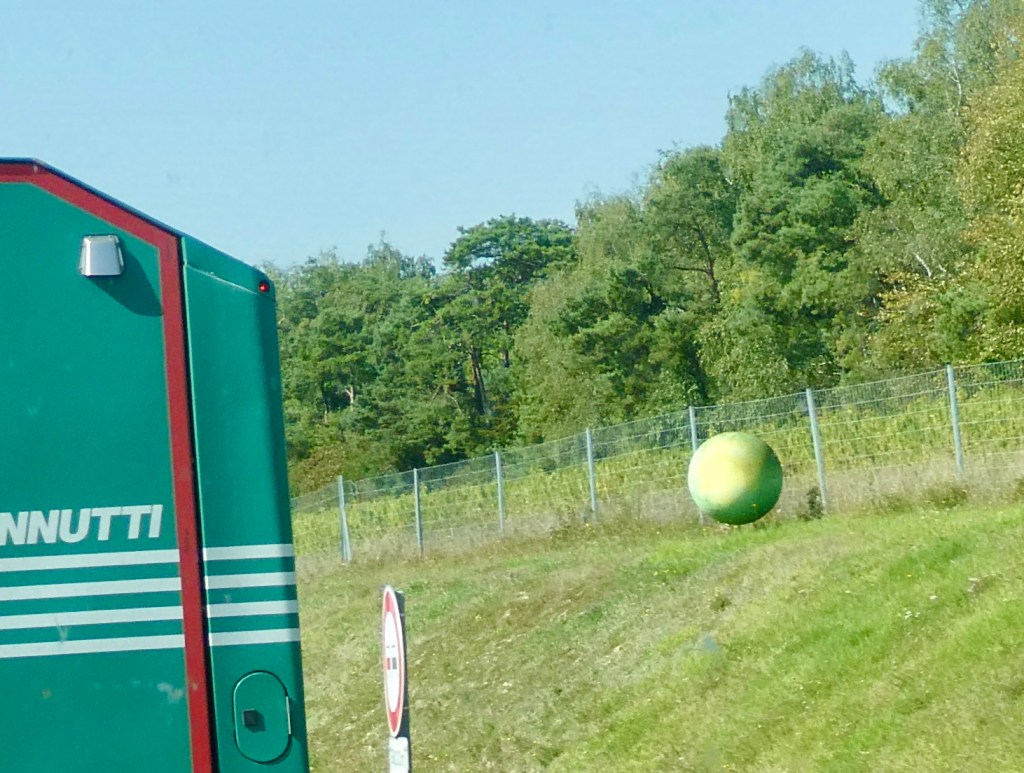
Along this road, in the area about half way between Luxembourg and Paris, drivers had accidents due to falling asleep. Brain science research suggested that if there were random things to look at that didn’t belong along the road, people would notice and stay awake. We saw numerous examples.

The strategy worked but after about ten years the effect was fading. They repainted the objects to make them brighter and make them more noticeable. Improvement was made once again.
Our guide started telling us about Reims. “Reims is the capital city of the Champagnia region of France. Mimosas don’t exist! If France still had the guillotine, that would be a capital offense.”
It takes between three and ten years to create a bottle of champagne. The formation of a treaty to end WWI an article was written into the document saying only this area of France can produce champagne. The United States signed the treaty but did not ratify it so there may be a loophole for the US.
We were trained in how to drink champagne. “Hold the glass in a way that will not warm the champagne. You do not swirl it like wine because you break up the bubbles. Also, don’t smell it, just drink it!” It should be cooled but not cold.
“In this part of France they grow sugar beets so Coke tastes slightly different – but if you want bubbles, you should drink champagne” said our tour guide.

Arriving in Reims we walked towards the city center. The town was 60-80 percent destroyed during the wars and only the fountain remained in the city center.

I had a delicious lunch of Quiche Lorraine and champagne- both regional examples. I don’t usually like champagne but this was good, and I don’t think I was holding my glass correctly!

The Reims Cathedral is the most important cathedral in France, more so than Notre Dame. It has been a UNESCO World Heritage site since 1991.
The Reims Cathedral was the traditional location for the coronation of the kings of France. Twenty five French kings were coronated at the cathedral, the last in 1825. Coronation was an important event but the king was already king by birth.
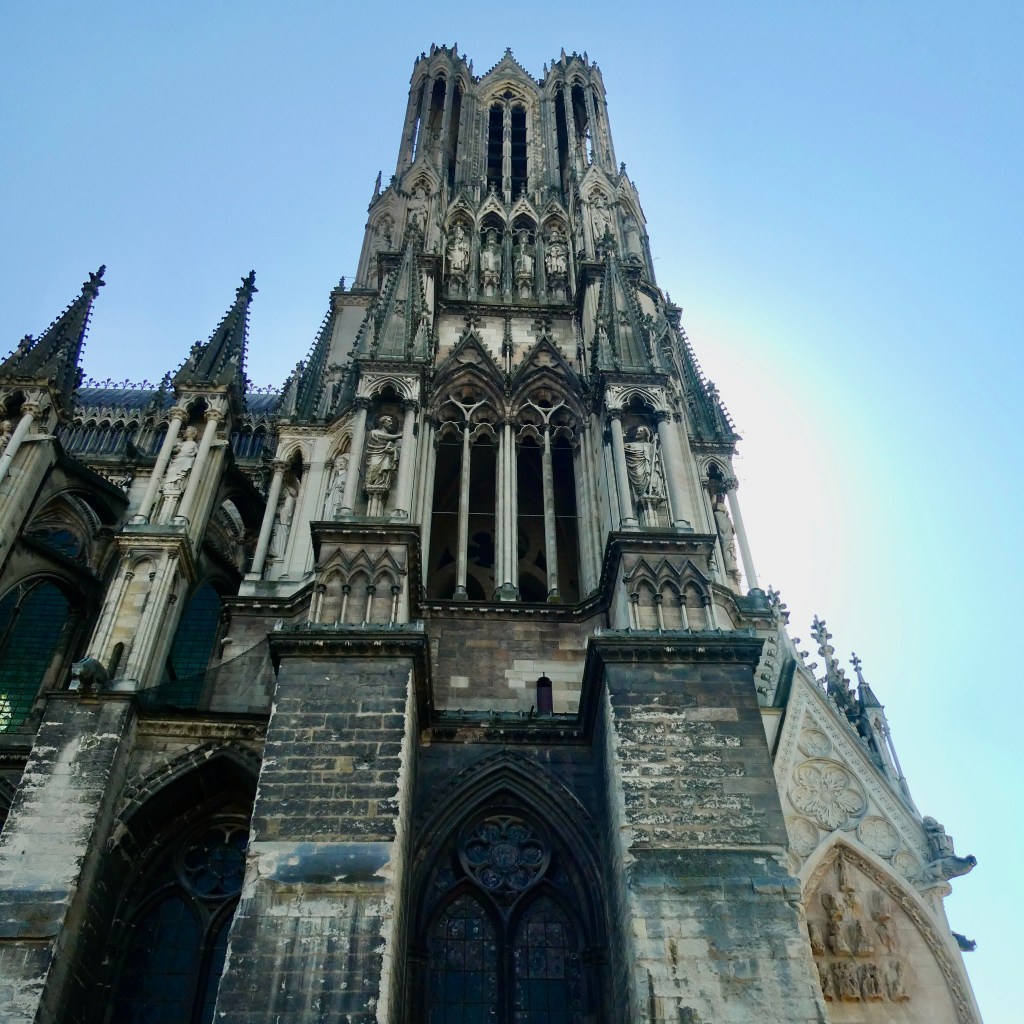
The original cathedral was commissioned in the fifth century by Bishop Nicosaius on this location, the former site of Roman baths.
King Clovis was baptized christian in the cathedral a century later, the first French king to do so.
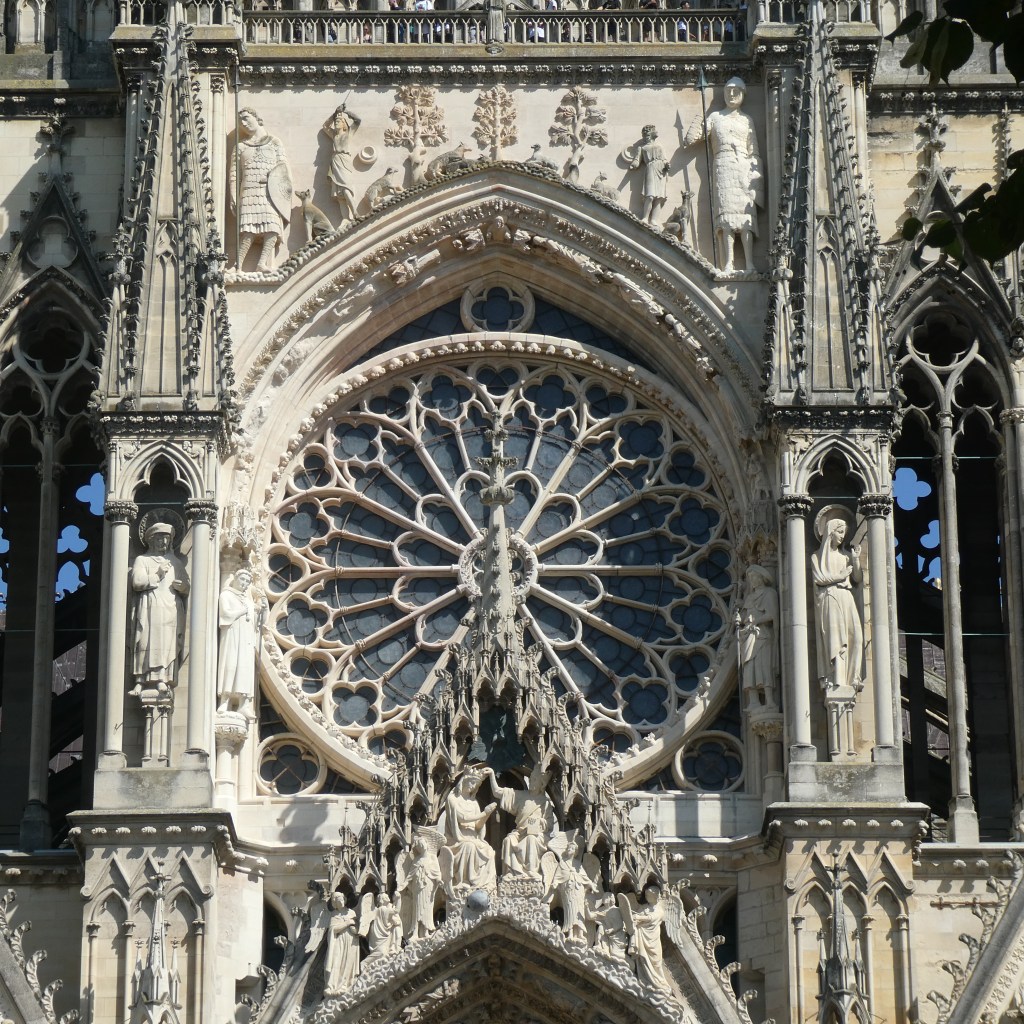
In 1211 the lower chapels were complete. The areas above, including the Rose window, took until 1290.
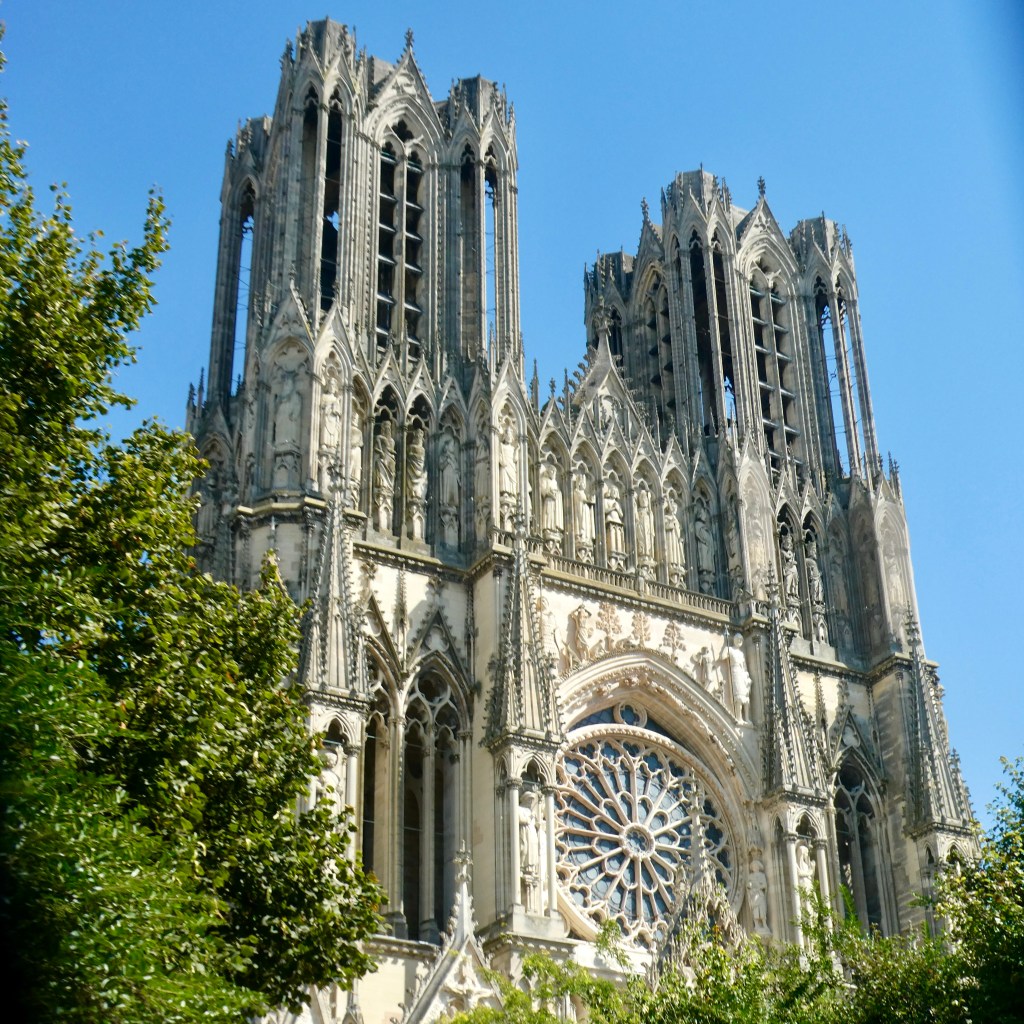
Construction of the present Reims Cathedral began in the 13th century and concluded in the 14th century. It was built to replace an earlier church destroyed by fire in 1210. The cathedral is a prominent example of High Gothic architecture.

About two thirds up are a row of kings meant to signify they were halfway between heaven and earth. The spacing would have been about half way if the intended spires were built. When the builders got to that point in 1516, the Renaissance had begun and spires were no longer desired.

There are Bible stories and people in the art on the facade. In earlier centuries, the stone was painted so the cathedral was colorful.
Although it was only slightly damaged during the French Revolution 1789-1799, there was some cathedral restoration in the 19th century.
The Germans tried to destroy the Cathedral during WWI to damage French morale. It suffered extensive damage from 300 shells. The roof was destroyed and more damage happened when the Germans occupied Reims.
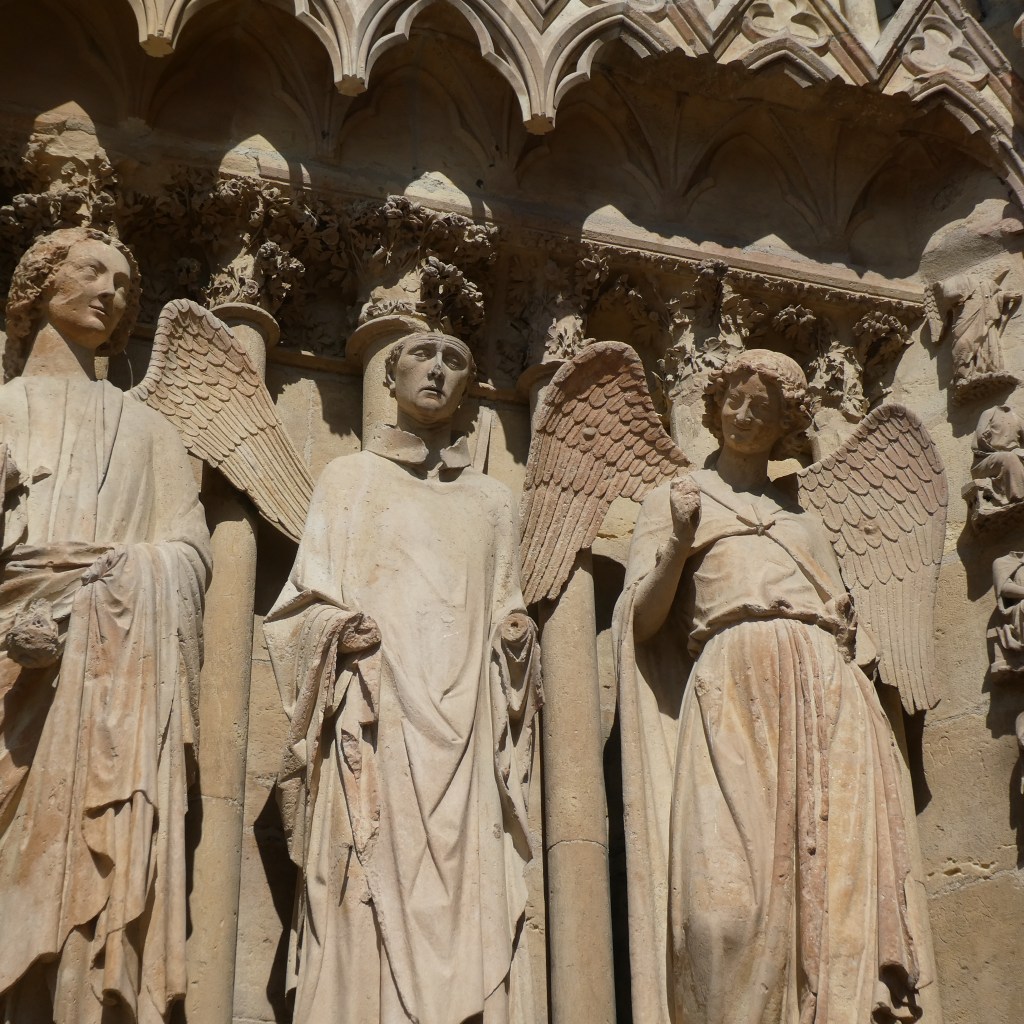
Shelling and a falling beam from the resulting fire decapitated the angel on the right, called both the Smiling Angel and St. Nicasius Angel. Built in the 13th century, her gentle smile had welcome visitors into the cathedral.
After the shelling and fire, her head was broken into more than 20 pieces. She became famous to the world as a symbol of the suffering of the people of France after the damage. Thanks to a priest who collected the pieces, and a plaster cast in a museum, the angel was restored in 1926.
After the war restoration of the cathedral became a world wide effort. The Rockefeller family from America paid to repair the roof using concrete.
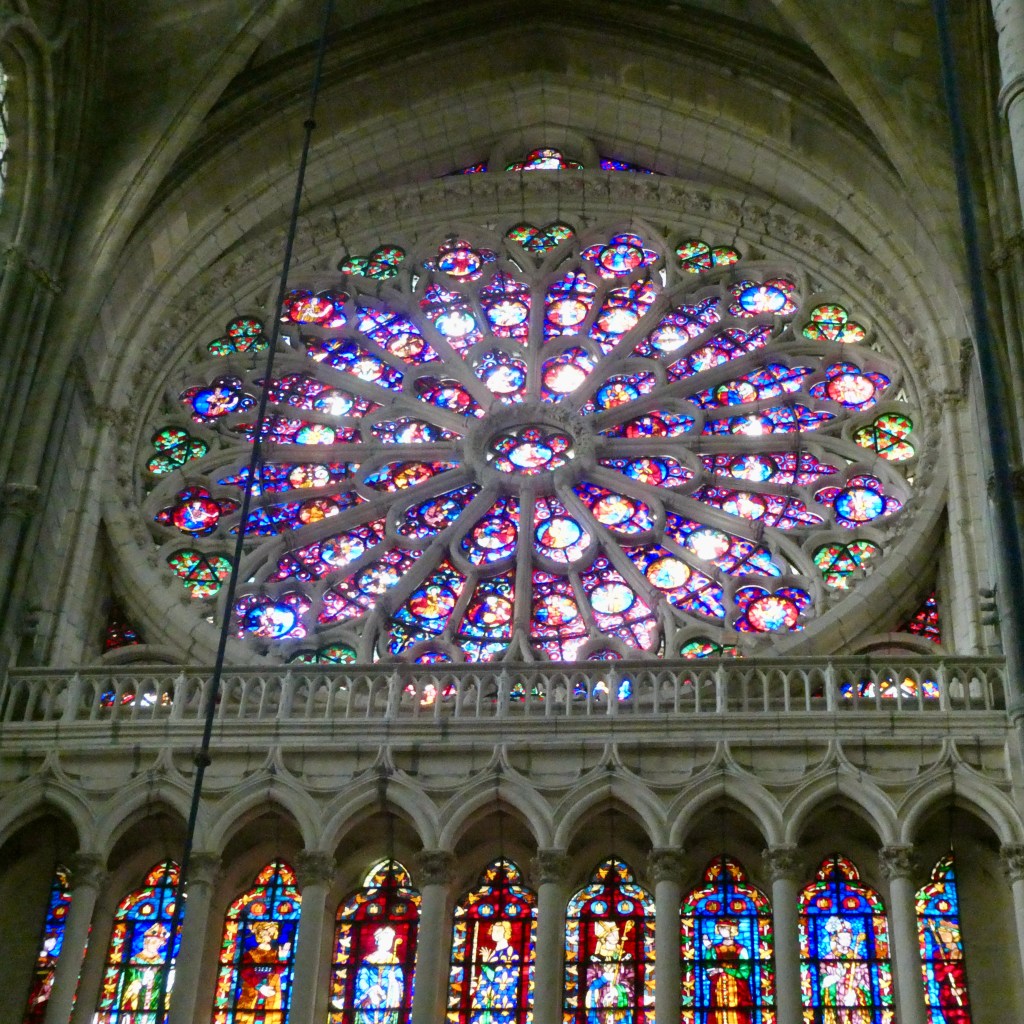
This is the rose window from the inside. Stained glass is very prominent throughout the cathedral.

This is the western facade from the inside. The interior of the cathedral was once painted and very colorful complimenting and reflecting the stained glass.
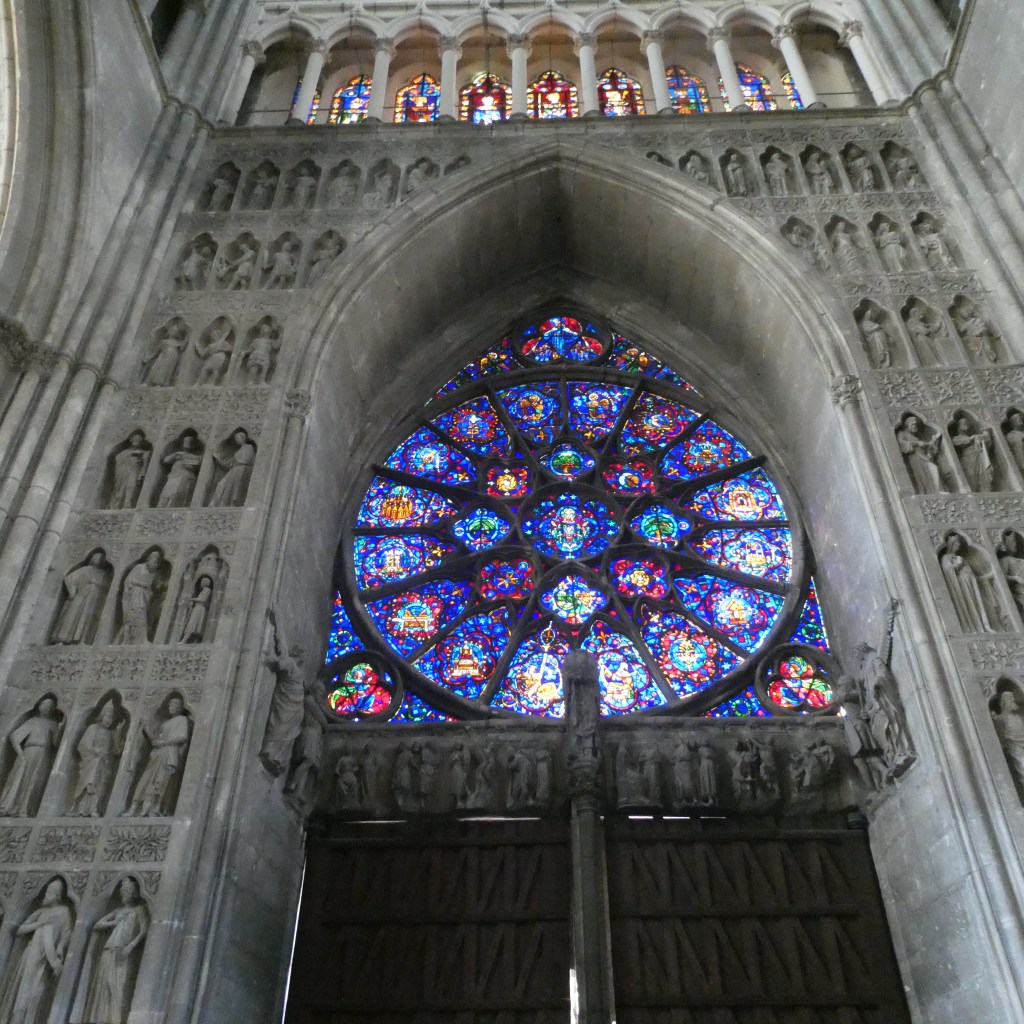
The stained glass windows range from original to restored to replaced due to age and destruction.
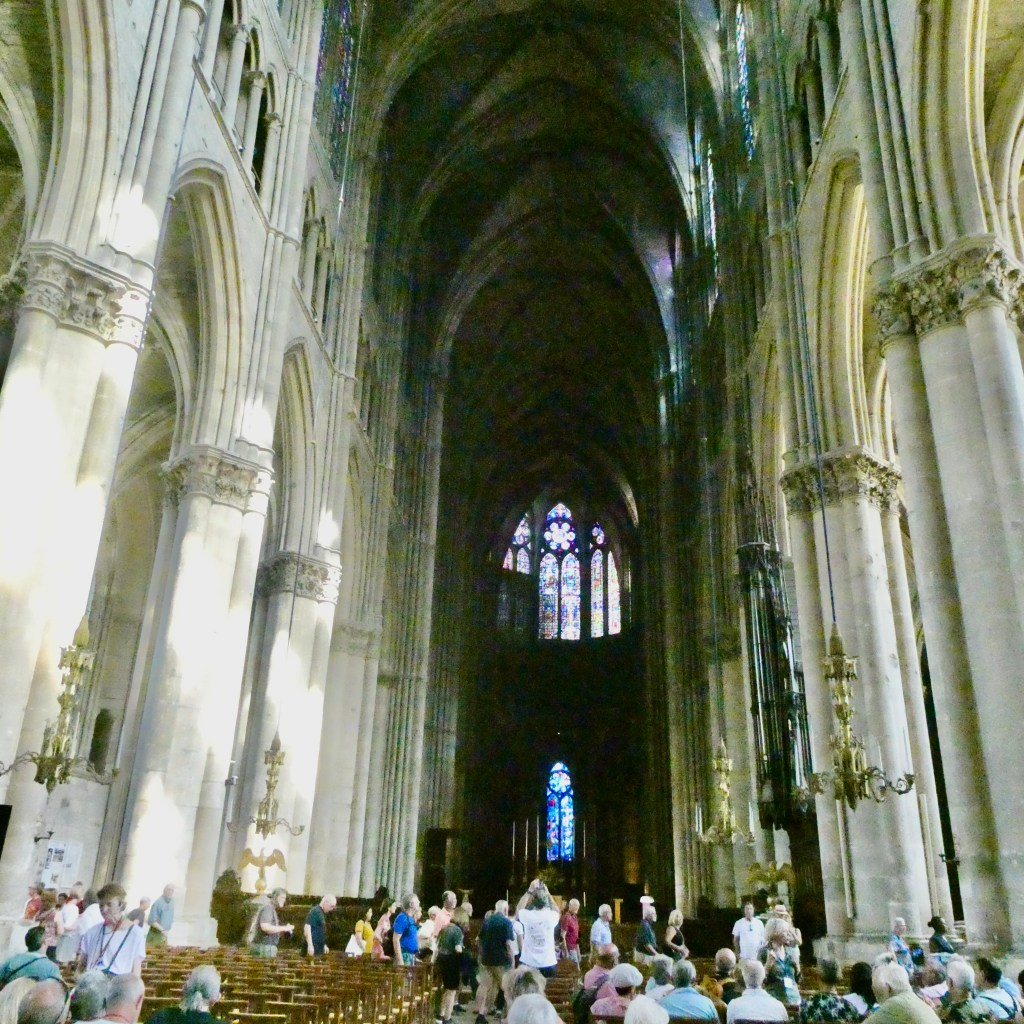
The windows at the top of the altar area are from 1214-15. The front portion was once divided off as being sacred. In the 18th century it was opened up for all to see.

These side windows were once colored but were replaced to provide more light inside.
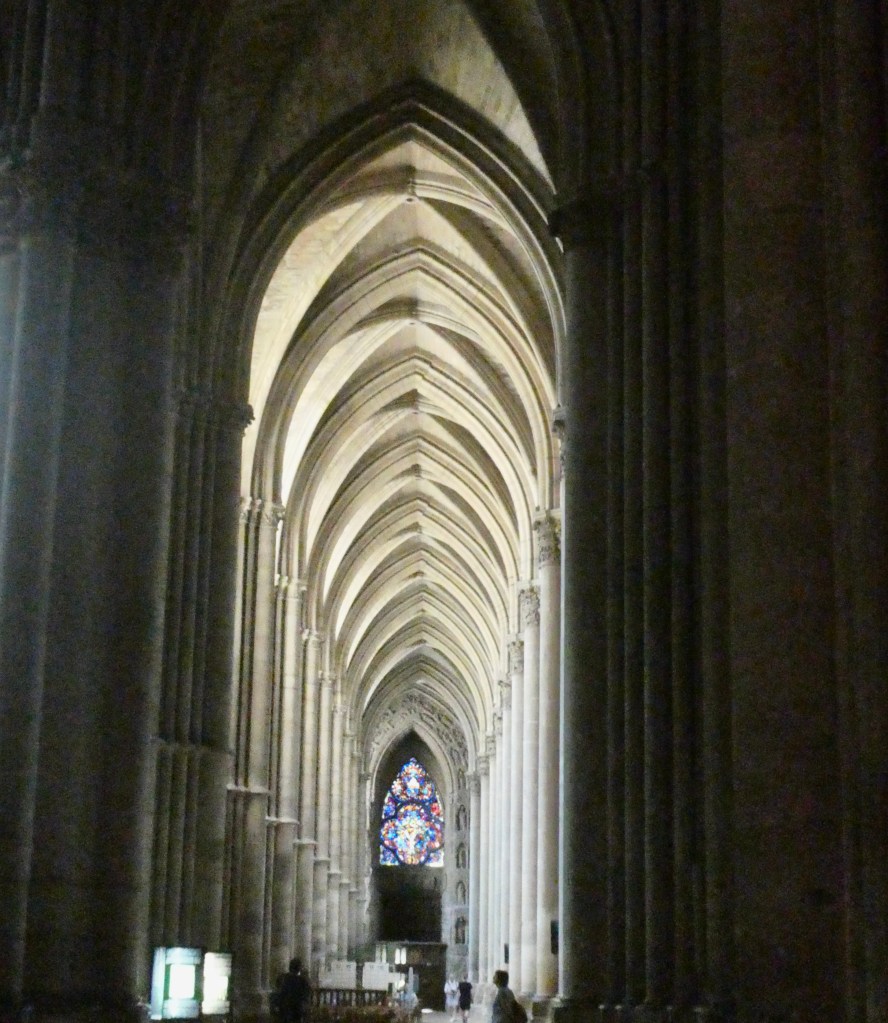
A 1905 law gave cathedral ownership and maintenance to the French government. The Catholic church has rights to its use and the Reims cathedral has services throughout the week.

Some of the best-known windows (to those who know about such things) are from 1974. These are the three windows made by Marc Chagall. They represent the Tree of Jesse, the Old and New Testament; and the “Grandes Heures de Reims”.
Marc Chagall (1887 – 1985) was a Russian and French artist. He created works around the world in a variety of mediums including stained glass, paintings, drawings, book illustrations, stage sets, ceramics and tapestries.
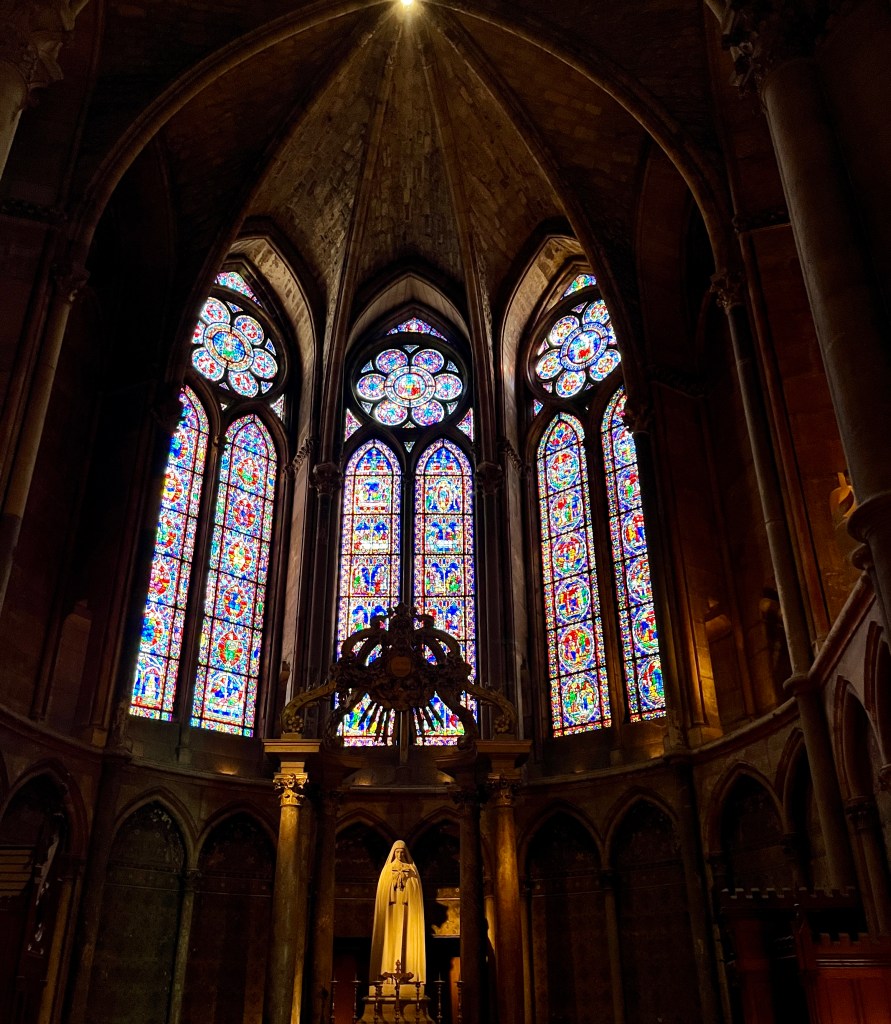
The newest stained glass windows in the Reims cathedral were placed in 2015.
We were in Reims on September 8, 2023.
Next up: We get to Paris and it was hot.


 Serene Wandering