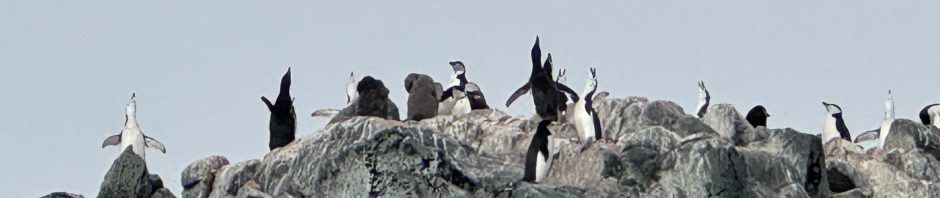
We were in Dunedin on January 25, 2025.

“Oh my, what a shock.” That is what Randy said when he looked out our windows and saw logs, thousands of them, again. We learned this species of pine originated in California where it takes 200 years to mature. The species was brought to New Zealand where a different environment and modifications allow the pine to mature in 25 years. These timbers are sent to Asia. Much of it will be made into particle boards – some returning to New Zealand.
This is our last port in New Zealand. Then we have a few sea days and begin the Australia portion of the cruise.

We had room service for breakfast today, something we rarely do. Today it seemed appropriate since we were time crunched for the dining room and had pretty much sworn off the Lido buffet for this trip.
Our excursion was the Albatross Cruise and Natures Wonders. It held the possibility of seeing albatross, seals, sea lions and penguins. And a boat ride! And an eight wheel drive all terrain vehicle!

After a very short bus ride from the port, we boarded the Albatross Express. We were told the catamaran has Euro-Six engines for lowest emissions. It is also equipped with impellers, not propellers, to protect the wildlife.

We were required to stay below as we left the harbor. I had moments of discomfort as I remembered a similar situation near Cozumel, Mexico. That had been my first ever experience of claustrophobia and I do my best to avoid similar situations. Fortunately this was just a few minutes.

We passed our ship, the Westerdam.

Our guide asked if anyone from North America knew the term “red right returning?” Randy did, and explained it. Our guide said that North Americans are the only ones who do it that way in the world and that everyone else uses green on the right return. We were glad to hear about that because when we’d been watching the Singapore cargo ship a few days ago, we recognized that he was operating on a whole different set of rules than we understood.

When looking along the hillside, we saw these vertical lines of trees going up the hill in several places. We were told that it was likely a natural barrier to keep the sheep and cattle at home.
As we sailed out of the Otago Harbor, our guide explained that Captain Cook discovered that Polynesian people occupied the largest area known at the time.

That area was a generally a triangle formed by Hawaii (1), New Zealand (2) to Easter Island/Rapa Nui. On this map Samoa is (4) and Tahiti is (5). Fiji is excluded on the western side.
New Zealand was the latest large land mass to be “discovered” other than Antarctica.


We boarded busses to go to a private farm. We got into an Argo, an eight wheel all terrain vehicle.

We passed a World War II bunker. The bunkers were built all along the east coast of New Zealand to protect against the Japanese, but were never used.

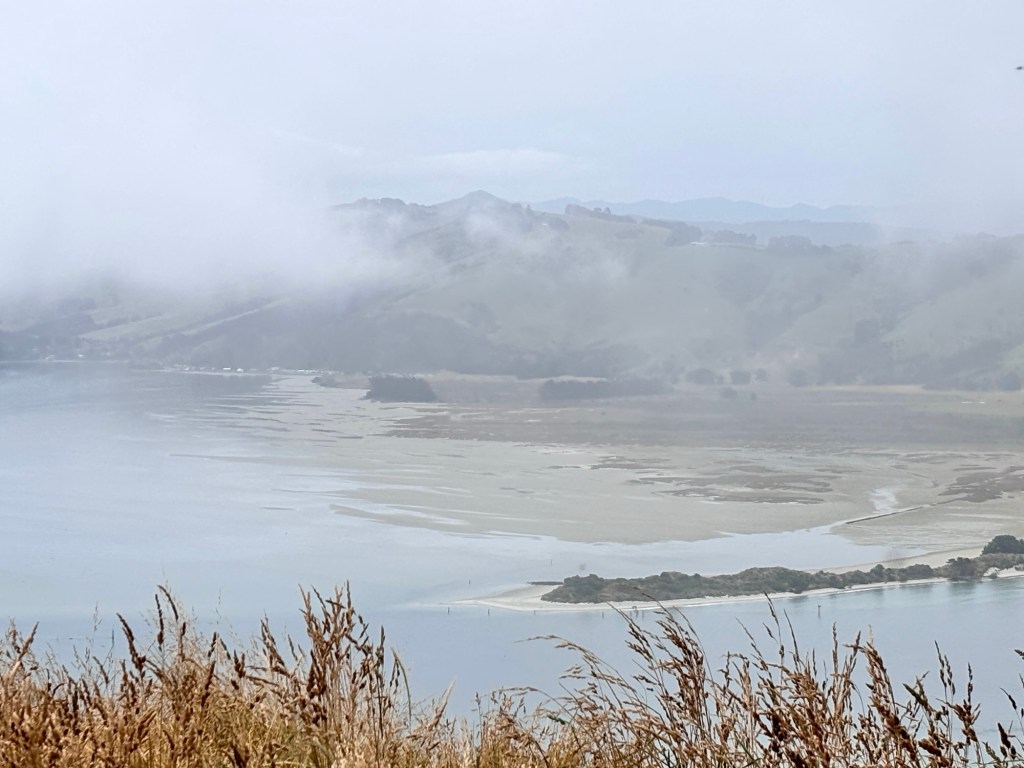

We had nice views at the top but the fog was rolling in!


We came back down and had a chance to watch some New Zealand Fur Seals. This area of rocks is home for the mothers and babies.

We saw some very young ones!

We saw babies nursing.

Some were in the grass above the rocks. These were the smart seals!
The babies will be here about six months at which point they will go out to sea with their mothers. They will continue to live in this general vicinity, but not this specific cove.

We also saw the nastiest looking kelp. It looked like something out of a horror movie. We were told it can grow up to a meter a day and has no commercial use. That seems like a missed opportunity!

This young seal seemed very interested in all the people. I wonder if this curiosity will be to his benefit or detriment.

We walked a bit to see this sandy beach. The owners of Nature Wonders are keeping this beach only for the wildlife.

We could see a few sea lions in repose on the beach.

The real prize is to see a yellow-eyed penguin on the beach. We didn’t, but learned they are the third largest penguin in the world and have this area as one of their remaining habitats. There are not very many of these penguins left and will likely be extinct in 15 years.

We were able to see the other native penguin, the Blue Penguin.

Natures Wonders has set up a series of doors where the penguins can be peeked in on. The penguins access a natural burrow on the opposite side and create a nest or den. They can be observed by peeking in the doorway.
Different burrows are utilized different years as the penguins choose. We were able to see three in use.

The first door opened to a parent penguin (unknown whether it was mother or father) and two five day old chicks. We only saw one of the chicks and didn’t want to stay too long to see the other.
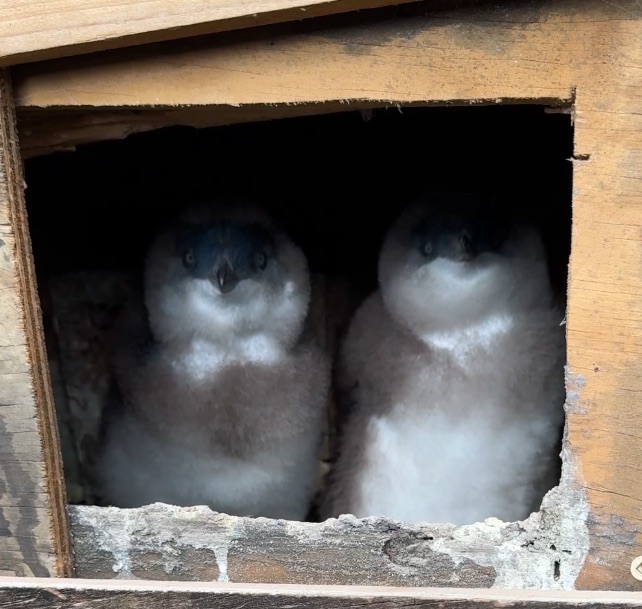
In the second opening, we saw two 9 week old siblings. They were very fluffy and cute – much cuter than the picture shows. They will be gone soon, no longer needing to be fed when they learn to eat fish on their own.
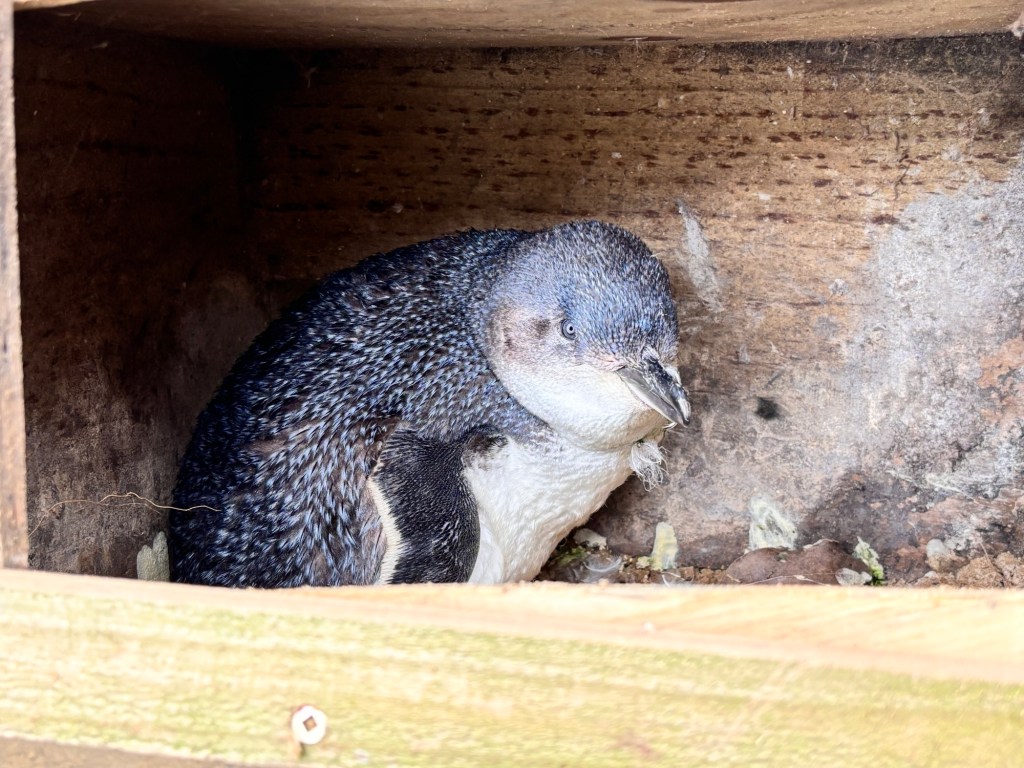
The third box held an adult that was molting.
We returned to the reception center and had a hot mug of tea and a scone.
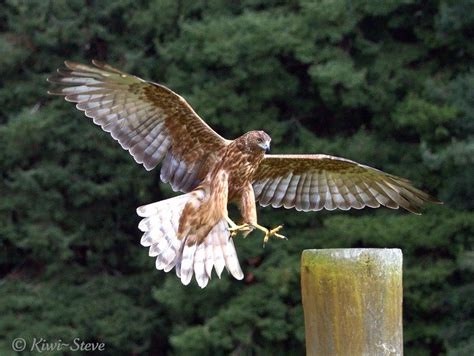
On the way back down we saw a Harrier Hawk. I was on the wrong side of the bus so this is a stock photo. We were told that this type of hawk is New Zealand’s only raptor. They eat mostly rabbits.

Seeing these hay rolls reminded me of something we’d been told a few days ago. Someone in New Zealand invented a biodegradable hay roll cover. The hay rolls just stay in the fields. Eventually, the cows (sheep?) are brought to the hay roll to feed eliminating the need to transport the hay roll. Makes sense to me.

It was time to re-board the Albatross catamaran. It had begun to rain but we knew we wanted to be up top, regardless.

We passed the Tamara Head lighthouse. It was built in 1864 and is still operating.

We were told that a species of albatross nests towards the top of this point. Our guide said that our best result here would be to see a white head peak up above the grass as they were nesting. There was not very much wind and they prefer to fly when it is windy.
Just when we were feeling disappointed, we began to see albatross in the water.

Supposedly, we saw three different species! We were rocking and rolling so much that even taking pictures occasionally was precarious enough. I didn’t attempt to take any notes.

I do remember that our guide said that none of the three species of albatross will go onto land – even though it is close. They come here from thousands of kilometers away for feeding. It’s an easy run to the grocery harbor!

It reminded us of when we saw and learned of the albatross on Kauai. Those albatross parents would fly all the way to Alaska on their feed run. See that post at Kauai: A Rainy Island and Albatross. They really are very interesting birds.

On the way back towards the ship. Randy talked with our skipper, who is also the ranch owner who owns pretty much the whole peninsula where we spent the morning.

Perry explained and demonstrated the light system for boats coming into the harbor. If you are coming straight in the light is white (as this photo shows in the middle right). If you are slightly to left or right of straight in, the light will be red or green.

We saw penguins in the water. I didn’t hear, or remember, which kind. They were quite small and would disappear and then pop up again 20 meters away.
Perry and Randy had quite a conversation. Perry said that it was soon going to be time to start shearing on the farm. He has about 2500 sheep and he, his son-in-law, and the dogs would do it themselves. In season, Perry has sheared 300 sheep a day for many years.
Back on board Westerdam, we were feeling fondly about our first trip to New Zealand. We sat on our balcony and watched people come and go.

A couple of gulls came to visit on our balcony, but I only got one to pose for a picture.

Randy noticed that our Holland America Navigator App said the temperature was -34 F and -36 C. We had our jackets on but it wasn’t that cold (and the conversion doesn’t compute either).
After dinner, we returned to our balcony to look for the albatross. We had been told that we’d see them as the ship left.

We had a different view of the WWII bunkers. We saw six or seven along our way.

First of all, we had a much better view of the albatross that were nesting when we were on the sixth deck of a cruise ship than we had from water level.

We stood on our balcony and spotted albatross, seals and lots of penguins! So cool!

We ended our night at the Rolling Stone Lounge. I got a picture before the dance floor filled.
Next up: Sailing Fiordland National Park Sea Day


 Serene Wandering