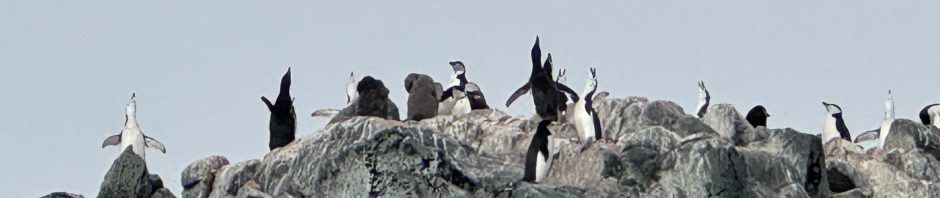
The Isle of Man is one of three self-governing British island territories. It sits in the Irish Sea between Great Britain and Ireland.

The United Kingdom is responsible for the island’s defense and representation abroad, but the Isle of Man has a separate international identity.
Humans have lived on the island since before 6500 BC. Gaelic influences began in 5th century AD. We had the Isle of Man’s history described to us as before the Vikings, during the Vikings, and after the Vikings. We visited on August 2nd.

As we came into port, we could see many wind turbines in the distance. Randy counted about 85, but said there were more on the horizon.

Our excursion was to travel by steam train from Douglas to Castletown.

The train station was made of bricks that were originally ballast on return voyages from Ireland.


This narrow-gauge train began operations in 1874. It still runs with its original locomotives.

There were eight passengers per car.

The only disappointing thing about the train ride was that our views of the sea were few.
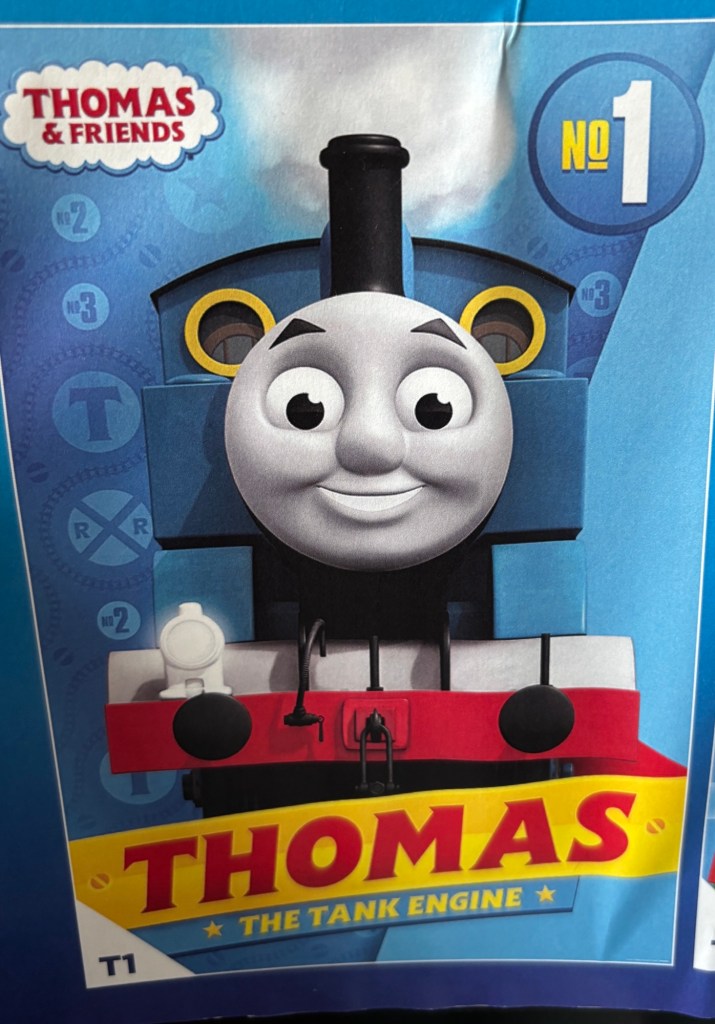
The children’s storybook character Thomas the Tank Engine was based on a fictional island near The Isle of Man. That is just the first of several random things we learned about the Isle of Man – more to come!
Our destination, Castletown, was named for its fortress, one of the most complete medieval castles in the British Isles.

This clock on the Castle Rushen’s exterior is prominent from the town square. It was presented to the island by Queen Elizabeth I in 1597. It has only ever had one hand, but is still operable after 400 years.
Castle Rushen’s first line of defense was an outer wall that was 7 feet thick and 25 feet high. The castle’s walls themselves were 12 feet at the base thinning to 7 feet thick at the top.


We paid our fee and began 90 minutes of exploration.

The castle entrance was protected by a drawbridge and two porticuilles with a killing area between.

The castle is operated by the Manx National Heritage, an organization that manages a significant proportion of the Island’s heritage assets including over 3,000 acres of coastline. It took over managing the castle in 1988 and completed restorations.

The Manx are the ethnic group that originated on the Isle of Man. Their language has a Gaelic origin but developed in isolation so is unique. Their governance structure, The Tyndall, was introduced by the Vikings over 1000 years ago. For example: A potential law must be read publicly, outside, in its entirety in both English and Manx.

Although the castle has been found to contain some construction materials dating to 947, it is advertised as 800 years old. It was developed by successive rulers between the 13th and 16th centuries.

After its initial construction and use by Norse and Gaelic rulers, the castle changed hands repeatedly between the Scots and the English.

From 1405 to 1738, the Isle of Man, and the castle, was controlled by the Stanley family, beginning with Sir John Stanley. His title began as the King of Mann, and over the centuries, the title transitioned to the Lord of Mann. Today the reigning British monarch, currently King Charles III, is the Lord of Man (The spelling changed over the years).
In the 18th century, the castle shifted in use to an administrative center including a mint and home for the law and parliament. The Isle of Man has the longest continuous parliament in the world. In 1881, it became the first national legislative body in the world to give women the right to vote in a general election although the action excluded married women.
Late in the 18th century, the castle began a steady decline and was converted into a prison. It was in notoriously poor condition. The prison held both men and women (and the children born to the women).

Early in the 20th century, the castle was restored under the oversight of the Lieutenant Governor, the highest ranking government official in residence on the island. The castle transferred from the British Crown to the Isle of Man government in 1929.


We lost count of how many rooms there were to explore in this compact castle.
One of the eight bathrooms had a medieval “resident” trying to do his business, with sound effects! It is too bad we don’t have a video, or at least a picture of that memorable room!

Some rooms were decorated to show how it might have looked during medieval times. The bird is only in silhouette in this picture, but the bird being served was stripped of its beautiful outer plumage, cooked, and re-dressed for serving.

We went up and down many circular stairways.


Many rooms had placards indicating what the room was used for during its medieval, administrative and prisons timeframes.

The castle was very interesting but when we got back it was time to explore the town of Douglas a bit.

The Gibb brothers – the BeeGees – were born on the Isle of Man.
There is an infamous TT Motorcycle race that takes place here. (We didn’t know it.). Friend and reader, Mark, just gave us the scoop on the race. Over 260 people have died since 1907. Sheesh!
Manx Cats were known as cats from the Isle of Man early in the 19th century. Their lack of tail arose as a natural mutation on the island.
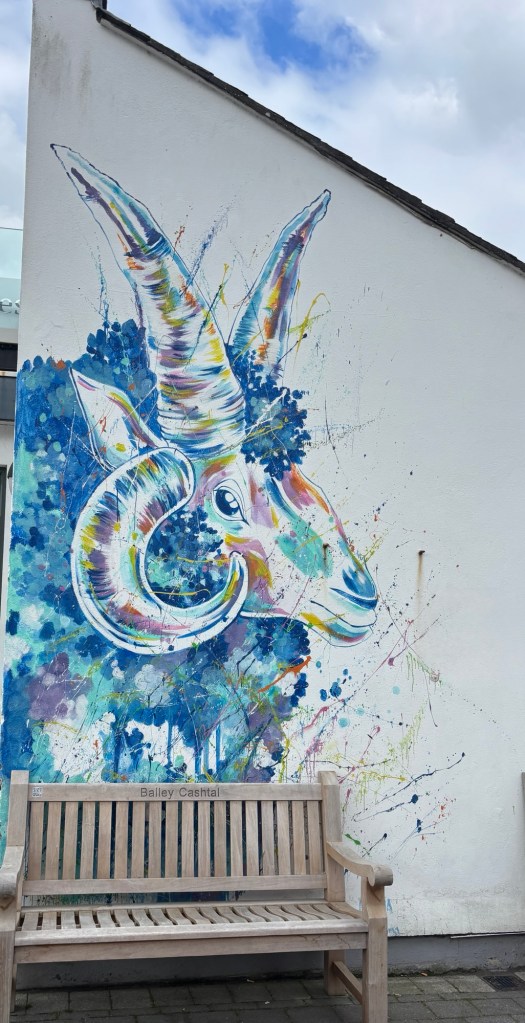

The Manx Loaghtan is a small native sheep from the Isle of Man. They usually have four, and occasionally six, horns. It is much desired for its unique meat.

The Isle of Man flag was first recorded in its presentation to parliament in the 14th century. A common interpretation is: Whichever way you throw me, I will stand – indicating resilience. The symbol was also used on coins printed in the 17th – 19th centuries.

Shipwrecks on the coast of the Isle of Man in 1822 inspired local resident, Sir William Henry to encourage the British government to establish “a national institution for the preservation of life and property from shipwreck.” He was instrumental in saving lives personally and in development of this resource.
The little castle below is on the Island of Refuge. There is always supposed to be bread and water in the little castle for anyone in need.

Nieuw Statendam is the largest cruise ship that will visit the Isle of Man this year. It is a ship of about 2600 passengers, mid size by industry standards.
The Isle of Man was one of the more interesting places we’ve been that we had not even known existed before arriving and exploring.
For many, many years, we had gotten a Christmas ornament from every new place we visited or every special trip we took. We have had to get much more selective in recent years because we don’t have tree space for all the ornaments we already have. That being said, I bought this one from Isle of Man in a heartbeat.

I will smile in remembrance as I place it in a prominent place on the tree this year.
Next up: Liverpool, England. We went Beatles-centric!


 Serene Wandering
The Isle of Man race is actually a notorious motorcycle race. There have been a couple hundred deaths of riders, spectators and race marshals. Several a year in some cases!
Well that is crazy stuff! The guide was pretty blase about it! Updated the blog, thanks!