
On our tour, we learned that the earliest humans in Greece are from six millennia BC. Christianity grew out of this area. The 1204 crusades took Constantinople and split the empire. The Ottomans came in 1453 and ruled for 400 years.
The fight for Greek independence began in 1821. France, England and Russia were supportive and for a time Greece had a neutral German king. Athens became the capital in 1834.
Greece eventually had a Danish monarchy. In 1974, 72 percent of the Greek population voted against continuing a relationship with the monarchy.
Under Greece’s democratic style government, citizens vote every four years. They have a prime minister and a mostly ceremonial president. The Greece constitution is considered the most advanced constitution across Europe combining examples from America and post revolution France.
There are 11 million people in Greece, and five million of those are in Athens.
The Greek influence is so broad that there are 16,000 Greek words in English.
Our destination in Greece, on this day, was Corinth, both the canal and the ancient city.

In ancient times, several rulers saw a potential benefit in digging a canal through the isthmus between the Ionian Sea and the Aegean Sea. The first known intent was from the 7th century BC but they just couldn’t make it happen given knowledge and resources at the time. (The picture shows the canal eventually developed.)
Instead, early rulers developed a portage road so ships could be towed from one side of the isthmus to the other.
A second attempt at a canal was considered around 300 BC. Three Roman rulers considered the idea but each suffered a violent death before initiating the project. One of those rulers was Julius Caesar.
The canal idea was revived again after Greece became an independent country in 1830. It was deemed too expensive for a new country to take on.
The successful opening of the Suez Canal in 1869 sparked canal interest again. The Greek government passed a law authorizing the construction of a Corinth Canal. Construction began in April 1882 and, after some financing drama, was completed in July 1893. Construction took 11 years.

The canal connects the Gulf of Corinth in the Ionian Sea to the Saronic Gulf in the Aegean Sea. The canal is 4 miles long and only 80.7 feet wide at sea level. It is not passable for most modern ships and is now mainly a tourist attraction.
We traveled a short distance to the city of Corinth. Archaeologists believe the area of ancient Corinth was inhabited from the 10th century BC.
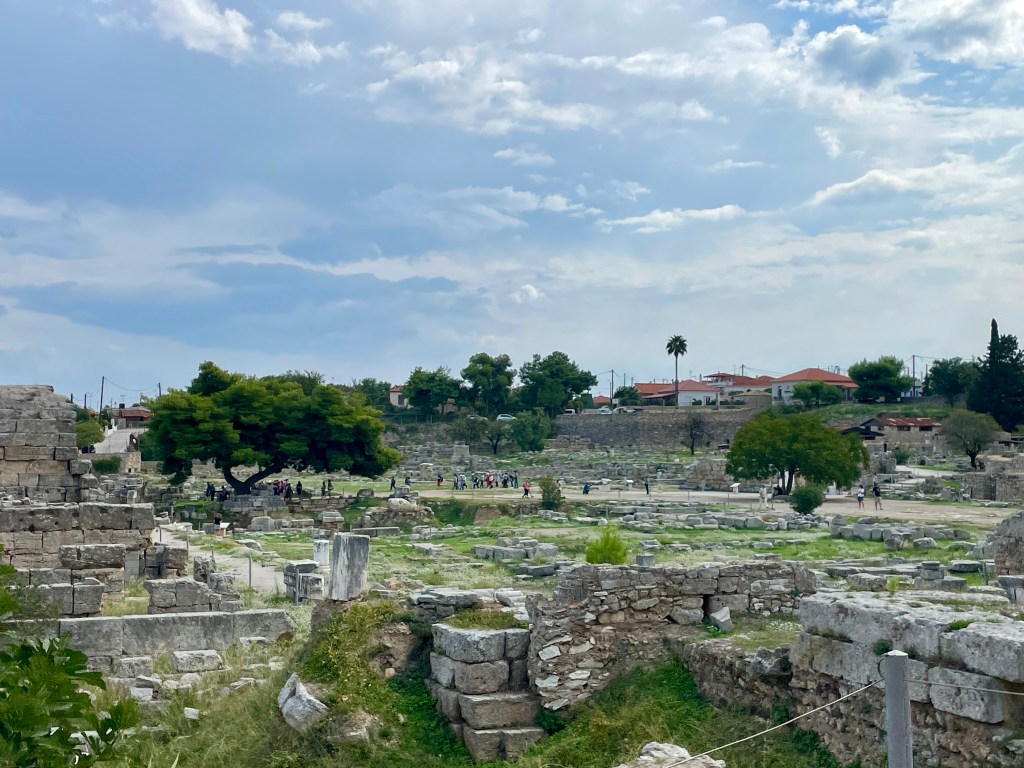
Ancient Corinth was one of the largest and most important cities in Greece, with a population of 90,000 in 400 BC. The Romans demolished Corinth in 146 BC and built a new city in its place in 44 BC. It was later made the provincial capital of Greece.
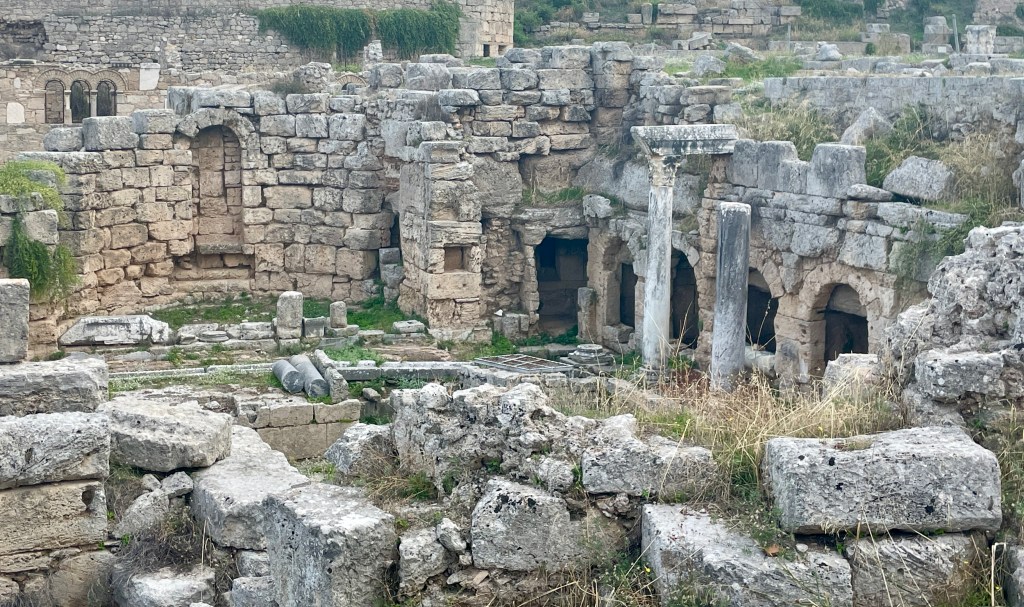
Corinth was once the richest city of the world. It had two ports, one on each side of the isthmus, with the ability to travel almost anywhere. The portage road allowed for travel between the Ionian and Aegean seas.
Paul visited Corinth during the time of Roman occupation. In 51 AD he lived here with Aquila and Priscilla. Paul was run out of Corinth but he wrote several letters back to believers in Corinth. Those are recorded in Corinthians I and II in the bible.
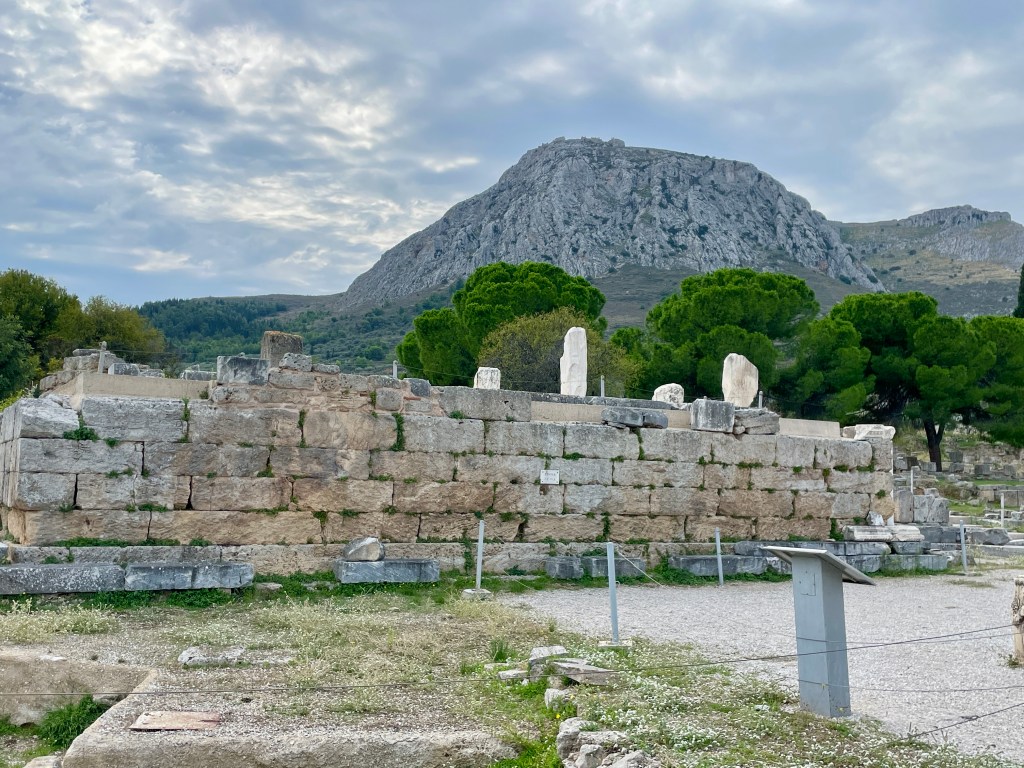
Paul came to this area to preach, likely from this platform.
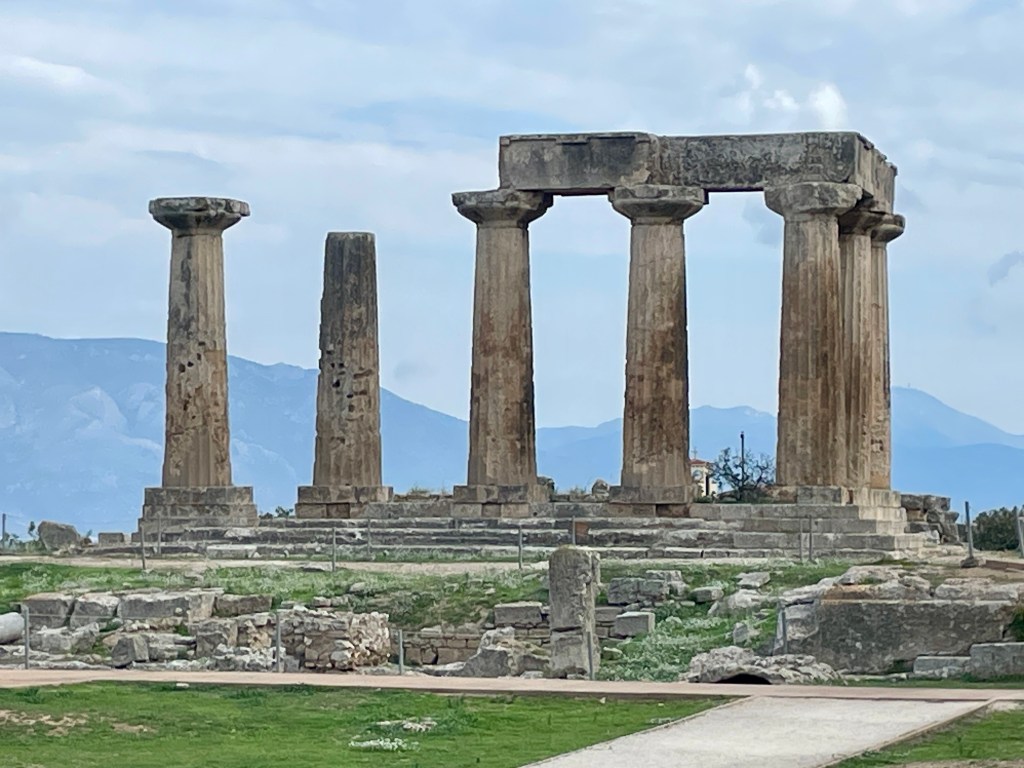
This is the Temple of Apollo. Its structure corresponded to the golden rule of temple building. The number of columns on the short side = x and the long side = 2X + 1.
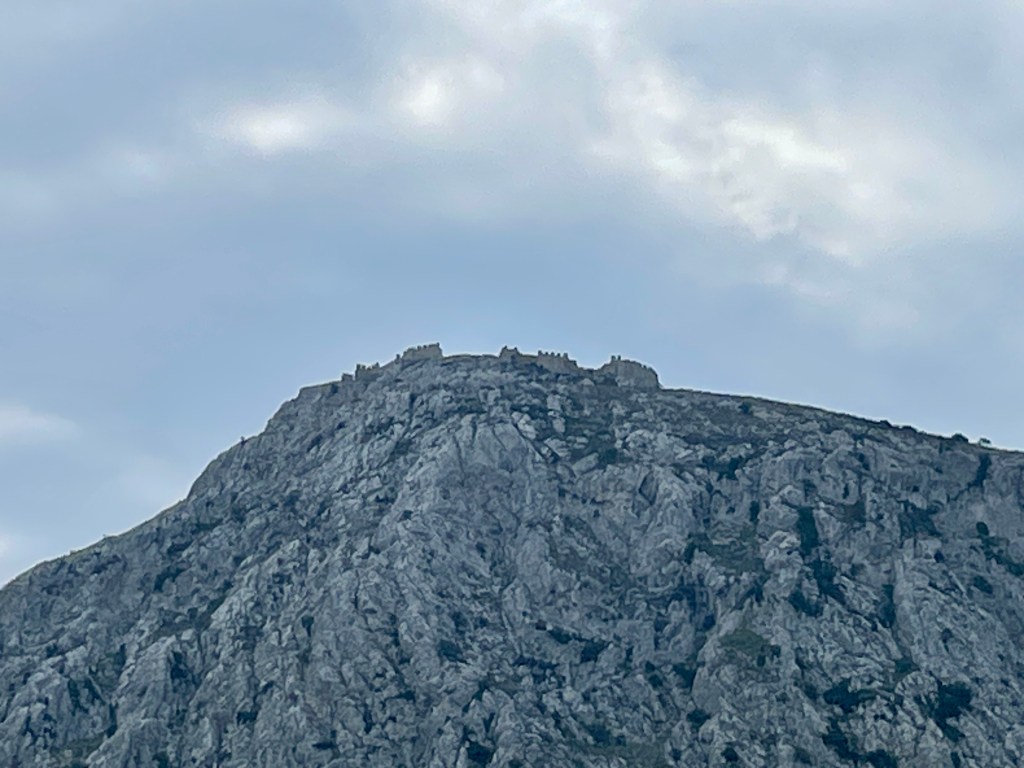
Aphrodite protected the city from her temple on top of the mountain. There were also Aphrodite prostitutes to take sailors’ money while their ship was moored at port, or being moved along the portage road.
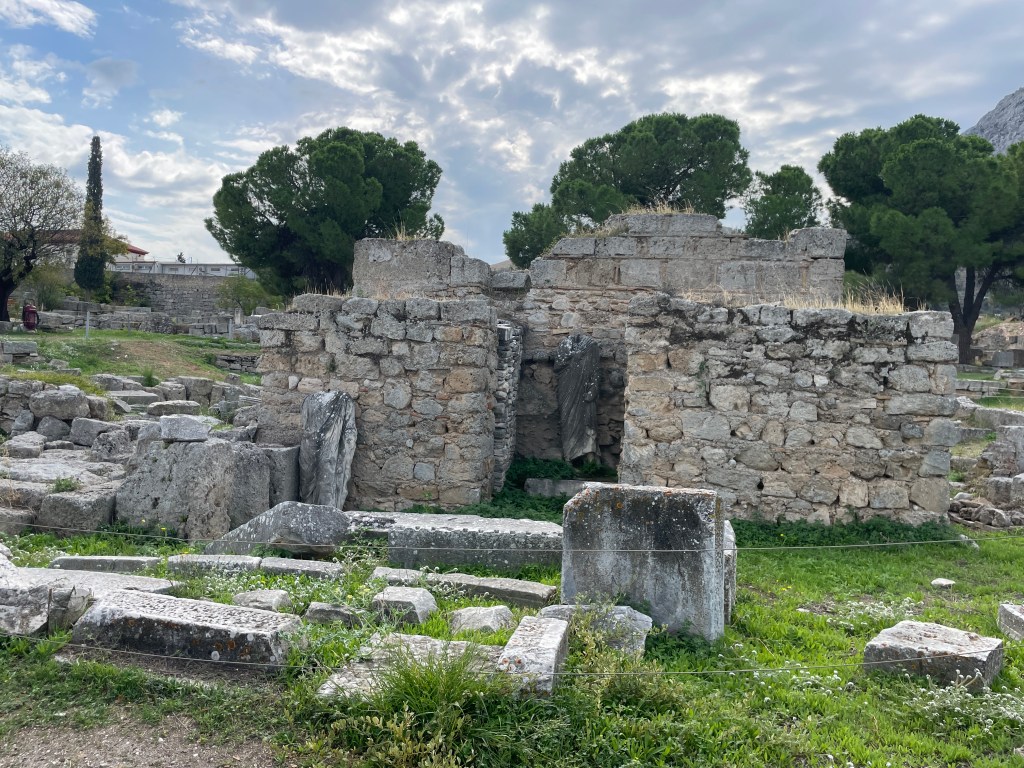
Ancient Corinth had quite a history combining Greek mythology, the Rule of Tyrants, Roman rule and the missionary visits of Saint Paul, Byzantium history and devastating earthquakes and on and on!
The modern city of Corinth is outside the area of the ancient city because of destruction from a massive earthquake in 1928.
We visited Corinth on September 30, 2023.
Next up: Athens


 Serene Wandering
Wow, that is a crazy narrow-looking canal. Sawn out of solid rock by the looks of it! When you say that the Golden Rule of Temple Building is “The short side = x and the long side = 2X + 1”, my civil engineer mind asks, +1 what? Foot, yard, cubit, ??
Columns! I should have been more specific.
Got it! Thanks.