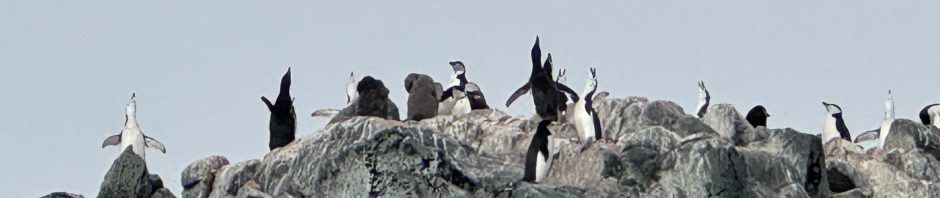

Before our final day, we had our final night aboard the Treasure of Galapagos. Our ten person crew joined us in their dress uniforms so we had a chance to say goodbye and give them a thank you tip.
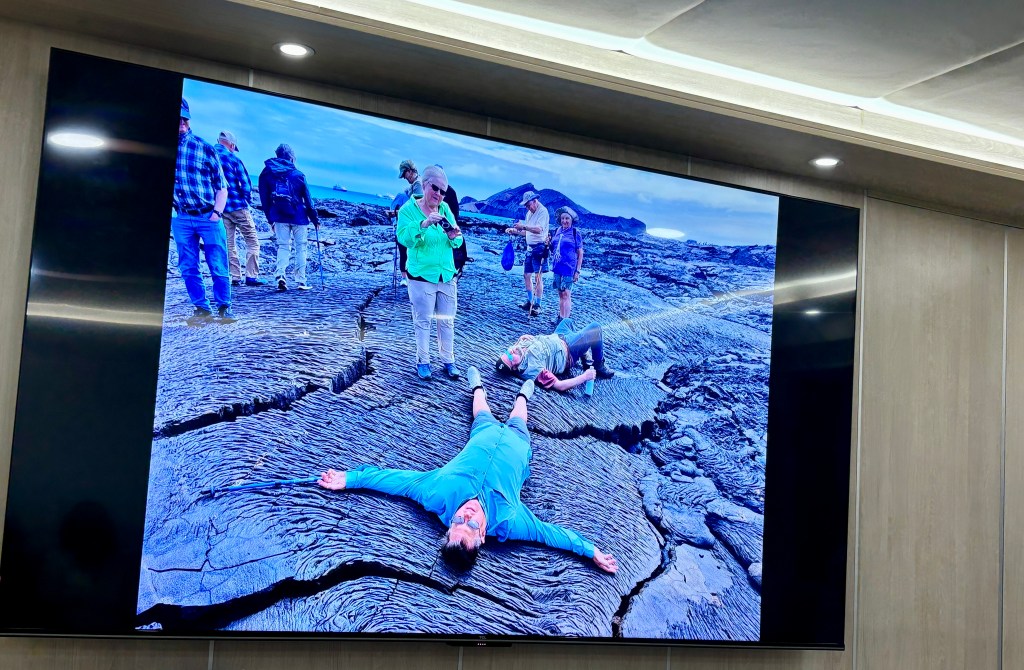
Victor had prepared a photo montage of our trip. I was able to grab a quick picture of one he took of Randy and me on the lava bed.
Fortunately, our last overnight was uneventful and we awoke on the other side of San Cristobal Island. We said goodbye to the crew and went ashore in the zodiacs.

Of course, we saw one more sea lion sleeping in the rocks.

We were bussed to the San Cristobal Interpretation Center to learn more about the Galapagos Islands that we had been exploring for the last four days.

The Galapagos are a group of islands with unique ecosystems and biodiversity because they are impacted by four world currents which converge in the area.
Administered as a national park of Ecuador, they try to balance eco-tourism, the communities that live on five of the islands, responsible fishing and waste management.
The center offered us a history of the islands from origin to its discovery by Europeans and the abuses of attempted colonization. There’s even a murder mystery in there!
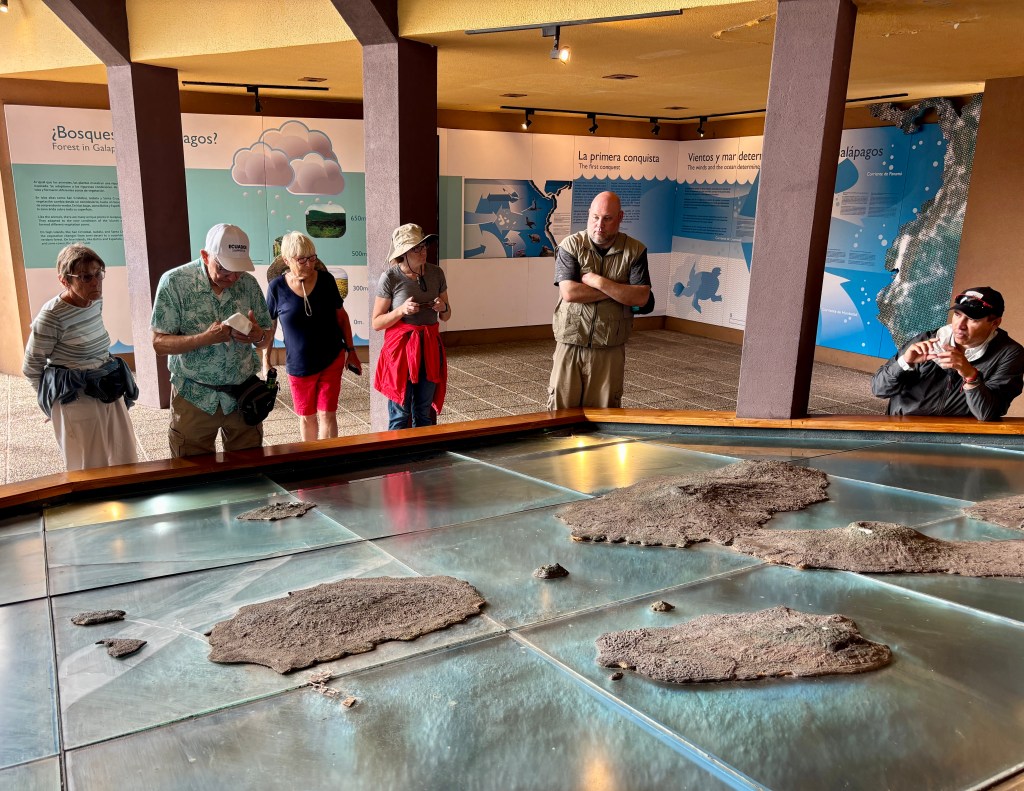
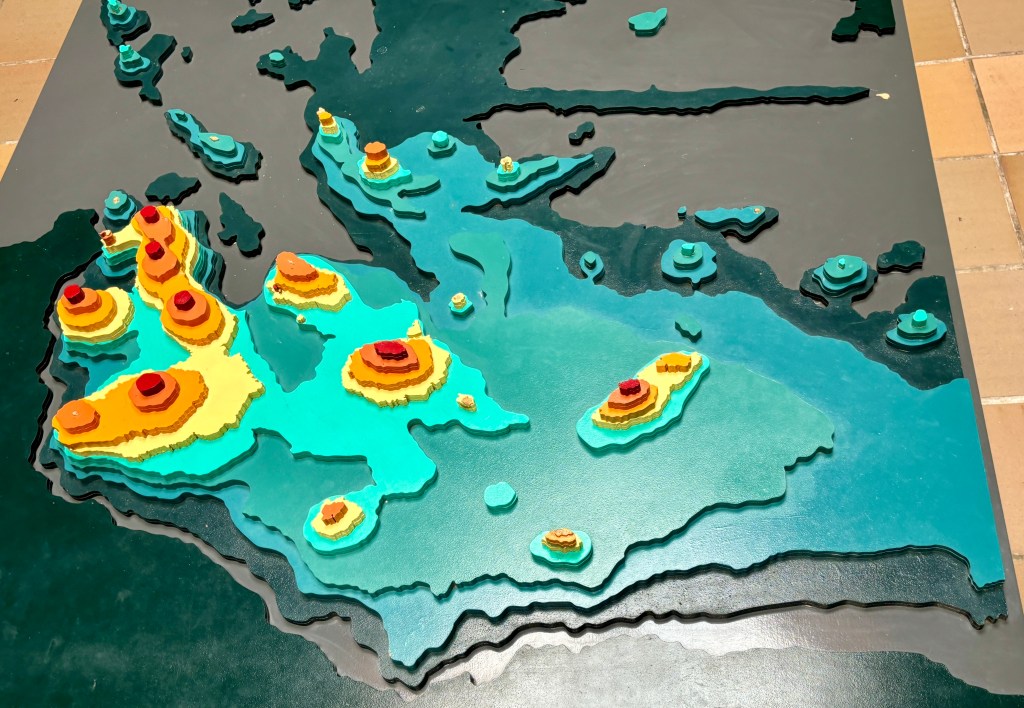
Over the course of millions of years, underwater volcanoes erupted repeatedly. The islands are the tops of underwater volcanic mountains. There are fourteen islands in the Galapagos, using the definition that each island has its own volcano. There are many more “extra rocks.”
Currently, the hot spot from the earth’s core is creating new islands to the northwest. This happens as the Nazca Plate is moving southeast at 3-4 inches per year.
Legend, and pottery shards, suggest that indigenous groups found their way to the islands from the Ecuador mainland during pre-Columbian times.
Documented discovery began with Tomás de Berlanga, sailing for Spain to inform the king about lands conquered from the Inca. When the winds died, the currents took them out to sea. They landed, near death, on these islands. A few died in the next 21 days, but most were able to sail back to the mainland when the winds returned.
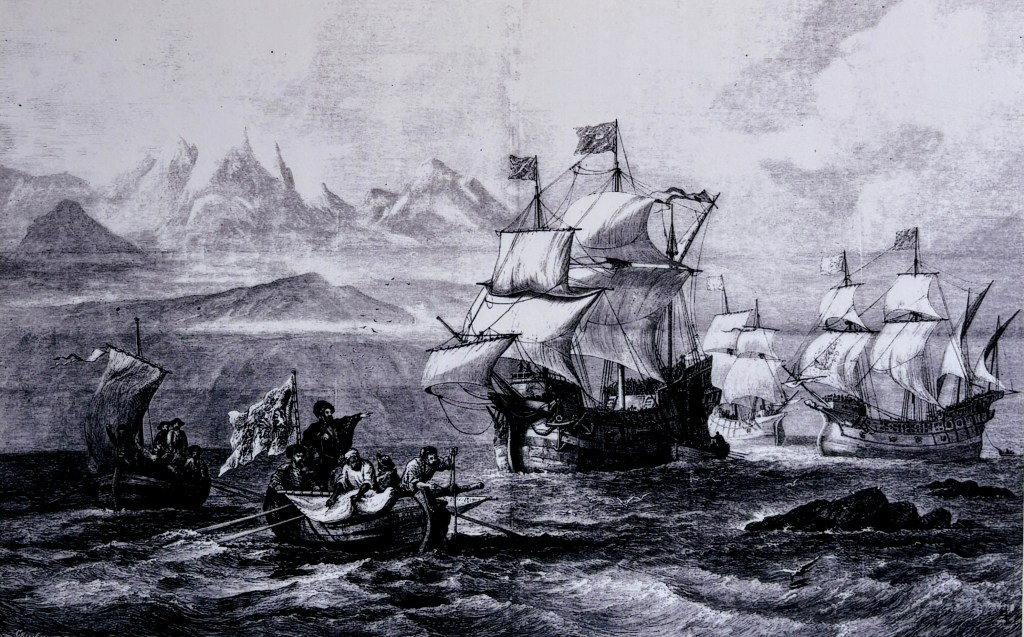
Once discovered, the King of Spain sent numerous expeditions to explore and map the islands. Many of the islands were named during this time and still bear their Spanish names.

In the 17th and 18th centuries, the islands became a haven for pirates. Exploitation of resources, including the great tortoises, began.

Non-native species were introduced.
In 1832, Ecuador claimed the Galapagos Islands as their territory. Jose Villamil was designated the first governor and tried to establish a community that included prisoners who were pardoned in exchange for doing the work. The mixture of colonists and former prisoners didn’t work and Villamil left within five years.
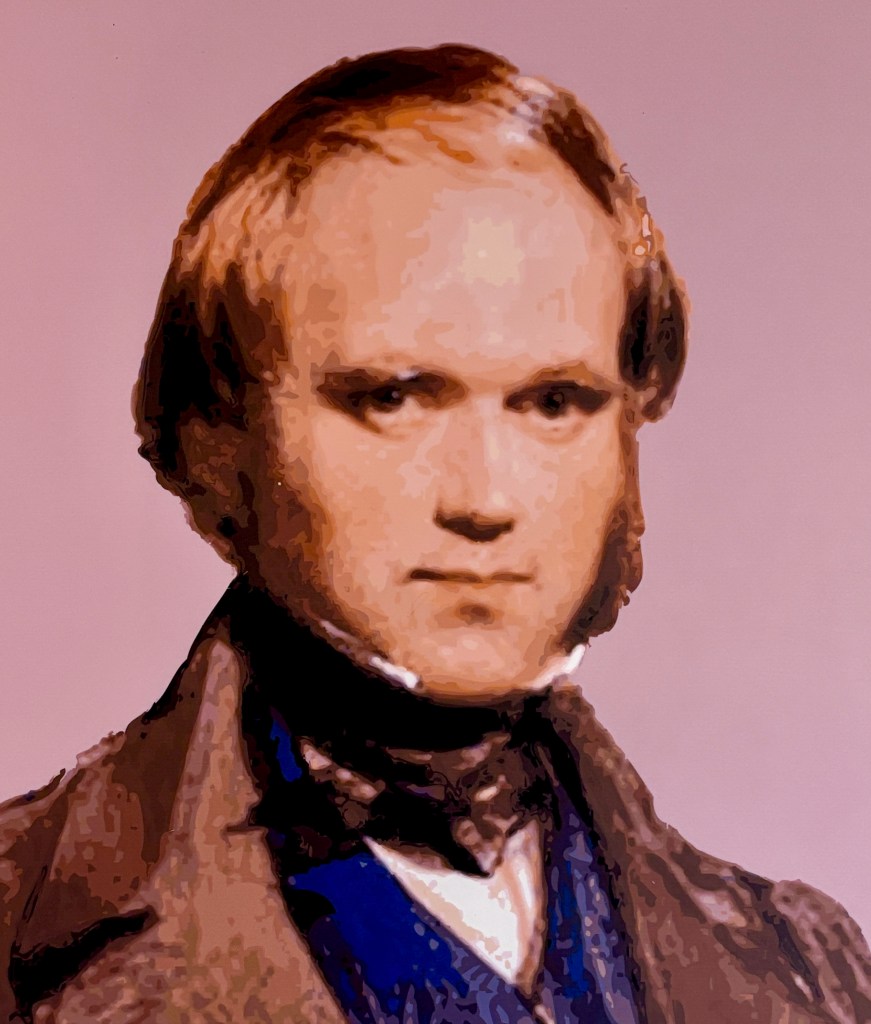
In 1835, Charles Darwin arrived during a voyage on the Beagle.
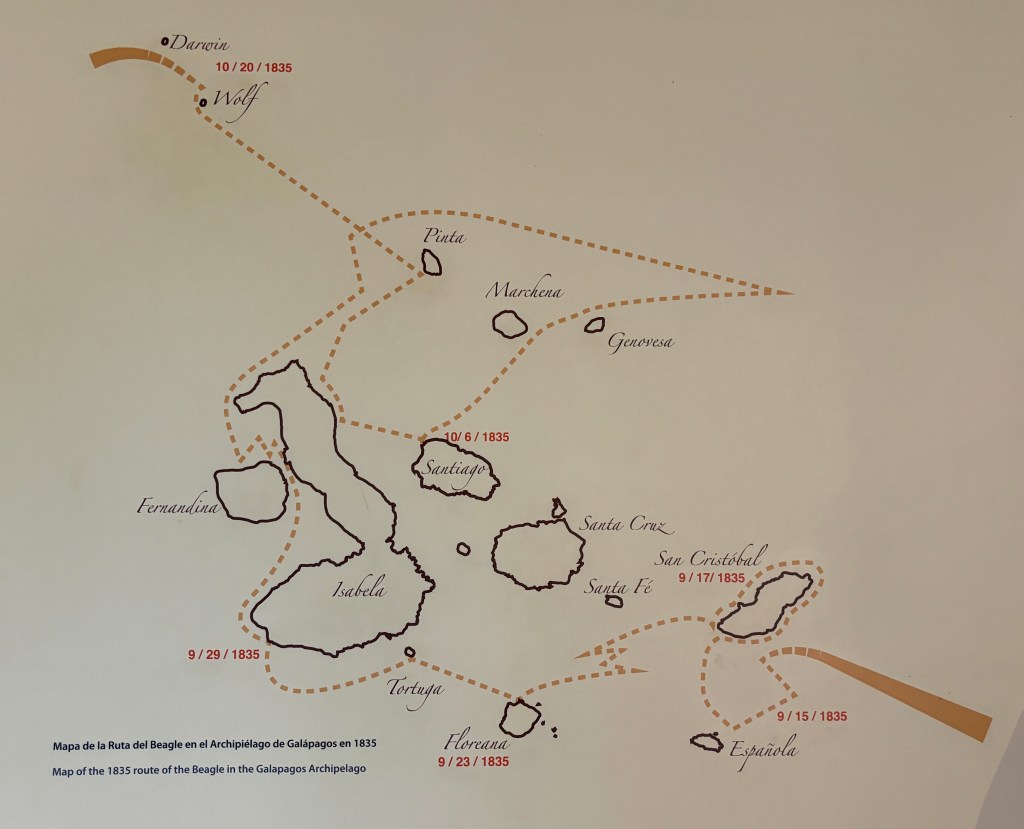
The Galapagos were just one stop on a five year voyage under Captain Fitzroy but left an indelible mark on Darwin, and eventually the world of science and religion.
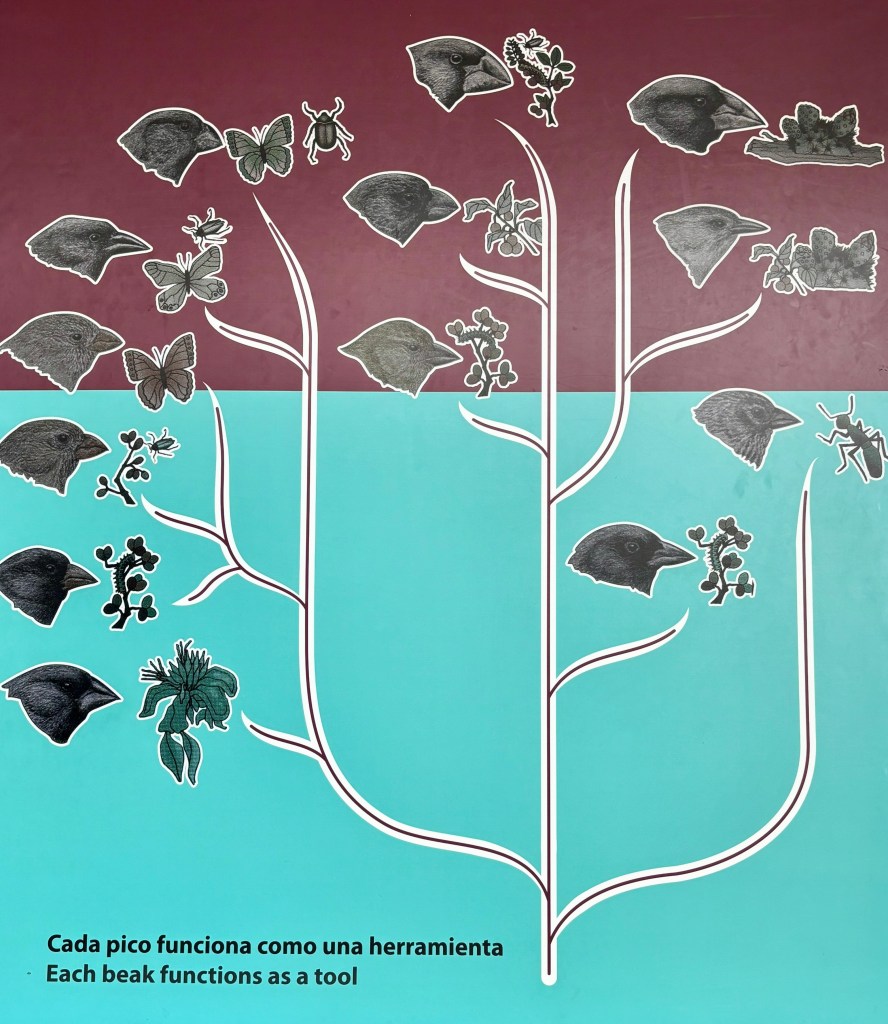
Darwin recognized that, geologically, the islands had a unique origin that should be studied. He noted the differences in species not only from the mainland but also between the islands. Darwin warned against the introduction of non-native species.
Over time, Darwin developed his theory of evolution that resulted in great controversy throughout the world. The implication that humans could have evolved from another, more primitive species caused him to be greatly and maliciously criticized. Charles Darwin died in 1882.
Back on the Galapagos, the exploitation of the islands continued. Cattle were introduced. Criminals continued to be sent there. Over time, the islands were mostly abandoned because various criminal acts left an aura of being cursed.
In 1860, the United States, France and England became involved because the location of the islands was considered valuable for international trade and strategic as a defensive position. The abundance of guano was valuable and marketable. Despite pressure, Ecuador did not give up control of the islands.
In 1925, the islands were marketed in Norway as a tropical paradise. That didn’t work out well and many immigrants died in the arid environment.
In 1929, two German couples emigrated (not together) to Floreana, a mostly habitable area.
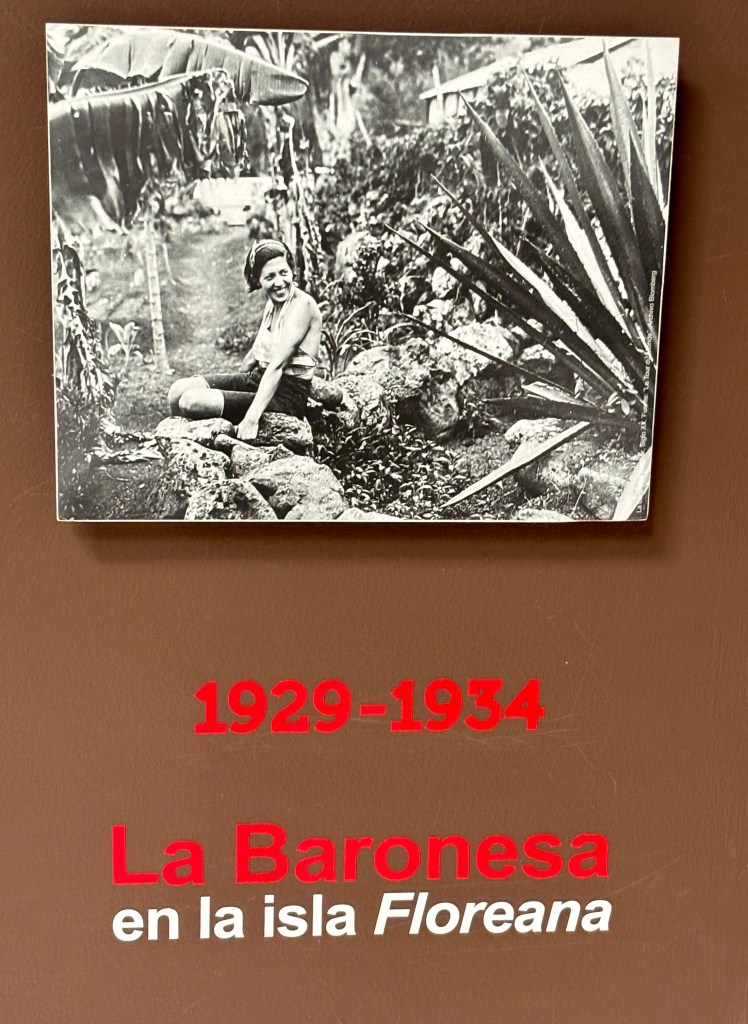
Austrian Baroness Eloise Wehrborn de Wagner-Bosquet, and her two German lovers, also came to the island to build a hotel. She declared herself Empress of Isla Floreana. In March 1934, the Baroness and one of her lovers disappeared under mysterious circumstances while all of their belongings remained. The drama continued with the disappearance of her other lover and the death of one of the original German men. His wife returned to Germany. In the end, only one of the two original couples stayed on.
The mystery has never been solved, but a movie was made about the events in 2014. It was called “The Galapagos Affair: Satan Comes to Eden.”

In 1942, the Americans established a base in the islands to protect the Panama Canal as it was considered a likely target for the Japanese.
In 1946, a penal colony was established in the islands. For thirteen years terror was inflicted on those sent there . The penal colony was closed after an inmate uprising.
In 1959, Galapagos National Park and the Charles Darwin Research Station were created.
Tourism began in the islands in 1969. Keeping an appropriate balance is still the challenge.
In 1984, The Galapagos Islands were declared the first Natural World Heritage Site.
What a history that we knew nothing about! I think I thought the animals had always been there, developing in their own way, and people found them and behaved responsibly. Not so much! Hopefully, care and preservation will always be a priority going forward. Ecuador seems to be doing credible work.
We returned to Phoenix after some minor travel issues. Our reaction to the trip for at least a week after we returned was that “it was exhausting.” We did so much in 20 days! Of course, once we recovered we appreciate so much the opportunity to see what we saw and do what we did.
It is hard for either of us to pick a favorite event! Was it fishing for piranha or snorkeling with penguins? Was it walking in Machu Picchu or flying above the Nazca Lines? Was it learning about the Inca and how artificial intelligence says they couldn’t have built what they built? Was it walking with the tortoises or boating with dolphins? So much to choose from!

When we returned we were able to “scratch off” Peru and Ecuador and the Galapagos Islands.

Our thanks to Avalon for great planning and wonderful execution. Also thanks to our fun, kind and considerate travel companions. I hope we meet again!
We visited South America, including the Nazca Lines, Machu Picchu, Peruvian Amazon and the Galapagos Islands in September, 2024!


 Serene Wandering
WOW, what a trip you have just mastered. Amazing is all I can say. My nephews wife is from the Netherlands and was one of two Doctors in the Galapagos for a few years when she first graduated in the Netherlands. They sure enjoyed living there. Her next job took her to become the only Doctor on the Isle of Skye for another 2 years , however they did not enjoy the weather ( dark and dreary) or the isolation as much. They now have settled in northern UK and started their family.
Thank you so very much for taking us on your latest adventure and we are constantly amazed at how well Randy is doing after his two or three year ordeal. Amazing stamina. We are so envious of this latest trip especially knowing we will never get there ourselves. So we cannot express our gratitude for all the work that you put into your blogs. we look forward to your next adventure.
We are staying home this winter after our two month trip across Northern US return to friends and family in the Maritimes in our LTV. Lovely way to travel. Our next trip is October/ November 2025 to explore Belgium on our own and then fly to Athens to pick up our Adriatic cruise through Croatia, Italy,Albania and a tiny bit of Greece.
We wish you a very Merry Christmas and all the best wishes for 2025.
Hugs to both.
Interesting about your doctor relative! We will be visiting The Isle of Skye in the summer on a cruise around the UK.
Your trips sounds nice, both past and upcoming! Cruising is our fave, not so much work. Belgium came on our radar lately when a site we follow did a video about renting a canal boat in Belgium. It sounded like something we’d both like to do!
All the best!
Great travels and lovely pictures. The history of exploration is fascinating. When you laid down on lava rock, how did it feel? I get exhausted just reading about your travels. Glad your back and resting up for what’s next.
It was just hard. Surface was smooth. Had to chuckle about you thinking we were back. Back and gone again! I’m responding from Mazatlan, but we are planning to relax here. I always write a trip after we are home.