Two Cruises: Dover Again!

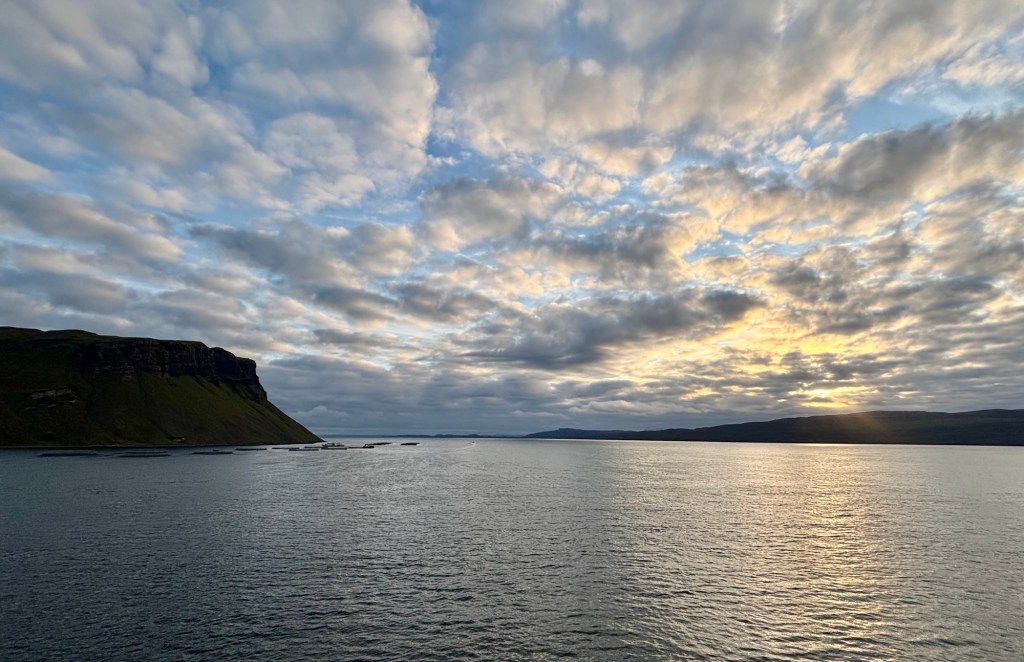
One more time we woke up to the white cliffs of Dover.  

We usually do ship sponsored shore excursions but, on this second time in Dover, we decided to go out on our own.  We considered going to Dover Castle and exploring the tunnels from where the evacuation of Dunkirk were organized.  That sounded interesting but we just weren’t in a mindset to enjoy yet another castle.  That will be a priority if we return to Dover on a future trip.

Our goal for this day was to see the World’s Oldest Sea-Faring Boat.  We learned about it during a port talk on the ship.

We walked about a mile through the port area into town.

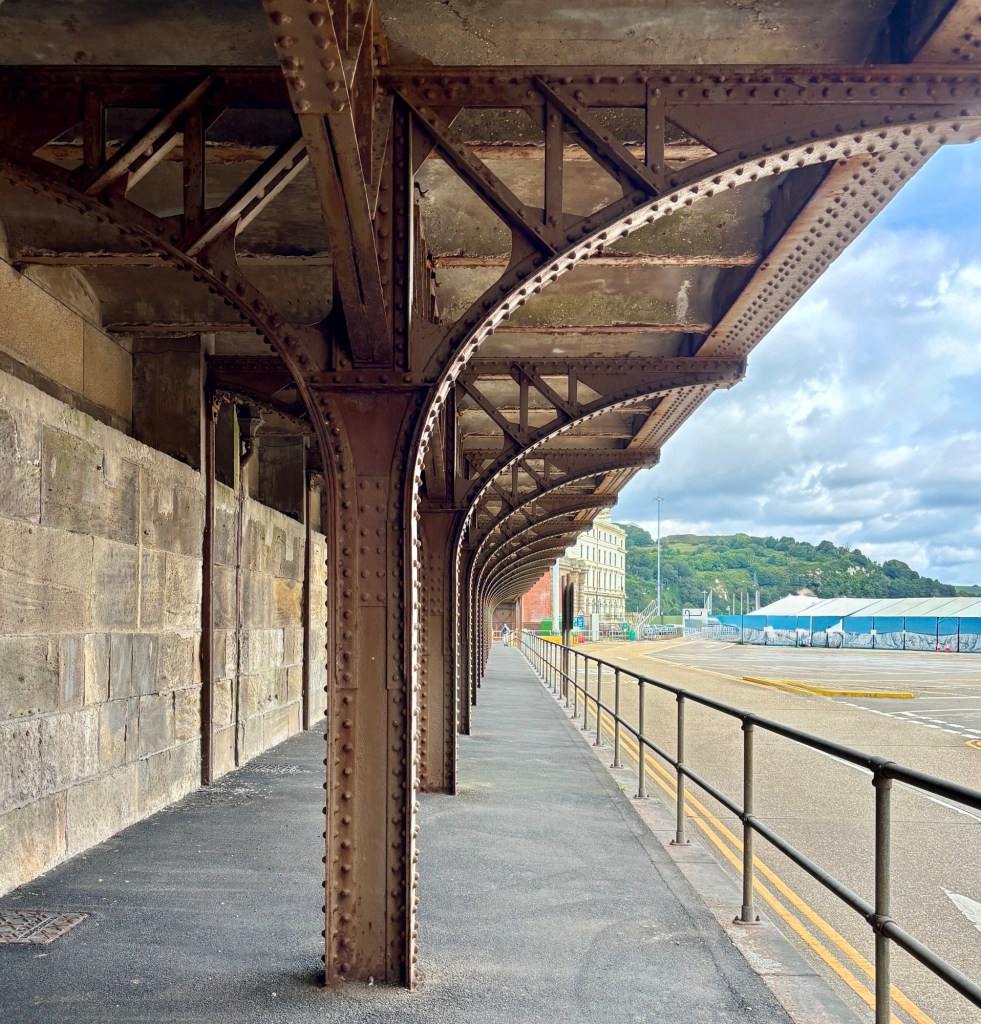
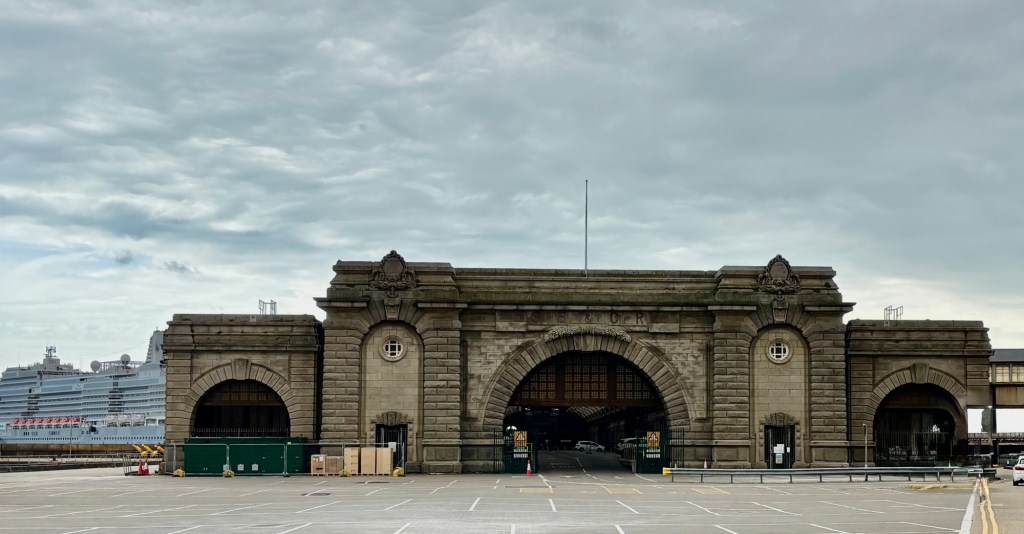
We saw some interesting old buildings on our way.

We passed by the old SC&R railroad terminal.  It was built for the South Eastern and Chatham Railway which was a union of two former rival railways. 

We made it to the Dover Museum.  There was no admission fee charged but we were happy to donate our last six British pounds. After all the countries and currencies, we were down to only US dollars.

This prehistoric wooden boat, was discovered in September 1992, during road construction.  Knowing the discovery might be important, the crew called in archaeologists.

Due to the position of the boat and nearby buildings, they were not able to remove the entire length.  In fact, they don’t know exactly how long it really was.

The archaeologists knew that past attempts to excavate boats in one piece had not been successful.  Consequently, a decision was made to cut the boat into sections and reassemble it afterwards. 

Together the teams worked at removing pieces of the boat as quickly as they could both for the road budget and for minimizing the time the old wood was exposed. They kept the wood wet by spraying it with water.

The next step was to drain the water and submerg the pieces in a liquid wax mixture for 16 months.

Then they set the blocks to freeze dry for two years to remove any remaining water.

While waiting, the archeologists built a replica which helped them understand more about how the boat was first made.

Thirty pieces of the original boat were reassembled over 9 months.

After seven years of research and conservation, the Dover Boat came back to Dover.  (I can’t believe it isn’t in the British Museum!) 

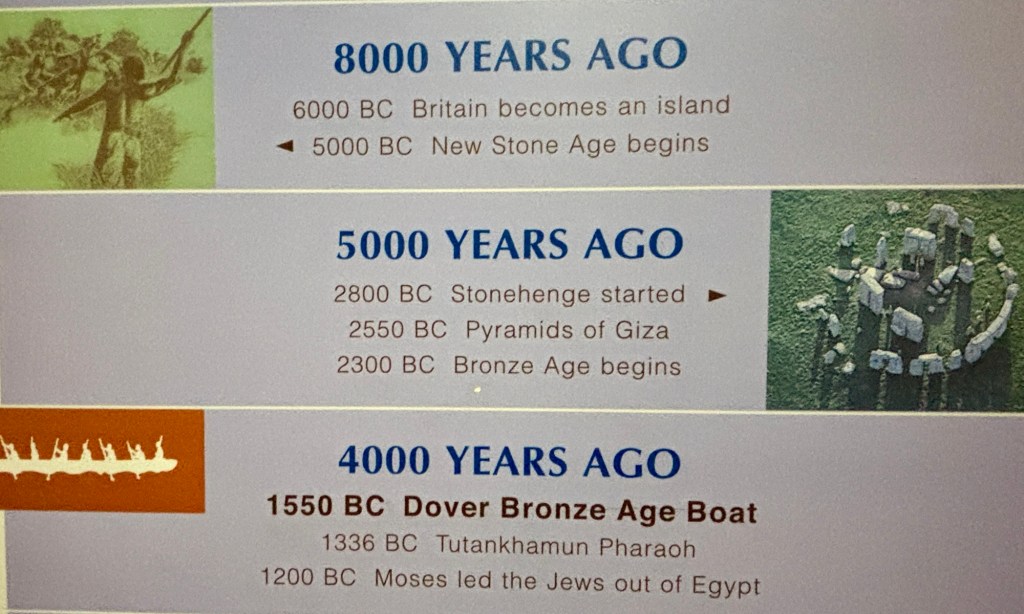
The boat’s excavation was an internationally important archaeological discovery. It is considered the world’s oldest known sea-faring vessel.  

The boat is about 3,500 years old, in use about 1500 BC during the Bronze Age.

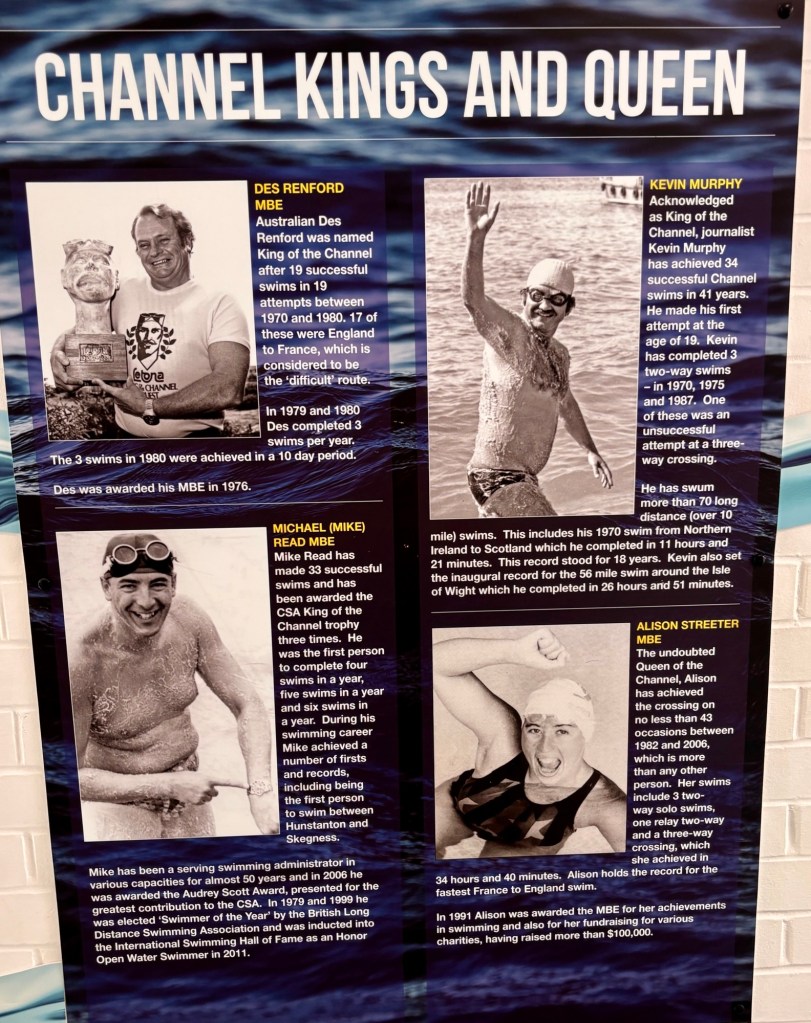
There were a number of other exhibits in the Dover Museum but the only one of that really caught our attention was about the men and women who swam the English channel, specifically the Straight of Dover.

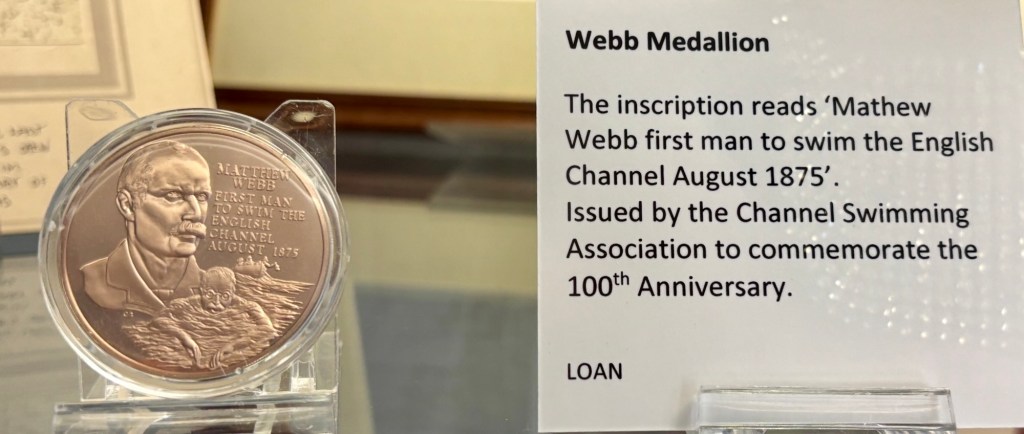
The first man to swim the channel unaided was Captain Matthew Webb in 1875.  He and his rivals didn’t always play nice.

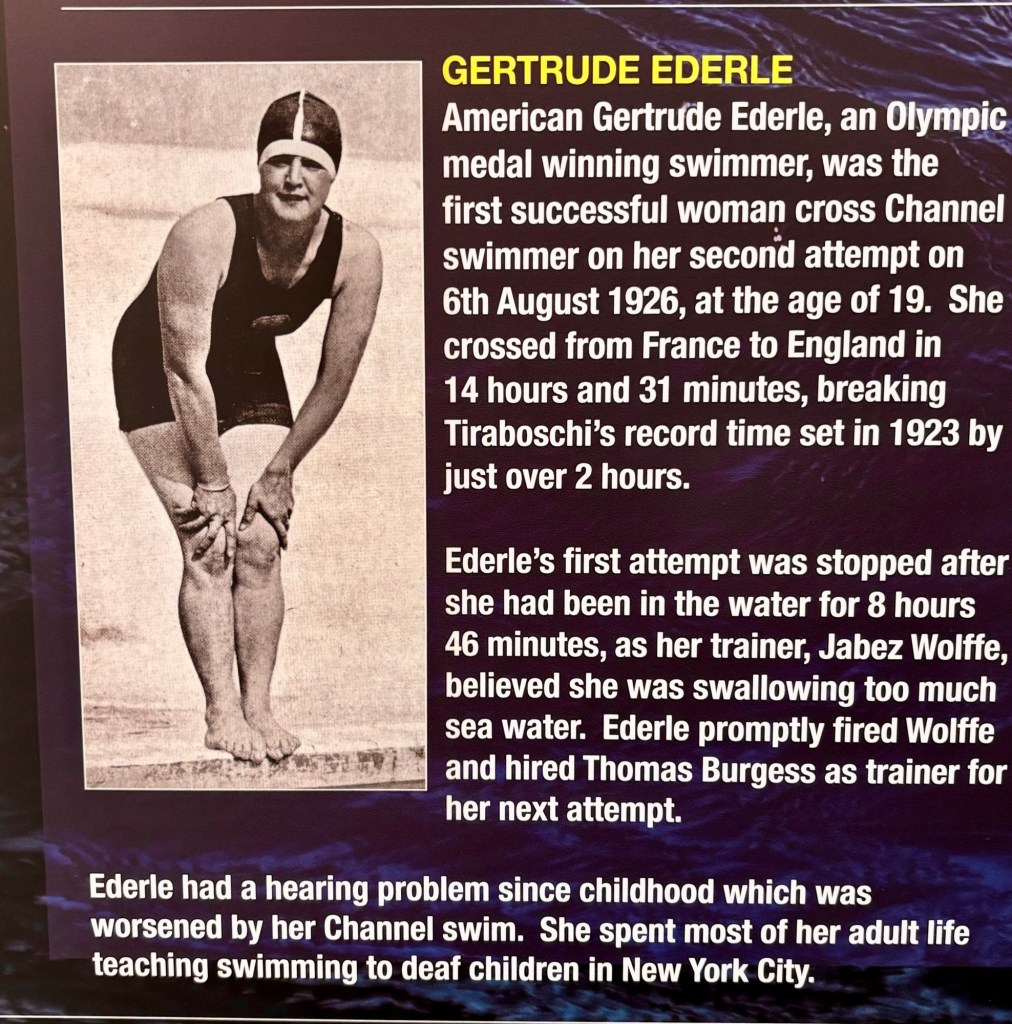
The first woman was 19 year old American, Gertrude Ederle, in 1926.  It was her second attempt.

Some swimmers went Dover to Calais, others went Calais to Dover.  The latter was considered slightly easier.

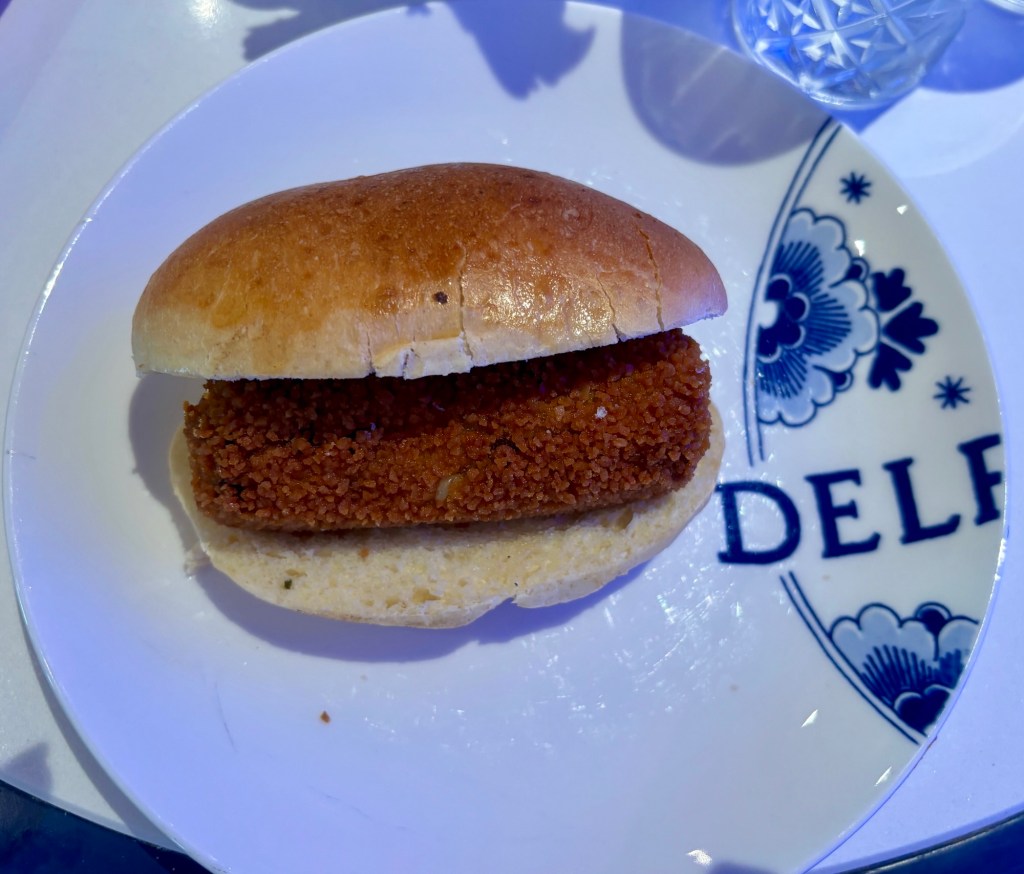
We walked back to the ship for lunch and tried a sandwich that was very, very popular with the Dutch passengers on board. 

The ‘sandwich’ is called BROODJE KROKET and is fried veal ragout on a roll.  It is usually served with mustard.  We were both fans!

Our next broodje kroket will have to wait until the next time we are on a “dam” ship – the Oosterdam in late 2026.

Our month long journey, beginning in Rotterdam, and two cruises exploring the British Isles and Iceland, was a great trip. We enjoy visiting and learning about and from other countries. We are thankful that we were able to travel with our friends Cindy and Darrell again!

PS

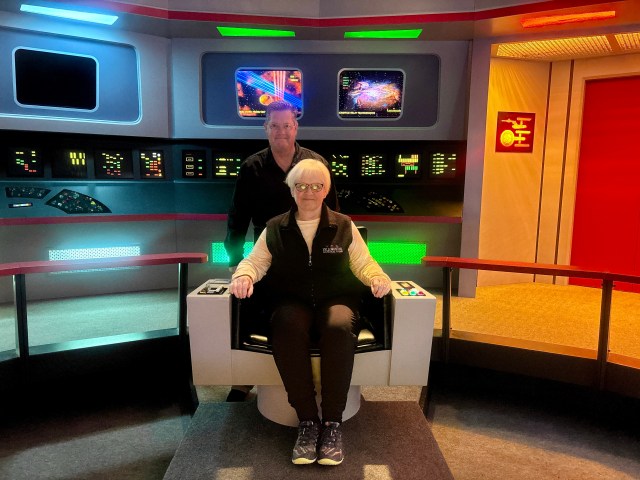
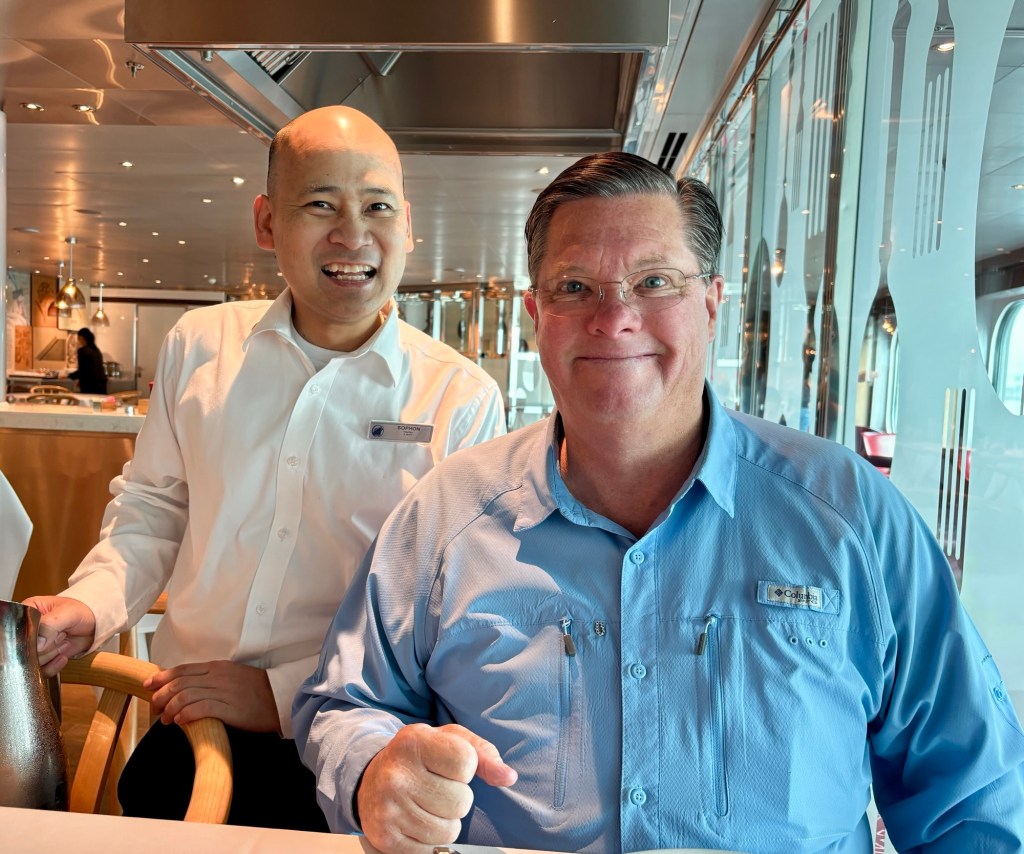
Guess which one Randy is! He was okay with me adding this. He’s happy with his role.

Posted in Uncategorized | 2 Comments

Two Cruises: Dunvegan Castle, Scotland

We arrived in Portree, Isle of Skye, Scotland on August 21st.  Portree was the port we missed on the first cruise due to bad weather.  It looked much better this time!

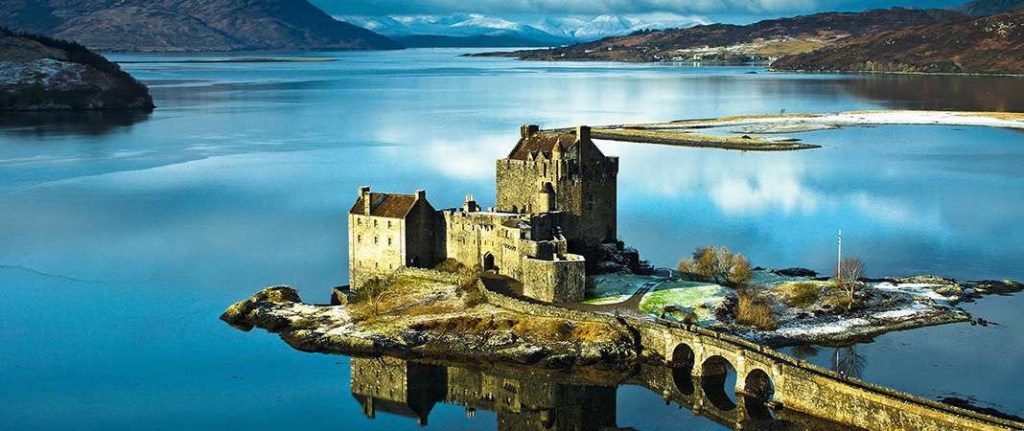
The castle we missed last time was the picturesque Eileen Donan.

This picture is from the Eileen Donna website. The shore excursion manager told us that Dunvegan, our scheduled castle for the day, was just as good if not better.

We went to Portree by tender and boarded a coach.

The countryside on Isle of Skye has a pinky purple flowering shrub that is common heather.

On our journey to the castle, our guide told us that the main two clans on Skye were the MacLeods and the MacDonalds. They fought for centuries. The government eventually tired of the bloodshed and split the two into separate lands in 1610. 

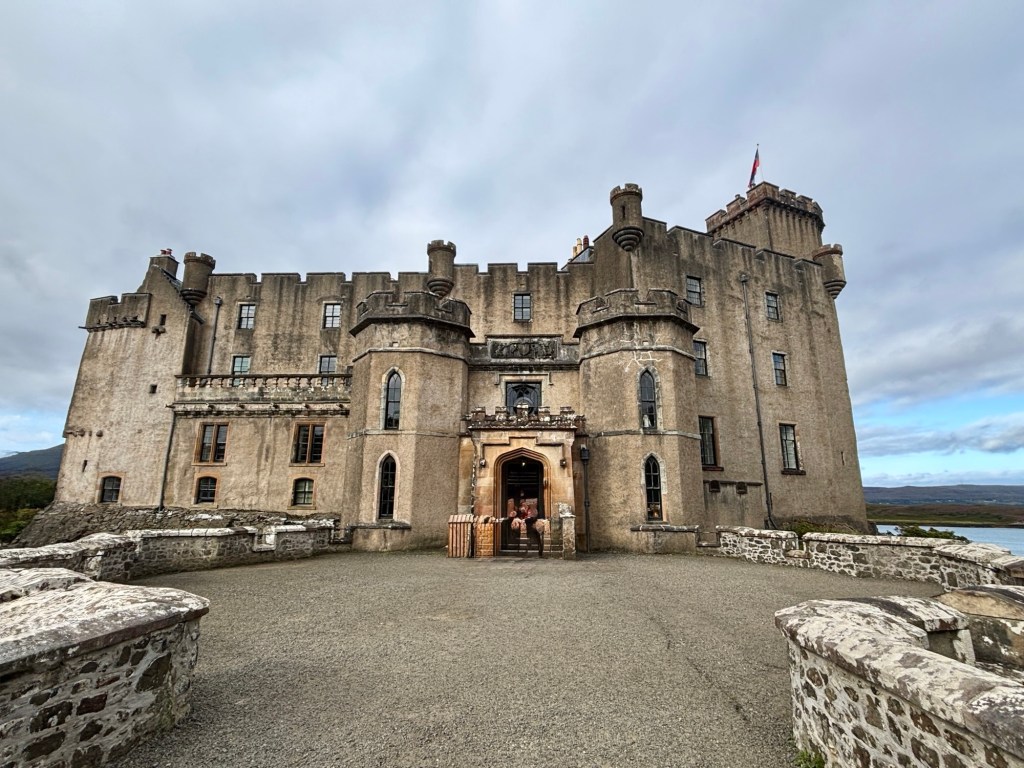
Our tour took us to Loch Snizort and Dunvegan Castle. 

The castle was the stronghold of the MacLeods for nearly 800 years and is still their family home. 

We were able to walk about on our own throughout the castle.  There were docents around to answer questions.

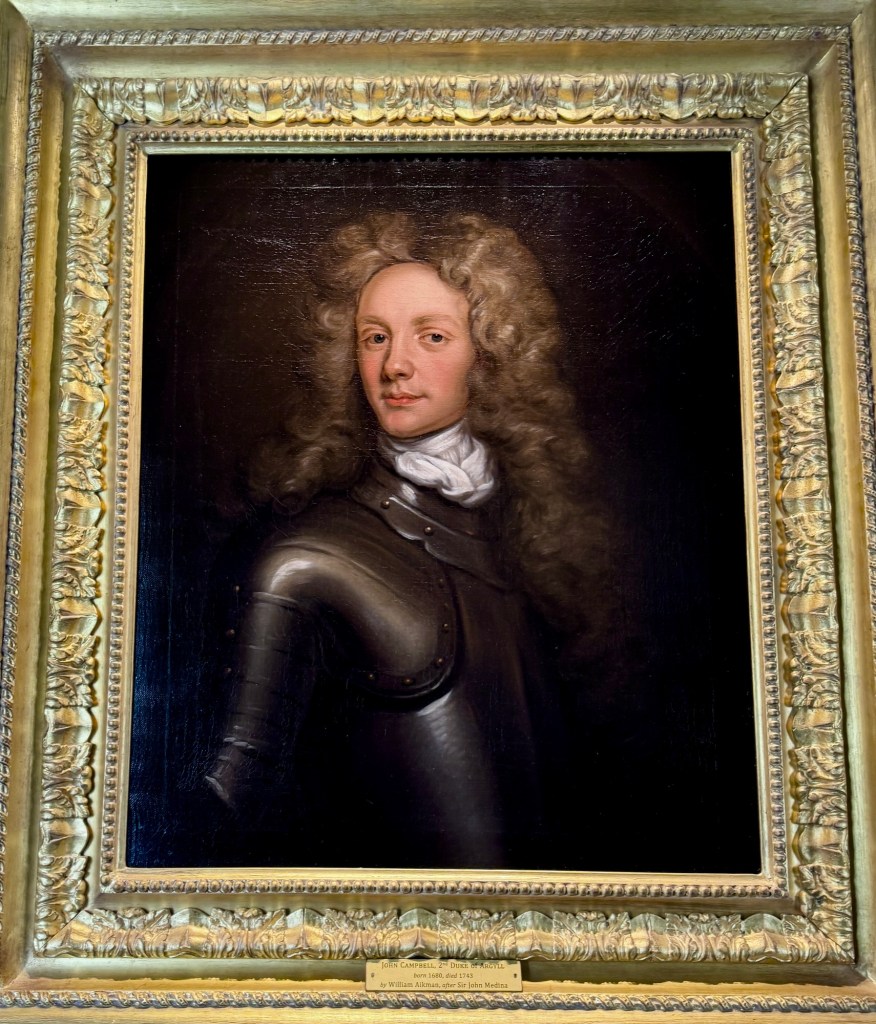
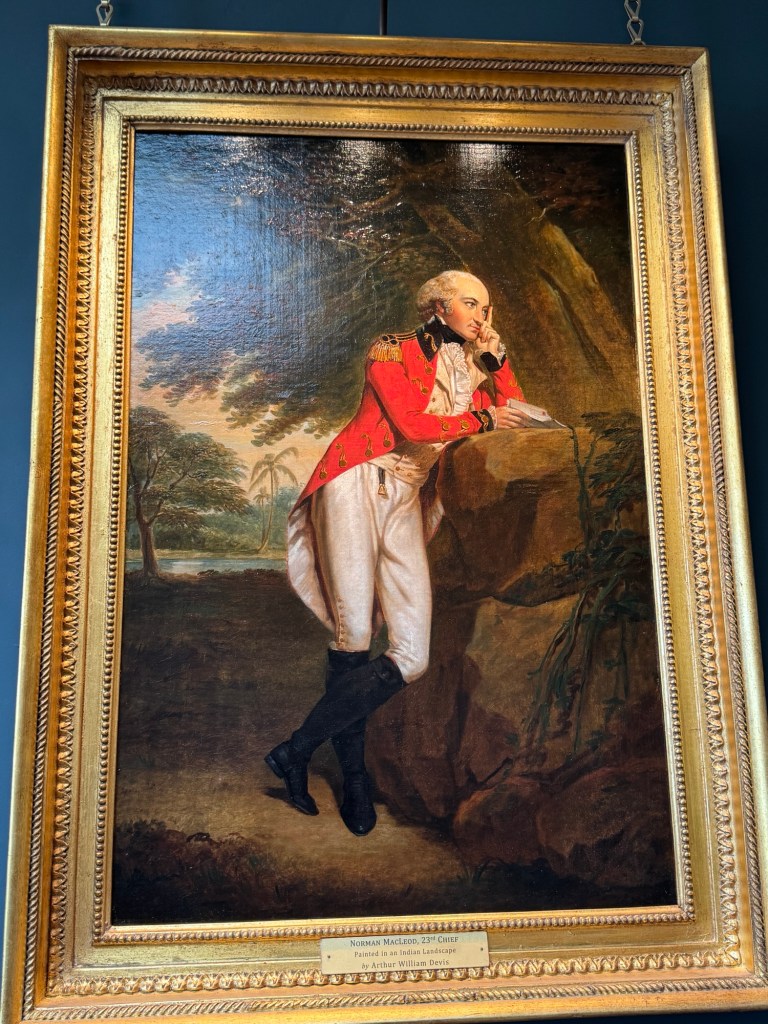
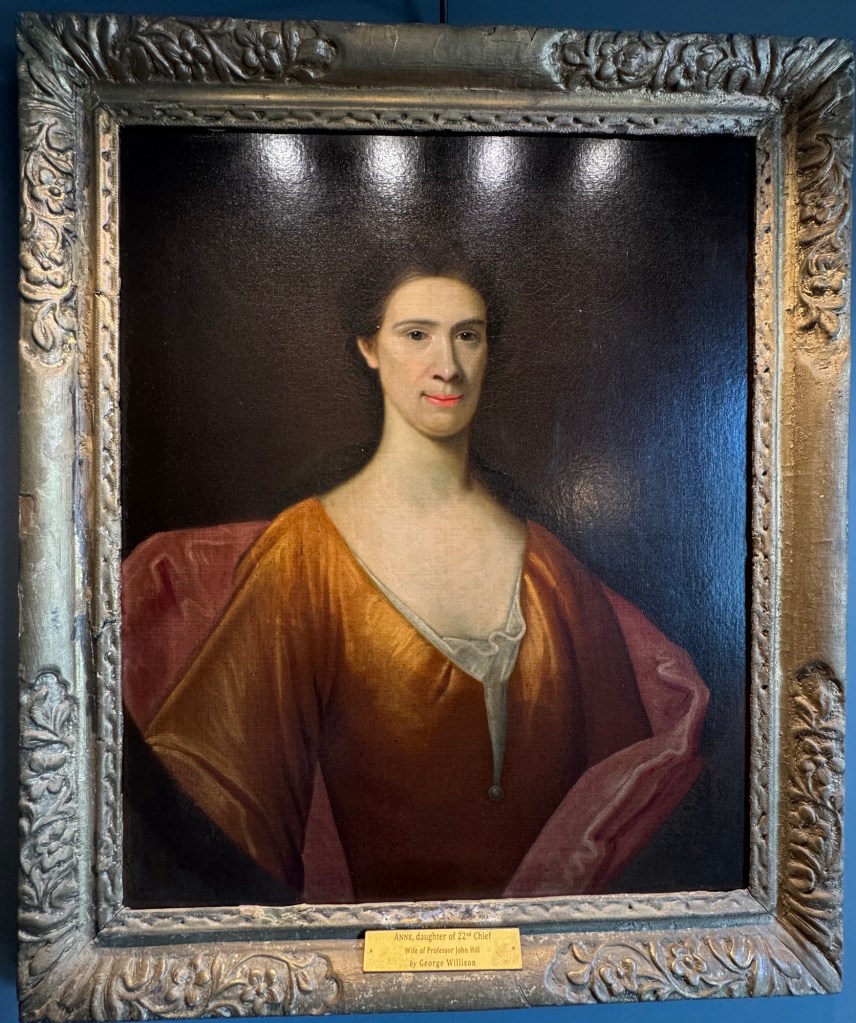
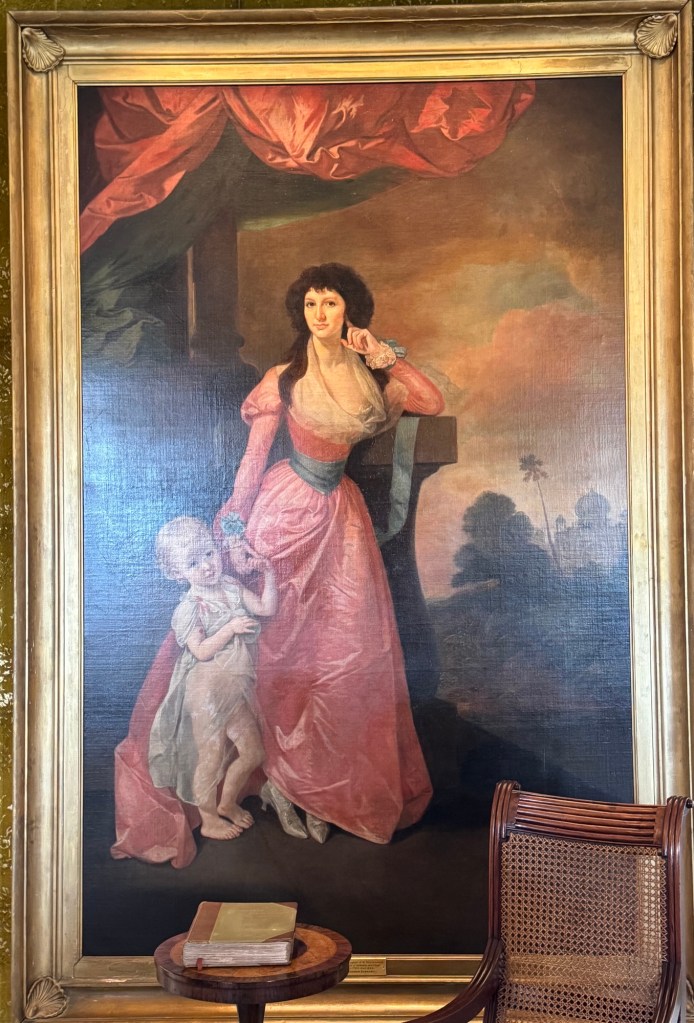
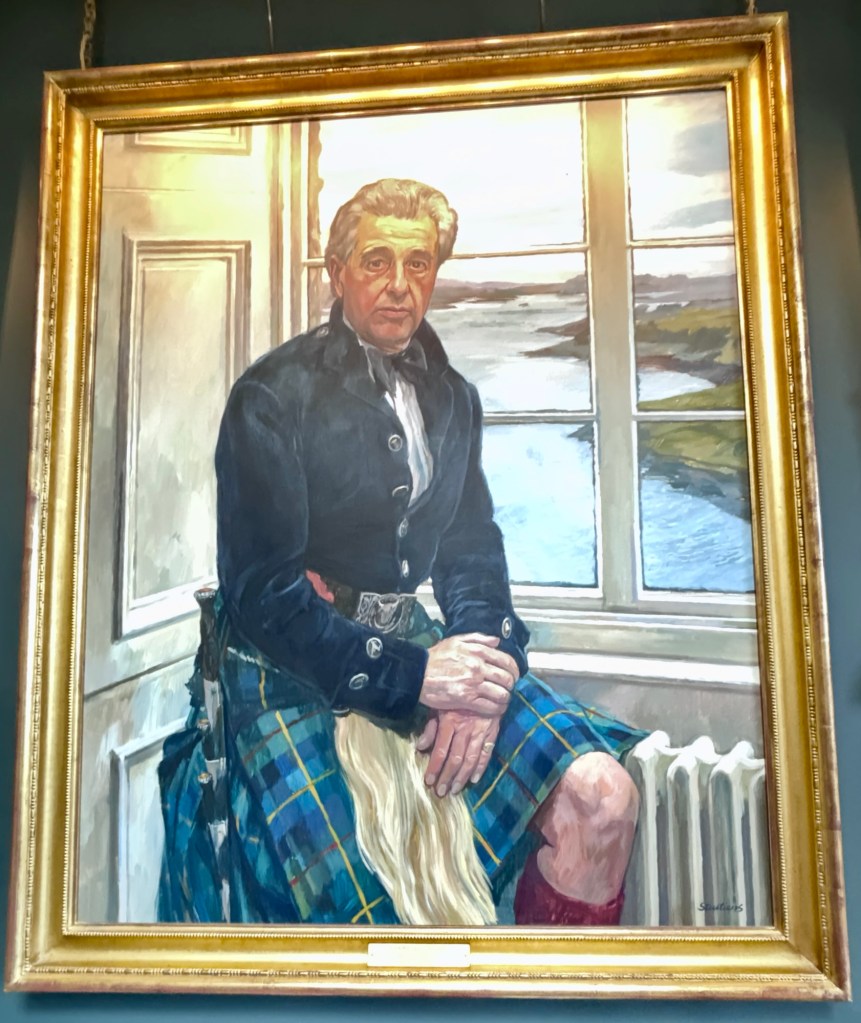
There were lots and lots of portraits of former MacLeod chieftains and family members.

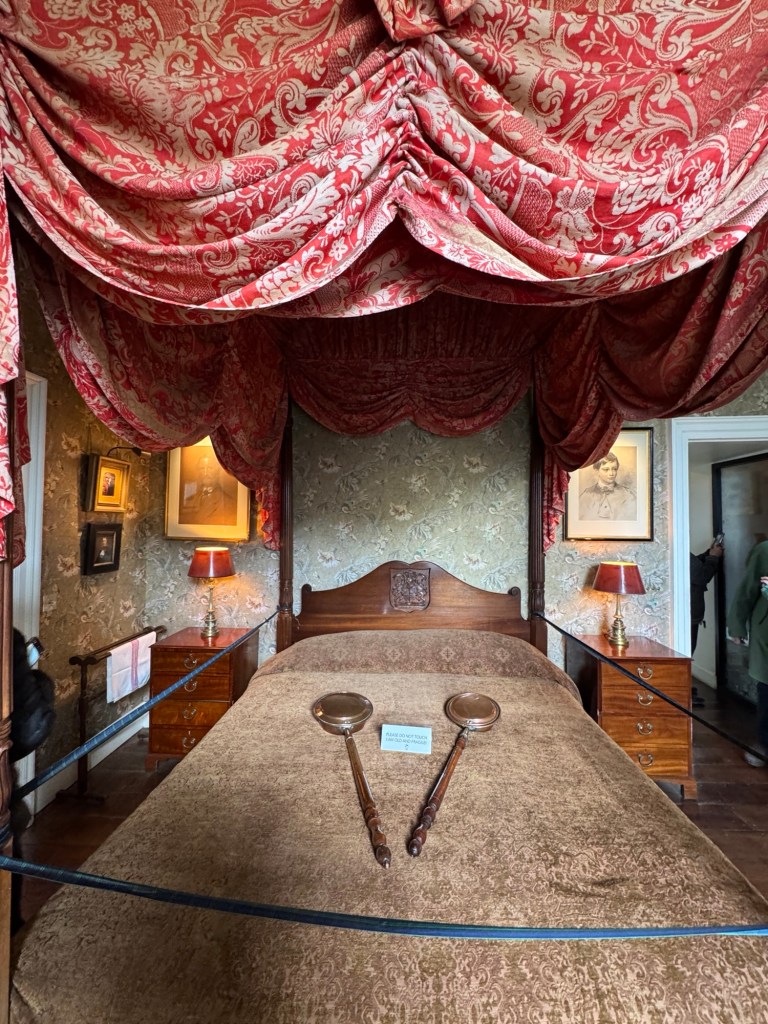
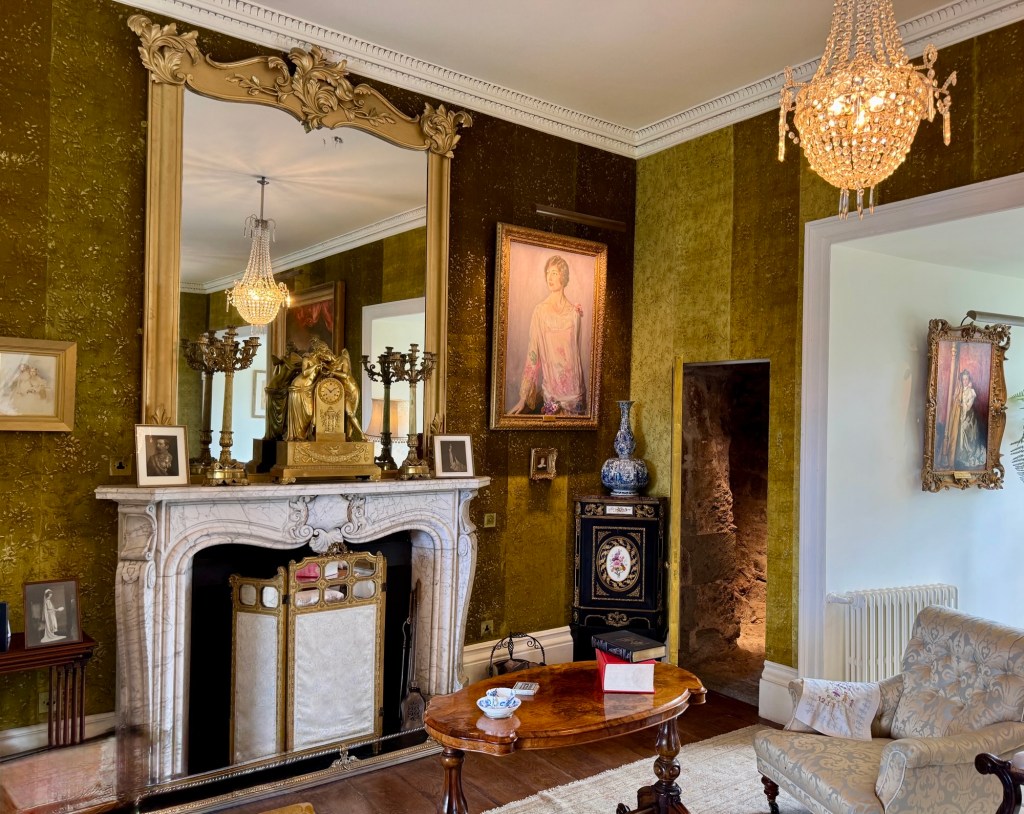
Several rooms were furnished for us to see how they might have looked.

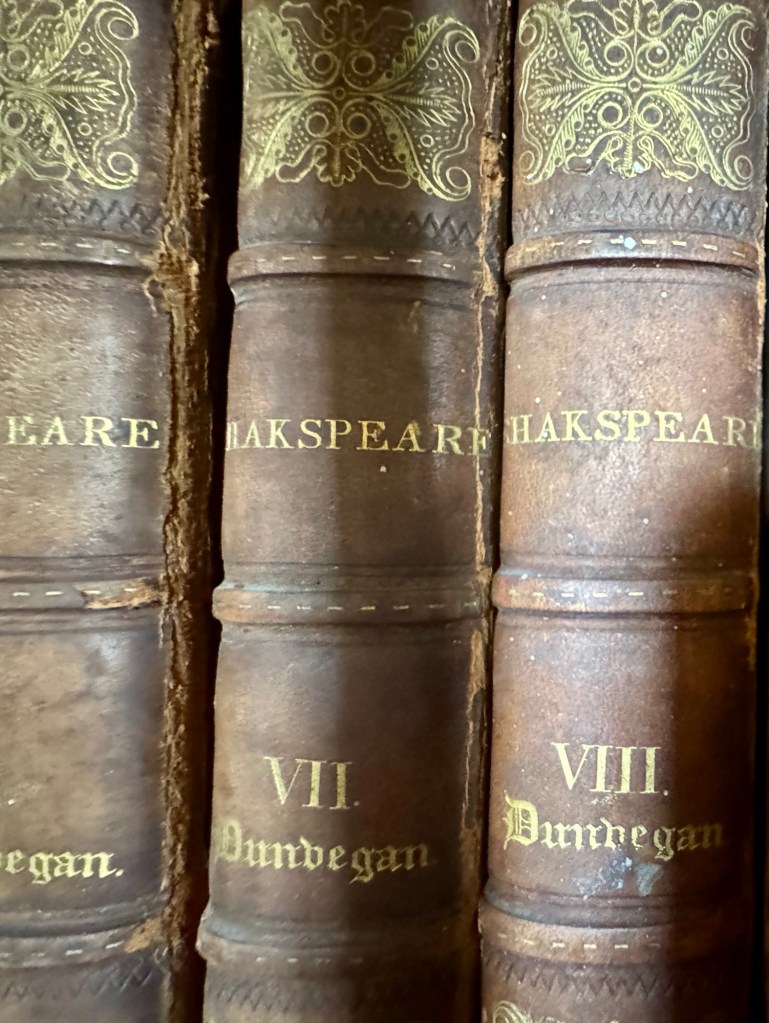
In the bookshelves we saw a collection of the works of Shakespeare bound specifically for Dunvegan.

Notice the secret passage door to the right of the table with the vase.  

One of the castle treasures is the ‘fairy flag’ of Dunvegan — said to possess miraculous powers.

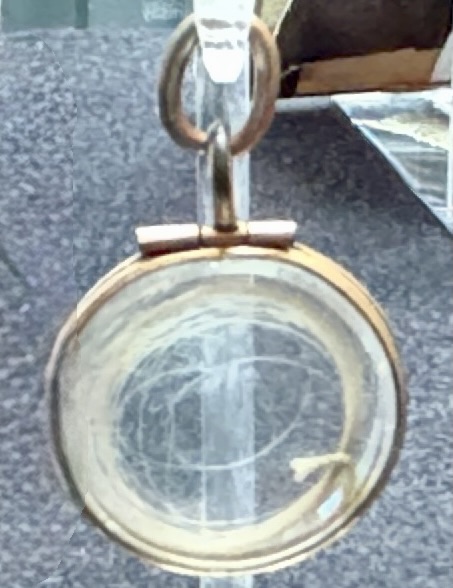
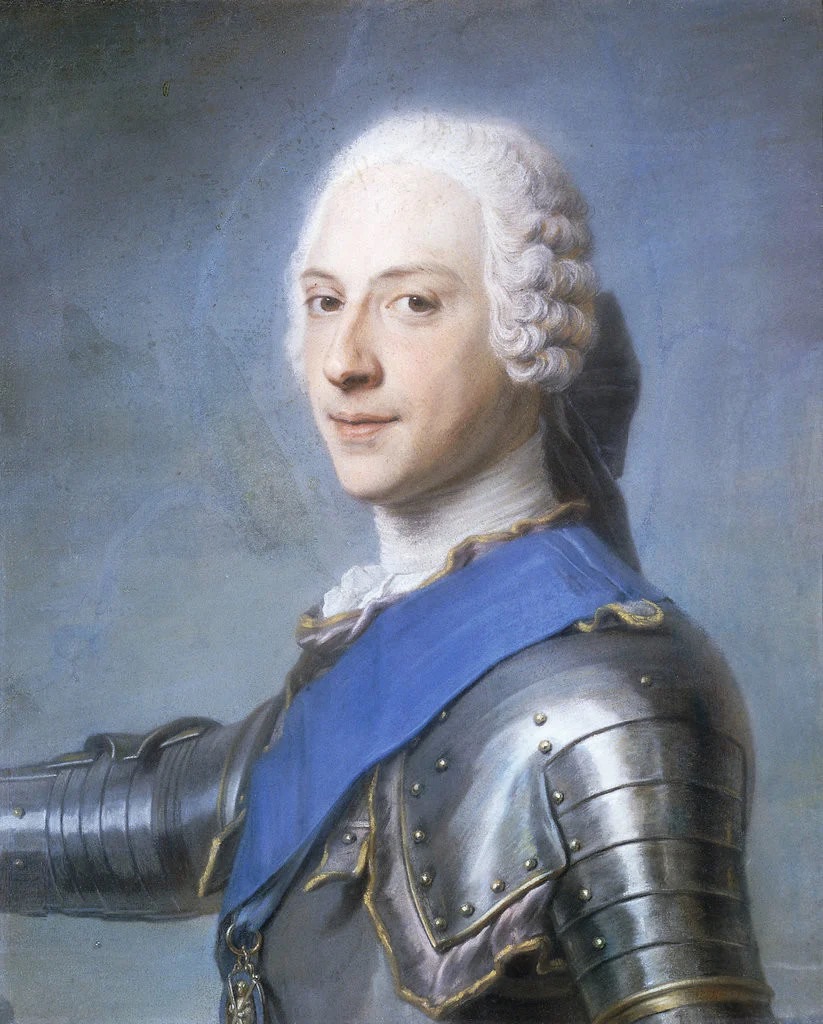
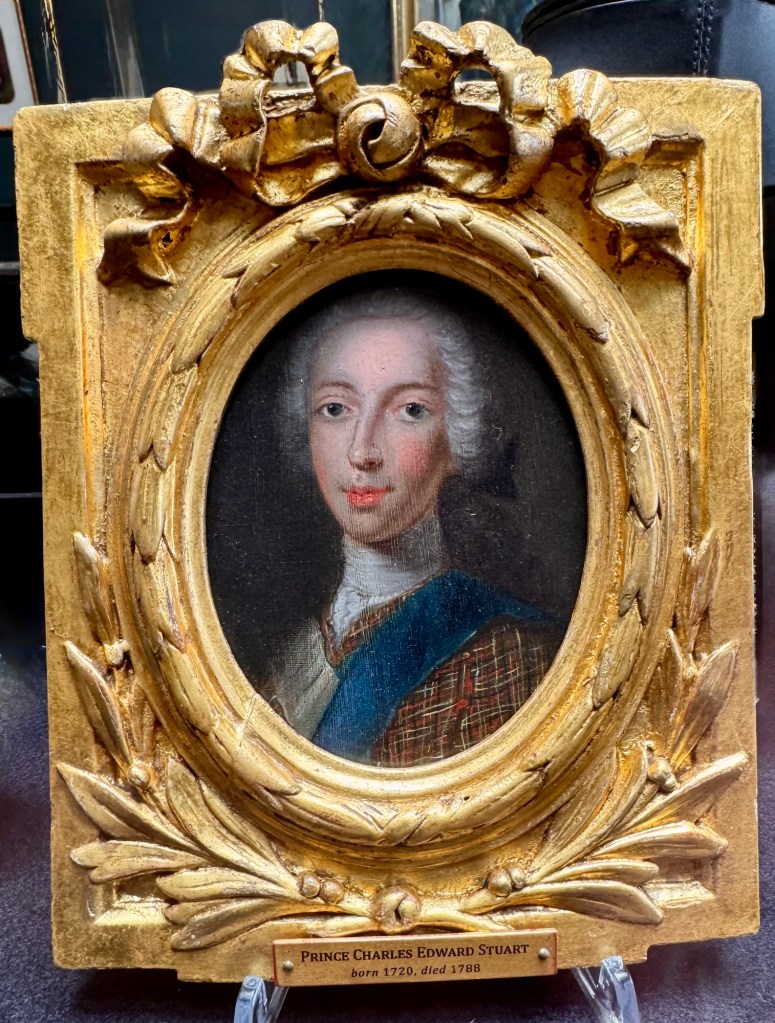
Another treasure is a locket with hair clipped from the head of Charles Edward Stuart, also known as Bonnie Prince Charlie.   

A bit of background for those of us who don’t know the complex English – Scottish – Jacobite history…  After Queen Elizabeth I died without a direct successor, there was monarch messiness.  Bonnie Prince Charlie, was trying to assert his right to the crown.  He was a Jacobite in the second phase of their rebellion.  Charlie did well as a military leader – until he didn’t.   

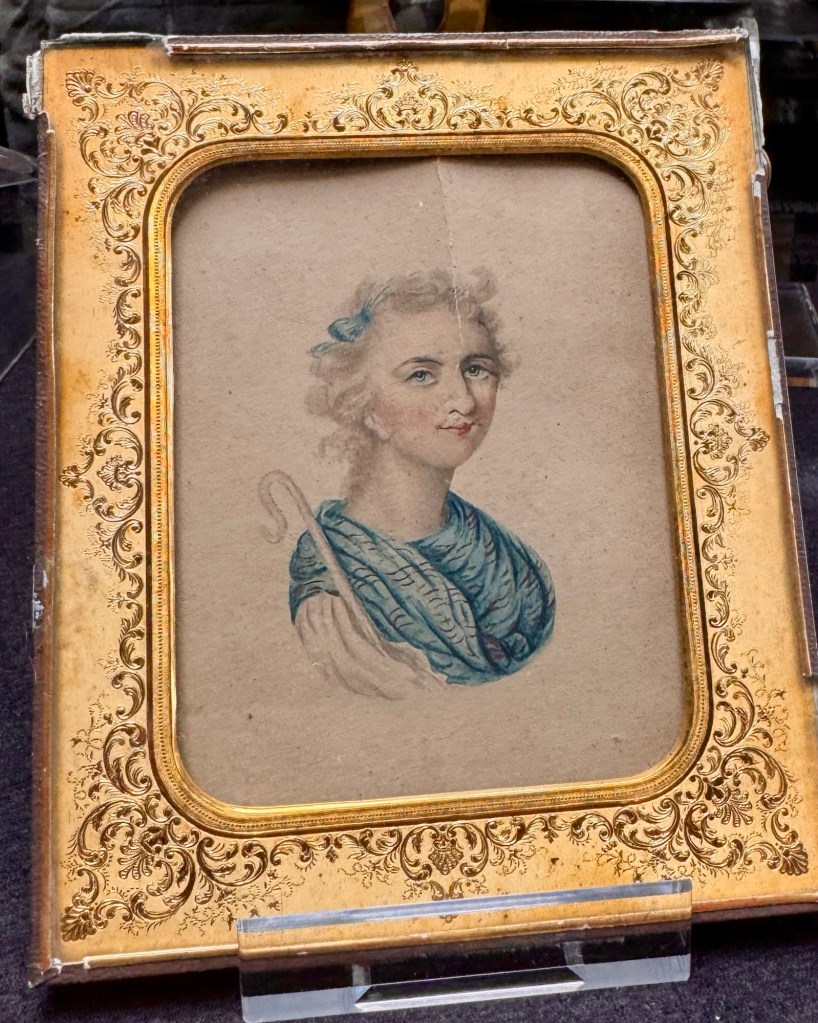
He escaped and eventually made it to the Isle of Skye with the help of a woman named Flora MacDonald.  She received a lock of his hair as a keepsake in 1747.

When I looked on-line for a better picture of this locket of hair, I discovered that lots of places have a locket with his hair – it must have been a thing!  Unfortunately, I didn’t find a better picture of the locket at Dunvegan.

This was Prince Charlie’s waistcoat, also from Flora MacDonald’s family.

Another Flora! Centuries later, Flora MacLeod was the 28th Chief Commander, Dame of MacLeod.

Although we didn’t notice it on our walk through, another Dunvegan treasure is the 17th-century four-pint drinking horn. Each male heir has to prove his manhood by successfully draining the horn of claret.   

This is a reproduction of the horn available in the gift shop.

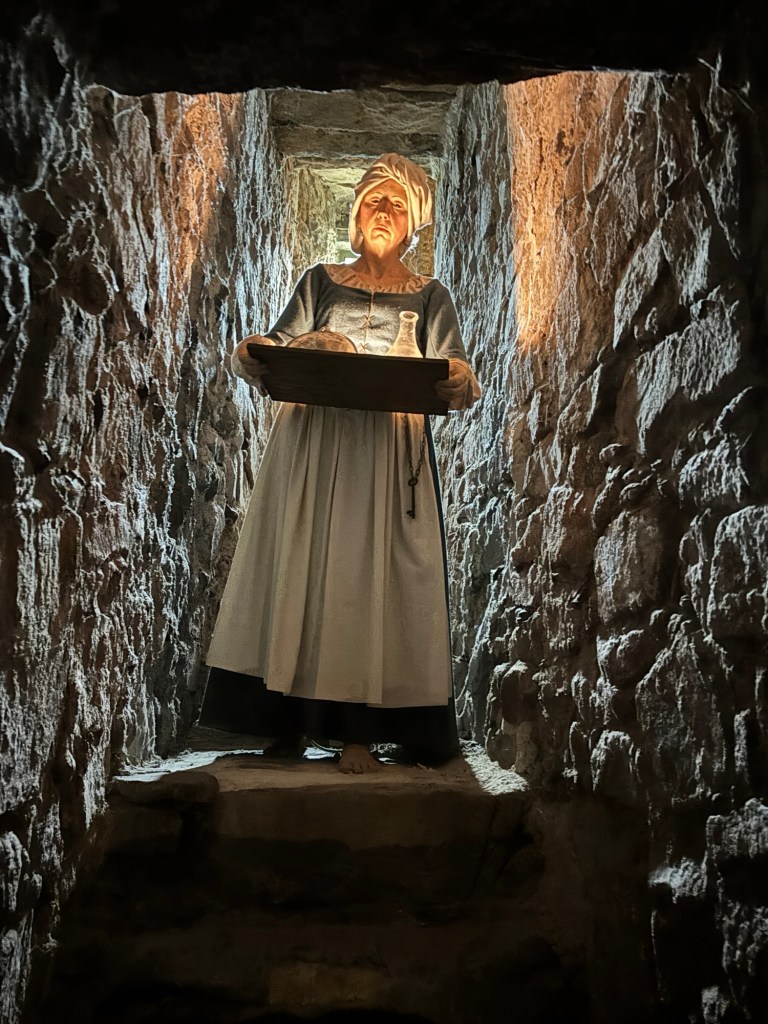
We saw one of the passages down to the servants quarters.

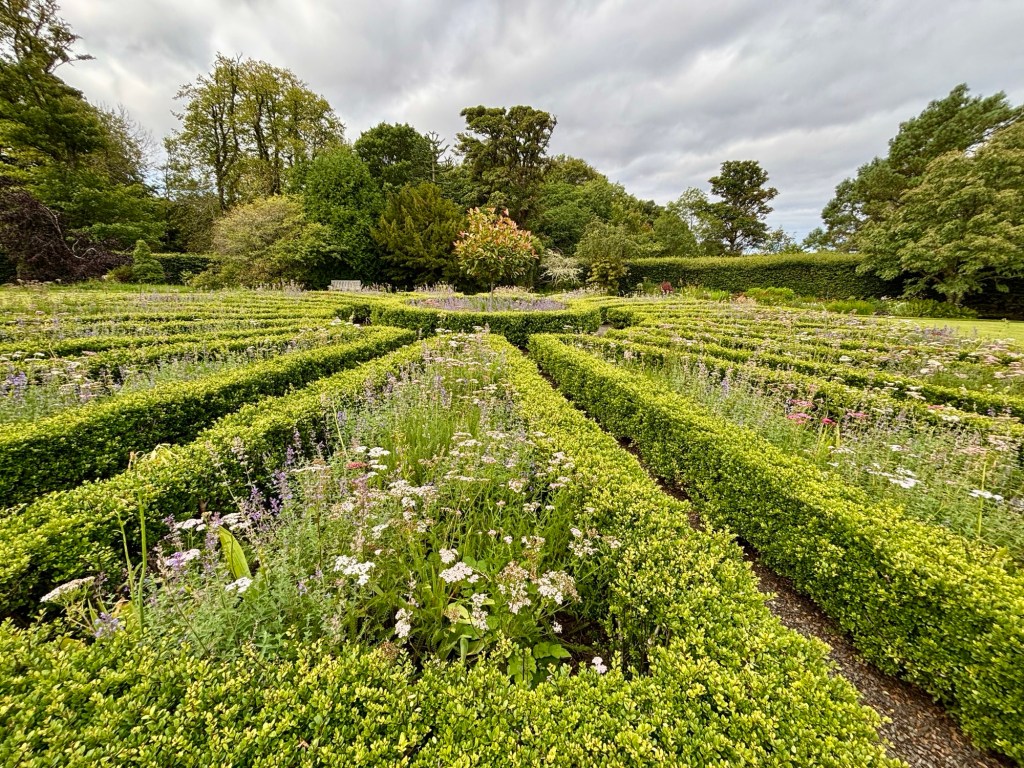
Dunvegan Castle’s gardens were originally laid in the 18th century and have a series of paths, pools and woodlands. 

We were able to view the castle from several places, only missing the view from the water.

Dunvegan Castle is still home to the current Chieftan of the MacLeods, Rory.

Rory is the 30th MacCleod to lead the clan.  Dunvegan is the oldest castle in Scotland to be continuously occupied by the family.

In addition to tours, the grounds and select rooms are available to rent for events. 

There are cottages, a campground, cafe, and loch cruises.  It seems quite the endeavor to keep Dunvegan Castle open and maintained. We were happy to contribute with our tour tickets and a few purchases in the gift shop. Of course, one of them was a MacLeod tartan!

We took a few pictures around Portree while waiting for our tender back to Nieuw Statendam. (People artificially removed.)

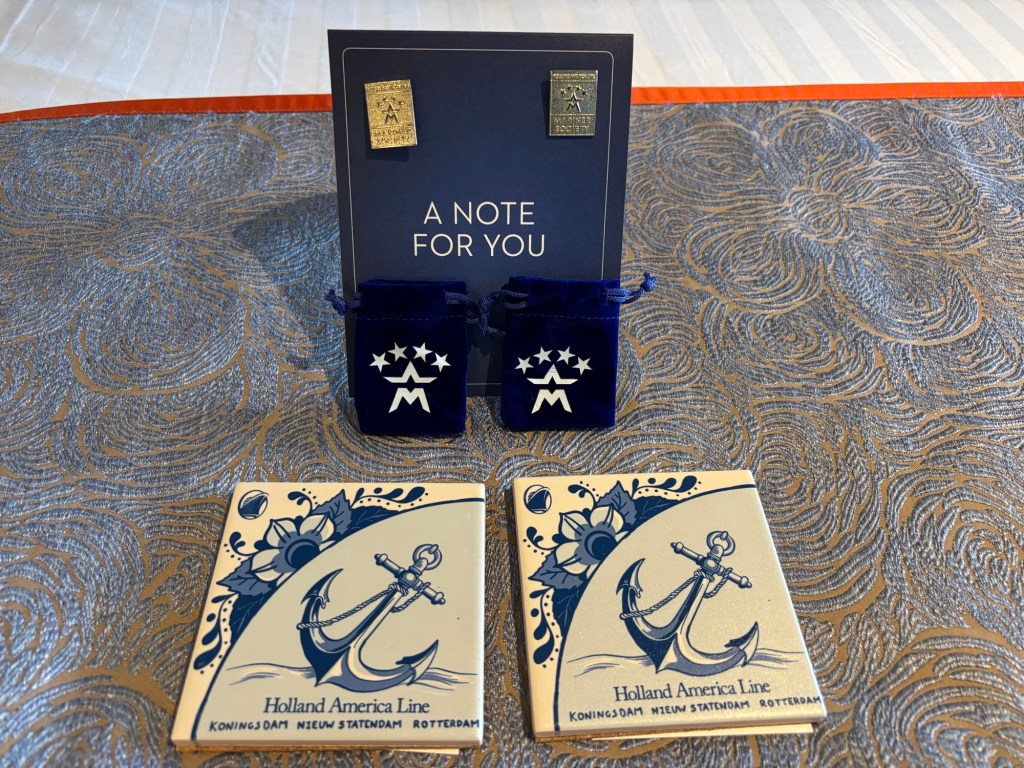
When we returned, we found our 4 Star Mariner pins and tiles had been delivered.

We had another dinner in Club Orange and took pictures of the crew that enhanced our cruise in lovely ways.

Next up:  One more stop in Dover.

Posted in Uncategorized | Leave a comment

Two Cruises: Isle of Lewis – the Second Time

The first time we visited Stornaway, Scotland, Cindy and Darrell were with us.  As we met in the evening for dinner that evening, they were quite excited about their interesting tour of Historic Lewis.  We decided we would try their excursion on our second time through on August 20.

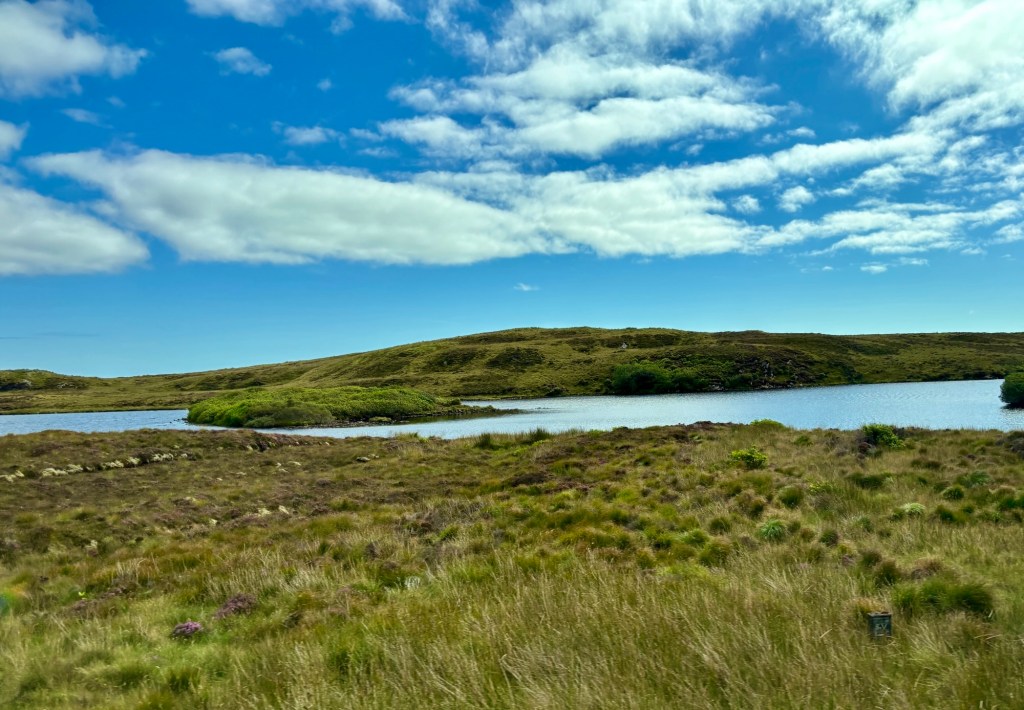
The tour began with a drive through the sphagnum moss moors of central Lewis.  

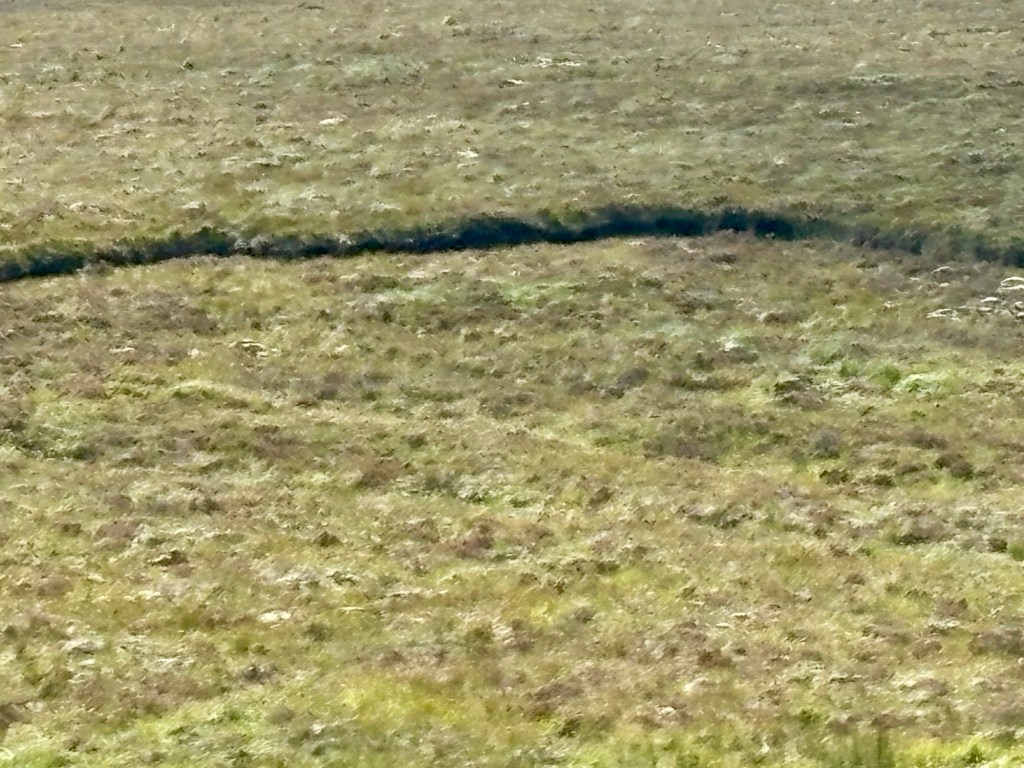
This photo shows where some moss has been cut.  At one time 75 percent of the residents used moss for heating their homes.  Now only 5-10 percent do so.  A cubic feet of moss weighs 59 pounds. When dry, it weighs 17 lbs.

This tour typically included the Callanish Standing Stones but access is limited at this time due to renovation of the surrounding area. 

I did get a picture of the Callanish stones from the bus.

The stones are set in the shape of a Celtic cross and are the island’s most dramatic prehistoric ruin.  They date from 3500 BC, before Stonehenge.

Ruins are a common sight driving through Scotland.

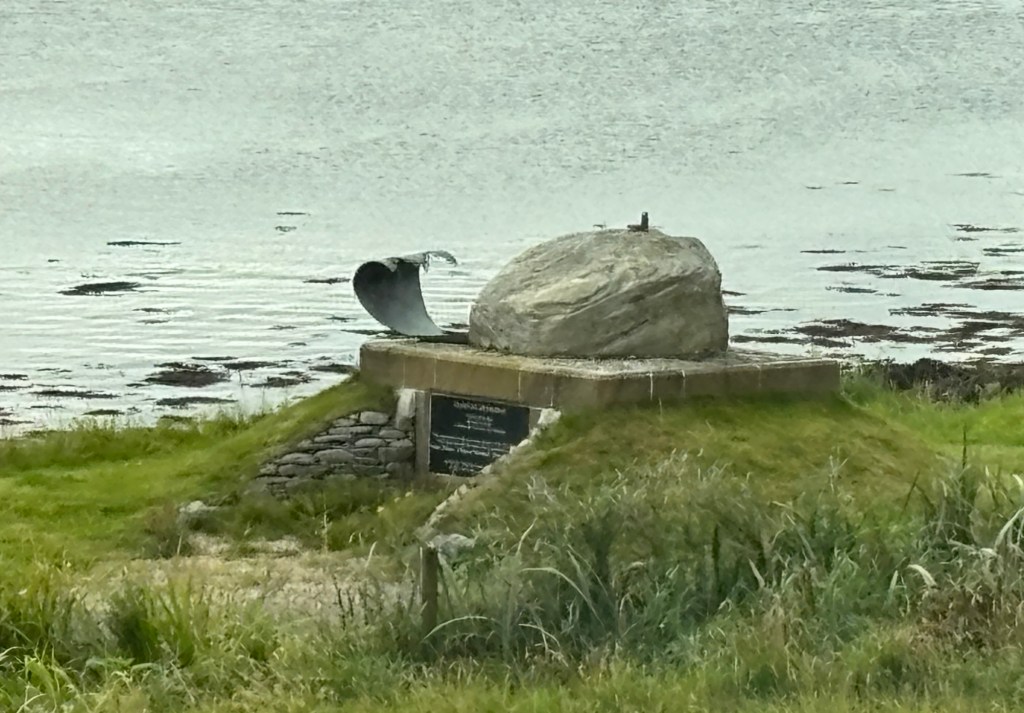
This is a monument of a huge wave coming over Flannan Island on Dec 14, 1900.  Three lighthouse keepers disappeared from the island under mysterious circumstances.  

Likely, three light housekeepers were washed into the sea.  A British movie about the event, The Vanishing, (alternatively titled Keepers), was made in 2018.   Songs, operas, books, video games and TV programs have also featured the disappearances. 

The middle island is where the lighthouse and mystery took place.

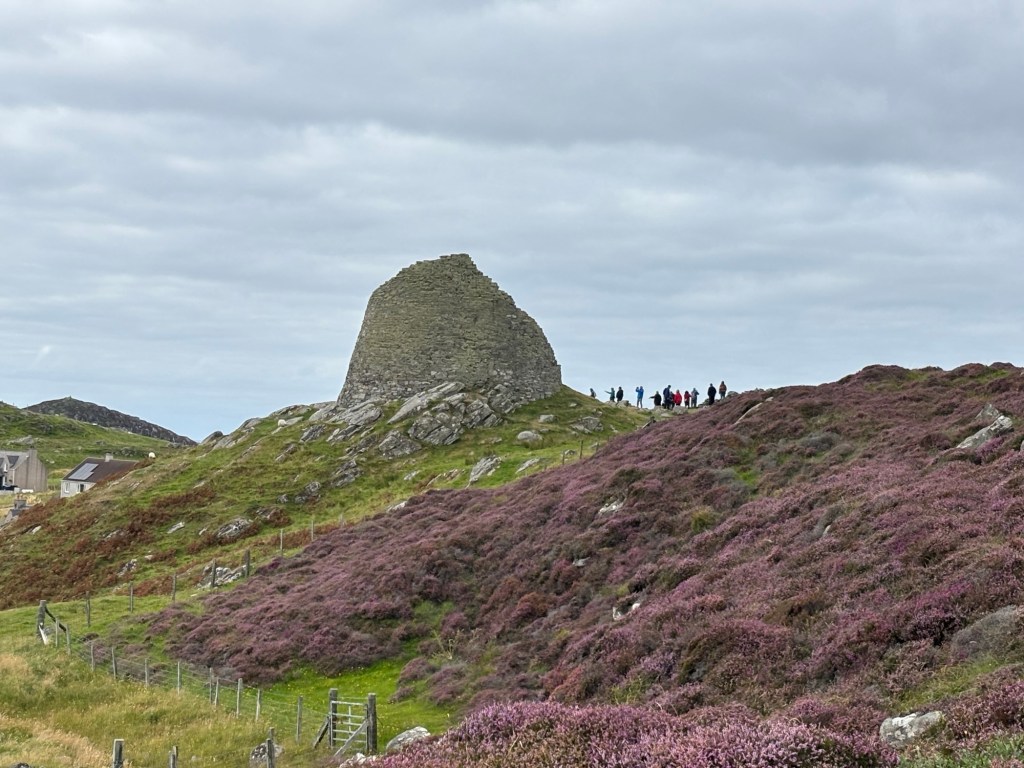
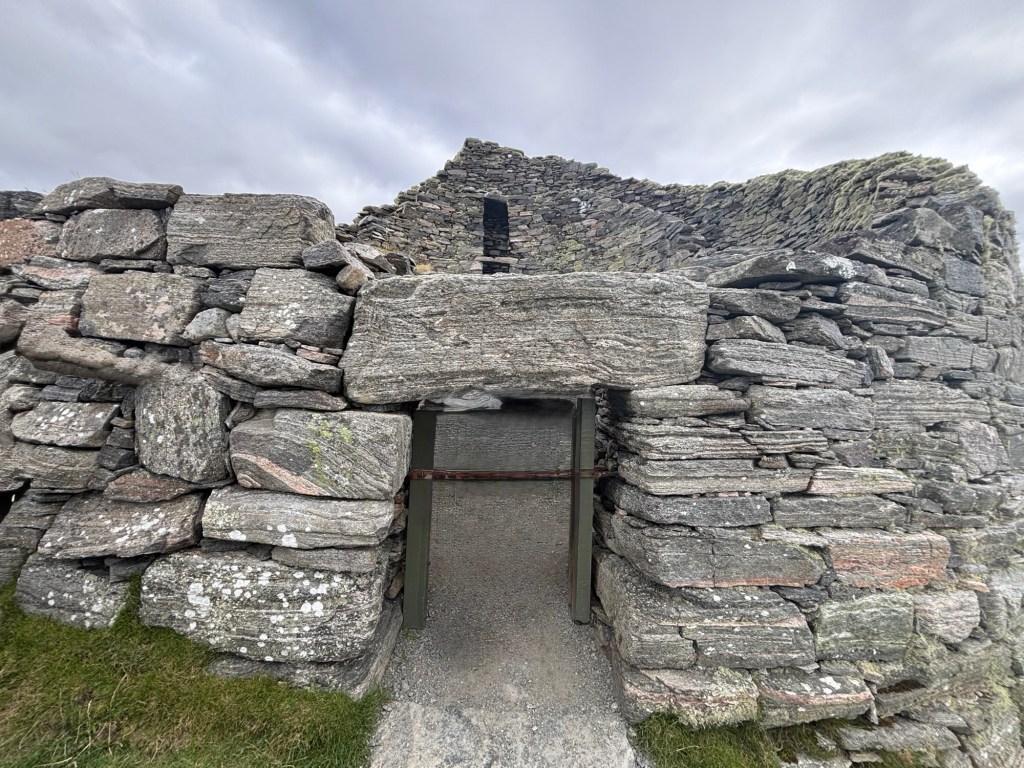
Our destination was Carloway Broch — a stone tower built around 100 BC.  

Broch is Norse for “fort” but our guide believe this would have been a community meeting house and not for defensive purposes.  

Its construction and design was not strong enough for defensive purposes. 

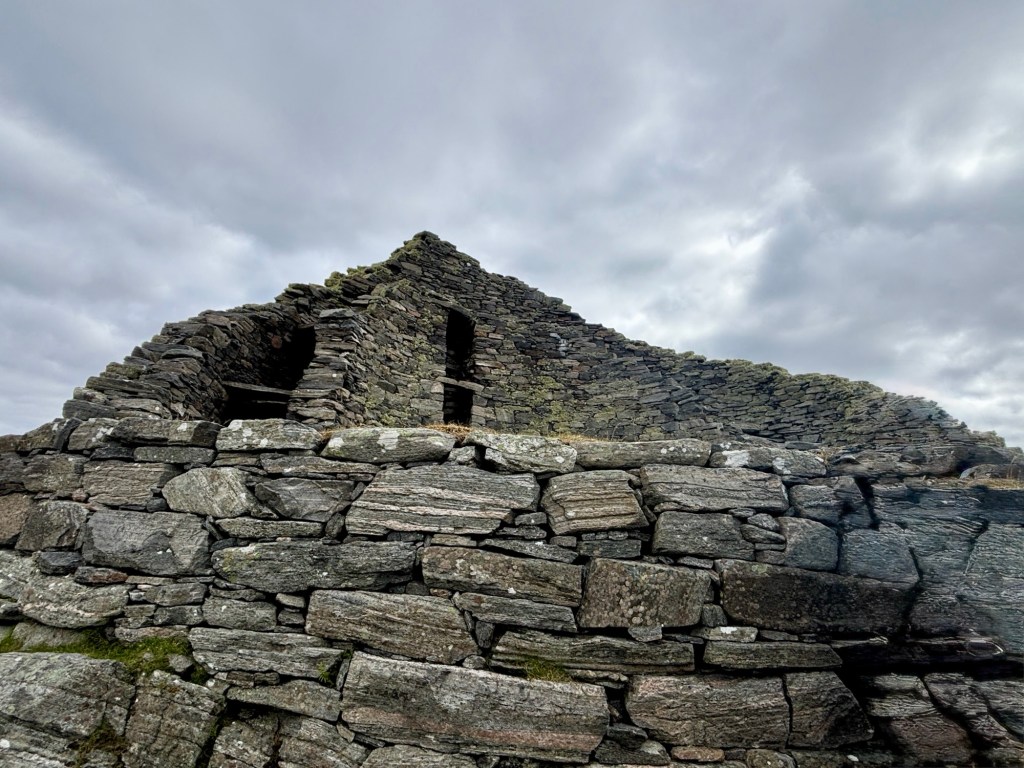
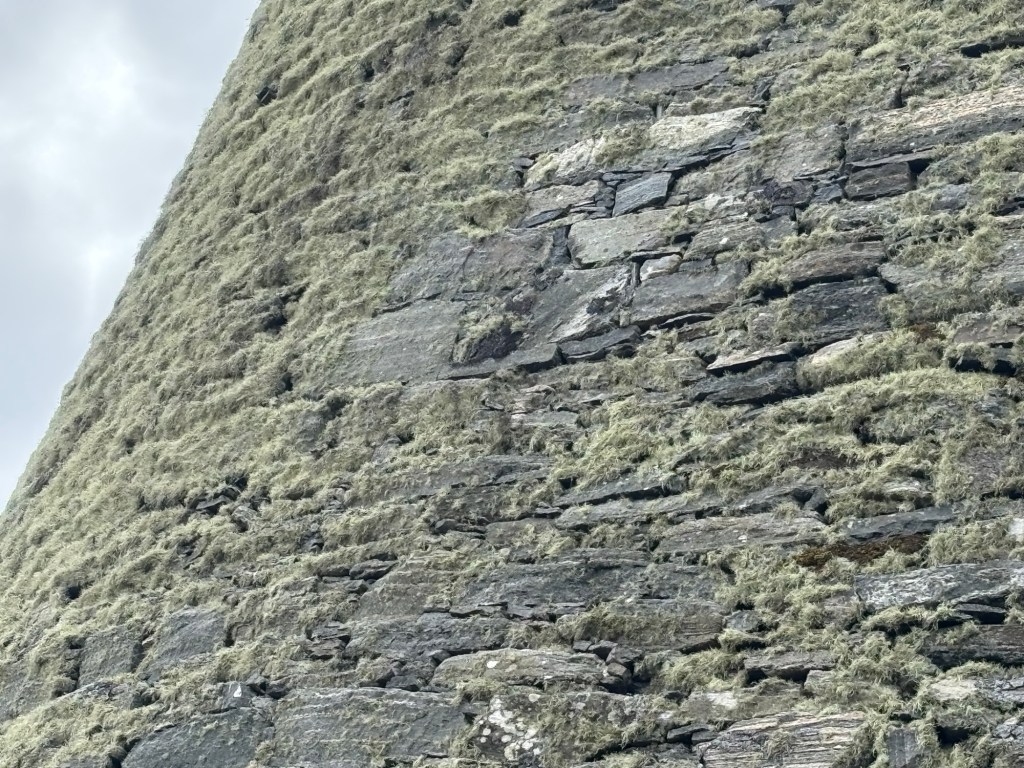
It is built in two walls –  the outer is convex and the interior is vertical.

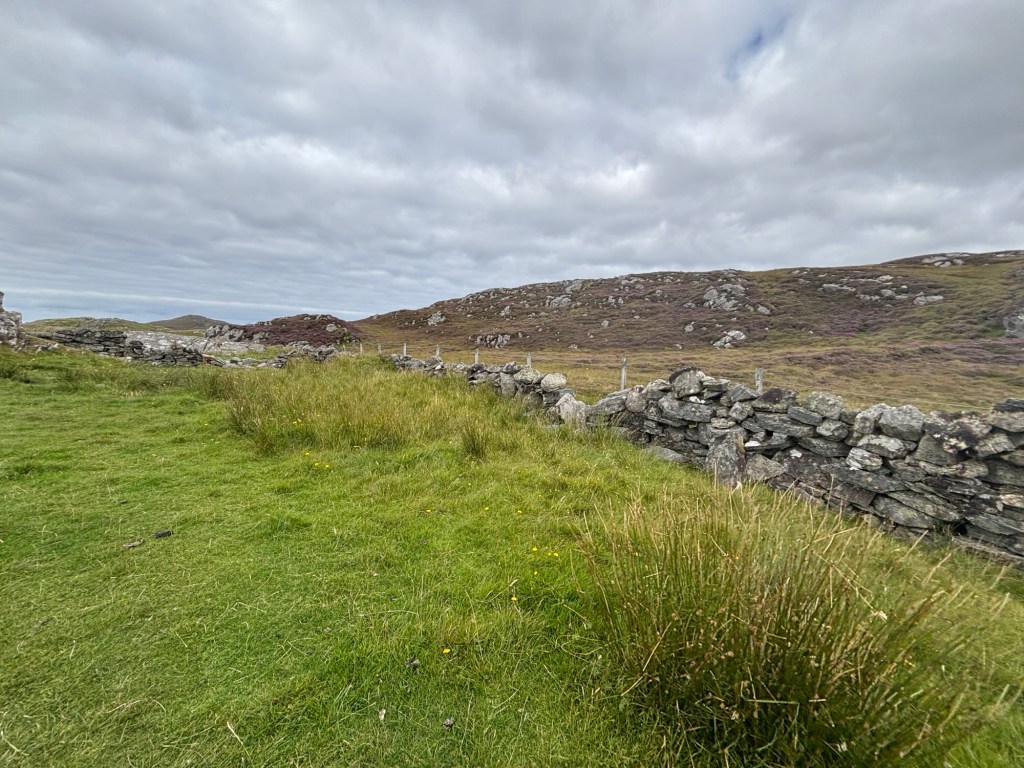
Over time, the broch was abandoned and stones were removed to build other houses and fencing.

Restoration started and much of the work was done by two sisters.  They did what they could with what they knew and put in a tremendous amount of work.  

Their work has been refined to make the broch safer to visit, although our guide thought it precarious.  

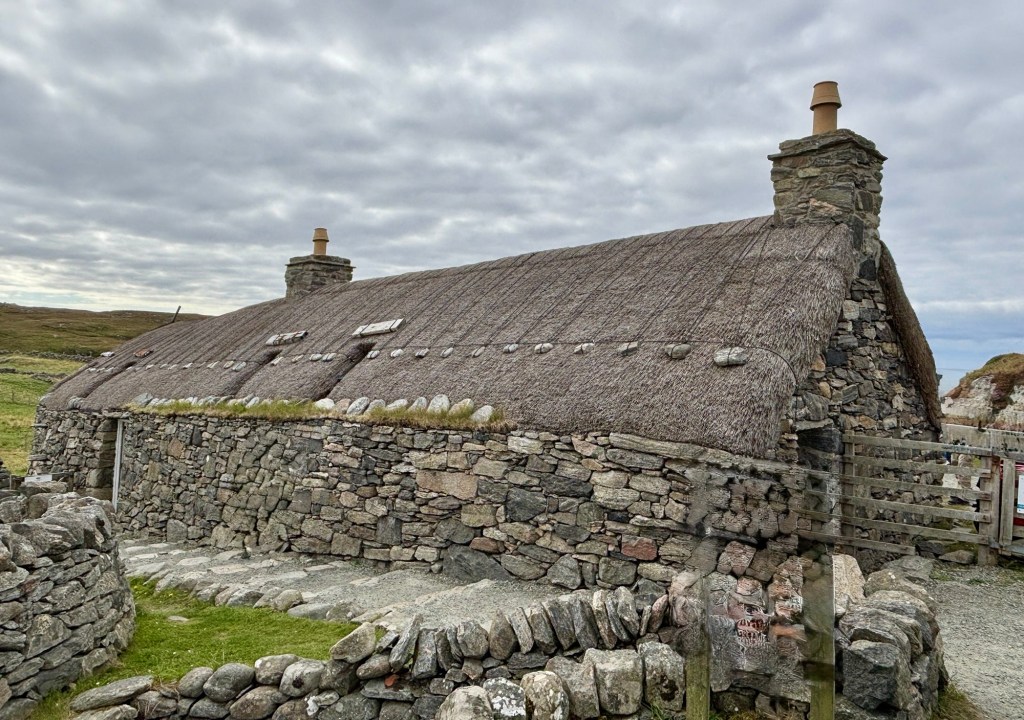
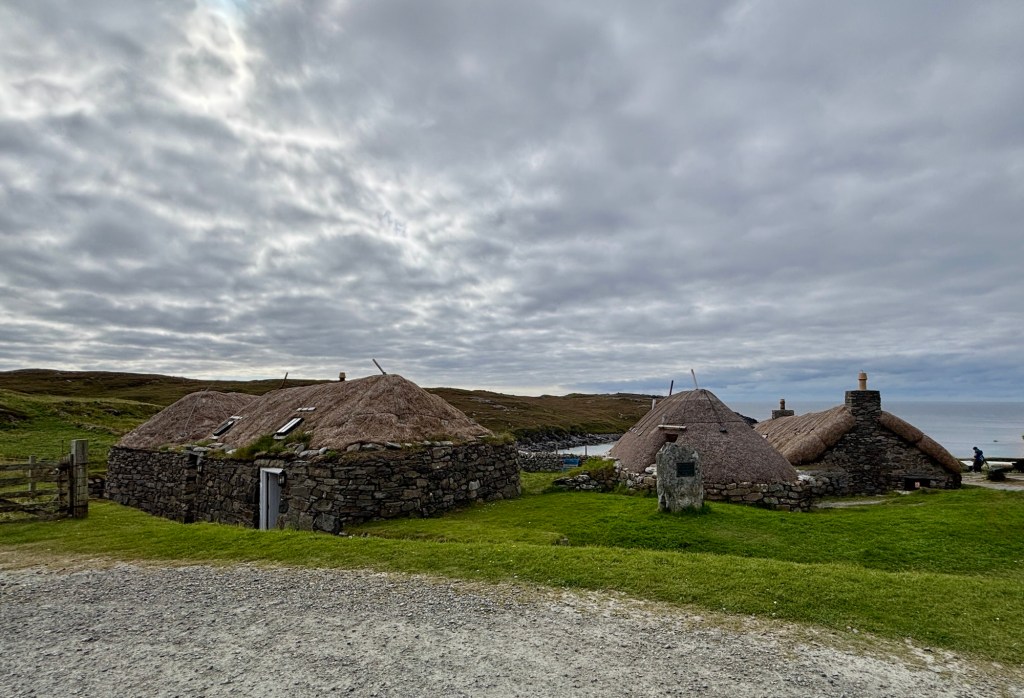
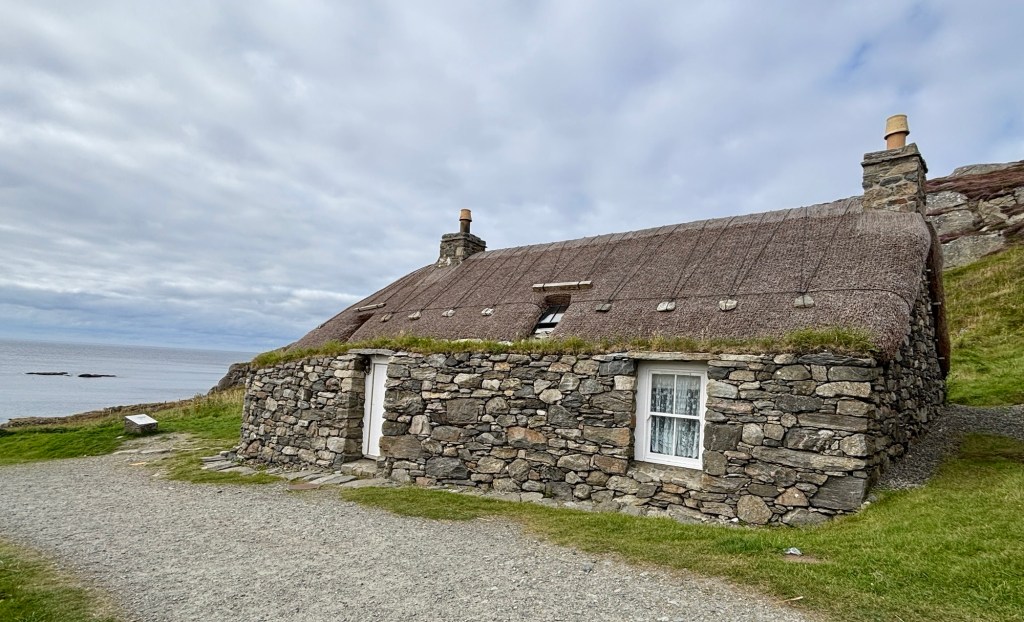
Our next stop was the settlement of Gearrannan, the traditional village of ‘black houses’ at the edge of the ocean. 

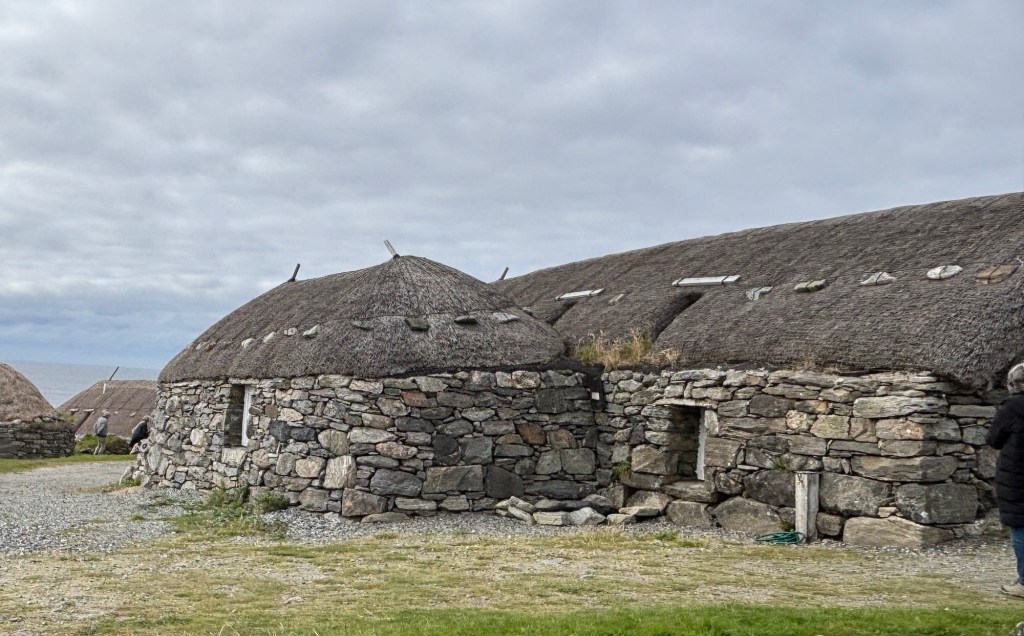
These houses were built in the late 1800s. They were once the traditional style houses along the Hebridean coast.

The houses feature packed earth floors, stone walls, and thatched roofs. 

Black houses were built originally as a combined barn and home where people lived together with their animals.  Both rooms slope to the middle for liquid disposal.

An open peat fire usually dominated the main room, marking the walls with soot and leading to the ‘black houses’ name. 

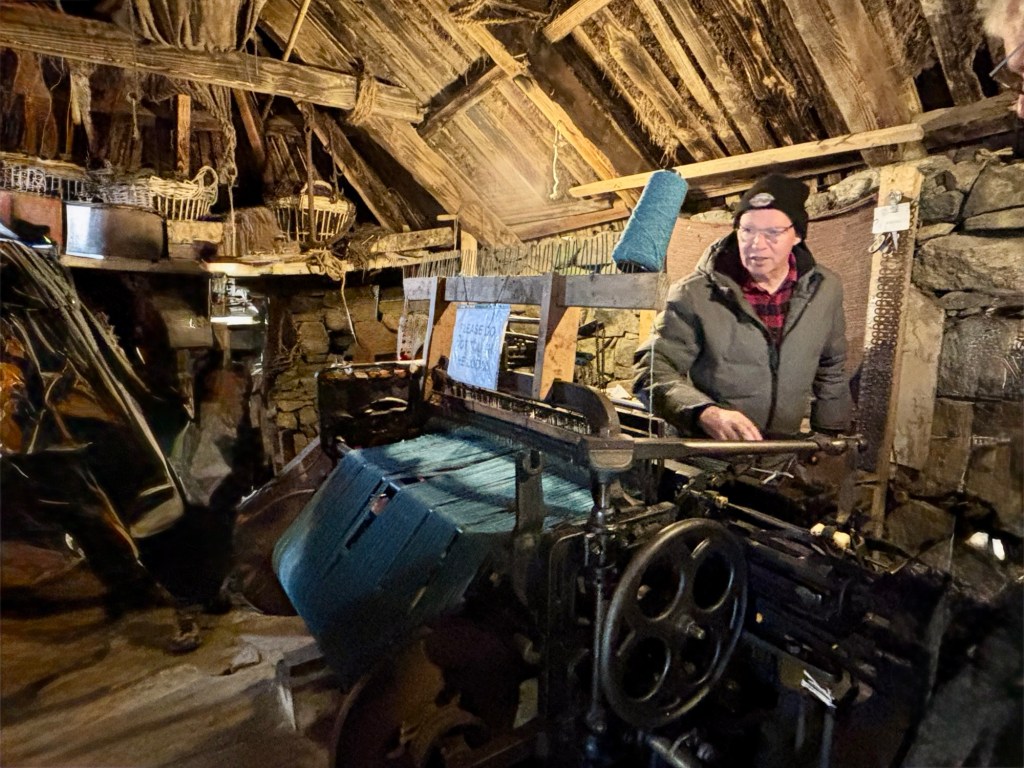
This example was furnished as it was in the 1950s.  

A fire kept the space warm, and a divider separated the human inhabitants from their farm animals.

Between 1945 and 1965, the other black houses on the Isle of Lewis received running water and electricity. 

People lived in these houses until the 1970s, when the village’s remaining elderly moved on.  

Decay into ruin seemed inevitable but in 1989, a local trust began work restoring and preserving these black houses. 

Not only does the black house village have living museum space and activities but there are also overnight facilities for rent.

We looked In the gift shop at the local products for sale.  While there, I started reading a display and discovered it expressed local angst against Donald Trump.  

His mother was born in a black house a short distance away. She eventually moved away and married Fred Trump.  In 2008, Donald Trump visited this area and efforts were made by locals to introduce him to the life his mother would have lived in a black house.  Trump spent less than a minute in his mother’s childhood home.  He was perceived as being uninterested in learning about the local history and what her life might have been like.   The Scottish people protested Trump’s presence in Scotland several times while we were on this trip but we did not know their dislike for him went back so far.  

This arch was made by the two lower jaw bones from a beached blue whale in 1920.  The harpoon was in the whale but the head had not exploded.  (I hadn’t know they ever exploded!)

Fortunately the man dealing with the whale and harpoon was not in the shed when it finally did explode so he was not injured.   

We enjoyed our Historic Lewis excursion, just as Cindy and Darrell had.

Next Up:  The Isle of Skye, the port we missed because of weather on our first cruise.

Posted in Uncategorized | Leave a comment

Iceland: Big History of a Small Island

There are so many extra things we learned about Iceland that didn’t fit into our earlier posts – so I’m adding an additional post to get down some of these other interesting things.  

Some of these extras were from guides and port talks, and most came from the book How Iceland Changed the World by Egill Bjaanason.   Its subtitle  is The Big History of a Small Island.  

It was a great book and I was happy to leave it in the ship’s library for another traveler to enjoy.  We went by the ship library the next day and I was so pleased that someone had already taken it!

Iceland, the land of fire and ice, was the last major territory settled in northern hemisphere.  The settlement of New Zealand,  a few centuries after, made human occupation of all major territories in the world complete. 

Iceland is about the size of Ohio. 

There is a Ring Road, also called Route 1, around most of the perimeter of Iceland. It is 1908 kilometers long, taking about 24 hours to transit. There are many travel sites that promote the places to visit along the Ring Road if you are traveling in Iceland independently. They suggest allowing seven days.

Because my social media feeds are still giving me Iceland information, I saw this posting of the road being washed out because of heavy rains and winds. The comments indicated that, once the weather subsides, these washouts are repaired in just days.

Twelve percent of Iceland is covered by glaciers. 

Alaskan Aspen is the tree having the best success in reforestation.

Iceland’s conversion to Lutheranism led to improved literacy as people were encouraged to read the scriptures for themselves.

The Black Death hit Iceland in 1402 and wiped out 2/3 of the population. 

The first country wide census ever was done in Iceland, commissioned by King Frederick IV of Denmark, circa 1700.  The results indicated a population 50,358 which plunged to 30,000 three years later due to a small pox outbreak.

“The population of Iceland is 1000 times smaller than that of the United States…. What we lack in manpower,  we make up in volcanoes, but we’re still figuring out how to aim them.” spoken by an Icelandic Prime Minister at a White House dinner.

Iceland has chosen to emulate the Nordic countries as a social democracy.  The people pay high taxes but get a lot for them.  Medical care and education through university are free. 

During the Cold War, Iceland denied the US government request for a 99 year lease to build a military base.  However, since Iceland didn’t have a defense force, some Americans did serve in that capacity. Iceland still has no armed forces.  It is a peaceful place.

The Icelandic language has not changed much in centuries. It is the closest to the old Norse. They do not incorporate new words from other languages.  They create new words from their own.  For example:  the Icelandic word for computer combines their words for sorceress and numbers.

Circa 870 AD, Norseman, Infólfr Aranson decided on the location of the first permanent settlement, using a traditional method. That meant casting pillars carved with the image of Thor overboard as soon as land was sighted and settling wherever the gods brought them ashore. Two of his slaves searched for three years before finding the pillars. That settlement became Reykjavik, meaning Smoky Bay in Old Norse. The name was said to be inspired by steam rising from hot springs.

The eruption of the volcano Laki lasted for seven months  in 1783. It changed the weather of the entire northern hemisphere for years.

Loki spewed 220 square miles of lava 3 feet deep. Iceland was covered in ash and then in acid rain.  Many sheep died resulting in famine throughout the island. Air particles led to a severely cold winter all through Europe which resulted in freezing rivers destroyed crops and flooding.  It was the greatest occurrence of “natural” death in Britain killing 23,000 – 30,000 people.

When evaluating marriage partners in Iceland, one often is considering semi-distant cousins. It has been common in some cultures to marry cousins.  Worldwide, more than 10 percent of marriages are between cousins.  Icelanders are familiar with their genealogy and have access to a data base to see how related they are. There is an app for that!

After World War II, Iceland declared independence for Denmark and then joined the United Nations.  Their ambassador became the leader of the ad-hoc committee to tackle the Palestinian issue.  It was chosen because Iceland was not Arab, not Muslim, not in the Mediternnean, not Eurocentric, not anti-Semitic and not one of the big five.  That left Iceland, Guatemala, Sweden, Peru, Canada, Australia, Iran and a few more.  There was much maneuvering but in the end, Israel was created in 1947.

NASA astronauts including Neil Armstrong trained in central Iceland because the landscape is similar.  Nine of the twelve people to ever walk on the moon, first trained in Iceland.

American chess master Bobby Fisher played his match against Boris Spassky in Reykjavik in 1972.  Years later he was arrested and jailed in Japan for traveling on a voided US passport after playing a match in Yugoslavia.  A friend from Iceland helped him gain asylum and citizenship.  He lived his last years, and is buried, in Iceland.  

Mikhael Gorbachev and Ronald Reagan met in Rekyjavik and tackled the issue of nuclear arms.  Although they didn’t reach the deal they’d hoped, they made significant progress and a deal was reached a year later.

In Iceland in 1980, Vigdis Finnbogadottir, was the first woman in the world to be elected president by a direct vote of the people – not through parliament or party leadership.  She was elected the fourth president of Iceland with a margin of 1,911 votes.

Halla Tómasdóttir, another female president of Iceland, was inaugurated on August 1, 2024.  The is the seventh president of Iceland since gaining independence.

Iceland was a very interesting destination, and way bigger in world impact, that I ever suspected!

Posted in Uncategorized | Leave a comment

Two Cruises: Puffins and Keiko Free Willy

We visited the island of Heimaey on August 18th.  It sits off the southern coast of Iceland.  

We learned that our ship was staying in place using dynamic positioning and thrusters.  We were above the electricity cables providing service on the island so the ship was not allowed to lay anchor. 

The isolated island was a long-time shelter for the Icelandic fishing fleet.  It was beneficial that the fleet was at home when a volcanic eruption took place in 1973.  The fleet was able to help with a total evacuation of the island.  Everyone survived the eruption except for one person who stayed behind trying to loot the pharmacy. 

The eruption caused the island to grow by 2.2 square kilometers.

Our excursion was to cruise around the island to see various bird colonies – specifically PUFFINS!  

We did see them, but they are very small and it was difficult to get pictures.   The closest I came to one was on the tender back to the ship at the end of the day.  

Iceland has an estimated 6-8 million puffins with about two million being seasonal residents on this island.   In mid August, the adult puffin were migrating out of Iceland so, perhaps, we were lucky to see any at all.

We learned that people who took walking excursions were able to see puffins close up.  I just chose the wrong excursion in that respect.

The very bumpy looking ground is showing all the puffin burrows underground.  In a few weeks the “puffling” inside the burrow will get hungry and make its way towards the light.  If it is daytime and the light they see is the sun reflecting in the ocean – all is well.  The puffling jumps out over the ocean and begins its life at sea.

These birds are different seabirds – not puffins.

If the puffling emerges at night near one of the towns, he could be confused and jump towards a house or street light.   There is a whole culture in Iceland of rescuing the misdirected pufflings.  They are gathered, kept in a box overnight and then thrown off a cliff to the ocean the next day.  Our tour guide told a story of taking a walk one evening and collecting four pufflings – one in each pocket and one in each hand.  It seems that Icelanders take their commitment to the puffins very seriously.

Then there are the sheep…there are sheep all over Iceland, easily out numbering the humans.  We have learned how they are mostly set free to roam all summer and gathered again in the fall to keep protected over the harsh winter.

We saw sheep grazing on remote islands, often high up above steep rock cliffs.  

The sheep are placed there in the spring using a net and pulley system.  They are collected and removed again in the fall.  What we failed to ask is why?  Why go to all the work to have them graze these islands and then gather them down again?  

The 2010 volcanic eruption that disrupted air travel worldwide was this mountain and glacier area off in the distance. The volcano, Eyafjallajökull, erupted between March and June 2010. After an initial six days of eruptions, 20 countries closed their airspace to commercial jet traffic and it affected approximately 10 million travelers.

This middle island is Surtsey, the second youngest island in the world. Its creation began with eruptions 130 meters below sea level from November 1963 to June 1967.  It is named after the Norse god of fire and has been protected as a natural laboratory. 

And just for our information: The world’s youngest island formed in 2014 off Tonga’s main island.  It is already diminishing and sinking into the sea.  It will probably not be visible within 30 years.

Iceland’s famous Elephant rock is made of basalt columns and formed by the slow cooling and contraction of lava. 

There are two volcanos in this picture.  The left, flatter one erupted in 1963. The one on the right erupted 4000 years ago.

Our guide was a lovely young woman.  She told us a bit about growing up on a small island.  She said Icelandic students must learn three things before graduating.  First, everyone must learn English because no one on earth speaks Icelandic.  Second, everyone is required to learn to swim both for themselves and for rescue situations.  Third, everyone must learn to run from volcanoes!

She also said that the dating life on the island (for her at 21) really stinks.  She’s pretty sure her soul mate isn’t on the island or she would have met him already. Everyone is either a cousin, already taken, or no one she’d want to date.   She was asking if any of us had sons or grandsons to recommend.  

There were several caves being carved out at water level.  We approached a few but actually fit inside one that is known for its acoustics.  Musicians sometimes play inside.  Our tour boat captain played a song on the sound system – the experience lacked authenticity.

This area is where the whale Keiko lived his final years as highlighted in the movie Free Willy. 

Keiko lived in a secluded area behind this infrastructure.  Keiko was safely confined but also enjoyed the most freedom he ever had.

Currently the site is operating as a Beluga Way sanctuary.  They have two beluga whales, with room and plans to have 6 more.  Their goal is to get the whales out of amusement park swimming pools.

We saw the following post on social media a day after this was posted. Good for them!

Back to the original post…

We spent our last afternoon in Iceland in the Crow’s Nest watching the sheep graze along the steep hillside far above the seaside cliffs.  

As we sailed away, the cruise director alerted us to the fact that we were going to sail by one of the internet memes for the loneliest house on earth, or most desirable if you don’t want neighbors. 

I found it on line, and then took a picture of the same house. 

And then there was a second house on the next island over.  I guess they were neighbors of a sort.

This was a nice day and a good excursion. Unfortunately, the puffin viewing could have been better. . Another trip, another time.

Next Up:  One more blog on Iceland because I learned some interesting things that I haven’t put down yet.

Posted in Uncategorized | 2 Comments

Reykjavik:  Two Great Excursions!

In preparing for the port of Reykjavik on August 17, I had hoped to book tours to the Blue Lagoon and the Golden Circle. Those are two very popular attractions out of Reykjavík. The ship offered both tours but not in a way that I could do both given the times offered. To see both, I would have to book one through the ship and get a private tour for the other.  However, if the ship was late docking in the morning, we’d miss our private tour or if the private tour was late at the end of the day, we might miss our ship. I really wanted both to be ship excursions to eliminate concern, but that didn’t exist.

After a significant amount of research, angst, and conversations with people who had been to the Sky Lagoon,  I decided to book the Sky Lagoon and Golden Circle both from the ship. People said we wouldn’t even miss the Blue Lagoon. They were right!

In a word: PERFECT!  The Sky Lagoon may have been the single best excursion we had on the trip.  When people ask my favorite place from our two cruises, Sky Lagoon often pops into my head.  

We decided to just enjoy the experience and not worry about phones and pictures.  The pictures here are from their website.

We had learned that swimming and soaking in geothermal pools is very Icelandic. Our excursion allowed for soaking in the lagoon and participating in the Skjól ritual.  The ritual sequences heat, cold, warmth, drizzle, softness, steam and hydration.

It began  with a soak in the warm geothermal waters with views of the North Atlantic Ocean.

We watched others do the second step in the ritual – a cold plunge but skipped it ourselves – no regrets!

A beautiful sauna was next with Iceland’s largest single-pane window.  It gave the impression of being outside.

The next steps had us walk through a cold fog mist, complete a body scrub, and then go into a steam room.  The final step in the ritual, was a small Krækiber juice made from Icelandic wild berries.  One of the berries was the variety we picked and ate on the mountain on our first trek in Iceland.

We went back out into the main pool to enjoy the warmth and the views. 

We enjoyed crown berry martinis from the swim up bar, because why would we not!

Our time in the Sky Lagoon was over and we dressed and checked out.  We had been fitted with a wristband which was how we charged our drinks, souvenir, and even a can of Arizona Iced Tea. Before departing, our charges were downloaded from the wristband onto a display and payment was completed.  

Recently, Randy and I were watching TV and a commercial came on the screen. We recognized that the commercial had been filmed at the Sky Lagoon during winter.  It would be great to experience the lagoon in winter!  We’d still skip the cold plunge!
We went back to the ship feeling very content, ate lunch, and then met for our second excursion: the afternoon/evening Golden Circle tour.

The map shows some of the places we would visit, leaving from Reykjavik, where two thirds of Iceland’s population resides.

We headed southeast to the Reykjadalur Valley. On our drive, plumes of steam escaped from the geothermic liquid under the surface. 

The Hellisheidi Power Plant sits in the high temperature field and uses that geothermic activity to produce electricity and hot water to heat homes in the Reykjavik area.  It is all renewable.  No fossil fuels are used for heating and electricity.

We were told the Hellisheidi Power Plant is the 4th largest producer of power in the world.  

Their processes leave very small amounts of carbon dioxide and sulfur.  They have developed a process to solidify the gasses and inject them back into the basalt that makes up 95 percent of Iceland.

The surrounding basalt lava fields are covered in a green moss.

Iceland produces more electricity per capita than any other country in the world.  They excel in hydroelectric and geothermal systems and advise others around the world.  

This used to be a ski lodge.  There is no longer enough snow because of climate change.

We continued to the furthest point in the circle, to Gullfoss waterfall..

Gullfoss is thought to be Iceland’s most beautiful waterfall.  Spoiler alert: They are all beautiful!

This woman, Sigridur Tómasdóttir, is credited with saving Gullfoss.

She was one of 13 children born to a farmer whose land included Gullfoss.  Around 1900, foreigners began buying waterfalls and building hydroelectric plants. At first, her father declined offers for Gullfoss but eventually agreed to a rental agreement on the falls.

Then in her mid-thirties, Tómasdóttir  began working to invalidate the rental agreement.  Her father would not help her, but she did get support from a government official.  Although she ultimately lost her case in the courts, the delays caused the foreign investors to lose interest.

We all still have Gulfoss to enjoy because of her efforts.  The falls and the surrounding lands are now protected.   

We traveled a short distance to Geysir geothermal area.   The English word for geyser is spelled GEYSER but it is derived from the geyser in southern Iceland spelled GEYSIR.  Geysir was a specific site where the name evolved to be any geyser. 

Geysir has been dormant since 1915.  We visited the smaller geyser nearby called Strokkur.  It still erupts about every seven minutes.  

This chart shows the eruption heights of Geysir, Old Faithful in the US, Stokkur, and Pohutu in New Zealand.

Our final destination was Thingvellir National Park – a UNESCO World Heritage Site.

Thingvellir is a primary site in Iceland’s geological and historical heritage.  First, the geologic factors. 

There are a number of tectonic plates throughout the world.

Two of them bisect Iceland, the North American plate and the Eurasian plate.  Iceland is being built every day by volcanic activity between the two tectonic plates  

The plates are moving away from each other at a rate of 2 centimeters a year.  The left side of the country is older and no longer has active volcanoes.  The right side has lots of geothermal and volcanic action.

We walked along and through the geological fault next to the North American plate. There is intermediate land between the two plates that has developed over time.

The North American and Eurasian plates are very close to each other just 40 kilometers from where we were. 

After seeing this picture in a briefing on the ship, I was disappointed that we didn’t get to see and walk this place. where the plates were so near.

Where we were, however, didn’t just have geological significance, it had historical significance as well.  

Before the year 900, most of the people in Iceland were from Norway, with some from the British isles.   That created some strife, so residents decided that there needed to be laws for all of Iceland.

Two brothers, Ingólfur Arnarson and Hjörleifur Hróðmarsson, settled in Iceland around 874 AD.  When the decision was made to create laws, one brother went to Scandinavia to study laws and the other brother selected a site for the future parliament.  

That parliament, the Icelandic Althing, is considered to be Europe’s oldest national legislative assembly.  It was established in AD 930. 

This flagpole is where the first parliament met and where the “law reader” informed the people of proposed, or agreed upon laws.

It is thought that the natural rock wall opposite from the speaker position, helped to provide acoustic assistance to allow the Icelanders to hear.

The assembly continued to convene here every summer until 1800.  Periodically, and on special occasions, they still do. 

Beginning in the 13th century, Iceland was under either Norway or Denmark. In the 16th century a Danish king declared that couples in Iceland could not marry unless they could demonstrate resources to support a family. 

When children were born out of wedlock, the father was beheaded and the mother was drowned in this pool. The child was auctioned off.

It isn’t a pretty story but our most elegant guide said it was important to remember even the bad in your history.

In 1874, Icelanders got their own constitution but were still under the Danish monarchy.

During WWII, Britain occupied Iceland to prevent Germany from taking it due to its strategic position.  The United States took over that occupation in 1941, allowing Britain to reassign their soldiers.  In June 1944, Iceland declared independence from Denmark, with support from the United States.

Our day in and out of Reykjavik was fabulous!!

Next Up:  Heimaey, an Island off the coast of Iceland

Posted in Uncategorized | Leave a comment

Two Cruises: Isafjordur and The Vikings

As we approached Isafjordur on August 16, we had nice views from our balcony. 

A pilot boat approached to drop off the pilot who would direct our ship into port.

We had decided, after our last fjord cruise, that it might be nice to do something different.  We were on standby for a tour called “A Viking Thing” but kept our fjord cruise because it was too late to cancel.

We found out very early that all water related tours were canceled, including our fjord cruise.  We felt badly for those who had booked whale watching excursions and were so disappointed to miss their chance. For us, we saw this as a potential opportunity.  We spoke to the shore excursion people to see if we could wait around to see if there were any no-shows for A Viking Thing.  (Unless you have an unexpected illness, we do not understand not showing for a tour.  Tours from the ship are expensive, especially those in Iceland.)

Regardless of why, there were three no-shows.  The shore excursion personnel tried to reach them but ultimately gave two spots to us.  Our fjord cruise had been automatically refunded when it was cancelled and it took them just a few moments to charge our cabin instead.   

We were off and running – almost literally – because the tour was waiting for us.  A result of us being the last ones on the bus (probably people were wondering WHY we were so late), we got seats in front.  Those are always saved for folks with mobility needs.

Our coach driver and guide were grandfather and grand-daughter.  She spoke perfect English, with no accent. She was born in Iceland and moved to Norway as a child. Her family moved back to Iceland, but she moved to Denmark for university.  All three of her resident countries stressed learning English.  Thus, she speaks, Icelandic, Norwegian, Danish and perfect English.

The local harbor was beautiful.

Our guide pointed out an avalanche tunnel and fencing designed to keep Isafjordur safe, or at least safer, during the winter snows.

Very soon after leaving town, we entered the longest tunnel in Iceland at 5.5 miles.  There is even an intersection within the tunnel! 

To save money, they made the roads one lane after the intersection.  There are many turn outs along the lane for when vehicles meet.  Cars going into Isafjordur, always have priority. Cars going out of town have to wait in the turn-outs. (For those of you examining details – this picture was taken later in the day when we had priority heading back into town.)

As always, the guide told interesting facts and tales along the way.  She said her favorite tale is the Yule Lads.  They are 13 troll brothers who live in the mountains and give presents to kids at Christmas. Icelandic kids put their shoes in the window and the lads give you a present if you are good, or a potato if you are not.

Trolls and elves are very much alive in Icelandic culture.  Elves are thought to have a deep respect for nature and Icelanders do as well.

Volcanic eruptions created Iceland by creating mountains.  Ice age glaciers flattened the mountains, and the melting glaciers formed the valleys.  

She explained that a fjord, by definition, must have mountains on both sides and have sea between them.  The height of the mountains must be more than the distance between the mountains.  (I have looked for years for a definition of fjord that made sense to me and this one finally did!)

When the Vikings arrived in Iceland, they used descriptors to name places or things. Isafjorder is the fjord of ice.  They also sometimes named places after themselves.

Iceland was named (at least the name that stuck) by a Norwegian man who was bitter about his experience on the land.  His daughter drowned on the voyage and his livestock died during the brutal winter.  Even though the land is seasonally green, he named it Iceland as a warning for others to stay away.  (Conversely, even though Greenland is predominately covered with snow and ice, Erik the Red named that land Greenland as an enticement to get people to settle there.)

When the Vikings arrived, twenty five percent of the land was covered with trees.  Now it is one percent.  There is a reforestation effort but it is hard to grow trees in this environment.

The Vikings brought sheep, horses and cows to Iceland.  Prior to that, the only mammal was the arctic fox.

Icelandic sheep and horses lived and reproduced in isolation. They were not bred with other varieties.  Therefore, they have some unique characteristics.

The Icelandic horse is smaller in stature, pony size, but has two extra gaits, and is called a five gait breed.  Besides walk, trot and canter/gallop, the extra gaits are called tölt and flying pace.

It is against the law to bring other breeds of horses into Iceland in an effort to keep the Icelandic Horse pure.

During settlement, Viking men spoke Old Norse.  They eventually brought women to Iceland from Scotland and Ireland and the women spoke Gaelic.  Icelandic is similar to Old Norse, with a Gaelic twist.  The languages are similar enough that Icelanders can read Old Norse.

Some believe that the Scottish and Irish women did not need to be taken to Iceland against their will.  They might have been happy to go because the Viking men’s hygiene habits were much better than local men. The Vikings set aside one day per week for bathing and were the first to brush their teeth.  

After an interesting ride, we arrived at The Viking Place and met our hosts.  

Their main room has many areas and things to explore and maybe purchase.

We were given a small glass of beer.  It was similar to Viking beer in that it was made from sea-weed.

The simple Viking clothing was explained and we had the opportunity to play dress-up. The Vikings would have used horns for drinking or storing things, not as a decoration on their helmet.

We were instructed on how to roll out a small piece of flat bread and cook it over a fire.

We could spread butter or brown cheese on top.  It was a nice to have a warm snack. These flat bread pieces would have been a delicacy for the Vikings because the flour would have been imported.  Grain crops do not grow in Iceland.

After our time at The Viking Place, we took a walking tour around the little town.

We saw this example of a building technique.

These mounds cover the ruins of ancient a gathering place for the historic local parliament.  They are undisturbed after a thousand years.  Icelandic culture has little money or interest in archeology.

This is a typical rural church.   A pastor visits and leads services once every four weeks or so.

Every town in Iceland, regardless of size,  has a heated pool that residents use year round.  It is a very important part in Icelandic culture, perhaps in a nod to that old Viking good hygiene.  

Eating ice cream is another part of cultural and is consumed regardless of the temperature and season.

Small towns have a strong sense of community and often have a Facebook group for town and incidental communication.   A sense of community is vital for getting through the long dark winter.

Storytelling is also important in Icelandic culture – again, helping get through the winter..  Ten percent of Icelanders have published a book, the highest per capita anywhere in the world.

Pepsi MAX  is the most popular soft drink.  There is no sugar and twice the caffeine to keep you awake during the two months of mostly darkness.  The sun does rise in those two months, it just can’t be seen above the mountains.   The change for more sunlight, or more darkness, is about 9 minutes per day one way or the other.

As we headed back to town, we saw a lovely rainbow over the landscape.

Once back on board, walking along the promenade, we had a good view of the work that is in progress to expand the port area at Isafjordur.

From our balcony on the opposite side of the ship, we saw some sheep on the “beach.”  The sheep beach was right at the end of the airstrip.  Our guide had told us that the mountains and the winds make flights in and out of Isafjordur very tricky.  She said that only the most experienced pilots are allowed to try.  Even with experienced pilots, about 40 percent of flights into Isafjordur in the winter are cancelled.

Randy spent some time watching activity in the little dip up on the side of the mountain.  For a time, it seemed that there was a rescue going on.  Later, he changed his mind to think there were just some workers doing some work.

Later in the day, the weather deteriorated as expected.  We were glad we had been comfortable on our tour earlier in the day.

Next Up:  Reykjavik, and maybe our favorite shore excursion of all.

Posted in Uncategorized | Leave a comment

Two Cruises: Godafoss Waterfall and Laufás Turf House

We sailed towards Akureryki on August 15. There are 20,000 residents in Akureryki, Iceland’s second largest city.

We were at breakfast when the captain announced a jumping whale on the starboard side.  That is the side our cabin was on but we weren’t there.

We spent an hour in the Crow’s Nest before leaving on our late morning tour.

We met our tour guide, Lila, who was wearing a tank top when we had on our winter coats.  She said she was not cold because “it IS summer in Iceland.”  

As always, our guide shared information as we traveled by coach.  Lila told about the retiree practice of meeting at geothermal pools in the mornings for a soak and conversation.  Geothermal pools are everywhere around Iceland.  

Our tour involved three destinations and the first was the botanical garden.   We don’t generally choose to visit gardens, but I did want to see the other two destinations, so here we were.   

However, once arrived, even we were impressed with the work and variety of colors and plants – especially in this environment!  The garden is only 53 miles from the Arctic circle, one of the most northern botanical gardens in the world.  

The land was set aside in 1910 for the formation of a park and was designed by a society entirely of women.  It officially opened in 1912 and was the first public park in Iceland.   It transitioned into a botanical park in 1957. 

The garden features around 400 species of Icelandic plants, with more than 7000 species overall. That includes plants from arctic,  temperate  and high mountain areas. 

As we left Akureryki, we could see Nieuw Statendam and a smaller ship nearby.  The smaller ship was the Windstar Star Pride. She sails with 312 passengers compared to 2600-ish for our ship.

The farmers in this area primarily grow hay to feed the animals during the winter. There are more sheep than people, 2.5 per person.

Lila said those weren’t really hay rolls, they are marshmallows for the trolls.  The black ones are licorice flavor.  Trolls are a big part of Icelandic culture. 

Seriously, there were a variety of colors of hay rolls.  Different colors indicate donation to a particular non-profit.

Sheep are sheared twice a year and the wool is still somewhat profitable.  Meat is far more profitable.  The bones and horns are used in jewelry.

A few farmers will grow root vegetables like potatoes and carrots but grains do not grow there.

As we approached our next destination, we could see the Skialfandaflioi River, Iceland’s fourth longest river.

Our second, and primary destination, was Godafoss, the Waterfall of the Gods.

Godafoss has a nearly 40-foot drop along a curved lip that is almost 100 feet long. 

It is one of the world’s notable waterfalls.

There isn’t consistent criteria for a list the world’s “best” waterfalls.  The lists would be different if determined by height, water flow, width or other selected criteria.

Our last destination of the day was Laufás, a church site and residence. This area has been a religious site from the pagans to the Catholics to the present Lutherans.

A Catholic takeover happened in 1047 and priests were leaders in the area for 500 years. The last Catholic priest in Iceland was beheaded here in 1517, as part of the transition to Lutheranism.

We met our local guide outside the former vicarage, now turned visitor center and gift shop.  She told us a bit about the history and the residence and sent us on our way to explore. There were also a few docents inside. 

This turf house was a wealthy vicarage and was built to allow for a minister with a large family and servant household. Some 20-30 people lived here at one time.

Even though this looks like five houses, it is really one interconnected building with 17 rooms.

Icelandic turf houses were the product of a challenging climate, offering better insulation as compared to buildings made of wood or stone. 

We could see some of the construction techniques.

Some of the rooms were very bare and dark, probably how the work and servant areas would have looked.

This was a traditional wedding dress, displayed in one of the darker rooms.

Other rooms show how the building may have looked for family residents.

The Laufás site was rebuilt from 1866-1870 by Rev. Björn Halldórsson, who served from 1853-1882.  

The Laufás turf house is now owned by the National Museum of Iceland.  

This Laufás church was built in 1865 and is still in use.  

Its pulpit was built in 1698. 

This turf house vicarage is much more elaborate than most turf houses in Iceland.   The church and vicar could afford this elaborate home because 5000 eider duck nests were spread out across the marsh. The down from the eider ducks funded the church and residence. 

An eider duck is featured on the peak of the center of the five entrances.

Eider down is a soft and fine layer of feathers from the chest of the female. Hormonal changes cause the down feathers to loosen and the nesting female plucks the feathers to provide warmth for her eggs. 

Eider down was gathered then and is still highly valued for its softness, lightness, insulation, fibre structure and compression resistance.  Seventy-five percent of eider down is produced in Iceland.

Rev. Þorvarður Þormar, minister at Laufás from 1927-1959, was the last to live in the Laufás turf house. He moved into a new vicarage in 1936. 

The current pastor is the thirty-third priest or pastor at Laufás since 1047.  She is the third woman pastor – obviously in the Lutheran line.

The official religion of Iceland is Lutheran, but our guide said that people don’t care if your religious preferences is Lutheran, or not, or nothing at all.  They also don’t care about your gender, sexual preference, vegan status, or politics.  The Icelandic philosophy is do your own thing and don’t bother anyone else for doing theirs.

She also mentioned the Icelandic philosophy of petta radast.  Our cruise director had told us about the mantra when preparing us for our visits to Iceland.

As we returned to town, our guide talked about how Icelanders are all related.  They actually have an app to see just how related people are. 

Lila told us local police officers don’t carry guns but they do have tasers.  There is a  three year training program to be a police officer in Iceland so they are very well prepared.  There has been only one death incident involved police shooting EVER.

She made sure we noticed the traffic lights in Akureryki – the red lights are heart shaped!

Next Up:  Our third Icelandic port –Isafjordur

Posted in Uncategorized | Leave a comment

Two Cruises: Djupivore, Iceland 

This was our first inkling of a view of Iceland!

It looked a little better as we made our way onto land on August 14.  

Our tour this day, our first in Iceland, was to the Valley of Waterfalls — the Fossardalur Valley.     

Our driver’s name was Sigi.  When I mentioned she was our second guide named Sigi, she said it was a common name.   (The first was our guide in Norway who was from Iceland.)

Sigi also told us she wasn’t our guide, just the driver.  Djupivore, population 500, doesn’t have the infrastructure to support cruise ship tourism.  When ships arrive, area vehicles and drivers are gathered.  At least in our case, the vehicle seemed new and was very clean. The vehicle did not belong to Sigi, but to a local sheep farmer.

 It was the first time we’ve ever been parceled out into 16 separate vehicles on a tour!

Sigi did warm up to the activity and told us about growing up on a sheep farm. She is planning on moving to Spain for the winter and may or may not come back.

She said Iceland has no mosquitoes, and no snakes.  Its largest predator is a fox.   

These fences are to keep the foxes out of the seabirds’ nests.

Iceland does occasionally get a polar bear from Greenland arriving on an iceberg. They are always euthanized.

At our first stop we met our primary guide.  We presume he also drove one of the vehicles.  He told us a legend about horses, acting like sirens, trying to lure humans to their deaths.

We walked to a waterfall that is currently flowing only one cubic meter of water instead of the normal eight.  The area is not getting as much snow in the winter as before and the lakes that feed the waterfalls are down significantly.

The 4 x 4 SUV that we were riding in, had separate air pumps to adjust tire inflation level for comfort. 

Sigi would try to get a small stool in place for me because of the height of the vehicle and my lack of the same. Eventually we fell into a routine where I would get down on my own but she would have the stool in place for me when it was time to re-load.  There were four passengers but the other three, Randy and a couple from Canada, were all taller. This was not our vehicle, but the stool being placed was the same.

There were a few vehicles that were so tall that even the men needed a substantial ladder to load up.

We stopped at an old homestead site that was occupied last from 1922-1944.

The couple that lived in this house had 17 kids in 22 years.  All were single births and all survived. Of course, given the span, they didn’t all live there at the same time.  Sigi’s dad was one of the 17 kids. 

The family eventually moved to a different location.

Our main guide’s great, great uncle also lived in the house.

Which brought up the question of finding a husband or wife that isn’t family. The answer was a bit vague. Mostly they don’t choose a person that is too close.  This topic came up in almost every stop in Iceland.

Sigi’s dad, mentioned above, was actually her foster dad.  She told us when her mother was unable to care for her, the family who raised her took her in.  It sounded as though it wasn’t a legality – just the community taking care of one of their own.

We saw a lot of sheep seemingly enjoying their time at pasture. 

The sheep will be collected to go back down before winter.  A lot of the gathering is done by groups of people walking through the hills but some people use dogs or ATVs.

Most sheep are found in the first walk.  They always do a second walk but use drones to find those that were missed.

For the winter months, about 500 sheep will be kept in a barn about this size.  There is no heat but the crowded conditions keep them warm.  

To be able to make a living from sheep, a farmer must have about 1000 head.  Many have fewer and a second job.

We stopped and got a great view of the valley looking back.

Sigi and the other driver/guides pointed out berries called crown berries.  We had a chance to pick and eat some as well as a few blueberries.

Sigi was memorable – in a good way.  We had the definite impression that she would just as soon have been able to go about her life without the inconvenience of a cruise ship tour.  Yet, in another example of the community taking care of one of their own, they provided assistance to the main guide who had this business but couldn’t do it on his own.

Iceland has some wide open spaces and the promised waterfalls.

It also had a few survivors in unlikely places.

We were brought back down and the vehicles gathered for a second tour. Many of our fellow tourists, took the opportunity to visit the two commercial entities at the pier.

Enticed by this picture from our introductory talk on Djupivore aboard ship, we went in search of the Eggs of Merry Bay by Sigurõur Guốmundsson.  Revealed in 2009, 34 eggs each represent one of the local birds. 

The eggs are generally the same size except for this one which represents the red-throated diver, the official bird of Djupivogur.

Obviously, the lighting, positioning and enhancements of my photos don’t match the professional rendering.

This is what my original looked like before I “cleaned it up.”

This might be my favorite, with Nieuw Statendam in the background. It was an interesting place and very much worth the 1/2 mile walk there and back.

From the ship we looked back on our first stop in Iceland.

Goodbye to Djupivogur.

Next Up:  Our second of five ports in Iceland, Akurerki.

Posted in Uncategorized | Leave a comment

Two Cruises: Sea Day To-Do List

I had several things on my sea day “to do” list on August 13th. It was the second sea day of our second cruise, this being the stretch between Norway and Iceland.  

We had benefit of an extra hour of sleep as we headed west. All the better for making up the sleep I missed listening to the Seattle Mariners’ last two innings in the middle of the night.  They won, Astros lost, Mariners moved into first place!

We crossed over from Holland America 3 Star to 4 Star Mariners and I had a message to go to guest services for our new key cards that show our new status and resulting benefits.  The biggest benefit is free laundry!

While there, I asked to exchange my remaining Euros to Icelandic Krone. We almost always use our credit cards but it is always nice to have some local currency for tips and incidentals. They didn’t have Icelandic Krone so I converted the Euros to US dollars. Seventy Euros were roughly $82 USD.  So far on this trip,  we have been in countries using Euros, British Pounds, Norwegian Krone and soon, Icelandic Krone.  The ship usually accommodates exchanging currency. 

I also canceled our shore excursion to the Medieval Town of Rye when we are in Dover again at the end of this cruise.  We learned that Dover has the oldest boat ever found. That sounded more interesting.

Our first activity was a Coffee Talk with Cruise Director Tjalling and Chief Engineer Peter.  They both speak English and Dutch so it was a bit of a dance getting all questions and answers in both languages for the audience.  

There were a lot of Dutch speaking passengers on this cruise.  All announcements were done in both languages and a few events were duplicated, one in each language.

Some new things we learned, or were confirmed, during the coffee talk:

They reluctantly confirmed that there was a helicopter medical evacuation over night.  People around the ship heard the sound in different ways.  We didn’t hear it at all, but had spoken to another who had.  Of course, they gave no details.    

The ship’s course tracking certainly showed that something had happened.

Later in the cruise, in an Ask the Captain session, we learned that the passenger involved had been able to rejoin the cruise in Reykjavik. The passenger, and his wife, thanked the captain for saving his life after he suffered a stroke.

Engineer Peter explained that cruise and cargo ships are attempting to halve the carbon footprint by 2030. Hydrogen fuel, batteries, or nuclear energy are the options.  Norwegian ferries are already using battery power.

However, ships are currently better than the average SUV when considered per person.  Airplanes are way worse.

Engineer Peter said that each port can stipulate the type of fuel allowed.  Mostly that involves Arctic or Antarctic regions and was not a factor with this cruise.

It takes 850 meters to bring Nieuw Statendam to a full stop.  Peter indicated that it would not be a comfortable stop with everything vibrating.

Randy asked what type of maintenance takes the most time and effort- the exterior or the machinery inside.  Peter said that the outside always requires the most maintenance against the salt water and sea air.  If they were not diligent, the ship would be covered in rust within six months.  

Whether it is Peter’s leadership, or the work of the crew, or a combination of both, this ship was in the best condition we’ve ever seen it.  These are our 5th and 6th cruises onboard Nieuw Statendam.

We were going to be around Iceland for the next five consecutive port days.

Given that, we had presentations in the theatre about Iceland in general and how city and farm Icelanders thrive and/or survive in the 24 hour sunshine and the 24 hour darkness. 

Another important item on the To Do List was to complete the Holland America ship survey for our previous cruise.  It is a big deal for crew if they are commended in those surveys so I have learned to keep a running list so I don’t forget anyone.  Positive mentions earn them time off (a VERY precious commodity) and help with promotions.

We were fortunate to walk by at the right time to get these seats with a sea view!  We were reading, scrolling, listening to podcasts etc. with a glass of wine. I was also researching why the Dutch people on this ship are SO DANG TALL!

I am used to almost everyone being taller than me and I don’t care.  However, on this cruise it was ridiculous!!  I was in line for a hot chocolate and could tell by language who was around me.  I was almost miniature!
Then we went to a Cocktail Chat with Cruise Director Tjalling, and magician Kolos.

Kolos got a degree in economics but wanted to be a magician.  He was just satisfying his parents with the economics degree. He is from Budapest Hungary and has been a working magician for 20 years.

He has been working week long gigs on cruise ships for 10 years and has also been on Penn & Teller in Las Vegas.

During the chat about economics, Tjalling mentioned getting a degree in engineering but not enjoying being a computer coder.    Afterwards, Randy took the opportunity to go talk with Tjalling about computer career stuff.  His retelling of the conversation was quite interesting. 

Tjalling may be the best cruise director we’ve ever had, but it isn’t his life goal to stay in this position.  (Notice his orange shoes later in the cruise on Orange Night!)

Without us changing seats, our entertainment changed to Vivace playing movie themes.  Life aboard ship is often awesome!

Maitr’D Elena, from Romania, sent us champagne during dinner to celebrate our new 4 Star Mariner Status.  So sweet!

We ended the day with one more music set.  This was “regional soloist Andy.” 

We weren’t sure if this was a random passenger with a flute or coordinated but it was fun.

This day just reaffirmed our love for Sea Days!

Next Up: Iceland!

Posted in Uncategorized | 2 Comments