Fort Ticonderoga

We left the futuristic past of Star Trek and went to the real past on Lake Champlain.

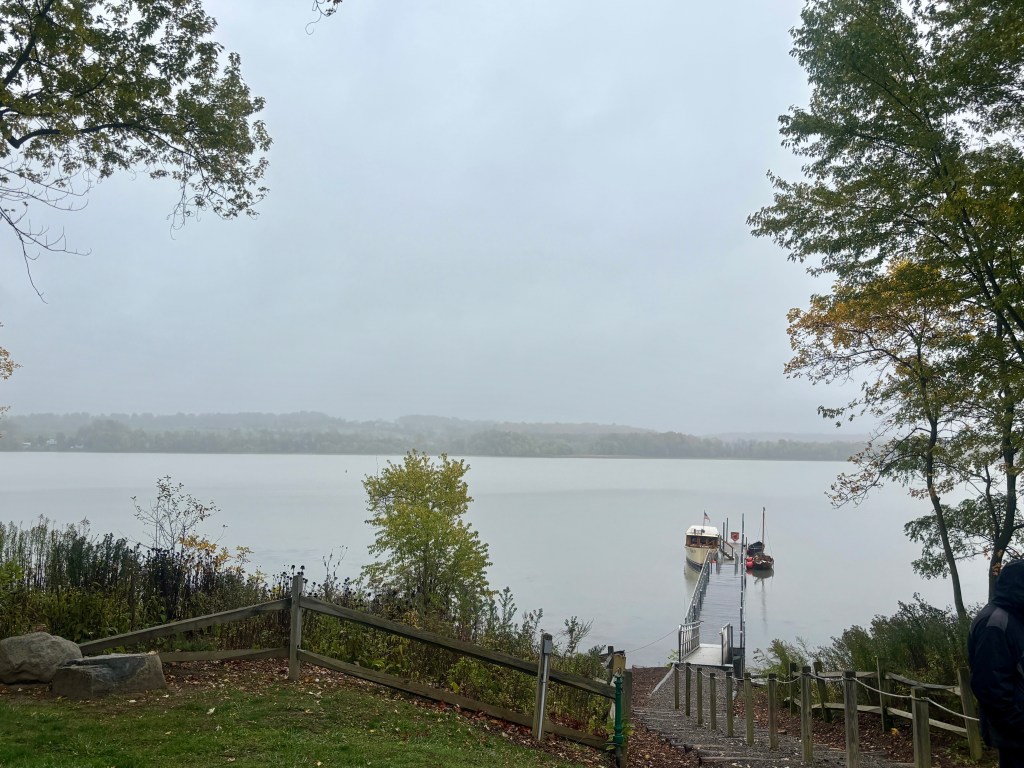
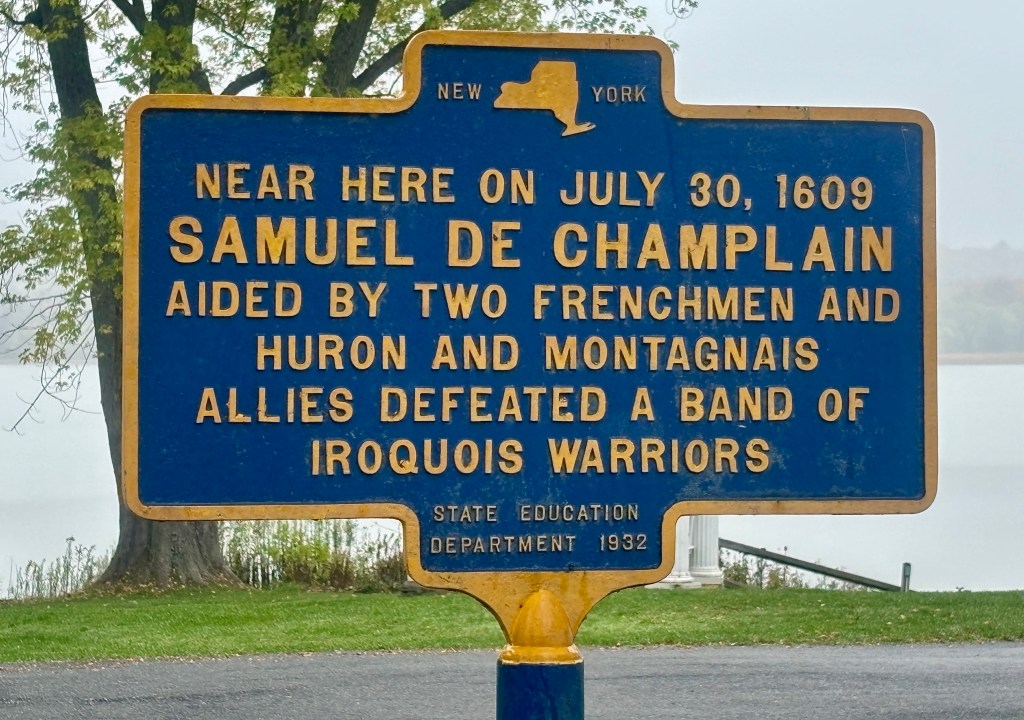
It was near here that Frenchman Samuel de Champlain arrived in 1609.

Of course, there were already indigenous people living their lives when the Europeans, be it French or English, arrived to disrupt them.

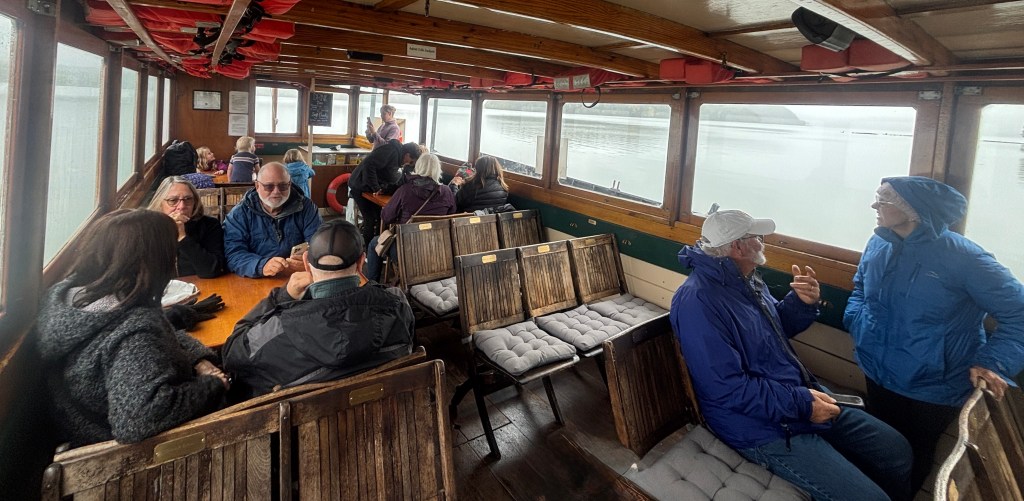
Our activity was a boat ride aboard the Carillon.

From the water we could see Fort Ticonderoga. It was also the site of the French fort Carillon commissioned in 1755.  The builder was to “choose the most favorable site for entrenchments or other fortifications to prevent the British from taking Carillon.”

This fort has an interesting history.  It belonged to the French and then fell to the British (and American colonists) in 1759.  It was then named Fort Ticonderoga.

There were 395 warriors assisting the British in their battle with the French.  The French had some indigenous groups aligned on their side as well. 

Americans, no longer happy to be British subjects, captured the fort in 1775.  Those included Benedict Arnold, Ethan Allen and the Green Mountain Boys.  

It went back to British control under General Burgoyne in 1777.  They blew up much of what was left of the fort before retreating to Canada.

The fort, first called Carillon and then Fort Ticonderoga, was ruins by 1781.

This painting of Fort Ticonderoga by John Henry Hill was made in 1878.

Area people carried off materials from the fort for building projects.  It is local belief that this house was built with old fort resources. Private ownership has not allowed for testing verification.

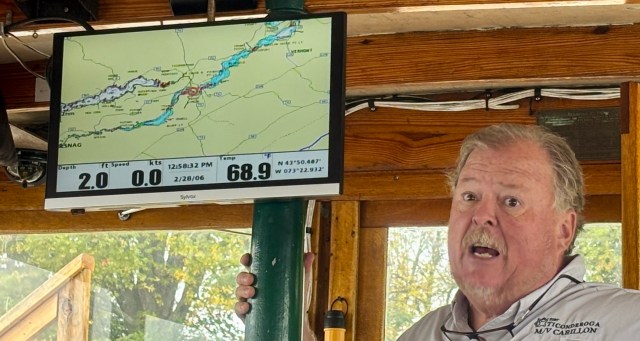
Our boat captain did a great job of explaining the geography of the area around Lake Champlain and nearby Lake George. The British once rowed up Lake George, portaged across the seven mile separation, and entered Lake Champlain for battle.

He also showed us some sonar pictures of what was underneath the surface.  This picture shows caissons for a bridge that the Americans tried to build during their occupation of the fort from 1775-77. It was intended to bridge from Vermont to Fort Ticonderoga. They didn’t get it done before the British took back the fort.

The site was purchased in 1820 by William Ferris Pell when little remained.  However, the old fort was interesting because of its part in early American history.

Members of the Pell family began reconstructing Fort Ticonderoga in 1909.  They chose to approximate 1759 when it was a British Fort.

The venture was one of the first historical reconstructions in the United States. 

The fort has operated as a non-profit museum ever since.  (If it was a national historic site we wouldn’t have been able to visit as it would have been closed due to the government shutdown.)

We learned some interesting things there.

This was the site of the first American offensive victory of the American Revolution.  It happened without battle or bloodshed and 42 British prisoners were taken.

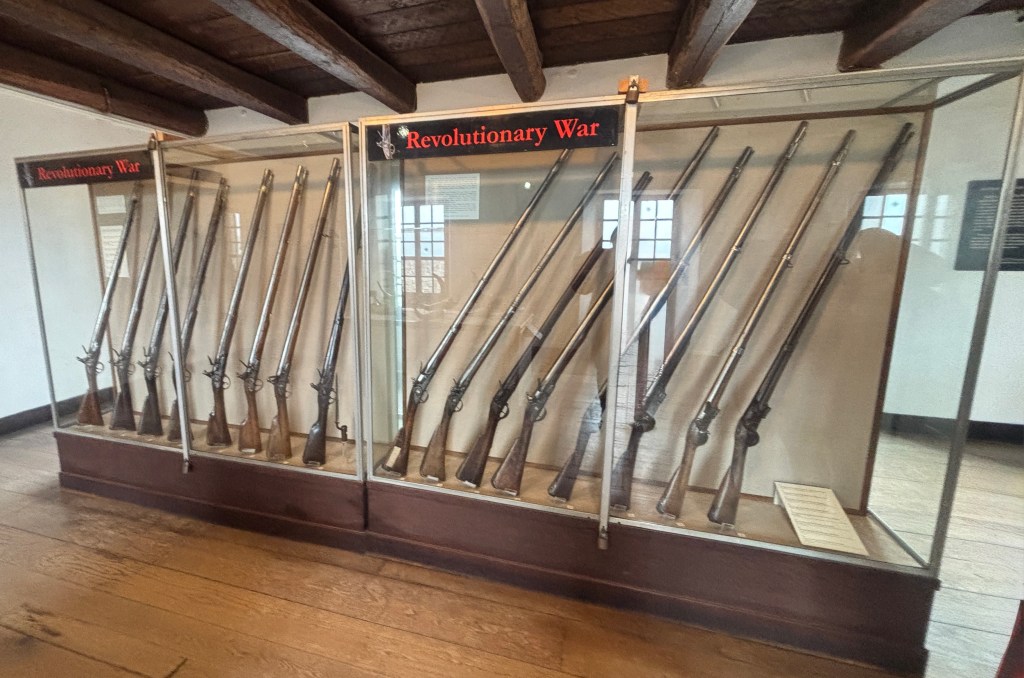
The largest private military collection in the country is the collection at Fort Ticonderoga.

There was this interesting display about how the troops were fed and what were in their rations.  Notice that they were required to cook communally and definitely not fry their food or they would be punished.

It was also interesting that Lieutenants got two times the regular rations increasing by rank until it was six times the rations for a Colonel.  Excuse me…who is doing the physical work here! 

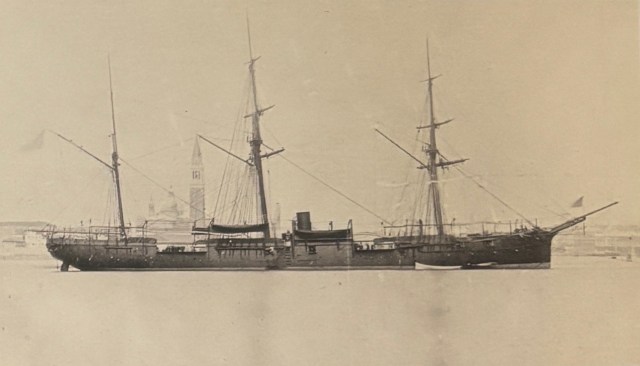
We also learned about various ships that were named Ticonderoga, the first being a two masted vessel used to fight against the British in 1814.  It is shown in the picture on the middle left.

The second Ticonderoga was built during the Civil War in New York.  After the war, the ship served in European, African, and South American waters.  She circumnavigated the globe, over 36,000 miles, in 1878 to develop commercial relationships across the world. 

The third Ticonderoga became a US Navy vessel when it was seized by US Customs Officials in 1917.  She was originally a German freighter named Kamilla Rickmers. She made three voyages across the Atlantic successfully transporting horses, vehicles, troops, and other supplies to France. In the fall of 1918, she was attacked by a German submarine.  After a two hour battle, Ticonderoga was done.  Only 24 crew, out of 237, survived.

The fourth Ticonderoga was an aircraft carrier in 1944. She was launched by Stephanie Pell, the grand-daughter of Stephen and Sarah Pell who founded the Fort Ticonderoga Museum.  She was also the great-great-great-granddaughter of William Ferris Pell who bought the site in 1820.

In 1983, the US Navy guided missile cruiser USS Ticonderoga was launched.  She was the first cruiser designed to track and engage multiple enemy targets through radar and computers.

As we left the fort, we saw that restoration work continues.

We drove through the now lovely battle grounds. There were a number of hikes designated and several historical markers.

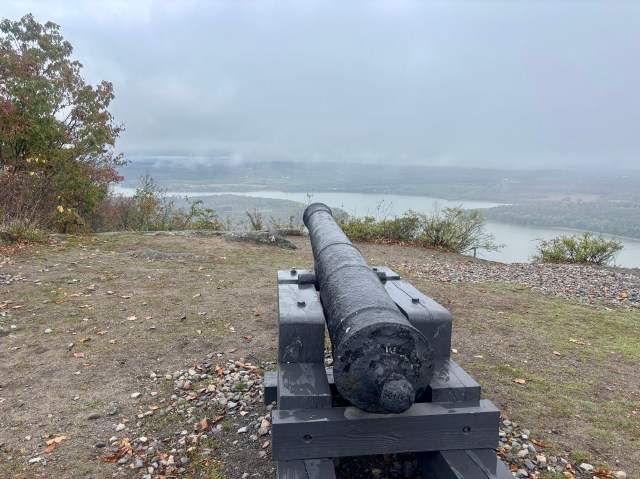
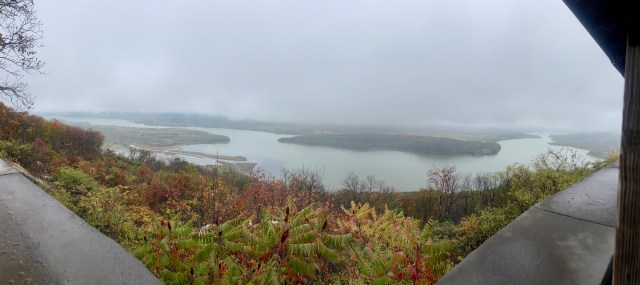
We went to Mount Defiance and it was clear why this was a strategic point for battle.  Fort Ticonderoga sits on the promontory on the left.  The lands at the bottom are New York.  Across the lake is Vermont.

I spent some time playing with my phone trying to get a panoramic shot of Lake Champlain from Mount Defiance. I was happy with my effort.

Then I walked a few paces and saw this one!

Next Up: We go to Fort William Henry on Lake George.

Posted in Uncategorized | 1 Comment

Ticonderoga: Stardate 1312.4 

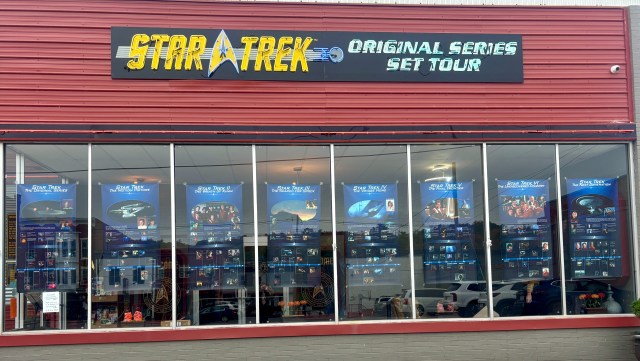
We moved into Ticonderoga, New York and were enthusiastic for our first event of the day – The Star Trek Original Series Set Tour. It was Star Date 1312.4 or October 14, 2025.

The following excerpts are from their website:  
When the STAR TREK television series was canceled in 1969, the original sets were dismantled and largely destroyed. 

Trek superfan James Cawley began the process of rebuilding the sets just as they would have been seen 50 years ago when the series was being filmed!

Our sets are complete recreations built using the original blueprints, hundreds of hours of serious research and thousands of photographs.

The Star Trek: Original Series Set Tour Invites you to come see the Desilu Studio as it looked during the years between 1966-1969.

We believe we have seen every episode of the original Star Trek series at least once and likely several times so we were quite enthusiastic.

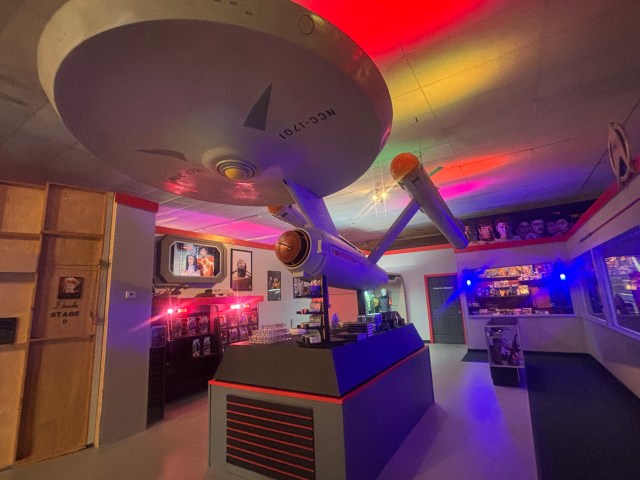
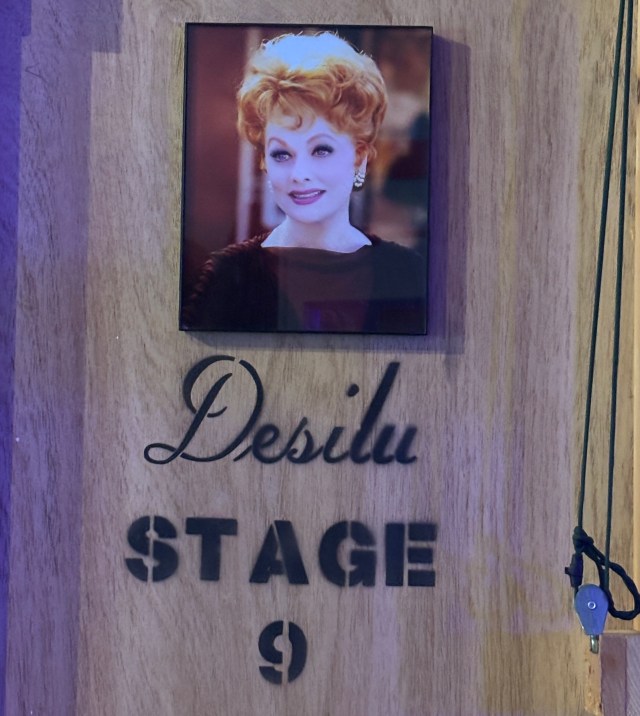
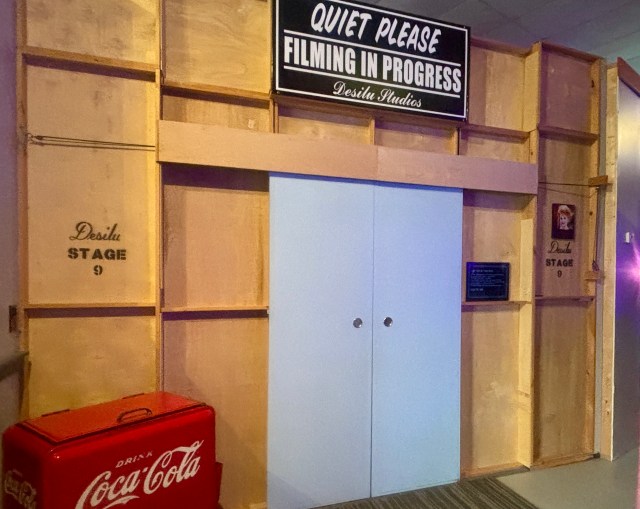
We walked into the recreated Desilu studio.

Our first lesson was how the doors worked that slid open simultaneously as a member of the crew approached.  Workers pulled them apart as needed using a pulley system.  Sound effects were added in post -production.    Something as simple as doors opening as we approach them is routine now, but not in the 1960s!

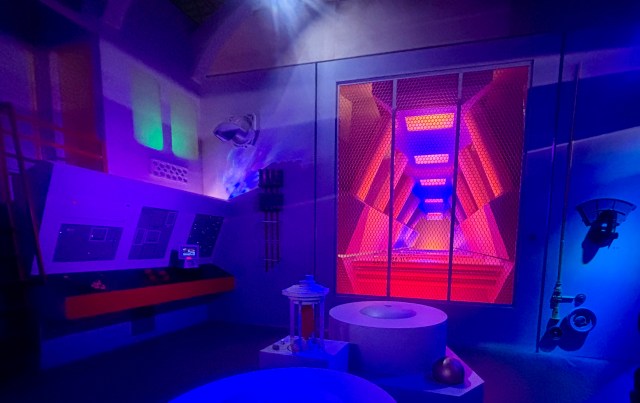
Our first set was the Transporter room!  We learned how glitter water, Alka Seltzer, and masking techniques were used to create the body shaped illusion that someone was being transported. 

We also got to pretend we were operating the transporter – but no touching the sets.

We had five on our tour – a delightful number.  The couple dressed in uniforms did not really consider themselves Trekkies – they were just opting for more fun for the day.   Their favorite Star Trek version was The Next Generation.  Ours is the original series and then Voyager.  

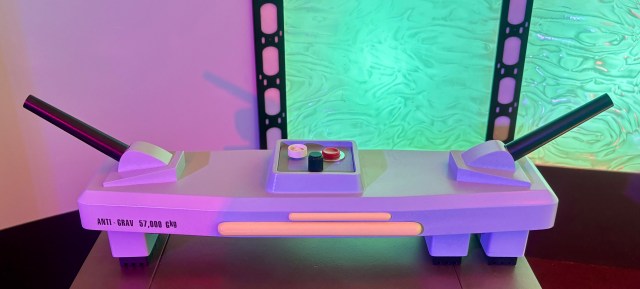
This gadget, used to transport a canister in an episode, is one of a few authentic set items that the museum owns.  

We went into the Medical Bay and learned that the diagnostic screens were painted black with lights shining through cut-outs behind it. 

A person behind the screen moved the arrows up and down.

The ancient medical tools were displayed in Dr. McCoy’s office.  They were standard items in the 1960s.

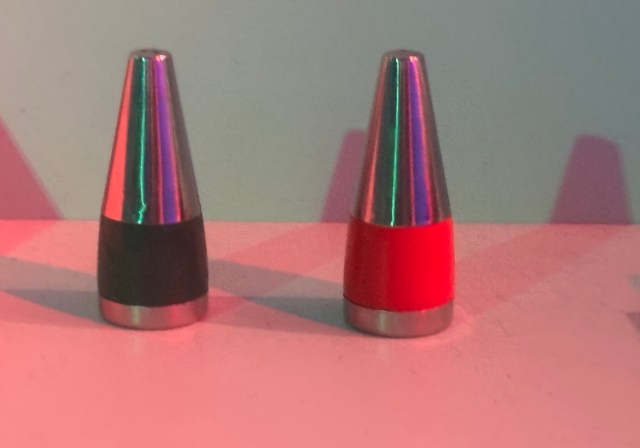
Dr. McCoy used these instruments to help his patients.  In reality they were salt and pepper shakers from Finland or Denmark.  

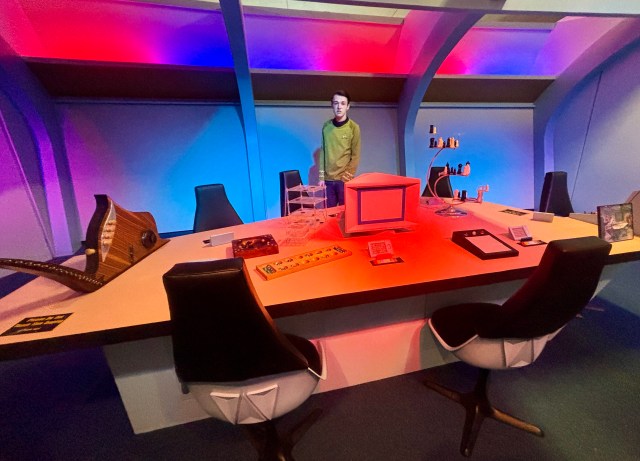
This multi purpose conference room appeared in many episodes.  

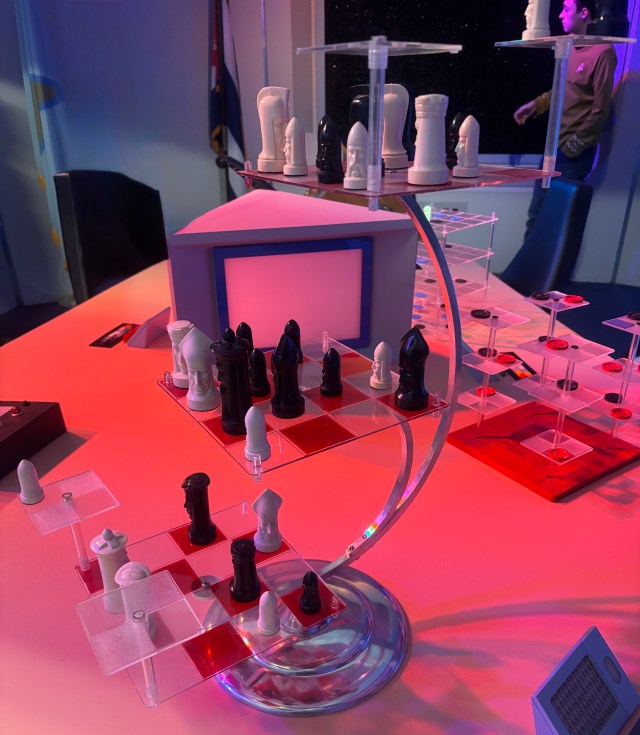
There were a variety of items displayed including Spock’s 3D chess game.  It was made with a regular game board, a cake stand base and a shoe display from a department store. 

This device was a modified slate board like some of us played with as children.

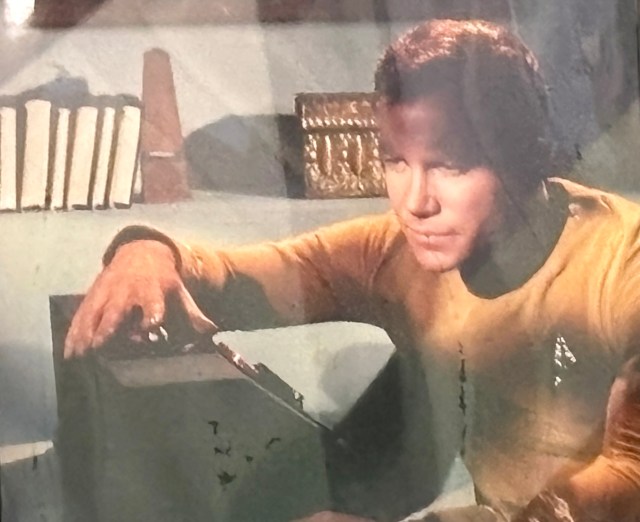
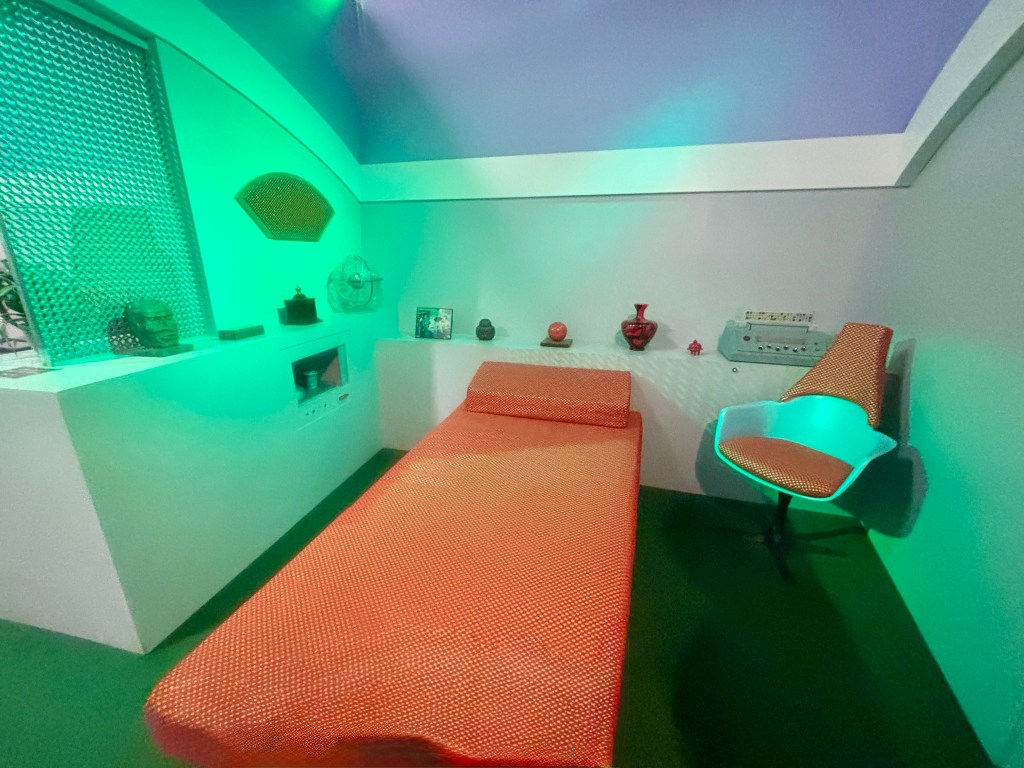
Our next room was Captain Kirk’s quarters.   Our tour guide is in the picture. 

The gold box on the shelf in Kirk’s quarters is the second original item that actually appeared on the show.  

William Shatner, and a few other surviving cast members, take part in events at the museum fairly regularly.

At some point William Shatner took it off set and gave it to one of his fan club presidents.  Years later, the box ended up on eBay and the museum developer/owner bought it.

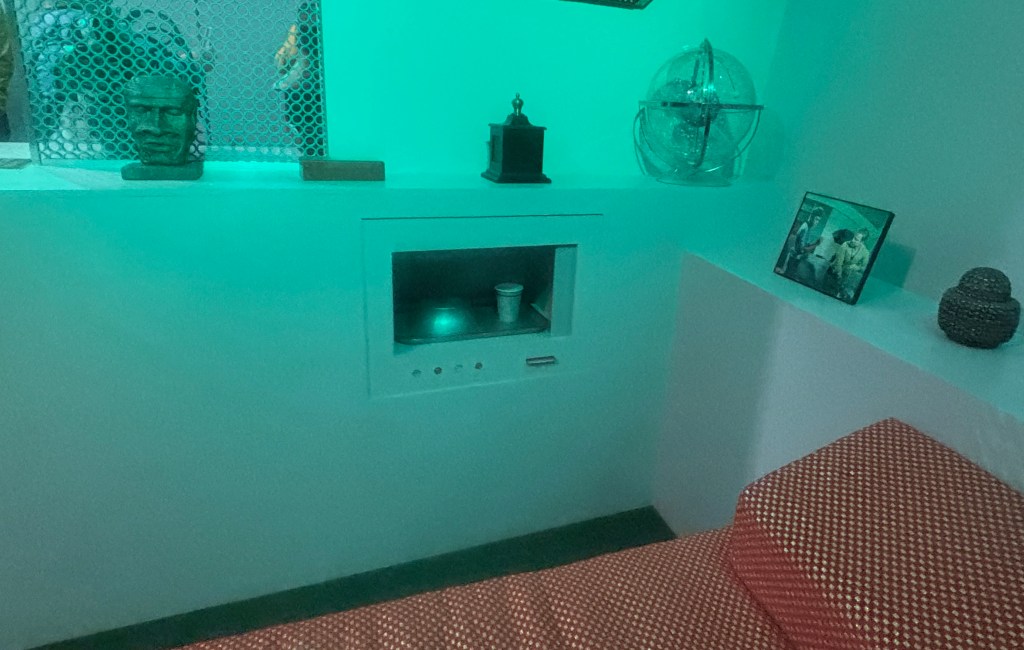
Adjacent were his sleeping quarters.  Notice the food replicator.

These medals and insignias were also original to the series.

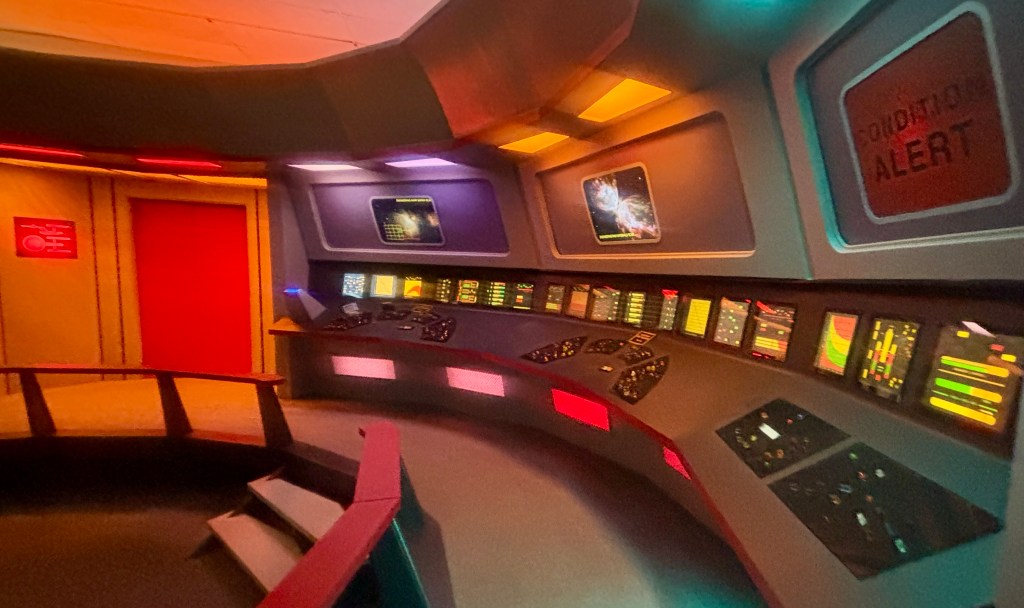
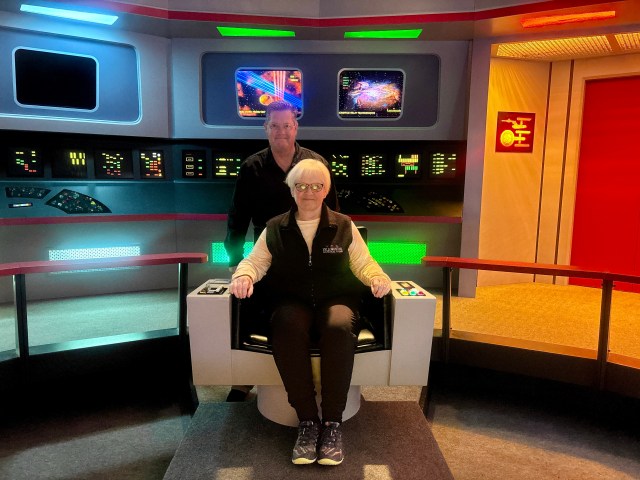
We were on the Enterprise bridge!

To seek out strange new worlds where no one has gone before!!

With a new captain!

And her science officer!

Randy in the perfect Kirk pose!

Scotty was down there somewhere keeping the Enterprise moving.

One of the things we learned was that there really wasn’t any order to the star dates at the beginning of the series.  The numbers were random – just like the one I used in the title – until the second year.

I hope it looks like we had a great time at the Star Trek Original Series Set Museum because we did!   It was a fun, fun morning. We are now inspired to watch The Next Generation!

In Ticonderoga we learned that a New Jersey company manufactures Ticonderoga pencils.  The wood used isn’t even from the area, someone just liked the name.

Next Up:  Fort Ticonderoga.

Posted in Uncategorized | 1 Comment

NH: Mount Washington Cog Railway

This sign indicates that the White Mountains of New Hampshire are famous for America’s worst weather!  Our guide for the Mount Washington Cog Railway on October 13 said that we won!  We get the experience of really bad weather!

Our train ride was scheduled to be an hour up the mountain, an hour at the summit, and an hour back down.  We were told the weather at the summit was so bad, we’d likely just go up and back. 

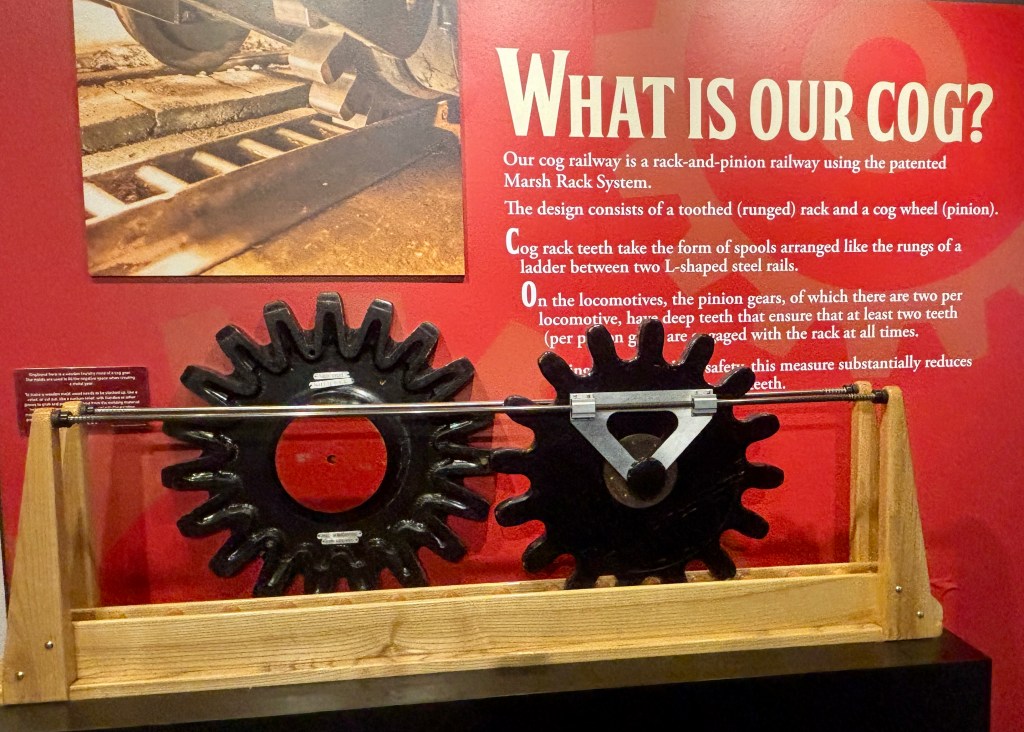
Before we left we had the opportunity to learn a bit about the World’s First Cog Railway. It was developed in 1869 with a maximum grade of 37.41 percent.

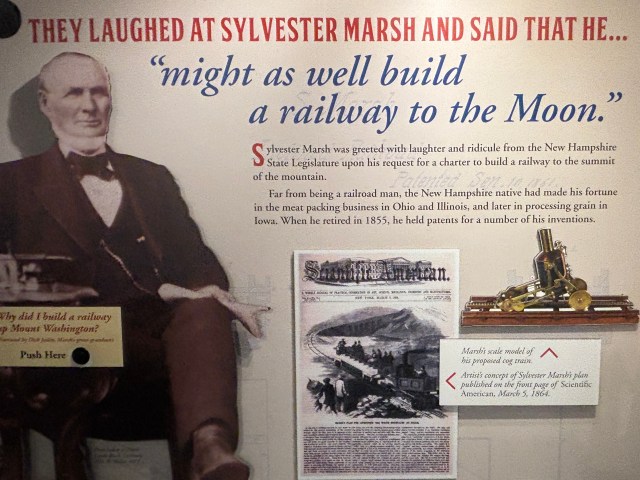
As you can see, Switzerland developed a cog railway two years later, in 1871, with a maximum grade of 25 percent. Mount Washington Cog Railway developer, Sylvester Marsh, was born nearby in 1803.  He didn’t want to be a farmer. He chose a life in business, did well, and eventually thought to build a railway.

He found that the Swiss had developed a rack and pinion design which he modified.

It wasn’t an easy process to get the railway built, but he accomplished it.

We boarded the train and started up the hill at 5 mph.

We weren’t up very high when we could see the trees blowing in the wind. There were a couple hikers heading up. That seemed unwise.

Four trains can be on the mountain because of switch areas. The was important on our day because the schedule was modified as trains wouldn’t spend much time at the summit.

Standing “up” was really leaning at a 30 percent grade.

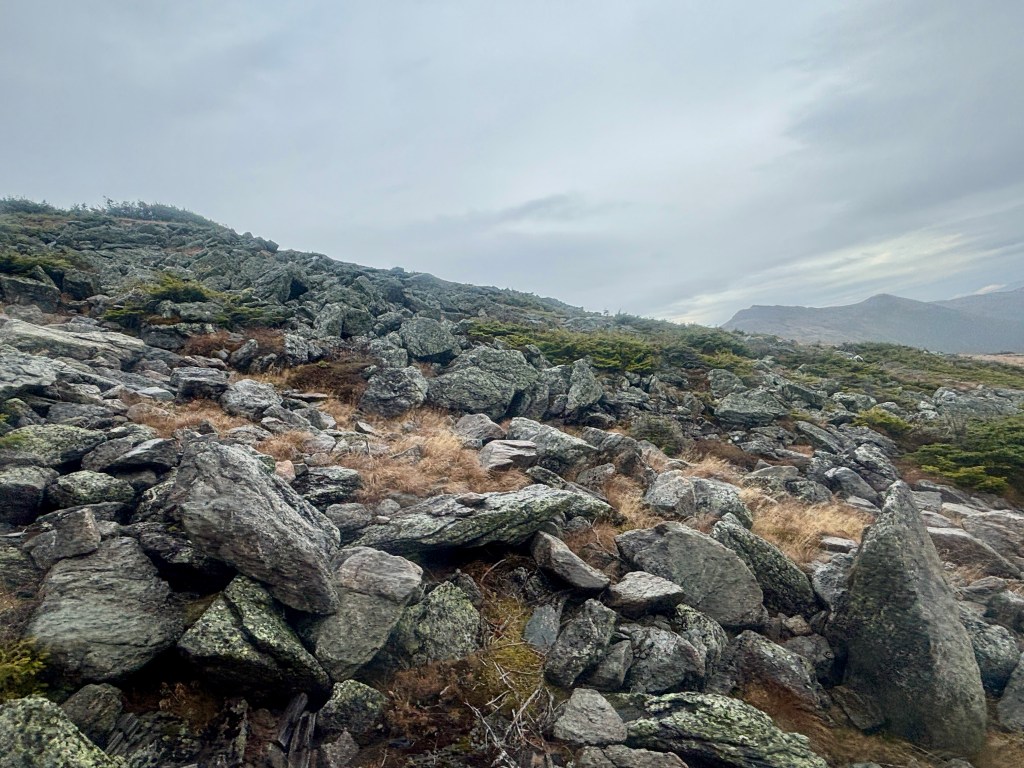
We traversed four climate zones on our way up the mountain.

The alpine tundra zone is at the summit.

These are markers for the northern region of the Appalachian Trail.

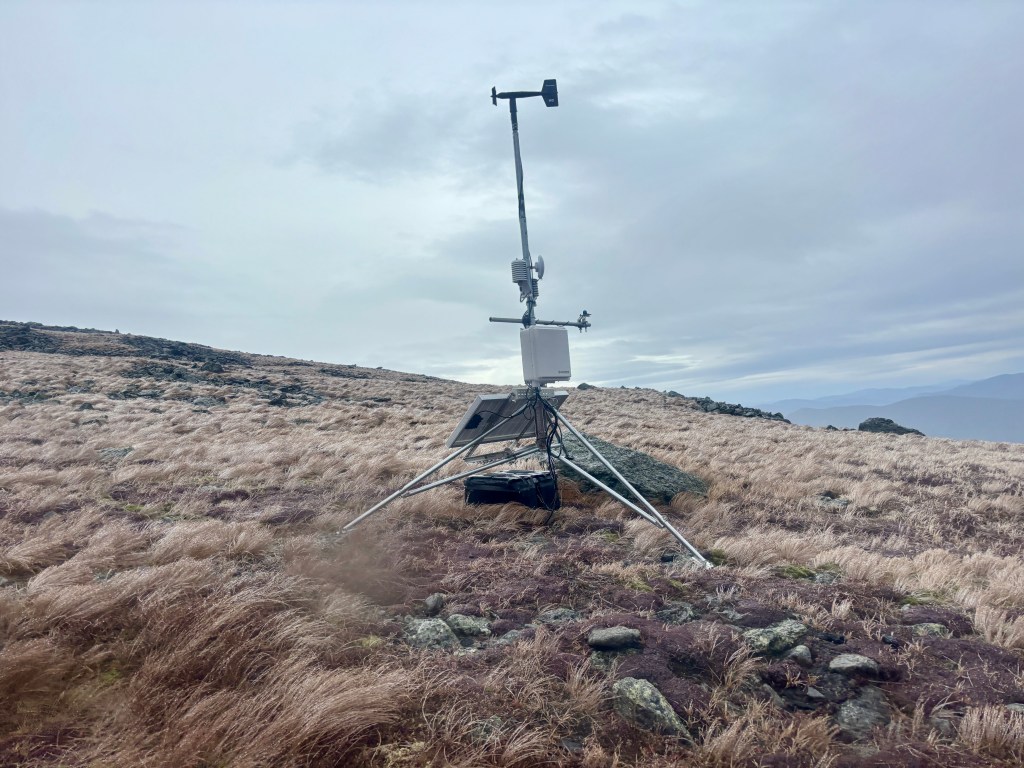
The weather station near the summit gives current information. We learned that they don’t go to the summit when there are sustained winds of 71 mph. 

We approached the summit. Ahead was the first of the three trains in our time group.

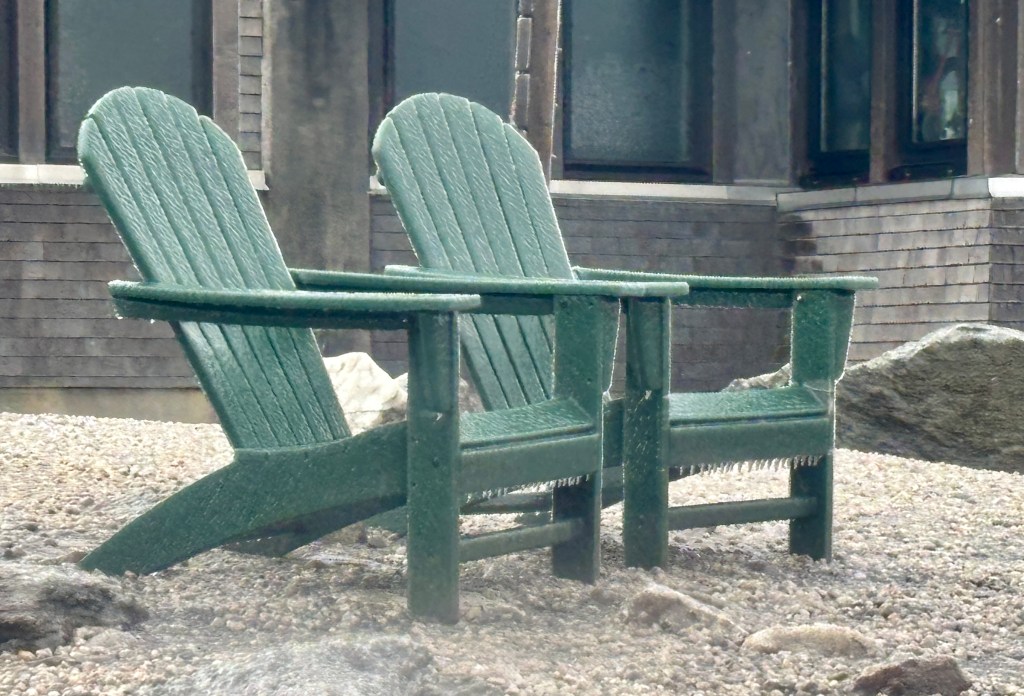
Our guide confirmed that conditions at the summit were not going to allow us to get off the train safely. The windows on the east side of the train promptly froze over because of moisture from the nor’easter.

Wind gusts blew part of the engine’s smokestack off when we arrived at the top and our guide went to retrieve it.

She told us that one of their engines has a snowblower when snow is on the tracks.  The summit gets an average of 42 feet of snow. The coldest temperature ever recorded at the summit is 59 degrees below zero, -109 windchill. They don’t take passengers all the way to the summit in the winter. 

While at the top, we were told there were eight hikers “desperate” for a ride down. Fortunately, the trains weren’t completely full so they were able to accommodate them.  That isn’t always true so hikers go up at their own peril.

Over 160 people have died on Mount Washington over the past 200 years.  It is known for being one of the world’s deadliest mountains. 

We passed a memorial to Miss Lizzie Bourne, the first recorded female to die on the mountain. In September 1855, 23-year-old Lizzie set out to climb Mount Washington with her aunt, uncle and cousin.  They wanted to watch the sunrise from the Tip-Top House. Stormy weather and darkness overtook them.  Lizzie perished in the cold.  The next morning they realized how close they had been to safety in the Tip-Top House.  

We headed back down the mountain. The picture shows the third train in our time group, behind us on the way up and in the lead on the way down.

We crossed paths with this steam engine that was built in 1875. It burns coal and was the second steam engine they acquired. 

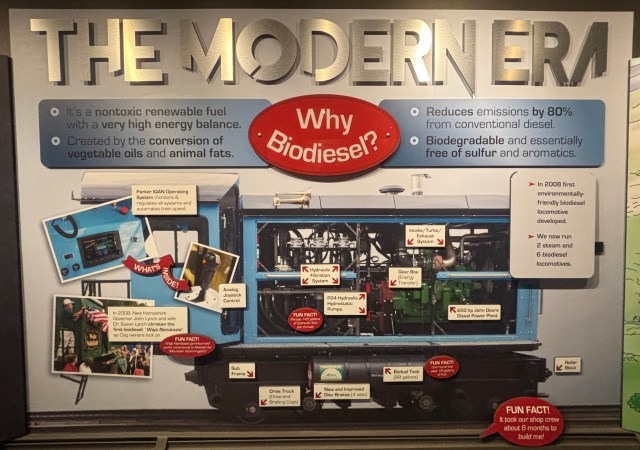
The train we were on was being pulled/pushed by a biodiesel engine.  Most of their fleet is run on biodiesel due to environmental concerns.

Our guide was explaining about her safety training, specifically about how to stop the car if it becomes unhooked from the engine.

It was a very interesting train ride, even if we did miss out on time at the summit.

The leaves in the Mount Washington area of New Hampshire were past the prime season.

We had our box lunch when we returned to the lower station. Normally, we would have had it at the summit.

We made our way into Vermont!

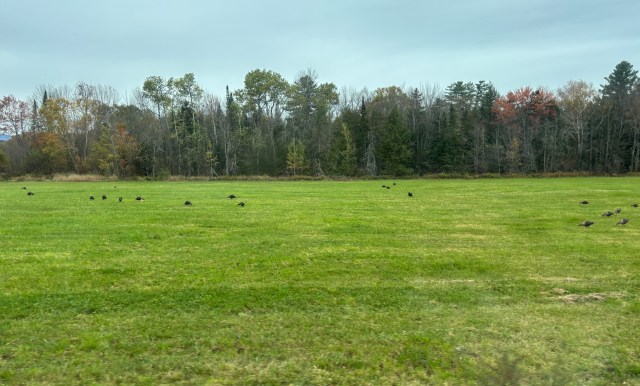
We saw wild turkeys in a field.  Shortly after we saw trees with lines of tubing for gathering sap for maple syrup. Unfortunately, I didn’t get a good picture.

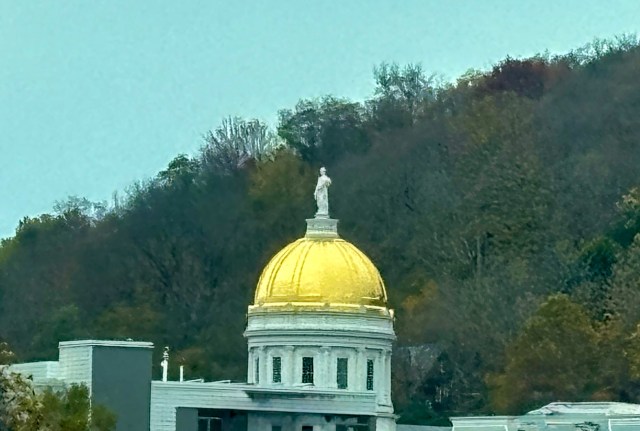
We passed the state capital in Montpellier.

We went to Ben and Jerry’s and it was very busy.  We were here in July 2016 and it had been very busy but that was summer!  This day was Indigenous People’s Day – so it was holiday busy. 

We parked near the flavor graveyard so popped back in for a picture – with people removed.  We spent more time at the graveyard in our previous visit.

The tours were sold out but we had also done that on our earlier visit so it was no problem.  We were at Ben & Jerry’s for a purpose!  We made our way to the gift shop to look for a shirt for Randy.  
He bought this shirt last time and wanted a replacement.  

We got in line for ice cream. At least 150 people were in front of us but it went quickly. 

Everyone got ice cream – even labs got pup-cups 🙂

I chose my flavor easily and Randy agonized over his until the last moment.

When ordering, we saw this note.  We learned on our first visit, in 2016, that Ben & Jerry had sold the company with stipulation that their company values were maintained. They both continued to be involved.

Earlier in October (2025) we heard that Jerry Greenfield quit the company, “accusing parent company Unilever of curtailing Ben & Jerry’s ability to speak out on social and political causes, which is synonymous with the brand’s identity.”

Although we prefer an unfettered Ben & Jerry’s, we still had our ice cream. I had chocolate chip cookie dough and Randy had a scoop of Cherry Garcia and another of strawberry. It’s what’s for dinner!

We made it to our hotel in time to watch game two of the  American League Championship Series.  It was another Mariners Win 10-3!  

I got (ordered) a new shirt too!

Next up:  Ticonderoga: Stardate 1312.4

Posted in Uncategorized | Leave a comment

PHX to BOS and Beyond

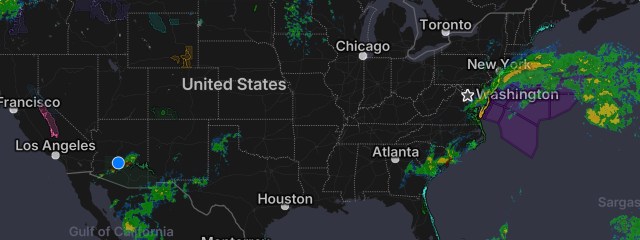
Our morning flight from PHX to BOS on October 12 was delayed.  The pilot said it wasn’t just the ramifications of Hurricane Priscilla approaching Phoenix but also a nor’easter heading into Boston.  

Logan Airport in Boston put a hold on us leaving even after we were good to go in Phoenix.

This may be our first flight ever that had weather issues on both ends.  Our flight was delayed twice as we sat on the plane.

We also had potential air traffic control issues due to the government shutdown.  Yet, there we were ready to make the best of it.

This trip was originally scheduled to visit Randy’s cousin in Vermont and see New England’s fall colors. Ultimately, his cousin’s health didn’t allow for our visit but we had already built the trip so decided to go ahead.

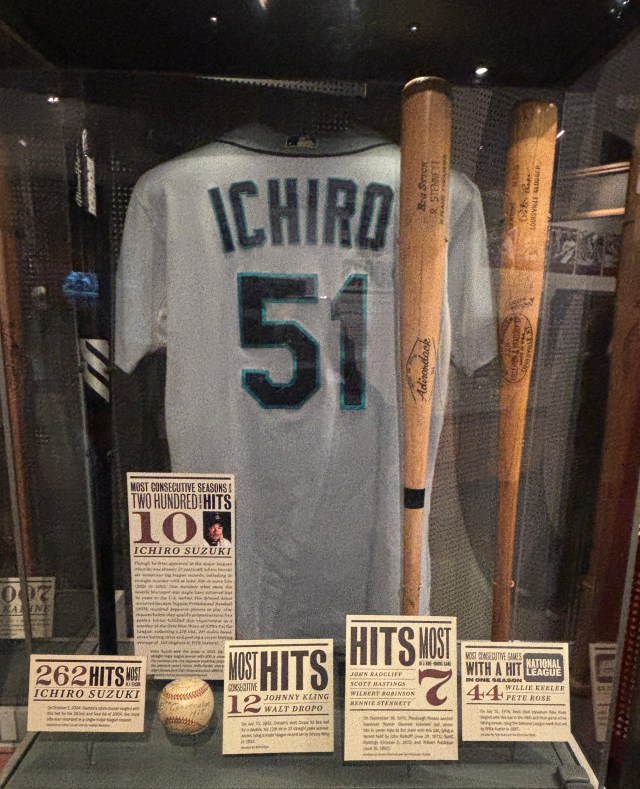
This trip was a modification of our annual baseball trip – when we go see the Seattle Mariners or Arizona Diamondbacks play games in a city or area we want to visit.  We’ve been to Baltimore and Detroit in recent years. This year, instead of seeing games, we were going to Cooperstown to the Baseball Hall of Fame.  That will come up in a future post.

Finally, this trip would pick up Connecticut, the only state that is missing on our state map that isn’t in the south.

There were lots of interesting things on this trip itinerary, including four national parks which probably wouldn’t be open in the shutdown.  I am a believer in “all you can do is all you can do.”

The pilot made up our delay going cross country but then we spent part of what he’d gained in a holding pattern over Boston.  In the end, we got there safely, just a little delayed, and all was well.  

While waiting for our rental car to be delivered to us, Randy saw a Kia Telluride.  He asked a very helpful agent if it was possible to change our reserved car to a Telluride.  She was able to do that for us!  Our daughter is considering getting a Telluride so we would be able to give her feedback from our experience.

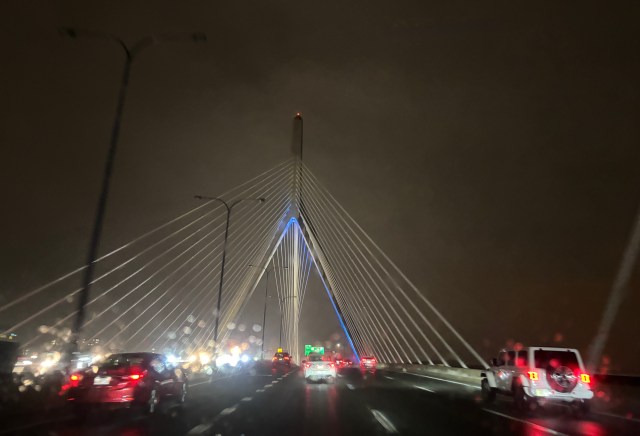
It was dark, rainy, and fast moving as we made our way out of Boston.  We wondered if the tunnels were part of the infamous Big Dig from decades ago. We only missed one exit and considered that a win.

On the way to our hotel in the White Mountains of New Hampshire, we listened to the first game in the Mariners – Blue Jays American League Championship Series.

Congratulations to my favorite team, the Seattle Mariners, who won a winner take all fifth game in the American League Division Series (against Detroit) to get to this Championship Series!  That game went 15 innings. They did the seventh inning stretch TWICE!

Their success made me feel validated for listening to games in the middle of the night while we were a month in Europe and Iceland!  

We checked into our hotel a little after 10:00 pm and were able to watch the Mariners finish out game 1 with the win!

Next up: A train ride and game 2!

Posted in Uncategorized | Leave a comment

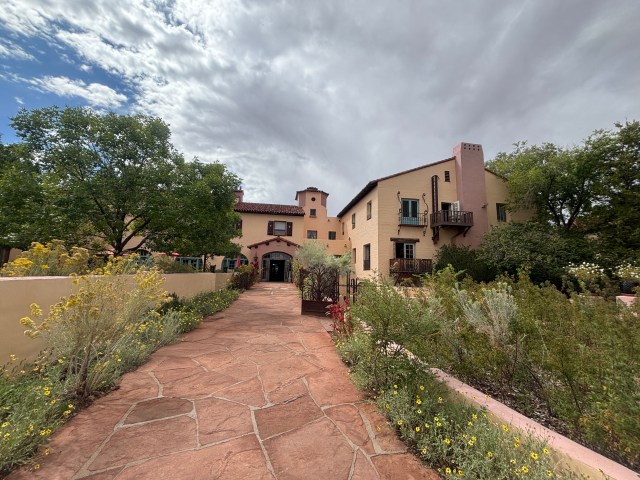
Historic Hotel Series: La Posada

My birthday was in late September and I wanted to spend it at the La Posada Hotel in Winslow, Arizona.

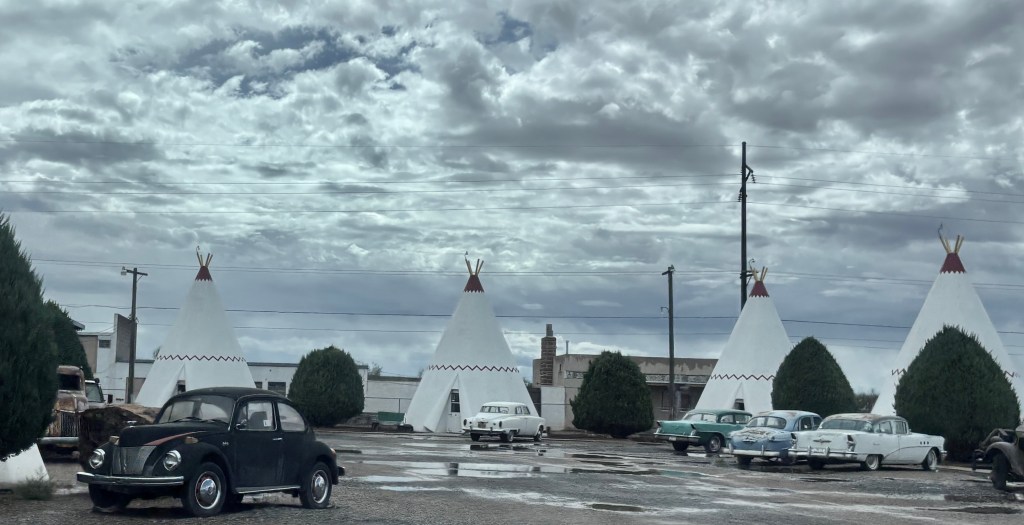
I could have selected the Wigwam Hotel in Holbrook but at this point in life (my 66th birthday) I was looking for something a bit more refined!

Both Holbrook and Winslow are on Route 66 in northern Arizona.  

Winslow is famous for “the corner” mentioned in the Eagles’ song Take it Easy.

Standing on the corner in Winslow, Arizona

Such a fine sight to see

It’s a girl, my Lord, in a flatbed Ford

Slowin’ down to take a look at me

We were at the corner in 2019 and Randy bought a T-shirt that he enjoyed wearing for many years.  He was glad to go back to Winslow and buy another. In fact, he got two!

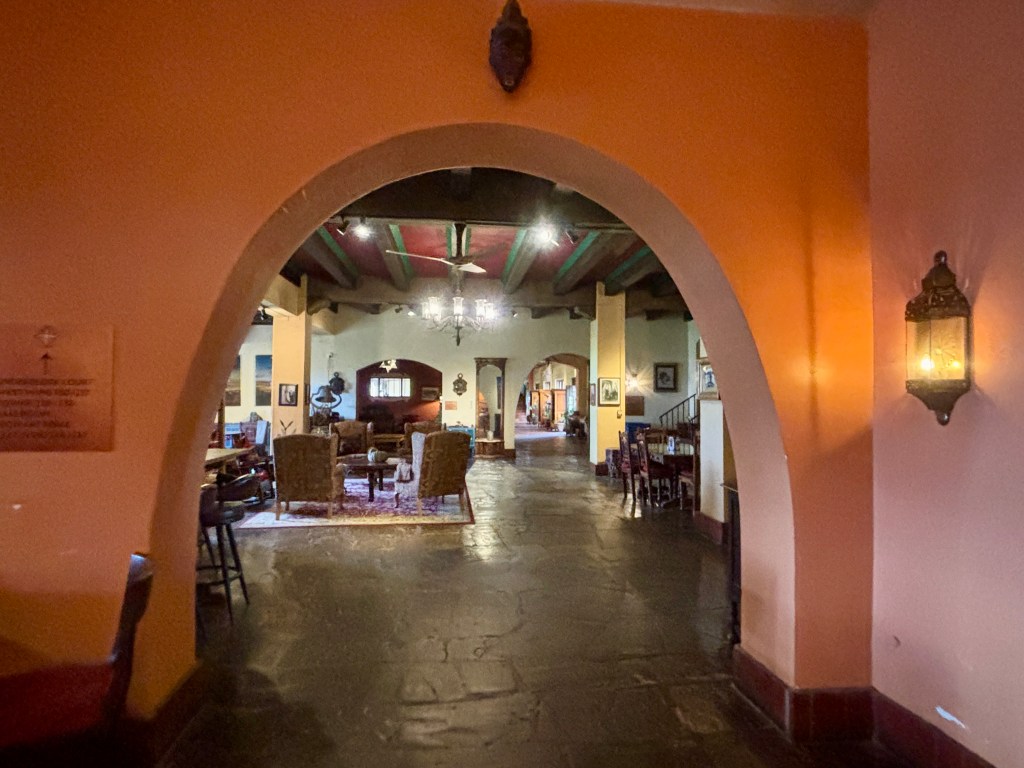
On our last visit, we walked through the La Posada Hotel but didn’t stay because we were in our RV.  I have always had a love for historic hotels so the memory stayed with me. 

Our friends, Jo and Flynn, enjoy staying at La Posada so we invited them along.

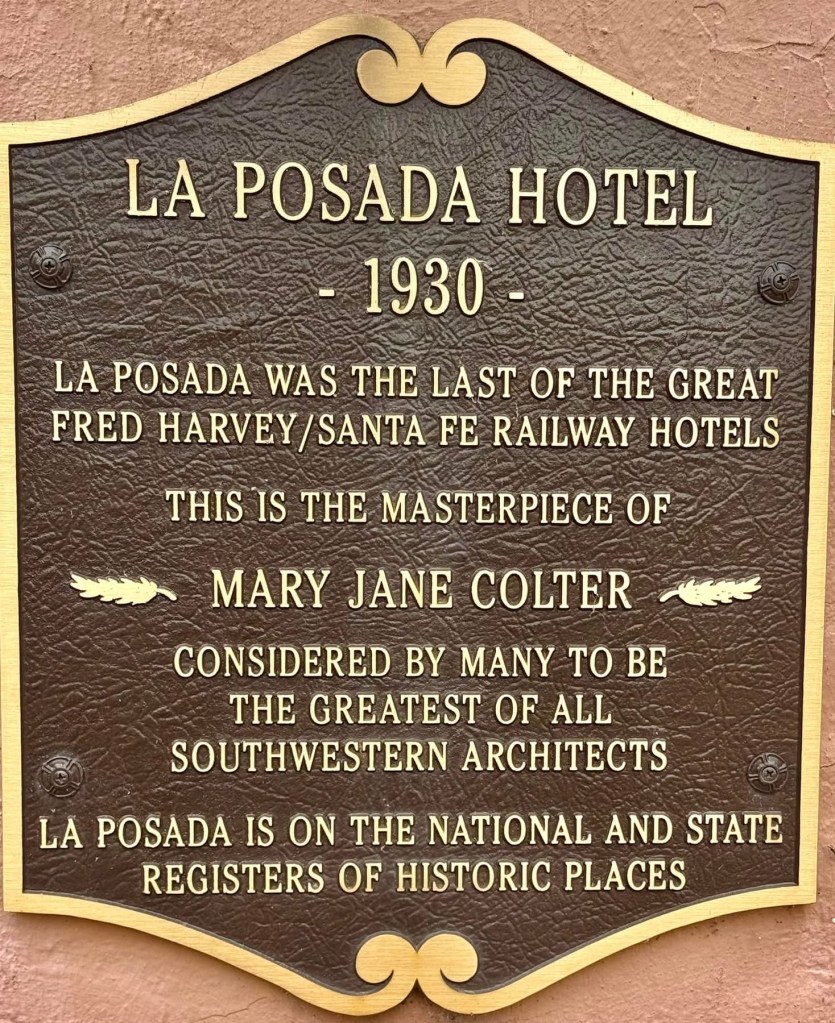
The hotel was designed by Mary Colter who considered La Posada her finest work. 

She designed it to feel like the ranch home of a wealthy Spanish Colonial family.  She wanted guests to feel like they were coming home.

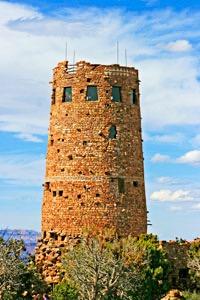
Colter also designed a number of buildings at the Grand Canyon including Hopi House (1905),  Lookout Studio (1914), and Desert View Watchtower (1933).

Her El Navajo Hotel in Gallup, NM was designed in 1923 but torn down in 1957 to widen Route 66.

La Posada Hotel, opened in 1930, was the last of the Fred Harvey Company hotels.  Harvey’s hotels and restaurants followed railway lines throughout the west.  Rail travel declined due to the great depression and then because of increased automobile use. Those factors caused the La Posada to close after just twenty-seven years.  

The Santa Fe Railroad gutted La Posada in 1961 and turned  the building into their regional offices.  

Allan Affeldt and Tina Mion acquired La Posada from the Santa Fe Railway in 1997.  It was their goal to reopen the hotel and offer fine dining in a restaurant they called The Turquoise Room.

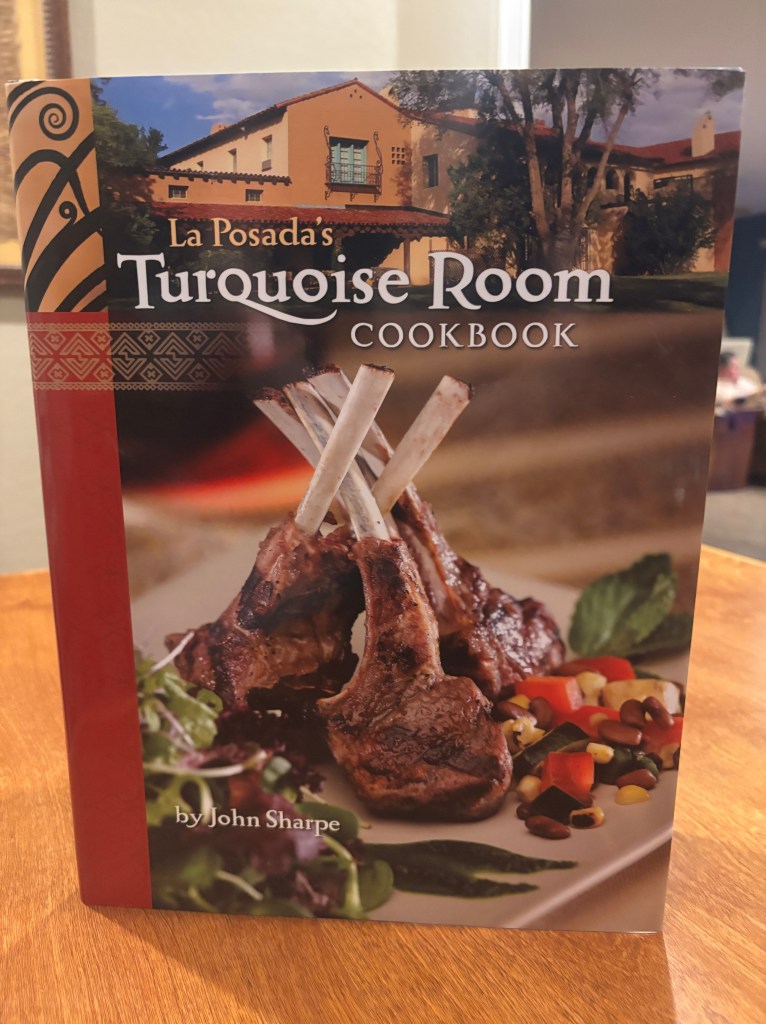
We had my birthday dinner at the Turquoise Room and our meals were unusual, artistic and delicious.  During our dinner conversation, Jo said she had once bought a Turquoise Room cookbook that she had never used.  

Jo gave me the cookbook a few weeks later and I took a picture of their signature soup that Flynn and I enjoyed!  It is sweet corn and black bean with red chili cream!

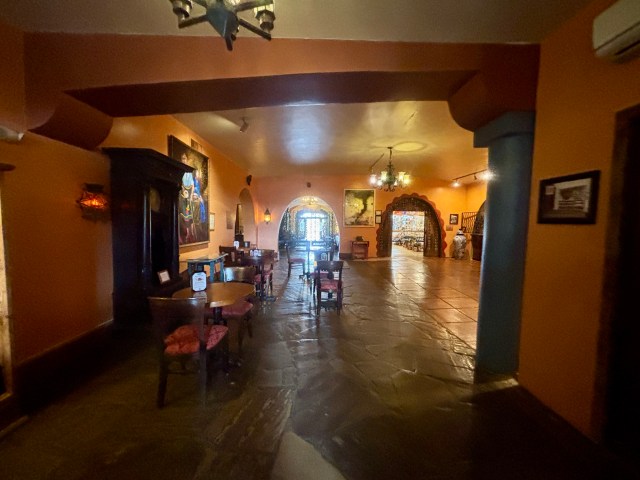
The next morning we had a delicious breakfast and set about exploring more of the hotel. We had experienced guides in Jo and Flynn.

Tina Mion, one of the pair that set out to reopen the hotel, is an artist and the hotel has a gallery that is full of her interesting works.

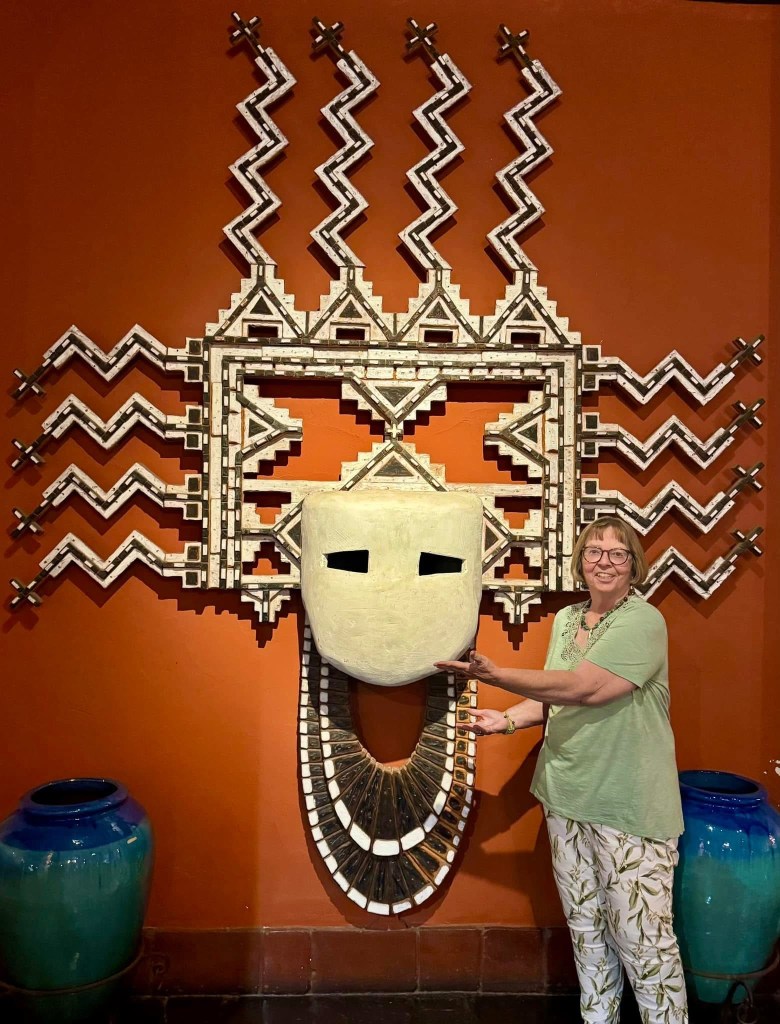
The public areas have more traditional southwest and Native American art. Photo with Jo by Flynn!

One of the things I most enjoyed about La Posada were the bookcases in each guest room and many common areas.  Our room had a case of at least 60 previously read books and that was a small collection compared to other rooms we saw.  There were no provisions to check them out, or buy them. I assume if you were in the middle of a book you could take it with you.

La Posada also has a museum in the old train depot.  We spent an hour or so checking things out.  

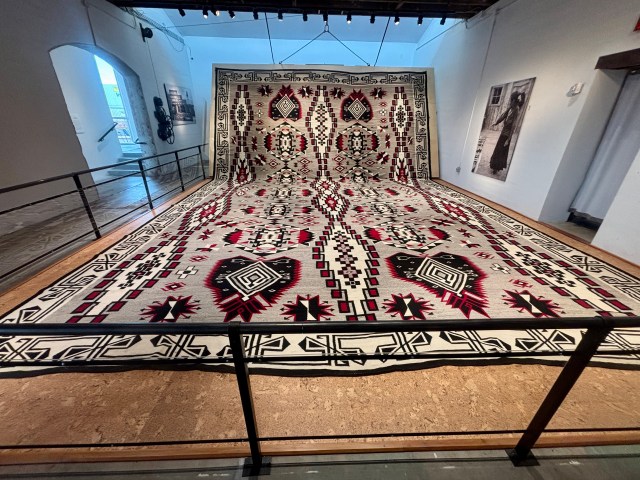
Most interesting was the display of the Largest Navajo Rug in the World.  It was commissioned in 1932 and completed in 1937.

Julia Joe was the master weaver.  She wove on a custom loom fit inside a custom building sized 40′ x 30′ x 10’. 

In a community effort, the Red Clan sheared about 200 Navajo Churro sheep.  They, including Julia’s daughters, spent two years washing, carding, dying, and spinning the wool. 

Julia and her daughter, Lillie, sat at the loom during most daylight hours for a little more than three years weaving the 21’4″ x 32’7″ masterpiece.

The rug used natural colors and had a universe theme including protective talismans.  The rug’s border included Puebloan potshards. 

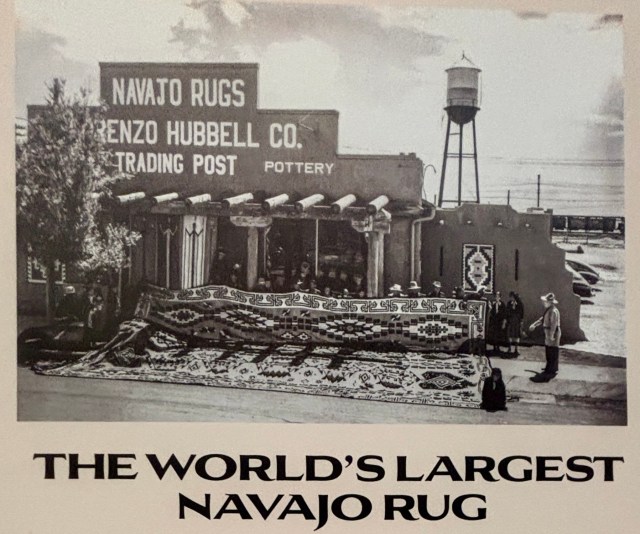
The rug had been commissioned by Lorenzo Hubbell Jr. to use in marketing his Winslow Trading Post. The weaving traveled to museums throughout the country and to the U.S. Senate Chambers.  It was displayed at Marshall Field ‘s New York department store in 1943 and was used as a backdrop for Hubbell’s Winslow Motor Company display of the 1946 DeSoto.

In 1949, the Winslow Trading Post with all the inventory, including the famous rug, was purchased by businessman Kyle Bales. The rug was shown occasionally through the 1950s-1970s. Sites include the Los Angeles County Fair, the World’s Fair in New York,  the Heard Museum in Phoenix and the Arizona State Fair.

Bales’ daughter eventually donated the former Hubbell Trading Post in Winslow (and the rug) to the Arizona Historical Society as a potential museum.  The museum was not developed so the “World’s Largest Navajo Rug,” disappeared into storage for more than forty years.

La Posada’s renovator, Allan Affledt, understood the rug’s significance.  He was able to purchase the rug from the Bales family and developed a permanent space for it in the old baggage room of the train station at La Posada.   

One of Julia’s daughters, Emma Joe Lee, who assisted in carding the wool as a child, was photographed on the rug in 2012 at age 94.

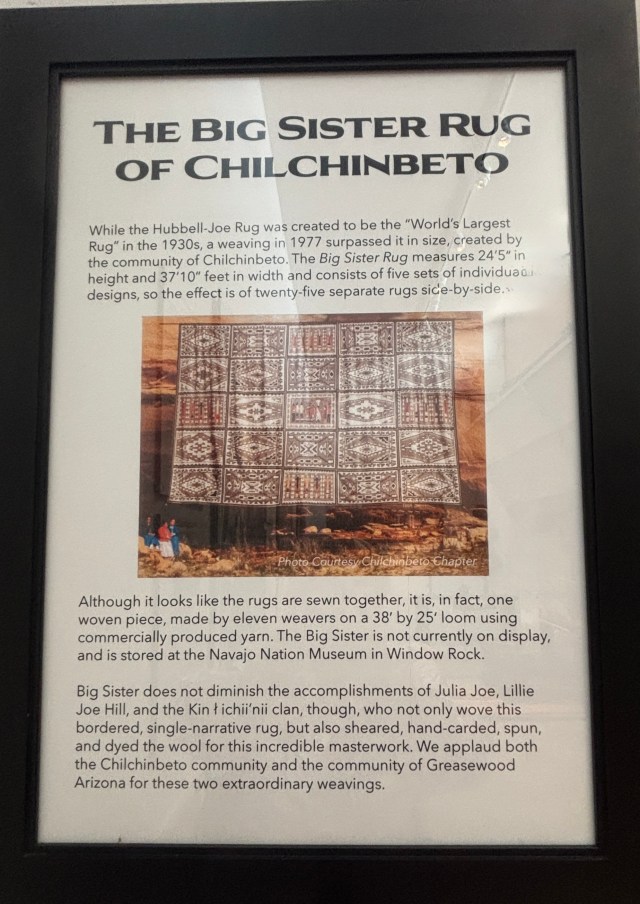
To reflect the person who originally commissioned the rug and the master weaver, it is referred to as the Hubbell-Joe Rug.

An even larger rug was woven in 1977 called The Big Sister Rug.  It is in Window Rock, Arizona at the Navajo Nation Museum but not currently on display.

I hadn’t intended to write about my birthday and our stay at La Posada even though the hotel was wonderful and I thought the rug was a great story.   It wasn’t until I was looking at our blog for something else that I saw I had once started a Historic Hotels series.

That hotel was The Gadsden Hotel in Douglas, Arizona.  We stayed at the Gadsden in 2021.  So, if you too like historic hotels, ghosts, or travel in southern Arizona, that post is Historic Hotel Series: The Gadsden

Posted in Uncategorized | 1 Comment

Two Cruises: Dover Again!

One more time we woke up to the white cliffs of Dover.  

We usually do ship sponsored shore excursions but, on this second time in Dover, we decided to go out on our own.  We considered going to Dover Castle and exploring the tunnels from where the evacuation of Dunkirk were organized.  That sounded interesting but we just weren’t in a mindset to enjoy yet another castle.  That will be a priority if we return to Dover on a future trip.

Our goal for this day was to see the World’s Oldest Sea-Faring Boat.  We learned about it during a port talk on the ship.

We walked about a mile through the port area into town.

We saw some interesting old buildings on our way.

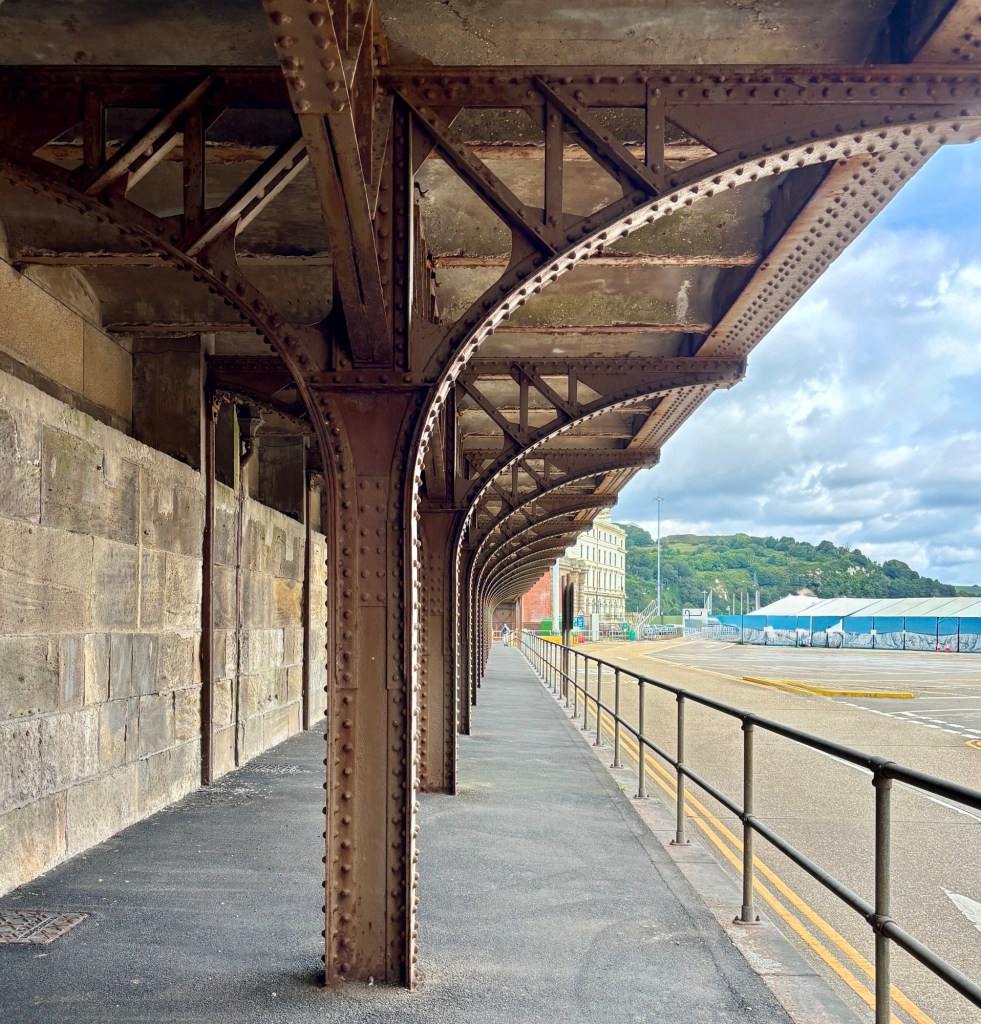
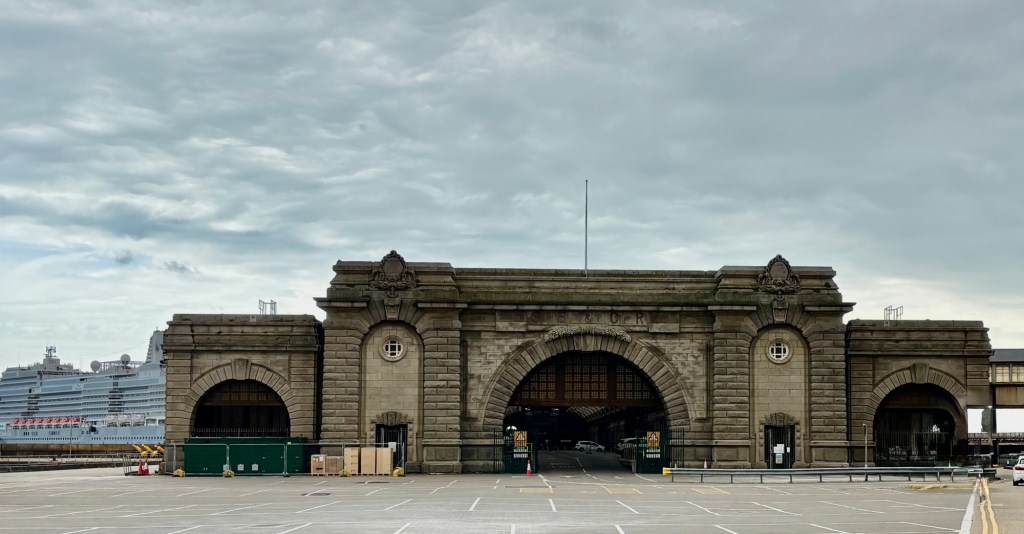
We passed by the old SC&R railroad terminal.  It was built for the South Eastern and Chatham Railway which was a union of two former rival railways. 

We made it to the Dover Museum.  There was no admission fee charged but we were happy to donate our last six British pounds. After all the countries and currencies, we were down to only US dollars.

This prehistoric wooden boat, was discovered in September 1992, during road construction.  Knowing the discovery might be important, the crew called in archaeologists.

Due to the position of the boat and nearby buildings, they were not able to remove the entire length.  In fact, they don’t know exactly how long it really was.

The archaeologists knew that past attempts to excavate boats in one piece had not been successful.  Consequently, a decision was made to cut the boat into sections and reassemble it afterwards. 

Together the teams worked at removing pieces of the boat as quickly as they could both for the road budget and for minimizing the time the old wood was exposed. They kept the wood wet by spraying it with water.

The next step was to drain the water and submerg the pieces in a liquid wax mixture for 16 months.

Then they set the blocks to freeze dry for two years to remove any remaining water.

While waiting, the archeologists built a replica which helped them understand more about how the boat was first made.

Thirty pieces of the original boat were reassembled over 9 months.

After seven years of research and conservation, the Dover Boat came back to Dover.  (I can’t believe it isn’t in the British Museum!) 

The boat’s excavation was an internationally important archaeological discovery. It is considered the world’s oldest known sea-faring vessel.  

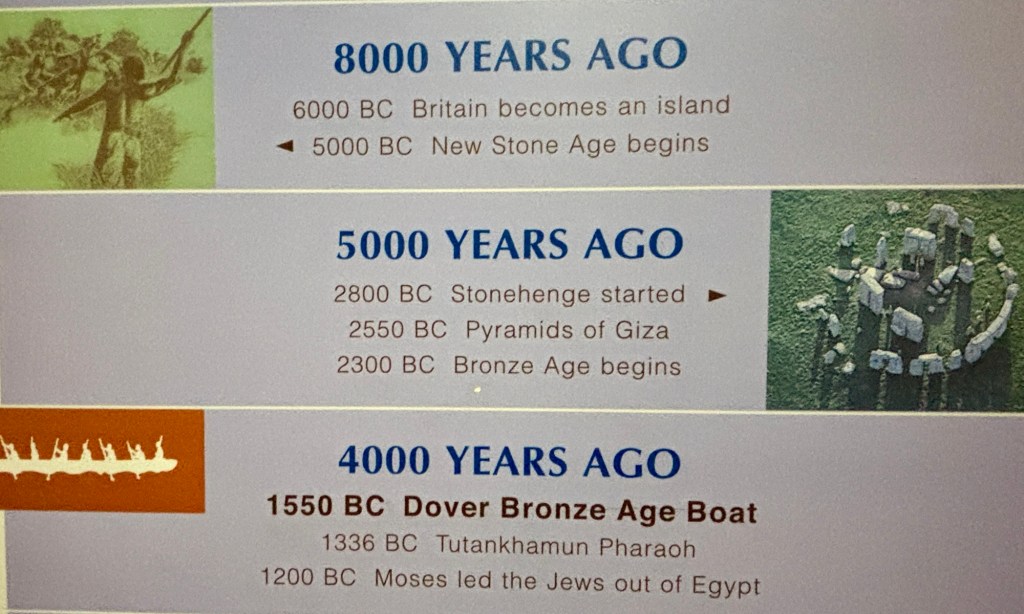
The boat is about 3,500 years old, in use about 1500 BC during the Bronze Age.

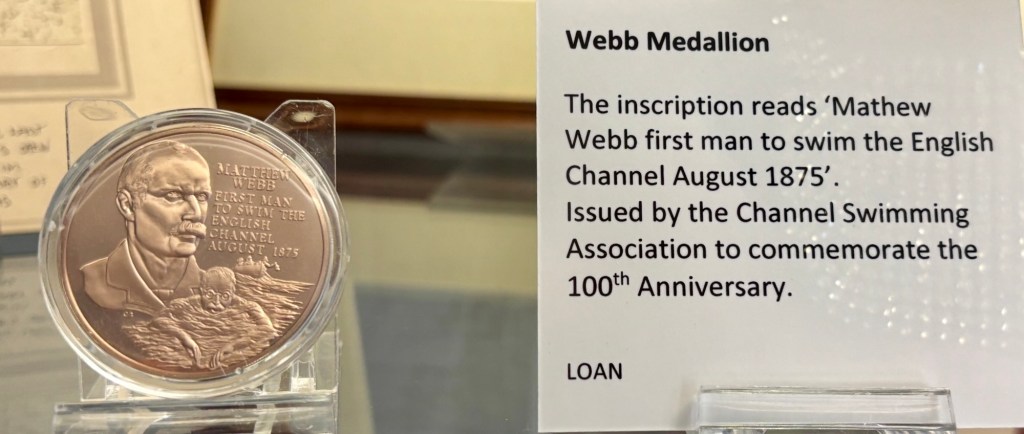
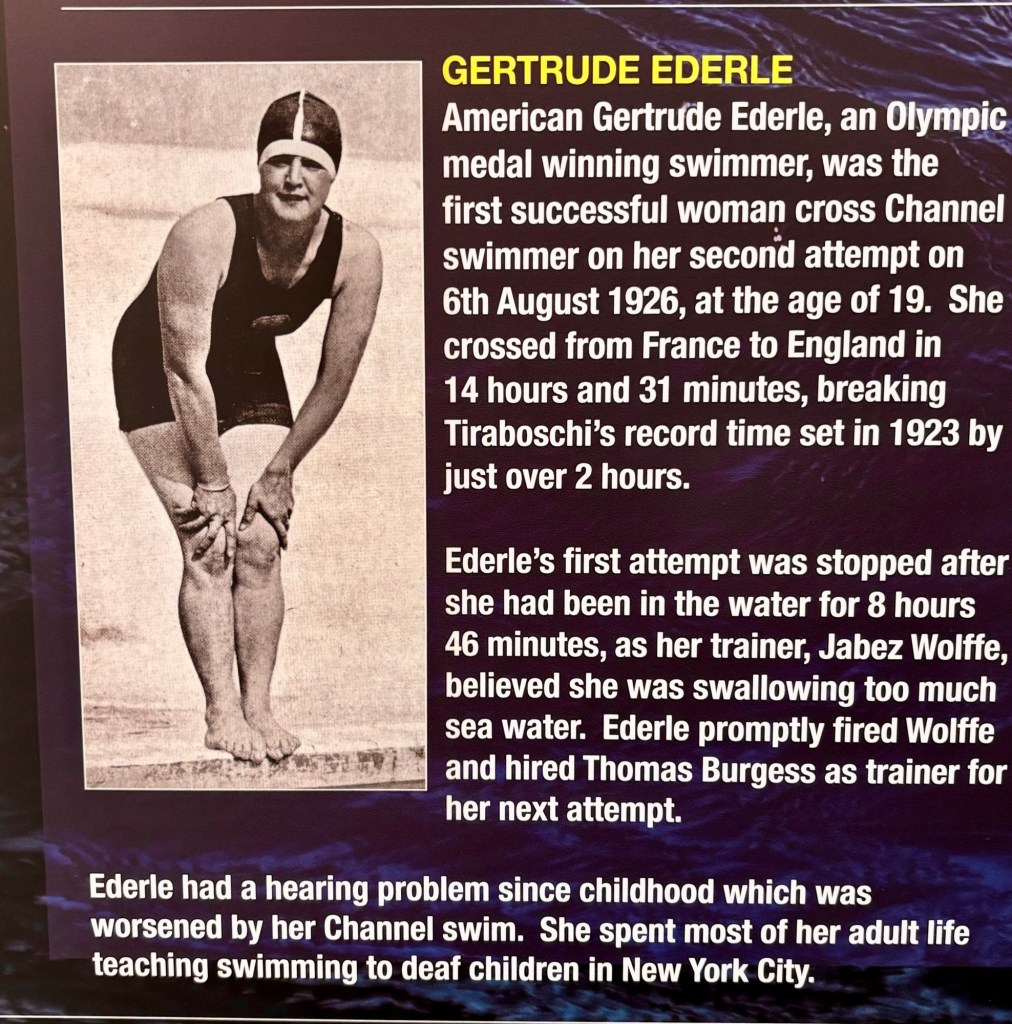
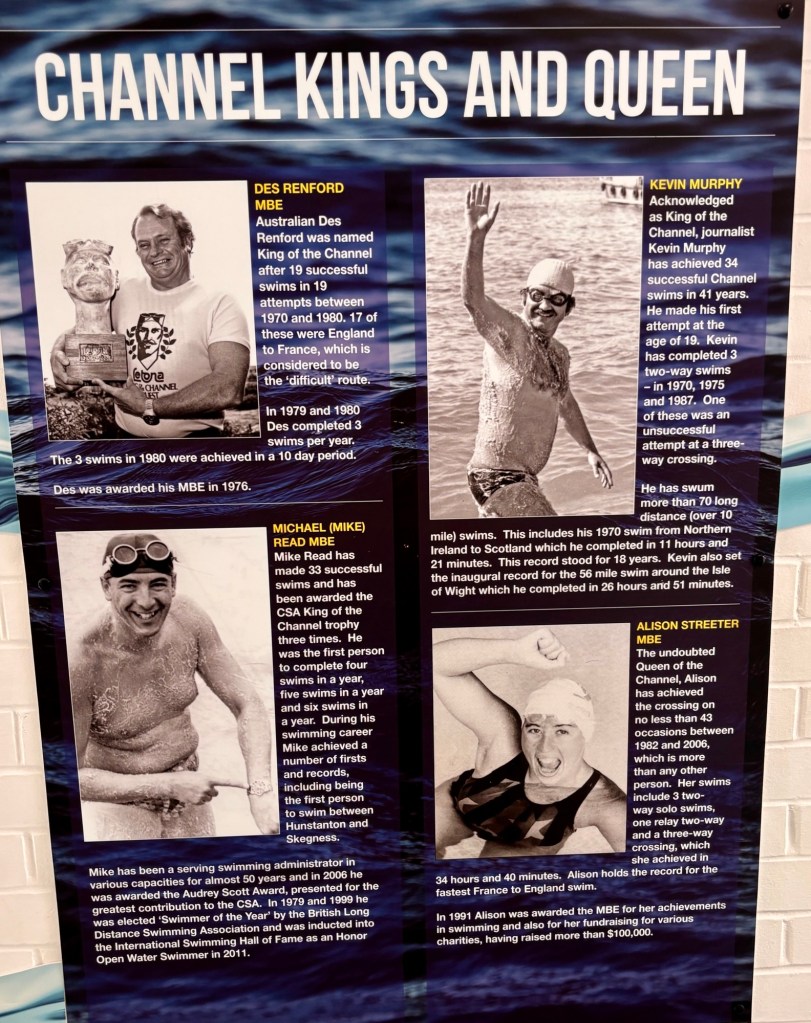
There were a number of other exhibits in the Dover Museum but the only one of that really caught our attention was about the men and women who swam the English channel, specifically the Straight of Dover.

The first man to swim the channel unaided was Captain Matthew Webb in 1875.  He and his rivals didn’t always play nice.

The first woman was 19 year old American, Gertrude Ederle, in 1926.  It was her second attempt.

Some swimmers went Dover to Calais, others went Calais to Dover.  The latter was considered slightly easier.

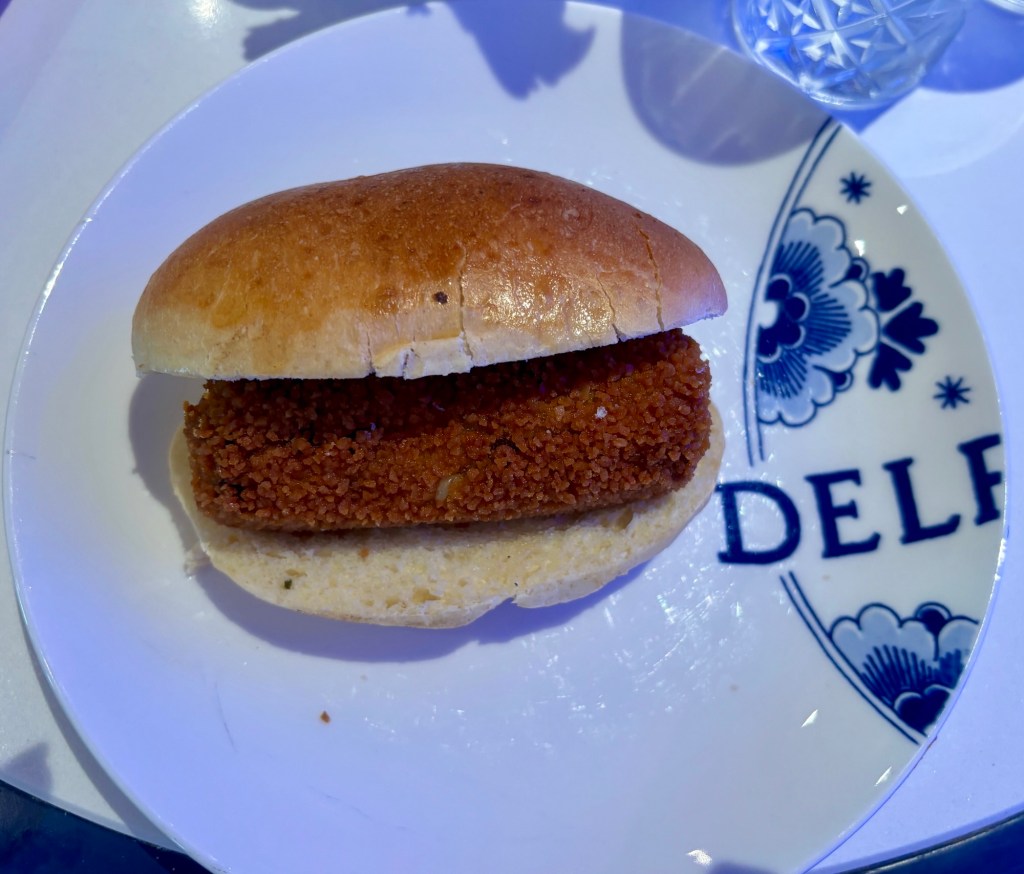
We walked back to the ship for lunch and tried a sandwich that was very, very popular with the Dutch passengers on board. 

The ‘sandwich’ is called BROODJE KROKET and is fried veal ragout on a roll.  It is usually served with mustard.  We were both fans!

Our next broodje kroket will have to wait until the next time we are on a “dam” ship – the Oosterdam in late 2026.

Our month long journey, beginning in Rotterdam, and two cruises exploring the British Isles and Iceland, was a great trip. We enjoy visiting and learning about and from other countries. We are thankful that we were able to travel with our friends Cindy and Darrell again!

PS

Guess which one Randy is! He was okay with me adding this. He’s happy with his role.

Posted in Uncategorized | 2 Comments

Two Cruises: Dunvegan Castle, Scotland

We arrived in Portree, Isle of Skye, Scotland on August 21st.  Portree was the port we missed on the first cruise due to bad weather.  It looked much better this time!

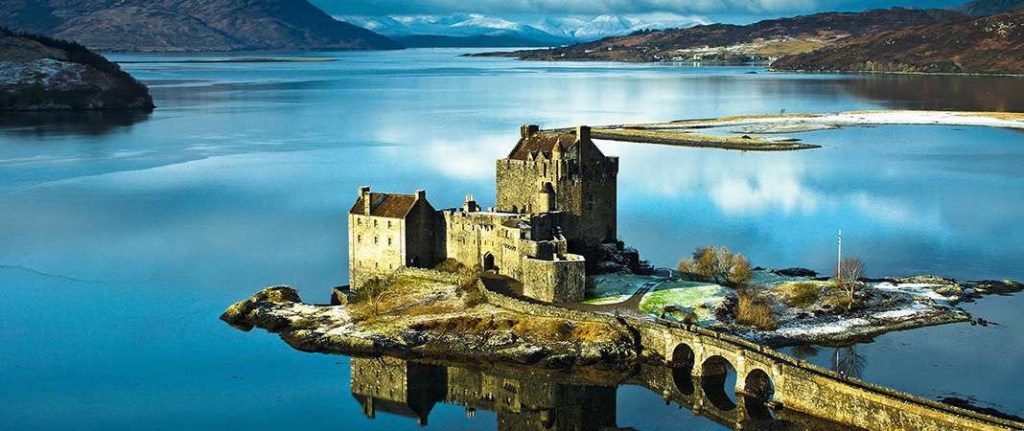
The castle we missed last time was the picturesque Eileen Donan.

This picture is from the Eileen Donna website. The shore excursion manager told us that Dunvegan, our scheduled castle for the day, was just as good if not better.

We went to Portree by tender and boarded a coach.

The countryside on Isle of Skye has a pinky purple flowering shrub that is common heather.

On our journey to the castle, our guide told us that the main two clans on Skye were the MacLeods and the MacDonalds. They fought for centuries. The government eventually tired of the bloodshed and split the two into separate lands in 1610. 

Our tour took us to Loch Snizort and Dunvegan Castle. 

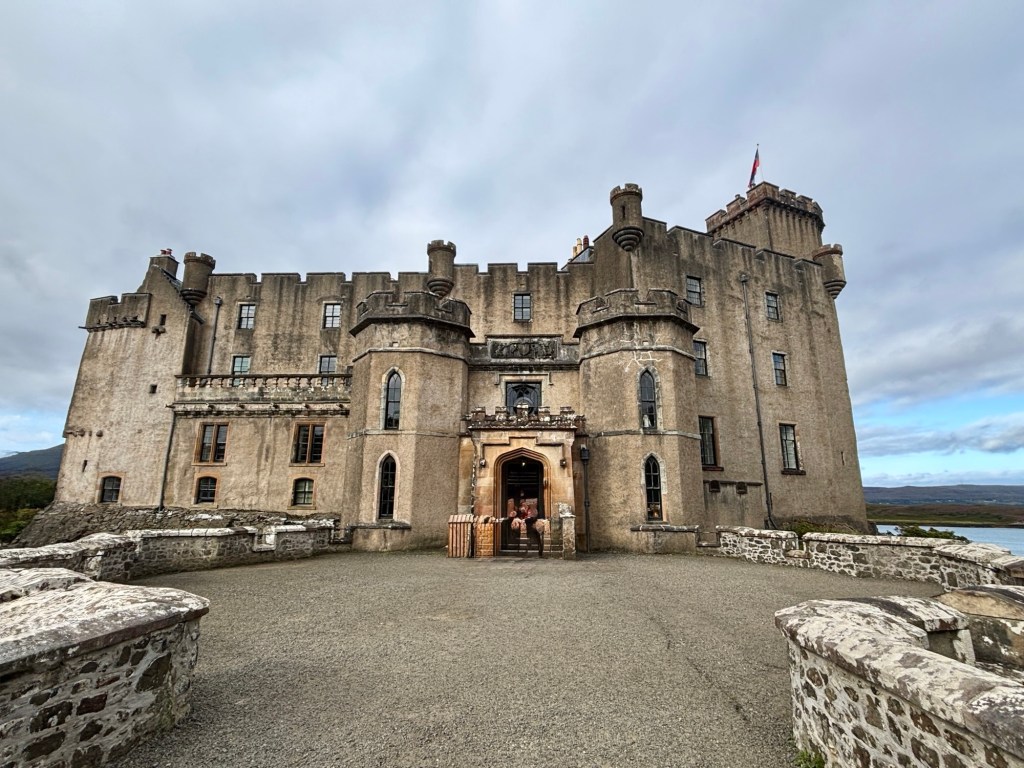
The castle was the stronghold of the MacLeods for nearly 800 years and is still their family home. 

We were able to walk about on our own throughout the castle.  There were docents around to answer questions.

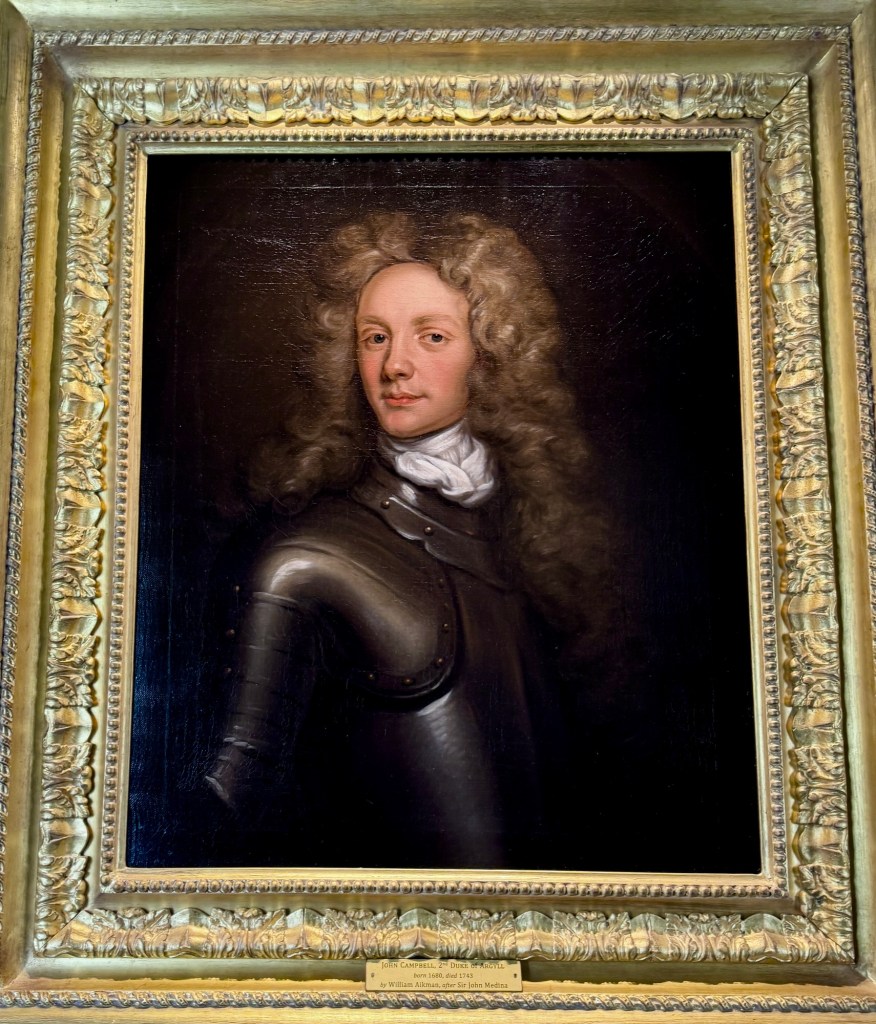
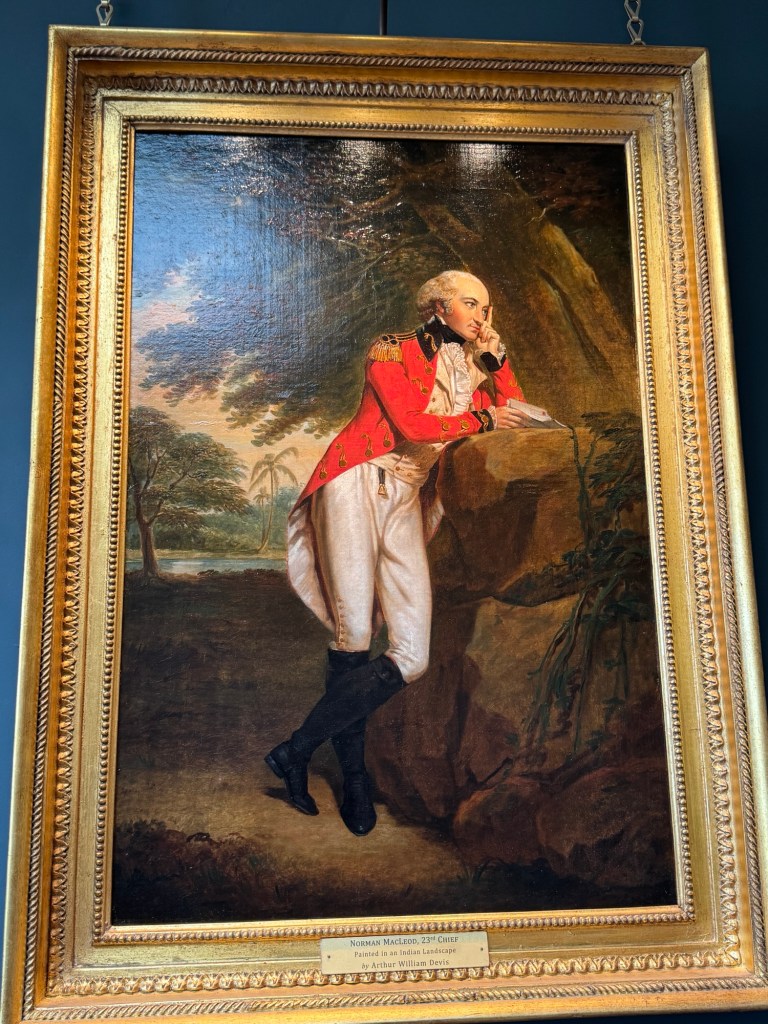
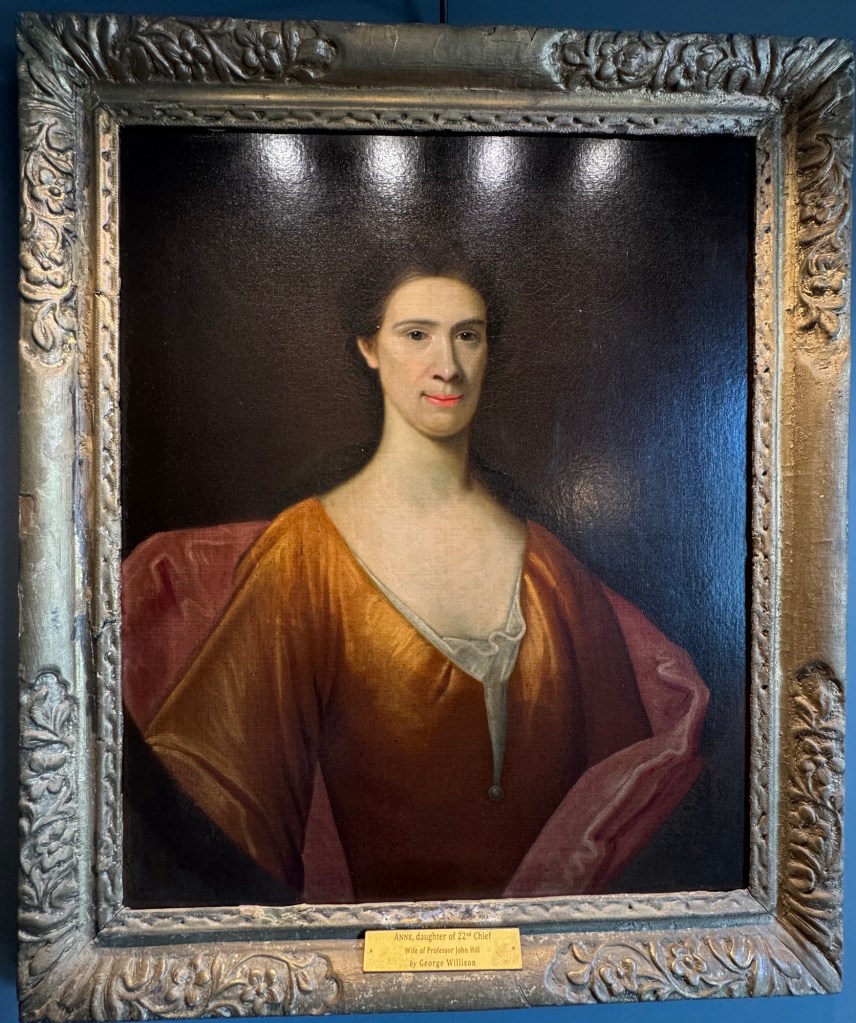
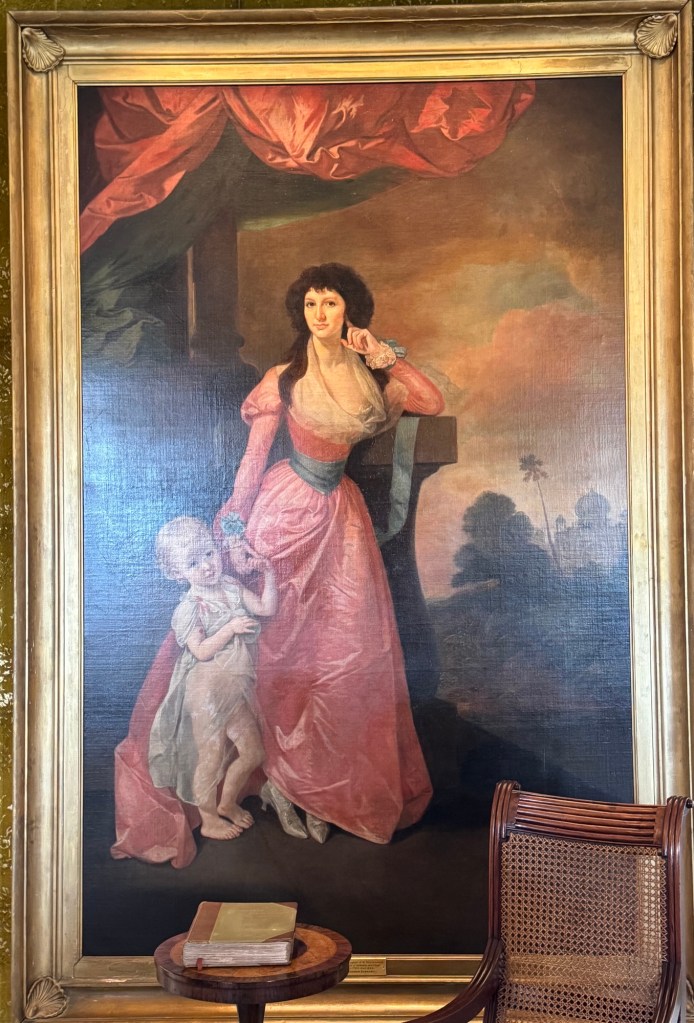
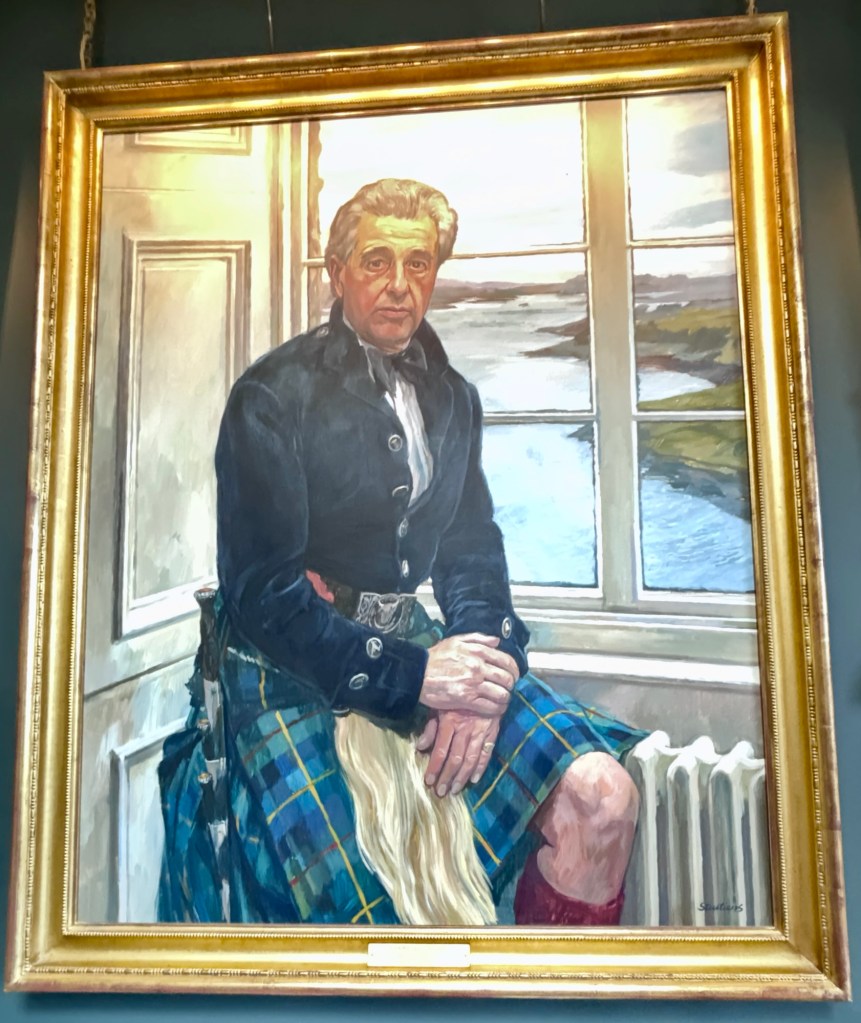
There were lots and lots of portraits of former MacLeod chieftains and family members.

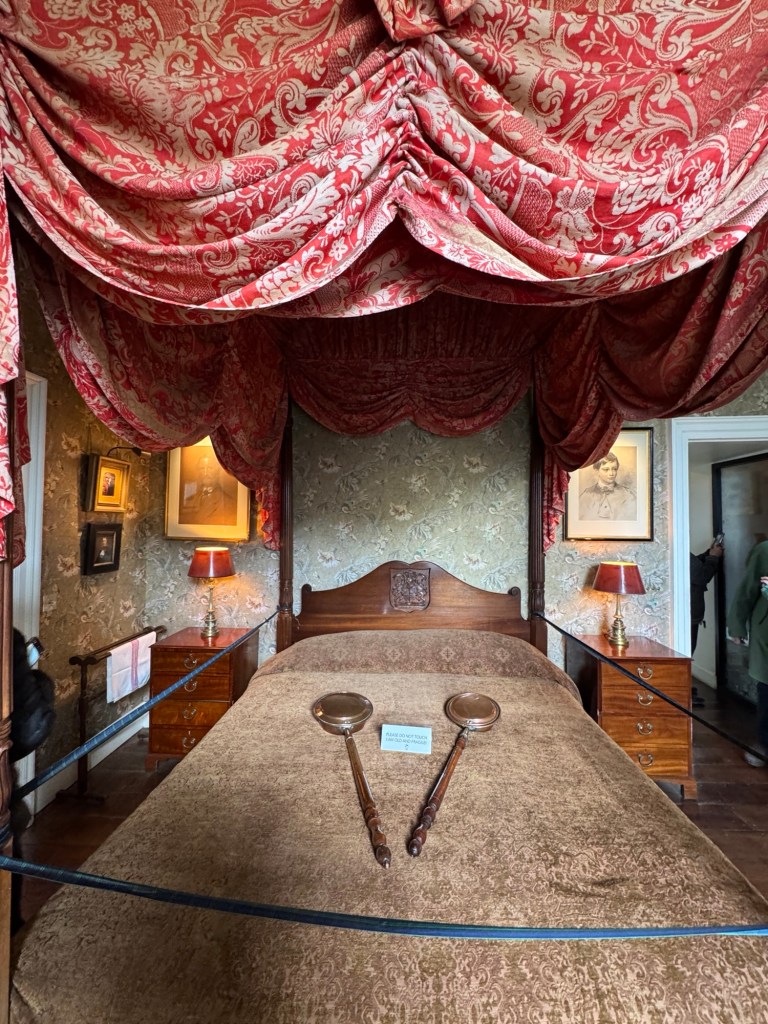
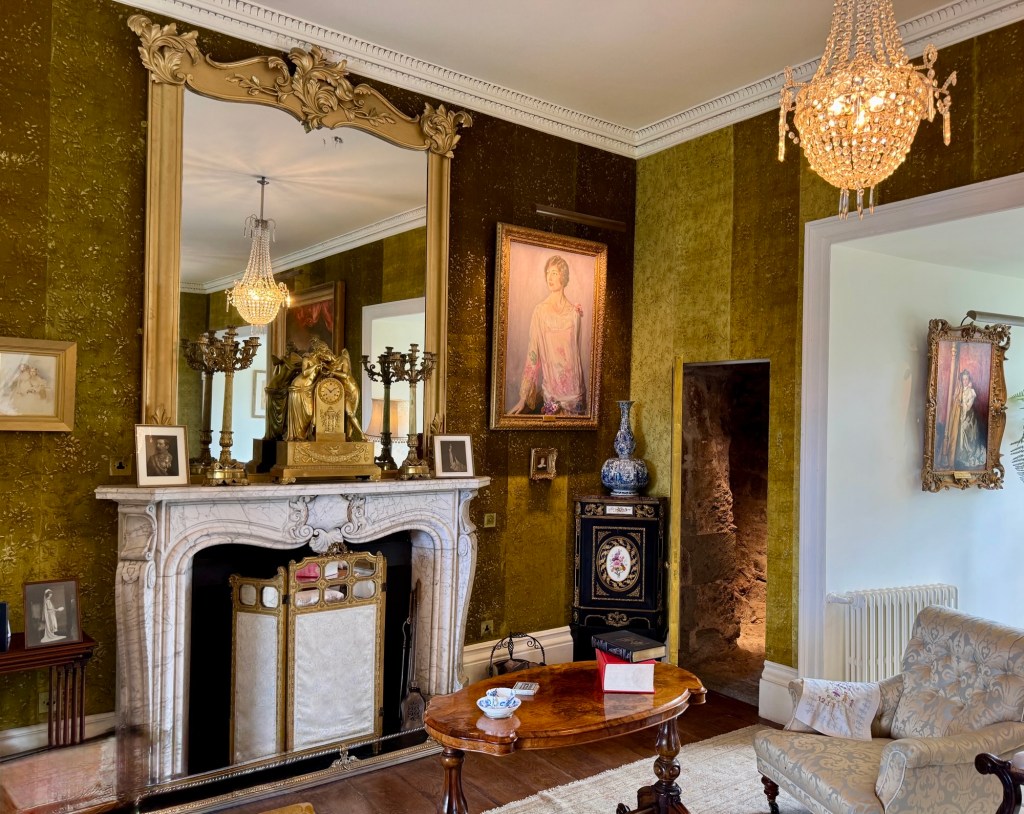
Several rooms were furnished for us to see how they might have looked.

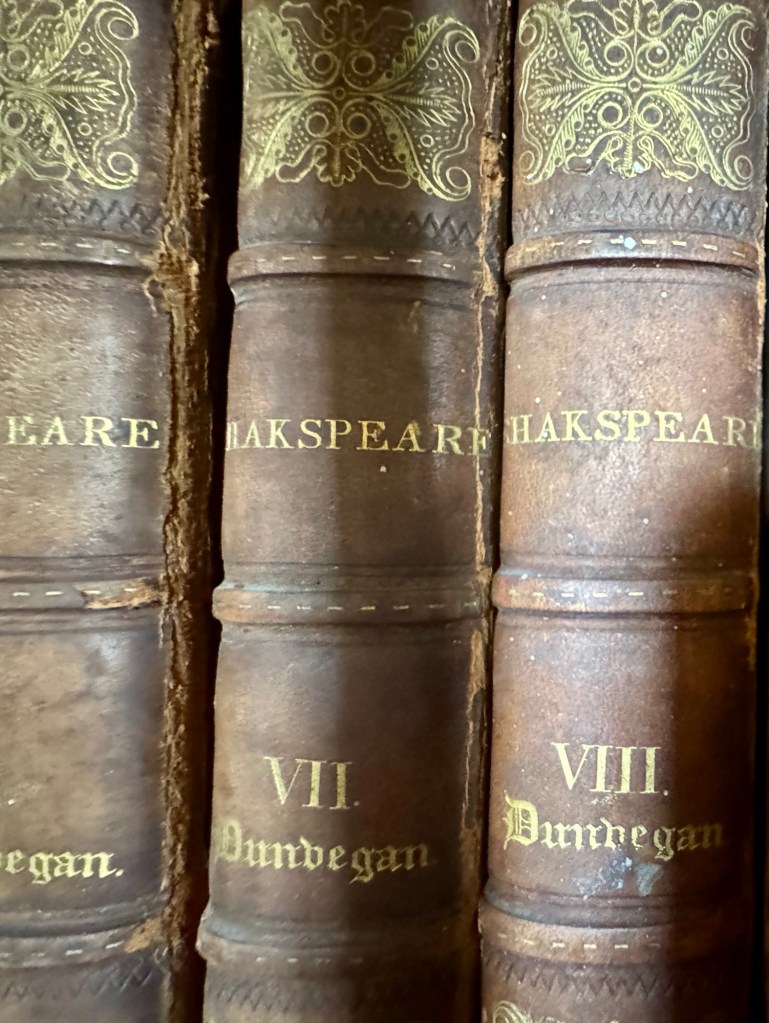
In the bookshelves we saw a collection of the works of Shakespeare bound specifically for Dunvegan.

Notice the secret passage door to the right of the table with the vase.  

One of the castle treasures is the ‘fairy flag’ of Dunvegan — said to possess miraculous powers.

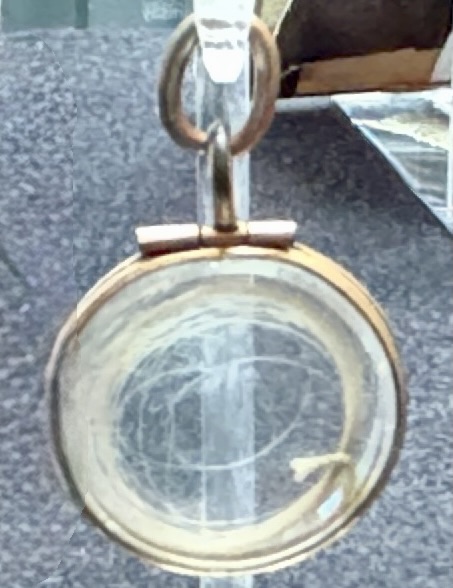
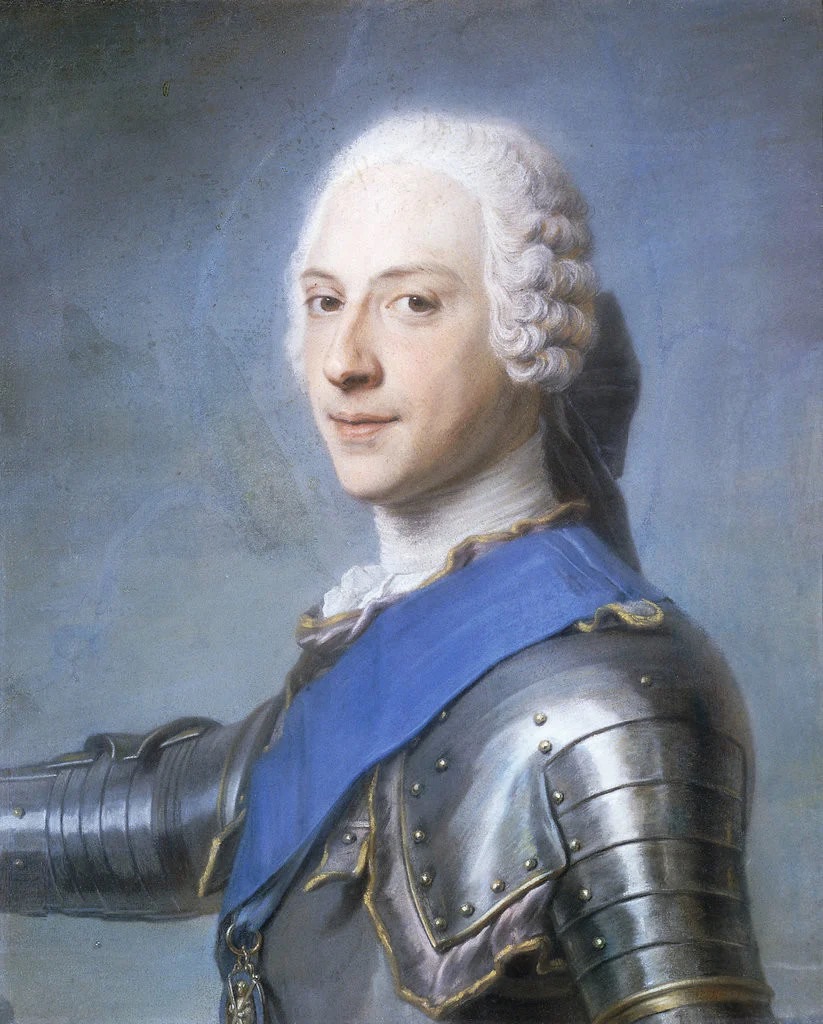
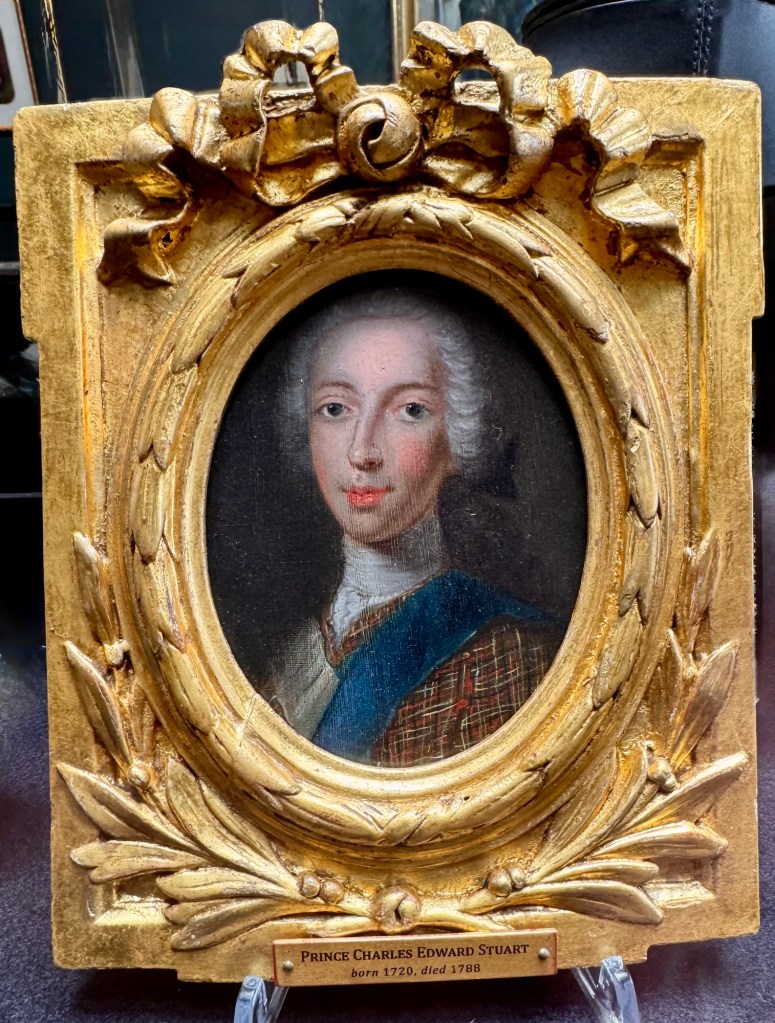
Another treasure is a locket with hair clipped from the head of Charles Edward Stuart, also known as Bonnie Prince Charlie.   

A bit of background for those of us who don’t know the complex English – Scottish – Jacobite history…  After Queen Elizabeth I died without a direct successor, there was monarch messiness.  Bonnie Prince Charlie, was trying to assert his right to the crown.  He was a Jacobite in the second phase of their rebellion.  Charlie did well as a military leader – until he didn’t.   

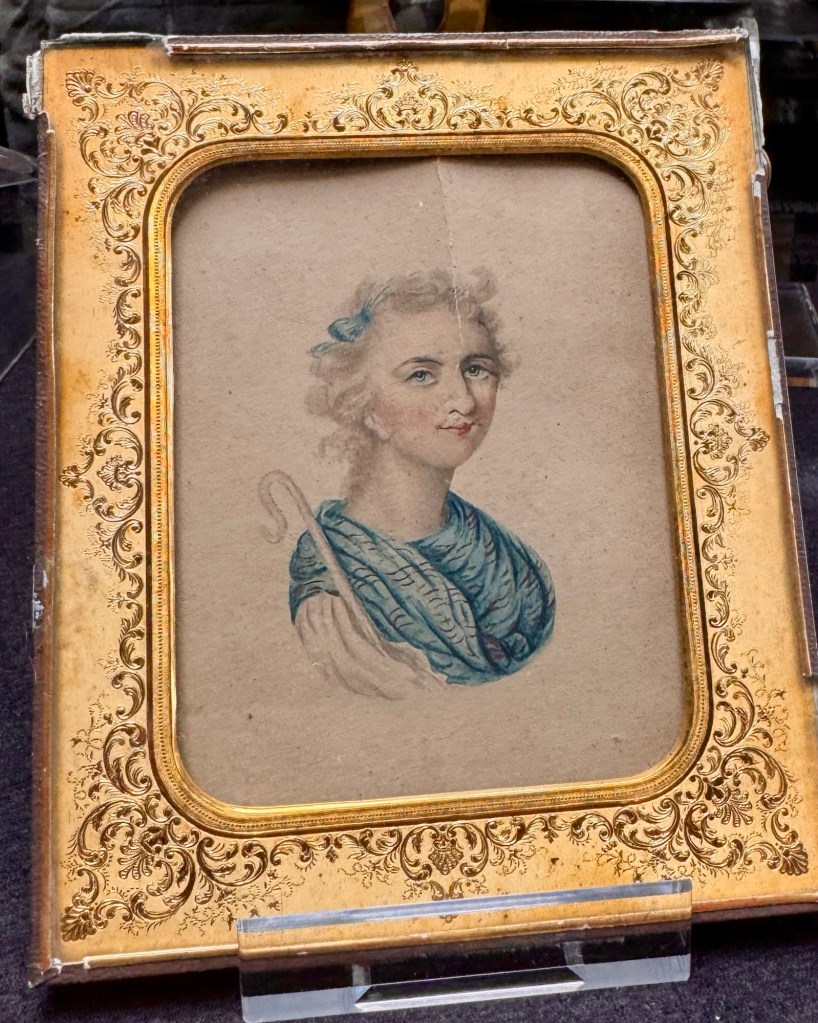
He escaped and eventually made it to the Isle of Skye with the help of a woman named Flora MacDonald.  She received a lock of his hair as a keepsake in 1747.

When I looked on-line for a better picture of this locket of hair, I discovered that lots of places have a locket with his hair – it must have been a thing!  Unfortunately, I didn’t find a better picture of the locket at Dunvegan.

This was Prince Charlie’s waistcoat, also from Flora MacDonald’s family.

Another Flora! Centuries later, Flora MacLeod was the 28th Chief Commander, Dame of MacLeod.

Although we didn’t notice it on our walk through, another Dunvegan treasure is the 17th-century four-pint drinking horn. Each male heir has to prove his manhood by successfully draining the horn of claret.   

This is a reproduction of the horn available in the gift shop.

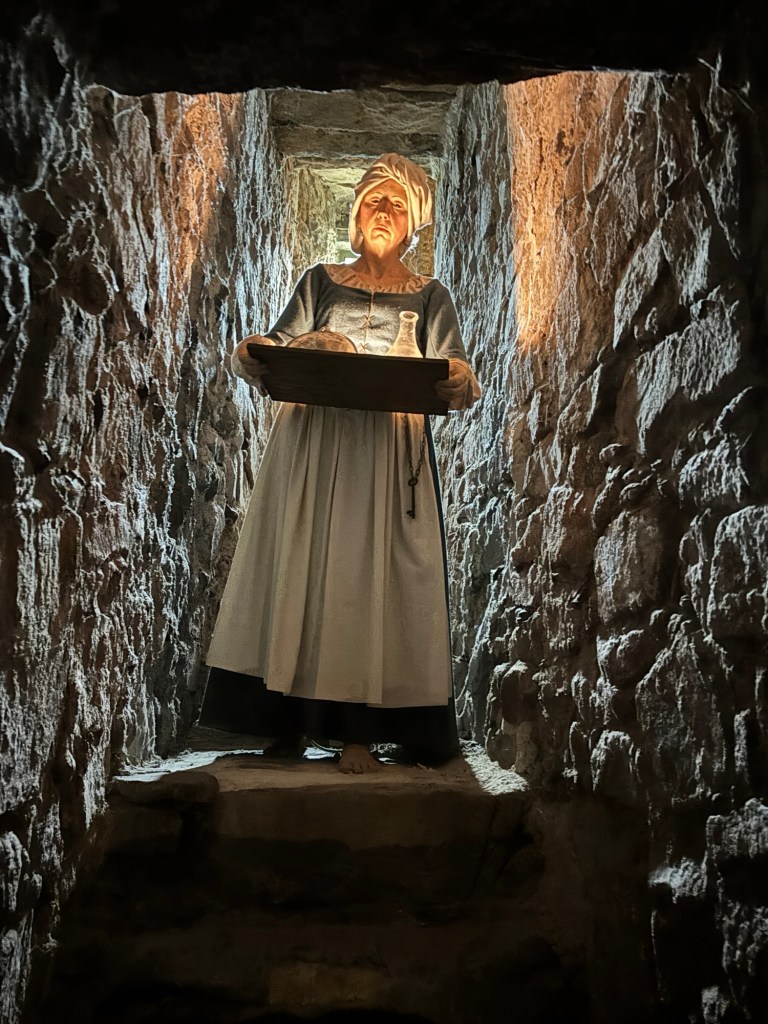
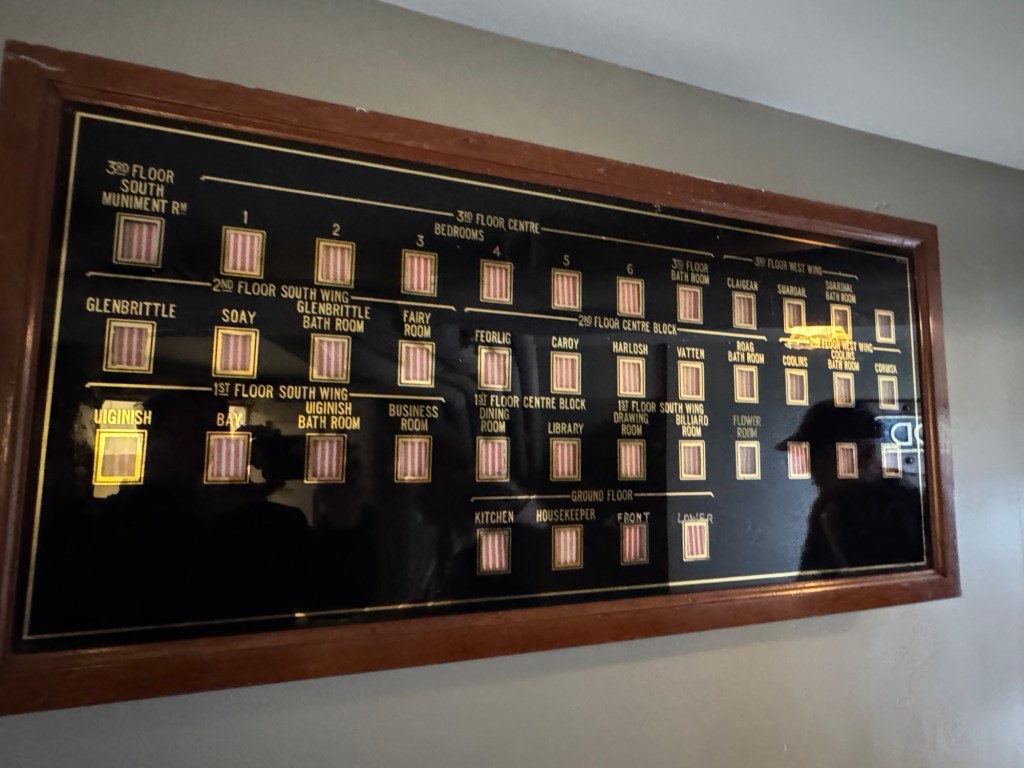
We saw one of the passages down to the servants quarters.

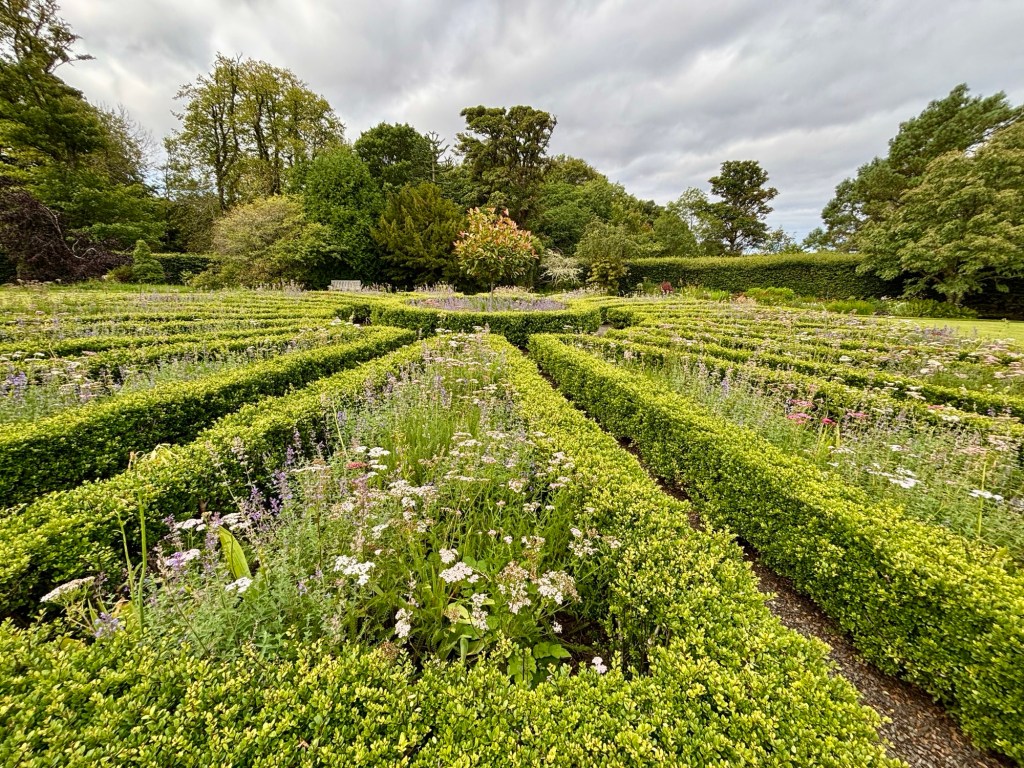
Dunvegan Castle’s gardens were originally laid in the 18th century and have a series of paths, pools and woodlands. 

We were able to view the castle from several places, only missing the view from the water.

Dunvegan Castle is still home to the current Chieftan of the MacLeods, Rory.

Rory is the 30th MacCleod to lead the clan.  Dunvegan is the oldest castle in Scotland to be continuously occupied by the family.

In addition to tours, the grounds and select rooms are available to rent for events. 

There are cottages, a campground, cafe, and loch cruises.  It seems quite the endeavor to keep Dunvegan Castle open and maintained. We were happy to contribute with our tour tickets and a few purchases in the gift shop. Of course, one of them was a MacLeod tartan!

We took a few pictures around Portree while waiting for our tender back to Nieuw Statendam. (People artificially removed.)

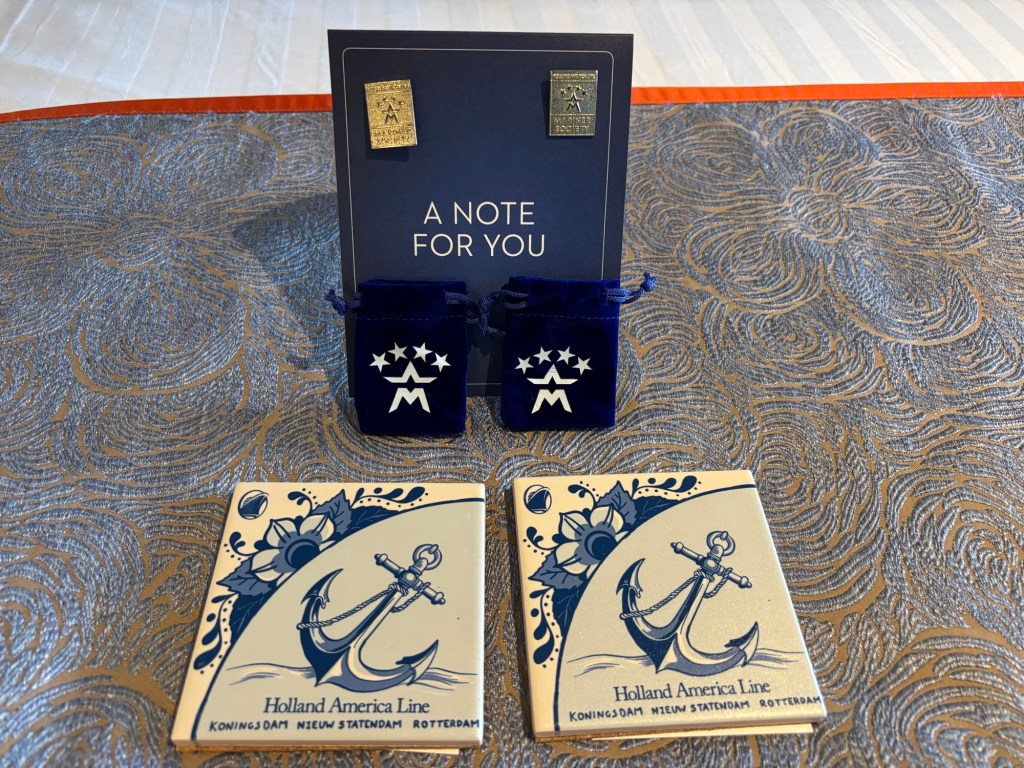
When we returned, we found our 4 Star Mariner pins and tiles had been delivered.

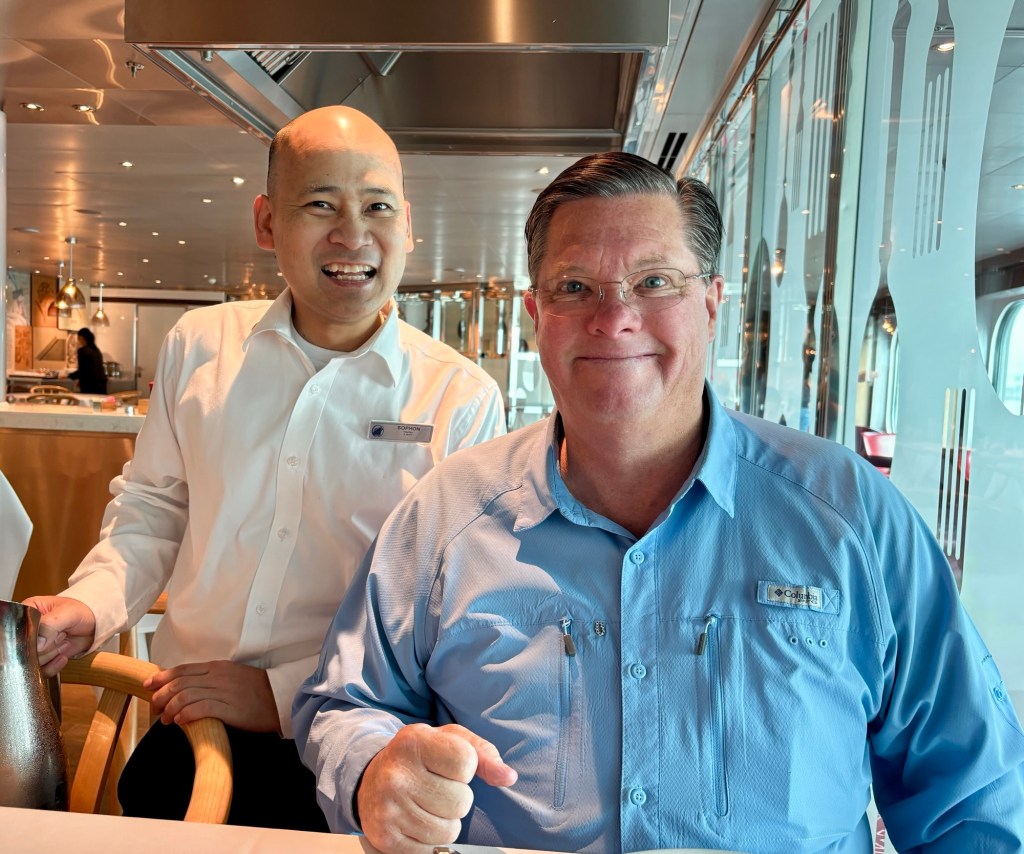
We had another dinner in Club Orange and took pictures of the crew that enhanced our cruise in lovely ways.

Next up:  One more stop in Dover.

Posted in Uncategorized | Leave a comment

Two Cruises: Isle of Lewis – the Second Time

The first time we visited Stornaway, Scotland, Cindy and Darrell were with us.  As we met in the evening for dinner that evening, they were quite excited about their interesting tour of Historic Lewis.  We decided we would try their excursion on our second time through on August 20.

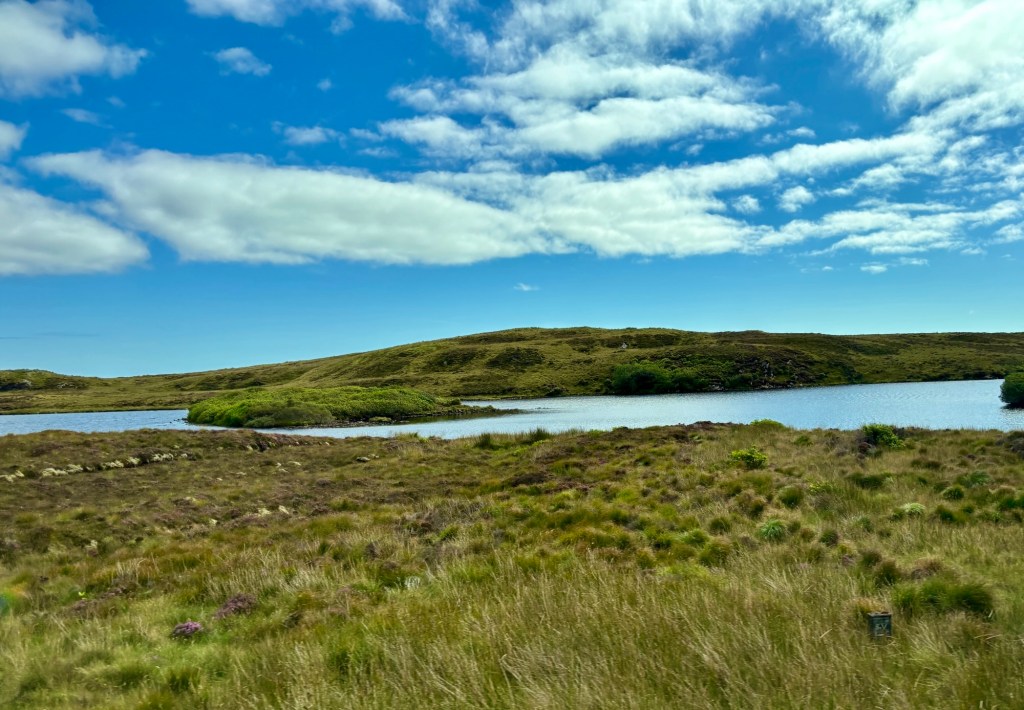
The tour began with a drive through the sphagnum moss moors of central Lewis.  

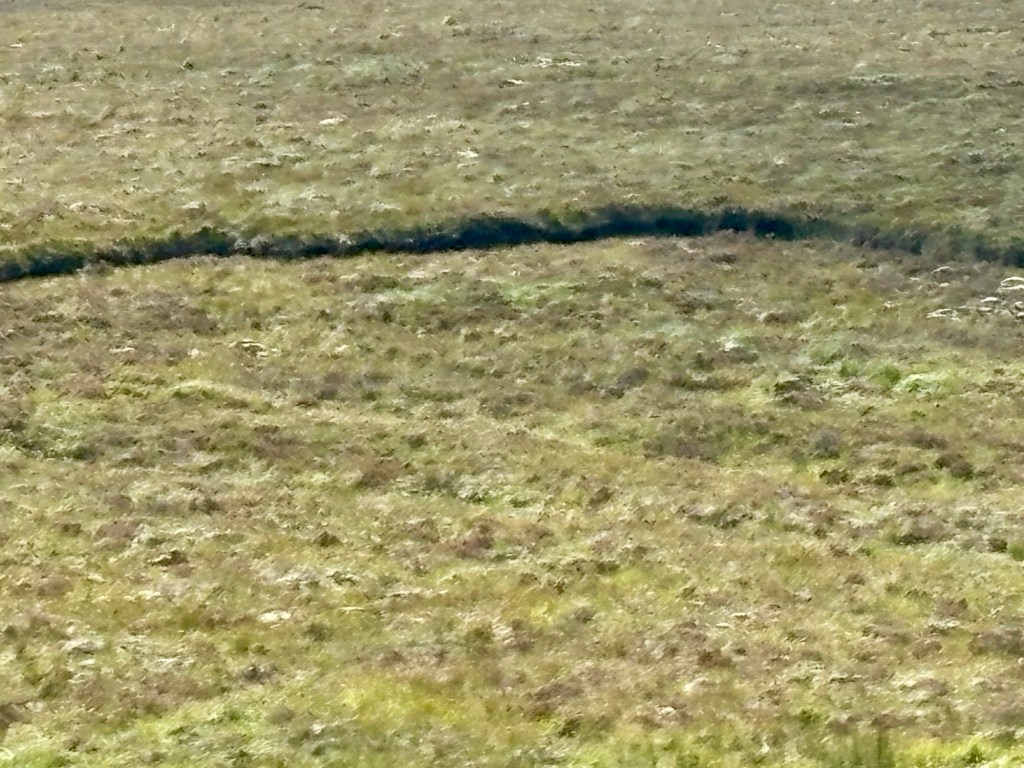
This photo shows where some moss has been cut.  At one time 75 percent of the residents used moss for heating their homes.  Now only 5-10 percent do so.  A cubic feet of moss weighs 59 pounds. When dry, it weighs 17 lbs.

This tour typically included the Callanish Standing Stones but access is limited at this time due to renovation of the surrounding area. 

I did get a picture of the Callanish stones from the bus.

The stones are set in the shape of a Celtic cross and are the island’s most dramatic prehistoric ruin.  They date from 3500 BC, before Stonehenge.

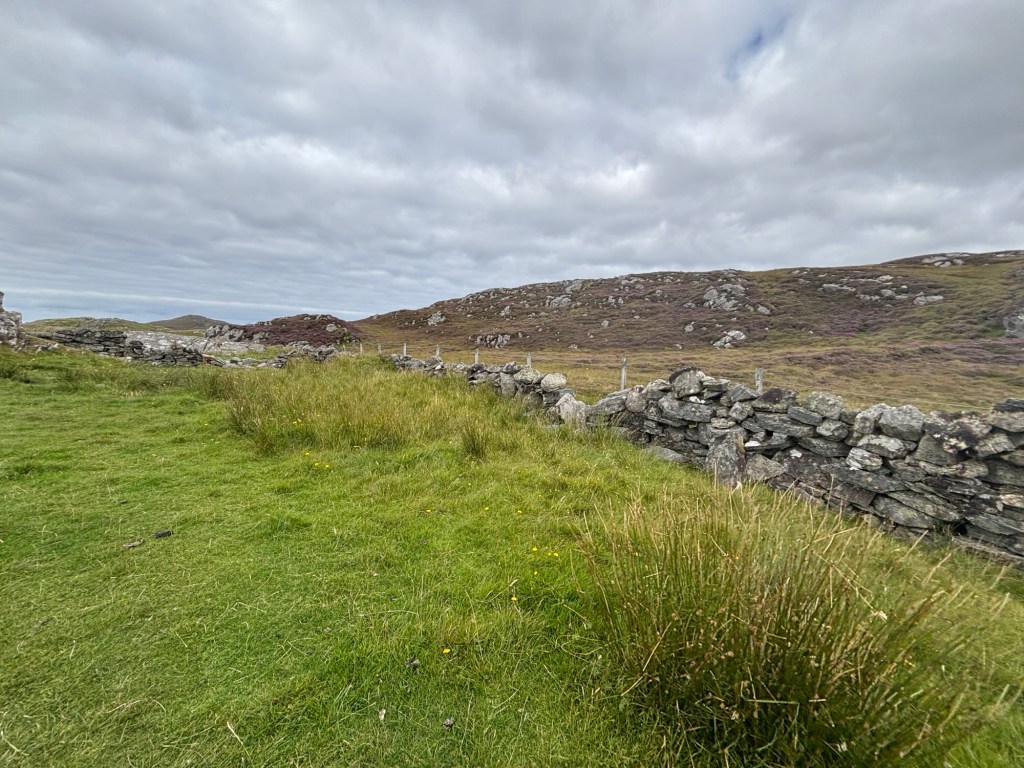
Ruins are a common sight driving through Scotland.

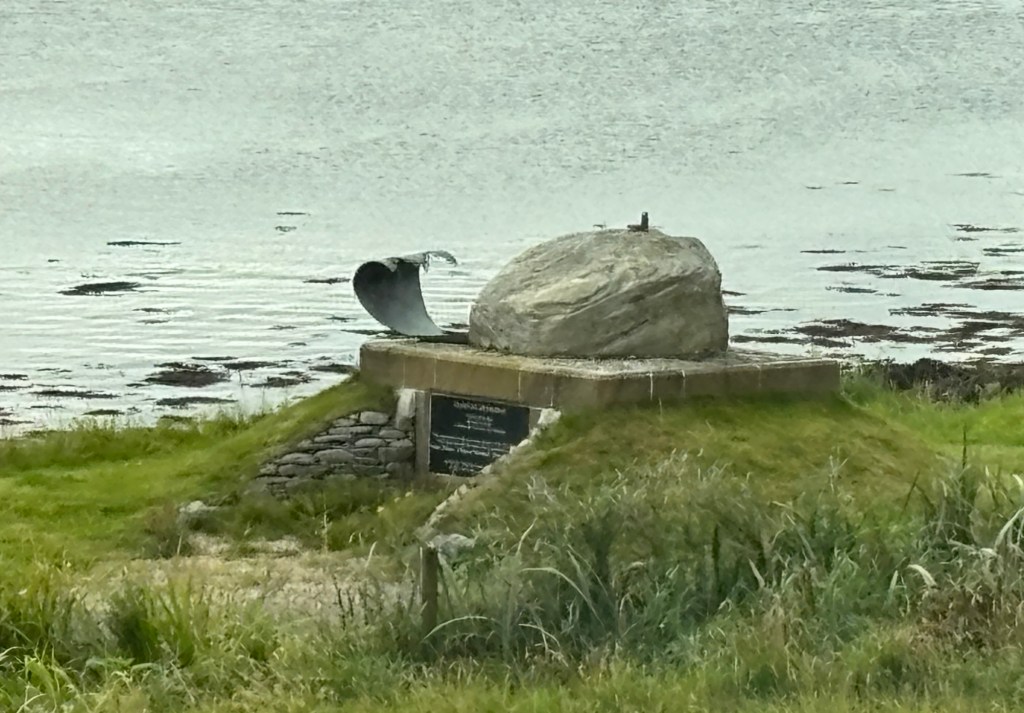
This is a monument of a huge wave coming over Flannan Island on Dec 14, 1900.  Three lighthouse keepers disappeared from the island under mysterious circumstances.  

Likely, three light housekeepers were washed into the sea.  A British movie about the event, The Vanishing, (alternatively titled Keepers), was made in 2018.   Songs, operas, books, video games and TV programs have also featured the disappearances. 

The middle island is where the lighthouse and mystery took place.

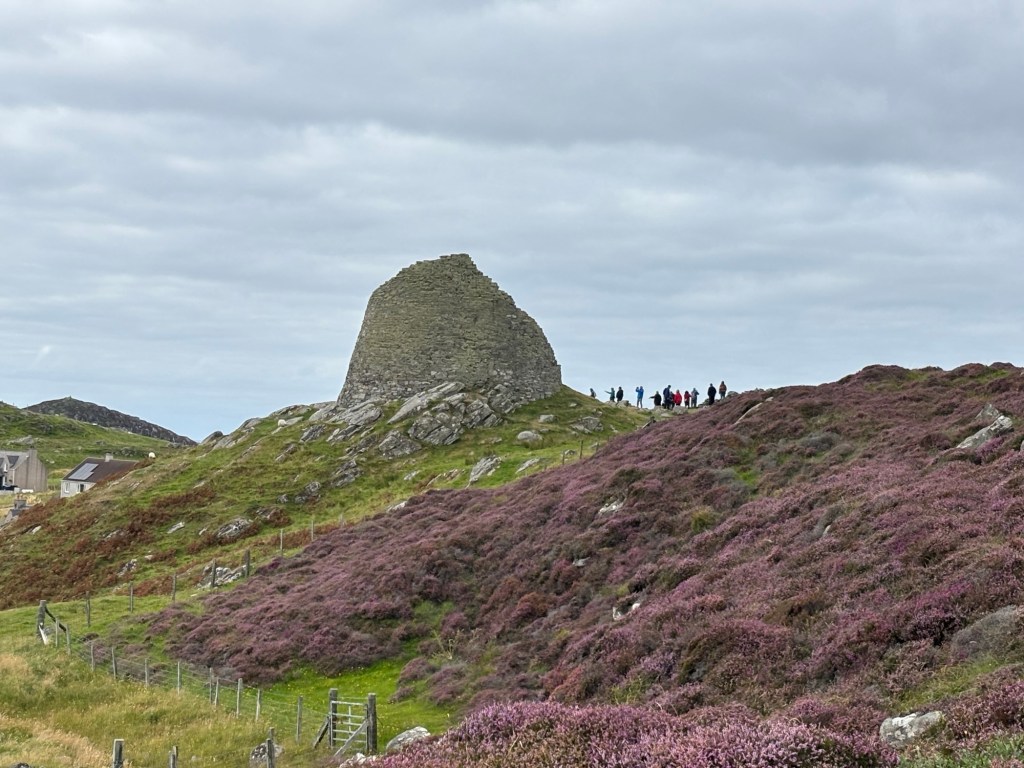
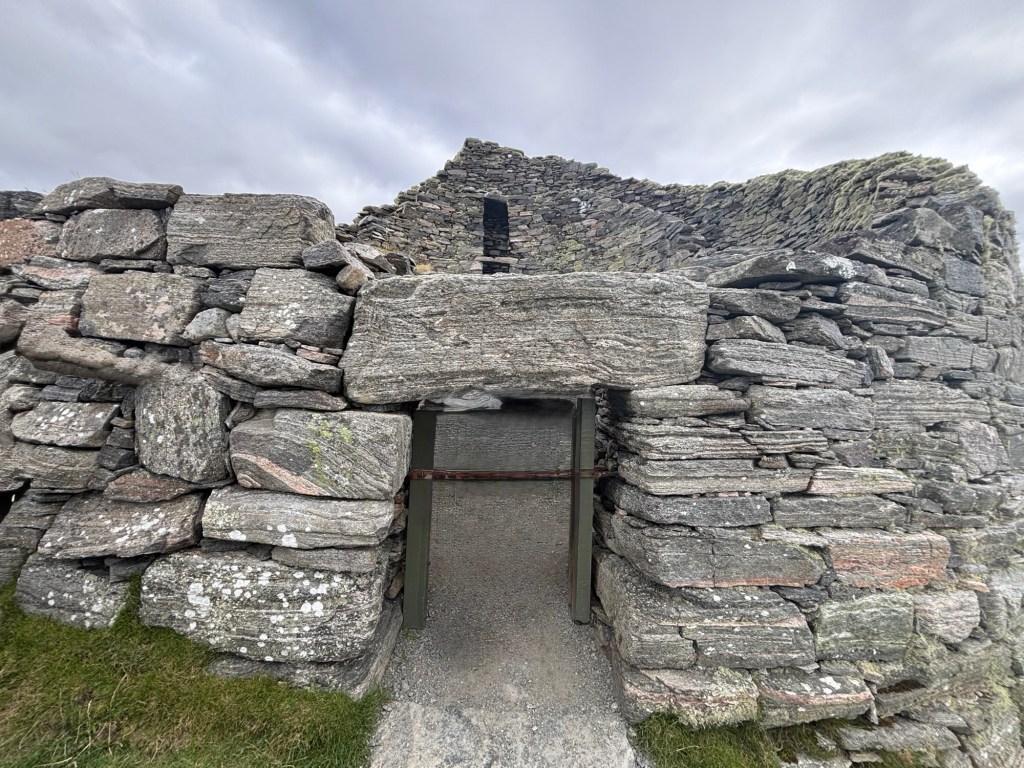
Our destination was Carloway Broch — a stone tower built around 100 BC.  

Broch is Norse for “fort” but our guide believe this would have been a community meeting house and not for defensive purposes.  

Its construction and design was not strong enough for defensive purposes. 

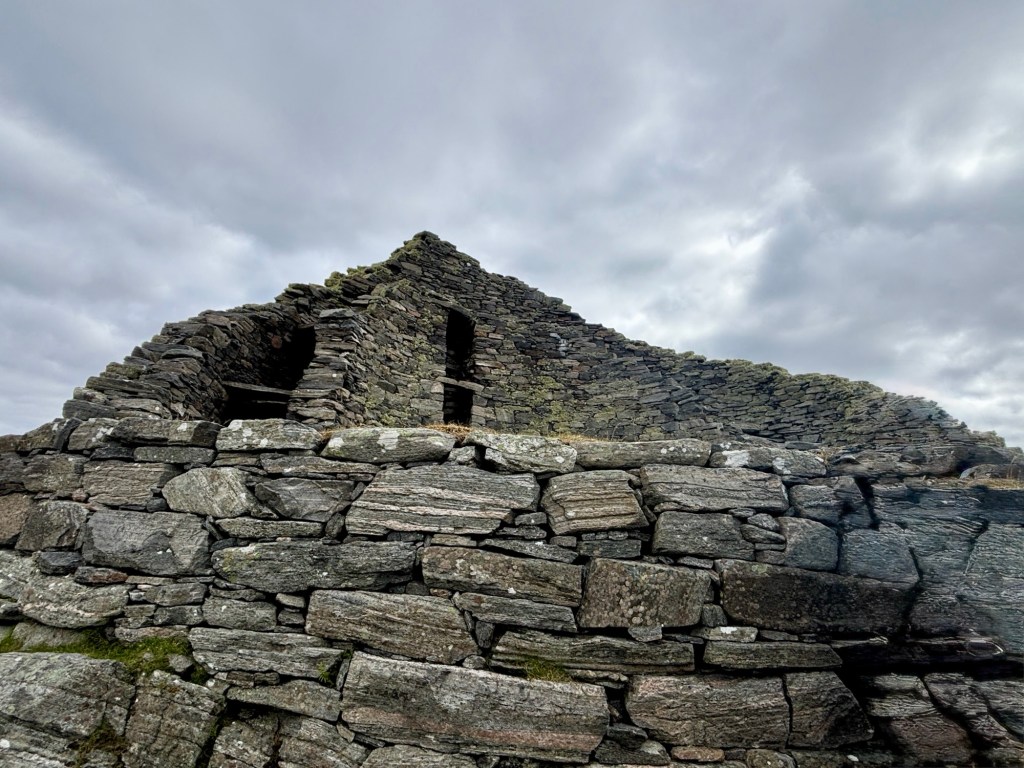
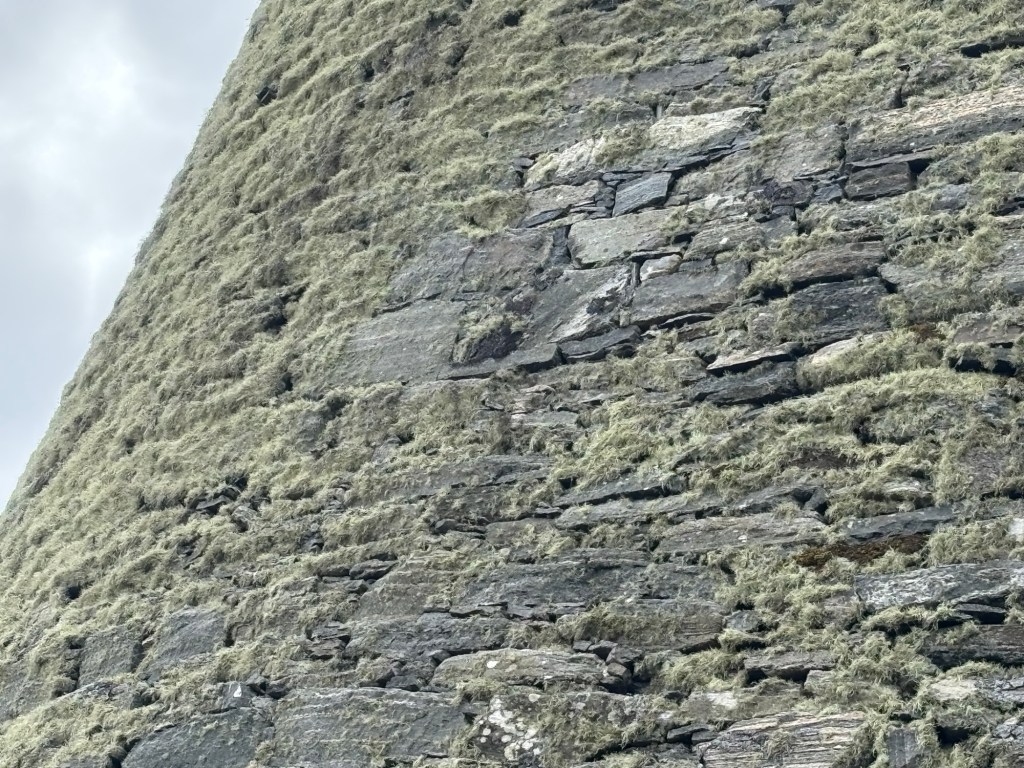
It is built in two walls –  the outer is convex and the interior is vertical.

Over time, the broch was abandoned and stones were removed to build other houses and fencing.

Restoration started and much of the work was done by two sisters.  They did what they could with what they knew and put in a tremendous amount of work.  

Their work has been refined to make the broch safer to visit, although our guide thought it precarious.  

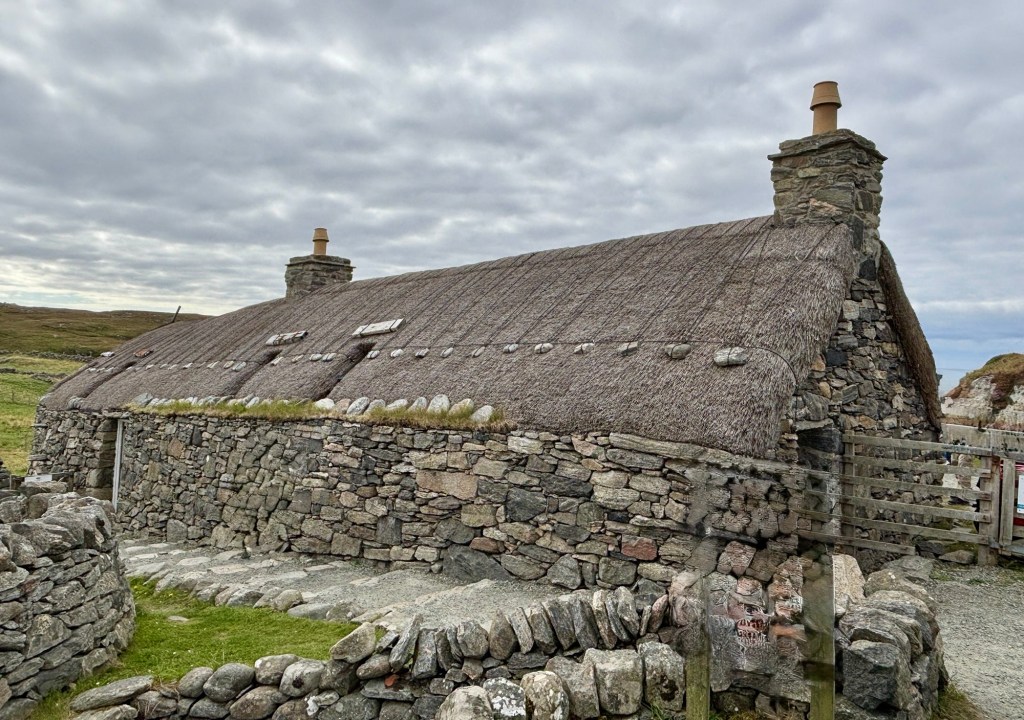
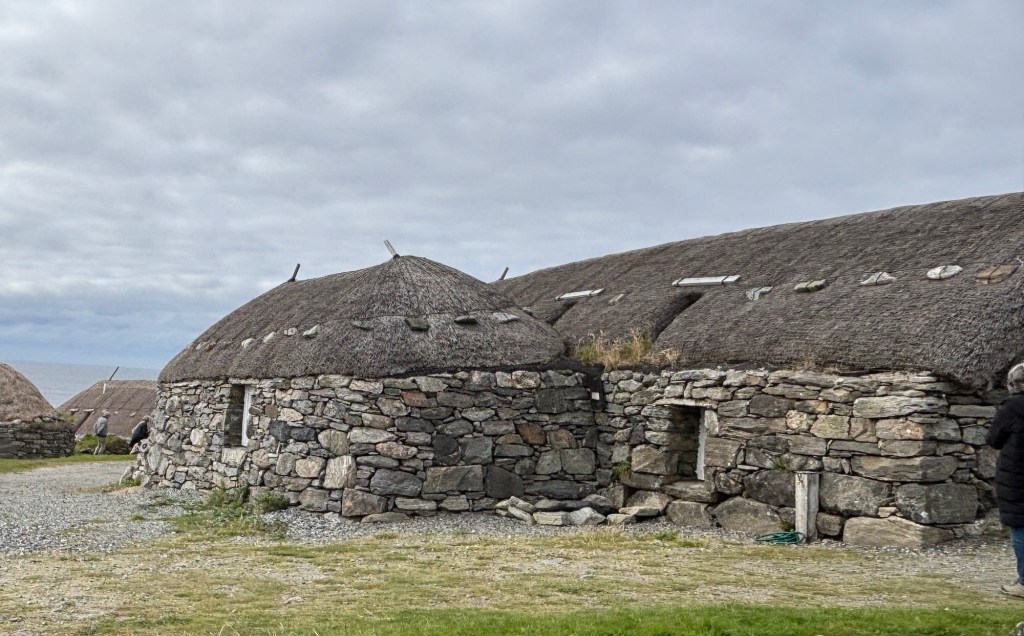
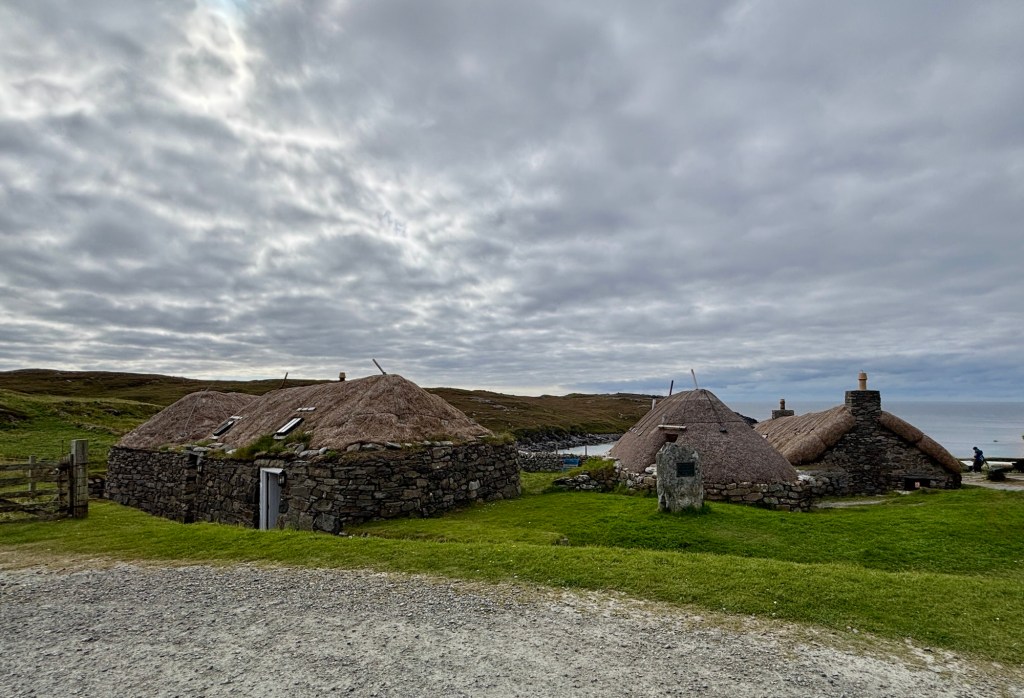
Our next stop was the settlement of Gearrannan, the traditional village of ‘black houses’ at the edge of the ocean. 

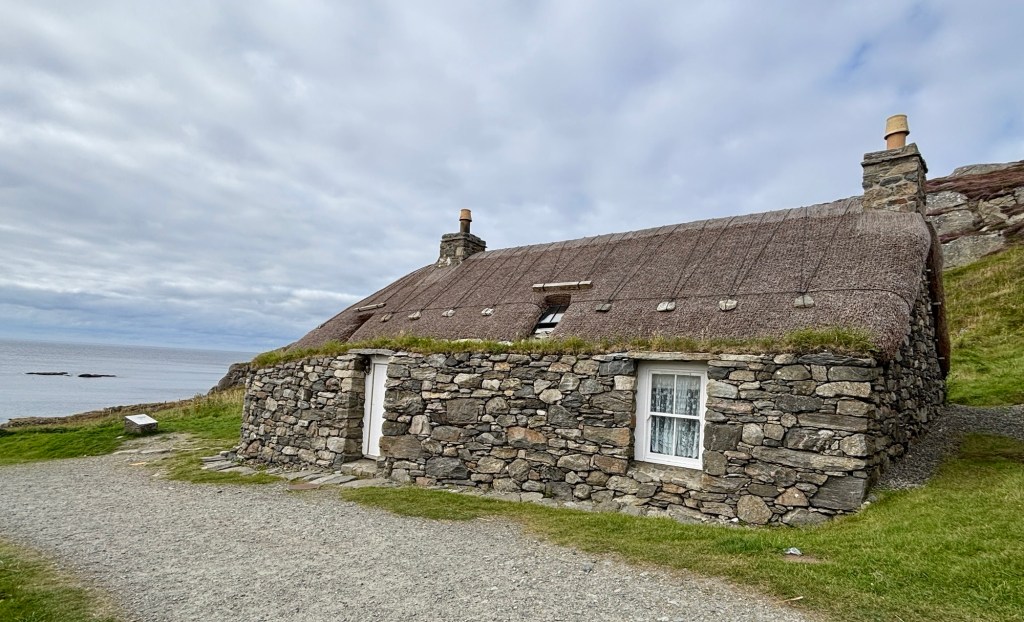
These houses were built in the late 1800s. They were once the traditional style houses along the Hebridean coast.

The houses feature packed earth floors, stone walls, and thatched roofs. 

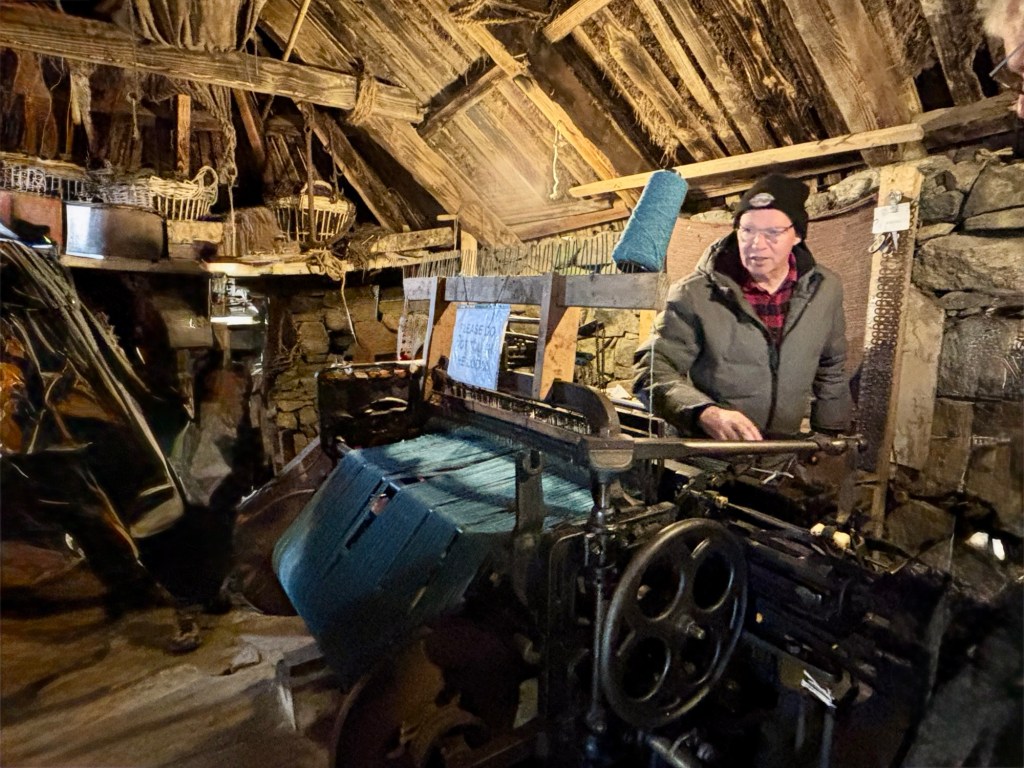
Black houses were built originally as a combined barn and home where people lived together with their animals.  Both rooms slope to the middle for liquid disposal.

An open peat fire usually dominated the main room, marking the walls with soot and leading to the ‘black houses’ name. 

This example was furnished as it was in the 1950s.  

A fire kept the space warm, and a divider separated the human inhabitants from their farm animals.

Between 1945 and 1965, the other black houses on the Isle of Lewis received running water and electricity. 

People lived in these houses until the 1970s, when the village’s remaining elderly moved on.  

Decay into ruin seemed inevitable but in 1989, a local trust began work restoring and preserving these black houses. 

Not only does the black house village have living museum space and activities but there are also overnight facilities for rent.

We looked In the gift shop at the local products for sale.  While there, I started reading a display and discovered it expressed local angst against Donald Trump.  

His mother was born in a black house a short distance away. She eventually moved away and married Fred Trump.  In 2008, Donald Trump visited this area and efforts were made by locals to introduce him to the life his mother would have lived in a black house.  Trump spent less than a minute in his mother’s childhood home.  He was perceived as being uninterested in learning about the local history and what her life might have been like.   The Scottish people protested Trump’s presence in Scotland several times while we were on this trip but we did not know their dislike for him went back so far.  

This arch was made by the two lower jaw bones from a beached blue whale in 1920.  The harpoon was in the whale but the head had not exploded.  (I hadn’t know they ever exploded!)

Fortunately the man dealing with the whale and harpoon was not in the shed when it finally did explode so he was not injured.   

We enjoyed our Historic Lewis excursion, just as Cindy and Darrell had.

Next Up:  The Isle of Skye, the port we missed because of weather on our first cruise.

Posted in Uncategorized | Leave a comment

Iceland: Big History of a Small Island

There are so many extra things we learned about Iceland that didn’t fit into our earlier posts – so I’m adding an additional post to get down some of these other interesting things.  

Some of these extras were from guides and port talks, and most came from the book How Iceland Changed the World by Egill Bjaanason.   Its subtitle  is The Big History of a Small Island.  

It was a great book and I was happy to leave it in the ship’s library for another traveler to enjoy.  We went by the ship library the next day and I was so pleased that someone had already taken it!

Iceland, the land of fire and ice, was the last major territory settled in northern hemisphere.  The settlement of New Zealand,  a few centuries after, made human occupation of all major territories in the world complete. 

Iceland is about the size of Ohio. 

There is a Ring Road, also called Route 1, around most of the perimeter of Iceland. It is 1908 kilometers long, taking about 24 hours to transit. There are many travel sites that promote the places to visit along the Ring Road if you are traveling in Iceland independently. They suggest allowing seven days.

Because my social media feeds are still giving me Iceland information, I saw this posting of the road being washed out because of heavy rains and winds. The comments indicated that, once the weather subsides, these washouts are repaired in just days.

Twelve percent of Iceland is covered by glaciers. 

Alaskan Aspen is the tree having the best success in reforestation.

Iceland’s conversion to Lutheranism led to improved literacy as people were encouraged to read the scriptures for themselves.

The Black Death hit Iceland in 1402 and wiped out 2/3 of the population. 

The first country wide census ever was done in Iceland, commissioned by King Frederick IV of Denmark, circa 1700.  The results indicated a population 50,358 which plunged to 30,000 three years later due to a small pox outbreak.

“The population of Iceland is 1000 times smaller than that of the United States…. What we lack in manpower,  we make up in volcanoes, but we’re still figuring out how to aim them.” spoken by an Icelandic Prime Minister at a White House dinner.

Iceland has chosen to emulate the Nordic countries as a social democracy.  The people pay high taxes but get a lot for them.  Medical care and education through university are free. 

During the Cold War, Iceland denied the US government request for a 99 year lease to build a military base.  However, since Iceland didn’t have a defense force, some Americans did serve in that capacity. Iceland still has no armed forces.  It is a peaceful place.

The Icelandic language has not changed much in centuries. It is the closest to the old Norse. They do not incorporate new words from other languages.  They create new words from their own.  For example:  the Icelandic word for computer combines their words for sorceress and numbers.

Circa 870 AD, Norseman, Infólfr Aranson decided on the location of the first permanent settlement, using a traditional method. That meant casting pillars carved with the image of Thor overboard as soon as land was sighted and settling wherever the gods brought them ashore. Two of his slaves searched for three years before finding the pillars. That settlement became Reykjavik, meaning Smoky Bay in Old Norse. The name was said to be inspired by steam rising from hot springs.

The eruption of the volcano Laki lasted for seven months  in 1783. It changed the weather of the entire northern hemisphere for years.

Loki spewed 220 square miles of lava 3 feet deep. Iceland was covered in ash and then in acid rain.  Many sheep died resulting in famine throughout the island. Air particles led to a severely cold winter all through Europe which resulted in freezing rivers destroyed crops and flooding.  It was the greatest occurrence of “natural” death in Britain killing 23,000 – 30,000 people.

When evaluating marriage partners in Iceland, one often is considering semi-distant cousins. It has been common in some cultures to marry cousins.  Worldwide, more than 10 percent of marriages are between cousins.  Icelanders are familiar with their genealogy and have access to a data base to see how related they are. There is an app for that!

After World War II, Iceland declared independence for Denmark and then joined the United Nations.  Their ambassador became the leader of the ad-hoc committee to tackle the Palestinian issue.  It was chosen because Iceland was not Arab, not Muslim, not in the Mediternnean, not Eurocentric, not anti-Semitic and not one of the big five.  That left Iceland, Guatemala, Sweden, Peru, Canada, Australia, Iran and a few more.  There was much maneuvering but in the end, Israel was created in 1947.

NASA astronauts including Neil Armstrong trained in central Iceland because the landscape is similar.  Nine of the twelve people to ever walk on the moon, first trained in Iceland.

American chess master Bobby Fisher played his match against Boris Spassky in Reykjavik in 1972.  Years later he was arrested and jailed in Japan for traveling on a voided US passport after playing a match in Yugoslavia.  A friend from Iceland helped him gain asylum and citizenship.  He lived his last years, and is buried, in Iceland.  

Mikhael Gorbachev and Ronald Reagan met in Rekyjavik and tackled the issue of nuclear arms.  Although they didn’t reach the deal they’d hoped, they made significant progress and a deal was reached a year later.

In Iceland in 1980, Vigdis Finnbogadottir, was the first woman in the world to be elected president by a direct vote of the people – not through parliament or party leadership.  She was elected the fourth president of Iceland with a margin of 1,911 votes.

Halla Tómasdóttir, another female president of Iceland, was inaugurated on August 1, 2024.  The is the seventh president of Iceland since gaining independence.

Iceland was a very interesting destination, and way bigger in world impact, that I ever suspected!

Posted in Uncategorized | Leave a comment

Two Cruises: Puffins and Keiko Free Willy

We visited the island of Heimaey on August 18th.  It sits off the southern coast of Iceland.  

We learned that our ship was staying in place using dynamic positioning and thrusters.  We were above the electricity cables providing service on the island so the ship was not allowed to lay anchor. 

The isolated island was a long-time shelter for the Icelandic fishing fleet.  It was beneficial that the fleet was at home when a volcanic eruption took place in 1973.  The fleet was able to help with a total evacuation of the island.  Everyone survived the eruption except for one person who stayed behind trying to loot the pharmacy. 

The eruption caused the island to grow by 2.2 square kilometers.

Our excursion was to cruise around the island to see various bird colonies – specifically PUFFINS!  

We did see them, but they are very small and it was difficult to get pictures.   The closest I came to one was on the tender back to the ship at the end of the day.  

Iceland has an estimated 6-8 million puffins with about two million being seasonal residents on this island.   In mid August, the adult puffin were migrating out of Iceland so, perhaps, we were lucky to see any at all.

We learned that people who took walking excursions were able to see puffins close up.  I just chose the wrong excursion in that respect.

The very bumpy looking ground is showing all the puffin burrows underground.  In a few weeks the “puffling” inside the burrow will get hungry and make its way towards the light.  If it is daytime and the light they see is the sun reflecting in the ocean – all is well.  The puffling jumps out over the ocean and begins its life at sea.

These birds are different seabirds – not puffins.

If the puffling emerges at night near one of the towns, he could be confused and jump towards a house or street light.   There is a whole culture in Iceland of rescuing the misdirected pufflings.  They are gathered, kept in a box overnight and then thrown off a cliff to the ocean the next day.  Our tour guide told a story of taking a walk one evening and collecting four pufflings – one in each pocket and one in each hand.  It seems that Icelanders take their commitment to the puffins very seriously.

Then there are the sheep…there are sheep all over Iceland, easily out numbering the humans.  We have learned how they are mostly set free to roam all summer and gathered again in the fall to keep protected over the harsh winter.

We saw sheep grazing on remote islands, often high up above steep rock cliffs.  

The sheep are placed there in the spring using a net and pulley system.  They are collected and removed again in the fall.  What we failed to ask is why?  Why go to all the work to have them graze these islands and then gather them down again?  

The 2010 volcanic eruption that disrupted air travel worldwide was this mountain and glacier area off in the distance. The volcano, Eyafjallajökull, erupted between March and June 2010. After an initial six days of eruptions, 20 countries closed their airspace to commercial jet traffic and it affected approximately 10 million travelers.

This middle island is Surtsey, the second youngest island in the world. Its creation began with eruptions 130 meters below sea level from November 1963 to June 1967.  It is named after the Norse god of fire and has been protected as a natural laboratory. 

And just for our information: The world’s youngest island formed in 2014 off Tonga’s main island.  It is already diminishing and sinking into the sea.  It will probably not be visible within 30 years.

Iceland’s famous Elephant rock is made of basalt columns and formed by the slow cooling and contraction of lava. 

There are two volcanos in this picture.  The left, flatter one erupted in 1963. The one on the right erupted 4000 years ago.

Our guide was a lovely young woman.  She told us a bit about growing up on a small island.  She said Icelandic students must learn three things before graduating.  First, everyone must learn English because no one on earth speaks Icelandic.  Second, everyone is required to learn to swim both for themselves and for rescue situations.  Third, everyone must learn to run from volcanoes!

She also said that the dating life on the island (for her at 21) really stinks.  She’s pretty sure her soul mate isn’t on the island or she would have met him already. Everyone is either a cousin, already taken, or no one she’d want to date.   She was asking if any of us had sons or grandsons to recommend.  

There were several caves being carved out at water level.  We approached a few but actually fit inside one that is known for its acoustics.  Musicians sometimes play inside.  Our tour boat captain played a song on the sound system – the experience lacked authenticity.

This area is where the whale Keiko lived his final years as highlighted in the movie Free Willy. 

Keiko lived in a secluded area behind this infrastructure.  Keiko was safely confined but also enjoyed the most freedom he ever had.

Currently the site is operating as a Beluga Way sanctuary.  They have two beluga whales, with room and plans to have 6 more.  Their goal is to get the whales out of amusement park swimming pools.

We saw the following post on social media a day after this was posted. Good for them!

Back to the original post…

We spent our last afternoon in Iceland in the Crow’s Nest watching the sheep graze along the steep hillside far above the seaside cliffs.  

As we sailed away, the cruise director alerted us to the fact that we were going to sail by one of the internet memes for the loneliest house on earth, or most desirable if you don’t want neighbors. 

I found it on line, and then took a picture of the same house. 

And then there was a second house on the next island over.  I guess they were neighbors of a sort.

This was a nice day and a good excursion. Unfortunately, the puffin viewing could have been better. . Another trip, another time.

Next Up:  One more blog on Iceland because I learned some interesting things that I haven’t put down yet.

Posted in Uncategorized | 2 Comments