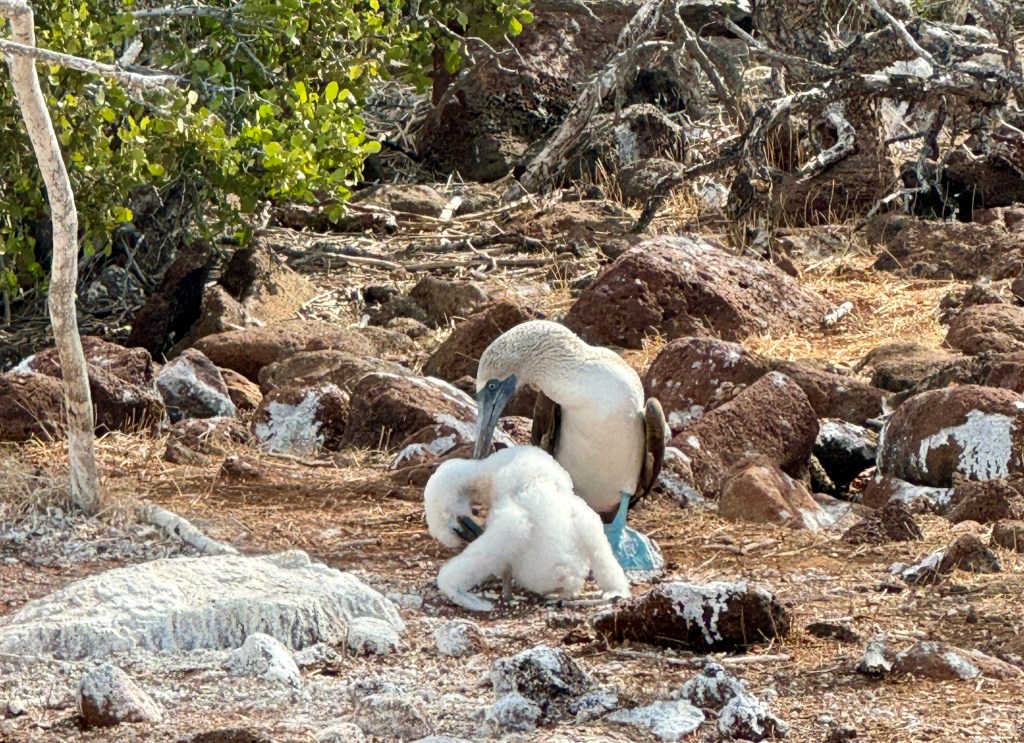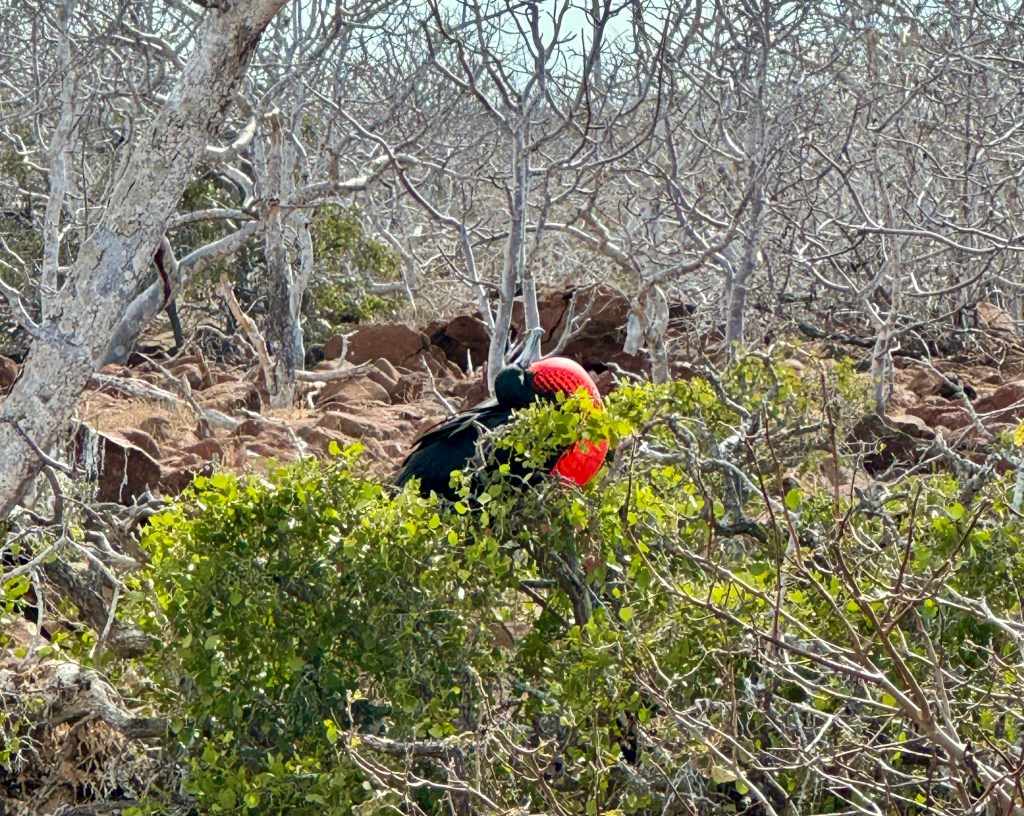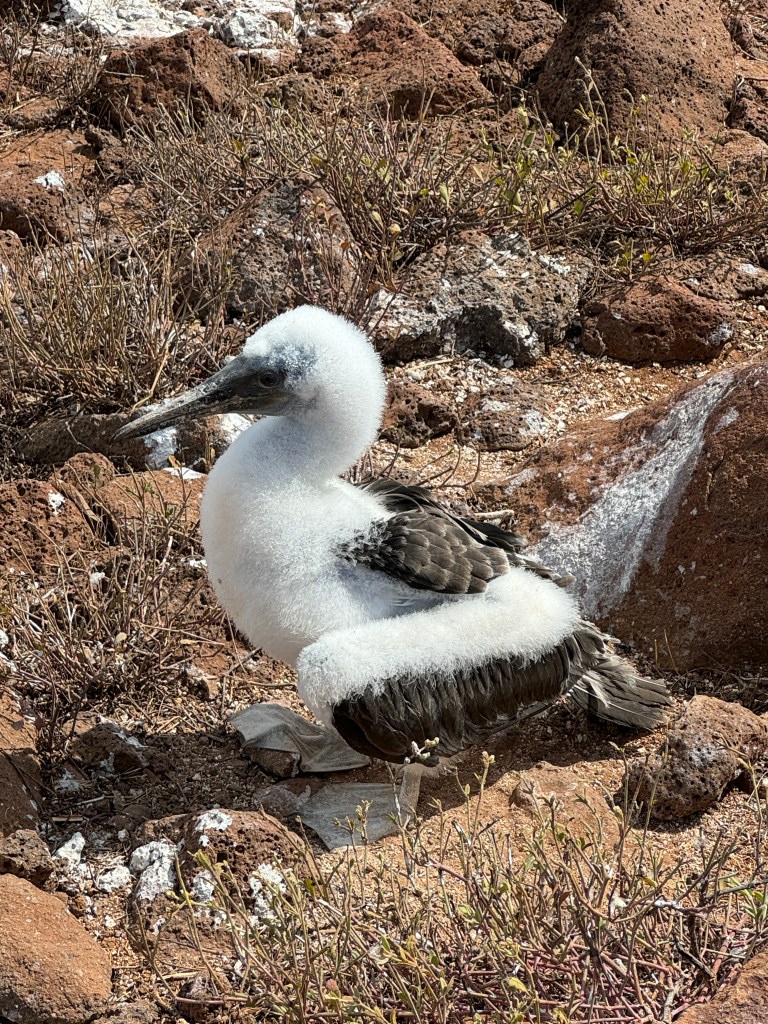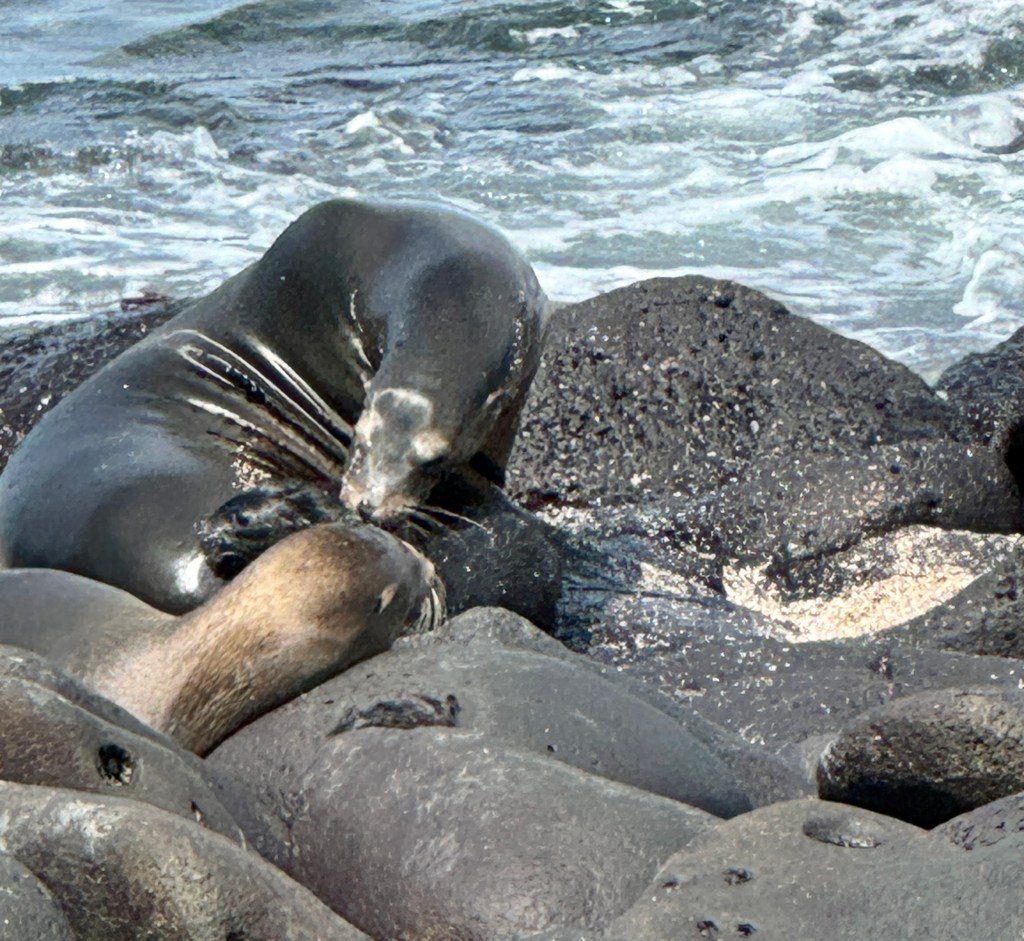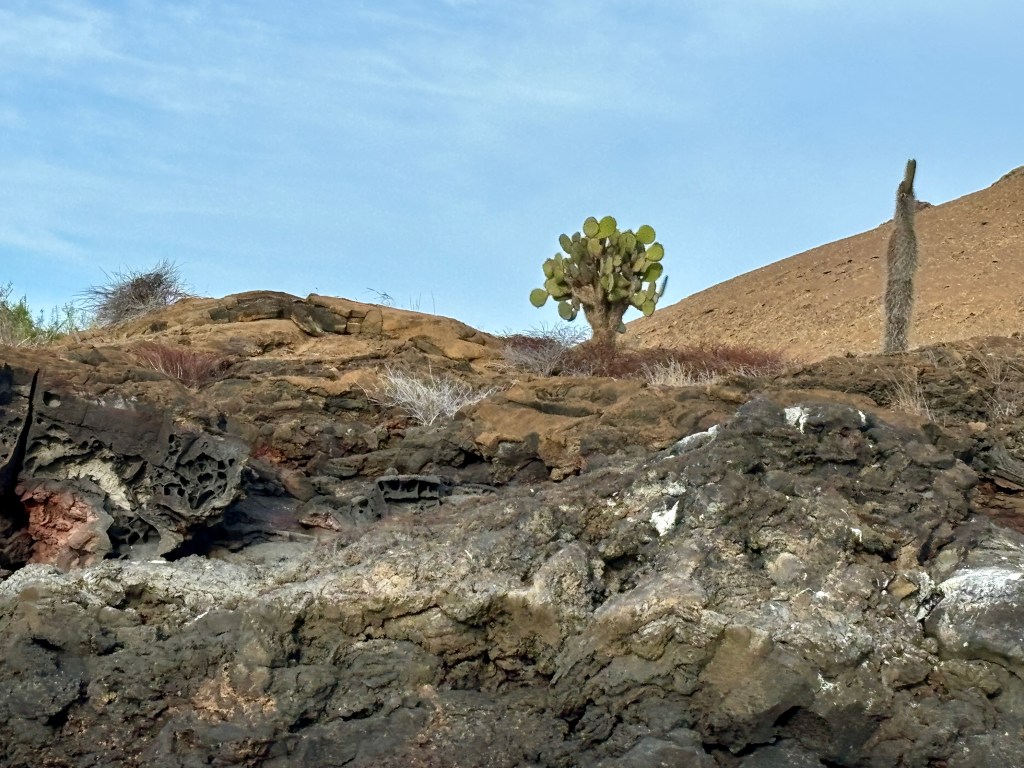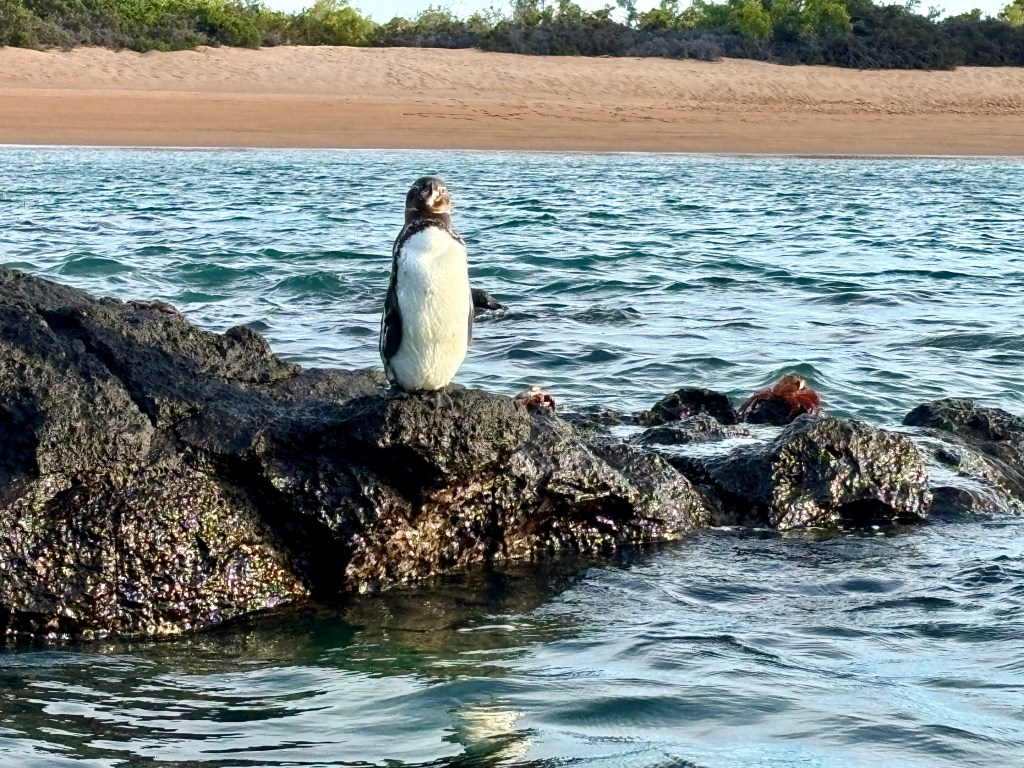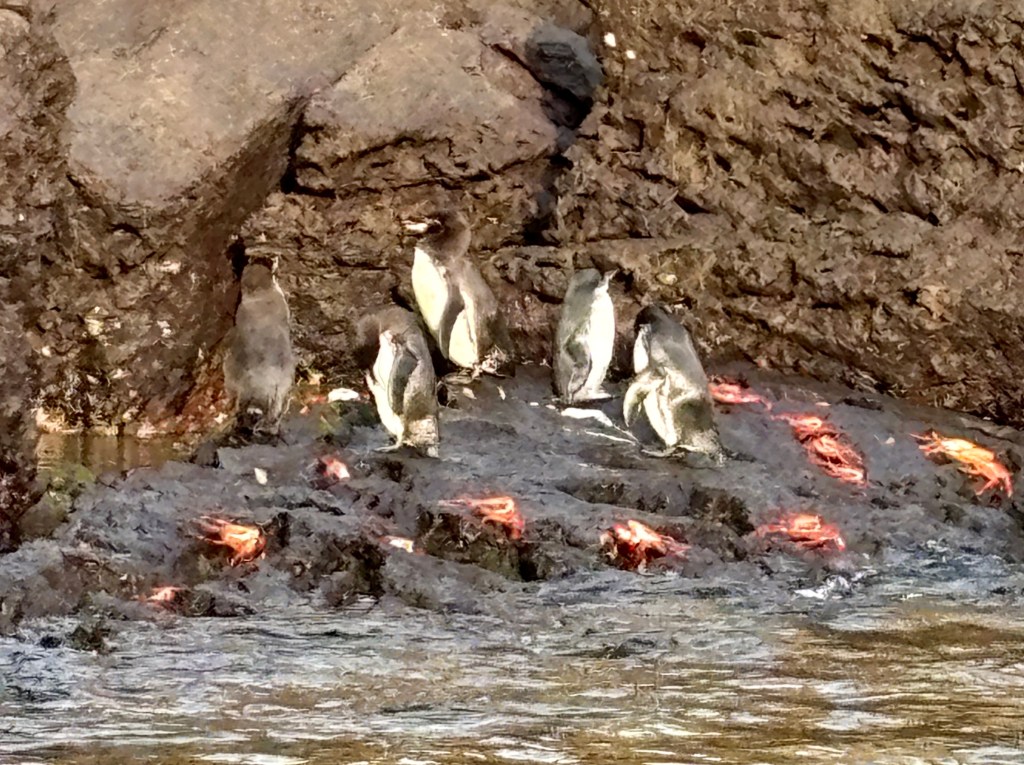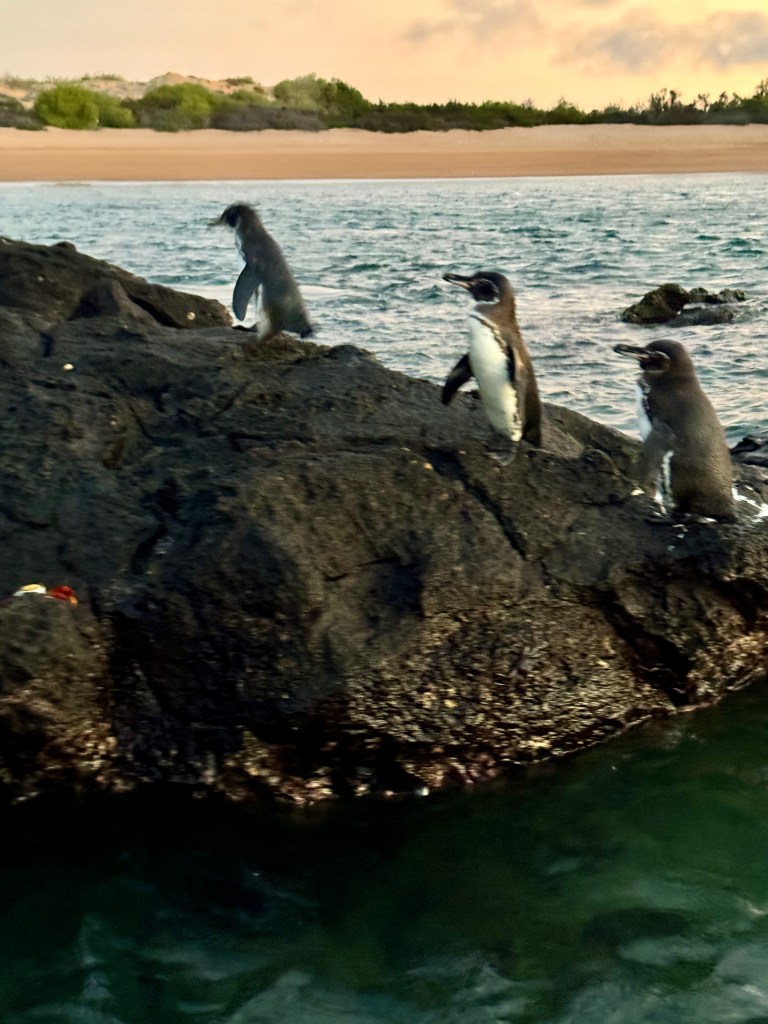
Ecuador: Arriving in the Galapagos Islands

We had an early start at the hotel in Quito.  Our bags had to be out by 4:30 to allow for Galapagos bag inspections.  They were looking for anything fresh or with seeds that might invade the Galapagos ecosystem.

The hotel had a modest breakfast for us in the lobby, which was nice considering that their regular breakfast service didn’t start for another 90 minutes.  Avalon seems to have the ability to negotiate these things.

The Quito airport was a nice place.  It was clean, with lots of shopping, and a fair amount of food options even before 7:00 am.

Most surprising was the suggestion to throw toilet paper in the toilet.  For two weeks, that had been pleaded against, even in nice hotels.   Sorry, if that seems like too much information but retraining habits of a lifetime are challenging!  

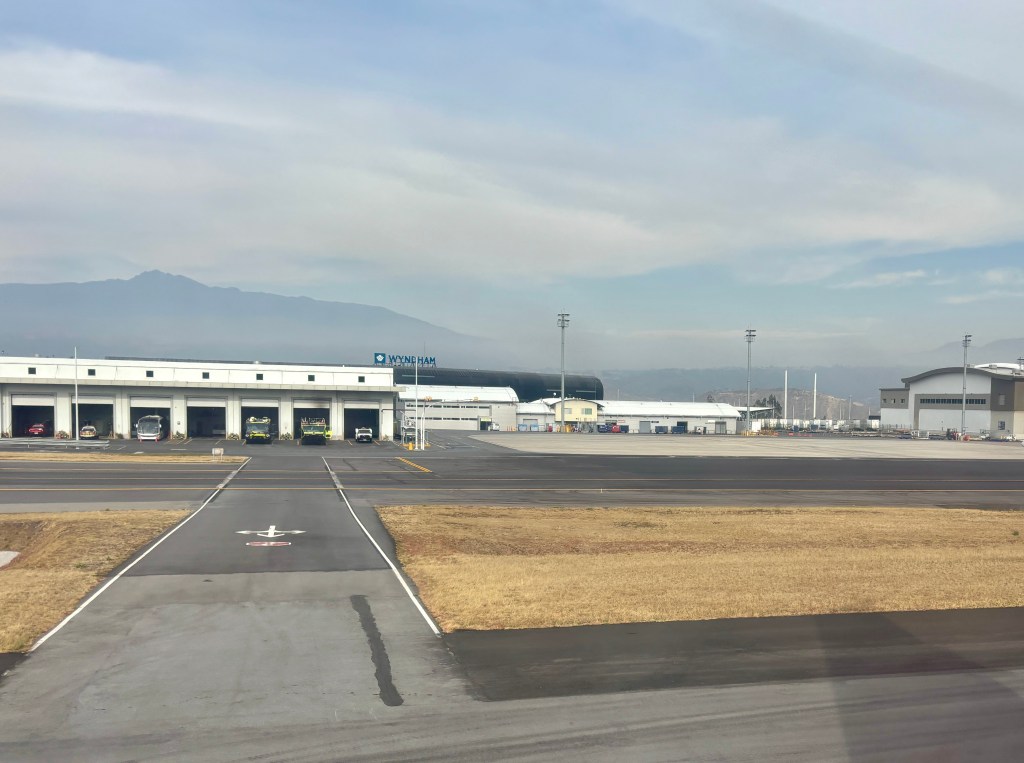
We boarded our flight on Avianca Airlines, the oldest airline in the Americas. As we were taxiing down the runway, we could see the smoke still enveloping Quito. Except for smoke in the air, and one time altering our bus route, the fires that made international news had not impacted our visit to Quito.

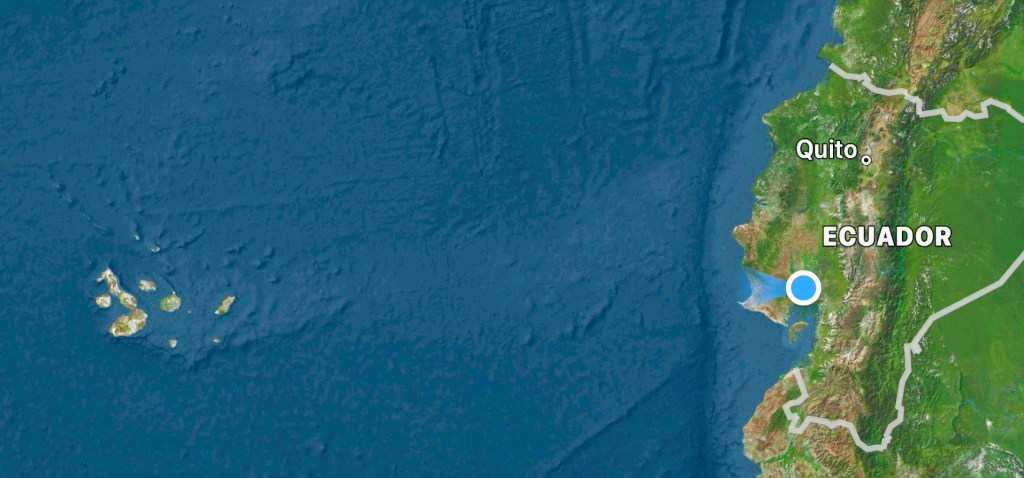
Screenshot

We landed in Guayaquil, south of Quito but still on the mainland.  Some people got off, but we were instructed to stay on the plane and in our seats while the plane was refueled for the flight to the Galapagos Islands.

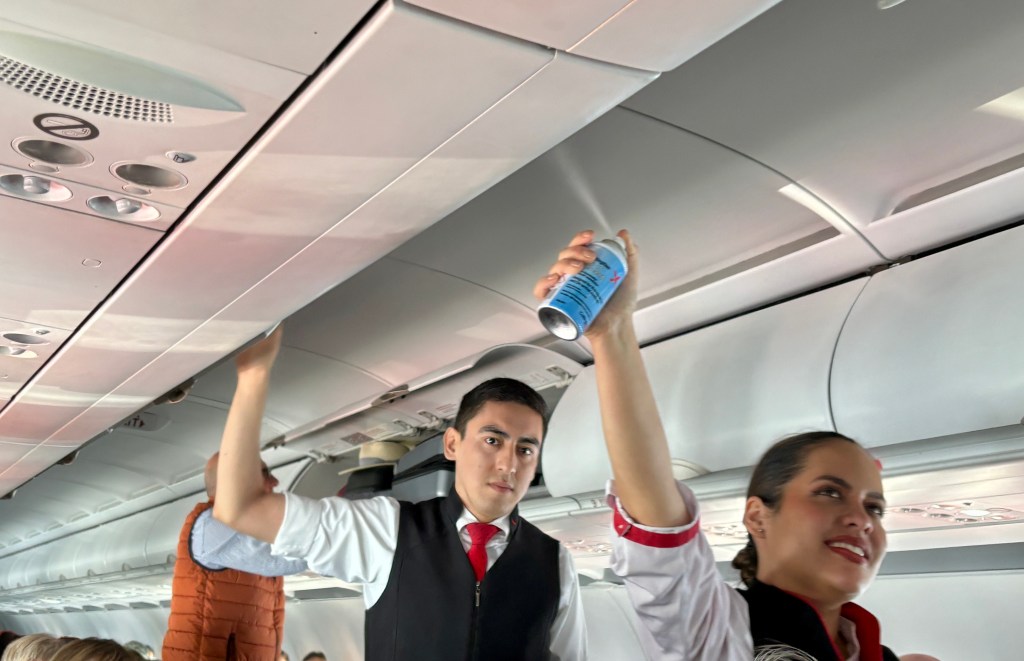
Mid-flight excitement happened when the flight attendants opened and sprayed all the overhead compartments and carryon luggage.  We assume that was an extra protection against anything that might accidentally get onto the islands.

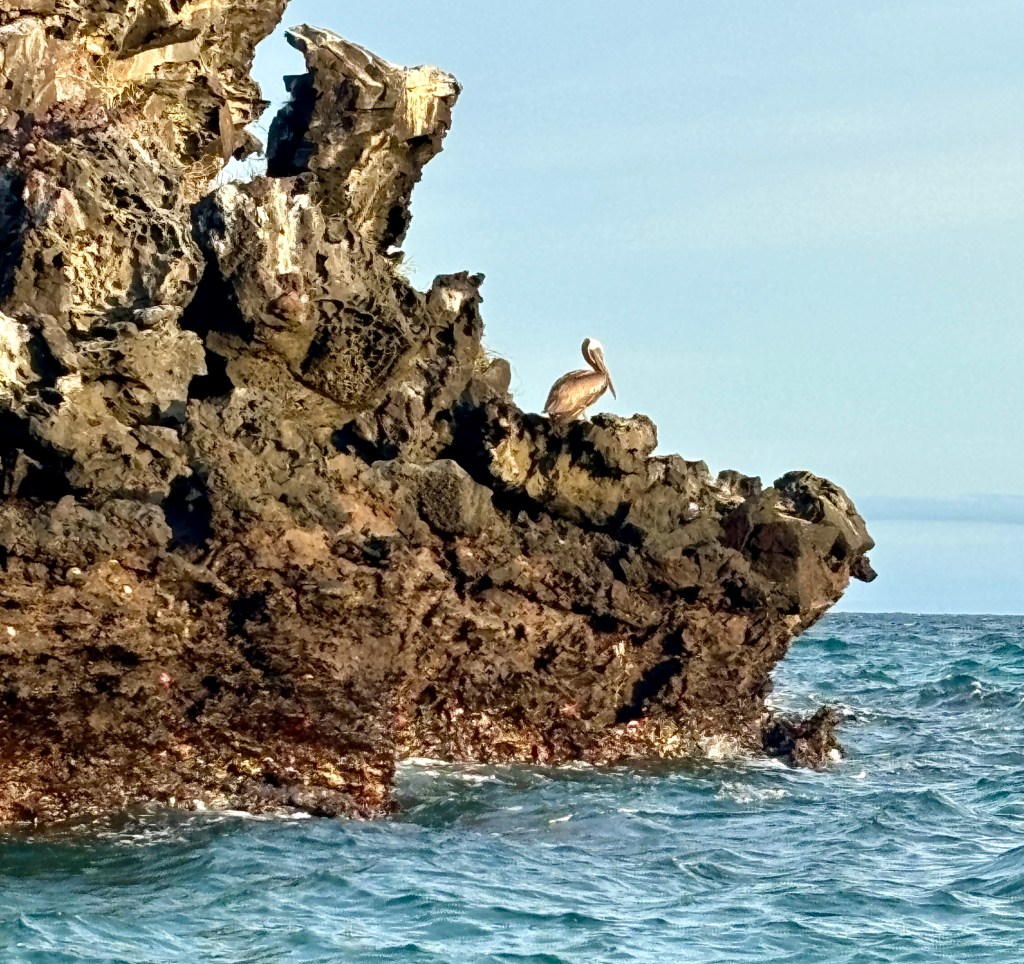
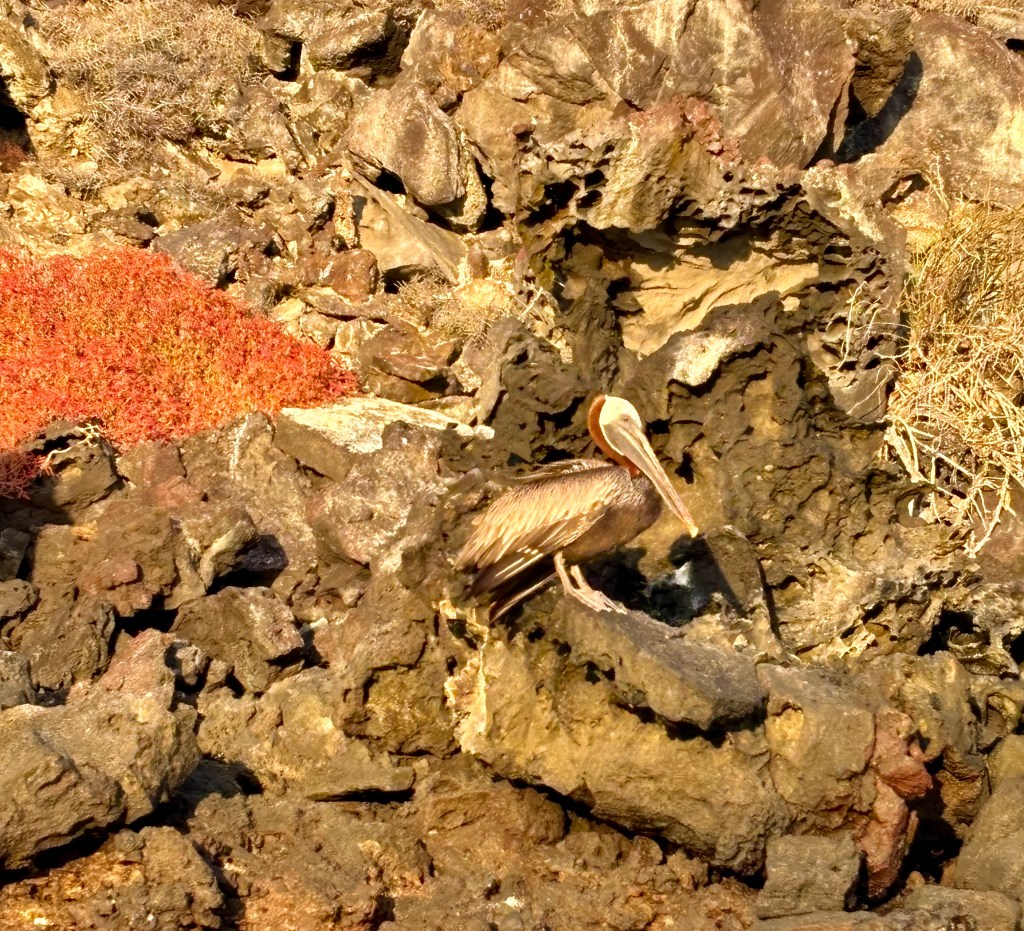
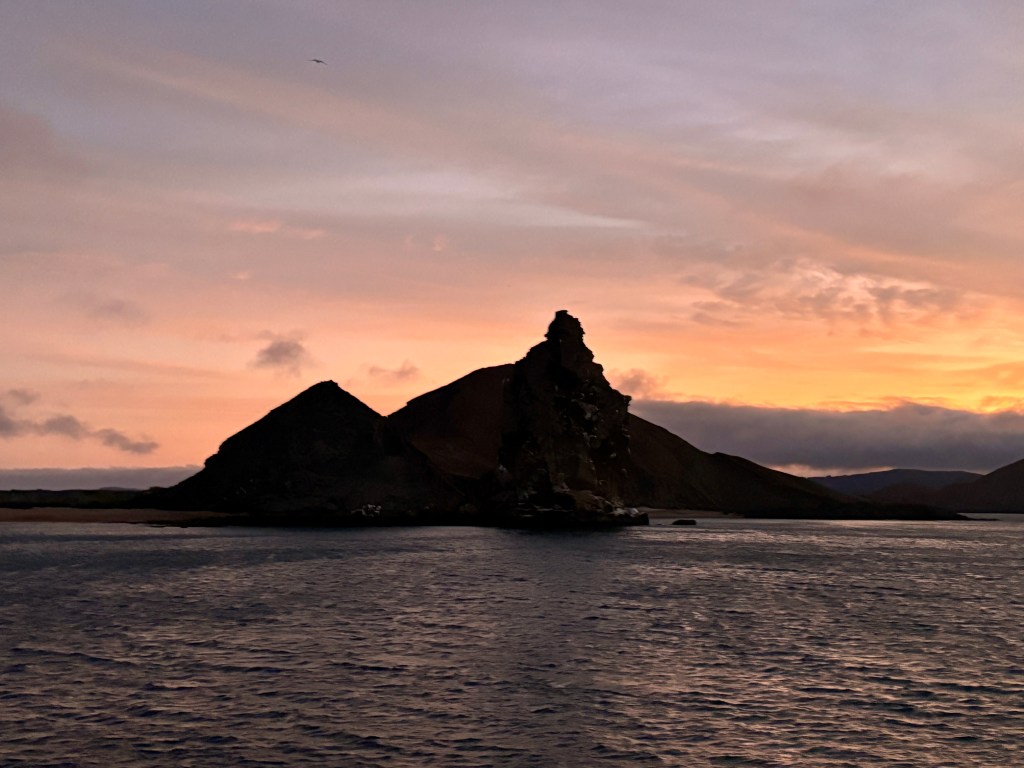
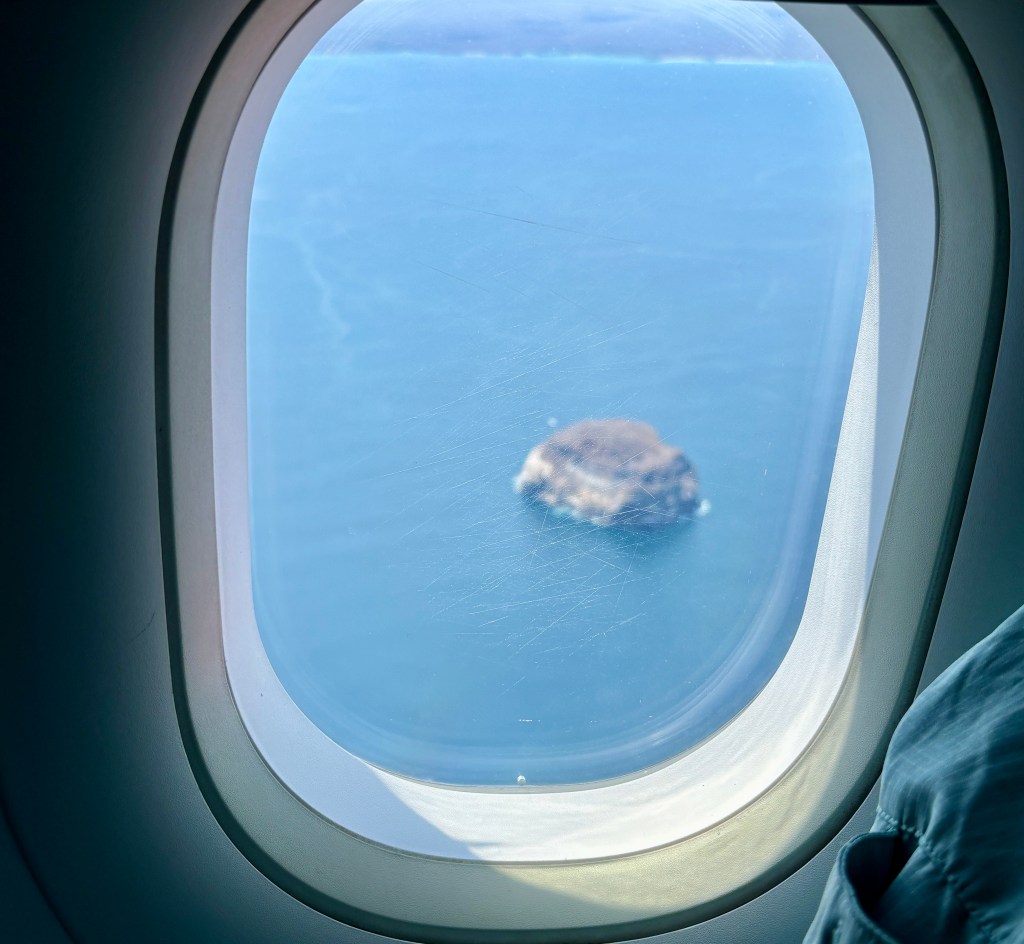
This was our first sighting of a Galapagos Island.

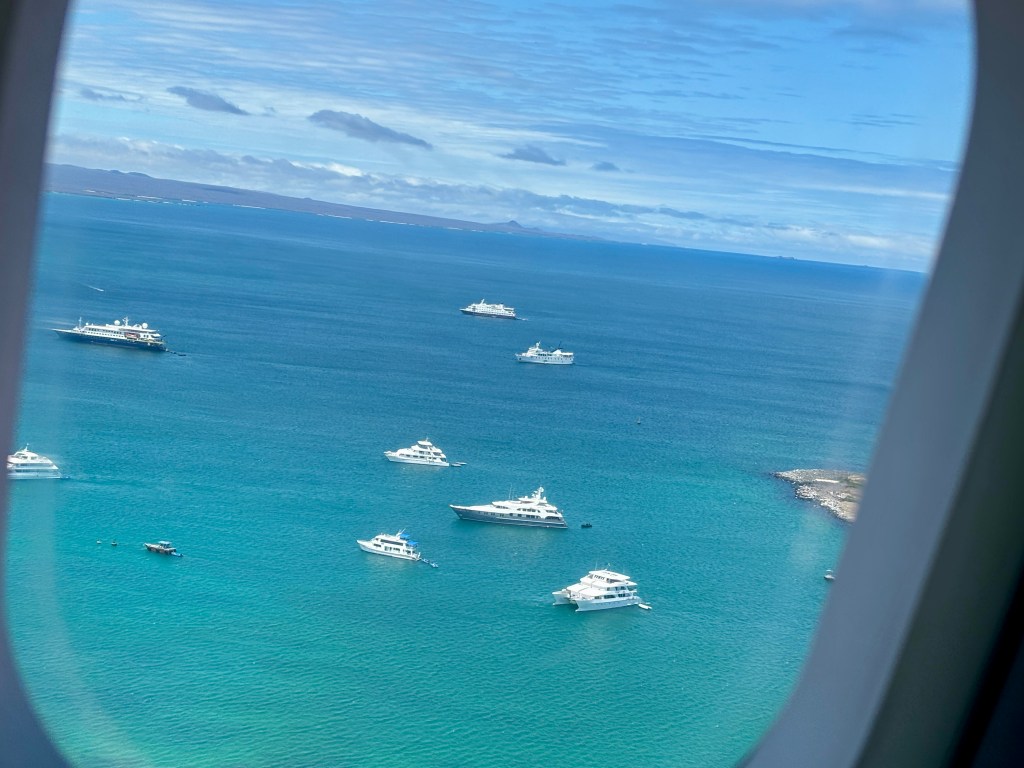
Obviously, we aren’t the only ones here!

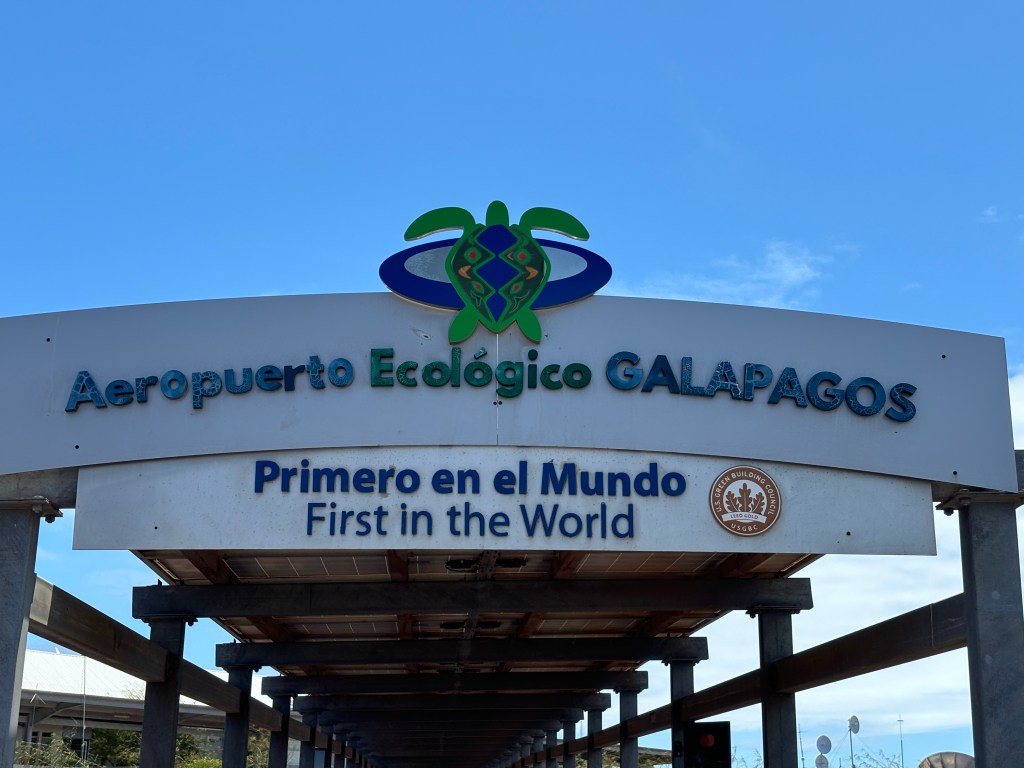
We landed on the island of Baltra and disembarked into the airport.

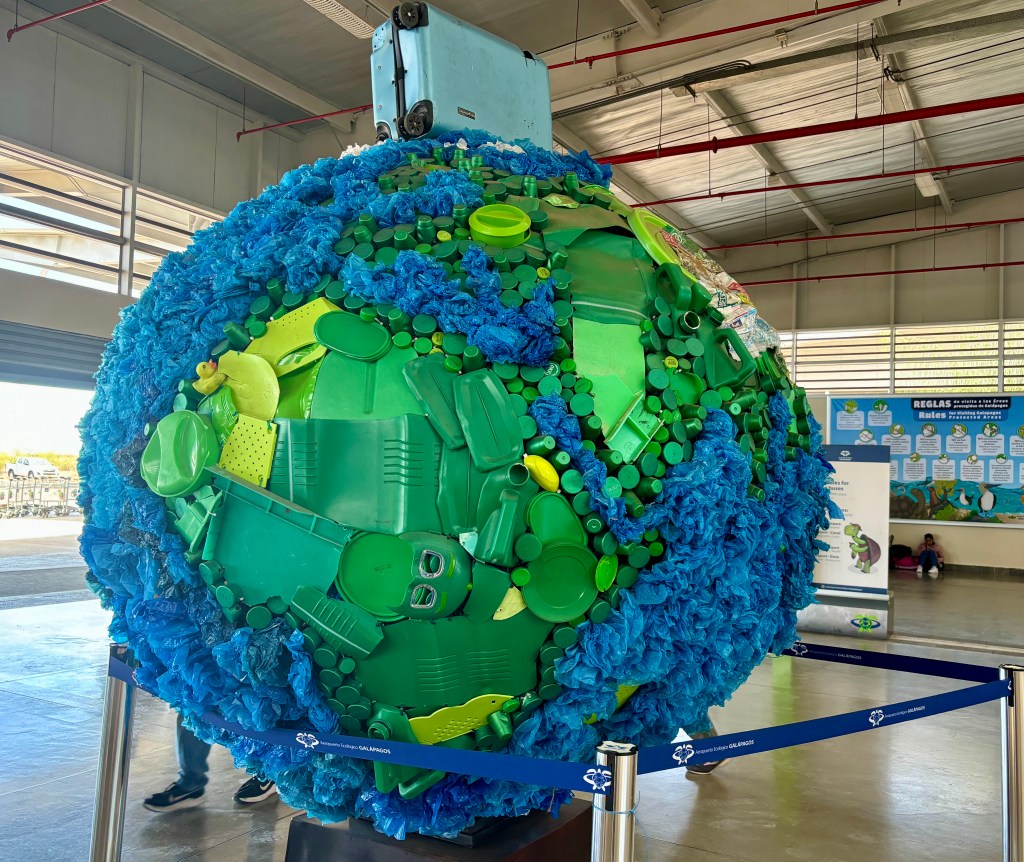
There was an earth made of items found in the sea.  

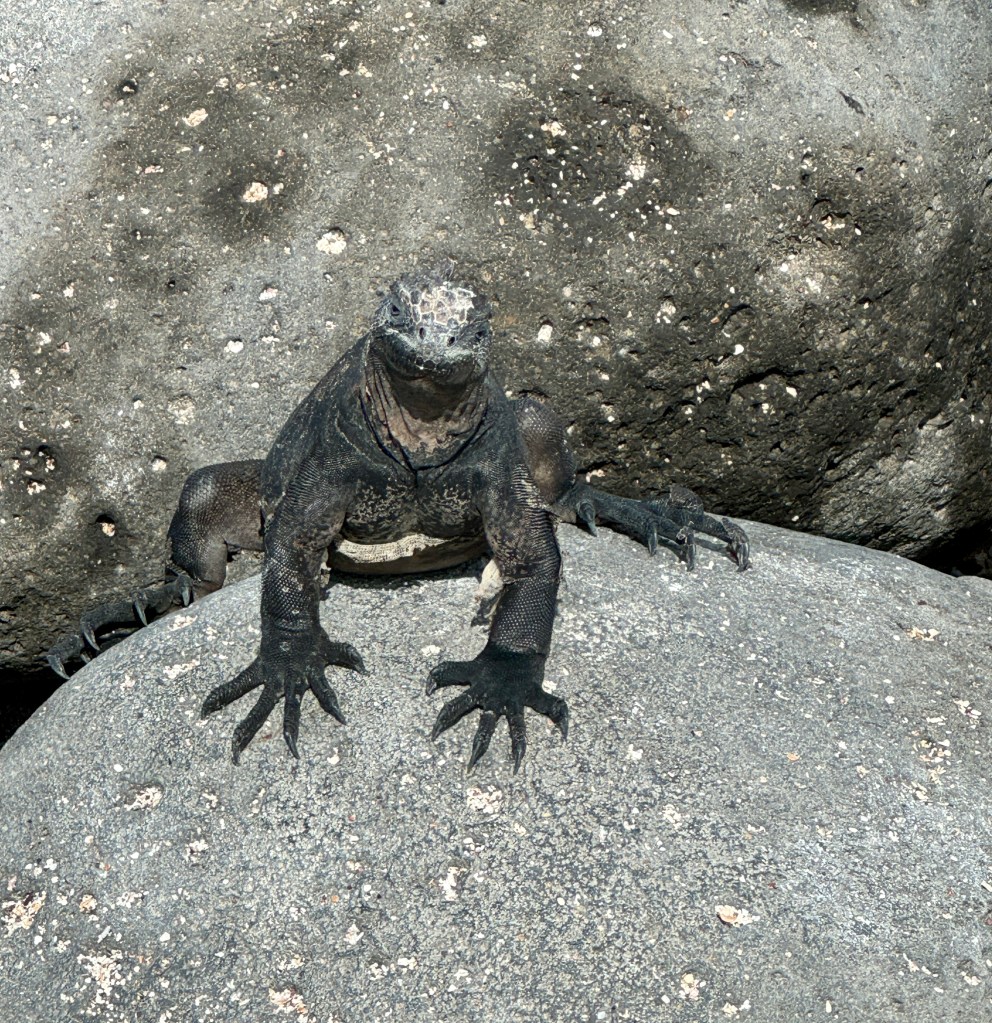
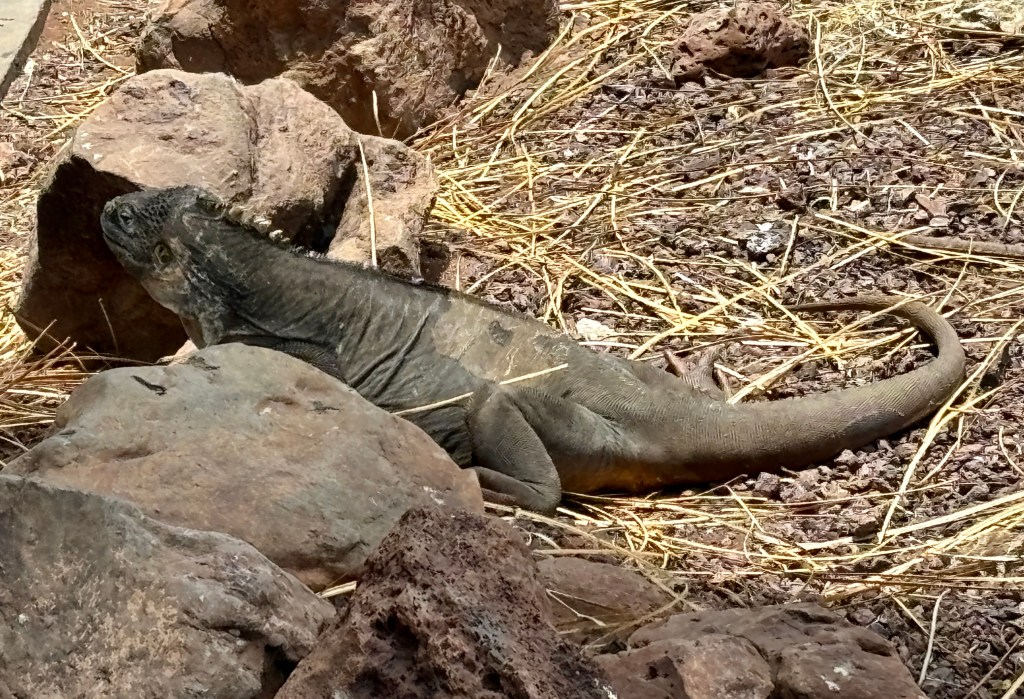
We saw a land iguana on the sidewalk and it reminded me of a BBC Planet Earth program we saw about hundreds of snakes attacking baby iguanas trying to make it across a beach.  It was so awful!  After seeing that, I said I never wanted to go to the Galapagos. And here we are.  (I later asked our guide about that program and he said the photography angles made the snakes look much larger than they really are.  I said I didn’t want to go there and he said we wouldn’t be.)

Avalon didn’t have a separate bus for us on Baltra so we boarded a city bus to go around the island to a pier. 

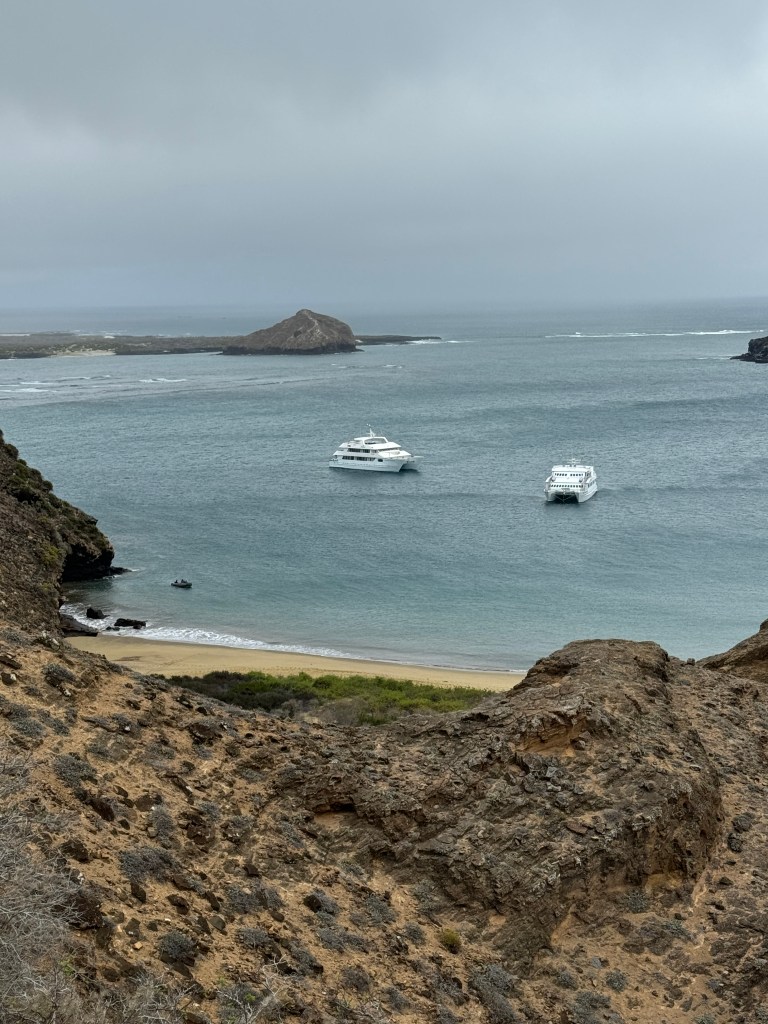
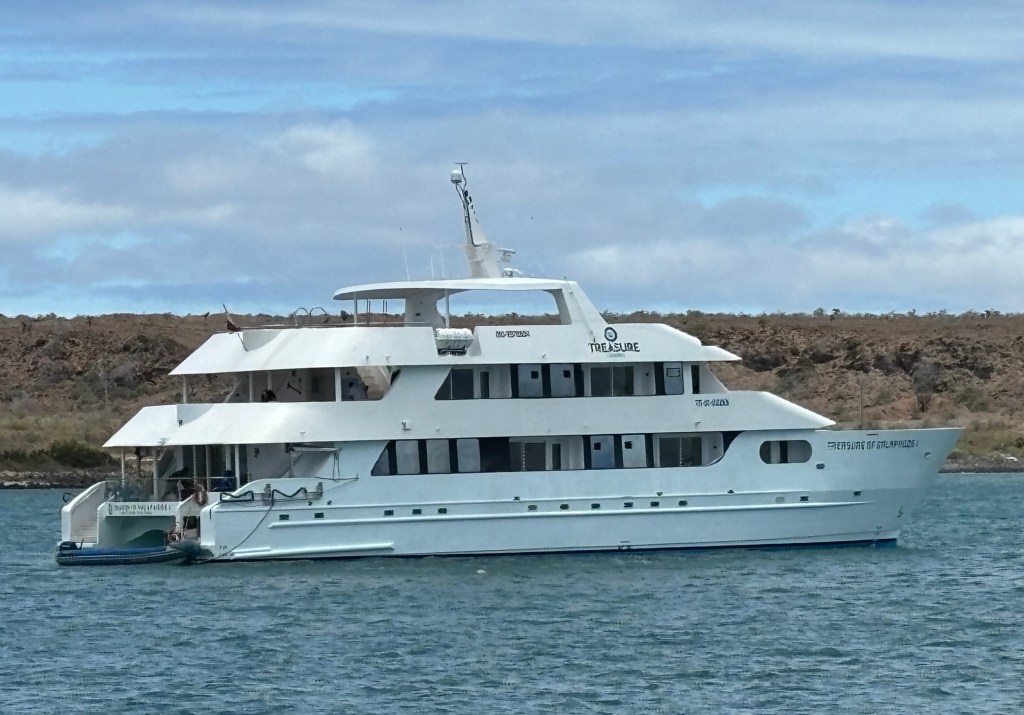
This was our first view of our home for the next four nights – the Treasure of Galapagos.  

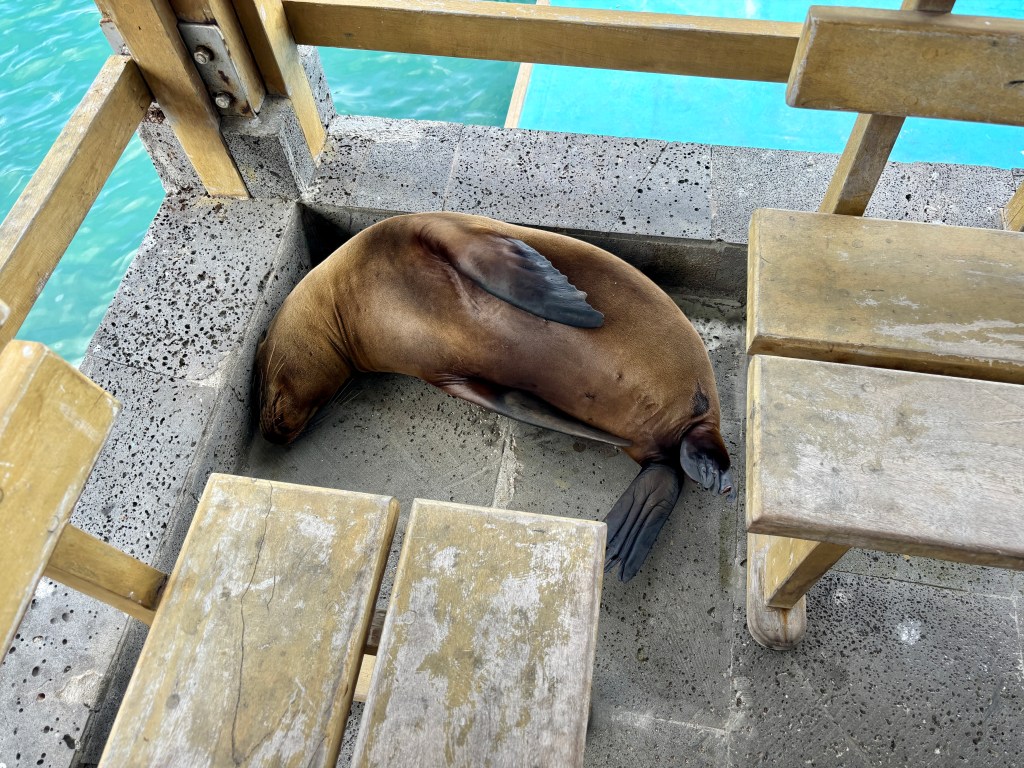
While we were waiting to transfer to the ship, this baby sea lion provided some interest.  Apparently the mother drops him off at the pier while she goes hunting or visiting or having some alone time or whatever mother sea lions do. He found his own place to nap.

Fifteen passengers boarded the Treasure of Galapagos.  There were twelve of us with Avalon and three others who joined for this segment.  The boat’s passenger capacity is 16.

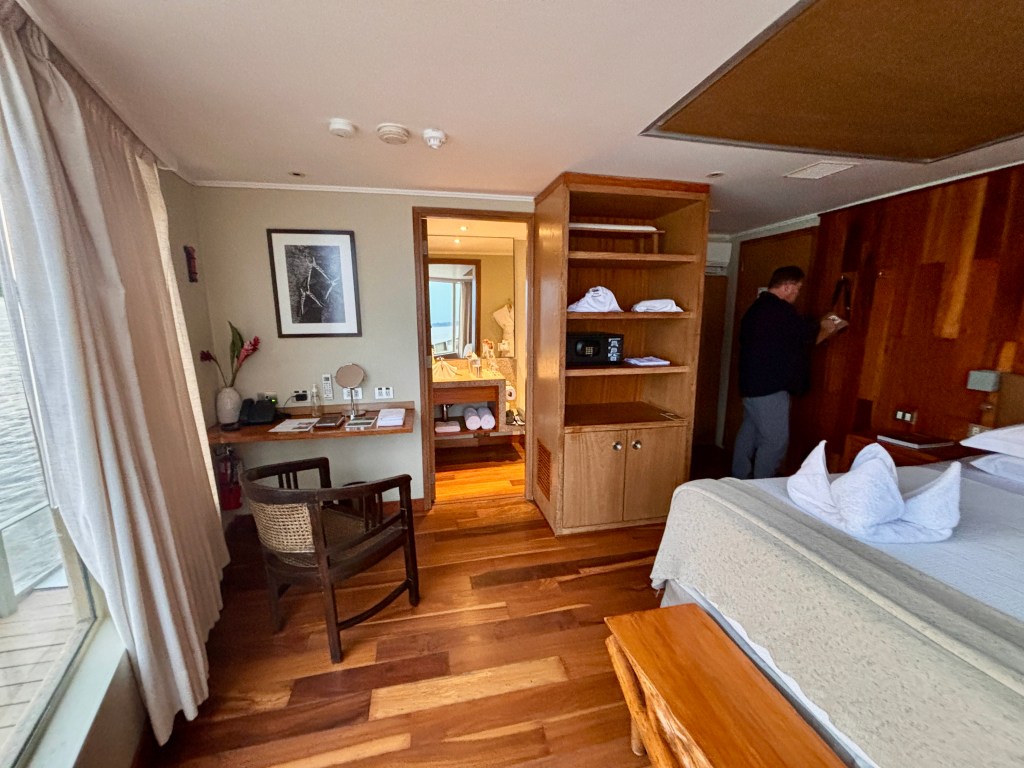
We were given Cabin 6 and it was very comfortable.  An interesting thing was that there were no keys for the cabins as they could only be locked from the inside.

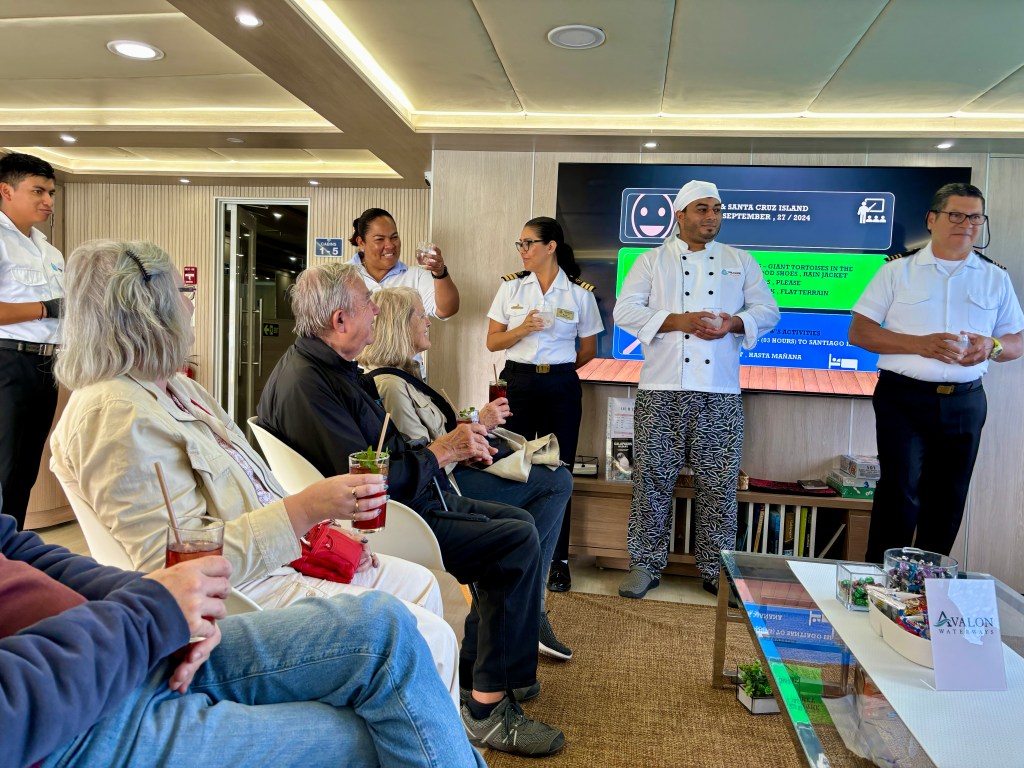
We had our opening orientation we met the ship’s crew and heard from our guide.

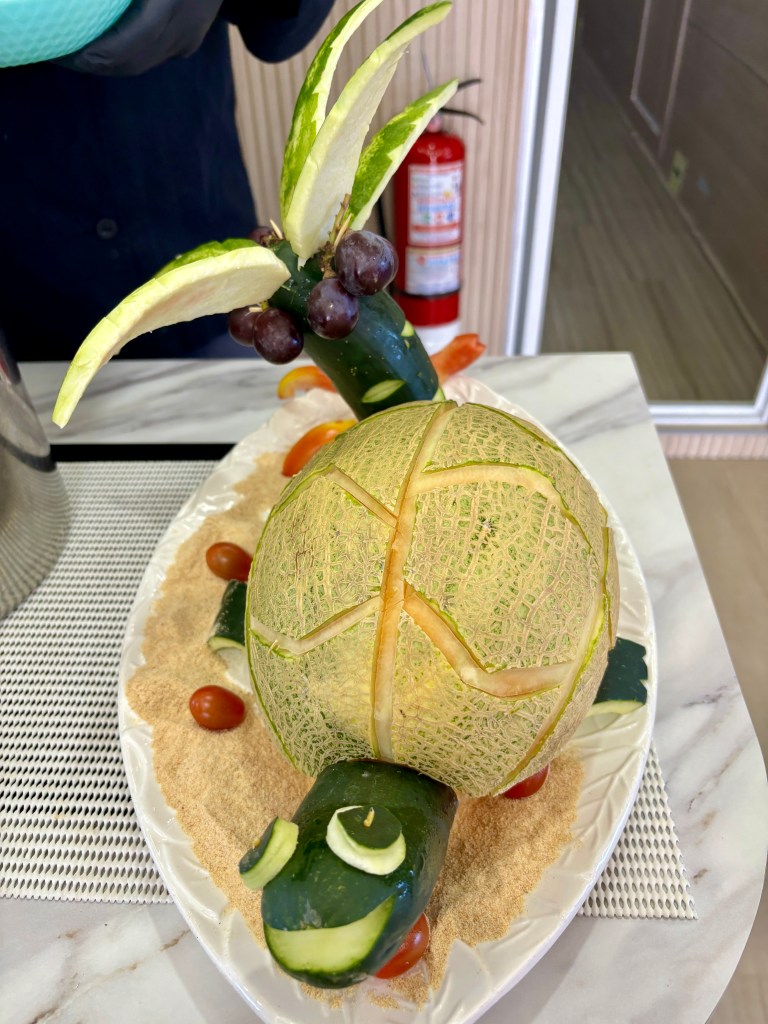
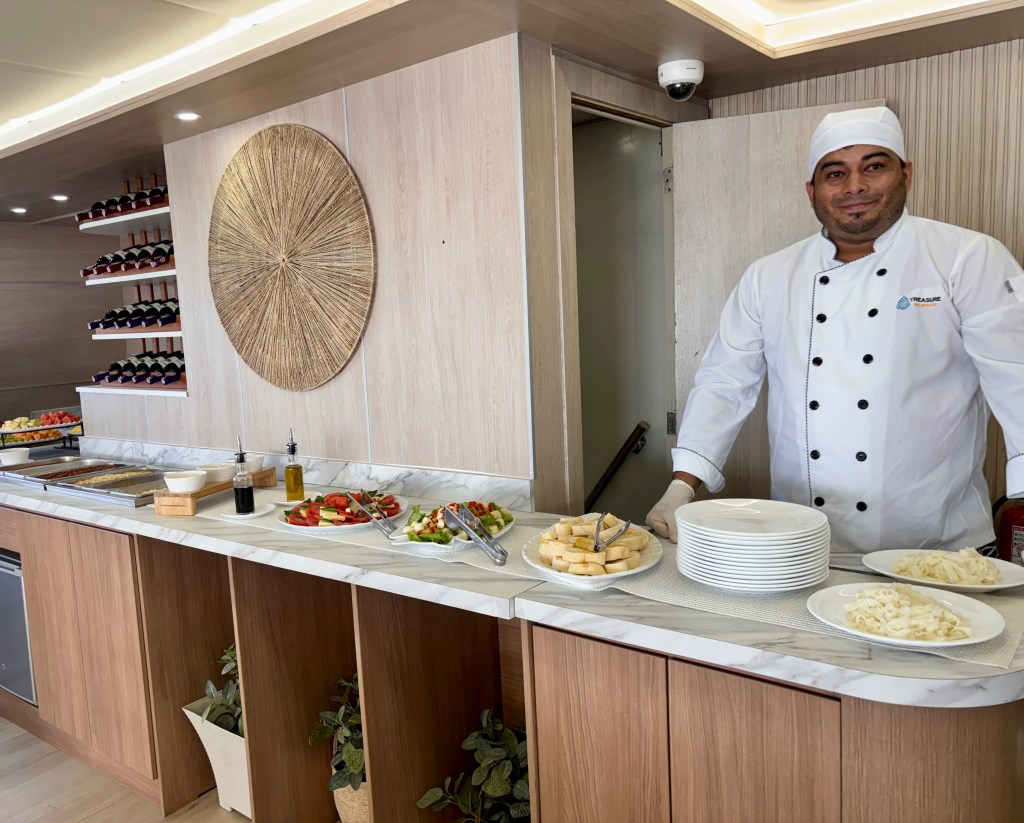
Our chef had prepared pasta for lunch with several sauce options.  (This man was amazing.  He did such a good job with so many challenges including those of us that don’t like fish, those who needed a gluten free diet, and one person who was allergic enough to tree nuts that it impacted what could be served to anyone,)

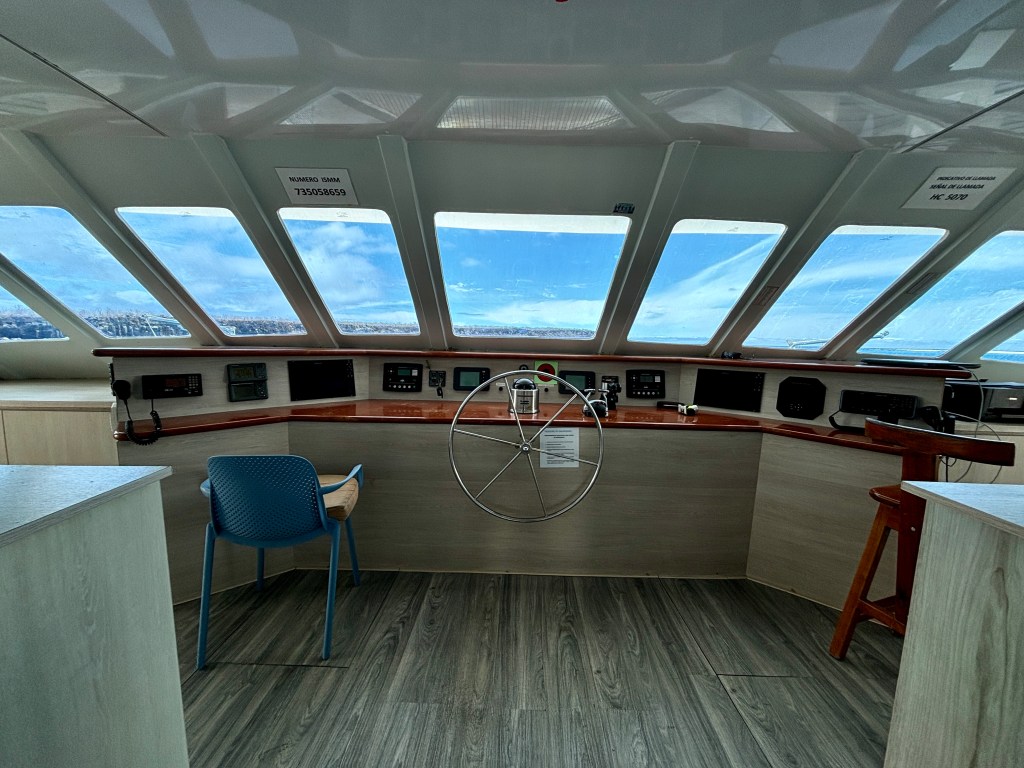
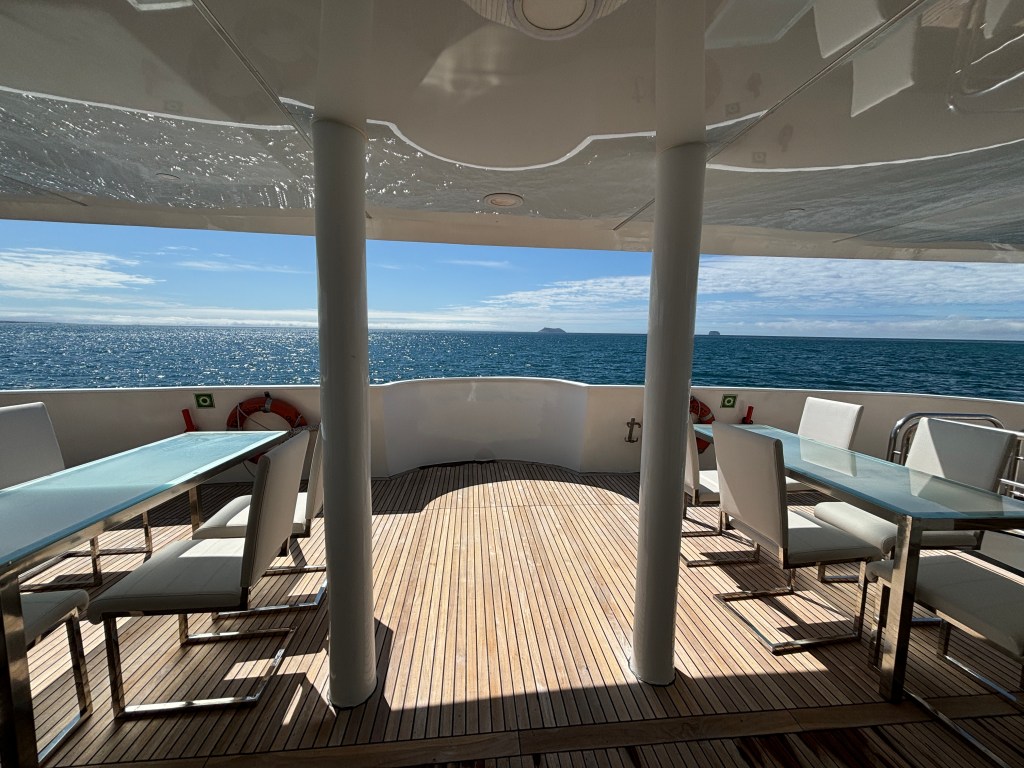
This was the view from our balcony.

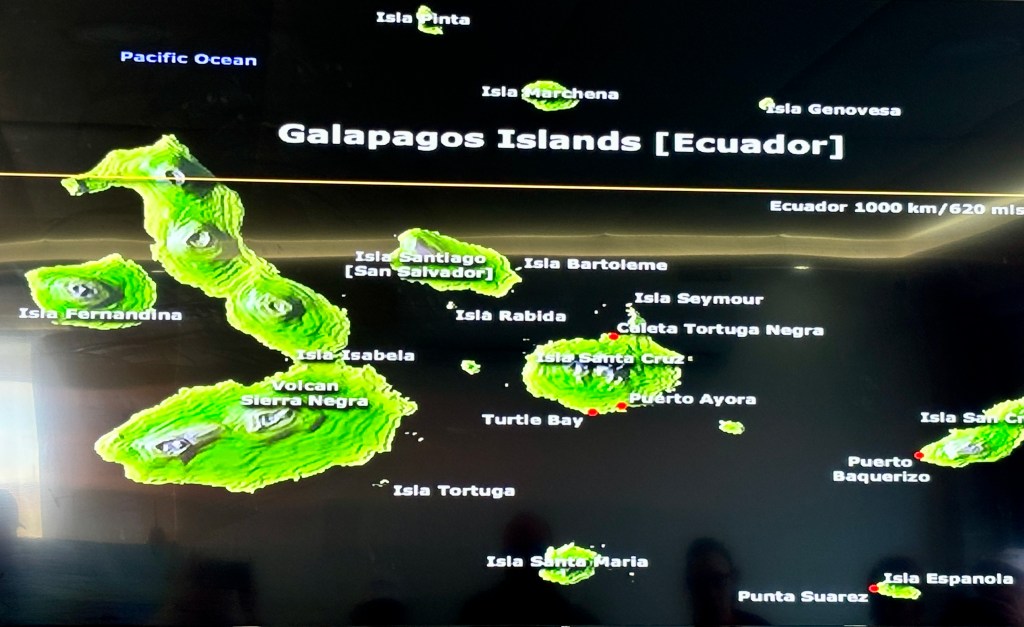
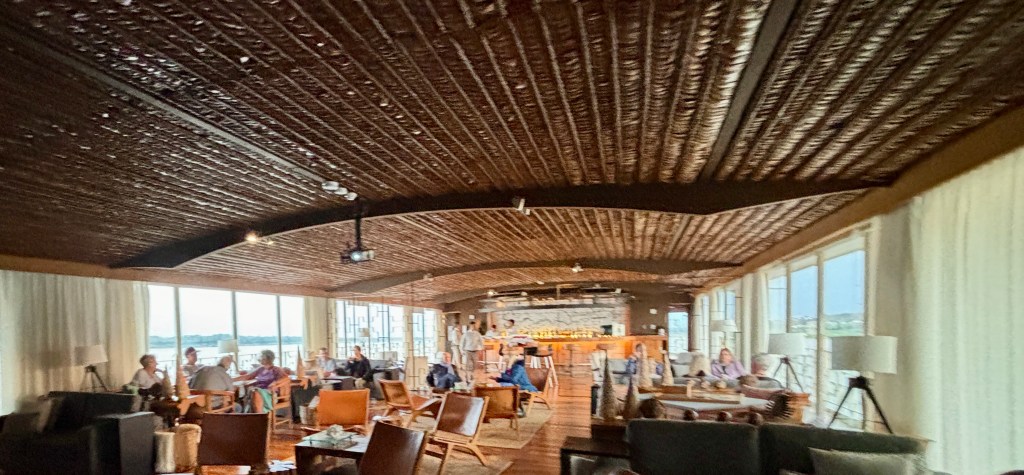
We had a brief time to explore the boat. We stopped near Santa Cruz Island and left for our first excursion. 

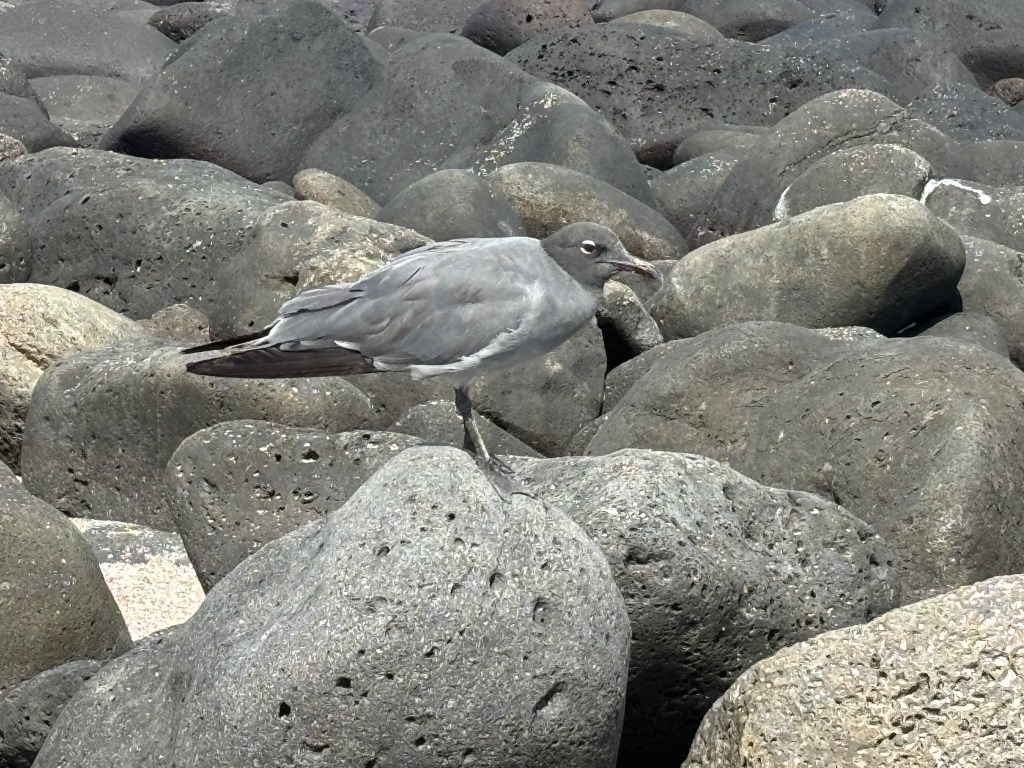
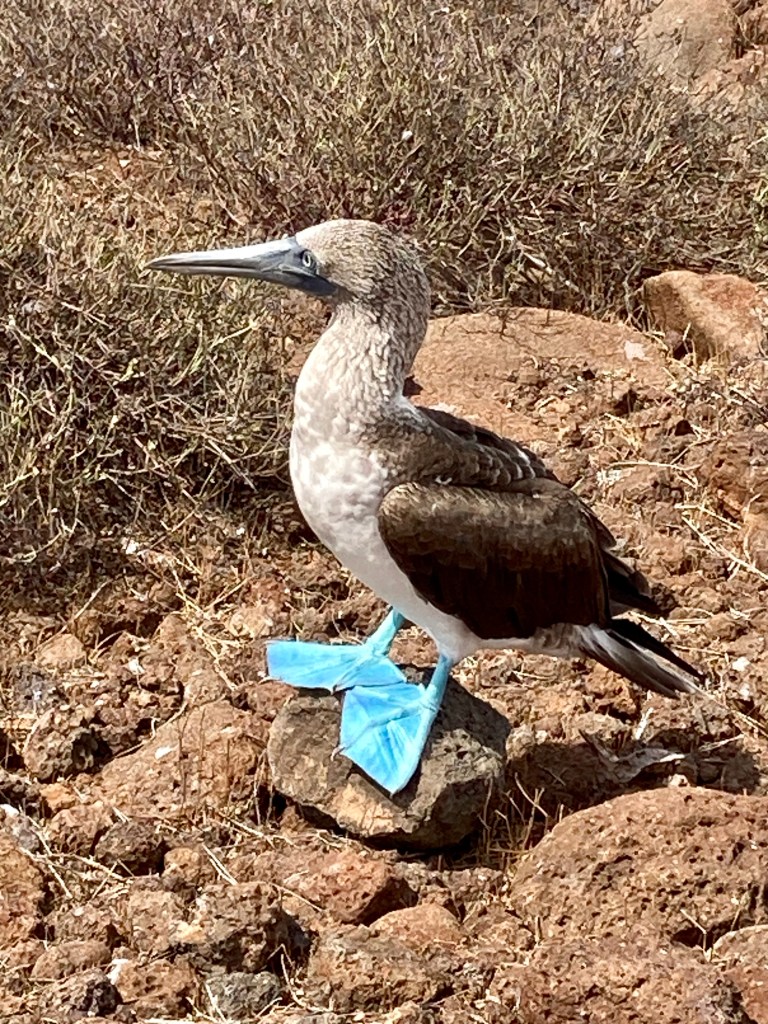
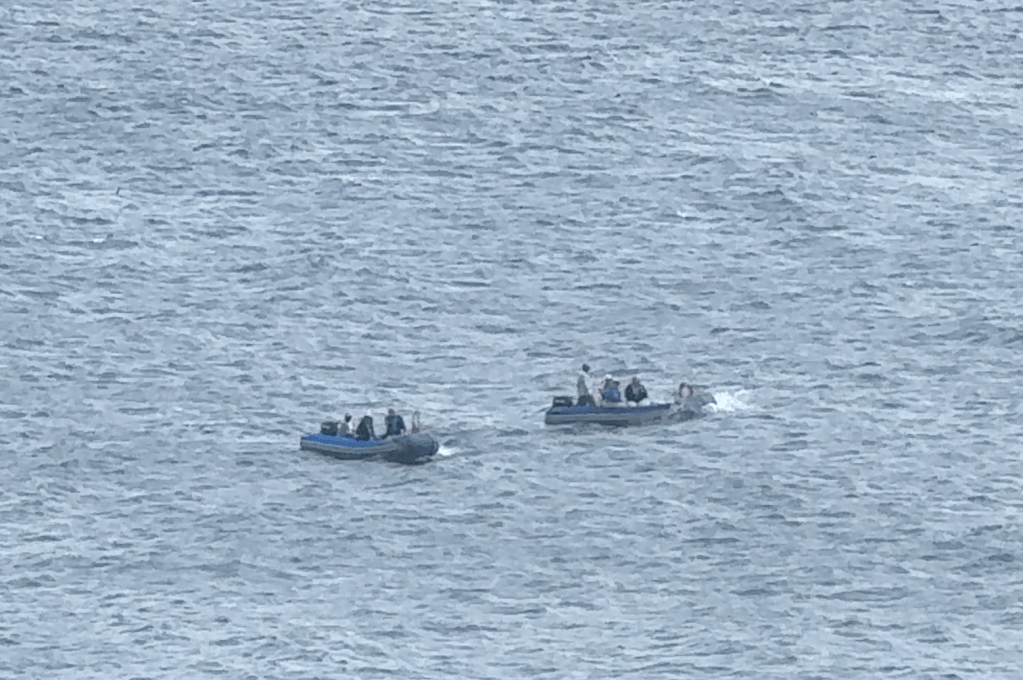
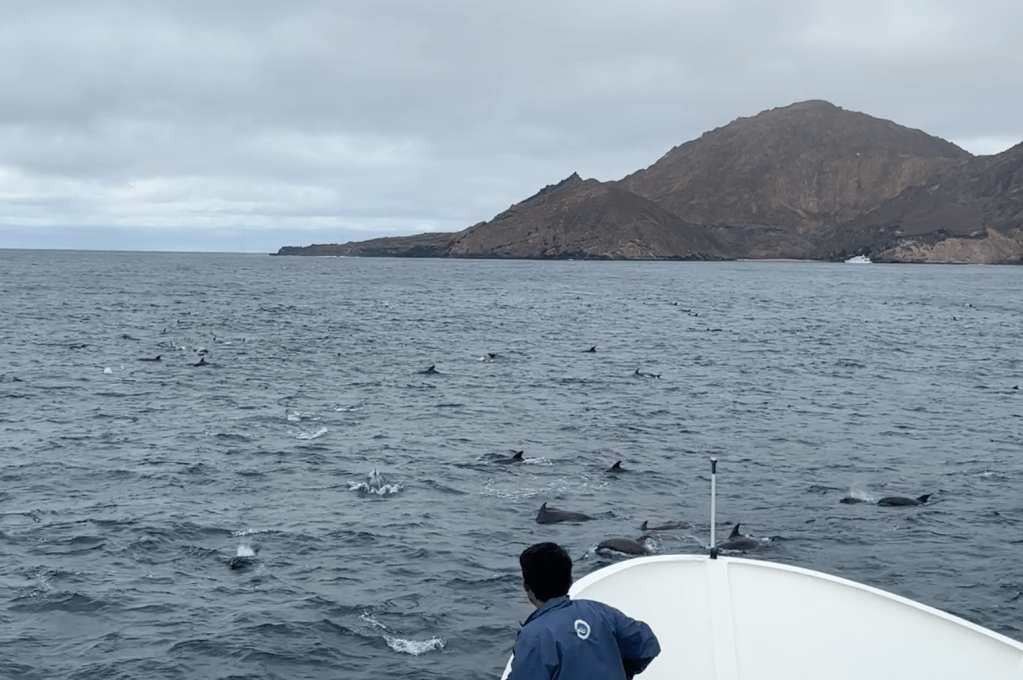
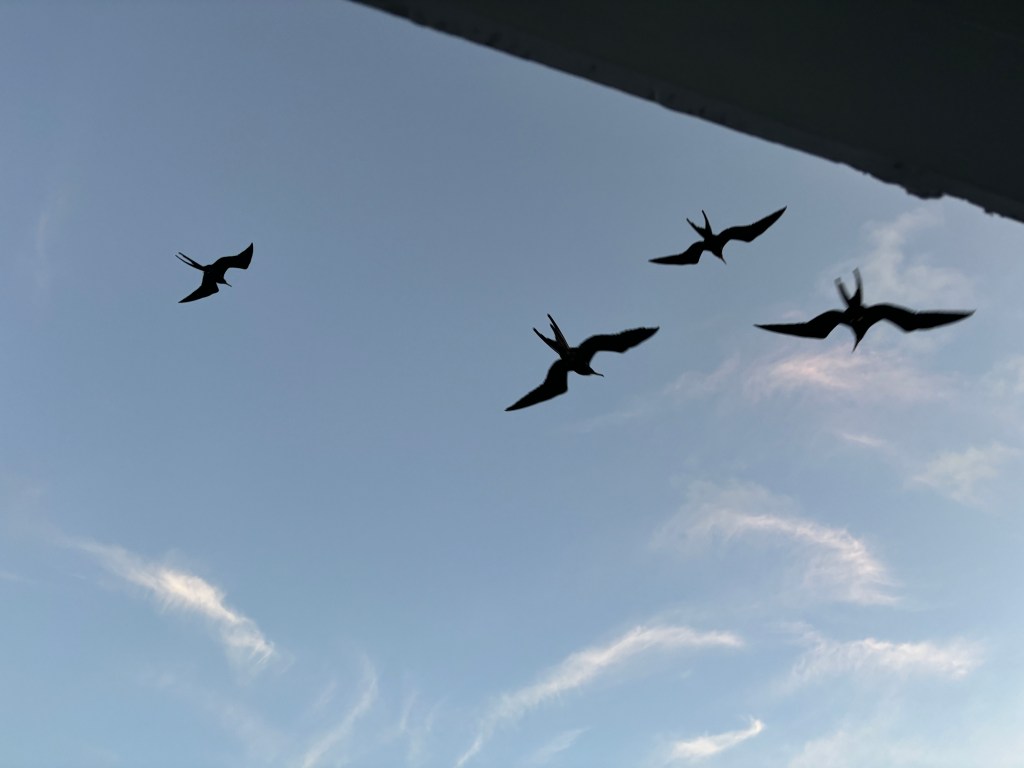
On board our zodiacs, we saw the first of many, many sea birds and sea lions.  

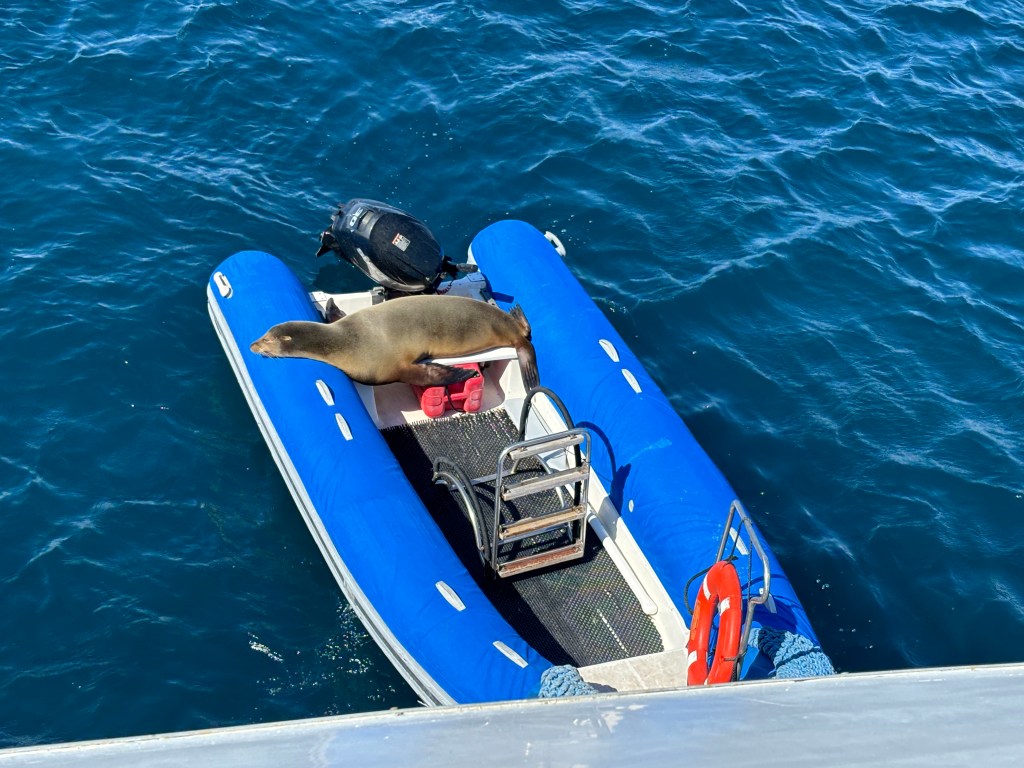
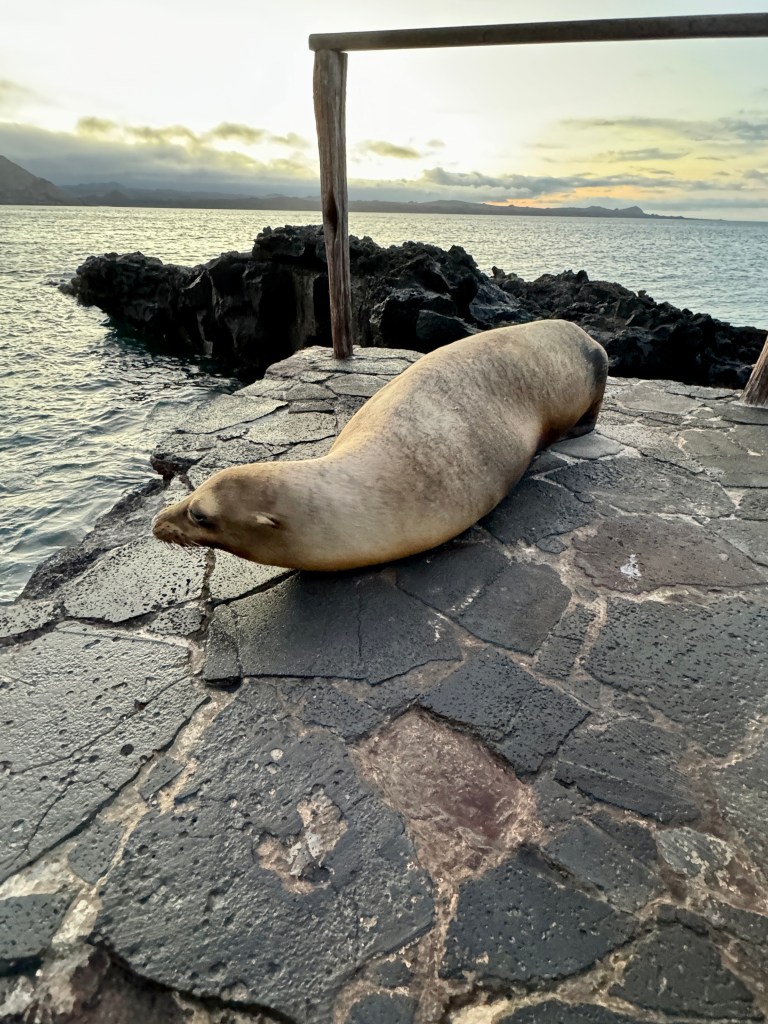
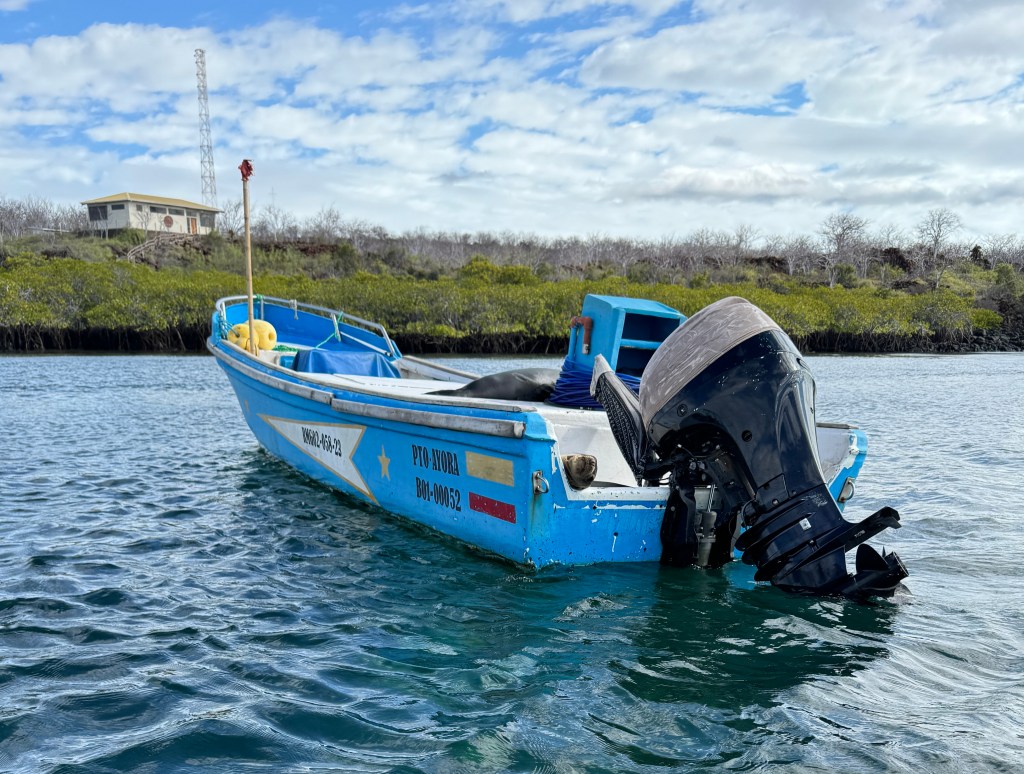
The sea lions hangout on the docks.

They board boats and pretty much go wherever they want!

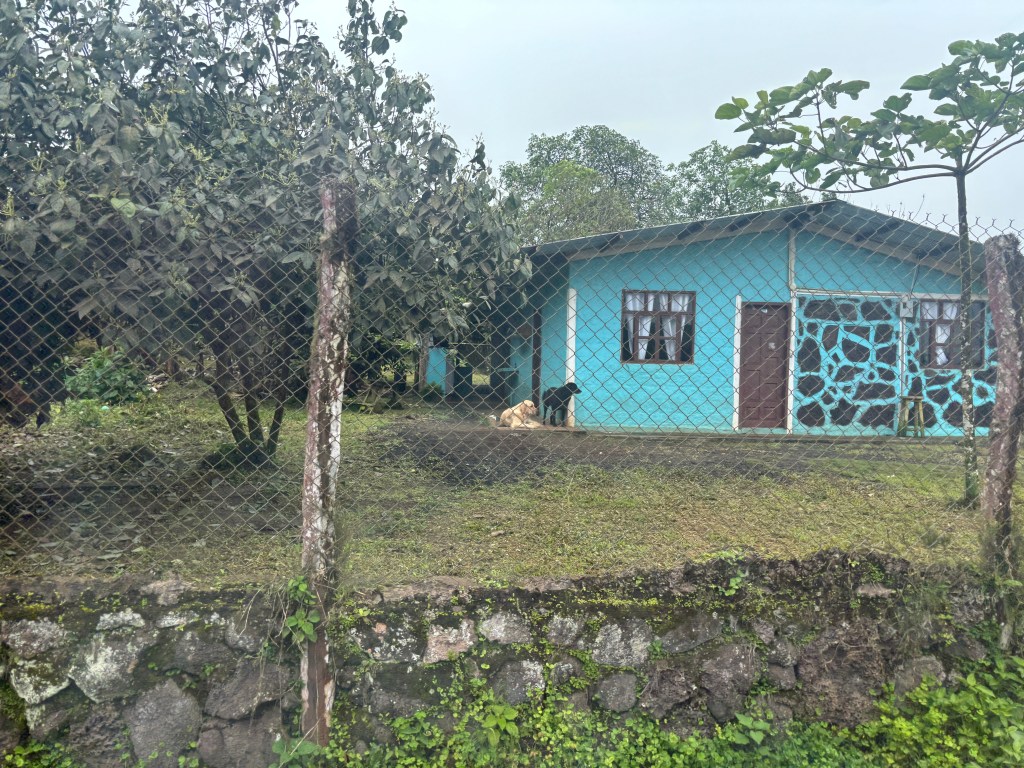
We drove across the island and I was surprised to see so many buildings and houses.  About 40,000 people live throughout the Galápagos Islands.  They are allowed to have pets but with strict rules and high licensing fees.

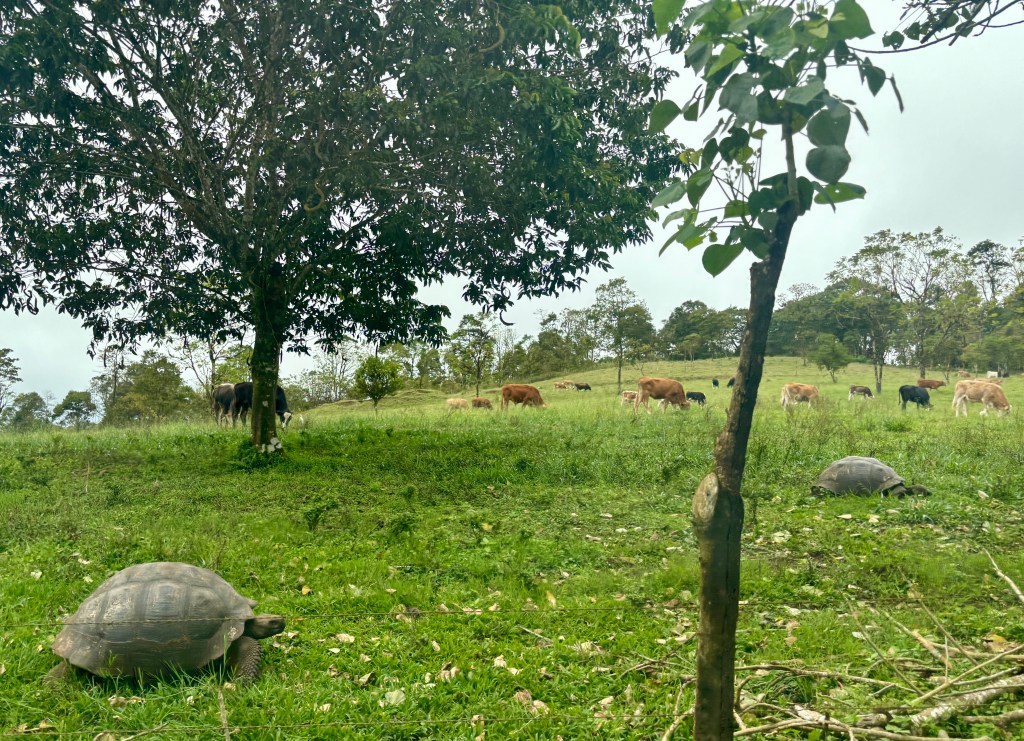
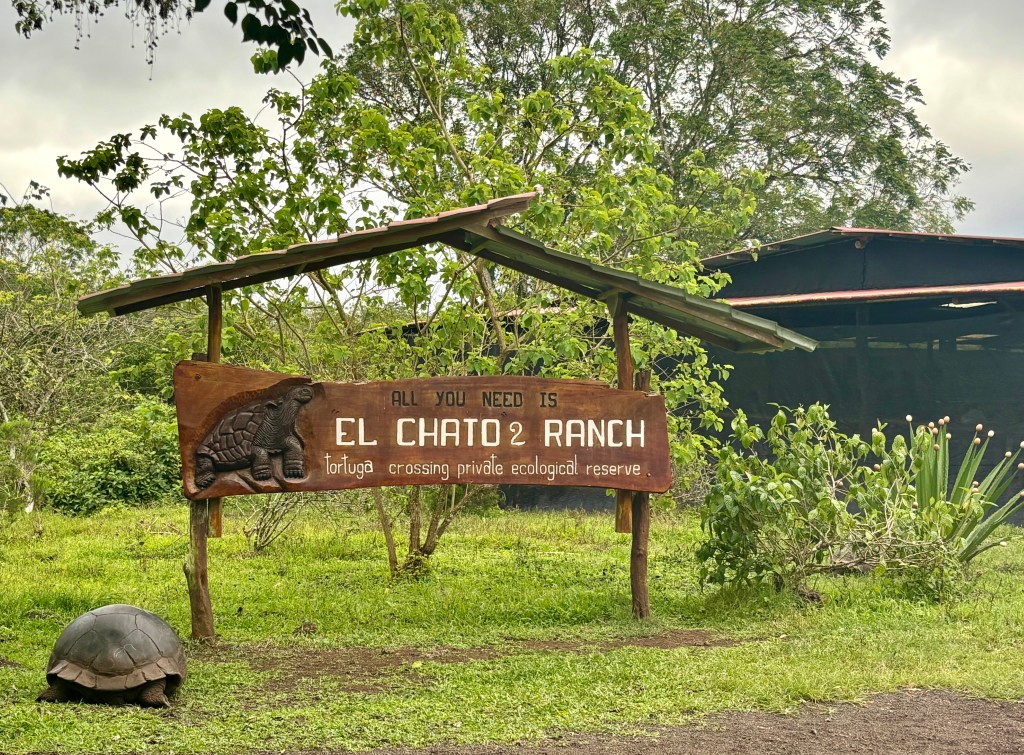
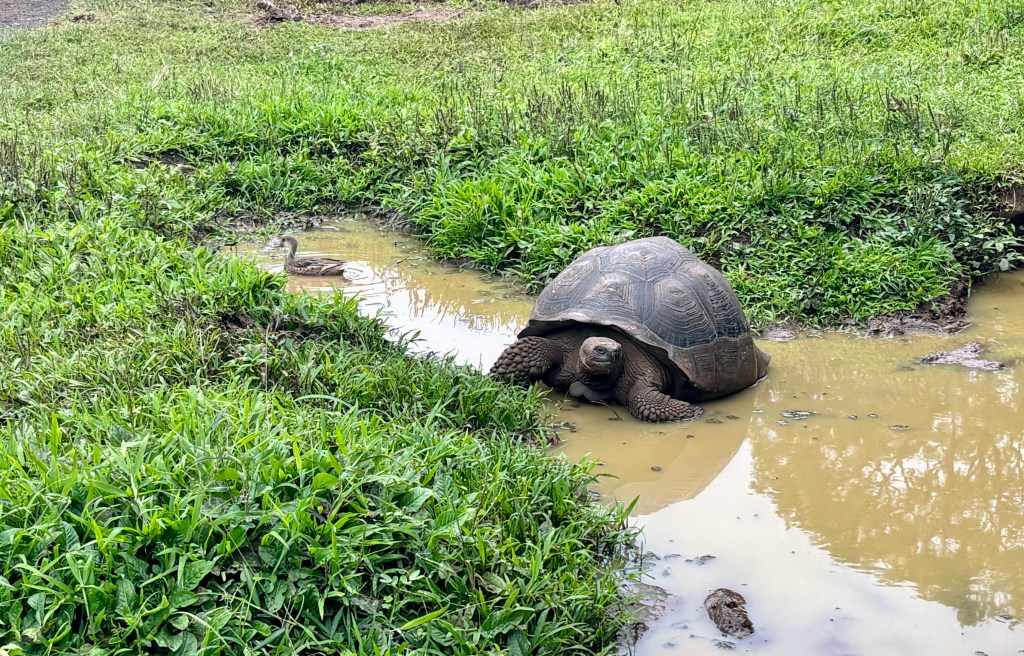
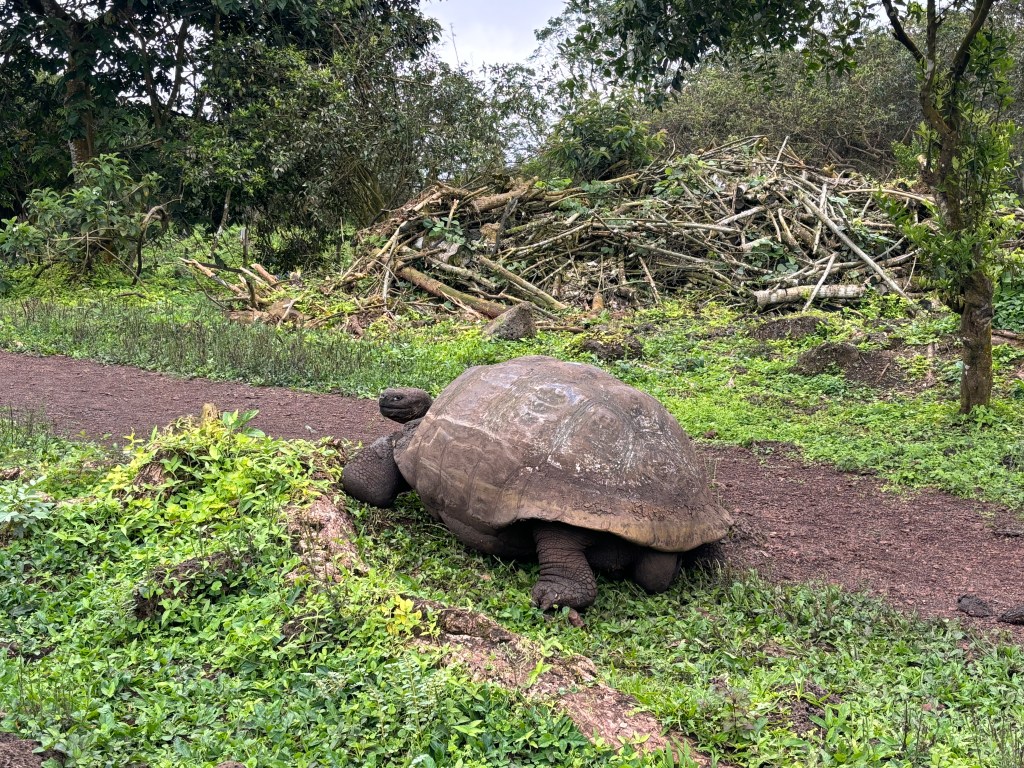
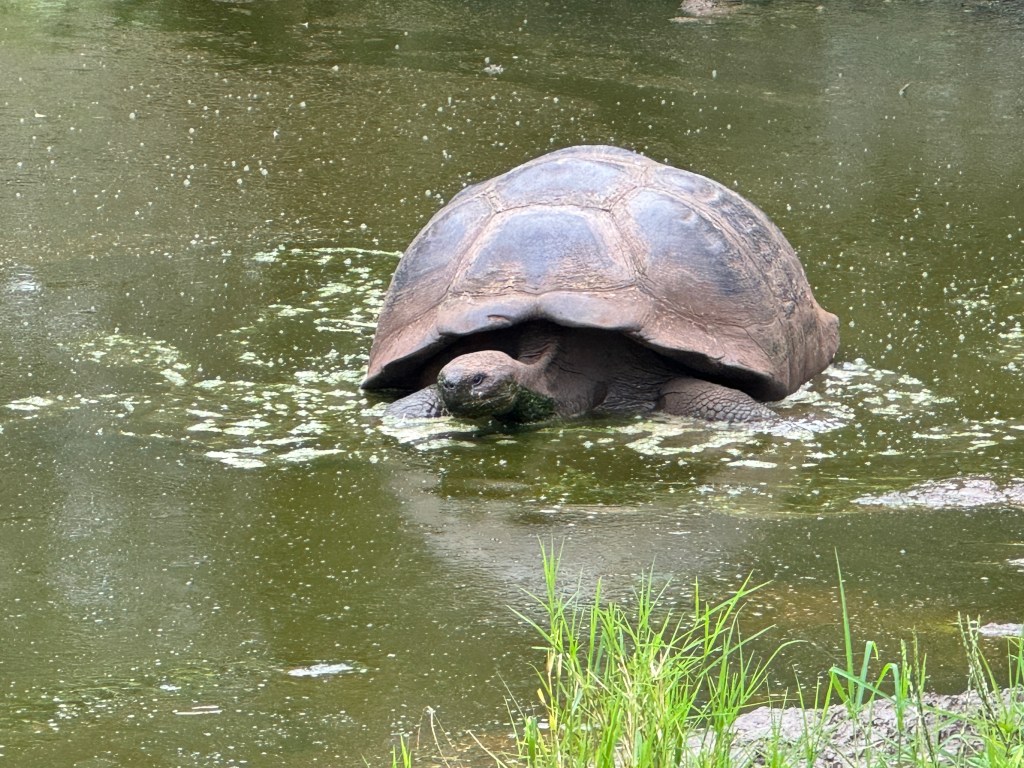
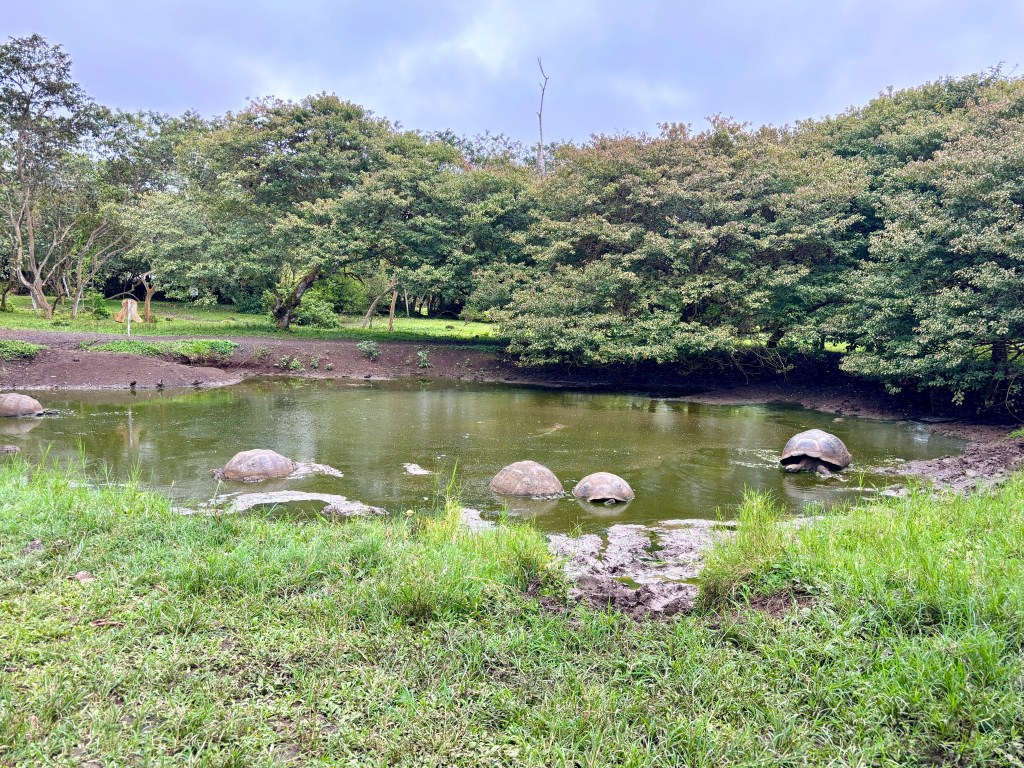
Our destination was a great tortoise reserve in the highlands. It was so much fun to see the tortoises in the fields, or the side of the road, as we approached the reserve.

Tortoises evolved over millions of years to be very large because of optimum conditions on the islands with no predators. 

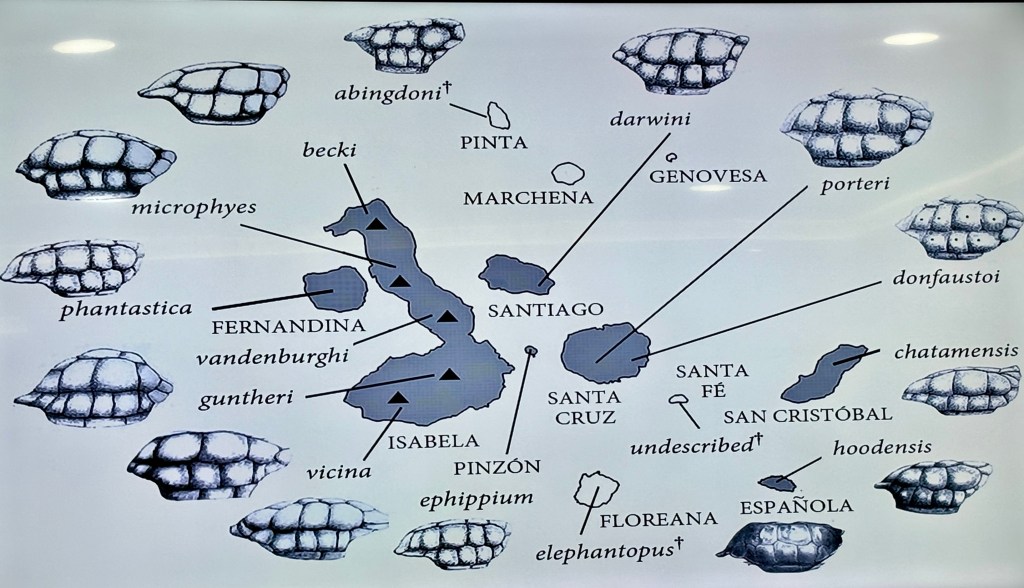
There are eleven species of tortoises throughout the Galápagos Islands totaling about 100,000 individuals.  We saw the porteri species on Santa Cruz Island. 

It is thought that there were 1,000,000 tortoises in the islands before humans started coming a few hundred years ago.  Some tortoises were directly killed, while others were killed by species that came with humans. 

Males are always bigger.  They can walk one mile a year if they have a lot of fat for energy. 

Tortoises are most active when they are warm and have collected energy from the sun.

They can only see the colors green and yellow but can hear very well.

Tortoise fossils go back 250,000 years.

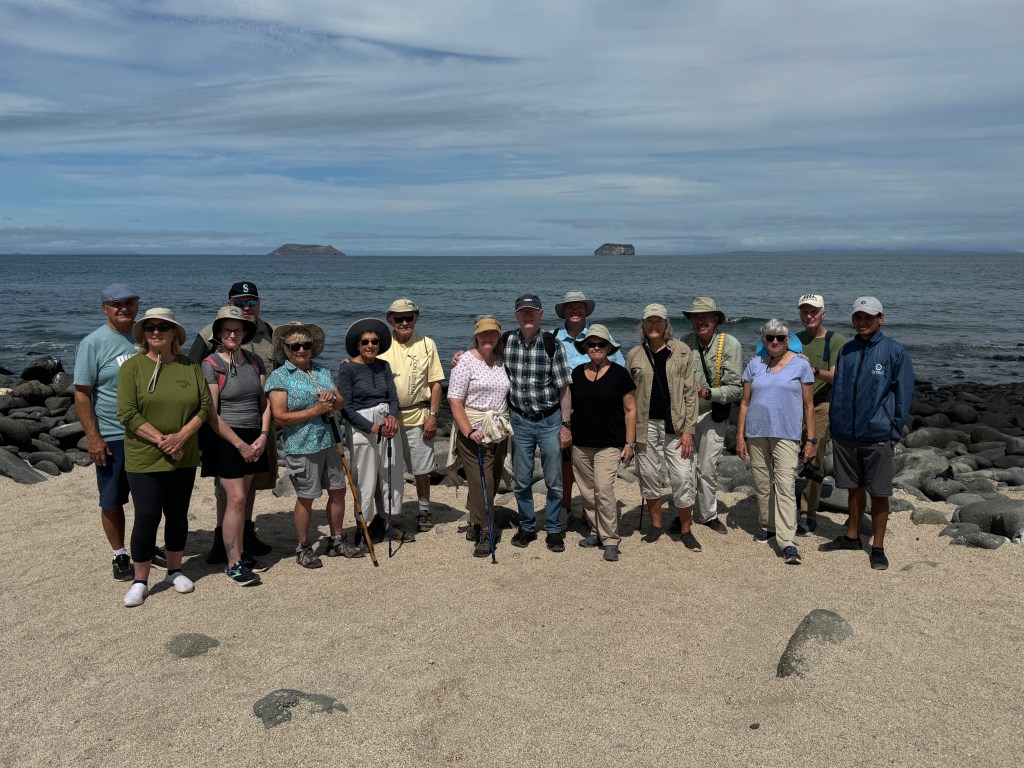
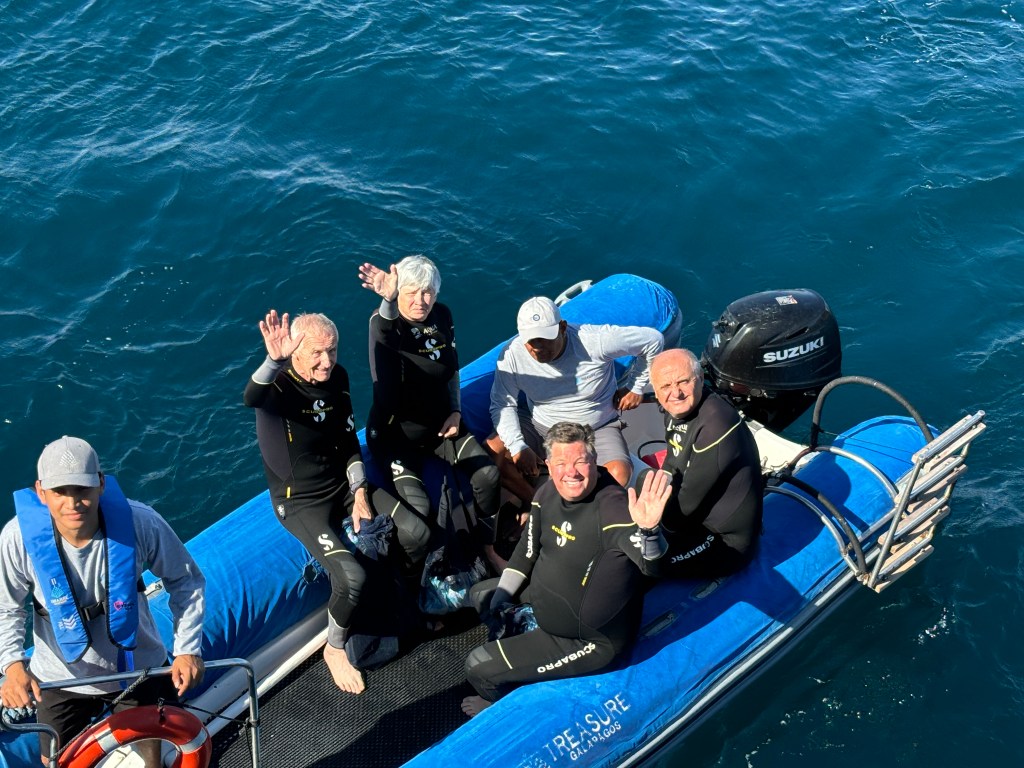
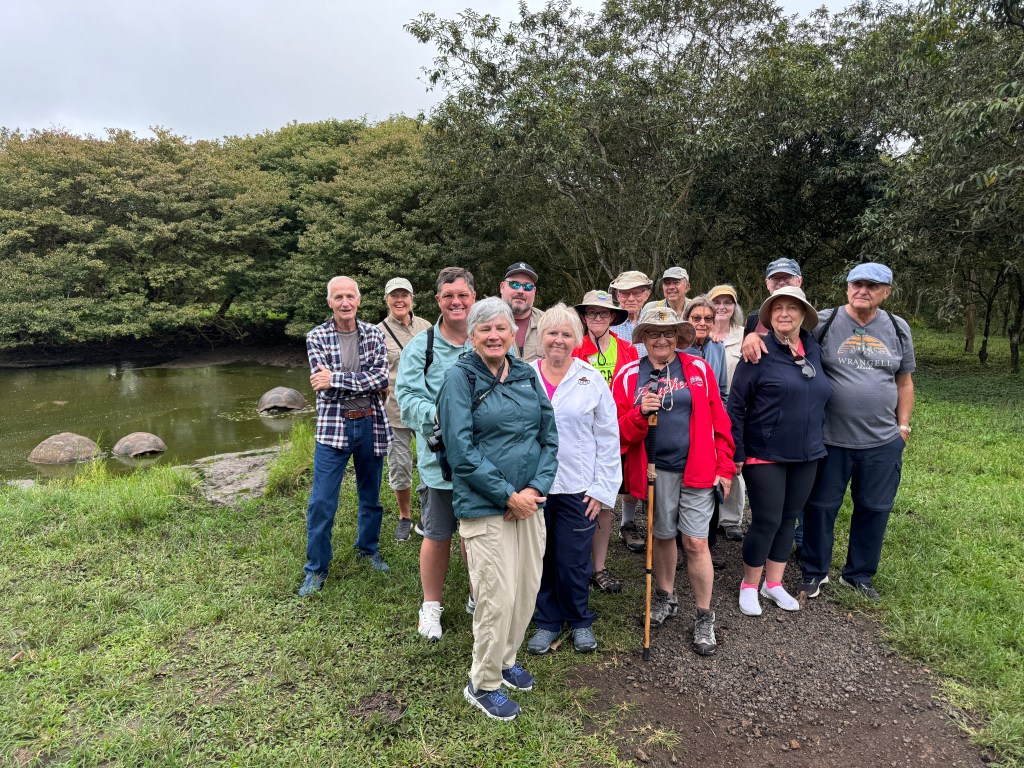
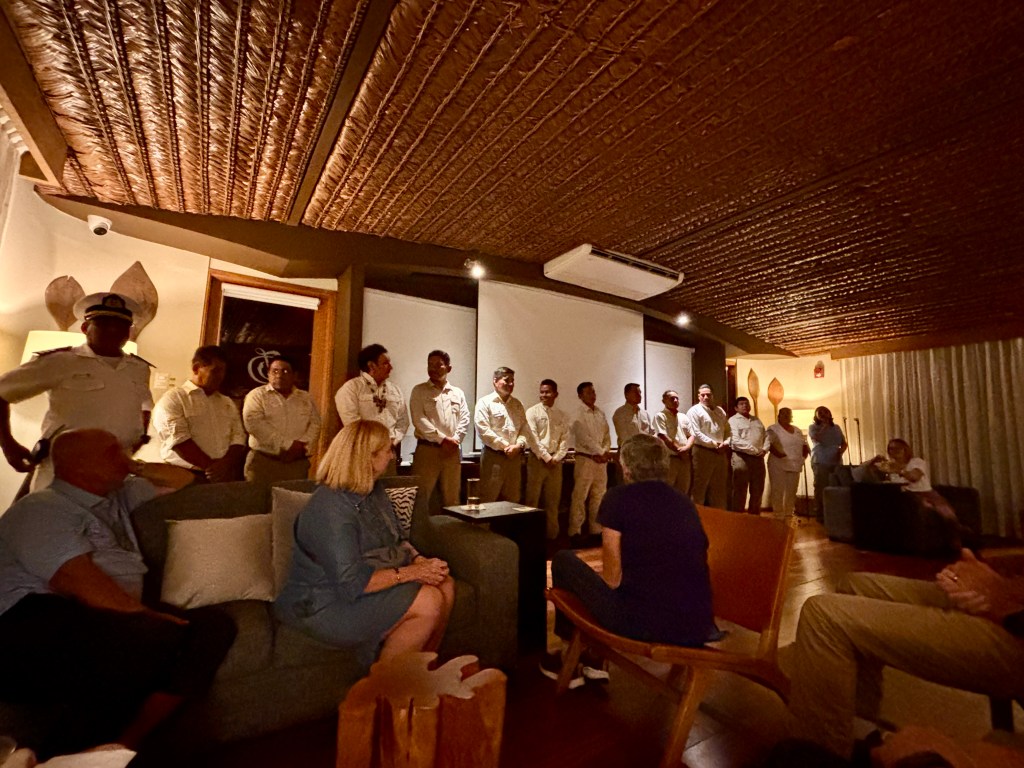
Here is our group, the passengers on the Treasure of Galapagos.

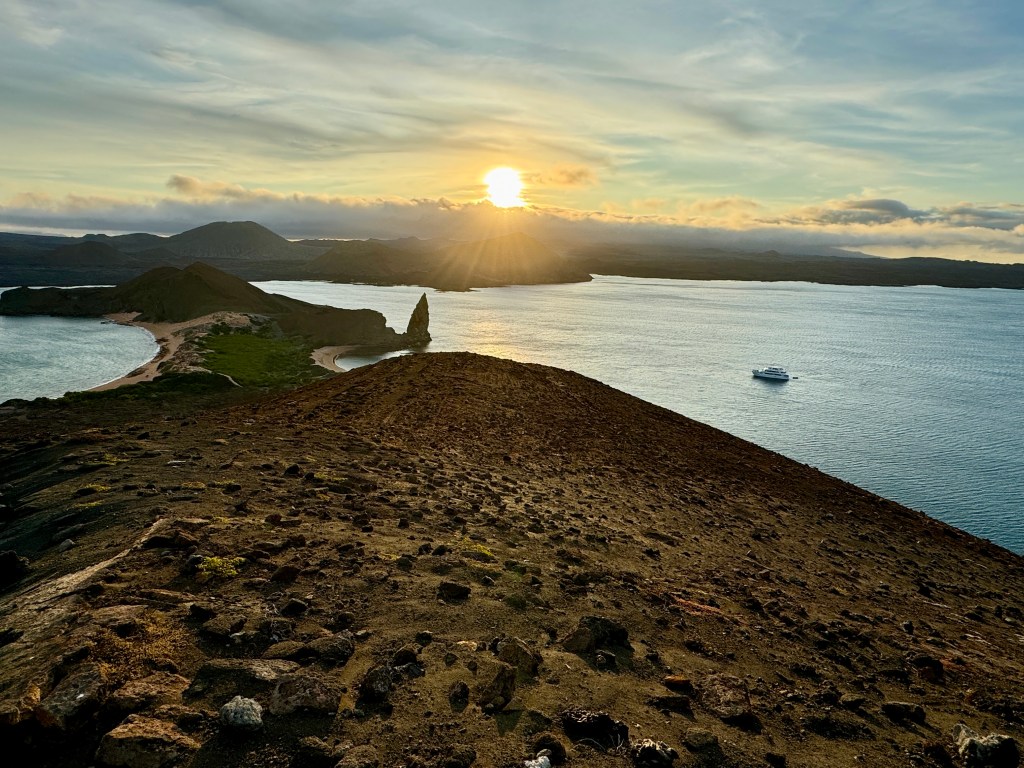
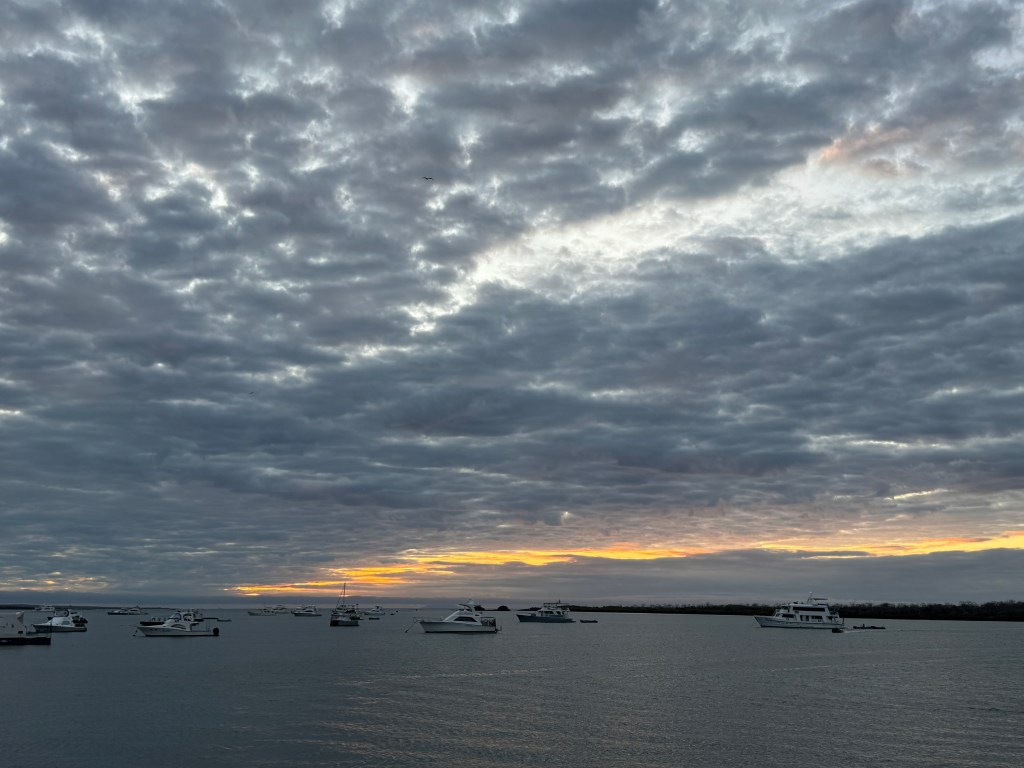
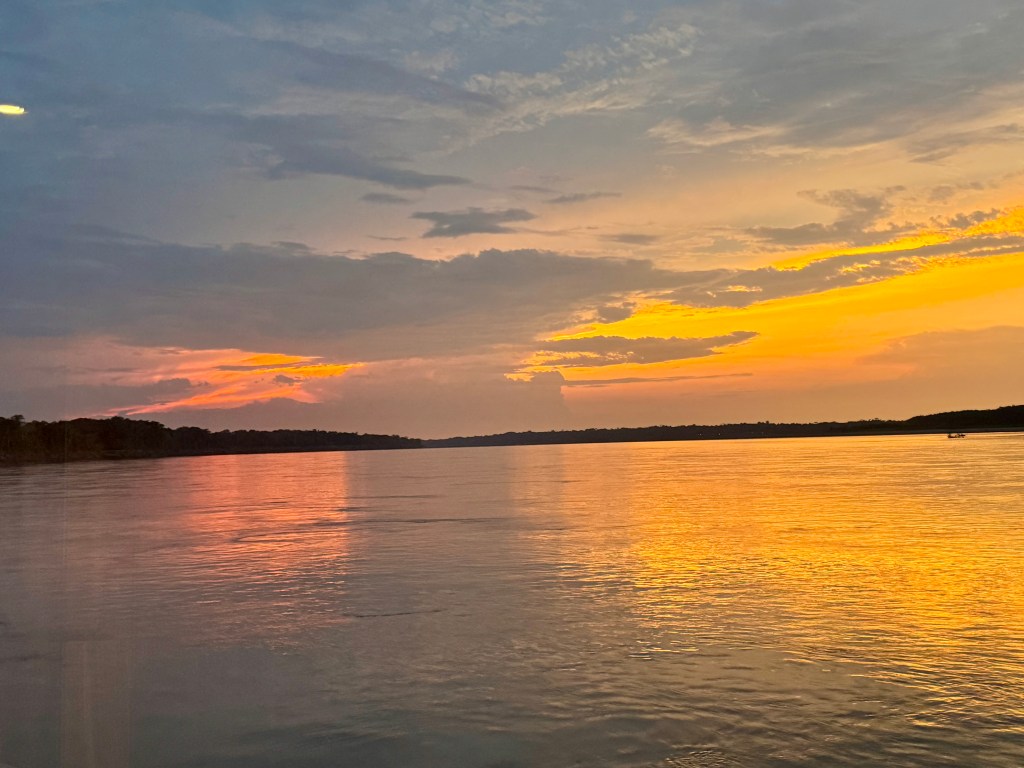
The view was lovely on our first evening aboard the Treasure of Galapagos.

We landed in the Galapagos Islands on September 27, 2024

Next Up:  More Galapagos adventures.

Posted in Uncategorized | Leave a comment

Ecuador: We Learned so Much in Quito!

Our Ecuador guide, William, picked us up at the hotel to begin our Quito adventure.   On the way, he gave us some general information.

The US dollar has been the national currency of Ecuador for 24 years.  They do have some local coins but not bills.  Ecuador is the only country in South America that uses US currency as their own currency.  One of the things we noticed is that there seemed to be more use of US dollar coins than is common in the US. 

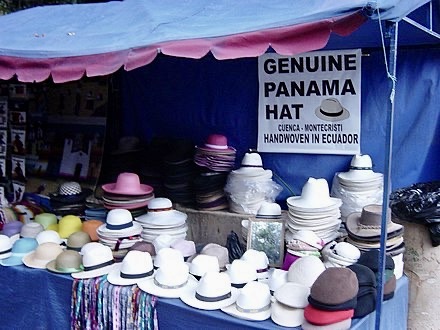
Panama hats are made in Ecuador!  The straw from a variety of palm used is grown in Ecuador and the hats were noted by the Spanish conquistadors in 1562.  Weaving the traditional Ecuadorian toquilla hat was added to the Unesco Intangible Cultural Heritage List in 2012. (Picture was taken from Wikipedia site.)

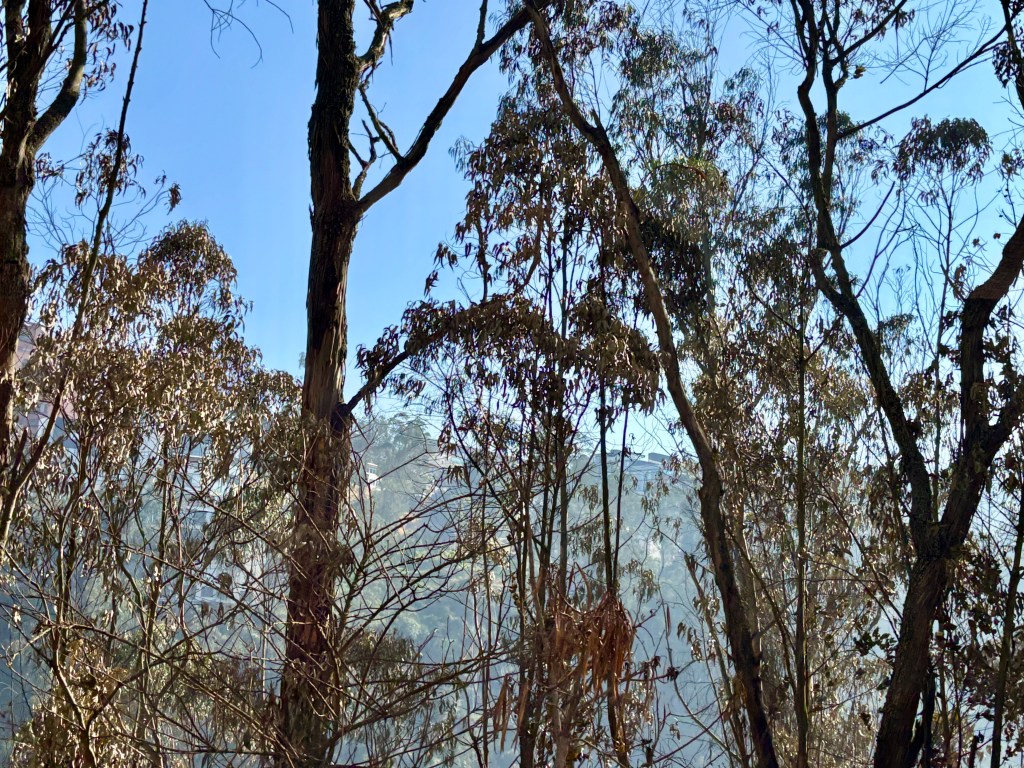
William spoke about the recent fires in Quito and that children had missed several days of school because of the smoke.  Life was quite disrupted but the situation was improving.  These trees were burned right off the road.

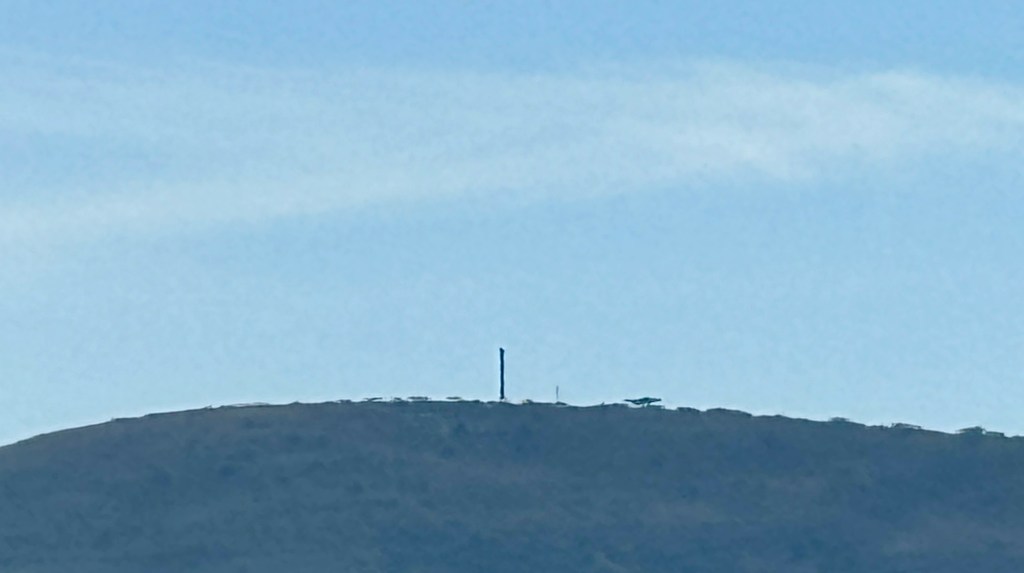
We were once again traveling on the Pan-American Highway as we journeyed. The monument on the hill was placed by the ancient people 1300 years ago and is evidence that they were knowledgable about the sun’s path on the equator.

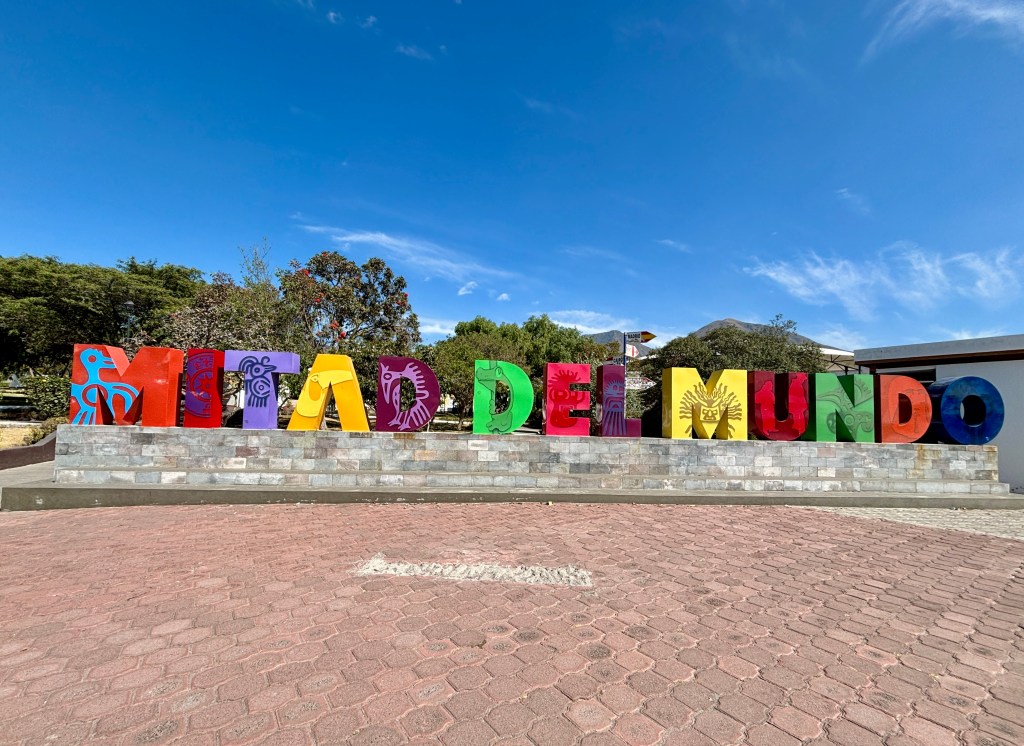
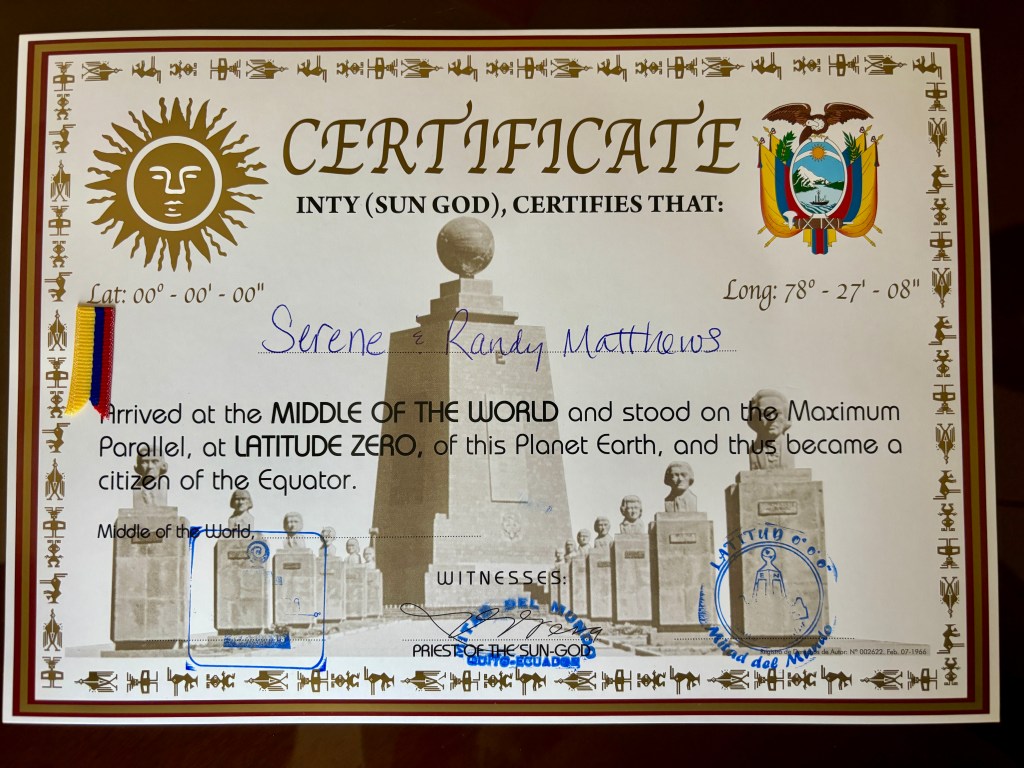
Our first stop was at Ciudad Mitad del Mundo – a monument and park celebrating the earth’s equator.

We explored exhibits on how a variety of indigenous peoples lived in the area that became Ecuador.

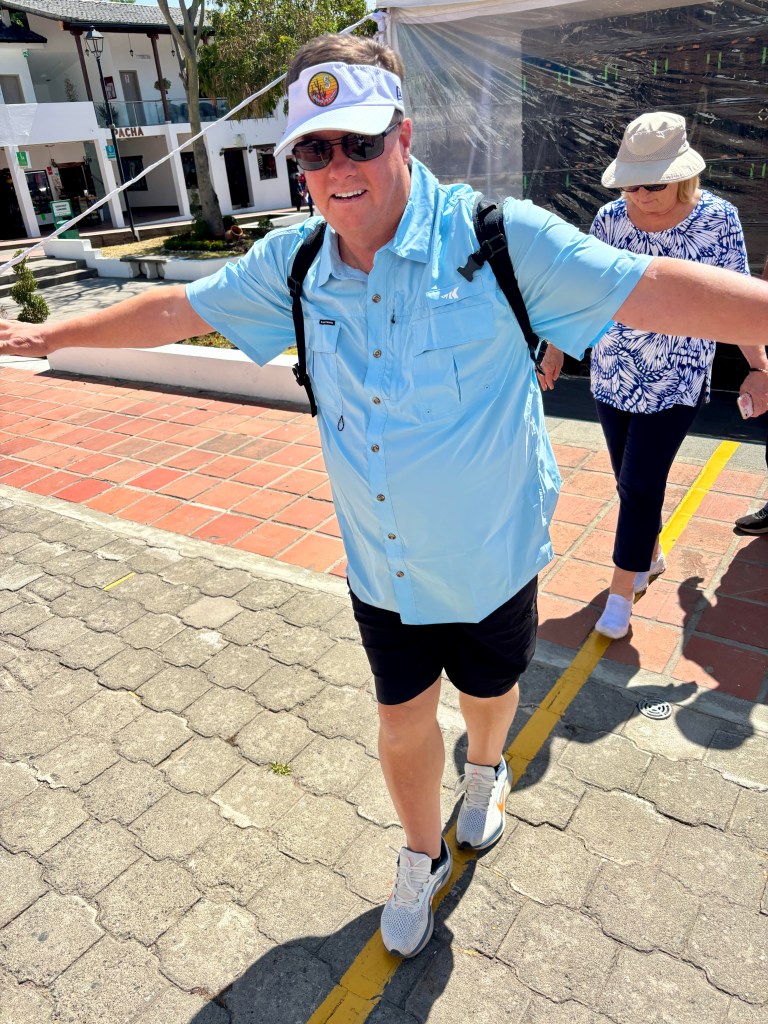
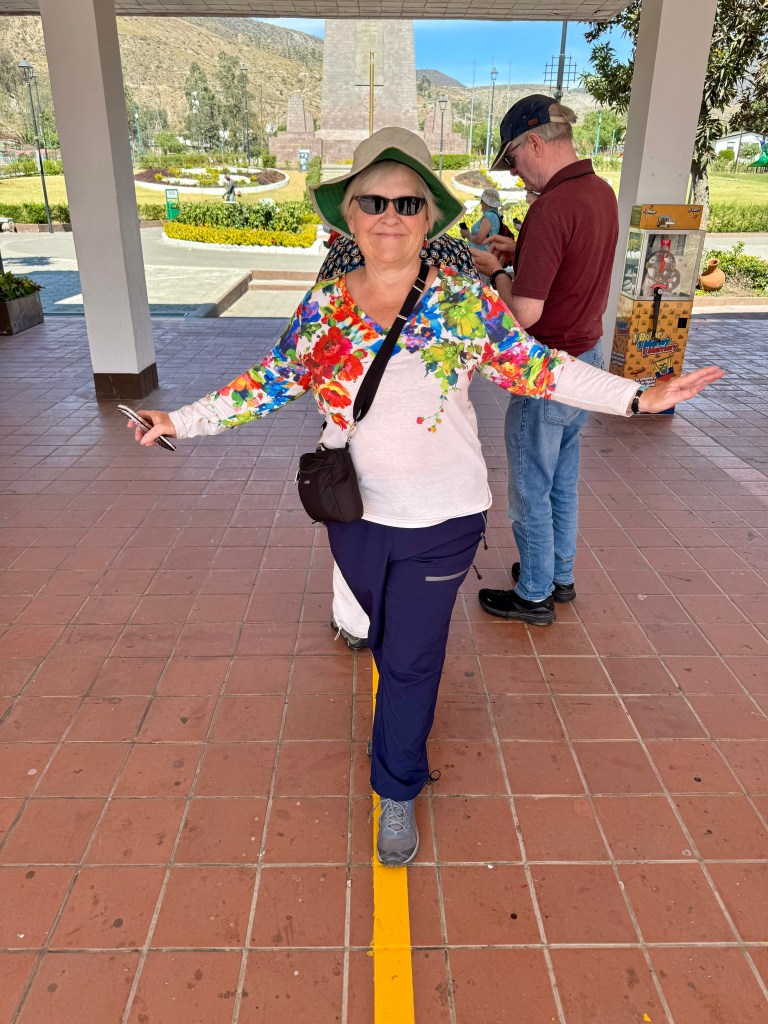
We walked the line – the equator line!   

One of the things we failed to do was have a picture of straddling the line to specifically stand in the northern and southern hemispheres at the same time.  Bummer!

The equator goes for 24, 901 miles around the earth and goes through thirteen countries.  Those are:  Ecuador, Brazil, Columbia, Sāo Tomé and Principe, Gabon, Republic of the Congo, Democratic Republic of the Congo, Uganda, Kenya, Somalia, Maldives, Indonesia and Kiribati. 

William told us that you lose body weight at the equator.  That is caused by the centrifugal force from Earth’s rotation.  We didn’t verify that with scales.

Our Ecuador tutorial continued once we were back on the bus!   Ecuador is somewhat smaller than Texas and has 90 volcanoes.  There are 17,000,000 inhabitants, mostly Mestizos those of Incan and Spanish mix.  Less than 10 percent are indigenous, mostly they live in mountain villages. Sixty percent of Ecuadorians live in towns. 

Ecuador has many ex-pat communities for those from the United States and Canada.  I could see the draw, at least as it involves Quito – a city with history and culture, but which is also modern and clean.  Quito also does not have the wandering dogs that were ever-present in Peru.

Ecuador’s varied ecosystems, mild weather and volcanic soil allow it to be self sufficient.  Climate change and jungle deforestation may change that going forward.

William told us about the variety of businesses in Ecuador.  He equated them to types of “gold” including the black gold – oil.  They also have green gold – supplying 20 percent of the world’s supply of bananas.  Pink gold is shrimp harvesting and sales. Gray gold is for fish, tuna, sardines and tilapia.  White gold is tourism.  

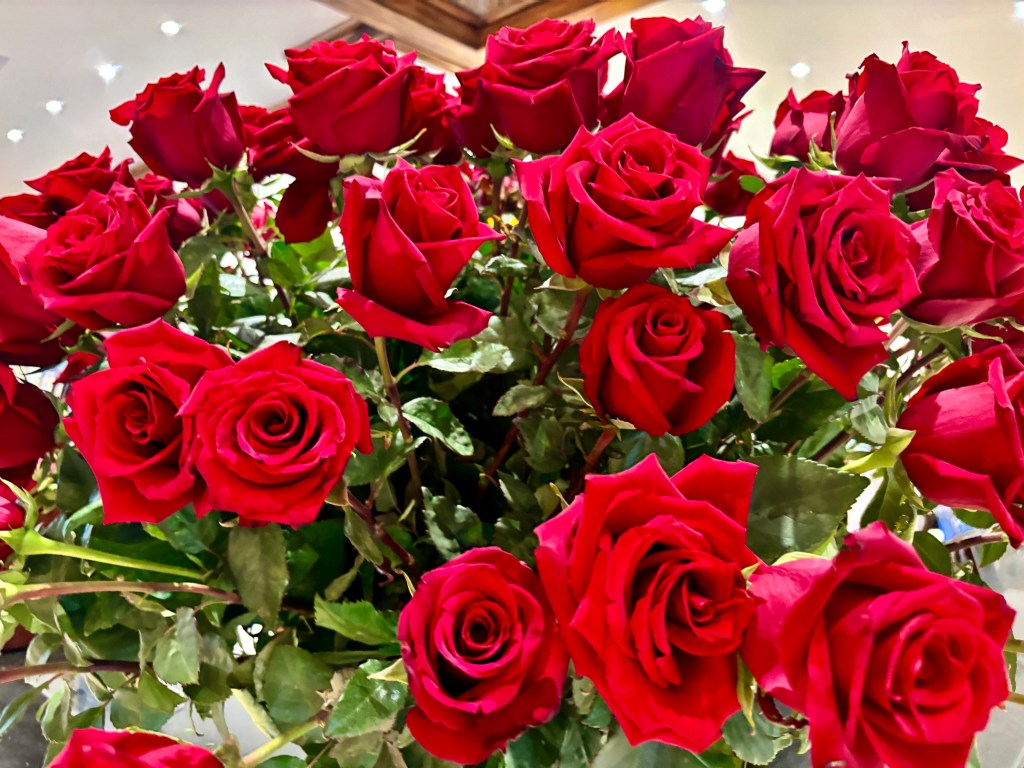
He said rainbow gold was for flowers.  Ecuador is a world leader in the production of roses, exporting 50,000 every single day.  There were very large arrangements in our hotel!

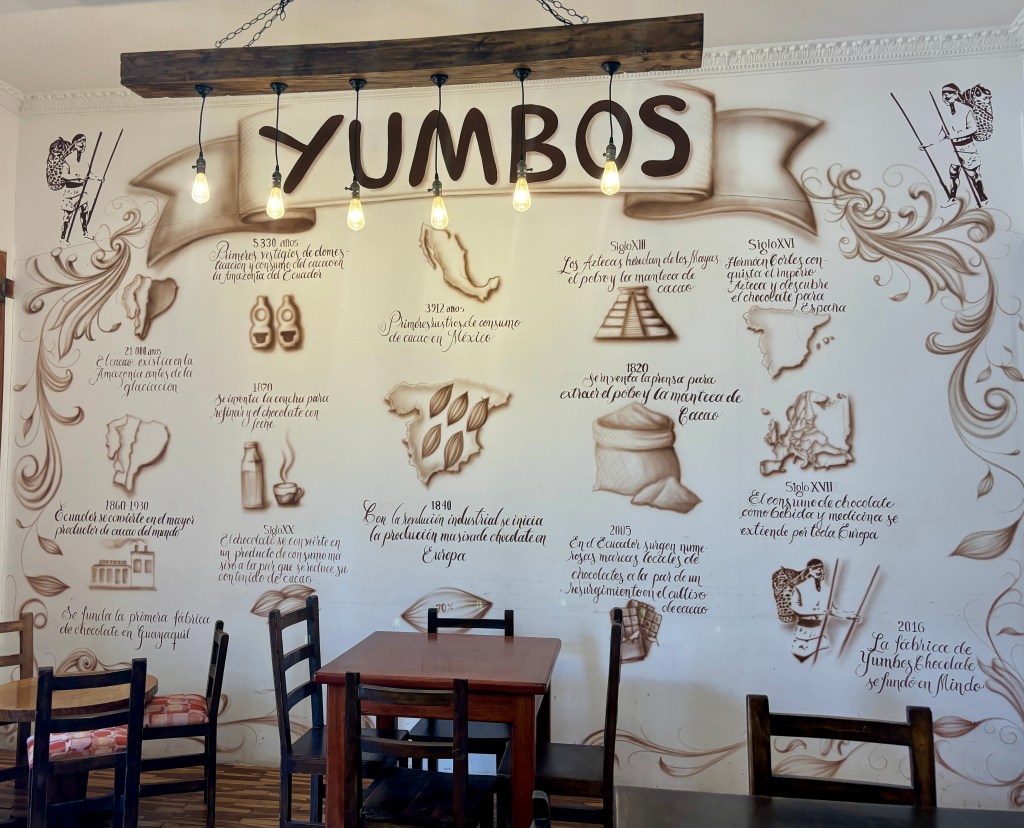
The last gold he spoke of, brown gold has to do with cacao beans for chocolate.  Chocolate production has a 5000 year history and had to do with our next destination. 

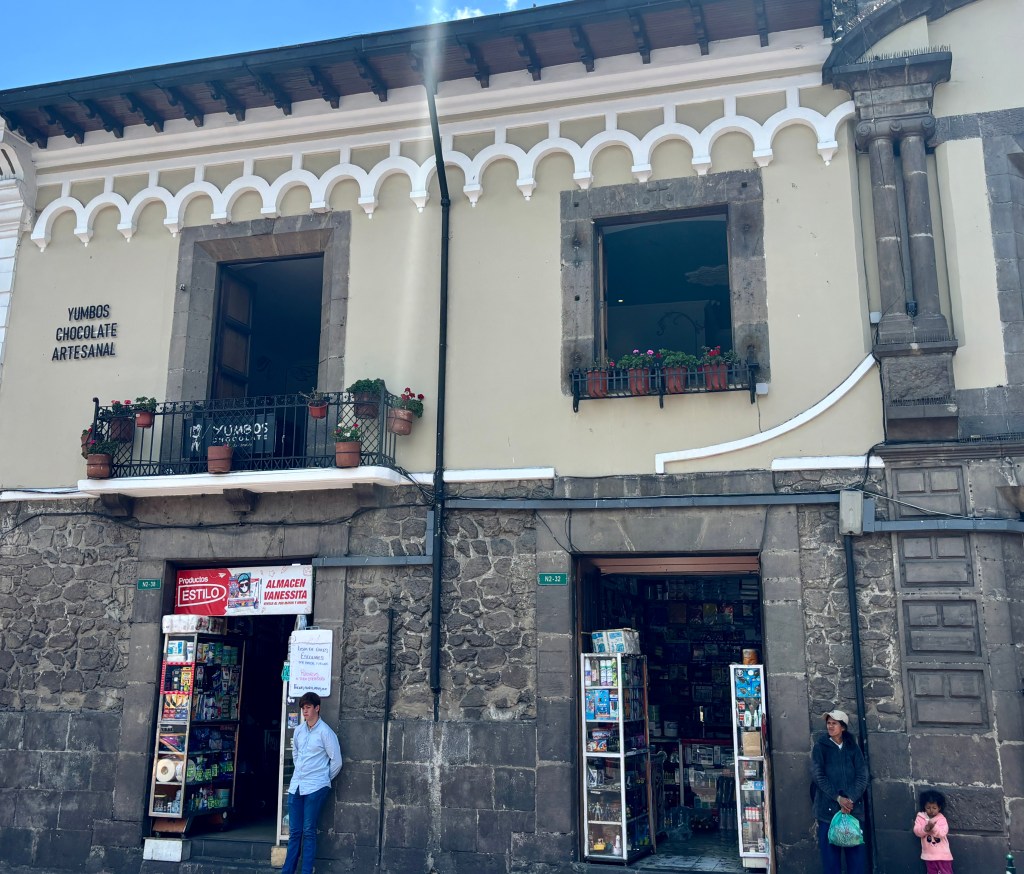
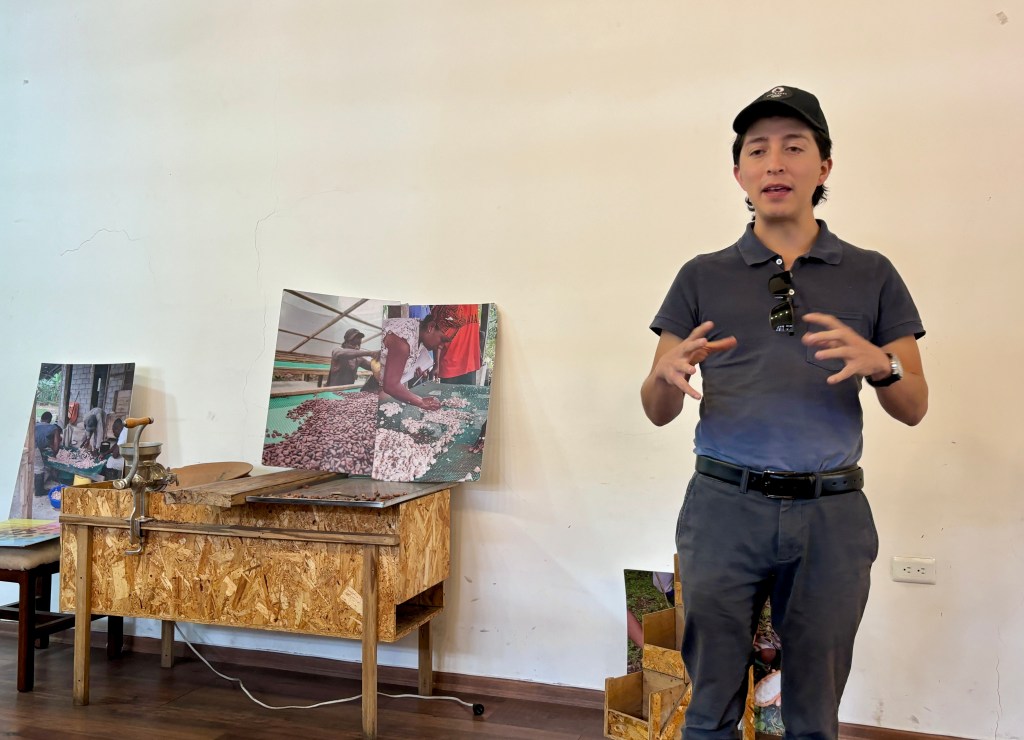
We were present for a chocolate tasting at Yumbos Chocolate Artesanal.  

Yumbos is a boutique chocolate operation. They were awarded the Chocolate Bar Award Winner for in 2019, 2021 and 2023.  It takes them 30 days to make a chocolate bar and they only make 5000 bars per month. They only sell locally because they do not have the inventory to go beyond that.

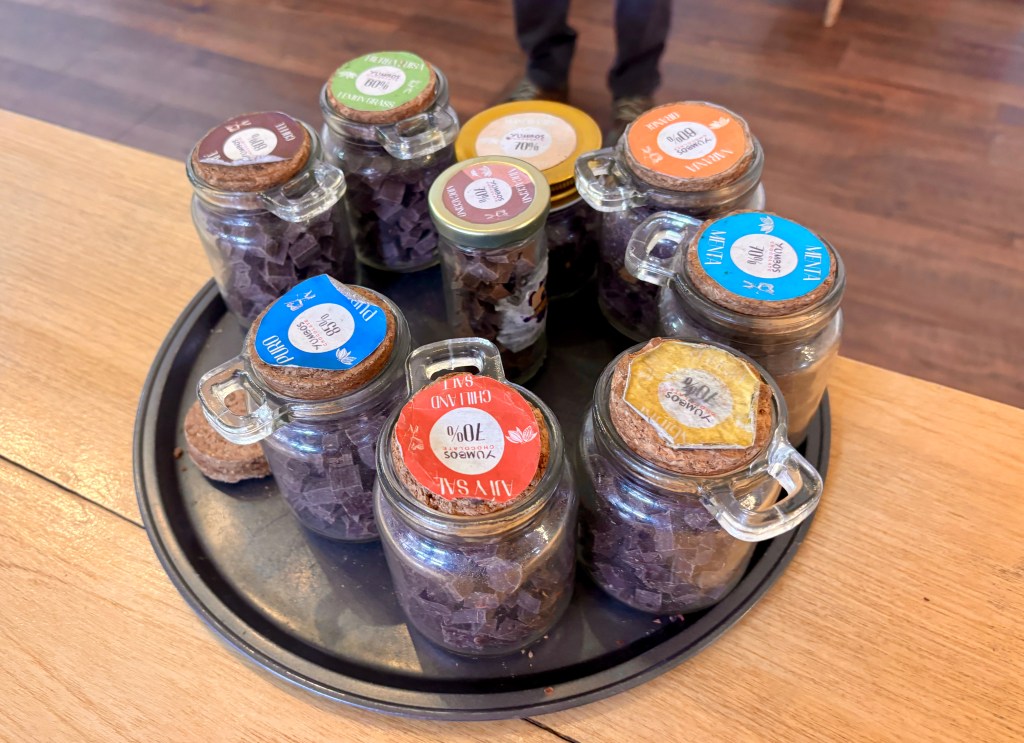
We were offered tastings of a variety of chocolates including 85 percent cacao, 60 percent with orange peel,  60 chocolate with coffee beans, chocolate with lemongrass, chocolate with chili and sea salt and chocolate with salt and mango.  As delicious as most of these were, we were also offered some hot chocolate that we did not care for at all!  

One of the things our guide talked about was the sense of taste – something I thought I knew a lot about.  I taught the five senses in kindergarten for many years including breaking down the sense of taste into sweet, salty, sour and bitter.   He started talking about the sense of umami!  What was that?!

That required instant research before we even left the shop.  Umami is a fifth taste characteristic of broths and cooked meats.  Soy sauce and ripe tomatoes are also example of foods with umami characteristics. Initially proposed in 1908, umami was accepted as a fifth taste in 1985.  This was primarily done because umami is recognized by a unique set of tongue receptors, not a combination of the other four. 

I loved learning about umami. I was so excited that I called my former kindergarten teaching partner, Connie, right away to tell her about it.

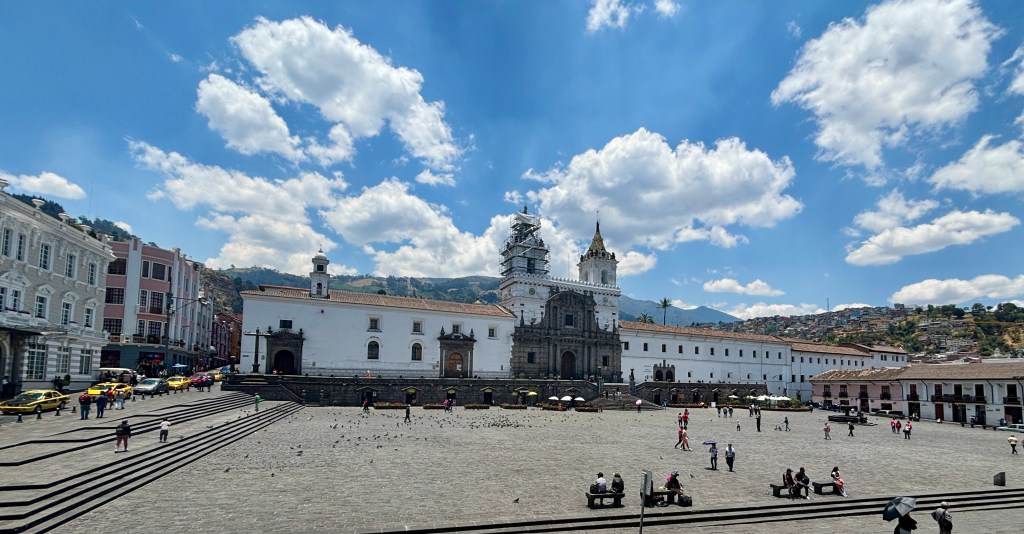
This is a picture of the Plaza de San Francisco, a public square, taken from the upstairs of Yumbos. The plaza was built upon ancient Incan ruins, including a palace that was in use from 1497-1533.

While we walked near the square and into Old Town Quito, we had a police escort.  We certainly never felt at risk but imagine police presence is a deterrent.  We saw numerous tourists use our police guide for information which he graciously provided.

Old town Quito has been a UNESCO site since 1978.  Quito was built over the top of an Incan city by the Spaniards, beginning in 1534.  They designed their city in the shape of a Latin cross emphasizing Catholic Church and government power. There were 33 churches in the area of the cross. There are some very steep roads similar to San Francisco. 

One of the interesting things we saw were a series of women walking around selling ice cream, or something similar.  It was interesting that the confection didn’t seem to turn into a runny mess!

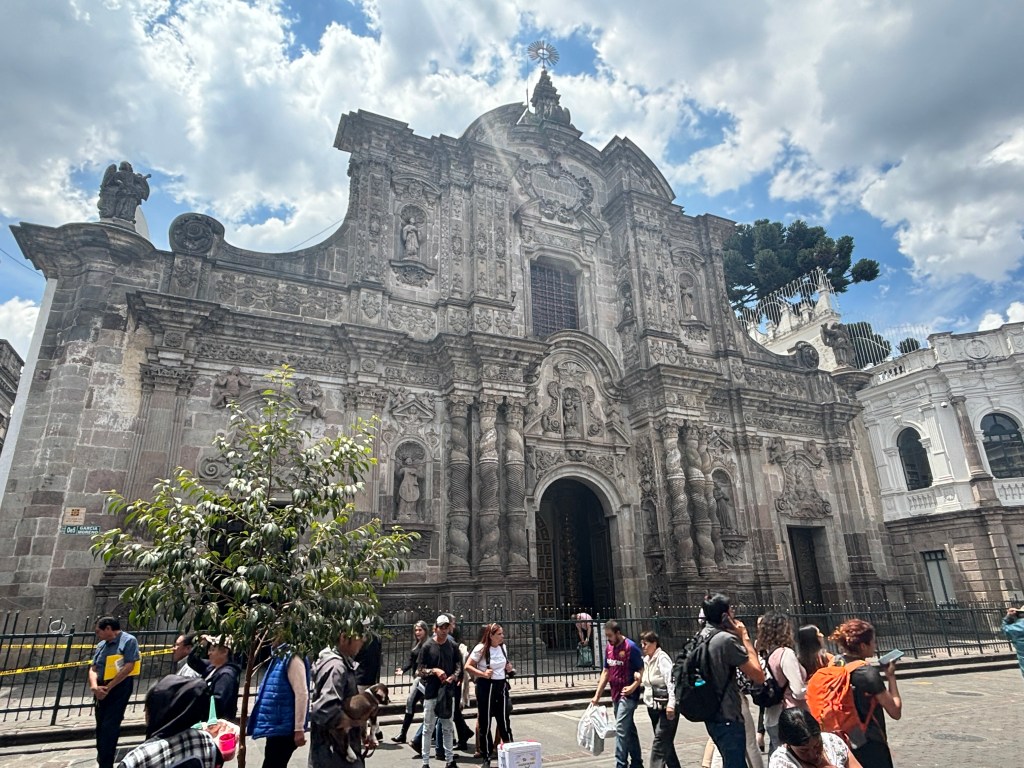
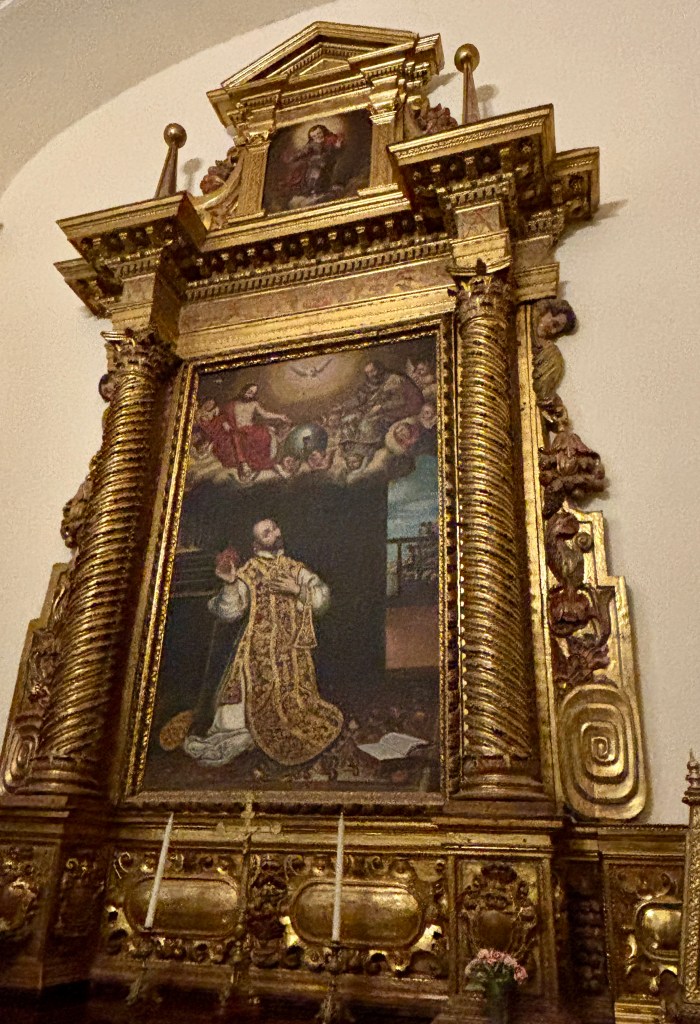
Our next destination was the Compañia Church, or more specifically Iglesia de la Compañía de Jesús. William said that 80 percent of the people in Ecuador are Catholic, but at least half aren’t active.

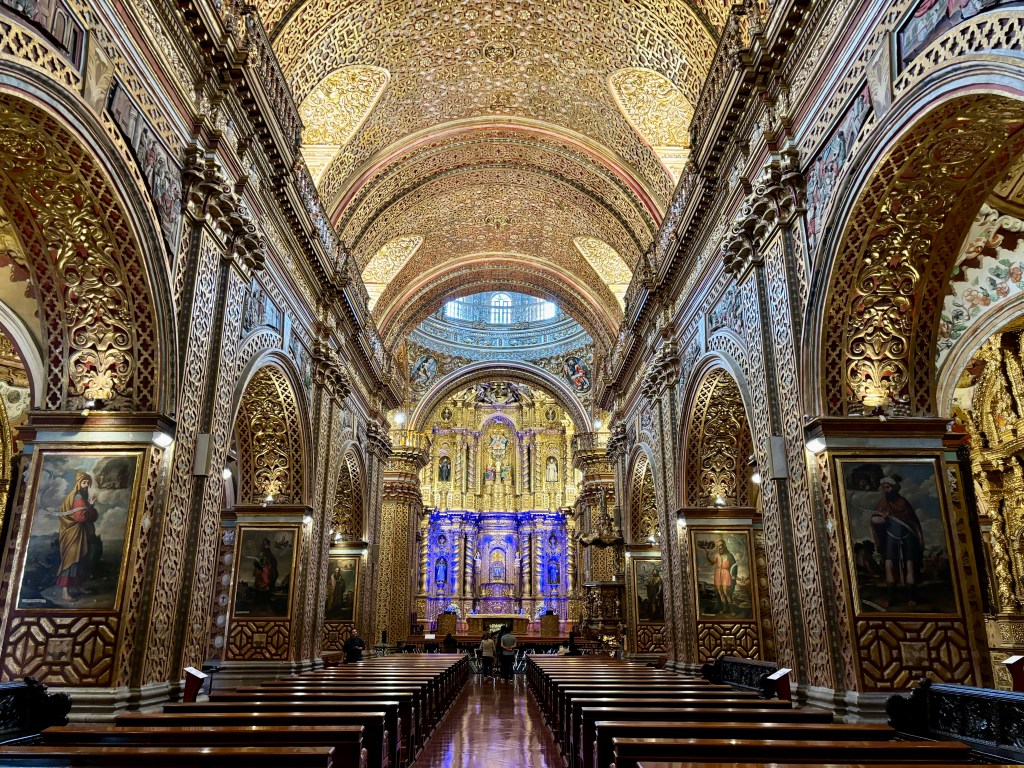
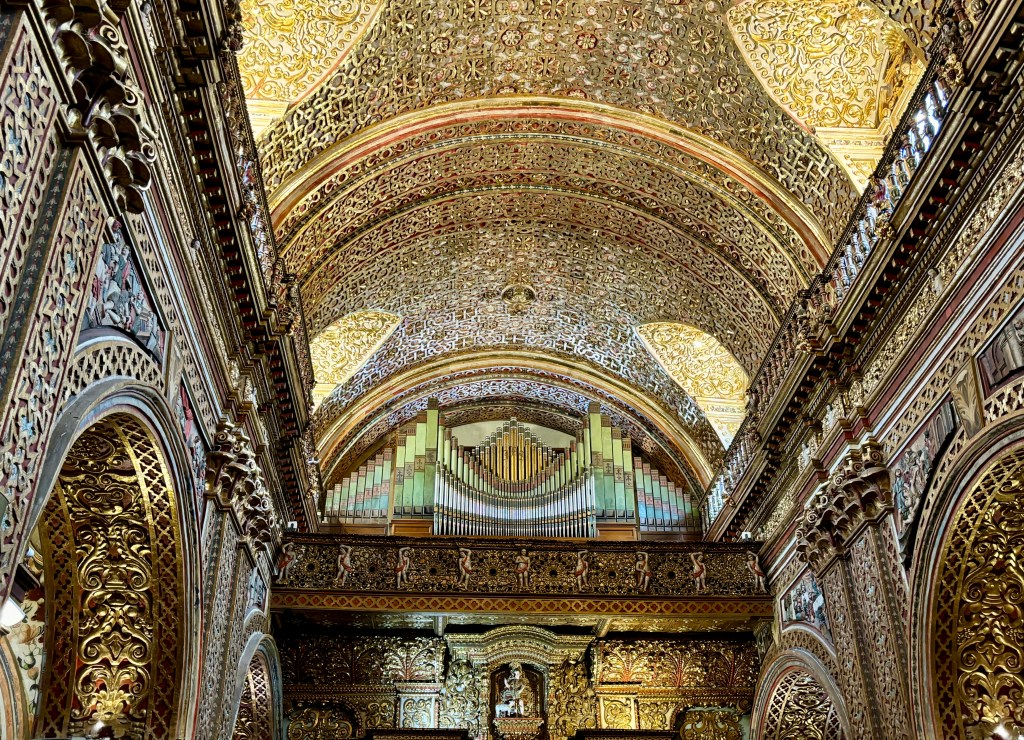
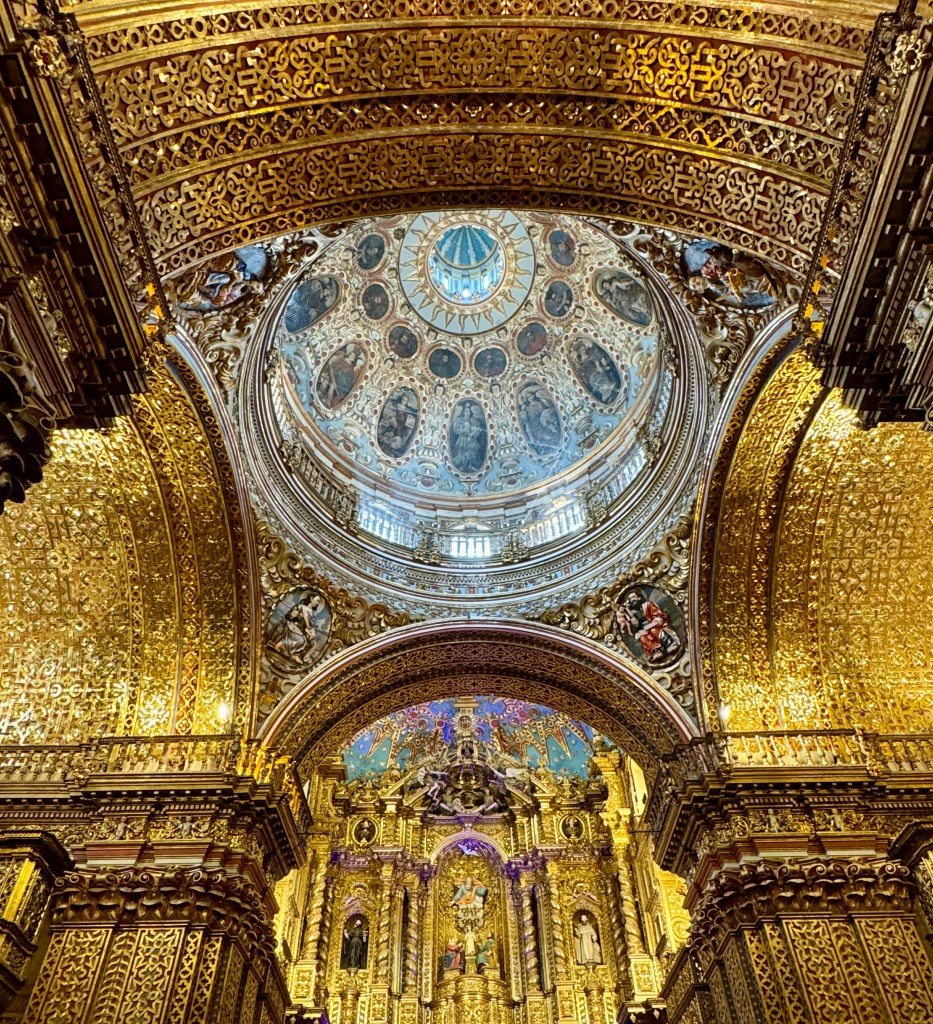
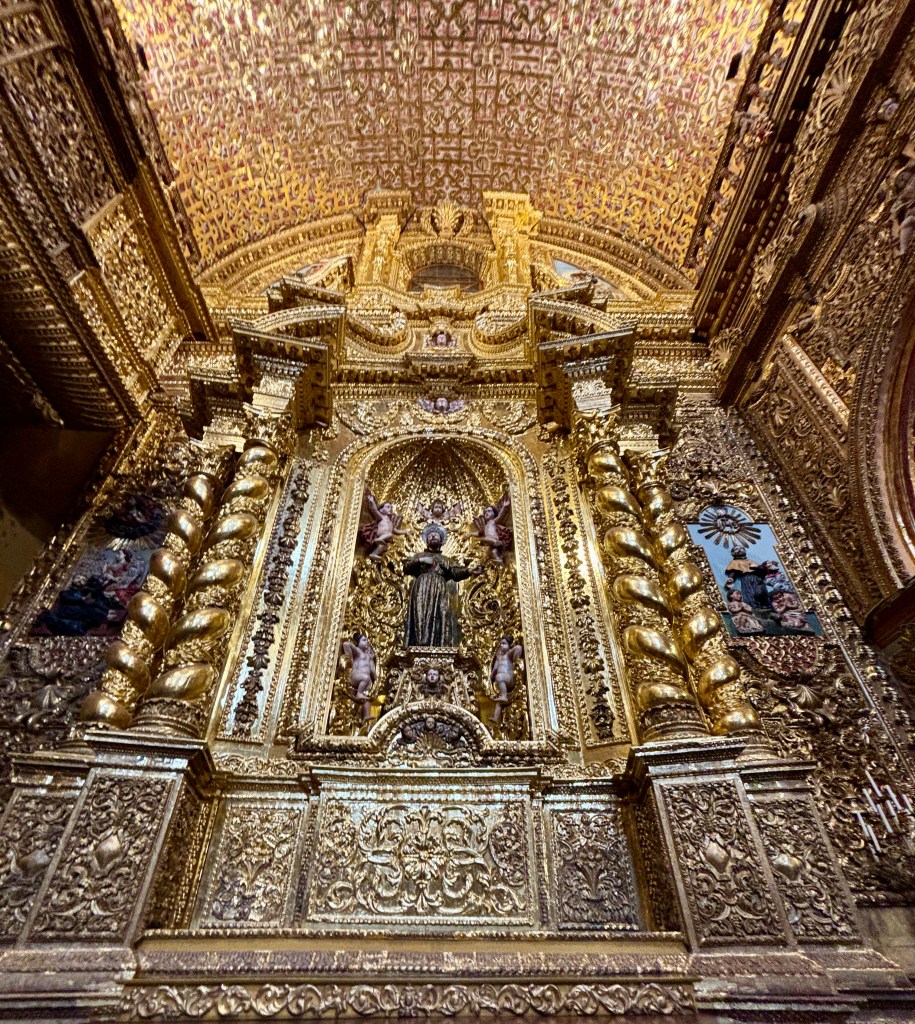
It took 160 years to complete the Compañia Church, the most ornate in Ecuador.  

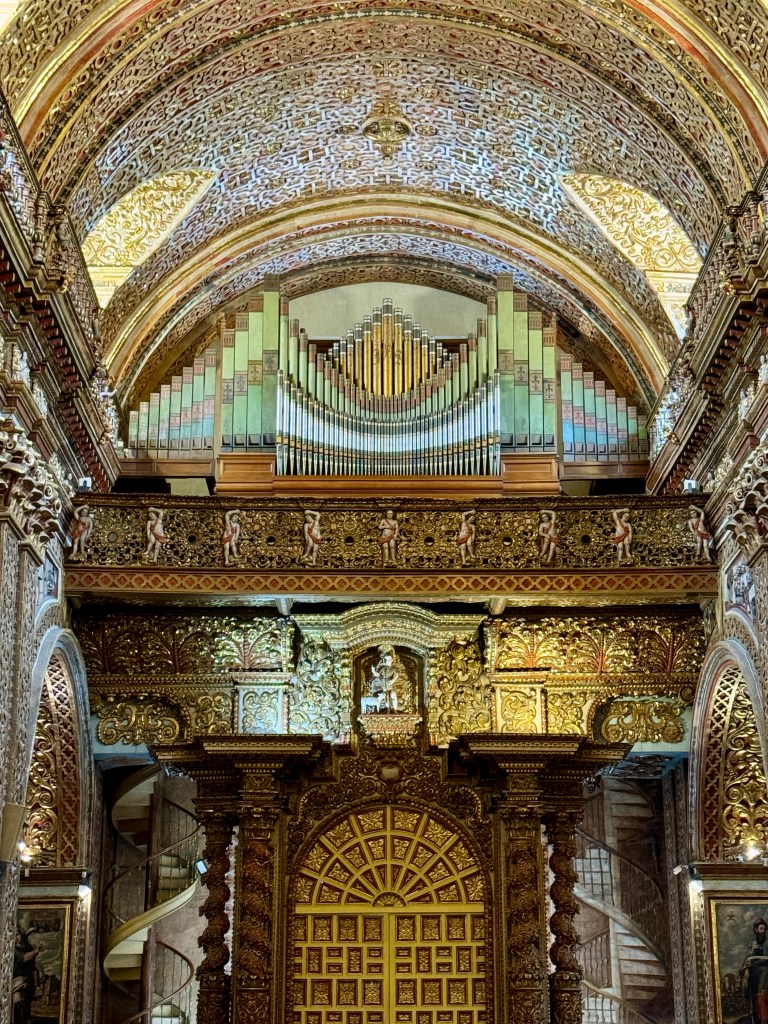
Even the back of the church, showing the organ, is beautiful.

William pointed out the symmetry of the circular staircases.  Only one is real, the other is painted.

The ceiling and dome are very ornate.

This painting of Our Lady of Sorrows is the same as one from the nearby Jesuit St. Gabriel’s Academy.  Thirty- six boys boarded at the school on April 20, 1906. One young boy observed the blessed virgin open and close her eyes.  He alerted other boys and the teacher.  The phenomenon lasted about fifteen minutes. The eye movement repeated for the students during prayer time. Church authorities eventually verified the miracle, and moved the painting.  Several other observances of her eyes opening and closing have happened over time and numerous people came to faith because of it.

In a gallery on the property we were shown that even as the Spaniards conquered the Inca, they incorporated a bit of their culture into their art.  Notice the somewhat circular rendition on the bottom right – this is an Incan design.

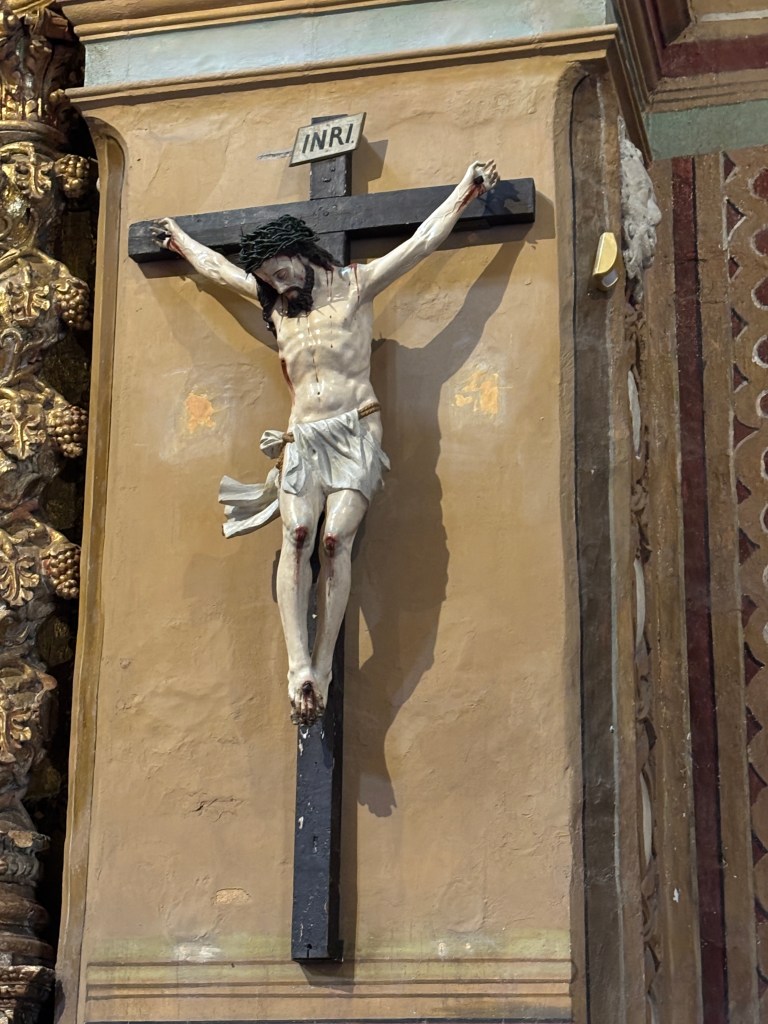
While observing this figure of Christ looking down with eyes closed, we were told that after accepting Jesus Christ, Mestizos would often display him this way with his head down and eyes open.  That was perceived that he was looking down at their Mother Earth, pachu-mama.  The Catholic Church forbade this, insisting that Jesus be portrayed in death looking down with his eyes closed or looking up to his father in heaven with his eyes open.

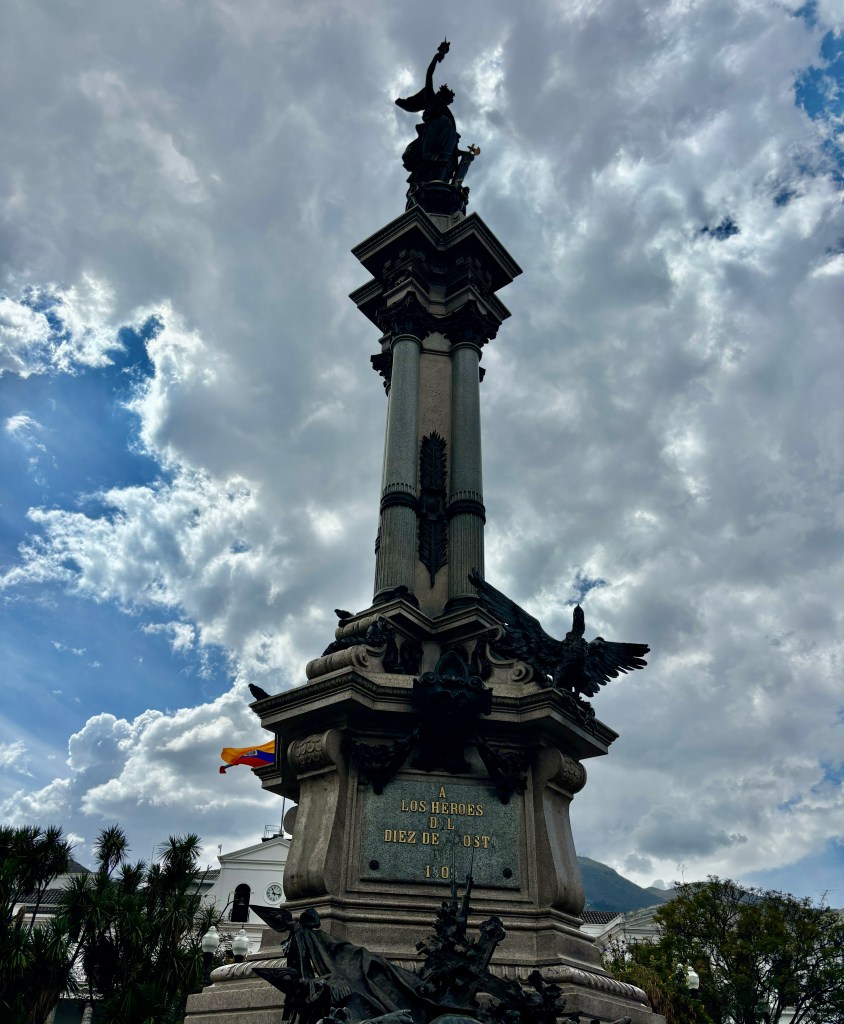
When we left the church, we walked to Independence Square.

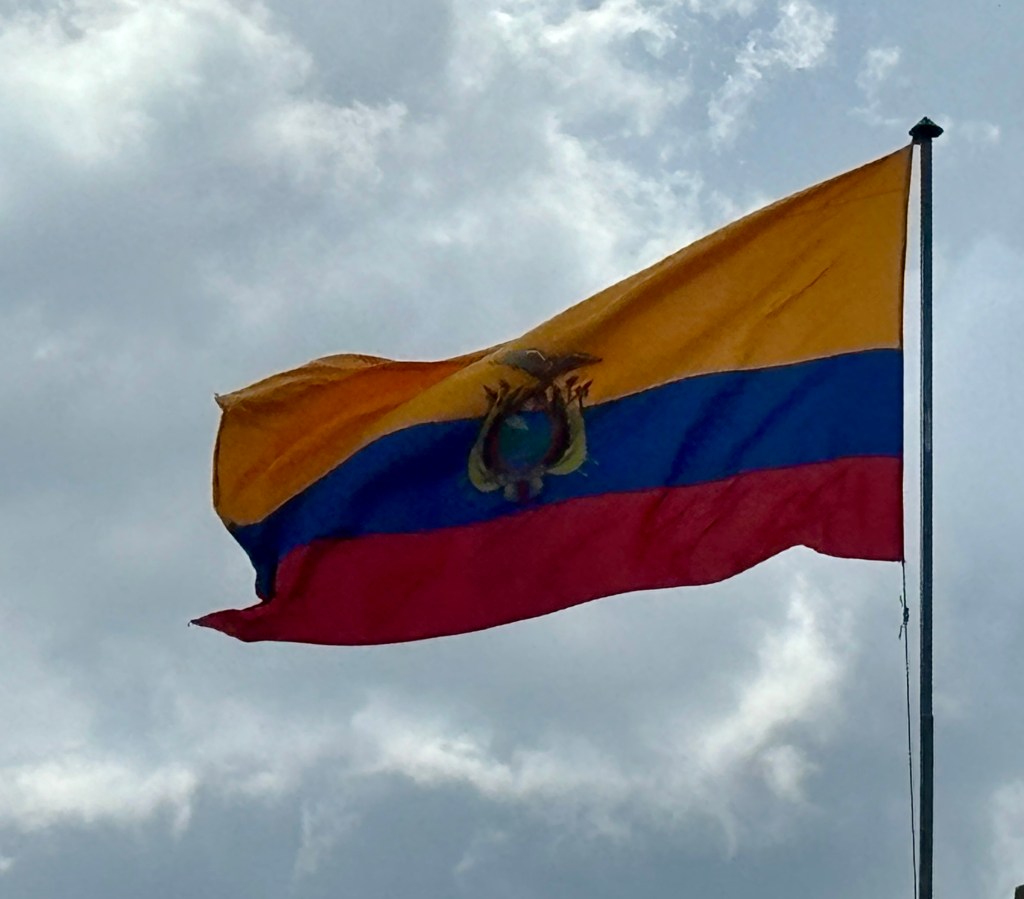
The Flag of Ecuador originated from a similar flag of the former Gran Columbia Union. Gran Colombia (1819–30) included lands roughly encompassing Colombia, Panama, Venezuela, and Ecuador.

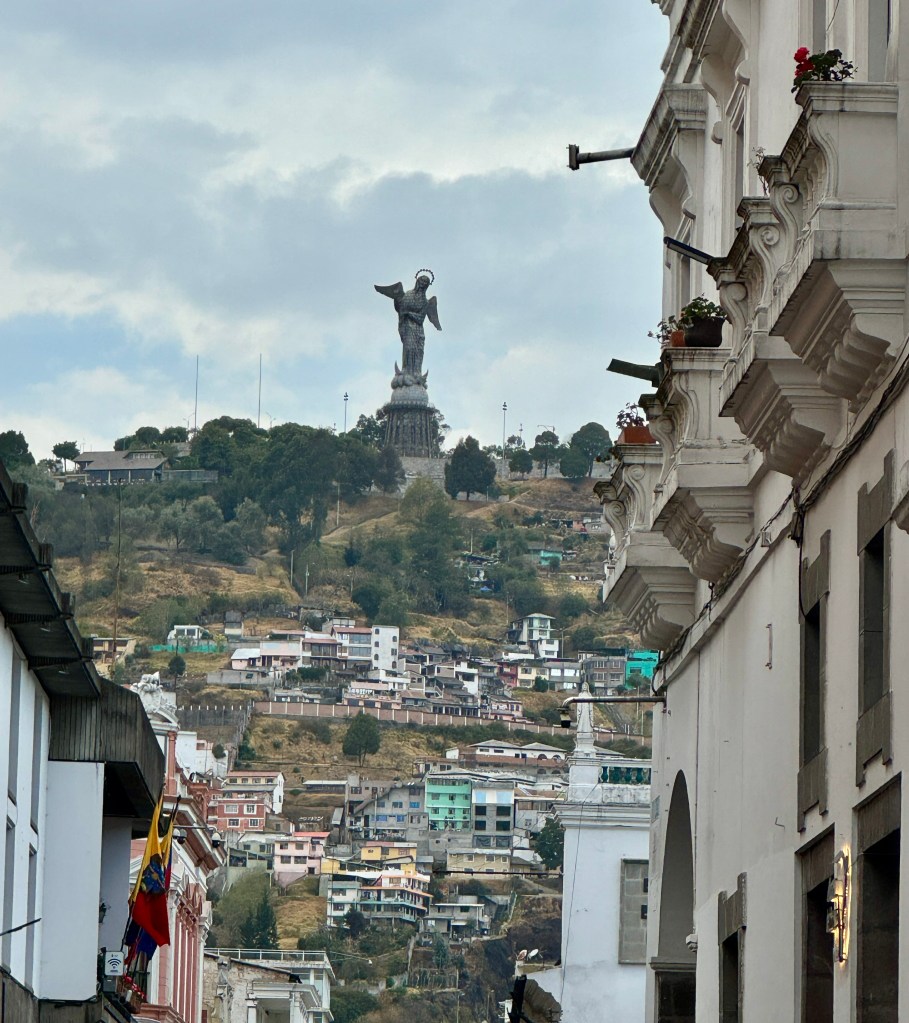
This statue of the Virgin Mary is the tallest aluminum statue in the world.

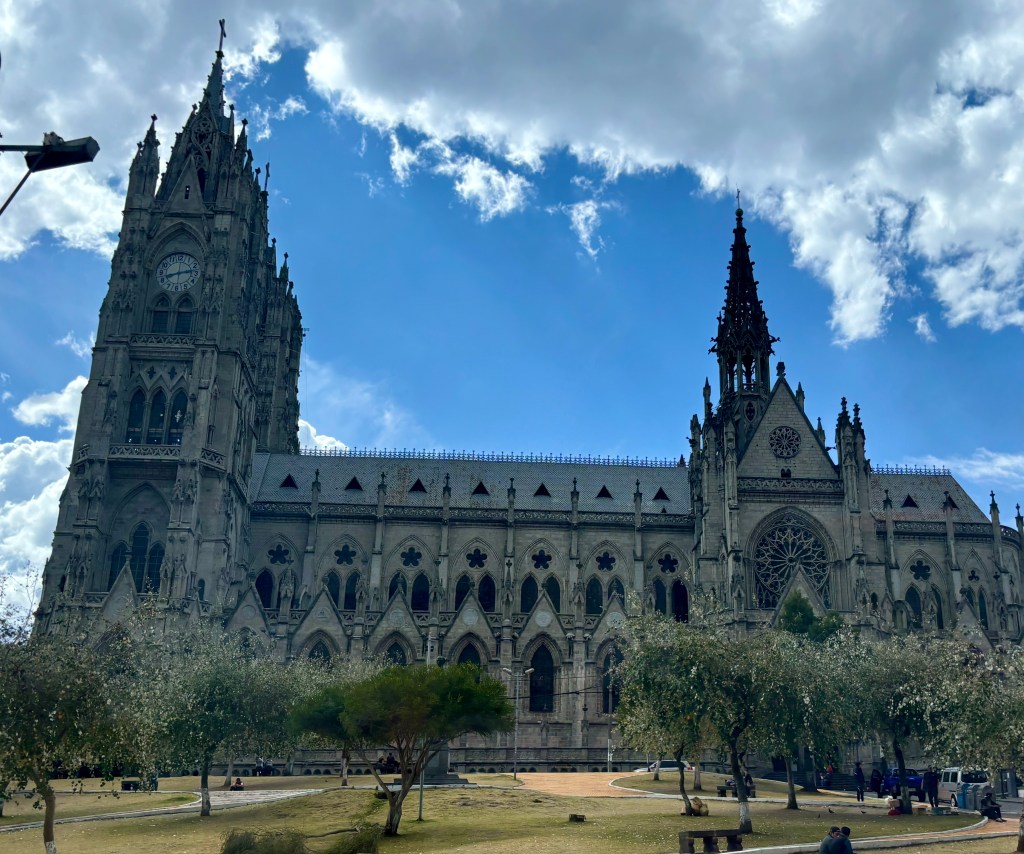
Ecuador’s National Basilica is still under construction with 10-15 percent remaining.

We had the opportunity to try a unique treat.  A local liquor is inside – “mistelas de liqór”

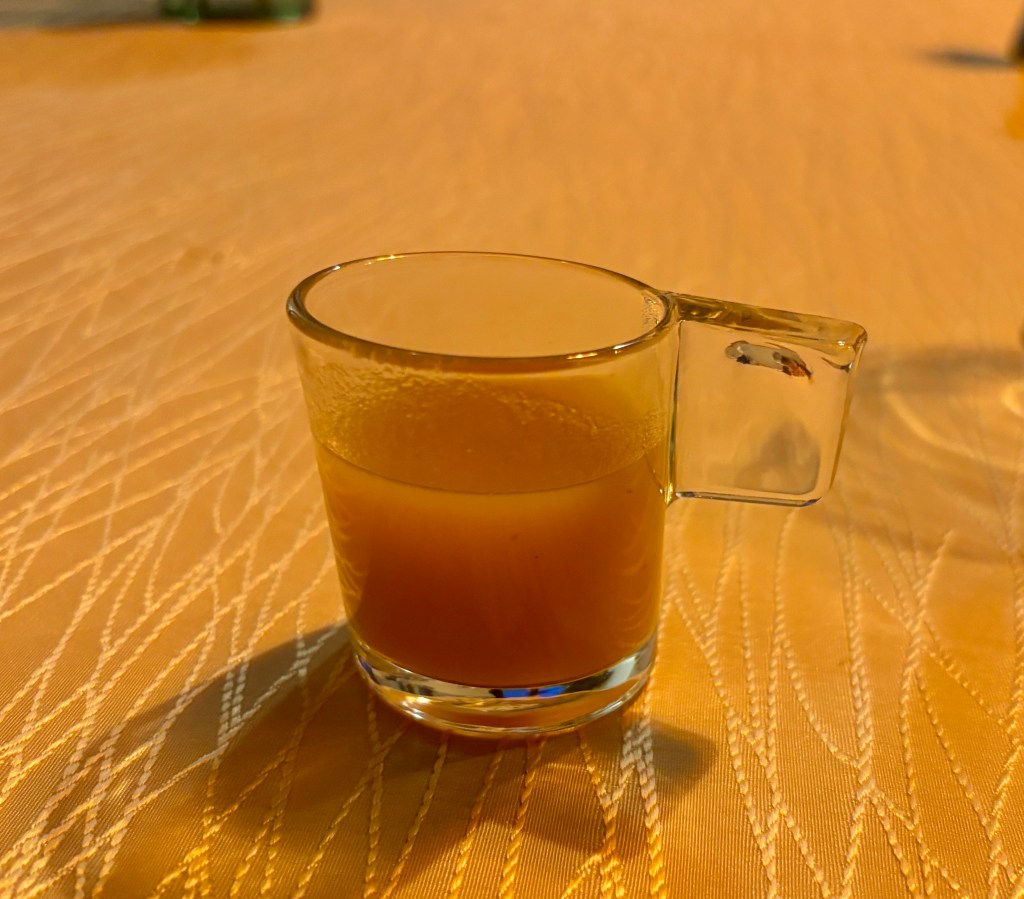
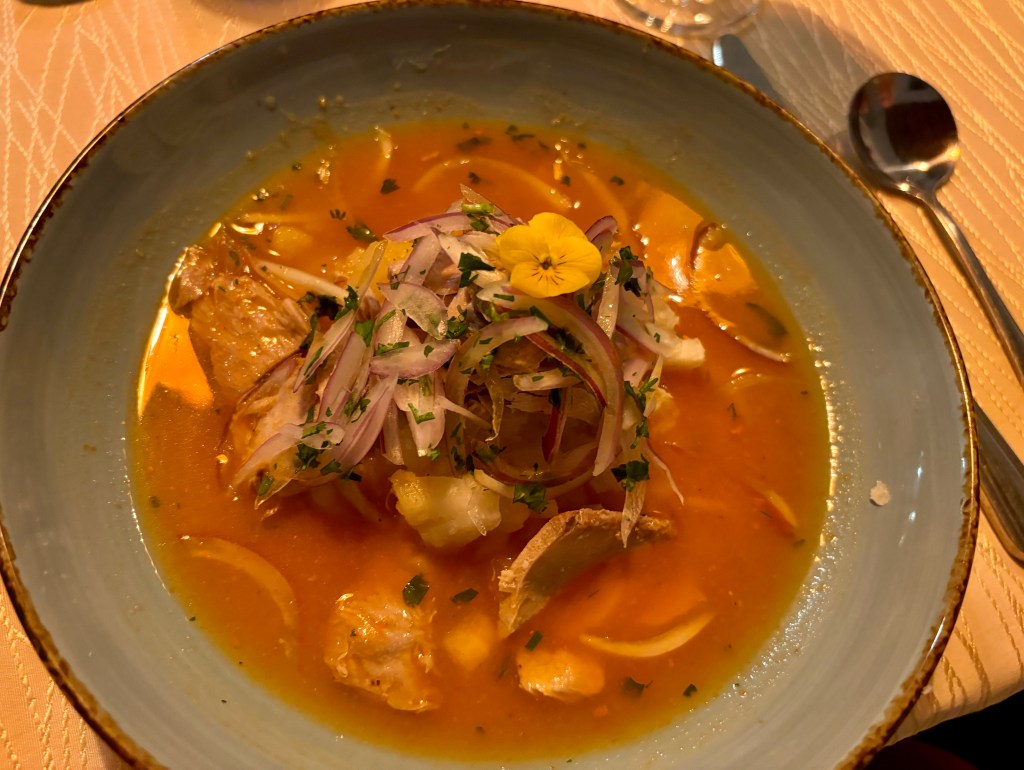
We went to a restaurant as a group and had a nice dinner that began with a traditional drink of Ecuador – cane-lasso.

It was great to learn so many things in Quito on September 26, 2024!

Next Up:  We transition to the Galapagos Islands.

Posted in Uncategorized | Leave a comment

Peru: Manatees and More of My Birthday

The morning of September 24, the day we were to depart the Delfin III, I woke up feeling hungry and went to the lounge for a cookie before breakfast.  During breakfast, I started feeling gastric-intestinal discomfort and headed to the cabin to eat dry toast and sip Coke.  I almost never drink Coke or any kind of pop. yet the carbonation has always seemed to help when I’m sick.

Unfortunately, the wife of the man who had been sick in Cusco had also become quite ill when we were on the Delfin III.  Probably his problem hadn’t been the high altitude sickness after all.  She missed a full day of Amazon activities and it appeared that I was next.

I wasn’t just going to miss out on activities. I, and therefore Randy, was going to have to deal with me being sick on a travel day.

Randy and I went through all of our various meds and I took whatever we thought might be beneficial.  We did not take our anti-malaria meds that morning in the mix of all that,  and never took them again.  

I slept for a couple hours before disembarking.  Two of our friends got in line extra early for the bus in order to get us the front seat. After another hour or so of sipping on coke during the drive, I felt pretty well and was able to move on with the activity of the morning. 

We visited a private agency formed to help endangered species including manatees turtles, sloths, snakes and macaws. 

They have a professional staff of biologists and veterinarians who work in conjunction with the Dallas World Aquarium. 

Their goal is to release the animals back to the wild whenever they can.  

These manatees, also called sea cows, are two young females.  The smaller is two months old and was injured by a machete.  The larger, two years old, is assisting in  socializing the younger.

This is a two year old male.  He and the female in the previous tank will be released to the liberation pond together with eventual release into the wild.

This manatee has only been at the center for three days.  He has a harpoon injury.  He will be treated and released quickly.

This sloth was used in the tourist trade for pictures and was not healthy, likely due to stress.  It will be remediated and released if possible. 

This chart shows the number of releases per species.

This is a type of pygmy monkey – the smallest monkey species in the world.

These monkeys won’t be released into the wild because they would be attacked by a native monkey group.  Instead, they will be released into the extended grounds of the center.  About 50 have been successfully released onto the grounds so far.

We saw five  liberation ponds the last stop before true liberation.  There were three manatees in the largest pond but we did not see them

Paiche are the largest fish in the Amazon region.  It is a popular fish to eat and was  served on the Delfin III.

We flew back to Lima one more time and then said goodbye to Enrique.  He had taken very good care of us over the past two weeks and greatly enhanced our trip. Our next activities were in Ecuador and we would have an Ecuadorian guide.    We also said goodbye to those on our tour who were not continuing to the Galapagos.  The twelve of who were going on were met by another Amazon representative, who took us back to the same Lima hotel we’d stayed in twice before!

The same representative met us the next morning and took us to the airport for our flight to Quito.

The twelve of us were truly without our Avalon support handler in the Lima airport and on the flight to Quito.  All seasoned travelers, we felt we could handle it as long as things didn’t go awry!

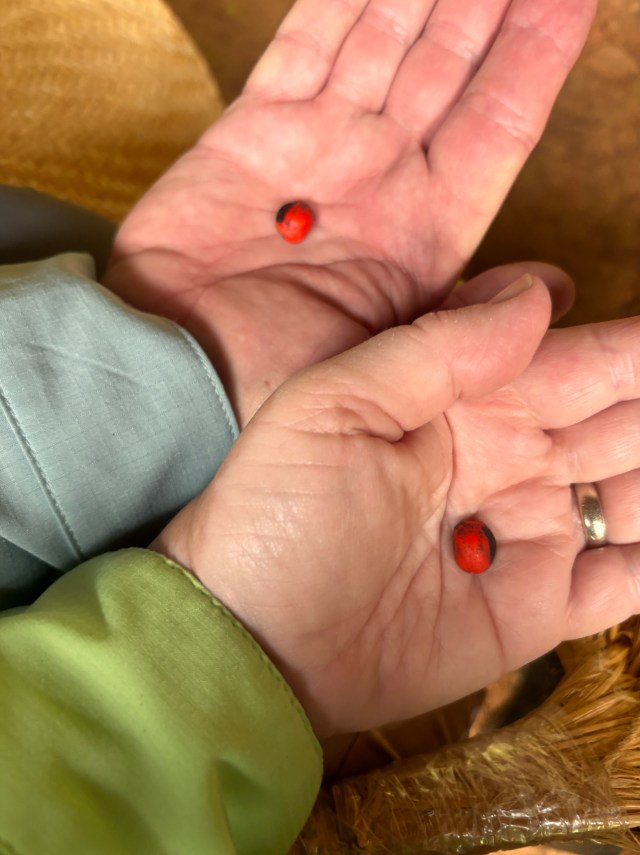
But first, I needed to spend my remaining Peruvian soles.  The amount was equivalent to about $60 USD so I went shopping in the airport gift shop.  It was my birthday after all.  I ended up buying a small Peruvian nativity scene to go with others I have collected from our travels.  I also bought a pair of earrings using the same type of red lucky beans we had been given in the Amazon.

In the end, I took out the credit card to buy one more item.  It was not to remember something we did in Peru, but something we won’t ever do. 

Rainbow Mountain, more accurately Vinicunca, is a 16,500 foot mountain somewhat near Cusco.  We saw signs for day tours to the mountain while we were in Cusco.  Enrique said he has taken people to Rainbow Mountain and only about 60 percent of those who try to hike it are successful.  That isn’t going to be me!

Our flight was uneventful and we were met by William, our new Avalon guide for Ecuador.

We had registered our trip with the US State Department and had received reports about fires in Quito.  The fires were in the national news in the US as my cousin contacted me saying she hoped they wouldn’t derail our trip.

The fires were still visible although the situation had greatly improved.  Apparently, the fires were set by an arsonist.

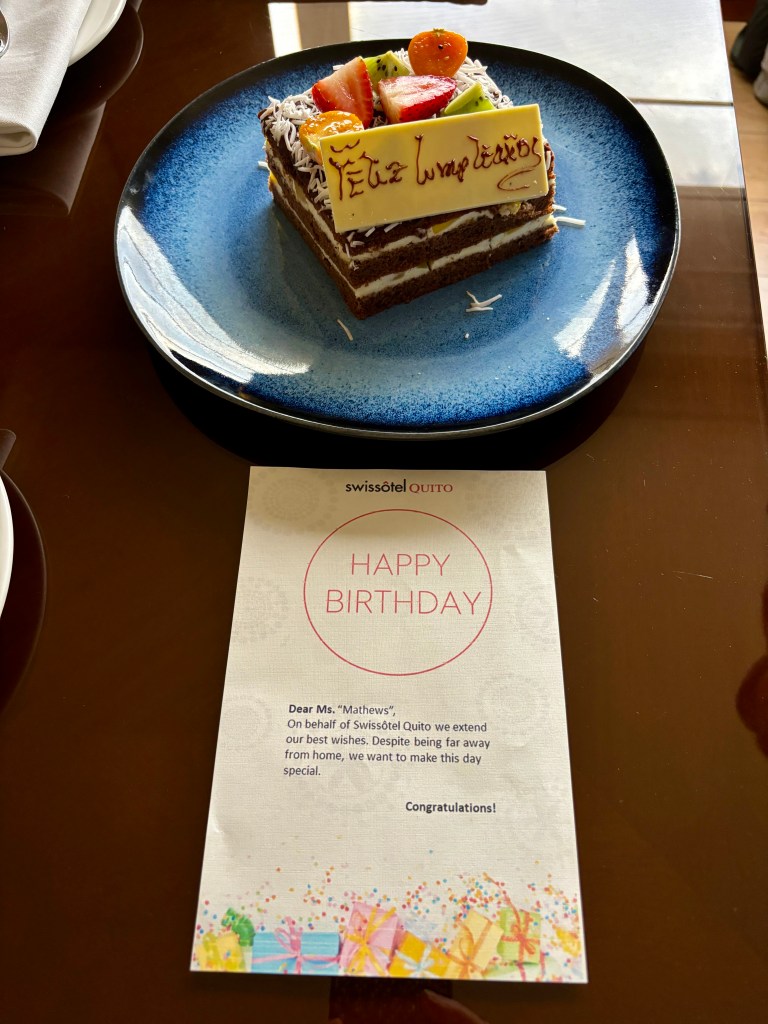
We arrived at our hotel and were surprised to find chocolate covered strawberries and a large slice of birthday cake!

A couple hours later all twelve of us joined together for dinner by choice – even when we didn’t have to! We really did get along very well throughout the trip.

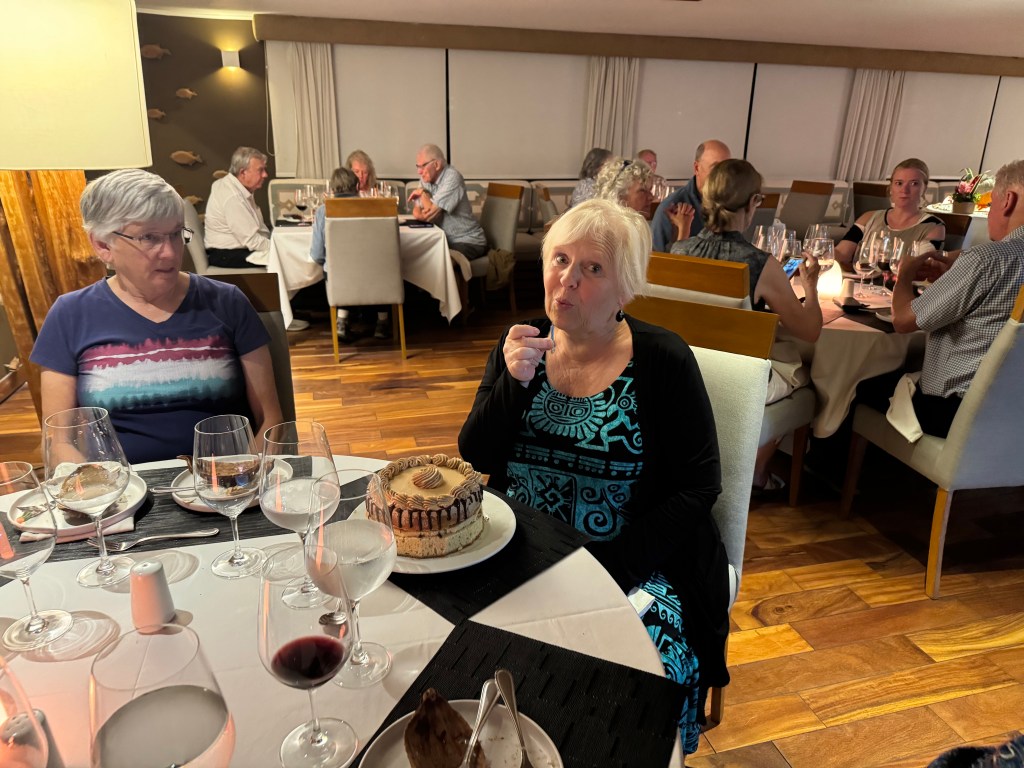
Someone told the restaurant staff that it was my birthday and it got celebrated again!   Enough already!

We arrived in Quito, Ecuador on September 25, 2024, my birthday.

Posted in Uncategorized | Leave a comment

Peru: Amazon Village

We opted to skip the first activity of the day – another jungle walk in the Amazon and stay on the Delfin III for the morning.  We were guaranteed to get hot, muggy and tired in the heat and not guaranteed to see monkeys, sloths, snakes or spiders.  We were happy with our choice as we stayed cool and comfortable in the lounge.  It seemed as though we had the ship to ourselves with just a few remaining crew.  After a while, a few more passengers wandered up to the lounge but we all seemed to be enjoying the quiet and solitude.

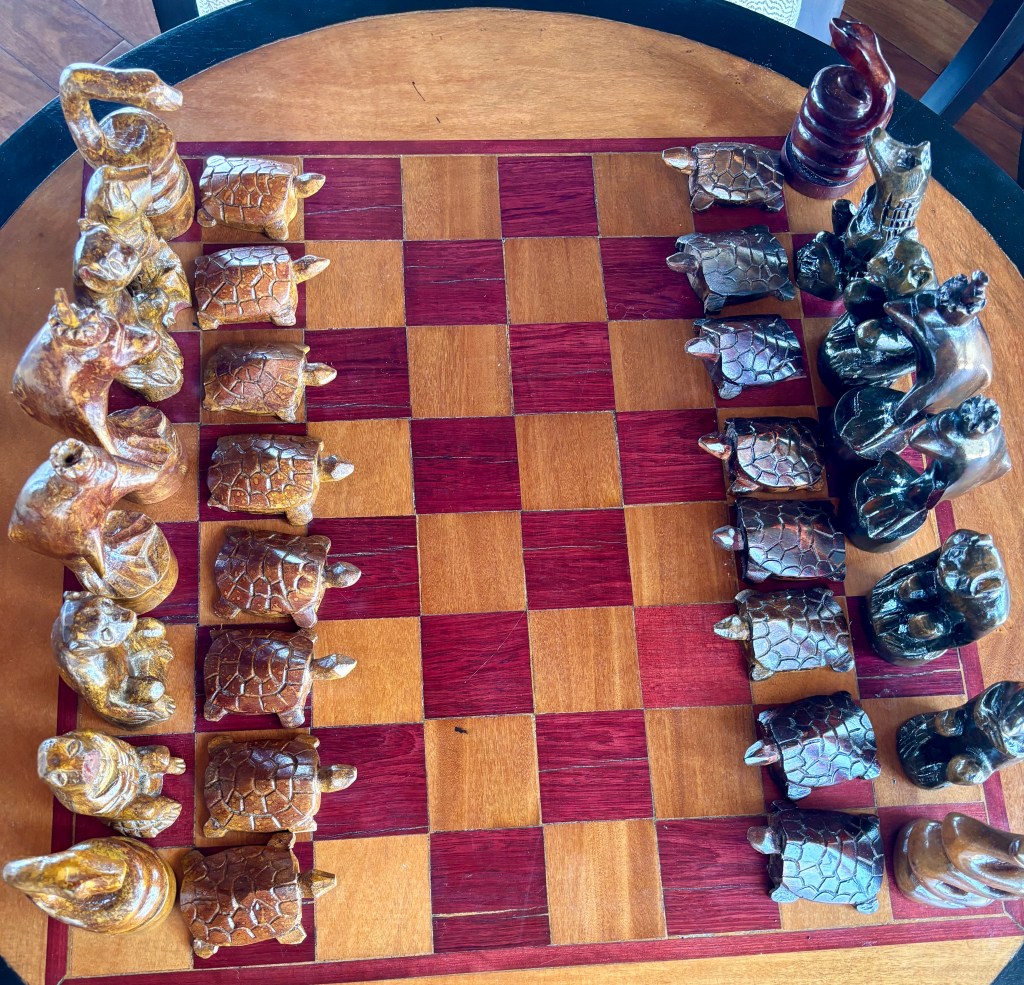
There was an Amazon themed chess board ready for play.

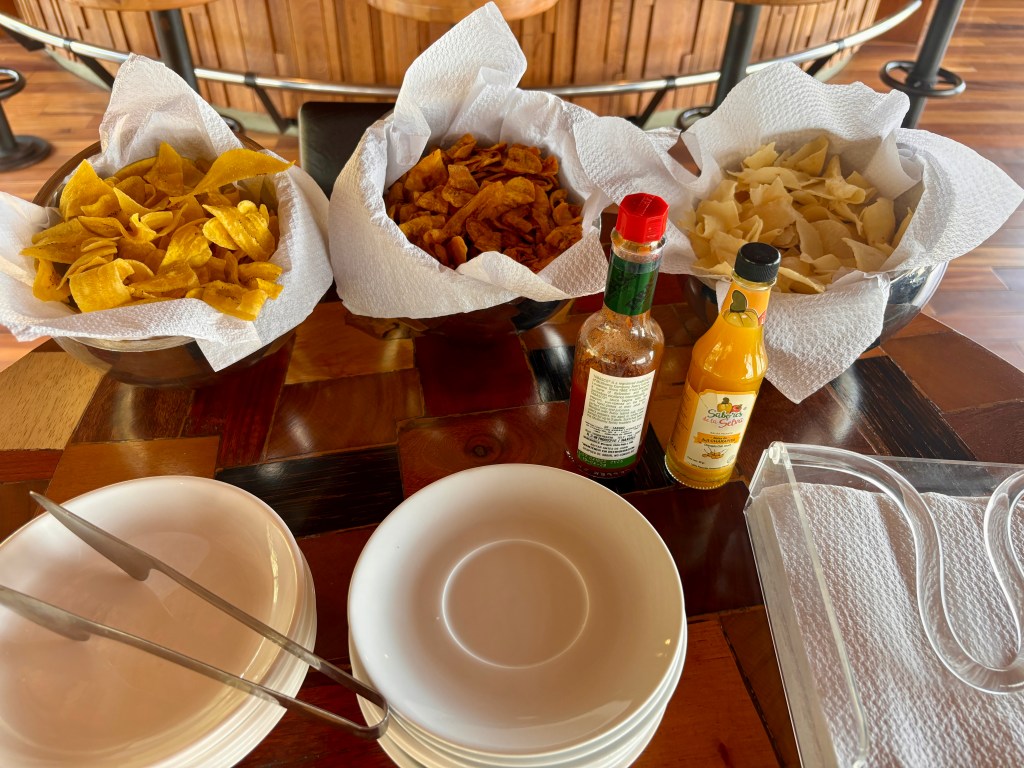
There were three types of plantain chips ready for snacking. 

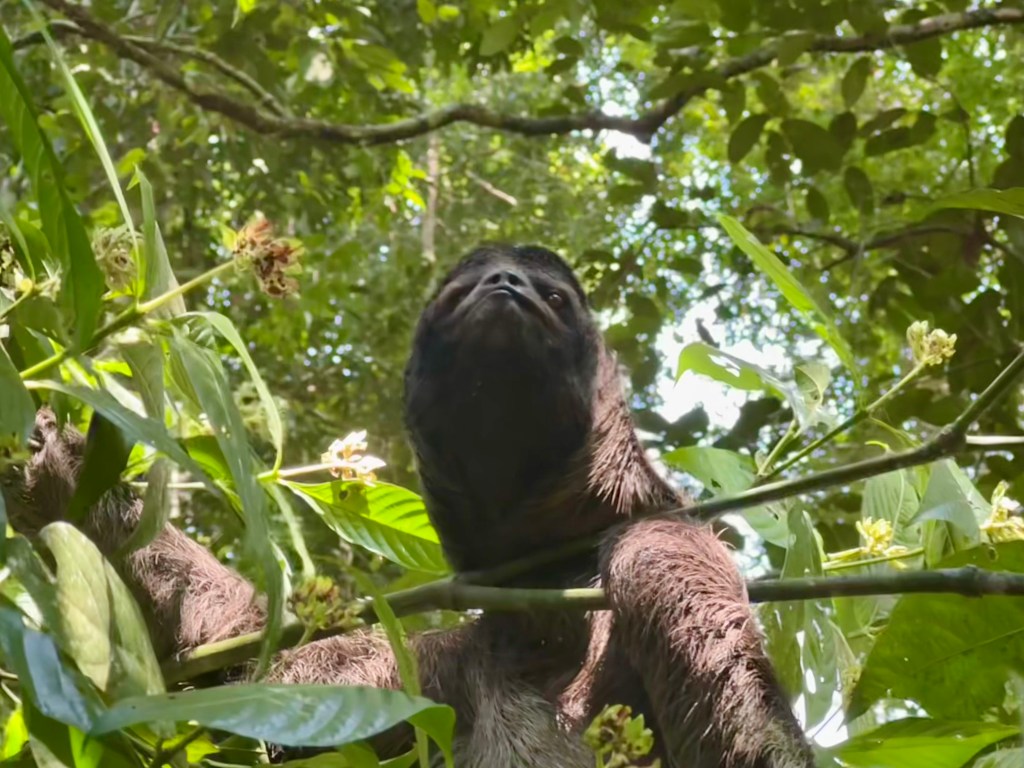
When the hikers returned, they said it had been hot and muggy but they did see a sloth and a tarantula. Someone shared their pictures of the sloth.

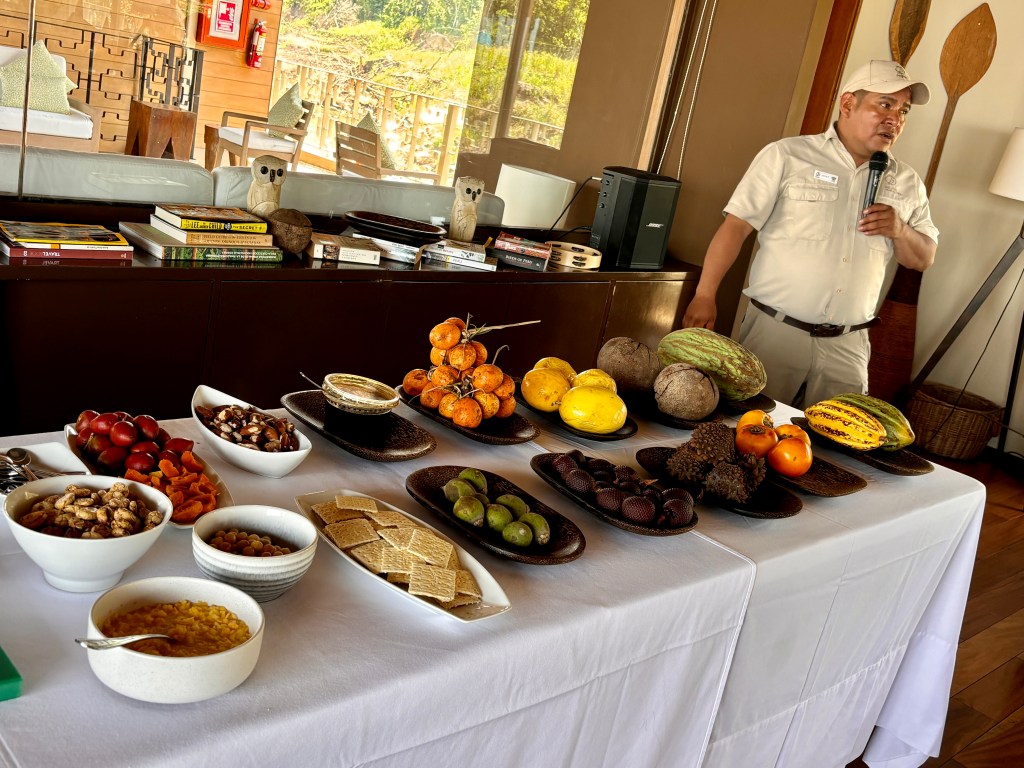
After they had a chance to clean up, the next activity was a Fruit of the Amazon presentation.  There are 170 species of tropical fruits in the Amazon region!

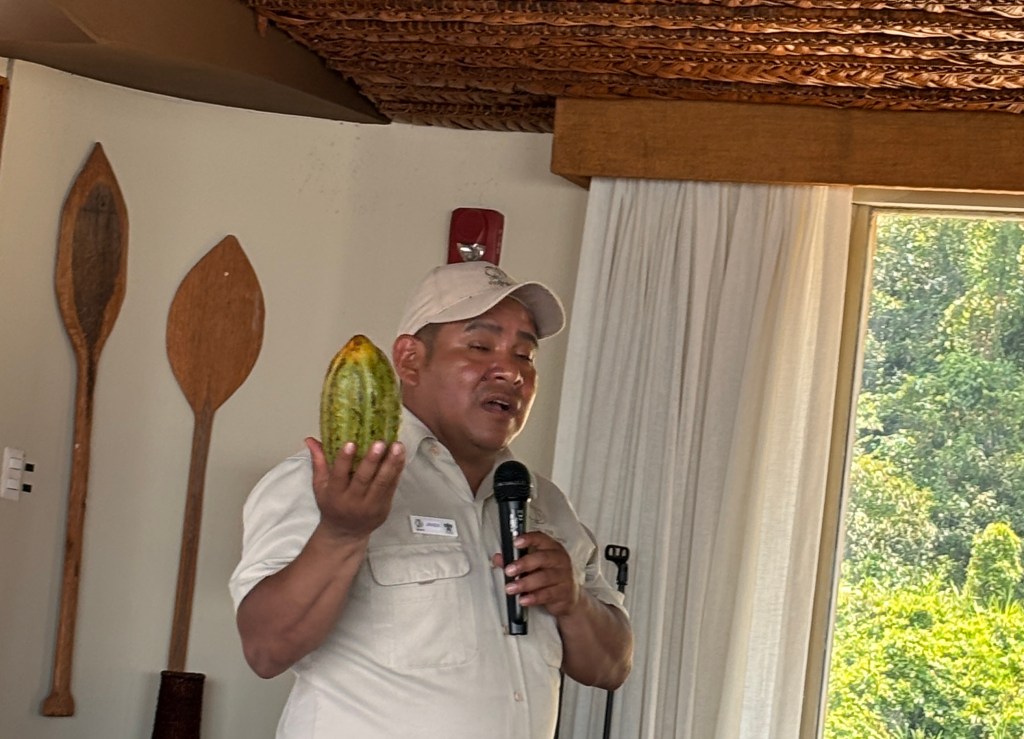
This large green fruit – macambo – is a relative of the cacao bean but evolved differently in the Amazon.  The white colored pods can be roasted and have antioxidant value.  The type of cacao  for chocolate  was developed by the Mayan culture in Mexico. 

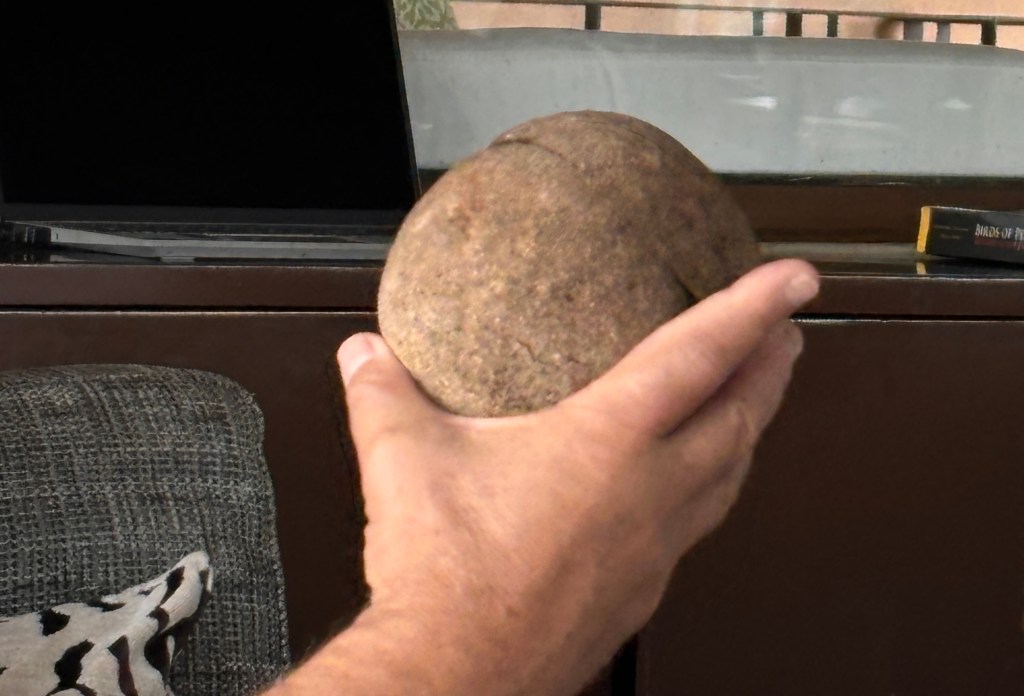
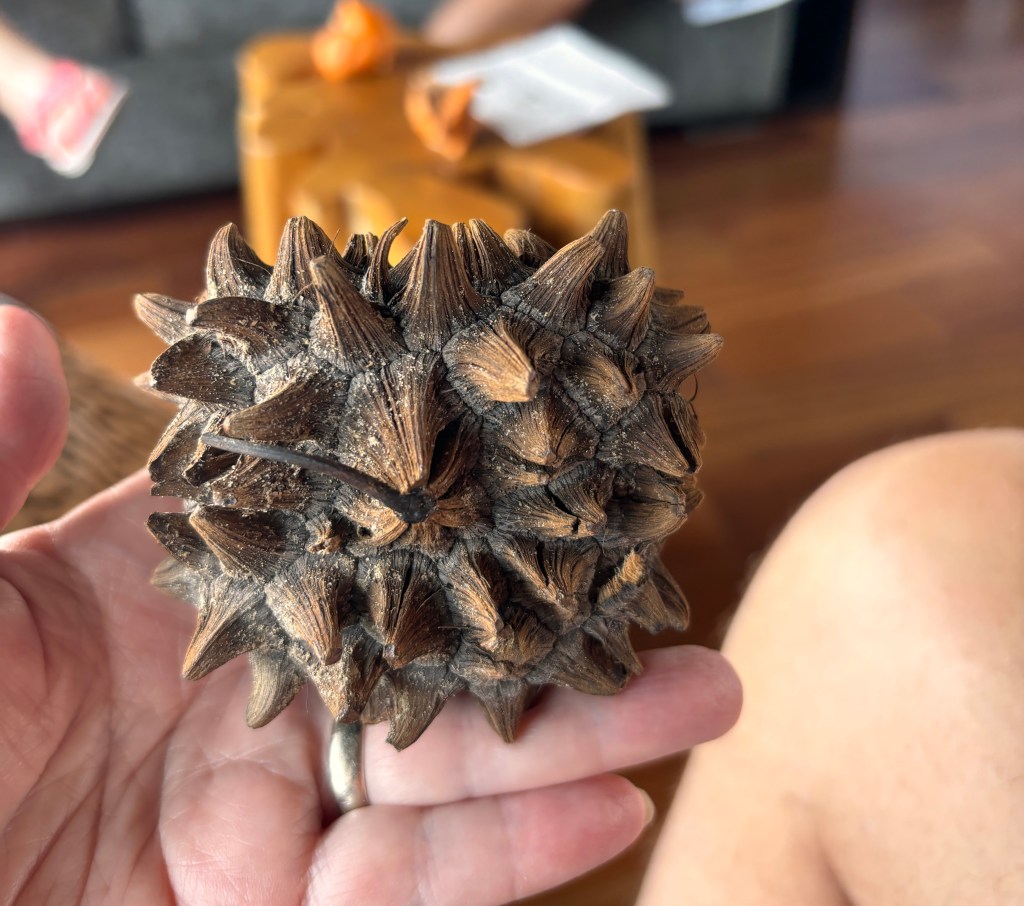
This is a Brazil Nut outer shell.  Brazil nuts are mostly attributed to Brazil but they grow all along the Amazon. A native rodent, the agouti, can break the shell and uses the nut as a food source.

This is a brazil nut shell that has been cut.  The nuts we are familiar with form inside this shell.

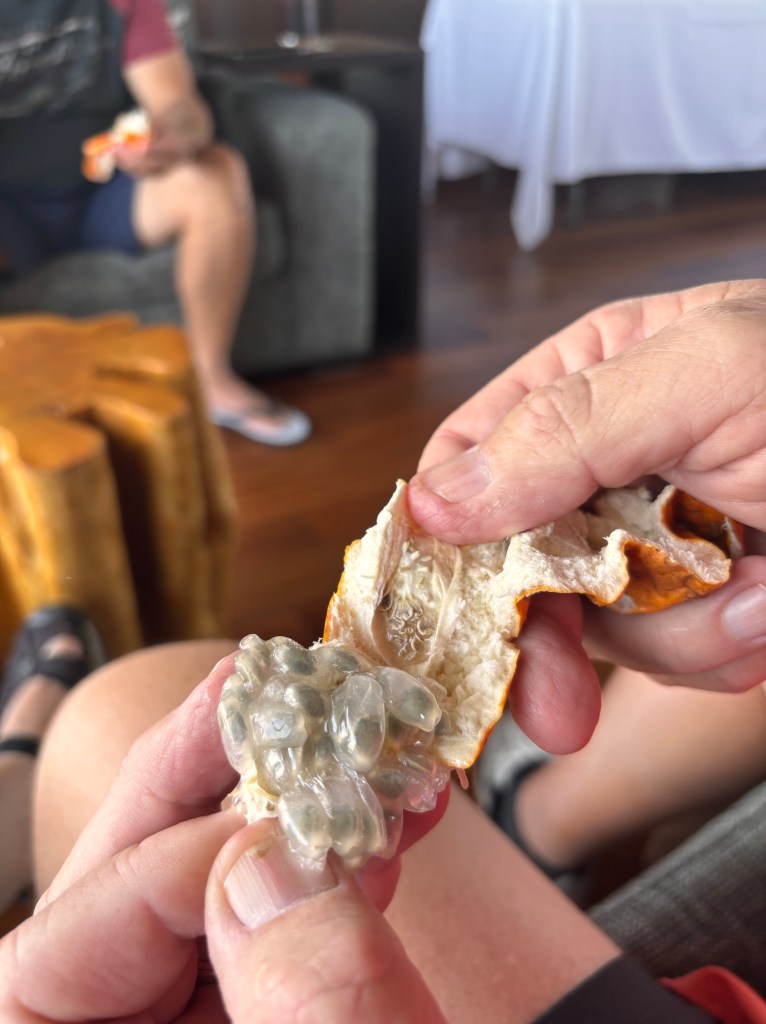
White grenadilla is a fruit in the passion fruit family.  It is sweeter than the passion fruit we are used to.  It has an interesting texture and neither of us cared for it.

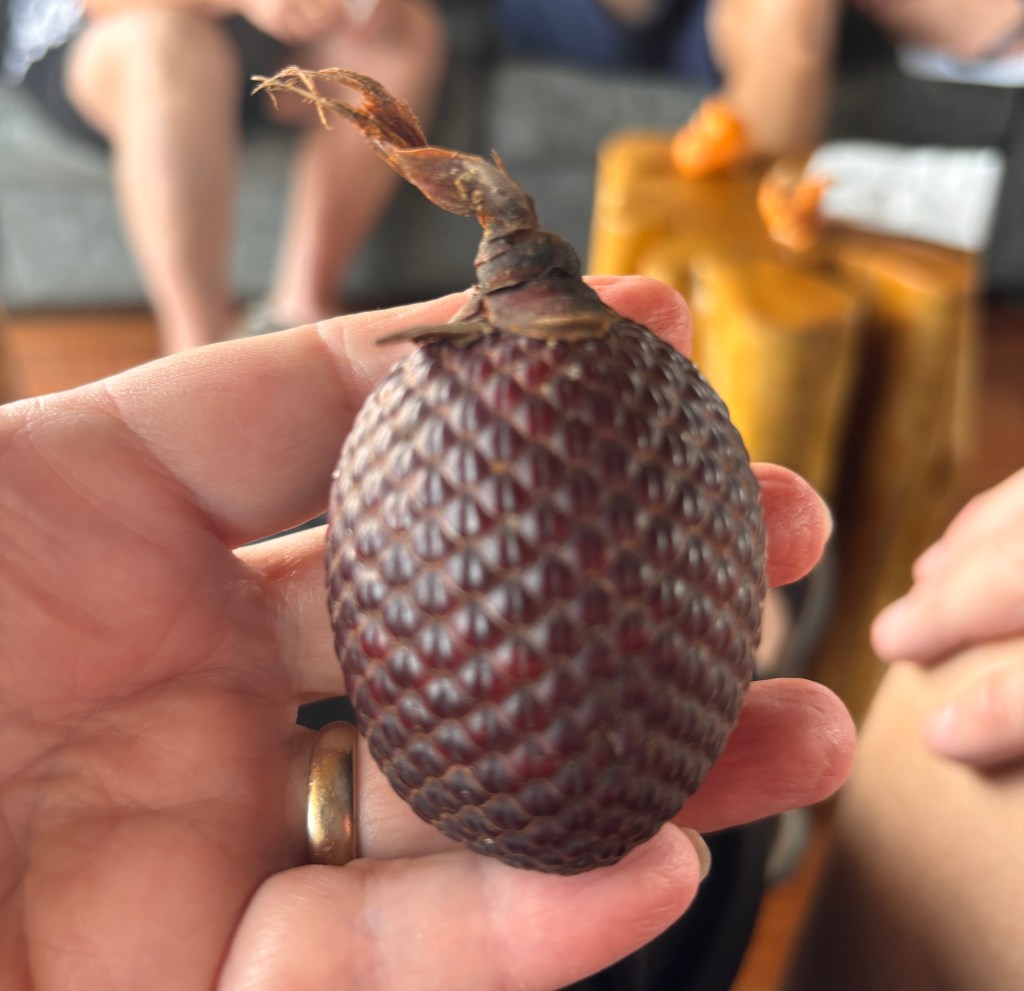
This is aguaje palm fruit.  It has twenty times more vitamin A than carrots. Macaws  eat them. 

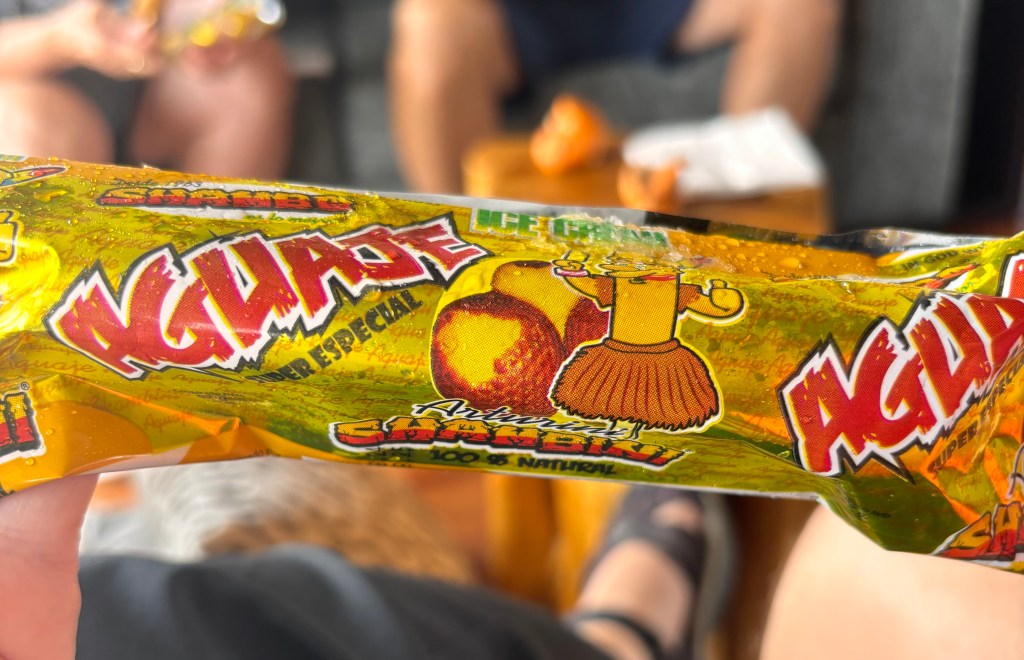
We had aguaje in popsicle form.

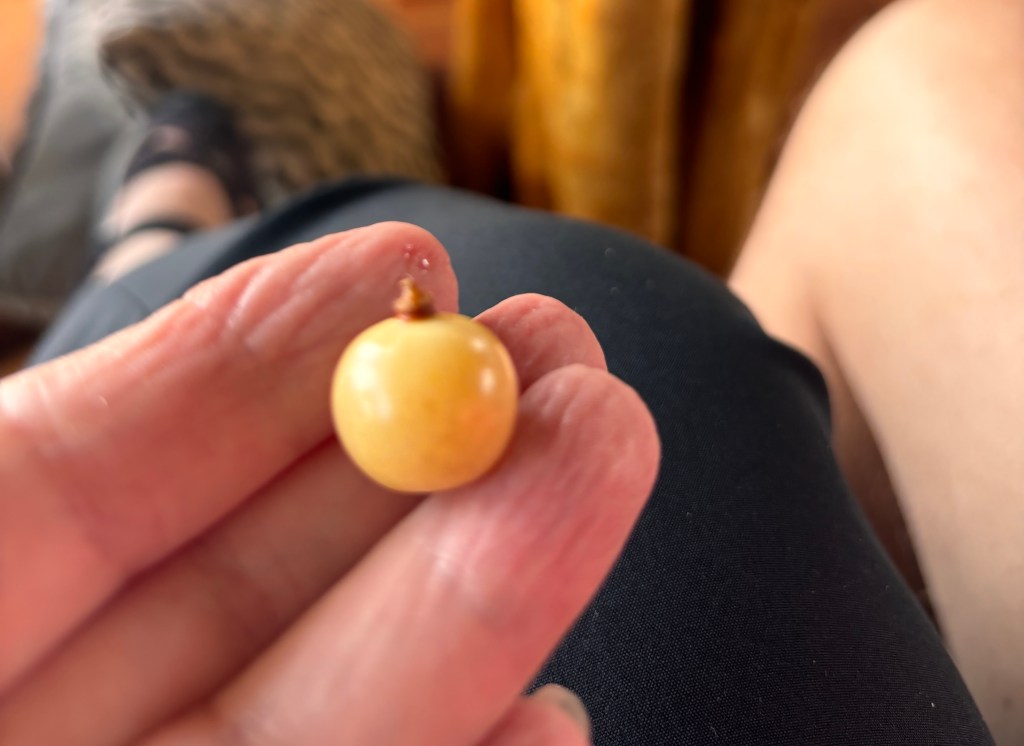
I don’t know what fruit or nut this is, but it sure looks interesting!

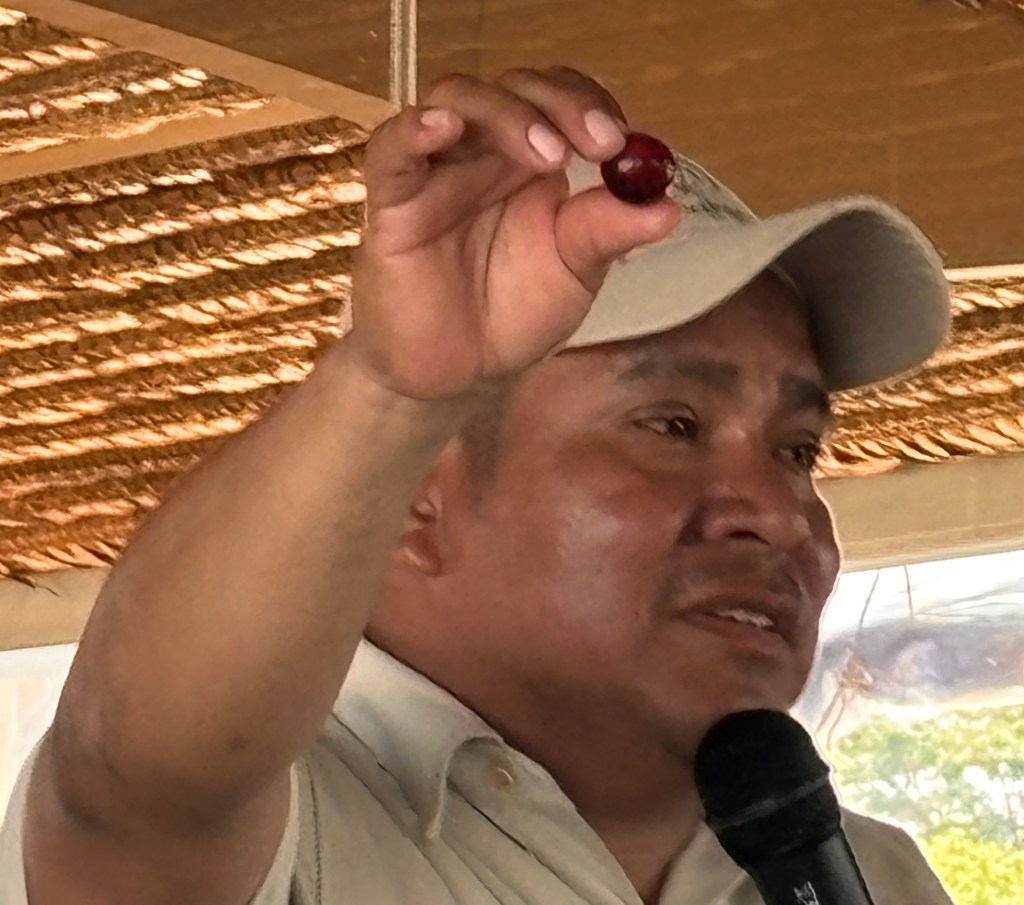
The camu-camu is good as an antioxidant and for anti-aging. It is often consumed as juice.  

This is a type of tomatillo.  Eat ten a day to reduce your cholesterol levels.

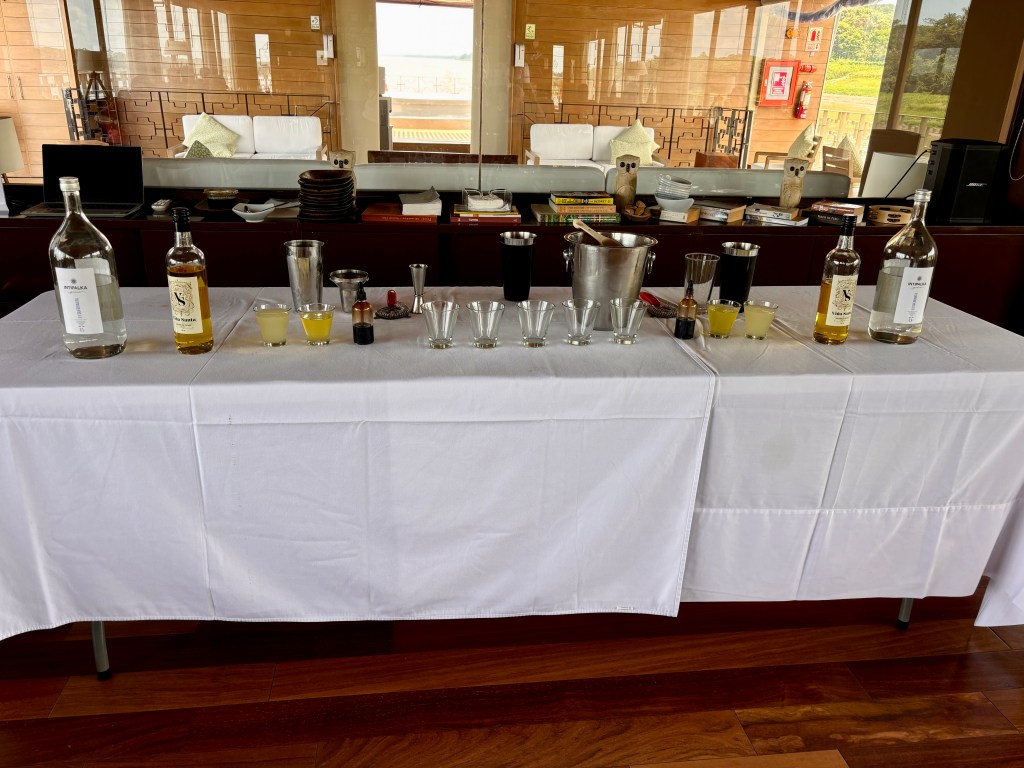
Then we had another Pisco sour demonstration with all of us participating in the shaking part.  I think it was our third time learning to make the national drink!

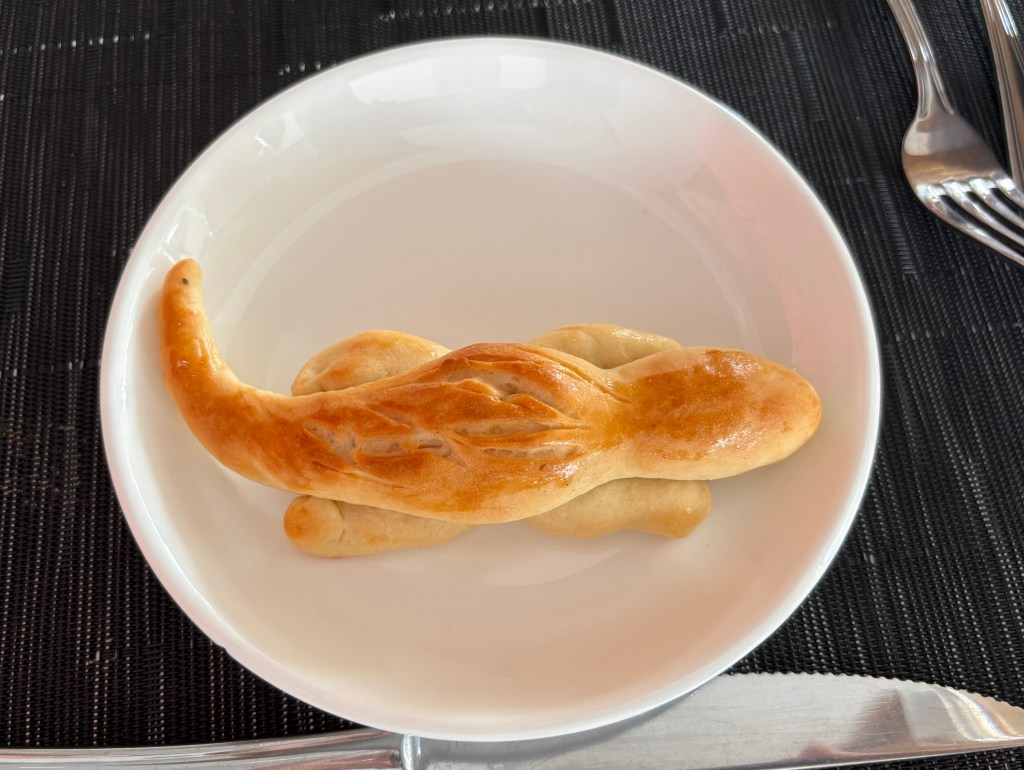
Lunch followed and included the bread art of the day.

The next activity was an excursion to an Amazon village to learn about their lifestyle.  That was worth braving the heat and humidity in my opinion.

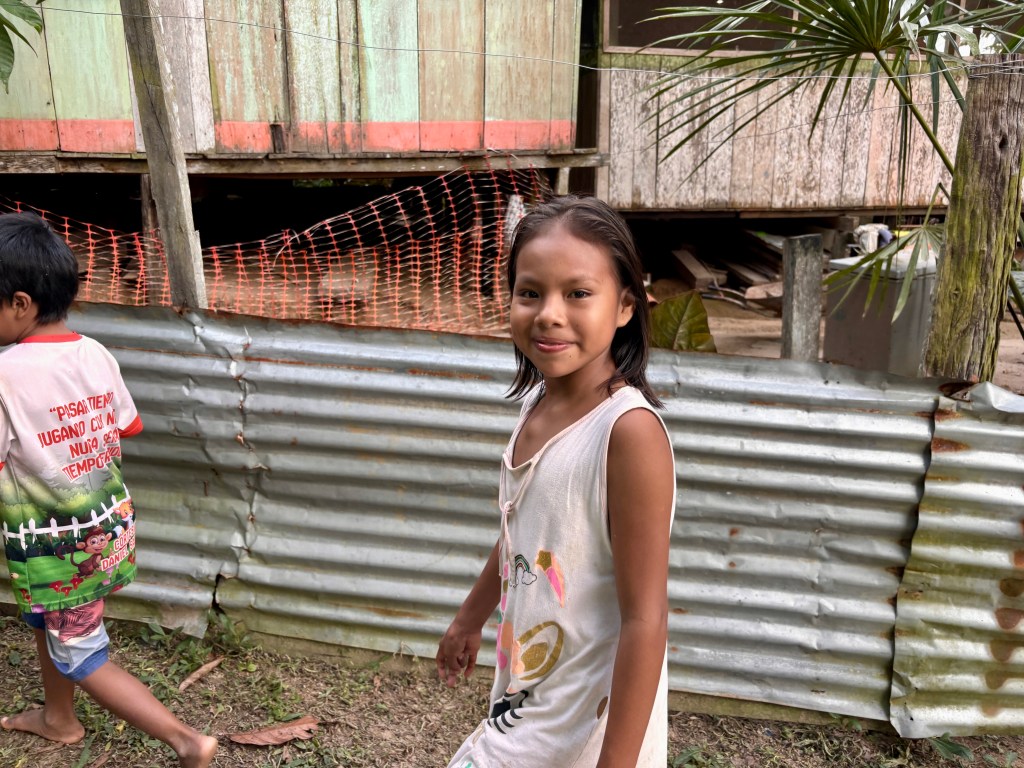
A group of kids met us at the boat dock.  They are familiar with tourist visitors.  Avalon suggested we bring school supplies as gifts and several of us had done so.

Our first stop was to a village kitchen where two women were preparing a meal for their families.

Fish, free food along the river, is always on the menu!

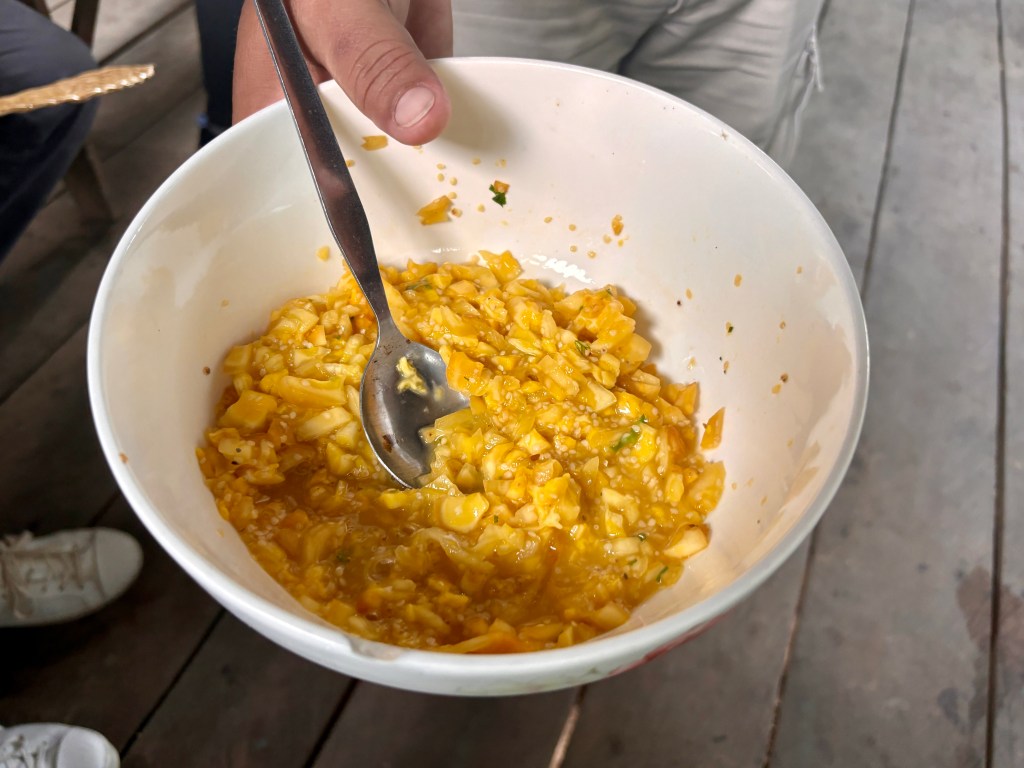
I do not remember what this food was but I think it had a banana base.

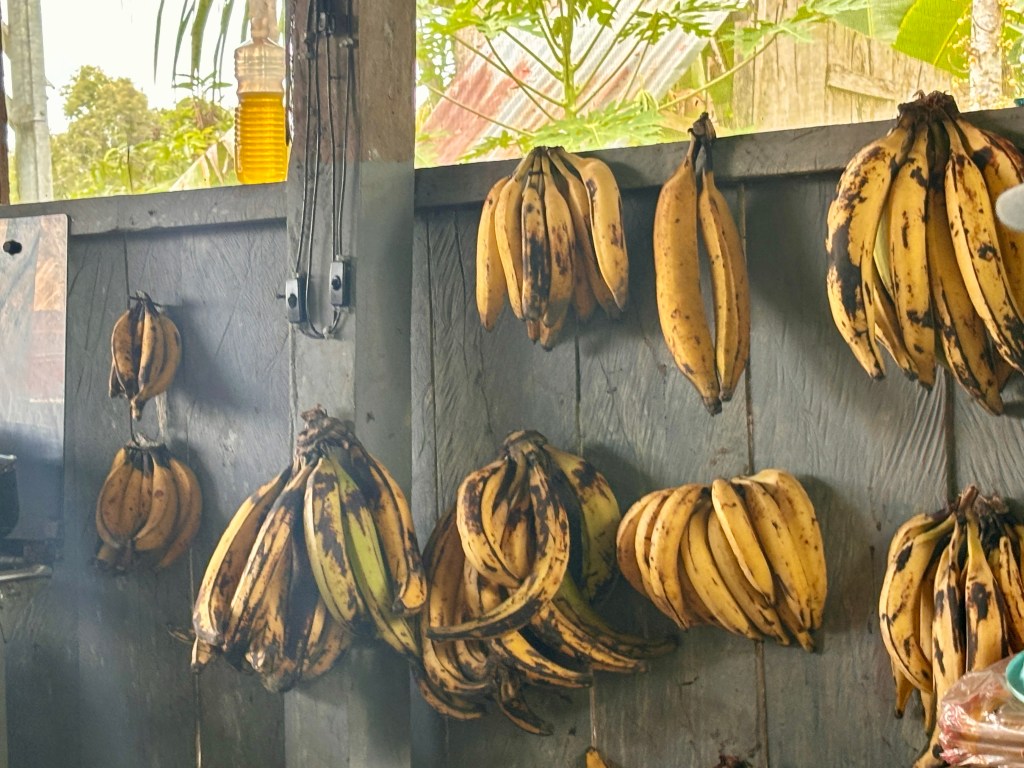
Bananas are used in every stage of ripeness with the ripest becoming juice.

I also don’t recall these foods.  The setting was intimate enough that taking notes didn’t feel appropriate.

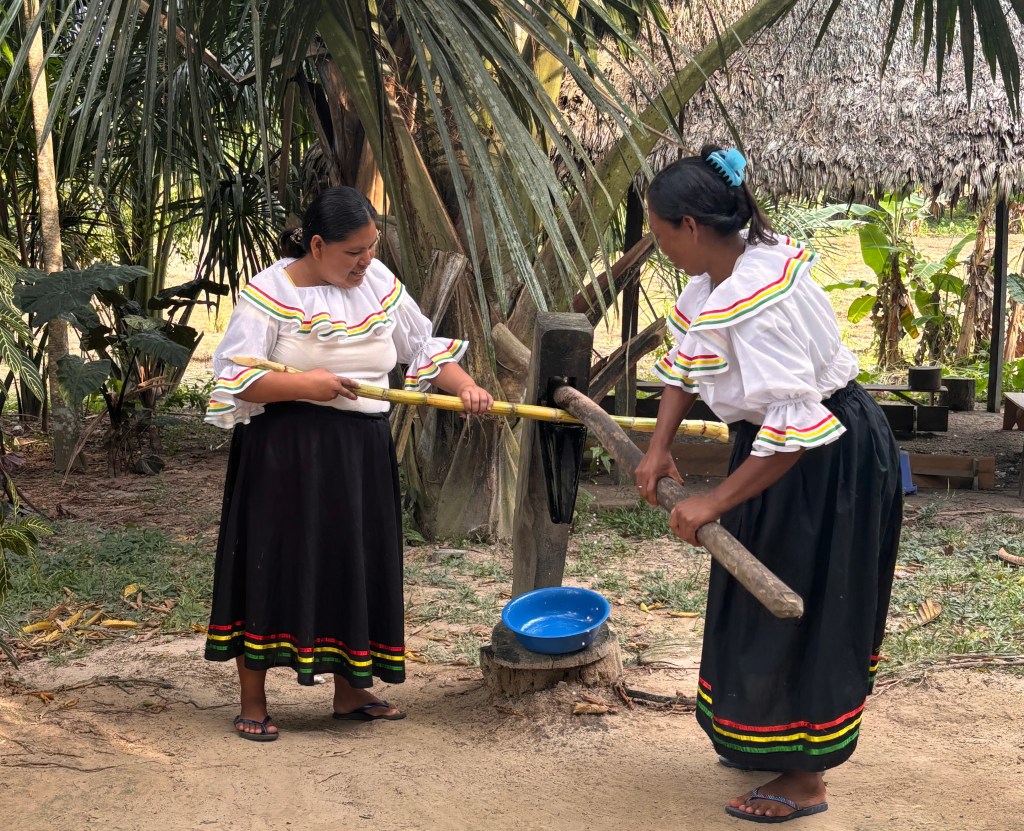
These women were demonstrating how they get juice from sugar cane.

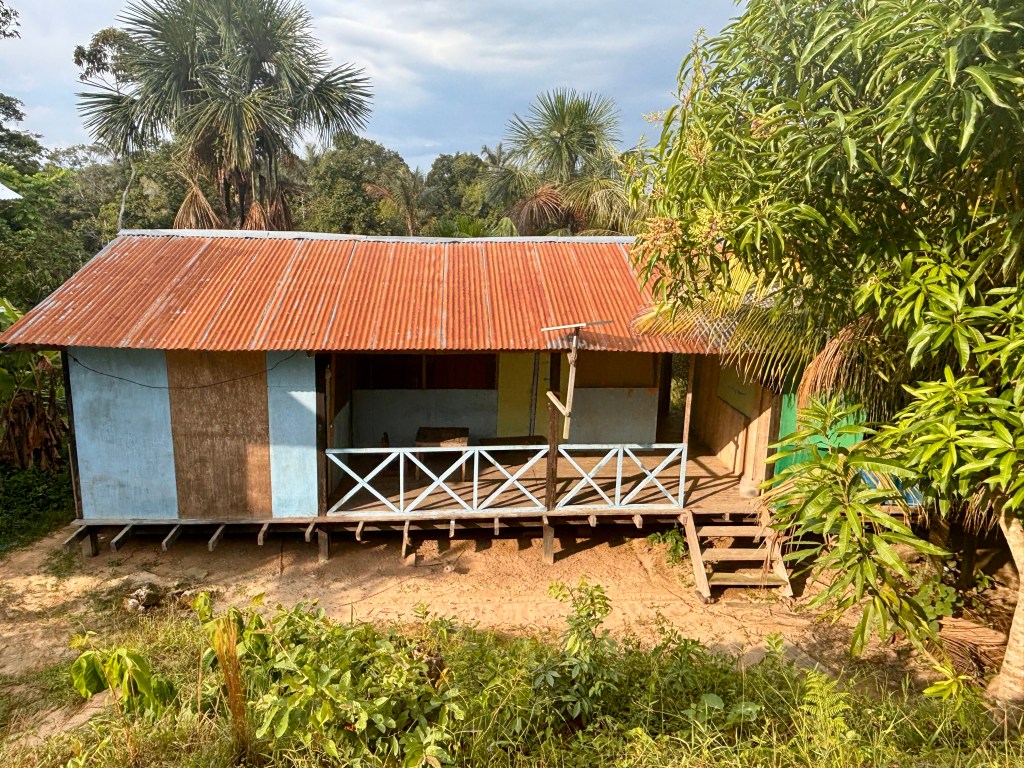
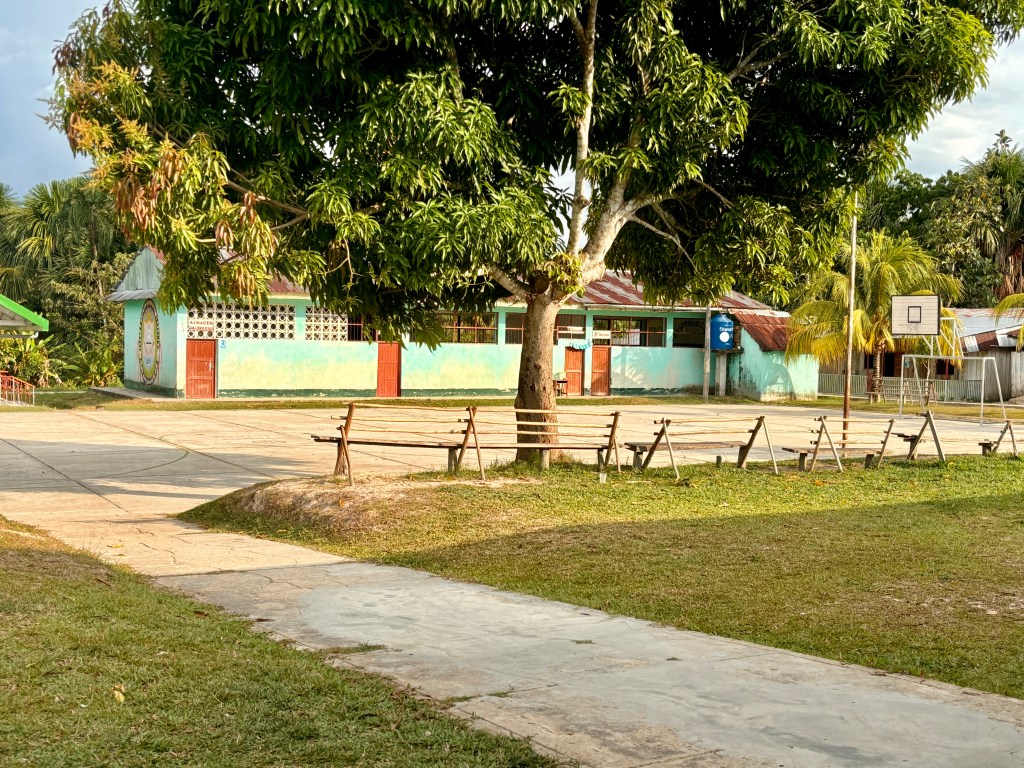
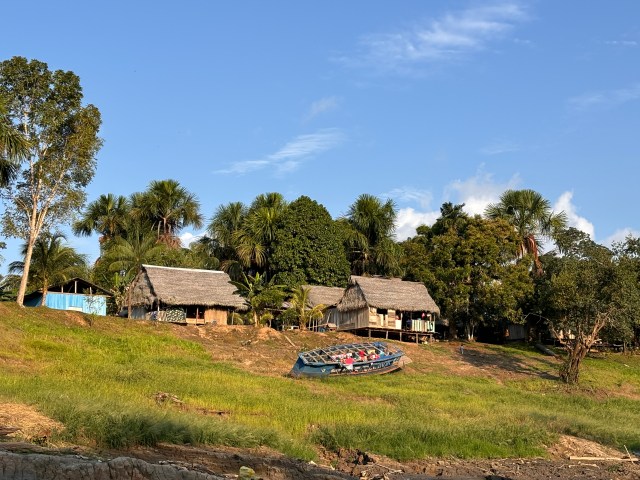
This is a typical home in the village.   

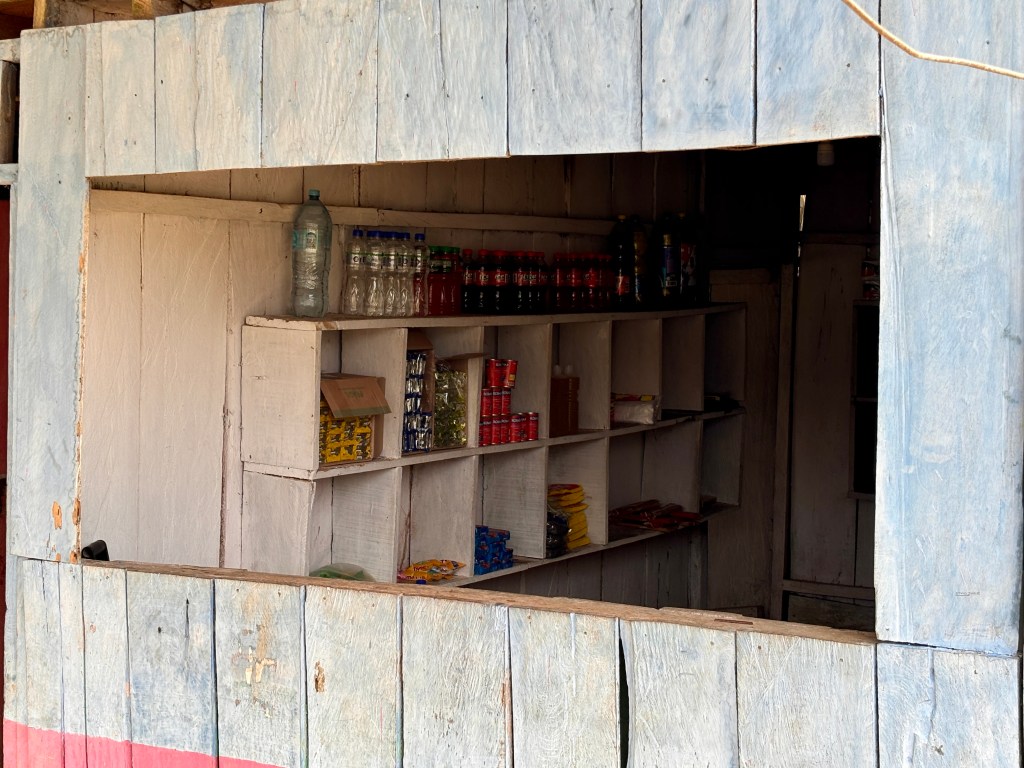
We saw this open shop but no one was minding the store.

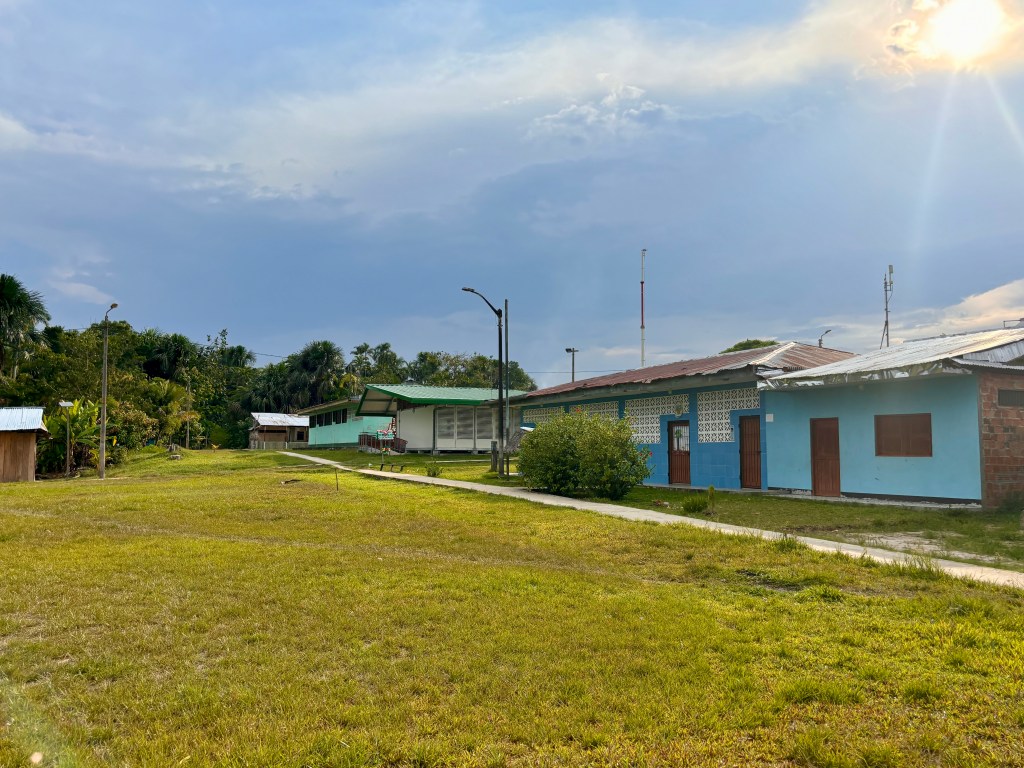
This is part of the central area in the village.  Peruvian government would have paid for the infrastructure.

The government also supplied the community with a generator and Wi-Fi capability.  The community has to pay for the fuel to run the generator. Typically they have electricity a few hours each week.

There are three school buildings generally equating to elementary, middle and high school groupings.

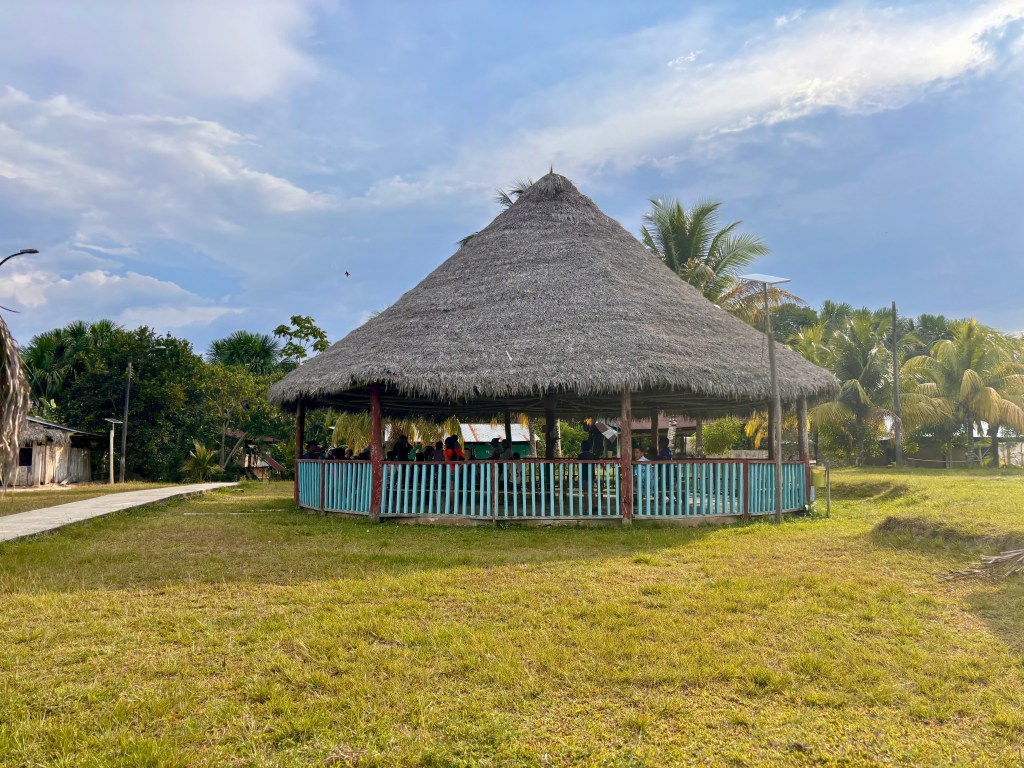
This central pavilion was our next destination.

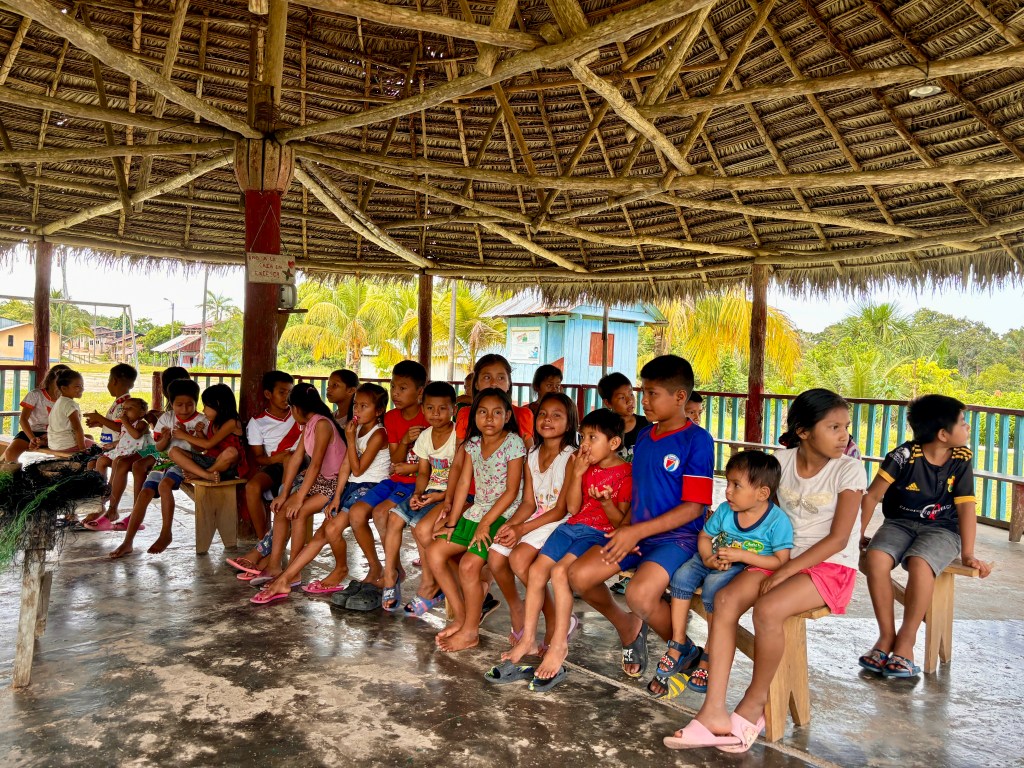
We found kids!  They were remarkably well behaved while we were receiving instruction from one of their teachers.

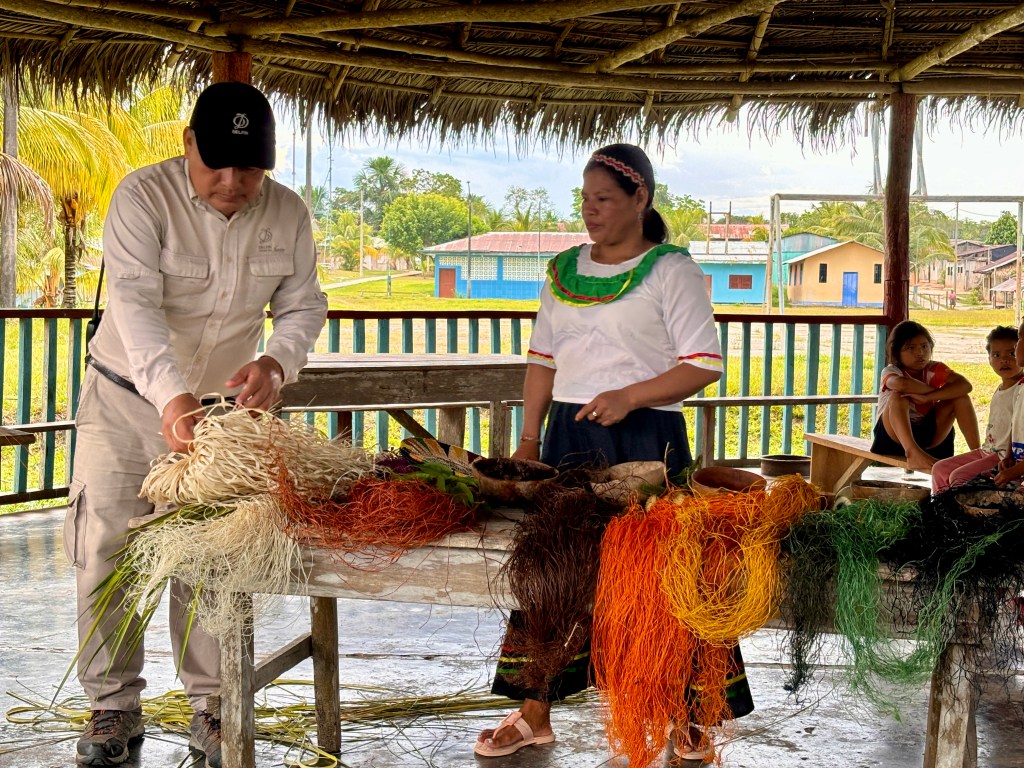
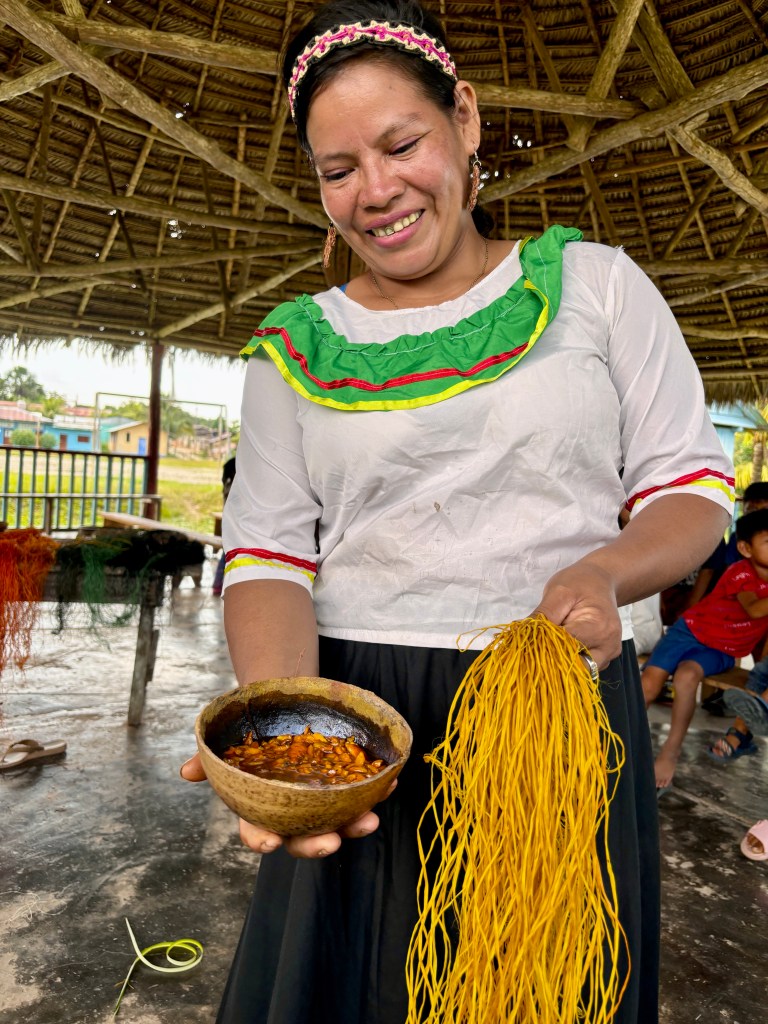
We learned about collection and drying of the fiber used for weaving.

We learned about which plants are used to achieve various colors.

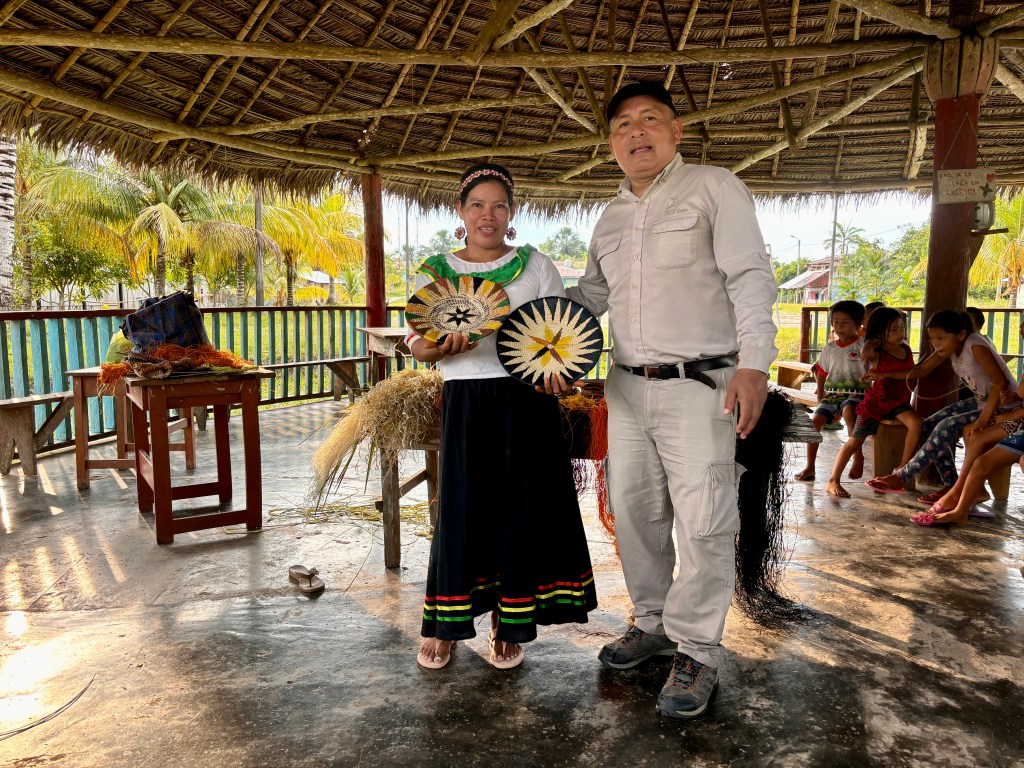
It takes her three days to weave a small basket. 

I bought the one on the right for the asking price of about $13 USD. 

Obviously this village is right off the river and open to receiving tourist guests.  This was not the Amazon village one might have seen in National Geographic decades ago.

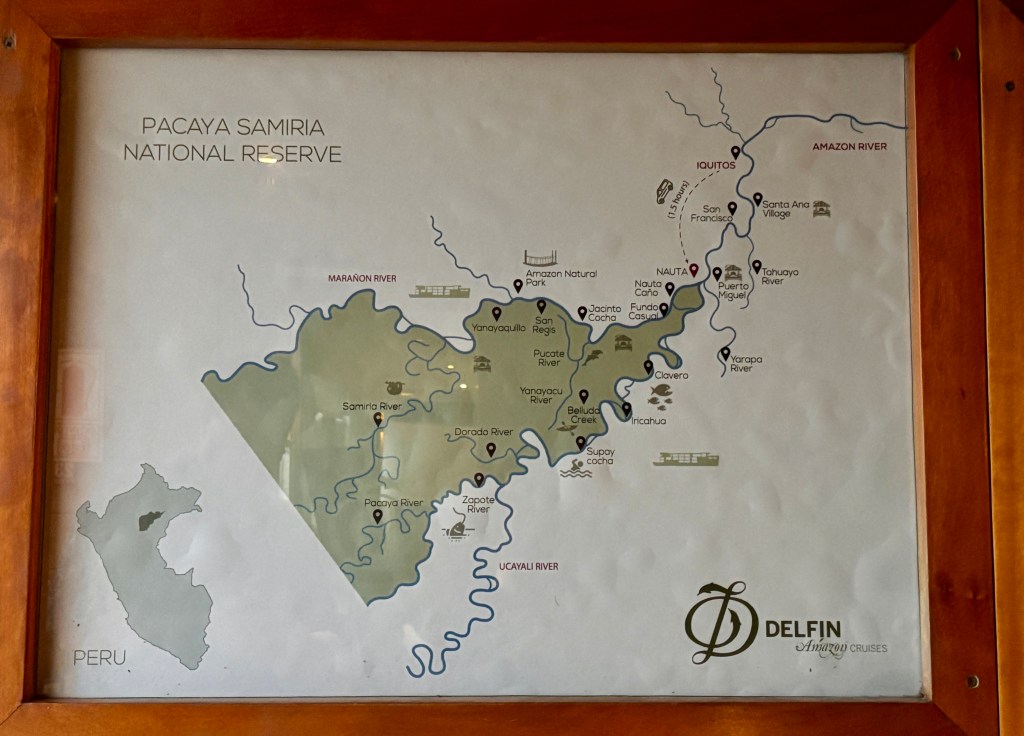
This map was posted to show us that on some of our Amazon journey we ventured into tributaries.

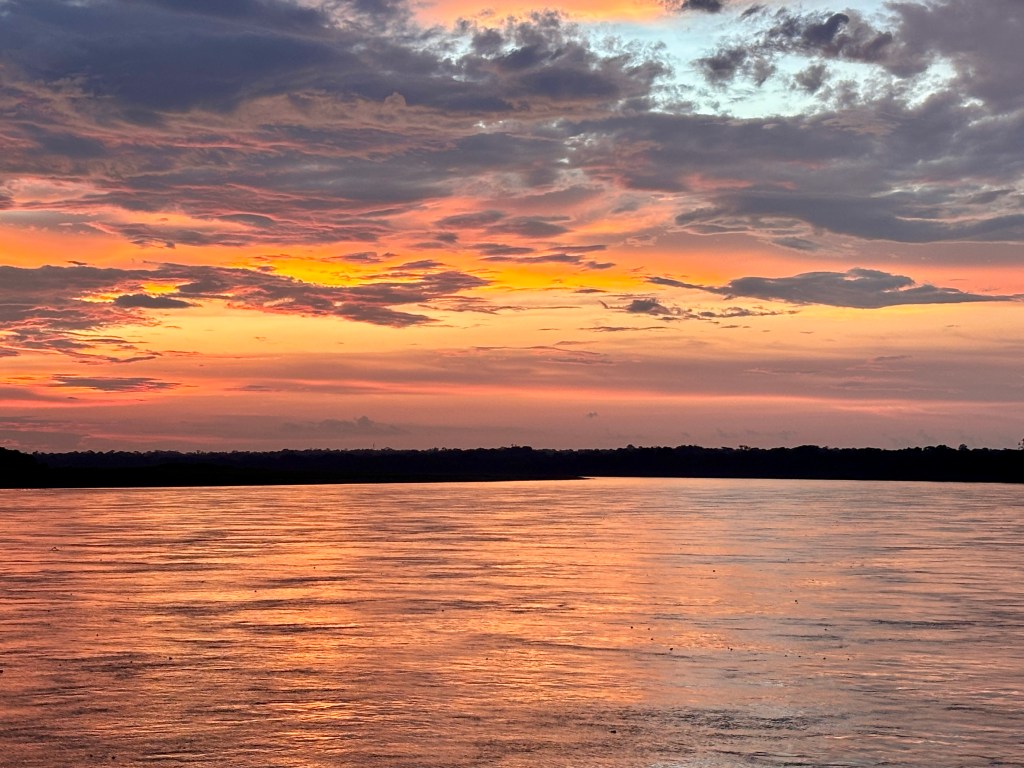
We had another beautiful sunset along the Amazon – or one of its tributaries.

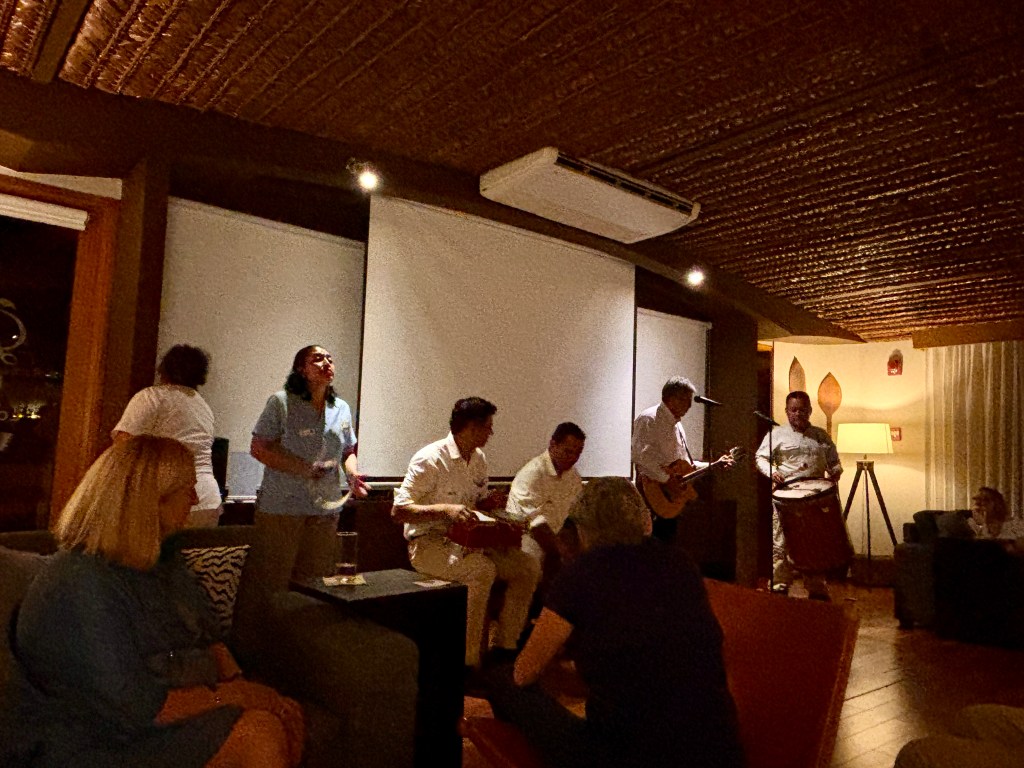
This being our last evening on board, we had a chance to see all the crew dressed up and to thank them for a job very well done.

A few even gave us an American music concert!

After dinner, the chef and waiters acknowledged two passengers having birthdays in a day or two after disembarking.  That would be me!

We were on the Amazon on September 23, 2024.

Next Up;  Sorry, not sorry, to leave the Amazon.  The boat was terrific but the weather was not.

Posted in Uncategorized | 1 Comment

Doing It All on the Peruvian Amazon

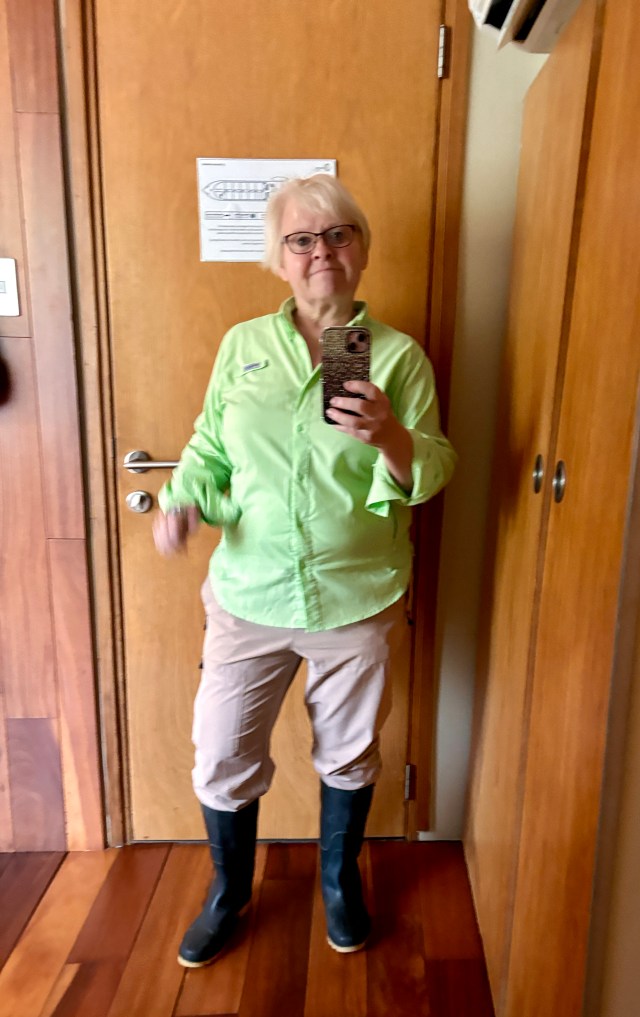
We had a 5:30 AM alarm 6:30 breakfast and then we were fitted with rubber boots.  

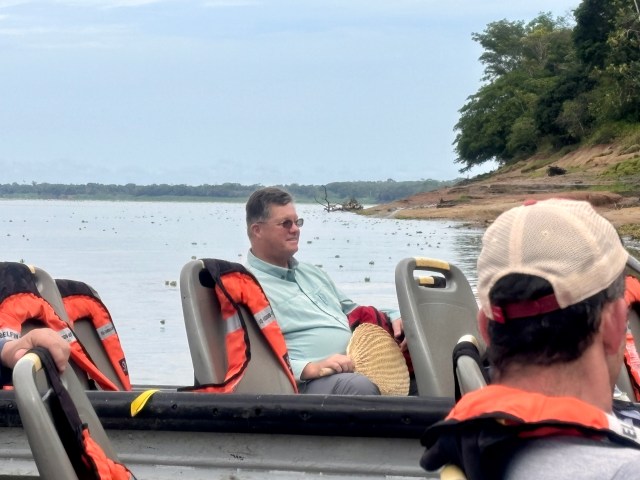
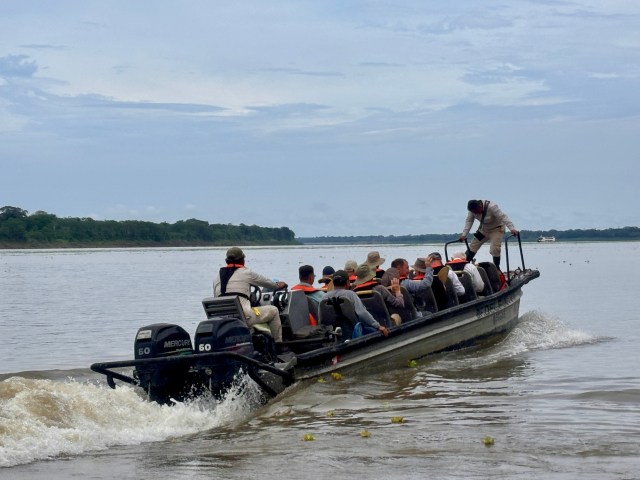
Then we embarked on a fifteen minute skiff ride to meet a local shaman.

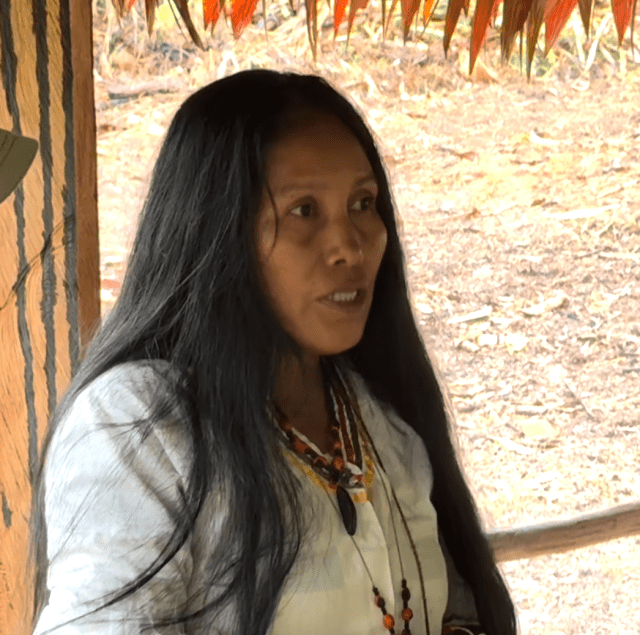
Karola is a Shaman.  She was selected at age 14 at an Ayahuasca ceremony.  She led a very restricted lifestyle and diet during her 8 years of training by her shaman grandfather. 

Ayahuasca is a psychoactive drink beverage, traditionally used by South American shaman and indigenous cultures.  It is used for spiritual ceremonies and healings.   The ceremony has gained popularity for people outside the Amazon area to experience as a cleansing or mystic event.  The drink is also used recreationally for its hallucinogenic properties by some North Americans and Europeans. 

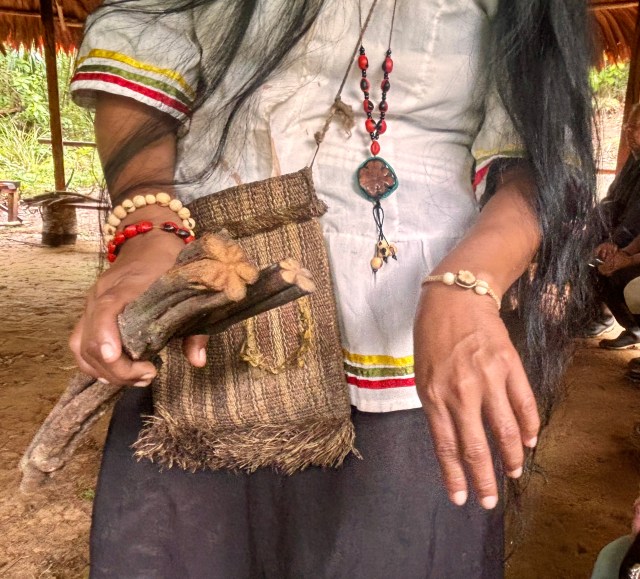
Karola is showing us the root of the plant by the same name. She also has a bracelet and a necklace containing a flat piece of the root.  

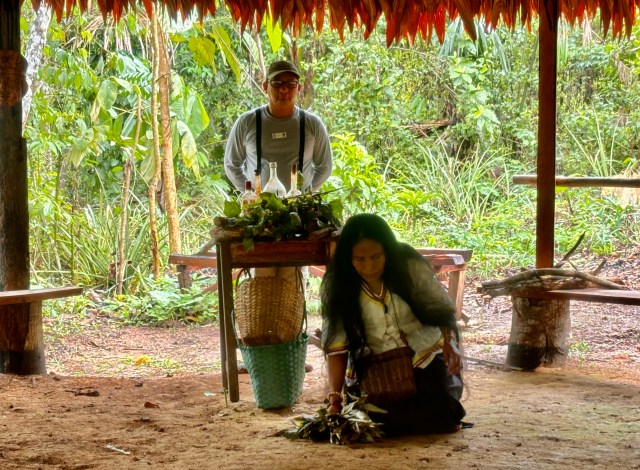
She also demonstrated the opening minutes of a traditional Ayahuasca ceremony.

As shaman, Karola uses plants to take care of nine villages in her region.  She travels to her patients if they can’t come to her.  Karola does not charge for her services but is often gifted back something grown or made by her patients.  She treated villagers during the Covid 19 crisis and none of them died.  

We were told 60 percent of all medicines originate with plants from the tropics.  

Karola is also a wife, mother of three, and co-laborer on their family farm.  She gave us each a lucky bean for good energy. 

We had all climbed up a muddy bank to reach the ceremonial shelter.  This route had a few steps and railings. We were told the upcoming jungle walk would be two muddy, hilly miles without supports.  

After being given the option to do the jungle walk or not Randy and I made different choices. Can you guess how?!  The only thing I can say in my defense is that more people opted to go back then to go forward on the jungle walk.

Will we see them again?

Instead of going right back to the ship, we enjoyed a skiff tour along the Amazon.  I was very happy with my choice!  They gave us water, Coke or Inca Cola, a very sweet local carbonated drink that tastes like bubble-gum.

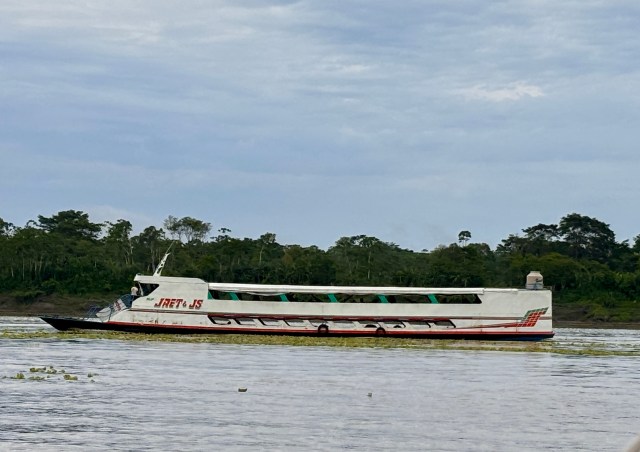
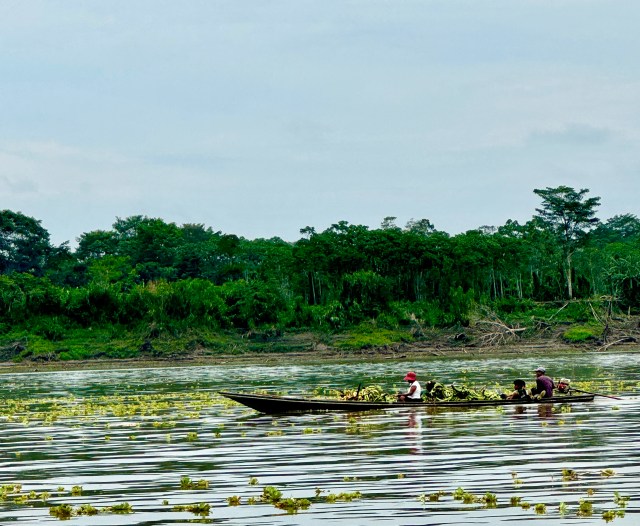
This boat is a water taxi for locals.

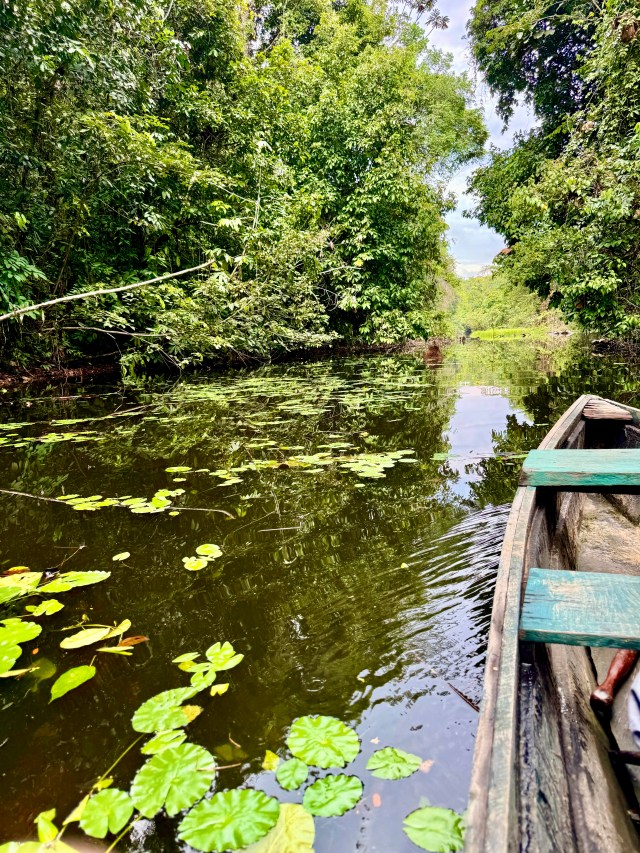
This is water lettuce.  It is a main food source for manatees.

Rice is planted and harvested cooperatively.  The plants get water from humidity.  It is harvested in November before the area’s flooding season begins.  The flooding brings silt full of nutrients.

Papaya, bananas and beans are also grown.  When harvested, the villagers take food to town to trade for salt, fishing line and machetes. 

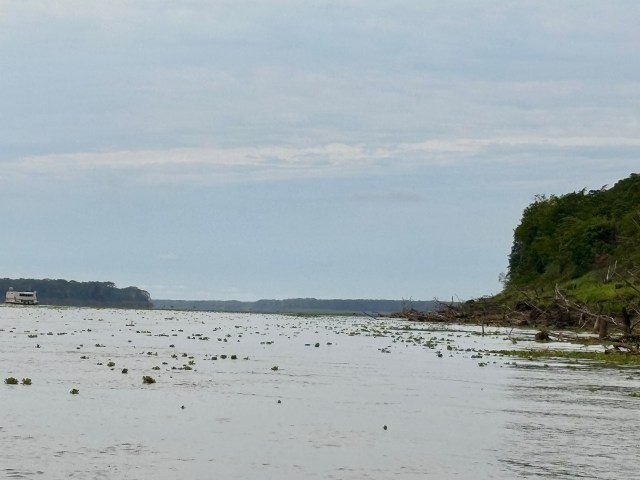
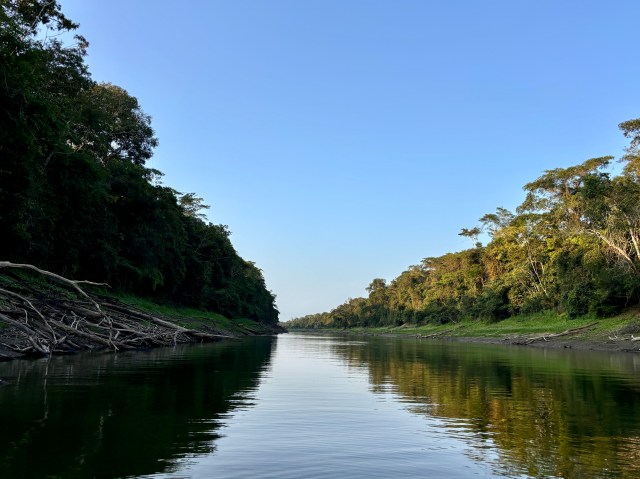
The river’s source is snowmelt from the Peruvian Andes.  In this area it is generally about 6-10 feet deep at this time of year.  Ships have to look for the slightly deeper channels.

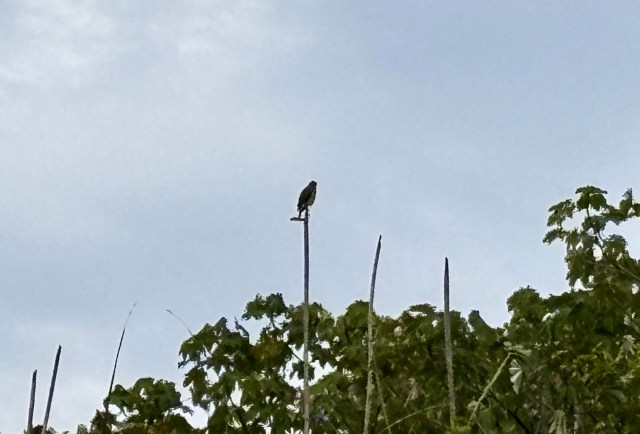
This is a Road-side Hawk, even though right now it is river-side.

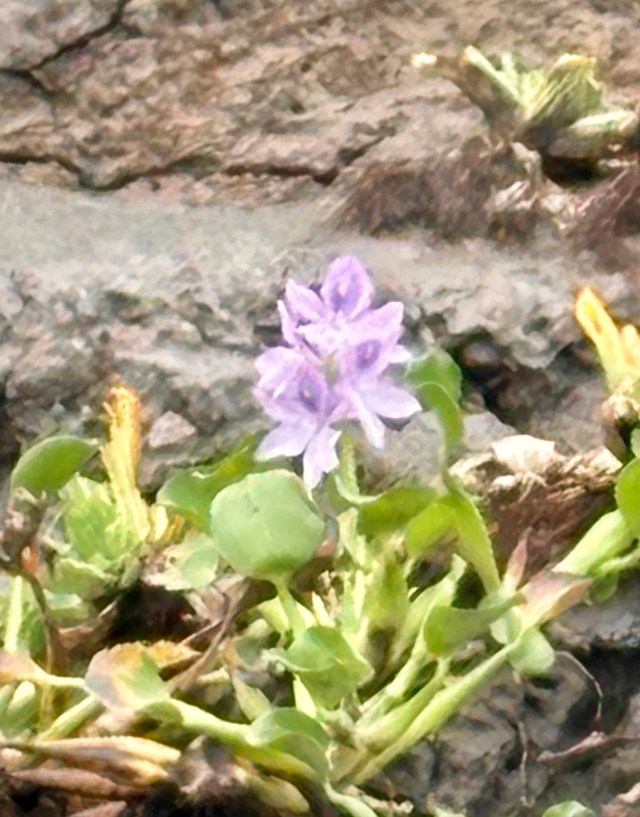
Water hyacinth, like the water lettuce,  is generally a floating vegetation.  

The fisherman is using an old refrigerator or freezer to store fish.

Our group made it back to the Delfin III. The ship’s crew had a system to remove our boots before stepping aboard.  They cleaned them before we would need them again – and keep the ship clean!

Randy enjoyed his hike in the jungle but he was towards the back so didn’t hear all the commentary.

He got some interesting pictures, even if we don’t know what they are about!

His guide was showing them the rubber on the rubber tree.  Randy brought a small piece back for me to see.

They made it back to the Delfin III hot, dirty, tired but alive.

After lunch we went back on another skiff ride. About one hundred people live in this community along the Amazon.

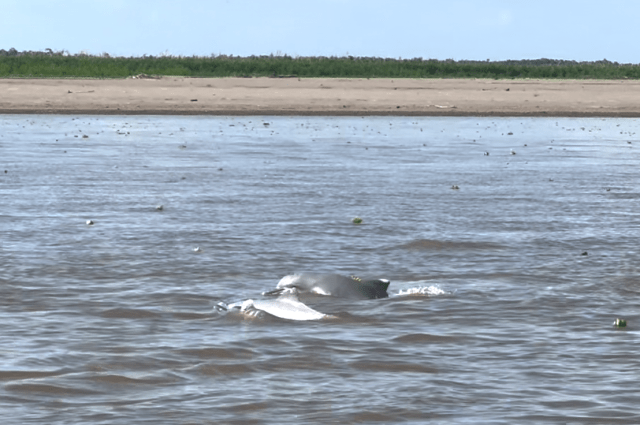
We saw some gray and pink dolphins but none of them gave us an opportunity for very good pictures. The pink dolphins we saw were not like the pictures I’d seen before the trip. These were more of a light gray with a bit of pink.

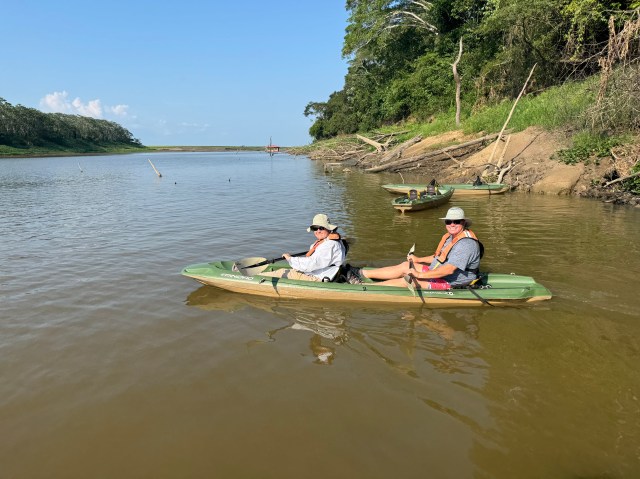
Next we were kayaking on the Amazon!

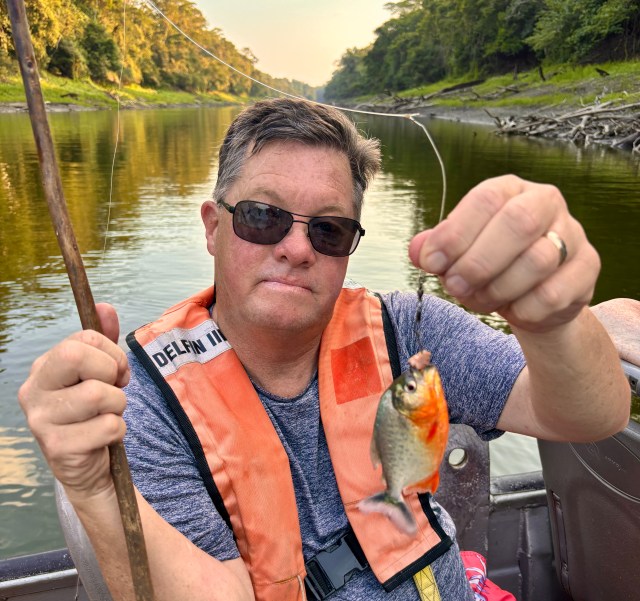
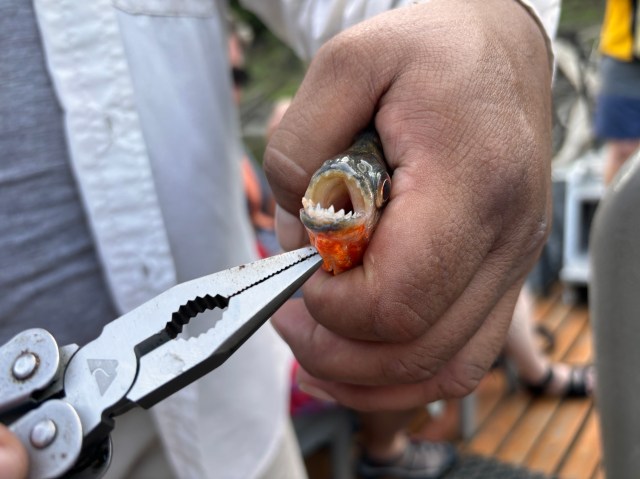
And the fun never stops!  Next up was fishing for red belly piranha!

The piranha were small and our guide was kept very busy taking them off the hook for those who were fishing! Everyone was catch and release!

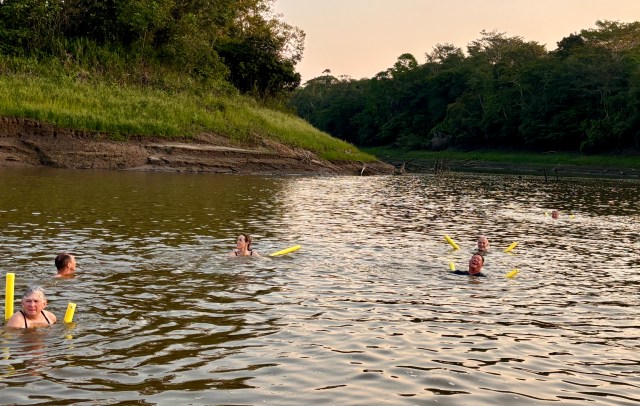
Then we went a ways up or down the river and some chose to go swimming in the Amazon!

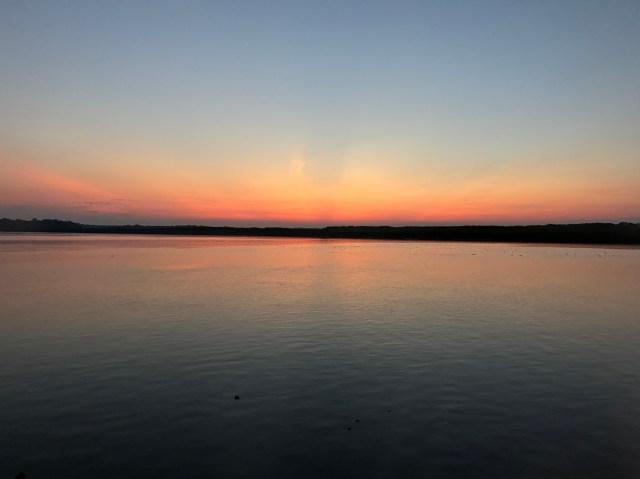
After that busy day, it was back to the Delfin III to clean up.  We had a nice sunset before dinner.

Remember when I said the food presentation was amazing on the Delfin III.  This was the first course of our dinner.

We were busy on the Amazon on September 22, 2024.

Next Up: More Amazon

Posted in Uncategorized | 2 Comments

Embarking on the Peruvian Amazon

The day, that would end on the Amazon, started early in Cusco with a 3:30 alarm, a 4:30 breakfast and a 5:15 departure to the airport.  Enrique had gone to the airport the night before to get boarding passes and luggage tags so all we needed to do on arrival was check our bags.

We had an unexpected upgrade to premium economy seats which meant a little more leg-room, no one in the middle seat, and better snacks. 

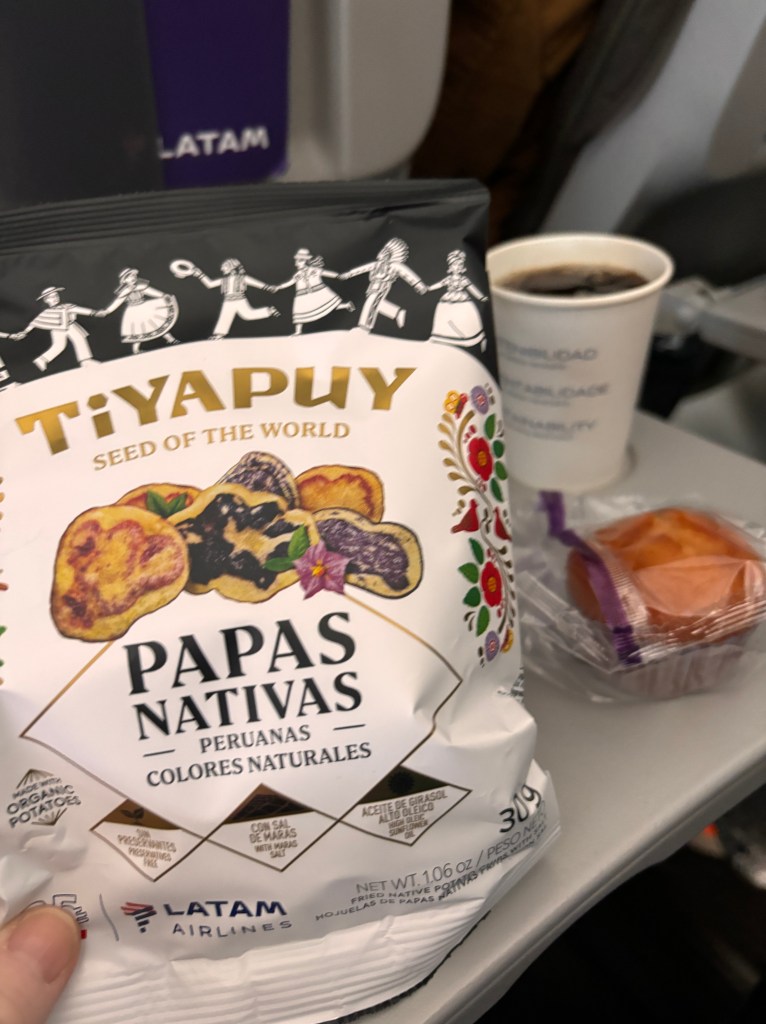
The specialty potato chips were quite good and we bought them several times after this introduction.

And in a happy result, the man who was ill in our travel group, felt much better after we landed in Lima.  That “seemed” to confirm the high altitude sickness assumption. 

Many of us had experienced minor symptoms with the high altitude. For most, it was just being aware of breathing as opposed to never thinking about it.  In a personal experience, I was trying to share a contact on my phone – something I have done dozens, if not hundreds, of times.  For some (altitude?) reason, the process was not computing.  It took a little longer, but I did get it accomplished.

Our second flight of the day was from Lima to Iquitos, Peru.

We had a choice in the Lima airport from a variety of American eateries. Our friend, Jocelyn, and I chose Starbucks to get the advertised pumpkin spice lattes.  Despite the advertisement, there was no pumpkin spice.  Habib and Randy got coffee and donuts at Dunkin’. 

When we landed in Iquitos, it was 92 degrees and humid!!  Ugh!  Iquitos is four degrees south of the equator. Iquitos has a population of about 500,000. Tourism is the largest business. 

Our next leg was a bus ride from Iquitos to Nauta, a community right on the Amazon River.  As we boarded, a woman handed us clove scented wash clothes.  That was delightful!! Our Avalon group was combined with 12 additional travelers so we were now a community of 36.

They gave each of us an ice cold water bottle (to keep) with ice cold water and a very nice boxed lunch..

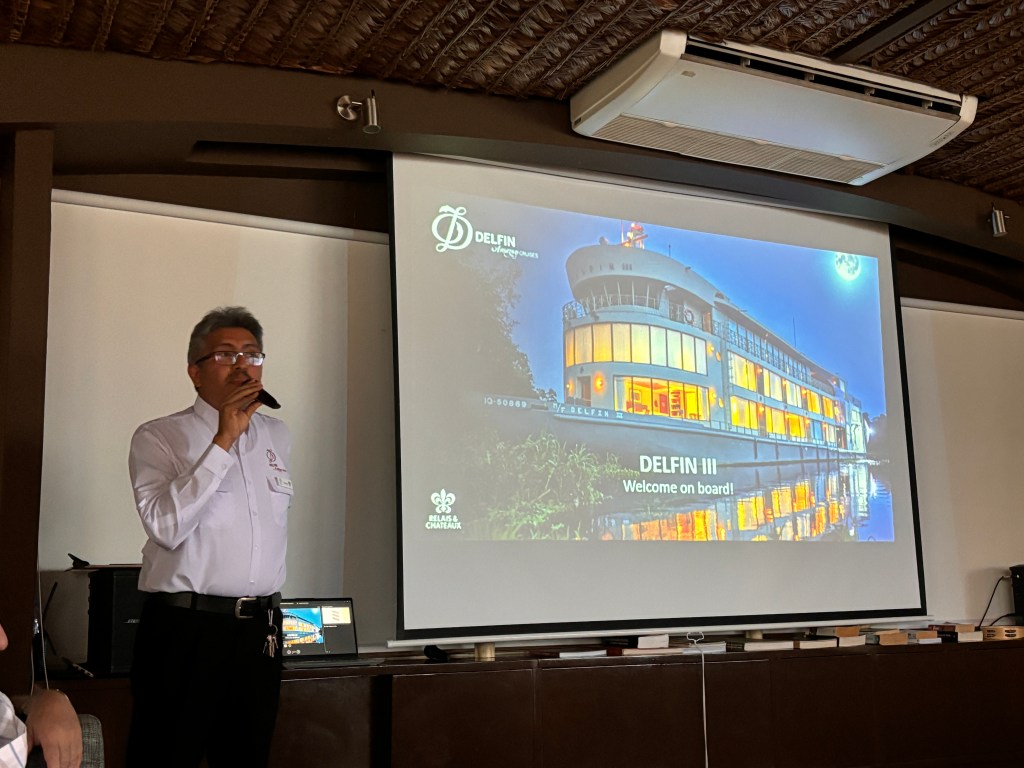
This was our first view of our home for the next THREE nights – the Delfin III.  

We had a short skiff ride out to the ship.

We began in the lounge with an orientation and muster explanation.  We were then set free to, explore, find our cabins and unpack a bit before dinner.

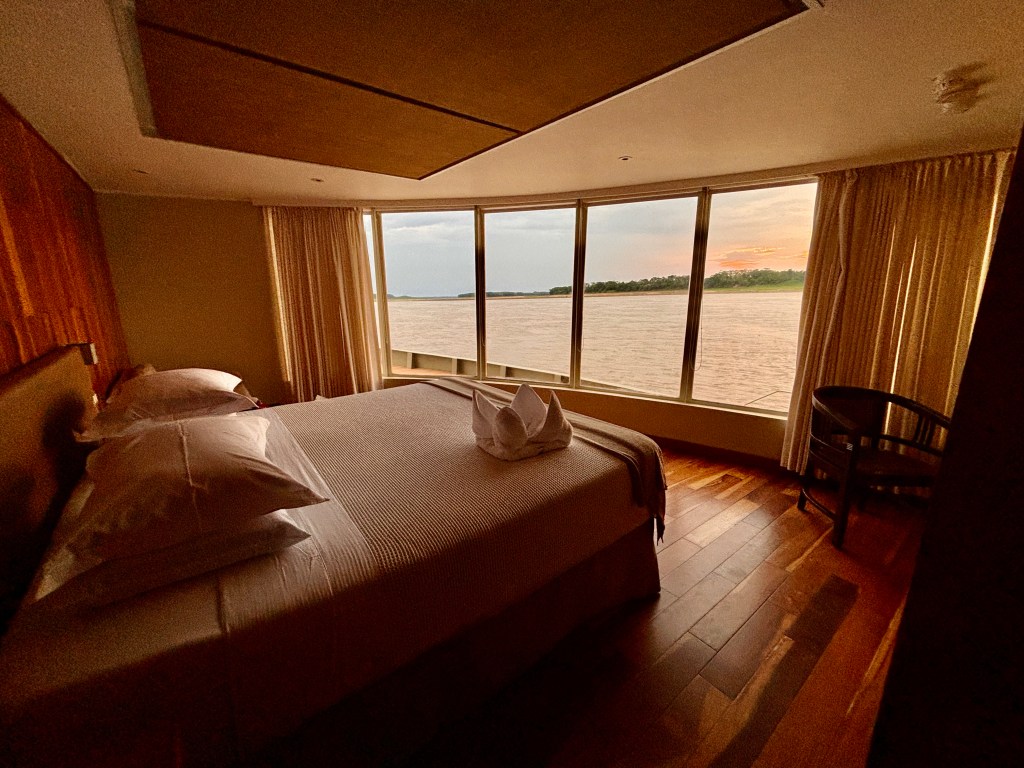
Of course, we went to find our cabin first!

Then we explored the ship.

We enjoyed an Amazon sunset from the Delfin III

During our first dinner, we learned the food was going to be very good and the food presentation was top notch!

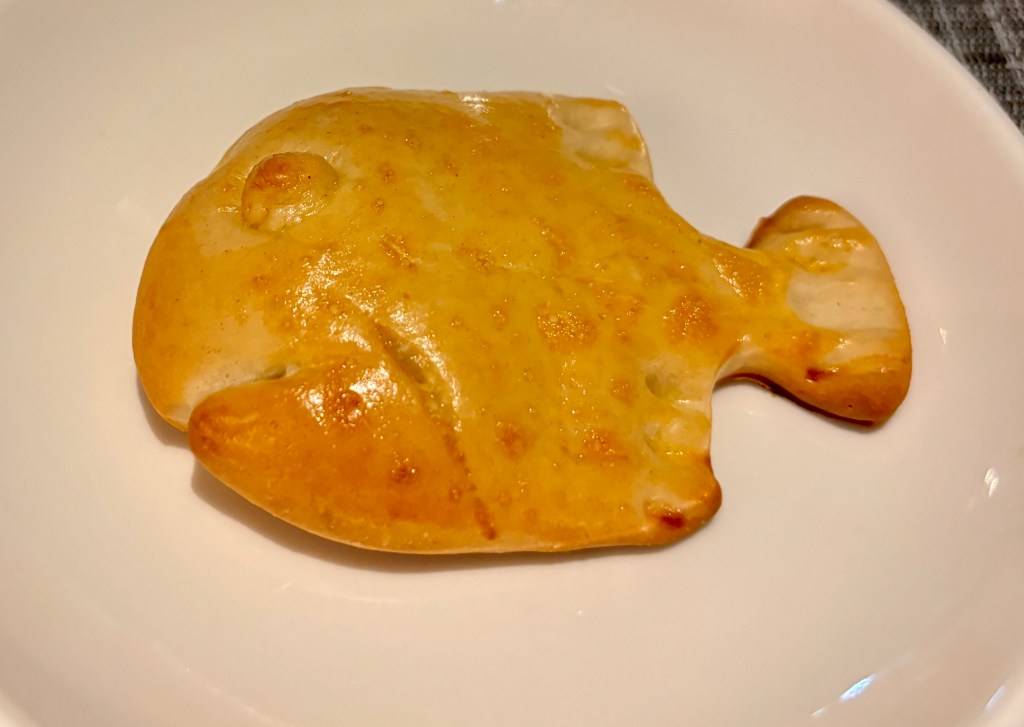
At every meal the bread was special. This was our first hint.

We gathered once more for our “next day” talk.   It was clear we were going to have another very early start and would be kept very busy if we were willing to do it all.

After an early morning, two bus rides and two plane rides, I opted to stay on the ship during the nighttime jungle skiff ride.

Randy went and took these frog pictures to show me part of what I missed.

We boarded the Delfin III on September 21, 2024.

Next Up:  We meet a Shaman along the Peruvian Amazon.

Posted in Uncategorized | 1 Comment

Peru: Cuzco Again!

The central courtyard of our hotel had a few women selling their items and one of them brought this adorable baby alpaca!  It made us all smile.

We learned this morning that one of our younger, and fit, men had become ill.  We assumed altitude sickness as we were once again above 11,000 feet.

The rest of us embarked on a tour of Cusco with Enrique.  This historic square (that was more like a triangle) has original walls that were built in the 1300s and 1400s by the Inca,  and the 1500s by the Spanish.

Santa Domingo Monestery is on the site of the most important Incan temple – Koricancha – The Temple of the Sun.  The Spanish tore Koricancha down and built the very first church in the Americas, Santa Domingo.

The Convent of Santo Domingo del Cuzco was founded in 1534. The Catholic church was built over the Inca Temple, as if to demonstrate the destruction and annulment of the Inca faith.

Notice the smaller door on the lower right hand side of the larger door.

This wall is part of the adjacent Inca Temple of the Moon. The stone walls are fit together so tightly they are earthquake proof.   An artificial intelligence assessment says these walls could not be built by the Inca with the tools they had – yet they did.

We traveled above the city.  The Inca formed their capital, Cusco, in the shape of the Puma.   The Inca lived and ruled here for 300 years.  Some believe that their conquest of the area was generally peaceful because people wanted to be part of the Inca civilization.

The Inca were eventually conquered by the Spanish.  People of mixed Inca and Spanish heritage are considered mestizo.  There are people  in Peru, who are still about 70% Incan.  That is because some population groups escaped into the mountains when the Spanish came.  Some remained hidden for 200 years.   As time passed, they came out and intermarried.  Their population became less DNA pure Incan.  Our guide, Enrico says he is about 40 percent Incan. 

Cristo Blanco was a gift from Arabic Palestinians in 1945 who sought refuge in Cusco after WWII. It is similar in likeness to Christ the Redeemer in Brazil but smaller.

Our next stop was to largest Incan structure.  It was named Saqsaywaman by the Spaniards.  The pronunciation sounds a little like “sexy woman.”

The complex, begun in approximately 1350, would have required the work of 25,000 men including architects, astronomers, engineers, stonecutters and stone transporters. 

The stones are placed in the shape of a zig zag, making some call it the Temple to the Lightning Bolt.  

Many of the stones weigh 150 to 200 tons. How did they get here from two miles away?  The local vicinity did not have these stones.

This square shaped section is unusual in the complex.

Like most places, the old wasn’t always valued.  Approximately 40 percent of the rocks in the complex were removed and used elsewhere in Cusco.

These stones are remains of the last glacier erosion.  This area was used as an altar.

Where there is visible damage to the stones, the damage happened in a battle between the Inca and the Spaniards. 

The Massachusetts Institute of Technology did ultrasounds on the rocks of Saqsaywaman.  There is not any cement between the stones, but they could not determine how the Inca accomplished their stone cutting and placement.

Archeology and academia has found and studied skeletons found in the vicinity.  Those are of a species that shares 25 percent homosapian DNA.   These are not the same as the skeletons with the elongated skulls discovered near Nazca that share 30 percent DNA.  So, are there two extra species in Peru?

Enrique spoke about energy vortexes in a fourth dimension.  In Peru, the energy vortex is thought to occur here and in Machu Picchu.  (In Arizona, Sedona is thought to also have this energy vortex.)   He raised the questions about whether there was another species that built this place.  Did the Inca try to emulate this site later in those known to absolutely be Incan?

Our next stop was the Basilica Cathedral of Cusco. Unfortunately, once again there were no pictures allowed.

It took 100 years for the Catholic Church to build Cusco’s cathedral but the Inca didn’t accept their Jesus.  Over time the priests began to introduce the Virgin Mary.  The Inca loved and accept her because they were used to worshipping Pachamama, mother earth.

Enrique told us that religion in Inca traditions always involved decorated skirts.  This tradition has transferred to providing a garment for Jesus. There is a multi-year wait for the privilege of providing the skirt for the Black Jesus.

Enrique’s extended family provided a skirt for Black Jesus in 1990. At that very time, a cousin was healed of polio. The family received a certificate of miracle from Pope John Paul II.

Black Jesus, thought to be more similar in appearance to the local Incan, mestizo, population was created in 1620.  It was brought out of the church in 1650 and is credited with stopping continued tremors from a devastating earth quake that killed over 5000 people. Black Jesus is credited with stopping a plague in the  next century.  A procession of Black Jesus around the city of Cusco still happens annually.

One of my favorite memories of our visit to the Basilica Cathedral of Cusco is a painting of The Last Supper.  The painting was represented or our entrance ticket and this is a photo of that ticket.

In a very large painting, Jesus and his disciples are eating guinea pig at The Last Supper.  Although some were offended by the rendition, it makes perfect sense because guinea pig is considered a delicacy.  They were eating important food at an important meal.

After our tours, a group of us went to Paddy’s, the highest elevation Irish Pub in the World. Sounds like a must do, doesn’t it?

We shared the best Shepherd’s Pie we have ever had!

Later in the evening, I saw  this group of four dogs wandering the streets. We have seen so many unattended dogs – over a hundred – all over Peru. .  This has been difficult for dog lovers to see but they all seemed to be in good shape, many with collars and/or blanket wraps.  Our guide said almost all have homes.  They enjoy their days out and about and return home in the evening.  I’m not completely sure this is true – but it sounds nice and made us feel better about seeing so many dogs!

We were in Cusco on September 20, 2024

Next Up: We journey to the Peruvian Amazon

Posted in Uncategorized | 1 Comment

Peru: Machu Picchu to Cusco to Malaria

Returning to our hotel near Machu Picchu,  we had the opportunity to watch demonstrations on how to make pisco sours and ceviche.

Pisco is the national drink of Peru.  It is a type of brandy and must be made in one of five Peruvian cities to be “official.”

The pisco sour recipe is: 3 oz of pisco, 1 oz simple syrup, 1 egg white, 1 oz lime juice. Pour over ice cubes and shake for one minute. Add drops of bitters 

We also had a cooking demonstration for ceviche – a  classic dish in Peru.  As there is no chance I will ever make a raw fish dish, I didn’t write down the recipe!  Randy can order it in a restaurant if it sounds good to him!

We both tried the ceviche and it was good, but I am still not planning to ever make it.

We had lunch at the hotel before leaving.  I asked about the butter because, each time we had been served butter, it tasted very different than I expected.  I was wondering if it was made from a different milk source.  The difference was that they added passion fruit.  To me, and our friend Annie, it tasted so horrible that we talked about that butter for the rest of the trip!

We had a return train ride down the mountain.  It was so loud that it was the low point of the entire trip for several of us.  It was was loud because it is a train and most people were joyfully chatting over other people chatting about our time in Machu Picchu. Oh, and the adjacent car had a private band playing. I don’t tolerate loud anything very well – says the former kindergarten teacher!   Randy loaned me his noise canceling earbuds to diminish as much as possible.  Our friend Gary put in ear plugs for the duration. I will follow his example going forward and always carry ear plugs with me!  

The train ride was followed by a much quieter bus ride back to Cusco.

Our accommodation in Cusco was a historic hotel. The Palacio Del Inka  was built by the Inca and occupied over time by Incan and Spanish aristocracy.   The hotel offered a tour which I intended to take, but in the end, didn’t work out.

At this point, we had to decide if we were going to begin taking our medication to prevent malaria infection when we were in the Amazon.  Protocol is to to take the pills before, during and after potential exposure.

Over the course of the last few days, whether people were going to take malaria meds or not had come up in numerous conversations. The retired pharmacist in our group had opted not to take them. It seemed it was split about 50-50.  Enrique said that was typical.

Randy and I had watched a Nova presentation on malaria as part of our trip preparation.  We learned: 

Malaria, bourn by mosquitos, is the biggest killer of humanity.  There are 2090 species of mosquitos but much fewer transmit malaria.  It was once considered a tropical disease but is now world wide.  

The American Revolution was impacted by malaria and eight US presidents had malaria including George Washington. 

The use of DDT destroyed mosquito populations, and in 1951 the US was declared malaria free.

Malaria became a poor country, po0r people’s disease.  There are 200,000,000 cases world wide each year with 600,000 deaths annually.   Eighty percent of the deaths are children under five.

Bed netting treated with insecticide is the most used tool to avoid malaria, but that strategy is losing effectiveness.

An effective vaccine has been elusive and 142 attempts have been made.  Malaria is a very complex parasite. 

The University of Oxford – a premier institution for developing vaccines including Covid 19, has spent 13 years working on a vaccine called R-21. Its intention is to promote antibodies attacking malaria parasites.

Most vaccines in the world are made in Pune, India. An Indian family business took Oxford’s vaccine into trial status giving it to children in Africa. It showed  77 percent efficacy. In 2022, the vaccine went into large scale trials, with 500,000 children,  and the results are promising.

Since the medical recommendation we received was to take the medication, we did, for a while.

We took our malaria pill on September 19, 2024.

Next Up: Our day in Cusco

Posted in Uncategorized | Leave a comment

Peru: It’s Machu Picchu Day!

I sent this text to numerous friends and family on the morning of September 18.  Of course, September 18 was also the day we went to the Inca Fortress and village that I wrote about last time – but the main event of the day was Machu Picchu.

Visiting Machu Picchu was the main reason for choosing this itinerary.  The Nazca Lines, the Amazon and the Galapagos were nice add-ons but never would have taken us to Peru and Ecuador on their own.

This trip had been reserved well over a year in advance and in January of 2024 we discussed needing to get in shape for hiking Machu Picchu.  Unfortunately, we didn’t do that and I spent months being concerned that I would be the “weak link” in the group tour of Machu Picchu.

At some point we learned that Machu Picchu is at 7000 feet elevation. We spend most of the summer months at 6500 feet at our mountain cabin so that seemed good preparation. When I got Covid a month before our trip, that added to my concern.

But, now it was go time and we were going.  Twice!  One of the benefits of this Avalon Waterways itinerary is that we got two opportunities to visit Machu Picchu  That gave us a better possibility of seeing it in good weather.

We boarded the Machu Picchu Train and took our seats in the Premium Lounge.  

Two train employees gave us a brief program on forbidden love between an Incan princess and her suitor.

We ate our scavenged lunches from the breakfast buffet and also had a complimentary snack.  

We enjoyed our 90 minute ride up the mountain.

It looks like we are in the right place!

There was a nice village with hotels, restaurants and shops.  Our next step was to get in a long line to ride a time ticketed bus up to the actual site.

We made it through all the steps, all timed and coordinated by Enrique, to make sure we were where we needed to be, when we needed to be there.  We don’t know why people try to do complicated things like this, in a different language, on their own.

There were thirteen switchbacks on the way up the mountain. 

The views were stunning.

When we entered the historic site, we were given passes to a particular circuit, pre-arranged by Enrique and Amazon Waterways.  There are four circuits with circuits 1 and 4 having limited access.

We all had route 2 entries and most of us took full advantage of the broad access that it provided. A few on our tour chose an abbreviated version of route 2, with their own guide, based on mobility concerns. 

Most of us would climb steps equivalent to seven stories. We went up but it was slow in pace and no problem – so much wasted worry!!

We crested and had our first view of Machu Picchu.

Isn’t she lovely?  The amount of time we (about 30 people)  spent waiting for her to have her friends get the perfect shot was a bit annoying. 

These are more of our first views!

Machu Picchu was likely built in the 15th century as an estate for the Inca emperor Pachacuti. It sits on an isolated mountaintop at one end of the sacred valley, far above the waters of the Urubamba River.

At that time, there were two entrances into the sacred valley among the mountains. One was a thatched bridge across a large ravine.  The other was a footpath which became known as the Inca Trail. 

Some Machu Picchu tourists (maybe purists) choose to hike four days and three nights and cover 32 miles of the Inca Trail. 

Others walk the last 32 yards….that would be us!  Following the last yards of the Inca Trail allowed us to access the only historic entrance into Machu Picchu. 

Machu Picchu rangers are trying to rehab the terrace levels.  The alpaca are surely helping!

Each vista offered slightly different angles on the community that once held 1200 people.

This was the communication house.  People communicated with other communities using conch shells.

Enrique would tell us about some of what is known along the way. 

In this case, the Inca would make a series of holes in the stone using hematite and then insert pieces of wood. Over time, the wood would swell and the stone would break.

Somehow, the Inca, with their knowledge and technical ability, cut and fit stones together like this!

The temple with three windows equates to Incan philosophy:  To love, To learn, To serve.

Duma Houses were for shamans to focus on their prayers.

Here is a view of the switchback road we came up and would travel again on our way down. Only the park buses were allowed on this road as there were times a bus needed to delay for another bus coming around a corner.

The Inca people grew crops on these terraces – primarily casaba tapioca root. They would use the Inca trail to trade for potatoes and quinoa with other groups.  The terraces were outside the walled city.  The houses on the left side were graineries.

This slant rock was used for winnowing quinoa. 

We walked through this area that was The Temple of the Condor.  The rock on the ground is the condor head.

This is an interesting place!

The Machu Picchu site is 40 percent original with 60 percent restored with original materials. 

This is similar to how much of Machu Picchu looked before any restoration.

It had been a terrific day at Machu Picchu! We explored about 70 percent of the site and still had another day to come!

Enrique’s plan was if we had a clear morning the next day, we would climb back to the top to witness the sunrise over Machu Picchu. If not, we would continue to explore areas we hadn’t yet seen. 

The next morning, we had a 4:30 am wake up for an early breakfast at 5:00.  Once again, both our bus ride and our entry were timed. By then some of us had become aware that our bus transportation had experienced a bit of a problem a few days prior! 

Nevertheless, we boarded our bus. By the time we got to the top of the mountain,  it was already raining a little. Randy and I had brought ponchos and those who hadn’t brought one, bought one. Enrique likes to say it rains 400 days a year at Machu Picchu – every day and sometimes twice.

The areas we explored on our second day offered time for learning about families that lived their whole lives in Machu Picchu.  They shared communal living spaces. Children stayed with their family until age eight, at which point they lived in age similar groups . They were considered adults at age 16. 

There is still much unknown about Machu Picchu…

including the purpose for these stairs.

This is a ritual cleansing area between two temples.

This was the only toilet found in the whole site.  Most would have used a chamber pot. A minority segment of the population were vegetarian and their urine was used, medicinally, based on the Inca study of plants.

This big room was likely used for community gatherings. 

The round circles on the ground are oriented north and south.  As light comes through the window, the circles reflected the constellations.   The pools were also used to ferment medicines.

We had our lovely afternoon in Machu Picchu, and then our rainy morning. It was so nice to experience both. With rain so common (400 days a year), it is sad to think many only experience it in the rain.

Where we had a stunning view down the mountain the day before, we now could see nothing.

The archeological record suggests that the Inca built Machu Picchu in 1450 but abandoned it 100 years later, about the time of the Spanish conquest.  It remained hidden because Europeans never looked for a city so far from the river.

Remember when we learned that the Inca formed their cities in the shapes of their animal gods.  Machu Picchu was made in an alligator shape.

Machu Picchu was introduced to the world by American Hiram Bingham, a Yale lecturer on South American History.  He journeyed to Peru and was shown Machu Picchu by native Melchor Arteaga on July 24, 1911.  The Incan city had been forgotten by all but those who lived in the immediate valley.  

The Indiana Jones character from the Raiders of the Lost Ark series of movies is thought to have been conceived in the likeness of Hiram Bingham.

Screenshot

There is a picture from Facebook that shows what the site likely looked like when rediscovered and more recently. Credit to Geopizza.

Machu Picchu was declared a UNESCO World Heritage site in 1983 and voted one of the New Seven Wonders of the World in 2007.

UNESCO recommends that visitation to Machu Picchu be limited to 2500 people per day to preserve the site.  The first day we were there, ticket sales were to 5750 visitors.   Planning is in place that much of the site will be closed to the public within three years.

People typically mispronounce Machu Picchu.   If you say Machu “pea-chew” you are saying old penis.  To say the name of the ancient city correctly, you need to say Machu “peak-chew.”

We were in Machu Picchu on September 18 and 19, 2024. I had no problem at all traversing the grounds except for climbing wet steps that were very tall for someone of short stature. The irony is that the Inca were even shorter than me!

Next Up: We go back to Cusco.

Posted in Uncategorized | 1 Comment

Peru:  Morning in the Sacred Valley

We had arrived at our resort in the Sacred Valley after dark so didn’t have a chance to see how nice the grounds were. 

This was the second time we’ve stayed at a very, very nice resort in a seemingly isolated portion of Peru.

We also needed to divide our belongings into one bag that would be with us for our afternoon adventure in Machu Picchu, a few things that will go on the train for overnight at a hotel near the site, and the bulk of our belongings that we won’t see again until after our second visit to Machu Picchu.  This was quite a complicated task and I’m not sure we could blame altitude fog for the confusion.  Eventually, we and everyone else in our group, figured something out and had our luggage sorted into the appropriate piles.

We had breakfast at the hotel but were also tasked with making or gathering something for lunch from the hotel’s breakfast buffet.  We had time constraints with our travel and there would not be time to stop for a proper lunch.

Soon after we left the resort, we ran into road construction that had started before it was supposed to.  Our bus driver and tour director had to do some negotiating so we could leave and meet our other well timed itinerary.

We passed the Sky Lodge Adventure Suites hanging off the side of the mountain!   Here are a few phrases I took from their website:   a once-in-a-lifetime chance to sleep in a completely transparent, hanging bedroom capsule over 1,000 feet above the valley floor,  not for the faint of heart, you must first either climb 1,312 feet to the top of Via Ferrata, or hike an intrepid trail through zip-lines, each suite comes complete with four beds, a dinning area and a private bathroom.  Packages includes breakfast & gourmet dinner with wine.  Even Randy said no thanks.

We also saw a bit of the last glacier in the Andes, the only one remaining in the equatorial zone.

We arrived at the the adobe village of Ollantaytambo. I missed out on buying coffee at the Incabucks.  Next time we’re in the neighborhood, I’m stopping!

Our destination was the ruins of an Inca fortress.  We were told that we could choose to walk to the top, or hear the tour but there wasn’t time to both.  Randy and I decided to divide and conquer and both get what we prefer! 

This is the way Randy went up….

He took a picture of these three alpaca on the way up!

These are some additional pictures of Randy’s trek up to the high point of the Incan Temple of the Sun. 

In Peruvian history, the Inca beat the Spaniards three times.  However, in Spanish history, they only acknowledge one loss –  that being here at the Temple of the Sun in Ollantaytambo.

This is the tour route….the way these rocks were placed involves the summer solstice

These stones weigh 90-100 tons.  How??

And how did they cut these stones to fit the way they do?  That mystery remains.

The Inca made their cities in the shapes of their gods. This fortress was made in the shape of a llama. 

The small house is the male sex organ of the God llama while the second house is the female sex organs of the God llama.  I don’t know what their more practical uses were.

This is an Inca water canal next to the stairs.  The water can be diverted to provide irrigated water to the terrace.   Using irrigation for one cycle and rain for another the Inca were able to plant two crops a year.

In general, walls that were conducted with this type of construction were less important than those with fitted stones.

This water temple was constructed for prayers of gratitude.  It is positioned so that the window allows the winter solstice light to come through.

The house on the side of the mountain, gets the morning light and is positioned to dehydrate foods. 

We left the ruins and headed back through the village.  I wanted to buy some of these colorful tassels but never did because I had no idea what I would do with them after I owned them.

We were headed to Rosa’s house, a woman of Incan descent.

She lives in a 500 year old Inca house that has a new roof.

These are husband and wife shawls over the bed.

In Inca tradition, the youngest child stays to take care of parents and inherits the home. In the Incan culture, there were not mid-wives, designated men served that role.
This stone is hematite from a meteor – strong enough to cut granite.

Rosa had a variety of religious or spiritual traditions represented in her home. 
She, like many, Inca did not feel the need to choose one over another.

In Inca tradition, prosperity is not measured by housing, it is measured by your friends and community.

We were in Ollantaytambo and Rosa’s home on September 18, 2024.  

Next up:  It’s Machu Picchu afternoon!

Posted in Uncategorized | 1 Comment