Viking Paris Extension: Normandy

Randy was not feeling well so he stayed at the hotel while Connie, Warren and I went on a small group tour to Normandy. Warren’s father had served in Europe during World War II so it was very important to him to go. We were pleased to go as well.

As we were driving through Paris early that morning we had a nice view of the Arch of Triumph.  Napoleon had this monument made to commemorate his soldiers one year after a significant victory.

We were on a full day trip, three and a half hours north of Paris, to another place commemorating more soldiers after battle and victory –  The Battle of Normandy, D-Day.
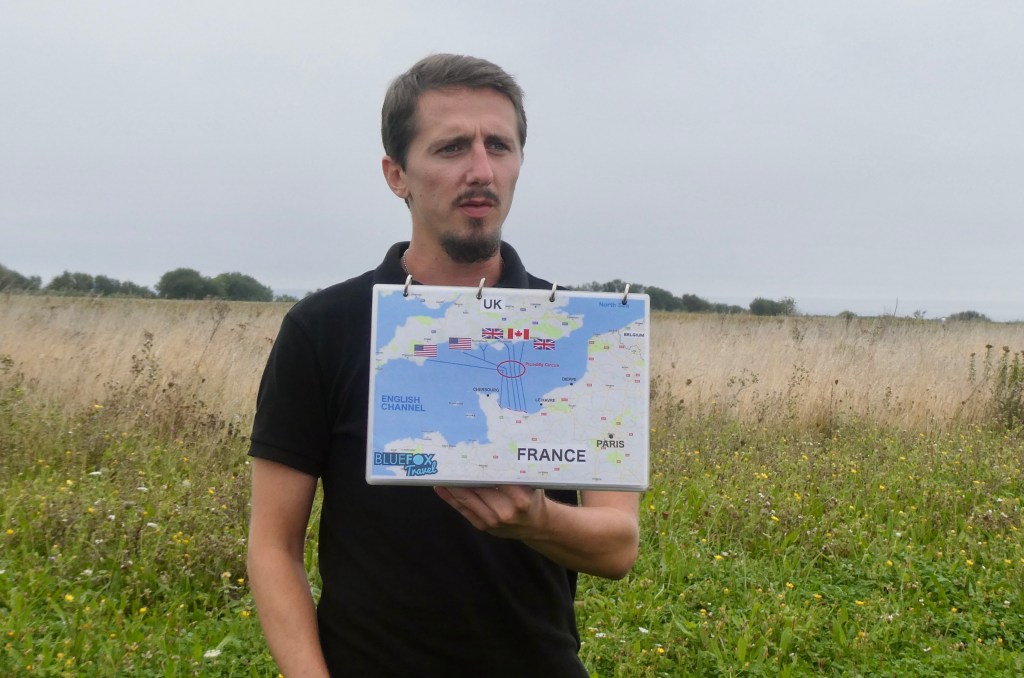
Although we were given a thorough summary on the preparations, strategies and battles, I am not going to attempt to be thorough. Instead you will read about details that captured my attention.

These were just two of the many German bunkers along the shore. 

About 20 soldiers would have been assigned to a bunker this size.
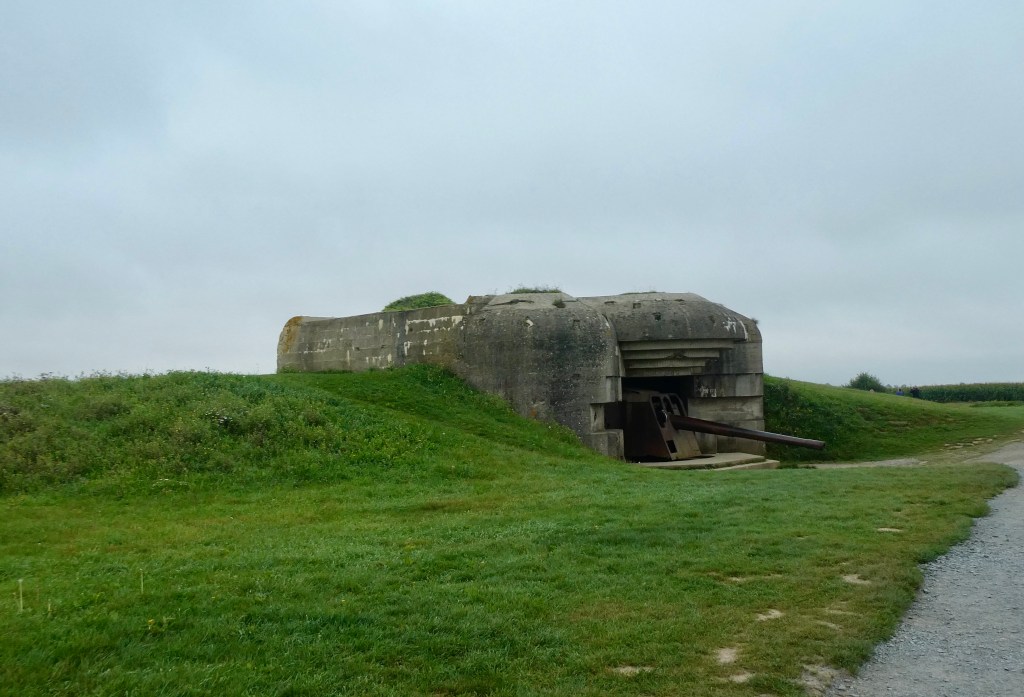
German guns could fire only 13 miles out while the Allies had a longer incoming range.  German soldiers in France were using reconditioned French guns from World War I.

We went on Omaha Beach.   
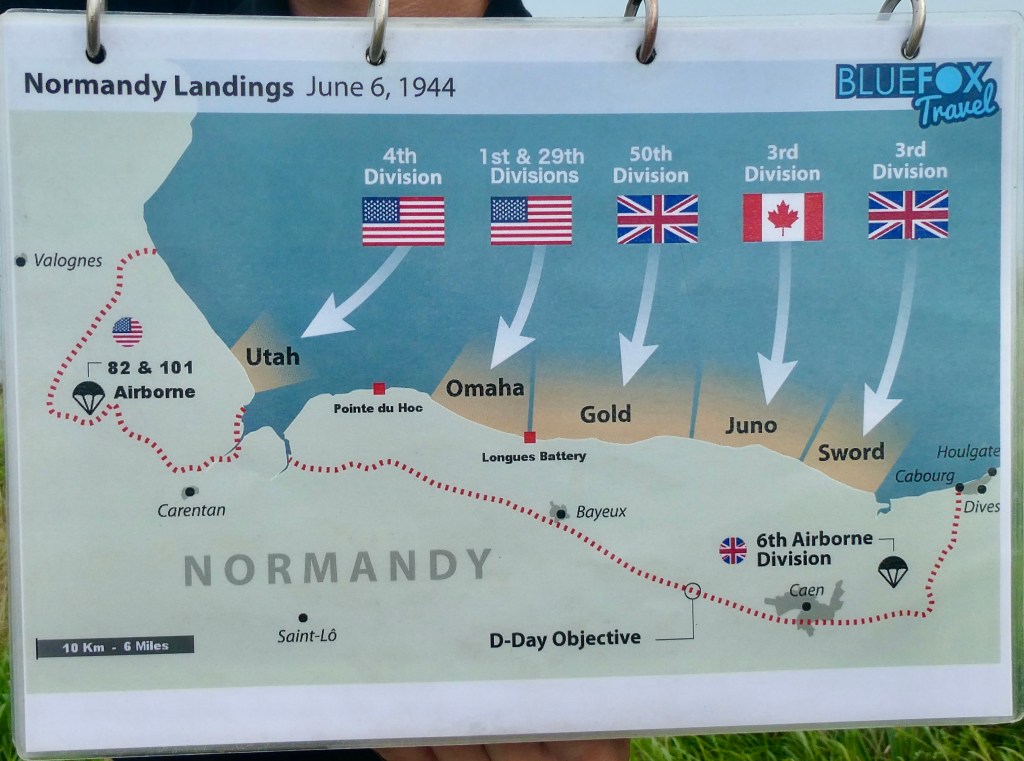
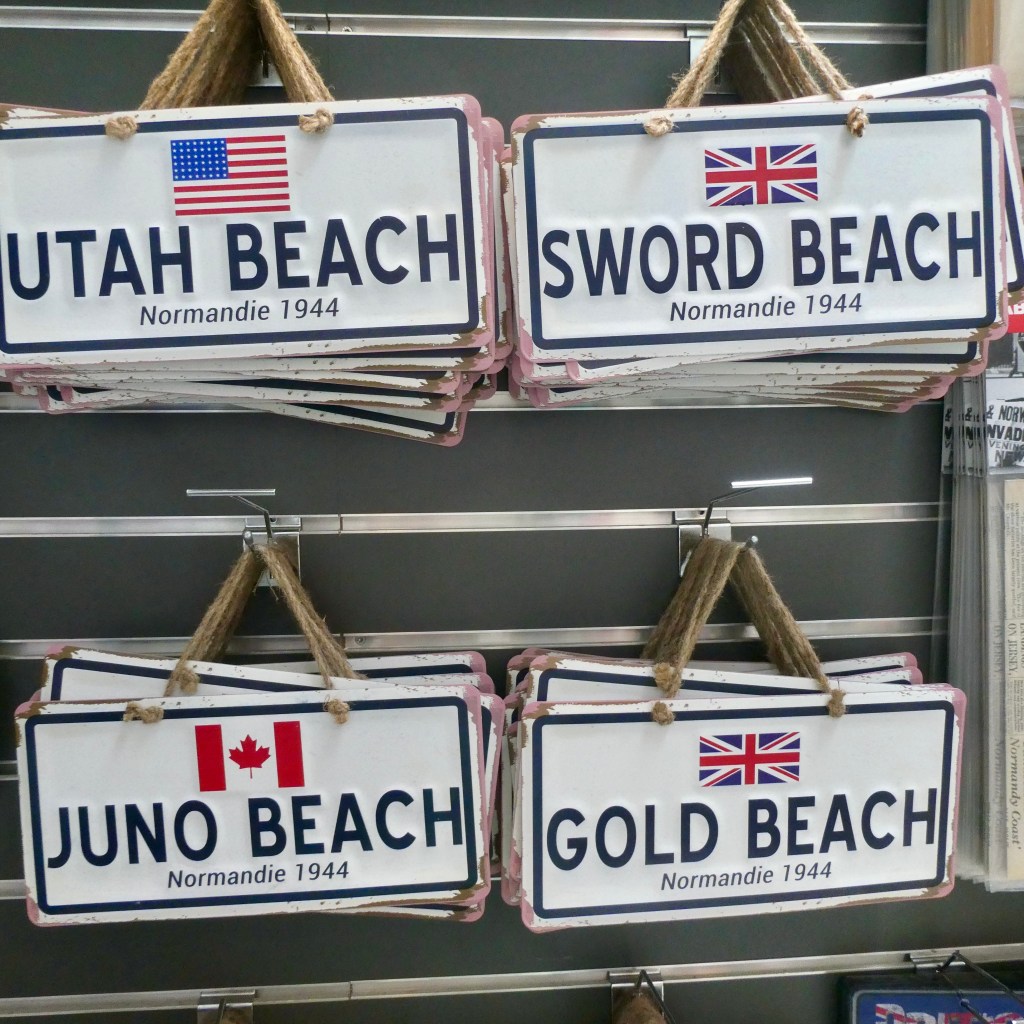
There were five landing sites for the Americans, British and Canadians that day.  Each country “named” the beach they were designated to attack. Eisenhower asked two construction workers where they were from and they replied Omaha and Utah. The Canadians and British decided to name their beaches after fish:  Gold, Sword,  and Jelly.   Someone determined Jelly was not acceptable and it was changed to Juno.

There were three important things the Allies needed for an assault to have a good chance of success.  They needed reasonable weather, a mid tide rising and a moon that was full only at the beginning of the night.

Poor weather caused a one day delay.  If they had not been able to launch when they did, they would have had to wait another month for all three conditions to align again.

A good coincidence for the Allies was that the German area commander was in Berlin. 

Omaha Beach is six miles long. Twenty five hundred Americans died there on D-Day.

The overall assault site was 50 miles long. There were 156,000 Allied troops attacking Normandy beaches that day. (After D-Day an additional 2.5 million allied soldiers landed here to fight for France.)

We were told only 10 percent of these floating tanks made it ashore. 

This is a memorial to Combat Medics placed at the first casualty collection point.

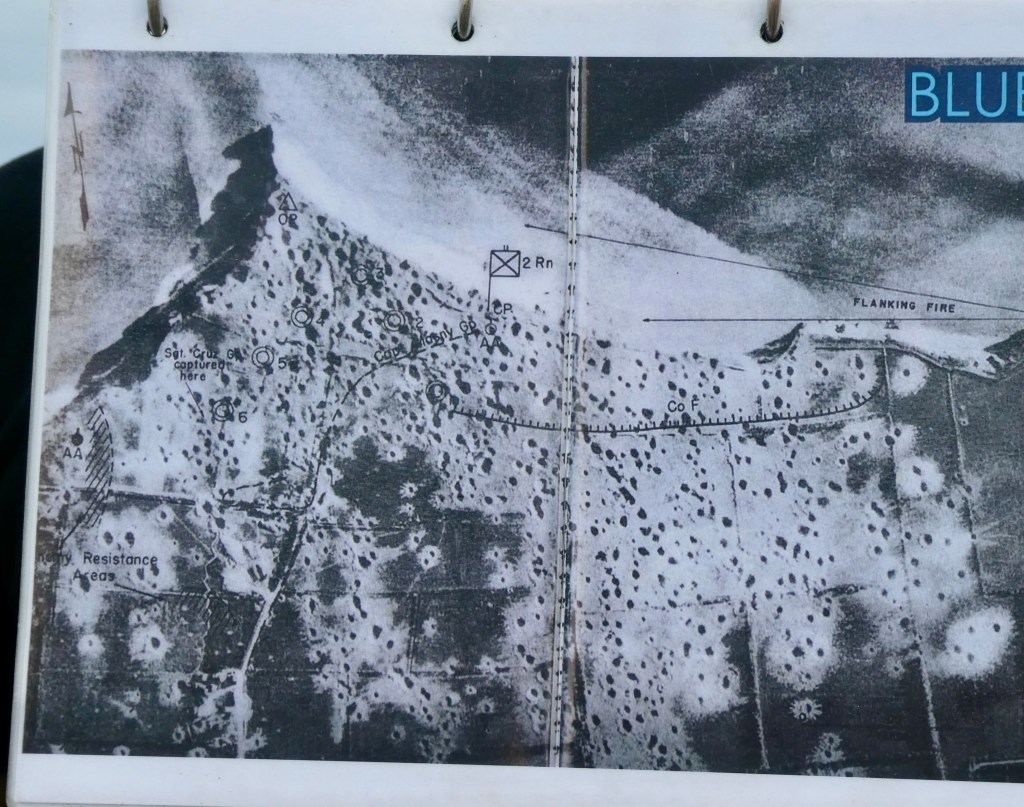
There were 225 Rangers assigned to try and take this point of land between Utah Beach and Omaha beach called Pointe du Hoc.  

They landed at the wrong cliff so were presumed dead by the commanders and their reinforcements were sent elsewhere.
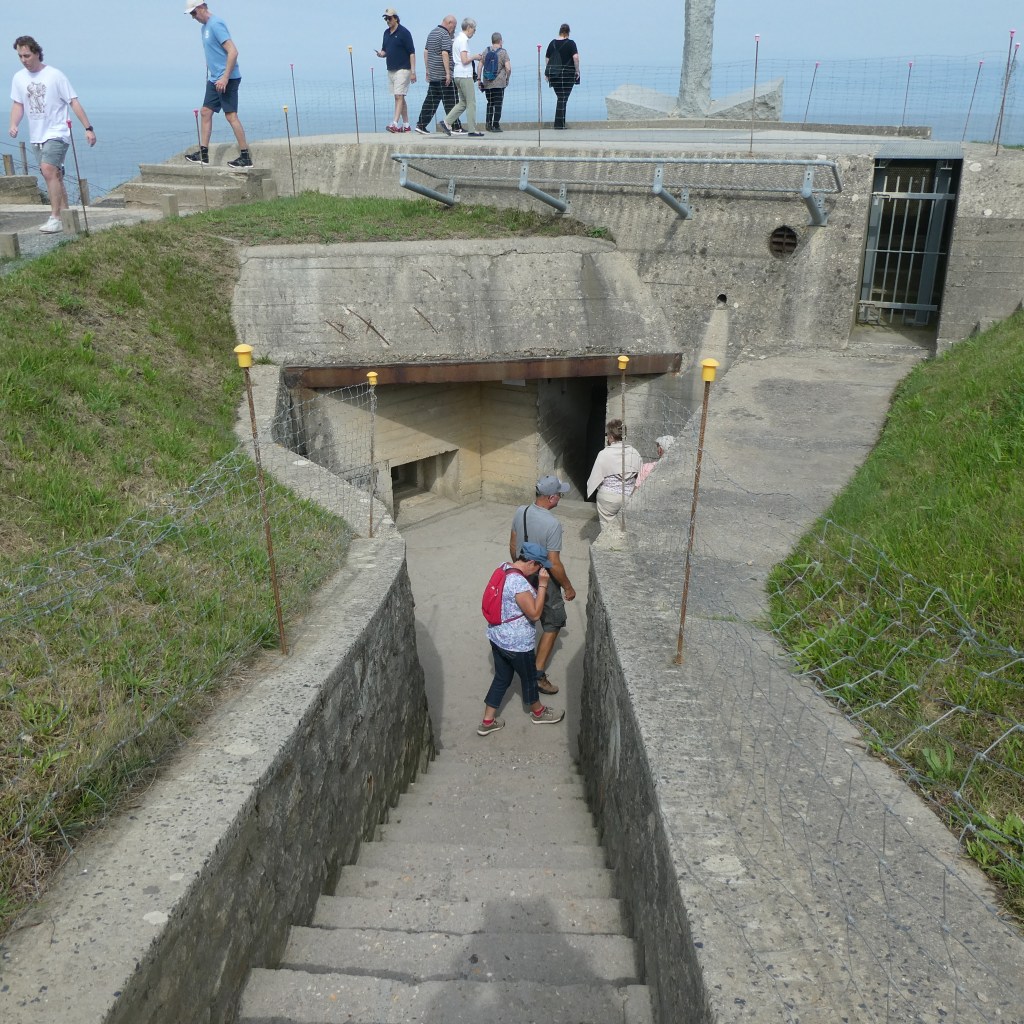
There were about 40 German soldiers per bunker and roughly 200 soldiers in the area.  

The Germans got reinforcements more quickly so only 90 Rangers were still able to bear arms when American reinforcements made it to them 48 hours later.

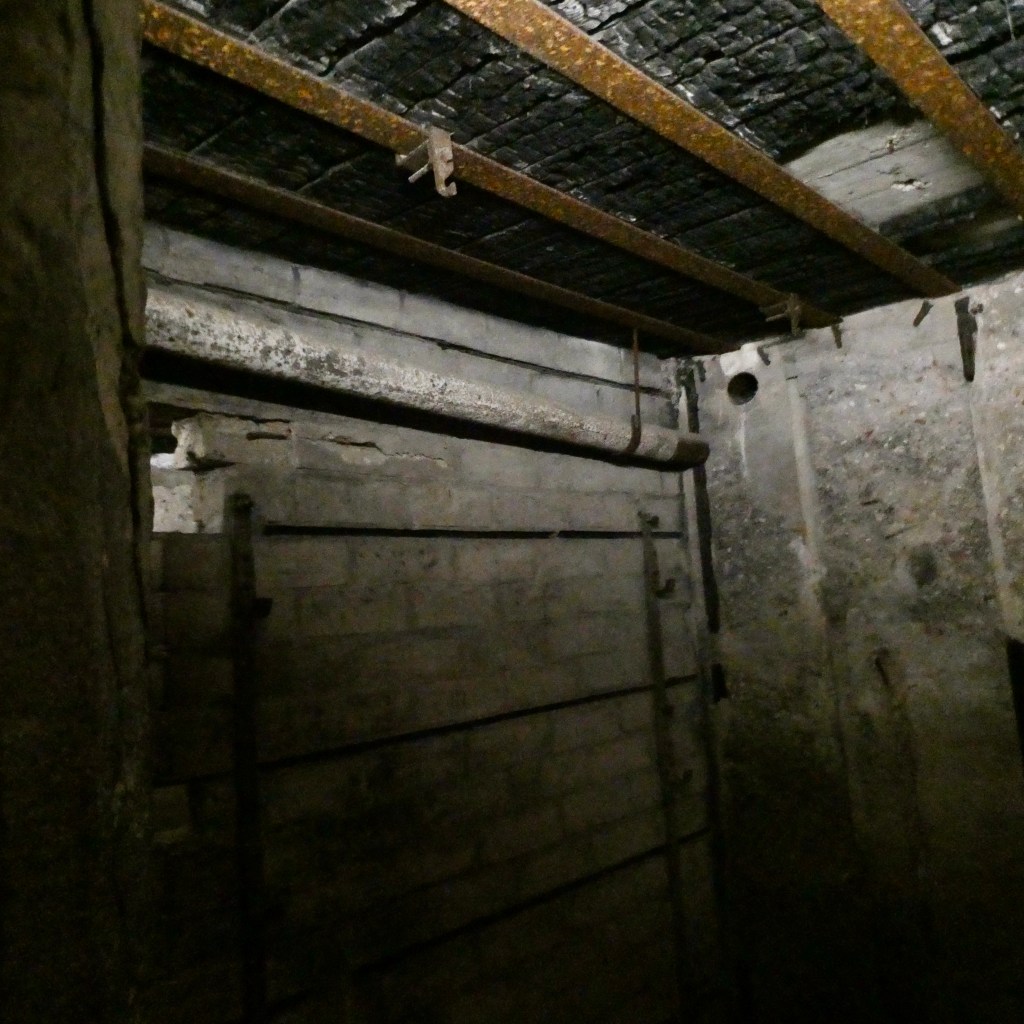
We were able to walk in and around this bunker that was mostly intact.
This picture shows the results of bombings on the land.

These massive concrete slabs used to be part of a bunker before they were blown up and scattered.
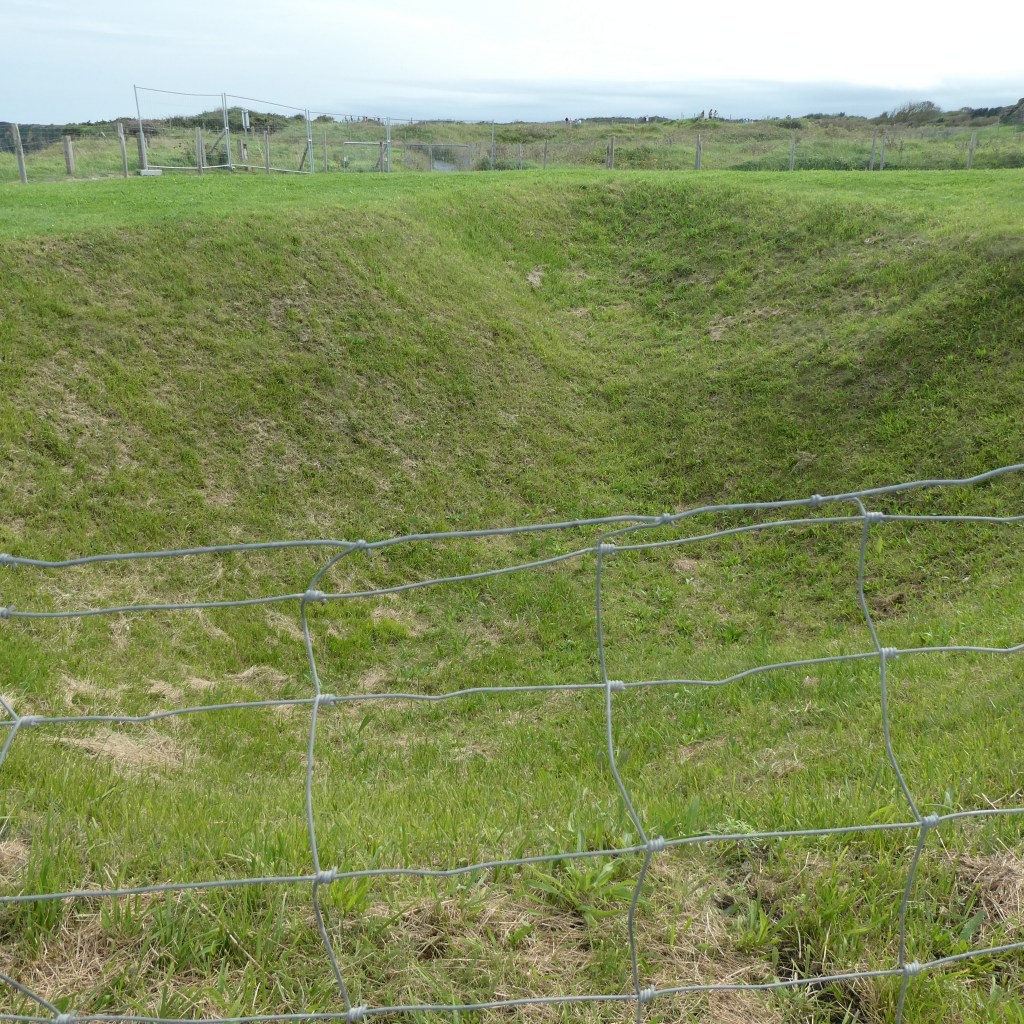
Some of these lands belong to the government and the history has been preserved. Other lands were flattened over time so they could be used for farming.
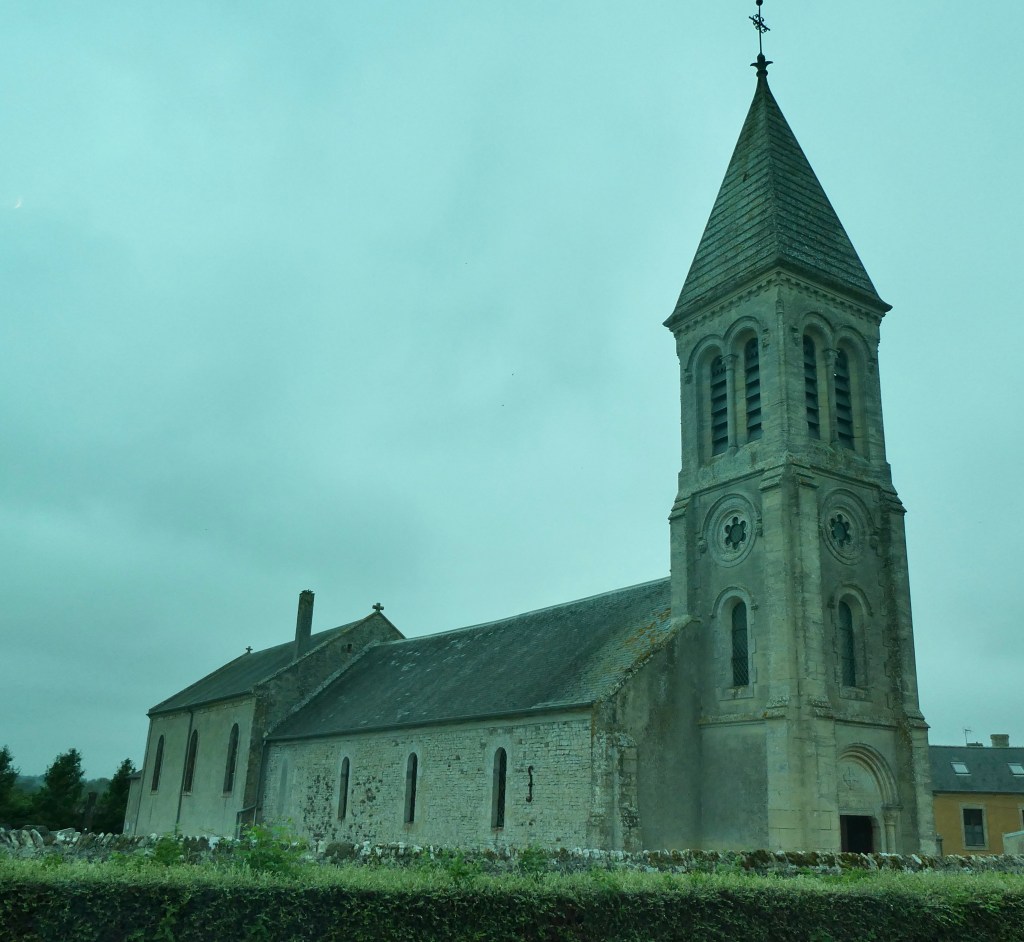
In the immediate days after D-Day, German snipers hid in church towers and steeples.  The allies shot down the towers so as not to deal with the snipers. They were later rebuilt. There are areas of the church that have different stone. Rebuilding sites like these were done quickly in the 1950s and 60s.
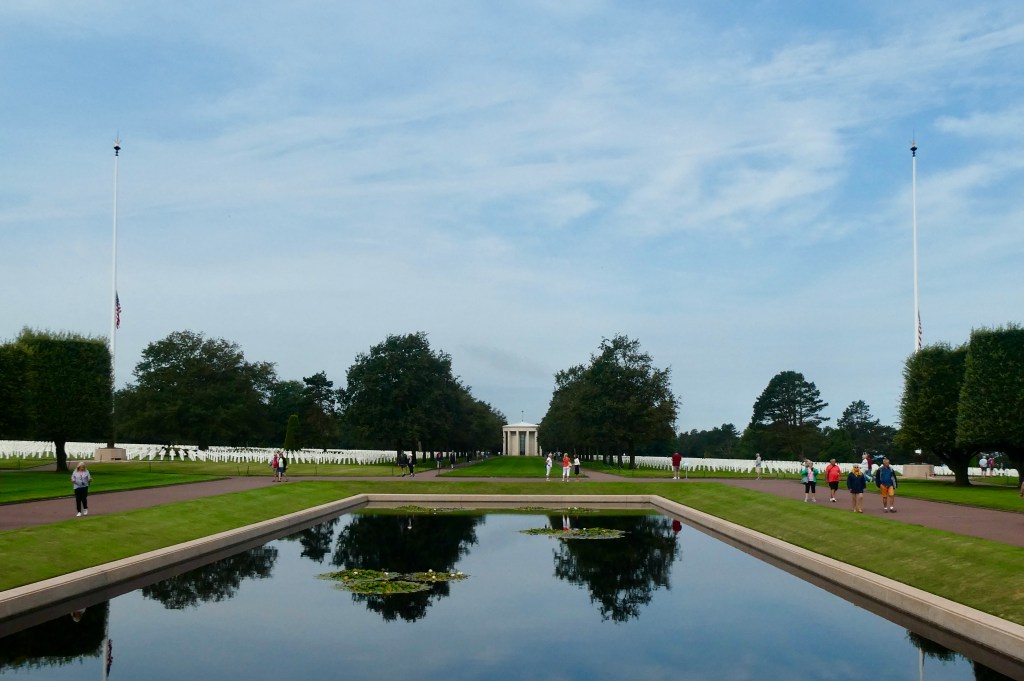
Our next stop was the American Normandy Cemetery and Memorial.
The cemetery is on French land but is American managed.
You can only be buried here if you were involved in the Battle of Normandy. 
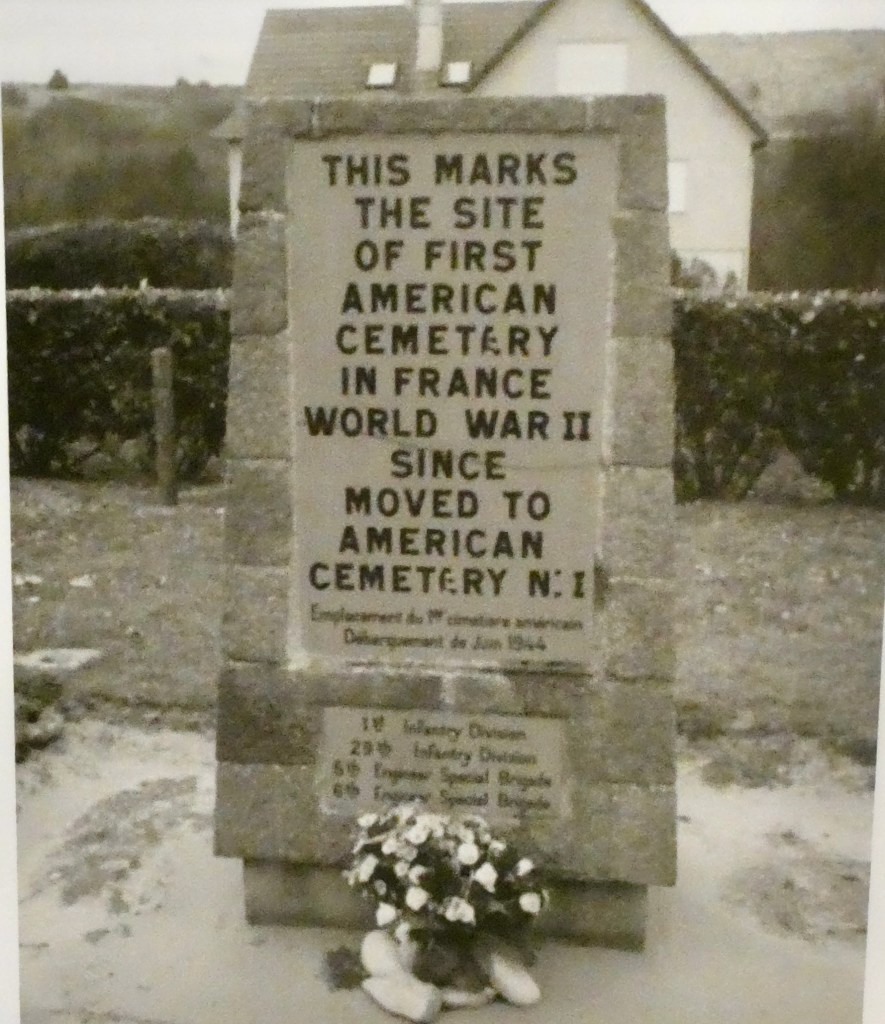
There were once ten separate American cemeteries but they were consolidated into one during the years 1947-56.

There were more than 29,000 Americans who died in the Battle for Normandy, including those on D-Day and the months after.
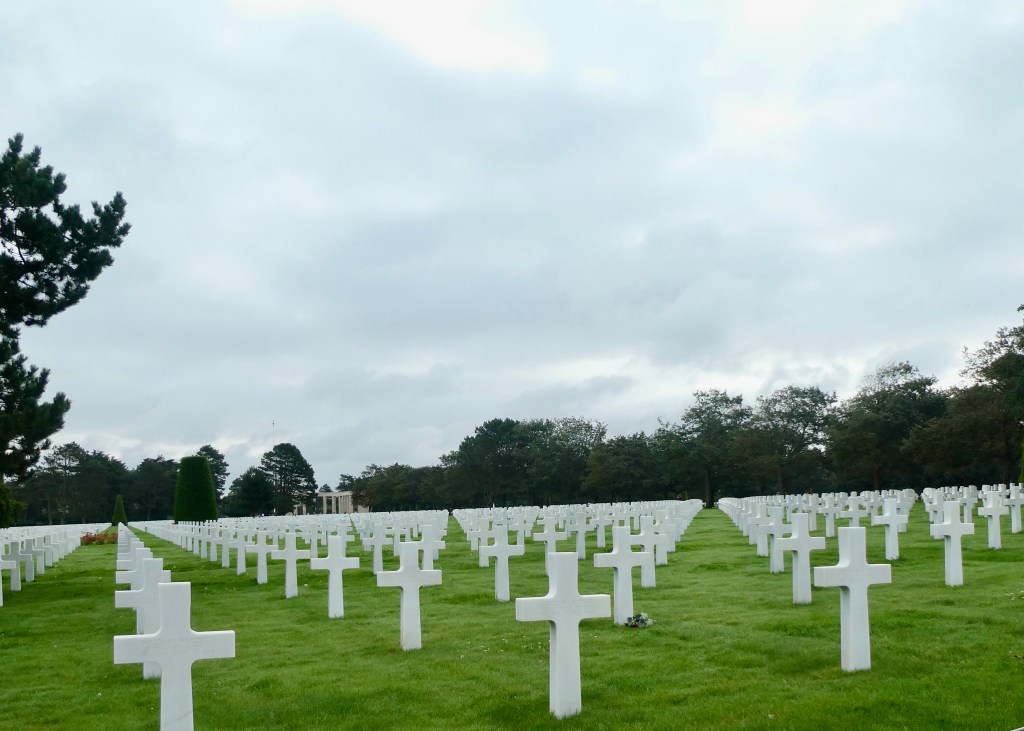
Two thirds of those went home at their family’s request.  The other third are here, 9388 American soldiers. The tour guide told us that one soldier was identified by DNA just last year but I was unable to find his name.

The names on the crosses face in the direction of the USA.  At this point in the war, soldiers knew about Jewish internment camps so those joining who were Jewish sometimes said they were Christian.  When families of the dead were contacted, sometimes they said “he was really Jewish” and then got Star of David markers.

Our final stop of the day was The Overlord Museum, named after the code name for the Allied battle for Normandy, Operation Overlord.

The life sized displays were numerous and very impressive.
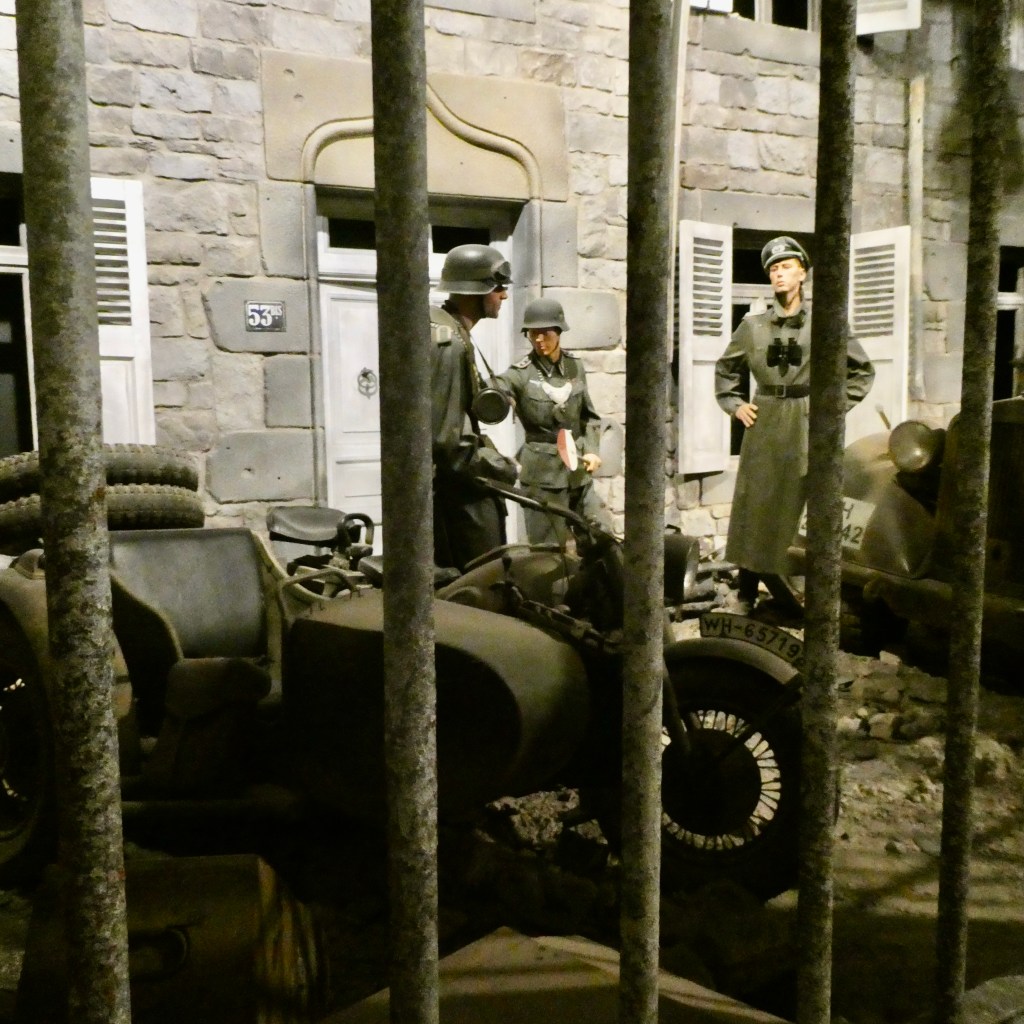
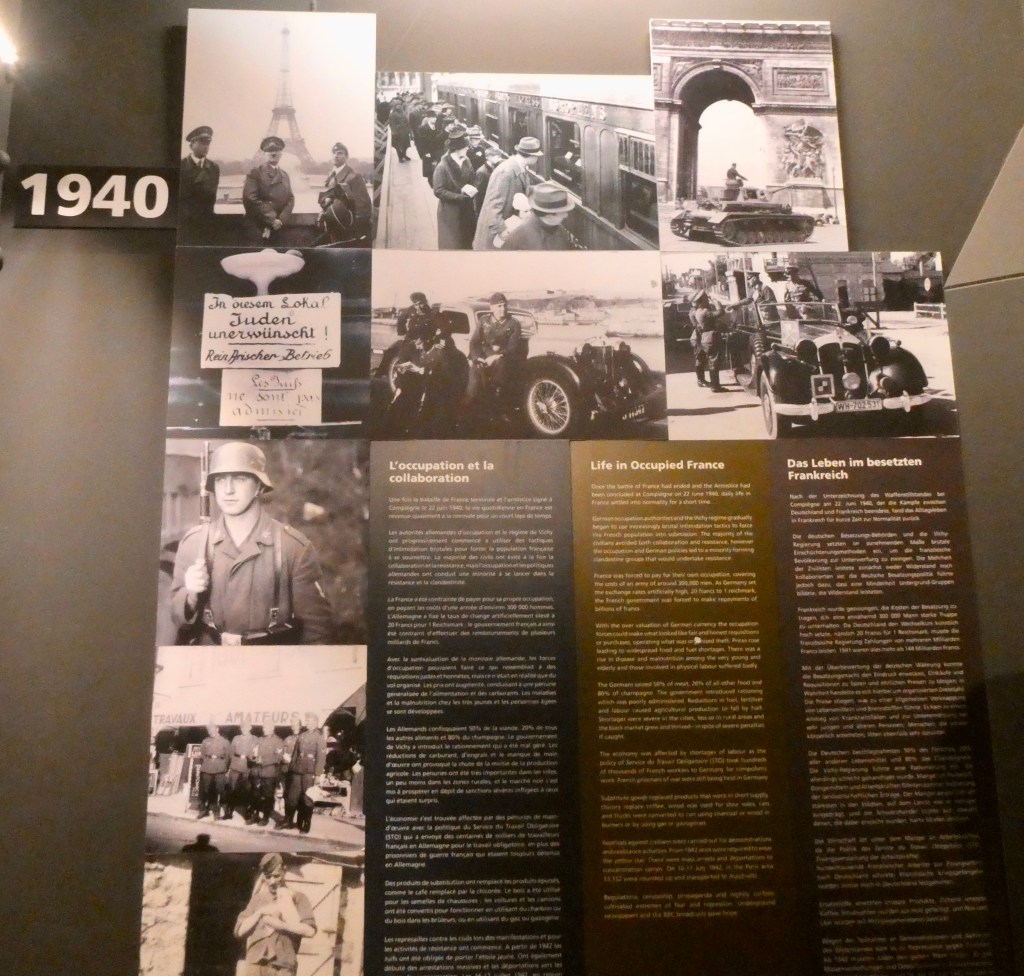
The information on placards and videos seemed so thorough. If studying World War II, and specifically D-Day and the Battle for Normandy, is your passion, you could be here for days.
Connie and Warren and I made our way back to Paris and the four of us gathered with our wine glasses from Bernkastle and had the remaining cherry cordial from Prague and peach liqueur from Cochem. We celebrated a successful trip and our last night in Paris together. They would head home to Arizona the next day while Randy and I went on to Zurich.  

Did I tell you (a few times) that it was hot in Paris?  Zurich and the Swiss Alps sounded like a perfect reprieve!

We went to Normandy on September 11, 2023.

Next: Zurich really is fabulous!

Posted in Uncategorized | 1 Comment

Paris: Eiffel Tower, Seine River Cruise and the Louvre

After being under the planning and protection of Viking for about two weeks, this was the day we were making our own way. We wanted to visit the Eiffel Tower, have a cruise along the Seine and tour the Louvre in one day!

The river cruise was easy to book but both the Louvre and Eiffel Tower took planning months in advance. The Louvre wasn’t bad.

However, the Eiffel Tower was a different story! I knew the exact day and middle of the night point in time that I needed to be online to get the earliest possible Eiffel Tower tour that allowed us to go to the top on September 10. Despite being ready, those tickets were gone in a flash. The best I could do was a bit later in the morning while paying for the most expensive “champagne included” tickets!
Perhaps that fits with the Eiffel Tower status of being the most visited paid entrance monument in the world!

As our Uber driver tried to get us close to the tower he found that roads were closed.  There was a very large Women’s 10K race being conducted in the area around the tower on the day of our visit. 

Thankfully there was a tall landmark we could walk towards! We eventually made it to a ticket line for those with advanced purchase tickets.

We learned the tower was planned for the 1889 World’s Fair, a date marking  the 100th anniversary of the French Revolution.

A design competition was launched in 1886 and Gustav Eiffel won by saying he could pay to get it built if he got the concession proceeds for a period of time.  (The cost was recouped in a very short time and then he made a lot of profit for many years.)

Digging began in January 1887 and construction of the tower was finished in March 1889.  It took only two years, two months and five days!

The resulting Eiffel tower was the tallest in the world at the time.  It measured 280 meters tall, the height of an 81 story building.

It was eclipsed by the Chrysler Building in New York in 1930.  The city added a transmitter tower in 1957 to gain the top spot once again at 330 meters.  After all this time it is still the second tallest building in France.

Parisians didn’t like the tower originally but grew to embrace it.  The lifts were a novelty. 

We certainly enjoyed both lifts – the first took us to the very busy second level where there were restaurants and shops.

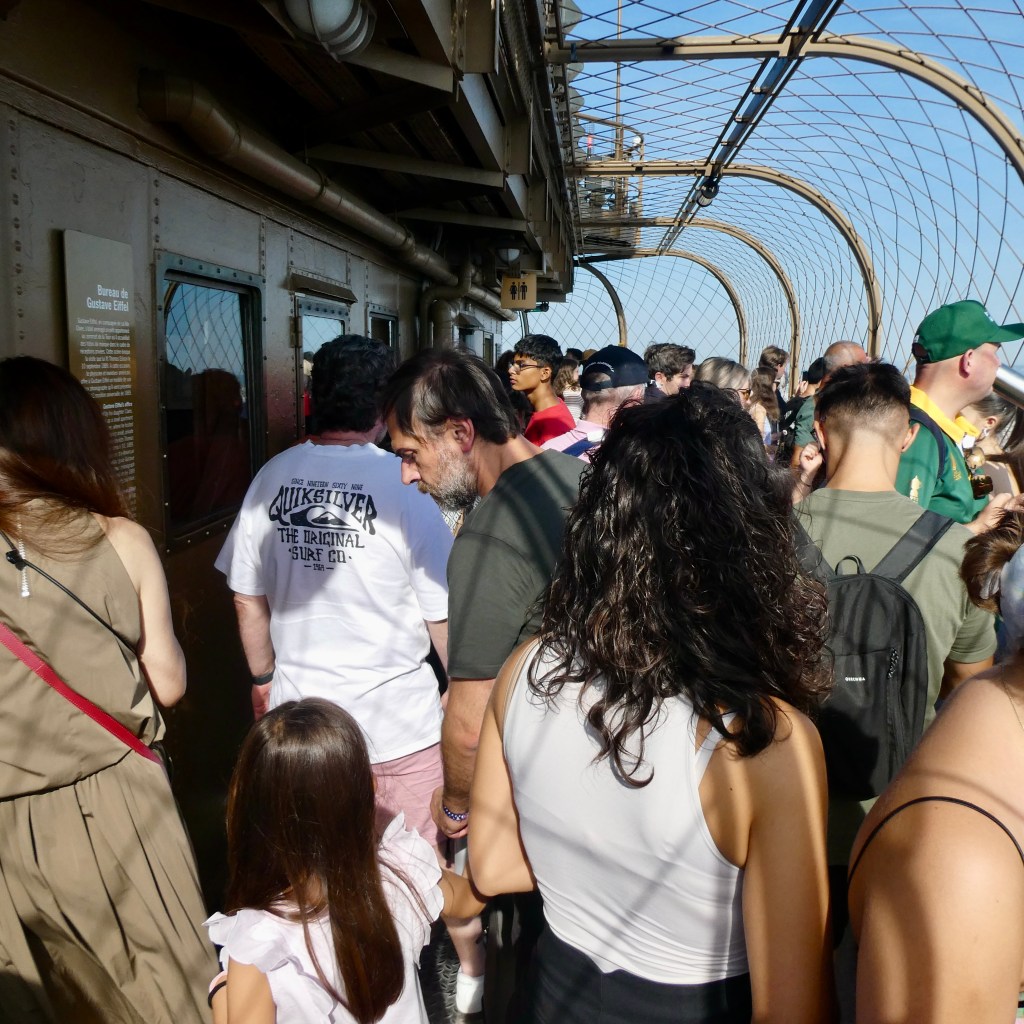
The second lift took us all the way to the summit where there was an observation deck.

It was at the top that we had our champagne served in “fancy” plastic flutes!

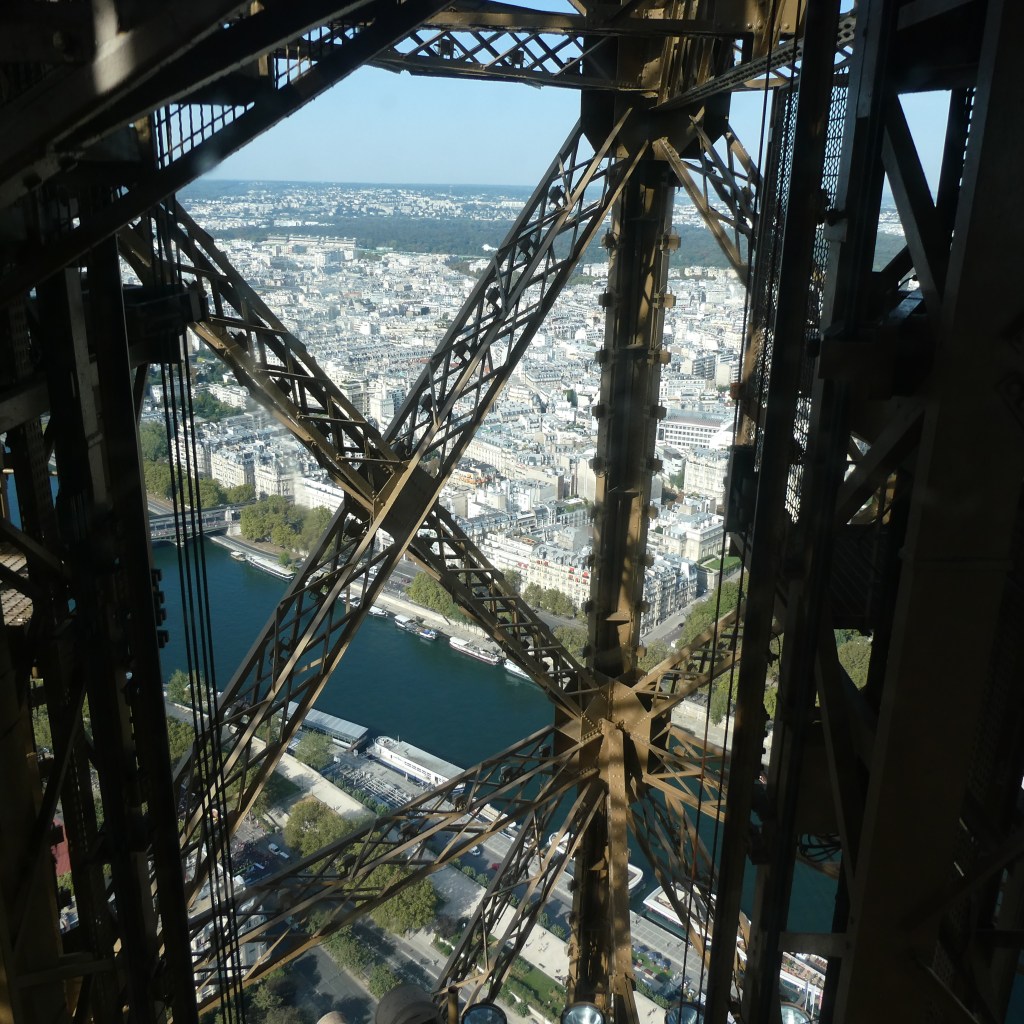
We saw views of Paris everywhere we looked!

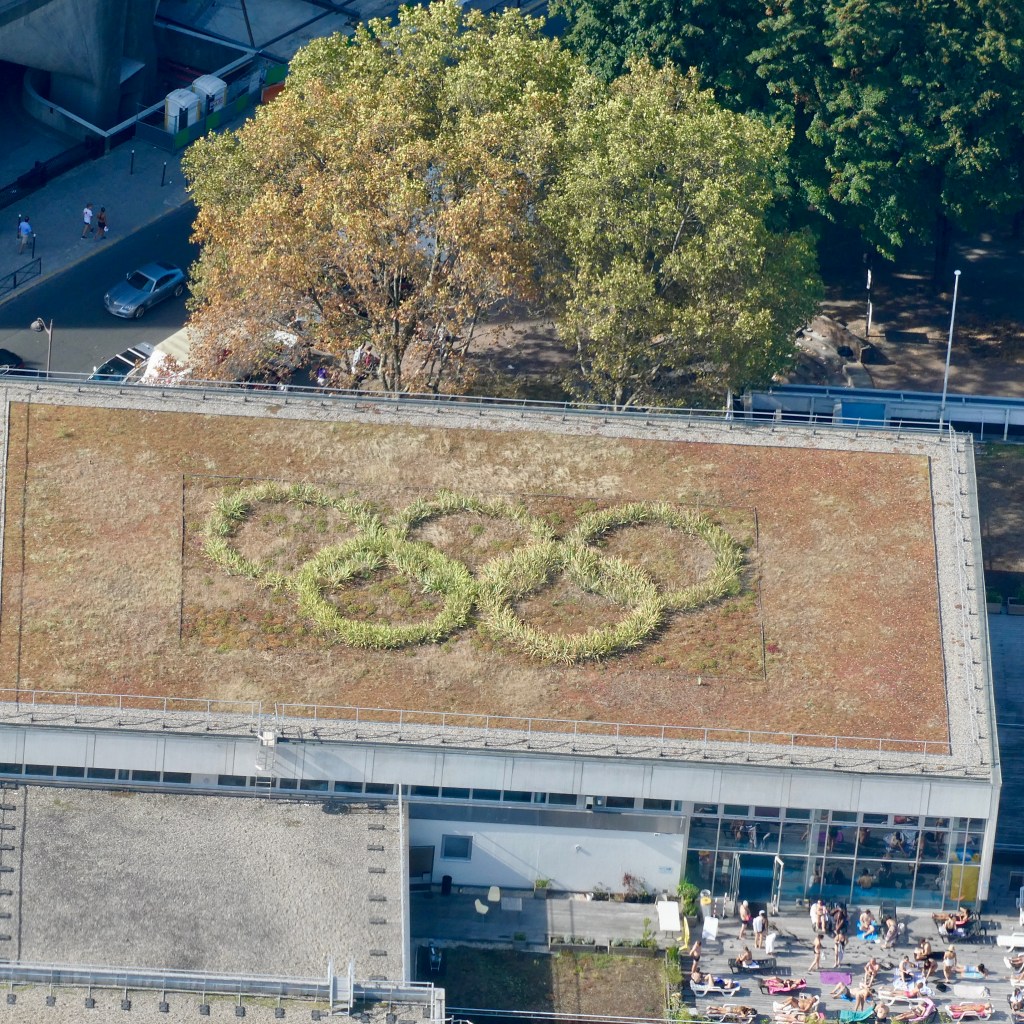
We saw evidence of preparation for the 2024 Olympics to be hosted in Paris.

The tower has 7,000,000 visitors per year and has become a globally recognizable icon of Paris.  The city of Paris now owns the concession. 

Fortunately our Seine River Cruise embarkation point was nearby – but that didn’t mean it was easy to get to given the fencing and barricades erected for the race.

We got there, boarded the boat and enjoyed the narration along the river.

We saw some fancy bridges!

These are part of a Russian Orthodox Spiritual and Cultural Center.

The obelisk in the distance is in honor for the work of Jean-Francois Champollion. He cracked the code of Egyptian hieroglyphs on the Rosetta Stone in 1822. 

In thanks, the sultan of Egypt offered Paris the diplomatic gift of two ancient Egyptian obelisks from the Luxor temple in 1830.  Getting the first one to and erected in Paris took years of effort and misadventures.  It was finally accomplished in 1836. The second obelisk was never picked up and “returned” to Egypt in 1981.

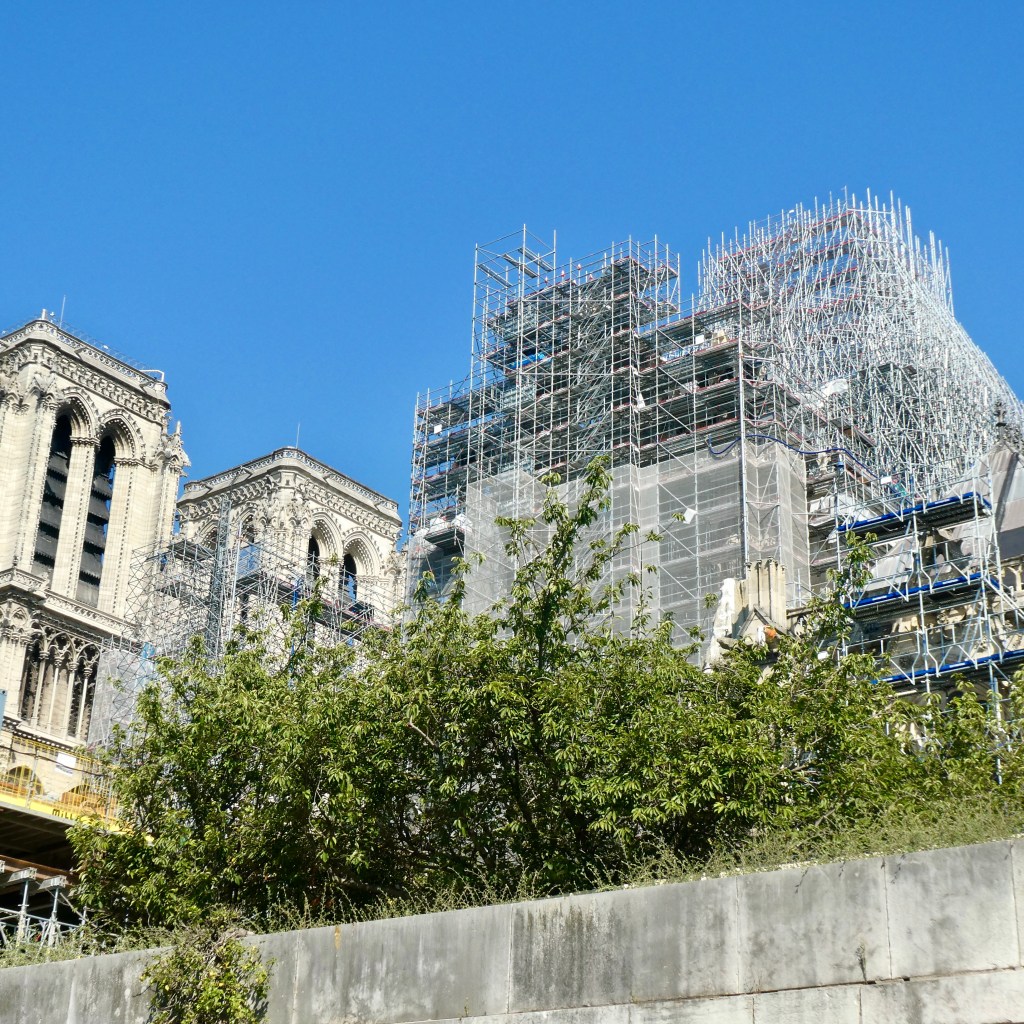
We saw Notre Dame again, this time from the river.

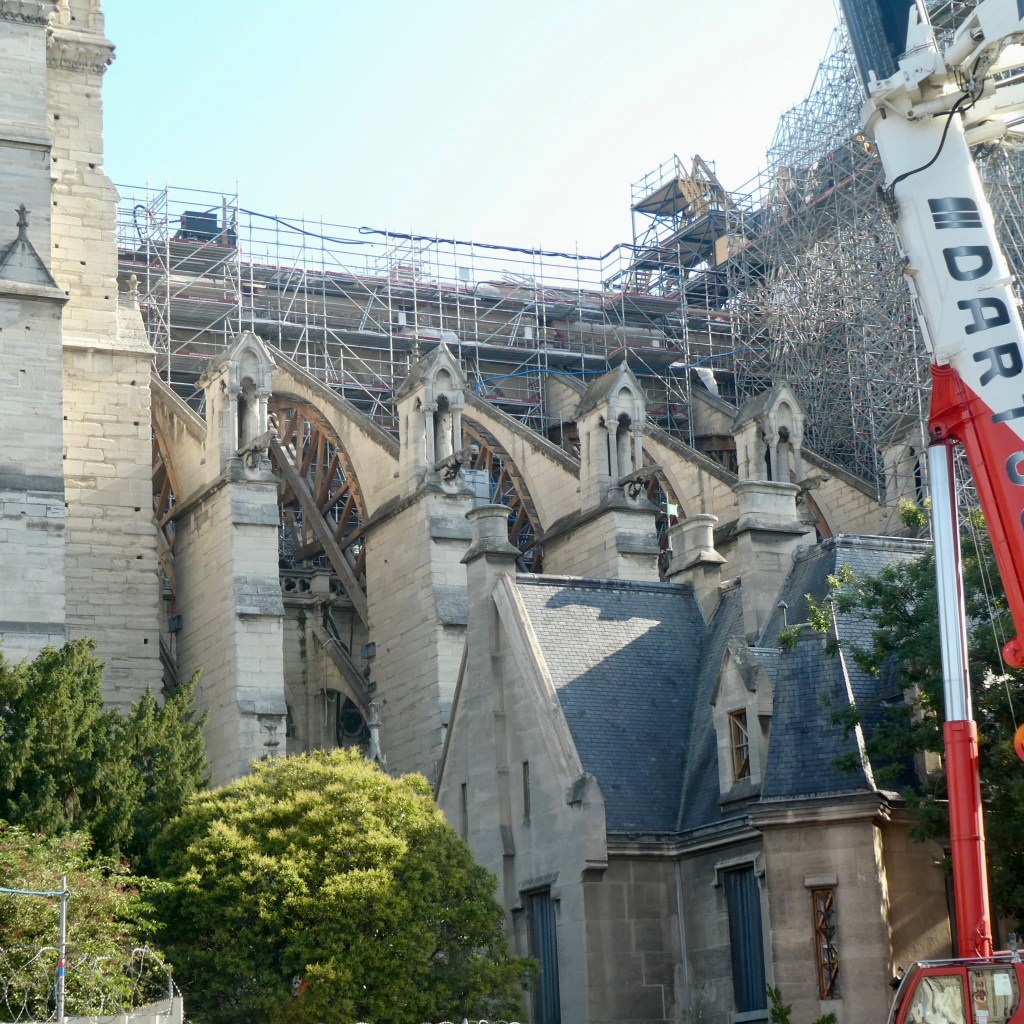
We had not been able to see this side of the repair work on Notre Dame from land.

More of the sights along the Seine River, Paris France!

We had one more view of the Eiffel Tower – this time from the river.

We disembarked and then had a terrible time getting an Uber to pick us up to take us to the Louvre. We were on a schedule needing to be there for our timed entry ticket purchased months in advance.  We had to navigate the competing thoughts of ‘we need to keep moving in case no one ever comes to get us’ and ‘we have to be willing to wait for a driver.”

Finally, after racing across the street, and getting a bit of a lecture about DON’T MOVE (even if the app tells you to) we were in a vehicle and on our way to the Louvre.

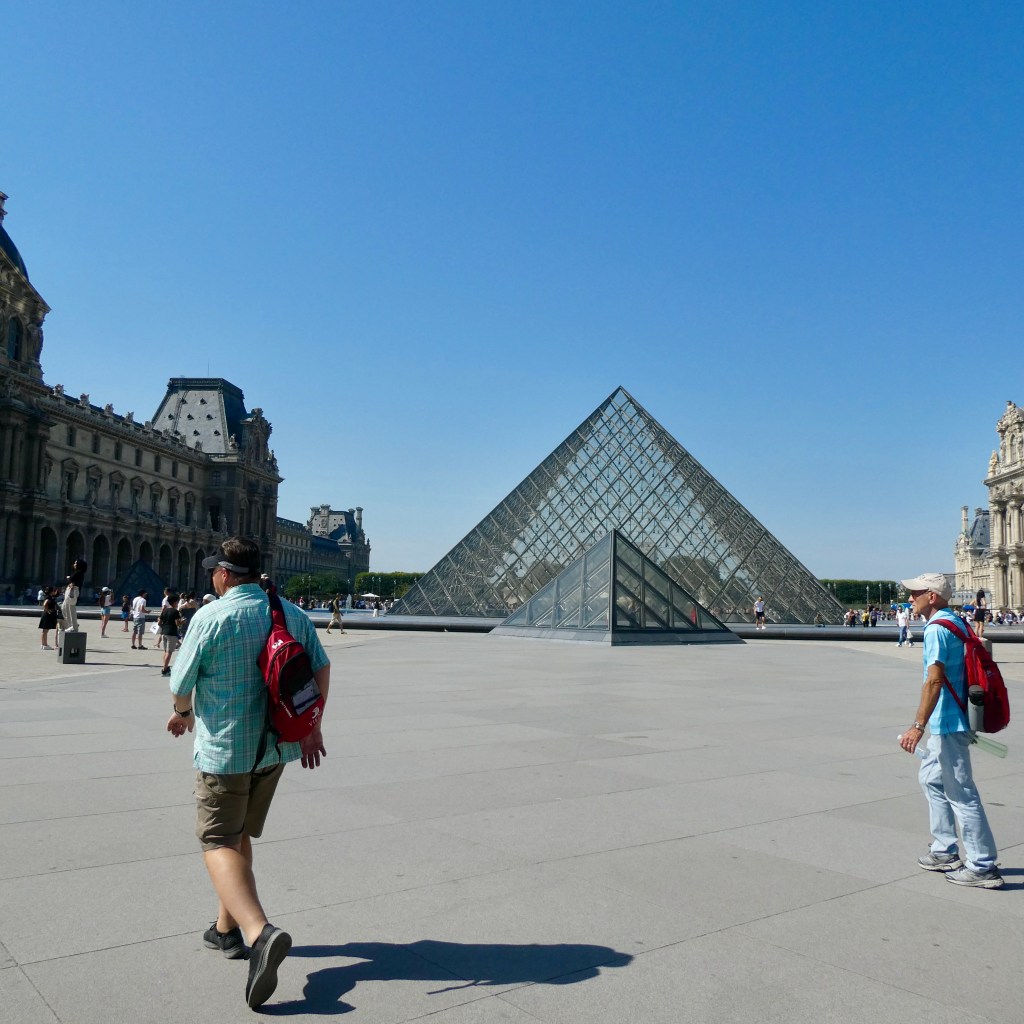
We made it to our final destination of the day, the Louvre Museum. It was still hot but we knew it would be air conditioned inside! 

We had booked a private guided tour for the Louvre because we didn’t have enough time in Paris to spend an entire day wandering around looking for the Mona Lisa and whatever else we might happen upon.

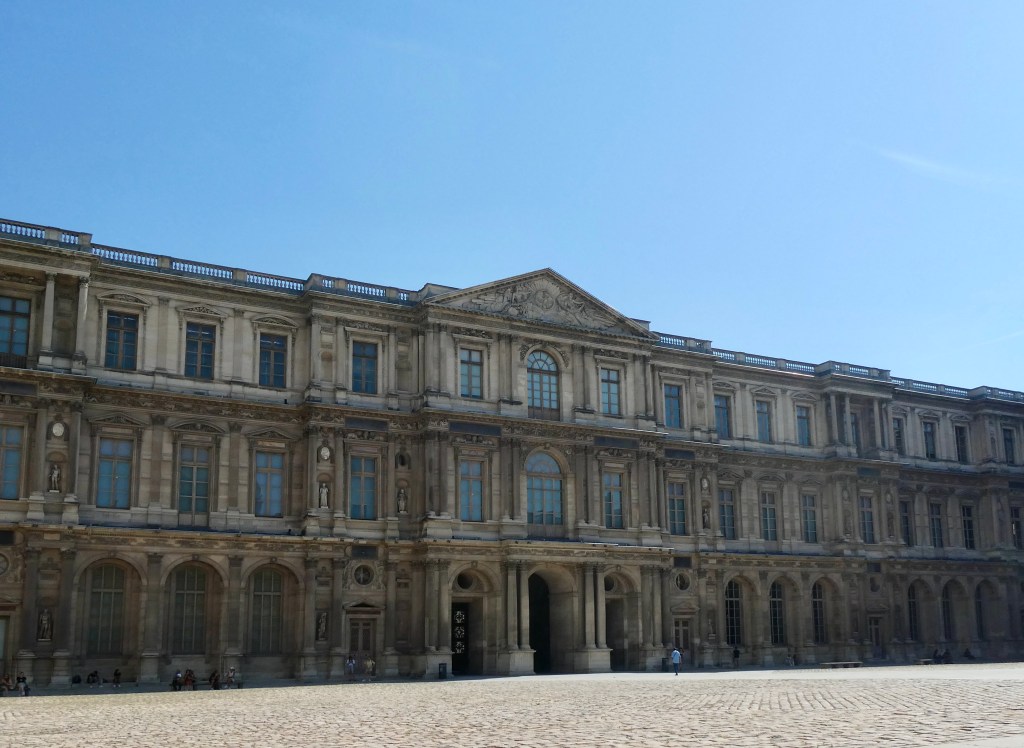
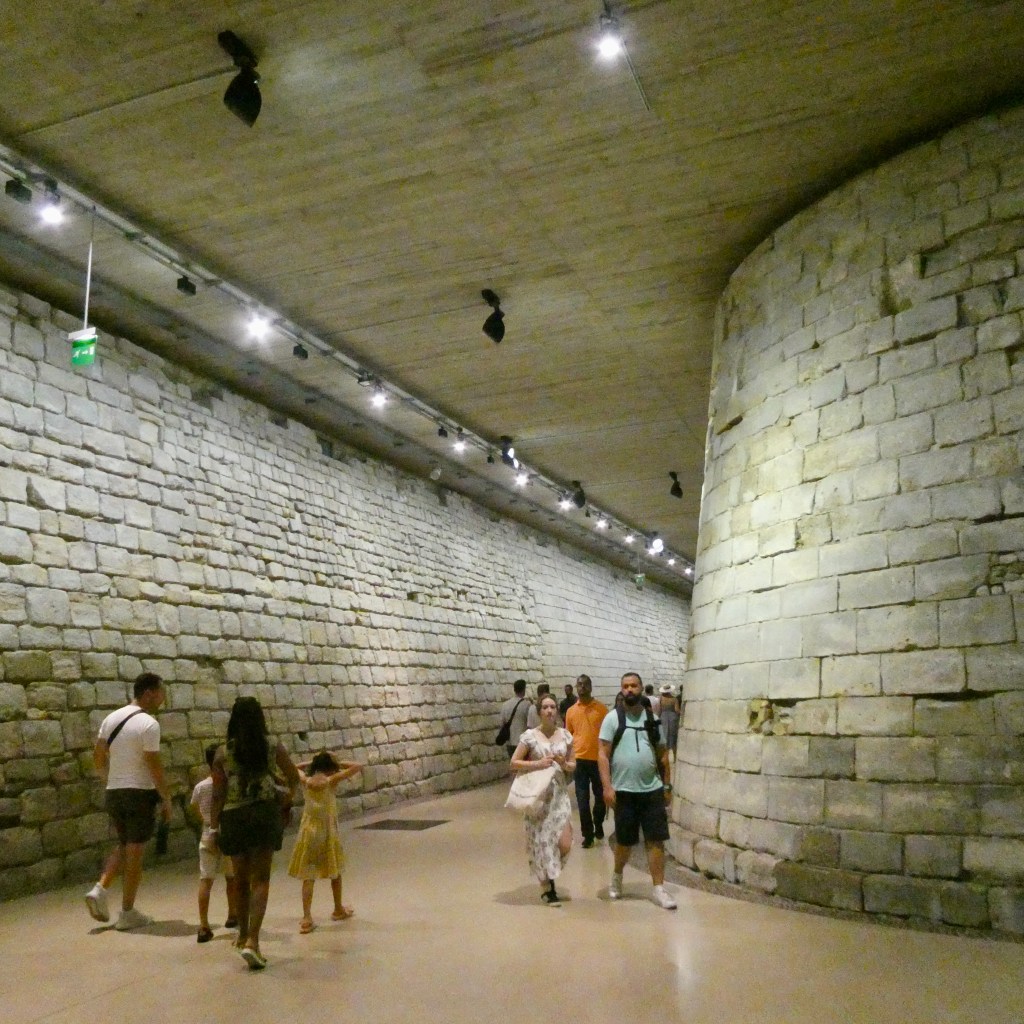
We met our guide and followed her lead. She took us first to the lower levels to see the foundations of the building from when this was the royal palace.

We were there – in the moat!

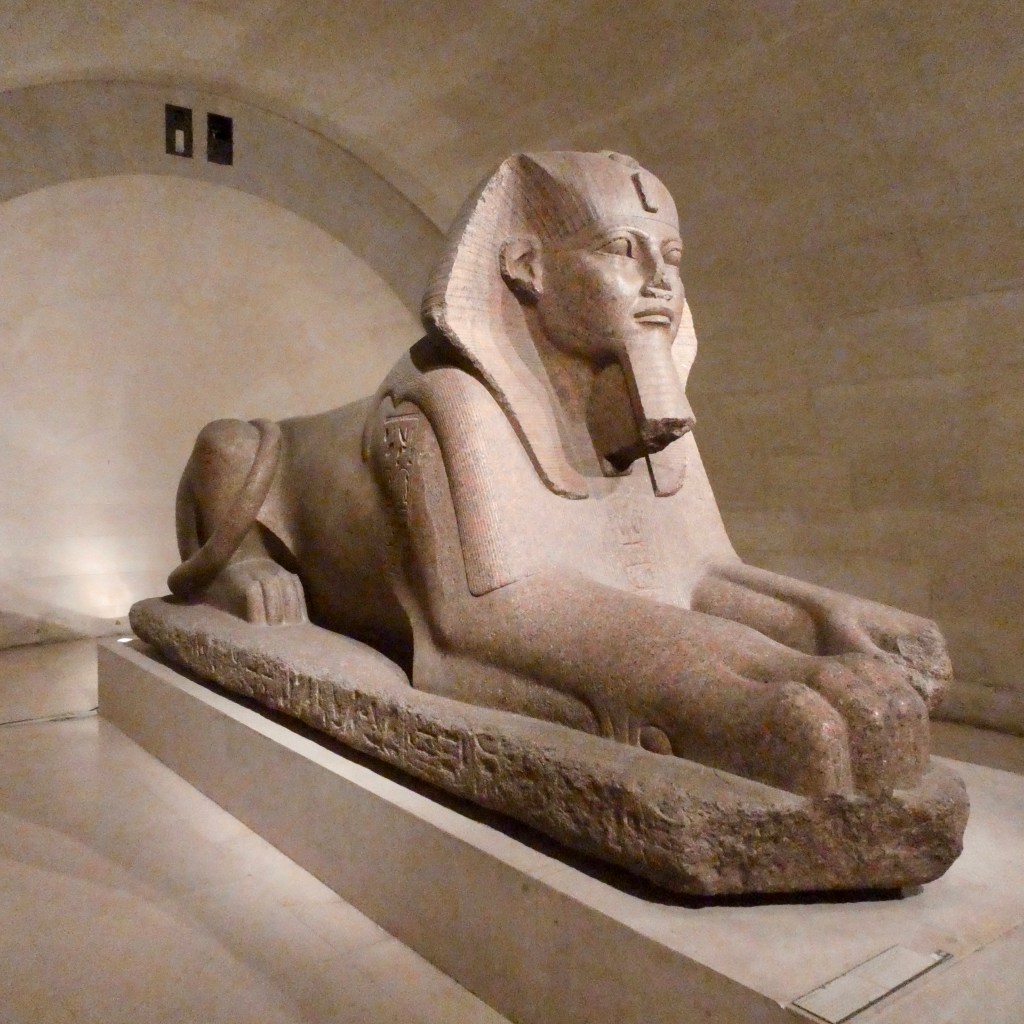
We saw some of the ancient Egyptian collection.

Our guide was very knowledgeable and always had us looking at details.

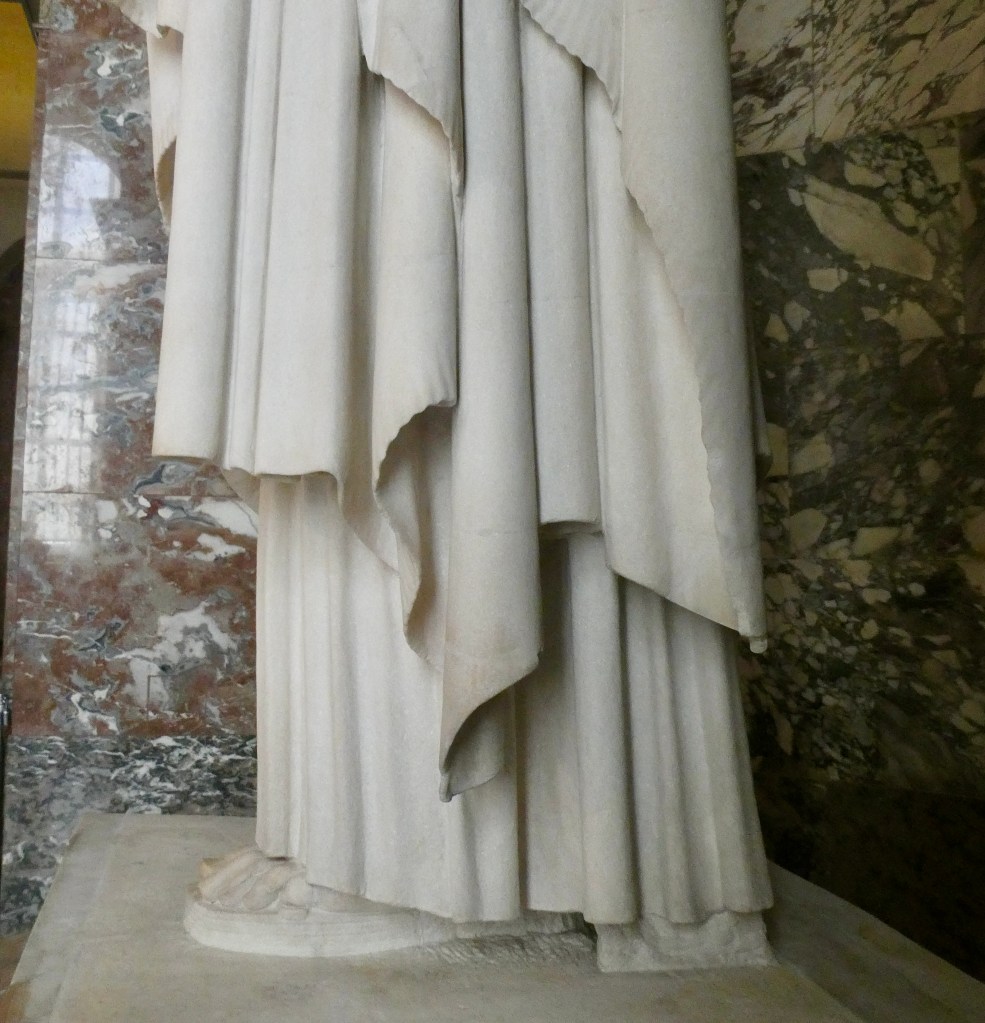
She had us notice how the artist was able to make the stone look like it was draping fabric.

This” stone fabric” has the illusion of transparency.

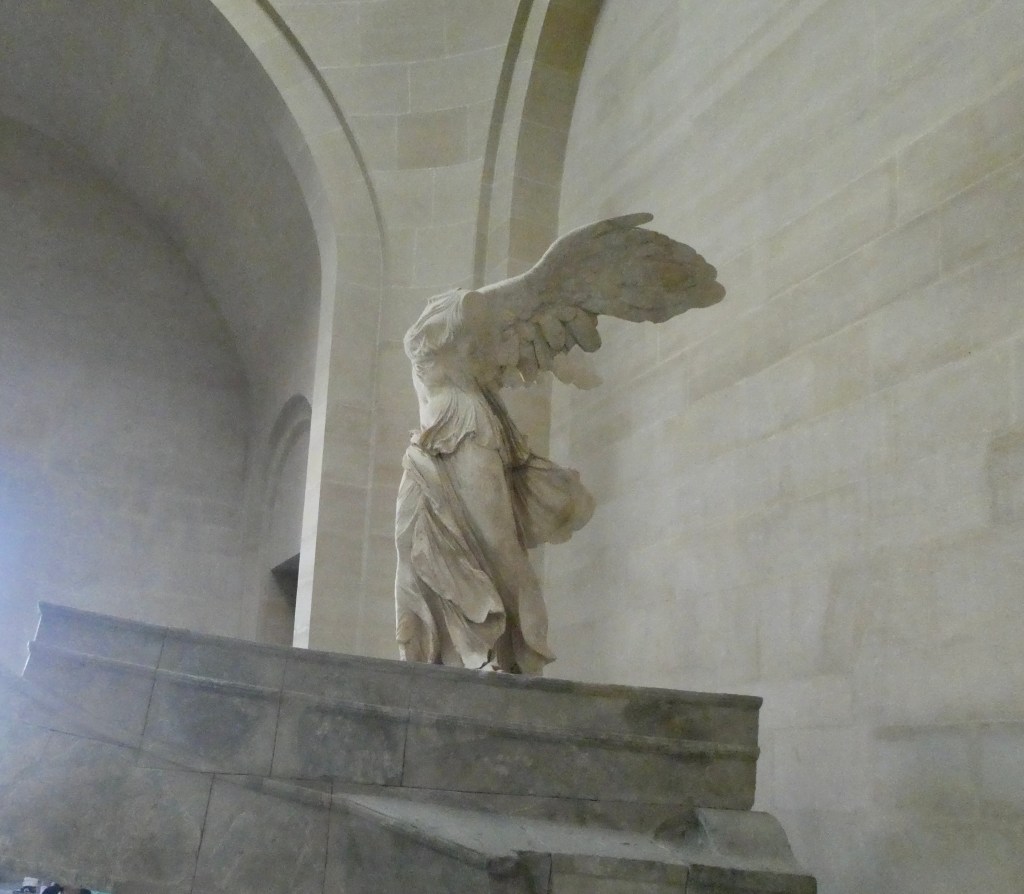
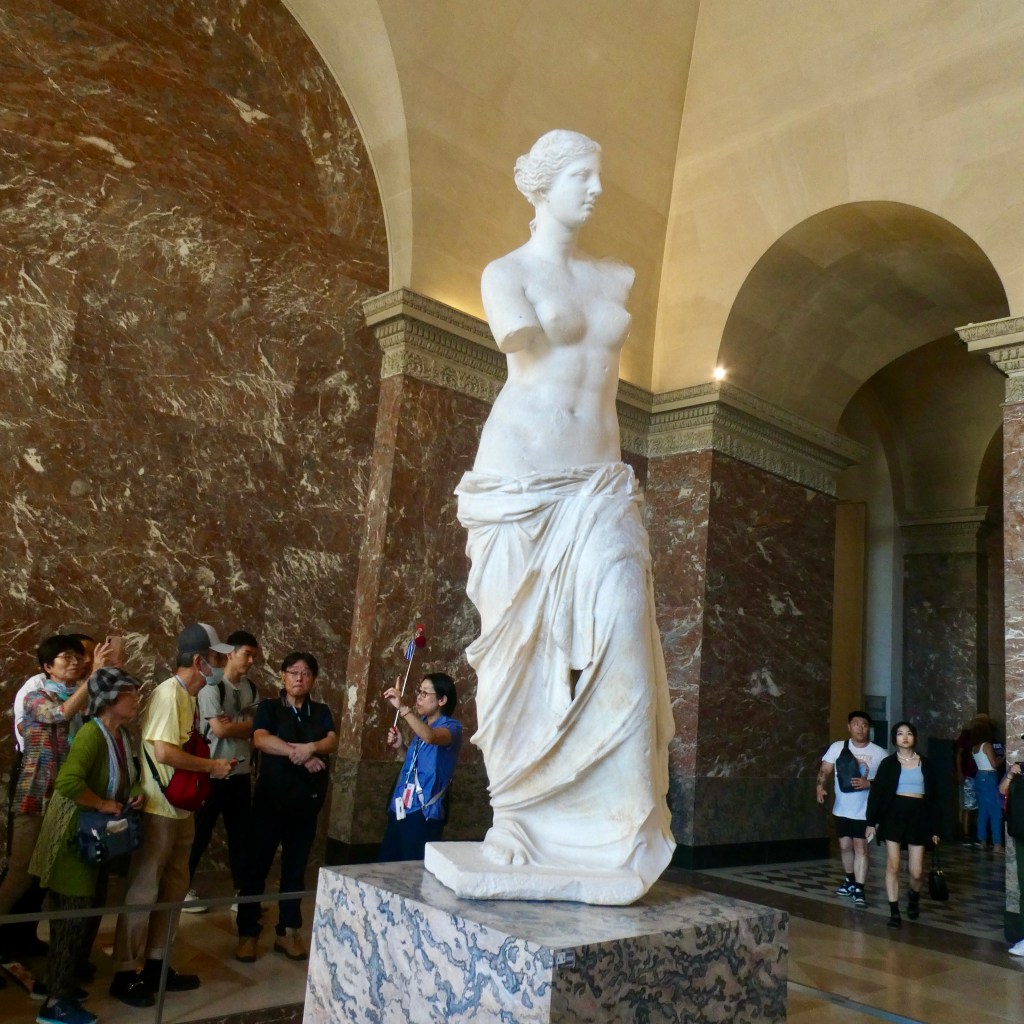
We saw a couple works that we recognized like the Nike (of Samothrace)…

and the Venus de Milo.

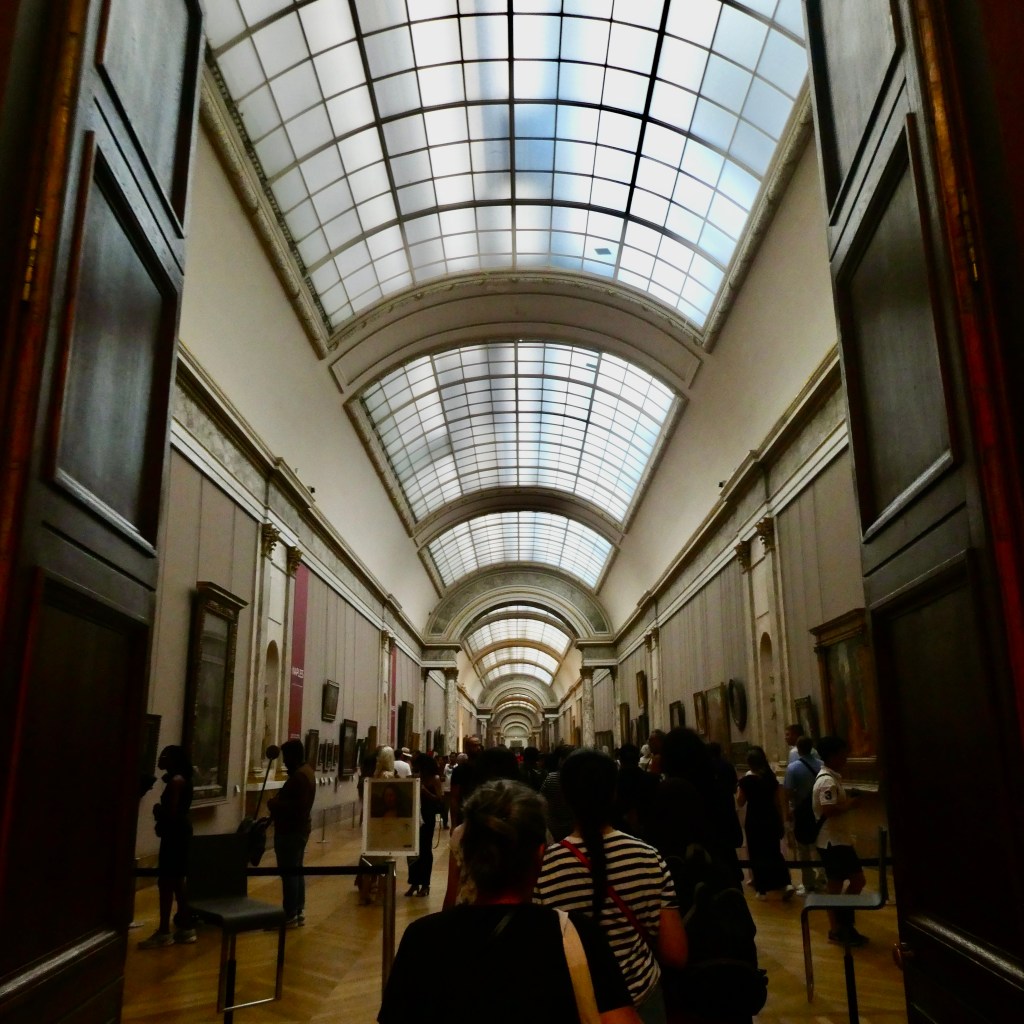
Then she led us to many paintings that we knew nothing about.  

Our guide’s passion seemed to be these lesser known paintings, their secrets, and how the artists created them.

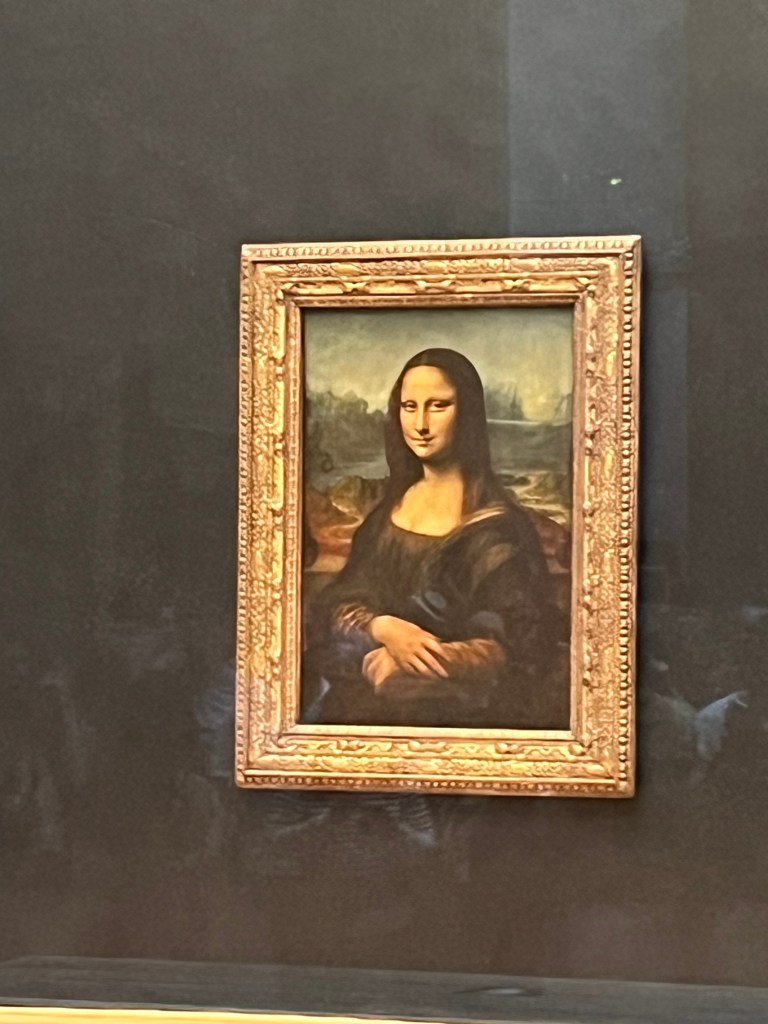
Our guide expressed frustration that one of an artist’s paintings might be more famous than another when the second was more worthy. She put the Mona Lisa in the category of being the most famous but not DaVinci’s best work.

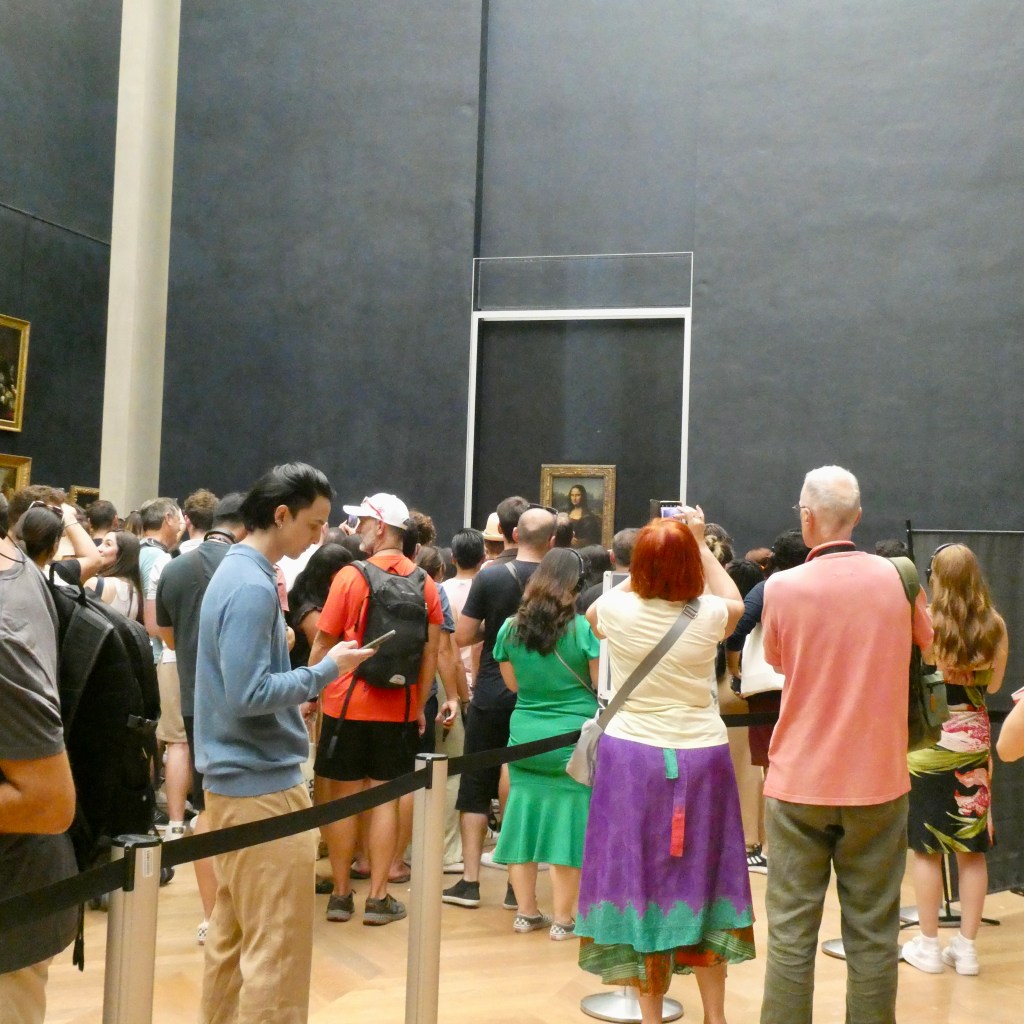
After 90 minutes, our guide escorted us to the line to view the Mona Lisa and was gone. 

  As you can see there was quite the crowd gathered to see the small painting of Mona Lisa.  

We got close enough to use the zoom feature on our cameras and called it good.

I have mixed feelings about our experience using the personal guide. On the positive side she was extremely knowledgeable and we saw, and partially understood, way more than we would have on our own no matter how long we might have wandered. On the negative side, we saw what she wanted to show us. I can only assume she hit all the Louvre highlights. The thing that bothered me is that she never asked us what we wanted to see – even though we probably wouldn’t have known what to say had she asked.

We wandered a bit more on our own.

I saw this painting by Rafael that seemed familiar even though I know almost nothing about art.

In the end we felt good that our full and busy itinerary for the day had been accomplished successfully and very much enjoyed. 

However, there is an exception – except for Uber! We still had one more frustrating attempt to get an Uber driver to take us back to the hotel. It was painfully slow but eventually accomplished. If you are wondering why we didn’t get a taxi, there weren’t any of those either.  I don’t know if transportation issues are the norm or if was just a very busy few days in Paris.

Connie and Warren still had the energy to do one more Viking tour called Paris by Night.  They were able to see the Eiffel Tower sparkle! We were sorry to have missed it, but not sorry enough to wish we had gone!

We were busy in Paris on September 10, 2023.

Next up:  Some of us go to Normandy.

Posted in Uncategorized | 2 Comments

Viking Paris Extension: Palace of Versailles

My lasting memory of Paris may be the heat.  We live in Phoenix so we are used to hot weather but we aren’t used to very little air conditioning.  Fortunately our hotel had AC but we weren’t in Paris to stay in a hotel.

Unfortunately, Paris was experiencing temperatures ten degrees warmer than normal. In addition there was so much going on in the city that every place was busy and crowded.  

Paris, home of 2.2 million inhabitants, was hosting the Rugby World Cup while we were there.  There was also a lot of construction happening, catching up after COVID, and in an attempt to make Paris more bicycle friendly. 

On top of everything else, they were preparing for hosting the Olympics in 2024. Our timing wasn’t great!

Our first tour was Panoramic Paris – fancy talk for a bus tour of the sights, getting off here and there. 

Most of my pictures didn’t turn out well through the bus windows but this one was fine.  Ernest Hemingway lived on this street during his years in Paris.

This tree is from the 1600s and is the oldest in Paris.  There are wooden supports because the tree was damaged during shelling from one of the wars. I’m not sure which war but there are a lot of possibilities.

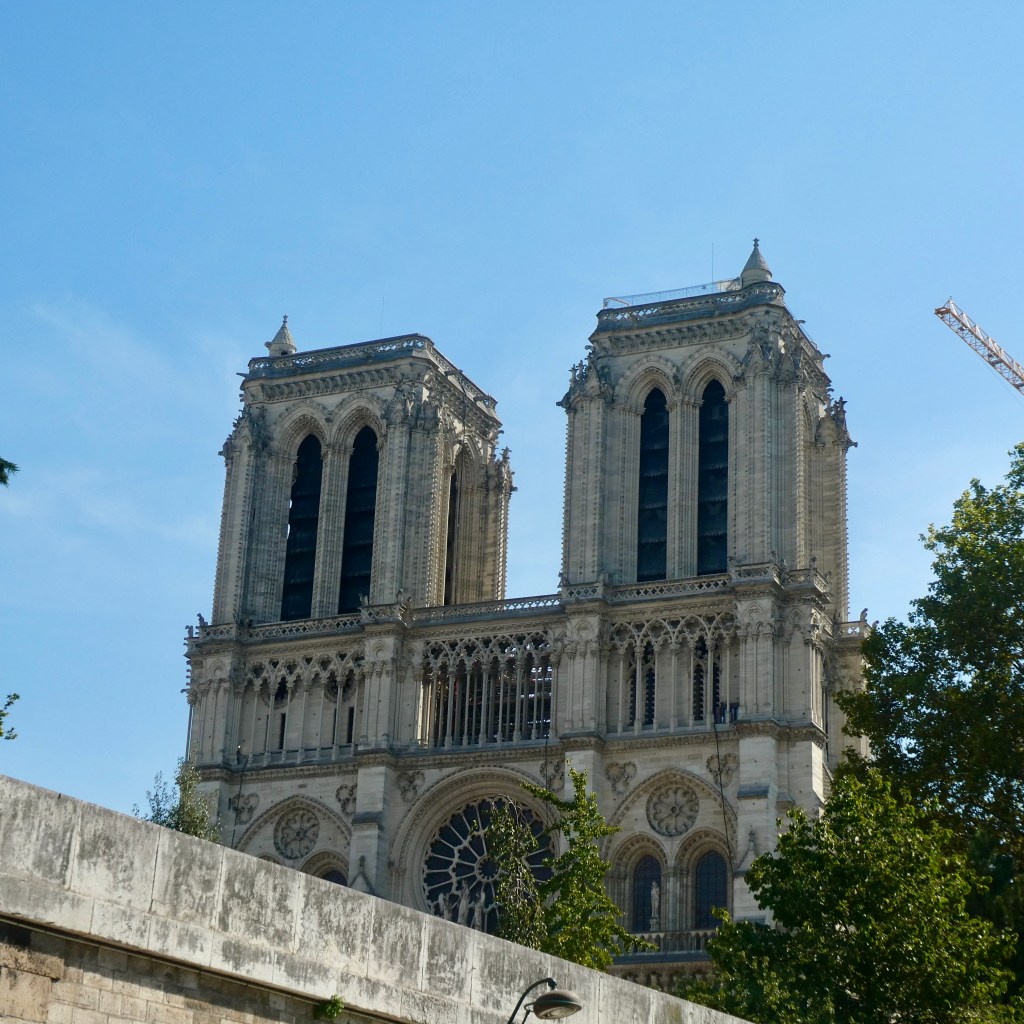
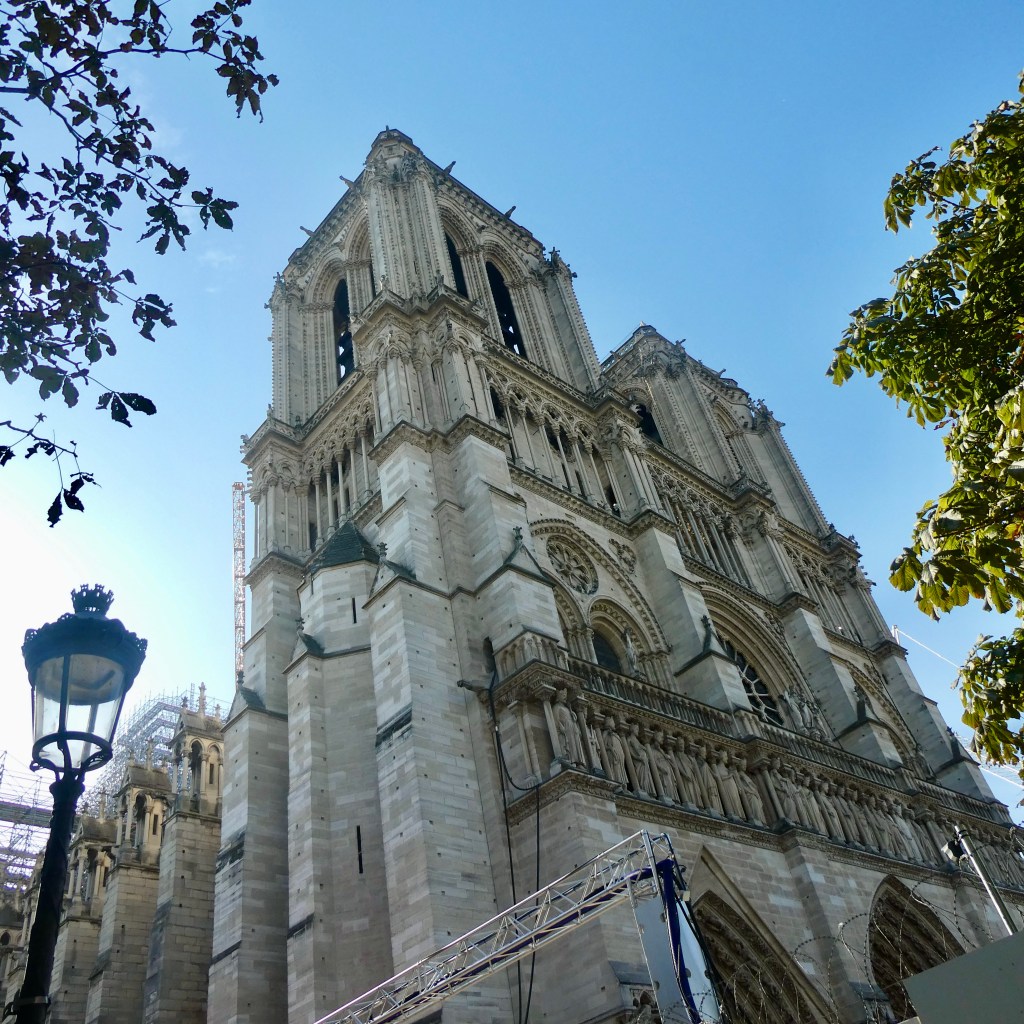
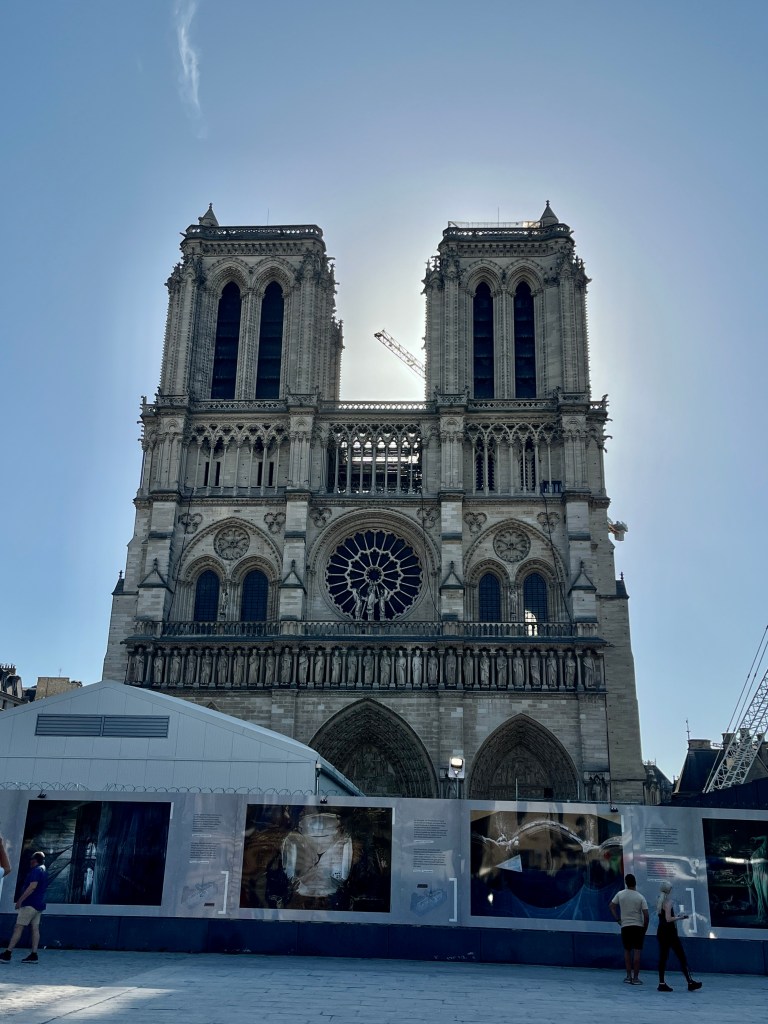
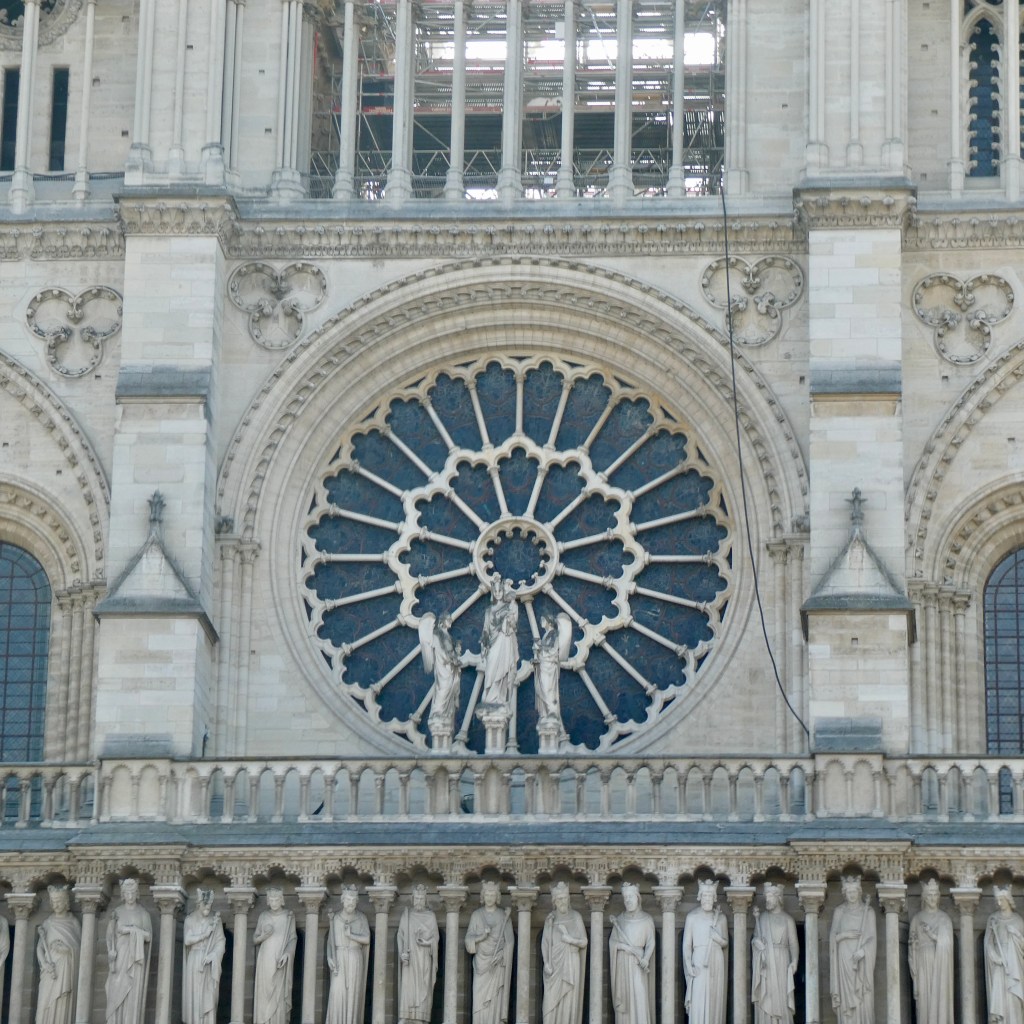
We were able to get out and walk around portions of Notre Dame, an 860 year old Paris landmark. 

It is, of course, under repair after the fire on April 15, 2019.  Story boards around the facility detail the fire and repair efforts.

They are on schedule with a five year massive effort to rebuild.  They plan to reopen December 8. 2024 – impressive given the delays that COVID caused in everything else.

We were told by our guide that Notre Dame wasn’t that important to the French until publication of Victor Hugo’s novel The Hunchback of Notre-Dame.

Our afternoon tour was to Versailles – the extravagant home of French royalty.  Unfortunately, in addition to the heat outside, the air conditioning on the bus did not work.  The bus temperature display read 40 degrees Celsius which is 104 degrees Fahrenheit. 

The palace and garden, are a UNESCO world heritage site. 

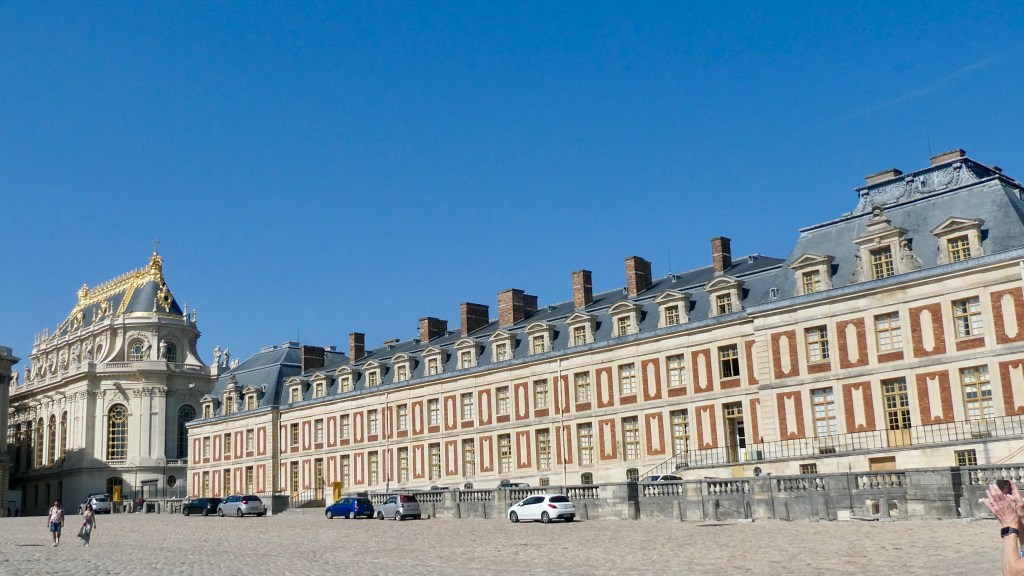
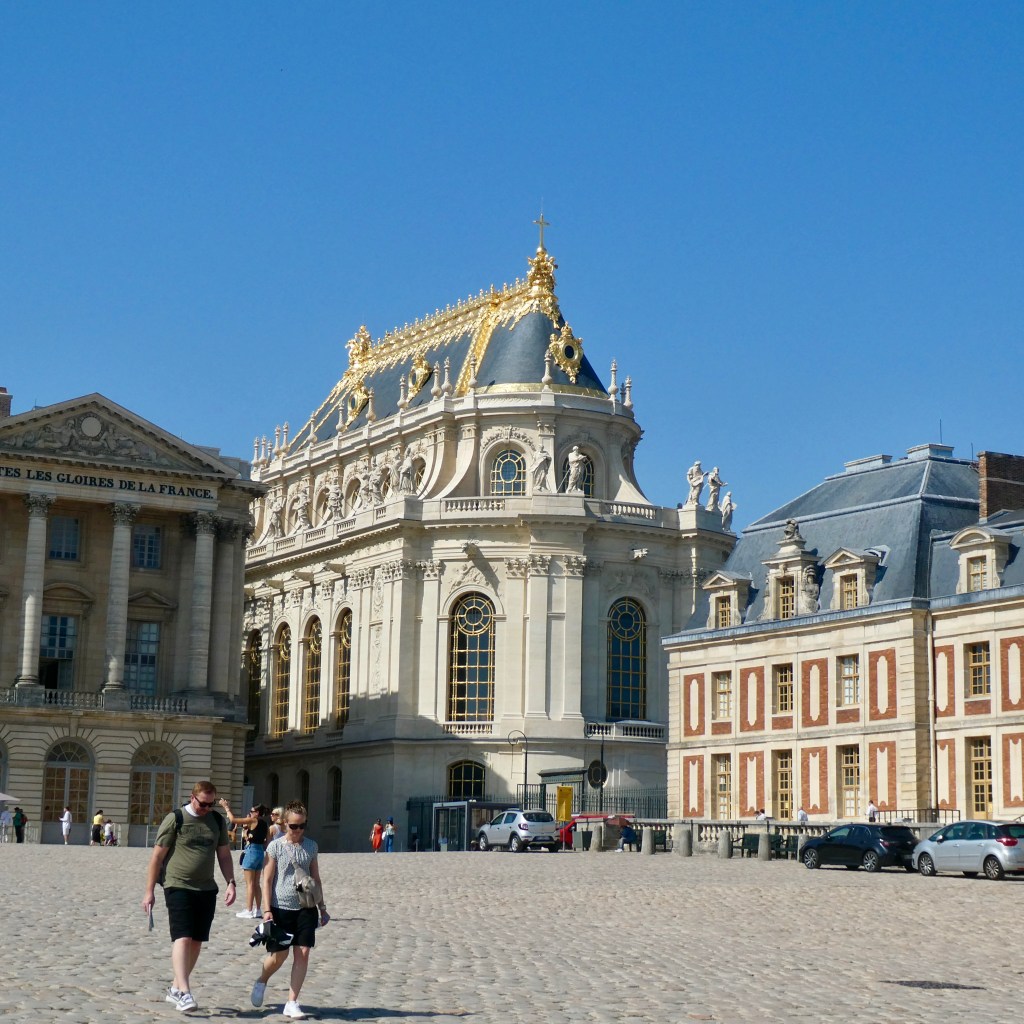
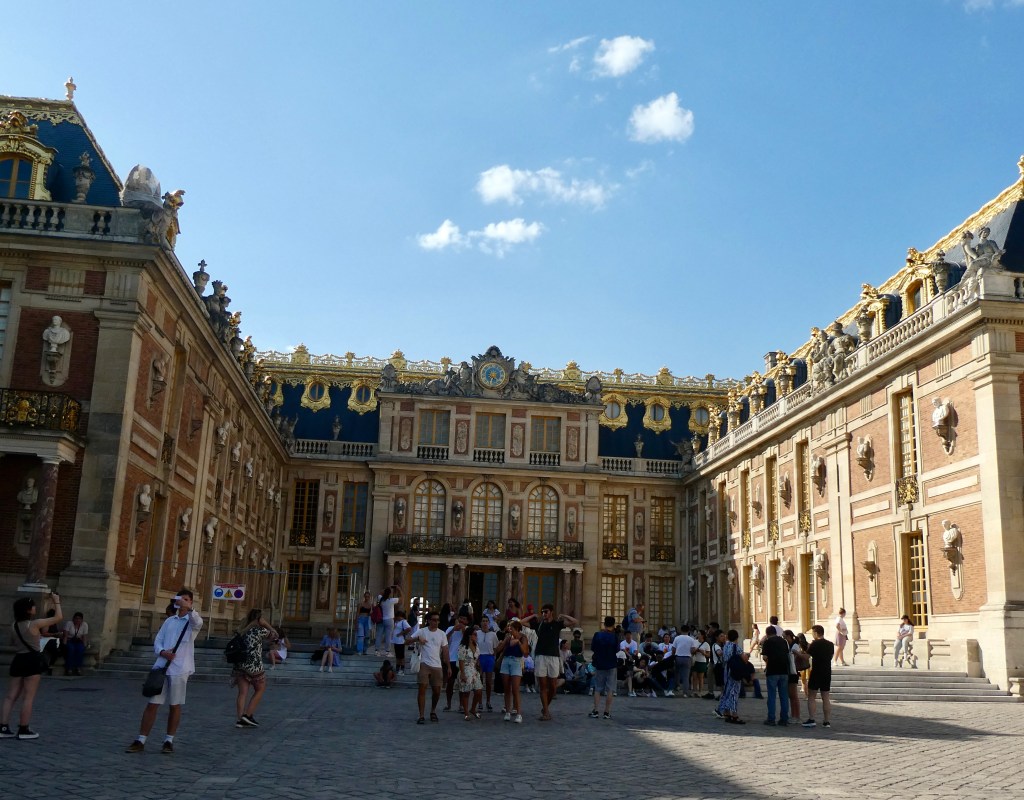
We were not far enough away to begin to get a picture of the entire palace. 

This one is from their website. 

The story of Versailles began in the 1600s when Louis 13th was King. The court was mostly in the old palace (now the Louvre) but moved around and was itinerant.  Louis decided he wanted a hunting lodge out of town and, in the 1620s, built one at Versailles. The hunting lodge had 20 rooms.  

Louis’ wife was Queen Anna of Hapsburg.  The marriage was a political alliance and finally resulted in a royal birth 23 years later. 

The baby Louis became Louis XIV. He became king at age 5 and ruled with an Italian Prime Minister. He began to rule by himself at age 23. 

He spent the next 50 years expanding the lodge, eventually to 2600 rooms. The court moved to Versailles permanently in 1682 when the palace began to be used for residence and administration. Part of his intent was to keep his enemies close. 

King Louis XIV ruled for 72 years, the longest in French history.

Eventually his son, Louis XV became king.  He lost much of the lands in France’ empire including Canada to England in the Treaty of Versailles of 1763.

I believe that these pictures are King Louis XV on the left and King Louis XVI on the right.

King Louis XVI was the Louis who married Marie Antoinette.  He was also the one that Benjamin Franklin came to ask for help with the American Revolution under the guise of “Our enemy’s enemy is our friend.” 

History considers King Louis XVI to be a good guy trying to manage the three classes of people – the clergy, the nobility and the commoners. In 1789 he held meetings to talk about taxes.  He thought that rich people should pay more tax but they didn’t want to and he couldn’t insist and maintain his power.

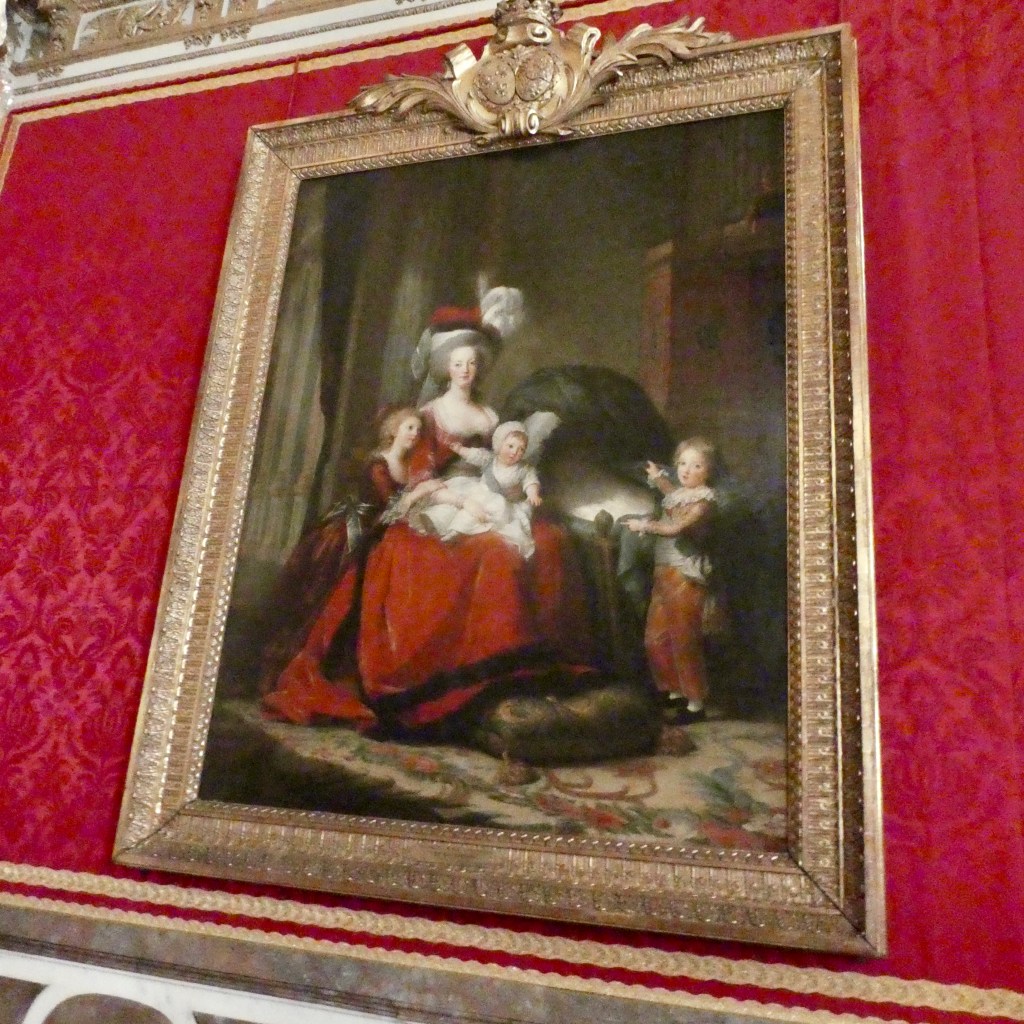
The resulting French Revolution determined the fate of both King Louis XVI and Marie Antoinette.

There were so many people visiting the Palace of Versailles that day that it was difficult to stay with our guide or stay within range of the earphone system.

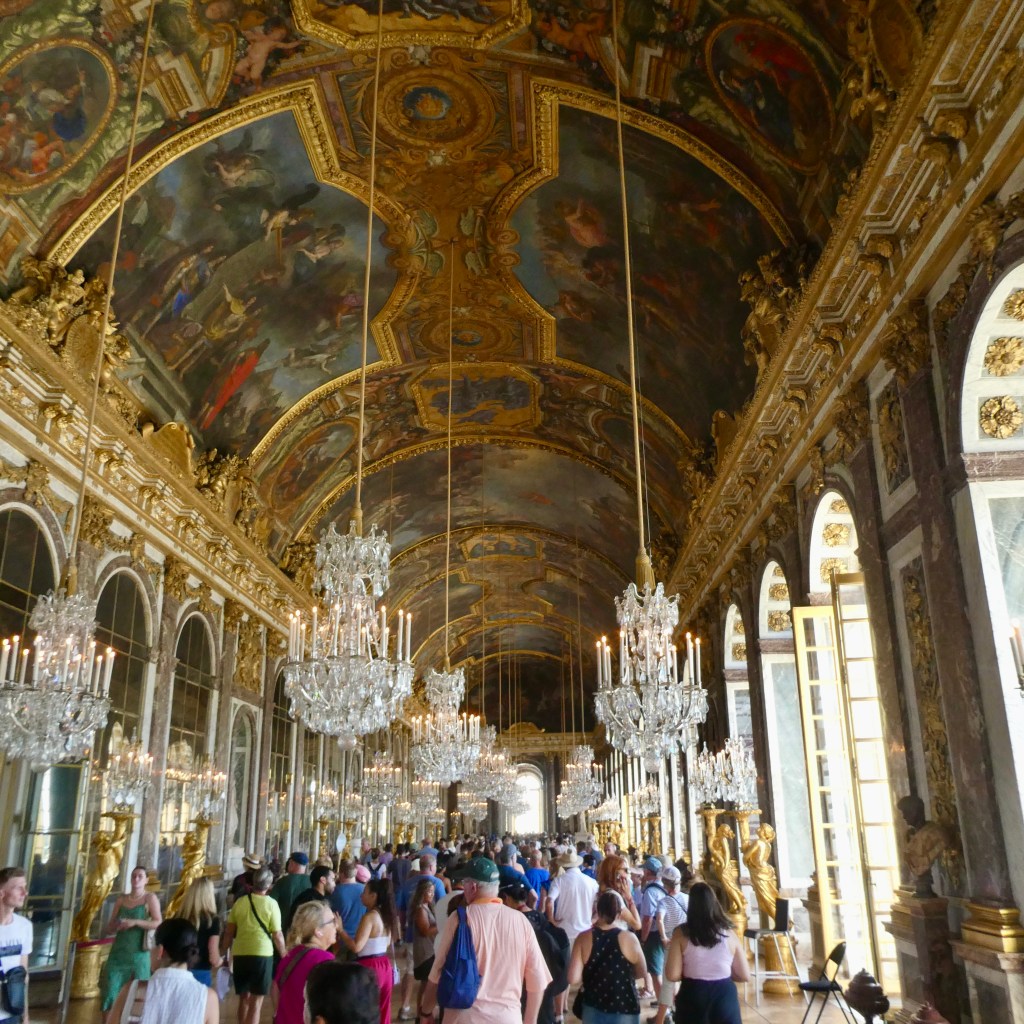
 We were in the crowd walking through the Hall of Mirrors.

In the end it was easier to just walk around, get a bit of a breeze from an open window when we could, and enjoy the sights.

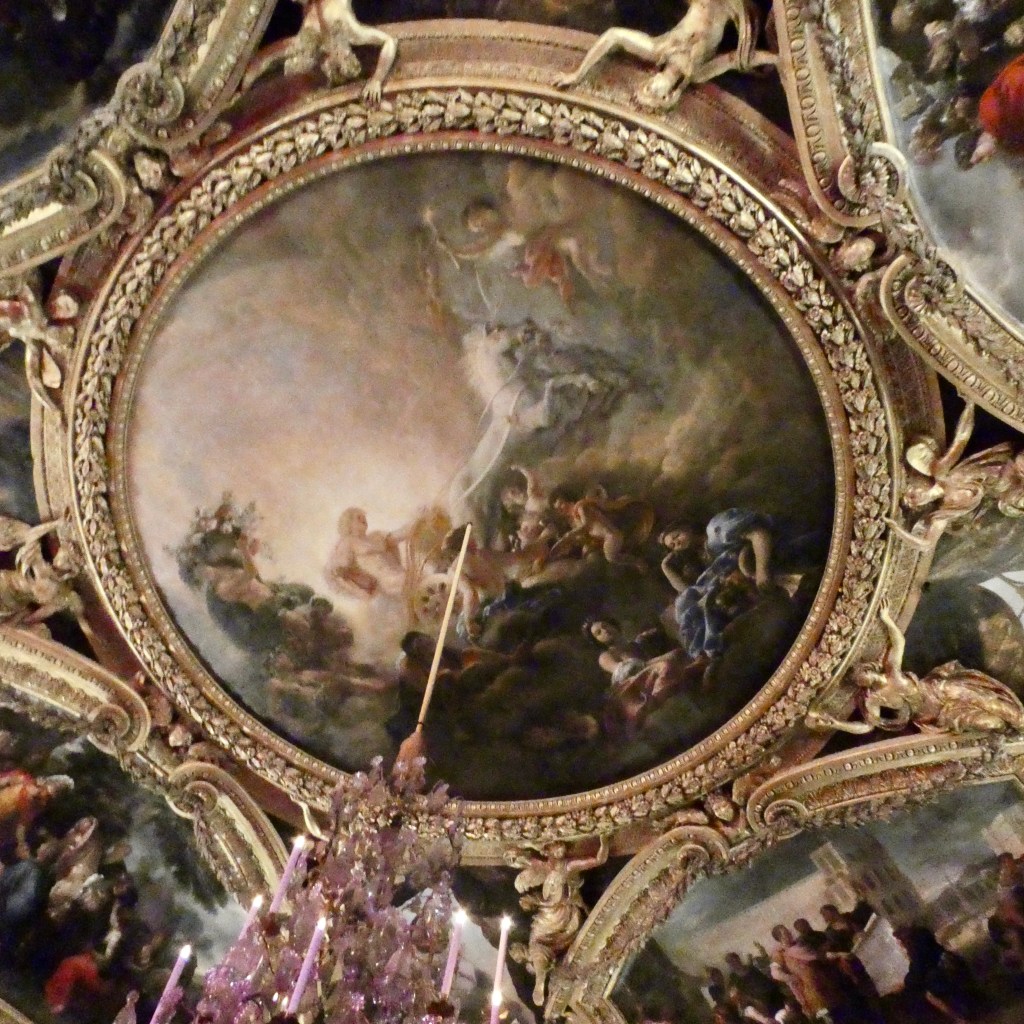
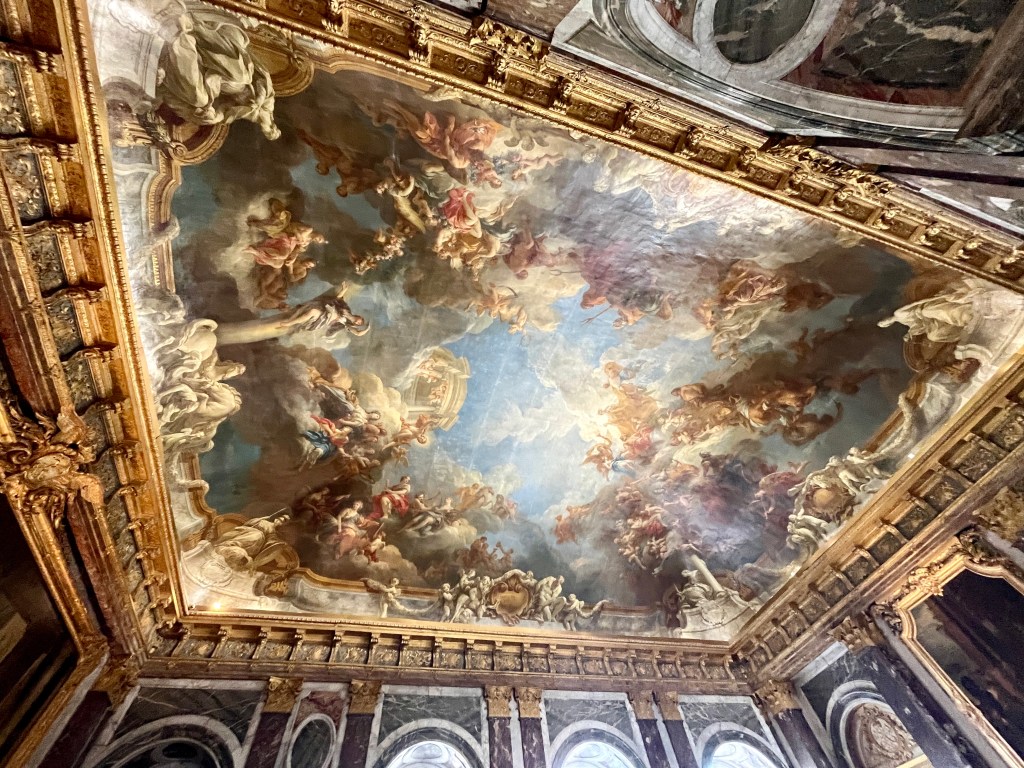
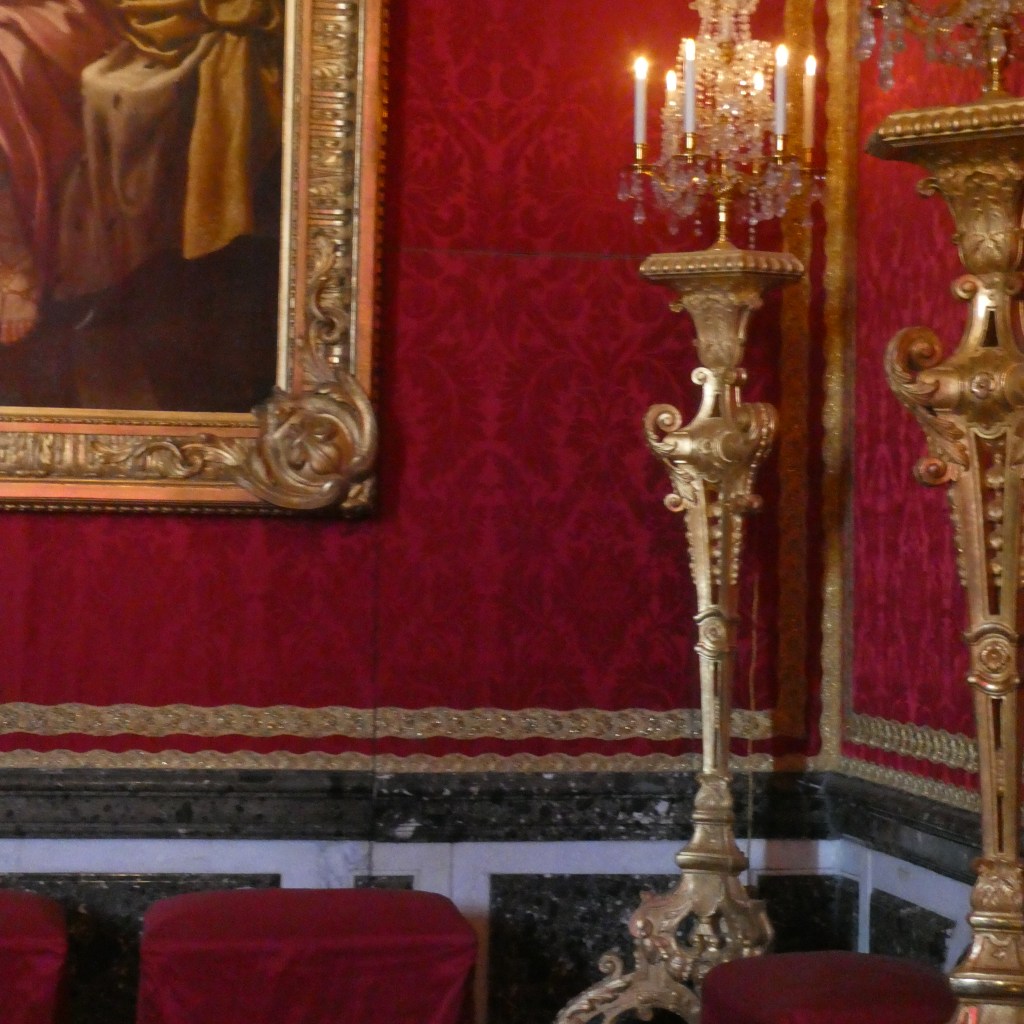
The interiors were very ornate!

This fresco is one of the largest in the world.

There were many tapestries.

This was the king’s bedroom.

It had a secret door in the corner! I wonder where it went and whether it was for security or play.

This was once Marie Antoinette’s bedroom.

The opulence extended to the outside.

The grounds cover 1000 acres – about one tenth of the original size which included hunting grounds. We enjoyed walking around a small portion of the expansive grounds.

The citrus trees in the planters are taken “in” during the colder months.

There are 400 sculptures on the grounds.

What do you get a king who has everything for his birthday?  The Swiss Guard, who provided palace security, made the lake as a gift.

Earlier I mentioned a Treaty of Versailles signed in 1763.  Another important Treaty of Versailles was signed by the Allies and Germany on June 28, 1919 signifying the end of World War I. 

We had been in and around the palace for hours. They should have had time to fix the AC or exchange our bus, right?  No!  The bus ride both ways was without AC. 

A Viking representative from corporate was on our bus for the 40 minutes ride to the hotel. He was even less happy than we were!  Heads were going to roll – which is an interesting phrase to use in a country known for using guillotines.

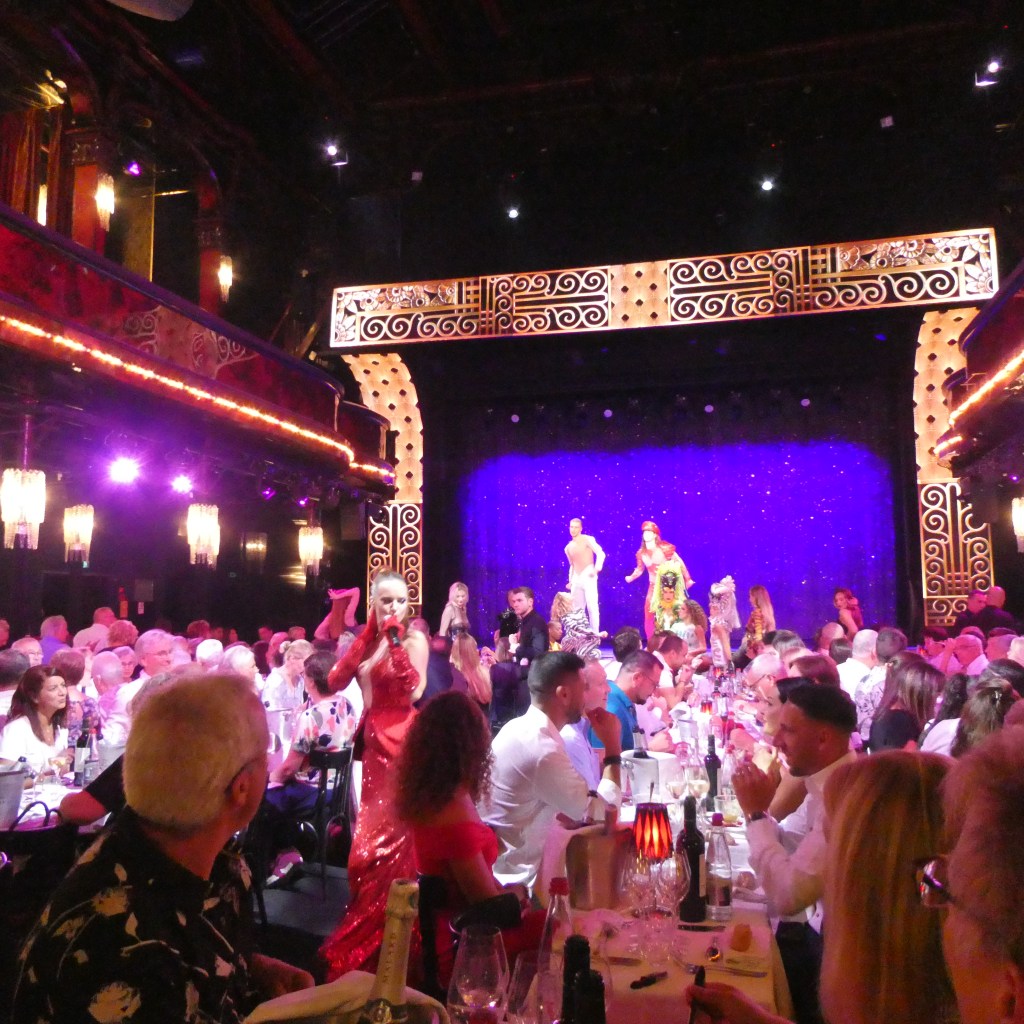
That evening, after a long hot day, we dressed up and went to the Paris Cabaret. The cabaret began in the late 19th century during a period of opulence. The building burned down.and was rebuilt by Gustave Eiffel in 1887-89, about the same time as Eiffel was building his tower.

Most enjoyed the dinner and show very much. The singers and dancers were very talented and had great strength and acrobatic skills. However, I was seated in a place and way that I could barely see the stage. I stood in the back but felt I was in the way as acts came in and out very quickly. Eventually I went out in the lobby and listened to the Mariners game on my phone. A good time was had by all!

We were at the Palace of Versailles on September 9, 2023.

Next up:  The Eiffel Tower and Louvre

Posted in Uncategorized | 2 Comments

Viking Bus Ride to Paris: Reims

We continued the bus ride to Paris with our guide.  She spoke about the belief that French people are rude.  She said not everyone is rude but it is the waiters who cause the problems. Parisian waiters have a life goal to make people feel bad and “they don’t do it because you are American, they do it because you breathe.”  There are almost no public restrooms in Paris, so visitors must interact with waiters and service people, thus the perception. In her opinion. (In hindsight, we really didn’t deal with any rudeness at all.)

Seventy five percent of power in France is from nuclear power.

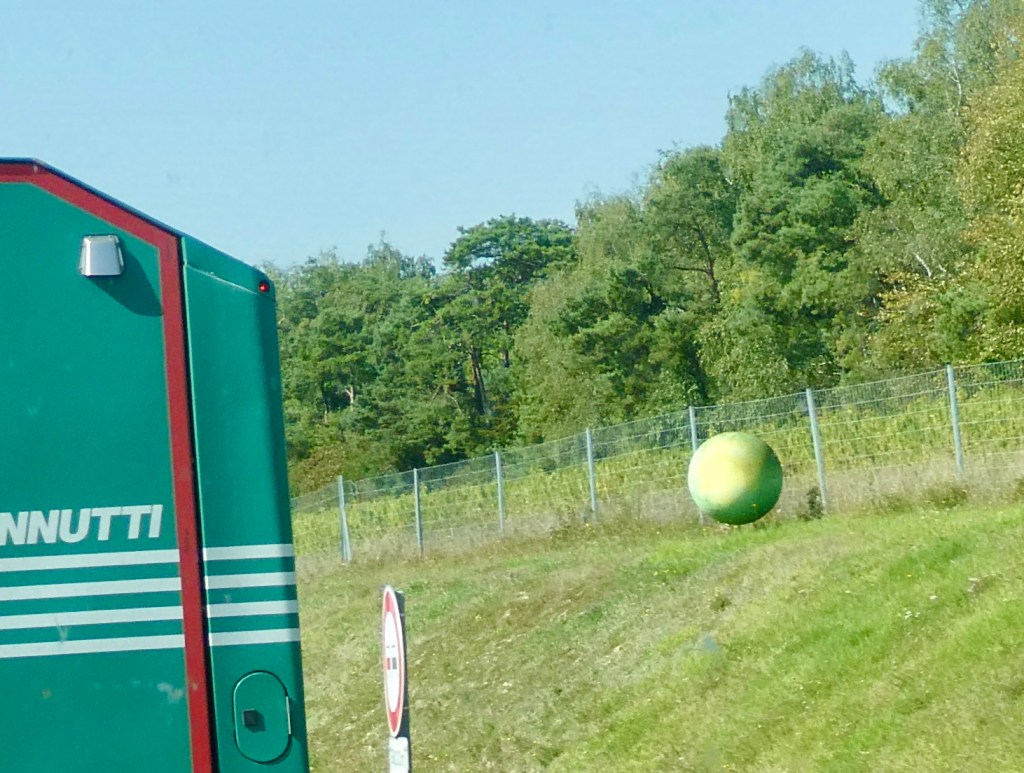
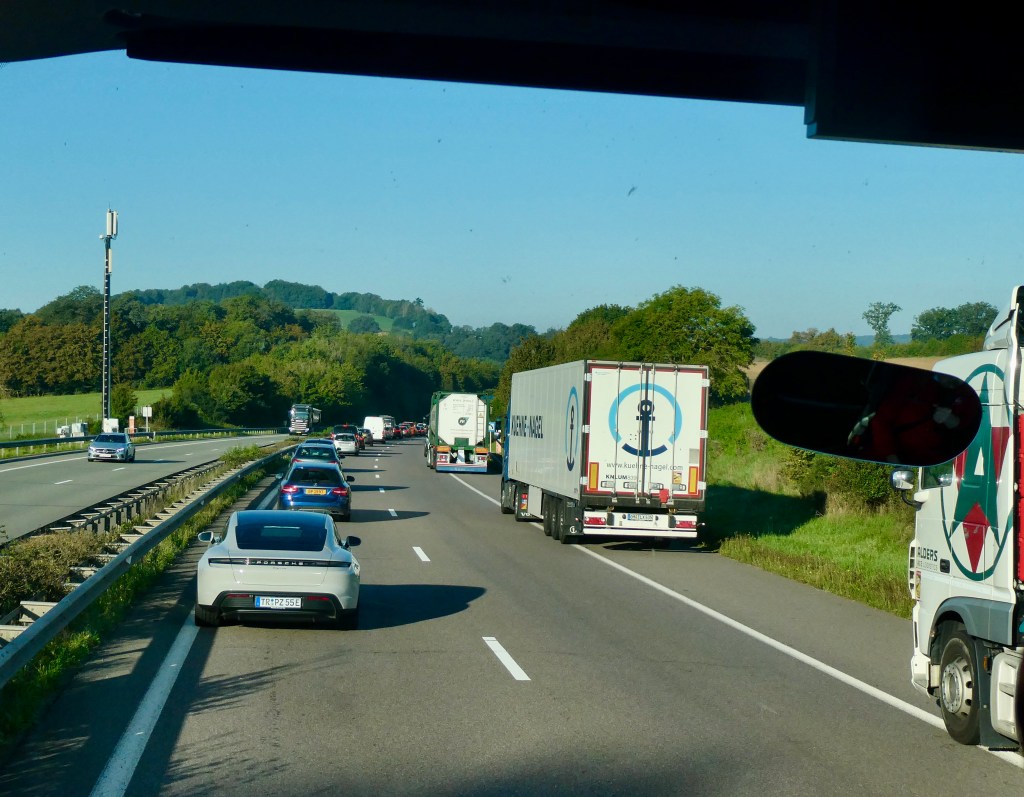
Along this road, in the area about half way between Luxembourg and Paris, drivers had accidents due to falling asleep.  Brain science research suggested that if there were random things to look at that didn’t belong along the road, people would notice and stay awake.  We saw numerous examples.

The strategy worked but after about ten years the effect was fading.   They repainted the objects to make them brighter and make them more noticeable.  Improvement was made once again.

Our guide started telling us about Reims.  “Reims is the capital city of the Champagnia region of France. Mimosas don’t exist!  If France still had the guillotine, that would be a capital offense.”

It takes between three and ten years to create a bottle of champagne.  The formation of a treaty to end WWI an article was written into the document saying only this area of France can produce champagne.  The United States signed the treaty but did not ratify it so there may be a loophole for the US.

We were trained in how to drink champagne.  “Hold the glass in a way that will not warm the champagne.  You do not swirl it like wine because you break up the bubbles.  Also, don’t smell it, just drink it!”  It should be cooled but not cold.

“In this part of France they grow sugar beets so Coke tastes slightly different – but if you want bubbles, you should drink champagne” said our tour guide.

Arriving in Reims we walked towards the city center. The town was 60-80 percent destroyed during the wars and only the fountain remained in the city center. 

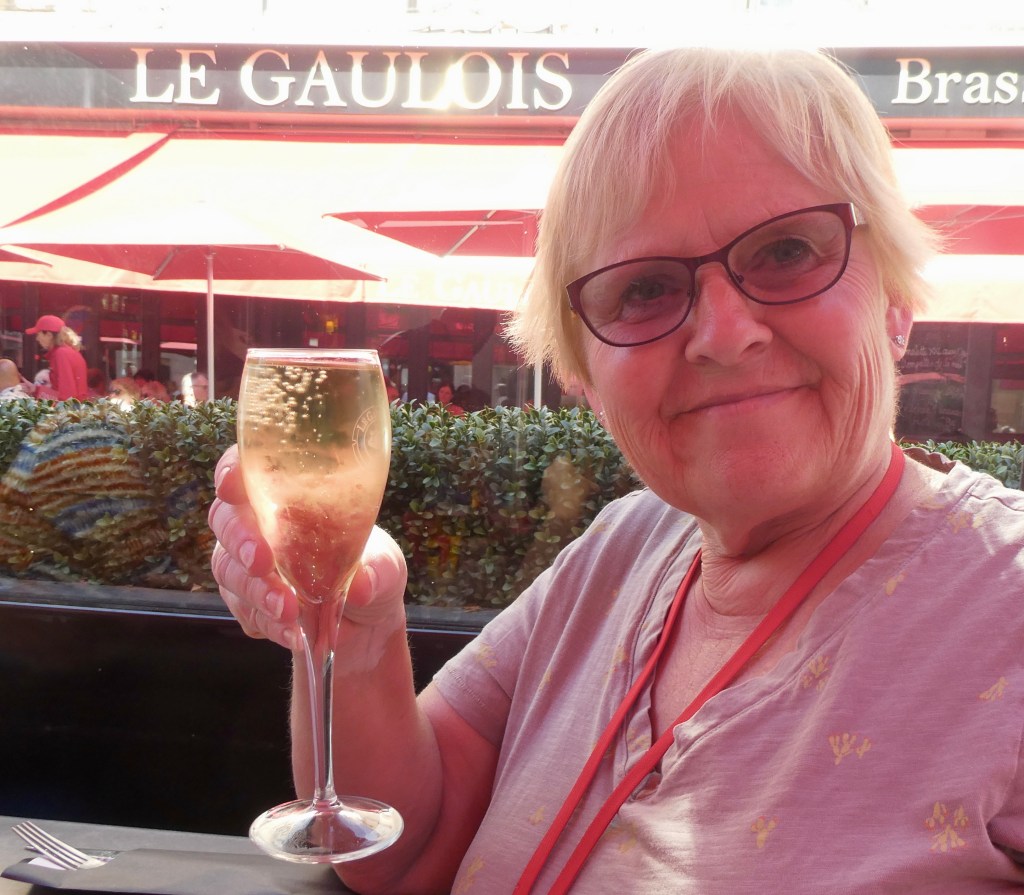
I had a delicious lunch of Quiche Lorraine and champagne- both regional examples.  I don’t usually like champagne but this was good, and I don’t think I was holding my glass correctly!

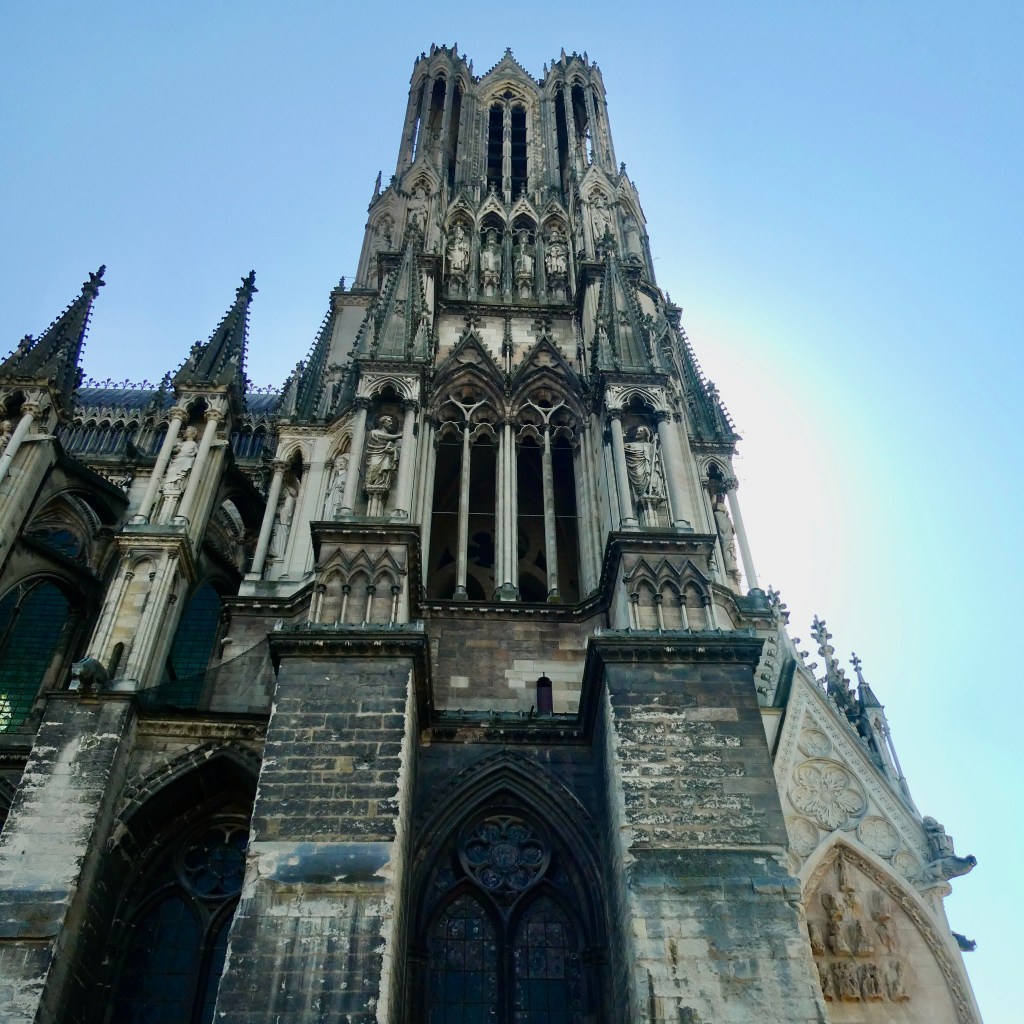
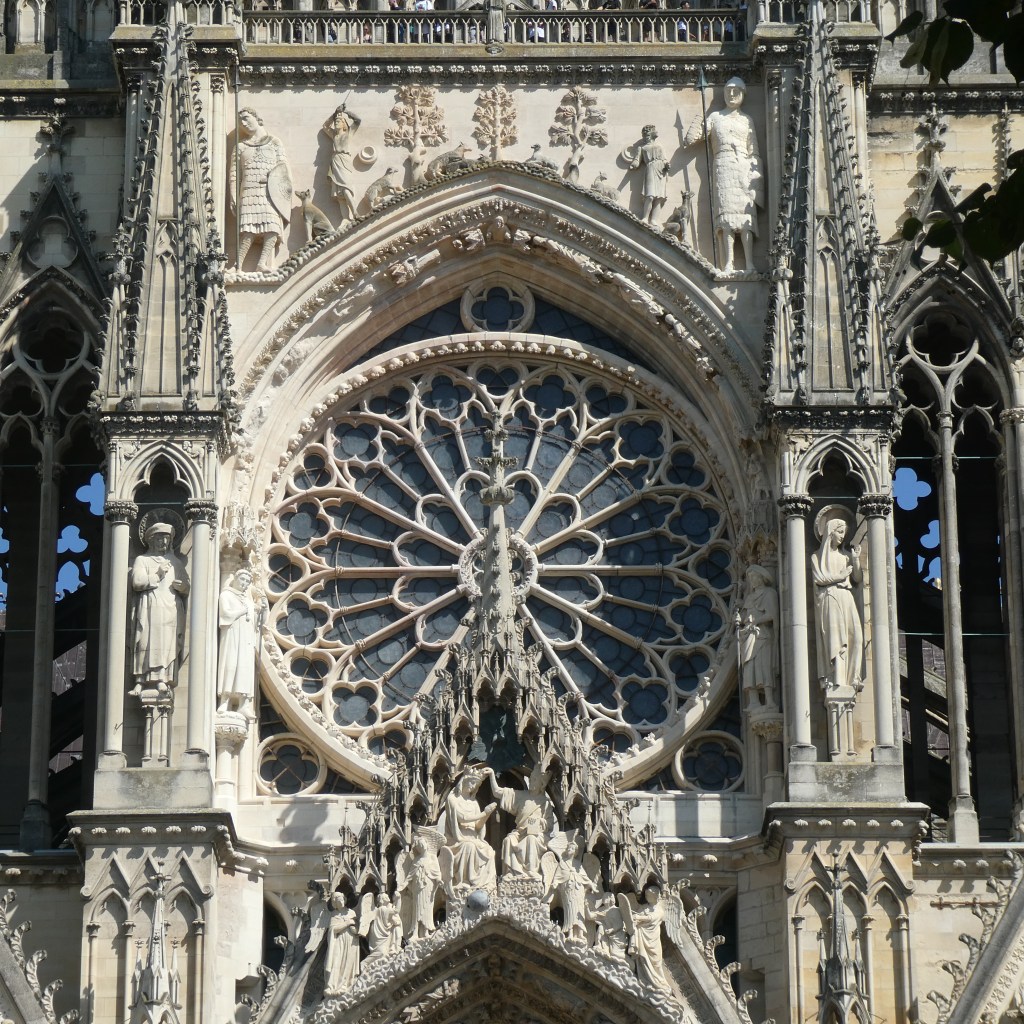
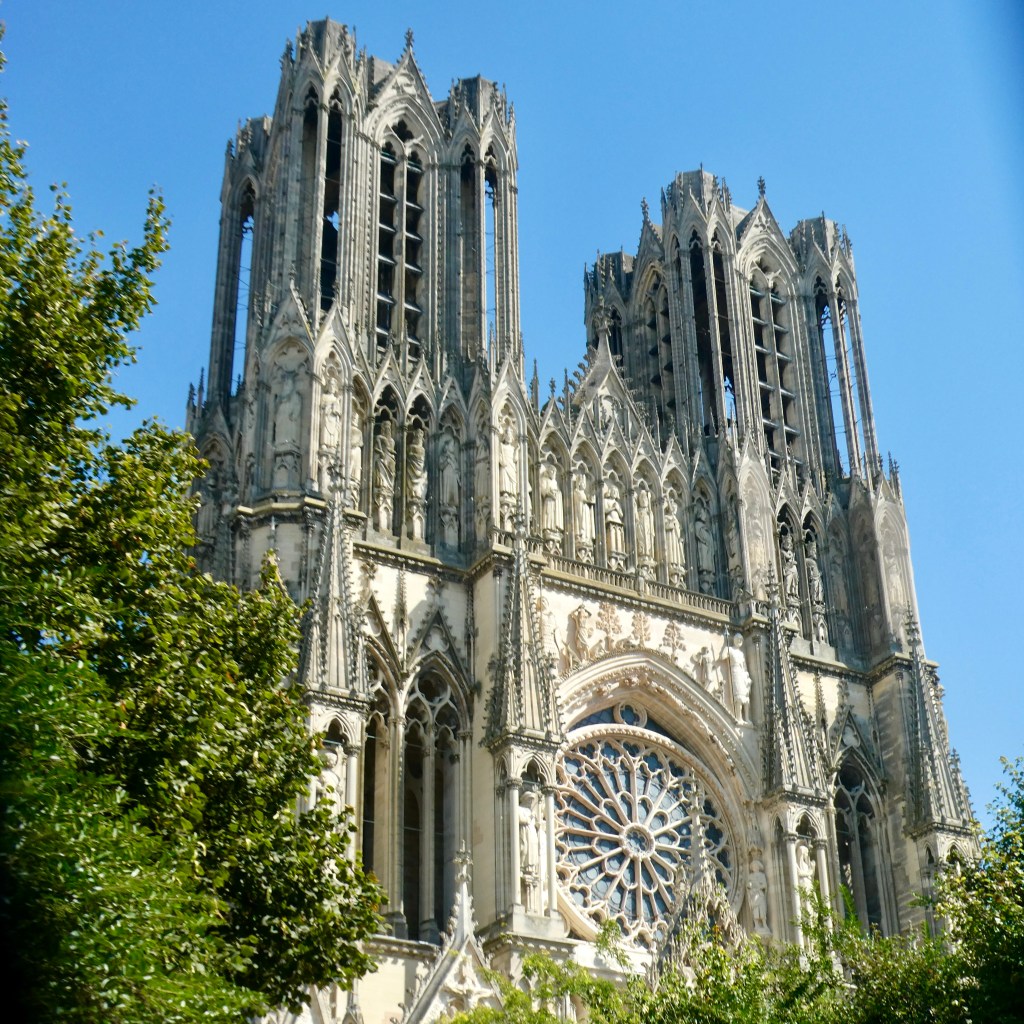
The Reims Cathedral is the most important cathedral in France, more so than Notre Dame.  It has been a UNESCO World Heritage site since 1991.

The Reims Cathedral was the traditional location for the coronation of the kings of France.  Twenty five French kings were coronated at the cathedral, the last in 1825.  Coronation was an important event but the king was already king by birth.

The original cathedral was commissioned in the fifth century by Bishop Nicosaius on this location, the former site of Roman baths.  

King Clovis was baptized christian in the cathedral a century later, the first French king to do so. 

In 1211 the lower chapels were complete.  The areas above, including the Rose window, took until 1290.

Construction of the present Reims Cathedral began in the 13th century and concluded in the 14th century.  It was built to replace an earlier church destroyed by fire in 1210.   The cathedral is a prominent example of High Gothic architecture.

About two thirds up are a row of kings meant to signify they were halfway between heaven and earth. The spacing would have been about half way if the intended spires were built. When the builders got to that point in 1516, the Renaissance had begun and spires were no longer desired.

There are Bible stories and people in the art on the facade.  In earlier centuries, the stone was painted so the cathedral was colorful.

Although it was only slightly damaged during the French Revolution 1789-1799, there was some cathedral restoration in the 19th century. 

The Germans tried to destroy the Cathedral during WWI to damage French morale.  It suffered extensive damage from 300 shells.  The roof was destroyed and more damage happened when the Germans occupied Reims.

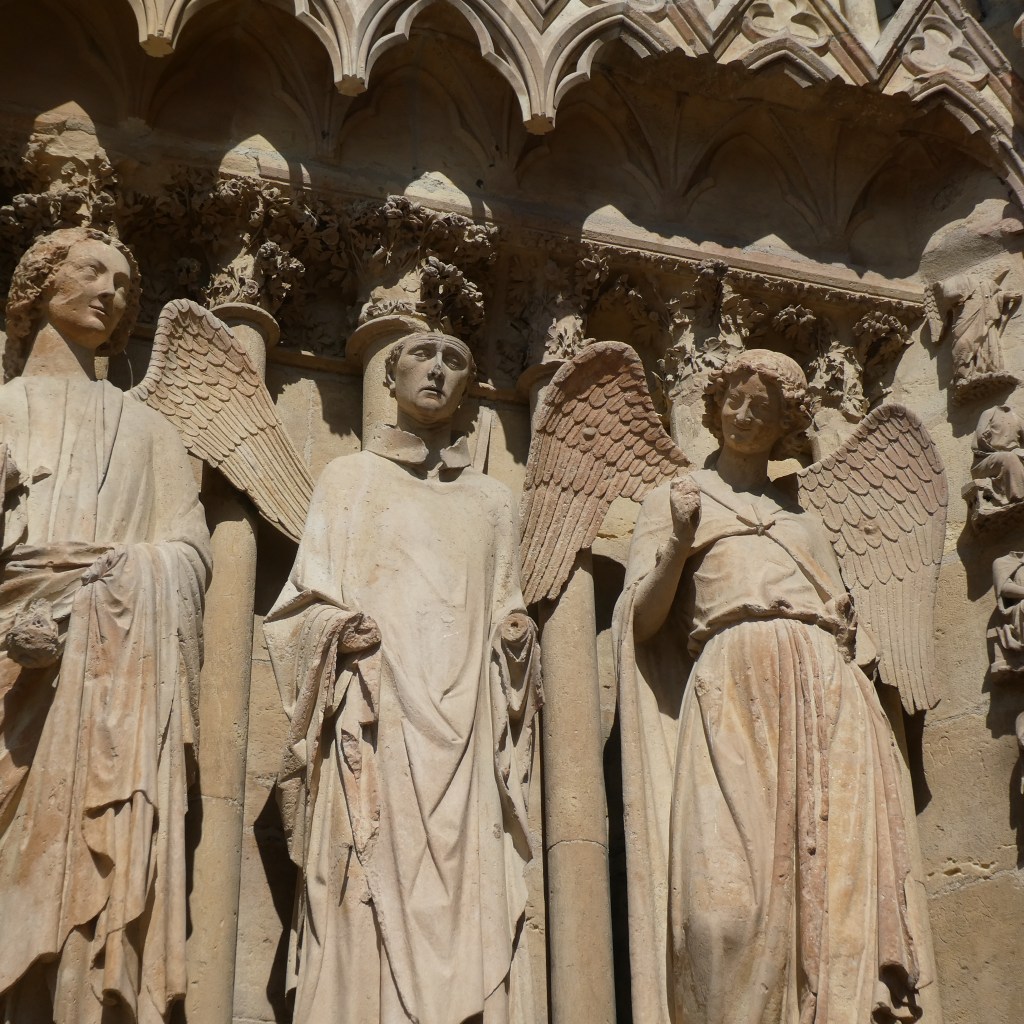
Shelling and a falling beam from the resulting fire decapitated the angel on the right, called both the Smiling Angel and St. Nicasius Angel.  Built in the 13th century, her gentle smile had welcome visitors into the cathedral.

After the shelling and fire, her head was broken into more than 20 pieces.  She became famous to the world as a symbol of the suffering of the people of France after the damage. Thanks to a priest who collected the pieces, and a plaster cast in a museum, the angel was restored in 1926.

After the war restoration of the cathedral became a world wide effort. The Rockefeller family from America paid to repair the roof using concrete.

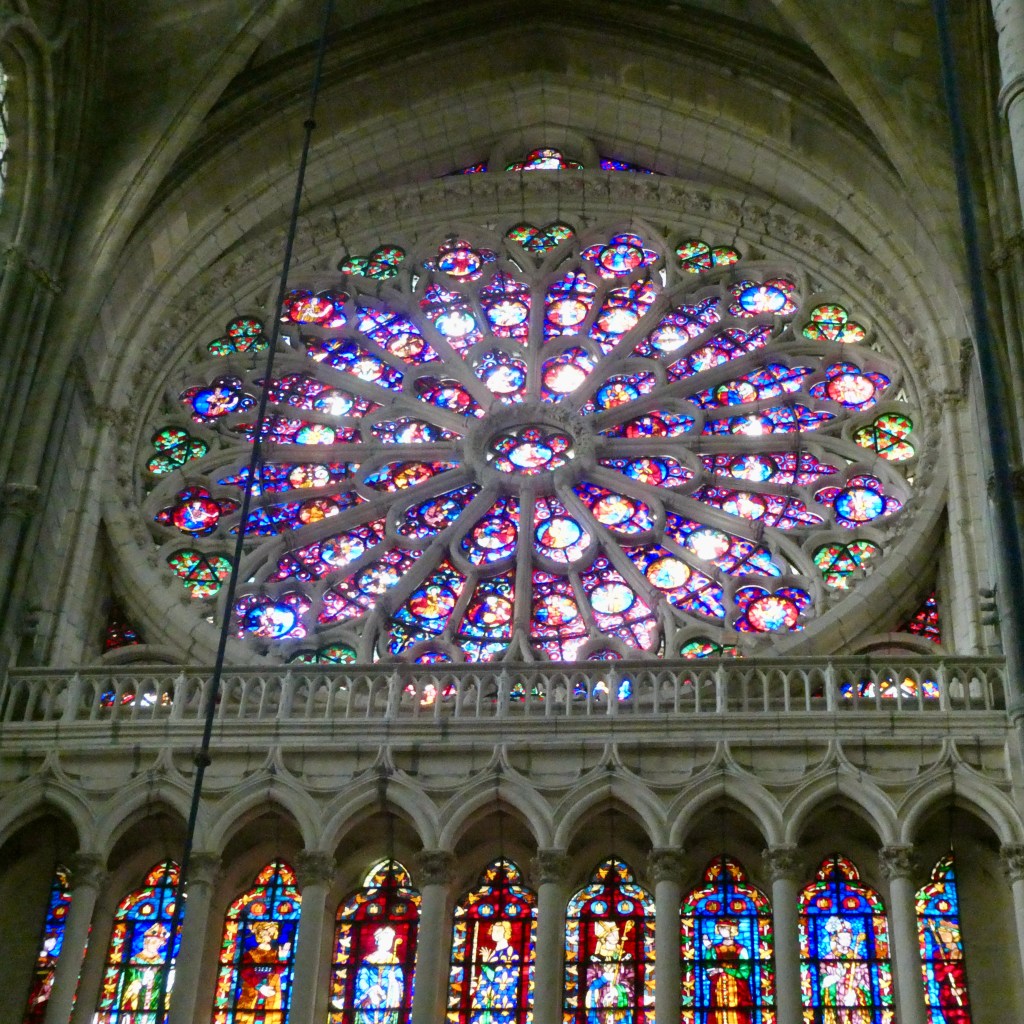
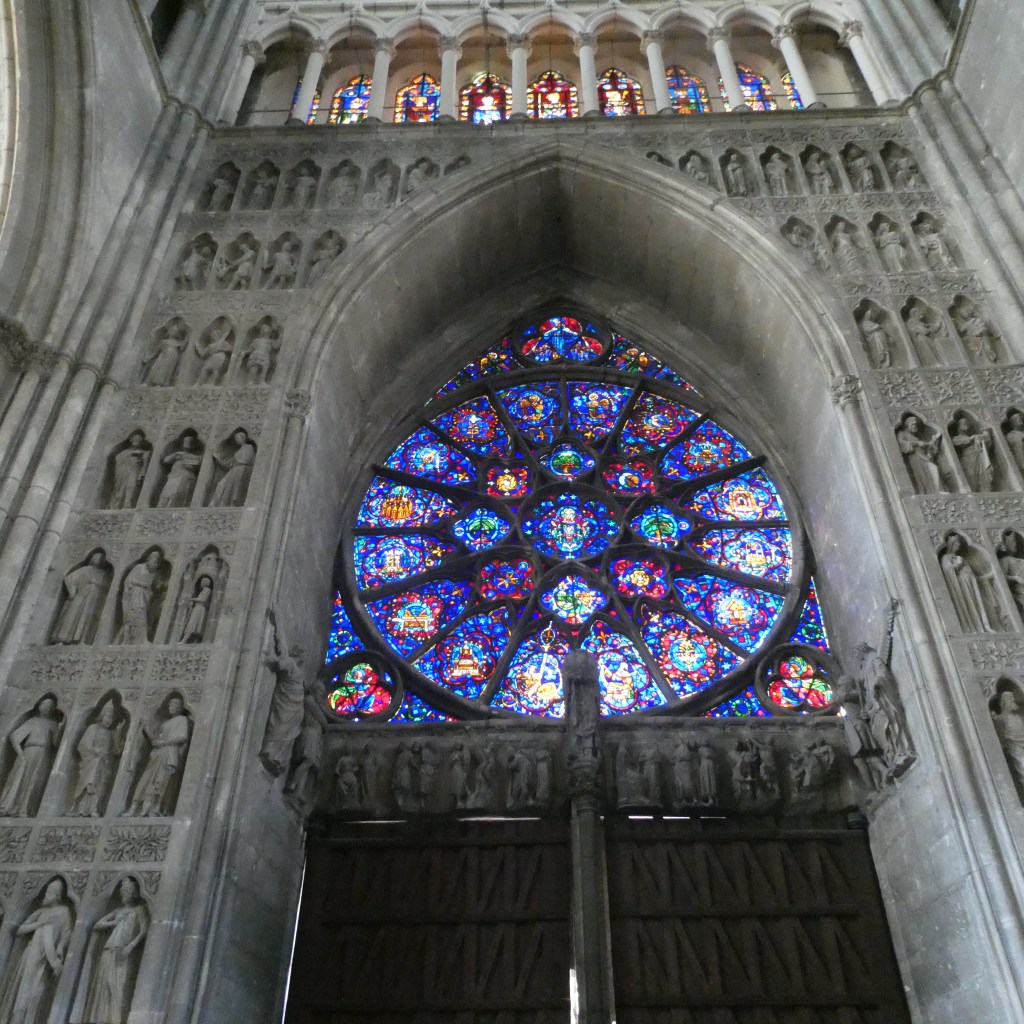
This is the rose window from the inside. Stained glass is very prominent throughout the cathedral.

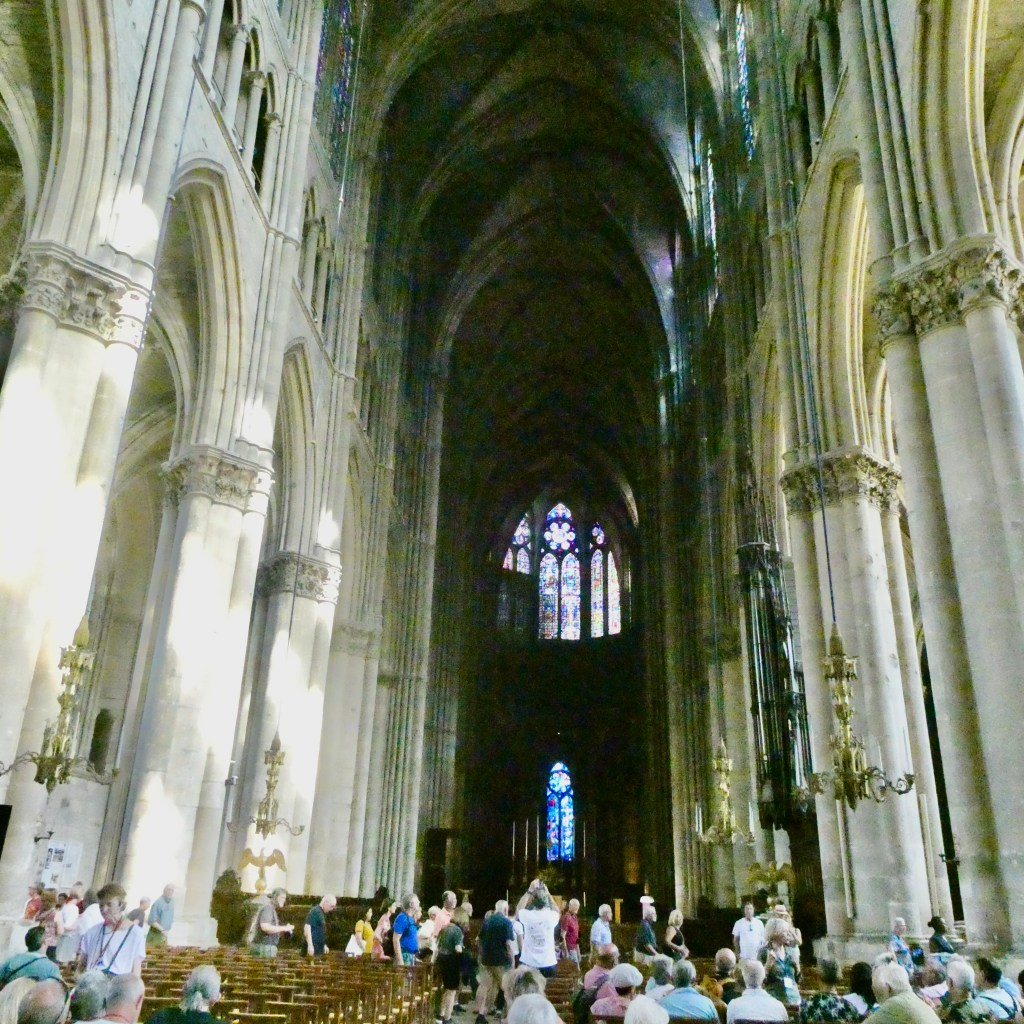
This is the western facade from the inside. The interior of the cathedral was once painted and very colorful complimenting and reflecting the stained glass. 

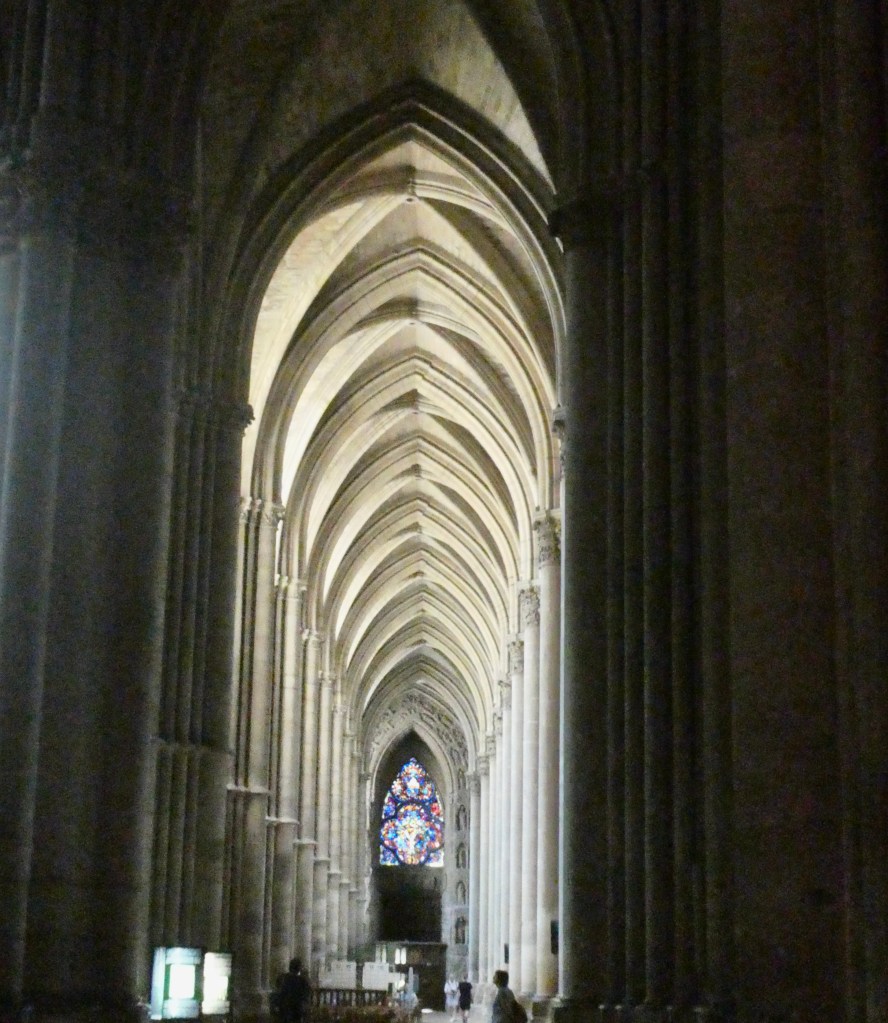
The stained glass windows range from original to restored to replaced due to age and destruction.  

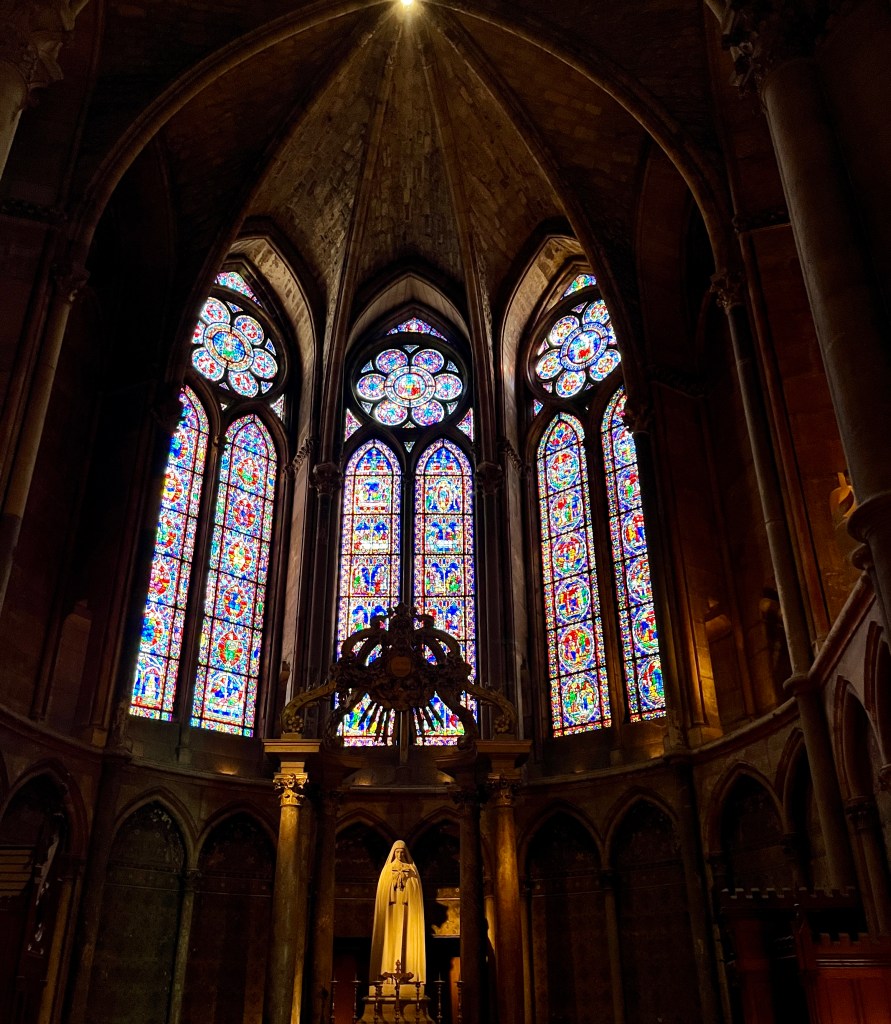
The windows at the top of the altar area are from 1214-15. The front portion was once divided off as being sacred. In the 18th century it was opened up for all to see.


These side windows were once colored but were replaced to provide more light inside.

A 1905 law gave cathedral ownership and maintenance to the French government.  The Catholic church has rights to its use and the Reims cathedral has services throughout the week.

Some of the best-known windows (to those who know about such things) are from 1974. These are the three windows made by Marc Chagall. They represent the Tree of Jesse, the Old and New Testament; and the “Grandes Heures de Reims”.

Marc Chagall (1887 – 1985) was a Russian and French artist. He created works around the world in a variety of mediums including stained glass, paintings, drawings, book illustrations, stage sets, ceramics and tapestries. 

The newest stained glass windows in the Reims cathedral were placed in 2015.  

We were in Reims on September 8, 2023.

Next up:  We get to Paris and it was hot.

Posted in Uncategorized | Leave a comment

Disembarking and the Luxembourg American Cemetery

Today was the day we left the Viking Alsvin.  Our room steward, Jovan , thanked us for being his tidiest guests.

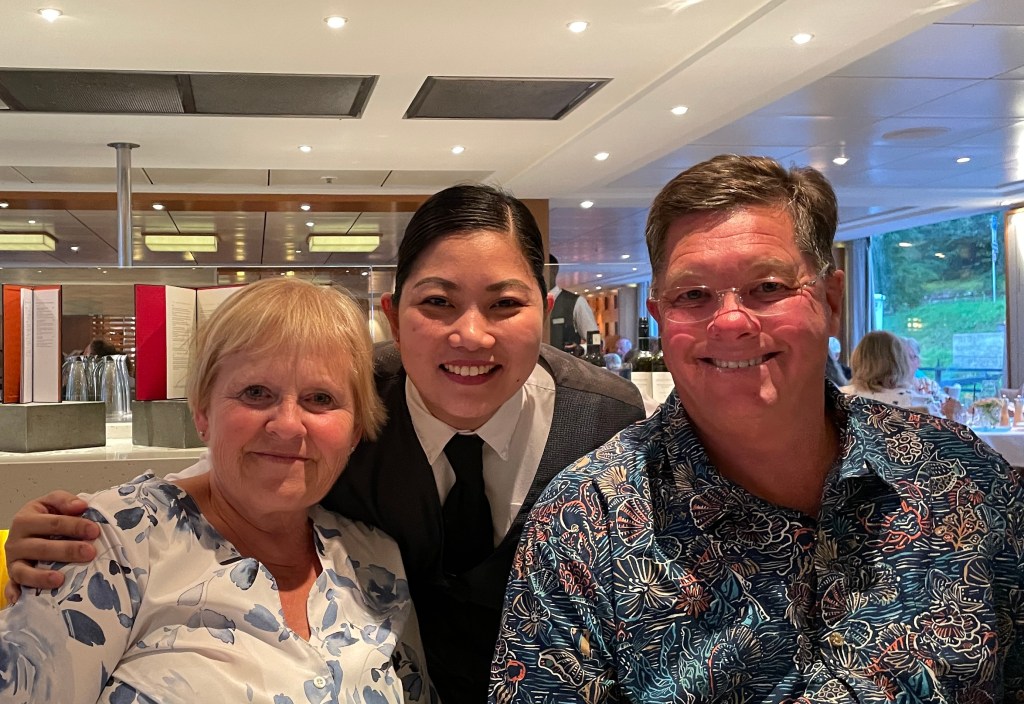
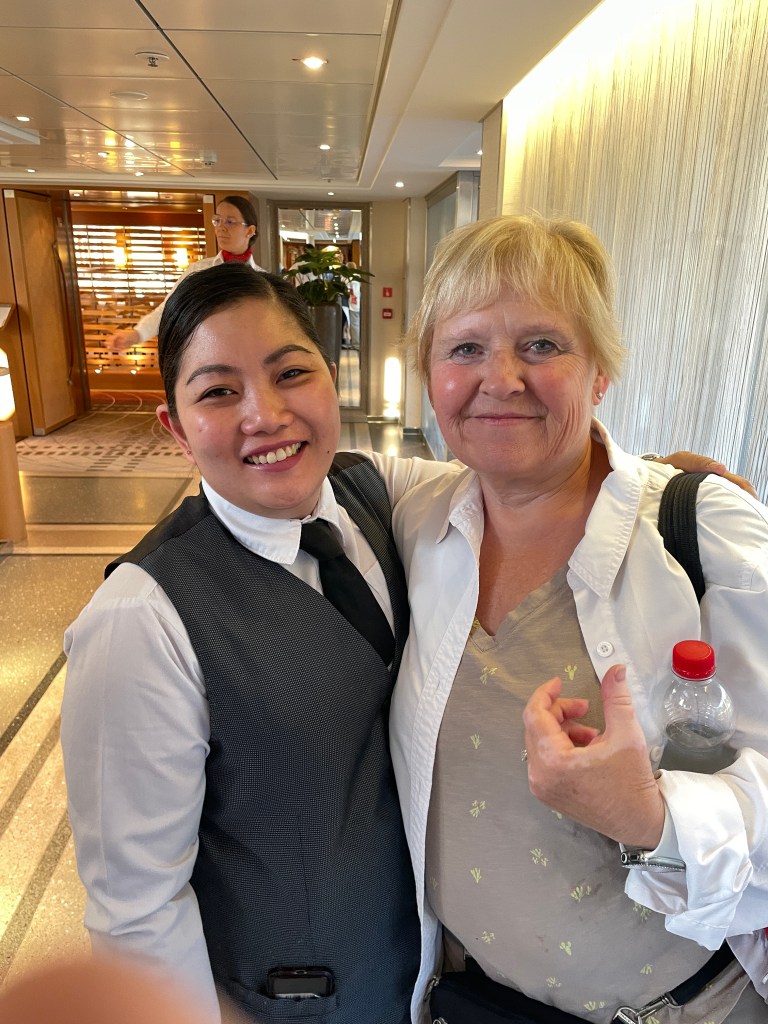
We said goodbye to the sweetest wait person Kristhina.  We had connected with her several times and learned about her two year old son at home in Manila with her mother.  Her husband is working on the Celebrity cruise line.  

On our last morning we talked again and said goodbye.  She came out for one more hug.  We have heard from her a couple times.

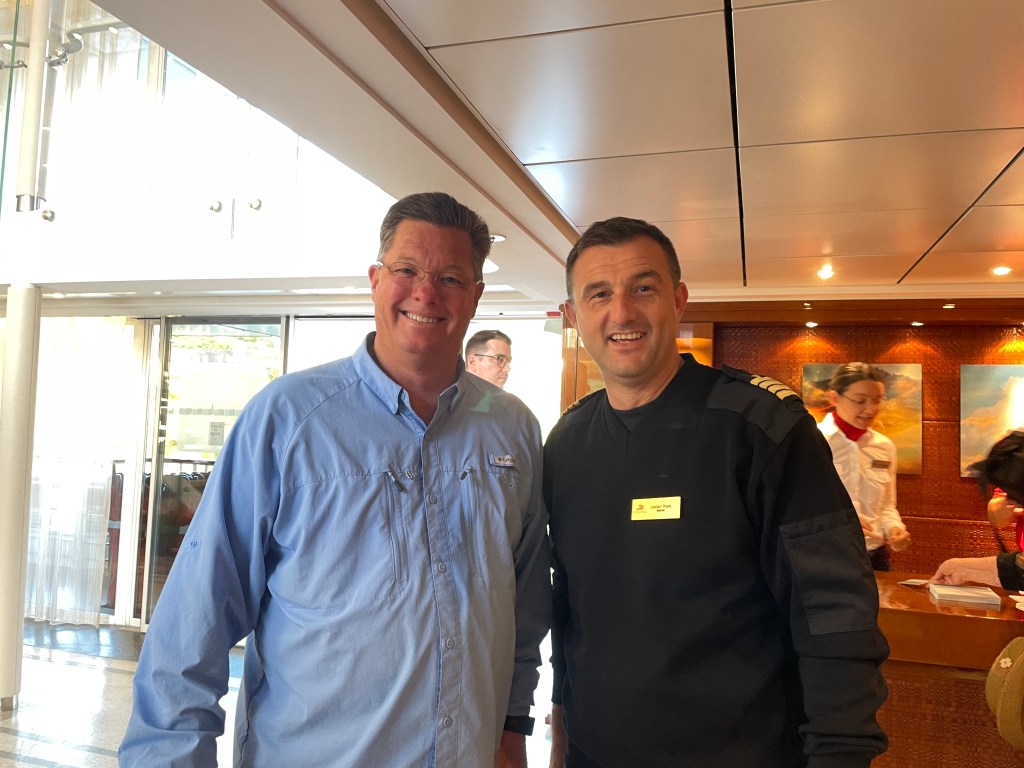
Randy said goodbye to Captain Lucian.  He had been very present with guests on the cruise.  Connie even danced with him one evening when Randy and I were already sleeping.

We boarded the bus for a full day road trip to Paris via Luxembourg and Reims, France.  The front seat on the bus was open so we took it.

Highway traffic along our route was dense because a lot of workers from France and Germany work in Luxembourg as the salaries are higher. The general rule of the road is to leave the center open for emergency vehicles.

Our guide for the day told us that Luxembourg is the second wealthiest country (assume it is per capita) in the world and has 600,000 inhabitants.    

Luxembourg became wealthy due to their iron ore industry.  Most beams for construction projects worldwide are still from Luxembourg.  (Qatar is now wealthiest.)

The influx of ore industry money  supported development of a banking industry which is another source of wealth.

The Translation Office for the European Union is also here.  That was a logical placement as people in Luxembourg speak four to five languages fluently. School grades are taught in successive immersion languages sequencing Luxembourgish, French and German. People usually learn English as well.

The country is officially the Grand Duchey of Luxembourg, a United Parliamentary Constitutional Monarchy.  It is currently ruled by Duke Henri and a Prime Minister.

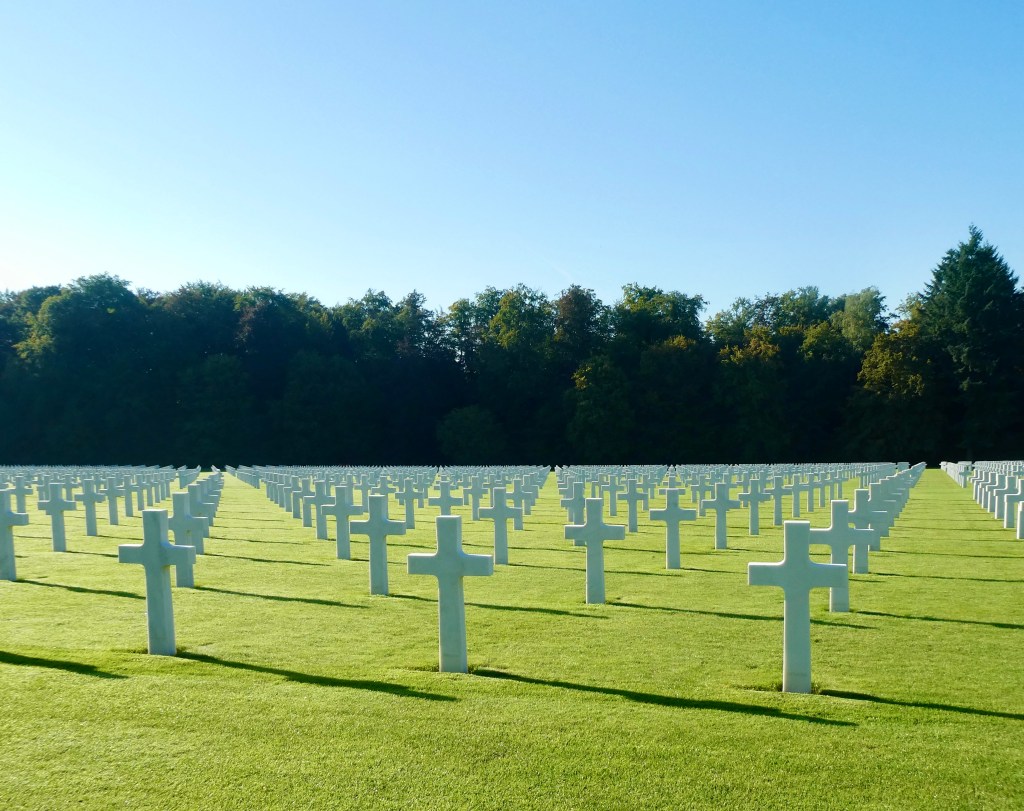
Luxembourg American Cemetery was the temporary cemetery after the Battle of the Bulge.  It was later made permanent and was dedicated on July 4, 1960.

The cemetery is on Luxembourg land, but given for this use in perpetuity.  Paid staff are employed by the US embassy. The cemetery covers 50.5 acres.

If soldiers had stated that they wanted to be buried with their comrades, they are here.  A soldier’s family could also choose to have them buried here or have their deceased returned to the US.

There are 5076 graves, including General Patton, one female army nurse, and 22 sets of brothers.  

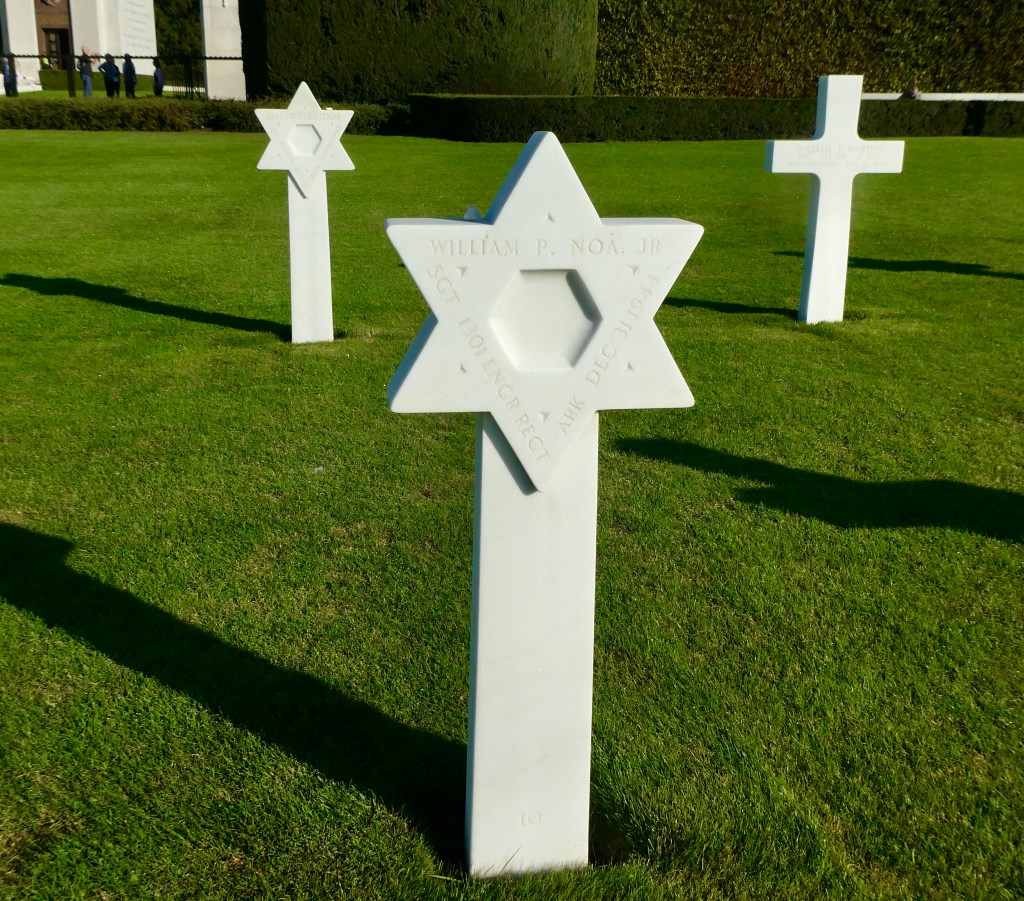
There are 4958 crosses and 119 stars of David.

Names and information were engraved on tombstones but not darkened, except for General Patton.

General Patton died after a car accident. When his body was brought to the cemetery there were lines of people along the road because they knew what Patton had done for them.

European Law generally states that there are no burials by rank or status.  However, for practical reasons it was a good idea to separate General Patton because so many people would be visiting his grave that the graves nearby would be disturbed.  Mrs Patton sought special permission from the Duchess for her husband to have a place of honor and the Luxembourg Duchess agreed.

(My father, who was career US military, is also in a military cemetery that does not place remains by rank, or even by conflict.  We like that idea.)

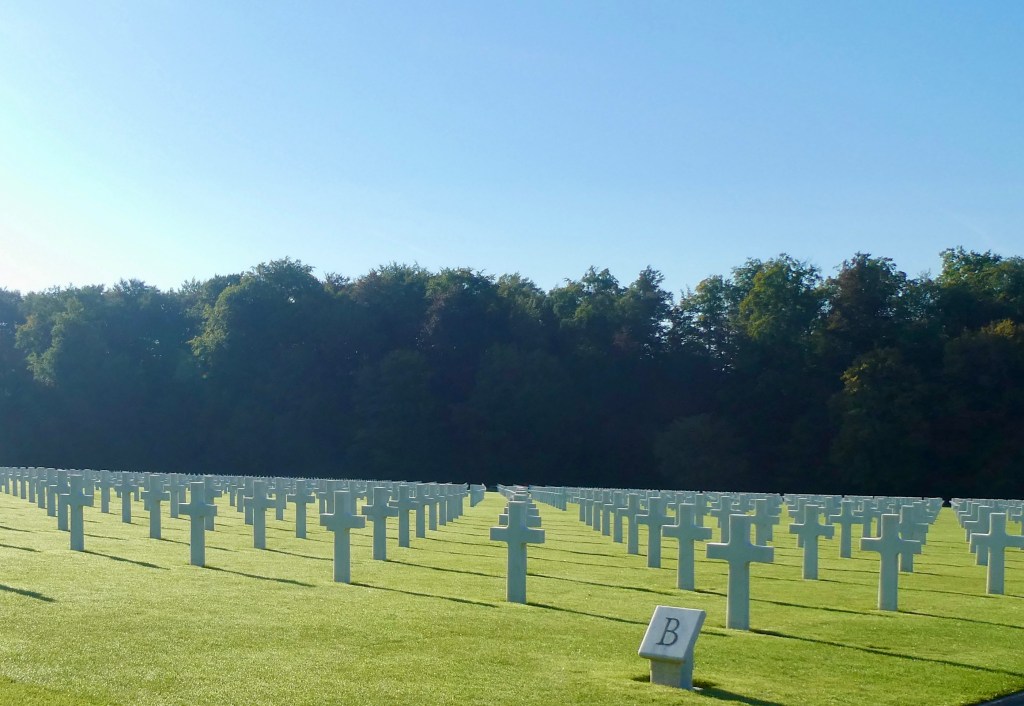
The Band of Brothers are buried together in section B.  That is another grouping that many people visit. The Band of Brothers (book and movie) tells the story of Easy Company, 506th Regiment of the 101st Airborne Division, U.S. Army. 

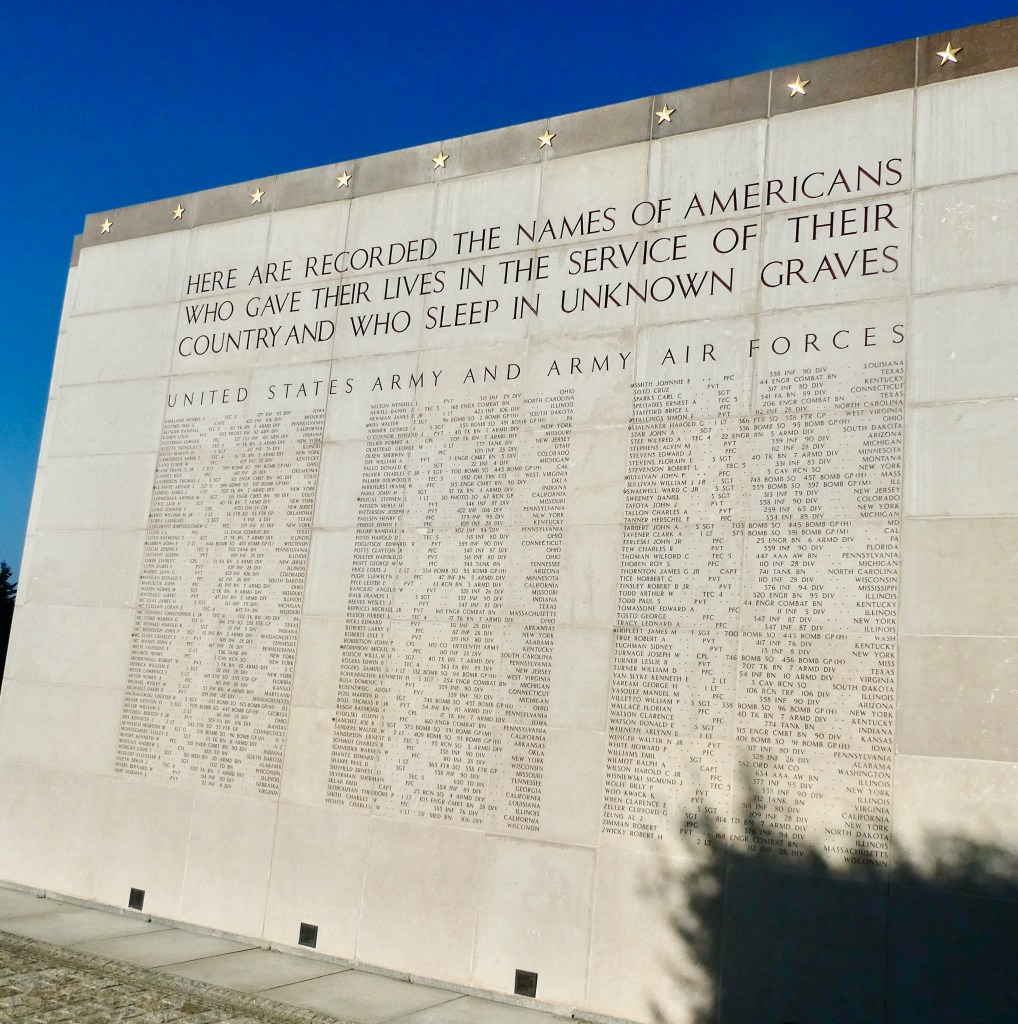
These large tablets show the names of 371 soldiers Missing in Action who were never recovered or who rest in unknown graves.

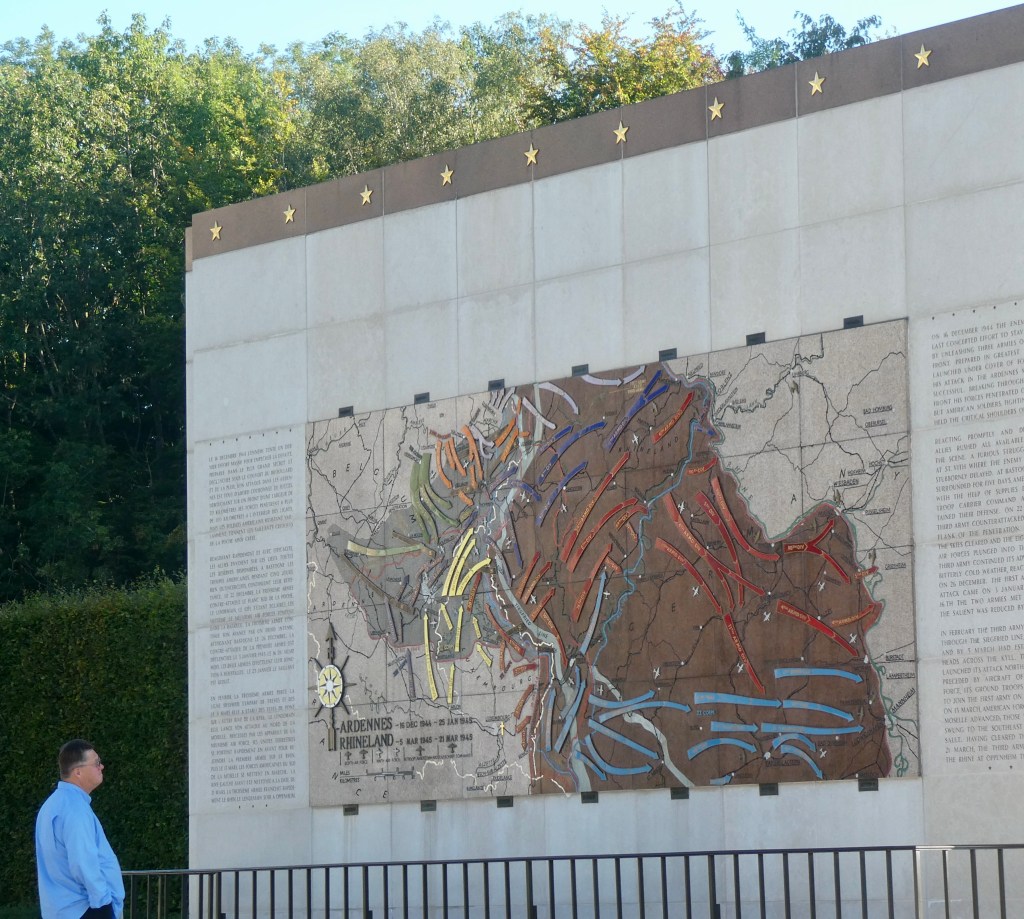
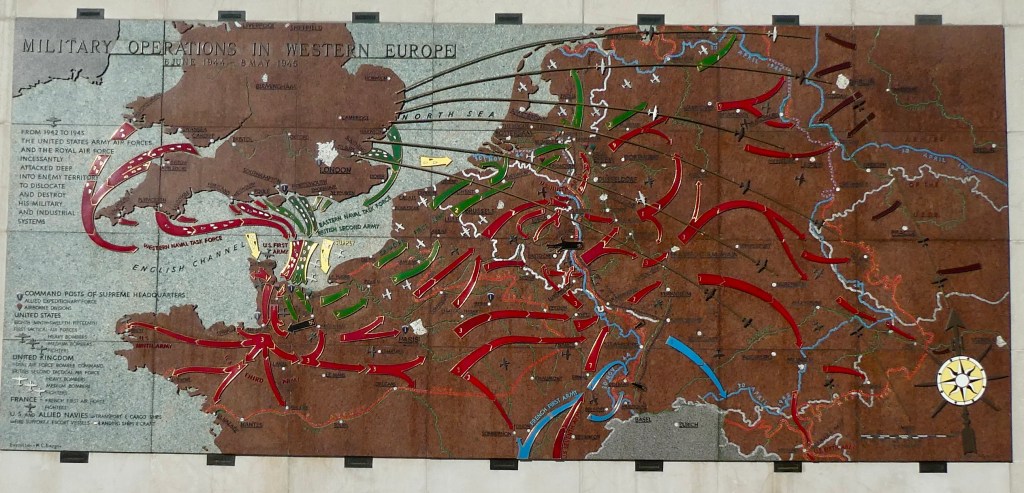
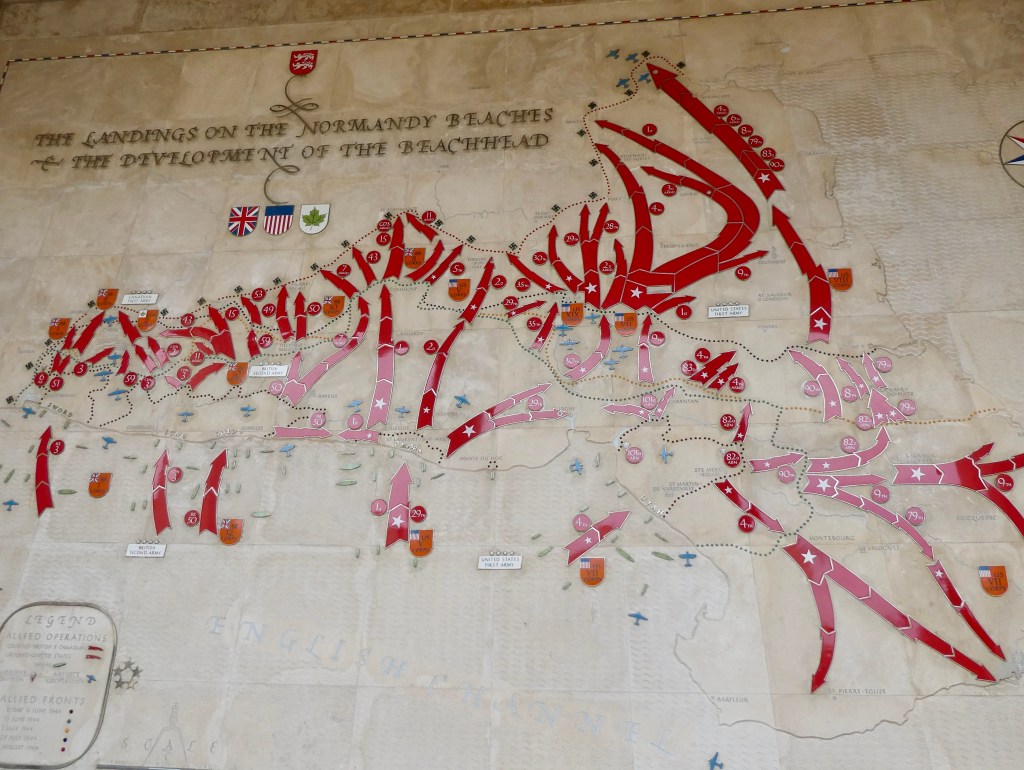
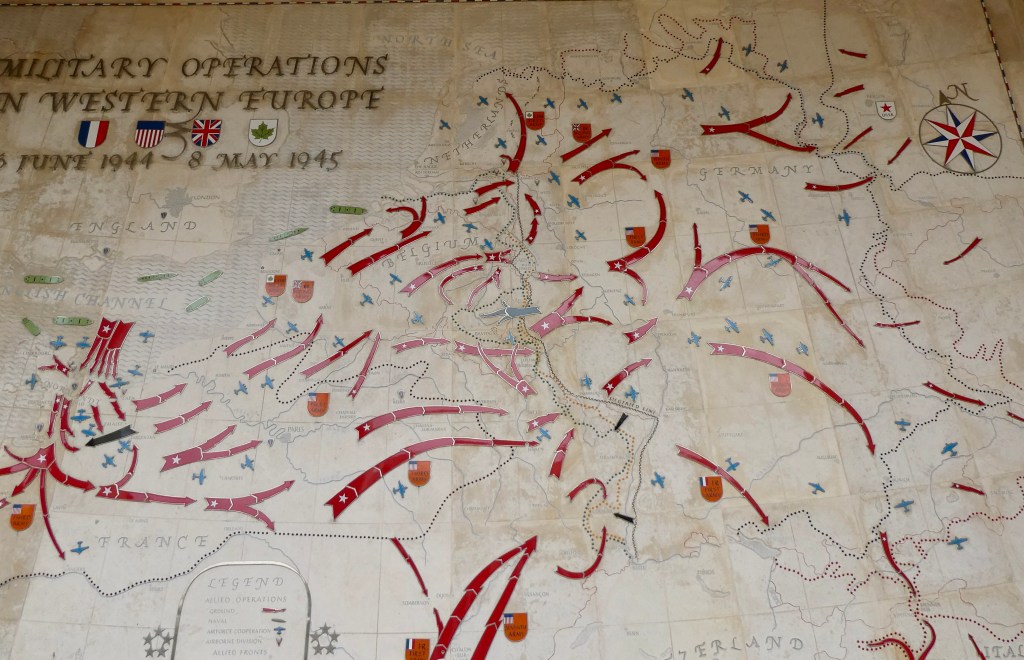
There are two large display maps detailing military operations in Germany and also in the entire European Theater..

A couple of people on our bus, including our friend Warren, had fathers who fought in the Battle of the Bulge, perhaps wounded, but made it home.

When we were at the American Military Cemetery near Florence, Italy last year we understood that there were two such cemeteries, that one and a second in Luxembourg.  In fact, there are 26 American Cemeteries and 32 memorials, monuments and markers in 17 countries. 

Leaving the cemetery we passed through an agricultural area of France that were battlefields during WWI.  The vast number of trenches caused the equivalent of 30,000 years of erosion.  To help the land recover,  the French government planted pine trees. After a few years the forest floor turned blue with blooms of a flower that had never grown there before.  The blue flower seeds were on the boots of US soldiers who fought and died in France. Our guide said it is nice to think that the forest continues to bloom each year in tribute.

She also told us that students in France are required to study history for many years beginning at age six.  From age 11 on the study gets very serious about WWI and WWII.  Our guide said that French people know what America did for them.

We were in Luxembourg on September 8, 2023.

Next up: We continue toward Paris and stop in Reims.

Posted in Uncategorized | Leave a comment

Viking River Cruise: Bernkastle, Wine and Not Trier

The town of Bernkastle was first recorded in civil documents in the year 1291.  It has always had a population of about 1000 because of the limited space available.

Landshut Castle was destroyed by fire in 1692.  It has recently been repurposed as a restaurant.

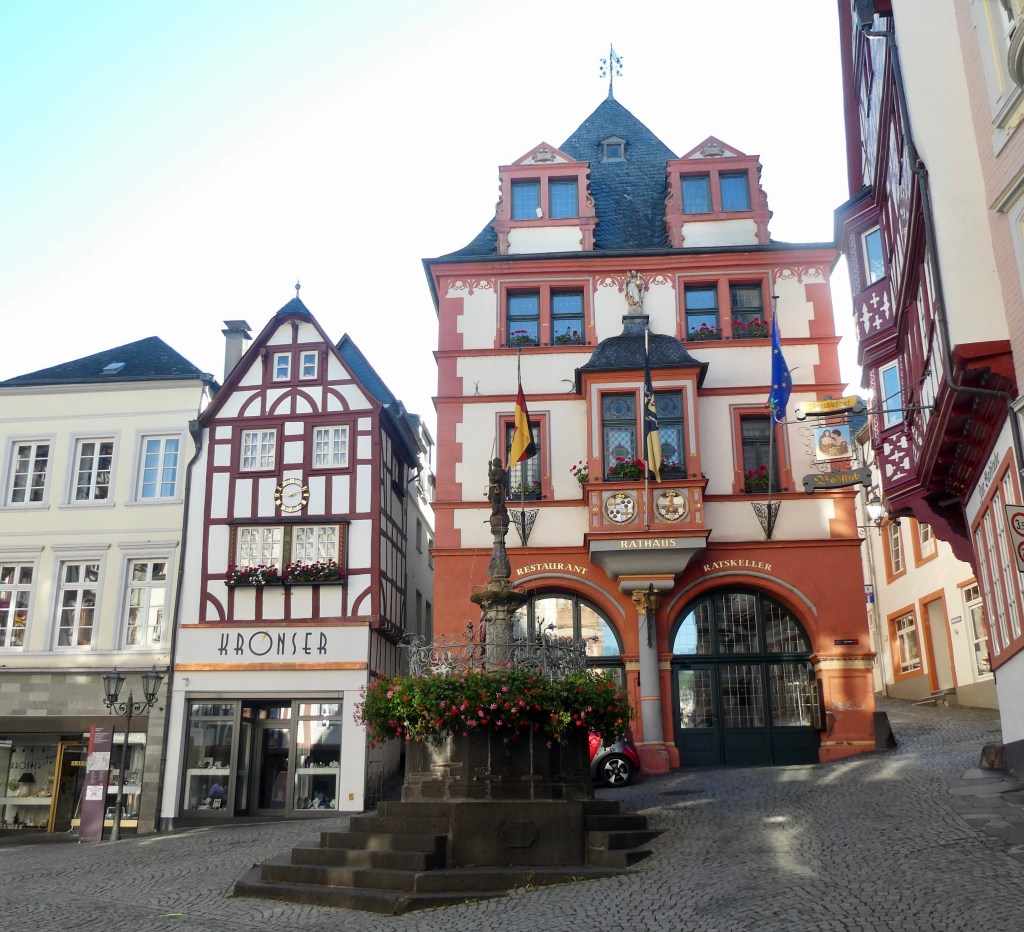
St. Michael’s Fountain is in front of the Bernkastle Town Hall built in 1608. 

This is the Spitzhauschen pointed house. The ground floor is quite small and, as the owners had more money, they built up and expanded a bit.

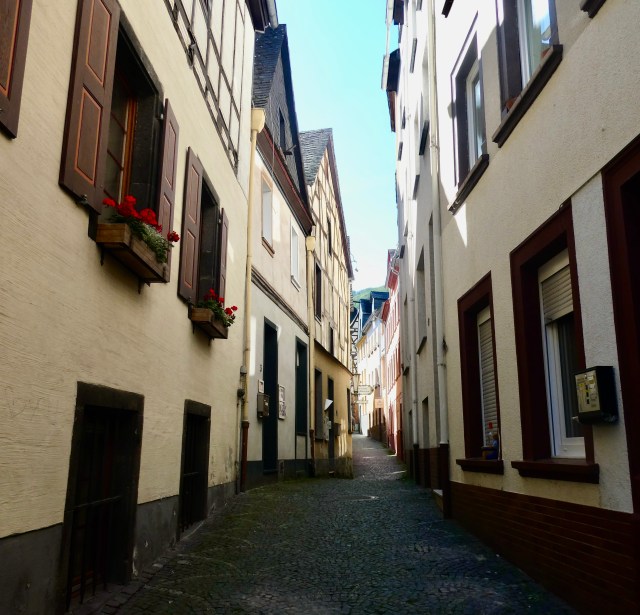
Bernkastle still has mostly original buildings because there was very little war damage as there wasn’t industry in the town.

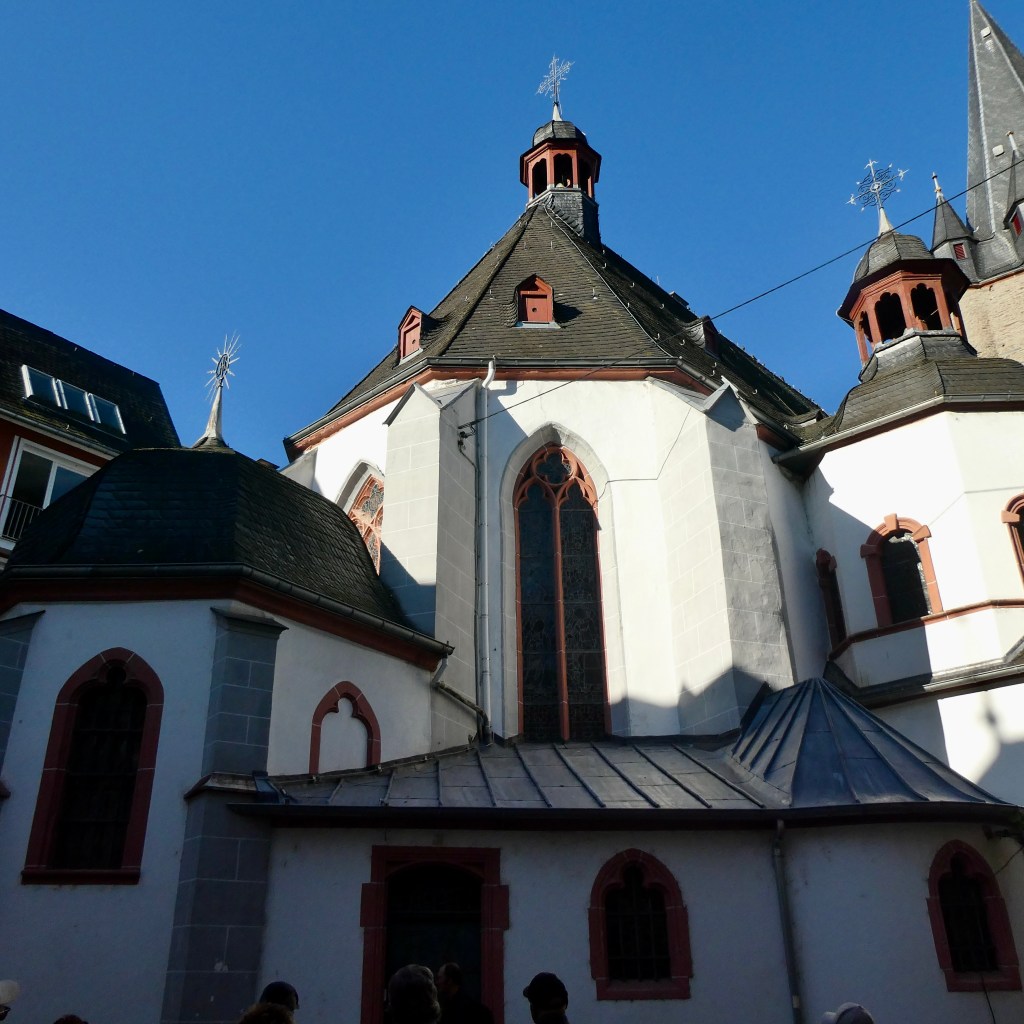
The St. Michael Church, built in the gothic style,  is 400 years old.

These numbers and letters on a church door involve a three kings tradition called chalking the doors in celebration of Three Kings Day. The digits are for 2023 while the letters are for the kings names Caspar, Melchior and Balthazar and the plus sign represents the cross.

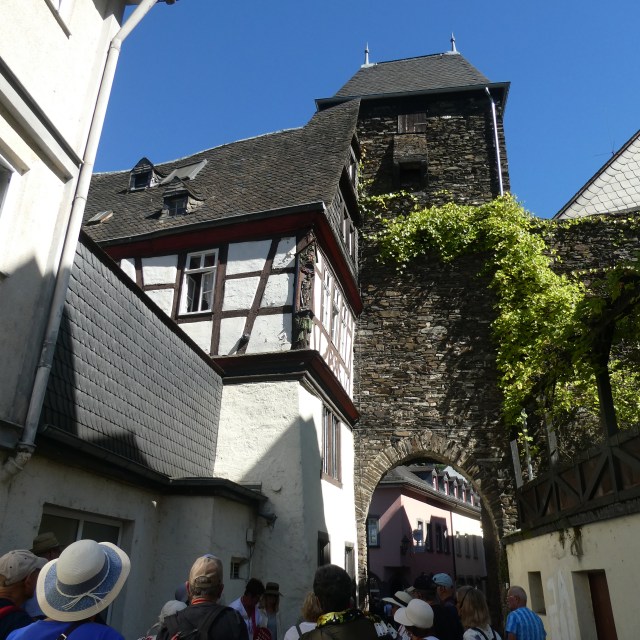
Bernkastle Tower is 600 years old.  It was once used for defense and now it is for bells.

Area vineyards are always established on a slope for more sunlight and the type of soil.

In Bernkastle, in preparation for our tour, we were told   “You’ve never had a wine tasting like this” and they were right. It was very unique!

The wine we were first served was Dokter wine.  It was so named because an important sick person was given the wine and got well.  

People in the area began to call the local wine, now the most famous riesling in Germany, the Dokter Wine. It tasted very light and I’m sure it made us healthier!

We were then able to begin the “do it yourself” portion of the tour – totally unsupervised. We could have spent hours there for our entry fee of about $20 per person.

There were 141 wines available to us in a wine cellar dating back to 1458.  The vast majority of the wines were riesling because of where we were on the Mosel River.  

They various wines were grouped by room according to dry, semi-sweet and sweet.   Yes, some rieslings were considered dry.

We looked to see if something on the information placard intrigued us.

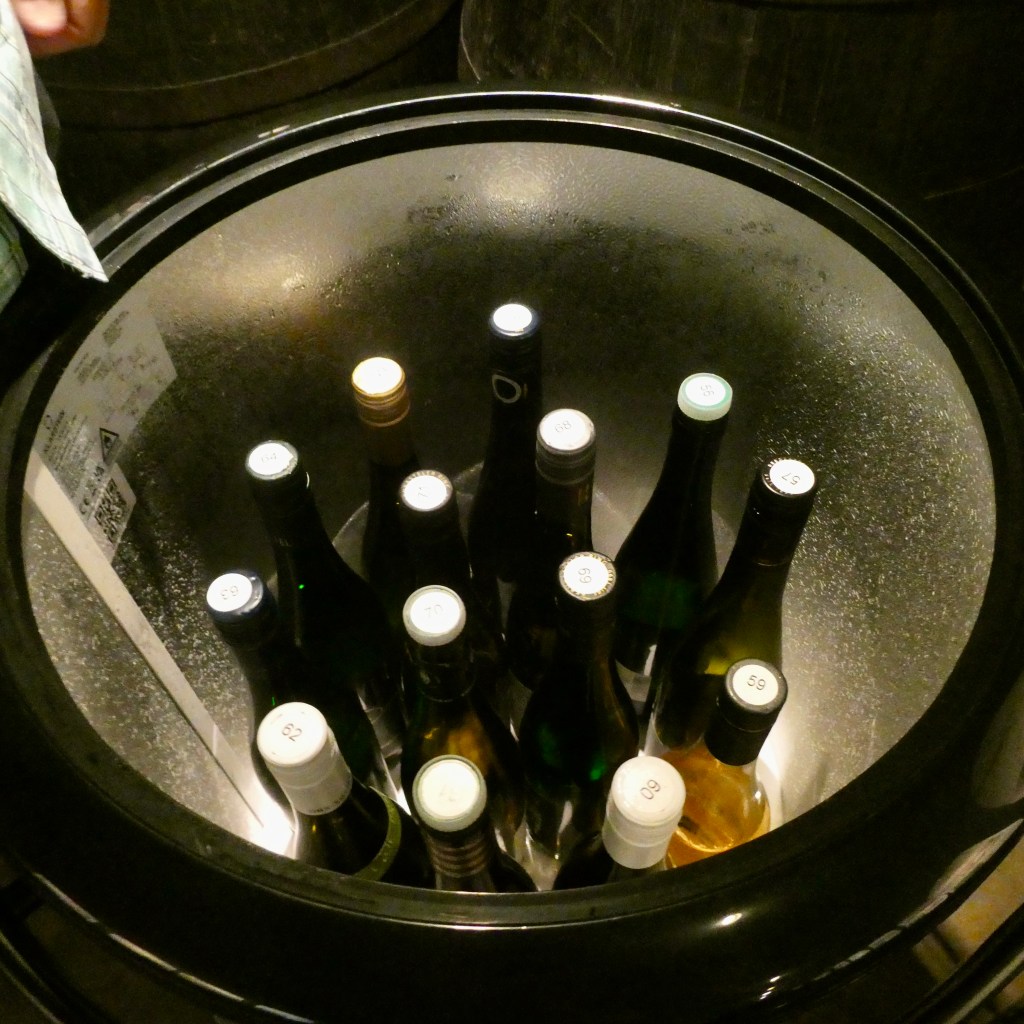
Then we found the bottle in the nearby cooler with the corresponding number.  

We probably tried a dozen.  It was very unique and enjoyable.

Randy’s assessment: “My wife has had too much to drink and it is 10:15 in the morning.”

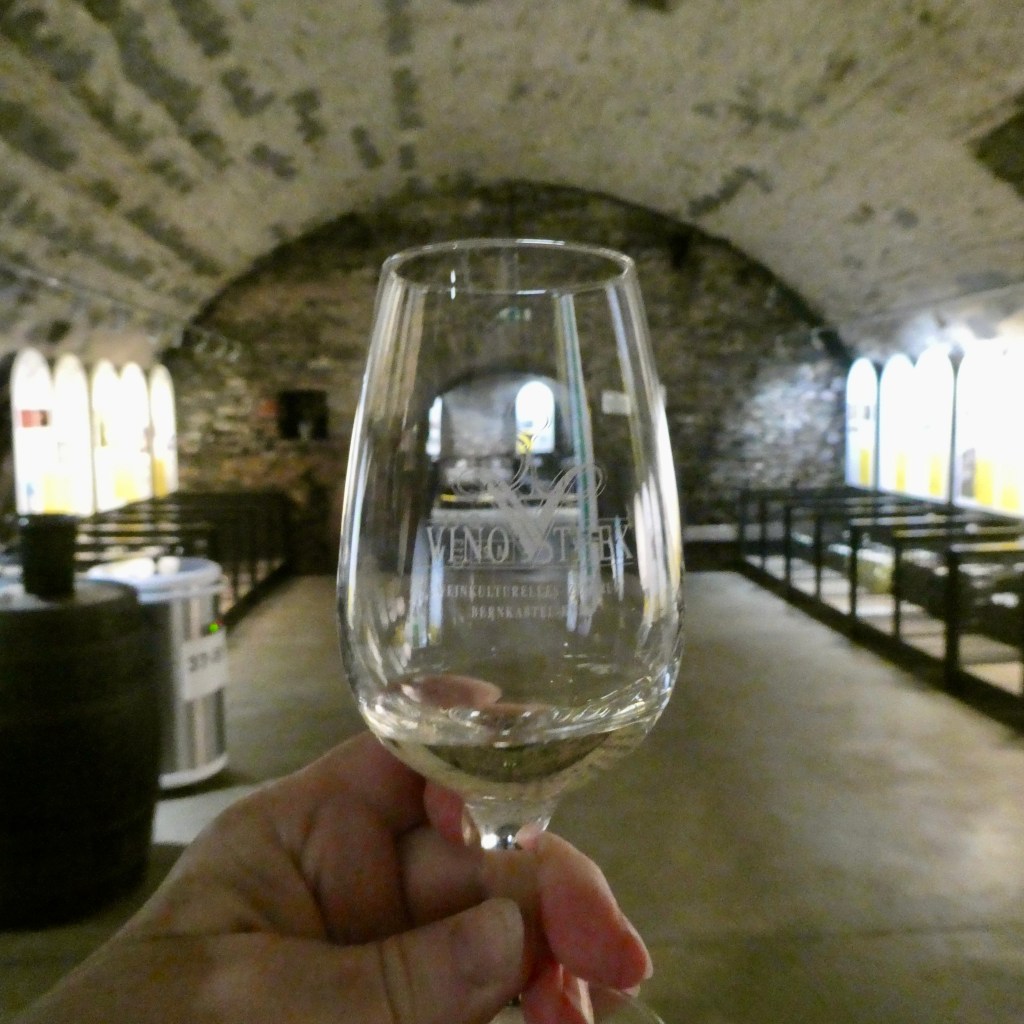
We had such a good time that we bought our glasses and brought them home in our luggage as a keepsake.

We made our way back to our Viking long boat, the Alsvin.

Randy is ahead walking with Claudia, possibly the best cruise director ever, and certainly the best we’ve ever encountered. She knew every one of her 160 ish passengers and where we were at all times. She knew every detail about everything.

We were scheduled to go on a tour of Trier in the afternoon. Trier is the oldest city in Germany and a UNESCO world heritage site.  It once rivaled Rome in size and influence. It was the birthplace of Karl Marx and home to a tunic thought to belong to Jesus at the time of his crucifixion.  

It was certainly worthy of an afternoon visit and we usually opt for every tour going anywhere when we possibly can. However, this day we opted to stay on the Alsvin while almost everyone else was gone.

Quiet space outside your cabin on a Viking River boat is very difficult to find and we opted for it.

We enjoyed the quiet ship and packed for disembarking the next day.  We read and visited the wheel house.

We asked our questions about operations and about right of way along the river.

The answer was that stretches of the river are treated differently and are designated by mile markers.  Other sections differ port to port.  In general, the priority is given to the vessel going downstream.

After a few hours our fellow passengers came back and we had our last night aboard the Alsvin.

Our travel companions, Warren and Connie, were very social, stayed up late, and met so many people! They enjoyed them selves immensely.

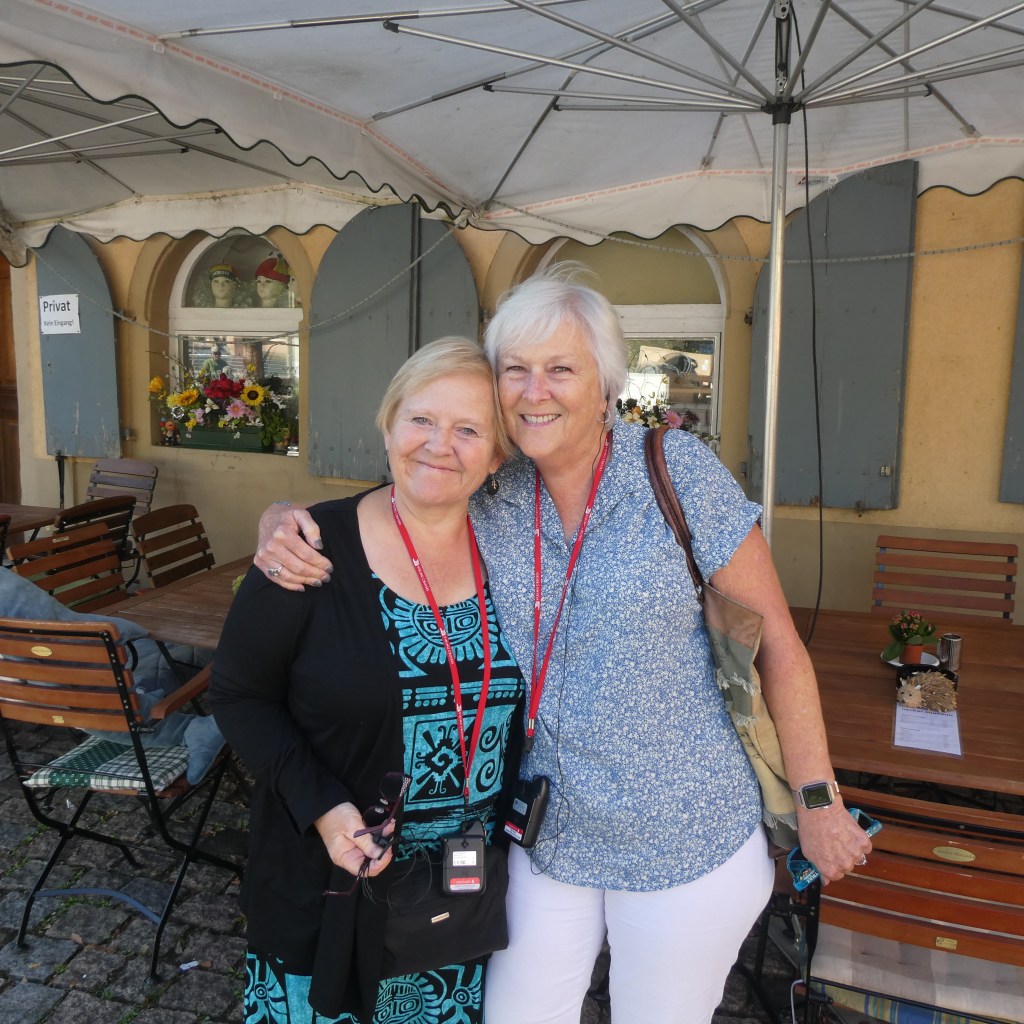
We (mostly I) tend to be a little ( a lot) more reserved but still met some very nice people. This was our last afternoon onboard with Warren and Connie and our new friends Vicki and Chuck.

We were in Bernkastle enjoying wine on September 8, 2023.

Next up: We disembark the Alsvin, board a bus to Paris, and visit Luxembourg on the way.

Posted in Uncategorized | 1 Comment

Viking River Cruise: Reichsberg Castle and Cochem

After sailing the Rhine, we boarded our bus and drove to Cochem. On the way we saw another castle on a hill – like our 35th of the day!

The vineyards in this area evolved from its Roman heritage from the years 50 BC to 400 AD.  Every soldier was given a liter of wine each day for his health. Over time the riesling grape became the dominate crop.

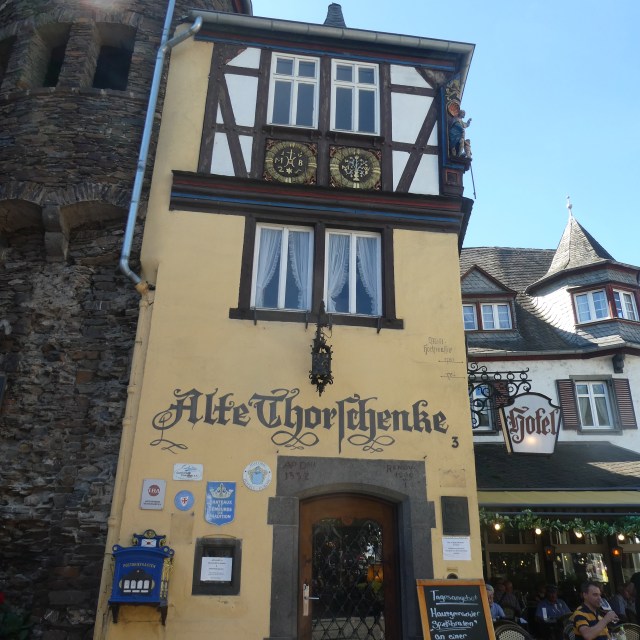
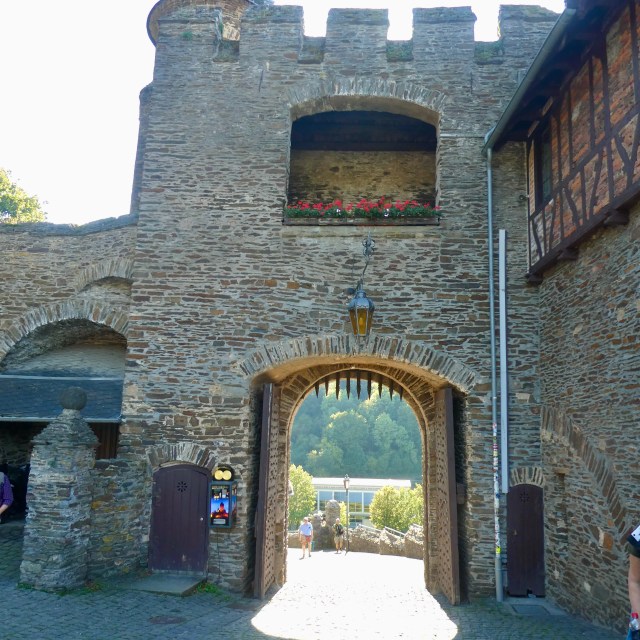
This city gate was built in 1532 .  It is one of three remaining gates in Cochem.  There were once four gates.

On the outside is an opening to deter an enemy by dropping bad stuff – like boiling oil or sewage.

There are narrow streets in historic Cochem.

This is the oldest house in Cochem.  It was built in 1332.  Two flood markers, dated 1781 and 1784,  are on the right side just below the lower window.

This house is from 1704. 

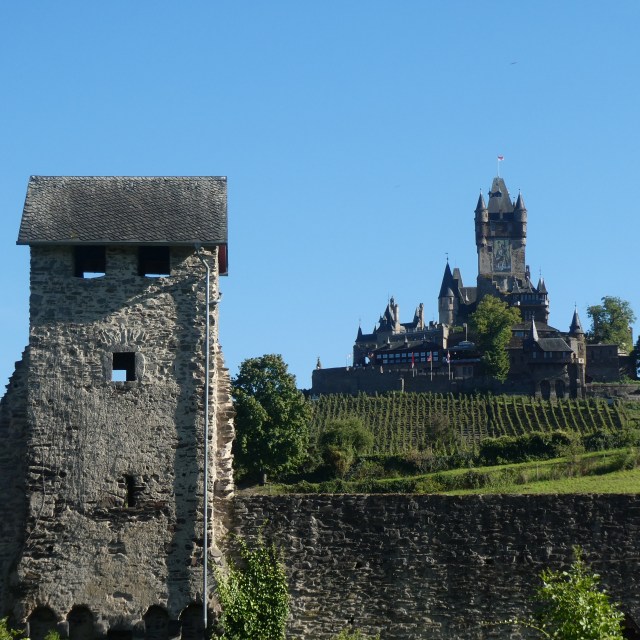
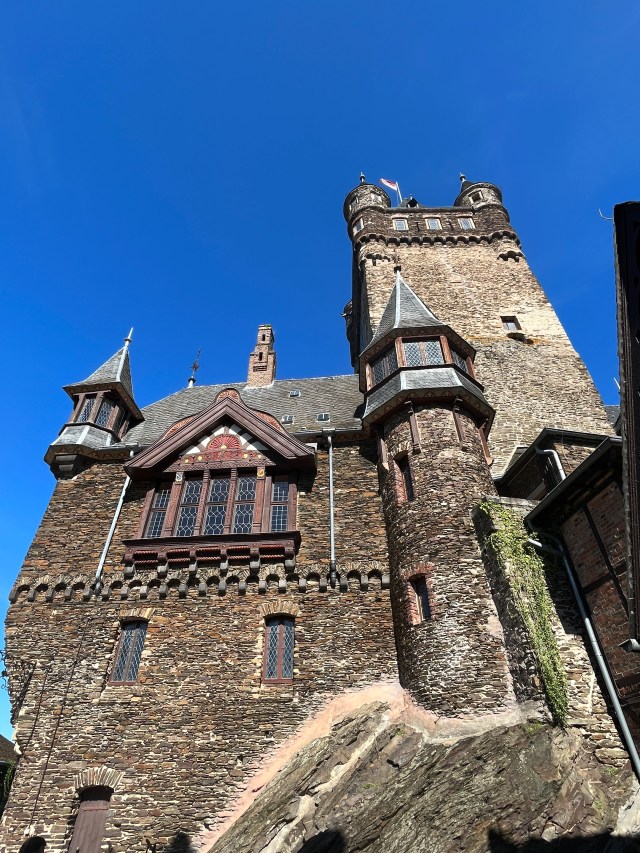
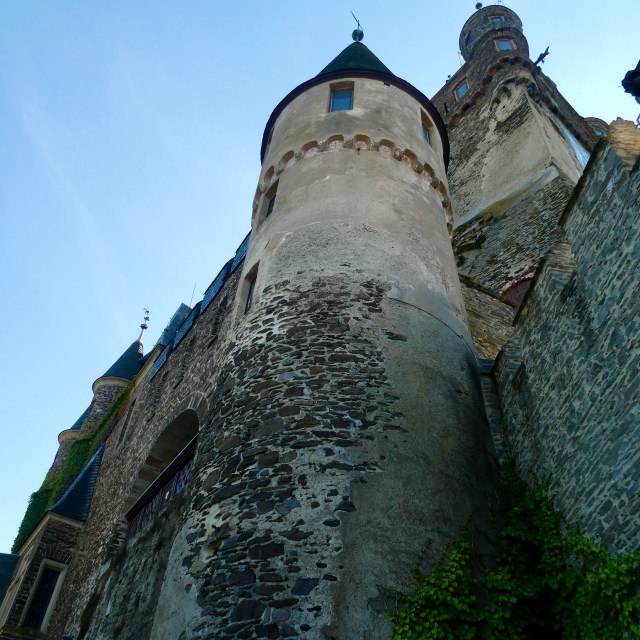
Going under the watchtower and out another gate, we had a view of Reichsburg Castle. 

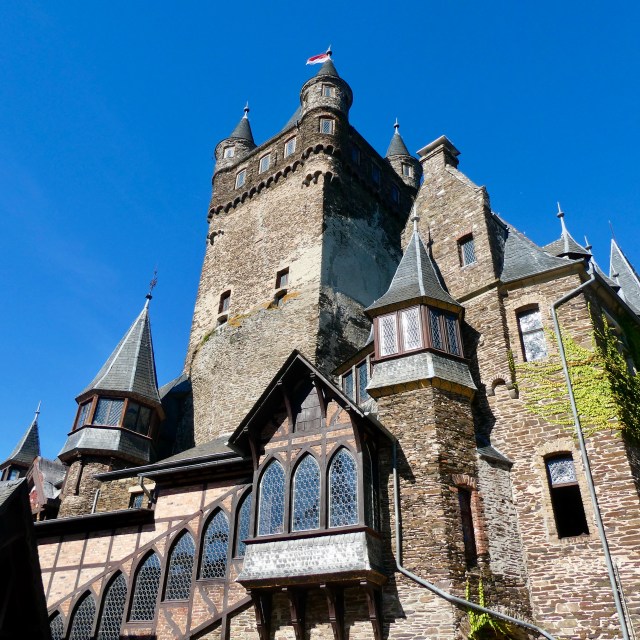
The main tower of the castle is 120 meters high. 

Reichsberg Castle was built in 1020 as the seat of Palatine nobles. 

In 1151, it became a home for German kings. 

In 1294 Archbishop of Trier made it a seat for his administration.  The Lord Electors of Trier used it until 1689.

In 1689 it was destroyed by French troops and eventually turned into a ruin.

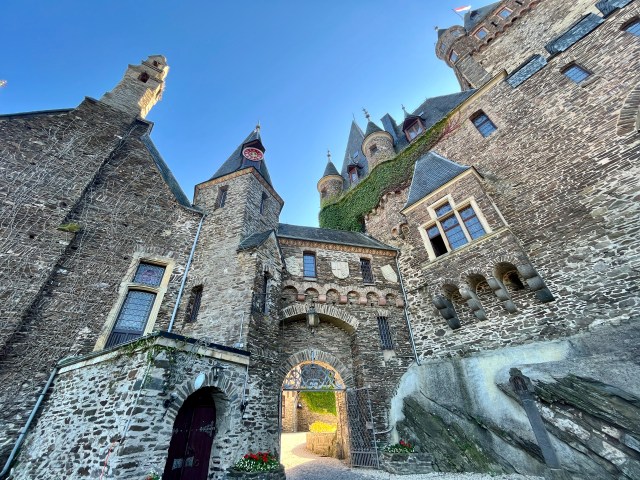
The main tower has a mosaic of St. Christopher.

This tower, the Witches Tower dates back to 1020 and was never destroyed.

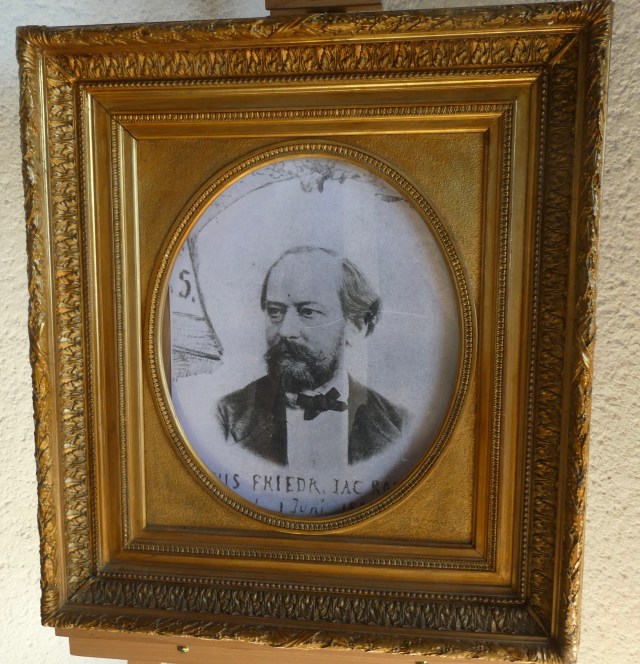
In 1860 Louis Ravene, from Berlin, bought the castle ruin. Over ten years he rebuilt it as a summer house. He died two years after it was completed.

In 1943 the family sold the castle to the Third Reich because of high taxation. Ancestors of this German family live in Canada and have been included in more recent castle celebrations.

After World War II, the castle reverted to the German  government. In 1978, the town of Cochem bought the castle for equivalent of $358,000.

When the family sold to the Third Reich, they took most of the furniture with them.  

The city has tried to get original furniture back and they have seven rooms refurnished.

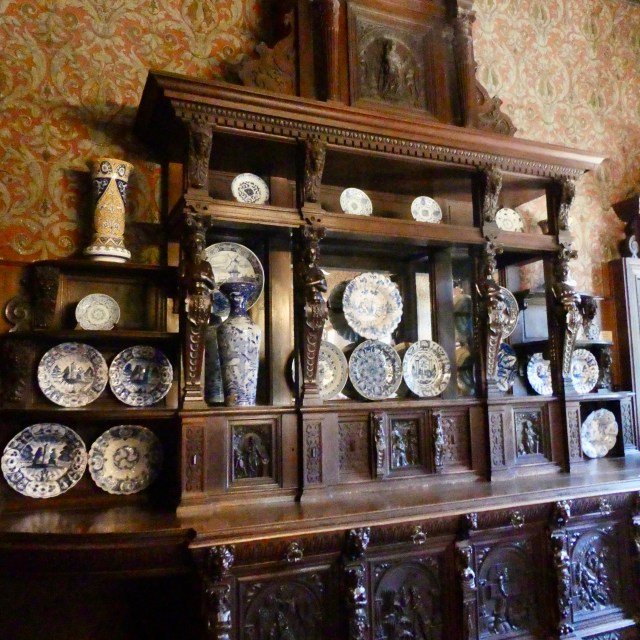
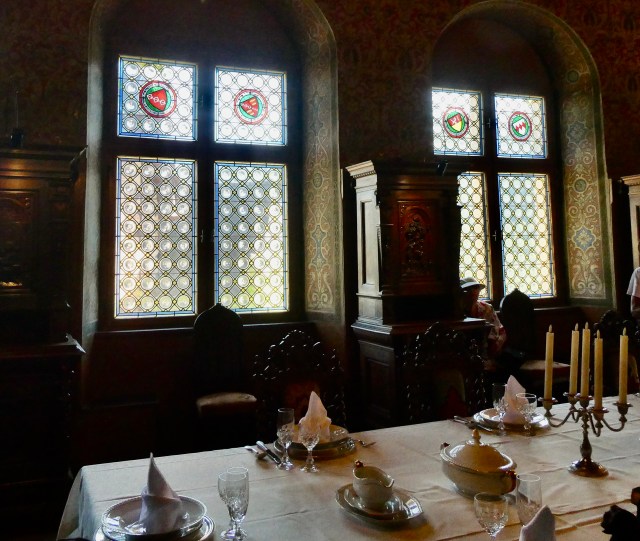
The dining room shows the Romanesque style, very balanced and symmetrical.

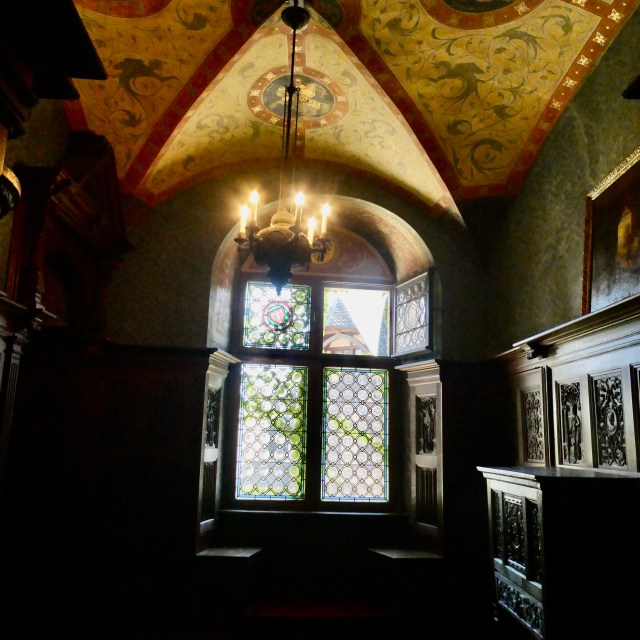
Other rooms were finished in gothic and baroque styles.

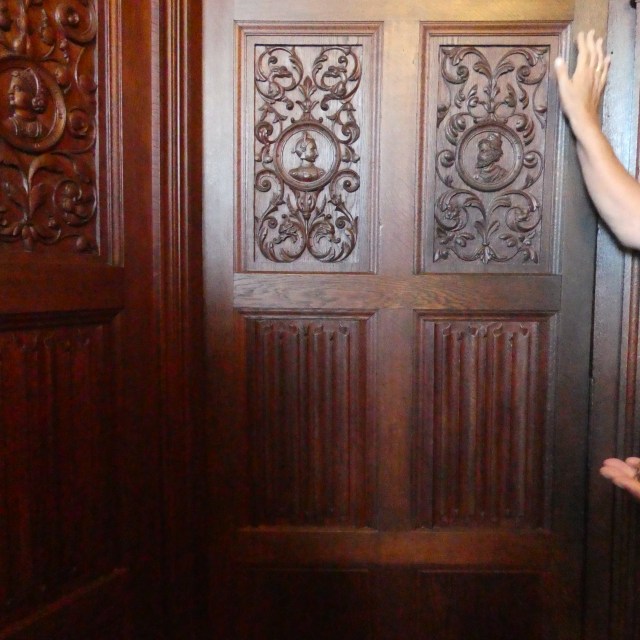
This room has two secret doors opened by small step switches on the floor. The first goes down to an escape tunnel.  The other goes to the upper bedrooms.

In a room dedicated to hunting we saw an interesting door.

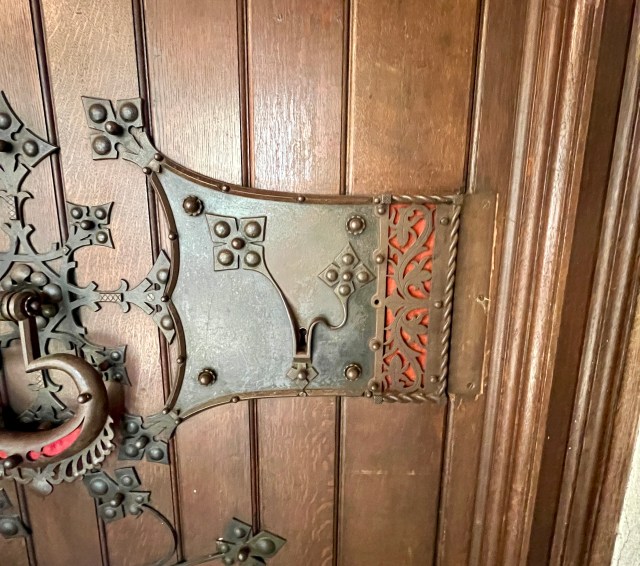
If you have had a bit too much to drink………

Put the key in the vicinity of the lock on the door and the guide will help you insert it in the lock.

The most valuable piece of furniture in the castle is this multi wood chest and wardrobe from the 16th century.

In the knight room we learned that the military salute originates from when knights used to raise their faceplate to greet their foe.

The well on the castle grounds is 150 feet deep and was dug when the castle was first built.

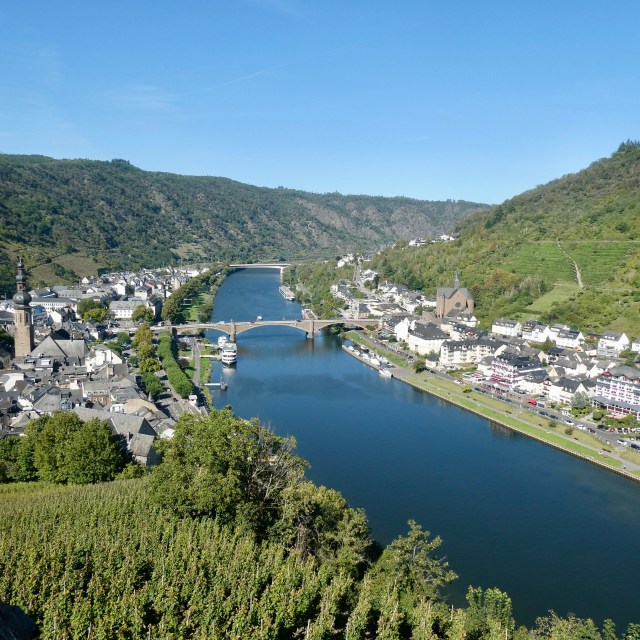
This is the view of Cochem from the castle. The city was damaged in WWII when the allies were trying to destroy a tunnel.   

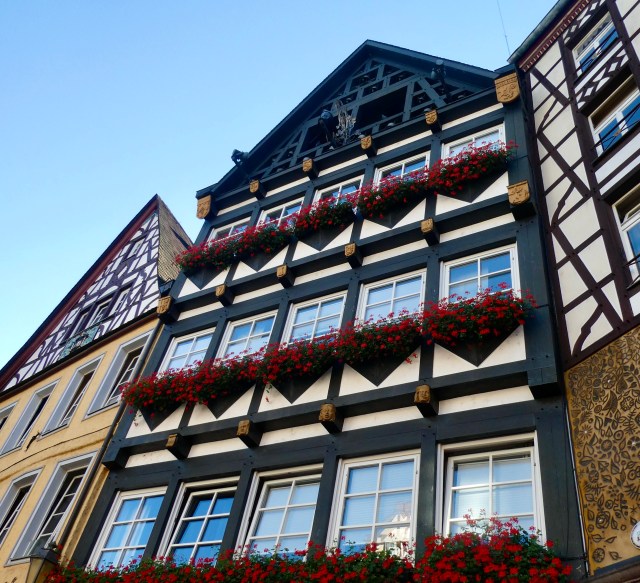
In 1974 people were getting wood from the city to rebuild.  A rich owner applied for wood and his request was denied. The city leaders told him that he could afford to do it himself.

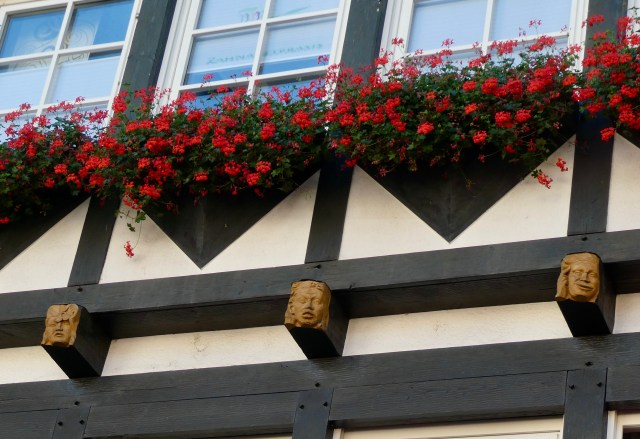
The man did pay for rebuilding himself but added faces on his facade to always show disapproving looks towards city hall.

He also added bells that ring four times per day so the rest of the city would have to listen to them.

One of Cochem’s specialties is a peach liquor made from small gray peaches that are not sweet.  Tastings are available in the town shops. We tried several and bought two small bottles! This was our favorite.

We were in Cochem on September 6, 2023

Next up: Bernkastle and one of our favorite excursions of the whole trip.

Posted in Uncategorized | 1 Comment

Viking Cruise: Rhine River Castles

When you see an advertisement for Viking River Cruises with castles along a river, you are probably seeing the castles along the Rhine River in Germany.  This was the day I was most excited for when we booked this cruise!  

As a short person, I am very purposeful about where I sit for events and my strategies were employed for this day.  I wanted an unobstructed view of both banks.  That meant I needed to be at the front or the back of the boat and I wanted a table to sit at because I expected to be there most of the day.  

I was up very early and was the first passenger above deck.  I chose my place and sat down to wait.  A bit later our friend Jeannie joined me on deck.

Jeannie and her husband went to the same church as we did near Phoenix.  We had not booked the same cruise on purpose but it was a very nice happening.   

This is a picture of Jeannie and me on the cruise but it was not taken that morning.  That morning was very chilly, especially on deck with the boat moving.  

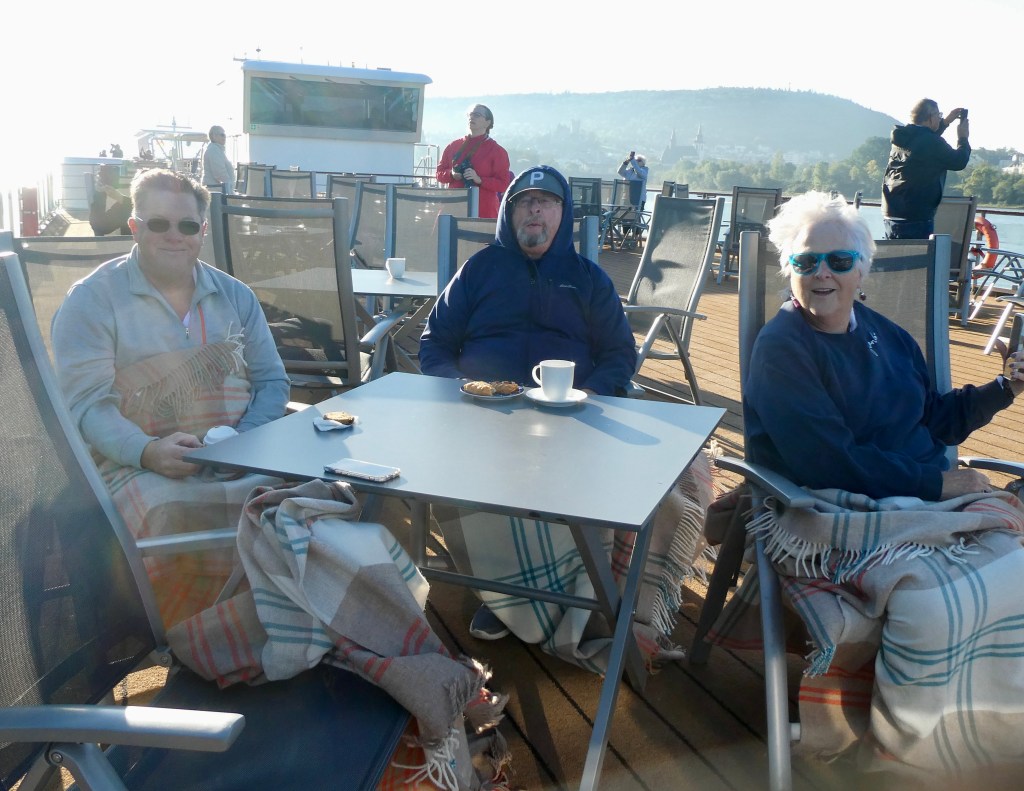
Overtime more people (including our husbands) came above and the crew made blankets available.

They also brought hot chocolate, and later Baileys.  

At some point they also gave us a brochure of the castles we would see and provided narration by the cruise director.  Do you sense perfection?  Viking is very good at this.

The 35 mile stretch we were sailing has more castle density than anywhere else in the world and has been a UNESCO World Heritage site since 2002.

Napoleon left most of the castles in ruin while he was here in 1689. The first American tourist to “leave a trace” here was Mark Twain with his book A Tramp Abroad.

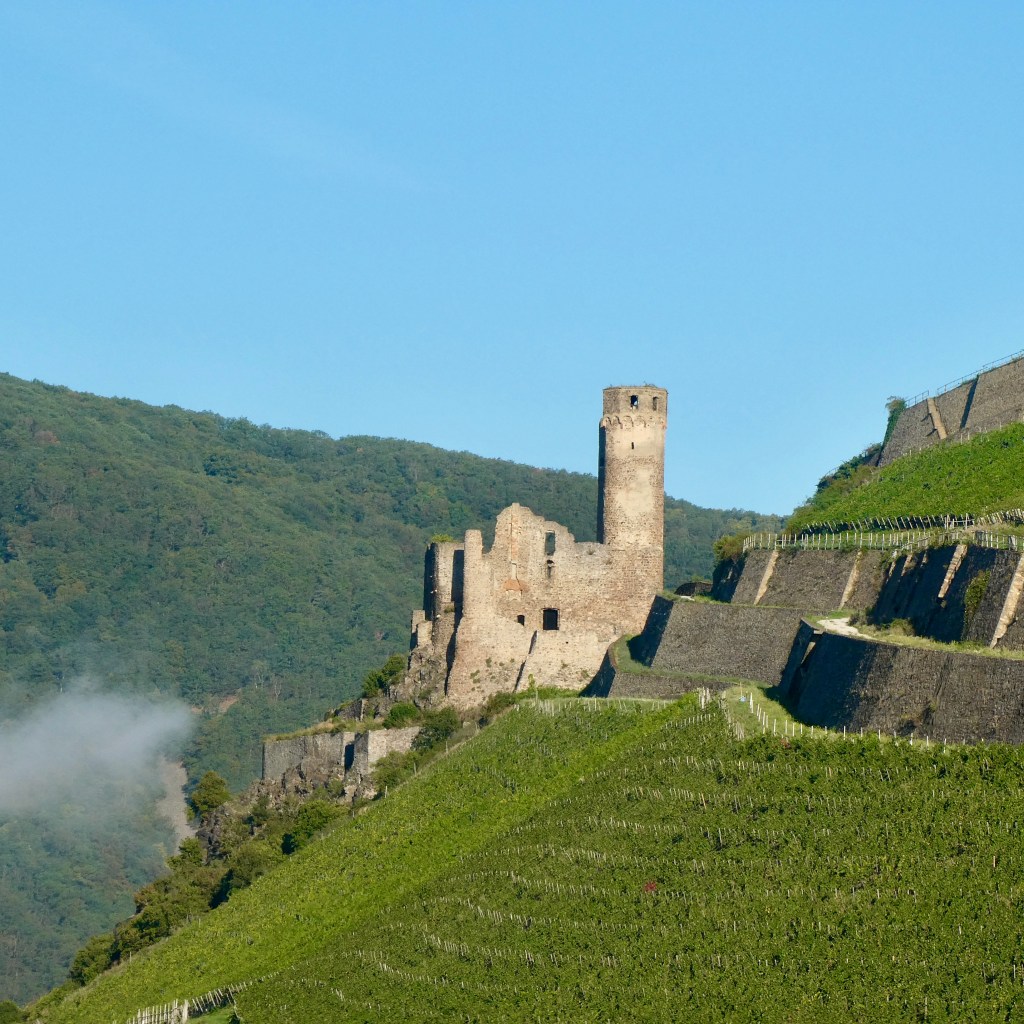
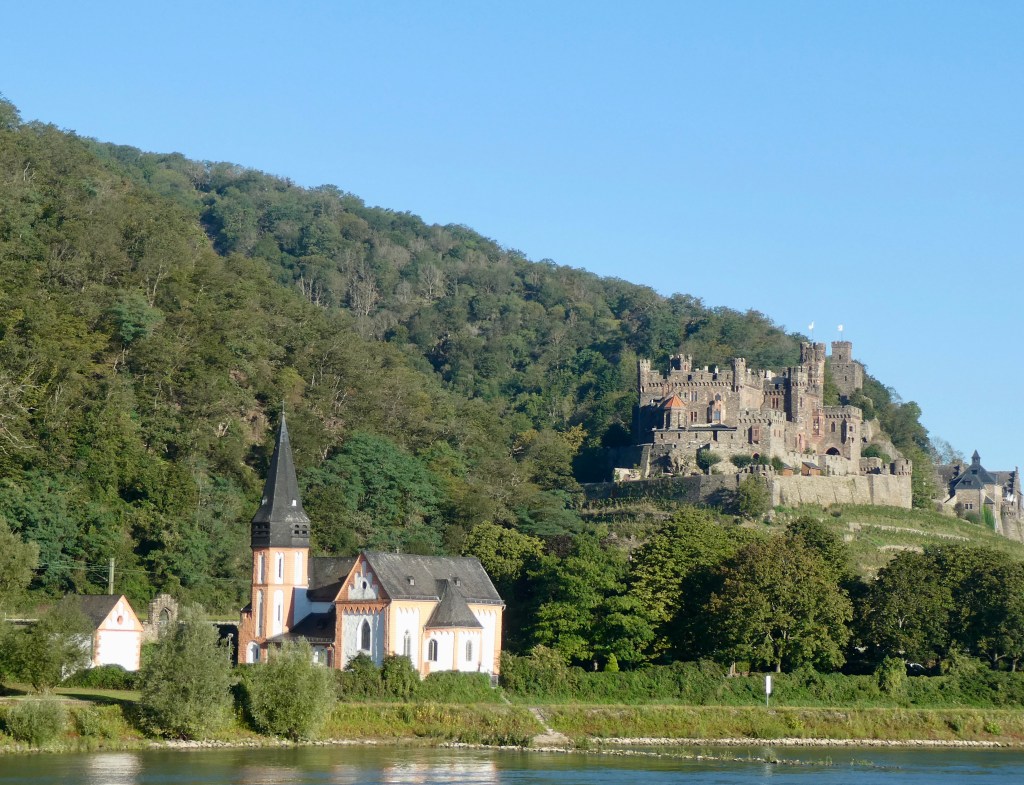
Ehrenfels Castle was built in the 13th century and is surrounded by ancient vineyards.   There are miles and miles of vineyards along the Rhine.  Some areas look quite steep.  

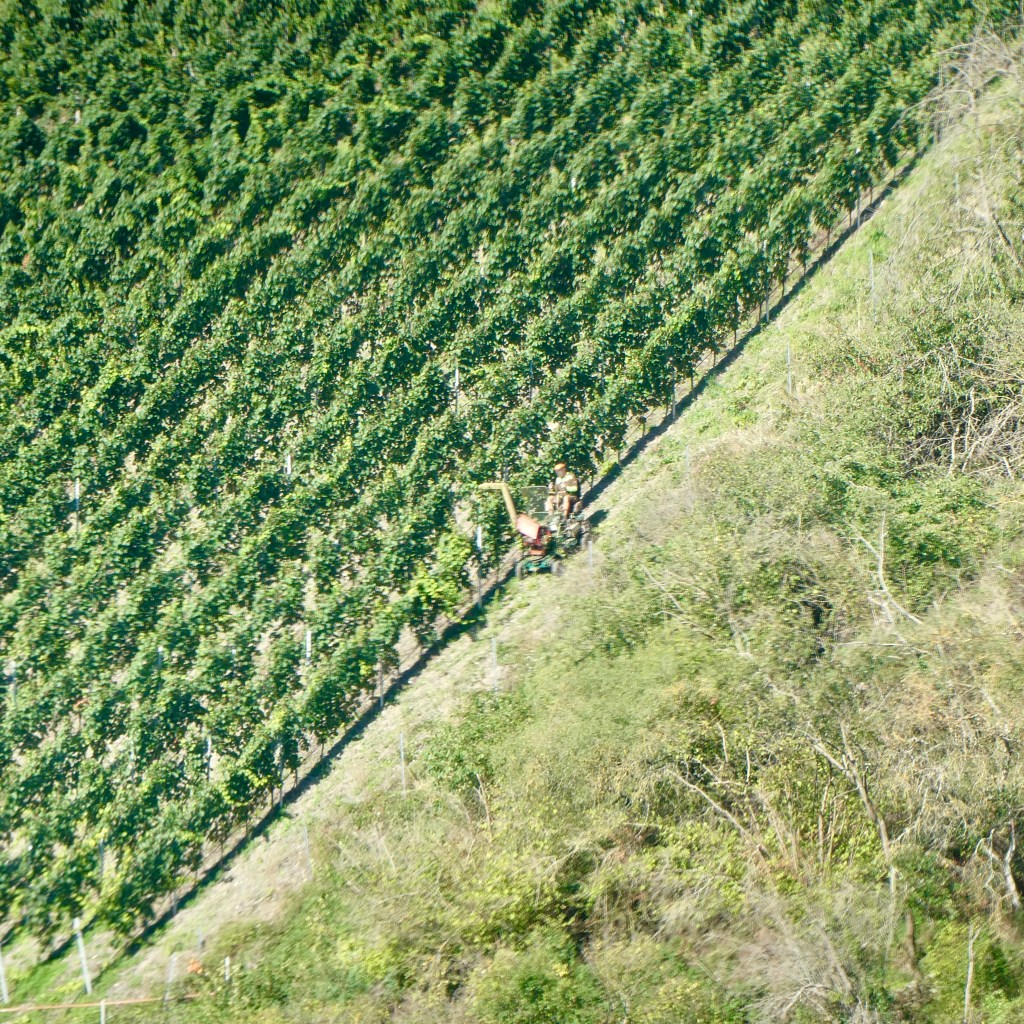
This guy has an interesting job! 

We learned that for 2000 years the Rhine River was a primary trade route. At times, 300 ships a day sailed through.  Land owners charged tolls to go by their castles.  There were so many tolls required that an emperor in the Hapsburg dynasty destroyed some toll sites to fix the abuse. 

Mouse Tower was a former toll tower.   It also served as a signal shipping station until 1974.  Its name is because legend serves that mice ate an archbishop imprisoned in the tower.

Rheinstein Castle was built by a Prussian and is now a museum where you can also stay the night.  Several castles now have hotel accommodations. That could be a new bucket list trip!

This chapel is from the 13th century and is the oldest on the Rhine.  The  Reichenstein Castle is in the background and both of these are just around the river’s bend from the earlier Rheinstein Castle.

The 12th  century Stahlach Castle is often used in Viking advertising.  It was attacked repeatedly in the 17th century and was in ruins until it was rebuilt in 1909 as a youth hostel.

The Sterrenberg castle is likely the oldest on the Rhine River and was built in the 12th century. It was built by a quarry and that quarry is now owned by a Dutch company as part of reparations after WWII.

This ship shape building was used for collecting tolls.  It is currently used to monitor water levels.

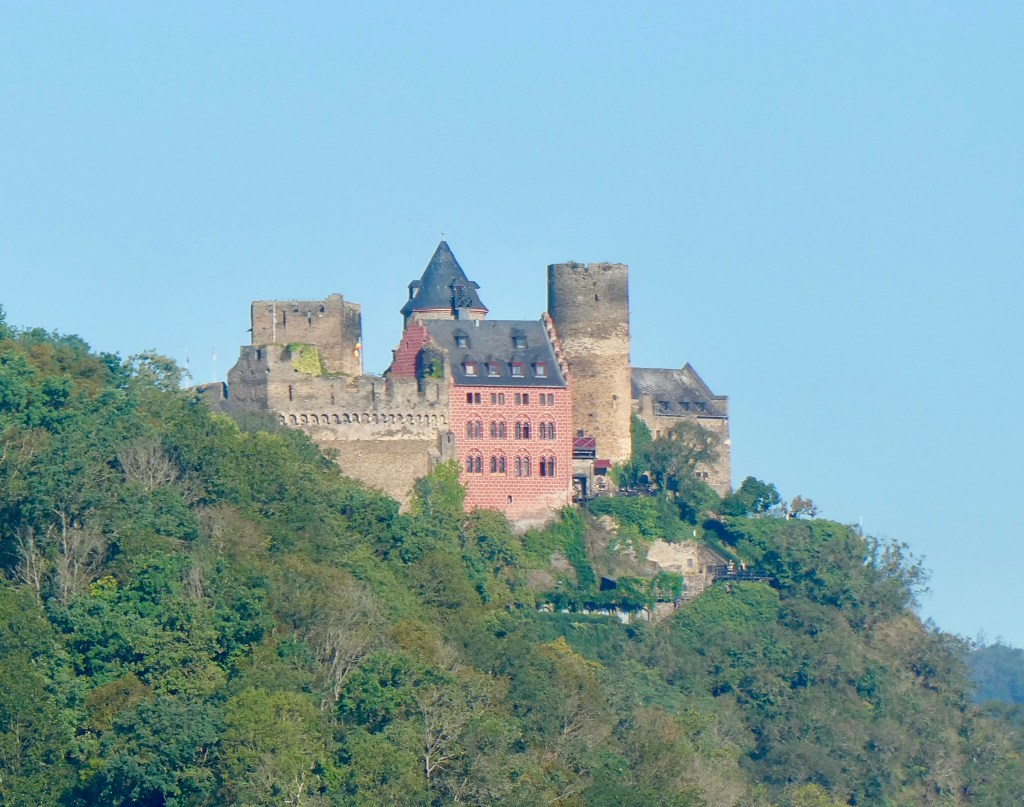
The original Schönberg Castle was built in 966 and burned by the French in 1689.  This reconstructed castle  combines three fortresses and towers into a renowned hotel and restaurant.

This isn’t really a castle at all. The allies had decided not to bomb the castles so Hitler often disguised tunnels as castles.

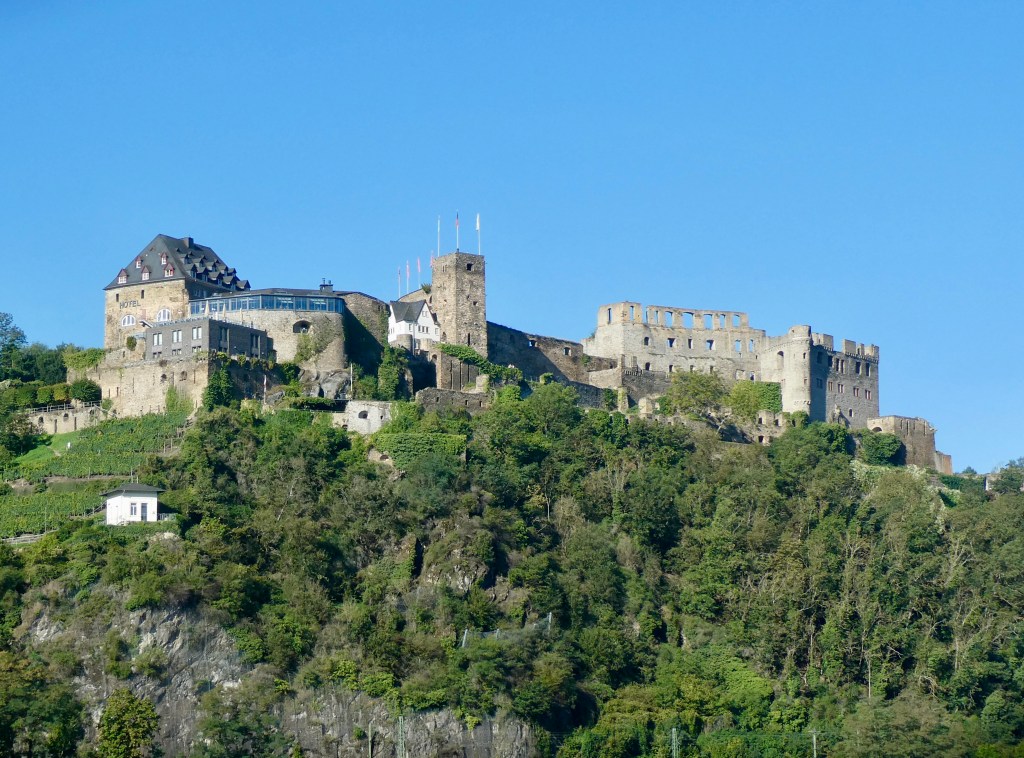
Rheinfels Castle sits high above the river and is one of largest castles on the Rhine.

This is the smallest town on the Rhine.  The pub is attached to the church and one must enter the church through the pub.

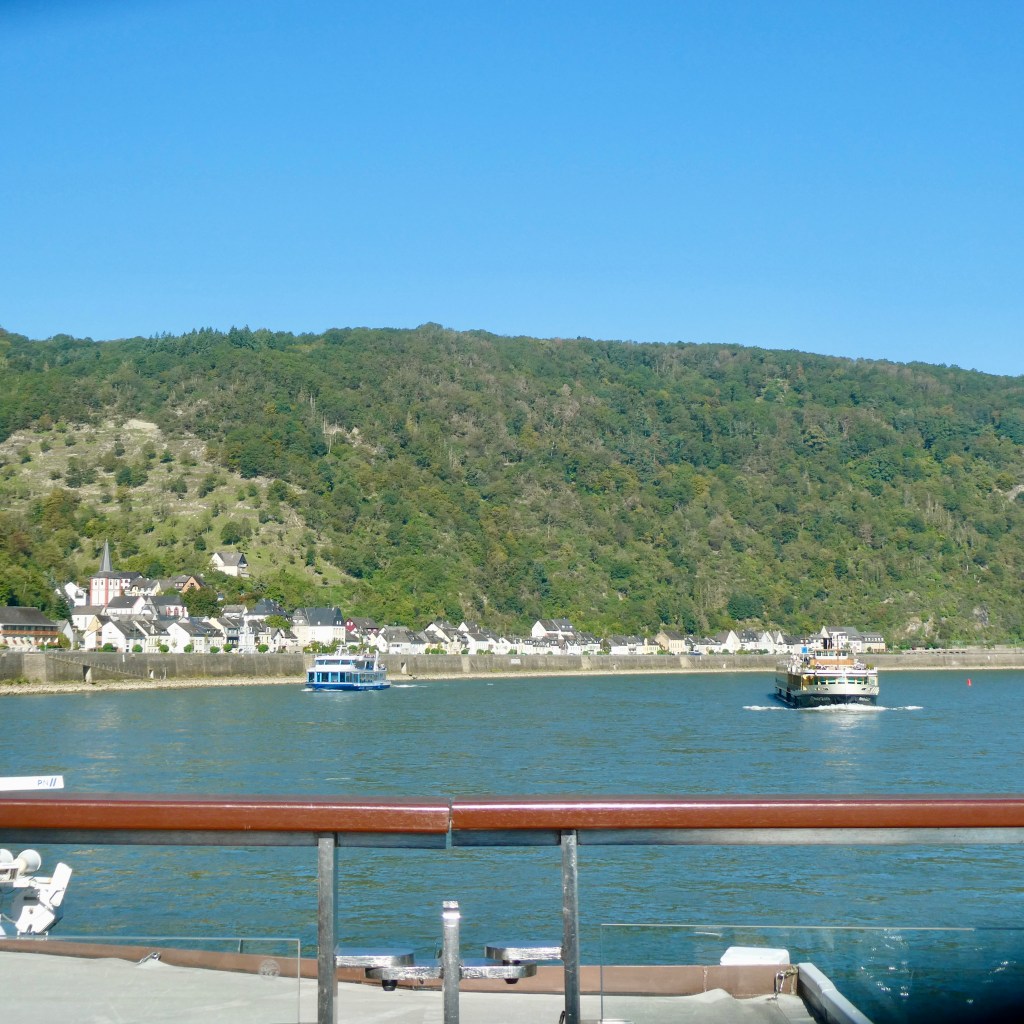
We used to own a boat and have some knowledge of the “rules of the road” on US waters. Along the Rhine we met other boats while sailing on the left, right, and sometimes through the middle.  The ship captains seemed to know what they were doing even if we did not!

Two brothers in dispute either built, or separated, the family castle into two.  There is a wall of dispute between them.

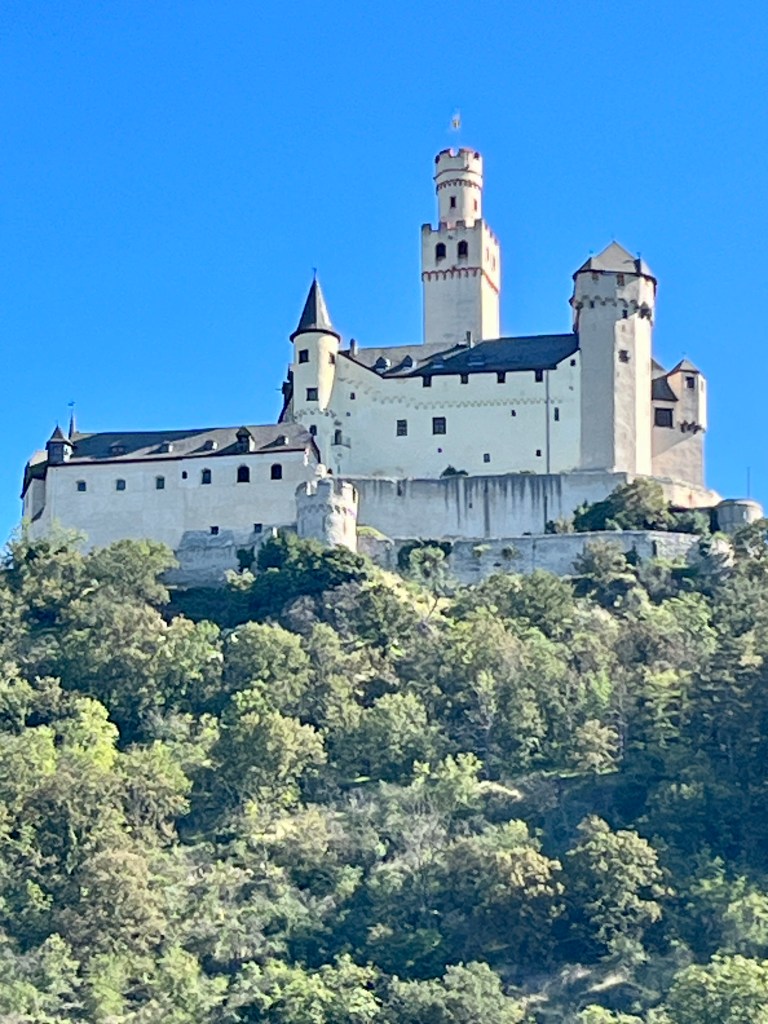
Marksburg castle sits above Braubach, Germany.  Of all the castles in the region, Marksburg is the only one to have never fallen into disrepair or been destroyed.

I think this is Lahnstein Castle. It wasn’t one of the ones highlighted by Viking.  I like that you see the old and the new together.

This seems a good spot for a castle identification disclaimer. I did not take good notes along the Rhine because I just wanted to enjoy the experience. Viking had given us the guide so I thought I would be able go back to it for research. The problem was that we took pictures from different angles than the guide showed, and sometimes we took more than one picture of the same castle as we approached and as we passed by. It was quite the puzzle to match the order and timestamps on our pictures to the kilometer markers along the river guide, bracketing the castles I wasn’t as sure about between the castles I was very sure about. I did my best.

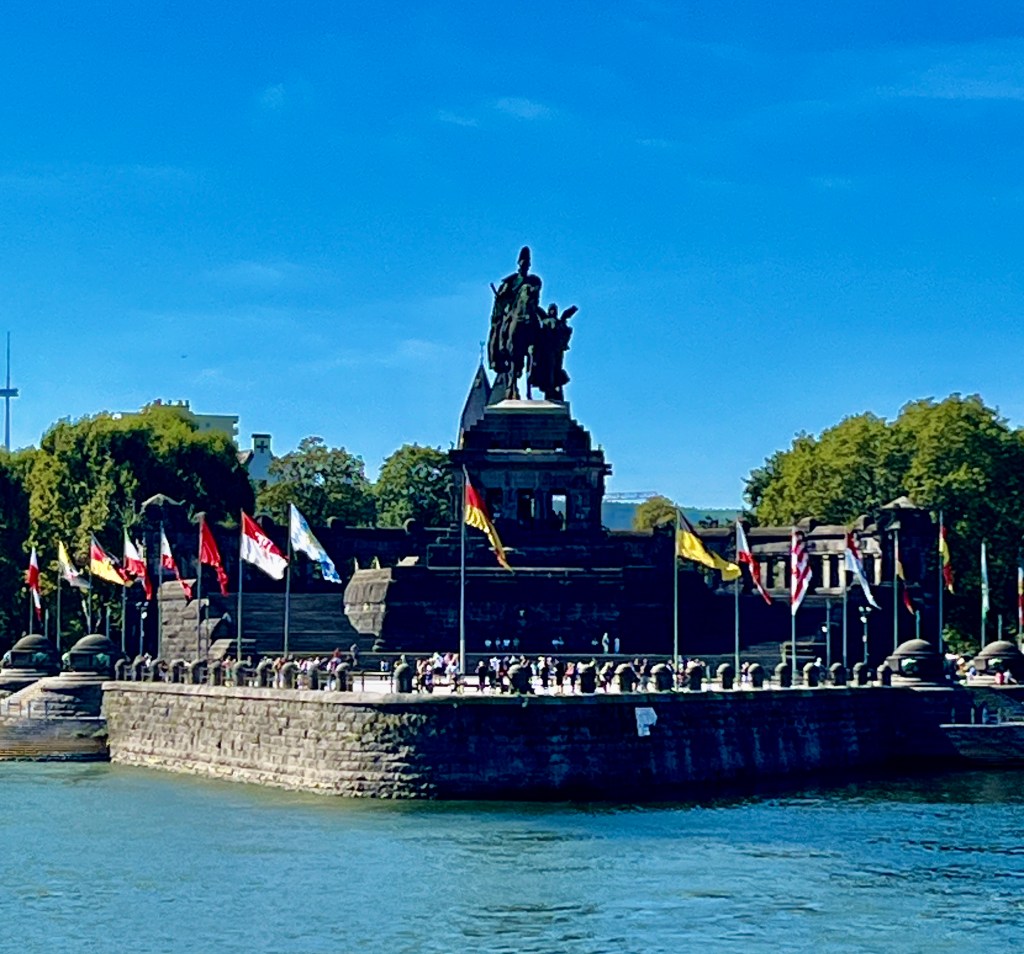
The Deutsches Eck is a promontory in Koblenz, Germany where the Rhine River meets the Mosel River.  The statue is a monument to  William I who unified Germany.  Destroyed in World War II, a replica was placed in 1993.  

We sailed the Rhine on September 6, 2023.

Next up:  Cochem and Reichsburg Castle

Posted in Uncategorized | Leave a comment

Viking Cruise: Mainz and The Gutenberg Museum

We had a morning sail down the Main River, and eventually moved into the Rhine.  

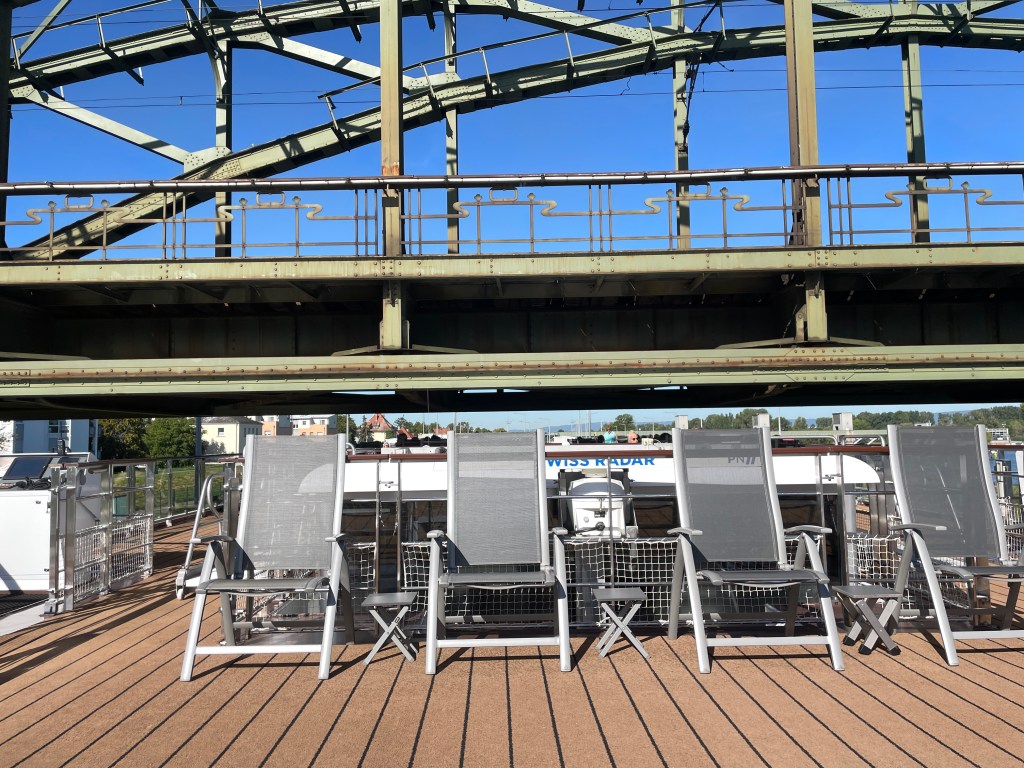
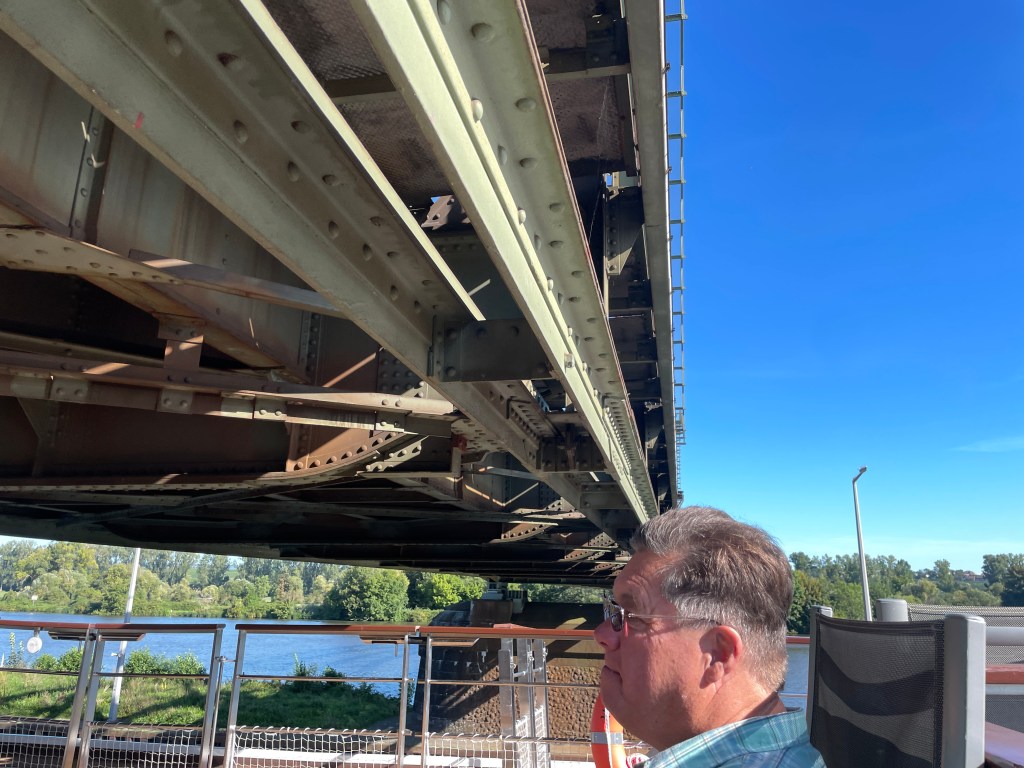
Sometimes we weren’t allowed to sit on top because of low bridge clearance but this day we were able to.

But just barely!

When we disembarked in Mainz we saw this monument to Germany. The side panel lists the cities of former East Germany. 

In this block there is a missing building.  It was destroyed during WWII and never replaced.  Eighty five percent of Germany was damaged during the war and much was rebuilt it 10 years under the Marshall plan

In Mainz there are blue and red street signs attached to buildings.  They are from the Napoleon era because his soldiers couldn’t read. Roads named in red go toward the river while roads named in blue parallel the river. 

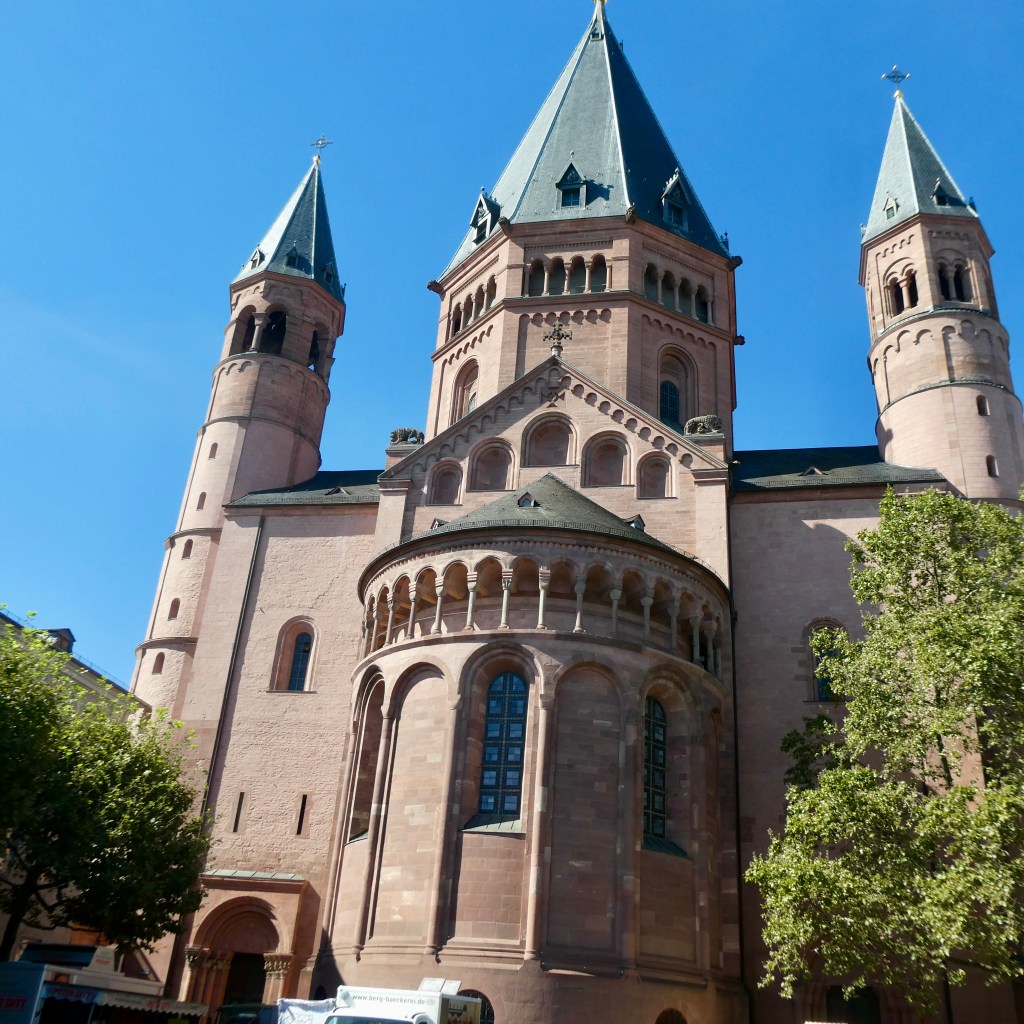
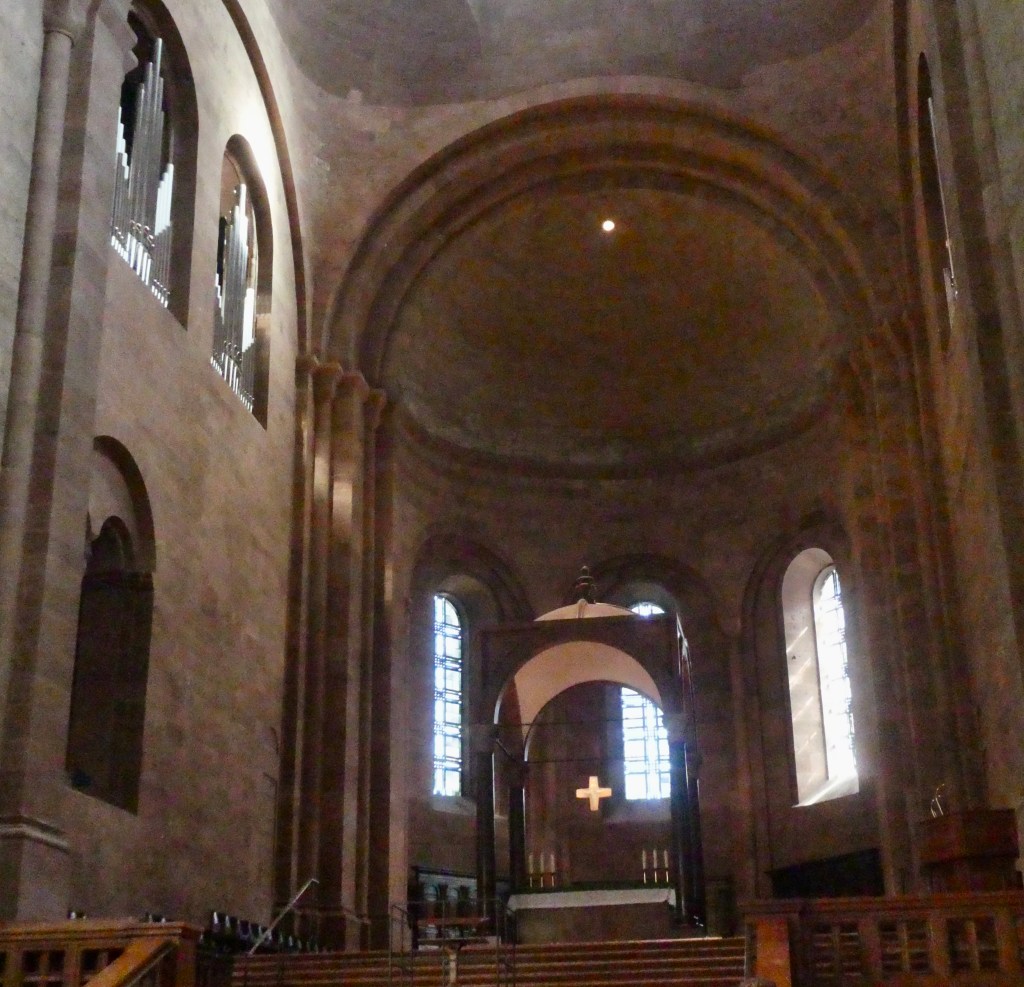
The Mainz Cathedral is over 1000 years old. 

Building the center section began in 975. The sides were added later.  

There are tombs of Mainz powerful prince bishops in the cathedral.

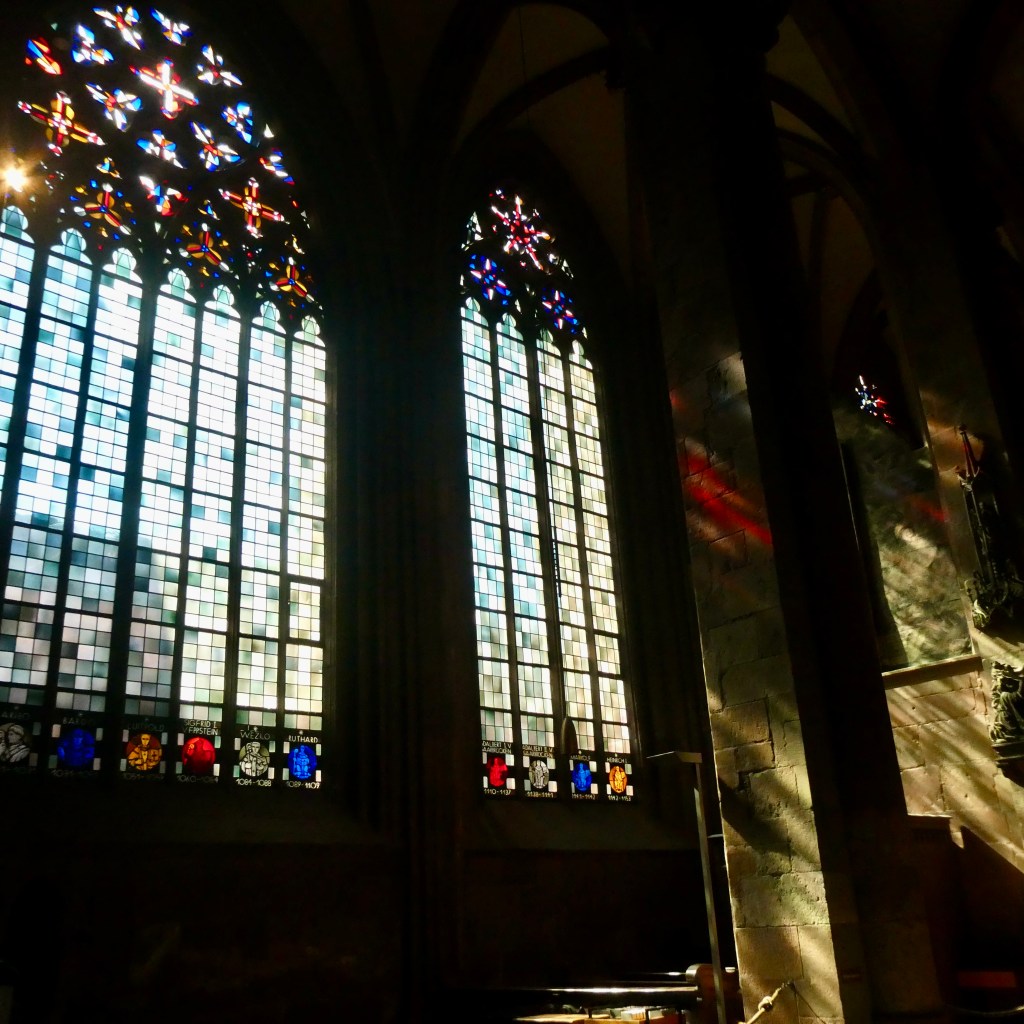
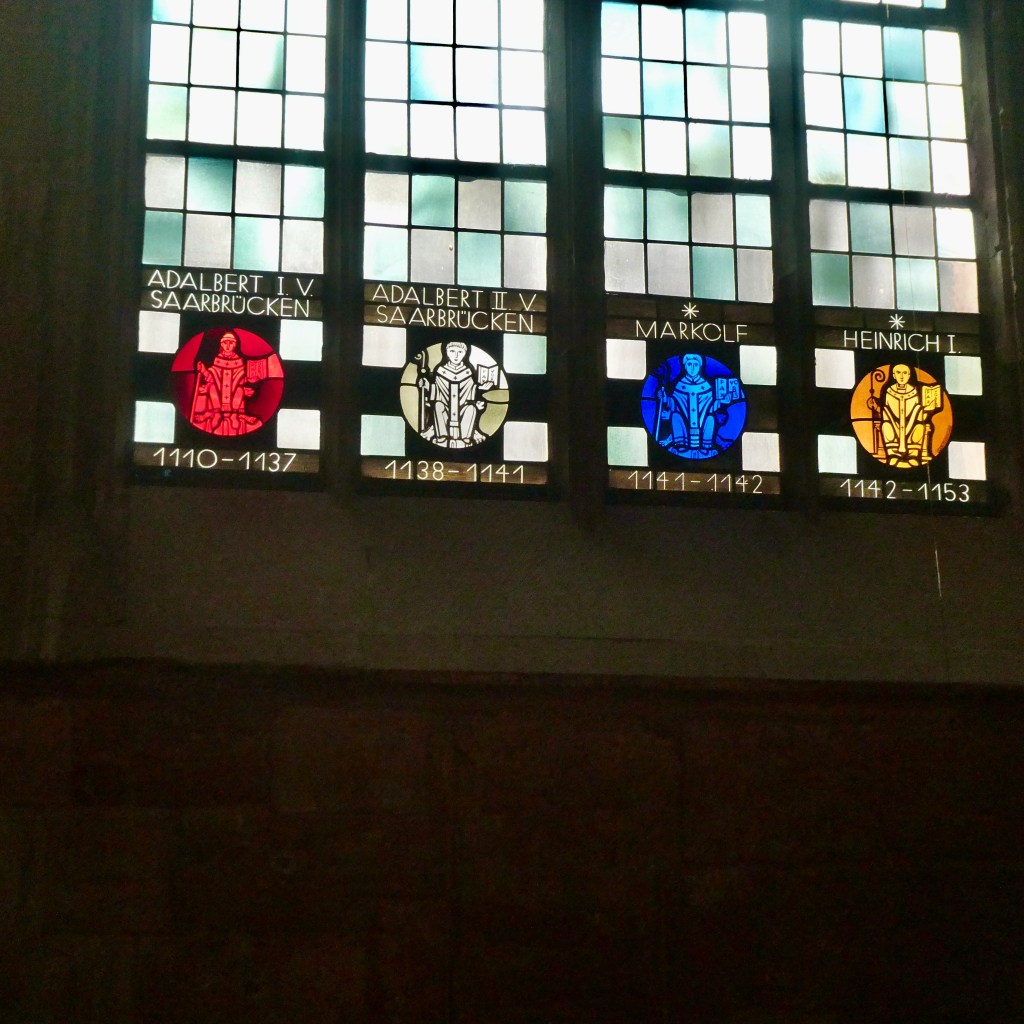
The stained glass is lovely with the bishops shown sequentially.  

Germany is half catholic and half protestant – mostly Lutheran.  Even if churches have an active congregation, they can’t possibly maintain these buildings.  Our guide told us that eight percent of income tax serves as a church tax to keep the churches going.  They are also used for cultural events.  The churches were not heated in the winter. It was thought that people could bundle up for services once a week

Allies tried not to bomb churches whenever possible during WWII.

This is a fountain from 1526!

Mainz has purposefully established a market atmosphere with no loud voices or sounds and no hawking of products.  They want shopping in the market to be a quiet pleasant experience. 

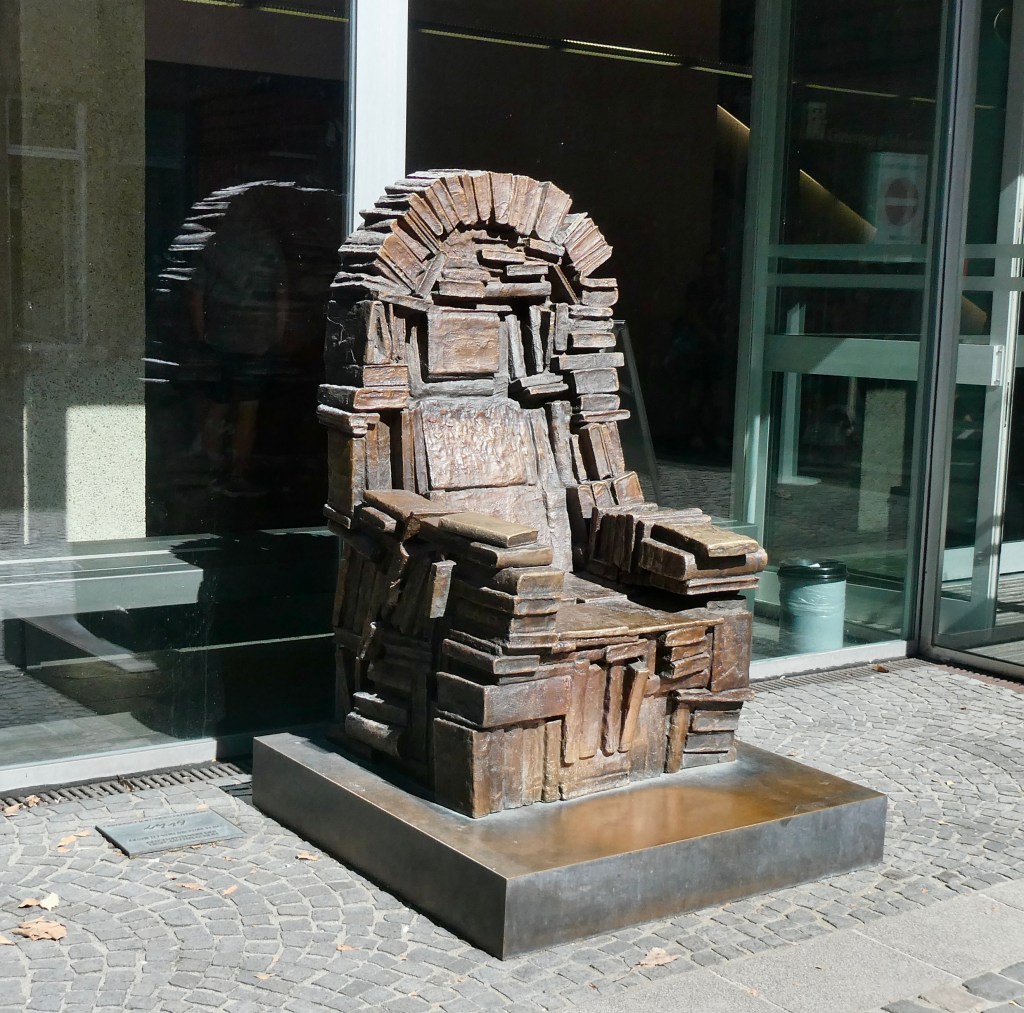
The Gutenberg Museum was developed in a building that started as a hotel in 1664.  Mark Twain once stayed there.  ( building with white van in front)

Gutenberg was born in Mainz in the 1390s.  He became a goldsmith around age 30 and eventually made his way to Strasbourg, France.  The goldsmith experience gave him the knowledge to work with metals.

He convinced contacts in both Strasburg and Mainz to help him with a secret project that he kept secret.

The Invention of the movable type printing press is widely regarded as the most important event of the post renaissance era.  

He made it possible to mass produce books instead of individually by hand.

Colors elements were from nature so they lasted.

We were able to enter a special part of the museum, a vault specific the Gutenberg Bible, but we were not allowed to take pictures.

Gutenberg’s Bible was printed in the 1450s as a three volume set.  It was written in Latin and printed in 42 line columns.  It was 500 pages, without numbers. The pages of the Bible were first printed in black and then over printed with red. 

Gutenberg printed 180 bibles and 49 copies remain.  We were told the Gutenberg Museum owns three.

The cost of one of a bible when printed was an equal to a year’s salary for an average man.  One of those remaining bibles recently sold for 14 million dollars.

The technological development of Gutenberg’s printing press and its impact on world history cannot be overstated.  

After touring Mainz, we returned to our ship, the Viking Alsvin.

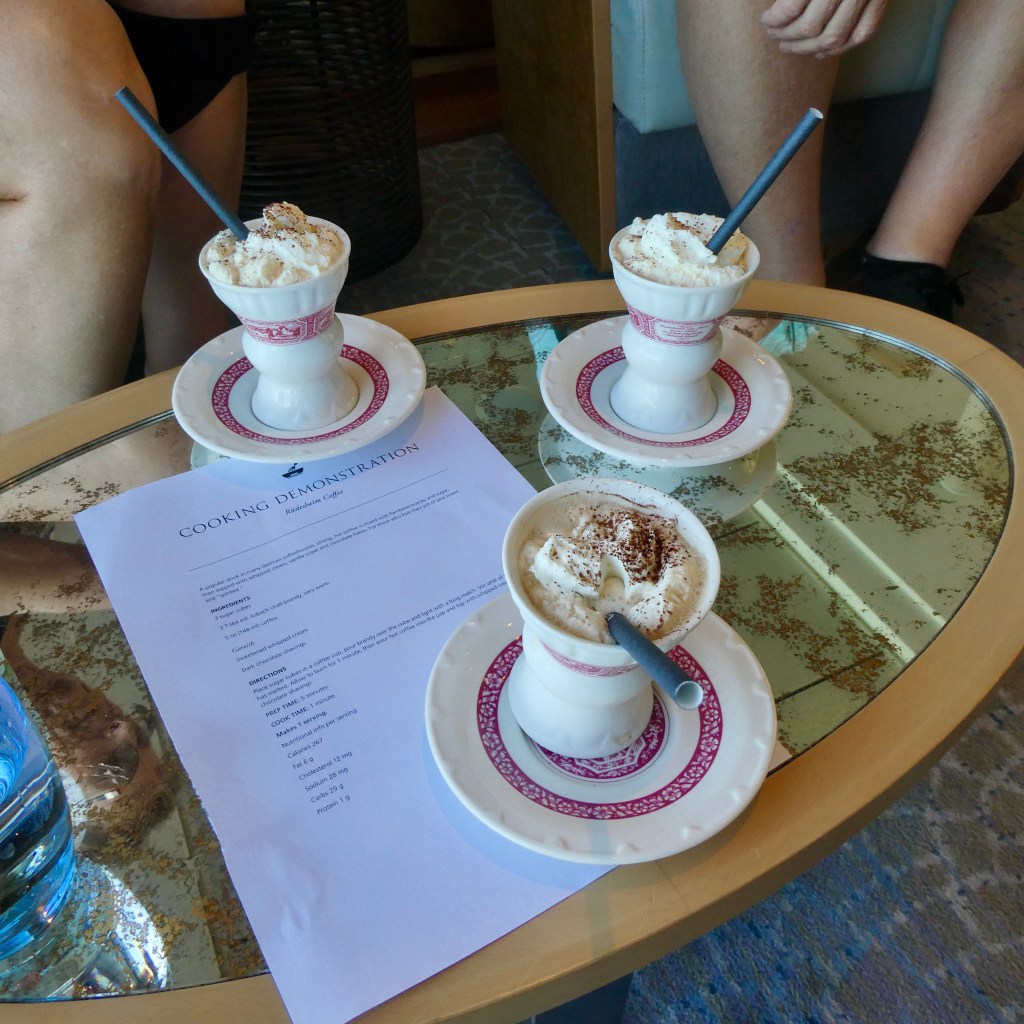
We enjoyed a cooking demonstration for Rüdeshei Coffee.

The recipe adds sugar and Asbach Uralic brandy to the coffee, then tops it with whipped cream and dark chocolate shavings. 

We sailed through the Rüdesheim region, first mentioned in 1074. 

The Romans started making wines in this region of the Rhine River 2000 years ago.

(We were in Mainz on September 5, 2023.)

Next up:  Sailing down the Rhine looking at castles!

Posted in Uncategorized | Leave a comment

Viking Cruise: Heidelberg

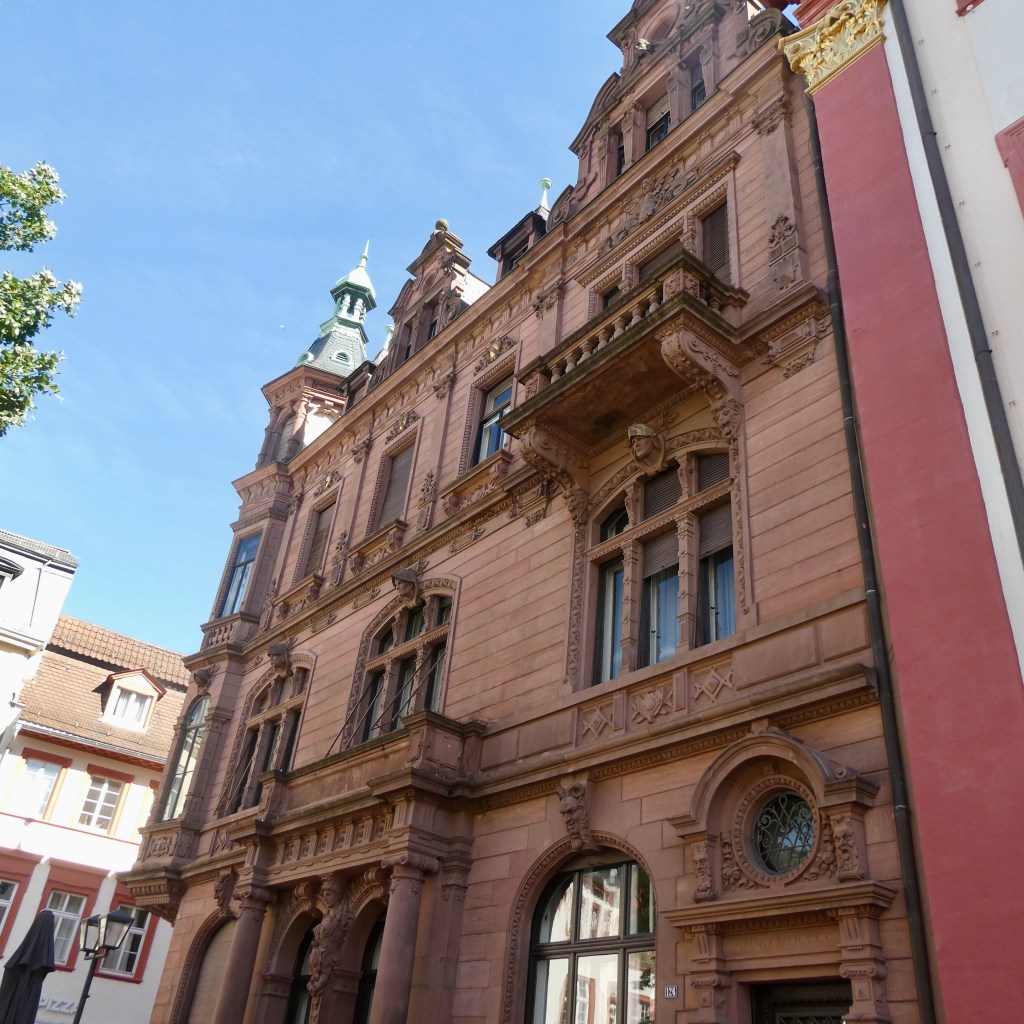
Heidelberg University is Germany’s oldest university. It was founded in 1386.  This building is the oldest and is just one of many throughout the city.  

This building was donated by a former American student around 1900 because there hadn’t been a  “proper” lecture hall when he was in attendance.

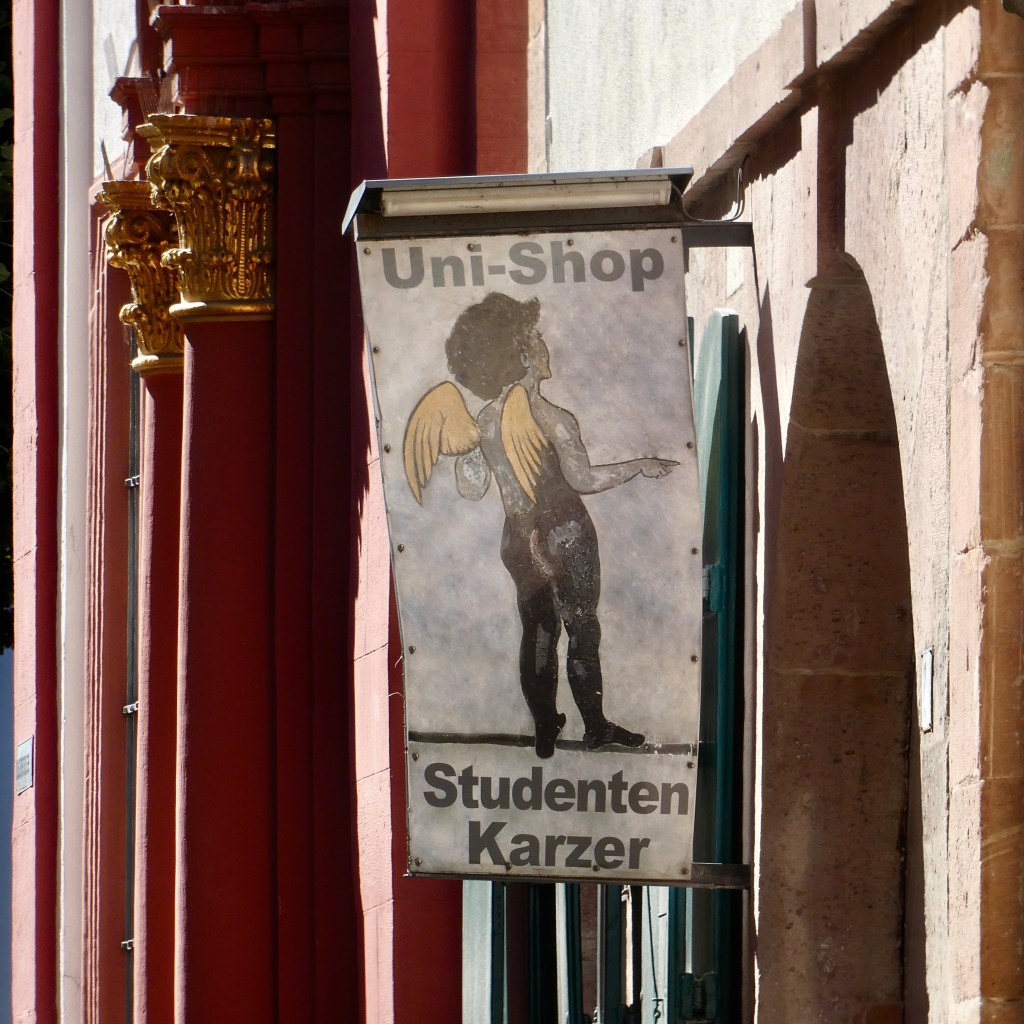
At one time there was a student “jail” to curtail mischief.  Mark Twain came to Heidelberg as a student to learn German – somehow I suspect mischief.

This building is residence for a fraternity of ten. Nice frat house!

Heidelberg University has academic prestige with 56 Nobel Laureates.  Forty percent of the university’s students are international.  

There are lots of English speakers in Heidelberg because of the university and because so many Americans lived in the city.  Heidelberg was home to a US military base until 2011.

Heidelberg was once ruled by a series of Prince Electors.

Martin Luther first defended his thesis in Heidelberg and the reigning Prince Elector was so impressed that nearly the whole village became Lutheran.

Lutherans and Catholics shared the Heidelberg church for 300 years. 

There was a wall separating their activities for most of those years.

Heidelberg was left in ruins by the French under Louis XIV. The church and the hotel at the end of the street were the only buildings to survive the resulting fires because they were made of stone.

The city was rebuilt in the 18th century.

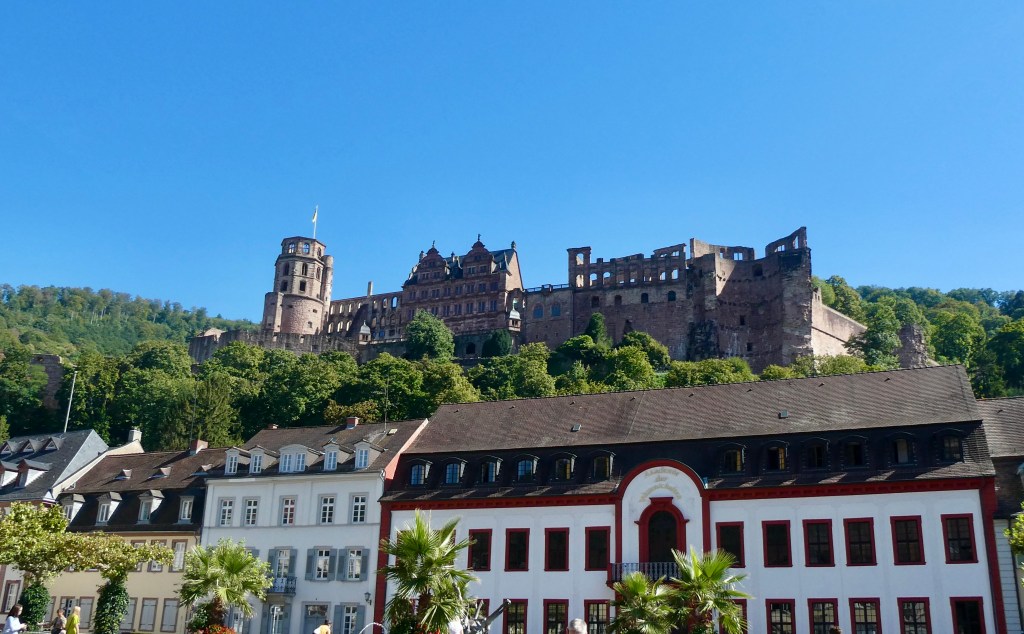
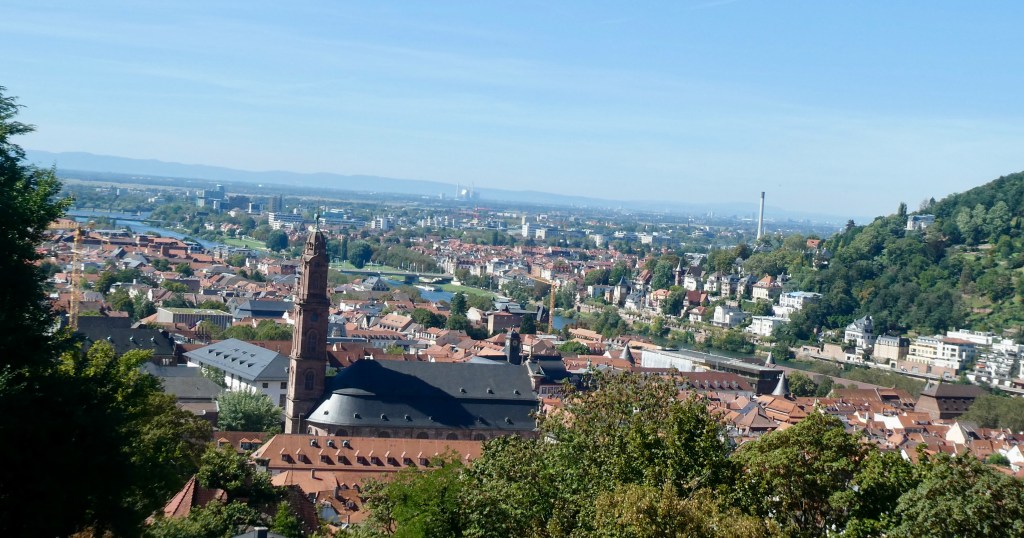
The ruins of Heidelberg Castle overlook the city.

The castle looked something like this in the year 1200.  

The castle was the home of the Palantine monarchy from the 13th to 18th centuries.  

Over the years, the castle expanded in a variety of architectural styles.

The castle was partially destroyed by fire caused by a lightning strike in the 17th century. 

It burned for a week.

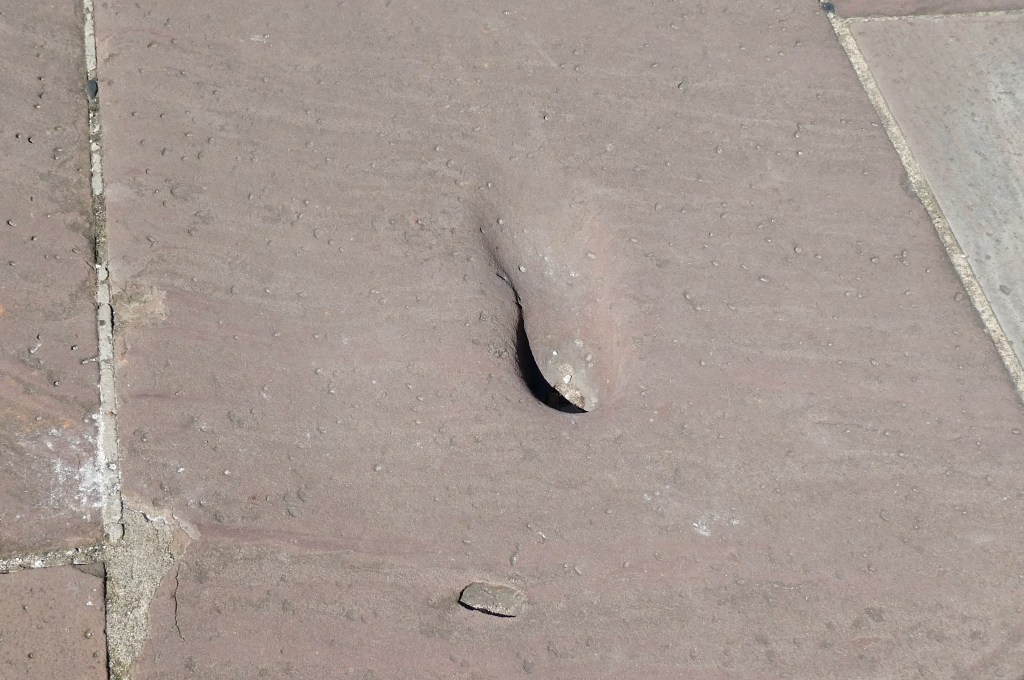
The folklore of this footprint is that a knight jumped from the bedroom of his lover after the fire began.

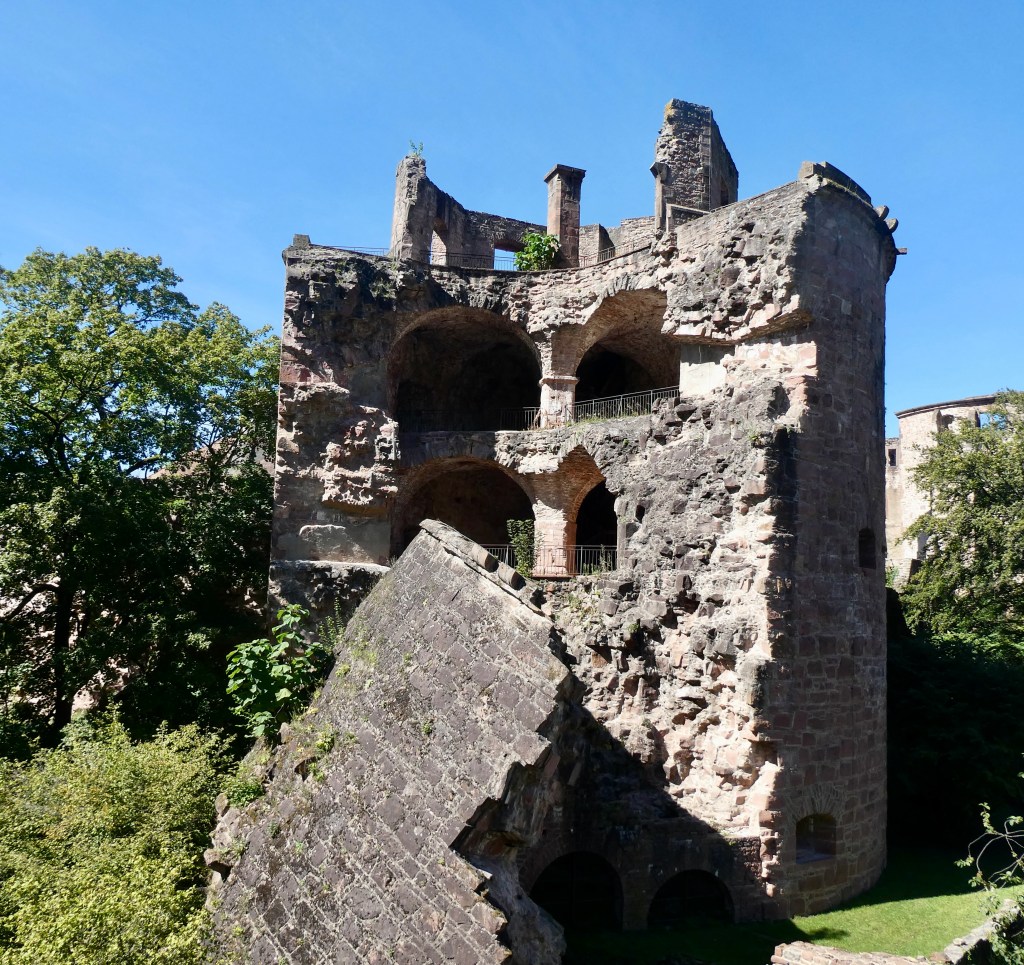
This tower was once used to store gun powder.  The French blew it up during the Seven Year War out of spite because they couldn’t possess it.

The Heidelberg Castle, maintained as ruins, is the second most visited castle in Germany.   (The Neuschwanstein Castle, more commonly known as the “Disney Castle,“ is the most visited.)

Heidelberg also has the world’s largest wine barrel.  It is made of 130 oak trees and held 50,000 gallons of wine.  The area tax collector collected tax in the form of wine from local wineries. He mixed it all together.  Unfortunately, we did not get to try any tax wine.

Although Jews in Heidelberg certainly suffered in World War II, the city had minimal allied bombing during the war.

(We were in Heidelberg on September 4, 2023)

Next up:  We leave the Main River, cruise into the Rhine, and go to the Gutenberg Museum.

Posted in Uncategorized | 2 Comments