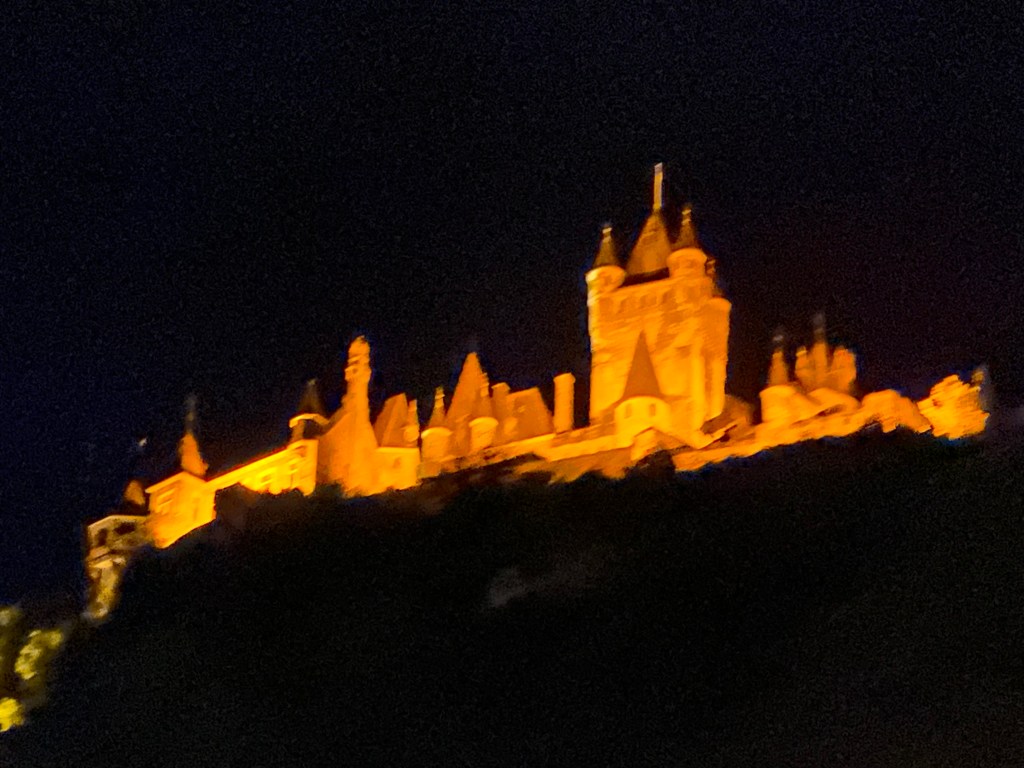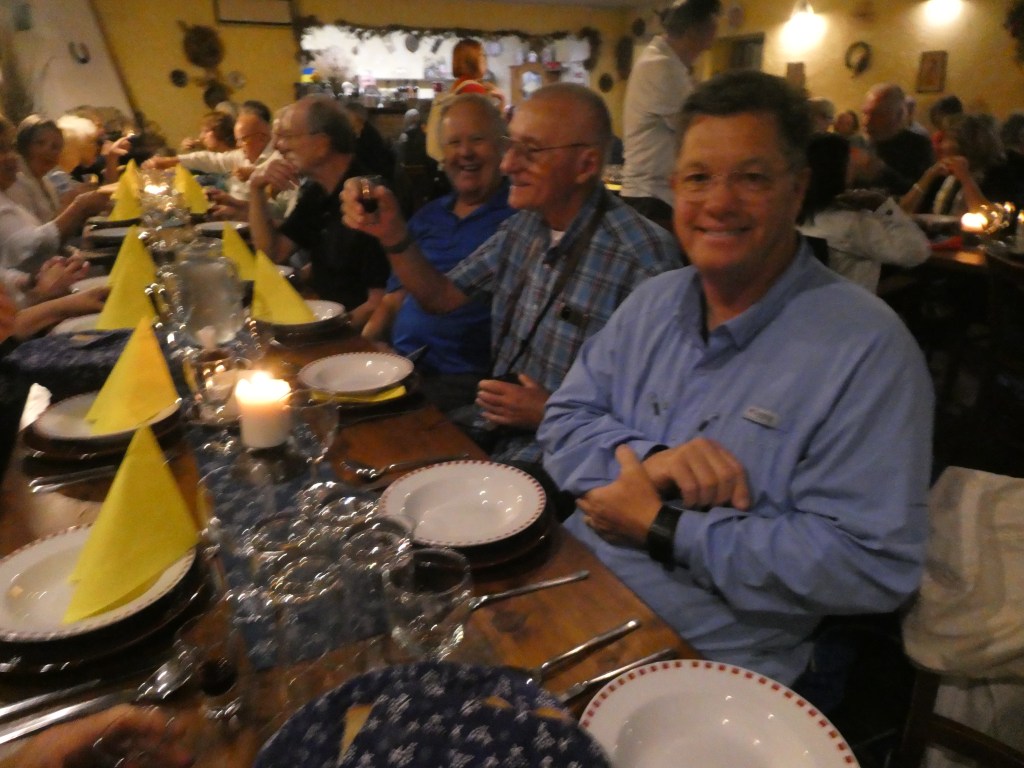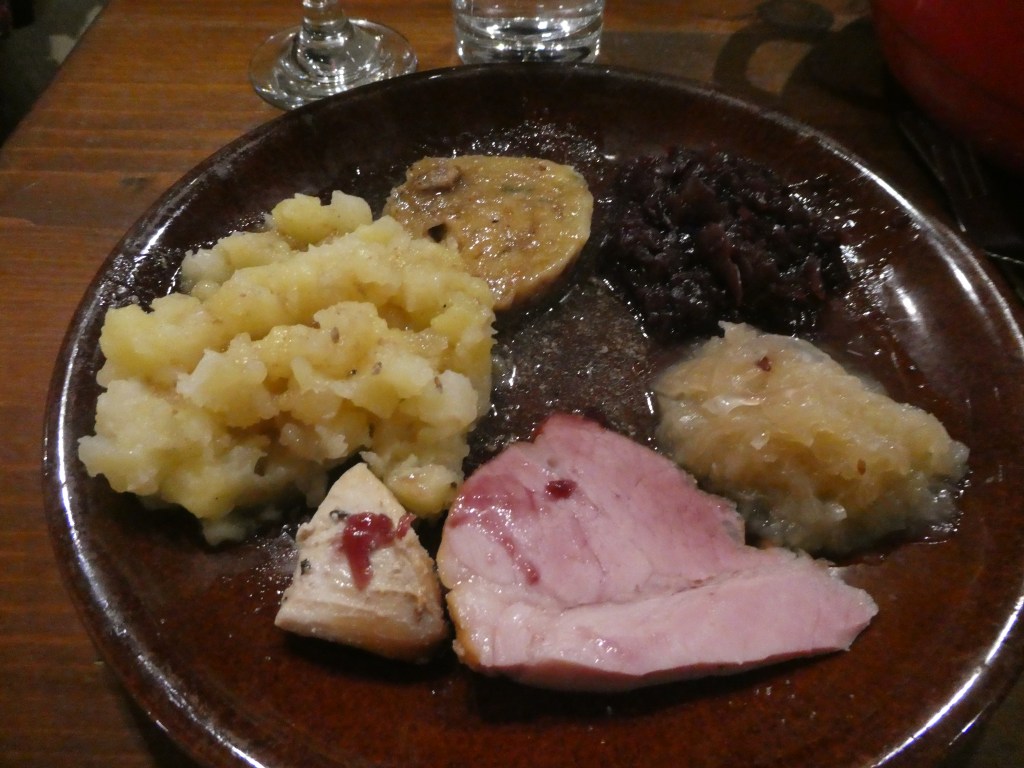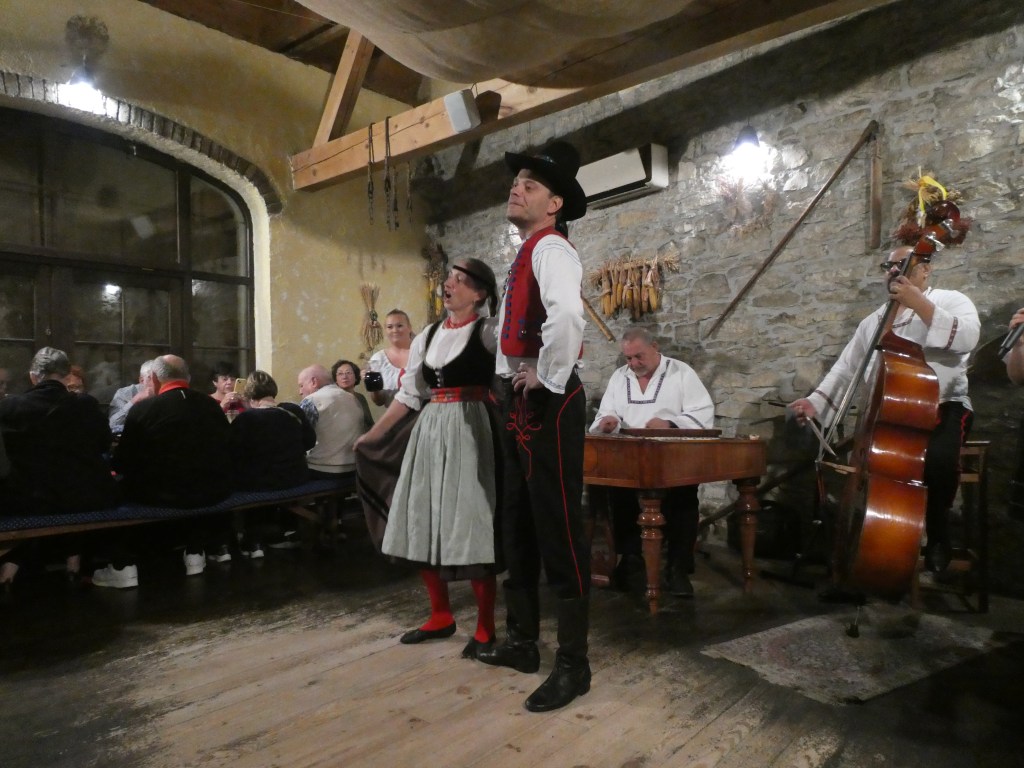
Viking River Cruise: Reichsberg Castle and Cochem

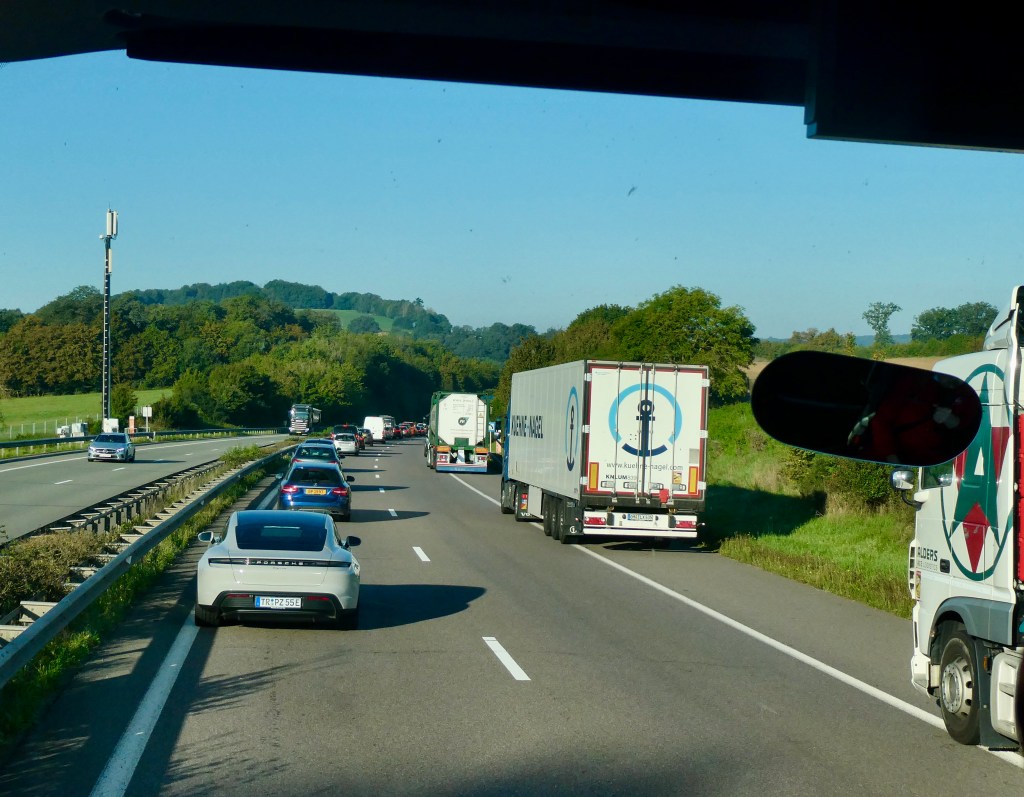
After sailing the Rhine, we boarded our bus and drove to Cochem. On the way we saw another castle on a hill – like our 35th of the day!

The vineyards in this area evolved from its Roman heritage from the years 50 BC to 400 AD.  Every soldier was given a liter of wine each day for his health. Over time the riesling grape became the dominate crop.

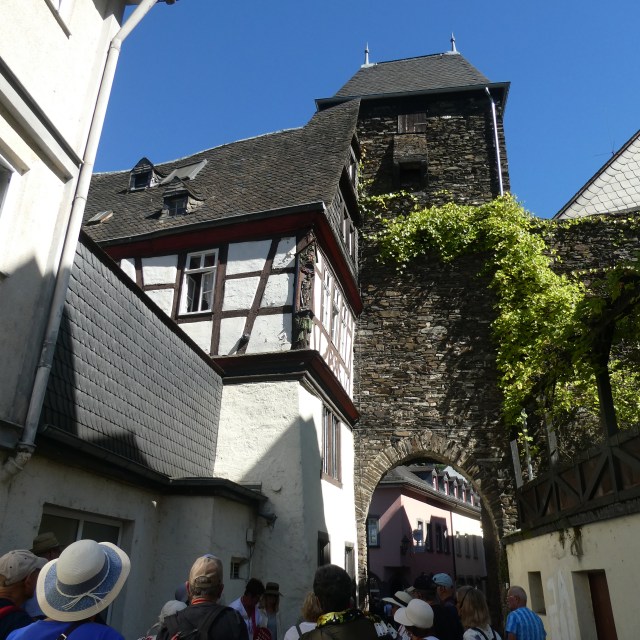
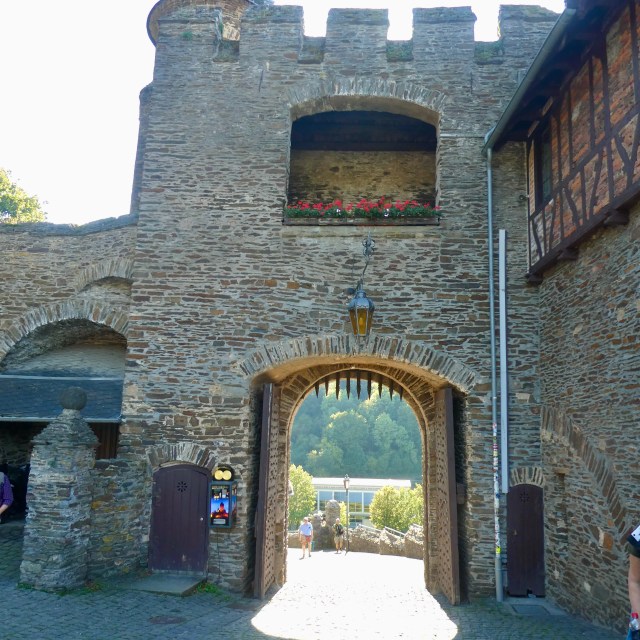
This city gate was built in 1532 .  It is one of three remaining gates in Cochem.  There were once four gates.

On the outside is an opening to deter an enemy by dropping bad stuff – like boiling oil or sewage.

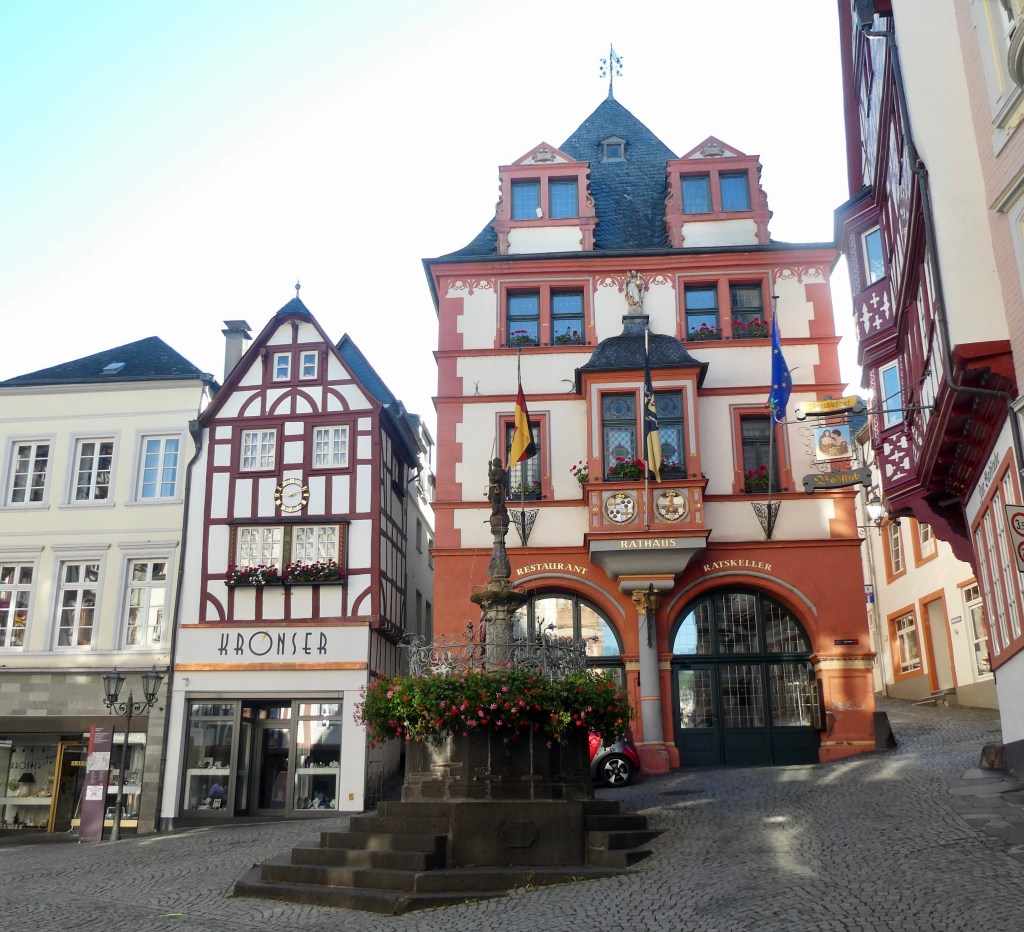
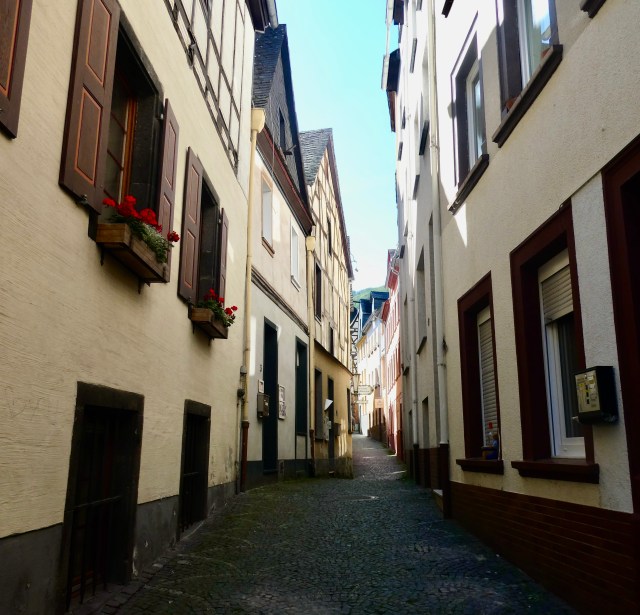
There are narrow streets in historic Cochem.

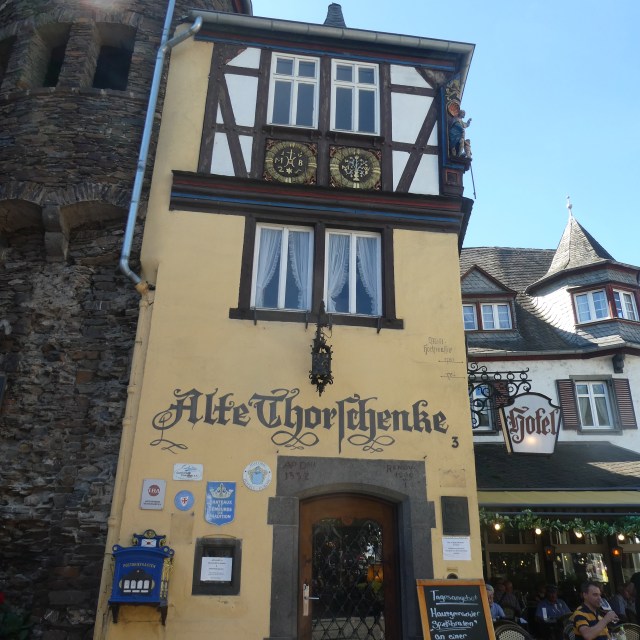
This is the oldest house in Cochem.  It was built in 1332.  Two flood markers, dated 1781 and 1784,  are on the right side just below the lower window.

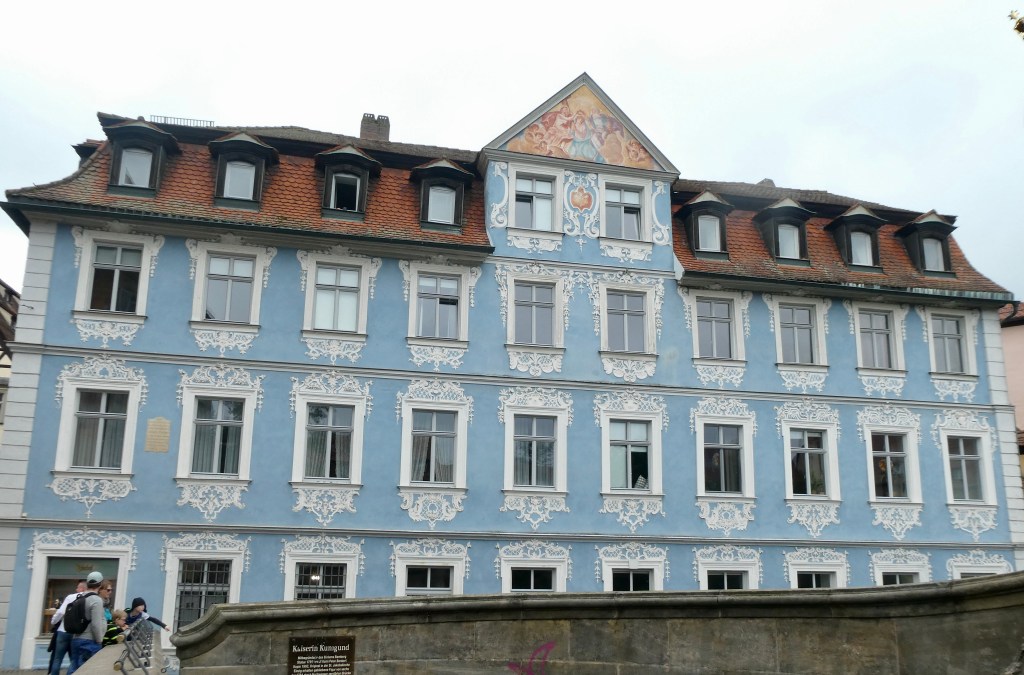
This house is from 1704. 

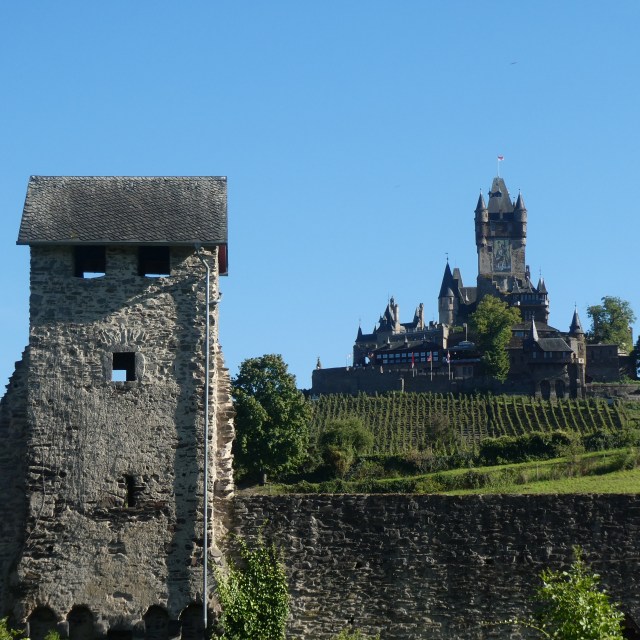
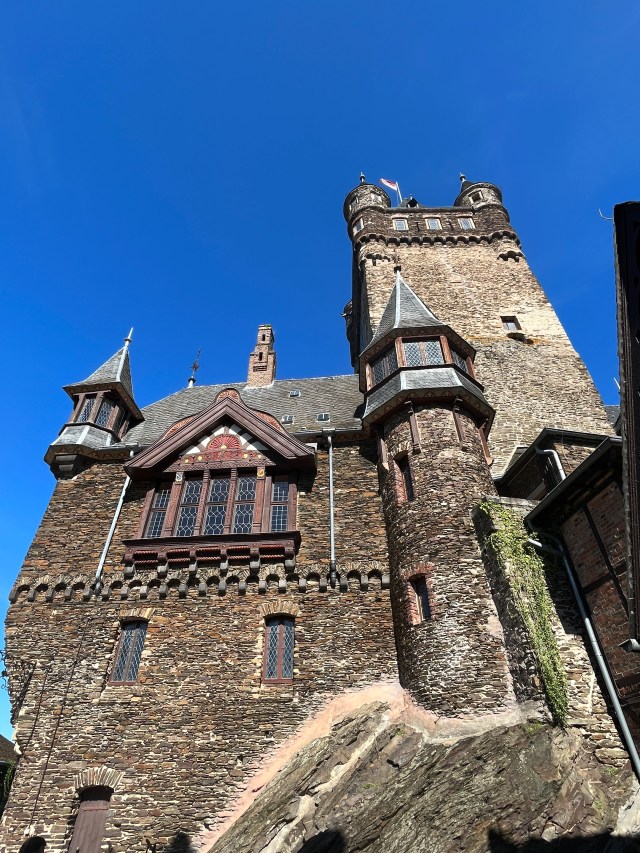
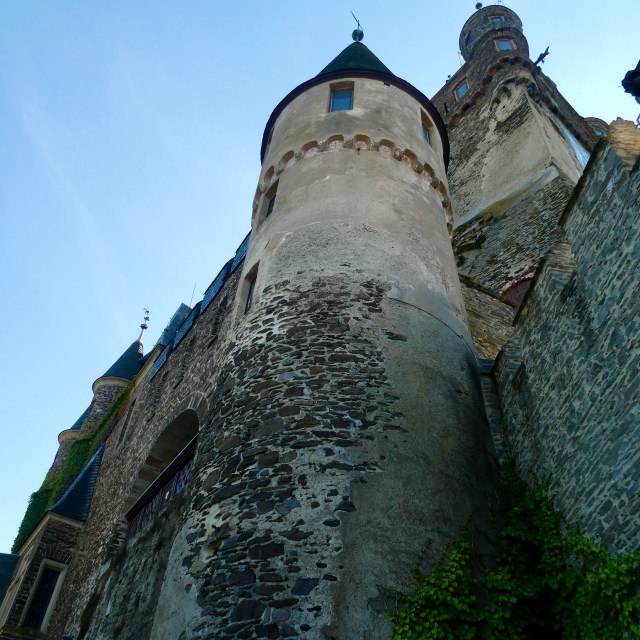
Going under the watchtower and out another gate, we had a view of Reichsburg Castle. 

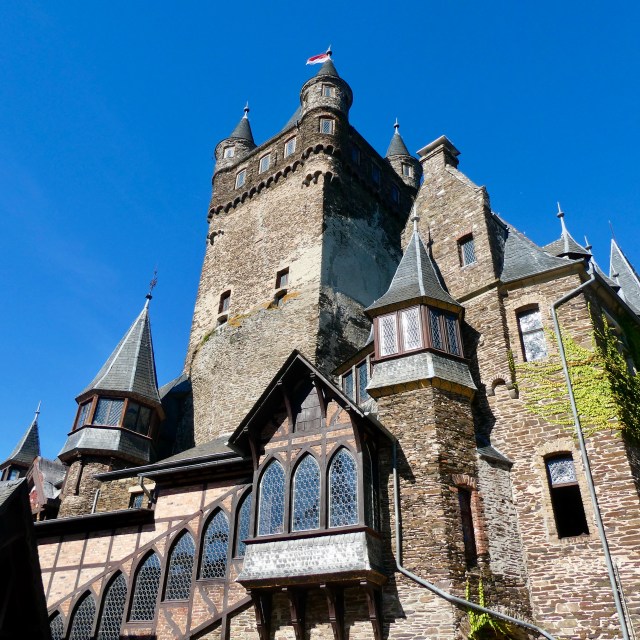
The main tower of the castle is 120 meters high. 

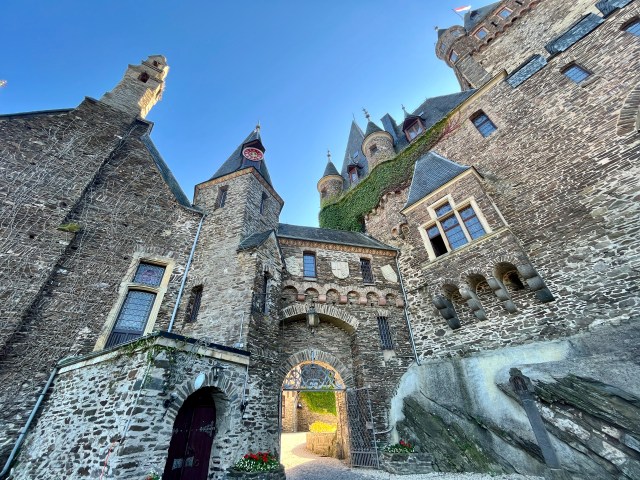
Reichsberg Castle was built in 1020 as the seat of Palatine nobles. 

In 1151, it became a home for German kings. 

In 1294 Archbishop of Trier made it a seat for his administration.  The Lord Electors of Trier used it until 1689.

In 1689 it was destroyed by French troops and eventually turned into a ruin.

The main tower has a mosaic of St. Christopher.

This tower, the Witches Tower dates back to 1020 and was never destroyed.

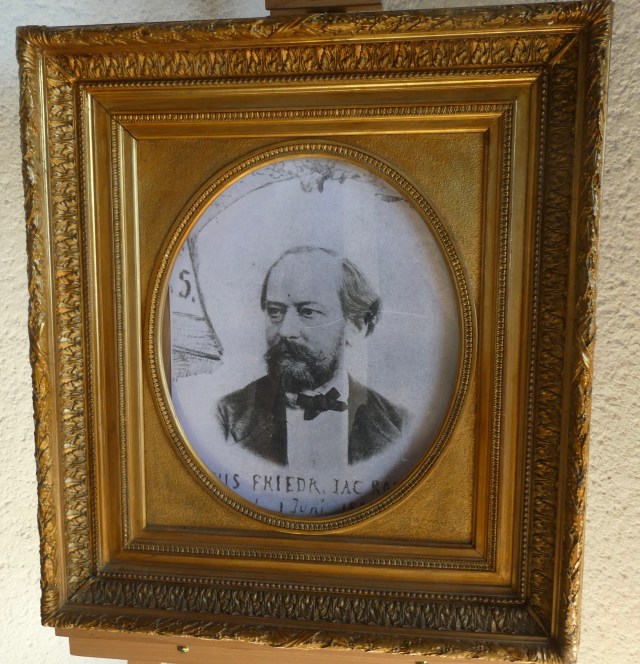
In 1860 Louis Ravene, from Berlin, bought the castle ruin. Over ten years he rebuilt it as a summer house. He died two years after it was completed.

In 1943 the family sold the castle to the Third Reich because of high taxation. Ancestors of this German family live in Canada and have been included in more recent castle celebrations.

After World War II, the castle reverted to the German  government. In 1978, the town of Cochem bought the castle for equivalent of $358,000.

When the family sold to the Third Reich, they took most of the furniture with them.  

The city has tried to get original furniture back and they have seven rooms refurnished.

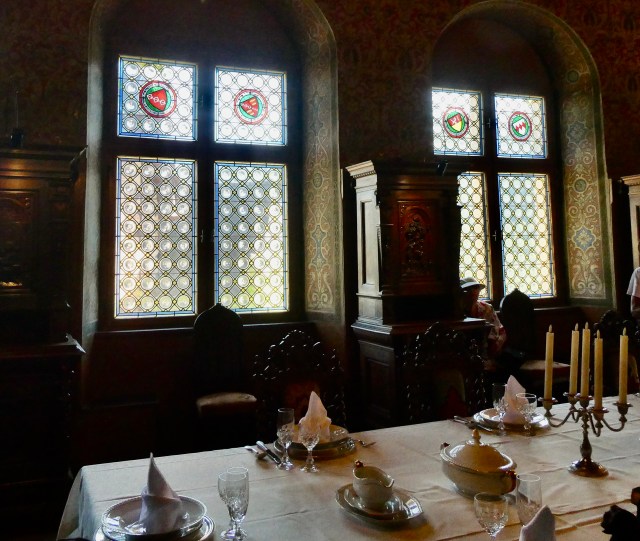
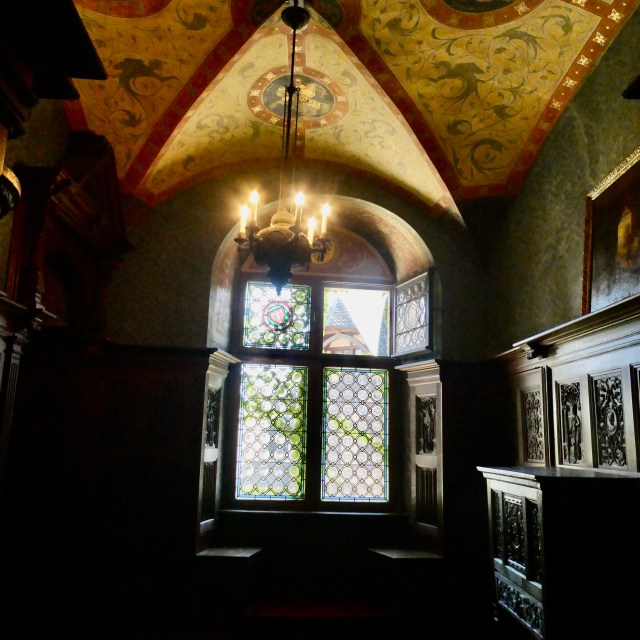
The dining room shows the Romanesque style, very balanced and symmetrical.

Other rooms were finished in gothic and baroque styles.

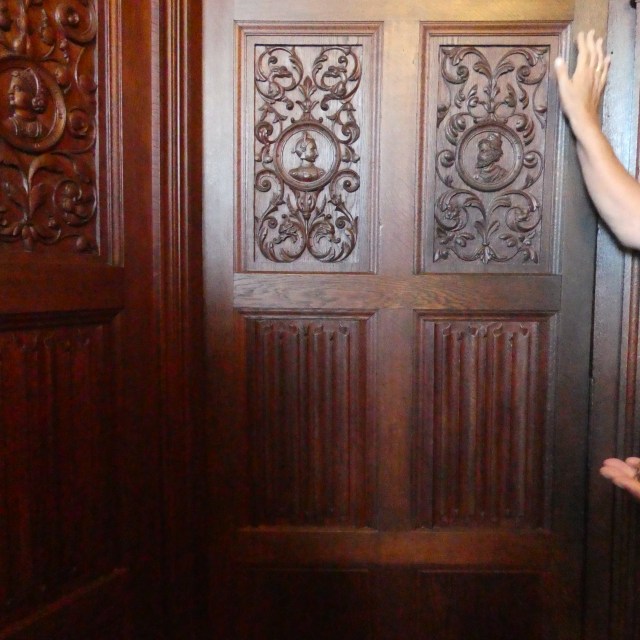
This room has two secret doors opened by small step switches on the floor. The first goes down to an escape tunnel.  The other goes to the upper bedrooms.
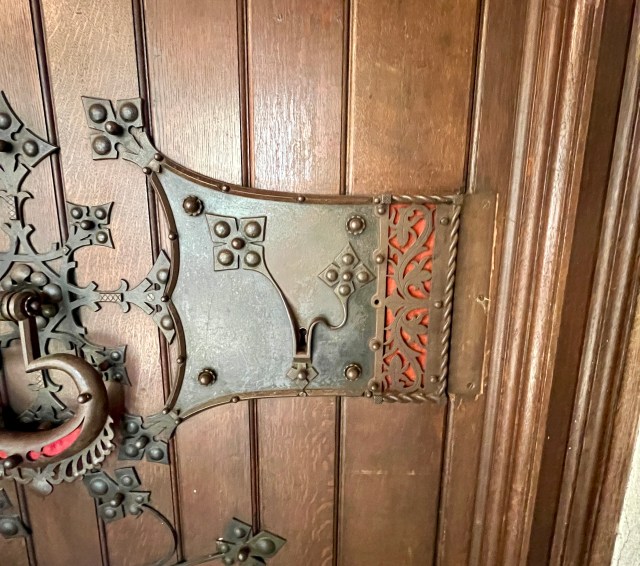
In a room dedicated to hunting we saw an interesting door.

If you have had a bit too much to drink………

Put the key in the vicinity of the lock on the door and the guide will help you insert it in the lock.

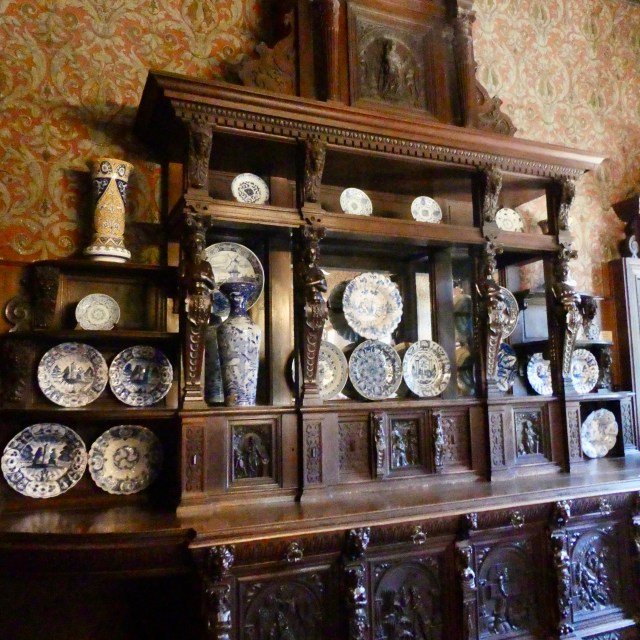
The most valuable piece of furniture in the castle is this multi wood chest and wardrobe from the 16th century.

In the knight room we learned that the military salute originates from when knights used to raise their faceplate to greet their foe.

The well on the castle grounds is 150 feet deep and was dug when the castle was first built.

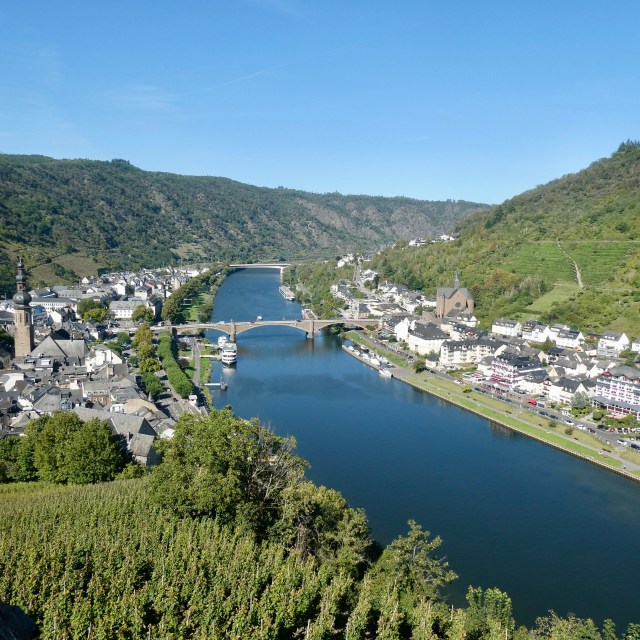
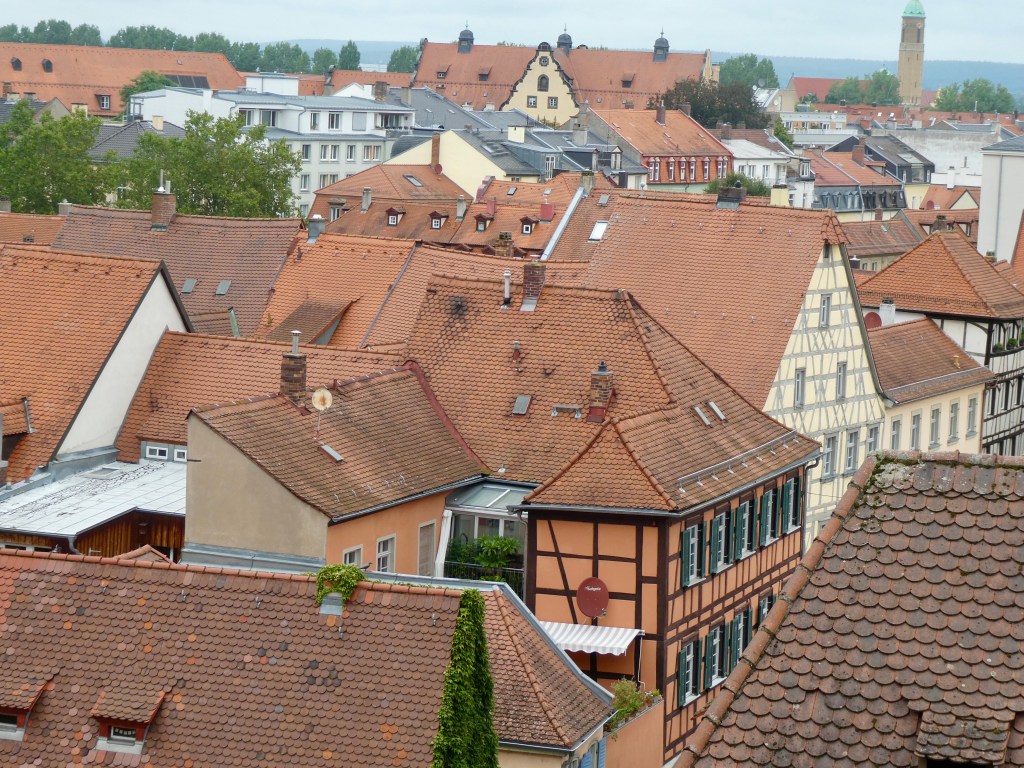
This is the view of Cochem from the castle. The city was damaged in WWII when the allies were trying to destroy a tunnel.   

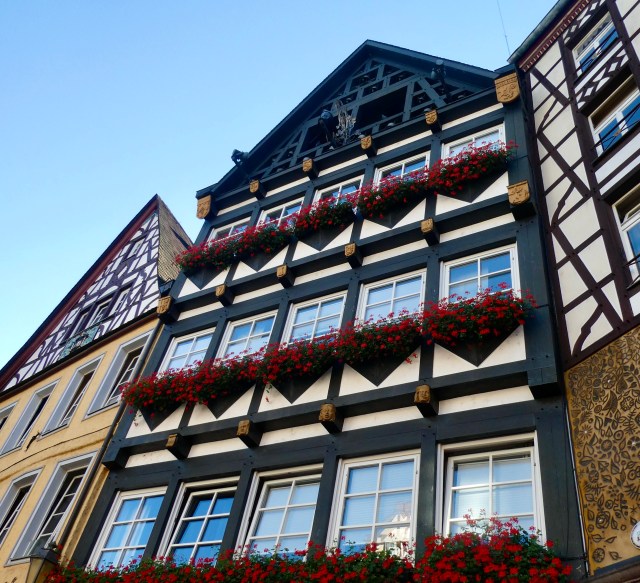
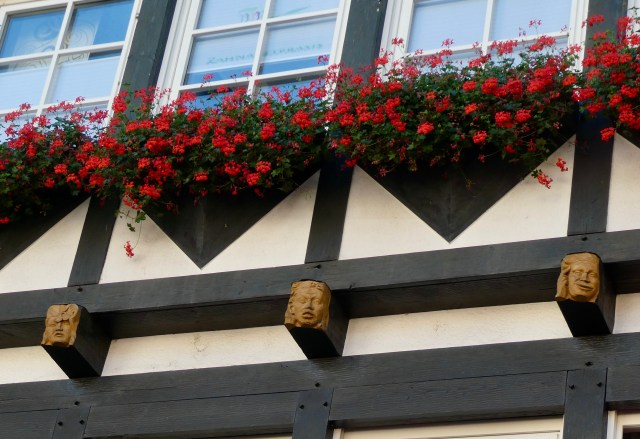
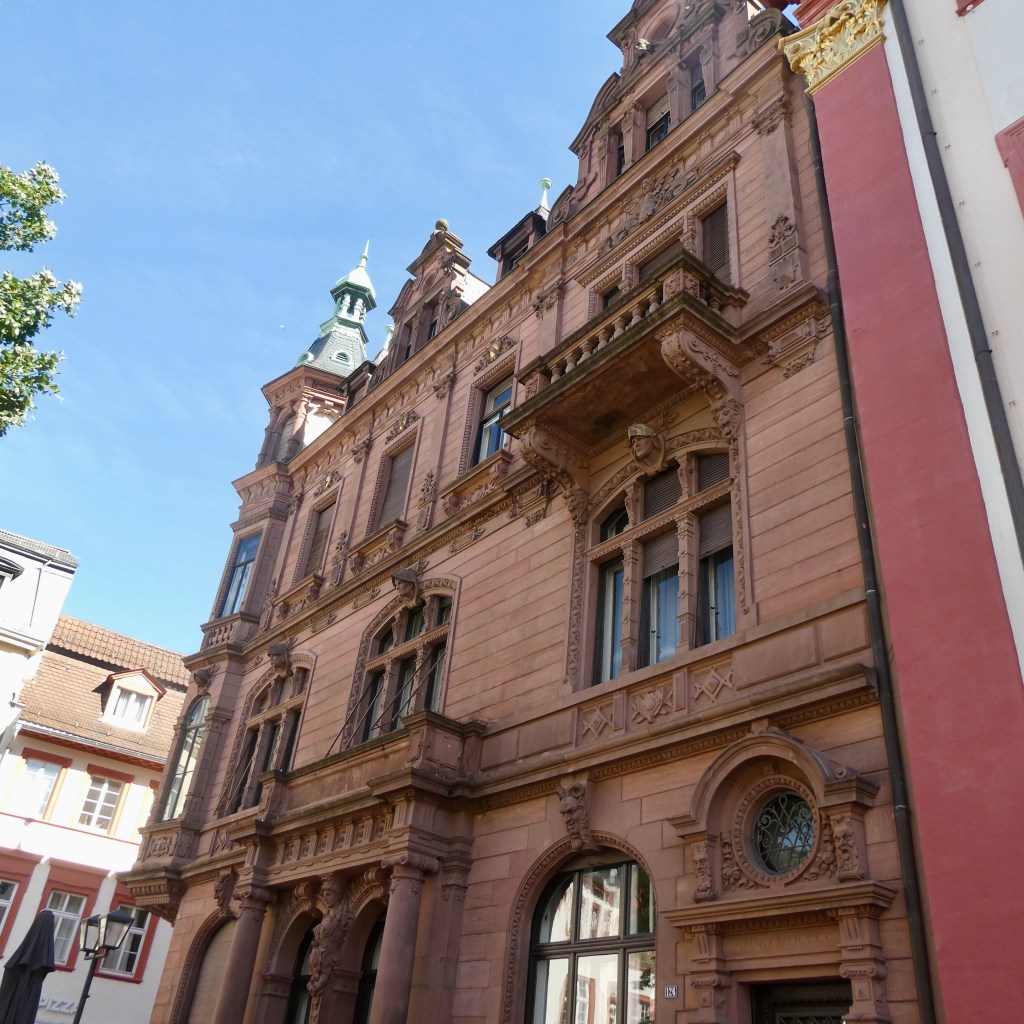
In 1974 people were getting wood from the city to rebuild.  A rich owner applied for wood and his request was denied. The city leaders told him that he could afford to do it himself.

The man did pay for rebuilding himself but added faces on his facade to always show disapproving looks towards city hall.

He also added bells that ring four times per day so the rest of the city would have to listen to them.

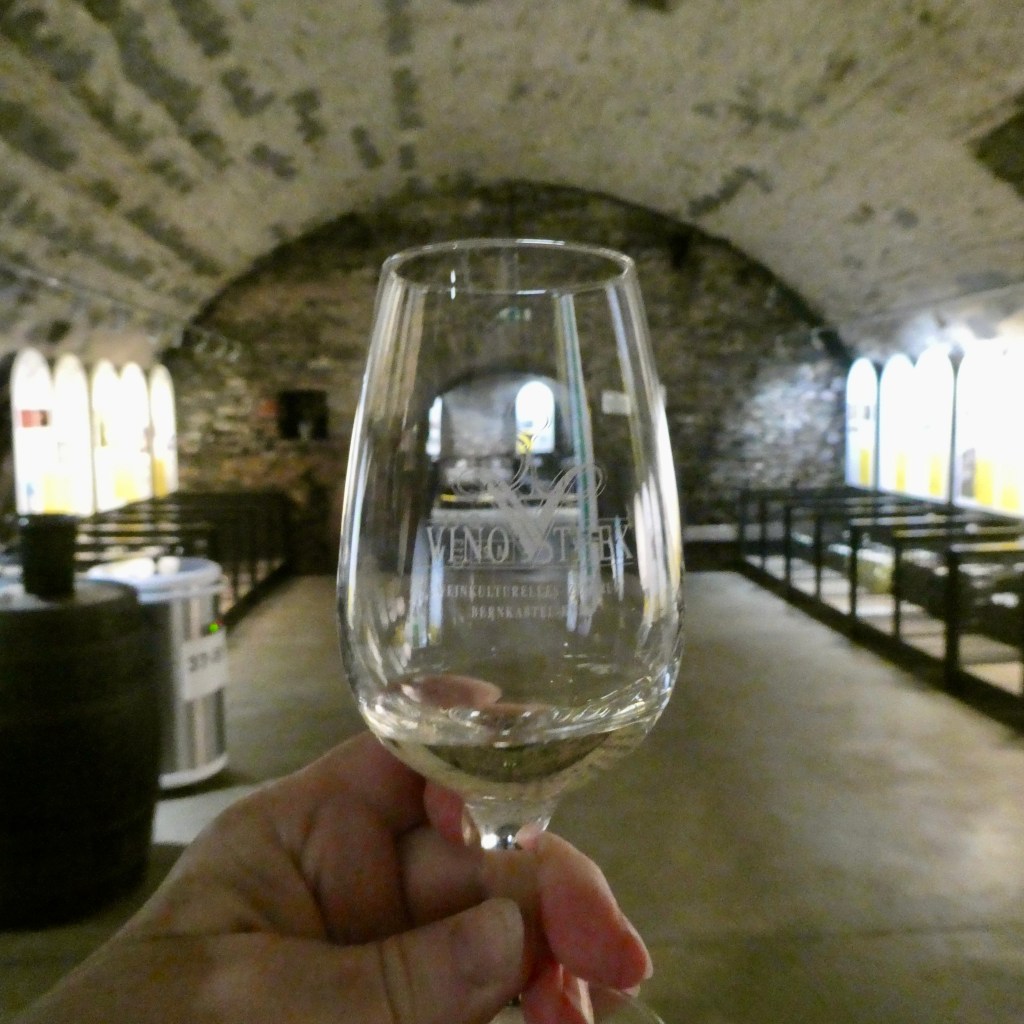
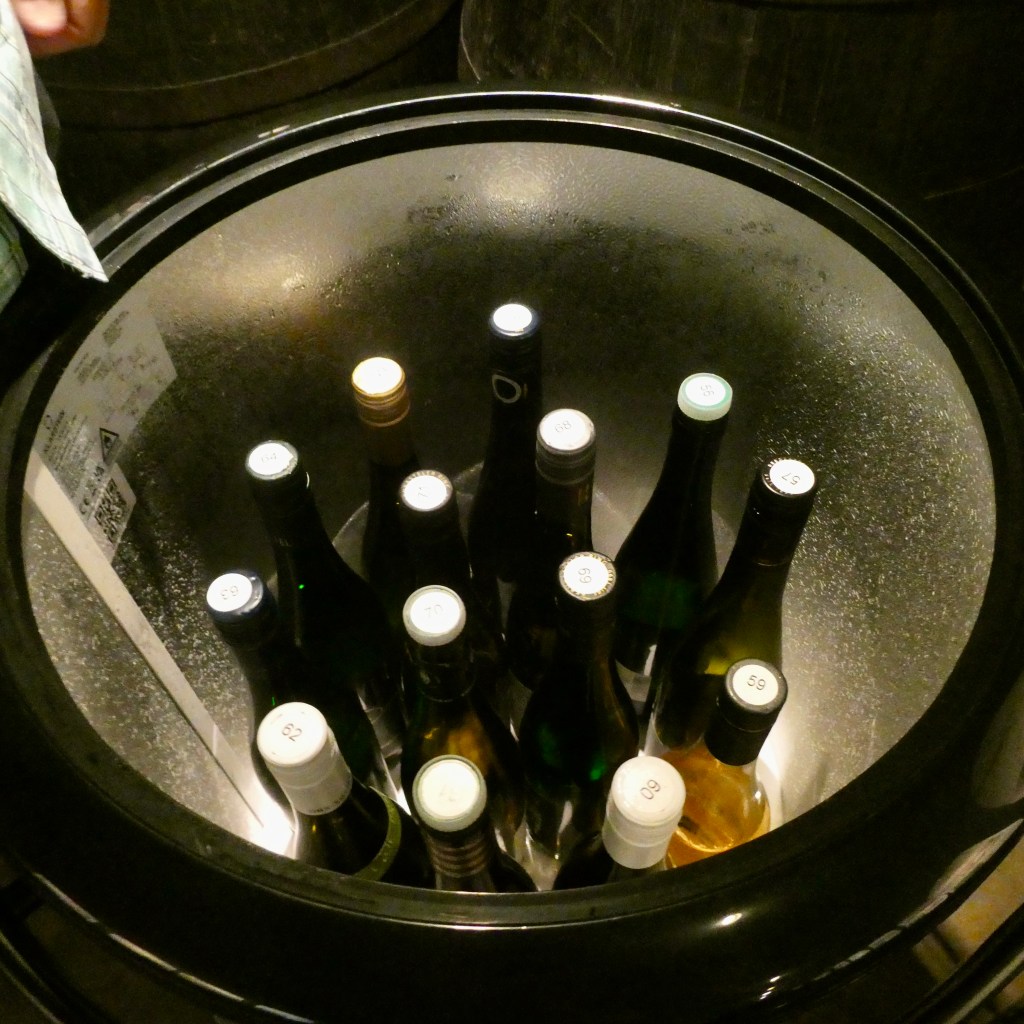
One of Cochem’s specialties is a peach liquor made from small gray peaches that are not sweet.  Tastings are available in the town shops. We tried several and bought two small bottles! This was our favorite.
We were in Cochem on September 6, 2023

Next up: Bernkastle and one of our favorite excursions of the whole trip.

Posted in Uncategorized | 1 Comment

Viking Cruise: Rhine River Castles

When you see an advertisement for Viking River Cruises with castles along a river, you are probably seeing the castles along the Rhine River in Germany.  This was the day I was most excited for when we booked this cruise!  

As a short person, I am very purposeful about where I sit for events and my strategies were employed for this day.  I wanted an unobstructed view of both banks.  That meant I needed to be at the front or the back of the boat and I wanted a table to sit at because I expected to be there most of the day.  
I was up very early and was the first passenger above deck.  I chose my place and sat down to wait.  A bit later our friend Jeannie joined me on deck.

Jeannie and her husband went to the same church as we did near Phoenix.  We had not booked the same cruise on purpose but it was a very nice happening.   

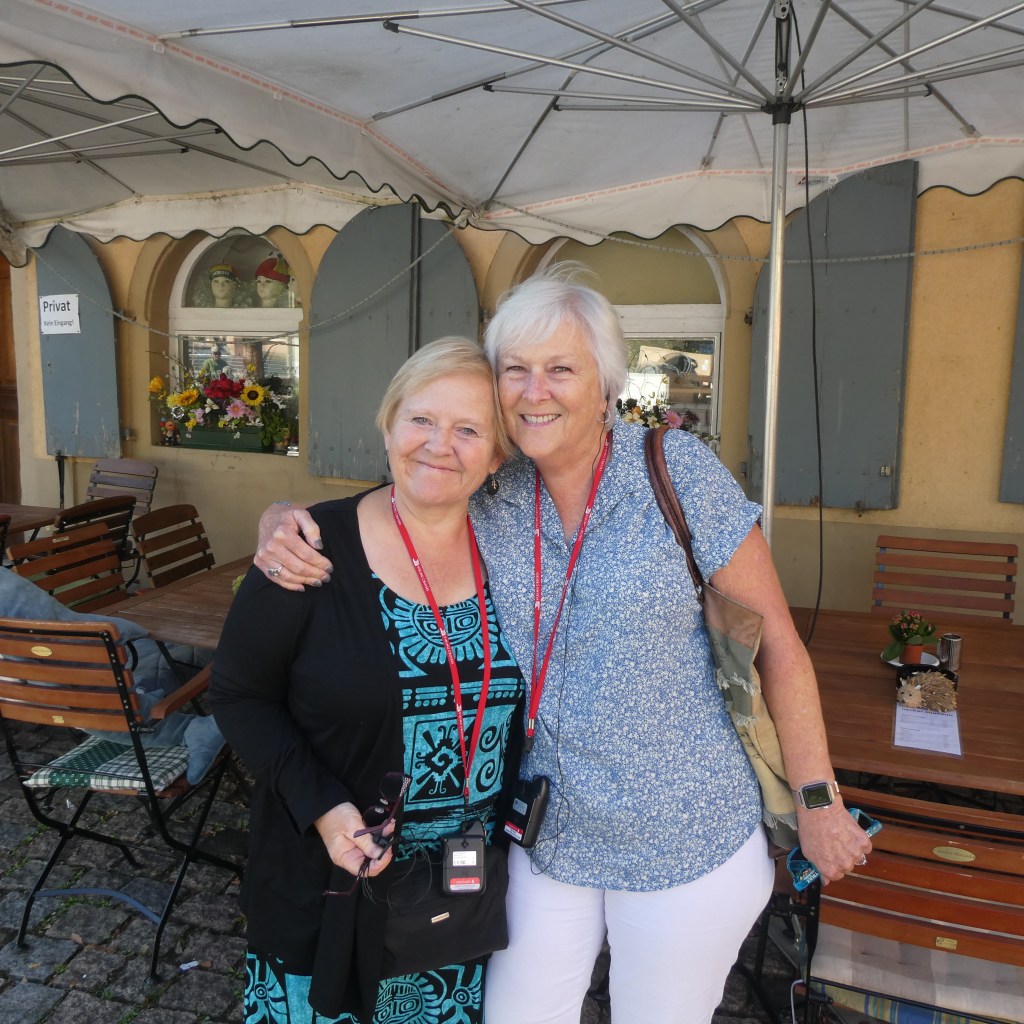
This is a picture of Jeannie and me on the cruise but it was not taken that morning.  That morning was very chilly, especially on deck with the boat moving.  

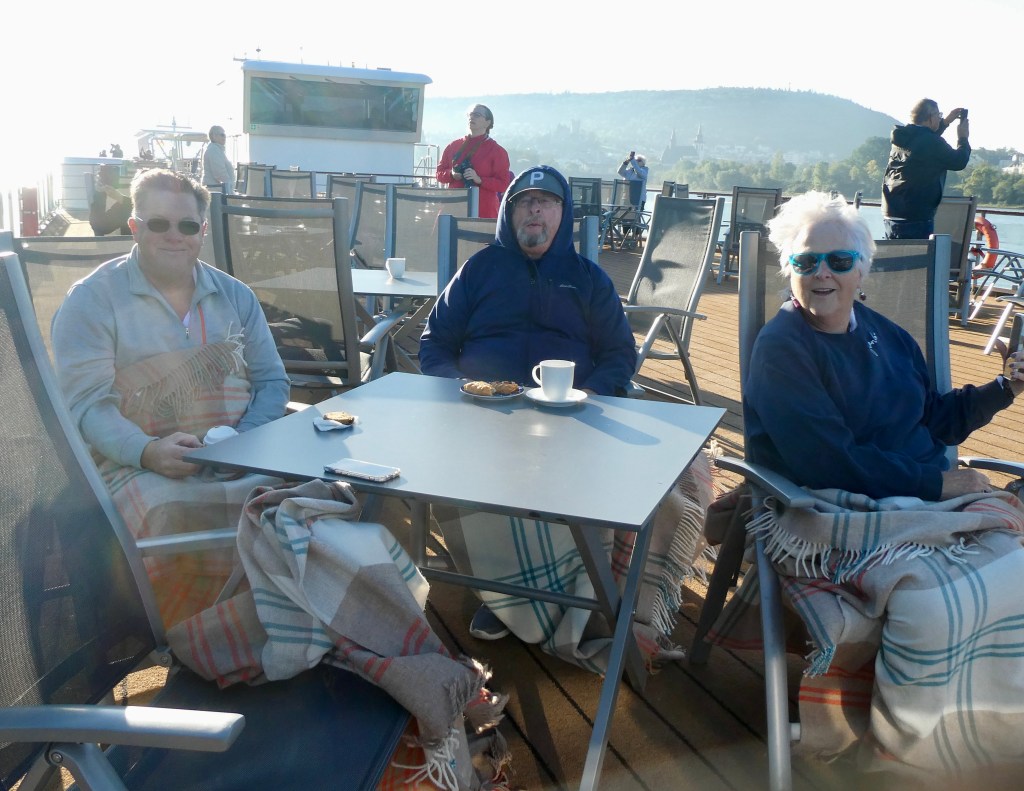
Overtime more people (including our husbands) came above and the crew made blankets available.

They also brought hot chocolate, and later Baileys.  

At some point they also gave us a brochure of the castles we would see and provided narration by the cruise director.  Do you sense perfection?  Viking is very good at this.

The 35 mile stretch we were sailing has more castle density than anywhere else in the world and has been a UNESCO World Heritage site since 2002.

Napoleon left most of the castles in ruin while he was here in 1689. The first American tourist to “leave a trace” here was Mark Twain with his book A Tramp Abroad.

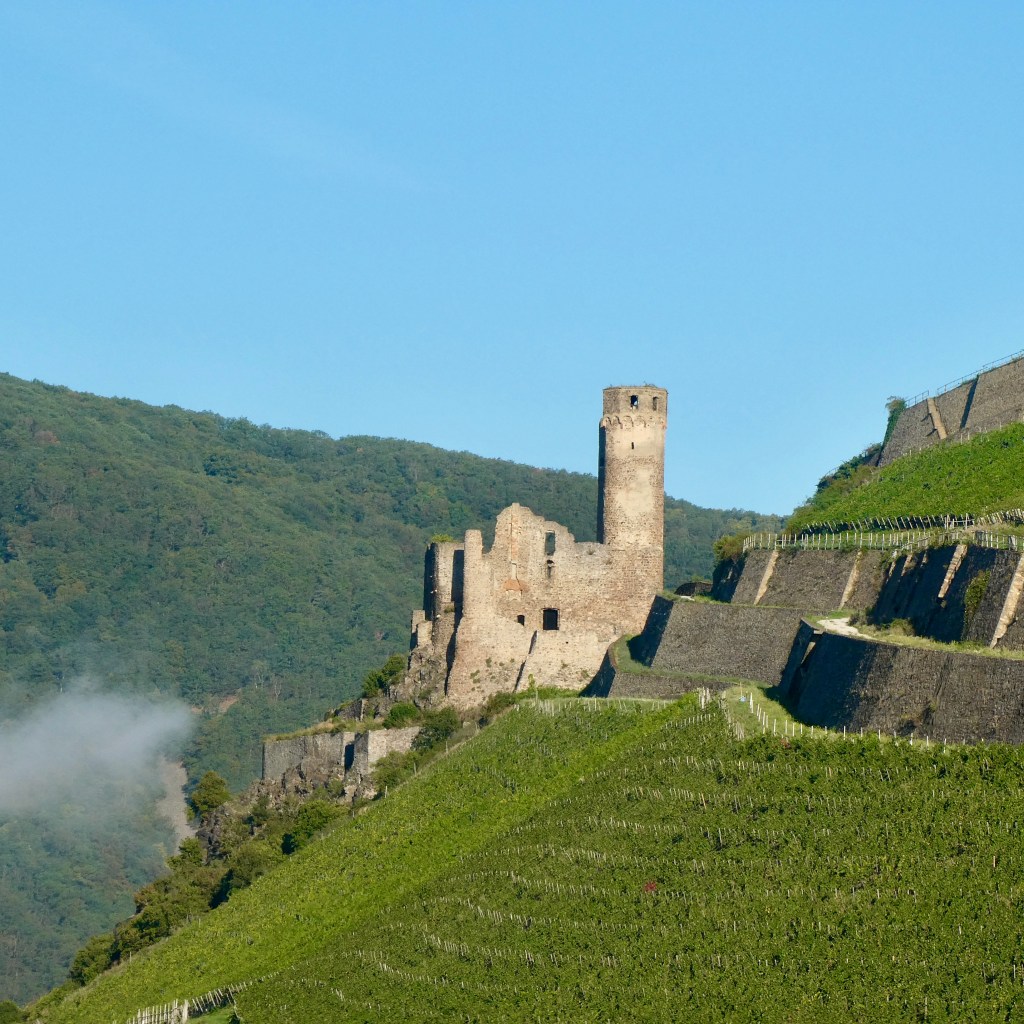
Ehrenfels Castle was built in the 13th century and is surrounded by ancient vineyards.   There are miles and miles of vineyards along the Rhine.  Some areas look quite steep.  

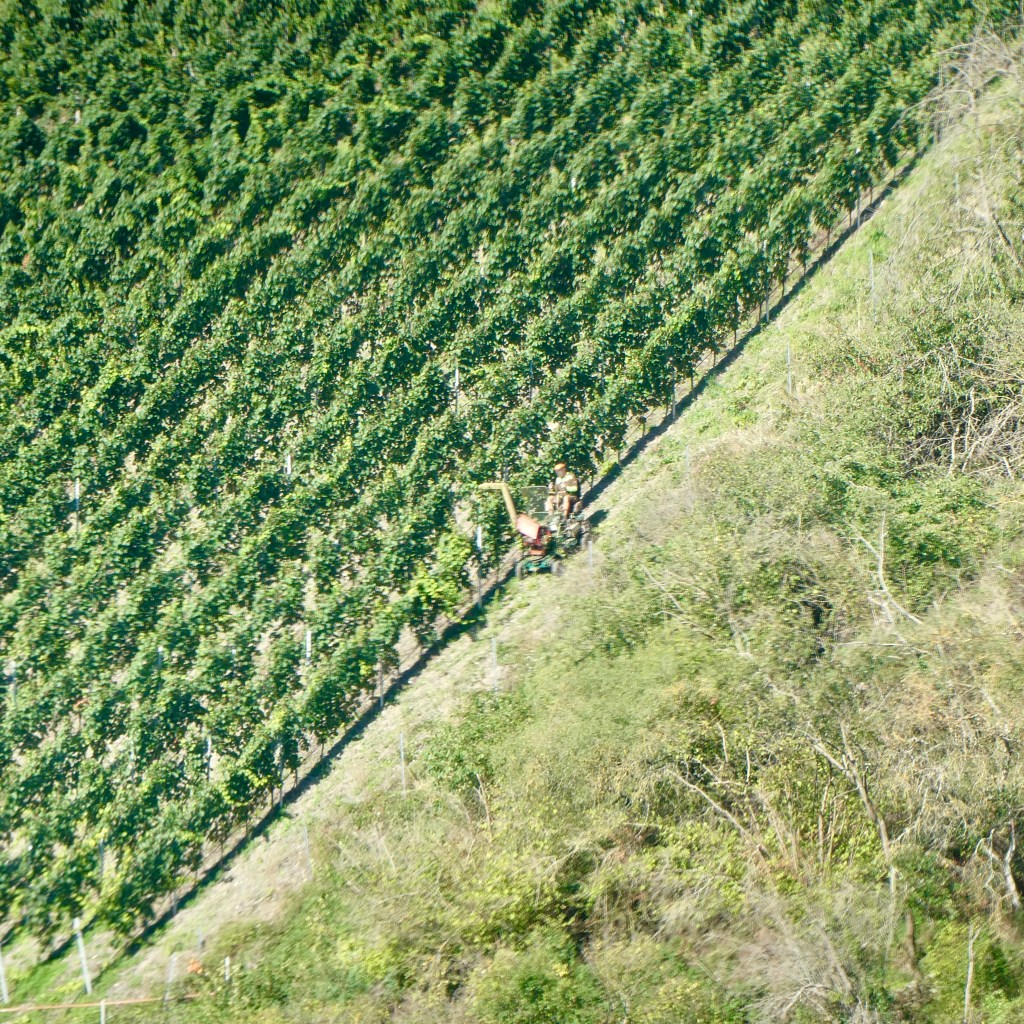
This guy has an interesting job! 

We learned that for 2000 years the Rhine River was a primary trade route. At times, 300 ships a day sailed through.  Land owners charged tolls to go by their castles.  There were so many tolls required that an emperor in the Hapsburg dynasty destroyed some toll sites to fix the abuse. 

Mouse Tower was a former toll tower.   It also served as a signal shipping station until 1974.  Its name is because legend serves that mice ate an archbishop imprisoned in the tower.

Rheinstein Castle was built by a Prussian and is now a museum where you can also stay the night.  Several castles now have hotel accommodations. That could be a new bucket list trip!

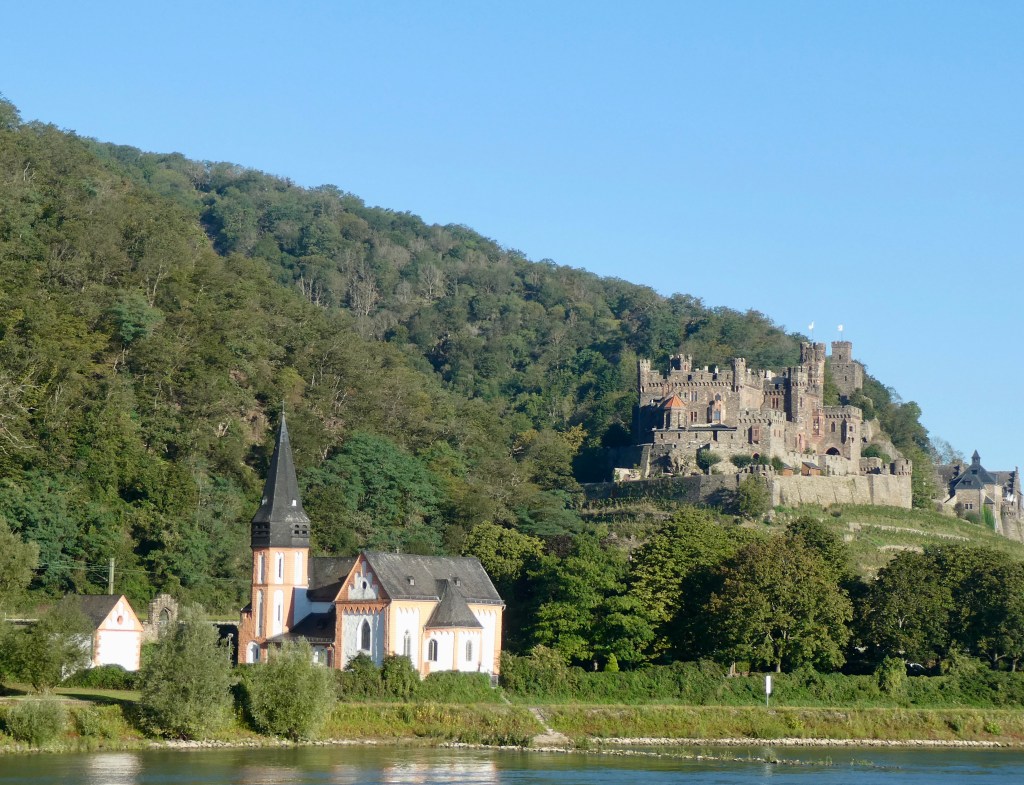
This chapel is from the 13th century and is the oldest on the Rhine.  The  Reichenstein Castle is in the background and both of these are just around the river’s bend from the earlier Rheinstein Castle.

The 12th  century Stahlach Castle is often used in Viking advertising.  It was attacked repeatedly in the 17th century and was in ruins until it was rebuilt in 1909 as a youth hostel.

The Sterrenberg castle is likely the oldest on the Rhine River and was built in the 12th century. It was built by a quarry and that quarry is now owned by a Dutch company as part of reparations after WWII.

This ship shape building was used for collecting tolls.  It is currently used to monitor water levels.

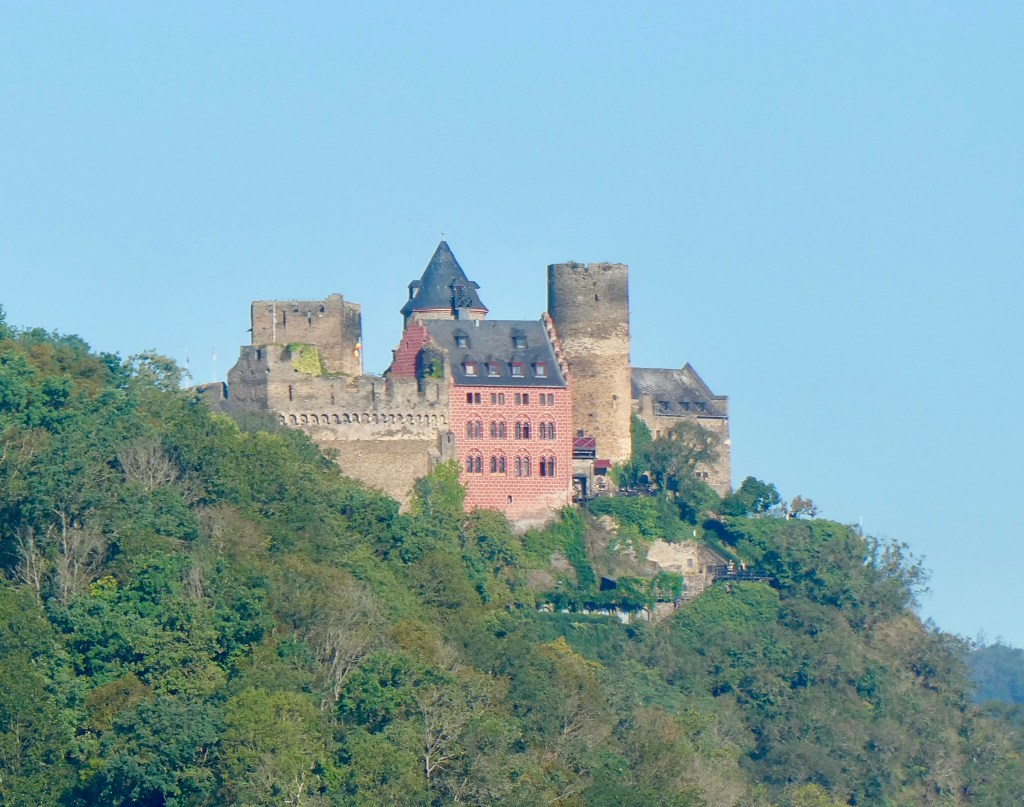
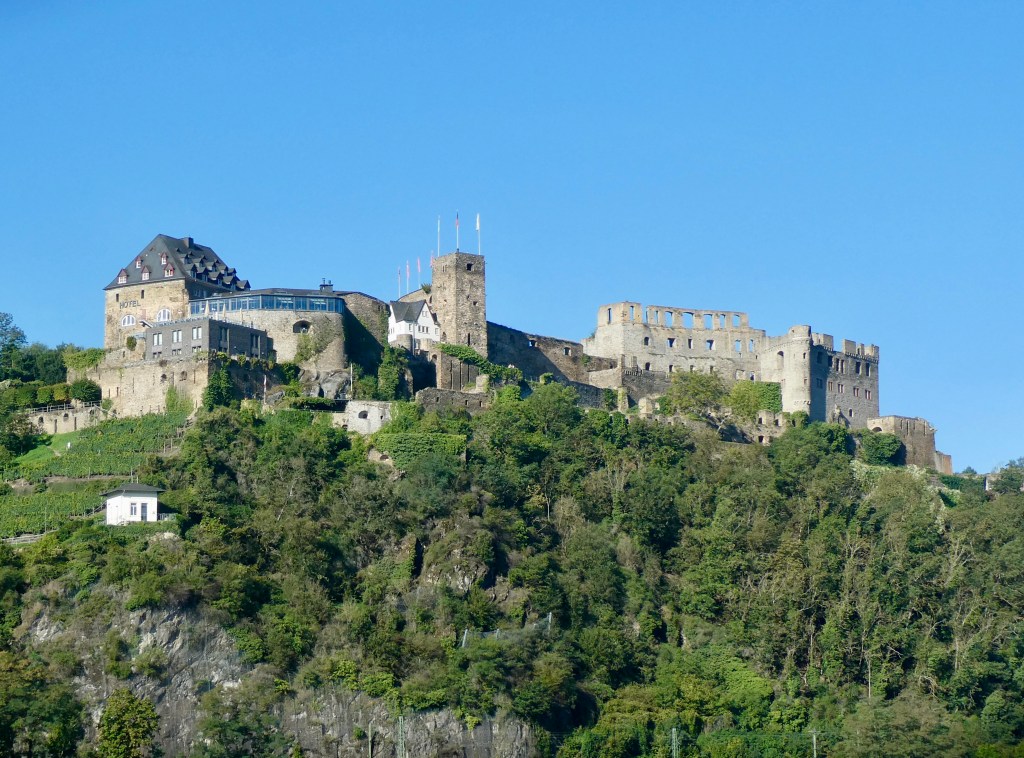
The original Schönberg Castle was built in 966 and burned by the French in 1689.  This reconstructed castle  combines three fortresses and towers into a renowned hotel and restaurant.

This isn’t really a castle at all. The allies had decided not to bomb the castles so Hitler often disguised tunnels as castles.

Rheinfels Castle sits high above the river and is one of largest castles on the Rhine.

This is the smallest town on the Rhine.  The pub is attached to the church and one must enter the church through the pub.

We used to own a boat and have some knowledge of the “rules of the road” on US waters. Along the Rhine we met other boats while sailing on the left, right, and sometimes through the middle.  The ship captains seemed to know what they were doing even if we did not!

Two brothers in dispute either built, or separated, the family castle into two.  There is a wall of dispute between them.

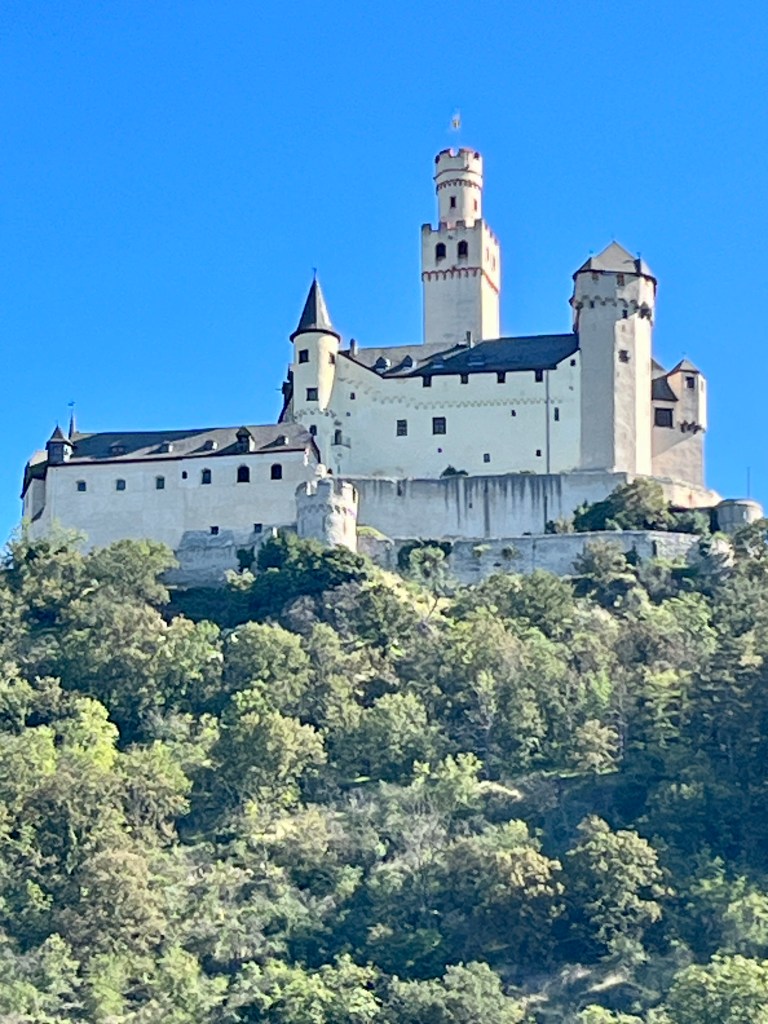
Marksburg castle sits above Braubach, Germany.  Of all the castles in the region, Marksburg is the only one to have never fallen into disrepair or been destroyed.

I think this is Lahnstein Castle. It wasn’t one of the ones highlighted by Viking.  I like that you see the old and the new together.

This seems a good spot for a castle identification disclaimer. I did not take good notes along the Rhine because I just wanted to enjoy the experience. Viking had given us the guide so I thought I would be able go back to it for research. The problem was that we took pictures from different angles than the guide showed, and sometimes we took more than one picture of the same castle as we approached and as we passed by. It was quite the puzzle to match the order and timestamps on our pictures to the kilometer markers along the river guide, bracketing the castles I wasn’t as sure about between the castles I was very sure about. I did my best.

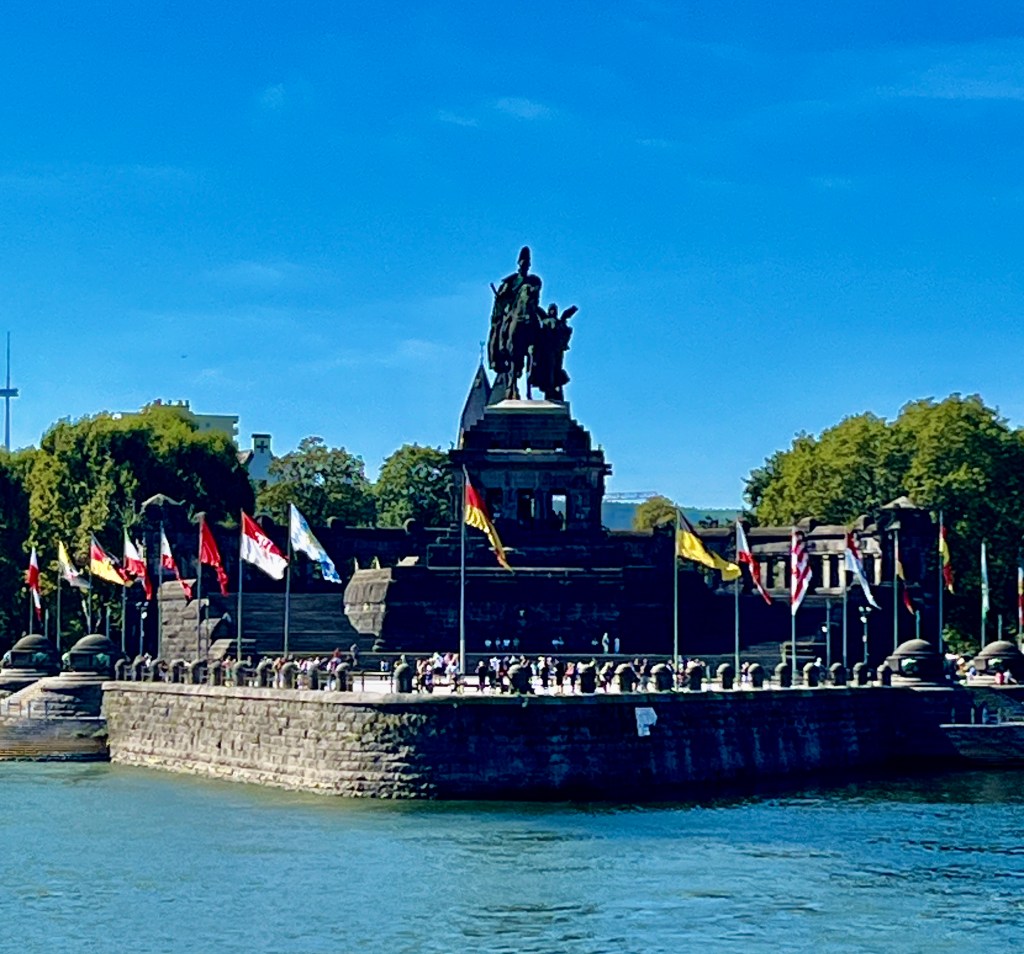
The Deutsches Eck is a promontory in Koblenz, Germany where the Rhine River meets the Mosel River.  The statue is a monument to  William I who unified Germany.  Destroyed in World War II, a replica was placed in 1993.  

We sailed the Rhine on September 6, 2023.

Next up:  Cochem and Reichsburg Castle

Posted in Uncategorized | Leave a comment

Viking Cruise: Mainz and The Gutenberg Museum

We had a morning sail down the Main River, and eventually moved into the Rhine.  

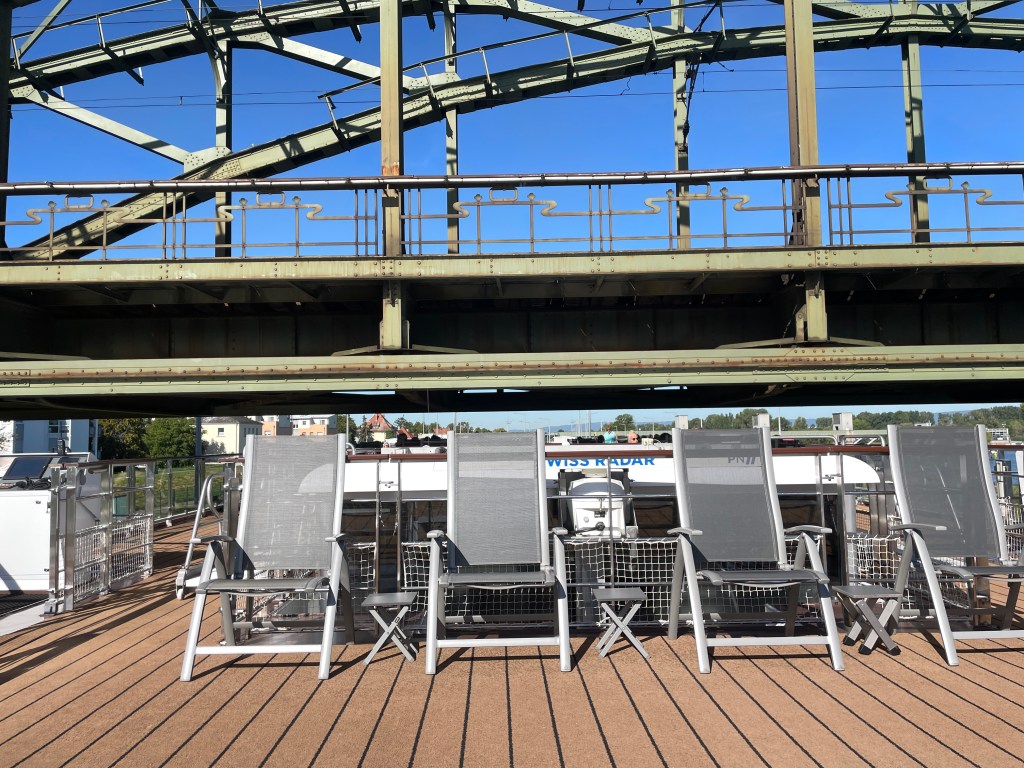
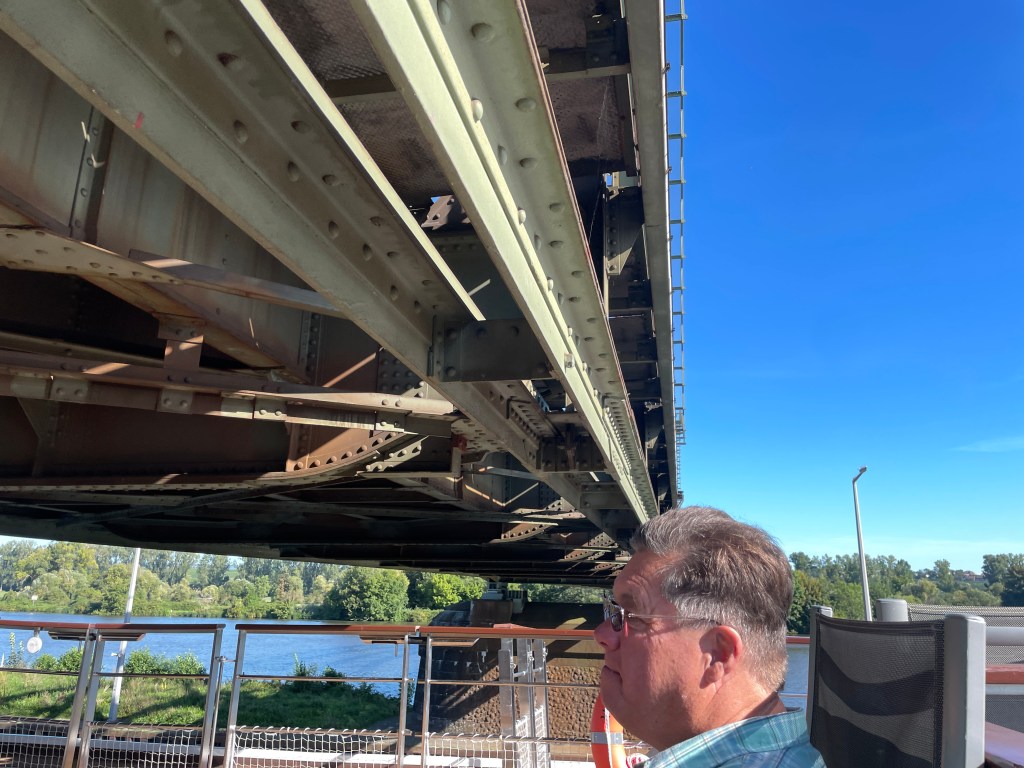
Sometimes we weren’t allowed to sit on top because of low bridge clearance but this day we were able to.

But just barely!

When we disembarked in Mainz we saw this monument to Germany. The side panel lists the cities of former East Germany. 

In this block there is a missing building.  It was destroyed during WWII and never replaced.  Eighty five percent of Germany was damaged during the war and much was rebuilt it 10 years under the Marshall plan

In Mainz there are blue and red street signs attached to buildings.  They are from the Napoleon era because his soldiers couldn’t read. Roads named in red go toward the river while roads named in blue parallel the river. 

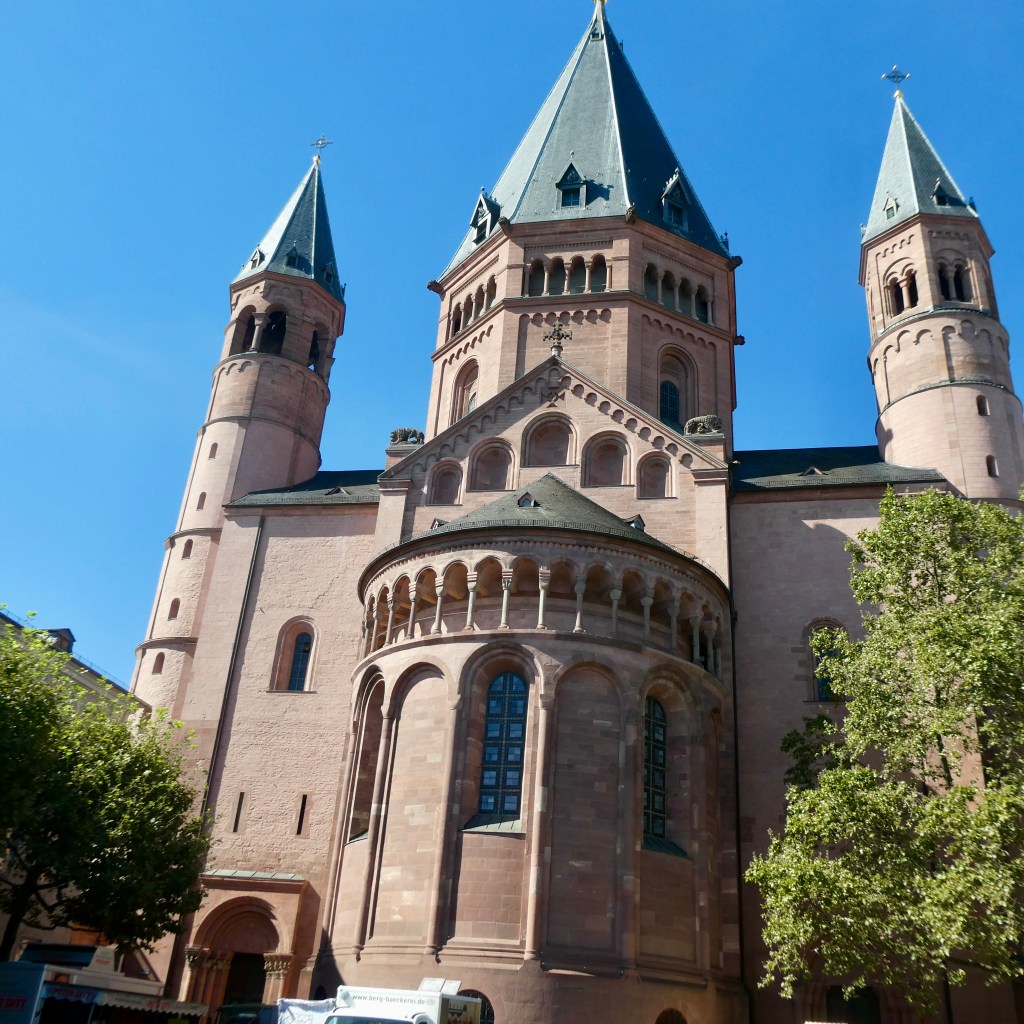
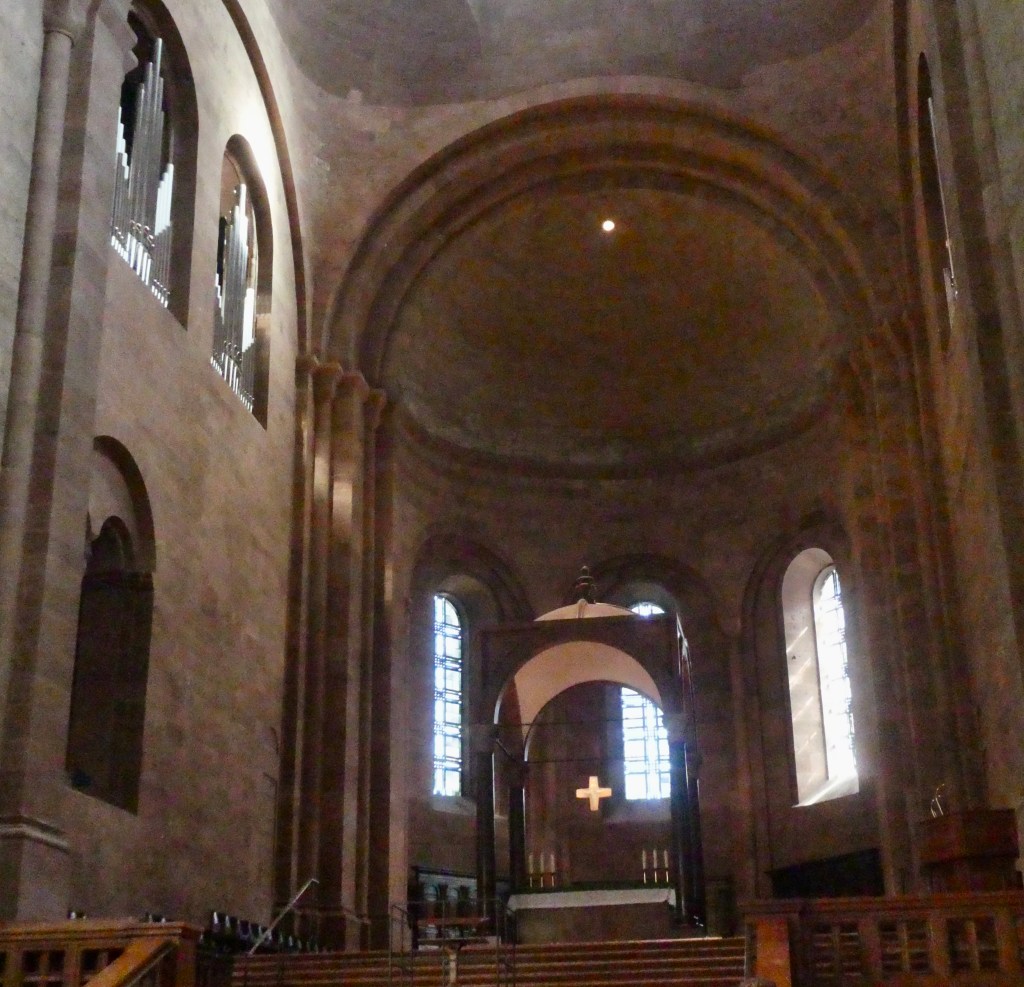
The Mainz Cathedral is over 1000 years old. 

Building the center section began in 975. The sides were added later.  

There are tombs of Mainz powerful prince bishops in the cathedral.

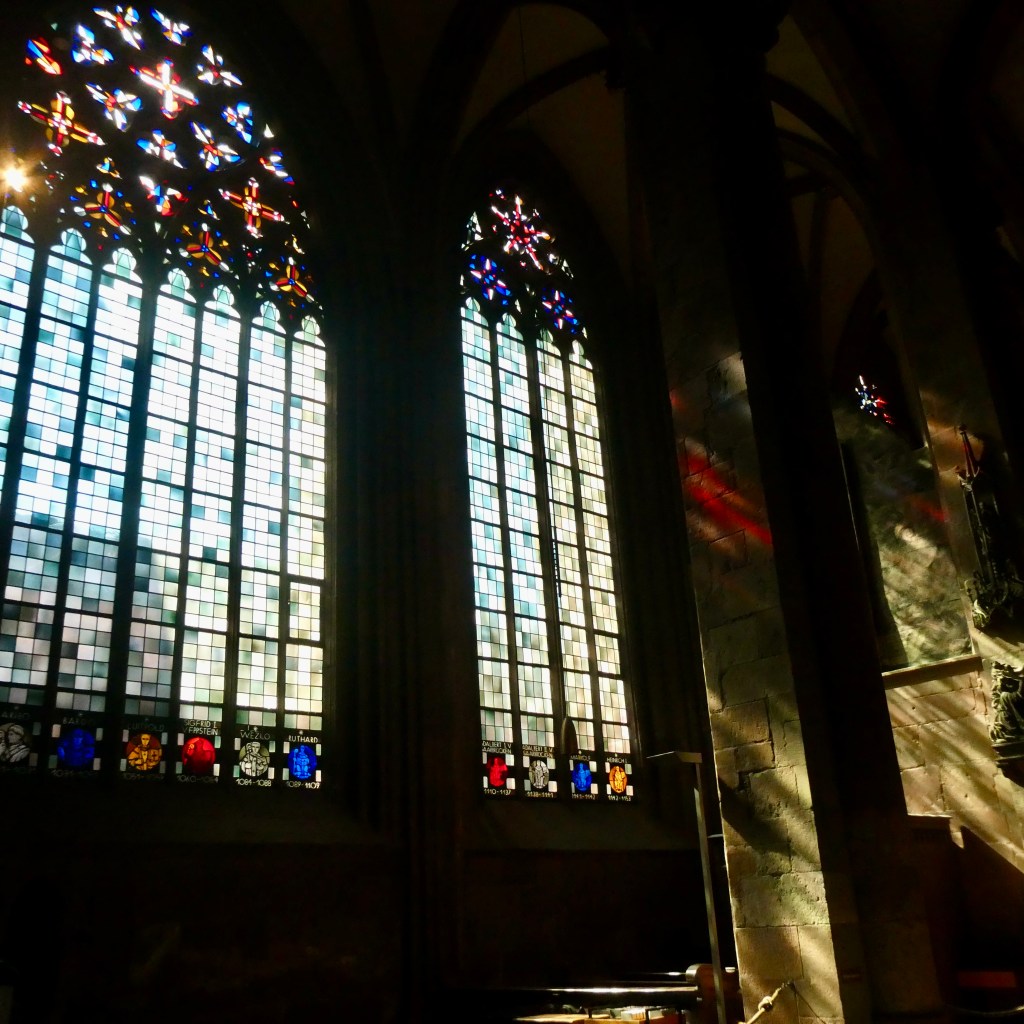
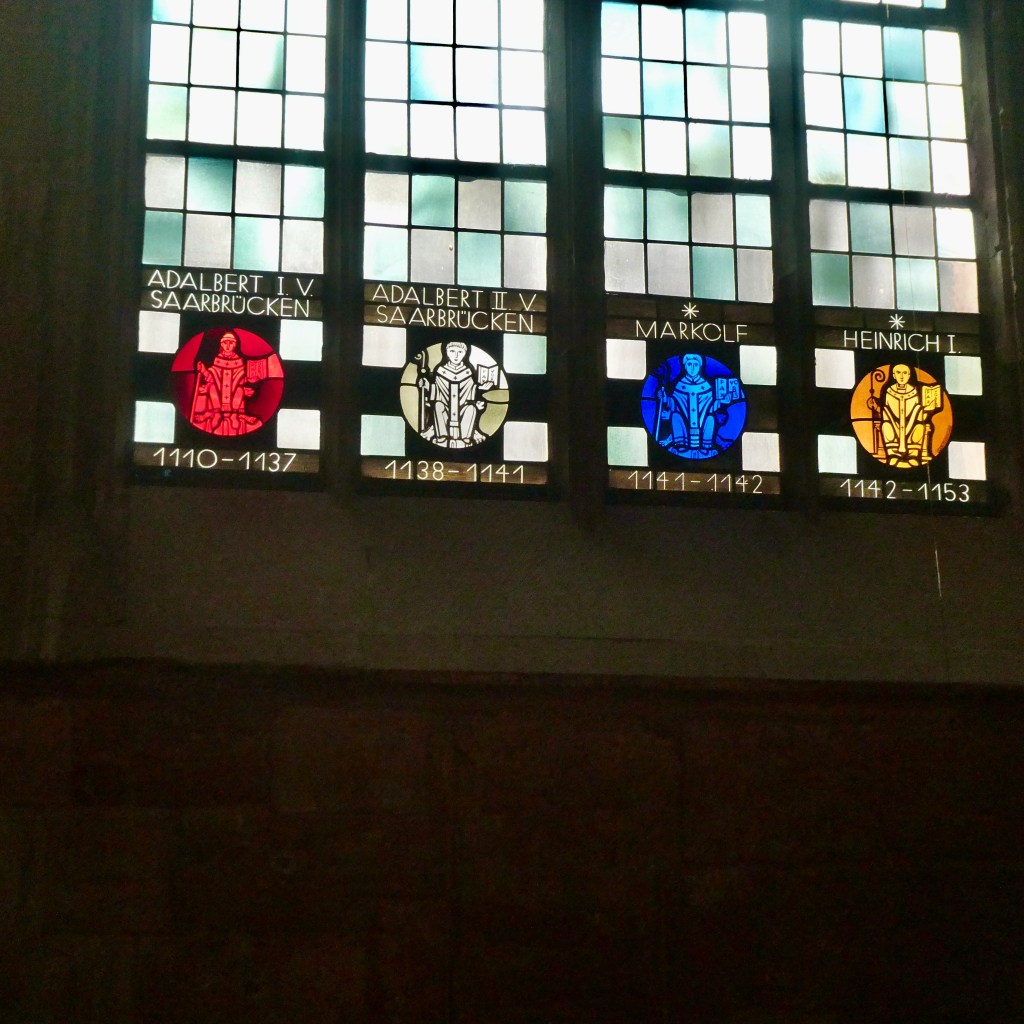
The stained glass is lovely with the bishops shown sequentially.  

Germany is half catholic and half protestant – mostly Lutheran.  Even if churches have an active congregation, they can’t possibly maintain these buildings.  Our guide told us that eight percent of income tax serves as a church tax to keep the churches going.  They are also used for cultural events.  The churches were not heated in the winter. It was thought that people could bundle up for services once a week

Allies tried not to bomb churches whenever possible during WWII.

This is a fountain from 1526!

Mainz has purposefully established a market atmosphere with no loud voices or sounds and no hawking of products.  They want shopping in the market to be a quiet pleasant experience. 

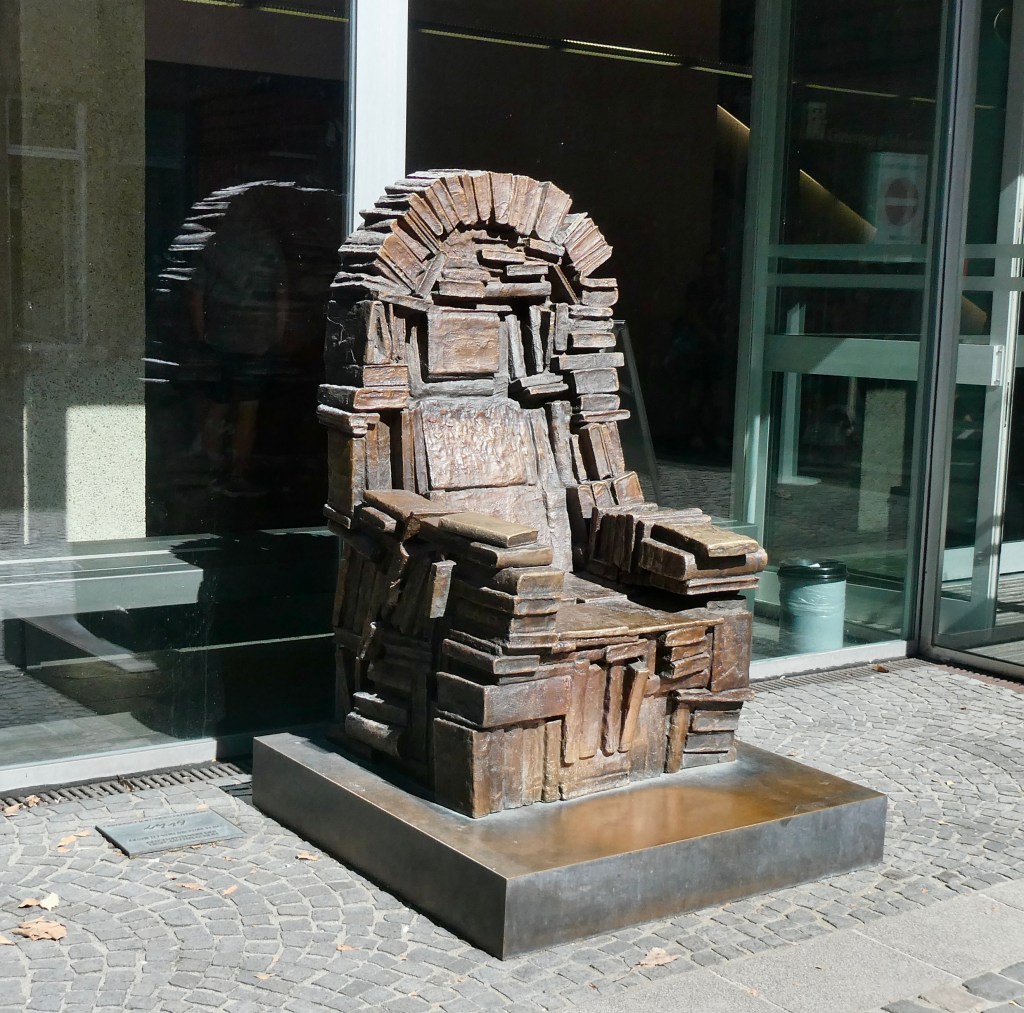
The Gutenberg Museum was developed in a building that started as a hotel in 1664.  Mark Twain once stayed there.  ( building with white van in front)

Gutenberg was born in Mainz in the 1390s.  He became a goldsmith around age 30 and eventually made his way to Strasbourg, France.  The goldsmith experience gave him the knowledge to work with metals.

He convinced contacts in both Strasburg and Mainz to help him with a secret project that he kept secret.

The Invention of the movable type printing press is widely regarded as the most important event of the post renaissance era.  

He made it possible to mass produce books instead of individually by hand.

Colors elements were from nature so they lasted.

We were able to enter a special part of the museum, a vault specific the Gutenberg Bible, but we were not allowed to take pictures.

Gutenberg’s Bible was printed in the 1450s as a three volume set.  It was written in Latin and printed in 42 line columns.  It was 500 pages, without numbers. The pages of the Bible were first printed in black and then over printed with red. 

Gutenberg printed 180 bibles and 49 copies remain.  We were told the Gutenberg Museum owns three.

The cost of one of a bible when printed was an equal to a year’s salary for an average man.  One of those remaining bibles recently sold for 14 million dollars.

The technological development of Gutenberg’s printing press and its impact on world history cannot be overstated.  

After touring Mainz, we returned to our ship, the Viking Alsvin.

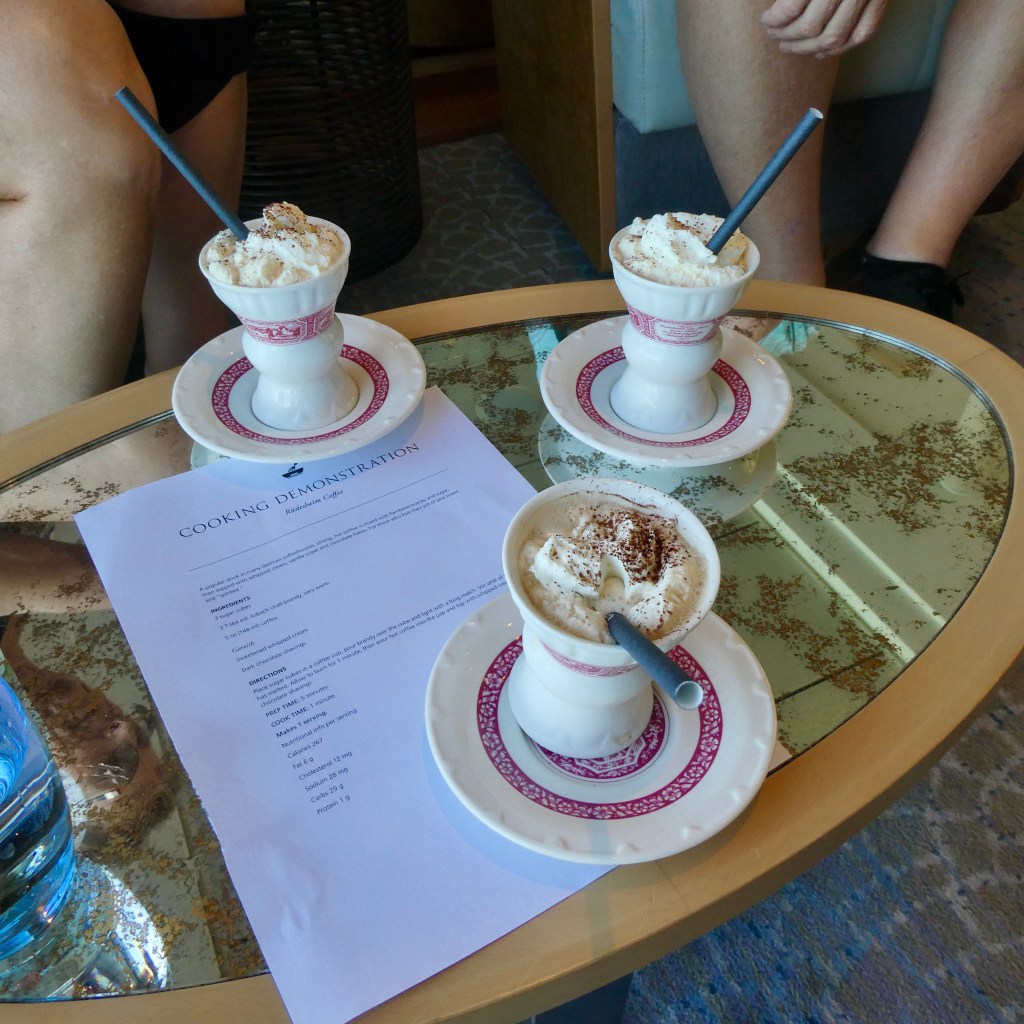
We enjoyed a cooking demonstration for Rüdeshei Coffee.

The recipe adds sugar and Asbach Uralic brandy to the coffee, then tops it with whipped cream and dark chocolate shavings. 

We sailed through the Rüdesheim region, first mentioned in 1074. 

The Romans started making wines in this region of the Rhine River 2000 years ago.

(We were in Mainz on September 5, 2023.)

Next up:  Sailing down the Rhine looking at castles!

Posted in Uncategorized | Leave a comment

Viking Cruise: Heidelberg

Heidelberg University is Germany’s oldest university. It was founded in 1386.  This building is the oldest and is just one of many throughout the city.  

This building was donated by a former American student around 1900 because there hadn’t been a  “proper” lecture hall when he was in attendance.

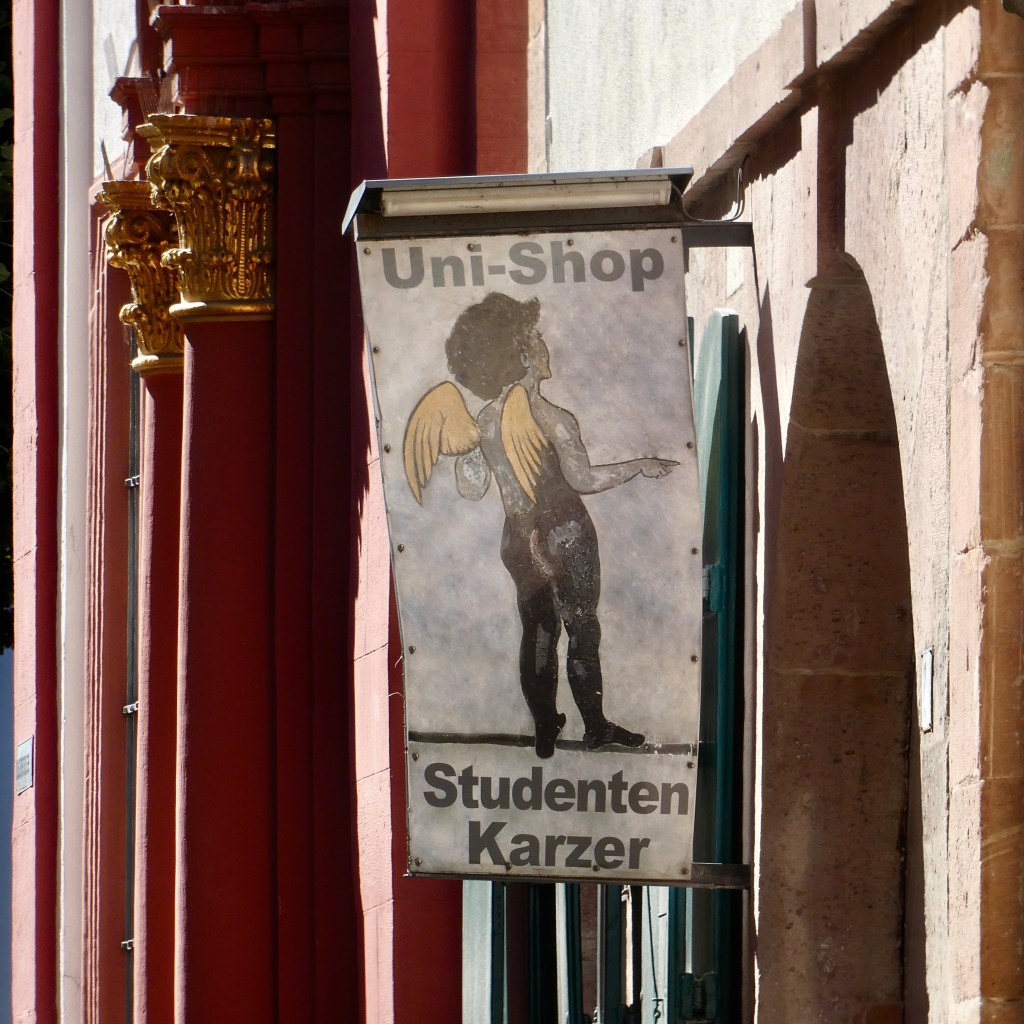
At one time there was a student “jail” to curtail mischief.  Mark Twain came to Heidelberg as a student to learn German – somehow I suspect mischief.

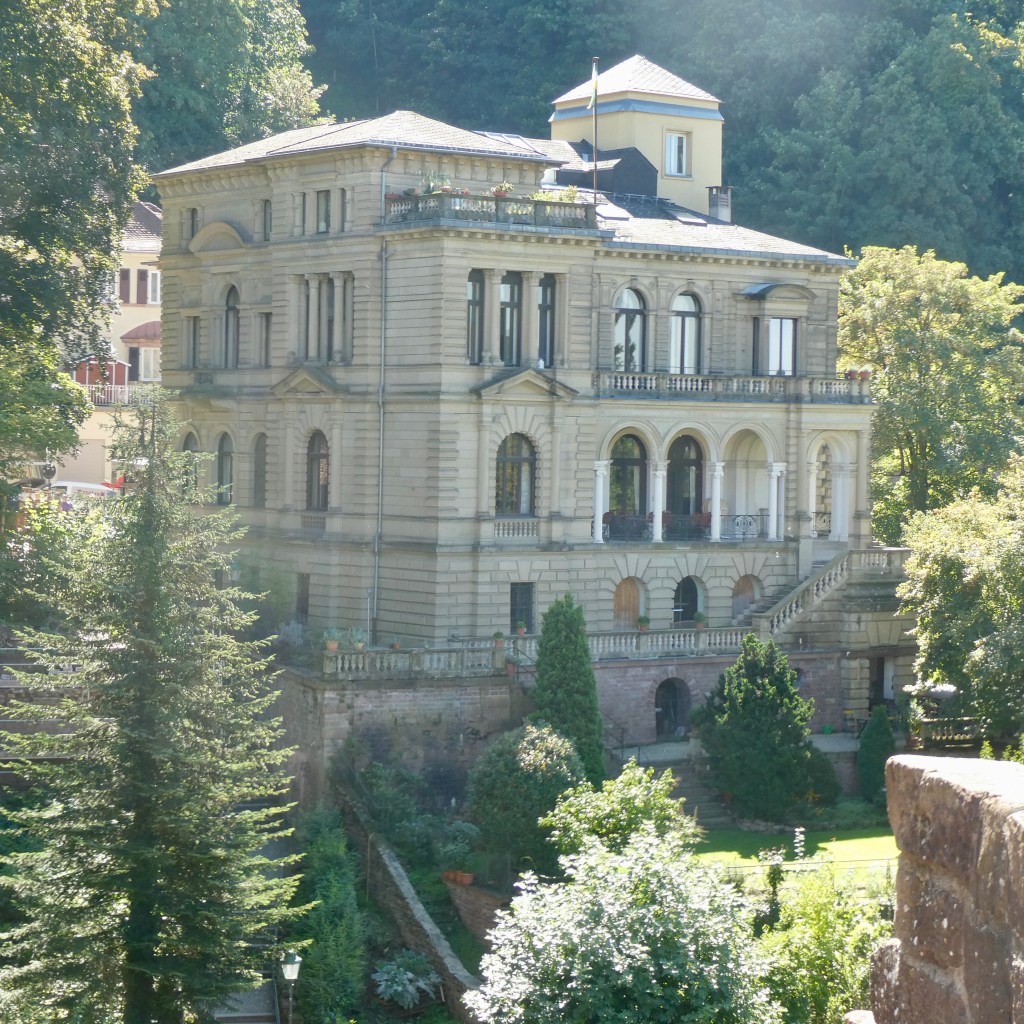
This building is residence for a fraternity of ten. Nice frat house!

Heidelberg University has academic prestige with 56 Nobel Laureates.  Forty percent of the university’s students are international.  

There are lots of English speakers in Heidelberg because of the university and because so many Americans lived in the city.  Heidelberg was home to a US military base until 2011.

Heidelberg was once ruled by a series of Prince Electors.

Martin Luther first defended his thesis in Heidelberg and the reigning Prince Elector was so impressed that nearly the whole village became Lutheran.

Lutherans and Catholics shared the Heidelberg church for 300 years. 

There was a wall separating their activities for most of those years.

Heidelberg was left in ruins by the French under Louis XIV. The church and the hotel at the end of the street were the only buildings to survive the resulting fires because they were made of stone.

The city was rebuilt in the 18th century.

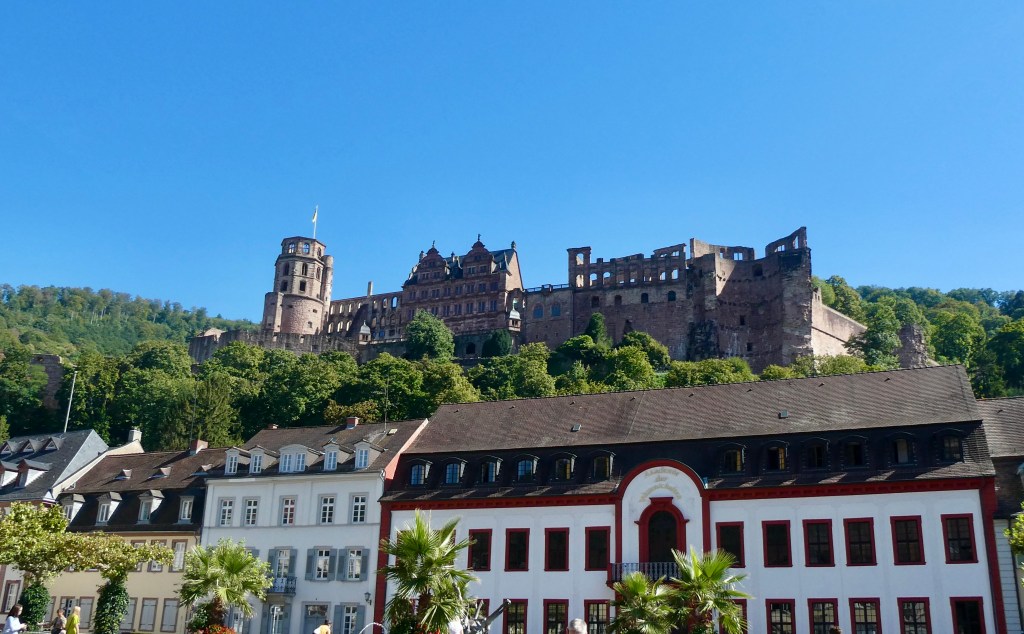
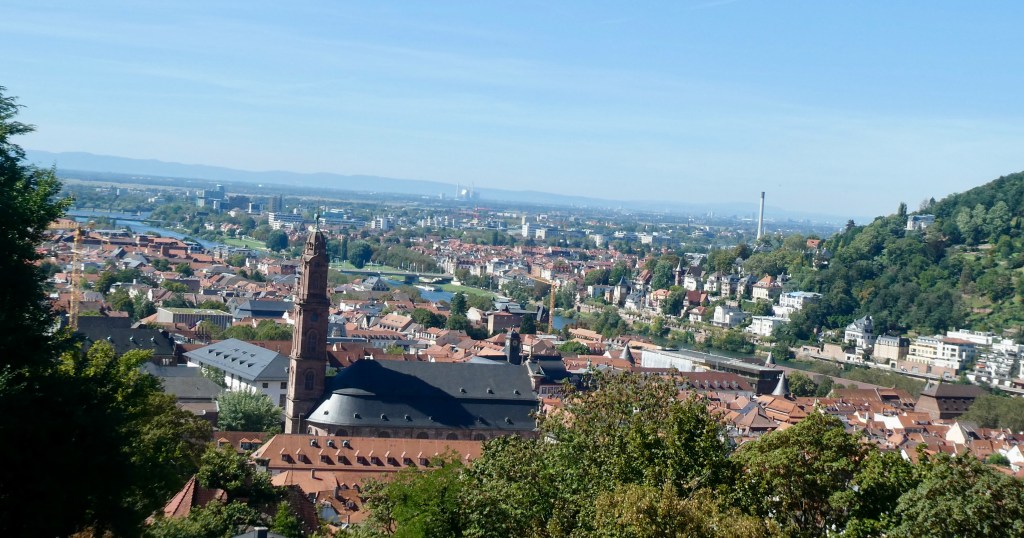
The ruins of Heidelberg Castle overlook the city.

The castle looked something like this in the year 1200.  

The castle was the home of the Palantine monarchy from the 13th to 18th centuries.  

Over the years, the castle expanded in a variety of architectural styles.

The castle was partially destroyed by fire caused by a lightning strike in the 17th century. 

It burned for a week.

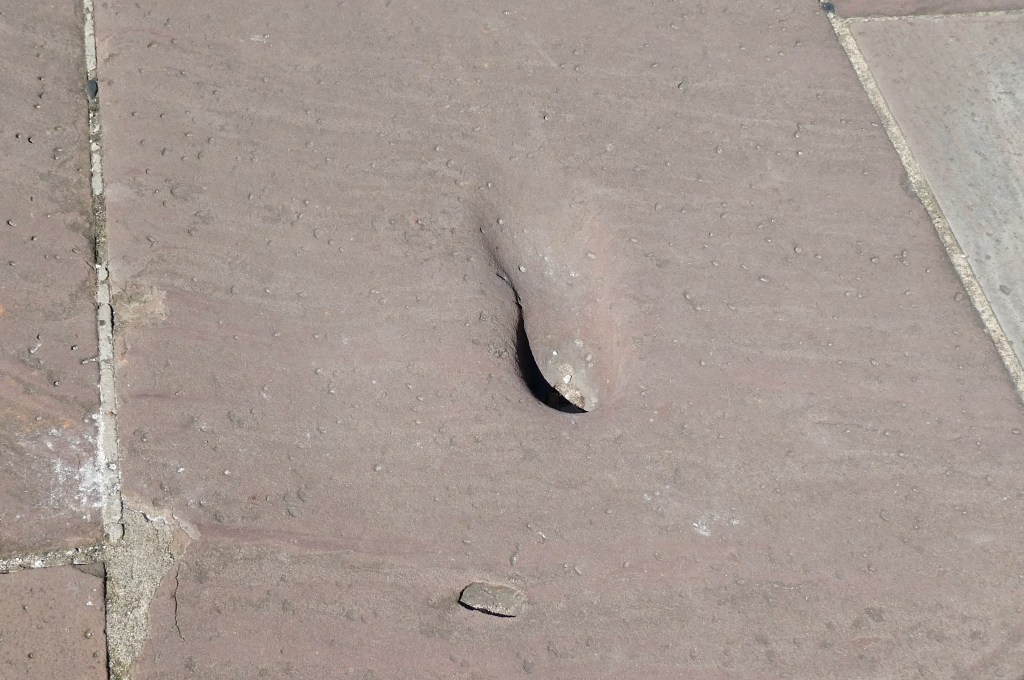
The folklore of this footprint is that a knight jumped from the bedroom of his lover after the fire began.

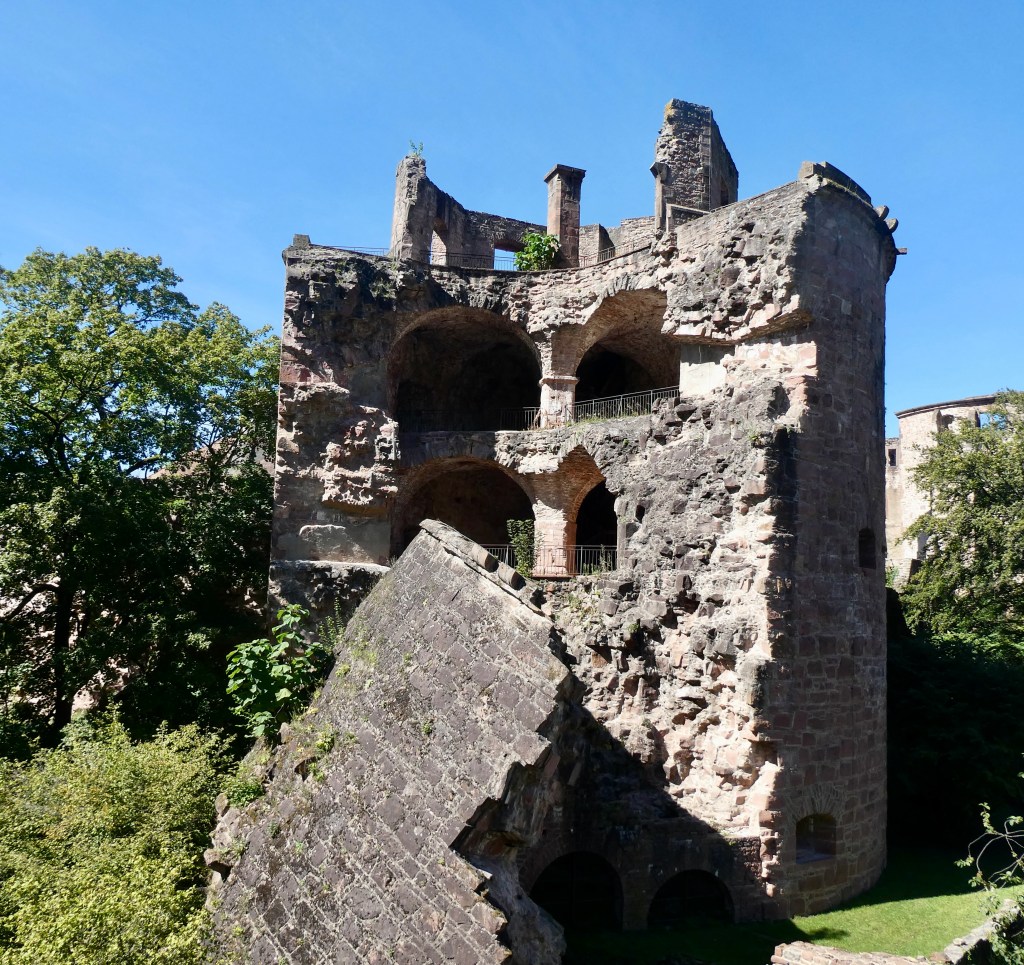
This tower was once used to store gun powder.  The French blew it up during the Seven Year War out of spite because they couldn’t possess it.

The Heidelberg Castle, maintained as ruins, is the second most visited castle in Germany.   (The Neuschwanstein Castle, more commonly known as the “Disney Castle,“ is the most visited.)

Heidelberg also has the world’s largest wine barrel.  It is made of 130 oak trees and held 50,000 gallons of wine.  The area tax collector collected tax in the form of wine from local wineries. He mixed it all together.  Unfortunately, we did not get to try any tax wine.

Although Jews in Heidelberg certainly suffered in World War II, the city had minimal allied bombing during the war.

(We were in Heidelberg on September 4, 2023)

Next up:  We leave the Main River, cruise into the Rhine, and go to the Gutenberg Museum.

Posted in Uncategorized | 2 Comments

Viking Cruise: Würzburg

Würzburg is a city of 135,000 residents and 35,000 of them are students. Tuition is free in Germany, even for international students. A potential student must be able to pass a German language test .

There are a number of university buildings around the city. This one is surrounded by one of the many vineyards in the area. Würzburg is built on shale and the minerals help make the grapes and wines healthy,

Stachel has Germany’s oldest and largest vineyards. This is the oldest wine bar in town – originating in 1413.  

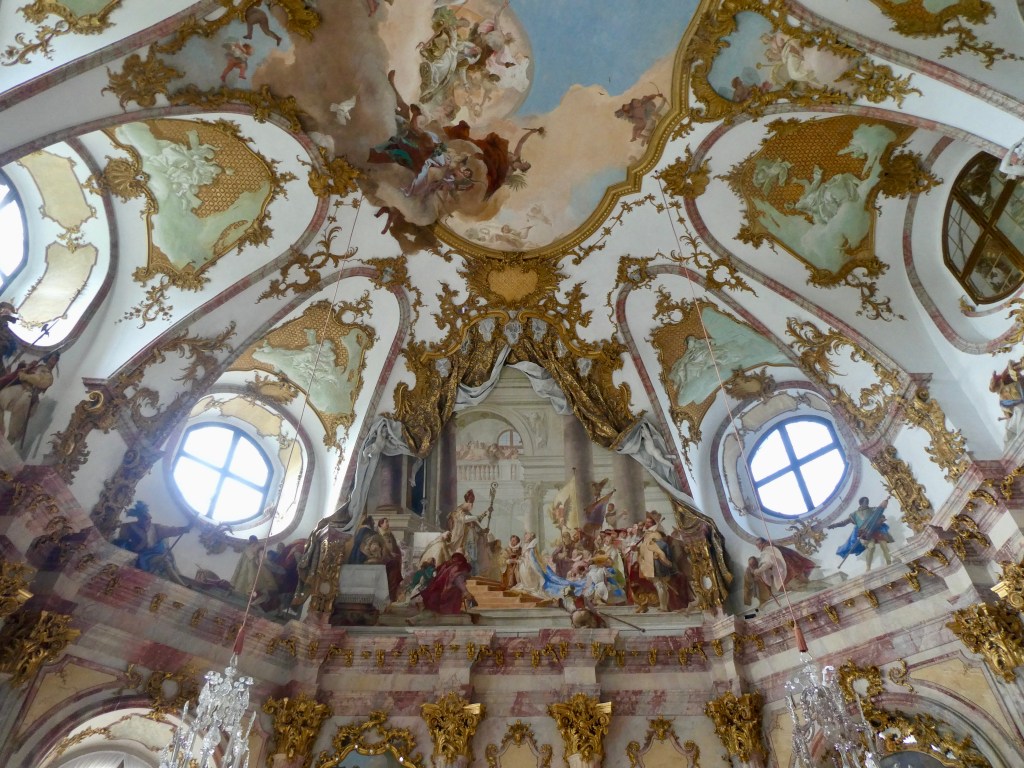
Our primary point of interest in Würzburg was the Bishop’s Residence.

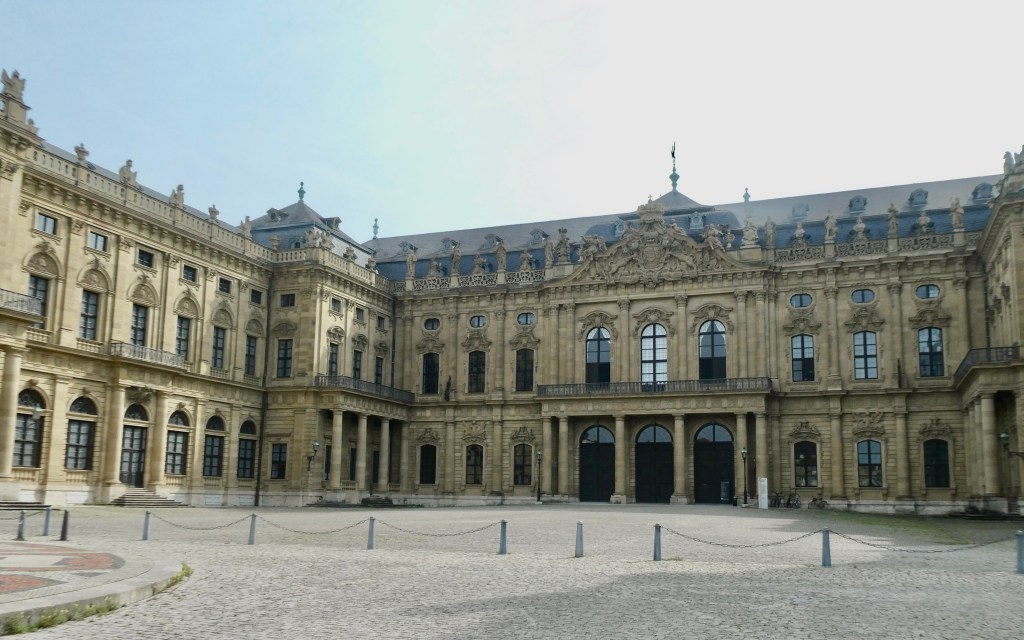
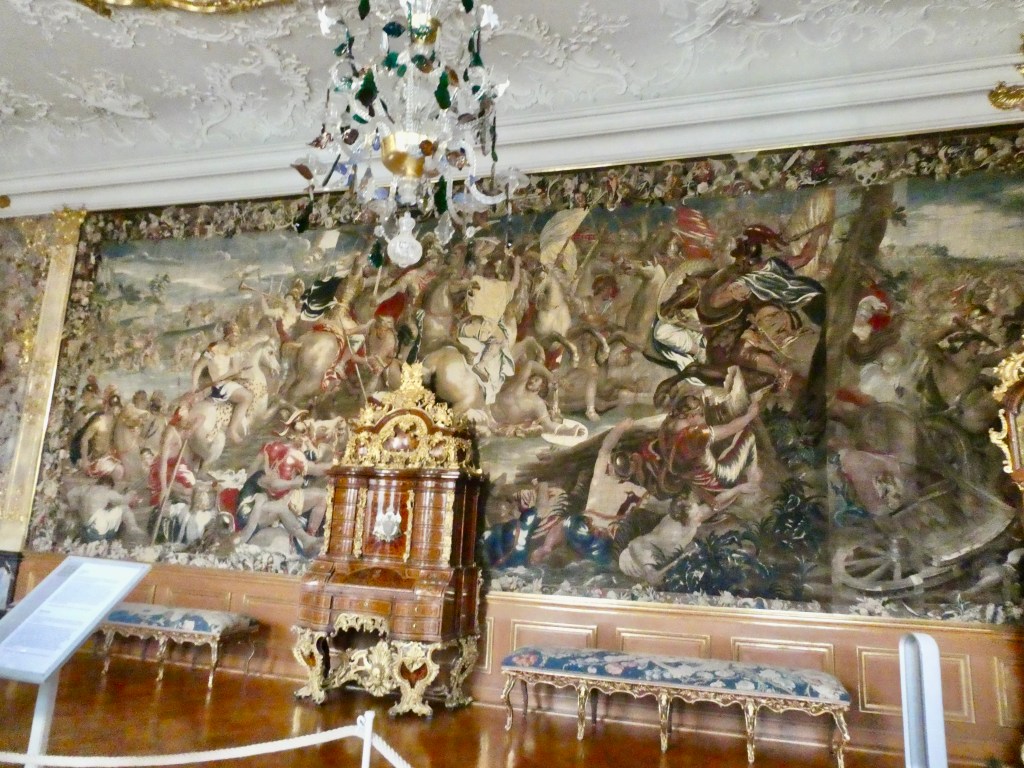
It is one of Germany’s largest and most ornate palaces.  The Bishop’s Residence has been a UNESCO World Heritage site since 1981. The exterior was built between 1720 and 1744.

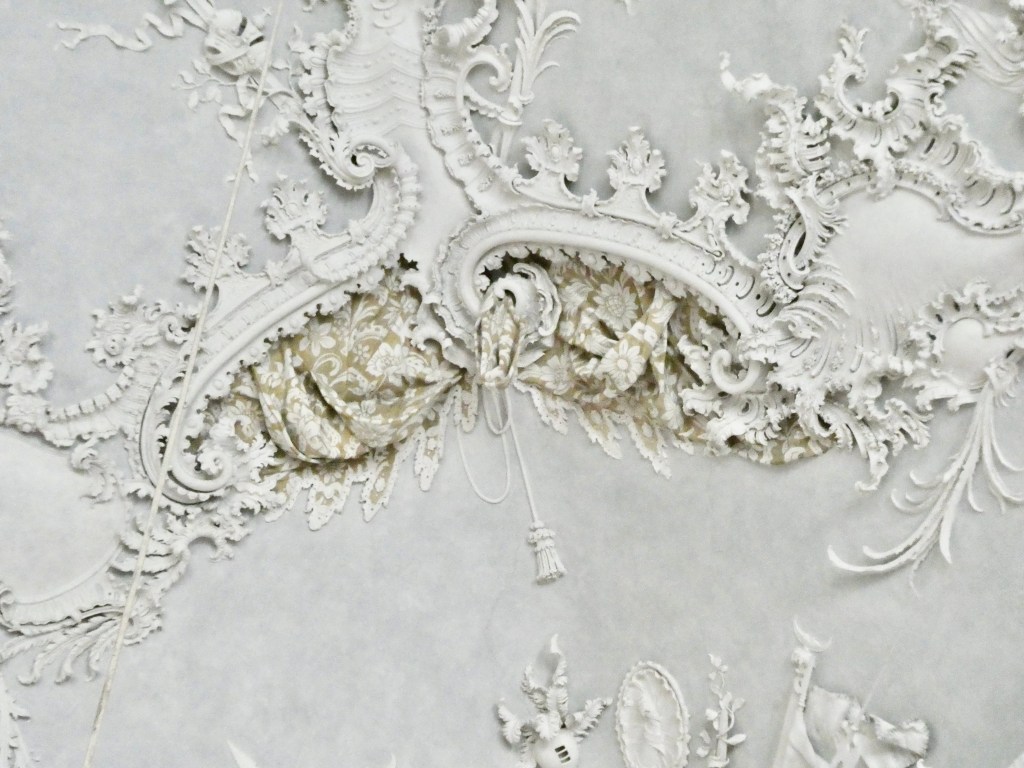
This totally stunning Stucco Room was created in nine months.  Even the parts which appear to be draped fabric are made of stucco.

There was a lot lead In the white paint so the artisans became ill.

The  room was created in anticipation of Marie Antoinette’s visit to the city.   The artists were very anxiously awaiting her comment on the room – but she said nothing!  That was devastating to the artists! However, she was very complimentary about the stucco room when she wrote about it after returning to France.

Upon arriving at the residence, Marie Antoinette took 45 minutes going up these stairs because she was required to greet and talk to so many people along the way.

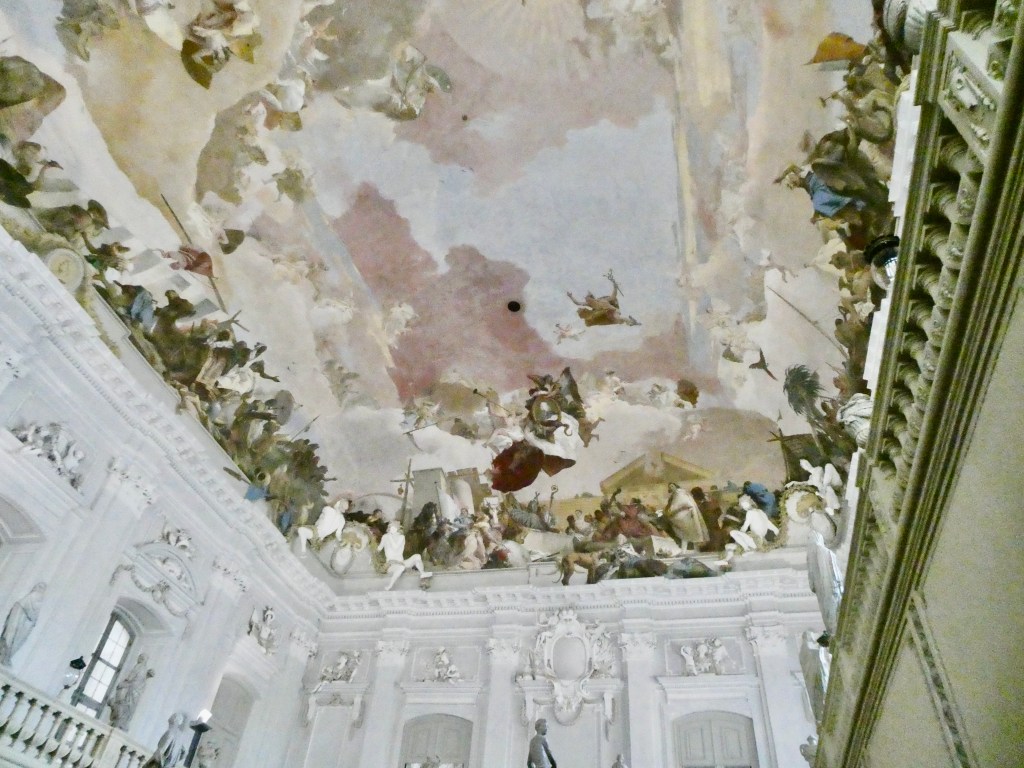
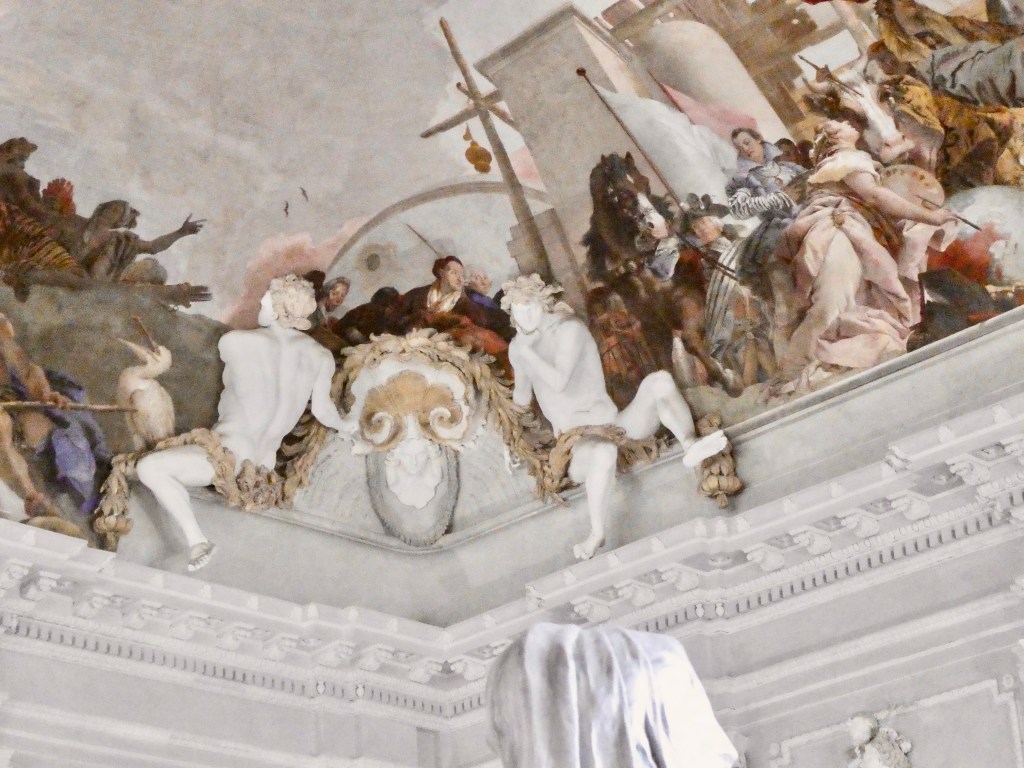
Another highlight was the 6400 square-foot Four Continents fresco painted by Giovanni Tiepolo.  He was not originally going to take this commission but was bribed by the grandeur of the project and ten times his normal fee.

The four sides represent four continents – Australia was not yet known.

The architect of the ceiling above the fresco had only built two regular houses before!

Completion on the interior work on the 400 room castle took until 1780.

The Ruler who lived in this residence was a Prince Bishop. Würzburg was one of a hundred states in the Holy Roman Empire.

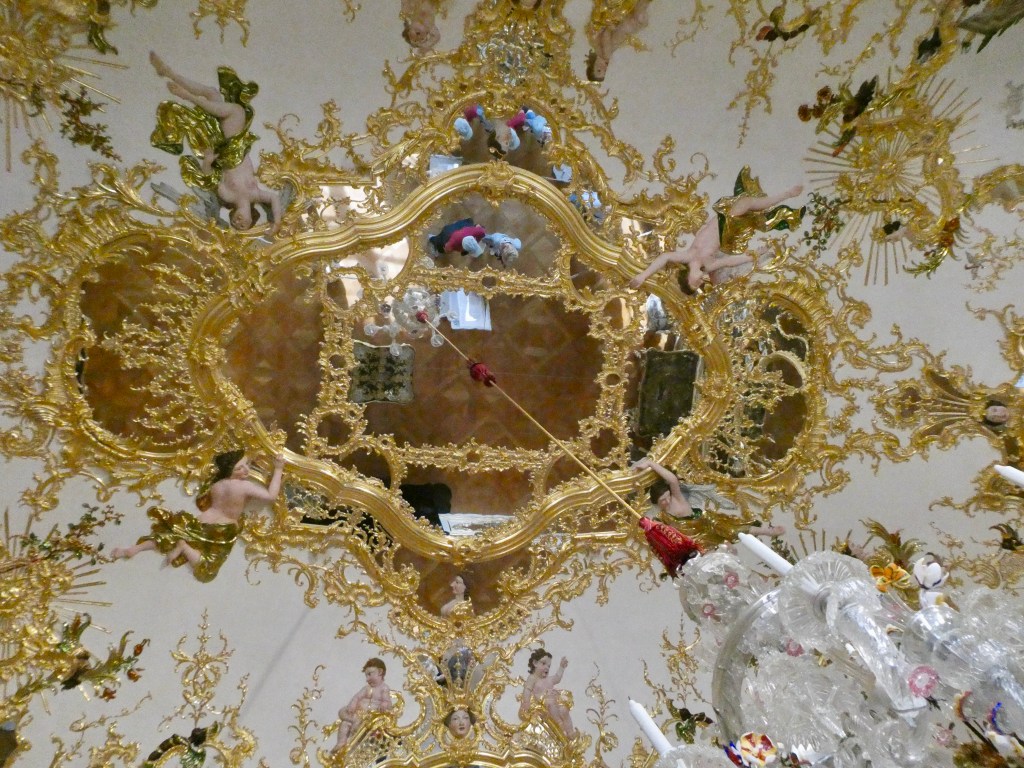
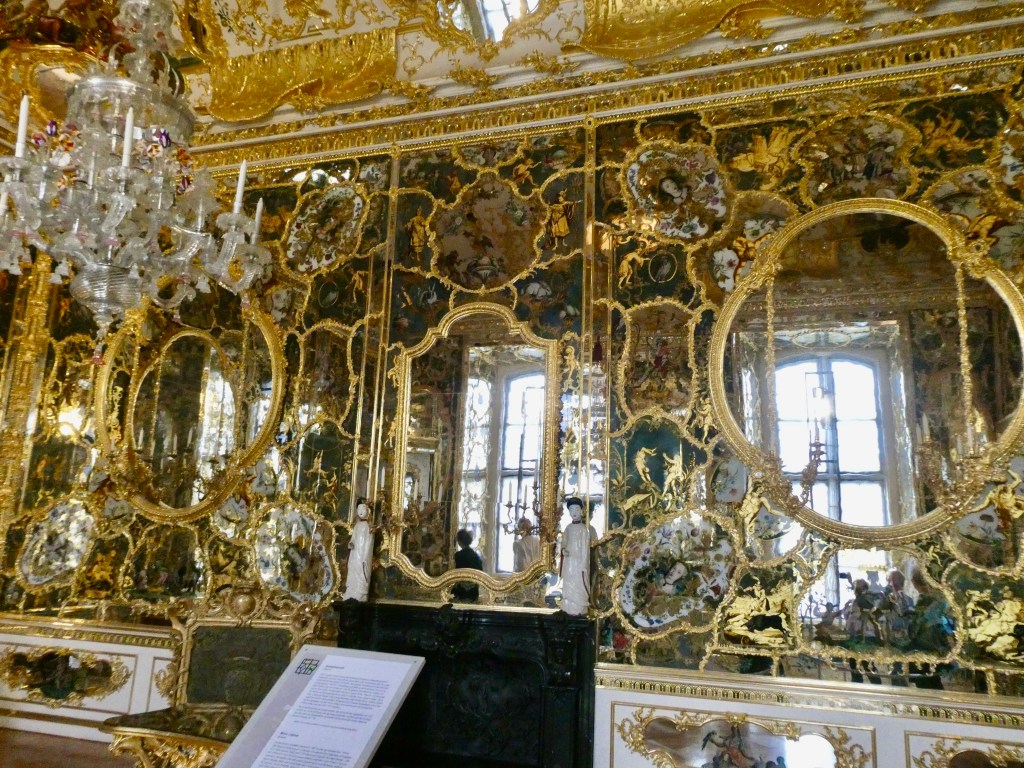
These pictures are from the Hall of Mirrors. The picture below is of a ceiling mirror.

With the demise of the Holy Roman Empire, the bishop moved out of the residence palace in 1803.

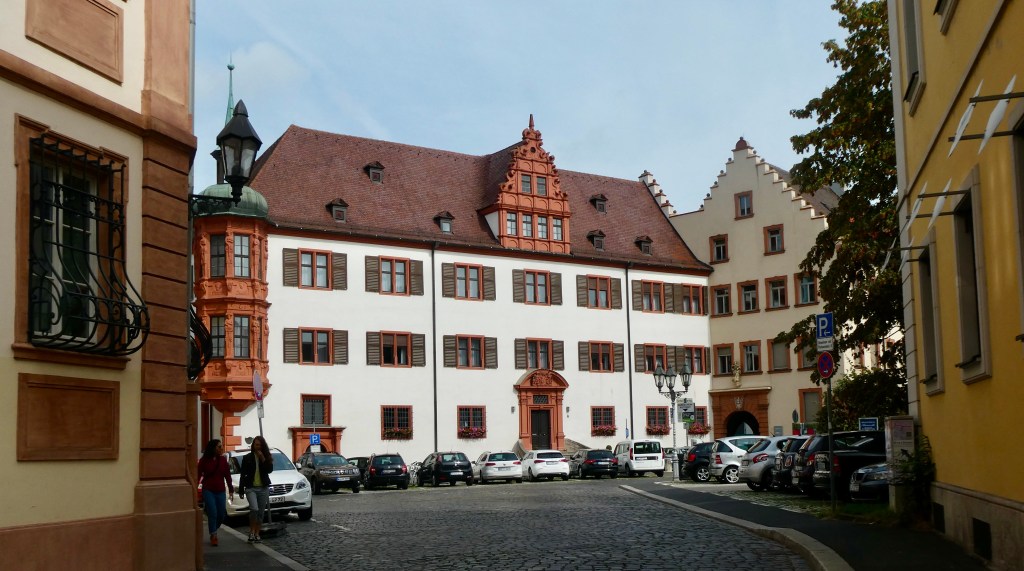
This was his next residence – a bit of a downgrade…

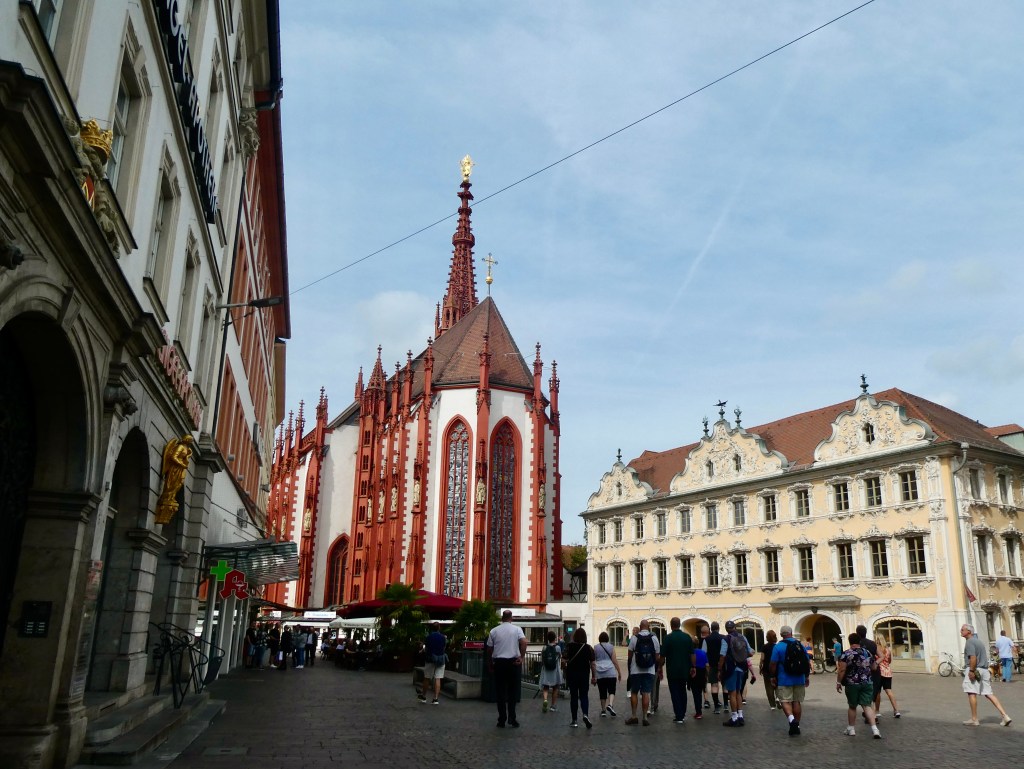
In his new neighborhood was the Mother Mary Chapel from the 1300s. 

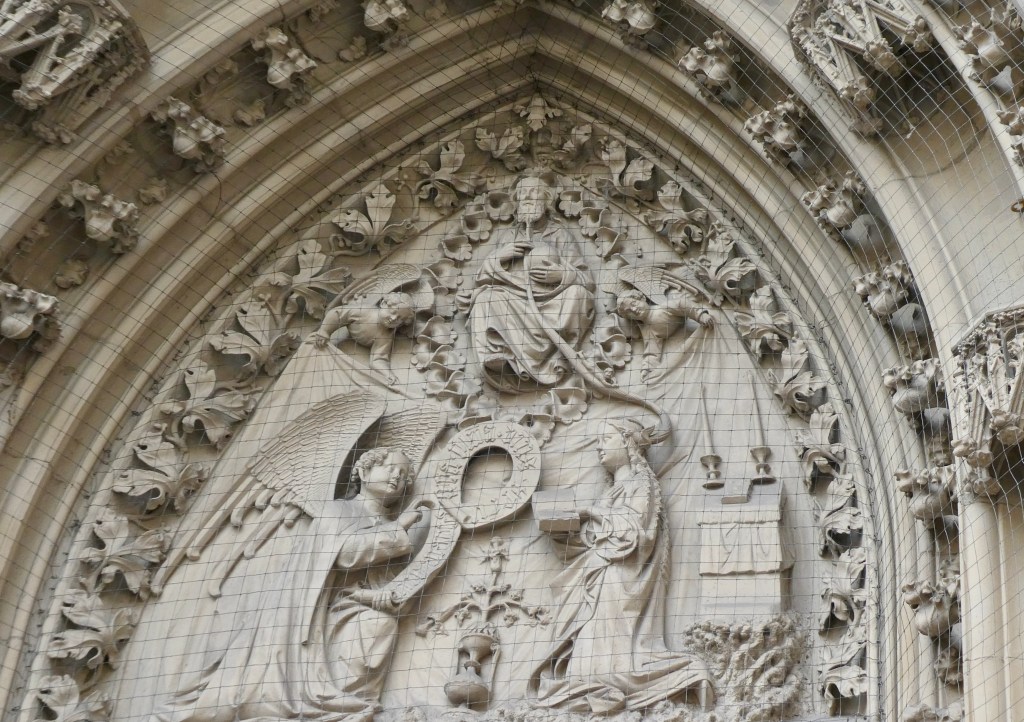
Another cathedral entrance had an explanation of the annunciation.  

Mary understood through her ears from Father God and the Holy Spirit that she would bear the messiah. This was the church’s way of making the annunciation “understandable.” Mary could get pregnant through her ear and still be a virgin.

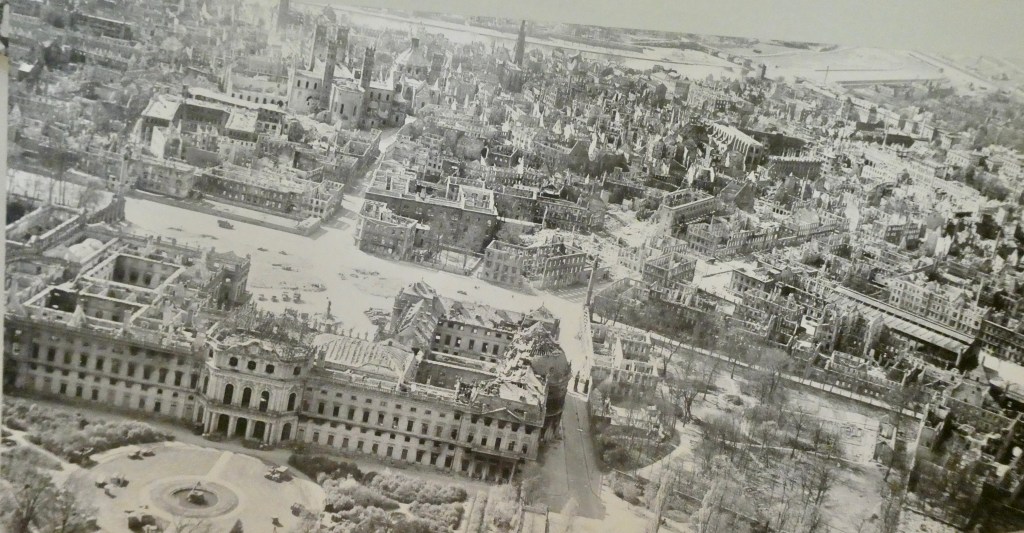
Generations later Würzburg was 90 percent destroyed during WWII. Most of the damage was through incendiary bombs and fire. Some of the city’s artistic treasures had been hidden away and protected so much survived.

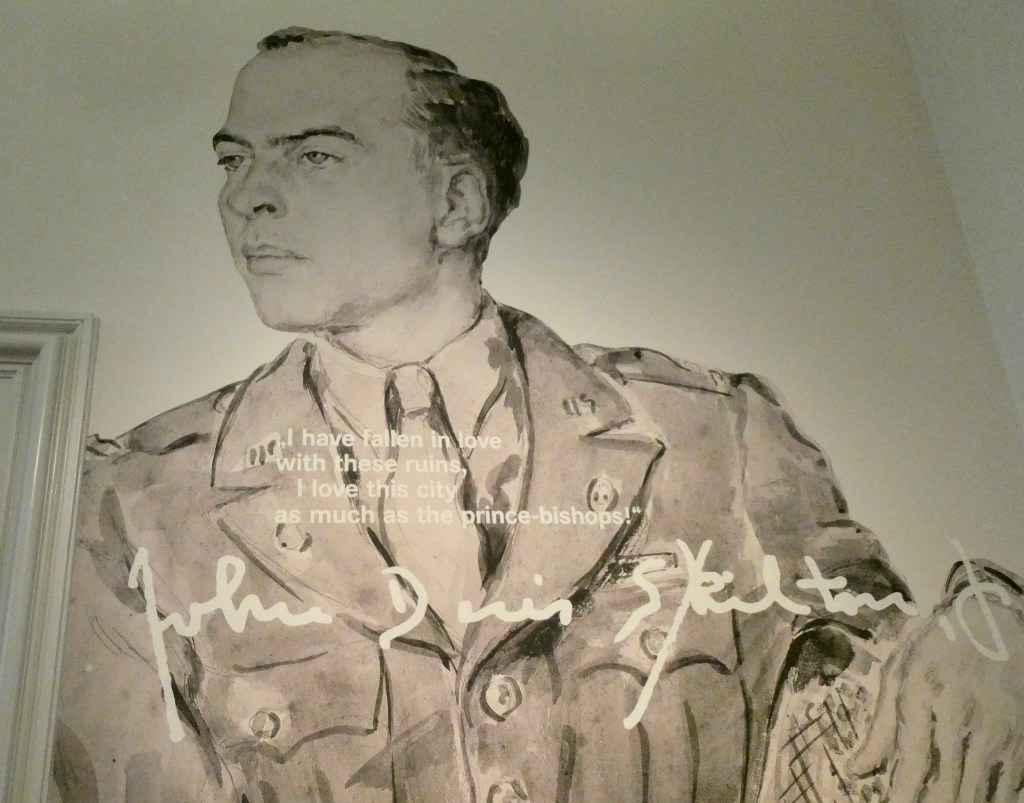
At the end of the war, the American Monument Men, and specifically Second Lieutenant John Davis Skilton, helped to safeguard many of the artistic treasures in the remains of the Bishop’s Residence Palace including the largest fresco of the four seasons.

Skilton was able to find the wood to have the roof partially rebuilt to protect what remained.

The entire Bishop’s Residence complex was meticulously restored after the extensive damage. The Marshall Plan paid for much of the early reconstruction.

Prior to the war, 80 percent of the residence’ valuables had been stored away. Years later, 80-90 percent of the artwork in the residence is original. 

The Mirror Room, destroyed during the war, could not be rebuilt with quicksilver because of the lead content. The Mirror Room was rebuilt in the 1970s with technology developed for eyeglasses,

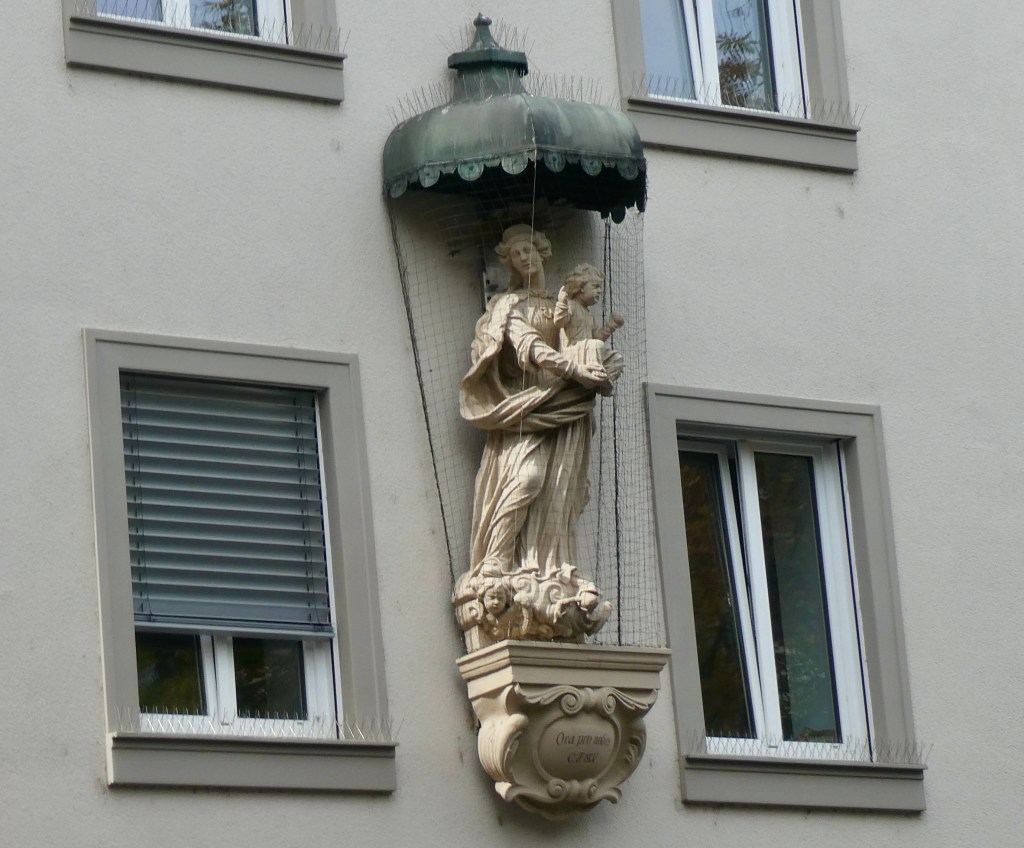
Würzburg is the City of Mary. There are many Mary statues around town. 

Many were destroyed during the war but 400 were hidden and placed throughout the city later.

We were leaving Würzburg when we saw our first castle along the river!

(September 3, 2023.)

Next up: Heidelberg

Posted in Uncategorized | 1 Comment

Viking Cruise: Bamberg and the First Locks

Bamberg is a “Medieval city wrapped in a baroque wrapper.” 

Because of this uniqueness, and a treasure of medieval structures, Bamberg was named a UNESCO World Heritage Site in 1993.    

Fortunately, only four percent of Bamberg was damaged during World War II instead of 91 percent destruction for nearby Nuremberg.  

Sometimes it is beneficial to be less “important.”

Our guide explained that the houses on the Regnitz River were for poor fishermen during medieval times.  The water was filthy because of the nearby slaughterhouse (the building on the right) where waste was dumped into the river. 

Times have changed because the ability to buy one of these houses now is very rare.  The last one (the black house) sold for 1.5 million Euros.

Bamberg is famous for its smokey beer – said to be like liquid salami.  It is made from malt dried processed over an open flame.  By Bamberg law, the beer can’t be served before 4:00 pm so we weren’t able to try it and I’m not sorry.

Schlenkeria Brewery is one of only two breweries left on this street. There were once 14 breweries that were in business on this street alone.  The man in the wreath is symbolic because the owner broke his legs when wine barrels fell on him.

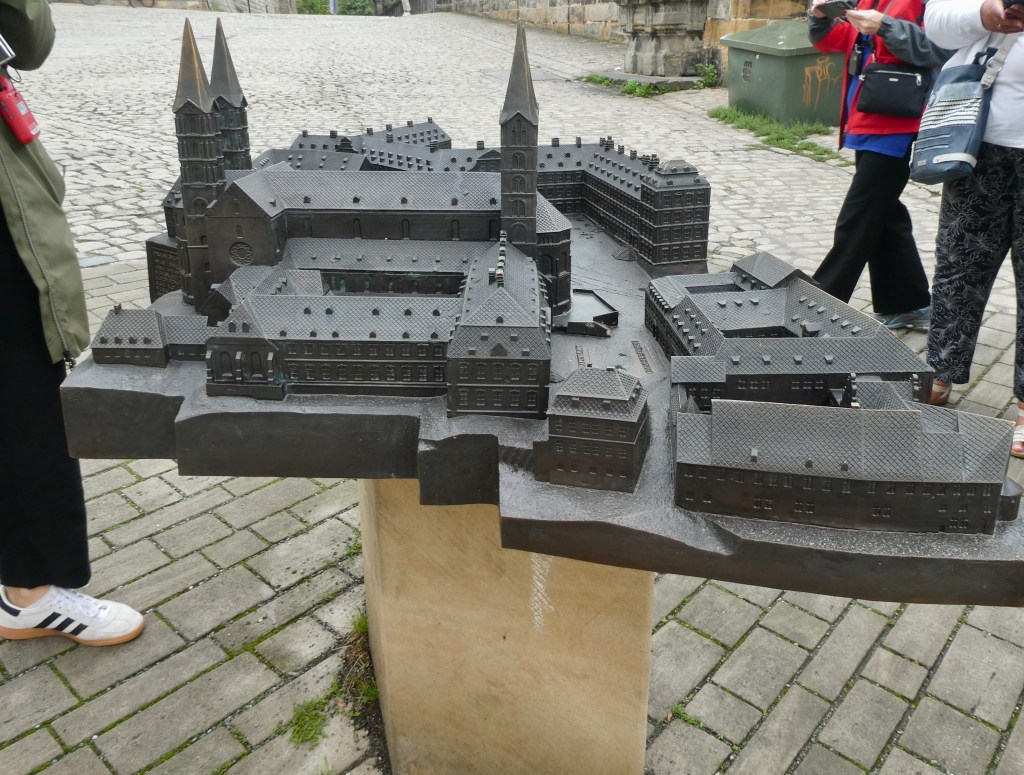
In 1007 Bamberg was the center of the Holy Roman Empire.  A braille map of the cathedral area is available.

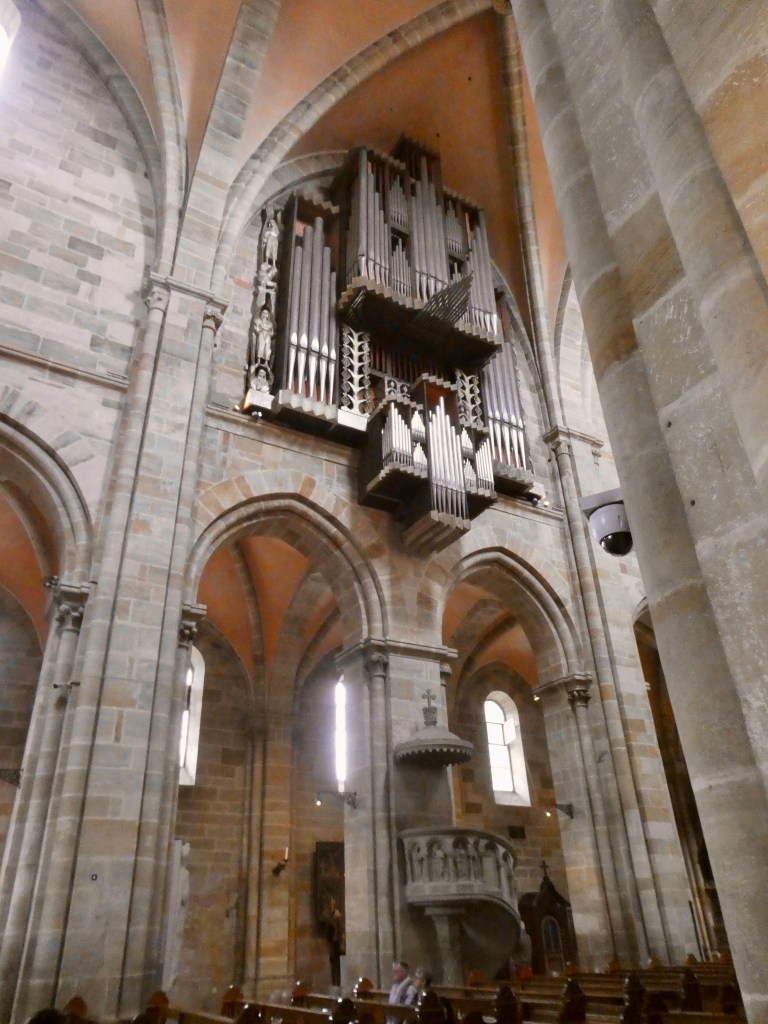
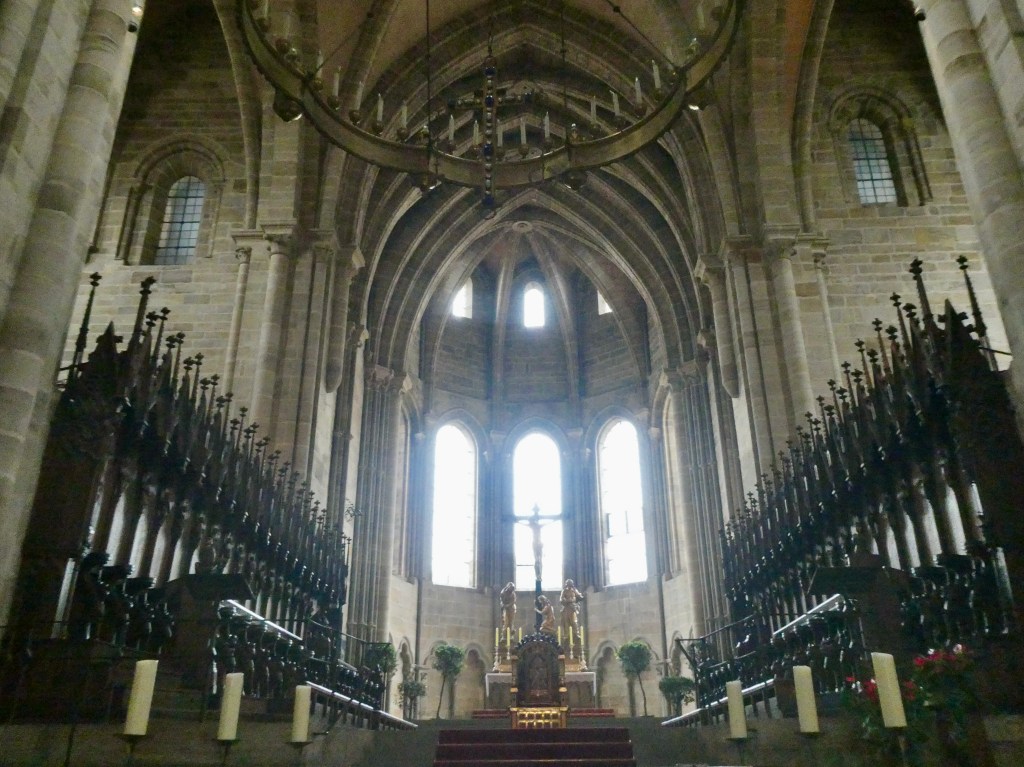
This 11th century cathedral is the third Cathedral of Bamberg.  The first two burned down.

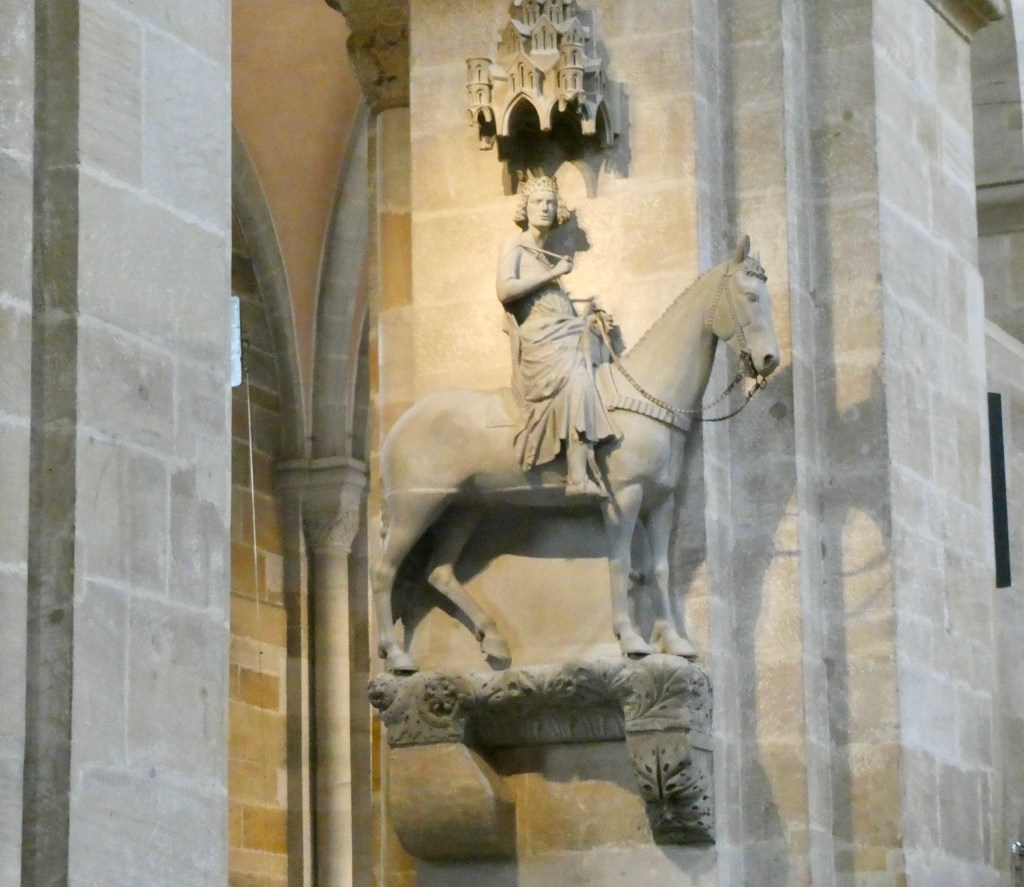
Inside the cathedral, we were able to see The Bamberg horseman. The horsemen is visible on a variety of Bamberg products. The city residents don’t know who he was but celebrate him anyway.  He is wearing a king’s crown – not an emperor’s crown.

The cathedral used to be very colorful inside.

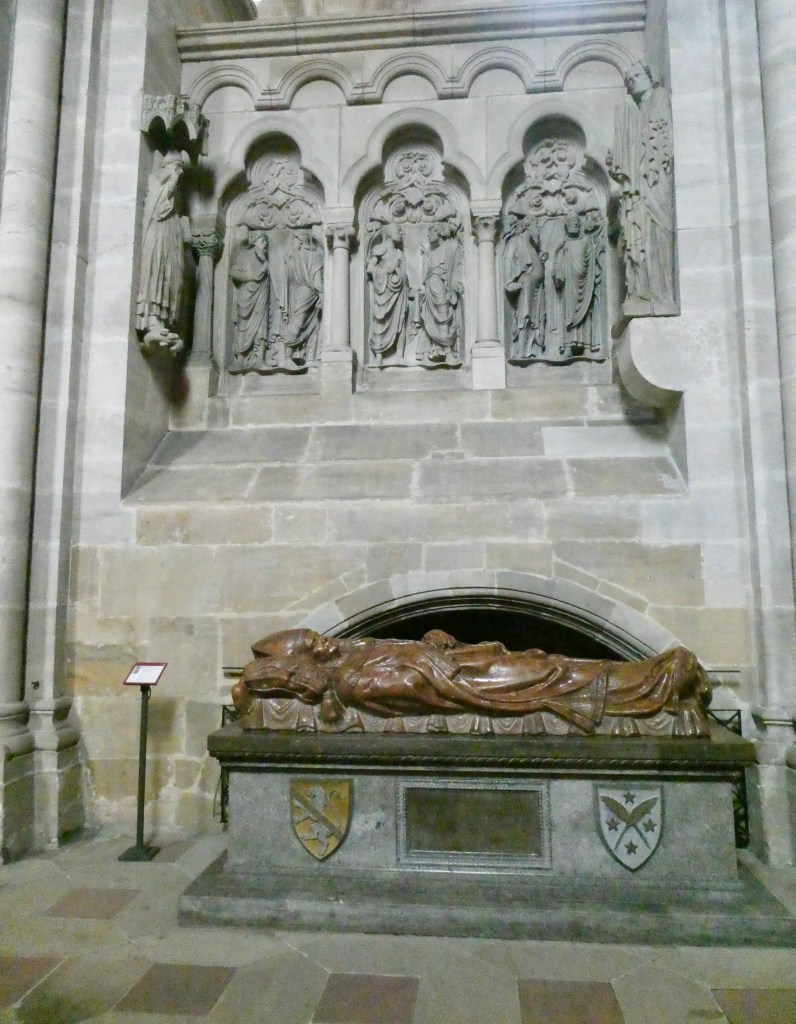
Pope Clement II is buried here after serving only one year as pope from 1046-1047. This is the only papal grave in Germany.

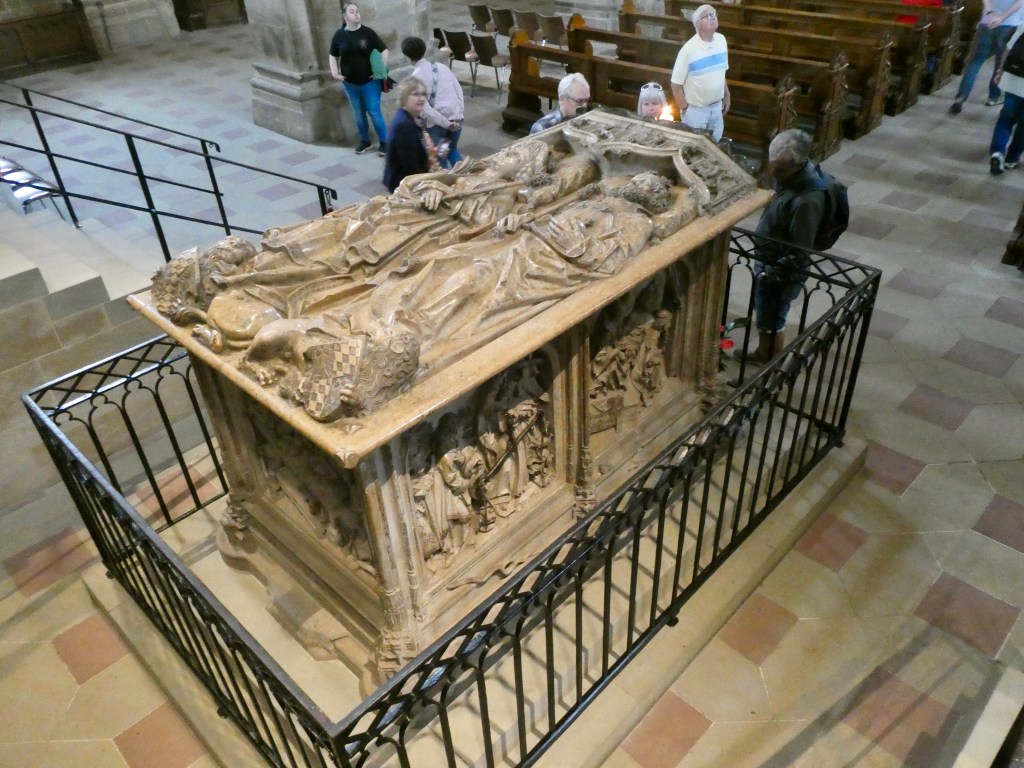
The shared tomb is for Henry II and his wife Cunigunde. They were an imperial couple who shared power.  She is on the side typically saved for the king.

The cathedral exhibits a combination of architecture styles.  These windows have romanesque round arches under gothic arches.

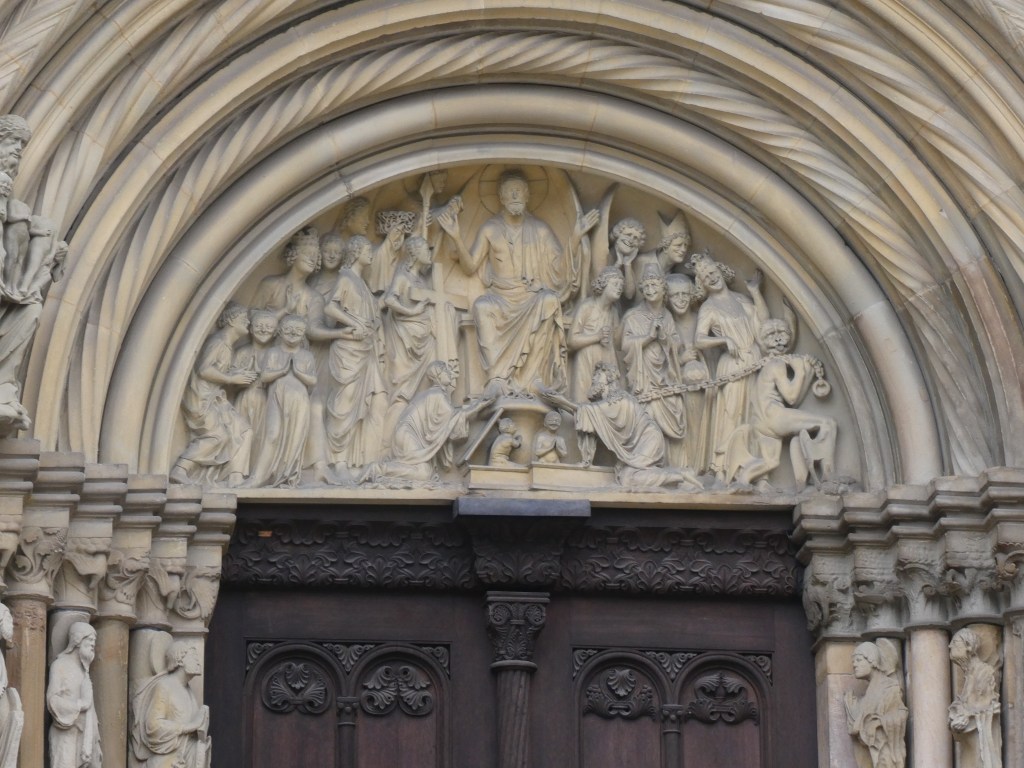
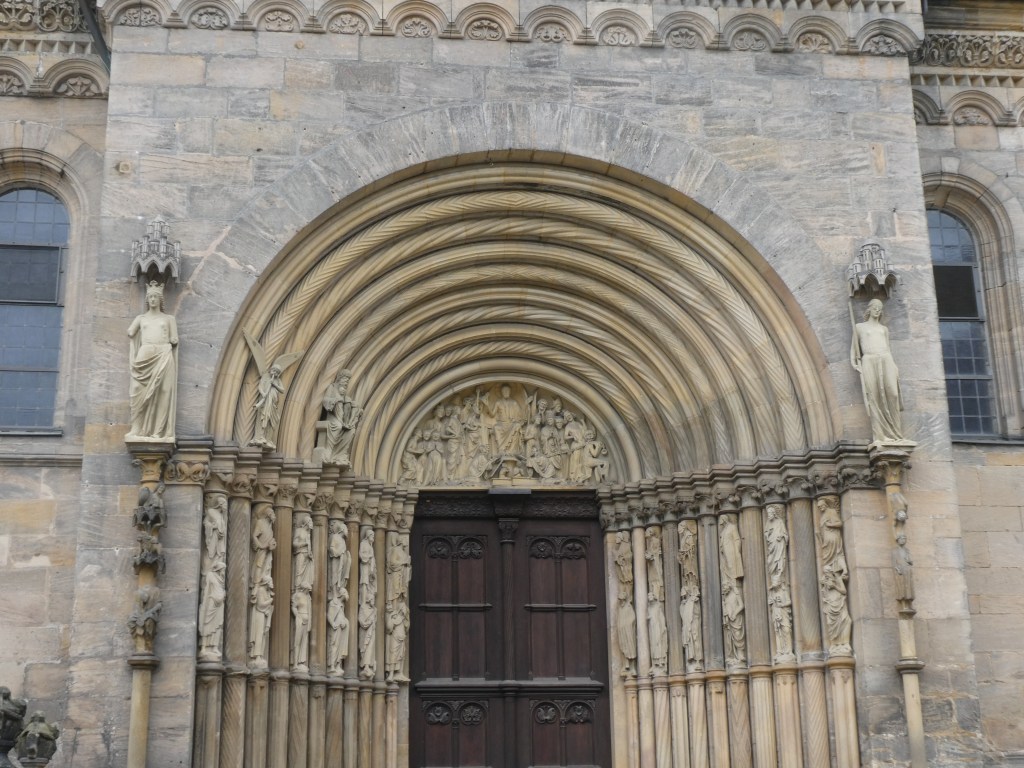
The side entrance of cathedral is the one used, historically, by bishops.  Above the entrance, Jesus is shown on the day of the last judgment.   Those on the right are depicted going to hell and those on the left are going to heaven. It is thought to be significant that the artist shows representation of all socioeconomic levels on both sides.

To the left of the entrance is a woman who used to hold the baby Jesus representing Christians. It is unknown what happened to her hands and the baby Jesus.  On the right side is a Jewish woman with a mask and broken staff.  This is a depiction of being unwilling or unable to see Jesus as Messiah.  This statue is evidence of very early (11th century)  discrimination of the Jews. 

In 1910 a Jewish synagogue opened 150 meters from the cathedral.  In November 1938, on the Night of Broken Glass,  500 Jews escaped while 500 were stolen away.  Currently Bamberg has a Jewish population of about 1000 again, and they have a new synagogue

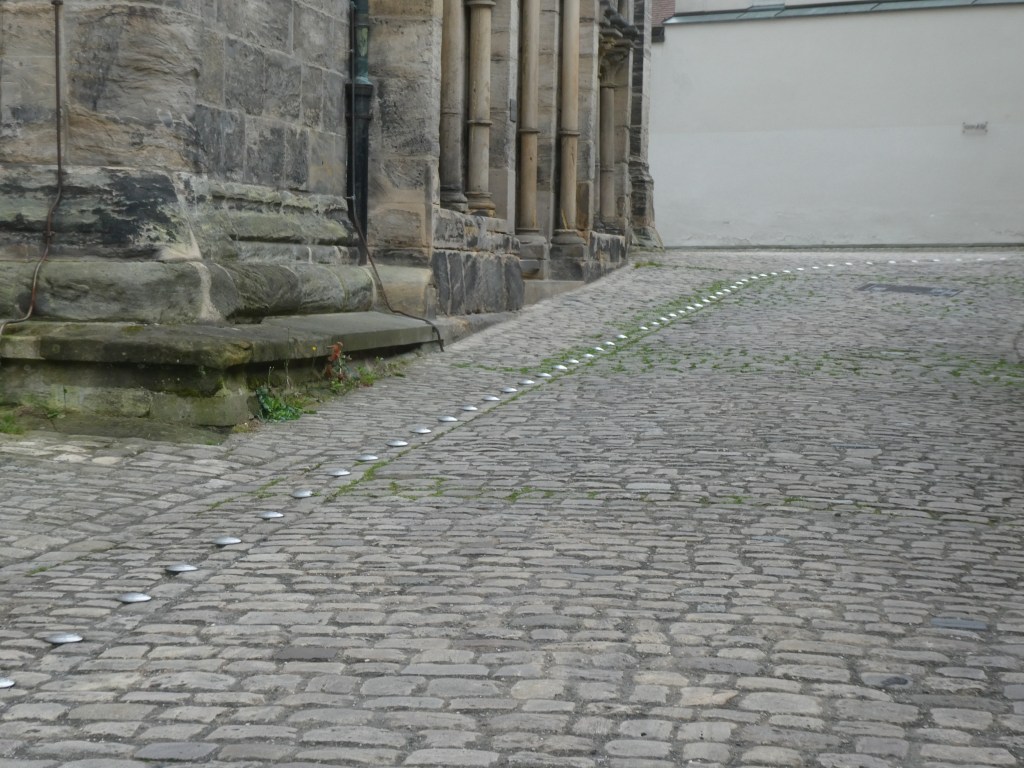
To keep the cathedral area more scenic, metal dots show vehicle lanes.

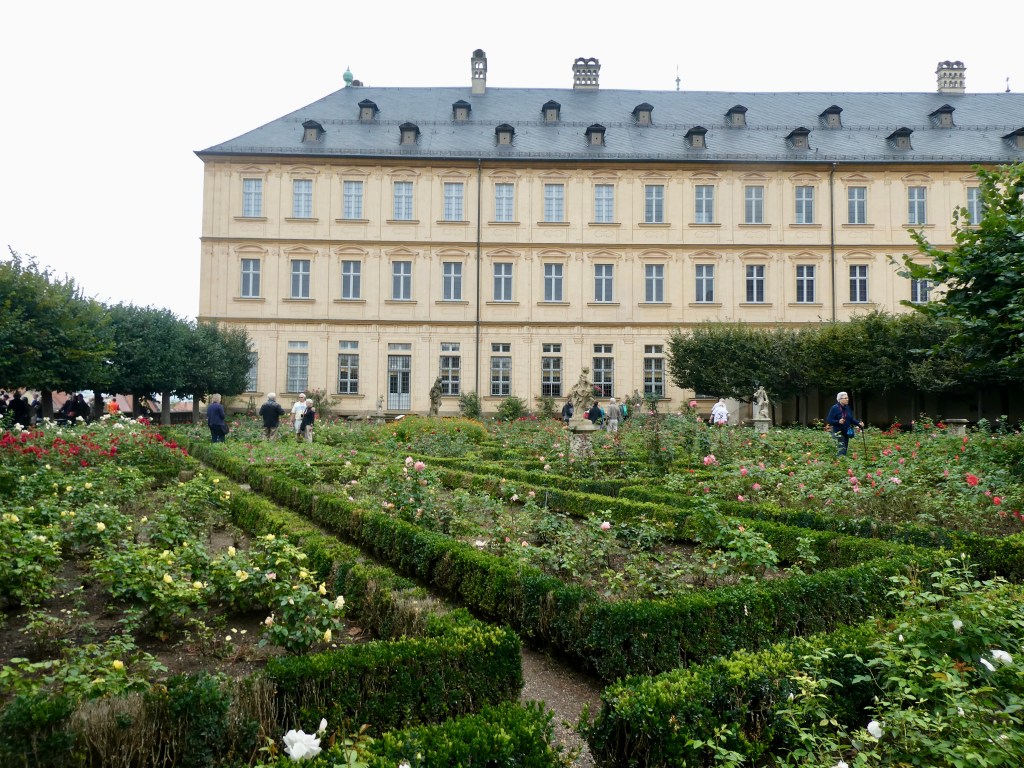
The Prince Bishops once lived in this home with 300 support people.    The two doors at the top  center were used for grain storage.  The inside is not yet refurbished for public viewing.  Our guide told us that the flowers are always blooming – although she doesn’t know how.

American movie makers shot scenes for The Three Mouseketeers in this courtyard.

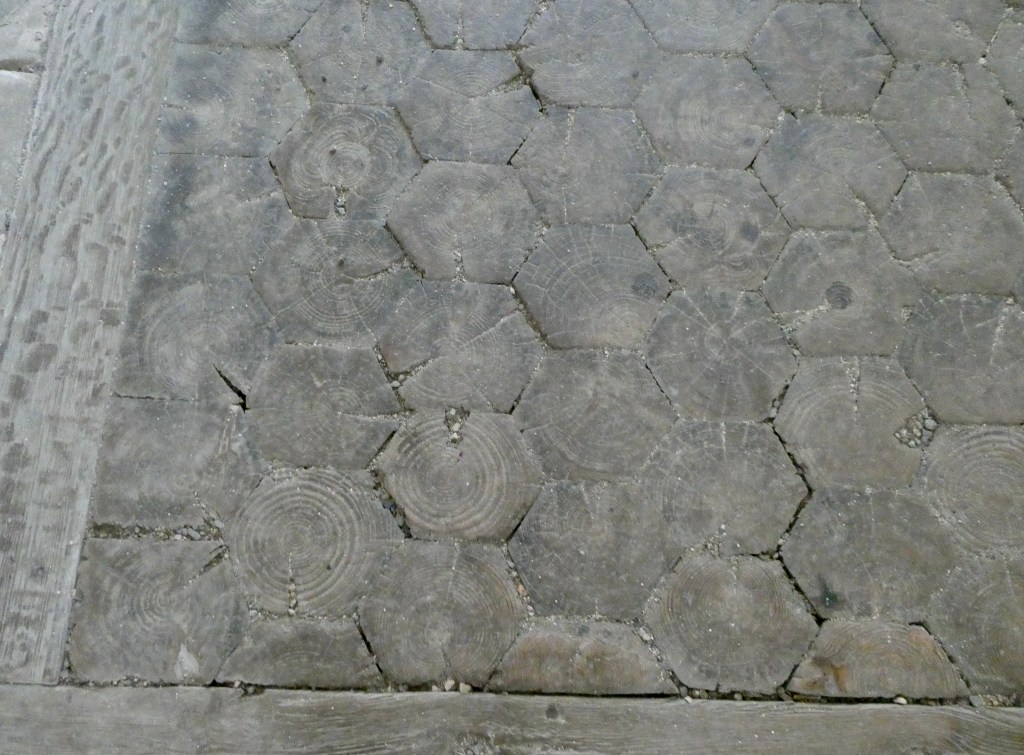
There are some wooden “cobblestones.”

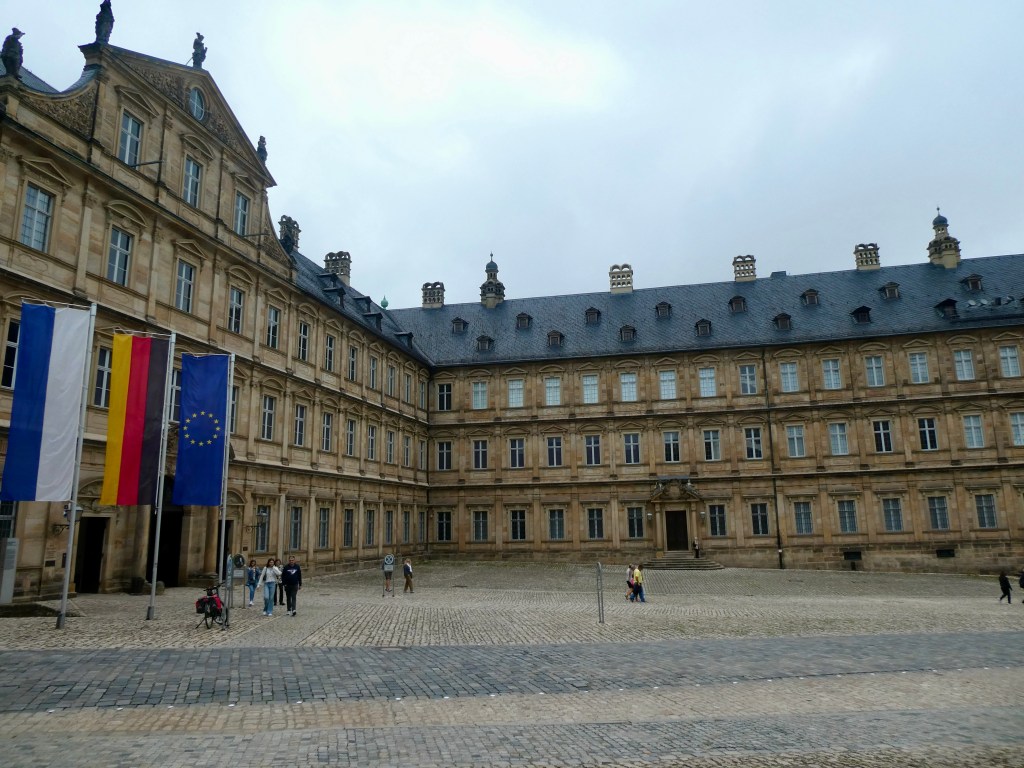
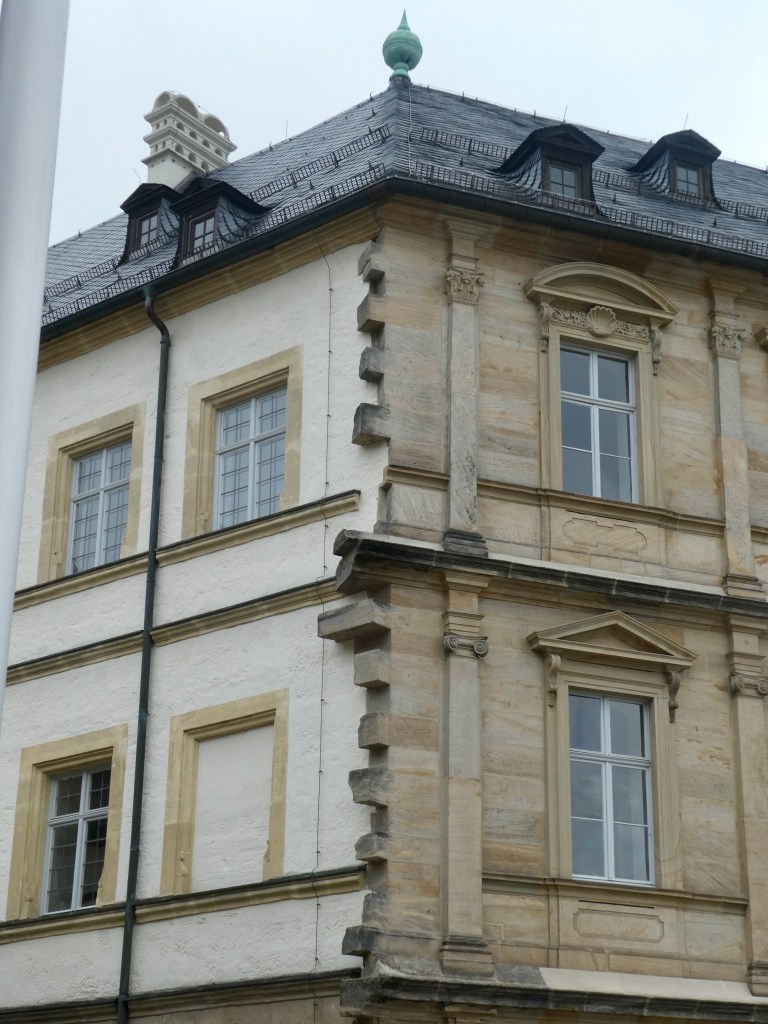
This government building was built in the baroque style.  That style is usually symmetrical but this building is in an L shape.  It was intended to be a U shape. 

These  waiting stones at the end indicate the building was not finished.

While visiting the building’s gardens, we saw that the windows in the back were painted with a 3D technique developed during the Italian Renaissance. Most of these “windows” are not real!

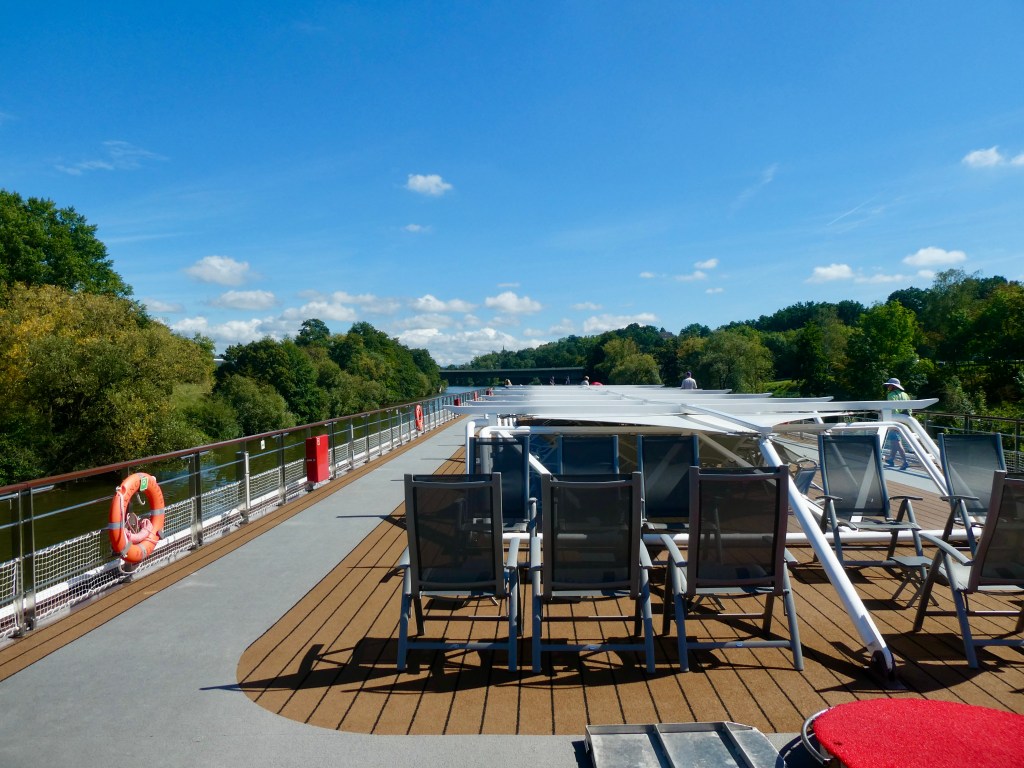
After our tour we were able to go back and spend some time on our ship while it traversed along the river.    When a bridge was too low, the observation room went down into the deck.   

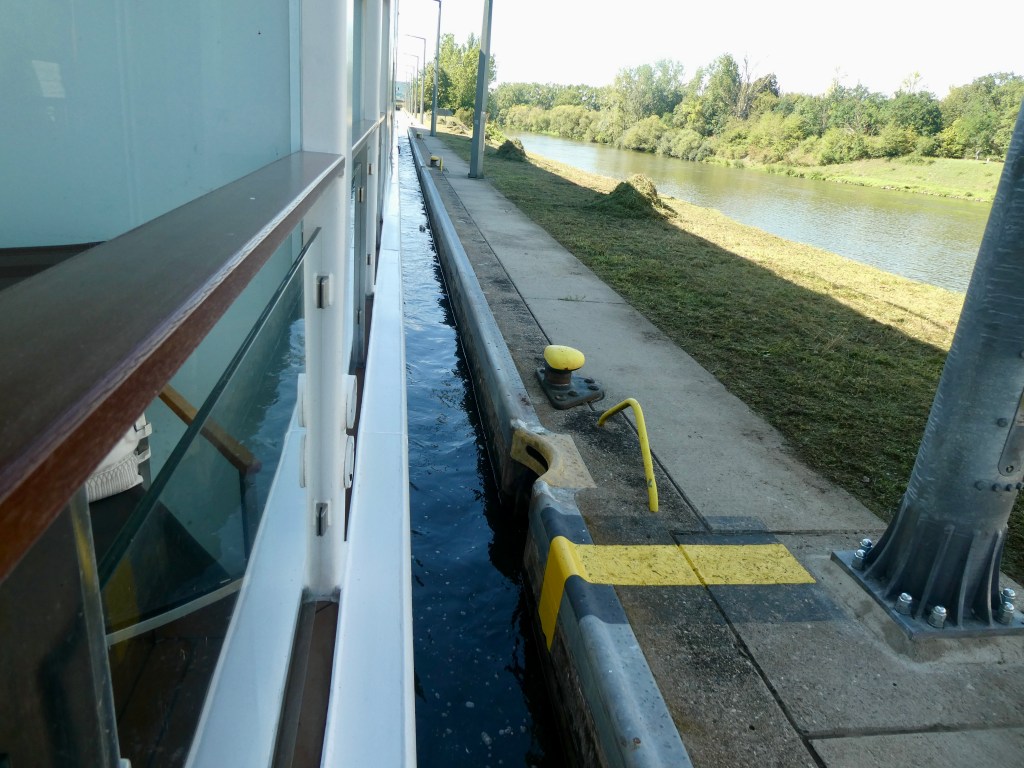
This was the first of 43 locks. 

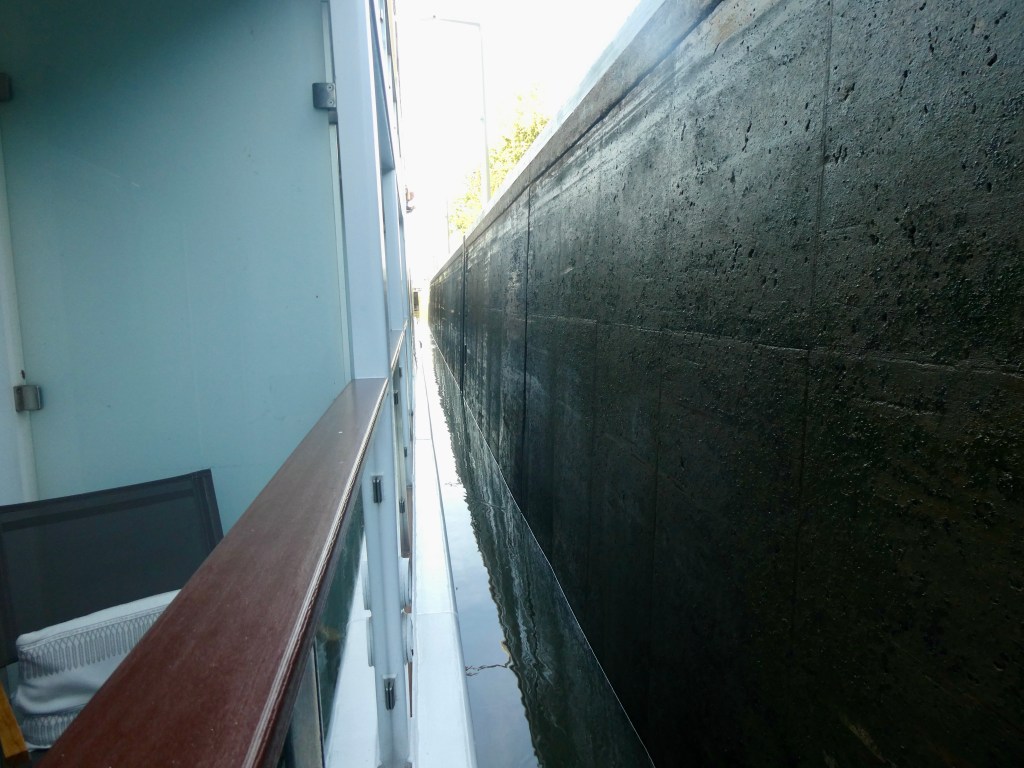
The best place to be, in my opinion, was our balcony.  I could reach out and touch the concrete as we went down about 18 feet in that first lock!   

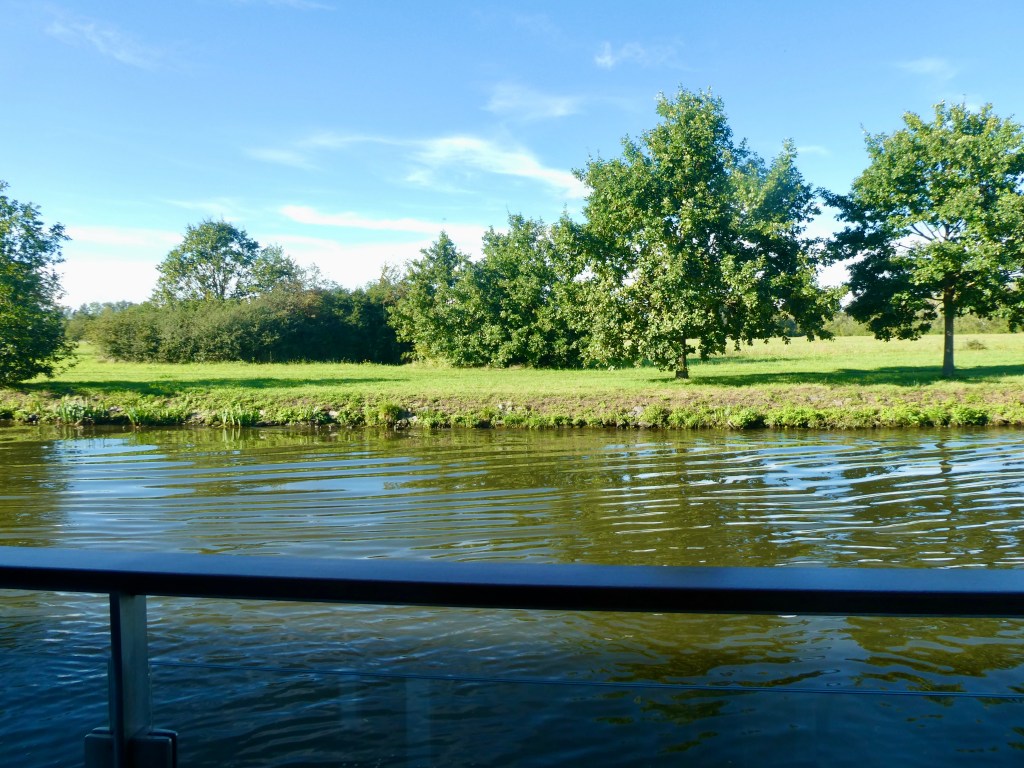
Afterwards it was nice to sit on the balcony and watch the water, just two to three feet below, with land about 25 feet away.

We went through several locks that day with more days of locks to come!

We visited Bamberg on September 2, 2023.

Next up: Wurzburg

Posted in Uncategorized | 1 Comment

Viking Cruise: Nuremberg and the Viking Alsvin

Leaving Prague, we traveled by bus to Nuremberg where we would board the Viking Alsvin after our tour.   

While on the bus, we learned there is “free travel” between the Czech Republic and Germany, as there is through most of Europe.  The autobahn has no speed limits for passenger cars but does have limits for trucks and busses. 

Germany has the largest population in the EU with 84.5 million.  That includes 1.2 million Ukrainian refugees. Germany is about one quarter the population of the US in an area the size of Montana so Germany is densely populated.

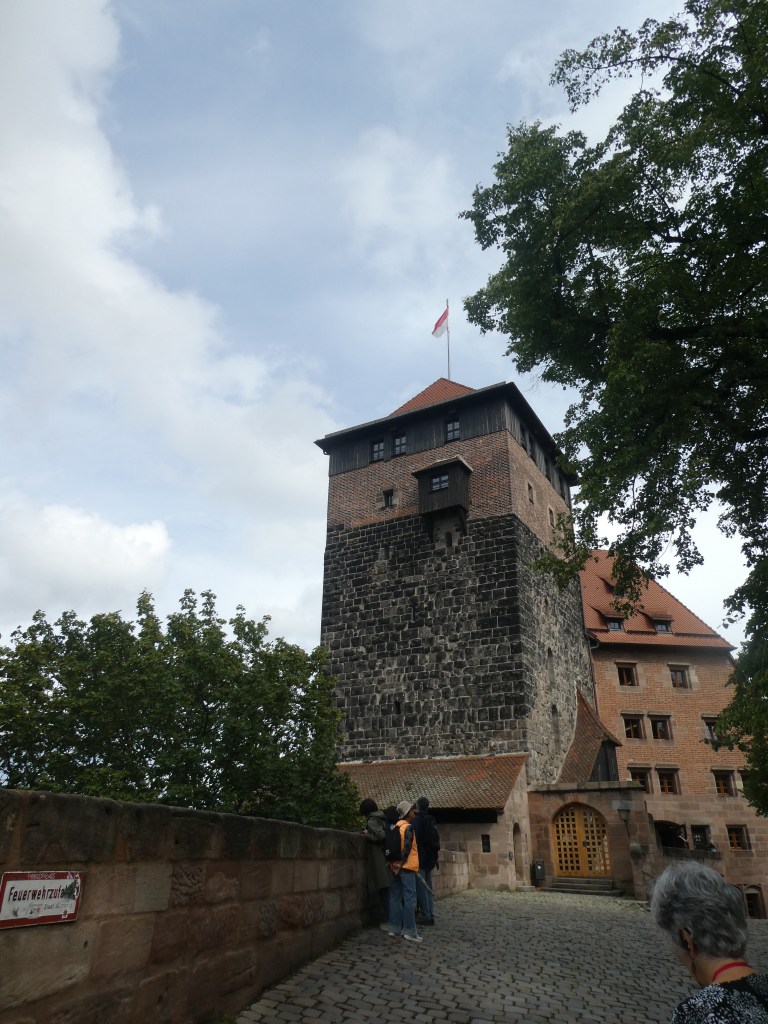
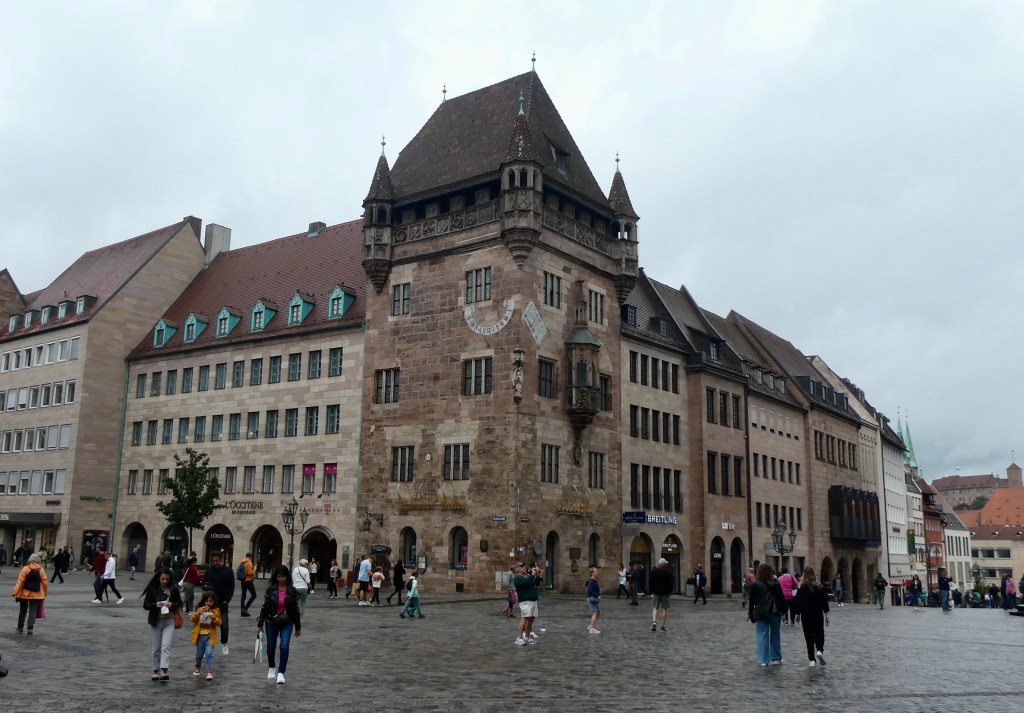
Looking back, Nuremberg was first mentioned in imperial documents in the year 1050.  This five corner tower dates from that era.

The location was at the center of 14 Trans-European trading routes.  Nuremberg became a free and independent city in 1219.  

The route we traveled was the same as a road developed by King Charles IV in the 14th century called the Golden Road.  He traveled from Prague to Nuremberg 52 times during his reign and each trip took 14 days one way.  There were also the hazards of wild animals and robbers.  King Charles acquired properties along the route by war, marriage and purchase in order to have a string of safe houses.  Travelers paid a road tax to travel on the Golden Road.   

The Prague to Nuremberg imperial road ended at this tower.  (It was also used as an air raid shelter during WWII.) 

When Christopher Columbus discovered new worlds, trade routes changed so the city went into decline.

1835 the first train in Germany was developed in Nuremberg marking the beginning of their Industrial Revolution.   Manufacturing brought people and some growth back to the city.

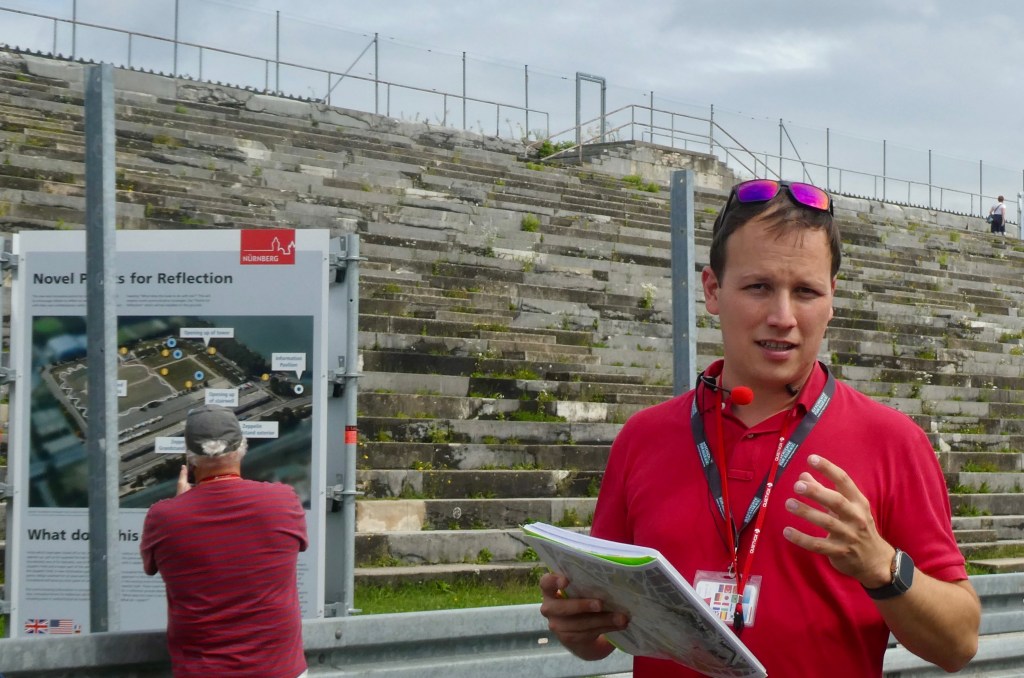
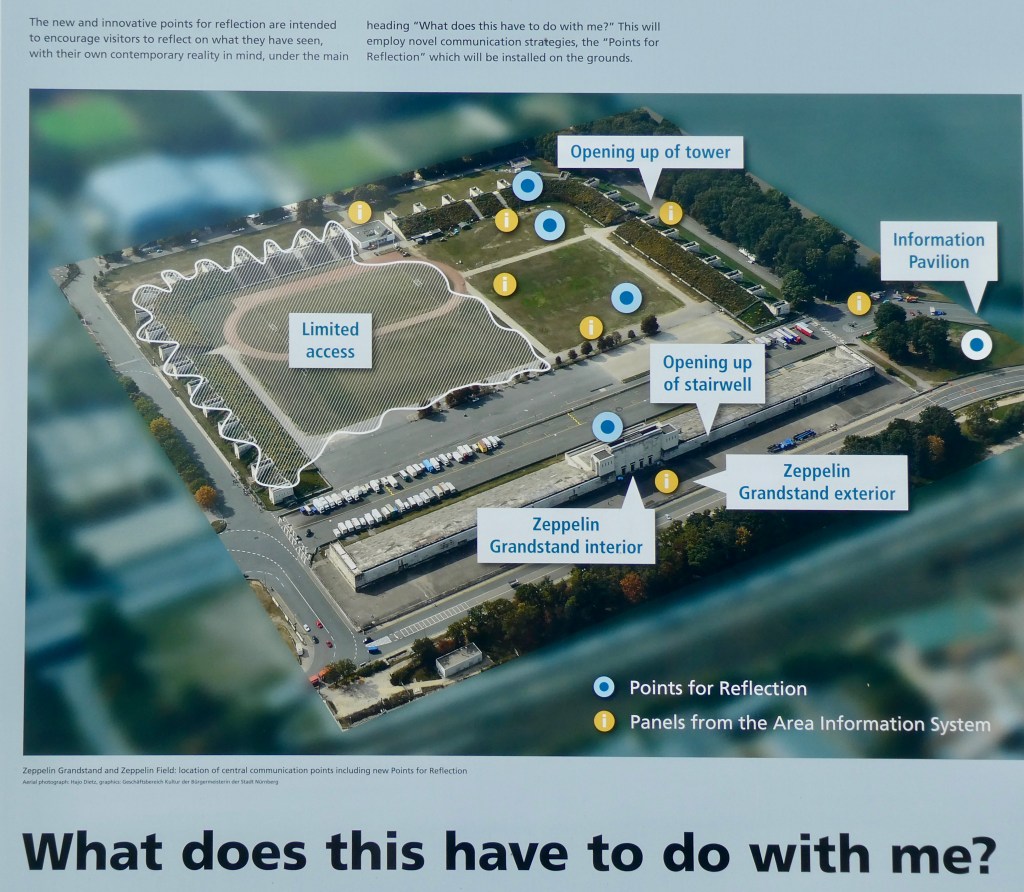
We were fortunate to have a great guide who told us about the history, the parade grounds and the work Germany is doing to keep it from ever happening there again.

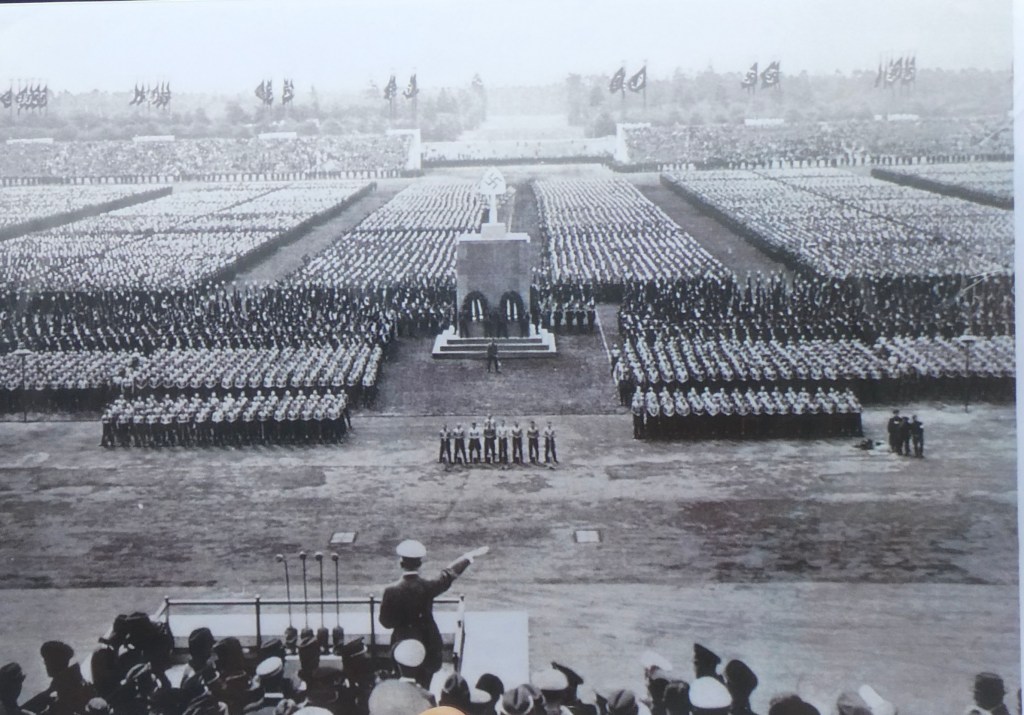
The Nazis took control of Nuremberg and their most important propaganda activities took place here between 1933 and 1938.  Nuremberg had been important in their Empire for 1000 years, and the Nazis chose Nuremberg specifically because of the propaganda importance. They wanted to usher in a new emperor in Hitler.

The Feuhrer made decisions about everything including the Zeppelin Field parade ground.  

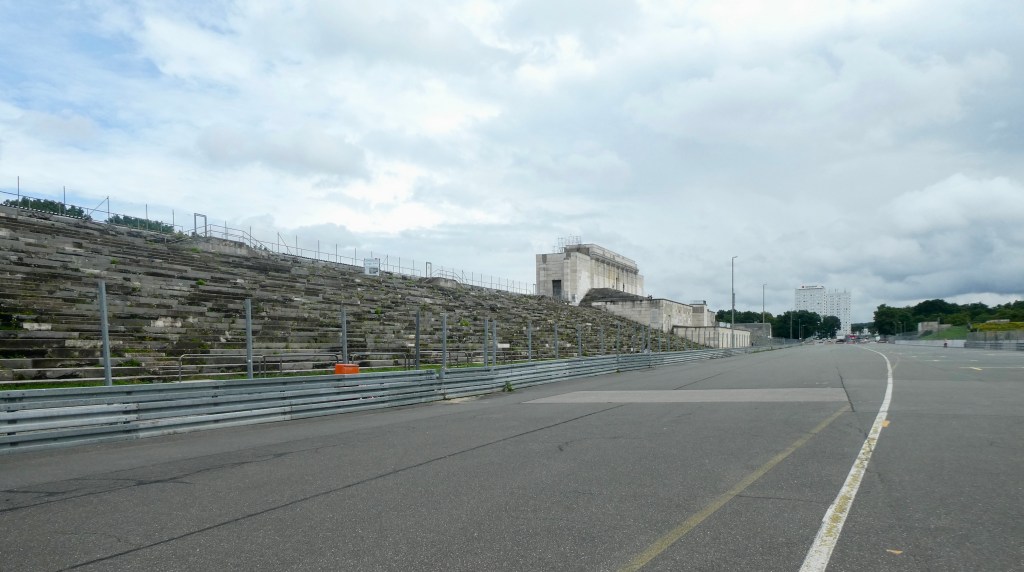
These parade grounds were proposed to be 16 square miles but were not finished before the war.  Still, it was four times the size of Central park.    

Rallies had 500,000 spectators and up to 700,000 participants.  The activities were designed to be spectacular to draw people in.  There were mock battles using current weapons.  Events lasted between 4 and 8 days and consisted mostly of speeches and personnel parades.

Germany invaded Poland in 1939 and the war was on.  

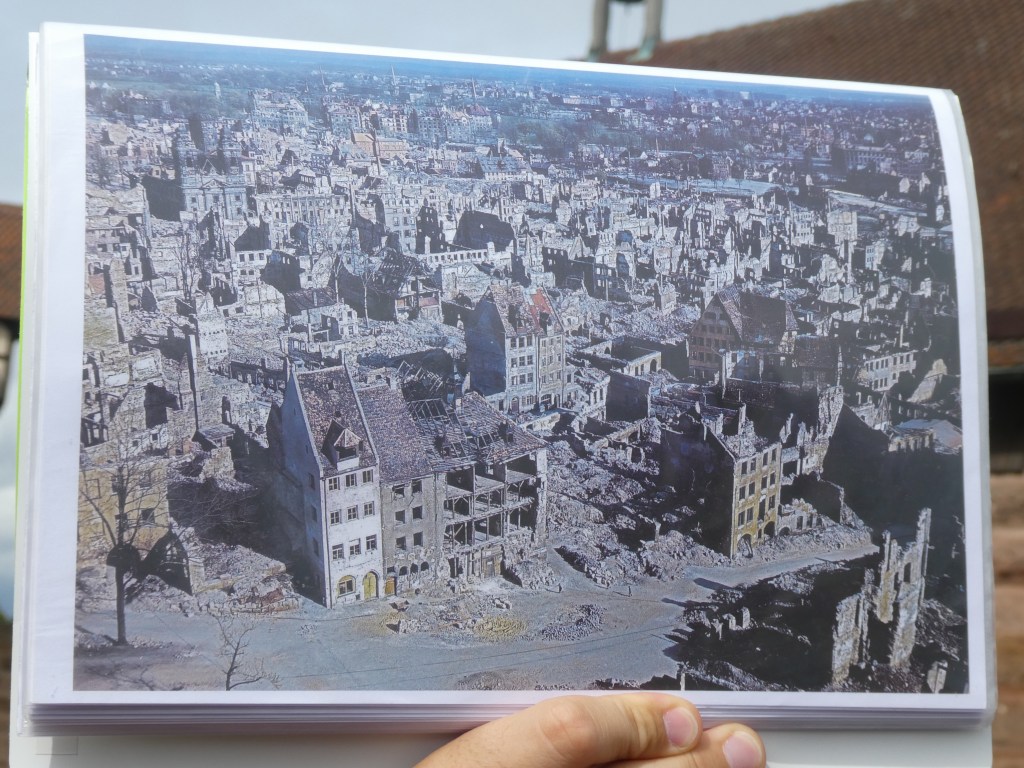
At the end of the war, damage was so extensive in Nuremberg that 91 percent of the city was reduced to rubble. If you’ve seen pictures, they are probably from Nuremberg.

In comparing the pictures you can see the light colored house survived WWII bombing. Much of the city was rebuilt (mostly by the American government) with the same medieval footprint as the old city.

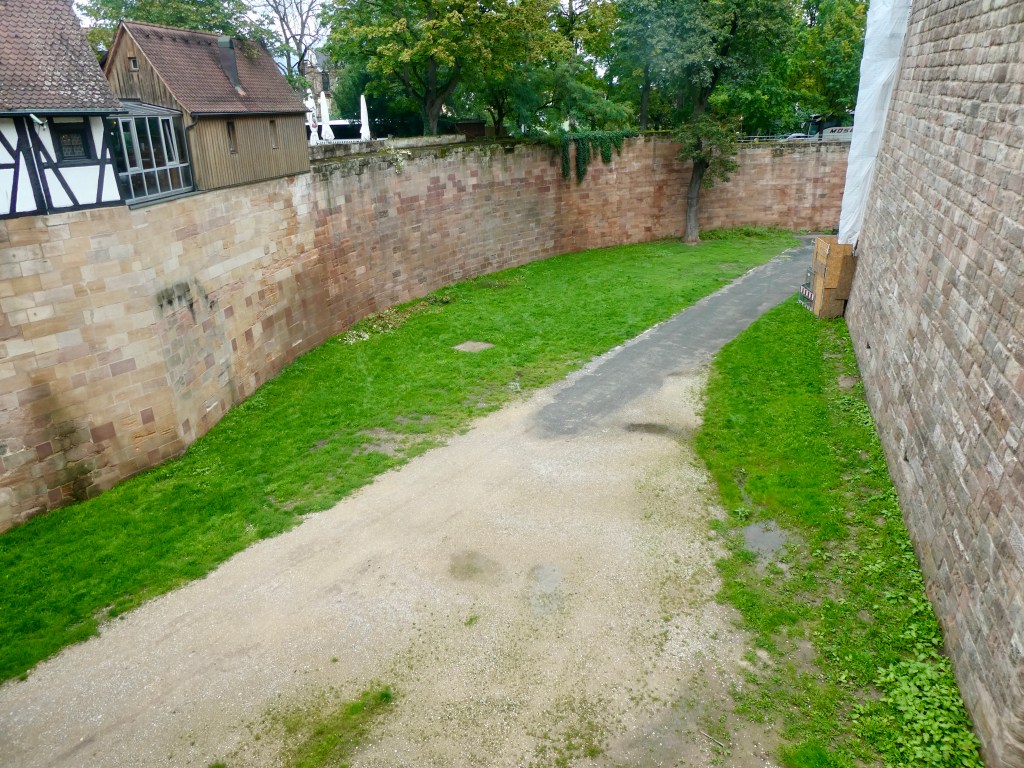
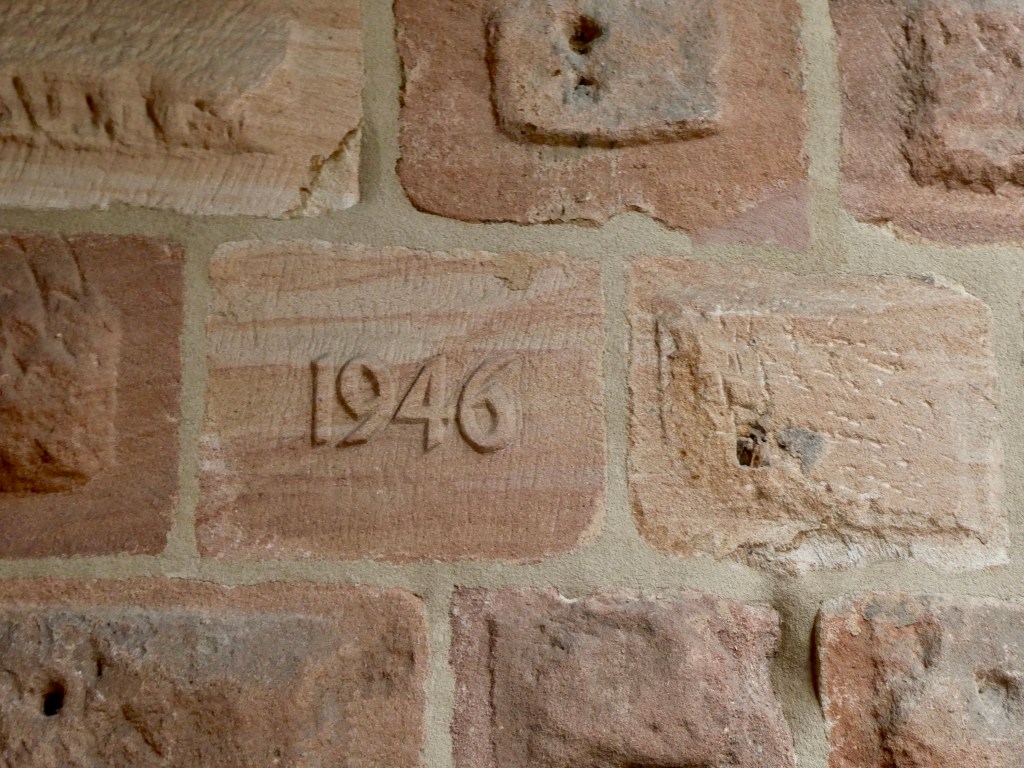
This is part of the old city wall of the medieval Nuremberg castle.  These walls are 80 percent original because sandstone doesn’t burn.

Throughout its thousand year history, the city of Nuremberg was never conquered until 1945 when the Americans did so from the air.

Medieval defenses included murder holes.  They would drop burning hot sewage upon invaders as a defense mechanism. 

After the war It seemed logical that the Americans would want the War Trials held in Nuremberg for propaganda purposes but that really wasn’t the case.  

The Grand Hotel was where lawyers for Nuremberg trials stayed.  

The proximity of a courthouse and adjacent prison was unique here.  As no one was sure how the local populace would accept their former leaders being put on trial it was beneficial to have them close. 

There was also the possibility of assassination if distances needed to be traveled. Instead, they could use the walkway between buildings.

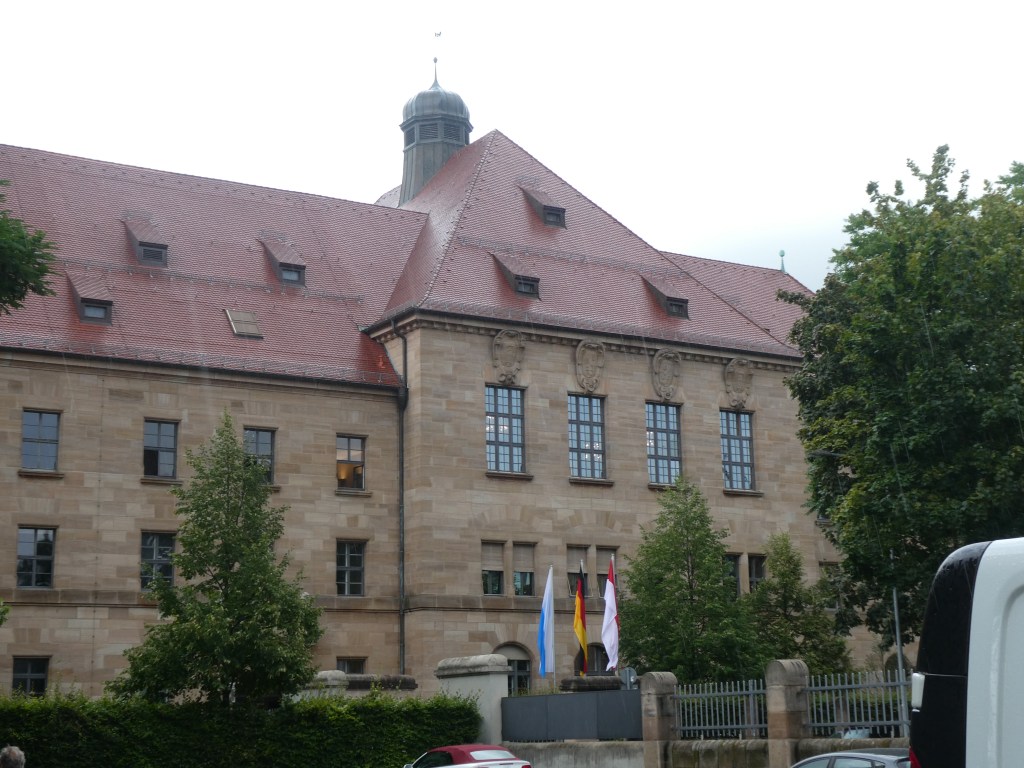
This was termed the Palace of Justice in 1945.  British and Russian governments were discussing assassinating Nazis for war crimes but exiled governments (like Norway) did not want retaliation to look like the Nazis would have done. 

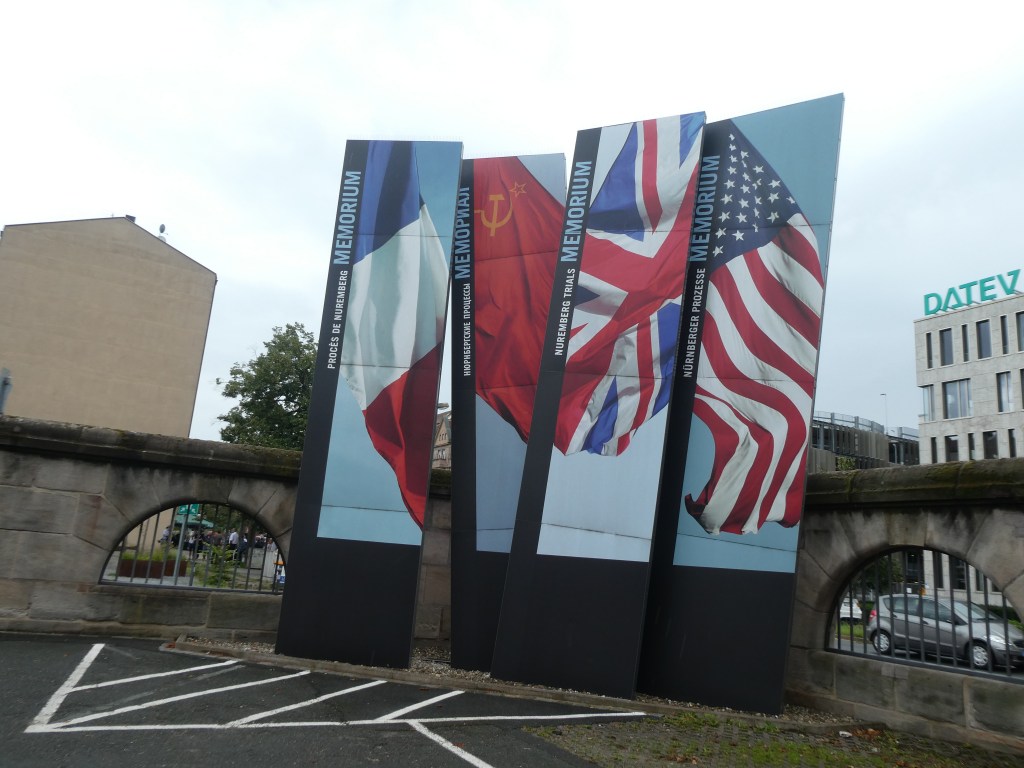
The United States, France, Britain and Russia agreed on four charges and the goal was to be done in three months.

The Americans wanted the largest courtroom.  Court room 6000 was the largest but it was still expanded. It is the room behind these four windows.

Journalists in attendance were Walter Cronkite, John Steinbeck and Ernest Hemingway. 

Prosecutors had a wealth of evidence and only one percent of files and evidence was used.   The trials lasted 11 months instead of three.

The most important defendants, who were still alive, were tried first. There were 22 sentences against 21 defendants with 12 death sentences. The convicted were executed and cremated so there were no graves. Trials resulted in seven prison sentences between seven and ten years.  There were three acquittals.

Stalin wasn’t happy with these real trials. He was used to show trials with predetermined results.

The Americans held 12 more trials in Nuremberg with 177 defendants.  There were 34 additional death sentences. These 13 trials are considered the beginnings of international justice.  Other countries conducted additional trials on their own.

Part of what happened when the Nazis were in power was that the people weren’t required to think anymore. They just followed the party line. After the war, in the 1950s and 1960s, the Germans tried to ignore their past.

From 1970 to the present, they have decided to confront and teach their history.  

More and more education centers are being built to support that effort.

One million German school children come to Nuremberg every year to learn about Nazi propaganda.

Eighth graders are required to visit a relevant Nazi site and experience first sources so the history can’t be whitewashed.  The goal is to limit future support of extremists.

I appreciated learning these karma things:

American soldiers paraded on the Zeppelin grounds after World War II.   Bob Dylan performed on those same grounds with Eric Clapton in 1978 – Dylan was Jewish. 

This red brick building was built for Nazi barracks but never used.  Following WWII, American service members stayed there for decades.  Now it is a government building for Immigration and Refugees. That seems a perfect answer for a former nazi  building!

We were very impressed with our first stop in Germany.

The rebuilt city is lovely, but most impressive is their willingness to confront their past and try to learn from it to prevent it from being their future.

We learned that Nuremberg is famous for gingerbread made without ginger.  I like really spicy gingerbread and neither of these worked for me.

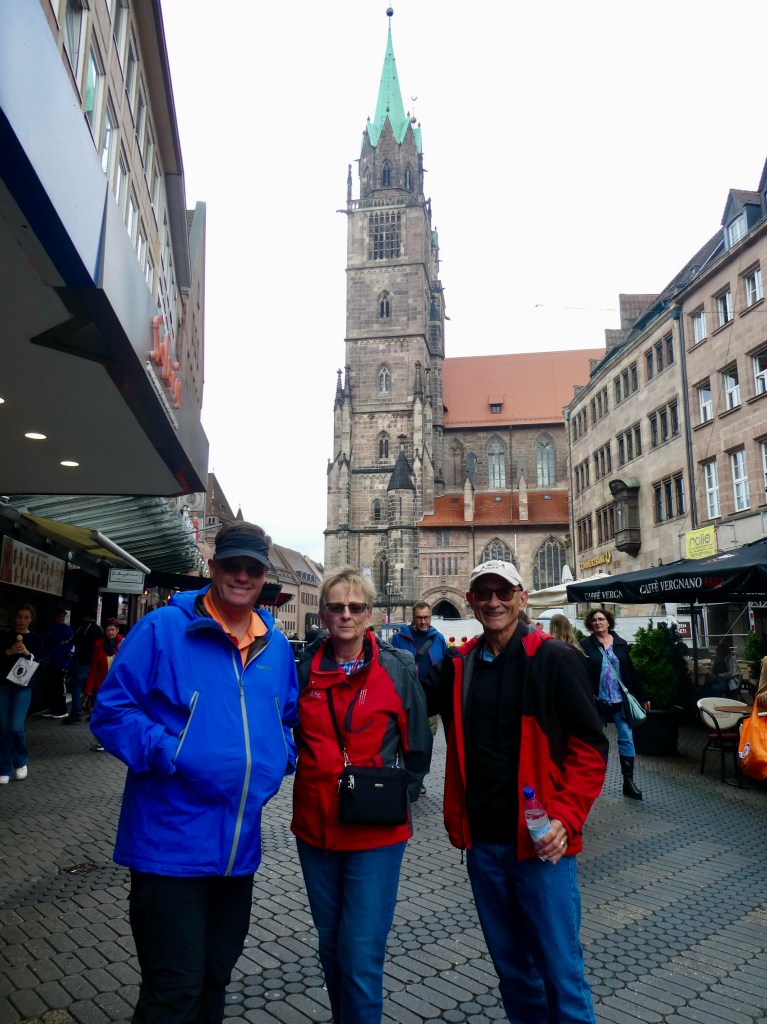
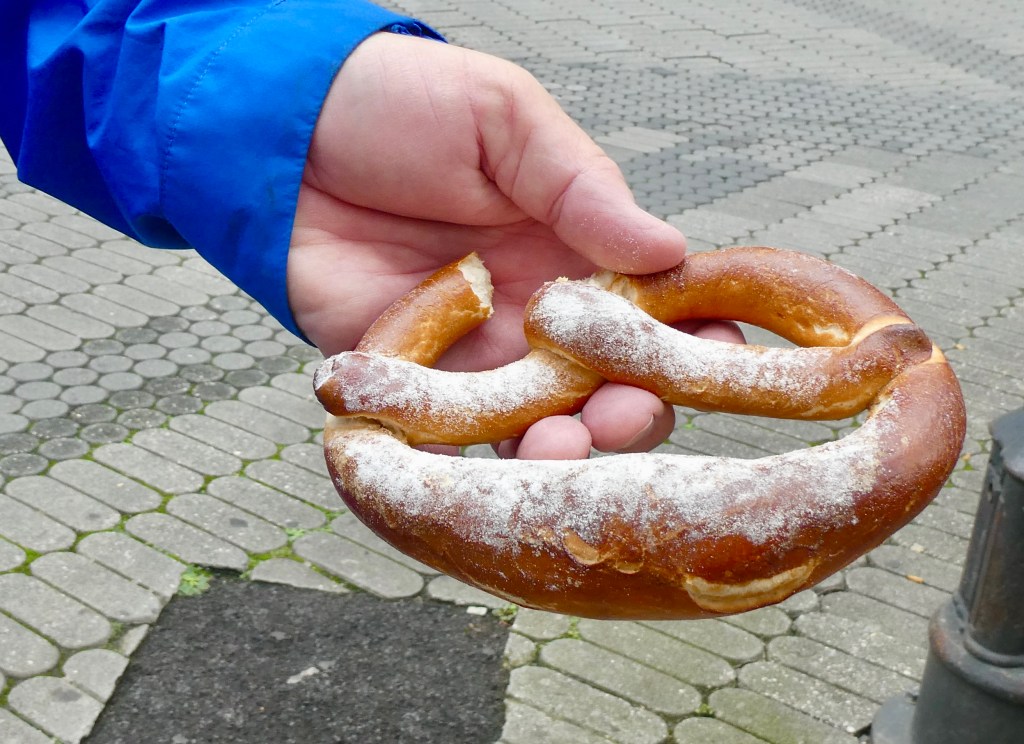
Randy had looked forward to trying an authentic German pretzel!  This one was purchased from a vendor cart but had been made earlier in the day and was cold and tough.  Disappointment!

They also make a specific kind of sausage, supposedly the oldest recipe in the world.  They produce seven million links per day. Nuremberg also has their own Red Beer.  This type is  bottom fermenting with a roasting temperature of 100 degrees Celsius.  Temperature determines beer color.

We arrived at the port and boarded the Viking Alsvin.  

We found our cabin.

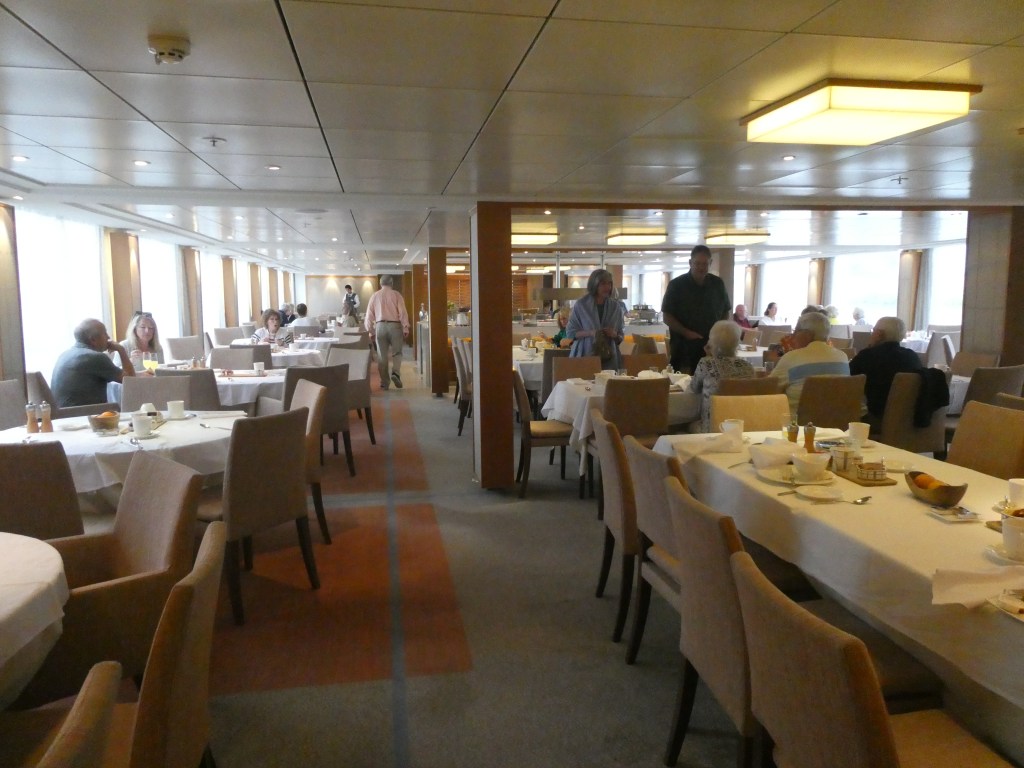
And the dining room where we would eat all our meals.

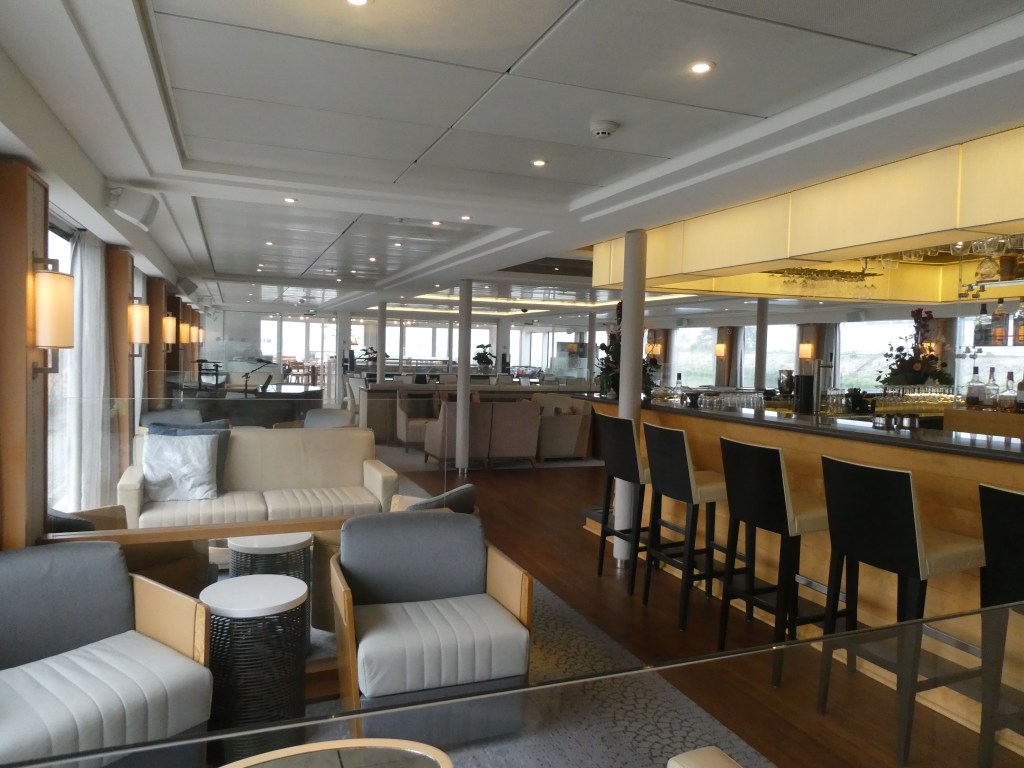
We found the lounge where everything else happens.

Depending on bridges and weather, we sometimes had access to the open deck above.

Next up: Bamberg and the First Locks

Posted in Uncategorized | 1 Comment

Prague Castle

From a distance we can see Prague Castle.  The complex actually holds four castles, built from the 9th to the 18th centuries.   It is the largest ancient castle complex in the world. The four castles include the old royal palace, Queen Anne’s summer palace, the Lobkowicz Palace and the new royal palace.  There are also a number of other churches and buildings on site.

We had a closer view as we approached the castle complex.

It was once surrounded by a green moat – not quite water with alligators, but the exposure was still able to be a deterrent to aggressors.

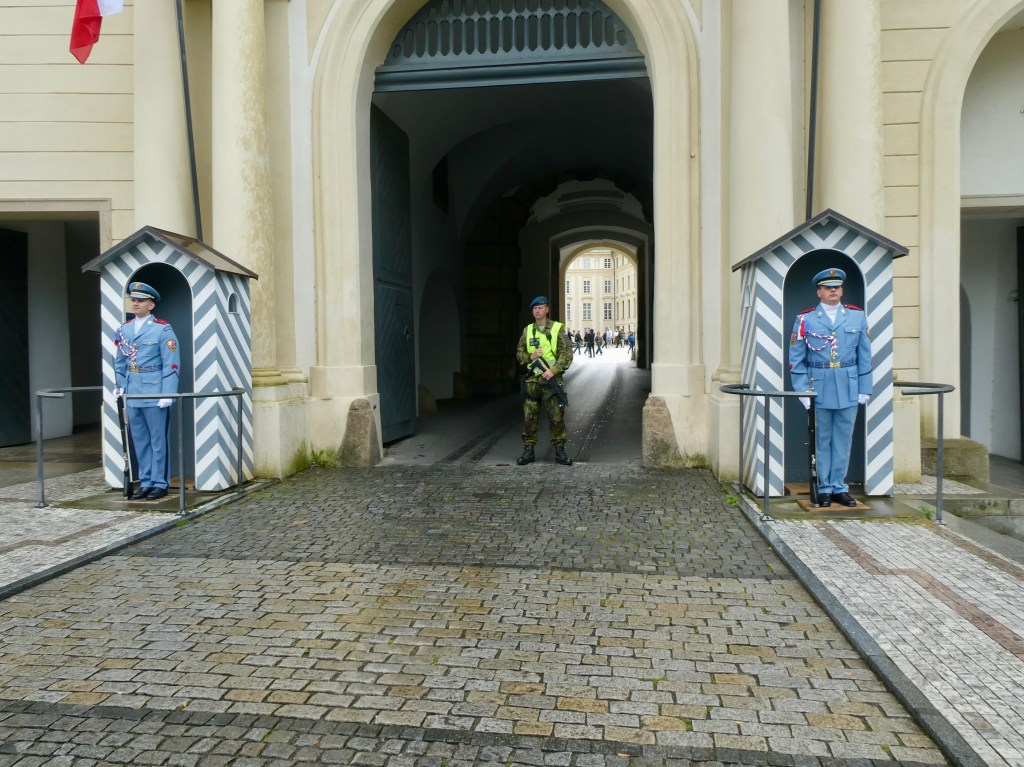
We passed the guards of the Prague Castle. 

Their uniforms were designed by the same man who won an Oscar for the movie Amadeus.   He was a Czech immigrant.

The gold star at the top of the cylindrical building means the Czech President is in the country. Currently, the castle complex houses the official office for the President. It had previously been the home for kings of Bohemia and Holy Roman Emperors. 

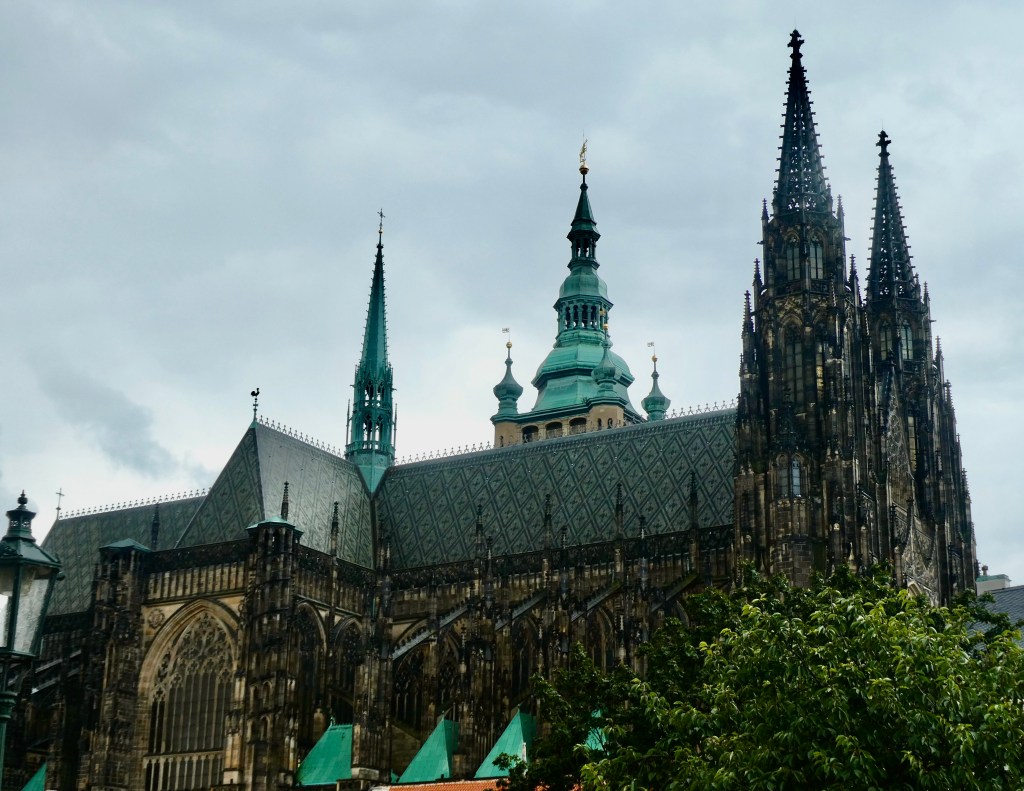
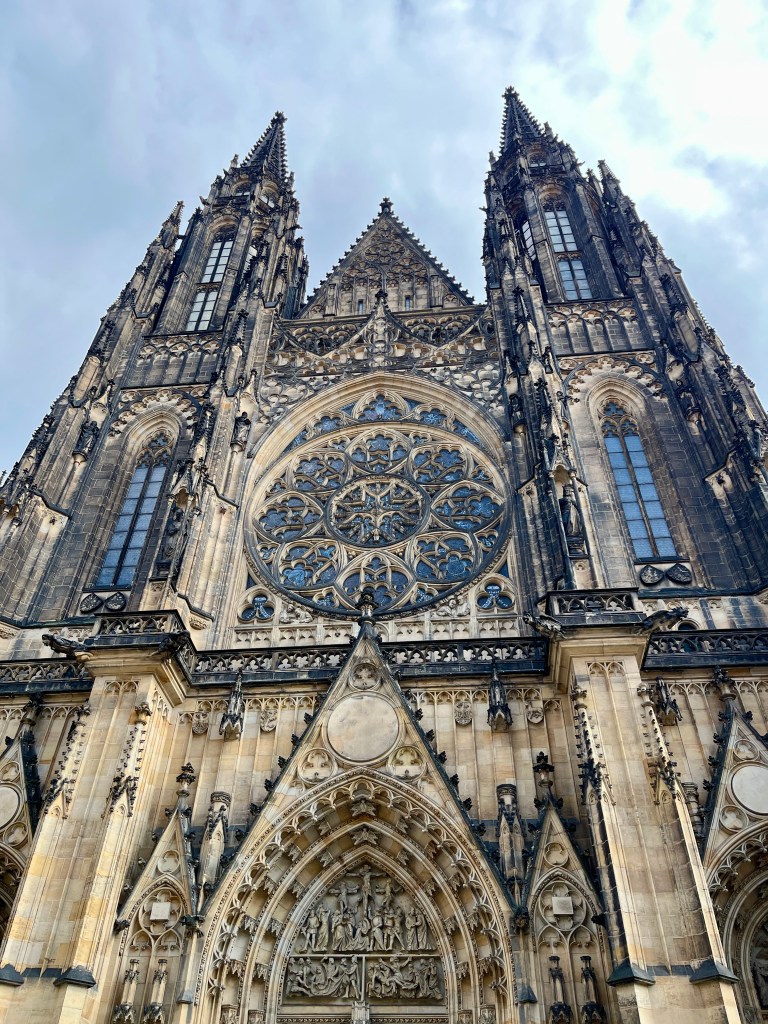
The St. Vitus Basilica was founded in the 10th century by Duke Wenceslaus.   

There have been three evolutions of the St. Vitus Basilica on the site.  

The current gothic style church  was started in 1344 by King Charles IV and was not completed until the 20th century. 

It remains the most important cathedral in the Czech Republic and many former kings and Holy Roman emperors are entombed there.

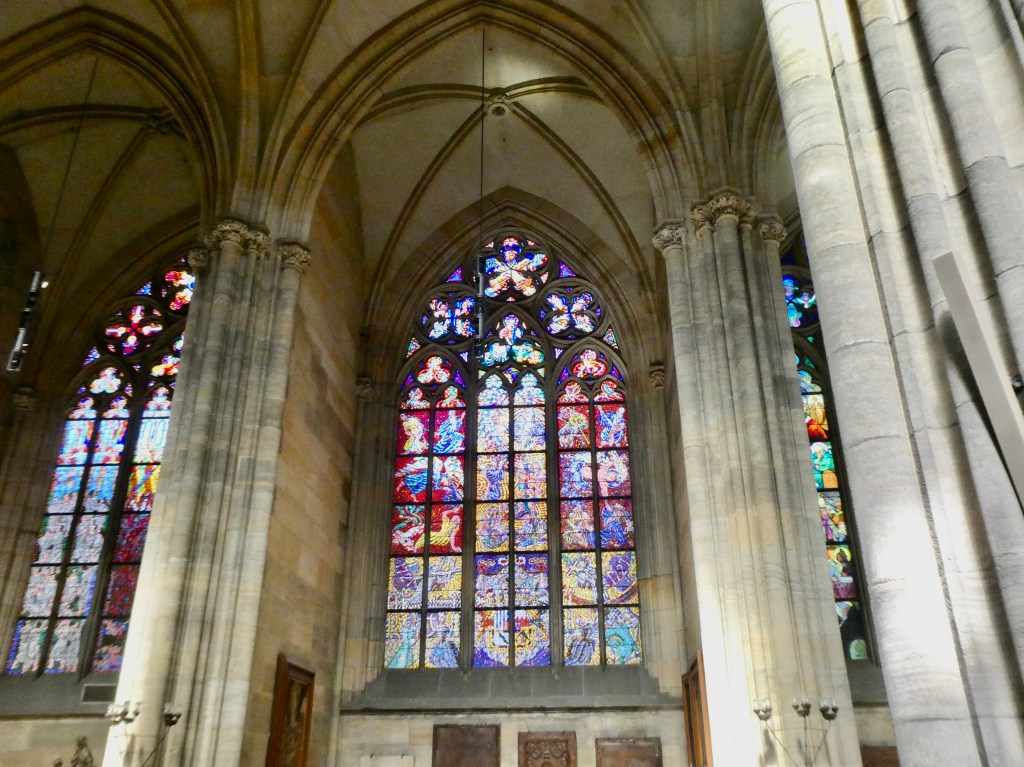
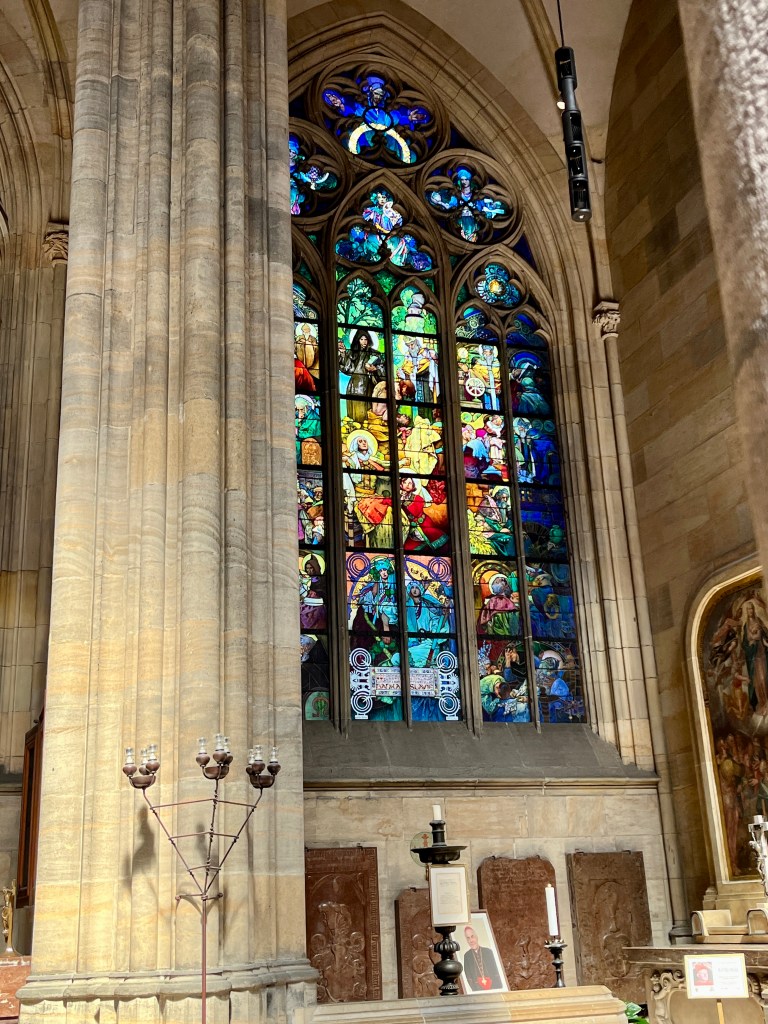
There are many side chapels in tribute to different peoples and saints.

A new organ from Spain will be installed soon.  It has been in the country for a year but they found the balcony needed to be strengthened before it could be placed. 

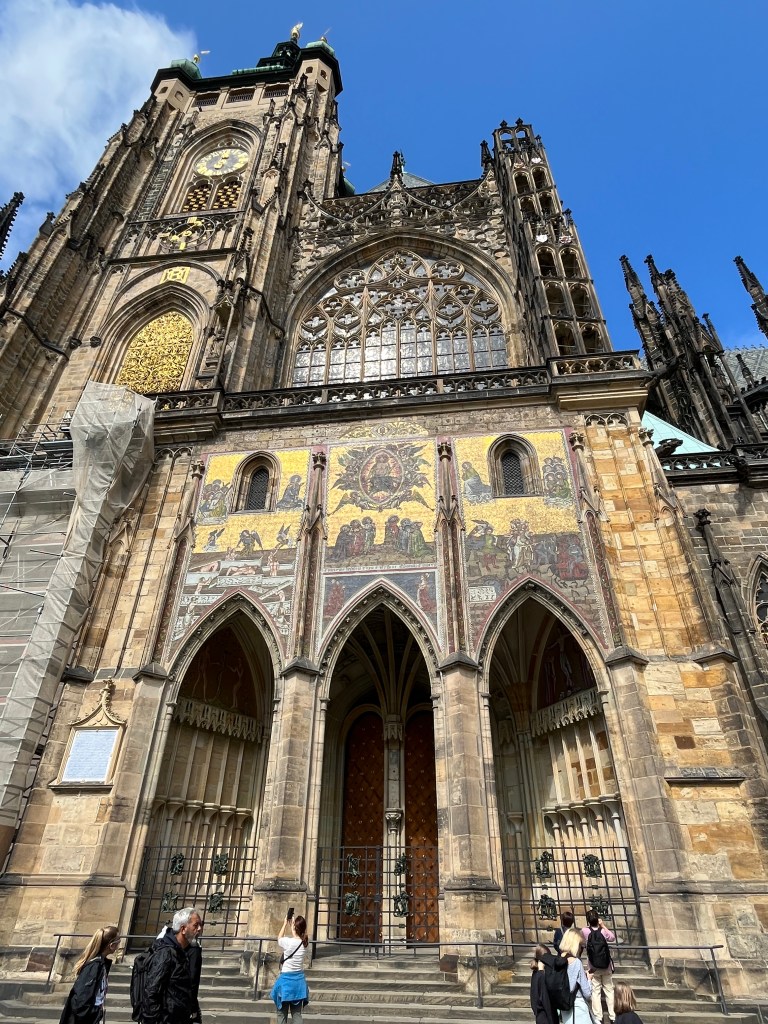
That will happen 100 years after the rest was finished.  The flying buttresses are of the French gothic style on St. Vita Cathedral.

The clock above the main entrance shows the hour hand above, and the minute hand below.

The royal palace was rebuilt In the 14th century, under Charles IV.  This section shows the architecture of the old palace before the rest was sheathed to look alike.

There was a covered walkway between the royal palace and the cathedral.

The building on the left is Saint George Church.  It is the oldest church in the complex being from the 12th century.  The building on the right was named for Maria Teresa, Queen of Bohemia and Hungary from 1740-1780.  The building provided accommodations for Nobel Ladies who were not married. 

This palace is now used for Presidential Offices, not for a presidential home.

After the great betrayal, Czech President Emil Hacha had to negotiate to hand over his country to Nazi Germany.  He suffered a heart attack during the negotiations on March 15, 1939.  Later, Adolf Hitler proudly spent a night in Prague Castle.  

In addition to the public access buildings in the Prague Castle Complex, there is one privately owned building – the Lobkowicz Palace. The palace was started in the 16th century by one brother and then completed by the next.  

The daughter of the second brother, Polyxena, married her first husband who died shortly after.   A few years later she married the First Prince Lobkowicz.

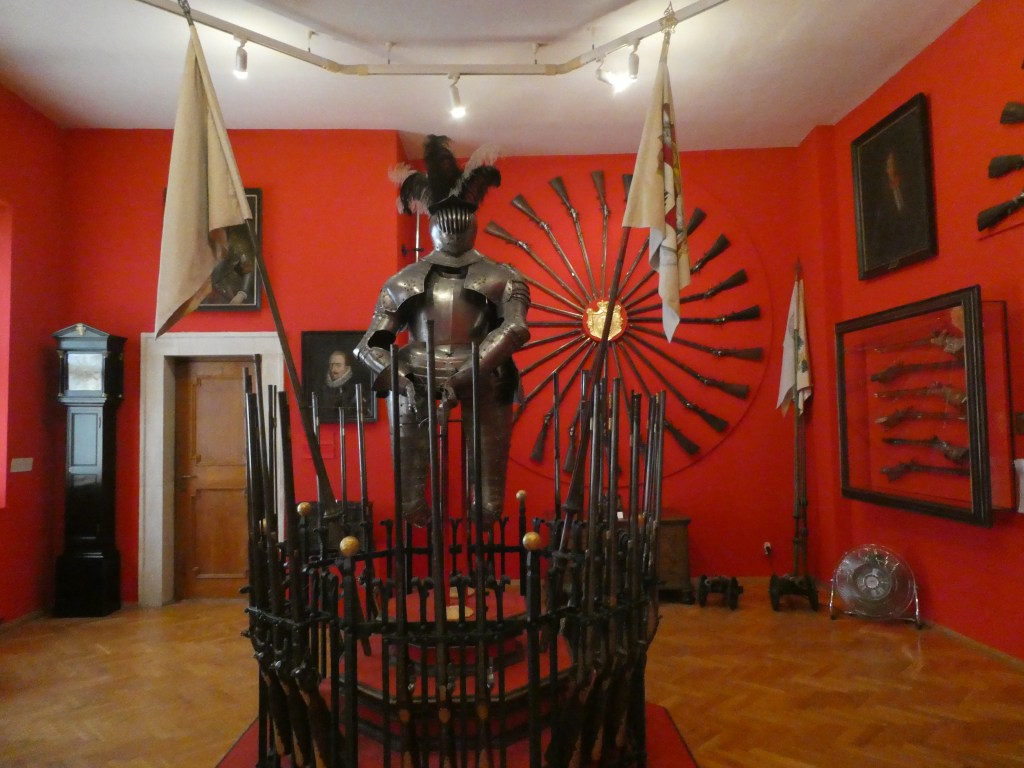
The galleries in the castle show their private collection of art and explain the family dynasty.

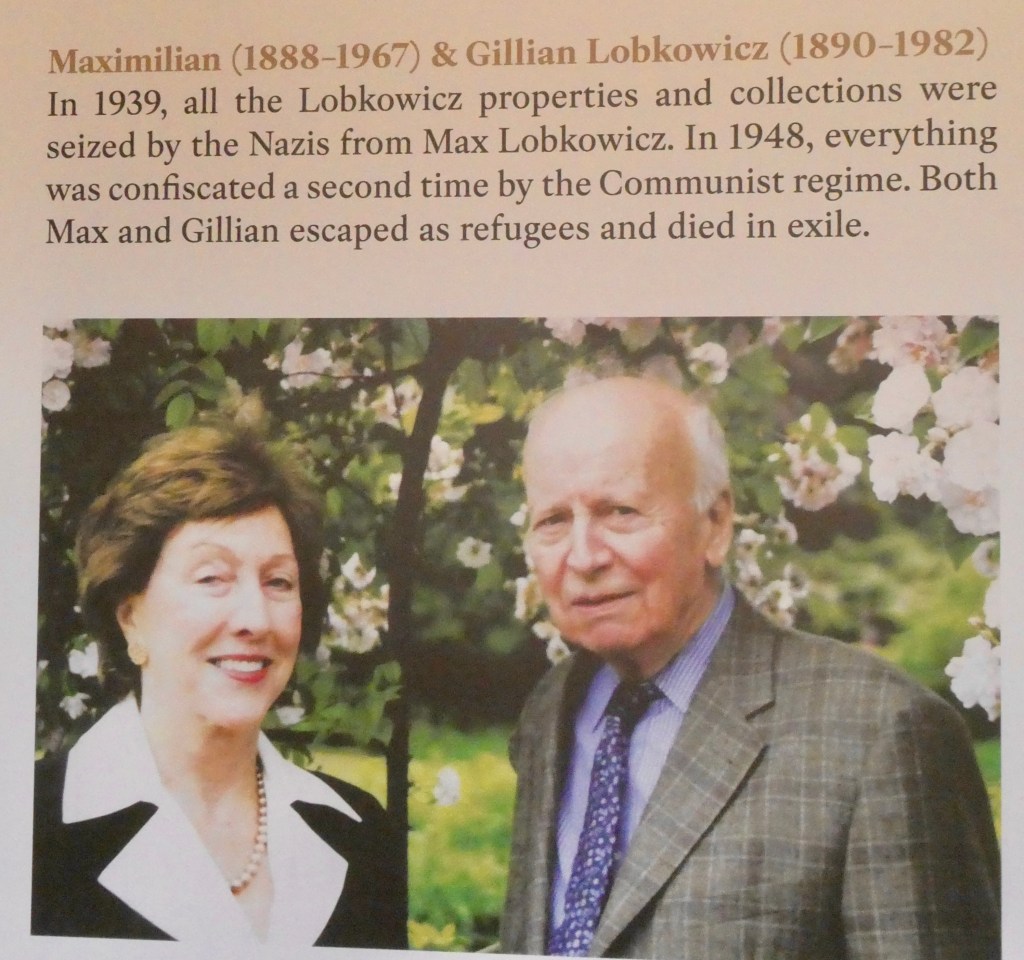
The Lobkowicz family was one of the wealthiest in the country under the Hapsburg dynasty. They were forced to flea the Nazis in 1939 when the palace was confiscated.   

After the fall of Communism in 1989, there was a twelve year restitution process to return the castle to the Lobkowicz family. After restoration and refurbishing, the palace opened as the Lobkowicz Palace Museum.

After lunch at the castle, we enjoyed a concert.

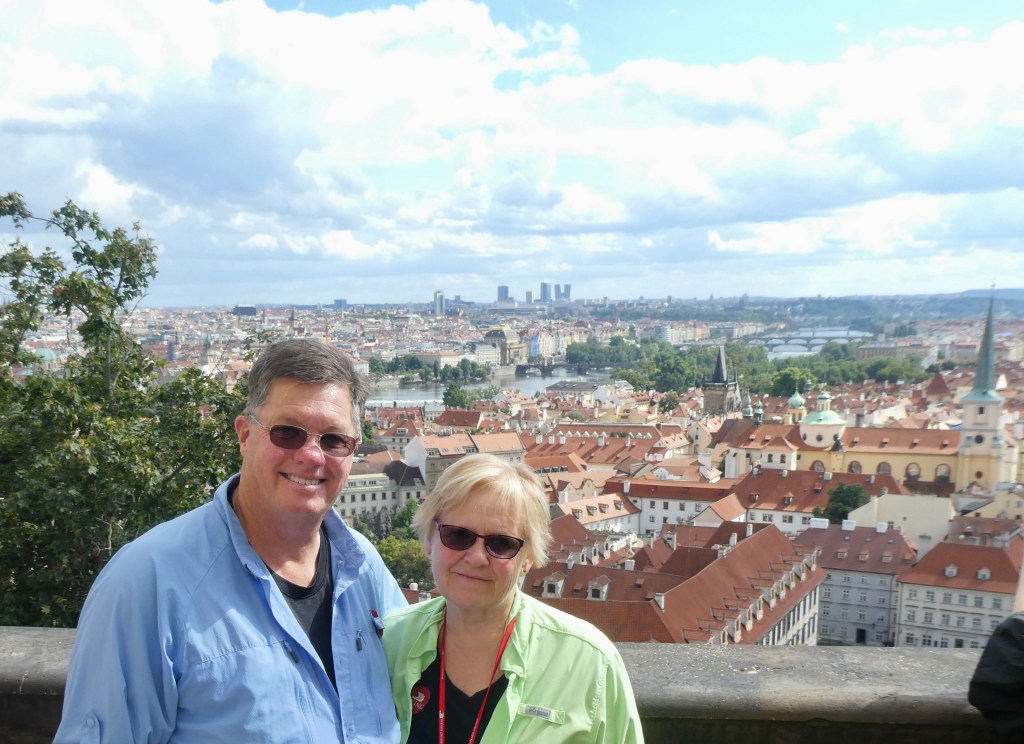
We were able to enjoy views of Prague from the balconies in the castle complex.

The buildings with red roofs were the original footprint of medieval Prague.

The Rolling Stones played several concerts at Prague Castle after the fall of communism, becoming friends with Czech leaders.  

The Stones paid $32,000 for illuminating Prague Castle for the enjoyment of the city residents and visitors. Photo credit to Connie who stays up much later than we do!

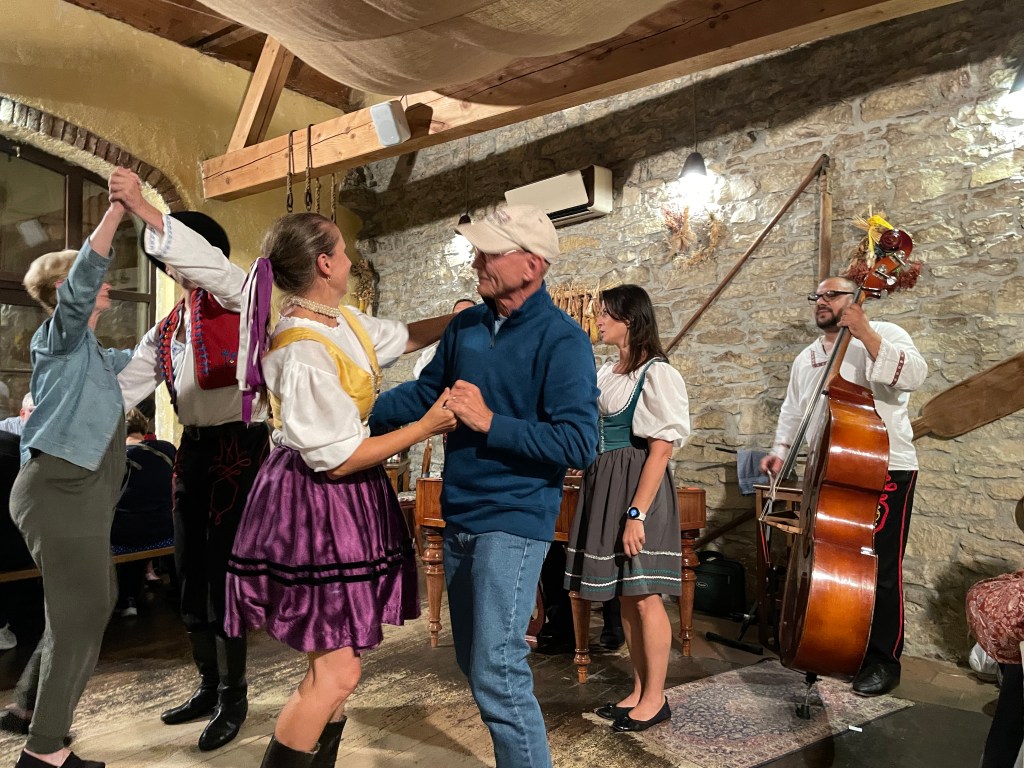
On our last night in Prague we enjoyed the Prague Folkloric Dinner that we had to reschedule from our first night.

The meal, served family style, was good!  There were also generous amounts of beer and wine available.

The entertainment was delightful.

Warren surprised us with his expertise on the dance floor!

Prague was great. We understand why so many people love Prague.

Next up:  Nuremberg, Germany

Posted in Uncategorized | Leave a comment

Our Prague City Tour

We began our Prague City tour in the Jewish quarter.  It was once a ghetto for Jews and the poor.  In the late 1800s it got so bad that the city of Prague cleaned it up and provided new sanitation measures.  The area then became highly desirable to all Prague residents.

This 1911 building, trimmed in gold, has Jewish artistic features.

This statue of Moses was melted down by the Nazis during WWII.  After the war, the artist’s wife still had the original mold so it was remade.

This is the oldest Jewish temple in central Europe.

The temple has two clocks – one Christian and one Hebrew.  They go in different directions!

Czech, German and Jewish people lived peacefully together here for centuries.  One hundred and thirty thousand Jews lived in Prague prior to World War II.  Thirty thousand of them left just before, or at the beginning of the war.  About 90,000 Prague Jews were murdered so only 10,000 returned.

After the war, the remaining Germans were expelled so the population was overwhelmingly Czech.  The country was not very diverse.  (Recently, the Czech Republic has taken in more Ukrainian refugees than any other country in the world.)

At the end of the World War II, the Americans stopped at Pilson – only one day away from Prague.  In the end, Stalin got the Czech Republic in the world re-sorting. The Czech people suffered for decades under Stalin and Communism.

We visited the 11th century Old Town square.

There are interesting buildings all around the square.  

The Church of Our Lady Before Tyn is gothic style. Construction began in the 13th century but was not completed until 1511 when the south tower was finished.   We did not go inside.

Our guide explained that, despite the number of churches in Prague,  the Czech Republic is 90 percent agnostic.  Over centuries, and for lots of reasons, faith just isn’t a thing in the Czech Republic.  It cannot be accounted for solely by decades under communism because faith levels in other countries experiencing the same have rebounded.   But, she did say they have the highest library density in the world!

Very nearby the square is the famous Prague Astronomical Clock. Built in 1411, it is the oldest astronomical clock in the world. Many people were gathered to see all the things that would happen at the top of the hour.  Fortunately our guide told us what to watch for and where.

The clock shows time passing in several ways.

The outer ring tells the Prague local, or Central European Time, using gold Roman numerals. Another dial separates into 12 parts for the unequal hours between sunrise and sunset, and vary as the days grow longer or shorter during the year. The large black outer circle has another movable circle marked with the signs of the Zodiac.   

The clock suffered burn damage during WWII, but the components survived and the clock was reconstructed.

As we walked around nearby, the goal became to take a picture of the clock without people in the view.  Randy got it!

Then we could enjoy some souvenir shopping in the area.

VJ Rott was a hardware store from 1840 – 1990.  It continued through communism but did not make it through the exodus of people actually living in the historic district. 

The water fountain worked for centuries, but did not survive the flood of 2002.

As we moved towards the Charles Bridge, we crossed under the  tower where Czech students stopped the Swedish Army when they were trying to invade in 1648.  (I don’t know about you but I had to reset my mind around Sweden being European aggressors. There was a real thing called the Thirty Years War.) 

This is King Charles IV, the most important ruler in the history of the Czech people.  His reign allowed them to flourish.   

There were many artisans along the bridge and a festive atmosphere.

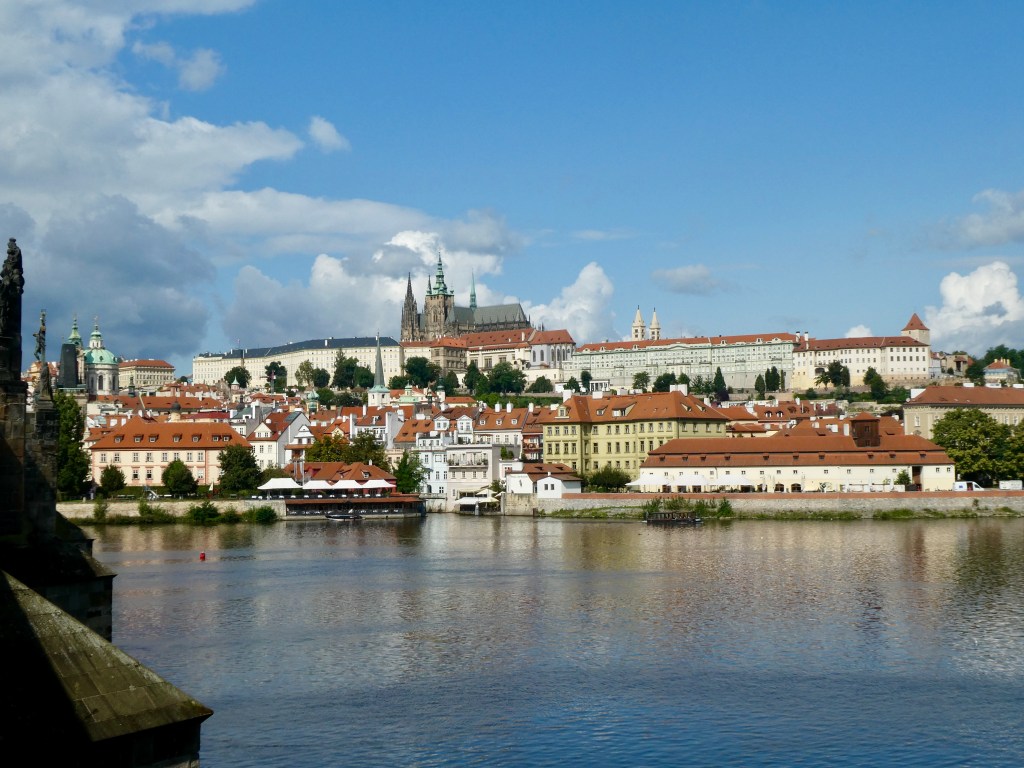
We had a lovely view of the medieval city and Prague Castle.

The view from the Charles Bridge to another.

There is an Eiffel Tower replica visible from the bridge.  It is 1/5 the size of the original in Paris.

This is a famous Prague photo-op with many centuries available in one photo.  The lower bridge tower is from the 12th century while the other tower is from the 15th century. In between is 16th century architecture with 18th century architecture to the right.

These type of architectural opportunities are unique to Prague with architects and students coming from all over the world to study.  This is because the city did not suffer the damage that other European cities did during WWII as the Allies concentrated on the industrial outskirts of the city.  

(Prague is still primarily an industrial city.  They make more cars per capita than any other country.  Skoda was the traditional Czech brand, later purchased by Volkswagen.  They also make buses and supply automotive parts, primarily to Germany.  They also have an industry to make hand guns.)

On the other side of the Charles Bridge was the Prague Firefighters Memorial to New York City firefighters after the attacks on 9/11.

We walked through Little Venice.

We walked through the Lesser Quarter, meaning the quarter is  smaller – not less important.  A massive fire in 1541 destroyed much of Lesser Quarter so the architecture remaining is mostly Baroque style.

Over time personal castles became government buildings and embassies.   This one is the US Embassy.

The church of St. Nicholas was known as the spy church as the  secret police used the high points to spy on embassies in the area. 

This was, maybe is, a surveillance tool to look under cars in this government area. 

This Memorial is to Czechoslovak Resistance during WWII.  The group was able to assassinate the highest ranking German officer assigned to their country. 

Art is often used as a social provoker.   

This is a very small section of the Lennon Wall – a symbol of non-violent resistance to oppression that began right after John Lennon’s death in 1980.  The communist government would direct that the wall be painted over and the students would paint on it again.  This went back and forth until the government changed in 1989.  There is constantly changing art on the Lennon Wall.  When it is occasionally painted it over, it is only to provide a fresh canvas.

We saw additional social provoking art.  These two men urinating on the Czech Republic is social commentary by David Cerny. 

This photo looks back at the Charles Bridge, built in 1347. 

Next time:  The Prague Castle

Posted in Uncategorized | 2 Comments

Prague 2023:  Kutna Hora – UNESCO World Heritage Site

In 1298, silver was discovered at Kutna Hora. Kutna Hora means “mountain to dig.”    

In 1300, King Wenceslaus organized area mining into a royal monopoly and issued a mining code.  He specified administrative and working conditions for mine operation.  He developed new positions such as guards and coin makers.  

Children less than 15 were not able to work underground.  Miners had to contribute to a fund for families and widows because miners only lived 30-35 years due to working conditions and arsenic in the drinking water.  

The miners went down 600 meters, taking 1.5 hours down, and two hours to get back up to the surface.  

They were required to wear hooded robe jackets with no pockets.

(Duke Wenceslaus I was the monarch referenced in the Christmas carol Good King Wenceslaus  He served Bohemia in the tenth century and was martyred.  The carol was written in 1853.)  

The silver strike at Kutná Hora was one of the richest in Europe ever,  producing 20 tons of silver a year between 1300 and 1340.  

During its prime mining, Kutna Hora had a population of 80,000 and was a rival to Prague in importance and wealth.

At the beginning of 15th century mining at Kutna Hora was disrupted.  It resumed, but stopped again.  In the 18th century, the mine was destroyed by fire and never rebuilt.

There is no mining in Kutna Hora anymore. The major employer is Phillip Morris as they supply cigarettes to Eastern Europe “since you Americans don’t smoke any more.”  They source tobacco from Bulgaria.

There is also a Lego factory and increased tourism due to UNESCO designations. 

The Cathedral of Saint Barbara is one of central Europe’s most impressive gothic buildings and is one of those Unesco World Heritage Sites. 

Construction began in the 13th century but, given the ups and downs of the city’s economy, it took 500 years to build. (This is from the center looking back.)

The cathedral is one third the size it was originally planned because silver mining discontinued.  (This is the center looking front.)

The cathedral is dedicated to Saint Barbara, the patron saint of miners.  Barbara was the daughter of a rich pagan who kept her protected and frequently locked up in a tower. 

She secretly became a Christian and declined a marriage arranged by her father.  She acknowledged her Christian faith and was cruelly tortured.  Each morning her wounds were healed.  Her father himself carried out a sentence of death by beheading.   He was struck by lightning after committing the act.  

The Madonna with Jesus statue is from the 14th century, and is the oldest item in the church. 

The former monastery, for 60 monks, is now an art gallery.  Patron saints line the walkway on the side overlooking the city.

The church in the center of town is older than Saint Barbara’s.

Dutchiski Restaurant was our lunch destination.  The family established a local brewery in the 1600s.   For 200 years, the restaurant has featured central European cuisine including pork and chicken, potatoes and dumplings and lots of beer!  My choices were:

Wild boar pate appetizer

Pork with plum sauce and mashed potatoes

Apple strudel

Our guide pointed out some interesting things on our walk back to our tour bus.

The small bump out to the right on this side of this building was a toilet, allowing the waste to drop down outside. 

This gothic water tower was built in 1497.  If that date isn’t obvious to you, it wasn’t to me either!  The second digit shows the top half of an 8 – so it is a 4.  Residents could not build wells because of the arsenic present underground. 

This brass square commemorates a Jewish family that died here at the hands of the Nazis.

Next up: Back to Prague!

Posted in Uncategorized | Leave a comment