Würzburg is a city of 135,000 residents and 35,000 of them are students. Tuition is free in Germany, even for international students. A potential student must be able to pass a German language test .
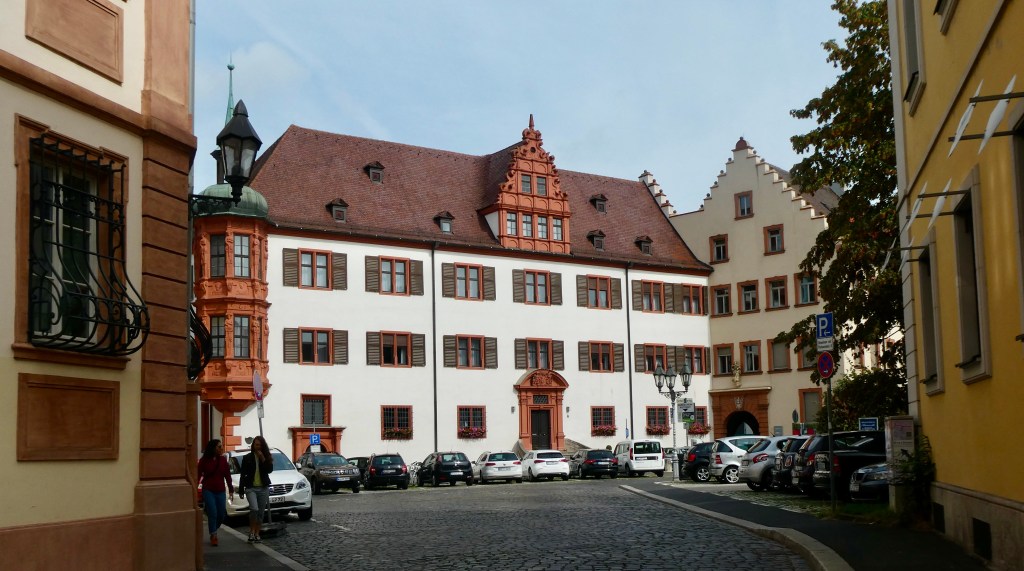
There are a number of university buildings around the city. This one is surrounded by one of the many vineyards in the area. Würzburg is built on shale and the minerals help make the grapes and wines healthy,
Stachel has Germany’s oldest and largest vineyards. This is the oldest wine bar in town – originating in 1413.
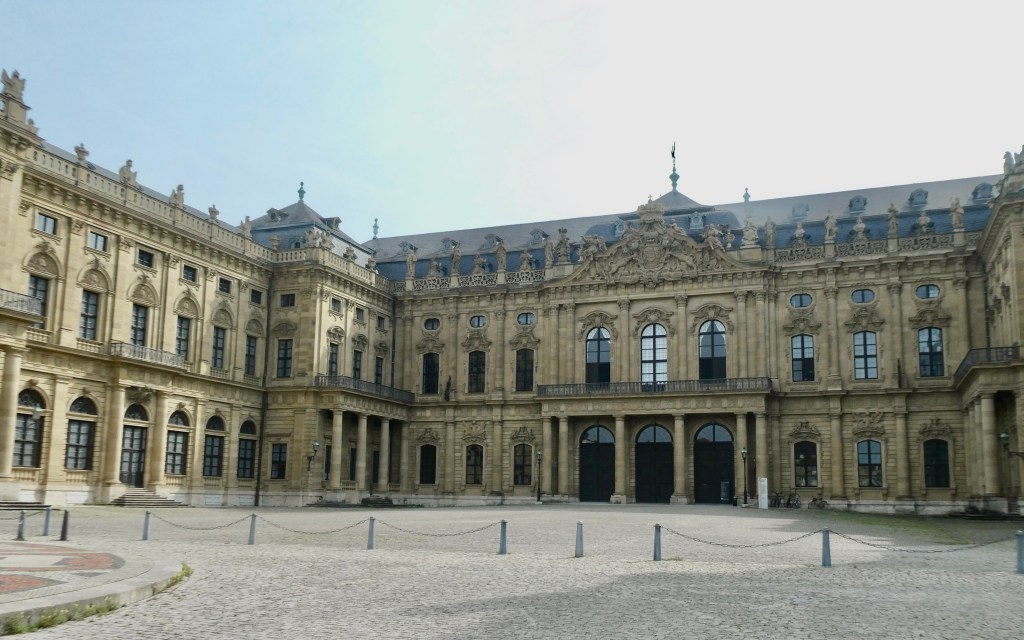
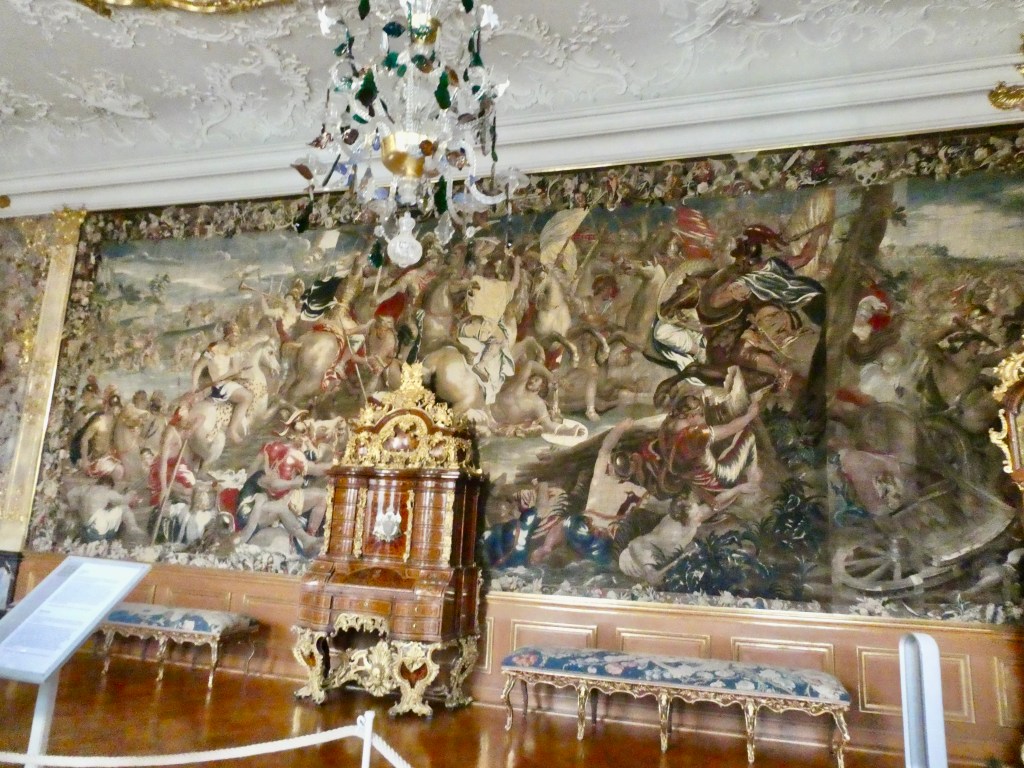
Our primary point of interest in Würzburg was the Bishop’s Residence.
It is one of Germany’s largest and most ornate palaces. The Bishop’s Residence has been a UNESCO World Heritage site since 1981. The exterior was built between 1720 and 1744.
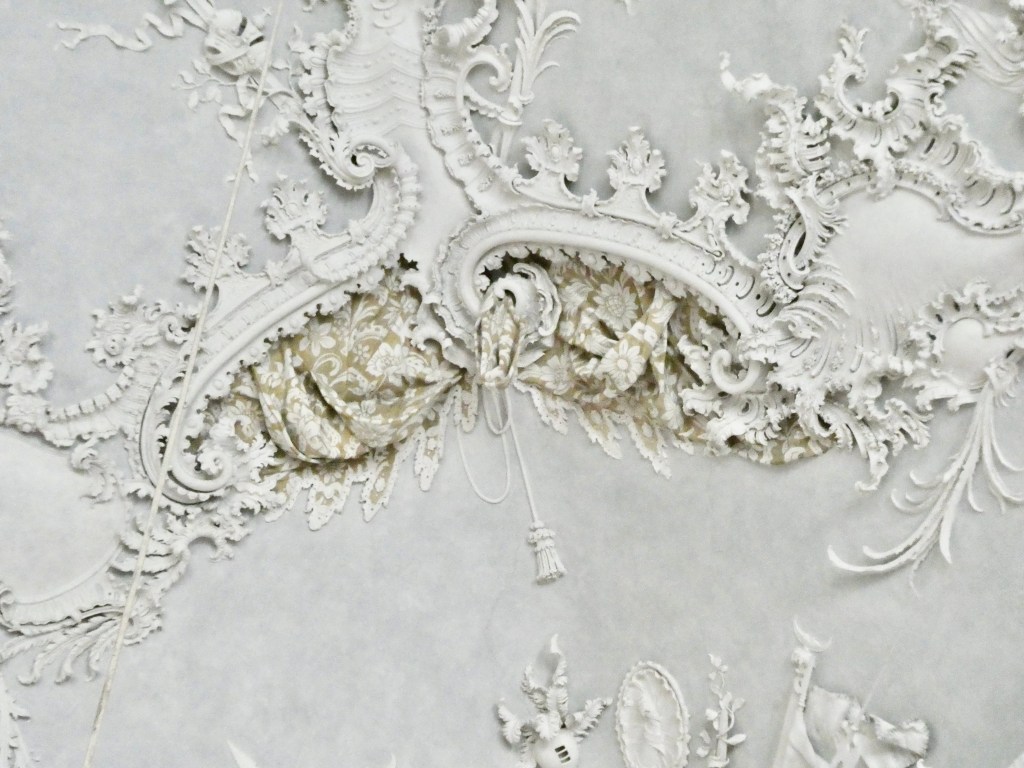
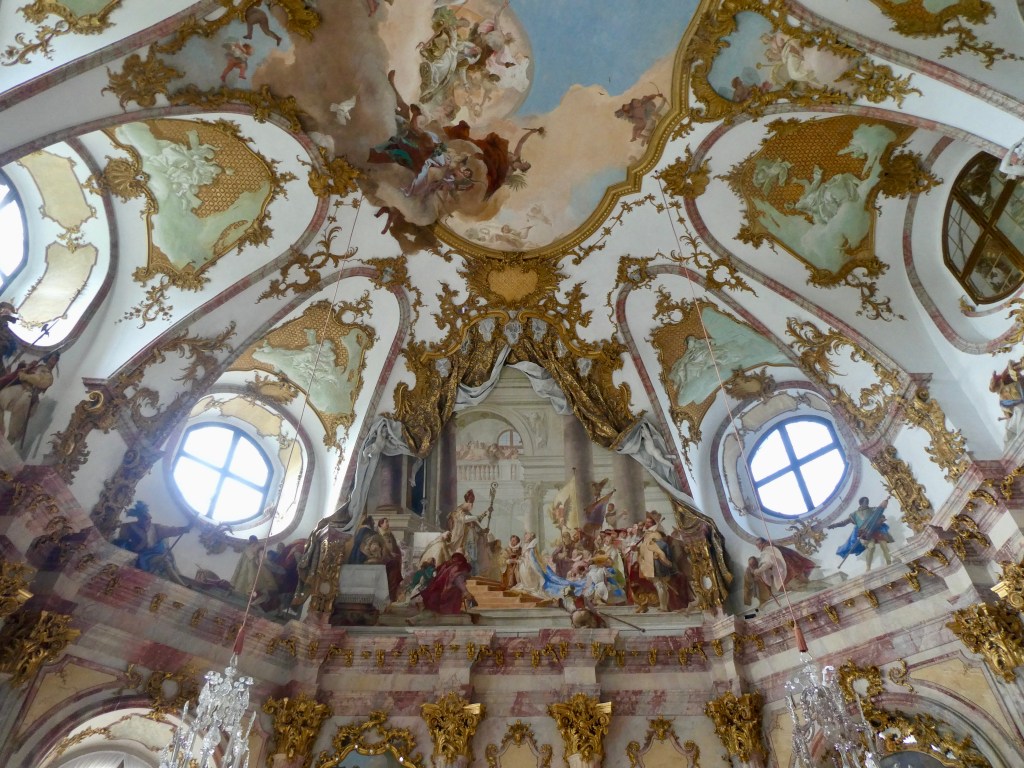
This totally stunning Stucco Room was created in nine months. Even the parts which appear to be draped fabric are made of stucco.
There was a lot lead In the white paint so the artisans became ill.
The room was created in anticipation of Marie Antoinette’s visit to the city. The artists were very anxiously awaiting her comment on the room – but she said nothing! That was devastating to the artists! However, she was very complimentary about the stucco room when she wrote about it after returning to France.
Upon arriving at the residence, Marie Antoinette took 45 minutes going up these stairs because she was required to greet and talk to so many people along the way.
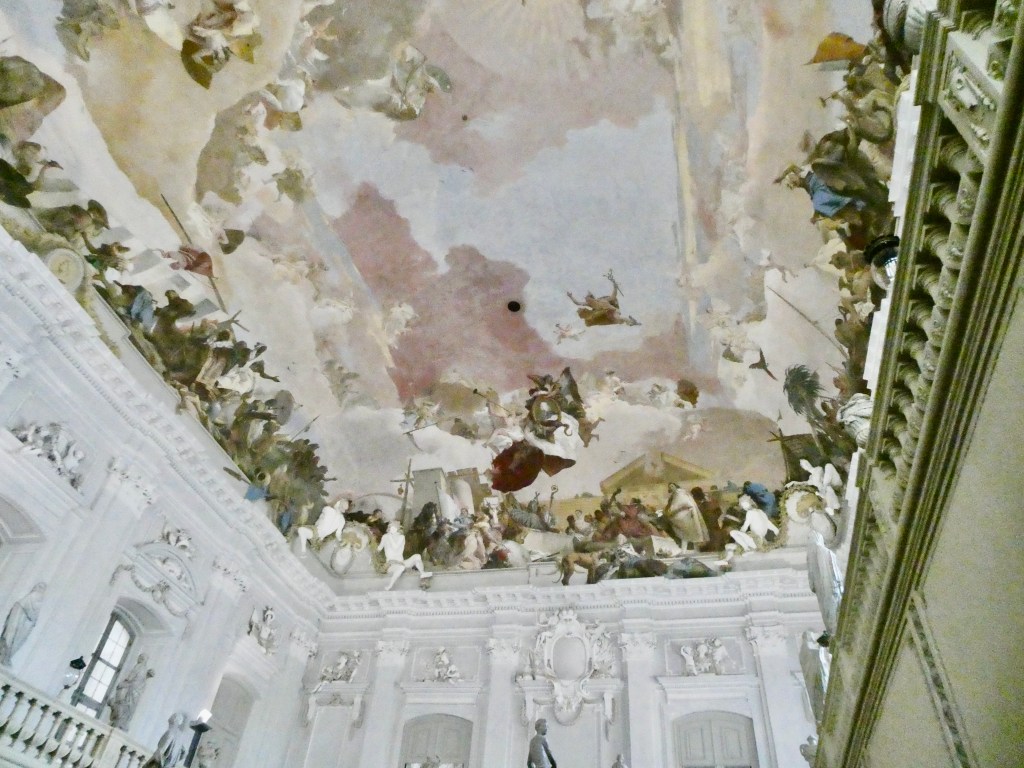
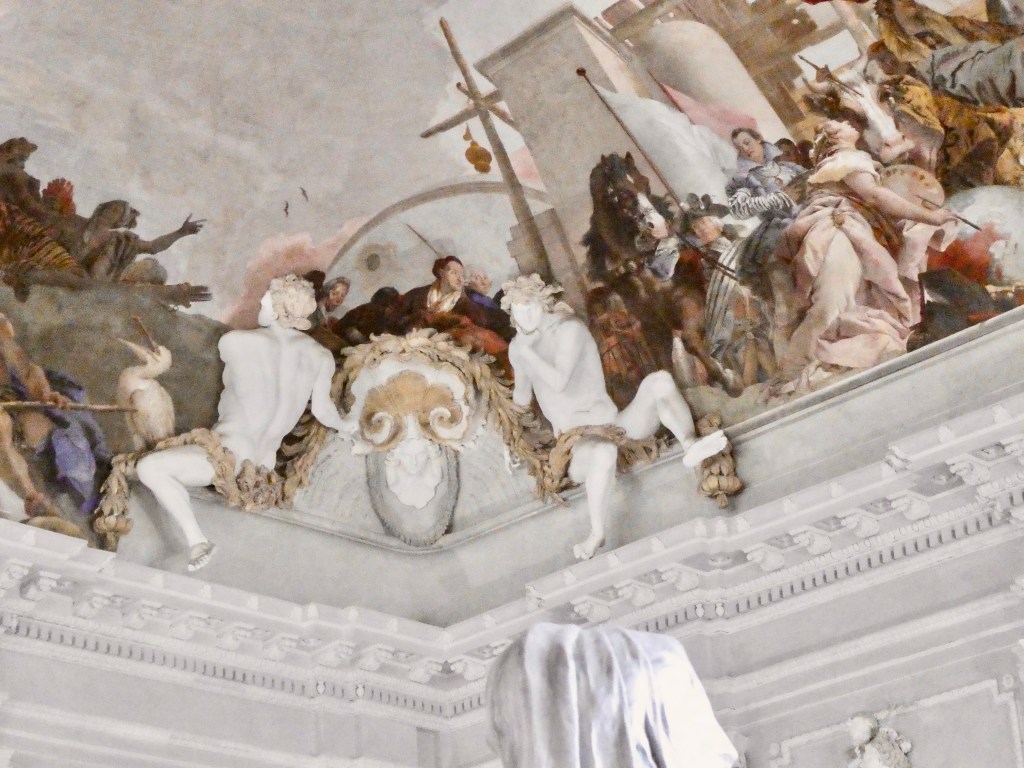
Another highlight was the 6400 square-foot Four Continents fresco painted by Giovanni Tiepolo. He was not originally going to take this commission but was bribed by the grandeur of the project and ten times his normal fee.
The four sides represent four continents – Australia was not yet known.
The architect of the ceiling above the fresco had only built two regular houses before!
Completion on the interior work on the 400 room castle took until 1780.
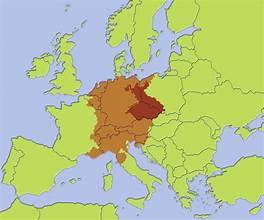
The Ruler who lived in this residence was a Prince Bishop. Würzburg was one of a hundred states in the Holy Roman Empire.
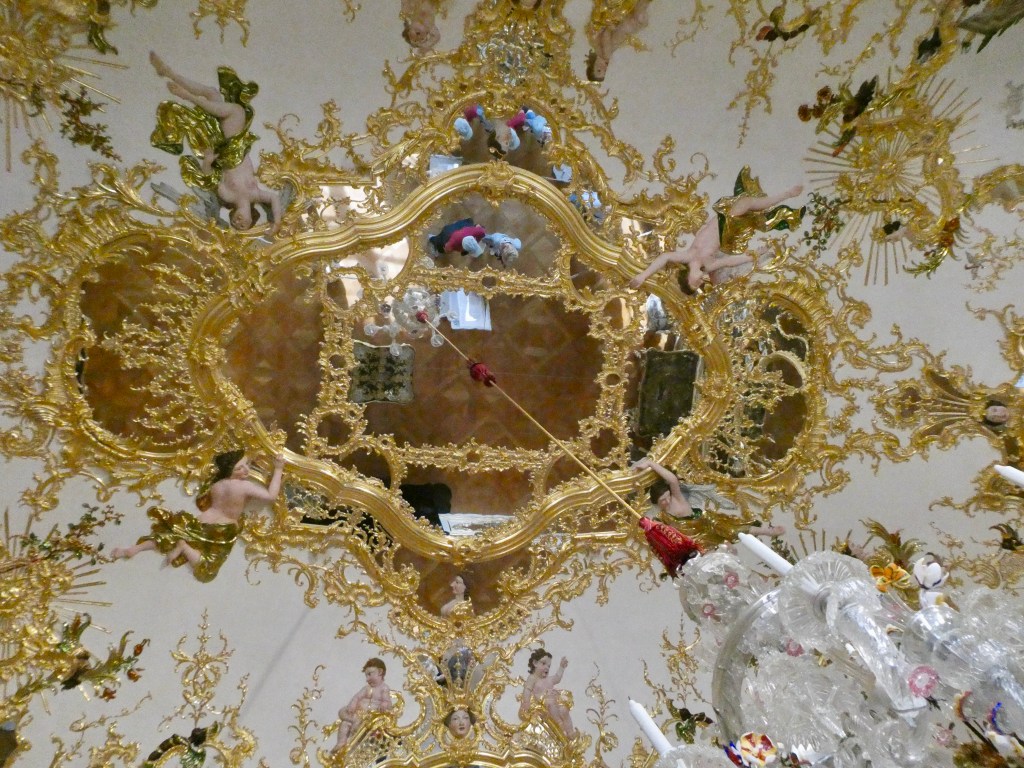
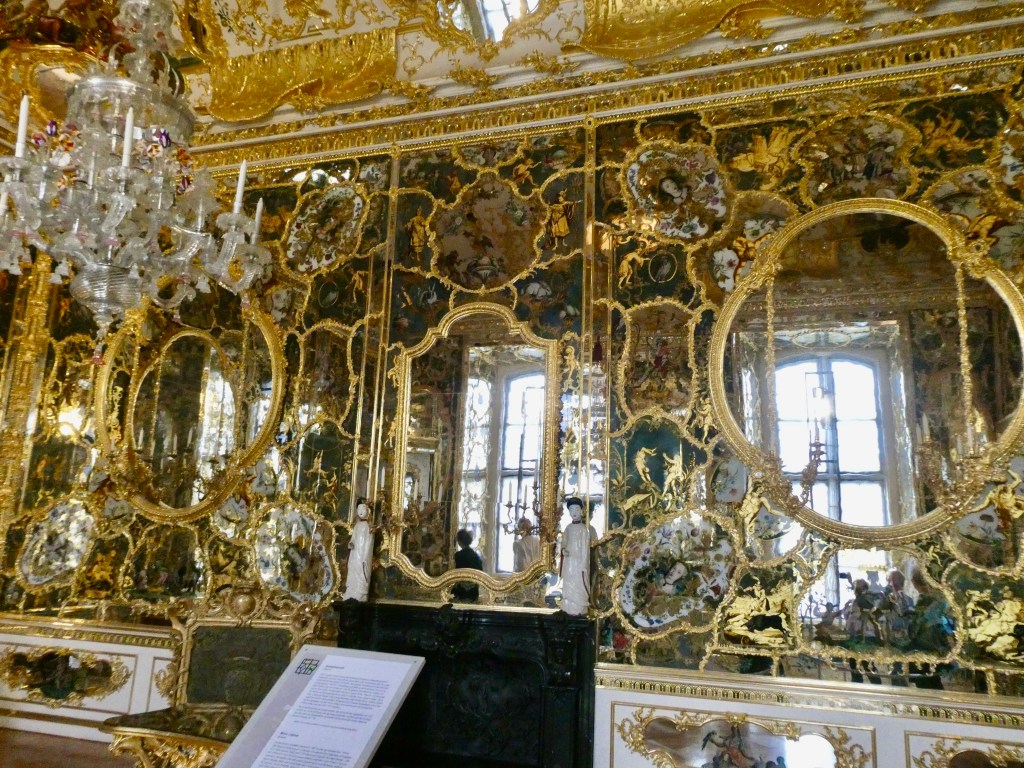
These pictures are from the Hall of Mirrors. The picture below is of a ceiling mirror.
With the demise of the Holy Roman Empire, the bishop moved out of the residence palace in 1803.
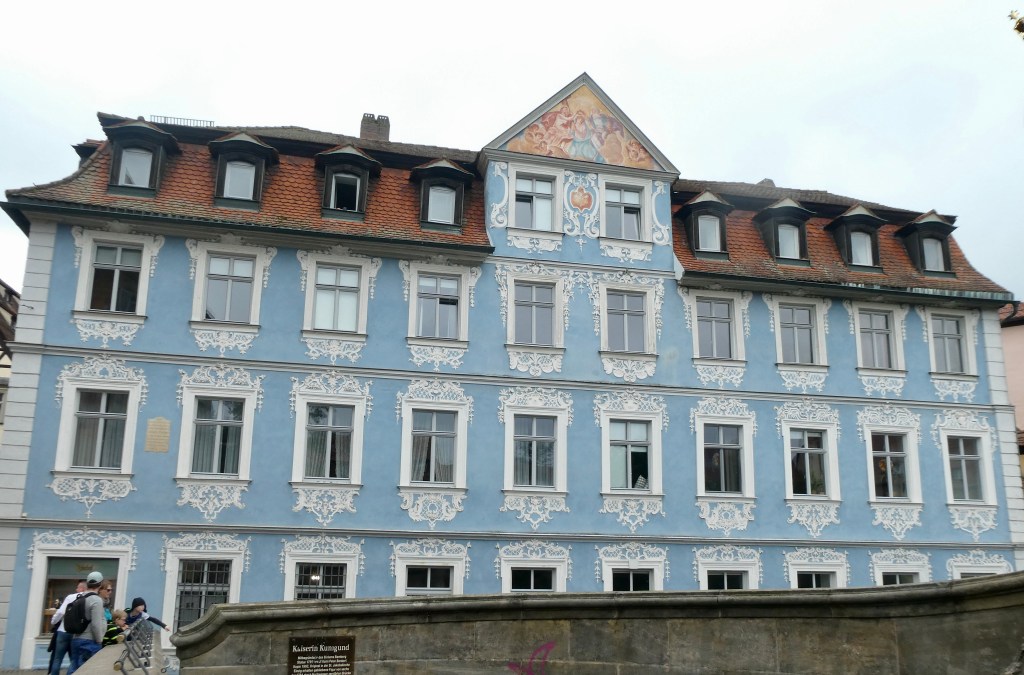
This was his next residence – a bit of a downgrade…
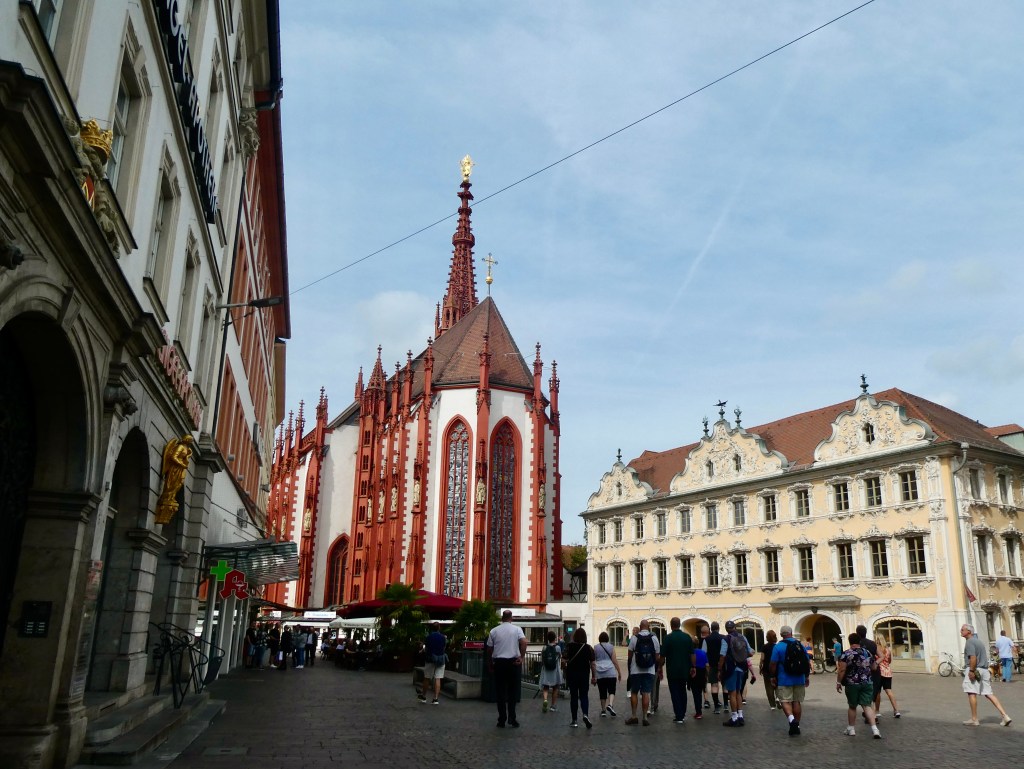
In his new neighborhood was the Mother Mary Chapel from the 1300s.
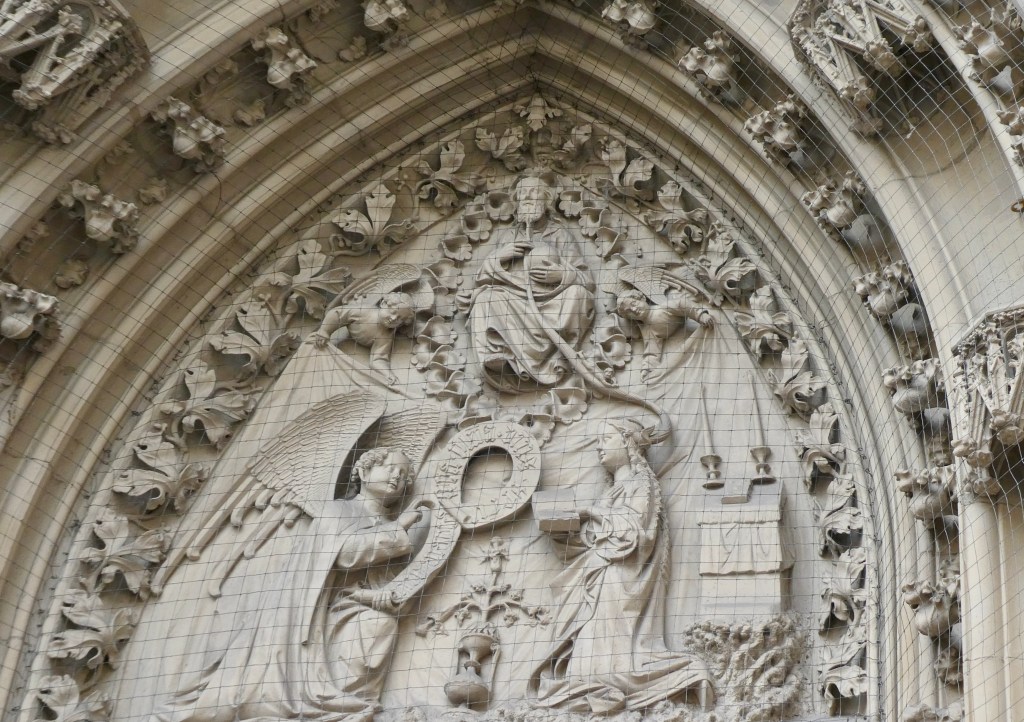
Another cathedral entrance had an explanation of the annunciation.
Mary understood through her ears from Father God and the Holy Spirit that she would bear the messiah. This was the church’s way of making the annunciation “understandable.” Mary could get pregnant through her ear and still be a virgin.
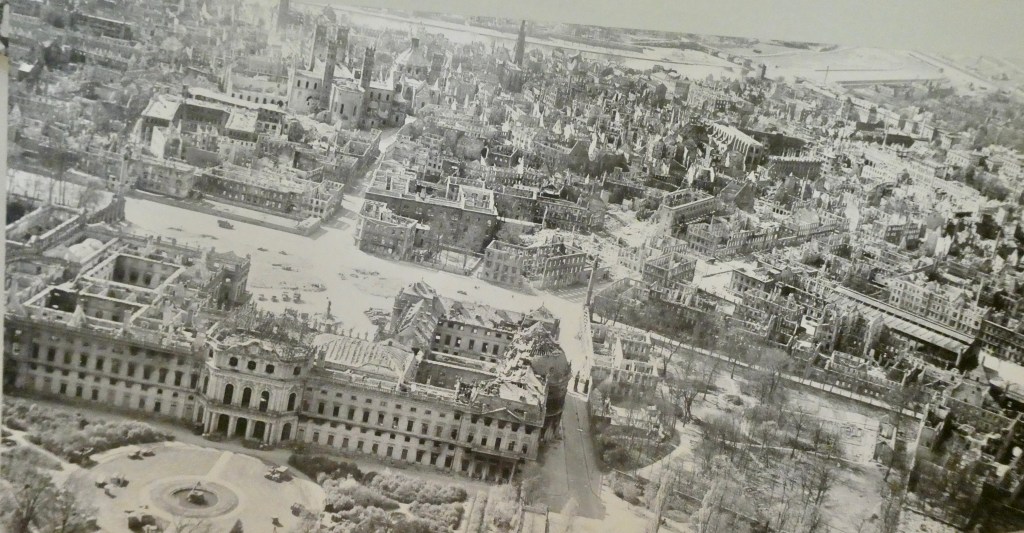
Generations later Würzburg was 90 percent destroyed during WWII. Most of the damage was through incendiary bombs and fire. Some of the city’s artistic treasures had been hidden away and protected so much survived.
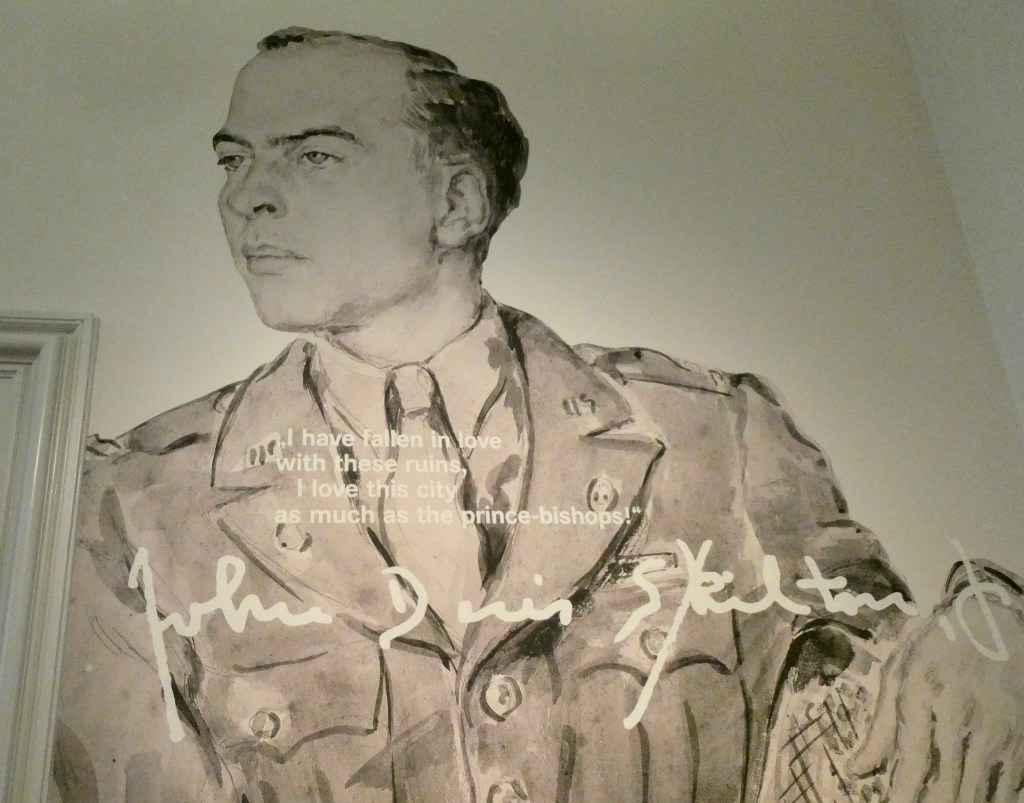
At the end of the war, the American Monument Men, and specifically Second Lieutenant John Davis Skilton, helped to safeguard many of the artistic treasures in the remains of the Bishop’s Residence Palace including the largest fresco of the four seasons.
Skilton was able to find the wood to have the roof partially rebuilt to protect what remained.
The entire Bishop’s Residence complex was meticulously restored after the extensive damage. The Marshall Plan paid for much of the early reconstruction.
Prior to the war, 80 percent of the residence’ valuables had been stored away. Years later, 80-90 percent of the artwork in the residence is original.
The Mirror Room, destroyed during the war, could not be rebuilt with quicksilver because of the lead content. The Mirror Room was rebuilt in the 1970s with technology developed for eyeglasses,
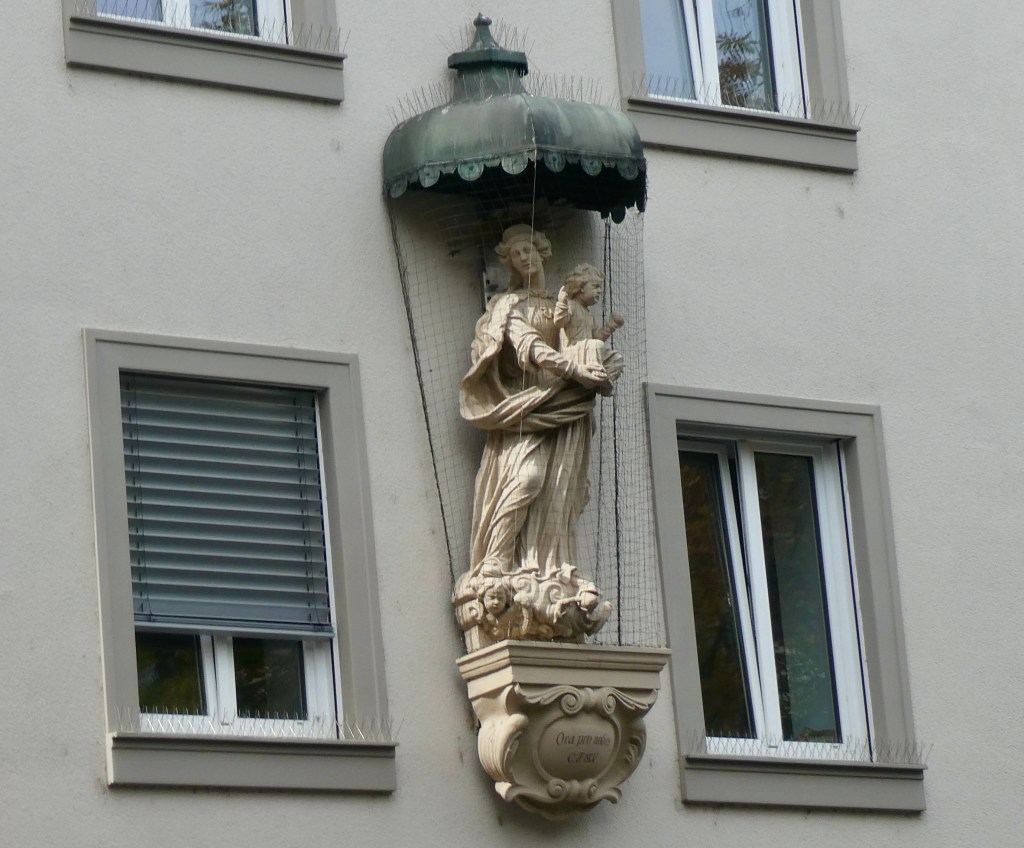
Würzburg is the City of Mary. There are many Mary statues around town.
Many were destroyed during the war but 400 were hidden and placed throughout the city later.
We were leaving Würzburg when we saw our first castle along the river!
Bamberg is a “Medieval city wrapped in a baroque wrapper.”
Because of this uniqueness, and a treasure of medieval structures, Bamberg was named a UNESCO World Heritage Site in 1993.
Fortunately, only four percent of Bamberg was damaged during World War II instead of 91 percent destruction for nearby Nuremberg.
Sometimes it is beneficial to be less “important.”
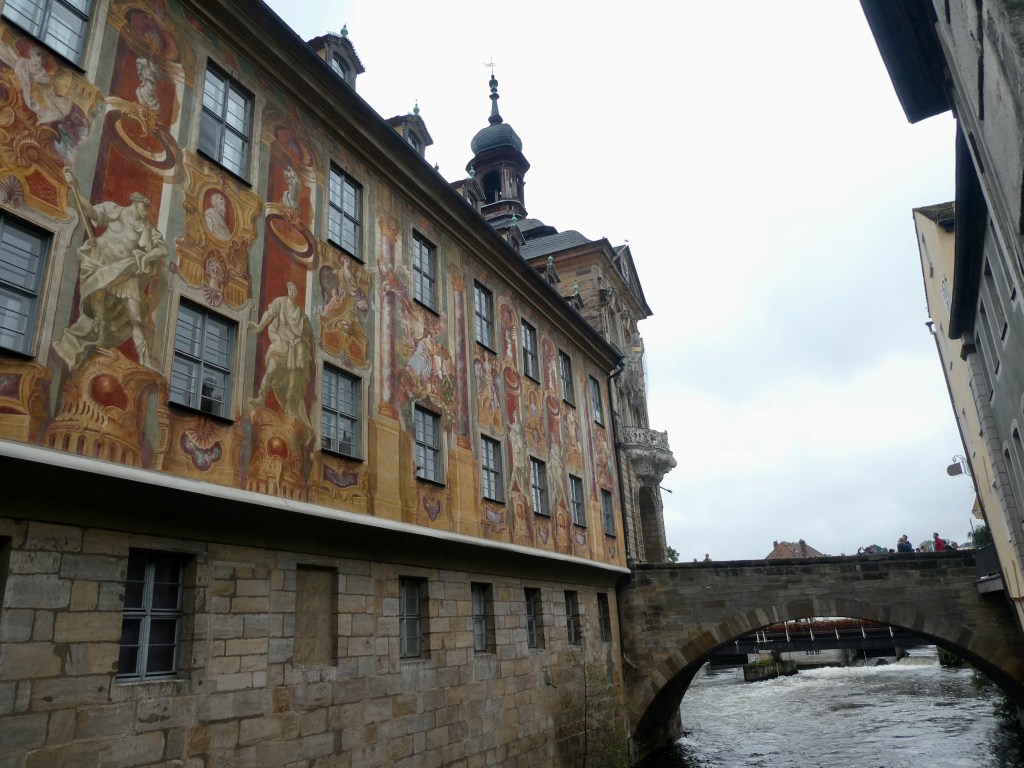
Our guide explained that the houses on the Regnitz River were for poor fishermen during medieval times. The water was filthy because of the nearby slaughterhouse (the building on the right) where waste was dumped into the river.
Times have changed because the ability to buy one of these houses now is very rare. The last one (the black house) sold for 1.5 million Euros.
Bamberg is famous for its smokey beer – said to be like liquid salami. It is made from malt dried processed over an open flame. By Bamberg law, the beer can’t be served before 4:00 pm so we weren’t able to try it and I’m not sorry.
Schlenkeria Brewery is one of only two breweries left on this street. There were once 14 breweries that were in business on this street alone. The man in the wreath is symbolic because the owner broke his legs when wine barrels fell on him.
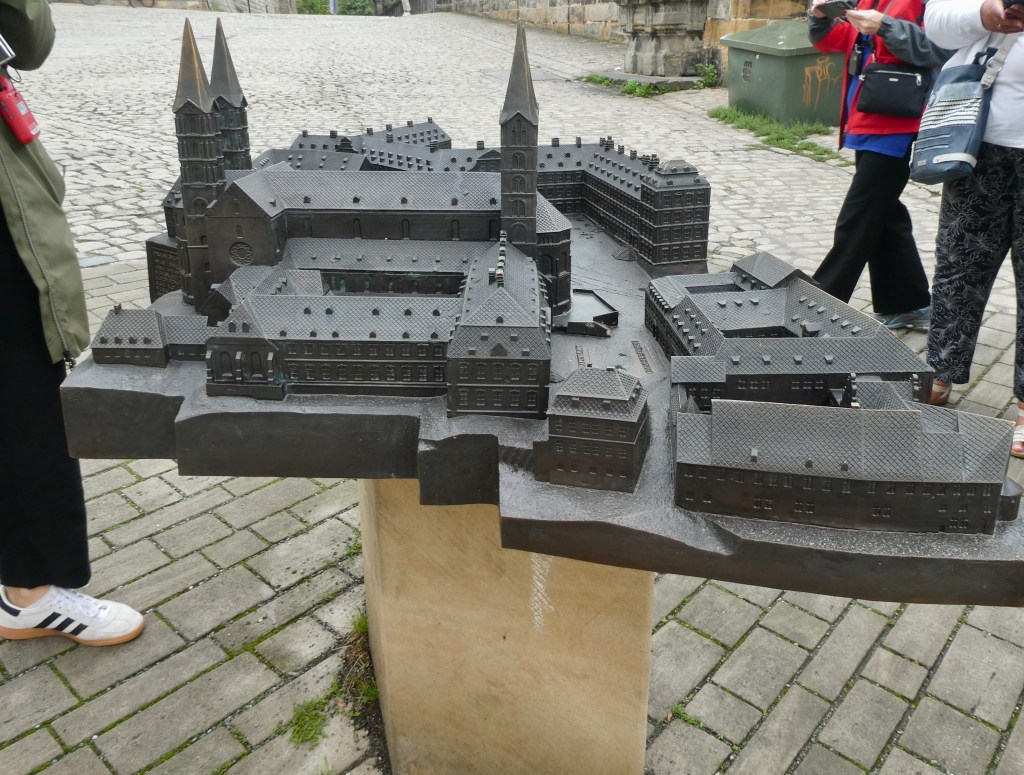
In 1007 Bamberg was the center of the Holy Roman Empire. A braille map of the cathedral area is available.
This 11th century cathedral is the third Cathedral of Bamberg. The first two burned down.
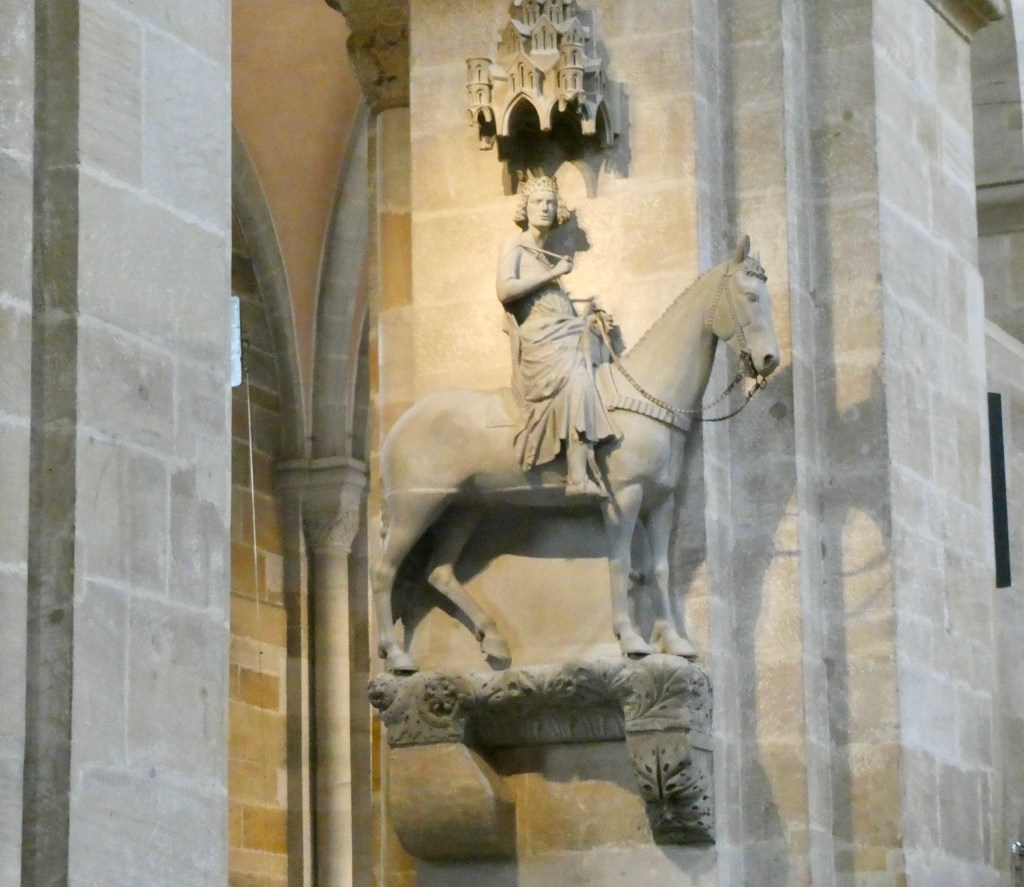
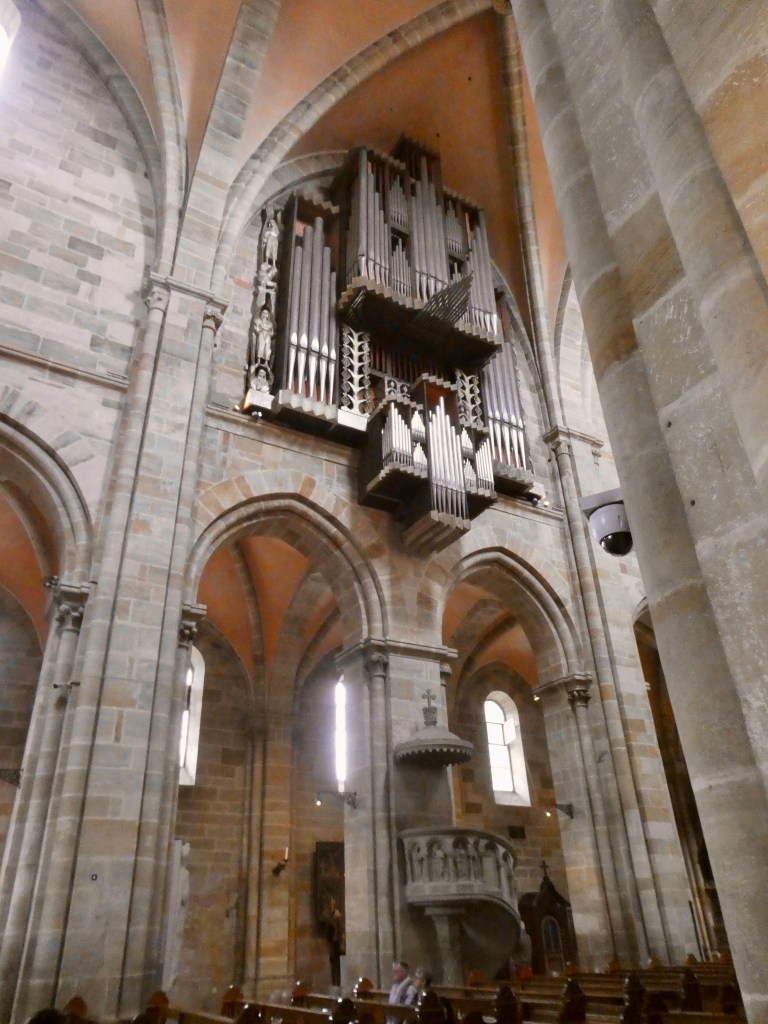
Inside the cathedral, we were able to see The Bamberg horseman. The horsemen is visible on a variety of Bamberg products. The city residents don’t know who he was but celebrate him anyway. He is wearing a king’s crown – not an emperor’s crown.
The cathedral used to be very colorful inside.
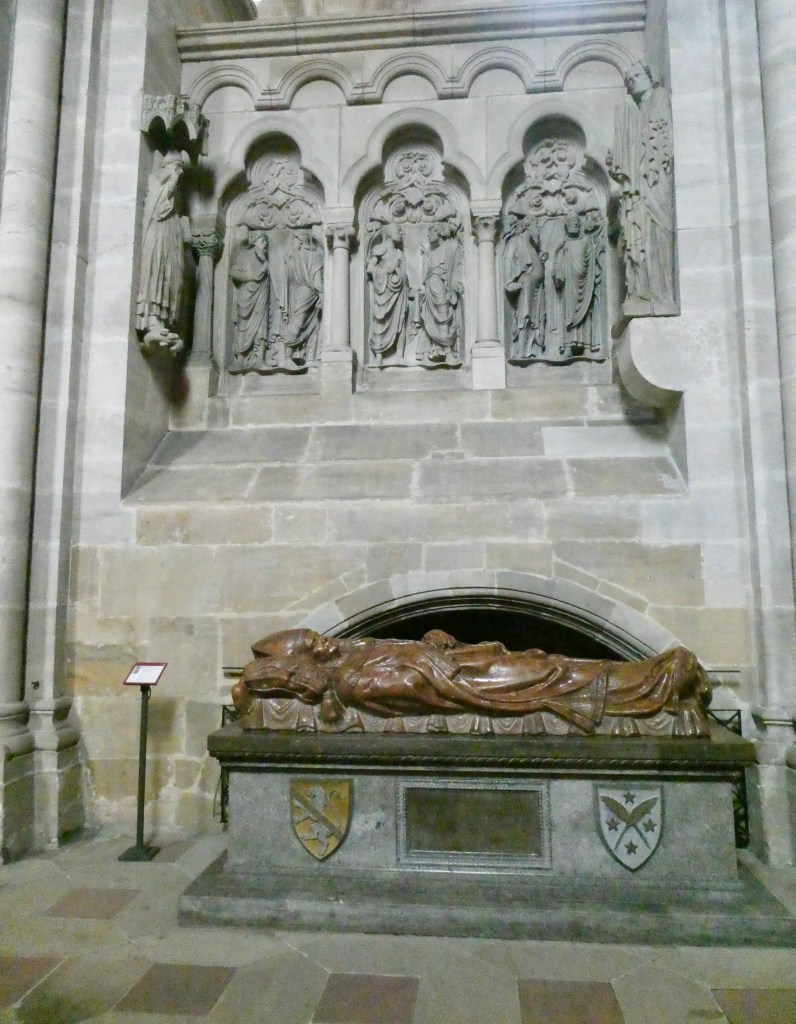
Pope Clement II is buried here after serving only one year as pope from 1046-1047. This is the only papal grave in Germany.
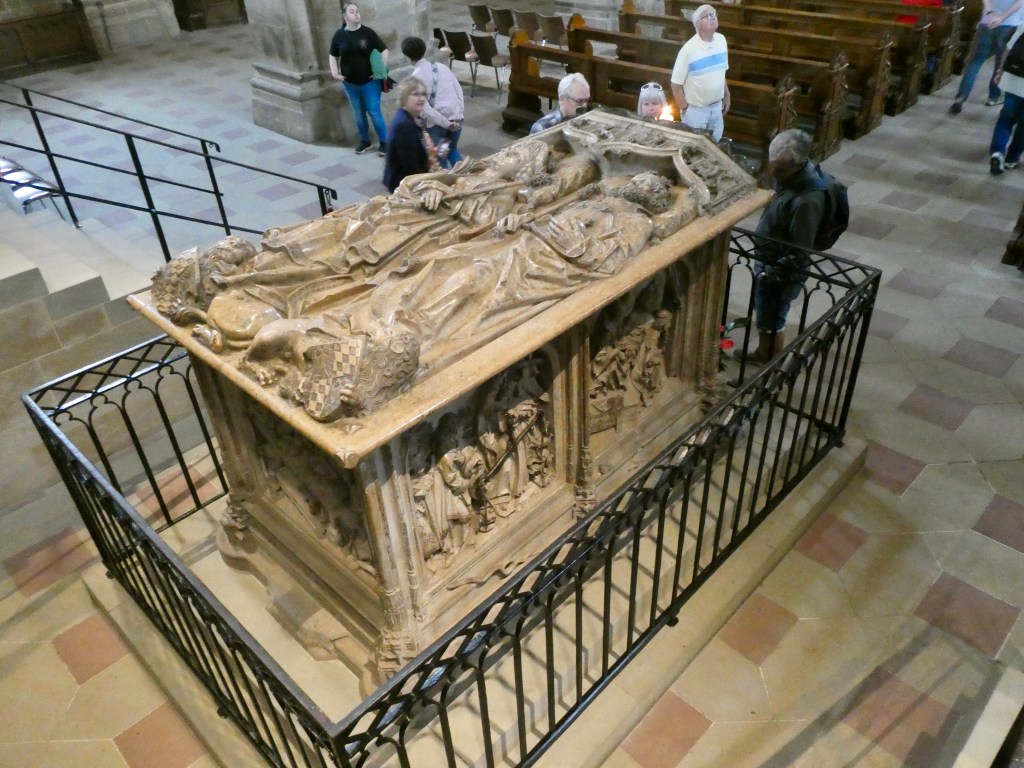
The shared tomb is for Henry II and his wife Cunigunde. They were an imperial couple who shared power. She is on the side typically saved for the king.
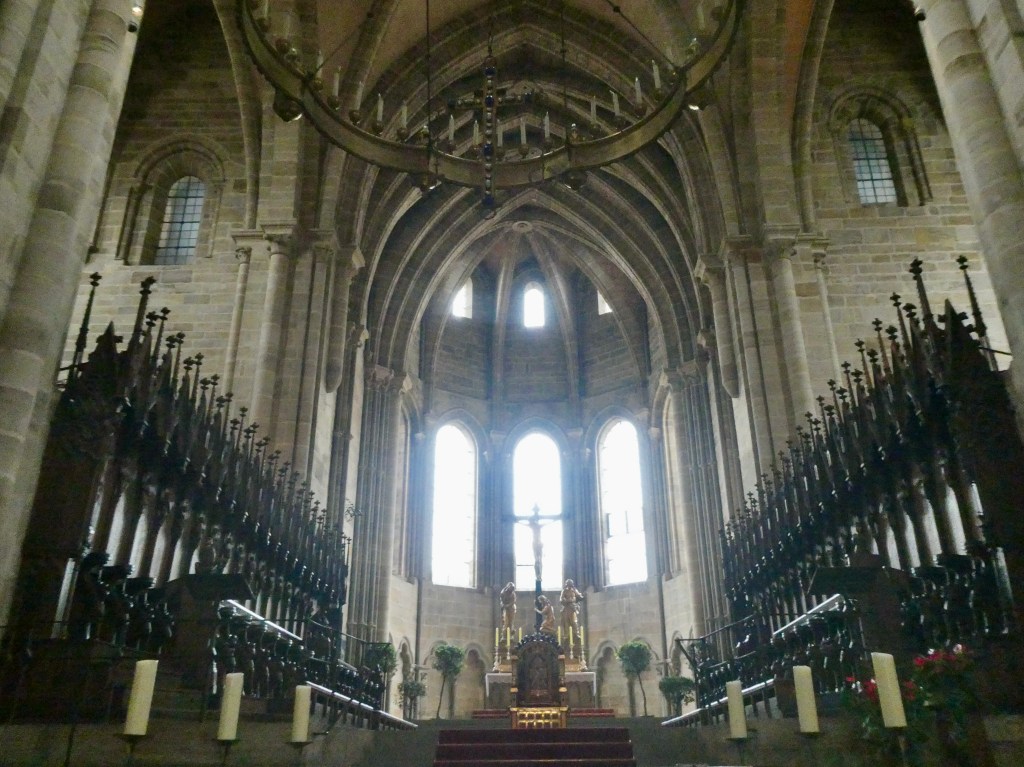
The cathedral exhibits a combination of architecture styles. These windows have romanesque round arches under gothic arches.
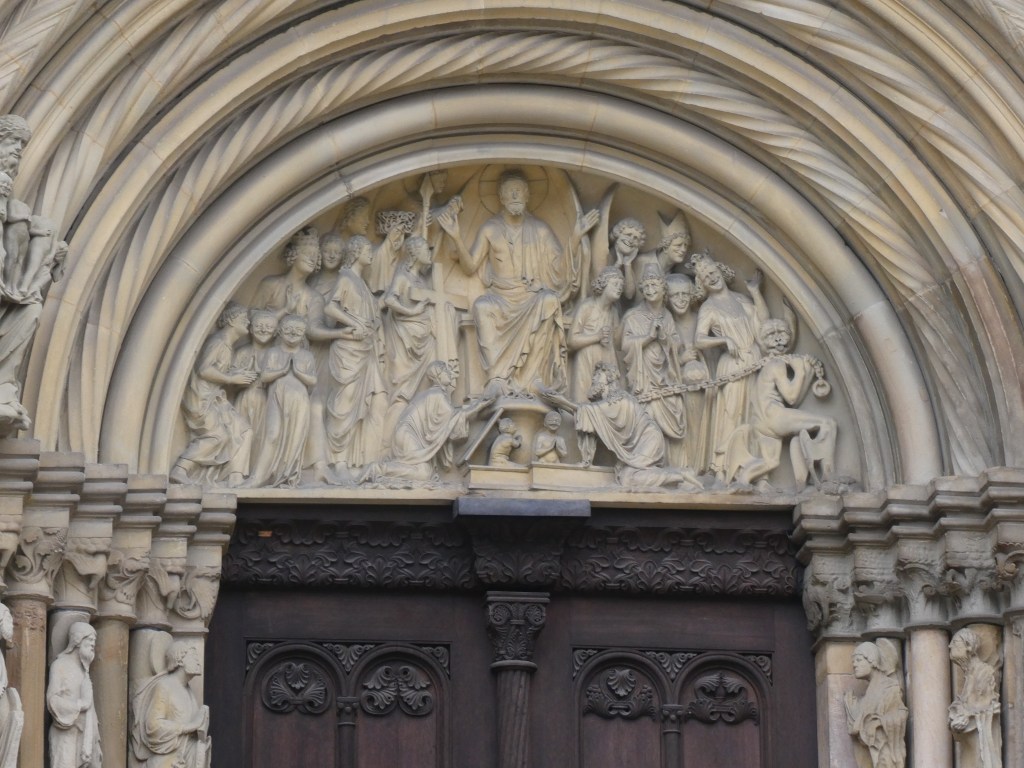
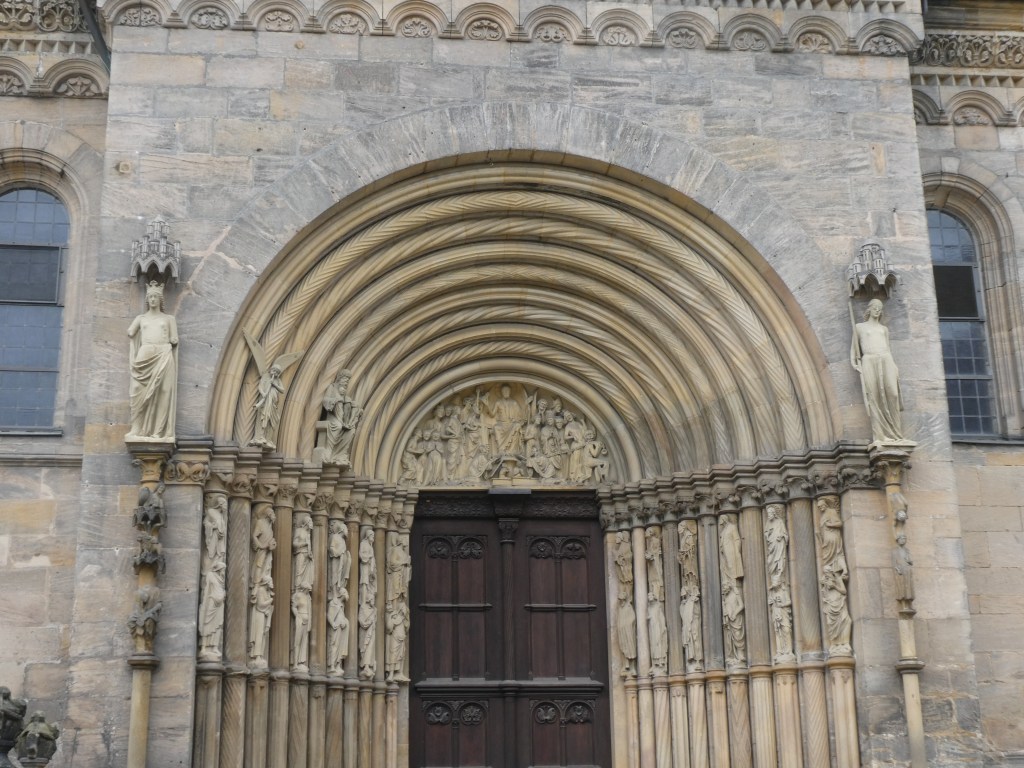
The side entrance of cathedral is the one used, historically, by bishops. Above the entrance, Jesus is shown on the day of the last judgment. Those on the right are depicted going to hell and those on the left are going to heaven. It is thought to be significant that the artist shows representation of all socioeconomic levels on both sides.
To the left of the entrance is a woman who used to hold the baby Jesus representing Christians. It is unknown what happened to her hands and the baby Jesus. On the right side is a Jewish woman with a mask and broken staff. This is a depiction of being unwilling or unable to see Jesus as Messiah. This statue is evidence of very early (11th century) discrimination of the Jews.
In 1910 a Jewish synagogue opened 150 meters from the cathedral. In November 1938, on the Night of Broken Glass, 500 Jews escaped while 500 were stolen away. Currently Bamberg has a Jewish population of about 1000 again, and they have a new synagogue
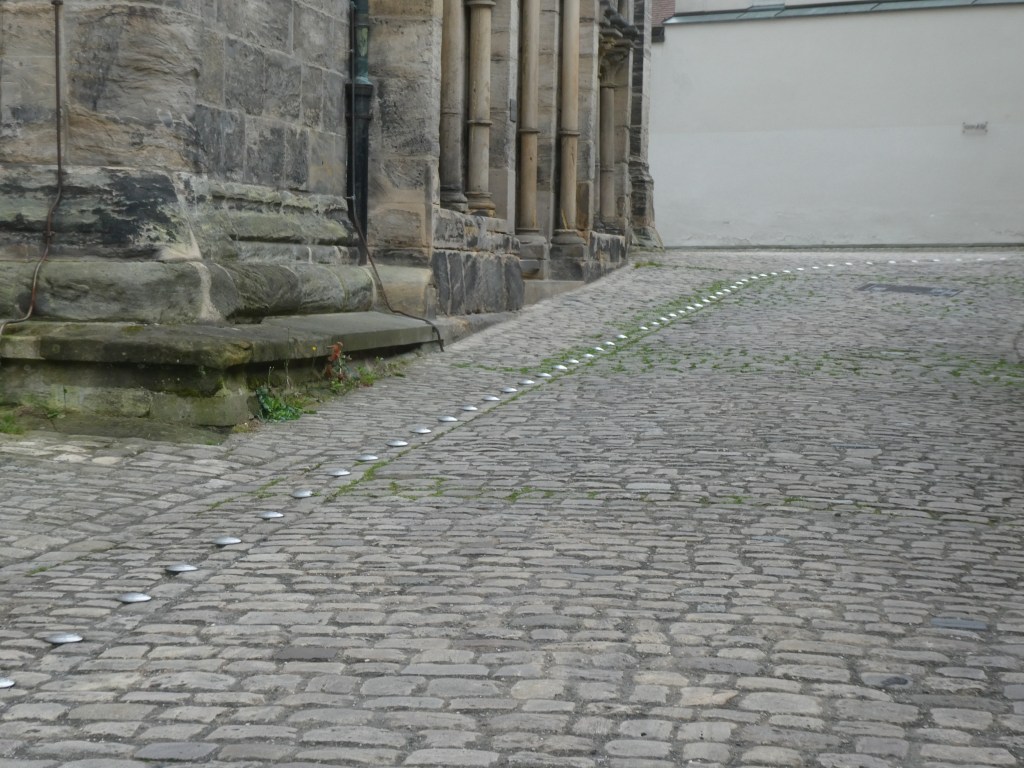
To keep the cathedral area more scenic, metal dots show vehicle lanes.
The Prince Bishops once lived in this home with 300 support people. The two doors at the top center were used for grain storage. The inside is not yet refurbished for public viewing. Our guide told us that the flowers are always blooming – although she doesn’t know how.
American movie makers shot scenes for The Three Mouseketeers in this courtyard.
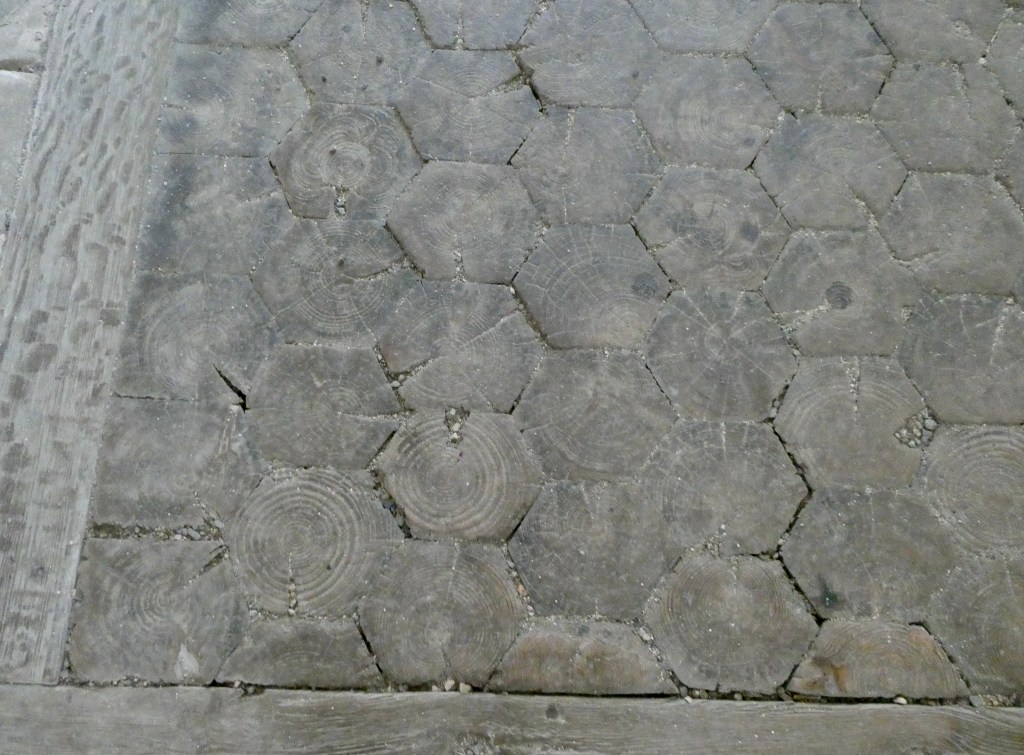
There are some wooden “cobblestones.”
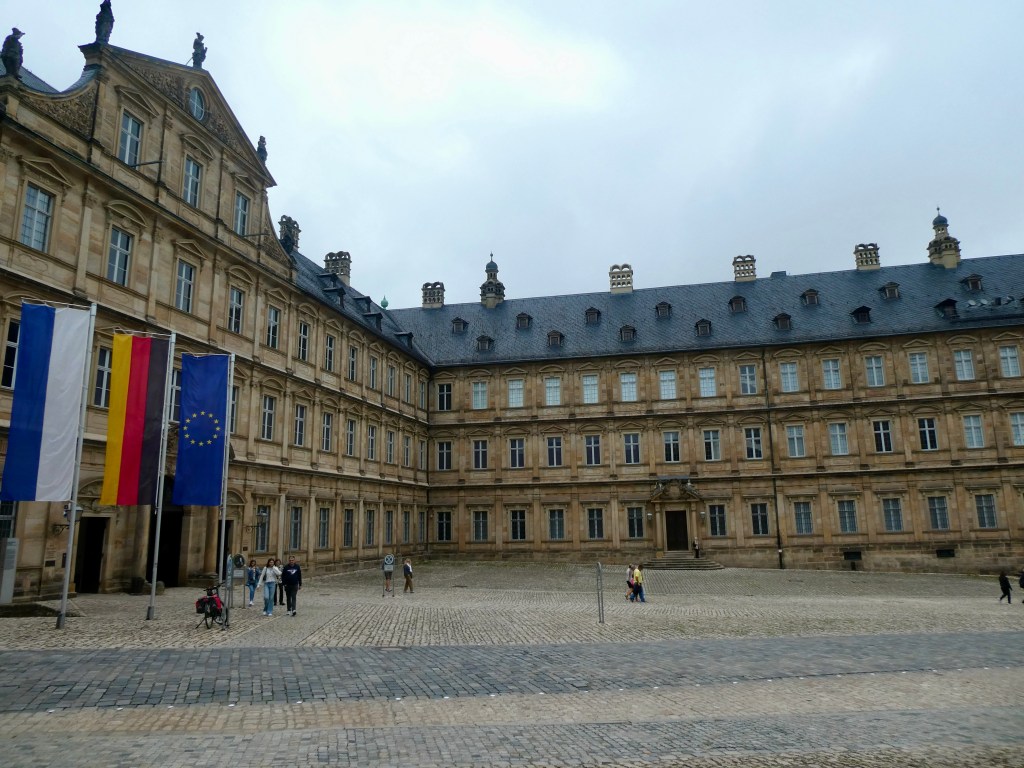
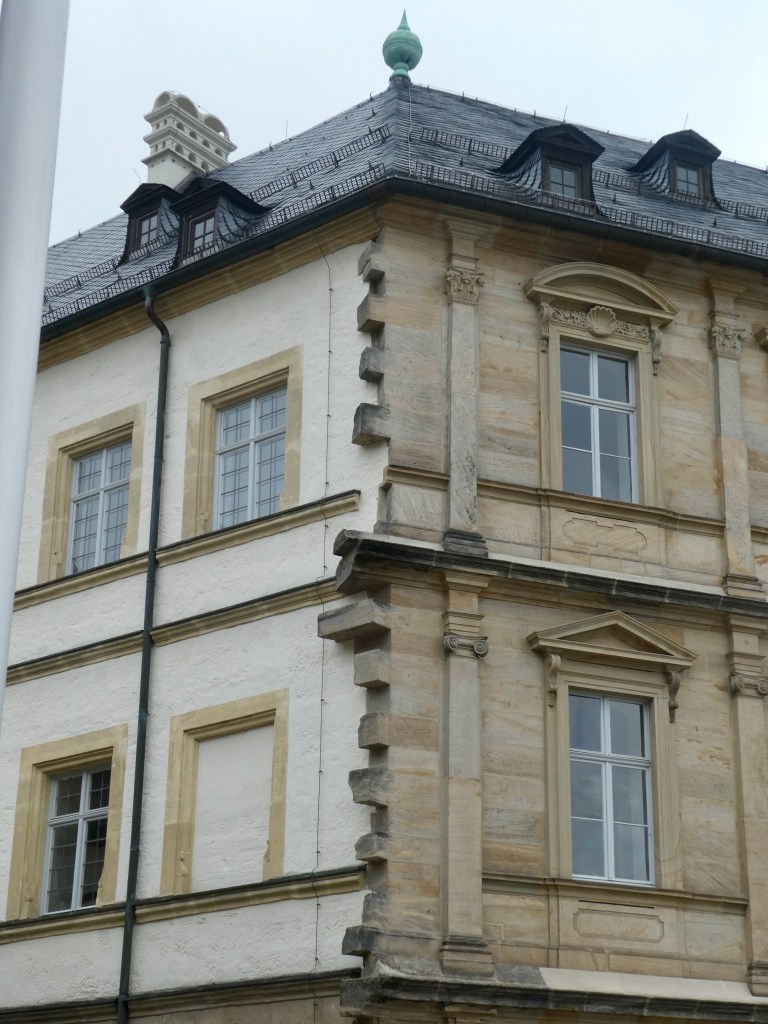
This government building was built in the baroque style. That style is usually symmetrical but this building is in an L shape. It was intended to be a U shape.
These waiting stones at the end indicate the building was not finished.
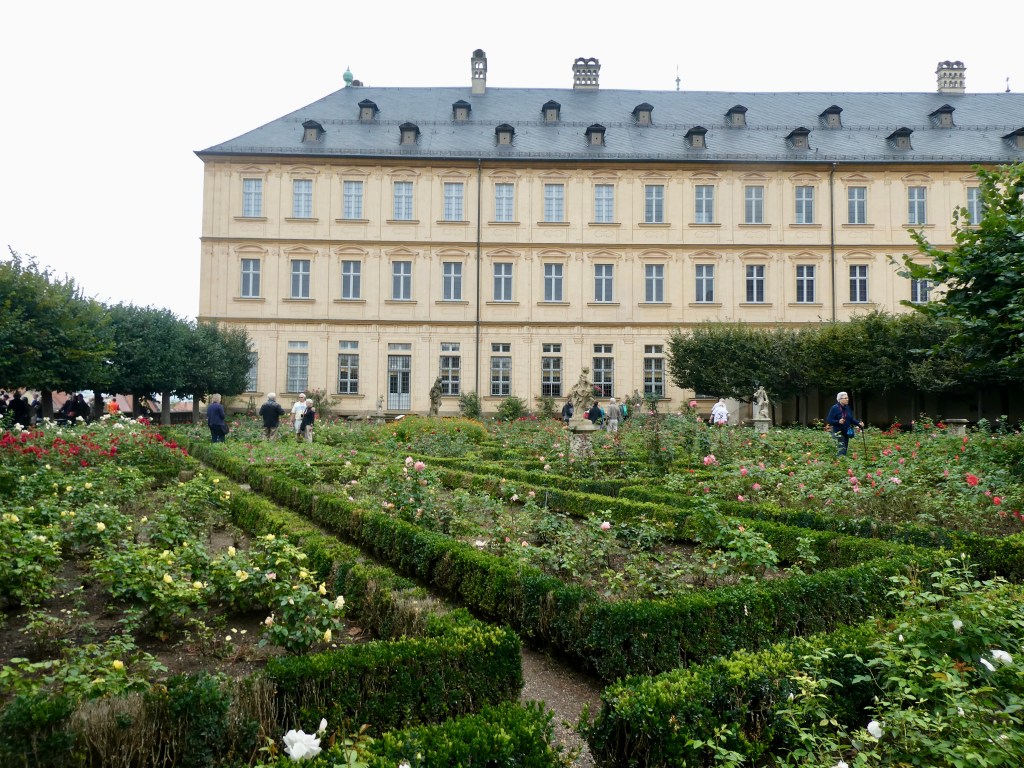
While visiting the building’s gardens, we saw that the windows in the back were painted with a 3D technique developed during the Italian Renaissance. Most of these “windows” are not real!
After our tour we were able to go back and spend some time on our ship while it traversed along the river. When a bridge was too low, the observation room went down into the deck.
This was the first of 43 locks.
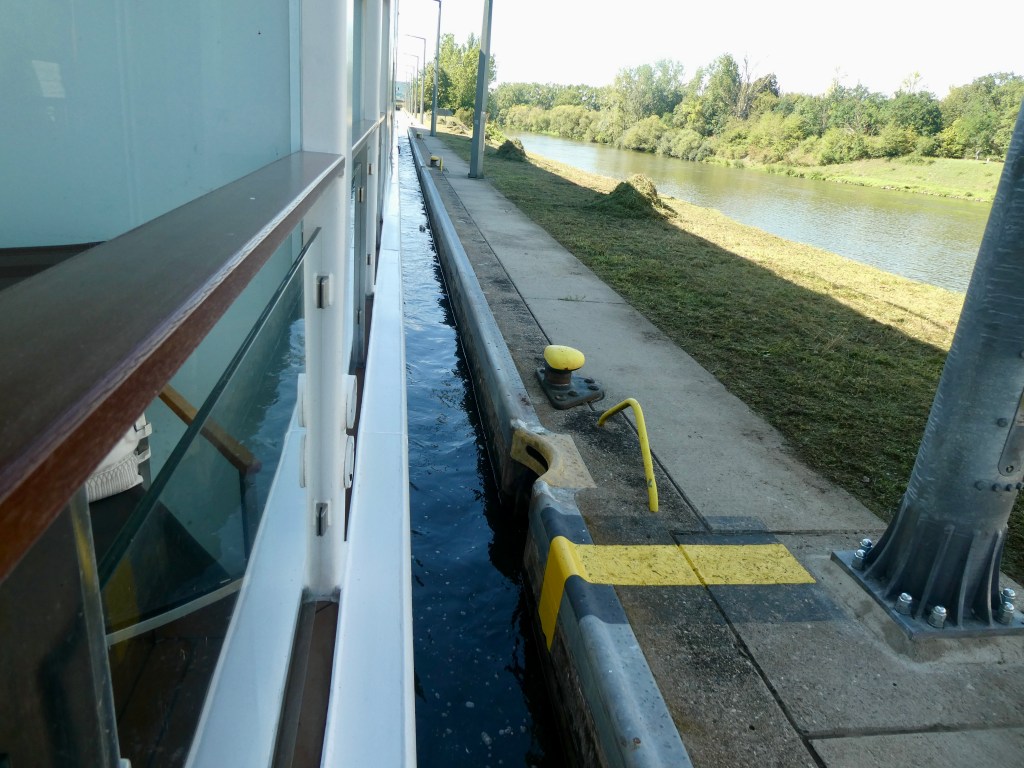
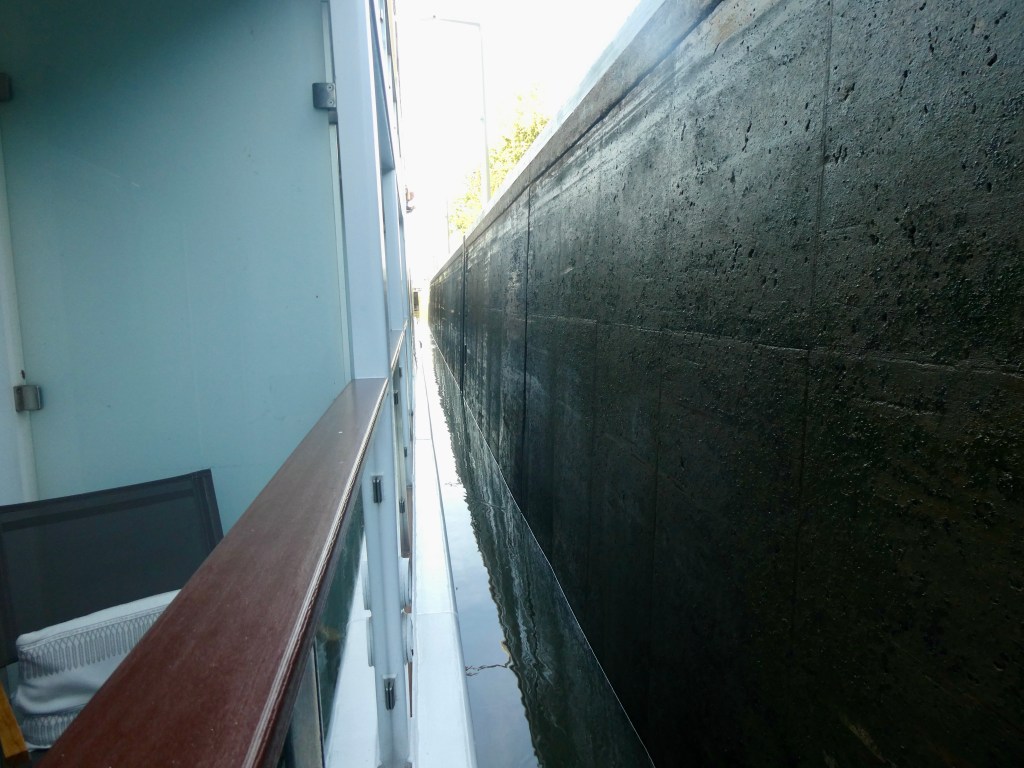
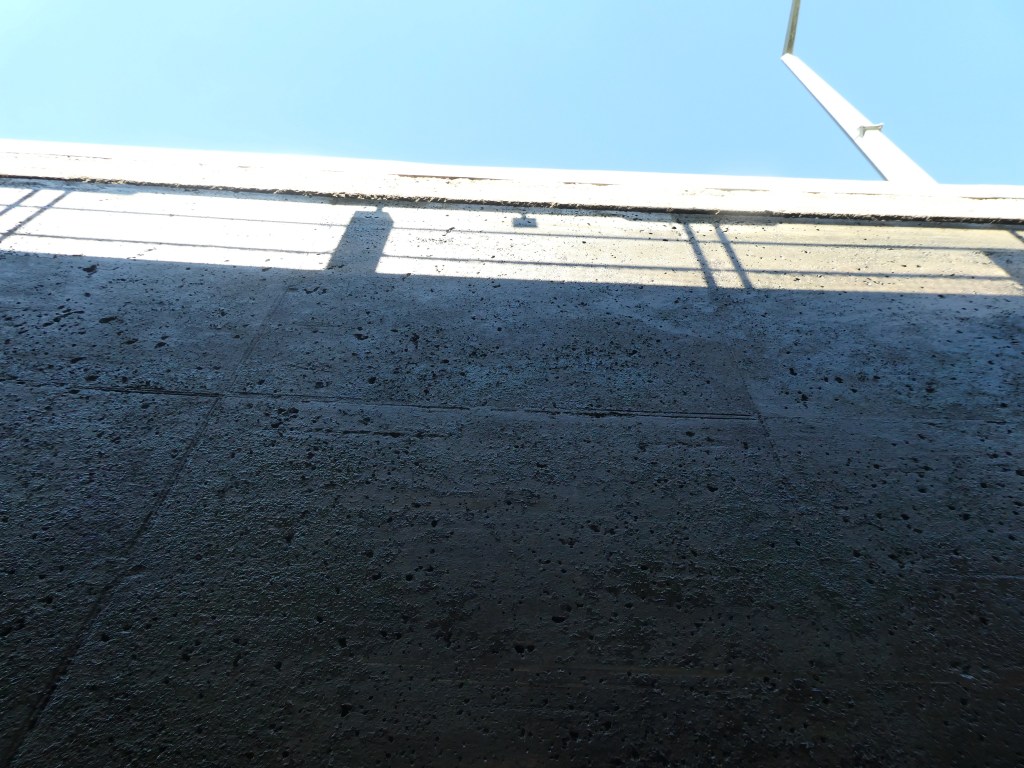
The best place to be, in my opinion, was our balcony. I could reach out and touch the concrete as we went down about 18 feet in that first lock!
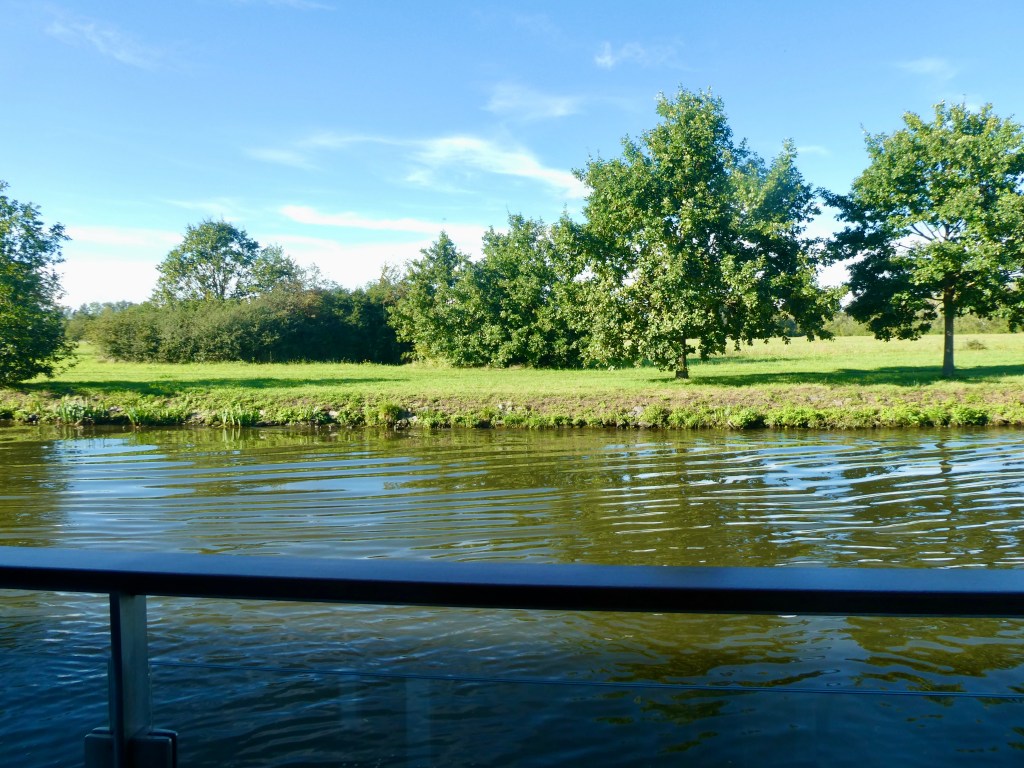
Afterwards it was nice to sit on the balcony and watch the water, just two to three feet below, with land about 25 feet away.
We went through several locks that day with more days of locks to come!
Leaving Prague, we traveled by bus to Nuremberg where we would board the Viking Alsvin after our tour.
While on the bus, we learned there is “free travel” between the Czech Republic and Germany, as there is through most of Europe. The autobahn has no speed limits for passenger cars but does have limits for trucks and busses.
Germany has the largest population in the EU with 84.5 million. That includes 1.2 million Ukrainian refugees. Germany is about one quarter the population of the US in an area the size of Montana so Germany is densely populated.
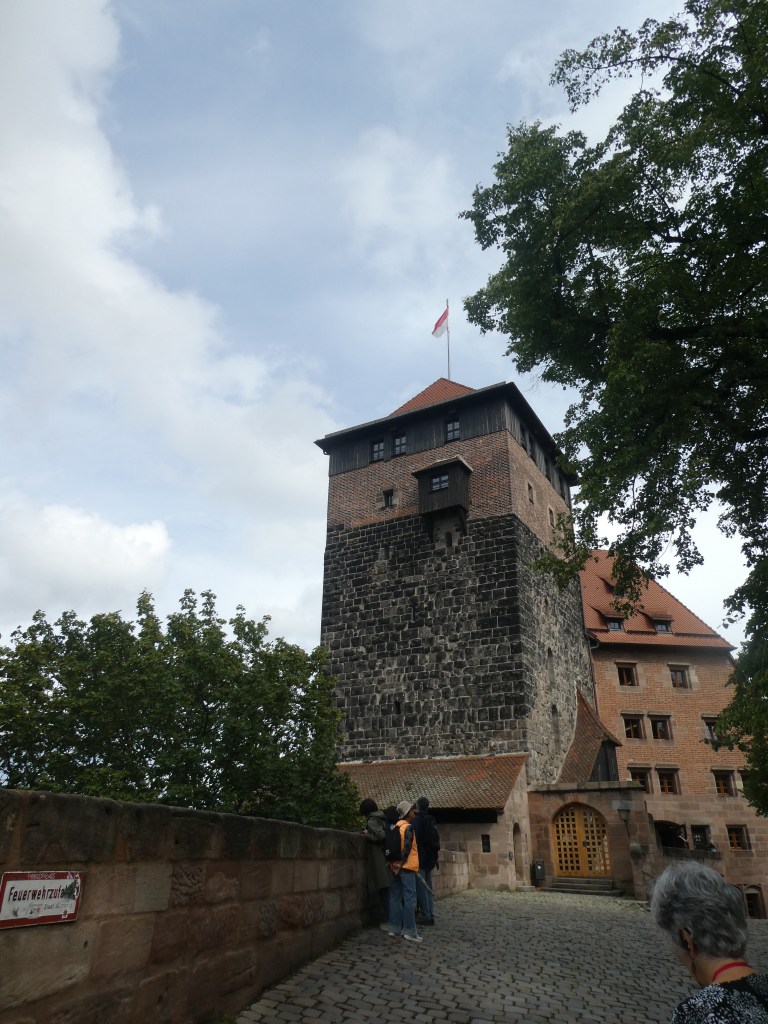
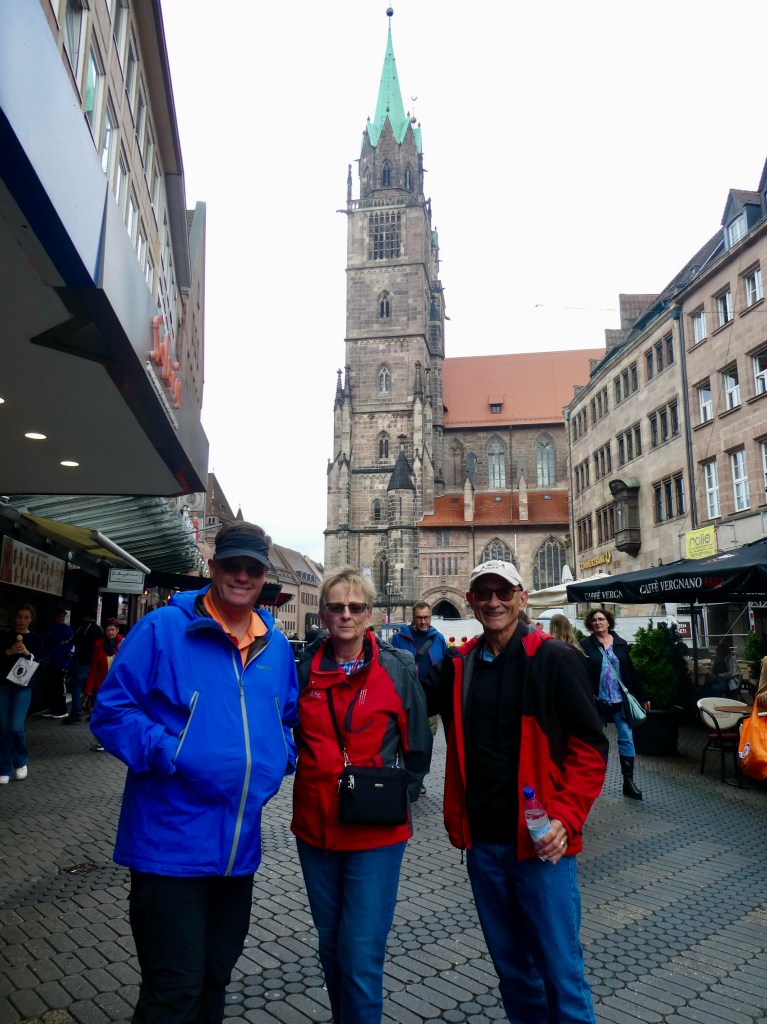
Looking back, Nuremberg was first mentioned in imperial documents in the year 1050. This five corner tower dates from that era.
The location was at the center of 14 Trans-European trading routes. Nuremberg became a free and independent city in 1219.
The route we traveled was the same as a road developed by King Charles IV in the 14th century called the Golden Road. He traveled from Prague to Nuremberg 52 times during his reign and each trip took 14 days one way. There were also the hazards of wild animals and robbers. King Charles acquired properties along the route by war, marriage and purchase in order to have a string of safe houses. Travelers paid a road tax to travel on the Golden Road.
The Prague to Nuremberg imperial road ended at this tower. (It was also used as an air raid shelter during WWII.)
When Christopher Columbus discovered new worlds, trade routes changed so the city went into decline.
1835 the first train in Germany was developed in Nuremberg marking the beginning of their Industrial Revolution. Manufacturing brought people and some growth back to the city.
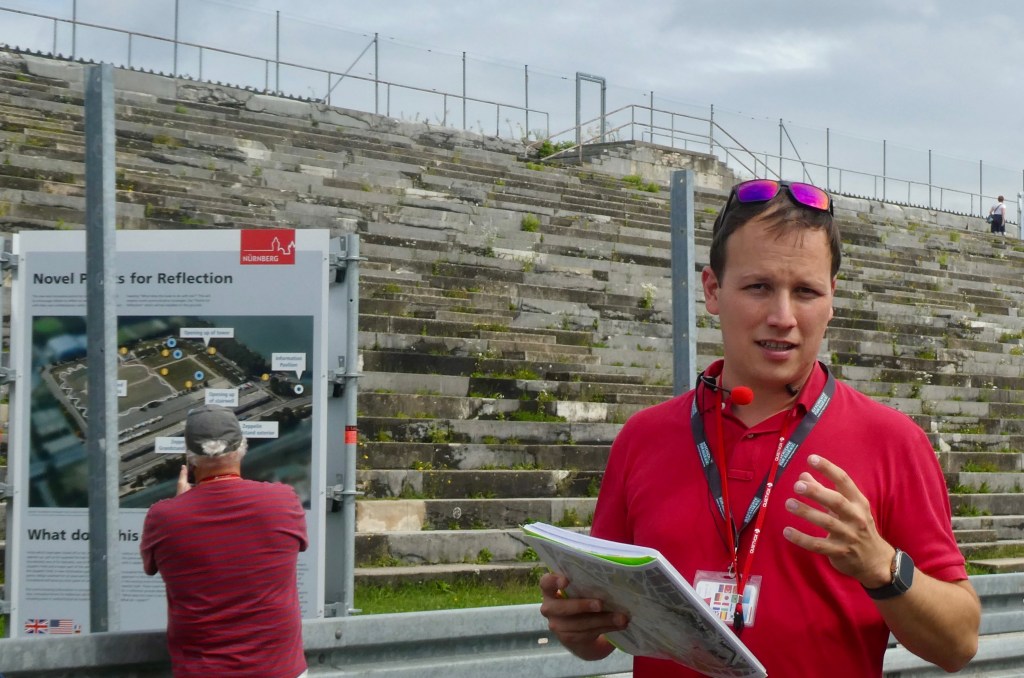
We were fortunate to have a great guide who told us about the history, the parade grounds and the work Germany is doing to keep it from ever happening there again.
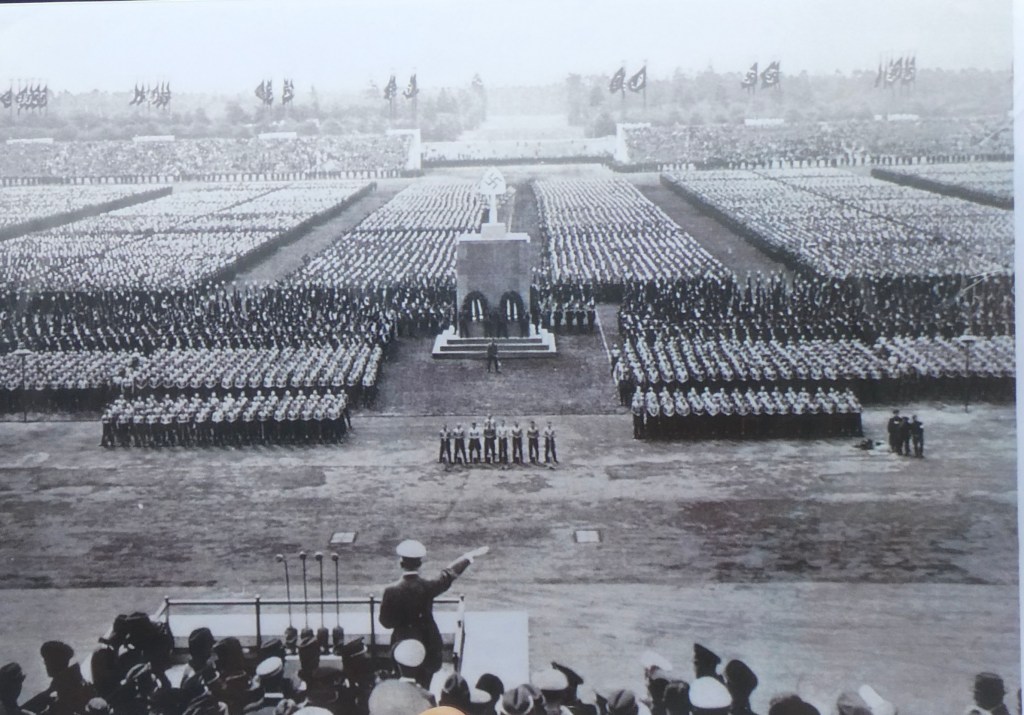
The Nazis took control of Nuremberg and their most important propaganda activities took place here between 1933 and 1938. Nuremberg had been important in their Empire for 1000 years, and the Nazis chose Nuremberg specifically because of the propaganda importance. They wanted to usher in a new emperor in Hitler.
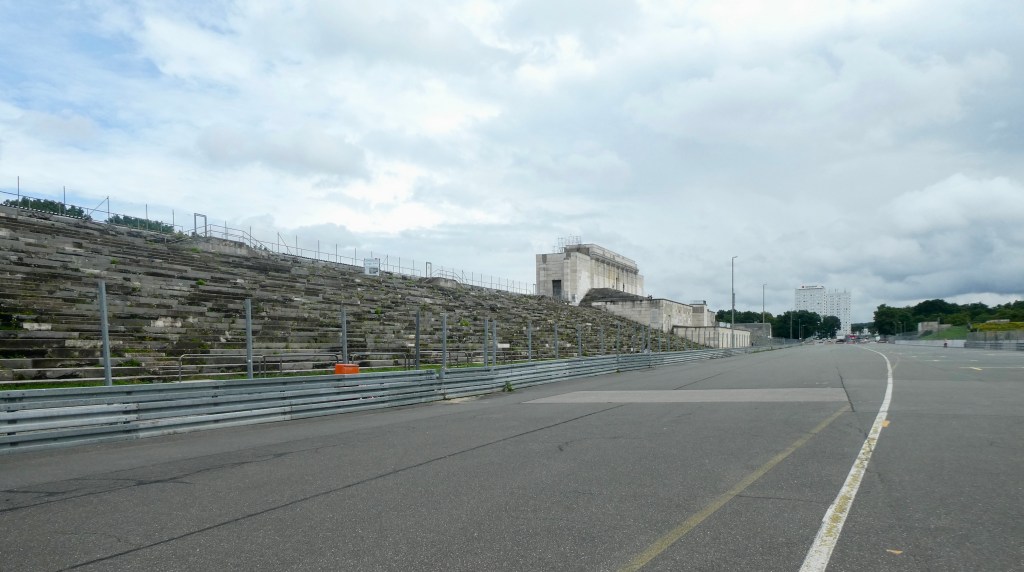
The Feuhrer made decisions about everything including the Zeppelin Field parade ground.
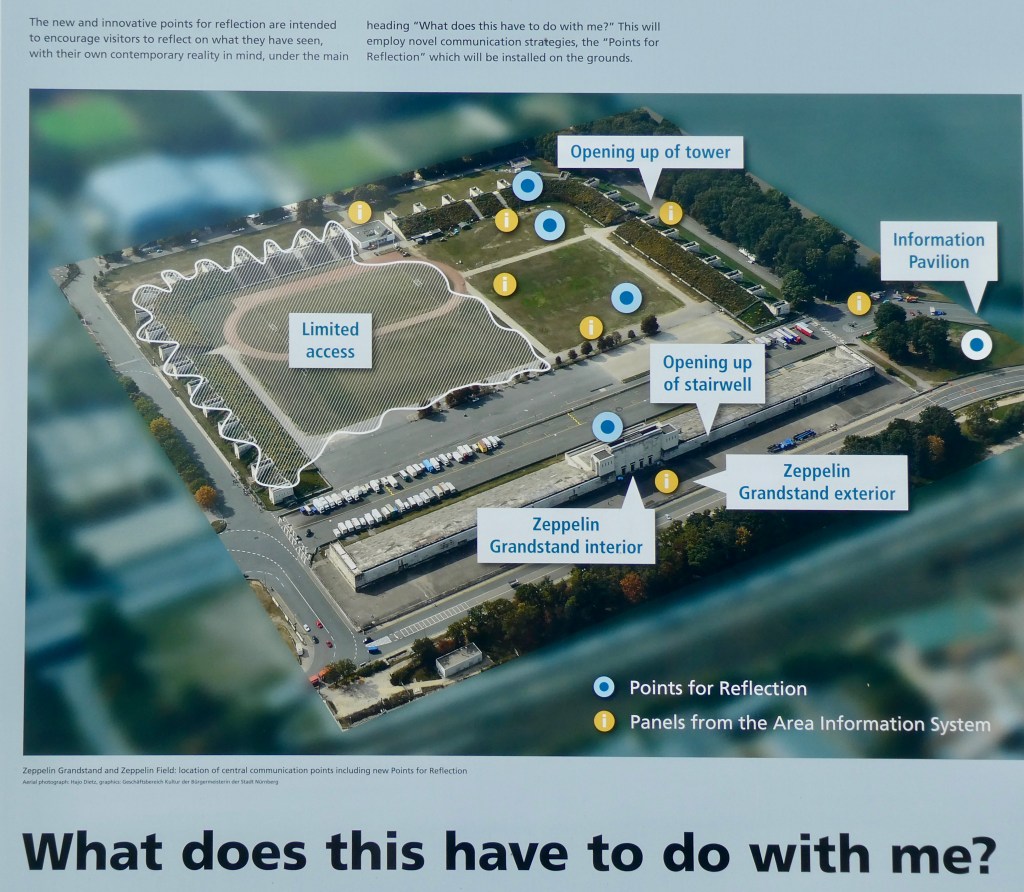
These parade grounds were proposed to be 16 square miles but were not finished before the war. Still, it was four times the size of Central park.
Rallies had 500,000 spectators and up to 700,000 participants. The activities were designed to be spectacular to draw people in. There were mock battles using current weapons. Events lasted between 4 and 8 days and consisted mostly of speeches and personnel parades.
Germany invaded Poland in 1939 and the war was on.
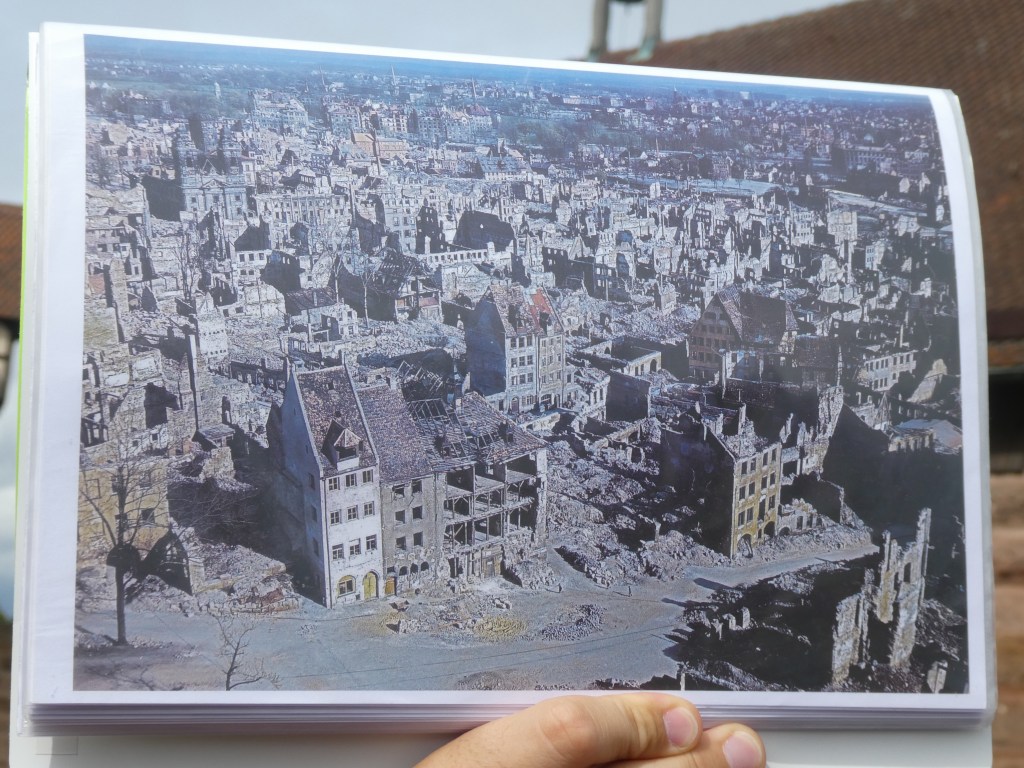
At the end of the war, damage was so extensive in Nuremberg that 91 percent of the city was reduced to rubble. If you’ve seen pictures, they are probably from Nuremberg.
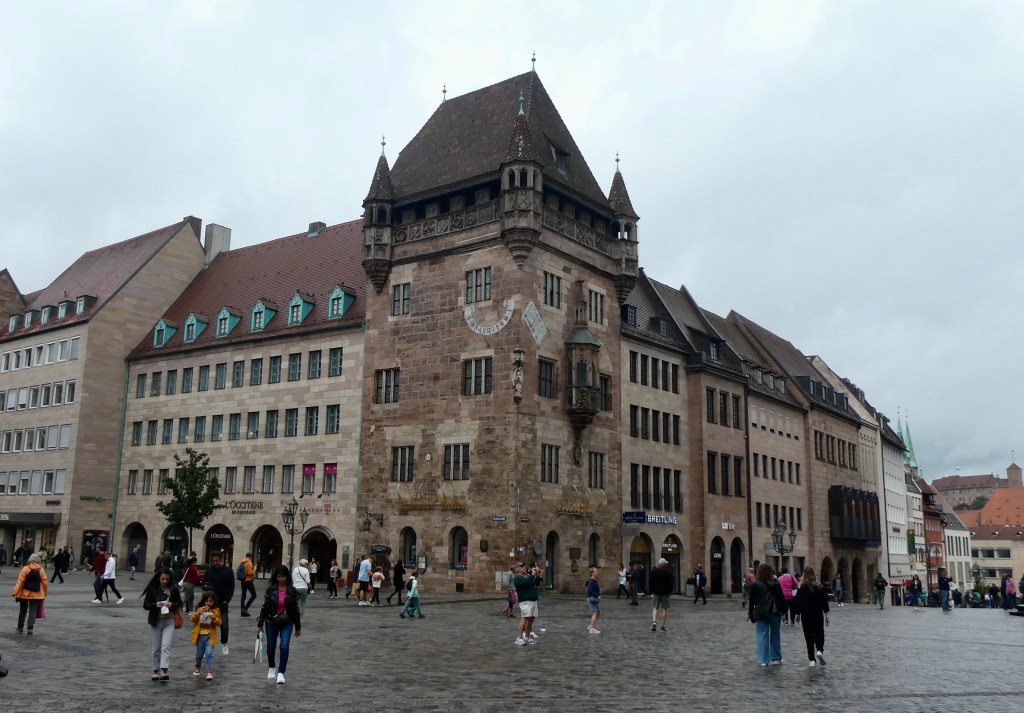
In comparing the pictures you can see the light colored house survived WWII bombing. Much of the city was rebuilt (mostly by the American government) with the same medieval footprint as the old city.
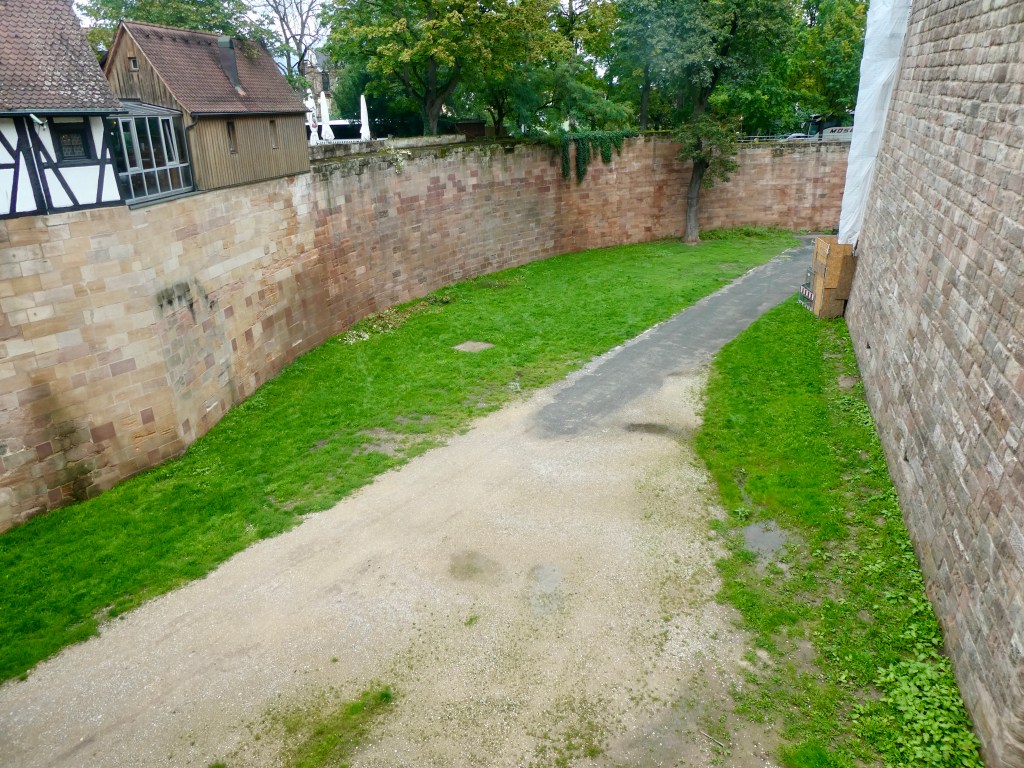
This is part of the old city wall of the medieval Nuremberg castle. These walls are 80 percent original because sandstone doesn’t burn.
Throughout its thousand year history, the city of Nuremberg was never conquered until 1945 when the Americans did so from the air.
Medieval defenses included murder holes. They would drop burning hot sewage upon invaders as a defense mechanism.
After the war It seemed logical that the Americans would want the War Trials held in Nuremberg for propaganda purposes but that really wasn’t the case.
The Grand Hotel was where lawyers for Nuremberg trials stayed.
The proximity of a courthouse and adjacent prison was unique here. As no one was sure how the local populace would accept their former leaders being put on trial it was beneficial to have them close.
There was also the possibility of assassination if distances needed to be traveled. Instead, they could use the walkway between buildings.
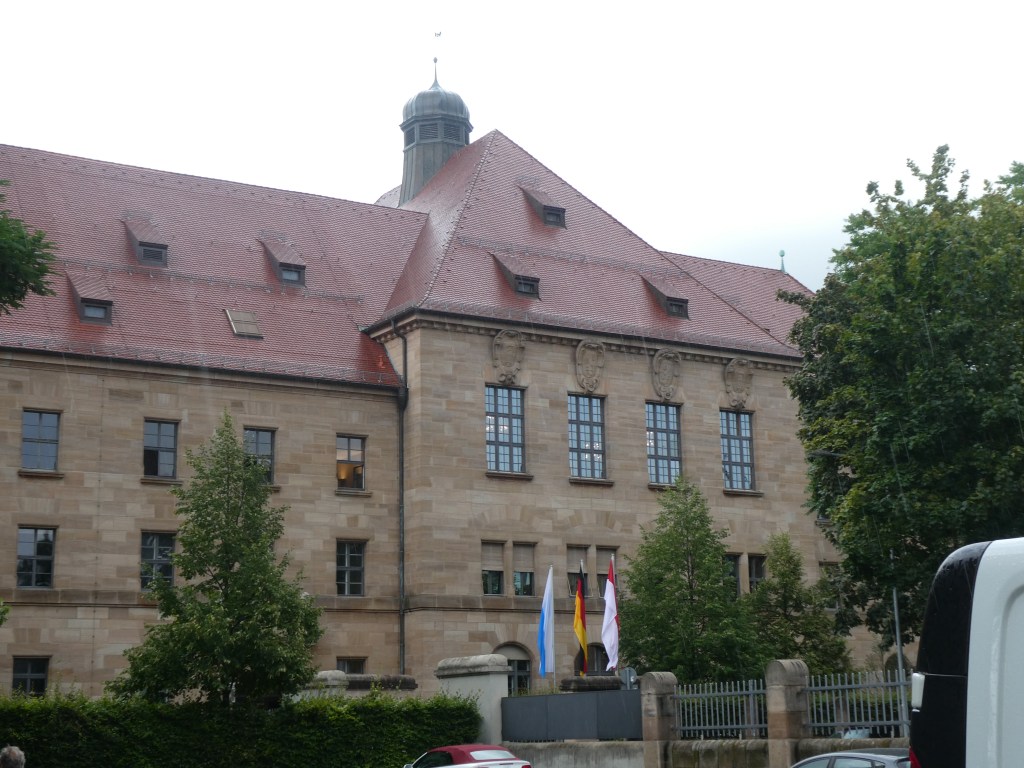
This was termed the Palace of Justice in 1945. British and Russian governments were discussing assassinating Nazis for war crimes but exiled governments (like Norway) did not want retaliation to look like the Nazis would have done.
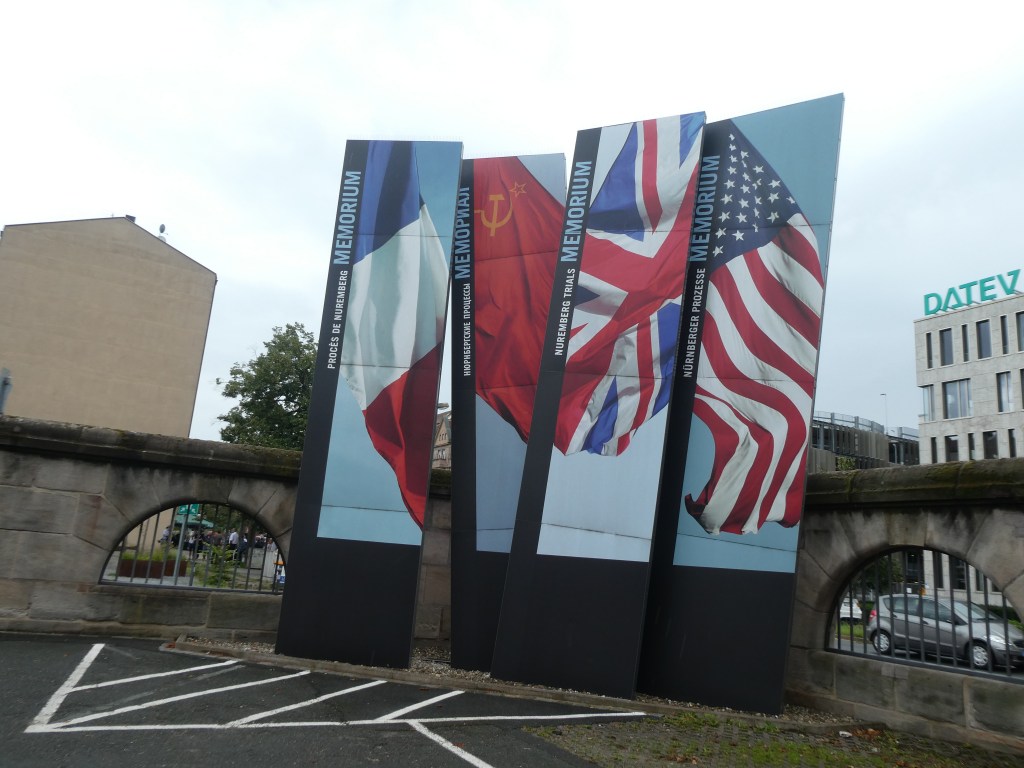
The United States, France, Britain and Russia agreed on four charges and the goal was to be done in three months.
The Americans wanted the largest courtroom. Court room 6000 was the largest but it was still expanded. It is the room behind these four windows.
Journalists in attendance were Walter Cronkite, John Steinbeck and Ernest Hemingway.
Prosecutors had a wealth of evidence and only one percent of files and evidence was used. The trials lasted 11 months instead of three.
The most important defendants, who were still alive, were tried first. There were 22 sentences against 21 defendants with 12 death sentences. The convicted were executed and cremated so there were no graves. Trials resulted in seven prison sentences between seven and ten years. There were three acquittals.
Stalin wasn’t happy with these real trials. He was used to show trials with predetermined results.
The Americans held 12 more trials in Nuremberg with 177 defendants. There were 34 additional death sentences. These 13 trials are considered the beginnings of international justice. Other countries conducted additional trials on their own.
Part of what happened when the Nazis were in power was that the people weren’t required to think anymore. They just followed the party line. After the war, in the 1950s and 1960s, the Germans tried to ignore their past.
From 1970 to the present, they have decided to confront and teach their history.
More and more education centers are being built to support that effort.
One million German school children come to Nuremberg every year to learn about Nazi propaganda.
Eighth graders are required to visit a relevant Nazi site and experience first sources so the history can’t be whitewashed. The goal is to limit future support of extremists.
I appreciated learning these karma things:
American soldiers paraded on the Zeppelin grounds after World War II. Bob Dylan performed on those same grounds with Eric Clapton in 1978 – Dylan was Jewish.
This red brick building was built for Nazi barracks but never used. Following WWII, American service members stayed there for decades. Now it is a government building for Immigration and Refugees. That seems a perfect answer for a former nazi building!
We were very impressed with our first stop in Germany.
The rebuilt city is lovely, but most impressive is their willingness to confront their past and try to learn from it to prevent it from being their future.
We learned that Nuremberg is famous for gingerbread made without ginger. I like really spicy gingerbread and neither of these worked for me.
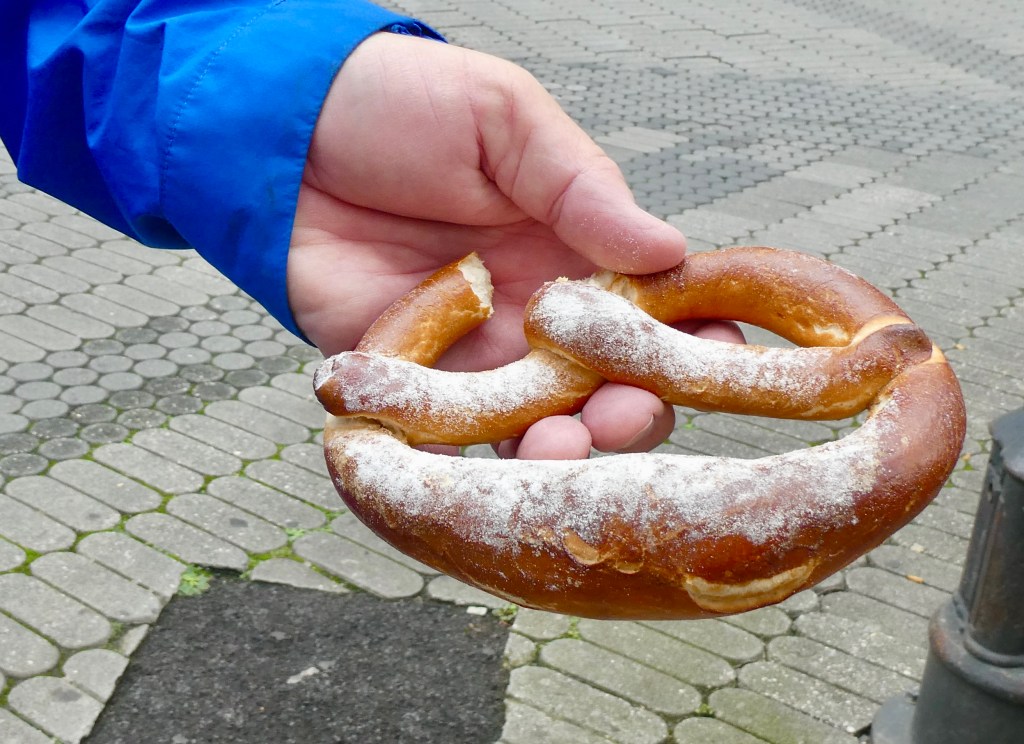
Randy had looked forward to trying an authentic German pretzel! This one was purchased from a vendor cart but had been made earlier in the day and was cold and tough. Disappointment!
They also make a specific kind of sausage, supposedly the oldest recipe in the world. They produce seven million links per day. Nuremberg also has their own Red Beer. This type is bottom fermenting with a roasting temperature of 100 degrees Celsius. Temperature determines beer color.
We arrived at the port and boarded the Viking Alsvin.
We found our cabin.
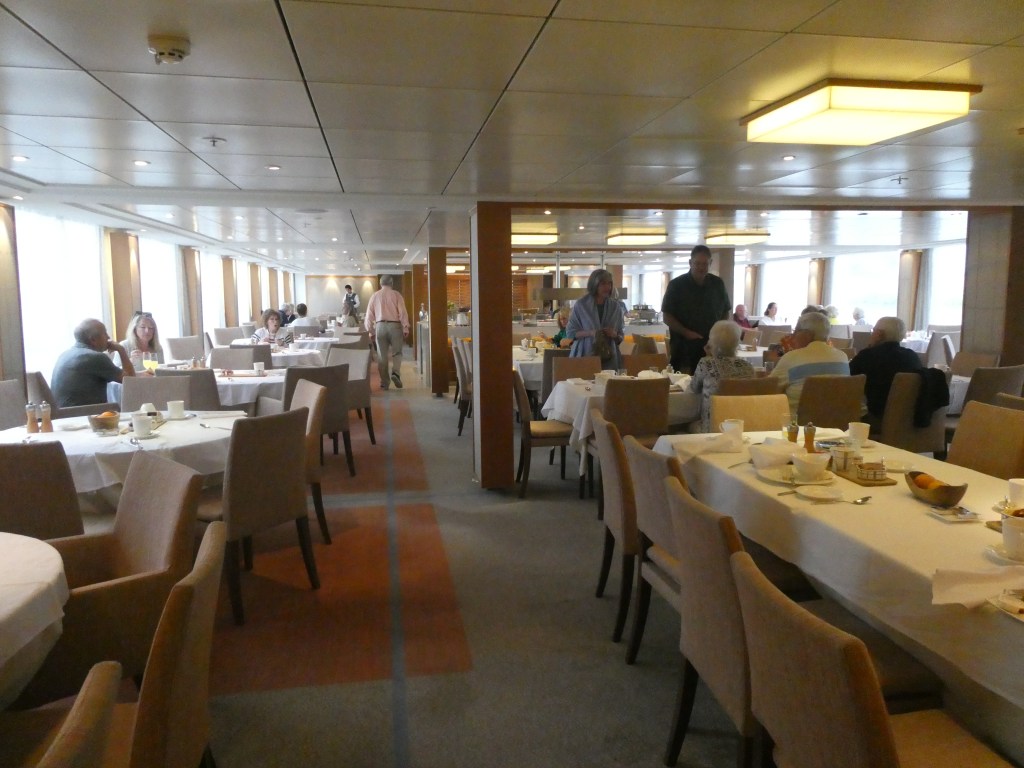
And the dining room where we would eat all our meals.
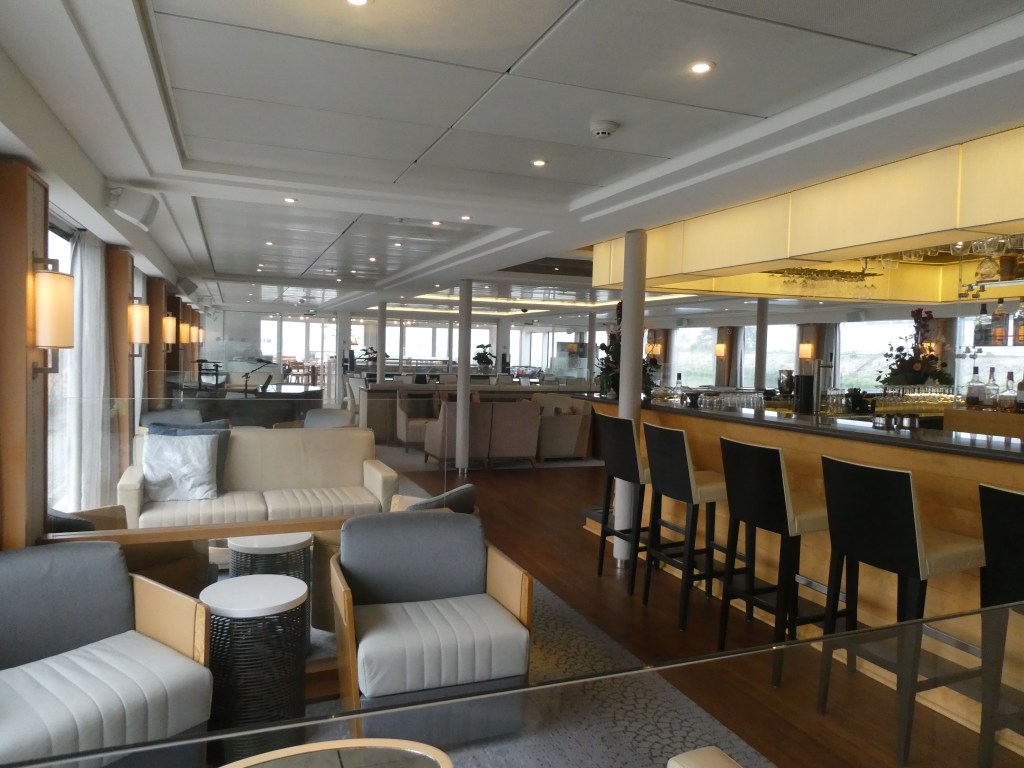
We found the lounge where everything else happens.
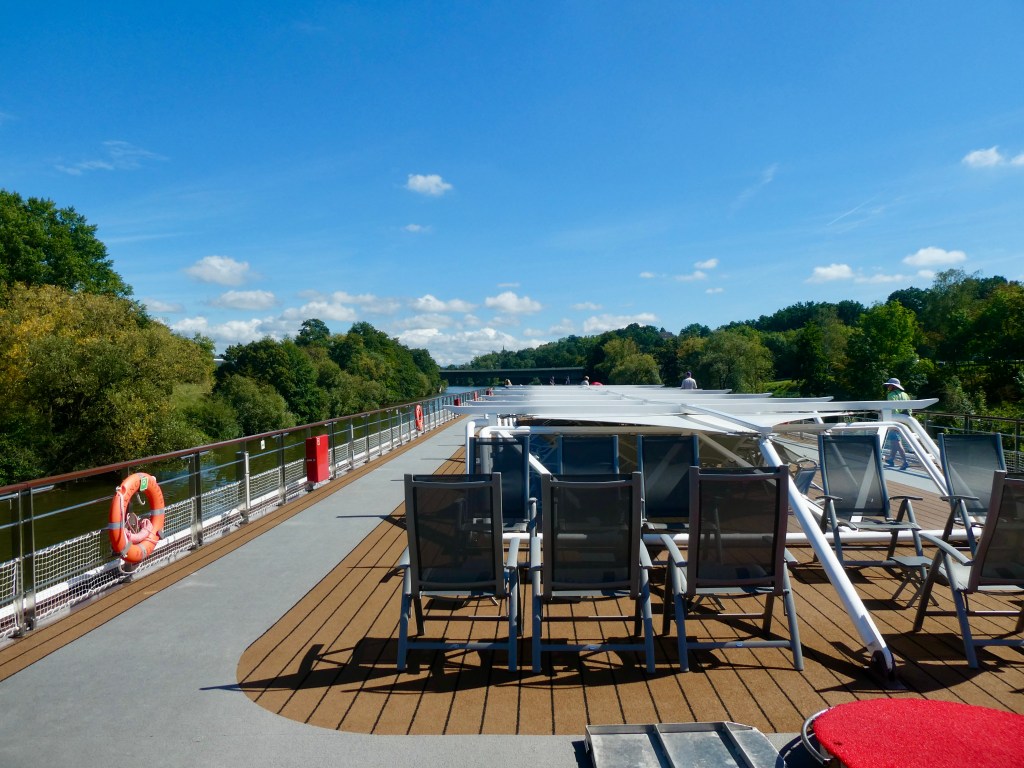
Depending on bridges and weather, we sometimes had access to the open deck above.
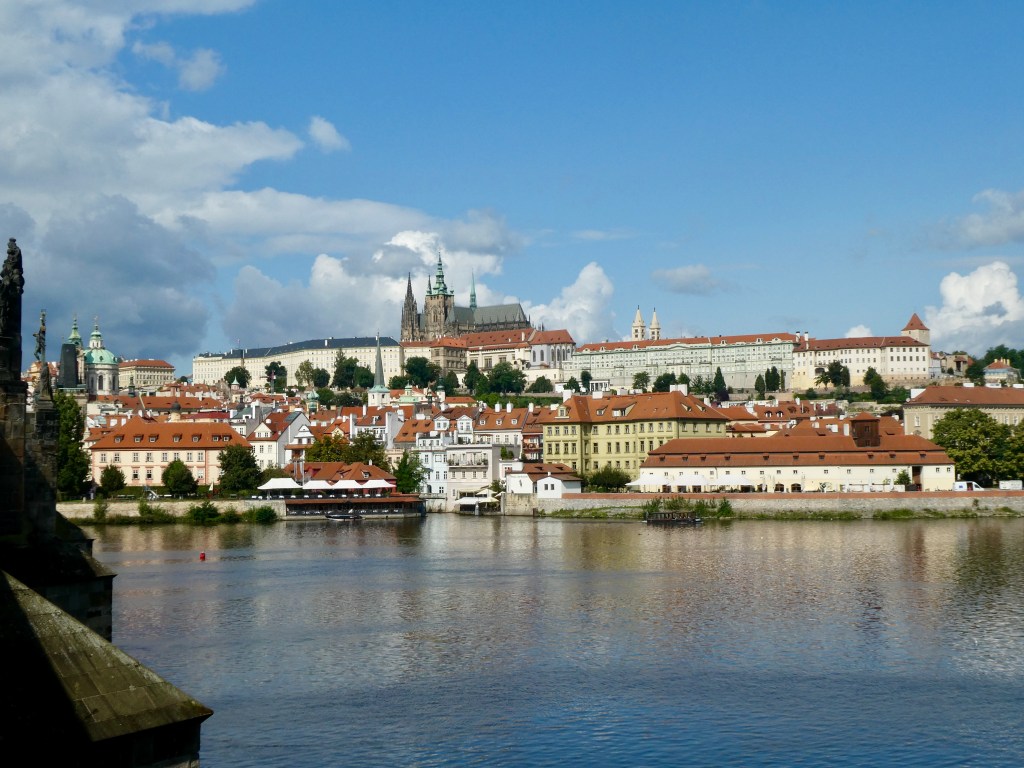
From a distance we can see Prague Castle. The complex actually holds four castles, built from the 9th to the 18th centuries. It is the largest ancient castle complex in the world. The four castles include the old royal palace, Queen Anne’s summer palace, the Lobkowicz Palace and the new royal palace. There are also a number of other churches and buildings on site.
We had a closer view as we approached the castle complex.
It was once surrounded by a green moat – not quite water with alligators, but the exposure was still able to be a deterrent to aggressors.
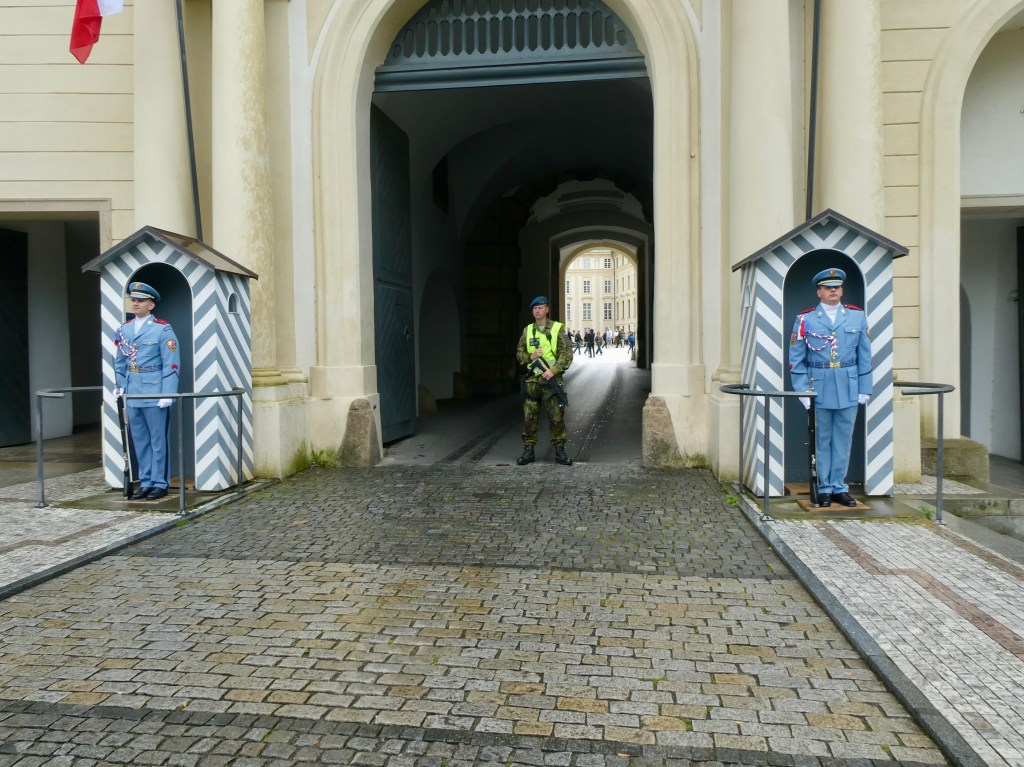
We passed the guards of the Prague Castle.
Their uniforms were designed by the same man who won an Oscar for the movie Amadeus. He was a Czech immigrant.
The gold star at the top of the cylindrical building means the Czech President is in the country. Currently, the castle complex houses the official office for the President. It had previously been the home for kings of Bohemia and Holy Roman Emperors.
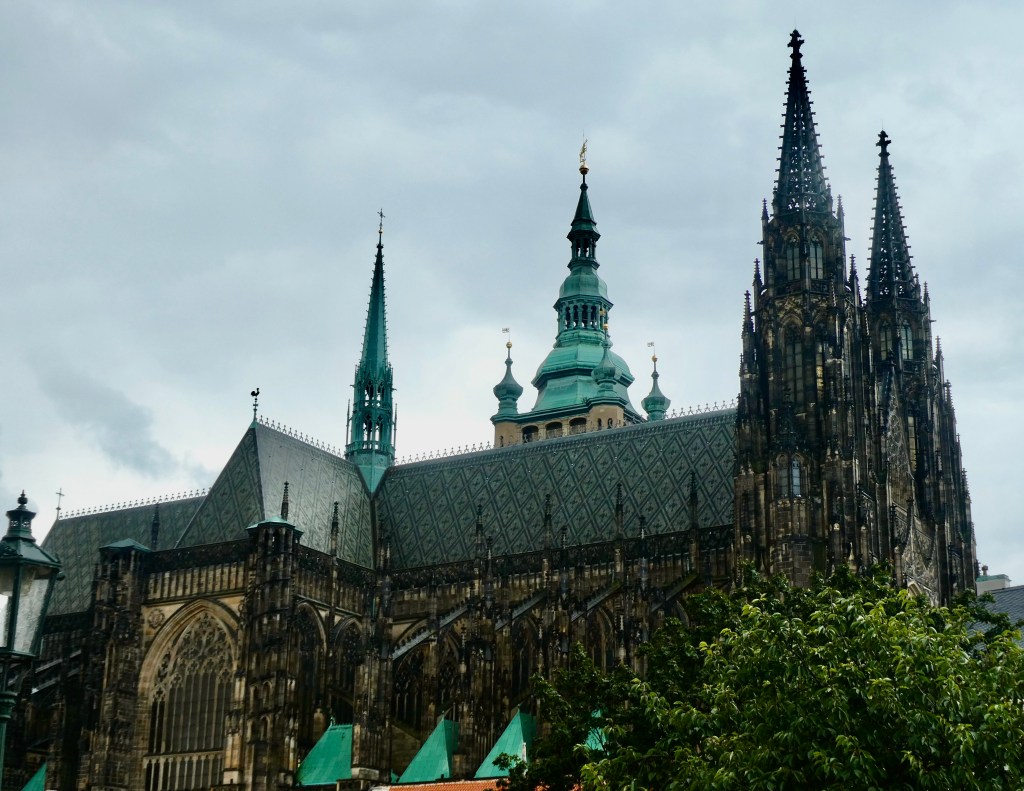
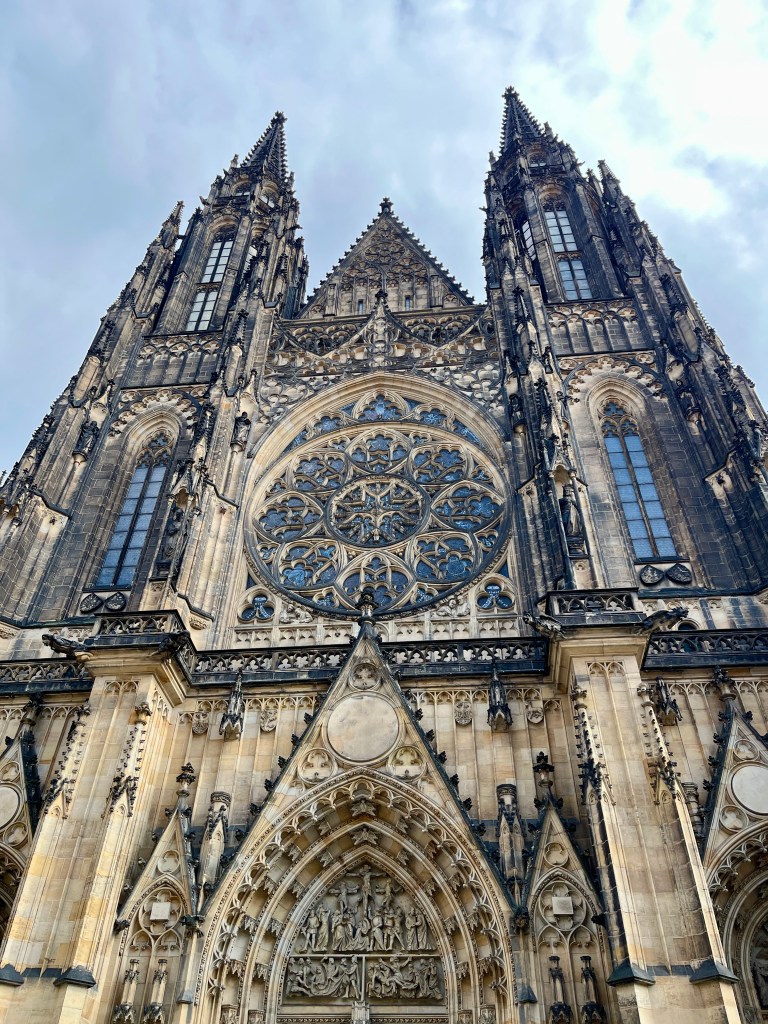
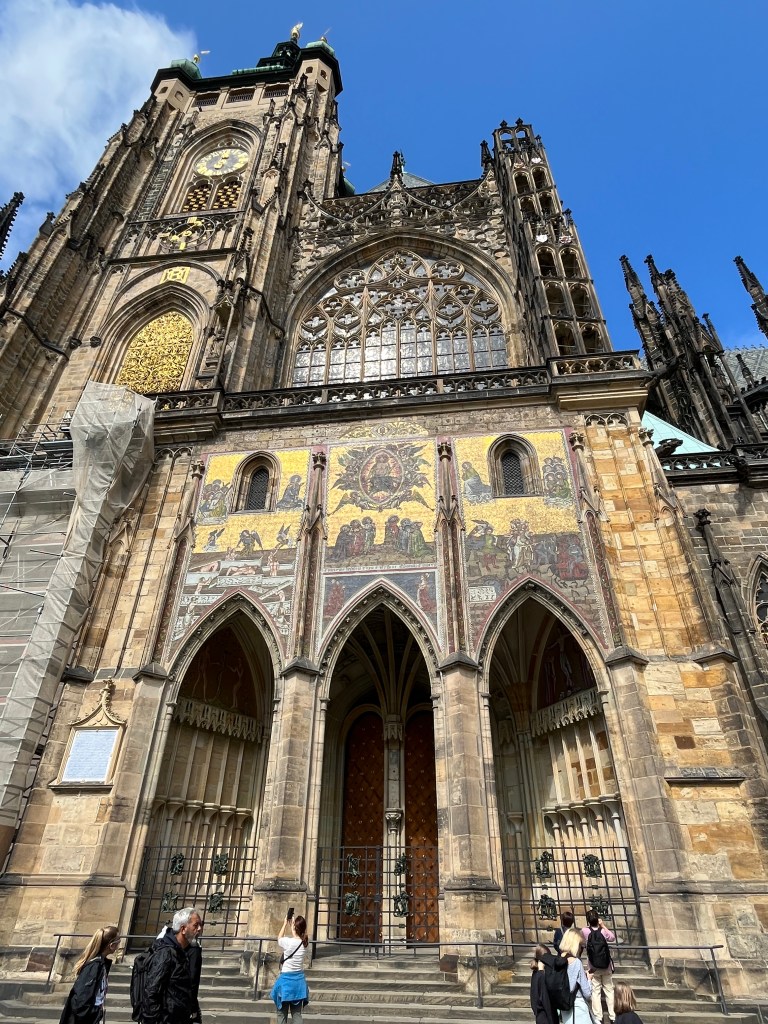
The St. Vitus Basilica was founded in the 10th century by Duke Wenceslaus.
There have been three evolutions of the St. Vitus Basilica on the site.
The current gothic style church was started in 1344 by King Charles IV and was not completed until the 20th century.
It remains the most important cathedral in the Czech Republic and many former kings and Holy Roman emperors are entombed there.
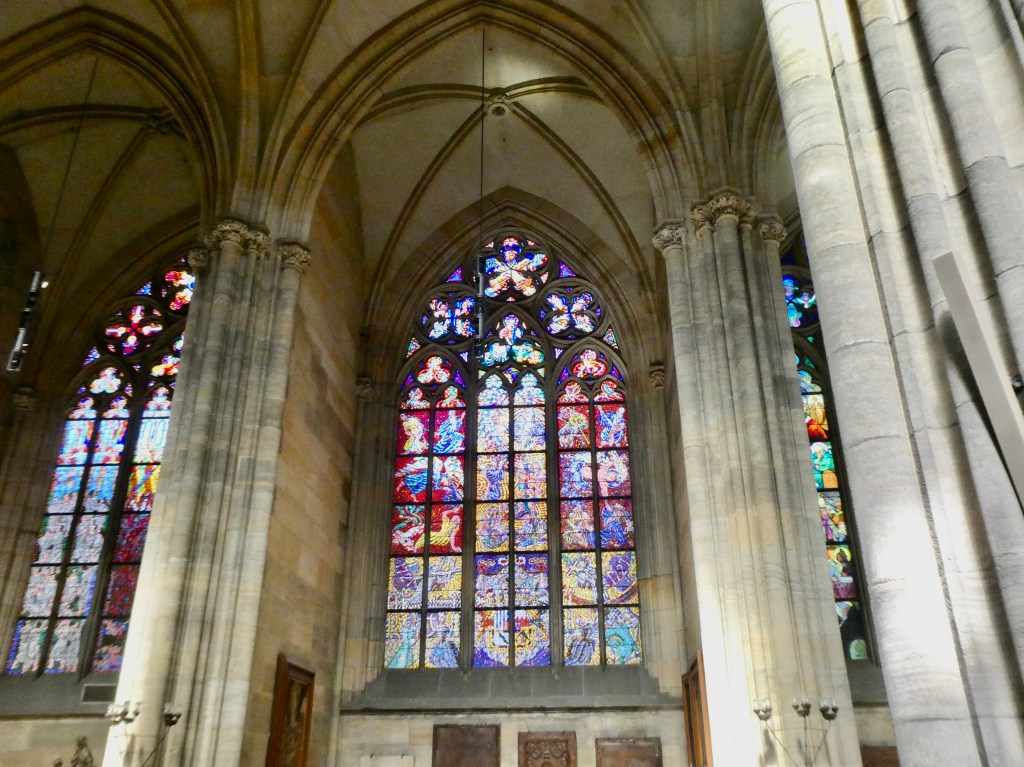
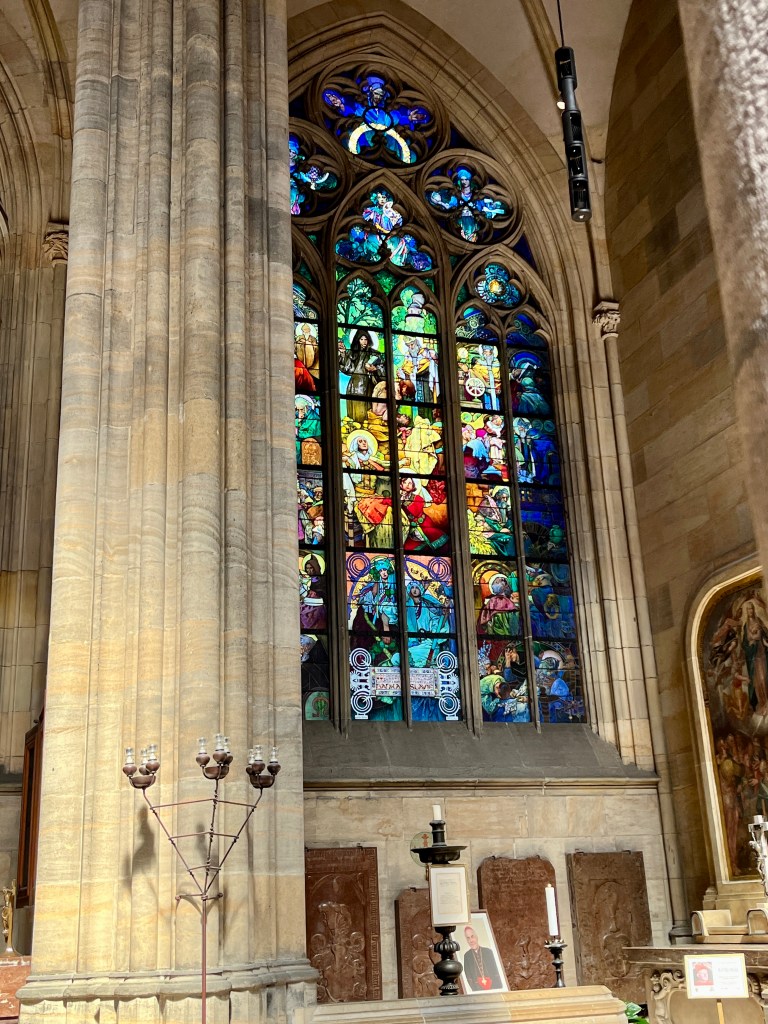
There are many side chapels in tribute to different peoples and saints.
A new organ from Spain will be installed soon. It has been in the country for a year but they found the balcony needed to be strengthened before it could be placed.
That will happen 100 years after the rest was finished. The flying buttresses are of the French gothic style on St. Vita Cathedral.
The clock above the main entrance shows the hour hand above, and the minute hand below.
The royal palace was rebuilt In the 14th century, under Charles IV. This section shows the architecture of the old palace before the rest was sheathed to look alike.
There was a covered walkway between the royal palace and the cathedral.
The building on the left is Saint George Church. It is the oldest church in the complex being from the 12th century. The building on the right was named for Maria Teresa, Queen of Bohemia and Hungary from 1740-1780. The building provided accommodations for Nobel Ladies who were not married.
This palace is now used for Presidential Offices, not for a presidential home.
After the great betrayal, Czech President Emil Hacha had to negotiate to hand over his country to Nazi Germany. He suffered a heart attack during the negotiations on March 15, 1939. Later, Adolf Hitler proudly spent a night in Prague Castle.
In addition to the public access buildings in the Prague Castle Complex, there is one privately owned building – the Lobkowicz Palace. The palace was started in the 16th century by one brother and then completed by the next.
The daughter of the second brother, Polyxena, married her first husband who died shortly after. A few years later she married the First Prince Lobkowicz.
The galleries in the castle show their private collection of art and explain the family dynasty.
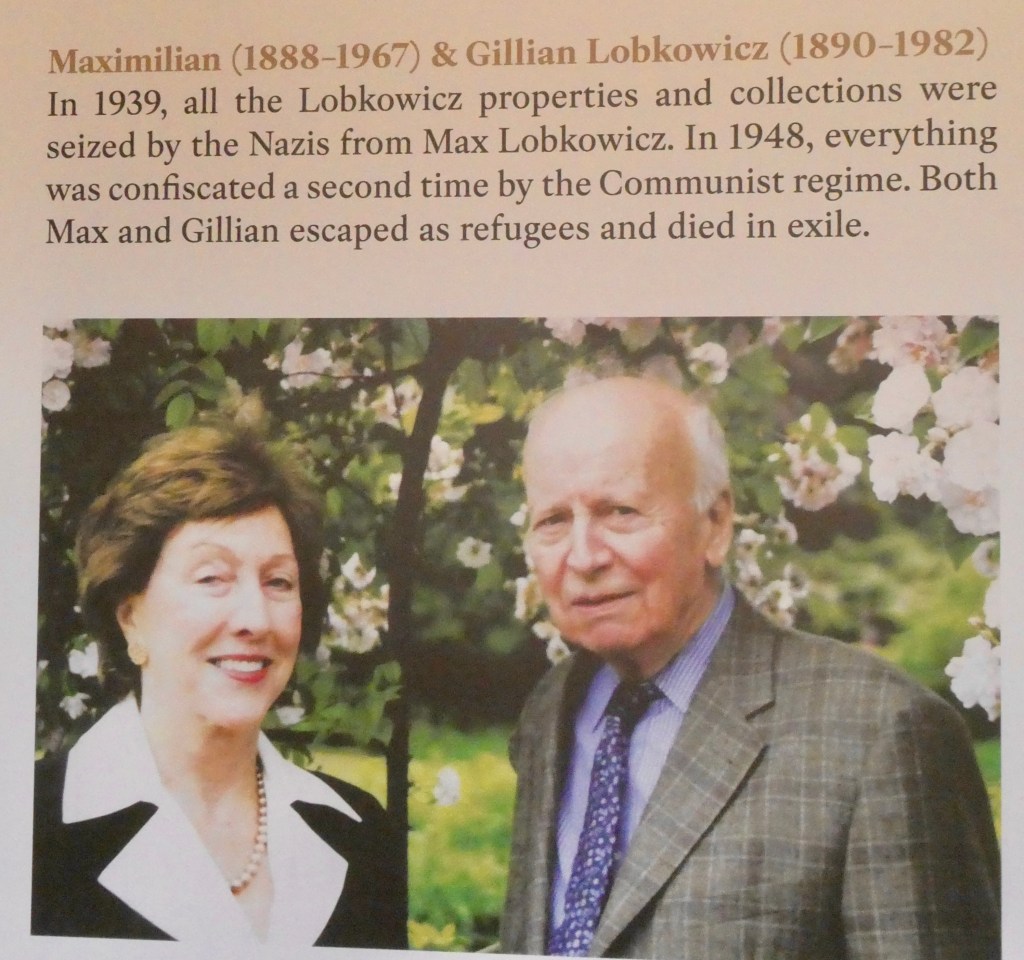
The Lobkowicz family was one of the wealthiest in the country under the Hapsburg dynasty. They were forced to flea the Nazis in 1939 when the palace was confiscated.
After the fall of Communism in 1989, there was a twelve year restitution process to return the castle to the Lobkowicz family. After restoration and refurbishing, the palace opened as the Lobkowicz Palace Museum.
After lunch at the castle, we enjoyed a concert.
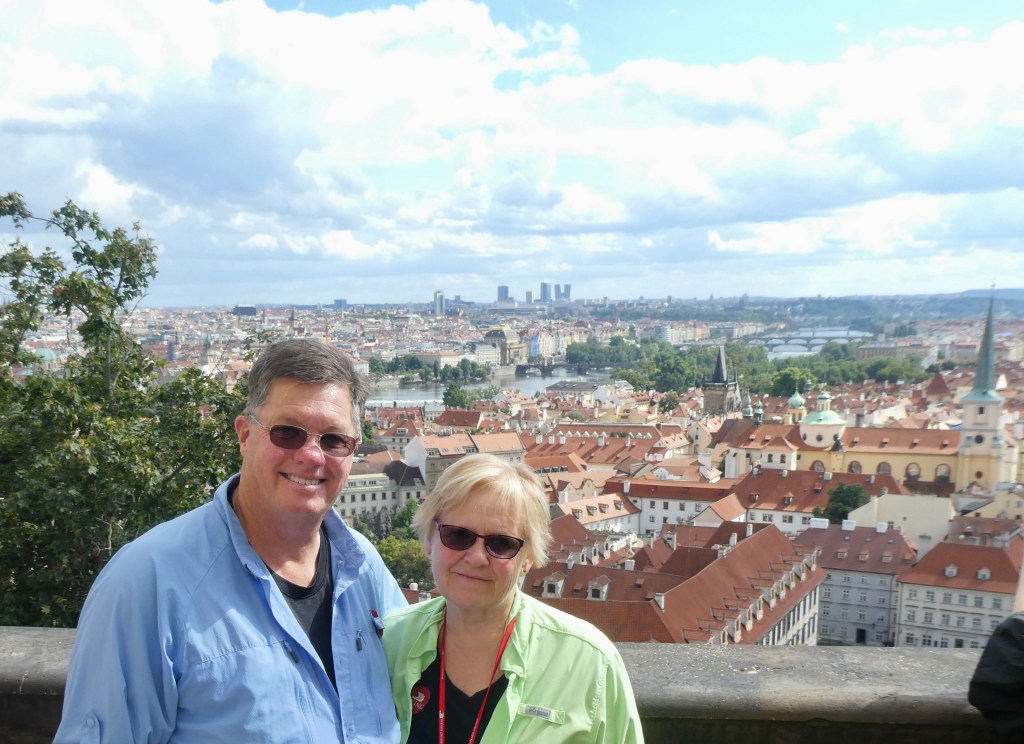
We were able to enjoy views of Prague from the balconies in the castle complex.
The buildings with red roofs were the original footprint of medieval Prague.
The Rolling Stones played several concerts at Prague Castle after the fall of communism, becoming friends with Czech leaders.
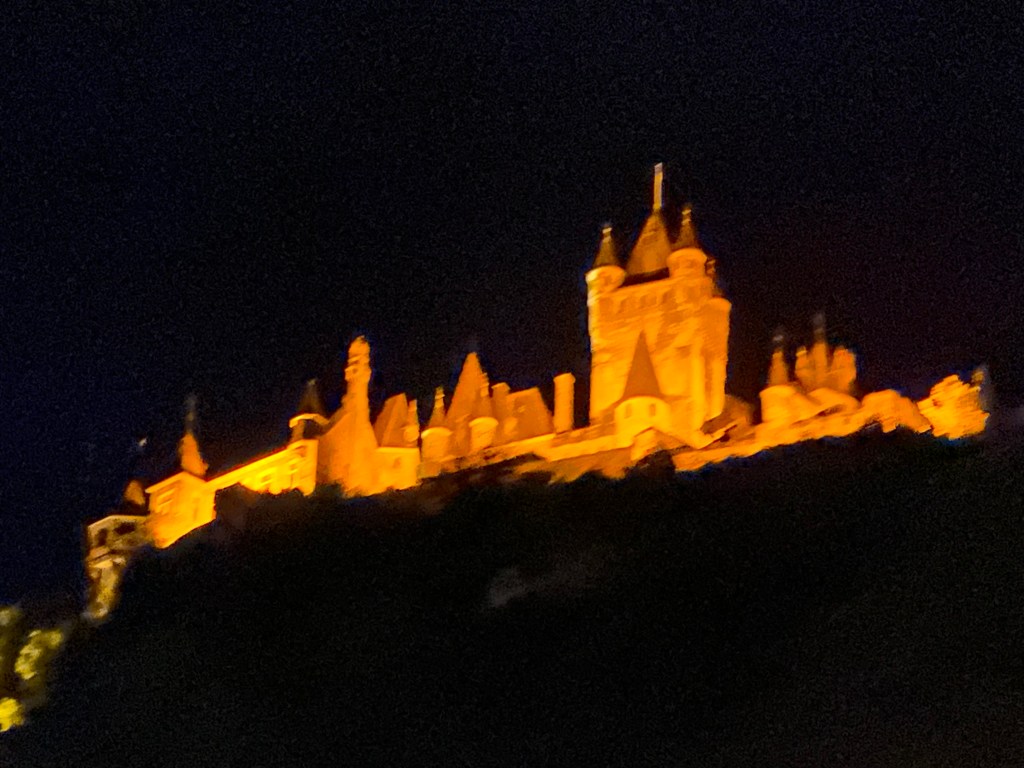
The Stones paid $32,000 for illuminating Prague Castle for the enjoyment of the city residents and visitors. Photo credit to Connie who stays up much later than we do!
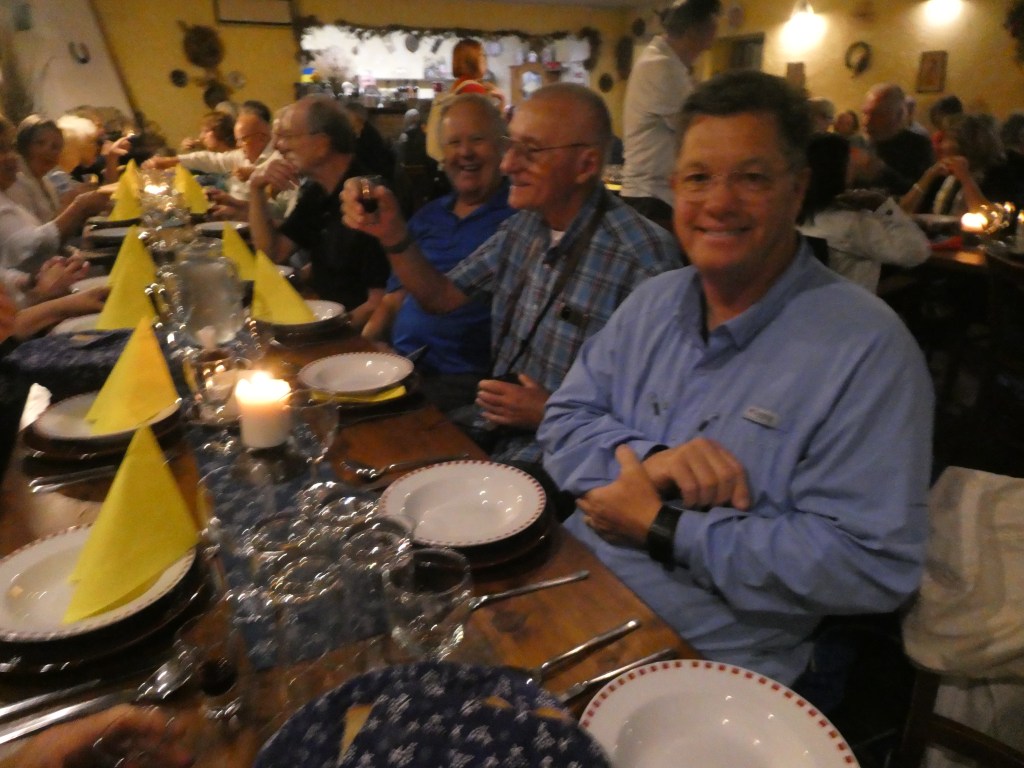
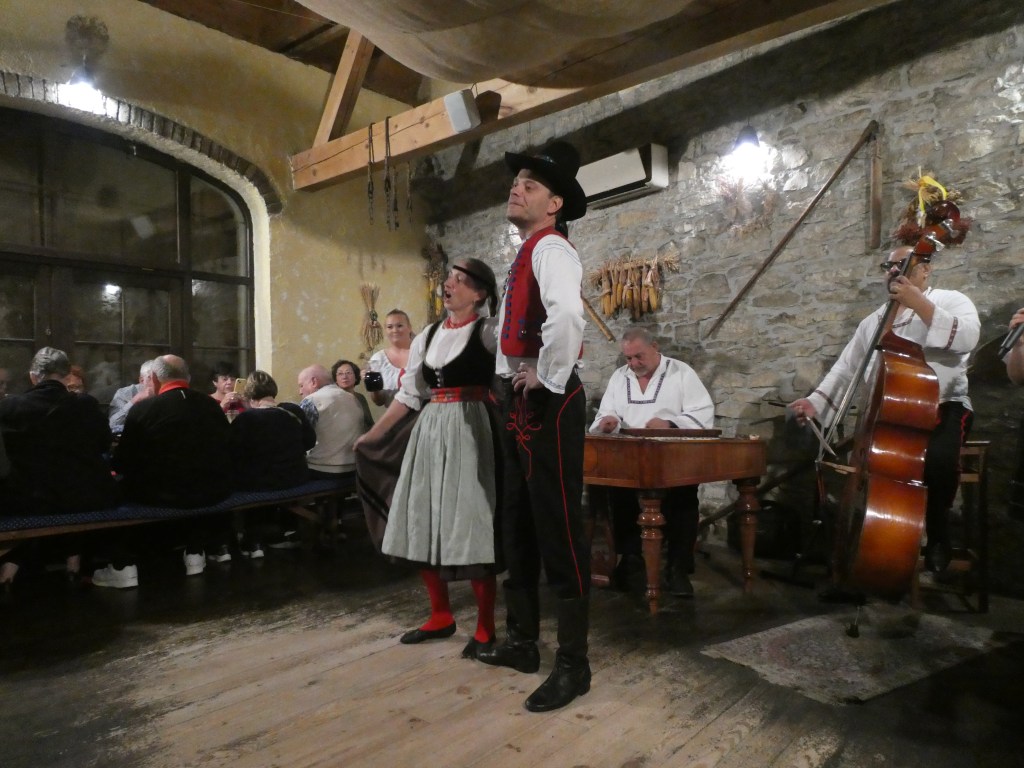
On our last night in Prague we enjoyed the Prague Folkloric Dinner that we had to reschedule from our first night.
The meal, served family style, was good! There were also generous amounts of beer and wine available.
The entertainment was delightful.
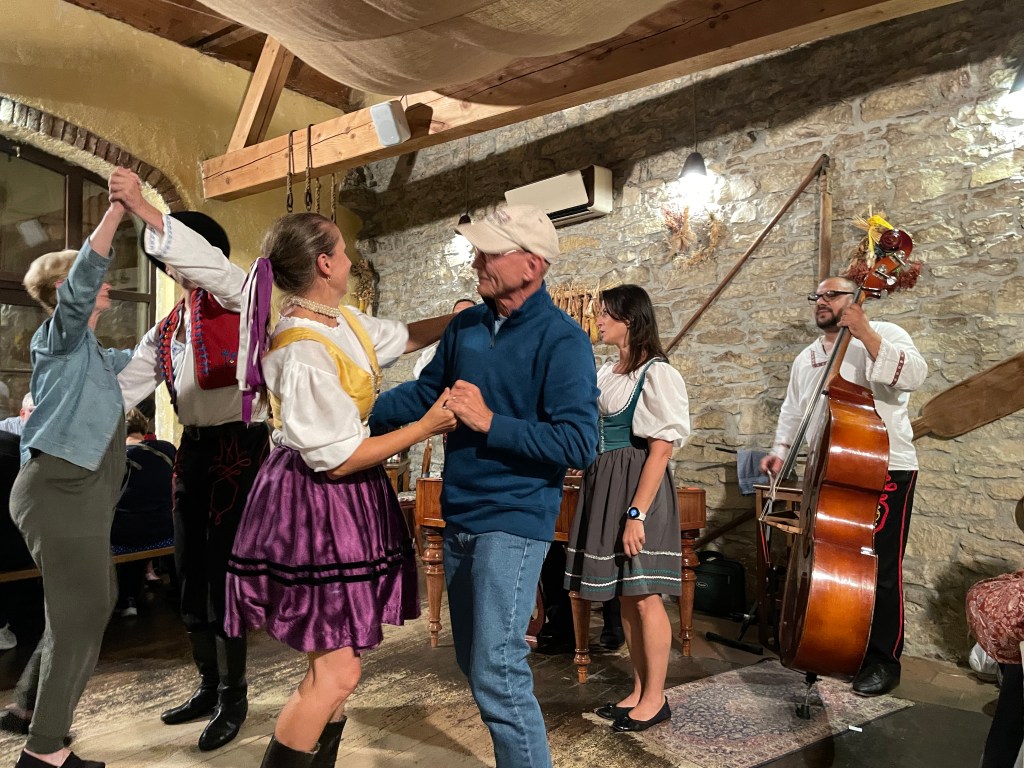
Warren surprised us with his expertise on the dance floor!
Prague was great. We understand why so many people love Prague.
We began our Prague City tour in the Jewish quarter. It was once a ghetto for Jews and the poor. In the late 1800s it got so bad that the city of Prague cleaned it up and provided new sanitation measures. The area then became highly desirable to all Prague residents.
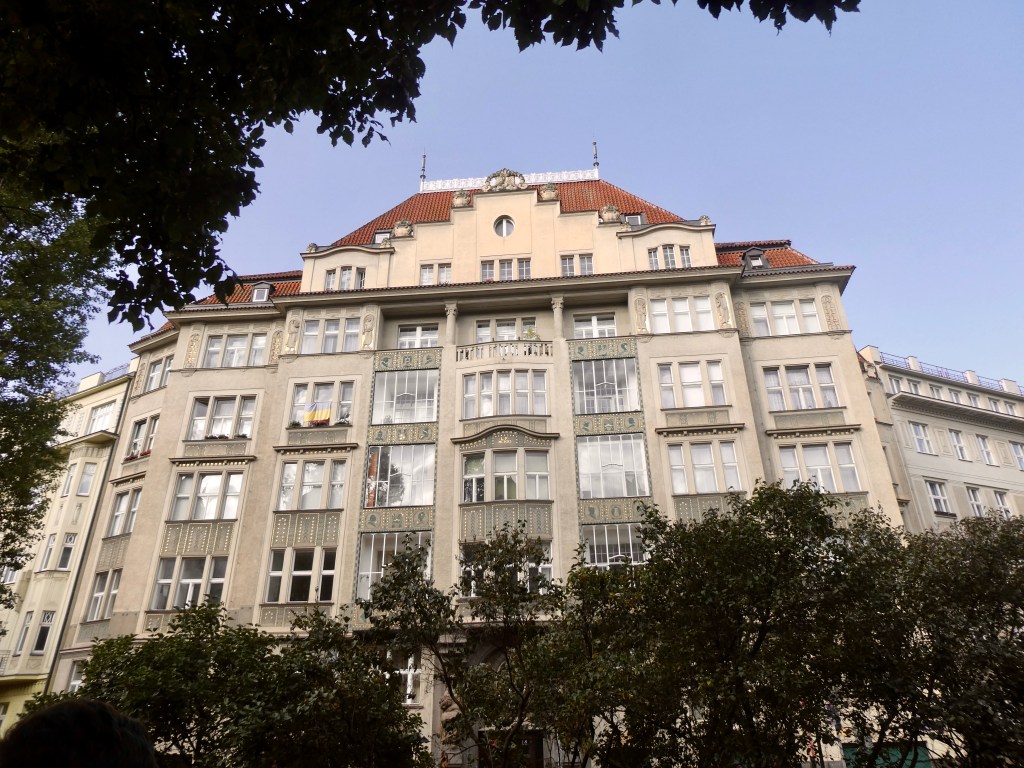
This 1911 building, trimmed in gold, has Jewish artistic features.
This statue of Moses was melted down by the Nazis during WWII. After the war, the artist’s wife still had the original mold so it was remade.
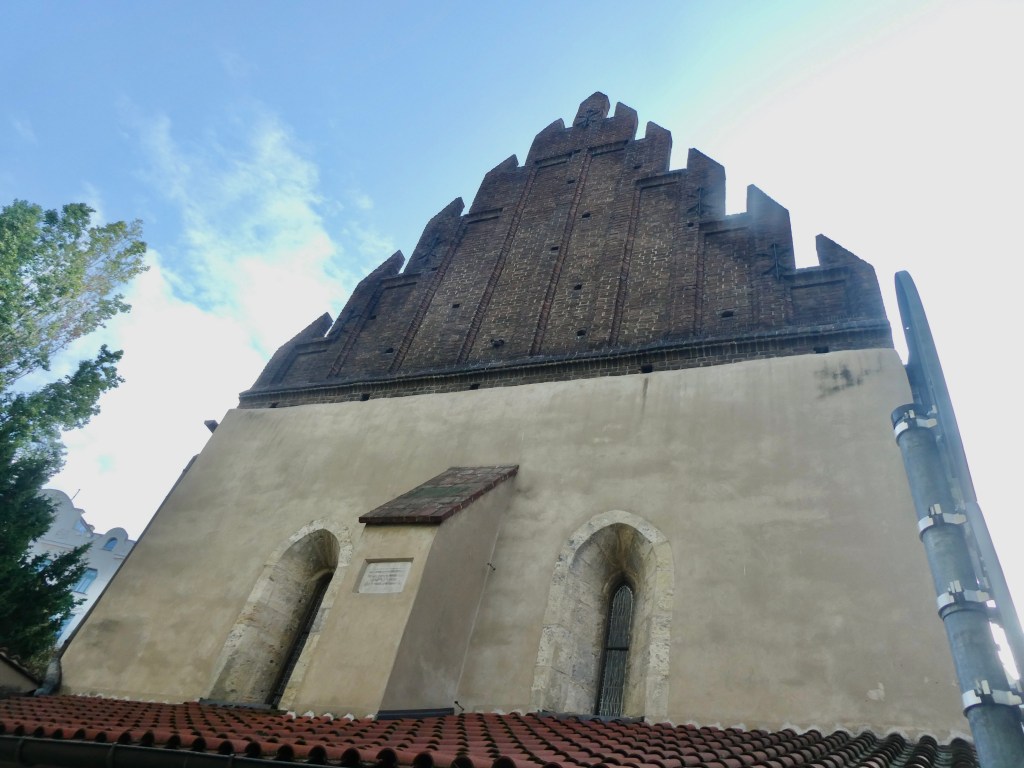
This is the oldest Jewish temple in central Europe.
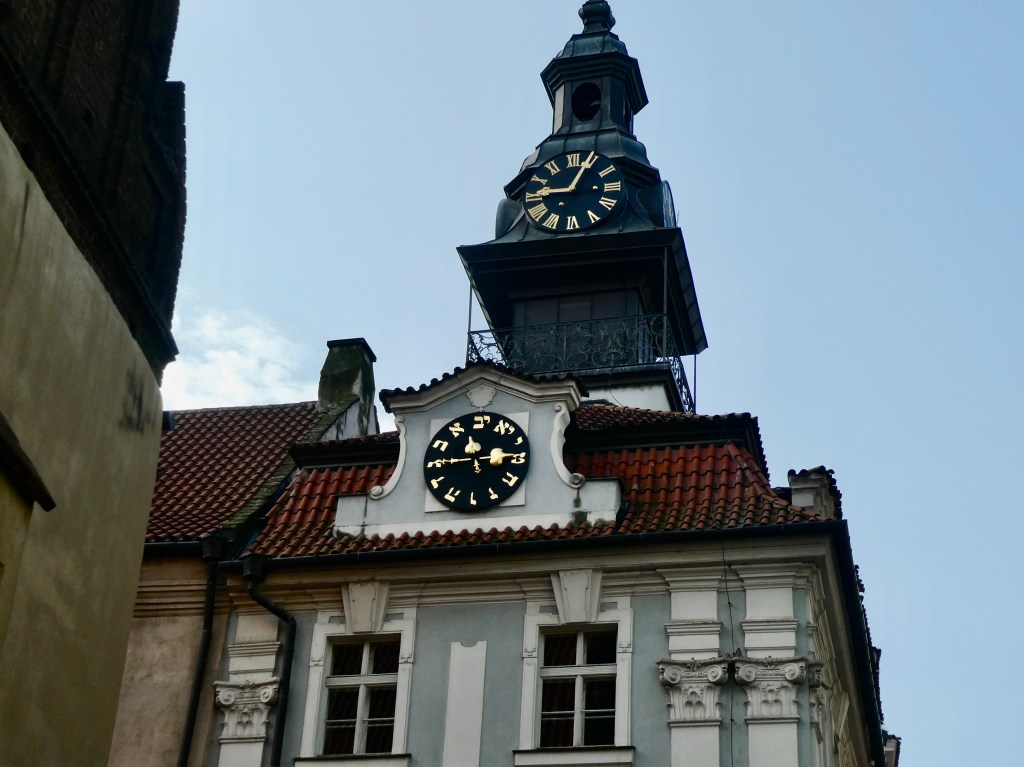
The temple has two clocks – one Christian and one Hebrew. They go in different directions!
Czech, German and Jewish people lived peacefully together here for centuries. One hundred and thirty thousand Jews lived in Prague prior to World War II. Thirty thousand of them left just before, or at the beginning of the war. About 90,000 Prague Jews were murdered so only 10,000 returned.
After the war, the remaining Germans were expelled so the population was overwhelmingly Czech. The country was not very diverse. (Recently, the Czech Republic has taken in more Ukrainian refugees than any other country in the world.)
At the end of the World War II, the Americans stopped at Pilson – only one day away from Prague. In the end, Stalin got the Czech Republic in the world re-sorting. The Czech people suffered for decades under Stalin and Communism.
We visited the 11th century Old Town square.
There are interesting buildings all around the square.
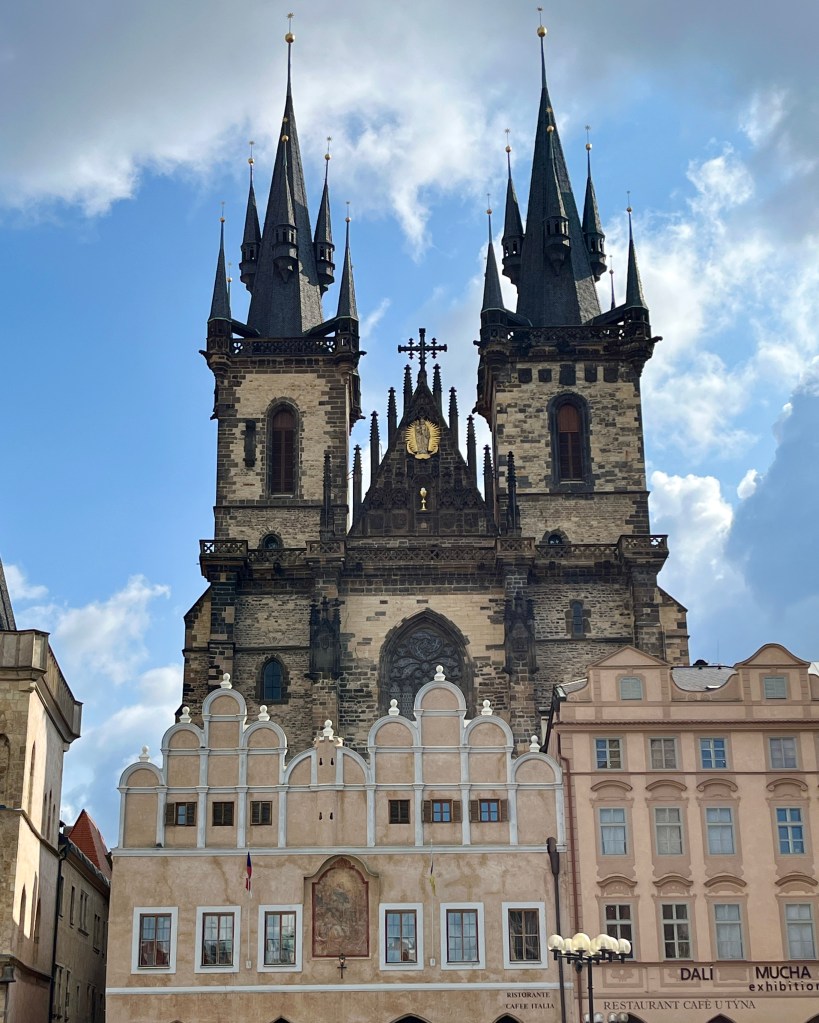
The Church of Our Lady Before Tyn is gothic style. Construction began in the 13th century but was not completed until 1511 when the south tower was finished. We did not go inside.
Our guide explained that, despite the number of churches in Prague, the Czech Republic is 90 percent agnostic. Over centuries, and for lots of reasons, faith just isn’t a thing in the Czech Republic. It cannot be accounted for solely by decades under communism because faith levels in other countries experiencing the same have rebounded. But, she did say they have the highest library density in the world!
Very nearby the square is the famous Prague Astronomical Clock. Built in 1411, it is the oldest astronomical clock in the world. Many people were gathered to see all the things that would happen at the top of the hour. Fortunately our guide told us what to watch for and where.
The clock shows time passing in several ways.
The outer ring tells the Prague local, or Central European Time, using gold Roman numerals. Another dial separates into 12 parts for the unequal hours between sunrise and sunset, and vary as the days grow longer or shorter during the year. The large black outer circle has another movable circle marked with the signs of the Zodiac.
The clock suffered burn damage during WWII, but the components survived and the clock was reconstructed.
As we walked around nearby, the goal became to take a picture of the clock without people in the view. Randy got it!
Then we could enjoy some souvenir shopping in the area.
VJ Rott was a hardware store from 1840 – 1990. It continued through communism but did not make it through the exodus of people actually living in the historic district.
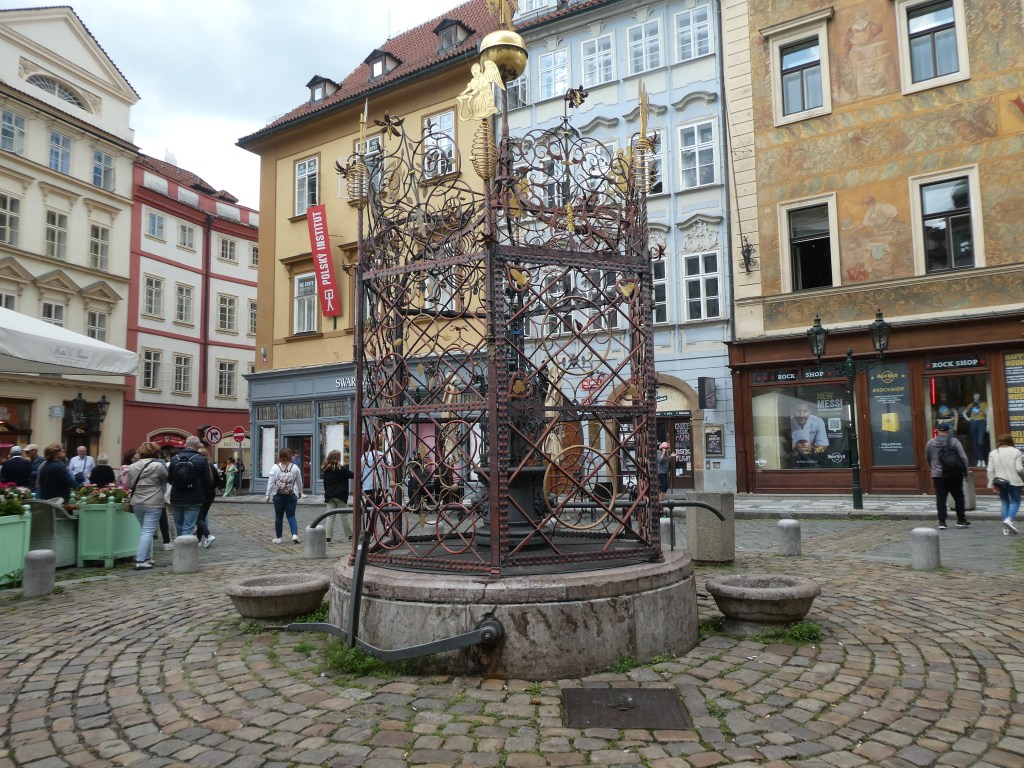
The water fountain worked for centuries, but did not survive the flood of 2002.
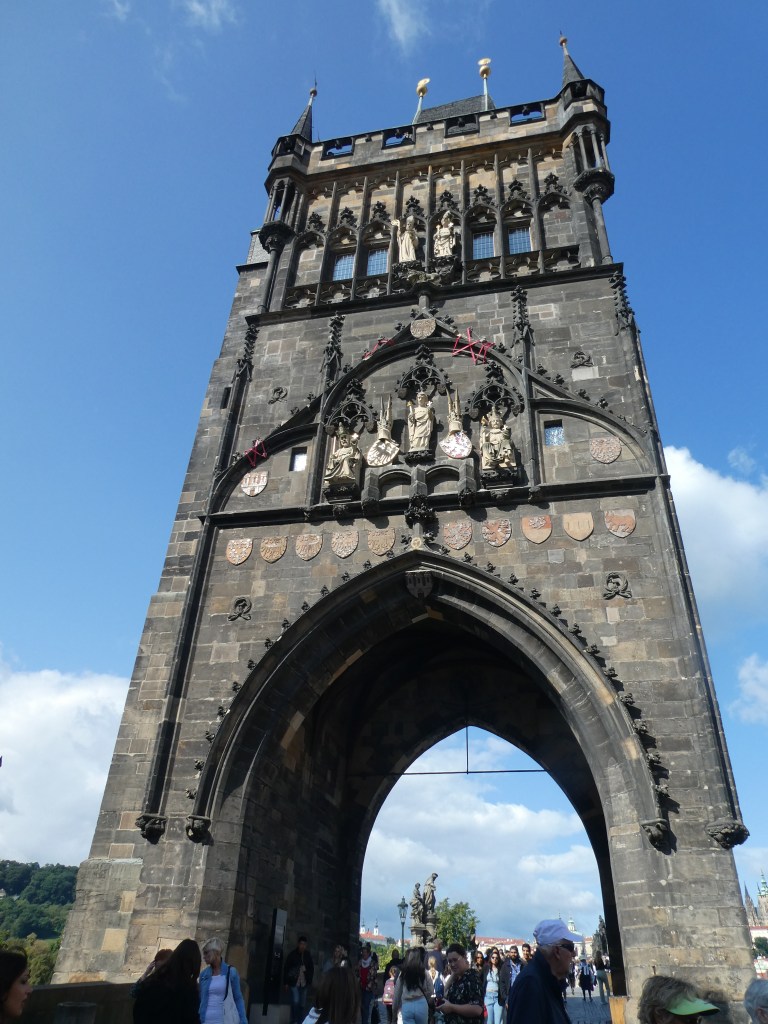
As we moved towards the Charles Bridge, we crossed under the tower where Czech students stopped the Swedish Army when they were trying to invade in 1648. (I don’t know about you but I had to reset my mind around Sweden being European aggressors. There was a real thing called the Thirty Years War.)
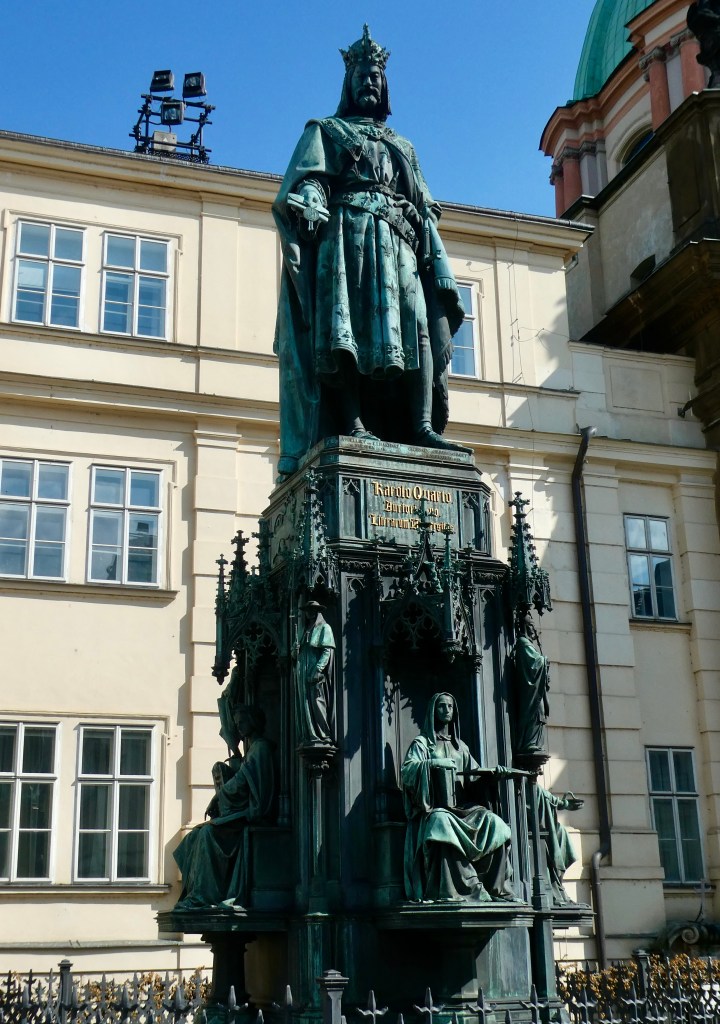
This is King Charles IV, the most important ruler in the history of the Czech people. His reign allowed them to flourish.
There were many artisans along the bridge and a festive atmosphere.
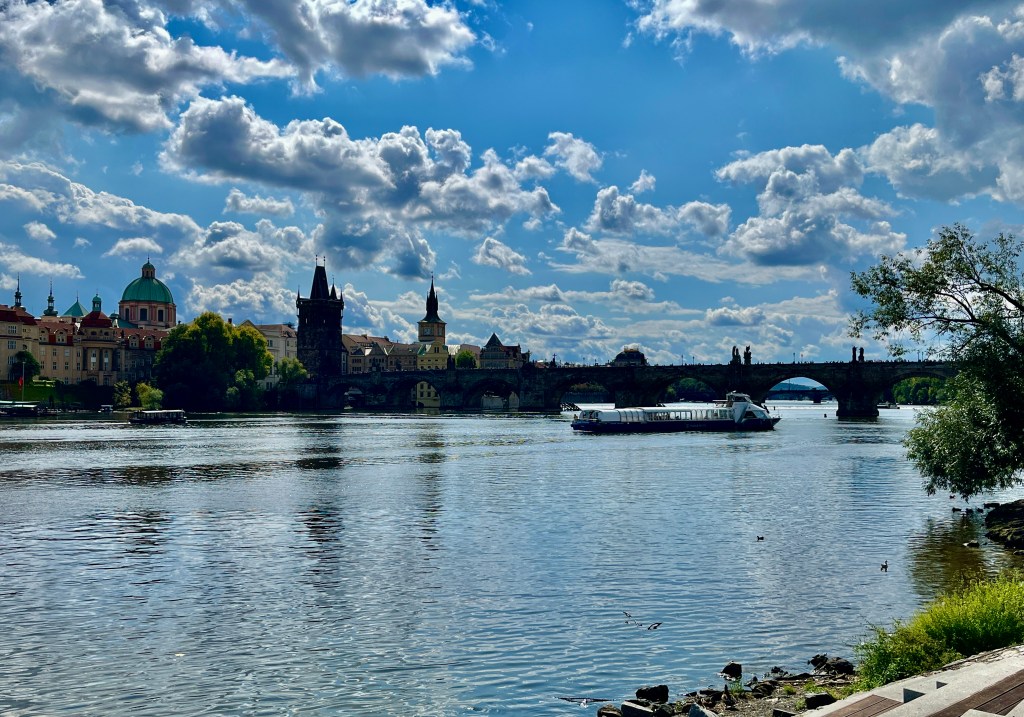
We had a lovely view of the medieval city and Prague Castle.
The view from the Charles Bridge to another.
There is an Eiffel Tower replica visible from the bridge. It is 1/5 the size of the original in Paris.
This is a famous Prague photo-op with many centuries available in one photo. The lower bridge tower is from the 12th century while the other tower is from the 15th century. In between is 16th century architecture with 18th century architecture to the right.
These type of architectural opportunities are unique to Prague with architects and students coming from all over the world to study. This is because the city did not suffer the damage that other European cities did during WWII as the Allies concentrated on the industrial outskirts of the city.
(Prague is still primarily an industrial city. They make more cars per capita than any other country. Skoda was the traditional Czech brand, later purchased by Volkswagen. They also make buses and supply automotive parts, primarily to Germany. They also have an industry to make hand guns.)
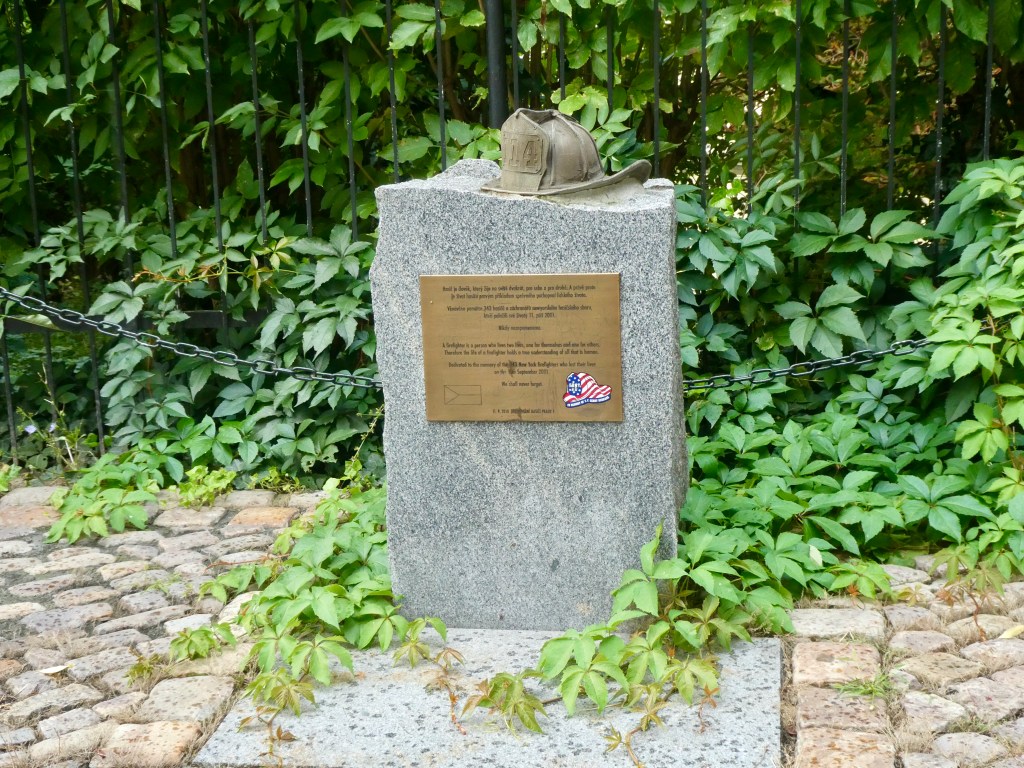
On the other side of the Charles Bridge was the Prague Firefighters Memorial to New York City firefighters after the attacks on 9/11.
We walked through Little Venice.
We walked through the Lesser Quarter, meaning the quarter is smaller – not less important. A massive fire in 1541 destroyed much of Lesser Quarter so the architecture remaining is mostly Baroque style.
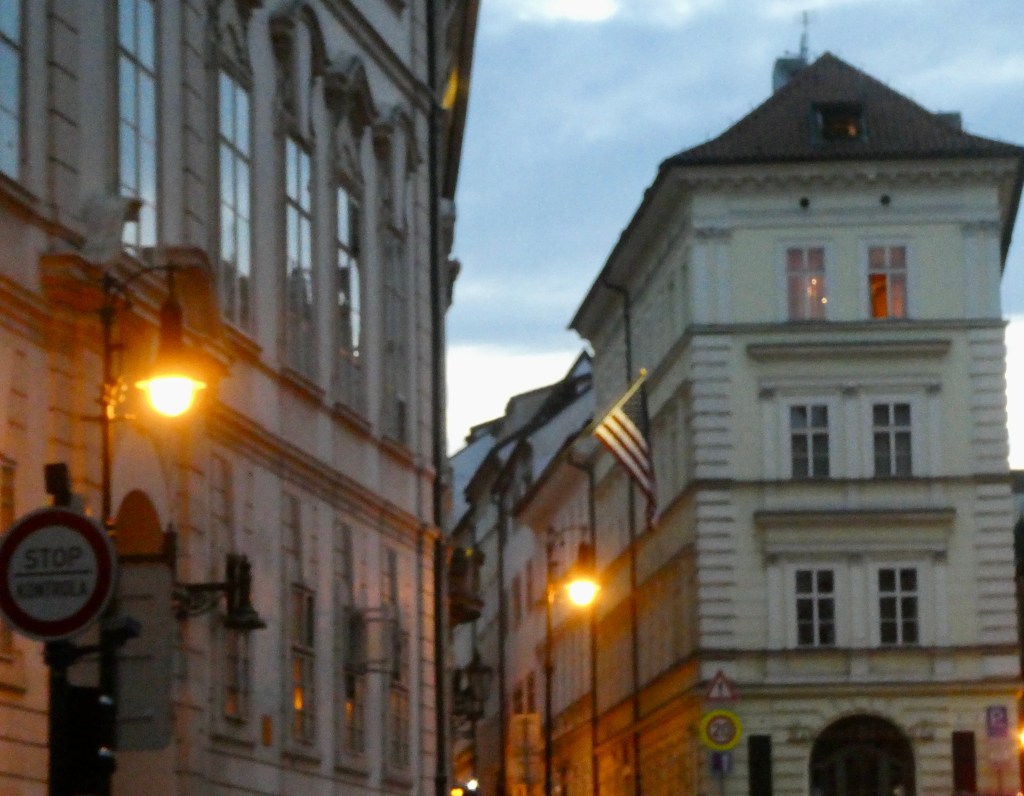
Over time personal castles became government buildings and embassies. This one is the US Embassy.
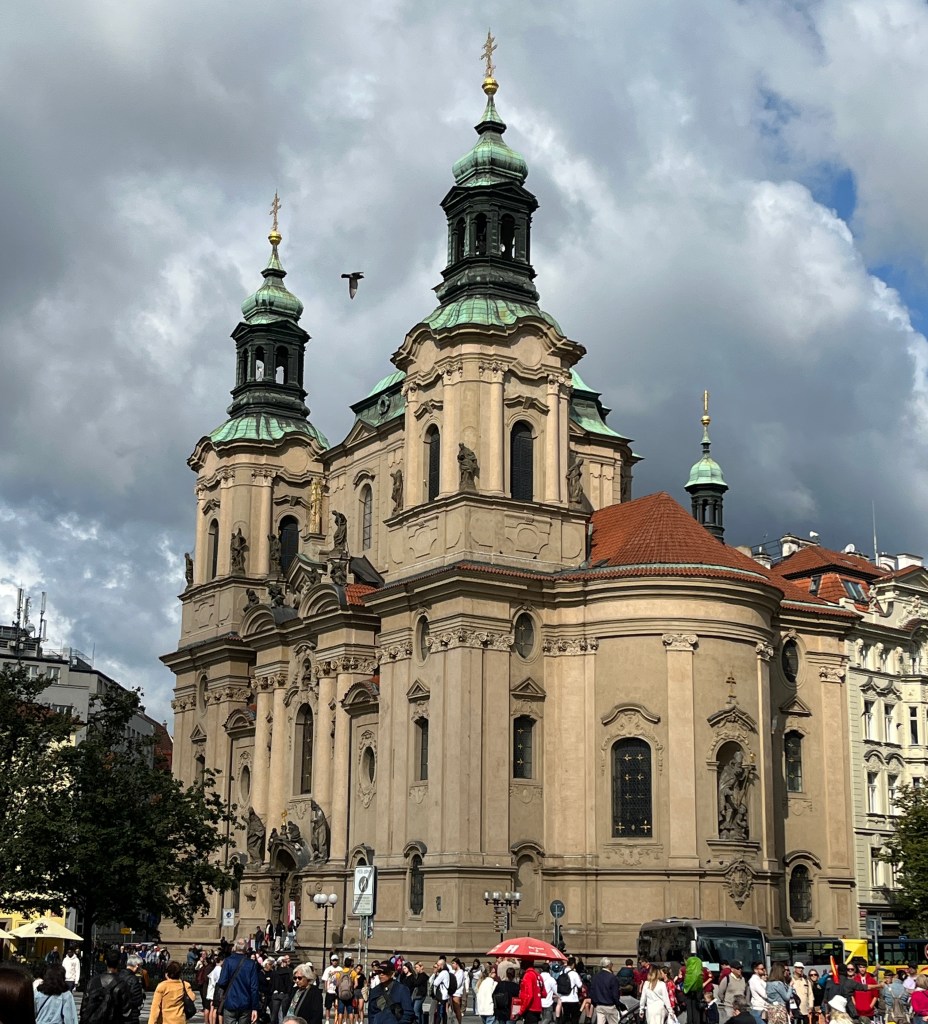
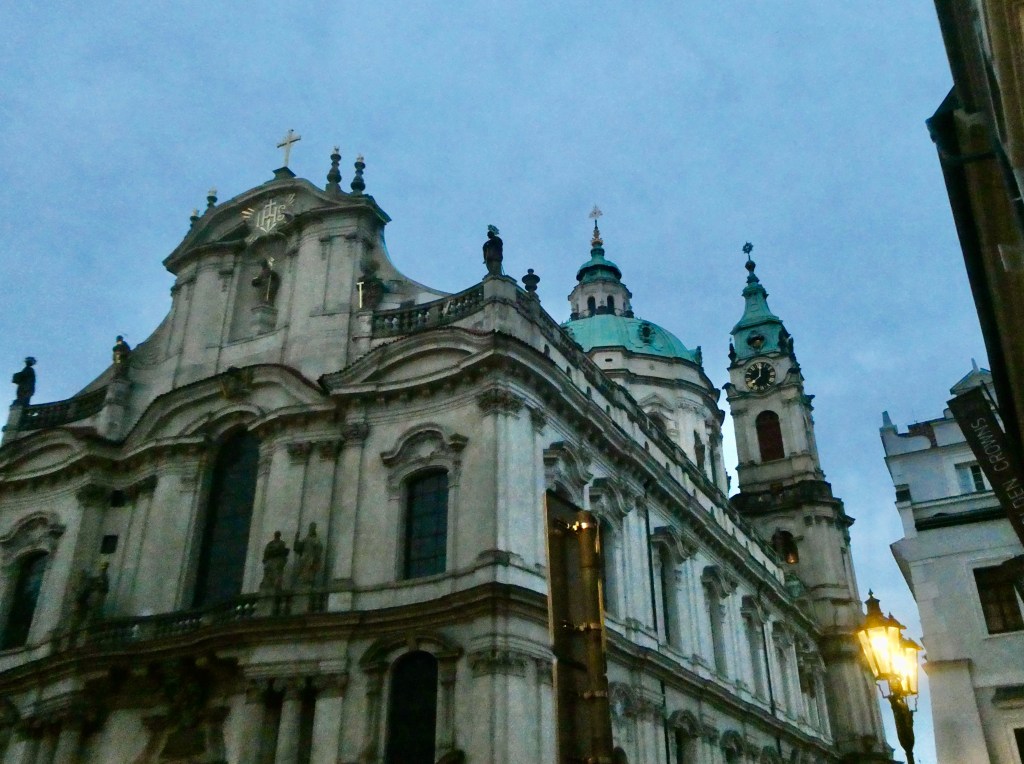
The church of St. Nicholas was known as the spy church as the secret police used the high points to spy on embassies in the area.
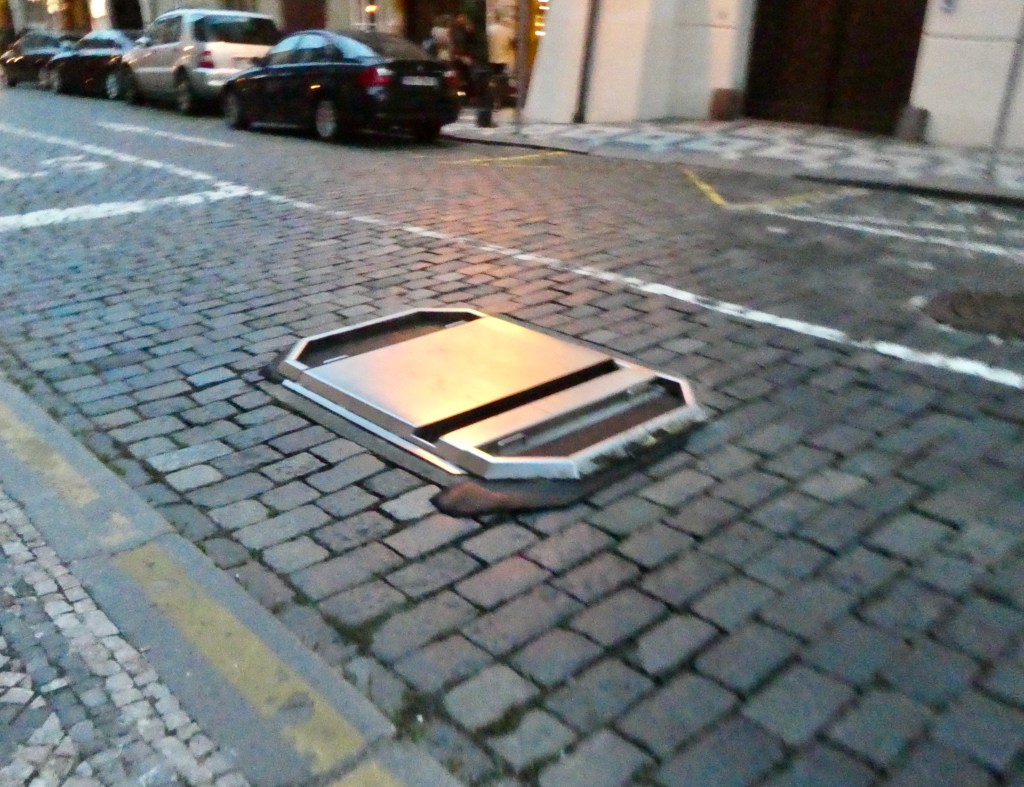
This was, maybe is, a surveillance tool to look under cars in this government area.
This Memorial is to Czechoslovak Resistance during WWII. The group was able to assassinate the highest ranking German officer assigned to their country.
Art is often used as a social provoker.
This is a very small section of the Lennon Wall – a symbol of non-violent resistance to oppression that began right after John Lennon’s death in 1980. The communist government would direct that the wall be painted over and the students would paint on it again. This went back and forth until the government changed in 1989. There is constantly changing art on the Lennon Wall. When it is occasionally painted it over, it is only to provide a fresh canvas.
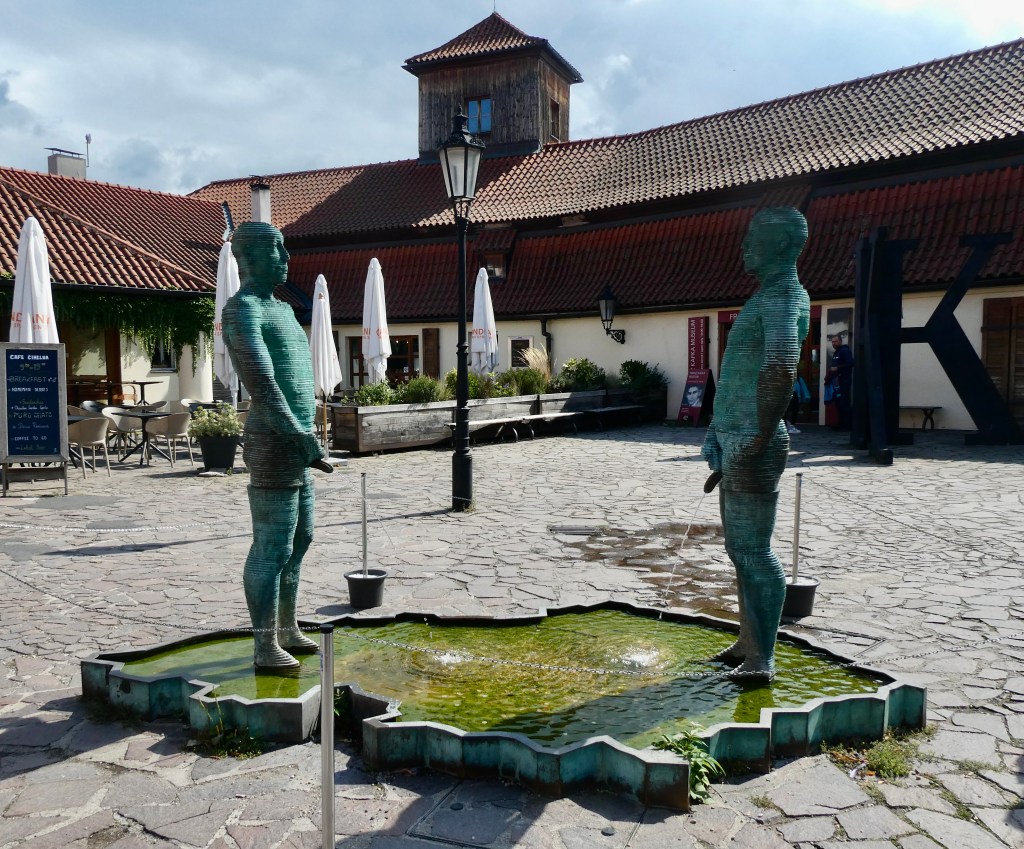
We saw additional social provoking art. These two men urinating on the Czech Republic is social commentary by David Cerny.
This photo looks back at the Charles Bridge, built in 1347.
In 1298, silver was discovered at Kutna Hora. Kutna Hora means “mountain to dig.”
In 1300, King Wenceslaus organized area mining into a royal monopoly and issued a mining code. He specified administrative and working conditions for mine operation. He developed new positions such as guards and coin makers.
Children less than 15 were not able to work underground. Miners had to contribute to a fund for families and widows because miners only lived 30-35 years due to working conditions and arsenic in the drinking water.
The miners went down 600 meters, taking 1.5 hours down, and two hours to get back up to the surface.
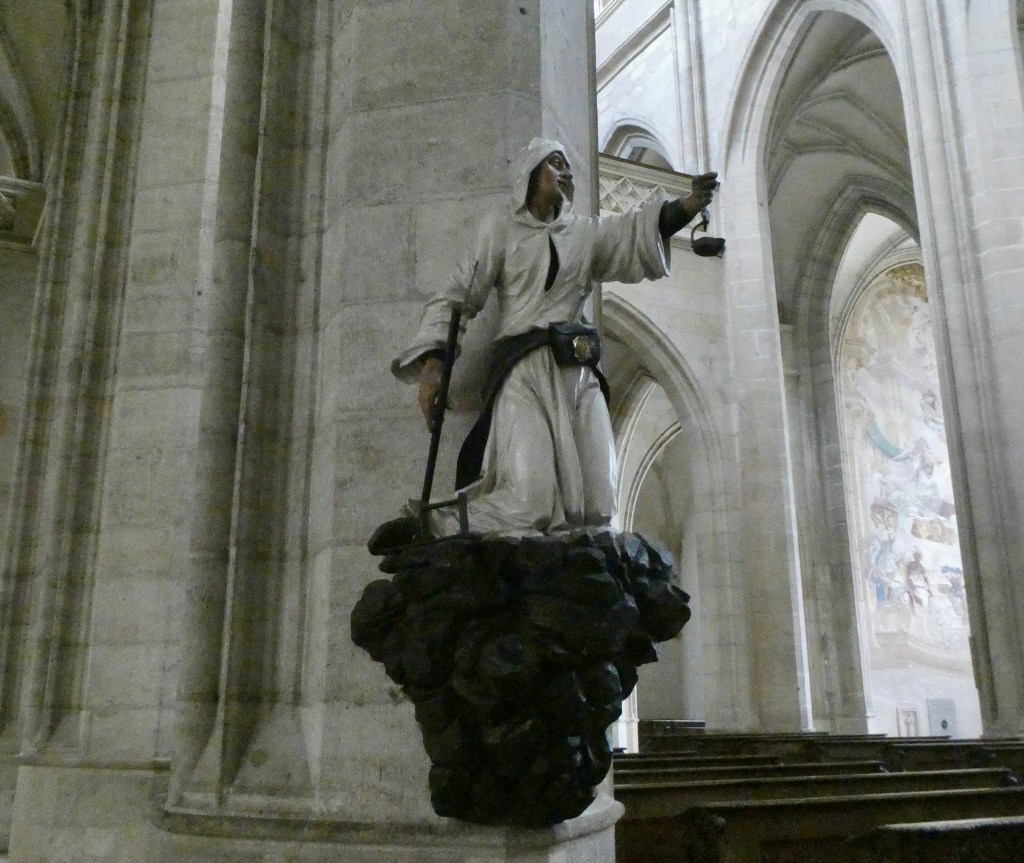
They were required to wear hooded robe jackets with no pockets.
(Duke Wenceslaus I was the monarch referenced in the Christmas carol Good King Wenceslaus He served Bohemia in the tenth century and was martyred. The carol was written in 1853.)
The silver strike at Kutná Hora was one of the richest in Europe ever, producing 20 tons of silver a year between 1300 and 1340.
During its prime mining, Kutna Hora had a population of 80,000 and was a rival to Prague in importance and wealth.
At the beginning of 15th century mining at Kutna Hora was disrupted. It resumed, but stopped again. In the 18th century, the mine was destroyed by fire and never rebuilt.
There is no mining in Kutna Hora anymore. The major employer is Phillip Morris as they supply cigarettes to Eastern Europe “since you Americans don’t smoke any more.” They source tobacco from Bulgaria.
There is also a Lego factory and increased tourism due to UNESCO designations.
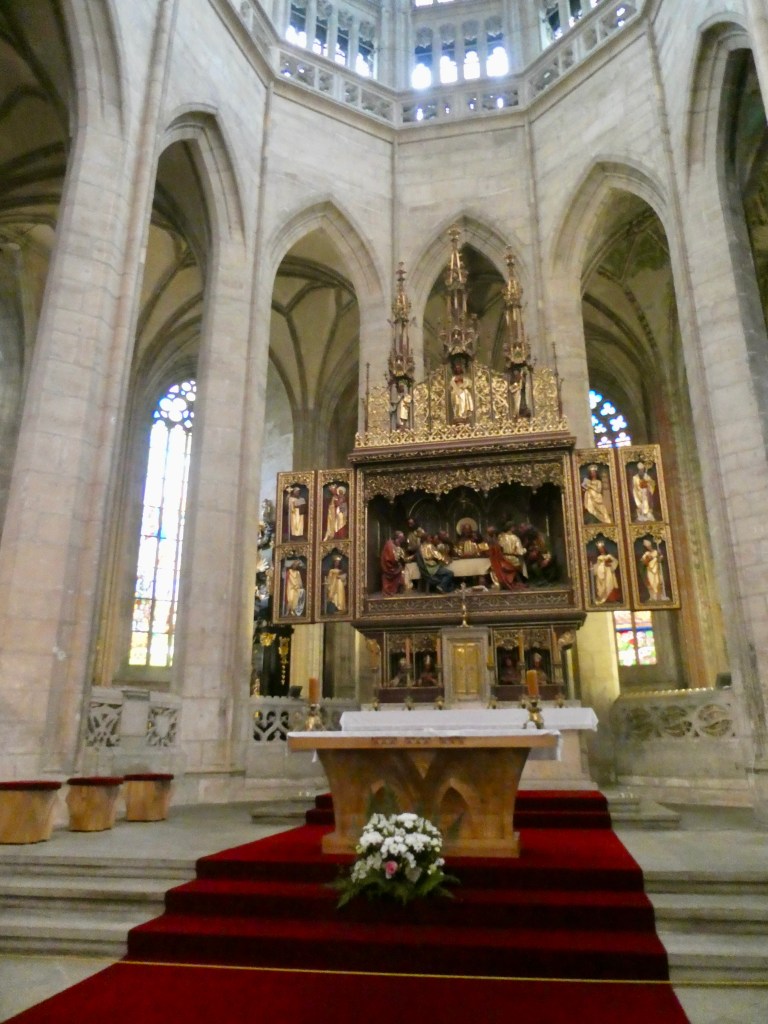
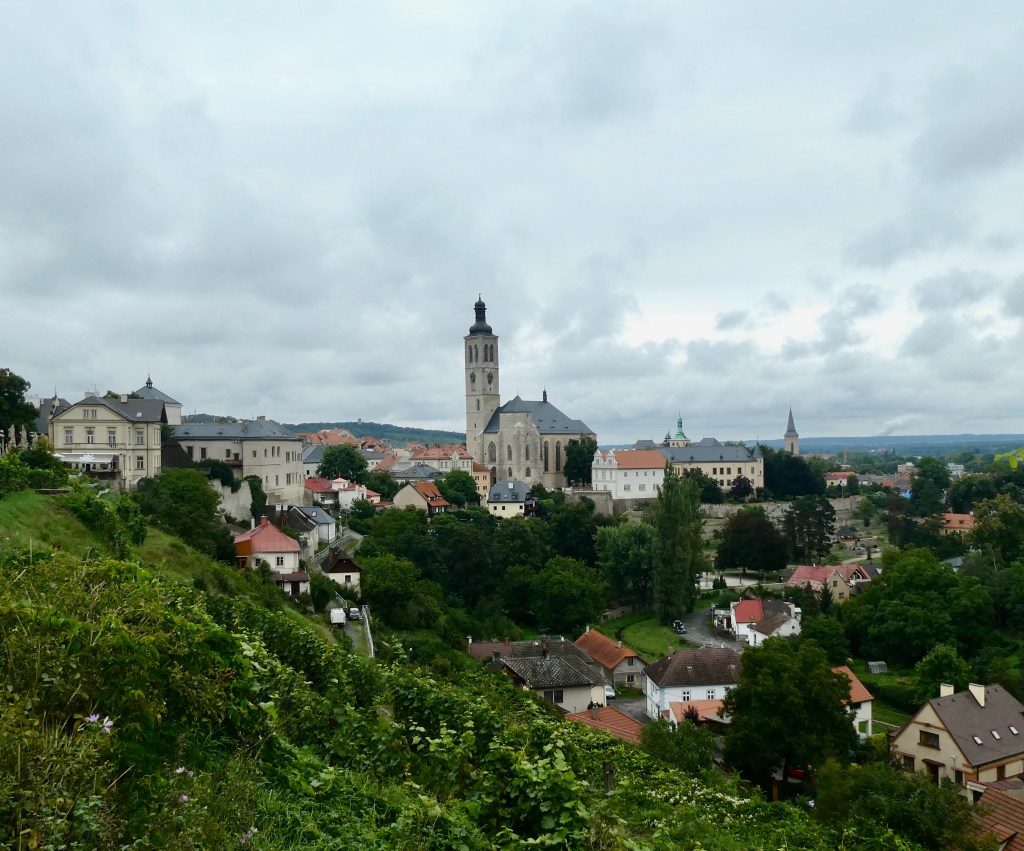
The Cathedral of Saint Barbara is one of central Europe’s most impressive gothic buildings and is one of those Unesco World Heritage Sites.
Construction began in the 13th century but, given the ups and downs of the city’s economy, it took 500 years to build. (This is from the center looking back.)
The cathedral is one third the size it was originally planned because silver mining discontinued. (This is the center looking front.)
The cathedral is dedicated to Saint Barbara, the patron saint of miners. Barbara was the daughter of a rich pagan who kept her protected and frequently locked up in a tower.
She secretly became a Christian and declined a marriage arranged by her father. She acknowledged her Christian faith and was cruelly tortured. Each morning her wounds were healed. Her father himself carried out a sentence of death by beheading. He was struck by lightning after committing the act.
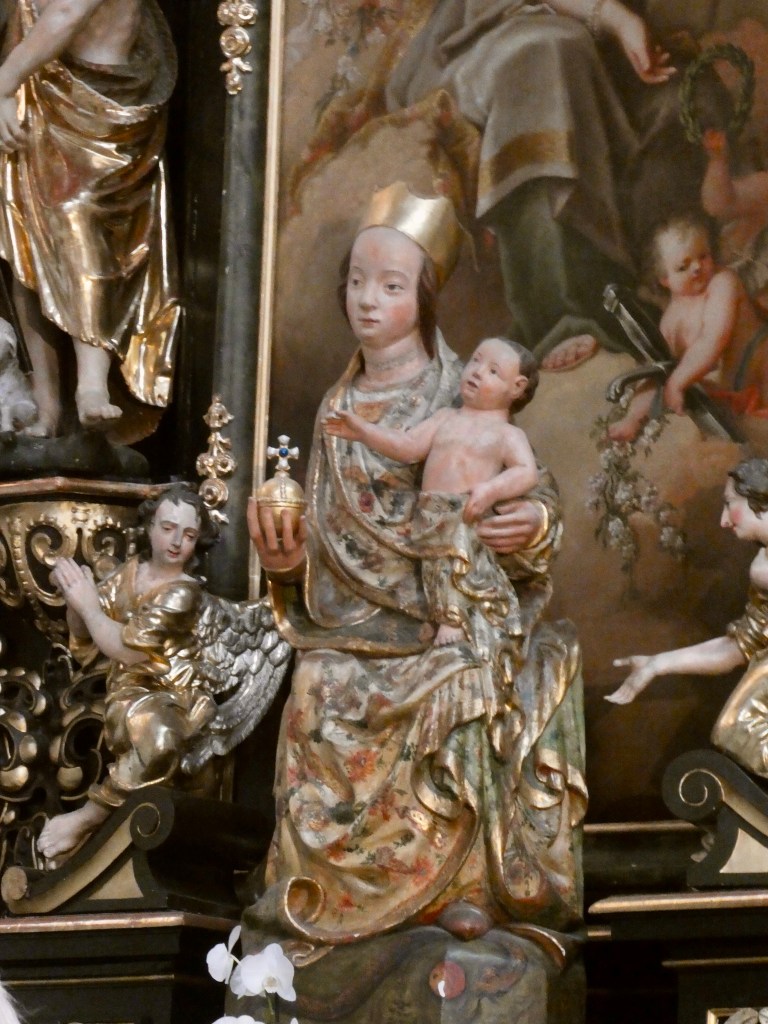
The Madonna with Jesus statue is from the 14th century, and is the oldest item in the church.
The former monastery, for 60 monks, is now an art gallery. Patron saints line the walkway on the side overlooking the city.
The church in the center of town is older than Saint Barbara’s.
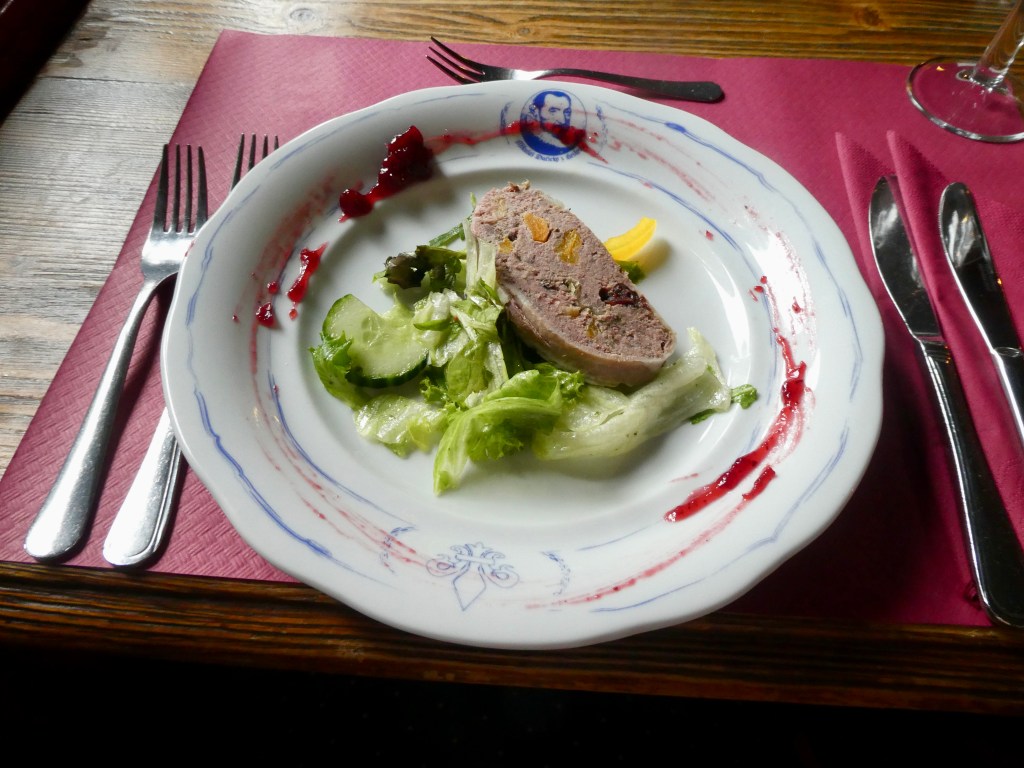
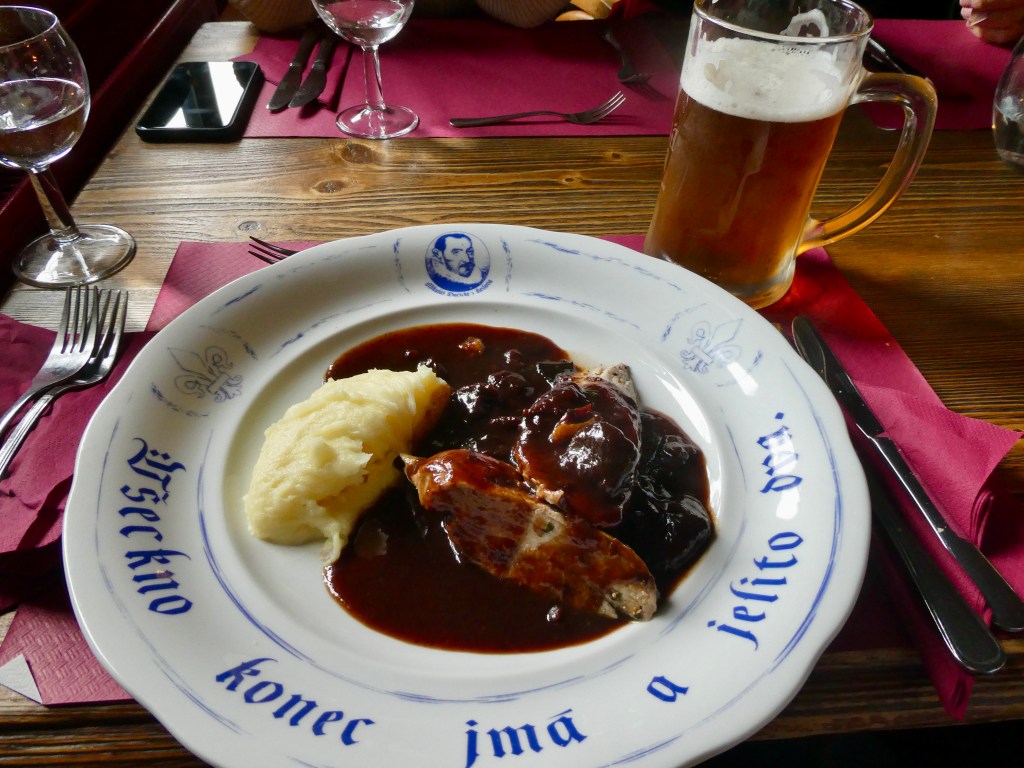
Dutchiski Restaurant was our lunch destination. The family established a local brewery in the 1600s. For 200 years, the restaurant has featured central European cuisine including pork and chicken, potatoes and dumplings and lots of beer! My choices were:
Wild boar pate appetizer
Pork with plum sauce and mashed potatoes
Apple strudel
Our guide pointed out some interesting things on our walk back to our tour bus.
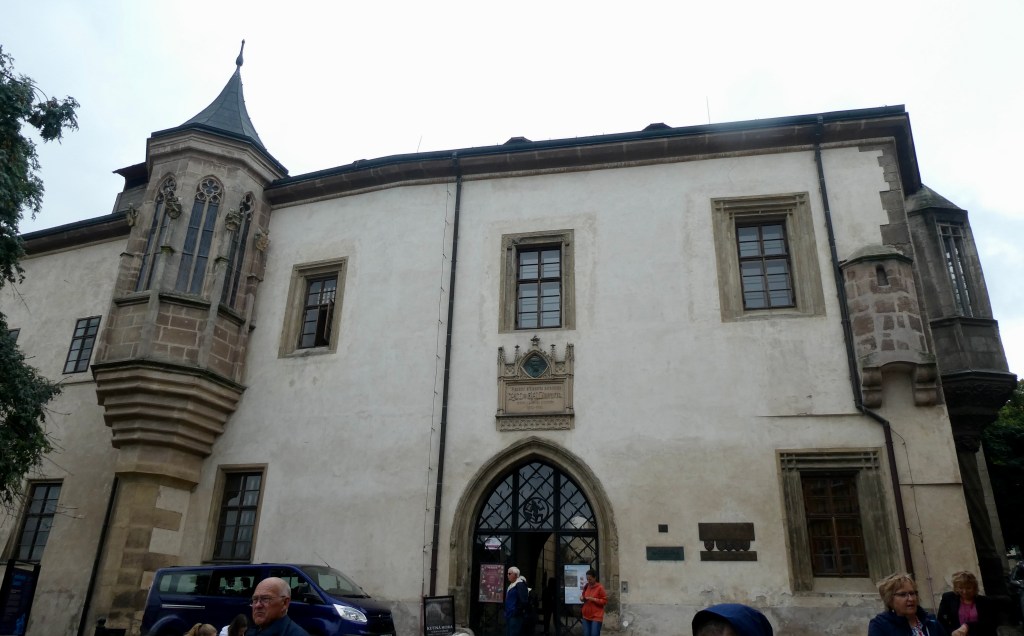
The small bump out to the right on this side of this building was a toilet, allowing the waste to drop down outside.
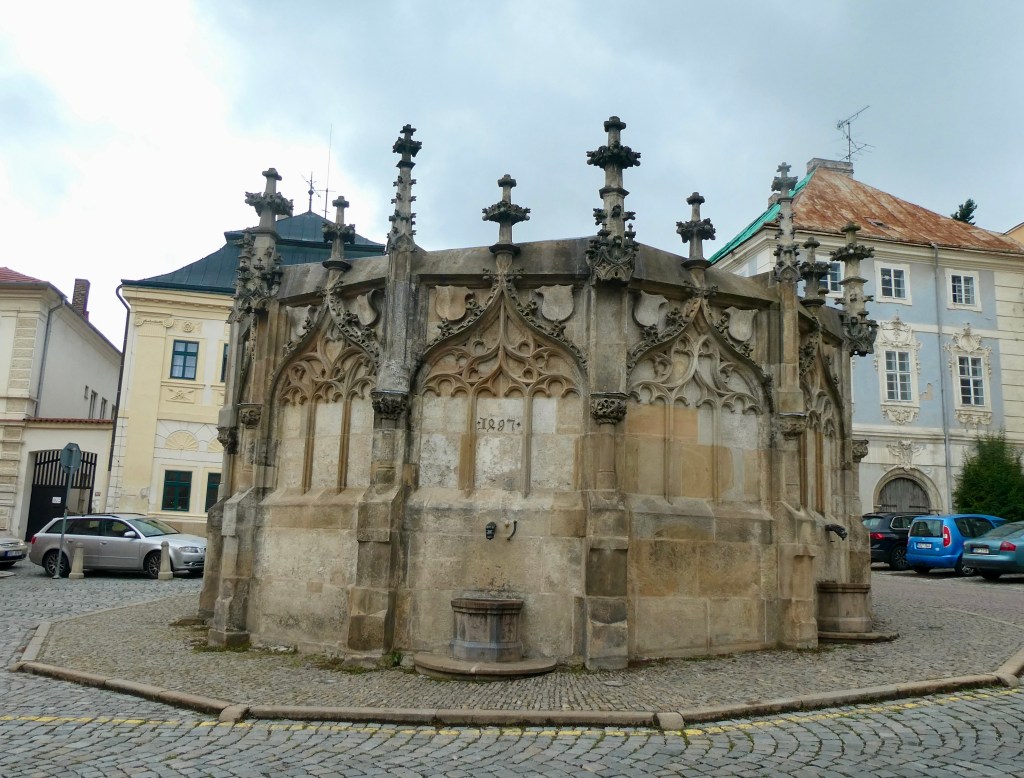
This gothic water tower was built in 1497. If that date isn’t obvious to you, it wasn’t to me either! The second digit shows the top half of an 8 – so it is a 4. Residents could not build wells because of the arsenic present underground.
This brass square commemorates a Jewish family that died here at the hands of the Nazis.
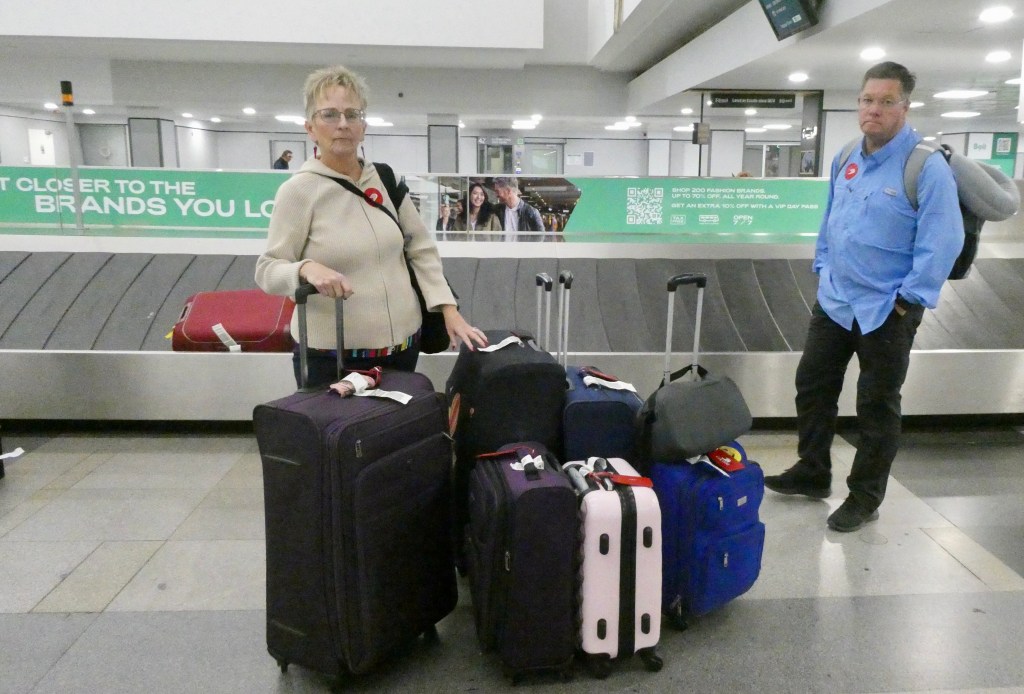
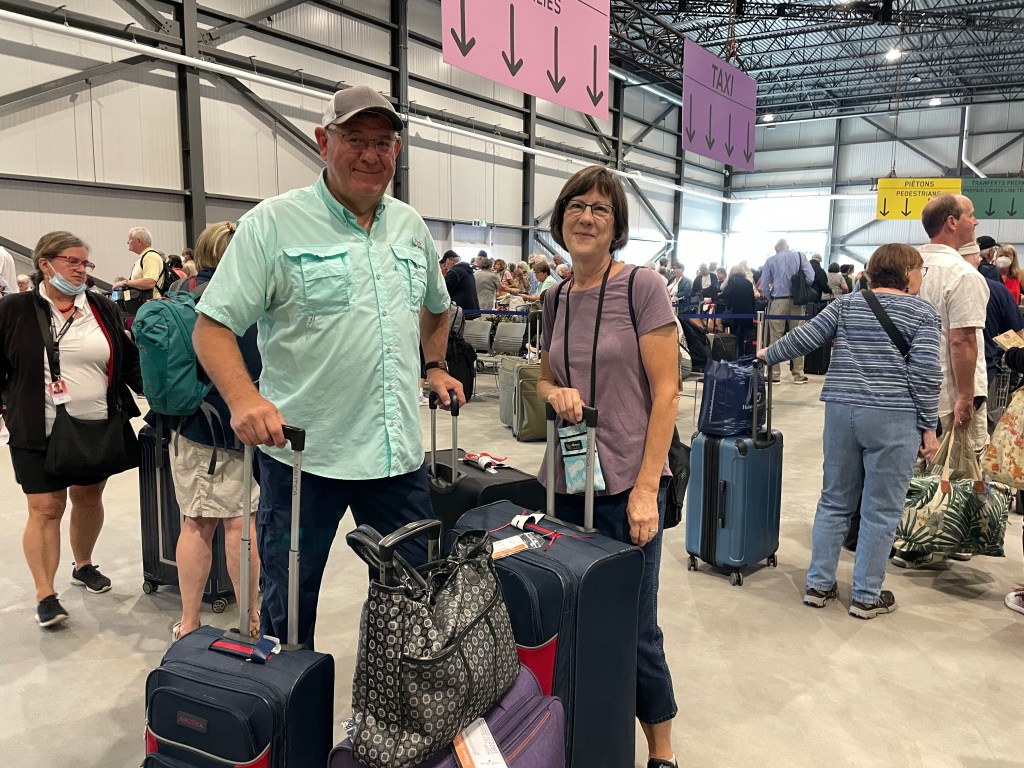
All of the luggage made it with us! We were collected by a driver and taken to our hotel.
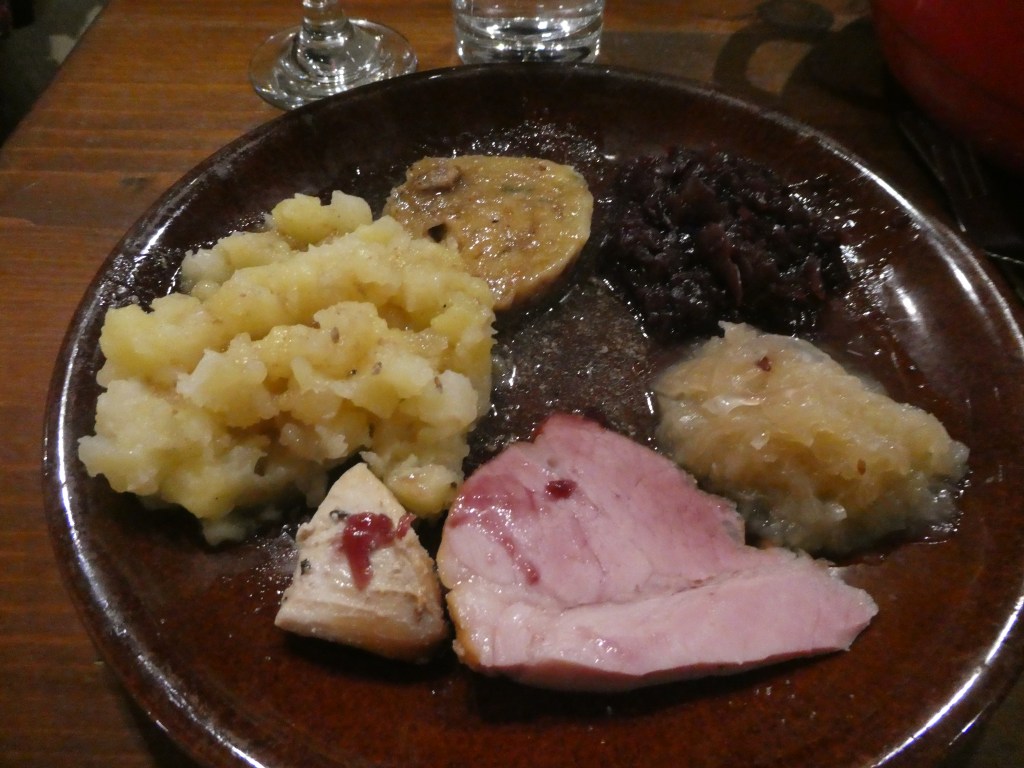
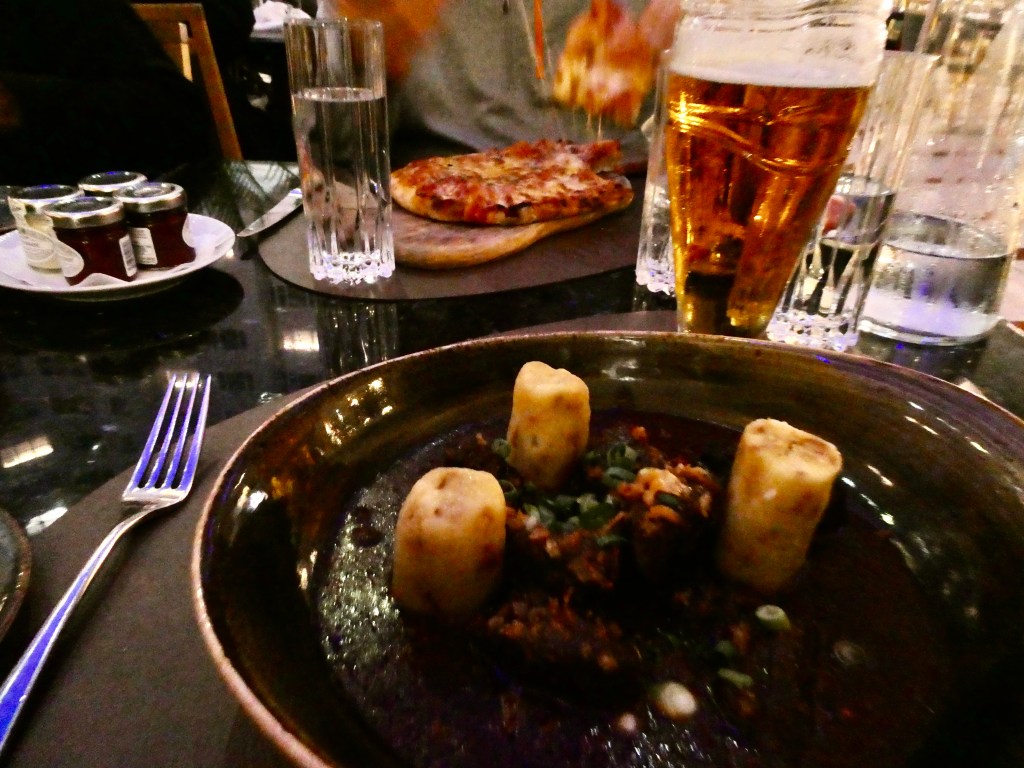
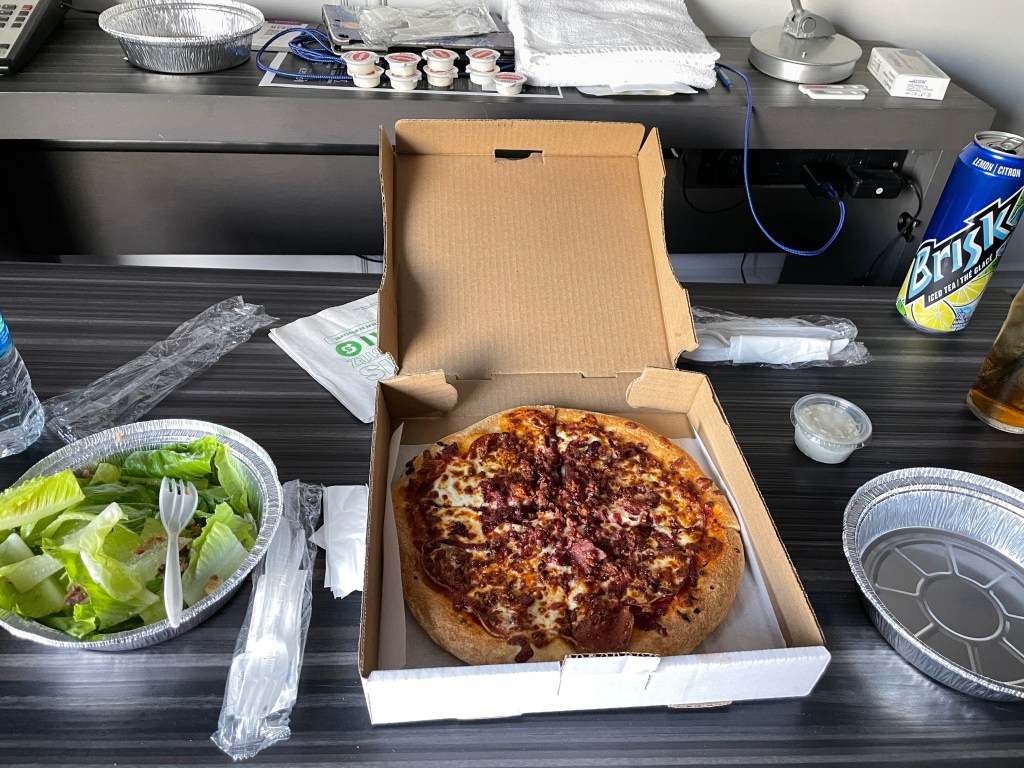
We were tired after our day of travel so we ate at the hotel restaurant. The meal in the picture was mine. It was the first of many meat and dumpling meals we had while in this part of Europe. This one was delicious! Of course we had to try Prague beer! Randy was revisiting pizza in Europe, but it wasn’t quite Italy.
Because our flight came in late in the day we missed both of our scheduled excursions. We were able to rebook one but totally lost an excursion about Czech Resistance in World War II.
My general knowledge about the history of the Czech Republic was very poor, knowing little more than it used to be called Czechoslovakia. A novel I read during trip preparation, Prague Spring, was set during a brief period of expanded freedoms in 1968. The Soviet Union objected and stopped the new found freedoms with a harsh invasion.
Good for you if you knew more than I did, but if you don’t…here is a very brief (and inadequate) summary.
The area now known as the Czech Republic was called Bohemia when it was populated by the Celts in the 4th century BC.
The Roman Catholic Church expanded in 950 AD and Bohemia became part of the Holy Roman Empire.
Charles IV ruled in the 14th century and his rule is considered the golden age of Bohemia. He was elected Holy Roman Emperor in 1355.
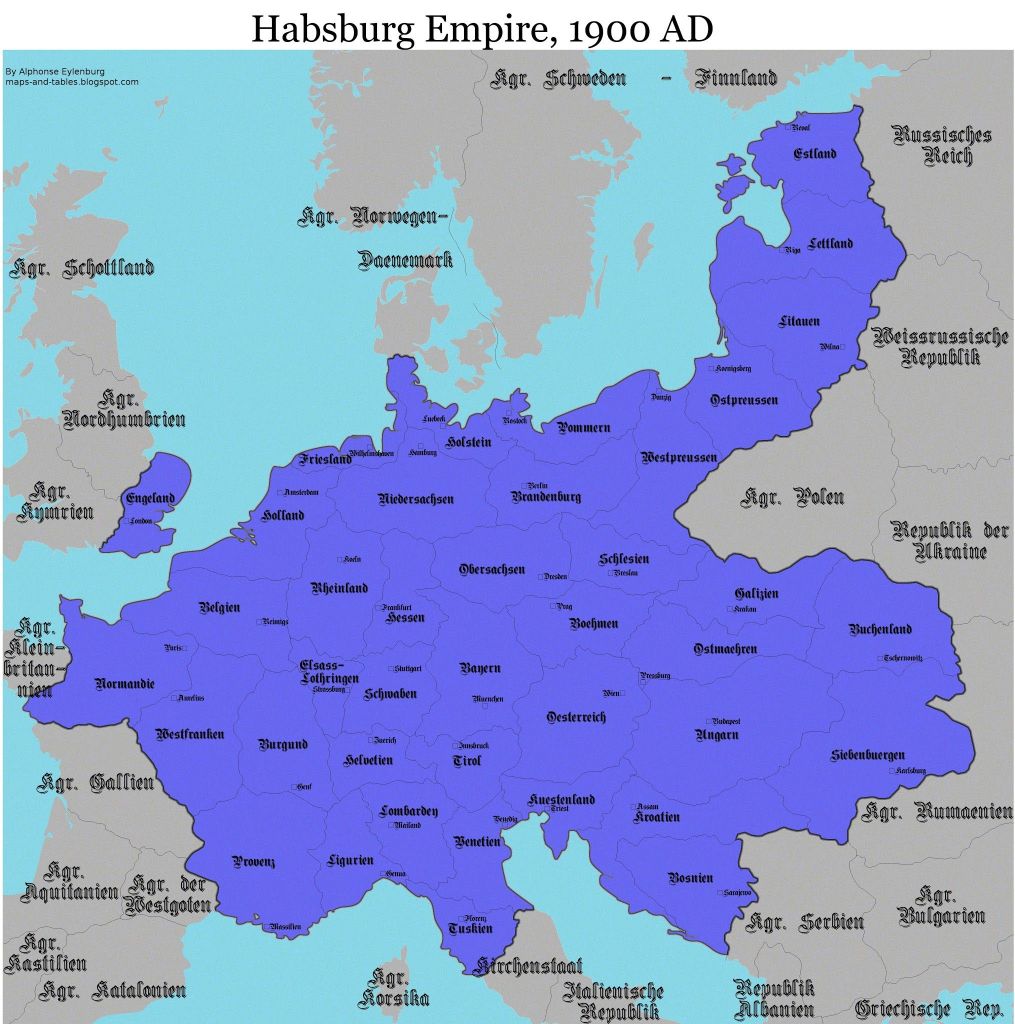
In the 1800s, the Austrians and the Habsburg Empire took control of Bohemia. Their defeat in World War I allowed for the creation of independent Czechoslovakia in 1918.
Great Britain, France and Italy agreed to sacrifice Czechoslovakia to Adolf Hitler at The Munich Conference in 1939. As there were no representatives of Czechoslovakia present, this is considered The Great Betrayal. (This is just stunning to me!)
After World War II, the restored Czechoslovakia came under Soviet influence. The Communist Party of Czechoslovakia ruled until 1989.
The Prague Spring was a period of political liberalization in Czechoslovakia during the spring of 1968. Some reforms were allowed including a loosening of restrictions on the media, speech and travel. Not approving of the reforms, the Soviet Union invaded in August 1968.
In 1989 the Communist regime collapsed due to the Velvet Revolution – massive non-violent demonstrations led by students and dissidents resulting in the end of one-party rule in Czechoslovakia.
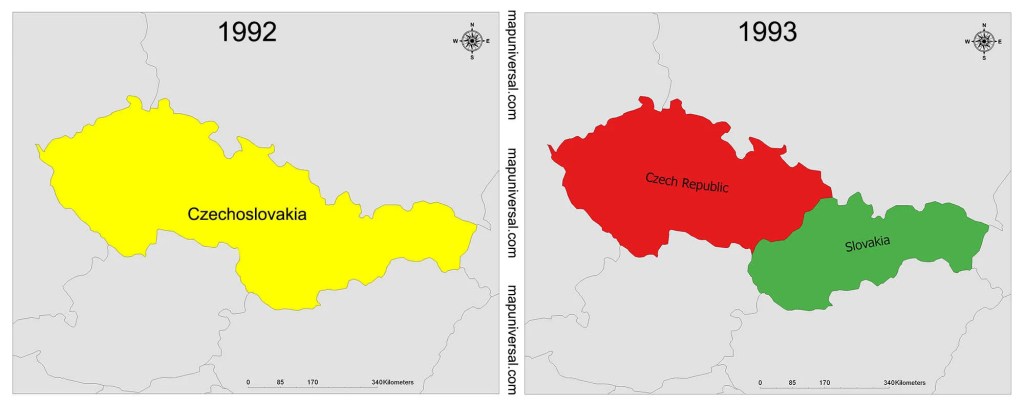
On January 1, 1993, Czechoslovakia was peacefully divided into Czech and Slovak Republics, both independent countries.
The Czech Republic joined NATO in 1999 and the EU in 2004.
My brief history lesson is complete. The next day we were up and ready to start exploring! Our first destination was the Sedlec Ossuary or “Bone Church.”
We saw some interesting buildings on the way!
During the Russian occupation all small private farms were acquired and made into large farms. After the Velvet Revolution, people got their land and businesses back because of well kept records in the archives.
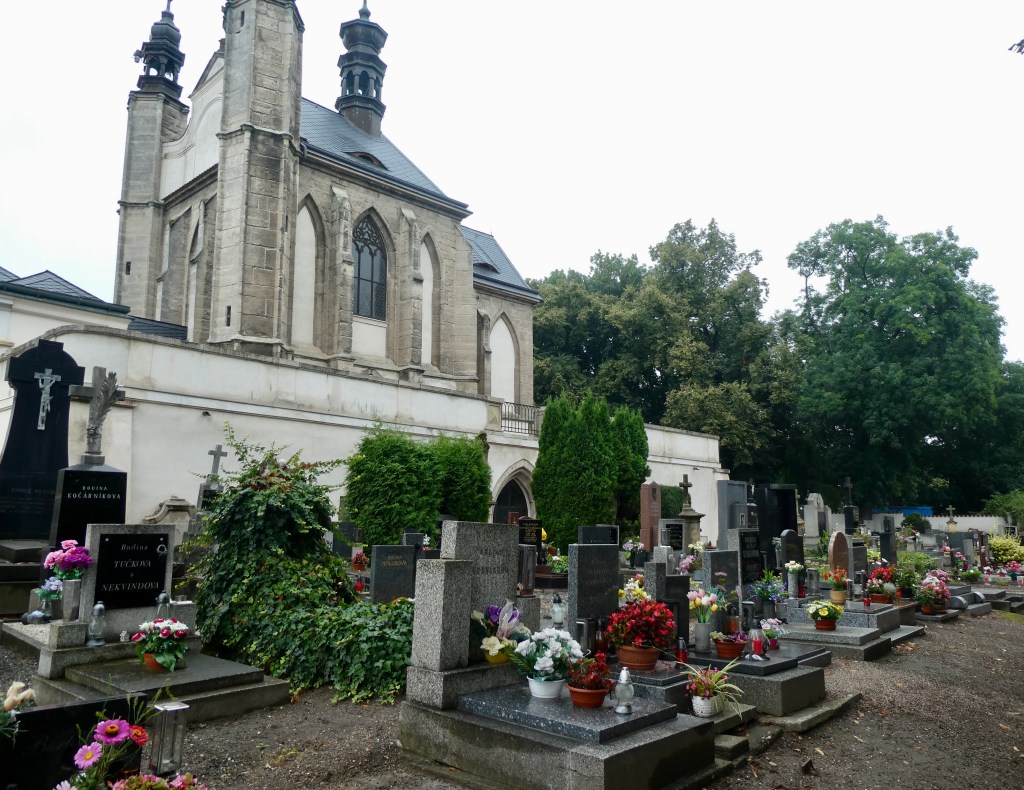
We made it to the Cemetery at the Church of All Saints. On the grounds is the Roman Catholic Sedlec Ossuary or “Bone Church.” It is a UNESCO World Heritage Site.
The story began when a monk went to the Holy Land and got soil from Golgotha in Jerusalem. He spread the soil in the cemetery to make it holy and people from all over the area wanted to be buried there. Over many years, wars, and plague epidemics, the number of burials in this cemetery was huge!.
In the 14 century, the monks wanted to build a chapel in the middle of the cemetery and came upon the mass graves of 40,000 to 70,000 people.
A century later, a half blind monk exhumed and cleaned the bones.
Ossuaries were common during the 14th to 16th cemeteries. Using and storing bones in this way was not thought to be disrespectful.
At the Sedlec Ossuary there were five massive piles of bones with many used for decoration and furnishings.
There are 30-40,000 human bones in artistic arrangements in the chapel but pictures were not allowed. I bought postcards and took pictures of the postcards.
The Sedlec Ossuary is among the most visited sites in the Czech Republic.
Next up: The Unesco World Heritage Site of Kutna Hora.
Our latest trip to Europe took place from late August to early October 2023. It encompassed two cruises and some varied land stays before, in-between and after. The adventure began in London, even though it wasn’t supposed to. London got us -again!
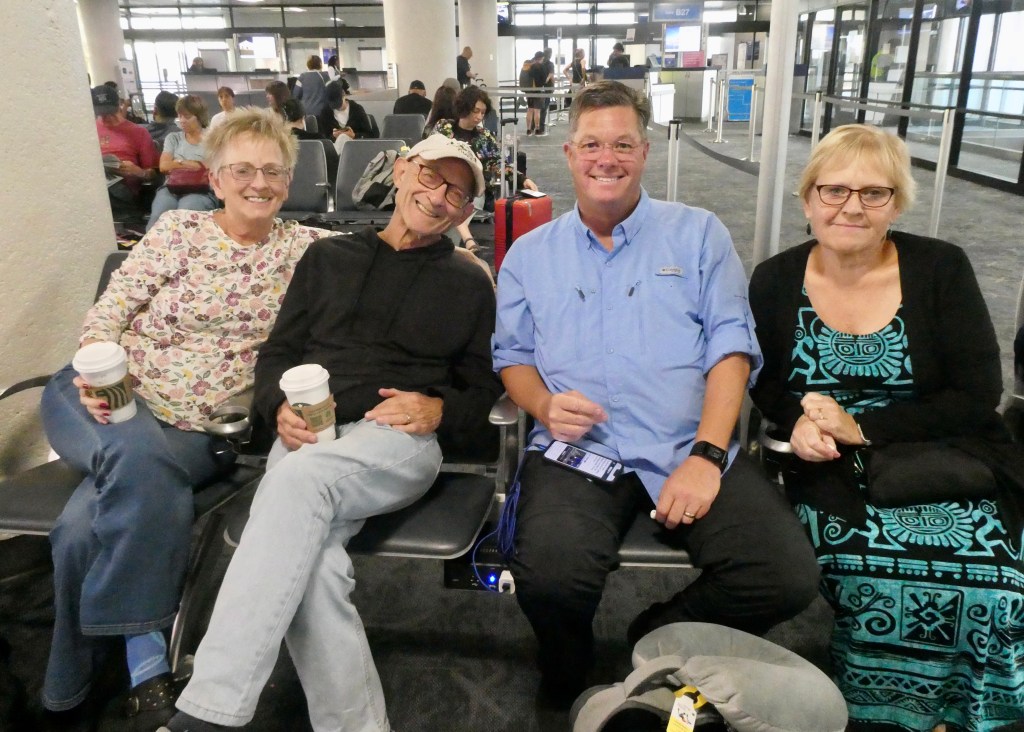
Leaving Phoenix started well. Our traveling friends, Connie and Warren, arrived at our house the day before and we enjoyed an evening at Arizona Broadway Theater.
The next afternoon we went to Phoenix Sky Harbor Airport. We had drinks and a light meal before boarding our flight for London at 7:30 pm. We had a connection in London the next morning and then into Prague mid day.
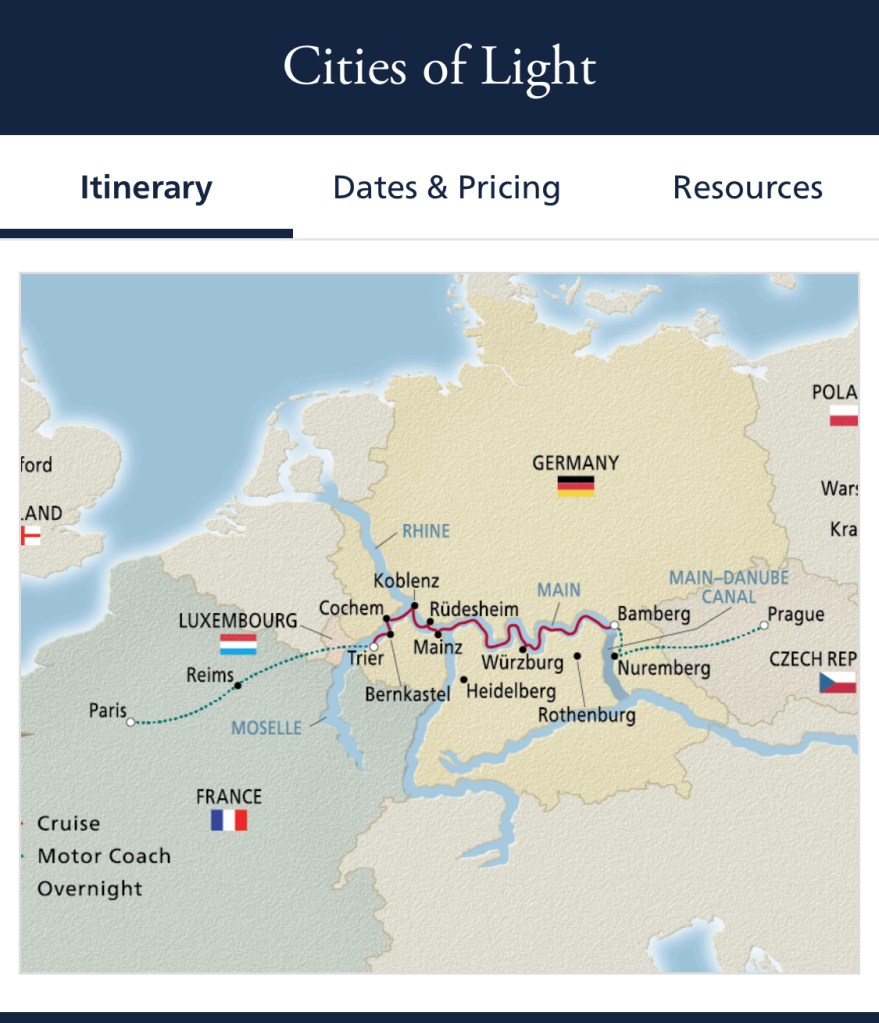
Our planned trip with Connie and Warren was a Viking River Cruise called the Cities of Light – beginning in Prague, cruising through Germany, and ending in Paris.
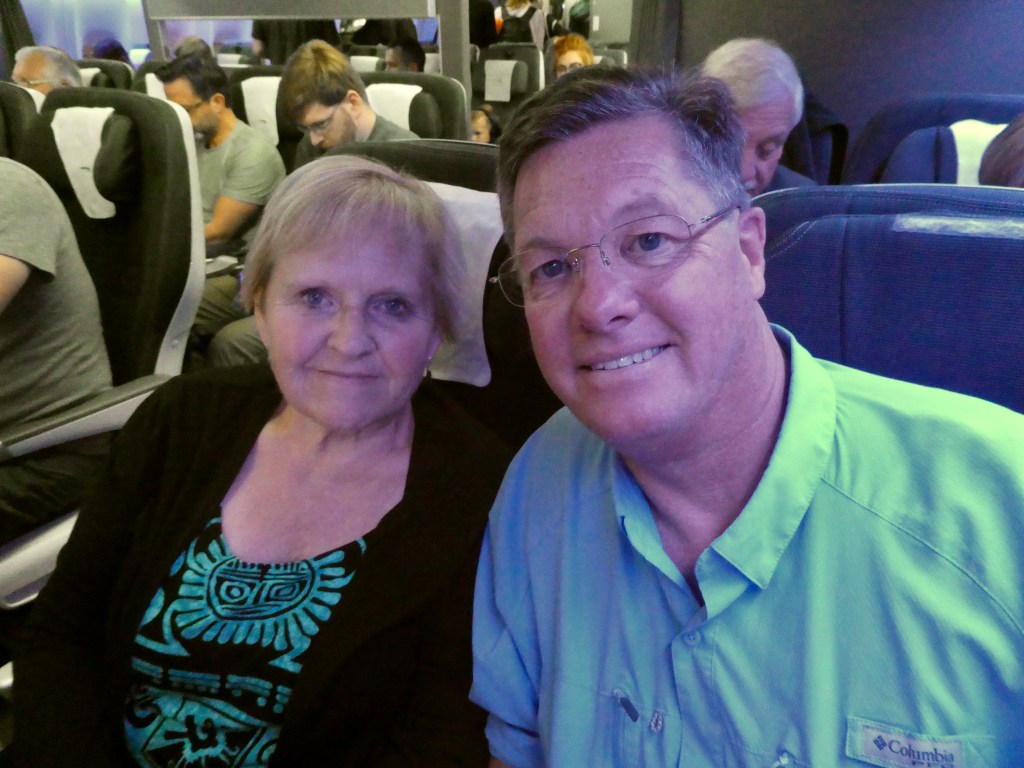
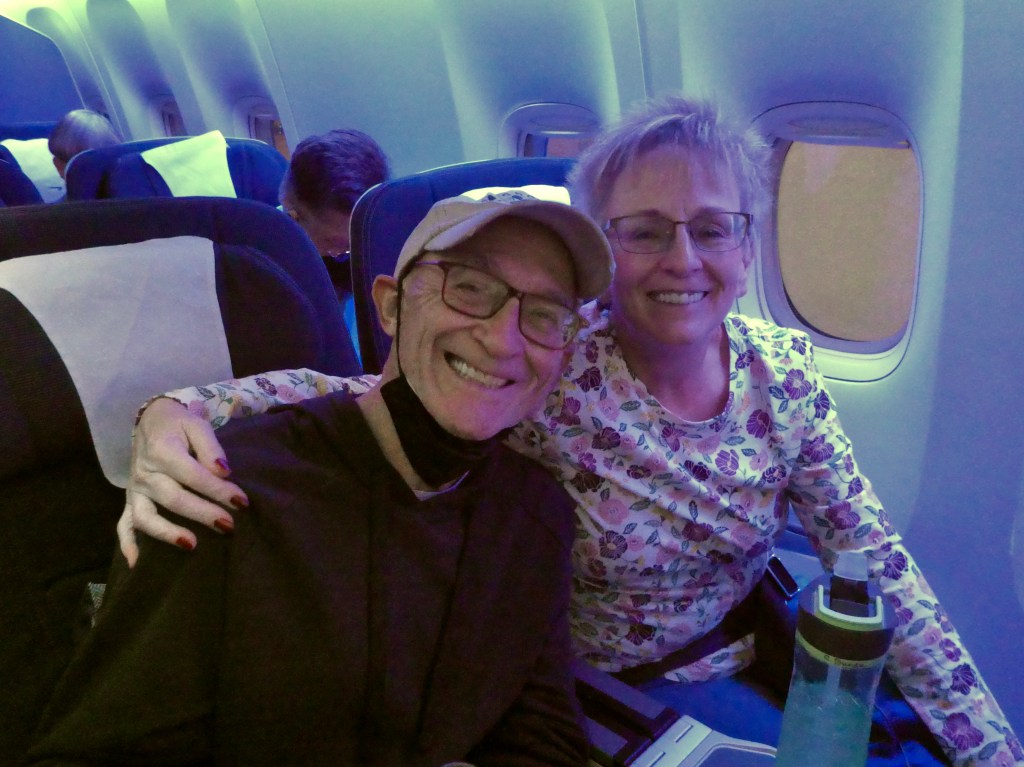
We had an uneventful flight in premium economy on British Airways.
All was well – until we arrived at Heathrow in London. We spent 45 minutes on the tarmac because “a computer system used by ground control was down” – or so we were told. Planes currently at the stands (gates) could not leave, and those waiting for stands (gates) could not enter.
When we were eventually able to go inside the terminal we discovered that the computer outage was a much bigger deal than we understood on the plane. The problem was with air traffic control across the UK, not just ground control. Many flights out of Heathrow were already canceled but ours was just showing as delayed.
We made our way from Terminal 5 to Terminal 3 for our next flight not knowing if we were going or staying. We received mixed messages about whether our flight was canceled or really was just delayed.
The emergency travel contact at Viking couldn’t rebook us on a flight for the next day because our current flight had not been canceled officially.
I texted our travel agent in Phoenix and she got right on it contacting and working with Viking until they had us booked out the next afternoon. We had four of the eight available seats on the afternoon flight to Prague the next day.
Then our travel agent went to work trying to find us hotel rooms for the night. Options kept slipping away as everyone who was stranded also needed accommodations. Many thousands of people were involved.
After about 90 minutes, we had new airline tickets and hotel reservations for the night. While I was working on tickets and hotel with our travel agent, Randy and Connie spent all that time trying to locate our bags. The airline knew they had been loaded onto our connecting flight but didn’t know exactly what has happened to them when the flight was canceled.
Almost all baggage from the canceled flights was going to be brought to two baggage claim carousels in Terminal 3 where we were. Several hours later our luggage still hadn’t come out.
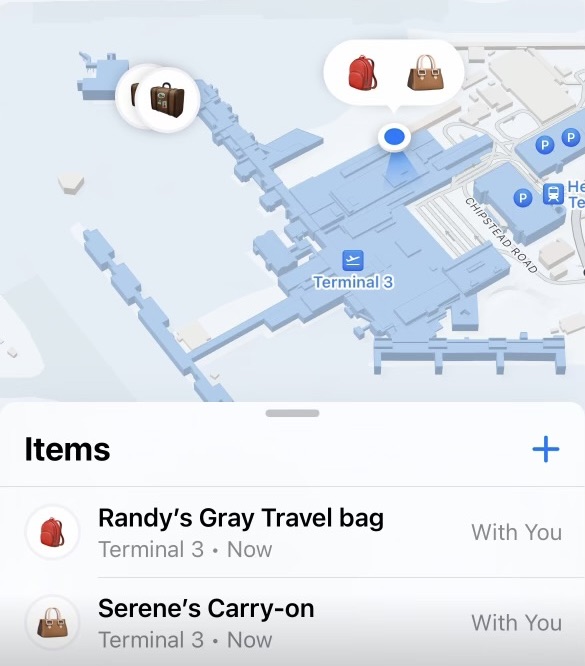
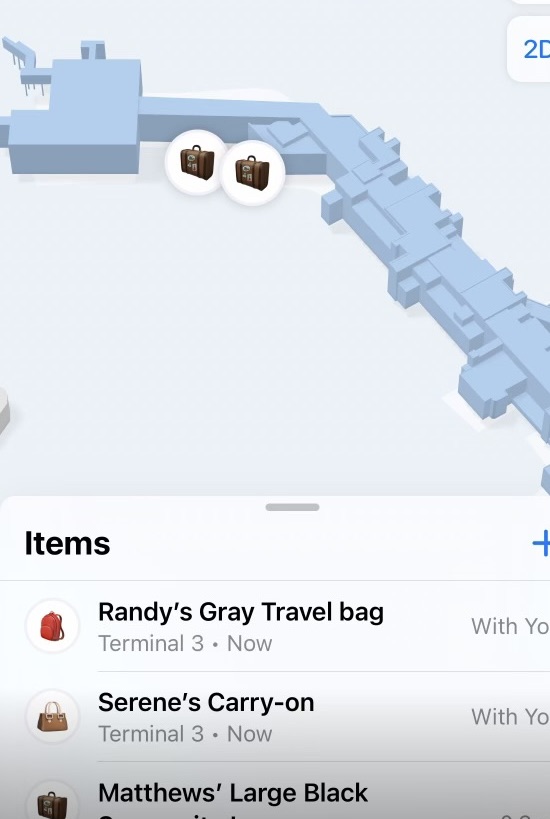
We had purchased four Apple Air Tags (gps trackers) for this trip so he knew our two suitcases had made it to the vicinity of Terminal 3 – where our next flight was supposed to have left from and where we now were.
Two Air Tags were in our suitcases with the other two in my general bag and Randy’s backpack. He could “see” our checked luggage near us. Randy spoke to several baggage people but they were not able, or willing, to go get them, even though they were “right there.” So close – and yet so far.
Eventually British Airways baggage personnel suggested we go upstairs to departures because we were within the check in window for our flight the next day. Checking in, and assigning our bags to our new flight, should keep them in the vicinity and not let them wander away somewhere.
We would have felt better actually having our luggage with us but we had no option other than to leave without them and hope.
Connie and Warren had a carry-on luggage bag each so had a change of clothes and necessities. I had a change of clothing in my general bag. Randy had a toothbrush in his backpack.
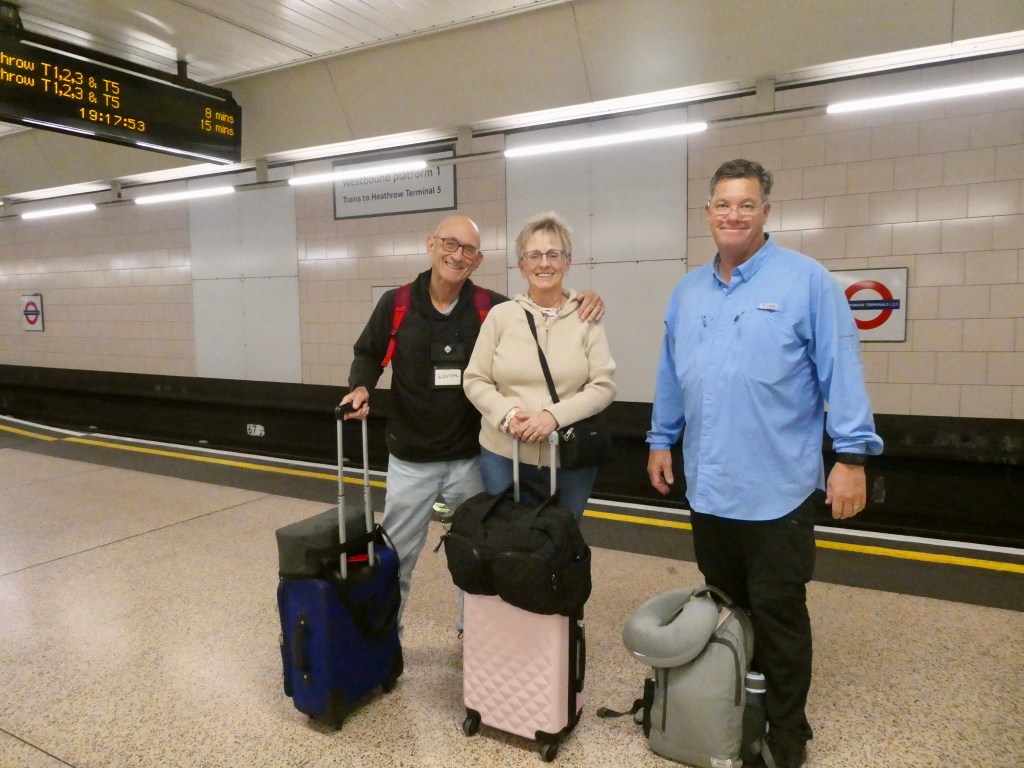
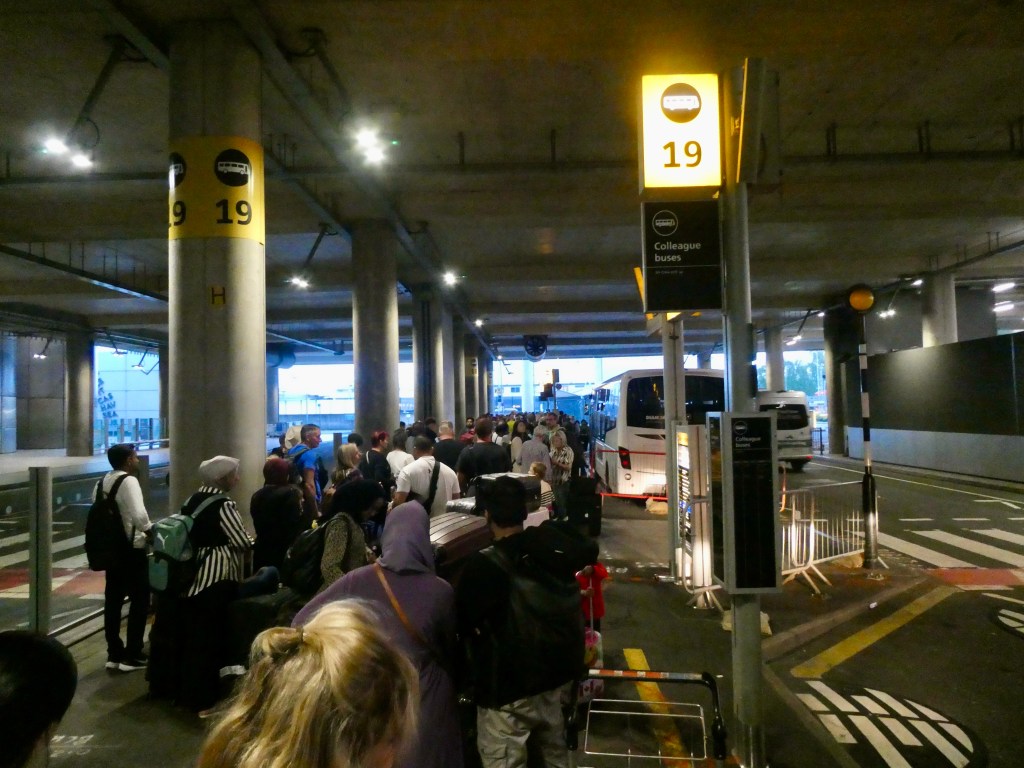
We took an Uber to the hotel as there was a very long line for the hotel loop bus.
We had a late dinner. Randy ordered fish and chips because he had been disappointed that he hadn’t had fish and chips the last time we were stranded in London. Unfortunately he was a bit disappointed in his meal and isn’t a fan of mashed peas!
We collapsed when we got to our room after not having gotten a lot of sleep on the plane the night before. I did wake up in the night, checked my phone, and saw the Mariners were winning. Priorities people!
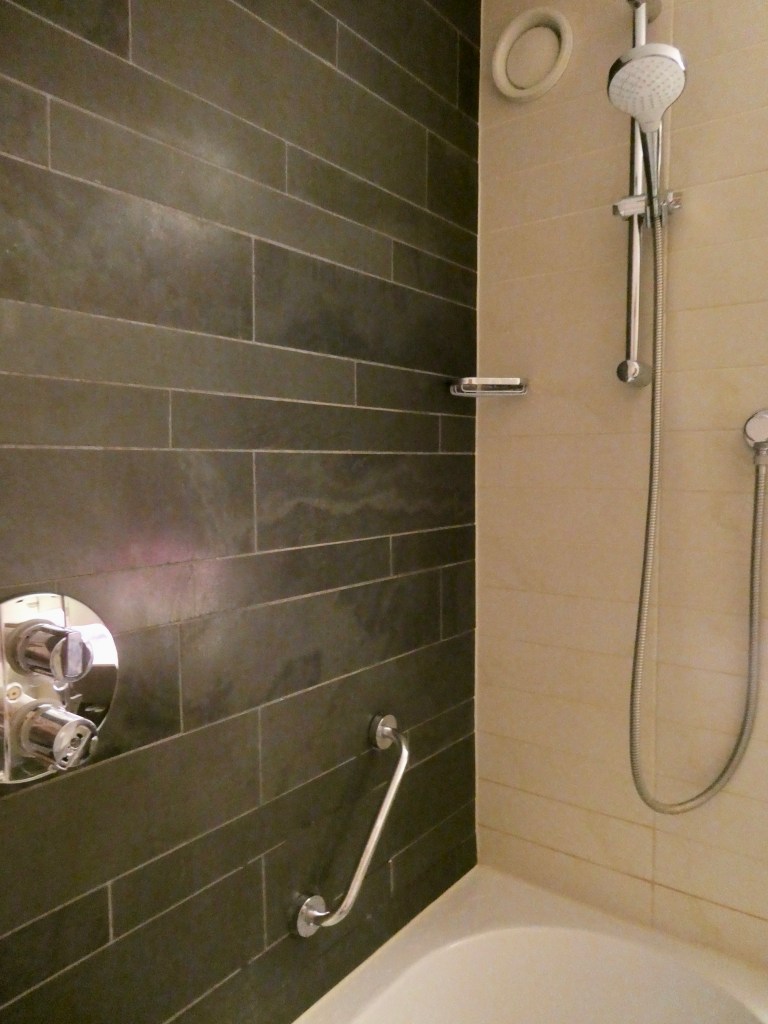
The next morning I laughed while trying to figure out the shower fixtures. Welcome back to Europe! We experienced fixture confusion repeatedly on our trip to Italy last year!
It took me awhile to figure out there was no hot water and it wasn’t just that I didn’t know how to get it. The lack of hot water got us complimentary breakfast. I almost got decaf coffee until I remembered I was in London and had tea with milk.
We took an Uber to the airport and found that our 1:45 flight was delayed to 2:41. We already knew we had lost one of our planned excursions in Prague, but this extra delay made the evening excursion undoable too.
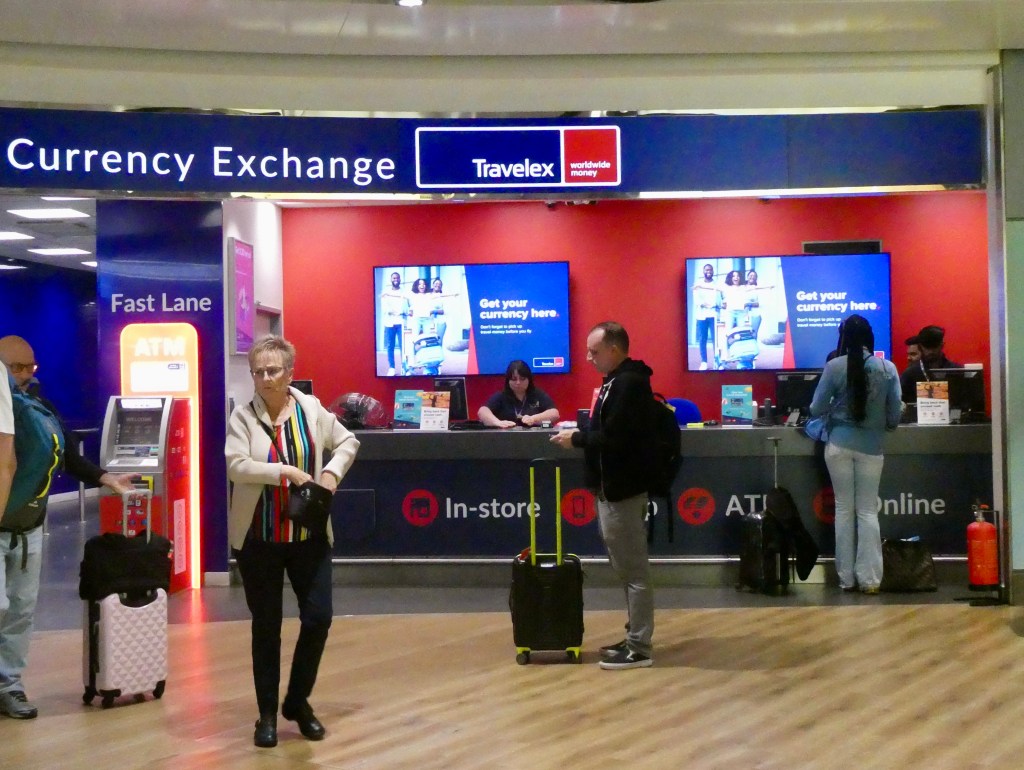
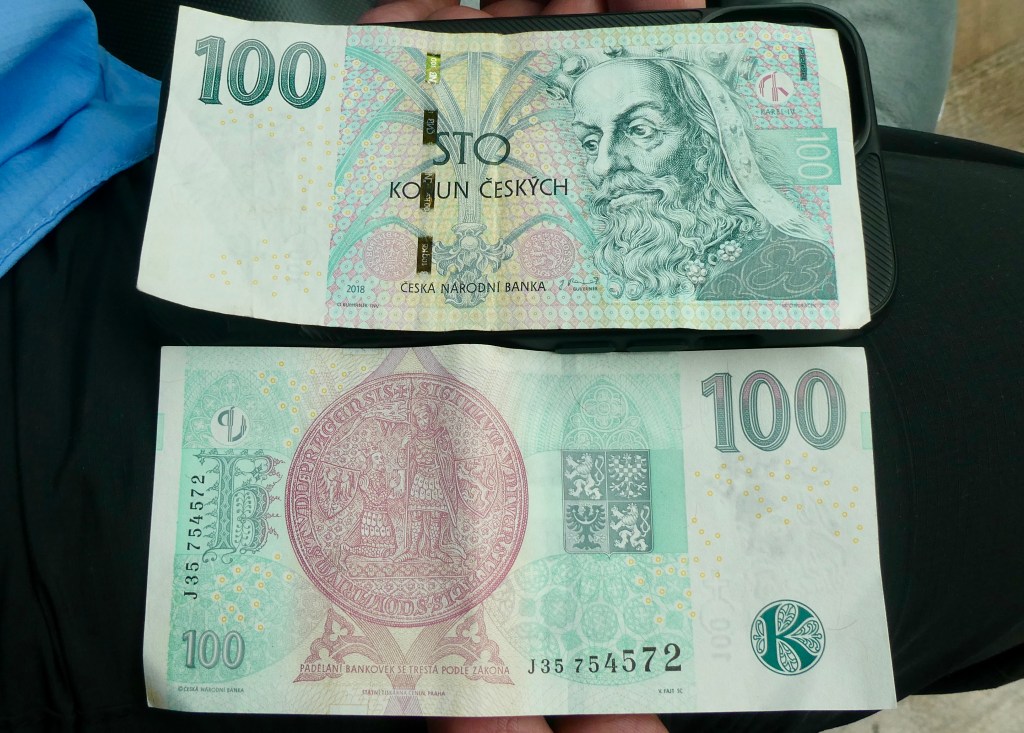
We went to a currency exchange booth at the airport because we wanted to have some Czech Republic Crowns and we had time to do it. The agent explained we would be going from USD to Pounds to Crowns. We knew they would take a share but the share they took was very large! For $42 USD we got 500 Crowns. The fair exchange would have been 940 Crowns. Oh well. At least we weren’t concerned about getting a lot!
When we were on the plane, finally ready to go to Prague, I thought we were lucky that we were just one day late instead of later. Many thousands of people were involved in this mess and the ripples likely took days to totally sort out.
Because of the AirTags we had some confidence that our bags would arrive with us in Prague, but we could only hope that Connie and Warren’s luggage was with us too.
The reason I titled this “London – Again” was because we were in this same place and time a little over a year ago when we were flying from Rome to Phoenix through London. We were late out of Rome so missed our connecting flight at Heathrow and had to stay the night at a hotel (when Randy didn’t get fish and chips). That was courtesy of British Air.
We were flying British Air this time too but the problem wasn’t theirs. We’ll be making a claim through our travel insurance for our trip interruption.
I’m glad to say our return flight at the end of this trip was scheduled on Swiss Air through Zurich, avoiding Heathrow and London.
We have plans to be in London, on purpose, in 2024. Hopefully our planned visit to London will be better than the unplanned ones.
On the morning we should have all left Quebec City, Cindy and Darrell did. I was moving to a hotel near Randy but couldn’t check in until the afternoon. That gave me one last morning to explore more of Historic Quebec City.
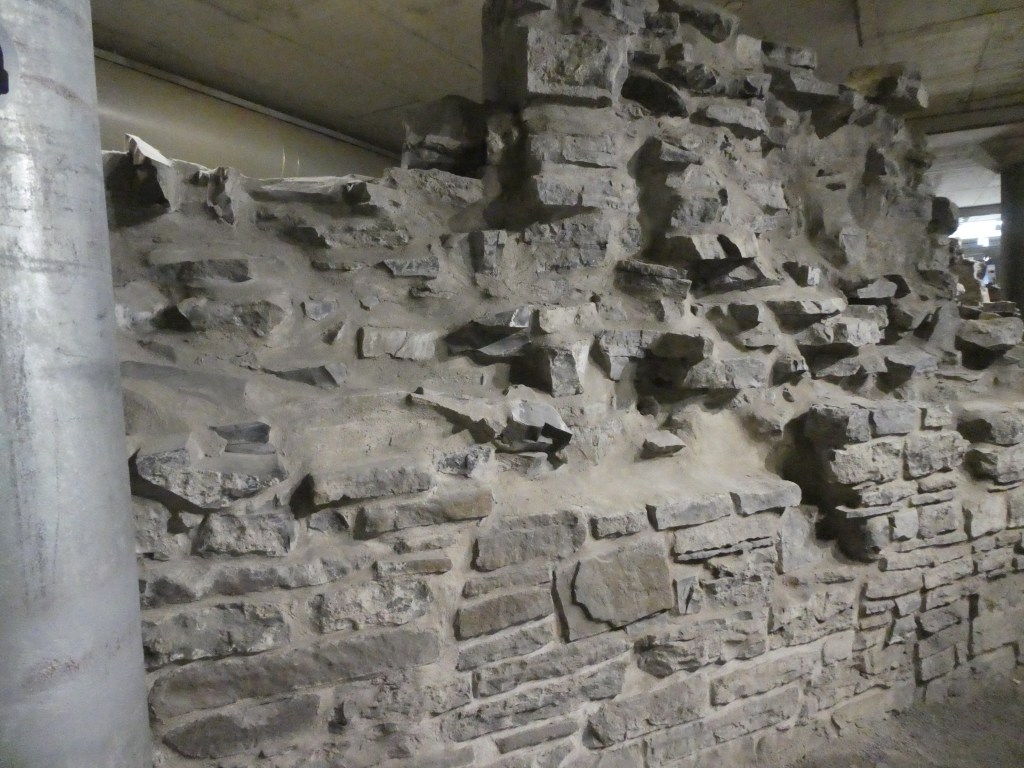
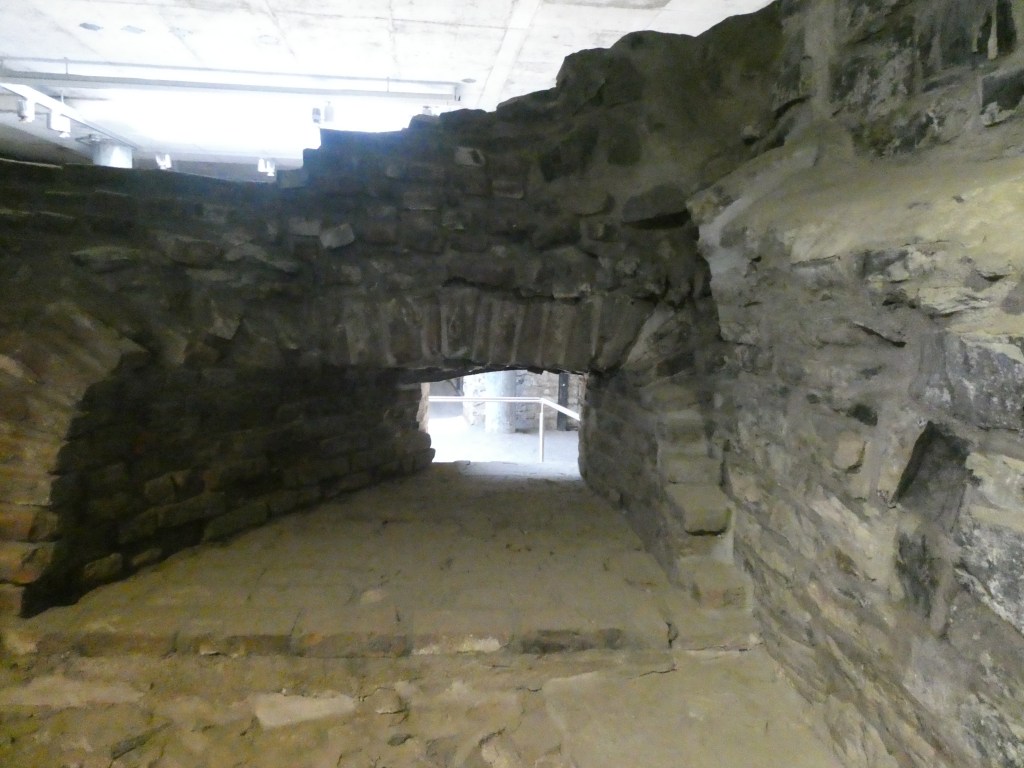
I had noticed something happening under the boardwalk earlier and went to see if that could be interesting. It was! I was able to tour the remains of the Castle of St. Louis, a National Historic site.
During their first winter in Quebec in the early 1600s, 21 of 28 Frenchmen died. They then made alliances with First Nation peoples because the Frenchmen didn’t know how to hunt or survive in these lands.
The French wanted to get into the fur trade and they established the first trading post in Lower Town.
Quebec City was chosen for strategic reasons. There was the narrowing of the river and it was a known gathering spot for First Peoples
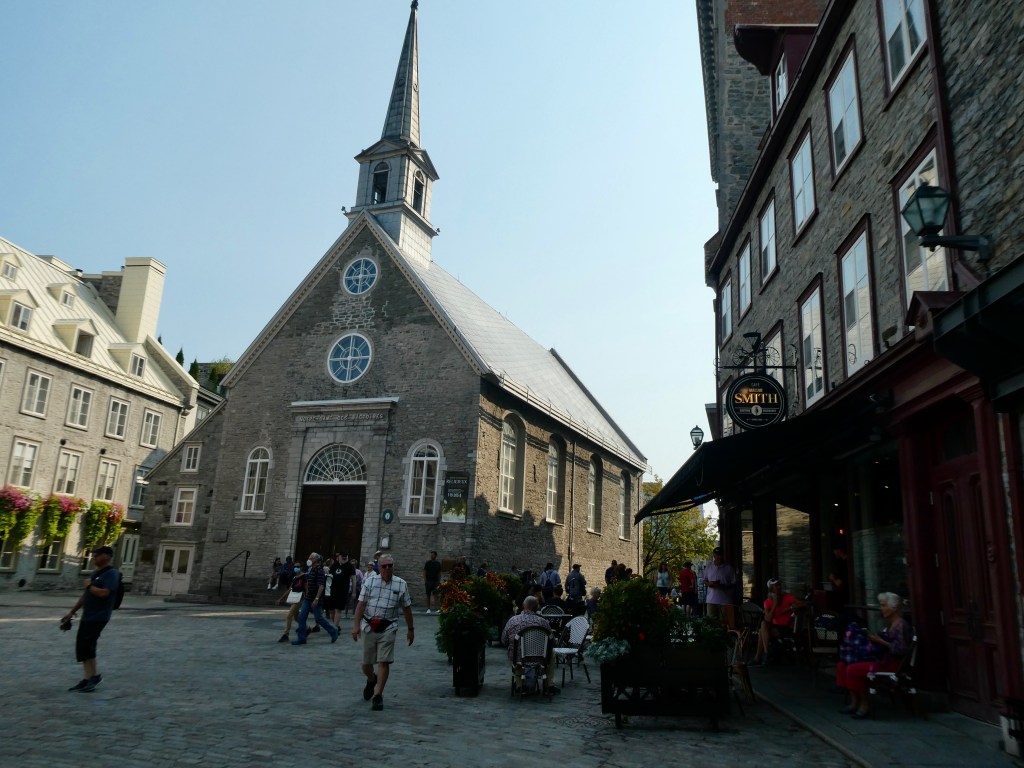
French explorer Samuel de Champlain built his first habitat in Lower Town including the Notre Dame Church.
In 1620, the French built a fort for 40 people. Their cannons could reach the river.
In 1628 the English got interested in Quebec. The Kirk brothers came to attack Quebec but did not have enough manpower to win. In 1629, the Kirk brothers came back and laid siege to the city and it became British. It took three years of negotiations between France and Britain, but control of Quebec returned to France. However, the Kirk brothers burned much on their way out.
In 1635 the founder of Quebec city, Samuel de Champlain, died.
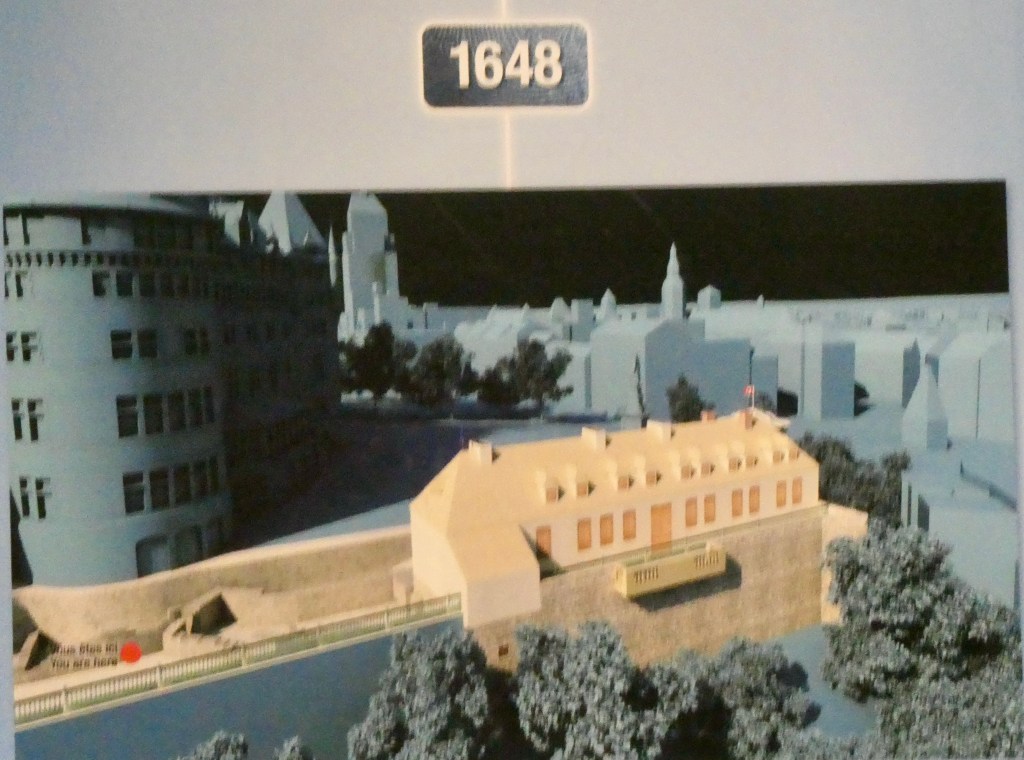
He was replaced in 1636 by Governor Charles Hualut de Montmagny who built the first St Louis Castle in 1648.
In 1648 the French held territory from Quebec all the way down to the Gulf of Mexico. They ruled those vast lands from from the Castle of St. Louis. Recognizing they could not militarily control so great an area, they controlled it by diplomacy.
Over the years different governors added on to or rebuilt sections of the castle.
Britain started a strategy of picking off important outposts in New France. In 1760, the French won all the battles, but in 1761 they went back to the English. There was a treaty in 1763.
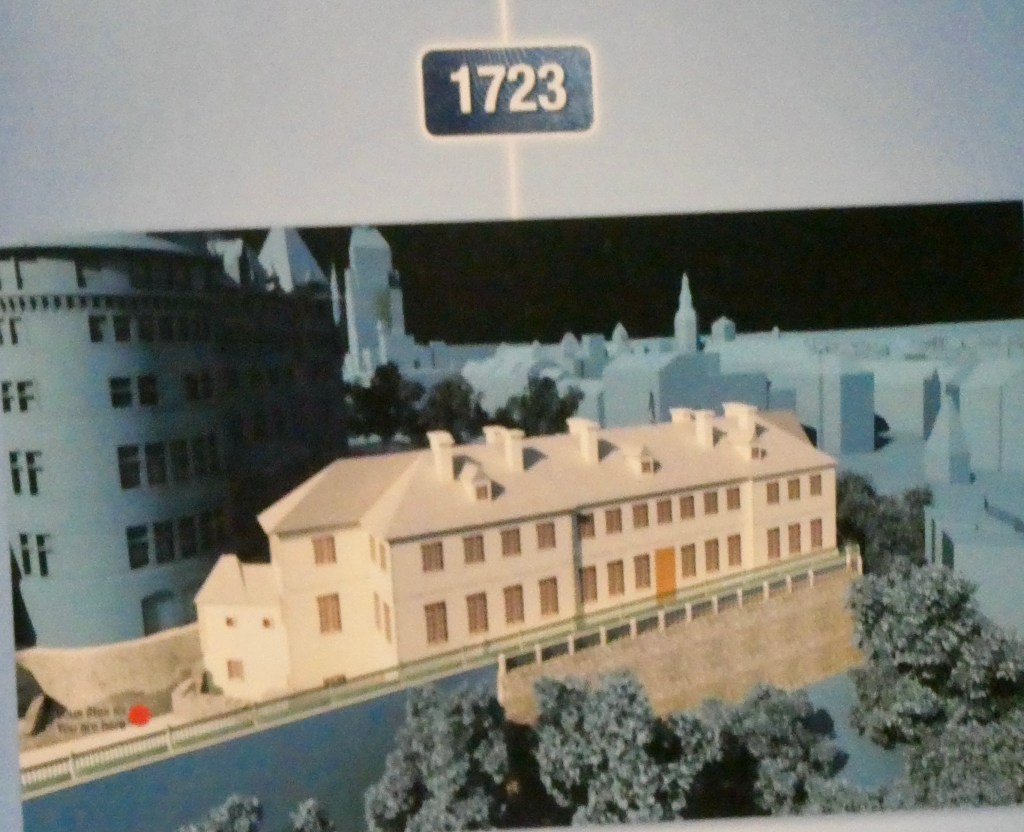
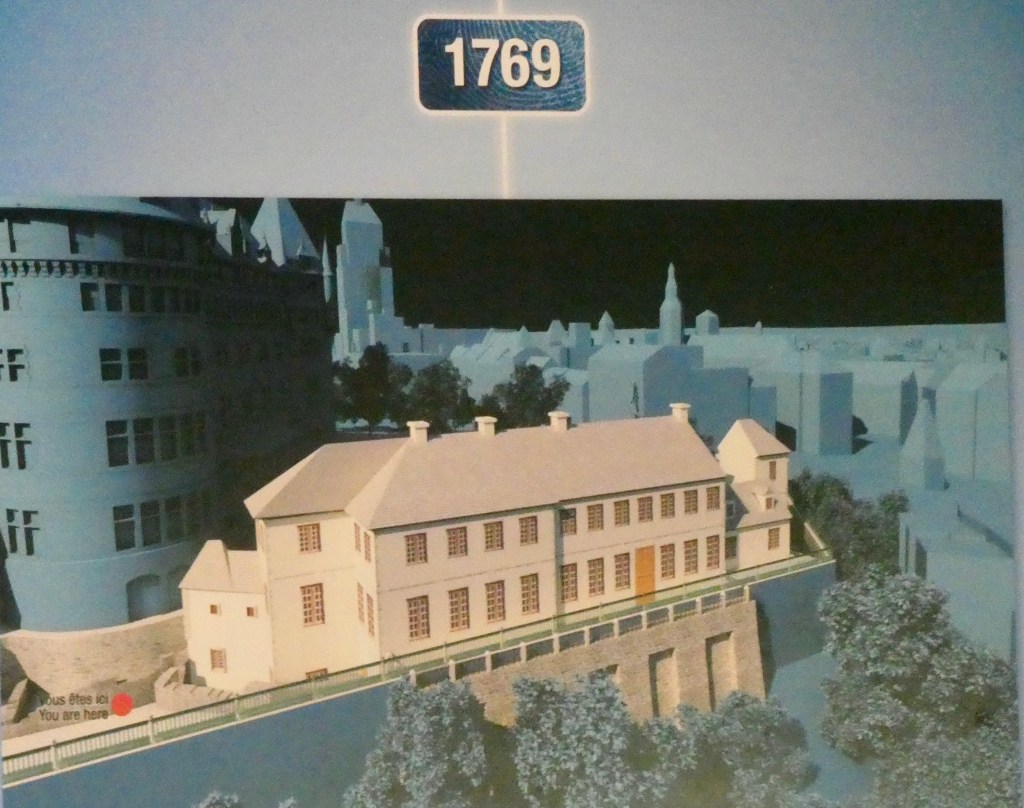
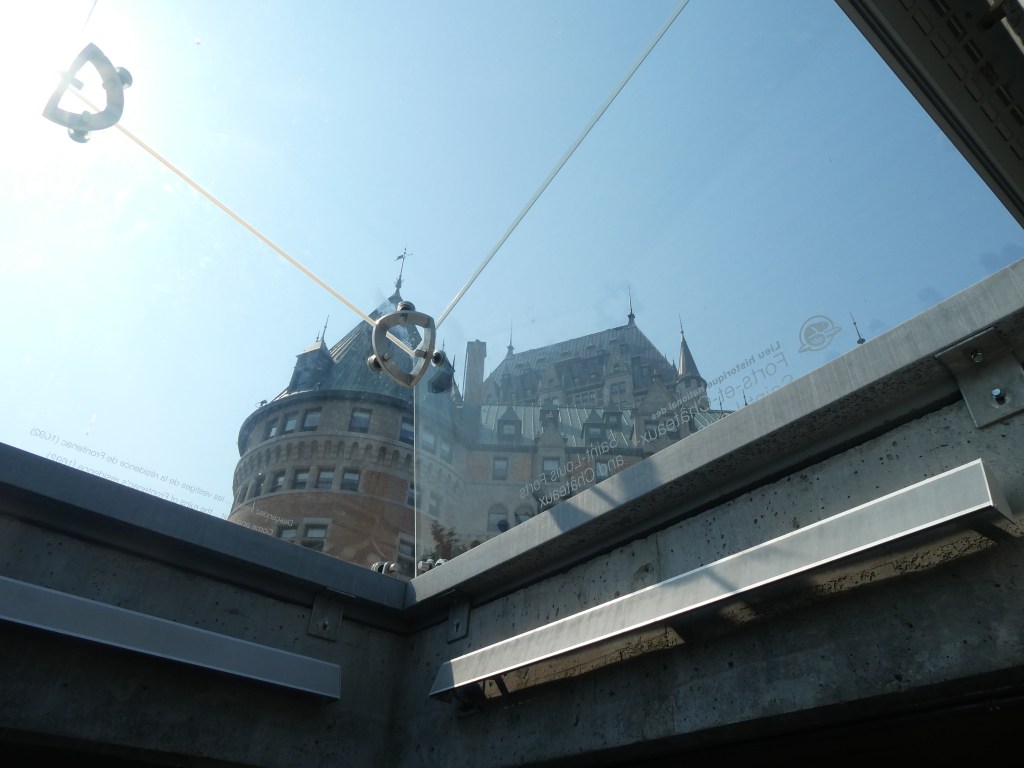
Britain built a new castle where the current hotel is but didn’t like that the view was blocked by the old Castle of St. Louis, so they added on to the old castle instead.
The area under the terrace was the former street level.
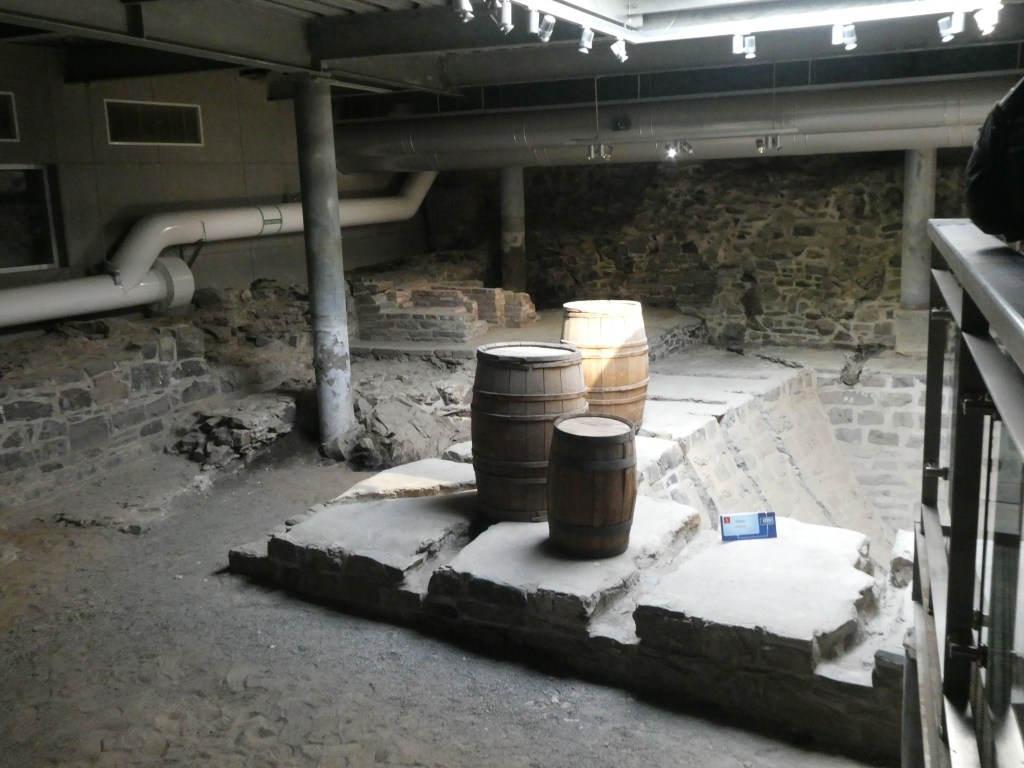
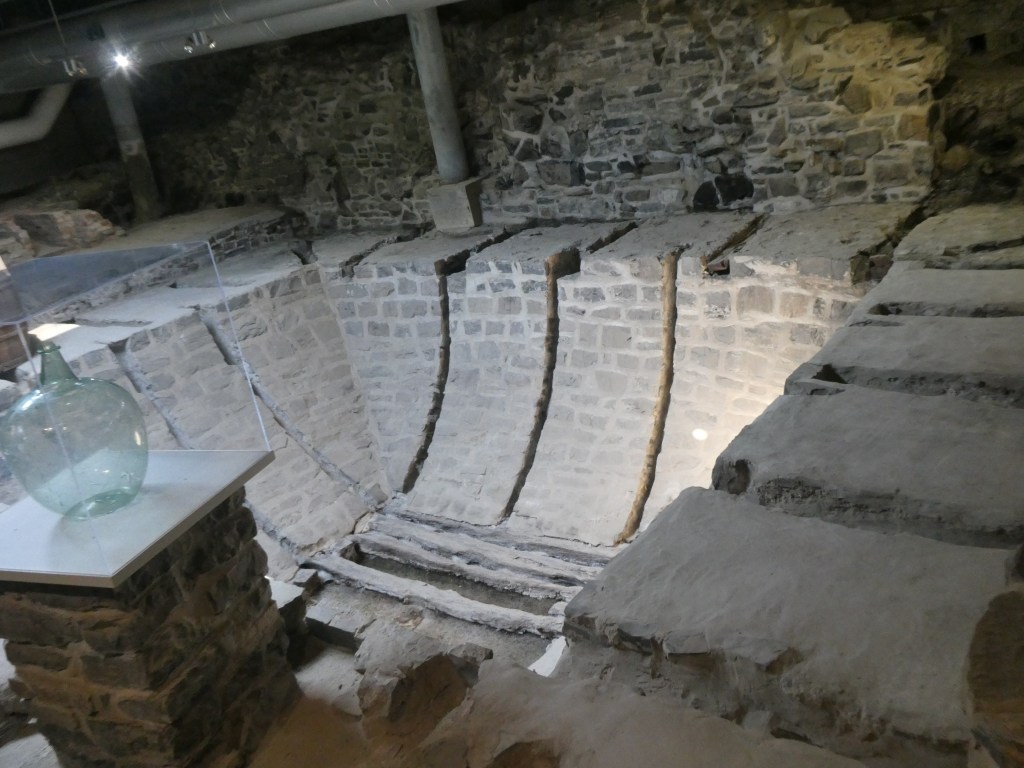
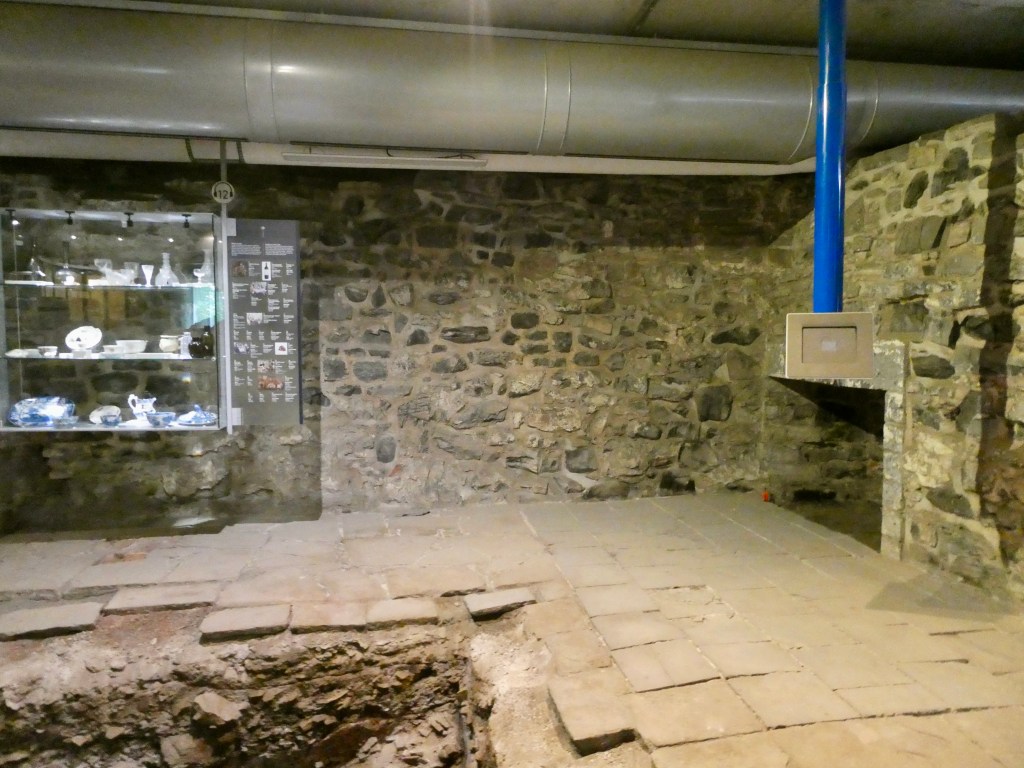
The first room we saw was an ice house in 1771 used by the British. It was dug up in 1980s
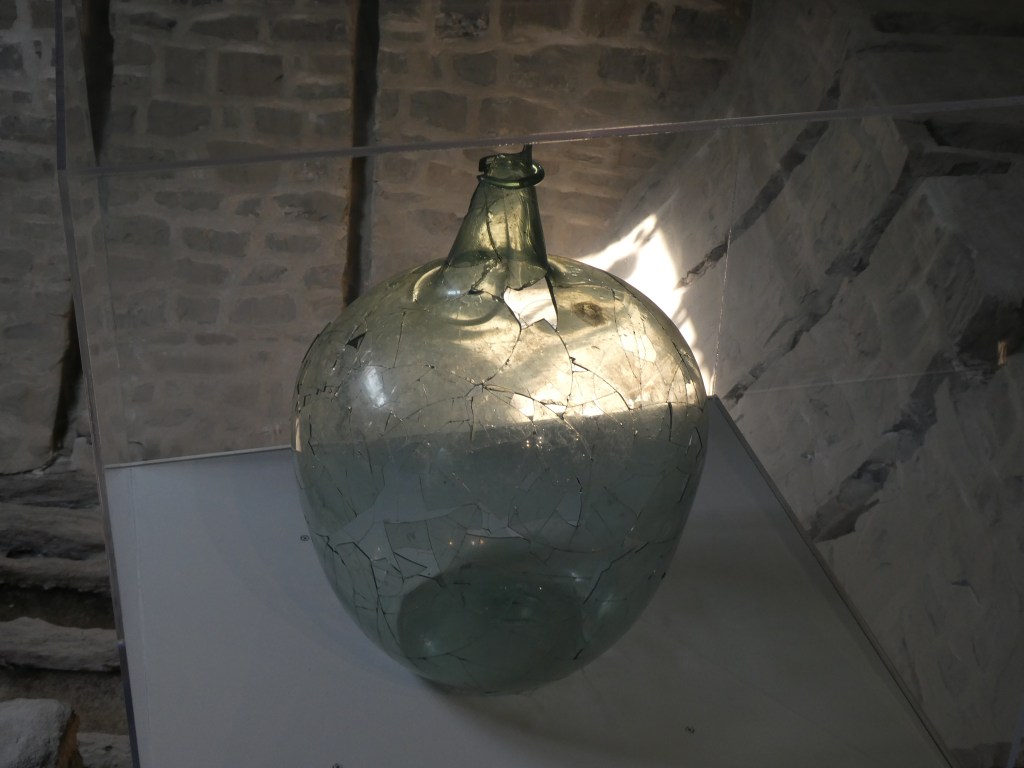
This glass jar was in 404 pieces and would have held oils. It took 12 years to rebuild.
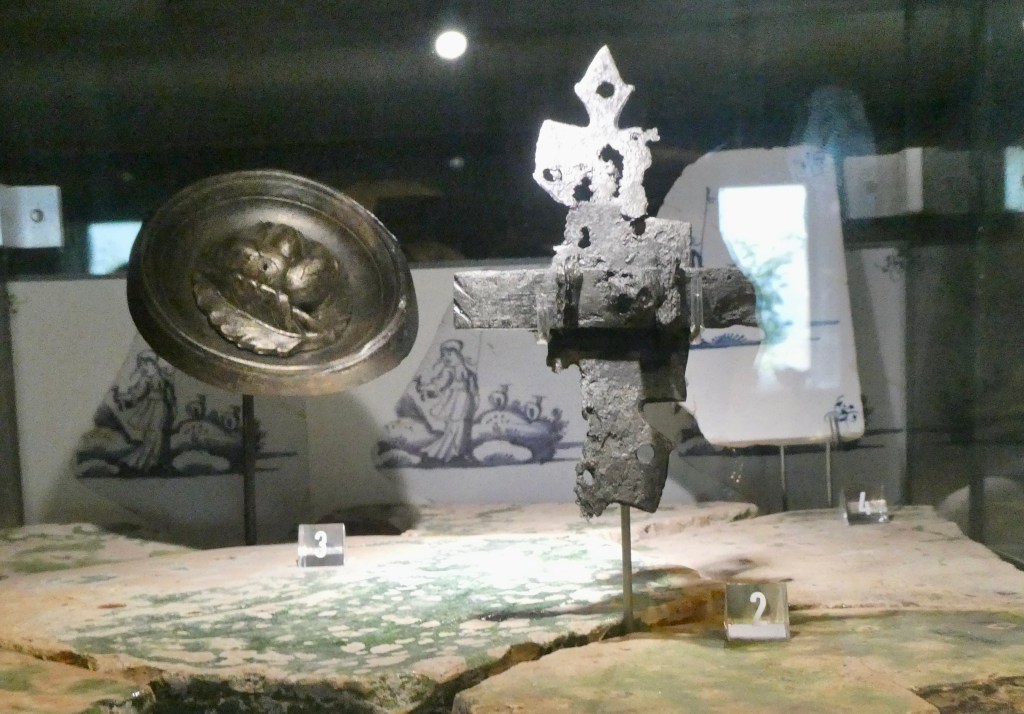
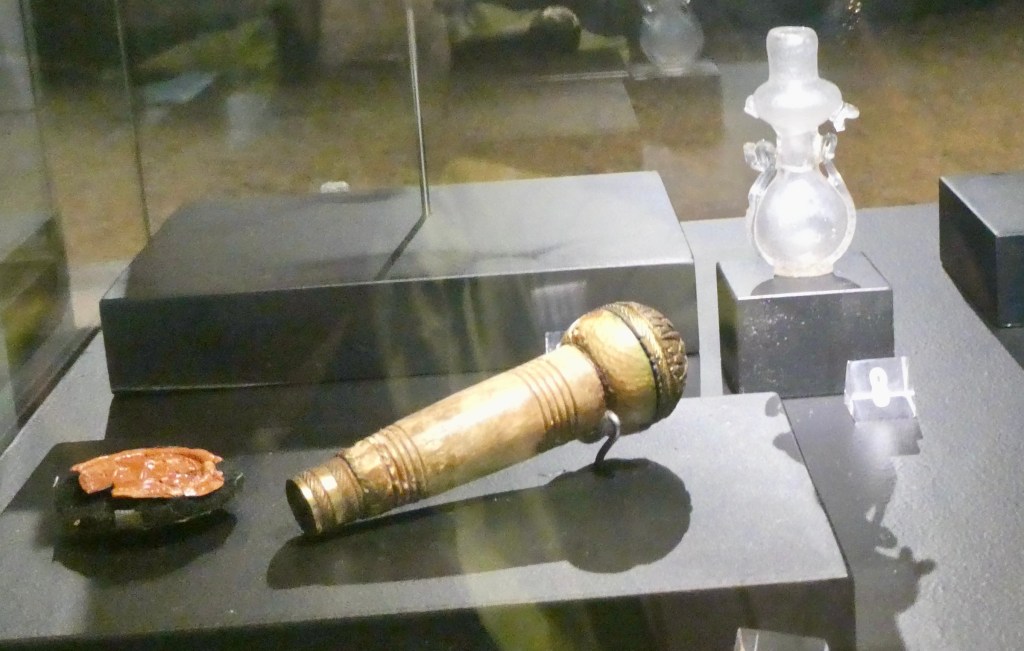
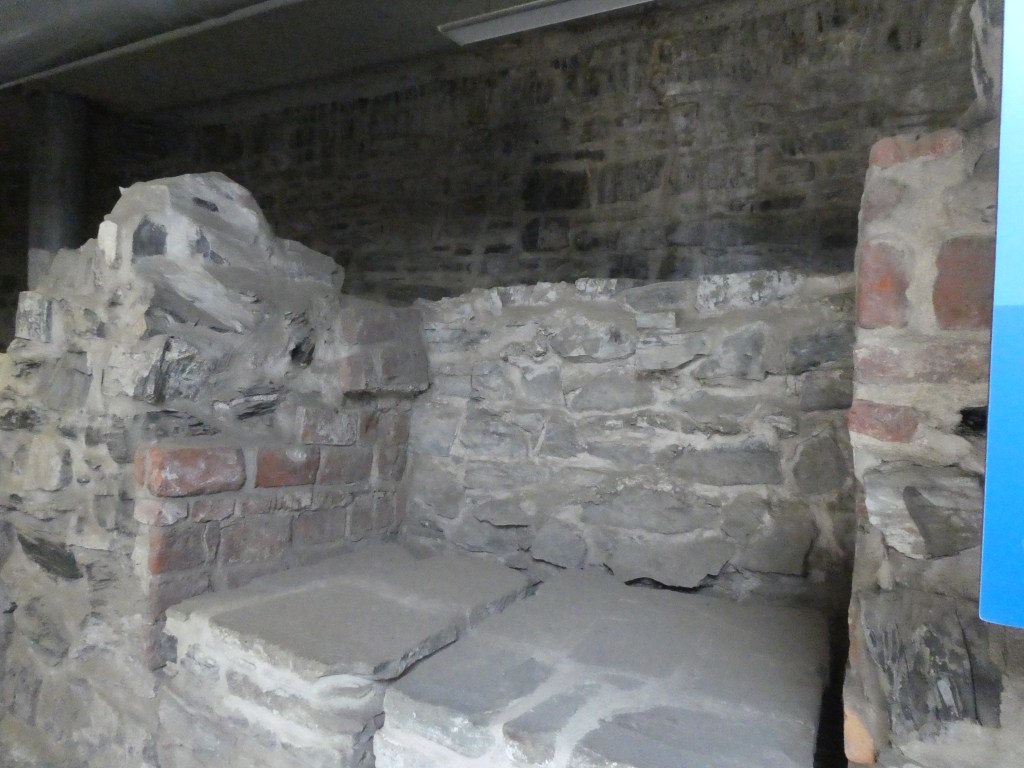
Some small items were found in the latrine as it was also used for garbage. Every five years someone was charged with cleaning the latrines and could keep anything they found.
There were lots of artifacts found because French governors didn’t want to use their predecessors articles and brought in totally new households. Researches have also found British items. British rulers who did well in Quebec might be appointed to India next.
Castle entrance.
Scullery area
Kitchen
They have receipts for these gray stones that came from across the Atlantic.
The British and French differed on how many prongs were on forks so archeologists know which era an artifact comes from.
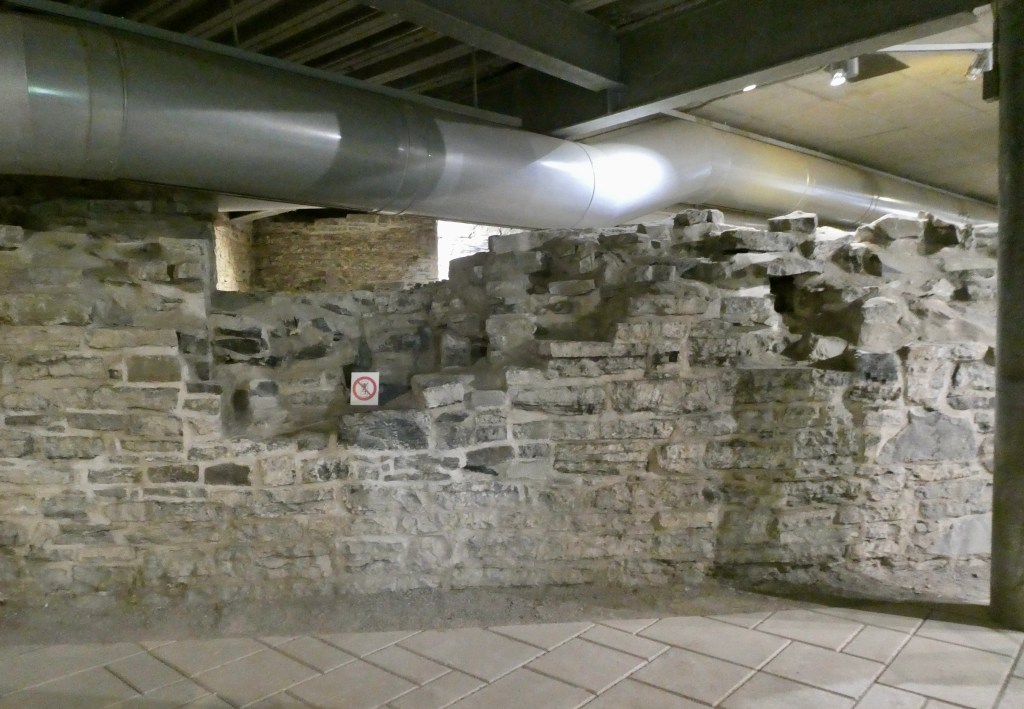
Some parts of the castle remains were destroyed while building the funicular in 1879.
The second (British) castle was destroyed while building the hotel.
Archeological excavation of the old castle was done from 2005-2008. It opened to the public in 2012.
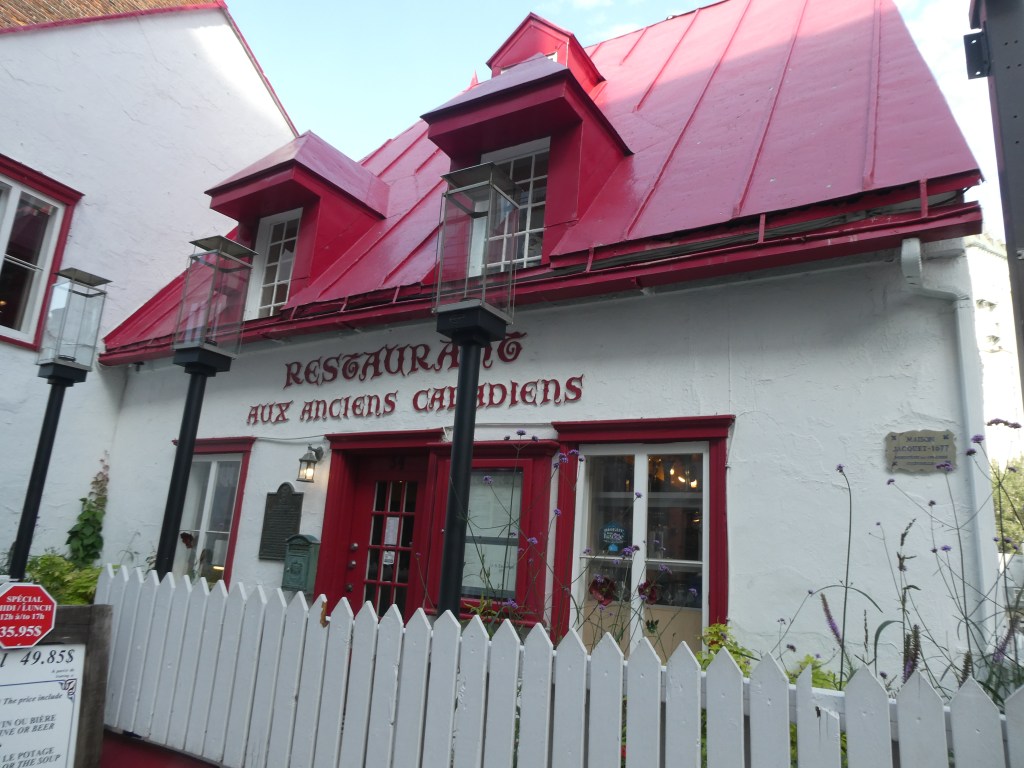
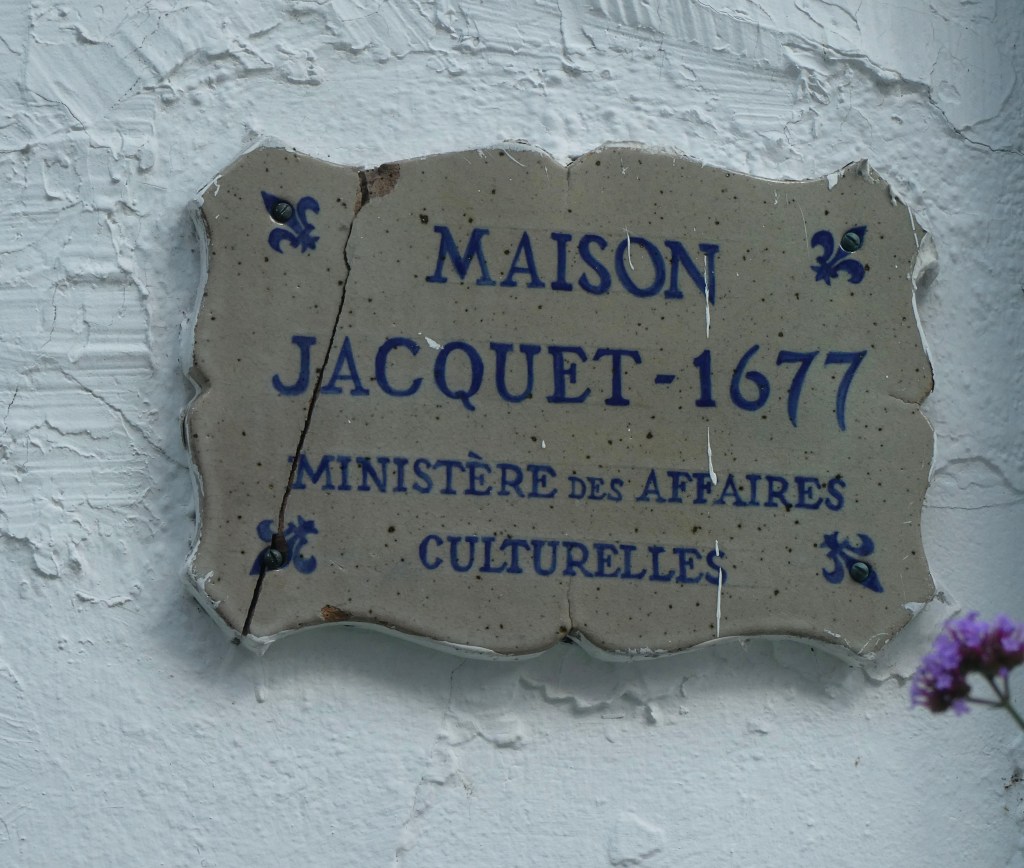
At the conclusion of my tour, I walked to the Maison Jacquet, one of the oldest houses in Quebec built in 1677.
Several prominent figures in Quebec history have resided in Maison Jacquet, including the author of the novel Les Anciens Canadiens, Philippe-Aubert de Gaspé, who lived here from 1815 to 1824.
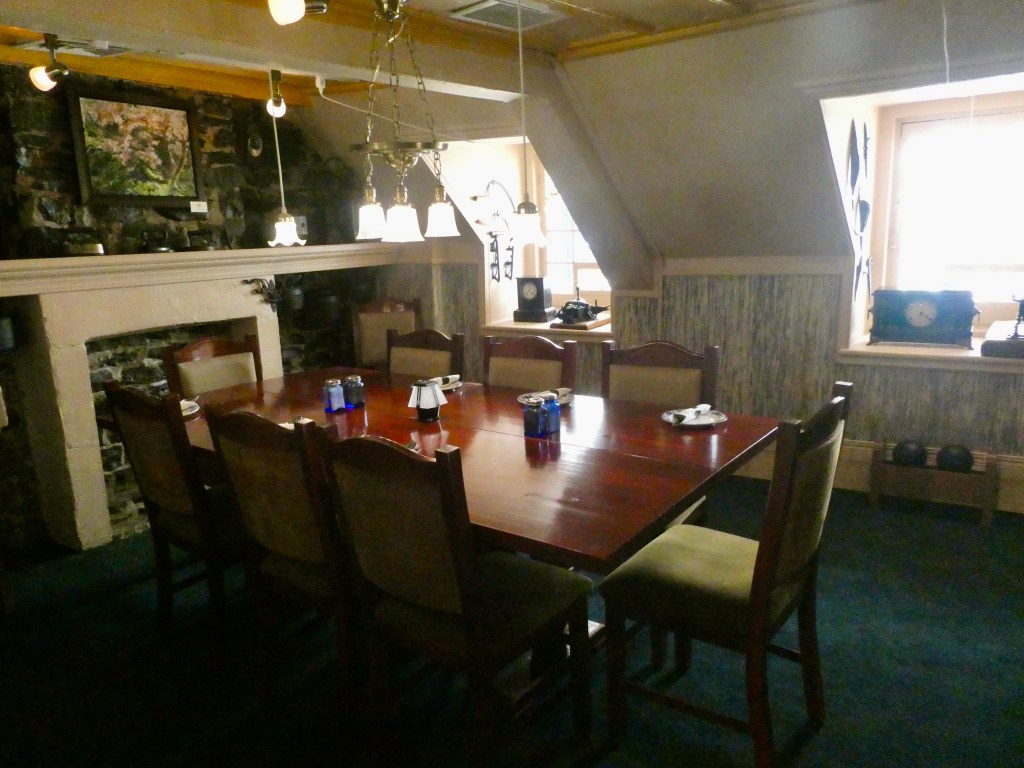
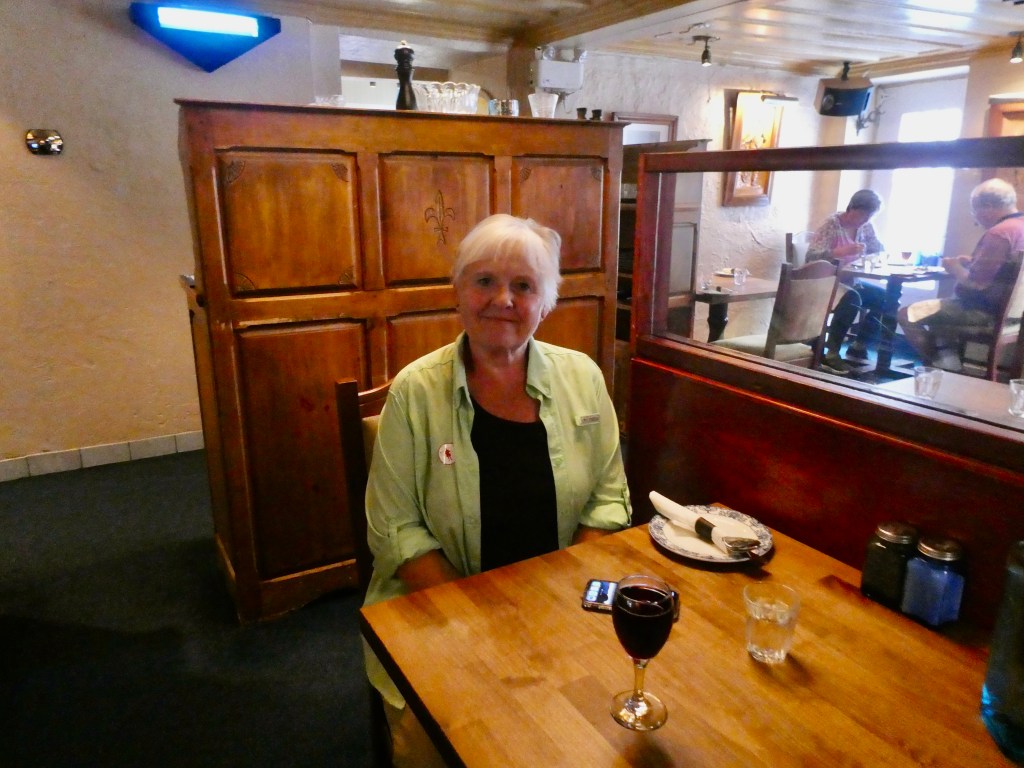
And if that house is now a restaurant, and you have the chance to go in, why would you not!
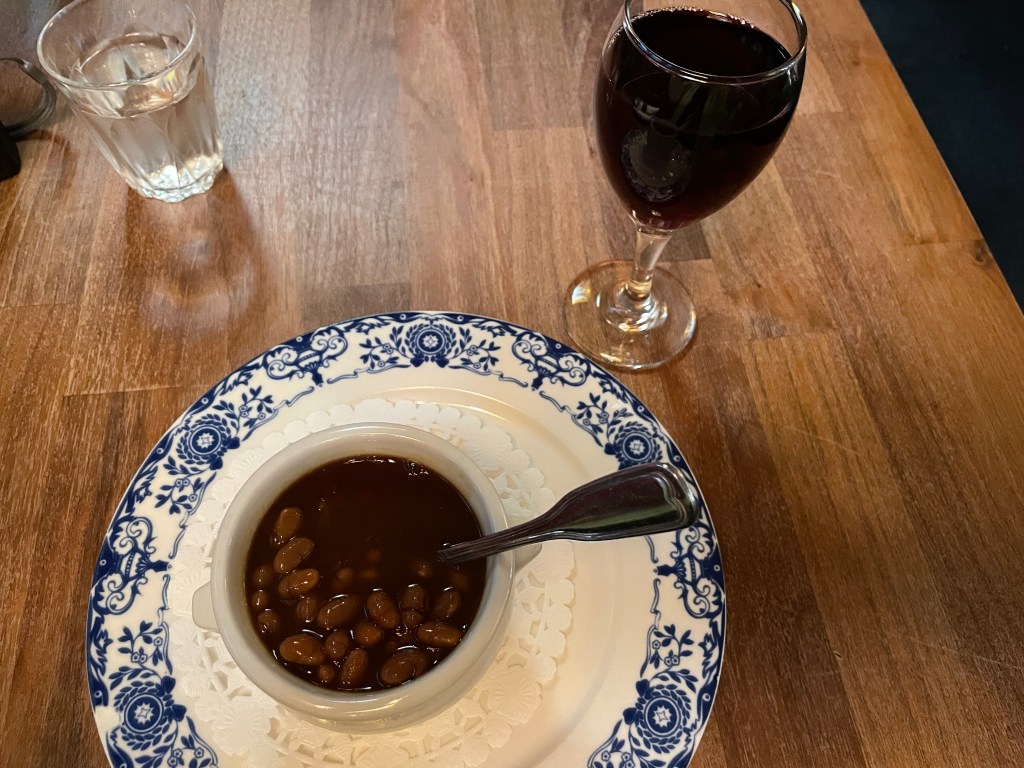
My meal started with the most DELICIOUS beans and a glass of wine.
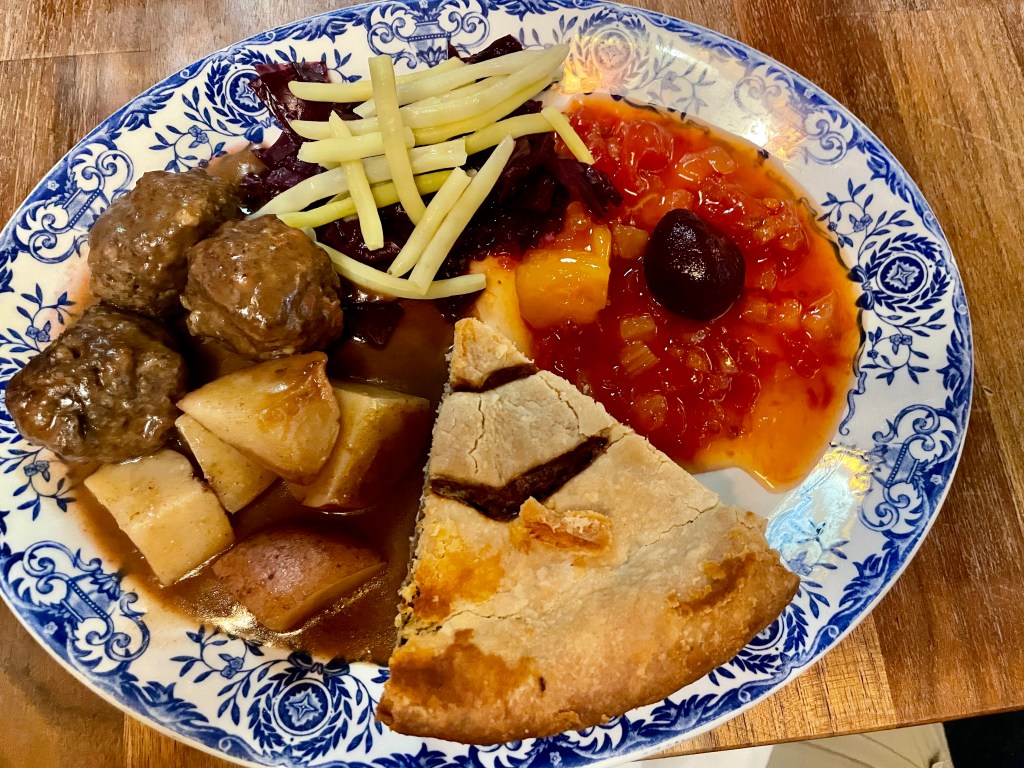
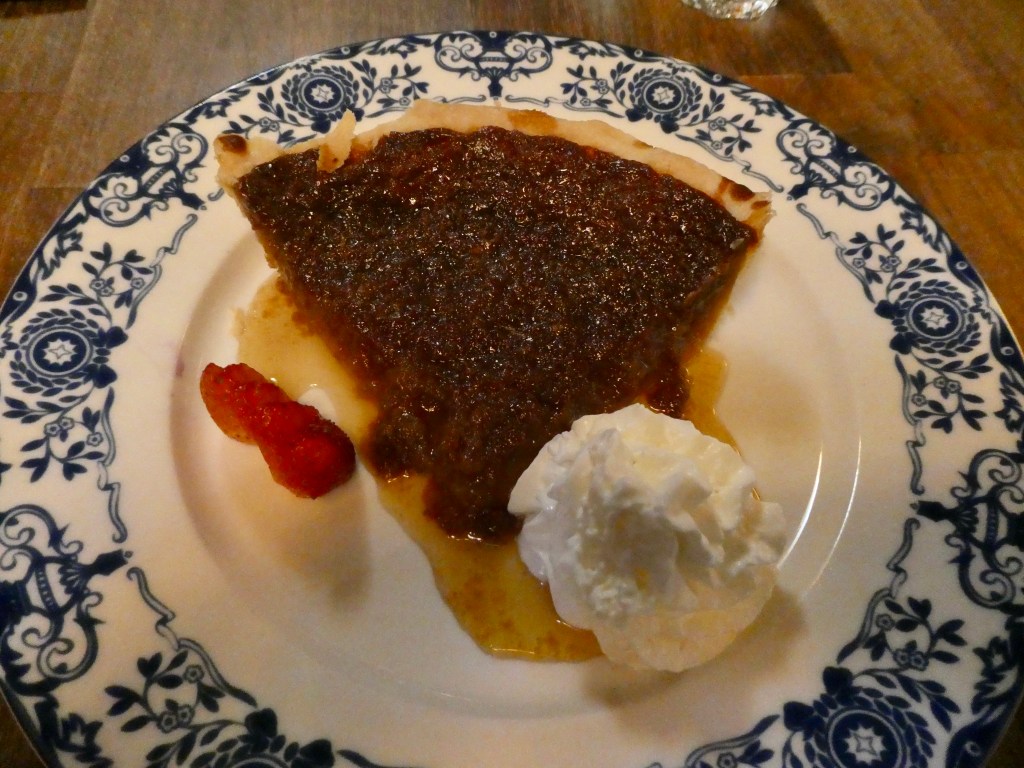
I was able to pick from a variety of regional foods for my next courses.
I’m sure they were good but I have no particular memory of any of it a year later except for the beans!
I gathered my belongings and took an Uber to the part of town where Randy’s hotel was. I checked in at the hotel next door because there was no room at the inn where he was.
We’ll go with Randy’s notes now:
Lots of people speak two languages (at least).
I’ve been watching French TV without English subtitles and watching sewer lines be installed out my window.
I figured out the room airflow so my underwear that I washed in the shower would dry quicker. It worked well.
On Saturday (around 11) I took the last Covid rapid test I had. It is important for these tests to only confirm your reading after the 15 minute time. Take a photo of the reading for your records. It showed I was now negative. However, I looked at it later and there was a very slight reading of positive, but that was after 45 minutes. I ignored that reading.
Darrell and Cindy left Saturday and Serene moved to a hotel next door. She came over and stayed a while and we both wore masks. She brought over two rapid tests from Cindy.
On Sunday I discovered the couch was actually a Murphy bed. Who knew.
1st negative Covid test on 9-10-22
2nd negative Covid test on 9-11-22
For a couple days, I became the food delivery person and joined Randy in his room for a few hours.
I went to my hotel in the evenings just in case the medical inspector came.
Randy got emails from the Canadian medical authorities periodically and one finally included a phone number. He called and talked with a woman who spoke English. He explained that he had tested negative twice and she said he could leave Canada!
Randy called me immediately and wanted to leave NOW!
Our reservations to fly out on American (that I had rebooked when he got COVID) were not scheduled for two more days.
I tried to convince him to go with me to Old Quebec and we could stay at the Chateau Frontenac for a couple days because this was an unexpected opportunity. He was not interested and just wanted to go home.
I could not change our American reservations on my phone because it was an international flight. I also could not get anyone from American Airlines on the phone.
United had flights going to Phoenix but we needed to leave for the airport very soon if we were going to get on that flight. So I booked the flight on my phone and we left. We checked out of our respective hotels not knowing if would be charged (or reimbursed) for our unused nights. We were a bit concerned that we would be “caught” leaving Quebec before his official quarantine end date but went ahead.
Fortunately, we were able to board and eventually landed in Phoenix late that evening. We stopped by the American counter to cancel our flight to leave Quebec two days later.
Imagine our surprise the next day when we got notification it was time to check in for our flight from Quebec to Phoenix when we were already home!
Many hours on the phone later, we were told that we would get flight credit on American Airlines but we had to book new flights within two weeks and fly before the end of 2022. It was something, better than nothing.
Those credits were used on our great trip to Nashville in December 2022.
The struggle with travel insurance lasted into December as well. Holland would pay anything that the travel insurance didn’t pay but I had to get final resolution there first.
I claimed Randy’s hotel charges and Uber Eats costs. I claimed (but didn’t really expect to receive) my hotel charges when I moved to be near him. That process became months of submitting and re-submitting receipts for my claims and eventually submitting receipts for things they requested that I wasn’t even claiming. I submitted the United ticket receipts because they wanted to know how we got home. My thoughts were that they were just trying to wear me down with constant and repeated requests.
One day I was completely frustrated and told our travel agent to NEVER use that travel insurance for any trip we were on EVER again. She took over and escalated our claims up the chain of command. We received two deposits within two days – the first for everything I originally claimed and another for all the extra stuff they had asked about.
On the checks were statements about possibly having to repay any amount they might have overpaid in error. Ha! That wasn’t happening even if they asked- which they never did. After all their grief, I earned every last cent.
Last notes:
On Sept 26, 2022 Holland America announced Canada had modified its testing and vaccination procedures without specifically addressing quarantine requirements. Our trip was a month too early to not be tangled up with COVID quarantine in Canada.
Most people in Quebec were not wearing masks by the time we were there. Workers that Randy interacted with in the hotel, and with Uber Eats, were surprised at their government’s quarantine requirements for visitors when COVID amongst the general population was mostly being ignored. However, we felt as visitors in Canada, it was our obligation to follow their rules.
We were in Canada during an election cycle. These campaign posters were the norm. There was nothing we saw that was hostile, or demeaning. or in your face with more and bigger is better. If only we could act that way here.
A year later, I have chuckled many times about Randy’s “feet on vacation” picture. He seemed to have a bit of a sense of humor about the situation early in his quarantine.
As I am writing these last words, I am glad I decided to go ahead and document this trip but It was also a good thing that circumstances caused me to delay. I asked Randy if he could laugh about it a year later and he said no, but he did smile once, and doesn’t mind that I wrote about it.
Remember when Holland America said they’d pay anything that wasn’t reimbursed? I didn’t pursue anything from them after the travel insurance eventually paid well. Holland America did issue a cruise credit for Randy for about $900 for the parts of the cruise he missed while in quarantine.
The use of that cruise credit is part of our next big adventure!
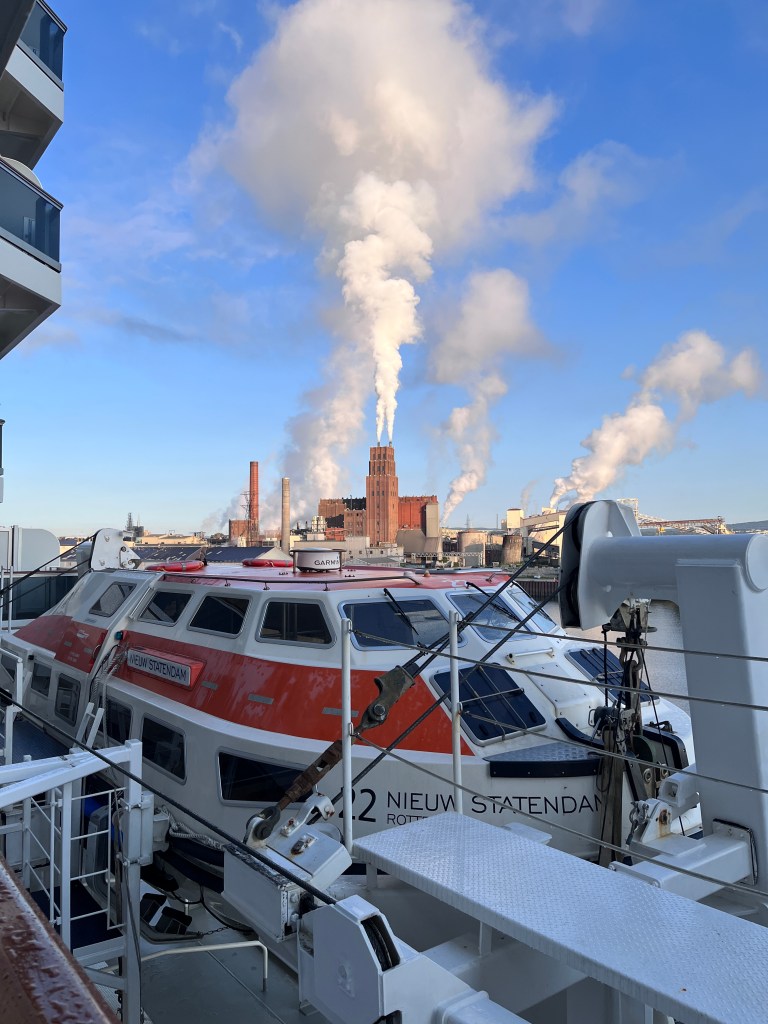
From his quarantine cabin, Randy had this view as we came into Quebec City.
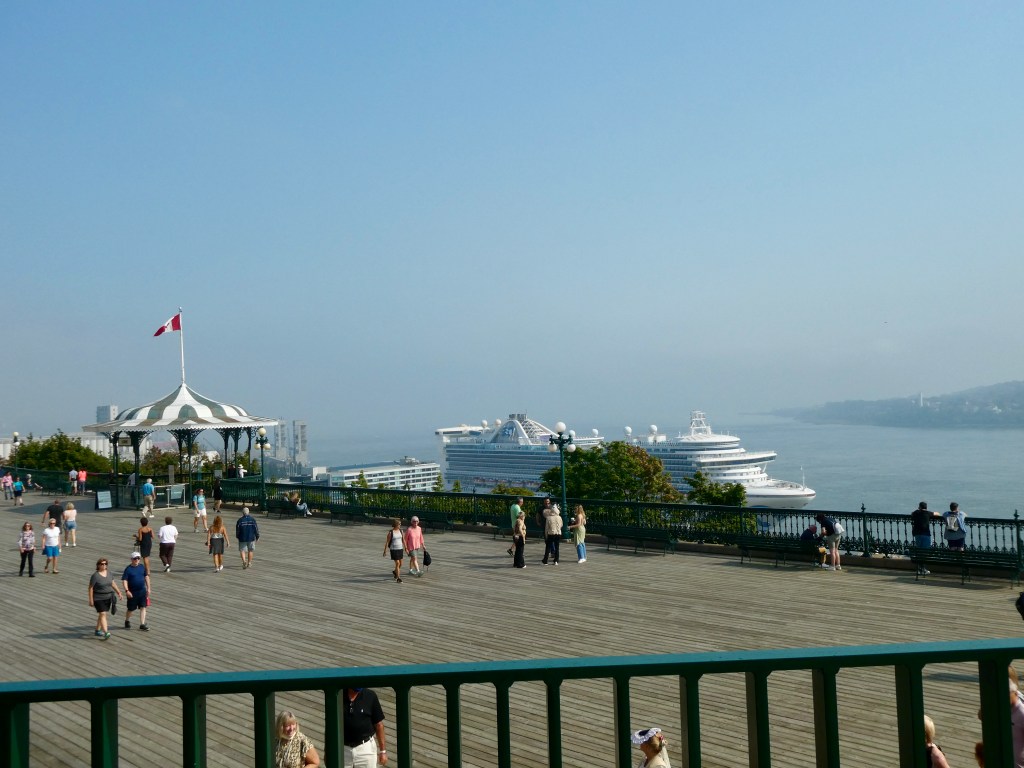
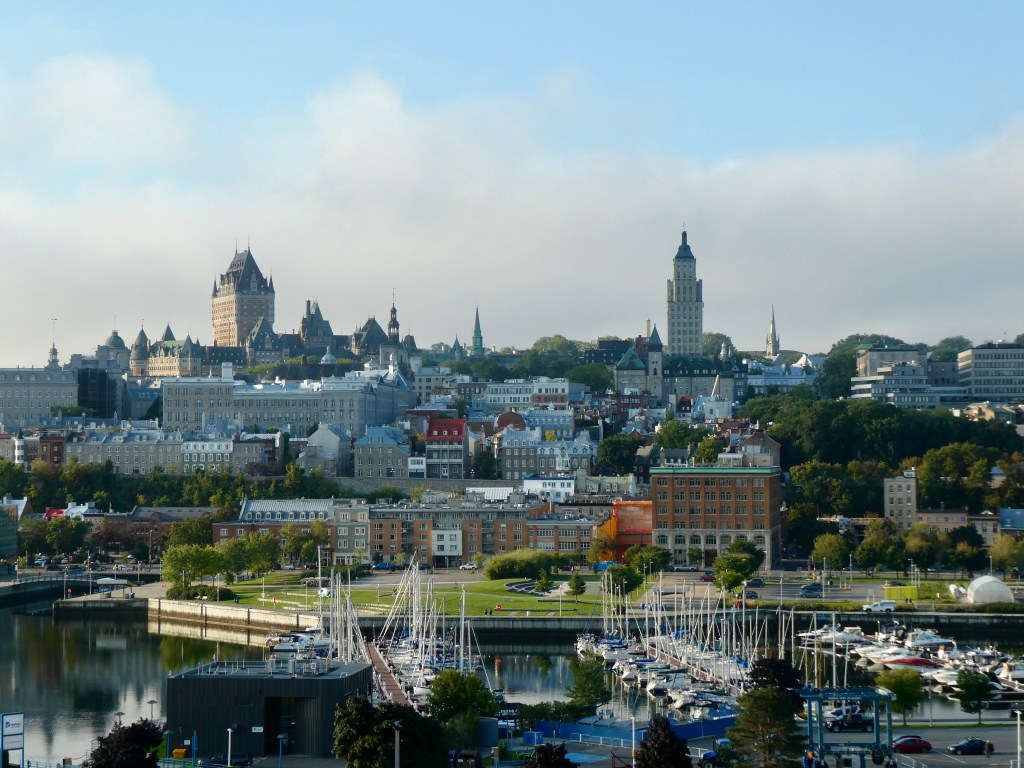
We had this view. The rental that Cindy, Darrell and I were sharing for three nights was way up near the fancy hotel Fairmont La Chateau Frontenac at the top left. Of course, the original plan was that the four of us would stay together for three days to explore the historic area of Quebec City.
Instead Randy was headed into quarantine for an additional six days at a hotel of Canada’s choosing. I could not get reservations at the same hotel but had plans to move to the one next to him when the Airbnb reservation was over. I had changed our plane reservations to correspond with Randy getting out of quarantine.
Cindy, Darrell and I gathered our bags and walked off the ship. We started the hike up the hill pulling our bags behind us.
These are Randy’s notes:
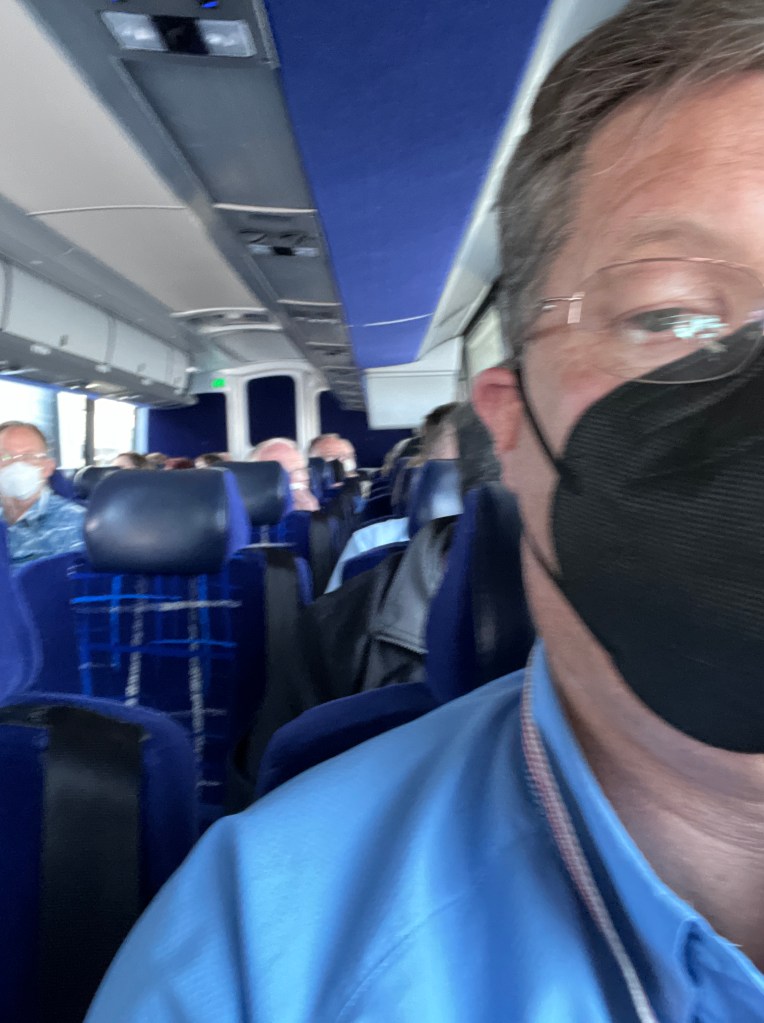
Cruise ended on 9-7. I was told to wait until an escort was sent to get me. They took us one at a time off the boat. They handed us a packet near the gangway and pointed at the buses, and said good luck. I used my cruise card to scan off the boat and was now Canada’s problem. The doctor did provide a letter indicating when my quarantine was over based on Canadian rules.
There were two buses and about 70 people split between two hotels. No security, we were to quarantine on the honor system.
What came apparent to Randy was that there were many couples going into quarantine. Some had both tested positive, and others had one person choosing to go into quarantine with their partner. We were never given that option but probably wouldn’t have done so anyway.
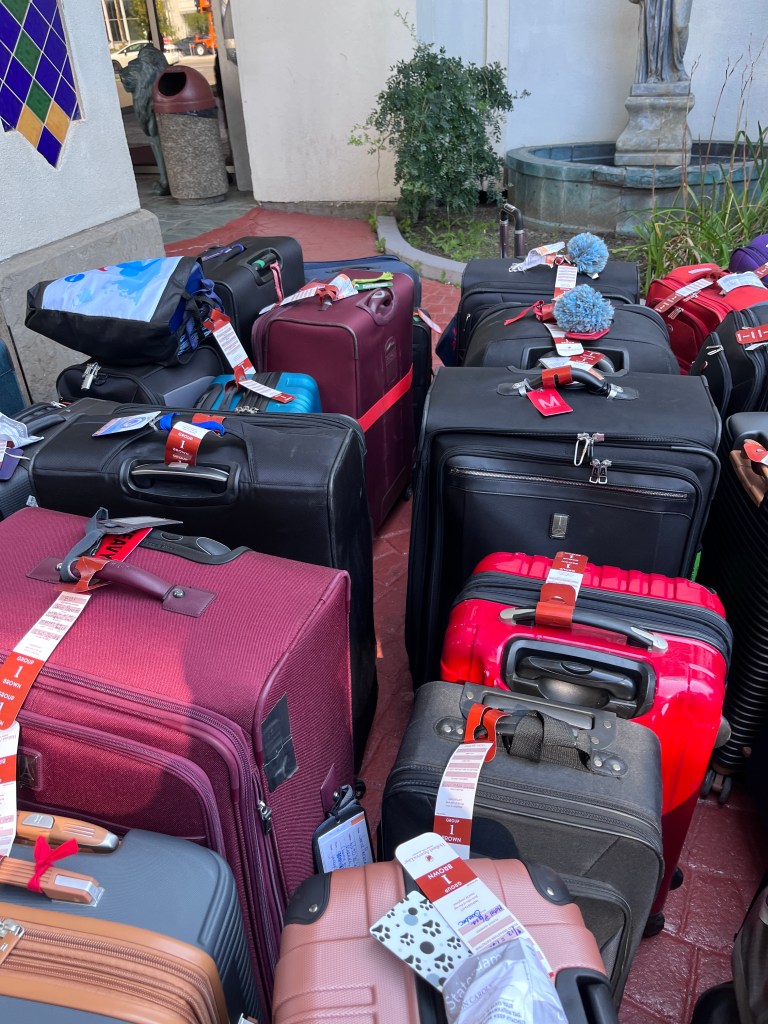
So many bags (and people) going into quarantine.
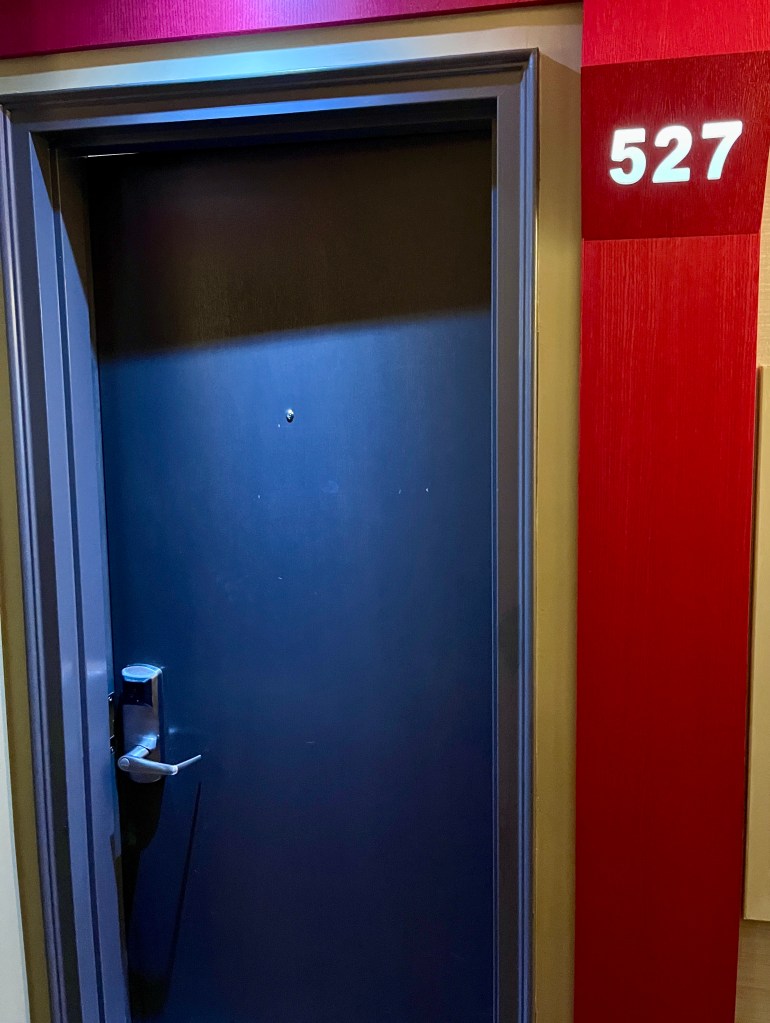
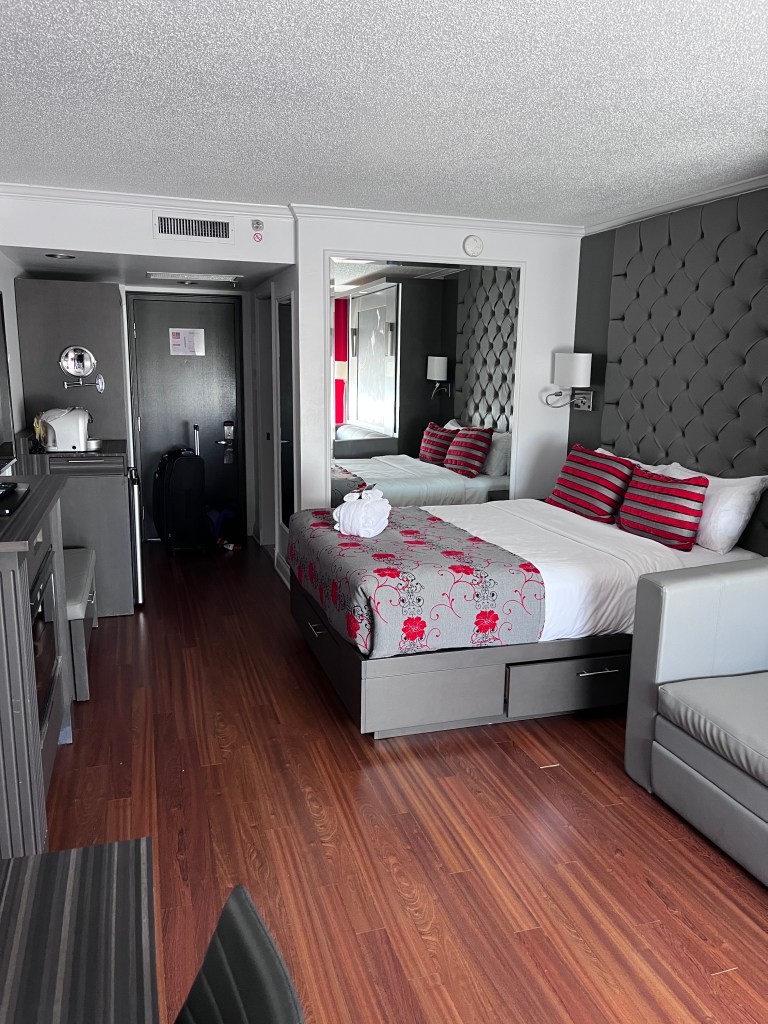
Randy’s room was number 527.
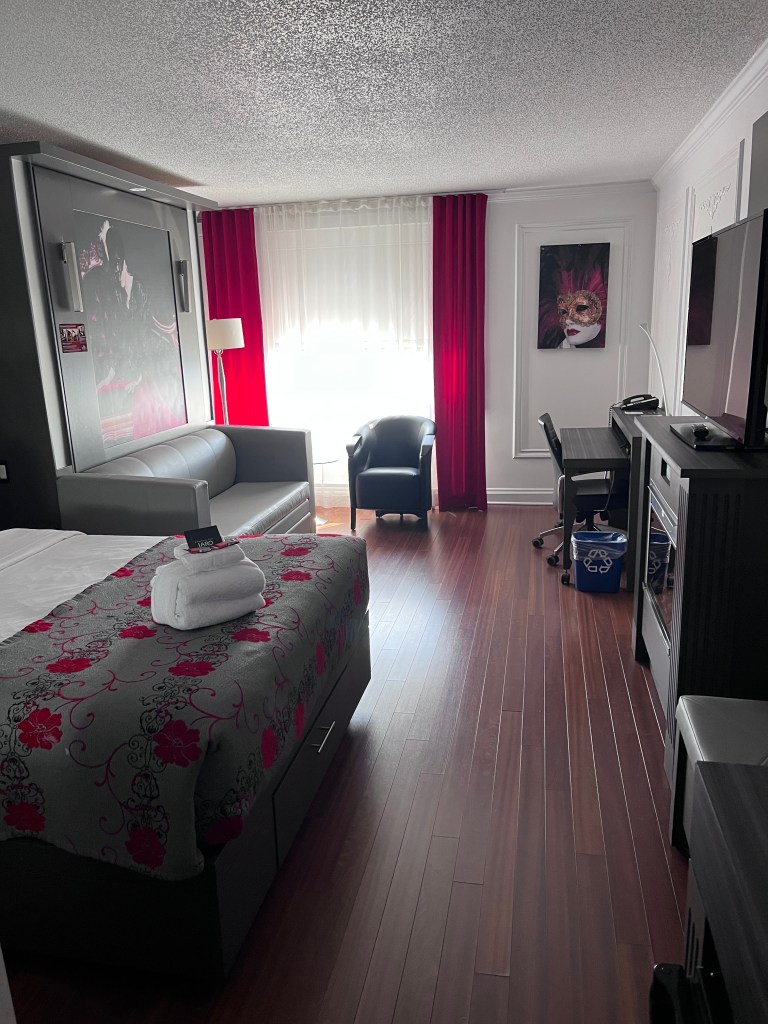
The room was fine but did not have a microwave – that would be problematic. Even getting things like plastic silverware and napkins was problematic.
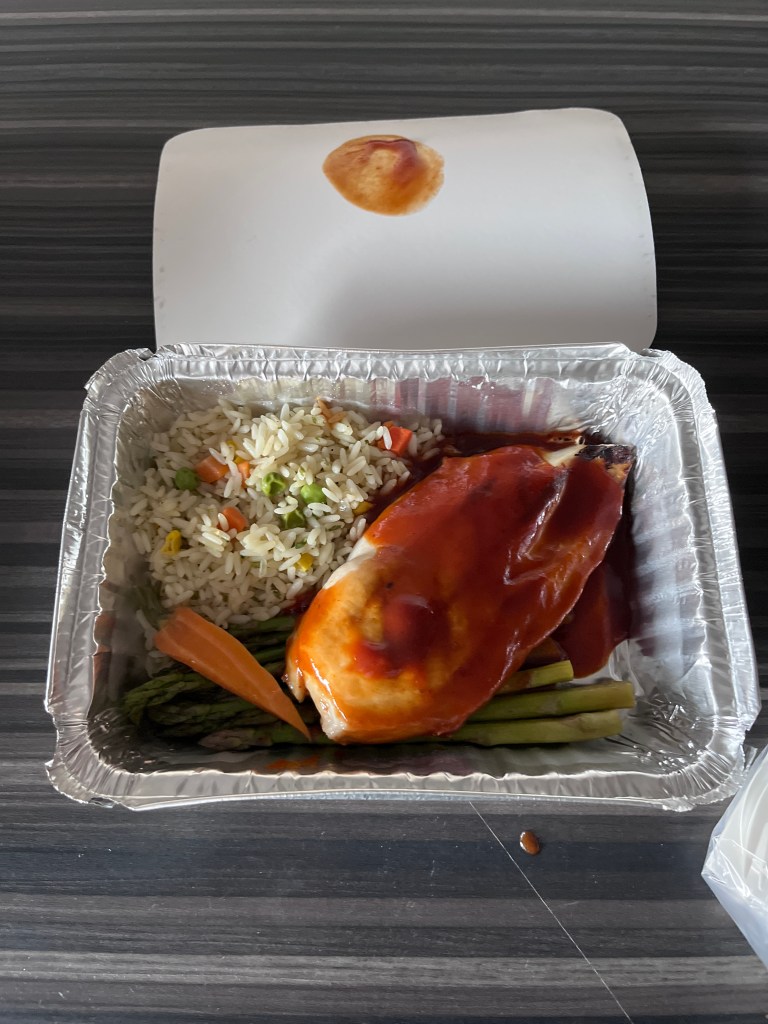
Randy was supposed to be served meals from the hotel restaurant. It became clear very quickly that they did not have the staff to provide meals for their COVID guests. The hotel was still trying to operate as a regular hotel and restaurant at the same time they had COVID floors.
COVID guests were given a short list menu, sometimes it did not have any hot options. Sometimes he would get something he didn’t order – like two steak dinners. Sometimes he would not get what he did order.
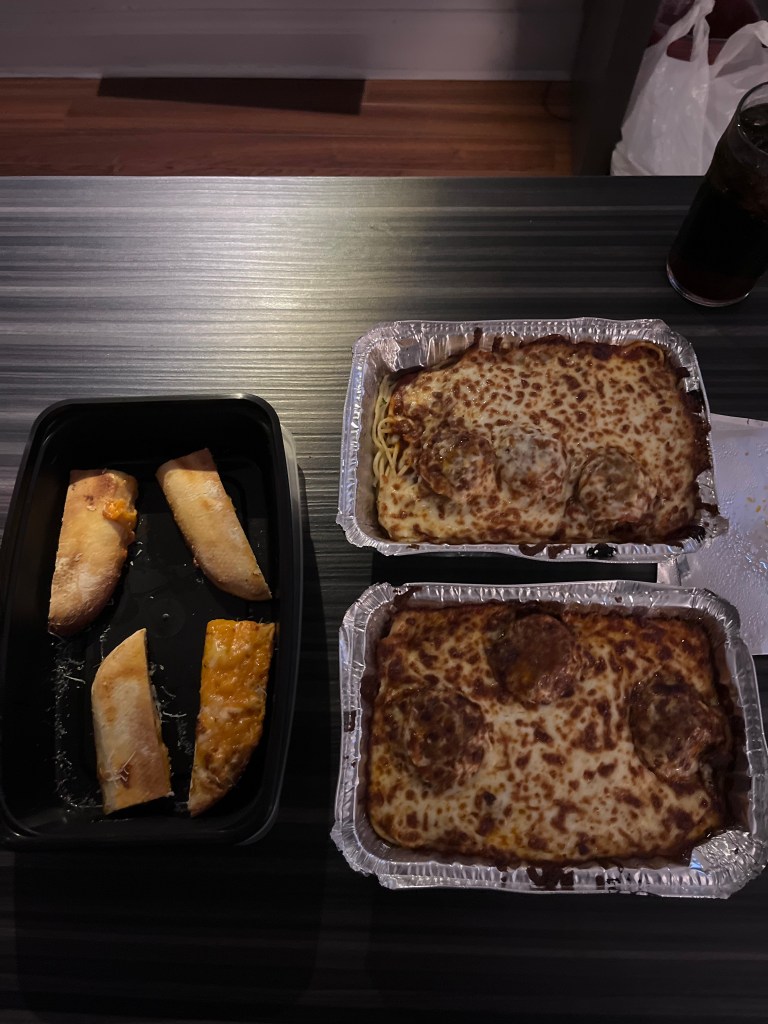
The hotel staff eventually suggested he use Uber Eats if he could. The hotel provided a list of area restaurants where he could order, pay and then a driver would knock on his door and deliver his meal. Mostly that worked except the first meal he ordered was spaghetti with and breadsticks.
He got two complete meals. He didn’t have a microwave to be able to save it and warm it up another day.
(The rest of us were in a completely different part of Quebec City so couldn’t help.)
The hotel staff also couldn’t provide any staff to deliver ice so Randy would sneak out periodically to go down the hall to get ice. He was aware that the woman next door snuck out to go for a walk each day. They were told that someone from the health department may be by at anytime to be sure they were there – but it never happened.
One other couple just left quarantine and went to the airport. In his limited conversations with the medical hierarchy in Canada, he was also told that if quarantined people are “caught” at the airport trying to leave then they will be required to start their quarantine all over again and there would be a $500 fine.
Given all that, except for his trips down the hall to the ice machine, Randy followed the rules.
And Cindy, Darrell and I went on with the plan…
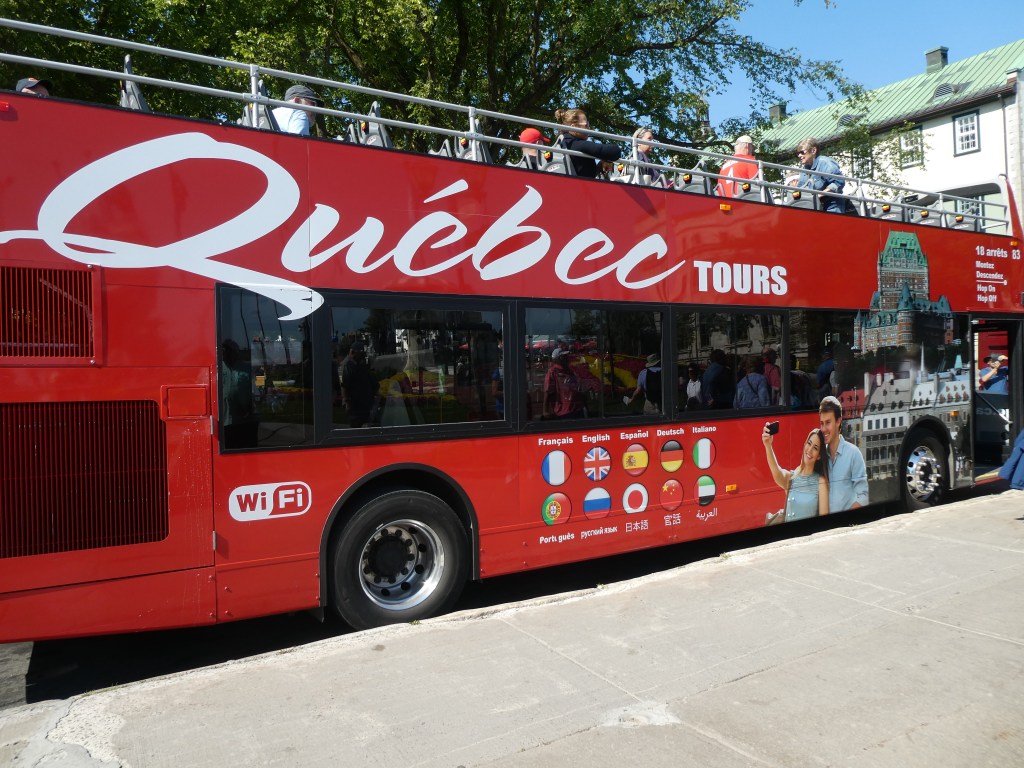
When we made it to the top of the hill, our Airbnb wasn’t available yet so we got on a bus tour to orient us to the historic district.
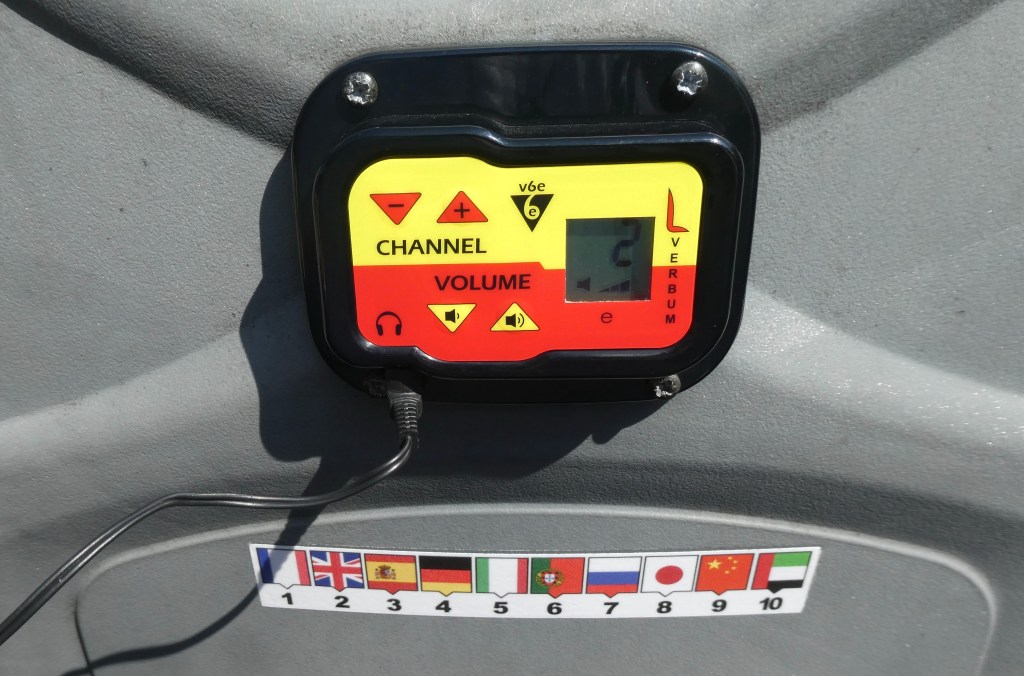
You could pick your language!
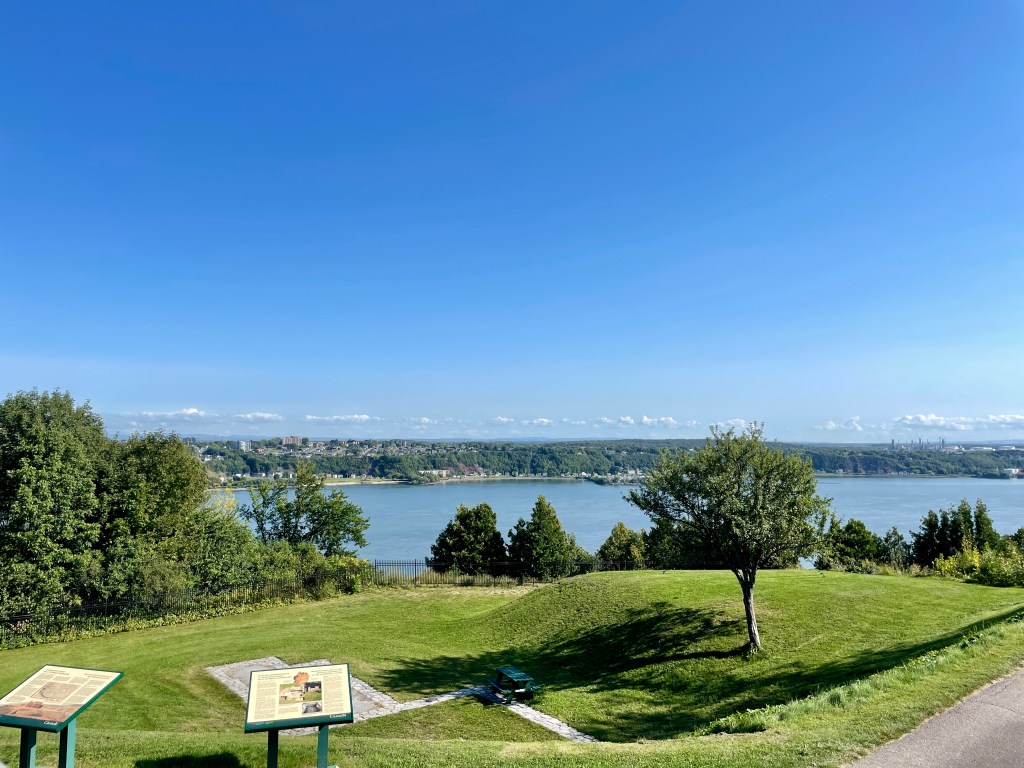
Quebec means “where the river becomes narrow.” It is an Algonquin word, not French. The Algonquin were the First Peoples of the area.
French explorer, Samuel D. Champlain came to survey the area in 1608 and set the course for French colonization.
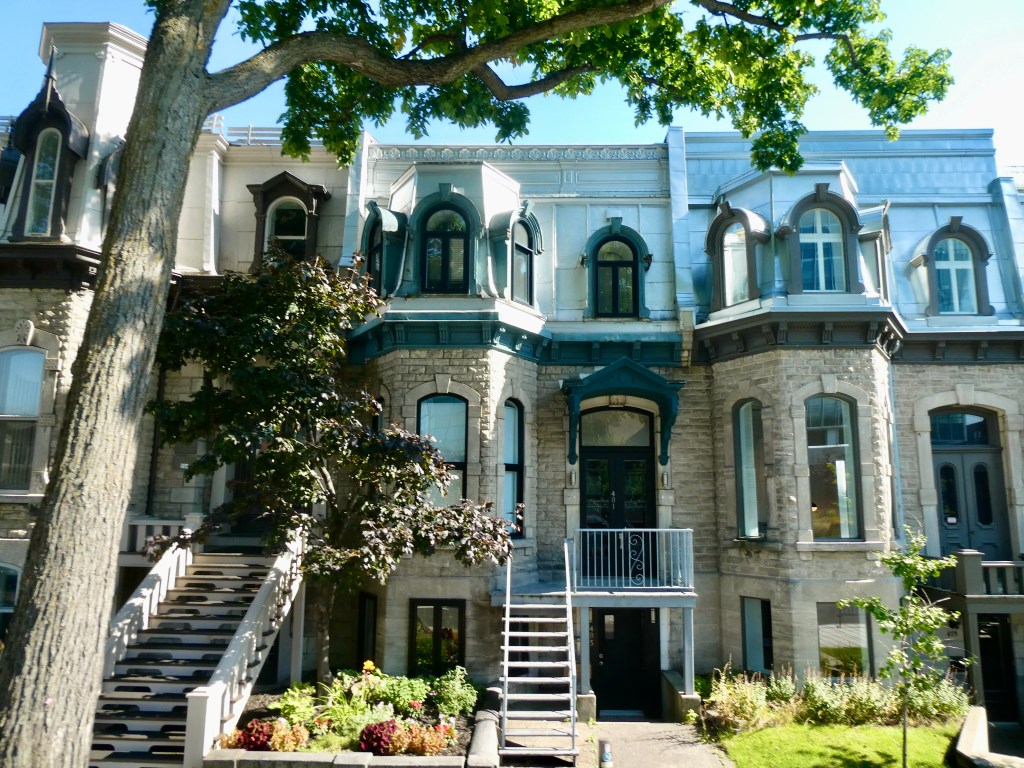
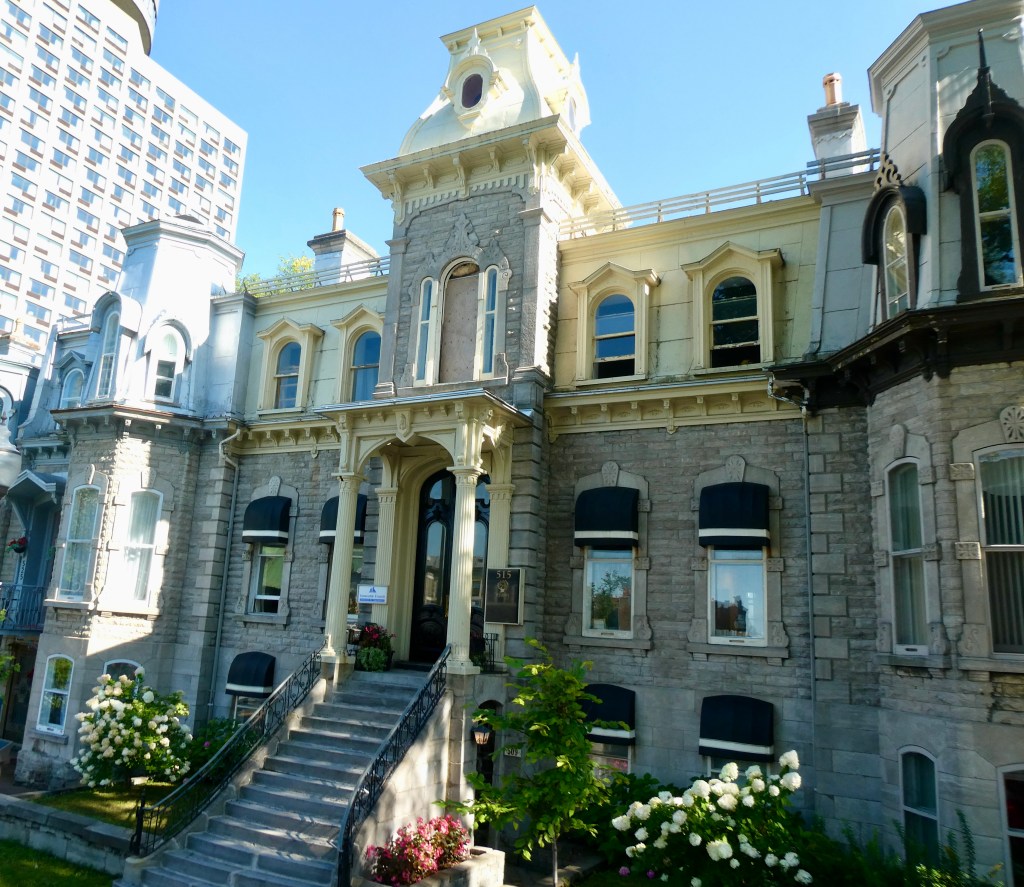
The French built buildings like there were in France and England.
There remains a combination of English and French architecture.
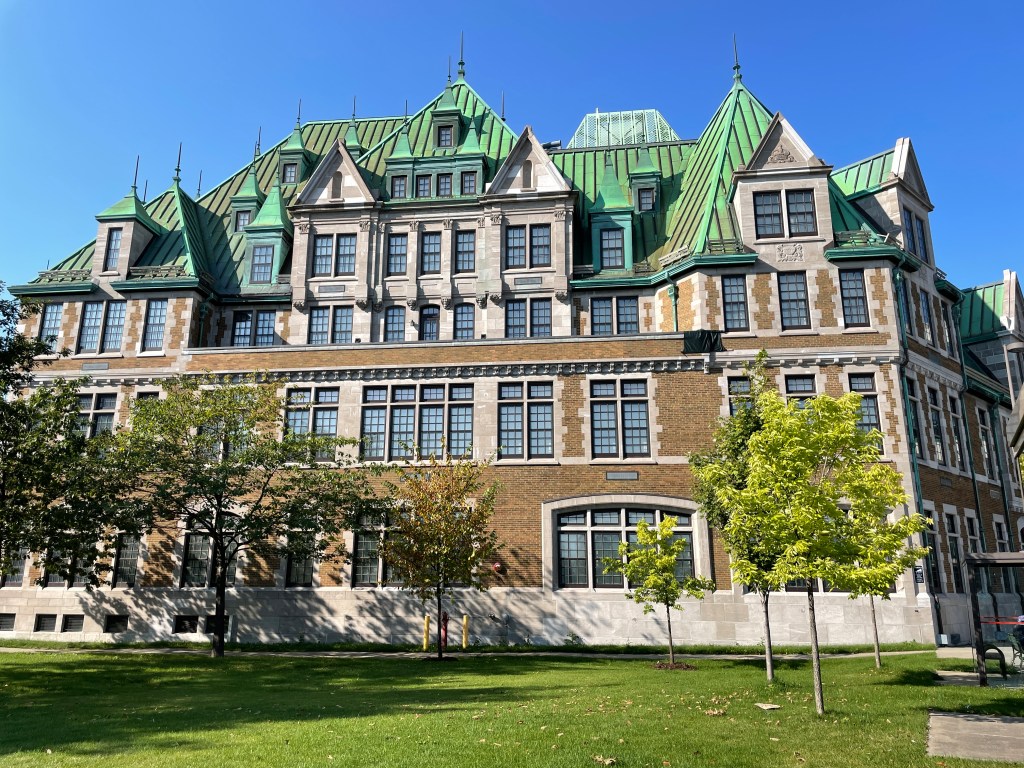
The copper roofs were shiny when first installed. They turned brown after a few years, then green after a few decades.
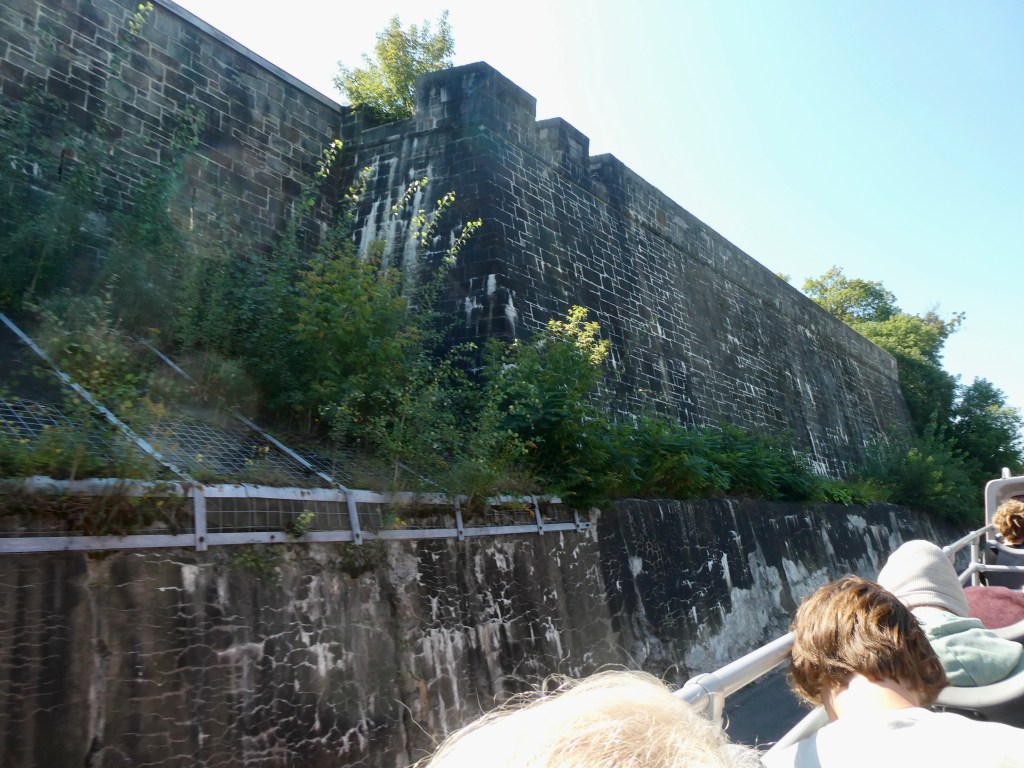
Quebec City is the only city in North America, north of Mexico, to be surrounded by fortification. The Historic District of Old Quebec, where Cindy, Darrell and I were staying, was named a UNESCO world site in 1985.
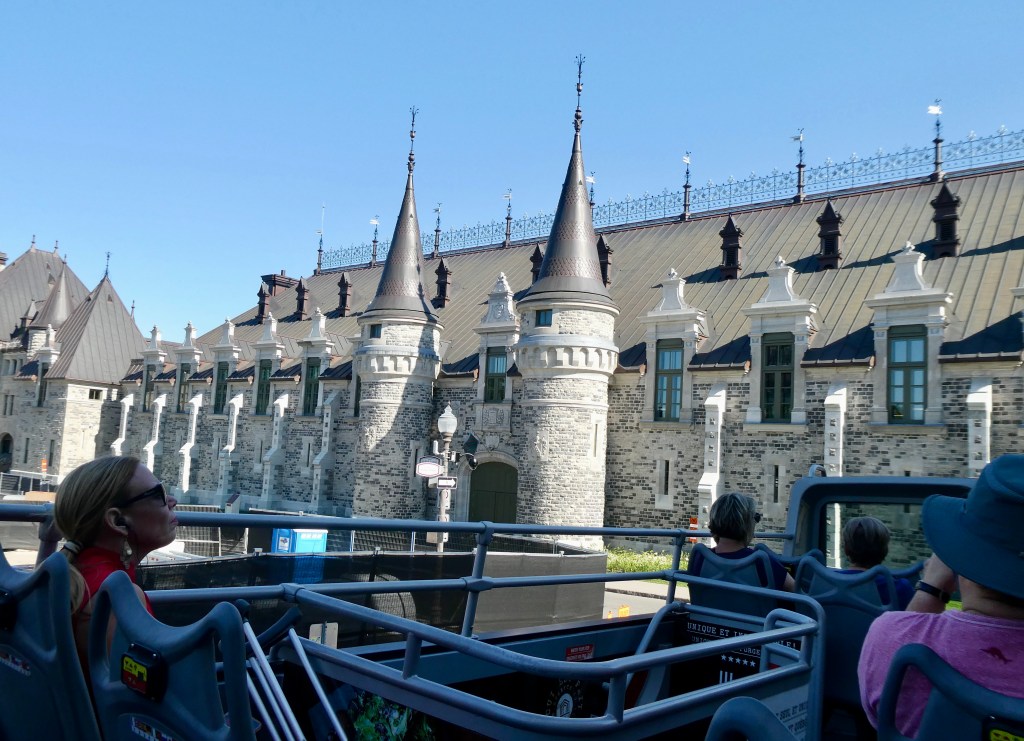
The Quebec Armory has a medieval castle look. The original was burned and then replaced.
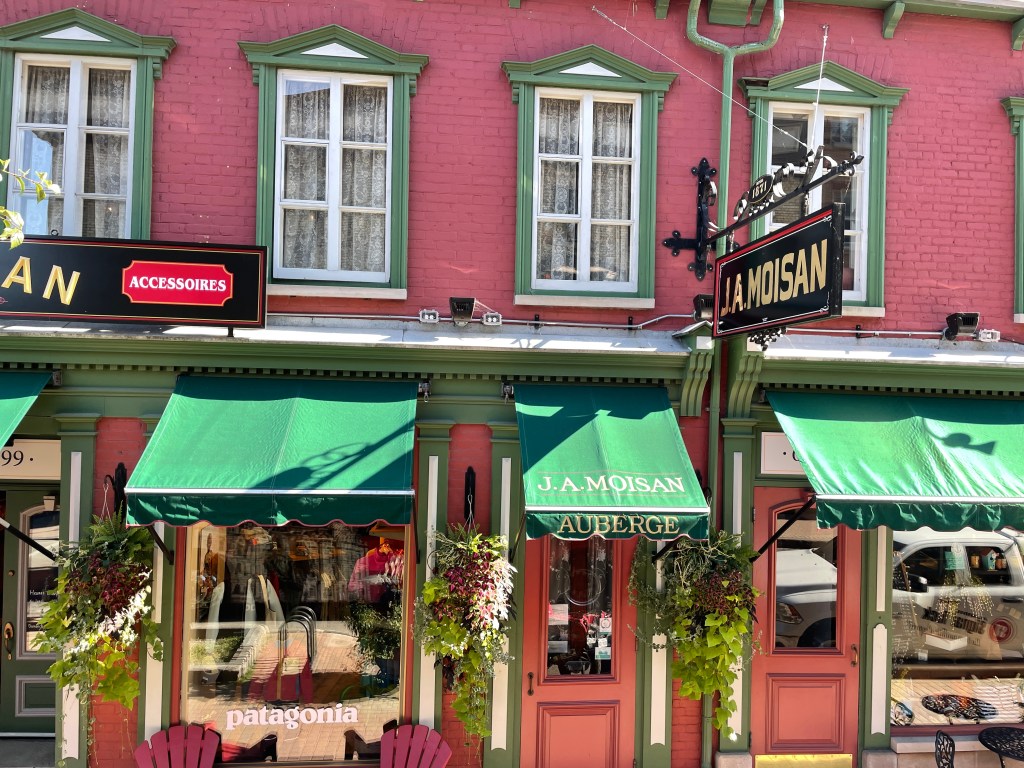
We drove by the oldest grocery store in Quebec City originating in 1871.
In 1863 Canada’s independence guaranteed linguistic rights of French speakers in Quebec. There are 800,000 people in Quebec City, and one million in the province.
Next up: Cindy, Darrell and I explore Quebec City while Randy languishes in quarantine. We felt bad for him too!


































































 Serene Wandering