Ford’s Alphabet of Automobiles

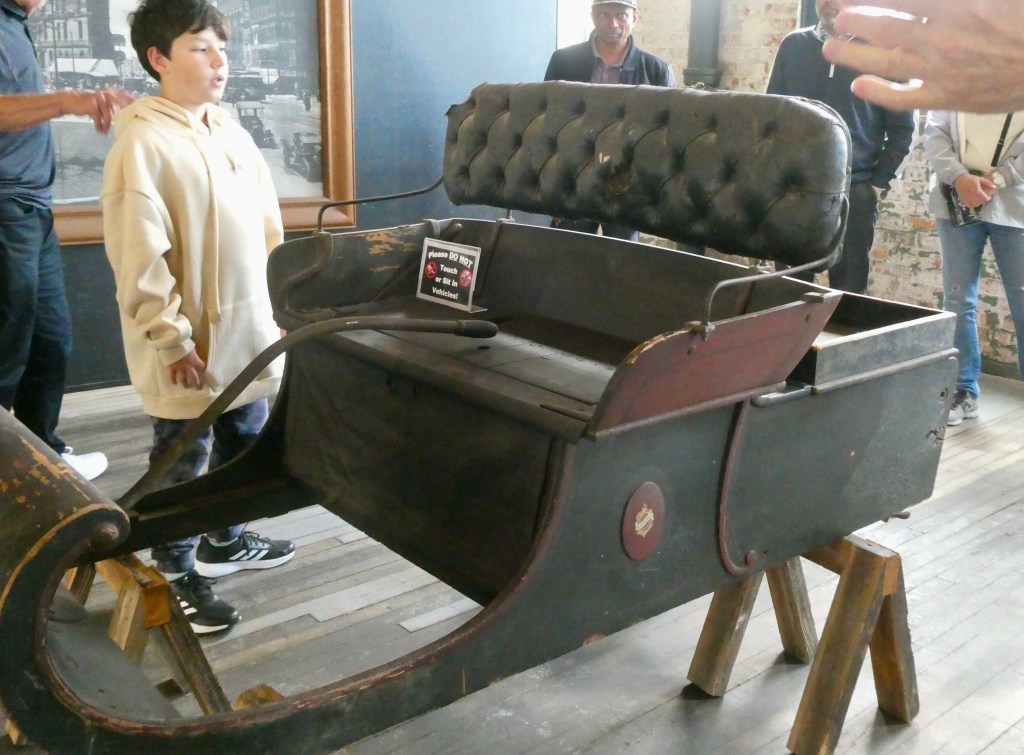
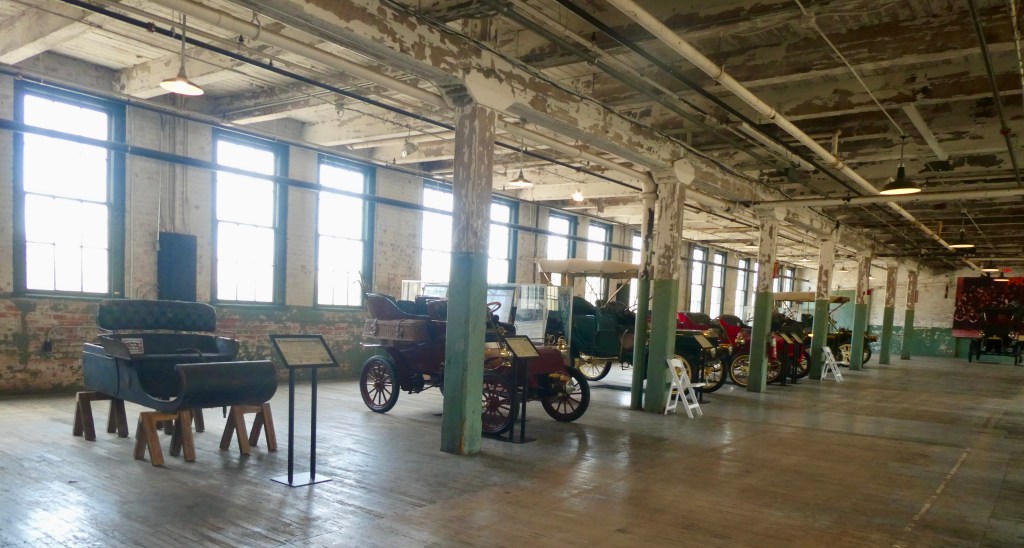
In the “Letter Cars” collection of the Ford Piquette Avenue Plant, they have the first Olds and then Ford Models A to F displayed sequentially on one side.  
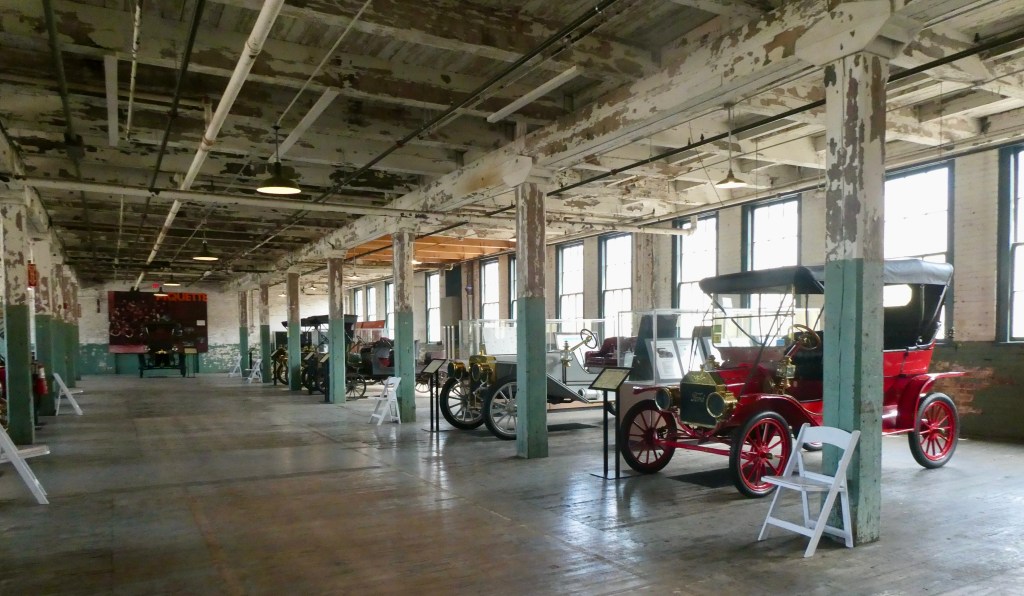
Model N is at the far end and then Models R through T are on the opposite side.  

Many of “Letter Cars” have been loaned to the Piquette Plant by the Larry D. Porter Artifacts Trust. Their collection includes one of every car that Ford Motor Company built at both the Mack Avenue (1903) and Ford Piquette Avenue (1904-1910) assembly plants.  Mr Porter paid for 17 years of storage for his collection while waiting to be able to display them in the Piquette Museum.  Other collectors have loaned their automobiles for display as well.

There is a smaller, but similar, display of letter cars at The Henry Ford Museum of Innovation.  I have used information and pictures from both museums in this post.  

Ford started with A but skipped some letters. He chose to use  A, B, C, F,  K, N, R, S and T.    

Models D and E were trucks and the projects were abandoned.  That is interesting because a truck, the F-150, has now been Ford’s top seller for many years.  Our next post will be about our visit to the Rouge Plant where the F-150 is made.

Model A
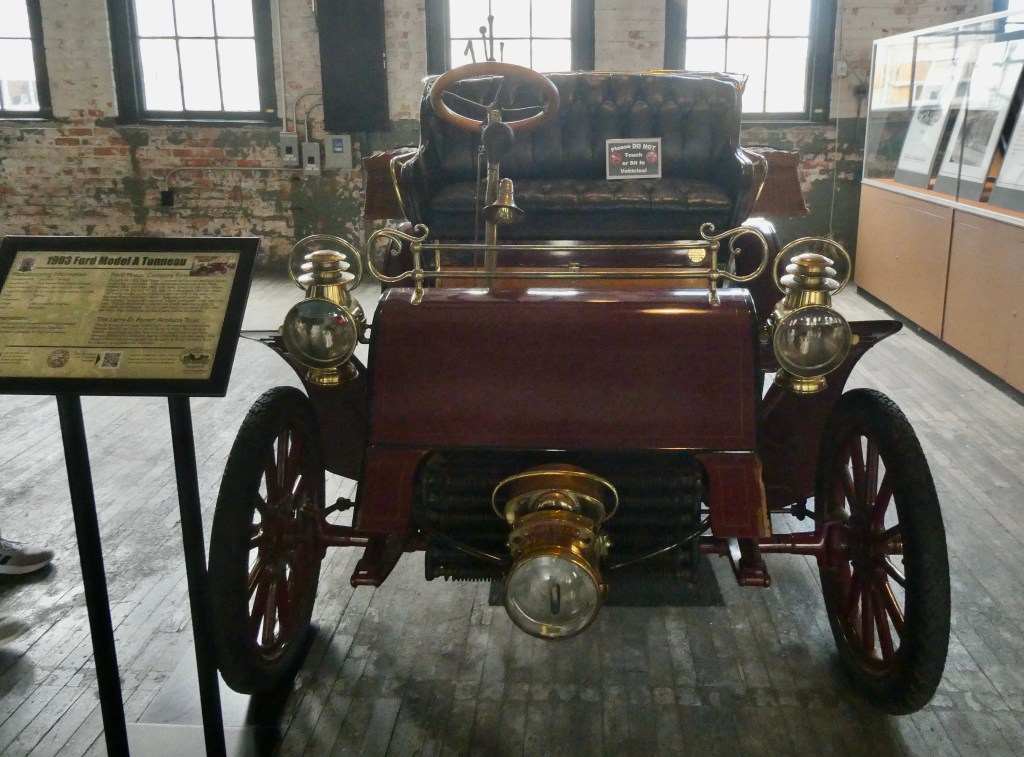
Ford’s first automobile, in 1903, was the Model A.  It was developed in a rented building that burned down.

The driver had to pull the seat out to put gasoline in the vehicle.  At that time gasoline was sold as a cleaning agent in hardware stores.  Gasoline was a by-product after oil was discovered in the US in 1859.
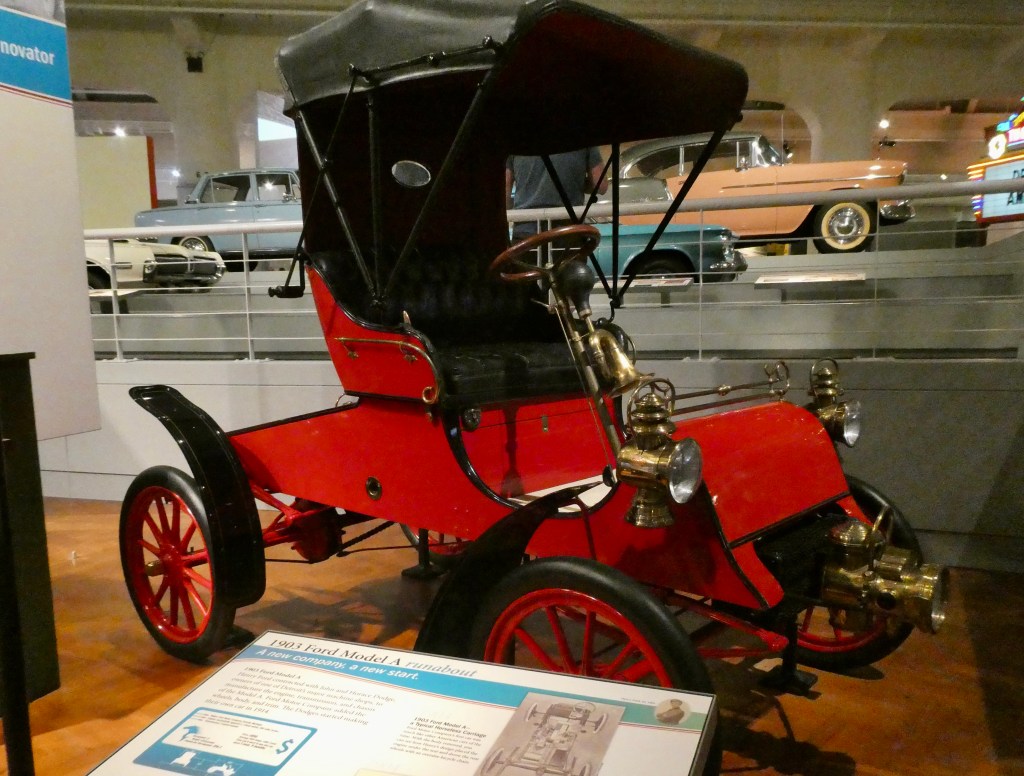
In a Model A the back seat was optional.  The original tires were white. 

Model B
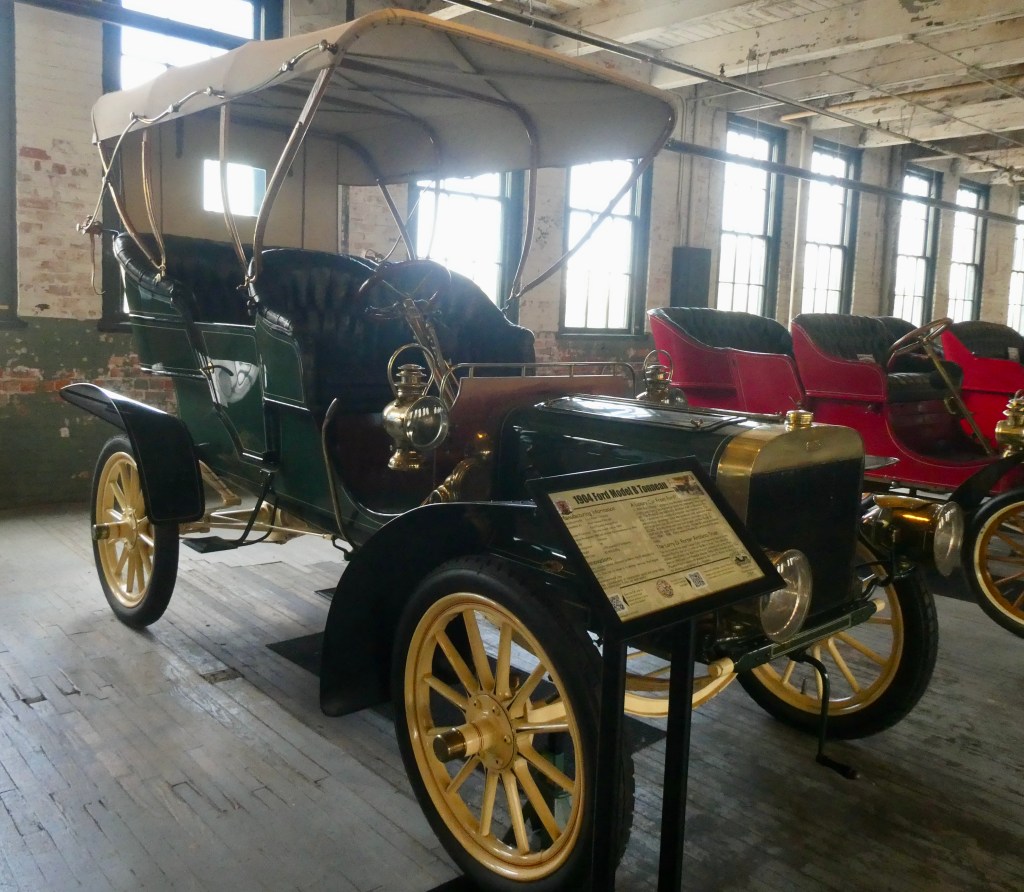
This 1904 Model B, built in the Mack Street Factory, is the most valuable automobile in the Piquette Plant museum. It was the very first Model B built and is one of only seven remaining in the world.  This valuable automobile was in pieces in boxes in a garage in Missouri. It was purchased for $750!  

In 1904, the profit motivated Ford Motor Company shareholders coerced Henry into building the company’s first luxury car.  This was not the vision Ford wanted for his company.   The vehicle’s four-passenger body was accented with polished wood and brass trim and had a price tag of $2,000.

The Model B had the first four cylinder engine.  The rear-axel and drive shaft developed for the Model B is the same design that was used until 1948. Those features and rear hub brakes set the Model B mechanically apart from other Fords.

Model Bs were produced from 1904 – 1906 but didn’t sell well. Only 500 were sold in 20 months.

Models A and B were produced before the opening of the Piquette Avenue Plant. Models C, F,  K, N, R, S and T were produced at Piquette.  

Model C 
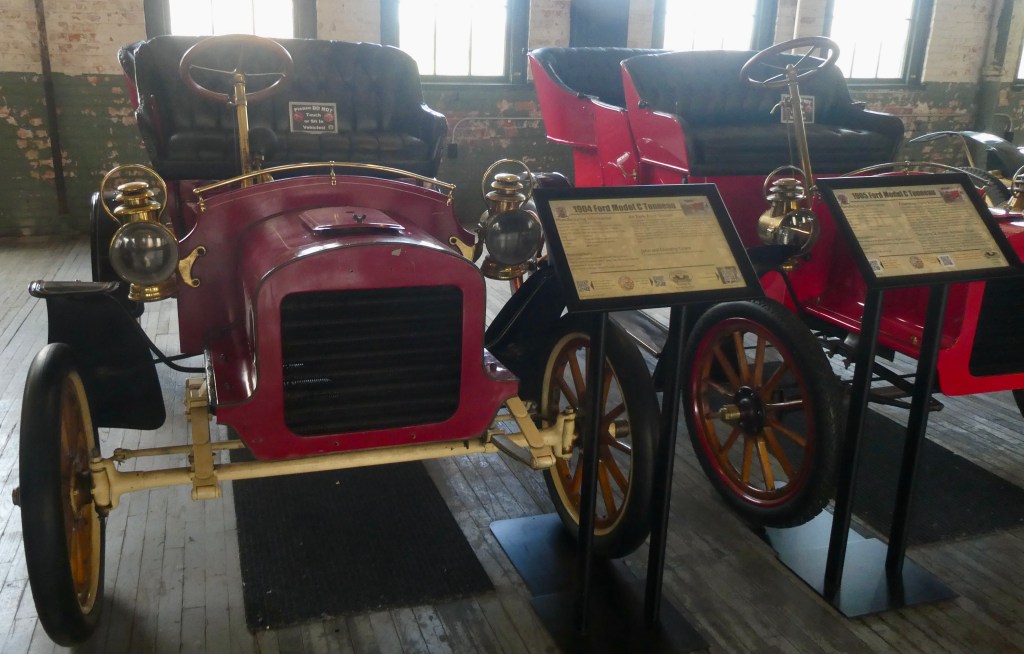
The Piquette Plant Museum has two of the 75 remaining Model C automobiles.

The Model C was more to Henry Ford’s liking, It was a quick update of the Model A going back to the two cylinder engine with a slightly longer wheelbase.  A french hood was added in the front, however, the engine remained under the seat. The hood covered the water tank.  The fuel tank was moved to the front.

Model F

In 1905, the company started production on the Model F with a wheelbase of 84″ and a larger 2-cylinder 12 HP engine. Other improvements included dual rear brakes, 30″ × 3½” wheels, and running boards for easier access. They also replaced the front bench seat with two single seats.  Rear seating was optional. This model resolved many earlier car issues.   Innovations included mounted oil lamps and a column-mounted horn. It was also possible to add side panels for a truck-like vehicle.

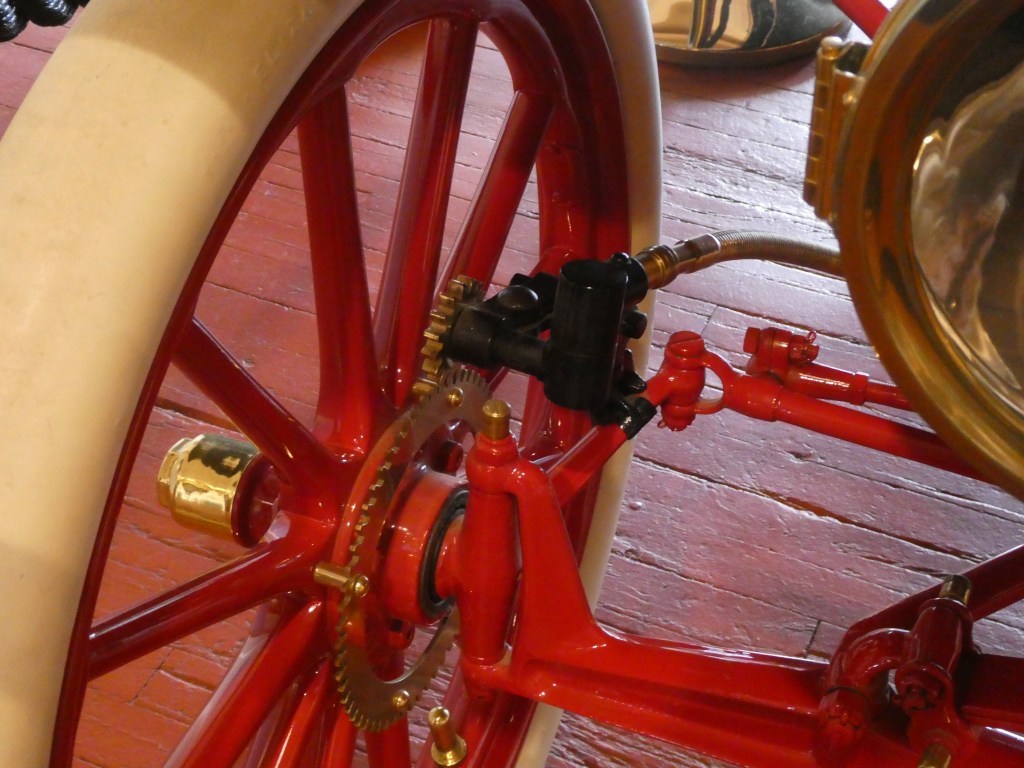
It was the last model with the flat 2 cylinder engine still mounted under the front seat and the last to use bicycle chains in their mechanisms.  The gas tank was under the hood. 
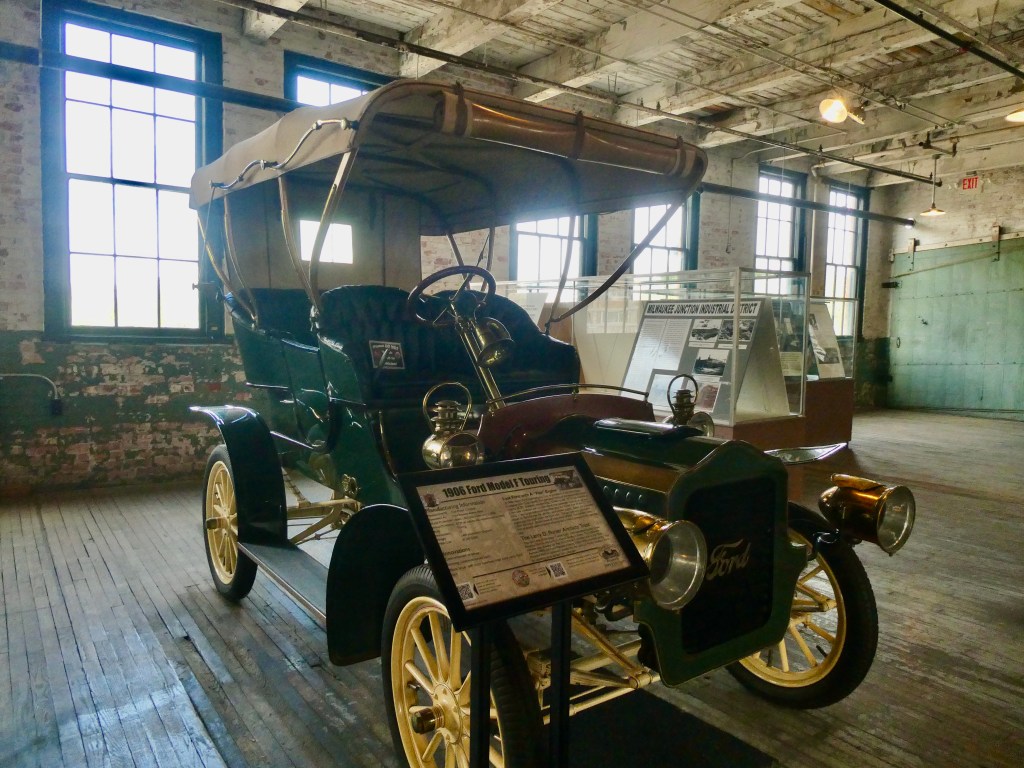
The Model F was available as a two seat runabout and a larger, more luxurious five passenger touring car.  This large touring model was found in a barn with wasp nests inside!  

These are two of the 40 known remaining Model F automobiles. 

In 1906, Henry Ford became the president of The Ford Motor Company.   Business was booming – reaching a 26.3 percent market share.

Model N  

In 1906 the Ford Motor Company released the Model N and topped the sales charts. Production was the first to employ some level of assembly production at Piquette.  At Piquette, Ford workers were able to build 100 per day and a total of 7000.  The original cost was $500 but when Ford realized it cost them $490 to build each one, they changed the price to $600.

The Model N fulfilled Henry Ford’s vision of a very reliable, low cost automobile for the masses. It featured a front mount 4 cylinder engine that could go 40 mph.
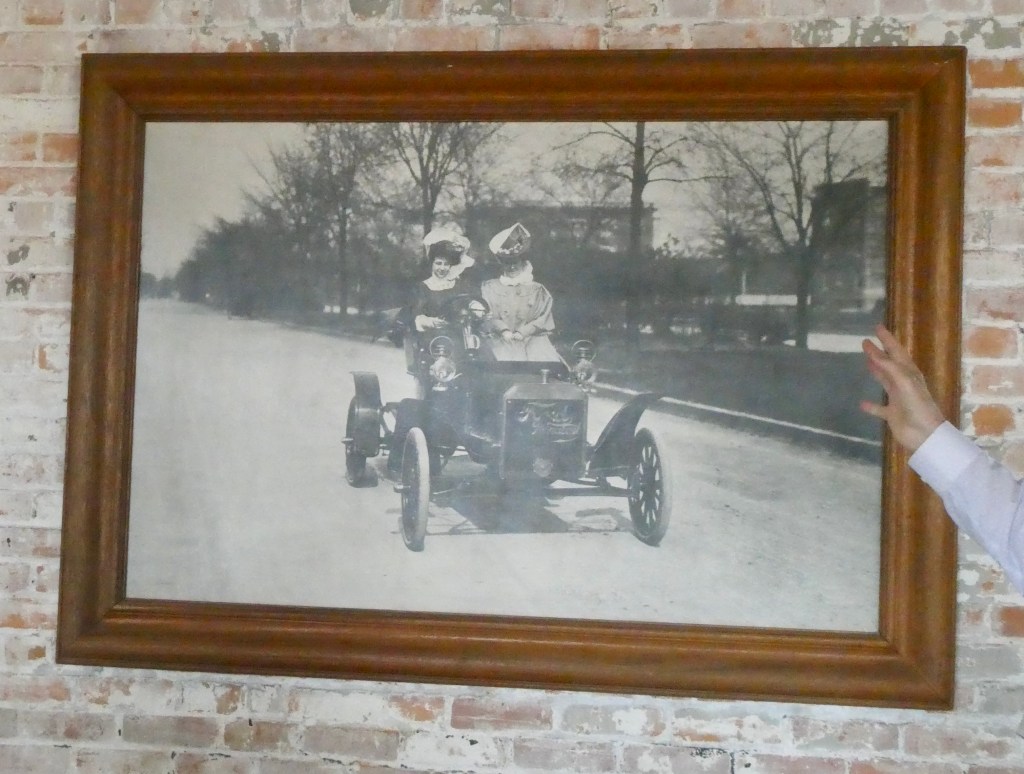
This 1906 photo shows a Ford secretary driving Mrs. Ford in a Model N.

The Model N was the first automobile to use the flying Ford logo.  The flying wings were used on 12,000 cars between 1906 and 1910, 99.9 percent were made in the Piquette plant.  When Ford changed suppliers for the part, the wings got dropped and it wasn’t corrected.

By 1907 the Ford Motor Company had 37% market share.

Model R
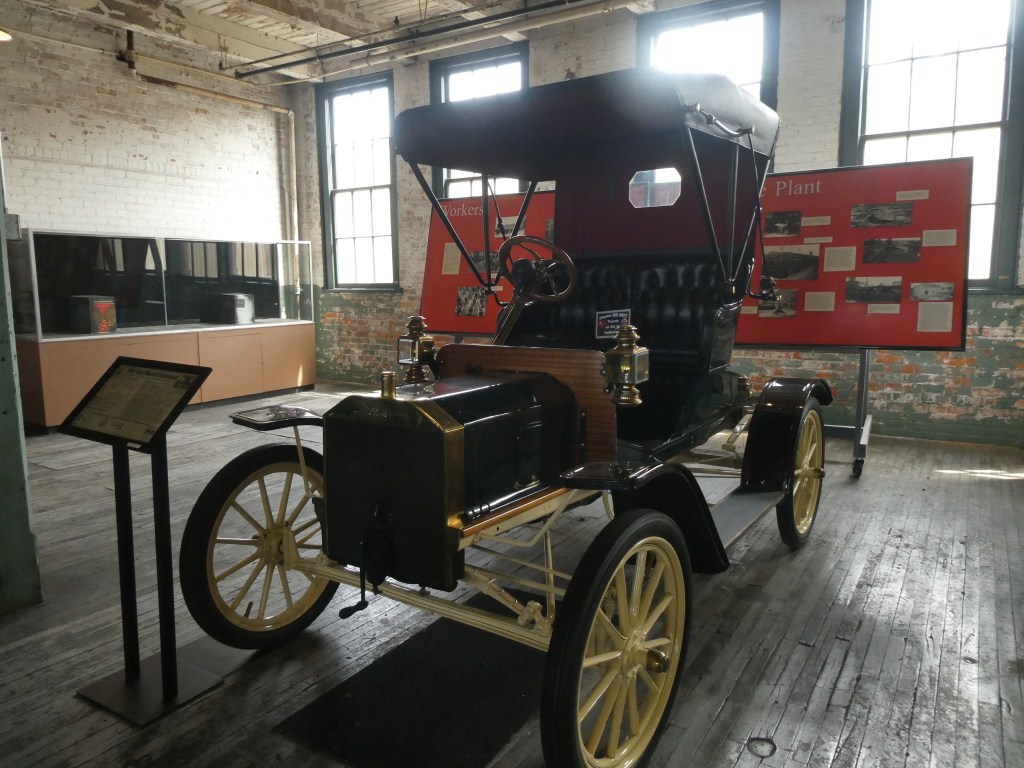
The 1907 Model R was a refined version of the Model N with full front fenders and attached running boards. It featured a two speed transmission and had the first spare wheel under the rear for on-the-road tire changes.

 At $750, the Model R sold so well that part suppliers had difficulty keeping up.

It was available in two colors – Brewster Green and Carmine Red -and was considered the first car for women. 

Model S
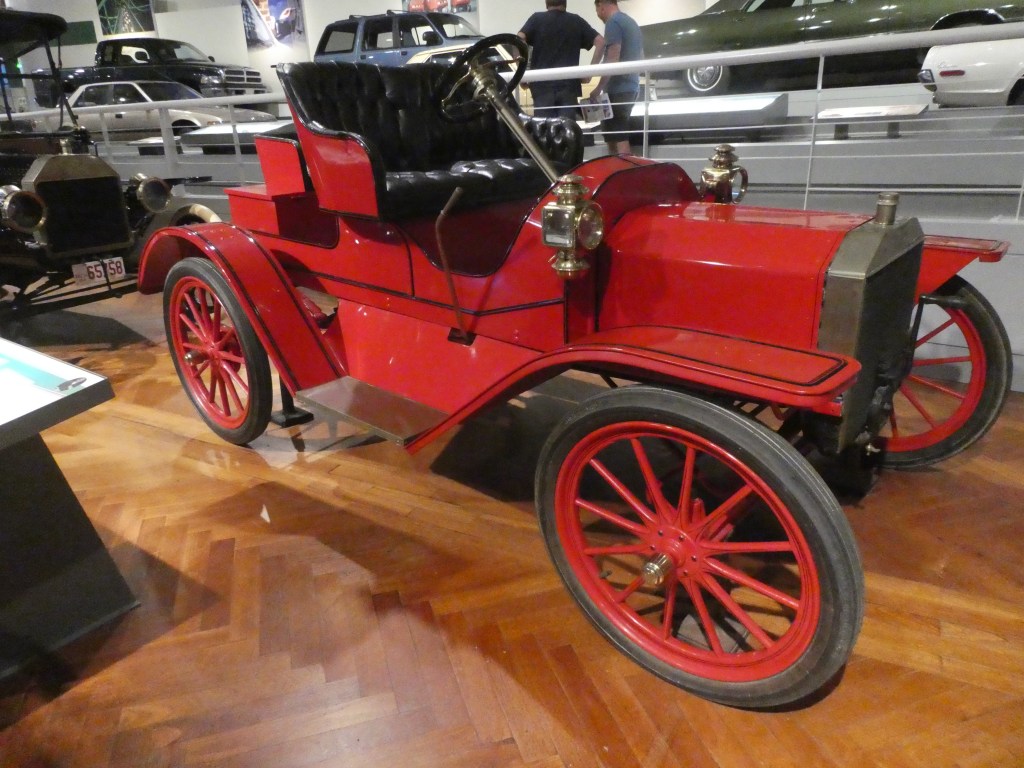
The 1907 Model S was an accident.  The Model R was made on the Model N base.  When they ran out of R bodies and wheels, they put R running boards on an N and called it Model S. The result was a down sized vehicle and reduced price.  They sold a lot of Model S automobiles!
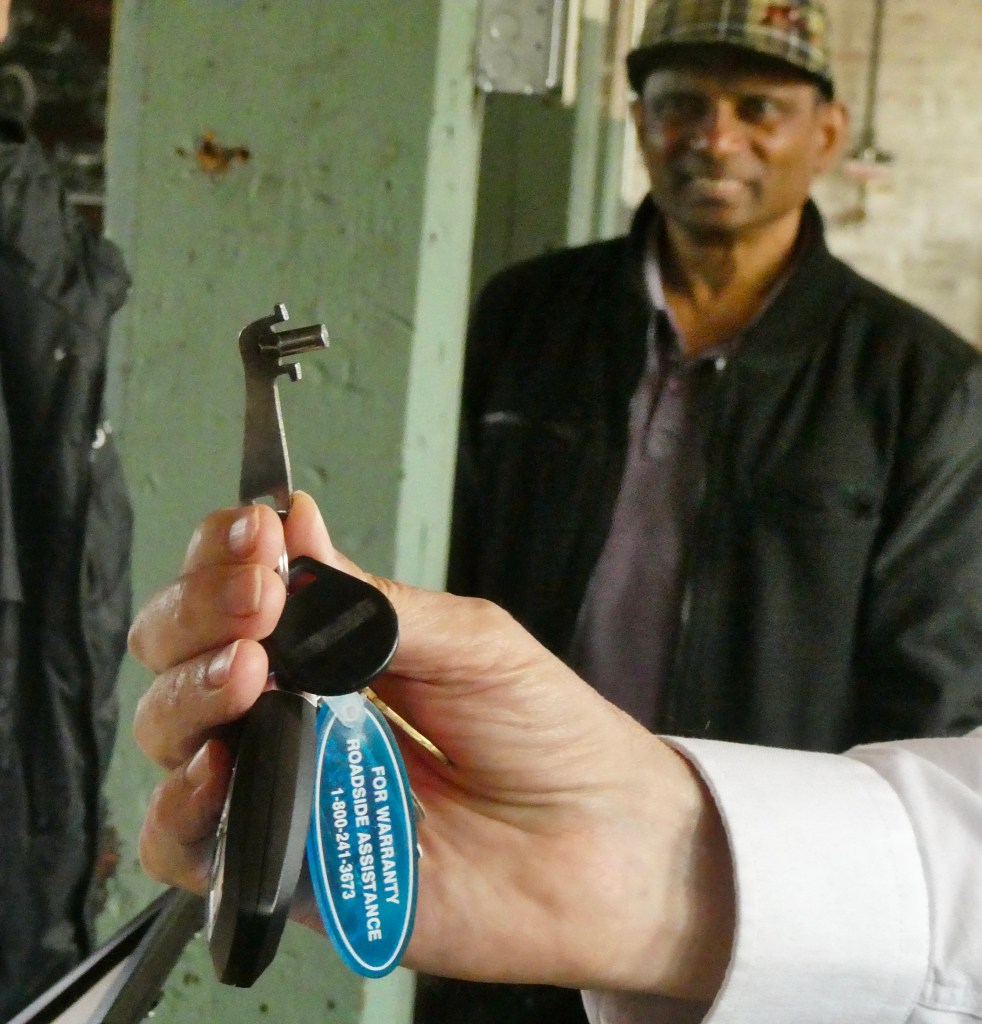
Owners of a Model S had the first car keys!
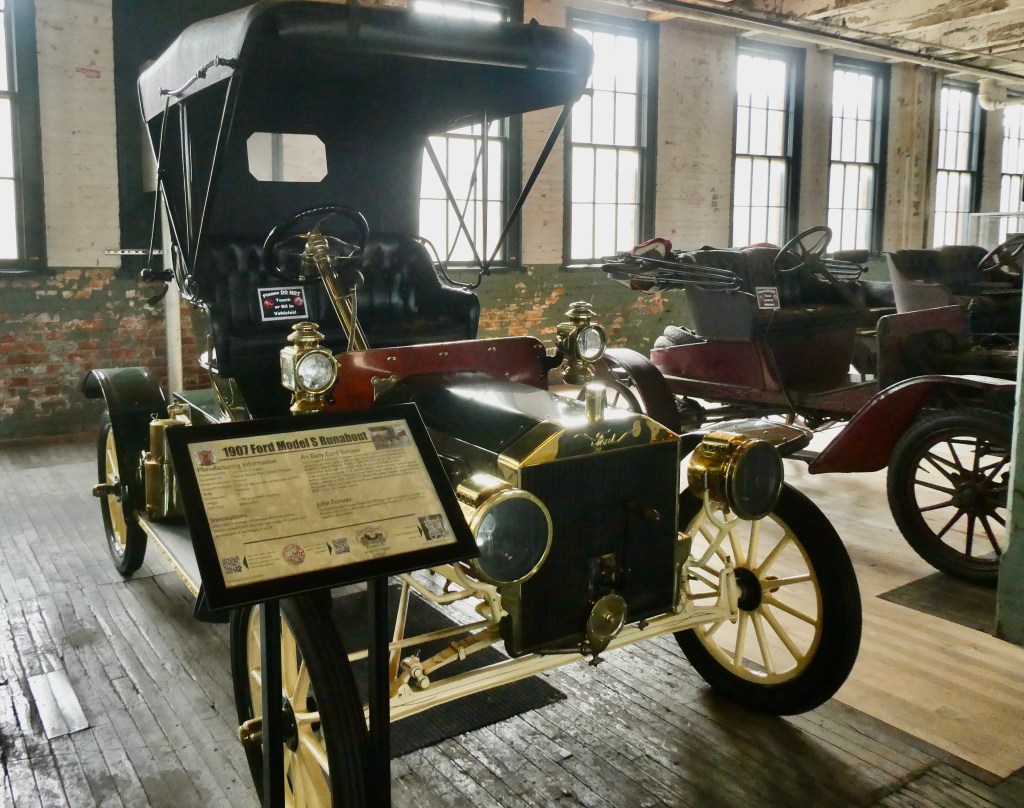
This picture shows two Model S automobiles.  The one on the left is restored and certainly valuable.  However, the one on the right, unrestored, is worth more. (That makes no sense to me!)

Do you remember the Model B Luxury version that Henry Ford didn’t care for?  Even when your name is on the company, shareholders can insist on another Ford luxury model. That was the 1908 Model K. It could be ordered in a standard touring or in the roadster version pictured above. Of 900 hundred produced, only 28 remain with this being one of only 10 roadsters known to remain.

The Model K had a six-cylinder engine and 40 horsepower. It was the last Ford automobile to feature the six cylinder engine until 1941.

The cost of the Model K was between $2500 and $3000 and was considered the Ford Motor Company’s first failure.  Alexander Malcomson, one of Ford Motor Company’s founding partners and promotor of the luxury line, left the company over the Model K. With his departure Henry Ford became the majority shareholder.

The Model K had veered away once again from Henry Ford’s goal to provide affordable and dependable vehicles. He was able to return the focus of the company back to mass-produced, affordable vehicles.

Did you notice that this Model K was a right side drive?  There had been ten years of disagreement over which side the driver should sit.   With development of the Model T, the decision was made for the left..

Model T – The Car that Changed the World

The Model T was Ford’s only offering in 1909. It was introduced in October of 1908.  Collectively Models N, R, and S models led Ford to the Model T – but it was a totally new automobile.

The Model T had body parts made of wood, steel and aluminum. It was well-suited for badly rutted roads and rough terrain with a three point suspension.  It was available in five styles: touring, runabout, coupe, town car and a landaulet. (A landaulet is a style where the rear passengers are covered by a top and the driver is separated from the rear passengers by a division as in a limousine.)
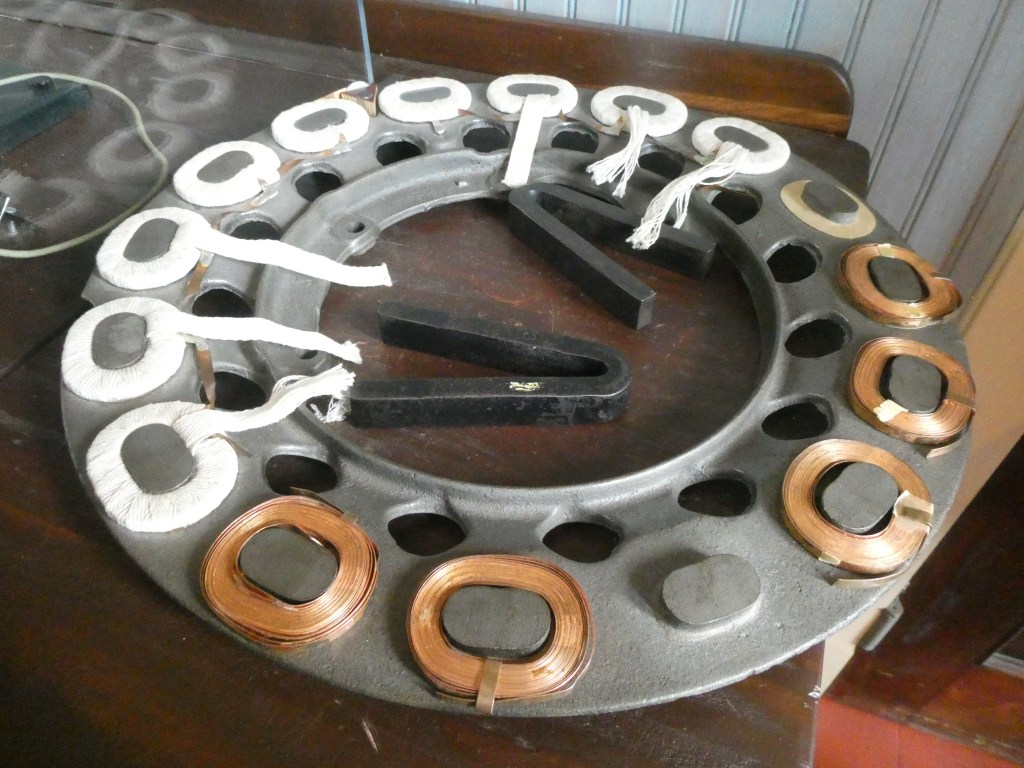
The Model T was the first to use a flywheel magneto ignition system developed by Henry Ford’s friend Edward “Spyder” Huff.  It was considered  a major advantage.
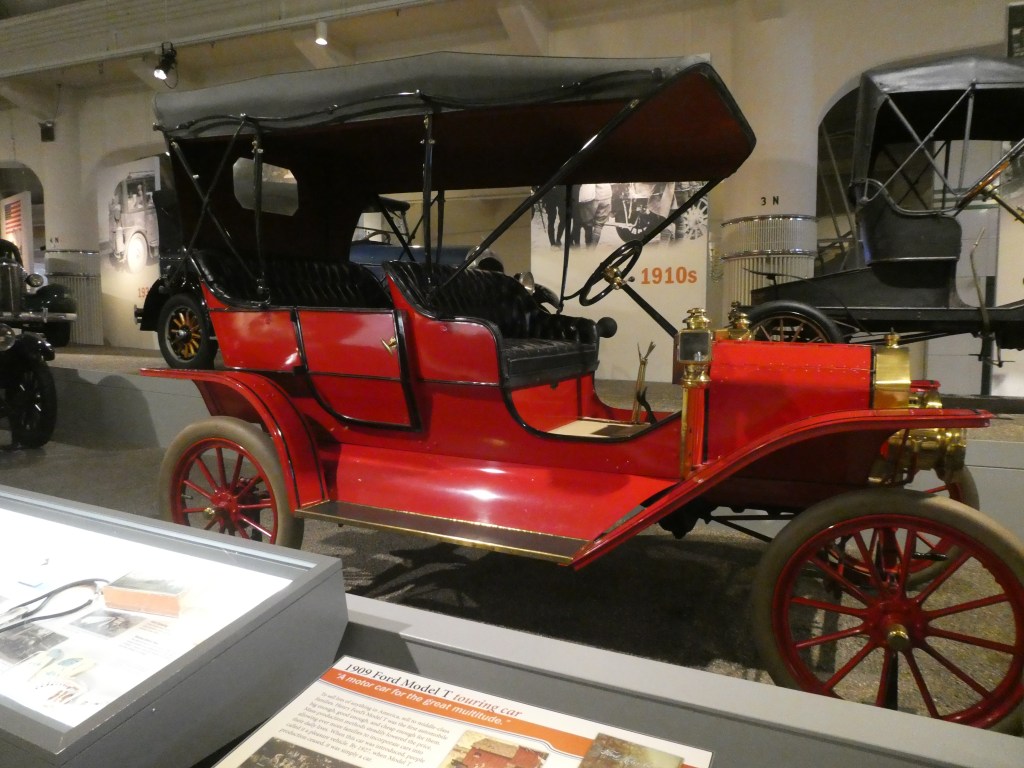
A 1909 Ford Model T Touring automobile.
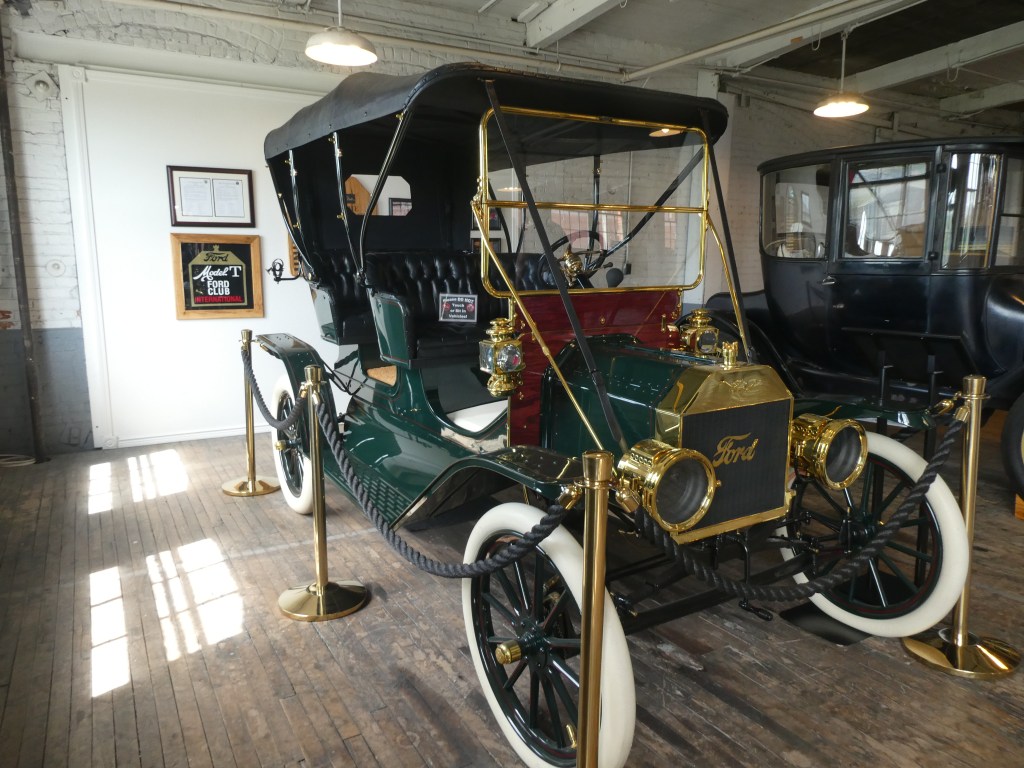
This 1910 Ford Model T won the 1922 Stynoski Award for the best restoration of the year.
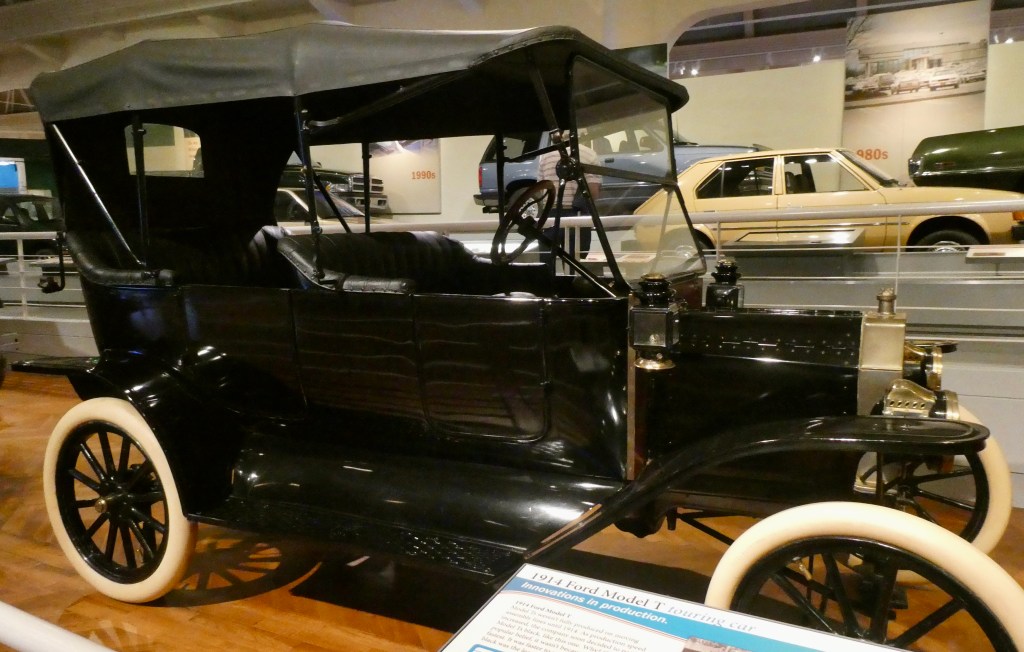
During mass production of the Model T, Ford decided to paint them all black because it was faster to use just one color.  Black was the least expensive color and the most durable. 

The assembly line had other consequences as well.  The work was boring and Ford had lots of employee turnover.  He doubled wages from $2.34 per day to $5 and then more workers stayed.  

By 1914, the first year of the moving assembly line, the price the Model T reduced to $550.
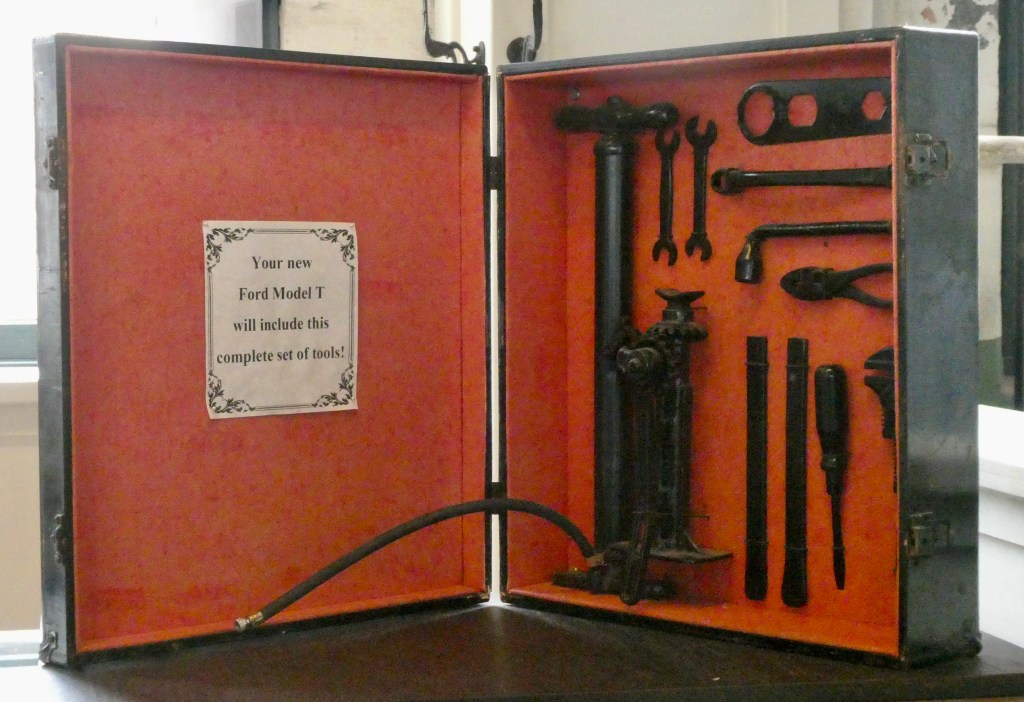
A tool set came with the automobile.
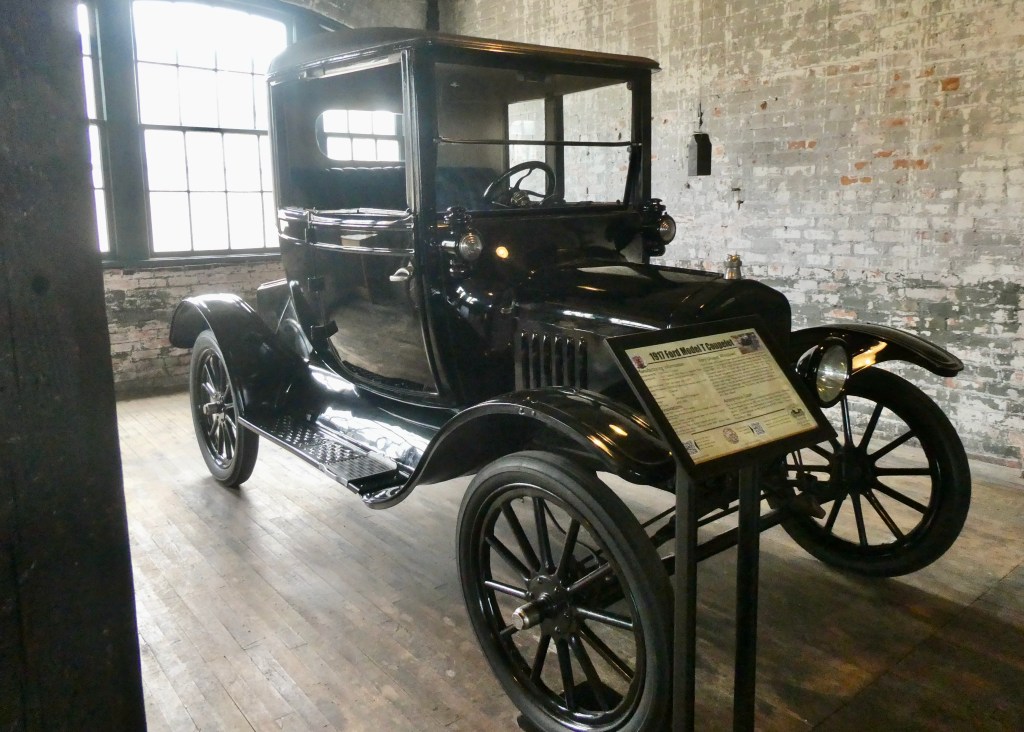
A 1917 Ford Model T Couplet.
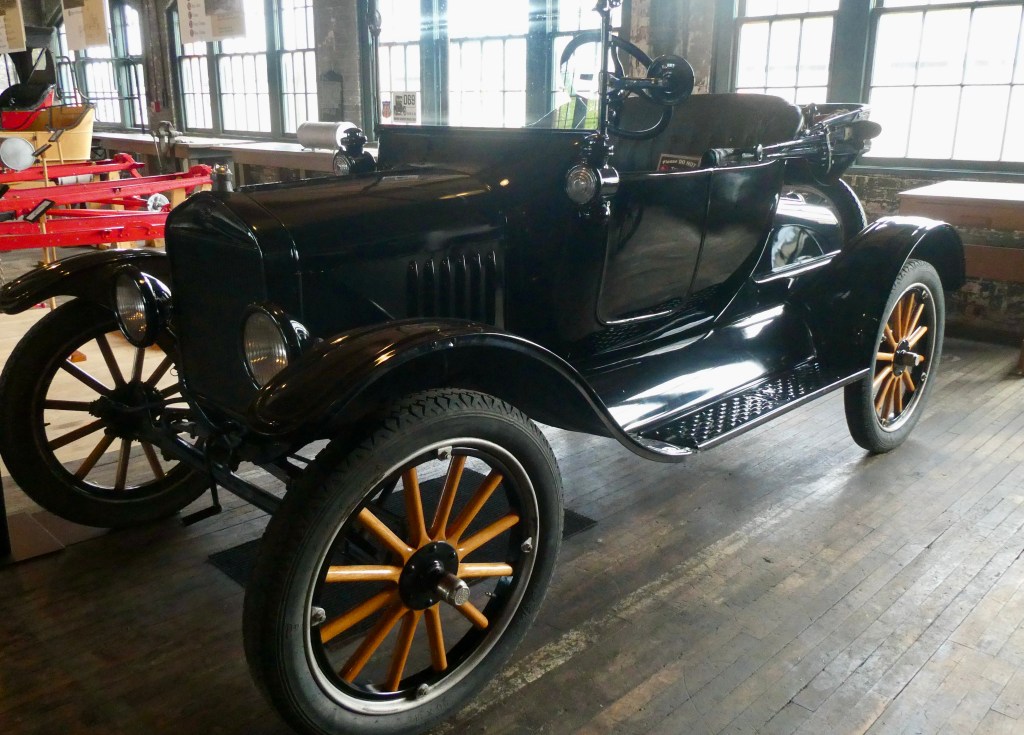
By 1921  the Model T is outdated but sales continue due to the $370 price tag.  One and a half million units were sold as compared to the technically superior Buick.  The current Buick model sold 83,000 vehicles at a base price of $1795.

In the 1920s Chevrolet innovated more than Ford and the Model Ts time was coming to a close.
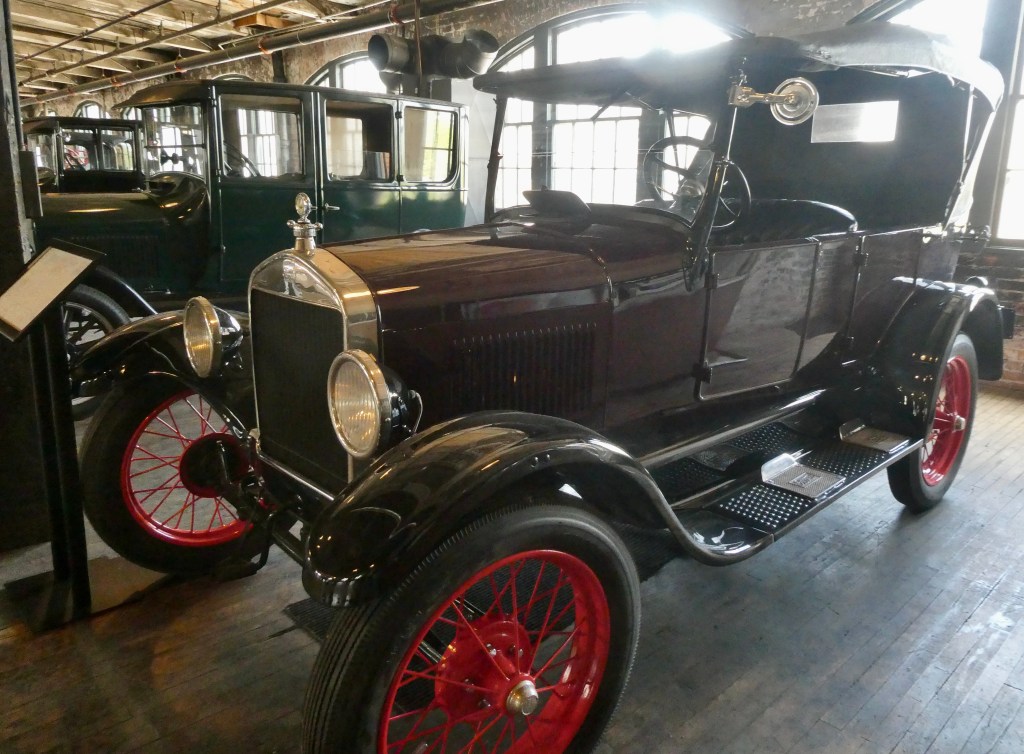
In 1926 Ford made some renovations to the Model T, including offering a variety of colors again, but market share continued to slip.
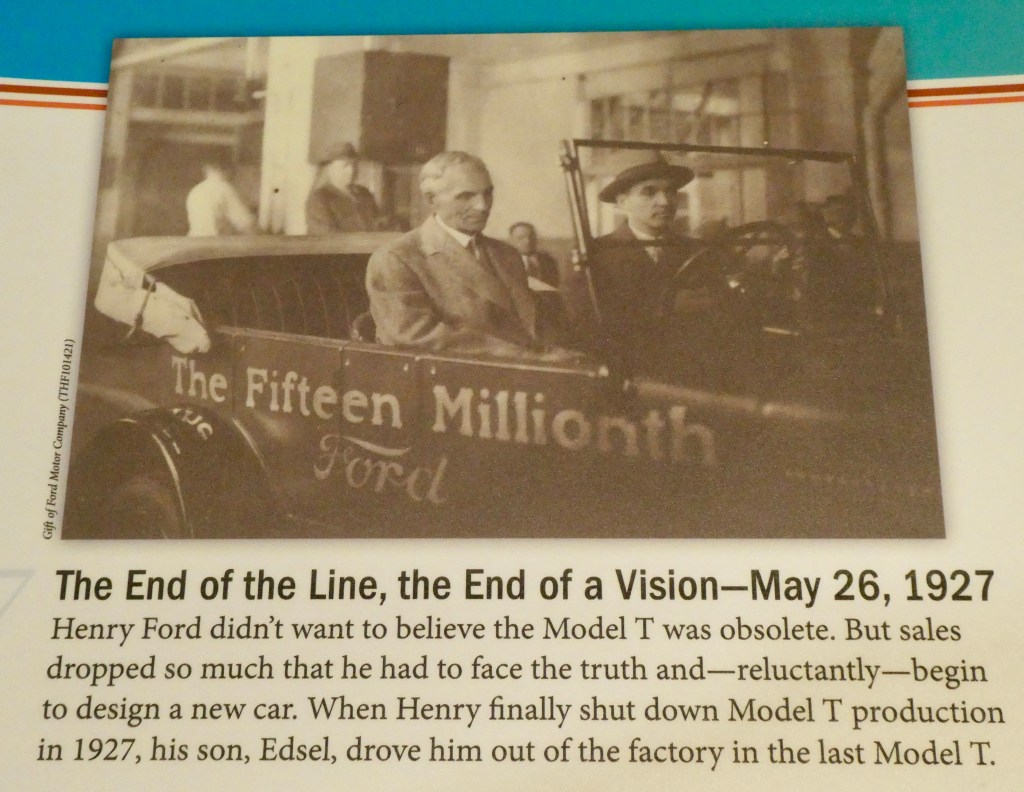
On May 26, 1927 son Edsel Ford drove Henry Ford out of the factory in the last model T made. 

The Ford Motor Company sold 15 million Model T automobiles over 19 years. Shipments were made to every continent except Antarctica.

New Model A
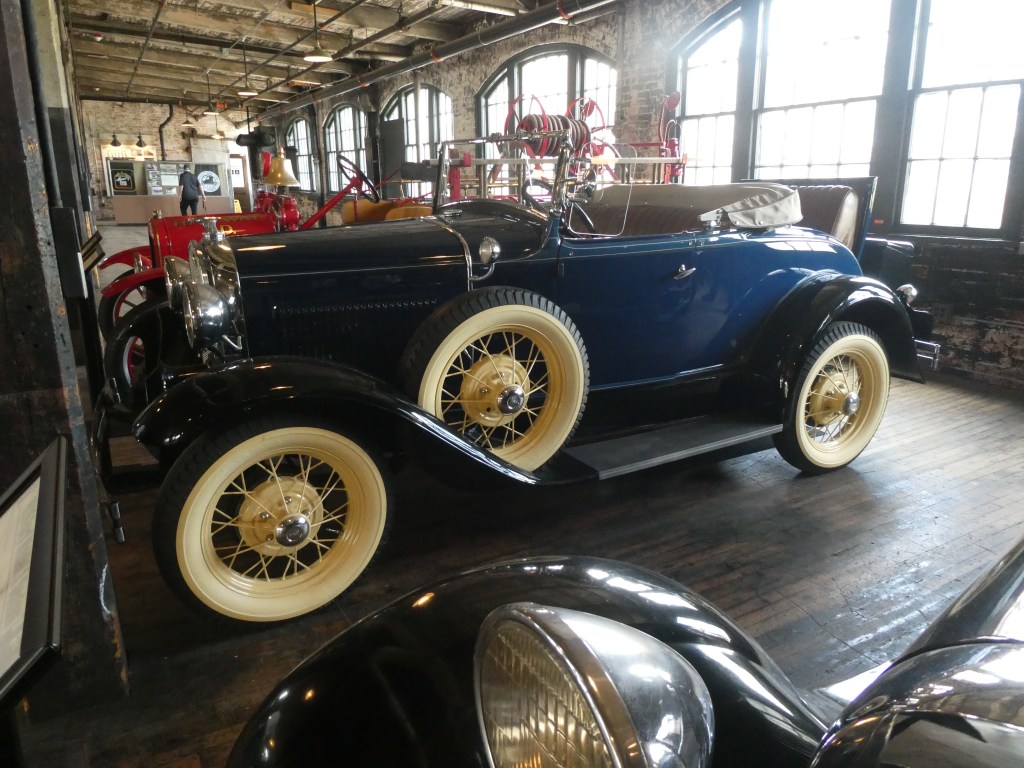
The Model T’s replacement, the all-new Model A, appeared in October 1927.It was assembled at the new Ford River Rouge Plant in nearby Dearborn, Michigan. 

Edsel Ford added styling in the Model A to save the company.  It sold 4.5 million from 1927-31 and cost $475 during the depression.  

Ford outsold Chevy in 1929 and 1930.
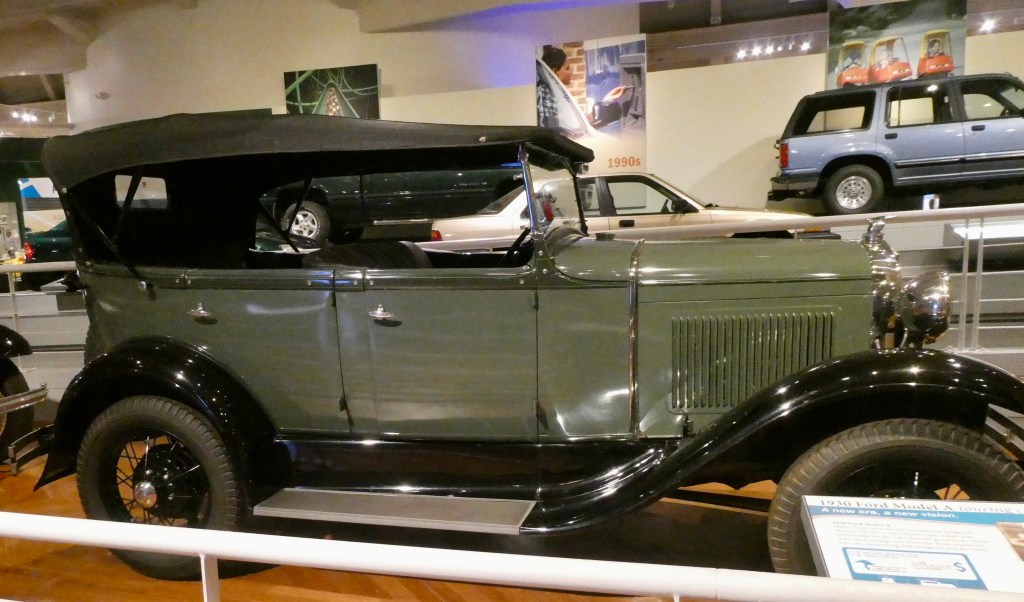
1931 Ford Model A Deluxe Roadster – Styling At Its Best! Competition was fierce, so Edsel Ford helped to develop an all-new, restyled Model A for 1930- 31. It was lower and more streamlined and was an instant success.

Chevy topped sales again in 1931 with a 6 cylinder engine.
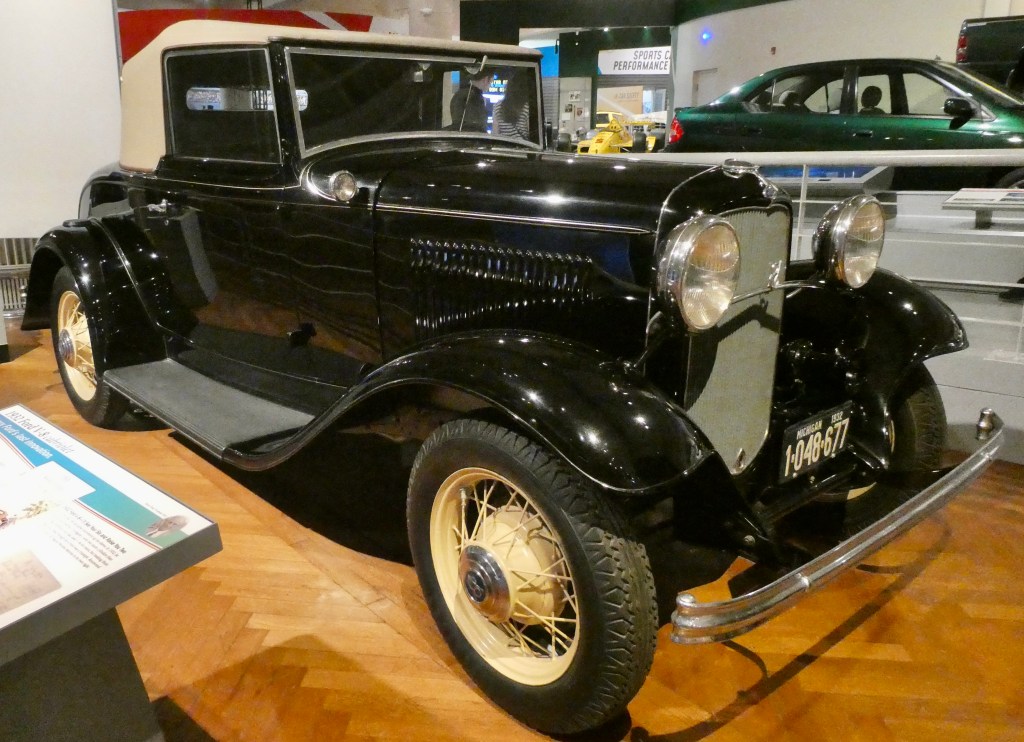
In 1932 Henry Ford’s last innovation was to make the V8 engine light enough and inexpensive enough to mass produce.  However, only 254,000 sold because of the great depression. 

And the beat went on between Ford, Chevy and other manufacturers for decades.  

The third floor of the Piquette Avenue Plant Museum has a whole array of Ford hacks and a variety of automobiles of note from other manufacturers.  

Two of special interest to me follow:  

This is a 1914 Regal Model T.  Because Ford did not trademark “Model T,” he couldn’t stop other companies from using the same model name.
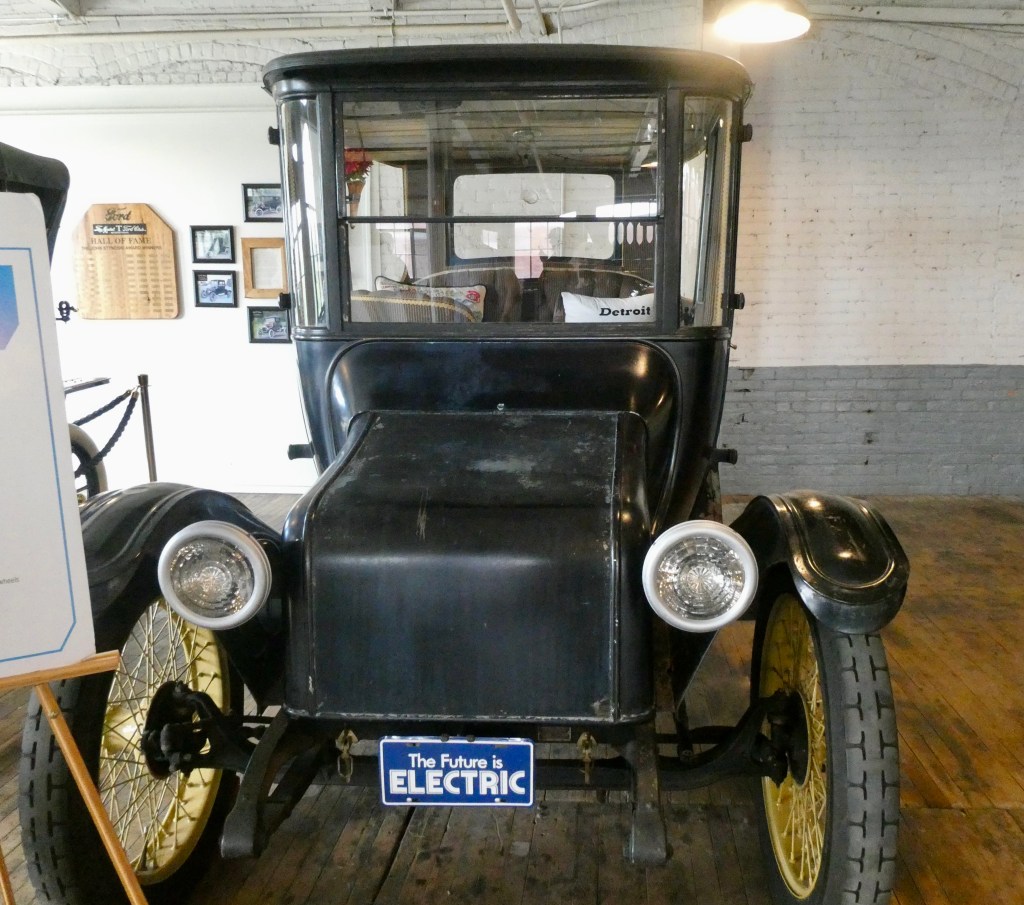
The second is a 1918 Detroit Electric Brougham.  It was urban mobility for the rich selling for $2940.  Its power was 84 volts sourced from 14 batteries .

The vehicle featured curved glass and a high roof.  The seats were regular household furniture .  

The Brougham’s top speed was only 20 mph which negatively impacted sales.  There were only 13,000 sold between 1907 and 1939.   One of those 13,000 electric vehicles was sold to Clara Ford, Henry’s wife.

Next up:  The Ford Rouge Plant and the F-150.
Posted in Uncategorized | 4 Comments

Detroit: Ford Piquette Avenue Plant

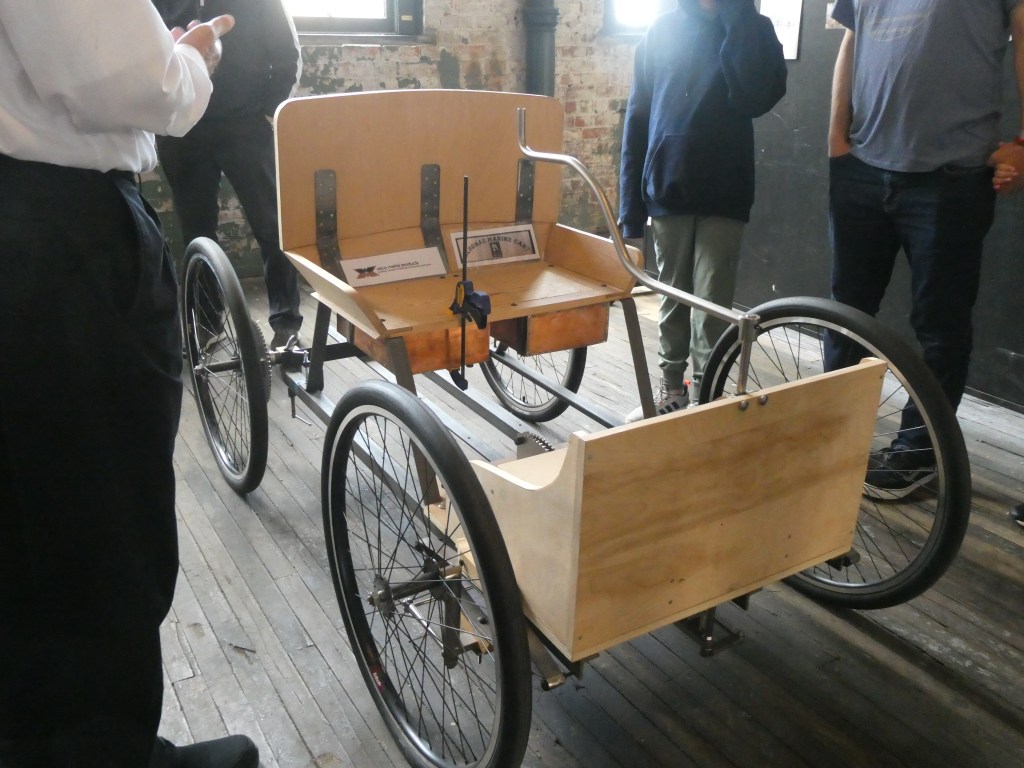
An early rendition of the automobile was the quadracycle. A driver put his foot on the tire to stop. Since there was also no reverse, the driver had to stop and turn it around. It was a start!

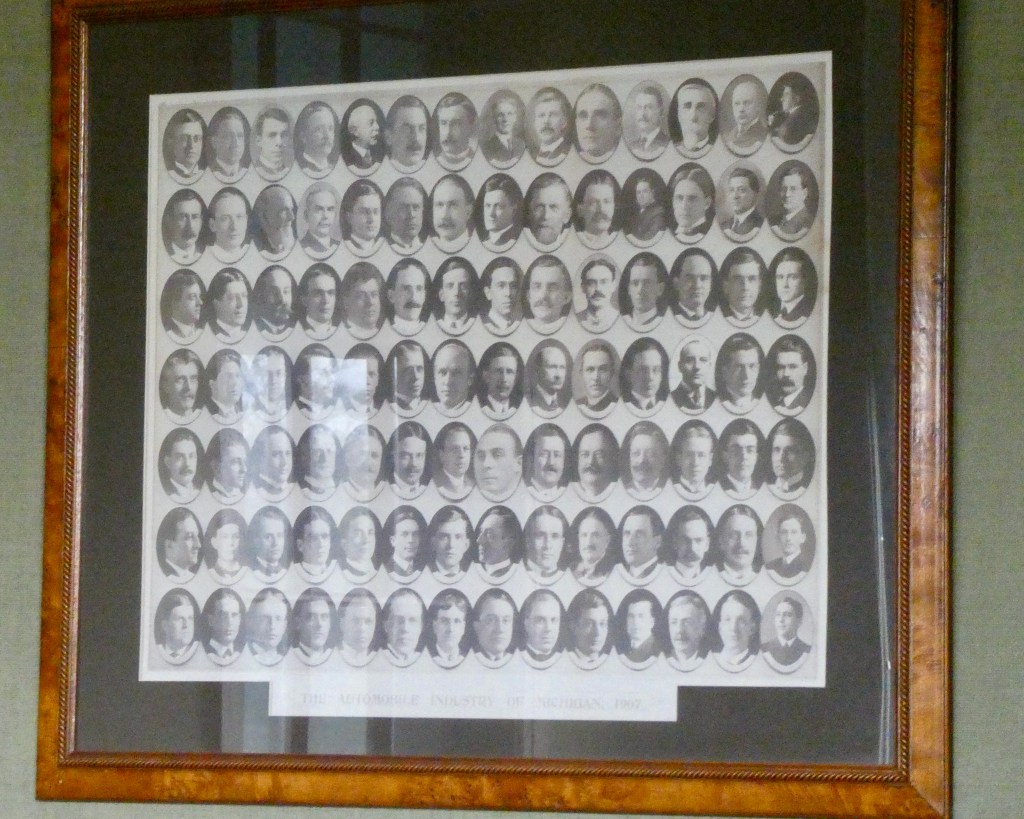
At the beginning of the 20th century Michigan had 100 car companies. Twenty were based in Detroit.

Olds was the first automobile manufacturer and, in 1904, introduced the Curved Dash. It was the first mass produced automobile. It was billed as cheaper and more reliable than a horse.

That same year, 41 year old Henry Ford moved the new Ford Motor Company to Piquette Avenue. Despite having two earlier corporate failures, he was a confident self-taught engineer and risk-taker.

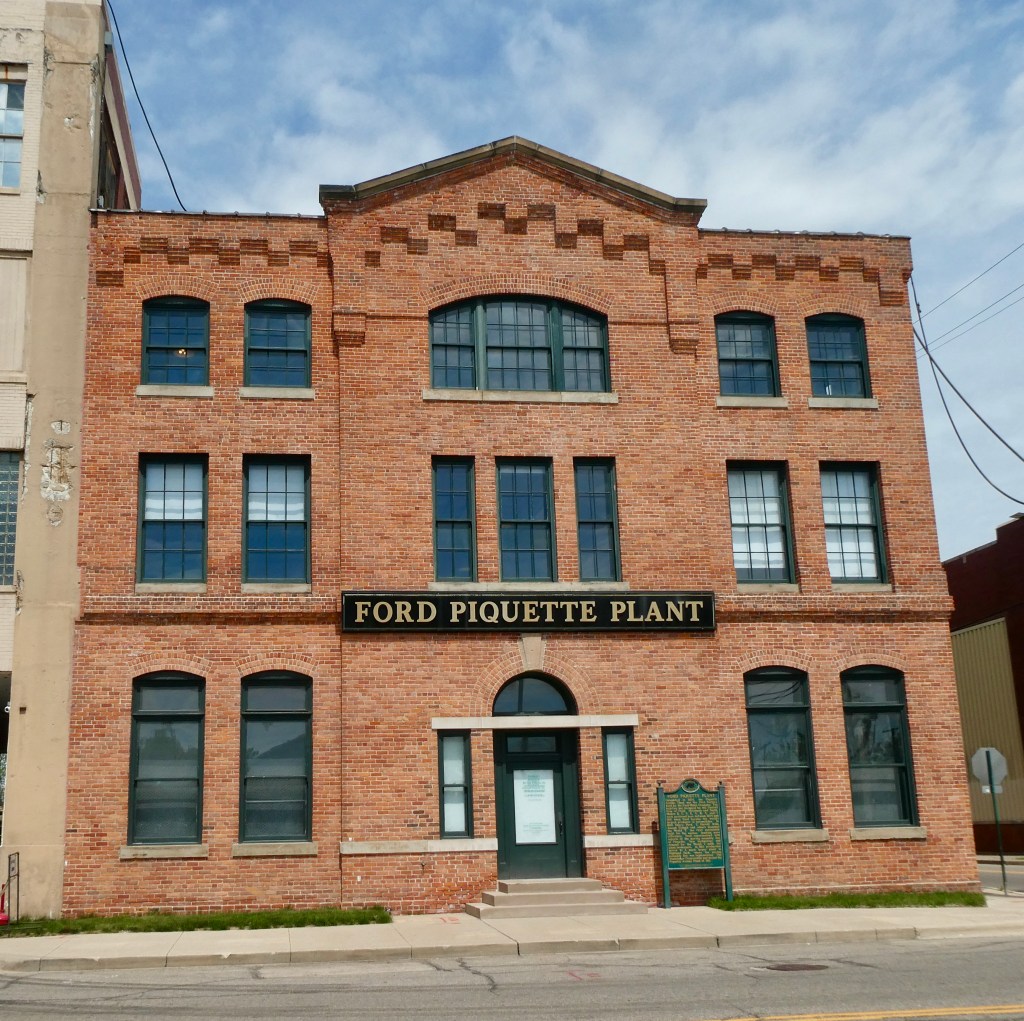
Completed in 1904 at a cost of $68,000, the Piquett Plant was the first factory built by the Ford Motor Company. The initial workforce was 30 men most of whom made $1 per 10 hour day.

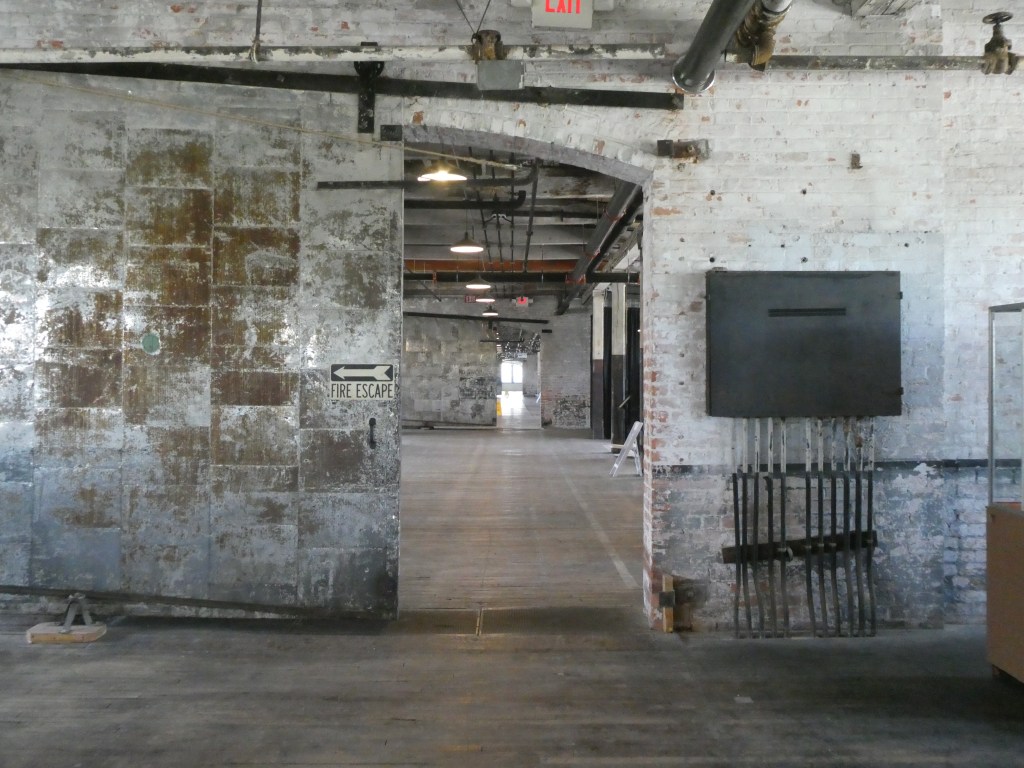
The building was separated with three sets of fire walls and doors.

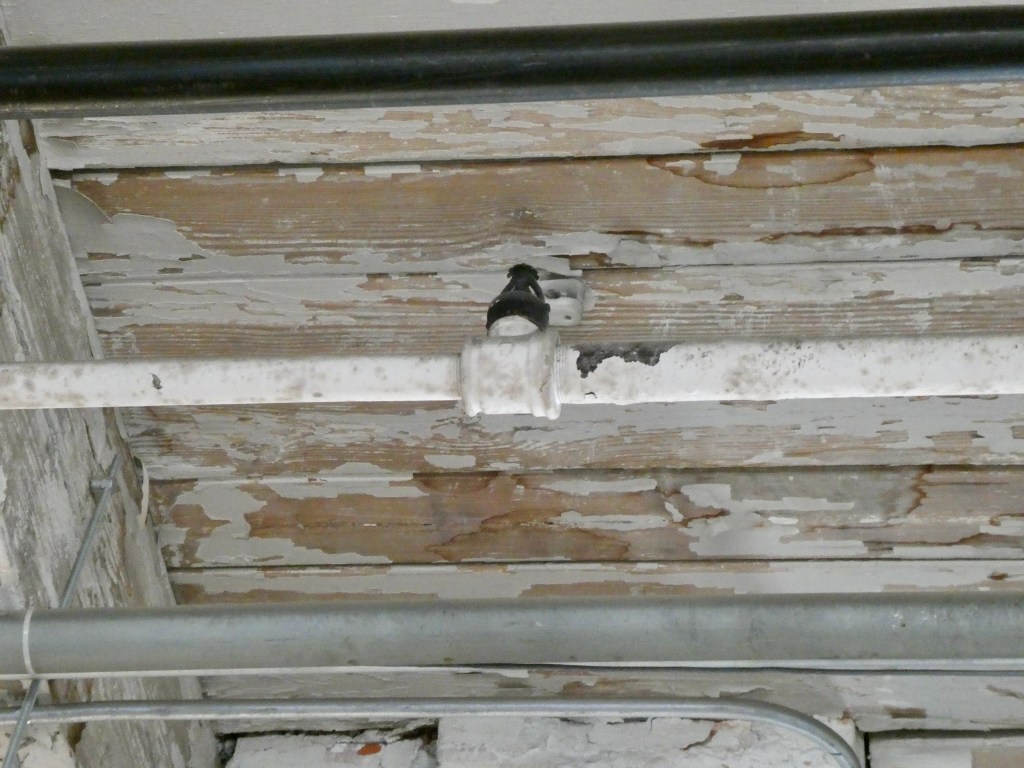
There was a temperature sensitive link of metal that would close the fire doors if needed.

The building had a sprinkler system but never had a fire to make use of it.

Ford was #1 by 1906. At the same time, Henry Ford was a charter member of the Wayne County Road Commission creating the world’s first modern highway.

During the years the Piquette plant was in operation (1904-1910), Henry Ford produced Models B, C, K, N, R, S and T. (More to come on the alphabet of automobiles in the next post.)

1908 Henry Ford, and others designed the Model T, the first automobile built for the masses. Seeking more efficiency, Ford experimented with aspects of the an assembly line at Piquette.

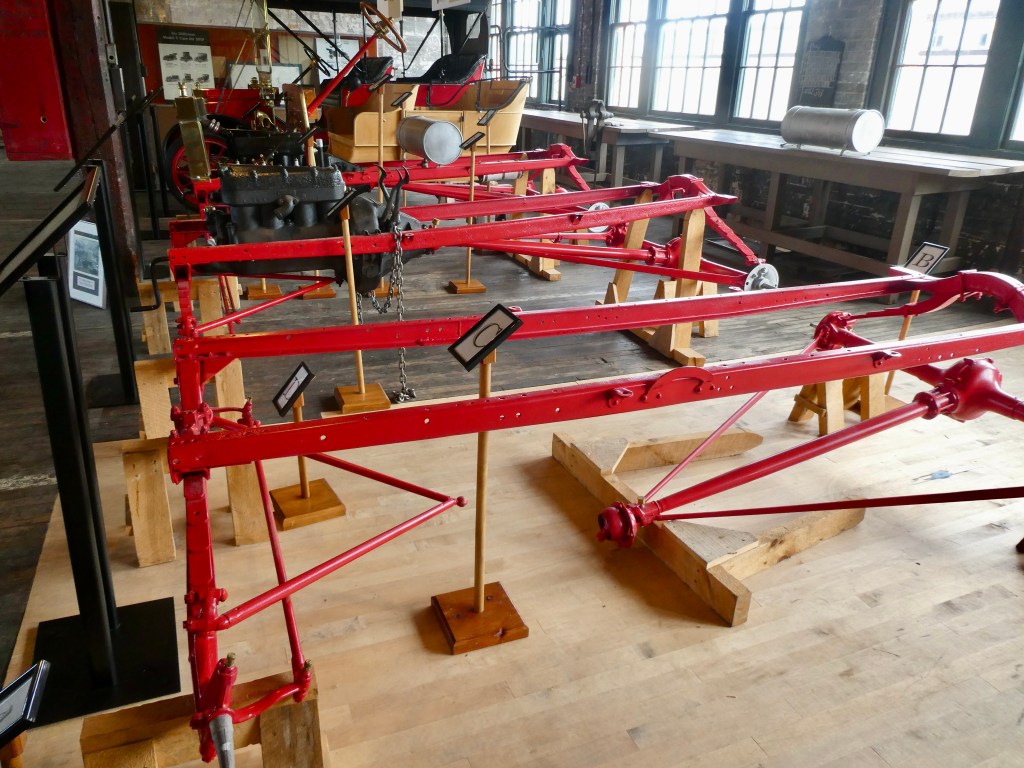
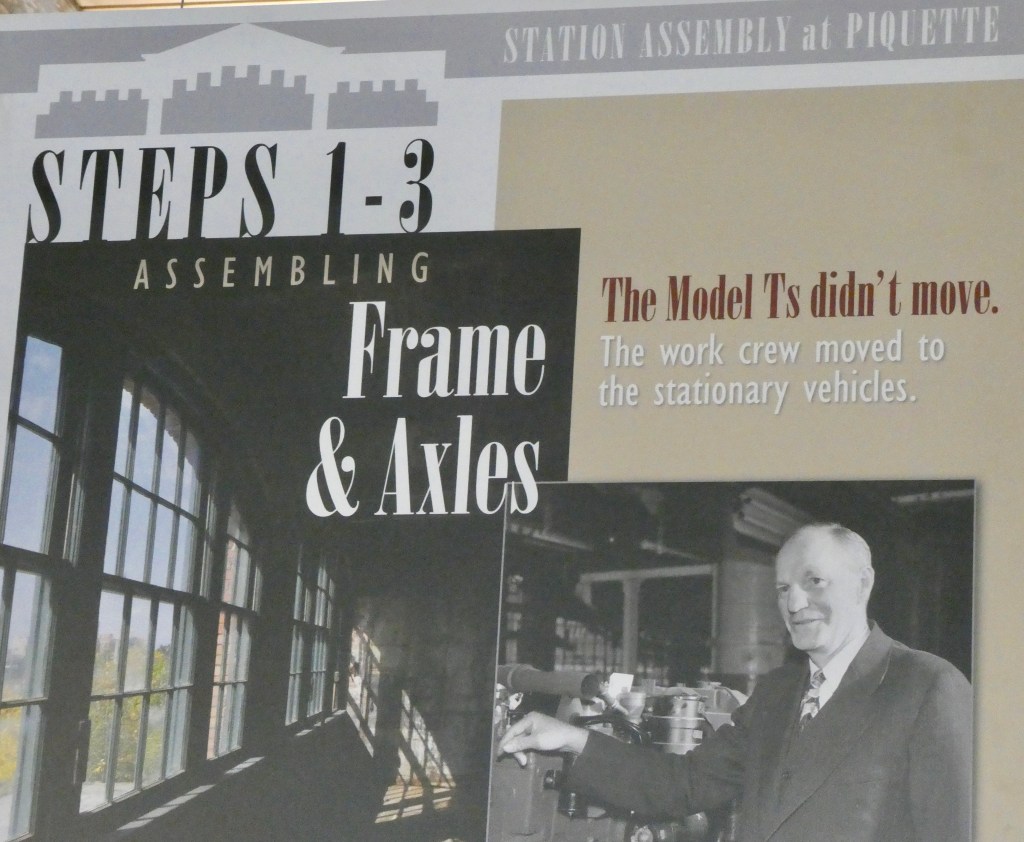
At first, the automobiles were put in stations with the workers moving from one to the next.

Ford raised worker pay to $5 per day to increase retention and loyalty. He was the first to pay you to eat, giving a paid 15 minute break during your day. In doing so Ford created a middle class that could buy his cars. Engineers were paid $25 per day. (Ford paid his employees in cash – a practice that continued until 1949.)

Even so, Ford felt there were secrets leaving the building as workers came and went. They created a secure room on the third floor used exclusively for design.

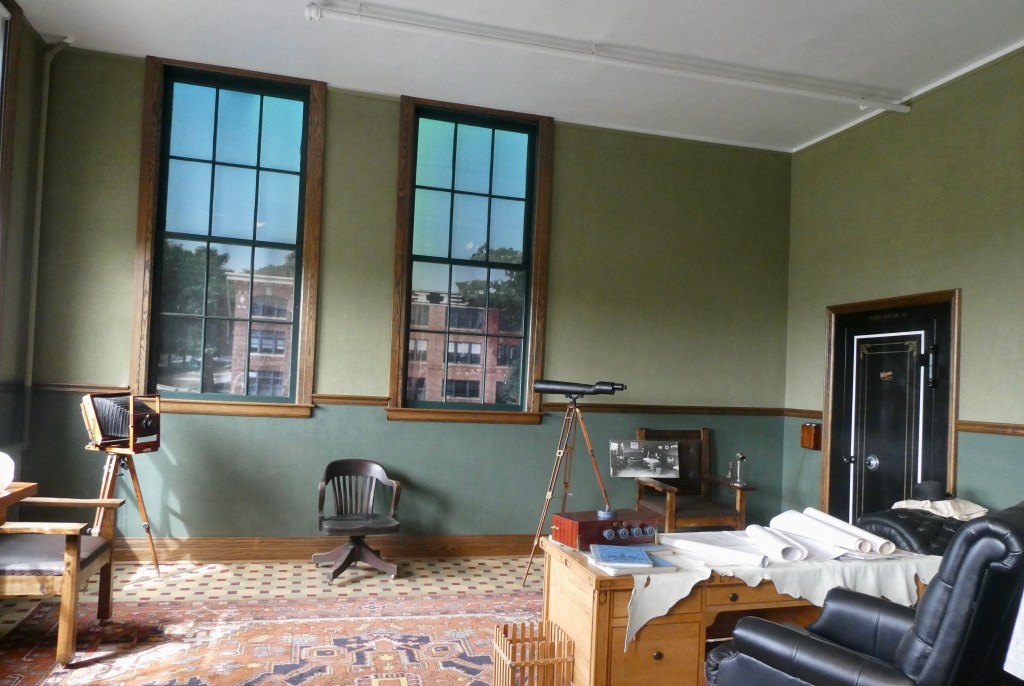
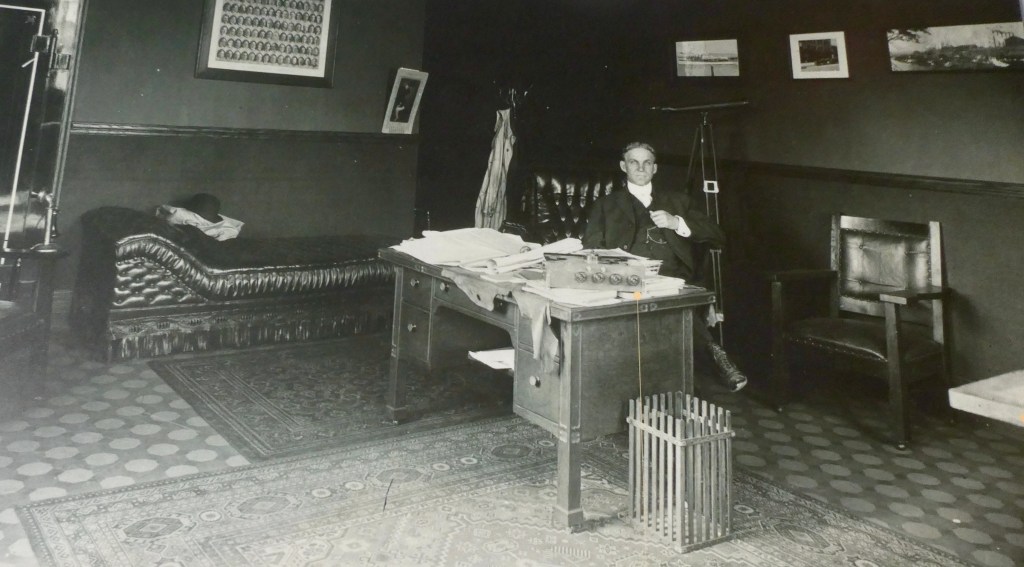
Henry Ford’s office was also on the third floor.

This is the only picture of Ford in this office. Notice the lounge in the back. He would sometimes sleep there.

In 1910, Ford became the world’s largest producer of automobiles. New technology and demand for the Model T made the Piquette Avenue Plant inadequate. Production and 1000 employees moved to a much larger plant four miles away where the moving assembly line was implemented.

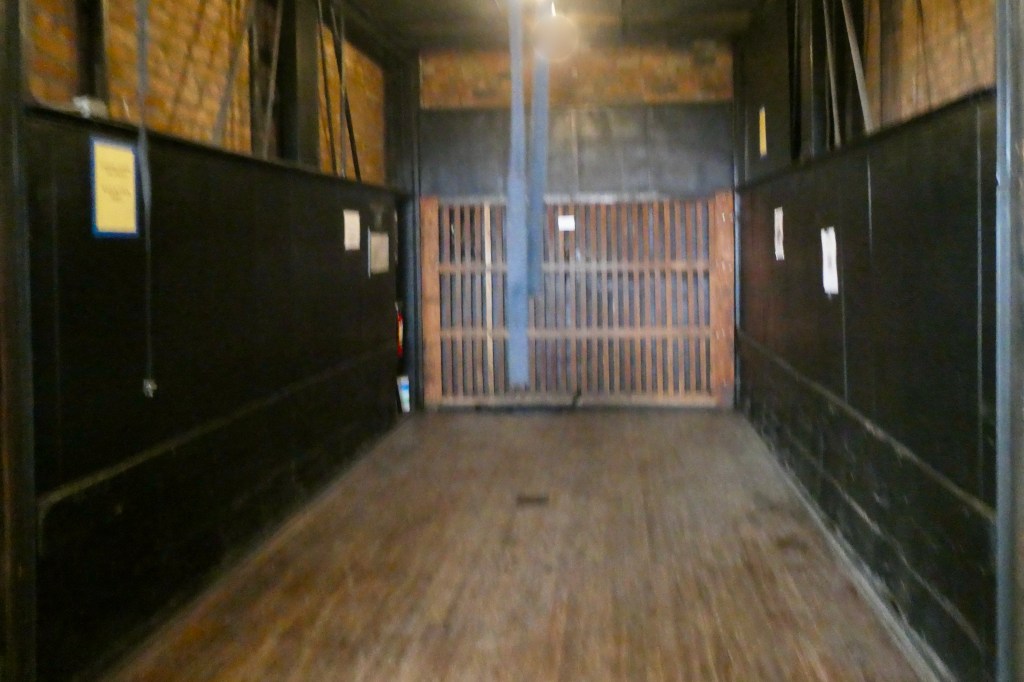
When Ford Motor Company left, the Studebaker Corporation purchased the Piquette Avenue Plant in 1911. The elevator was made larger to move the larger Studebaker cars up and down and in and out. They used the plant until the depression era when they consolidated back to South Bend, Indiana.

The building was then sold to 3M Corporation which owned it until 1975. Various owners used the building for storage in the following years..

In 1988 the former plant was purchased by Charles Wickens of London, England. With the building in a dilapidated state, and facing demolition, Wickens was a benevolent seller. He worked with a Detroit historic society when they wanted to buy and refurbish the building for history’s sake.

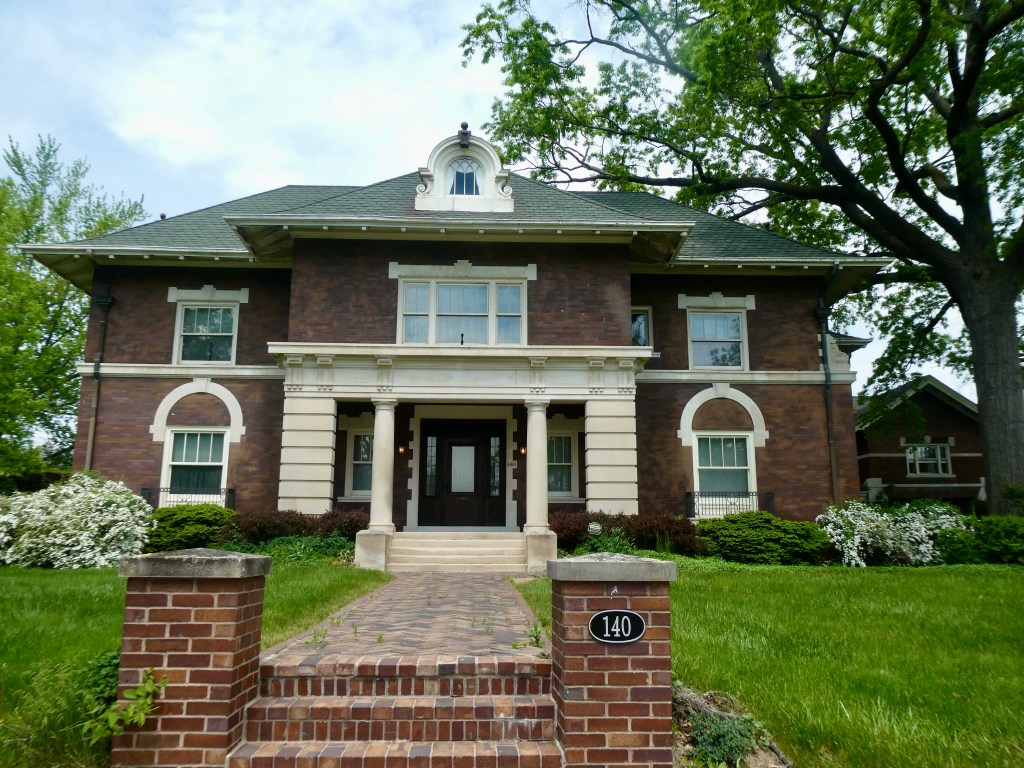
One of the primary contributors to that effort lives at 140 Edison in Detroit. The house is a National Historic Landmark because Henry Ford and his wife lived there during the beginning of their successful years in Detroit.

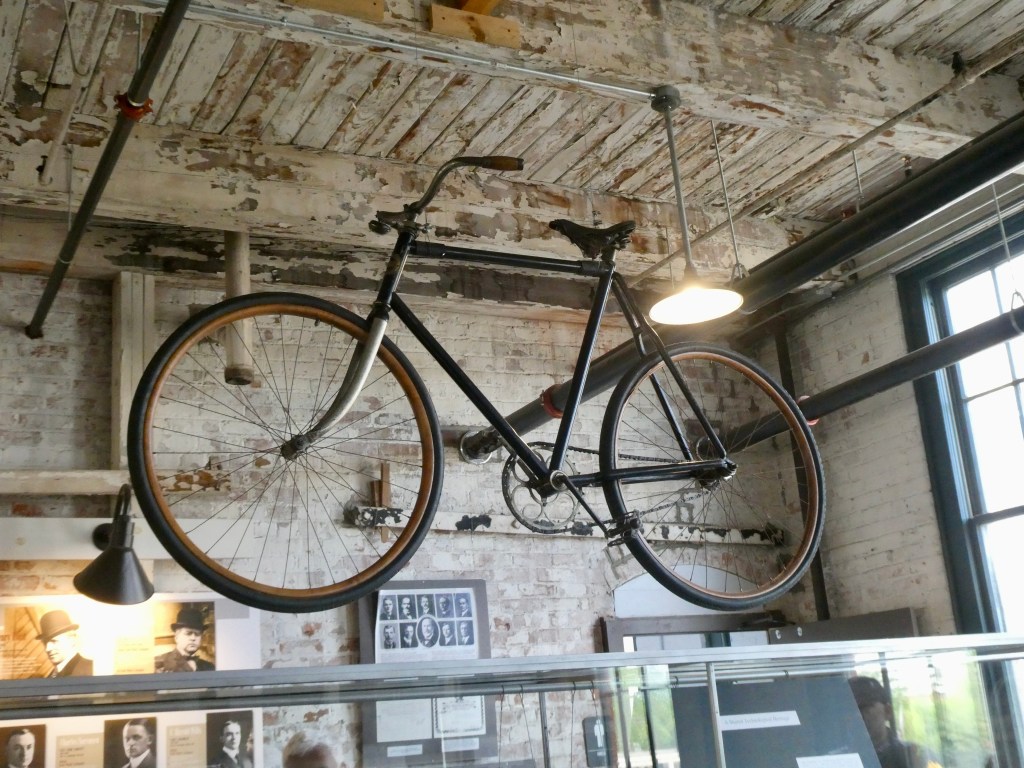
Henry Ford often road his bike to work! There seems to be some irony there!

Beginning in 2000, volunteer groups from car clubs and the Ford Motor Company began the long and arduous job of cleaning out and refurbishing the building into what it is now, a museum with an extensive car collection. The Ford Piquette Avenue Plant is also available for event rental.

In 2002 the Ford Piquette Avenue Plant was placed on the National Register of Historic Places – quite an achievement for a building that almost didn’t survive.

This carmine red Model T is front and center when you enter the building. This automobile, with serial number 220, was manufactured in December 1908 at the Ford Piquette Avenue Plant.

Though manufacturing of the new model began in October, 1908, the first Model T’s were designated as 1909 models. Costing $850, the Model T had a 4 cylinder 20 HP engine and a top speed of 35 mph.

The automobiles were available in a variety of colors but the roof, windshield, headlights, and speedometer were all optional adding $100 or more to the total cost.

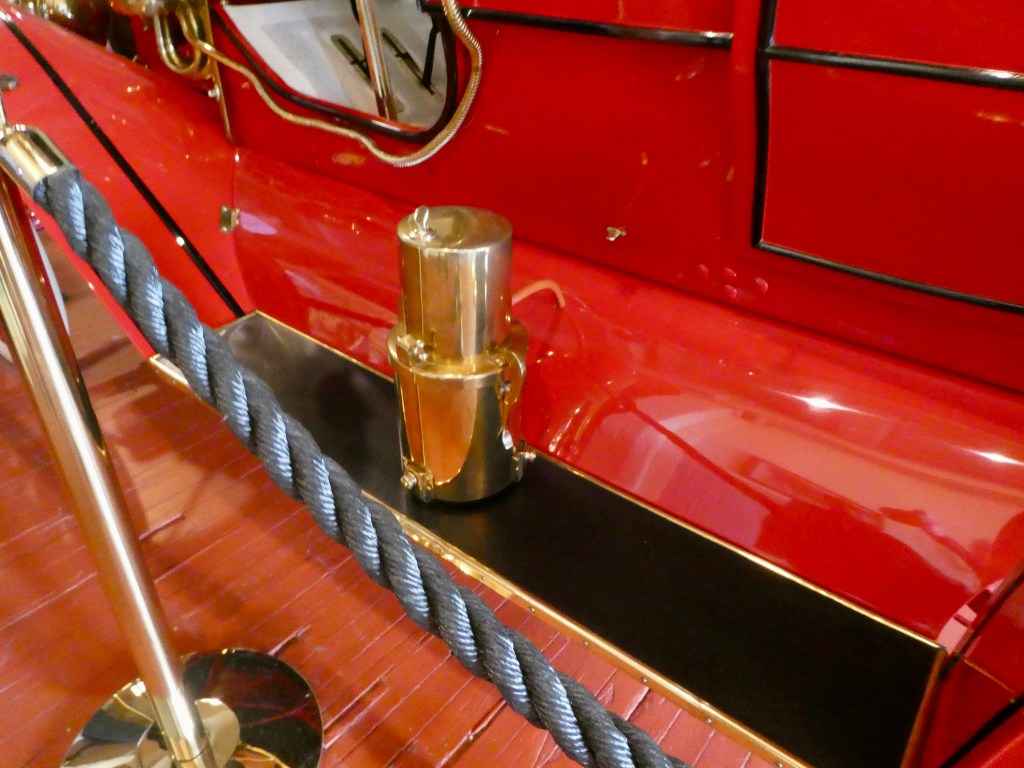
This side fuel canister is for the gas headlights.

The tires were upgraded bicycle tires. A. pump was sold with the car. The black device is the speedometer cable.

The first 2,500 Model T automobiles underwent constant engineering changes to address issues of reliability. The design improvements led to such successful sales numbers that 12,000 Model T vehicles emerged from Piquette, a rate of about 100 per day.

The cost was reduced to $260 per vehicle after it was mass produced. The first car to be universally affordable, there were 15 million sold. The Model T held the record of most sold for many, many years. The Volkswagen Beatle eventually sold more than the Model T, and then the Toyota Camry eclipsed it.

The Model T, initially produced at a rate of one every 12 hours at the Piquette Avenue Plant, took only 12 minutes at the Highland Park plant. The model T was deemed obsolete after 15 million cars and 19 years. Collectors still own 250,000 Ford Model T automobiles. The oldest known remaining Model T is Number 2. It recently sold for a quarter million dollars.

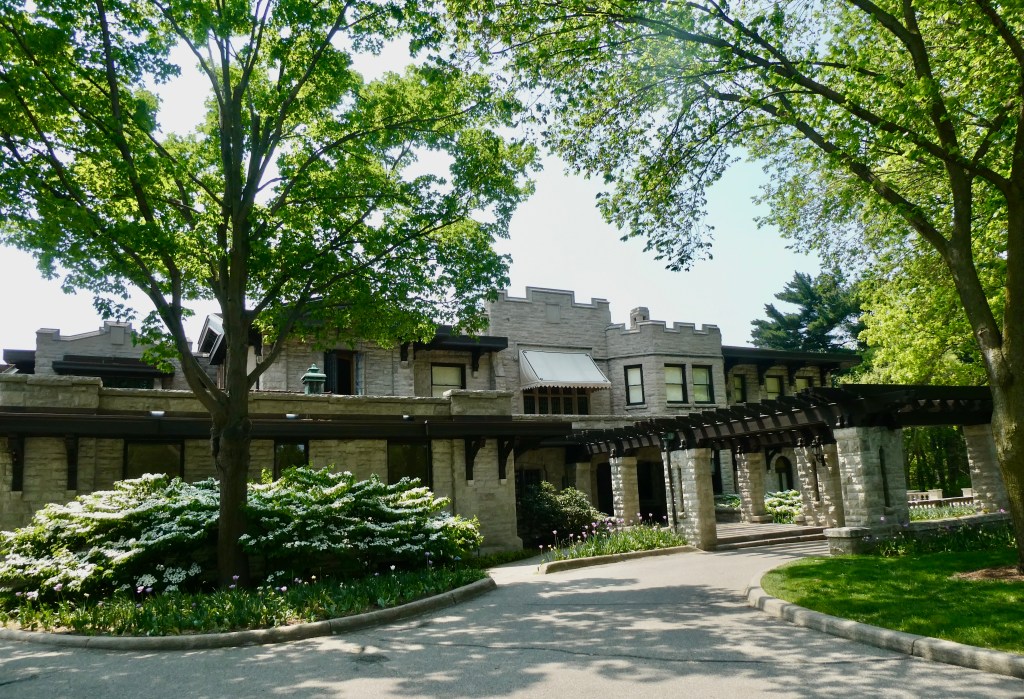
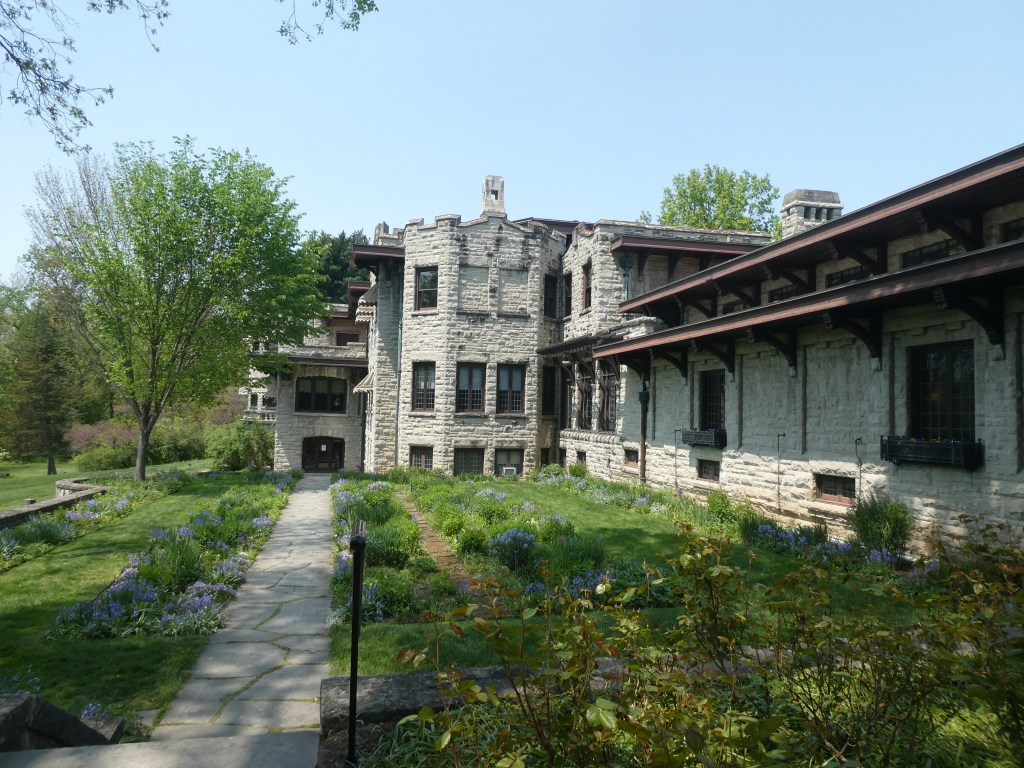
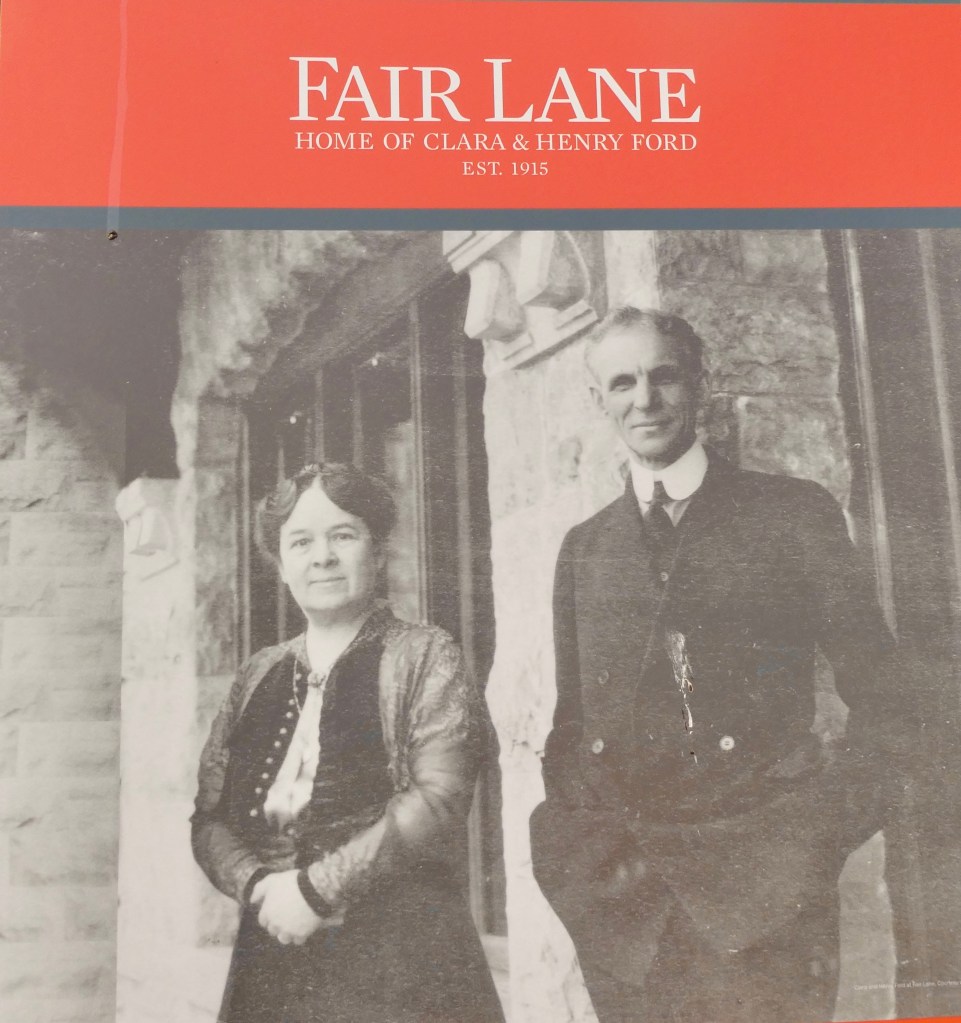
With all their success, Clara and Henry left their home at 140 Edison in 1915 and moved to an estate they called Fair Lane situated along the banks of the Rogue River.

The name Fair Lane was from the road on which Henry’s father, William Ford, was born in County Cork, Ireland.

The Powerhouse/Garage was constructed in 1914 after frequent guest and inventor, Thomas A. Edison, laid the cornerstone. The powerhouse supplied power for the entire estate using a hydroelectric system. The estate had some rare engineering designs including water filtration and boiler systems.

By the late 1920’s, the 56 room mansion, and estate totaled 1,300 acres including orchards, agricultural fields, gardens, greenhouses, servant cottages, a boathouse, a skating house, a maple sugar shack, and a pony barn.

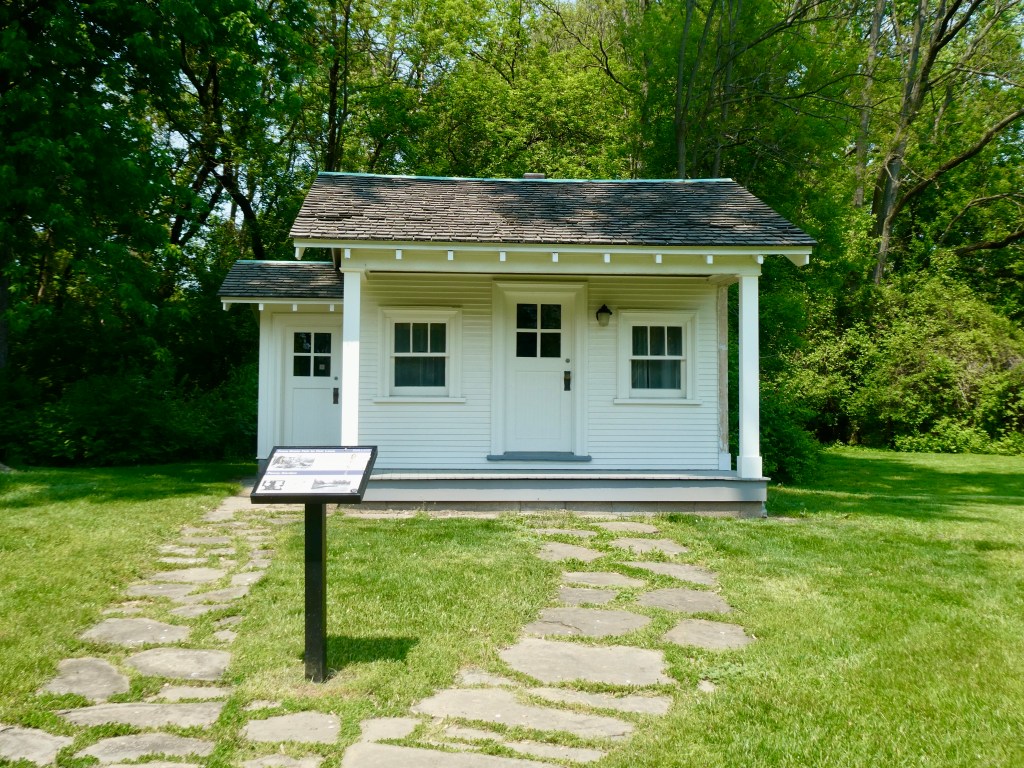
Henry Ford had a miniature farmhouse, and other farm buildings and machinery constructed for the 1924 Michigan State Fairs to educate urban children about life on a farm. After the fair, the buildings were brought to the estate for the enjoyment of the Ford grandchildren.

Fair Lane was named a National Historic Landmark in 1935.

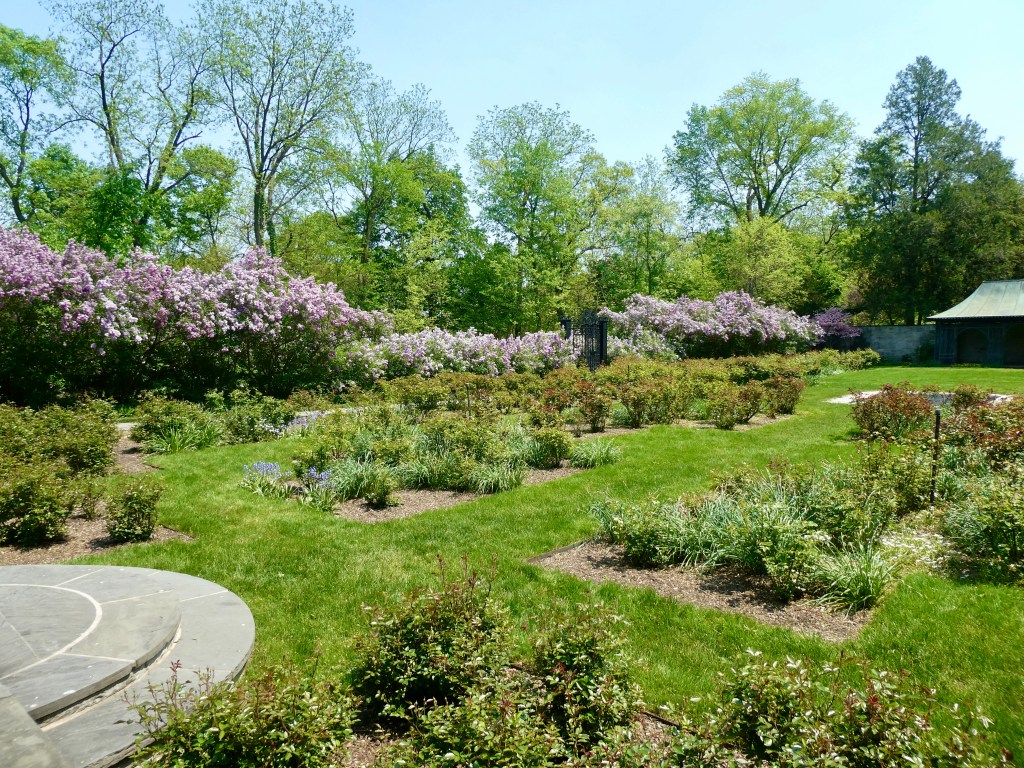
Clara Ford had extensive gardens, dominated by her favorite roses. When we were there the lilacs were in full and fragrant bloom.

Henry and Clara Bryant Ford lived at Fair Lane from 1915 until their deaths in 1947 and 1950 respectively.

In 1956, the estate was donated by Ford Motor Company to The University of Michigan for a Dearborn campus.

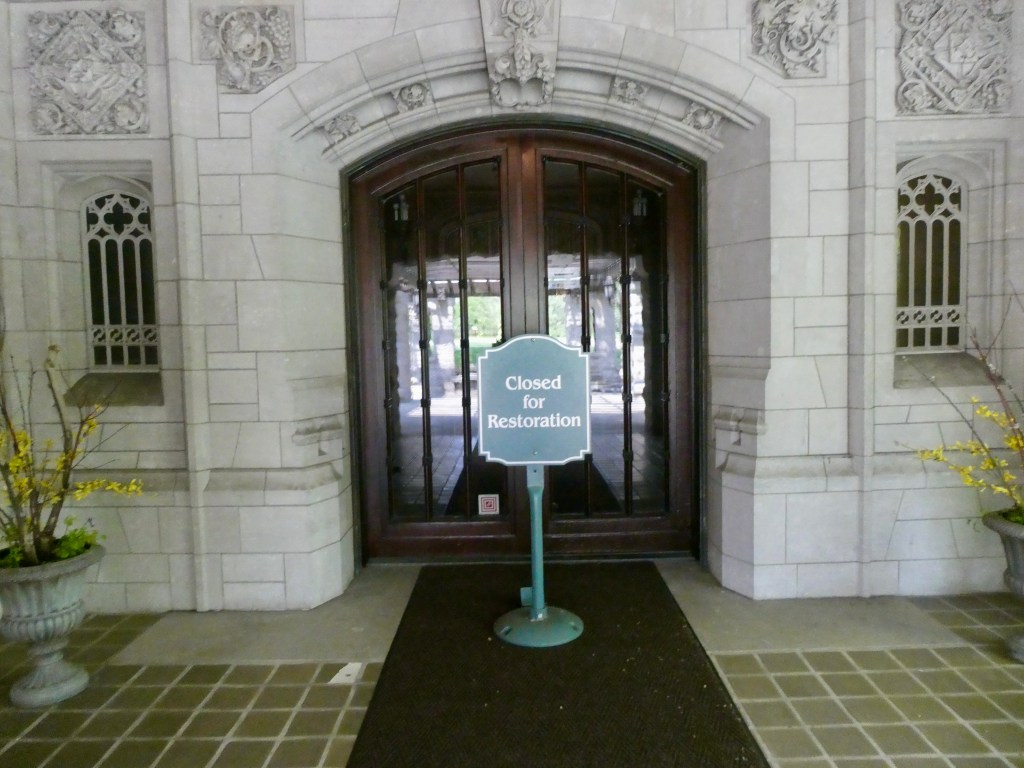
The house was undergoing renovation when we were there so we were unable to go inside. Tours are usually available.

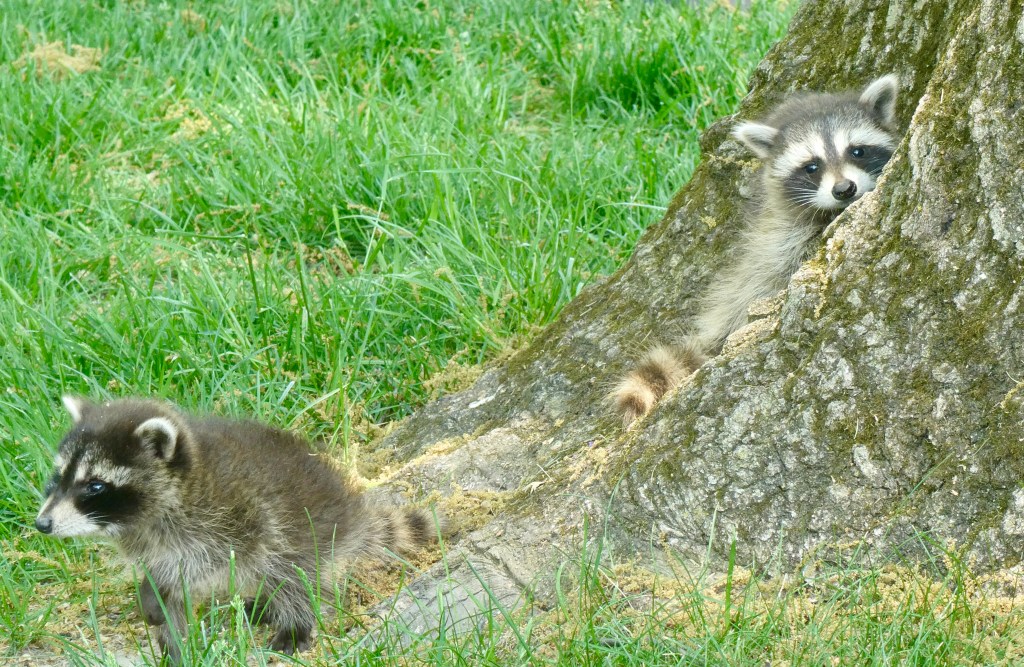
We enjoyed our walk around the grounds…and these baby raccoons. We wondered where mama was!

Next time…Henry Ford’s alphabet of automobiles!

Posted in Uncategorized | 2 Comments

Detroit: Architecture Tour and Pizza!

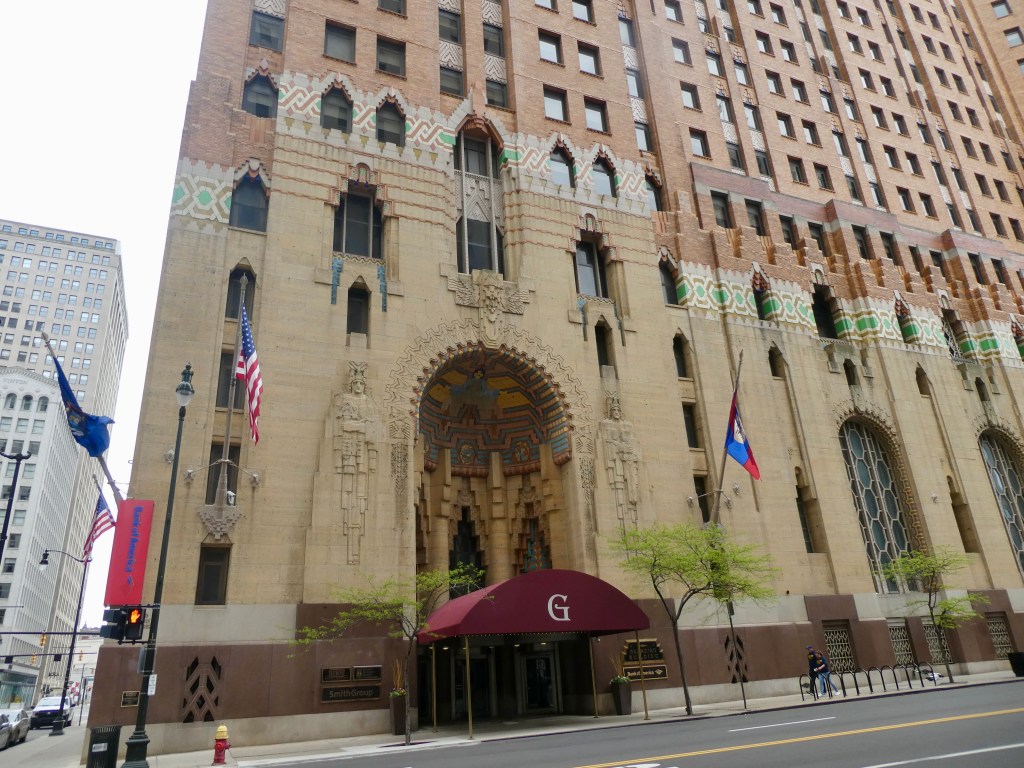
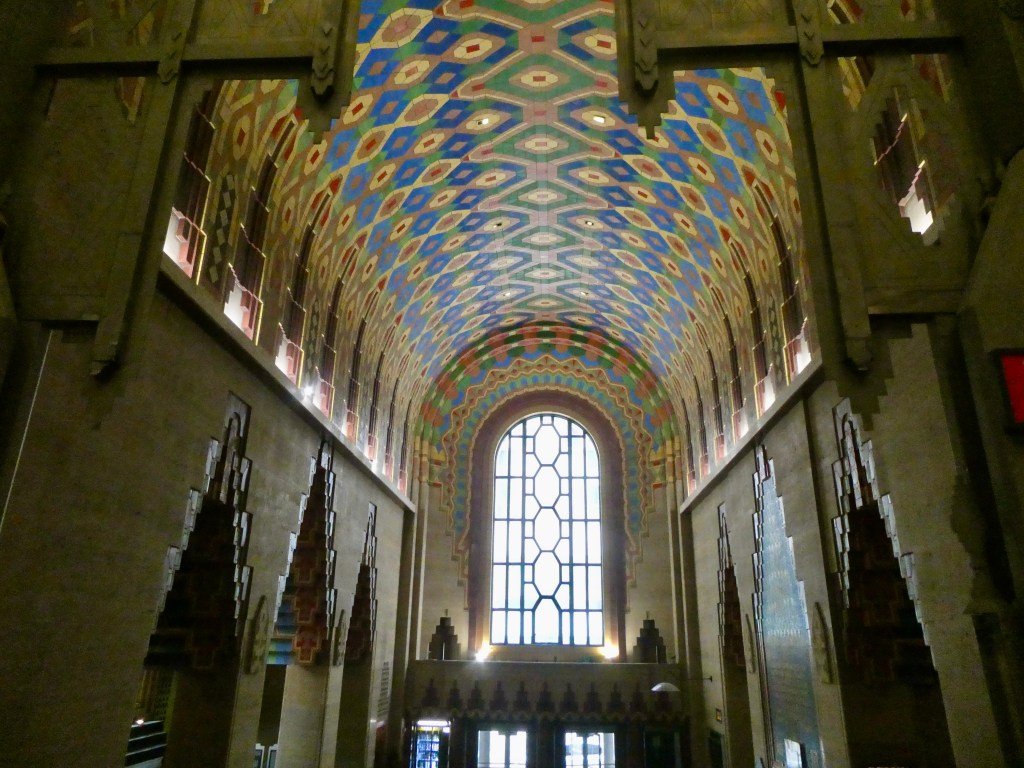
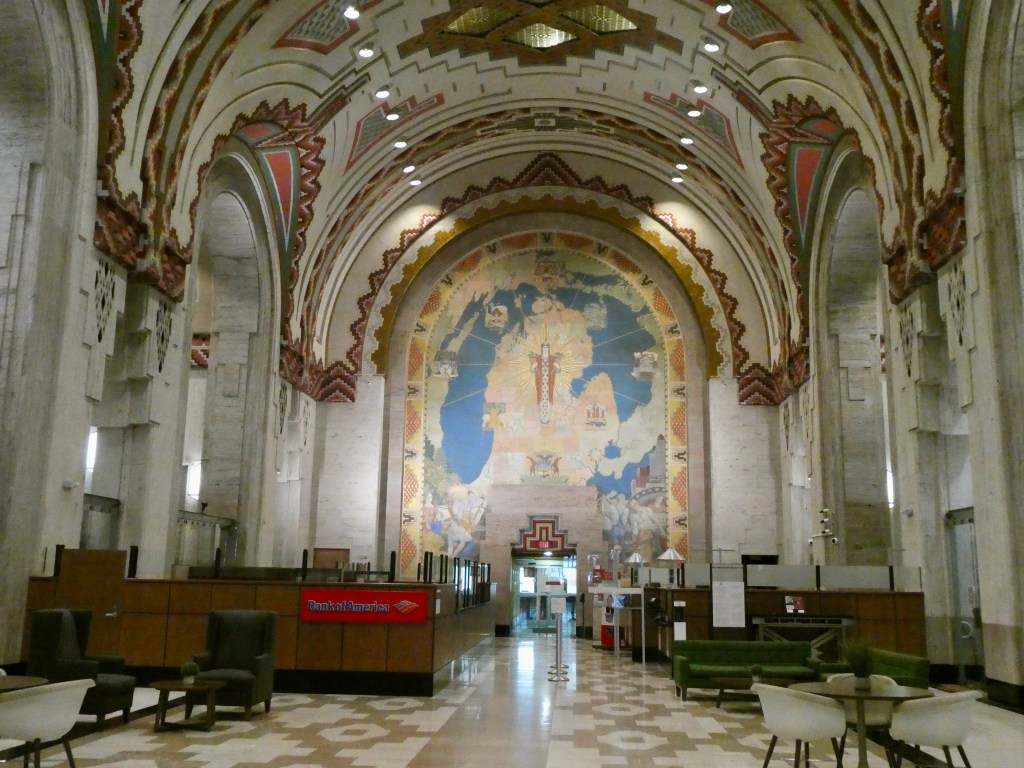
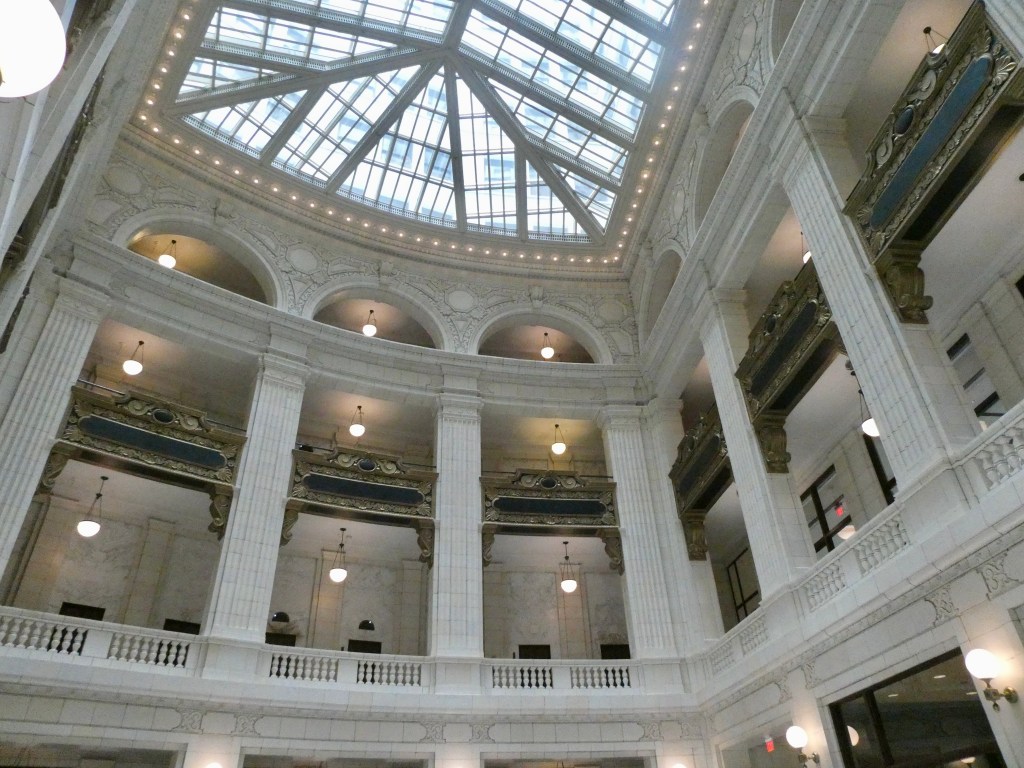
While looking for a food tour in Detroit (which didn’t exist),  I found a Downtown Architecture Tour. We began our tour at the Guardian Building in downtown Detroit. 

This picture is from the Guardian Building website as it is much better than the one I took!

The Guardian Building represents an era when people believed in the city of Detroit and its future.  

The building was built in 1928-29 when Detroit was an international commercial and industrial hub.  It took eighteen months to build and was considered the Cathedral of Finance.  The former Union Trust Building was designated a National Historic Landmark.

The Guardian Building is now owned by Wayne County and serves as its headquarters. The symbolic art under the arch is in the shape of Michigan.

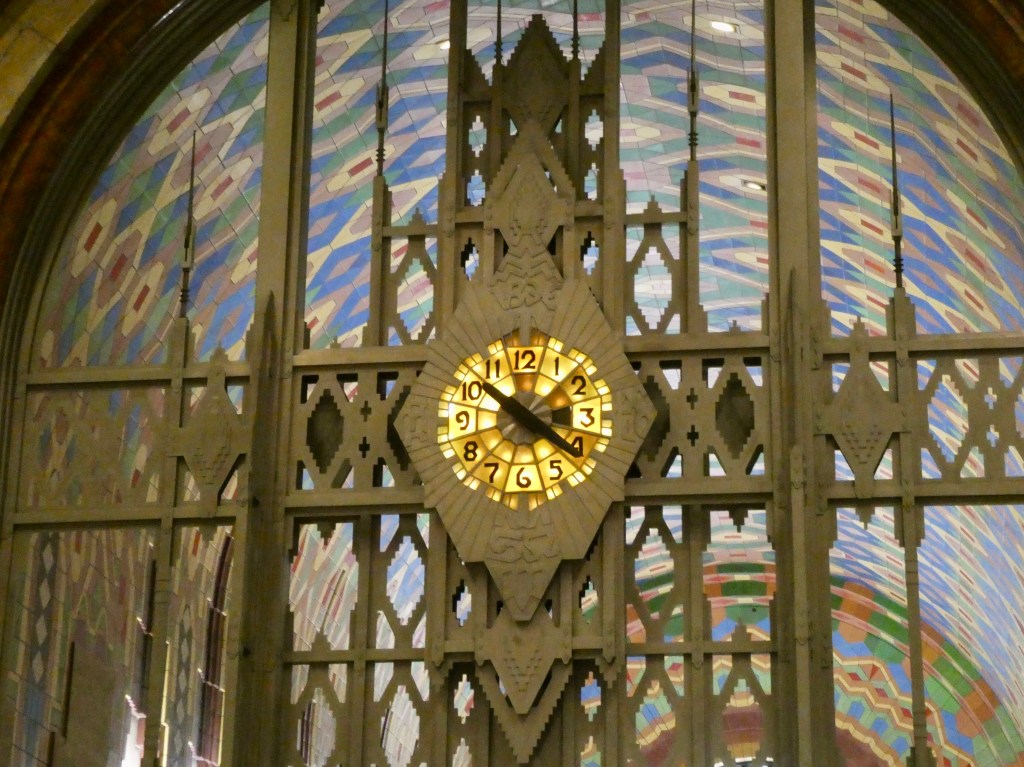
The lobby clock was made by Tiffany.

Most of downtown and much of Detroit went through severe depression.  Problems were plentiful and a corrupt local government contributed.  Detroit declared bankruptcy July 18,2013 and many buildings and homes were abandoned. 

The People Mover was built to provide access between buildings when the streets were dirty and unsafe.   As circumstances have dramatically improved, the People Mover is rarely used.

During the last decade there has been substantial investment and revitalization with private and government assistance.

Dan Gilbert, the majority stockholder of Rocket Mortgage, has made a massive investment in Detroit.  He purchased and developed over 100 buildings in downtown Detroit.  Gilbert and his wife joined The Giving Pledge to give half of their many billions away during their lifetime and Detroit and Detroiters have benefited.

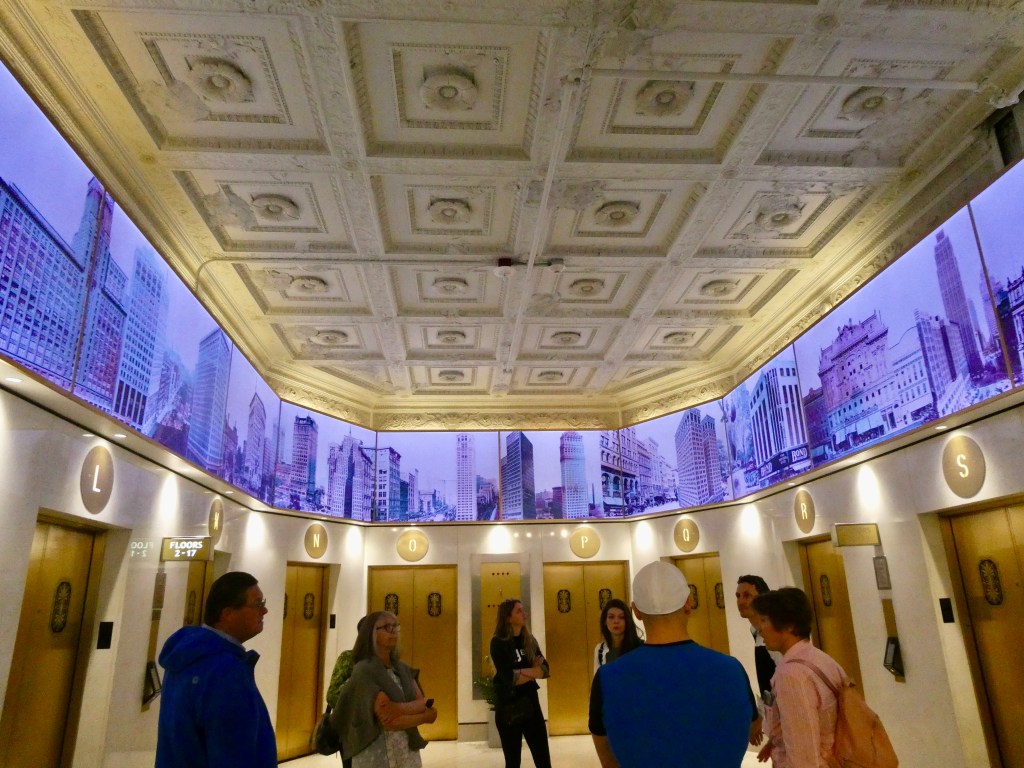
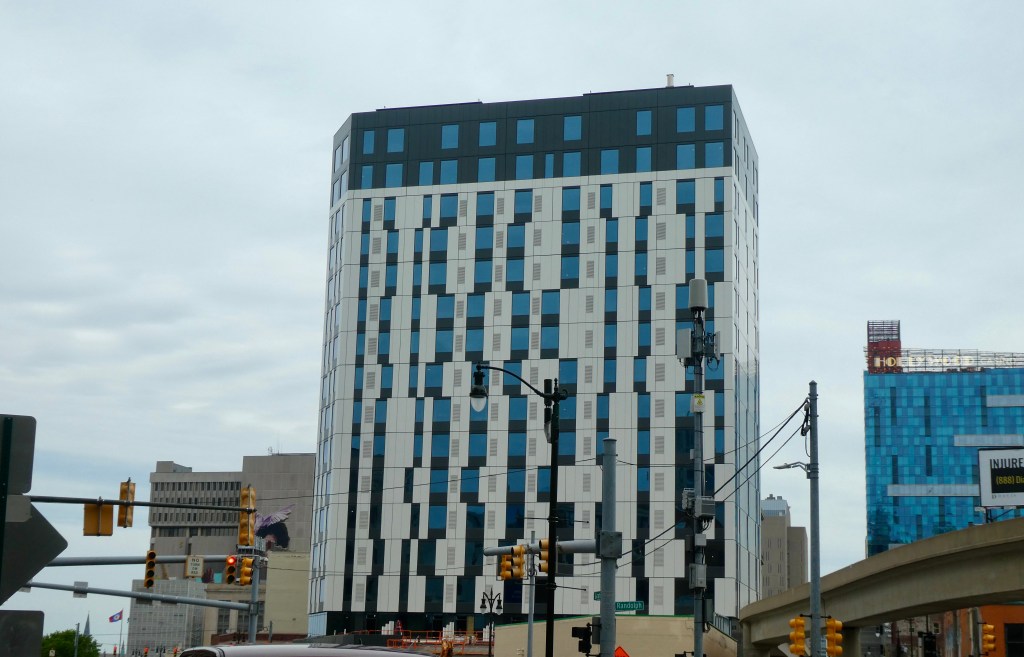
This is one of the many buildings that Gilbert has rejuvenated.   He frequently tries to hold on to, or portray, the building’s history as part of the renovation.

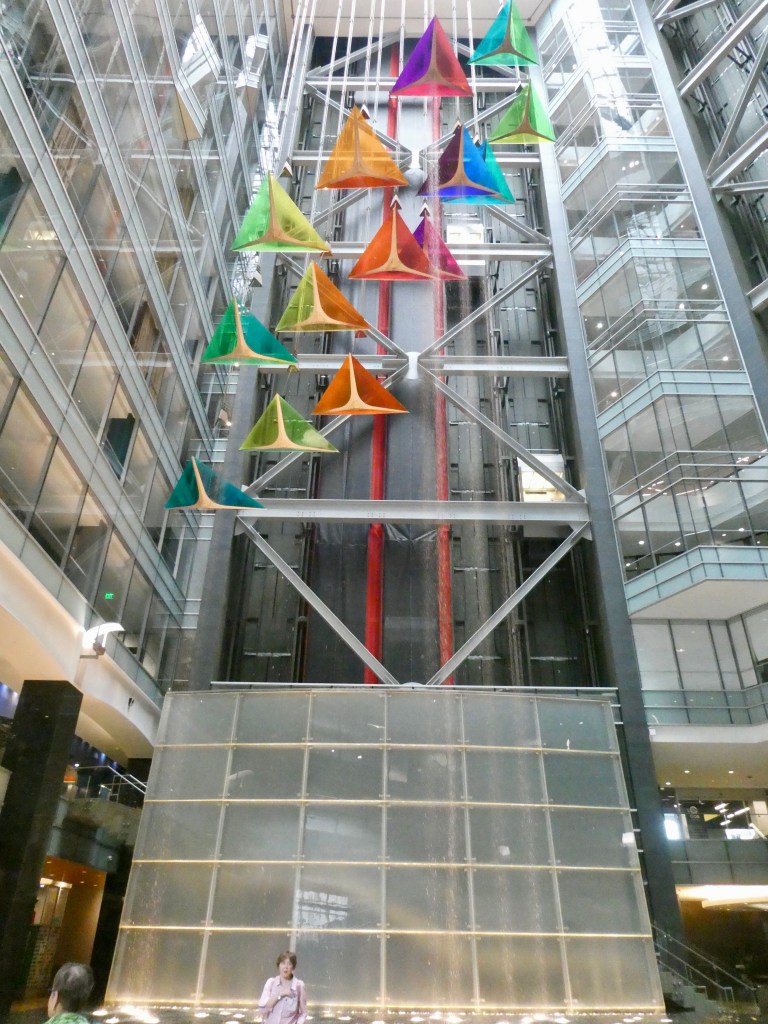
Rocket Mortgage world headquarters are at the One Campus Martius Building in Detroit.  The waterfall inside the Atrium is 114ft in height and is the tallest indoor waterfall in America.

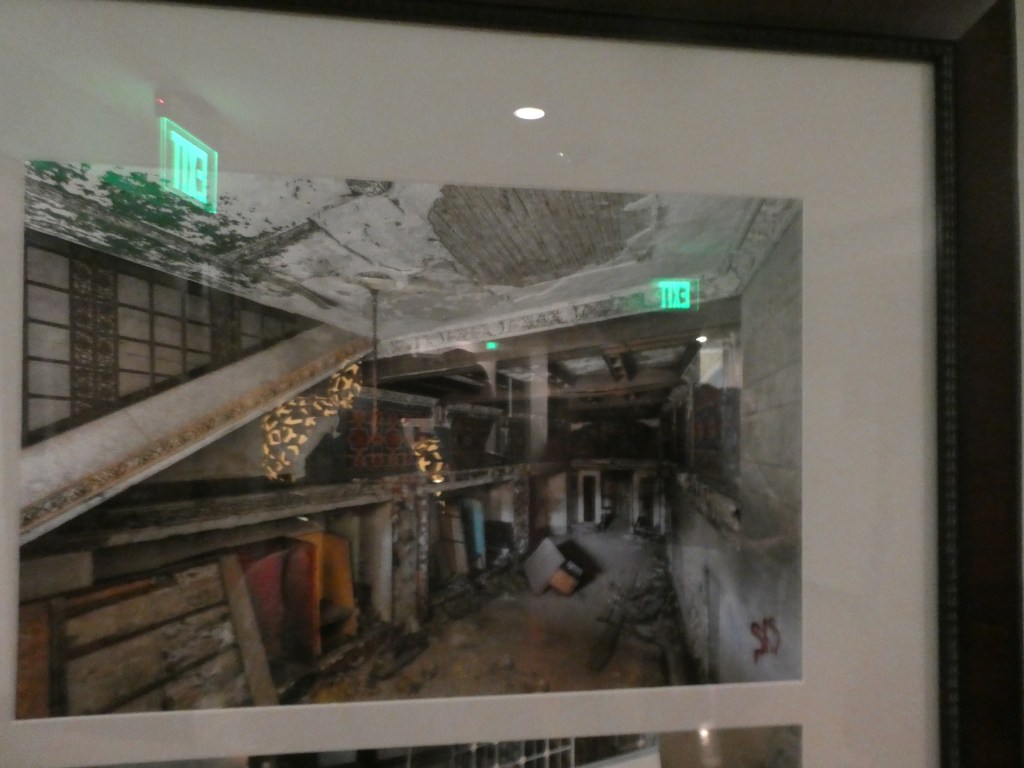
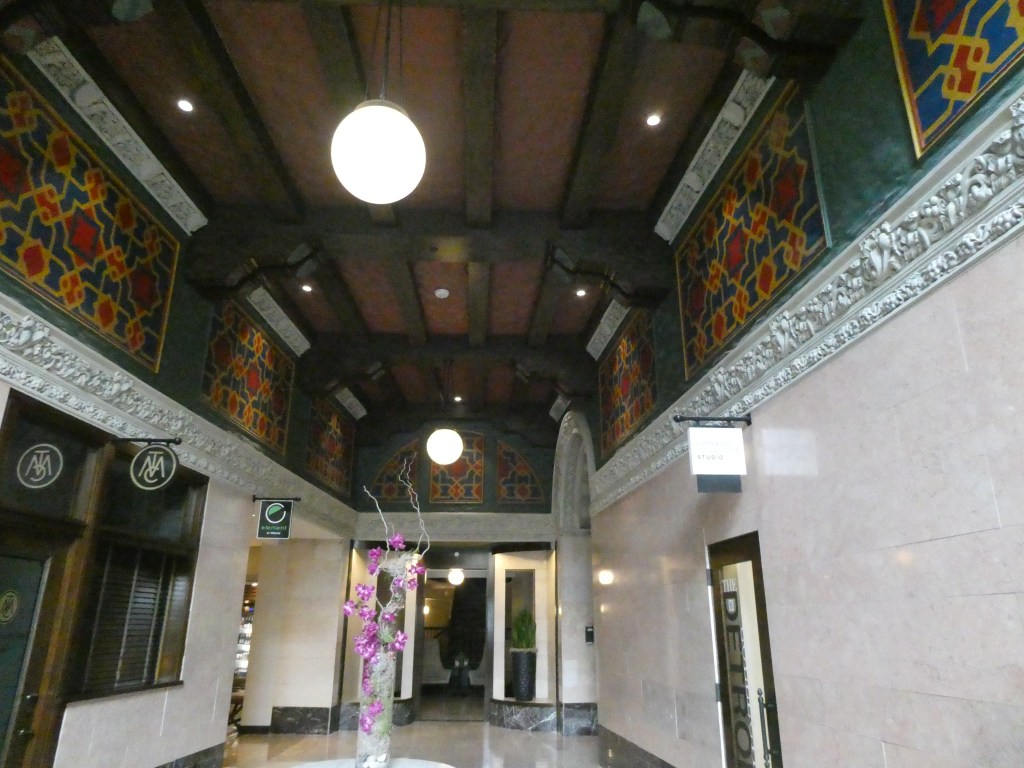
The David Whitney building is an example of the renaissance downtown Detroit has achieved in the last ten years.  Built in 1915, the Whitney building was listed on the National Historic Register in 1983.

Then the bad years happened.

This is the same hallway now.  Well done, Detroit!

The developers for the Apparatus Room took an old firehouse and repurposed it into a great food and bar venue.

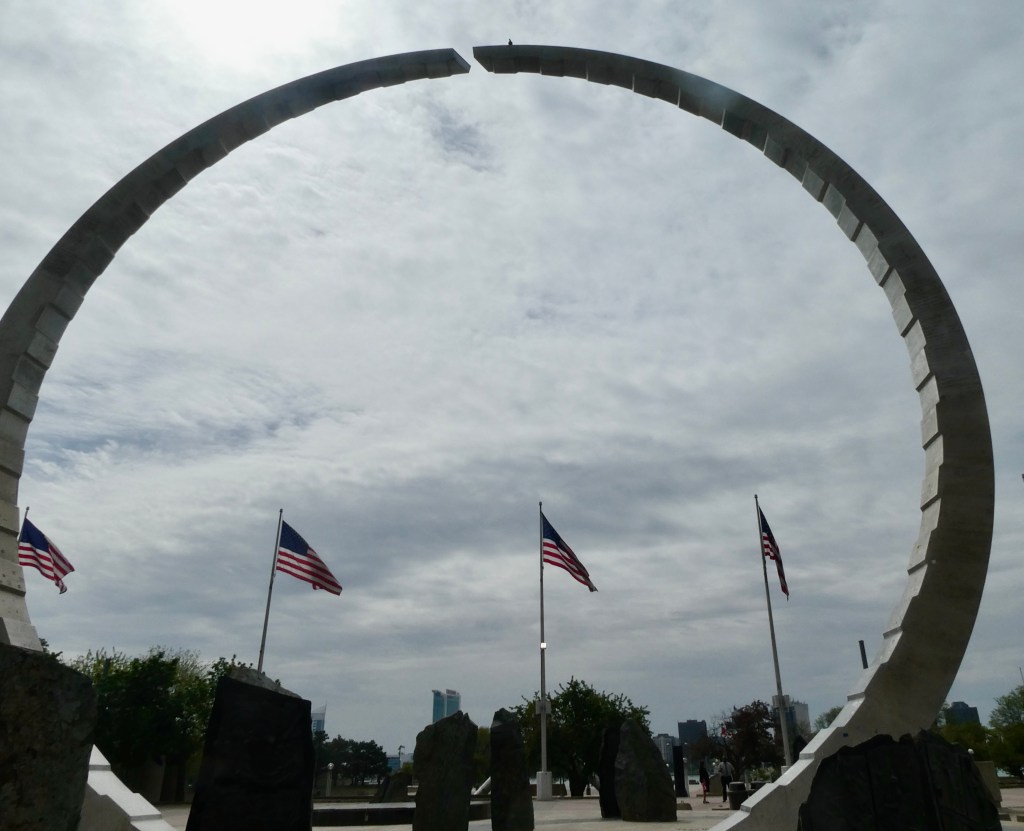
We visited Hart Plaza on the Detroit Waterfront and saw a collection of monuments.

We saw the Transcending Monument – a tribute to Labor.

After departing Montreal in 1701. Antoine de la Mothe Cadillac planted the flag of France and took possession of the territory for King Louis XIV.

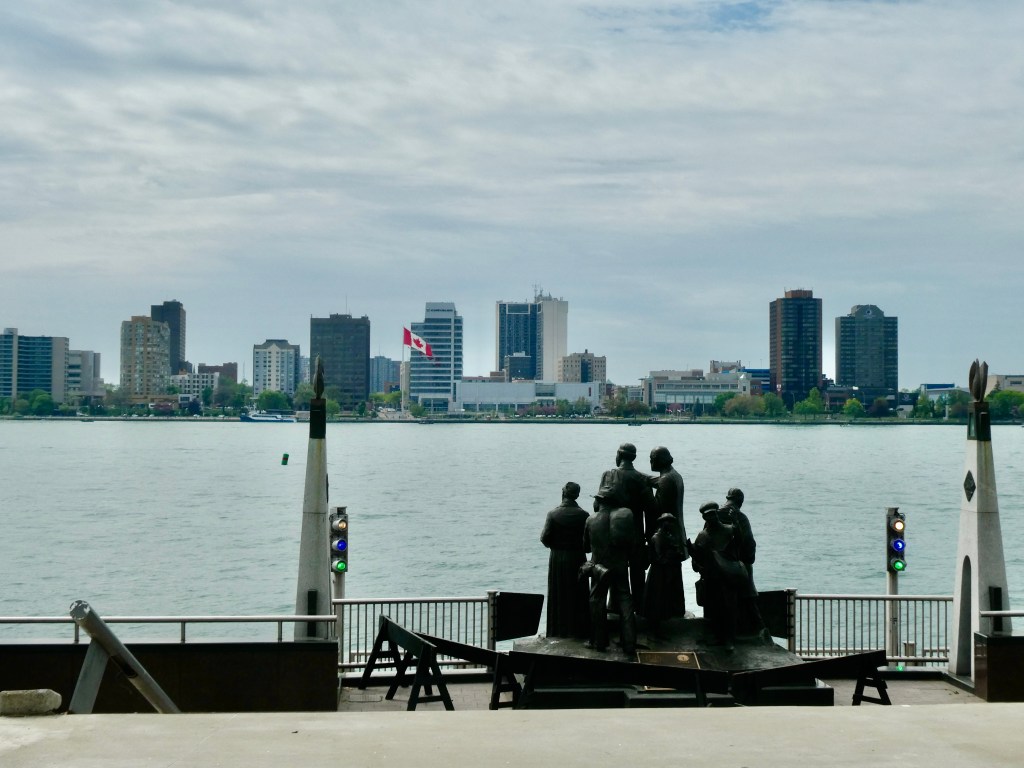
We looked across the Detroit River and saw Windsor, Ontario, Canada.  It really is that close!

This 2001 sculpture is called Gateway to Freedom and commemorates the Underground Railroad.

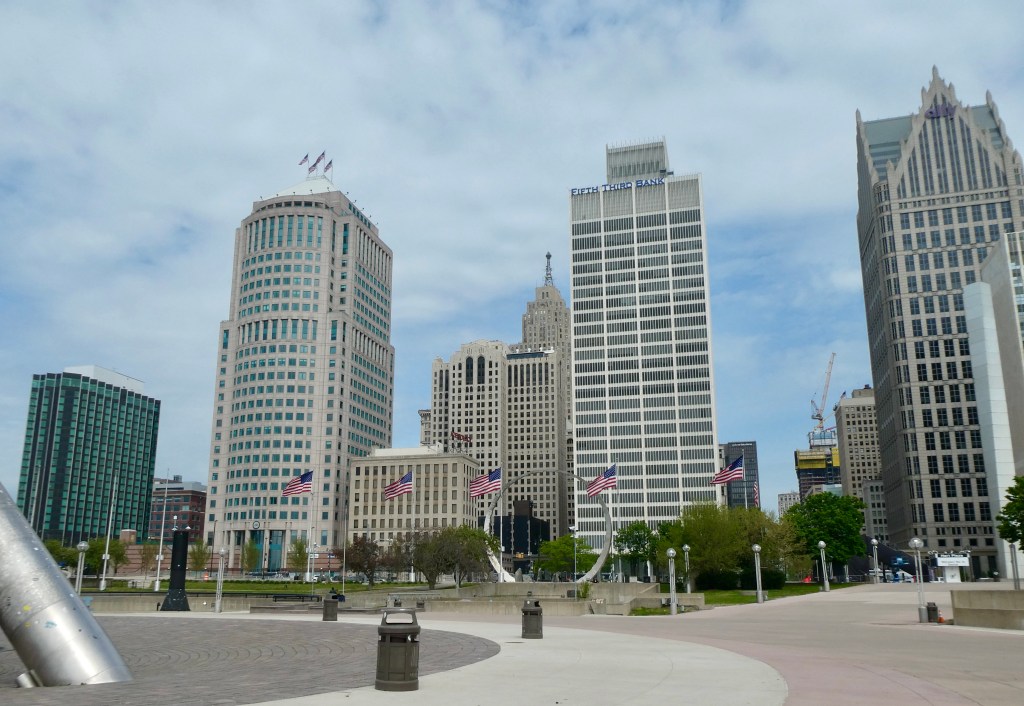
Turning around we could see the Detroit skyline.

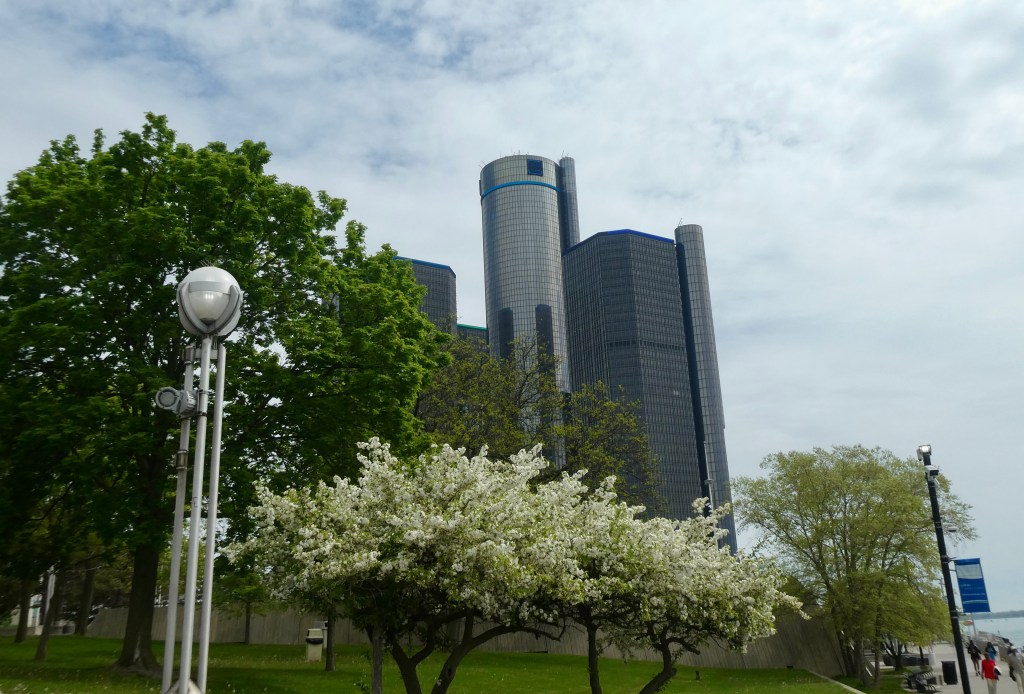
We could see the Renaissance Center – the brainchild of Henry Ford II.  Consisting of several large buildings forming a city within a city, the two most notable owners are the Westin Hotel and the World Headquarters for General Motors.

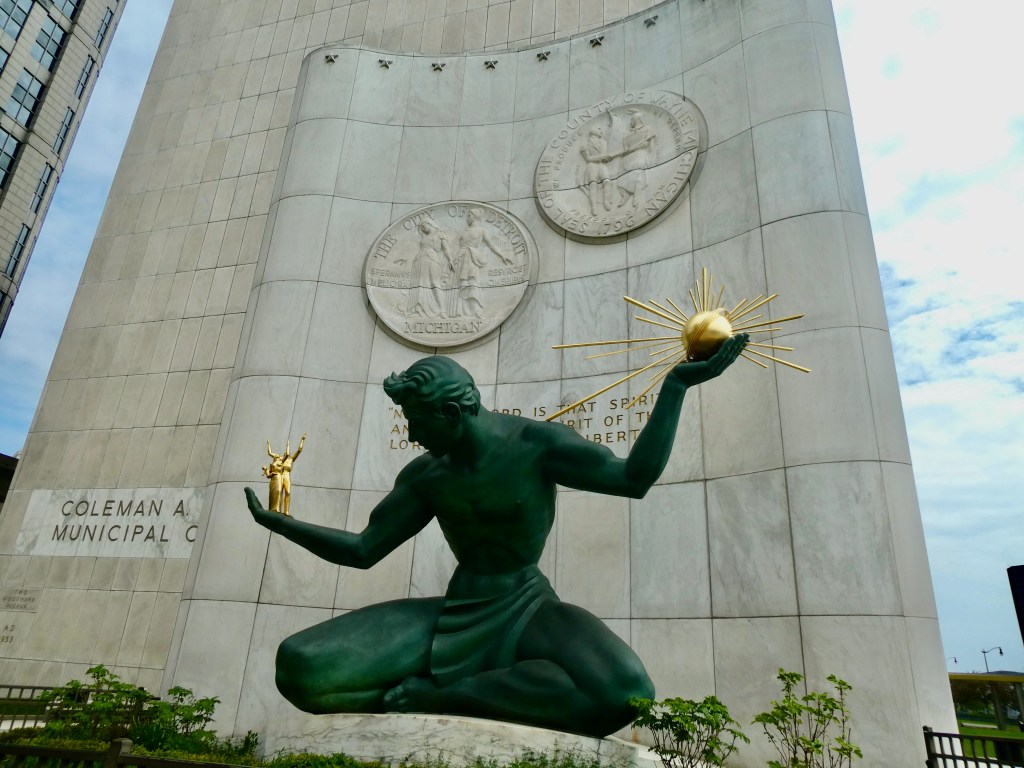
Near Hart Plaza is the Spirit of Detroit.  A tradition is to wrap the statue in jerseys of Detroit sports teams when one makes the playoffs.

As we walked around hearing the stories of buildings and their refurbishment, we learned that new condo buildings must have at least 20 percent subsidized housing.

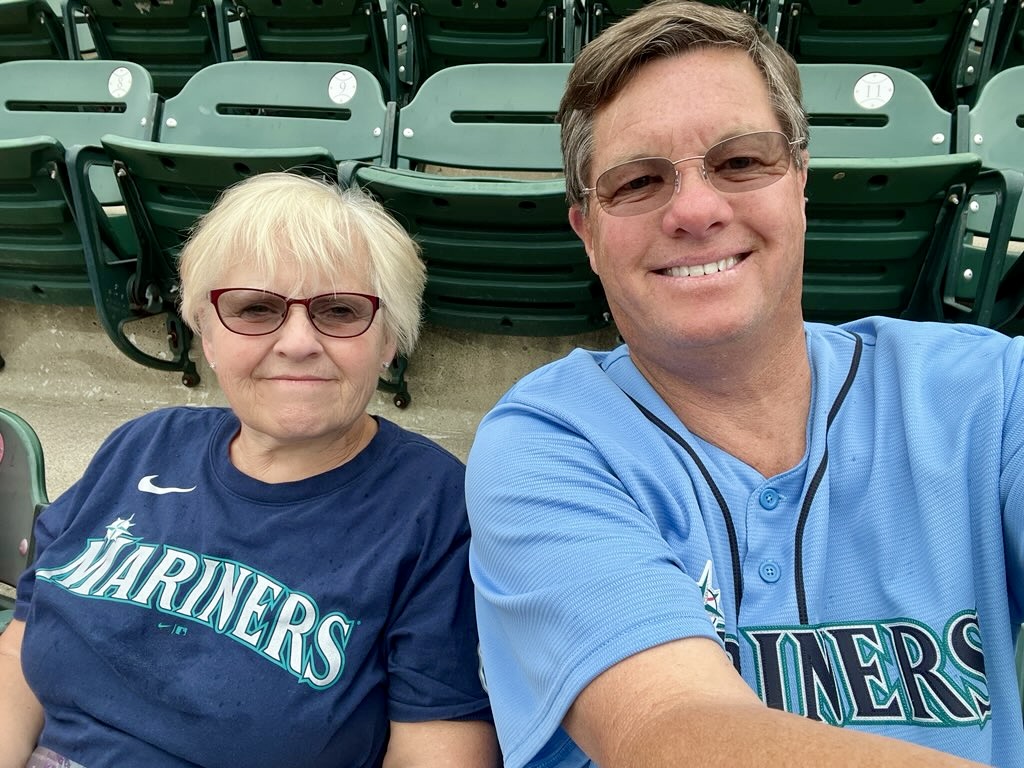
After our tour we were tired of walking and only wanted to sit.  So we decided to sit at another Mariners -Tigers baseball game!  

As we entered Comerica we noticed a marker indicating that the Detroit College of Law was on the site of the baseball stadium from 1935-1997.   The college was the first law school in Detroit, established in 1891.  It began with sixty-nine students including a woman and an African American.  Graduates became circuit court judges, a supreme court justice and an ambassador.  

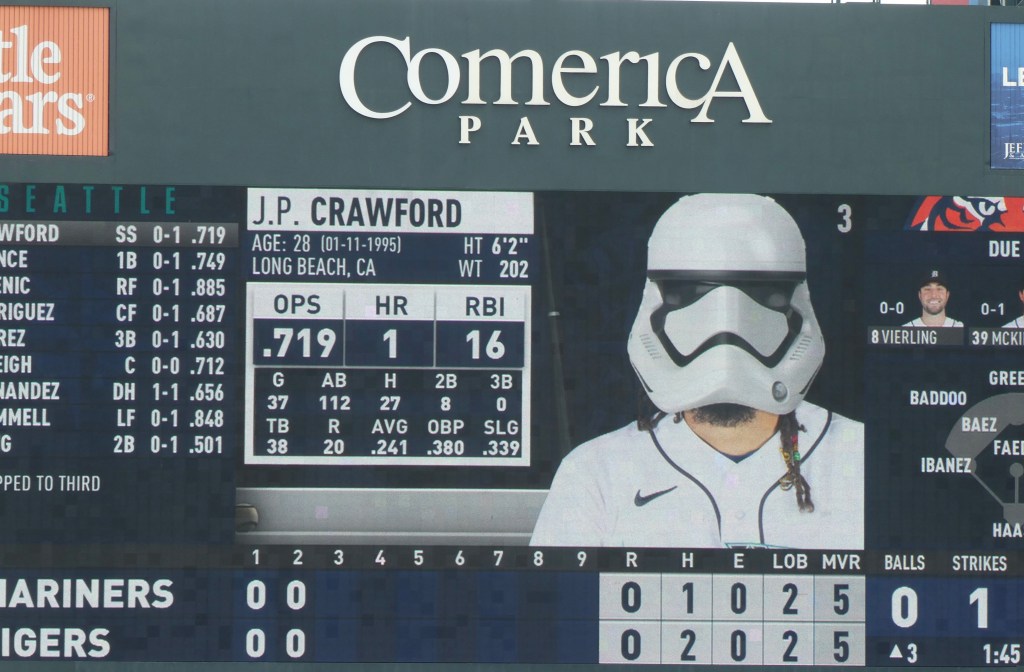
Once inside we found the theme for the day was Star Wars!  There were a variety of activities but we especially enjoyed the way they made our Mariners look like Storm Troopers on the big screen!

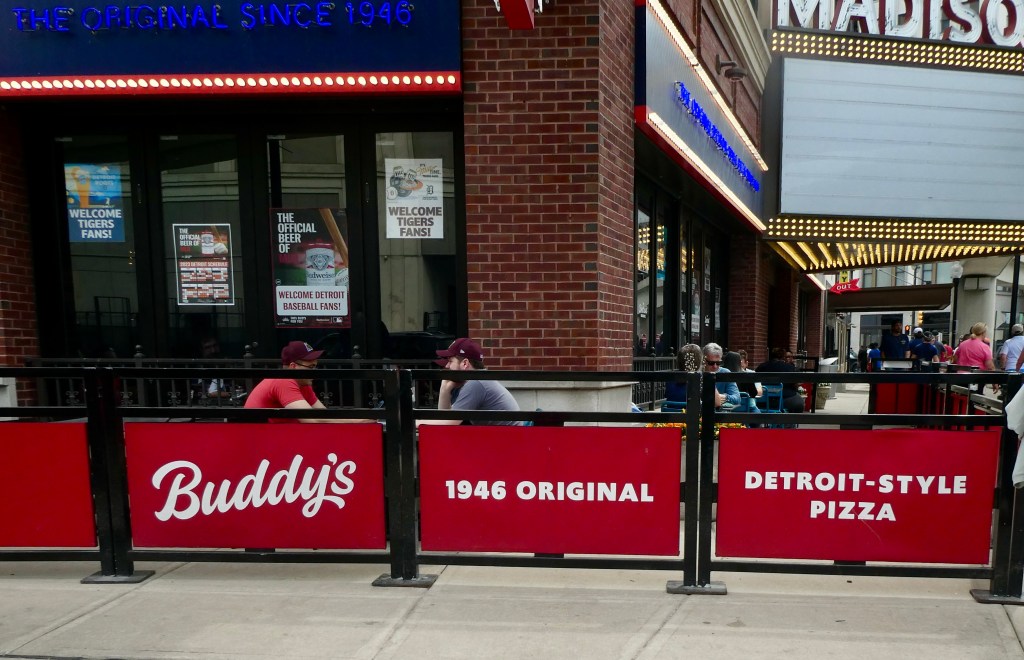
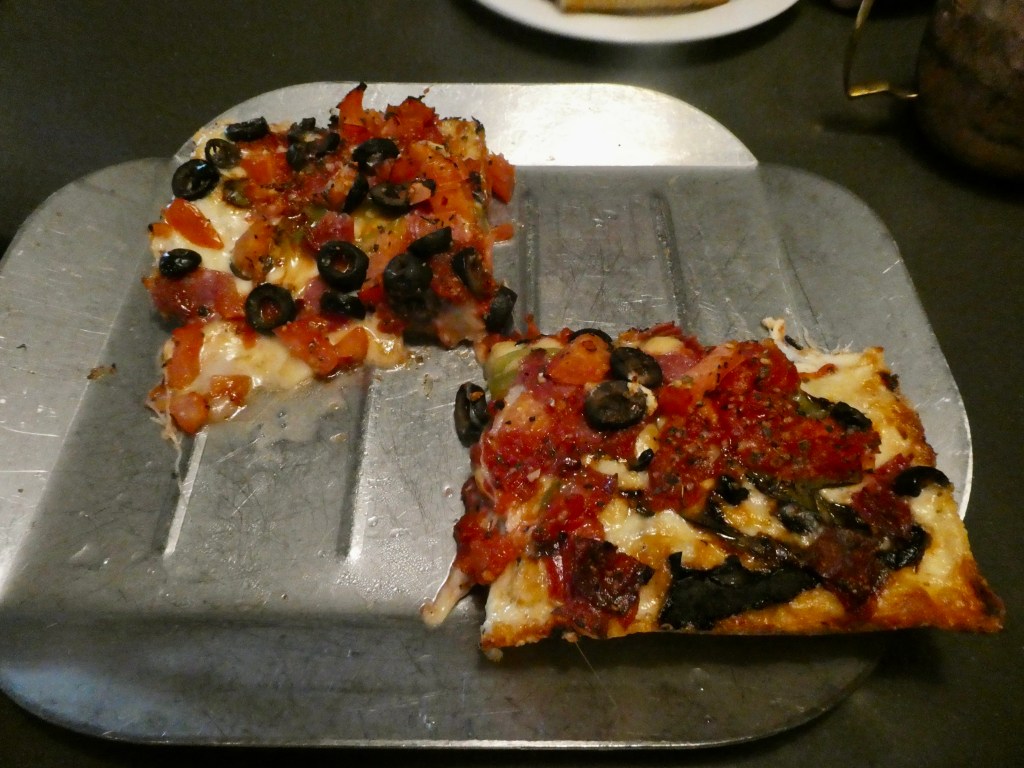
After the game we decided to try out authentic Detroit Pizza.  We had been told that Buddy’s was the original maker but the downtown location was not the original location.

Close enough!

Posted in Uncategorized | 5 Comments

Detroit: An Unexpected Music Tour

If you read our last post, you know that the Motown Museum was our first excursion in Detroit. Tickets were purchased in advance for the earliest tour on our first day.   

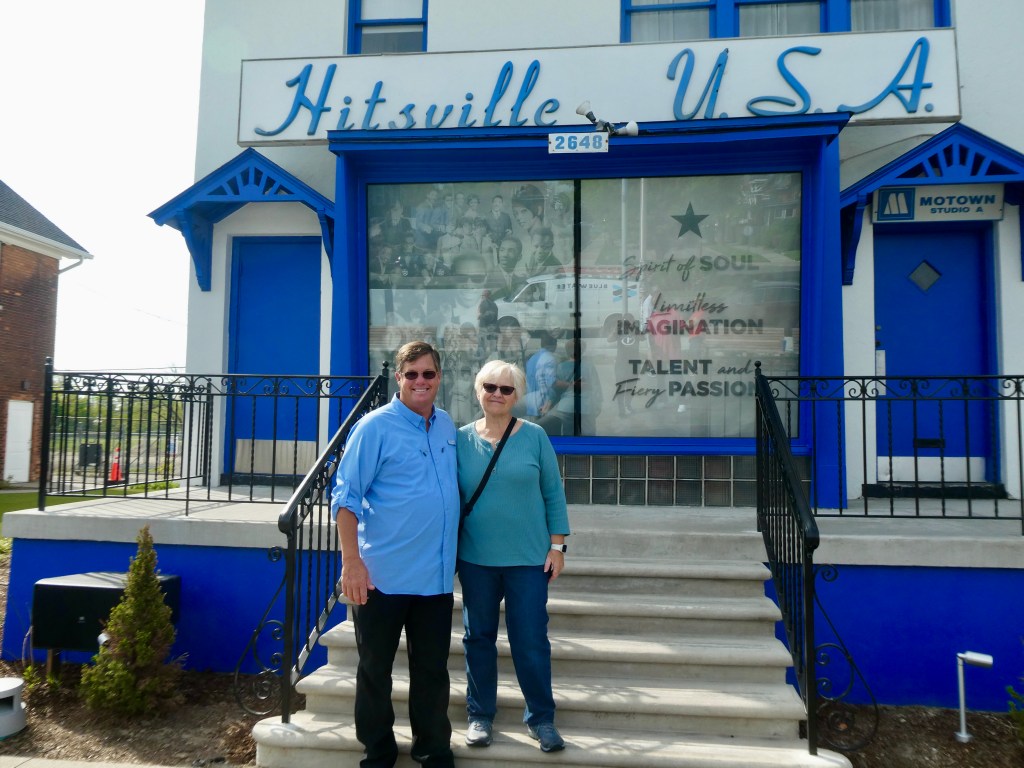
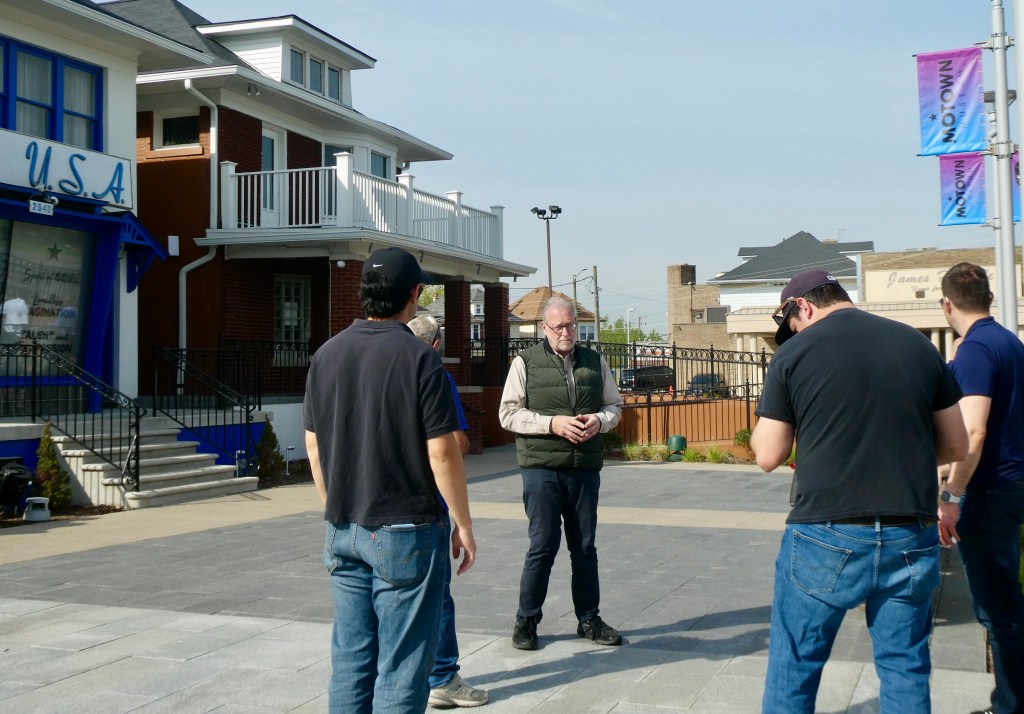
When we arrived, a bit early, there was a group of people prepping for a video shoot in front of the museum.   We asked one of them what was happening and were told that Peter Greenberg, Travel Editor from CBS, was preparing a segment about things to do in Detroit.  We didn’t know of him, but will watch for his segments on CBS Sunday morning.

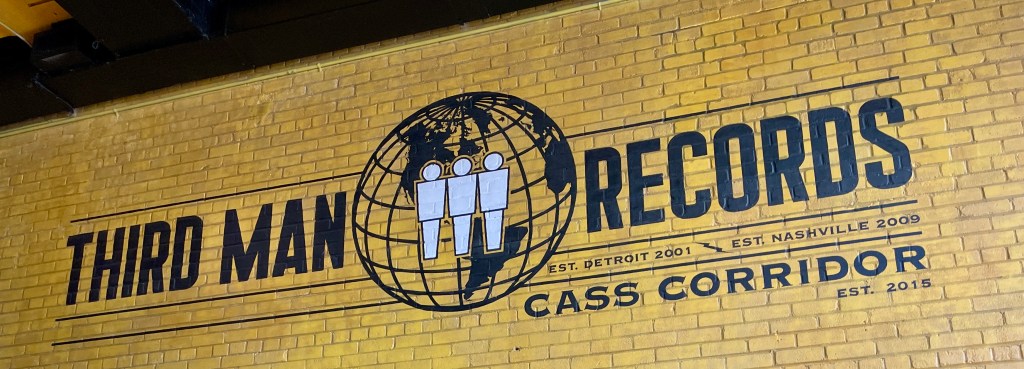
While waiting we asked the same person where else they were highlighting that we might want to go.  He recommended the Third Man Records Tour that they had done the previous day. 

A person from the Detroit Tourism Bureau was also there and genuinely thanked us for coming to Detroit.  He approved of our general list of coming attractions and recommended that we also go to Buddy’s Pizza, home of the original Detroit Pizza.  

We had places to go and an afternoon free before our first baseball game. I was able to get tickets on my phone for the Third Man Records tour and we were off.

Jack White grew up in Detroit and is a singer and songwriter who performed with his wife in their band called White Stripes.  They performed together during their marriage and for a time after their divorce. Eventually he went on to a successful solo career. (If  you haven’t heard of him – I hadn’t either – but I was definitely in the minority in Detroit.   Randy knew of Jack White  but listens to a lot more music than I do.)

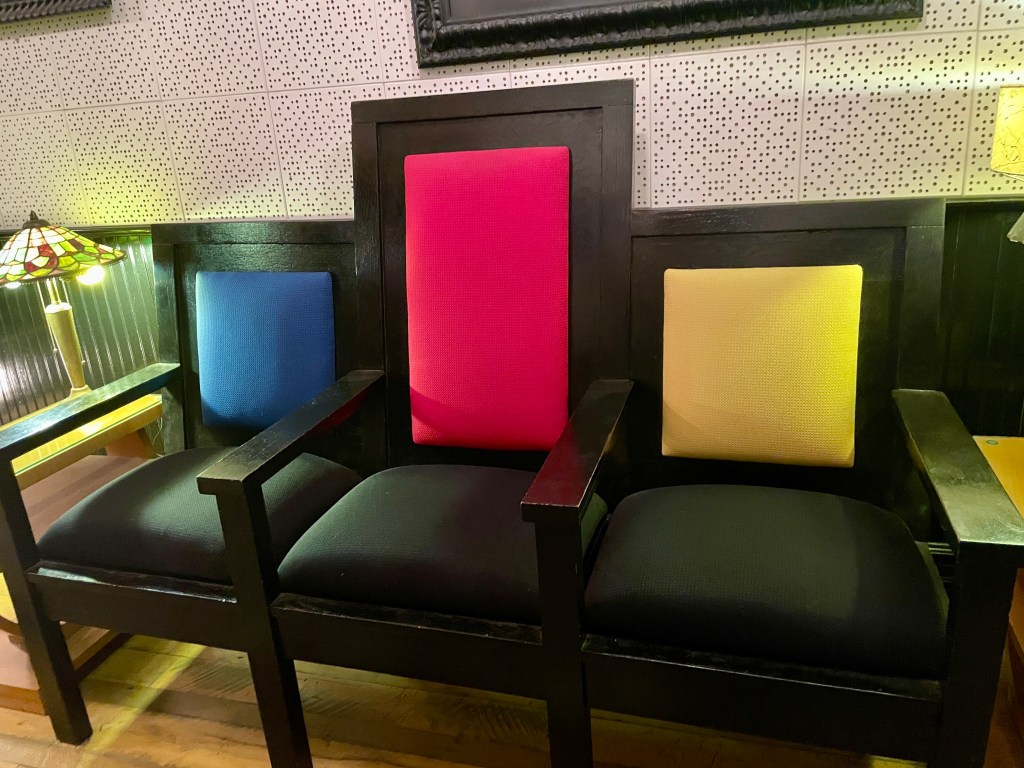
Jack White formed Third Man Records to allow him to press his own music onto vinyl.   He called it Third Man because, prior to making his career music, he supported himself by doing upholstery.   At that time he was the third upholsterer on the street.  

He upholstered this bench for the business as a tribute to his past.

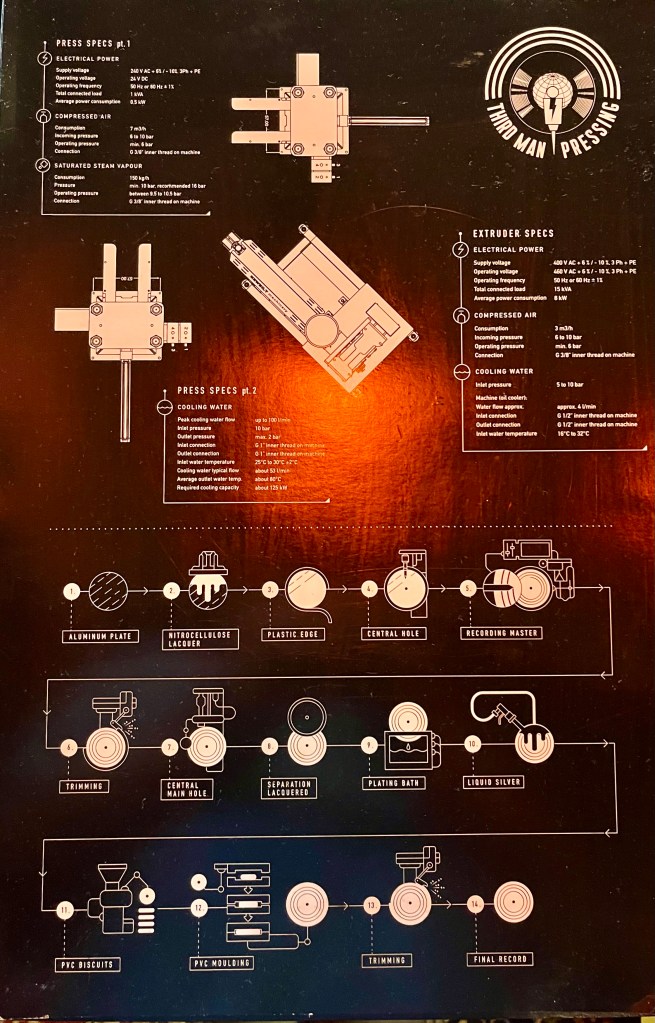
Jack White records to tape and then produces his vinyl records. Over time others asked to have Third Man Records produce their records.  

Taped recordings are digitized through a special computer.  

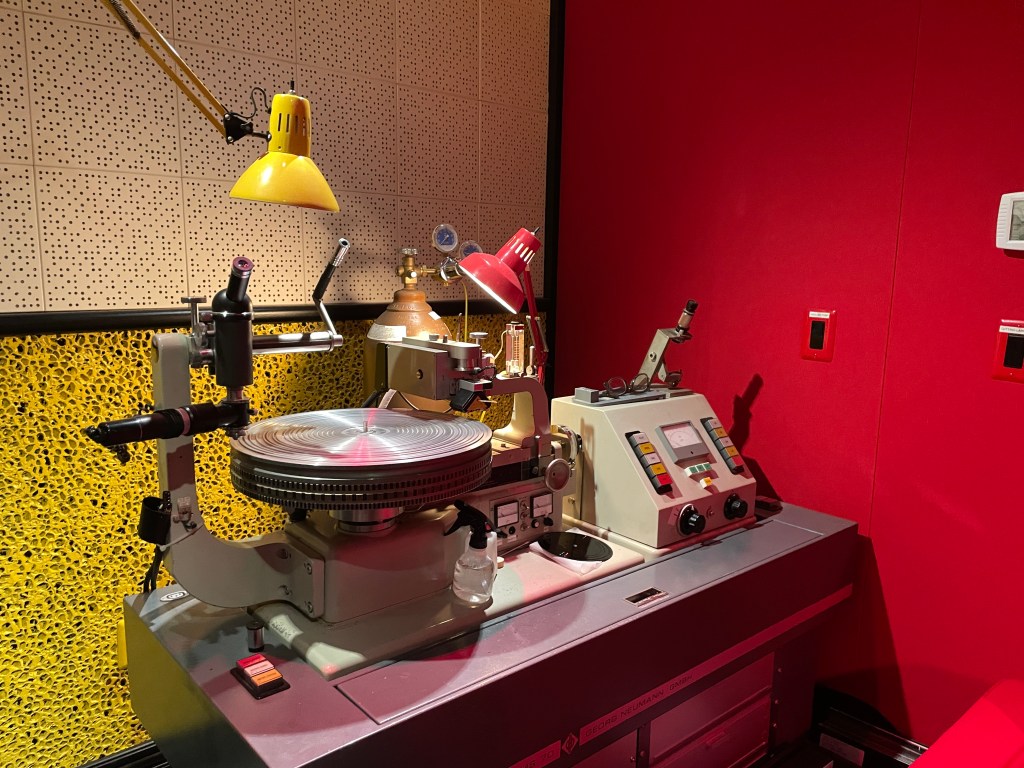
A lathe produces the master stamper.    These lathes are very rare because vinyl records had their time decades ago and is only recently having a resurgence. This 1970s lathe was purchased from a German sound engineer and he and his group came to Detroit to train Third Man Records engineers on its use.

They have also been contracted to do vinyl reissues of earlier albums.  The master tapes, with more advanced technology available today, allow the new listener to hear aspects of the music that previous technology did not produce. 

Some musicians (including school groups) are allowed to perform live and go directly to vinyl.  Those records include all the quirks that can happen in a live event.  

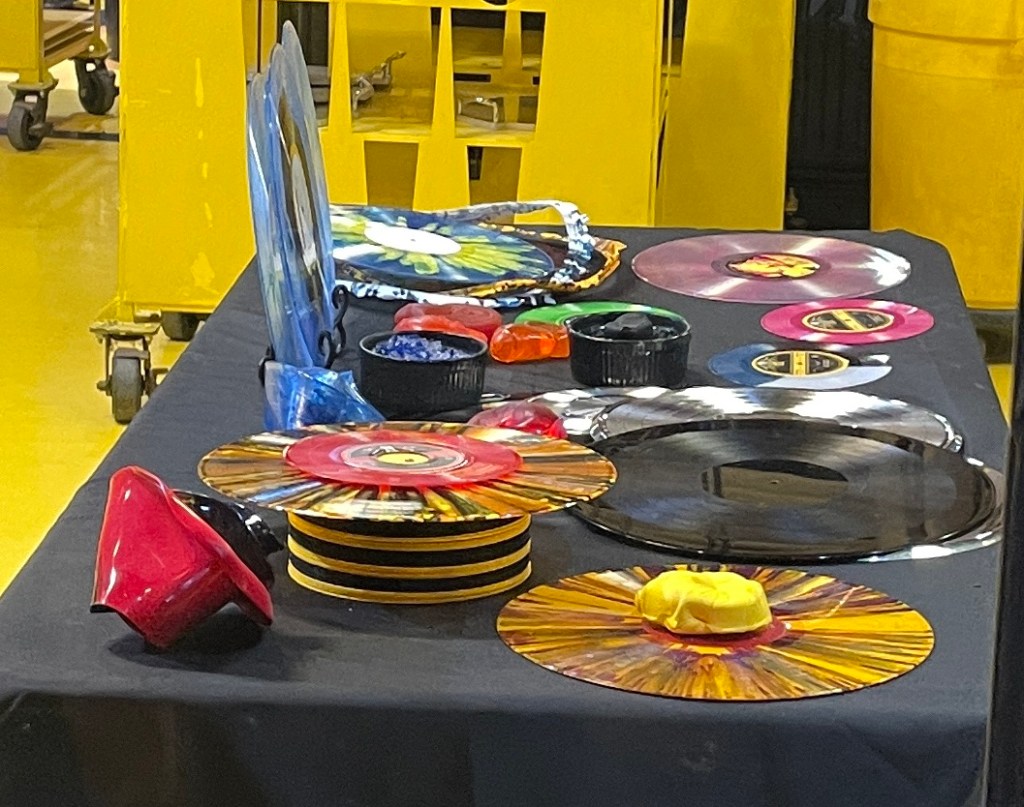
Third Man Records allow the artist to choose custom colors and designs. Price adjusted for complexity!

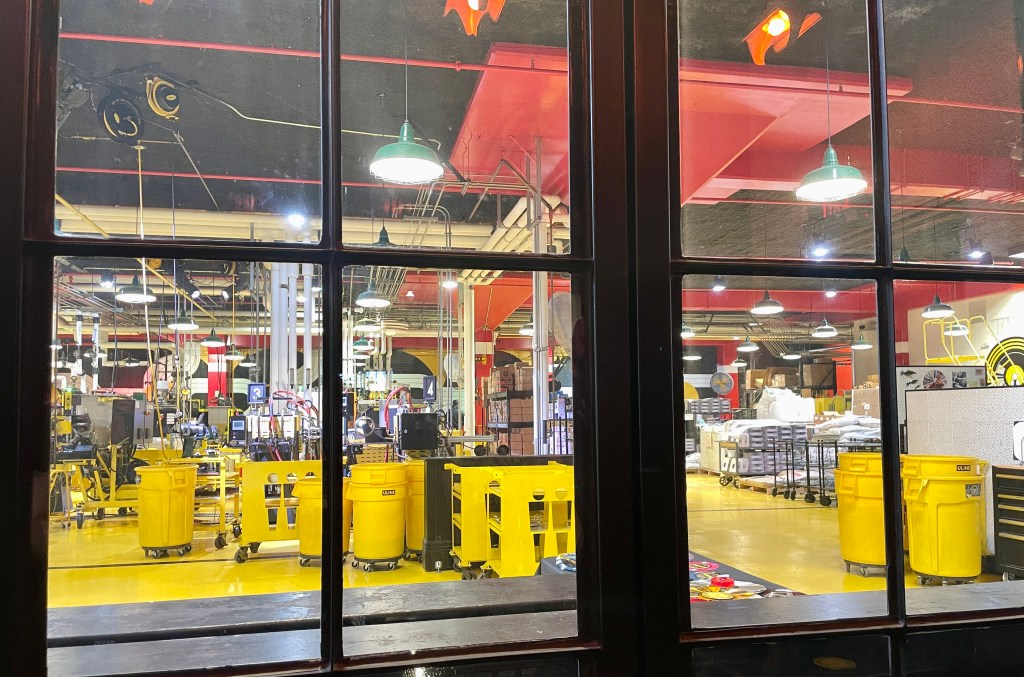
Pictures were not allowed while we were in the factory, but we stood for a while and watched two people complete their part of record production. They began with an orange colored composite chub – roughly the size of a tennis ball.  A second person kneaded color pellets into the chub.  It was then pressed and the musical track stamped onto the vinyl.  When the record came out of the machinery it was an orange disc with a starburst of contrasting blues and purples expanding out from the center.

Eighty employees produce 10,000 records per day. Not all are as highly customized as the one we observed.  We saw other options that were single color, or split colored.

We were told that black vinyl has always produced the best sound but the development of new composites has narrowed the gap in quality to be almost insignificant.

Every single record goes through audio and visual quality control and 95 percent pass.   We saw individual records being put into their covers one at a time. That process is not automated.

If I’ve given you enough (or more than enough) detail – read on!  If you’d like more of the science and technology behind stamping vinyl records,  I found this very good 7:00 minute video filmed on the Third Man Records site.  Access that video here

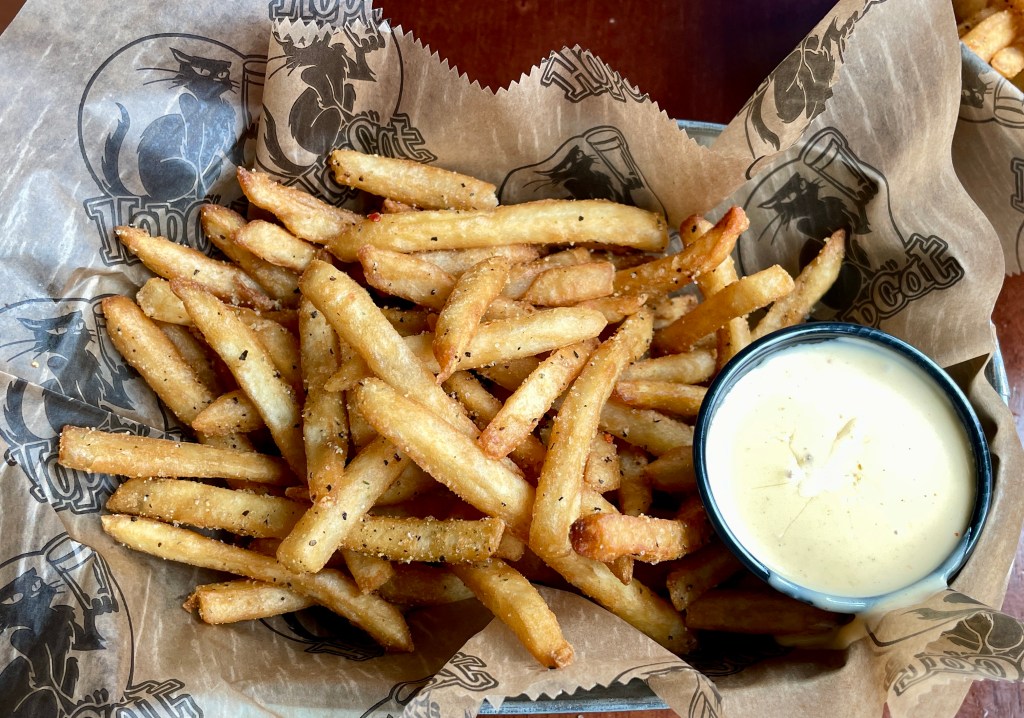
After our tour we went to a nearby restaurant called Hopcat. It had been recommended by our dinner waiter the night before..  Hopcat was ranked #21 of 591 restaurants in Detroit on Trip Advisor, so seemed worthy of a visit.

We saw on the menu that Hopcat has French Fries ranked in the Top 10 in America by the Food Network Magazine so of course we had to try them. 

Yes, they were good!

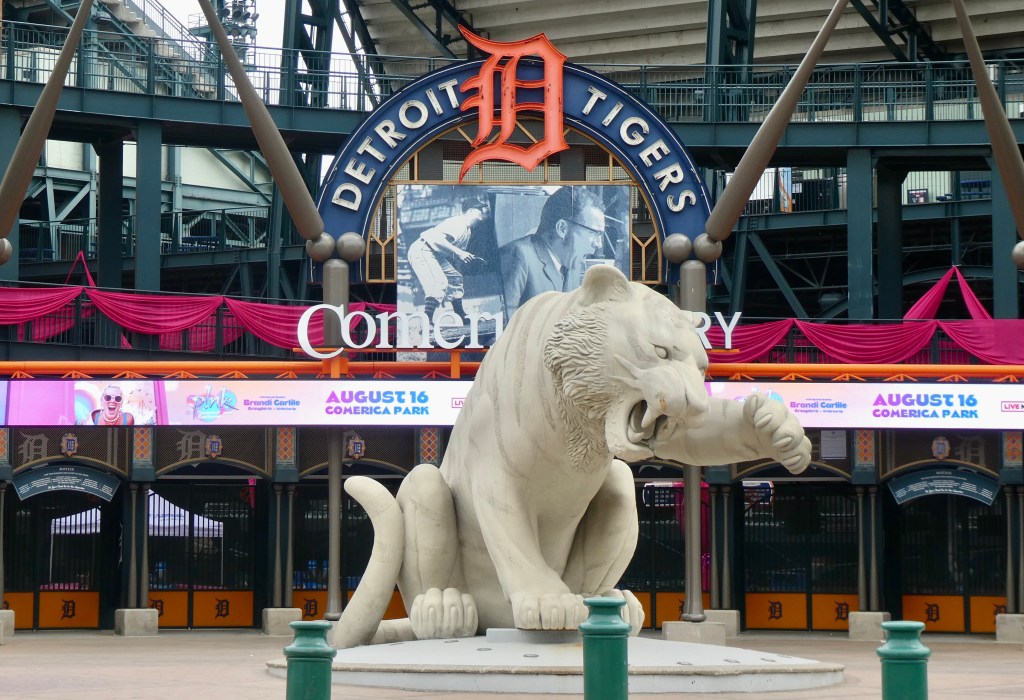
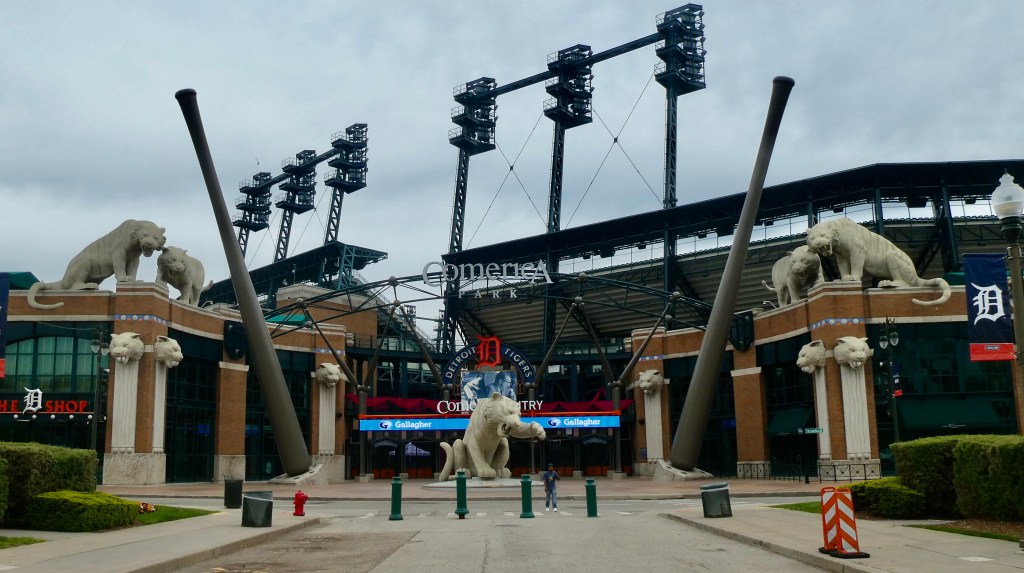
After lunch we made our way to Comerica Park to take some pictures before the game. 

In a couple hours we would be there watching the Seattle Mariners play the Detroit Tigers.  

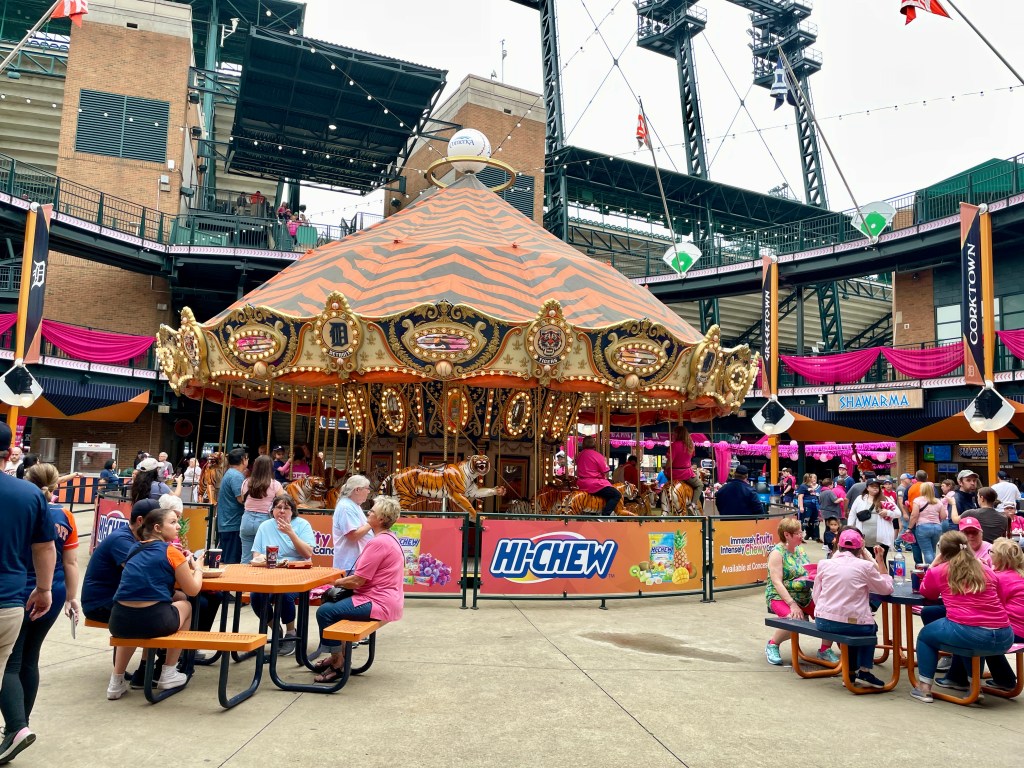
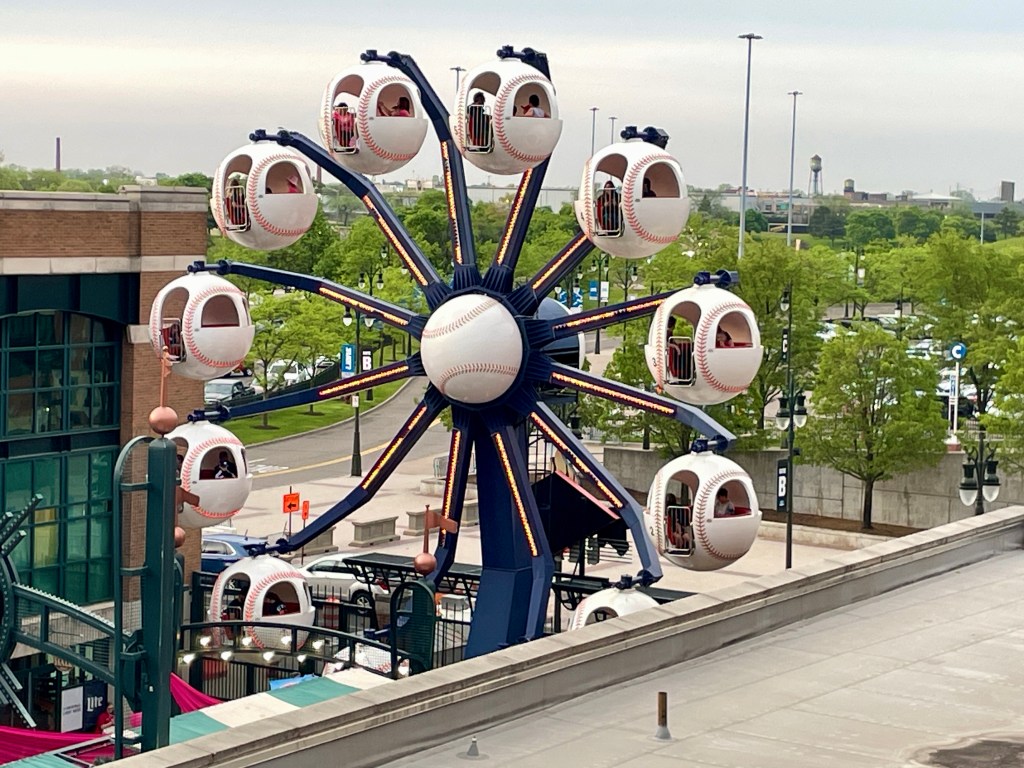
Comerica park opened April 2000 costing $300 million and includes an impressive front entrance, a carousel and ferris wheel.   

There was a statue of Ernie Harwell, a major league baseball sportscast for 55 seasons. Forty two of those years were with the Detroit Tigers. 

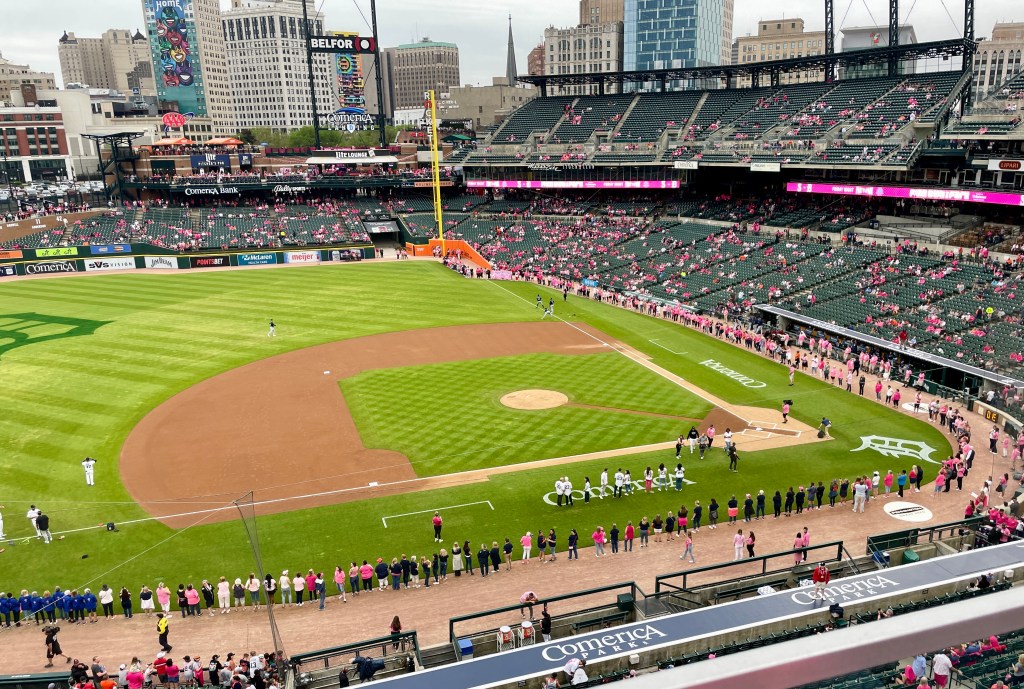
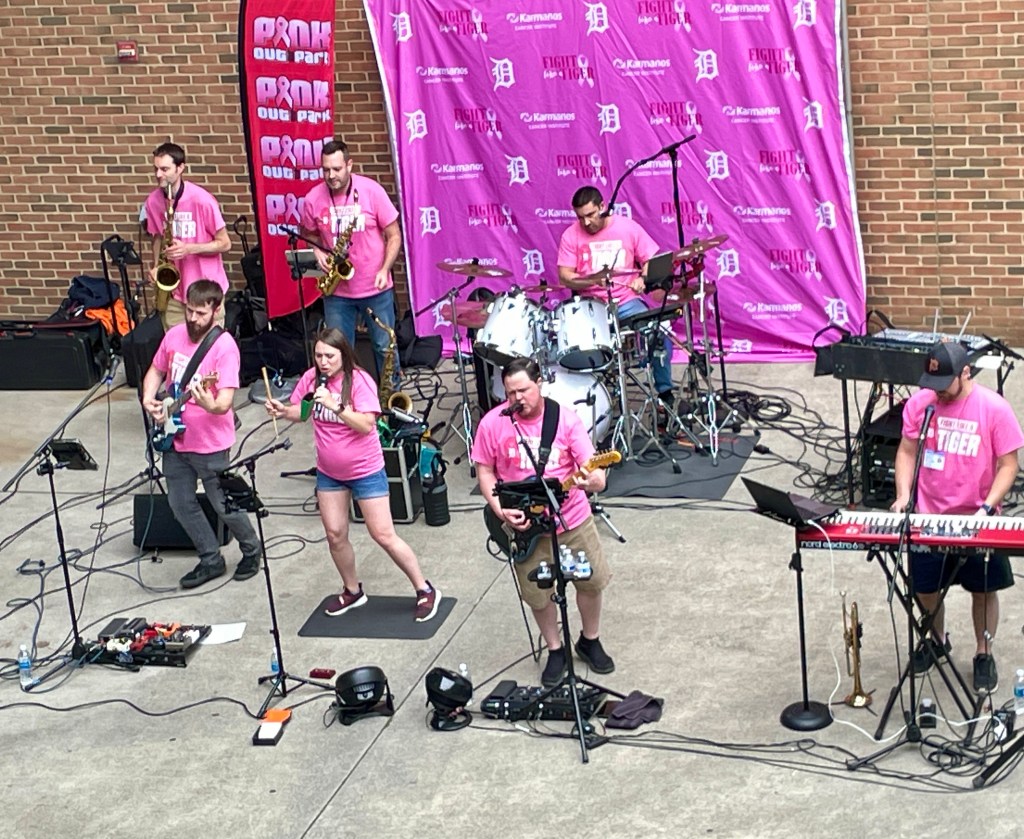
It was Pink Out the Park night highlighting the fight for a cure for breast cancer.   

Before the game hundreds of women who had experienced breast cancer walked around the field.  A woman seated next to us said that she may only go to one game a year but that game is always the Pink Out the Park game.

We all received a pink pullover and experienced a variety of events.  

Both teams and the umpires held signs for women they knew impacted by breast cancer.

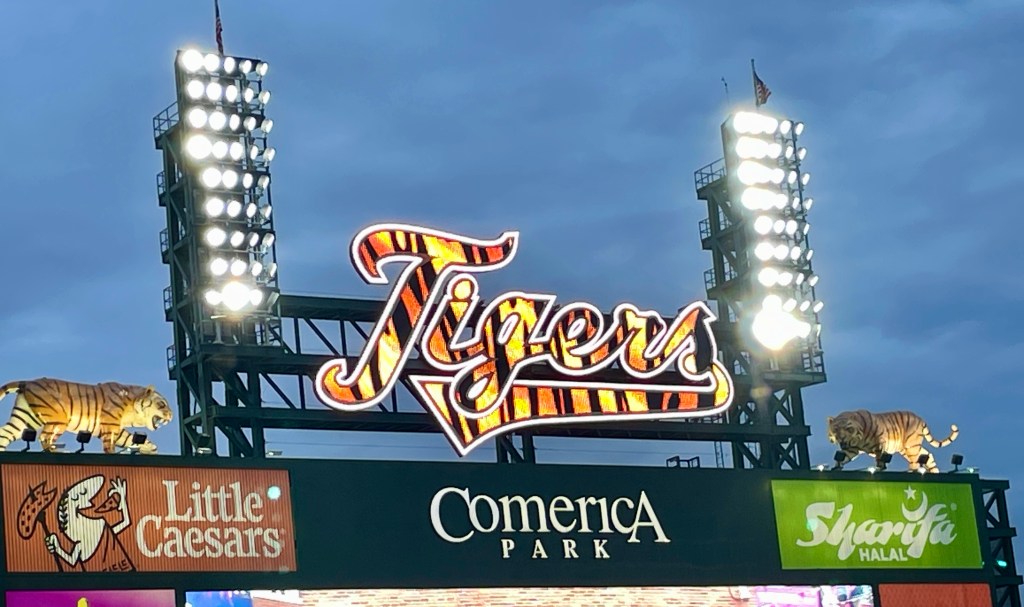
If you notice the Little Caesars advertisement on the video board – their world headquarters are in Detroit just a few hundred yards from the stadium.

One interesting deficit (in our opinion) of Comerica is that they do not post out of town scores on any of their boards.   We have seen those scores in every other ballpark we have been in.

The Mariners won game one of the series.

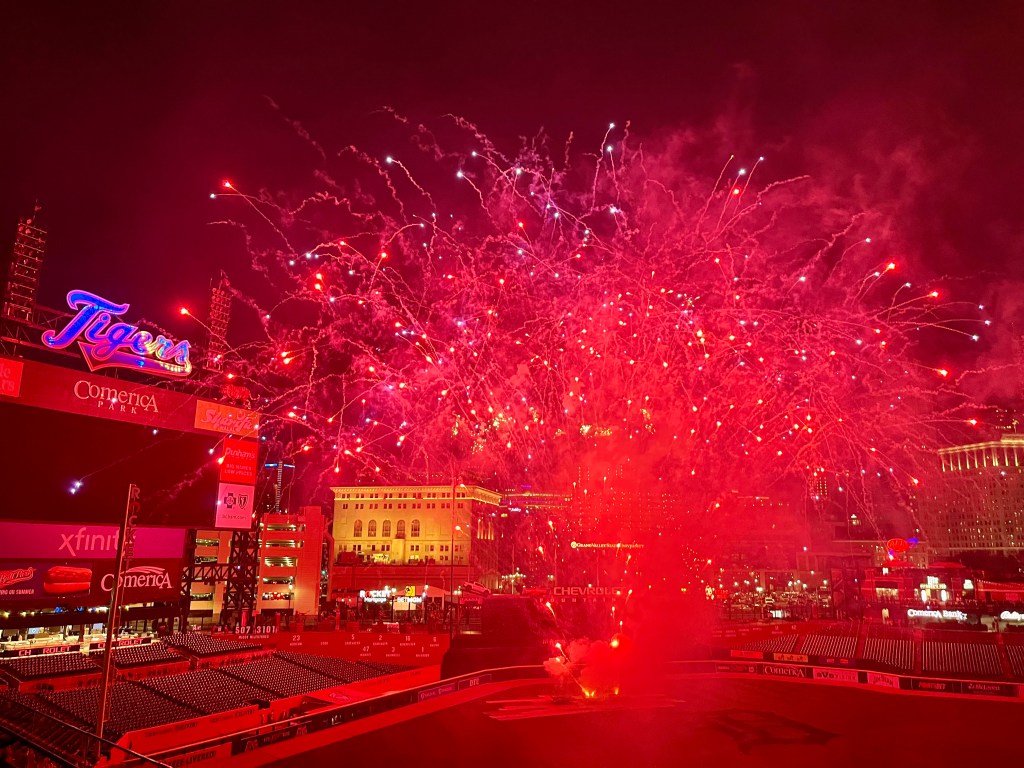
Fireworks at the stadium concluded our first day in Detroit. We had a short walk to our downtown hotel.

Next up:  We go on an Architecture Tour of Downtown Detroit and have authentic Detroit Pizza at Buddy’s.

Posted in Uncategorized | 1 Comment

Detroit? Yes, Detroit!

We had some interesting looks when we said we were going on a trip to Detroit.  By choice – on purpose. The idea started when I looked at the Seattle Mariners schedule to see where they would be playing in May that would be new to us, somewhere we hadn’t already been. That would be Detroit.

We thoroughly enjoyed our Nashville experience with country music, and thought learning about the Motown Sound could be great too.  We expected that we would recognize Motown music and artists more than we had with country music.

Someone recommended we watch the documentary Hitsville about the people and process of Motown before we went.  Hitsville was only available on Showtime which we do not have. I had to start a trial subscription and then download the movie on the iPad. We took turns watching it on the plane to Detroit.  

Hitsville was worth every inconvenience and we recommend it – even if you aren’t going to Detroit!

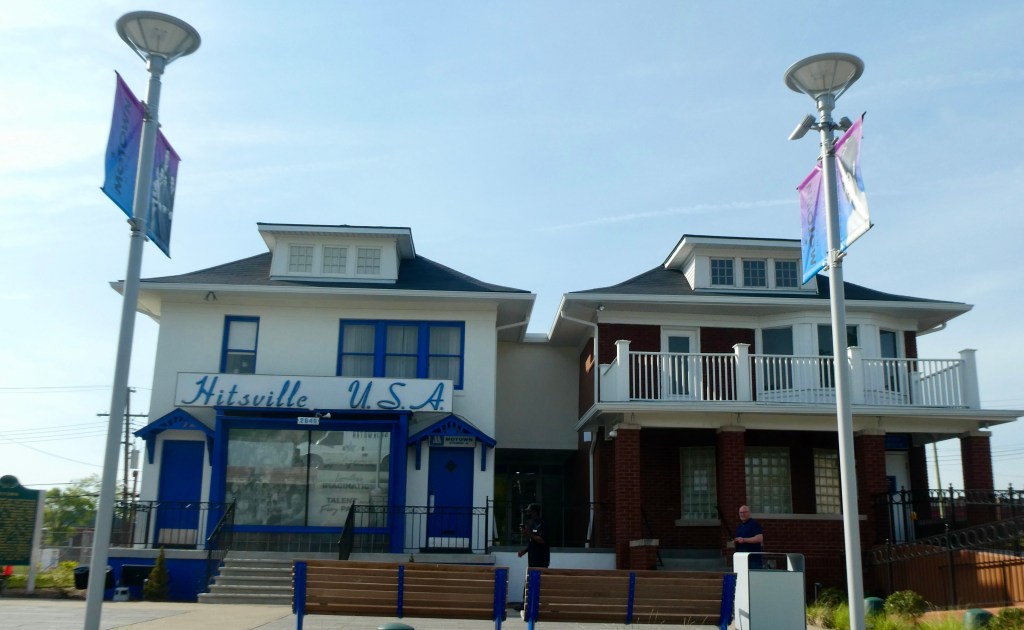
We went on the Motown Museum Tour our first morning in Detroit.

Hitsville and the short movie we began our tour with had segments with many people but the primary hosts were Barry Gordy and Smokey Robinson   (It was fun that we had just seen Smokey in Nashville in December.)

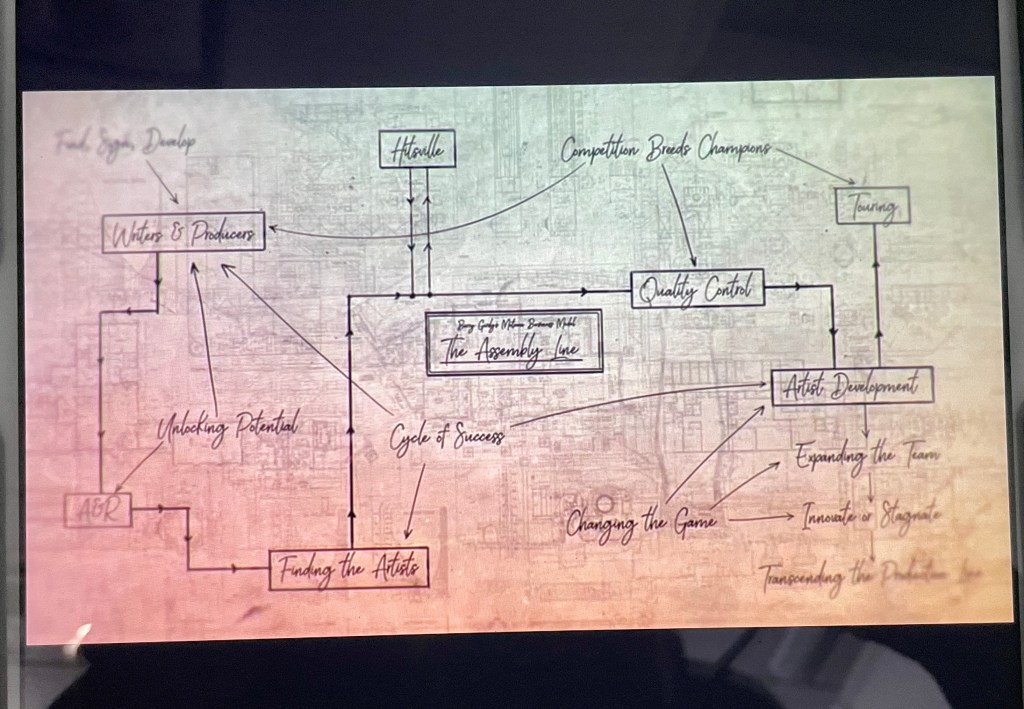
Barry Gordy based his design development for Motown using the experience he gained working on the Ford assembly line.  He envisioned a process that included Finding the Stars, Unlocking Potential, Writers and Producers, Quality Control, Artist Development and Touring.  Underlying foundations would be Competition Breeds Champions and Innovate or Stagnate.

Barry Gordy’s parents and siblings had a family savings club.  Each family member was expected to contribute.  When money was needed by one of the family,  a request was made and a response determined.   Barry requested a $1000 loan, and was granted $800.  
Barry Gordy’s wife found the house that became the Hitsville studio and later it and the one next to it became the Motown Museum.   

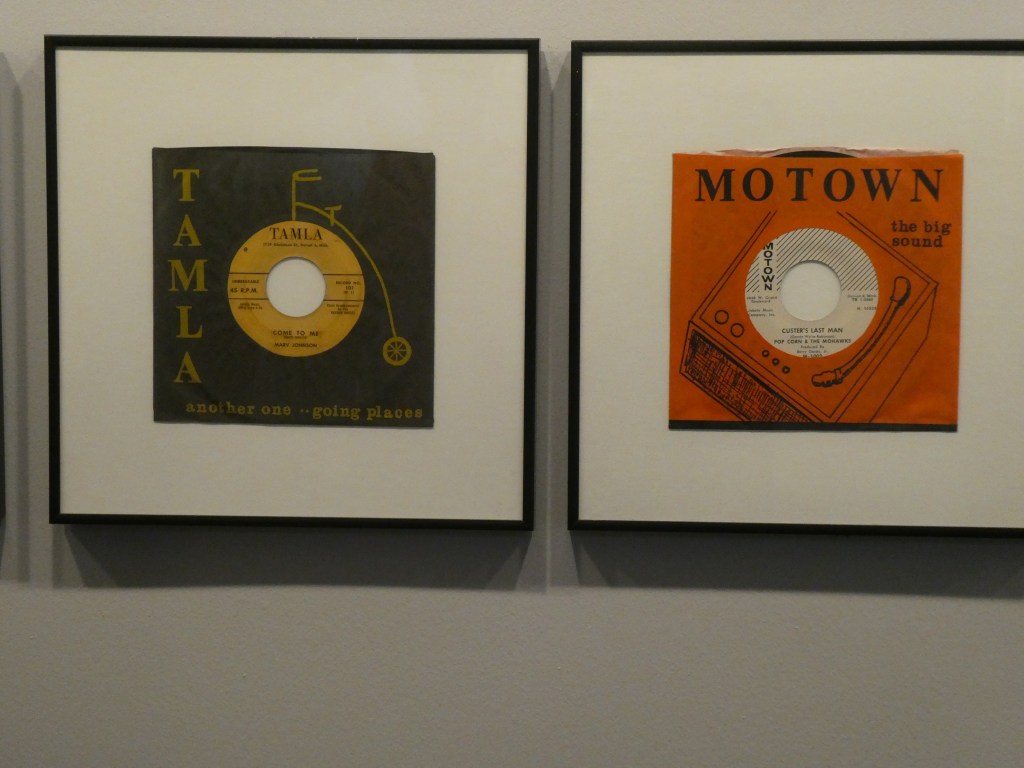
One of Gordy’s first collaborators was Smokey Robinson. They released “Shop Around” under the Tamala label in 1959. The song was out there doing okay, but not great.  Gordy called Smokey at 3:00 am suggesting a redo.  It became their first major hit and big seller.  That also began the tradition that the Hitsville studio was always open because you can’t time creativity.
Gordy switched the name of the label to Motown in 1960 in a nod to Detroit as the Motor City.

Smokey Robinson was a primary songwriter and wrote for many of the Motown stars.  The songwriting team of Holland-Dozier-Holland was also writing for many of the Motown stars.  

The studio took responsibility for finding and creating hit songs for their artists.   

Southern migration for jobs in Detroit factories led to many gifted musicians being in Detroit. After hours, they played in clubs and churches.  The Detroit public schools had a strong music program which developed more musicians.   Hitsville gave them a place to gather.  It was a once in a lifetime musical event from 1960 – 1972.

Barry Gordy hired the best people he could find and key positions were held by men and women, black and white, and also those of Jewish faith. 

Gordy used talented Detroit jazz musicians as his studio musicians. These musicians were already gifted at improvising and playing without written music. The group was known as the Funk Brothers.

The studio and its artists could shift and change things anywhere along the process because everything was done in house. 

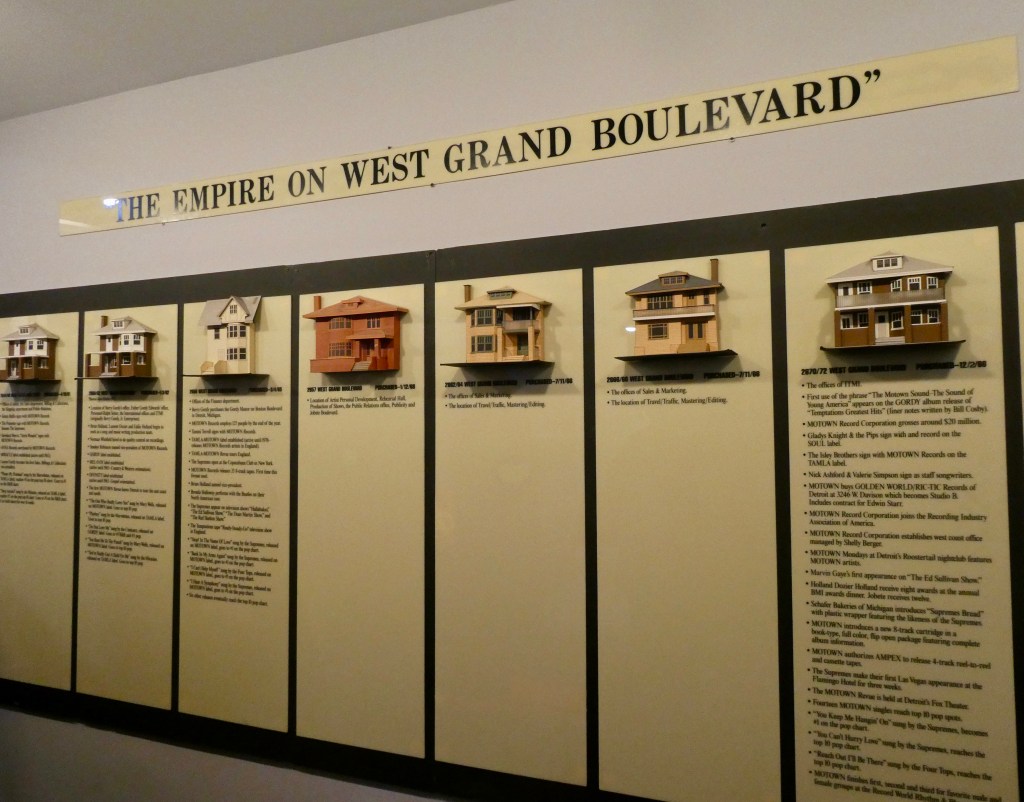
Over time the Motown studio purchased eight homes for various aspects of the business.

The Motown Museum owns six of them.

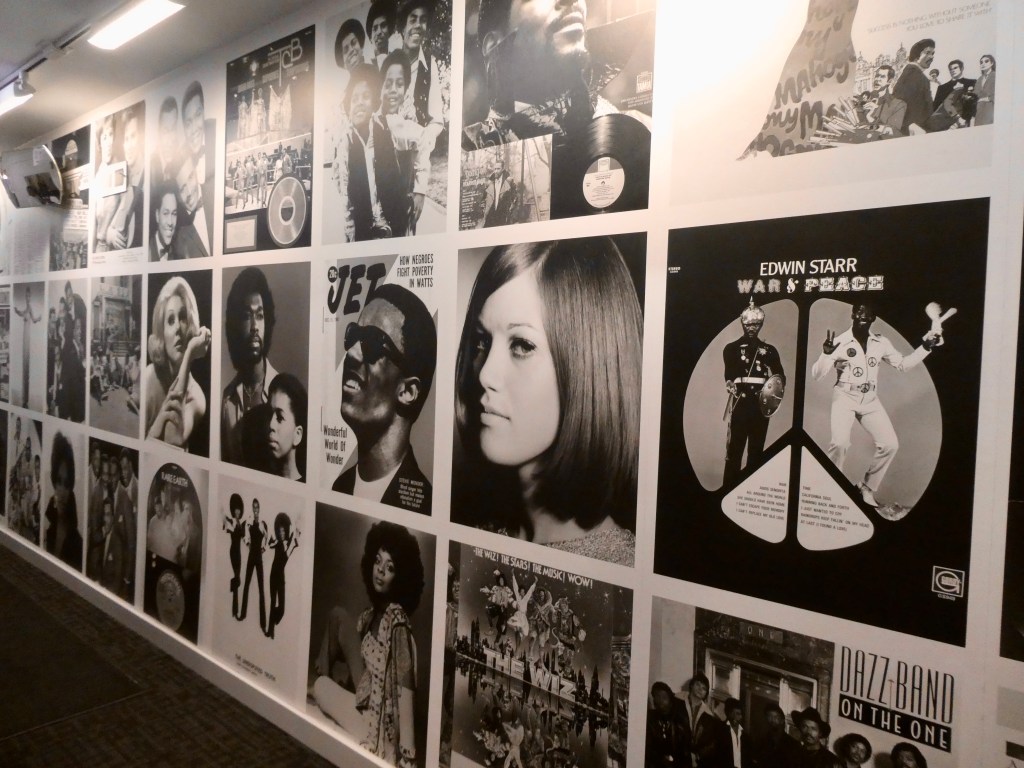
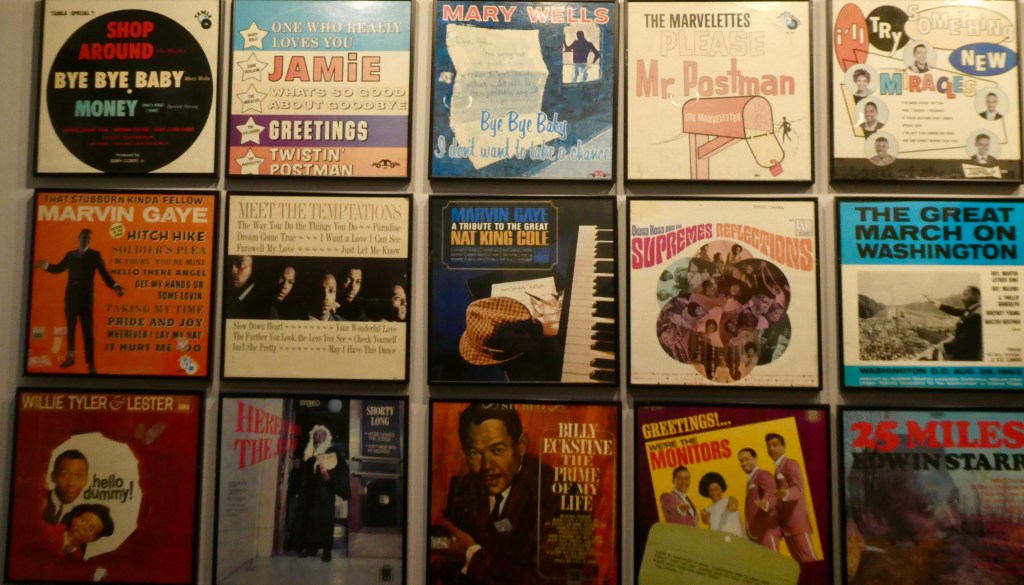
There is a wall in the museum that has copies of many Motown albums.  Our guide told us that the first four albums released were without artist pictures. Gordy knew the music would appeal to all people but he first needed them to be willing to listen. That was more likely to happen without them knowing an artist was black.

The process of choosing to release a song was a collaborative effort.  A quality control group decided whether they thought a song was a hit. They asked each person, if you only had one dollar left to your name, would you spend it on buying the song?  If not, the song was abandoned or tweaked. Gordy found that the collective competition sharpened their tools but didn’t dampen the love and cooperation.    

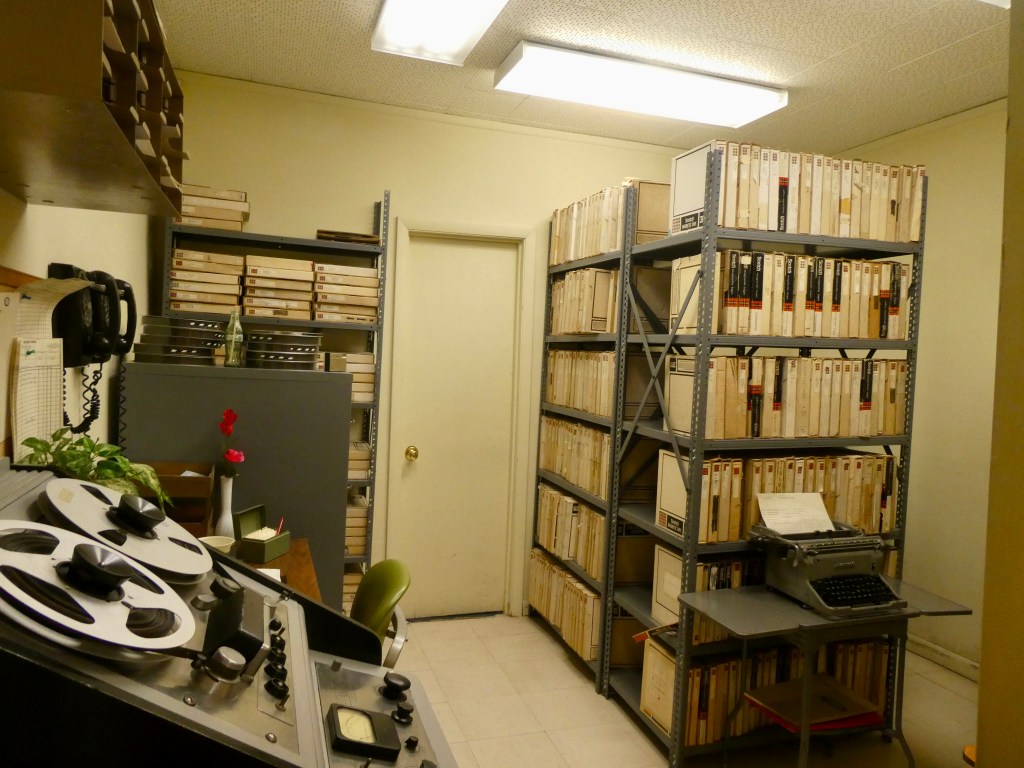
Motown was a collective, collaborative success. These are the tape masters for many of the songs.

Artist Development was done across the street in the house now owned by a sorority.   Motown artists were taught the creative steps for writing, singing and presentation.  Here they learned choreography and dancing. 

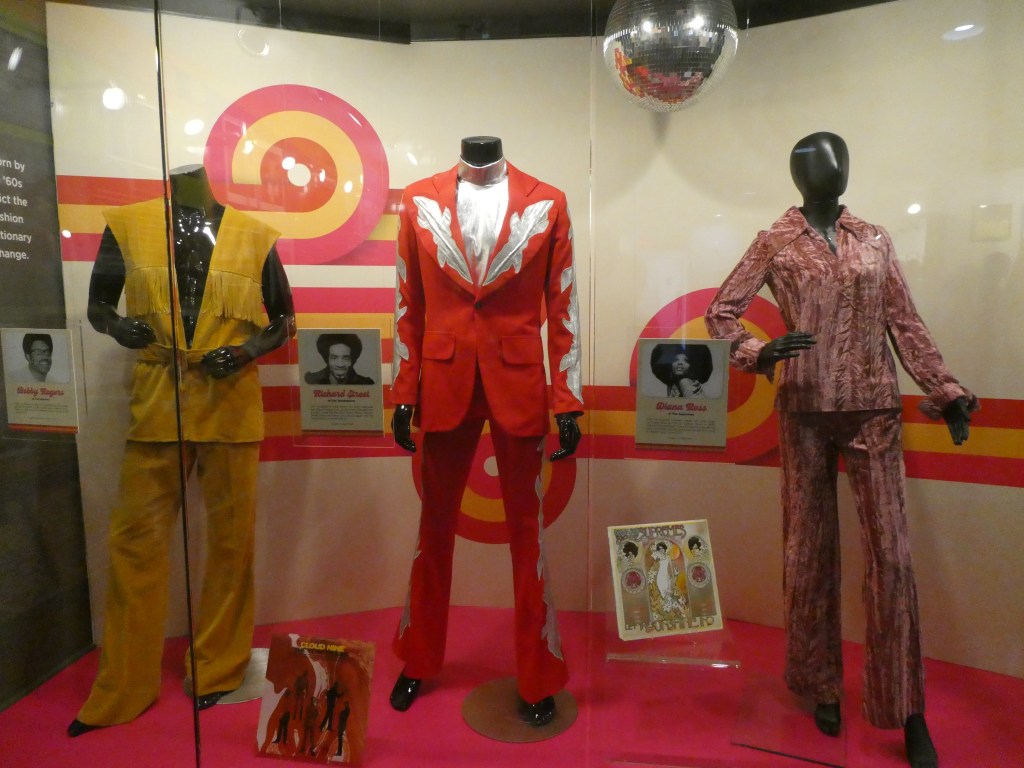
They were assisted with costuming. Motown artists even had etiquette instruction so they would know how to interact with fans, the media, other celebrities and even royalty.  

Marvin Gaye was a jazz performer in Detroit and wasn’t having much success. Barry Gordy helped him transition to the Motown Sound. Years later, “I Heard it Through the Grapevine” became Motown’s best selling song.

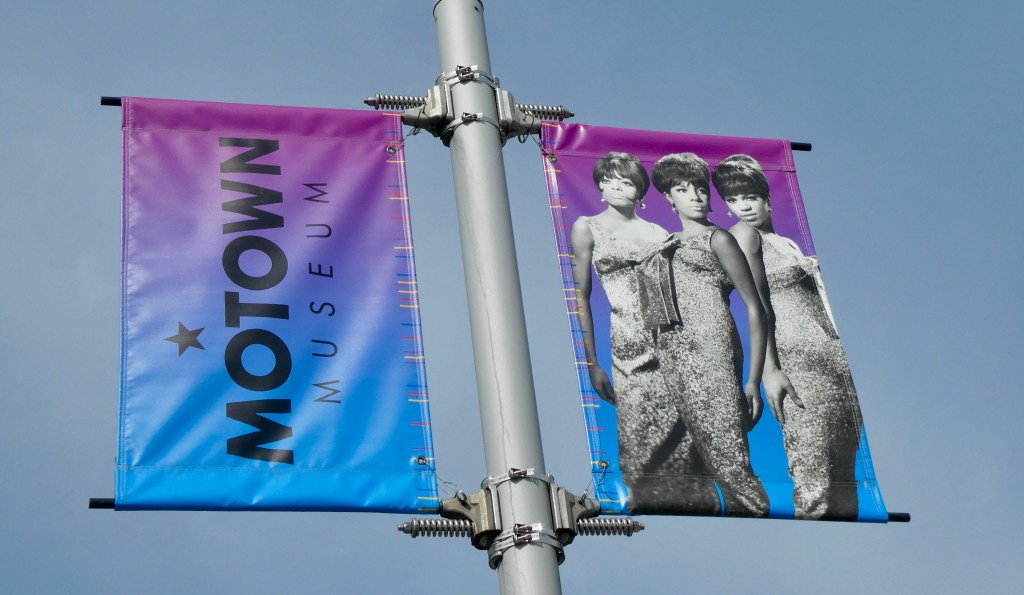
Diana Ross and the Supremes took longer than most Motown groups to refine their act and get that first hit.  “Where Did Our Love Go” made their mark and was followed by many others. They were eventually Motown’s highest volume group.  The Supremes performed on the Ed Sullivan Show on December 27, 1964 in the first of 14 appearances.

The Temptations was another group that took awhile to find their first hit but eventually made it with “My Girl.”  It was followed by many more.

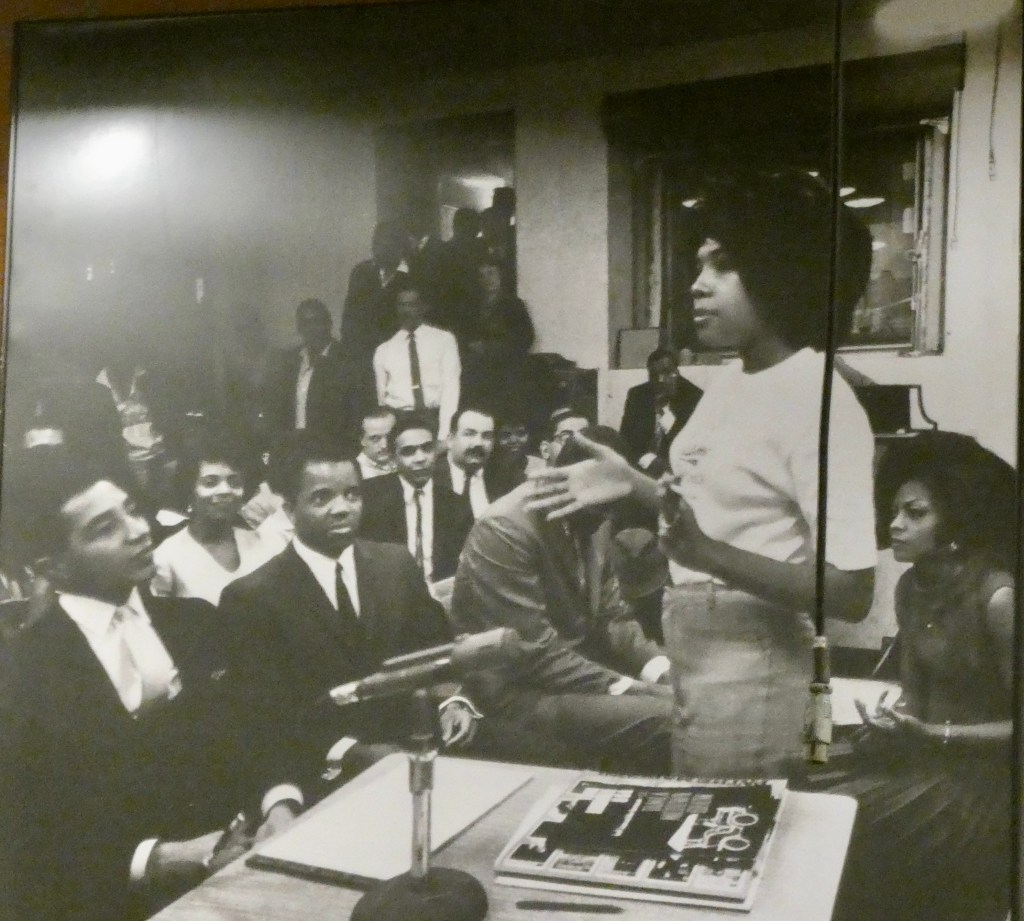
Martha Reeves was a secretary at this desk at Motown. She got her chance on the mic when a union rep was coming in and they needed a vocalist (as required by contract) in the studio right away.  Martha’s first hit was “Dancin’ in the Street.”

Stevie (before he was Stevie Wonder) was ten when he began at Motown.  He enjoyed a particular brand of candy bar so Gordy made sure it was always in the same location in the machine. Dimes were set on top so Stevie could always find one.   

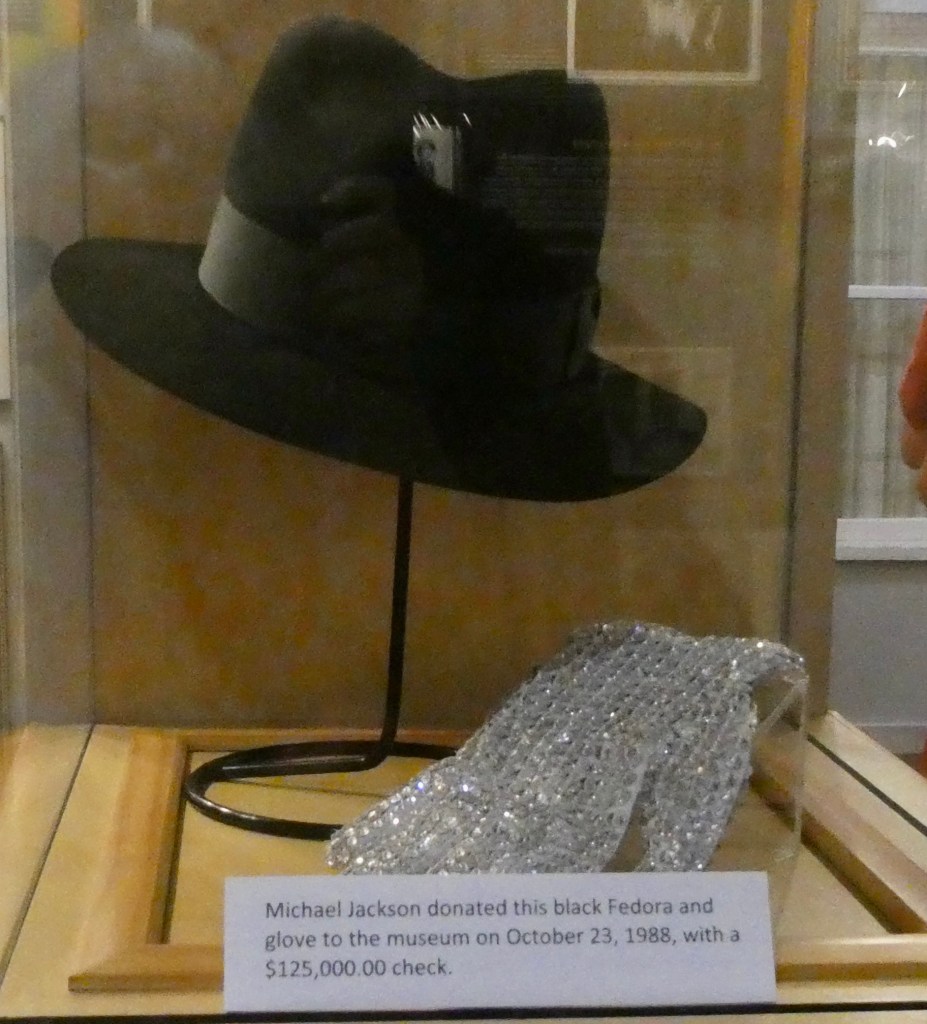
Motown signed and developed the Jackson 5 featuring a very young Michael. 

Michael eventually donated a hat and glove to the museum.

Over time Motown artists began touring the country. In Detroit, they were used to separate neighborhoods for blacks and whites, but they experienced different levels of segregation in the south.   Integrated groups were enjoying the music but the world was ugly outside the music hall. 

Martin Luther King recognized the emotional integration Motown was making in the country. Its impact was profound. Black became chic. 

In 1968, five of the top ten records of the year were from Motown. The company outgrew the houses and moved to downtown Detroit for four years.

With a cycle of great success comes change, and that happened at Motown. Artists had some freedom but only within Gordy’s boundaries. Instead of top-down driven innovation, the artists began to want to innovate their own talent. 

Diana Ross, Barry Gordy’s biggest star at the time, defied and almost separated from him over her plans for her future career.

Holland Dozier Holland left Motown over principle and formed their own company. 

Stevie Wonder, at age 21, considered leaving Motown to do his own thing.  Instead, he negotiated with Barry to have full control over his own music.  He and Marvin Gaye were the first to be allowed full creative control.

Despite Smokey Robinson sending Gordy information about earthquakes and smog, eventually, the company moved to Los Angeles.  Motown then changed from a record company to an entertainment conglomerate.  For example, the Jackson 5 had records, a cartoon series and a show on Broadway.

Pushing Barry Gordy’s boundaries even further, Motown artists wanted to address the country’s social problems in their music.  They wanted to impact what was happening in the world.   

Marvin Gaye was one of the first to do this with the song “What’s Going On.”  Gaye layered multiple tracks of himself singing and playing.  The production was brilliant and the content was outside Motown’s previous brand.

The company Gordy had started grew beyond his assembly line artist development and beyond his original vision.  Ultimately, like his artists, he believed that reflecting the world was a good thing.  

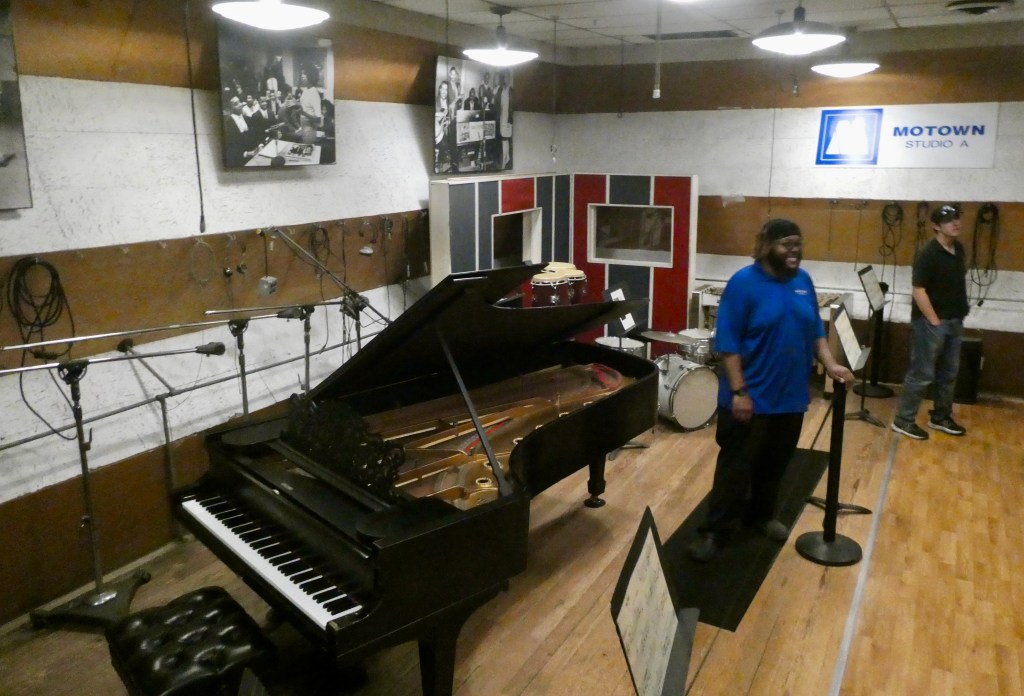
Back in Detroit, the original house, and studio A are available to tour. We were able to go into the small recording studio where so many famous artists had recorded hits with that unique Motown Sound. Together, our tour did our own rendition of My Girl paired with some choreographed moves. We definitely could have used some artistic development!

The studio piano is an 1877 Steinway.  After the studio moved to Los Angeles, the piano was eventually deemed unplayable until Paul McCartney donated funds to refurbish it.  

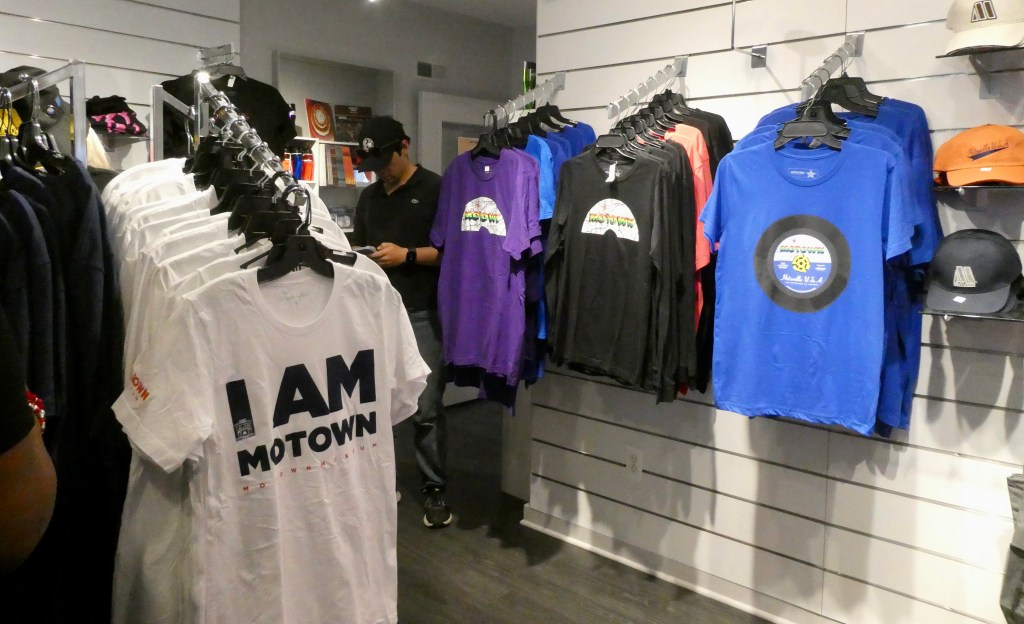
At the end of our tour, we were invited to “Shop Around” in the gift shop!

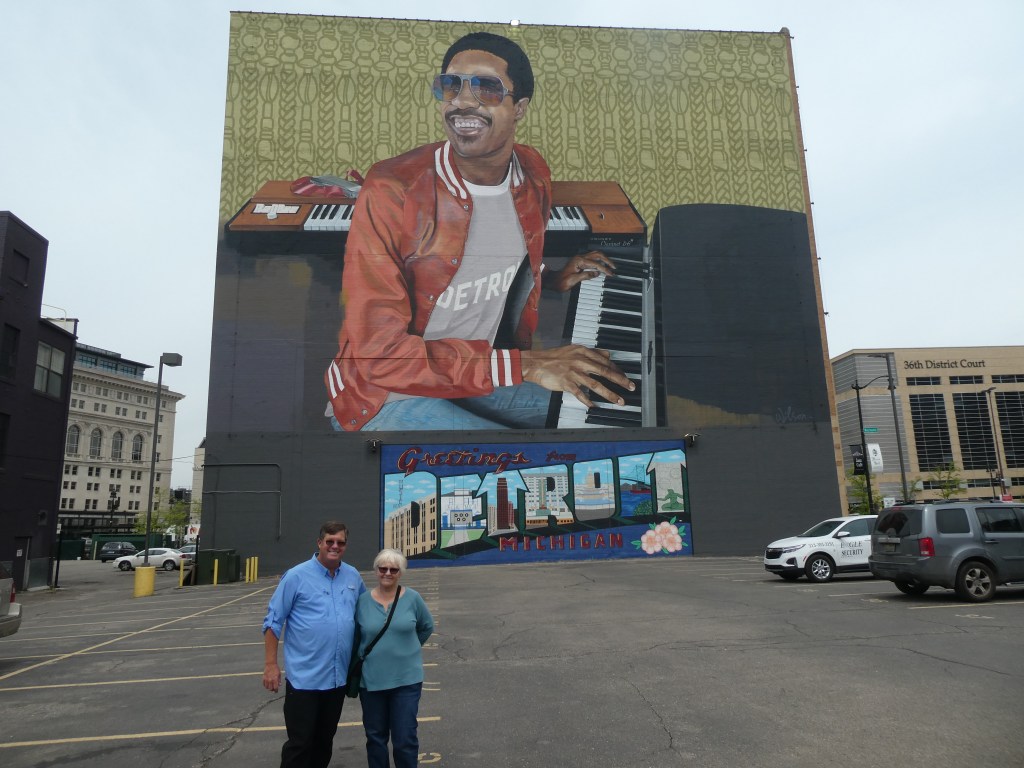
Detroit has many large murals. This one was right outside our hotel. It was a great first morning in Detroit. Yes, Detroit!

Posted in Uncategorized | 5 Comments

Kauai: Our Last Day

We dropped our hostess off at the airport early on our last day on Kauai.  We were taking the overnight flight so had a full day to spend on the south side of the island.

We stopped first at the Kauai Museum.  We learned that the Polynesians were early inhabitants on Kauai.  They purposefully brought in pigs, dogs and chickens around 400 AD.  They accidentally brought rats.

These poi stones are unique because of the handle.  This type has been found only in the Marquesas and on  Kauai. Archeologists use artifacts such as these to show Polynesian migration.   (Side note on poi:  We learned that poi should be allowed to ferment and that is how locals eat and enjoy it.  Poi served to tourists in luaus is generally not fermented.)

In Polynesian history, men and women did not eat together and women did not eat pigs.  Women did the weaving (and probably a lot of other things!) and men were the farmers, birders, boat builders and warriors.

Royal capes were decorated with thousands of feathers from four native birds.  The birds were humanely trapped and only a few feathers were taken from each so as to do no harm.  Unfortunately, at least one of those native bird species went extinction in the 1830s due to mosquitos.  

Another native bird, the nene, was about 25,000 strong in the late 1700s.  Due to hunting and introduced predators, the nene was almost extinct in the 1950s with only 30 remaining birds.  The nene has rebounded well with intervention and has upgraded to “threatened” with just under 4000 birds worldwide.

There is physical and anecdotal evidence that Hawaiians were surfing centuries ago!

For better or worse, Captain Cook landed in January 1778.  The native peoples thought he was the Hawaiian God of Peace. When Cook returned again in 1779, the people had figured out he was not a benevolent god and killed him and some of his men.

Then the missionaries came. The families of some stayed for generations and became part of the power structure of the islands.

Communities of Chinese, Filipino and Portuguese workers were developed – primarily to work in the sugar plantations. (The Portuguese brought the ukulele to the islands.) We visited one of those former plantations for the rest of our activities of the day!

We went to the Kilohana Plantation for a rum tour, train ride and luau!

We joined the guide and our fellow rum tasters in the buggy.

We drove by a stand of rainbow eucalyptus.

We walked deep into the tropical forest…. well kind of deep.

We found our first rum sampling.  

We had small samples of gold, dark, vanilla and sugar, coconut and chocolate rum. The first two weren’t very good and the last two were quite tasty!

I don’t remember what this drink was, but it had rum in it and was delicious!

Randy looks like he enjoyed it too.

We saw a few sights from our buggy along the way. 

We learned that pigs outnumber humans 7:1 on Kauai!  There are about 400,000 feral pigs posing environmental problems. Control measures are being considered.  

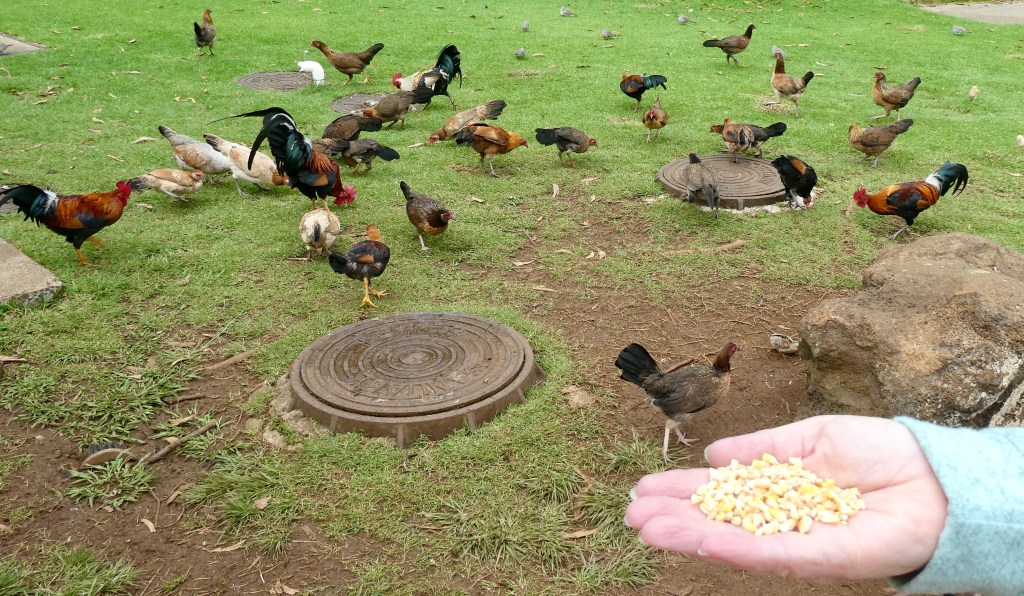
There is no current attempts to control the Kauai chickens!  

This was our second rum sampling destination

We had passion fruit, orange and tumeric daiquiris – and chips and chocolate. Afternoon snack of champions!

We were returned to the 1935 plantation house to await our next adventure – a ride on the Kewahuana Train.  A 1948 diesel from Colorado pulls the cars over 3.5 miles of track around the former plantation. 

Sugar plantation were agriculturally and economically significant on Kauai. Production began in 1835 and by 1910 there were ten massive plantations on the island. Over time other countries produced cheaper sugar because of proximity to where it was needed. 

This plantation stopped producing sugar in the 1970s. There is no more sugar cane grown on any of the Hawaiian islands – the last being on Maui in 2018. .

Currently 105 acres of the plantation’s land is operated under long term leases. The subcontracting independent farmers are trying to farm diverse crops in sustainable ways.  Currently Hawaii imports 90 percent of its food. 

Our last activity was a luau held on the plantation grounds. Fortunately it was held in a covered space!

We were additions to a table of luau VIPs. Nearly every luau performer and staff came by to speak with them at some point. The family was very gracious and included us in their conversations. The patriarch of the group was playing in the band, as he has been for decades.

.The main course was, of course, shredded pork!  It was delicious but at this point in the week, we’d had shredded pork several times.

We enjoyed the singers and dancers…

but we especially enjoyed this little girl enjoying the dancers!

Following the luau we headed to the airport and our red-eye flight to Phoenix. Despite the rain, our week on Kauai was great. Our flight home…..not so much…..but we survived it to nap the next day!

Posted in Uncategorized | 5 Comments

On Kauai: Noni and Waimea Canyon

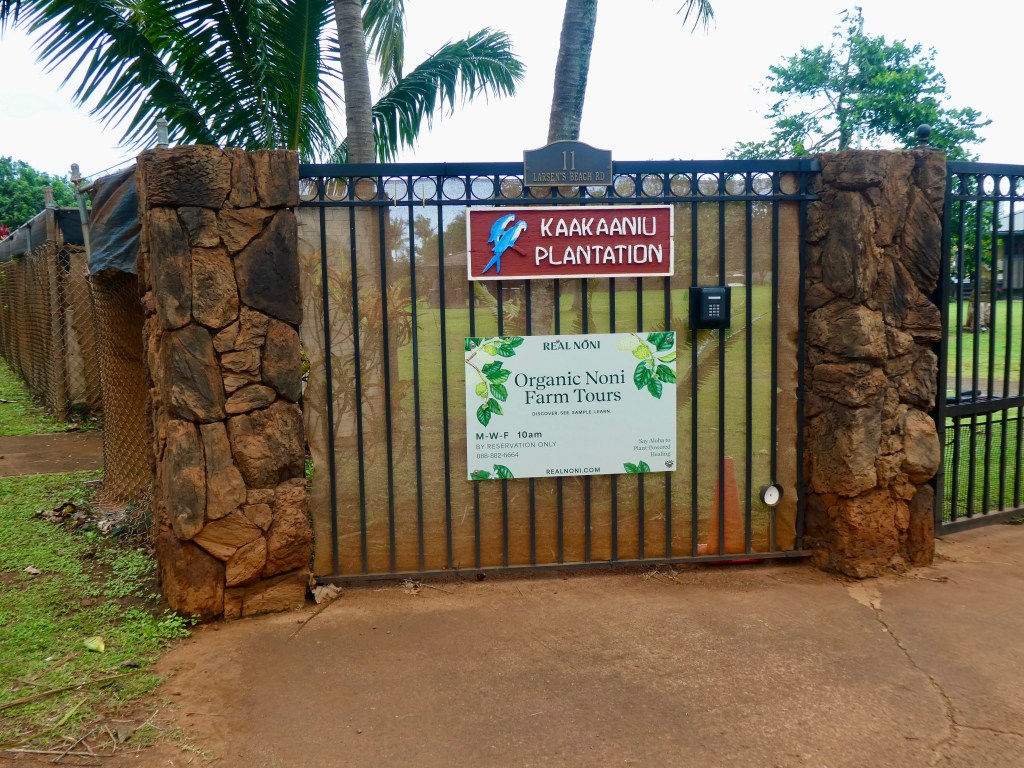
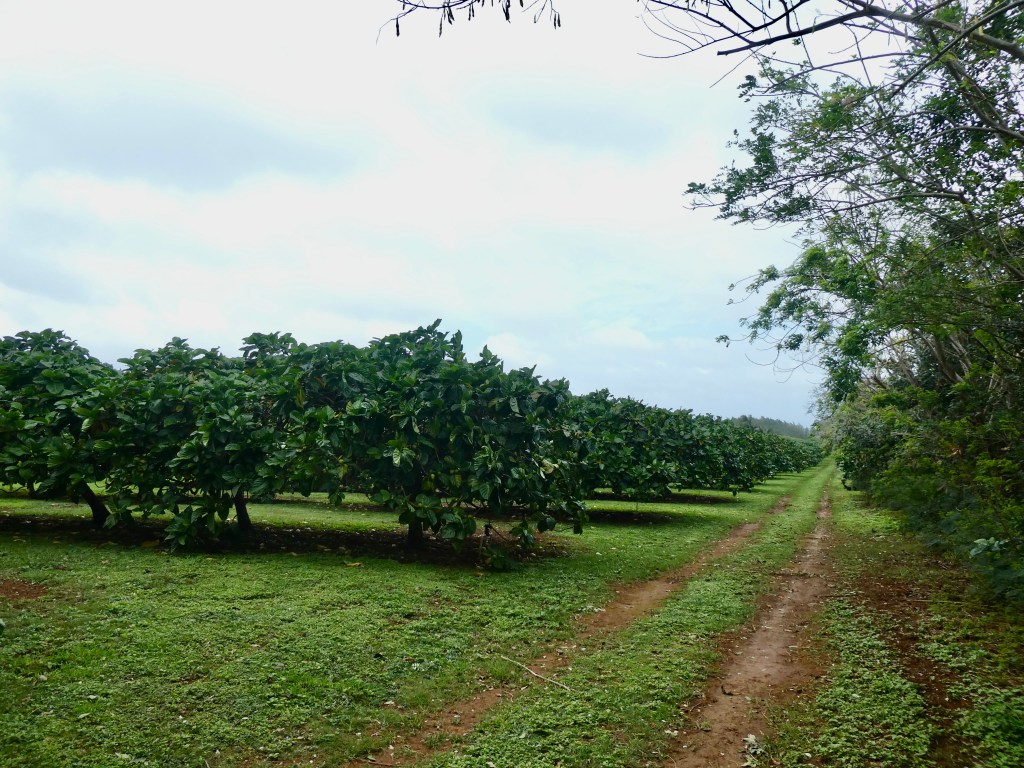
We were ready to learn about noni so went to Kaakaaniu Plantation for a free tour at the Organic Noni Farm.  (A free tour means they hope you purchase their product but we knew that going in.)

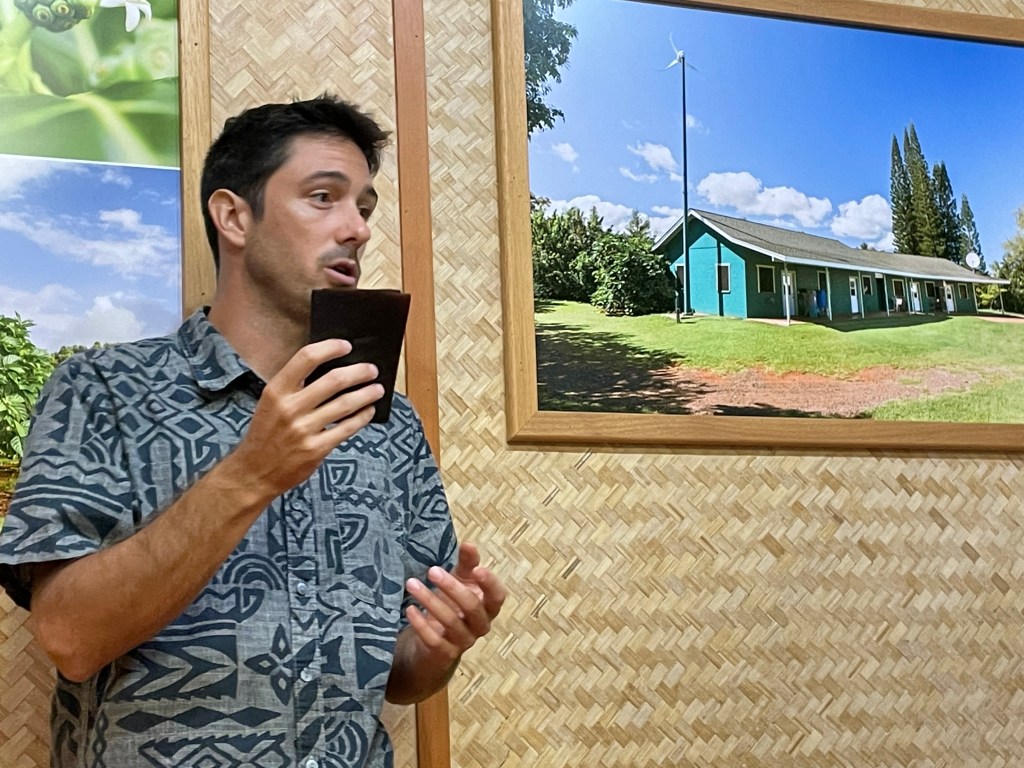
The farm and business is family owned and operated with great assistance from Steve, our guide. He works with noni from tree planting to sales of the finished product.

Steve told us that Polynesians either brought noni to Hawaii or recognized it from previous use when they arrived.   Archeological evidence suggests noni has been used for 40,000 years – most likely as a medicine or pain reliever.  Noni has anti inflammatory properties.

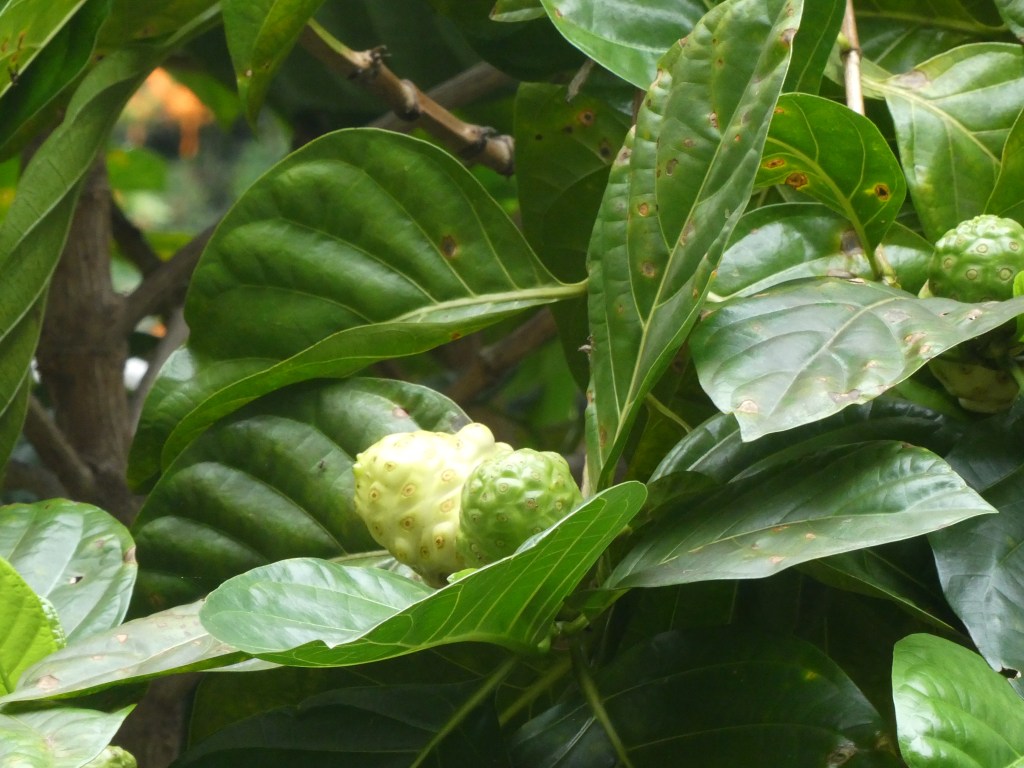
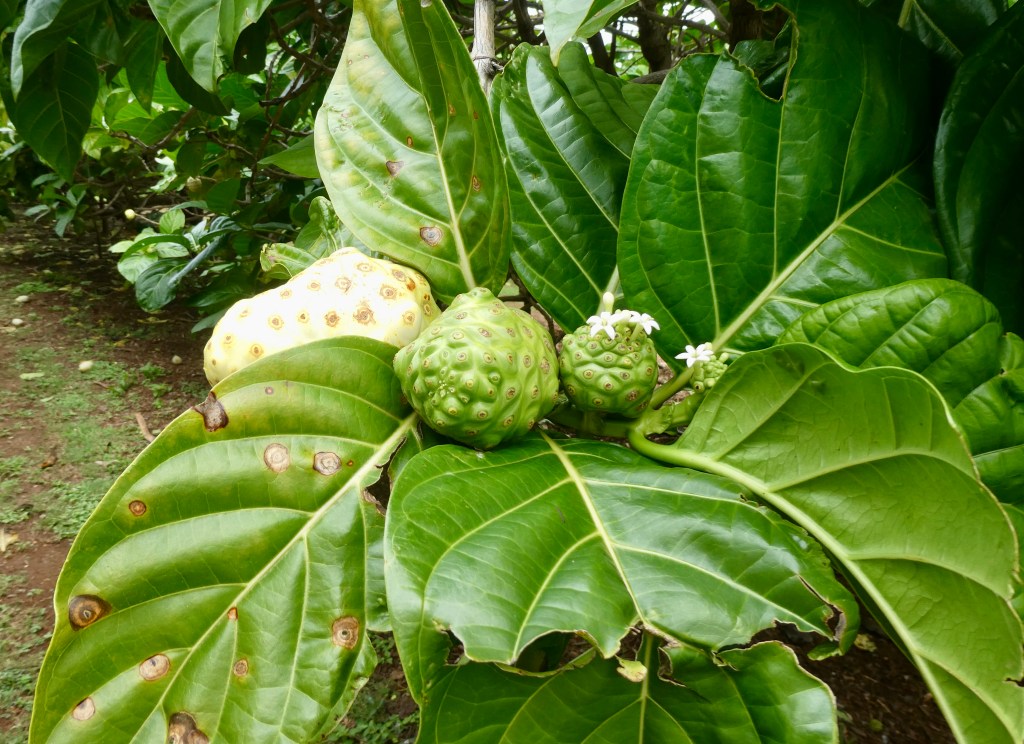
Noni trees are constantly producing.  This photo shows the various stages of development from blossom to ready to pick all on the same branch. The trees produce non stop year round.

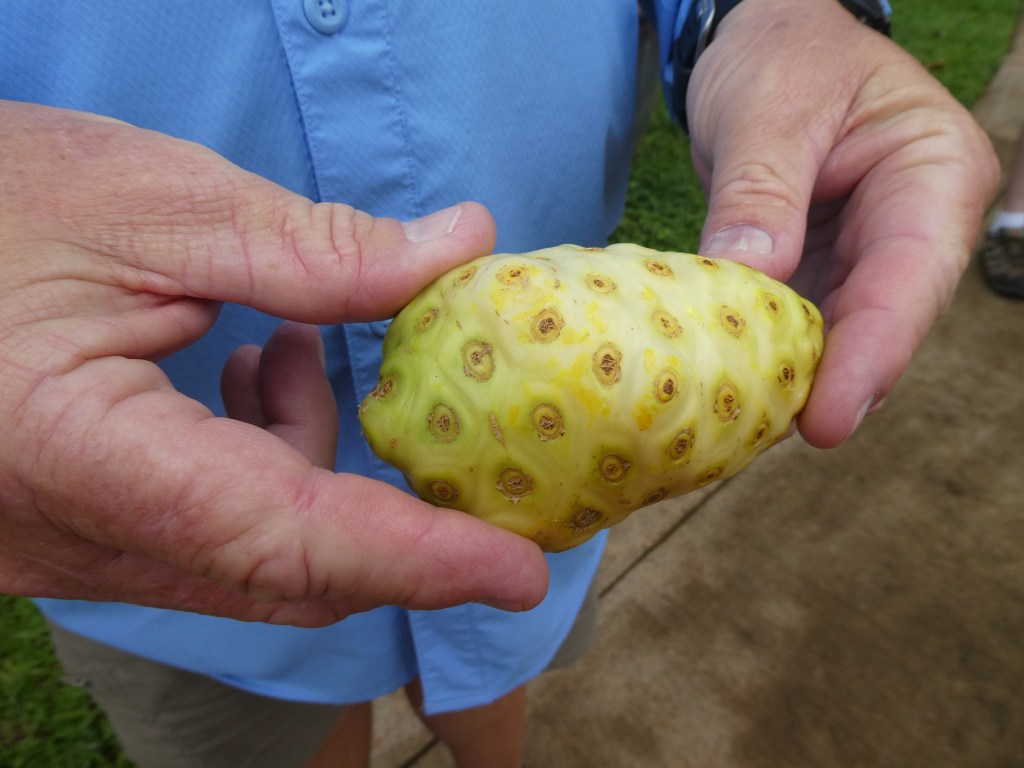
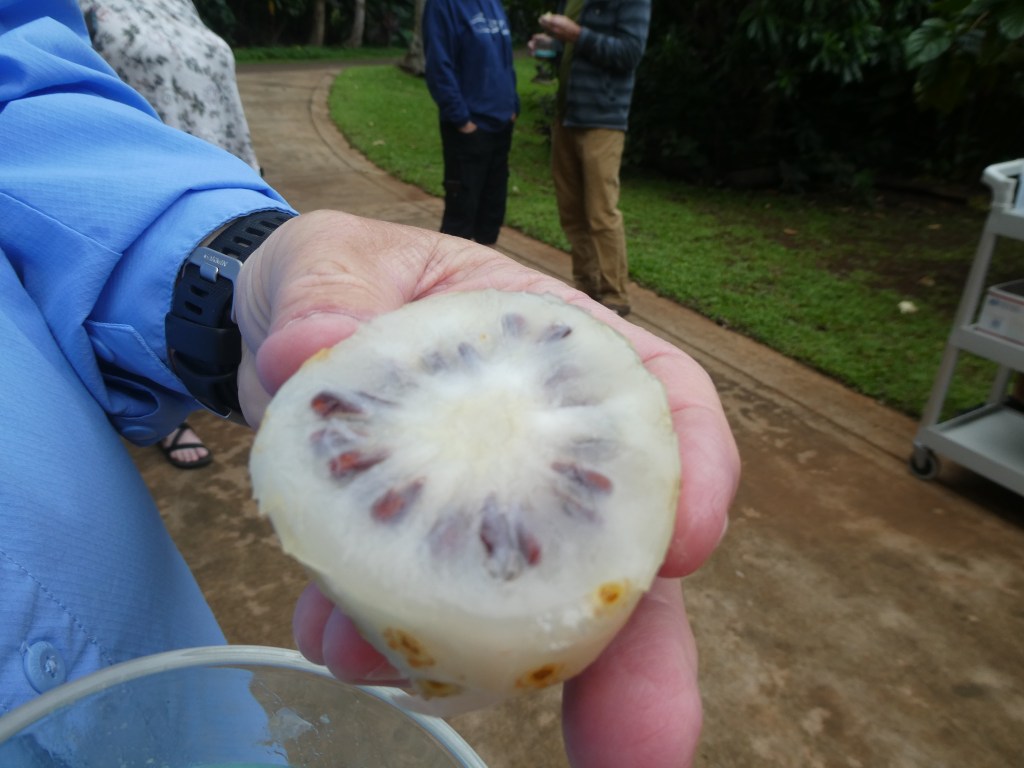
This is what a noni looks like when it is mature enough to use.  

We tried some of the pulp and it tastes like bleu cheese!.  We like bleu cheese but it was odd to taste it in fruit!

Noni is a complete protein and could be a primary food source.  However, the Organic Noni Farm does not suggest it be used in that way.

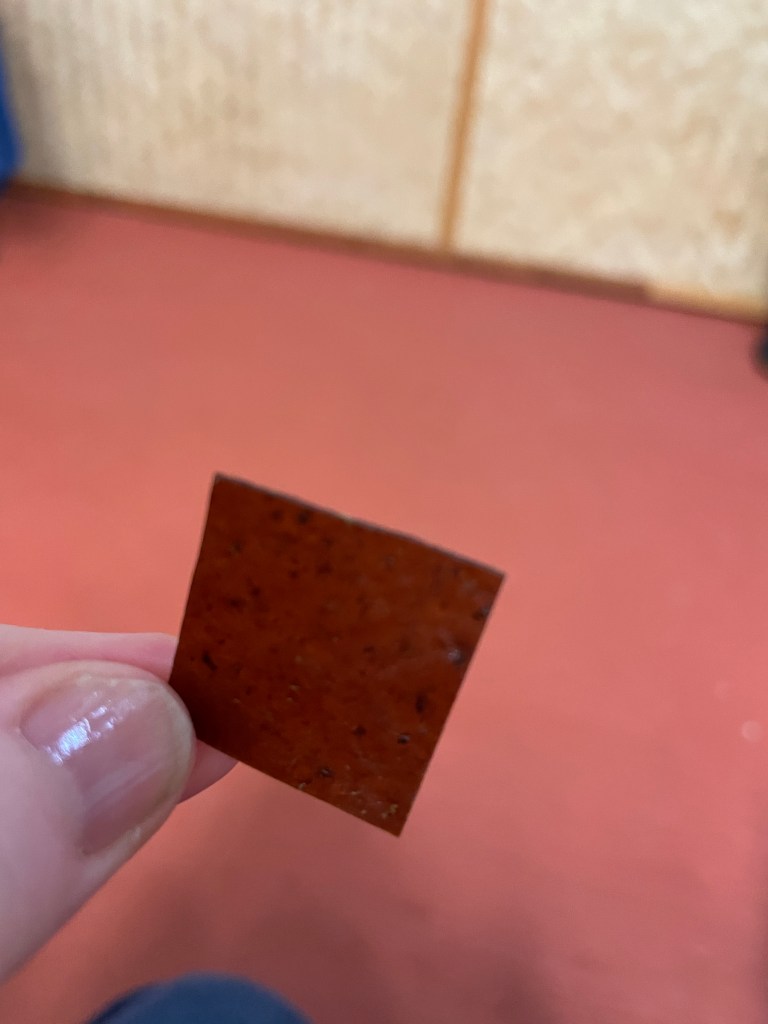
Their primary product is a 14:1 concentration fruit leather.  They suggest a daily dietary supplement dosage of one  2″ by 2″ square per day for maintenance and up to 4 squares per day for medical conditions. 

As an organic supplement, they suggest noni is helpful as an antioxidant for inflammation and arthritis, with additional possible benefit for almost everything!  (We bought some noni leather but haven’t tried it so can’t speak from personal experience.)

The Organic Noni Farm has worked with the University of Hawaii to develop a moisturizing lotion and a pain relief lotion. 

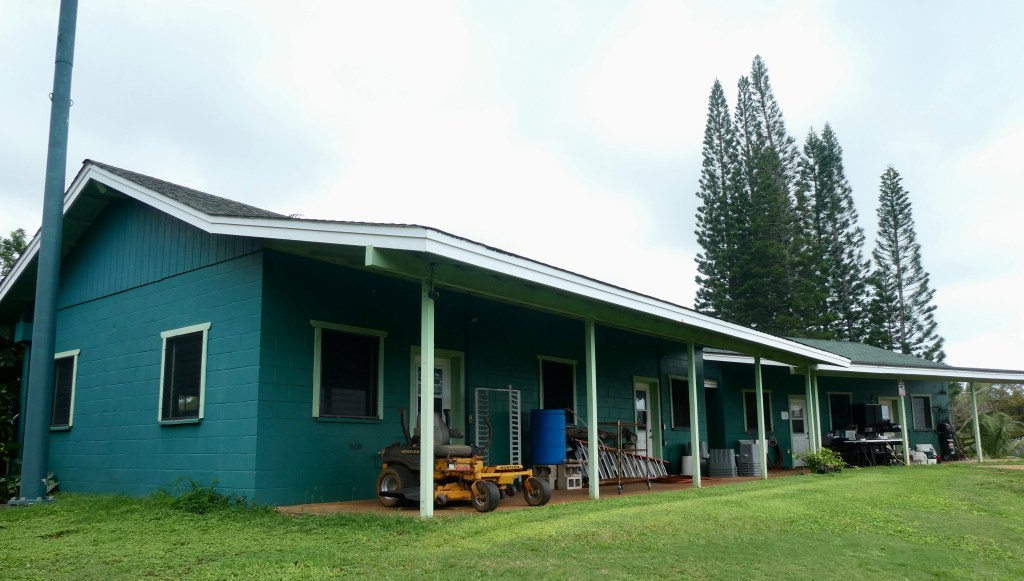
Noni processing, from picking to product, takes one week.  The mature noni softens for a few days, is put into liquid form, and then dehydrates for 60-72 hours.  The entire process, including packaging, takes place in this building.  Nothing is outsourced.

The Organic Noni Farm has 1000 trees. 

The trees provide way more noni than the family can currently process. Much goes to waste but there is a continual supply.

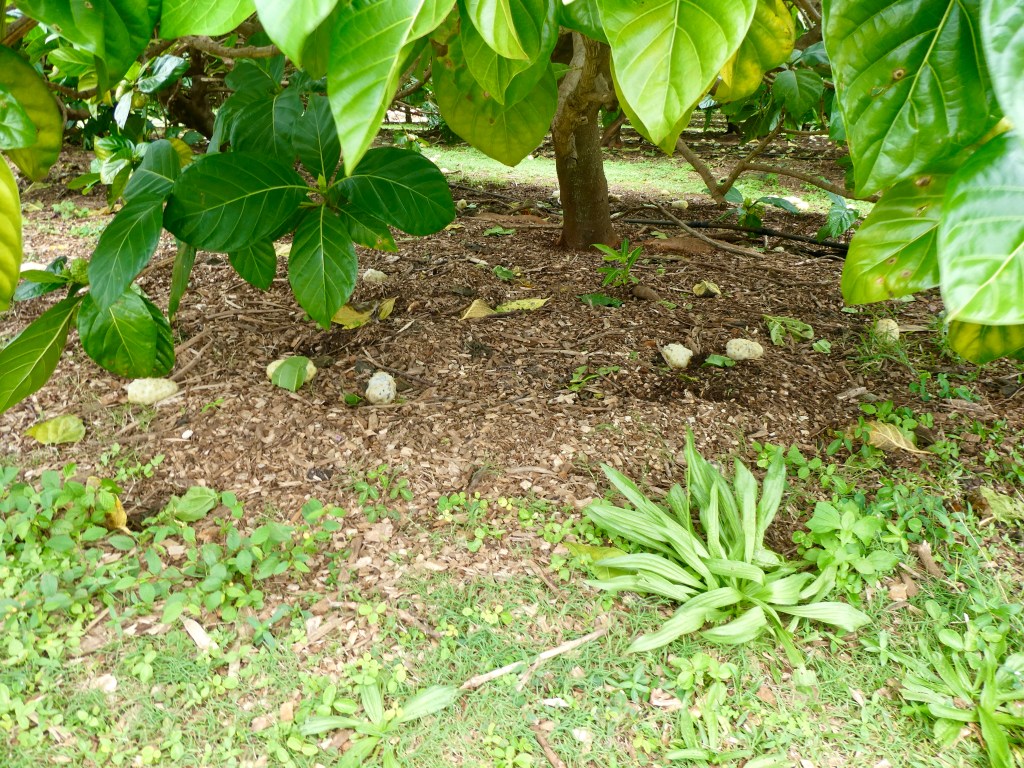
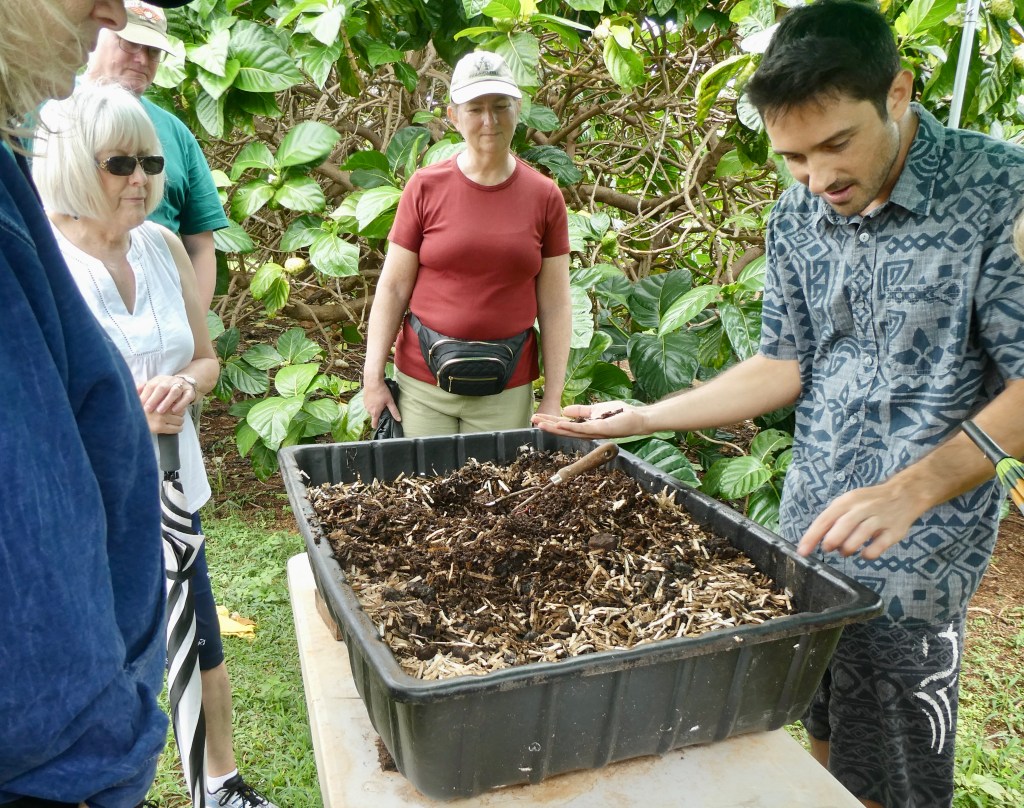
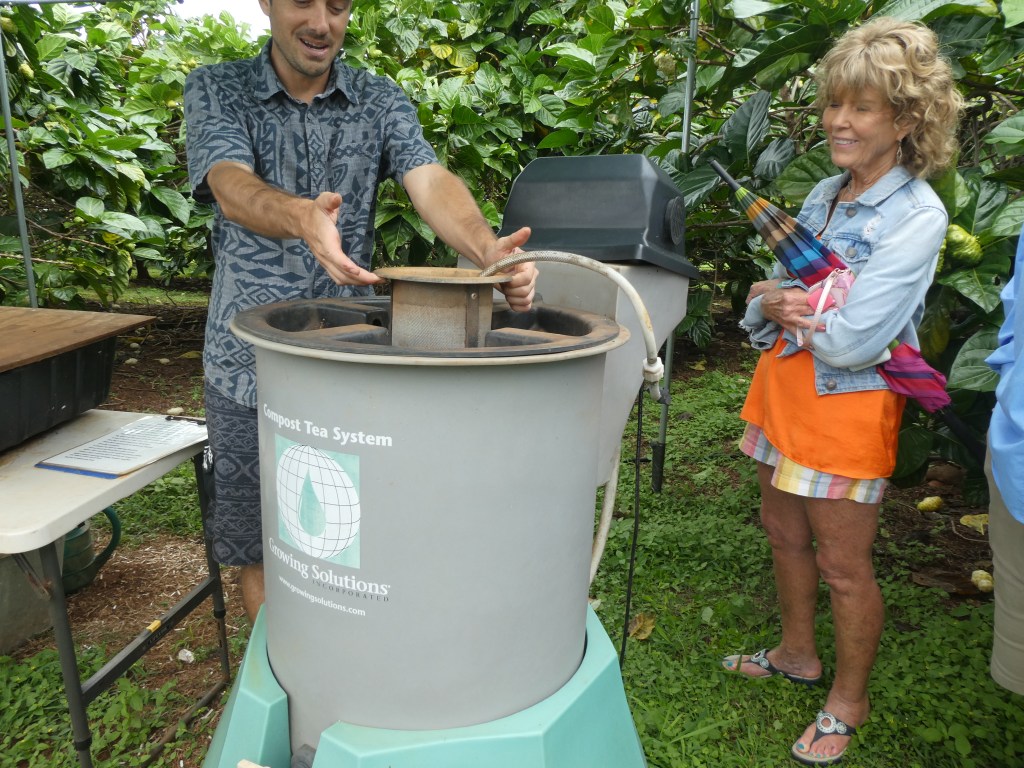
In caring for the trees, they fertilize with worm cast tea. The worms eat blended kitchen waste and give off castings (poop).  

The castings are made into a tea and each tree gets one cup of tea twice a year.  The trees are  also surrounded with mulch.   (Pictured is our friend, Donna, who hosted us on this trip.)

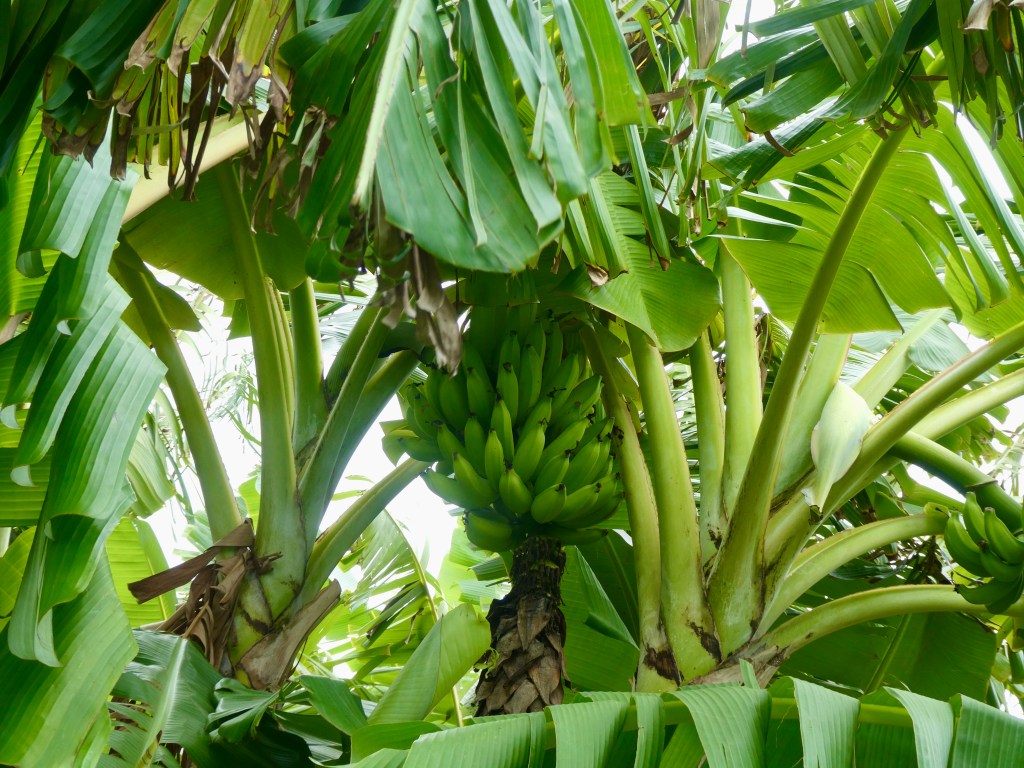
The farm has a number of other fruit producing trees, primarily for family use. These are apple bananas.   The stalks are one and done. Once a group of bananas is grown, that stalk dies off..

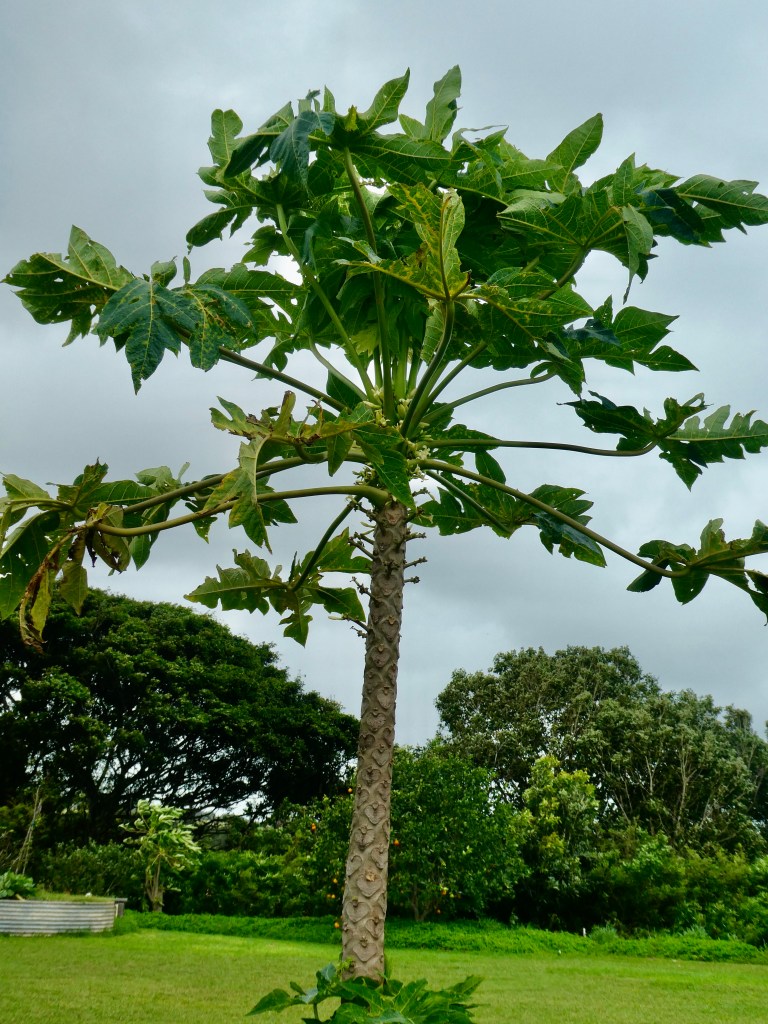
Papaya tree are male, female or hermaphroditic (containing both male and female properties in a single tree). Properties from both genders are necessary for papaya production.

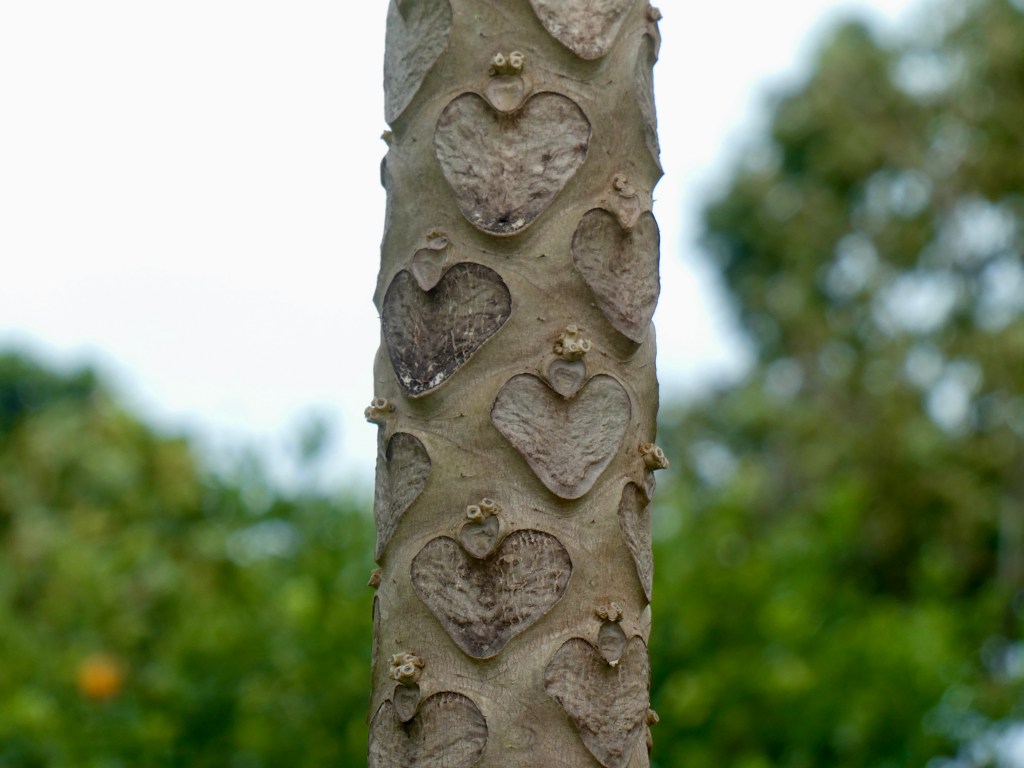
The papaya trunks have heart shaped markings as fronds fall away.

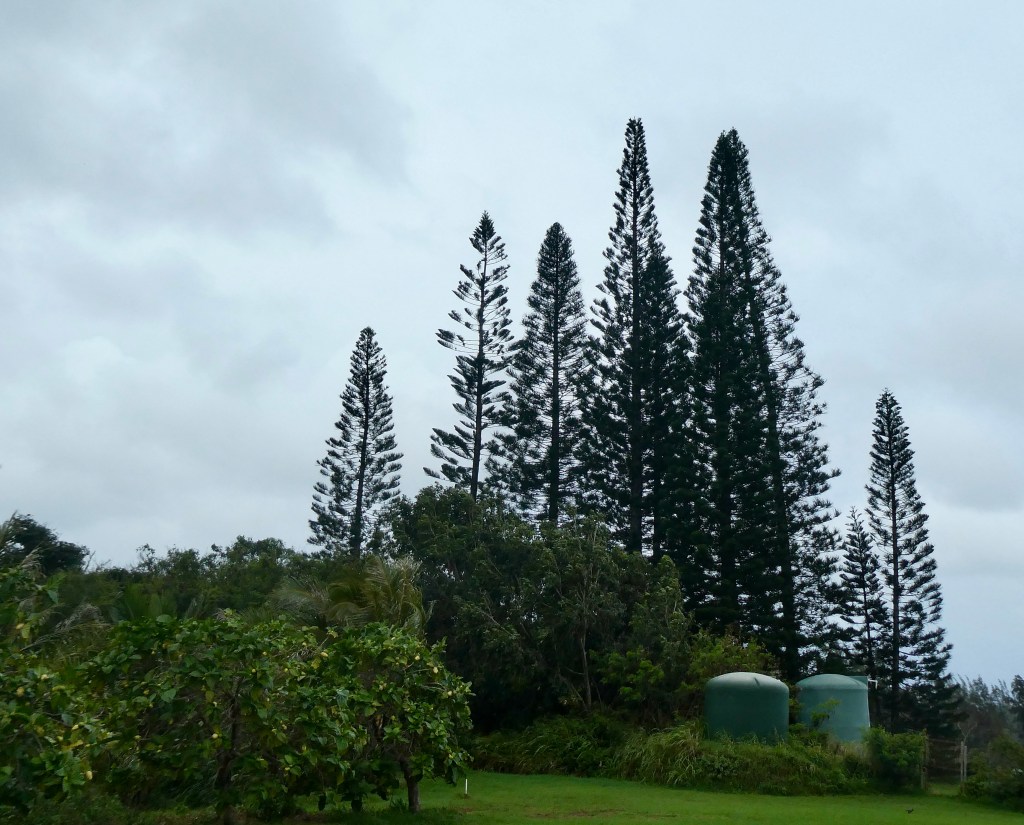
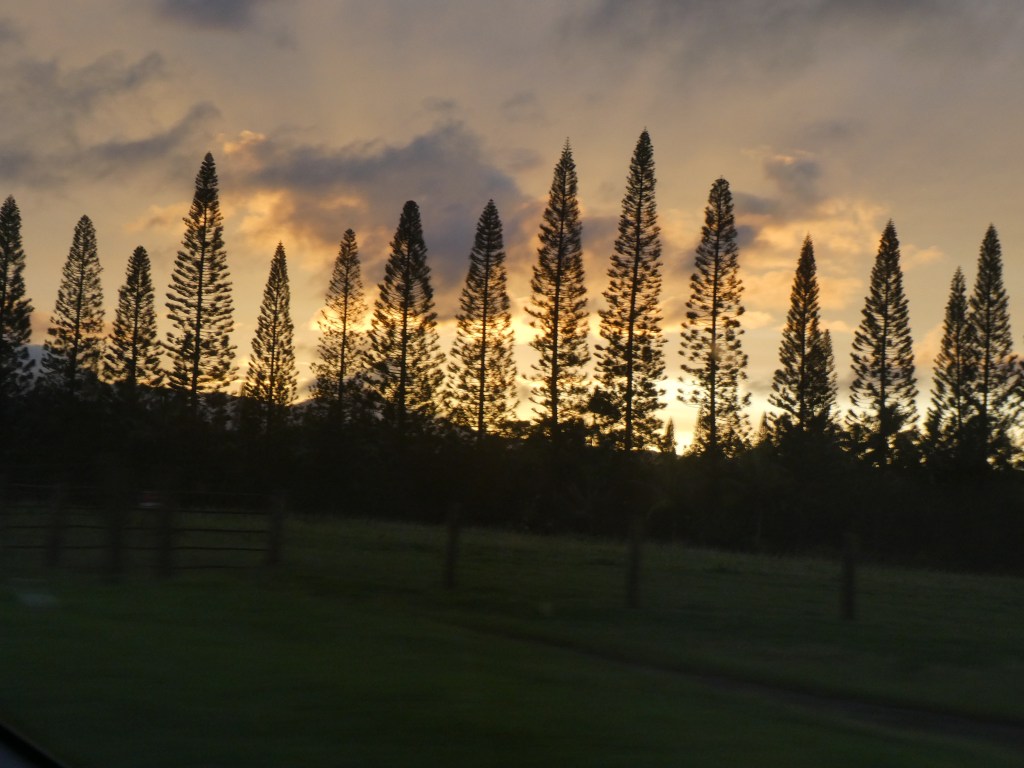
We were told about Norfolk pines.

They were imported to the Hawaiian Islands during an age when ships needed mast replacements using strong straight trunks.

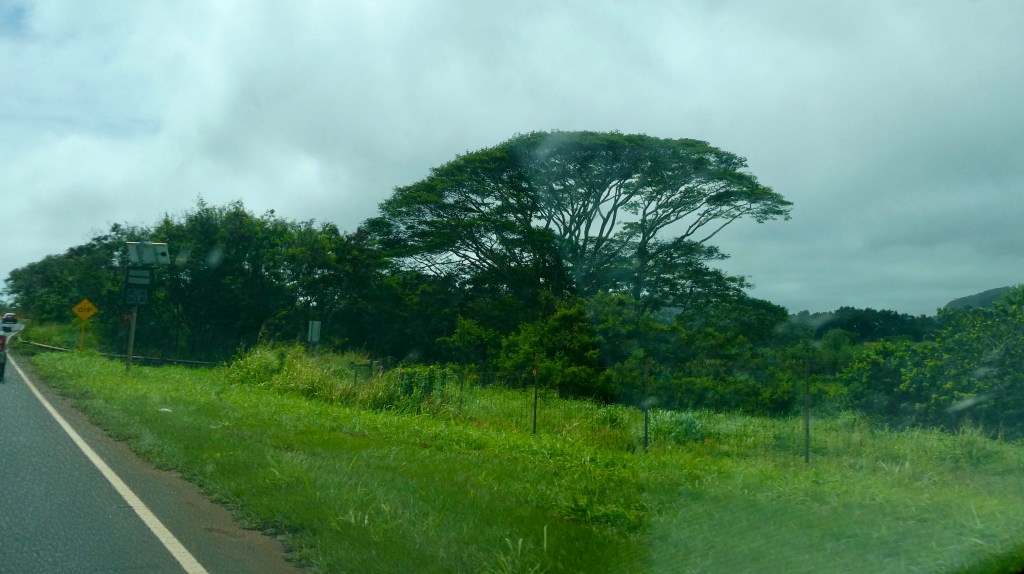
Another tree species, common on Kauai but not native, is the Albesia. Albesia trees in Africa grow to 30 feet and are a hardwood.   Because of water availability on Kauai, the Albesia trees here grow 60-70 feet high and are a soft wood.  It is the Albesia tree that is used for the mulch around the noni trees.

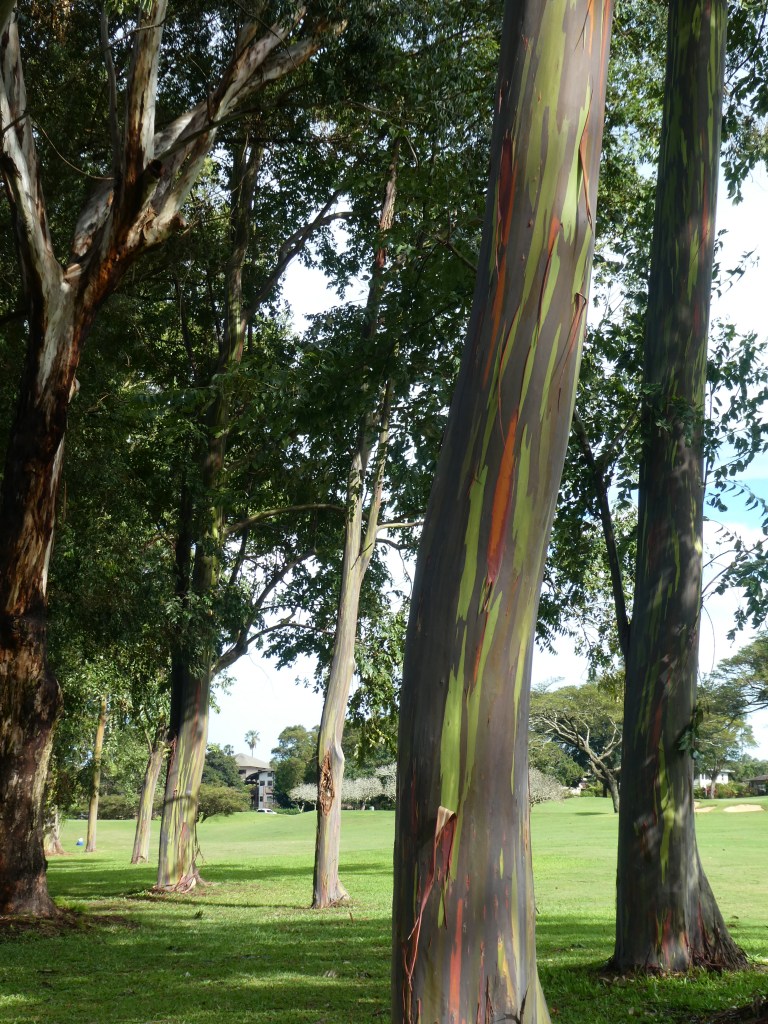
Staying with trees, this is the colorful bark of the rainbow eucalyptus. . Native to the Philippine islands, the rainbow eucalyptus were brought to Hawaii in the 1920s to help with reforestation and erosion.

After our tour was complete, we purchased our noni products and left the plantation.  

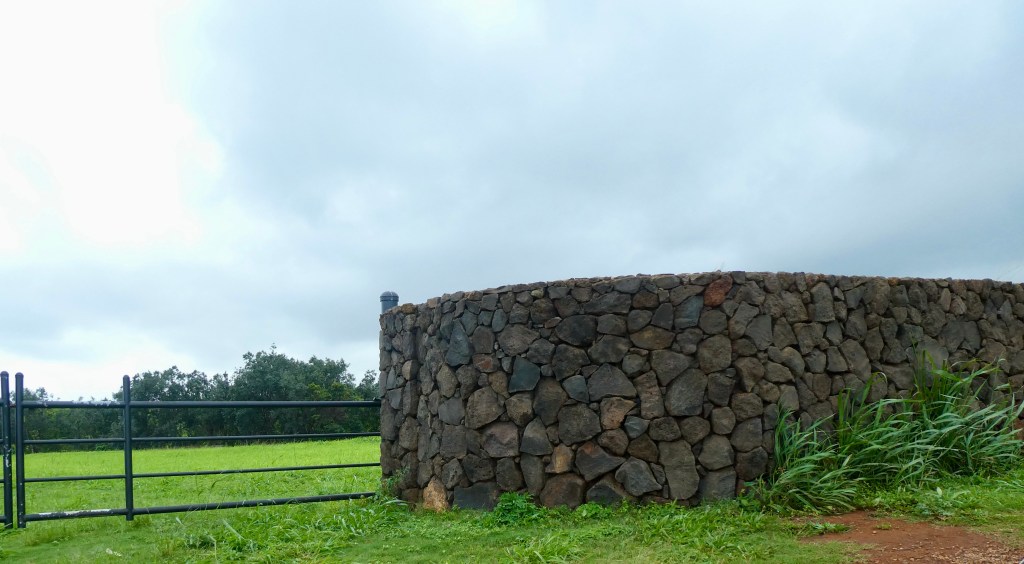
We were told to look for the nearby rock wall.  It surrounds 800 acres purchased by Mark Zuckerberg.  This enclosed property once had 75 home sites. It now has only one – his.  Our guide indicated that there is both good and bad in having high profile owners on the island. They are frequently generous, but also have specific wants that may not always mesh with local customs.  Mark Zuckerberg owns 1300 acres on Kauai. 

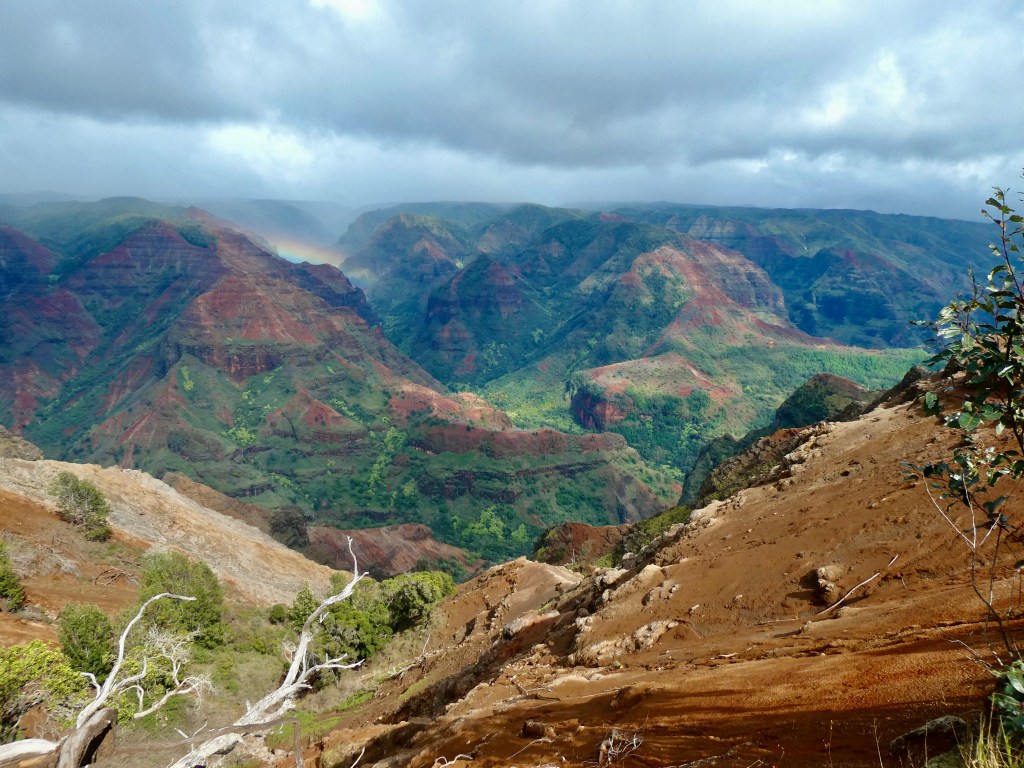
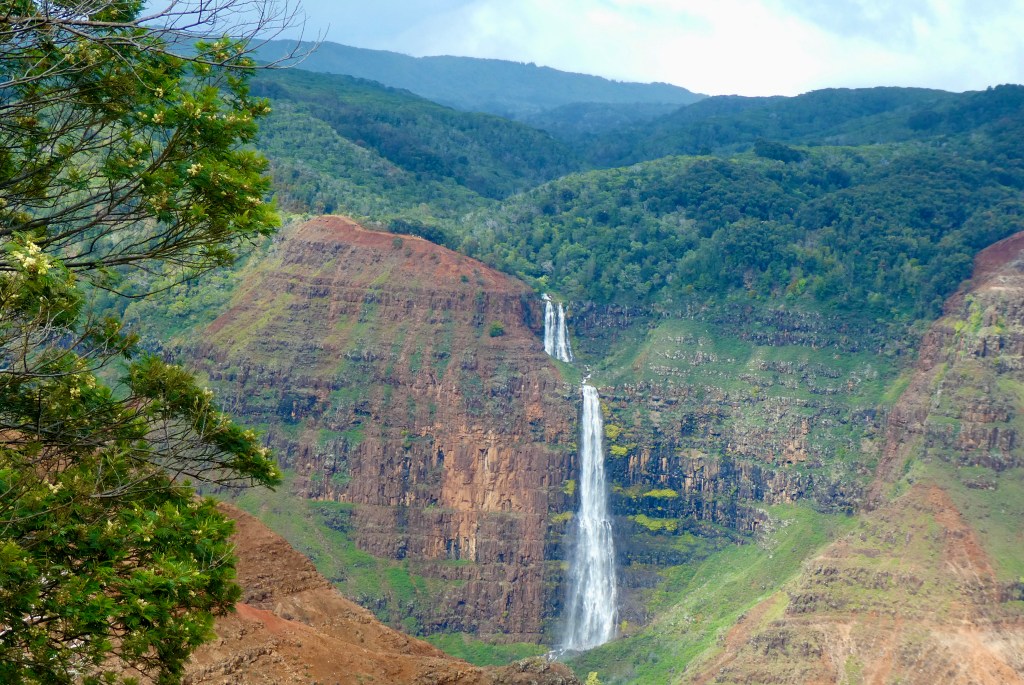
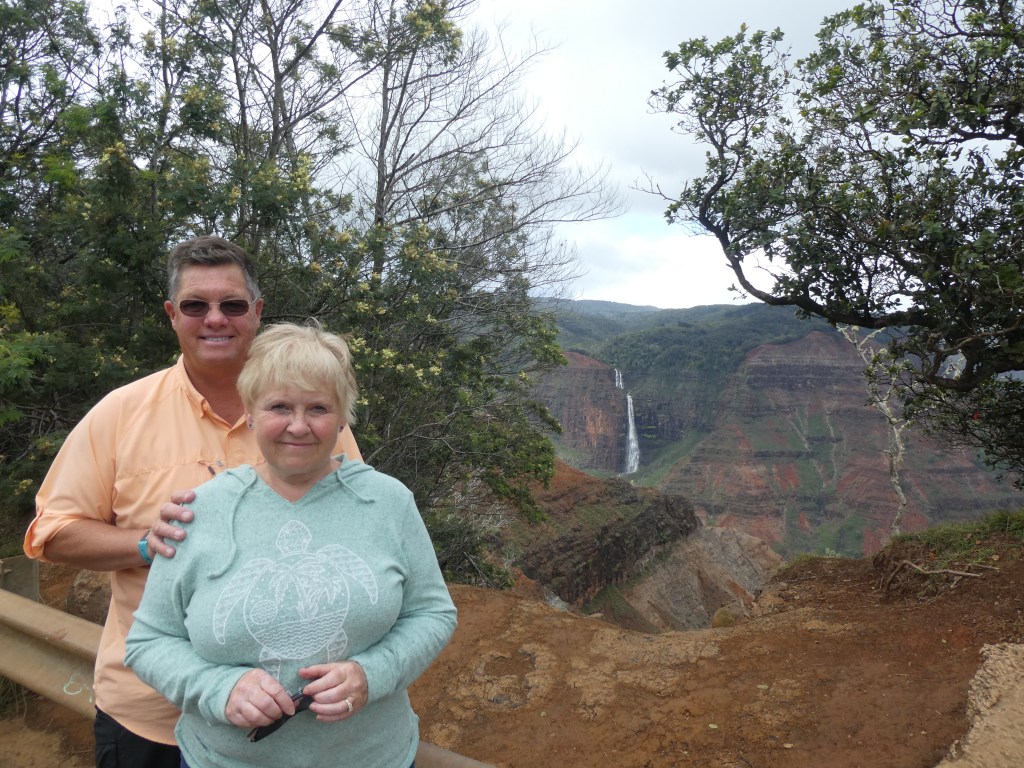
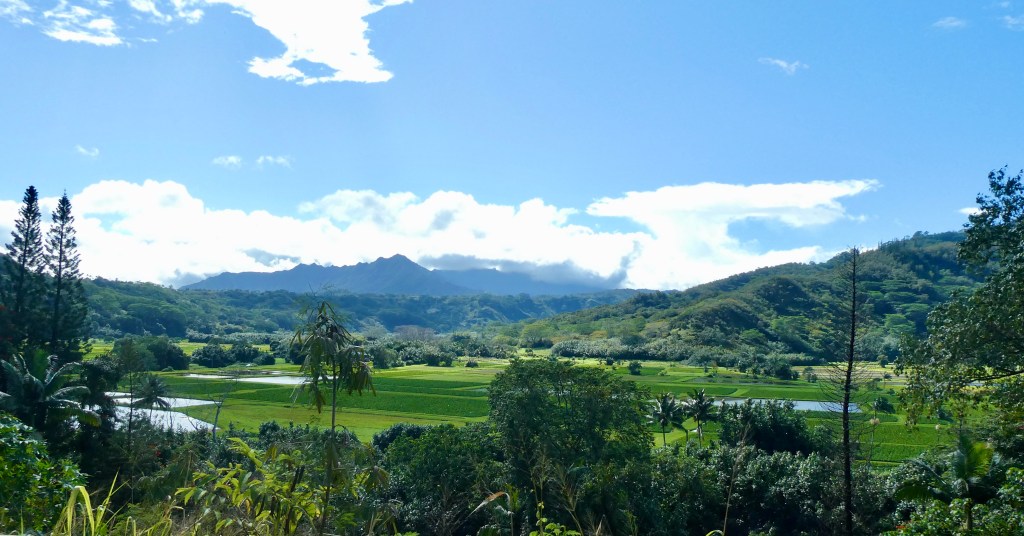
When our sight seeing flight was canceled again due to weather, we drove to Waimea Canyon.

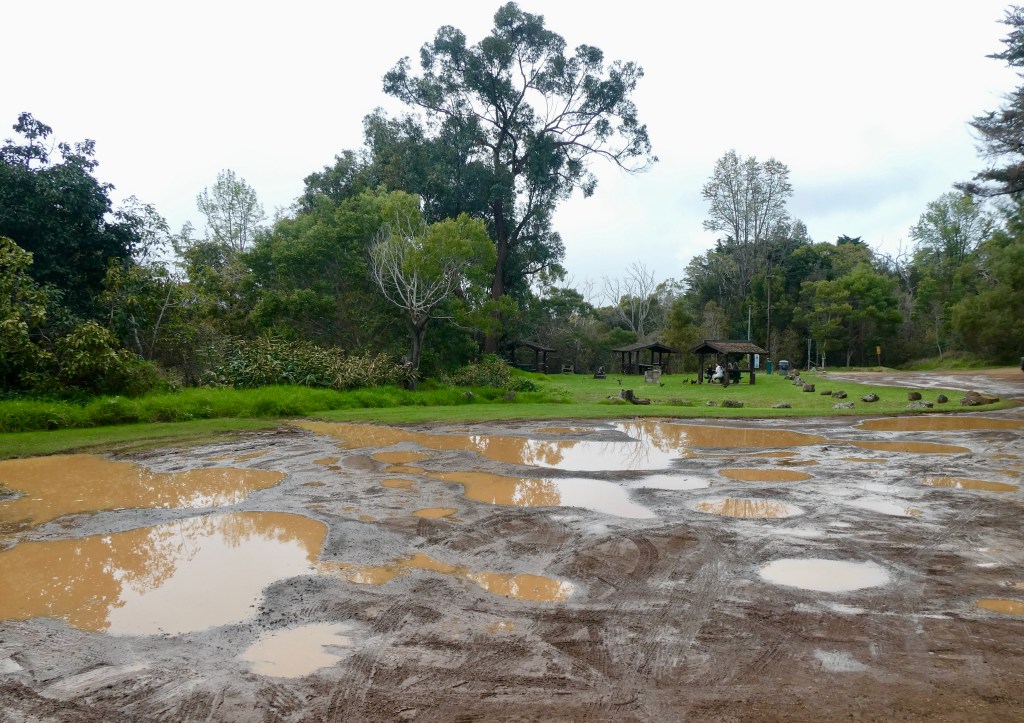
It was also too wet to hike so we drove around a bit and looked at views of the canyon.

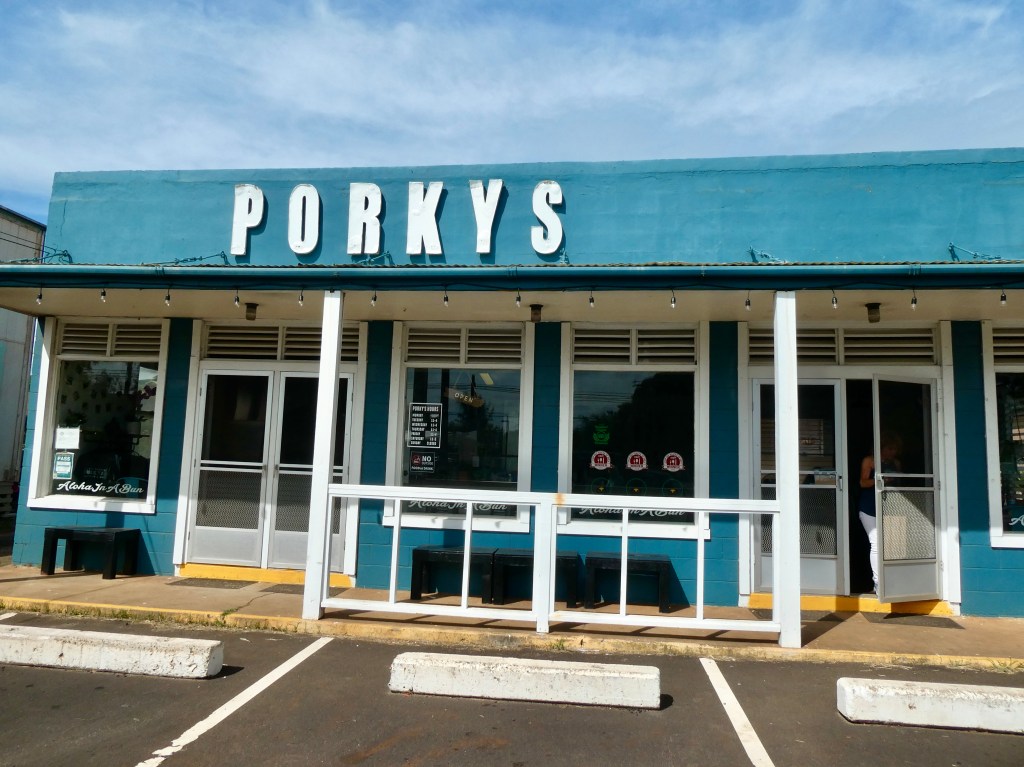
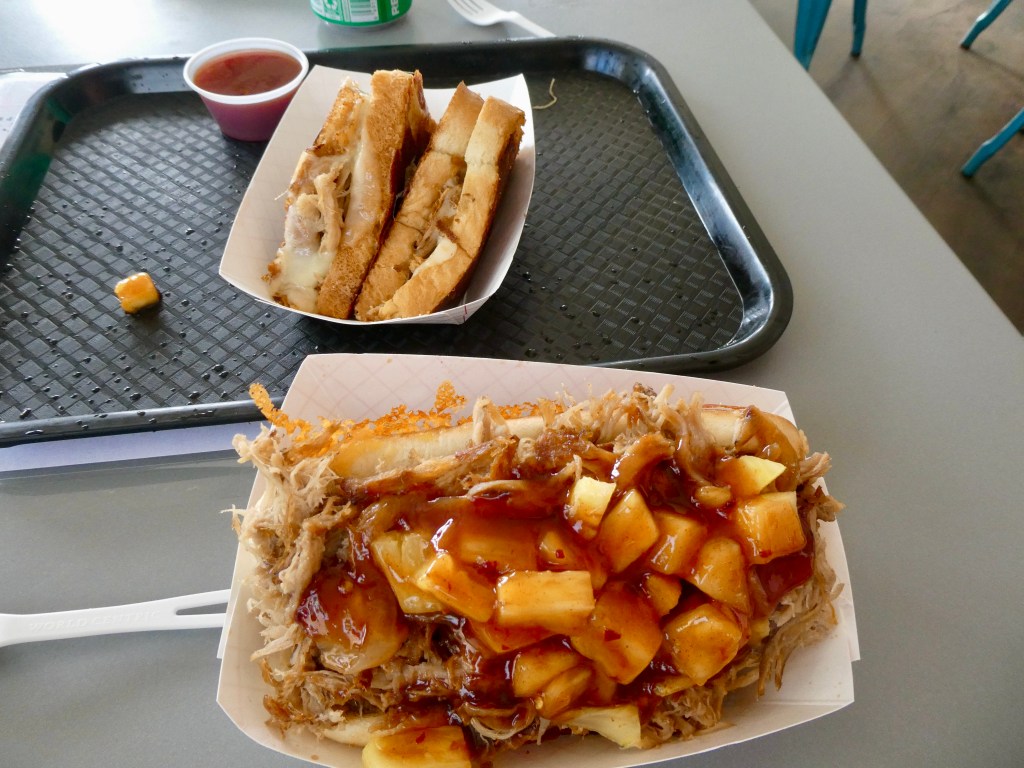
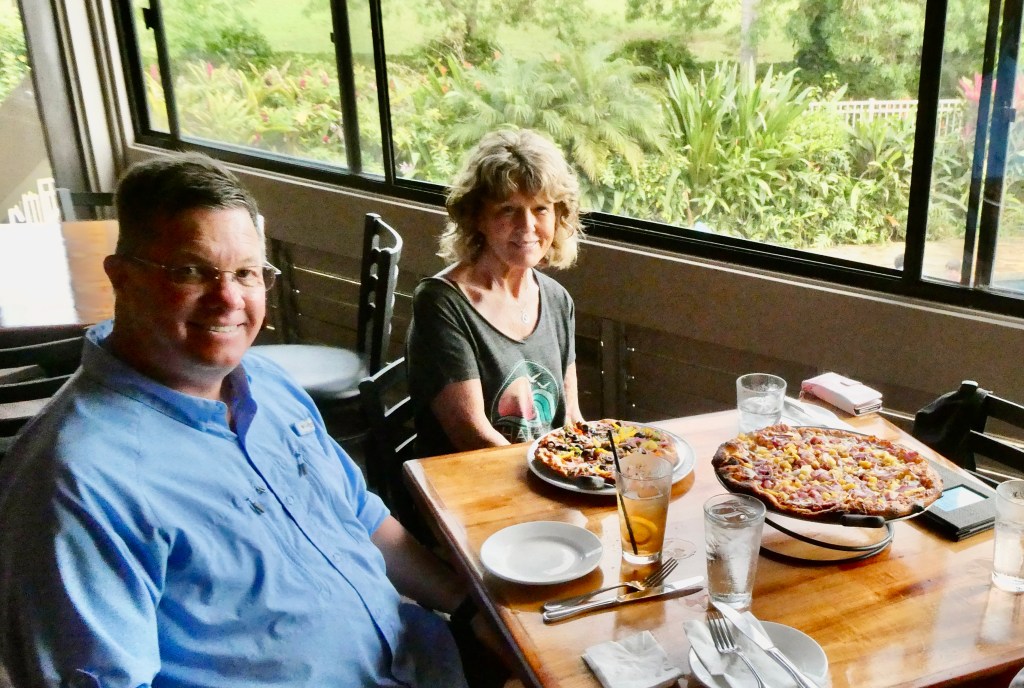
We ate at Porky’s – a famous west island eatery.

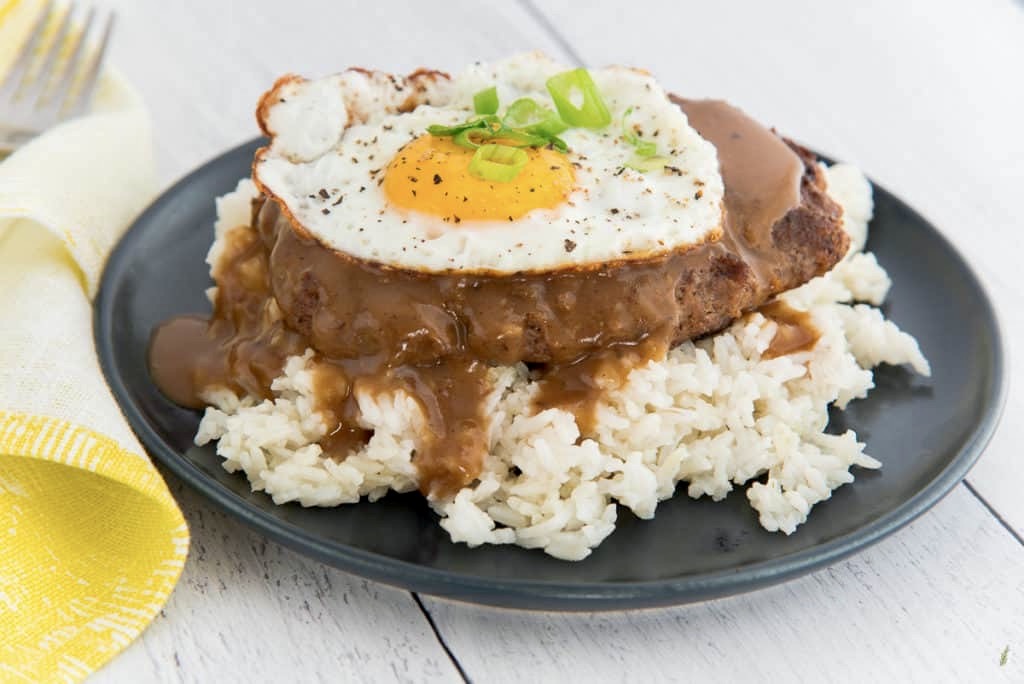
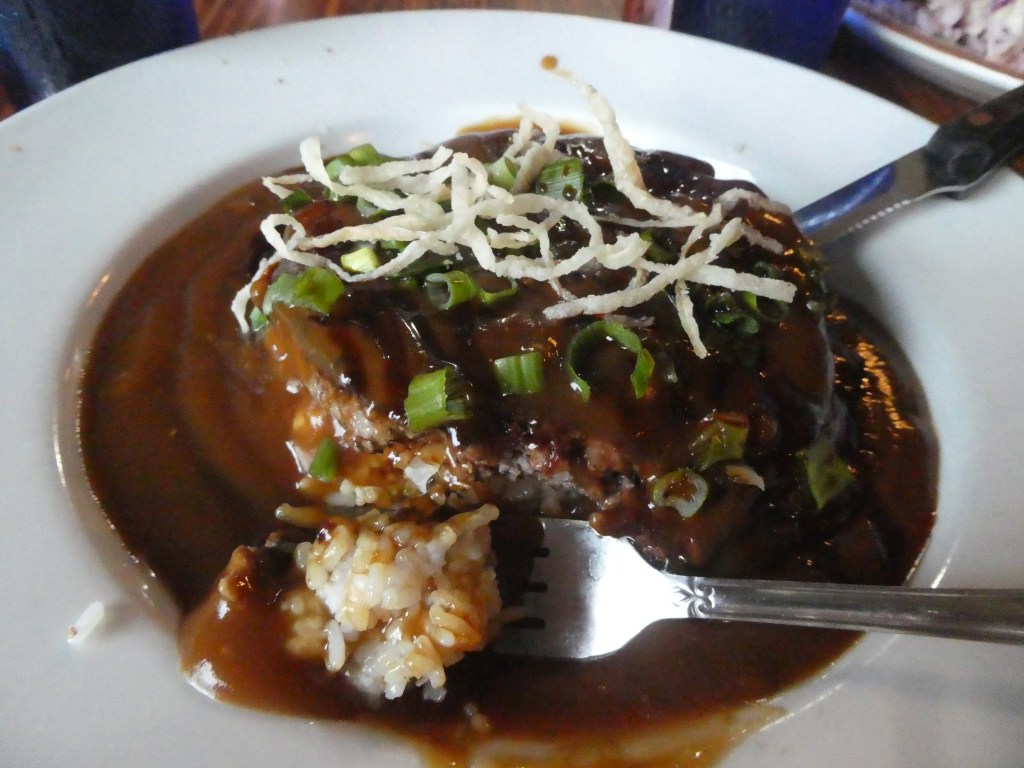
One more food related item – below is a common Hawaiian comfort food – loco moco.

It combines layers of white rice, burger and brown gravy. It is topped with runny eggs.

I don’t like runny eggs so this was the version I ordered! It was very good.

Next up: Rum tour and Luau!

Posted in Uncategorized | 4 Comments

Kauai: A Rainy Island and Albatross

We were able to enjoy a week in Kauai courtesy of our next door neighbor, Donna.  She had enough time- share points to have most of a month on the island.  Her family members came and went and, when she found she’d be alone for her last week, she invited us to join her. 

We were on Kauai in 2013 so much was familiar including the lush country side.

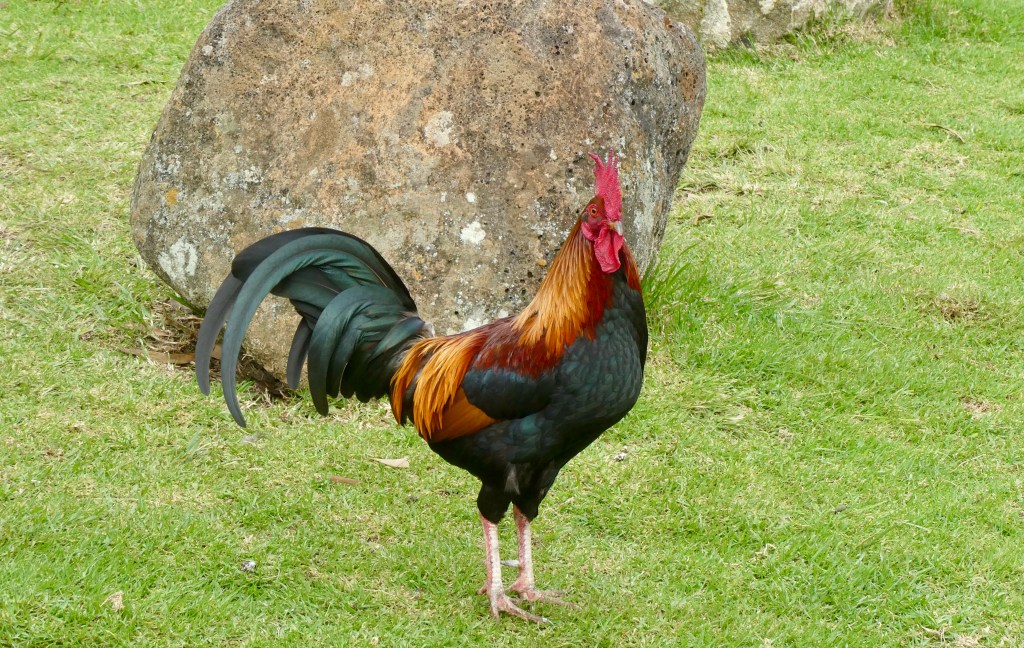
Also familiar were the “rare”and “special” Kauai chickens! 

We saw (and heard) them once or twice.

 Or maybe a thousand times!

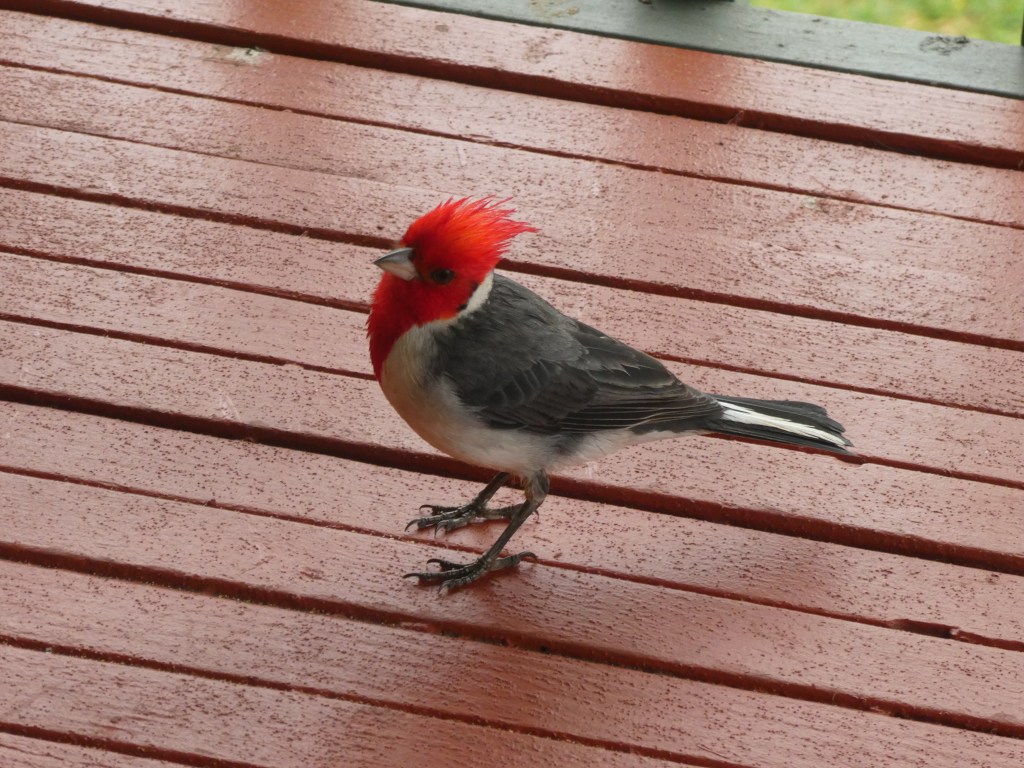
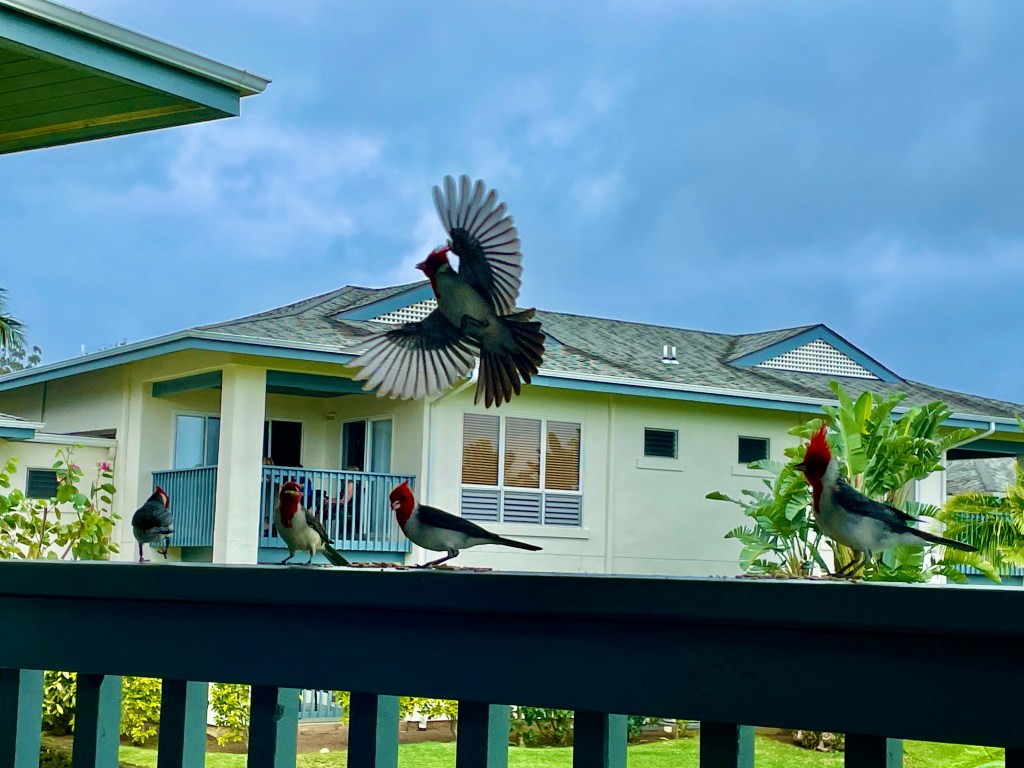
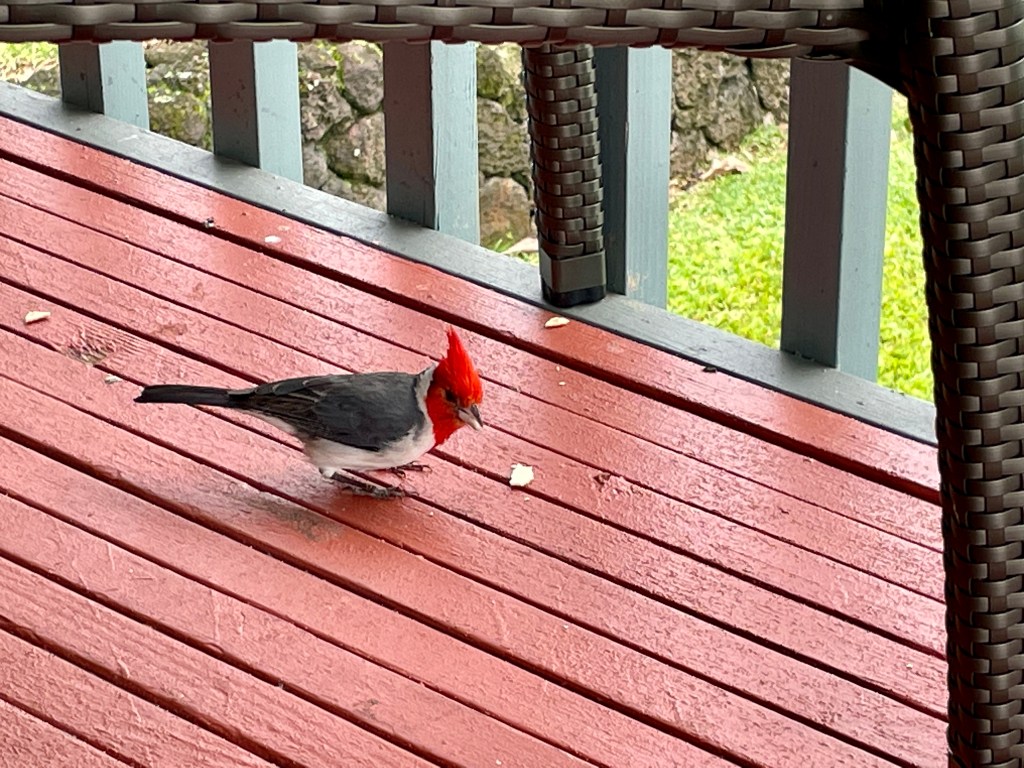
We also enjoyed seeing these birds again!  They are Red-Crested Cardinal although they aren’t actually part of the Cardinal family.  Native to Brazil, these lovelies are related to Tanagers.

I accidentally got this cool shot of the Red-Crested Cardinal on the condo deck!  

There might have been crackers involved.

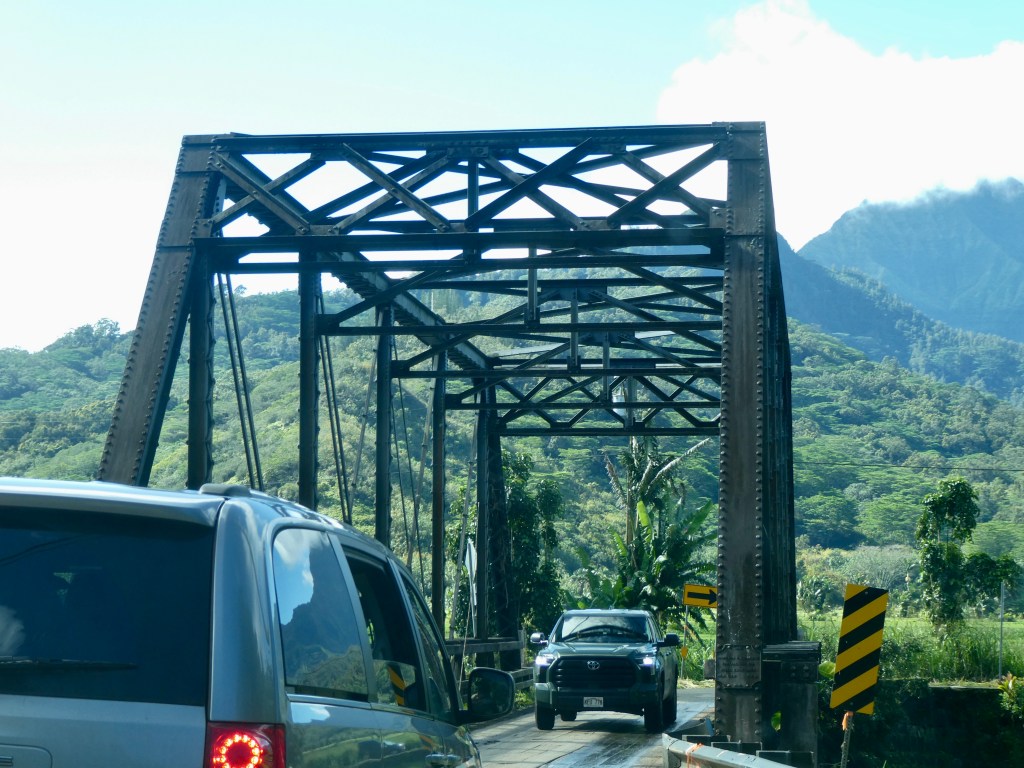
We had been on this one lane bridge to Hanalei before.  

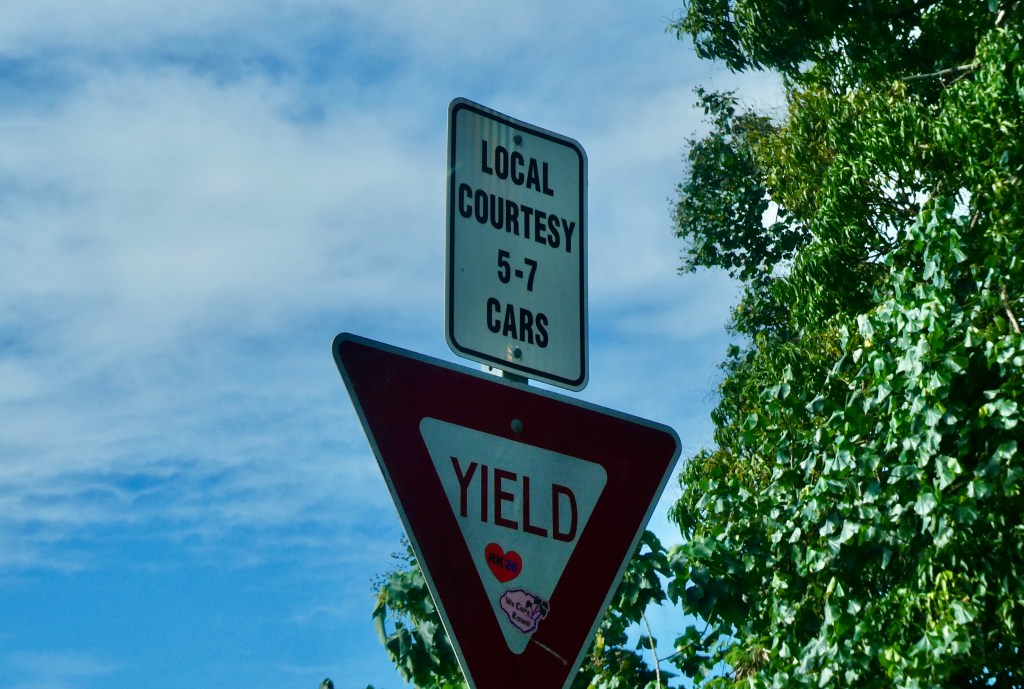
The 5-7 vehicle courtesy is the same as 2013.

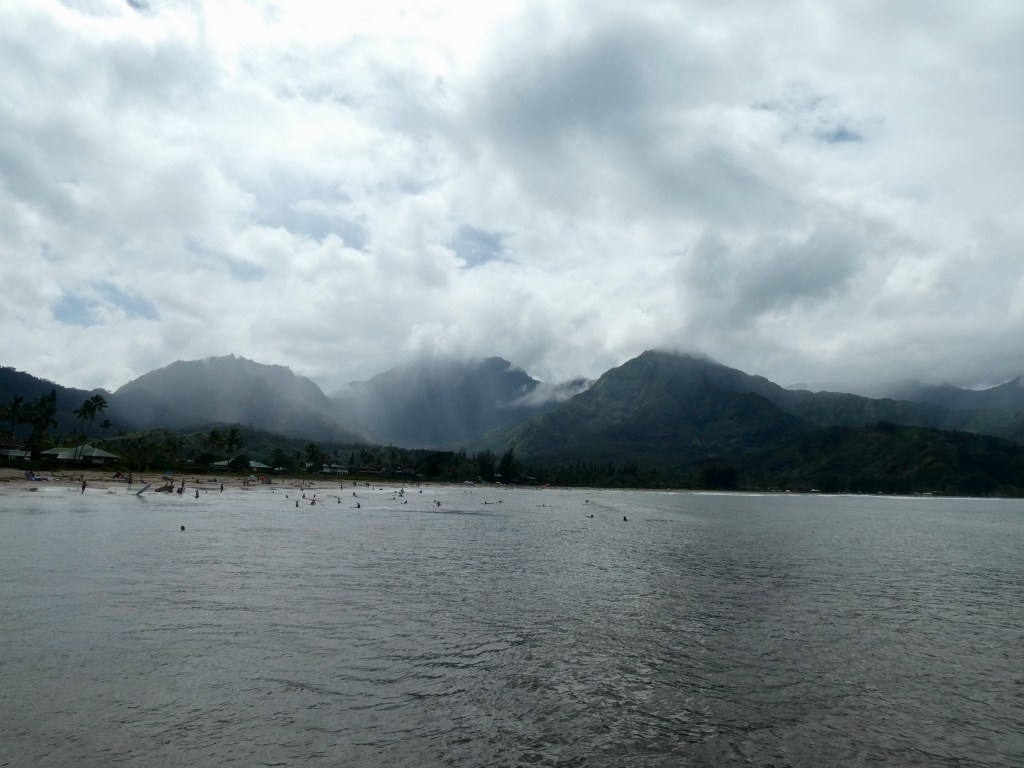
Unfortunately this bridge and others were closed by flooding on the day we were to have had a food tour in Hanalei.  It was canceled. 

Rain, in greater amounts than usual, impacted our week on Kauai several times.  We couldn’t go for a plane ride to see the Na Pali Coast on two separate days. There were other excursions that just weren’t as appealing in the rain.  

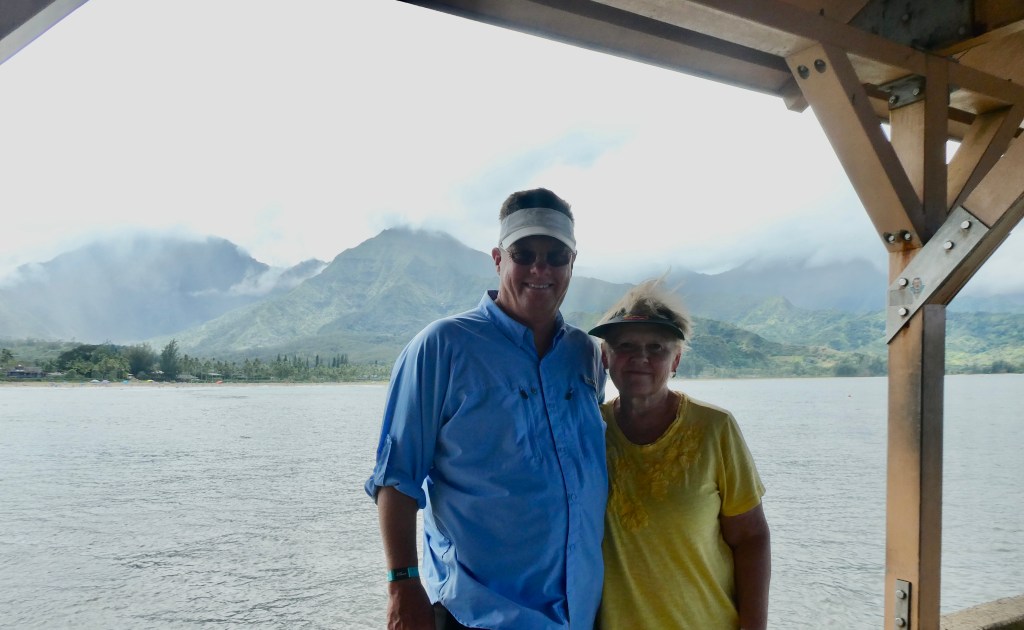
We were still able to enjoy our week! On a sunny moment in time, Randy and I took a walk in the neighborhood adjacent to the time share complex.

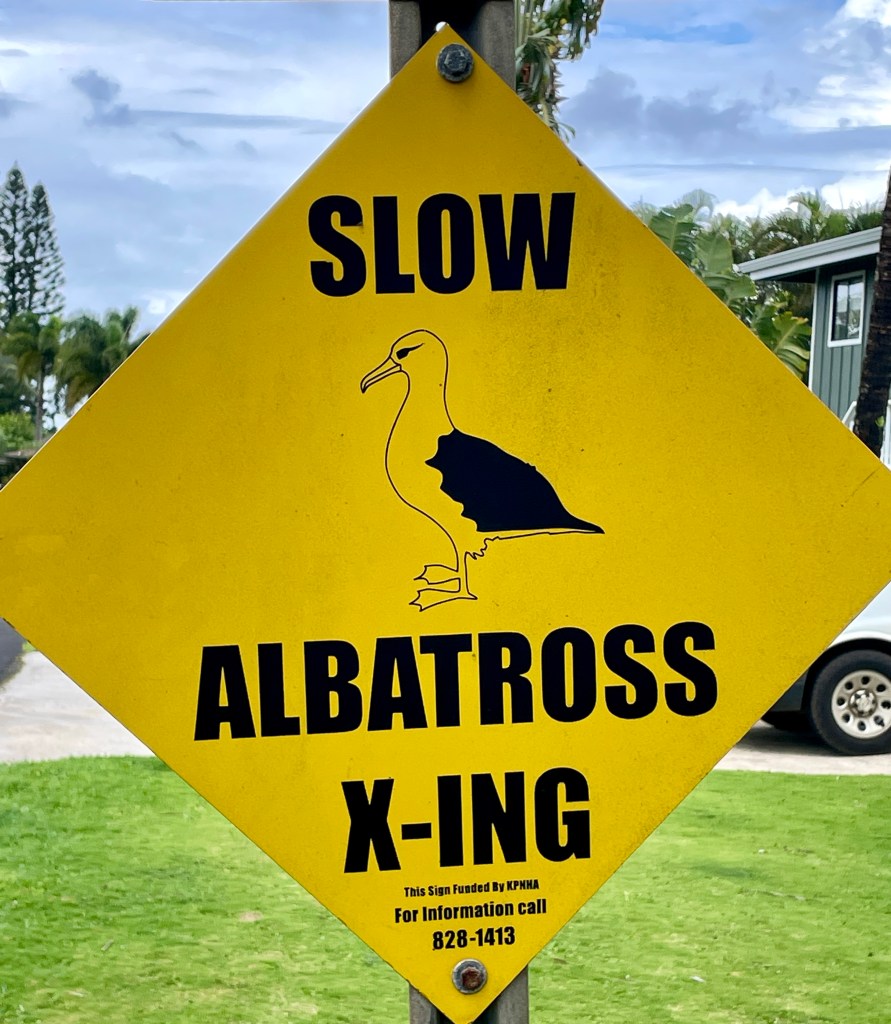
We came upon this sign for albatross crossing!

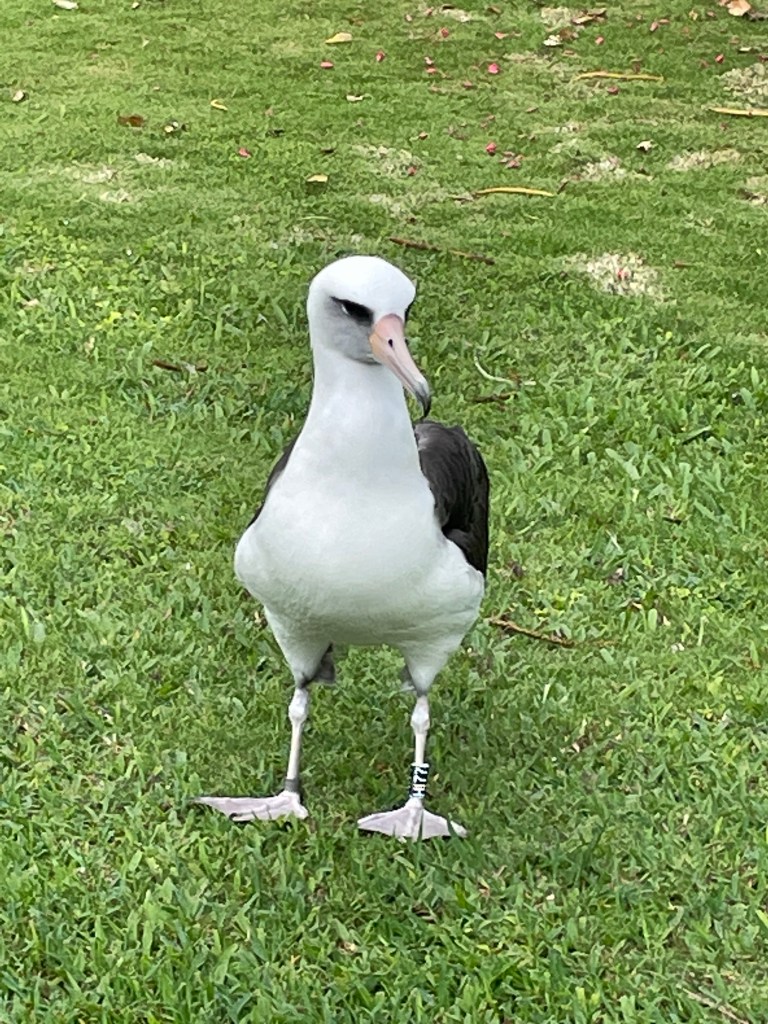
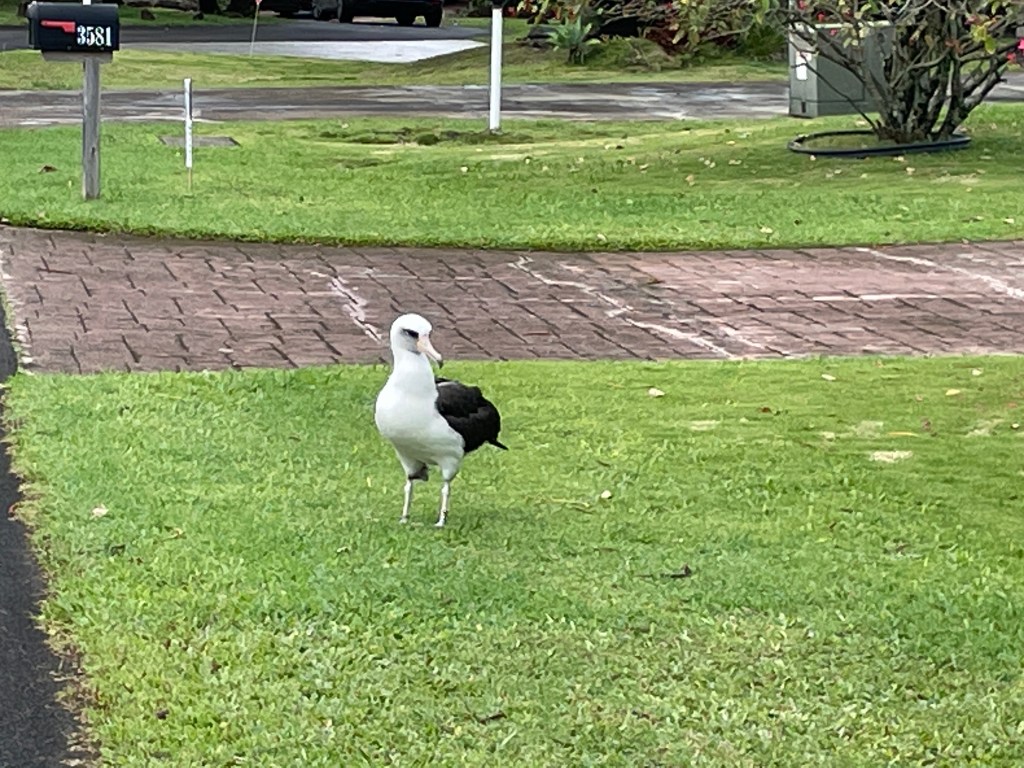
Very shortly we came upon a few individual albatross!  They were intriguing as we knew almost nothing about them. My trip notes said “research albatross” so I did.

I went specifically to the site www.albatrosskauai.com  Their information is extensive, but I’m shortening your education to just a brief summary:

There are 22 species of albatross world-wide but the ones that visit Kauai are called Laysan albatross.  They have wing spans of over six feet.  

Laysan albatross spend most of their lives on the waters of the Pacific.  They, and other varieties, may not touch land for years at a time.  The Laysan travel great distances from the waters off North and South America to Hawaii to the Arctic. 

As much as they live at sea, albatross cannot nest on the water.  Each November adult albatross return to land to breed and raise chicks. 

Albatross mate for life.  Given that they return to the nesting site at different times, researchers believe they don’t travel together throughout the year.  A mate left alone will usually pair up with another.

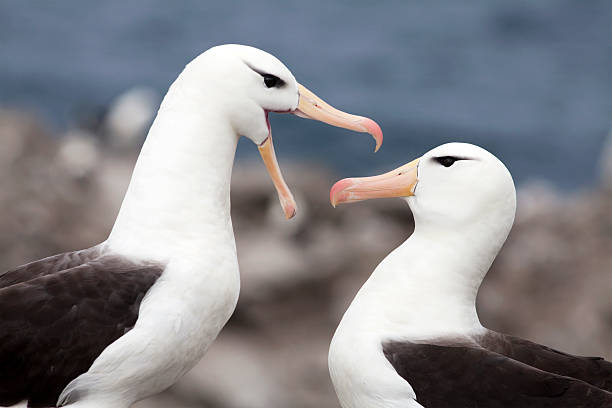
Black-Browed Albatross (Thalassarche melanophrys) pair, Falkland Islands.

Many hundreds of thousands of albatross nest in the northern Hawaiian islands.  About twenty years ago, the Laysan Albatross began nesting on Kauai. 

There are currently several hundred nesting pairs, some choosing residential sites.

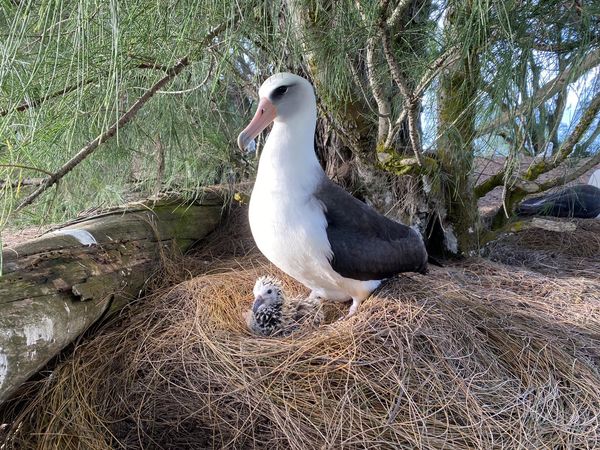
Albatross build a nest on the ground and lay one egg a year. Both parents take responsibility for the egg and chick.    The viability of the eggs and their successful hatching is about two thirds of eggs lain.

One parent stays on the egg while the other flies thousands of miles north to feed.  The journey takes one to two weeks while the remaining parent never leaves the nest, even to eat themselves. 

The gestation period is 70-80 days.

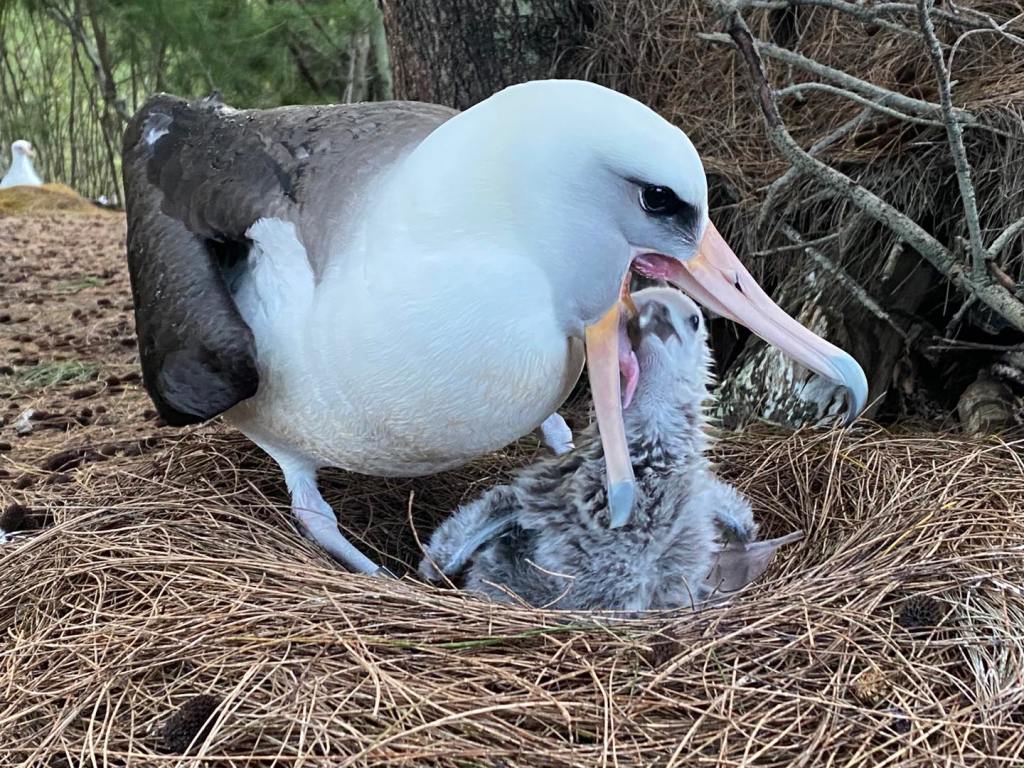
At three weeks of age, the chick is left “home alone” for days at a time while both parents go on the food cycle to bring regurgitated “take out” for the growing chick.  

The chick is fed this way for four months.  Combined, the parents make 25-30 trips traveling about 60,000 miles.  

The chick grows to its adult size during this time. At about six months, an internal clock and compass leads the chick, independently, to the edge of a cliff where it runs and jumps and flies.  

It probably won’t touch land again for 3-5 years when it will return to it’s place of birth to find its own mate and start the cycle again.   These are pretty fascinating birds!

Next up:  We learned about the growth and use of noni.

Posted in Uncategorized | 4 Comments

Road Trip: Palm Springs, California

We planned a road trip to the Palm Springs area of southern California to see a show at the McCallum Theatre.  Usually we see any show we want in Phoenix but we were not home when Come From Away played here last summer.  More on that later.

Our trip involved a two night stay so we visited a few places highlighted on a travel show on PBS called Samantha Brown’s Places to Love.

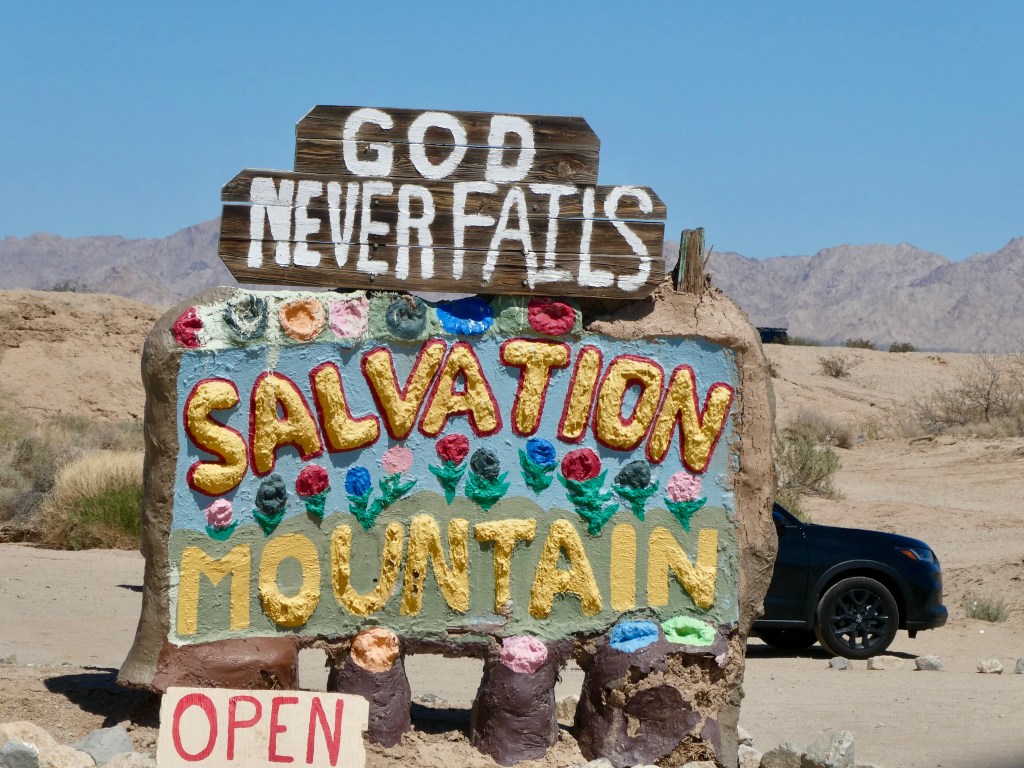
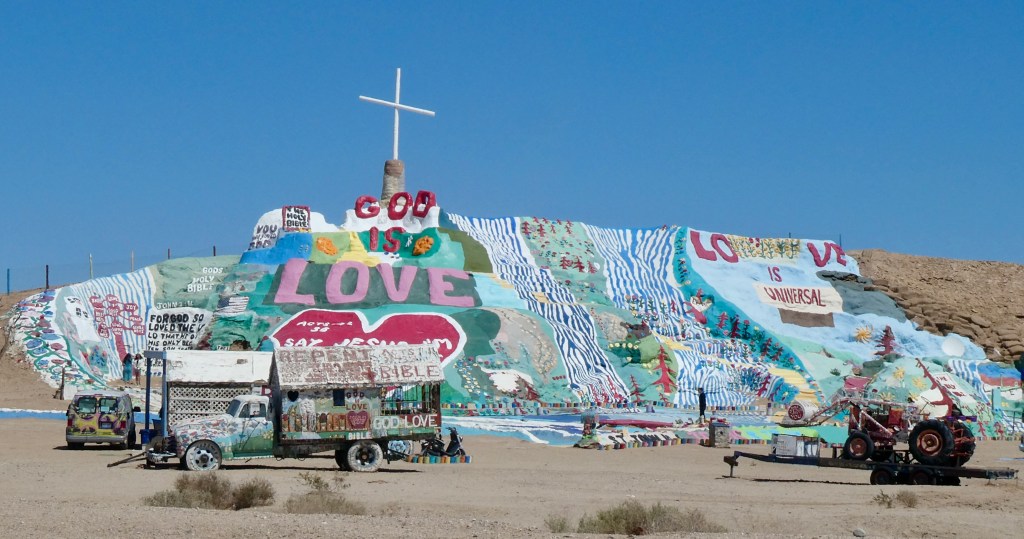
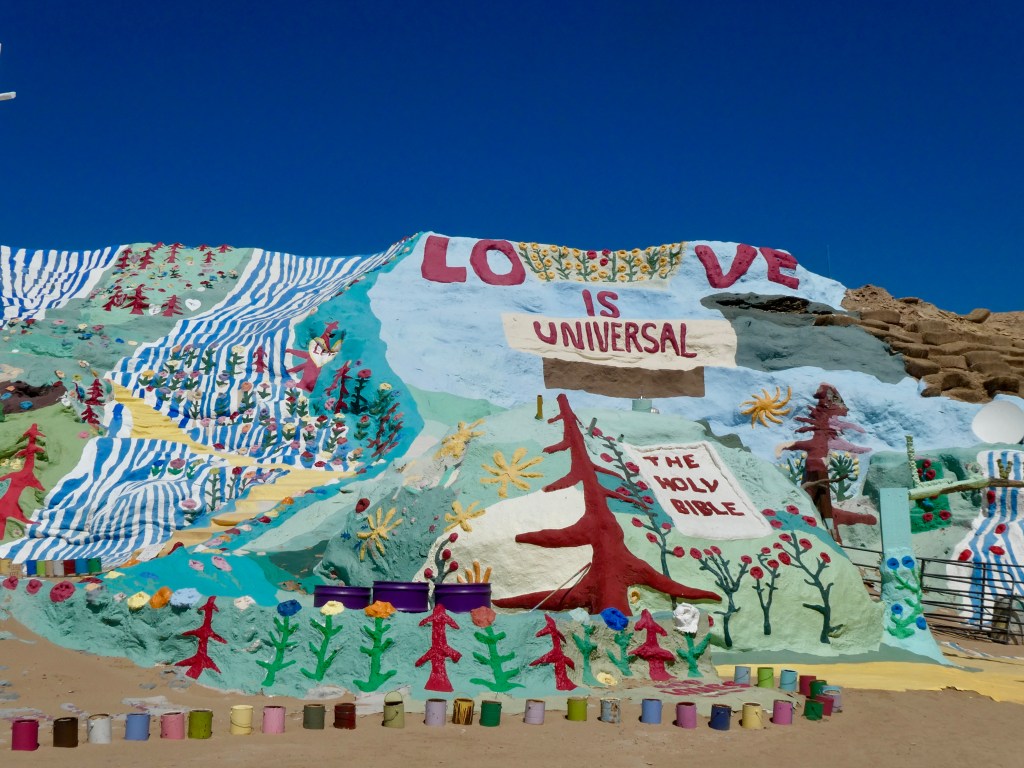
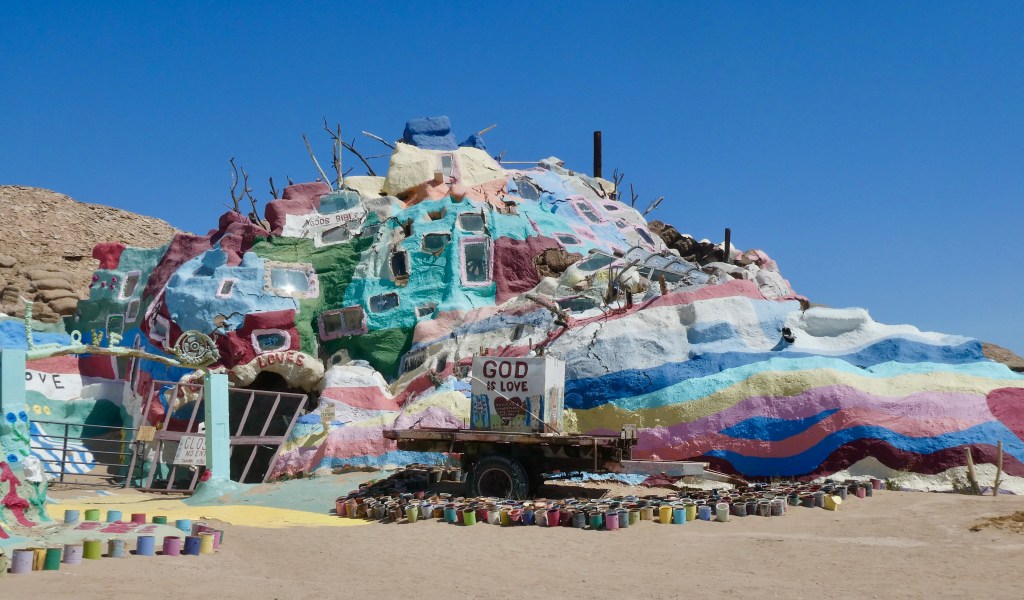
We started at Salvation Mountain in Niland, California.  

Salvation Mountain began as a temporary monument representing God’s love as perceived by Leonard Knight (1931 – 2014).  

Leonard found all religions to be too complicated instead believing all that was needed was repentance and forgiveness through Jesus Christ.  

He put his belief into his Salvation Mountain.

He worked on his monument over 28 years using plaster covered hay bales, items scrounged from the dump, and half a million gallons of latex paint.

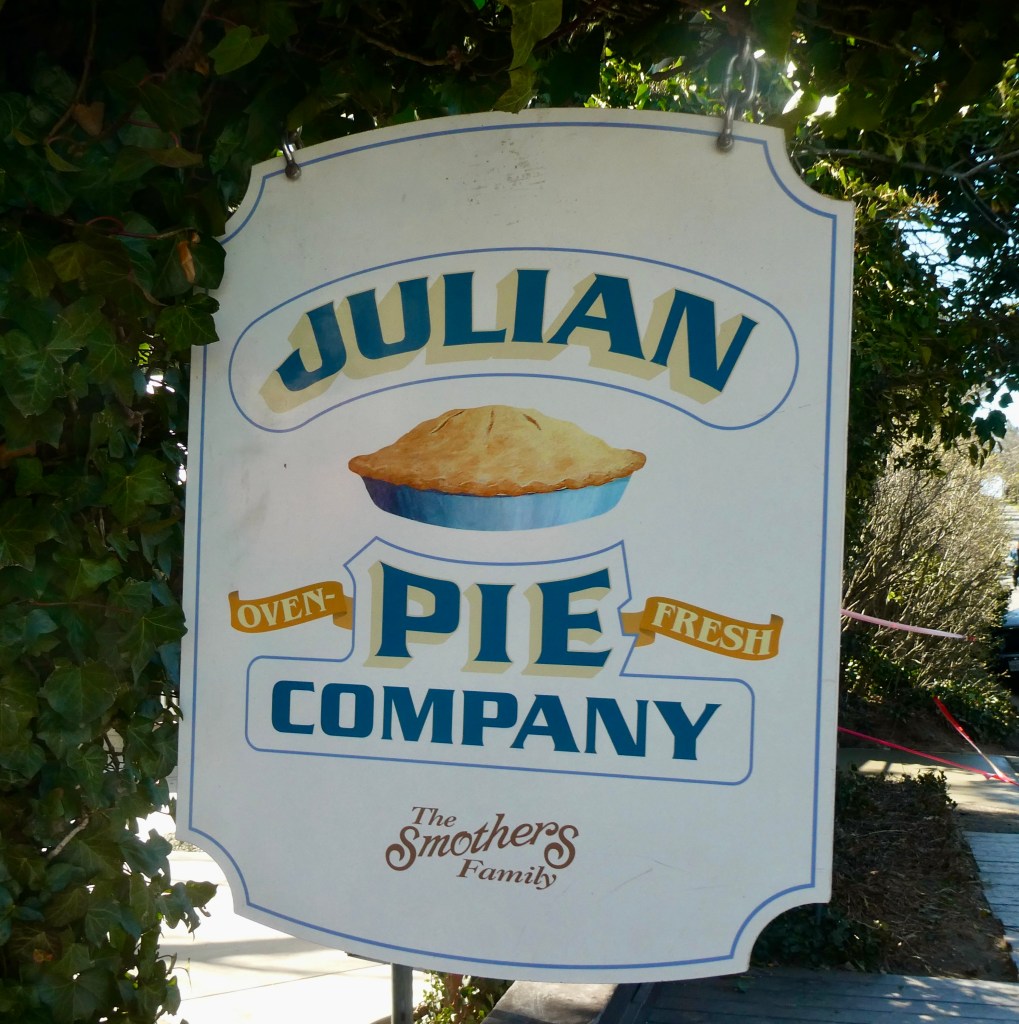
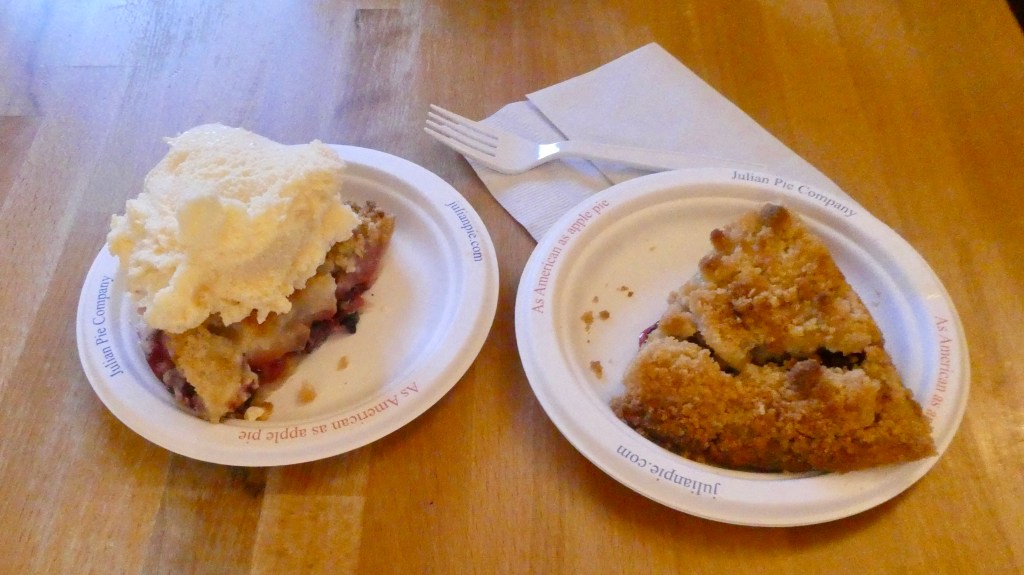
The PBS show made us aware of visiting the town of Julian to have pie at the Julian Pie Company..  

A long standing family operation, almost all pies start with home grown apples. We had apple and berry pie for dinner!

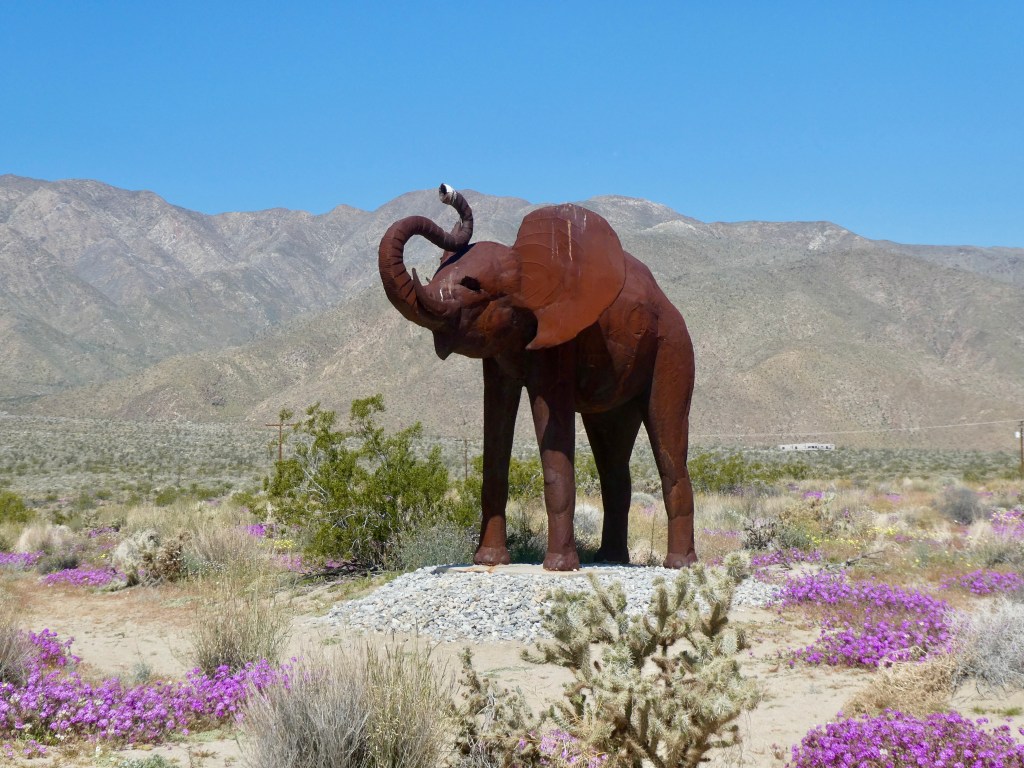
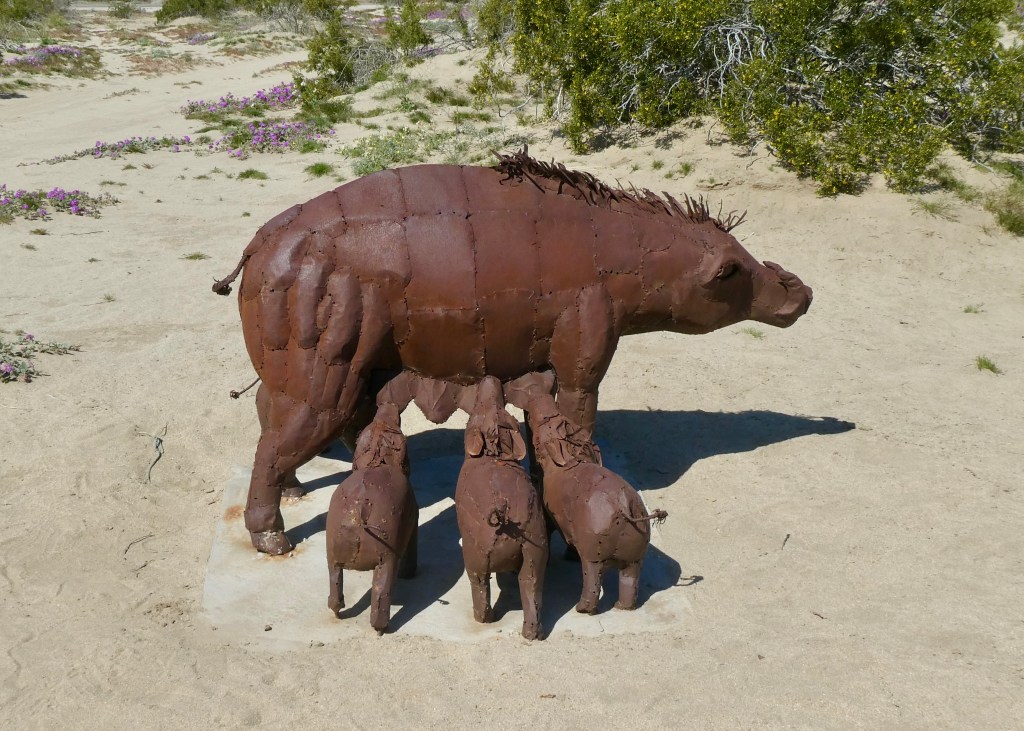
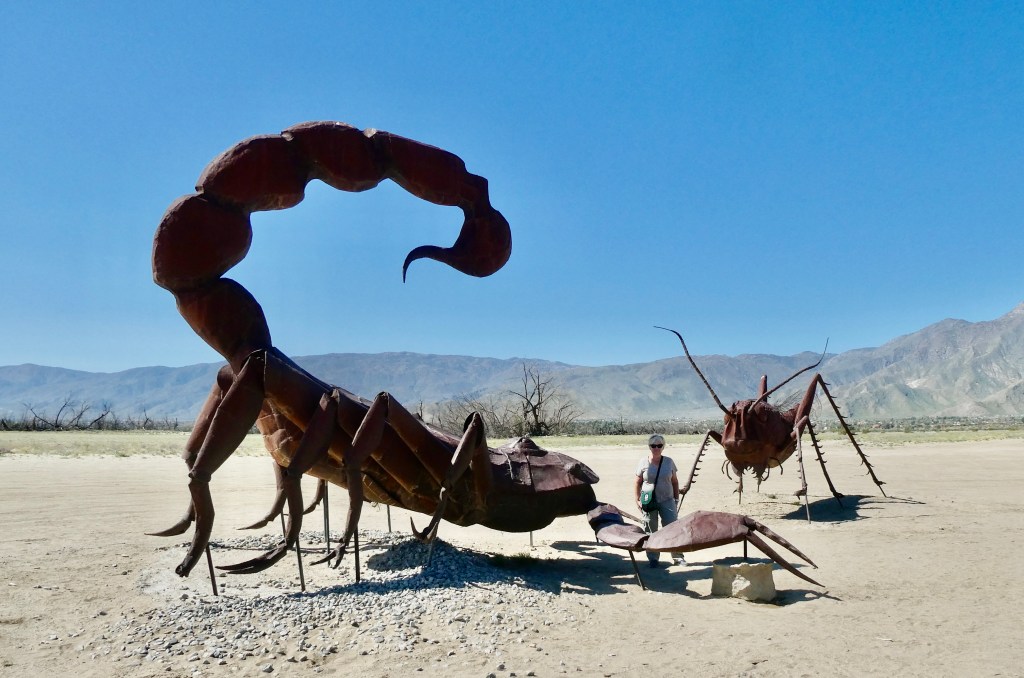
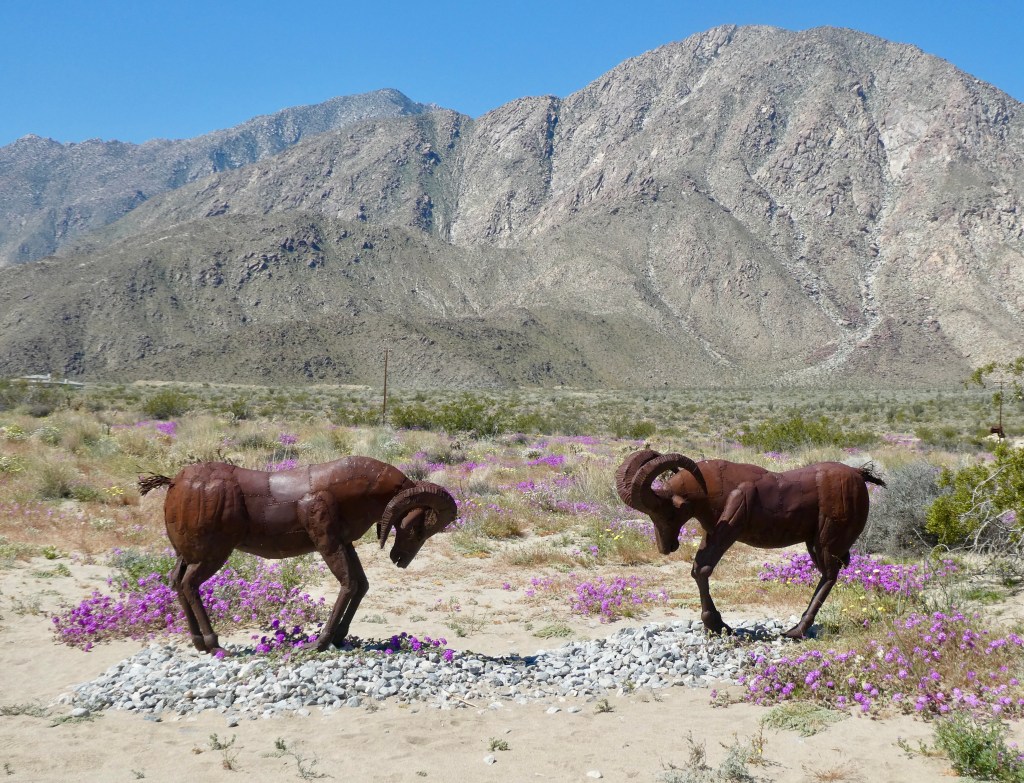
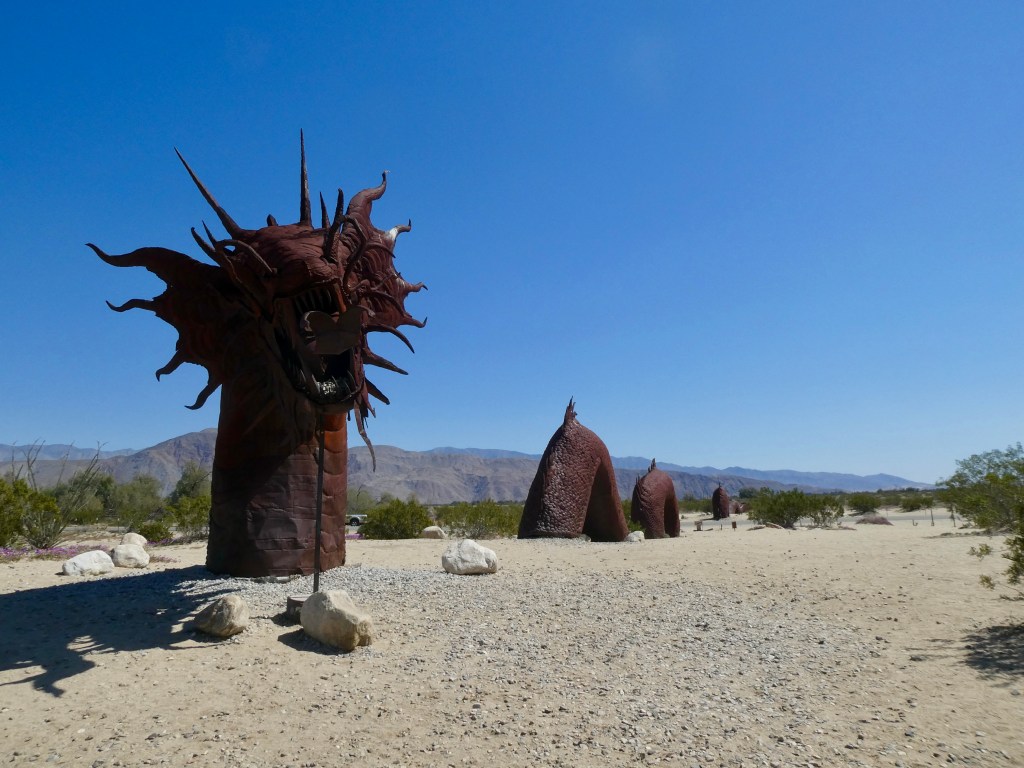
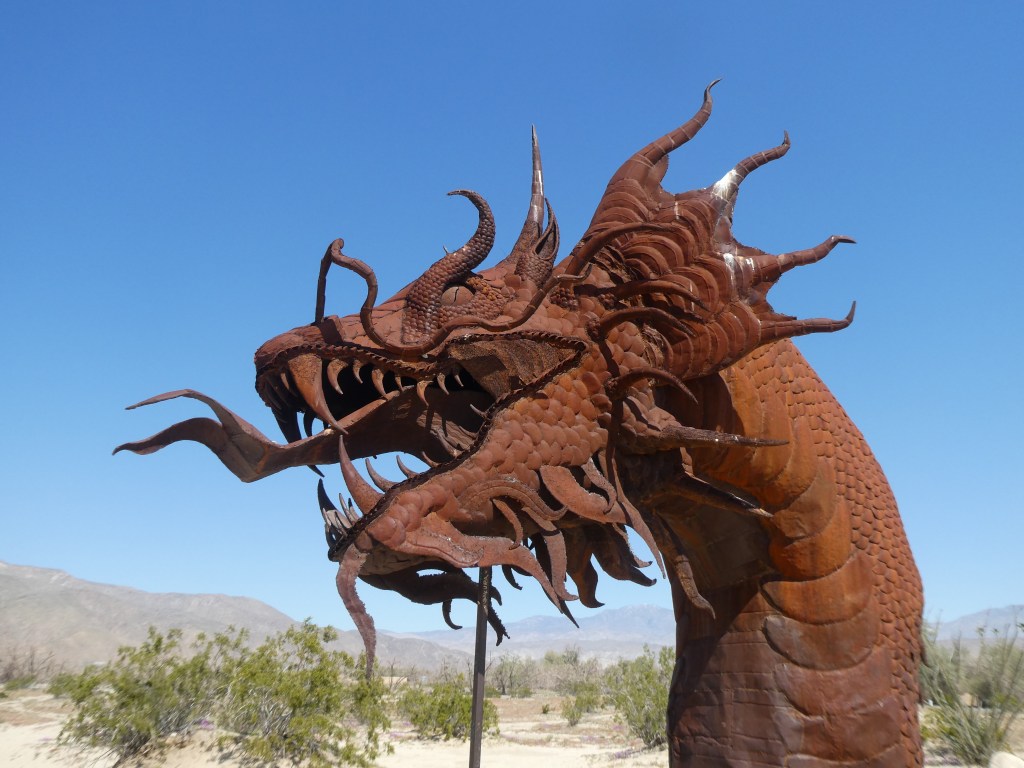
Again, following the PBS show recommendation, we visited Borrego Springs to see a collection of larger than life metal sculptures.

There are 130 sculptures in and around the town of Borrego Springs. The town is surrounded by the Anza-Borrego Desert State Park.

The largest concentration of sculptures are in an area north of town called Galleto Meadows.  

We lucked out with some wildflowers too!

Philanthropist, and Galleto Meadows owner Dennis Avery, commissioned sculpture artist Ricardo Breceda to build the sculptures from 2008-2012. That seems a nice gig for an artist during the recession!

We drove through and walked around the expansive area.

The sea serpent has body parts on both sides of the road!

As fun as these side experiences were, the purpose of our trip was to see the musical Come From Away at the McCallum Theatre.

We become aware of the show when visiting Newfoundland last summer.  

I have not yet written about that trip. However, we so enjoyed re-living our Italy trip by writing it after the fact, that I will probably write our Canada trip as time allows this summer. By then Randy may be able to find the end of that trip somewhat amusing!  No, probably not….teaser!

Anyway, in preparation for seeing the musical we both read Jim DeFede’s book The Day the World Came to Town.

We learned that Newfoundland is pronounced Newfin-land.  They have their own time zone that is 90 minutes ahead of US Eastern Standard Time.  Their isolation leads to a cooperative spirit for the survival of all.

The history of helping others rose again in 1942 when two US military ships were destroyed by running aground in a violent storm.  One hundred ninety three sailors drowned but 186 were saved by the heroic efforts of Newfoundlanders.

The island has a long history of aviation importance as a refueling stop for military and civilian aircraft.  Newer jets with longer range has greatly reduced aviation traffic but the long runways remain. 

On September 11, 2001, United States airspace was closed at 9:54 a.m. EDT after the terrorist attacks. There were 4546 aircraft aloft over the US and they were directed to land. There were an additional 400 international flights heading to the US, mostly from Europe..

Of those 400 flights, 250 aircraft were diverted to Canada.  Those planes carried 43,895 people.  Thirty-eight planes, landed in Gander, Newfoundland with crew, passengers, and an assortment of animals.  

Imagine 6595 extra people joining a town of 10,000!   The book and the musical tell the story of the locals and passengers and how they passed the next four days together.  The service provided by the population of Gander is unimaginable – yet they did it.

Photos were not allowed of the production. If you ever have the chance to see the musical, do it!  At the very least, read the book!

An interesting side note to entering the theater – ID and proof of COVID vaccination were required.  We had received this information with our tickets. Masks were recommended but not required.

The next day we had a four hour drive back to Phoenix and made a couple more stops along the way.

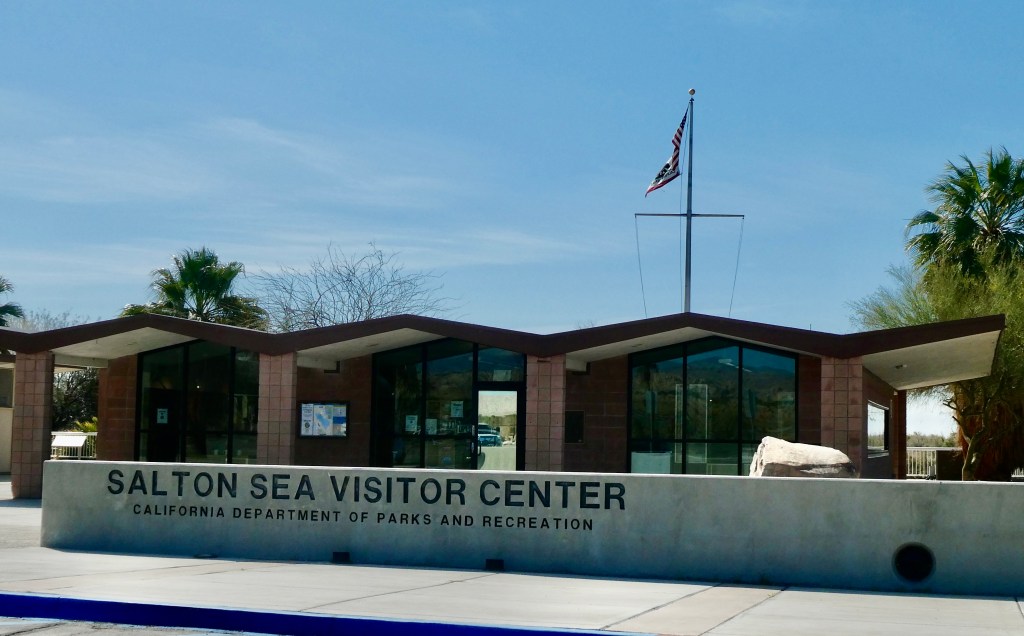
Our first stop was the Salton Sea Visitor Center.   

The depression for the lake was caused by tectonic shift, sediment collection and flooding along the Colorado River.  It has a salt water, fresh water, salt water history.

The sea measures 372 square miles and is the largest lake in California.  It sits 277 feet below sea level. It was once the second busiest (of 273) state parks in California.  Its heyday was in the 1950s and 1960s.

Even after its peak, the Salton Sea was still a haven for fish and fishermen and birds and birders.  

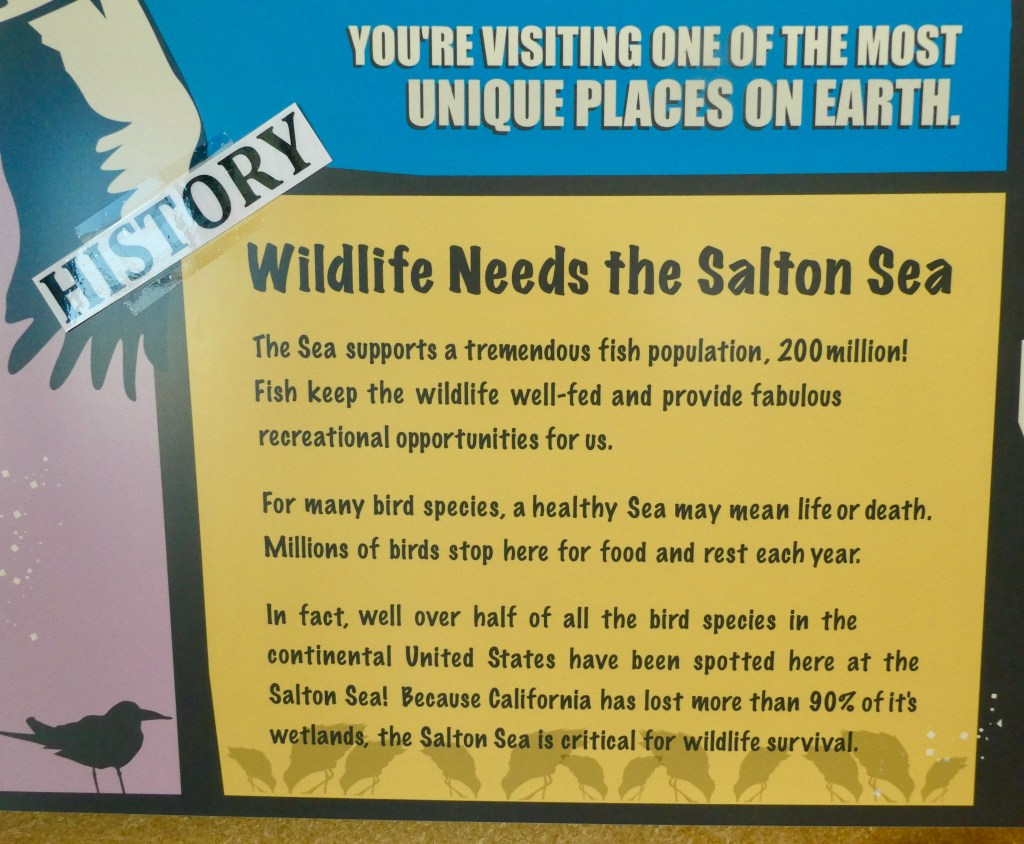
Placards in the visitor center are now slapped with History labels as so much has changed.

With climate change and drought, the salinity has increased too much to support fish and the last of the fish died two years ago.  Given that, there are now much fewer birds.  The politician Sonny Bono was very interested in the health of the Salton Sea. There are maintained birding areas with his name in the southern part of the sea.

The Salton Sea currently has higher salinity levels (60 grams per liter) than the Pacific Ocean but less than the Great Salt Lake.

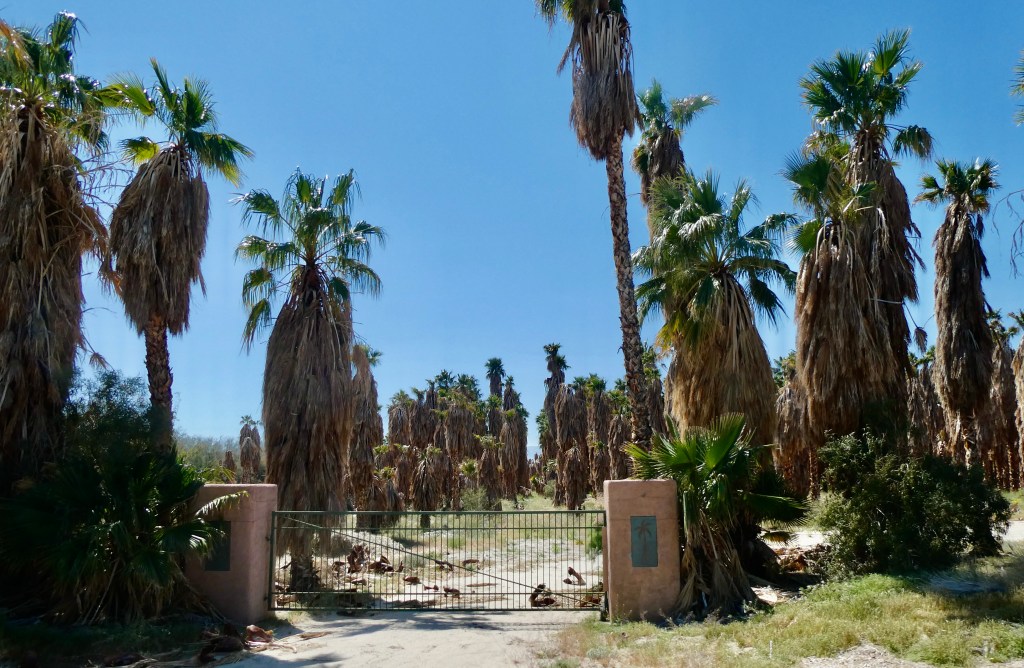
As we left the area we were quite confused by the assortment of agriculture that was dying off, and new agriculture being planted.

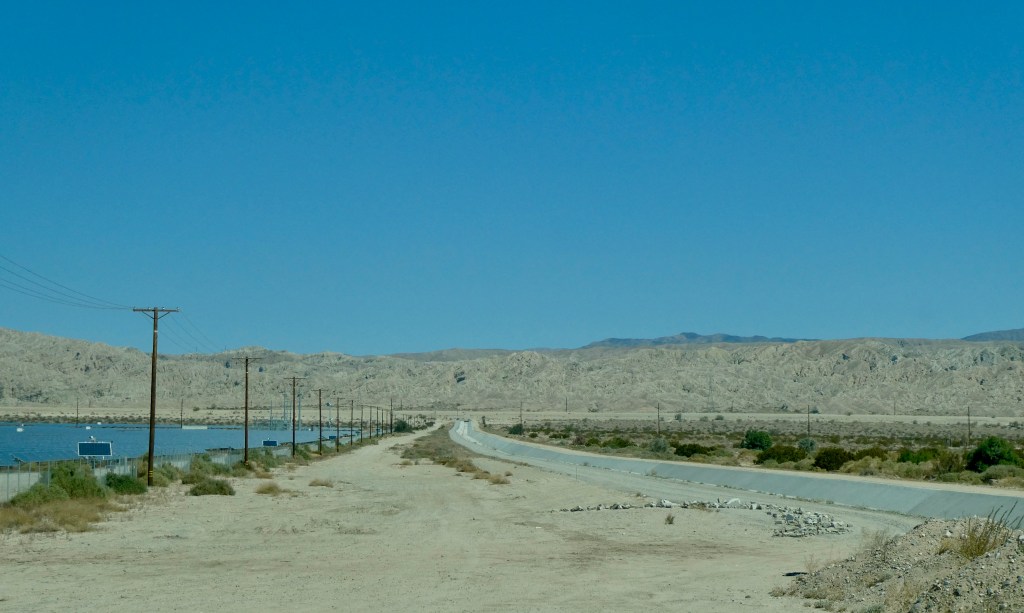
We were stunned to see this new water canal. 

I know the water and agriculture scenario is complicated given the drought but allowing established crops to die, while starting new crops, when water is scarce just doesn’t make a lot of surface sense.  

On to a person who made more sense of his life – General George Patton.   

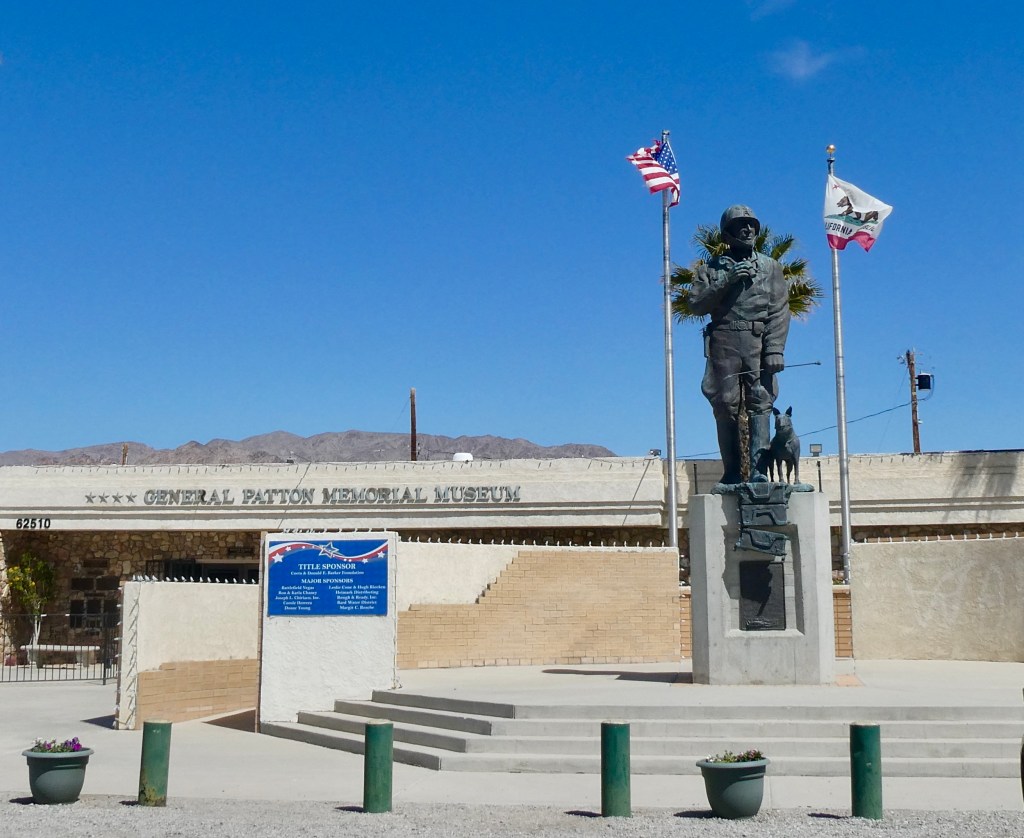
Our last stop in the area was at the General Patton Memorial Museum.  The museum is extensive with details, not just about Patton, but about all military activity during his lifetime.

Some very brief highlights of his life are that he had a family legacy of military service stretching from the Revolution to World War II.

Patton went to West Point and participated in the 1912 Stockholm Olympics as the first American athlete in the pentathlon.

He was instrumental in beginning a tank training program during World War I.

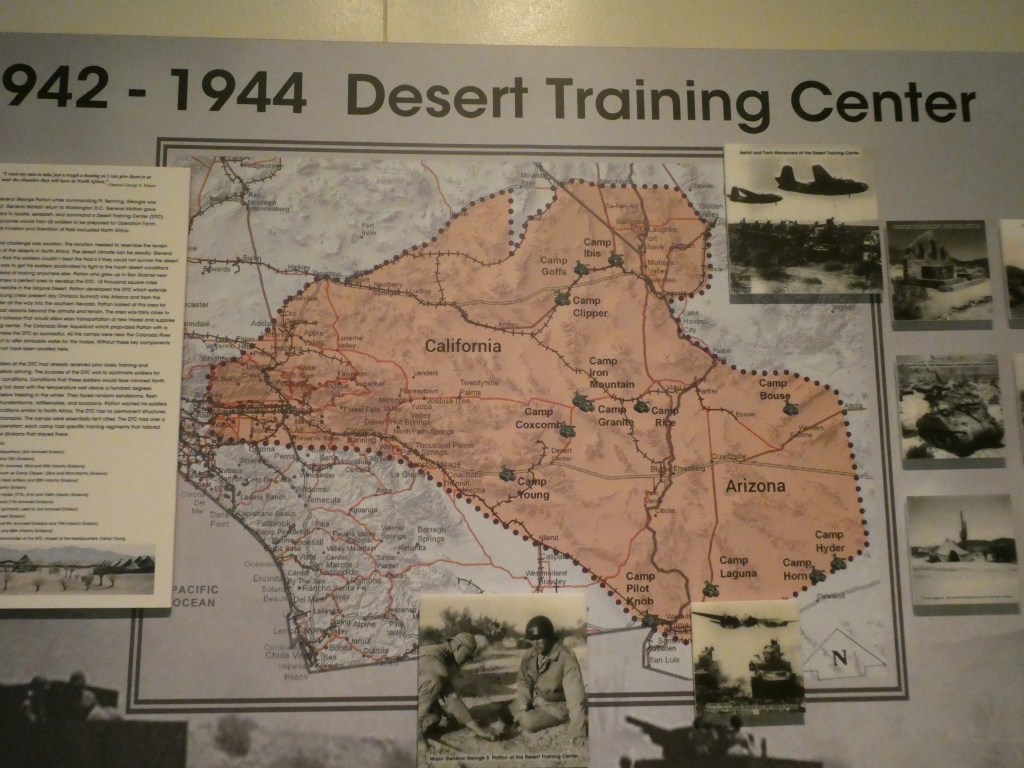
After the US got into WWII, Patton chose the site for, and led, the Desert Training Center  in the American southwest.  He was from southern California so knew of the Mohave Desert area. 

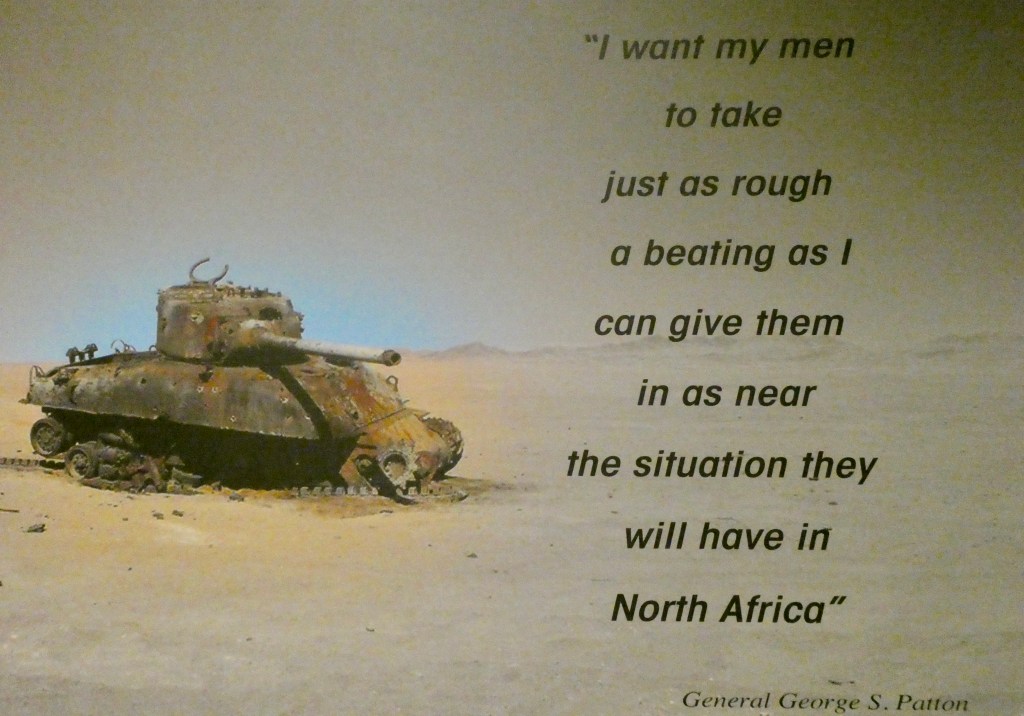
His goal was to prepare American soldiers for war against the Axis regimes in Northern Africa.  

There were camps holding about 15,000 soldiers scattered in the region. At one time there were over 200,000 soldiers training in the Desert Training Center.  

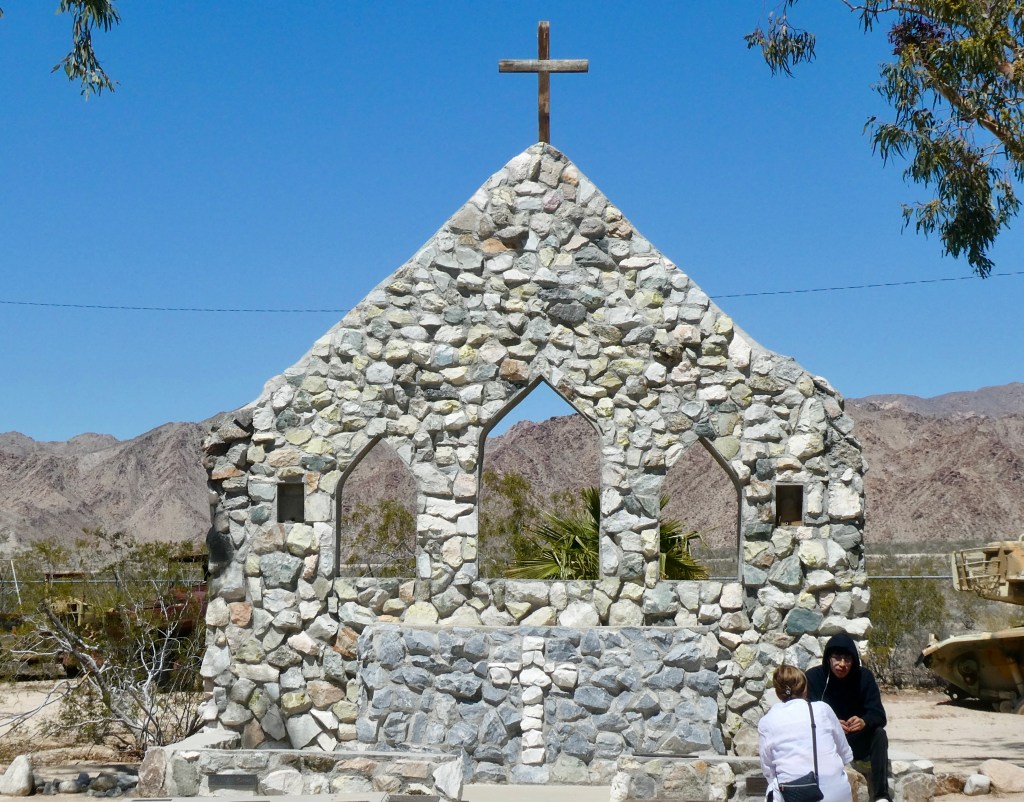
The camps were spartan with no luxuries at all.  Men lived in tents and ate standing up. There were two chapels, one for Catholics and one for Protestants. This is a representation of one of them at the museum.

When the original engagements did not go well in northern Africa,  Eisenhower appointed Patton to come in and lead the troops.  He emphasized discipline and things turned around. 

Patton is seated second from the left as we view the picture. Eisenhower is seated in the center with General Omar Bradly to his left (our right).

Patton’s next accomplishment was capturing Sicily. He followed that with an unusual strategy in the Battle of the Bulge.

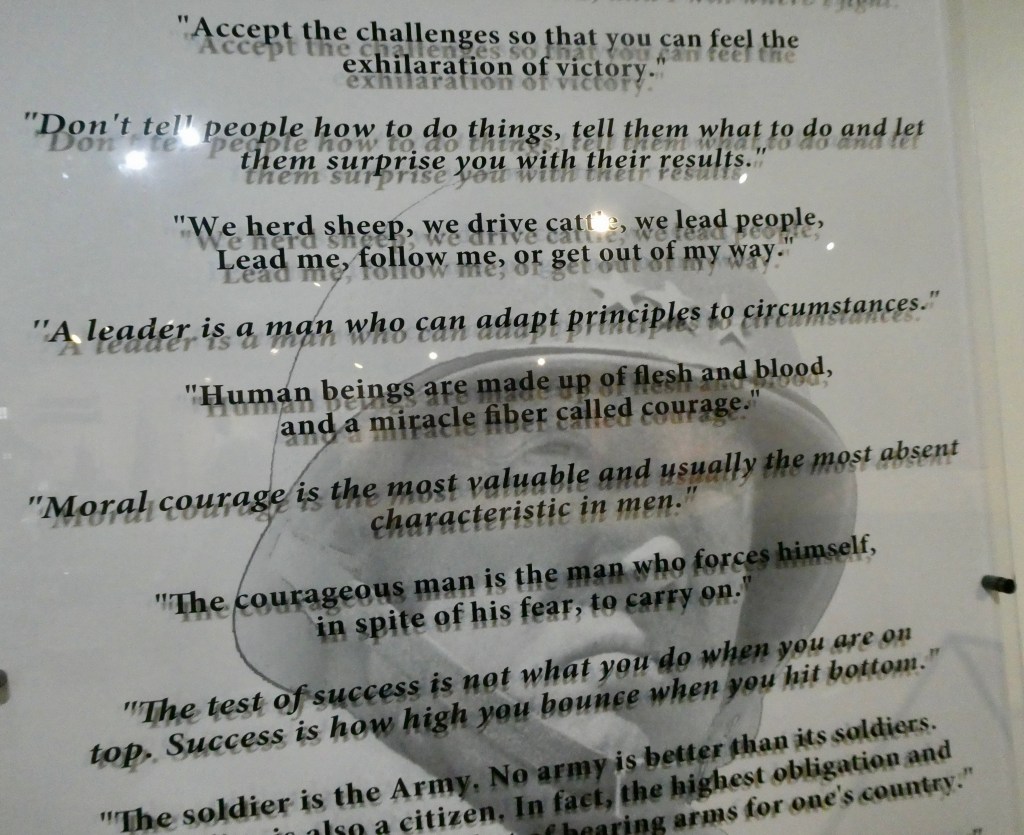
Patton must have been a good interview because the museum was full of his quotes.  Patton speaking also got him into some trouble . At one point he was sent to desk duty for accusing a shell shocked soldier of malingering. 

He also caused trouble for those trying to work through difficult situations with diplomacy.  After being his earlier champion, Eisenhower removed Patton as Commander of Bavaria because of things he said.

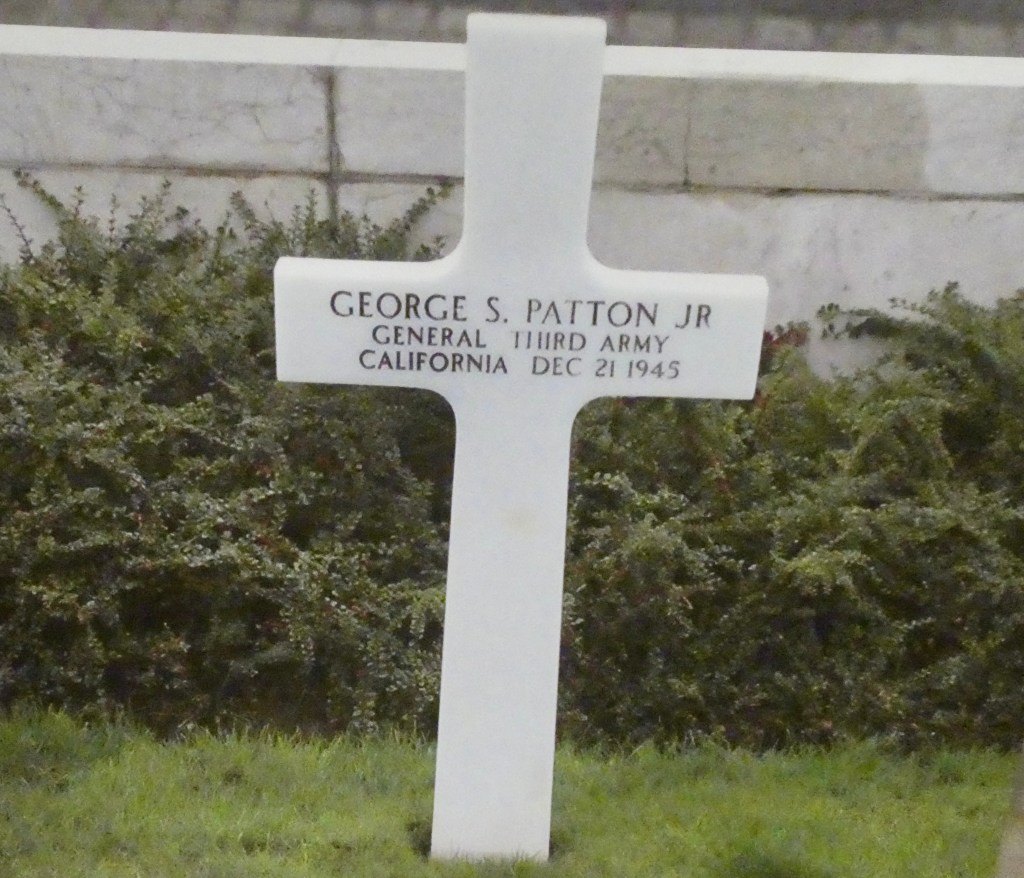
General George S Patton suffered a broken neck in a car accident in 1945. Two weeks later he died from a blood clot related to the paralysis suffered in that accident.  He and his wife decided prior to his death that he should stay with his troops. General Patton was buried in the Luxembourg American Cemetery. 

For those who might wonder, we visited Joshua Tree National Park and did the Aerial Tramway when we were in Palm Springs in 2015. Those observations are in the post One Potato, Two Potato, Three Potato, Four.

Posted in Uncategorized | 8 Comments

Arizona: Burros and Wildflowers

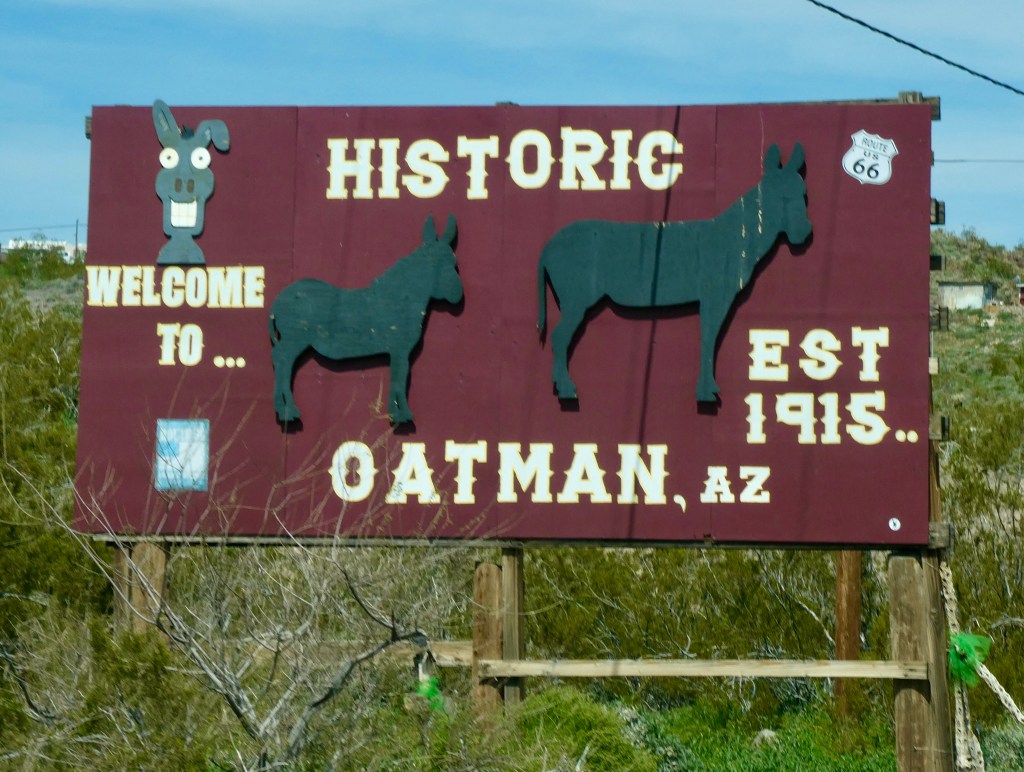
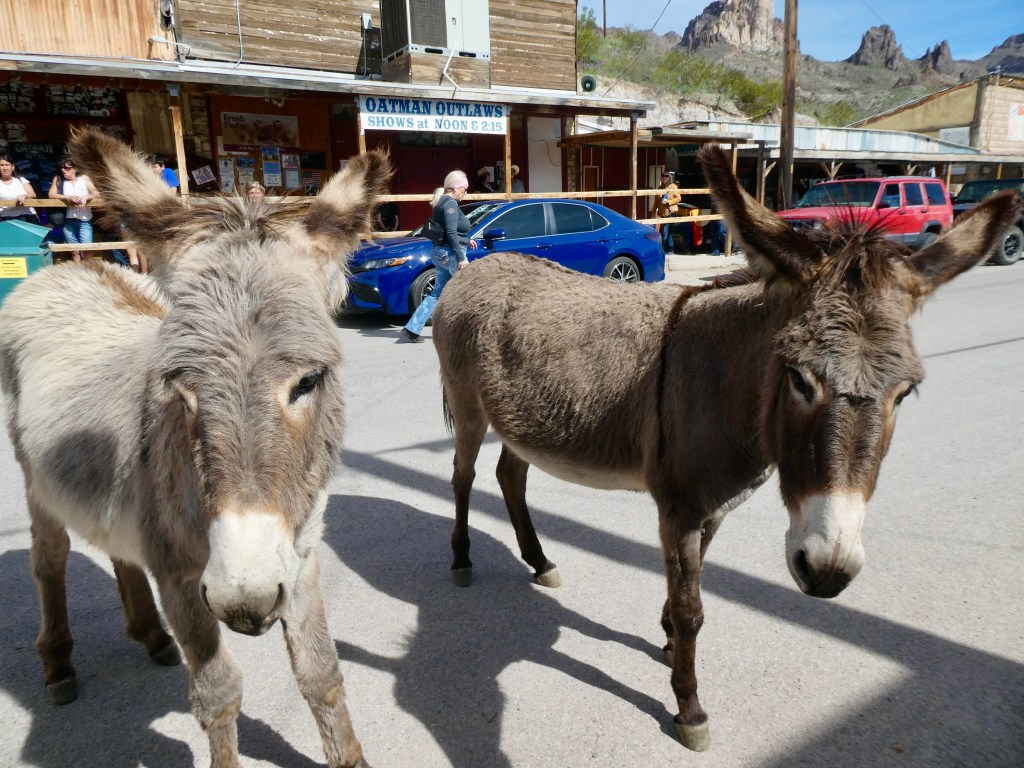
Returning from Las Vegas, we made a detour along Historic Route 66 to visit Oatman, Arizona. We knew it as a tourist ghost town with wild burros that wander the streets.  

Oatman is a former mining community and burros were common beasts of burden for the industry.  As the mines were abandoned, burros were sometimes released to fend for themselves.  The burros in Oatman are descendants of those mining burros.

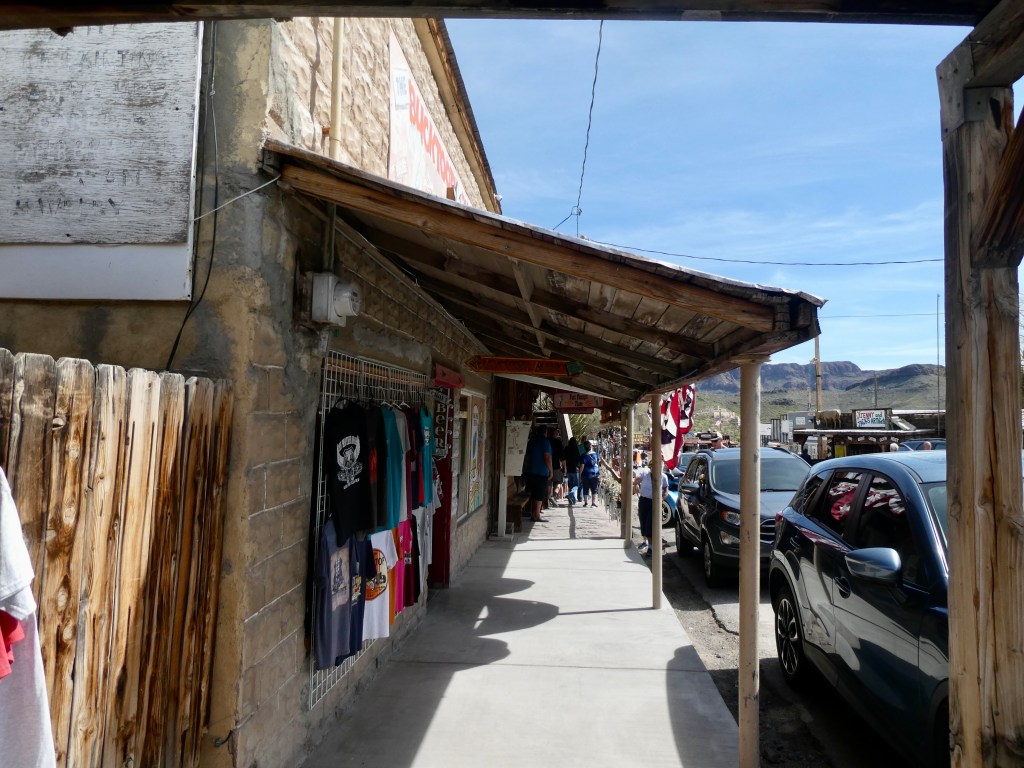
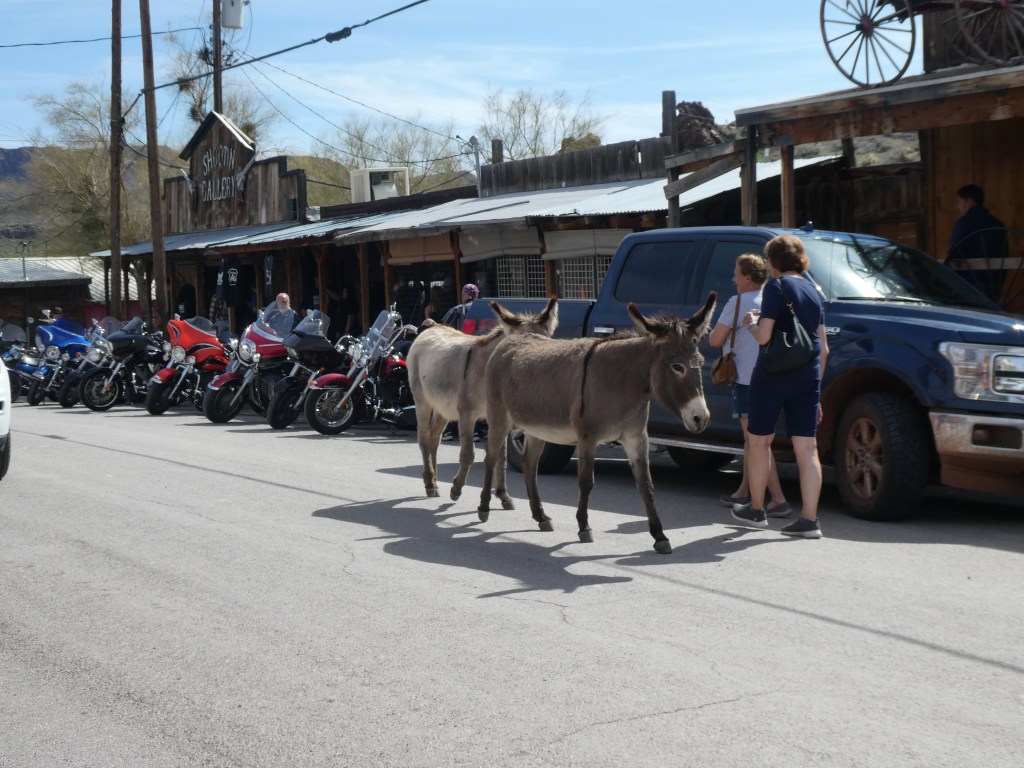
We arrived in town on a beautiful Sunday afternoon and found way more than we expected.  Oatman was very busy!  

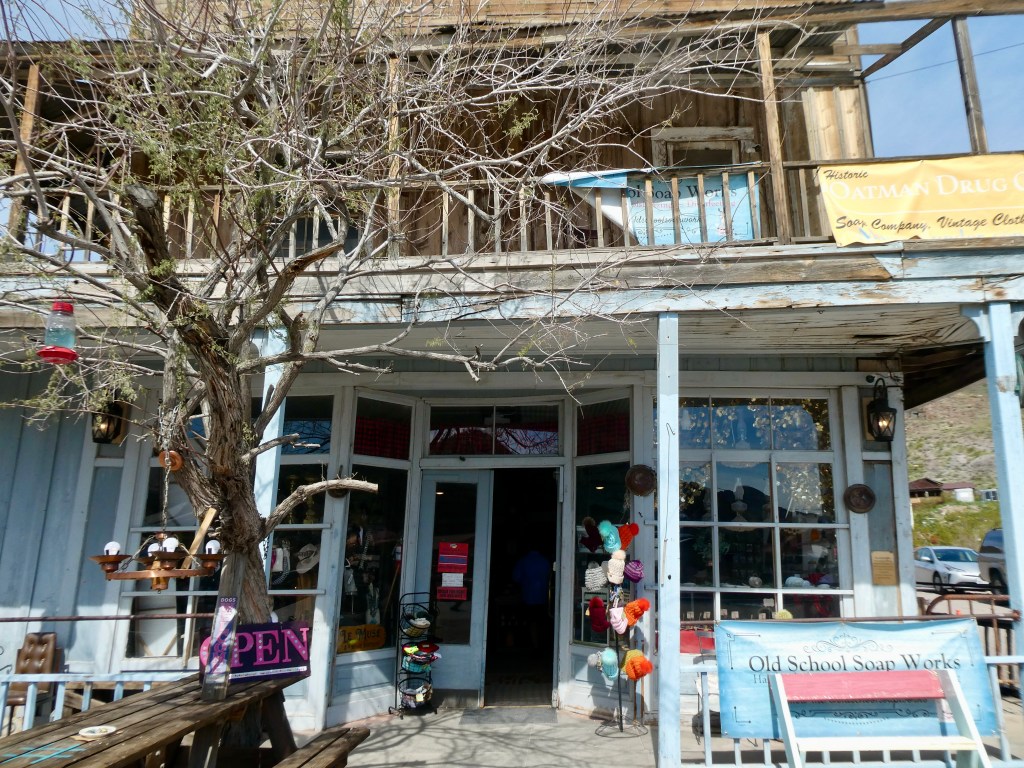
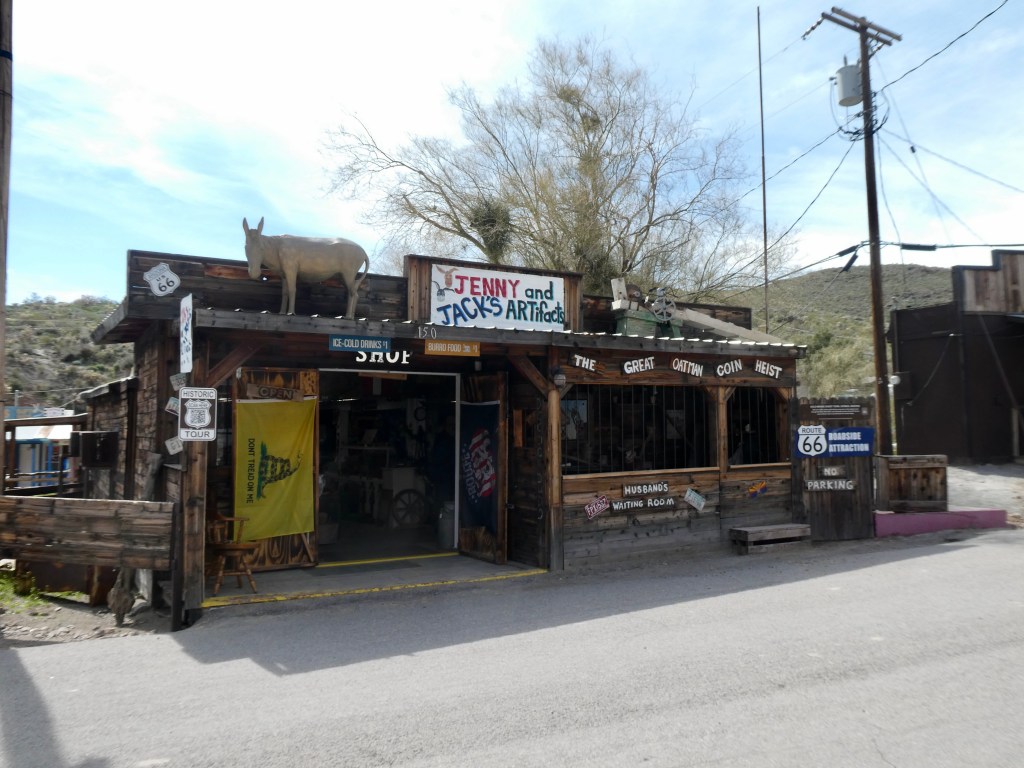
There were the old buildings and wooden sidewalks you expect in a western ghost town.

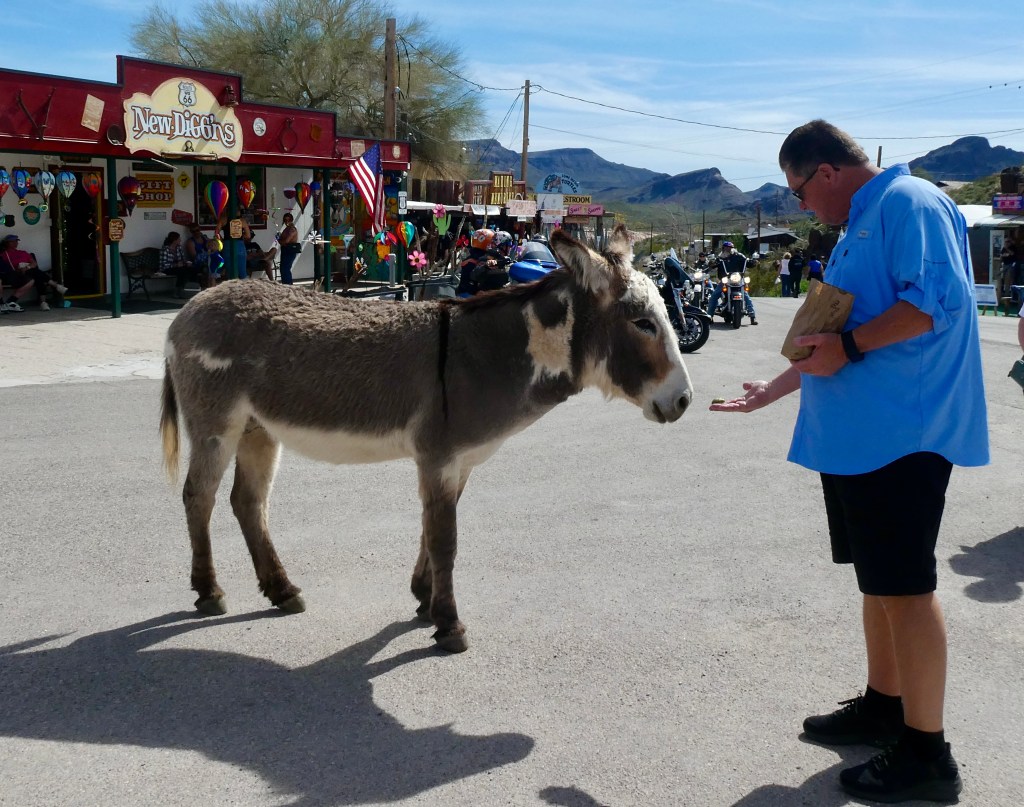
It didn’t take long to find the burros! They are technically wild, but also tame enough to enjoy a scratch or snack.

We bought a bag of hay cubes to feed the burros but they were not interested in “healthy” food. 

They wanted better treats than we were offering.

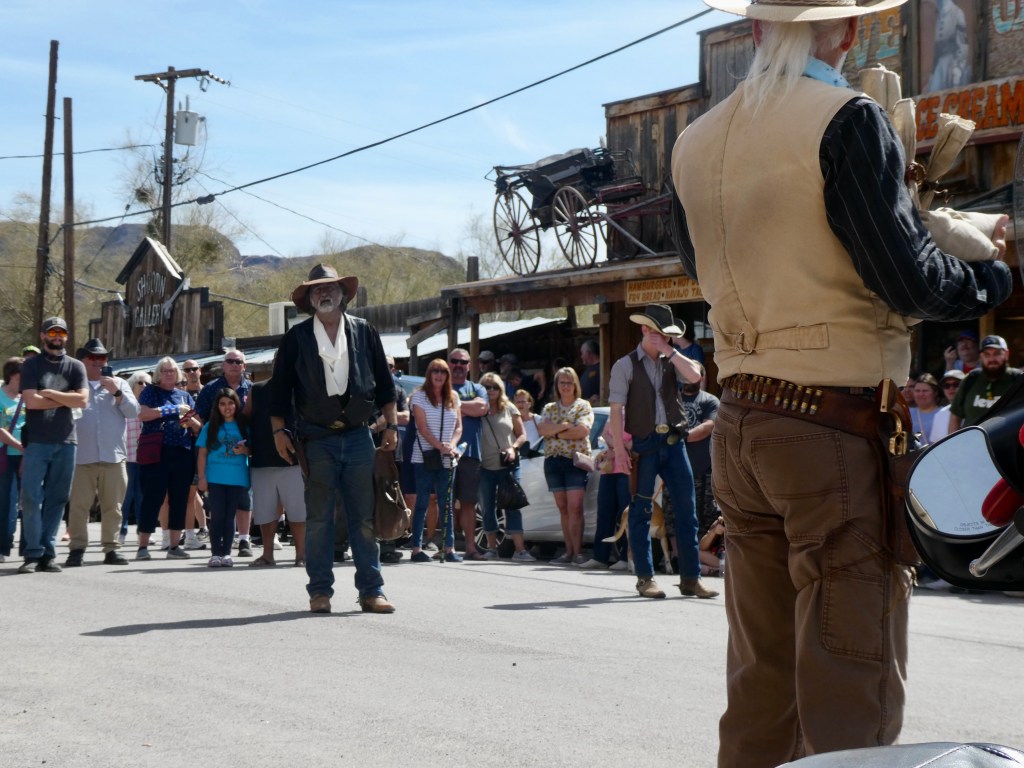
The locals performed a wild west showdown for us!

We wandered through some of the old buildings and shops.

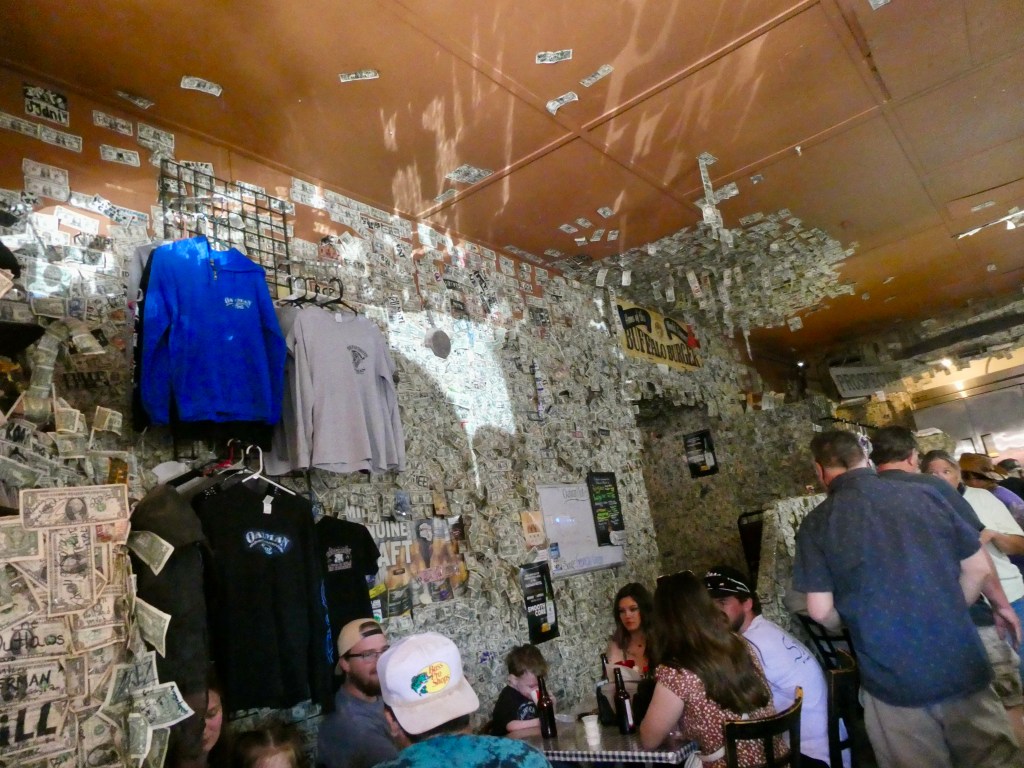
This restaurant was decorated with $1 bills and was busy enough that we only peeked inside.

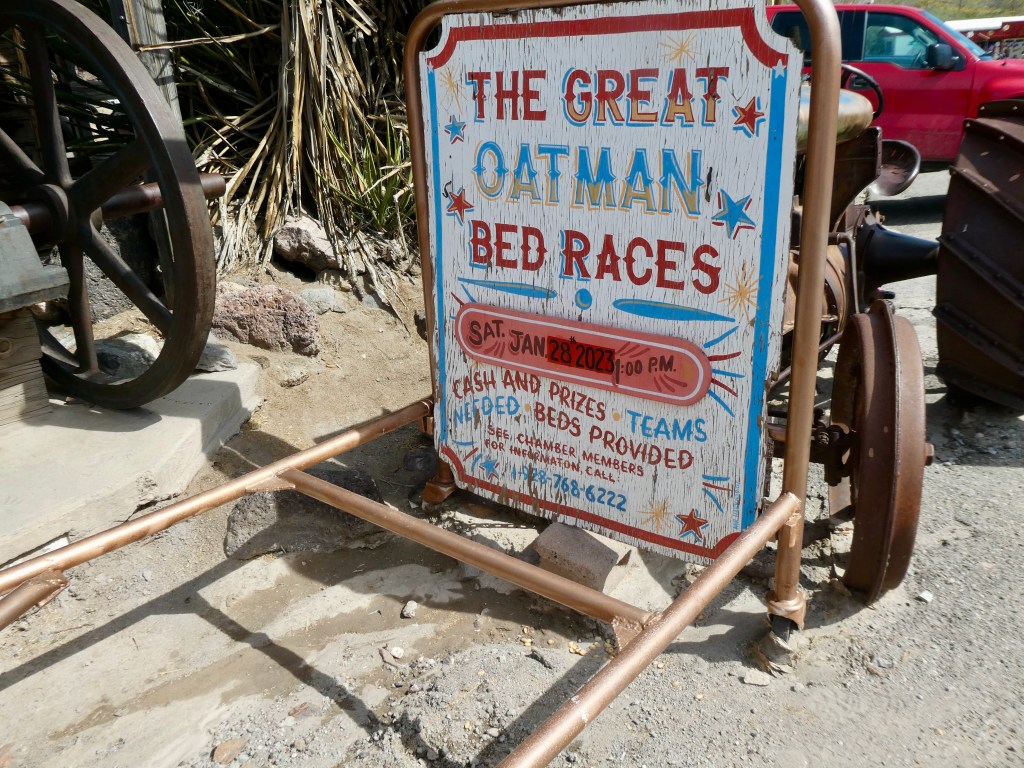
We missed the Bed Races but it looks like it could be fun!

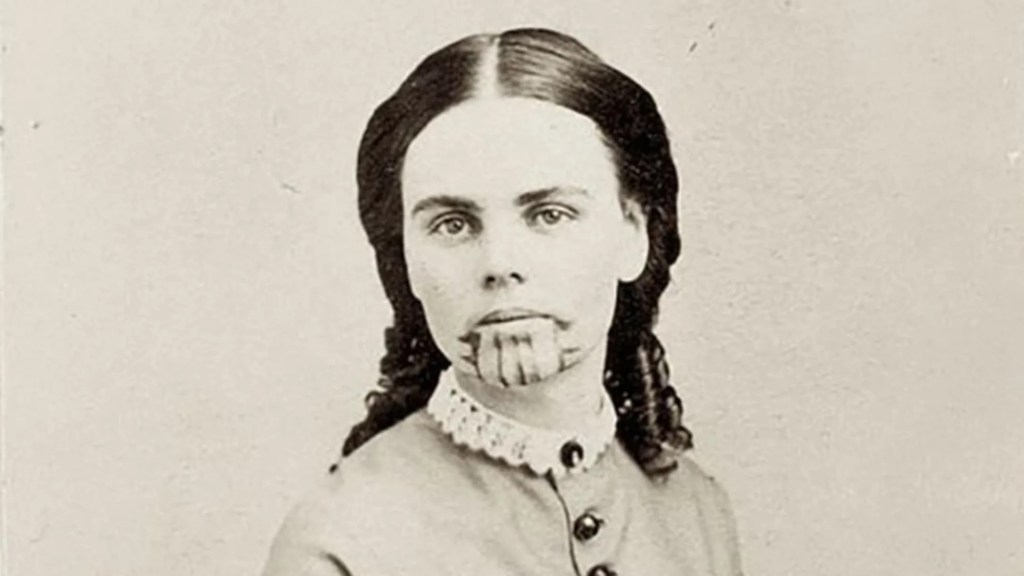
Olive Oatman’s restaurant and saloon was closed but it suggested a connection between her and the name of the town – something I hadn’t picked up on previously. Prospector Johnny Moss named the area after Olive Oatman in 1860 during her celebrity era.  

Olive Oatman and her family were part of a group traveling west to settle in western Arizona or southeastern California.  Some of the group decided to stay in New Mexico while others stayed near Tucson.  Although the Oatmans were warned of the danger, they eventually traveled further west alone.  

Ninety miles east of Yuma, the Oatmans and their seven children were engaged by Native Americans and the encounter turned deadly.  Both parents and four of the children were killed.  A teenage son survived and two daughters were taken captive.   

The girls, ages 14 and 7, were taken by the Yavapai and lived as slaves for about a year.  They were eventually traded to the Mojave tribe who treated them as adopted daughters. They were given tattoos identifying them as members of the tribe.

Over several years, people interacting with the tribe noticed the white girls living amongst the Mojave.  Word made it back to civilization. Olive was eventually “rescued” although accounts differed on whether she appreciated being taken away. (Prior to finding Olive, the younger sister died, along with many of the Mojave, during a drought.)

Olive was reunited with her brother and became a bit of a celebrity on the lecture circuit. She later married and lived until age 65.   

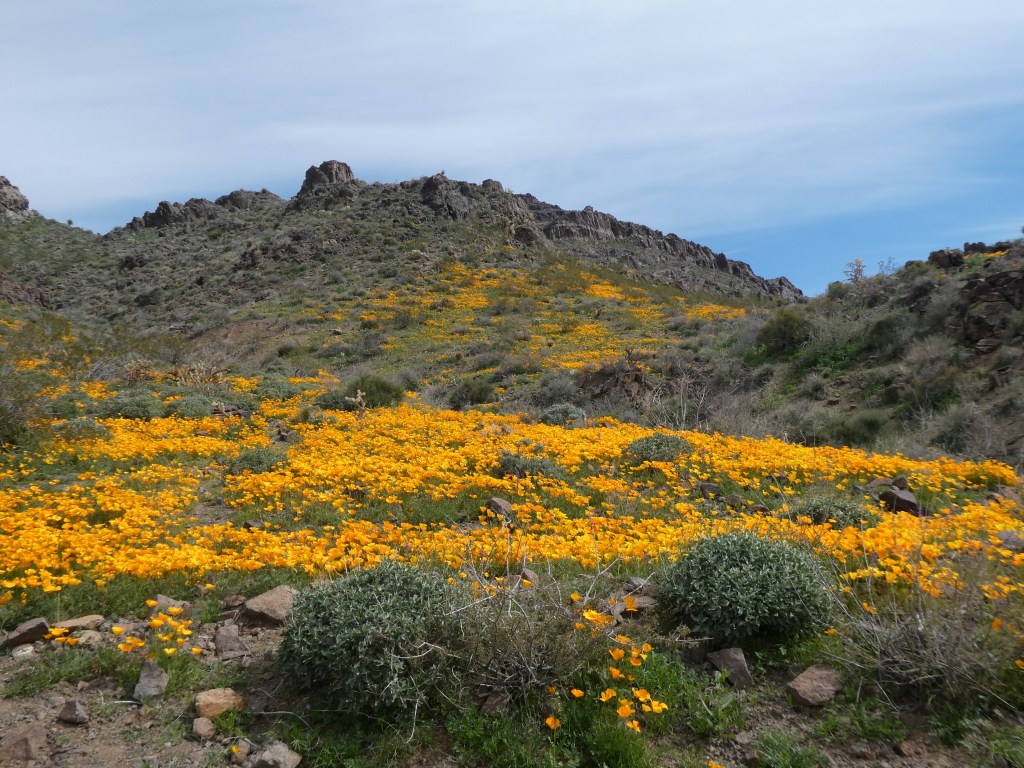
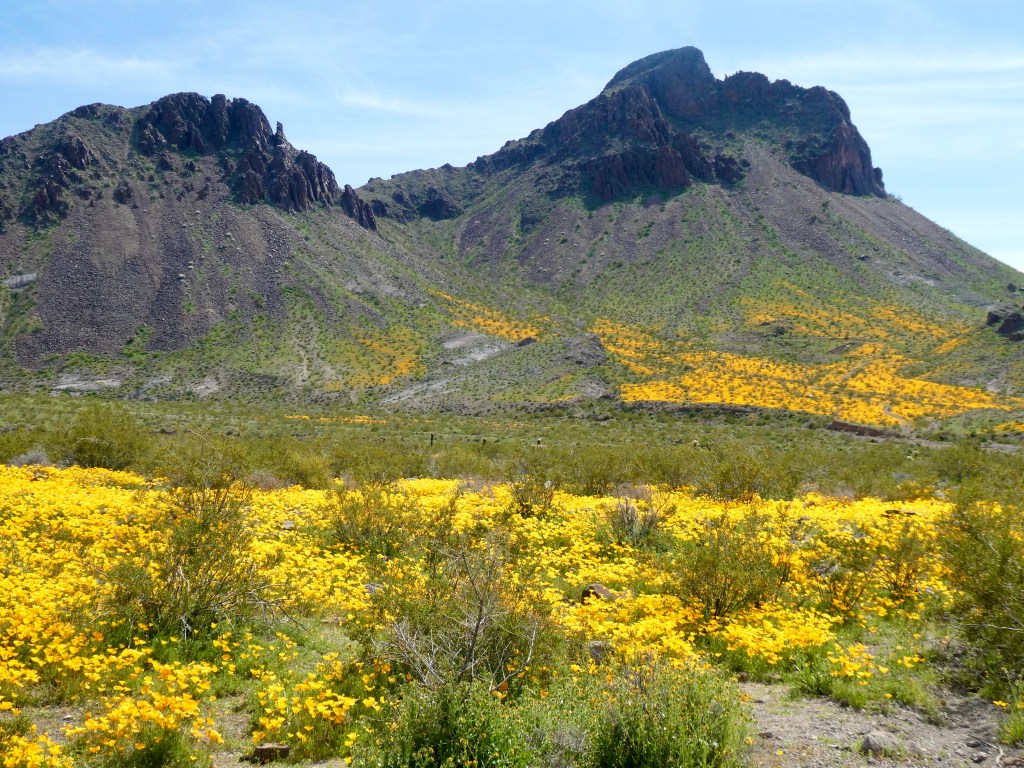
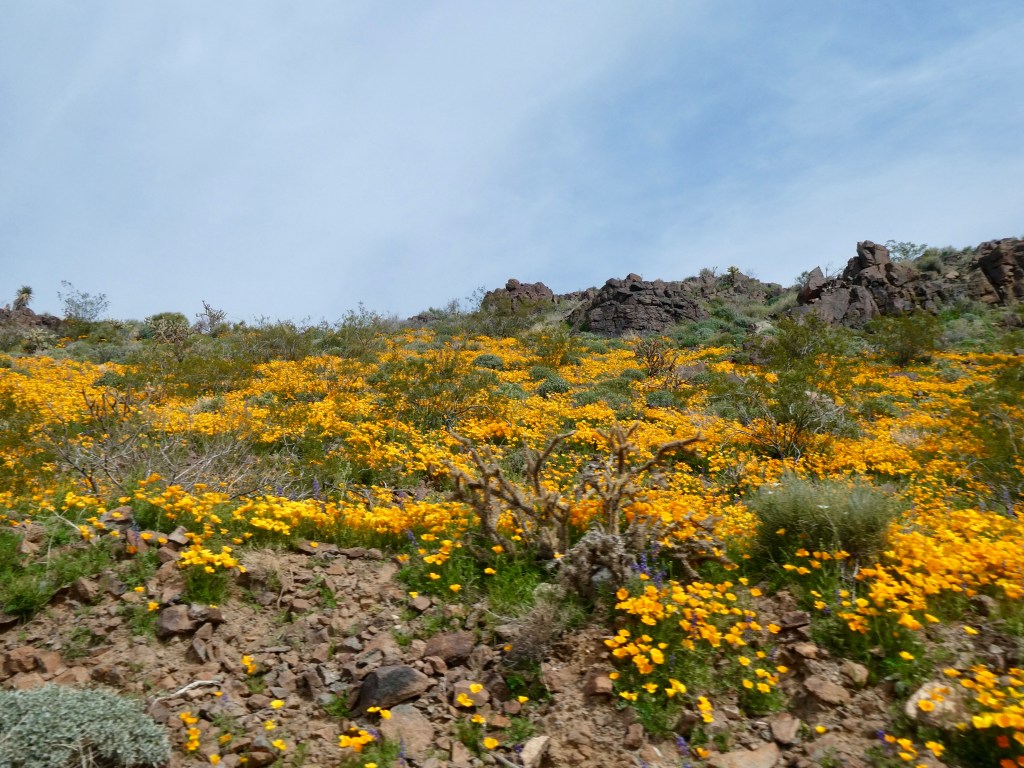
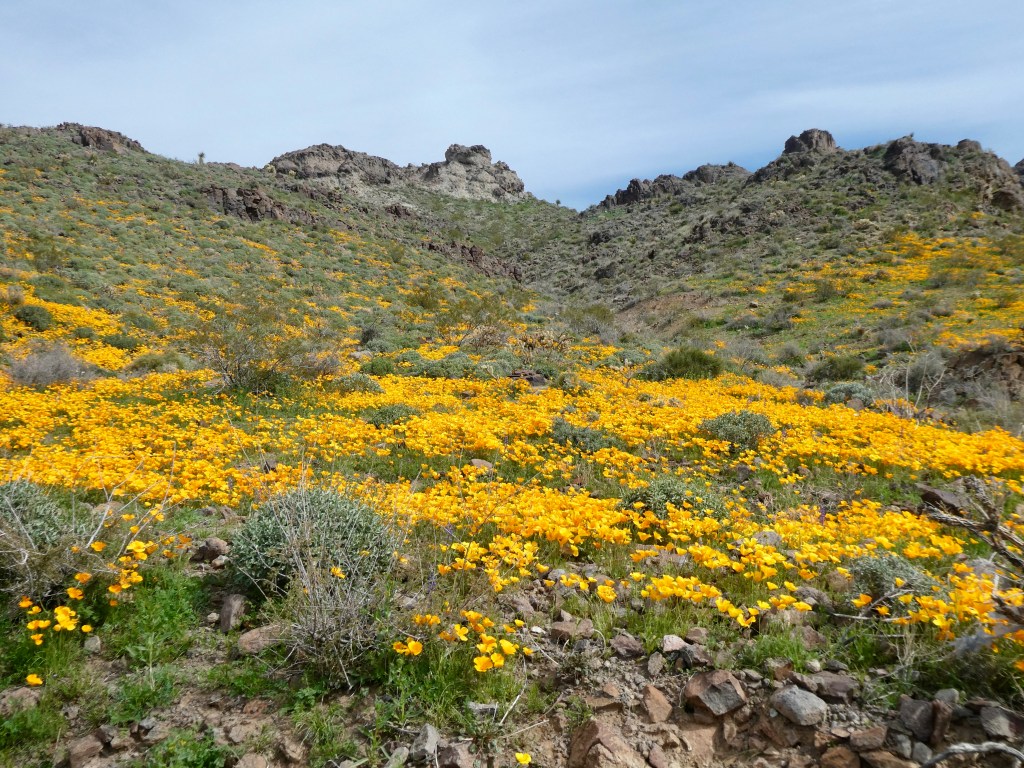
Entering and departing Oatman we were delighted to see bright yellow wildflowers against the stark landscape. 

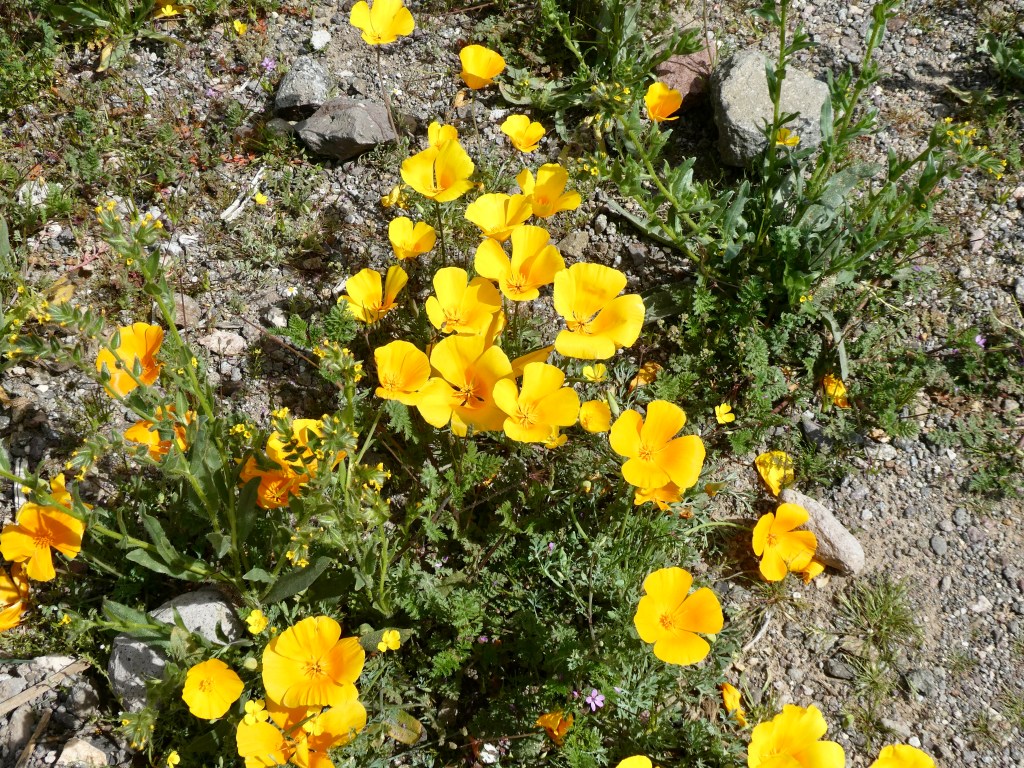
We were at the right place at the right time for Mexican poppies!

When you live in the desert, spring wildflowers are such a gift.  The winter of 22-23 has been wet and cool.  

Water is desperately needed and we also knew that the moisture might treat us to a nice wildflower season.

Twice this past week we ventured out on a desert hike looking for wild flowers.

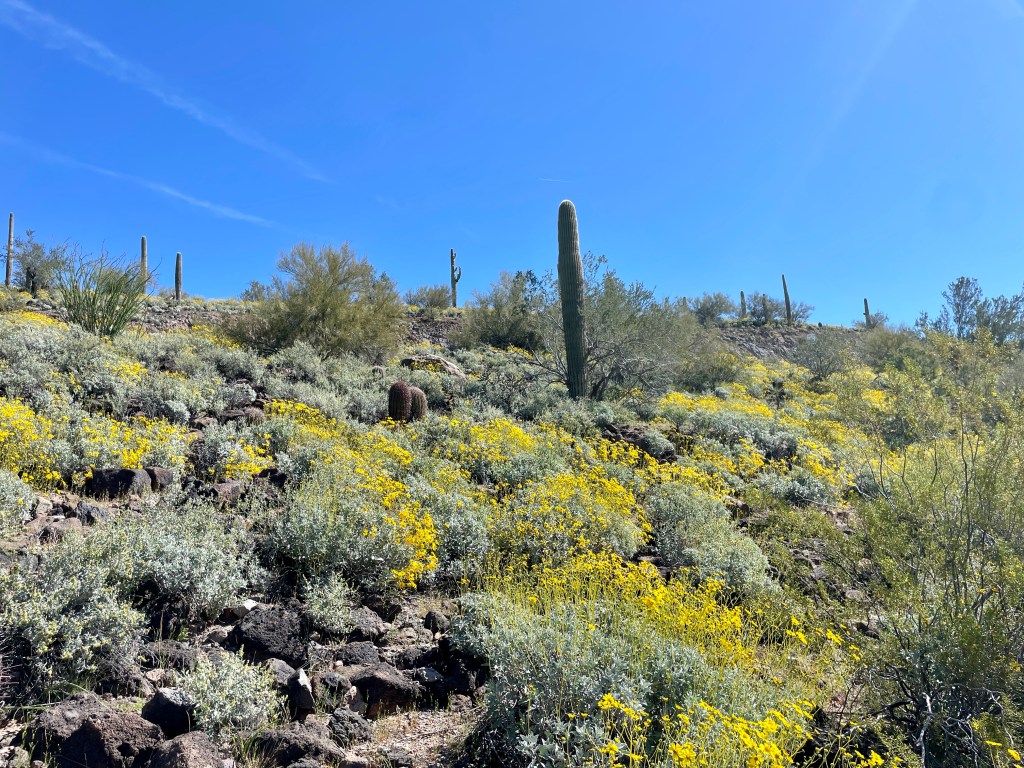
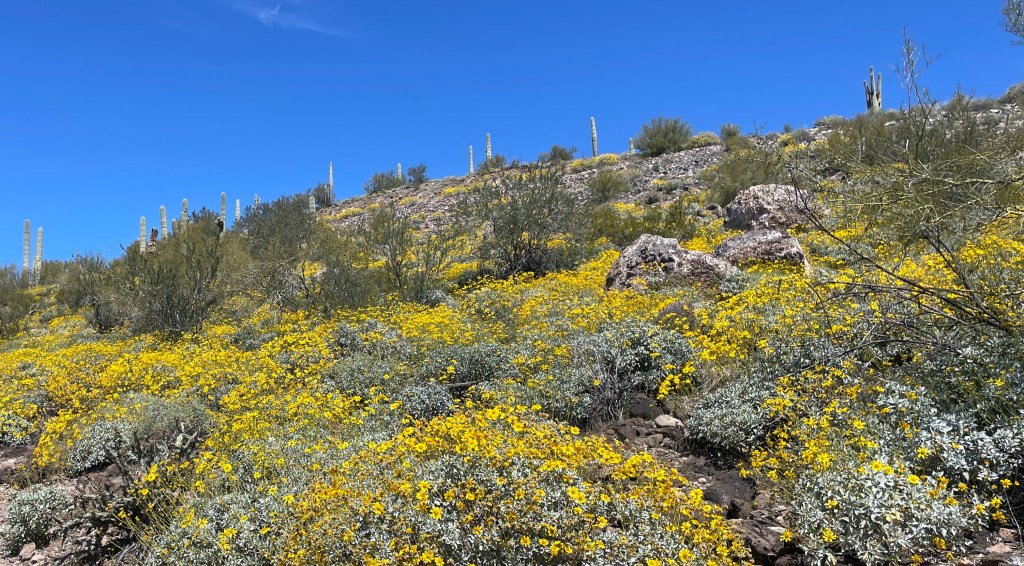
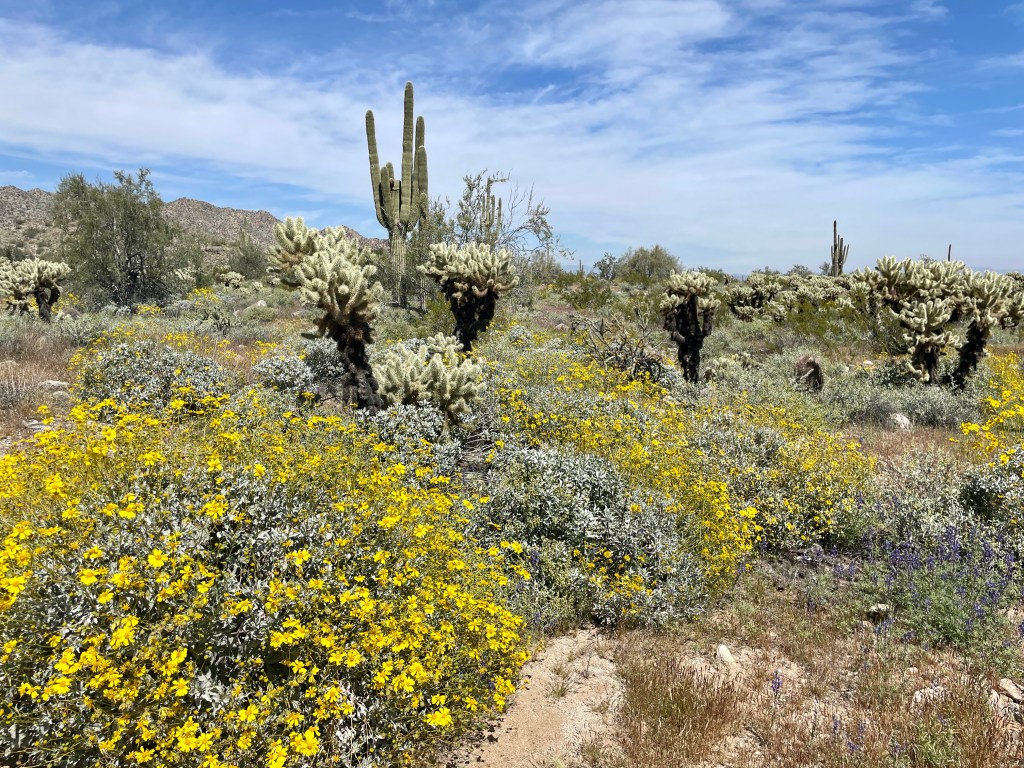
White Tanks Regional Park is near us and we enjoyed seeing a variety of flowers.

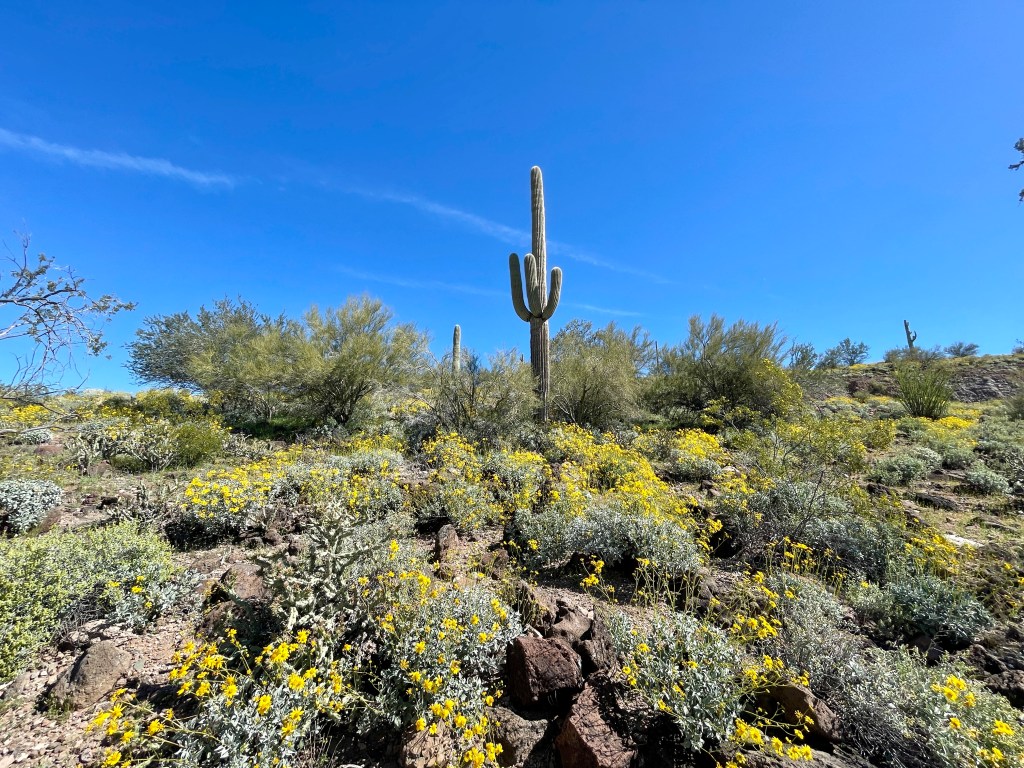
A few days later we went just a bit further to Lake Pleasant Regional Park.  There were more flowers there!

Lake Pleasant is one of our favorite parks because not only are there nice trails, but there is a lake, a restaurant at the marina, and the possibility of seeing wild burros.

It seems like hiking Wild Burro Trail should work for seeing burros! We see them about every third time we visit Lake Pleasant. 

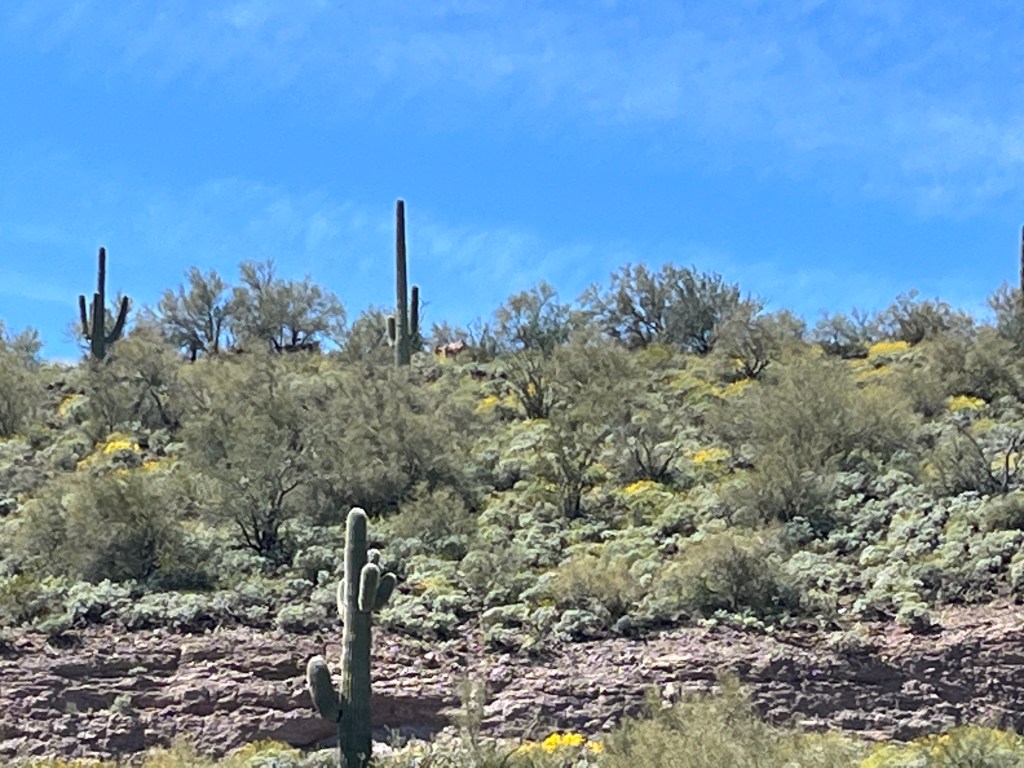
On this day we heard the burros way before we saw them!  We could discern their general location by listening to their loud braying. It still took some time to find them high upon the ridge.  (This picture is using a phone zoom lens.) One of the three burros is just to the right of the saguaro in the top middle. They blend in so well that they must be moving to see them at this distance.

Burros and wildflowers (and lunch at the marina) made for a great day at Lake Pleasant!

Posted in Uncategorized | 4 Comments