Two Cruises: The Beatles and Liverpool

In preparation for visiting Liverpool, I gathered our British pounds left from a previous trip to London.  My goal, after the next few weeks, was to have no pounds or euros left. We always tried to tip tour guides in local currency so that is where most of it was destined.

Our luck at avoiding really wet weather had left us. At each previous stop, it seemed we were one step ahead of the big rains to come.  Today, August 3rd, we were going to get wet.

We boarded our bus and got a bit of information along the way.   

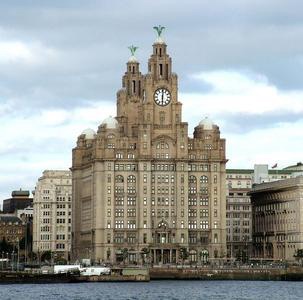
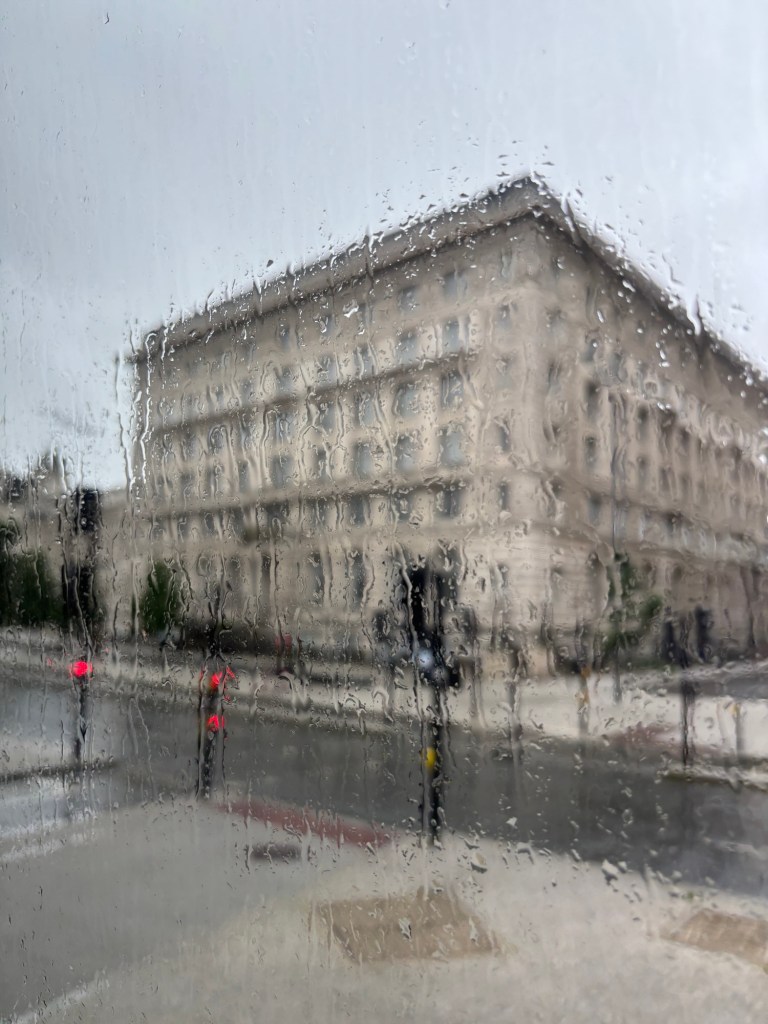
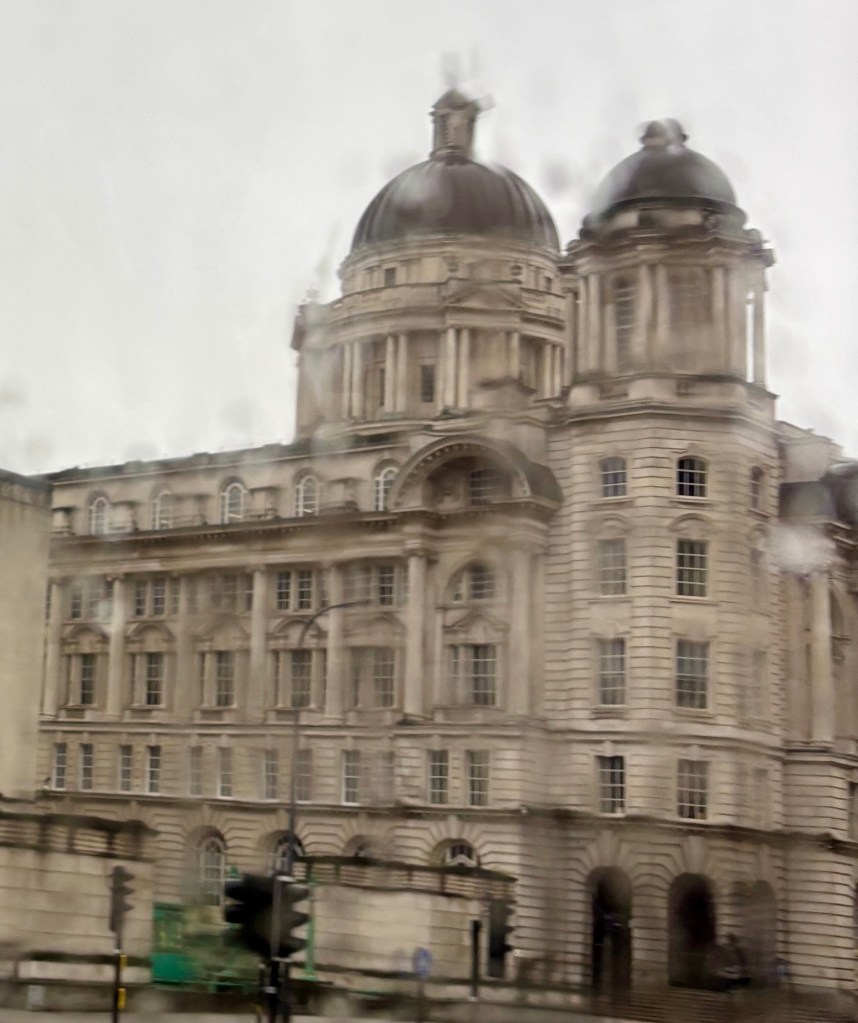
We passed the Royal Liver building, the tallest building in Europe until the 1940s.  The first picture is what we saw out the bus and the second is a better picture from the internet.  The clocks were large enough so sailors could know the time from their ships.

The Cunard building was the home of the cruise line. Twelve million Europeans used Cunard to emigrate to North America.

This building is the Port of Liverpool building.  Together these three buildings are known as The Three Graces.

From 1840 to 1900, Liverpool was the world’s busiest port. Currently there are eight miles of docks.

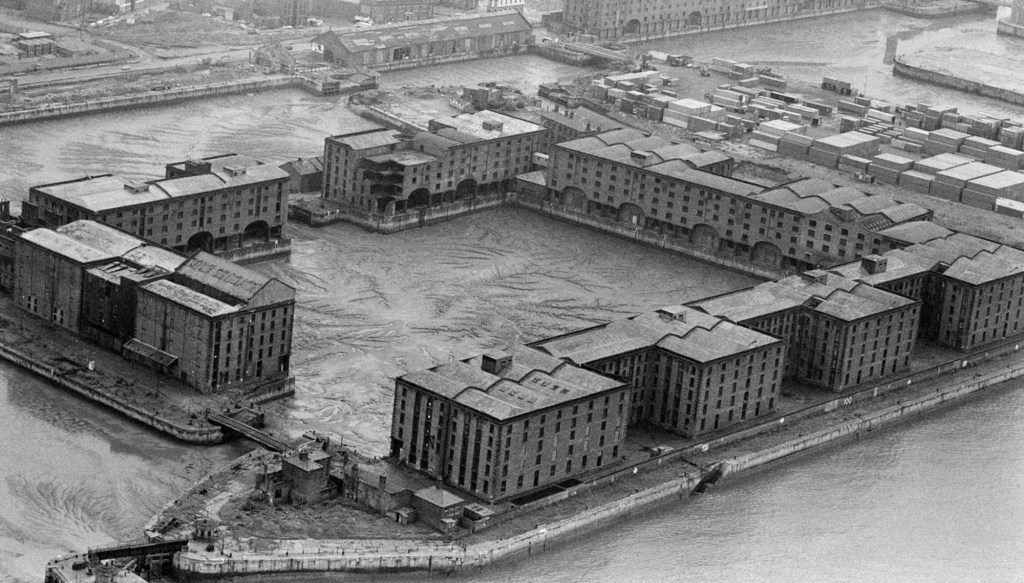
Part of the port is Royal Albert Dock. It was developed in 1846 and named for Queen Victoria’s husband.  Albert Dock had secure, fireproof warehouses. Cranes lifted heavy loads.  Traders could buy and sell wares before import taxes were paid.   Albert Dock procedures cut in half the time it took to unload and load ships.  

This picture shows an abandoned Royal Albert Dock in 1980, when time and silt greatly reduced its stature.    In 1986 a Maritime Museum opened in an abandoned warehouse and restoration began.  Restoration continued over the next twenty years and, with the Three Graces, became part of Liverpool’s Unesco World Heritage status. 

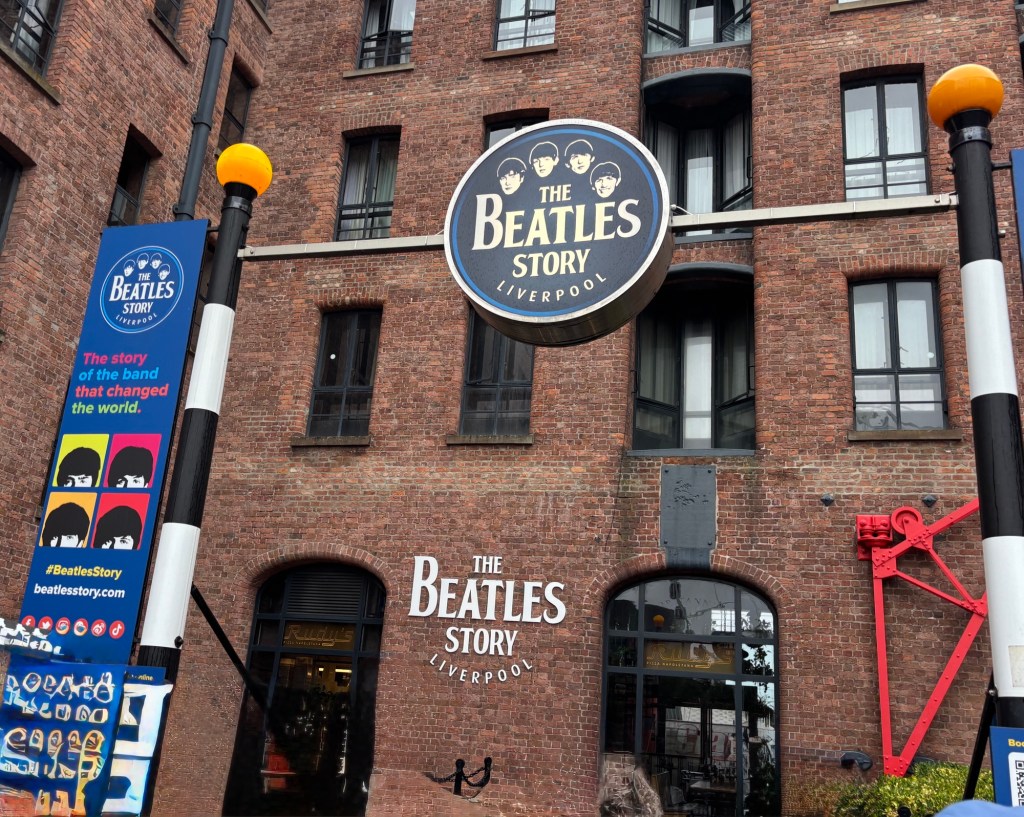
We were headed to the Royal Albert Dock because that is where The Beatles Experience is!

Since the early 1960s, when The Beatles first made their appearance, Liverpool has played a leading role in the formation of the world’s popular music culture. 

We are a decade too young to be serious Beatles fans but we were certainly aware and knew some of their major hits.

The Experience started at the very beginning, a very good place to start.  (Oh wait, that isn’t a Beatles’ song.)

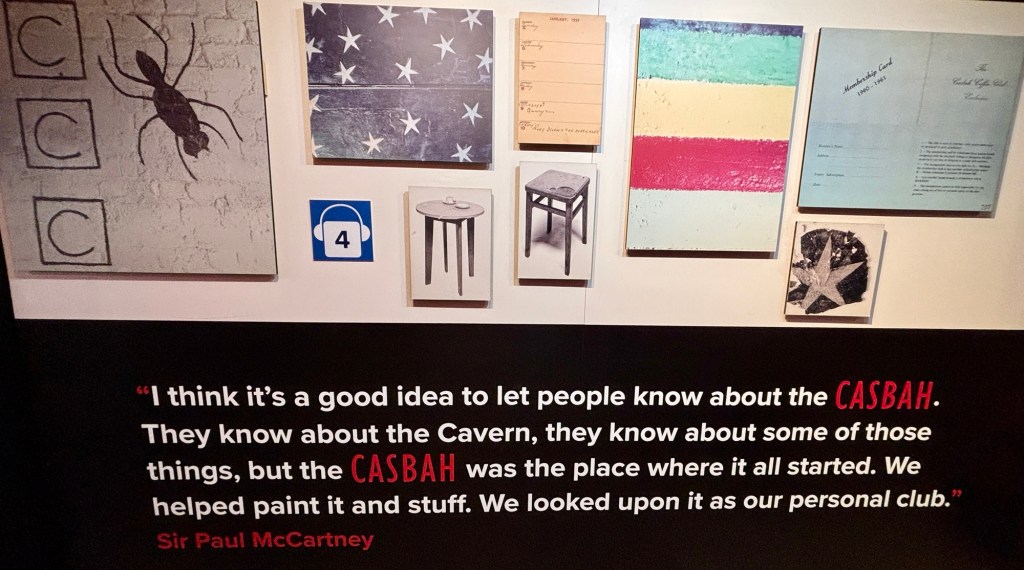
The group, with a different drummer, began playing at the Casbah.

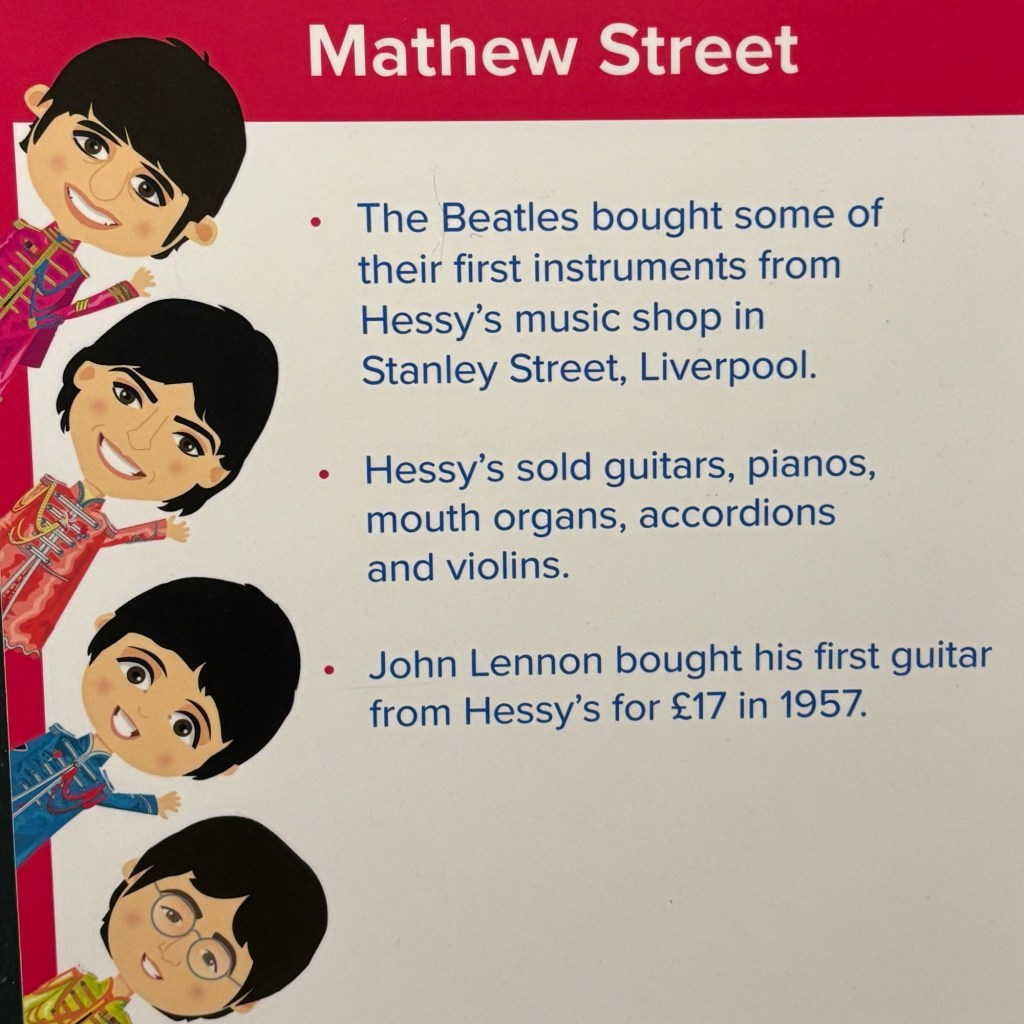
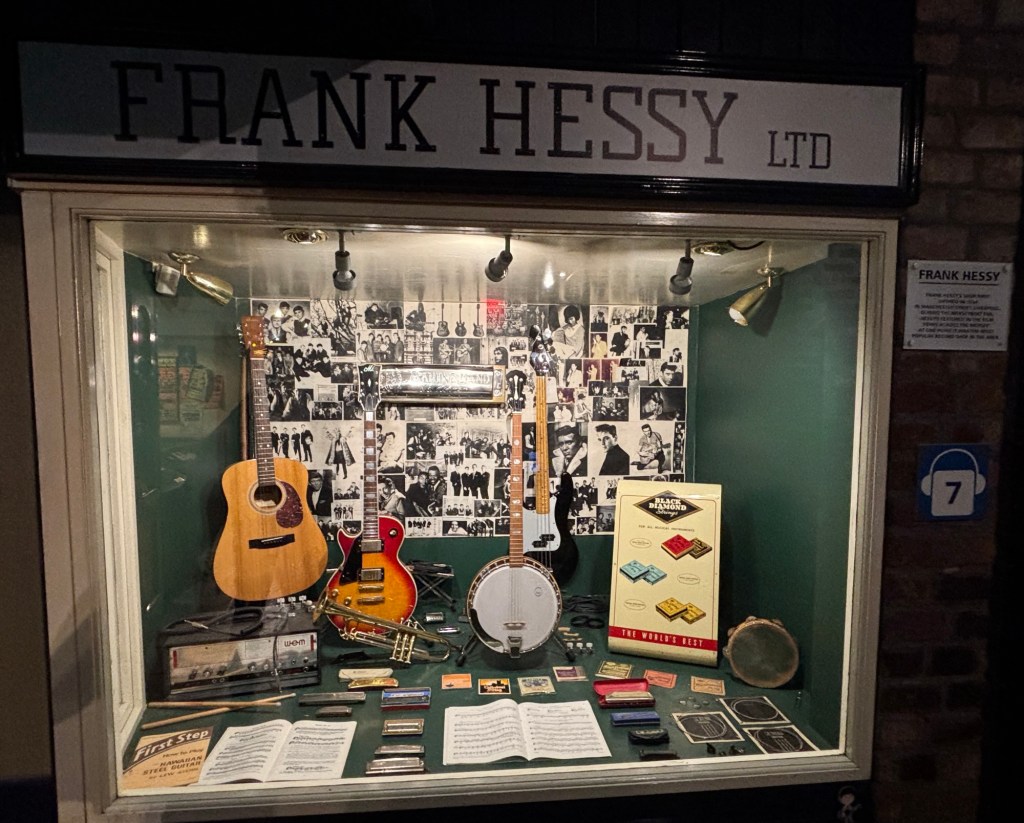
They bought their first instruments at Hessey’s Music on Mathew Street.  We walked Mathew Street later in the day.

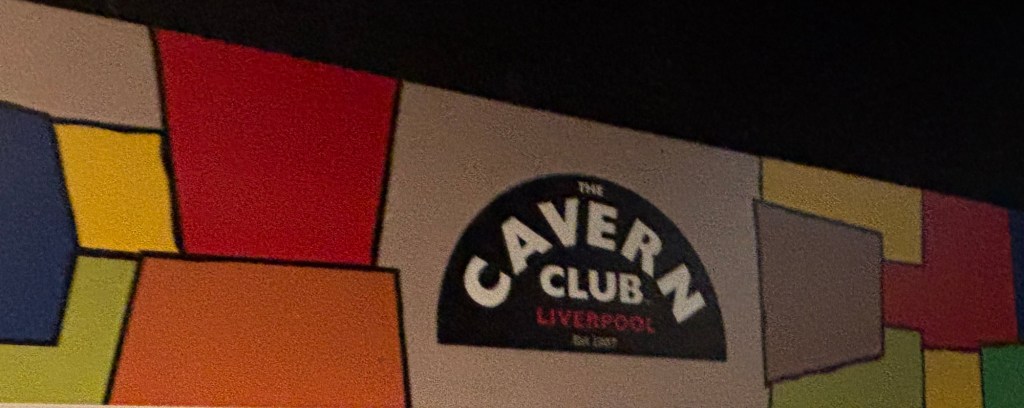
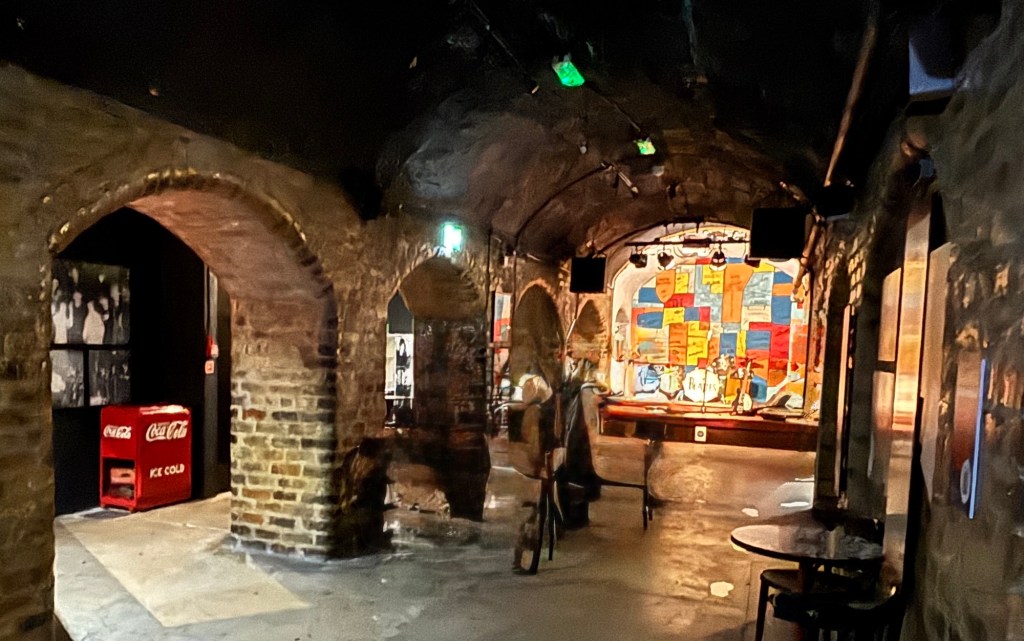
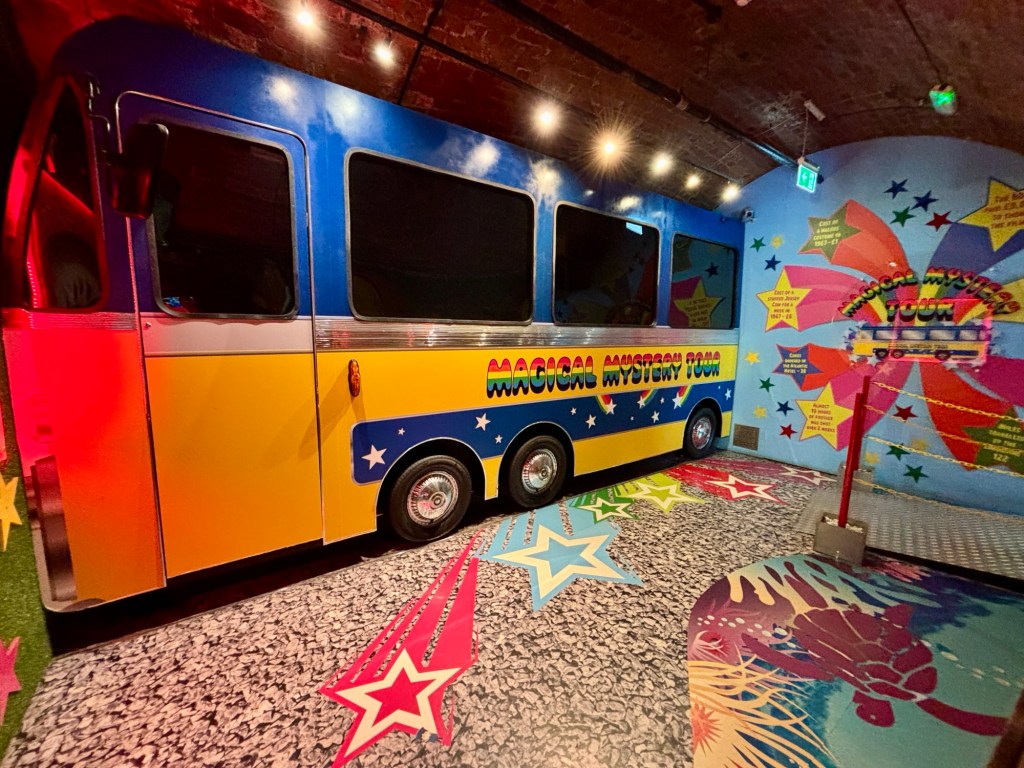
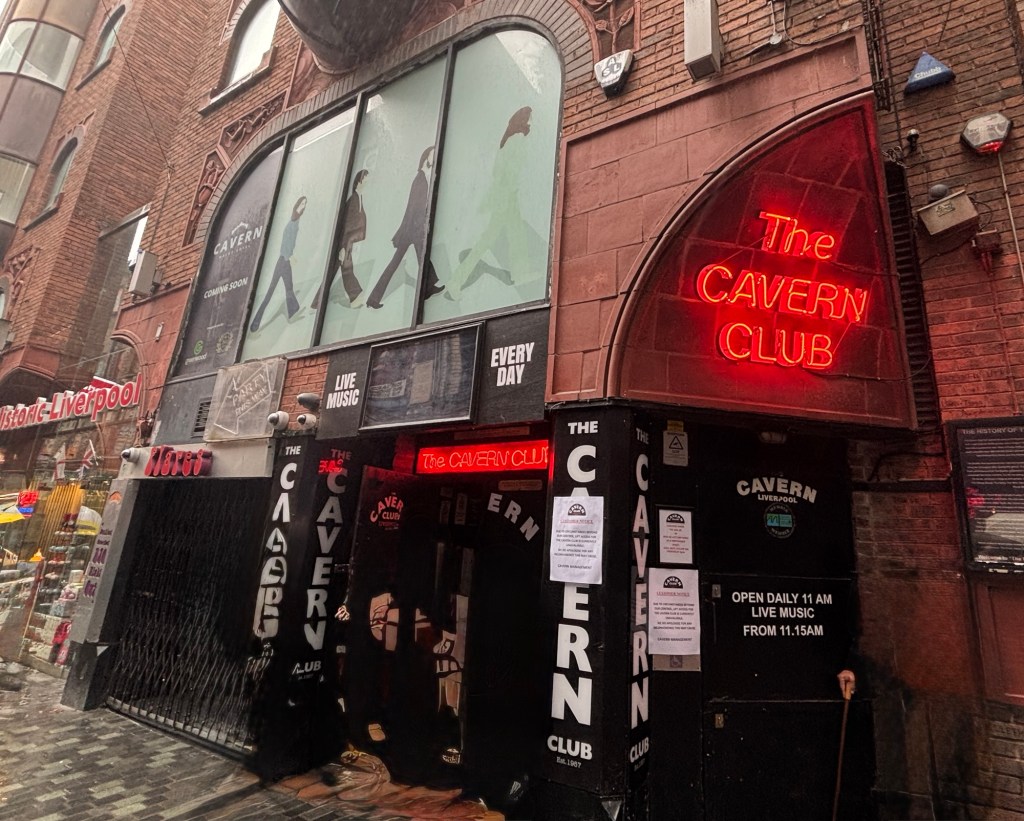
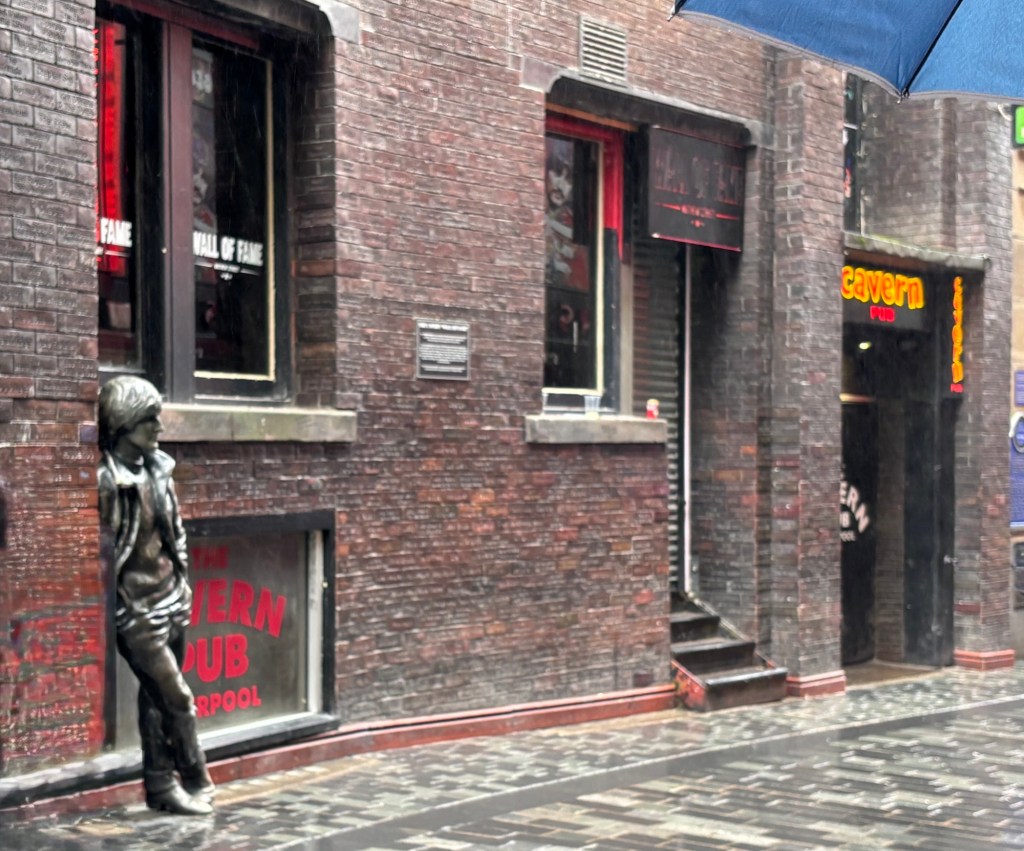
We saw a remake of the Cavern Club where the Beatles performed 247 times, making it the most famous club in the world.

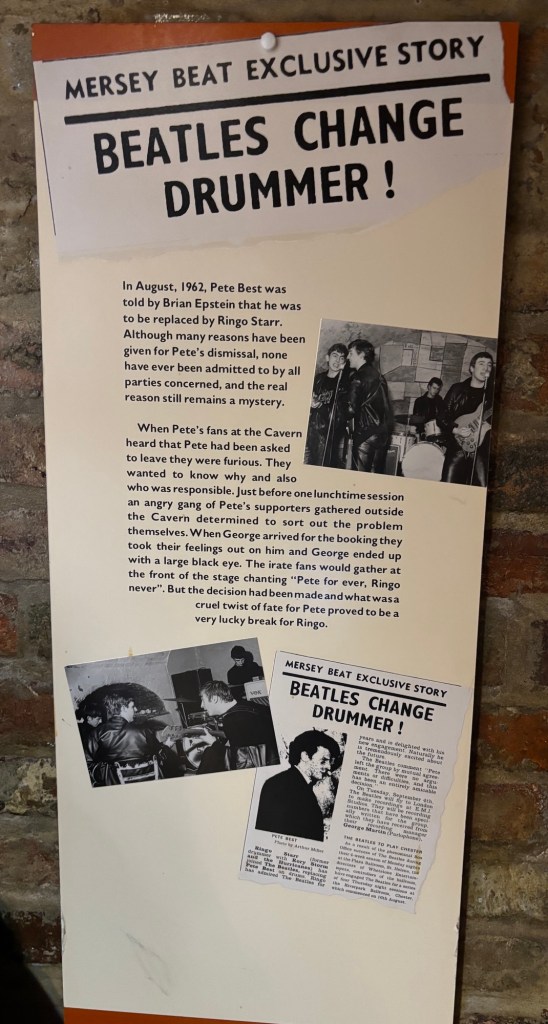
August, 1962: Peter Best was out and Ringo Starr was in as drummer.

The Beatles appear on the Ed Sullivan Show February 9, 1964.

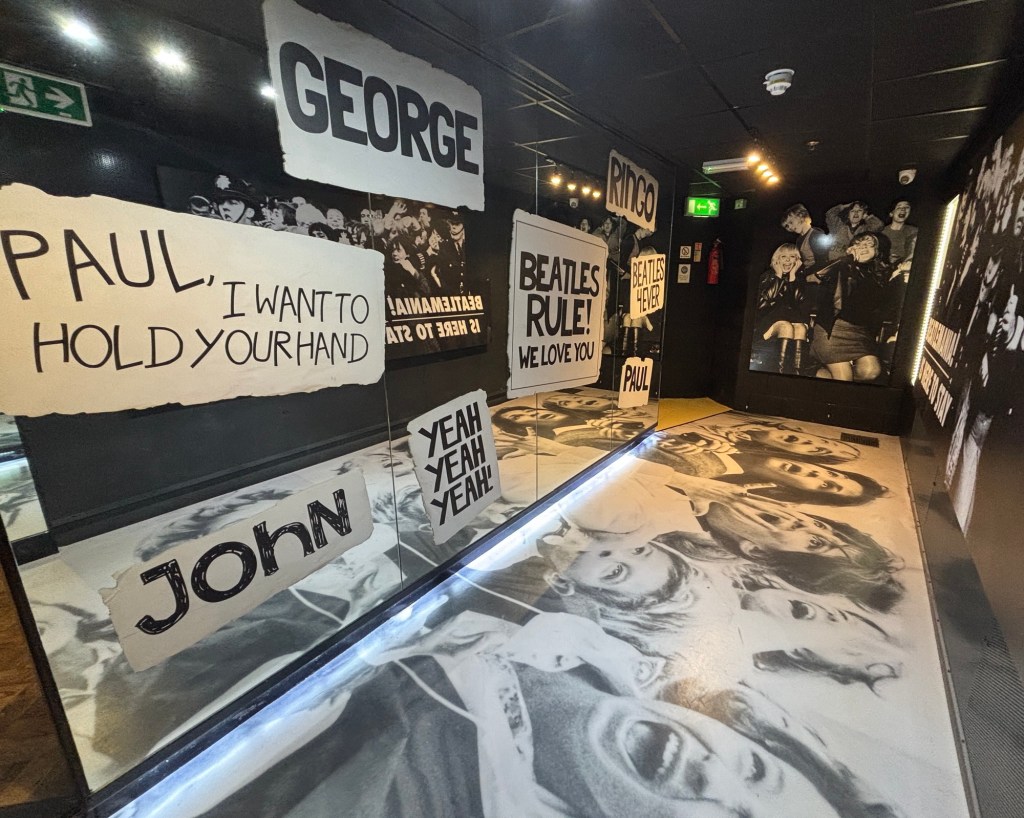
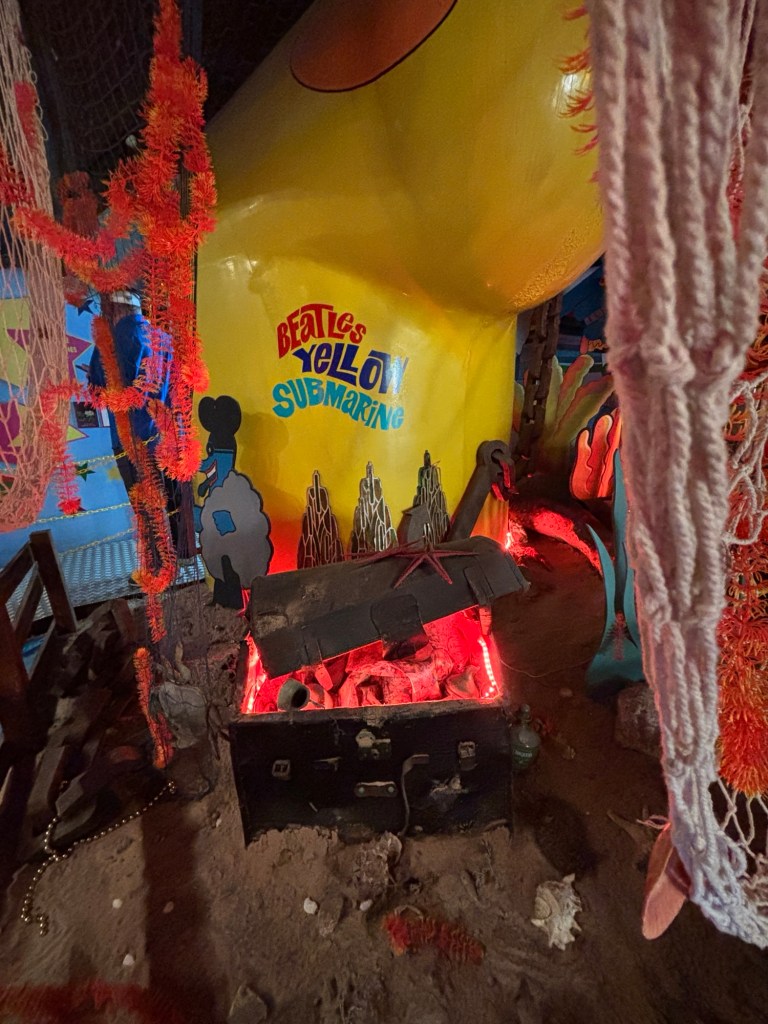
Beatlemania!

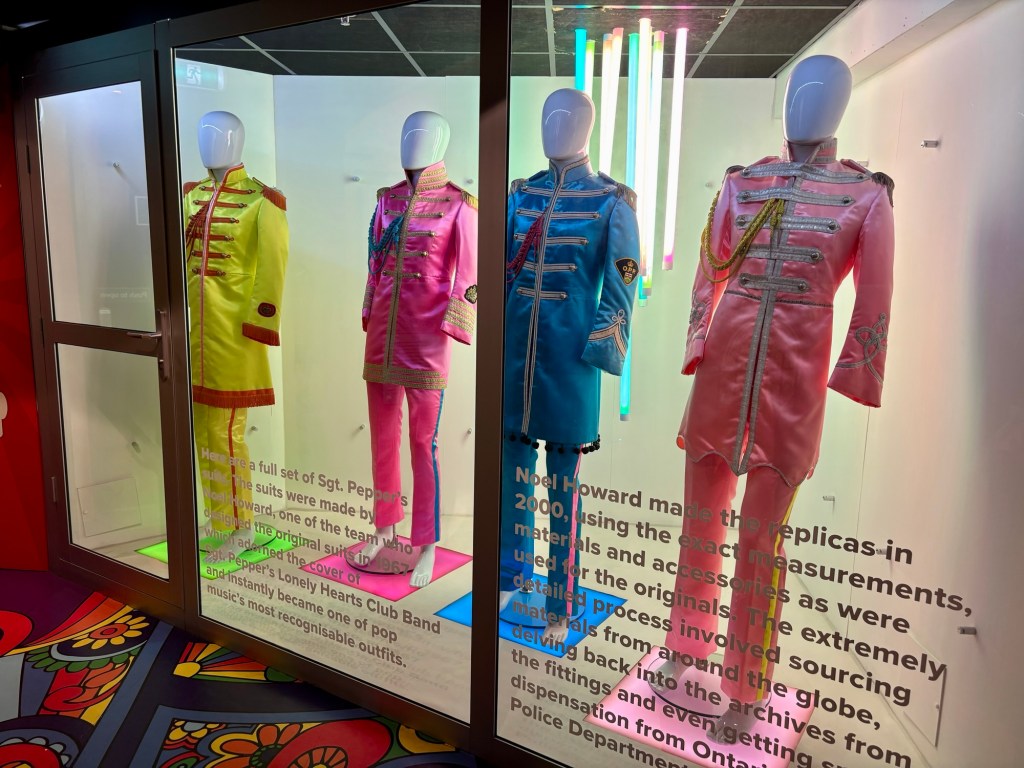
Costumes from the Sgt. Peppers Lonely Hearts Club Band Tour.

There were sections of the museum dedicated to each of the band members. These are the things we learned:

Paul McCartney is the most successful recording star ever.

John and Paul were very successful song writers together but George Harrison wrote some of their great songs like Let it Be, Love You Too and Here Comes the Sun.

This is the rebuilt Cavern Club.  The original was demolished in 1973 but the new one built with the same bricks and same dimensions. In addition to the Beatles,  there is a list a mile long of other past and current stars who have played there.

George was stabbed in his home and his wife went after the intruders.

Ringo was the only one to remain on good terms with all the other Beatles after the break up. Ringo was also the voice of Tommy the Tank Engine we learned about at Isle of Man.

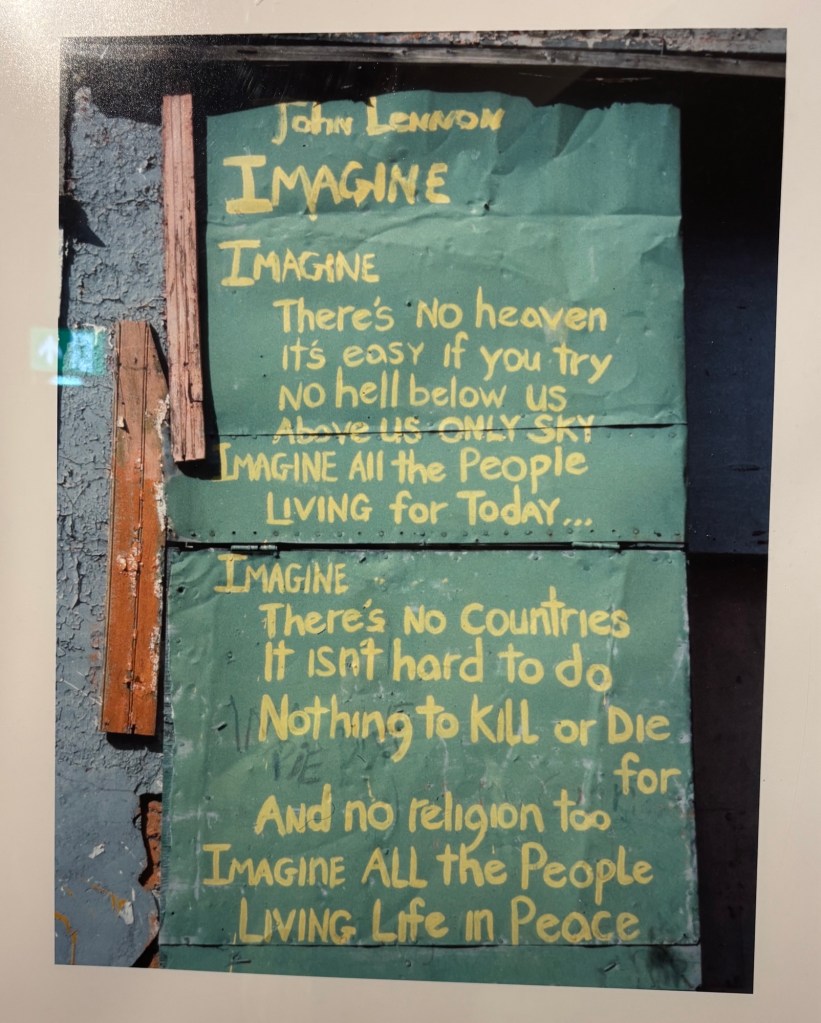
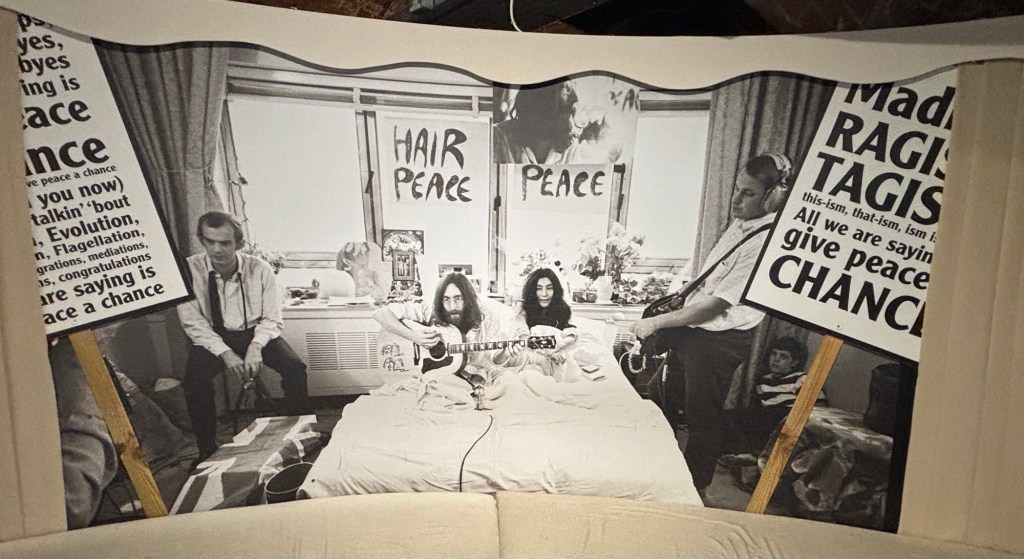
There was a large section of the museum dedicated to John Lennon.

We left the museum and went to explore areas of Liverpool significant to the Beatles.

This is Mathew Street. 

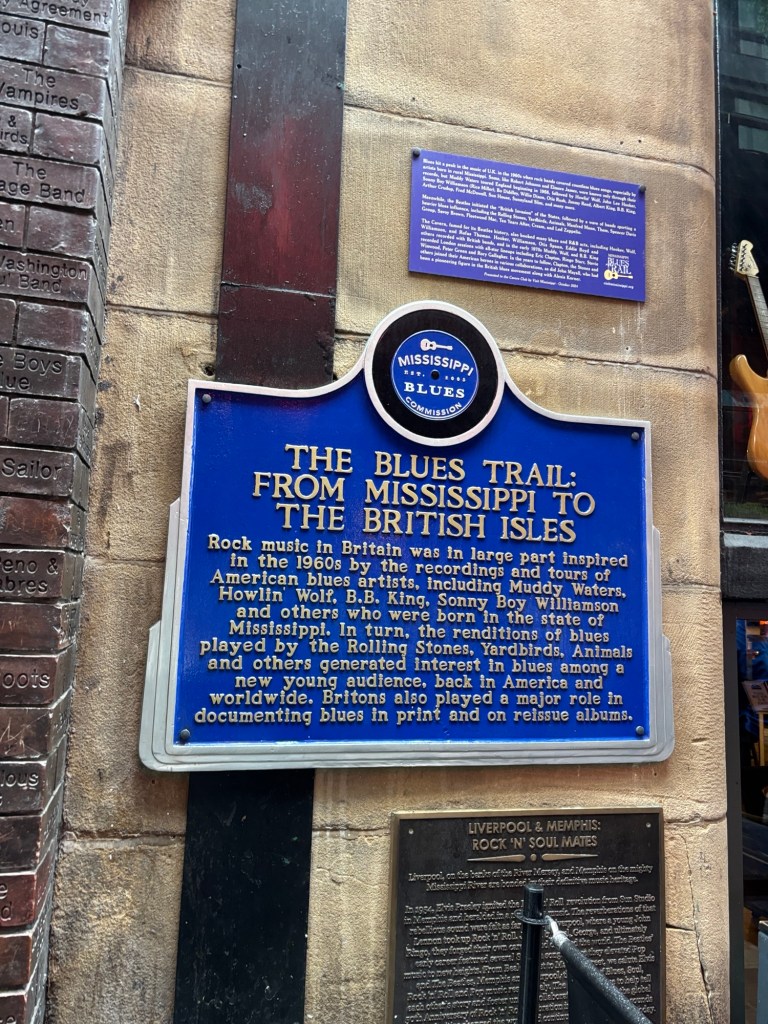
It is paired with Beale Street in Memphis as the two most musical streets in the world.

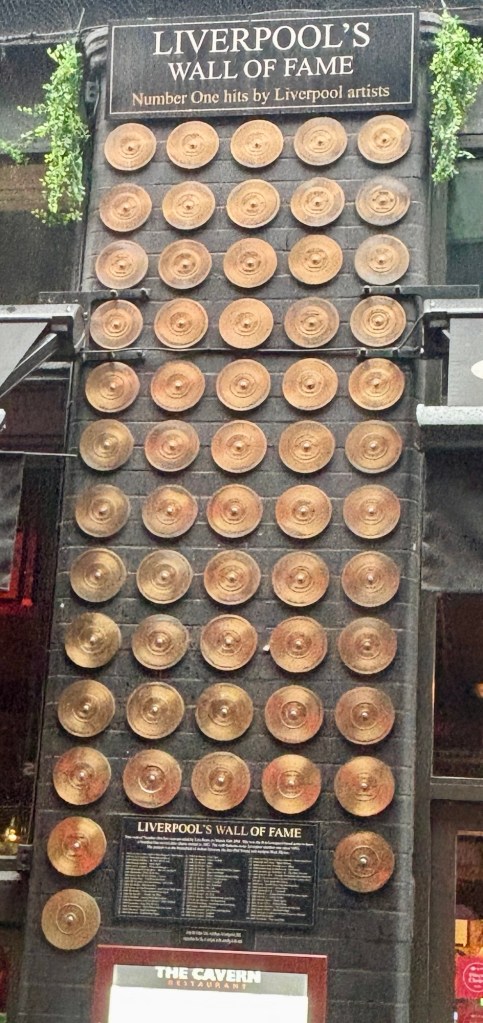
Liverpool is in the Guinness book of records for the most artists with number one singles of any geographical location in the world.

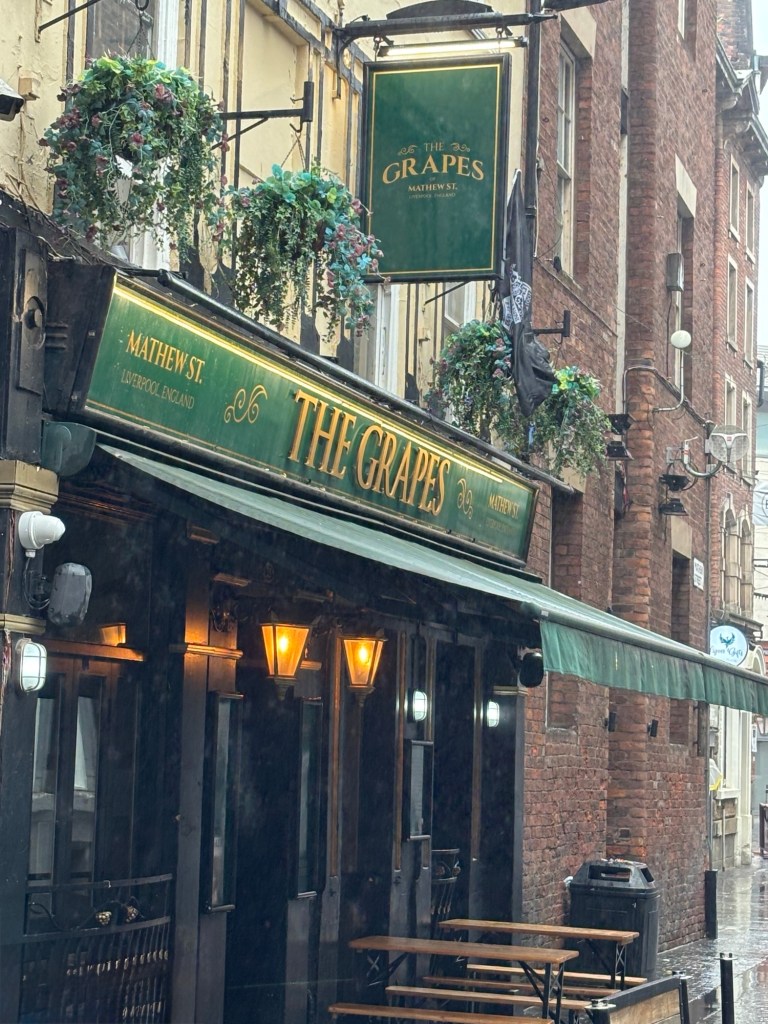
There was no alcohol served in the Cavern Club so the Beatles and others made their way to The Grapes between sets.

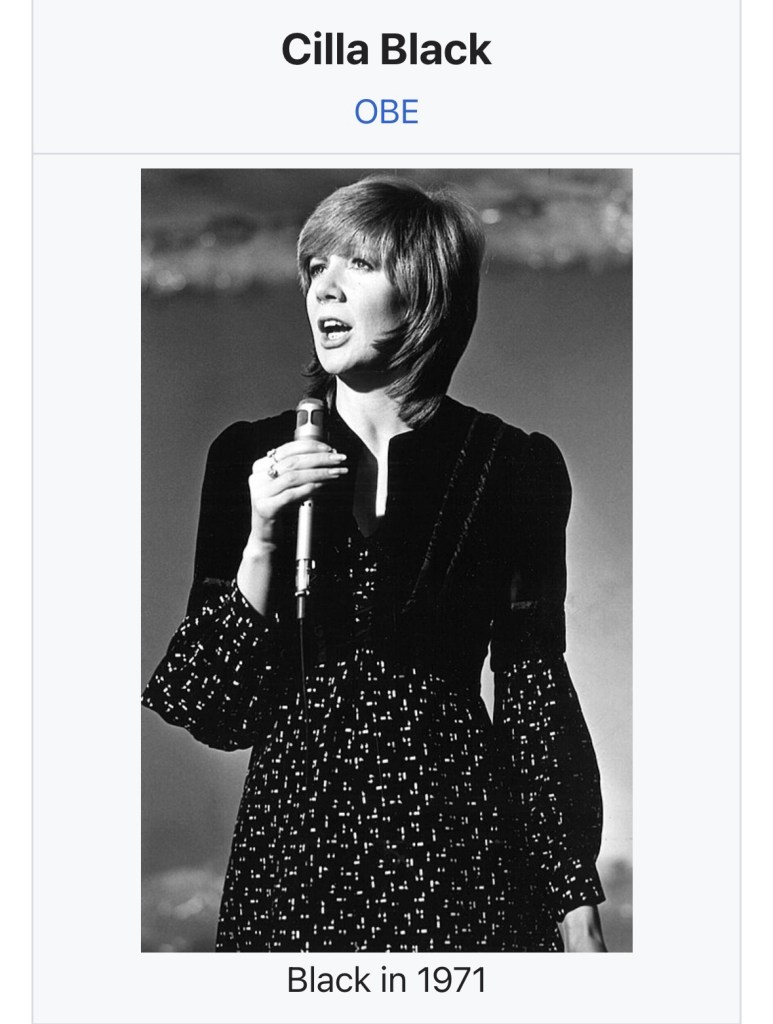
Outside the Cavern Club is this statue of Cilla Black. She was the coat-check girl at the club.  With their help and encouragement, she was able to go on stage with the Beatles.  She was signed by their manager, Brian Epstein.   She was the top female recording star in the UK in the 1960s and 70s with songs like “Anyone Who Had a Heart” and “You’re My World”.  She later had a career as a television personality.

I did not know the name Cilla Black so did a bit of research in writing this.  I thought it was interesting that her name was really Priscilla White.  I found this photo.

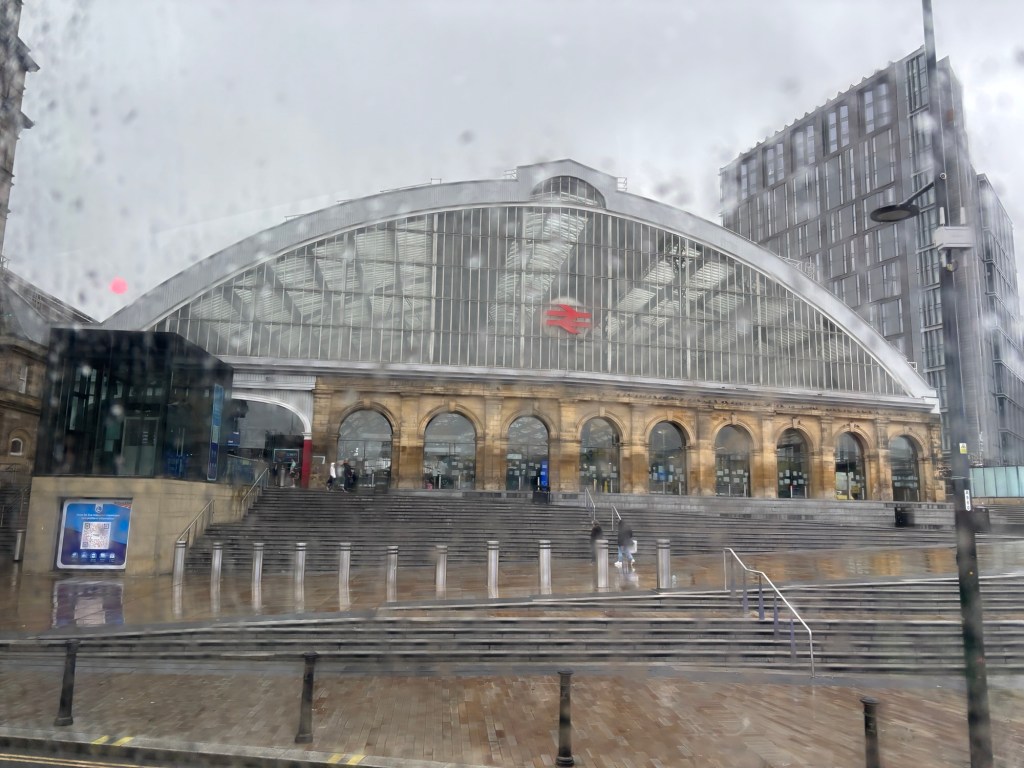
Enroute to more Beatles’ sites, we passed the Liverpool Lime Street Railway Station. It is the “oldest still operating grand terminus mainline station in the world”. 

I find it interesting that so many places we travel have the oldest of this or that.  I feel like I should have been keeping a list!

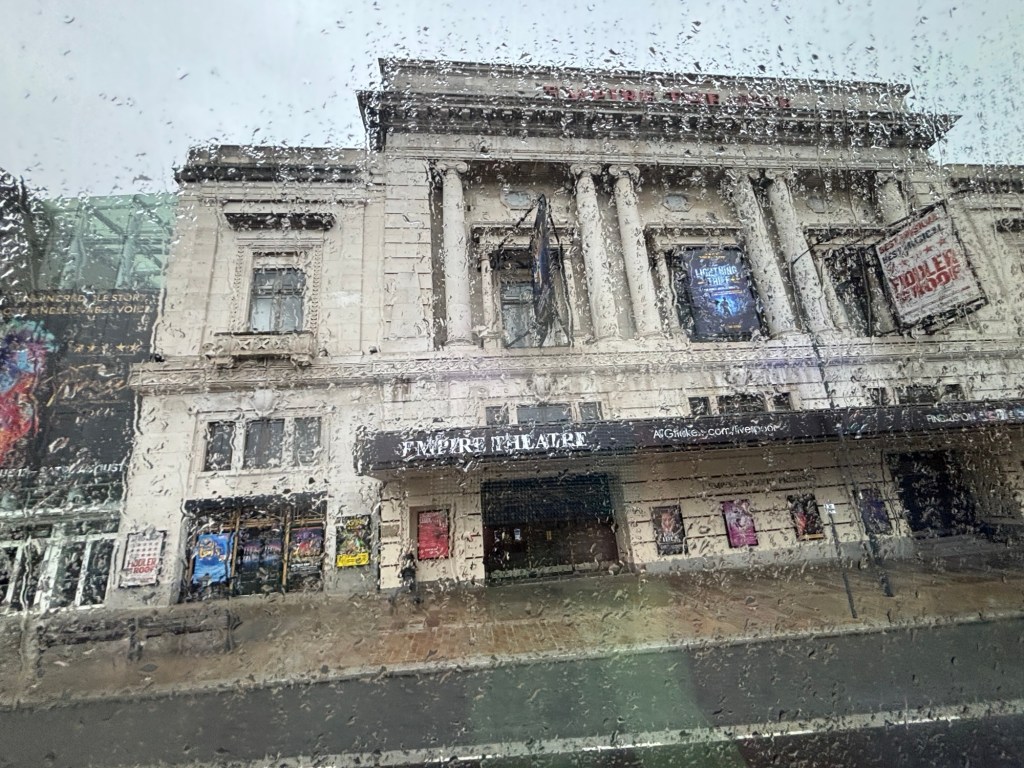
We also went past the Liverpool Empire Theatre, venue of the last Liverpool concert site of the Beatles.  It was held on December 5, 1965.

The group Queen recorded epic song Bohemian Rhapsody for the very first time at The Empire.

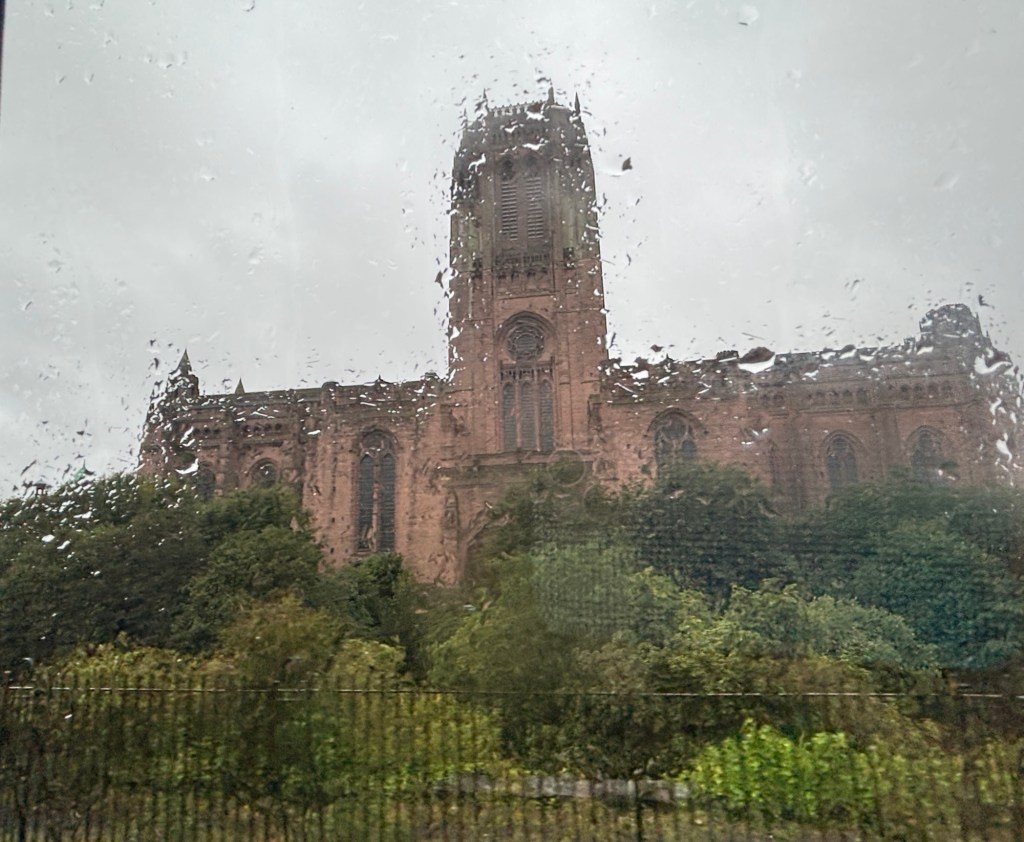
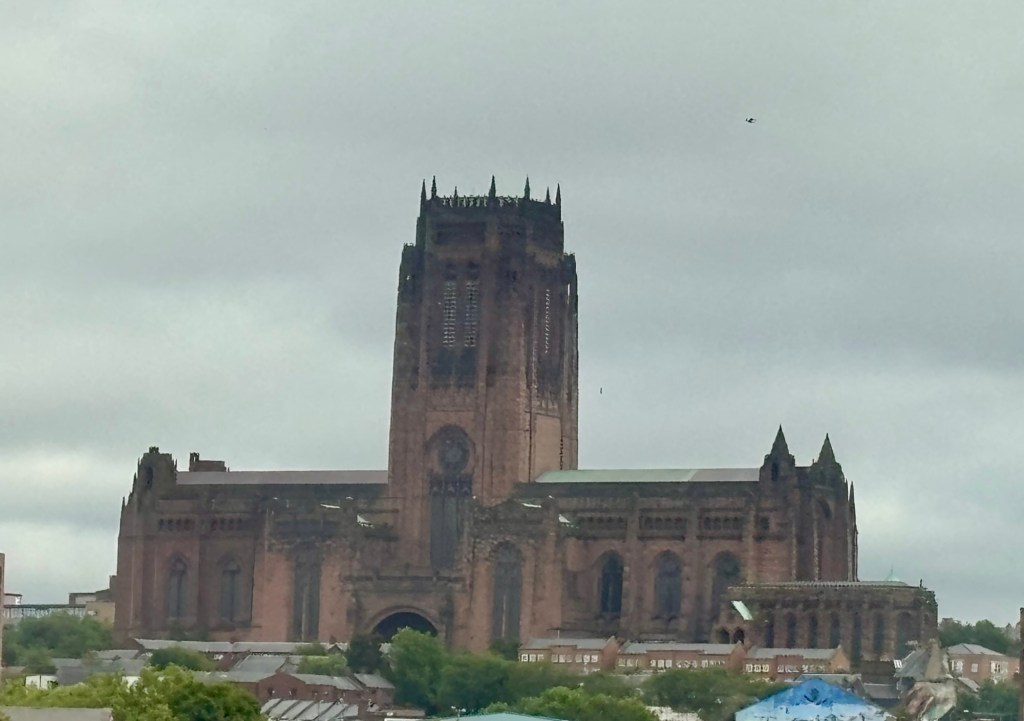
The Anglican Cathedral in Liverpool is the largest cathedral in Britain and the 5th largest in the world. It is the largest non Catholic Cathedral in the world.  Paul McCartney auditioned for the boys choir and was not selected.

Decades later, Paul McCartney’s live album, Oratorio, was recorded in the cathedral in 1991.  Paul had asked that the old choir director be present, and he was.  Our guide said they had a very sweet, cordial conversation.

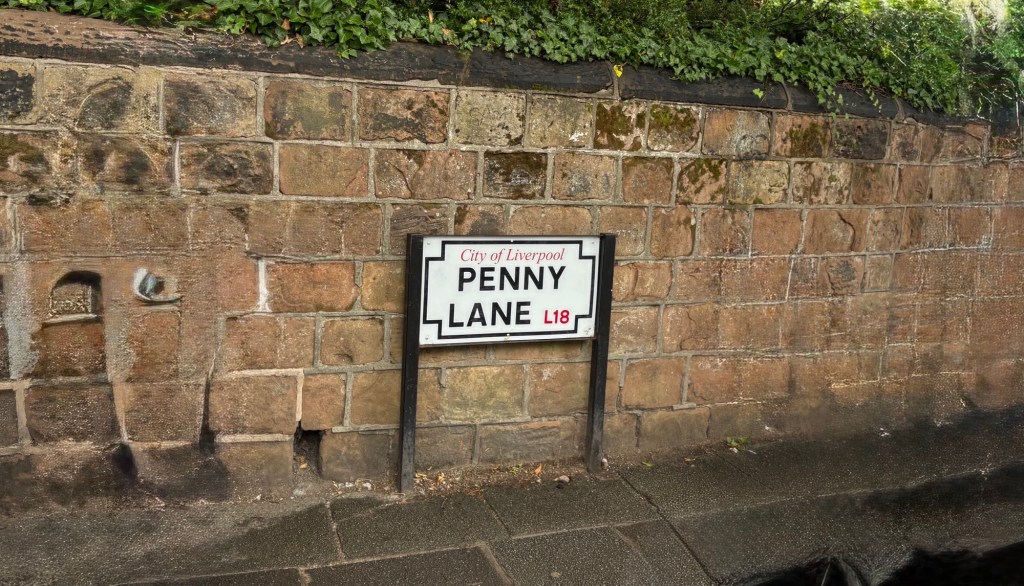
The 1967 song Penny Lane was on audio as we drove down Penny Lane.

The song was about life on the lane and Liverpool in general.

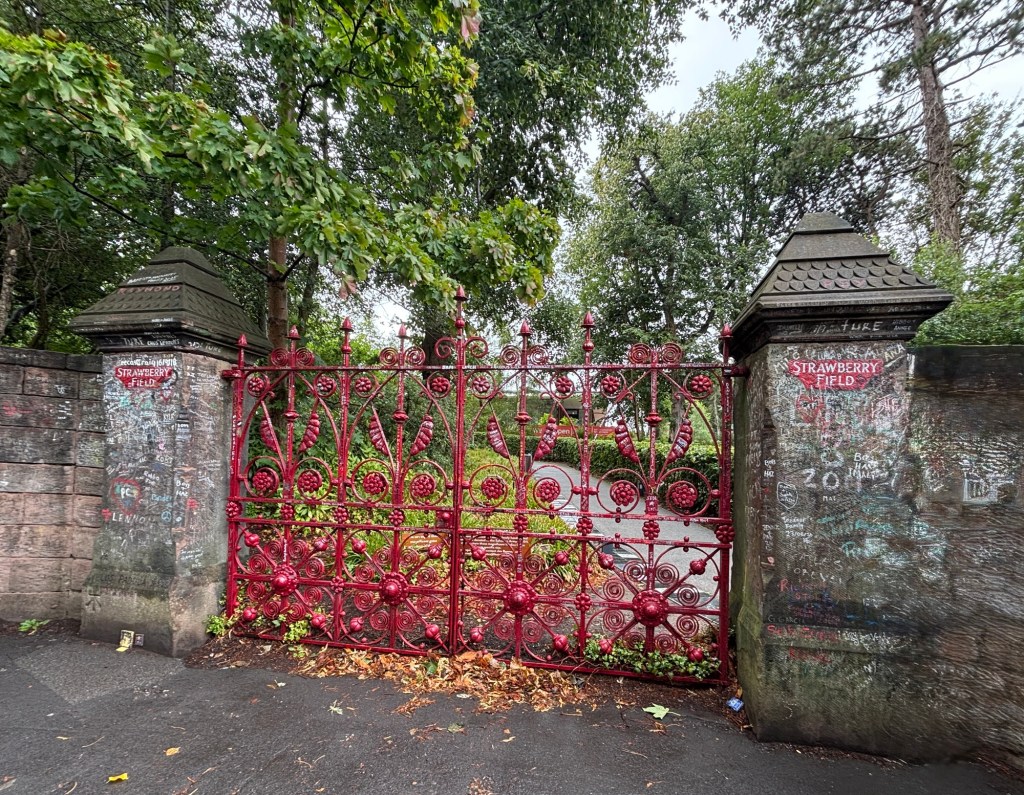
Strawberry Fields was a girl’s orphanage during John’s youth near where he lived with his aunt.  Now it is a non profit work training center for Liverpool youth.

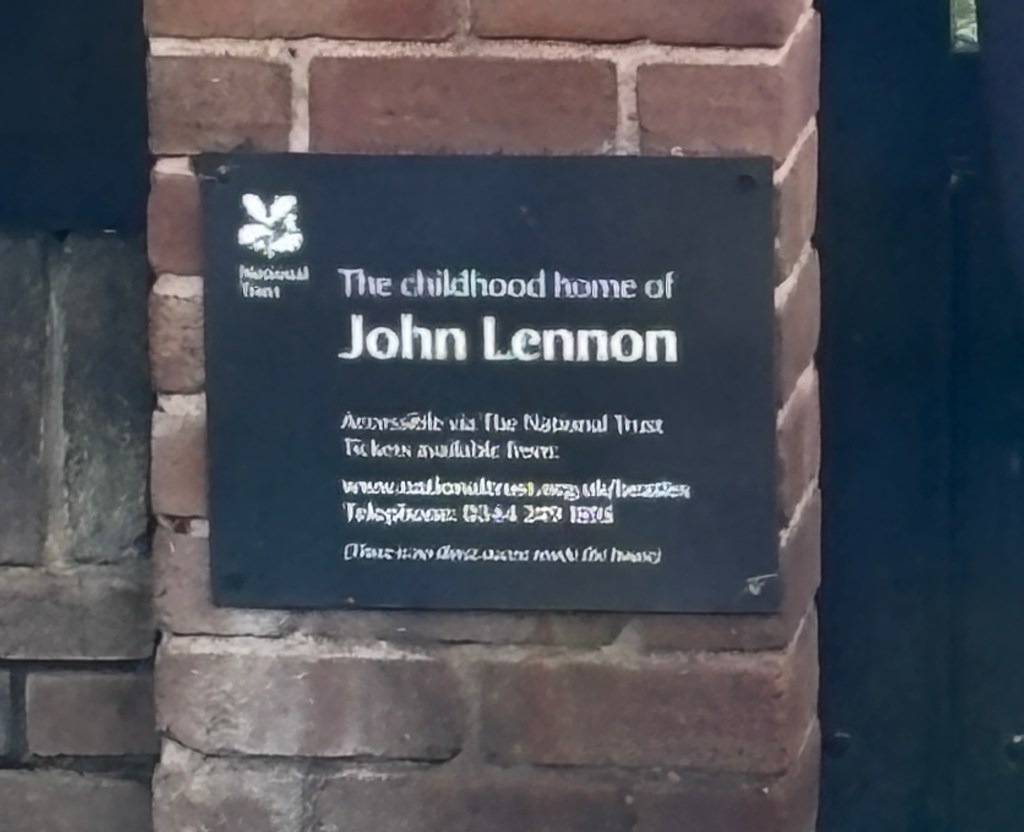
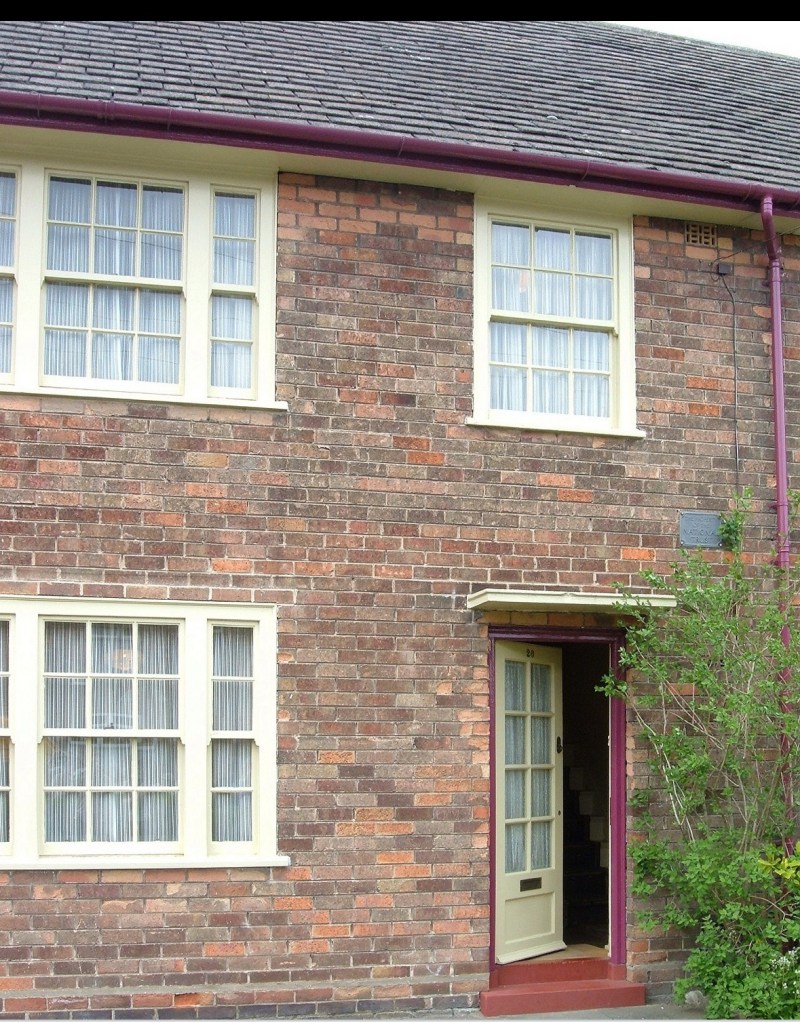
This was John’s childhood home when he lived with his Aunt Mimi.  Aunt Mimi and her husband had taken him in when life with his parents was unstable.  Still, it was often lonely and difficult after his uncle died.  His aunt did not appreciate his music noise.

With the massive success of the Beatle’s, Aunt Mimi felt like a prisoner of her own home with people always outside.  John bought her a home away from the city.

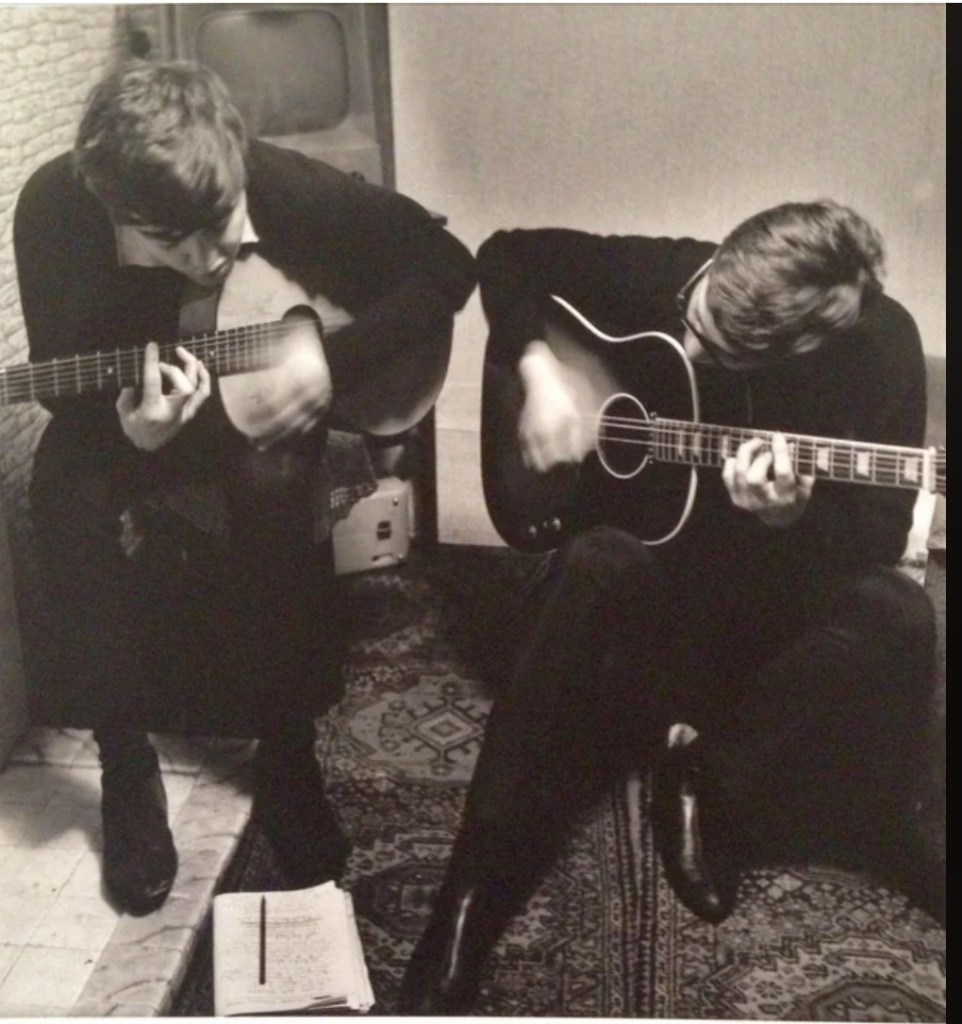
We drove by the street that had the house in which Paul McCartney lived for several years. Our bus was too big to go directly so this is a picture from the internet. It was a hangout for the Paul, John and George to practice and write songs.  It is labelled by the National Trust as “the birthplace of the Beatles”.

It was in this house that they practiced the newly learned B7 chord and incorporated it while writing “I Saw Her Standing There”.

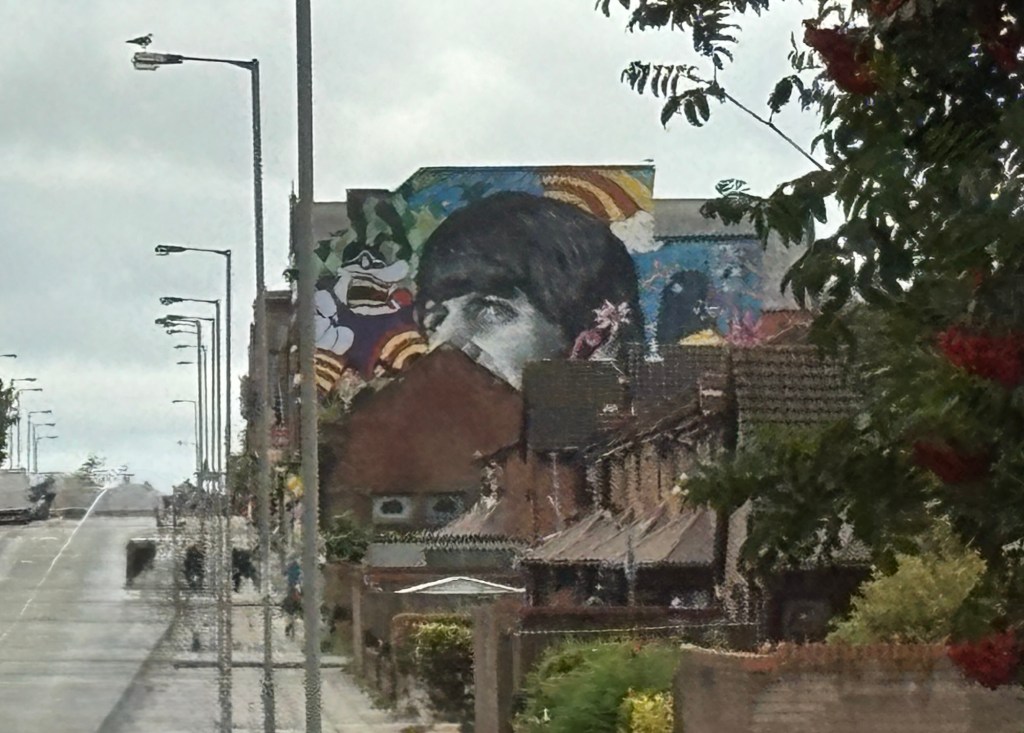
Ringo lived across the street from where this mural.  He was a sickly child.  Ringo taught himself to play drums at an early age.  He played as a left handed drummer on a right handed drum set.  This allowed for his unique sound.

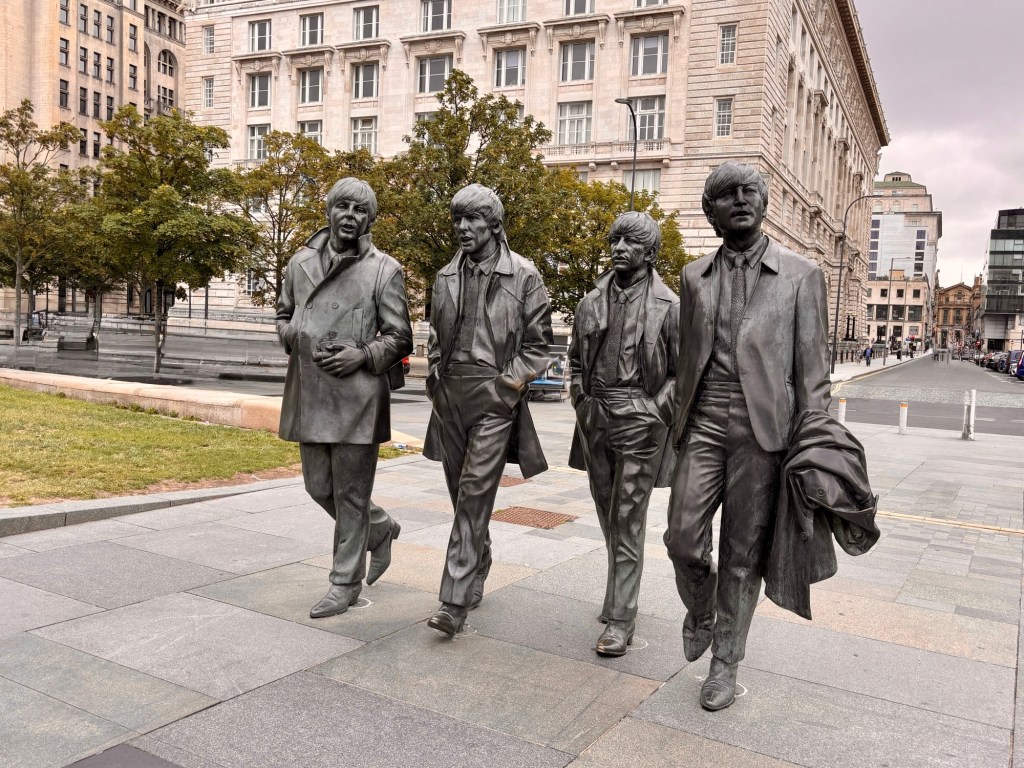
This Beatles sculpture is the most photographed sculpture in Europe.

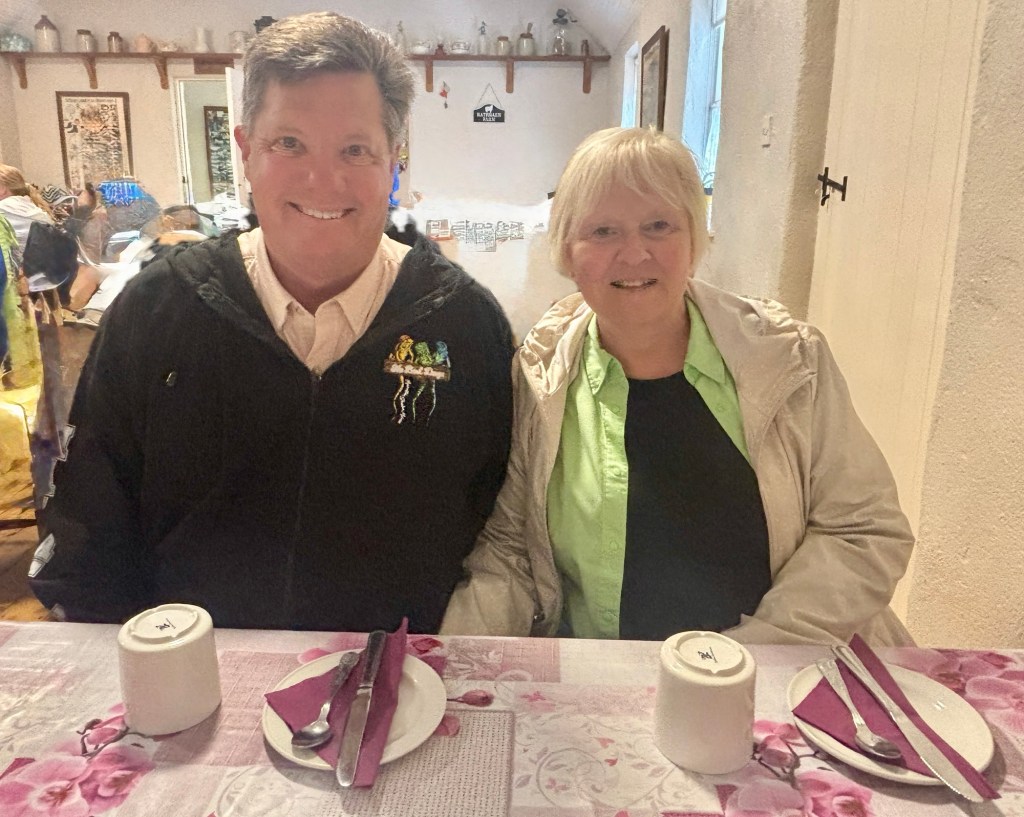
It was a marvelous day learning about Liverpool and the Beatles along with Cindy and Darrell.

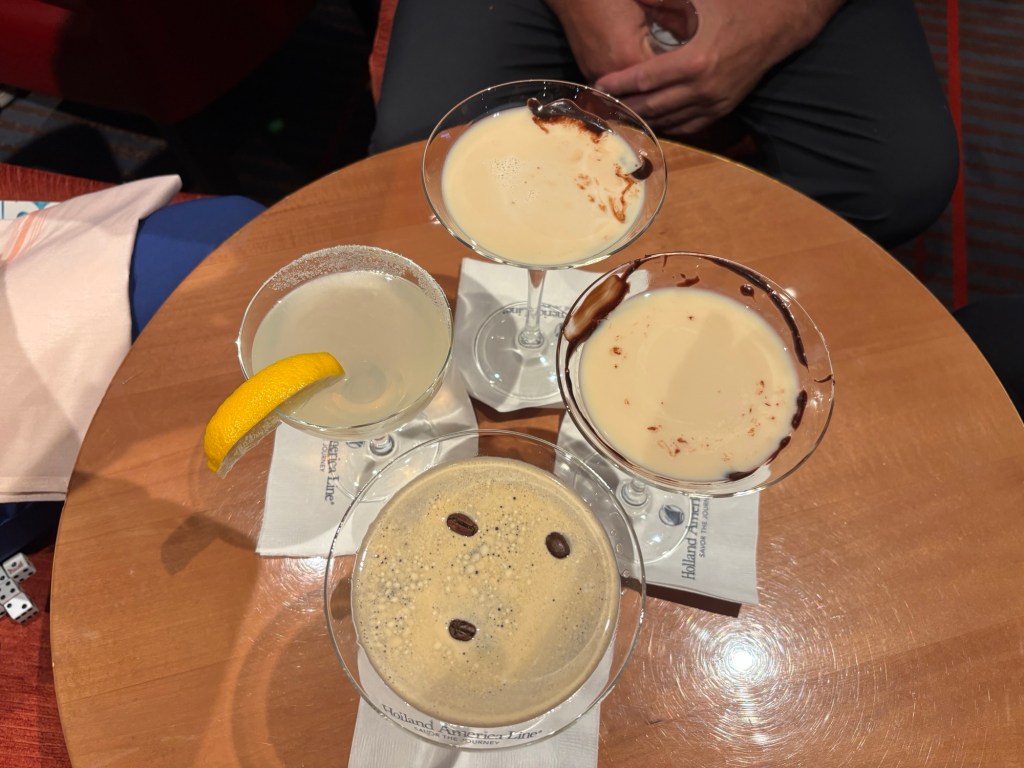
We celebrated a good day with martinis – chocolate martinis for the guys, a lemon drop martini for Cindy and an espresso martini for me!

Next up: Sea Days and Loch Ness

Posted in Uncategorized | Leave a comment

Two Cruises: Isle of Man

The Isle of Man is one of three self-governing British island territories.  It sits in the Irish Sea between Great Britain and Ireland. 

The United Kingdom is responsible for the island’s defense and representation abroad, but the Isle of Man has a separate international identity. 

Humans have lived on the island since before 6500 BC.  Gaelic influences began in 5th century AD.  We had the Isle of Man’s history described to us as before the Vikings, during the Vikings, and after the Vikings.  We visited on August 2nd.

As we came into port, we could see many wind turbines in the distance. Randy counted about 85, but said there were more on the horizon.

Our excursion was to travel by steam train from Douglas to Castletown. 

The train station was made of bricks that were originally ballast on return voyages from Ireland.

This narrow-gauge train began operations in 1874.   It still runs with its original locomotives. 

There were eight passengers per car.

The only disappointing thing about the train ride was that our views of the sea were few.

The children’s storybook character Thomas the Tank Engine was based on a fictional island near The Isle of Man. That is just the first of several random things we learned about the Isle of Man – more to come!

Our destination, Castletown, was named for its fortress, one of the most complete medieval castles in the British Isles. 

This clock on the Castle Rushen’s exterior is prominent from the town square.  It was presented to the island by Queen Elizabeth I in 1597.  It has only ever had one hand, but is still operable after 400 years. 

Castle Rushen’s first line of defense was an outer wall that was 7 feet thick and 25 feet high.   The castle’s walls themselves were 12 feet at the base thinning to 7 feet thick at the top.

We paid our fee and began 90 minutes of exploration.

The castle entrance was protected by a drawbridge and two porticuilles with a killing area between.

The castle is operated by the Manx National Heritage, an organization that manages a significant proportion of the Island’s heritage assets including over 3,000 acres of coastline.   It took over managing the castle in 1988 and completed restorations.  

The Manx are the ethnic group that originated on the Isle of Man.  Their language has a Gaelic origin but developed in isolation so is unique.   Their governance structure, The Tyndall,  was introduced by the Vikings over 1000 years ago.  For example: A potential law must be read publicly, outside, in its entirety in both English and Manx.

Although the castle has been found to contain some construction materials dating to 947, it is advertised as 800 years old.  It was developed by successive rulers between the 13th and 16th centuries.

After its initial construction and use by Norse and Gaelic rulers, the castle changed hands repeatedly between the Scots and the English.

From 1405 to 1738, the Isle of Man, and the castle, was controlled by the Stanley family, beginning with Sir John Stanley.  His title began as the King of Mann, and over the centuries, the title transitioned to the Lord of Mann.  Today the reigning British monarch, currently King Charles III, is the Lord of Man (The spelling changed over the years). 

In the 18th century, the castle shifted in use to an administrative center including a mint and home for the law and parliament.  The Isle of Man has the longest continuous parliament in the world. In 1881, it became the first national legislative body in the world to give women the right to vote in a general election although the action excluded married women.

Late in the 18th century, the castle began a steady decline and was converted into a prison. It was in notoriously poor condition. The prison held both men and women (and the children born to the women).

Early in the 20th century,  the castle was restored under the oversight of the Lieutenant Governor, the highest ranking government official in residence on the island.   The castle transferred from the British Crown to the Isle of Man government in 1929.  

We lost count of how many rooms there were to explore in this compact castle. 

One of the eight bathrooms had a medieval “resident” trying to do his business, with sound effects! It is too bad we don’t have a video, or at least a picture of that memorable room!

Some rooms were decorated to show how it might have looked during medieval times. The bird is only in silhouette in this picture, but the bird being served was stripped of its beautiful outer plumage, cooked, and re-dressed for serving.

We went up and down many circular stairways.

Many rooms had placards indicating what the room was used for during its medieval, administrative and prisons timeframes.

The castle was very interesting but when we got back it was time to explore the town of Douglas a bit.

The Gibb brothers – the BeeGees – were born on the Isle of Man.

There is an infamous TT Motorcycle race that takes place here.  (We didn’t know it.). Friend and reader, Mark, just gave us the scoop on the race. Over 260 people have died since 1907. Sheesh!

Manx Cats were known as cats from the Isle of Man early in the 19th century.  Their lack of tail arose as a natural mutation on the island. 

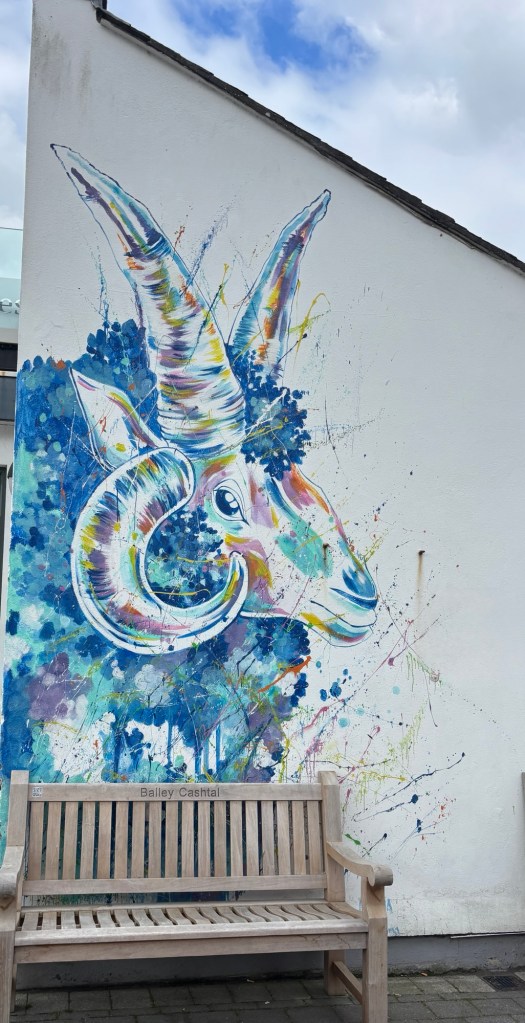
The Manx Loaghtan is a small native sheep from the Isle of Man.  They usually have four, and occasionally six, horns.   It is much desired for its unique meat.

The Isle of Man flag was first recorded in its presentation to parliament in the 14th century.  A common interpretation is: Whichever way you throw me, I will stand – indicating resilience.  The symbol was also used on coins printed in the 17th – 19th centuries.

Shipwrecks on the coast of the Isle of Man in 1822 inspired local resident, Sir William Henry to encourage the British government to establish  “a national institution for the preservation of life and property from shipwreck.”  He was instrumental in saving lives personally and in development of this resource.

The little castle below is on the Island of Refuge. There is always supposed to be bread and water in the little castle for anyone in need.

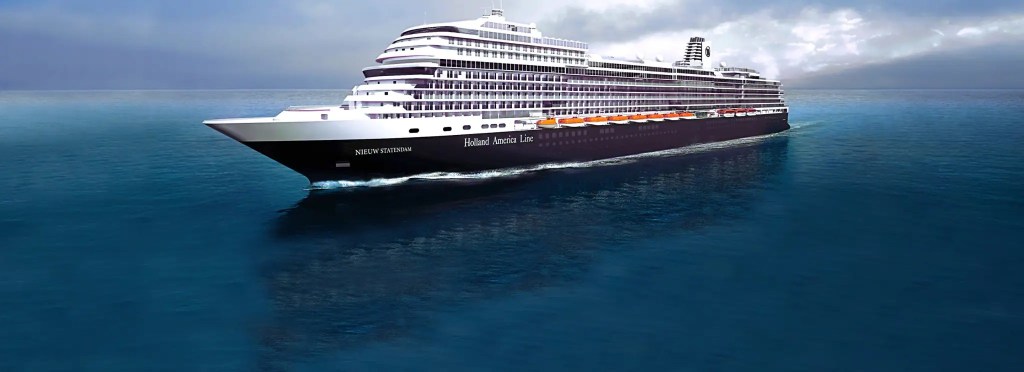
Nieuw Statendam is the largest cruise ship that will visit the Isle of Man this year.  It is a ship of about 2600 passengers, mid size by industry standards.

The Isle of Man was one of the more interesting places we’ve been that we had not even known existed before arriving and exploring.

For many, many years, we had gotten a Christmas ornament from every new place we visited or every special trip we took.  We have had to get much more selective in recent years because we don’t have tree space for all the ornaments we already have.  That being said, I bought this one from Isle of Man in a heartbeat.

I will smile in remembrance as I place it in a prominent place on the tree this year.

Next up: Liverpool, England. We went Beatles-centric!

Posted in Uncategorized | 2 Comments

Two Cruises: Galway, Ireland

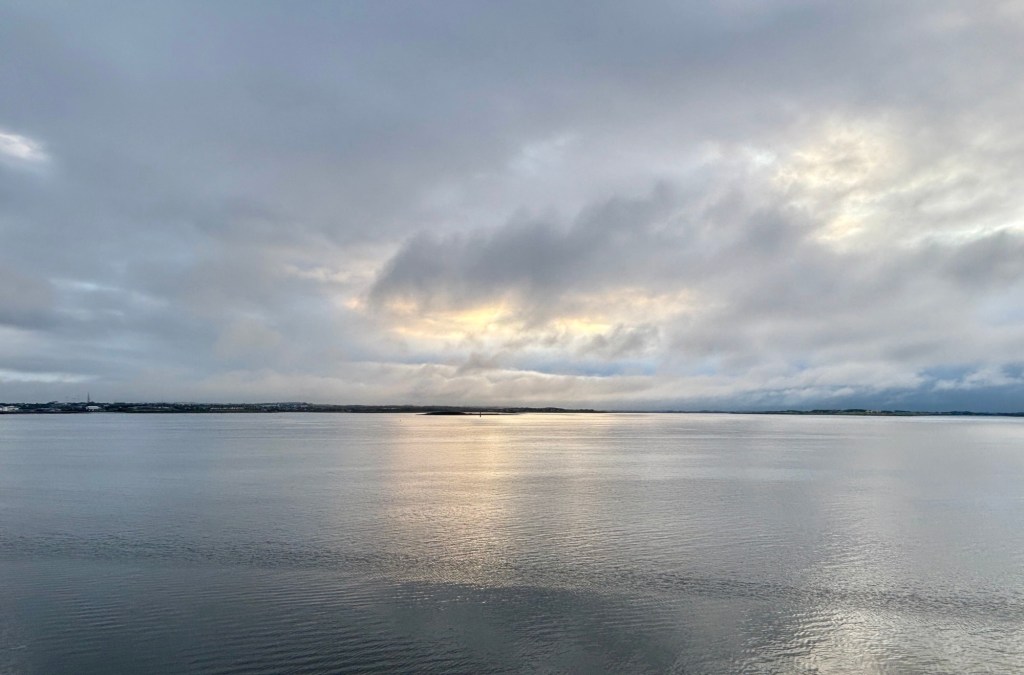
This was our first view coming into Galway, Ireland on the morning of July 31st.  It was early because we had a 7:00 am meet-up due to the need to tender into the port. 

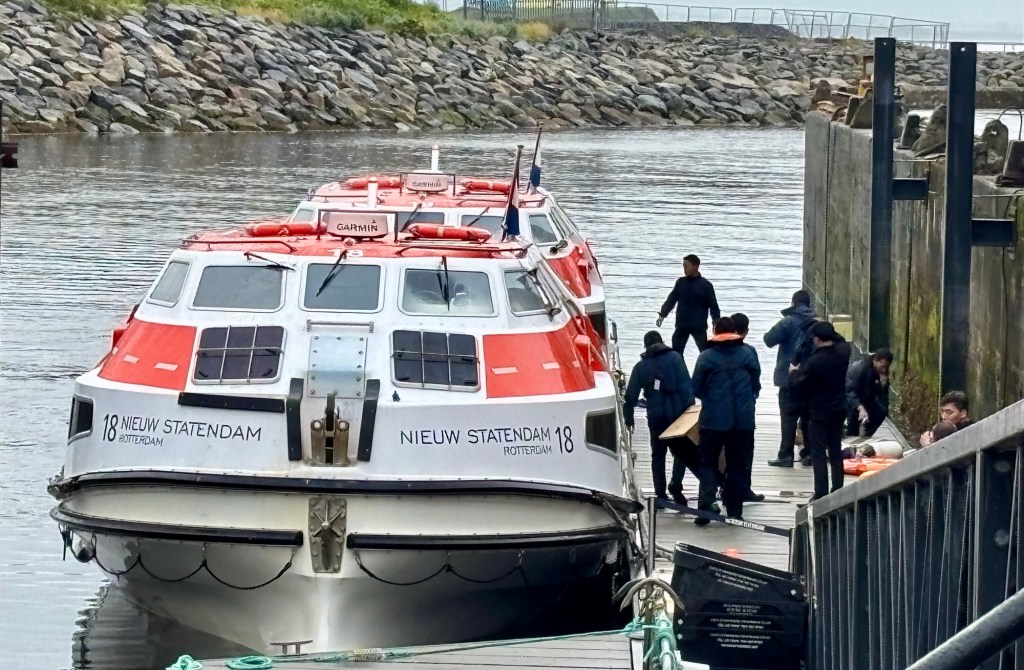
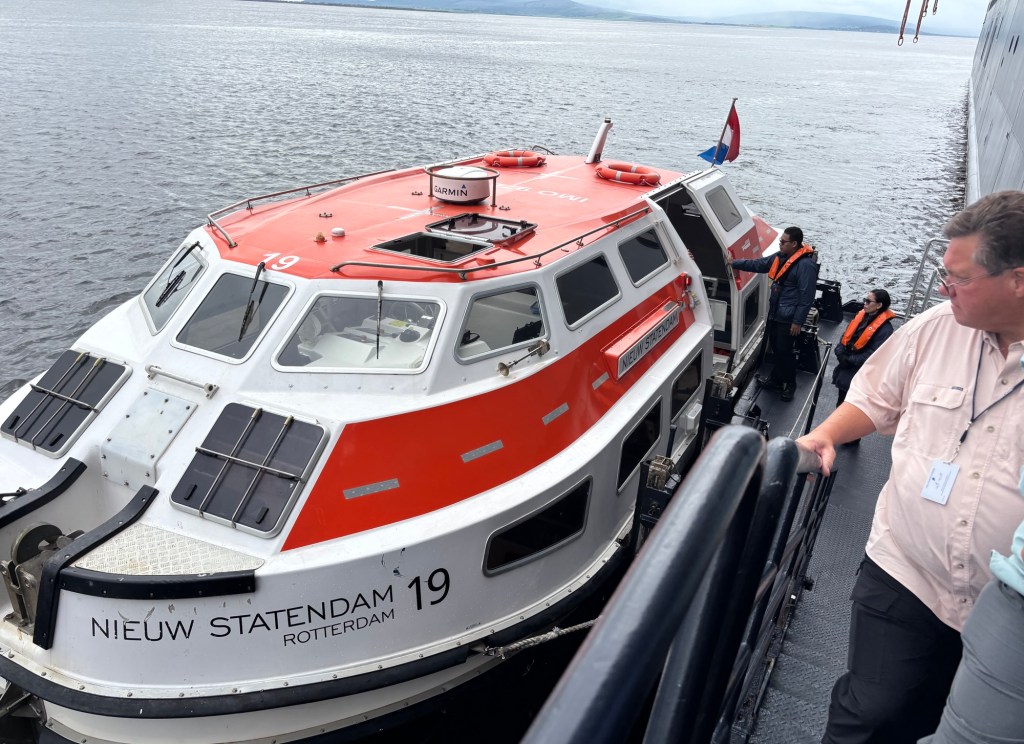
If tendering is required it means the ship can’t dock at the pier, perhaps the port doesn’t have a pier, or the dock is too full or the ship is too big.  We will have four tender ports on this cruise and Galway is the first.   

We are on the same tour with Cindy and Darrell! 

There are 265 days of rain on the west of Ireland vs 165 on the east.  This was our first rainy day.

Galway has been on maps since the mid 1400s likely because of its inclusion on shipping routes.

Fourteen families ran Galway quite well from medieval to modern times. Thus, the city is called The City of Tribes.

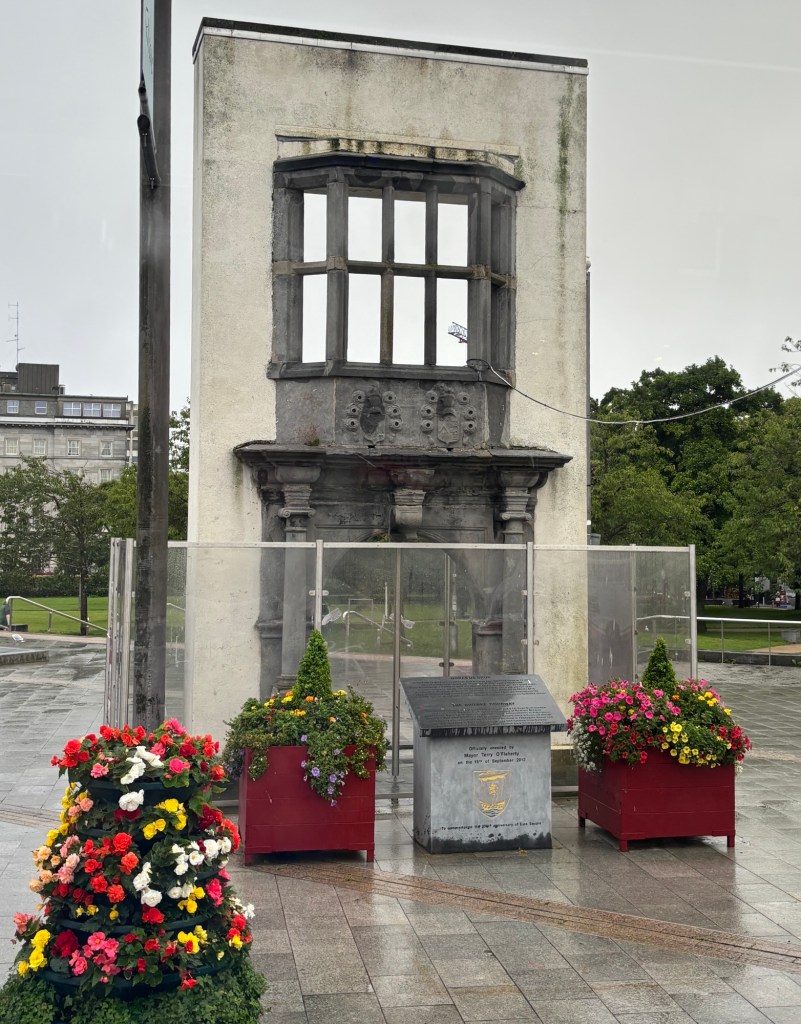
The Browne family was one of those family tribes.  The Browne Doorway was part of the family townhouse, built in the early 17th century. The ornate decoration represent two families united in marriage.  

The Doorway is in John F Kennedy park.  President Kennedy came to Ireland and gave a speech in Galway asking “Who has a family member who has emigrated to America?”  Of course, there were many given the potato blight famine in Ireland.

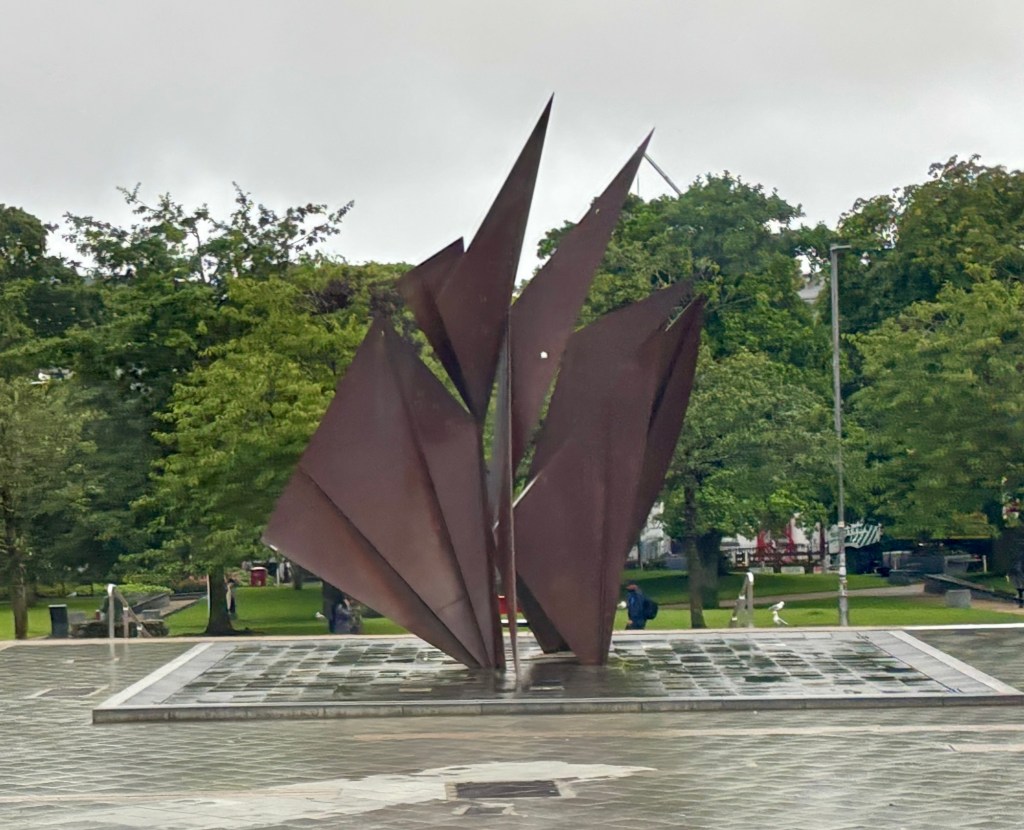
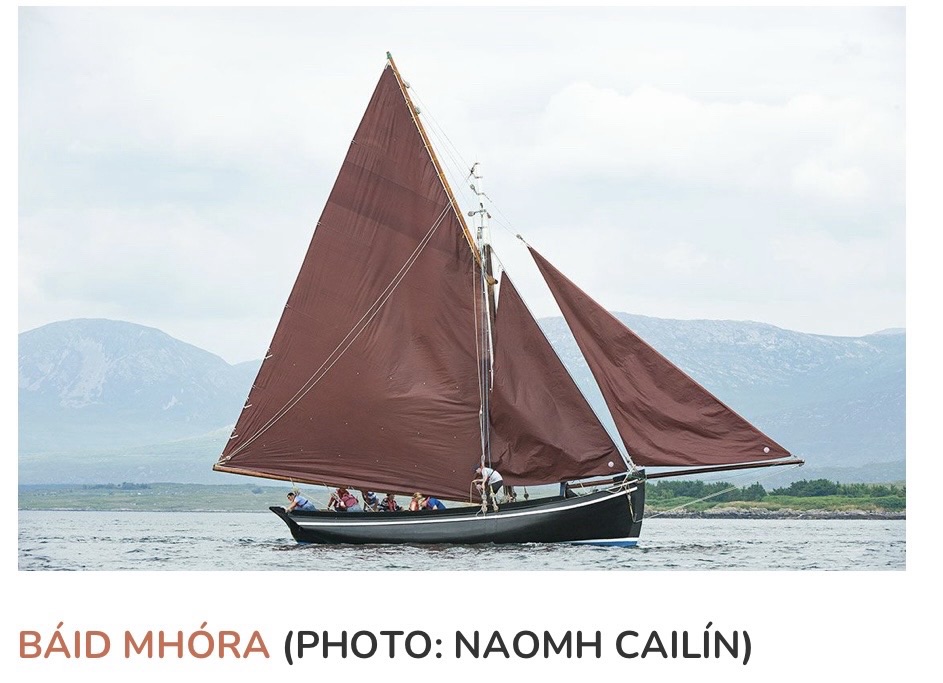
This sculpture commemorates the Galway Hooker, also called Red Sails of Galway. This sturdy  boat is characterized by a black-colored hull (originally a tar coating) and rust-red sails. 

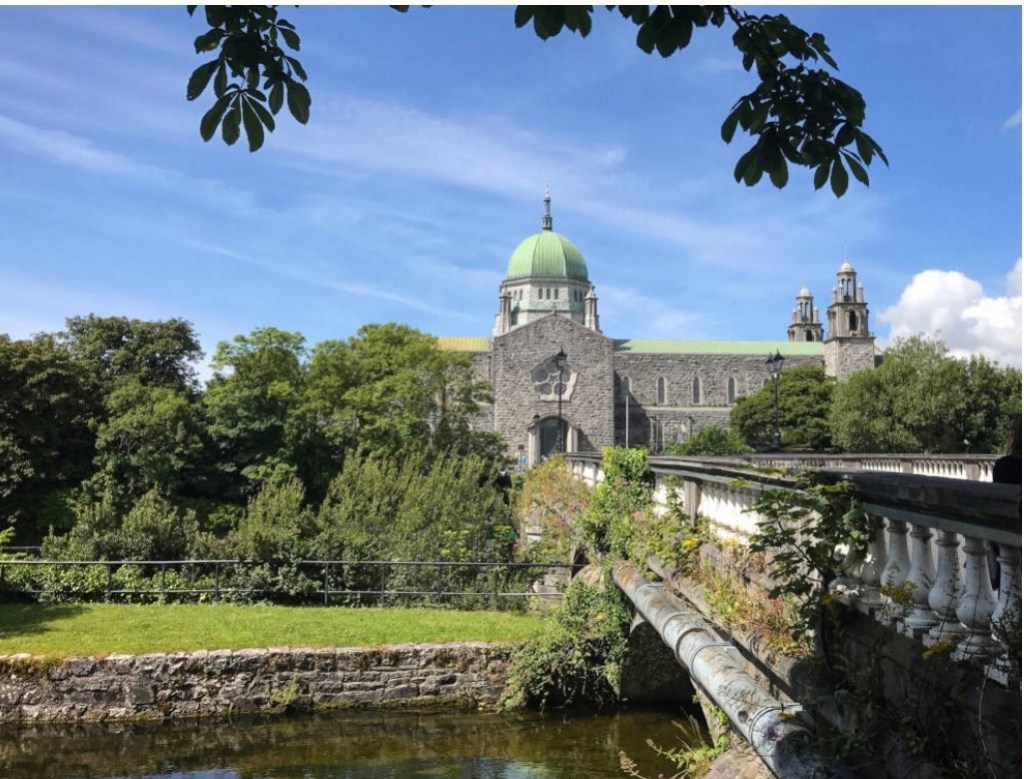
This is Galway Cathedral built between 1958 and 1965.  It was the last Cathedral built in Europe in the old style. A lot of money from Boston helped finance the cathedral.

Galway has strong pharmaceutical, education and tech device industries. The economy is typically strong and has been recession proof.

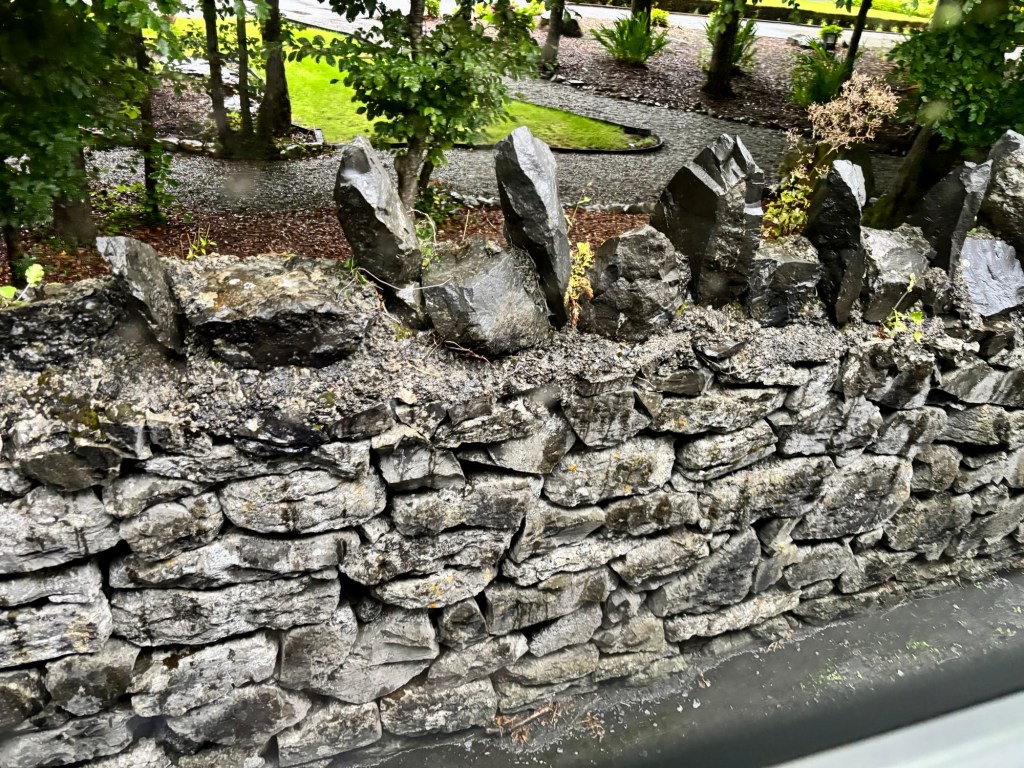
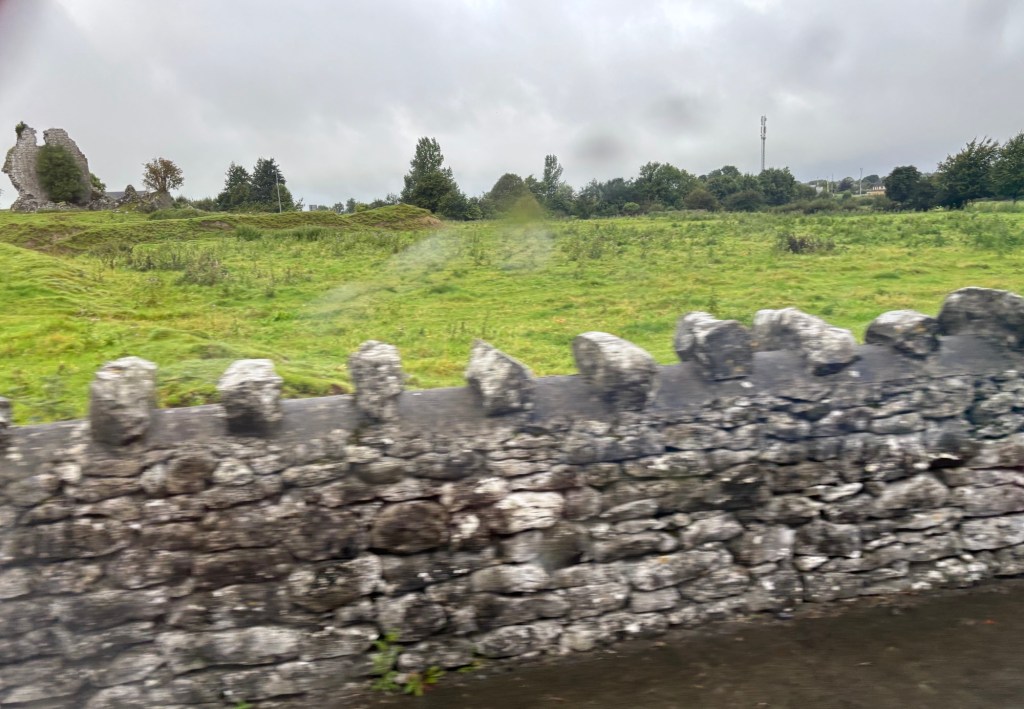
As we left Galway and went through nearby villages, we saw unique walls.  In the past, families designed and built walls in their own style.

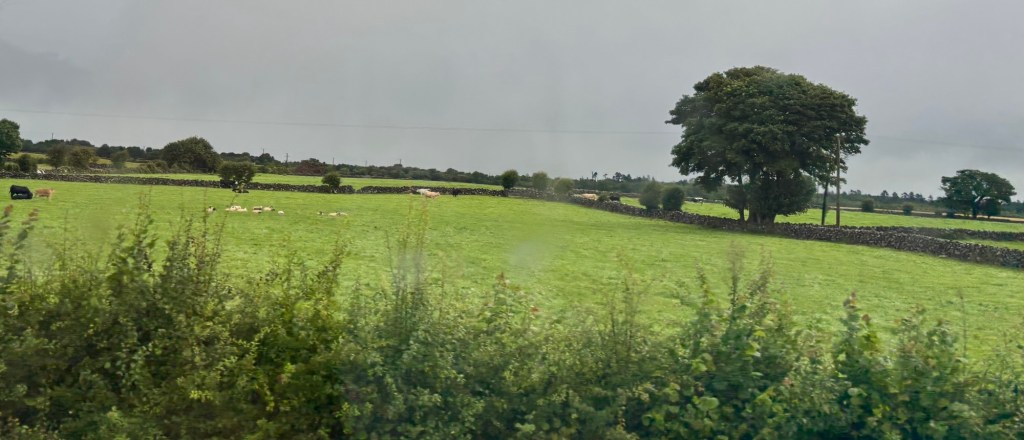
We saw how these walls separated the farms.

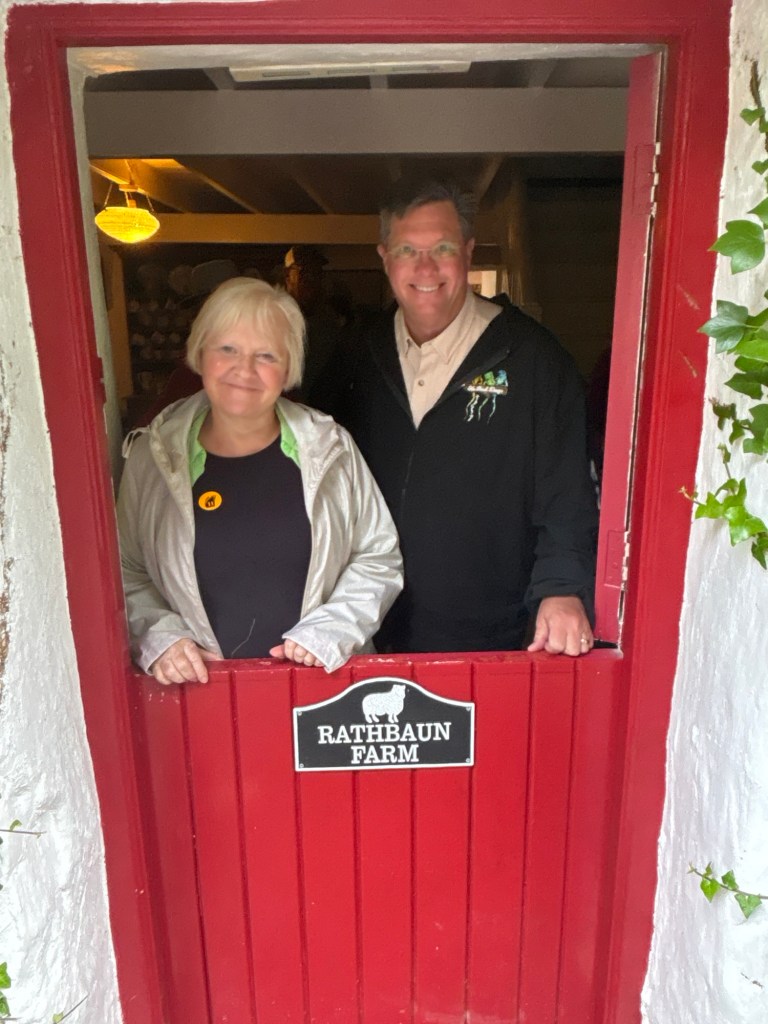
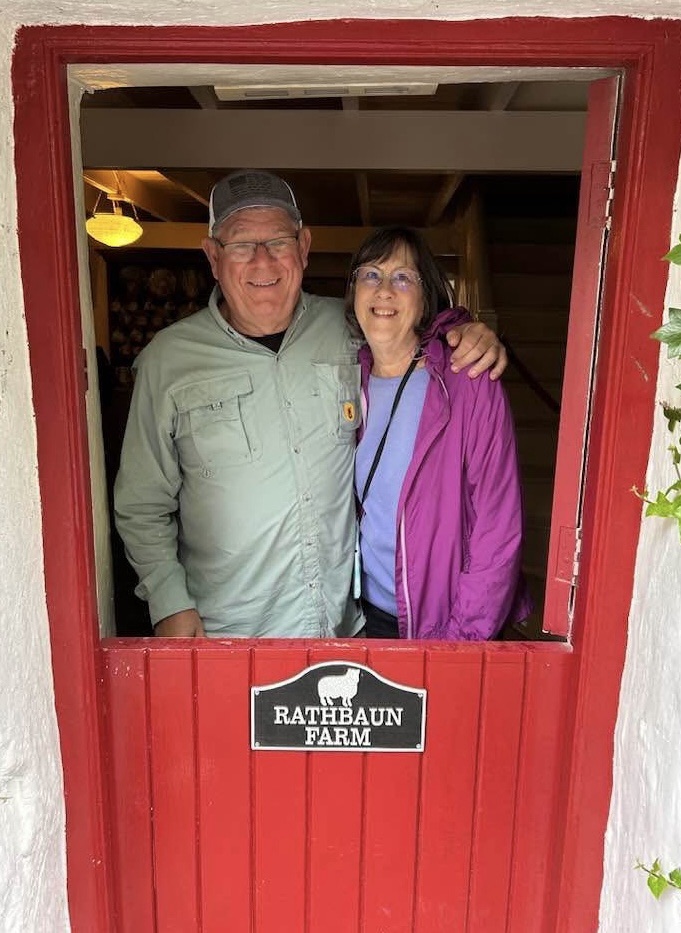
Our destination was Rathbaun Farm.

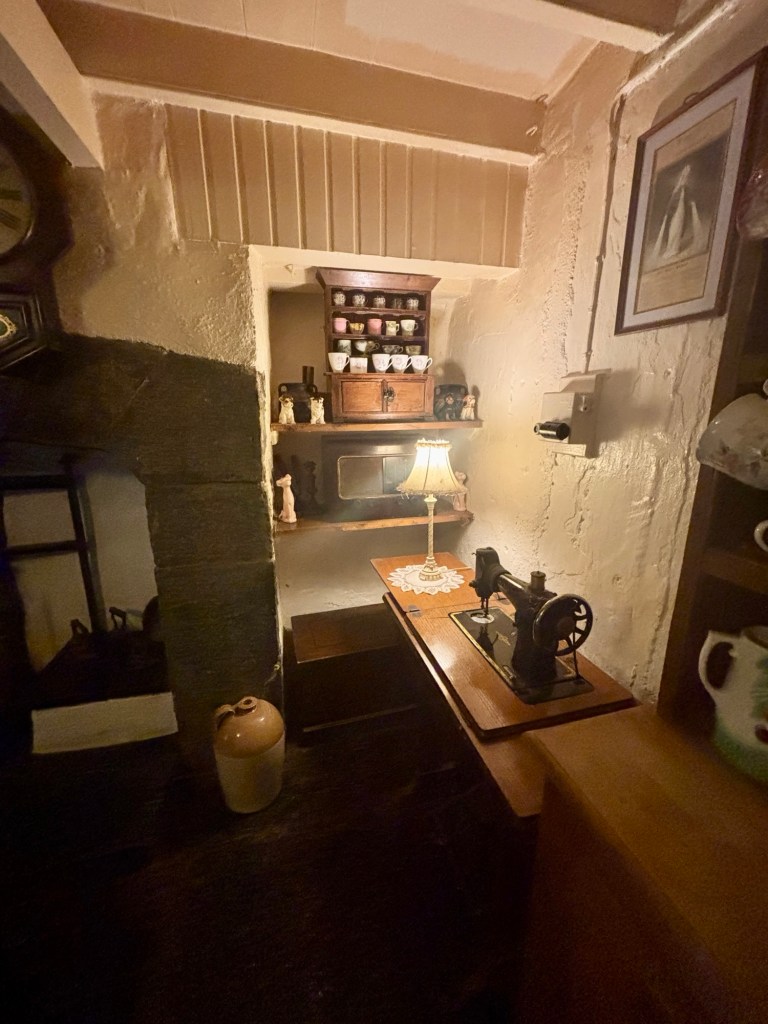
We enjoyed exploring the 250-year-old farmhouse.

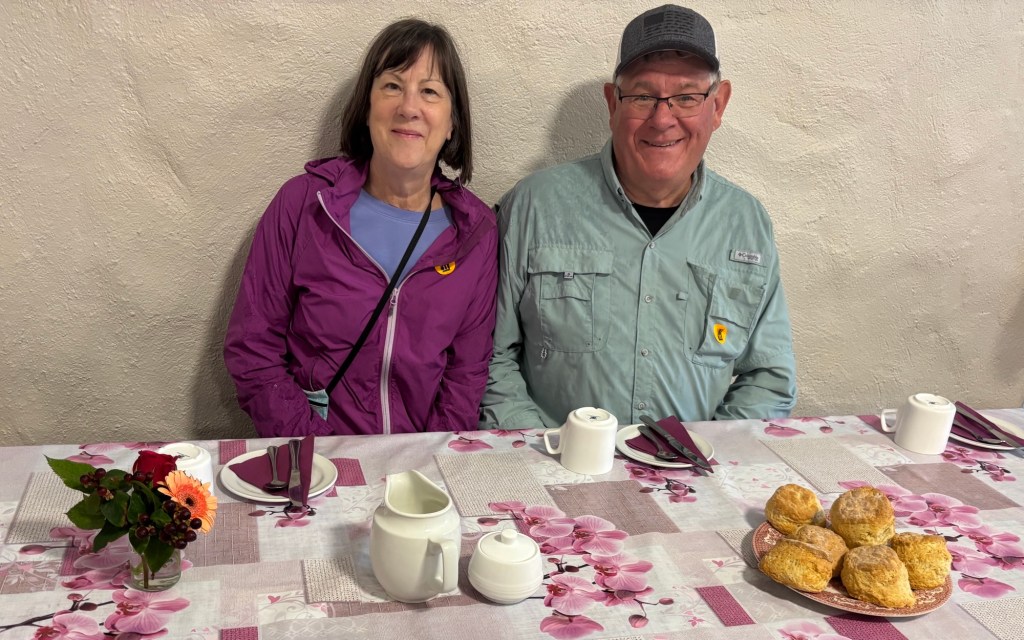
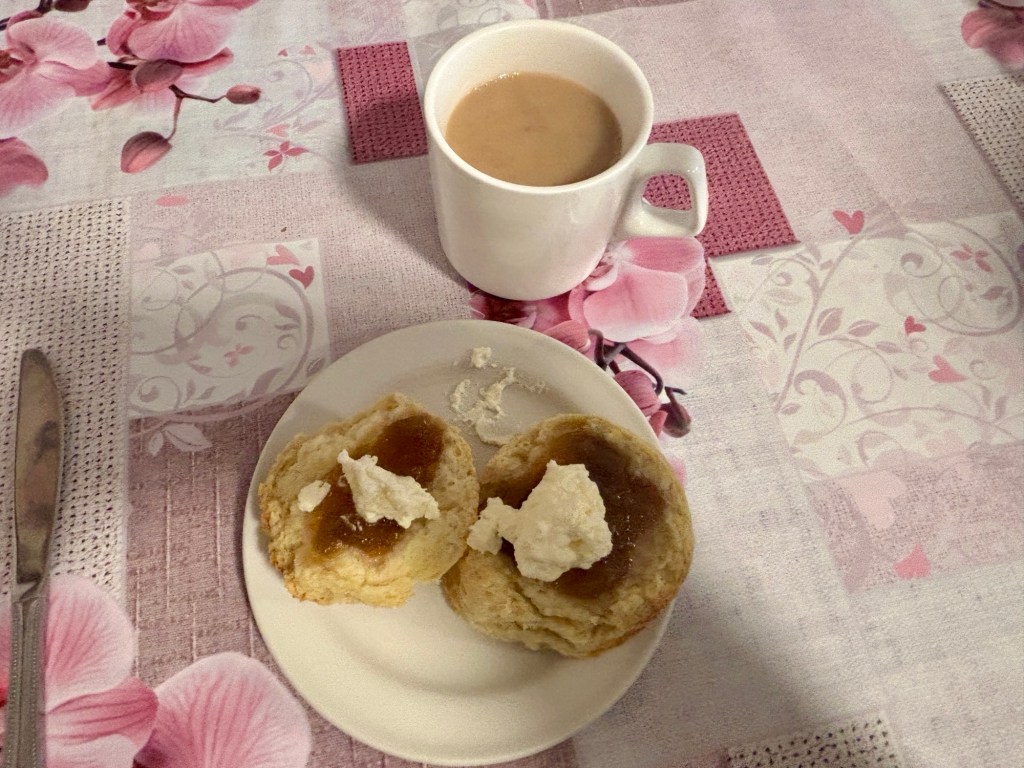
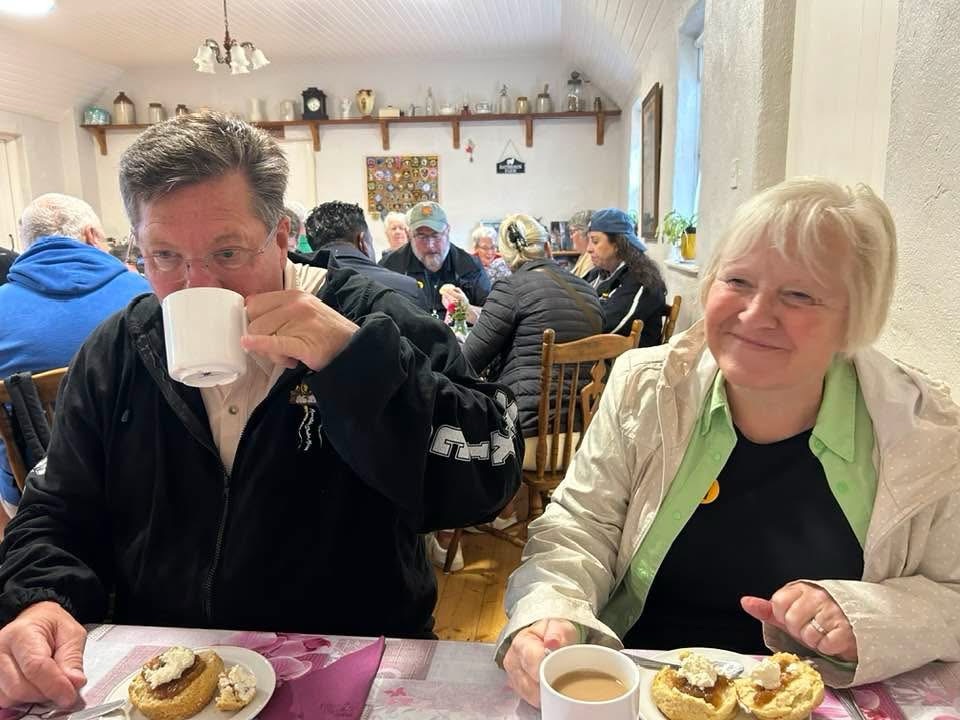
We had tea and scones. 

Randy was teaching us little finger positioning while drinking tea.

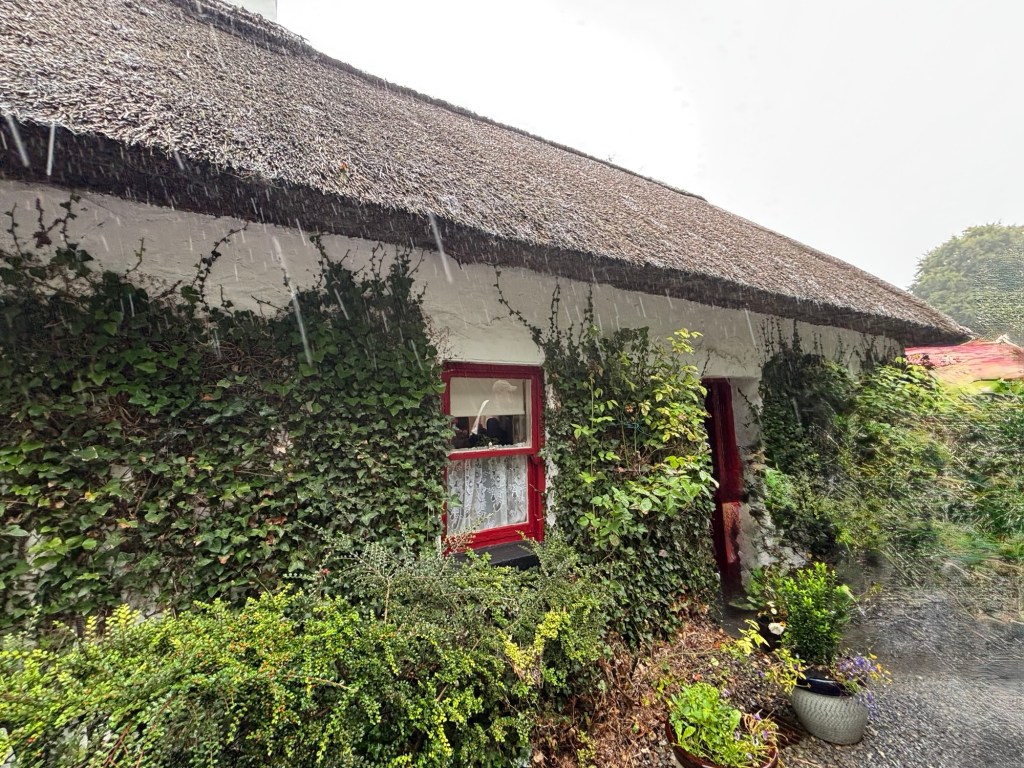
We had a few minutes more to explore the grounds. This thatching was interesting.

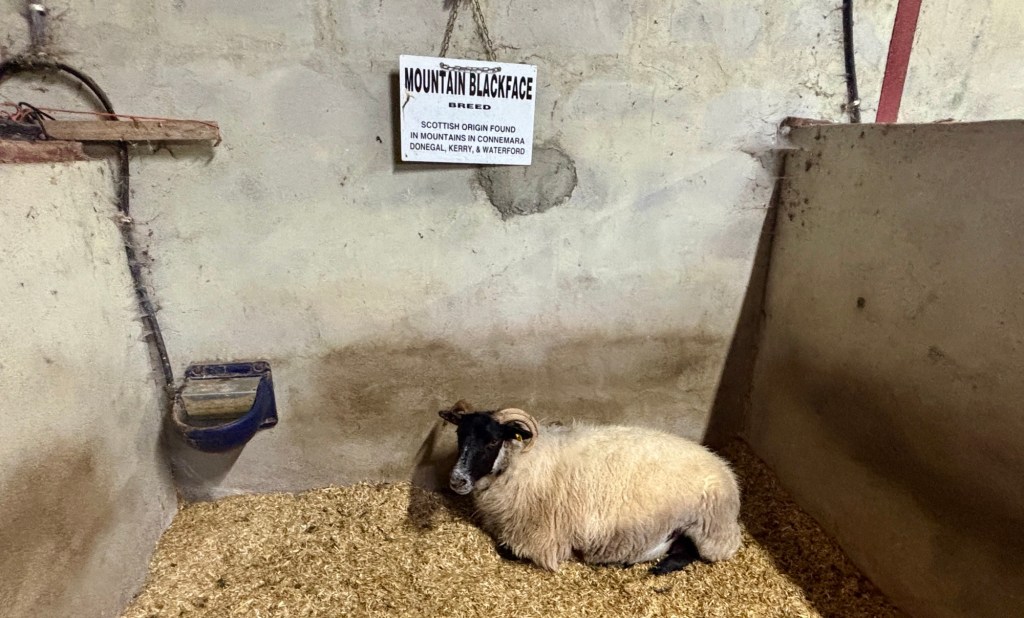
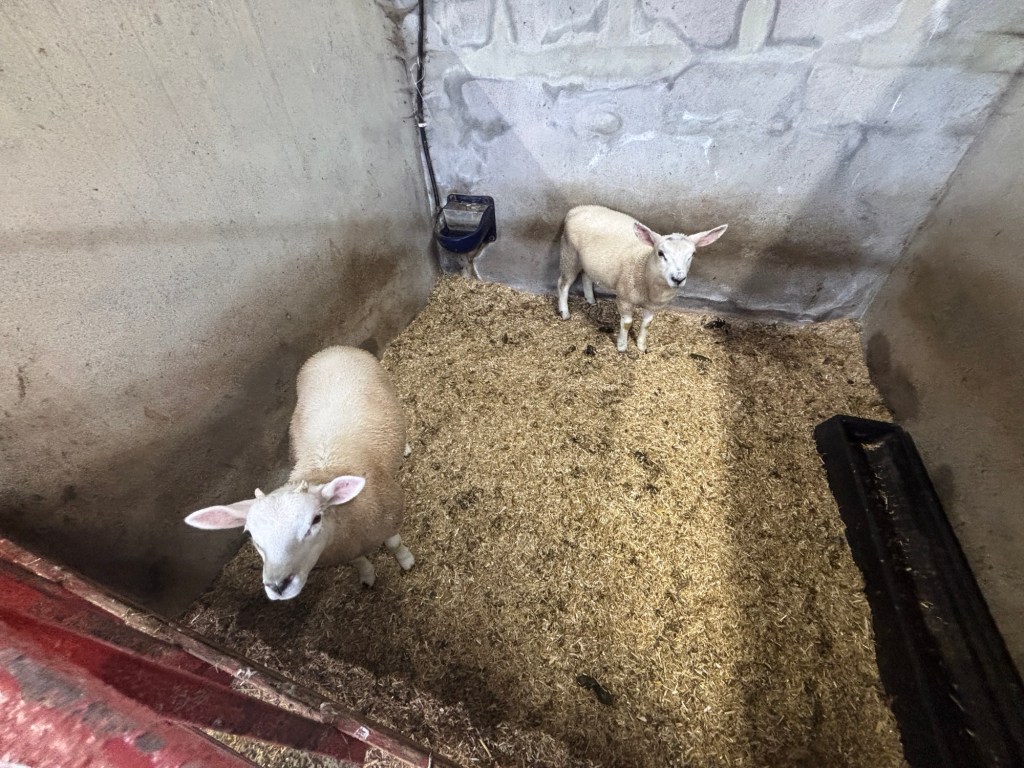
The Connolly family, still actively farming, allowed us to view their various sheep types.  They had about eight different varieties penned so we could see the differences.

One ewe had triplets, but she only had two teats.  Having two lambs is the norm. After a couple weeks, the largest will be taken away and bottle fed because she will no longer be able to provide for all three.

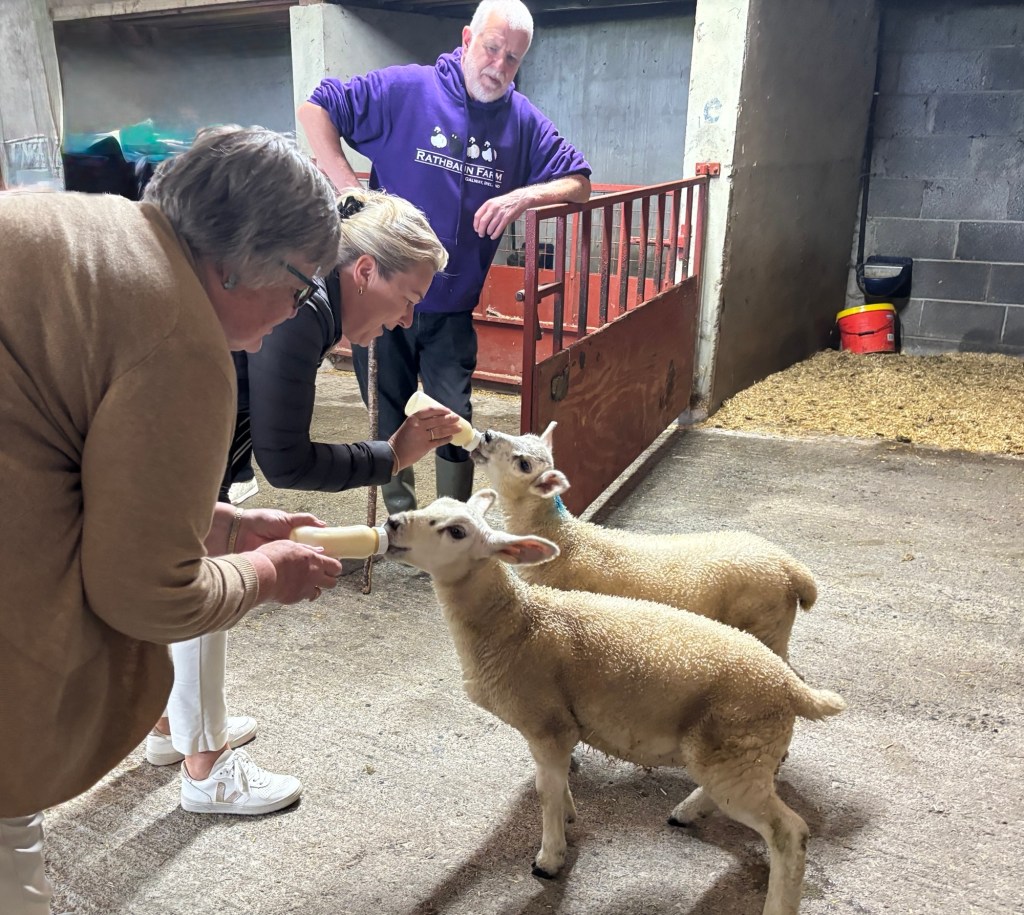
Two women on our tour bottle-fed two lambs. 


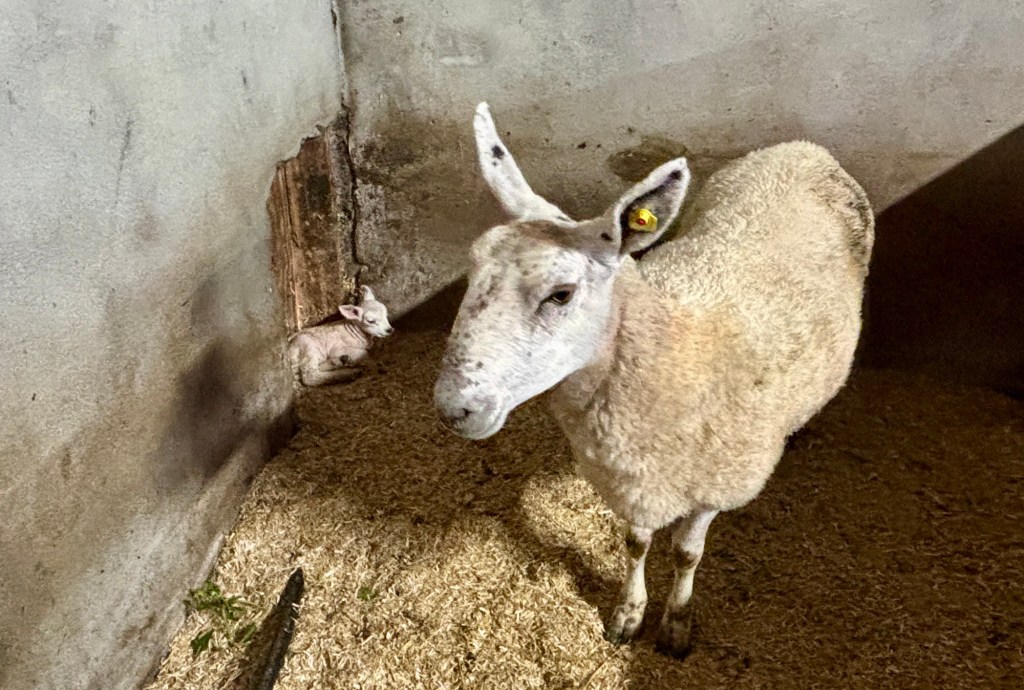
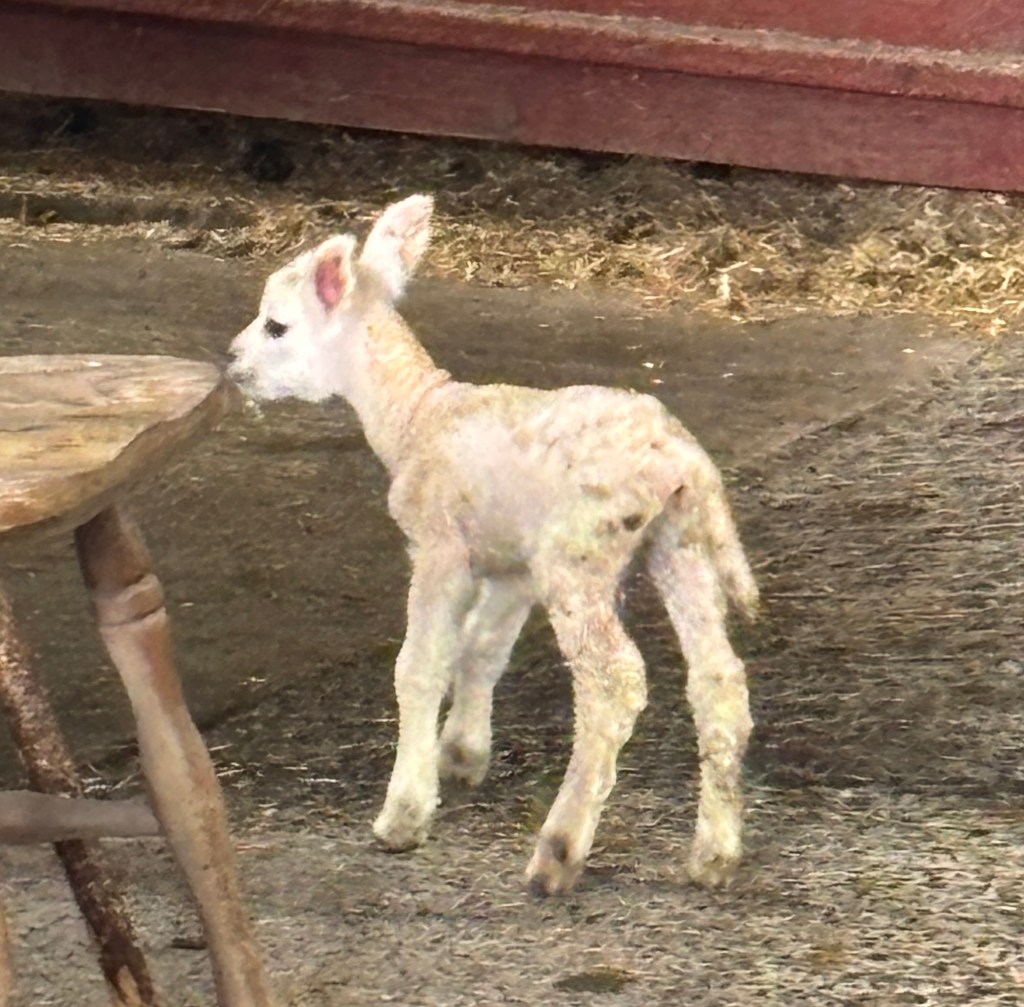
This ewe had a premie, only a couple days old.  In this picture she seems to be protecting her baby from too much attention.

Then the farmer went in and took it away from her so we could see it close up for a few minutes. I didn’t much like that he did that.  Cindy got a good picture of the little baby.

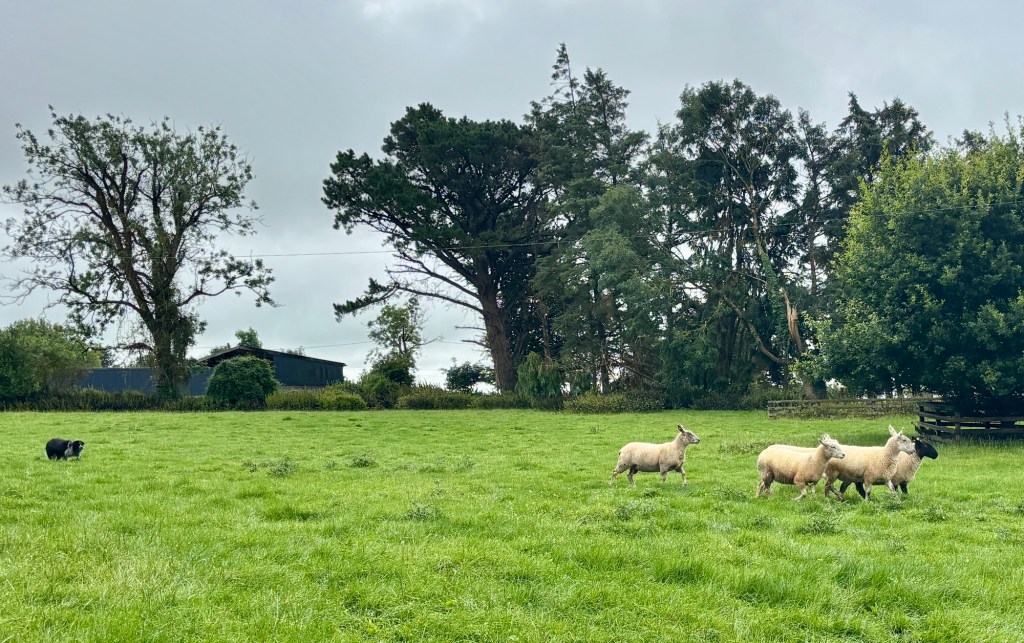
We watched the farmer maneuver his flock.  

Then he showed us how his dog moves the sheep.  I asked if the sheep were afraid of the dog, and the farmer acted as though it was a dumb question.  He said of course, because dogs kill sheep.  They have a problem with roaming pets occasionally killing sheep.  

When we have seen sheep and dogs in other places around the world, Randy and I have never had any sense that the dogs were any more than protectors and gatherers. Maybe it is a Scotland thing or maybe Randy and I just never ever thought about dogs being aggressive.

On another tour in Scotland a few weeks later, we saw this sign.

The wool shearing costs more than the wool is worth.  That is pretty common except for Merino wool from sheep in the southern hemisphere. The wool from here goes to China, India or Eastern Europe and will be mixed with other fibers in products.

There are breeding modification attempts being made to develop sheep that don’t grow as much wool so wouldn’t need to be sheared.

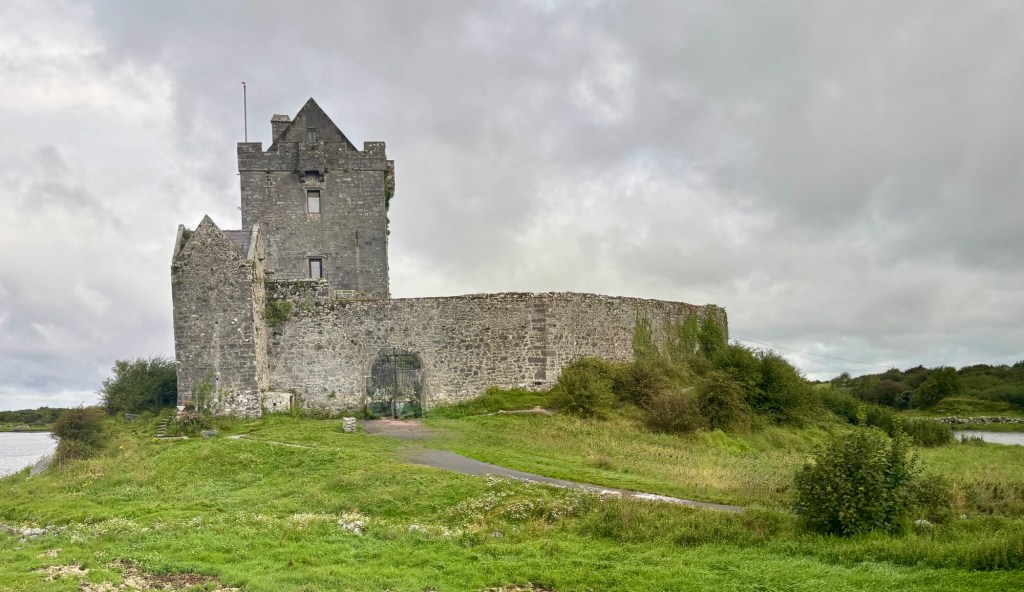
We drove by Dunguaire Castle — a small 16th-century castle built by the Hynes clan.  Defensively, there is water on three sides.

It is one of the most photographed castles in the west of Ireland and was used in the movies Guns in the Heather (1969) and North Sea Hijak (1979).

A group of writers, including WB Yates, bought the castle and had writers’ meetings and workshops. Then there was a period of disuse until it was renovated and opened for tours and period dinners activities.

The castle was closed for renovation at the time of our drive by “visit.”

More castles remain in western Ireland than other places in the country because development was slower so they weren’t taken down.

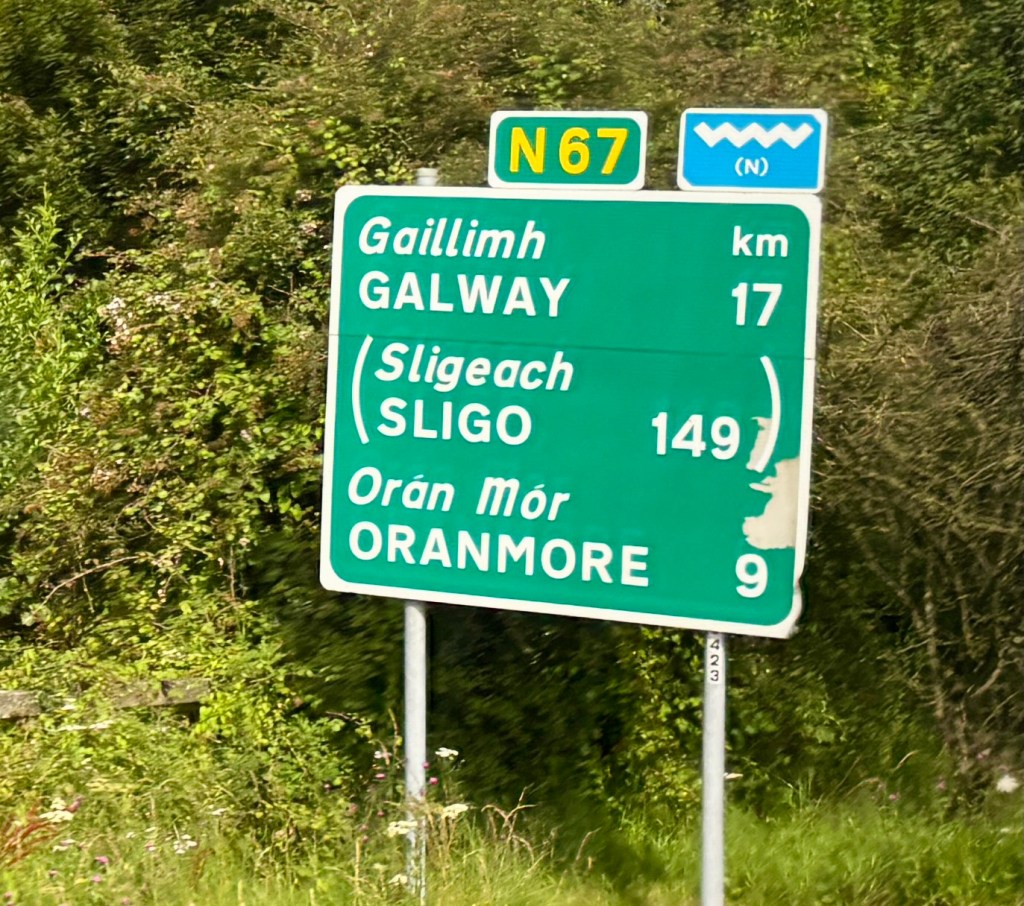
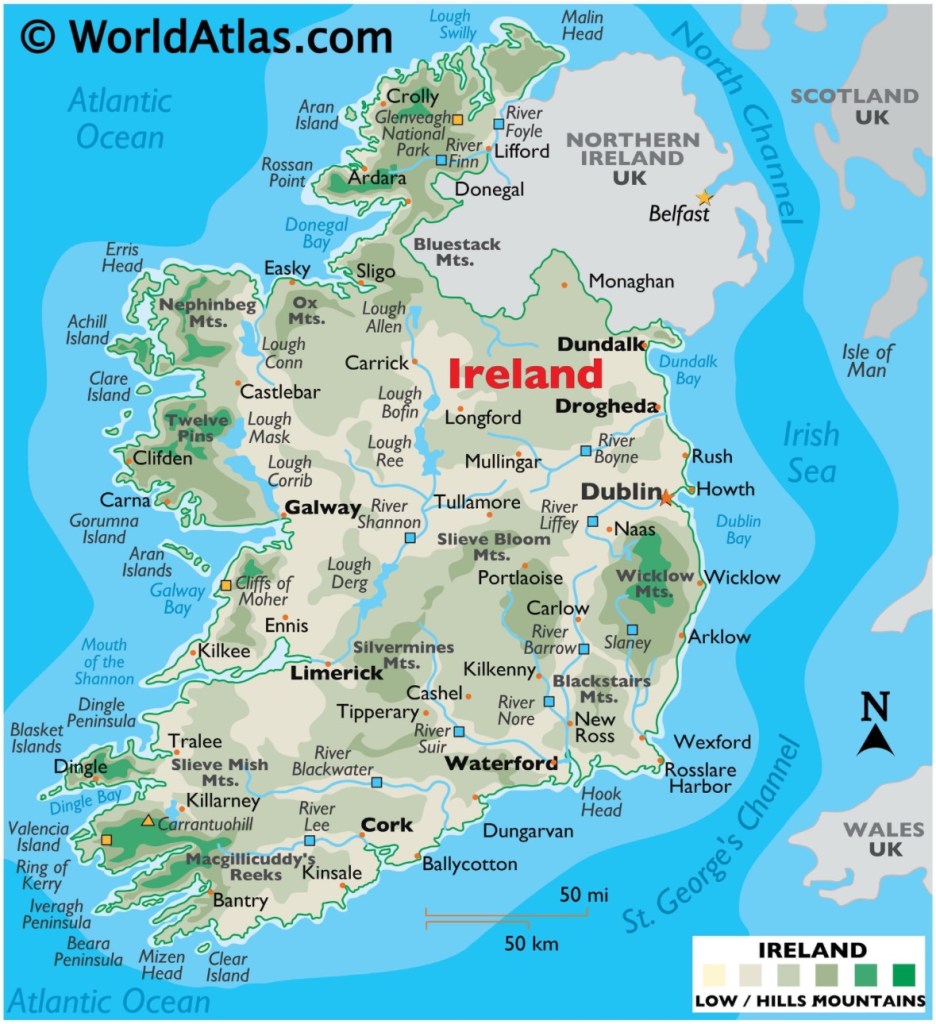
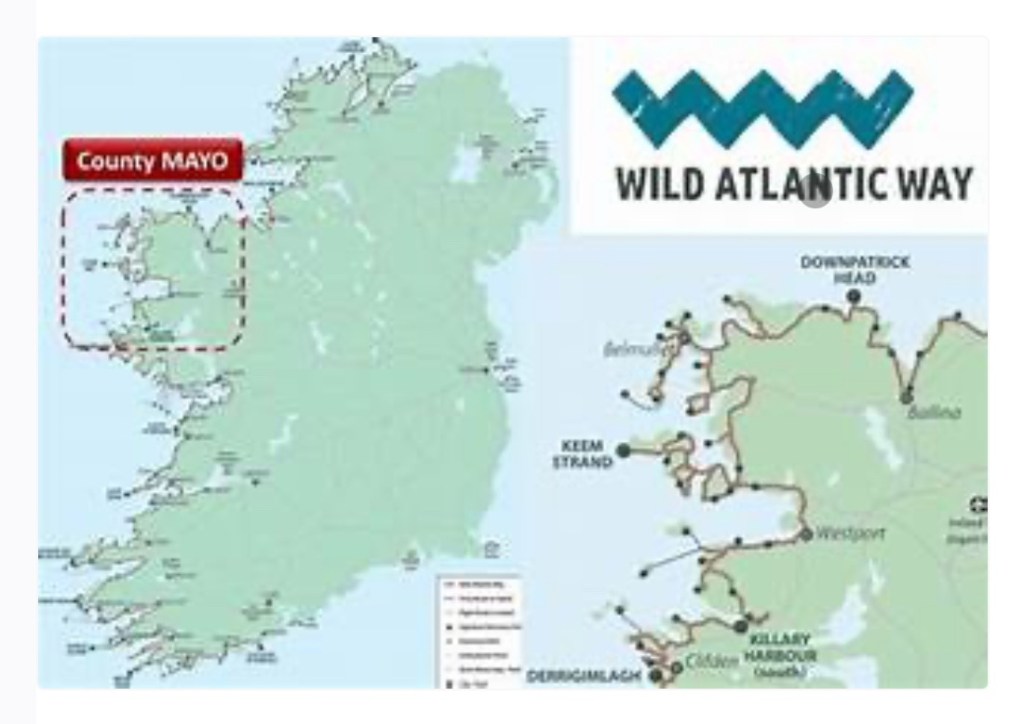
We were still following the Atlantic Coast Way that I wrote about in Donegal. It is Ireland’s Route 66 for tourism.

One more tender right back to the ship.

Next Up: Cobh, County Cork, Ireland

Posted in Uncategorized | Leave a comment

Two Cruises: Killybegs and Donegal, Ireland

July 30 was the first visit of Nieuw Statendam to Kellybegs, Ireland.  Our ship was one of 24  ships that has, or will, arrive this season.

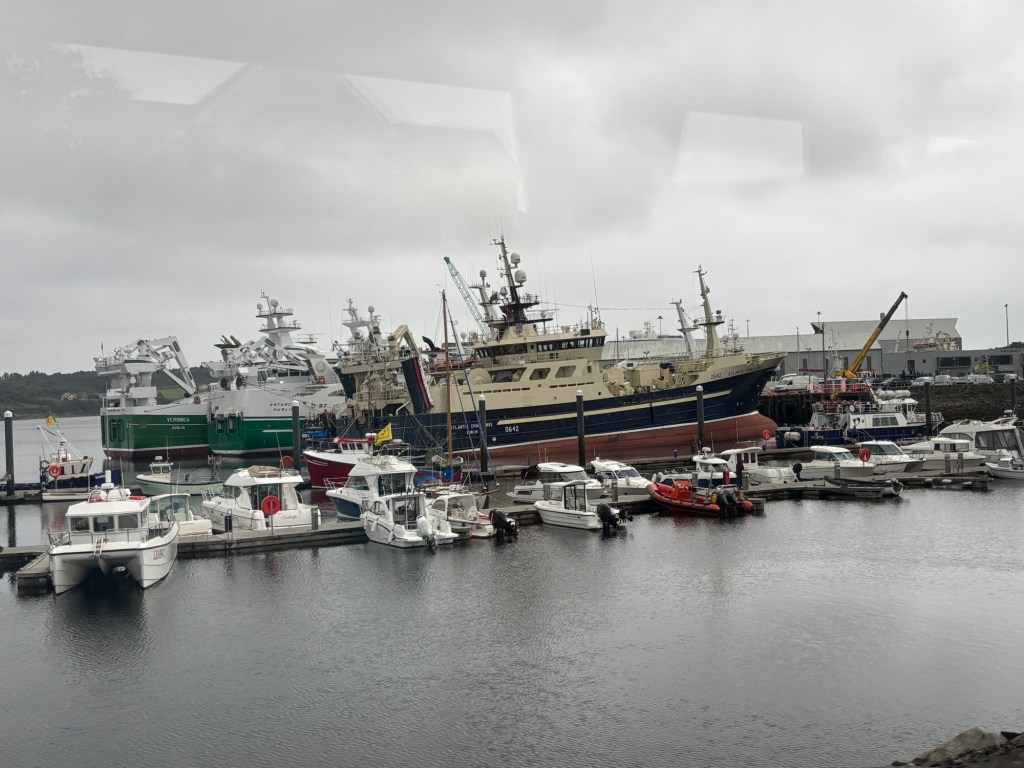
Killybegs has a deepwater harbor that opens into Donegal Bay. It boasts Ireland’s largest fishing fleet. The fleet are allowed specific seasons to get their quota per species.  Herring has not been fished for more than 20 years as the government tries to rebuild the population. Our guide mentioned two fish species that they fish to export but wouldn’t eat locally. 

Donegal is in the Republic of Ireland, but is also in the historic region of Ulster.  Ulster was divided in the decision for independence, generally along religious lines. Three of the nine counties voted to join the Republic of Ireland while the remaining six chose to form Northern Ireland, part of the United Kingdom.  Since 1998’s Good Friday agreement there is peace after centuries of warfare. 

Our drive to Donegal took us along part of the 2,500-kilometer-long coastal route known as the Wild Atlantic Way.  It was developed as a “Route 66” type tourism enhancement and has been very successful.  Due to the problems in Northern Ireland, many tourists had been reluctant to venture this far north.

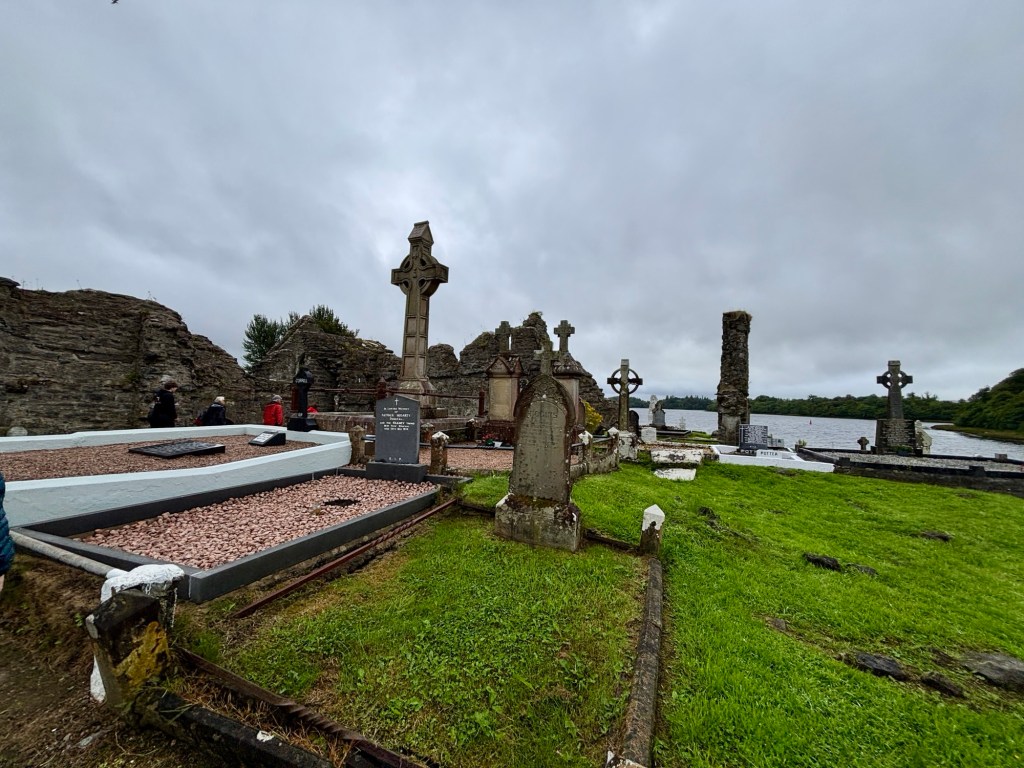
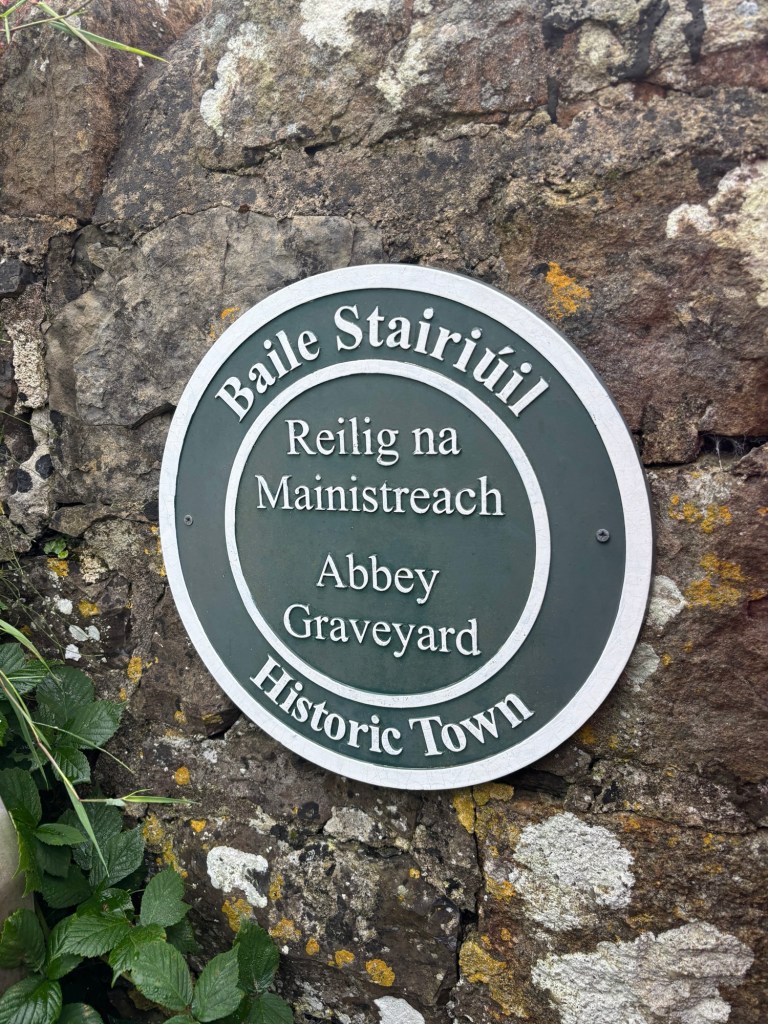
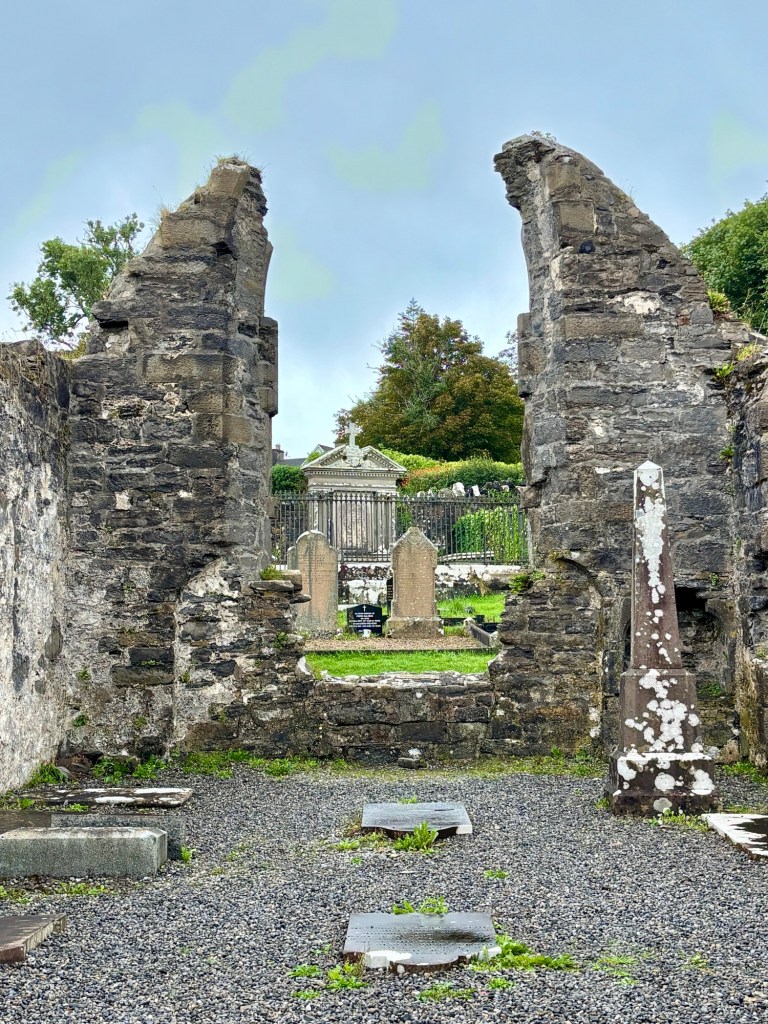
We arrived in Donegal and walked to the ruins of an ancient Abby. The Abby was built in 1474 through the efforts of the powerful O’Donnell family who led this area for centuries.  Overtime, both Catholics and Protestants were buried there.

One of the significant historical events of the Abby was that Annals of the Four Masters was written here.  Four friars wrote one of the earliest texts of the history of Ireland.  

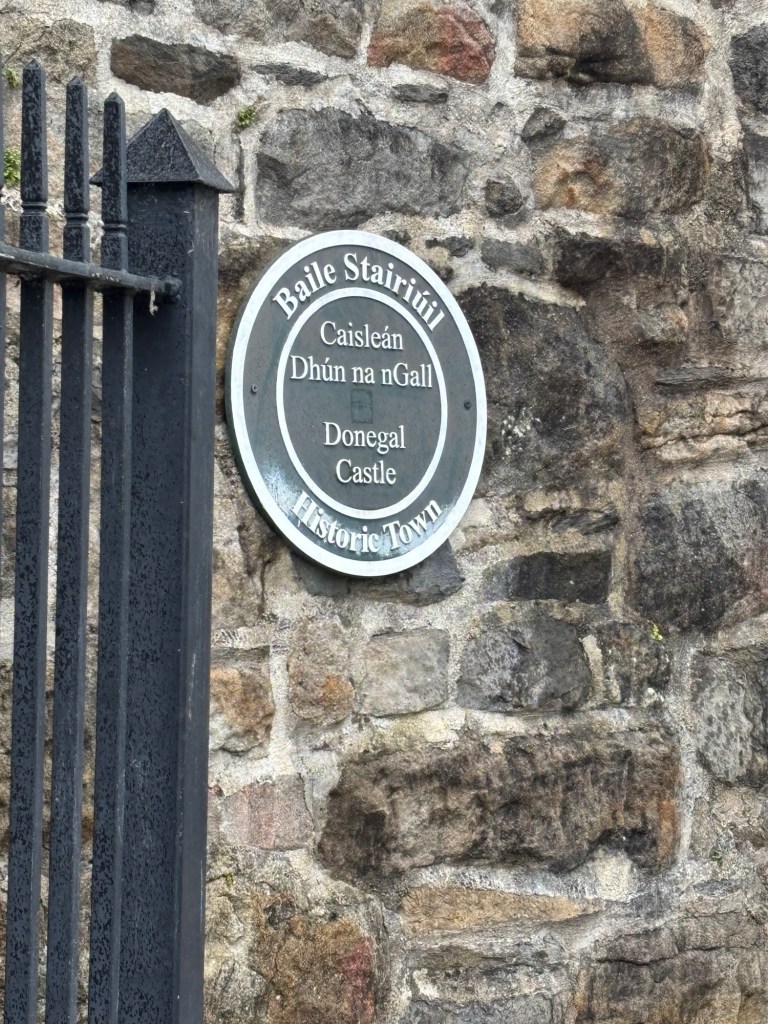
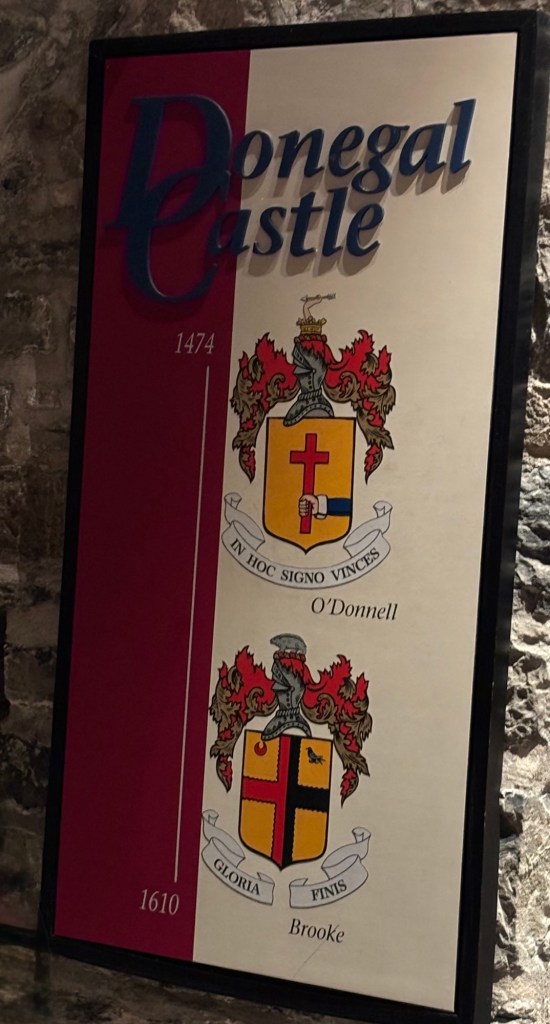
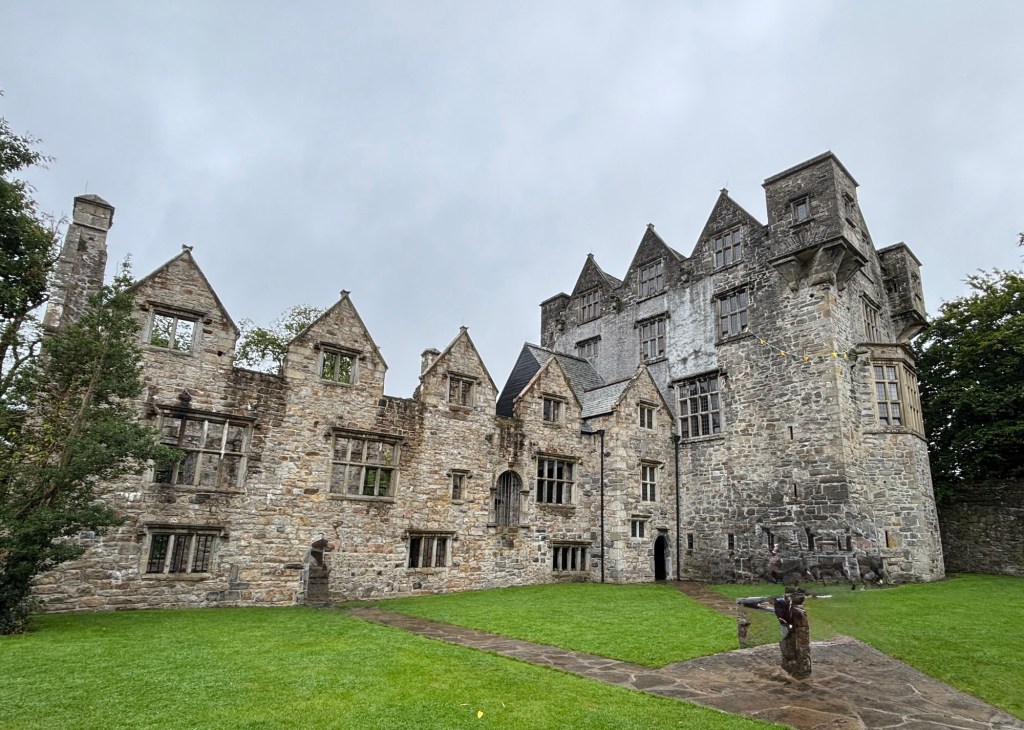
From there we moved to Donegal Castle, also built by a 15th century O’Donnell chieftain. The O’Donnell clan ruled the area from the 12th to 17th centuries.  Early inhabitants of the area had been tribal, flighting each other.

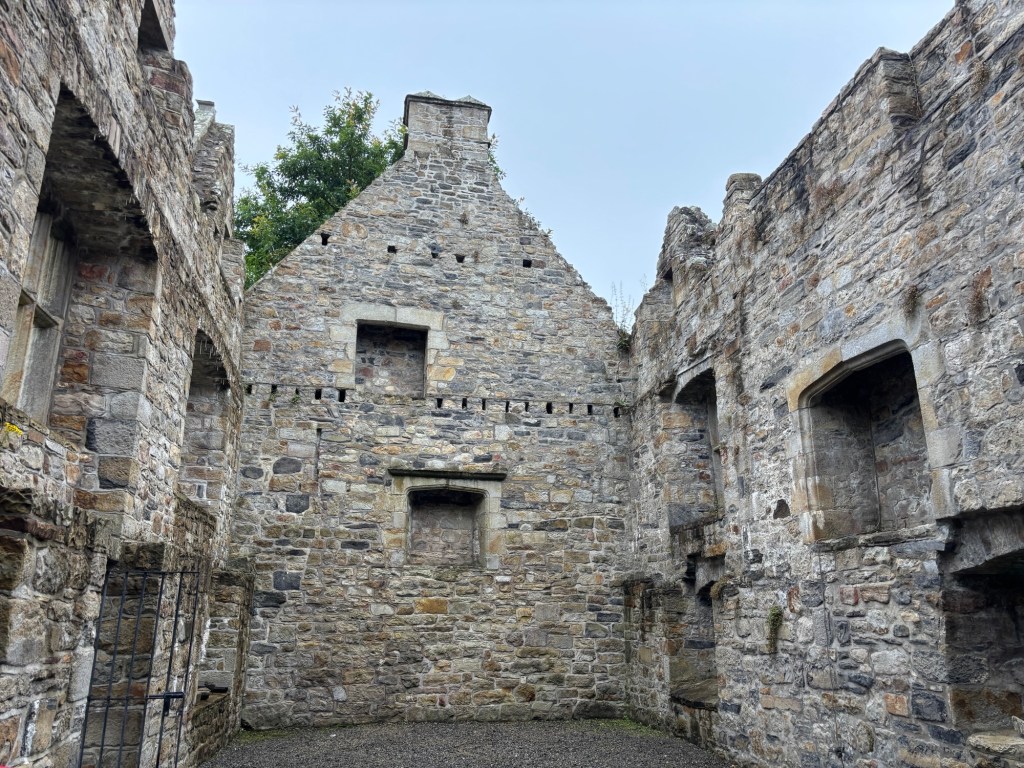
The tallest part if the castle is over 550 years old.  It was originally built as a fortress for the O’Donnell clan.

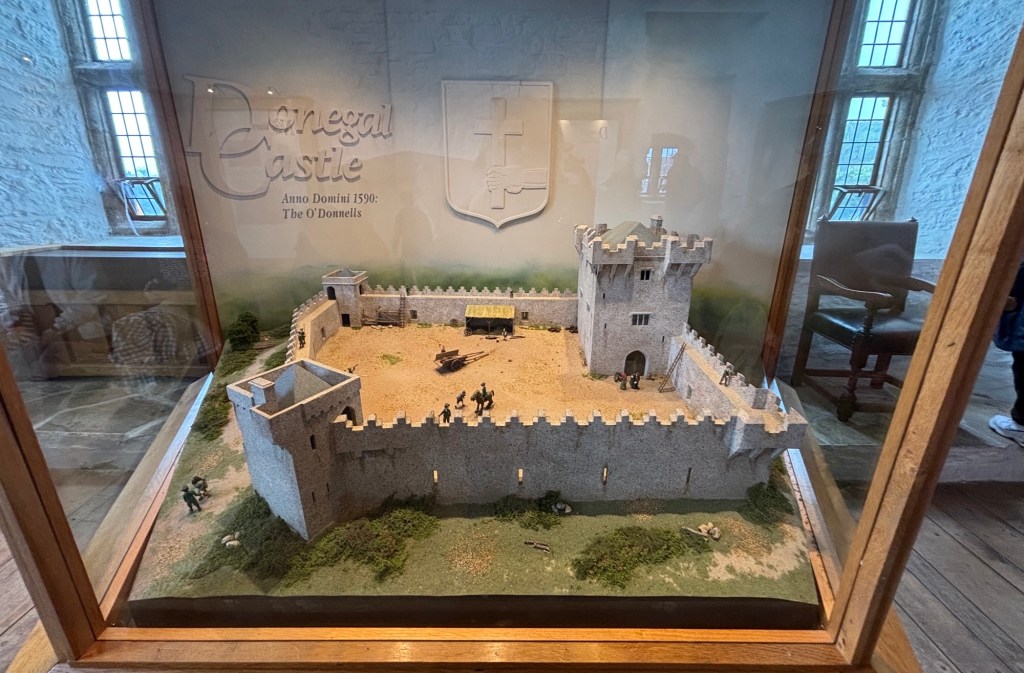
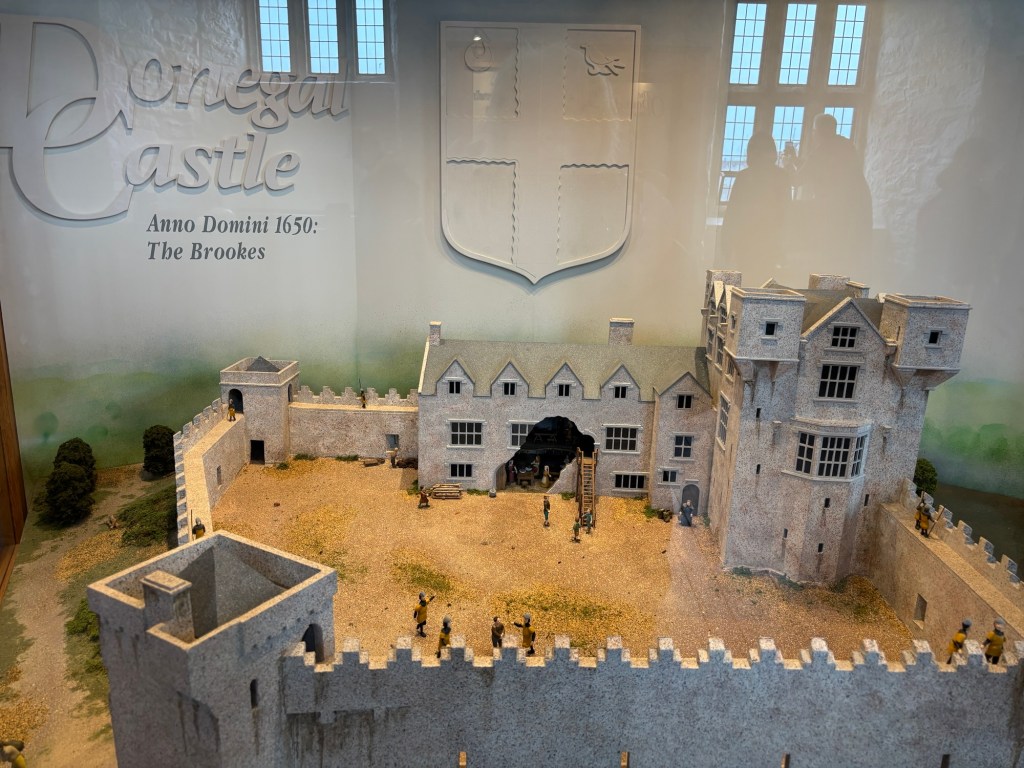
This depiction shows how the castle looked at that time. The reality of living in a castle in that era was that it was cold and dark.  The defensive features were walls made of 10 feet of solid stone and small windows presenting a wide range to shoot out, but little opportunity to shoot in.  

Another defensive feature was the trip stairs. The steps aren’t even to trip the advancing enemy.  They also go in a clockwise manner given that most of the population is right handed. It means a right hand of swordsman coming down the stairs as the advantage of the full swing of their sword. There is only one castle in all of Ireland, in which the staircase goes counterclockwise, Park Castle in County Lerum, likely built by a clan of predominate left handers.

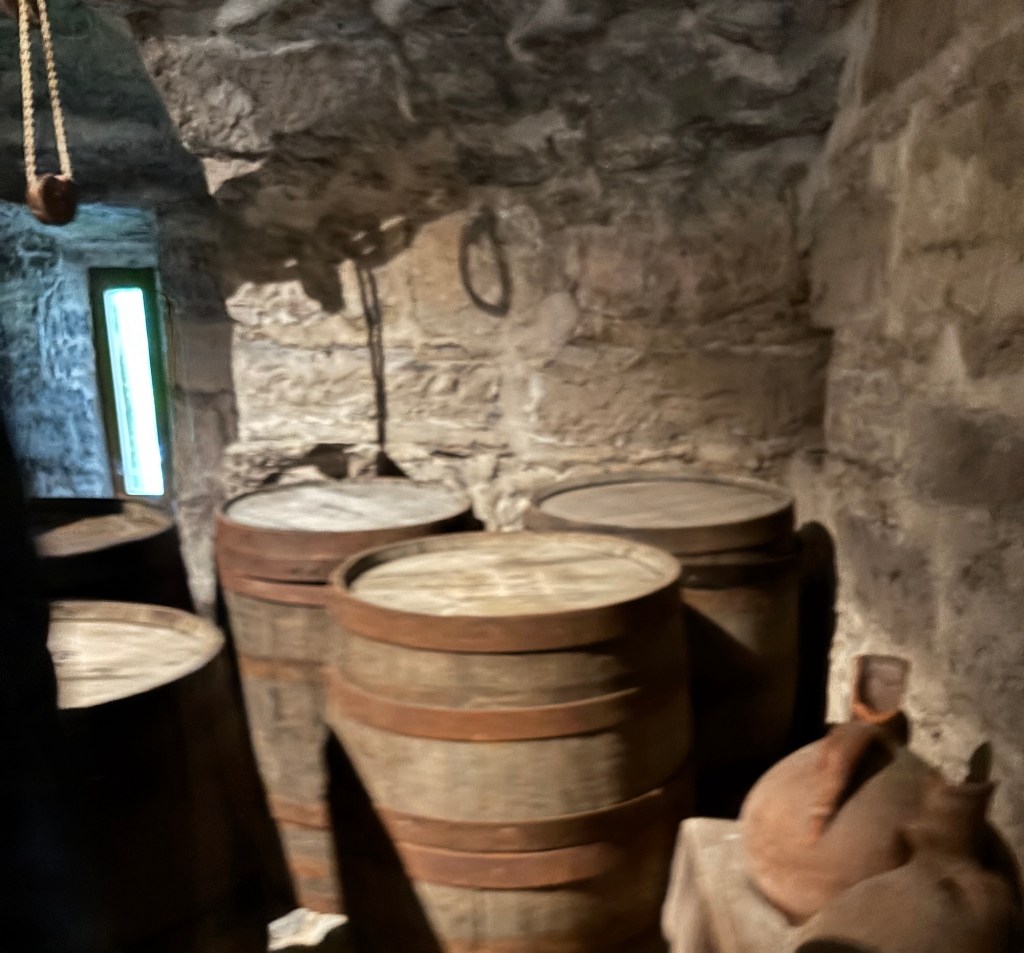
The O’Donnells capitalized on the fishing industry that existed even then.  The fish was salted and sent to France and Spain.  They brought back 100 tons of wine per year – likely in those same barrels.

In England, Henry VIII gave way to Elizabeth I (although it wasn’t quite that simple) and she pressed British rule on Ireland.  In time the chieftains were run out and the O’Donnels destroyed Donegal castle so the British couldn’t use it.

In 1611, the castle and its lands were granted to an English captain, Basil Brooke. His family re-built and refined the tower house and added a new wing. 

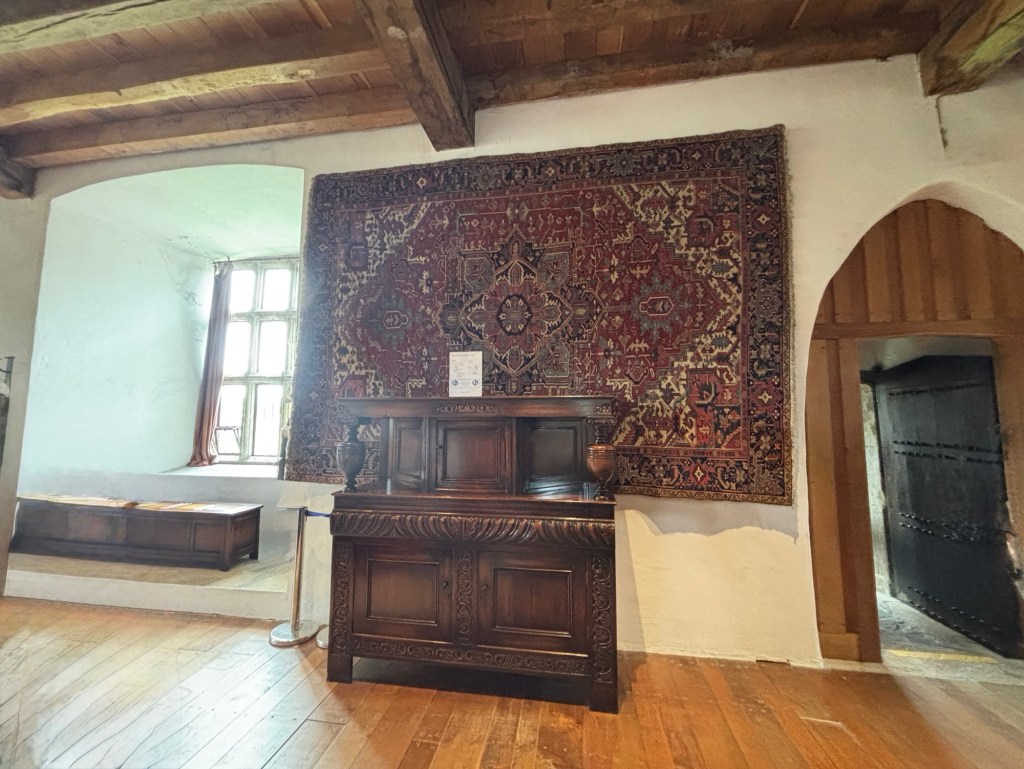
The dining room has many windows for natural light under the Brookes. Only wealthy families could afford them. 

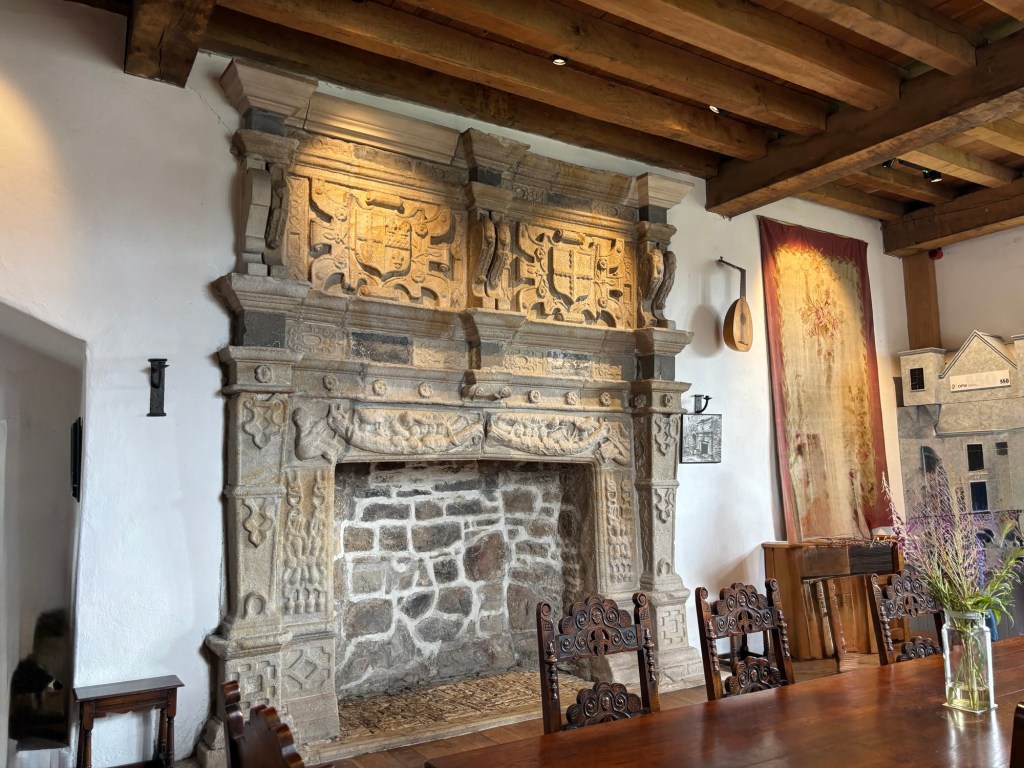
The two engravings of Coat of Arms represent the Brookes family and that of his wife, the Leyster family.

Over centuries the castle belonged to others and was abandoned.  It has undergone periods of restoration since 1990 by governmental agencies.

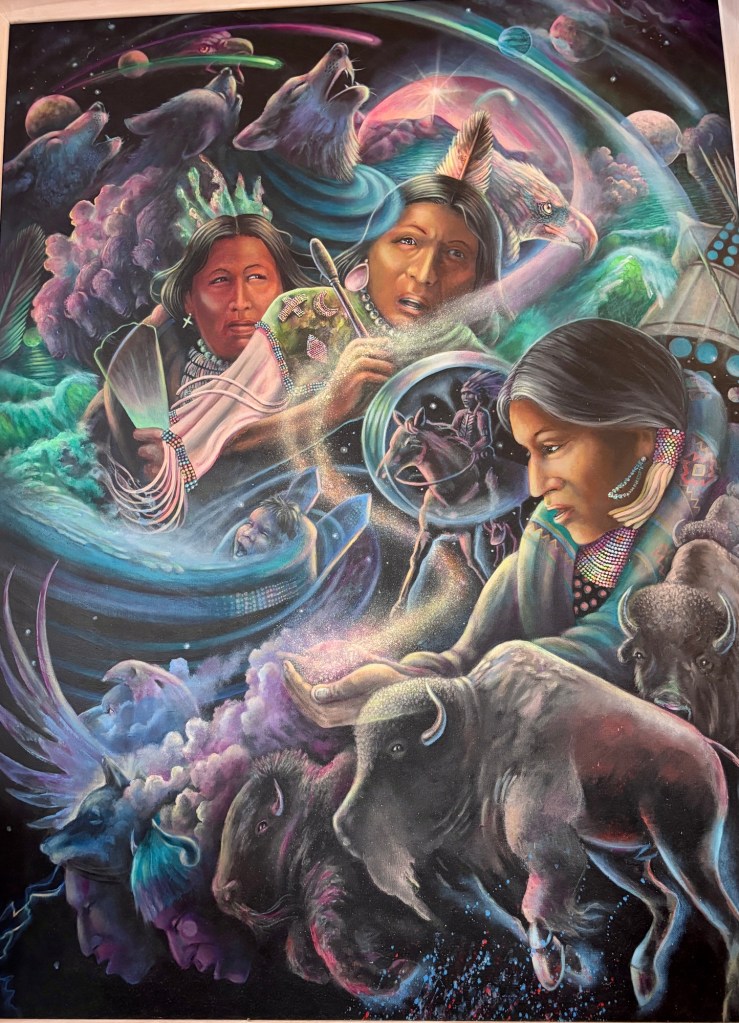
Inside the castle we saw a painting done to commemorate the Choctaw Nation of Oklahoma.  In 1847, the Choctaw donated $170 to help the Irish poor during the potato famine.  That was only 14 years after the tribe was marched along the Trail of Tears.  The gift created a lasting friendship  between the two nations.

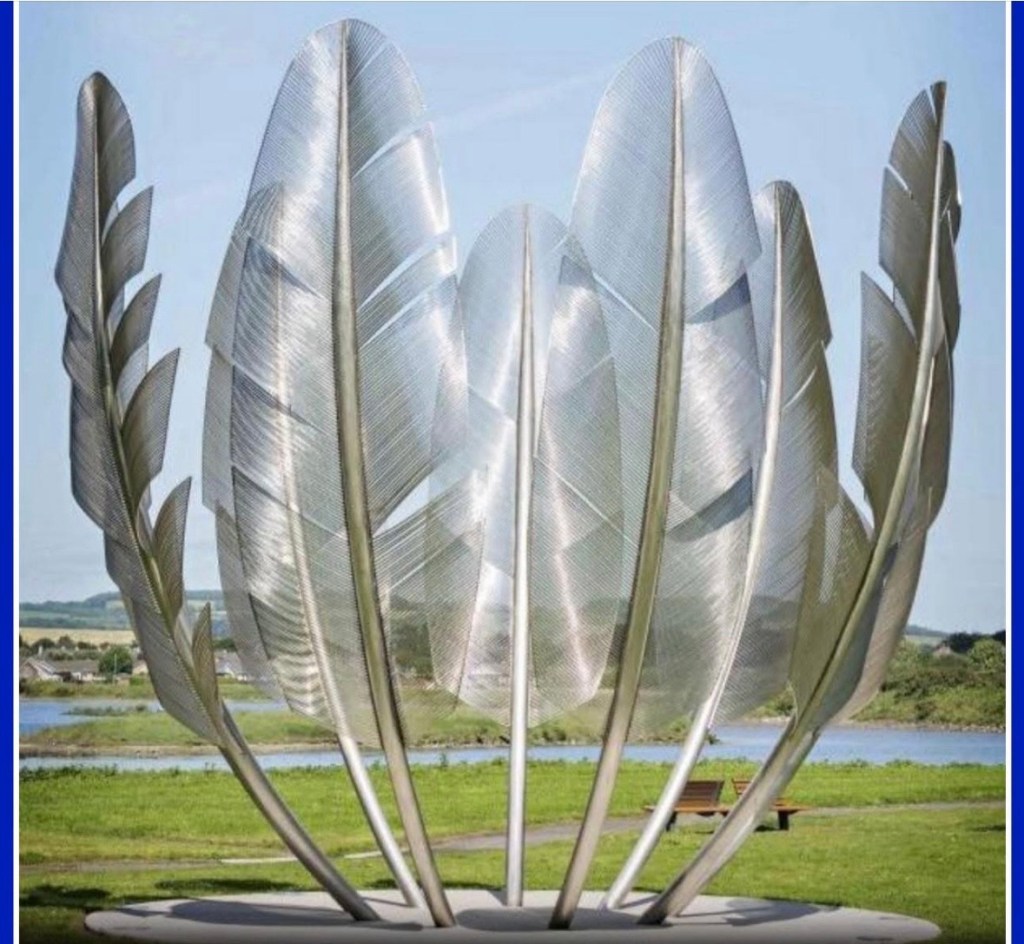
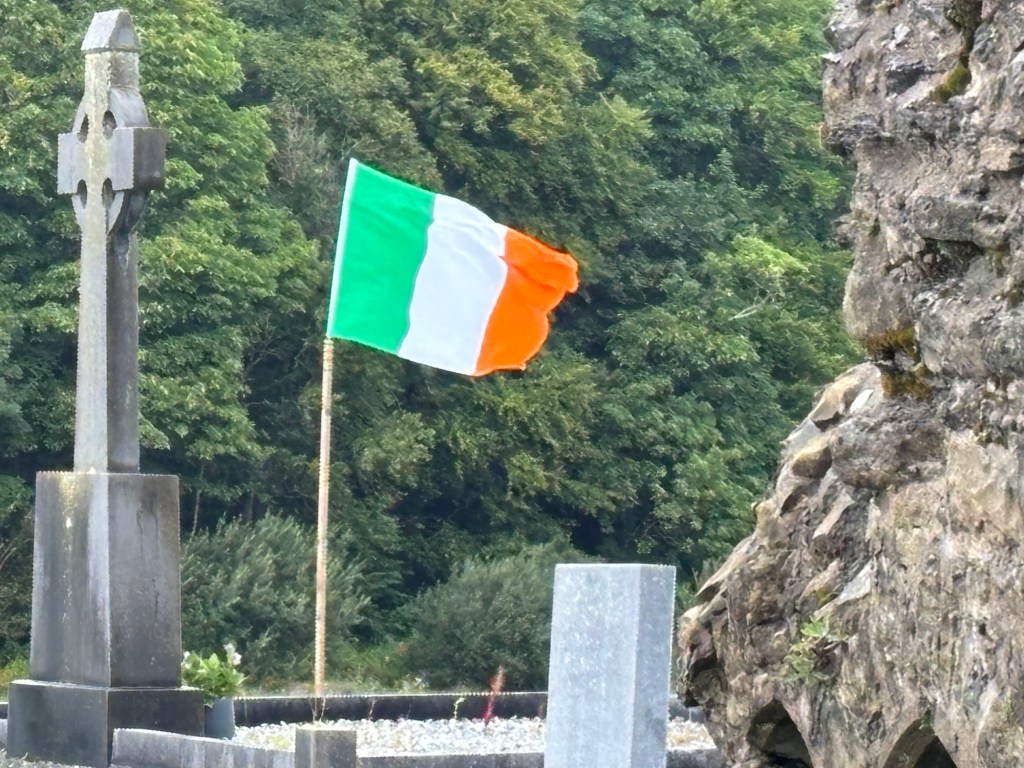
There is a second commemoration to the Choctaw in Cork County, Ireland.

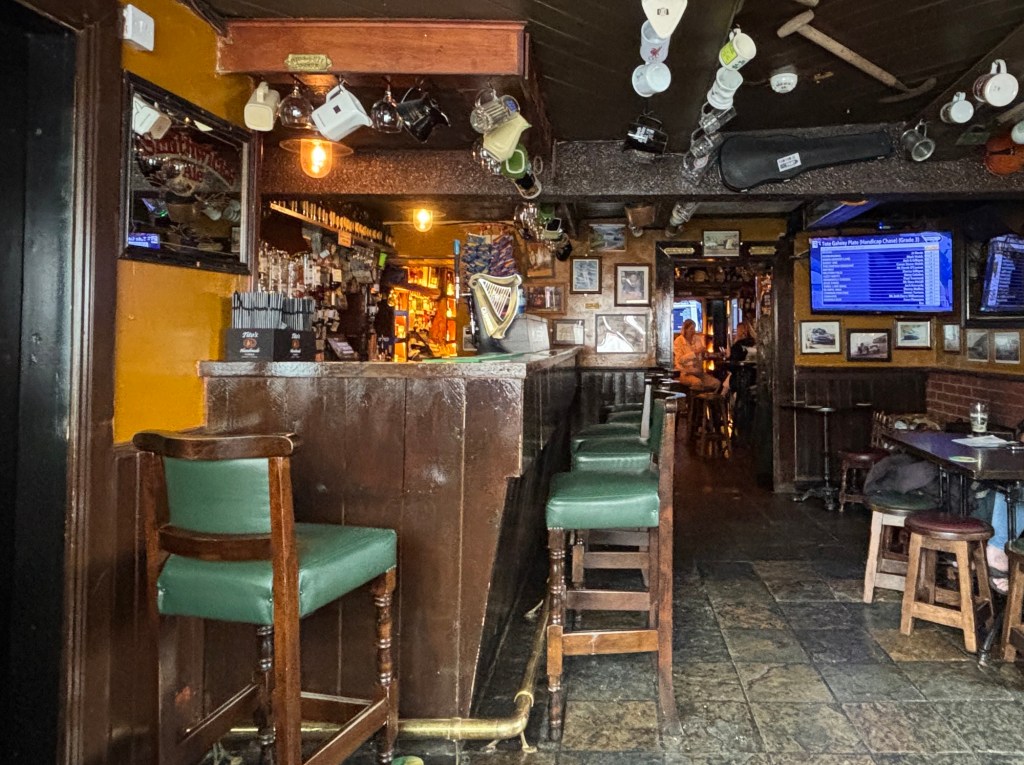
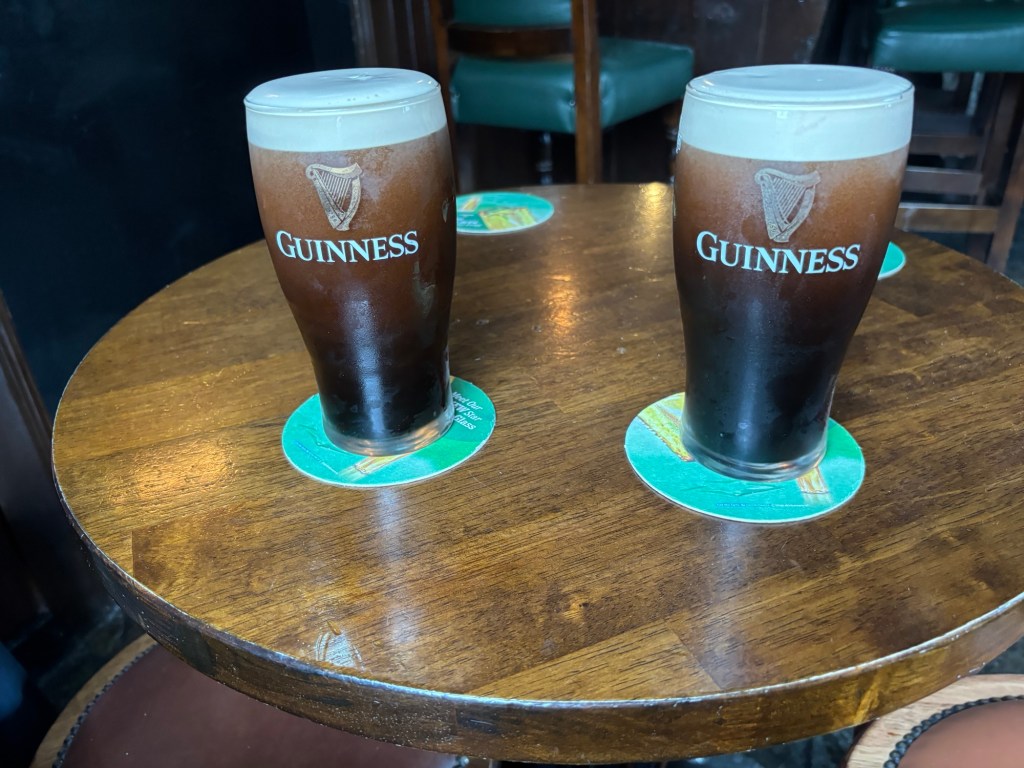
With an hour to ourselves, Randy and I stopped at McCafferty’s Bar for a Guinness.  Our tour guide said true Irish don’t drink Guinness – but we are tourists!

The Irish bartender, in the Irish bar, was not aware that true Irish don’t drink Guinness.  He says he serves a lot of it.

As we drove back our guide told us more information – although at this point all of it may be suspect! Guides are memorable for many reasons.

He said people build their houses along the roads in Ireland because they are likely built on family lands.  The highest home ownership in the world is in Ireland.  That standing is at risk since the price surge post covid.

Since 1922, the police, or garda, in Donegal have not carried weapons.  The crime rate in this part of Ireland is very low .

Our guide also said that 5000-6000 Americans emigrate to Ireland each year.  The number of research requests increased after November 2024.

The guide said leprechauns are an American invention and no Irish say “Top of the morning.”  Someone we met later wouldn’t comment on the leprechauns but did agree no one says “Top of the morning.”

Ireland was a new country for us and we had an interesting first day.

Next up: Galway with Cindy and Darrell

Posted in Uncategorized | Leave a comment

Two Cruises: Harris Whiskey, Gin and Tweed

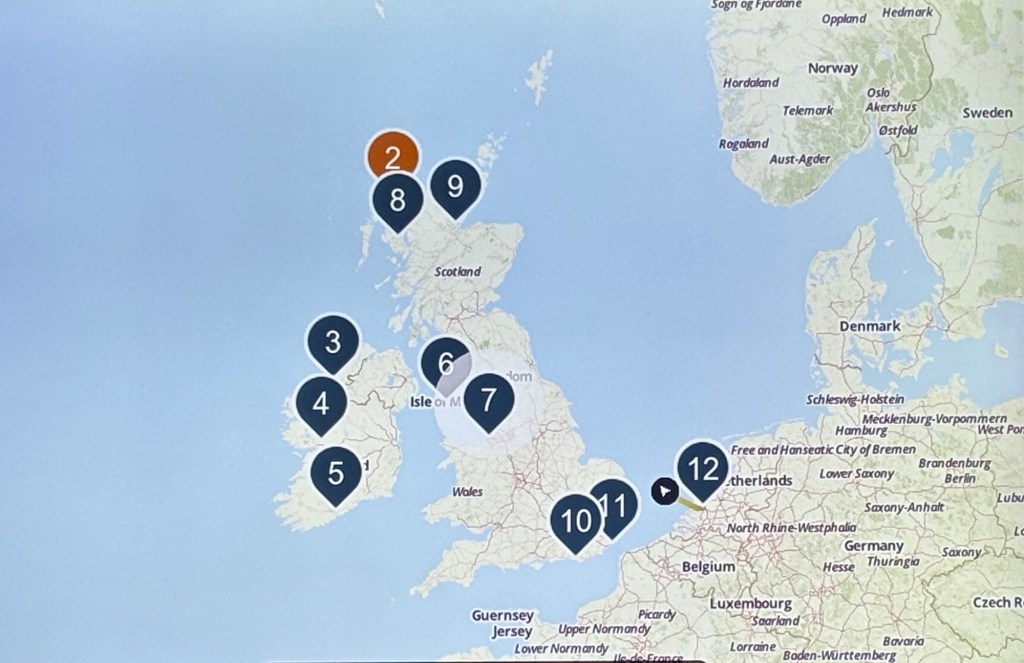
We started this cruise where we will end it, in Rotterdam, shown at #12. We had a sea day through the North Sea enroute to the Isle of Lewis, north of the Scottish mainland, depicted by #2. 

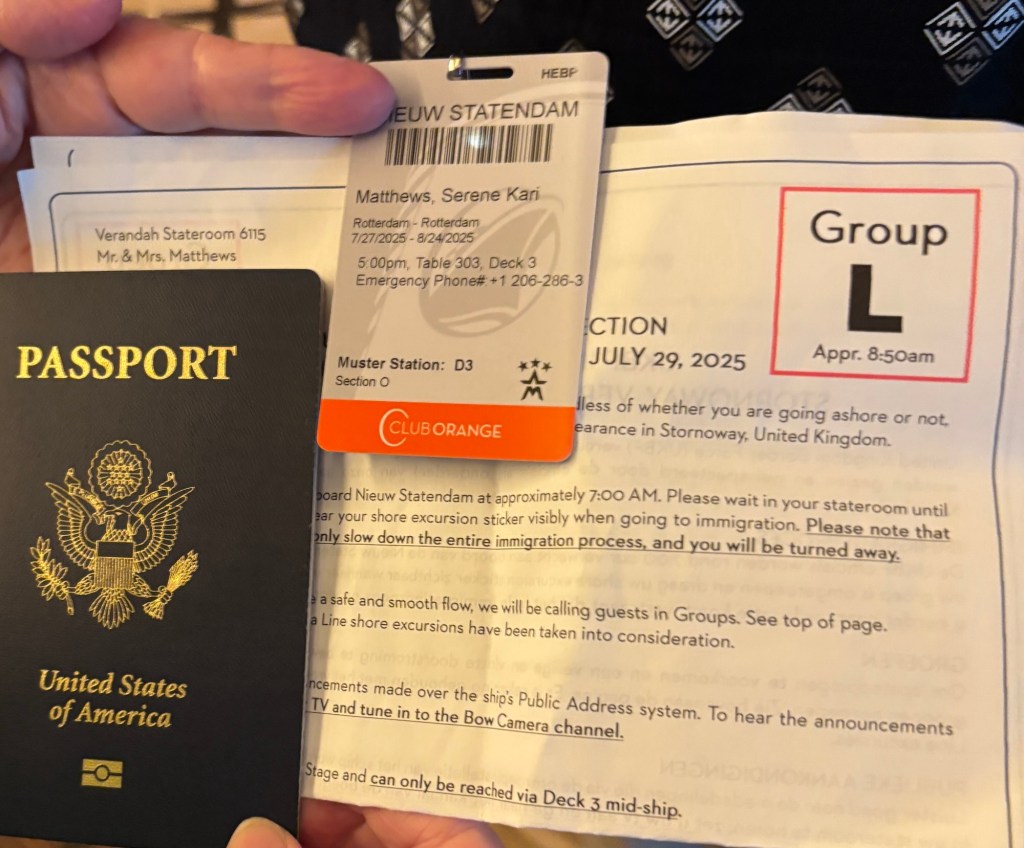
We received instructions about the immigration process for Scotland and Ireland.  The process was specific and different for those holding European or non-European passports.  On the day we arrived, July 29, we had to wait for our group to be called and proceed. Our group was determined by our shore excursion.

All the passengers on the ship had to meet face to face with an immigration officer, even if you did not have an excursion.  Our next step was to surrender our passports to ship personnel so immigration officials could view them at any time.  Our passports would be returned when we left Ireland. (I do not know if the crew had any/all of the same requirements. I assume that their passports are already held by ship personnel.)

Our ship docked at Stornaway, on the Isle of Lewis. The town has had a deep water port for only two years.  That allows passengers to walk off the ship instead of “tender” from anchor.  Lewis, and our destination, Harris, are in the remote Hebridean islands.

Most island residents work for the local government in services and infrastructure.  Medical workers are the second largest group.  Some work off shore in the oil industries.  Tourism is growing but has a short season.

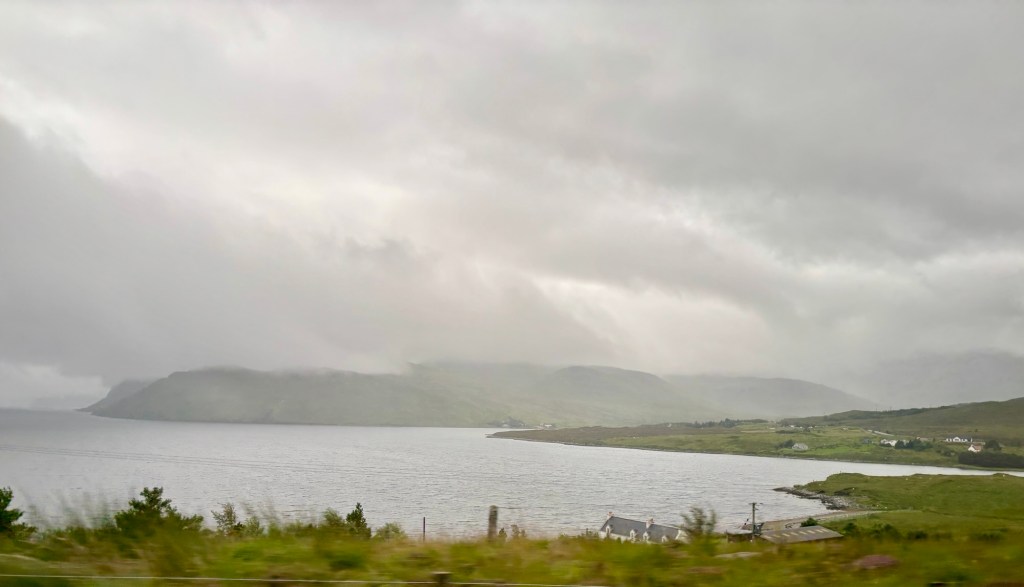
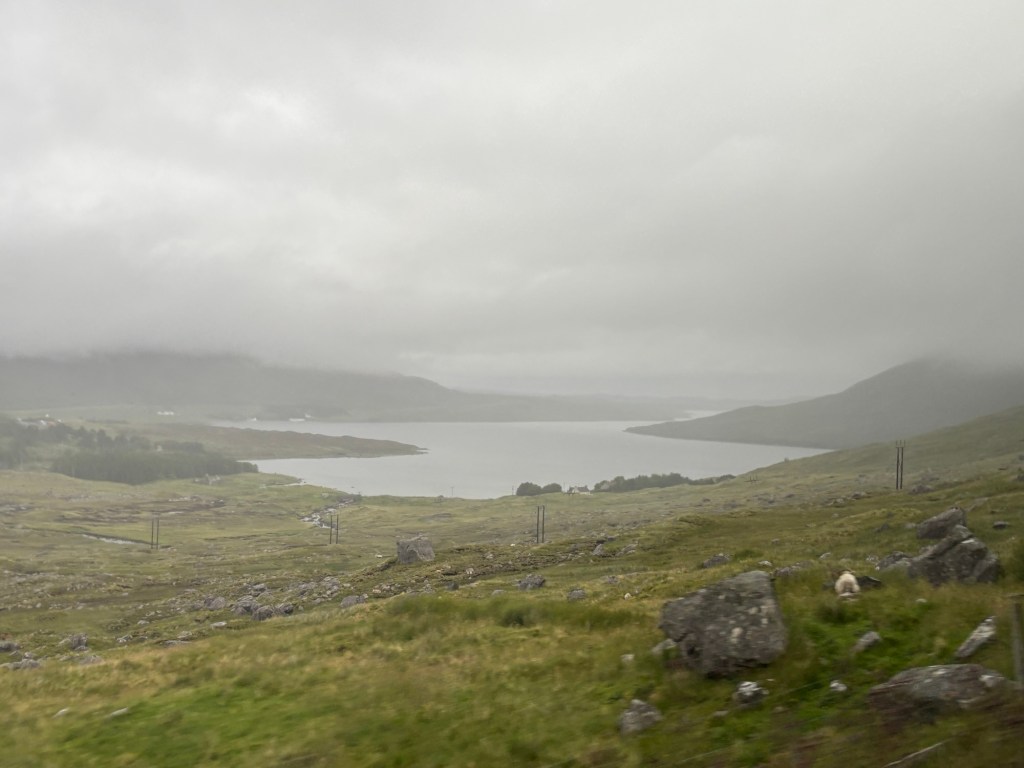
These pictures are summer in northern Scotland.

Ninety-three pieces of the famous “Lewis chess set” were found on the island in 1931. Most were purchased by the British Museum shortly thereafter.  The game pieces came from at least four chess sets and other games.  The pieces were probably made in Norway in the late 12th or early 13th century. 

One of the three known missing pieces was found in Edinburgh during the Covid pandemic.  I vaguely remember hearing about that and researching the Lewis chess set at that time. It was nice to put a place to the memory. 

There may be some unclear geologic or geographic separation between the Isle of Lewis and the Isle of Harris but we never crossed a bridge or waterway.  When I asked the guide about it, I was told it technically IS the same island – kind of. The bus driver from one, and the tour guide from the other, put on quite the good natured show of being from separate entities.

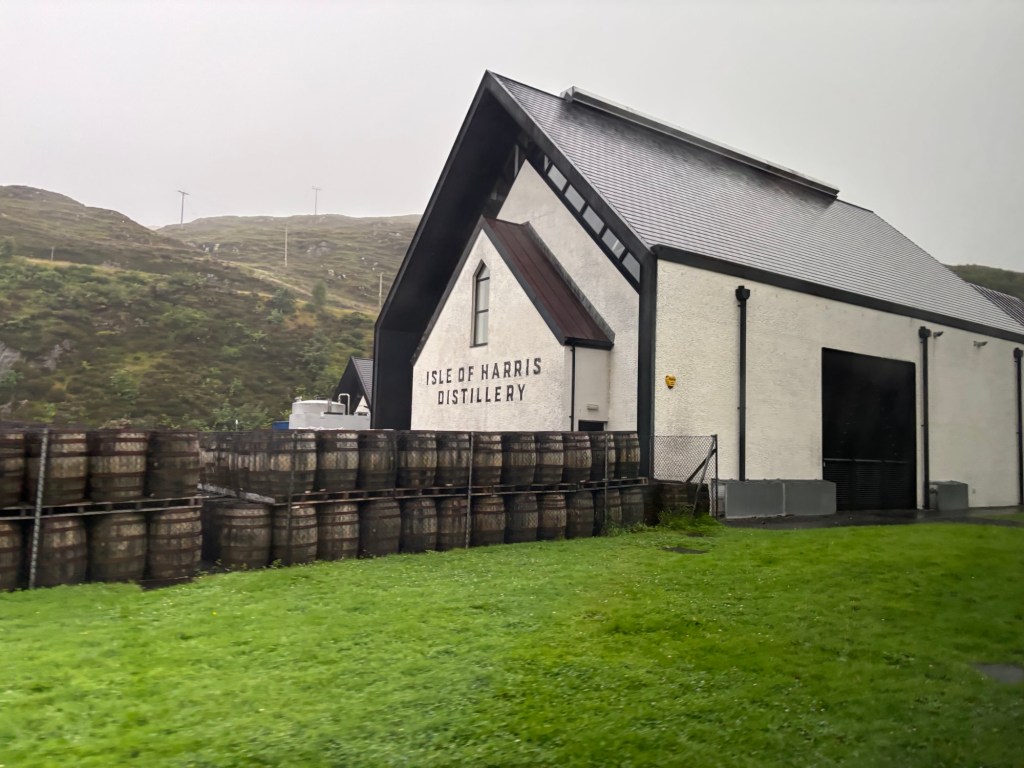
Our tour went from Lewis to Harris to visit the Isle of Harris Distillery.  In a long history of illegal distilling, this distillery was the first legal one ever built on the island. 

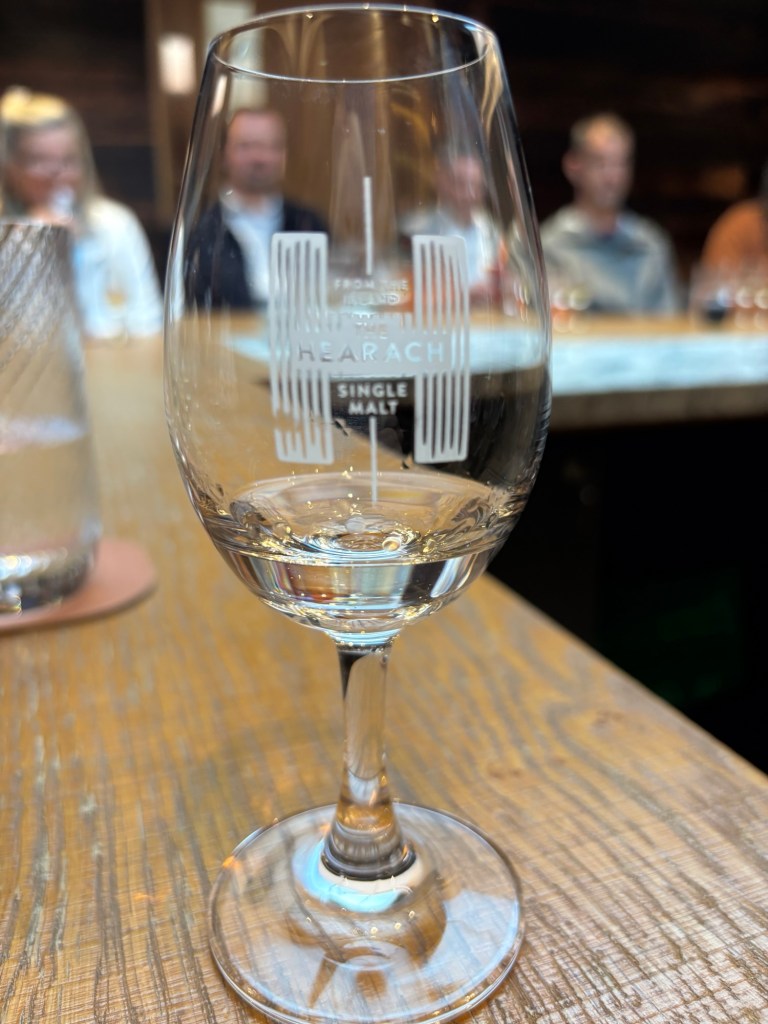
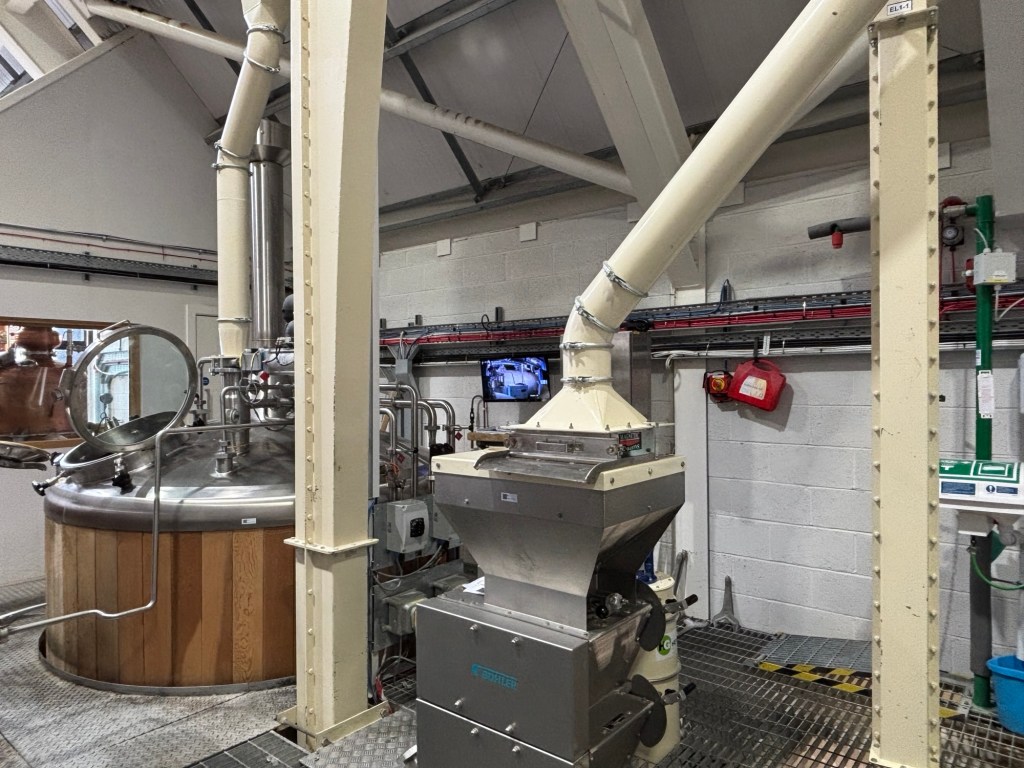
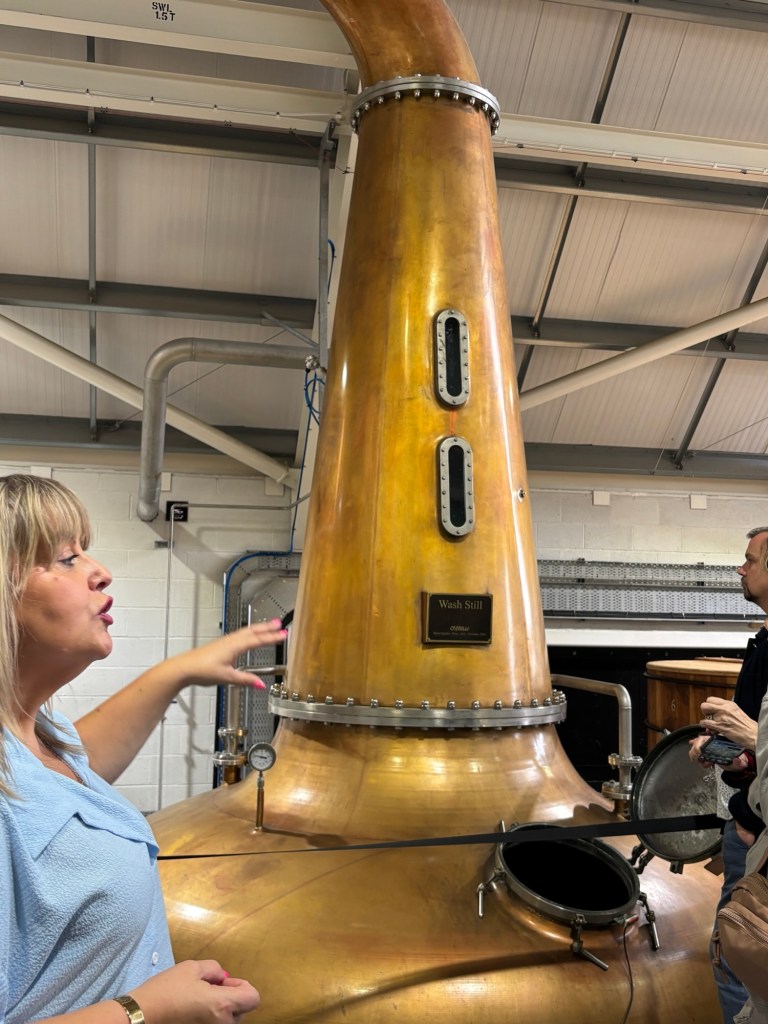
We had a tasting and behind-the-scenes tour and learned how whiskey and gin are each made. 

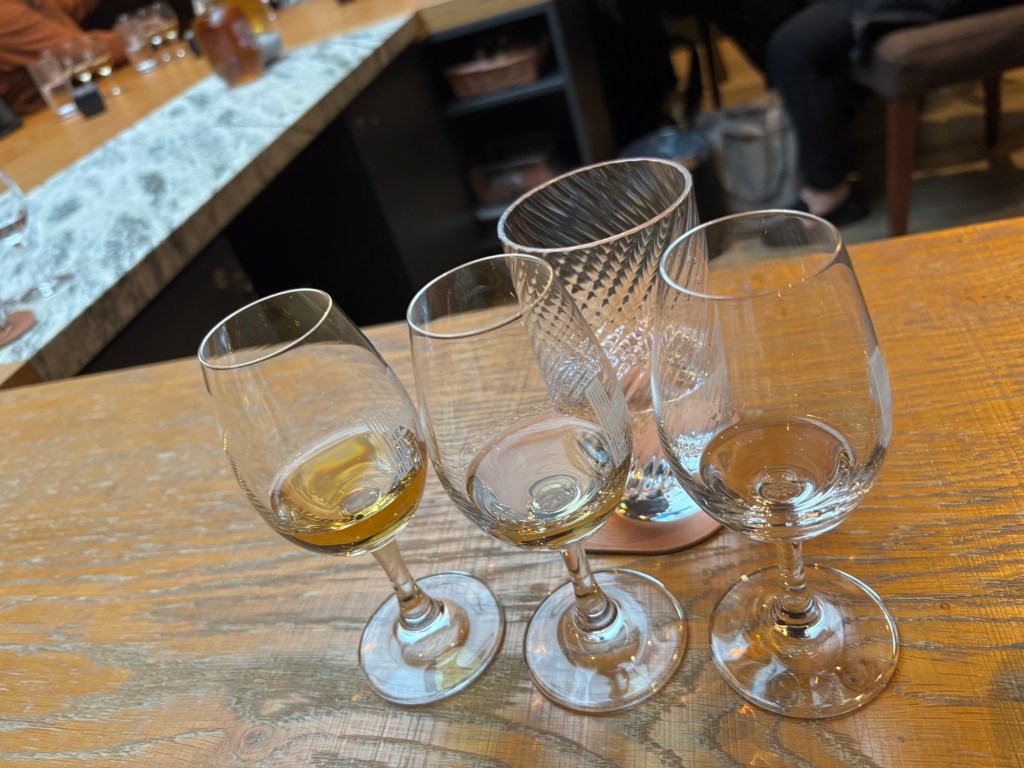
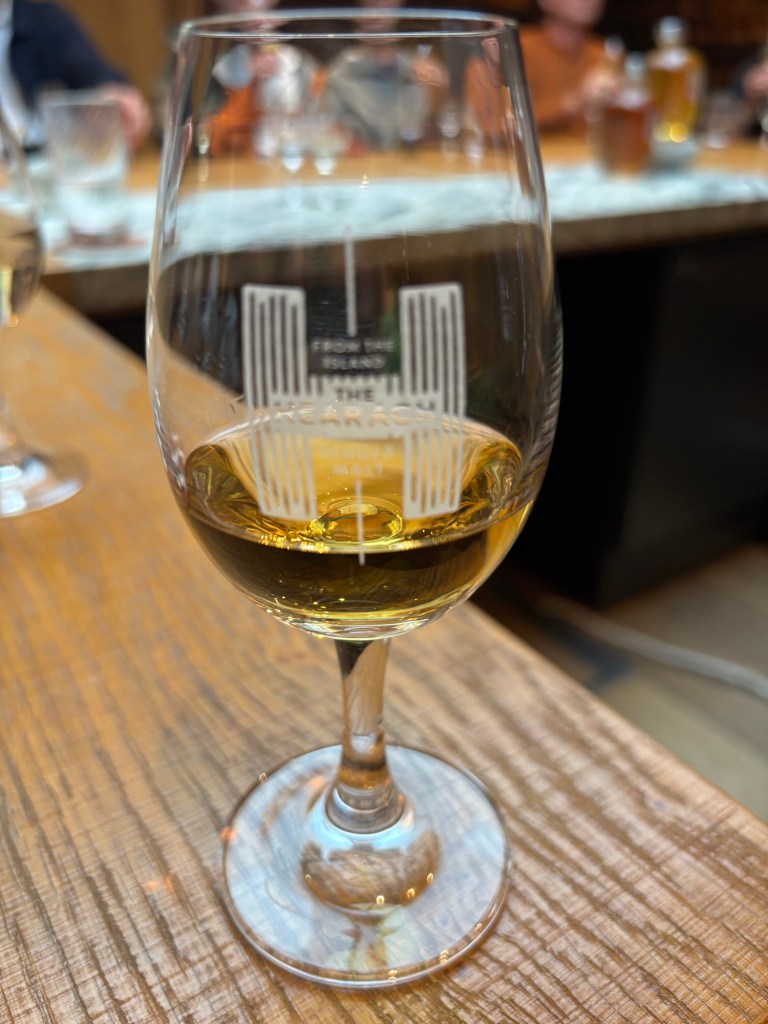
Our first tasting was of something that was 65% alcohol.  It was comparable to bad moonshine and pretty awful! Although I’m not sure, I think this was the whiskey before it was improved, processed, and aged.

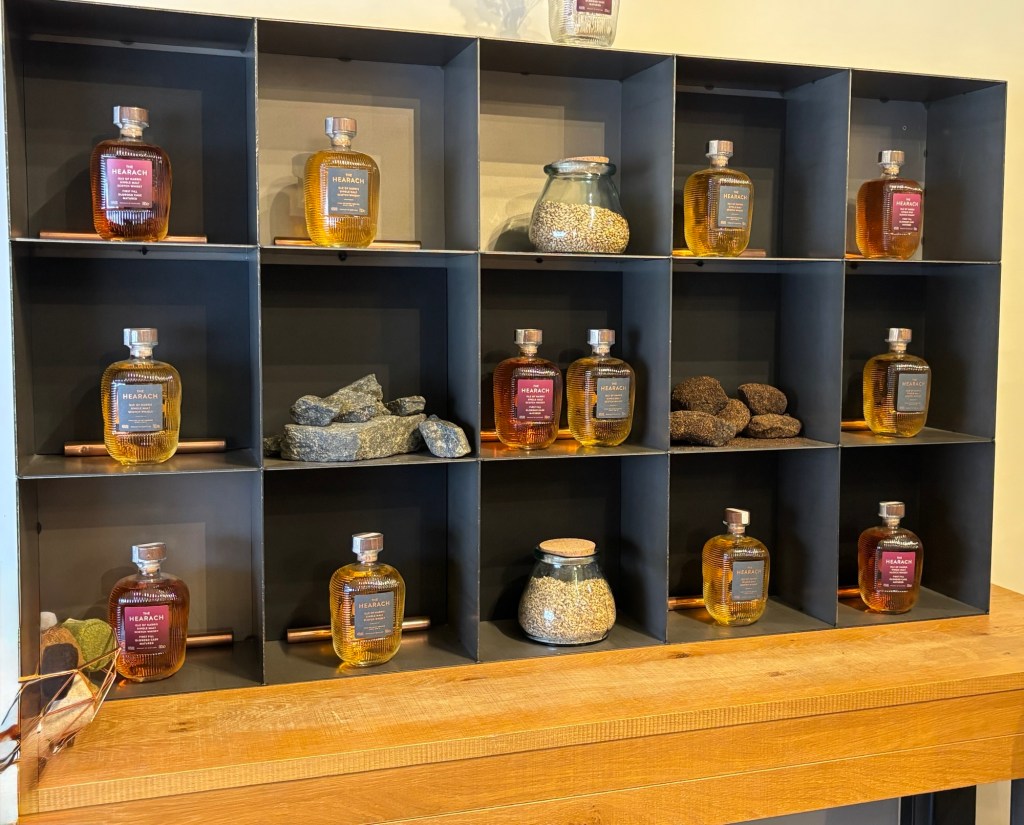
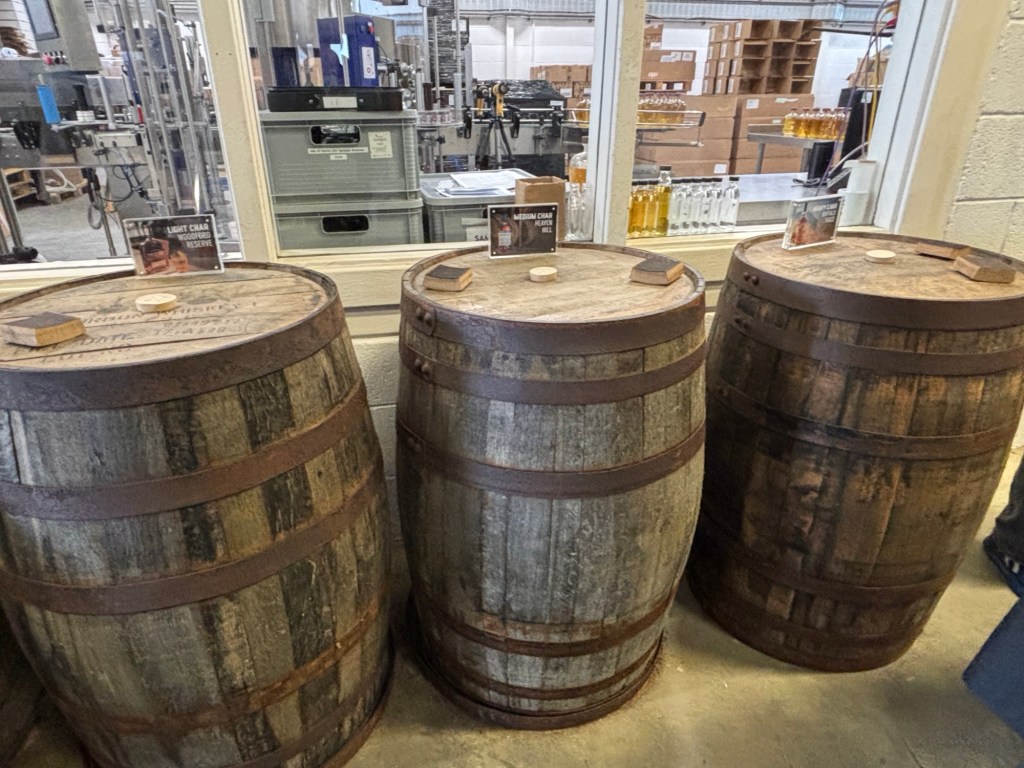
Our second and third tastings were Scotch whiskey, the two types this distillery produces.  The difference in color and taste have to do with the cask, or barrel, in which the whiskey ages.  It must age for a minimum of three years.

The lighter color whiskey utilizes former bourbon barrels from the United States.  The barrels can be used only once for bourbon and are then sold to Scotland for whiskey.

(We were at this place on a day there were massive protests against Donald Trump being in Scotland. I wondered if this distillery will continue to have access to the barrels if Trump retaliates. Of course, all things are connected and if that happens, the distilleries in Kentucky will lose market for their used barrels.)

The darker colored whiskey sits for the same three years but in barrels from Spain that were last used making sherry.  

We didn’t really like either whiskey, but the one from the sherry barrels was our preferred. It seemed a bit sweeter.

In Scotland, a person will add small amounts of water to fine tune the whiskey to individual taste. She had us try it and it did make a difference. They do not use ice.

The first time the cask is used for whiskey, it holds some of the flavor of either the bourbon or sherry.  The second time this distillery uses the casks, the batch will have more of a whiskey base flavor.   The casks are then sold again and not used in this distillery.

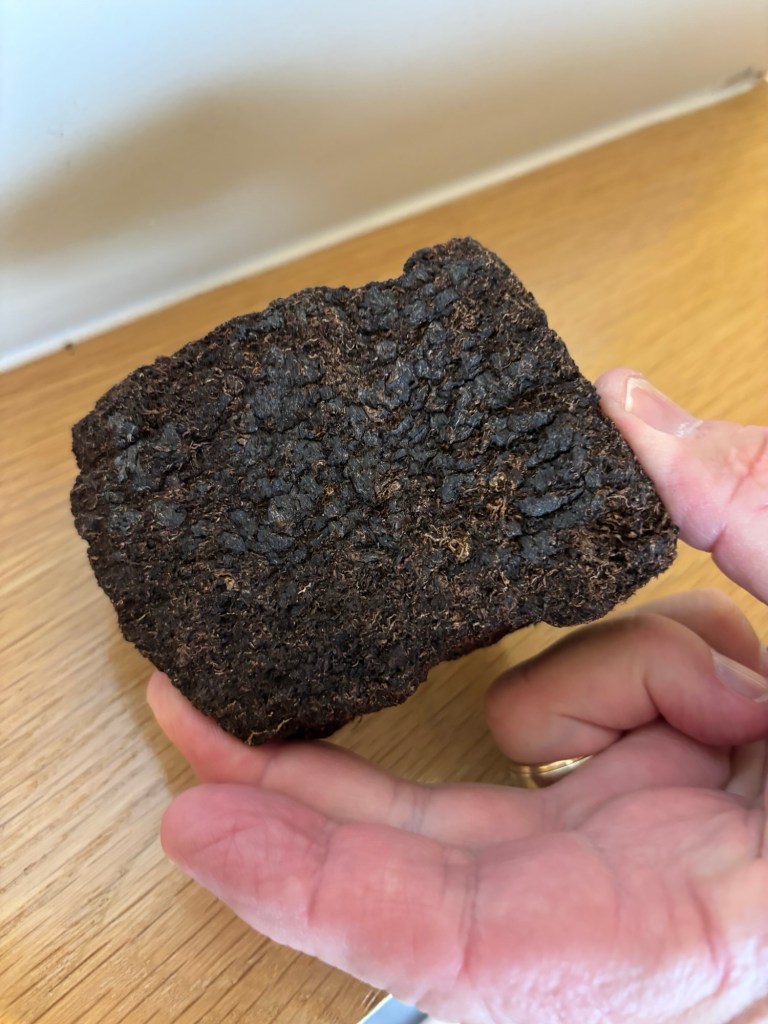
Cutting and burning peat was once a primary source of household heat in this area, but is no longer.  However, peat is still used in drying hops which enhances the flavor of their whiskey.

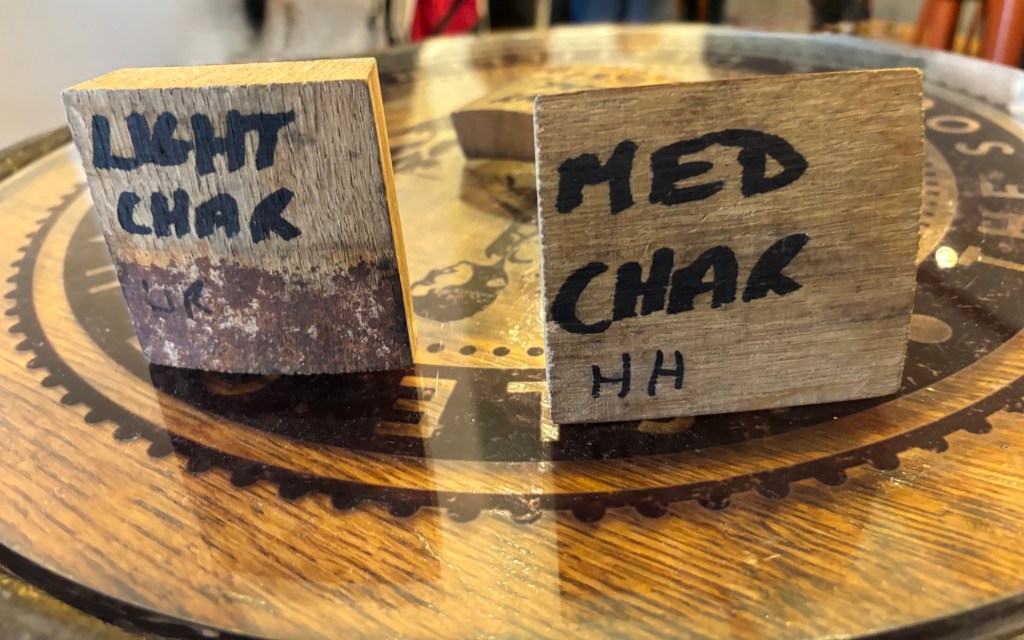
There is also a factor in whether the barrel has a light char or medium char when it was first prepared.

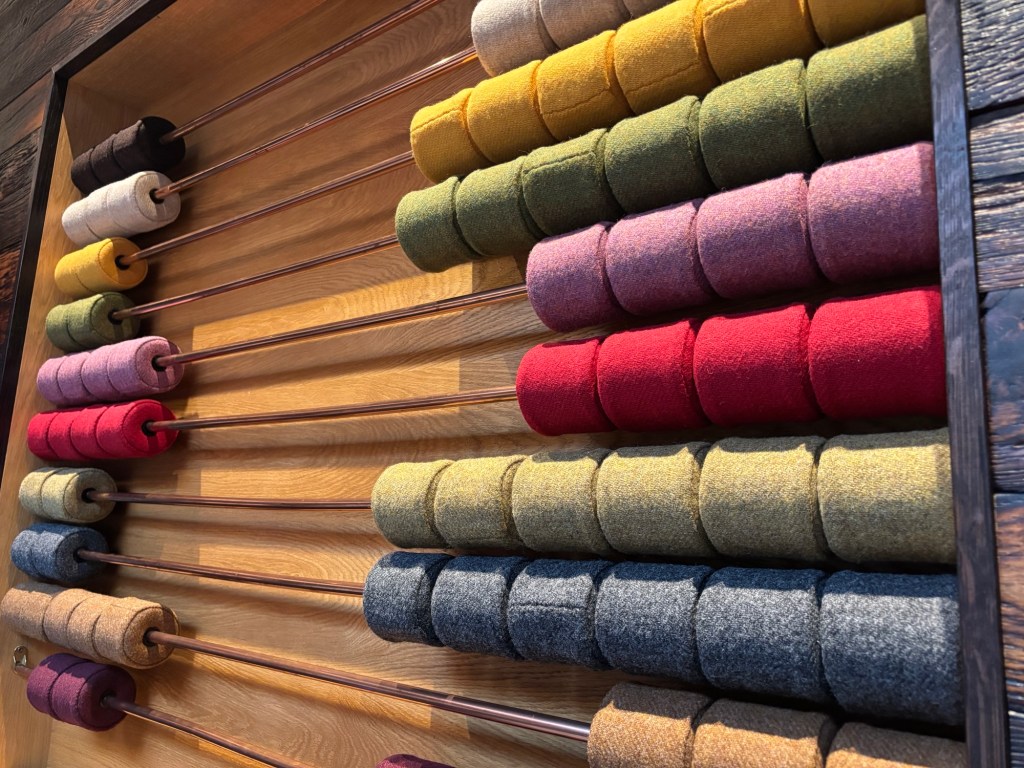
This whiskey flavor abacus allowed them to present a visual for the flavor differences between the whiskey aged in bourbon casks or sherry casks, in light char, or medium char casks, first or second use and other variables.

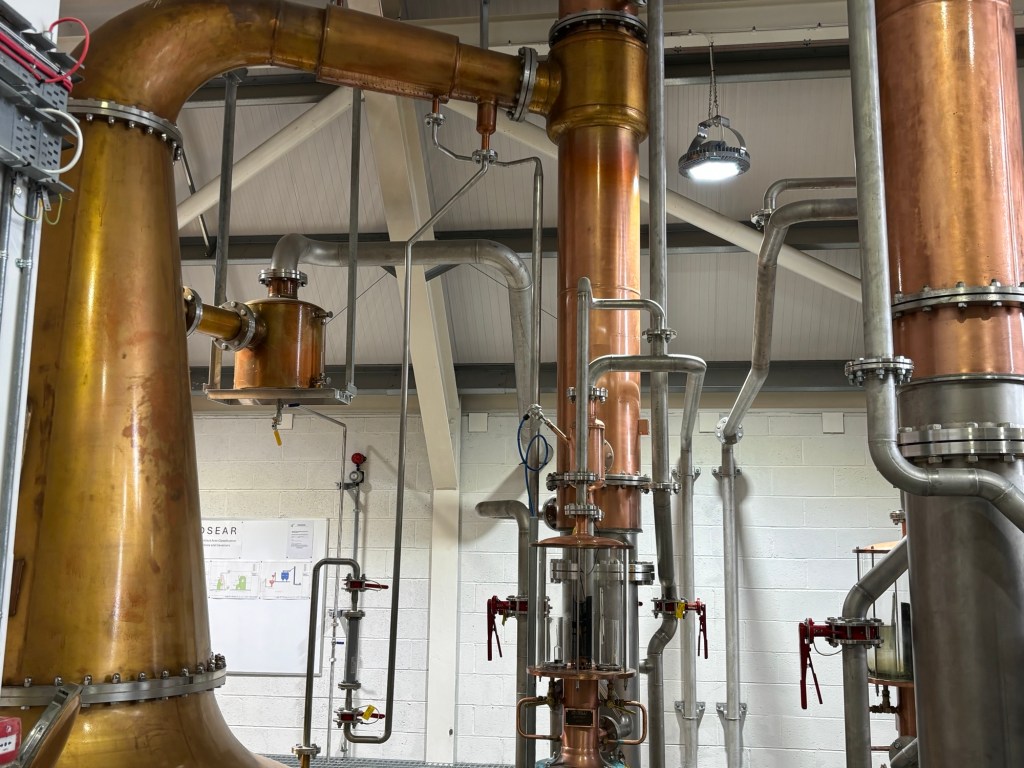
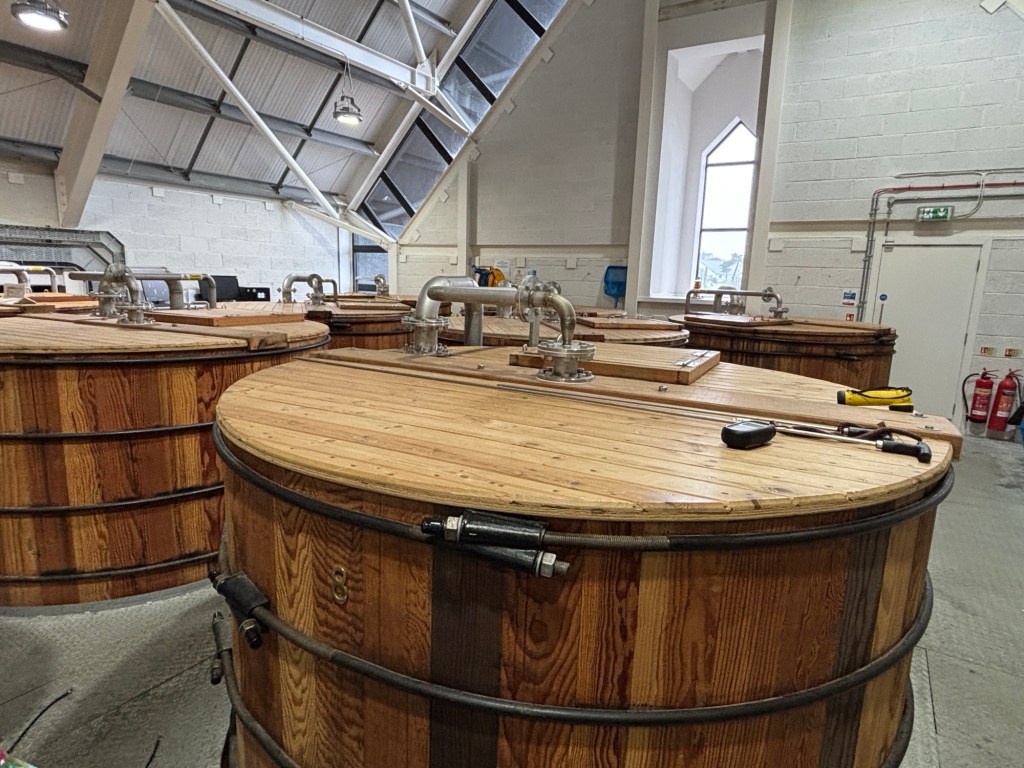
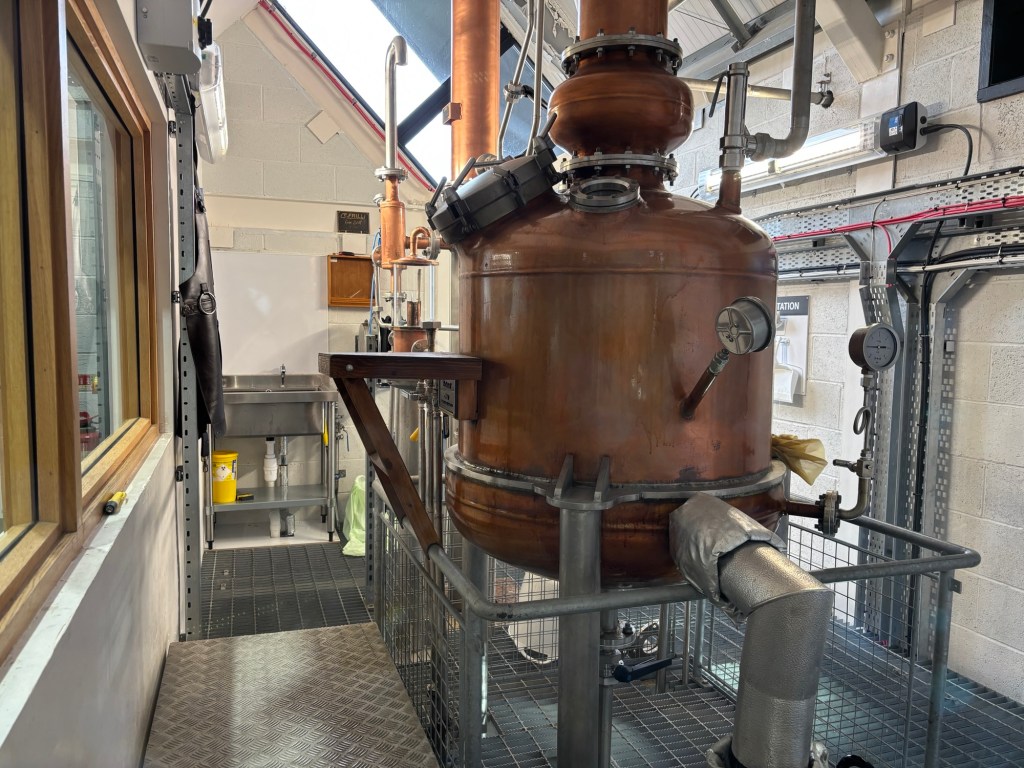
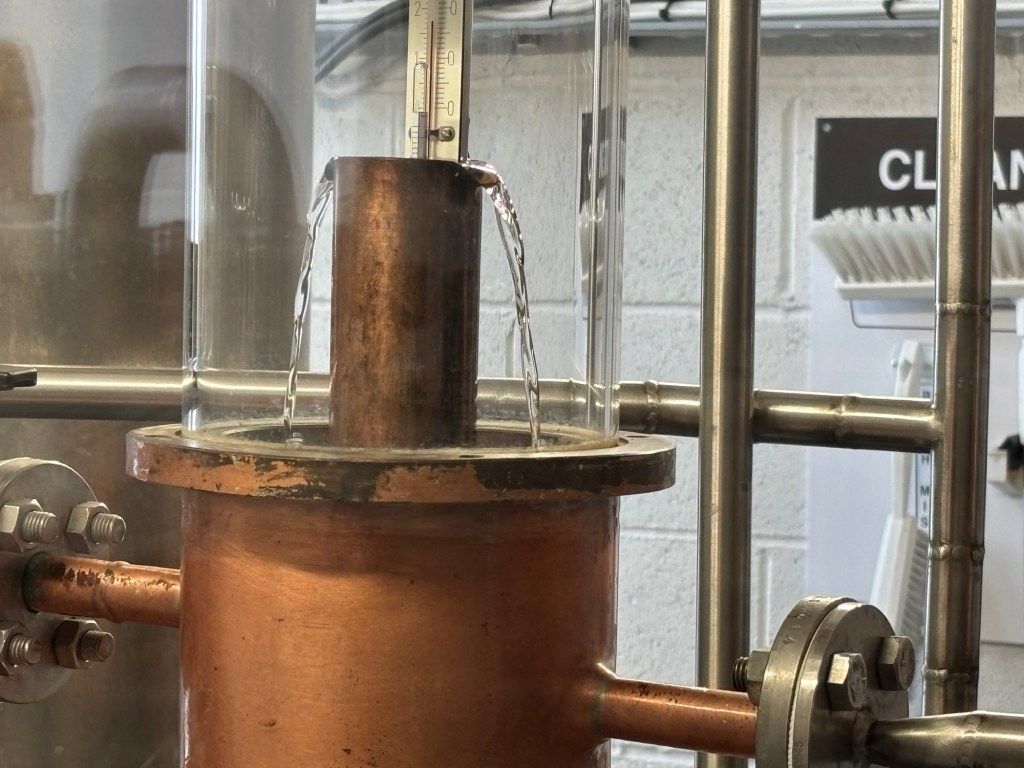
Our guide showed us the various steps in the process.

This distillery opened in 2015 but didn’t release their first whiskey until December 2023. 

In the meantime, while waiting on their whiskey, they needed to stay afloat financially so began producing gin. Gin only needs to sit for 72 hours.

Local seaweed is used in making Harris gin. 

Again, we saw the machinery involved. The gin is just pouring out in the picture on the right.

Harris gin put the Isle of Harris Distillery on the world map, selling in 24 countries.  Gin is the largest part of their business and is covering the company financially as whiskey consumption has declined worldwide. Whiskey is the largest export of Scotland.


To the credit of our guide, her information was fascinating- even to someone who didn’t like, know, or care about whiskey or gin.

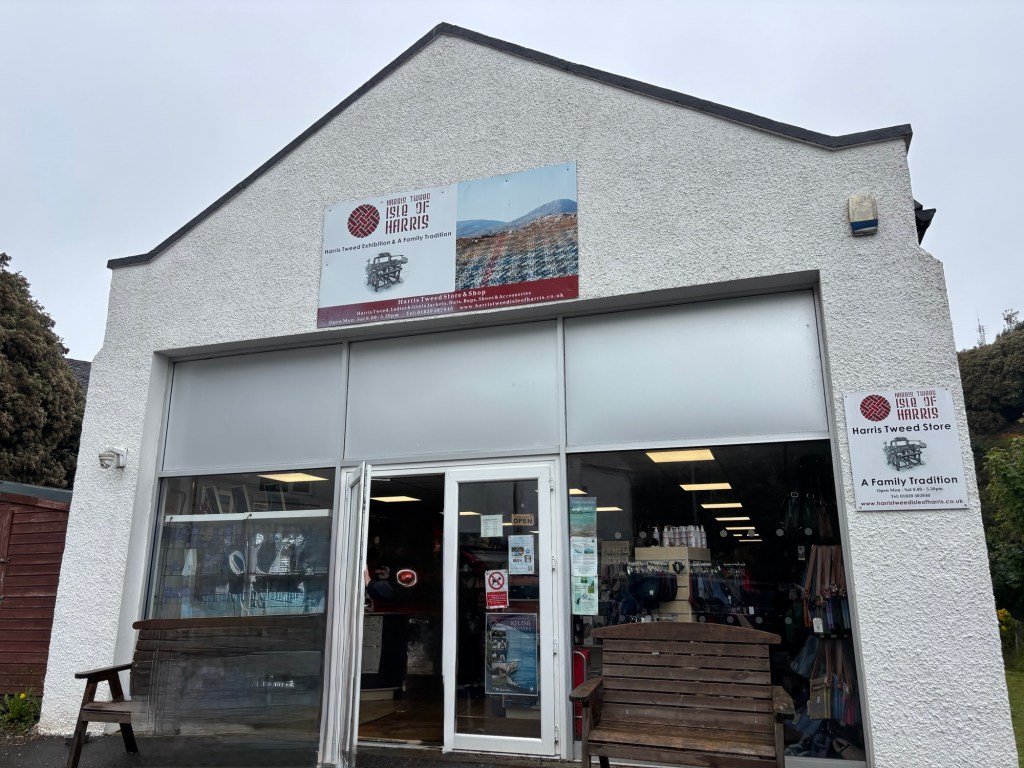
I was interested in this tour for the Harris Tweed, also a product of this island. We were supposed to spend time learning about and shopping for Harris tweed.  When the distillery tour took most of our time, we only had twenty minutes to browse in the tweed shop.

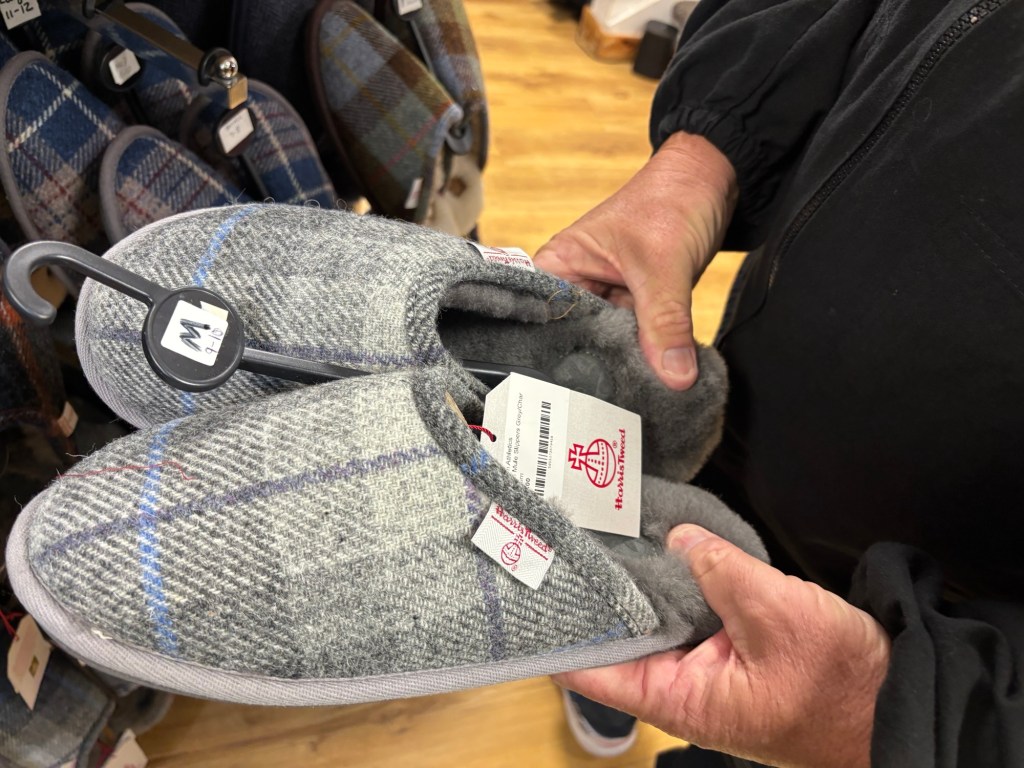
Randy bought some tweed slippers because he’d actually been thinking about a second pair.  I bought a small case for my headphones.  We live in the desert and already have more winter clothes than we need.

With no tour guide to explain it, I had to do my own limited research.  Harris Tweed is known worldwide and originated in this small village.


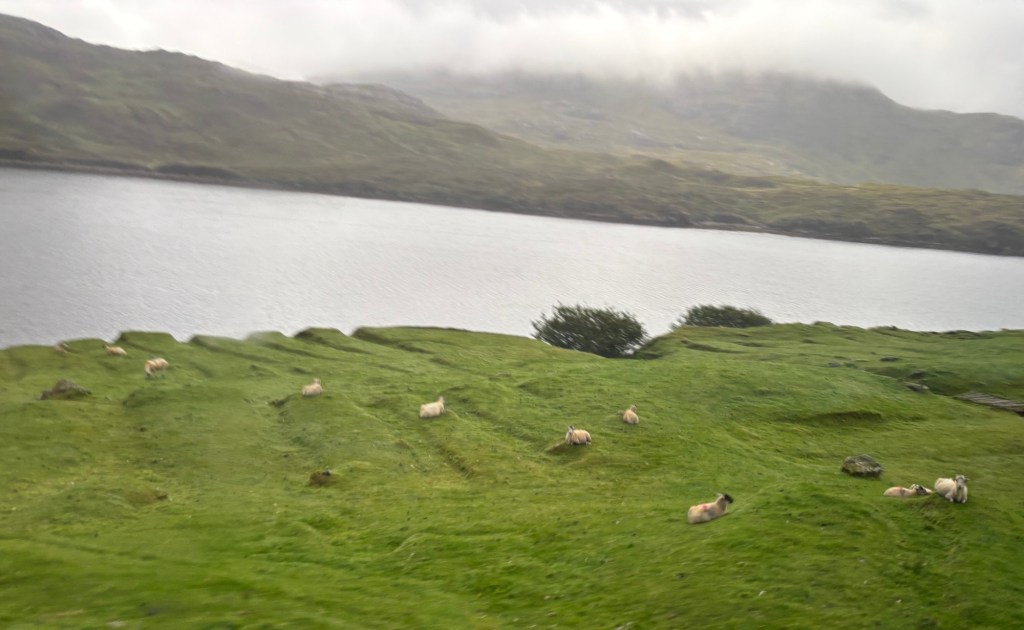
Historically, sheep were important as they could survive the harsh winters.  They were kept for meat and in the summer they were sheared for wool.

Beginning in the 17th century, the local wool was made into a special cloth.  In 1908, the fabric process was trademarked.  


Harris Tweed is an iconic product but also an evolving industry.  The desire for new products has changed the industry.  Scotland is involved in producing cashmere because of the pure water.   There is also growth in “smart textiles” for quick dry products and burn fabrics.  The textile industry that started with tweed has changed and remained successful.Harri

In our visit to the shop, and seeing various tweeds around Scotland, we saw far more plaid than anything else.

Other random things we learned on our bus ride back to the ship:

The movie 2001 A Space Odyssey was shot on the barren landscape of eastern Harris.

Peter May wrote The Blockhouse Trilogy while on the Isle of Lewis and, in negotiations, has insisted that any future movie adaption be filmed on the island. 

Up next: We go to our first port in Ireland!

Posted in Uncategorized | 1 Comment

Two Cruises: Joining Friends on Nieuw Statendam

We were able to enjoy a relaxing morning in Rotterdam and walked a couple hundred yards to check in at the port.  We boarded Nieuw Statendam shortly after 11:00 a.m. on July 27th.

We were excited to begin our cruise titled Wild British Isles: Ireland’s West Coast with our friends Cindy and Darrell. Having boarded the day before, in Dover, they were on a tour to the windmills.

This was our fourth voyage on Nieuw Statendam, so we knew our way around.

Our cabin was ready so we had a chance to explore our large balcony.  

It is large because of how the ship juts out a bit.  We had chosen the cabin specifically because of the balcony.

The inside was just like any other verandah cabin we’ve ever had on this ship – perfectly adequate.

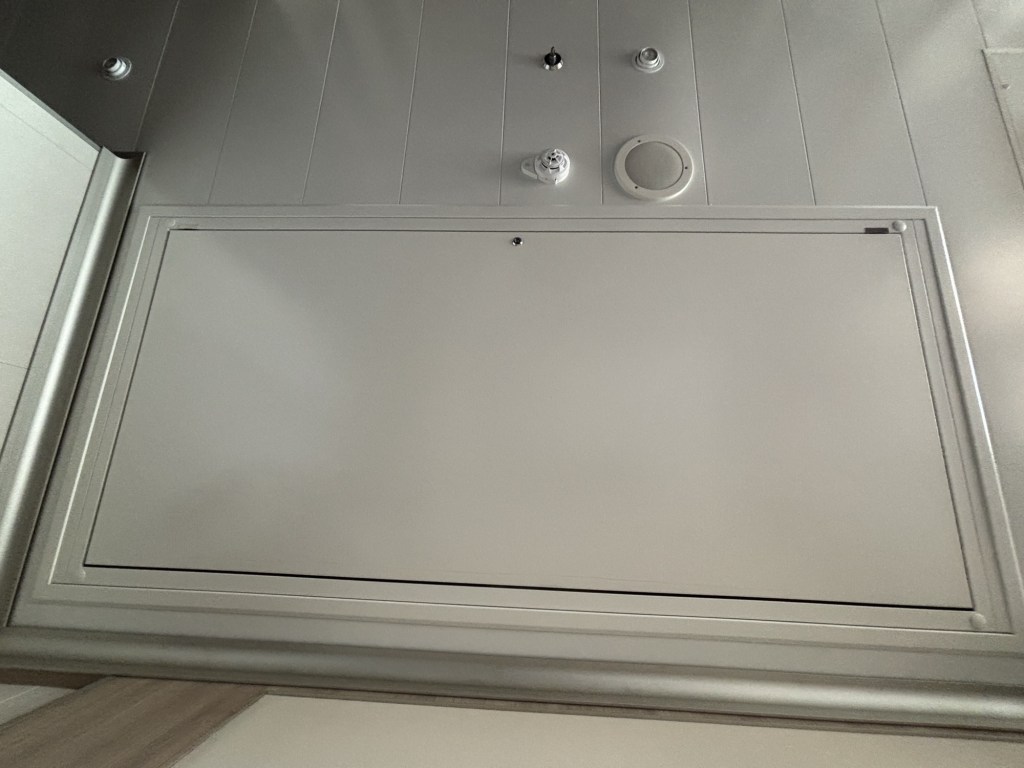
We noticed this large door above the bed. We learned later it was a drop-down bed for converting our two person cabin to a three or four person cabin if also utilizing the sofa bed. 

We spent time unpacking and organizing. We will live in this cabin for four weeks!

We watched our safety video and went to our muster station as required.    

We saw, and talked briefly, to Boby who had been our room steward on the Westerdam seven months ago. He did not remembe us, nor would I have expected him too.

Emely, on the other hand, remembered Randy right away.  She had been a favorite, also on the Westerdam, and we knew to look for her. Unfortunately, her job at the Dutch Cafe won’t allow for more than occasional brief contact.

We were happy to connect with Cindy and Darrell later in the afternoon.

We see them each time we go to Boise but haven’t vacationed with them since 2023 – on the cruise that Randy got quarantined with Covid.

It is always interesting to watch provisioning activity.

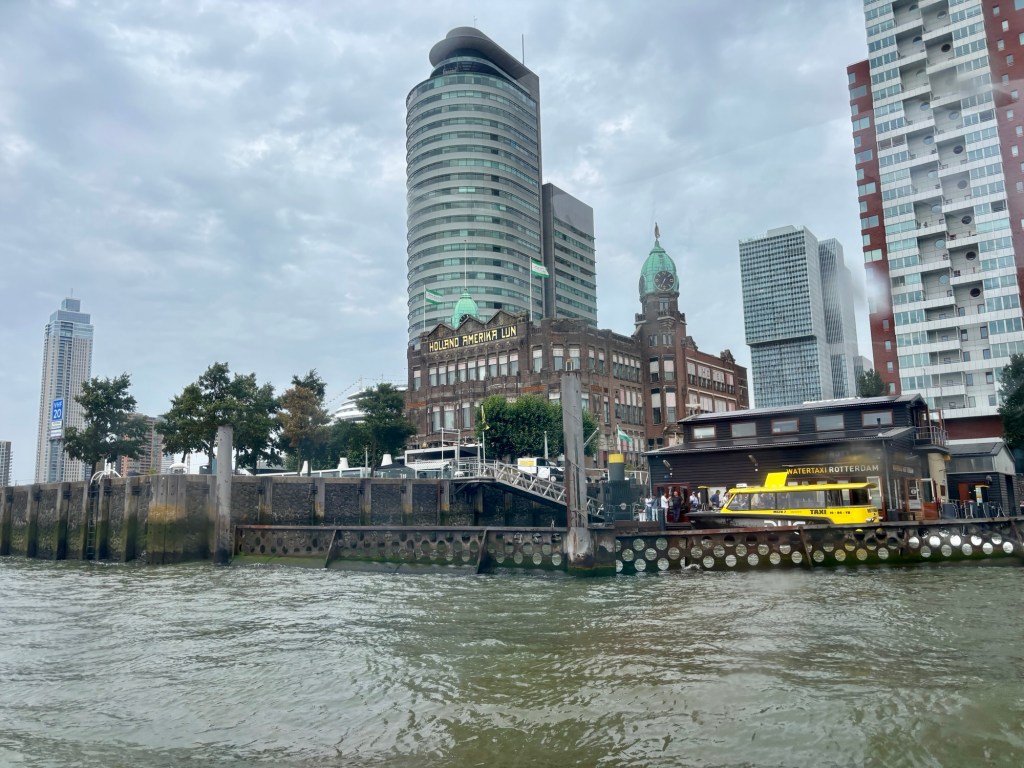
As we sailed away, we had one more look at the Hotel New York.

Since 1871, there have been seven ships named Rotterdam that have sailed for Holland America. The seventh, and current SS Rotterdam, had been in port prior to Nieuw Statendam arriving.

As we continued out of the city, we saw the permanently berthed fifth Rotterdam, now a hotel and restaurant.  

This former Holland America Line flagship was known as ‘La Grande Dame.’   She began sailing in 1959 and was the first Holland ship to transition from “transportation” to cruising as we know it.

As Rotterdam V aged, she no longer met maritime safety requirements. With Carnival Corporation owning Holland America, the ship was sold. She was renamed, abandoned after bankruptcy, sold again, and then refurbished.

In August 2008, Rotterdam V returned to the city of Rotterdam and is now a member of the West Cord Hotels group.  If we return, we will surely stay onboard.

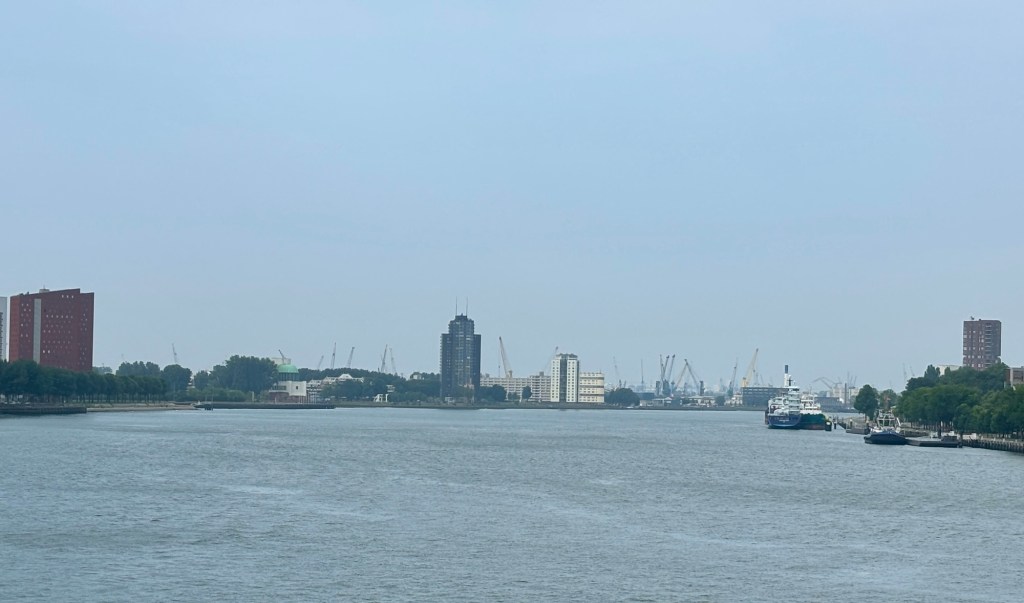
As we continued on, we saw miles and miles of the port of Rotterdam, the largest in Europe, and the largest in the world outside of Asia.

We enjoyed dinner with our friends and went to a first show.

Harry the Piano was very entertaining.  Through most of the show he played songs of his choice.  In the final segment he created a medley of requested songs.  His trick is to weave the songs sometimes playing them in totally different styles if requested. Imagine “Don’t Cry for Me, Argentina” as a polka with “Stairway to Heaven” as a country song. He was pretty good!!

Overnight, and all the next day, we sailed to our first port of call, the Isle of Lewis in Scotland.

Posted in Uncategorized | Leave a comment

Two Cruises: Kinderdijk Windmills

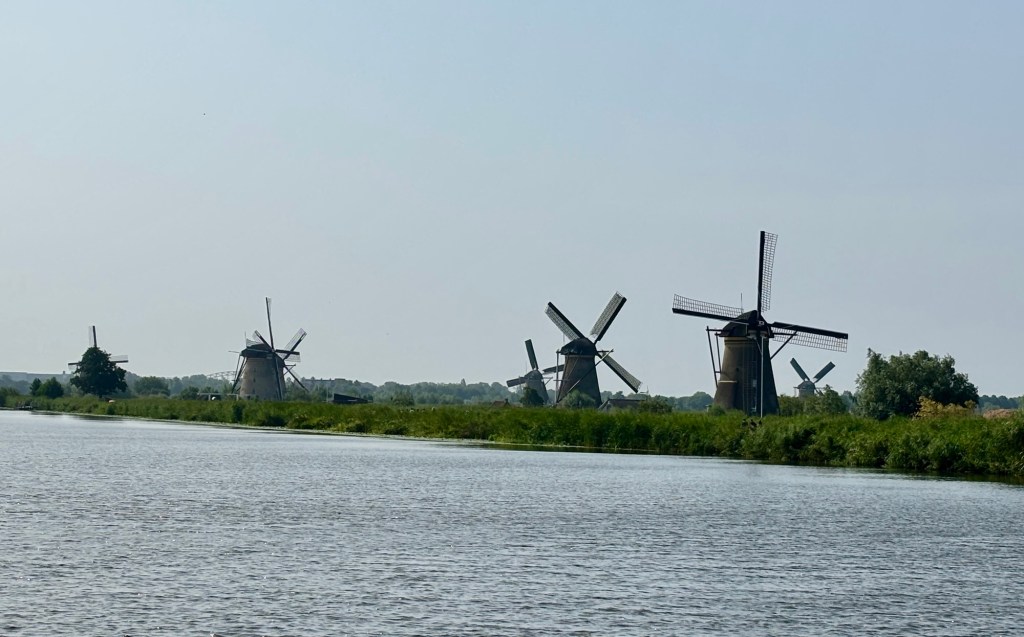
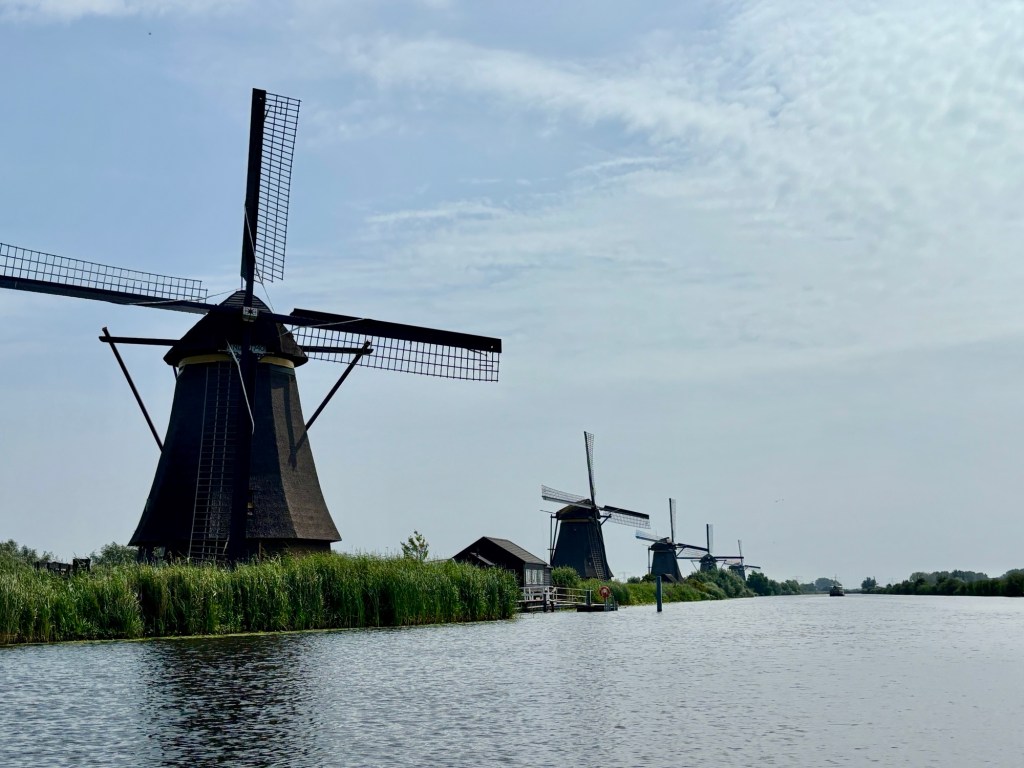
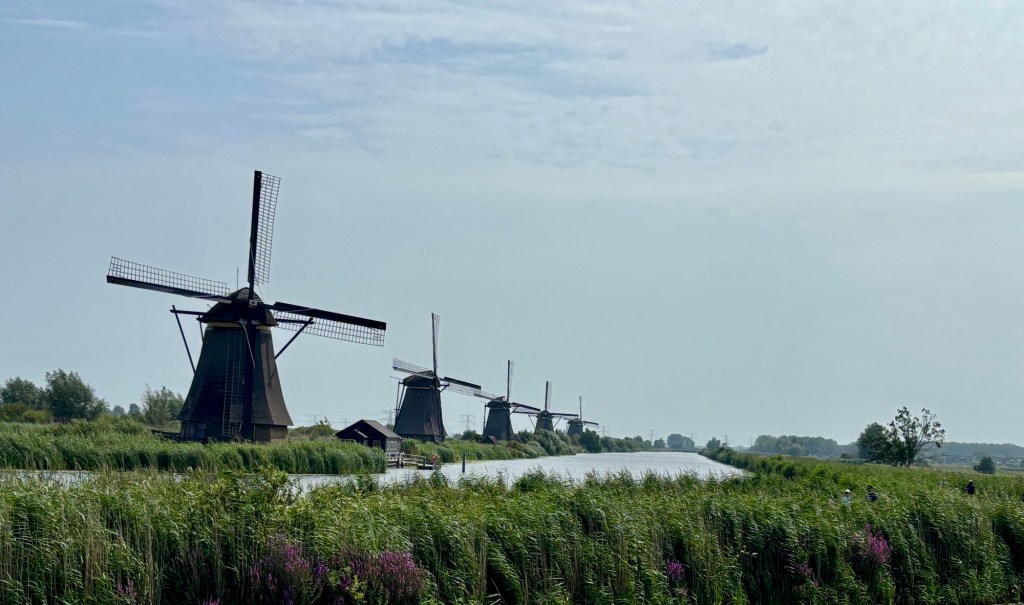
Kinderdijk has been a UNESCO World Heritage Site since 1997.  This group of 19 windmills was built circa 1740 and is the largest grouping left in the Netherlands.  That was our destination for the day on July 26.

We had a private tour with a lovely young woman named Eleftheria.  She says she is totally Dutch but she had creative parents who chose her name which means freedom in Greek. 

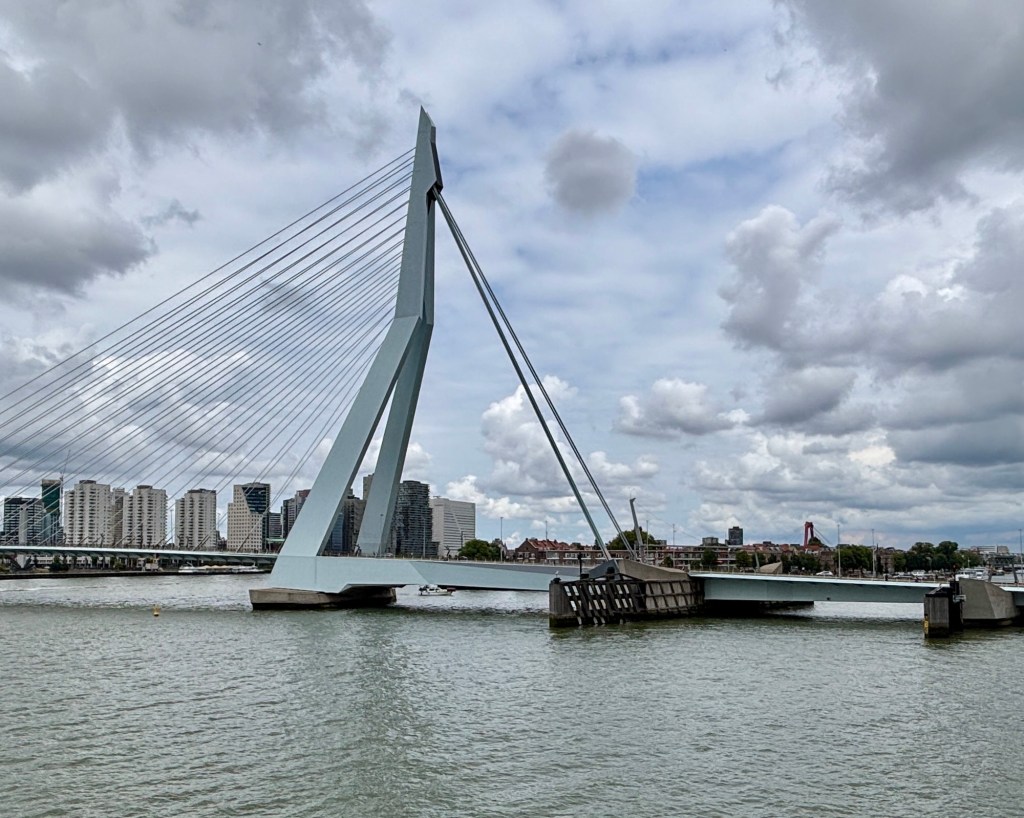
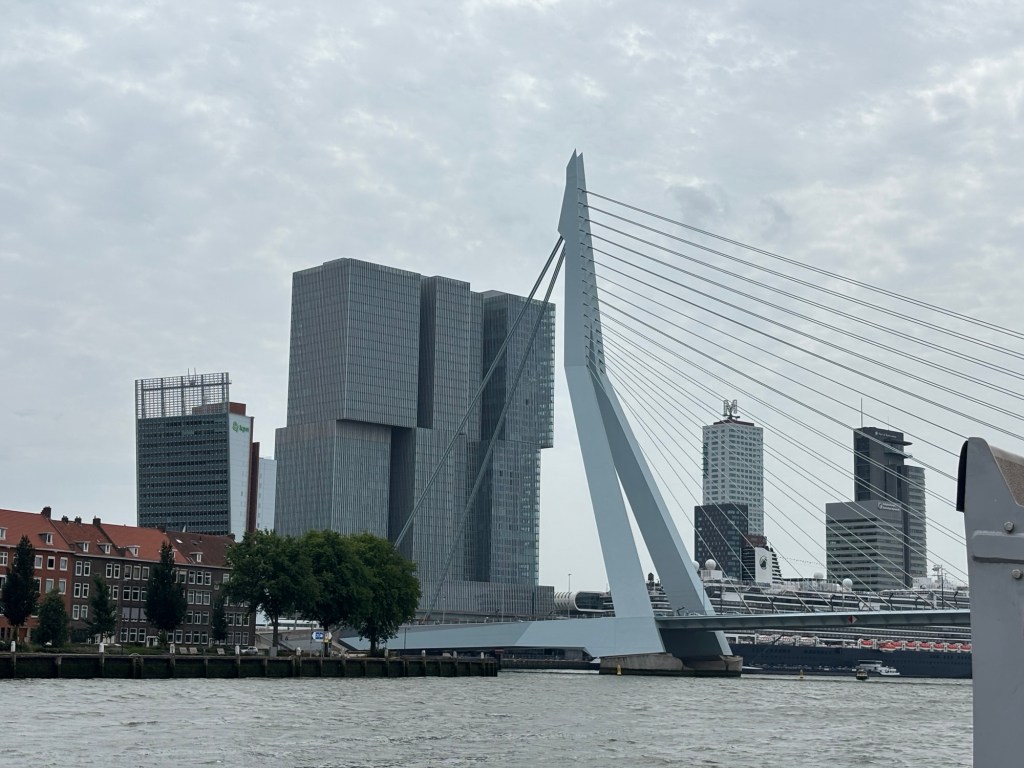
As we walked across the Erasmus bridge she told us how most of the city center in Rotterdam is new since the Second World War.  Germany bombed the city into submission to have control of their port, the largest in Europe. The port stretches for miles, this is just the part viewable from the bridge.

The bridge is named for Desiderius Erasmus, a prominent renaissance humanist and a major historical figure in Dutch culture.

The bridge, also called The Swan, is a symbol of Rotterdam.  

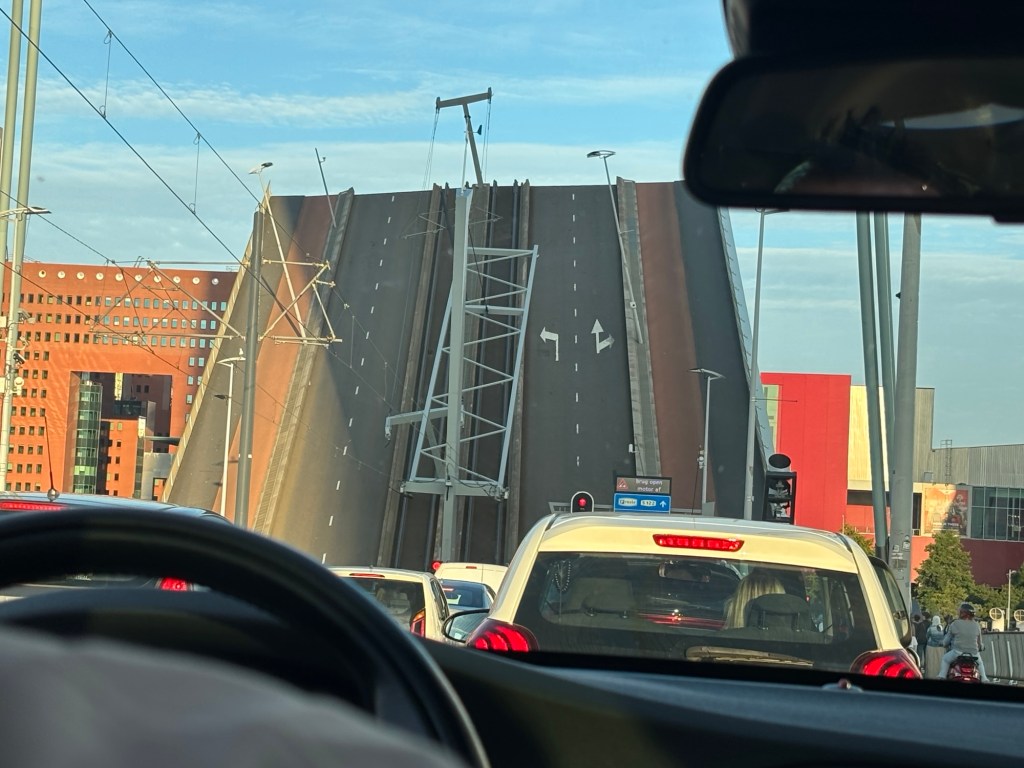
We were riding on the bridge the night before in our Uber when one end went nearly vertical to allow a high masted boat to pass through. 

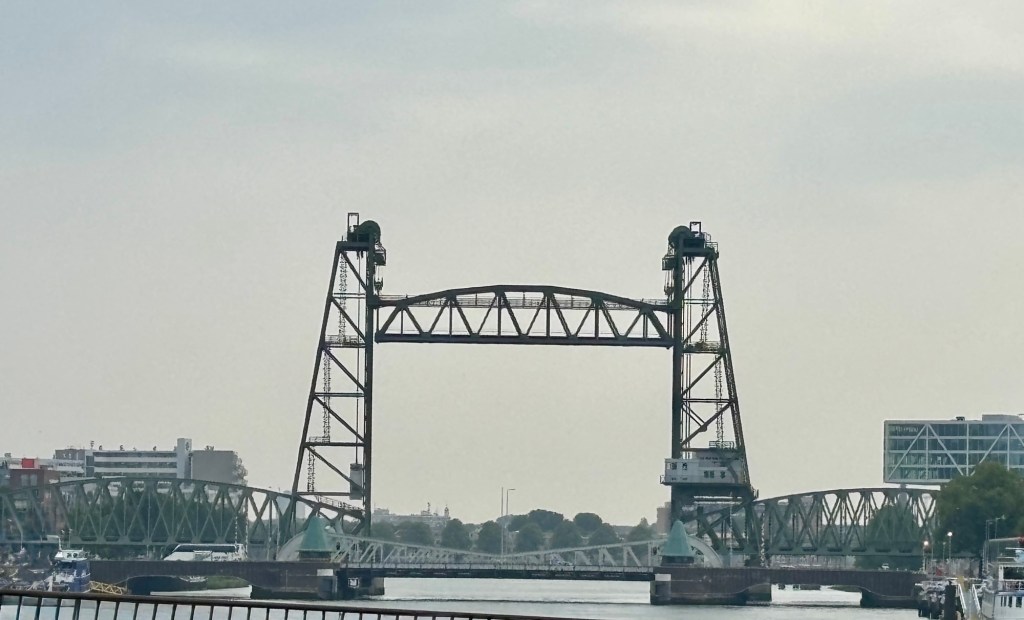
During that delay our Uber driver told us about the Hef Bridge, shown above, and how Jeff Bezos had coerced the city of Rotterdam to partially dismantle this bridge to allow his newly built yacht to pass under.  We were disgusted at the story. 

However, when El told us the story, she said that the city said “no” to the wealthy American and made him modify his yacht to be able to pass under.  We told her what we had been told the night before.  Although she was confident, El did the research quickly and confirmed that she was correct.  We liked her version of the story much more!

We learn repeatedly not to take everything tour guides or Uber drivers say as truth. Our Uber driver embellished a lot. He said when they dismantled the bridge to let Bezos’s boat through, they had to reconstruct it and used that opportunity to repaint it. Not only did they never take the bridge apart, it was never repainted.

The Hef is a vertical lifting bridge built in 1927 and was very unique for that time and is an iconic piece of Rotterdam.

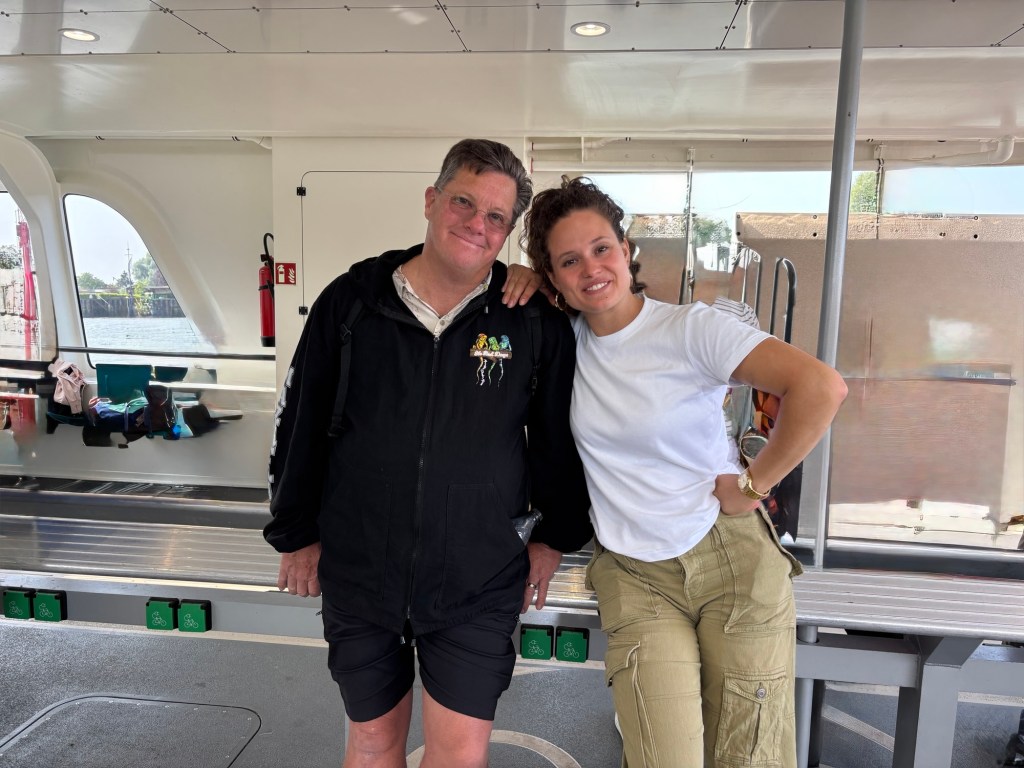
We took a pleasant 45 minute cruise on public (boat) transportation to Kinderdijk.  This picture is Randy, of course, and the delightful El, or Eleftheria.

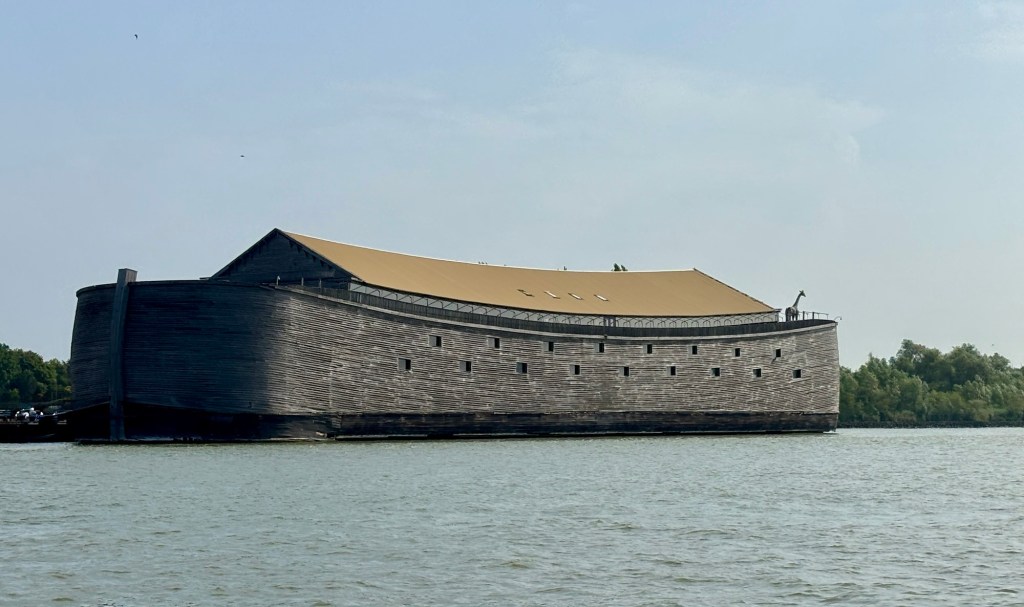
We passed a replica of Noah’s Ark. It was a little worse for wear, seemingly abandoned.

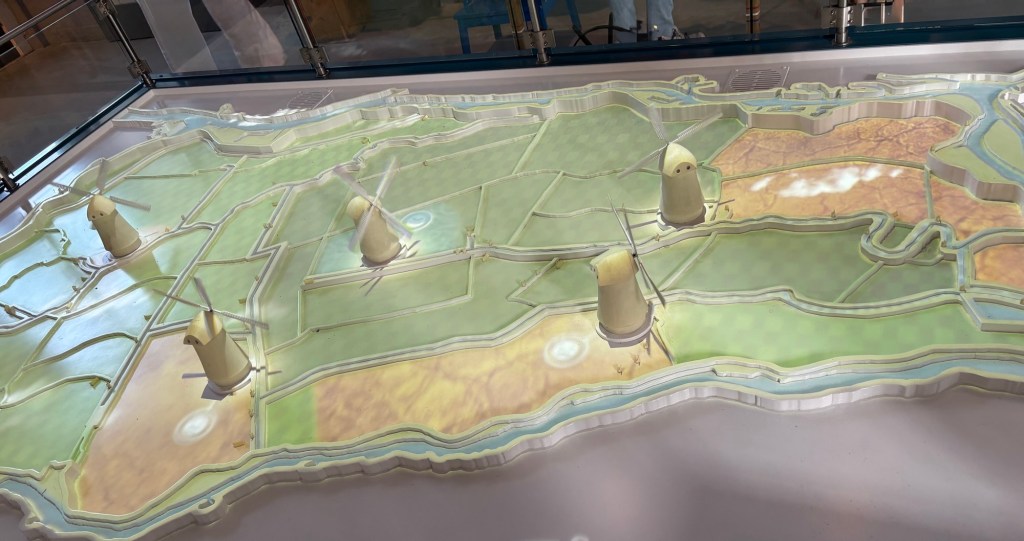
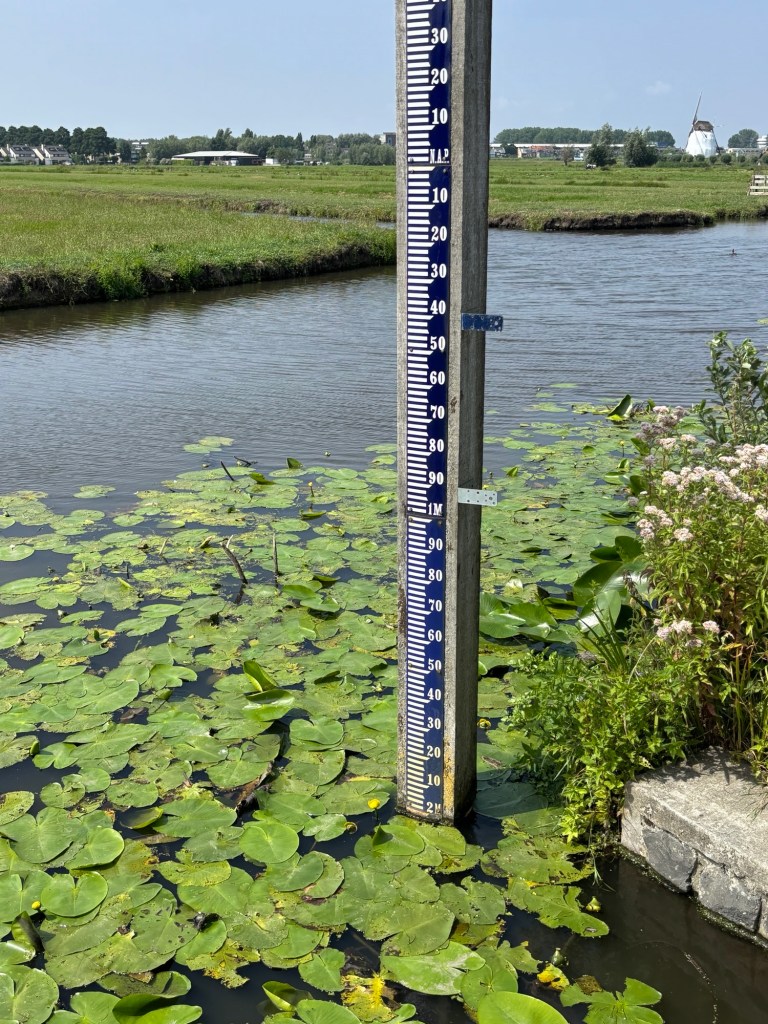
When we arrived at Kinderdjik, we missed the first few minutes of an orientation video. Seeing those minutes might have helped me but it took awhile to wrap my head around the fact that the canals and windmills were to get the water OUT. That was needed to make the land livable.  

Exposing the land also allowed them to cut out portions from the peat layer to dry and use as a fuel source. Some still use peat, centuries later.

We live in a desert in a decades long drought.  My mind always thinks conserve water and save every precious drop.  It just didn’t compute trying to get rid of the water so they could live in marshy lands below sea level.

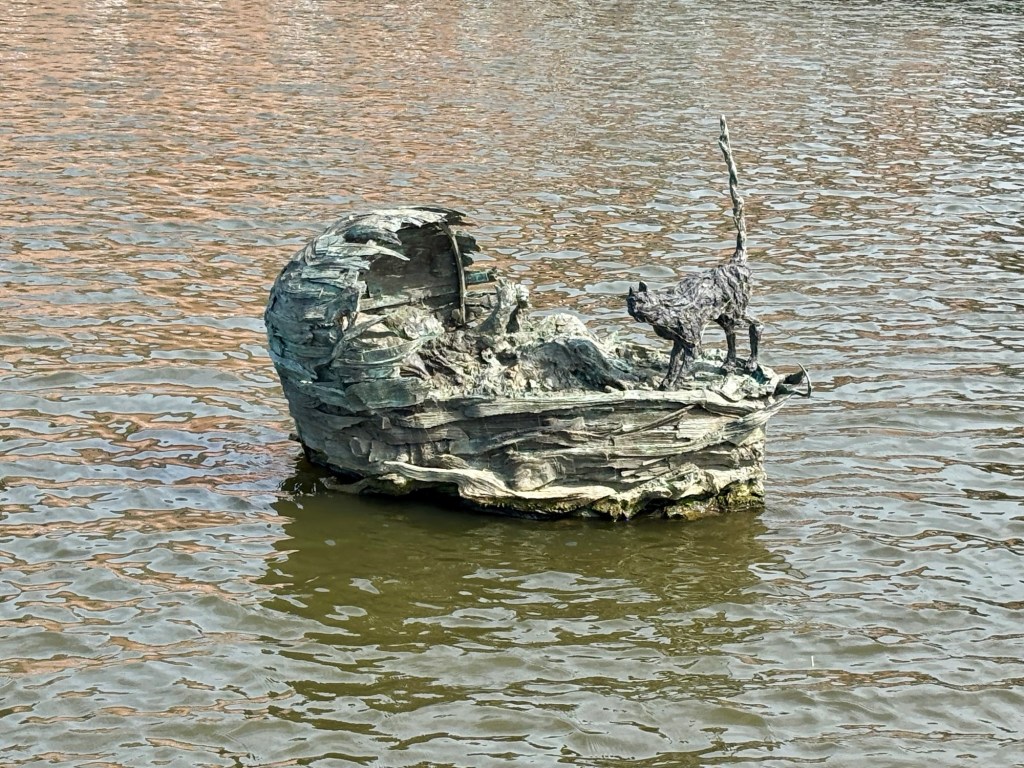
Kinderdijk is Dutch for “Children dike” and named for the legend of a villager finding a wooden cradle floating after a flood. 

Inside was a child with a cat trying to keep it in balance.  This sculpture is on the grounds in commemoration.

The former queen of the Netherlands, Beatrix, was instrumental in making sure this collection of 19 windmills were preserved.   Seventeen are rented out as homes while two are set as part of site tours.

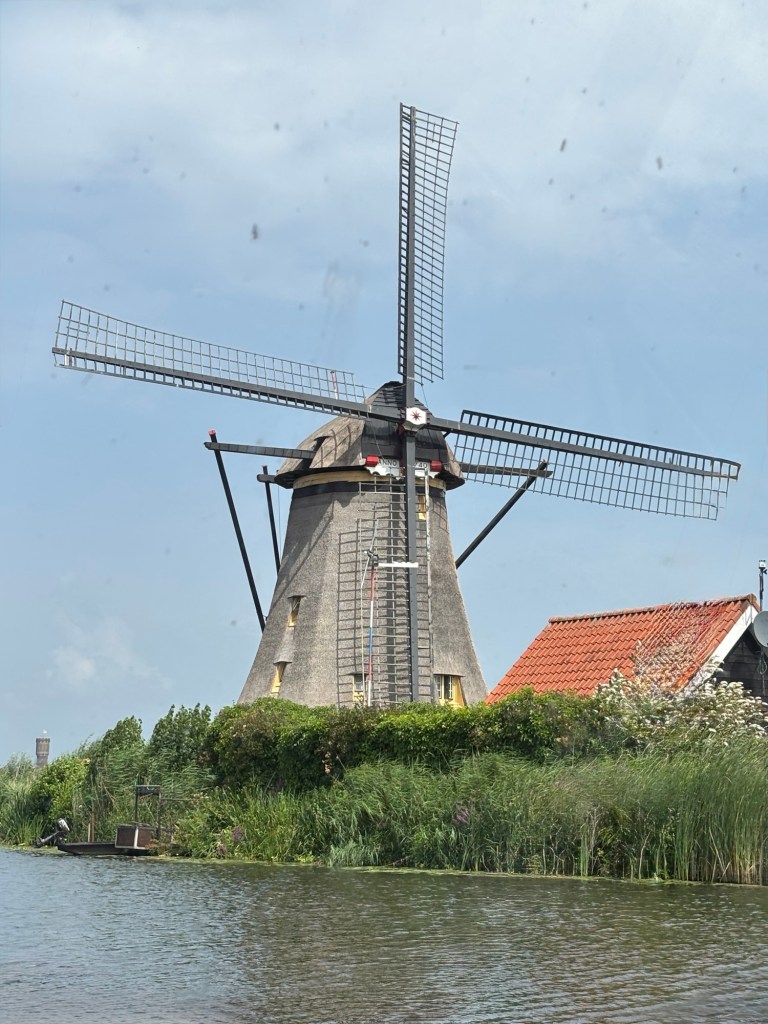
Apparently, this is the iconic windmill shot at Kinderdijk.

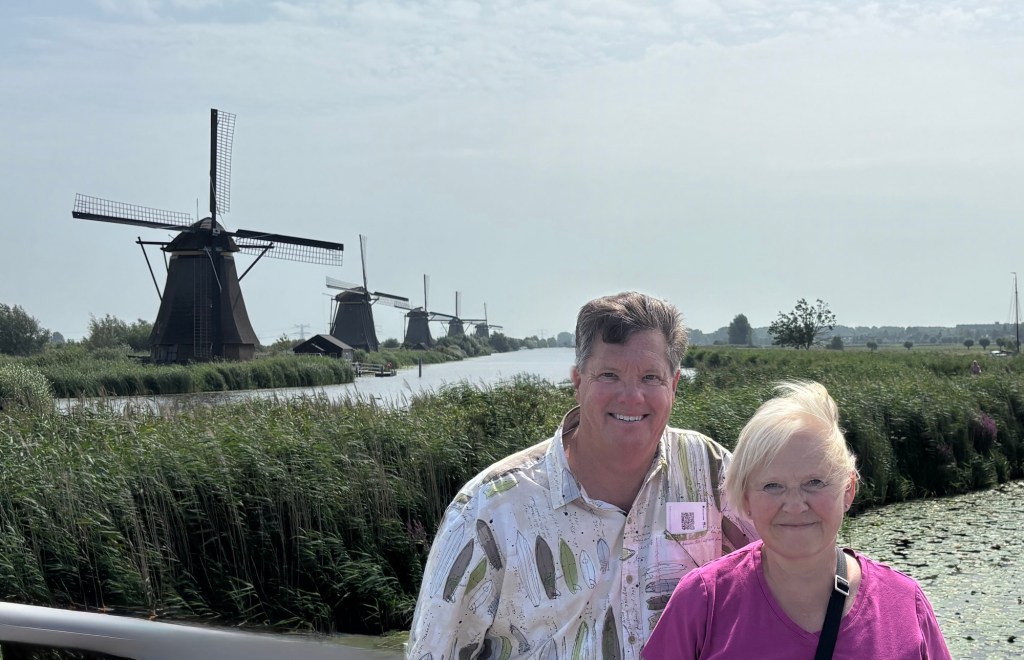
And here is proof that we were there!

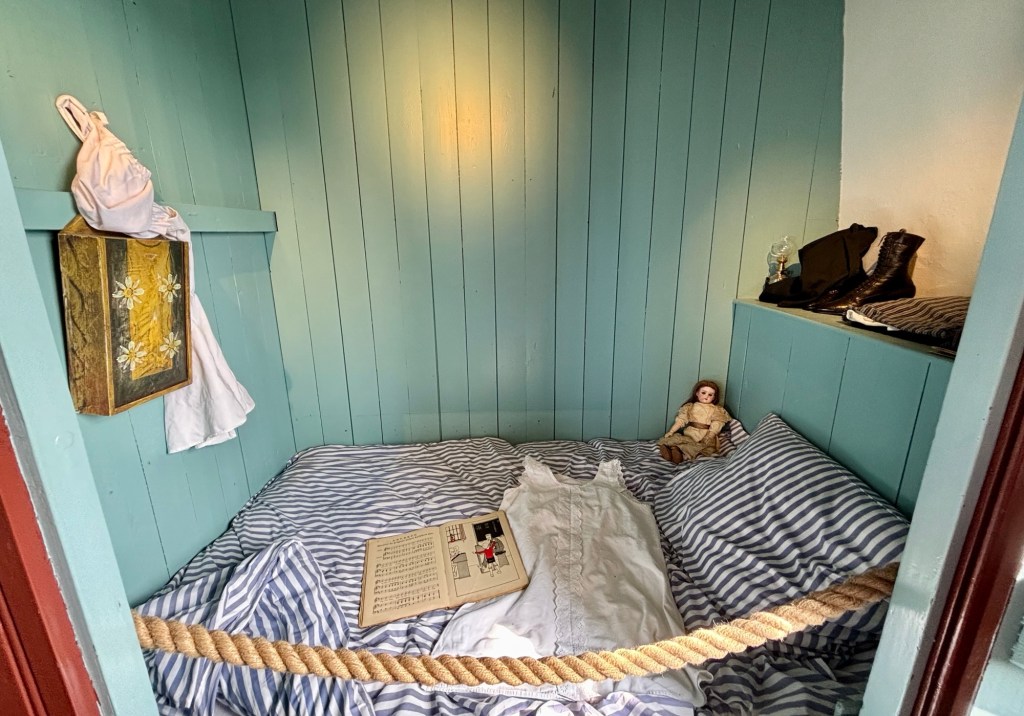
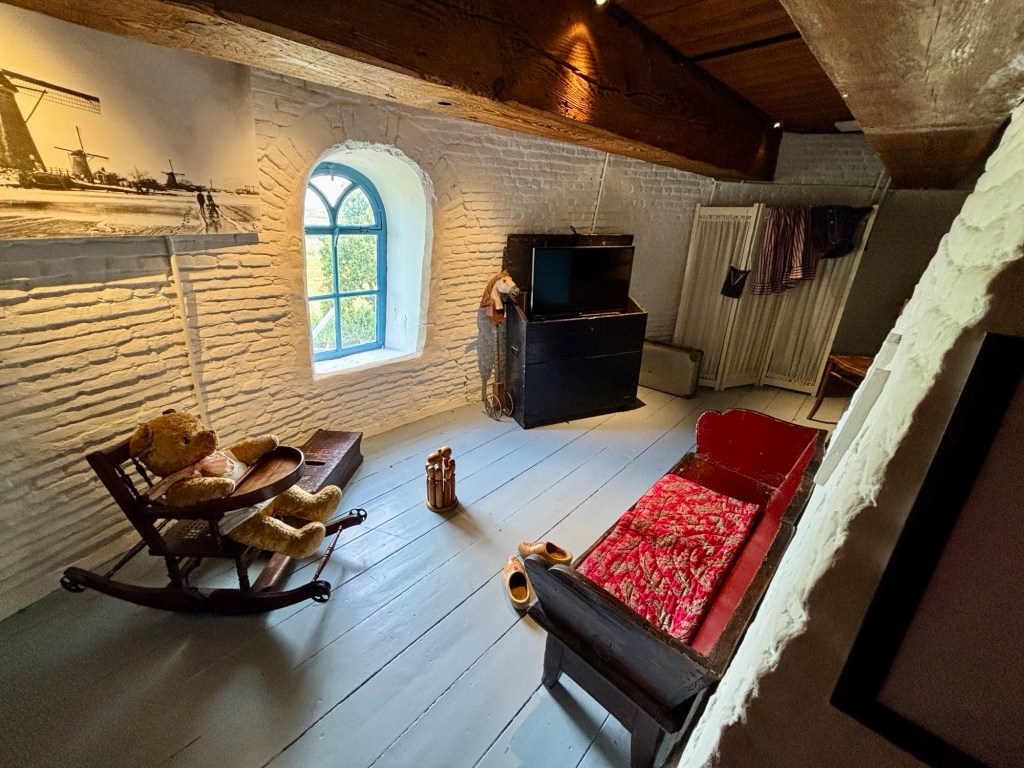
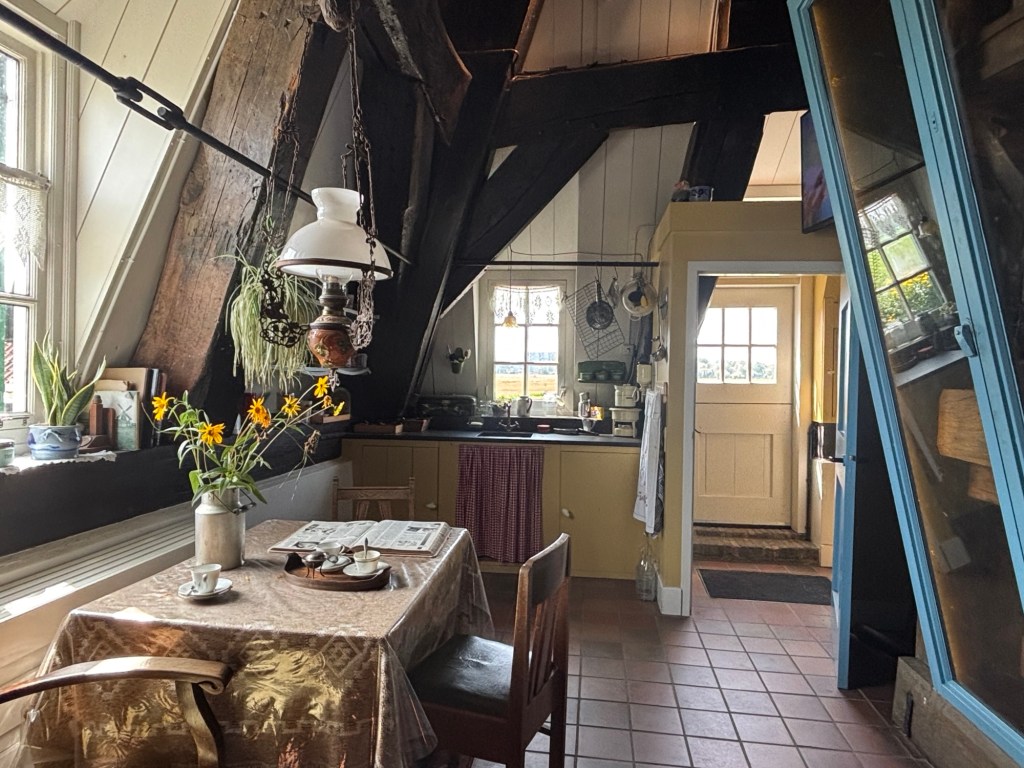
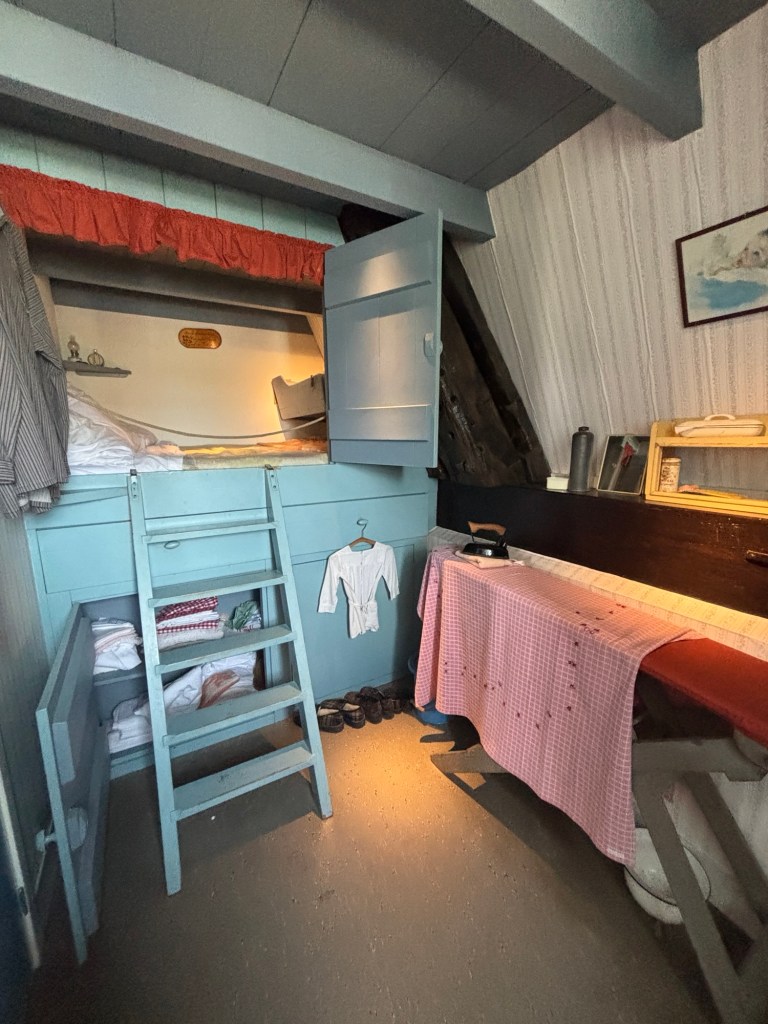
We enjoyed touring the two available windmills and seeing how “millers” and their families lived through the 17th, 18th and 19th centuries.

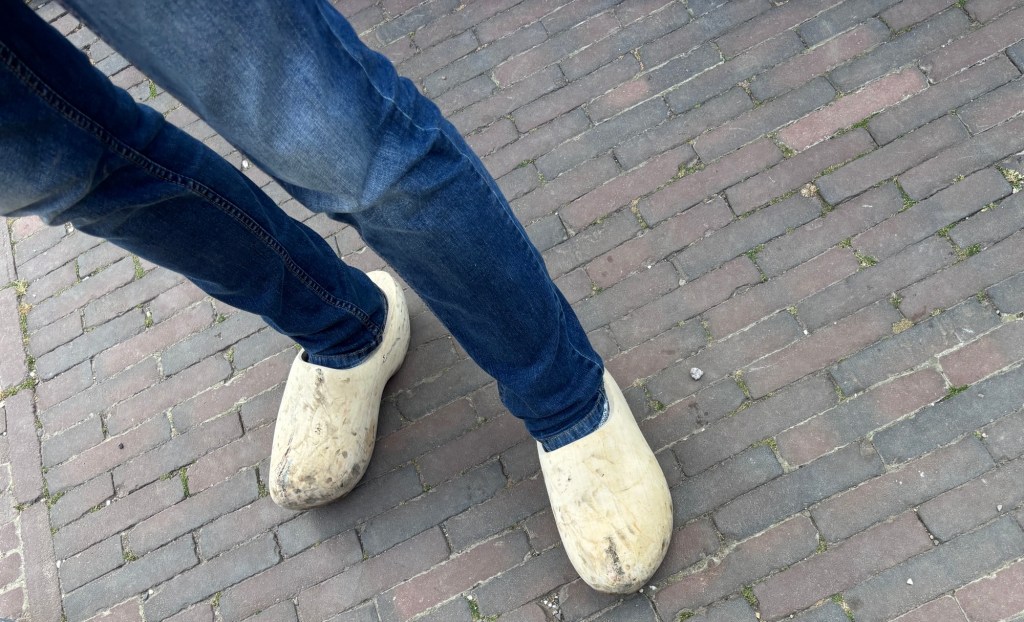
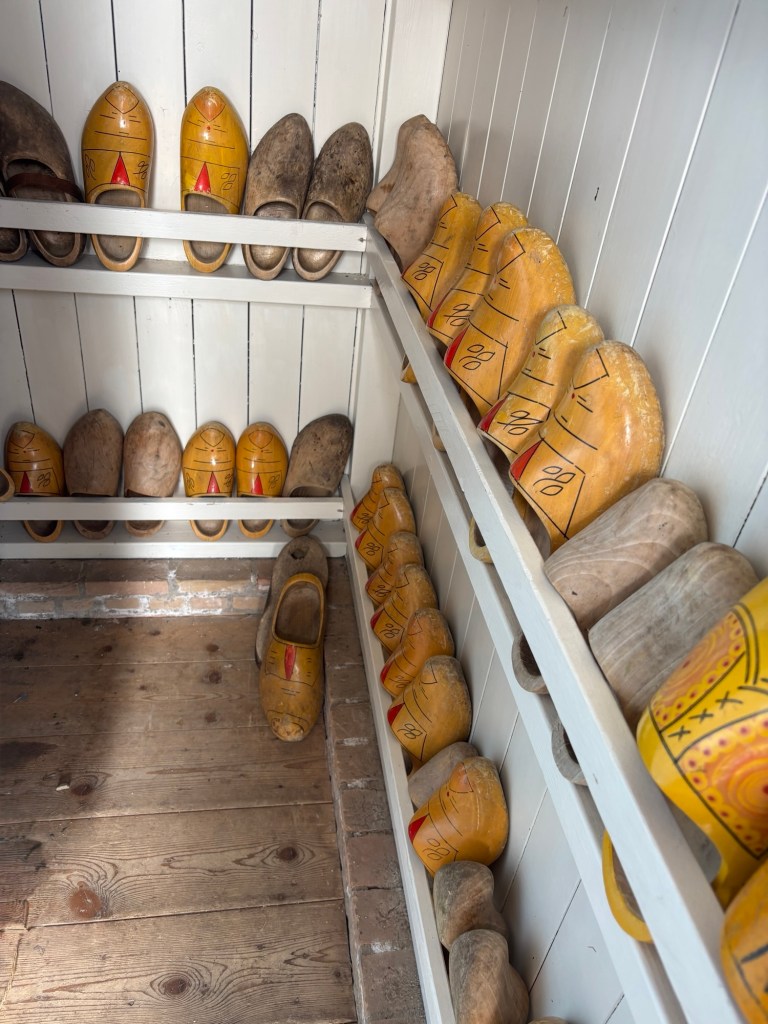
We had an interesting talk with one man about his wooden shoes.  He wears them always, but said they must be paired with wool socks.

They are made from a renewable resource, protect his feet from getting wet and being stepped on by farm animals.  Finally, they can be firewood when they are used up.  He says a pair lasts him about eight months.  In hindsight, we failed to ask how he knew when a pair needed to be replaced.

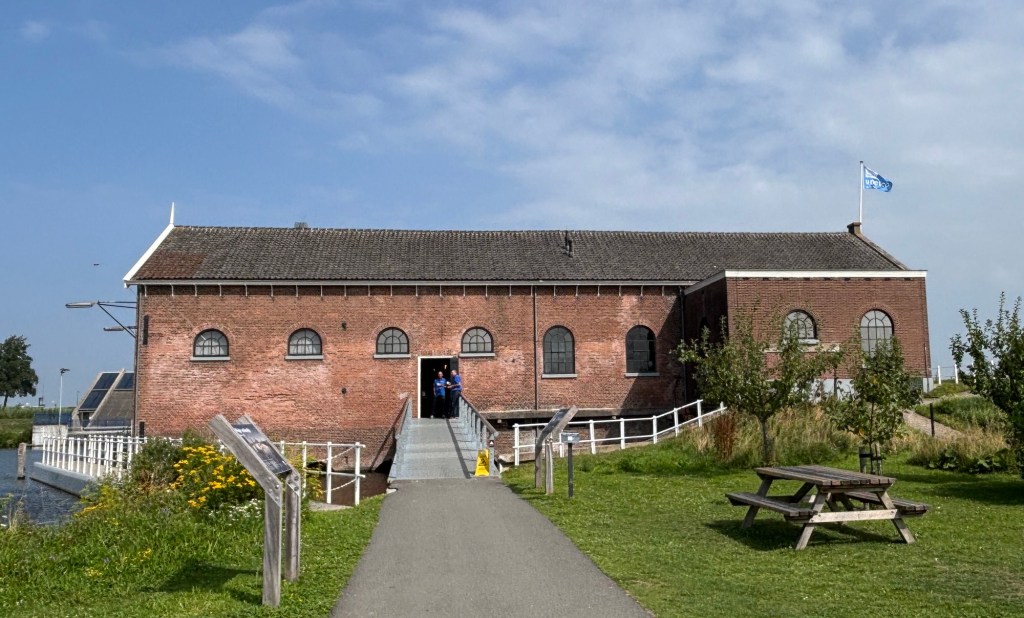
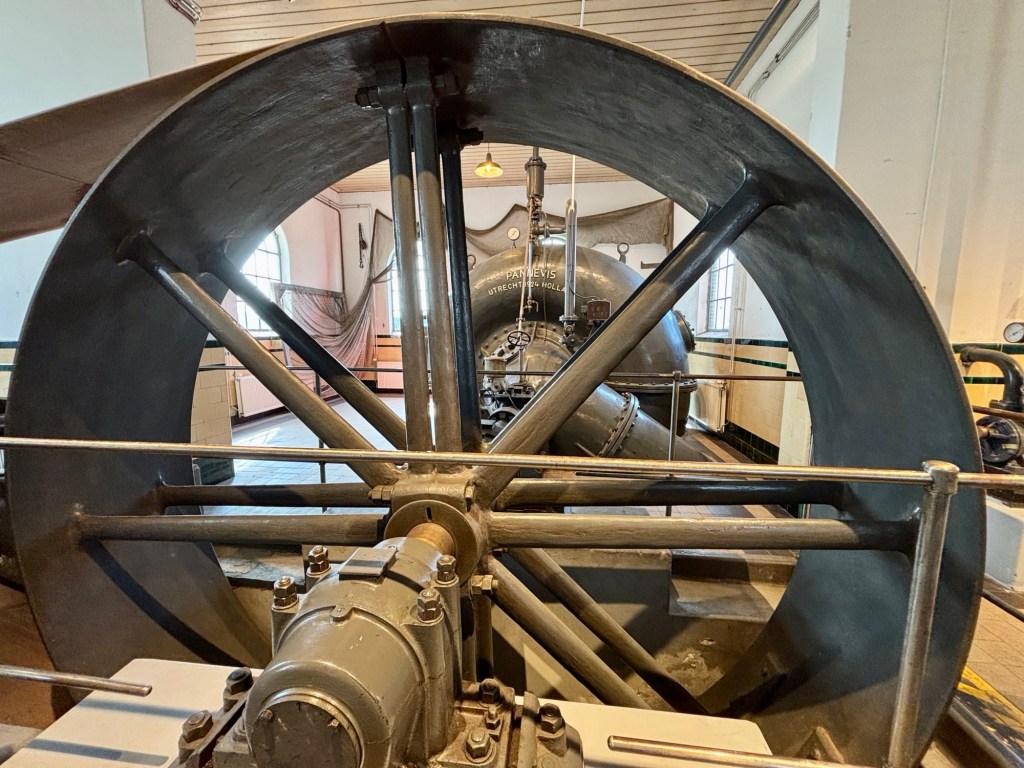
We visited a large building that held the steam engines that took on water pumping after the windmills.

Nowadays, water experts, using modern technology, play the chess game of how much water to remove, from where, at any given time, considering present and presumed precipitation.

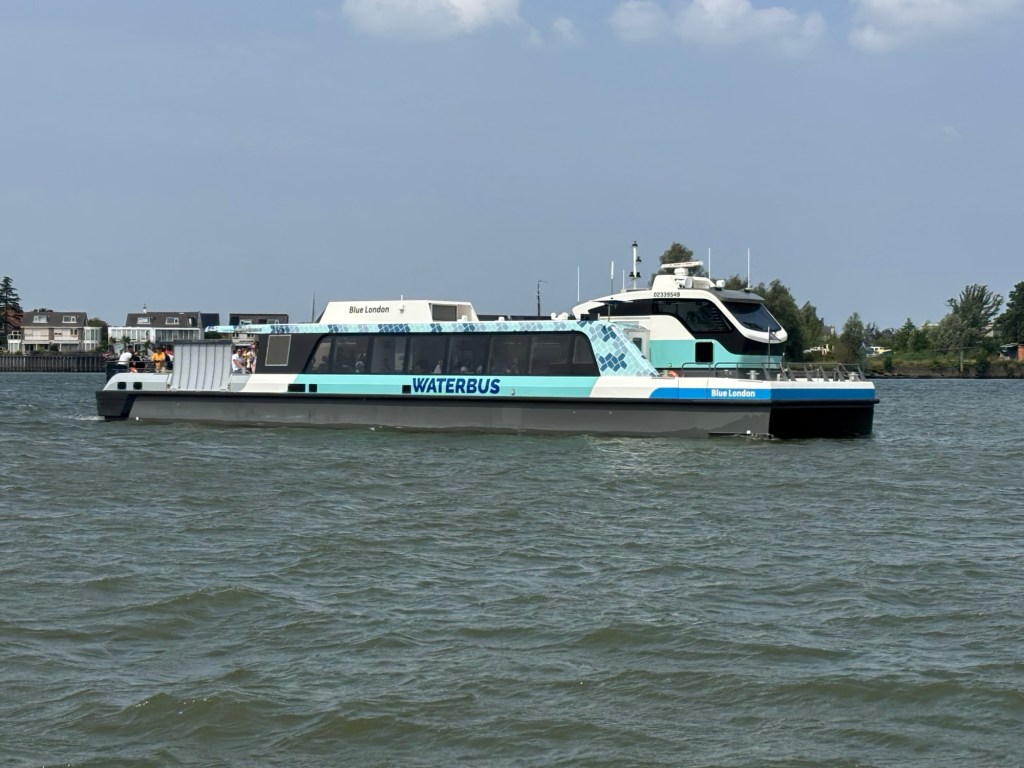
At the end of our tour we rode the boat back into Rotterdam. 

We decided to avoid the long walk back across the bridge. We got tickets aboard a second boat, a water taxi, for 10 Euros (about $11.50). It was a great choice.

From a different angle, we could see an interesting sky scraper behind the Erasmus bridge.

It was also interesting to see our Hotel New York from the water. It was a nice stay in Rotterdam!

Next Up: We board the Nieuw Statendam, catch up with friends Cindy and Darrell, and begin our first of two cruises.

Posted in Uncategorized | Leave a comment

Two Cruises:  Amsterdam Food Tour

We were still in Amsterdam on July 25th.  We had a food tour scheduled in the afternoon after our Anne Frank House morning.

We met our guide, Roman, and our fellow food tourists.  Roman was amazing in how he instantly knew everyone’s name.  He does two tours almost every day so it isn’t like he could study them.

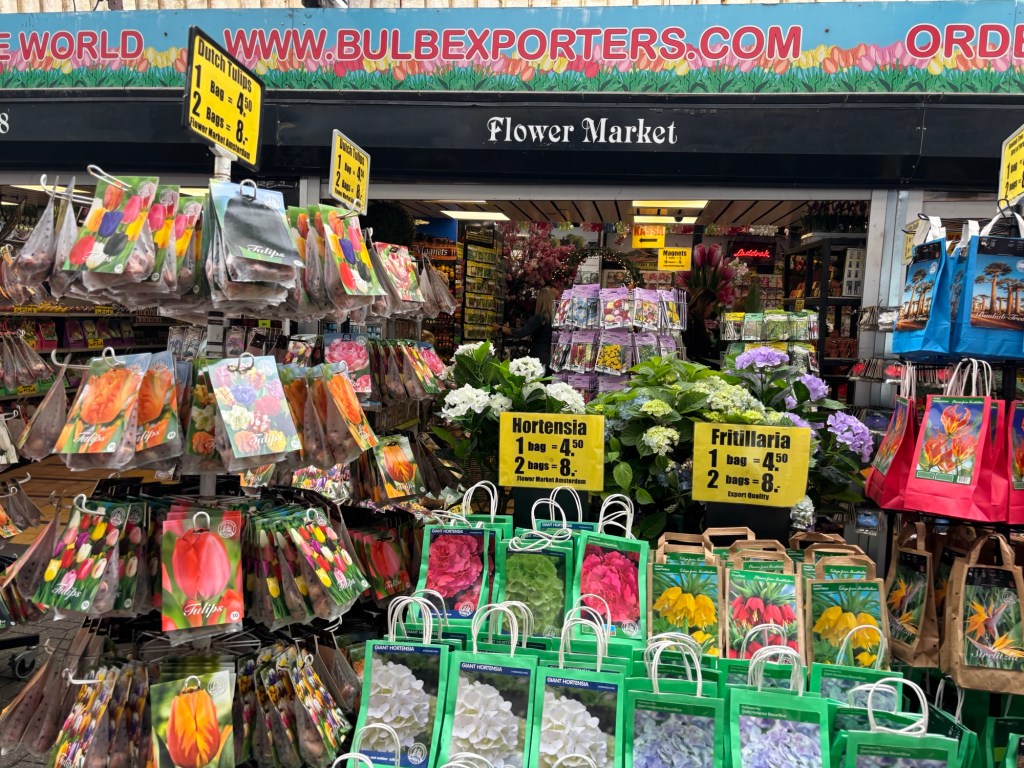
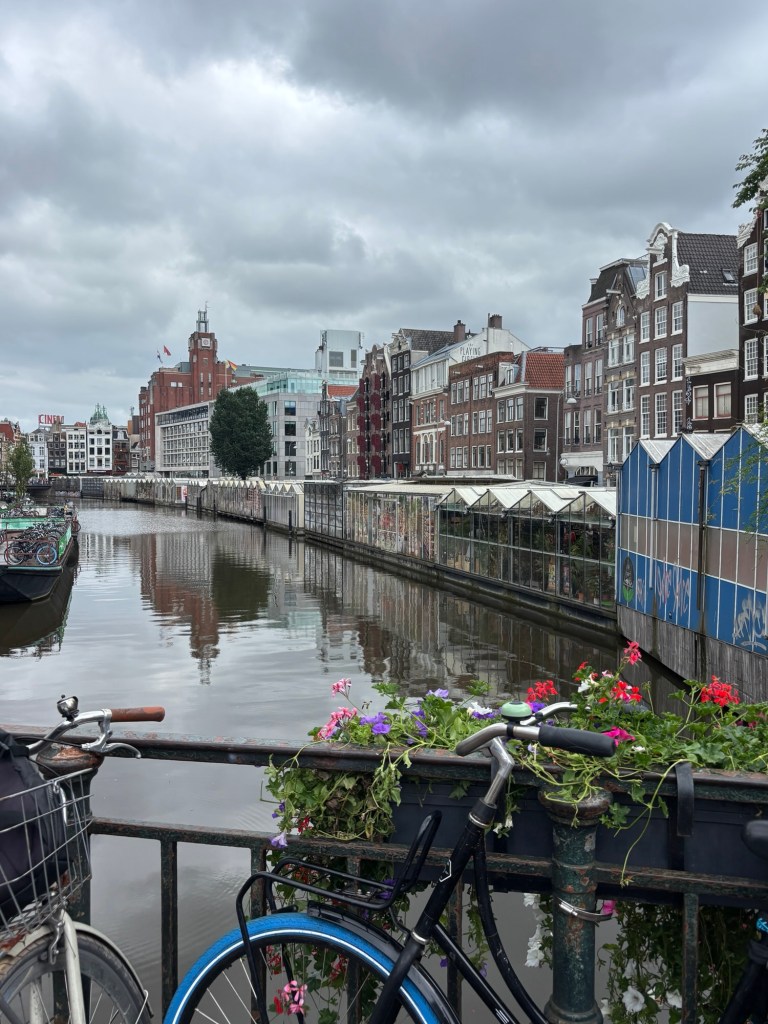
Roman began by taking us to a flower market that opened in 1871.  It is open everyday.  The Dutch originally acquired tulips from Istanbul and currently send out two billion tulips a year.  The growing season is March to May.

It wasn’t until we got to the back side that he showed us the flower market is really floating on the canal.

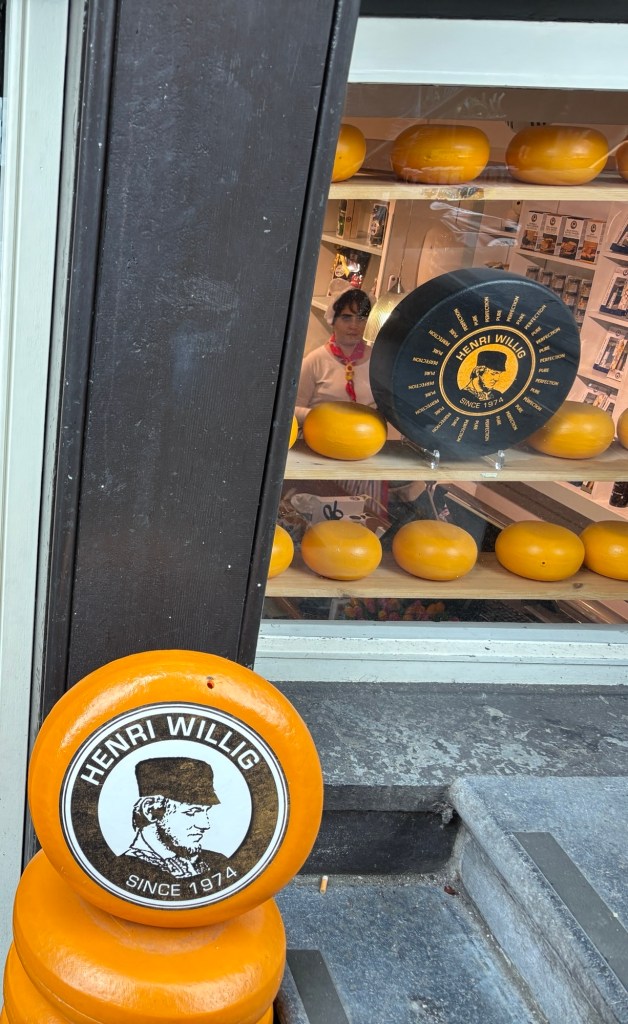
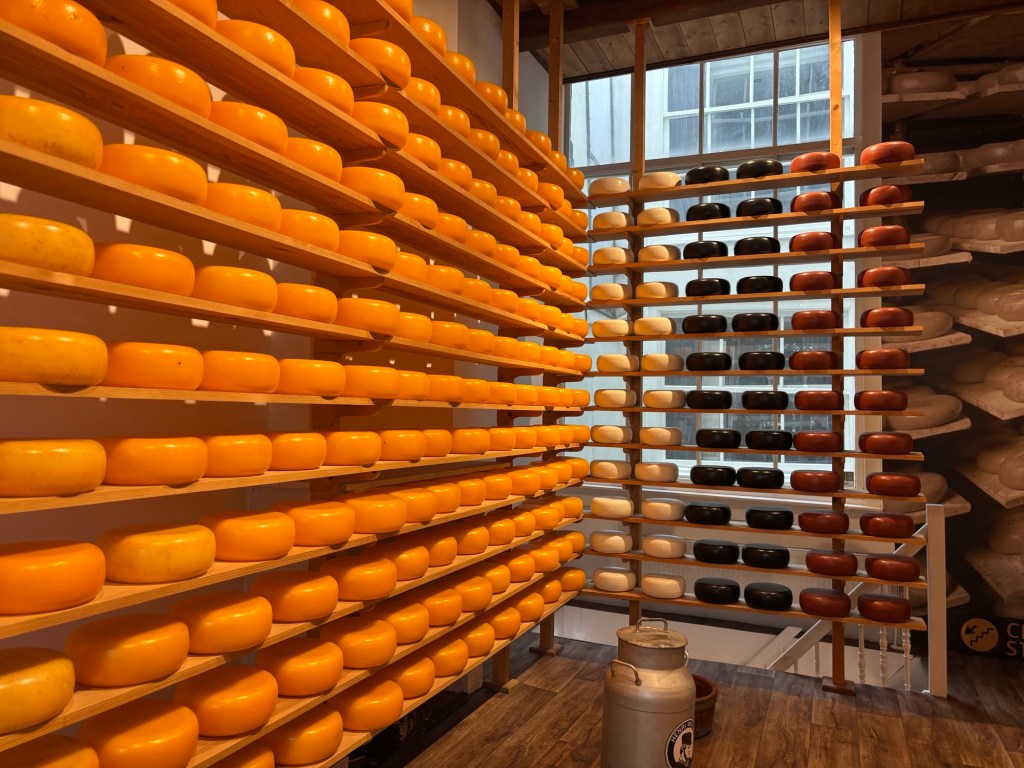
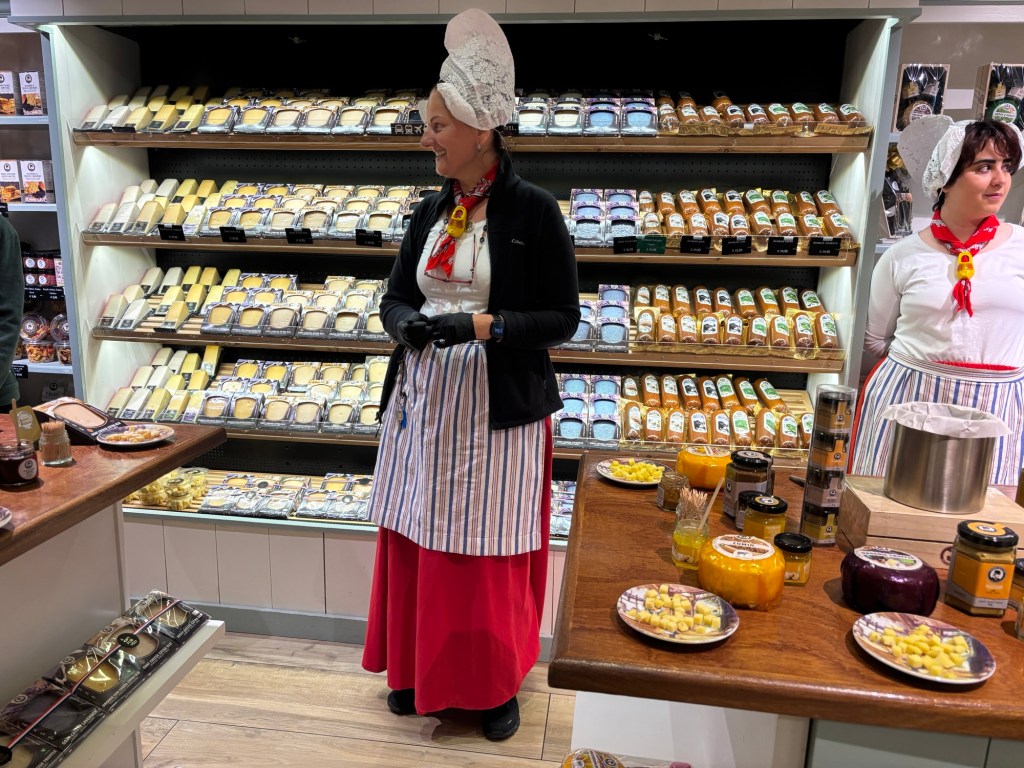
We stopped for Gouda cheese, which is aged beteeen two weeks and two years.   Each Dutch person eats about 34 lbs of Gouda cheese a year.  Edam is also a local cheese.

We started by watching a video about this dairy farmer’s ways.  His philosophy is that happy cows make the best milk and the best cheese.  His cows can be outside in the pasture or they can be reclining on soft hay in the covered area.  They can be milked or not as they feel the need.  The video showed how the cows walk themselves to an automatic milker.  We all loved this farmer.

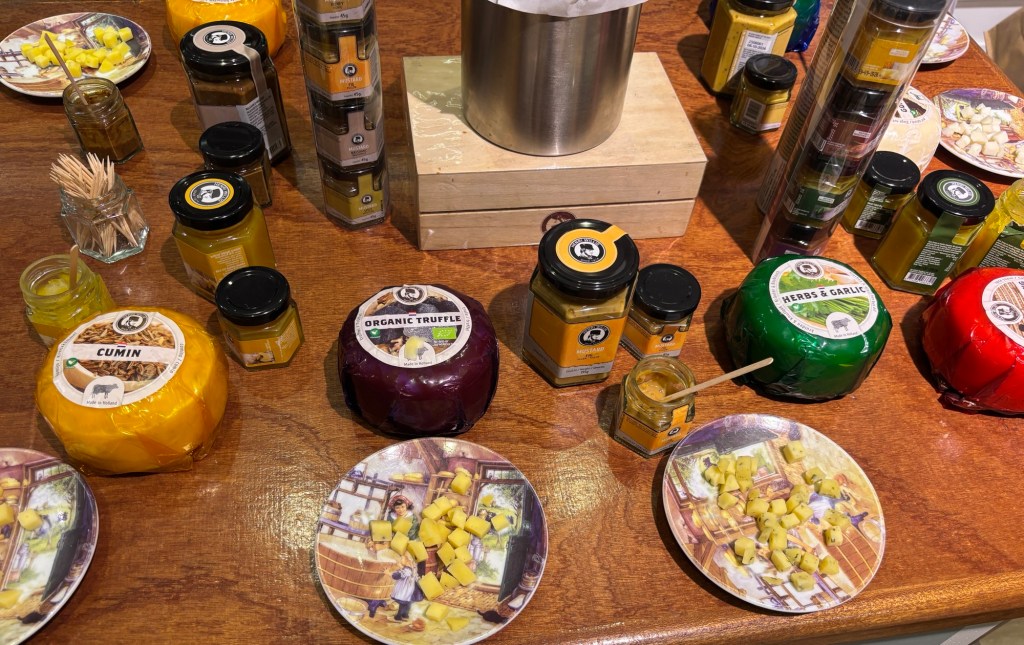
The cows did make delicious cheese.  We were able to sample about 20 kinds of cow, sheep and goat cheese. 

My favorites were the “goat cheese extra old” and “rosemary and thyme.”

Randy said he liked them all.  Several in our group bought cheese but we were in a hotel without a refrigerator heading to a cruise ship.
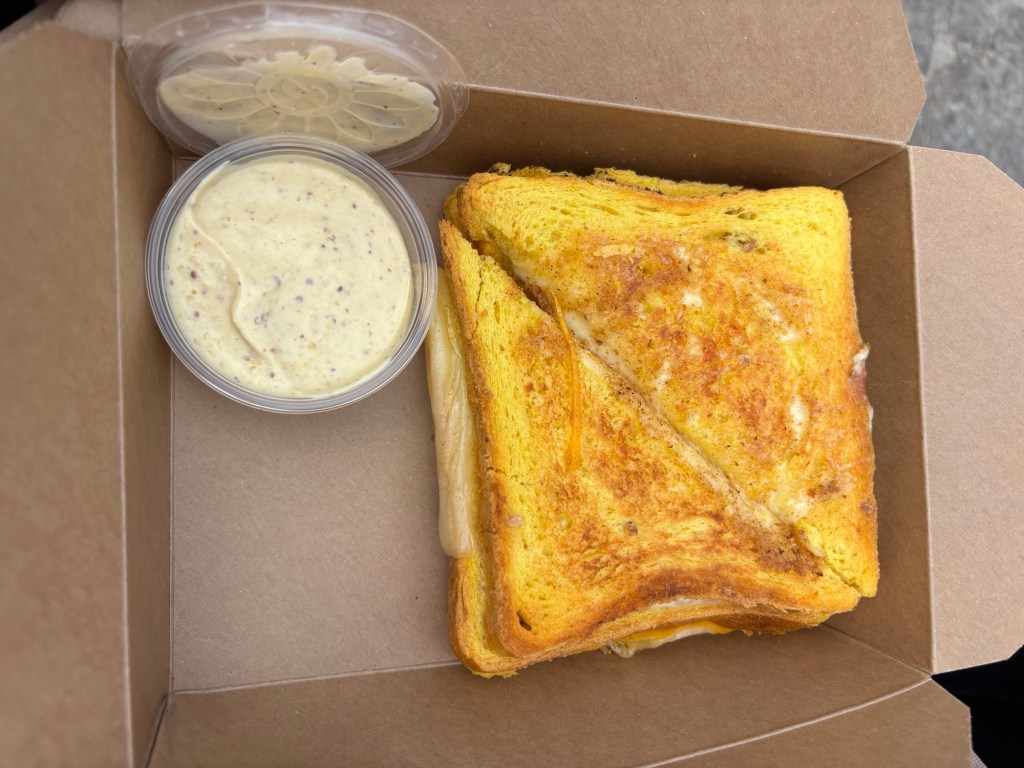
Our next stop was for take away grilled cheese sandwiches made with edam, gouda and cheddar cheeses.  The dip had a mayonnaise base.

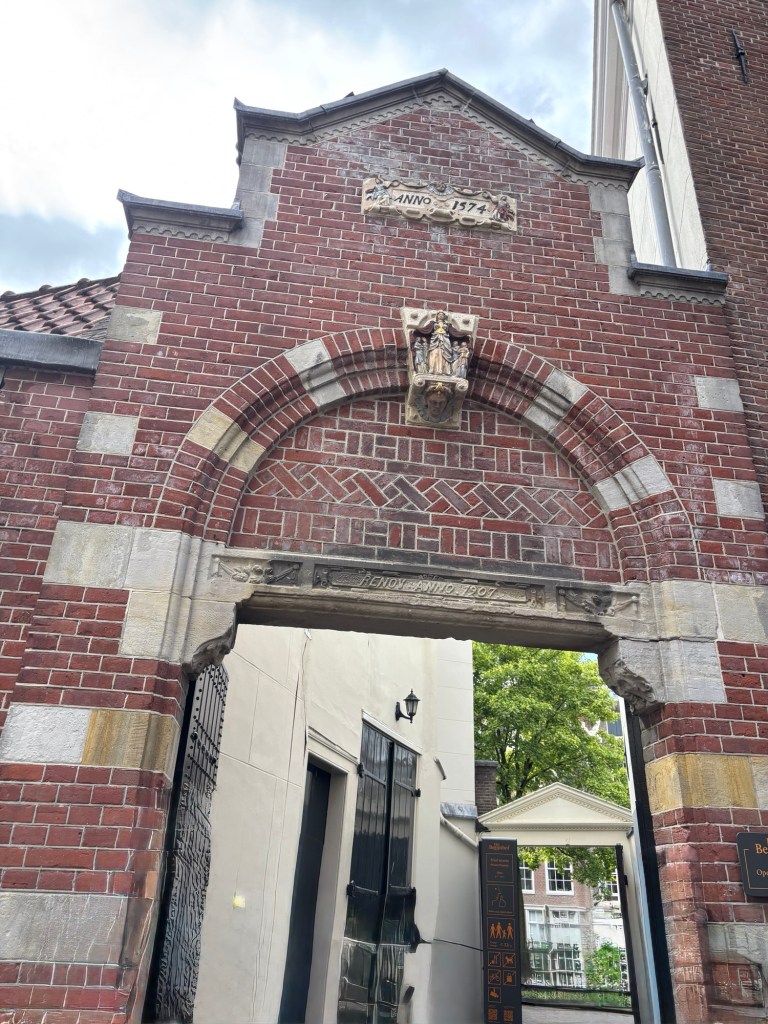
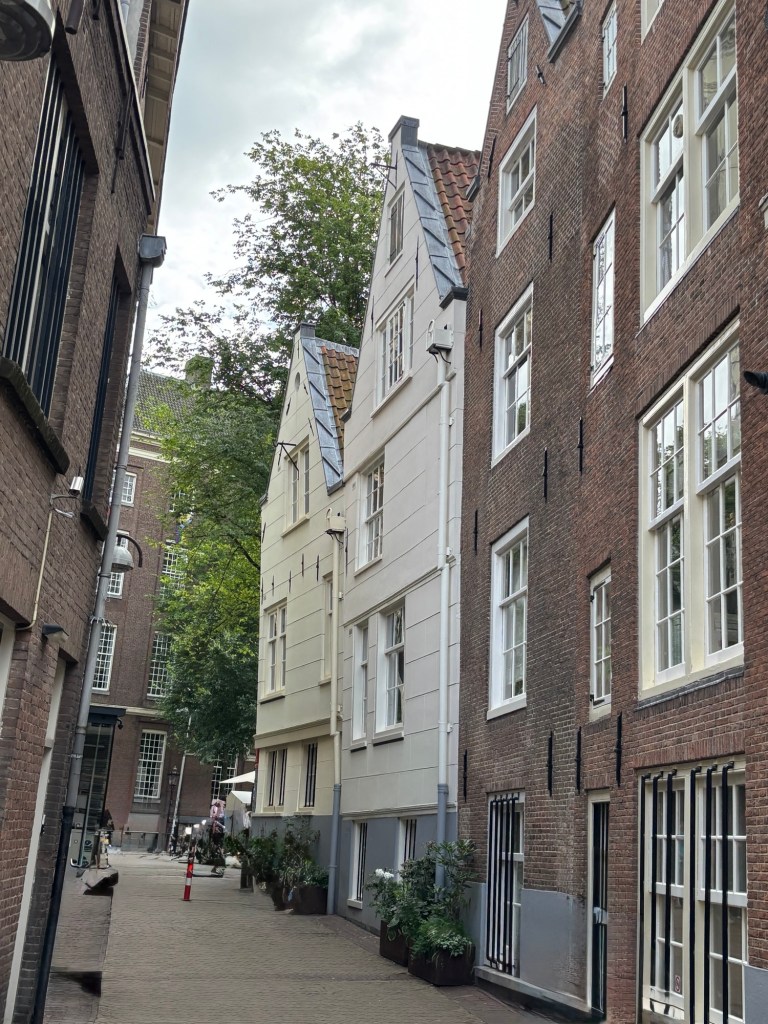
We walked a bit and came to a unique part of the city.  There are 105 women who live in this protected community of apartments. It is designed to give childless, unmarried women, 35 and older, with limited income, a safe community. 

There used to be more of these communities around Amsterdam, some run by the church, and later by the city.  Visitors may access the public courtyard during specific hours.

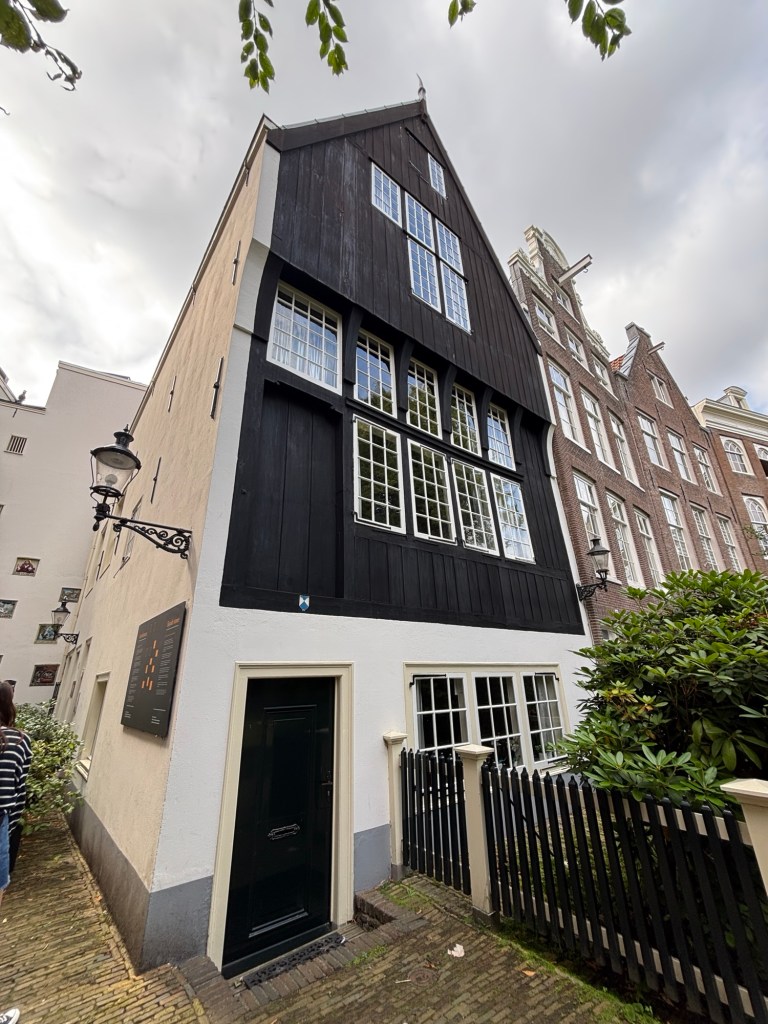
The last wooden house in Amsterdam is here.  It is over 600 years old.   Many houses in Amsterdam were once built of wood, but repeated fires initiated a required change in materials.

Directly across from each other are Protestant and Catholic Churches.  Both are active and allow participation from outside the women’s community.

The Netherlands was ruled by Spain for many years and was, thereby, Catholic.  When it became independent, the country became protestant. In tolerance, they allowed some Spanish Catholic churches if they were “hidden”  

This Catholic Church was one of them.  There is nothing denoting a church from the outside construction.

When the Dutch became protestant, they became Calvinists. Calvinists didn’t allow themselves pleasure in food.  As a remaining characteristic in Dutch culture, food preparation and eating is done as efficiently as possible.

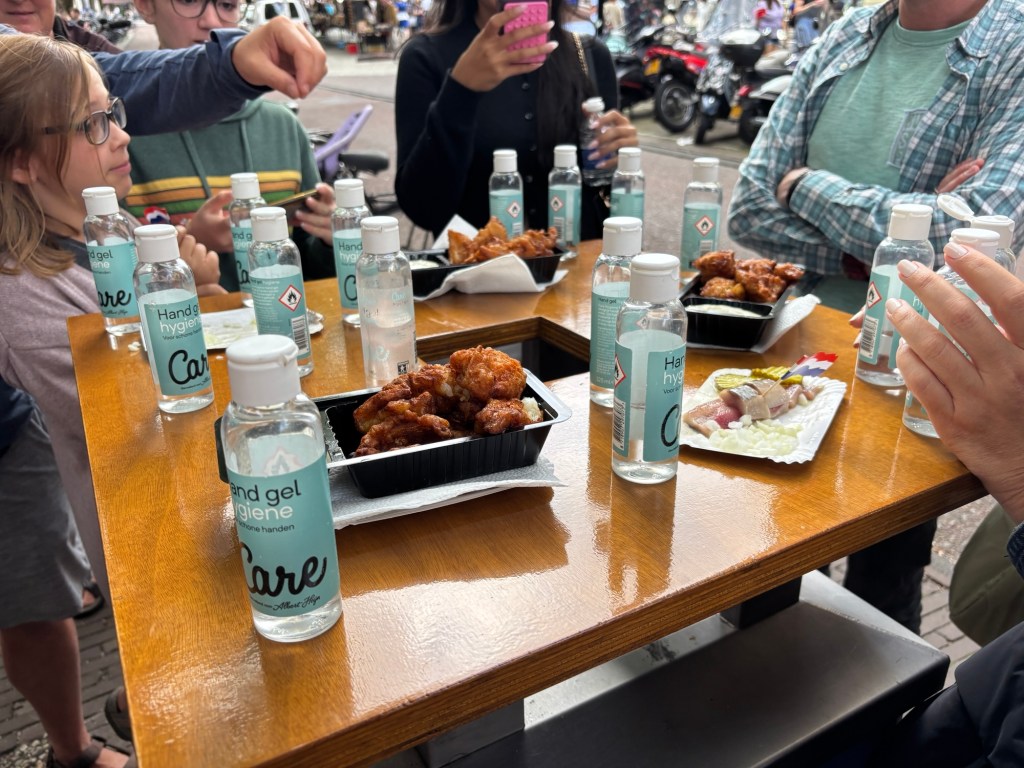
Thus, our next food stop was for take away fish. 

Our group circled around and ate from the top of a trash can!  Roman did clean it off and gave us hand sanitizer.  It was kind of strange, but it worked.

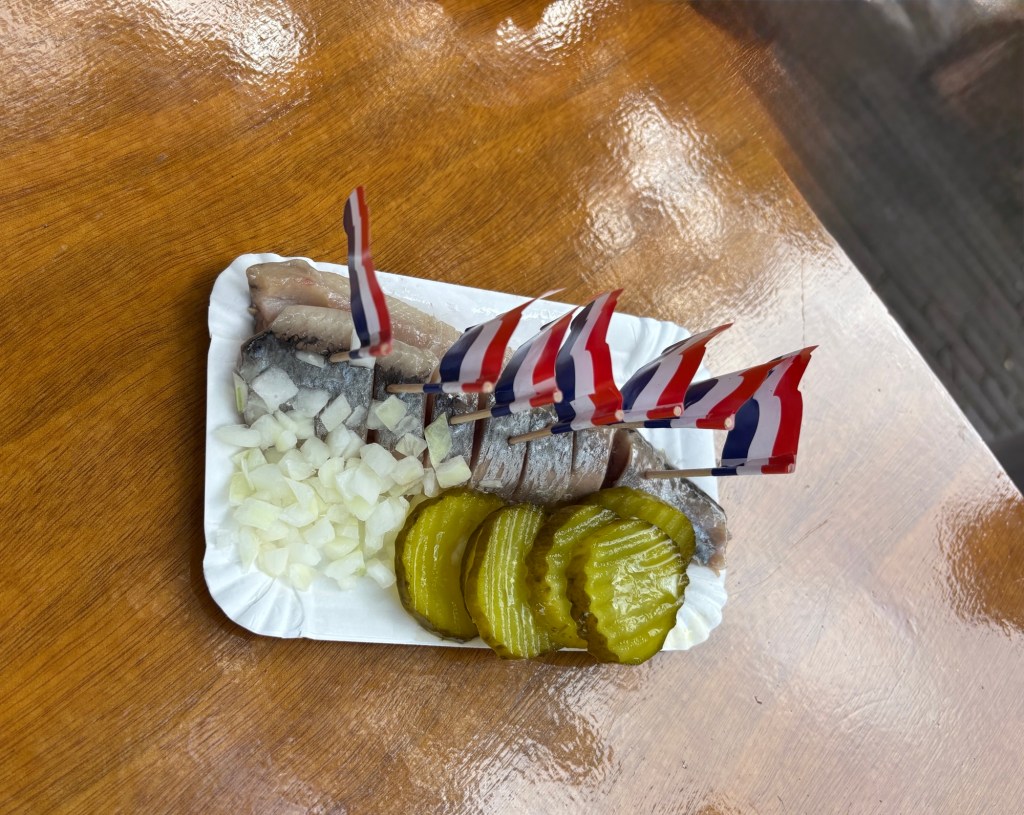
Our first “course” was herring with pickle and onion.  I try to be a good sport in these settings and eat a little of everything – even things I think I’ll hate.  I didn’t hate the herring – but the dominate taste was the pickle so that helped.

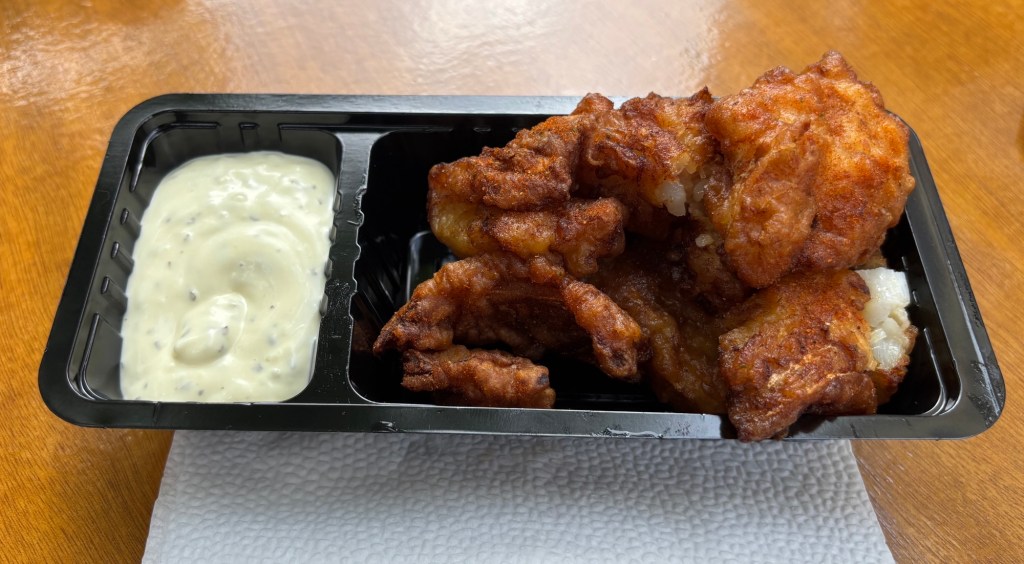
The second sampling was kibbeling, or fried cod.  It tasted just like any fried fish to me, but Randy liked it.

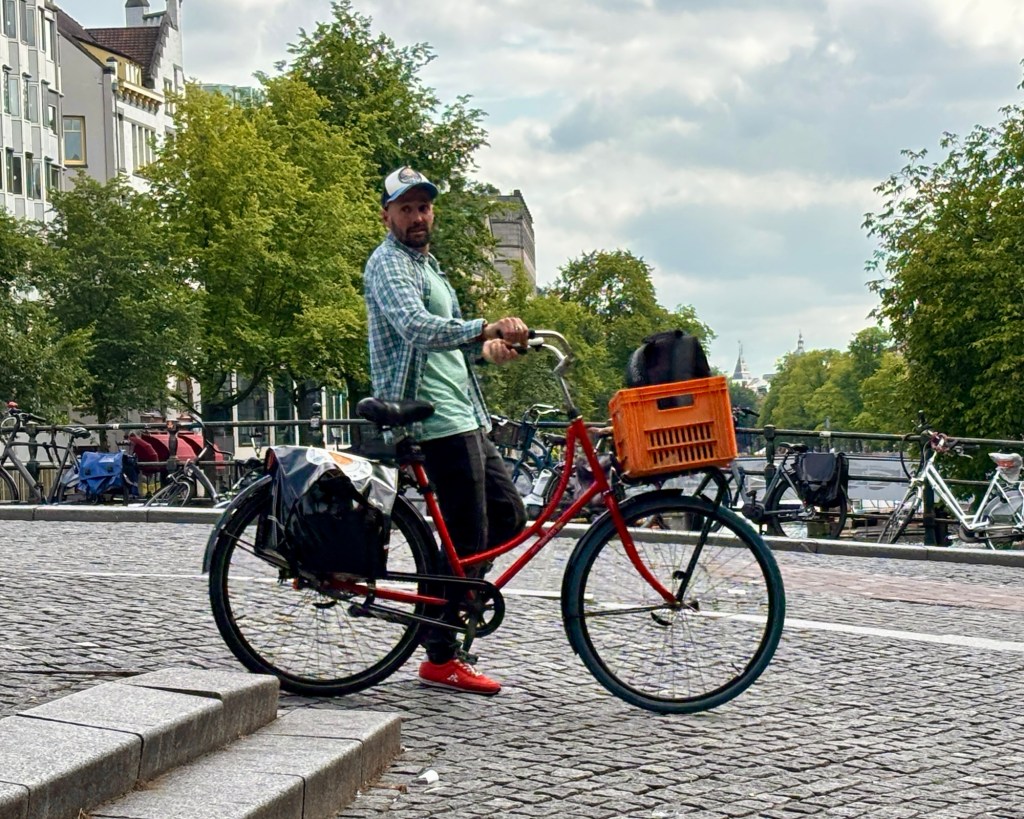
Roman continued to push around his bike as we walked from place to place.  He had some things for us in his packs.  His bike is a rental for €19 per month. The rental price for tourists is €15 a day.  The rental shop will fix anything that needs to be repaired and replace it if it gets stolen as long as he can prove it was locked.  Proof is having the key, removable only if the bike is locked.

Roman stressed repeatedly that Amsterdam is very safe BUT over 500,000 bikes are stolen every year. He said it’s a national craze.

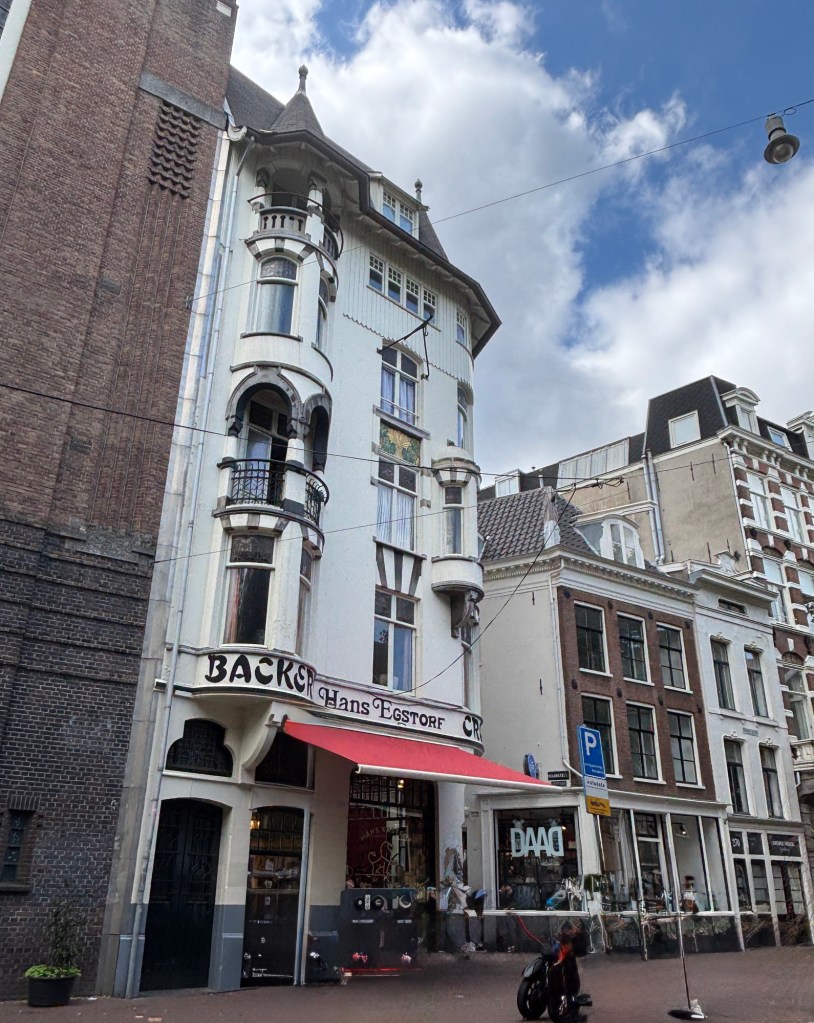
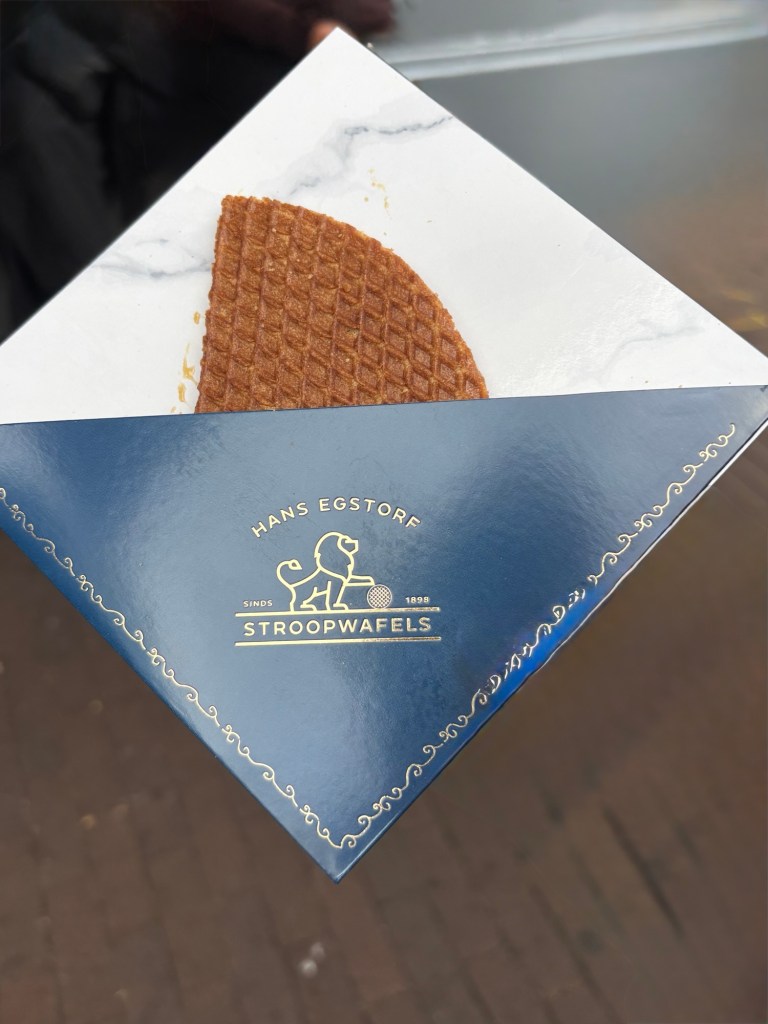
Hans Egstorf is the oldest bakery in Amsterdam. We stopped for stroopwafels. 

We have had the crisp, packaged version before but not ones hot out of the waffle iron.   They had a ginger/clove taste with caramel flavoring in the middle.

Food tours are interesting, not just for the food, but for the quirky things you learn.  

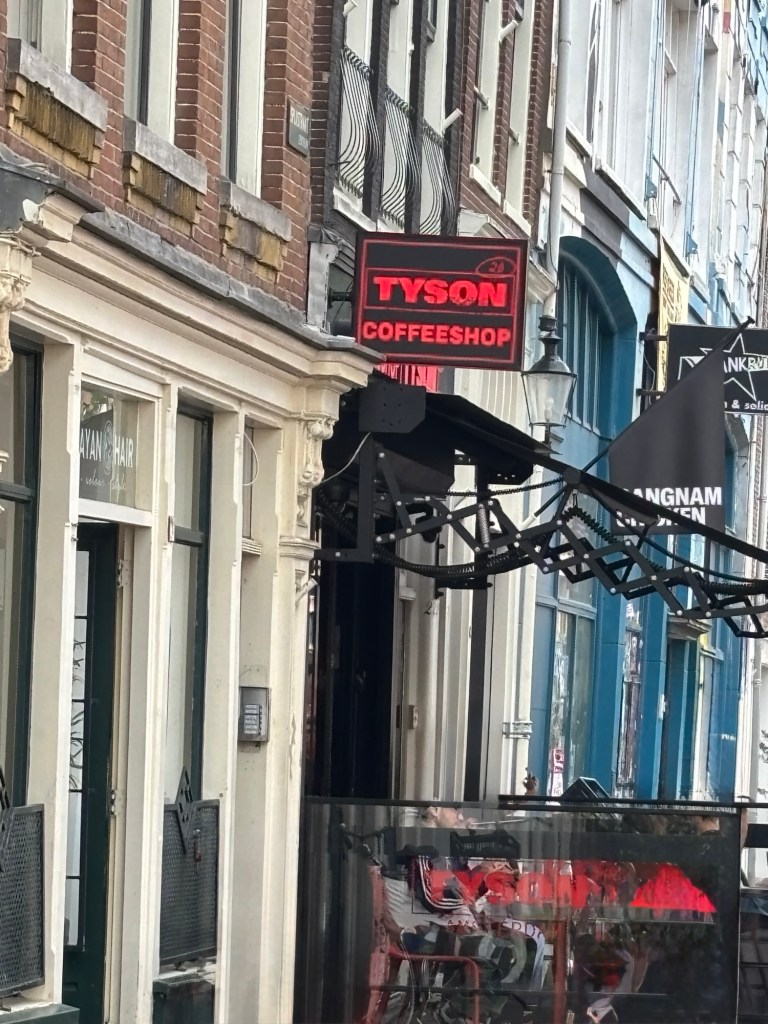
A coffeehouse sells canabis, not coffee.  This one is owned by Mike Tyson.  If you really want coffee, go to a cafe.

We had gone to a cafe to get coffee right after arriving in Amsterdam that morning. Mostly, we wanted to get change from a 50 Euro bill.  The proprietor said she couldn’t make change so early in the day but explained how people get change in Amsterdam.  She directed us to a nearby grocery store to buy a small item.  She said to use a checkout machine that would take cash to get the change back.  I’m sure it was comical for others to see how confused we were because there were no directions in English.  The young man behind us, who wanted to use the machine, helped us.
And the most fun story we heard – The Netherlands gained independence from Spain and became the first republic in Europe in the 1630s.  However, the Dutch eventually chose monarchy and were ruled by descendants of conquering hero William the Orange.   According to the legend, farmers crossbred carrots to give them an orange color to honor their monarch.  The orange carrot color grew in popularity, spread around the world, and became the dominant color.

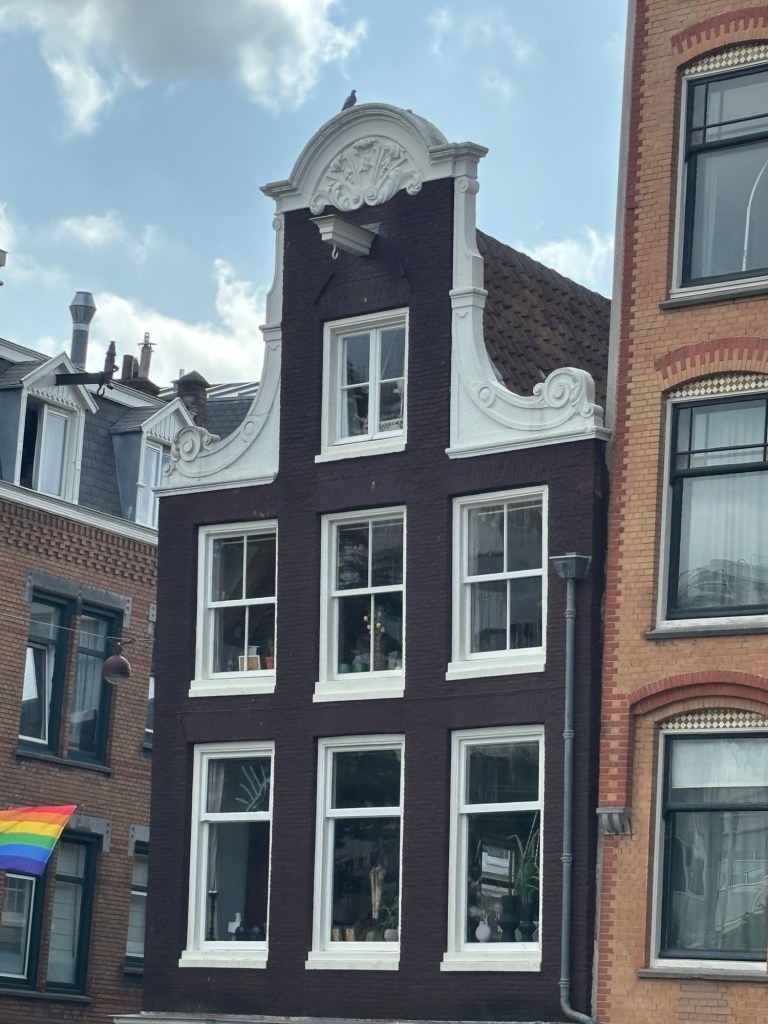
Most houses in Amsterdam lean forward with a hook near the roof.  This allows for packages and furniture to be hoisted up.  The stairs within the houses are usually far too narrow. 

Our food tour group crossed the largest canal bridge in Amsterdam. The bridge had many people on it but I have learned how to edit them out.  Amsterdam was plenty crowded that day – just not in my pictures.

The bridge used to have prison cells underneath it and one enclosure is still visible.

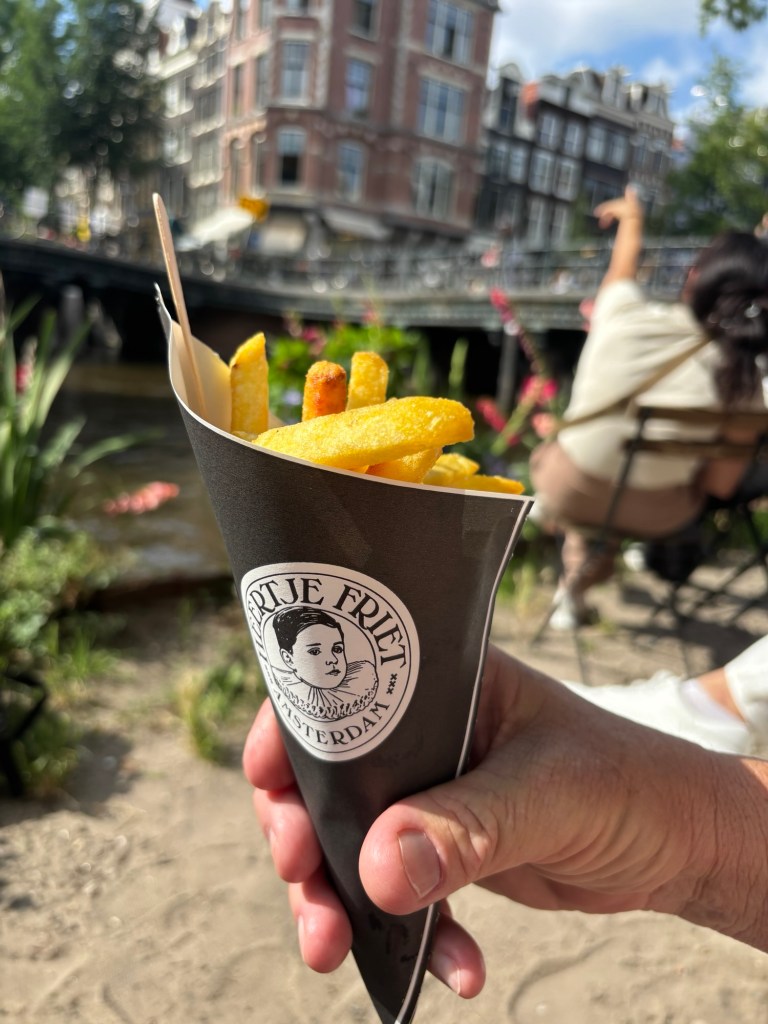
Our next course, again as take away, was french fries with a mayo curry sauce.

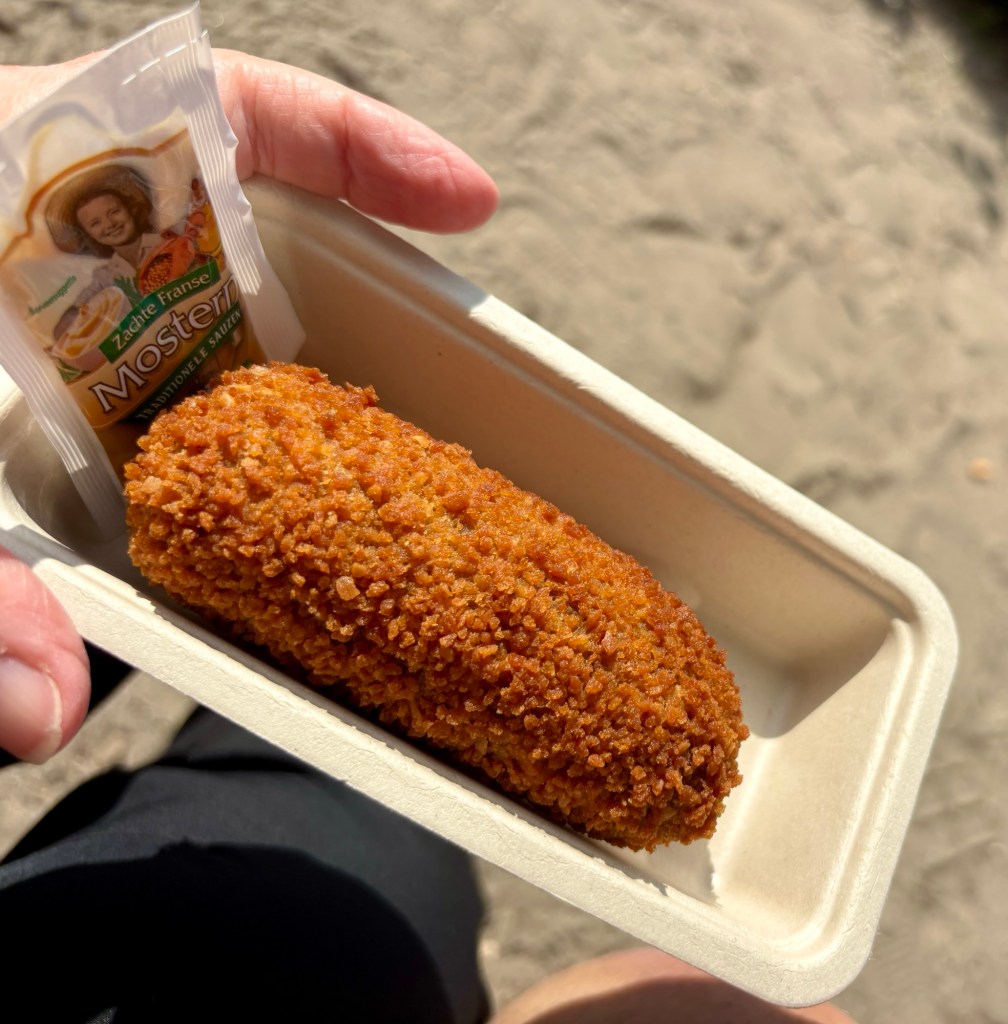
Then we had a kroketten, or beef filled croquette.  It was pretty good.

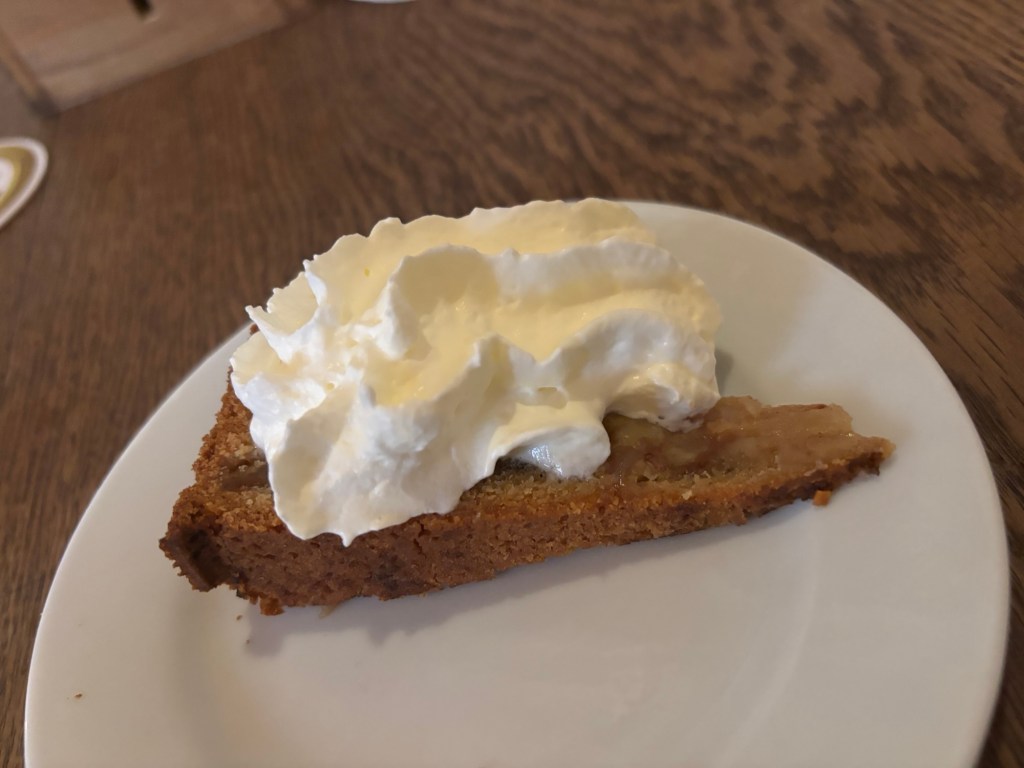
The only time we sat in a restaurant during our three hour tour was for our final course – Dutch apple pie!  We had Dutch beer with it!

Food in the Netherlands is generally simple, frequently fried, and quick to prepare and eat, usually while standing.   There just isn’t a foodie culture here. The food tour though, was still a blast!

Next up:  We learn about something that really is part of the Netherlands culture – windmills.

Posted in Uncategorized | 1 Comment

Two Cruises 2025: Anne Frank Day

We woke up in Rotterdam about 4:45 am local time on July 25, very happy to have slept as long as we did after our long travel day.

If you read my post on planning this trip, you know that getting tickets to the Anne Frank House was a significant endeavor fraught with illness, time change, international credit card fraud and persistence.  Okay, that is exaggerating a bit, but all aspects are somewhat true. Today was Anne Frank Day.

We had breakfast at the hotel and engaged an Uber to the train station. 

There were so many bicycles parked outside the station.  Bicycles are the prime mode of transportation in the Netherlands and seem to have right of way over everything.

The station uses a tap-on tap-off system like we have experienced before.  Of course, we generally have no idea how much we will be charged for these European mass transit activities, but it is never very much. 

We had a general idea of where to go from the helpful desk agent at the hotel.  We tried to look at the information boards for confirmation and understanding.  However, for a country in which everyone seems to speak some amount of English (thank you very much) there is almost no signage in English.  
We did recognize these!

We had to pay, again by credit card, to use the water closets. The funny thing was that women paid .5 Euros and men paid .9 Euros. Would that relate to which had to be cleaned more often?

The trains were electric and very quiet. The platforms were clean.

We were pretty confident we were in the right place.

We boarded and sat down to enjoy our ride to Amsterdam.  We were talking quietly when were shushed and told that we were in the silent car.  The woman pointed to the notice below the window.

We were novices and happy to learn – also very happy to accidentally be in a silent car. We had 75 minutes of silence to Amsterdam Central.  The trains interior was very clean.

These fields were for flowers, but past their season.

Again, although everyone we had interacted with for the last 24 hours spoke some English, the announcements on the train were only in Dutch.

Upon exiting the train, we followed the crowd out of Amsterdam Central, remembering to tap out. (We later learned that our tickets were the equivalent of $22 USD each.) 

Looking at Maps on our phones, we decided we would walk to the Anne Frank House.

A few things looked familiar from when we were in Amsterdam 18 months ago.  Northern Lights Cruise: Amsterdam is the link.

Today was the day to absorb what happened right here in Amsterdam during the Holocaust.

There were between 25,000 and  27,000 Jews in hiding in the Netherlands,  1/3 of whom were eventually betrayed.  Families were often separated while in hiding as it was less of a burden on the people providing shelter to care for one or two people rather than an entire family. 

These are pictures we took from outside. No photography was allowed inside.

We had timed entrance and then followed a tight queue throughout the building.  We saw the offices where the “helpers” worked. The helpers were four employees of Otto Frank who assisted those hiding by providing food and other essentials. Since we had both recently read books about the betrayal of Anne Frank, all of the names and events were familiar.

The place was different than I expected in that all the rooms were so compact.  That should have been obvious given the narrowness of the building.  We went up several flights of steep narrow stairs, with one or two rooms for offices on each floor.

This picture is of the bookcase that hid the opening to the stairs going up to the secret annex.  This picture is from the website and is exactly what we experienced.  The bookshelf is original but is encased.

Once in the annex, Randy noticed how squeaky the floors were.  That was just a reminder of how quiet the eight people in the annex would need to have been during the day.  There were four in the Frank family, three in the Van Pel family and Fritz Pfeffer.

We were able to walk through each of the annex rooms including one for Mr and Mrs Van Pel that also served as a communal room.  There was a bedroom for Mr and Mrs Frank and older daughter Margot, and another for Anne Frank and Fritz Pfeffer.  Anne’s side of the room was decorated with magazine clippings and photographs.  The only room we did not see was Peter Van Pel’s room in the attic, accessible only by ladder.  

Where the office rooms had been smaller than I expected, these rooms seemed larger.   However, I do not doubt that they felt very small to the eight people trapped in them for over two years.  There was very little natural light.

The occupants of the secret annex were betrayed and captured in August 1944.  They were on the last transfer to Auschwitz.  Anne and her sister were transferred to Bergen-Belsen and died in February or March 1945, just weeks before the end of the war.  

They were so, so close to making it through.  The only one of the eight to survive was Otto Frank, Anne’s father.

Before we left the museum we had an opportunity to see Anne’s diary and other pages she had written on when the diary was full.   Her writings started as her way to express her feelings about life.  She then decided to re-write and focus on telling what happened during the war so it could be known.  This picture is from the website. We saw the diary opened with her writing visible, but just for moments.

Anne wanted to make a difference in the world.  She accomplished that, probably even more so because of her death.

World, do better!

Next up: An Amsterdam Food Tour.

Posted in Uncategorized | Leave a comment

Two Cruises 2025: Phoenix to Minneapolis to Rotterdam

July 23-24, 2025

It was nice to have a reasonable start to our travel day to begin our trip! Our friend picked us up at 8:00 a.m. to take us to the Phoenix airport. 

Upon arriving, we learned our flight to Minneapolis was delayed for one hour.  We purposely had a five hour layover to avoid flight delay concerns so it was no problem for us. Unfortunately, not so for others.

The pre-flight safety video highlighted Delta as the first airline to 100 years old.   Segments were presented by people in period outfits by decade.

We made it to Minneapolis and had dinner and wait time in the Delta lounge.

Our next flight was Minneapolis to Amsterdam.   The gate attendants used facial recognition during the boarding process. That was new to us.  It worked well but made boarding slower than usual.

The 7:33 minute flight was uneventful. We slept for a few hours. 

Welcome to the Netherlands, the land of bicycles!

We had an hour Uber ride to our hotel in Rotterdam.

Usually I am happy to take recommendations from our travel agent regarding hotels, but this time I told her where we wanted us to stay. 

The Hotel New York is located in the 1901 headquarters of the Holland-America Line.

Unfortunately, the employee who gives the guided tours was on vacation so I got what I could from hotel placards and the website.  I will intersperse the timeline with pictures from around the hotel.

The initial business was Nederlandsch Amerikaanse Stoomvaart Maatschappij.  It was renamed Holland America Line in 1896.

A warehouse was added at the back of the headquarters in 1908.

In 1913 the office was expanded with a 38 meter high tower.  A second tower was added in 1917.  

There is a clock on one tower and weather vane on the other.

A scale model within the hotel shows Holland America’s SS Nieuw Amsterdam, built in 1938, as a luxury liner.  It was painted gray and stripped down to be a troop shift during World War II. Because of its speed and strength, it sailed without convoy between the United States and Great Britain.

After the war, Nieuw Amsterdam returned in glory to Rotterdam.  She was re-appointed inside and outside. In 1947, she returned to passenger service. It sailed its last voyage from Rotterdam to New York in 1971.  The SS Nieuw Amsterdam was scrapped in 1973.  That seems an unfortunate end for such a historic ship.

In 1971, with increasing competition from aviation for general transportation, the Holland-America Line (HAL) decides to focus on the American cruise ship industry.  Corporate headquarters moved to Seattle in 1977.

The former headquarters building in Rotterdam was sold in 1984. By 1988, it was occupied by squatters.  That same year, the city of Rotterdam purchased the building.

In 1981, hospitality developers began transforming the property into the current hotel and restaurant, officially opening in 1993.

These are of our room.

These are from the lobby and common areas.

From the hotel’s website:; 

Despite numerous improvements, the building still reflects its rich history, shaped in part by the hopes and dreams of thousands of migrants who embarked on a new adventure from here: a life in the land of opportunity: America!

This picture has the old hotel with modern buildings around it and also a door in the foreground.  There is no explanation about the door nearby, but may be symbolic of emigrants from Europe opening a door to a new life in the Americas.

The park around the hotel and pier is quite nice with green space and artistic features.

The hotel is very close to the pier as evidenced by this picture – probably not more than 100 yards.

The AIDAperla was in port and quick research revealed two interesting facts.  First, this ship was built by Mitsubishi in Nagasaki,Japan.  Most ships we are aware of seem to be built in Italy.  Second, a crew member from the AIDAperla went missing and was presumed overboard in 2023.  A nine hour search failed to locate the crew member and was called off.

We had a nice dinner at the hotel restaurant, got instructions for the train to Amsterdam for the next day, and called it an early night.

Next Up: We make it to the Anne Frank House.

Posted in Uncategorized | 1 Comment