Peru:  Miraflores District in Lima

Our first morning in Peru, we had an opportunity for a tour around the area of our hotel in the Miraflores District of Lima.  A lovely woman showed us around for almost two hours.

Miraflores was once an independent Spanish town established in the 1500s.  It became a district within the city in the early 1900s as Lima expanded.  Miraflores has the upscale residential and shopping areas within Lima and is the primary tourist destination. 
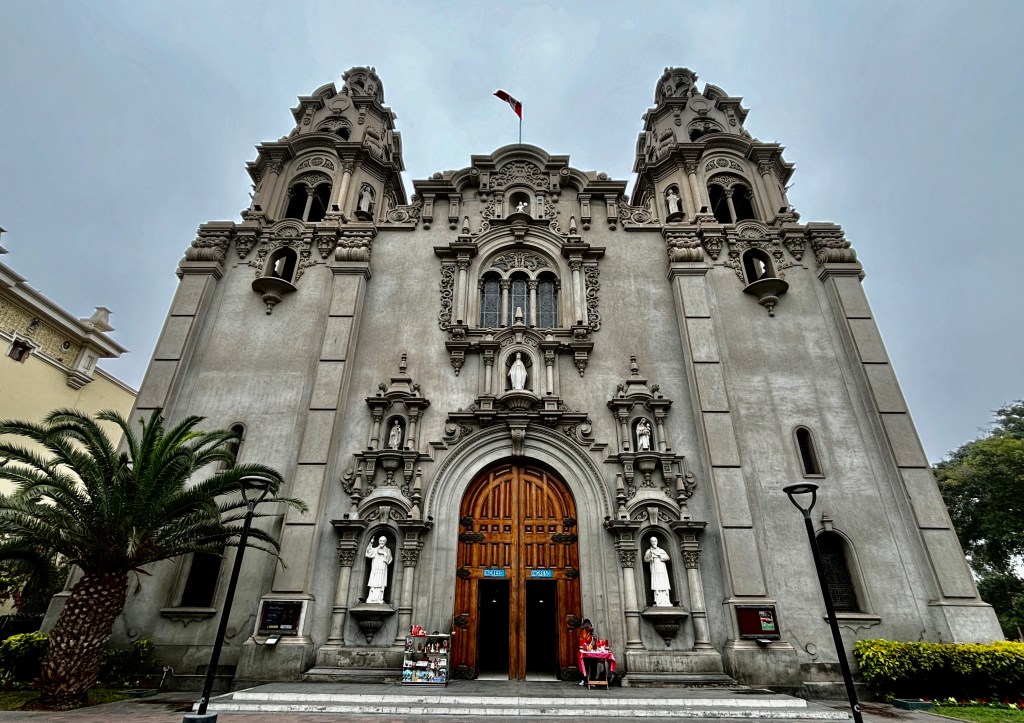
We walked a short distance to a collection of city parks.  The first place we visited was the Iglesia Virgin Milagrosa  or Church of the Miraculous Virgin. It was built in the 1930s over the remains of another church.

The inside was beautiful, as expected.  Do you see the church cat in the foreground?  We saw two cats during our quick look inside.
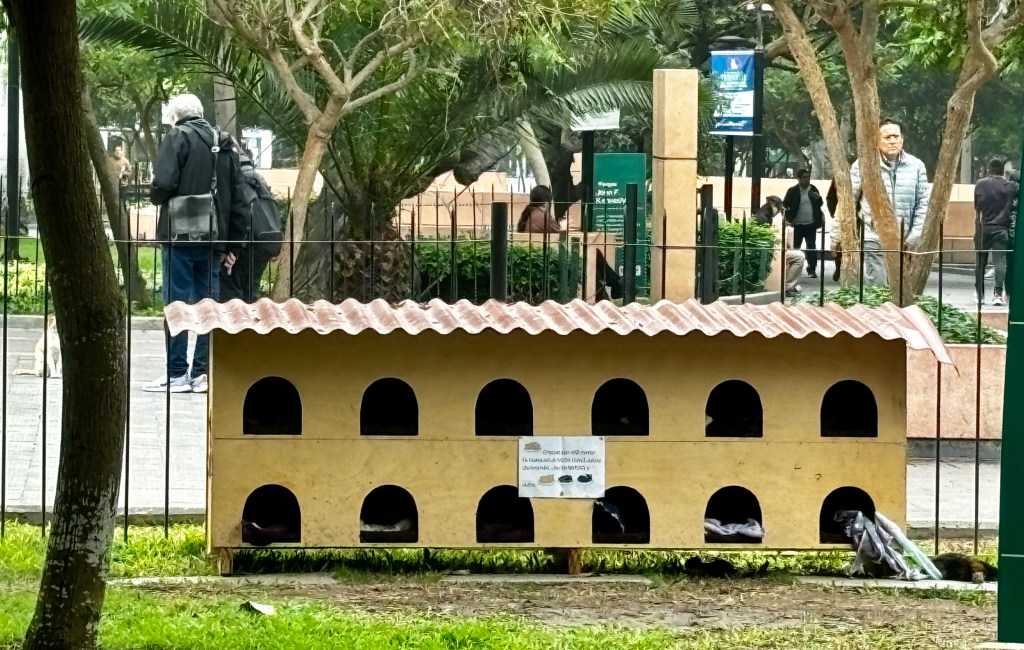
We saw numerous cats on the park grounds.  They were brought into this area long ago to deal with rats. The cats are provided food, shelter, and health care through volunteer agencies. The 20 or so cats we saw appeared healthy and happy.

There are a number of art pieces in the park area. One of the parks is called the Parque Kennedy in honor of US President John F. Kennedy.
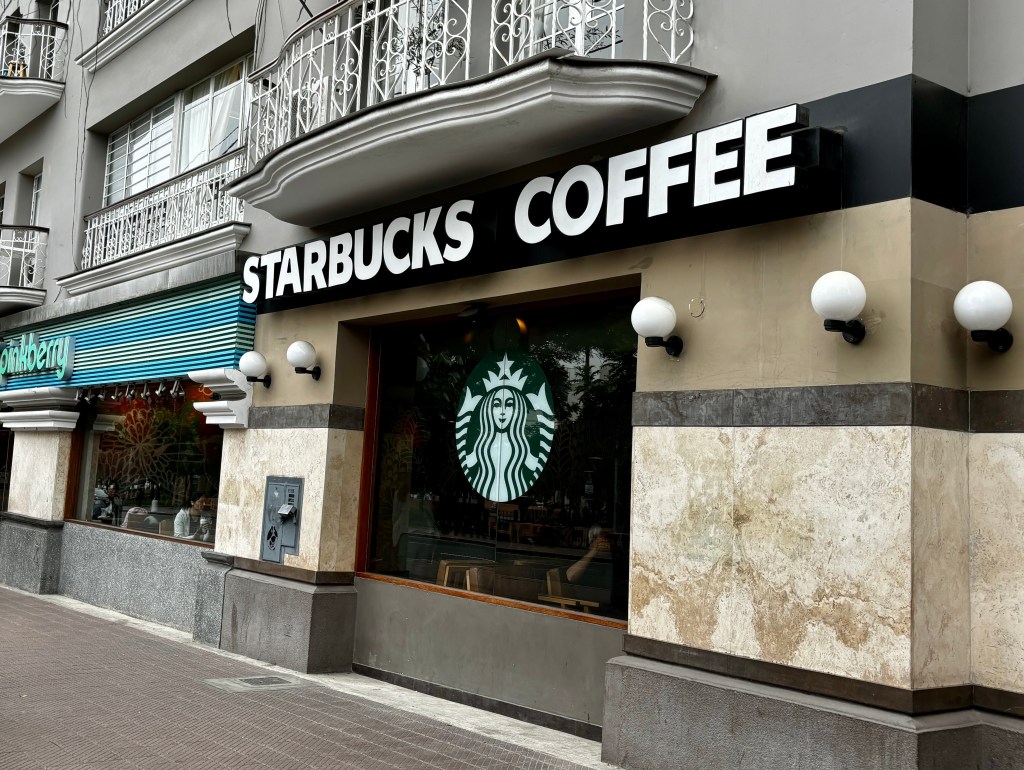
As we walked around Miraflores, we saw several Starbucks and other American transplants such as Popeyes, KFC, Subway, Papa John’s, Chili’s and Dunkin’.
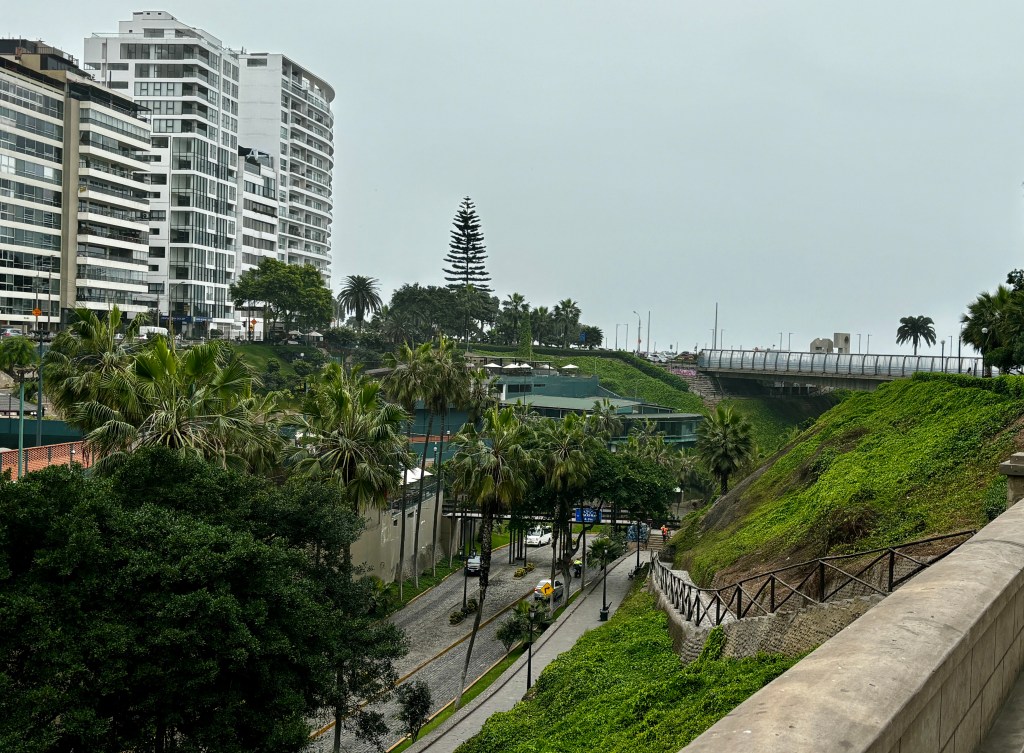
This road used to be an irrigation ravine to the Pacific Ocean. 
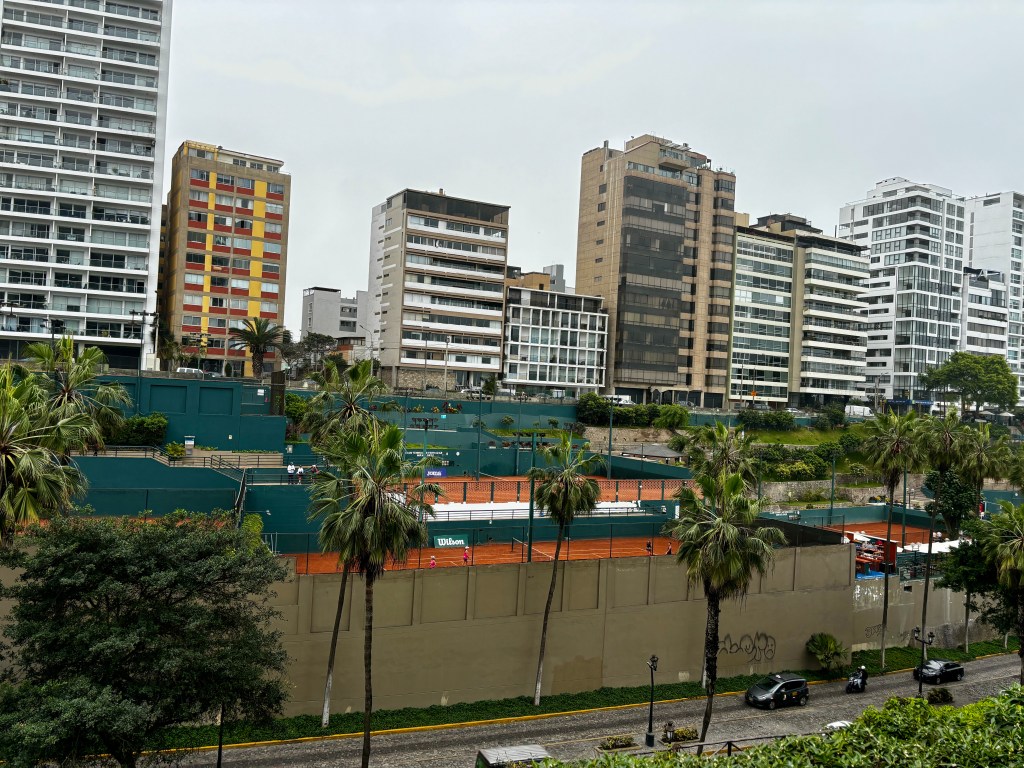
Above, and along the side of the road, is the oldest social club in Peru. It began in 1918.  Today, the club includes 20 or so tennis clay courts perched along several hundred yards above the road.  
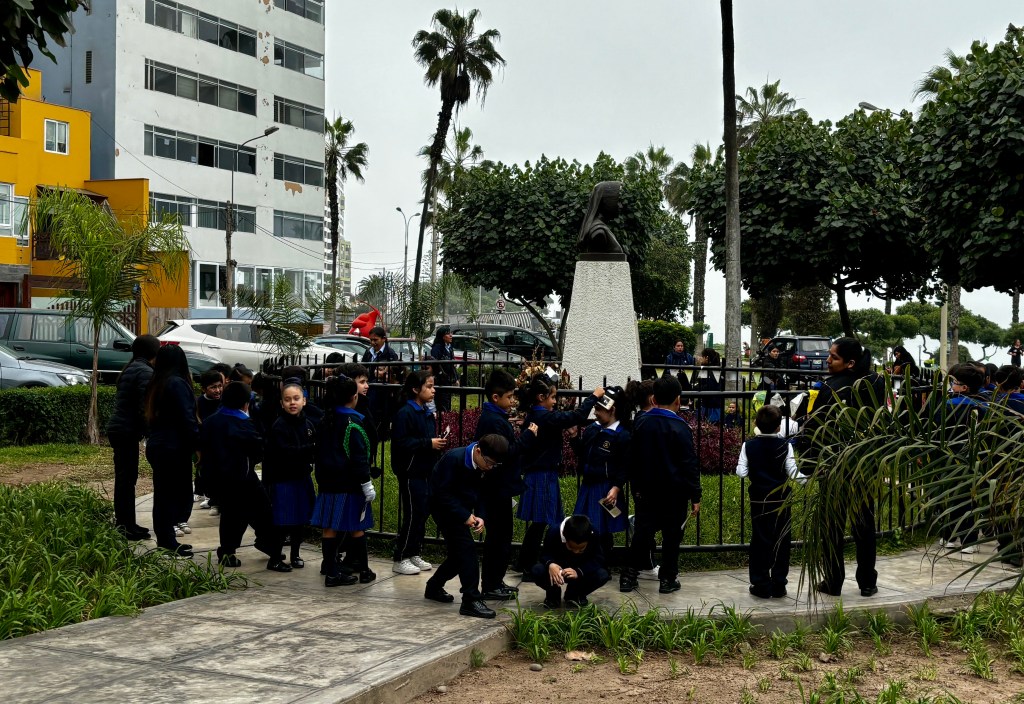
School children in Lima wear uniforms.  Their summer break will be in January and February.  South American seasons are opposite of North America. 

We walked to an area overlooking the Pacific Ocean.
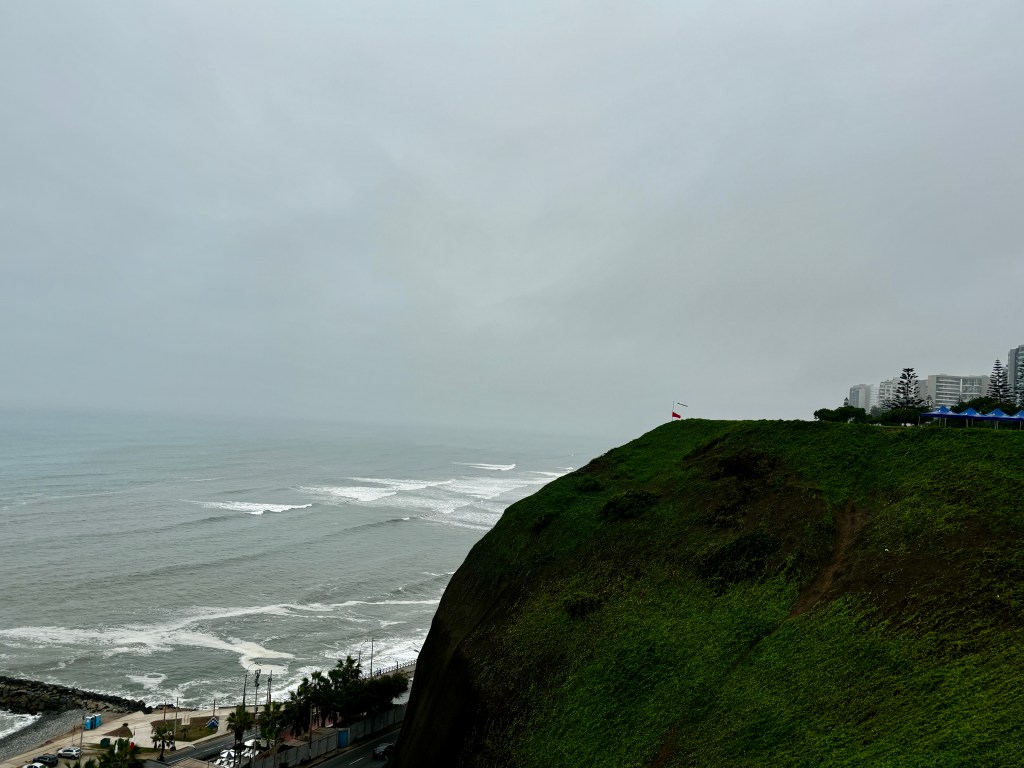
Hang gliding is allowed in this area of Lima, but only for professionals.  There are other areas that allow access for everyone.
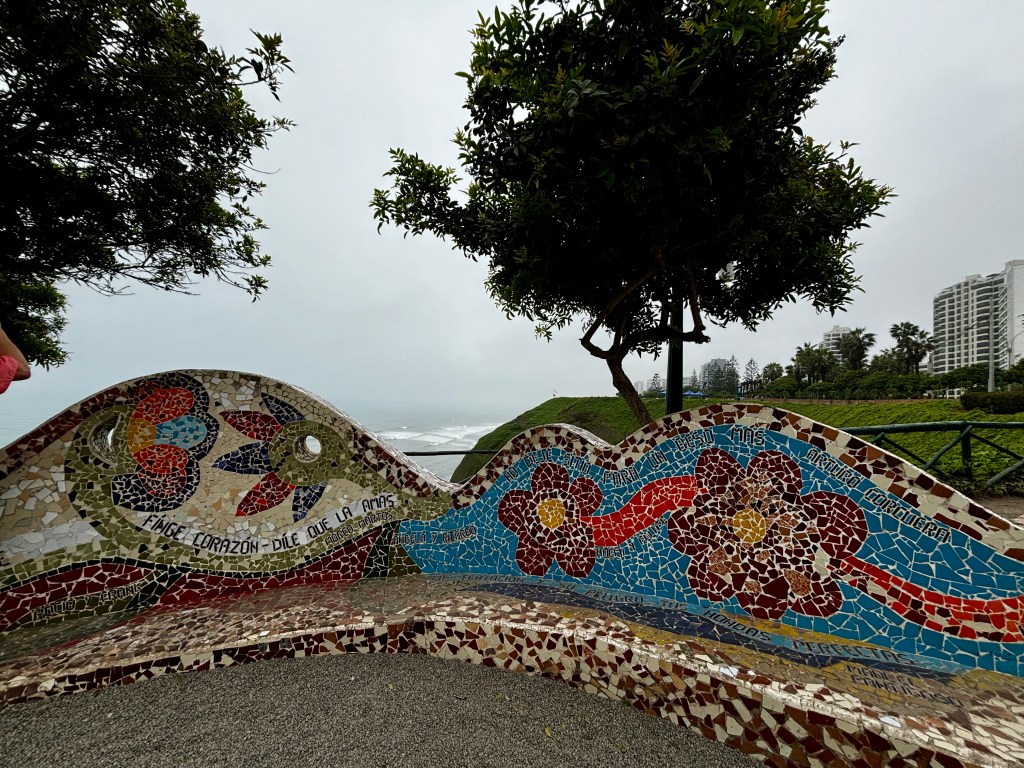
There is another park dedicated to Love. The mosaic wall, going for about 50 yards, is representative.

There are love locks on the fence.

There is a statue called The Kiss within Love Park.
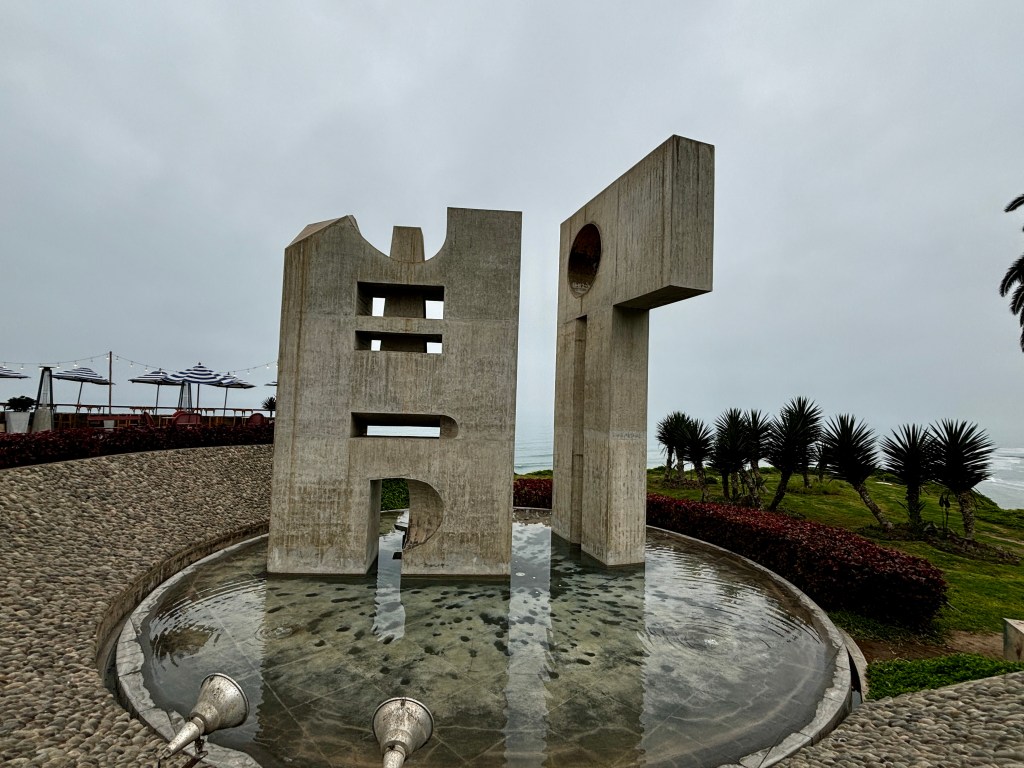
This is an abstract representation of an astronomical clock at Machu Picchu. (Spoiler alert: We didn’t see the original.)

The Waikiki Beach Club is where beginners learn to surf.
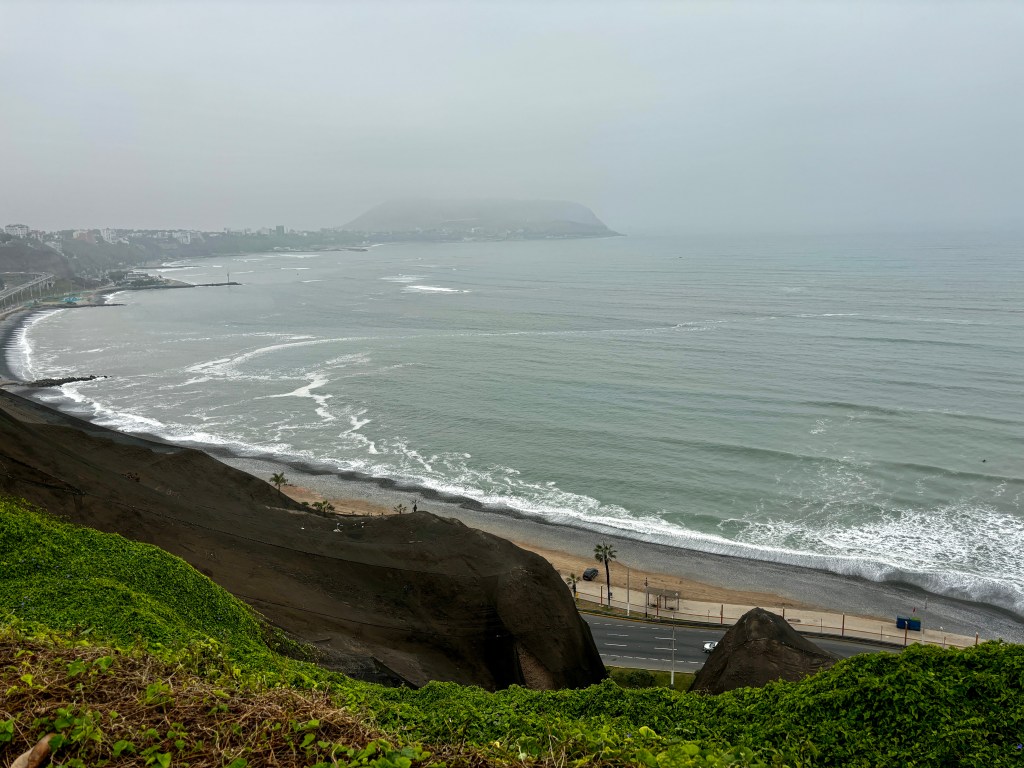
There are black rocky beaches in this part of Lima. Other areas in the city have sandy beaches.  Beaches in Peru are both private and public. 
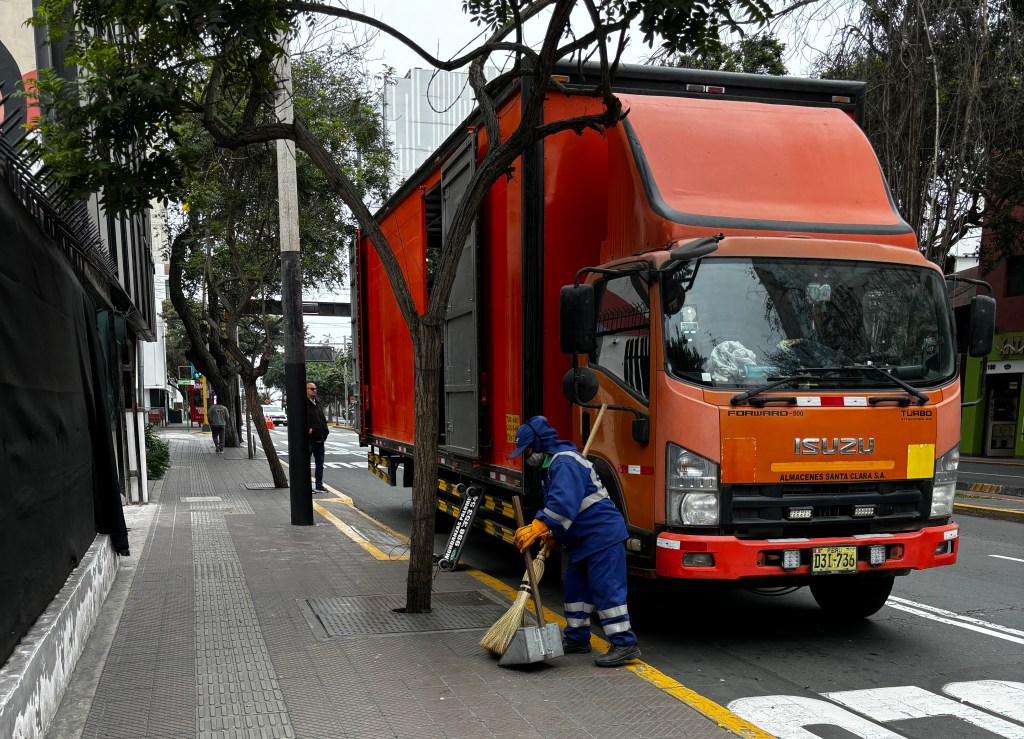
This affluent district in Lima is very clean.  We were aware of many street cleaners doing the work – generally mature women.

During our walking tour, we were warned about the traffic being told that drivers put no stock in the value of pedestrians. We experienced that to be true! 
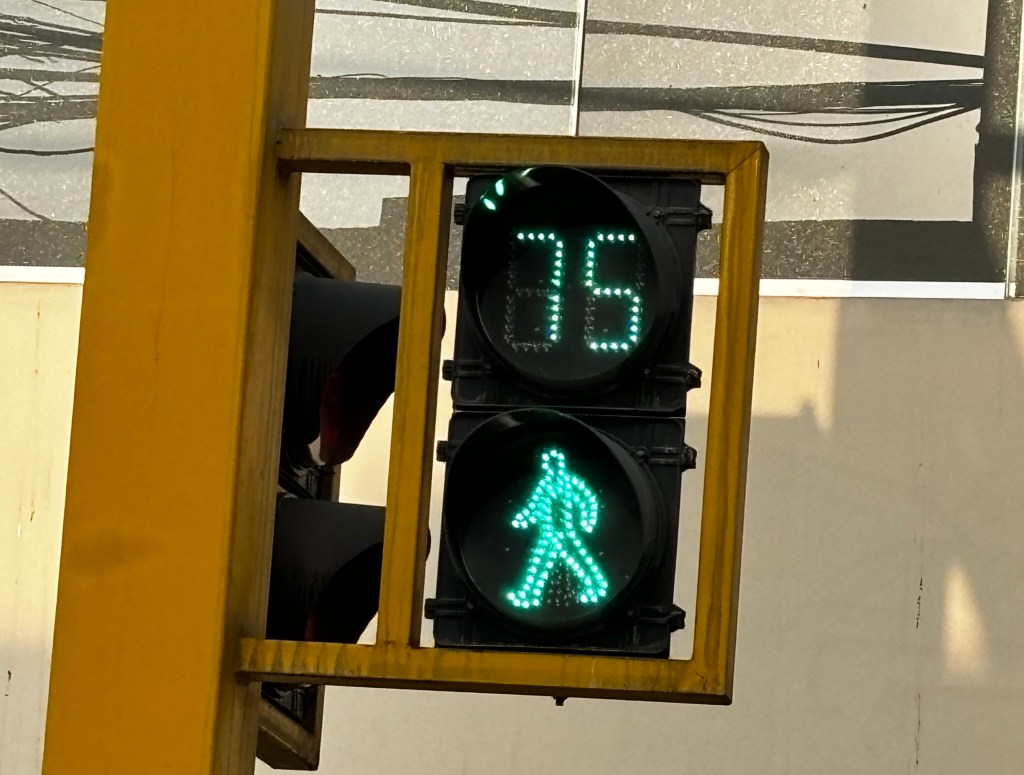
The other thing we noticed was that cross walk signals, supposedly allowing you to cross the street safely, had widely varying number of seconds to accomplish the task. The longest time allocation we saw was 78 seconds. There was no standard from intersection to intersection. 
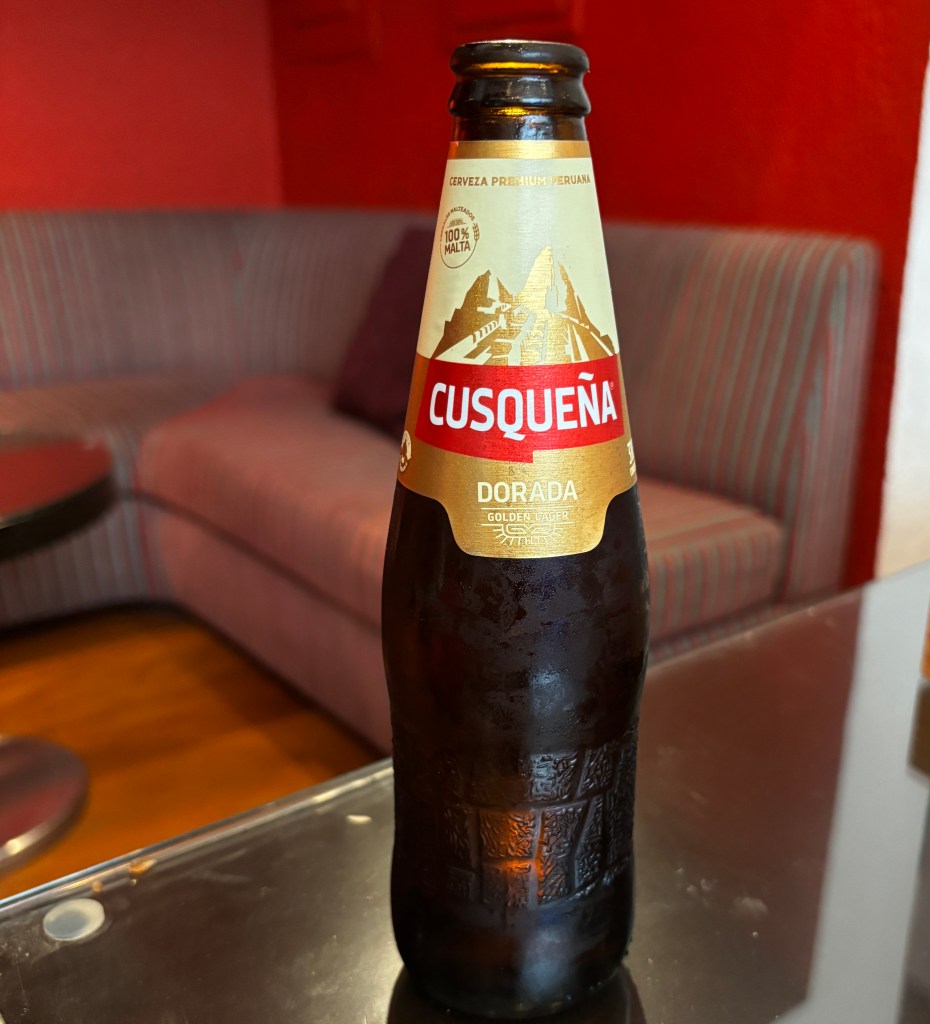
We returned to the hotel and had a couple drinks in the hotel bar, including our first Peruvian beer.   While sitting there, we received a fraud alert on a credit card we hadn’t even had time to use!  While on hold with Citibank, I was thinking about how difficult it was going to be to deal with things that auto-bill to that card while in Peru.  Fortunately, we recognized the activity and it was a false alarm!
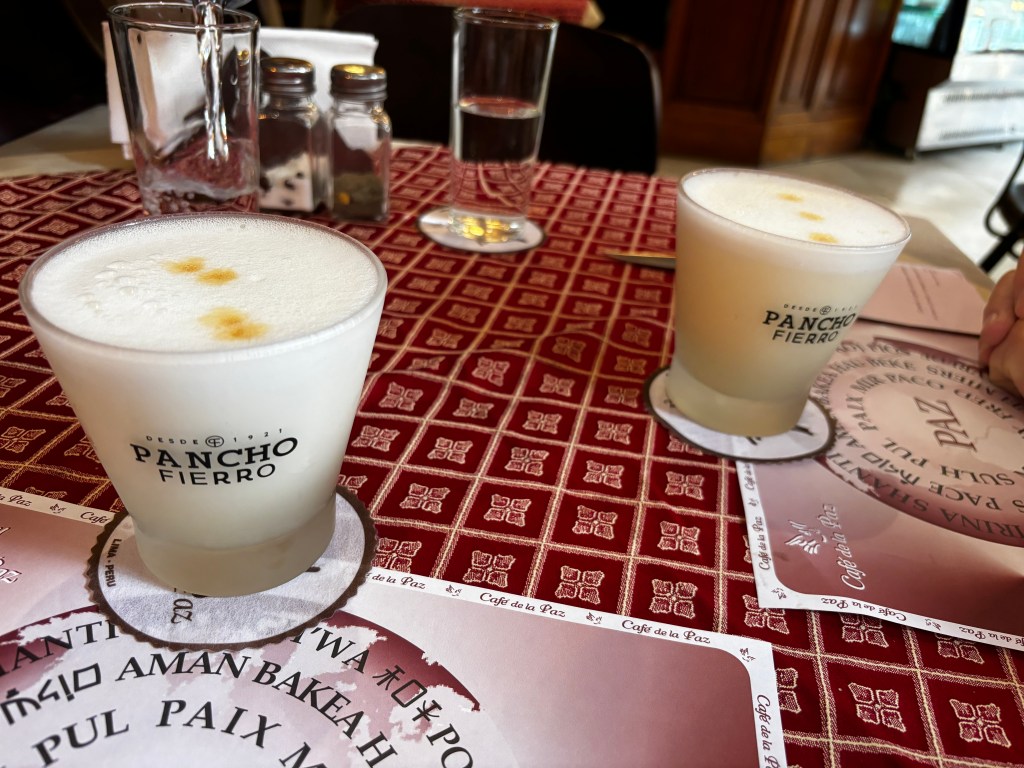
A little later we wandered off in search of a traditional Peruvian meal and found a restaurant that seemed to fit our needs.  We started out with the traditional Peruvian drink, Pisco Sours. They were very good.
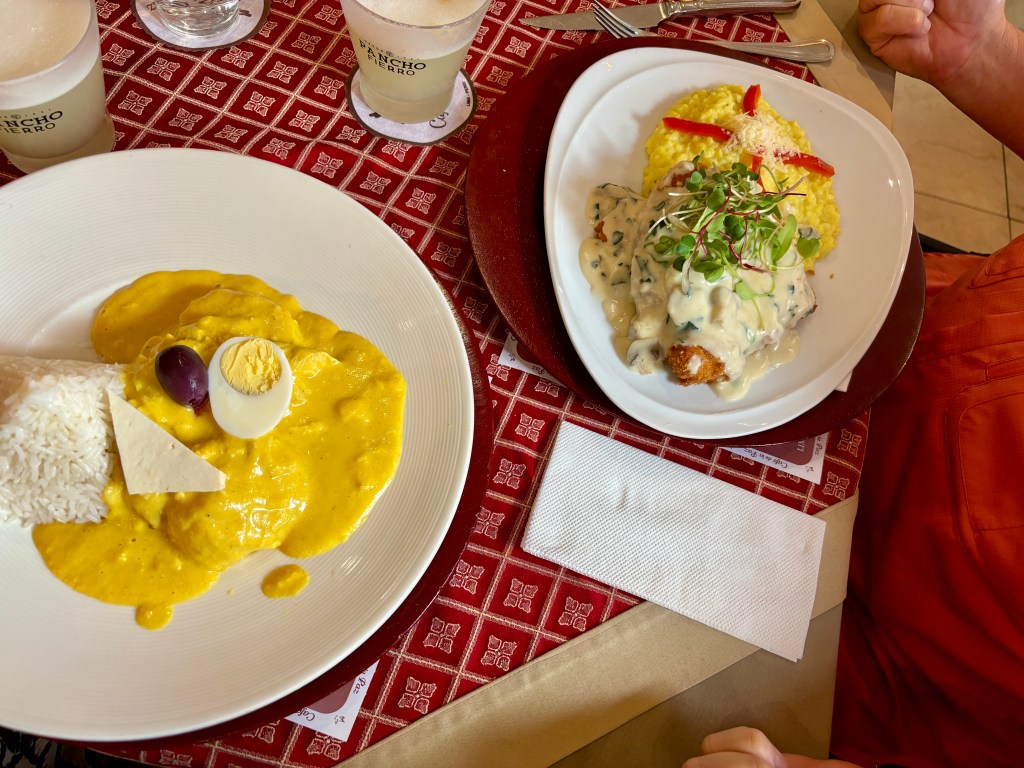
Seafood is very Peruvian, but we eat very little seafood. We chose two chicken dishes to share.  The dish on the left was so traditional that we were served it several times during our trip.

We got lost on our way back to the hotel and had to turn on Randy’s phone to use Maps. Figuring out how and when we might use our phones with our Verizon Travel Passes was part of the preparations for the trip. We knew we’d have cell access in Lima and Quito, but what about the Amazon and the Galapagos? I had given my mother, my brother, our daughter, and our neighbor lists with all of our hotel contact information, along with contact information for the US Embassies in Peru and Ecuador. (Fortunately, Avalon Waterways had provided the information.) We also registered with the State Department about our travel activities. Prep for this trip was a lot – I was glad the prep was done and we were actually on the trip!

We enjoyed our day and looked forward to meeting our tour guide and travel companions the next morning.

We were in Lima on September 13, 2024
Posted in Uncategorized | 1 Comment

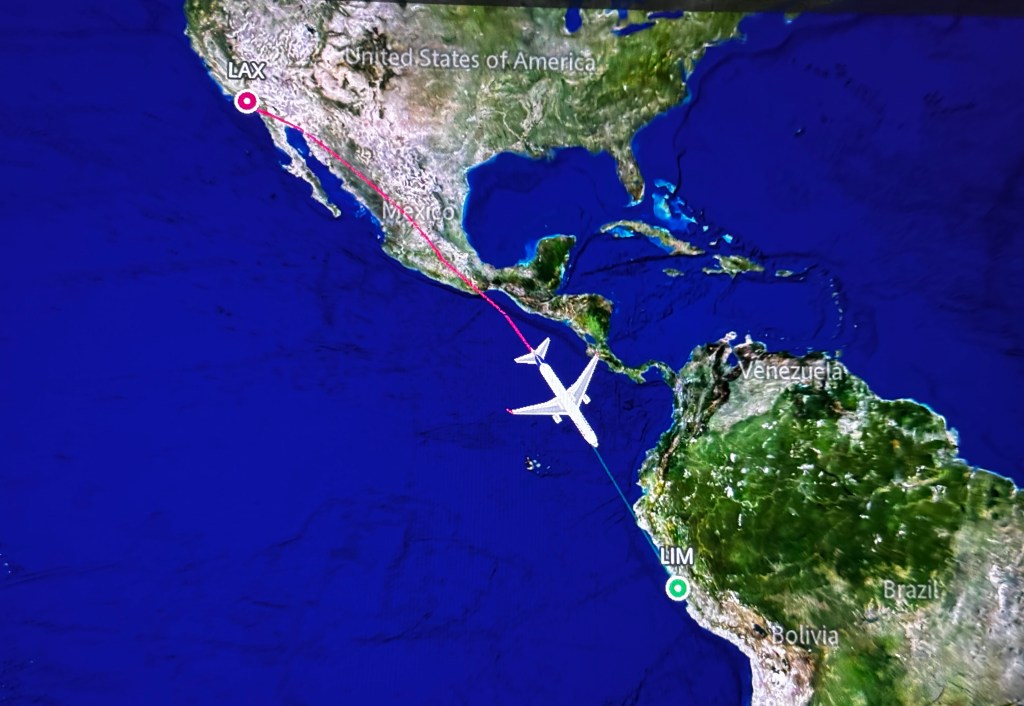
South America: PHX to LAX to LIM

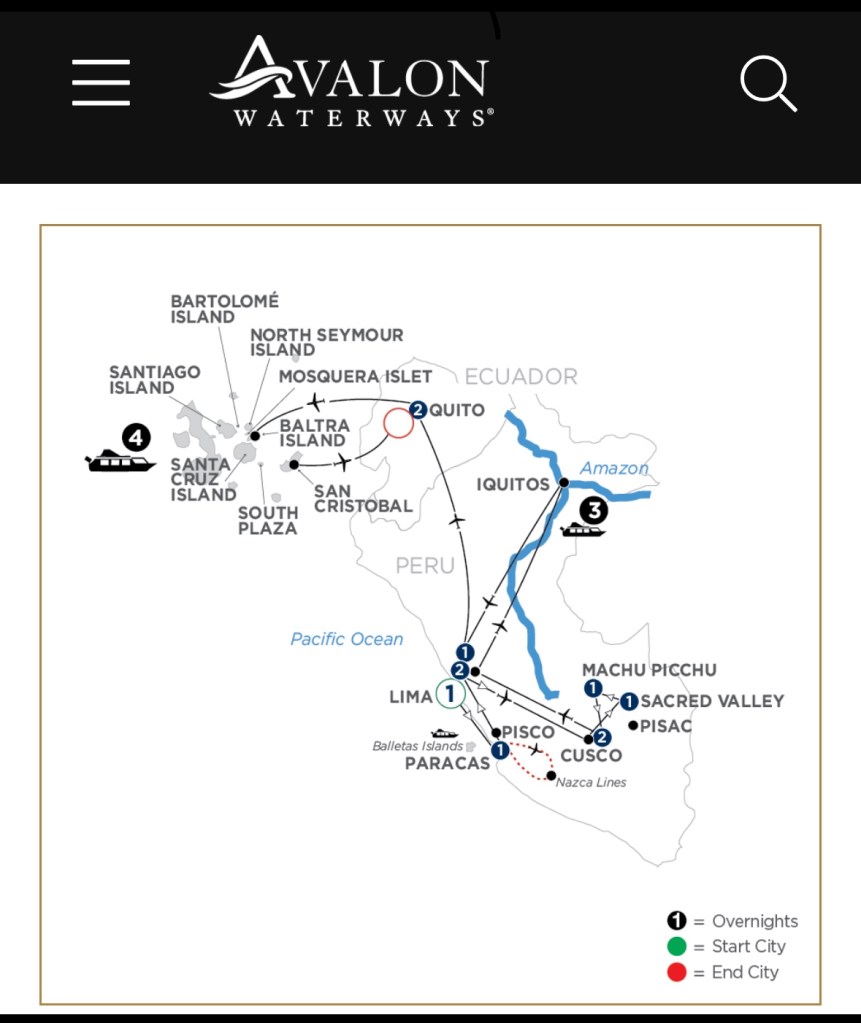
The primary reason for our latest adventure was to visit Machu Picchu in Peru.  Yet, if you are in the vicinity, why not go to see the Nazca Lines, the Peruvian Amazon and the Galapagos Islands?  We did all of that over three weeks from mid September to early October 2024.  Come along, won’t you?

This trip was under Avalon Waterways – a new travel company for us.  It was recommended by our stellar travel agent.  Even with all the details that she handled, it was still a very time consuming preparation for us.  We had to get help from travel medical personnel about high altitude and malaria medications – one of which I was allergic to.  We had to get the appropriate kind of insect repellent for the Amazon and carefully choose our luggage to meet the reduced requirements of some of the smaller airlines on internal flights.  We also were going to be away from our luggage for one night so had to figure out how to take one bag to handle taking enough for both of  us for one night.  We ordered a Peru electrical converter and figured out how to get Soles, the local currency.  It just felt like a lot – before we even left!

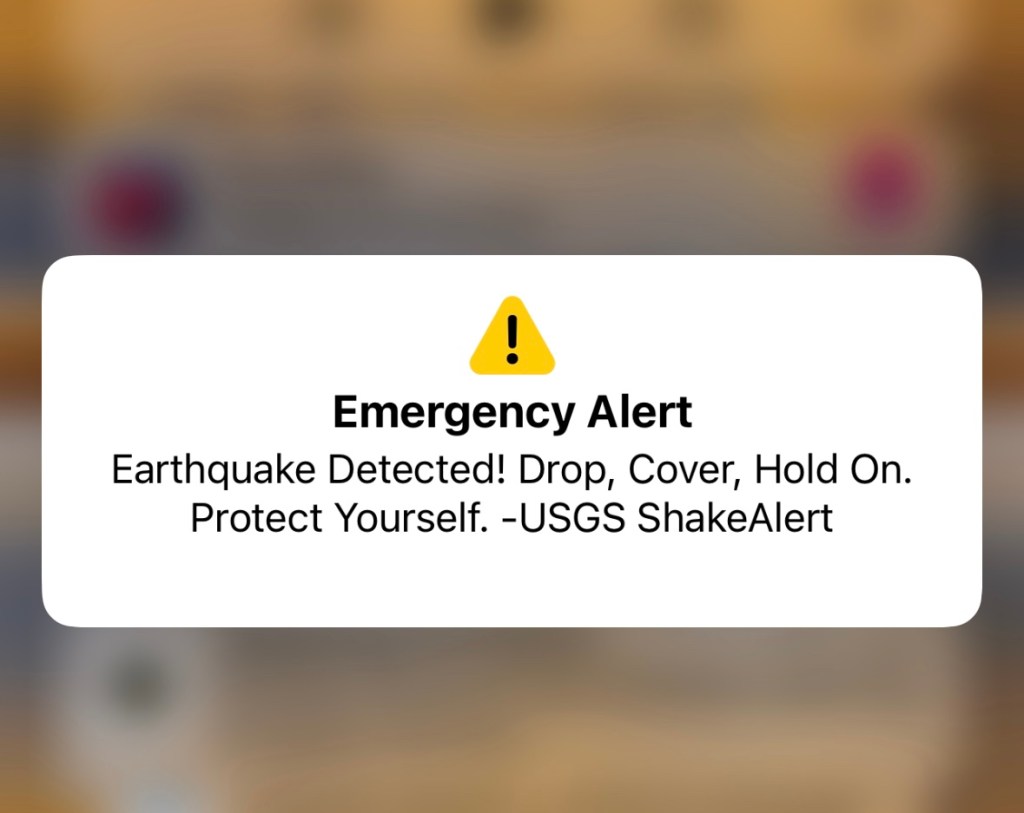
The first leg of our newest adventure had us leaving our house at 3:00 a.m. for a flight at 6:20 a.m. from PHX to LAX.  As we approached Los Angeles, phone alerts started going off all throughout the plane – but not ours.  Those people who didn’t put their phones on Airplane Mode were outed!

The alert was for an earthquake, later learned to be 4.7 magnitude centered in Malibu.

We had lounge access to wait out our four hour layover and, for once, it wasn’t crowded.

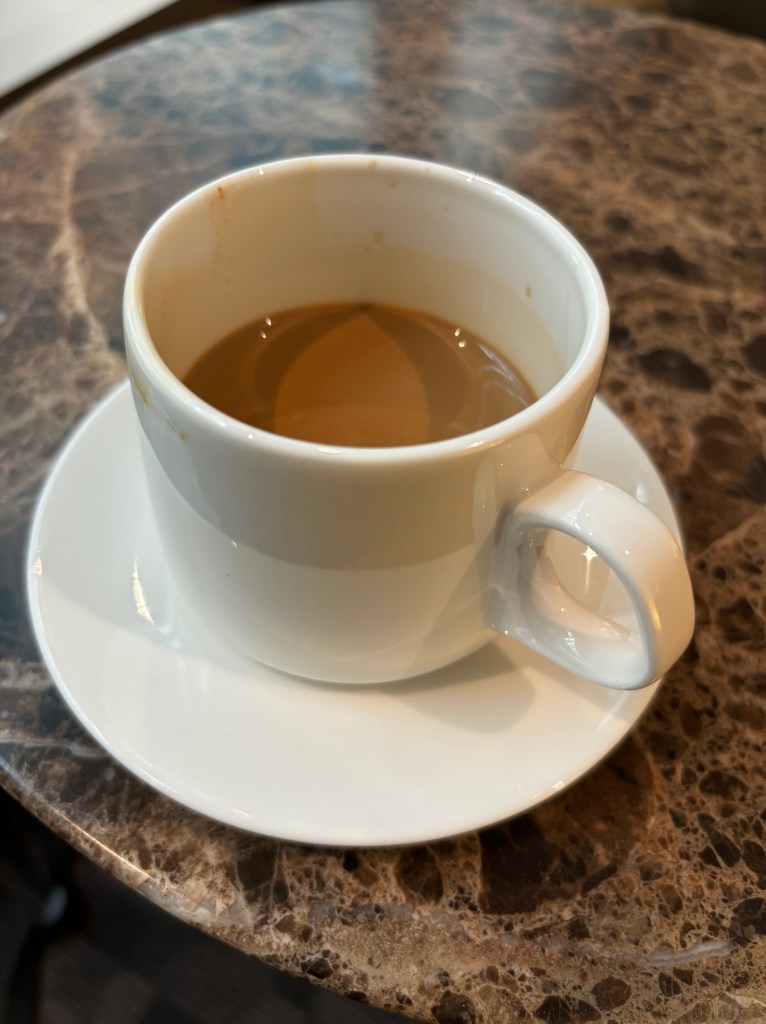
After all the prep, the early hour flight and an earthquake – I enjoyed my coffee and Baileys!

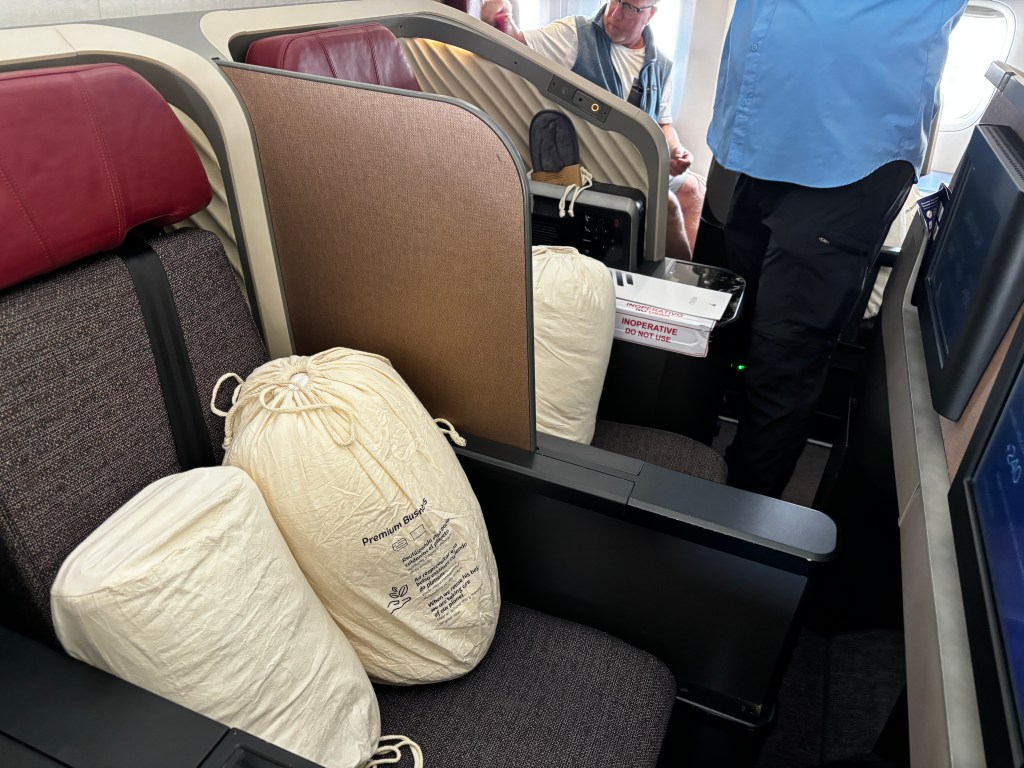
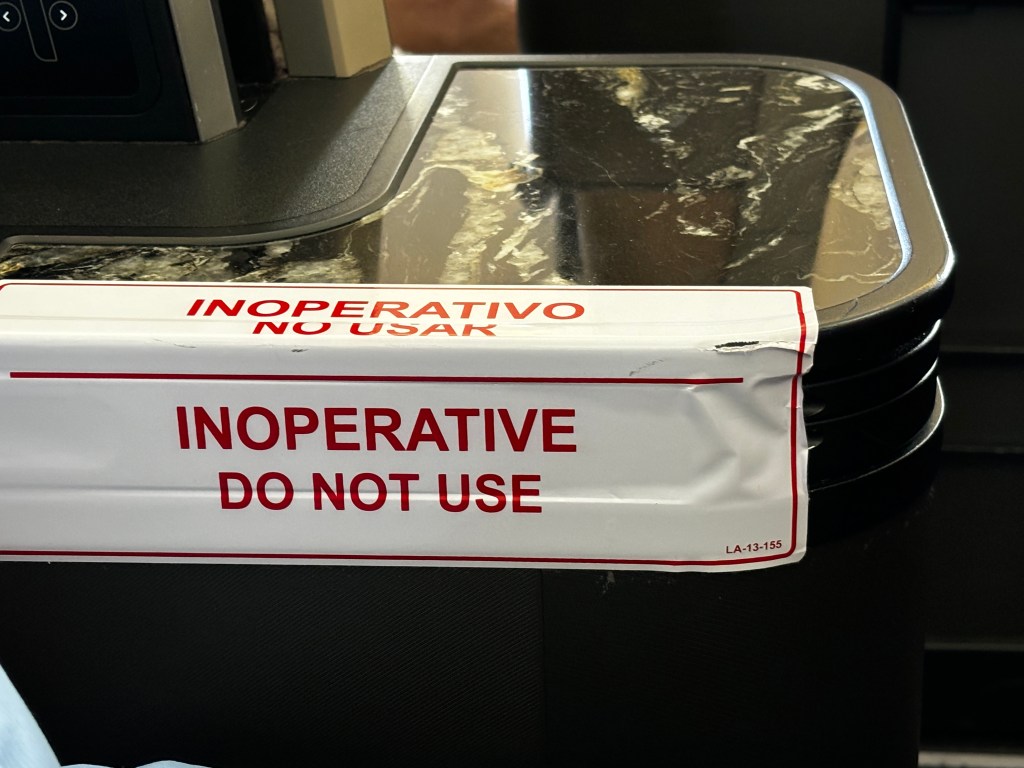
Our flight to Lima was 8 hours on Latam Airlines, the airline of Chile.  The table apparatus on one of our business class pods was broken so the gate agent was going to move one of us to a different pod, thereby giving the person receiving a complimentary upgrade the broken table. 

We opted to stay together, despite the broken table, and Randy took that seat.  He was being the gentleman, but also wondered if he could fix it!

Alas, no fix seemed possible.

Communication was interesting for us once on board because this is a South American airline and the primary communications were in Spanish and Portuguese.  English was a distant third.  Fortunately, our cabin attendants spoke enough English for us to get by.

With the very early start, I laid down flat and did sleep for an hour or so.  Randy did not, choosing to watch several movies.

The plane was very chilly so we had our provided blankets over us while we watched our screens.

We usually find that foreign airlines put more value on the passenger experience compared to US carriers.  I wouldn’t say that was true on Latam but it was adequate and our attendants were very helpful.

On arrival in Lima, passing through immigration and customs was very easy.  They recorded our entry electronically so our passports did not get a Peru stamp.  

We claimed our luggage right away and walked into an area to find our transportation from Avalon Waterways.  There was a crowd of drivers, all with passenger’s names but none had ours.  We had to wait a little while as our plane had arrived 30 minutes early. International flights generally come into Lima very early (for overnight flights) or quite late – 10:40 pm in our case.

We chatted with our pleasant driver on our 30 minute drive to the hotel.  Peru has about 32 million people and 11-12 million of them live in Lima.   One million of Peru’s population are refugees from Venezuela.

He said Lima is a gastronomic capital in the world!  Three of the top ten restaurants in the world, including #1 are in Lima.  The highest ranked, Central Restaurante, generally requires reservations a year out.

It was interesting that he knew about the recent presidential debate in the US and that the “senora did so much better than Trump.” We have found as we travel around the world, people know what happens in our country.   It wasn’t our plan to be out of the country during the 2024 campaign but, woohoo, side benefit!
We arrived about midnight at a nice hotel in Lima.  Unlike European hotels we’ve been in, the shower plumbing was just like what we are used to in the US.  Also, we did not need the Peru electricity adapter – yet.

Our trip began on September 12, 2024.

Next up:  We have a day in Lima on our own.

Posted in Uncategorized | Leave a comment

Summer Road Trip: Oregon Coast

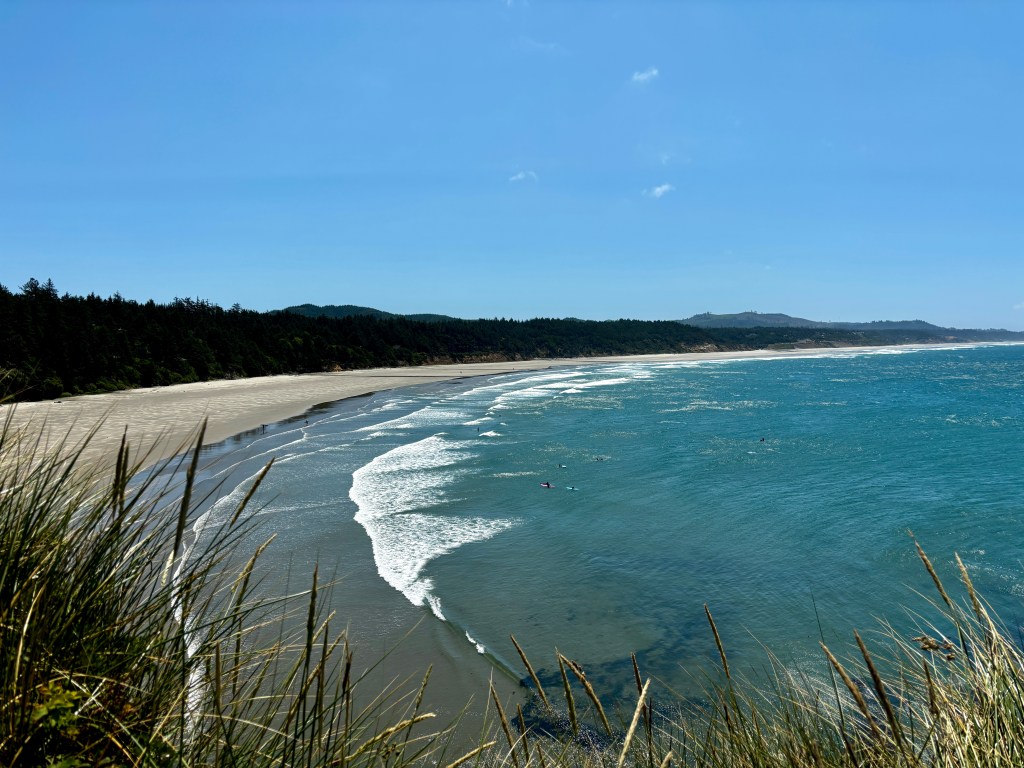
Our roadtrip continued along the Oregon coast, specifically the Lincoln City area.  

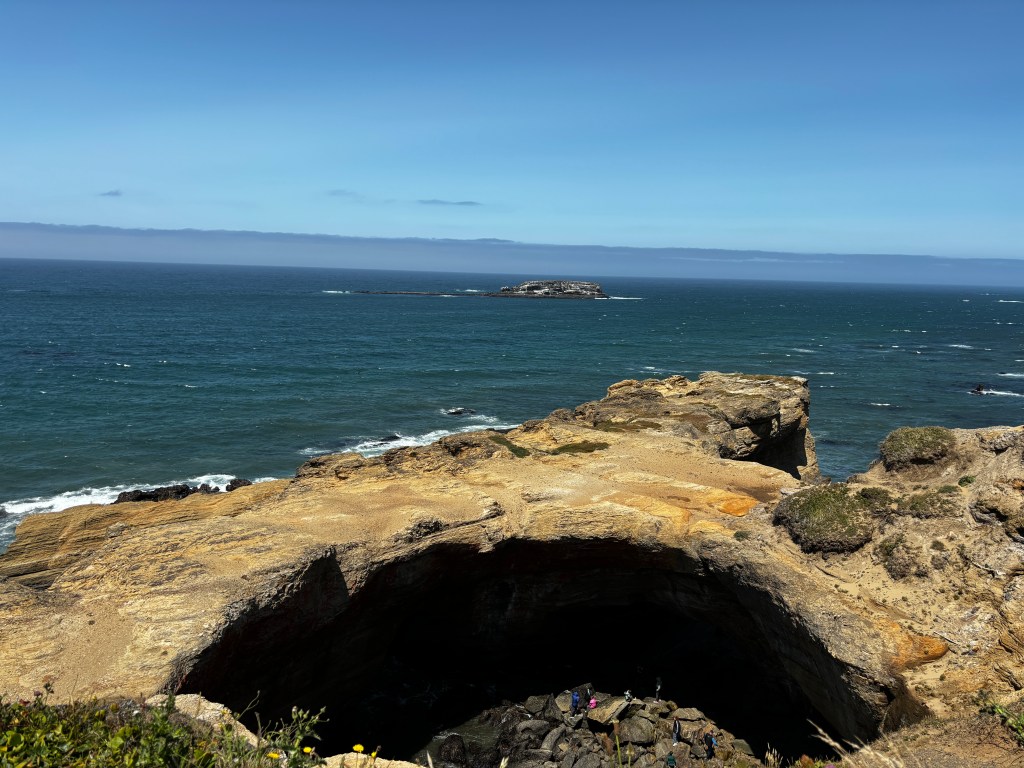
We met up with our daughter and grandson at Devil’s Punchbowl, a state natural area.

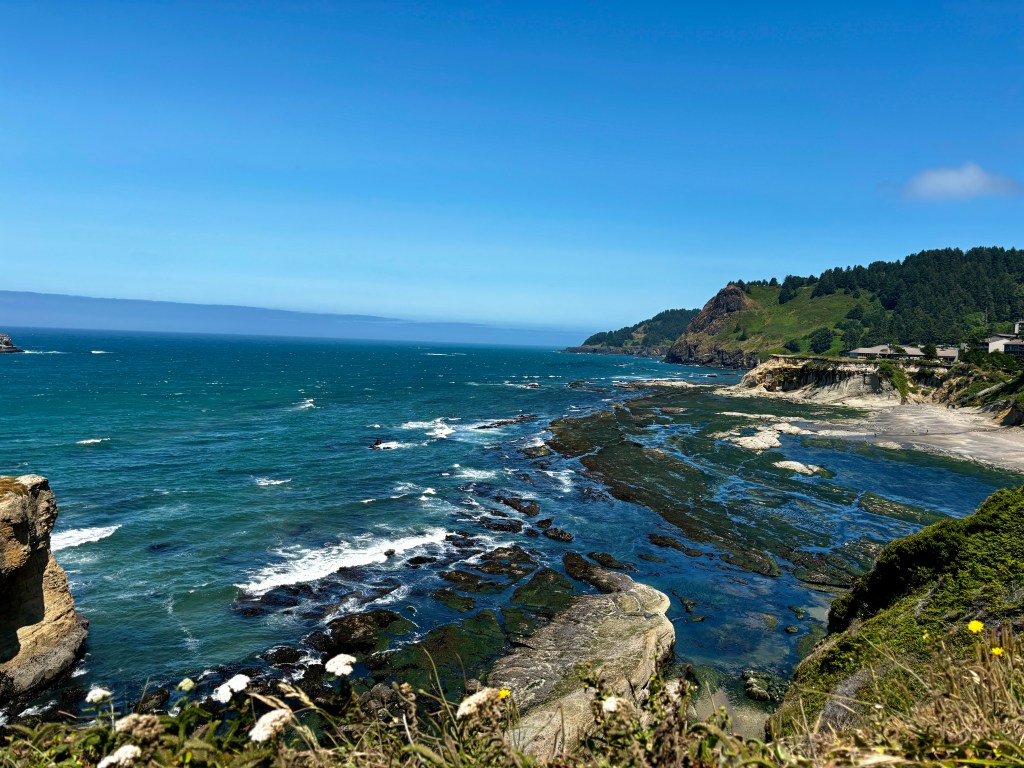
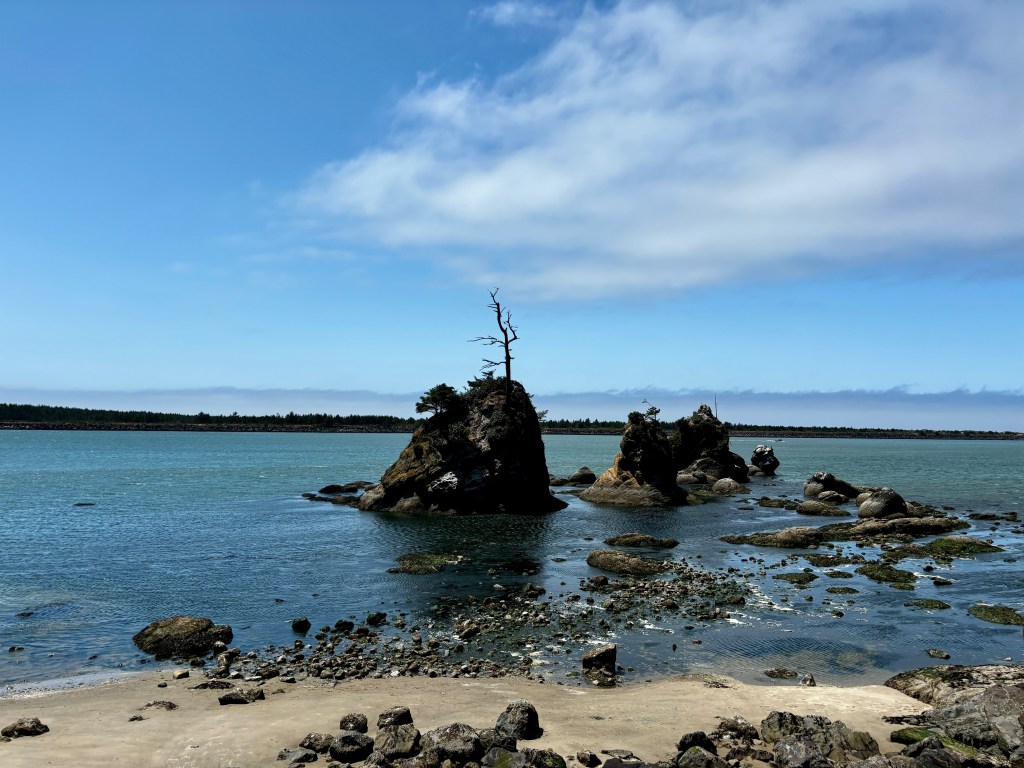
Looking the other direction, we saw the beautiful coastline.

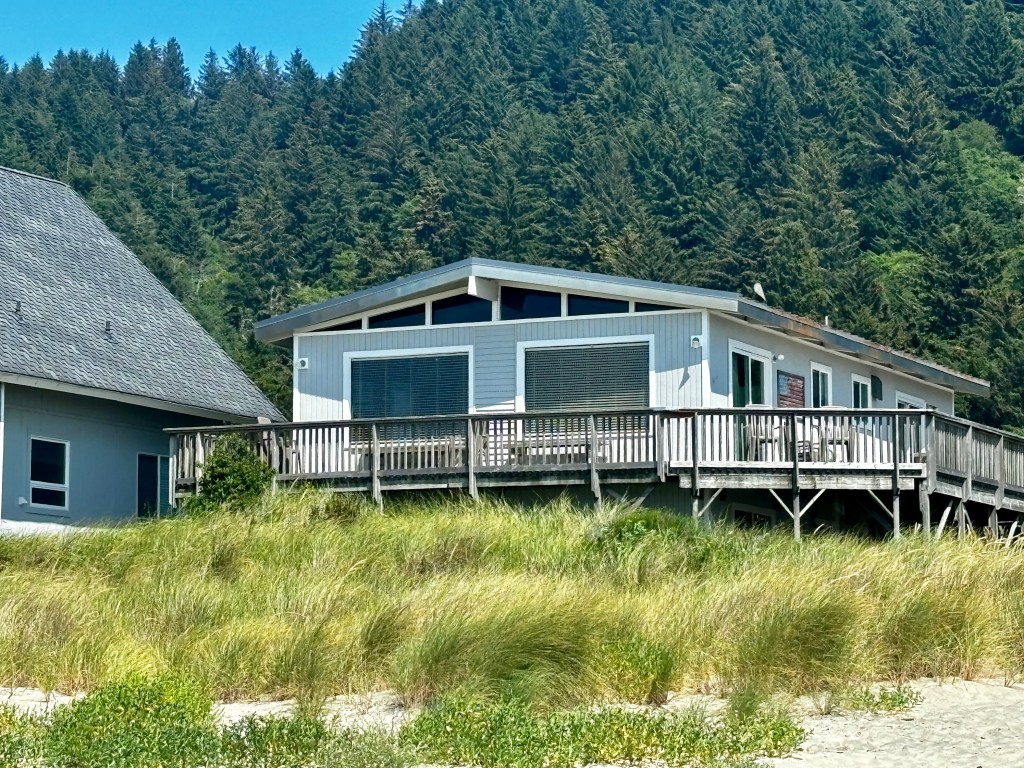
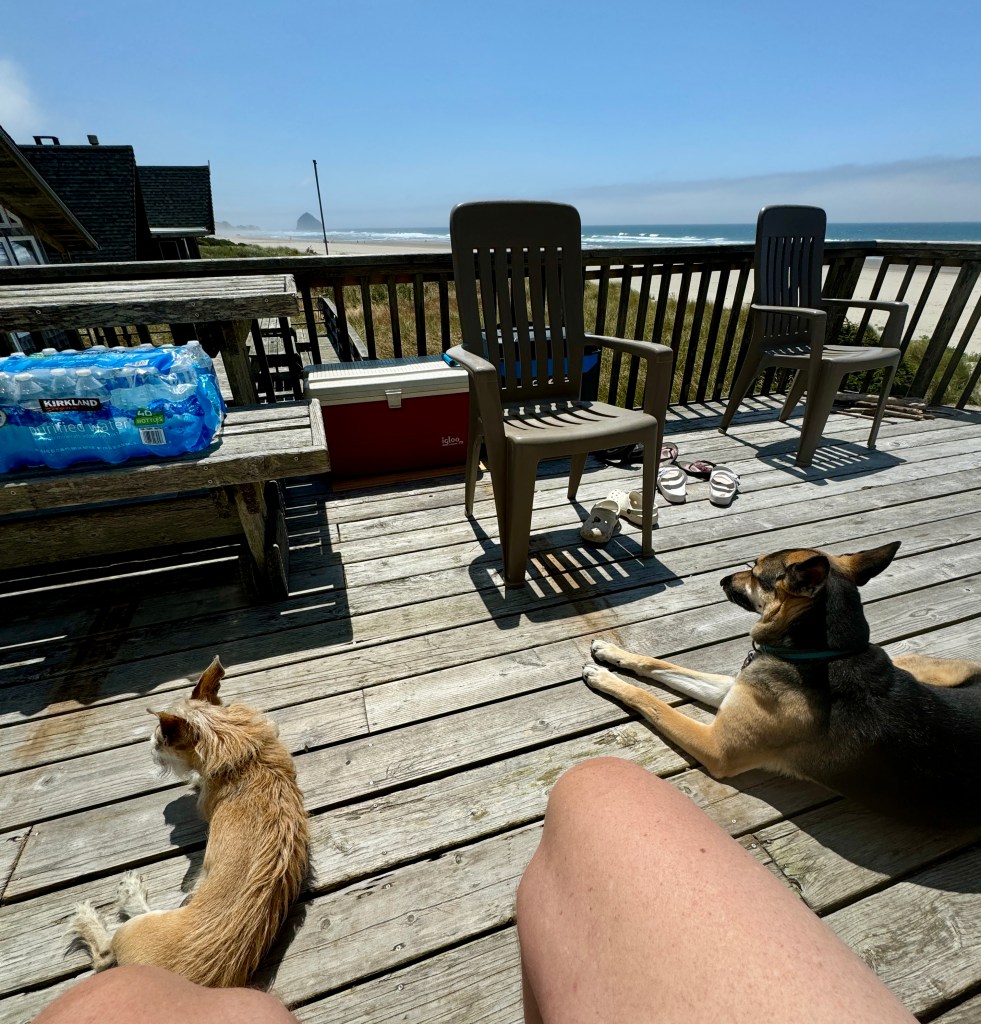
We found our rental home and waited for my mother, aunt and cousins to join us.  There were nine people and two dogs.   The house was in a great location but was just adequate in other ways.

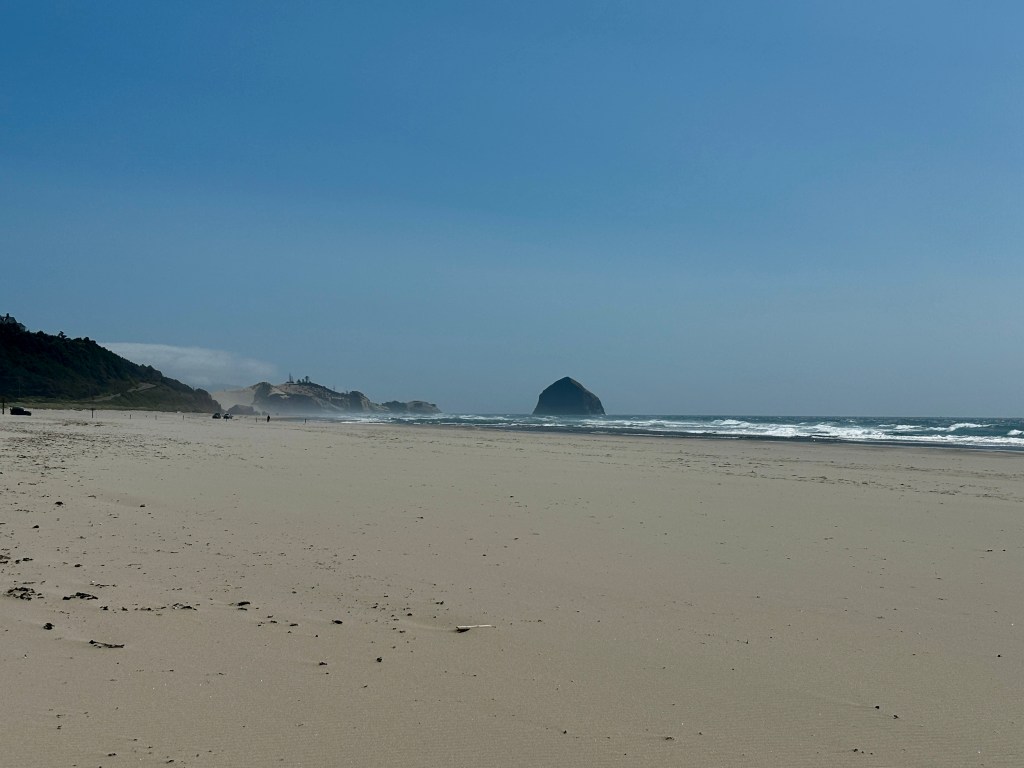
We could see one of Oregon’s Haystack Rocks.  This rock is larger than the other Haystack Rock near Cannon Beach.  However, the rock near Cannon Beach is closer to land so appears larger.  I learned there is actually a third Haystack Rock on the Oregon Coast, that one near Bandon in southern Oregon.  

We had an enjoyable week of visiting, eating, card playing, and foosball tournaments. There was one attempt at crabbing. It fulfilled our grandson’s desire to catch and eat a crab but that was the only one and it was missing some legs!

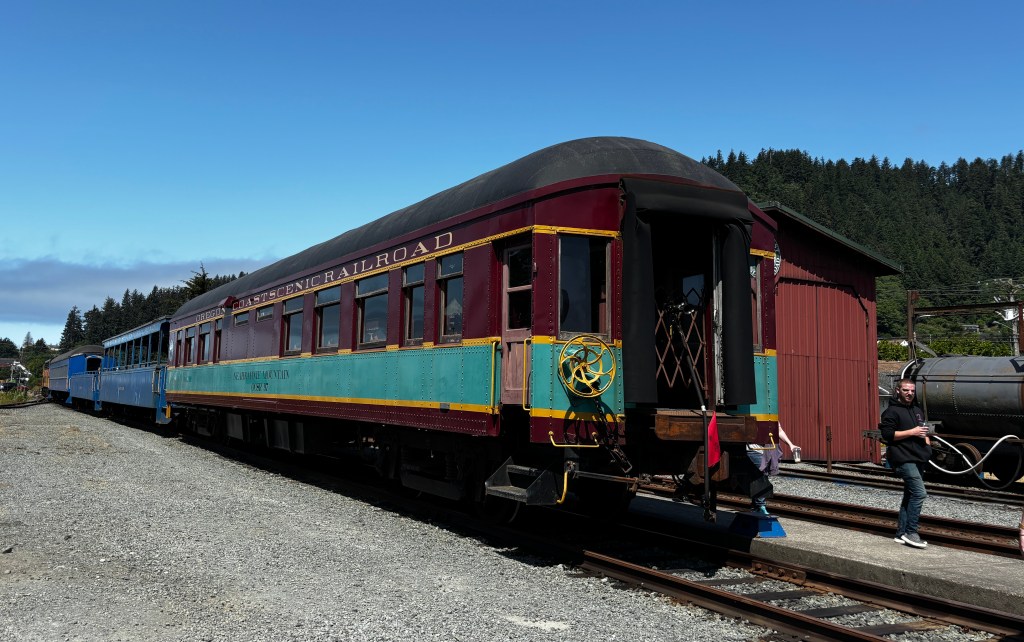
Additional activities included going on the Oregon Coast Scenic Railway.

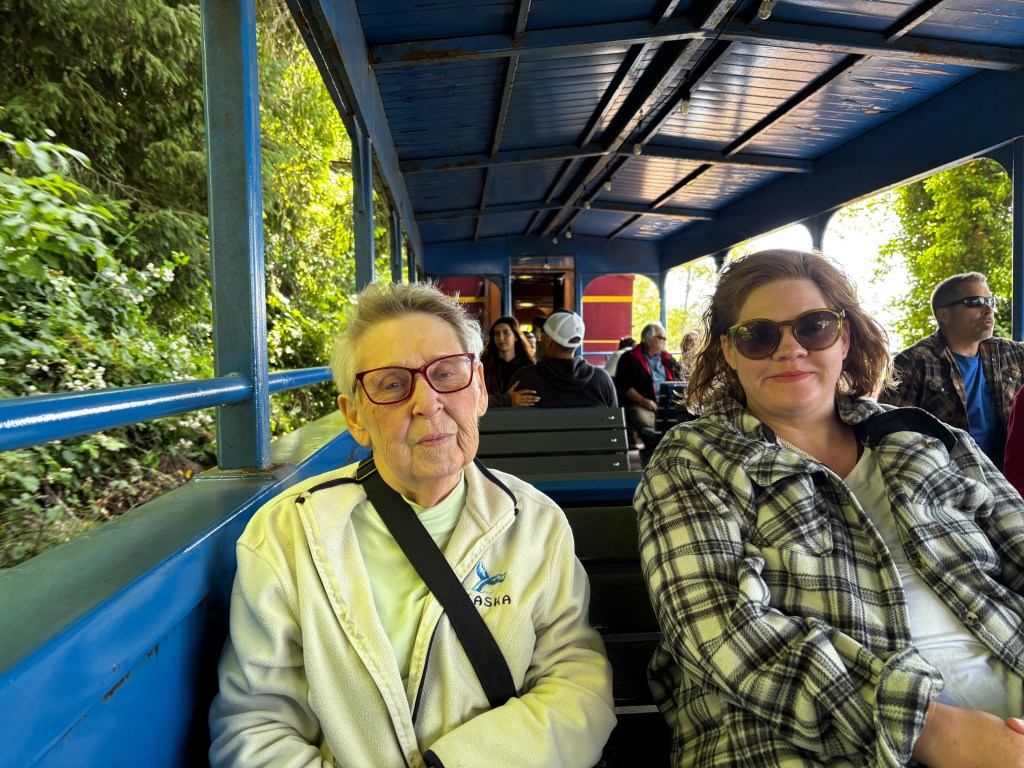
My mother, Beverly and our daughter, Natasha, enjoyed the trip.

We passed by Pronto-Pup in Rockaway Beach, birthplace of the pronto-pup and home of the giant corn-dog.

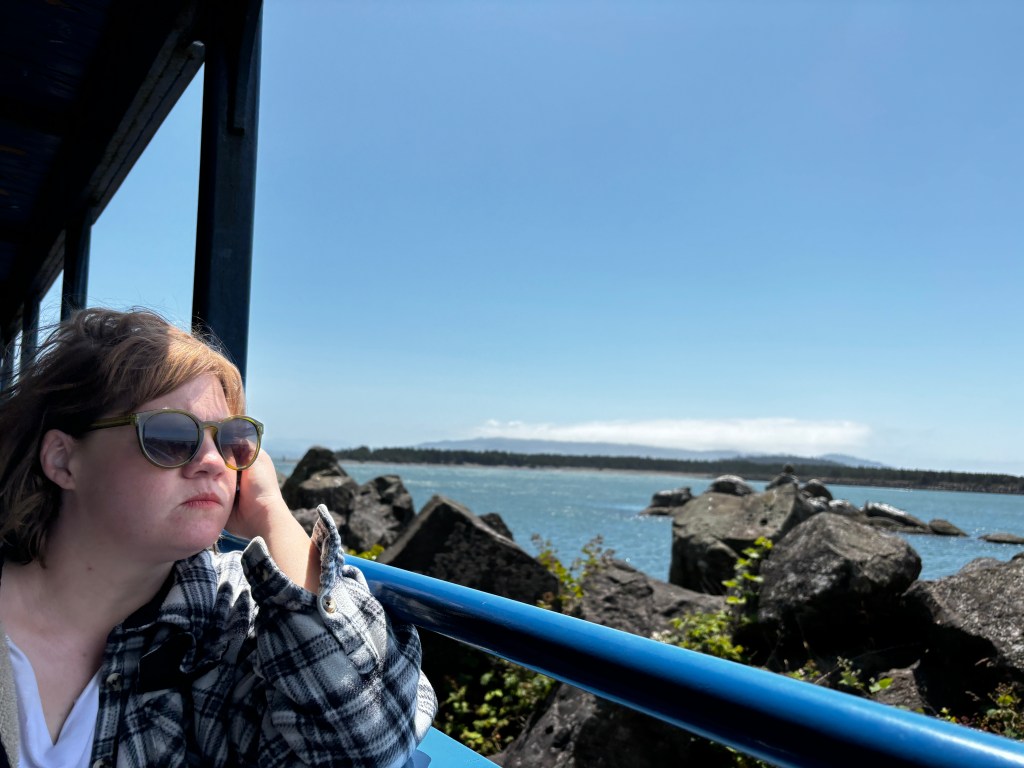
Natasha enjoying the view!

The view was lovely!

Randy stayed home, babysitting the pups, Boyd and Paris.

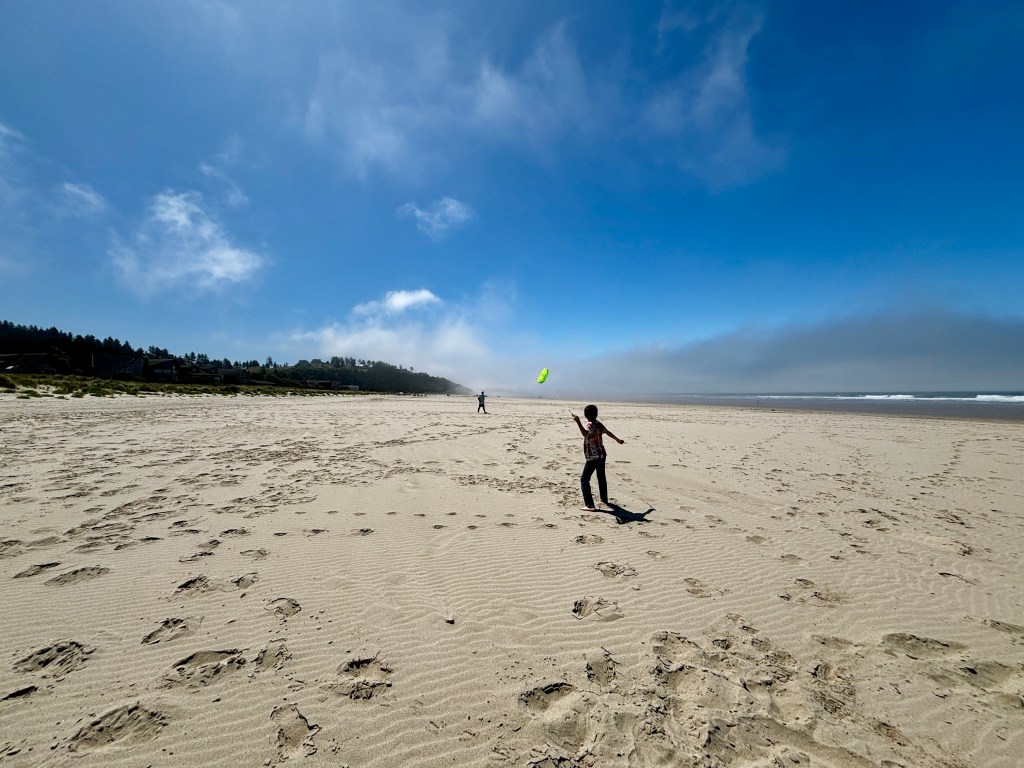
Randy and our grandson flew a kite.

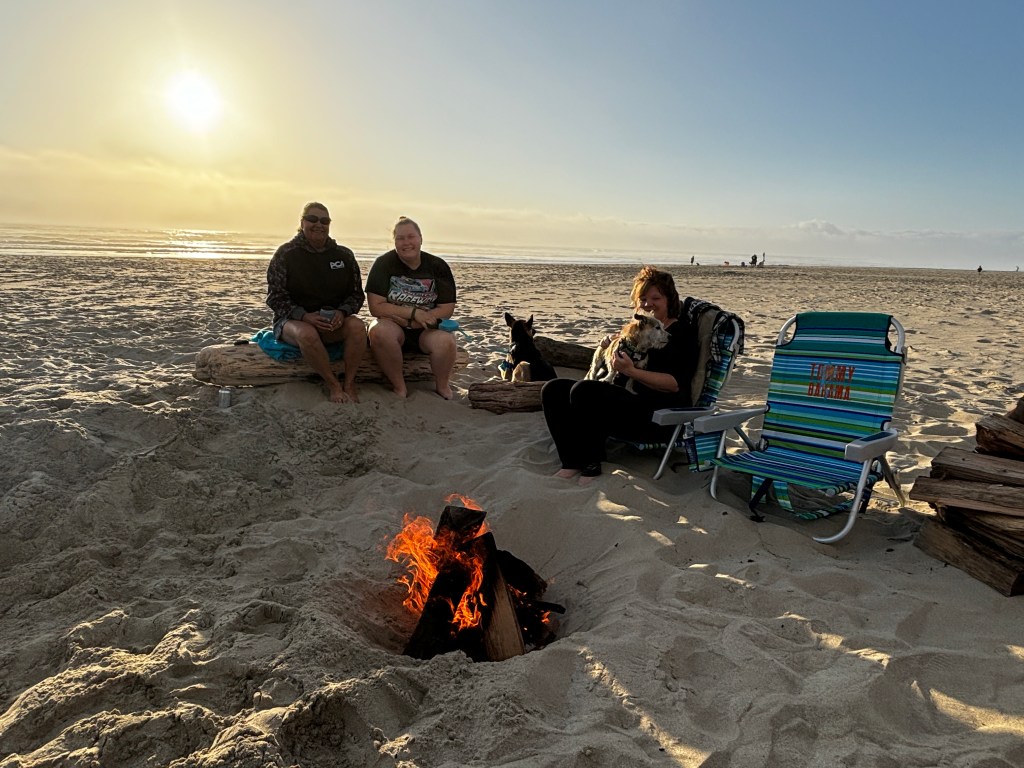
Cousins Lisa and Kylee and Natasha enjoyed a beach fire.  

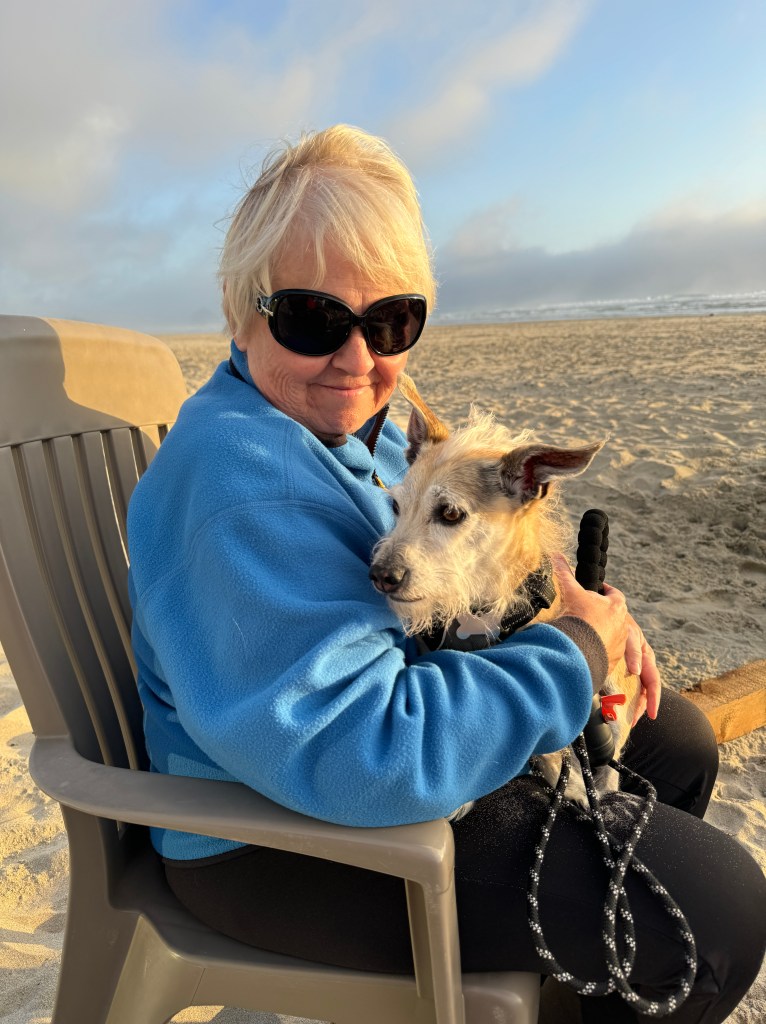
I enjoyed cuddling with grand-dog Boyd.  I loved spending time with pretty girl Paris too, but she is a bit big for lap cuddling.

Natasha went in the cold Pacific Ocean most days.  I think she was the only one who did it more than once! It was a delightful week with family but soon it was time to go.  

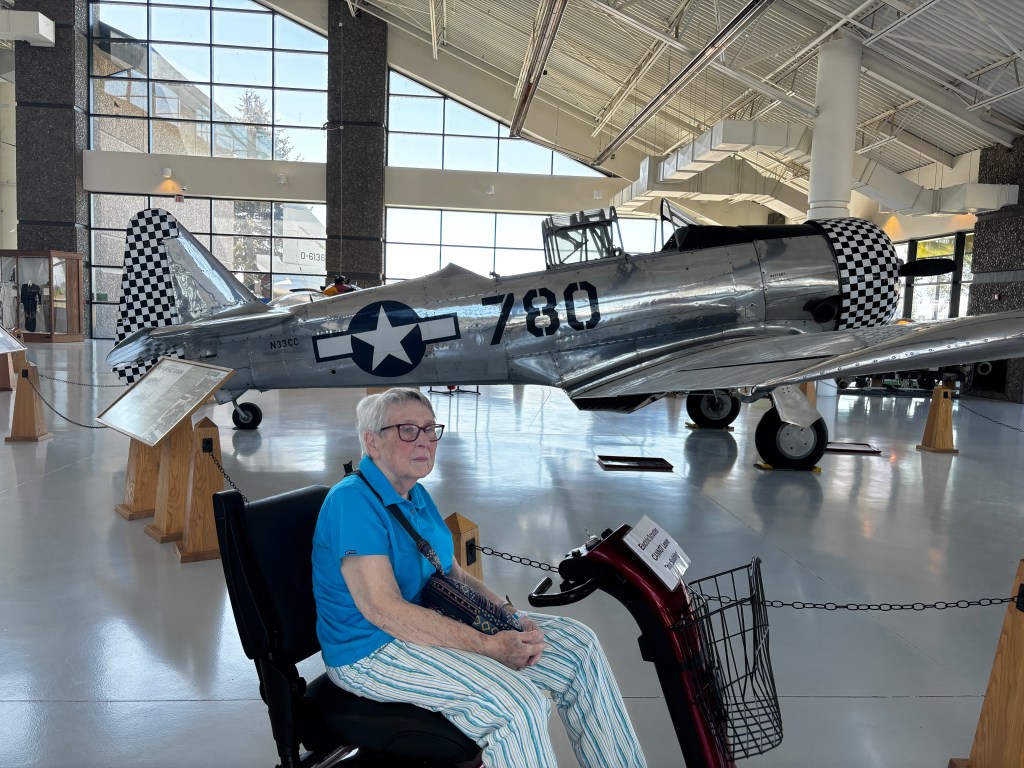
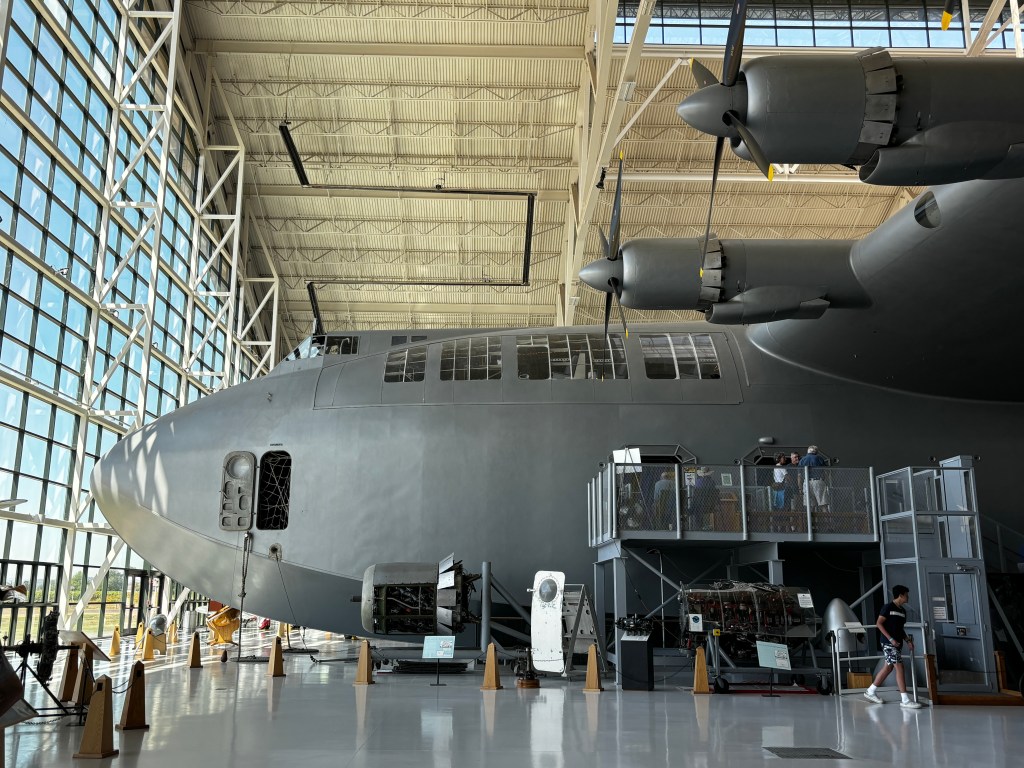
Beverly, Natasha and our grandson had never been to the Evergreen Museum in McMinnville.  It is the home of the Spruce Goose.  Randy and I spent a couple of days there in early 2016 during our RVing days.   I wrote a blog post about that visit called The Flying Boat and Flying Fortress.  Click the link if you’d like to read a fairly extensive review of our visit to the museum.

This time, mom and I enjoyed a docent tour.  It was very well done.

Natasha and our grandson did their own thing, actually getting to go inside the cockpit of the Spruce Goose.

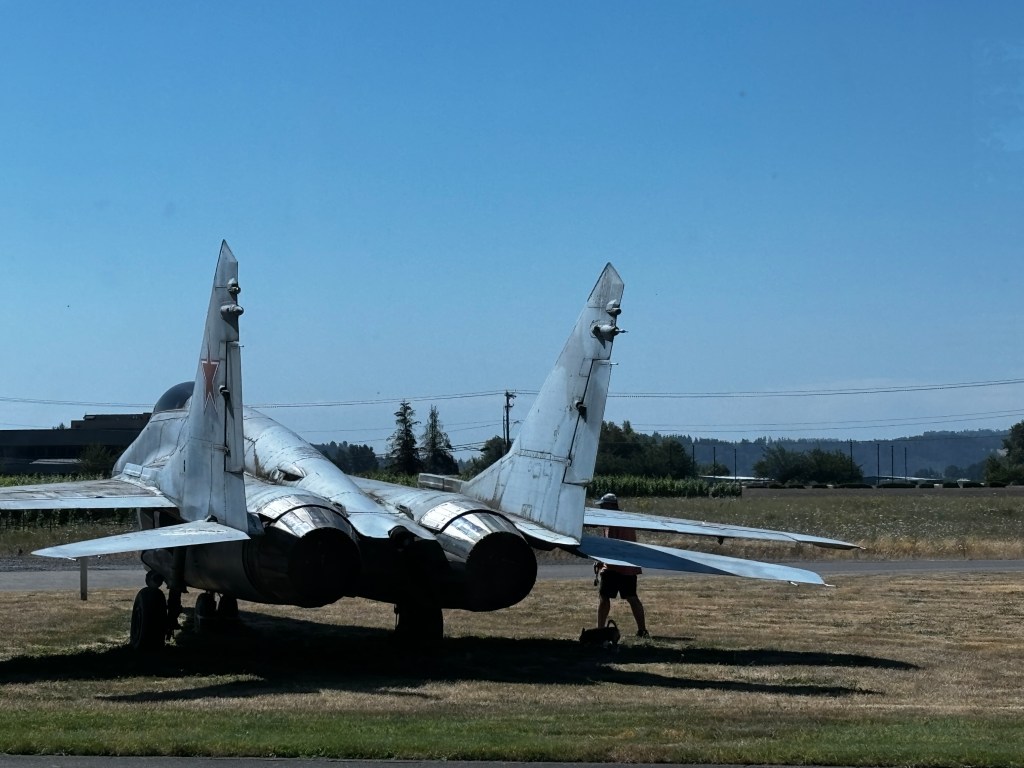
Randy and Boyd explored the planes outside as it was way too warm for Boyd to stay in the car.  

Following our visit of several hours, Randy and I took mom home to Vancouver while Natasha and our grandson went to Multnomah Falls.  Did you know Multnomah Falls has a timed entry system during the summer?  It was a good thing mom knew about it or they probably wouldn’t have been able to get in.

Randy and I stayed a night at Natasha’s in Boise and met our new grand-cat Lily!

Boyd and Lily were glad to be reunited!

We were able to see a few friends and accomplish a couple things on our short visit to Boise.  We enjoyed seeing Darrell and Cindy but didn’t take a picture.

The next morning, I was at the jewelry store for an annual check on my ring and earrings.  It is just something I always need to be aware of when traveling to Vancouver or Boise.  At least it is now annual and not every six months!

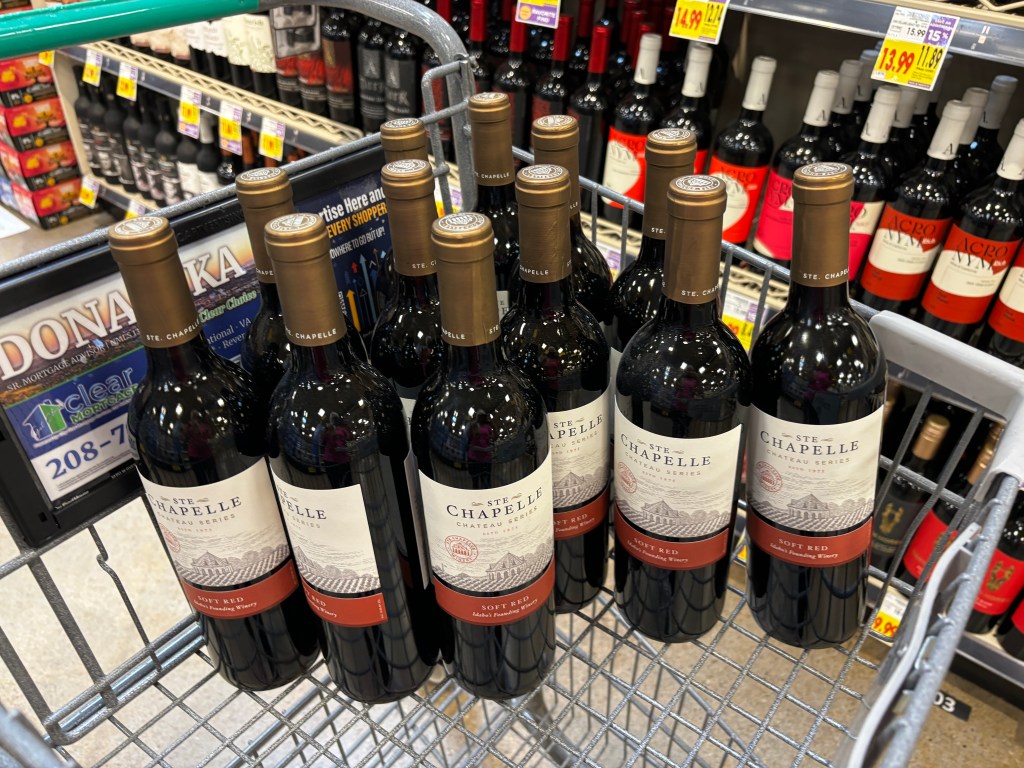
At the same time, Randy was buying a case of our favorite Idaho wine – Ste. Chapelle’s Soft Red.

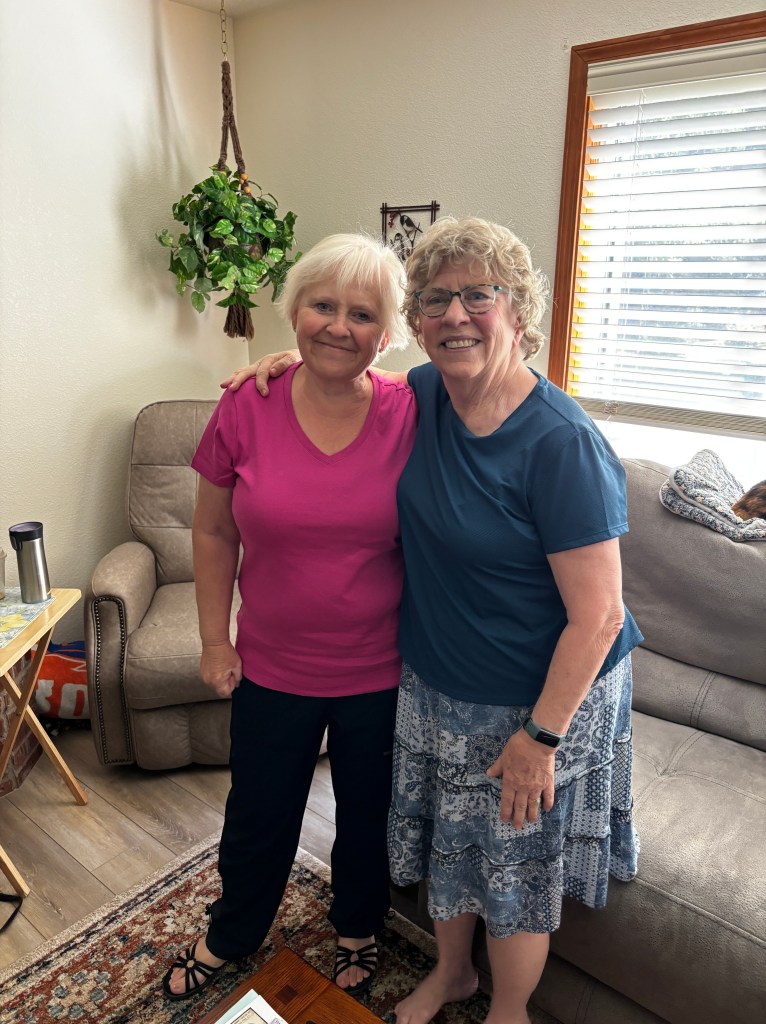
We enjoyed a visit with our friend and former neighbor, Karen.

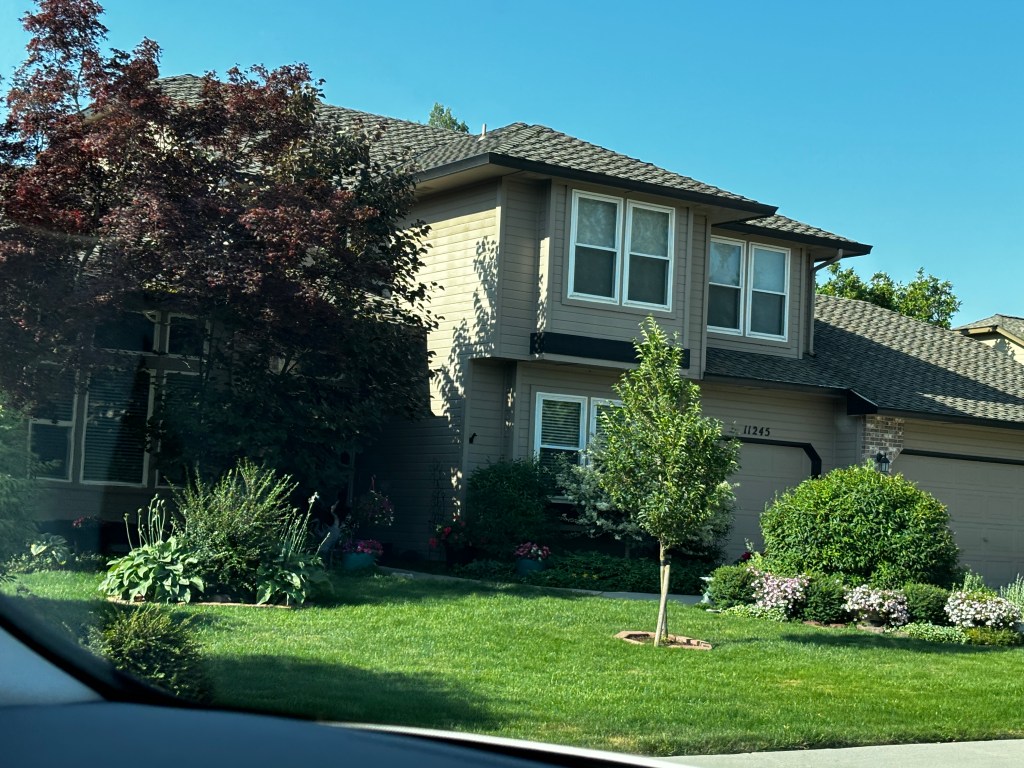
It was easy to drive by our old house.  The same owners are there since purchasing from us in 2014.  They keep it looking very nice.

We went to lunch with Debbie and Bryan at the only restaurant we ALWAYS go to when we are back in Boise.  That is Dong Khanh and we always get spicy beef!

After a busy 24 hours in Boise, we started the drive back to Phoenix.  We left about 2:00 pm intending to stop somewhere when we got tired.  We drove through Utah instead of Nevada so we’d have more options.  We ended up driving all the way through Utah and were still doing fine as we passed through Las Vegas.

Unfortunately when we did get tired nearing Kingman, AZ, it was past midnight and there were no hotel rooms available.  We kind of slept for an hour in the car at a truck stop. It was too hot to have the windows up and too creepy to have them down. We gave up and  Randy drove the rest of the way home. We arrived about 5:00 am and went straight to bed!

It was a great summer road trip and, as always, it was nice to be home.

Posted in Uncategorized | Leave a comment

Summer Road Trip: Kings Canyon National Park

While traveling throughout Sequoia National Park, we used an app called Just Ahead.  We used their free tour of Big Bend National Park a few years ago and thought it was excellent.

I purchased the Sequoia and Kings Canyon tour and downloaded it onto my phone so it would work whether we had cell service or not.   The tour ran in the background and provided interesting commentary as we arrived at a specific gps point.  We recommend it!

We left our lodging and traveled to the mostly adjacent Kings Canyon National Park.    The elevation range within the two parks goes from a low of 1360 feet to a high of 14,494.  Crystal Cave is below ground in Sequoia but tours have not resumed after the extensive fires.  There are 36 sequoia groves within the two parks.

This area is one of the largest wilderness areas in the lower 48 and includes both national park and national forests.

We did not see a sign indicating that we had transitioned into Kings Canyon but knew we had when we came upon signage for the Mountain Grove. This is the largest stand of sequoia in the world.  In five square miles, there are more than 2,100 giant sequoias measuring more than 10 feet in diameter.

This area was once General Grant National Park, established in 1890, a similar timeframe as Sequoia. Our hike to General Grant, the most famous tree in this park, was much shorter and easier than the hike to General Sherman.

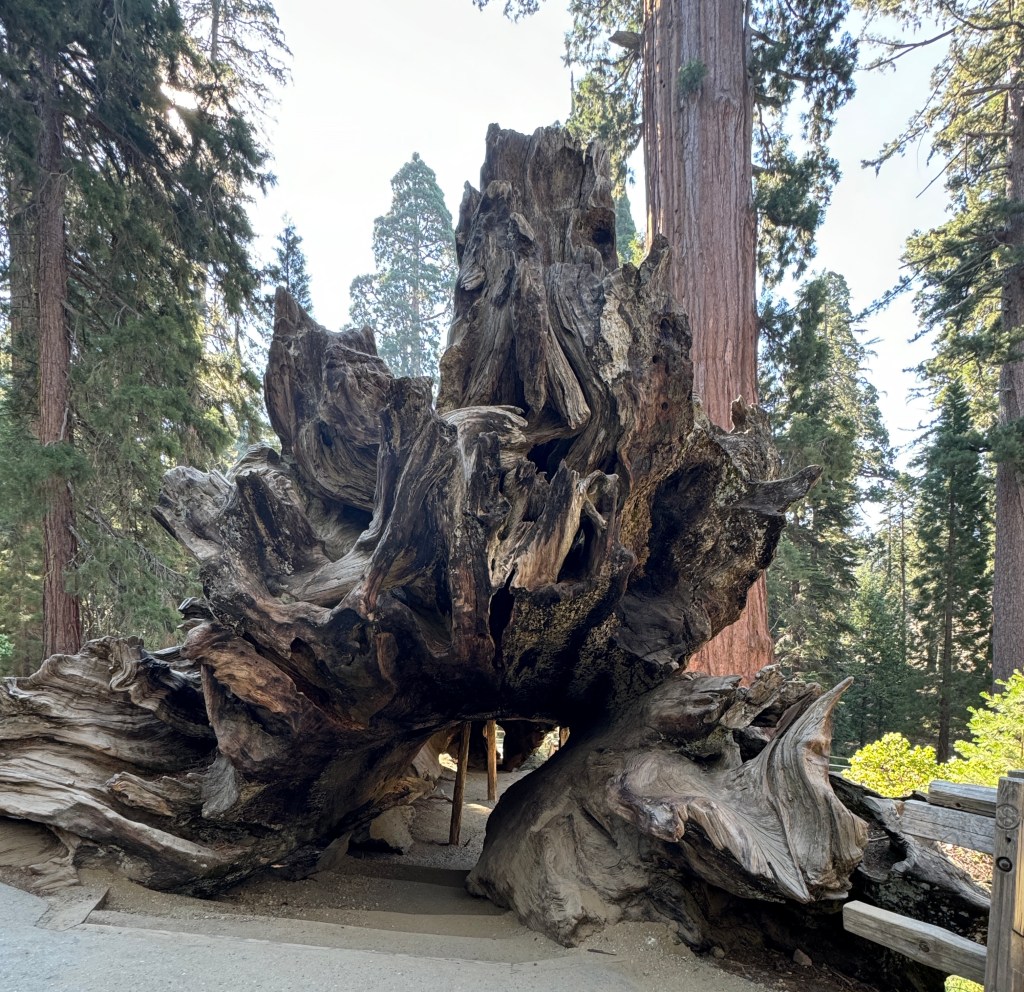
Along the way we saw a few things of interest.   This is the root end of a tree called the Fallen Monarch.

We could walk through and stand in the tree that workers once used as shelter.

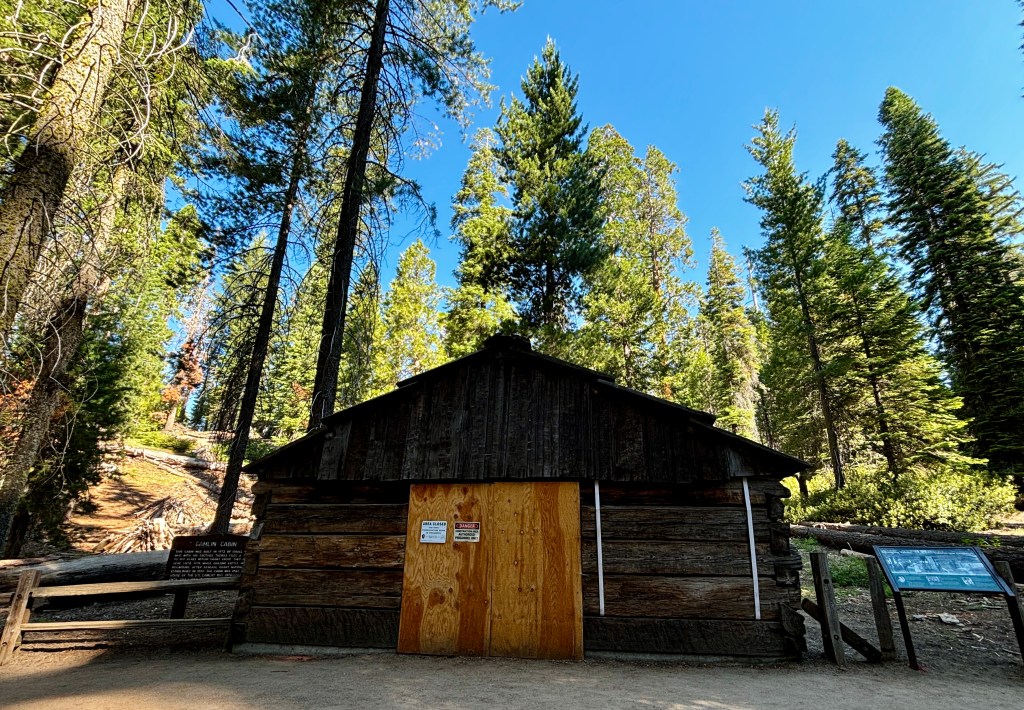
Israel and Thomas Gamlin lived in the Fallen Monarch prior to building the cabin below in 1872.  They filed a claim for 160 acres and grazed cattle here until 1878.  

When the lands became part of General Grant National Park, in 1890, the building was used for storage by the cavalry who patrolled and protected the park.  In 1913, it was home for the first resident park ranger, Lewis L. Davis.  He patrolled the park and learned about the tree-fire relationship. He also grew sequoia seedlings.

We also saw the remains of the Centennial Stump.  

A 24 foot diameter tree was cut down to display a section in the 1876 Philadelphia Centennial Exhibition.  Easterners couldn’t believe it was from one tree!

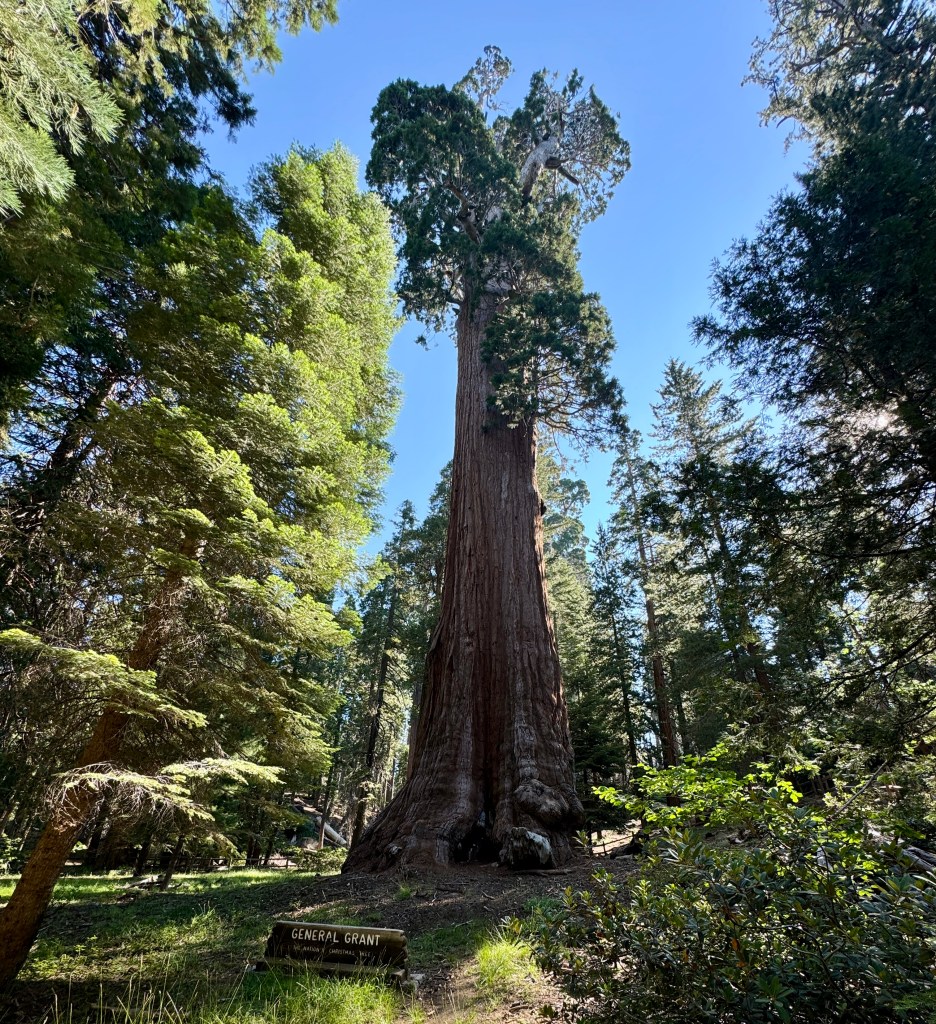
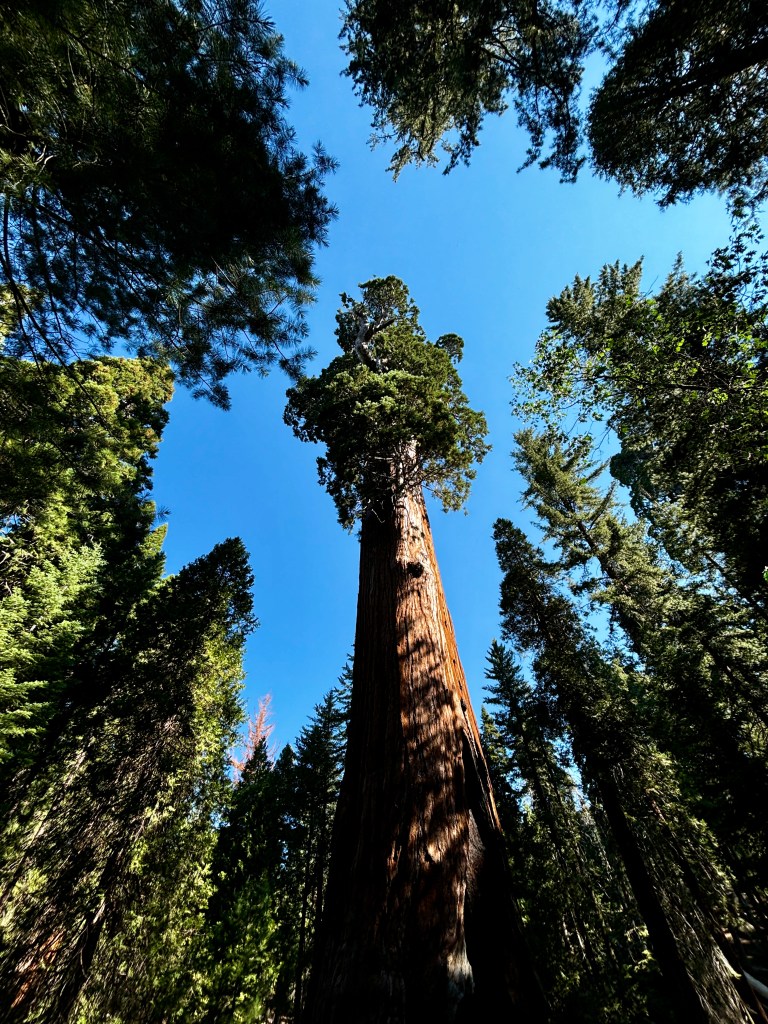
A short while later, we arrived at the General Grant tree.

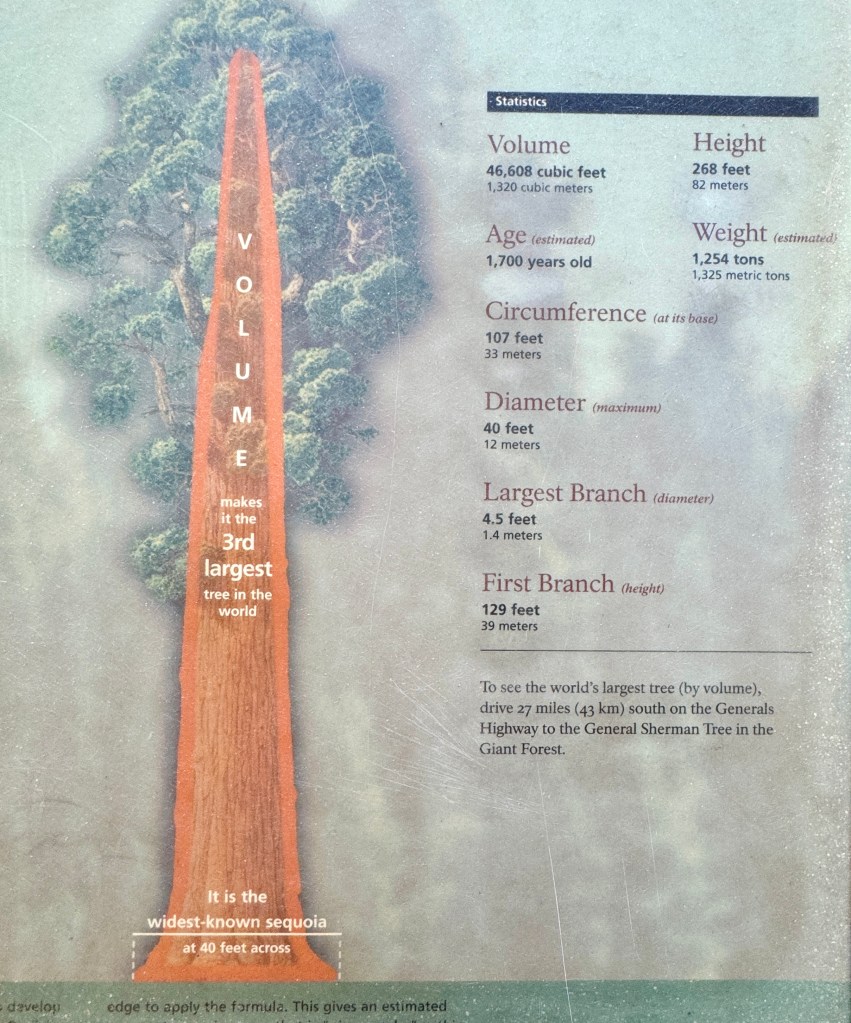
General Grant is the second or third largest tree in the world when considering height, diameter and volume. 

We saw, and heard, conflicting information about whether General Grant, or the President’s Tree in Sequoia, is the second and third largest.  (We did not see the President’s Tree.)

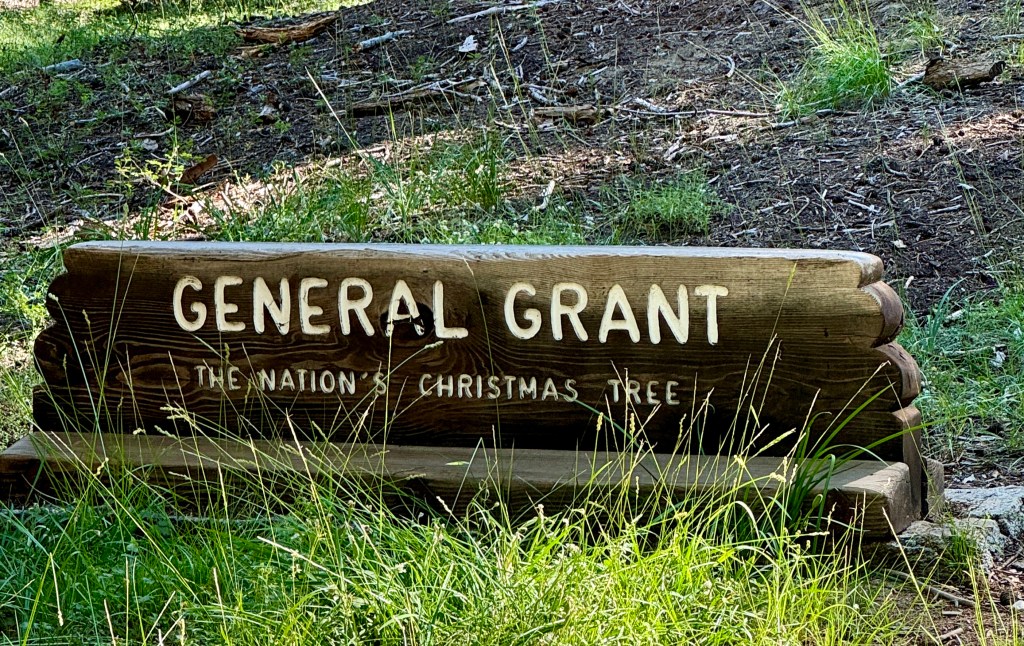
What is certain is that the General Grant tree was also named The Nation’s Christmas Tree. 1924, a visiting government dignitary heard a little girl exclaim, “what a wonderful Christmas tree it would be!” Later, President Dwight D. Eisenhower designated it a national shrine in memorial to those who give their lives for our country.

We enjoyed our time in Sequoia National Park and the General Grant area of Kings Canyon National Park. We just didn’t have the time to see any more of Kings Canyon.

 It took another 50 years, until 1940, for the canyon in the eastern part of the park to be protected.  The lands that were once General Grant National Park were included within the boundaries of the new Kings Canyon National Park.

If we visit this part of California again, we will prioritize seeing the canyon and touring the Crystal Cave.

Our national parks visit successfully accomplished, we proceeded north through central California.  All was fine until we had air conditioner problems in 115 degree heat.  I started looking ahead for service at about 3:00 pm.  Rich, a very accommodating owner of an independent, certified Mercedes repair shop in Redding agreed to try and diagnose our problem. That was very kind because we wouldn’t arrive at his shop until about 20 minutes before closing.  He even went the extra mile, calling the Mercedes dealership in Chico to see if they had the part he thought we might need.  

At that point, we were assuming we’d be spending the night in either Chico or Redding.  The independent shop could fit us in the next day for repair but we might have to shuttle the part from Chico.  Of course, that was all depending on whether or not Rich could diagnose the problem.

We found the repair shop and went inside the cool lobby to wait.  When Rich went out to get our car, the AC began cooling.  He hooked it up to his computers and ran the diagnostics.  Nothing definitive was found to be wrong except a thermostat was too hot and out of specs.  Typical computer, turn it off and turn it on again!  We had been going for hours in 115 degree heat. He apologized for not telling us to pull over, turn off the car, and restart it again as that is sometimes the only “fix” needed! No worries. By then, he was our hero!

Rich gave us a few suggestions, notably use “recirculate” when running the AC in extreme situations so the system doesn’t have to work so hard!   Duh…. We happily paid our fee, plus tip, and went on our way.   Even though we had kept him beyond closing time, Rich called us a few minutes later with a suggestion for when we got back to our home Mercedes Benz dealership in Phoenix.  If you have a Mercedes and happen to need service in Redding, California, Rich at North Star Motors is the guy! The AC has been working perfectly ever since.

We stopped for dinner at the original Black Bear Diner in Mount Shasta, California. 

We sat at the counter and listened to the banter between the kitchen staff and waitstaff.  We heard the lead cook say to a server,  “Emily, we haven’t had pepper jack for three years.”  (How do you not have pepper jack? ) They were also running low on bacon… It was an easygoing ending to a hot, somewhat stressful, afternoon.

We were at Kings Canyon in the heat of July 2024

Next:  We arrive at our destination – the Oregon Coast!

Posted in Uncategorized | 1 Comment

Road Trip to Sequoia National Park

We started our summer road trip in the heat!  We left Phoenix at 110 degrees and traveled west into California where it was even hotter! 

Fortunately, our day was uneventful and comfortable in our air-conditioned vehicle.  

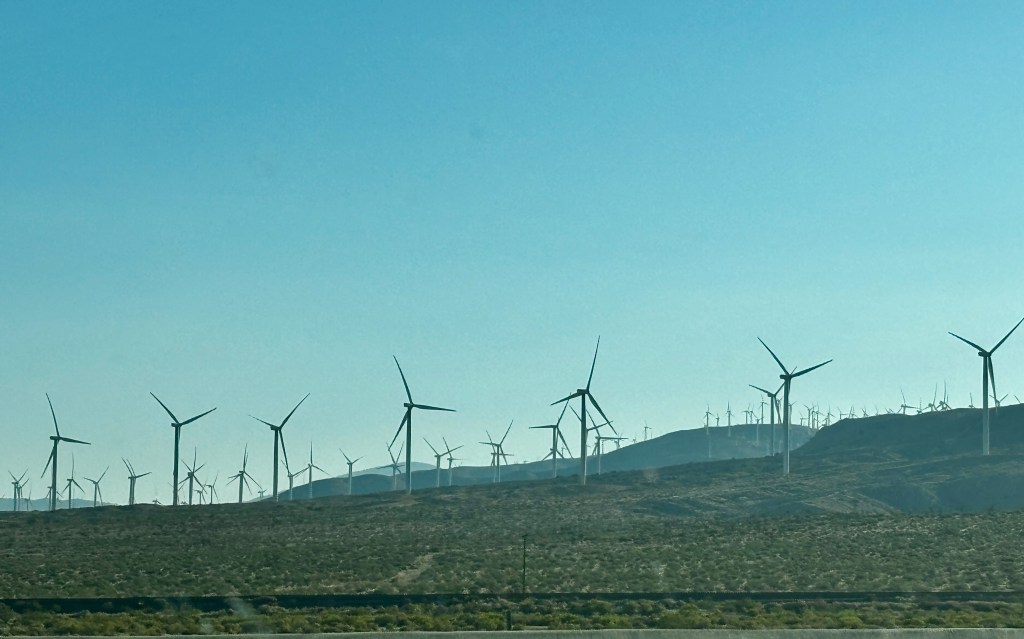
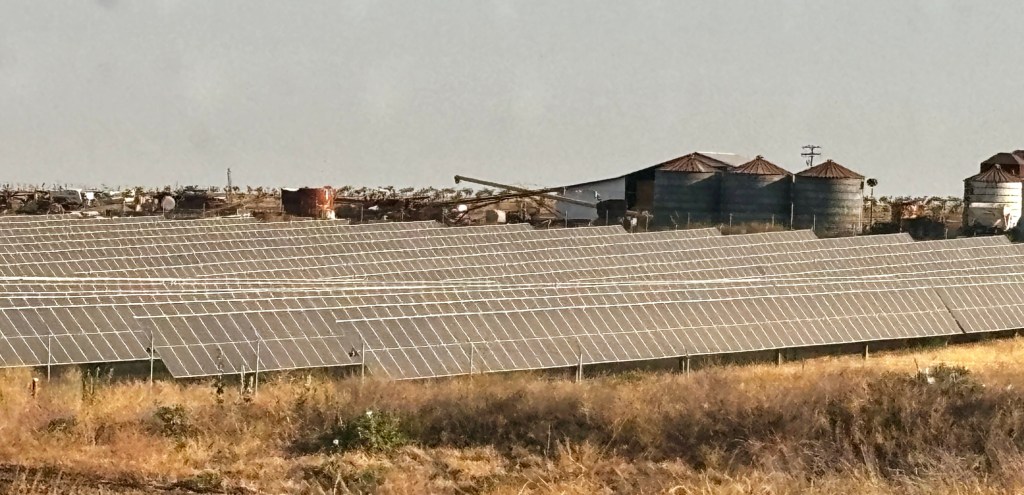
We saw wind turbines and lots of solar panels generating electricity. 

There were 17 fires in California on this day, so perhaps that was the cause for the colorful sunset as we approached Bakersfield to spend the night.

North of Bakersfield we saw an EV power plant.  That was not surprising so I didn’t take a picture.

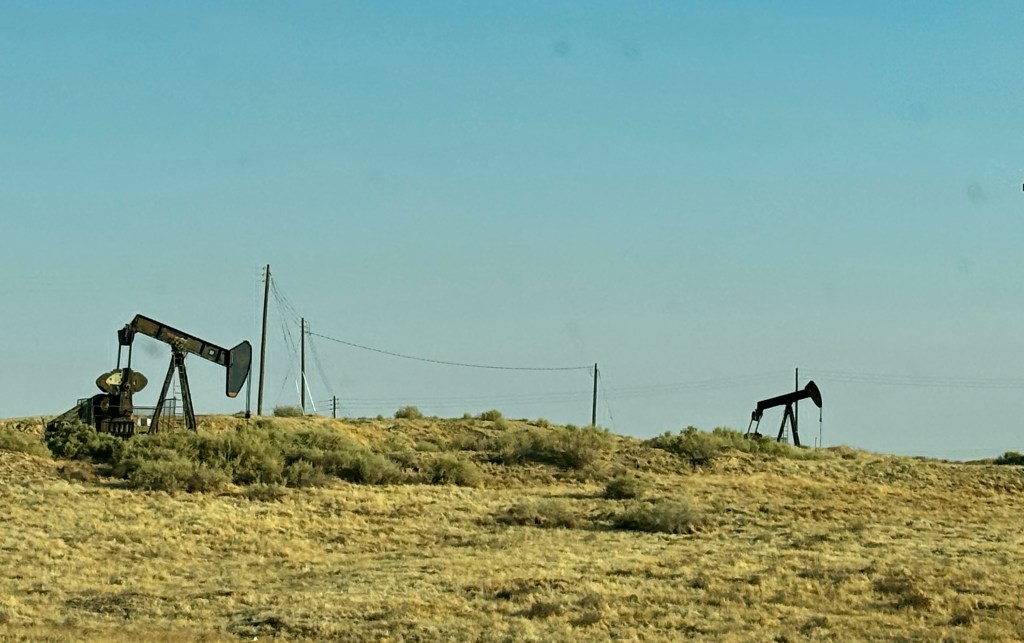
What was surprising was seeing hundreds of oil rigs.  Most were still, but some were active.   I hadn’t known California had substantial oil reserves.  California currently produces 8.3 percent of the nation’s oil.

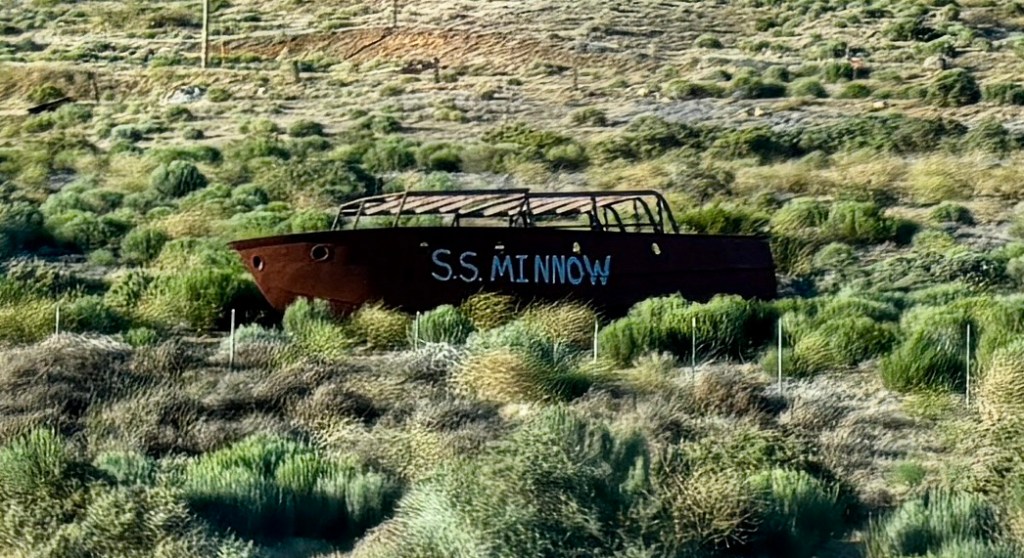
Is climate change responsible for the SS Minnow being stranded in south central California?

Our destination was Sequoia National Park. We’ve been to most of the national parks in the western US but had never visited Sequoia or nearby Kings Canyon National Park.

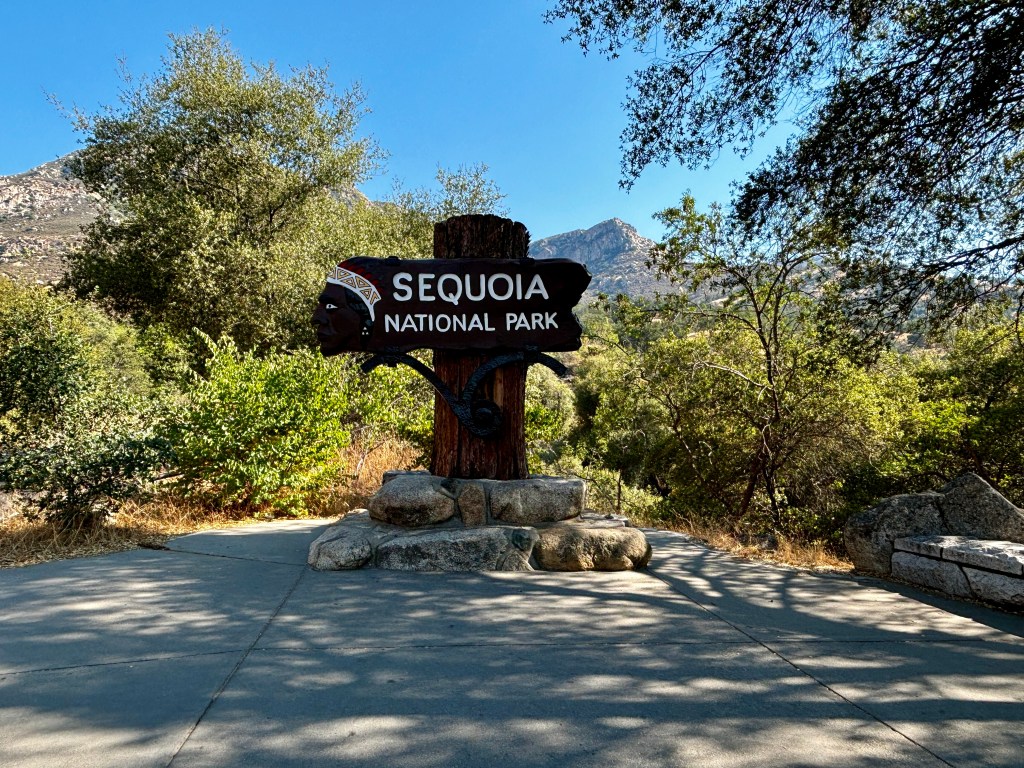
The park’s entrance sign, in place since 1935, has its own history.  It was carved in the 1930s by George Muno who served in the Civilian Conservation Corps.  The 4 by 10 foot sign was carved from a fallen sequoia tree that was about two thousand years old.

Muno’s intent was to honor Sequoyah, the Cherokee scholar who invented an alphabet for their language. Having a written form helped advance literacy. Many believe that the giant sequoia trees were named for Sequoyah.


Regardless of intent, Muno based the profile on the native man on the old “buffalo” nickel. It actually resembles a stereotype of a great plains American Indian, and not Sequoyah or the peoples who called these lands home for thousands of years.   

In present day, the appropriateness of this sign is sometimes reconsidered.  An article on the park website states:  “National parks preserve a complex web of history, not all of it inspiring. Some symbols of our past may not interpret our nation’s past in a sensitive and respectful way.”

Sequoia was America’s second national park, after Yellowstone.  Sequoia was established on September 25, 1890 as a permanent refuge for the sequoia trees.  It remains the only park established to protect a plant species.

The first substantive road into the forest was completed by the US army in 1903 under the leadership of Colonel Charles Young.  He was the first African American to achieve the rank of colonel.

The current road, the Generals Highway, was completed in 1926.  The road is in very good shape considering weather, fire and funding.  During the highway’s construction, workers saw the last grizzly known to be in California.  Although a symbol of California, grizzly bears were assumed already gone in the state. 

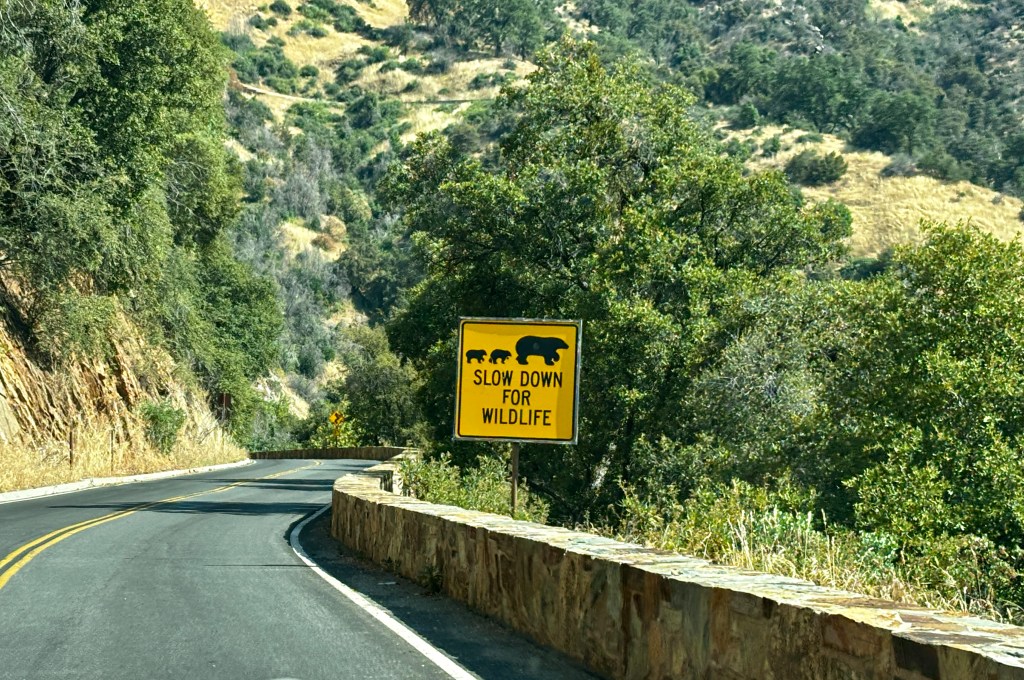
These days black bear are common and signs and notices on how to avoid them are everywhere.

As we passed through the foothills of the park, we drove through oak forests.

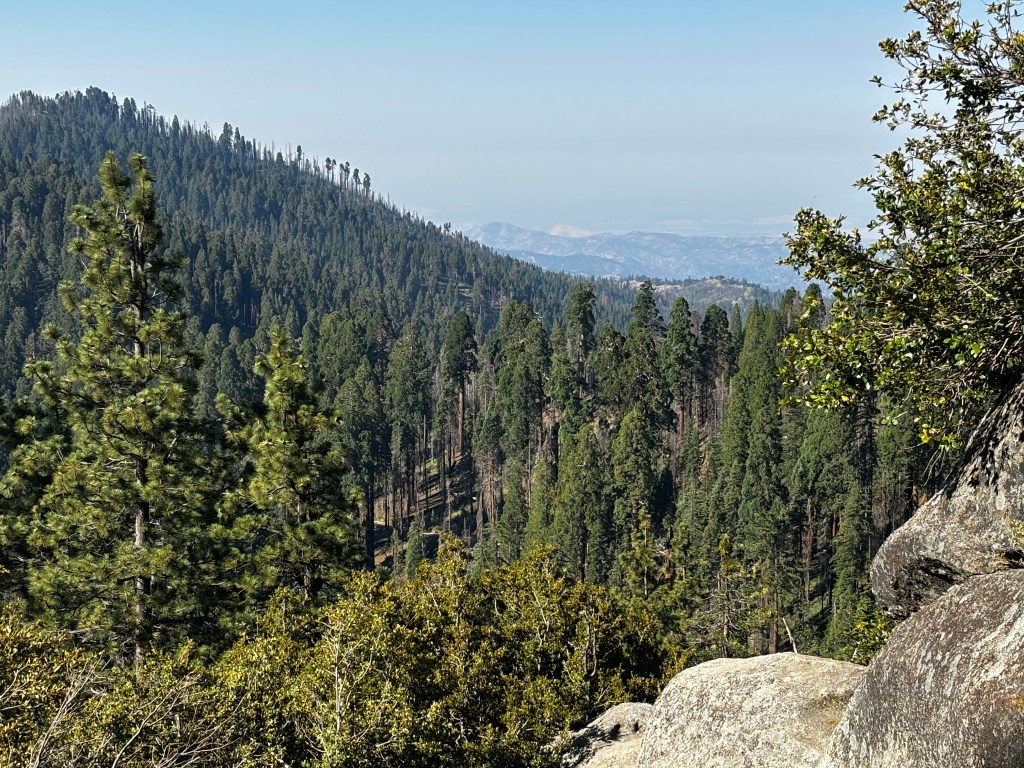
As we rose in elevation, the trees changed.

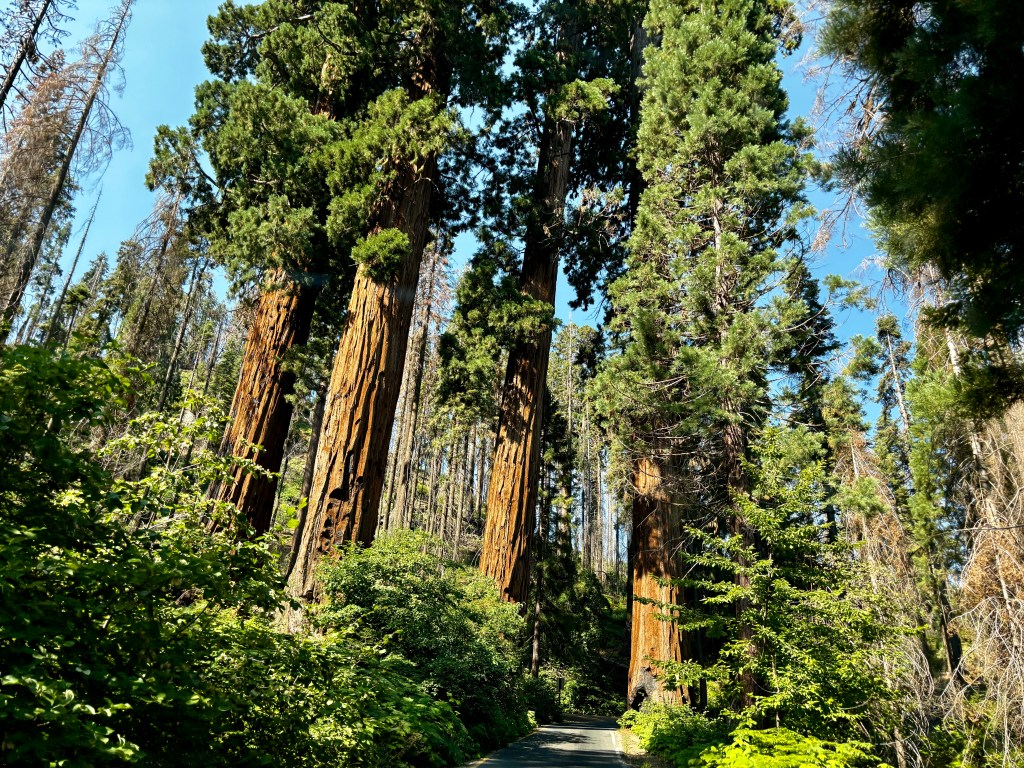
These trees are called the Four Guardsmen. 

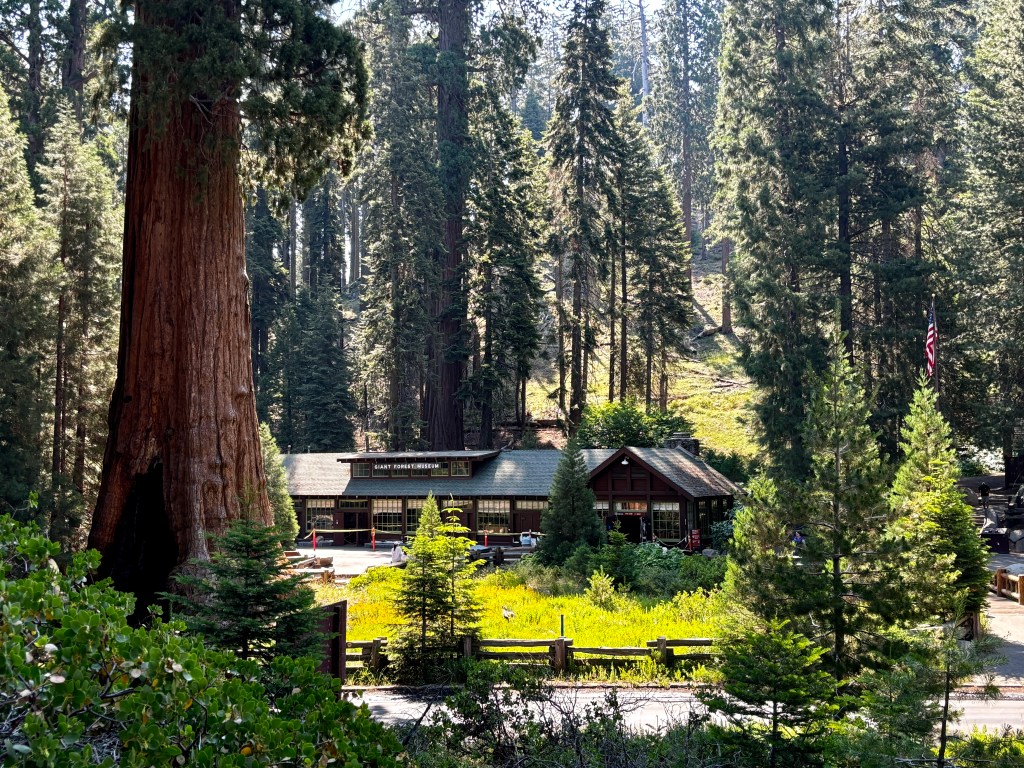
We visited the Giant Trees Museum and had an opportunity to learn about giant sequoia trees. At a very basic level we learned that sequoia are a different species than the other giant trees in California, the coast redwoods. 

It is unclear whether sequoias have a natural lifespan. Some of the trees in the sequoia groves are thought to be 13,000 years old. When trees are tall enough to rise above the forest canopy, the top dies off.  They continue to grow thicker, not higher.  

Their ability to grow rapidly over many years allows for the sequoia’s very large size.  

This picture shows the same museum building being used as a market with associated people, cars and engine exhaust.  Across the road were 100 hotel rooms. 

Over time, foresters and scientists realized that the trees needed space to thrive.  There was an effort to reduce and remove encroaching civilization. Trees are sometimes protected by fencing to discourage “love rings” which are caused by thousands of people touching the tree at approximately the same height.

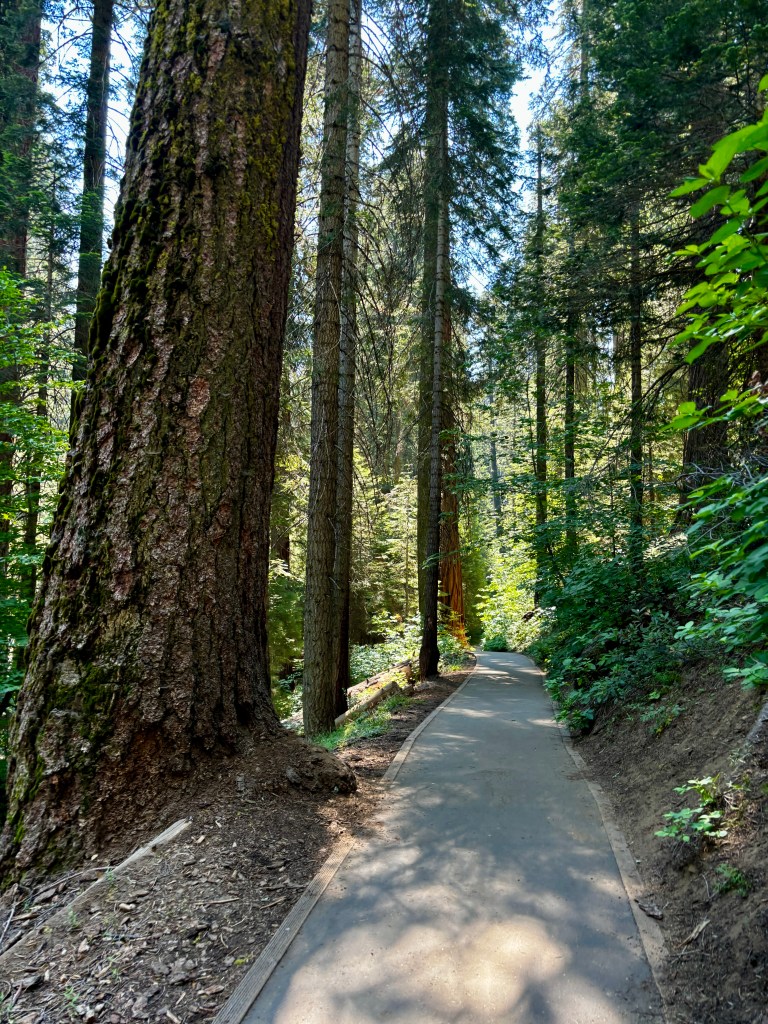
We walked the Big Trees Trail near the museum.

Along the way we learned that this area has characteristics that sequoia trees need, such as moist soil, an open sunny forest, a climate that doesn’t get too cold, and bare ashy ground. 

The meadow’s soil is too wet for the roots due to rainwater and snow runoff collection. Although sequoia need enormous amounts of water, they collect what they need as the water drains toward the meadow. 

Sequoia have a shallow root base, needing only about three feet of soil.  Adjacent trees will intertwine their root system providing stabilization.

This tree likely fell when the ground became too soggy, possibly with assistance from a strong wind or shifting foundation.

As the trees grow, lower branches are lost because of the lack of sun or forest fire.   Regular fires are beneficial to sequoia, creating conditions for cones to open and release their seeds.  The seeds then sprout on the bare ground enhanced by ash.

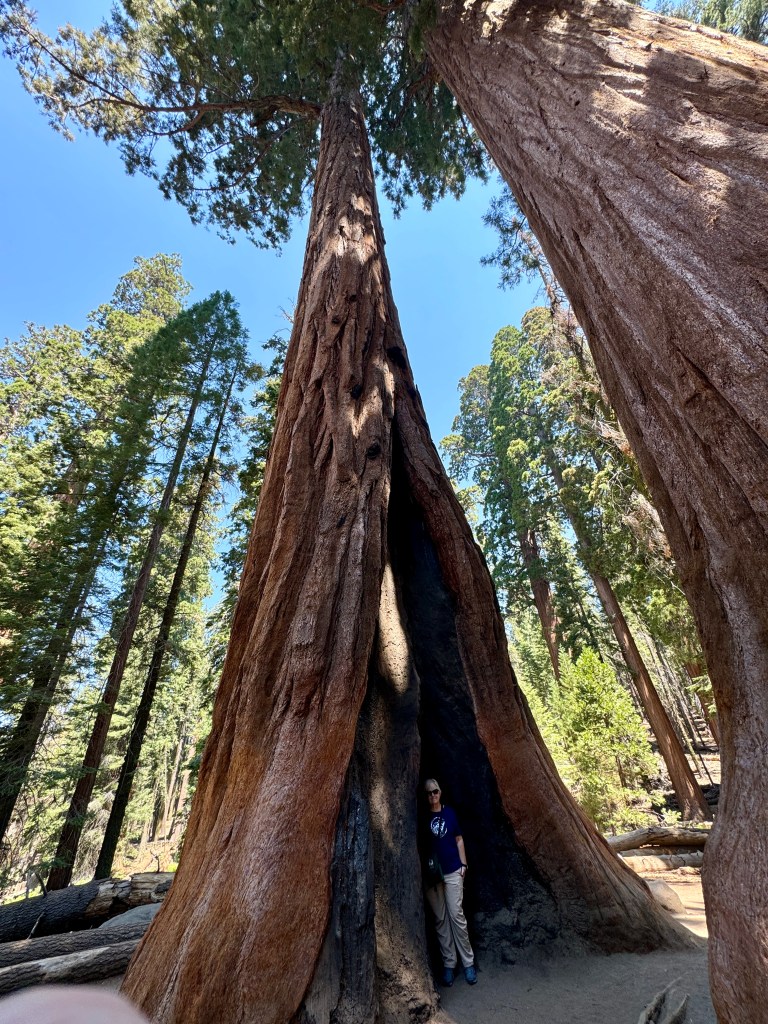
Large sequoias are likely to have fire scars but survive because of thick bark with air pockets that insulate the wood. High branches keep foliage away from most fires and the bark has very little sap so is not highly flammable. 

This tree fell in 1992, likely because of damaged roots interacting with soggy ground and wind.  A road was cut near its base early in the 1900s likely damaging the tree’s root system.

This told the story of a ranger hearing a sequoia falling for no apparent reason reason in 1974.

Another interesting sign was nearby.

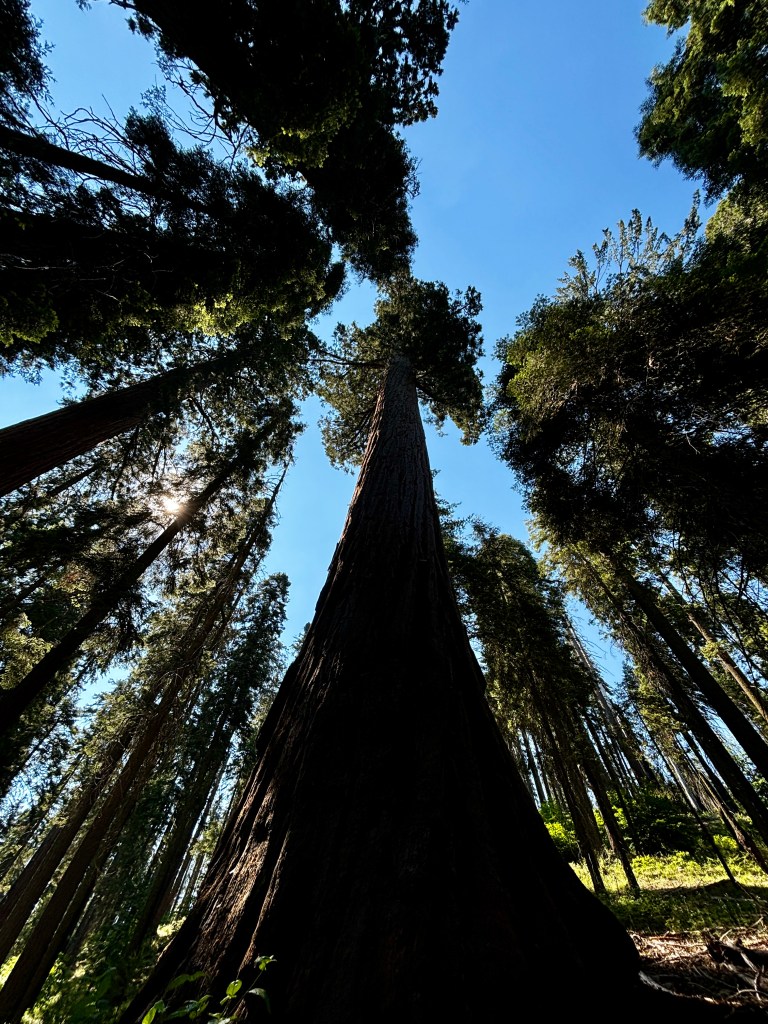
The trees made us look tiny!

Many of the tree names in Sequoia and Kings Canyon National Parks have a civil war association.  This tree is called the Clara Barton tree.

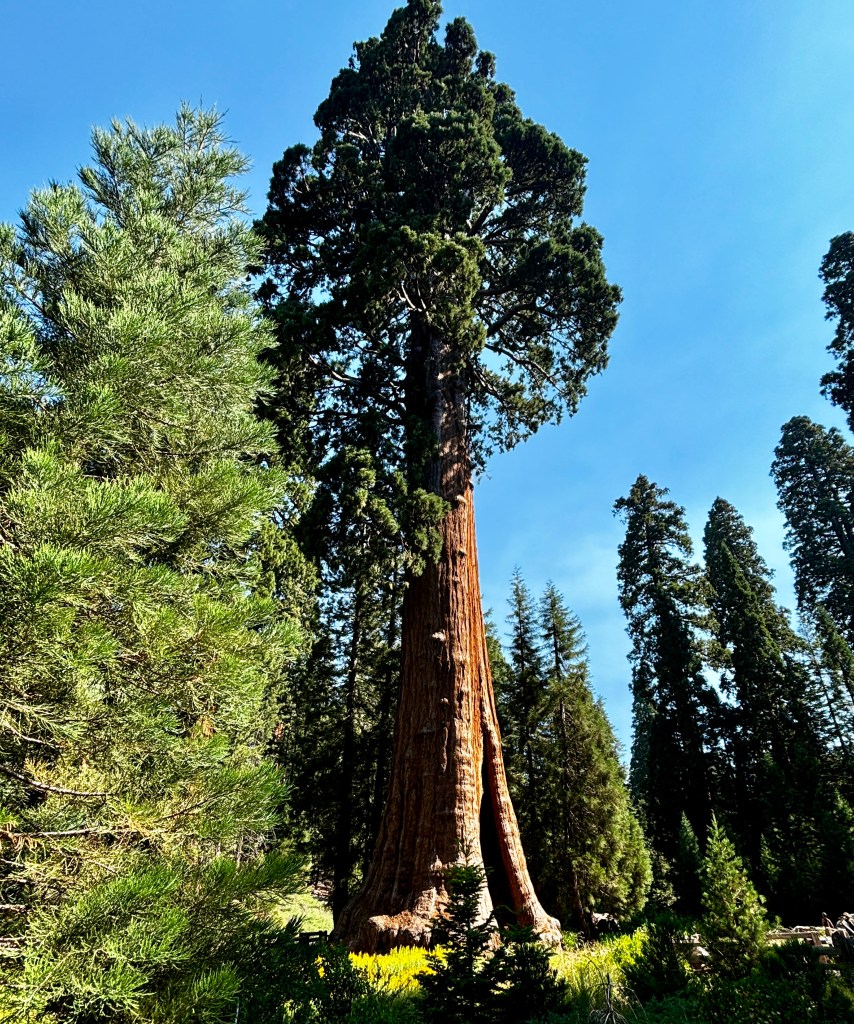
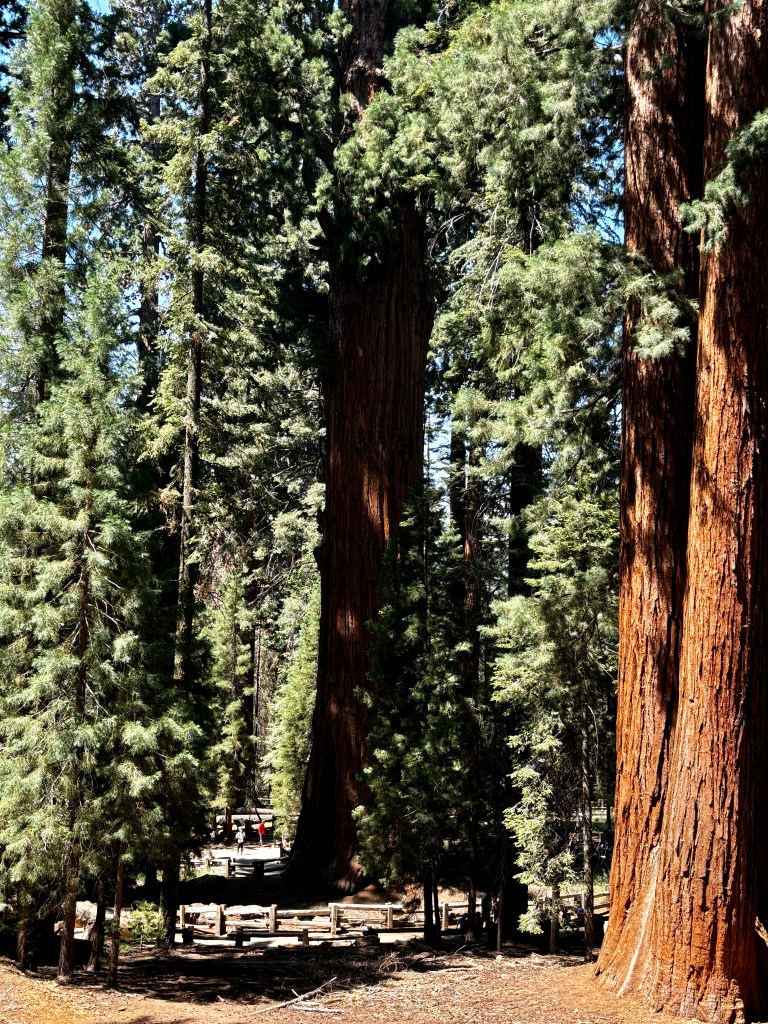
The must do in Sequoia National Park is visiting the General Sherman tree – the largest tree in the world. The determination of “largest” is made when combining height, diameter and volume. The walk to the tree was on a paved path – about a half mile all down hill.  Hmmm.  You know what that means.

It was nigh impossible to get a picture of the whole General Sherman Tree without people in the picture!

The height of General Sherman is 275 feet.  On a football field it would reach from one goal line to the opposite 9 yard line. The tallest sequoia is an unnamed tree measuring 311 feet.  The tallest coast redwood is 369 feet.

General Sherman’s weight is estimate at 1385 tons – more than ten blue whales. Its diameter is 36.5 feet, wide enough to block three lanes of traffic.

To grow this high, heavy and wide, the General Sherman Tree is estimated to be 1800-2700 years old.   It is not getting taller but is still increasing in girth: getting wider in diameter and increasing in volume.  

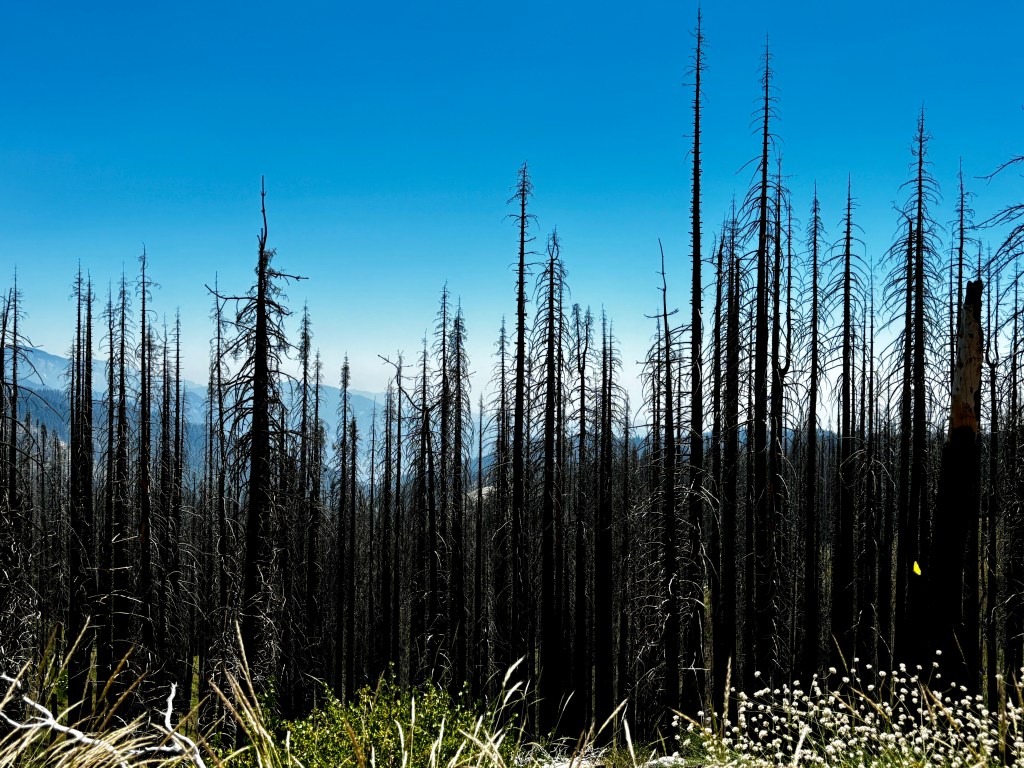
This picture shows rangers using structure wrap to protect the General Sherman Tree during the KNP Complex Fire.  This strategy can help a few sequoias but won’t save groves of trees.  The KNP Complex Fire in 2021 did a lot of damage!

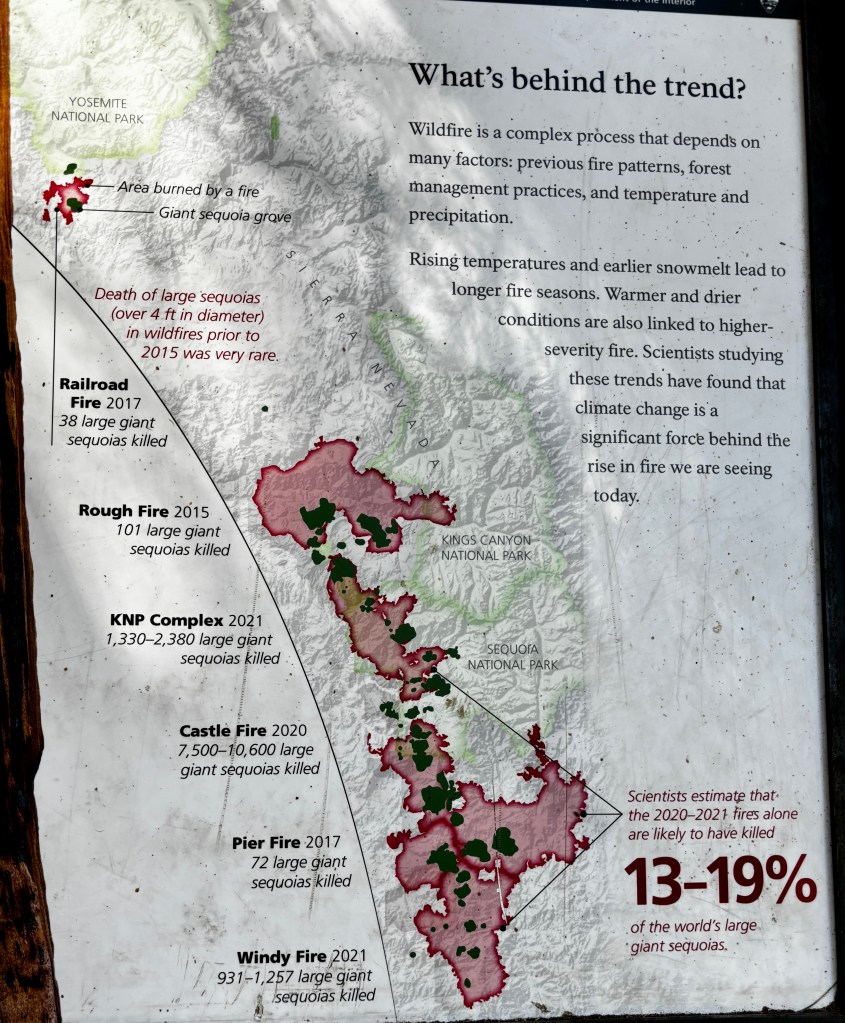
Unfortunately, sequoias are being lost at an alarming rate because of the intense fire seasons related to climate change.  The entire placard is interesting but notice that 13 – 19 percent of sequoias were lost during the 2020-2021 fire seasons alone.  

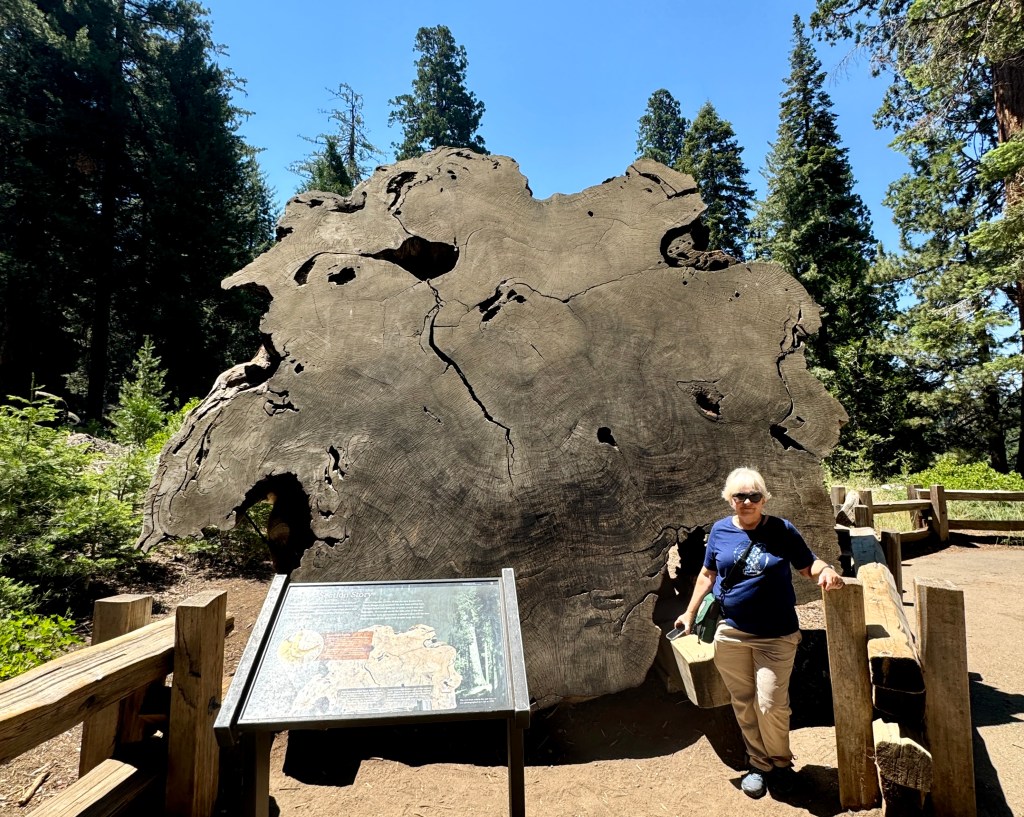
This stump section of a giant sequoia tells that the tree lived 2210 years and survived 80 fires that left scarring.    

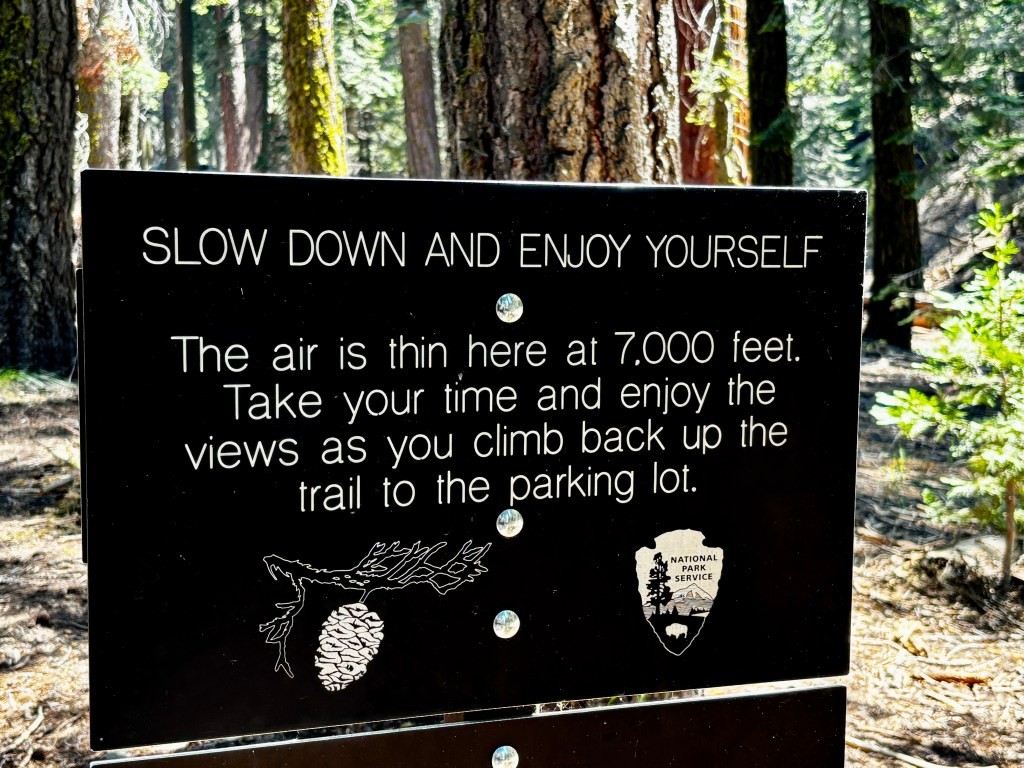
We began the trek back up the trail to the parking lot.

I did not enjoy it.

We had some interesting sights as we drove to our accommodations for the night.

We were spending one night at the Wuksachi Lodge within the park.   Reception, the restaurant, and gift shop were in this building.   Accommodations were in separate buildings near by.

The woman checking us in told us our room was on the entry level.  We thought that was good since she also told us we needed to take everything that had any hint of food out of our car because of the bears. Only our room wasn’t on the entry level. 

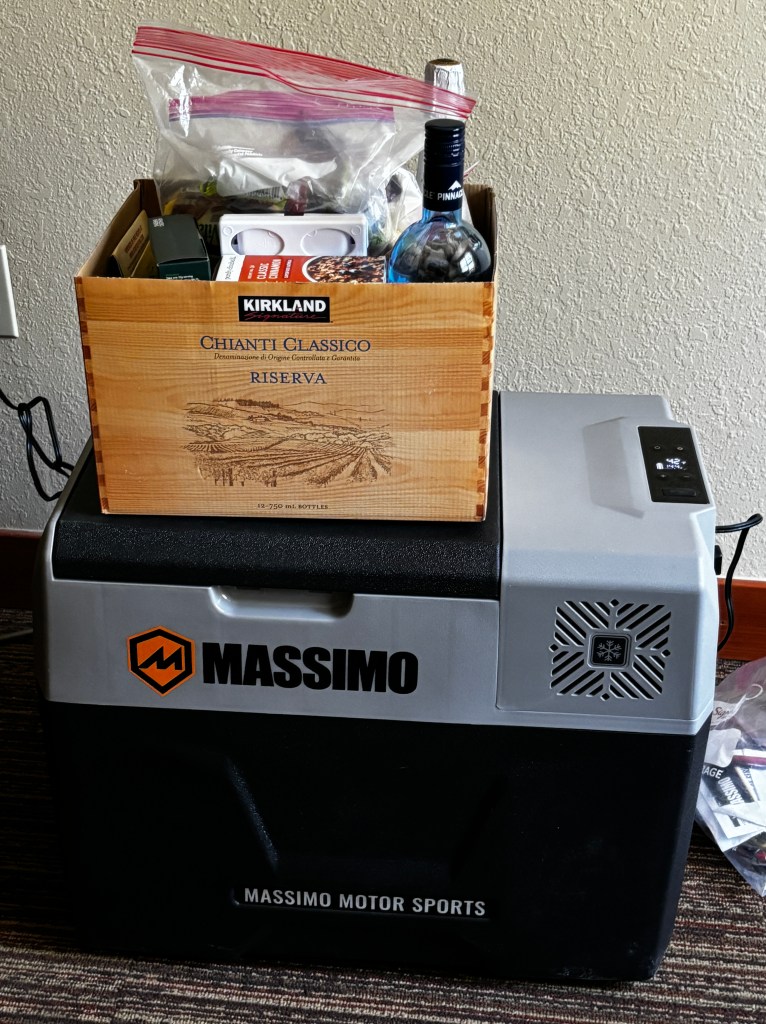
We (mostly Randy) had to lug two suitcases, our ice chest and our snack box up the stairs because there was no elevator.

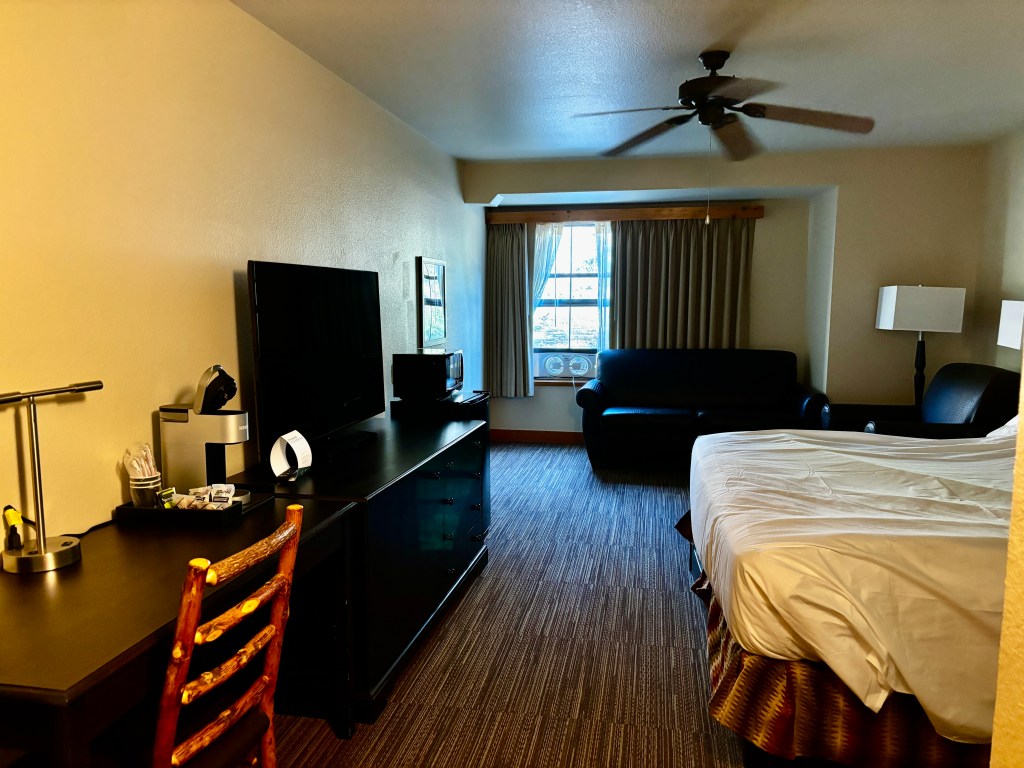
Our room was a nice size but did not have air conditioning.  We tried to “chill” for the rest of the afternoon.  

Our dinner reservations said “business casual” so Randy put on pants even though he was skeptical.  His skepticism was correct in that most people came in their regular vacation clothes. He grumbled.

We have prioritized staying in national park lodges all over the west and have thoroughly enjoyed the effort overall. Wuksachi Lodge wasn’t a net positive in the heat of the summer.  Only the location was superb.

We were in Sequoia National Park in July 2024.

Next up:  The General Grant Tree in Kings Canyon National Park

Posted in Uncategorized | 1 Comment

Philadelphia History and Food Tours

So….you can’t come to Philadelphia and not do a little history, right?  Randy agreed. I spent most of a week in the city with my mom about 20 years ago and we did it all. As a result, I could do this abbreviated version without regret.

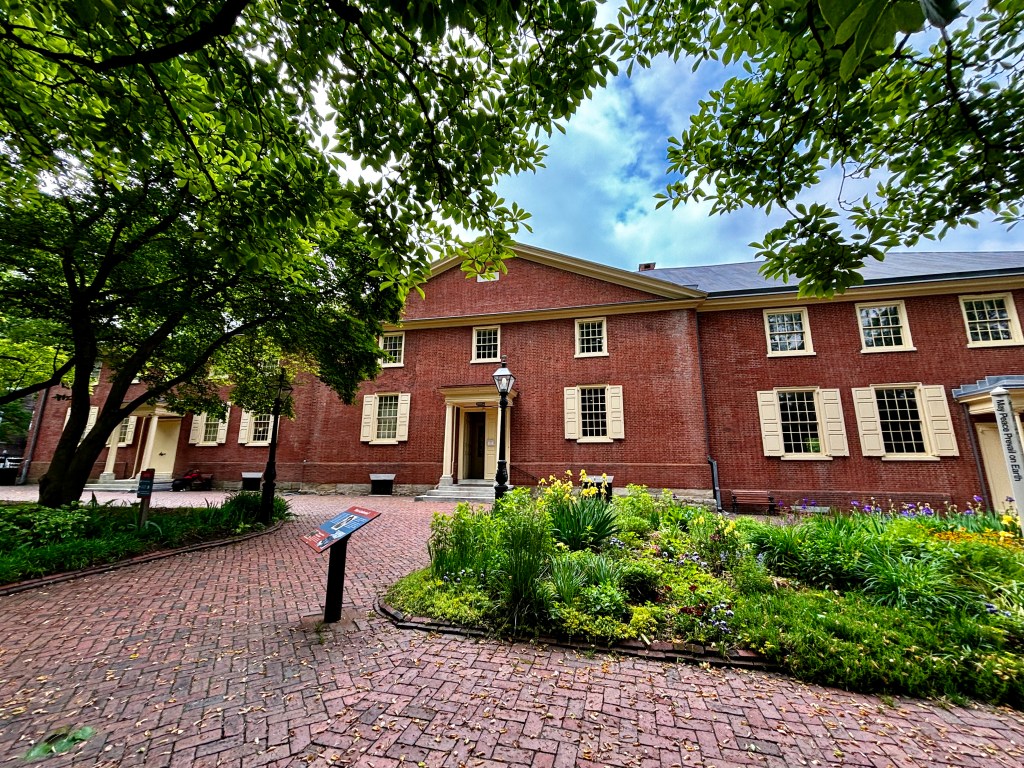
Our Philadelphia History Tour began at the Archer Street Quaker Meeting House.  It was built in 1804 on grounds granted by William Penn.  The Quakers welcomed all faiths in Penn’s Philadelphia.  The meeting house has been used continuously as a place of worship.

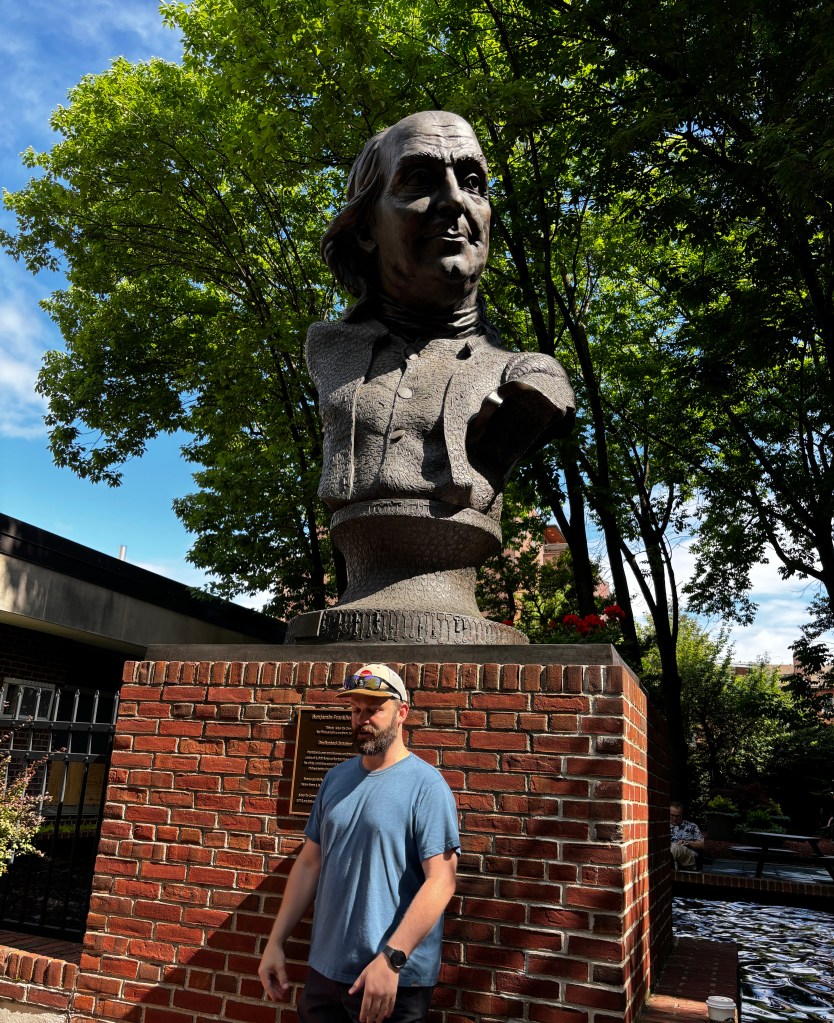
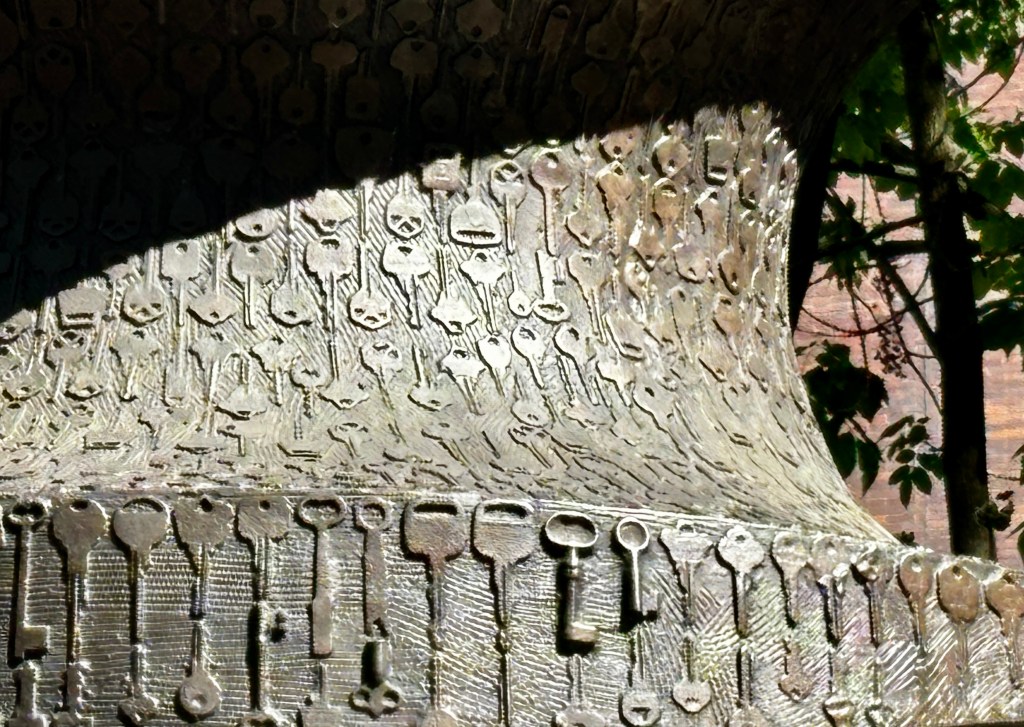
This statue of Ben Franklin was made using 1.8 million pennies donated by kids at 500 local schools. It also included brass from nameplates of Philadelphia firefighters dating from 1736.

One thousand keys are visible at the surface, symbolic of Franklin’s experience with static electricity from lightning and a key.

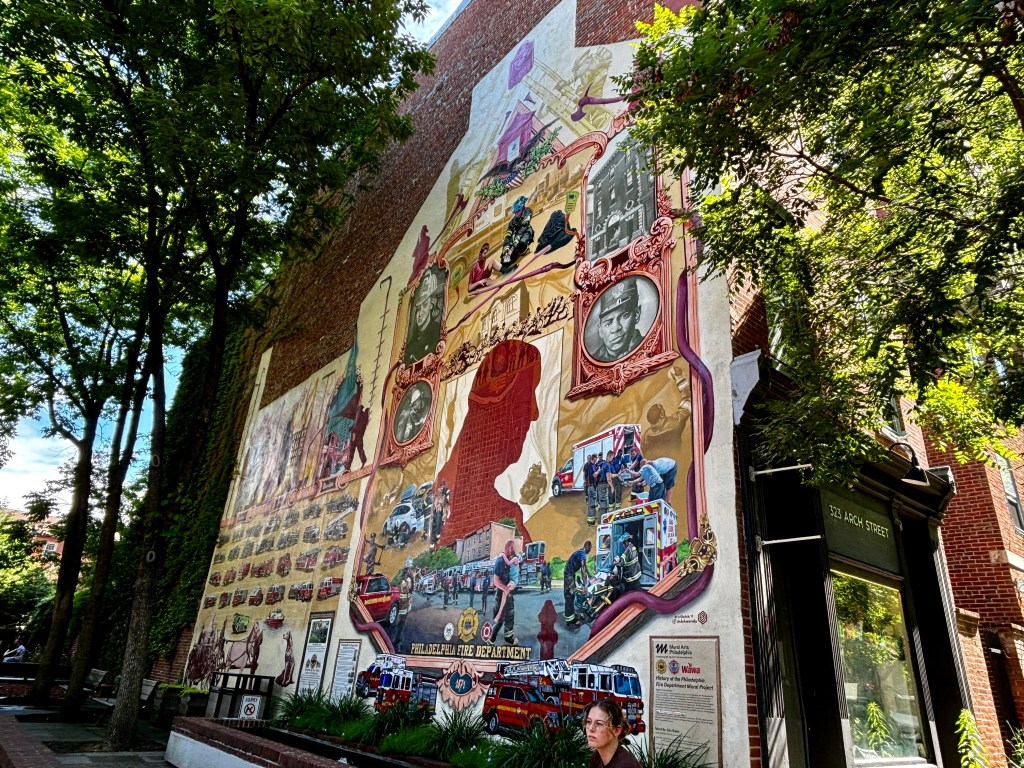
Adjacent to the statue is one of 4000 murals in Philadelphia, much of them centered in the historic area.  This one is about Ben Franklin and his co-founding of the Union Fire Company in 1736.  It was also known as the “Bucket Brigade” and was the first formally organized all volunteer firefighters group.

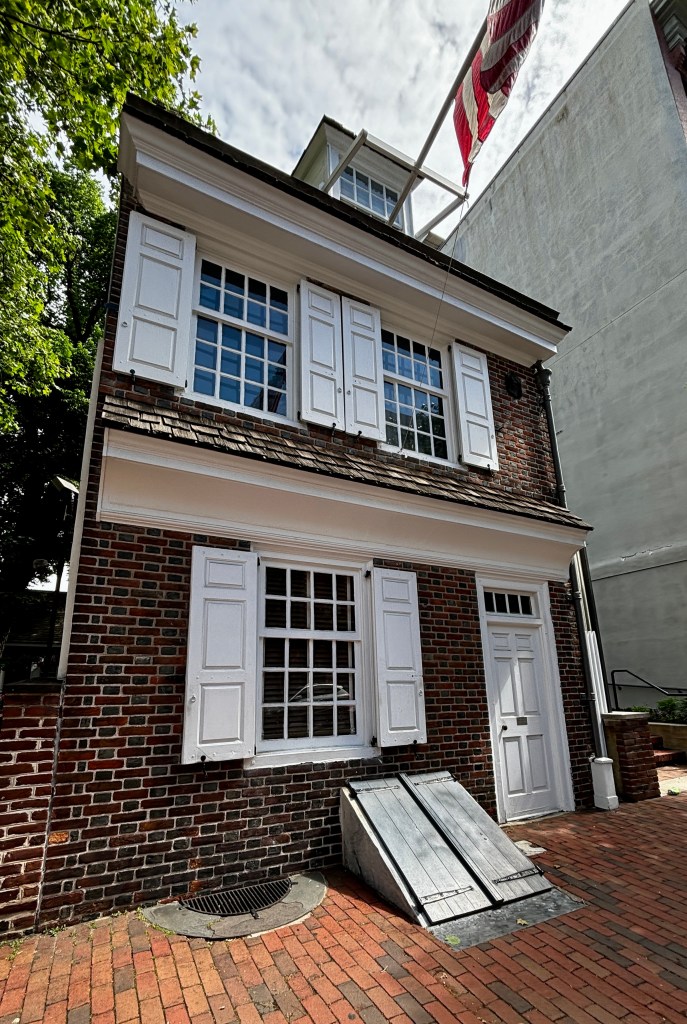
We did a quick stop outside of Betsy Ross’ house.  She is credited with sewing the first version of the Stars and Stripes for George Washington.  There is no official documentation of her doing so as it would have been a treasonous event.

Generations of family lore, with similar details from different branches of the family, brought the story forward about the time of the nation’s centennial celebration.

Regardless of whether the original flag story was true, she was a woman business owner (upholstery and flags) in colonial America and provided gun powder and bullets to the revolutionary soldiers.  She was exceptional if only for these documented activities.

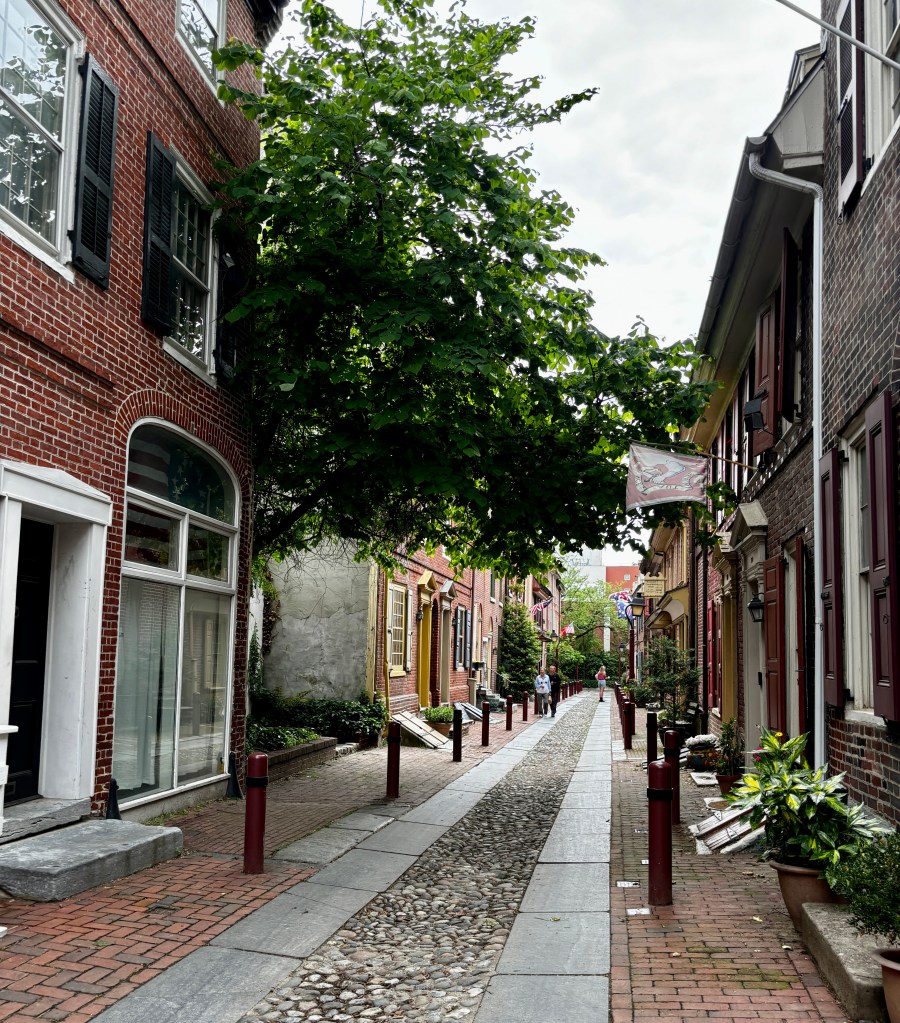
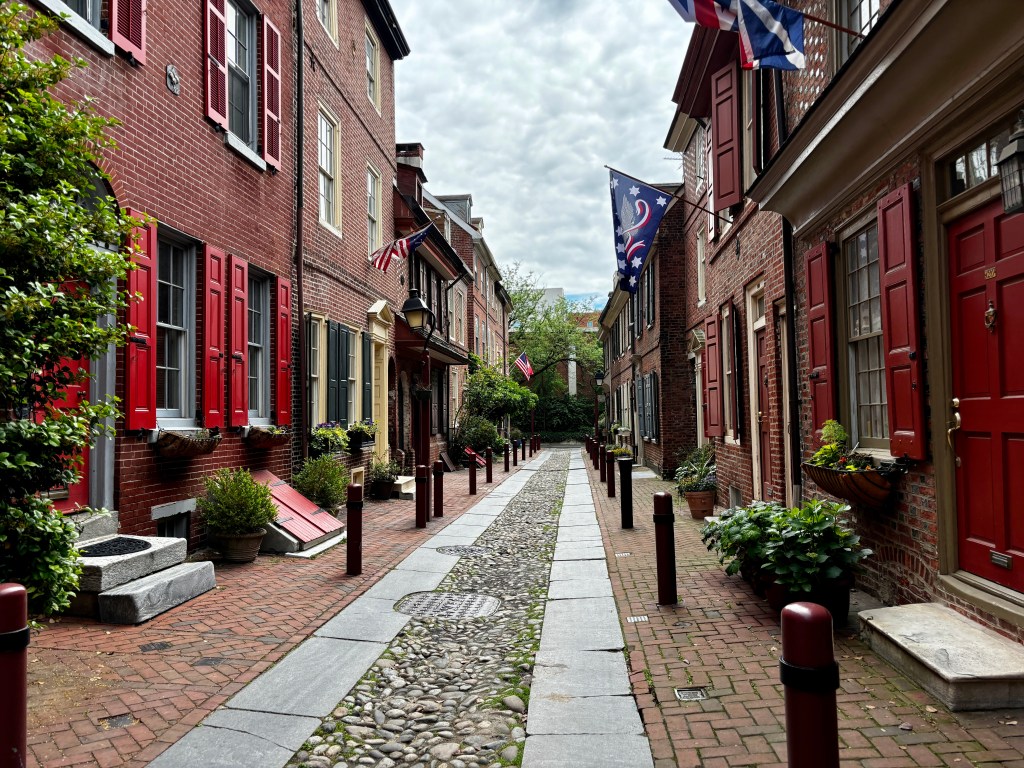
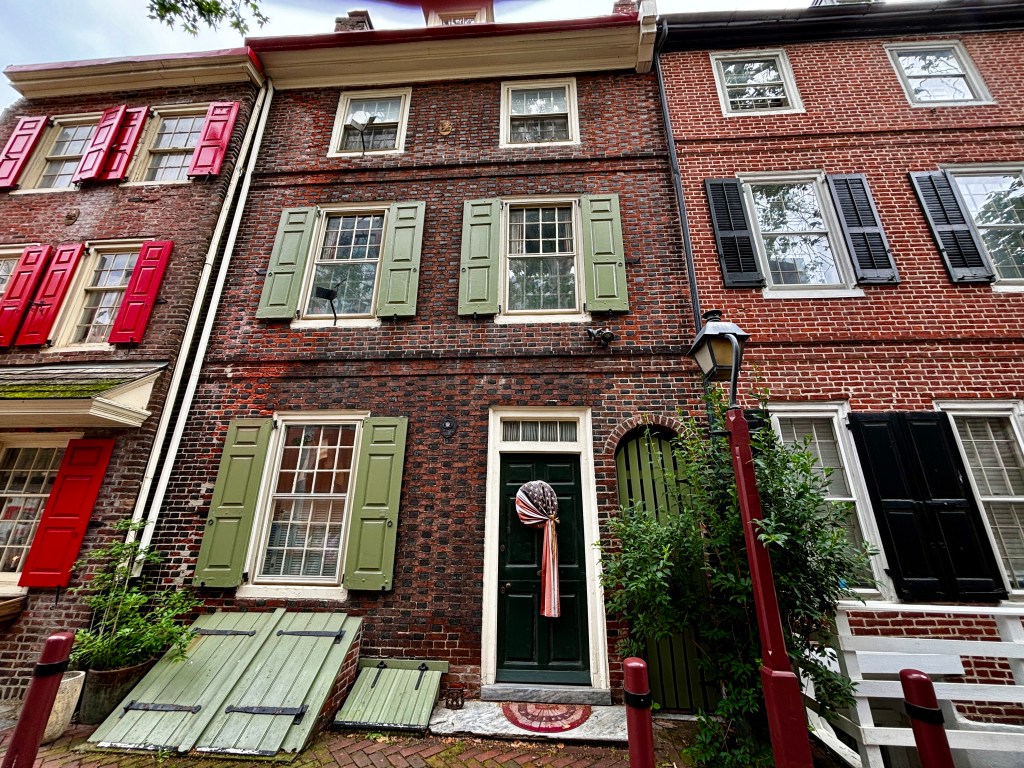
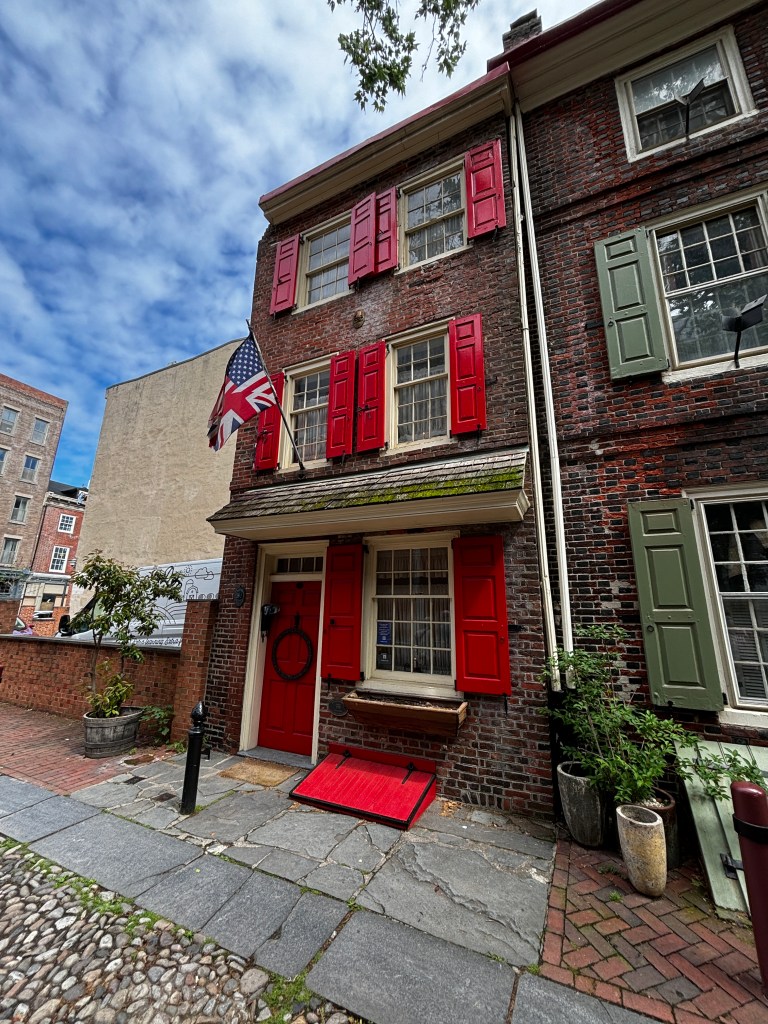
Elfreth’s Alley is the nations oldest, continuously occupied, English speaking street.  (The oldest continuously occupied street is in Saint Augustine, Florida.)

Six houses were at risk when the I-90 interstate was expanding.  Efforts were made to give the alley historical status protection and that was achieved.

Twenty-nine of the 31 houses are owned by individuals. Two houses are owned by the local association as a museum.

This house is currently for sale for $1.25 million.  Our tour guide thought that it was overpriced as the last house on the alley sold for about half that (before Covid).

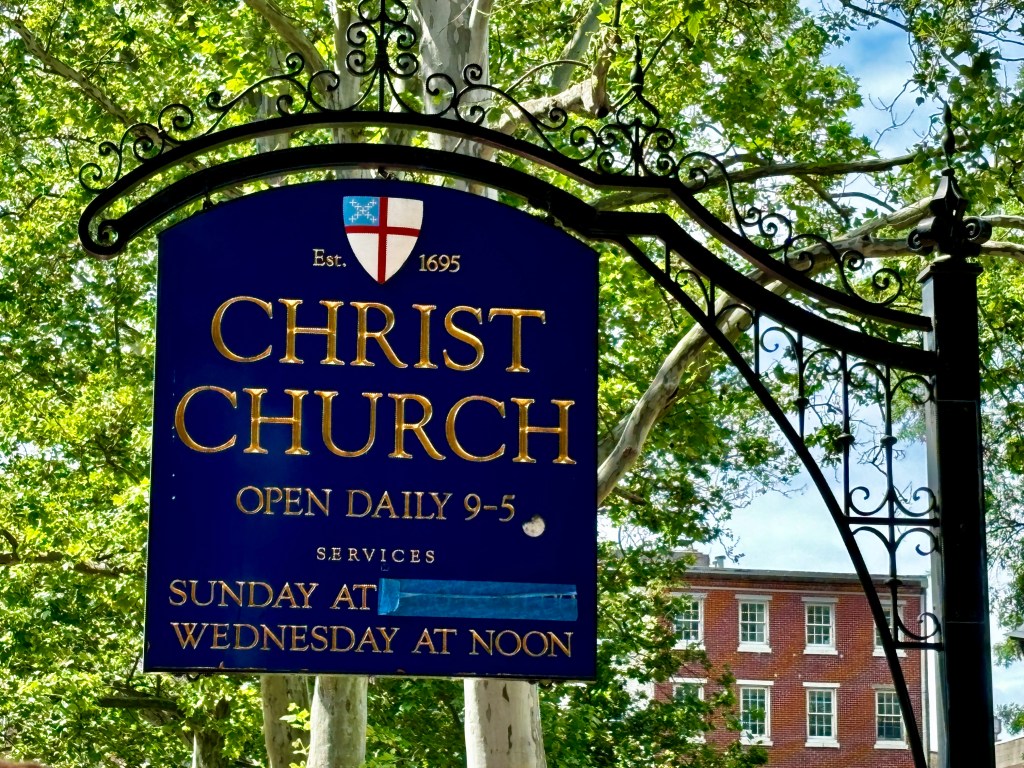
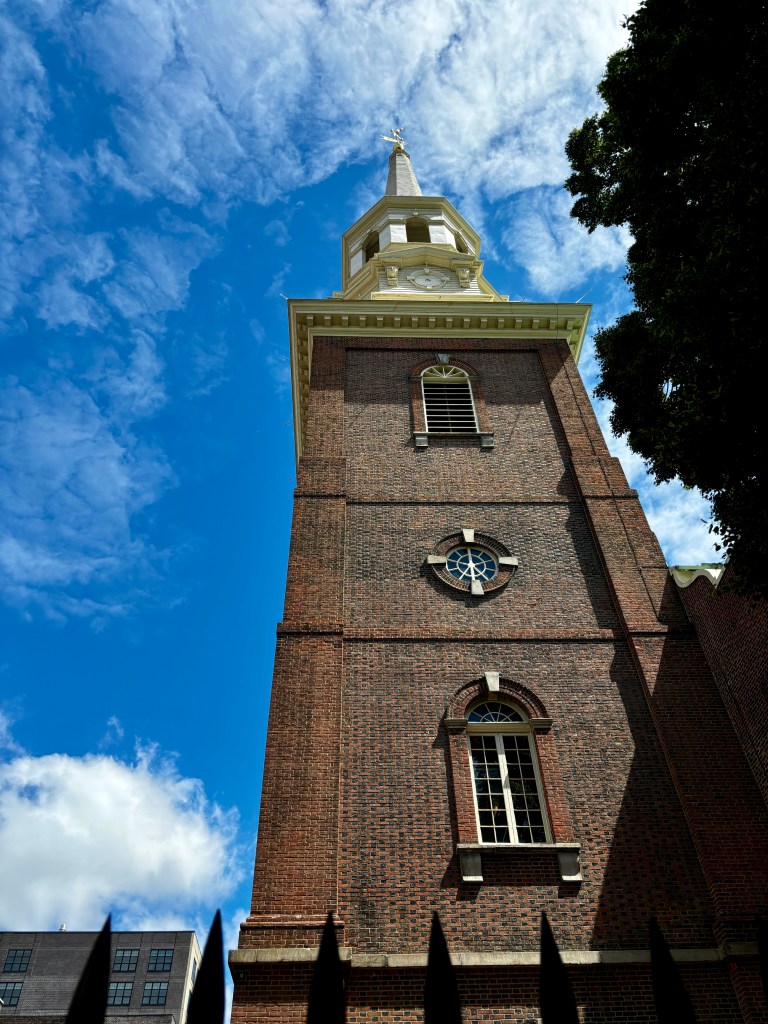
We moved on to Christ Church.  Mom and I had been able to tour the church but this time we were there on a Sunday morning and services were being held inside.  The church was established in 1695.  This is its third structure and dates to 1744.

We heard the same church bells that fifteen signers of the Declaration of Independence (who were members) would have heard.

The 197 foot church tower was the tallest building George Washington ever saw.  It was the tallest structure in North America for 56 years. 

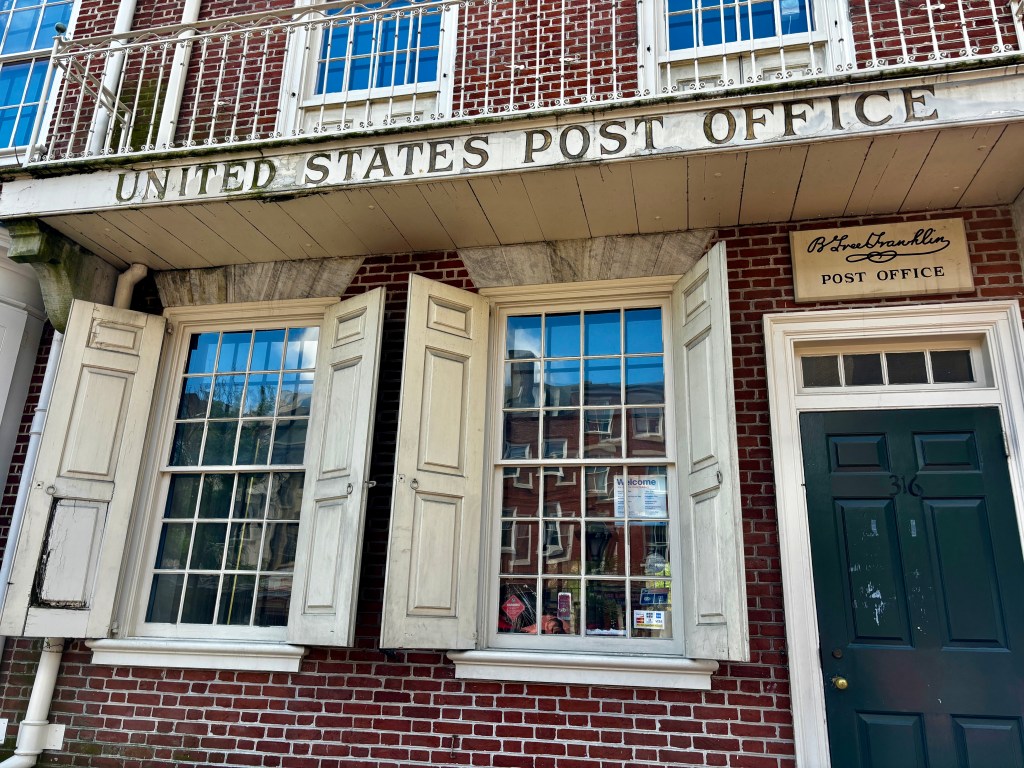
This United States Post Office established under “B Free Franklin.”  He was instrumental in forming what later became the United States Postal Service.  This is the only post office not required to display a flag.  It has operated since colonial times, but not continuously. 

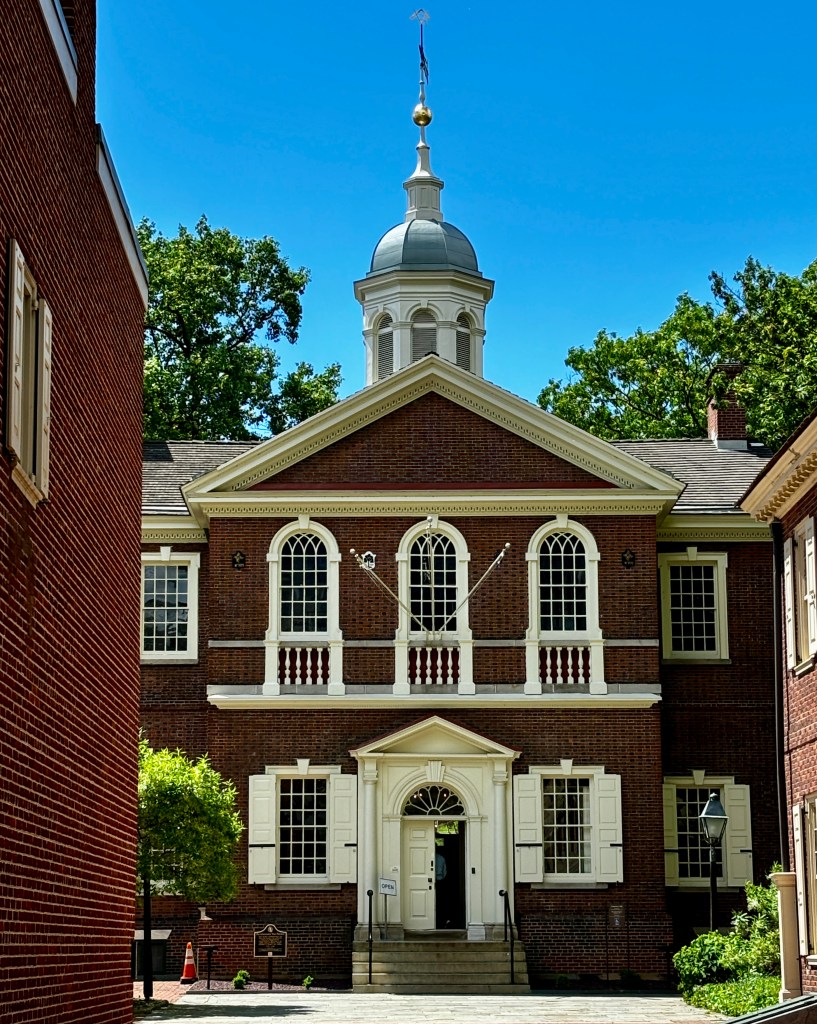
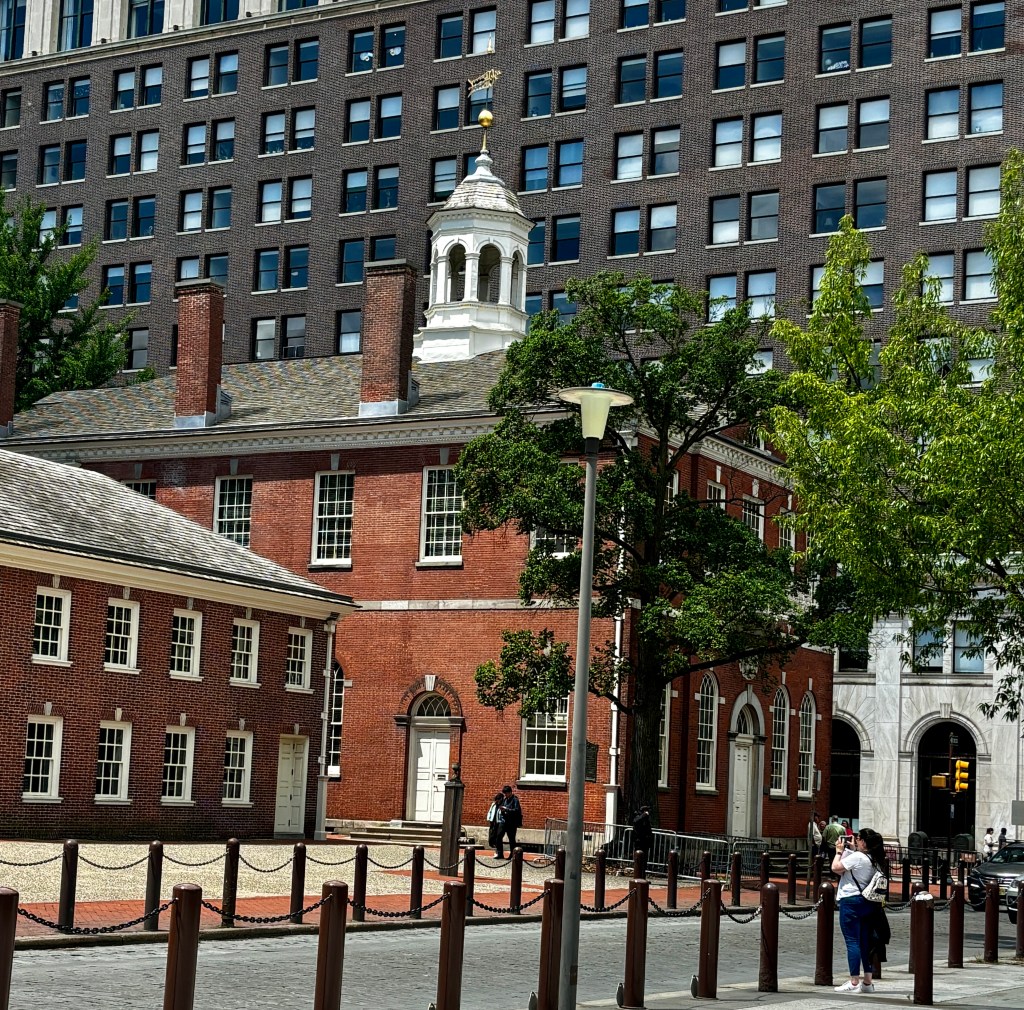
This is Carpenter’s Hall where colonist leaders and the First Continental Congress met to say we don’t want taxation without representation.

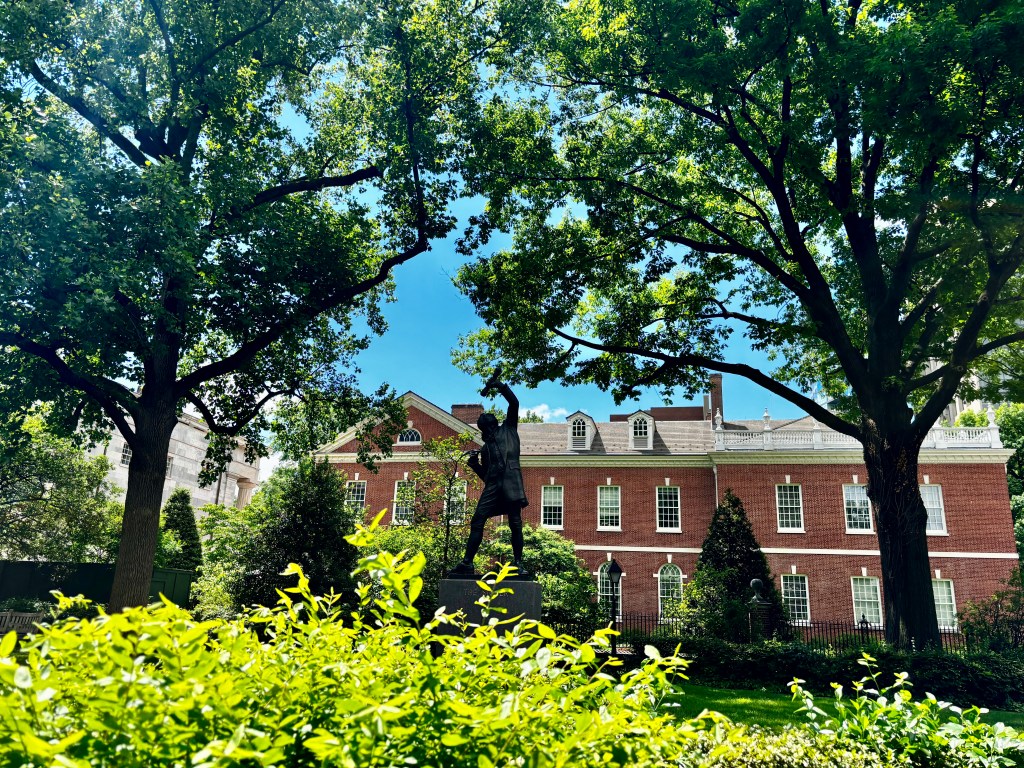
This statue is called The Signer in tribute to those who put their names on the documents.

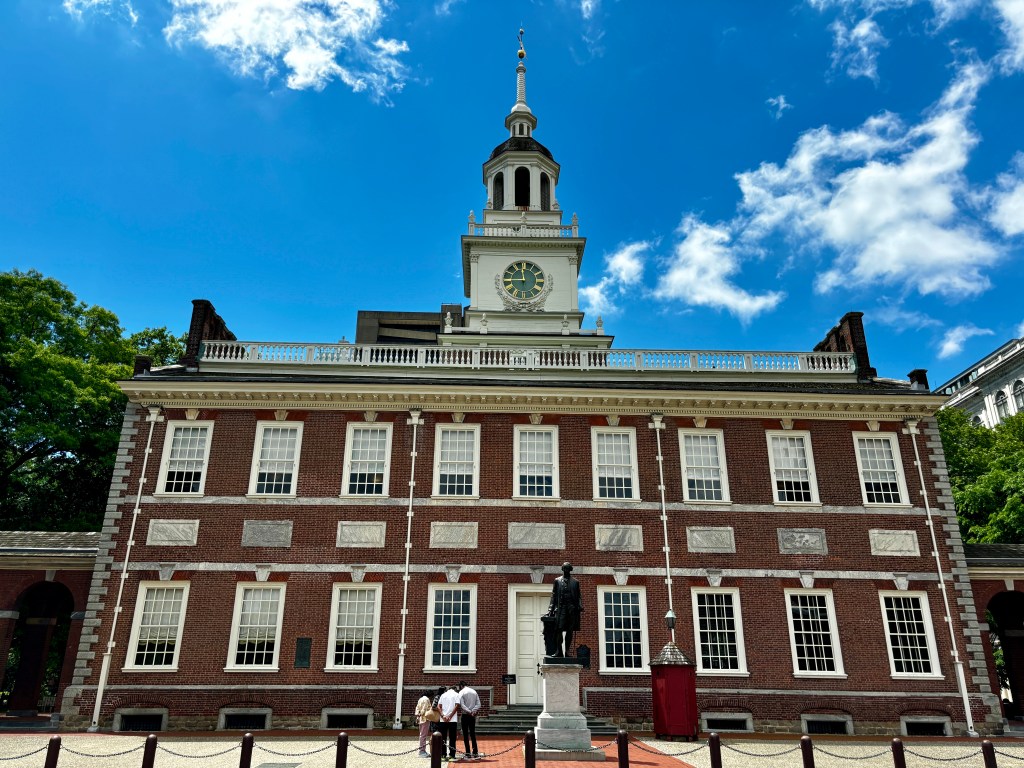
This is Independence Hall where the Second Continental Congress worked through the Declaration of Independence and the Articles of Confederation, the first constitution. 

Philadelphia was the first capital of the nation.  This building was Congress Hall with Upper and Lower chambers.  John Adams was sworn in here in the first peaceful transfer of power.  Good for them, and so many others, who have transferred power peaceably.

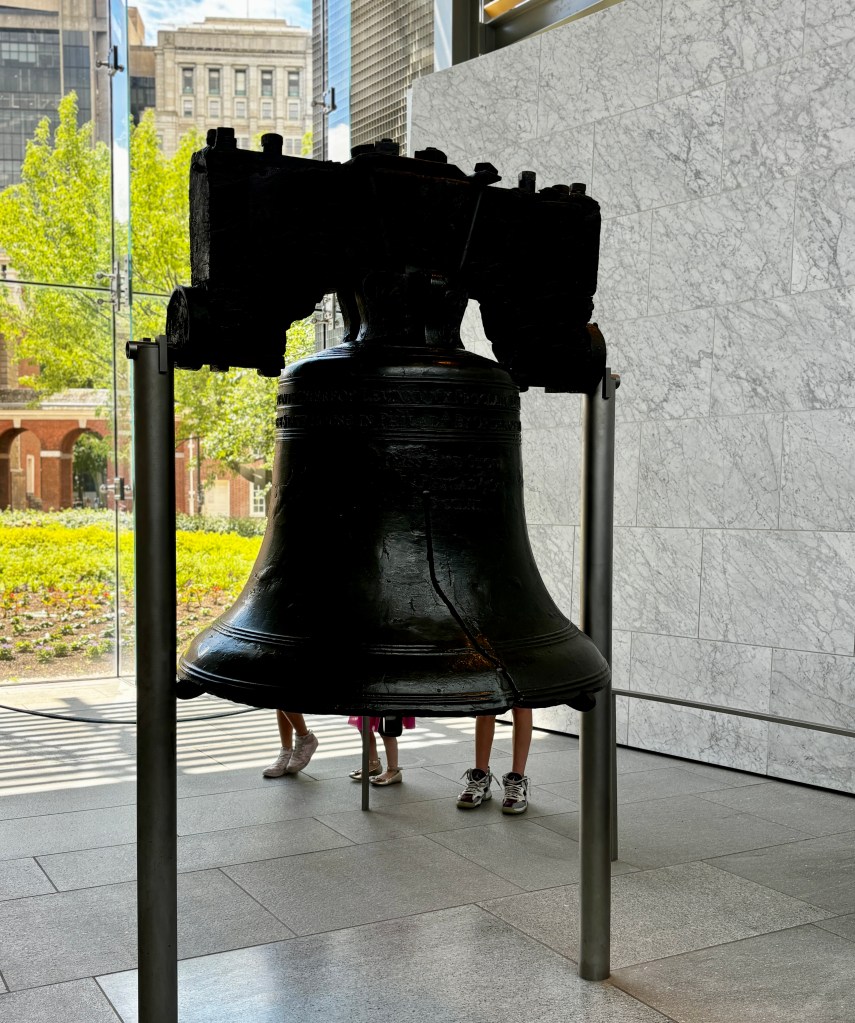
Of course this is the Liberty Bell with feet.  It was actually my best shot at getting the Liberty Bell without people around it! I’m not photo savvy enough to remove them and it really isn’t realistic to get a photo of the Liberty Bell without people around.

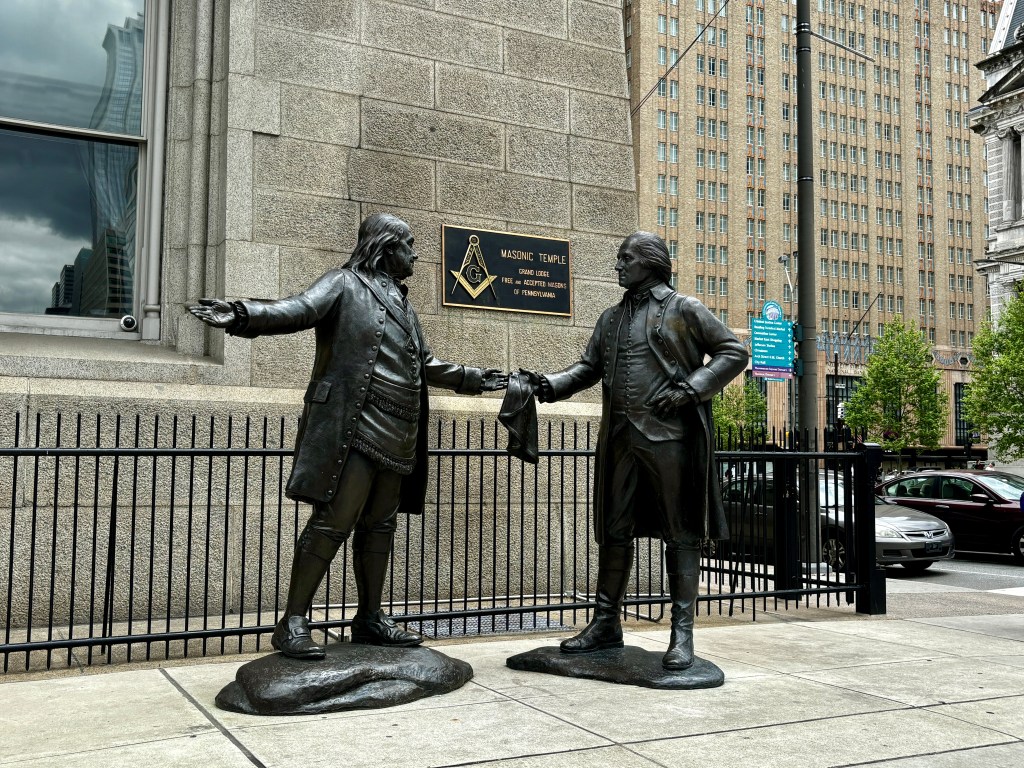
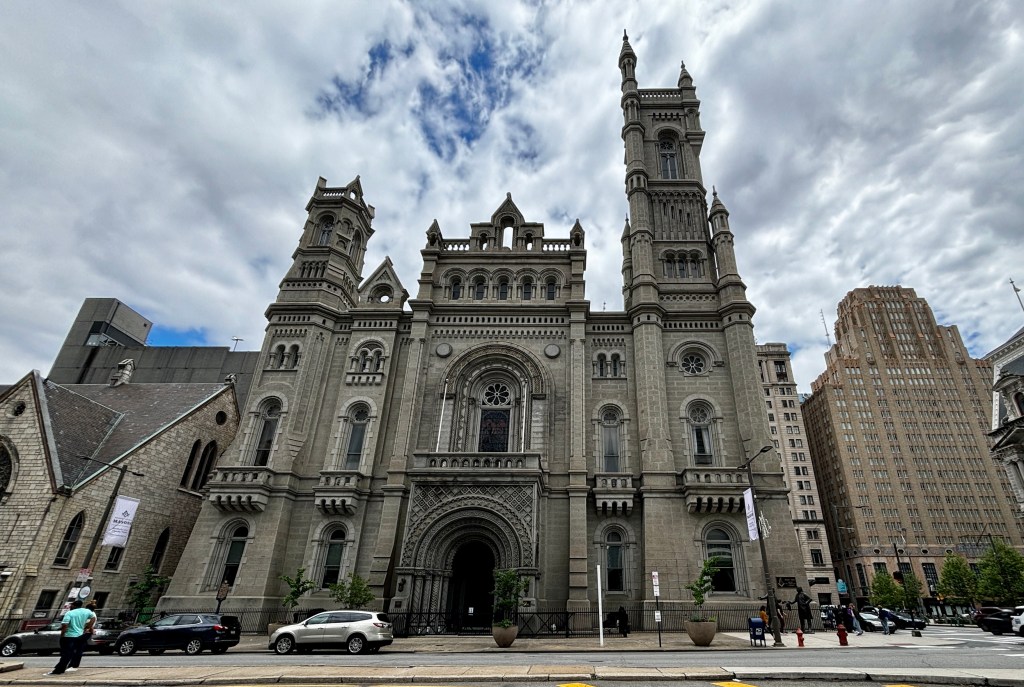
Our next activity was a Philadelphia Food Tour.  We met on a corner by the Masonic Lodge and enjoyed some views.

We saw these guys!

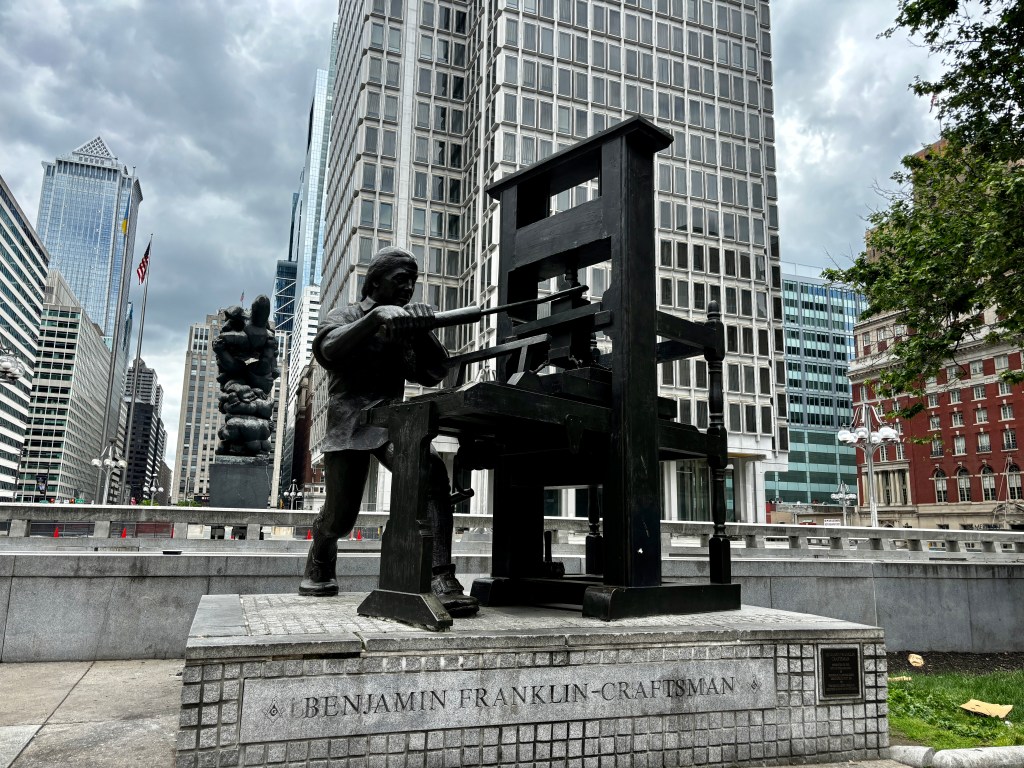
Ben Franklin, the craftsman, was across the street.

The architecture in downtown Philadelphia was great!

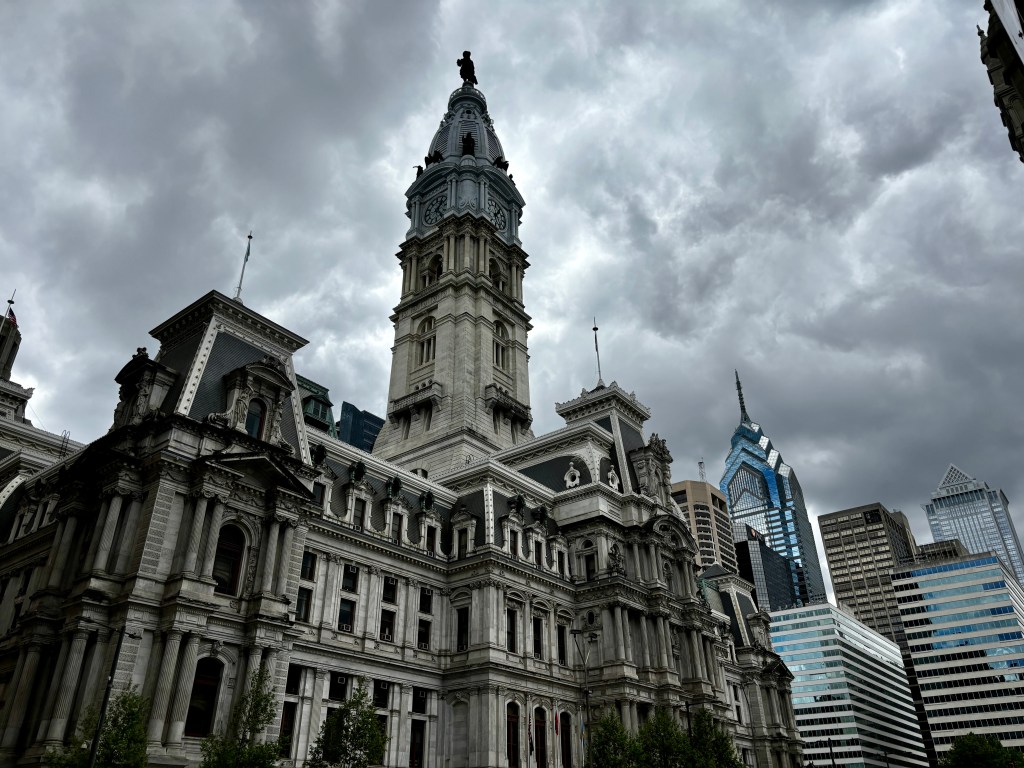
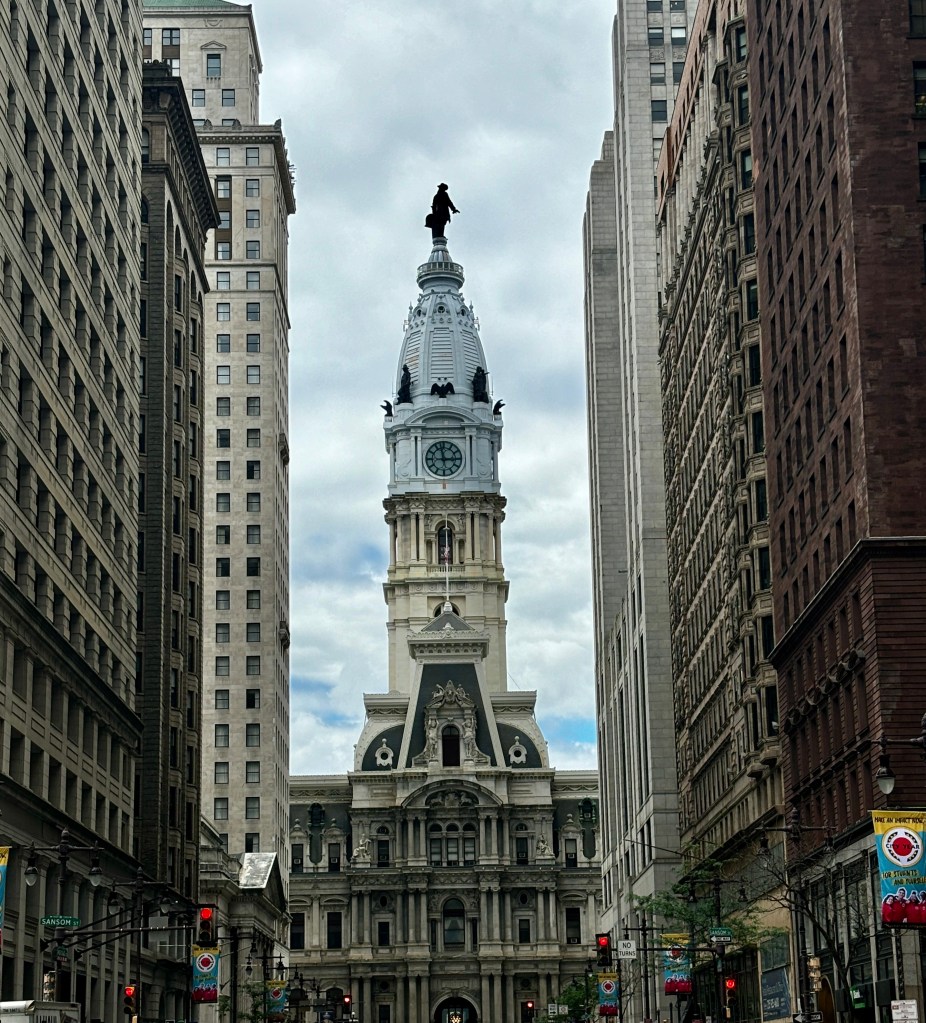
Our food tour guide brought us cheese steak sandwiches and told us about this large building. It is Philadelphia City Hall, the largest government building in our country.

It is the second largest masonry building. City Hall has the tallest statue (William Penn) of any building in the world at 37 feet tall, and weighing in at 27 tons. 

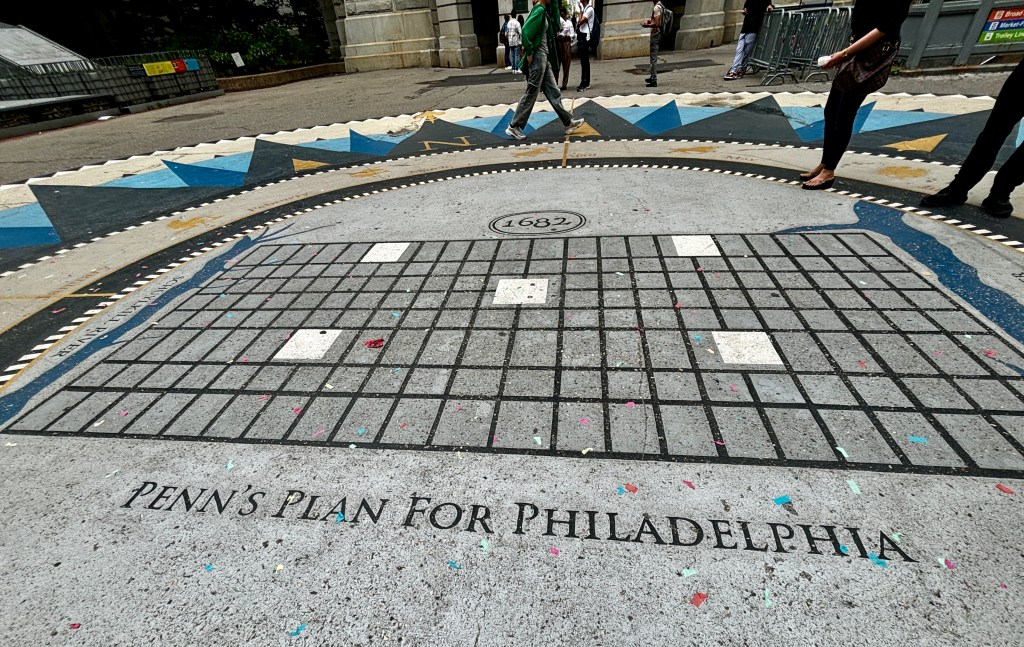
This was William Penn’s plan for his city of brotherly love. Philadelphia was to be laid out in a grid.  The white blocks are open space, parks, or places of service to the community.

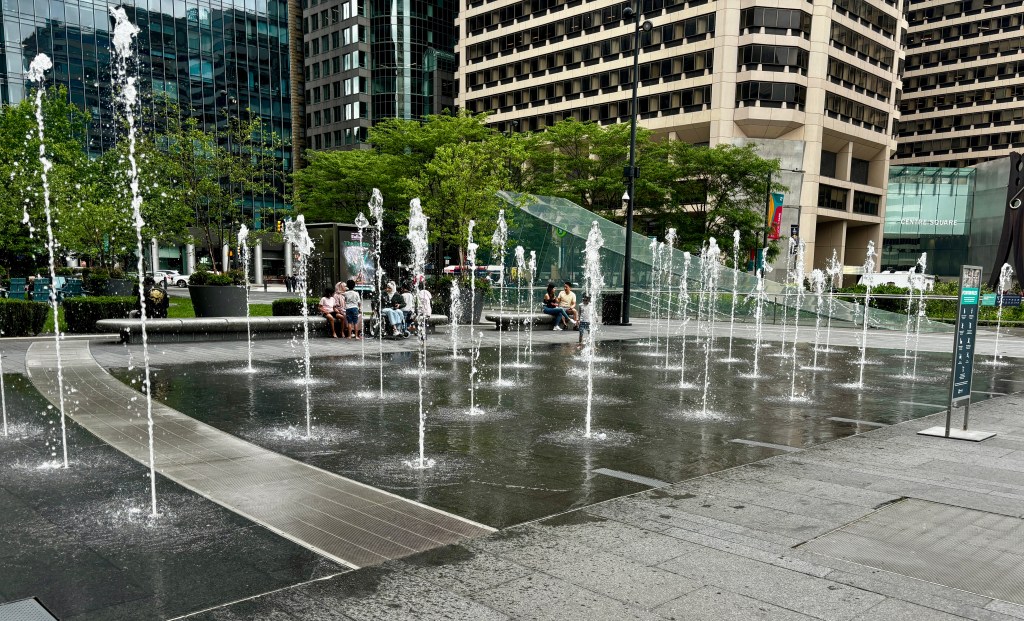
A transit center is under city hall plaza.  The water is lit to show the color of the subway train going underneath at the time.  Nothing was moving beneath us at that moment in time.

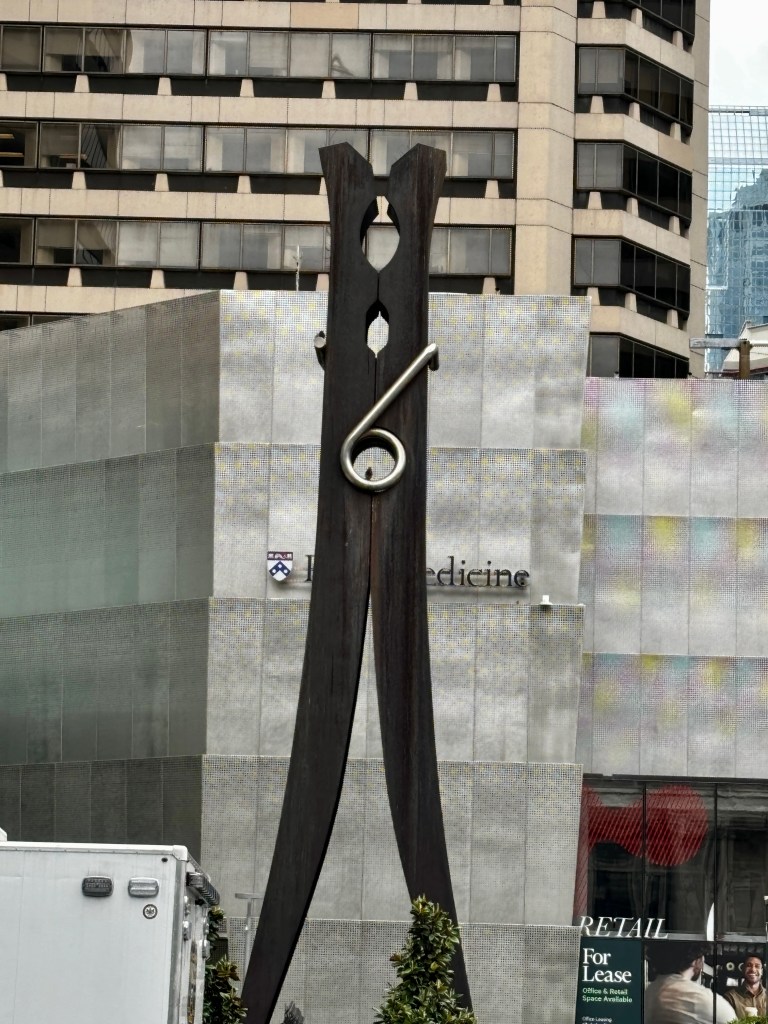
Philadelphia has a lot of street art as one percent of a project’s contract has to be used to provide art.  This looks like a clothesline clip or two lovers embracing.

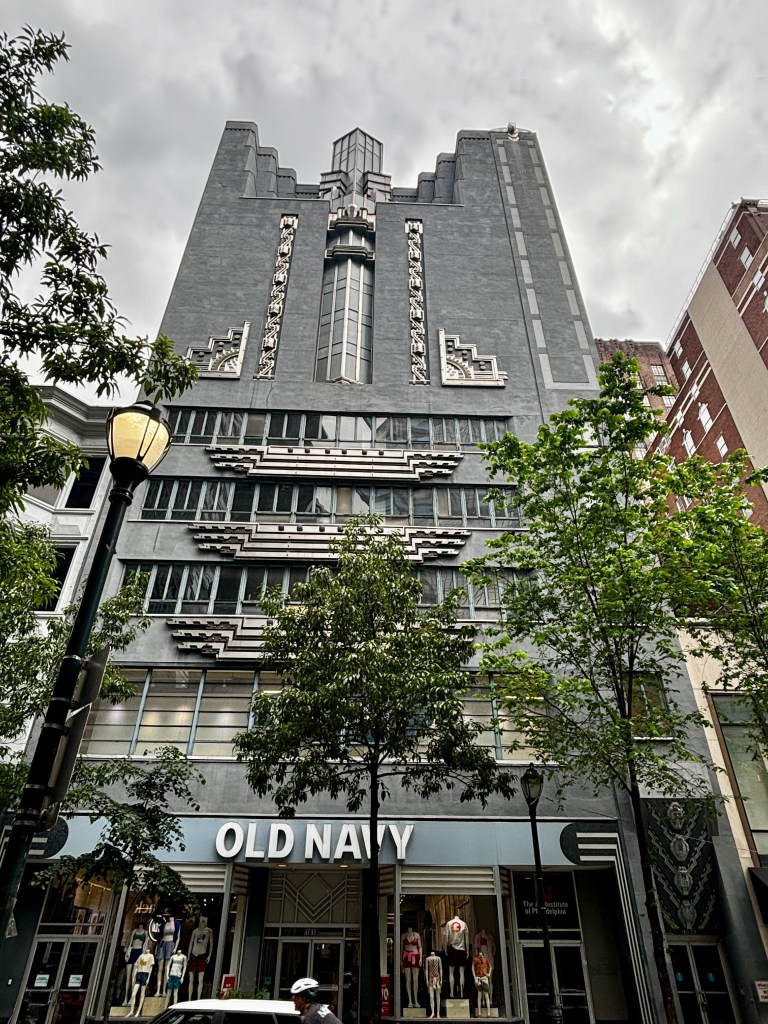
Our guide showed us interesting architecture including this Art Deco building.

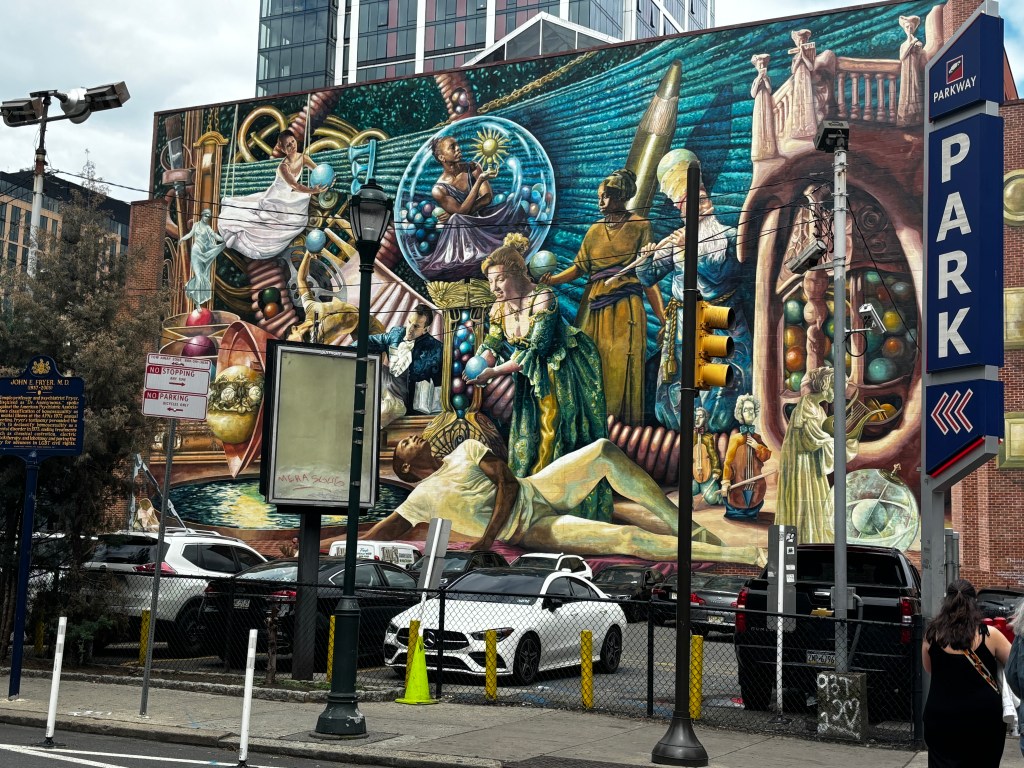
Our guide showed us several murals done by the Mural Arts Program.  As we had learned before, the city found that painting over graffiti just gave the artists a clean surface to paint again.  The goal was to provide a good outlet for the artists to the betterment of the city.  They started by inviting graffiti artists to participate but it took awhile to build trust.  It eventually became a successful partnership and now includes elementary and secondary students and an array of artists, both street and more traditional. Our guide had been a participant as a student and instructor.

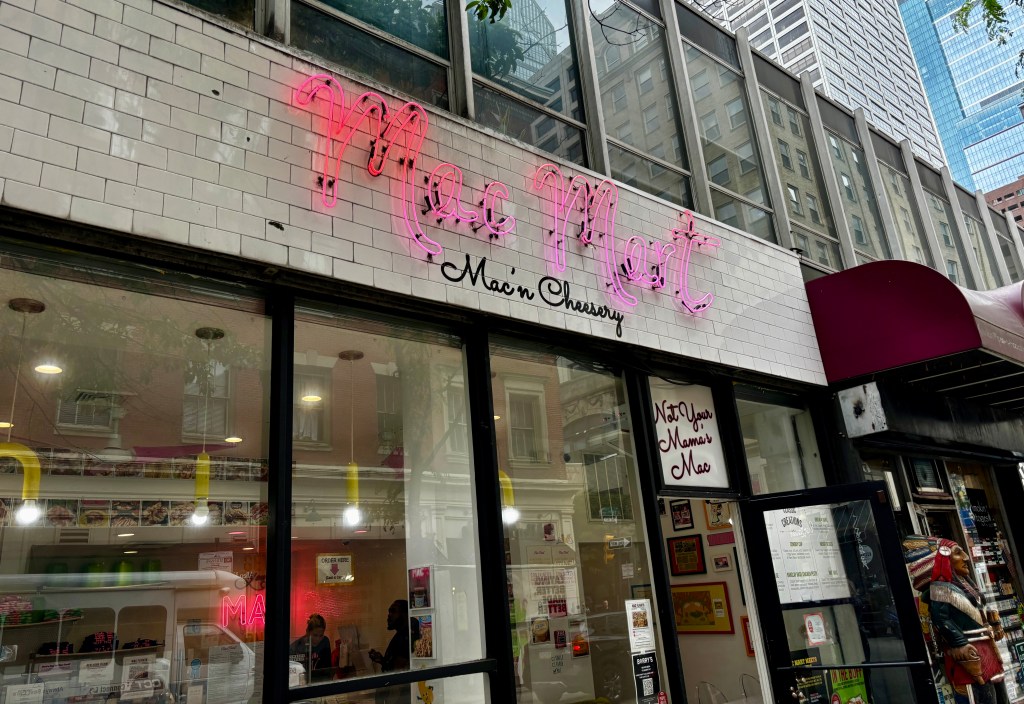
We didn’t eat at Mac Mart on our tour but how did we not visit a restaurant specializing in Mac & Cheese?

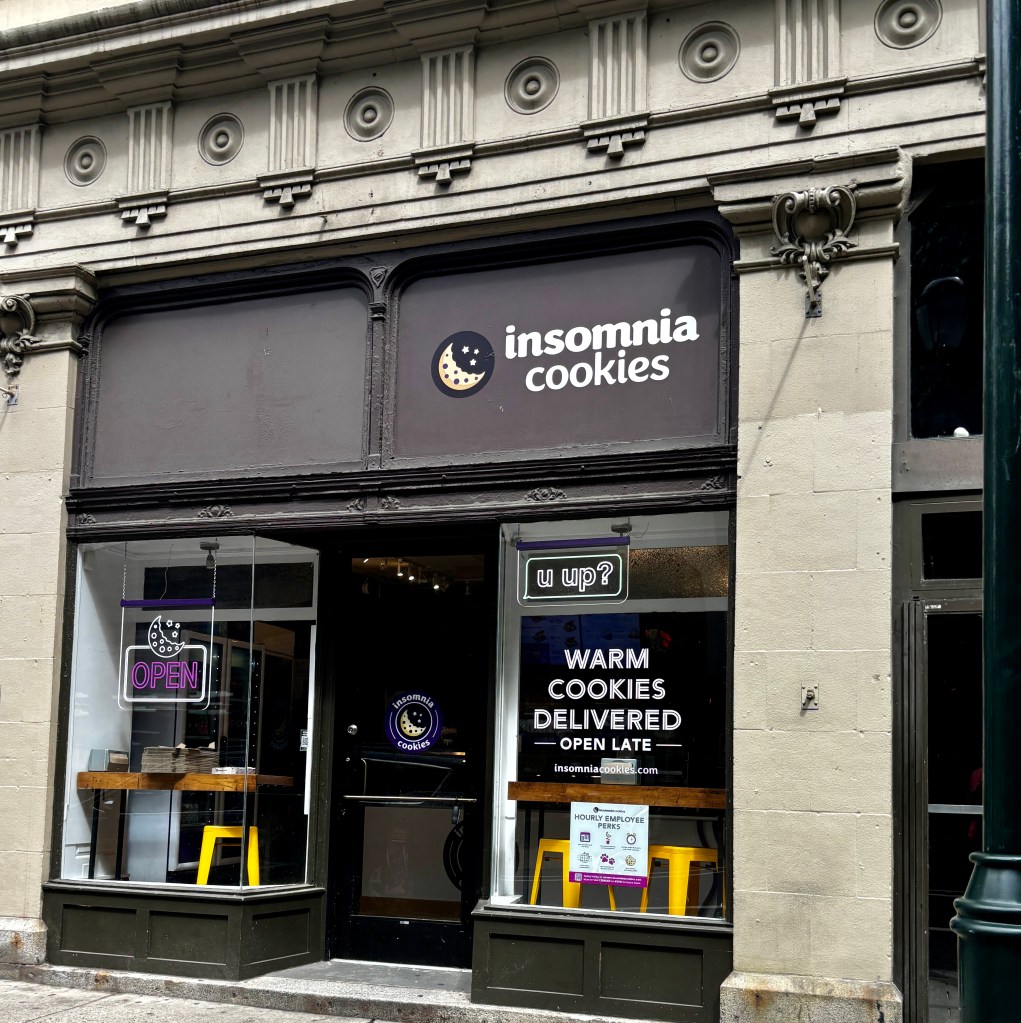
We did get to choose cookies at Insomnia Cookies – a franchise begun in Philadelphia by college students trying to stay awake to study.

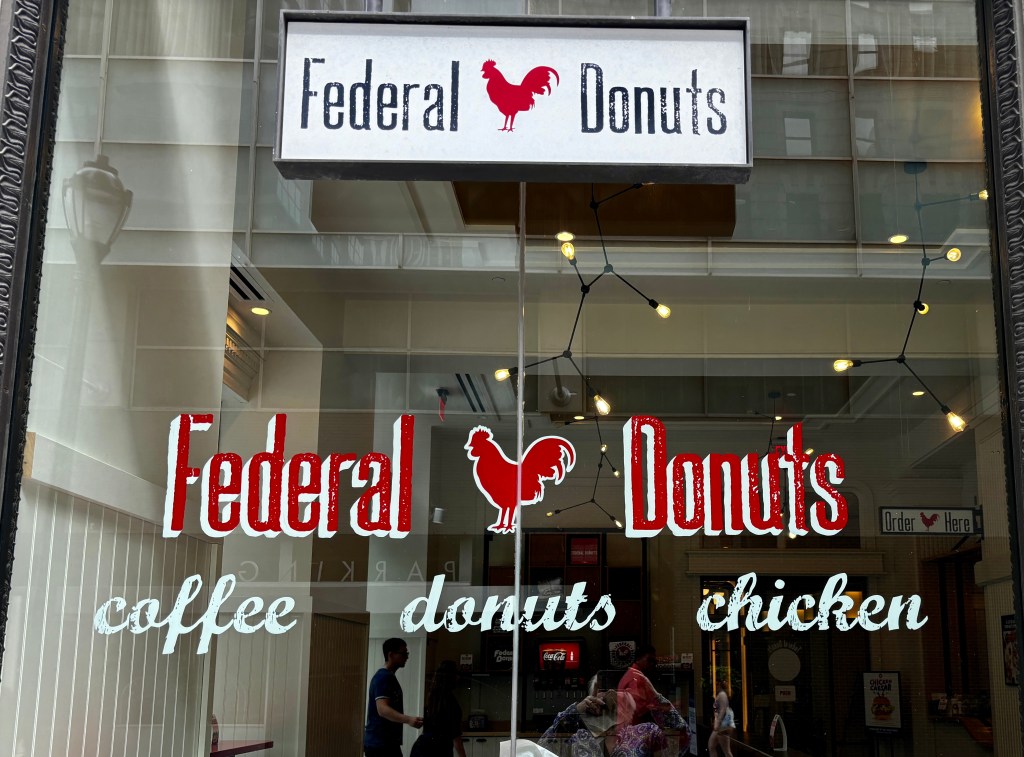
We had chicken and donuts at Federal Donuts.  On vacation, you enjoy the unusual!

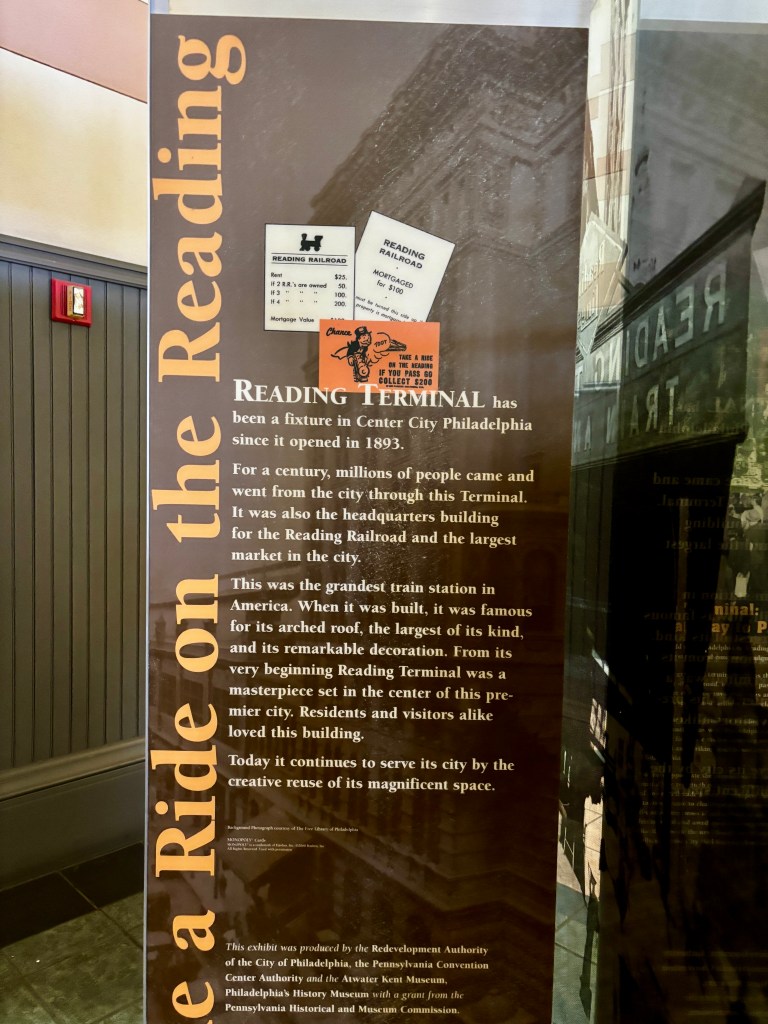
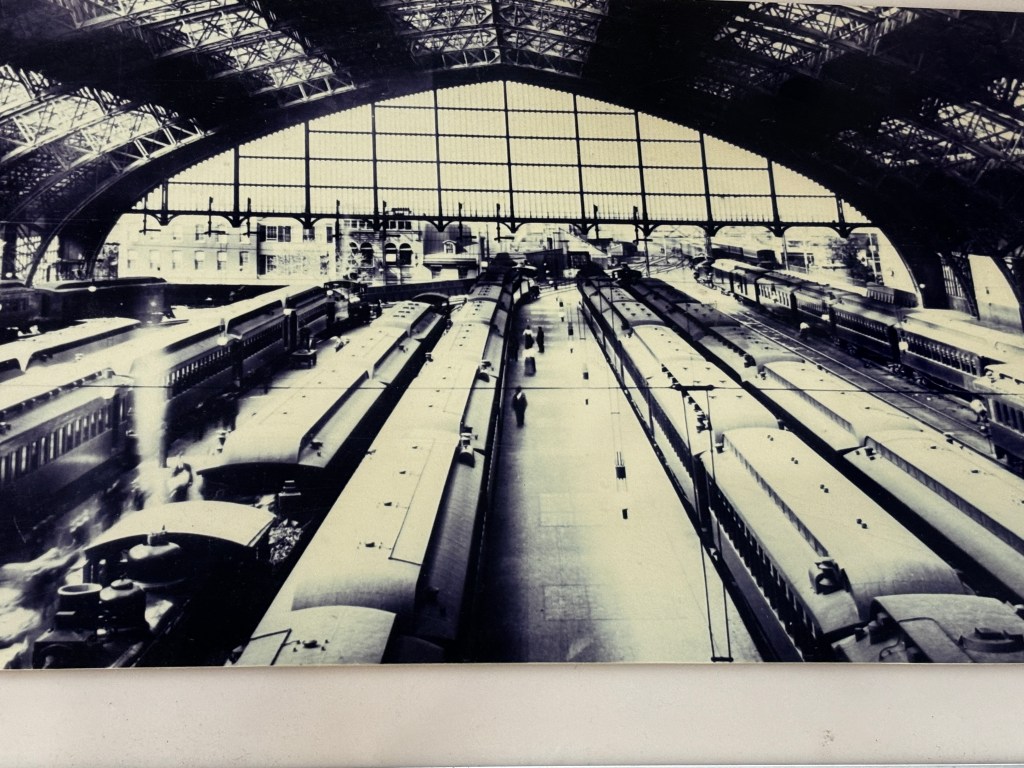
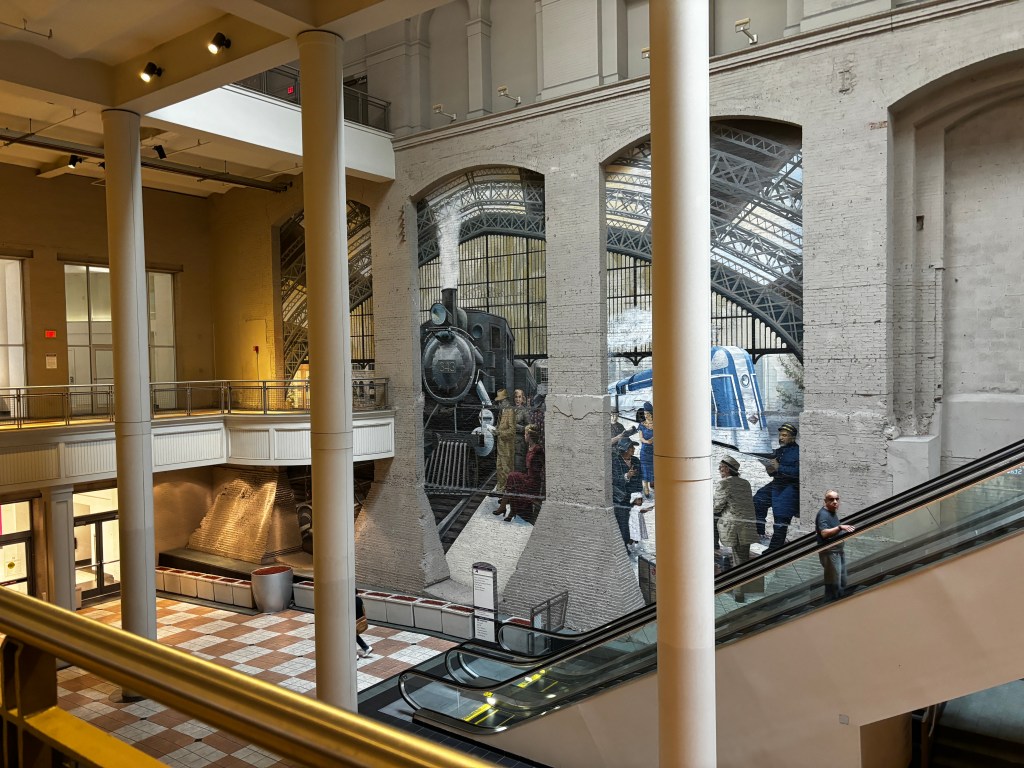
In Baltimore we had been introduced to sites related to B&O Railroad.  In Philadelphia it was the Reading Railroad.

This was what the terminal looked like in old days.

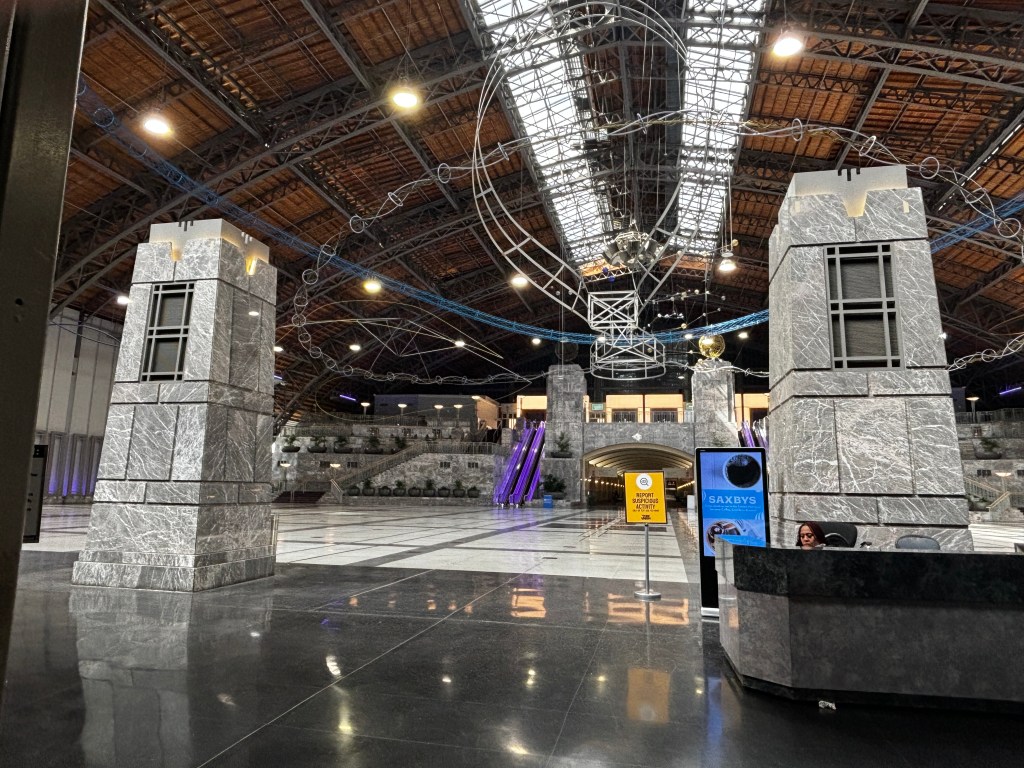
This is it now. 

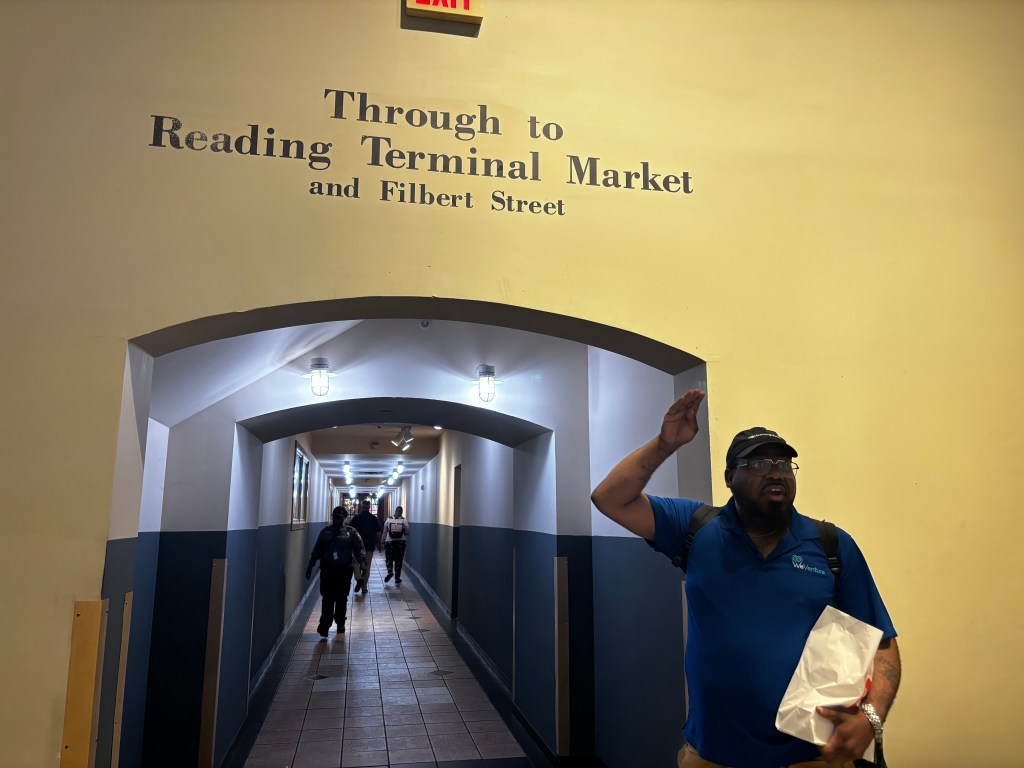
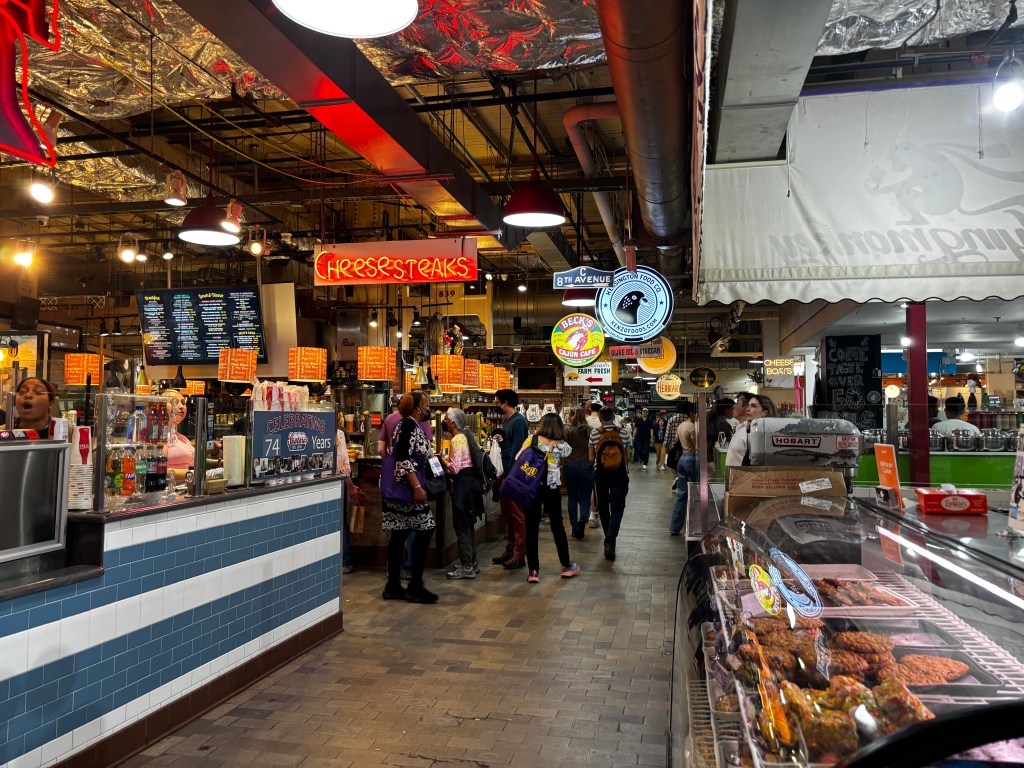
We walked through here on our way to Reading Terminal Market, active since 1894.

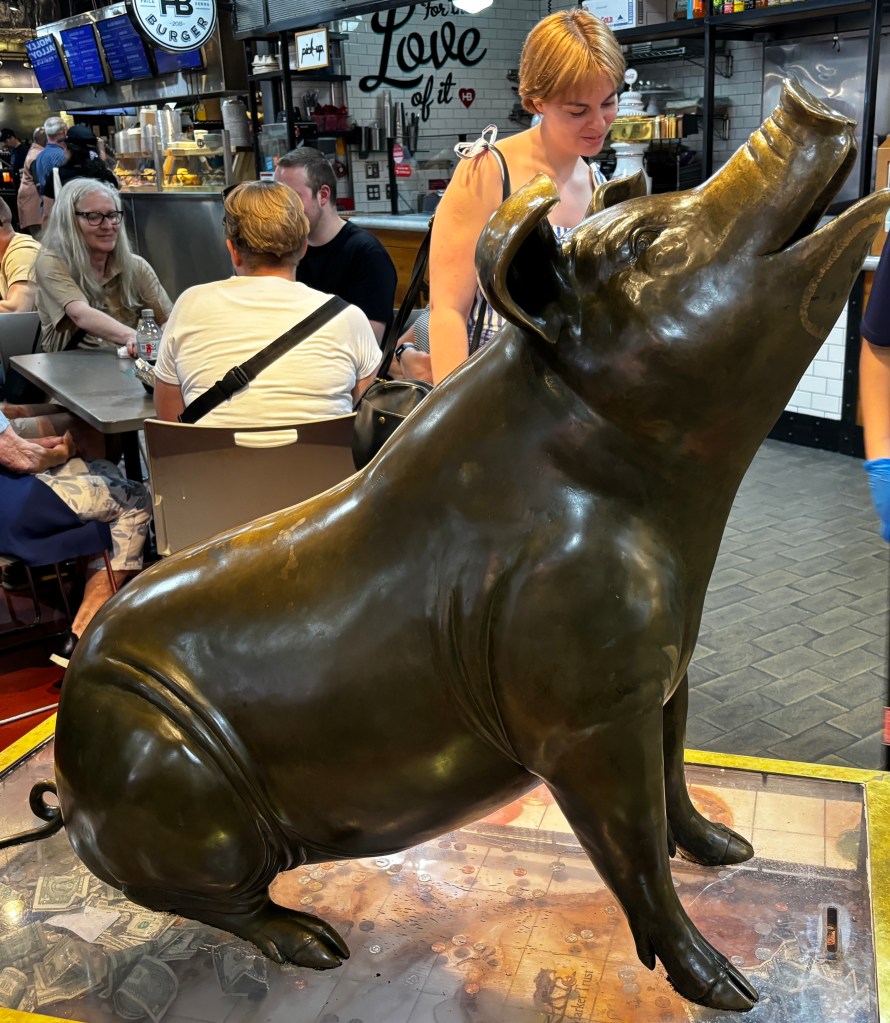
This pig is a donation collector.  You put spare change and bills in his mouth and it falls and collects at the other end.

We had a couple food items in the market.

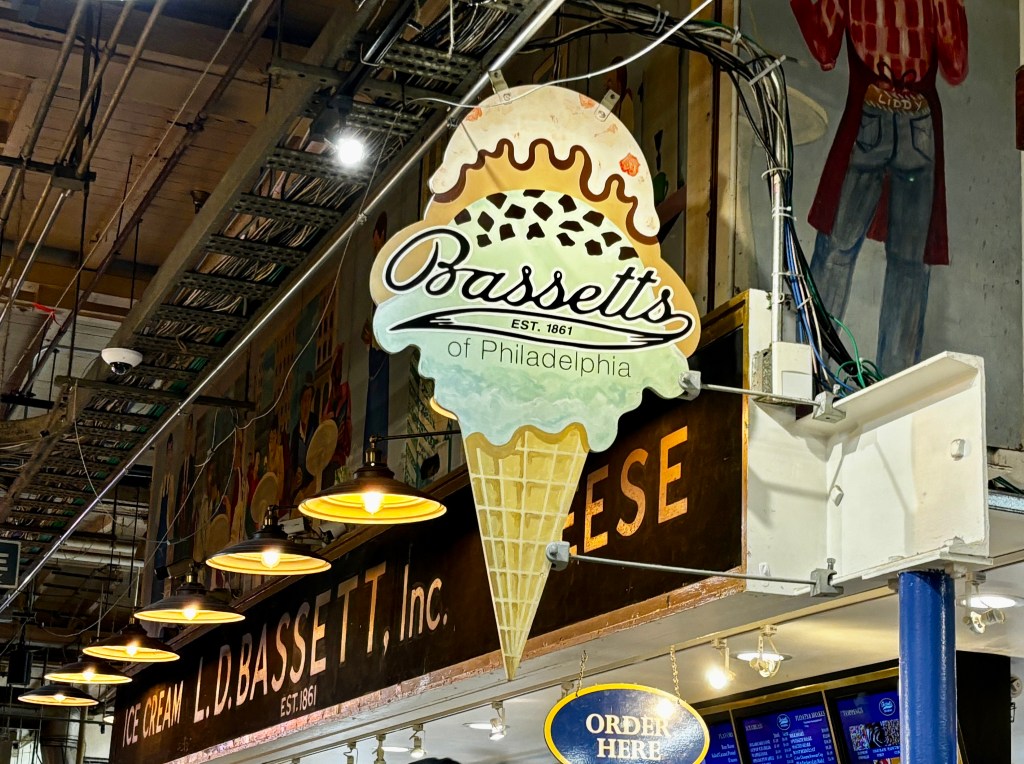
We concluded with ice cream from Bassets, operating since 1861.

The next morning we had an uneventful trip to the airport (no flat tire) and uneventful flight home. It was a good and interesting trip.

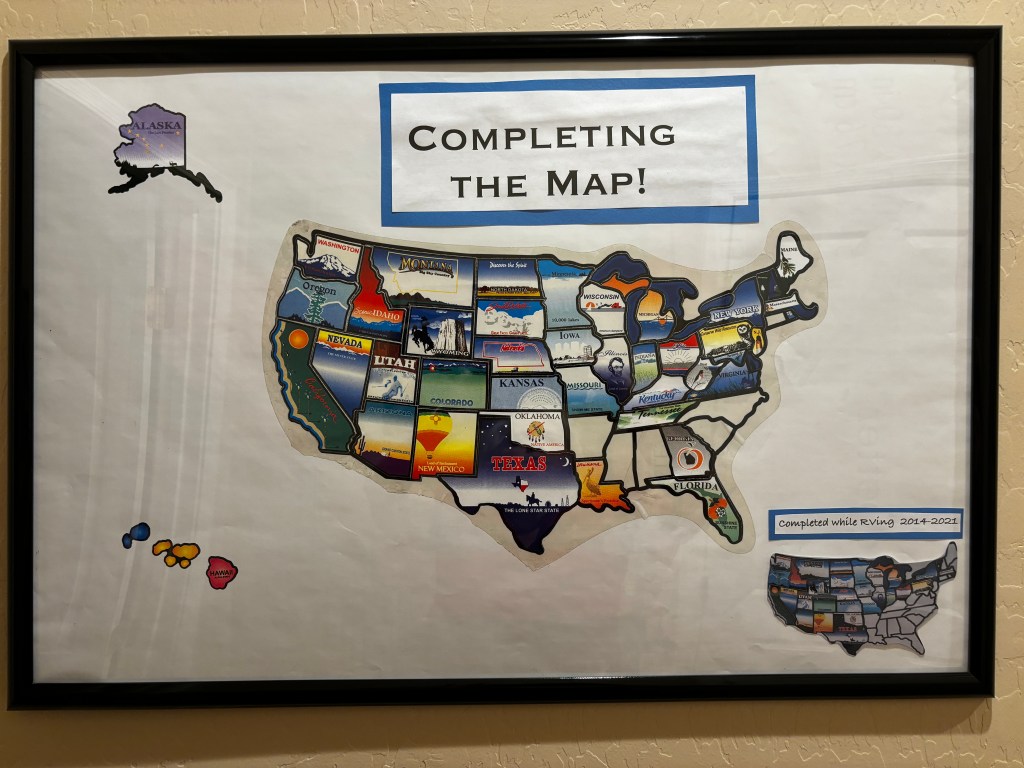
We added four states to our map: Maryland, West Virginia, Delaware and New Jersey.  We have six to go! Where will we go next year? Connecticut seems to be the only one that could be easily paired with a Mariners or Diamondbacks road trip to New York City. I’ll start planning when the 2025 schedule comes out!

We were in Philly in May 2024.

Posted in Uncategorized | Leave a comment

Dolphins to Phillies and Everything In-Between

Our last activity in Cape May, New Jersey was a Whale and Dolphin Watching Cruise.

We sailed through the Cape May Canal, a 3.5 mile canal dug by the Army Corps of Engineers in 1942. 

It enabled captains to avoid the German submarines they would have been exposed to if required to go around Cap May point.

Currently, we learned that tourism and fishing are the basis for Cape May’s economy. 

There is also a Coast Guard Training Center at Cape May, training 3000 recruits a year.  It is the only US Coast Guard training center in the US.  Training takes eight weeks.   We learned that many trainees, or those stationed at the base, often return to Cape May when their service is complete.

Coast Guard ships are named after enlisted heroes.

The Lawrence Lawson is named to honor Lawson’s service as a US Lifesaving Service station-keeper in Evanston, Illinois. He led his oar-powered crew into icy, stormy waters and rescued the crew of the steamship Clalumet on Lake Michigan in 1889.

The Angela McShan was named for the first African-American to be appointed an instructor at the Chief Petty Officers’ Academy and later the first to be promoted to Master Chief Petty Officer.  

We came out into the bay and saw bottle nose dolphins. 

We never got any good pictures as they move very quickly. Gray on gray on gray didn’t help either.

We had crew serving as spotters and narrator.  He told us that a female dolphin goes back to her matriarchal pod when expecting.  Dolphin gestation is 12 months.  She also nurses her young for 12 months. 

Dolphins employ cooperative fishing in their pods and each dolphin eats 10-15 lbs. of food per day.

Bottlenose dolphins can be seen near Cape May from April to December because the water temperature is usually 50 degrees or higher. They do not have natural predators but are injured or killed by boat strikes, pollutants and trash. 

Wild dolphins can live for 45-50 years.  Those in captivity live about 5 years.  The Flipper TV series was on for less than three years and went through five dolphins.  

These are the remains of an experimental concrete ship, the S.S. Atlantus.  It is one of 13 concrete ships built in WWI. It has been receding into the bay since it ran aground in 1926.

After exploring the shoreline of the bay, we went out to sea in search of whales.  Unfortunately, and despite the odds, we never saw whales.

We felt badly for those who really wanted to see whales but we have had the good fortune to see them many times. We were perfectly happy with the dolphins.

The next day we departed for Philadelphia and, for at least the second time, had low pressure in one of the tires.  Randy had already filled the tire once or twice and here we were doing it again.

You may remember we were given an “upgrade” to a mini van in Baltimore.  Considering our experience with Enterprise thus far, we were highly skeptical about whether the intake people at the Philadelphia airport would really fix the tire even if we told them about it.

We weren’t happy about it but felt like we needed to just get the tire fixed for two reasons.  First, the car was going to sit in a parking garage for two nights and we didn’t need a flat when we headed to the airport early in the morning.  Second, it was a mini-van likely to be rented by a family with kids on vacation and they didn’t need to deal with a flat tire either.

I called Enterprise and they directed us to a tire repair shop in the general direction of Philadelphia.  We were told that the tire service would be pre-approved by the time we got there.  Except it wasn’t. 

We told the service consultant to just fix the tire, thinking we’d be out the $15 to have it repaired.  Credit to him, he kept pursuing Enterprise approval and got it.   The tire repair just cost us some time.

We took a bit of a detour to go to Atlantic City, New Jersey and visited the boardwalk.  We were there early on a dreary weather day, so there wasn’t much going on.  We saw enough of Atlantic City to think we aren’t likely to go back.

We did spend a little time walking on the beach though, something we’d hardly done on this trip to the eastern seaboard!

We had been paying road tolls here and there and had to pay to cross this bridge.  Apparently you pay this direction (leaving New Jersey into Pennsylvania) but not in reverse.  The joke we heard later in Philadelphia was that you had to pay to leave New Jersey, but not to go into it. That is not a friendly neighbor perspective, and we certainly don’t have a broad view of New Jersey, but Cape May was delightful!

We arrived in rainy Philly and made it to our Bed and Breakfast Inn, The Thomas Bond House.

Thomas Bond, 1712-1784, was born in Maryland.  He trained as a physician and surgeon in Europe.  He worked in Philadelphia and contributed greatly to medical science in early America.  He, with his friend, Benjamin Franklin, founded the Pennsylvania Hospital in 1751, the first public hospital in the United States.  He was on the first Board of Trustees for the College of Philadelphia, now the University of Pennsylvania.

The house was built in 1769 by Dr. Bond and additions were made in 1824 and 1840. 

The house served as a residence until 1810 and then as a stocking factory, leather tannery, leather goods manufacturer, rag supplier, customs broker and retail shop.

It was restored as a Bed & Breakfast in 1988. 

Our second floor room was very, very nice.

We set off to find Philly Cheesesteaks.  I got mine “wit-wiz” with beef, grilled onions and cheese wiz.  

Randy had his loaded with provolone, peppers, onions and mushrooms.  We both liked mine better.

Our next activity was the Phillies baseball game. When I had tried to buy tickets on my baseball app for the Phillies vs Nationals baseball game, I could not get the purchase to go through – over and over.  Eventually I figured out the problem was that “select games are available only to those with addresses in the Tri-State area of PA, DE and NJ.”  That was surprising considering there were still tickets available and it was the day of the game.  I had to buy our tickets from Ticketmaster, a re-seller.  They did not care that we weren’t from the tri-state area.

We got directions on how to use the subway system to the game.  That required a ten minute walk to get on the blue line going west and then changing lines at the city hall station to get on the orange line going south to the sports complex where the Phillies, Flyers, 76ers and Eagles all play.  It was another ten minute walk to get to Citizen’s Bank Park.

We found that our seats were open to the rain so we moved several times in covered areas until people came to claim their seats. Eventually, the stadium filled up so we went to our own seats.  By then the rain was a mere mist and not a problem.

There were military parachute jumpers entering the stadium as game preparations  continued.

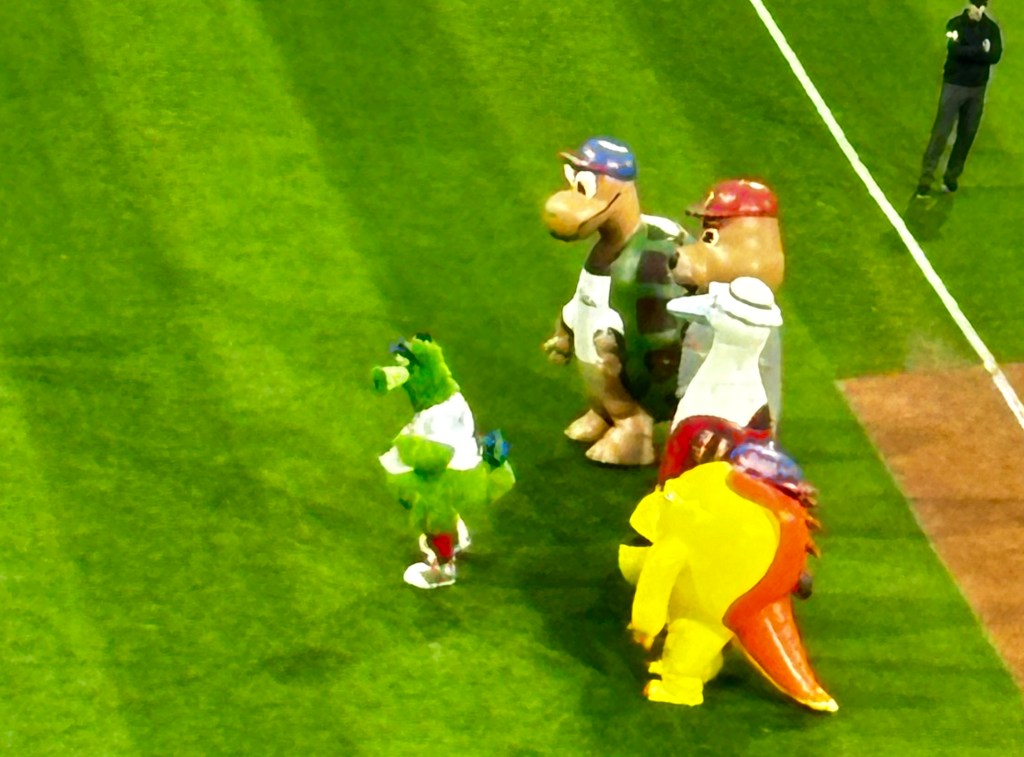
We were entertained by the original mascot, the Philly Phanatic. The Phanatic was portrayed from 1978 to 1993 by David Drummond.  From 1993 to present (2024) the Philly  Phanatic has been portrayed by Tom Burgoyne.  That is two people in 46 years!

The other thing we noticed at the game was one of the most enthusiastic waves around the stadium we have ever seen.  When stadium crowds around the country are getting annoyed with the wave, it was interesting to see Phillies fans embrace it so completely.  Hey, it was a good time to be a Phillies fan. At the time of our visit, they had the best record in baseball.

It was a great game and the Phillies ended up winning in extra innings which made the home crowd happy.  We didn’t really care, but our reversed subway ride was jovial.

Our ten minute walk from the subway stop to our B&B felt a little dicey after dark.  There were lots of people around so it didn’t feel overtly dangerous, just not comfortable.

We had a good night’s sleep and were ready for Philly Day 2

We were in Philly in May 2024.

Posted in Uncategorized | Leave a comment

Cape May: Aviation Museum

Randy was in a ‘limited participation’ mindset on visiting museums but it was still raining. So, we chose a museum of interest to him, an Aviation Museum in Hanger 1 at the former Naval Air Station Wildwood.

The Naval Air Station operated from 1943-45 to train navy pilots in dive bombing techniques.  In October 1944, there were 17,000 take offs and landings, one every 40 seconds. Trainees flew at night, simulating their future duties in the Pacific.  Practice targets were constructed in Delaware Bay and the Atlantic Ocean.

In 36 months, there were 129 crashes resulting in 42 deaths. 

During WWII, there were 22 all wooden double wide hangars built to support training navy fighter pilots.  Each hangar had over 4400 windows and covered 92,000 square feet.  Hangar 1 is the only one of its kind left.

After the war, dentist and Navy pilot Dr. Ralph Cox operated a low fare airline called United States Overseas Airlines out of Hanger 1.  With 18 planes,  Overseas Airlines was a safe and reliable carrier. It made flights within the country, to Hawaii, and to other places around the world.  The airline ceased operations in 1964. 

Hangar 1 deteriorated over the following years. Dr. Joseph Salvatore purchased it for $1 from the county with the intention to establish a group to restore the hangar and open it as an aviation museum.  The museum opened in 1997.

The museum has aircraft, of course, but also a variety of other exhibits.  Having read a number of novels about British efforts to break the German Enigma codes at Bletchley Hall, it was interesting to see an Enigma Machine.

This plane, silhouetted against the many windows in Hangar 1, is a Northrop F-5E Tiger  II.  This plane was, reportedly, the ‘aggressor’ in the original Top Gun movie.

Randy’s checking out the TBM Avenger.  It was a torpedo bomber.

Not an aircraft, but a 41 foot Coast Guard vessel.  It was used for search and rescue as well as law enforcement.

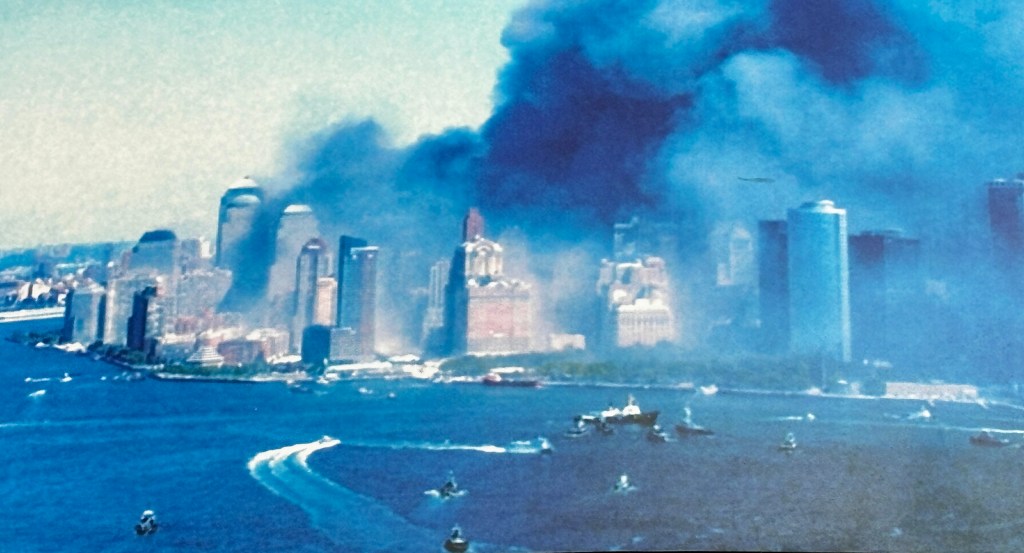
This was the exhibit that was most interesting to me – All Available Boats.

It had a number of information boards about the various boats, retired boats, captains, agencies and volunteers that responded to the 9/11 attacks in NYC.  There were a myriad of coordinated, and uncoordinated, efforts to get people away from the island of Manhattan.

This 1969 Sikorsky helicopter was deployed on the US Coast Guard Ice Breaker, Polar Star, in waters off Alaska.  

The Polar Star and sister ship Polar Sea are the oldest icebreakers in the coast guard fleet. A third, USCGC Healy, was commissioned in 1999.

Another section of the museum focused on the contributions of women in service to the country.

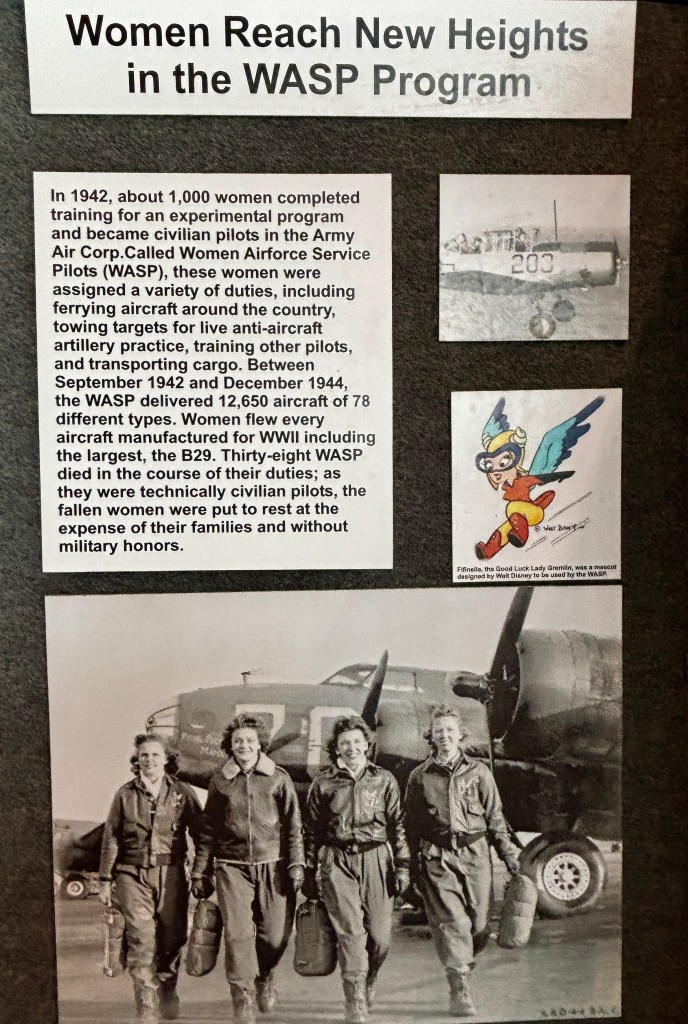
That included a display about the WASPs – The Women Airforce Service  Pilots.  The WASP were 1102 female civilian pilots who flew missions (bomber, cargo, drone, training and transport) accounting for over 60,000,000 miles during World War II under the command of the US Air Force.  We first learned about the WASPS at a museum in 2016 and have appreciated seeing reference to them since.

We also saw a display about the WAVES – Women Accepted for Volunteer Emergency Service into the Navy.  There were 8000 female officers supervising 80,000 female enlisted personnel performing a variety of tasks for the Navy.  By the end of the war, they accounted for 2.5 percent of Navy personnel.

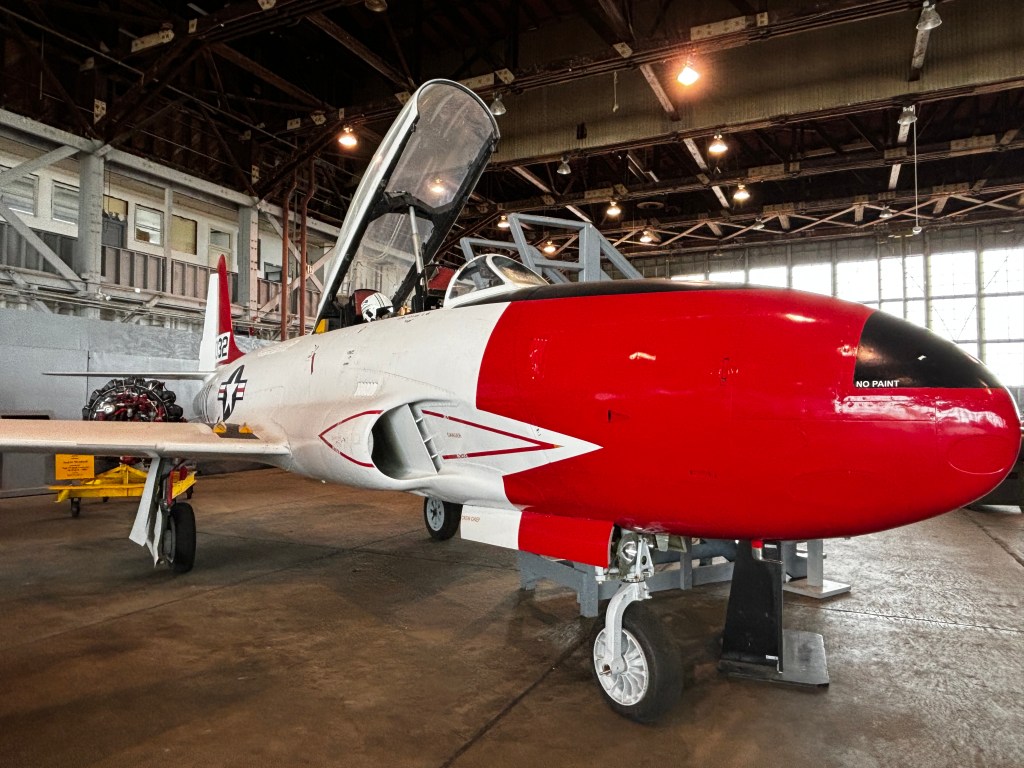
This is a Lockheed TWV Seastar that operated from 1953 – 1970.  There were a dozen or so planes presented with only statistics. An airplane must have a “story” to be of much interest to me – like the plane below.

This F6F-3 was put into service in 1943 with a squadron from California.  After returning in 1945, it was ditched at sea by its pilot twelve miles off San Diego.  Twenty-six years later, it was retrieved from 1800 ft. below the surface.  The plane was in excellent condition.  Unfortunately. it did not receive additional care and it deteriorated.  The plane was later acquired by the museum and restored.  It is the only surviving Hellcat of over 4000 that were built.

These are students on a field trip.  We visited quite a few places on this trip along side student field trips.  It sure brought back memories for me!

While we were there, the staff were preparing for a wedding to be held at the museum.

The photographer was doing the artsy shot!

We went outside to see more planes but by then my interest and note taking was not what they could have been.

Now this was familiar from all those years watching MASH.

We were in Cape May in May 2024.

Next Up: We pay to go to Philly!

Posted in Uncategorized | 1 Comment

World War II Tower and the Cape May Lighthouse

Tower operations were directed by Fort Miles and tasked with protecting the area from incursion by German ships and troops.   However, they found that the real threat was from enemy submarines which destroyed hundreds of merchant ships, many within sight of land.

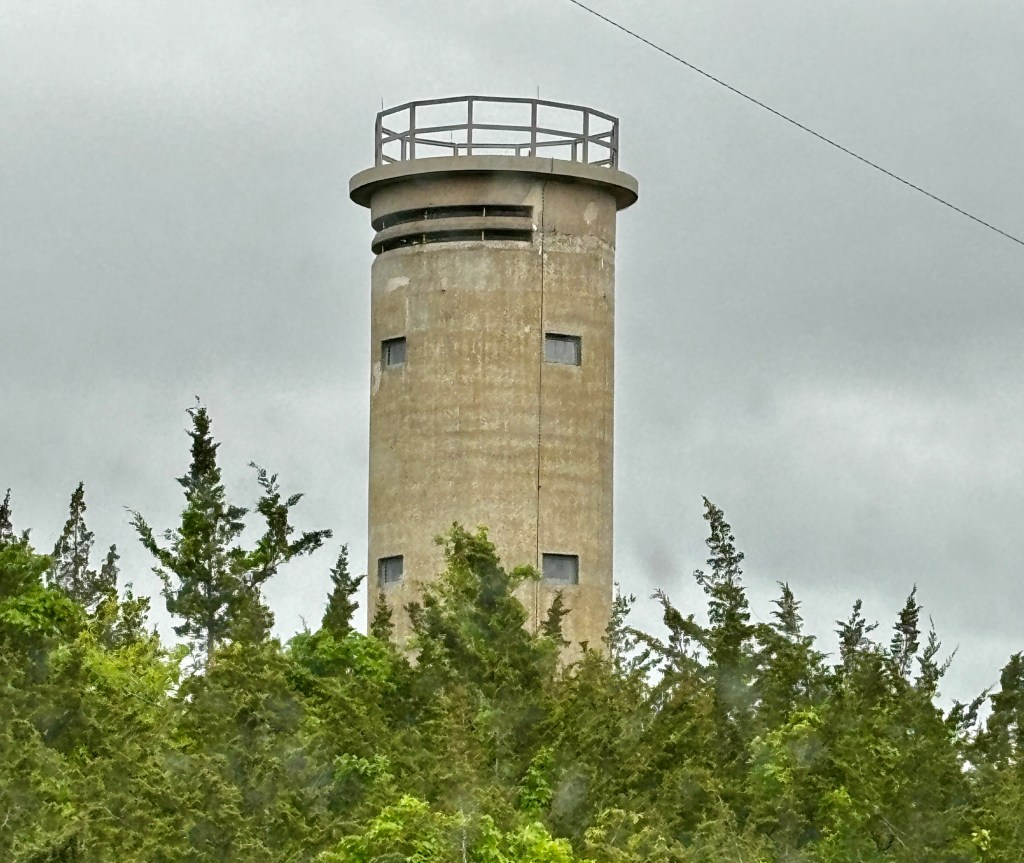
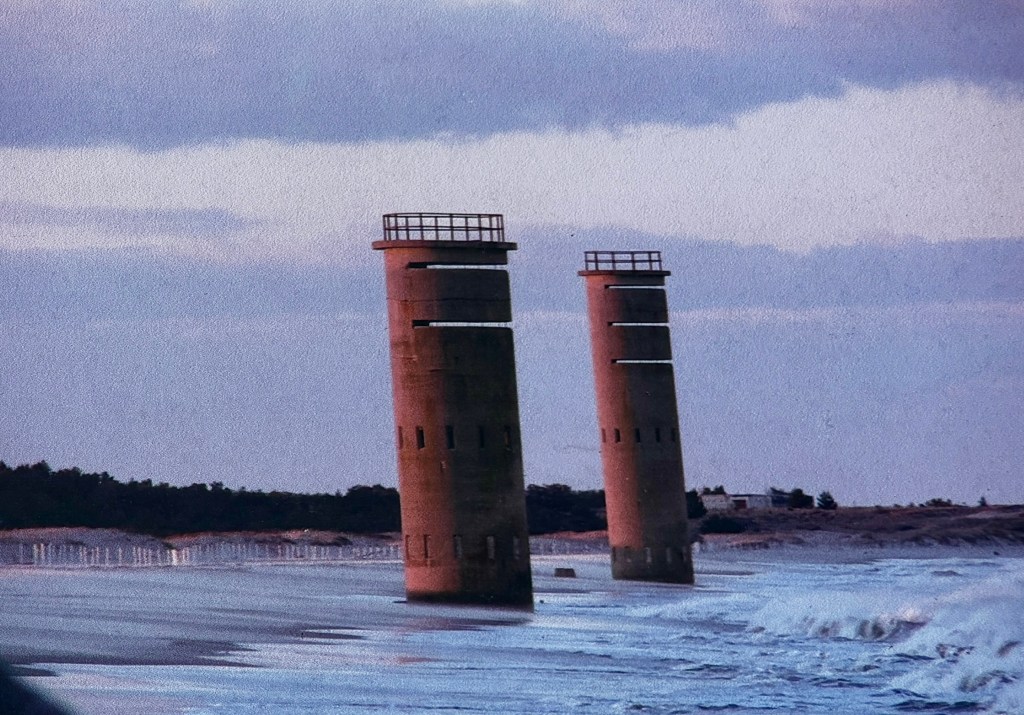
In the 1940s, the Navy, Army and Coast Guard all had bases near Cape May.   This is Cape May’s World War II Tower.  It was one of fifteen towers to monitor activities at sea to protect the Delaware Bay.  This is the only tower still intact in New Jersey. 

In 1942 the entire eastern seaboard was designated a military area and Cape May residents and visitors had to comply with black out measures to reduce risk.

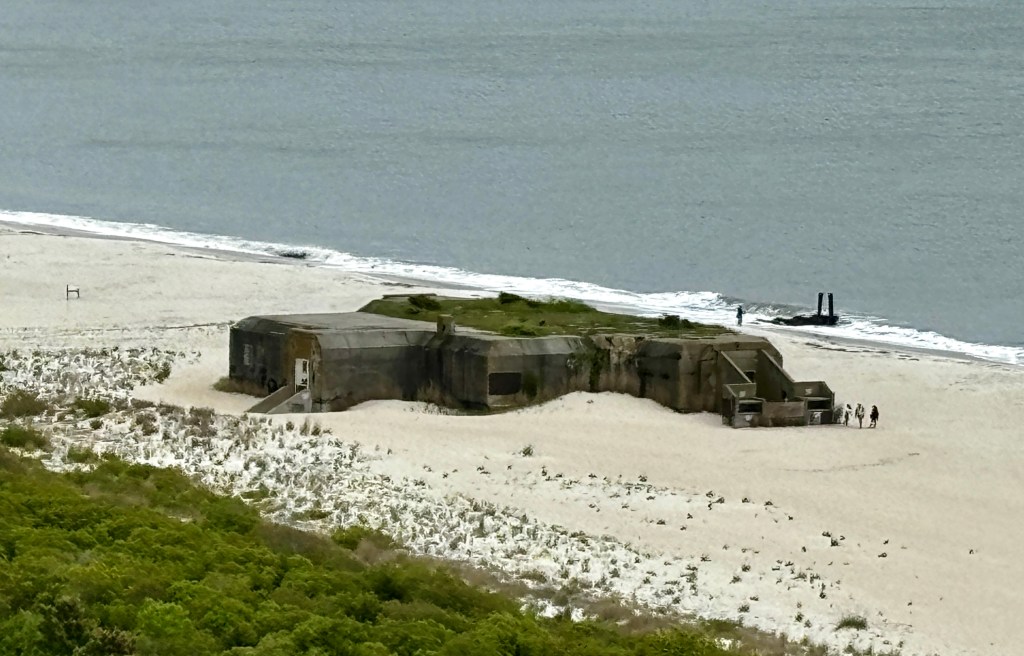
Men assigned to the tower watched the waters and provided coordinates to the battery on the beach to initiate an attack.  

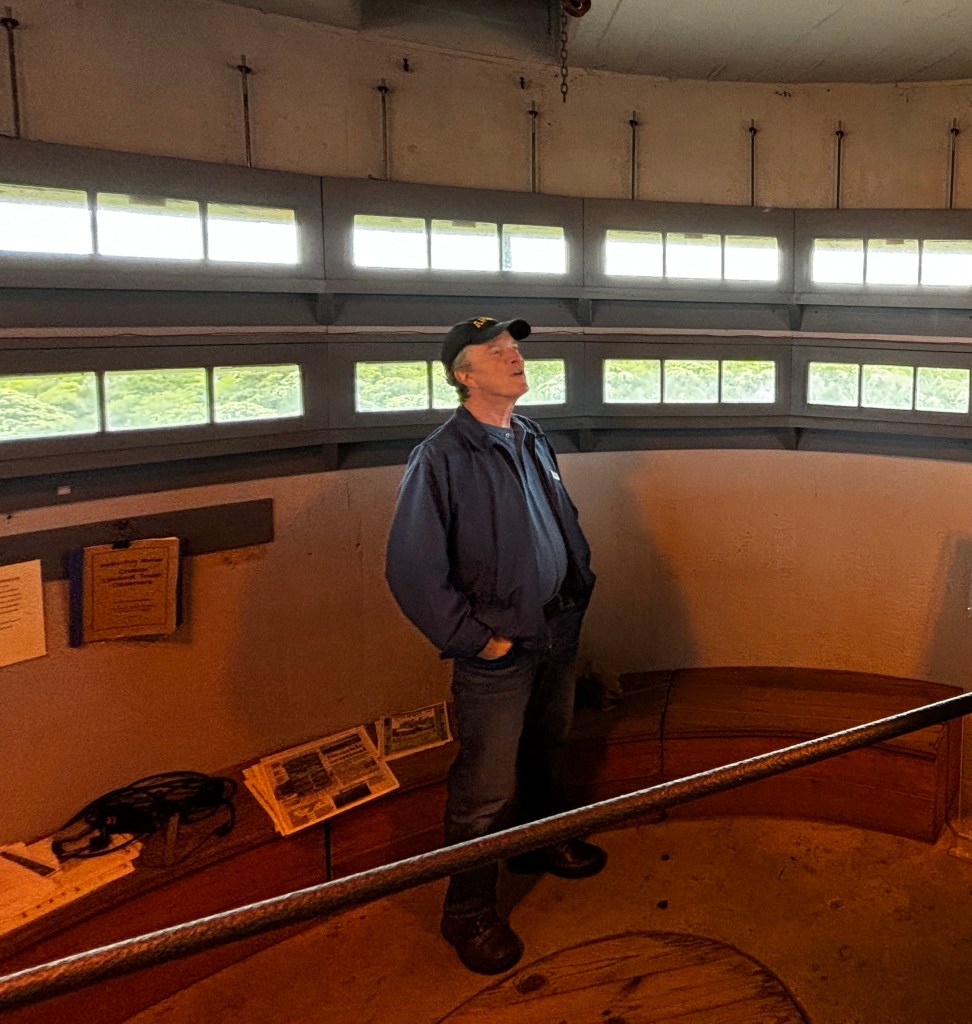
This tower had only one viewing slit at the top while some others in Delaware had two or three.  Only one was deemed necessary because this tower was connected with only one battery. 

In 1943, the allied effort gained ground and military efforts around the world became more offensive than defensive.  The improvement in amphibious warfare rendered permanent fire towers like these less useful.

The tower walls were made of one-foot concrete poured in place.  The tower is seventeen feet wide with an interior that is fifteen feet in diameter.  The walls were reinforced with iron bars but almost everything else was made of wood.  Metals were needed elsewhere in the war effort.

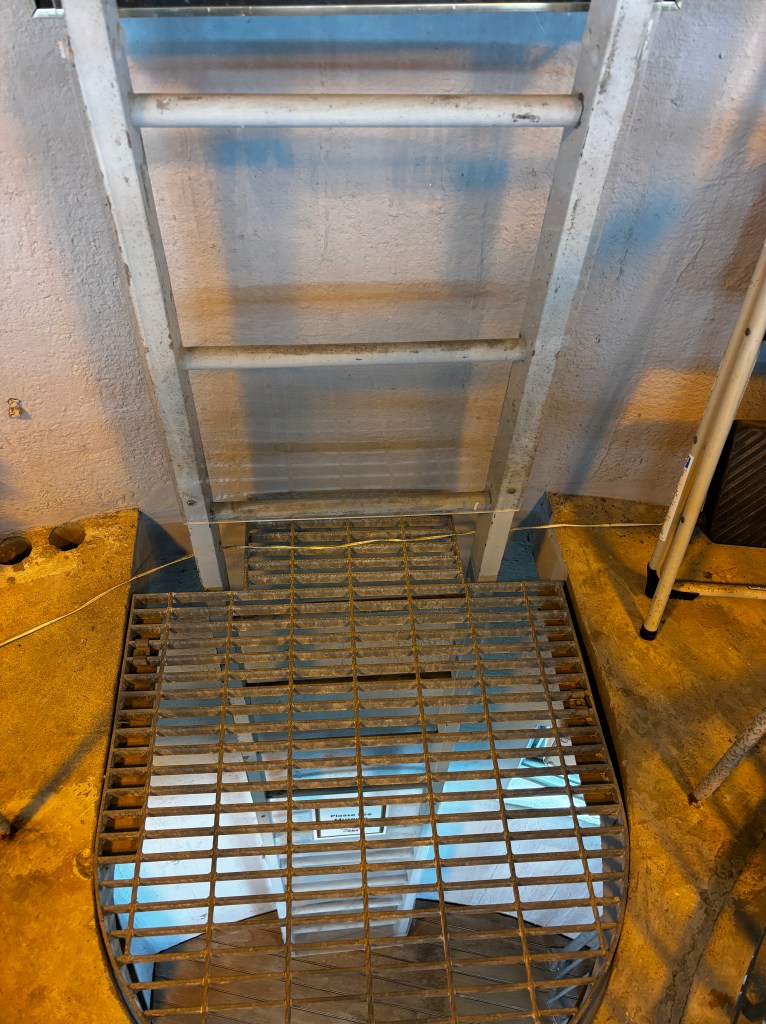
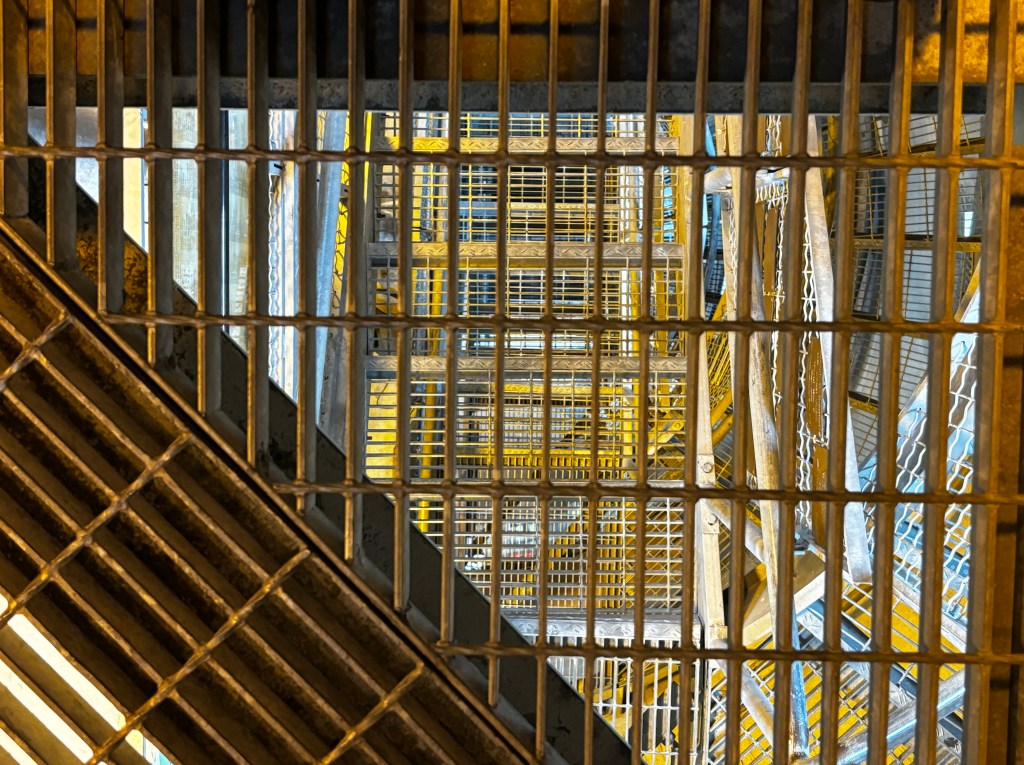
The stairs go six floors up to the scouting area.  

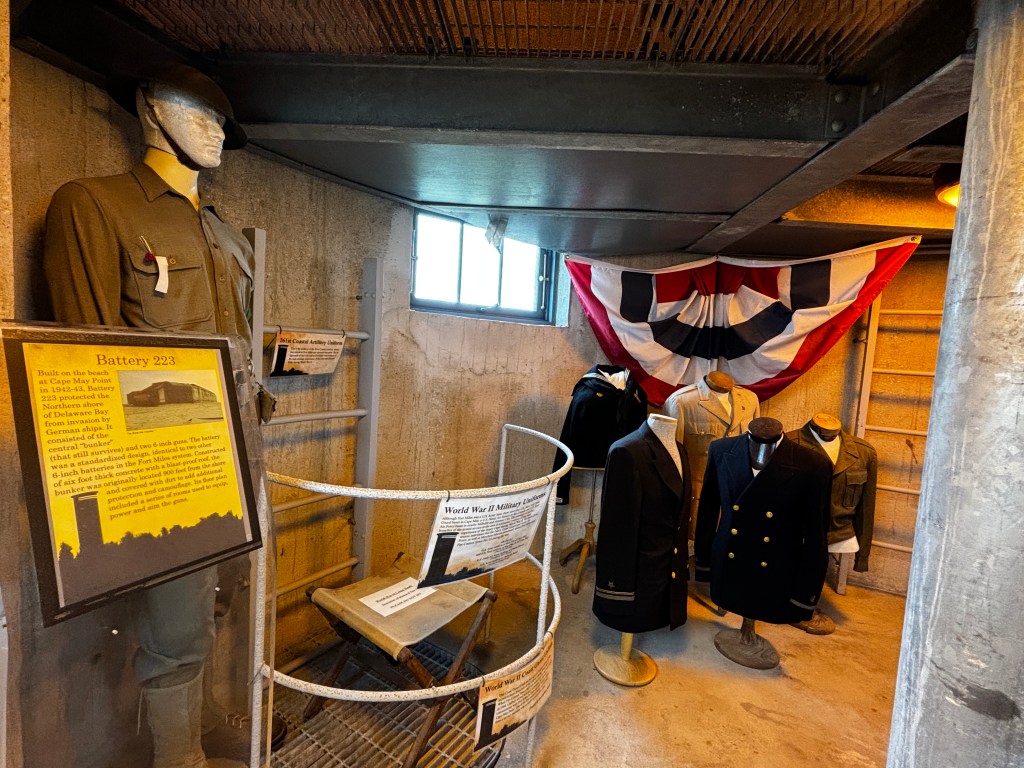
There were displays positioned on different floors.

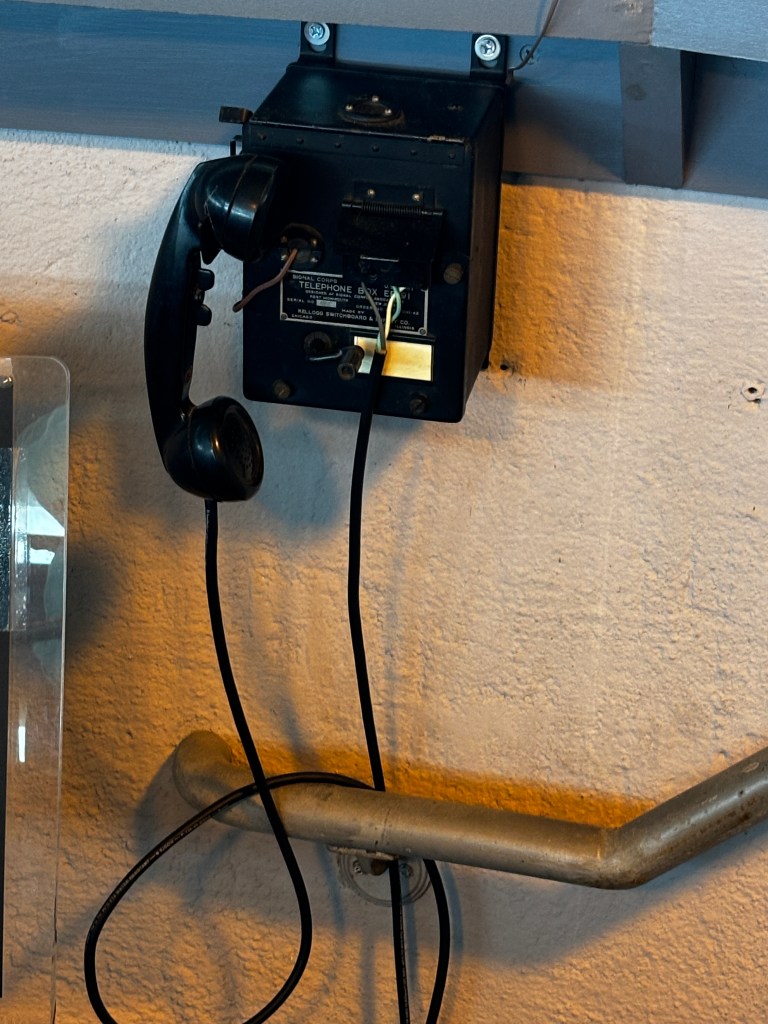
This phone was used to relay enemy coordinates down to the battery on the beach.

The docent at the top was very interesting with his facts and stories about the World War II tower.

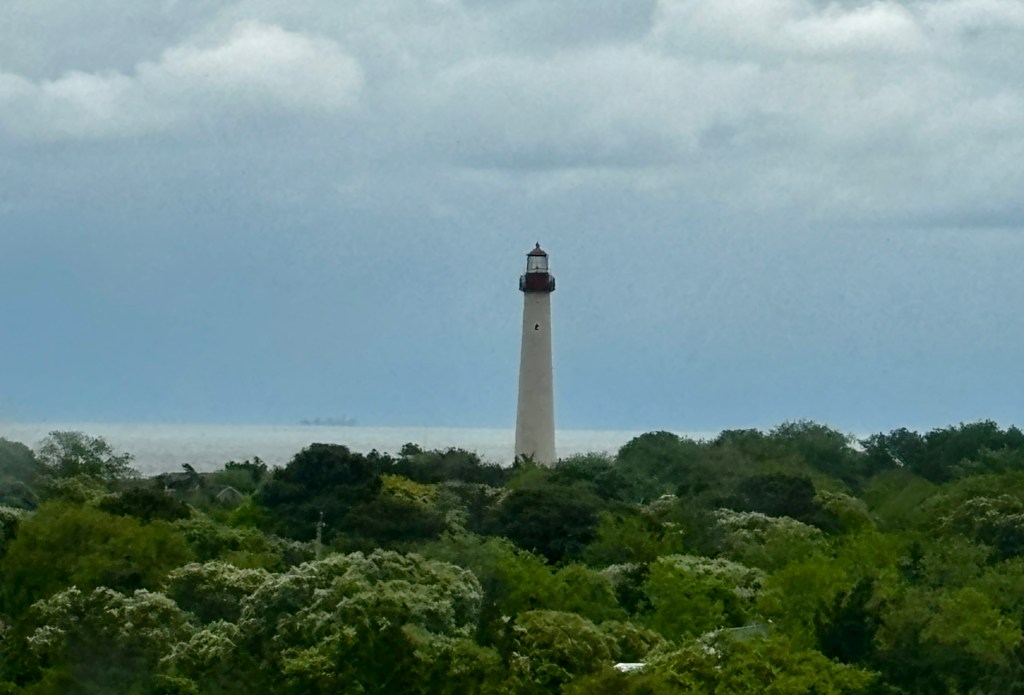
From the top, we could see our next destination – the Cape May Lighthouse.

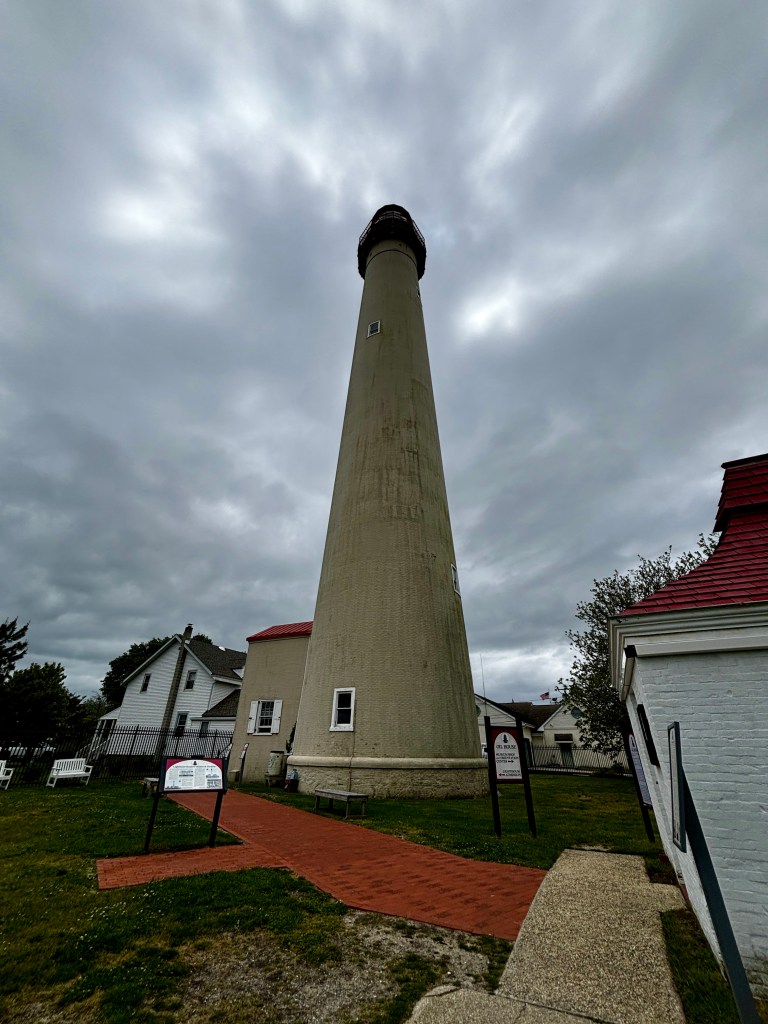
Here is a closer view of the Cape May Lighthouse.  It was built in 1859 and is 157½ feet tall. This is the third lighthouse near this site.  The first two, built in 1823 and 1847 were lost due to unstable shoreline and poor construction respectively.

It is one of the oldest continuously operating lighthouses in the country.  It went dark during World War II, when all lighthouses did the same guarding against enemy submarines.

The cost to build the Cape May Lighthouse was $40,000.  It is wider at the base than at the top.

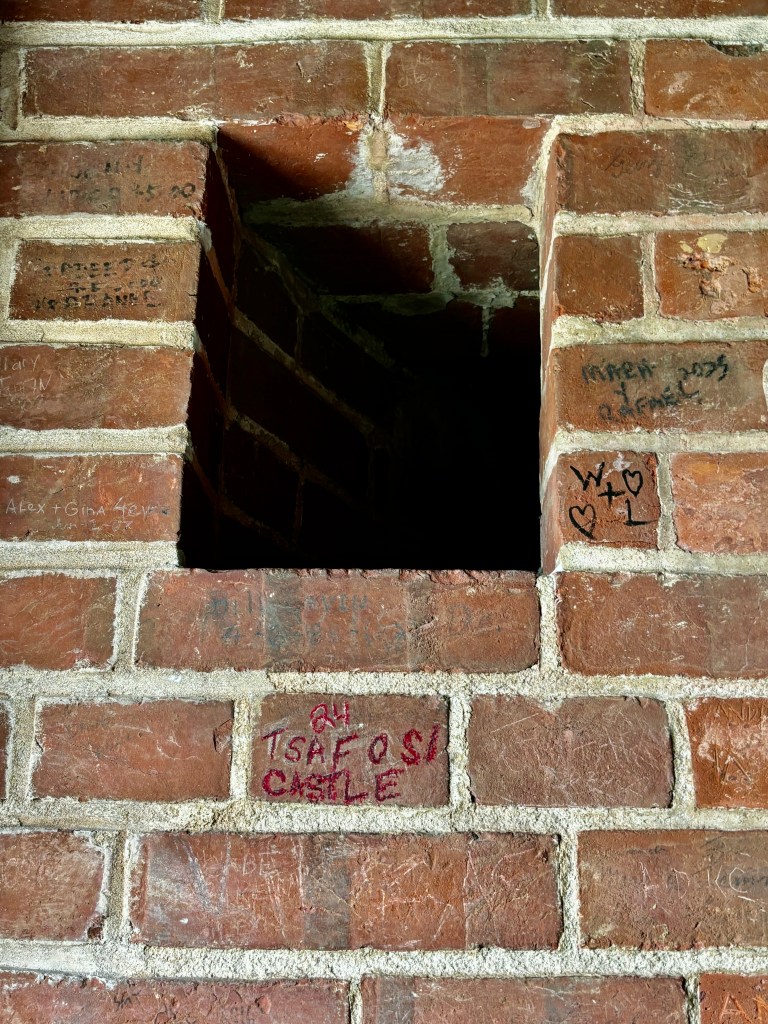
There is an inner wall and an outer wall.    The outer wall is just short of four feet thick at the base tapering to one and a half feet at the top.

The inner wall is 8 and a half inches thick for the entire length.  These openings between the two walls were placed throughout.

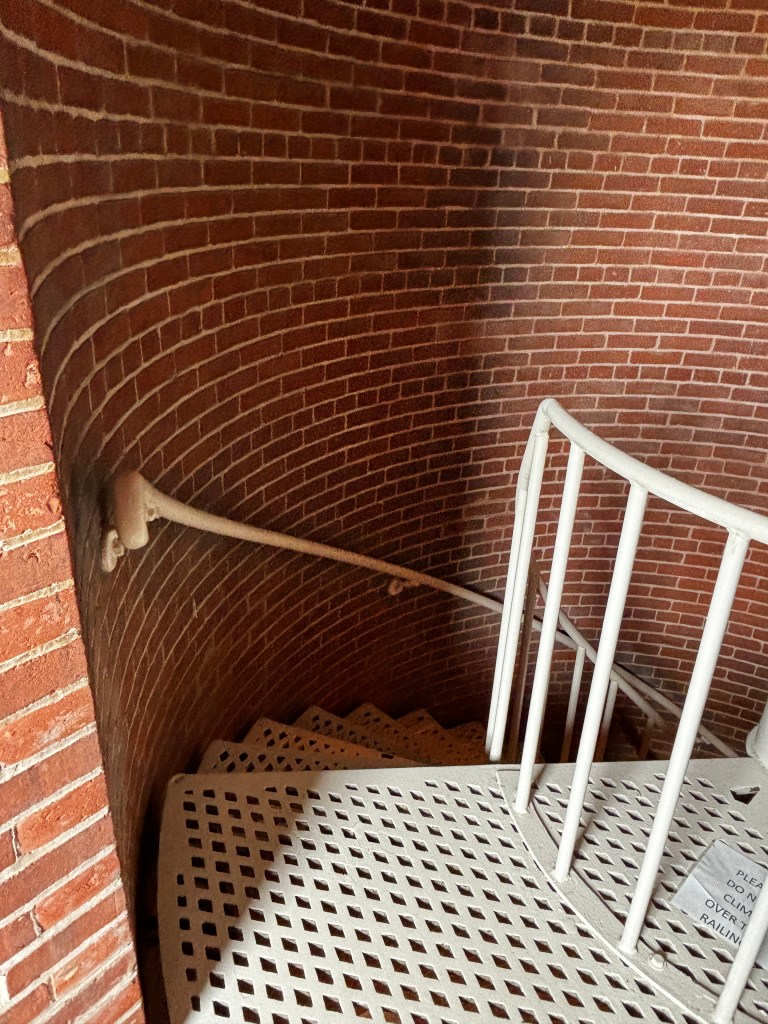
There are 199 steps and six landings.  The light house operated for the first six years without any railings.  The outer railings were added in 1865.  (The inner railings were added in 1988 for tourists.)

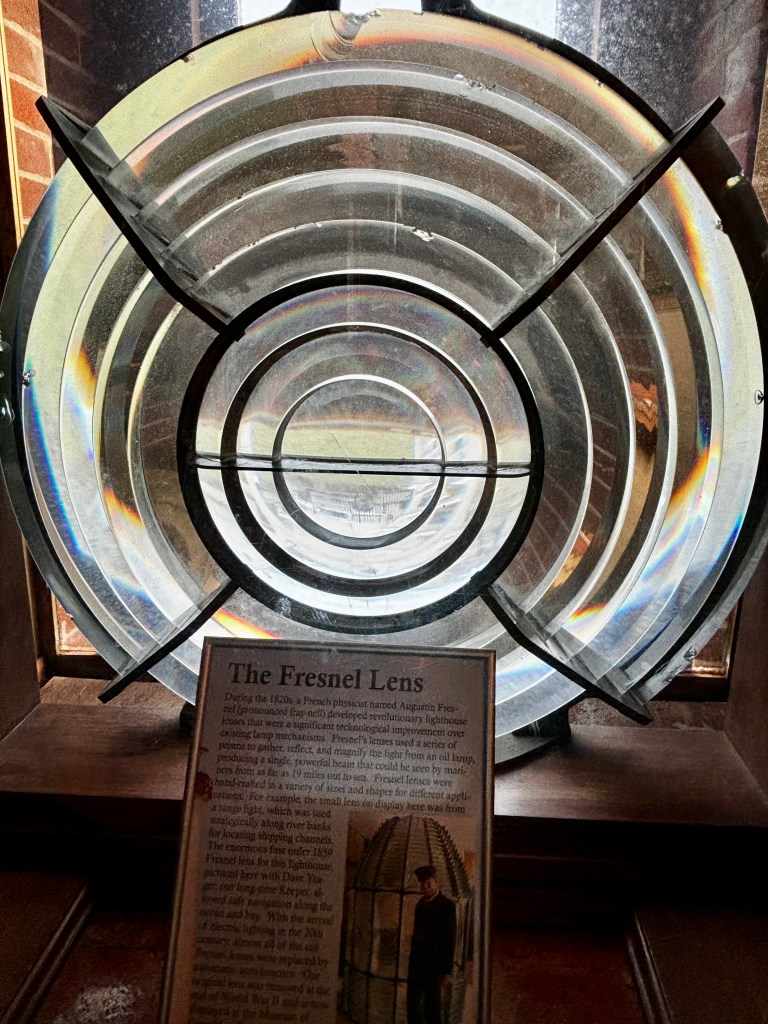
The original Fresnel lens cost $15,000 and is on display at the county museum.  This is just one component of a Fresnel lens.

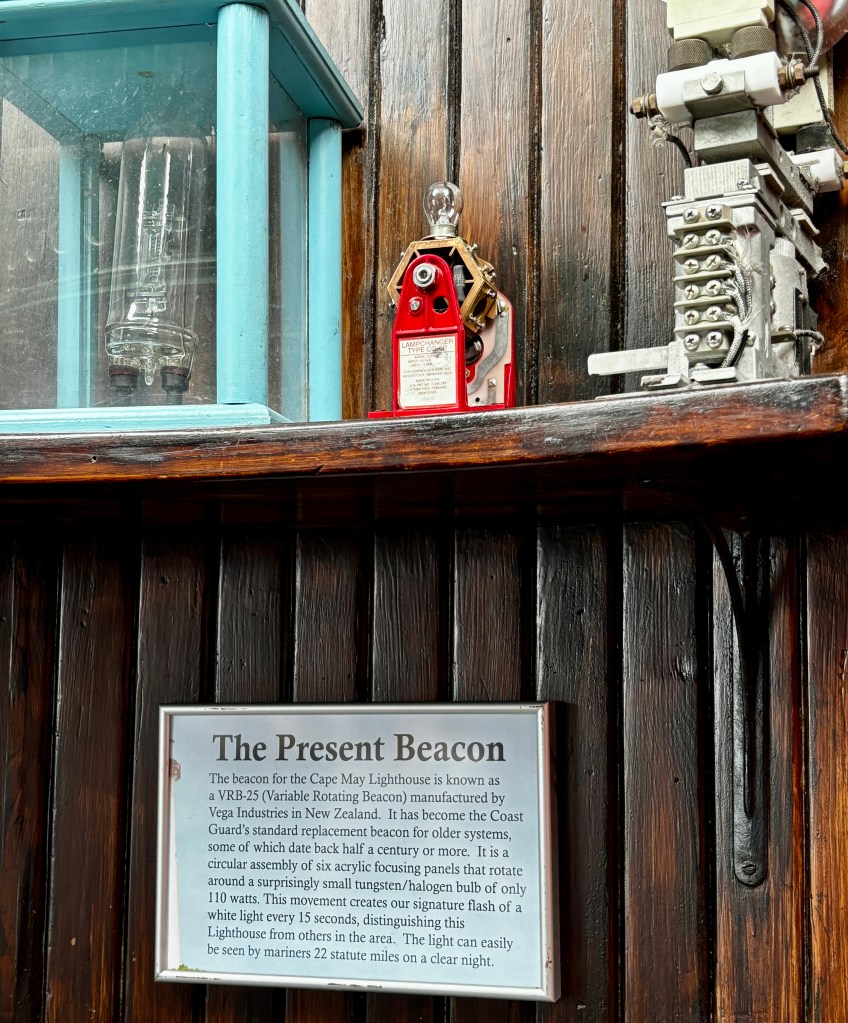
The lighthouse now uses a Visible Rotating Beacon manufactured in New Zealand and installed in 2016.  This is the current industry standard.

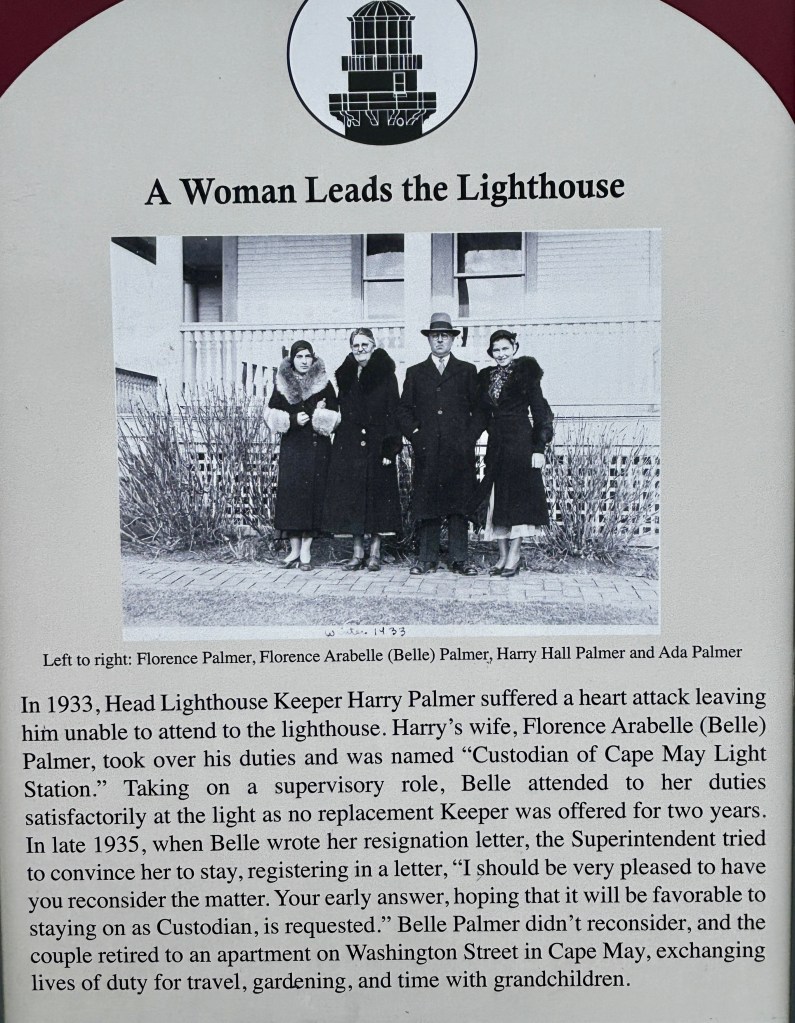
The lighthouse generally had one keeper and two assistants.  They, and their families, lived on site.  

For a time, the main lighthouse keeper was a woman.

The lighthouse was automated in 1936 eliminating the need for keepers to be permanently in residence.

In 1992 the lighthouse was transferred from the Coast Guard to the State of New Jersey.   Restoration and visitor operations are done by a non-profit group formed for that purpose.

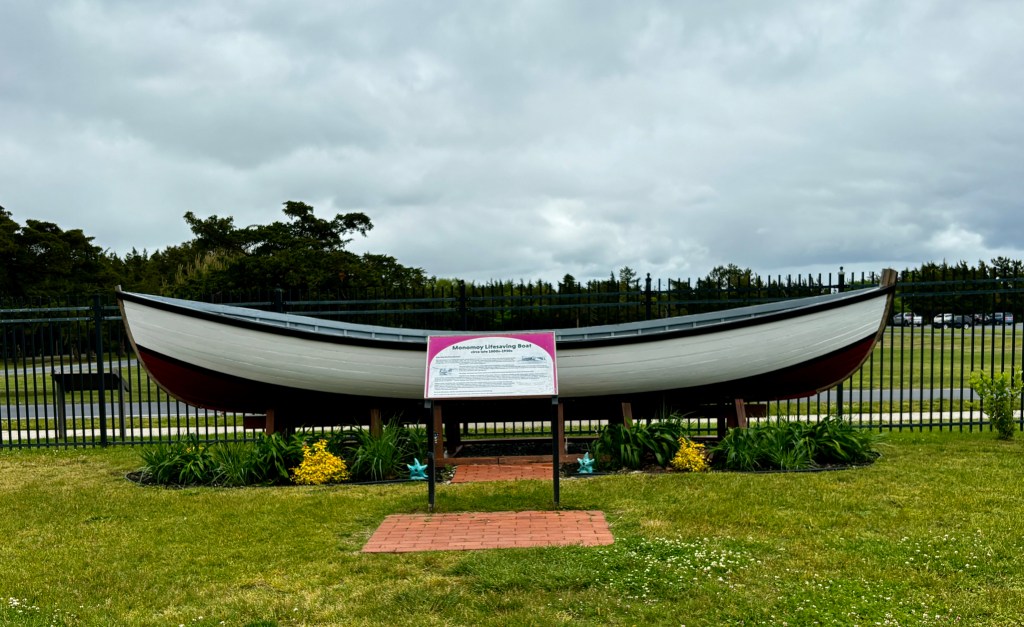
On the lighthouse grounds, we also saw the Monomoy Life Saving Boat.  Its era was from the late 1800s to the 1930s and was operated by US Lifesaving Service and early Coast Guard.

The boat is 26 feet in length from the late 1800s-1930s.  The “Monomoy” Class rescue boats originated in New England and were regularly used in Cape May area Life Saving Stations.  They typically weighed over 2,000 Ibs. and allowed for eight rowers to sit in four pairs side-by-side.   A coxswain steered from the stern.

After all those steps up and down the tower and up and down the lighthouse, we were ready for an early dinner.   We took the advice of the tower docent and went to an Italian restaurant away from the tourist areas.  He had also told us there was nearby liquor store to BYOB. We had seen that advertised a few places on the eastern seaboard and it seemed very odd to us.  We weren’t sure if that meant that the restaurants didn’t have their own bar service.

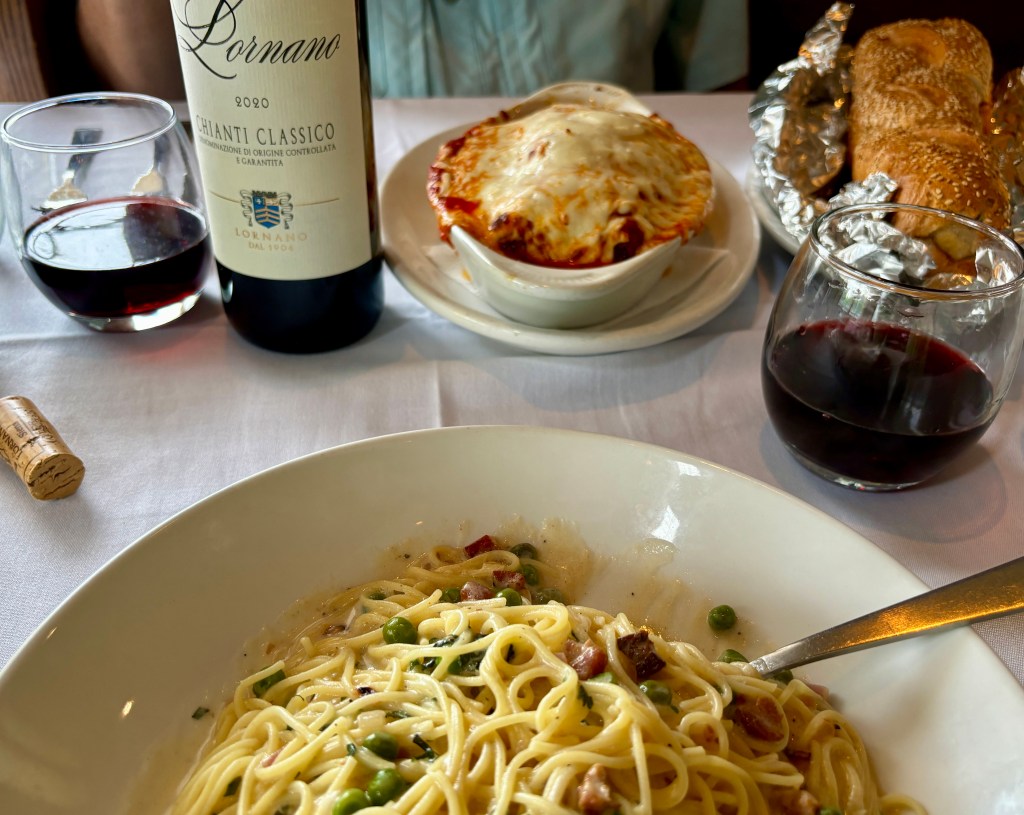
We found the restaurant and Randy went to buy a bottle of chianti while I went in to get a table.  I was a little embarrassed to see they did offer wine on the menu.  When I apologized that Randy was buying a bottle, the restaurant owner was not offended in the least.   He said when people BYOB it removes his responsibility for how much a patron drinks. That was an interesting perspective.

We enjoyed our bottle of chianti and our delicious dinner! The best meals we had on this trip seemed to be Italian!

We were in Cape May in May 2024.

Next Up:  More Cape May, a delightful place!

Posted in Uncategorized | 2 Comments

Cape May – The First Seaside Resort

As we had taken the early ferry from Delaware, we arrived in Cape May mid morning.  We had hours before we could check into our historic Bed & Breakfast.

We thought we would begin with a trolley tour.  It departed from the historic square area an hour later so we walked around a bit first.

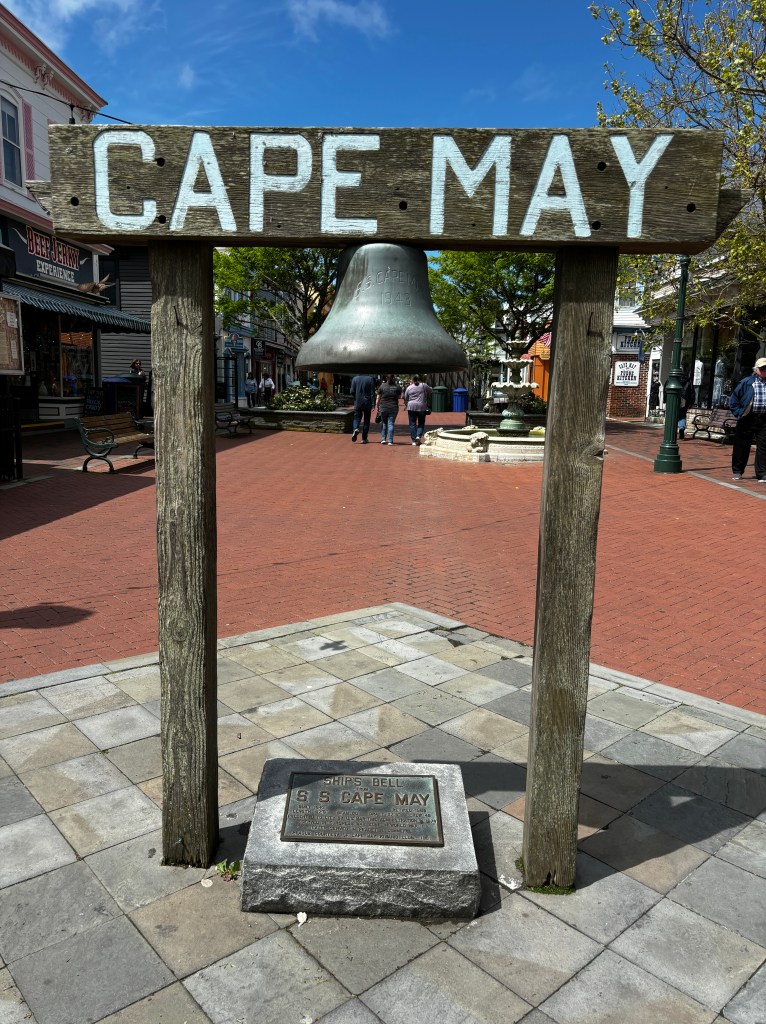
We came upon the bell from the SS Cape May.  The ship was built in 1943 and served in World War II. It later served in peacetime commerce and was retired in 1969.  The ship’s bell was presented to the city in 1974.

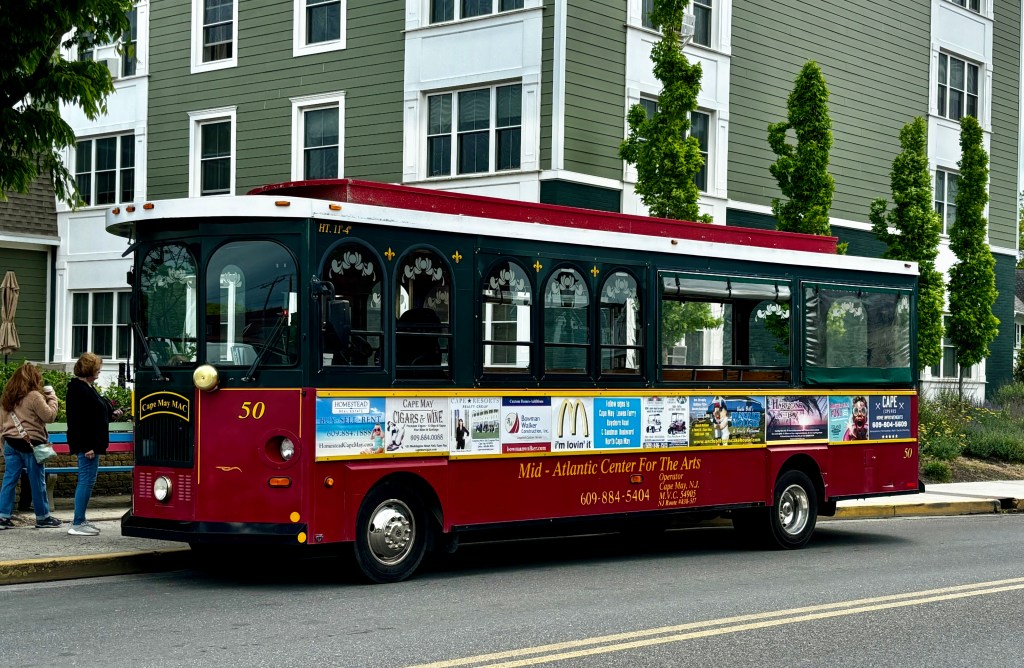
We boarded the trolley and began a tour of Cape May, our nation’s oldest seaside resort.  It was used as a summer escape as early as the 1700s.   Residents in Philadelphia, Baltimore and Washington were flocking there from the early 1800s. Back then the town was more accessible by water than by land

The number of pilgrim era descendants in Cape May is second only to Plymouth, Massachusetts.

In 1851 there were three casinos in Cape May.  When a woman from New Orleans won $1,000,000, they banned women. 

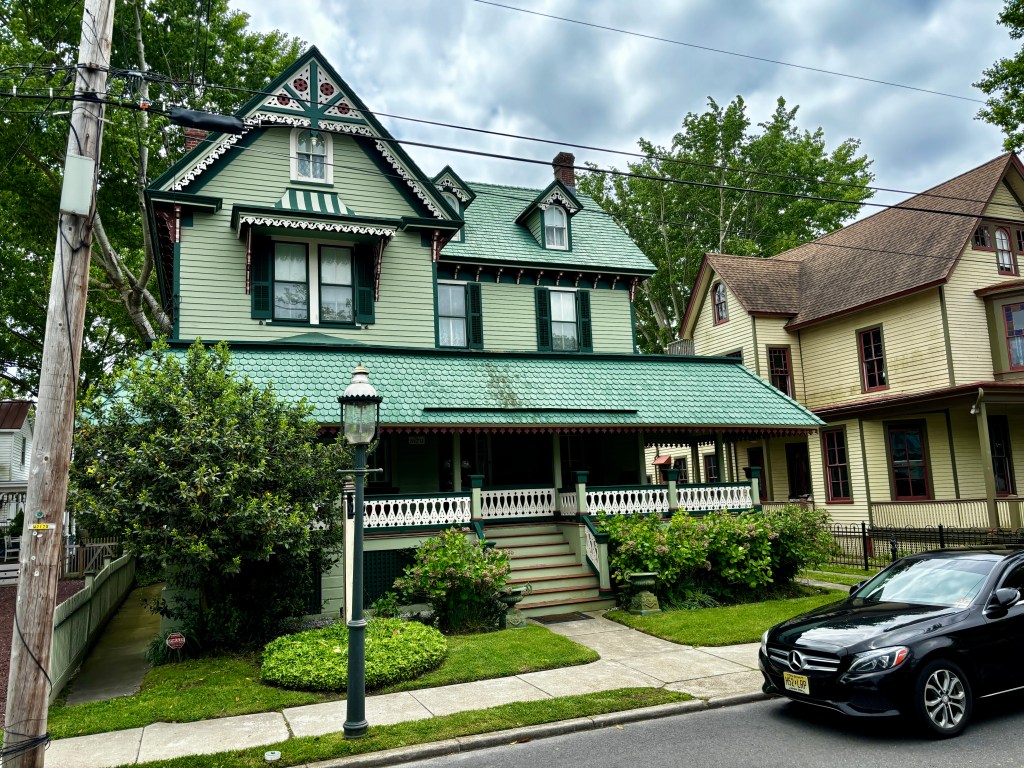
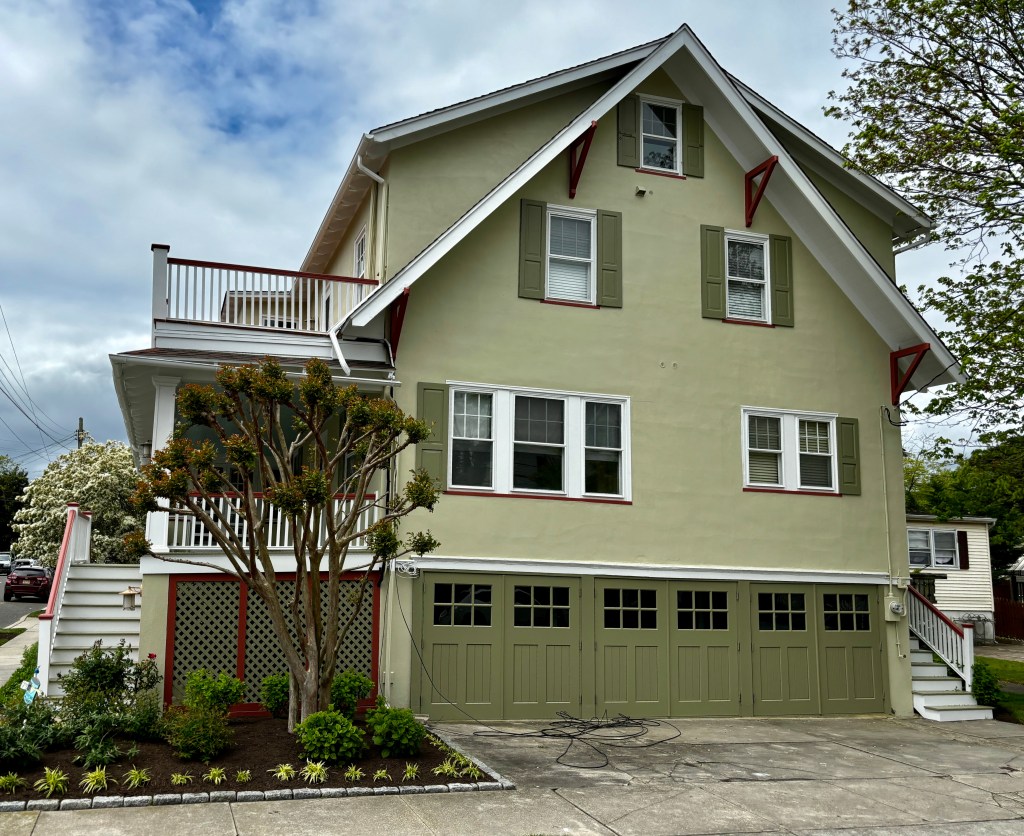
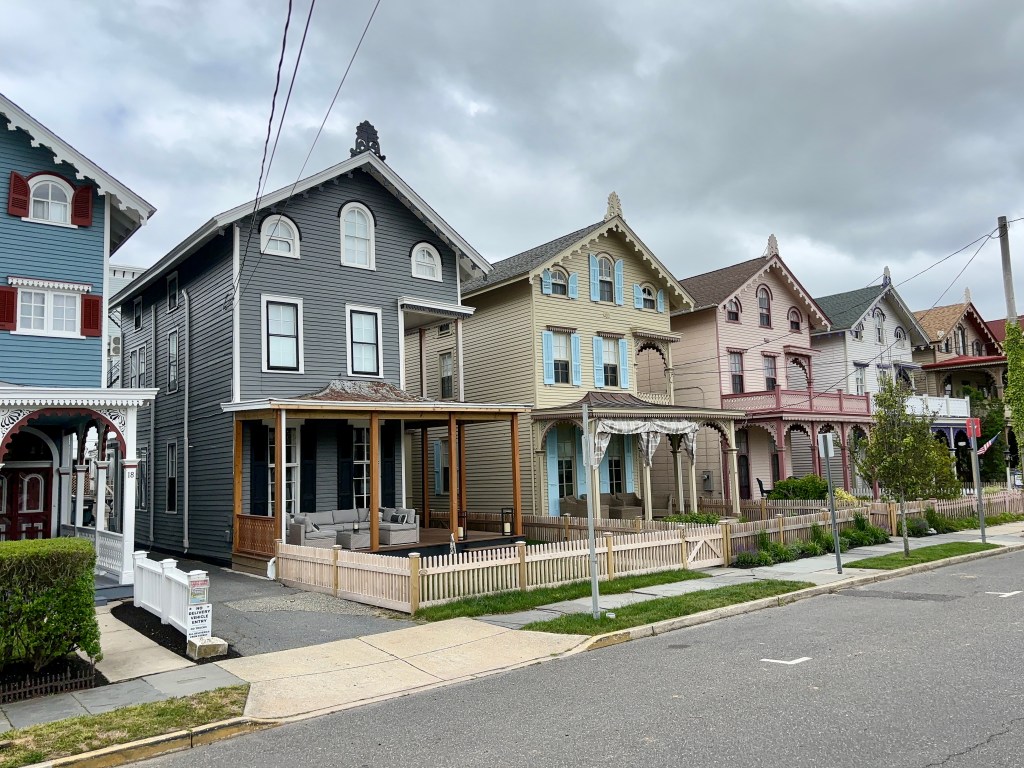
Our tour was an interesting description of the Victorian houses and residents. This house was built for $1800.

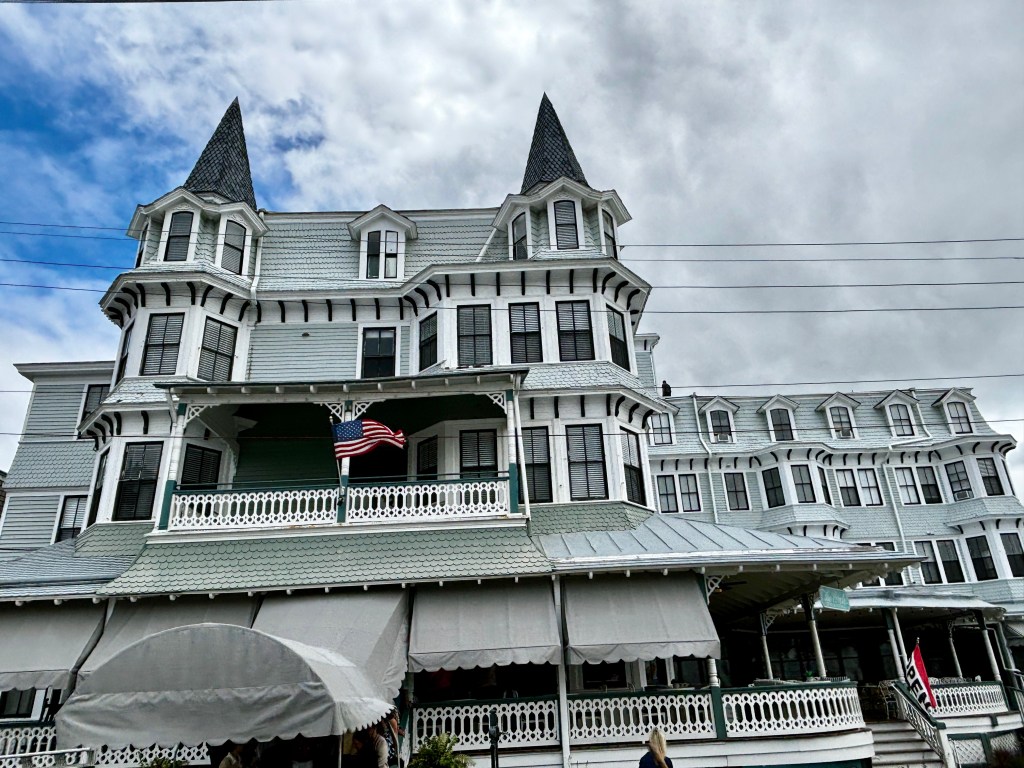
This is the Inn at Cape May. Both Wallis Simpson and Estée Lauder liked to give parties at the inn.

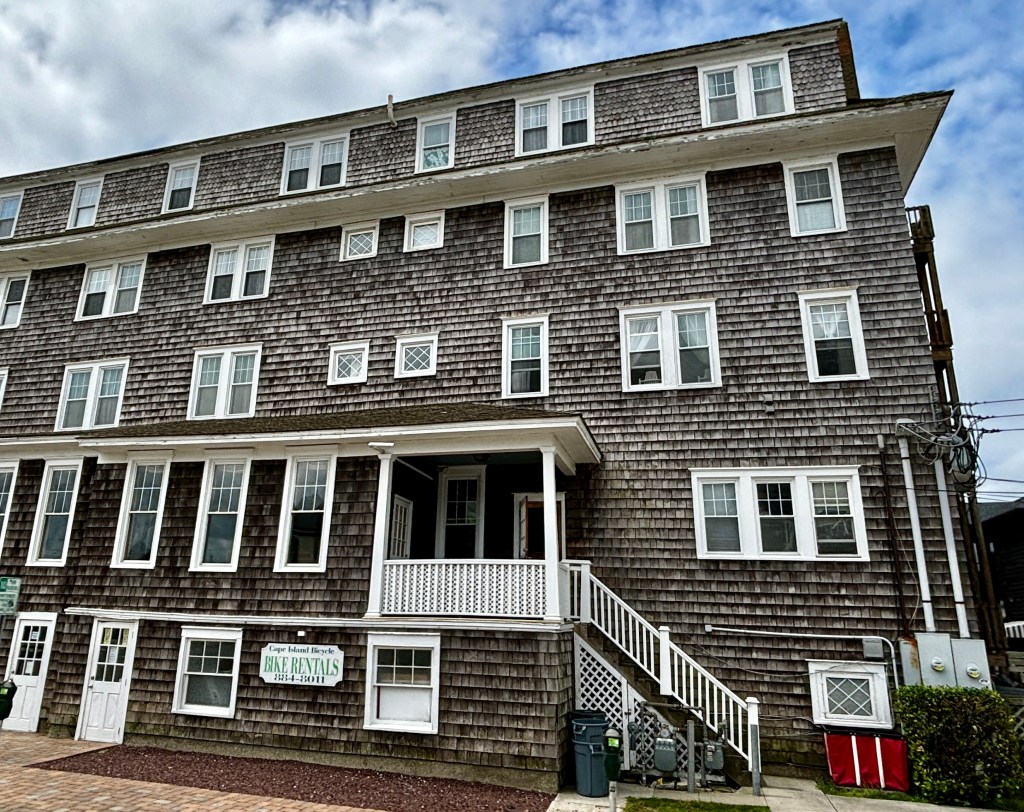
The use of shingles as siding was invented in Cape May.  We’ve seen that weathered gray shingle look on both coasts. 

This house was once owned by the Stetson family.  The new owners found lots of hats in boxes when they moved in.  They threw them out.

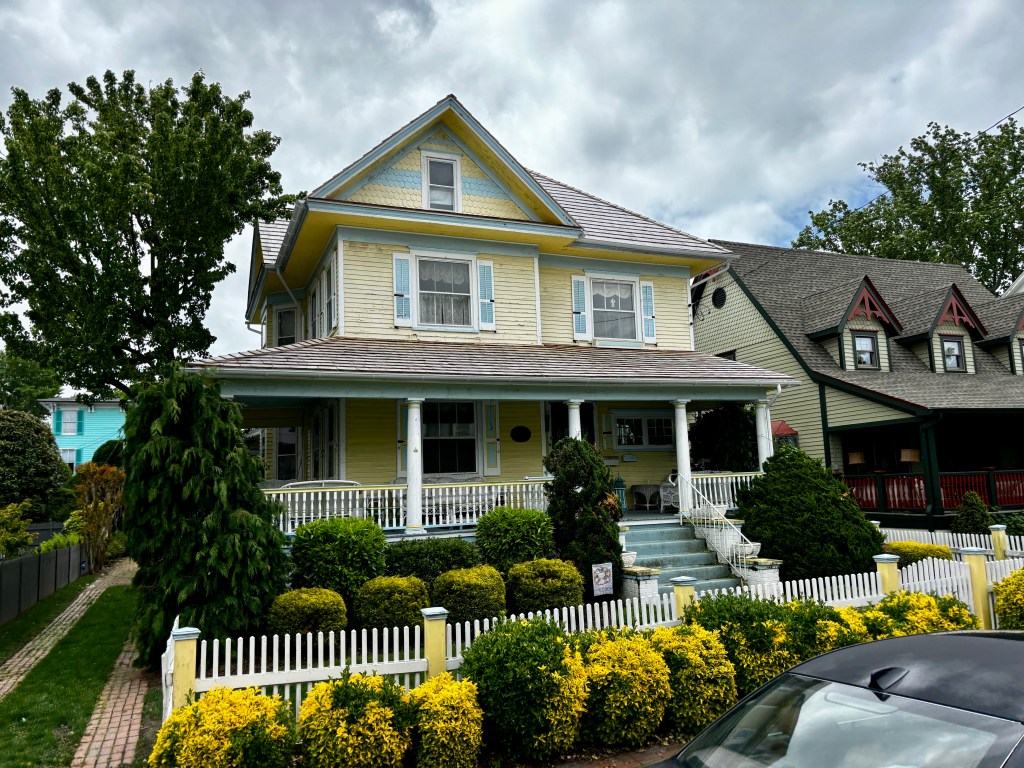
This yellow house was built by the brother of Norman Rockwell.

In 1878 a fire destroyed 40 acres on the west side of Cape May.   The fire started in a hotel.  The Pinkerton Agency investigated but could not determine who was at fault.  No one was ever charged.

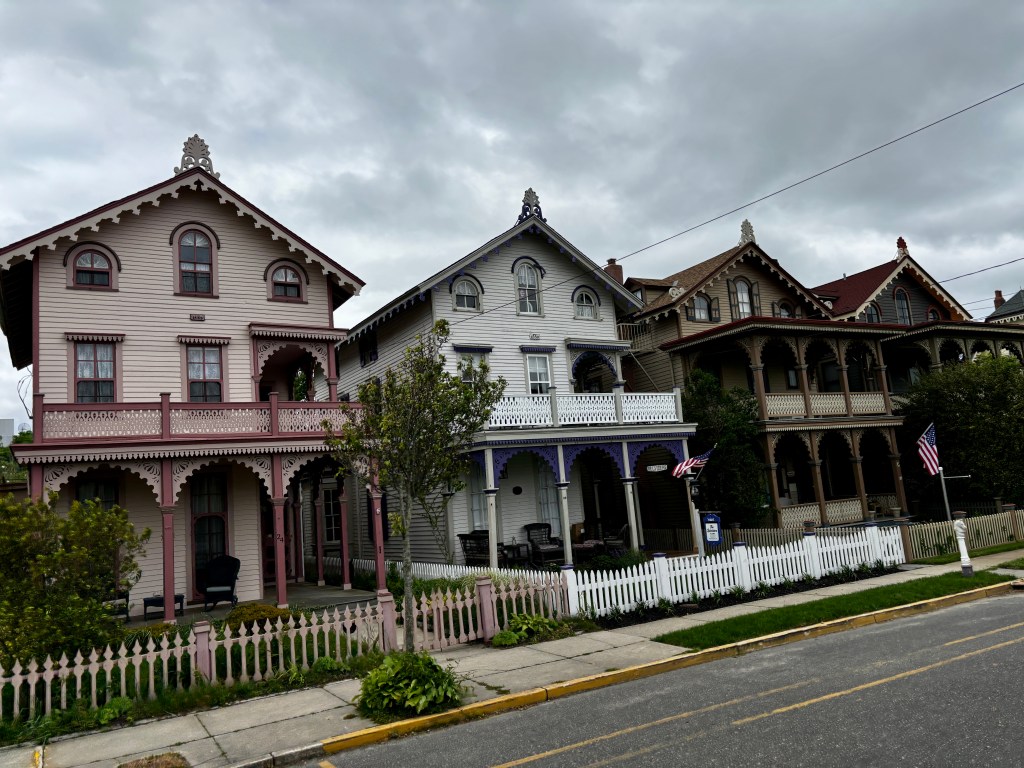
After the fire, some smaller “summer homes” were built instead of rebuilding the large mansions and hotels. These eight cottages were built for a total of $50,000.  

We walked by them several times and liked to notice the subtle differences.

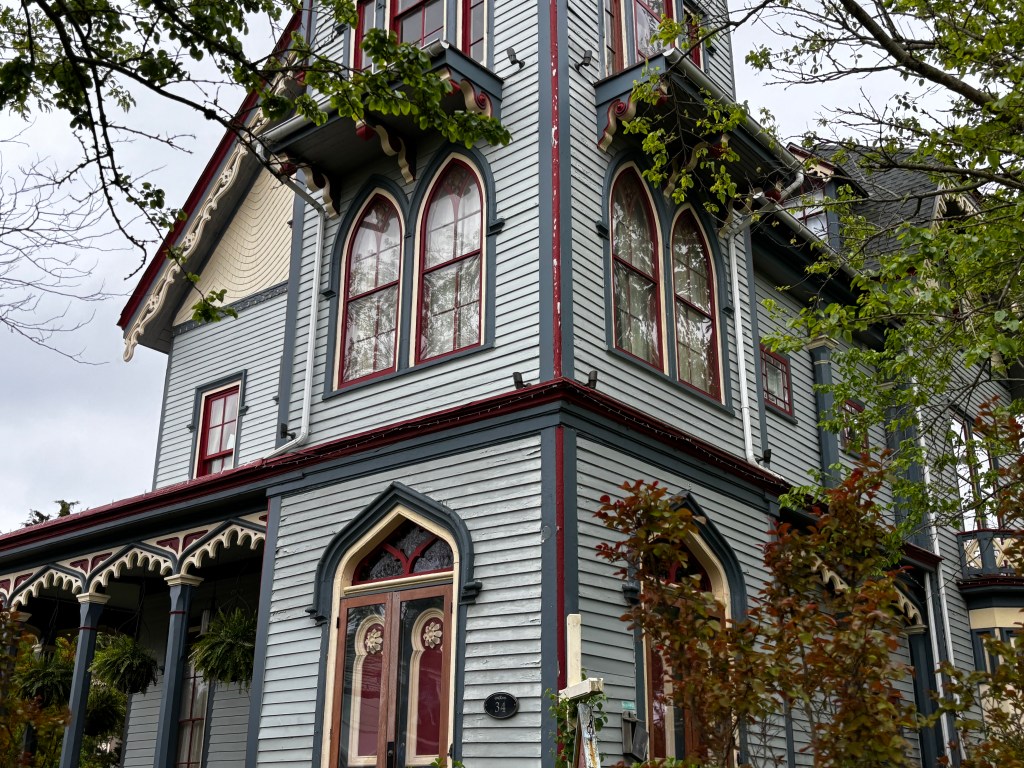
Cape May was named a National Historic City in 1976 based on the number of Victorian homes. Cape May buildings have the most original stained glass of any city in the US. 

At the end of our tour, it was time to find our lodgings.

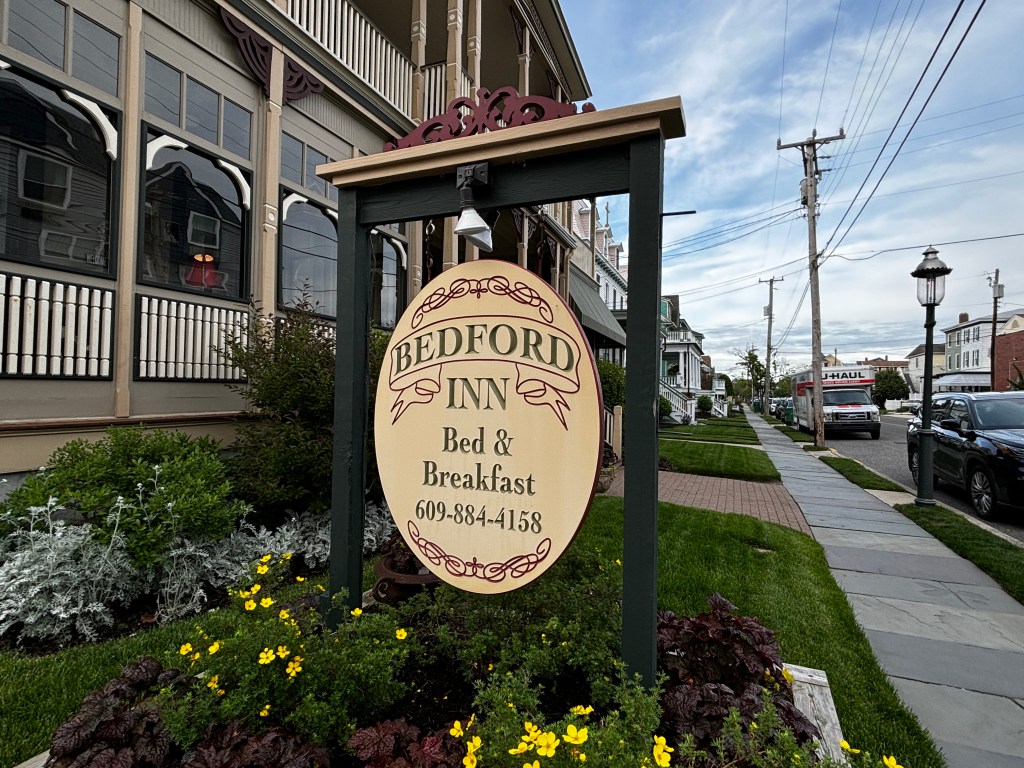
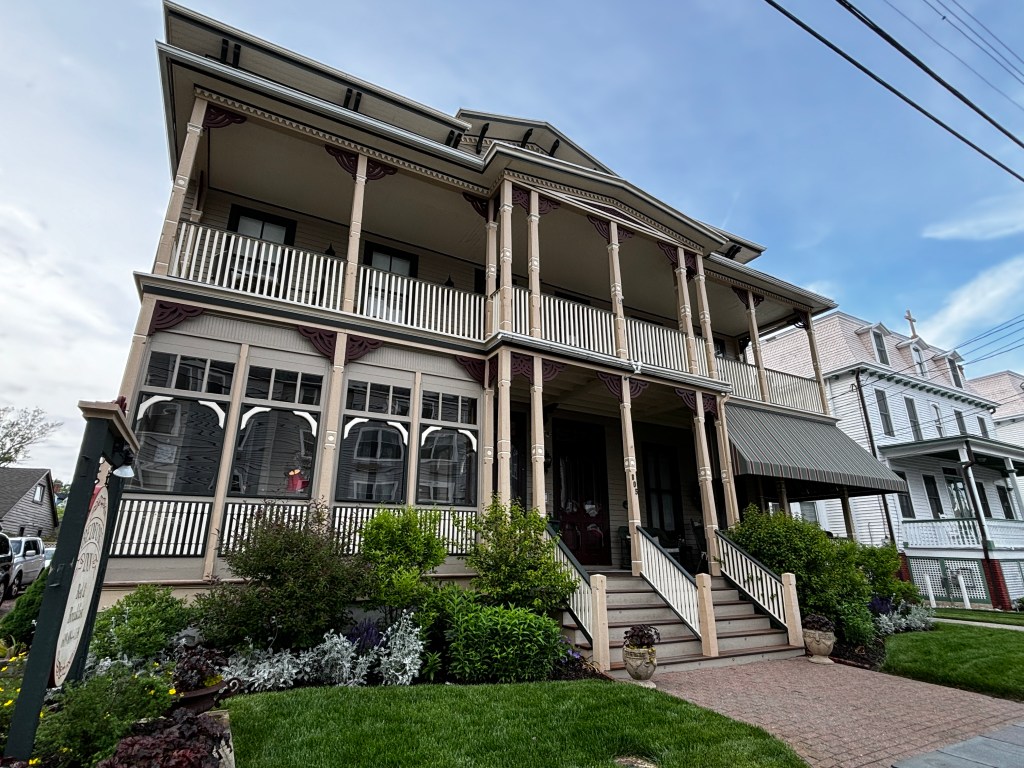
We stayed at The Bedford Inn, one of the top five Bed and Breakfasts in Cape May.  Victorian Bed and Breakfasts and boutique hotels are far more common in Cape May than chain hotels.

Built in 1883, the Bedford Inn features 10 guest rooms with period antiques. 

It is described as a “mother-daughter” house, side-by-side front doors that open to parallel stair- cases and separate living quarters.  Once a family home, it was converted to apartments, then a bed-and-breakfast.  A passage- way was opened to join the two homes to become one.   The subtle exterior is more representative of the Victorian style than the bright colors often seen.

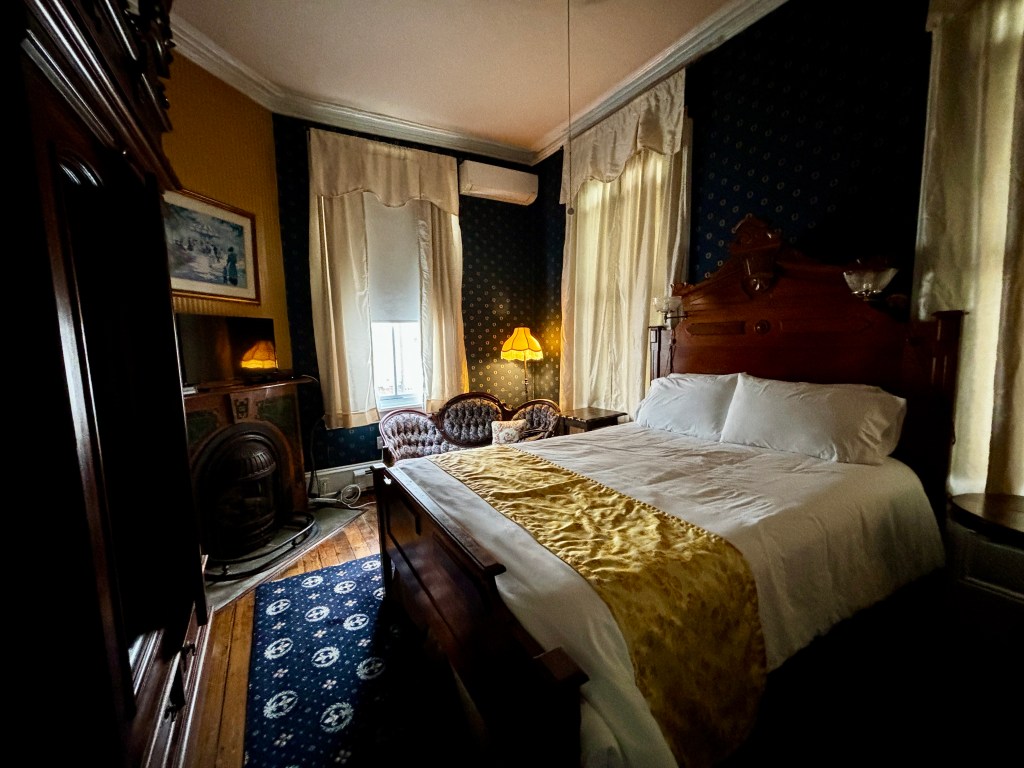
The interior has dark woods, ornately furnishings, gilded mirrors, floral carpets, and vintage lighting.

There was one bedroom on the ground floor and it was ours.  That was a nice thing when we didn’t have to carry our suitcases upstairs but not so great when people sat outside our window talking well into the evening.

One morning, we visited with sisters who meet at the Bedford Inn yearly. They have developed a delightful routine of breakfast at the inn, relaxing, ice cream for lunch, reading, wine at 3:00 and then dinner at one of Cape May’s many wonderful restaurants.   What is possibly better than that?

Overall, it was a delightful stay. 

We were in Cape May in May 2024
Next Up: More Cape May

PS  Blog Post #400

I interrupt our trip to the East Coast to make note of this, our 400th blog post.  Have you been with us since the beginning?  

Randy started, named, and wrote the first few posts himself as we were preparing to sell our home and possessions in Boise and launch our full time RV adventure.   

I wrote us through our RV life from the summer of 2014 to the summer of 2018 when our plans were derailed by health issues.  

I continued to write as we chose to leave the RV, and the road, and remain in the Phoenix area.  Since the summer of 2019, our posts have highlighted our adventures living in Arizona and our travels in the US and internationally.  At this point, I still enjoy writing so plan to keep on.  

I tried to determine a list of the most read posts over the years.  I sometimes look at the stats and reports and always see that there have been readings of What’s Under the Lake?.   I assume it must have been tagged by the town, state park or tourist site in Cascade, Idaho because that post has had over 1700 views.  The post was fine,  but it was not that much better than the rest!

Other posts that have been read repeatedly are No Body Contact With the Water and Our “Problems” With Antelope Canyon…

The post that we have read again and again is Elko’s Last Blog.  Randy read it everyday for a whole year after we lost our boy.  Many of you may remember it too.  His people loved him and he knew it every day.

Whenever you joined us, and whatever your favorite post might be, thanks for coming along!

Posted in Uncategorized | 4 Comments