The lands that are now New Brunswick went back and forth between French and English rule. During the time of American independence, these lands belonged to England.
Saint John, New Brunswick is Canada’s oldest incorporated city. The city began in 1783 as loyalists moved north following the US Revolution.
Benedict Arnold, infamous American traitor, went to England after escaping capture and joined His Majesty’s Service. In time, he and his wife came to Saint John, New Brunswick and he became a merchant. They lived in Saint John for six years but were not well revered.
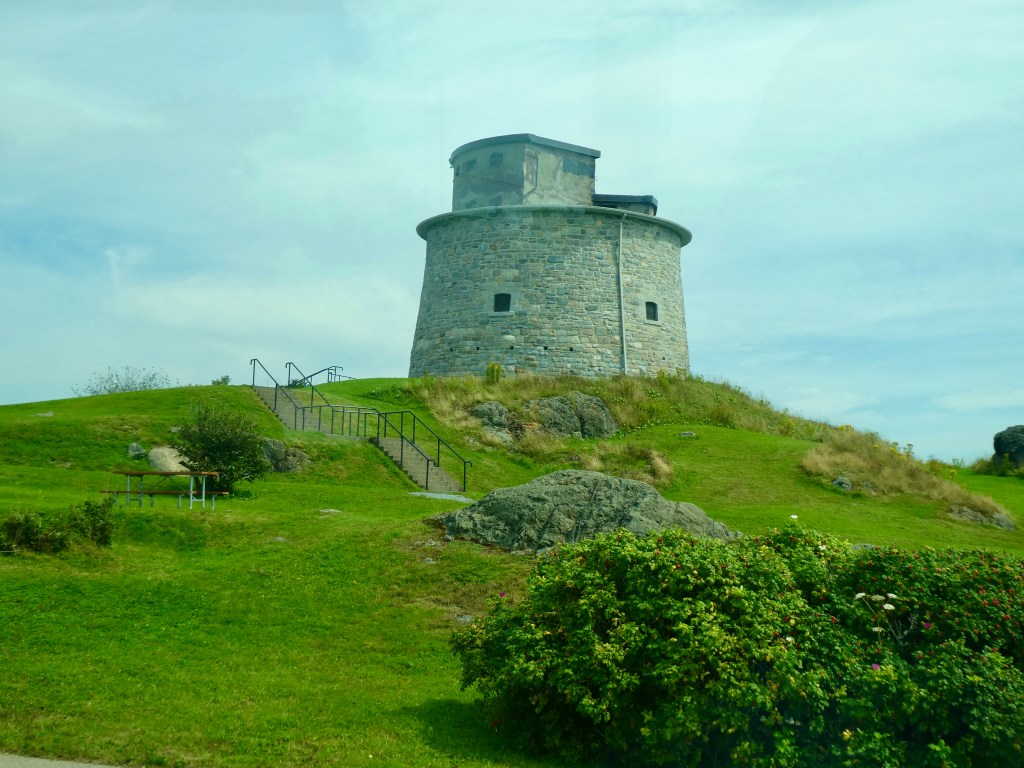
Martello Tower was built during the War of 1812. It had a low entrance and irregular stair measurements as a protective measure. The tower was attacked by the United States because it was a place nearby where the Americans could attack England. (The section on top was added during World War II.)
(Editorial comment – It was so very strange throughout this trip to hear about incidences where the US and Canada were attacking each other. I know it was a long time ago and Canada was British Canada at the time, but the whole idea just doesn’t compute!)
Saint John population increased between 1840-50s as many people came from Ireland during the potato famine.
In the mid 1800s, Saint John became the third largest ship building town in Canada.
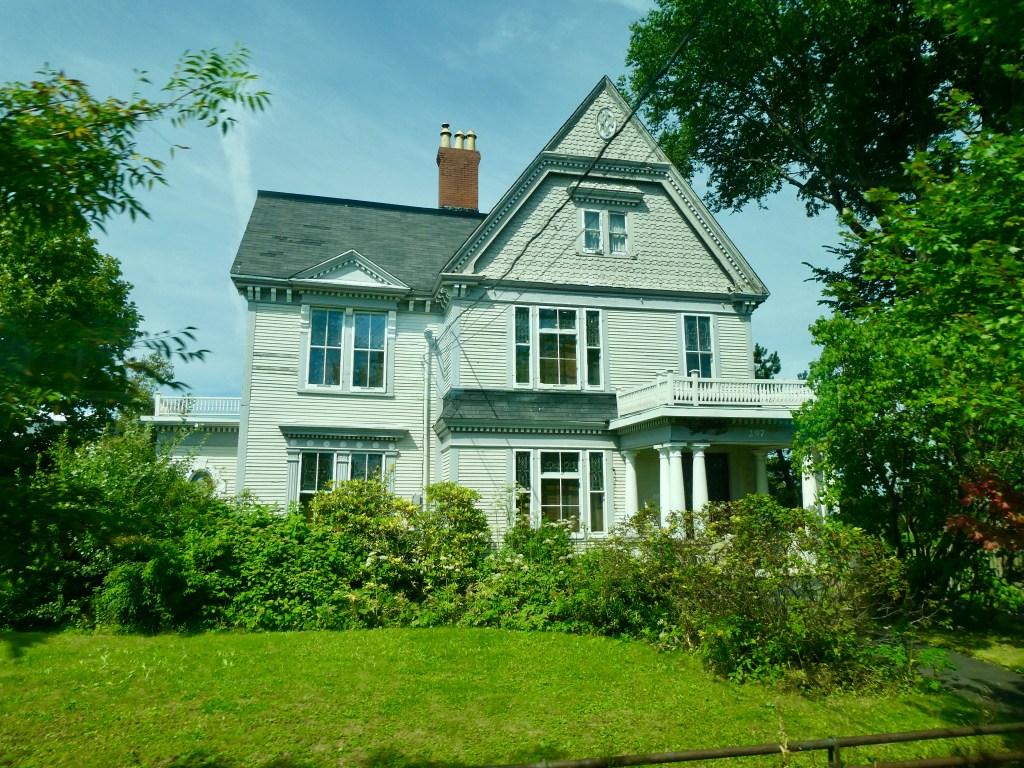
We were told that the owners of this 1910-11 house had been on a trip abroad buying furniture. The furniture sank on the Titanic. I don’t know what happened to the people.
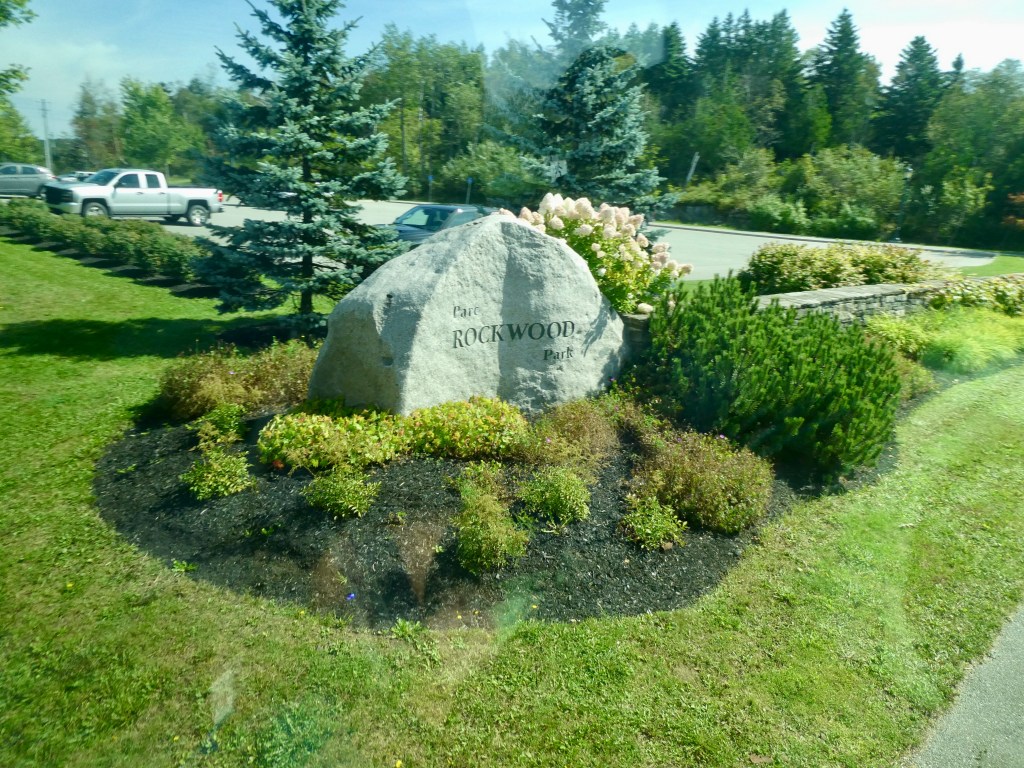
Rockwood Park was designed by Calvert Vaux, one of the designers of New York City’s Central Park.
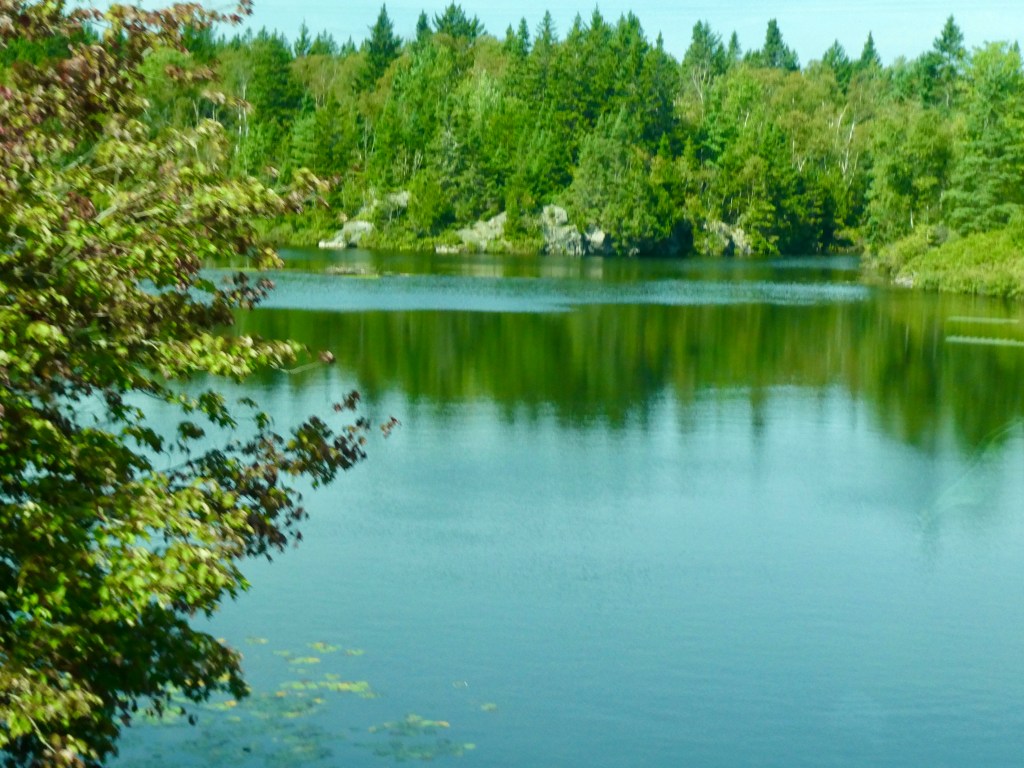
The park was formed around Libby Lake where local man Charles Gorman set a world speed skating record. He competed for Canada in the 1924 and 1928 Olympics.
New Brunswick is the only official bilingual province. Quebec’s official language is French while the rest are official English language provinces.
The McDonald’s in this part of Canada used to have McLobster!
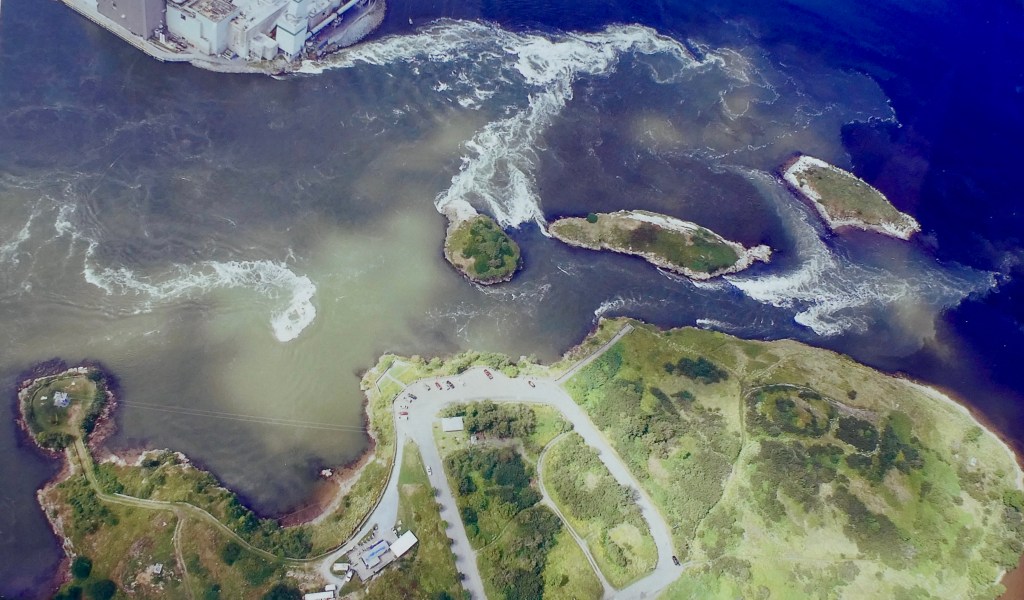
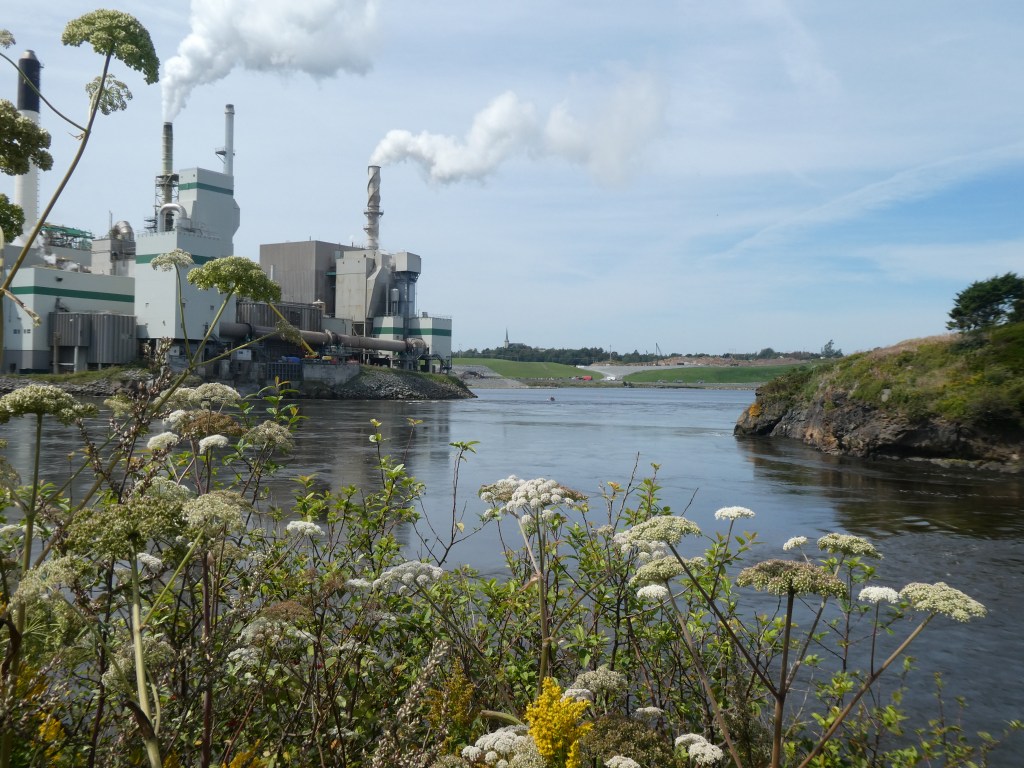
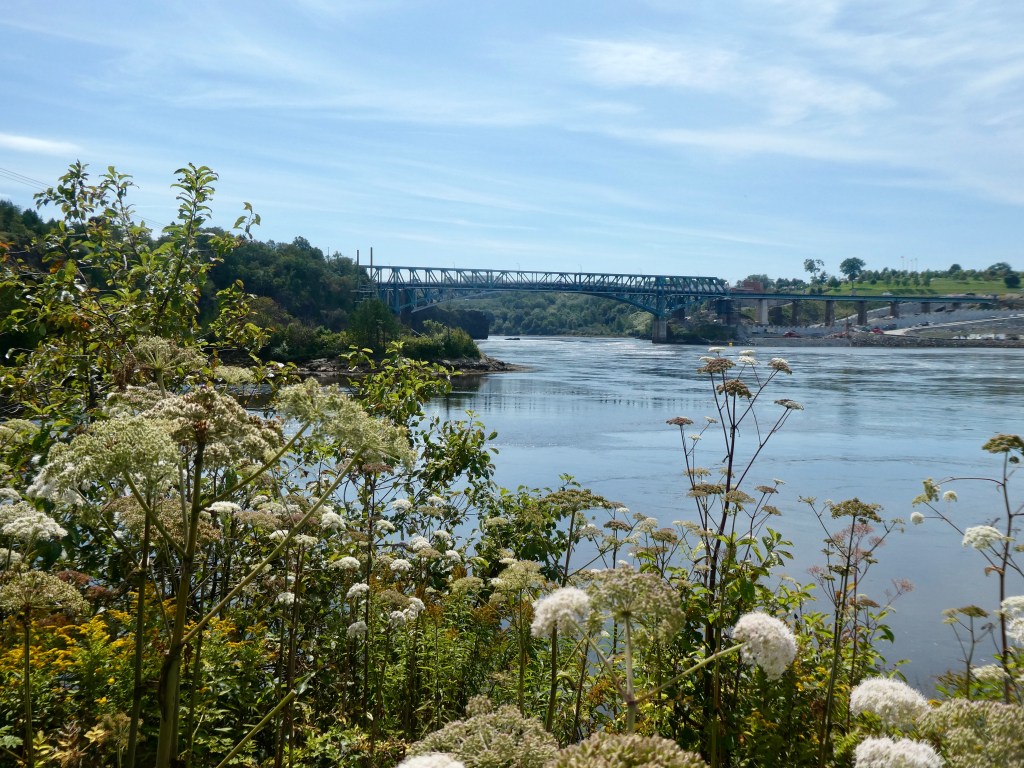
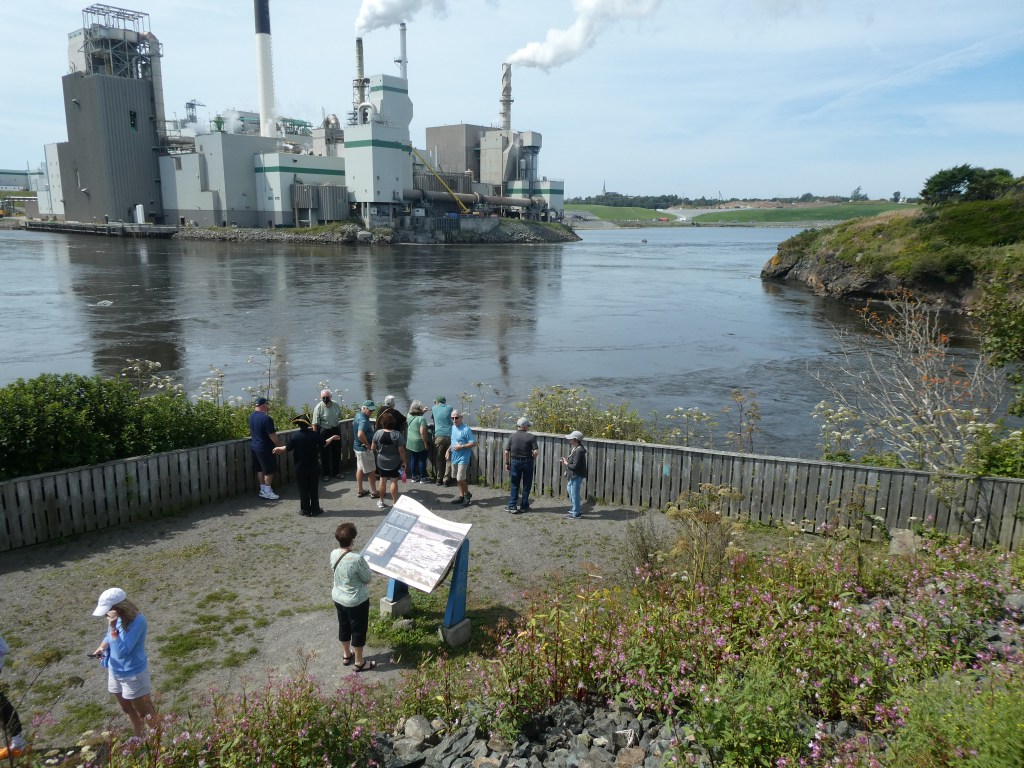
This area is known as the Reversing Falls Rapids. It is where the mouth of the Saint John river connects with the Bay of Fundy.
Most tides throughout the world adjust about three feet. The highest tides in the world are here.
The Saint John River usually goes towards the ocean except at high tide. The tidal change can be 28 feet in the river and 40 feet in the Bay of Fundy. The result is that the river actually falls fifteen feet backwards. Levels of brackishness can be found 70 miles upriver.
Power production turbines were installed and then destroyed by the tidal action. Work continues on a new design that can handle the extreme tides.
A 100 year old pulp mill is across the river.
It was very difficult to build bridges across the gorge. Three attempts failed either during construction or after the fact. The bridge in the picture was built in the early 1900s.
We were not there during the tidal change. It would have been interesting to see!
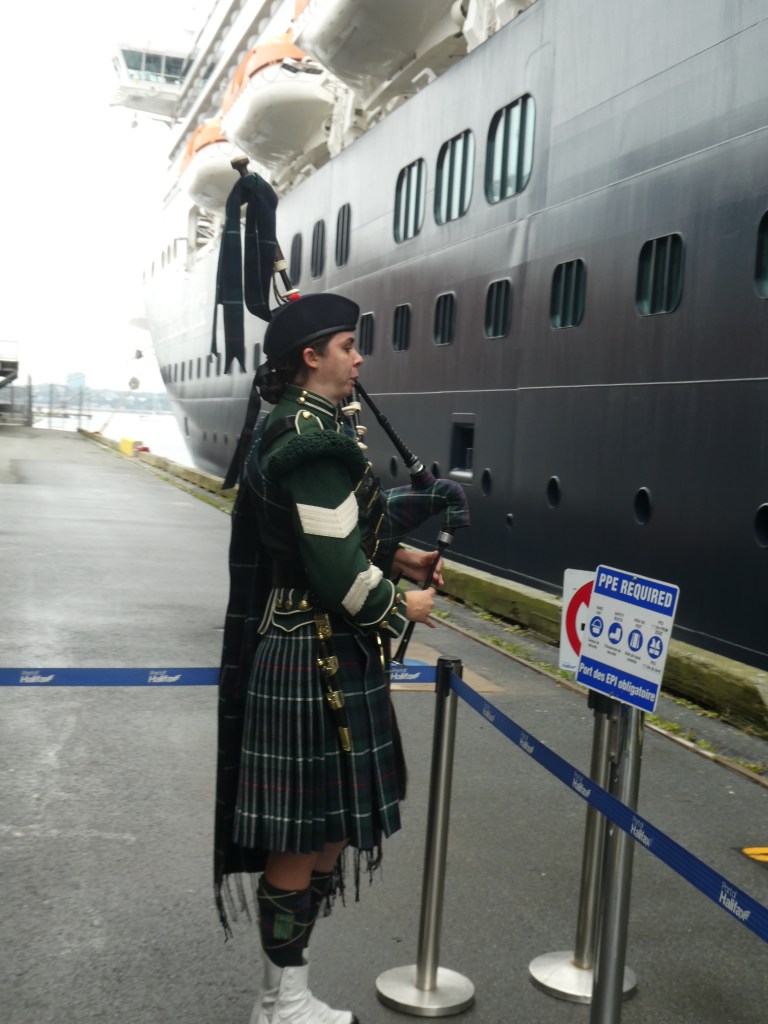
We boarded the Nieuw Statendam once more and set sail to our next port – Halifax, Nova Scotia
We arrived in Boston, turned in our rental car, and took a shuttle to the hotel. We had the fun and unexpected experience of running into Sharon, a friend from Boise, on the shuttle. She was also in town for a cruise, but not the same one as we were.
In the morning we connected with our planned Boise friends Darrell and Cindy. We headed to the pier and processed to board our Holland America ship. The lines were long as everyone went through COVID boarding protocols.
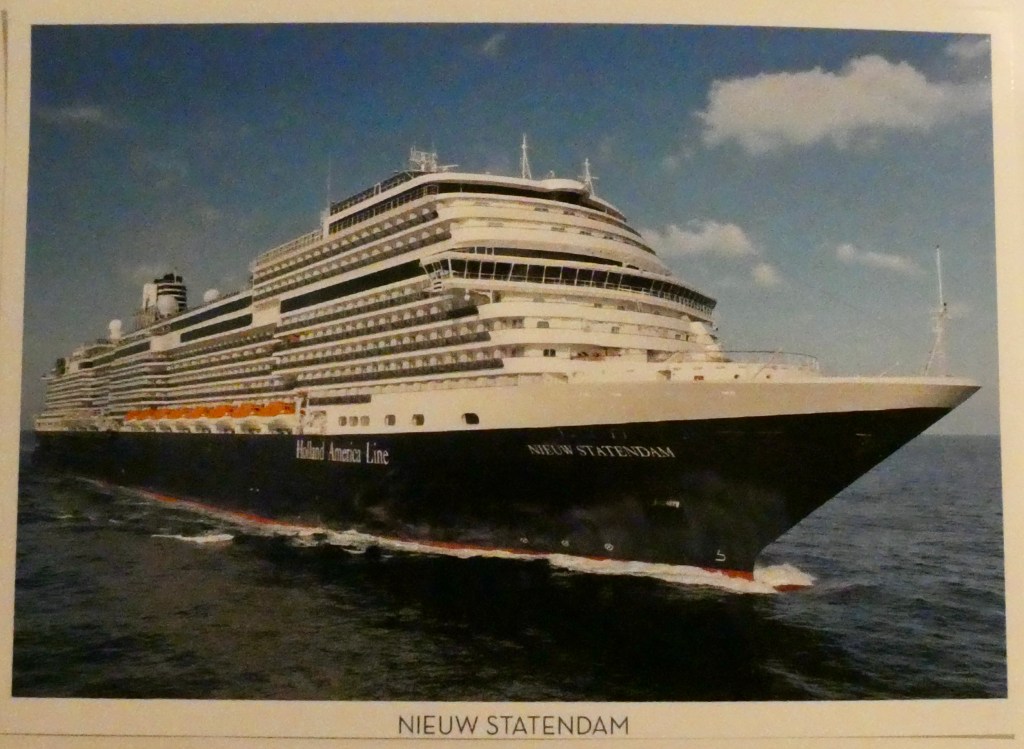
This is the Nieuw Statendam, the same ship we sailed on for 21 days from Fort Lauderdale to Rome earlier in the year. We had mixed feelings. We had enjoyed the ship previously, and knew our way around, but it would have been nice to experience a different ship as well.
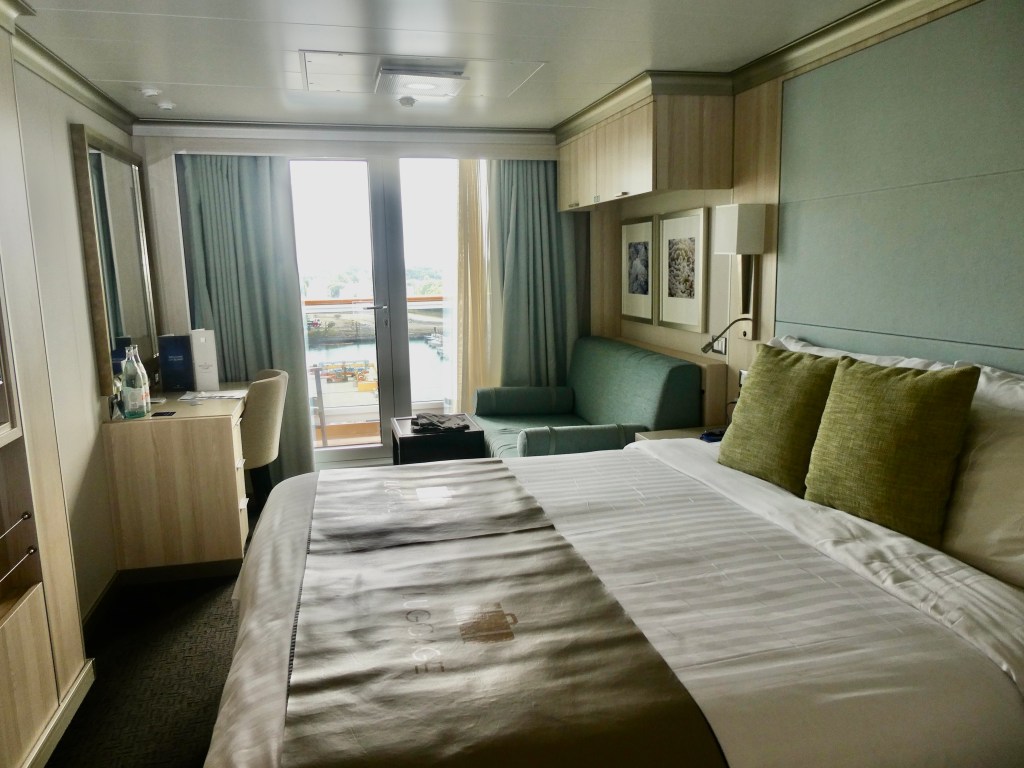
We did get a complimentary upgrade in cabin. It was still a verandah cabin but was the “spa version” with minor upgrades in the bathroom. It was located near the spa on Deck 10 – an upgrade if price and location are considered. What we lost in the upgrade was the extended balcony we had booked on Deck 4.
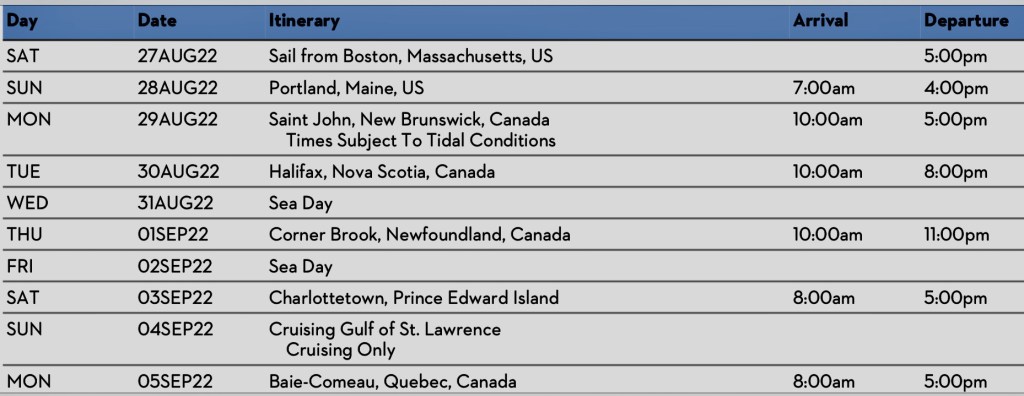
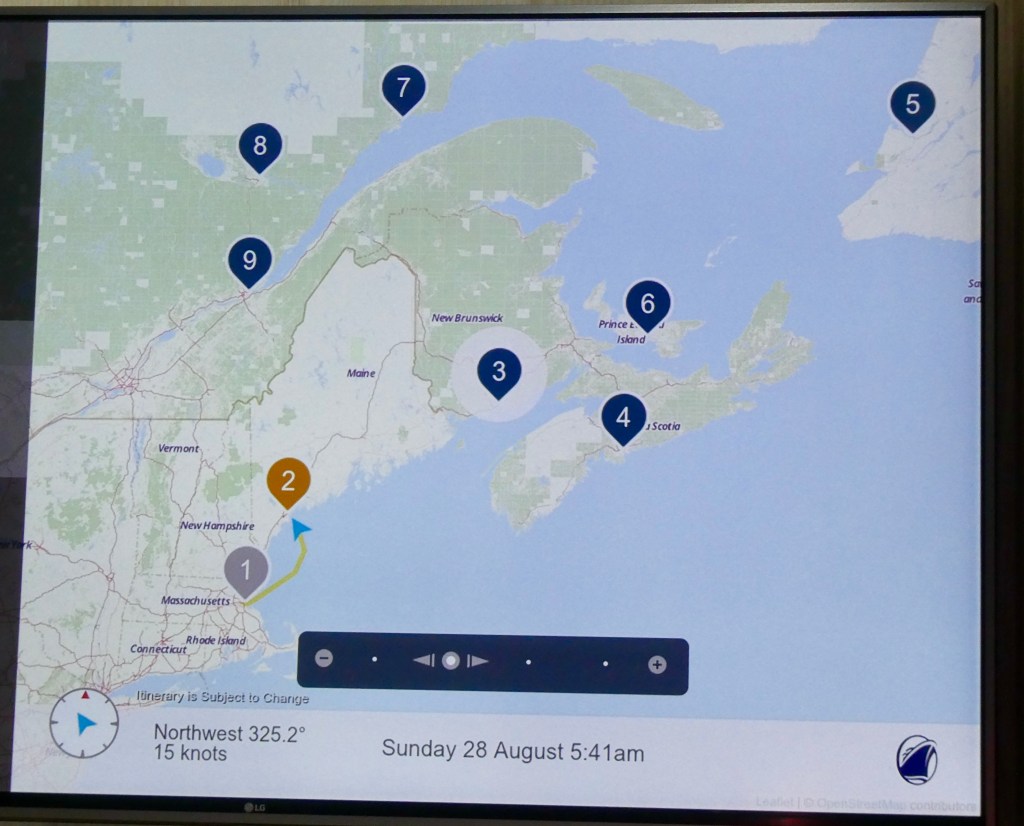
Our itinerary was to go from Boston to Quebec City with stops in Maine, New Brunswick, Nova Scotia, New Foundland, Prince Edward Island and Quebec.
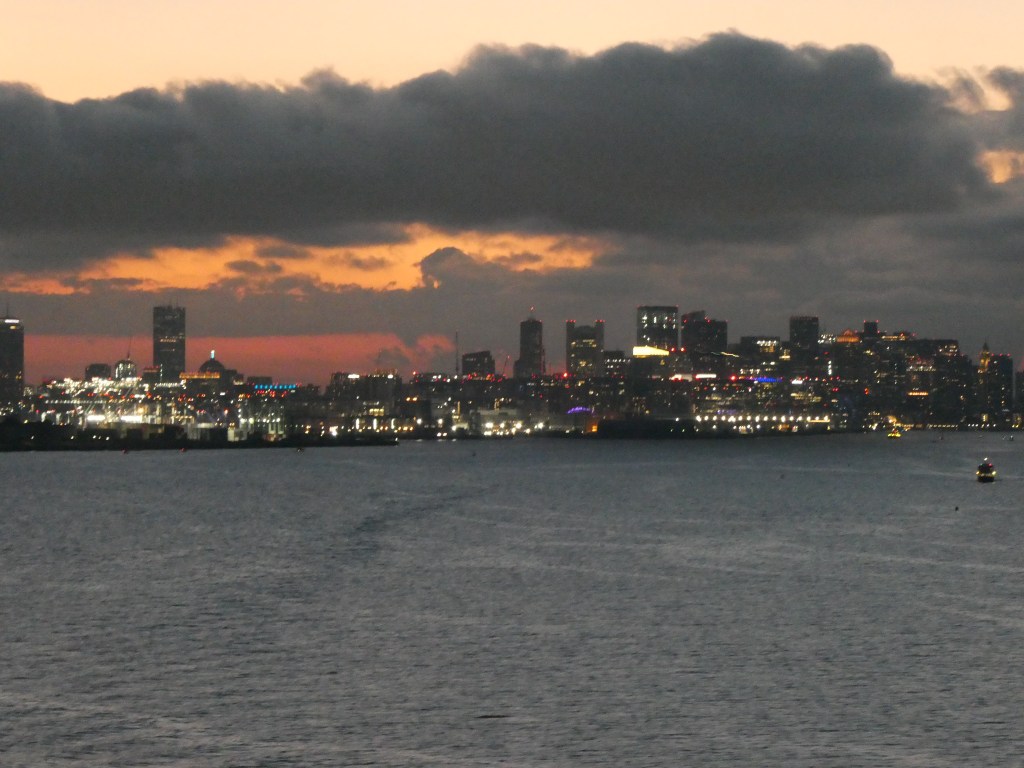
We left Boston in the evening.
Early morning progress shown on the TV in our cabin..
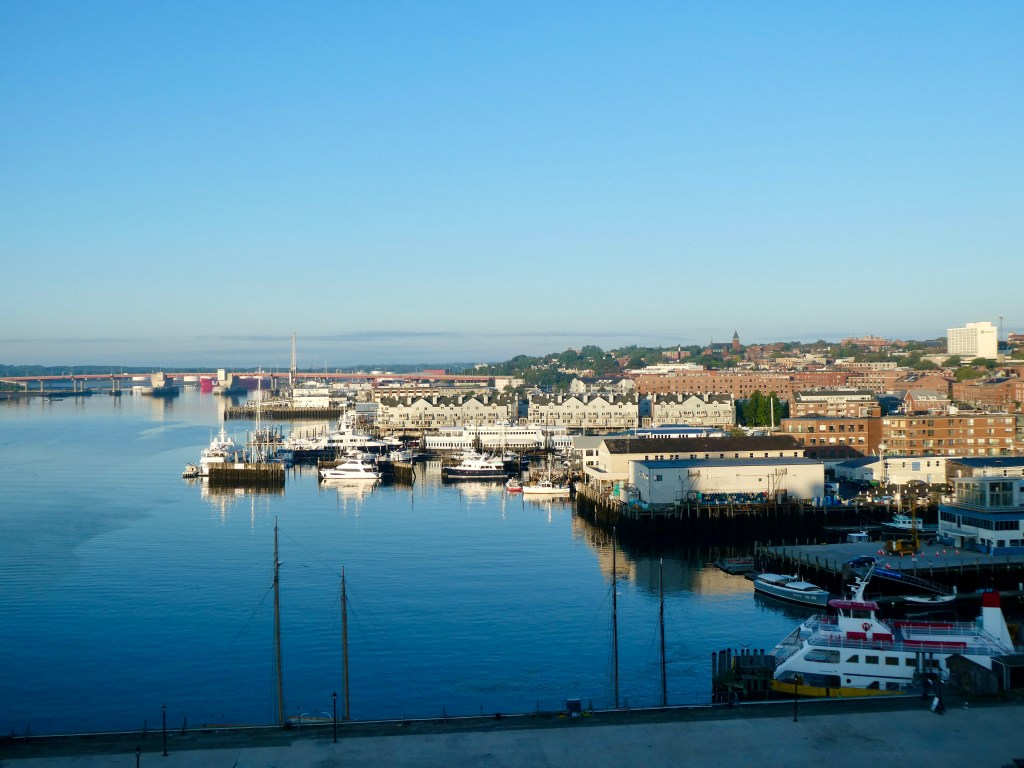
Sailing into Portland, Maine.
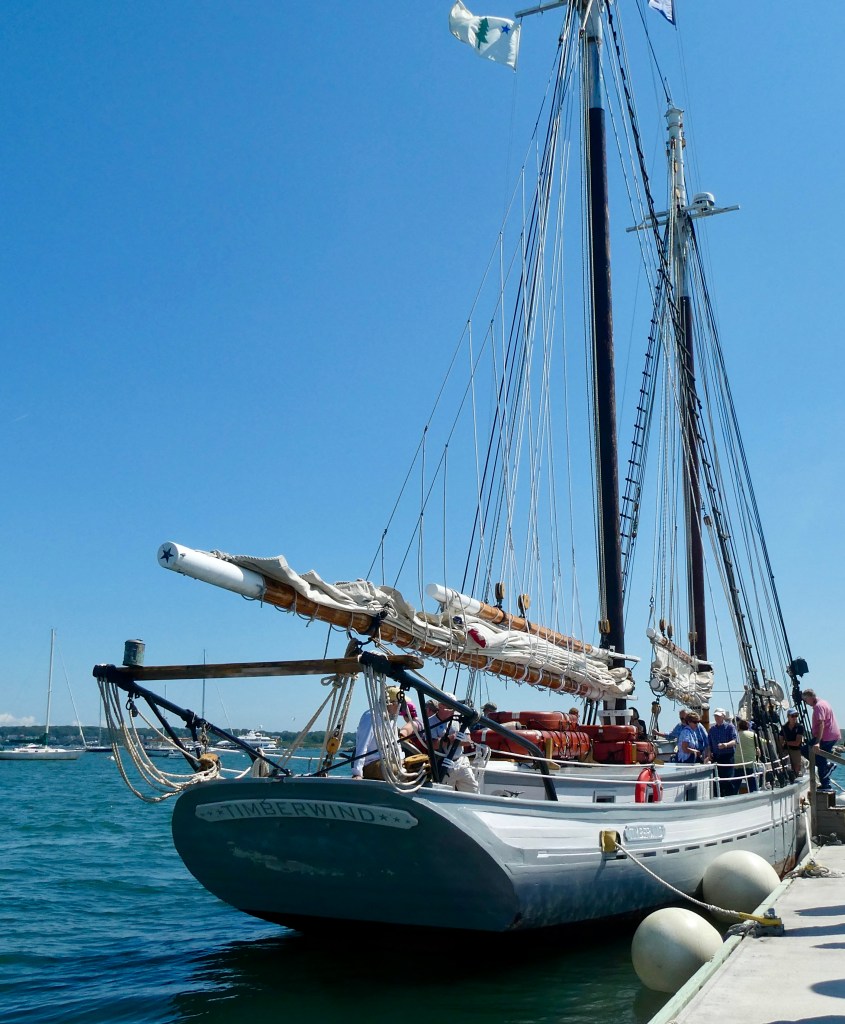
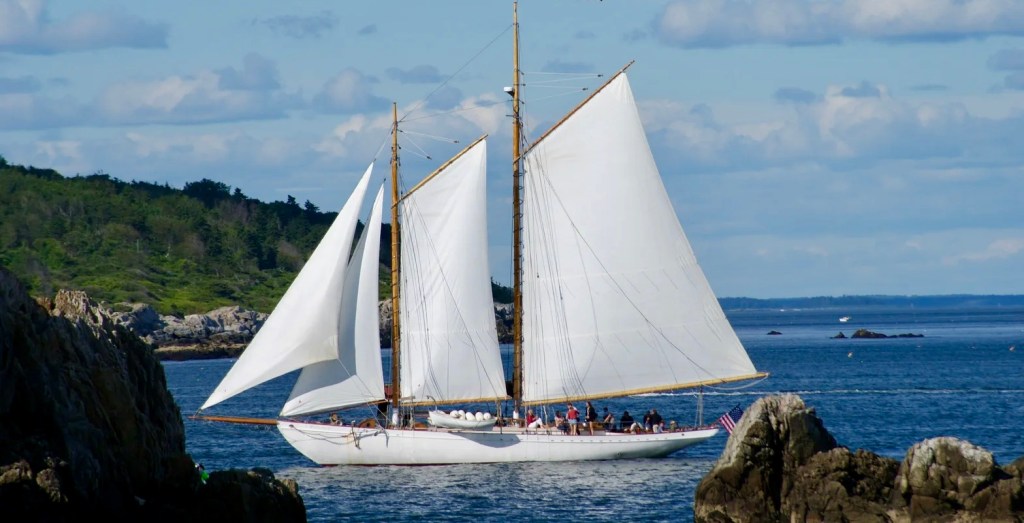
Our first shore excursion was aboard the 91 year old schooner Timberwind.
She served as a pilot boat in the harbor until 1969 under the name Portland Pilot. Built in 1931, she also served in Rockport, Maine and Belfast. She returned to her home waters in 2018 to be part of the Portland Schooner Company.
Timberwind is 70 feet long with a beam of 14 feet. She has an oak frame, and is sheathed in yellow pine. The deck planking is also yellow pine. Timberlwind was listed on the National Register of Historic Places in 1992.
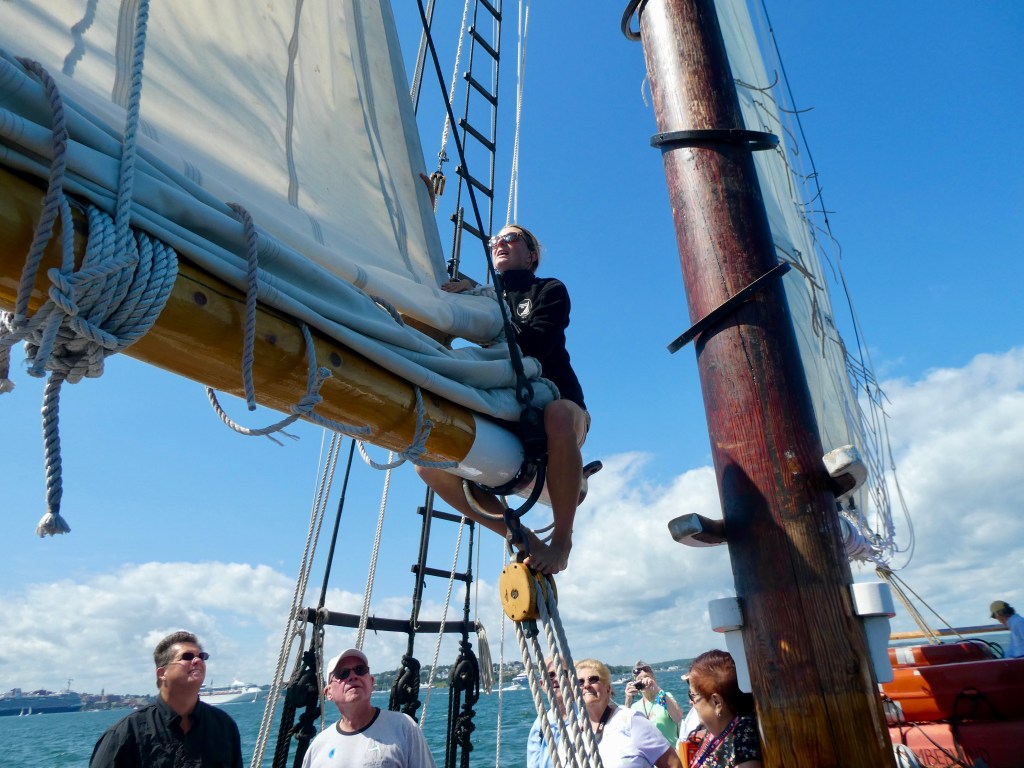
On the day of our sail, the predominantly female crew asked for volunteers to help with the rigging and sails.
Darrel and Randy volunteered.
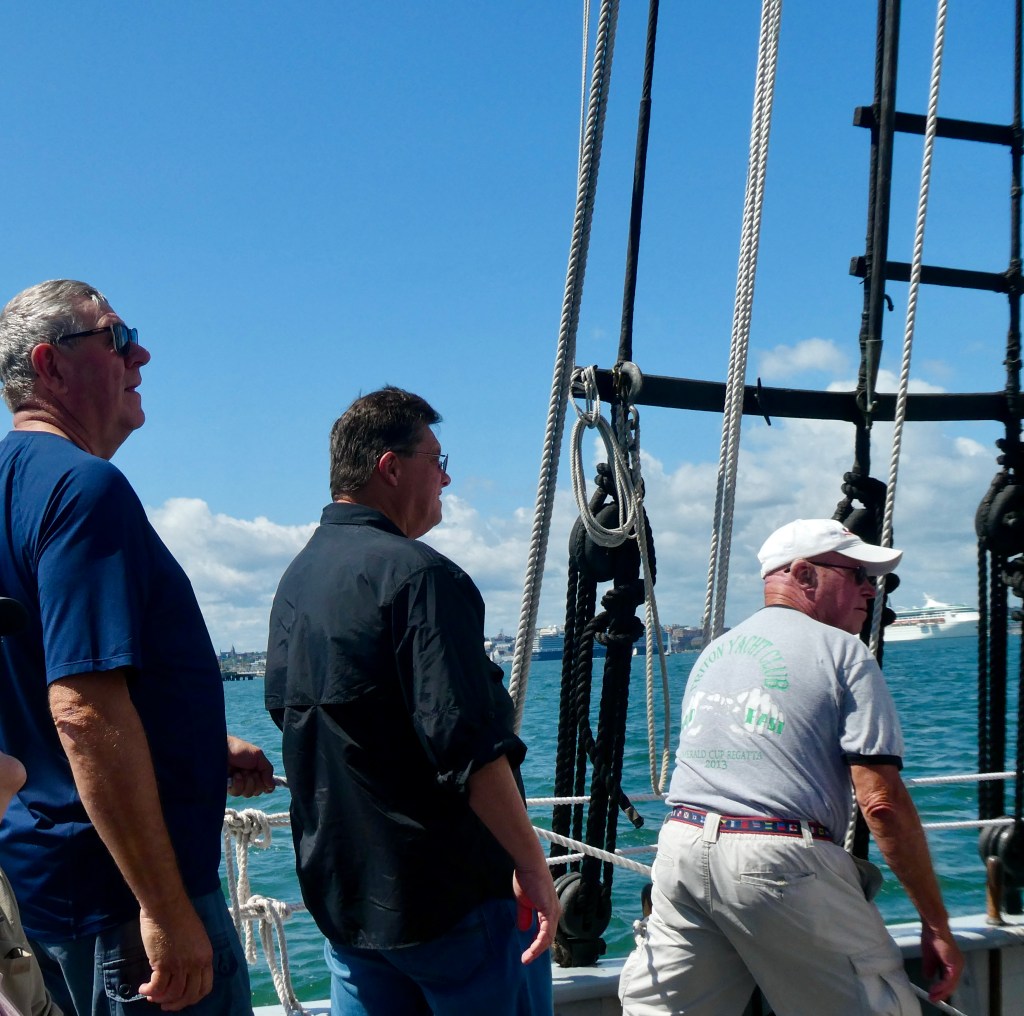
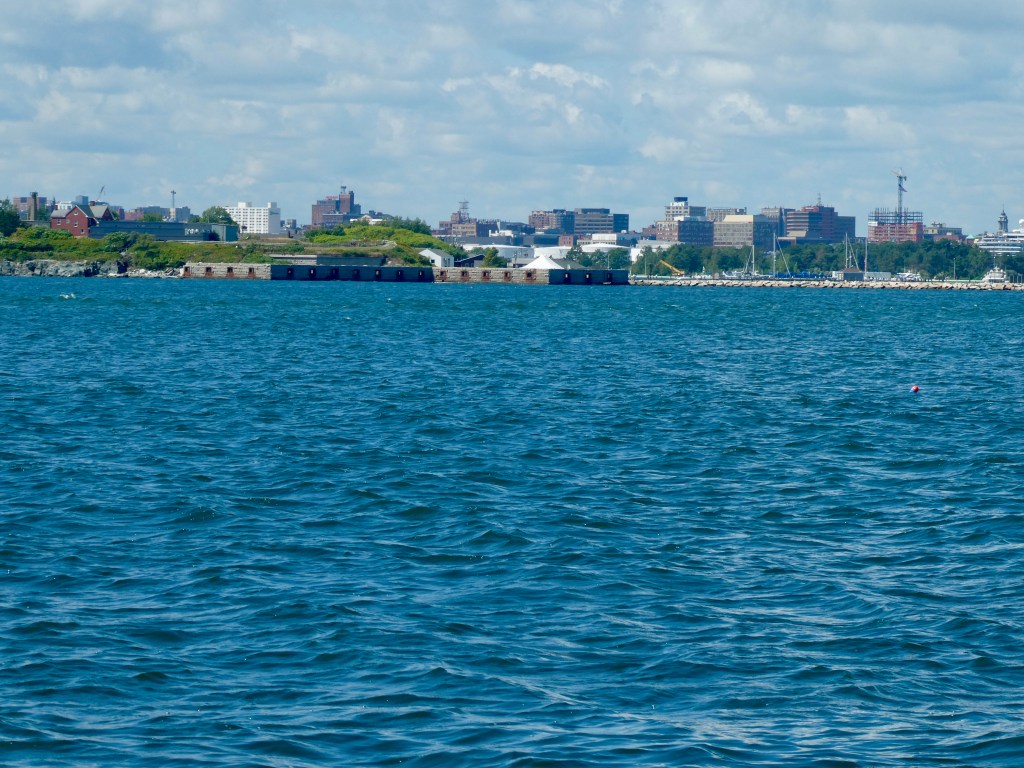
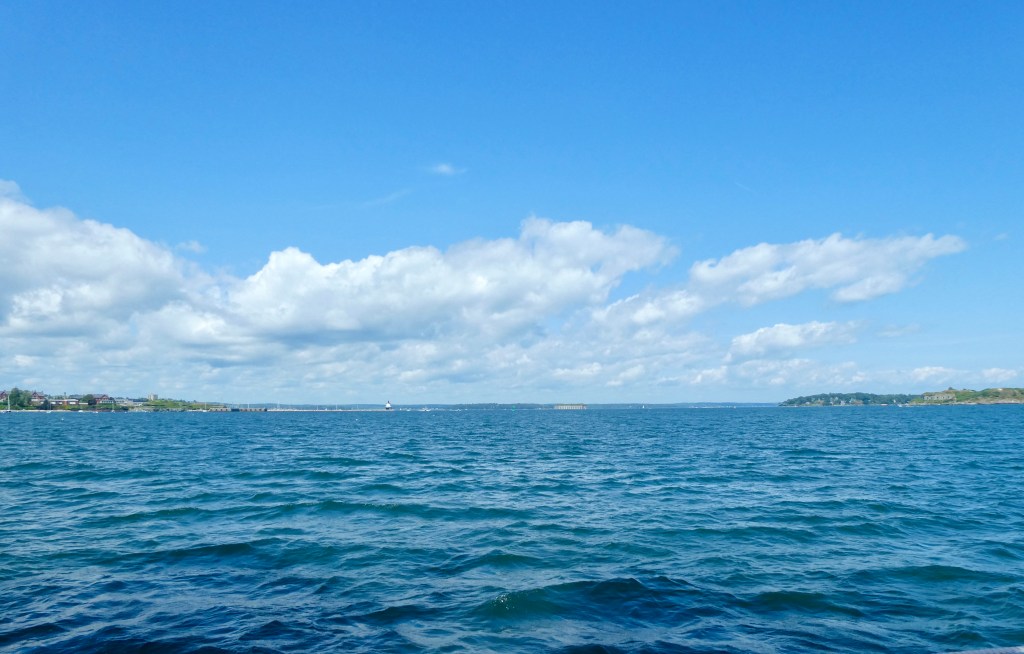
We enjoyed our view back on the city and the commentary around the harbor.
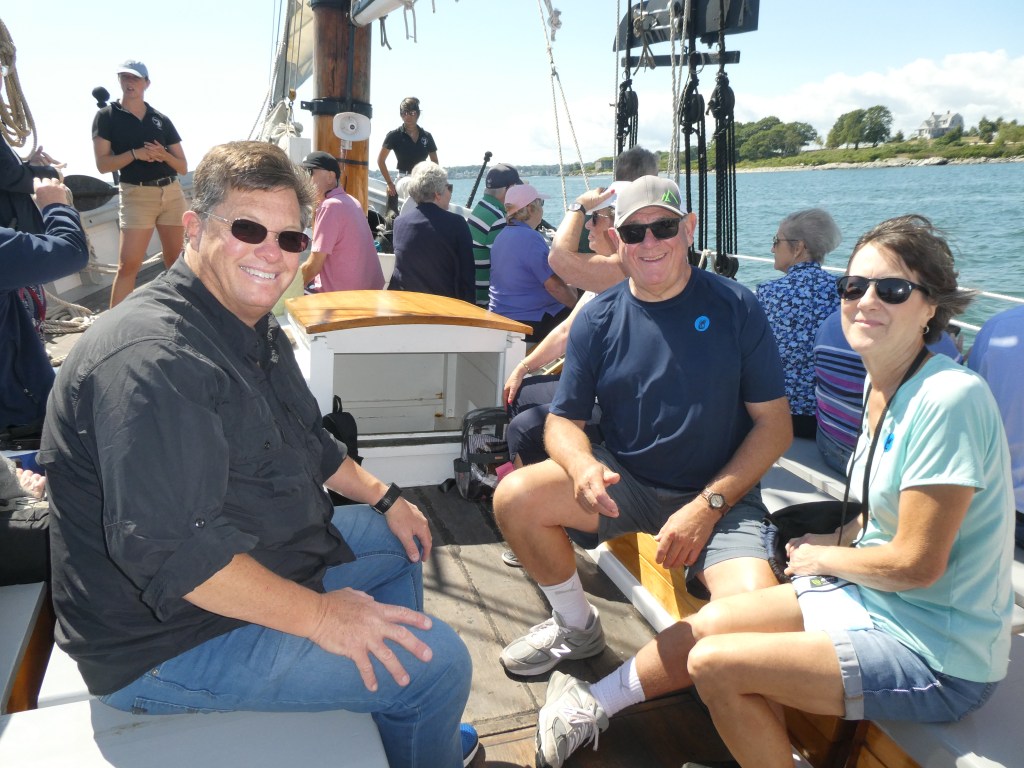
It was a nice day to sail around the harbor with Cindy and Darrell!
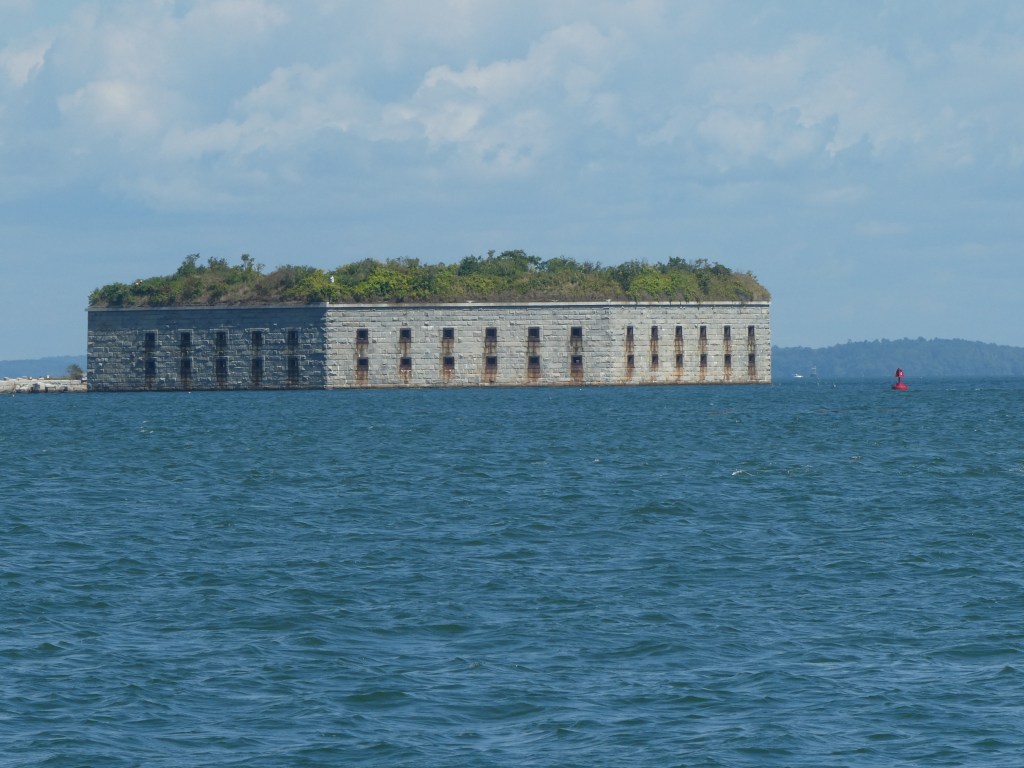
Fort Gorges was planned as one of three forts in the Portland Harbor. It was constructed entirely with local granite, and had 56 gun emplacements. By the time it was completed in 1864, it was already considered obsolete. Fort Gorges had a live-in caretaker after the Civil War, and it was a storage facility in both World War I and World War II. Fort Gorges was given to the city of Portland in 1960 and is community space,
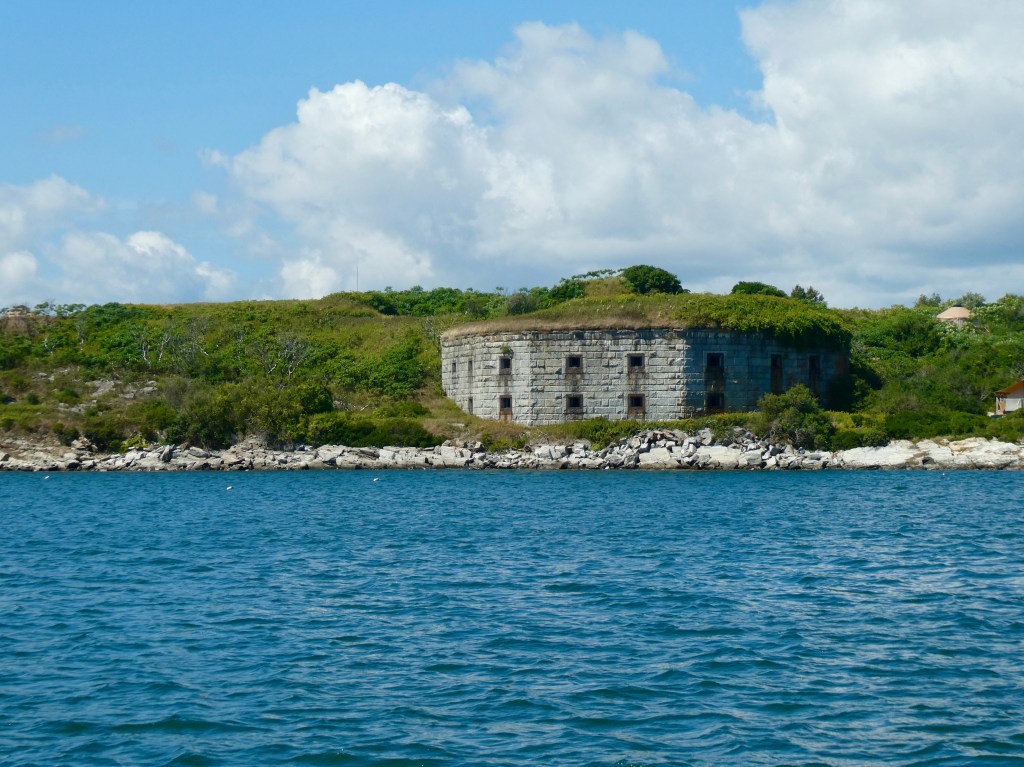
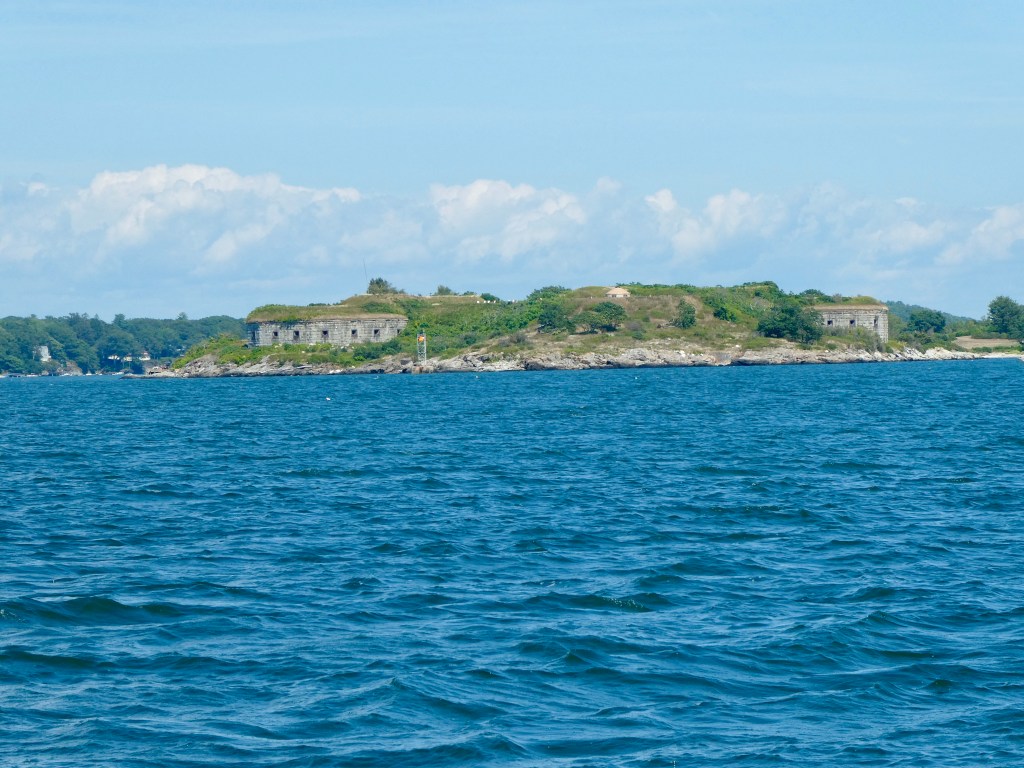
Fort Scammel was built on an island in the harbor in 1808 as part of the national system of fortifications. Although it was armed over several wars and conflicts, only one shot was ever fired – that during the War of 1812.
A bastion on the opposite side was built to protect access through the main channel. A third bastion was never completed.
The Portland Harbor was the closest, deepest naval port to Europe and there was lots happening during World War II. It was the last fuel stop enroute to Europe. The harbor was guarded by submarine nets and patrolled by the same Portland Pilot for the US Coast Guard.
Ten percent of all boats in the war were built in Portland area shipyards including 30 ocean cargo ships for the British government and 236 Liberty cargo ships for the United States government. The shipyards employed 30,000 workers between 1941 and 1945.
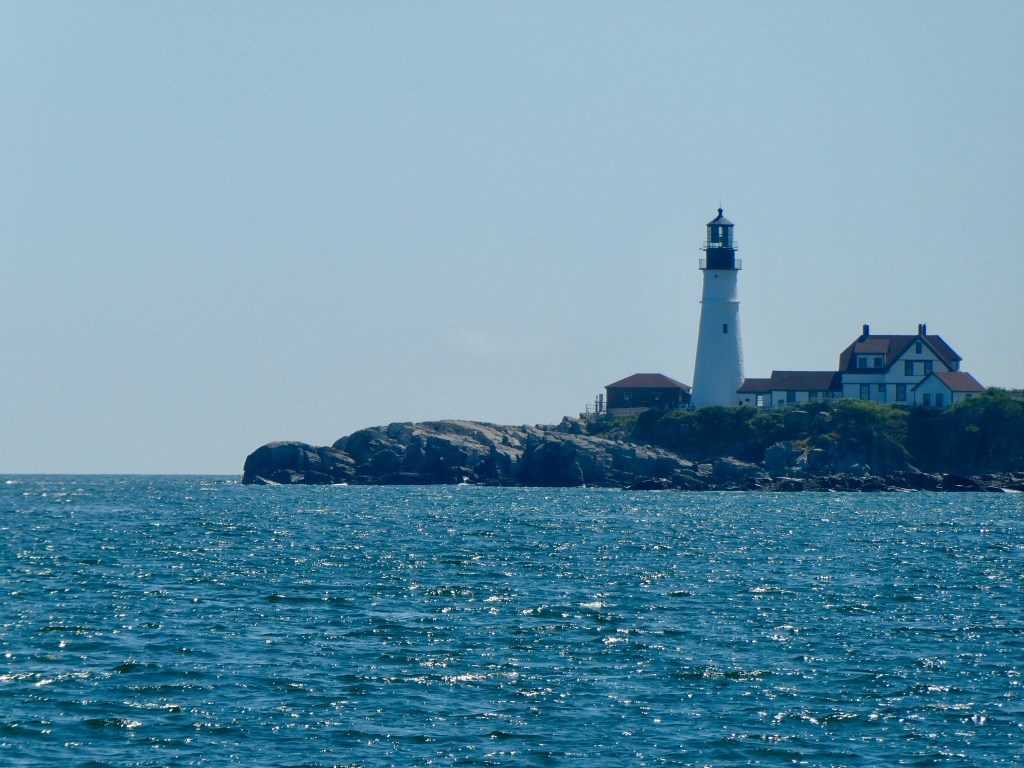
We had a view of the Portland Lighthouse from the water. It is the oldest working lighthouse in United States, built by the Second Continental Congress.
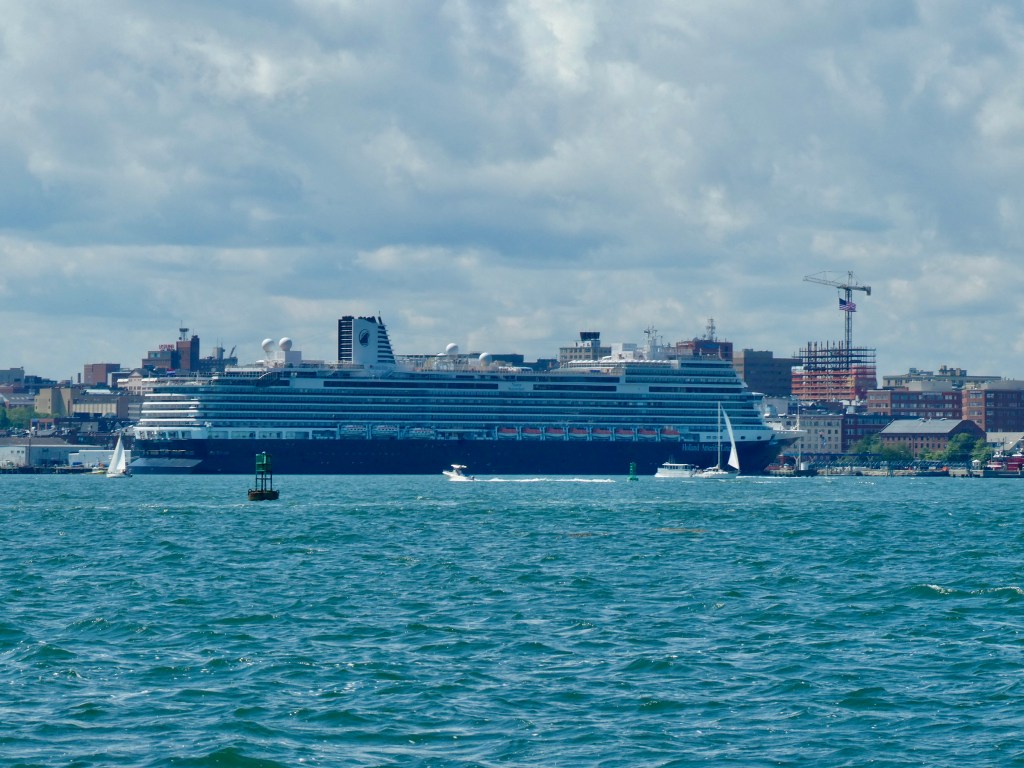
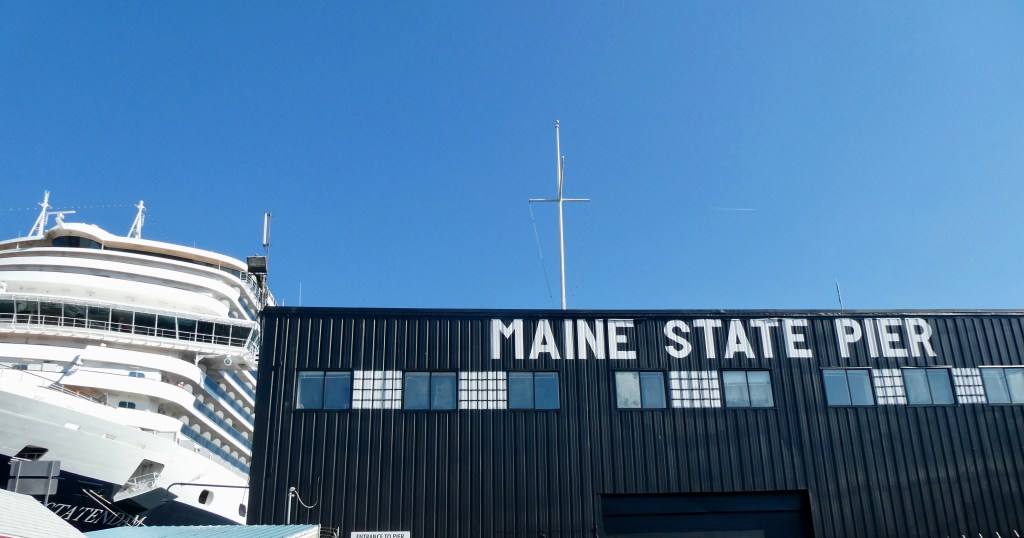
We saw our ship as we headed back in to port.
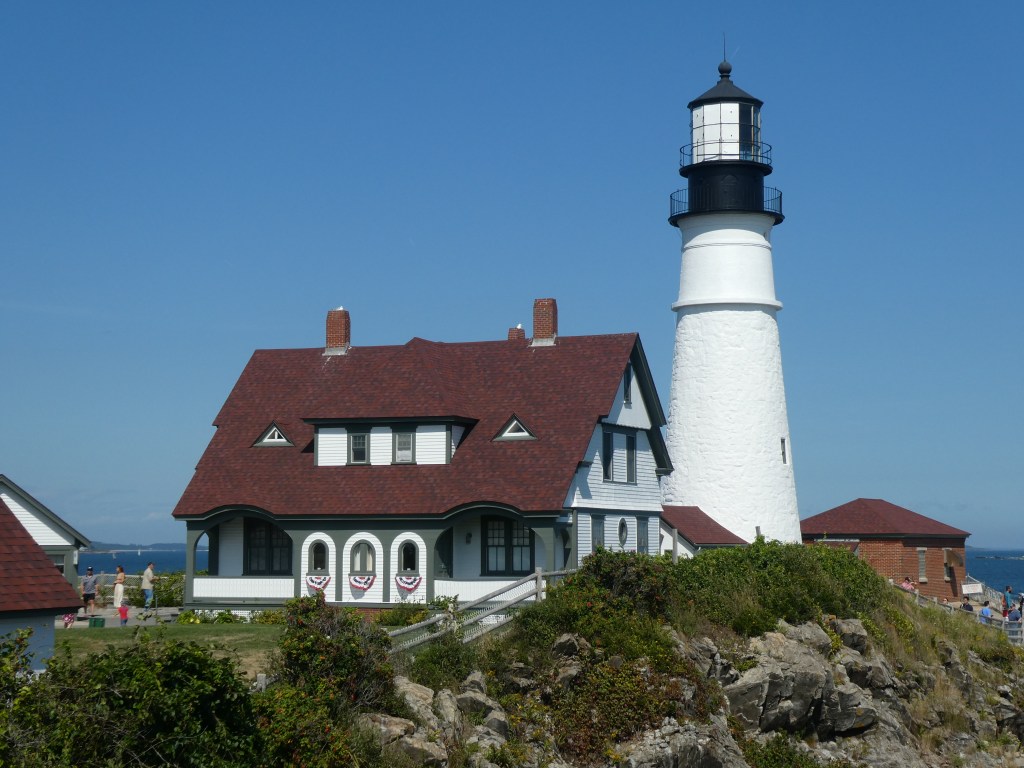
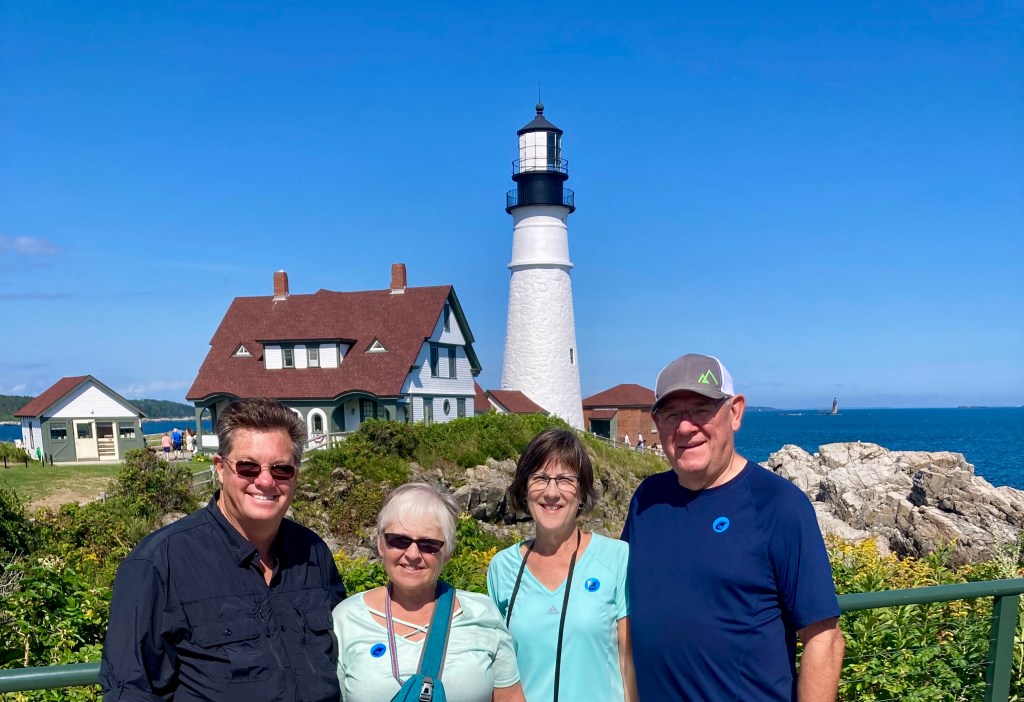
We traveled to the lighthouse in more traditional transportation- a bus. The Portland Lighthouse is the most photographed lighthouses in the world.
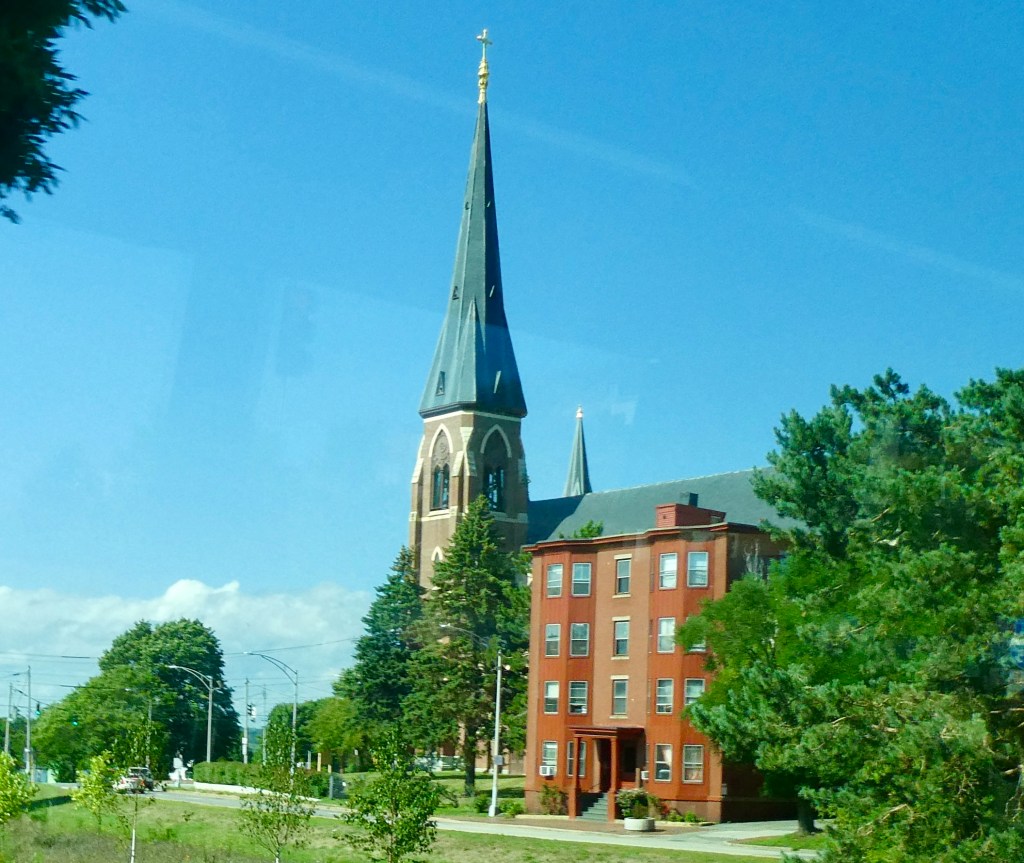
This church is the tallest structure in Maine.
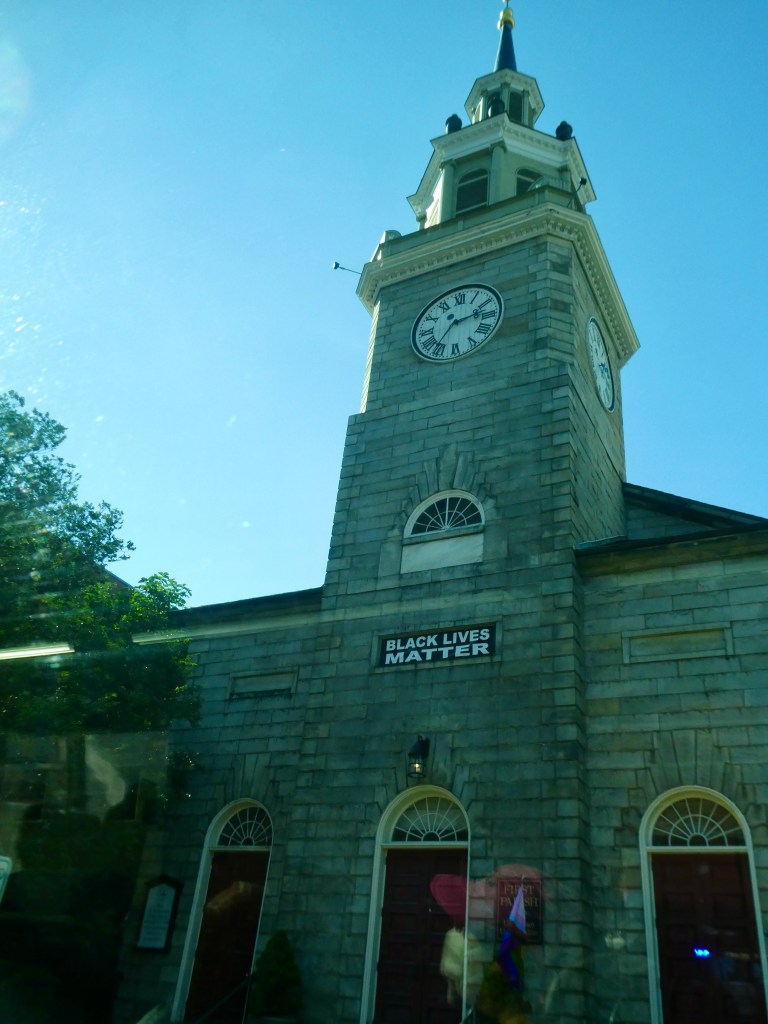
This church is from the 1700s and has damage from two cannonballs.
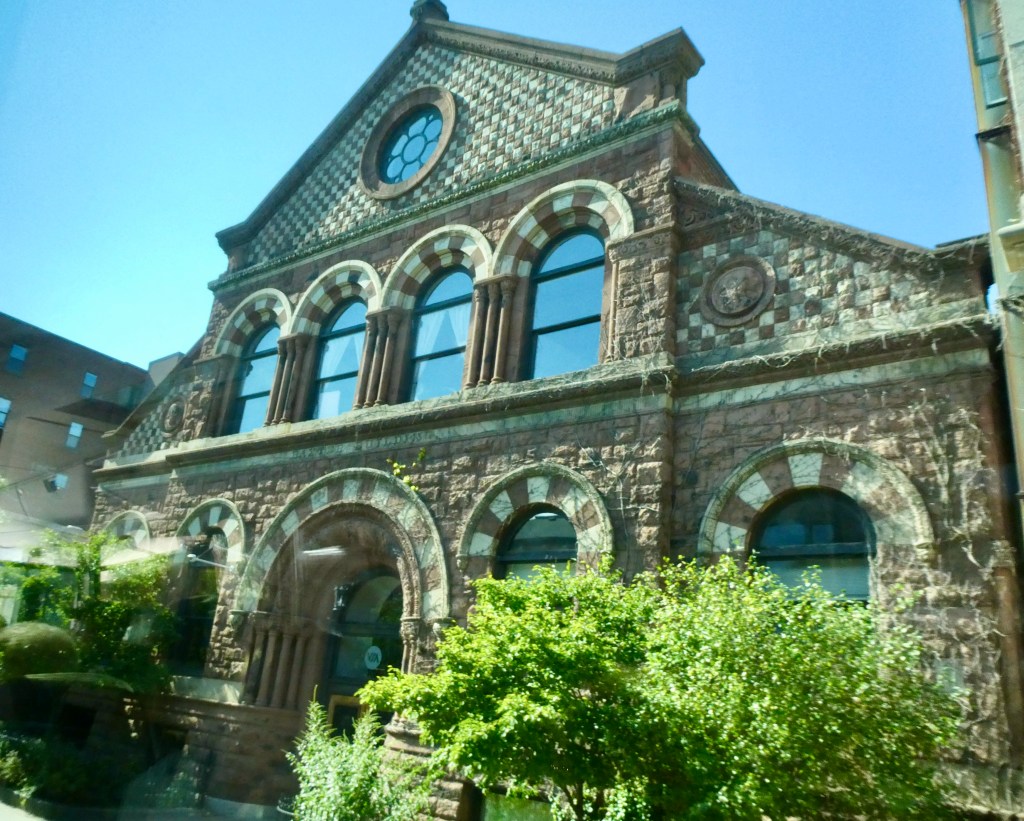
This building was the original library in Portland.
And in some Maine trivia…
LL Bean is the largest private employer in Maine. If you call them, someone in Maine answers. The company started with Mr. Bean marketing his waterproof boots to hunters after obtaining a list of those with licenses. Ninety-eight of the first 110 pairs came back to the company. Things improved with time!
We learned that Maine was once was part of Massachusetts so, in that way, was part of the original 13 colonies. Mainers had campaigned for statehood following the American Revolution and the Massachusetts legislature agreed to let the territory go in 1819. On March 15, 1820, Maine gained statehood. The quest became entangled in the slavery issue. Most people in Maine supported abolition, so their admission was linked to the admission of Missouri as a slave state. The controversial “Missouri Compromise” preserved the balance between pro and anti slavery members in the US Congress for decades.
We made our way back to the ship and had an enjoyable evening on board. Our next port was Saint John, New Brunswick, Canada.
This next set of posts are from a trip we took in August and September 2022. Yes, almost a year ago. When we got home in September 2022, I was still writing about Italy. Then came Nashville, and Kauai and Detroit. It was always my plan to go back and write about New England and Canada, but it just didn’t get done.
I regretted that because we really do like having this travelogue for ourselves, and especially because this trip has a unique, hopefully once in a lifetime, ending.
As we prepare to embark soon on another grand adventure, it is now or never on this trip. I was thinking never until I went to delete all the extraneous photographs I take while preparing to write a series of blog posts. I just couldn’t do it. The time is not never, it is now – and hopefully Randy can enjoy the end a year later.
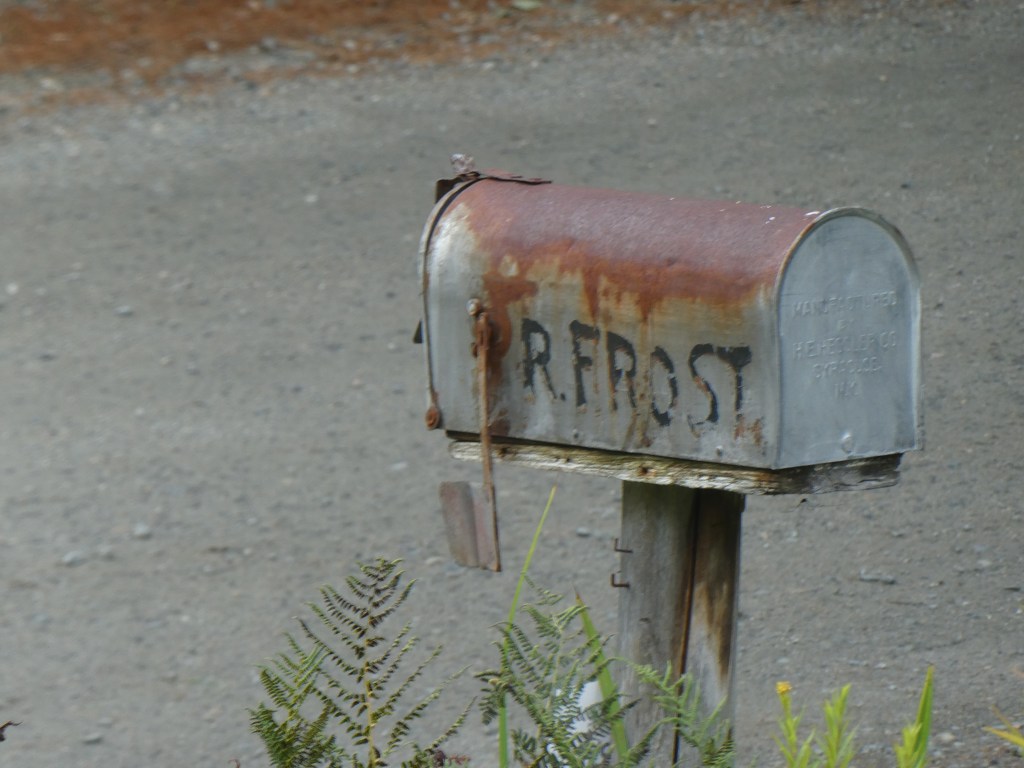
So, to begin….We flew from Phoenix to Bangor, Maine and went to see the city’s primary tourist activity – driving by author Stephen King’s house.
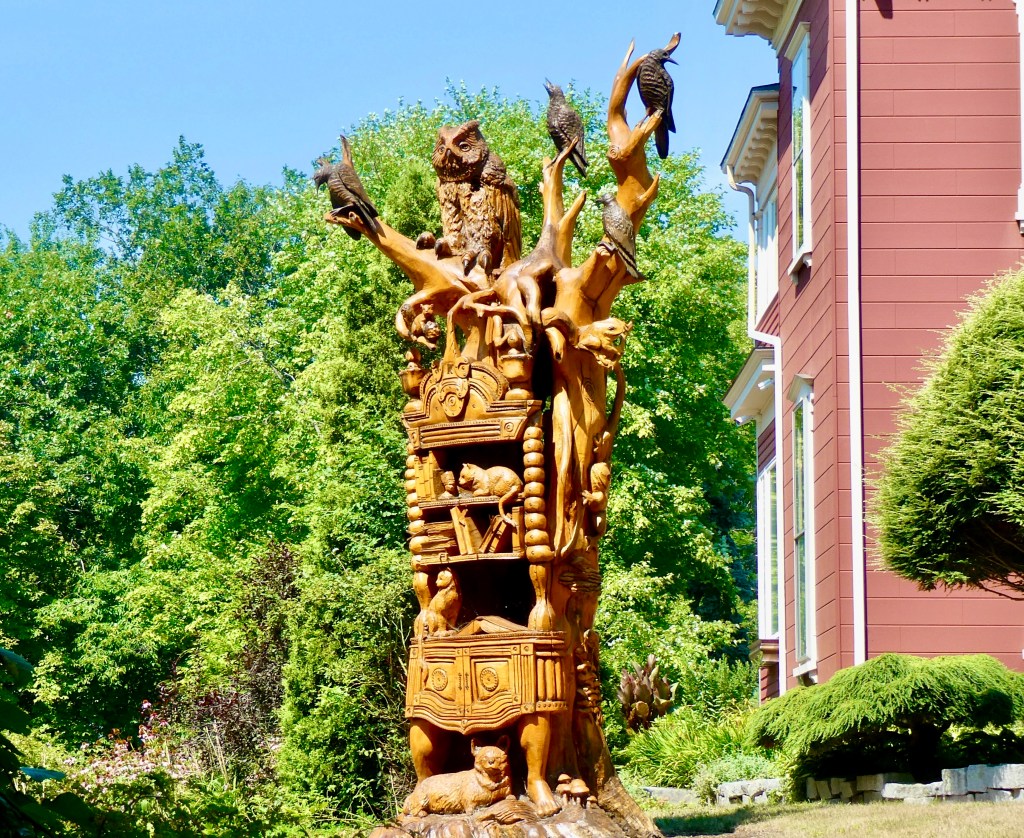
The sculpture in the yard was commissioned by Tabitha King. Artist Josh Landry used a chain saw, and worked for one month, to form a sculpture featuring books and animals out of the stump of a dead 300 year old ash tree.
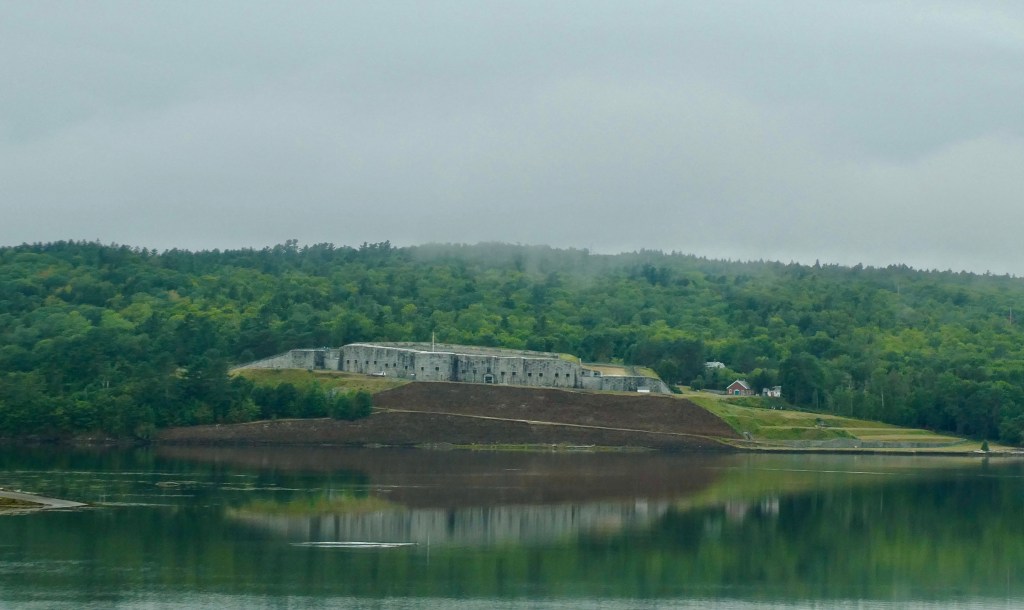
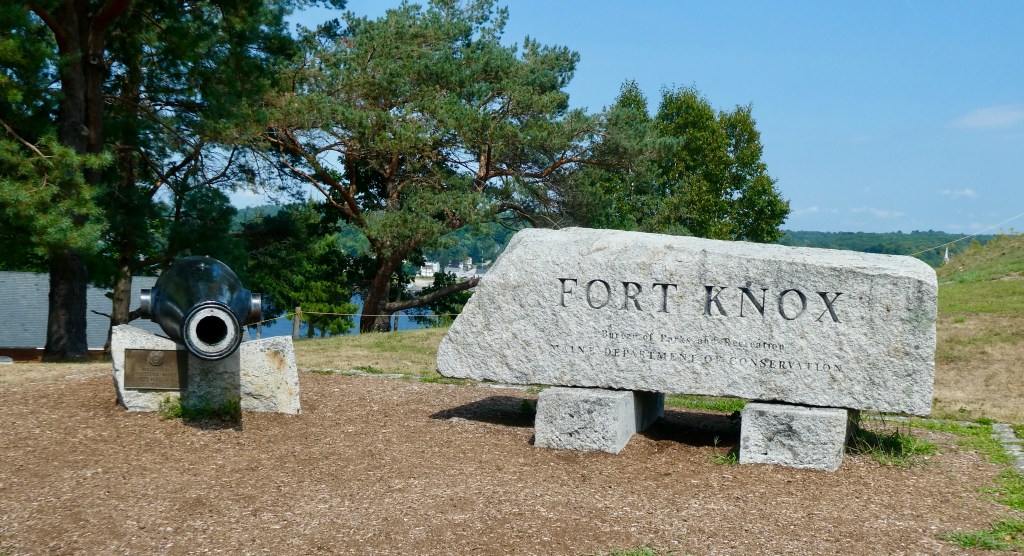
Going in the direction of Bar Harbor, we traveled along, and over, the Penobscot River. We could see Fort Knox across the river.
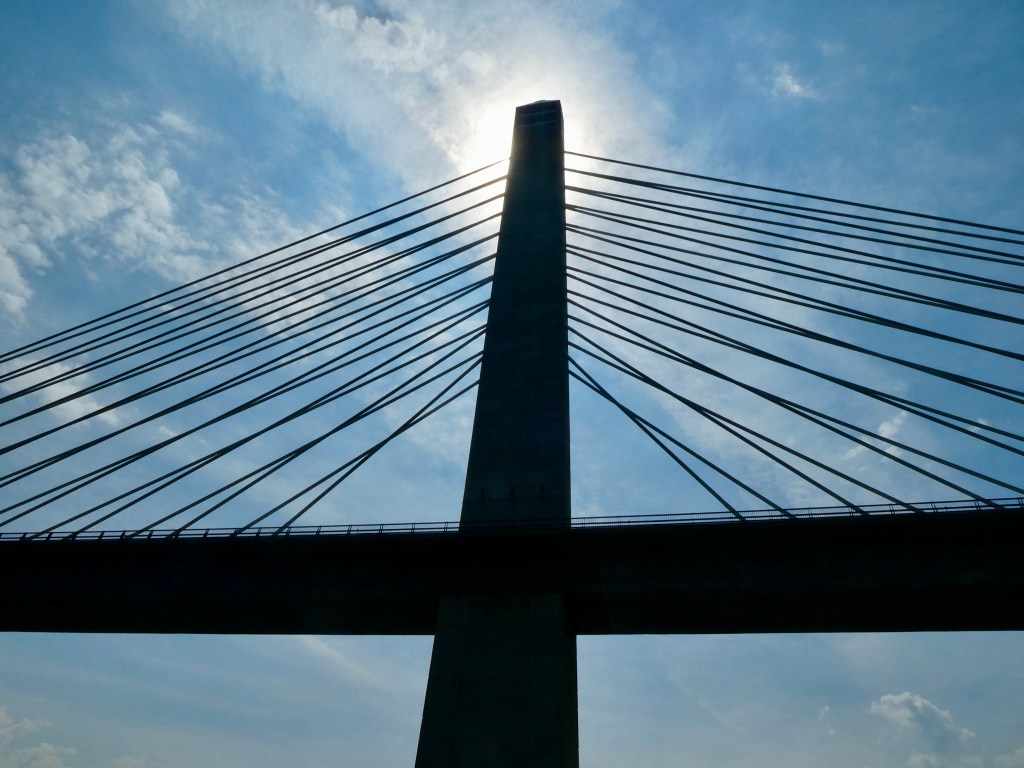
To get to Fort Knox we crossed the Penobscot Narrows Bridge.
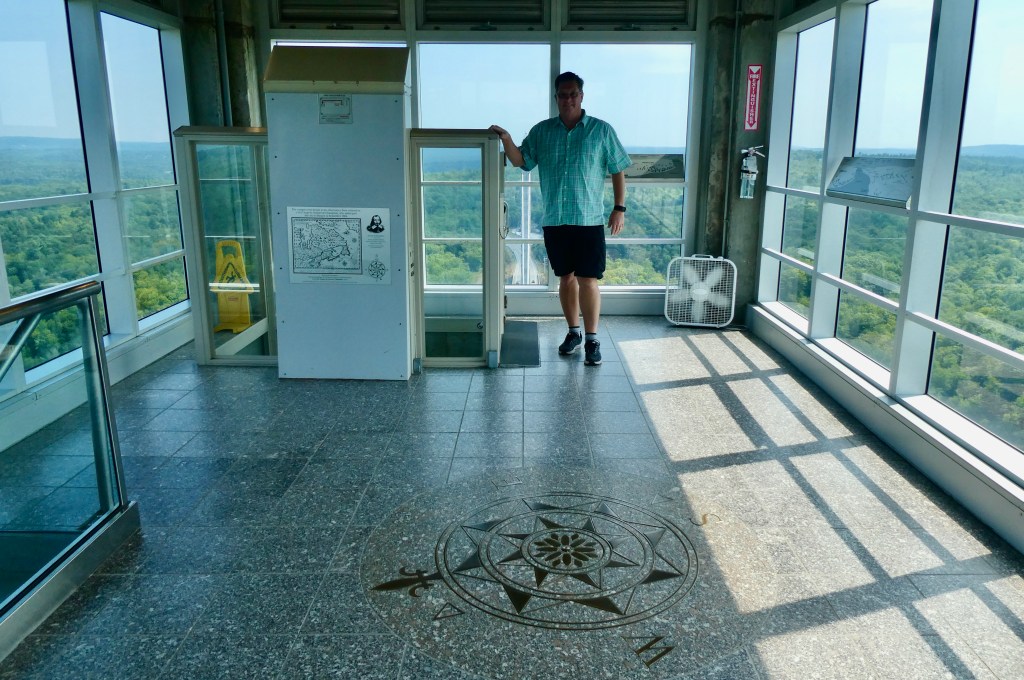
It has the worlds tallest public bridge observatory at the top of the obelisk shaped center mast.
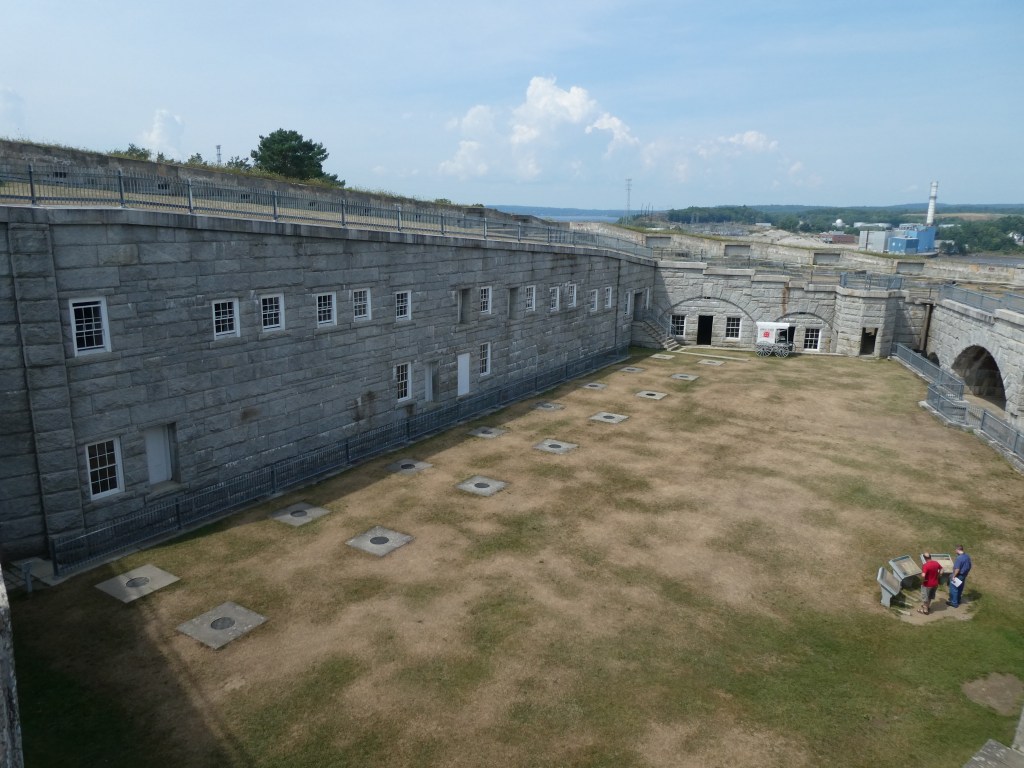
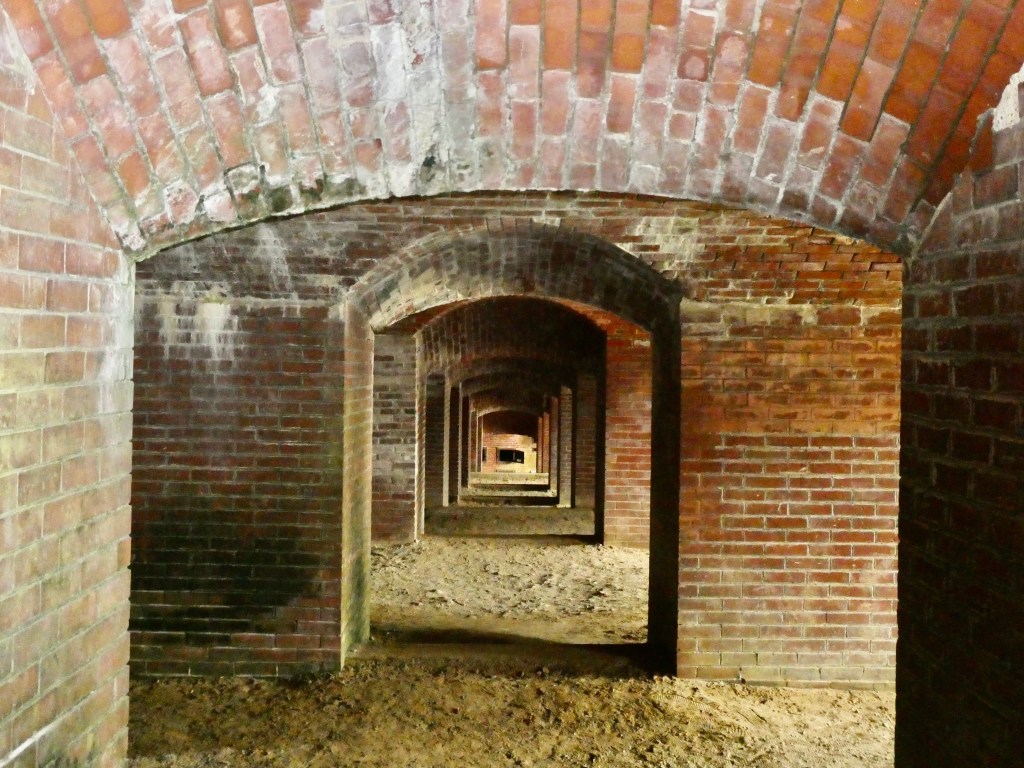
Fort Knox is one of the best-preserved military fortifications along the New England seacoast.
In the early years of our country, Maine was involved in border disputes with British Canada. Fort Knox was established in 1844 to protect the Penobscot River Valley against a future British naval invasion.
It was one of 42 forts built along the Atlantic, Gulf and Pacific seaboards after the War of 1812 to defend critical harbors against enemy invasion.
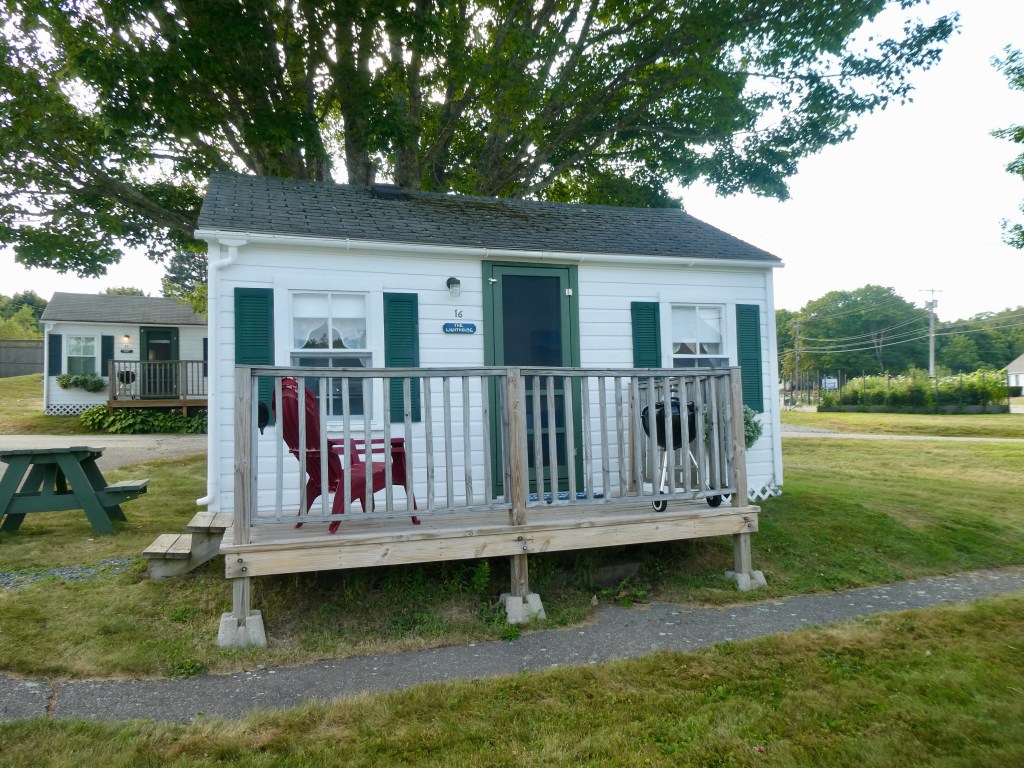
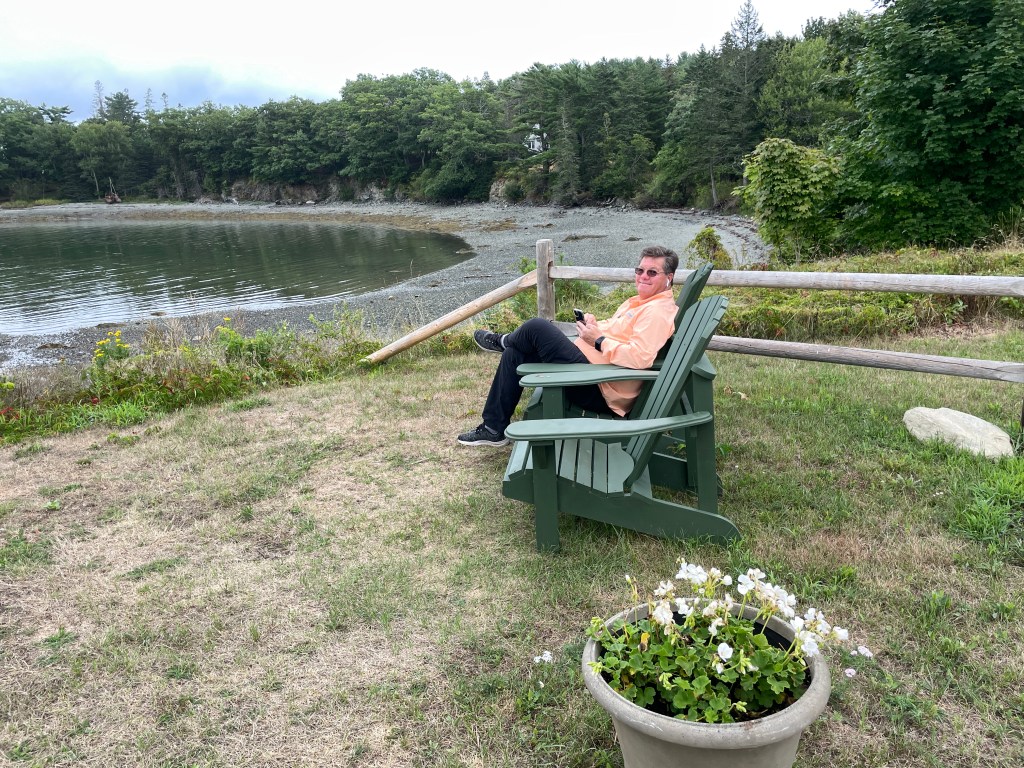
We proceeded to Bar Harbor and found our cottage on the coast.
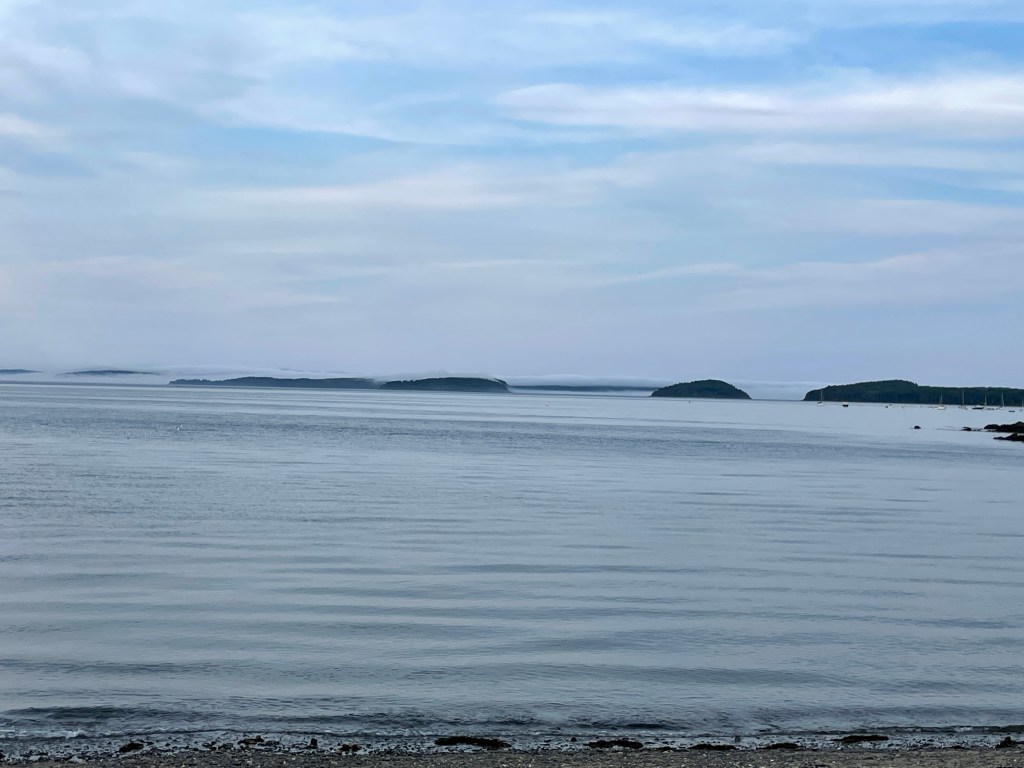
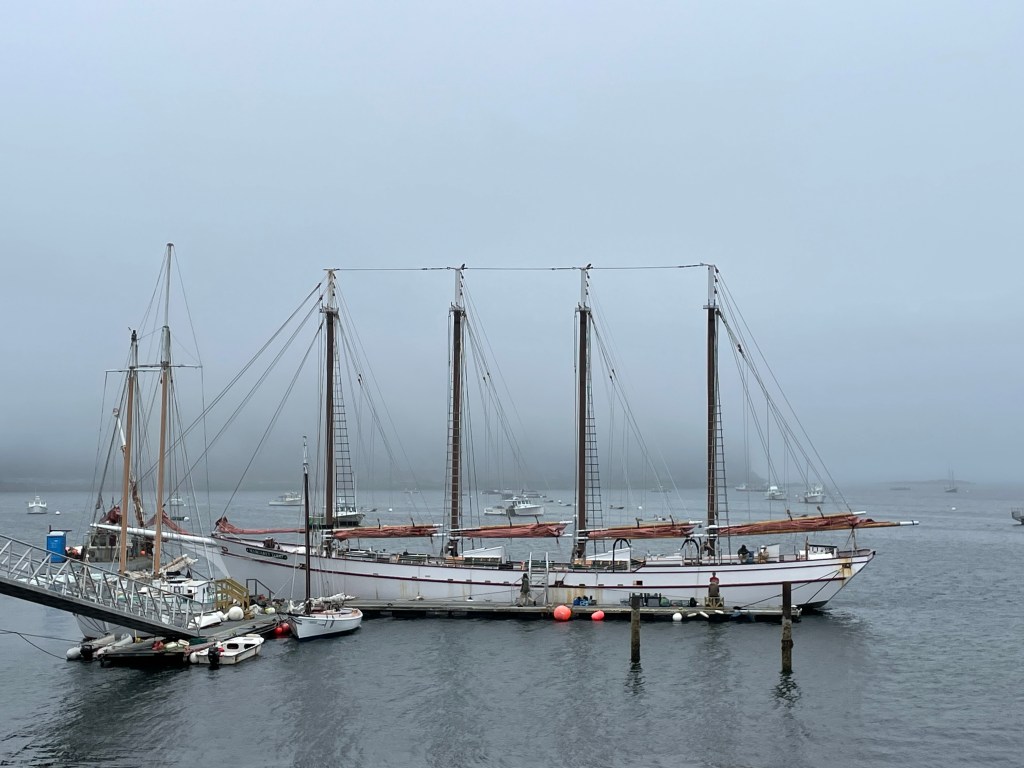
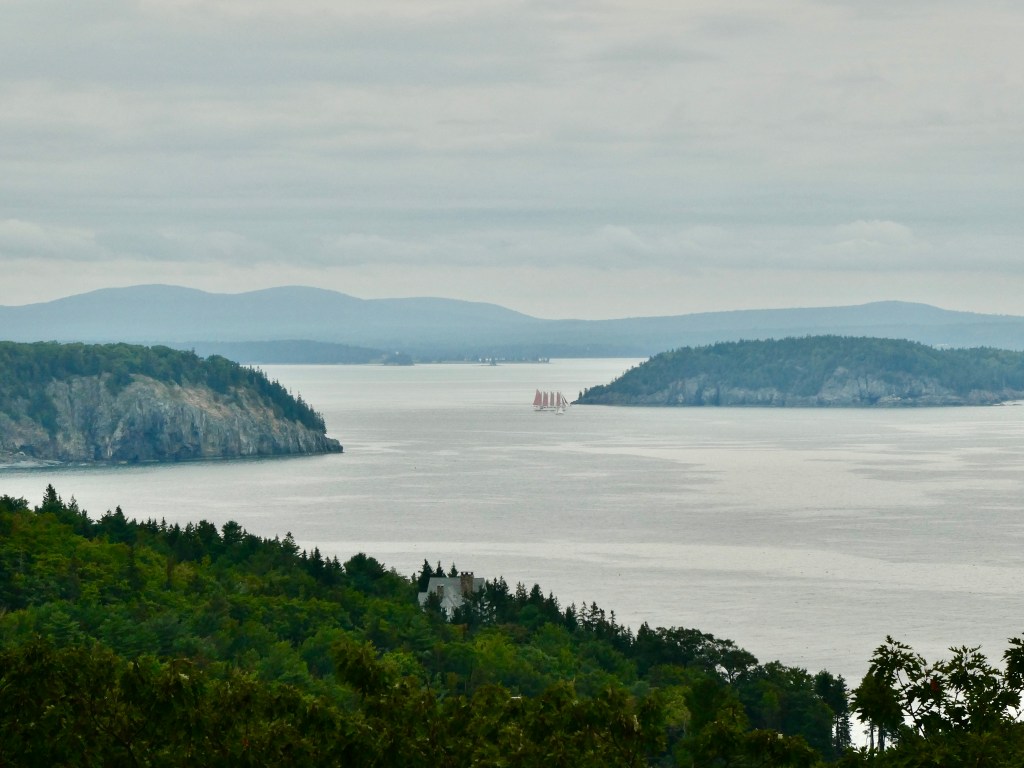
We enjoyed a sail among the islands of Frenchman Bay aboard a 151 foot schooner.
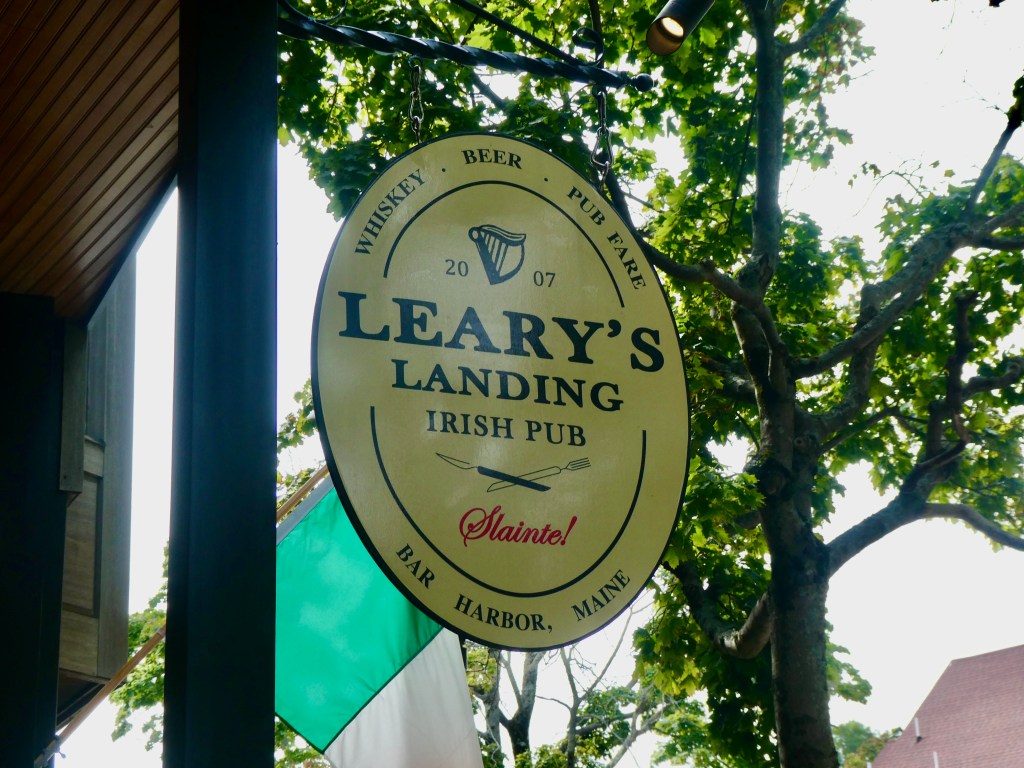
We ate at Leary’s Landing, the closest Irish pub to Ireland in the United States.
We went into Sherman’s Book Store, the oldest bookstore in Maine. It has been in business since 1866.
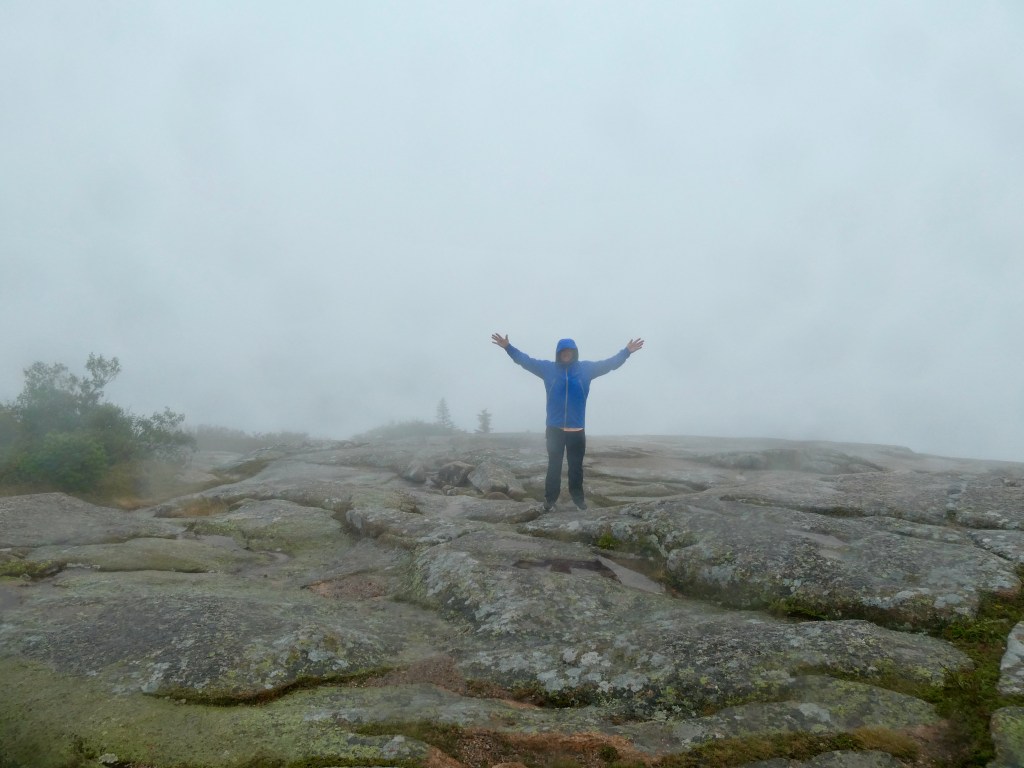
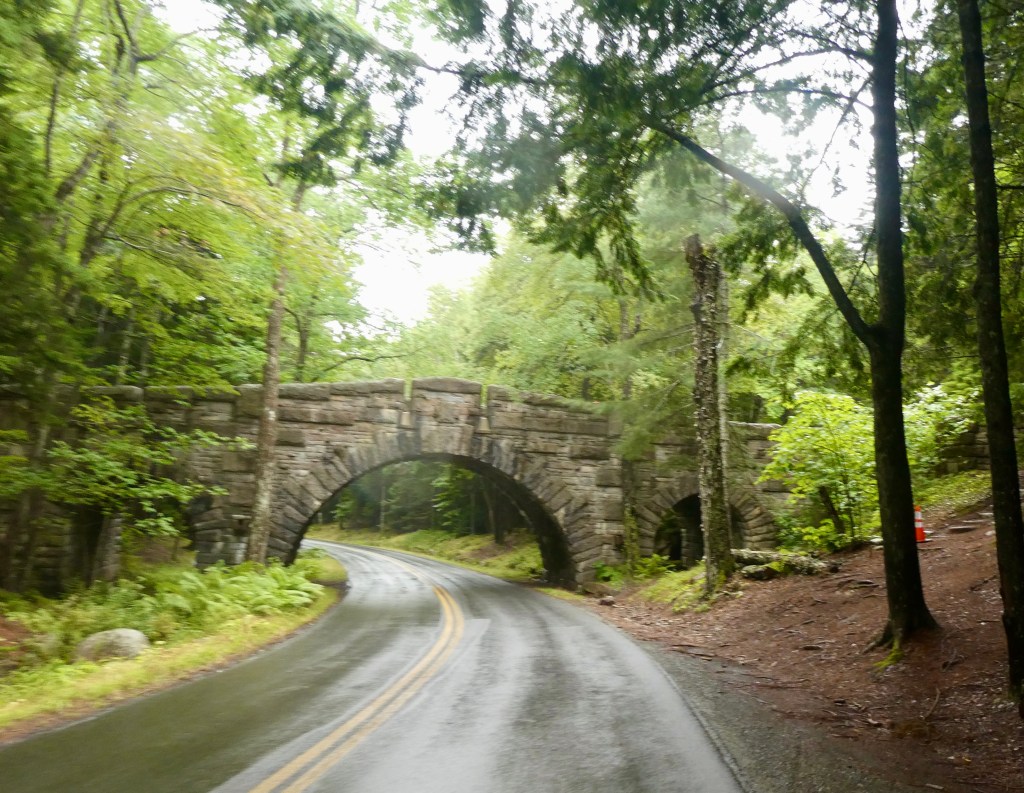
We went into Acadia National Park several times but we never did have good weather.
We did what we could and enjoyed driving around.
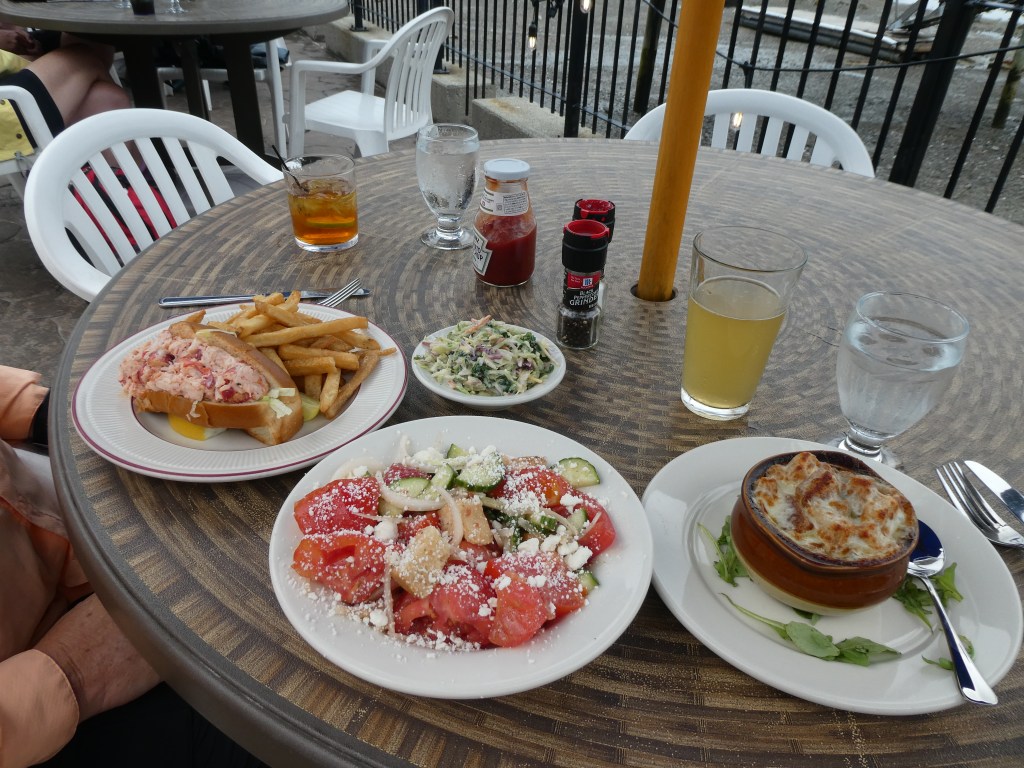
Neither of us care to eat lobster but when in Maine, you just have too, right?! Randy had a lobster roll. I had a bite of Randy’s lobster roll.
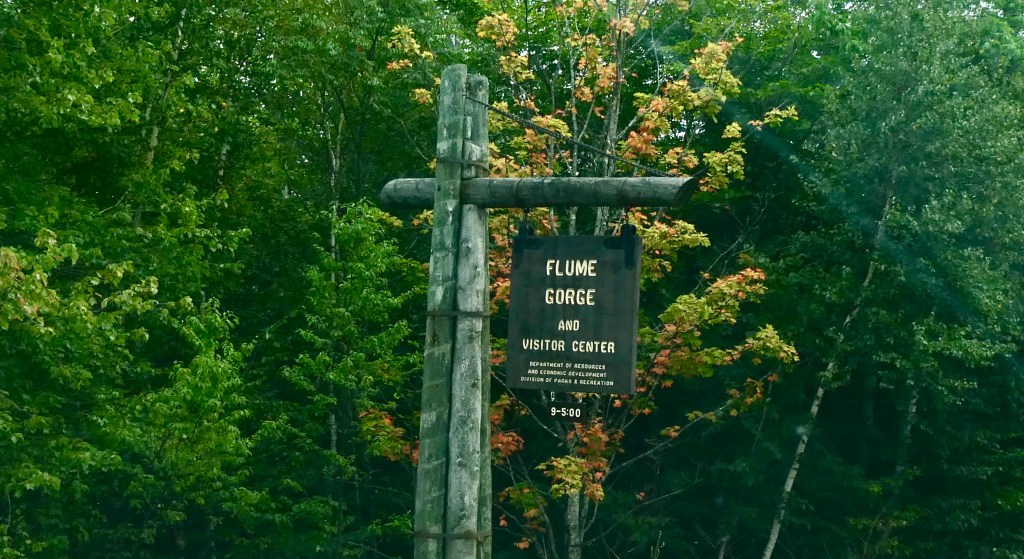
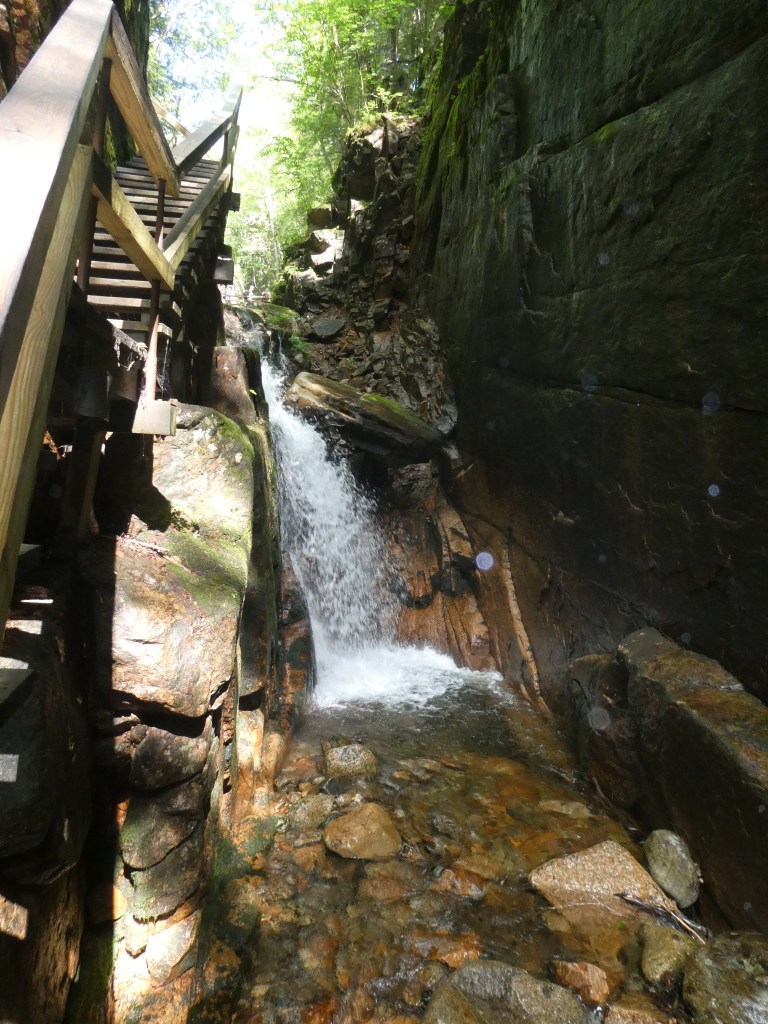
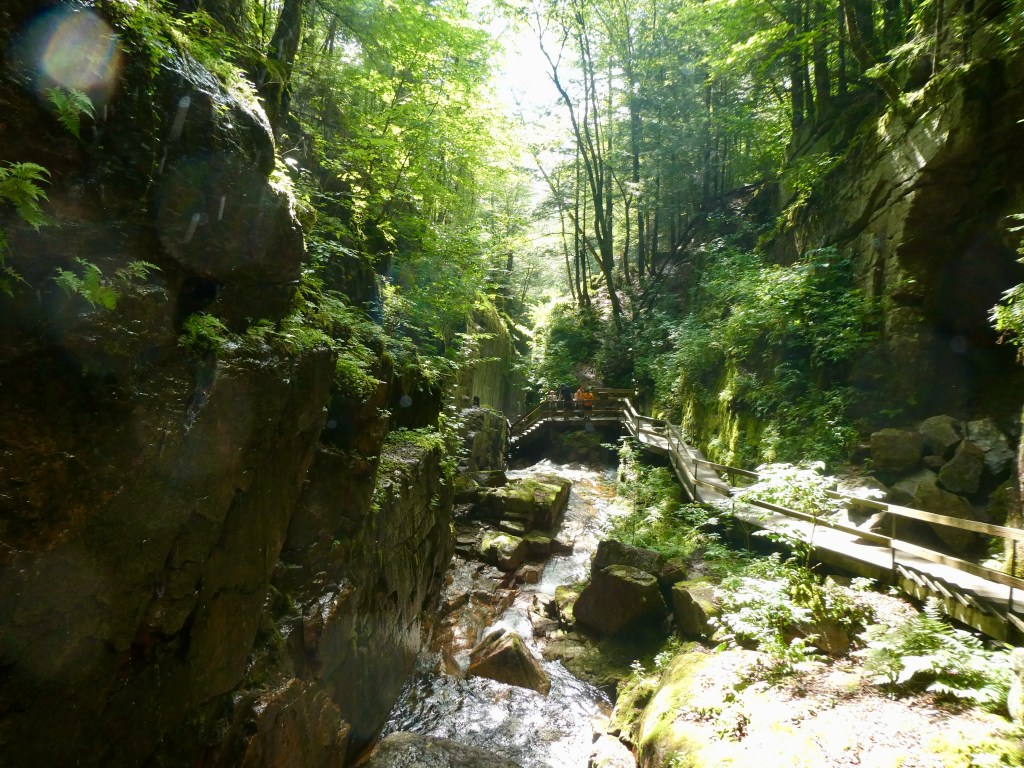
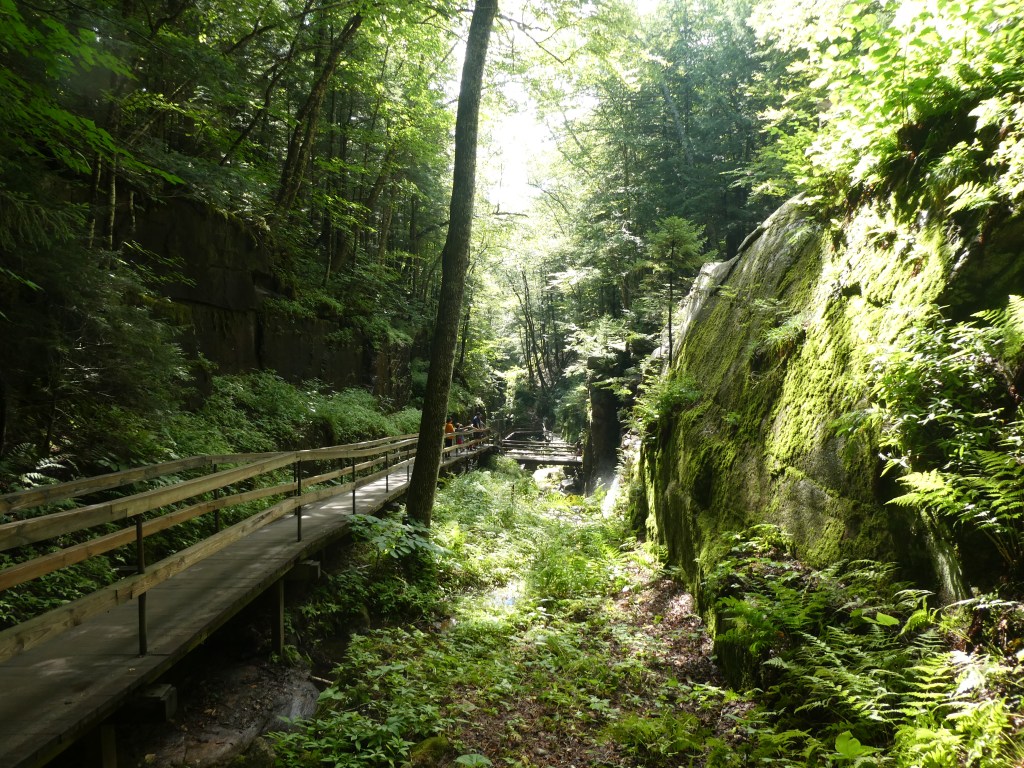
After a few days, we moved into New Hampshire, specifically Franconia Notch State Park. It is the home of Flume Gorge! The flume was formed by molten lava pushing up through cracks in ancient granite. The lava rock was worn away over the ages leaving the flume.
The flume has widened by frost and water.
Logging around the flume generated New Hampshire’s first conservation effort.
The Appalachian trail’s northern most location is also nearby.
Franconia Notch is also famous for the Old Man of the Mountain. Nathanial Hawthorne saw the profile in 1832 and wrote his short story, “The Great Stone Face” published in 1850.
The profile was present for at least two hundred years given a historical reference in 1805.
In the 1870s, a group of hikers reported the granite ledges comprising the Old Man seemed to be slipping. In 1916, a group of quarrymen drilled holes into the forehead stone and installed turnbuckles to anchor the profile.
In 1957 the state of New Hampshire approved sending tools and equipment to the top by helicopter. Four additional turnbuckles were installed and water was diverted to avoid it seeping into crevices. Additional work was done in the early 1960s.
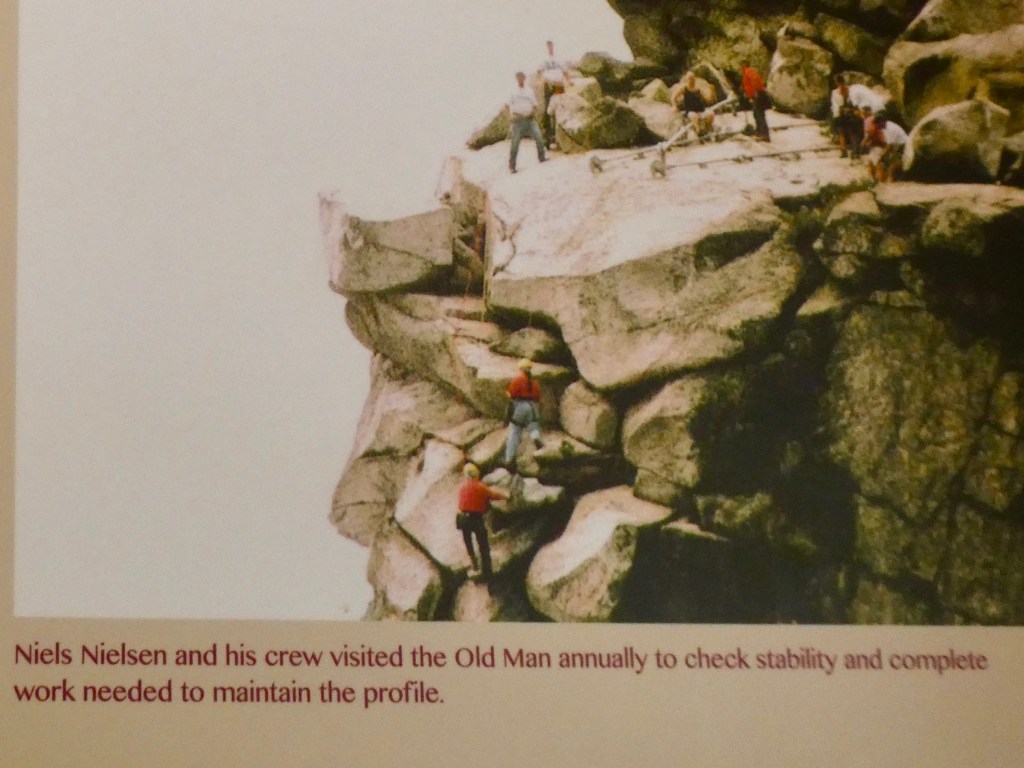
In 1965, the Old Man got an official caretaker, Department of Transportation bridge superintendent Niels Nielsen. He, and his crew, worked each summer painting the turnbuckles, cleaning debris from crevices in the stone, and covering cracks to prevent damage from water seepage. His son, David, eventually took over as caretaker.
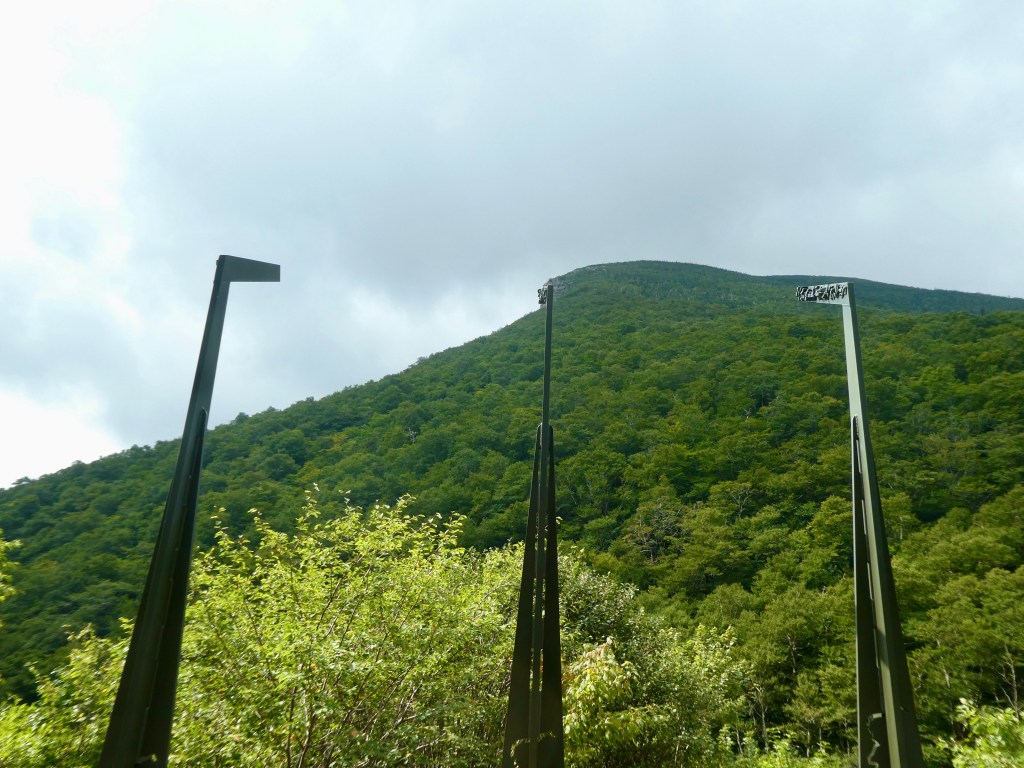
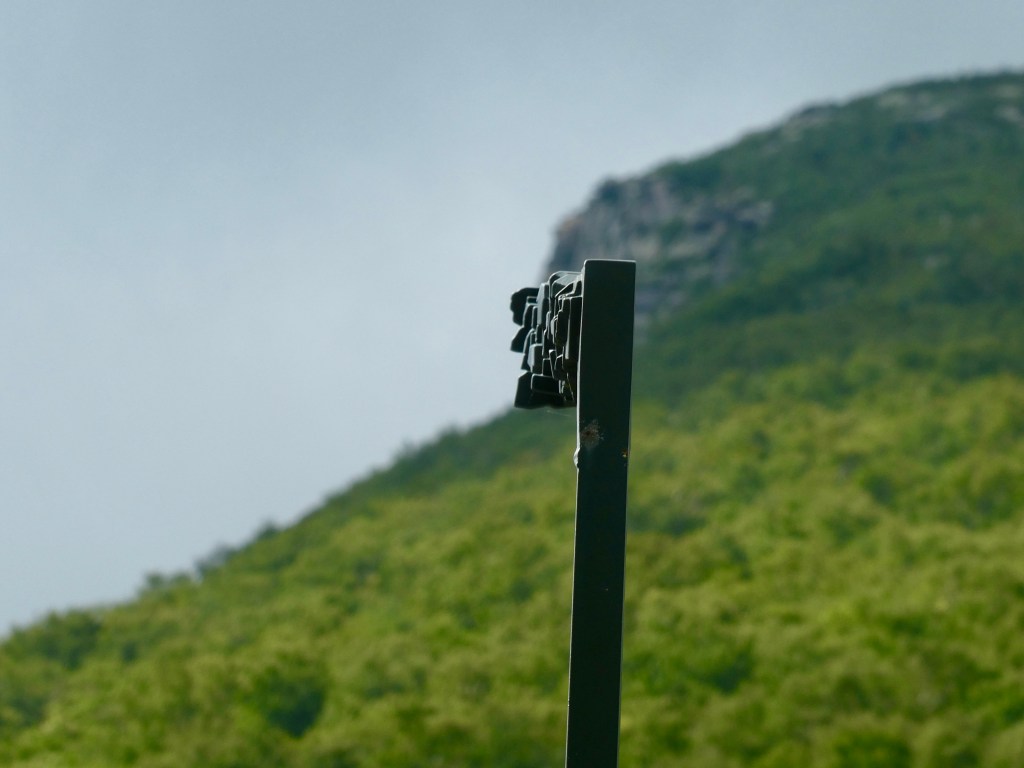
The Old Man of the Mountain came down on May 3. 2003.
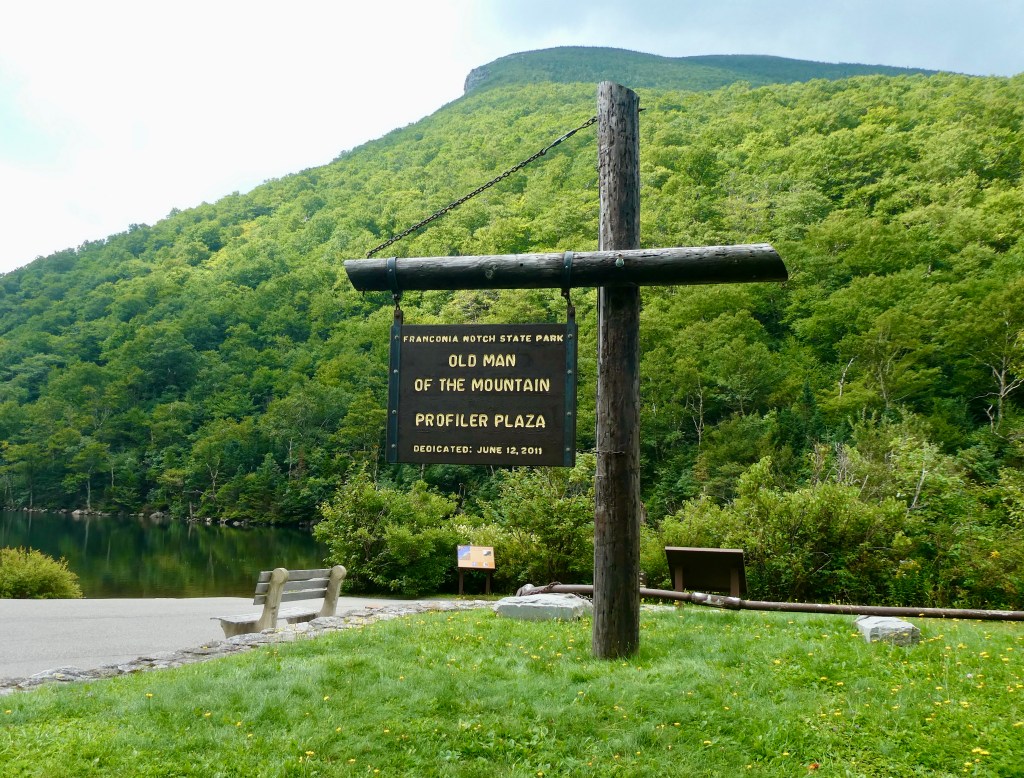
To “see” the Old Man of the Mountain now you go to Profiler Plaza.
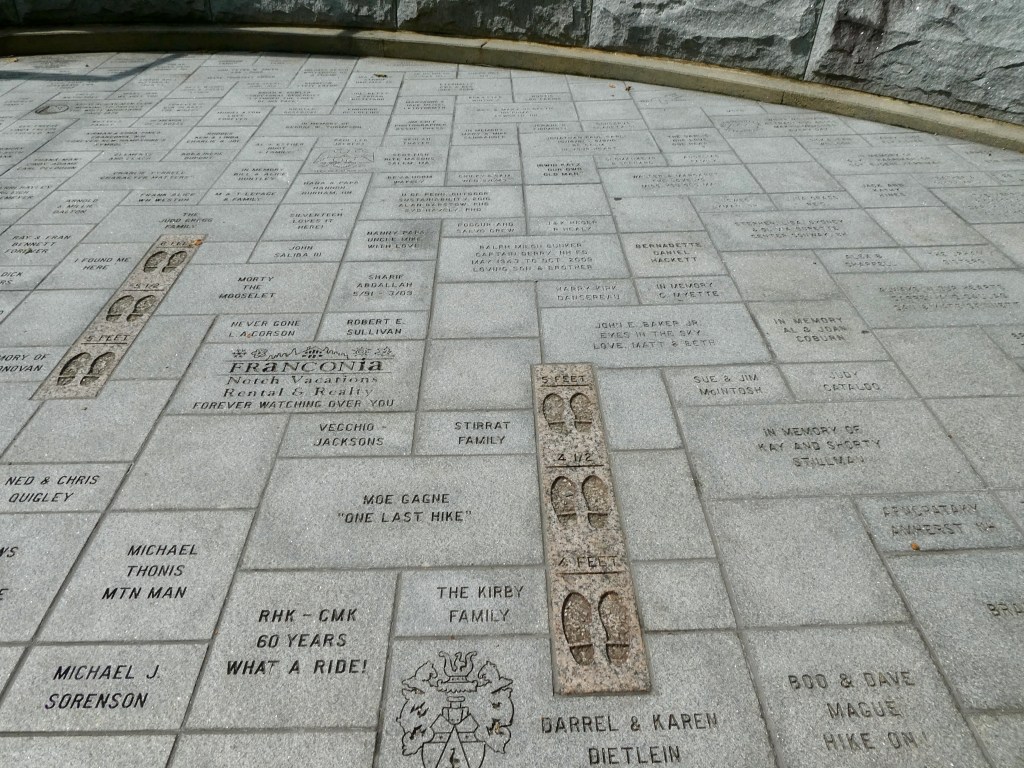
You find a pink granite stone engraved with your height.
While standing on the engraved footprints, sight along the profiler with one eye closed.
It is then possible to see The Old Man of the Mountain once more.
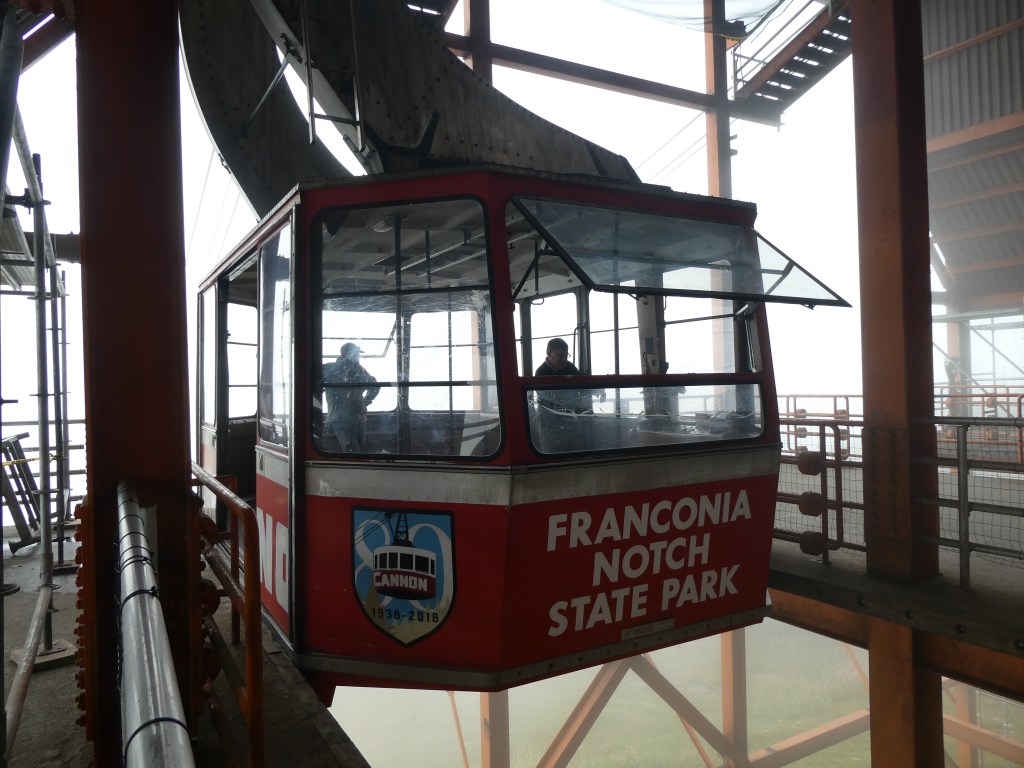
Still in Franconia, we went 4000 feet up to the top of Cannon Mountain on the first tramway in the United States.
Operations began in 1938.
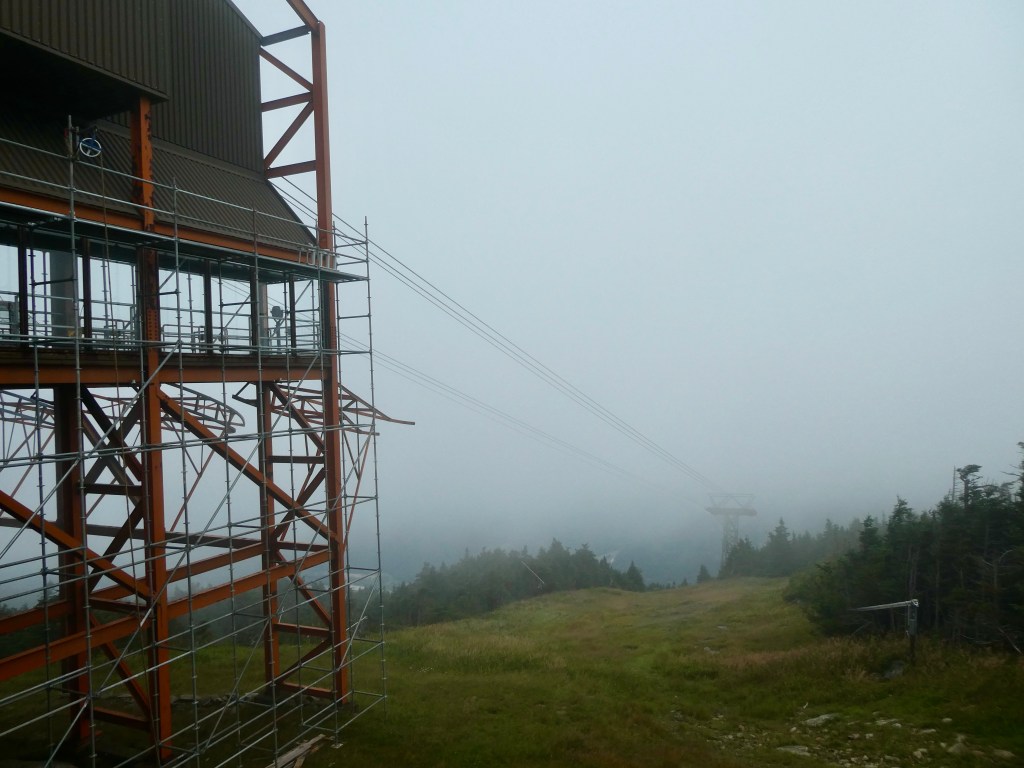
We walked around a bit at the top.
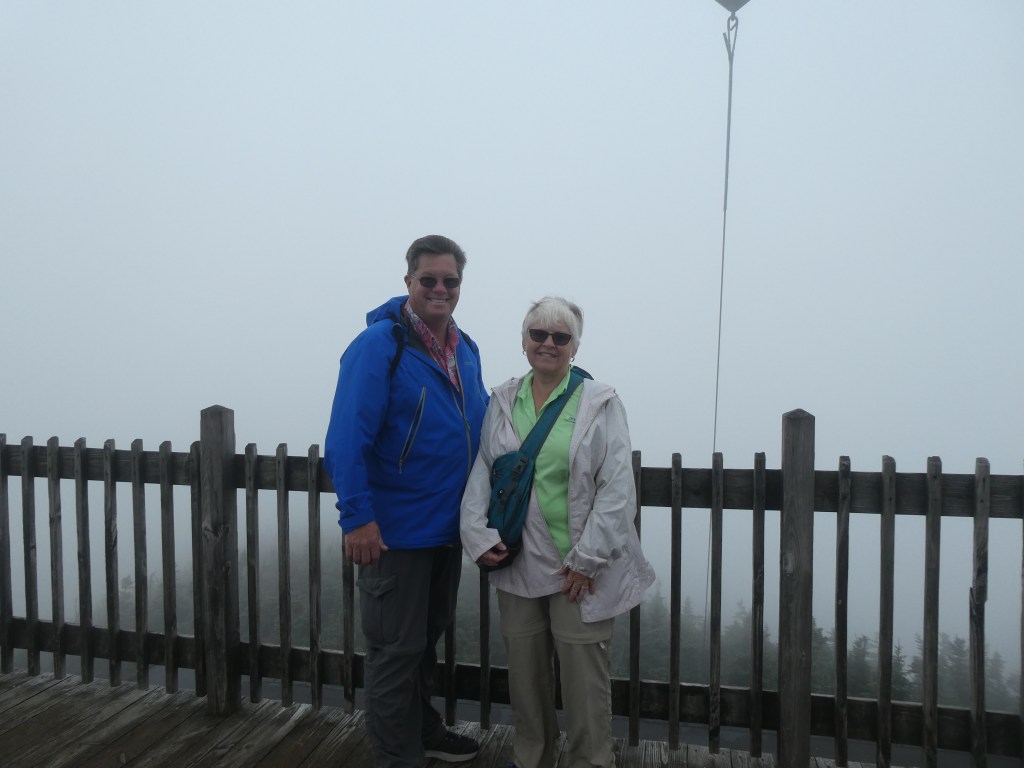
We got engulfed in clouds at the observation deck on the summit.
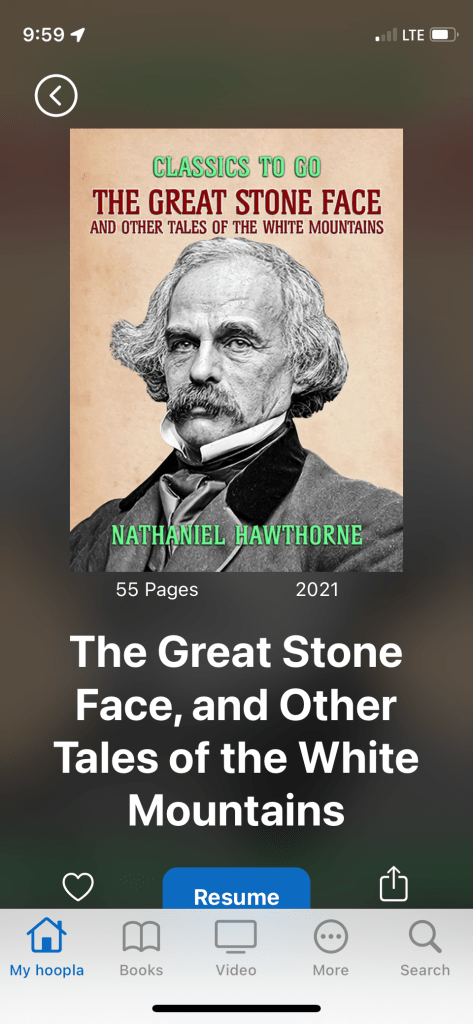
While waiting for the clouds to lift, I downloaded, and read, Nathaniel Hawthorne’s short story “The Great Stone Face.”
The task of reading The Great Stone Face was accomplished, but not enjoyed. I’m just not a Hawthorne fan.
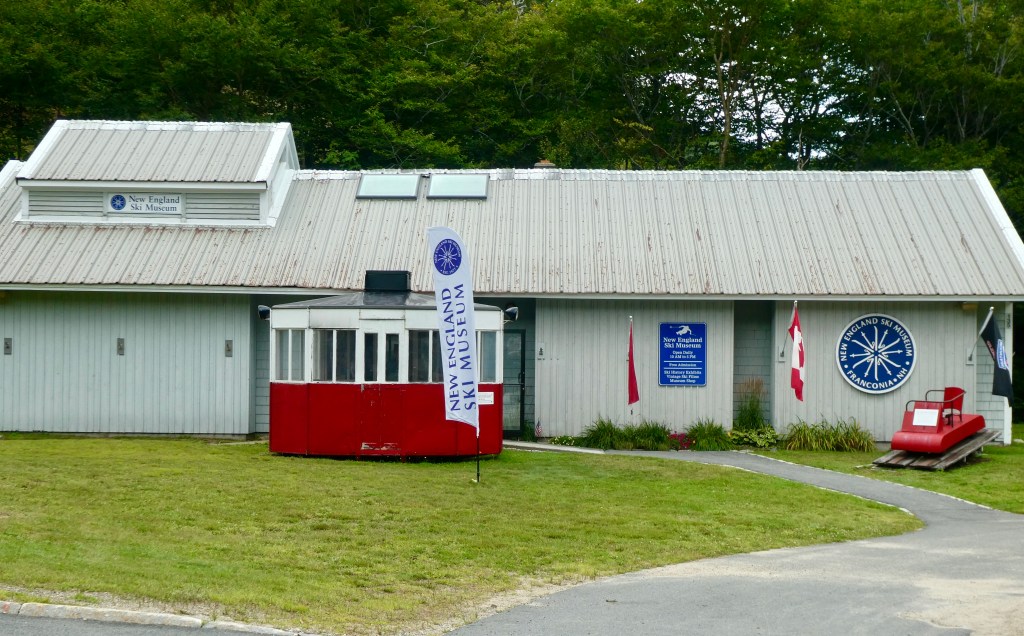
At the bottom of the mountain, we saw the original tram car outside the New England Ski Museum. Of course we went in.
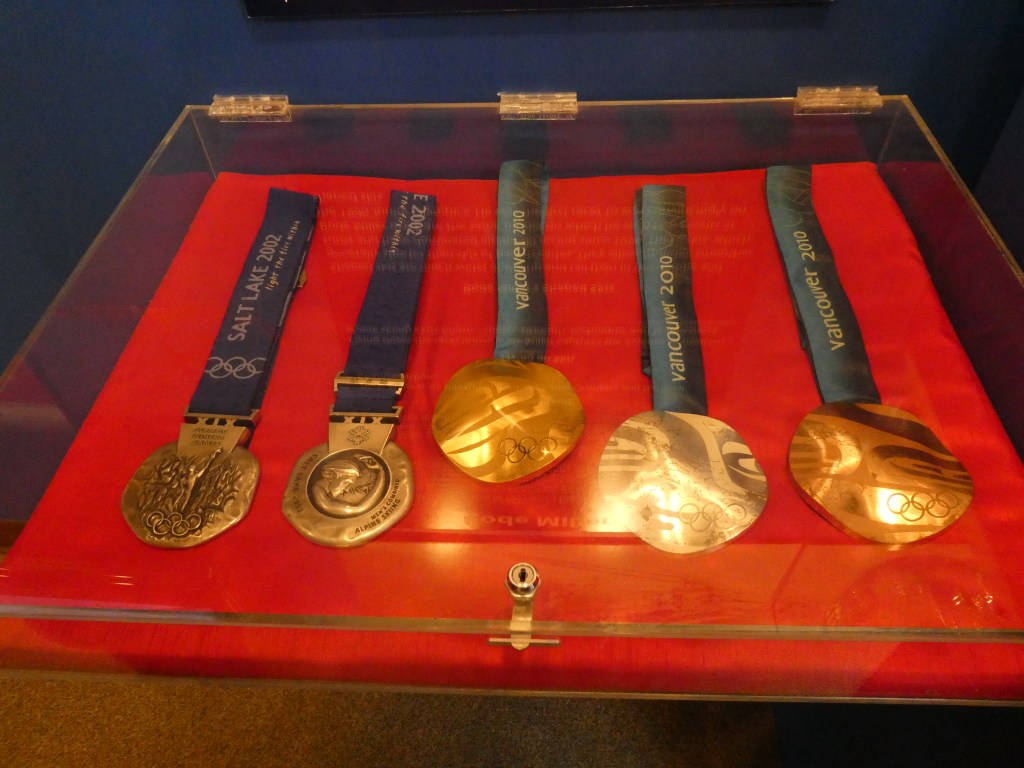
US skier Bode Miller learned to ski on Cannon Mountain and loaned his Olympic Medals to the museum.
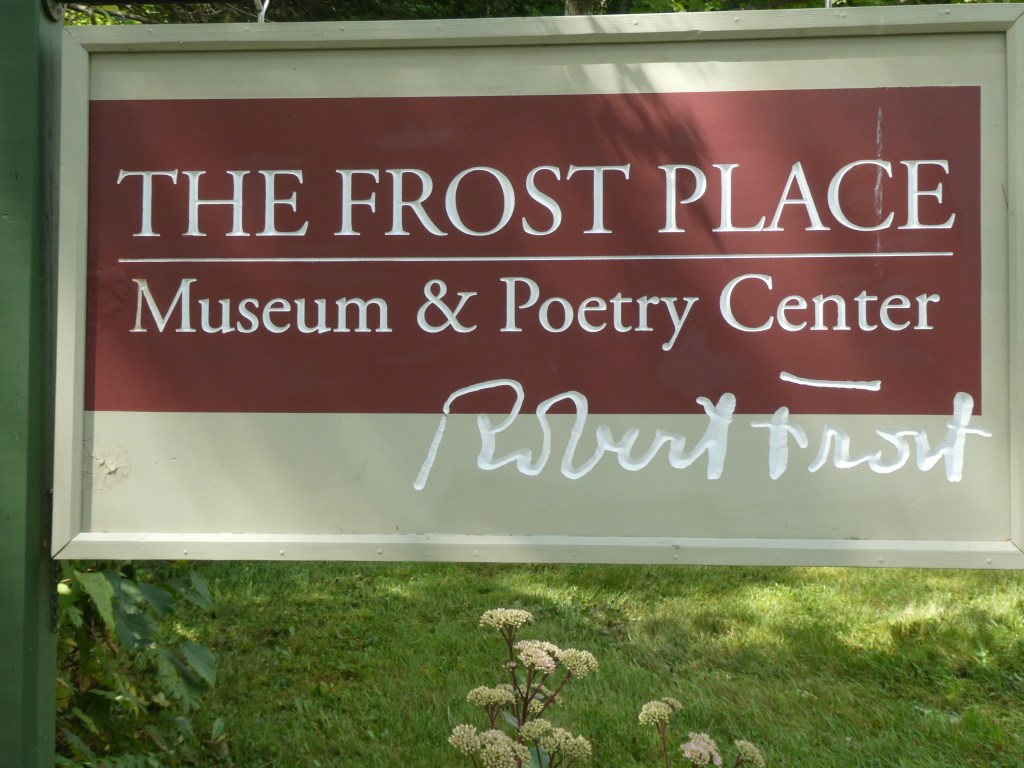
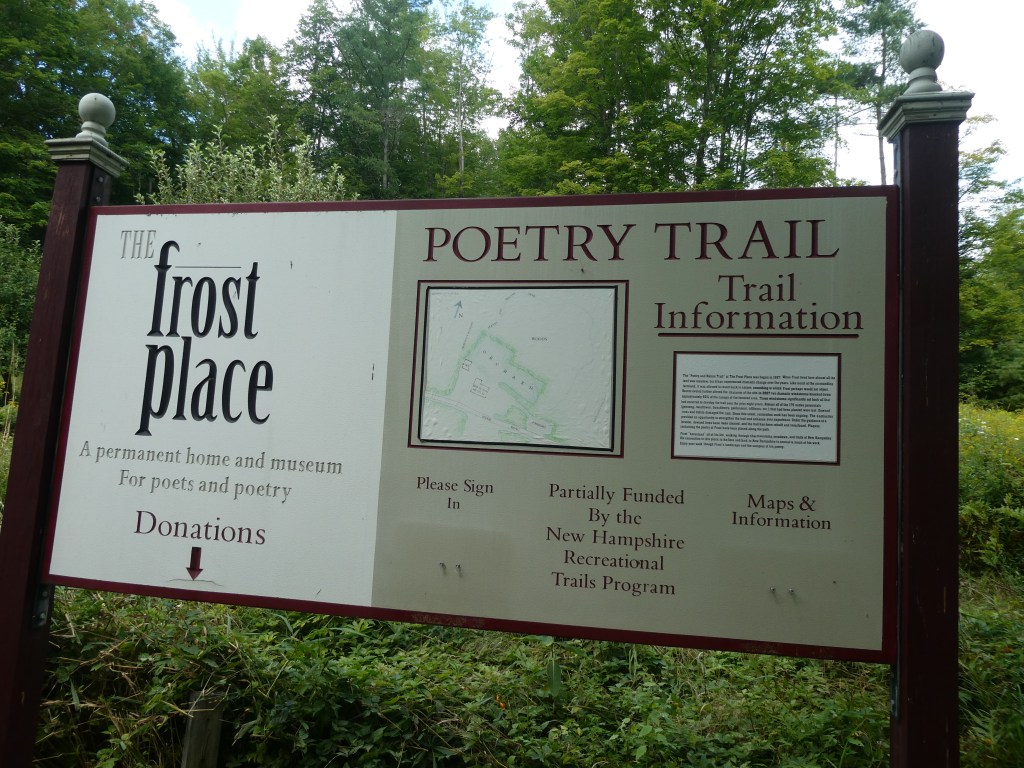
More in Franconia, we went to The Frost Place.
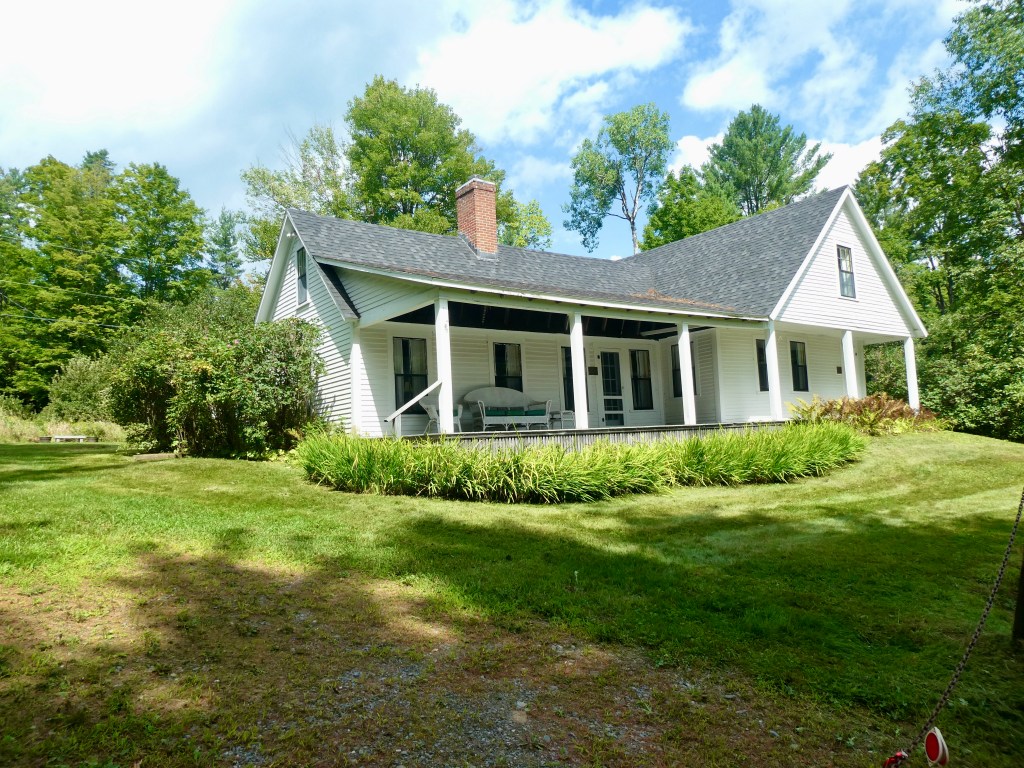
Owned by the city as a nonprofit educational center for poetry and the arts, The Frost Place is in the poet’s former home.
Out back, we walked the Poetry Trail.
Along the way are opportunities to read about a dozen of Frost’s poems.
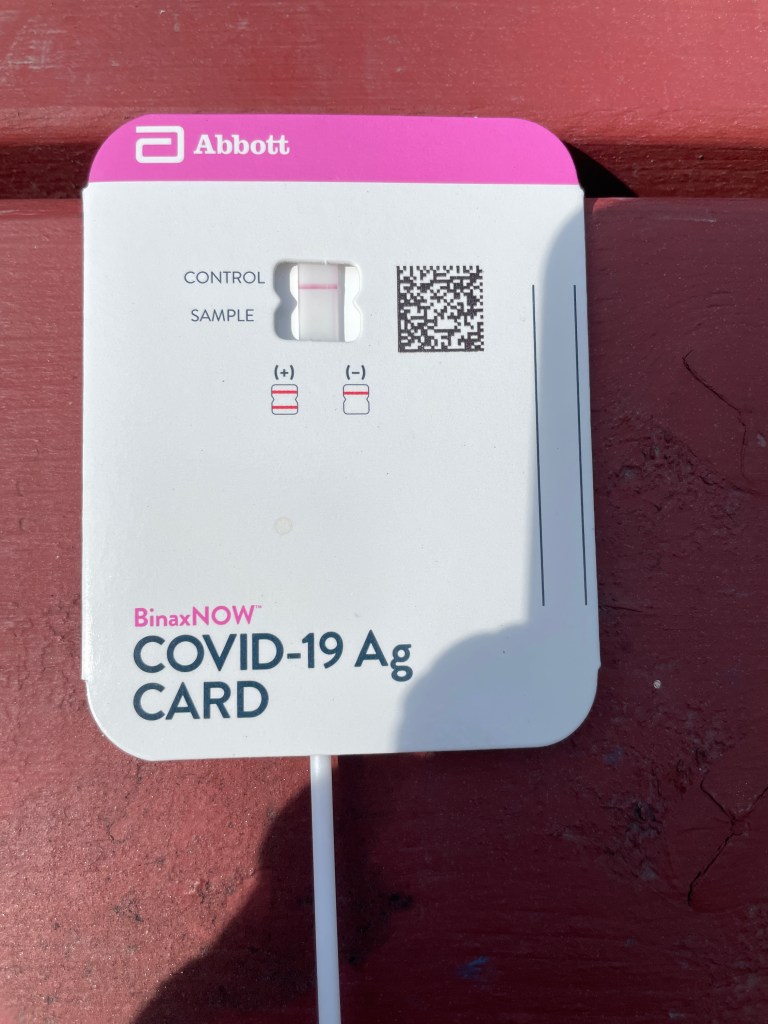
We had one more thing to do in New Hampshire before heading to Vermont. We had a cruise upcoming and in August 2022 you still had to test negative for COVID within a specified period of time.
I had not been able to work out in-person testing anywhere in rural New Hampshire or Vermont. We had pre-purchased tests that we could administer ourselves while being medically supervised over our phones.
Talk about stressful! We had to worry about technology and the results while sitting at a picnic table somewhere in rural New Hampshire.
Fortunately, we both tested negative.
That meant we were on to our last New England destination before the cruise – rural Vermont.
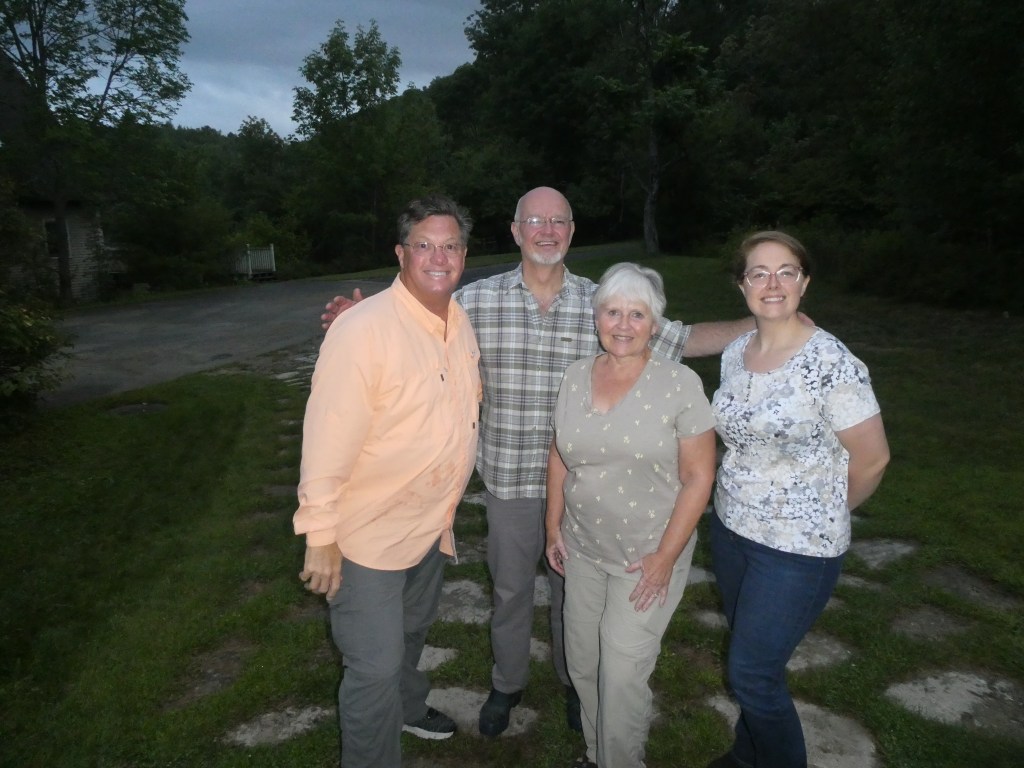
We were delighted to finally meet Randy’s cousin, Kevin, and Kevin’s niece Brynna. We talked non-stop for two days. What a joy!
Next post: We hook up with friends and our cruise begins!
Henry Ford and two of his friends, Charles Lindberg and Thomas Edison, were fairly vocal about their anti-semitism. We knew that before we experienced the commemoration of Henry Ford in Detroit and Dearborn. Our Detroit Architecture Tour guide mentioned the fact briefly but then we heard nothing about it again until our final experience in Greenfield Village.
We were told that the Ford family and Ford Motor Company went to great effort to erase, or at least diminish, that part of Ford’s legacy. It was suggested that places like The Henry Ford Museum and Greenfield Village were part of those efforts.
It is unclear if legacy rehabilitation was of concern to Henry Ford when he established the Edison Institute School System in 1929. Later it became the K-12 Greenfield School where Dearborn students (25 per grade) could spread out and learn about history in the same buildings where history happened. Students could also learn about inventors, inventions and the spirit of innovation in the same spaces in which the spirit thrived.
One of the docents we spoke with at Greenfield Village was one of those students, selected by lottery, to attend Greenfield School. He spoke about what a great experience and education he received. There was no charge to his family for him to attend Greenfield School.
We spent most of our village time in the area called Porches and Parlors. There are 26 historic homes, most are original and moved to the village. A few are replicas built with great authenticity. We were told that when Henry Ford had a building moved, it was taken apart carefully and everything saved. Even plaster pieces and mortar were saved to be ground and reused.
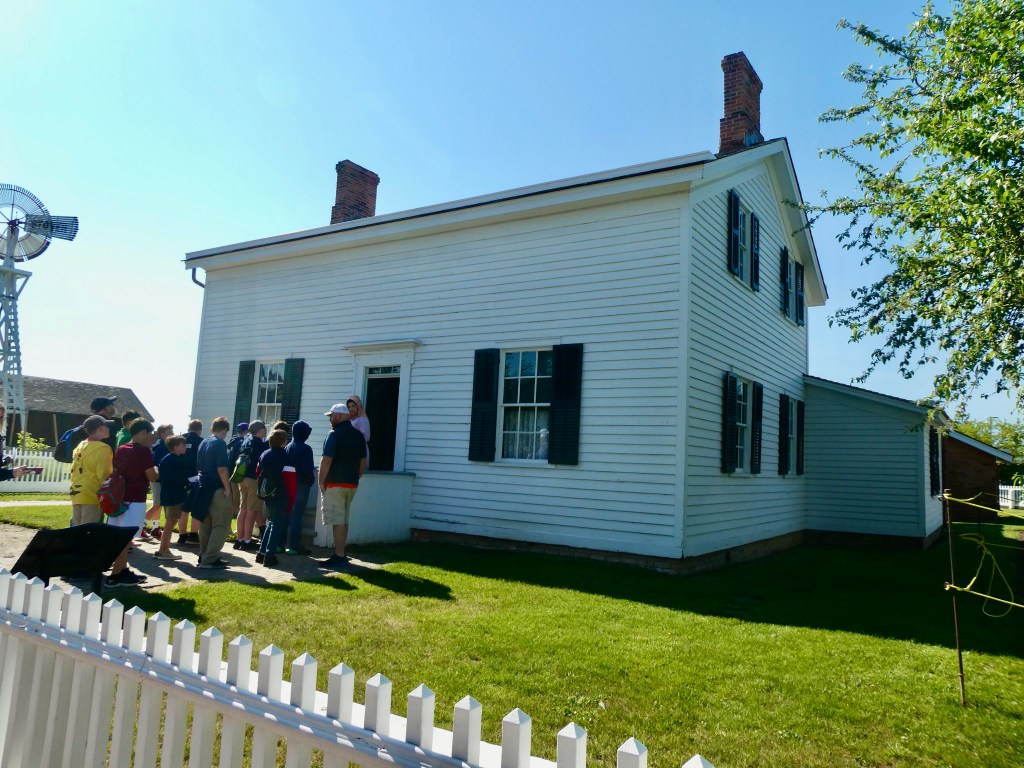
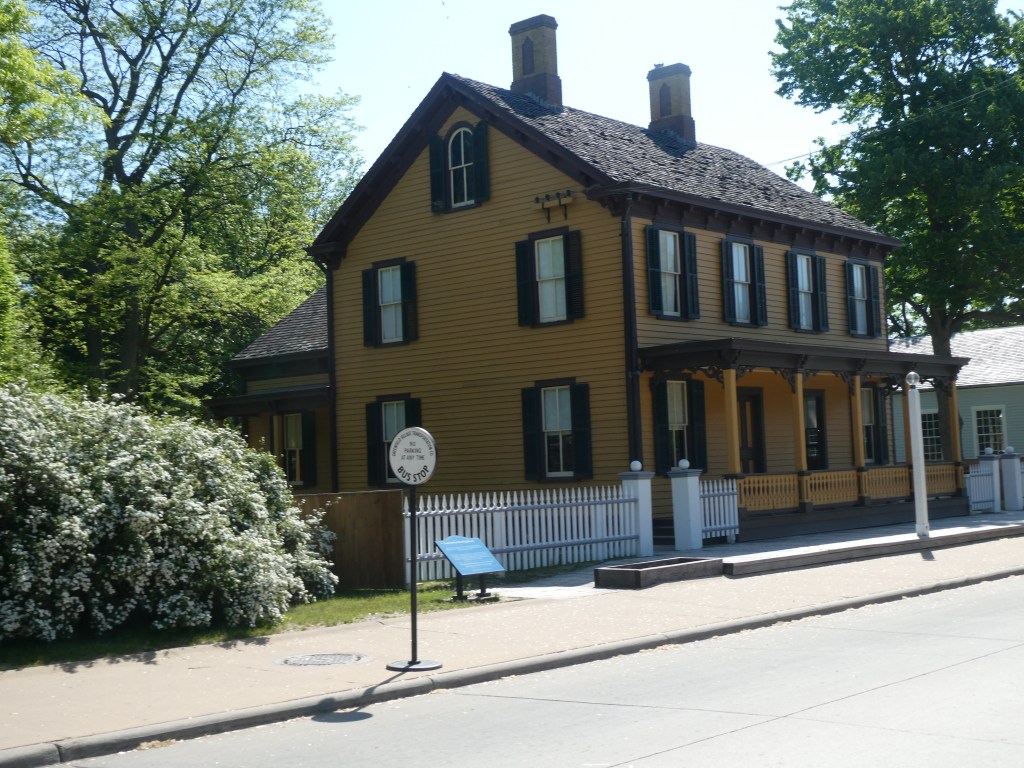
Henry Ford was born and raised in this farmhouse, originally located a few miles away from Greenfield Village. At 16 years of age, Henry left the family farm and went to Detroit to work as a machinist.
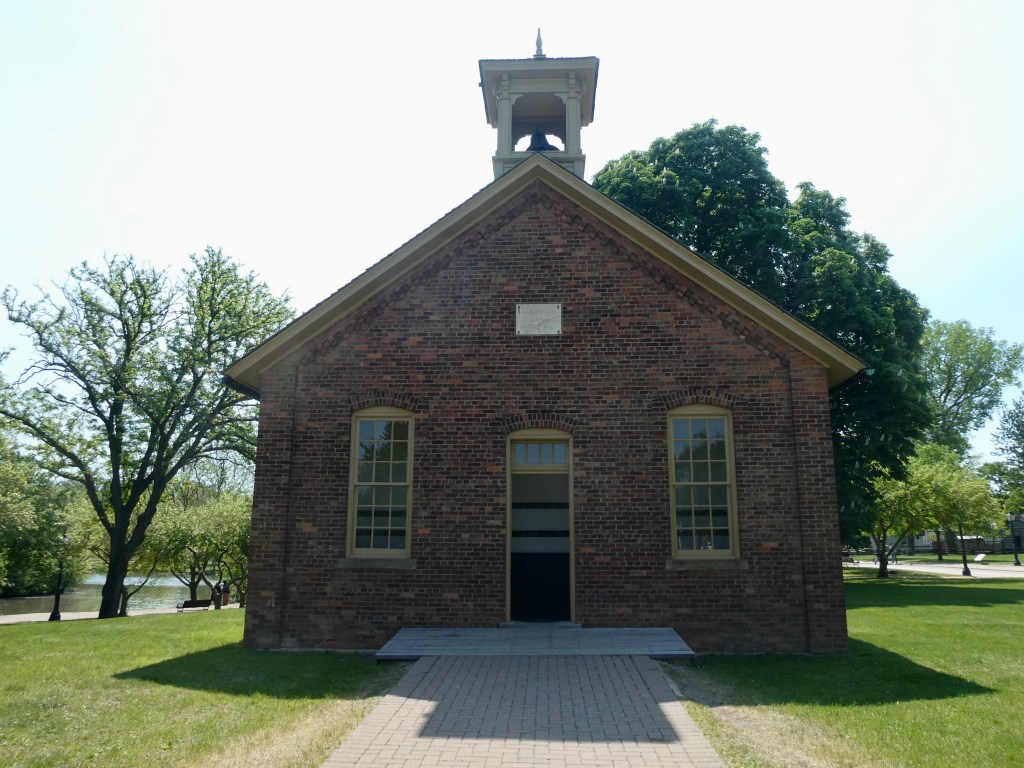
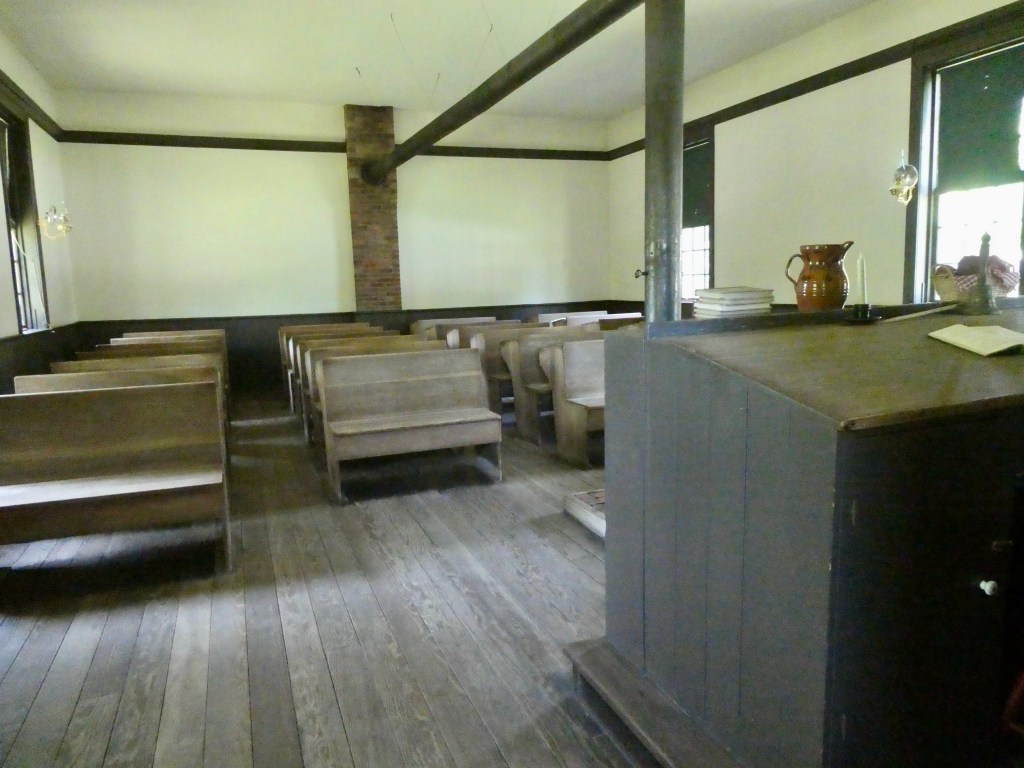
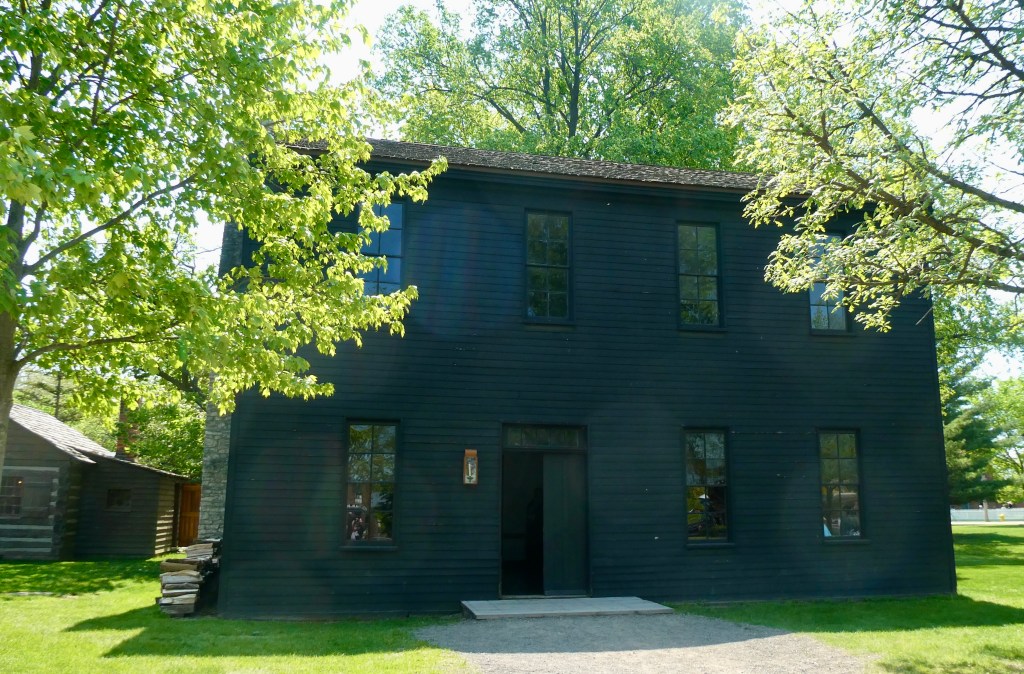
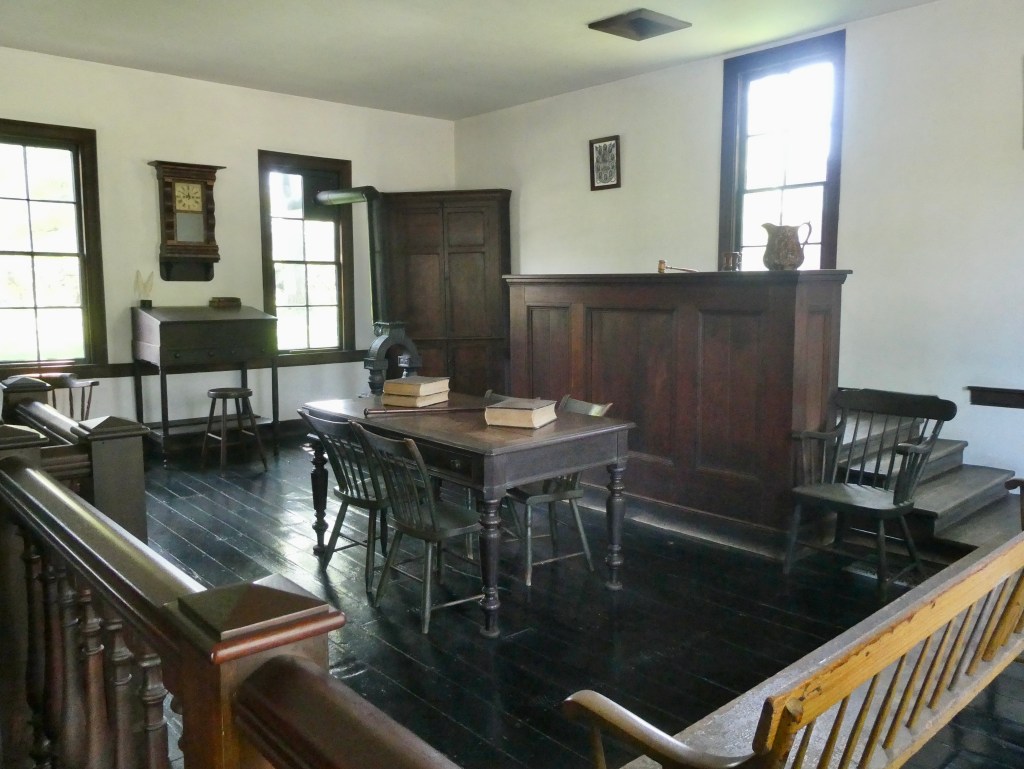
Henry Ford attended the Scotch Settlement School from age eight to eleven. It was built in 1861 in Dearborn, Michigan. He later restored the building and brought it to Greenfield Village to use as the first classroom for his experimental Edison Institute School System.
At the October 1929 dedication of Greenfield Village, Henry Ford sat at a desk in the same place in the classroom where he sat as a boy. He carved his initials into the replica desk, just as he had done many years before.
H. J. Heinz products were first developed in this house built in Sharpsburg, Pennsylvania in 1854. As a young man in the 1860s, H. J. Heinz spent much of his time in the basement making and bottling horseradish. He sold horseradish to people in his hometown and soon began making pickles, sauerkraut and later ketchup. He eventually moved operations to nearby Pittsburgh.
Wilbur and Orville Wright lived in this home while they developed their successful powered airplane. Their father and mother encouraged the boys, and their younger sister Katharine, to be intellectually curious. The home was built in 1870 in Dayton, Ohio.
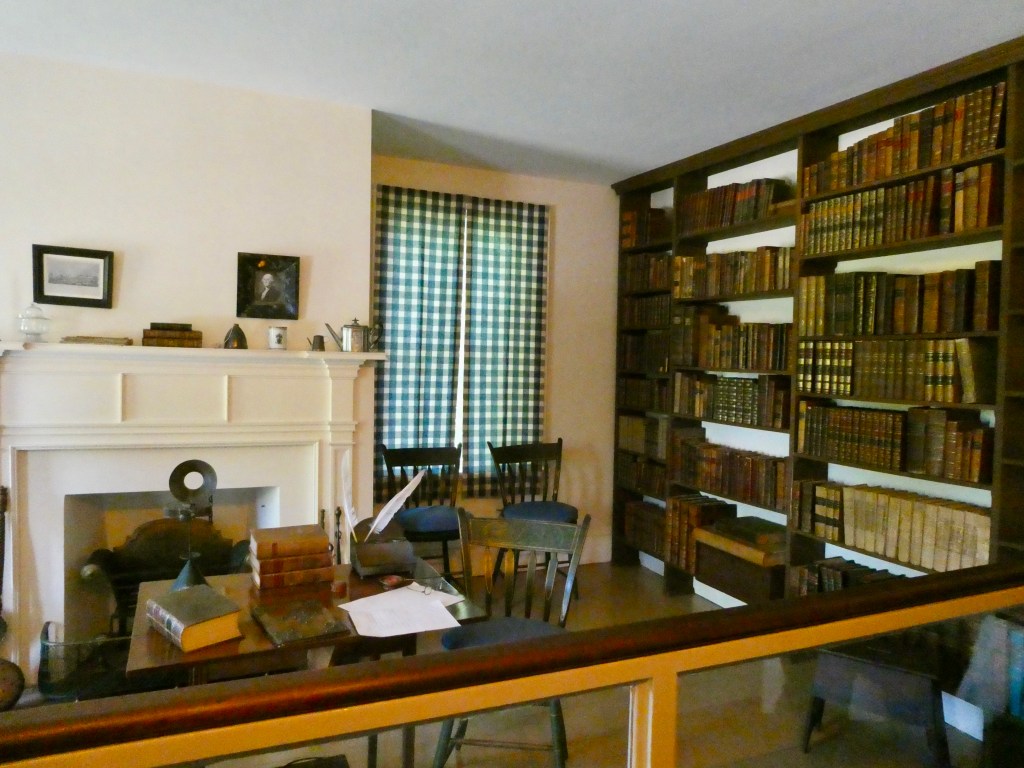
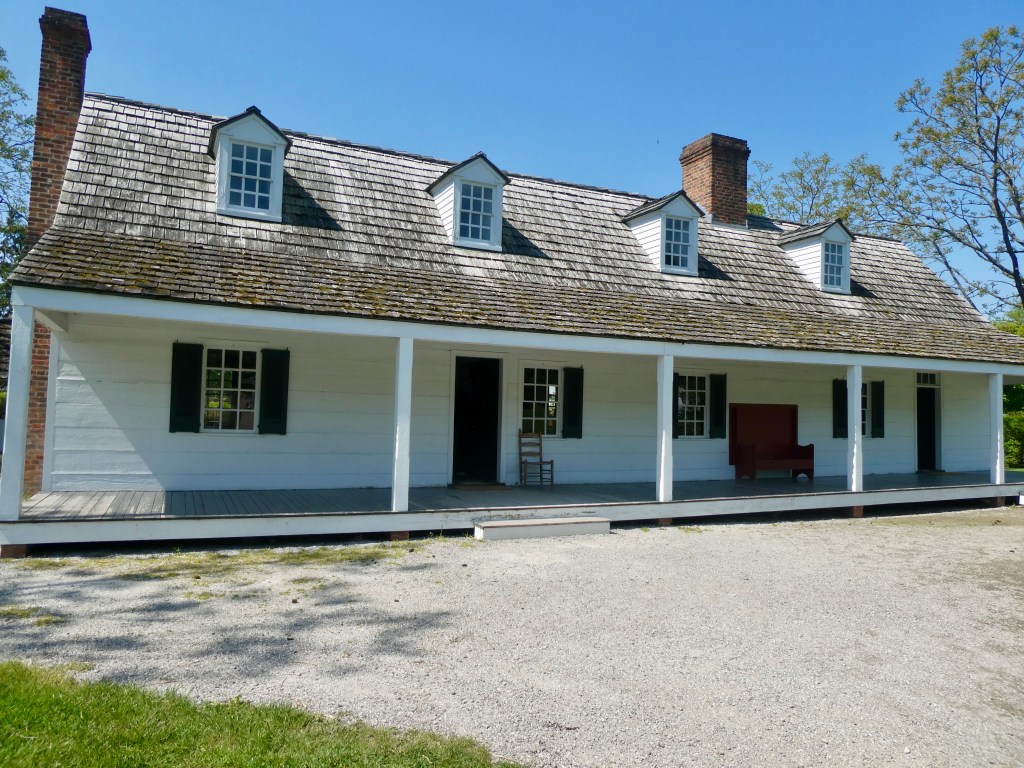
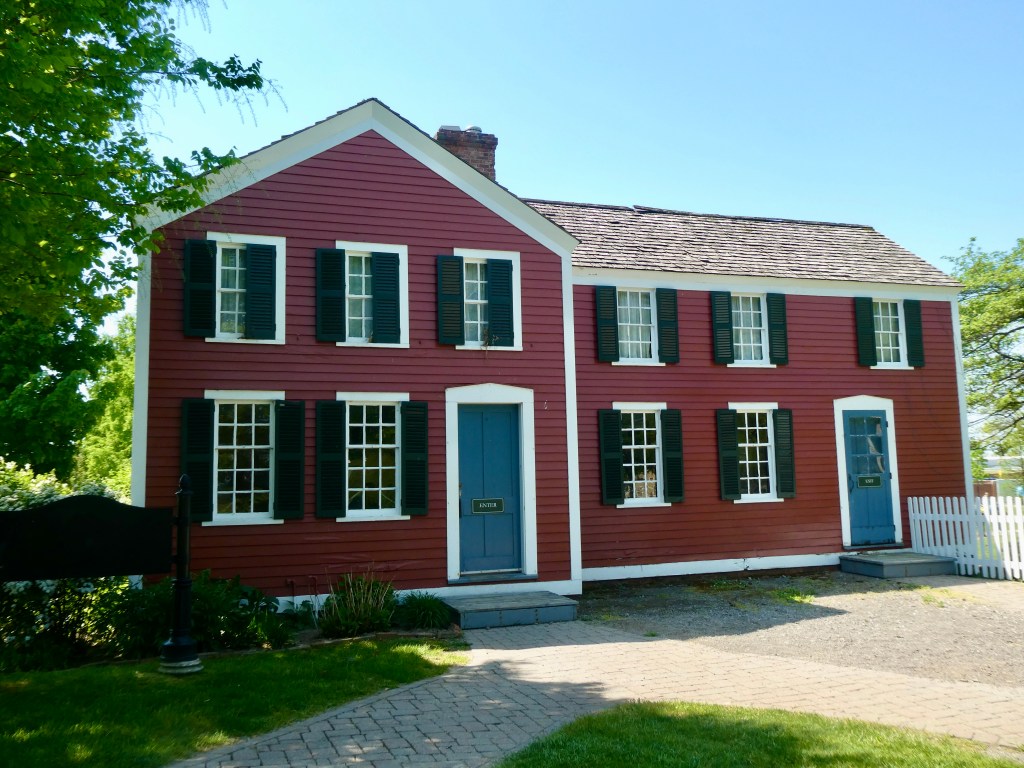
Noah and Rebecca Webster lived in this house in New Haven, Connecticut.
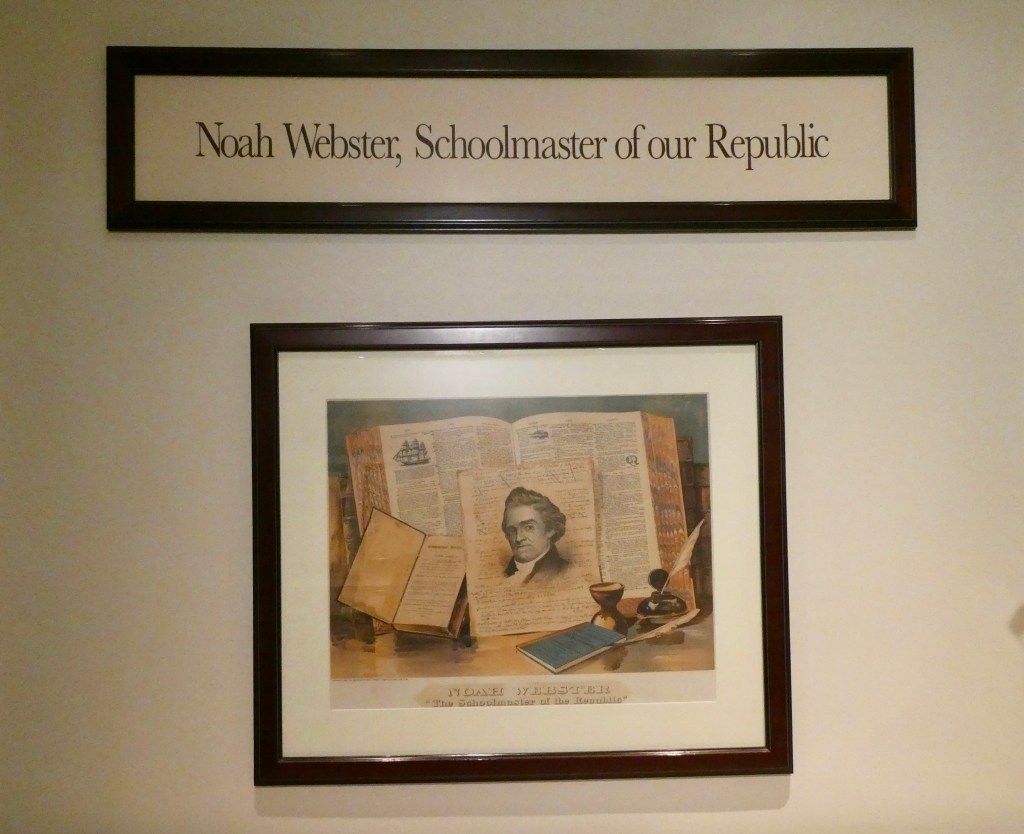
From this home he published his famous American Dictionary of the English Language in 1828. Webster’s dictionary aimed to capture distinctively American words and spellings for the first time.
And while he was considered “Schoolmaster of our Republic” he also believed that all “should be educated a little, but not to rise above their station.” Hmmm.
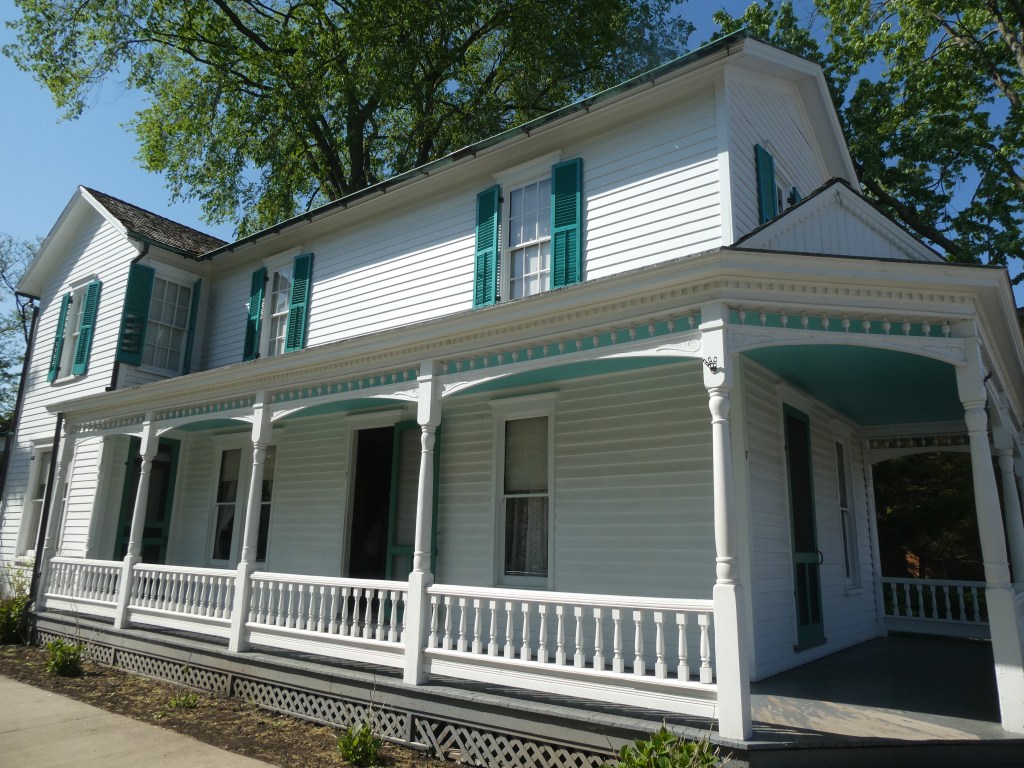
This house was built in 1835 in Ann Arbor, Michigan. One of its many residents was poet Robert Frost in the 1920s.
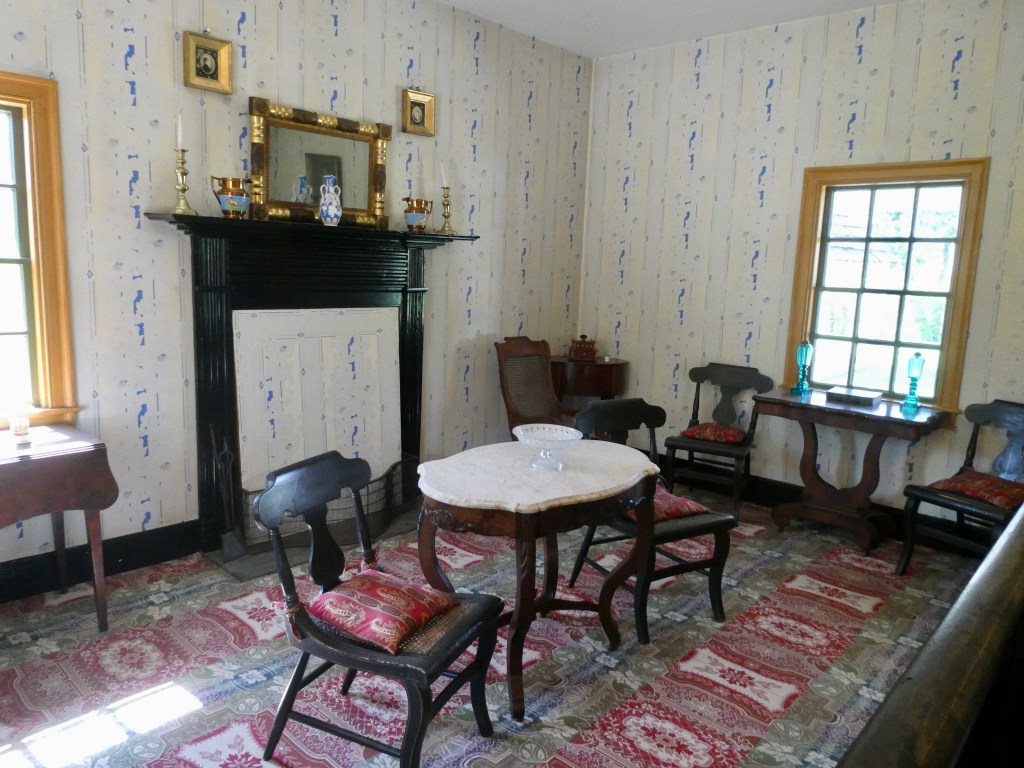
The Giddings House was built about 1750 in Exeter, New Hampshire. It was owned by the family when they were active West Indies traders. Their business was impacted significantly by the American Revolution.
Not all buildings in Greenfield Village are from this continent. The Cotswold Cottage, built in the early 1600s was moved from Gloucestershire, England.
Families who lived in this home may have been farmers and stone masons.
The Susquehanna Plantation was built up between 1826 and 1836 in St. Mary’s County, Maryland. By 1860, Henry and Elizabeth Carroll owned 75 enslaved men, women, and children. The Carrolls were among the elite of the area, a lifestyle made possible by those who were enslaved..
Slaves from the plantation likely supported the Union during the Civil War. Some probably served in the US Colored Troops or worked as prison guards at the large prison camp for Confederate prisoners built nearby Susquehanna in 1863.
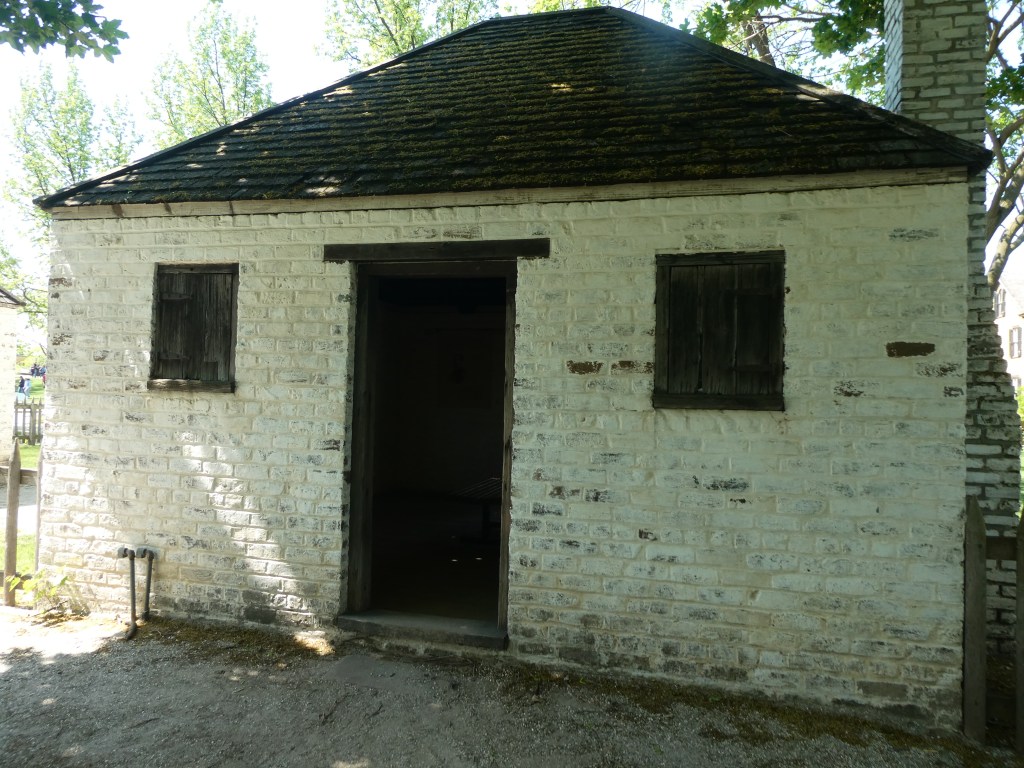
This was one of 52 slave quarters on the Hermitage Plantation near Savannah, Georgia.
There were 201 enslaved persons on the plantation manufacturing rice barrels, cast iron products and lumber. Bricks were also made on the plantation and that is why these slave quarters were made of brick.
This home is where Luther Burbank was born in 1849. He was an American plant breeder and naturalist. His experiments led him to develop the Russet Burbank potato – popularly known as the Idaho potato- which would become the world’s most cultivated potato.
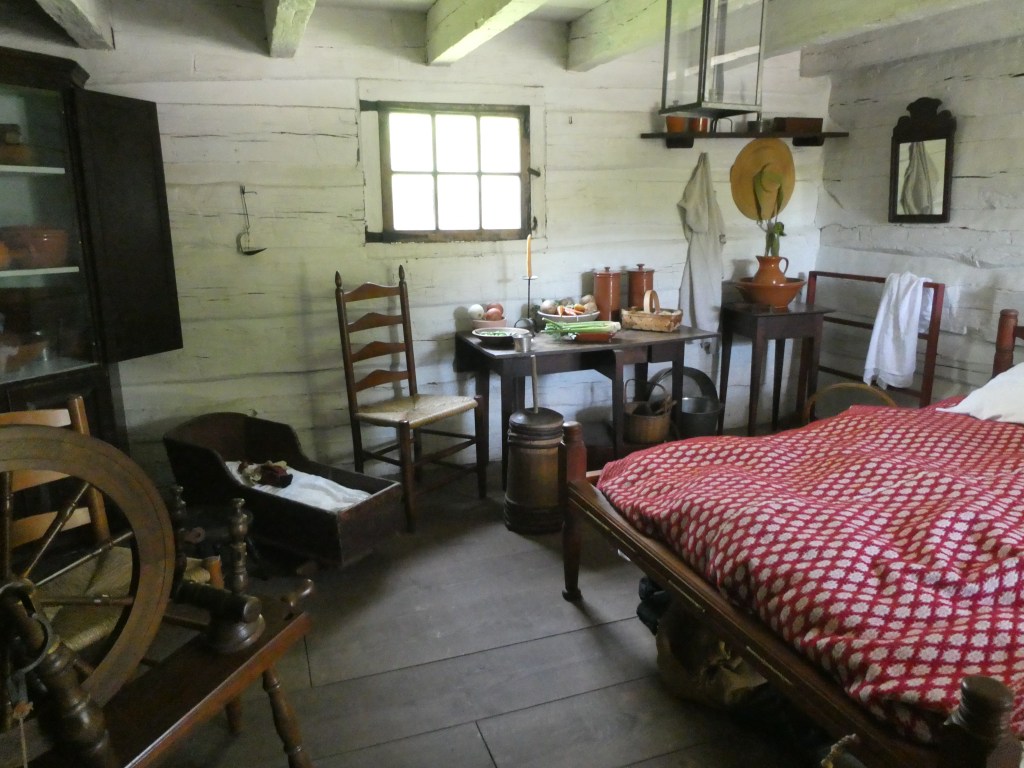
William Holmes McGuffey was born in the year 1800 in this small log home in western Pennsylvania. By the late 1800s, McGuffey’s Readers were the most widely circulated textbooks in the United States.
This is the Logan County Court House, build in 1840 in Postville, (now Lincoln), Illinois.
Abraham Lincoln practiced law here between 1840 and 1847. He was a traveling lawyer working mostly on neighbor disputes, contracts and debts.
The section of Greenfield Village, dedicated to the work of Thomas Edison, featured his Menlo Park Complex. Unlike many buildings in Greenfield Village, these are not originals that were moved. Structural components of the original New Jersey complex were incorporated in the rebuild in 1929 in Greenfield Village.
In 1876, Thomas Edison set a goal to have one major invention every six months and one minor invention every 10 days. He did very well towards that goal.
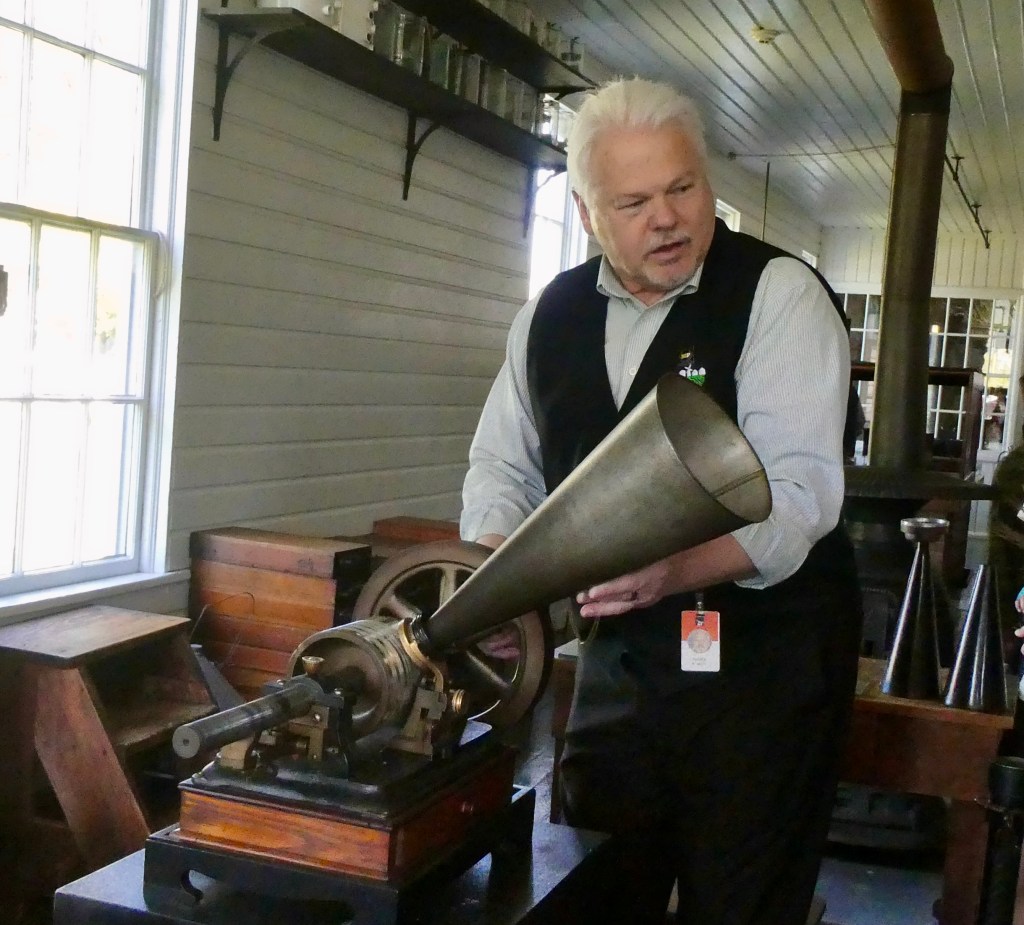
Menlo Park Laboratory was where Thomas Edison’s electric lighting system was created as well as the first phonograph.
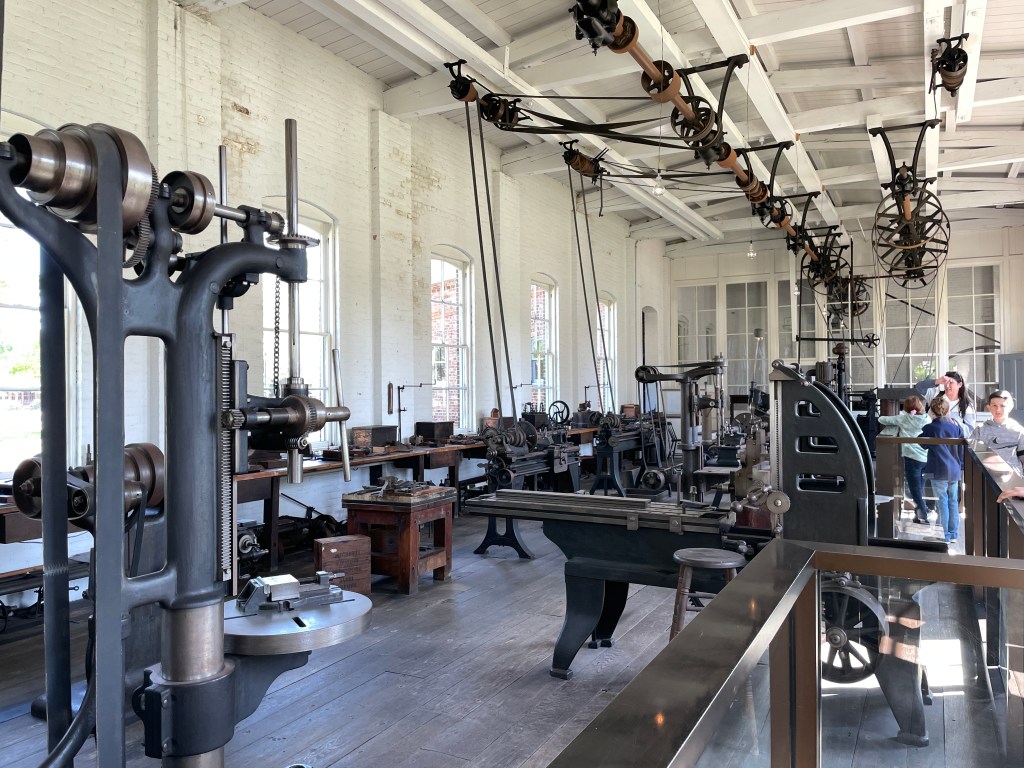
Machinists were highly skilled independent craftsmen and were critical to industrial change in the 1800s,
This is a replica building of Edison’s machine shop and the world’s first central power station used for his experiments and electrical lighting demonstrations in 1879 and 1880.
Unmarried male workers from Thomas Edison’s Menlo Park Laboratory lived in Sarah Jordan’s boarding house. The boarding house was one of the first homes ever to be wired for electrical light.
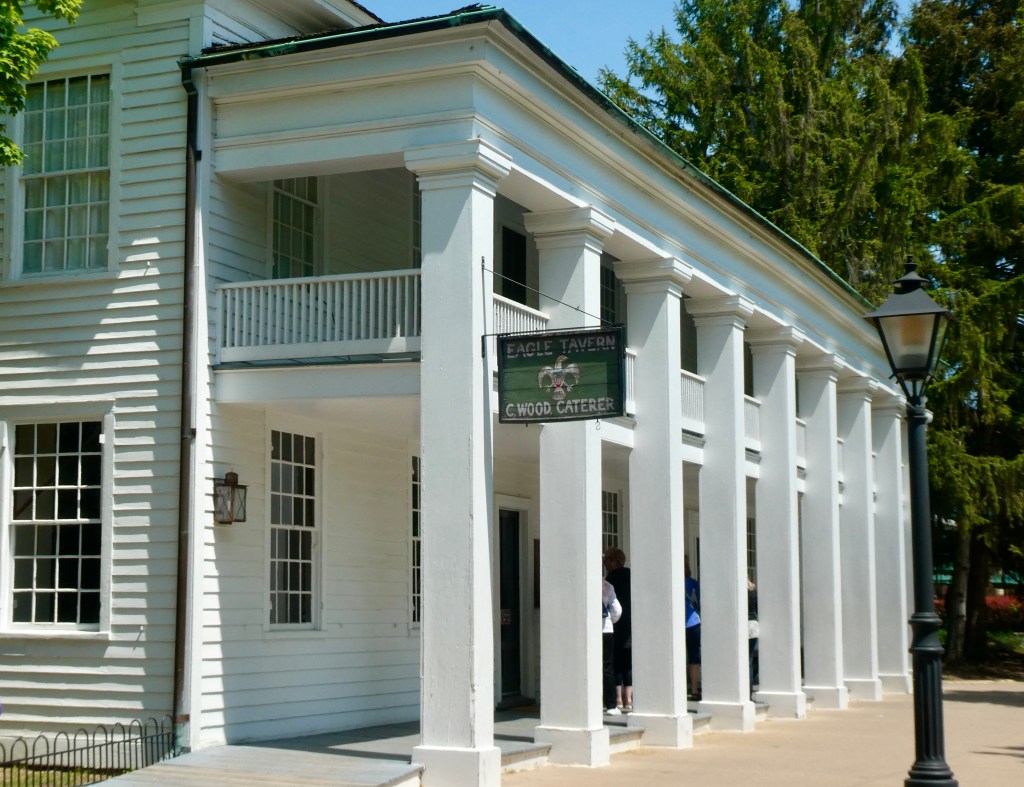
After exploring, we enjoyed lunch at the Eagle Tavern, built in 1831-32 in Clinton Michigan.
All people, regardless of social class, came together in taverns.
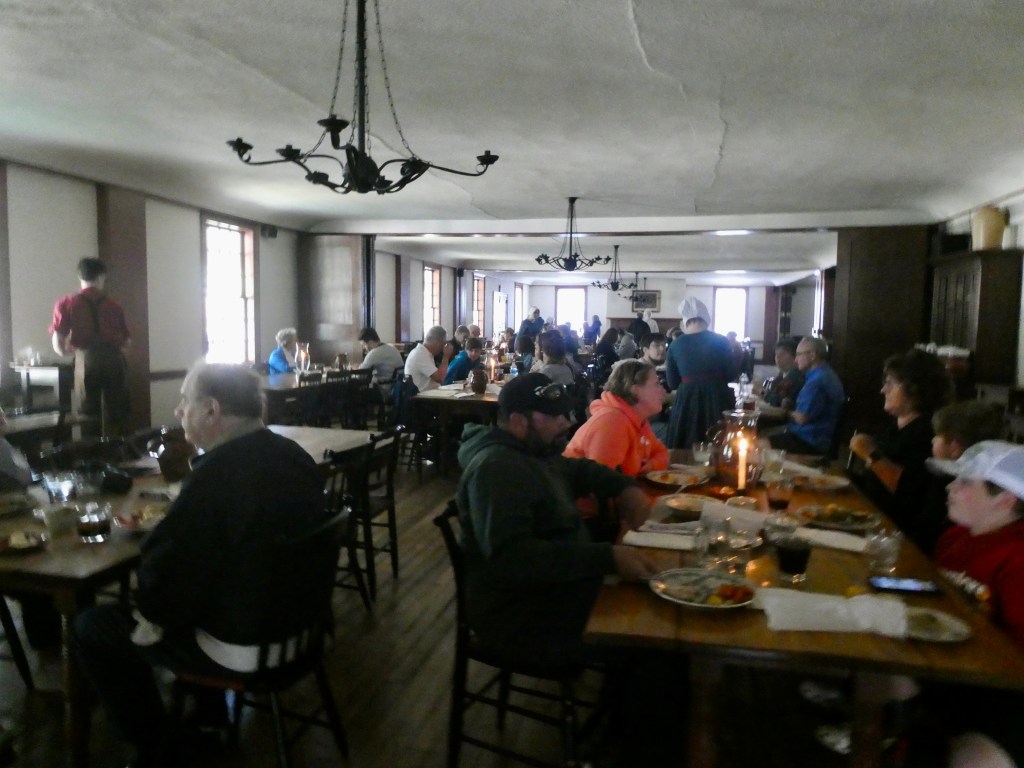
As we recall, our food was quite good. The mixed drinks, surely authentic to the era, were not to our taste.
There was an opportunity to ride around Greenfield Village in period vehicles but we never did.
We also could have explored sections of Greenfield Village devoted to Working Farms, Liberty Craftworks and Railroad Junction. As we had visited similar living museums elsewhere, we did not dedicate our time there. Greenfield Village is very large covering 90 acres!
Henry Ford’s work in Greenfield Village was dedicated a National Landmark in 1987.
The Henry Ford was founded on Oct 21, 1929, as part of the Edison Institute. The purpose was to preserve items of historical interest and innovation. It later opened to the public as a museum.
In the 523,000 square feet facility, there is opportunity to display innovations large, small and every size in-between.
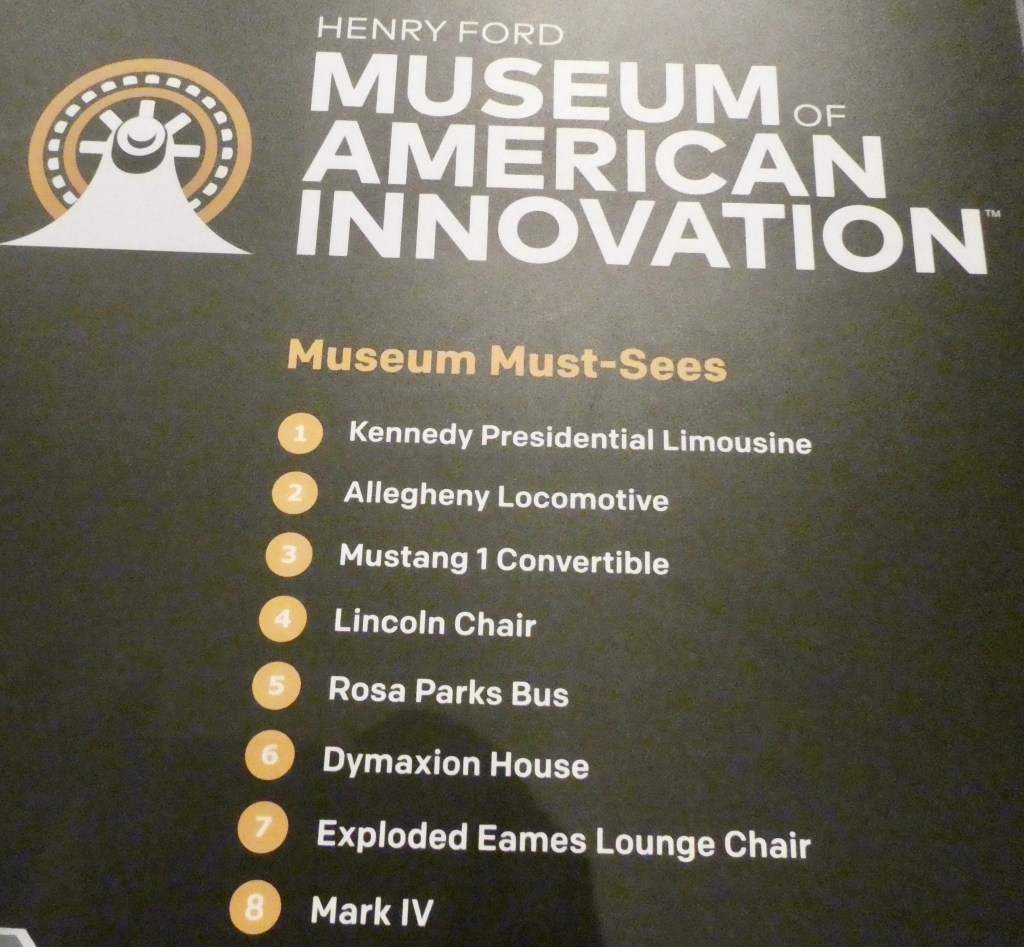
There is a list of the must see exhibits. All but one will be featured in this post. (We saw the exploded Eames lounge chair but it failed to make an impression on us at the time and I didn’t take a picture.)
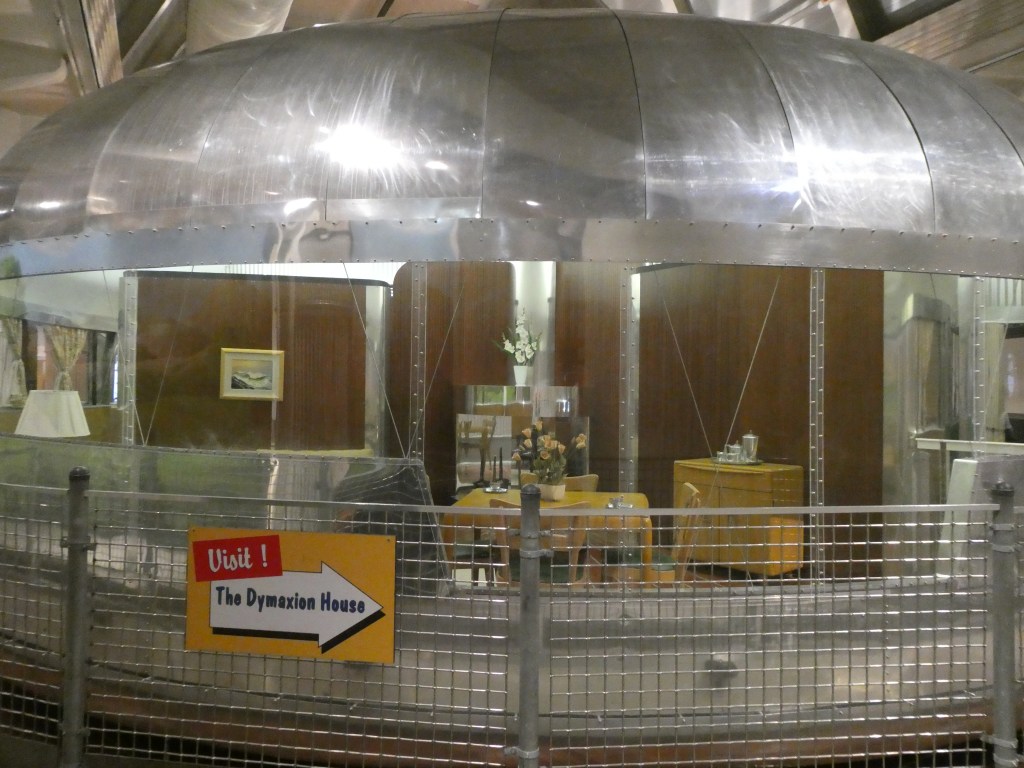
The first must see we came to was the Dymaxion House. This unique housing was prototyped for mass production in 1946 at a price of $6,500 each. Over 3700 inquiries were made about the 1017 square foot home but very few were ever built.
The Graham family, initial investors of the Dymaxion, lived in this house for 20 years. They had challenges with sound, heating and cooling. In 1992 the Grahams gave their Dymaxion, the last remaining, to the Henry Ford Museum.
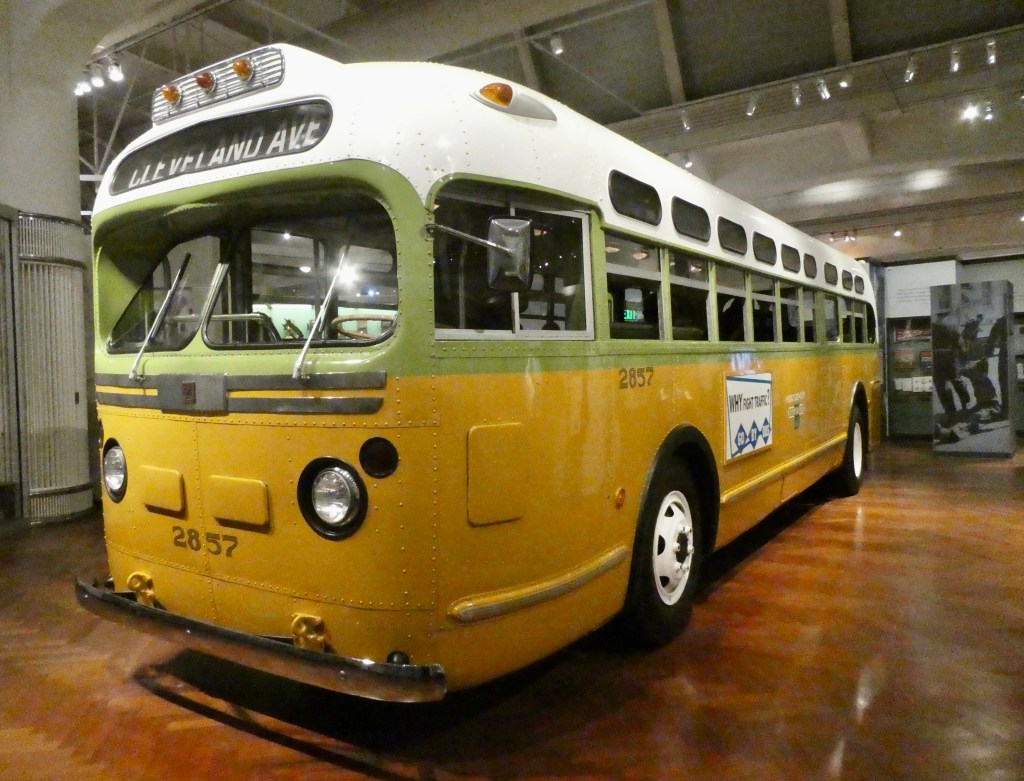
Another of the must see items was the Rosa Parks Bus.
On December 1, 1955, Rosa Parks refused to give up her seat to a white man on this bus in Montgomery, Alabama. That event sparked the Civil Rights Movement.
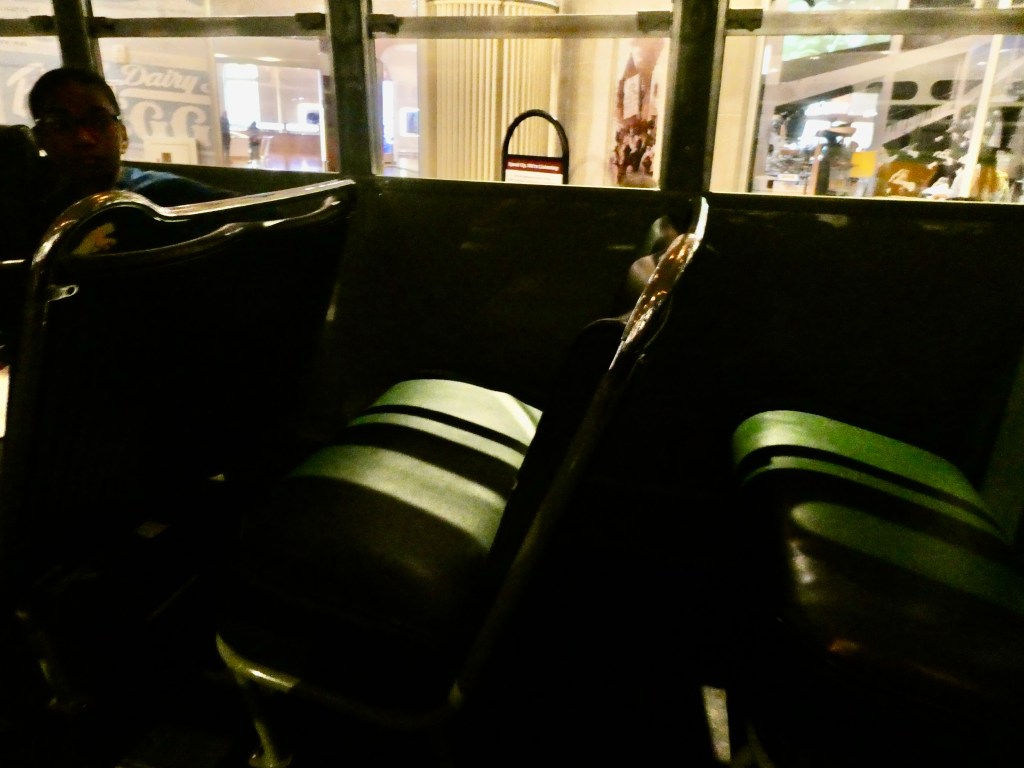
This was the seat Rosa Parks was sitting in. We were at the Henry Ford on a weekday in May and there were many school groups on field trips. We were delighted to see and hear that the students on the bus were very knowledgable about the event and almost all wanted to sit in the very seat.
Also on the list is the chair Abraham Lincoln was sitting in when he was shot at Ford Theatre.
This is the 1961 Lincoln that President John F. Kennedy was riding in when he was shot in Dallas in 1963. The car was made by the Lincoln Motor Company (a Division of Ford) in Dearborn. It was a deep blue color at the time of Kennedy’s use.
Following Kennedy’s assassination, the car underwent a rebuild, changing the color to black, but also adding full armor, bullet resistant glass, tires that can run flat and a back rail and platform for secret service agents. The car was used occasionally by presidents Johnson, Nixon, Ford and Carter.
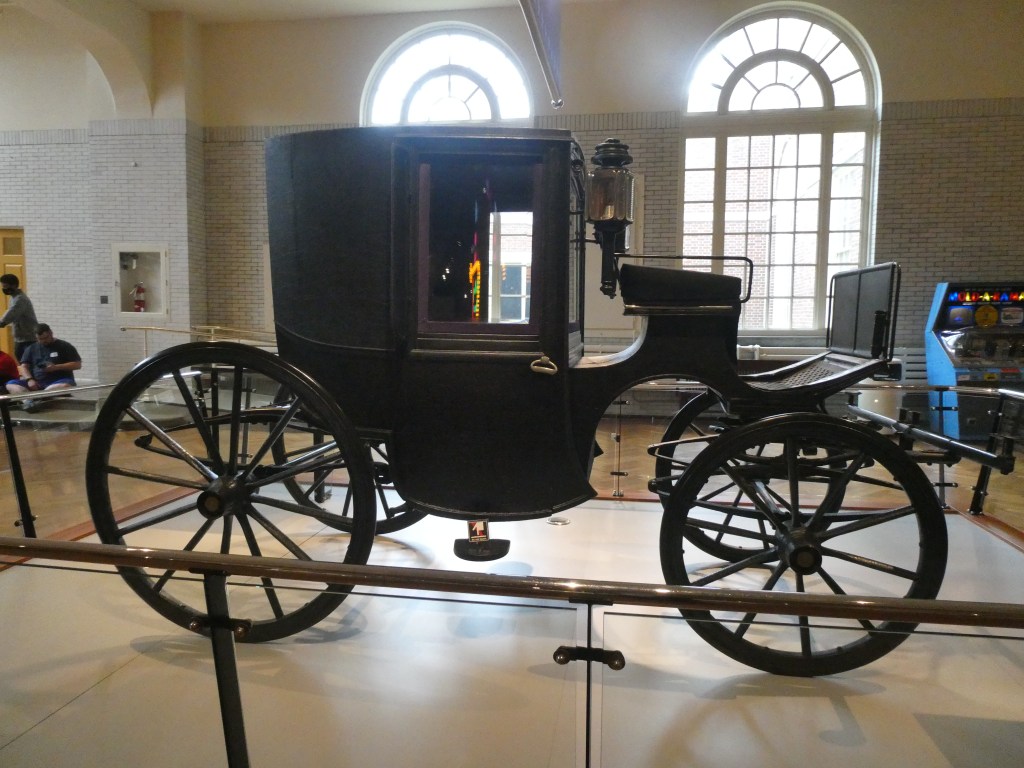
There were other presidential vehicles on display including this Brougham carriage used by President Teddy Roosevelt. He did not like automobiles. The build year on this carriage is circa 1902 and was not custom. It was also used in the Taft, Wilson, Harding and Coolidge administrations for household errands.
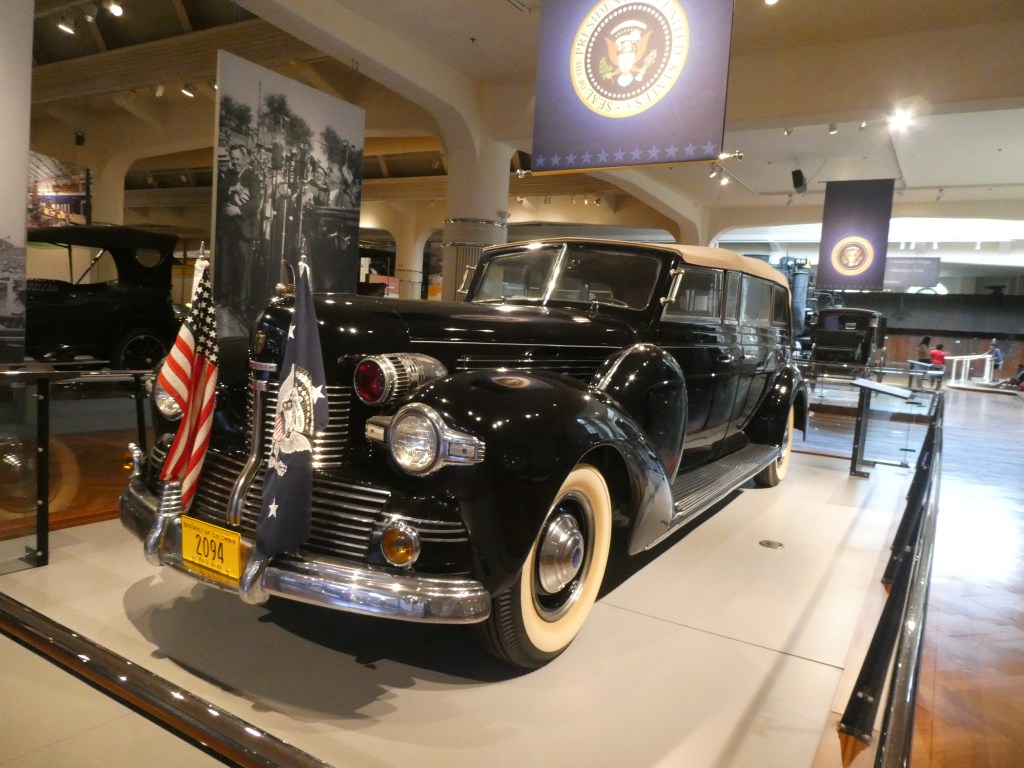
This 1939 Lincoln was the first car ever built purposefully for use by a president – in this case for President Franklin D. Roosevelt. It was nicknamed the “Sunshine Special” because he loved to ride in it with the top down. It had extra wide running boards and rear hinges on the back seat doors to make it easier to get FDR in and out of the car. After the Japanese attack on Pearl Harbor in 1941 the car was returned to the factory where it was equipped with armor plate and bullet-resistant tires and gas tank. The “Sunshine Special” was also used by President Harry Truman and retired in 1950.
President Dwight Eisenhower used this new 1950 Lincoln “Bubbletop” There was (and is) always a conflict between a president’s desire to be accessible and seen, and the desire to keep him safe.
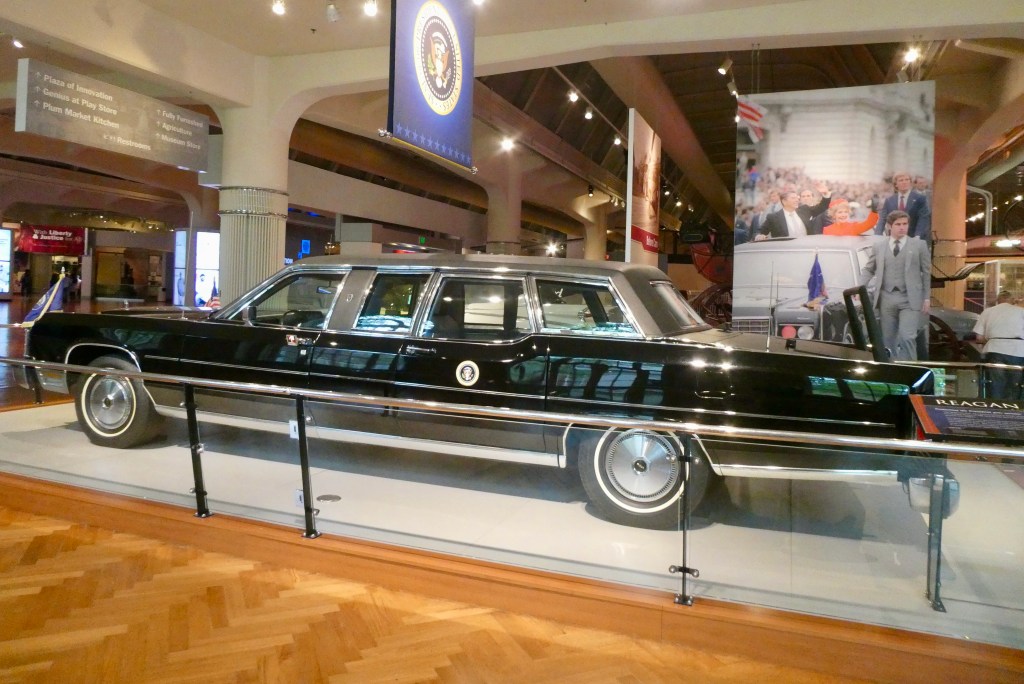
This 1972 Lincoln was used from 1972-92 by presidents Nixon, Ford, Carter, Reagan and GHW Bush. Reagan was injured when, in an assassination attempt, a bullet ricocheted off the car and hit him.
These vehicles were just a few of well over one hundred being displayed in one collection or another. There were vehicles in all shapes, sizes, ages, power sources and purpose.
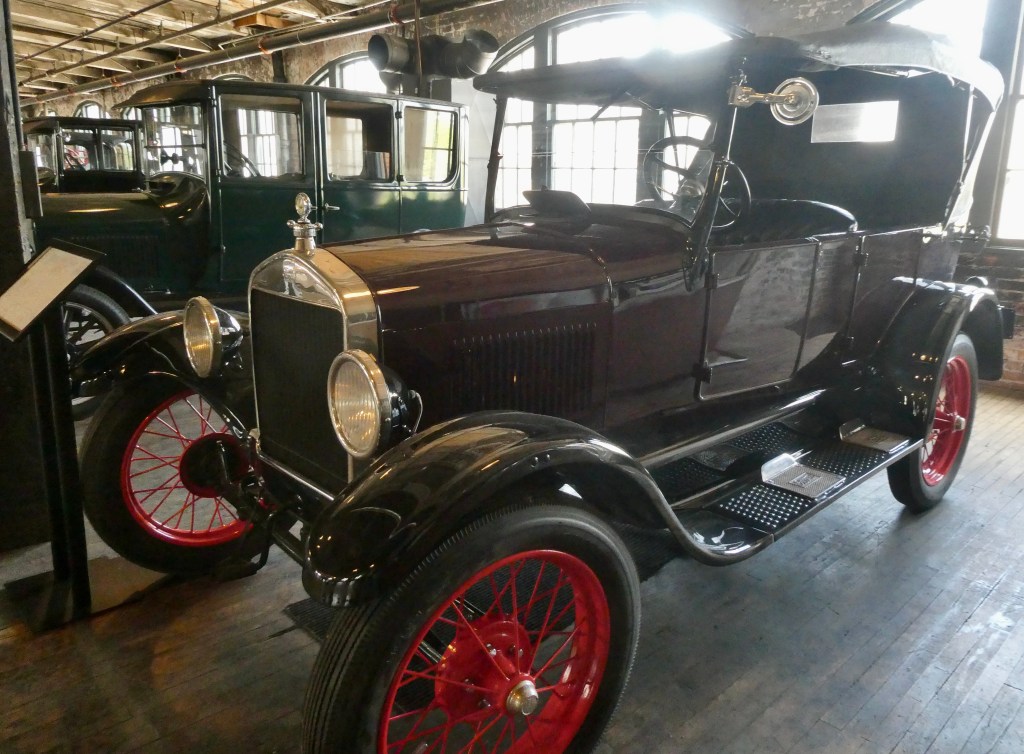
Being a Ford museum, of course there is information about the Model T. In this display they identified 7882 distinct steps in making the 1923 Model T Touring car.
In 1956, the Ford Motor Company built the Thunderbird. It was promoted as a car purchased just for the pleasure of driving.
This is a 1962 Mustang I Roadster. The Mustang was designed to have people think of Ford as exciting and forward thinking. This was a concept car and different from the Mustang that was released in 1964.
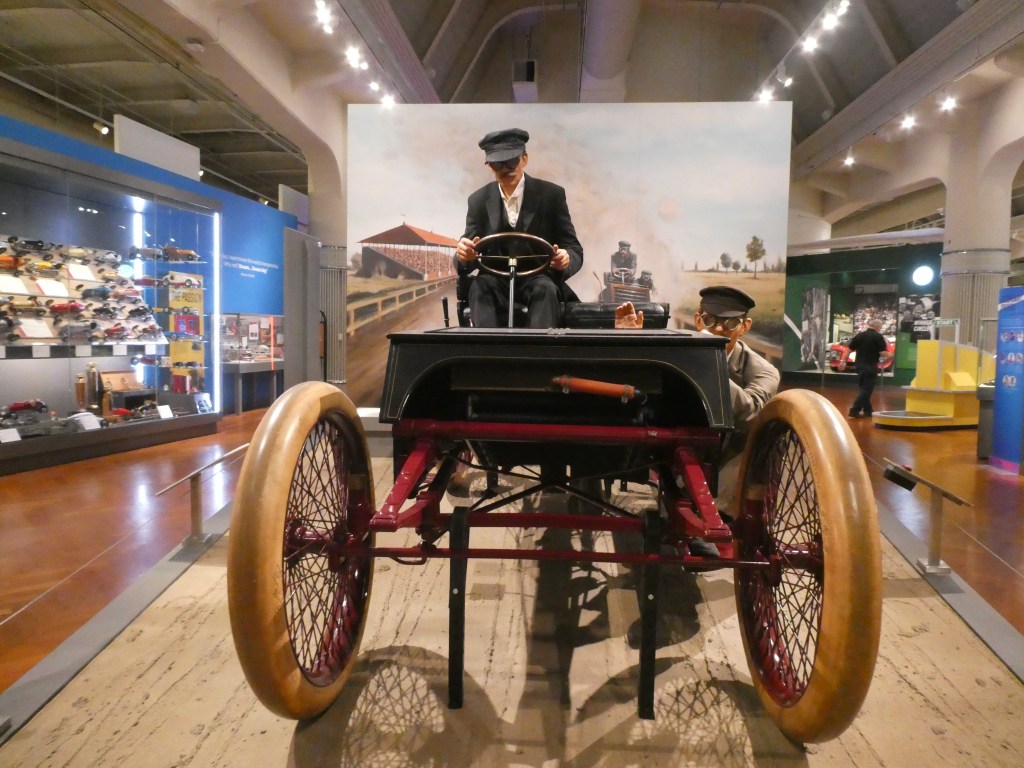
There was an entire collection of racing cars from early to current. This particular Ford vehicle was the winner of the 10 mile 1901 Sweepstakes.
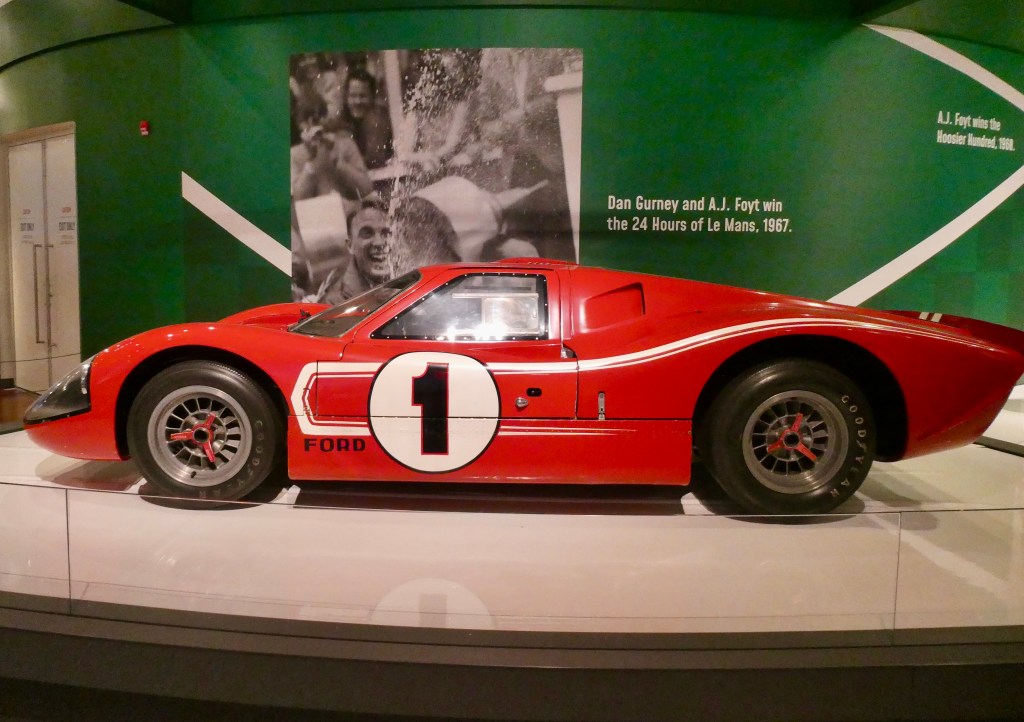
This 1967 Mark IV was driven by the first all American car team to win La Mans, a 24 hour race. It was built by Ford in Dearborn.
In 1903, this Packard was the second vehicle to go across the continent from San Francisco to New York City. It took 61 days. (The first vehicle to do so, also in 1903, took 63 days.)
The most photographed item in the museum, and not to be missed, is the 1942 Allegheny class locomotive, one of the largest and strongest ever built. It was designed to pull 160 coal cars, each with a 60- ton load over the Allegheny Mountains between Virginia and West Virginia. That load might be 1.25 miles in length!
Allegheny #1601 was the second ever built and is one of only two remaining. It is 125-ft long, 11-ft 2-in wide, 16-ft 5 ½-in tall and weighs approximately 771,000 lbs. Its original price was $230,663.
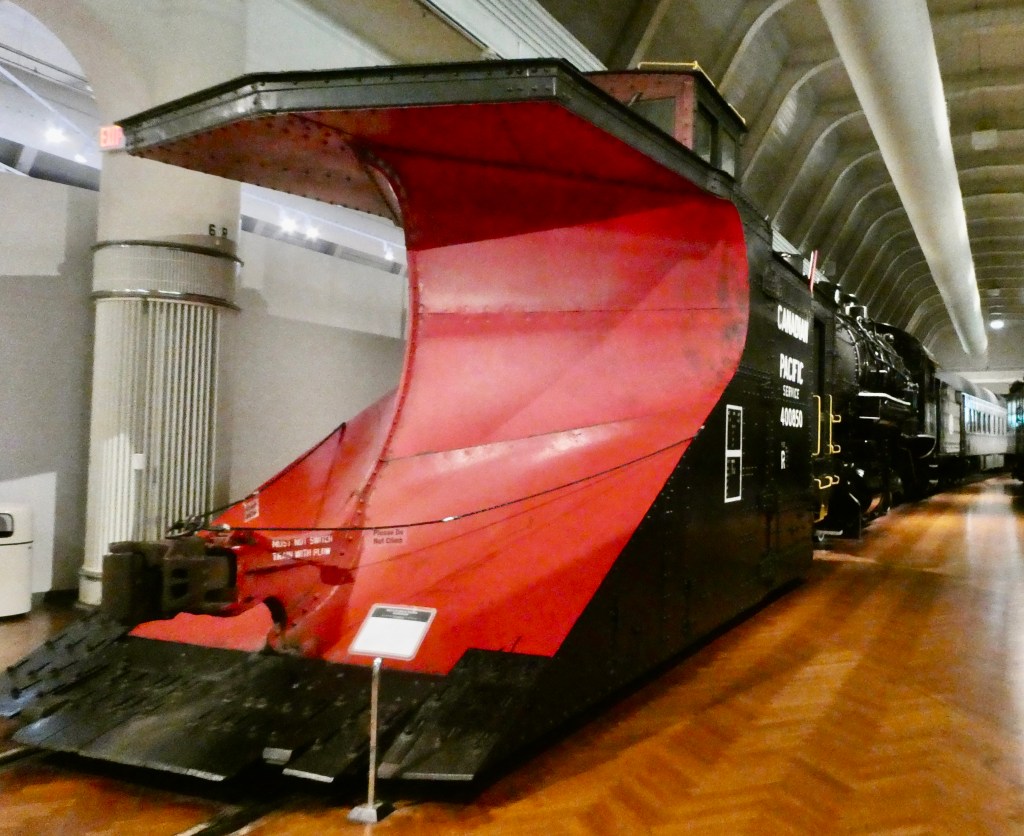
This is a 1922 Canadian Pacific Snowplow engine used from 1923 to 1990 in rural Canada and New England. The engine’s wings plow a single track 16 feet wide.
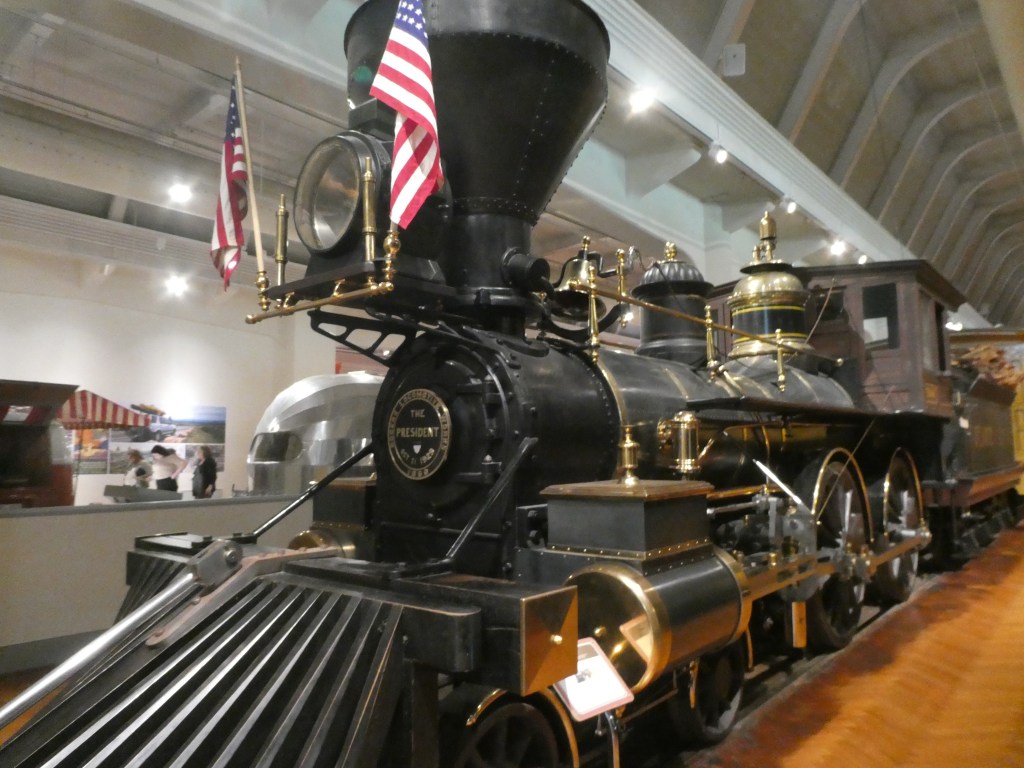
The last run of this 1858 Rogers train brought Henry and Clara Ford and their guests, Thomas and Mina Edison, and President Herbert Hoover and First Lady Lou Hoover to the dedication ceremony for The Henry Ford’s 1929 dedication ceremonies. The opening was timed to be on the 50th anniversary of Edison’s invention of the lightbulb. The locomotive was named The President in Hoover’s honor.
Edsel Ford coaxed his father into beginning an aviation division. Henry Ford only flew a few times in his life. The pilot for his first ever trip was friend Charles Lindbergh.
Henry Ford wanted to produce a small affordable plane for all, a Model T of the sky. This very first 1926 Flivver was only flown by Ford test pilot Harry Brooks and Charles Lindbergh. After 5.5 million dollars, Ford stopped the Flivver project when Harry Brooks, who was like a son to him, died in a Flivver crash.
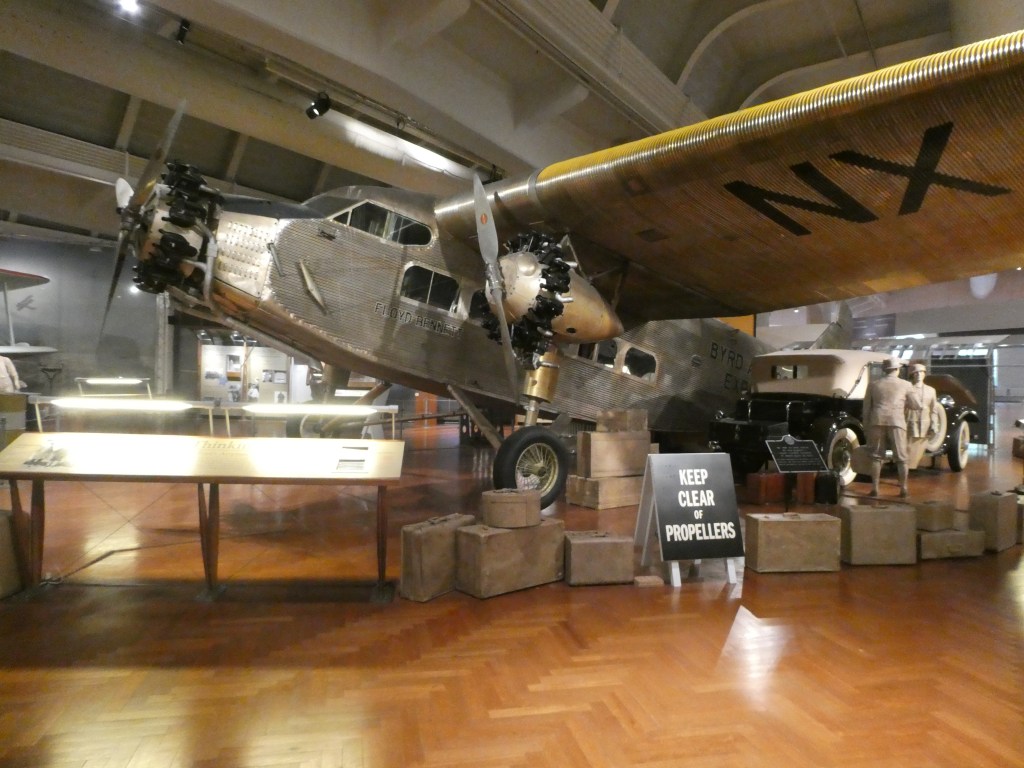
The Ford TriMotor was the first successful all metal plane, nicknamed the Flying Washboard. The plane was made of a corrugated aluminum alloy called “duralumin” that was as strong as steel while remaining relatively lightweight. There were 199 Ford TriMotor planes made. People trusted Ford airplanes because of the cars.
This Pitcairn-Cierva Autogiro was built in 1931. The company only made thirty of these plane/helicopters for about $15,000 each. The engine ran the propeller, and the blades turned on their own providing additional lift. The autogiro could land vertically but could not take off vertically.
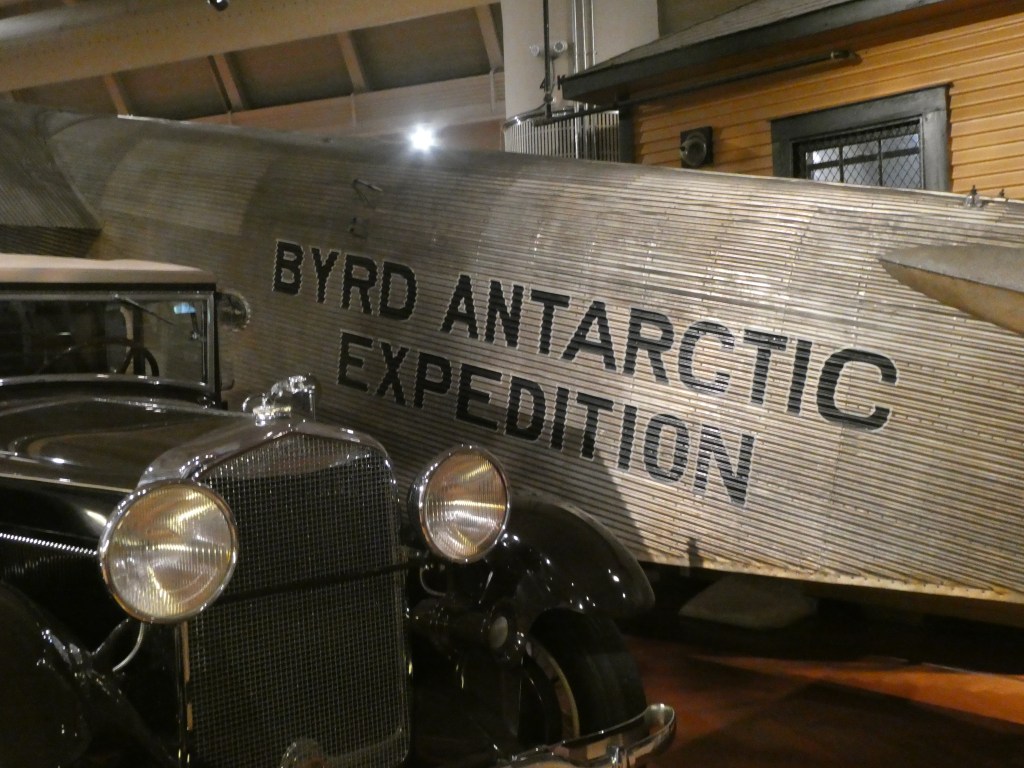
Edsel Ford financed Admiral Richard Byrd’s Arctic Expedition in 1926. Thereby the plane was named the Josephine Ford. However Tony Fokker was the manufacturer so he made sure that his name was prominent too so the plane was not mistaken for a Ford TriMotor. There is no definitive answer as to whether Byrd was successful in his attempt to fly over the north pole.
In November 1929 Byrd made the first ever attempt to fly over the South Pole. The successful attempt was made in a Ford TriMotor plane.
Among some other random things that caught my eye (among thousands more I could have chosen), there was a McDonalds sign.
Sign #146 in the McDonald’s system was installed August 1960 at the Madison Heights, Michigan franchise. This style of sign was used until 1962 when new stores installed the more modern Golden Arches. This sign was in use until it was donated to The Henry Ford in 1986.
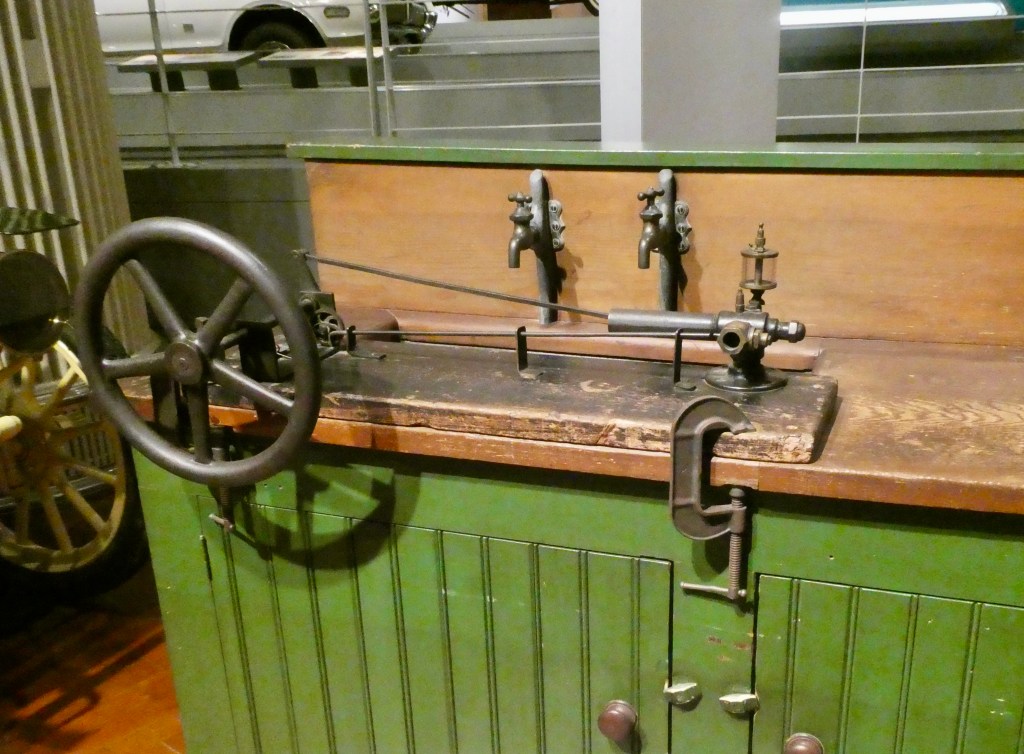
One final item is Henry Ford’s Kitchen Sink Engine. Text from the display states: “On December 24, 1893, Henry Ford carried his first experimental engine, made from bits of scrap metal, into the family kitchen and clamped it to the sink. His wife, Clara, fed gasoline to the intake valve while Henry wired the spark plug to an overhead light and spun the flywheel. The little engine coughed and then roared to life.”
And that engine changed the future for the Fords and America.
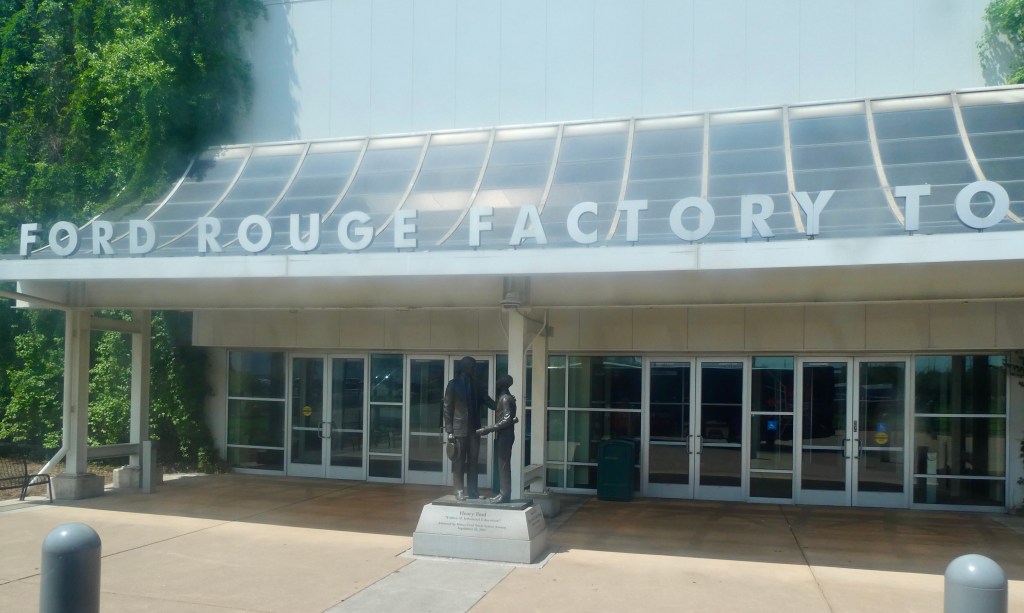
We visited the Ford Rouge plant in Dearborn, Michigan. Construction on the Rogue plant began in 1917 and was completed in 1928. At that time it was the largest integrated factory in the world.
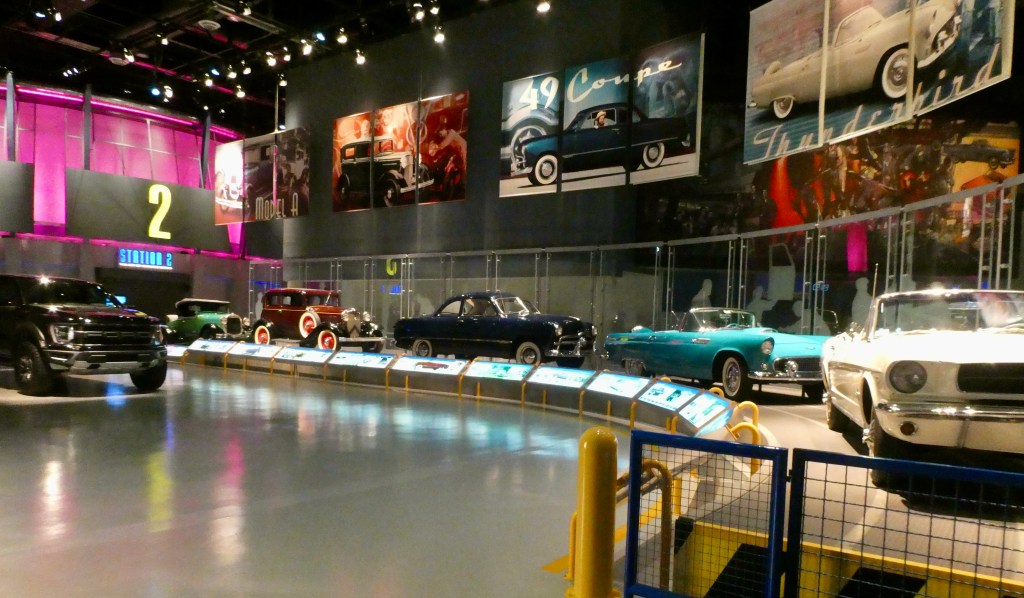
Over the years this plant has produced fifteen Ford products including the second generation Model A, V-8, Thunderbird and Mustang.
Now it is the production home of the Ford F-150, the best selling truck in the US for 46 years.
Our tour started with two theater events The first was a movie sponsored jointly by Ford and the United Automotive, Aerospace and Agricultural Implements Workers (UAW).
We hadn’t known that UAW had a broader membership base than auto workers.
The movie repeated some of what we had learned at the Piquette Plant Tour but added a segment about labor relations. Ford resisted union organizers passionately (and physically) because he thought he’d already done enough for his employees. He doubled their wages at one point. It took four years, but Ford employees did eventually unionize.
While Henry Ford was in charge, he emphasized bringing in all necessary raw materials and making everything in house. Under this management style, raw materials were turned into a car within 72 hours.
In a move that Henry Ford would not have approved, many components are now outsourced. The Rouge plant has only enough back stock for a few days of production.
Our second theater event involved video, robotic arms and visual imagery to build an F-150 right before our eyes. It gave us a very good overview for what we would see later on the assembly line floor.
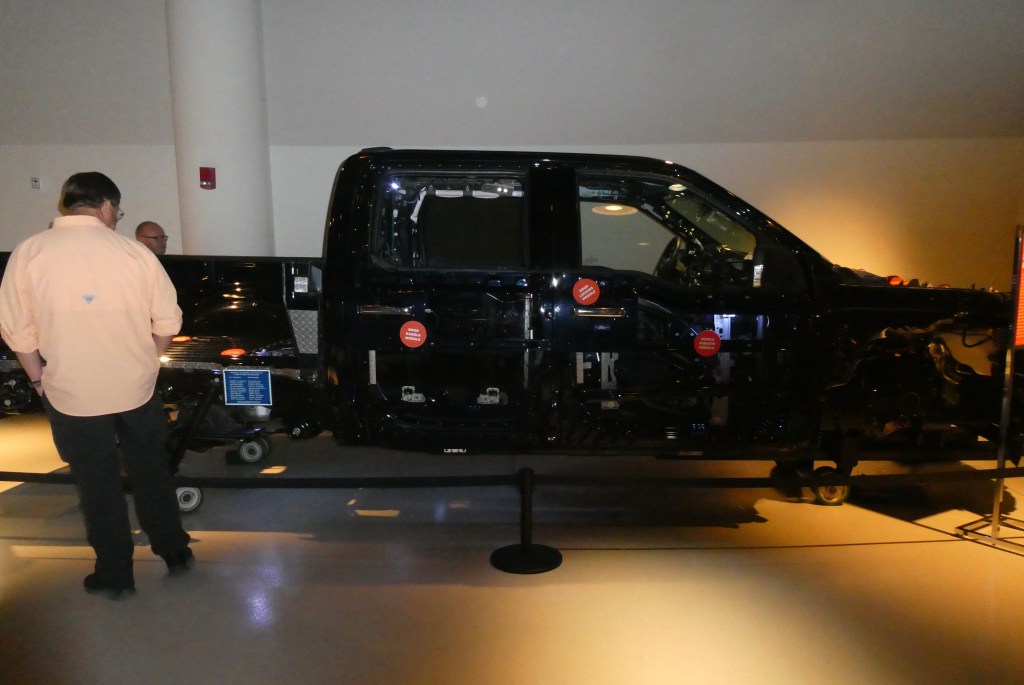
We explored some of the exhibits in the visitor center and Randy looked over the 2021 Hybrid F-150. This truck is a pre-production version of the hybrid model of the F-150. It combined a 3.5-liter turbocharged V-6 with a lithium-ion battery and 35-kilowatt electric motor, producing 430 horsepower. The hybrid engine has 20% better fuel economy. Ford Truck customers are able to choose the powertrain that most suited their needs – gas-powered internal combustion engine, hybrid gas-electric or full electric. My original research didn’t find that the hybrid F-150s were available but reader Mark has seen and driven a hybrid. Cool!
We went to an observation deck for a view of the Rouge Factory grounds.
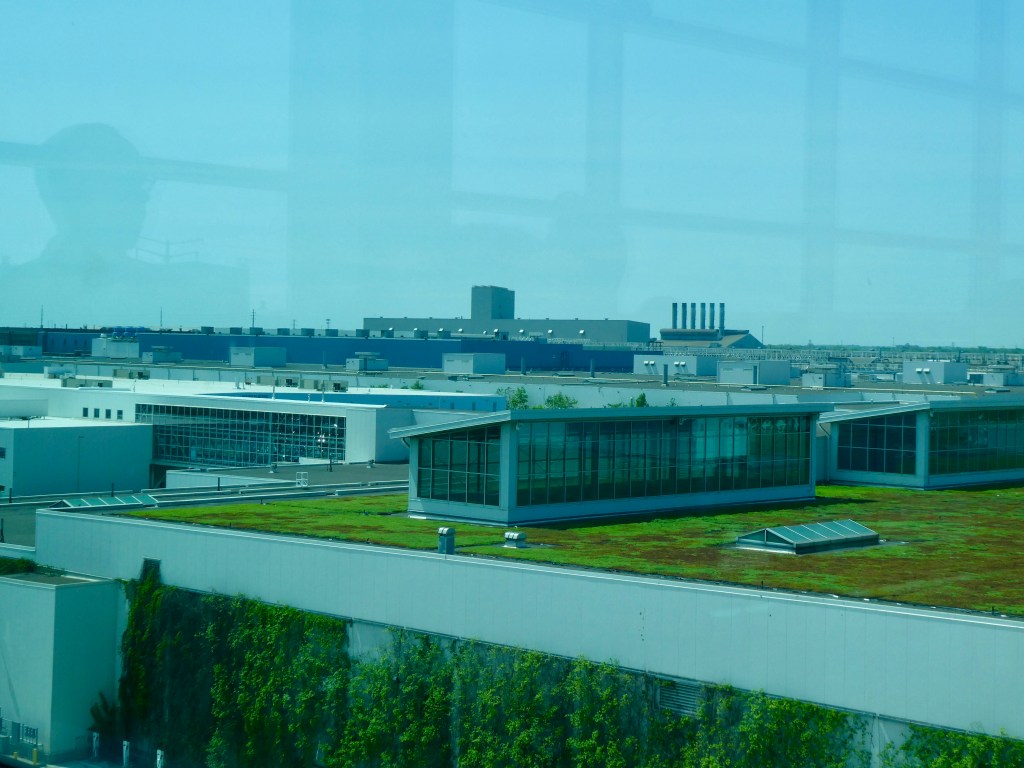
The dark building in the distance is the stamping plant. It is the size of 50 football fields. Military grade aluminum is used for body parts. The aluminum scraps from the process are collected and turned into chips and recycled. The recycled aluminum collected in one month, 20 million pounds, is enough for 51 jumbo jets or 37,000 Ford F-150s.
The building with the stacks is for painting. Body parts are run through a primer pool and then spray painted by robots.
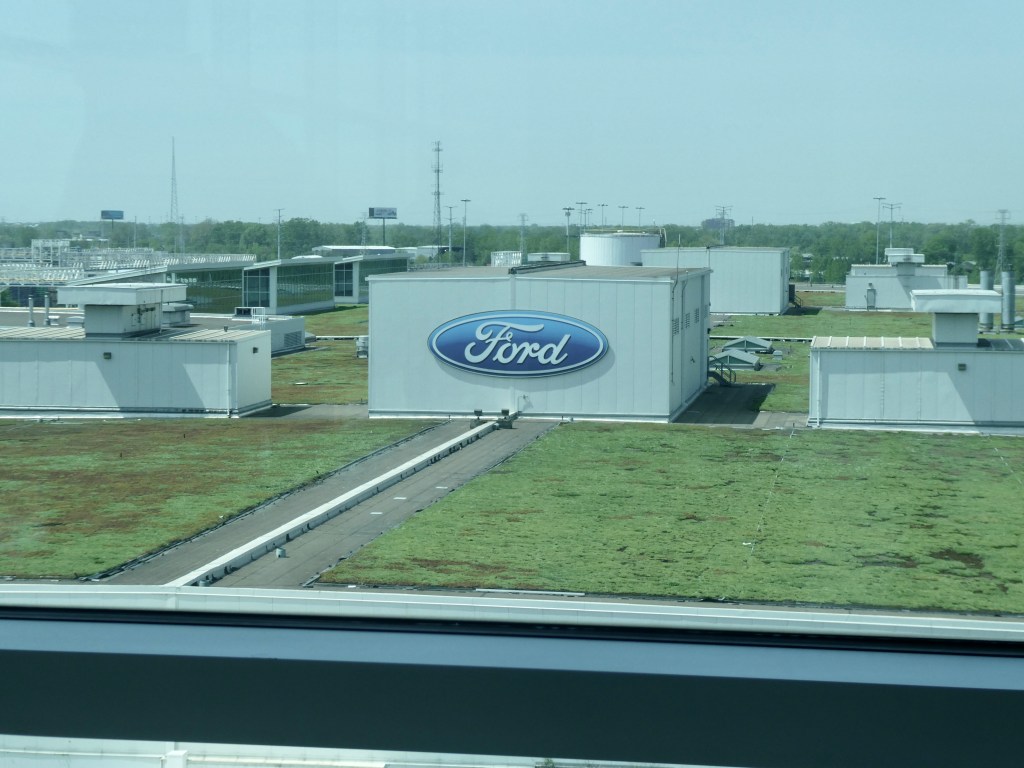
Final assembly occurs in the very large building under the living roof. This is the view from above the roof in the observation deck. This building is the size of ten football fields and is the only one we were able to tour.
The living roof utilizes several varieties of ground cover and, including the ivy on the sides, lowers the inside temperature by ten degrees. The insulation factor and the use of skylights reduce the amount of electricity needed to run that portion of the plant. The roof also cleans the air and absorbs rainwater. It saves the company significant money over a traditional roof and is thought to have double the lifespan.
The new electric truck The F150 Lightning is produced on the same plant grounds but in a separate building.
Unfortunately there were no pictures allowed inside the plant. We walked above and around the work being done below to create the world’s most popular truck for the last 46 years, the Ford F-150.
The 4.5 mile production line allows 53 seconds for each “job” whether it involves a robot putting in the windshield or an assembly line employee clipping in a rear light. A new F150 comes out of the Rouge Plant every 53 seconds.
The new truck is one of nine body types, on one of three chassis, with over 1000 combinations of options.
The assembly line computers are programmed to build each truck to the specifications of the buyer. Thirteen hundred trucks come off the line every day and all are pre-sold. None are going out for dealer stock.
Once the truck is built, it gets 8 gallons of fuel and goes for a 2-3 mile test drive. If quality control is satisfied, the truck is complete. It is shipped out to its new owner within 24-48 hours.
The rouge factory seems like an engineering marvel of consistency and efficiency. It also seems like a very boring job!
The workers do the same thing, or a very slightly modified version of the same thing based on the model, every 53 seconds for hours! We were told they sometimes trade jobs within their 10 person team to mix it up.
Workers seemed to wear whatever clothes they wanted. Some wore ear protection and many wore earbuds, presumably listening to music or audiobooks.
Randy did research on the average wage for beginning assembly workers at Ford – $20 per hour. We assume their compensation includes good benefits negotiated by the union, but we were surprised it wasn’t more money per hour.
Next up: One of Henry Ford’s “gifts” to Dearborn – The Henry Ford Museum of Innovation
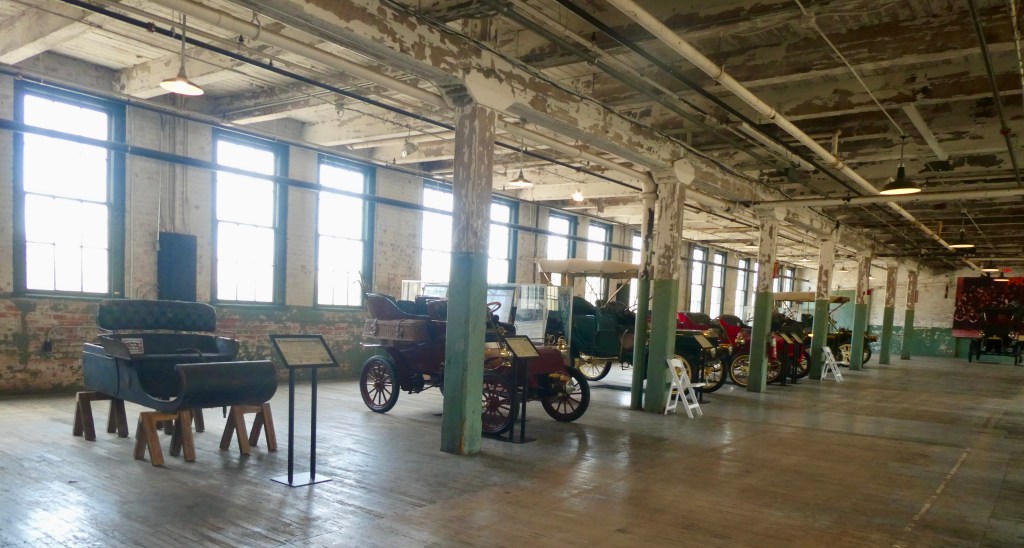
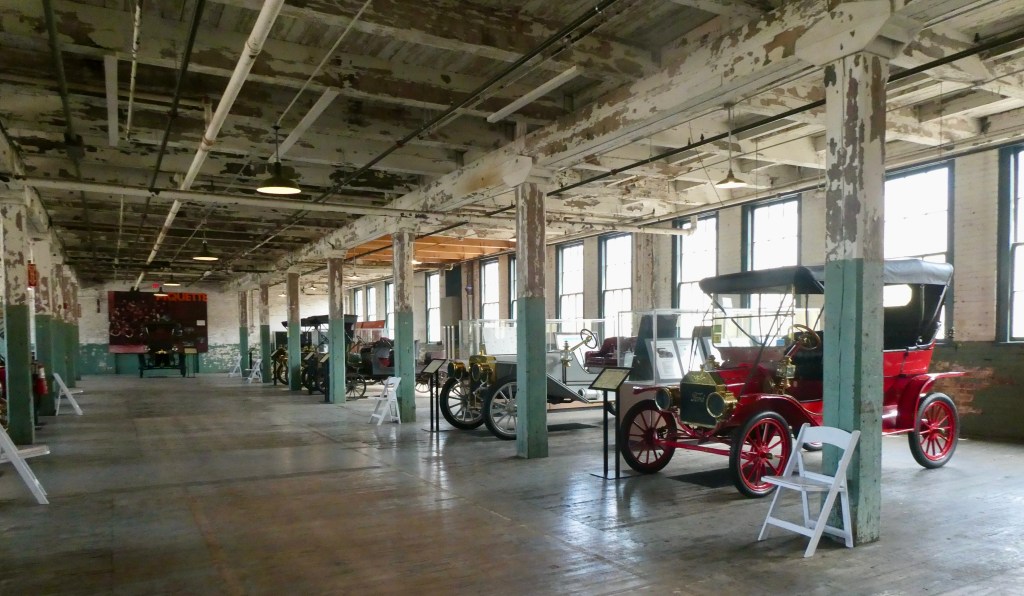
In the “Letter Cars” collection of the Ford Piquette Avenue Plant, they have the first Olds and then Ford Models A to F displayed sequentially on one side.
Model N is at the far end and then Models R through T are on the opposite side.
Many of “Letter Cars” have been loaned to the Piquette Plant by the Larry D. Porter Artifacts Trust. Their collection includes one of every car that Ford Motor Company built at both the Mack Avenue (1903) and Ford Piquette Avenue (1904-1910) assembly plants. Mr Porter paid for 17 years of storage for his collection while waiting to be able to display them in the Piquette Museum. Other collectors have loaned their automobiles for display as well.
There is a smaller, but similar, display of letter cars at The Henry Ford Museum of Innovation. I have used information and pictures from both museums in this post.
Ford started with A but skipped some letters. He chose to use A, B, C, F, K, N, R, S and T.
Models D and E were trucks and the projects were abandoned. That is interesting because a truck, the F-150, has now been Ford’s top seller for many years. Our next post will be about our visit to the Rouge Plant where the F-150 is made.
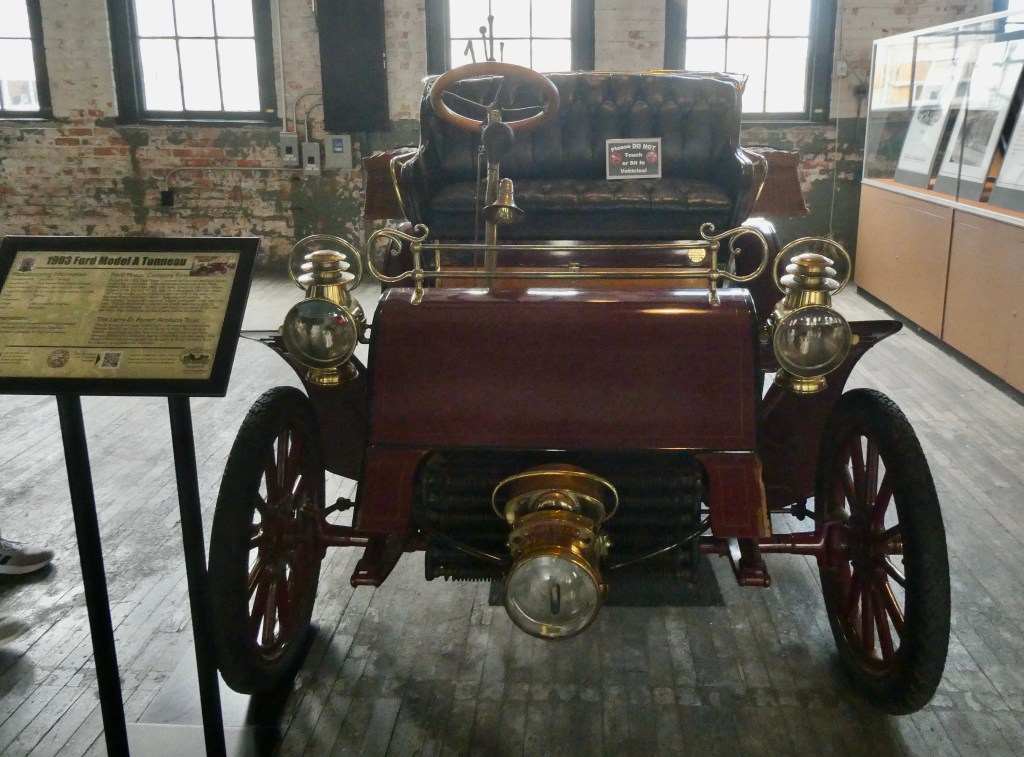
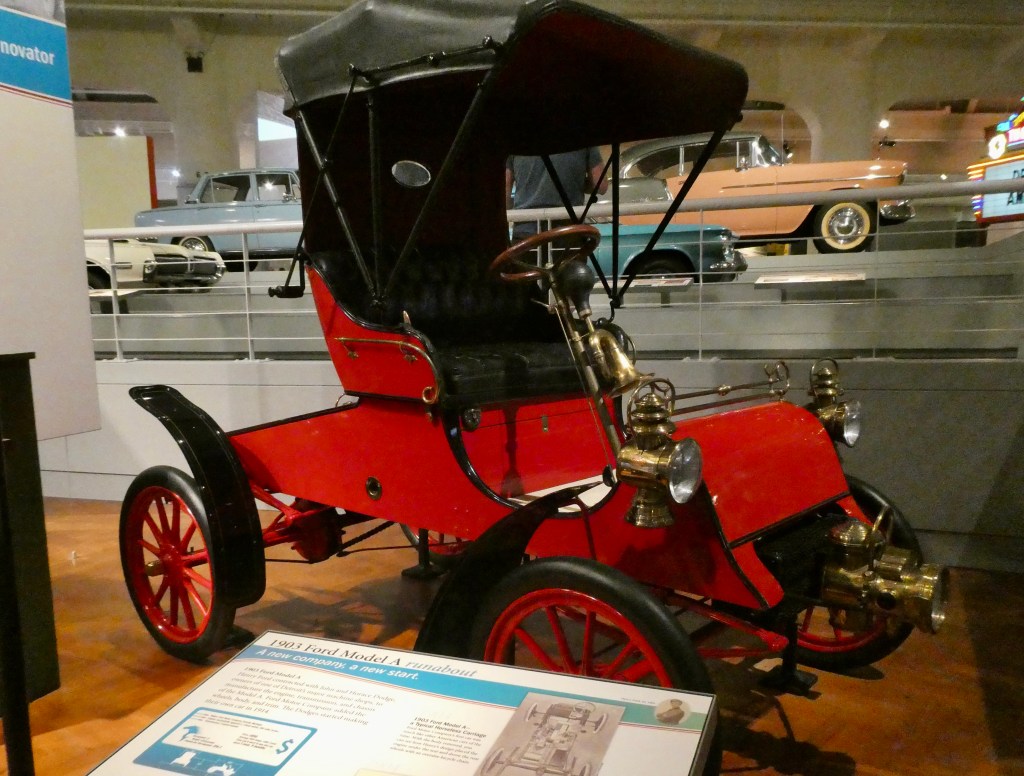
Model A
Ford’s first automobile, in 1903, was the Model A. It was developed in a rented building that burned down.
The driver had to pull the seat out to put gasoline in the vehicle. At that time gasoline was sold as a cleaning agent in hardware stores. Gasoline was a by-product after oil was discovered in the US in 1859.
In a Model A the back seat was optional. The original tires were white.
Model B
This 1904 Model B, built in the Mack Street Factory, is the most valuable automobile in the Piquette Plant museum. It was the very first Model B built and is one of only seven remaining in the world. This valuable automobile was in pieces in boxes in a garage in Missouri. It was purchased for $750!
In 1904, the profit motivated Ford Motor Company shareholders coerced Henry into building the company’s first luxury car. This was not the vision Ford wanted for his company. The vehicle’s four-passenger body was accented with polished wood and brass trim and had a price tag of $2,000.
The Model B had the first four cylinder engine. The rear-axel and drive shaft developed for the Model B is the same design that was used until 1948. Those features and rear hub brakes set the Model B mechanically apart from other Fords.
Model Bs were produced from 1904 – 1906 but didn’t sell well. Only 500 were sold in 20 months.
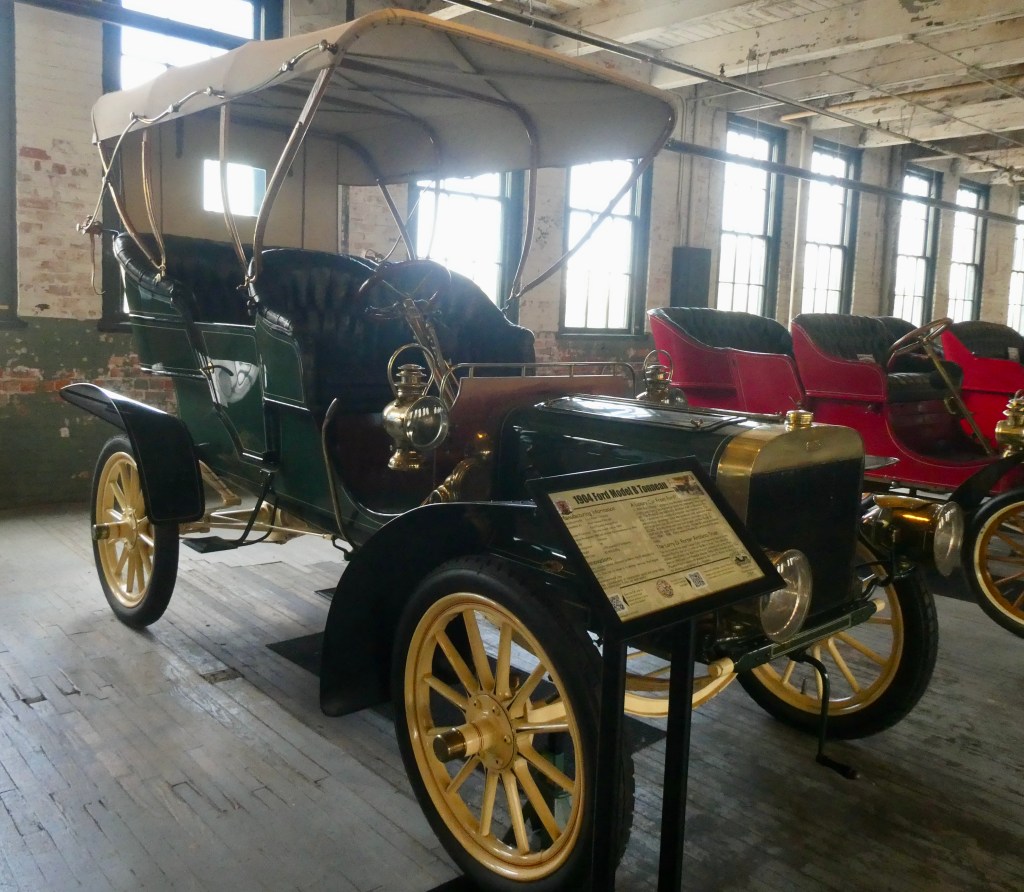
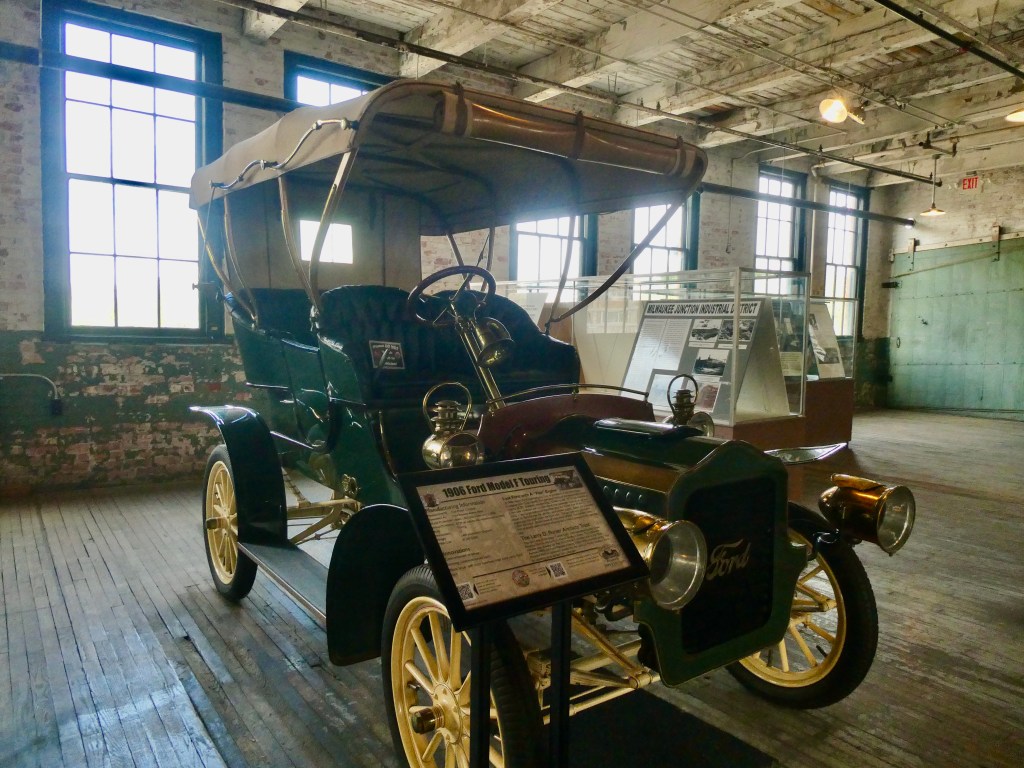
Models A and B were produced before the opening of the Piquette Avenue Plant. Models C, F, K, N, R, S and T were produced at Piquette.
Model C
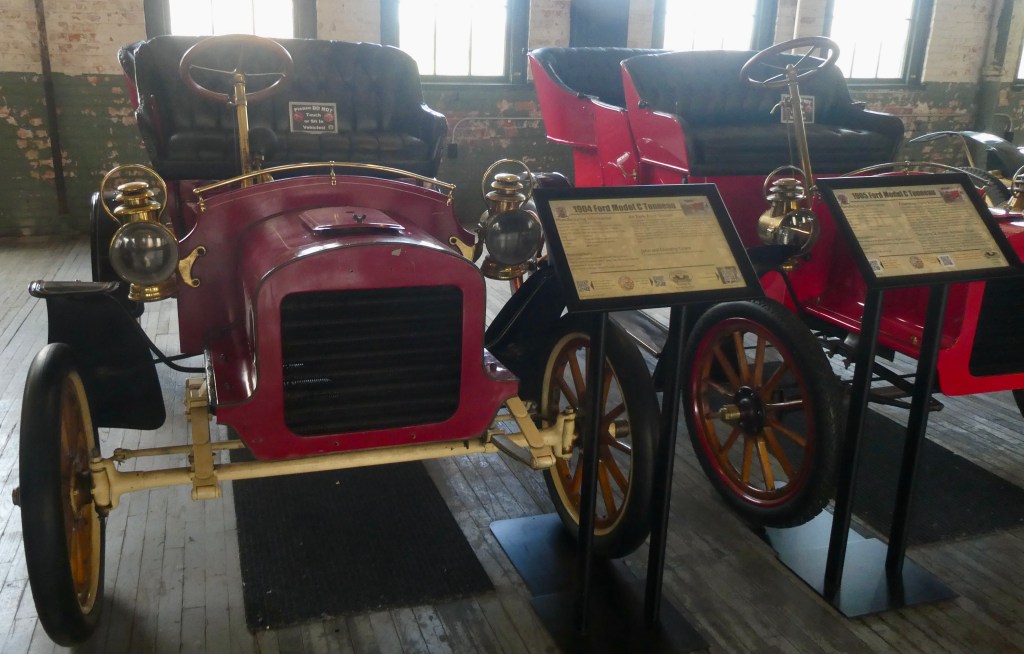
The Piquette Plant Museum has two of the 75 remaining Model C automobiles.
The Model C was more to Henry Ford’s liking, It was a quick update of the Model A going back to the two cylinder engine with a slightly longer wheelbase. A french hood was added in the front, however, the engine remained under the seat. The hood covered the water tank. The fuel tank was moved to the front.
Model F
In 1905, the company started production on the Model F with a wheelbase of 84″ and a larger 2-cylinder 12 HP engine. Other improvements included dual rear brakes, 30″ × 3½” wheels, and running boards for easier access. They also replaced the front bench seat with two single seats. Rear seating was optional. This model resolved many earlier car issues. Innovations included mounted oil lamps and a column-mounted horn. It was also possible to add side panels for a truck-like vehicle.
It was the last model with the flat 2 cylinder engine still mounted under the front seat and the last to use bicycle chains in their mechanisms. The gas tank was under the hood.
The Model F was available as a two seat runabout and a larger, more luxurious five passenger touring car. This large touring model was found in a barn with wasp nests inside!
These are two of the 40 known remaining Model F automobiles.
In 1906, Henry Ford became the president of The Ford Motor Company. Business was booming – reaching a 26.3 percent market share.
Model N
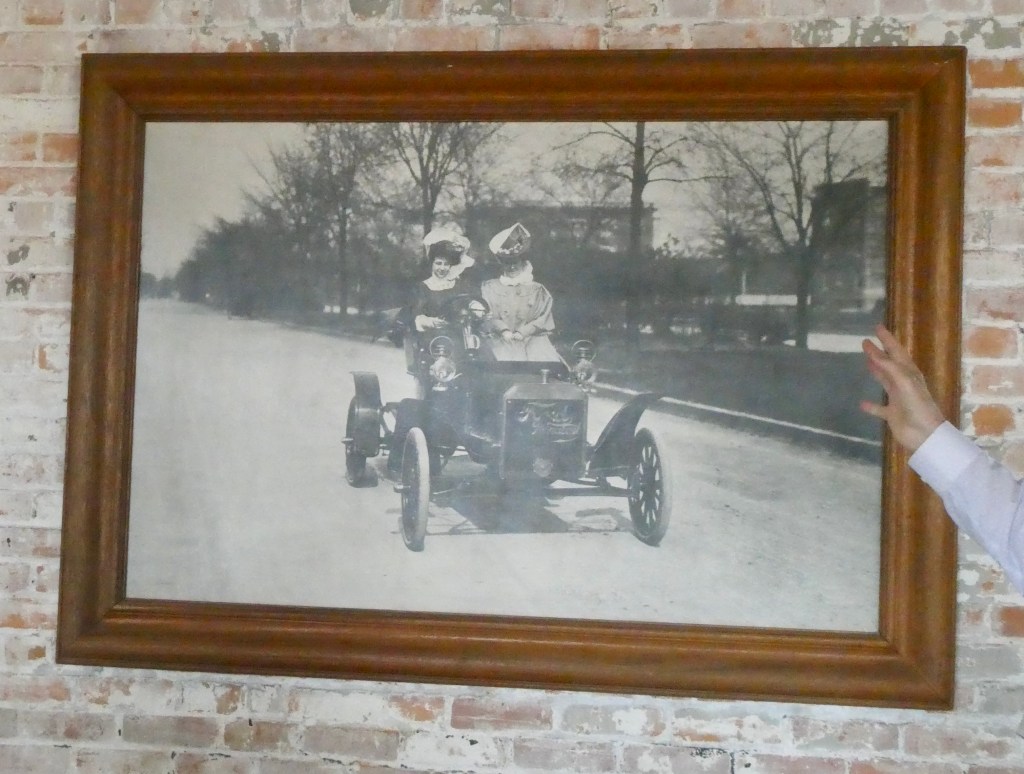
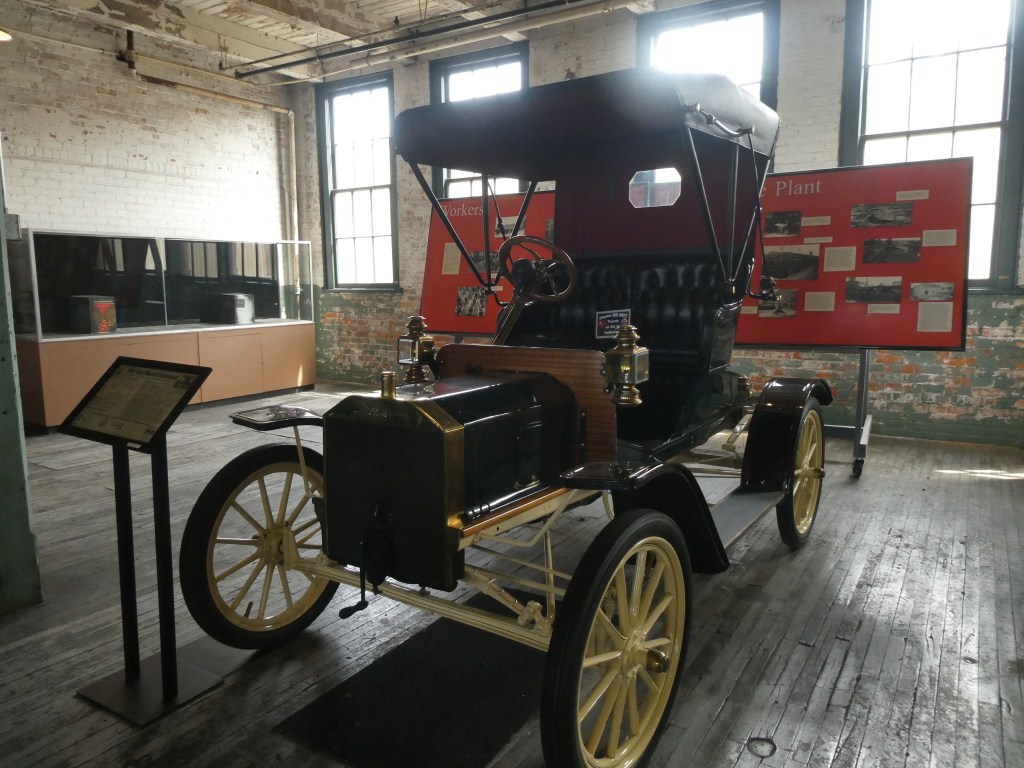
In 1906 the Ford Motor Company released the Model N and topped the sales charts. Production was the first to employ some level of assembly production at Piquette. At Piquette, Ford workers were able to build 100 per day and a total of 7000. The original cost was $500 but when Ford realized it cost them $490 to build each one, they changed the price to $600.
The Model N fulfilled Henry Ford’s vision of a very reliable, low cost automobile for the masses. It featured a front mount 4 cylinder engine that could go 40 mph.
This 1906 photo shows a Ford secretary driving Mrs. Ford in a Model N.
The Model N was the first automobile to use the flying Ford logo. The flying wings were used on 12,000 cars between 1906 and 1910, 99.9 percent were made in the Piquette plant. When Ford changed suppliers for the part, the wings got dropped and it wasn’t corrected.
By 1907 the Ford Motor Company had 37% market share.
Model R
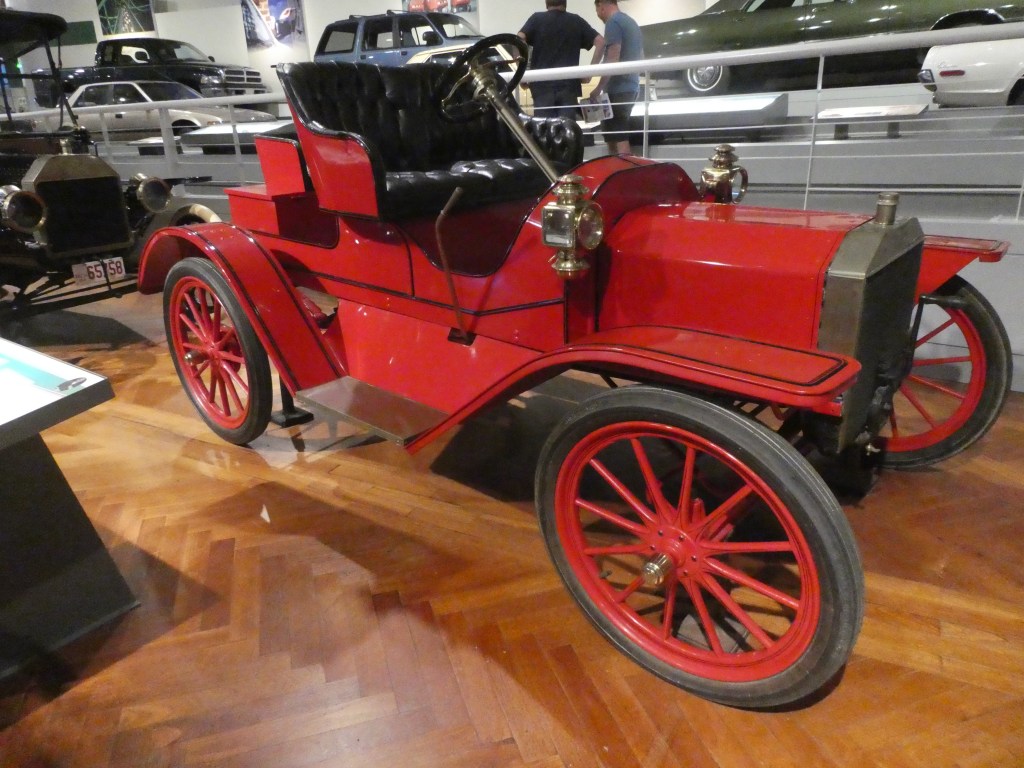
The 1907 Model R was a refined version of the Model N with full front fenders and attached running boards. It featured a two speed transmission and had the first spare wheel under the rear for on-the-road tire changes.
At $750, the Model R sold so well that part suppliers had difficulty keeping up.
It was available in two colors – Brewster Green and Carmine Red -and was considered the first car for women.
Model S
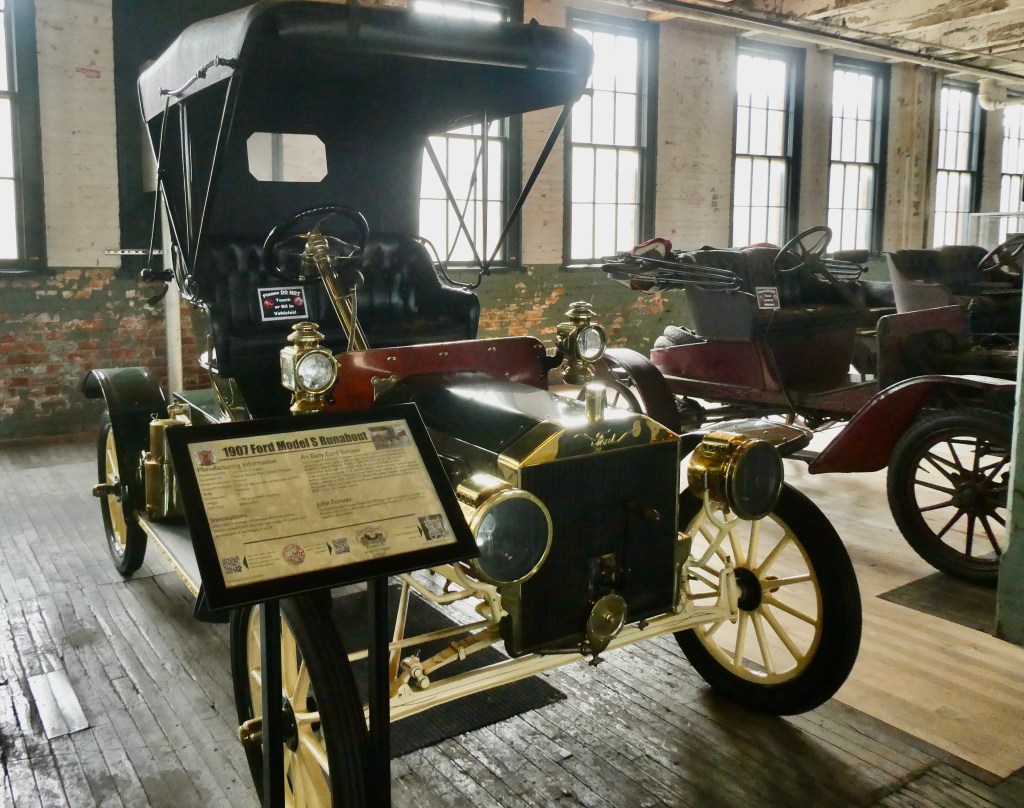
The 1907 Model S was an accident. The Model R was made on the Model N base. When they ran out of R bodies and wheels, they put R running boards on an N and called it Model S. The result was a down sized vehicle and reduced price. They sold a lot of Model S automobiles!
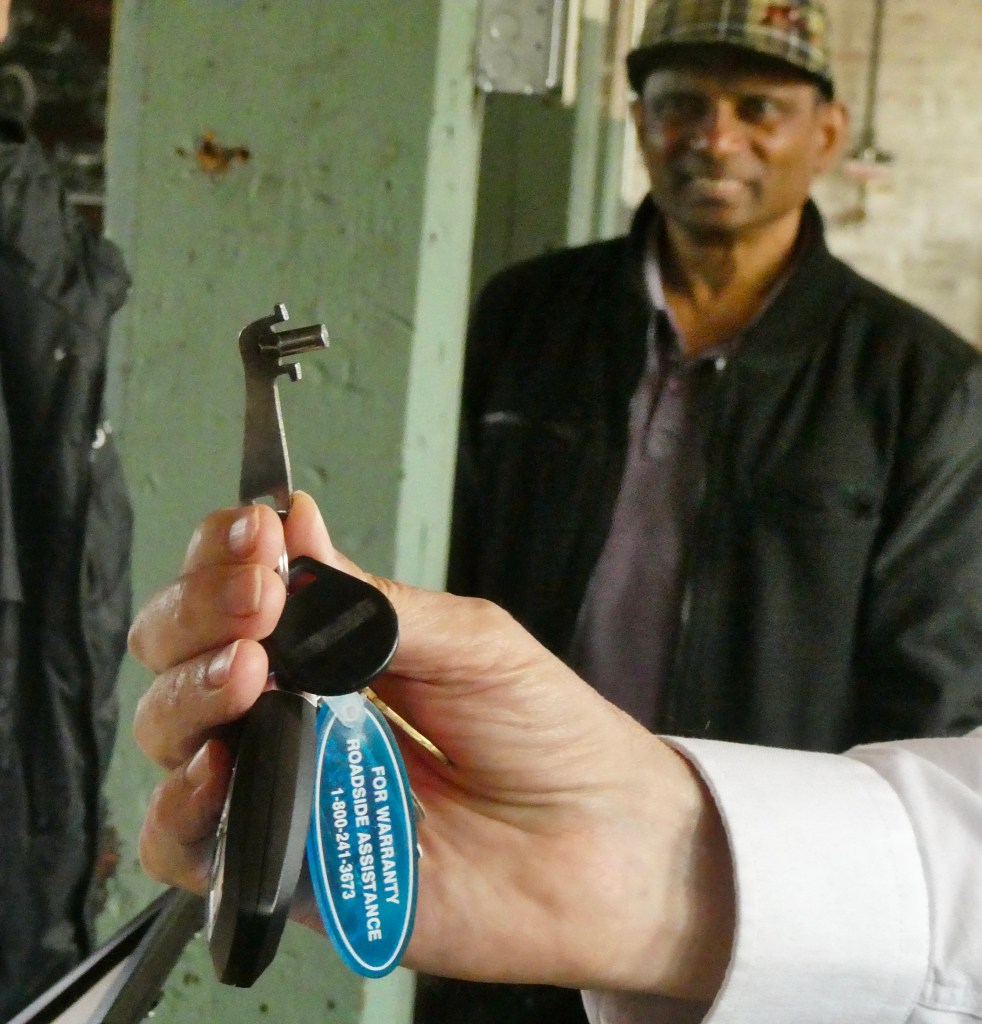
Owners of a Model S had the first car keys!
This picture shows two Model S automobiles. The one on the left is restored and certainly valuable. However, the one on the right, unrestored, is worth more. (That makes no sense to me!)
Do you remember the Model B Luxury version that Henry Ford didn’t care for? Even when your name is on the company, shareholders can insist on another Ford luxury model. That was the 1908 Model K. It could be ordered in a standard touring or in the roadster version pictured above. Of 900 hundred produced, only 28 remain with this being one of only 10 roadsters known to remain.
The Model K had a six-cylinder engine and 40 horsepower. It was the last Ford automobile to feature the six cylinder engine until 1941.
The cost of the Model K was between $2500 and $3000 and was considered the Ford Motor Company’s first failure. Alexander Malcomson, one of Ford Motor Company’s founding partners and promotor of the luxury line, left the company over the Model K. With his departure Henry Ford became the majority shareholder.
The Model K had veered away once again from Henry Ford’s goal to provide affordable and dependable vehicles. He was able to return the focus of the company back to mass-produced, affordable vehicles.
Did you notice that this Model K was a right side drive? There had been ten years of disagreement over which side the driver should sit. With development of the Model T, the decision was made for the left..
Model T – The Car that Changed the World
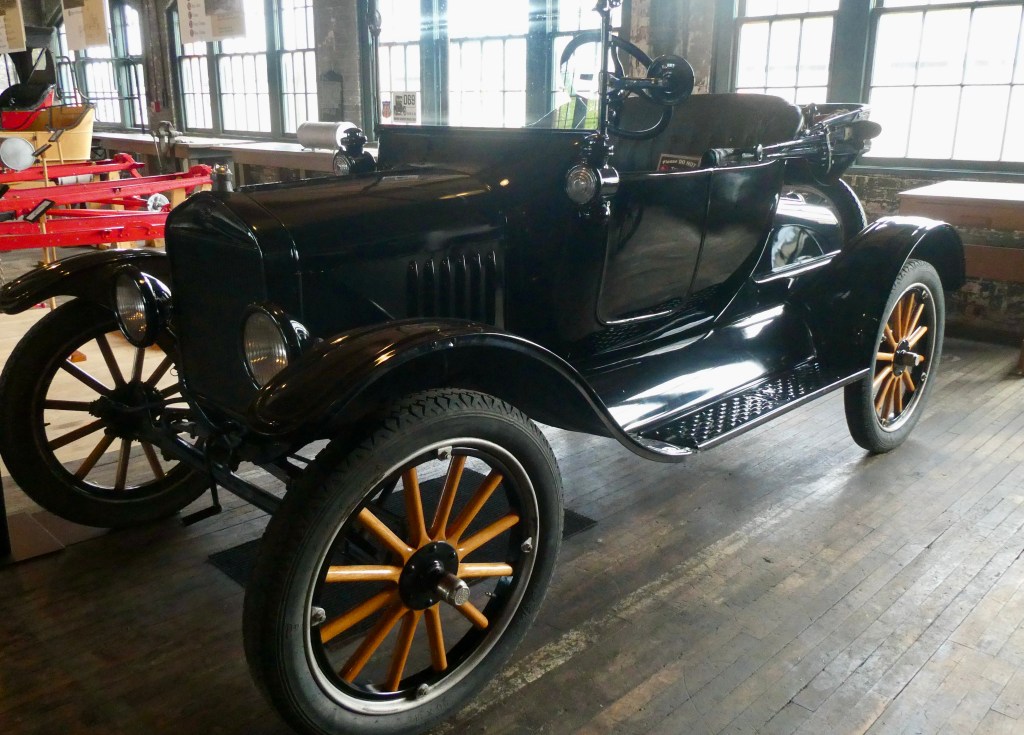
The Model T was Ford’s only offering in 1909. It was introduced in October of 1908. Collectively Models N, R, and S models led Ford to the Model T – but it was a totally new automobile.
The Model T had body parts made of wood, steel and aluminum. It was well-suited for badly rutted roads and rough terrain with a three point suspension. It was available in five styles: touring, runabout, coupe, town car and a landaulet. (A landaulet is a style where the rear passengers are covered by a top and the driver is separated from the rear passengers by a division as in a limousine.)
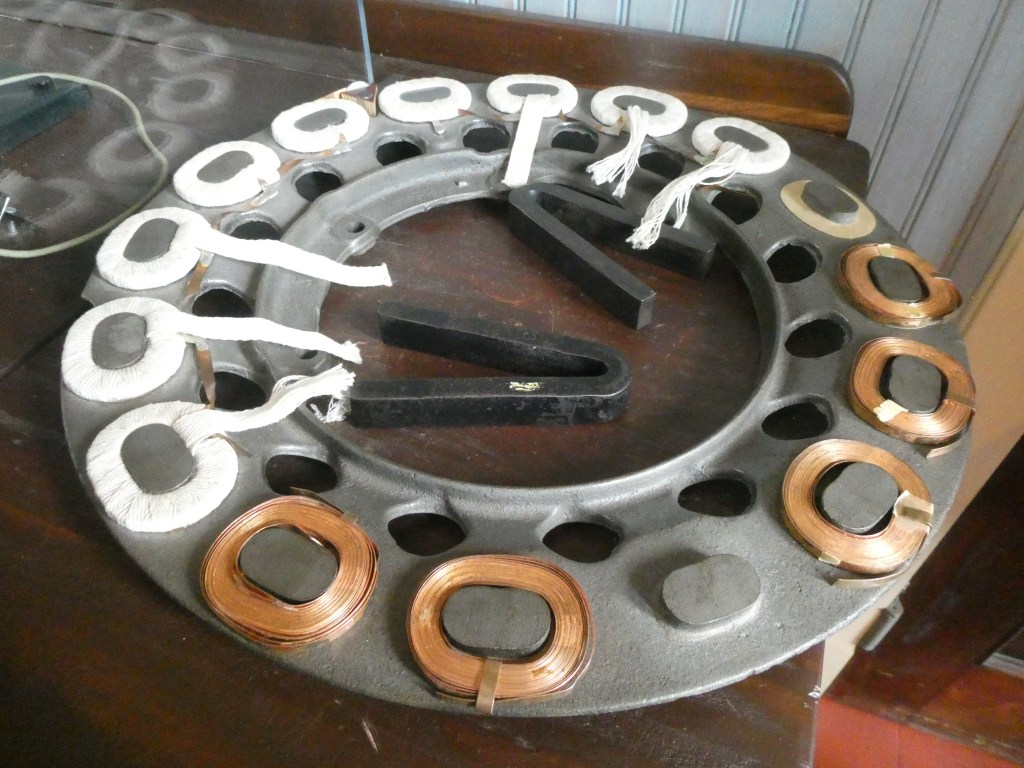
The Model T was the first to use a flywheel magneto ignition system developed by Henry Ford’s friend Edward “Spyder” Huff. It was considered a major advantage.
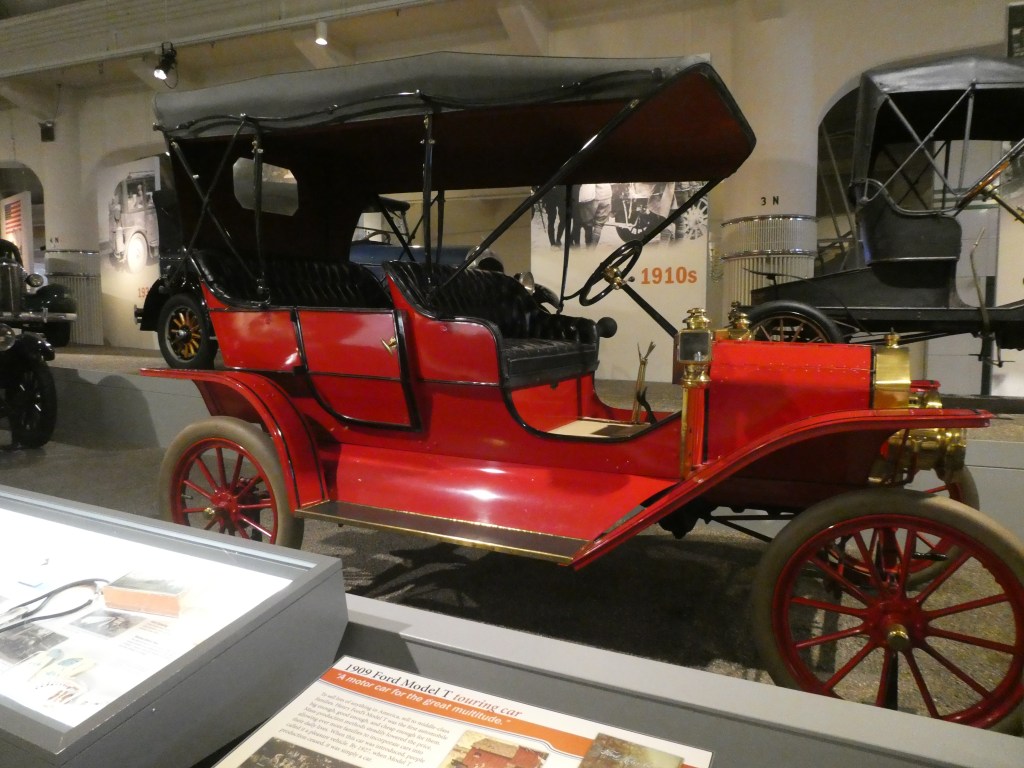
A 1909 Ford Model T Touring automobile.
This 1910 Ford Model T won the 1922 Stynoski Award for the best restoration of the year.
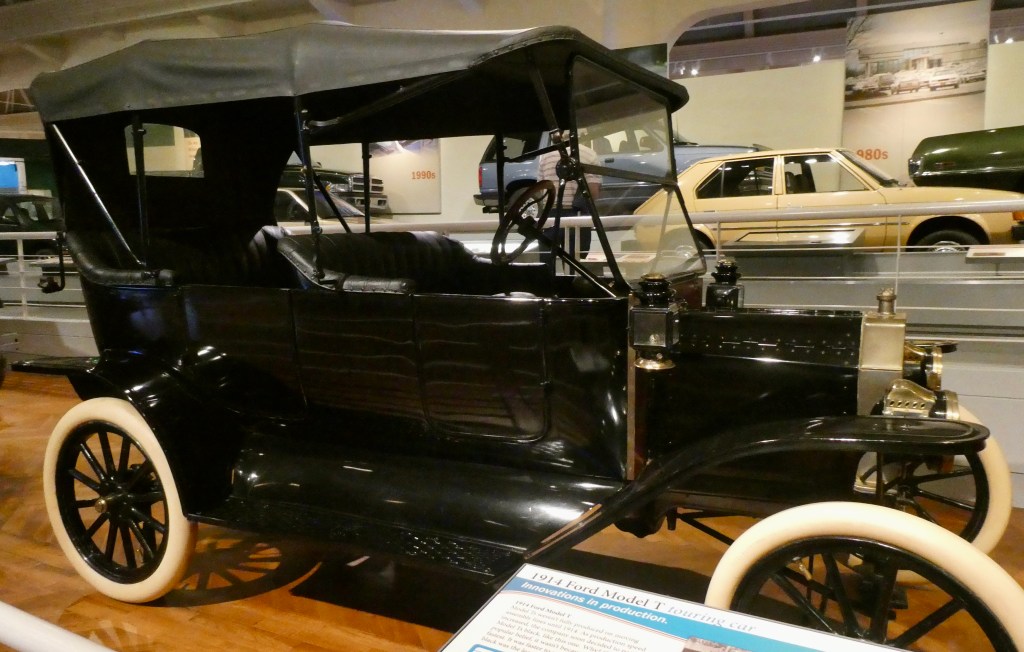
During mass production of the Model T, Ford decided to paint them all black because it was faster to use just one color. Black was the least expensive color and the most durable.
The assembly line had other consequences as well. The work was boring and Ford had lots of employee turnover. He doubled wages from $2.34 per day to $5 and then more workers stayed.
By 1914, the first year of the moving assembly line, the price the Model T reduced to $550.
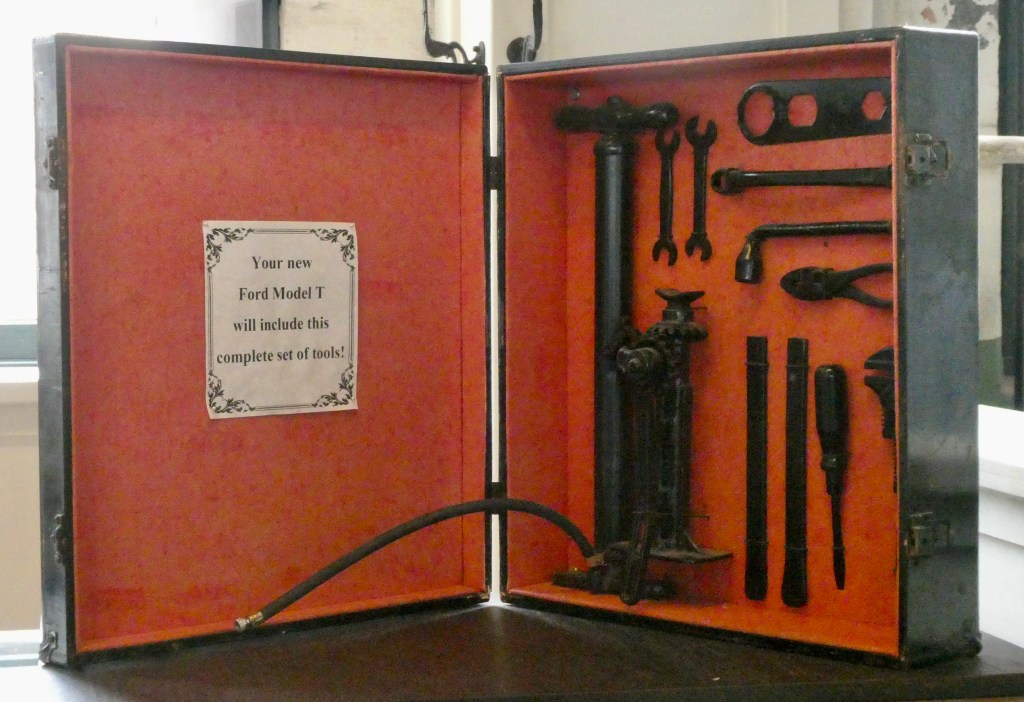
A tool set came with the automobile.
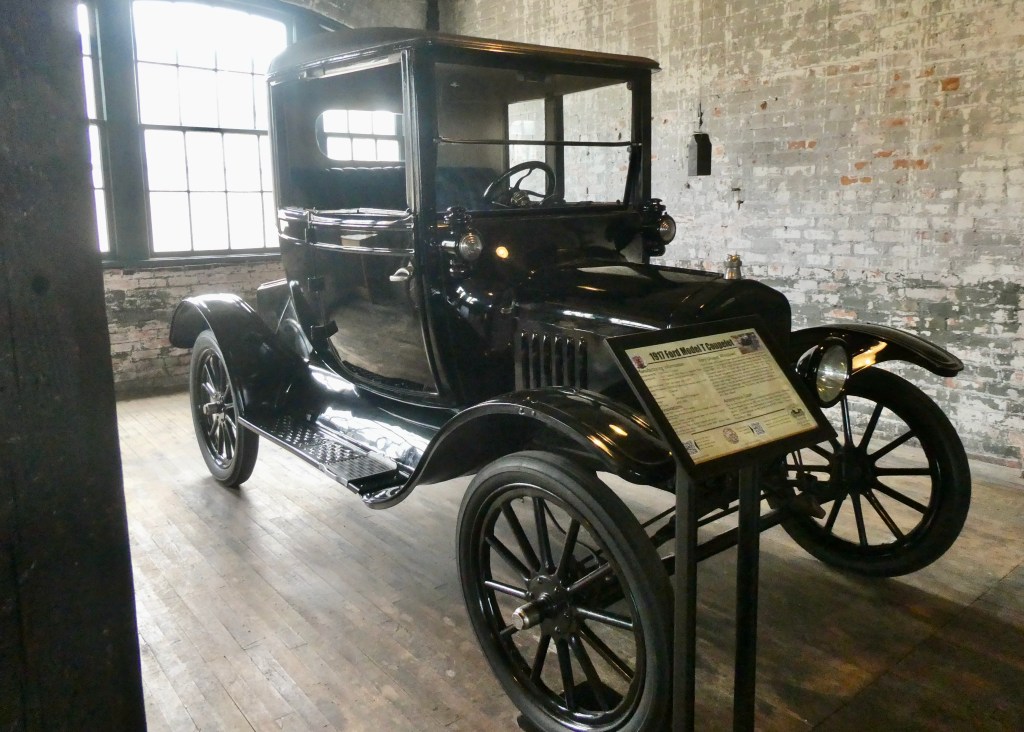
A 1917 Ford Model T Couplet.
By 1921 the Model T is outdated but sales continue due to the $370 price tag. One and a half million units were sold as compared to the technically superior Buick. The current Buick model sold 83,000 vehicles at a base price of $1795.
In the 1920s Chevrolet innovated more than Ford and the Model Ts time was coming to a close.
In 1926 Ford made some renovations to the Model T, including offering a variety of colors again, but market share continued to slip.
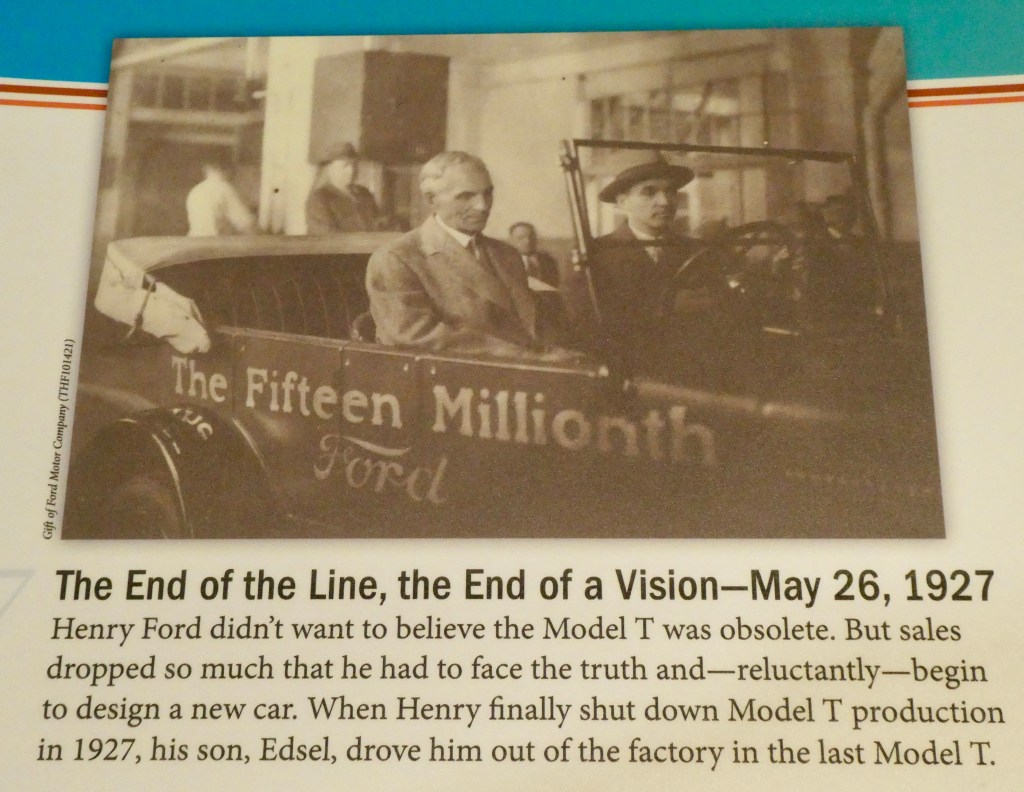
On May 26, 1927 son Edsel Ford drove Henry Ford out of the factory in the last model T made.
The Ford Motor Company sold 15 million Model T automobiles over 19 years. Shipments were made to every continent except Antarctica.
New Model A
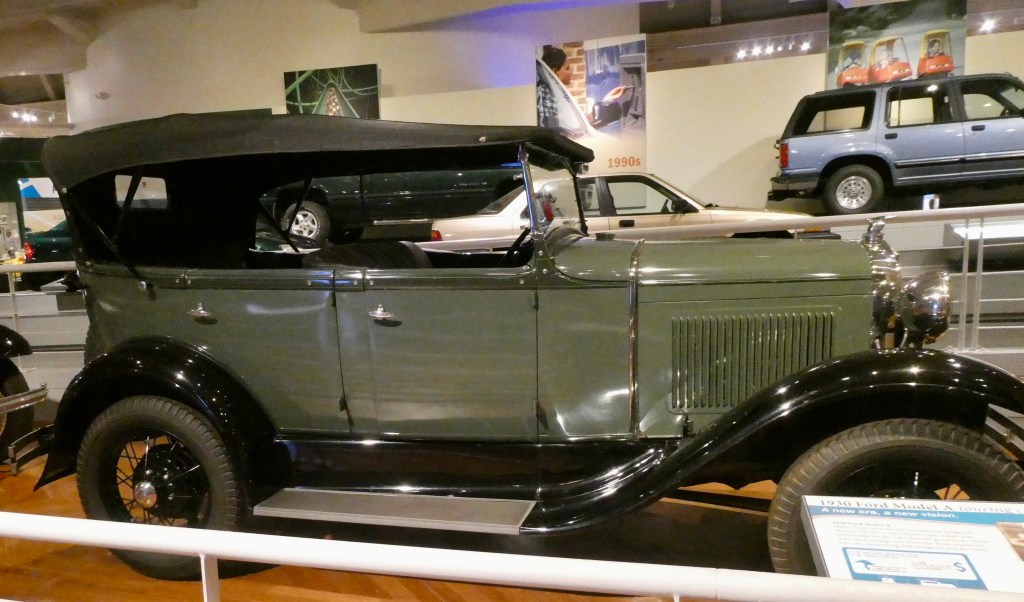
The Model T’s replacement, the all-new Model A, appeared in October 1927.It was assembled at the new Ford River Rouge Plant in nearby Dearborn, Michigan.
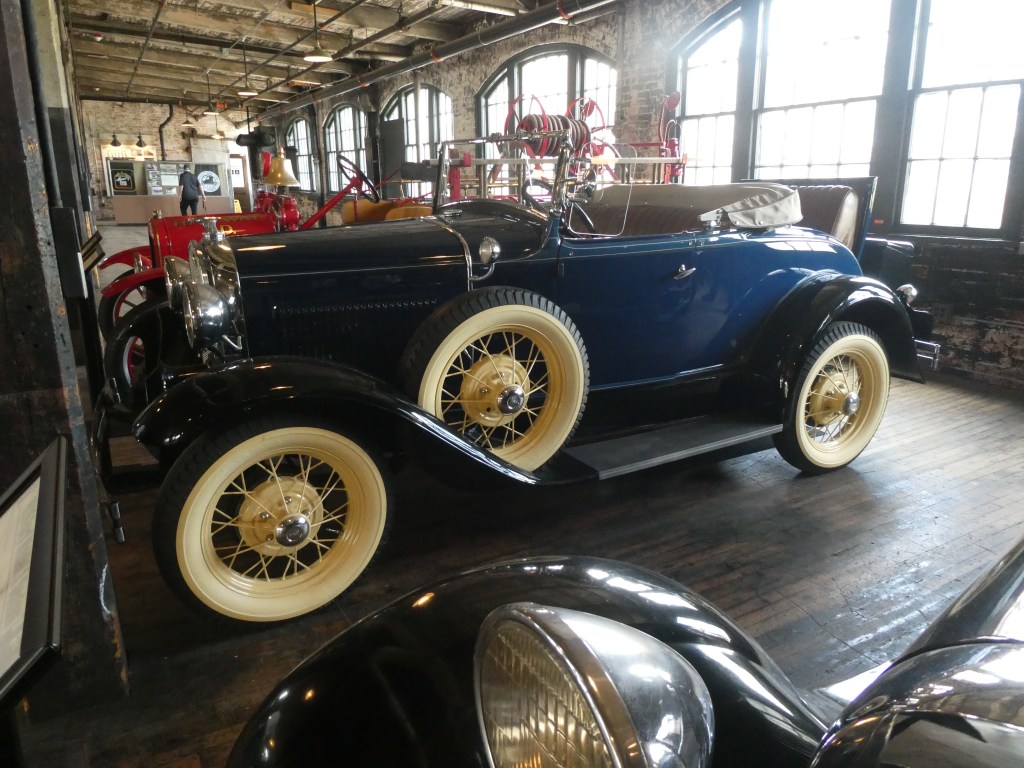
Edsel Ford added styling in the Model A to save the company. It sold 4.5 million from 1927-31 and cost $475 during the depression.
Ford outsold Chevy in 1929 and 1930.
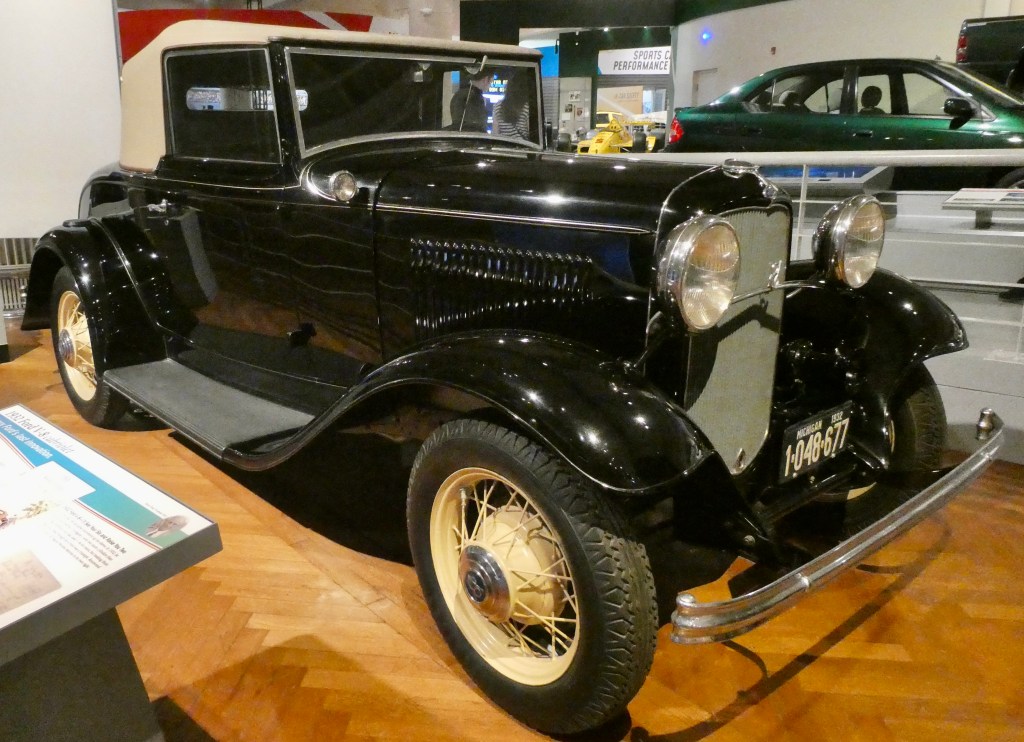
1931 Ford Model A Deluxe Roadster – Styling At Its Best! Competition was fierce, so Edsel Ford helped to develop an all-new, restyled Model A for 1930- 31. It was lower and more streamlined and was an instant success.
Chevy topped sales again in 1931 with a 6 cylinder engine.
In 1932 Henry Ford’s last innovation was to make the V8 engine light enough and inexpensive enough to mass produce. However, only 254,000 sold because of the great depression.
And the beat went on between Ford, Chevy and other manufacturers for decades.
The third floor of the Piquette Avenue Plant Museum has a whole array of Ford hacks and a variety of automobiles of note from other manufacturers.
Two of special interest to me follow:
This is a 1914 Regal Model T. Because Ford did not trademark “Model T,” he couldn’t stop other companies from using the same model name.
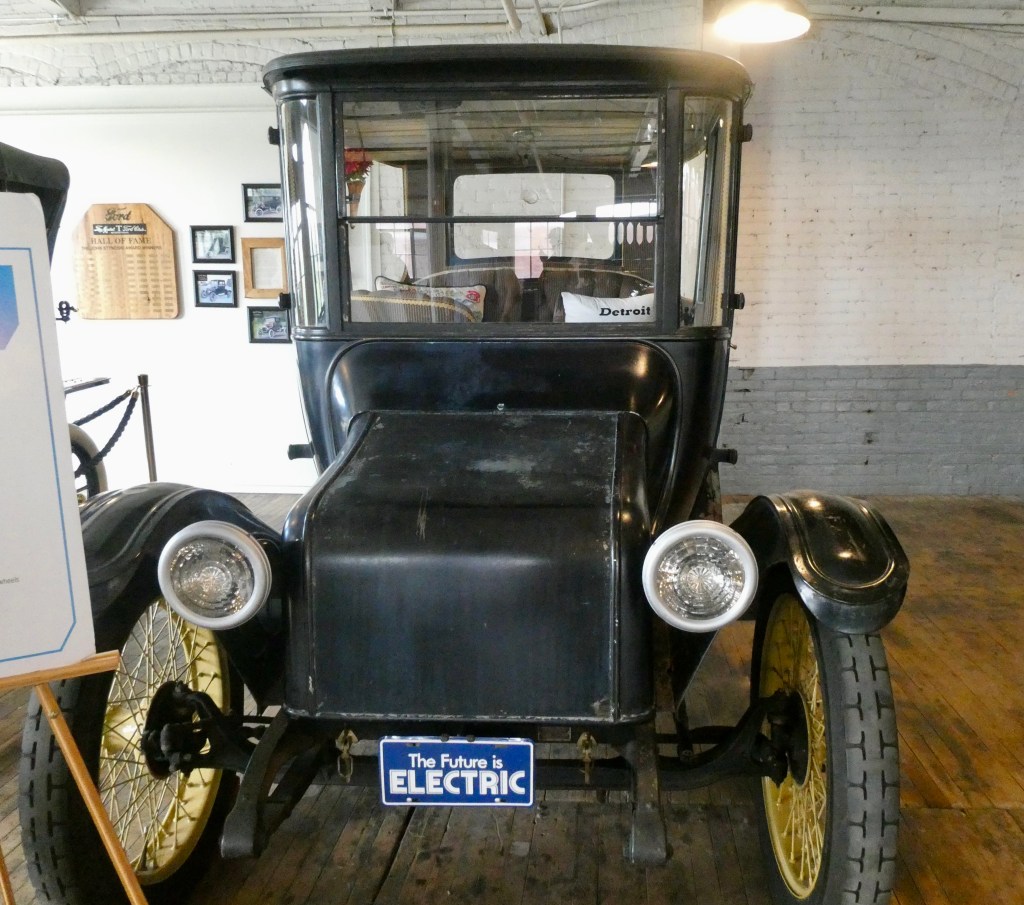
The second is a 1918 Detroit Electric Brougham. It was urban mobility for the rich selling for $2940. Its power was 84 volts sourced from 14 batteries .
The vehicle featured curved glass and a high roof. The seats were regular household furniture .
The Brougham’s top speed was only 20 mph which negatively impacted sales. There were only 13,000 sold between 1907 and 1939. One of those 13,000 electric vehicles was sold to Clara Ford, Henry’s wife.
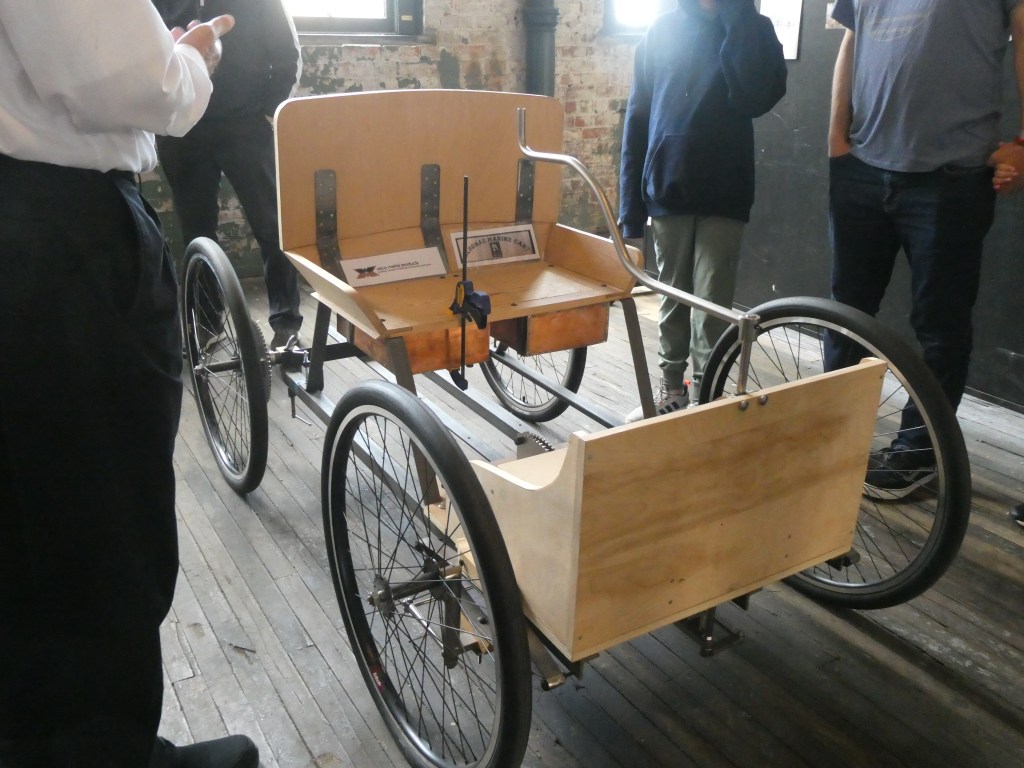
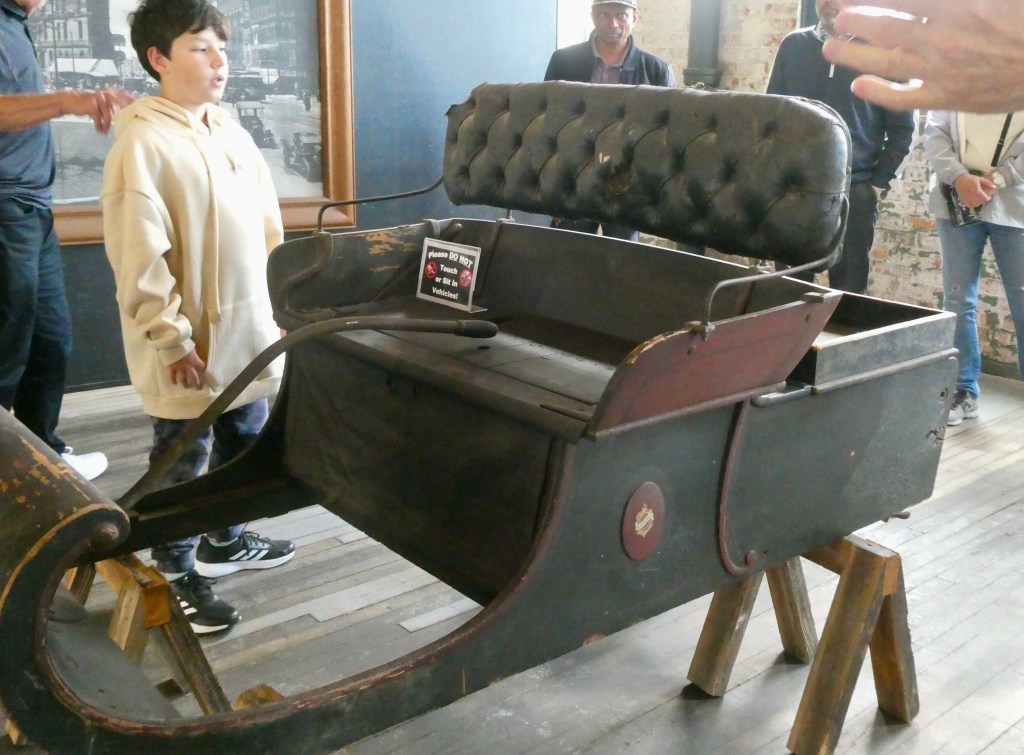
An early rendition of the automobile was the quadracycle. A driver put his foot on the tire to stop. Since there was also no reverse, the driver had to stop and turn it around. It was a start!
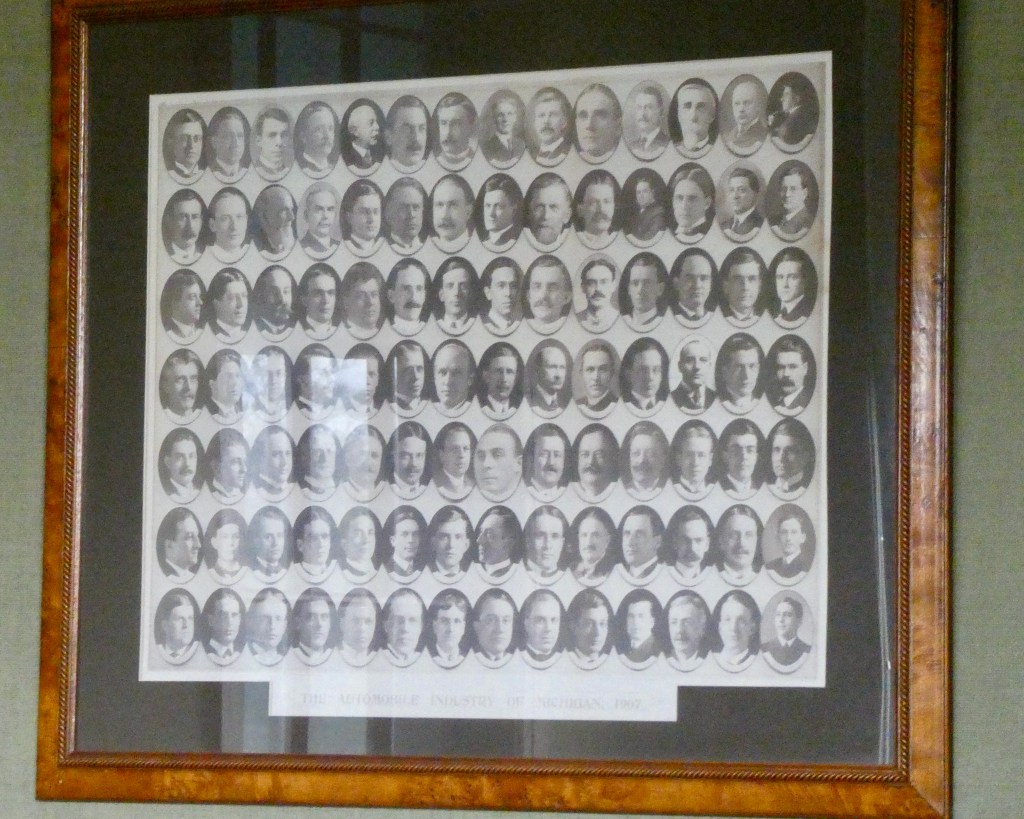
At the beginning of the 20th century Michigan had 100 car companies. Twenty were based in Detroit.
Olds was the first automobile manufacturer and, in 1904, introduced the Curved Dash. It was the first mass produced automobile. It was billed as cheaper and more reliable than a horse.
That same year, 41 year old Henry Ford moved the new Ford Motor Company to Piquette Avenue. Despite having two earlier corporate failures, he was a confident self-taught engineer and risk-taker.
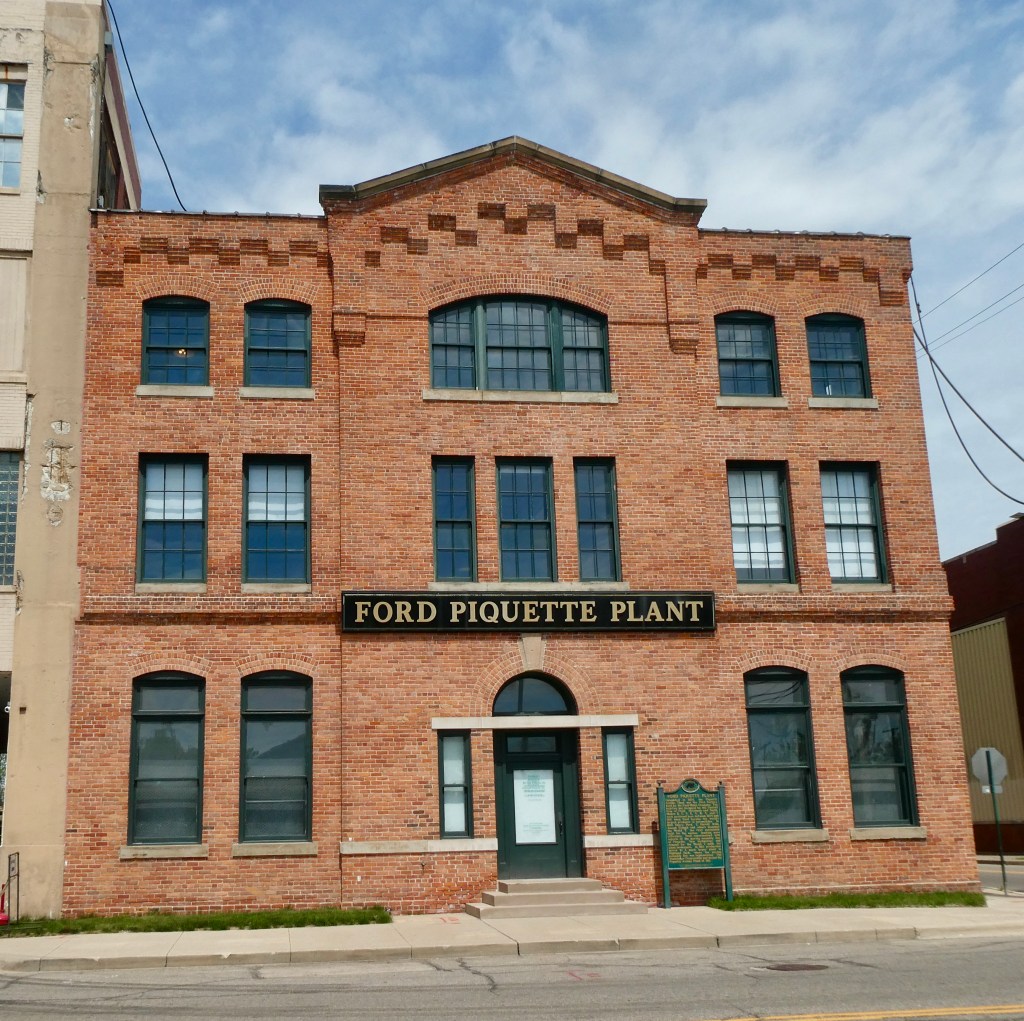
Completed in 1904 at a cost of $68,000, the Piquett Plant was the first factory built by the Ford Motor Company. The initial workforce was 30 men most of whom made $1 per 10 hour day.
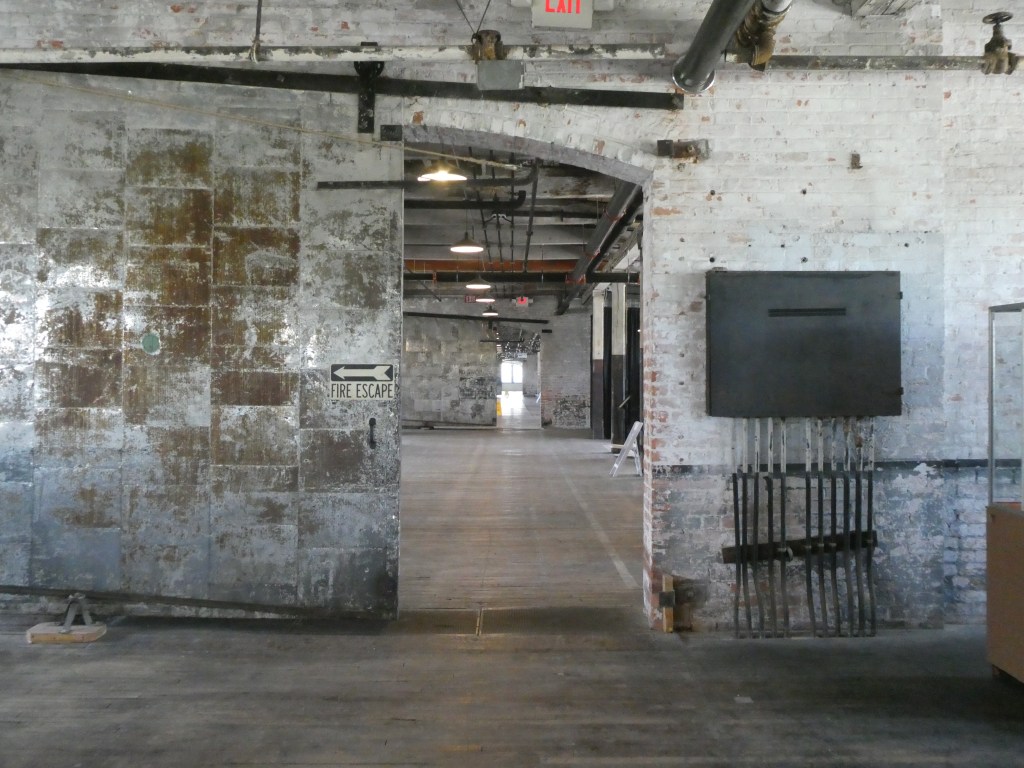
The building was separated with three sets of fire walls and doors.
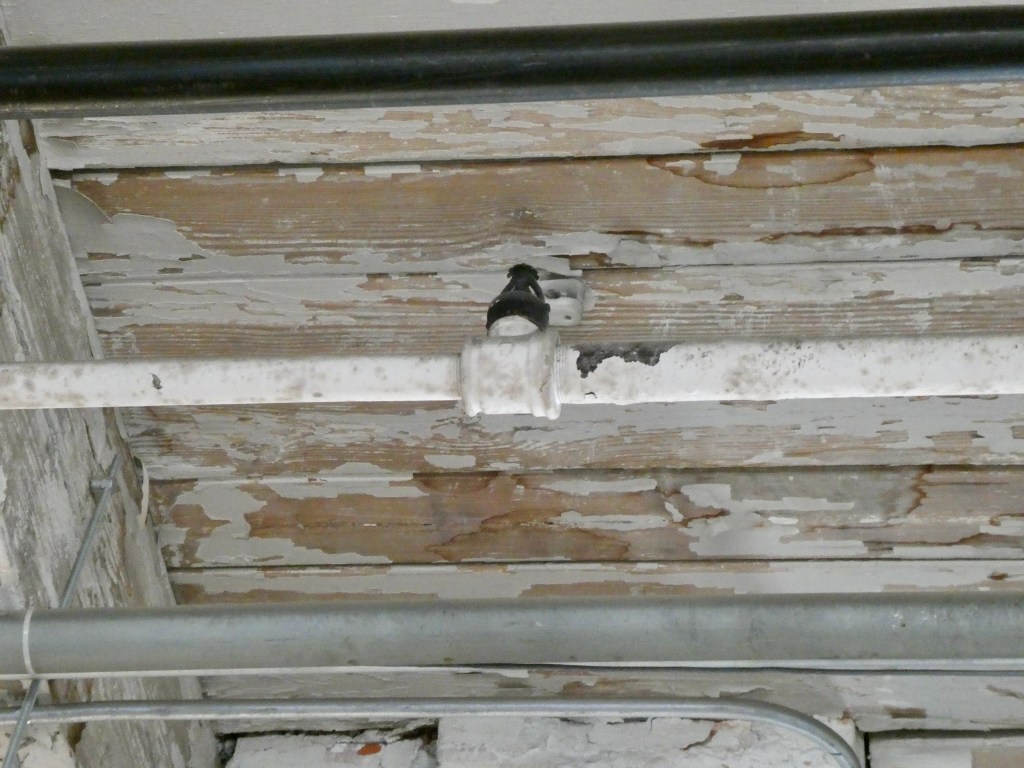
There was a temperature sensitive link of metal that would close the fire doors if needed.
The building had a sprinkler system but never had a fire to make use of it.
Ford was #1 by 1906. At the same time, Henry Ford was a charter member of the Wayne County Road Commission creating the world’s first modern highway.
During the years the Piquette plant was in operation (1904-1910), Henry Ford produced Models B, C, K, N, R, S and T. (More to come on the alphabet of automobiles in the next post.)
1908 Henry Ford, and others designed the Model T, the first automobile built for the masses. Seeking more efficiency, Ford experimented with aspects of the an assembly line at Piquette.
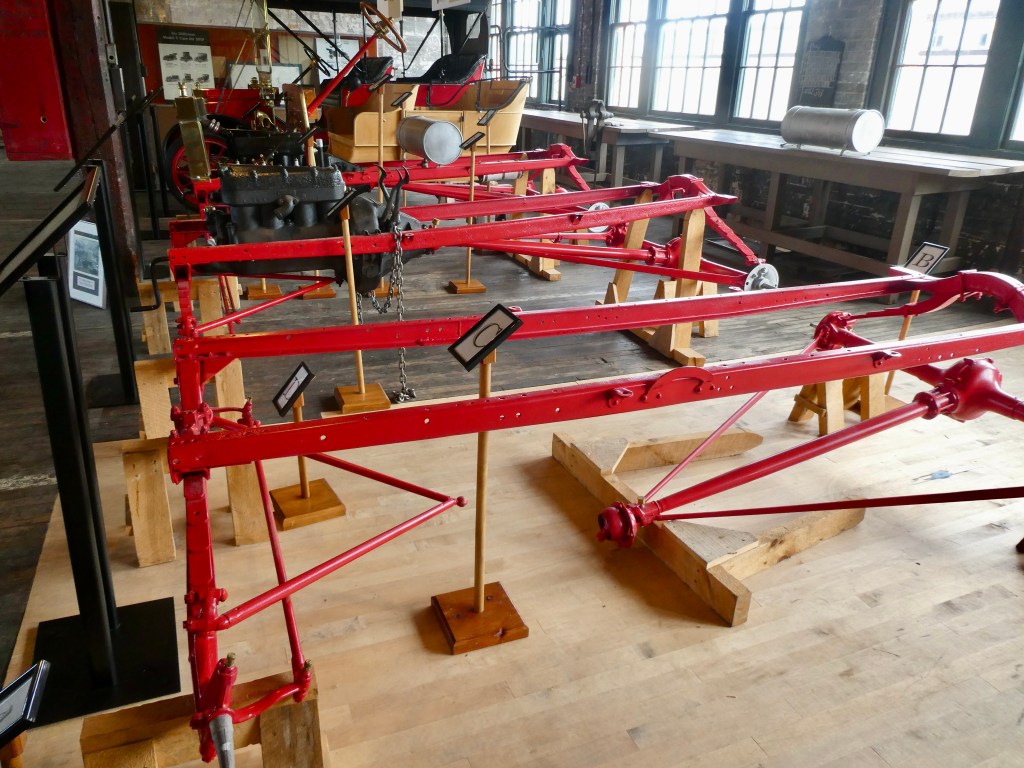
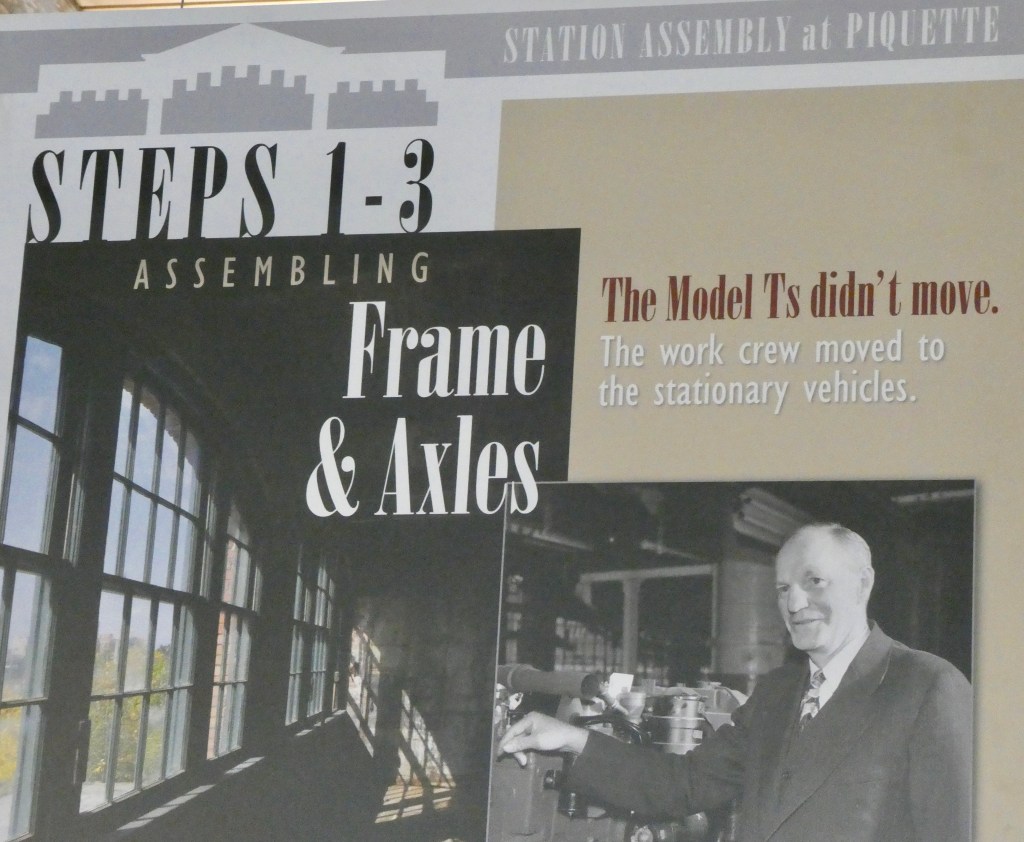
At first, the automobiles were put in stations with the workers moving from one to the next.
Ford raised worker pay to $5 per day to increase retention and loyalty. He was the first to pay you to eat, giving a paid 15 minute break during your day. In doing so Ford created a middle class that could buy his cars. Engineers were paid $25 per day. (Ford paid his employees in cash – a practice that continued until 1949.)
Even so, Ford felt there were secrets leaving the building as workers came and went. They created a secure room on the third floor used exclusively for design.
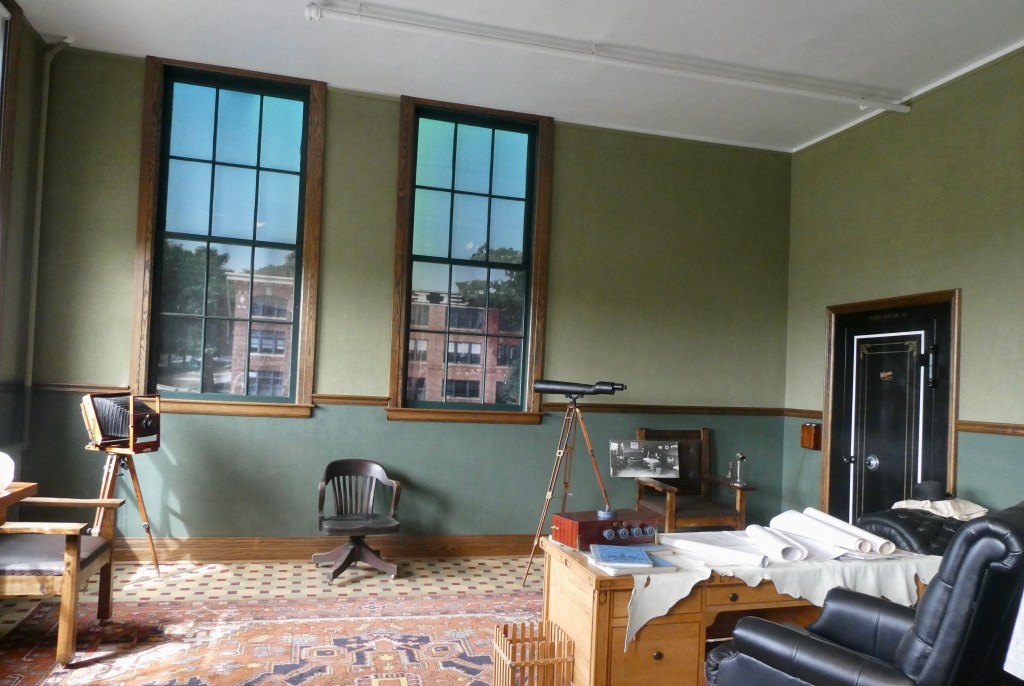
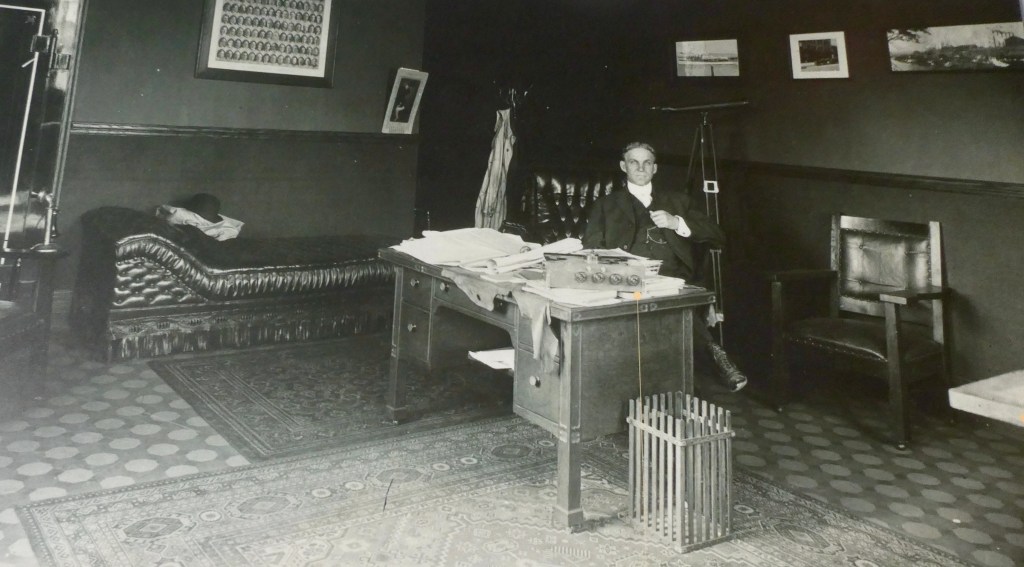
Henry Ford’s office was also on the third floor.
This is the only picture of Ford in this office. Notice the lounge in the back. He would sometimes sleep there.
In 1910, Ford became the world’s largest producer of automobiles. New technology and demand for the Model T made the Piquette Avenue Plant inadequate. Production and 1000 employees moved to a much larger plant four miles away where the moving assembly line was implemented.
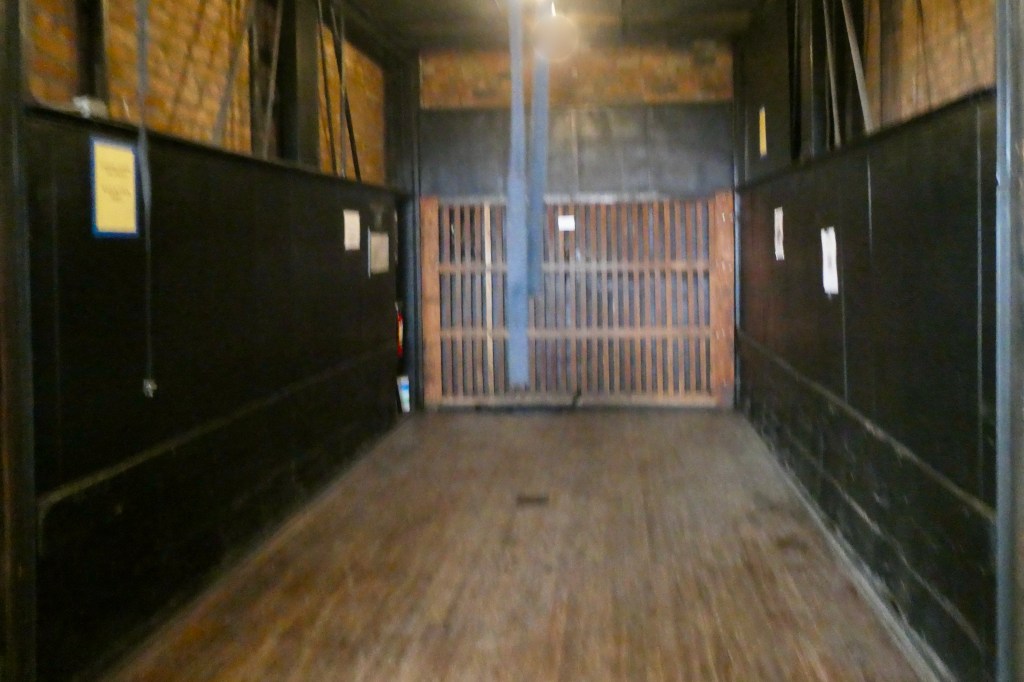
When Ford Motor Company left, the Studebaker Corporation purchased the Piquette Avenue Plant in 1911. The elevator was made larger to move the larger Studebaker cars up and down and in and out. They used the plant until the depression era when they consolidated back to South Bend, Indiana.
The building was then sold to 3M Corporation which owned it until 1975. Various owners used the building for storage in the following years..
In 1988 the former plant was purchased by Charles Wickens of London, England. With the building in a dilapidated state, and facing demolition, Wickens was a benevolent seller. He worked with a Detroit historic society when they wanted to buy and refurbish the building for history’s sake.
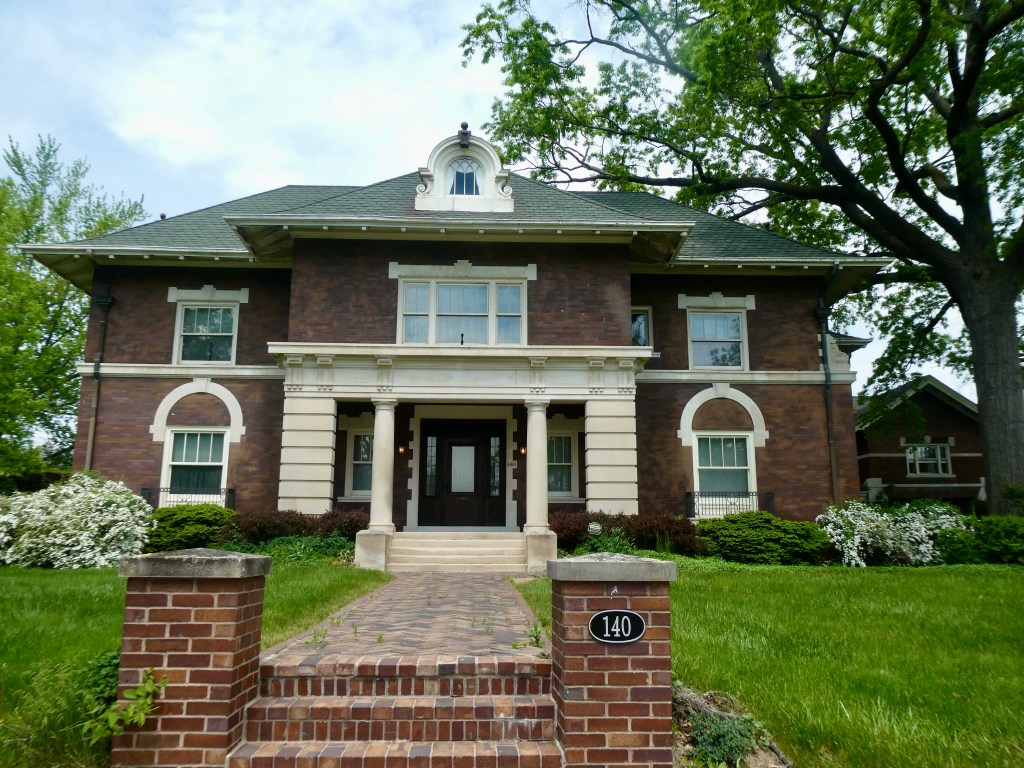
One of the primary contributors to that effort lives at 140 Edison in Detroit. The house is a National Historic Landmark because Henry Ford and his wife lived there during the beginning of their successful years in Detroit.
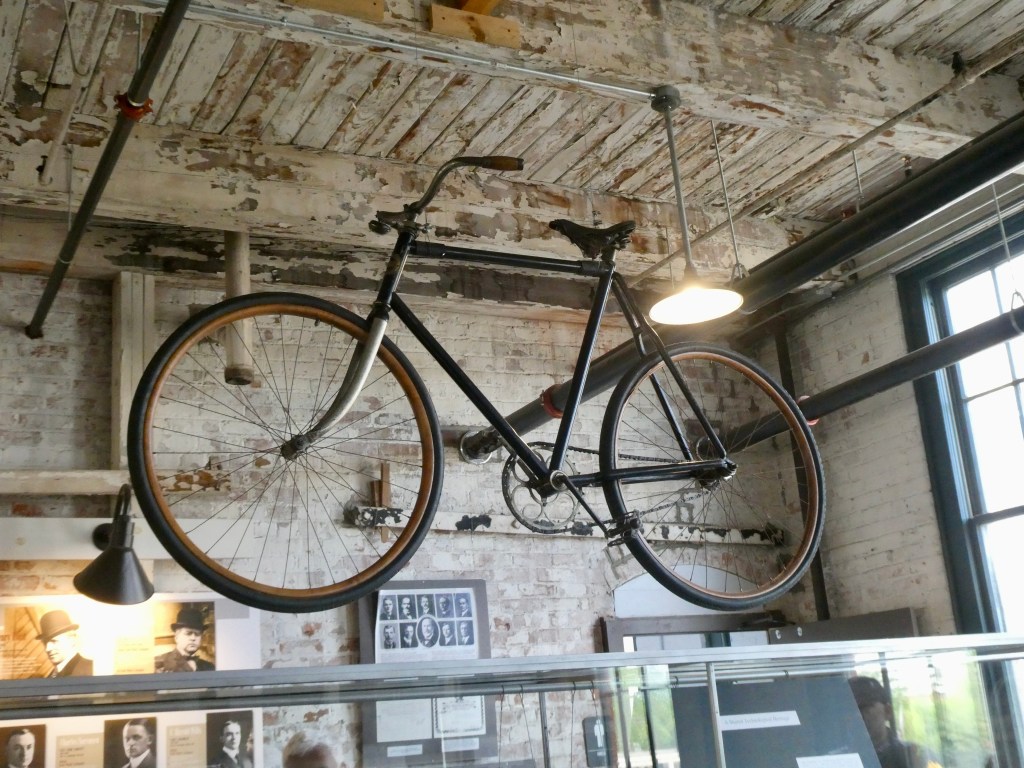
Henry Ford often road his bike to work! There seems to be some irony there!
Beginning in 2000, volunteer groups from car clubs and the Ford Motor Company began the long and arduous job of cleaning out and refurbishing the building into what it is now, a museum with an extensive car collection. The Ford Piquette Avenue Plant is also available for event rental.
In 2002 the Ford Piquette Avenue Plant was placed on the National Register of Historic Places – quite an achievement for a building that almost didn’t survive.
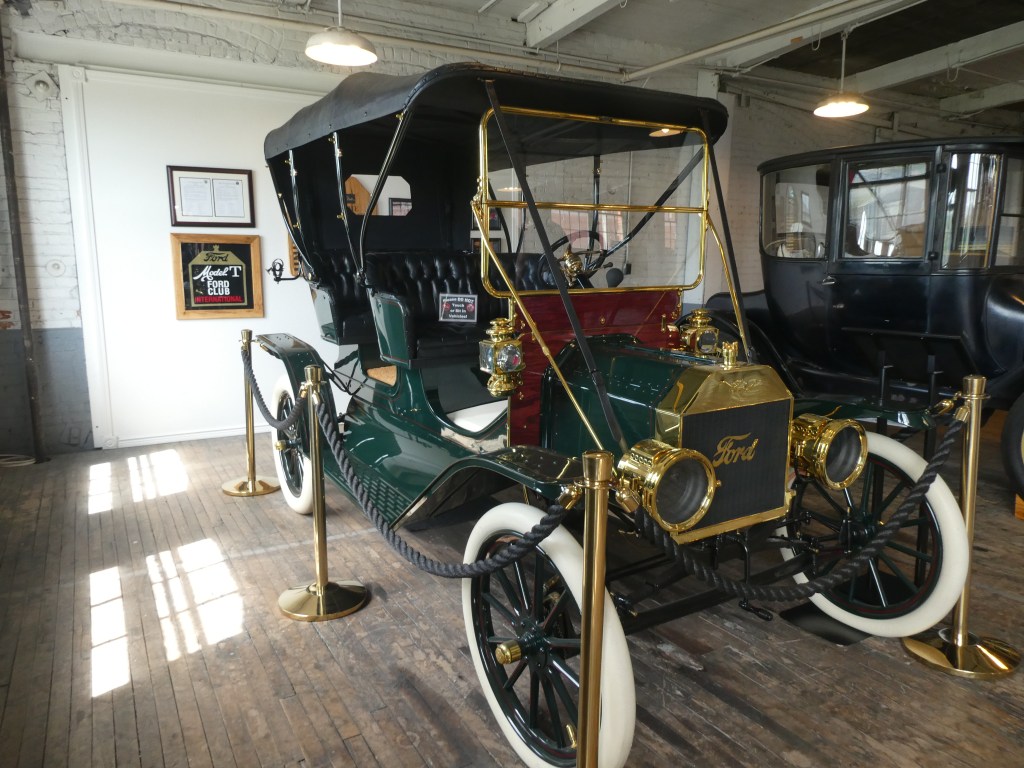
This carmine red Model T is front and center when you enter the building. This automobile, with serial number 220, was manufactured in December 1908 at the Ford Piquette Avenue Plant.
Though manufacturing of the new model began in October, 1908, the first Model T’s were designated as 1909 models. Costing $850, the Model T had a 4 cylinder 20 HP engine and a top speed of 35 mph.
The automobiles were available in a variety of colors but the roof, windshield, headlights, and speedometer were all optional adding $100 or more to the total cost.
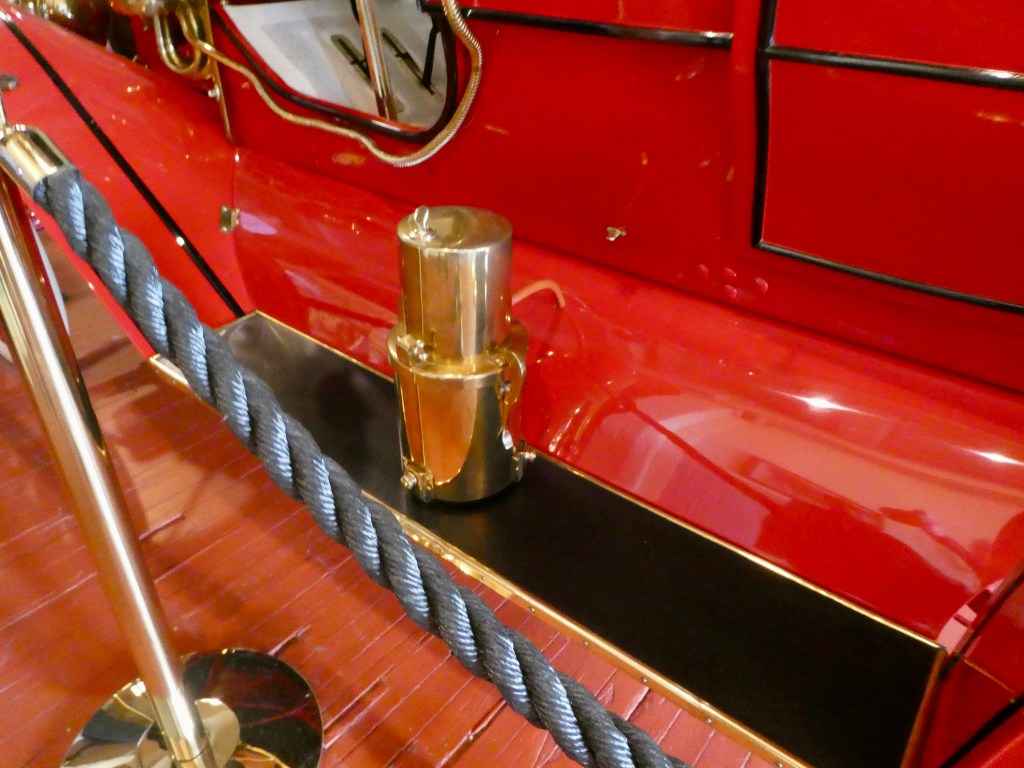
This side fuel canister is for the gas headlights.
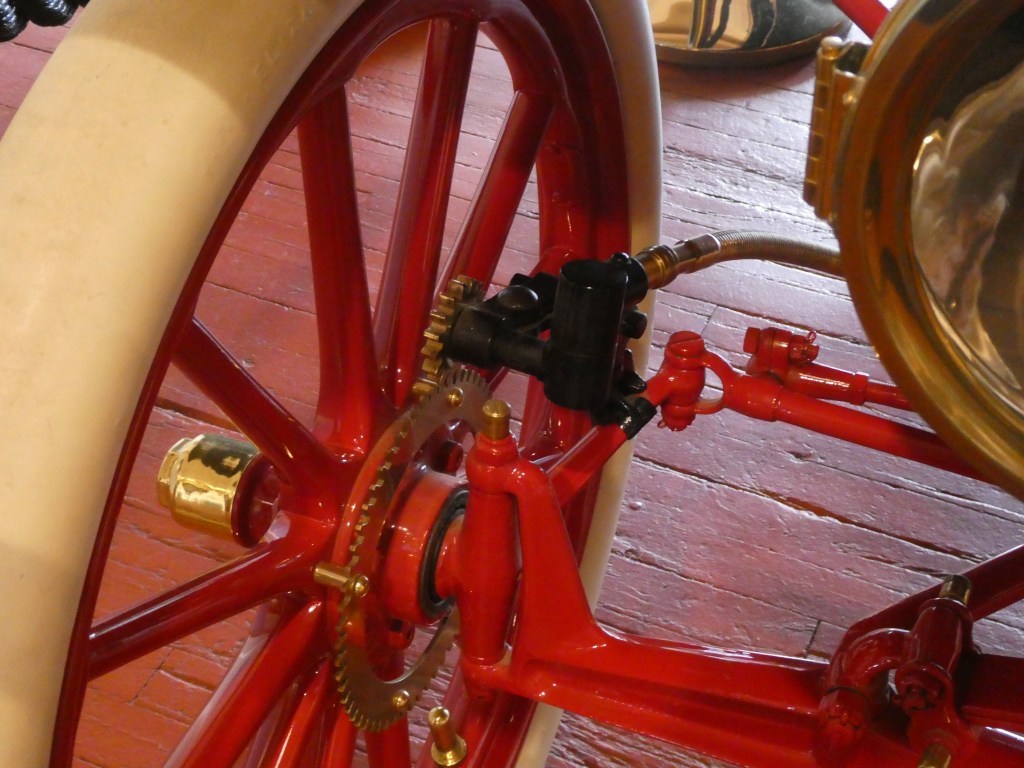
The tires were upgraded bicycle tires. A. pump was sold with the car. The black device is the speedometer cable.
The first 2,500 Model T automobiles underwent constant engineering changes to address issues of reliability. The design improvements led to such successful sales numbers that 12,000 Model T vehicles emerged from Piquette, a rate of about 100 per day.
The cost was reduced to $260 per vehicle after it was mass produced. The first car to be universally affordable, there were 15 million sold. The Model T held the record of most sold for many, many years. The Volkswagen Beatle eventually sold more than the Model T, and then the Toyota Camry eclipsed it.
The Model T, initially produced at a rate of one every 12 hours at the Piquette Avenue Plant, took only 12 minutes at the Highland Park plant. The model T was deemed obsolete after 15 million cars and 19 years. Collectors still own 250,000 Ford Model T automobiles. The oldest known remaining Model T is Number 2. It recently sold for a quarter million dollars.
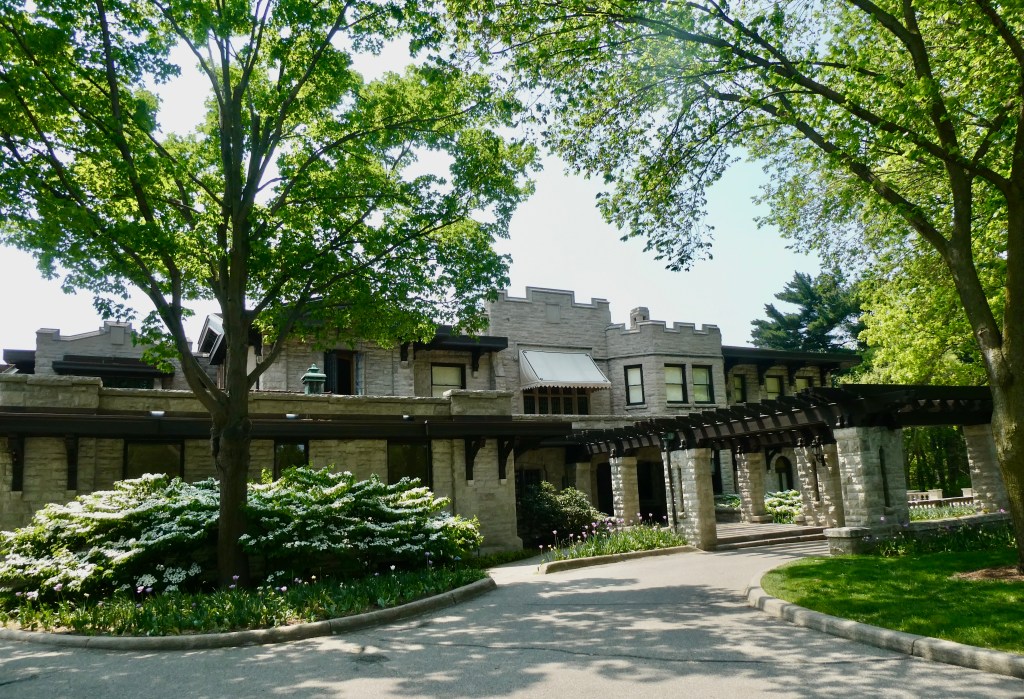
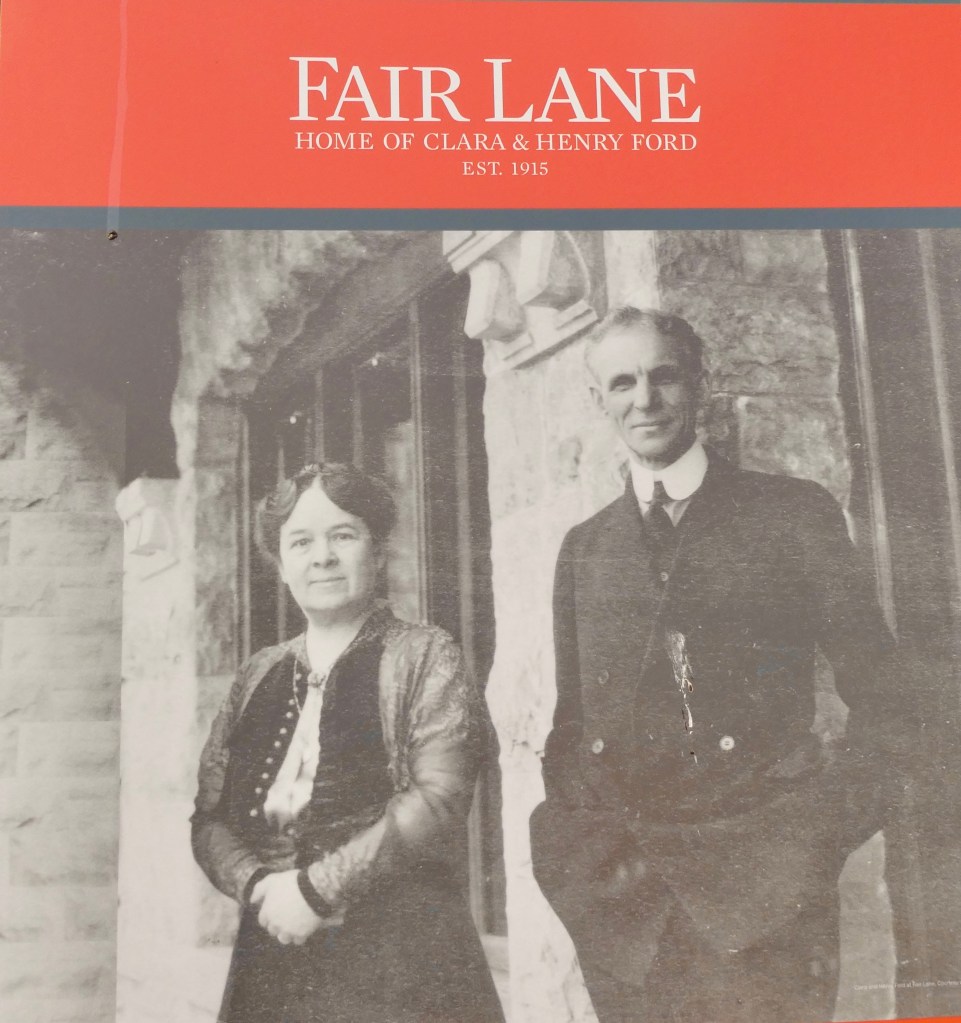
With all their success, Clara and Henry left their home at 140 Edison in 1915 and moved to an estate they called Fair Lane situated along the banks of the Rogue River.
The name Fair Lane was from the road on which Henry’s father, William Ford, was born in County Cork, Ireland.
The Powerhouse/Garage was constructed in 1914 after frequent guest and inventor, Thomas A. Edison, laid the cornerstone. The powerhouse supplied power for the entire estate using a hydroelectric system. The estate had some rare engineering designs including water filtration and boiler systems.
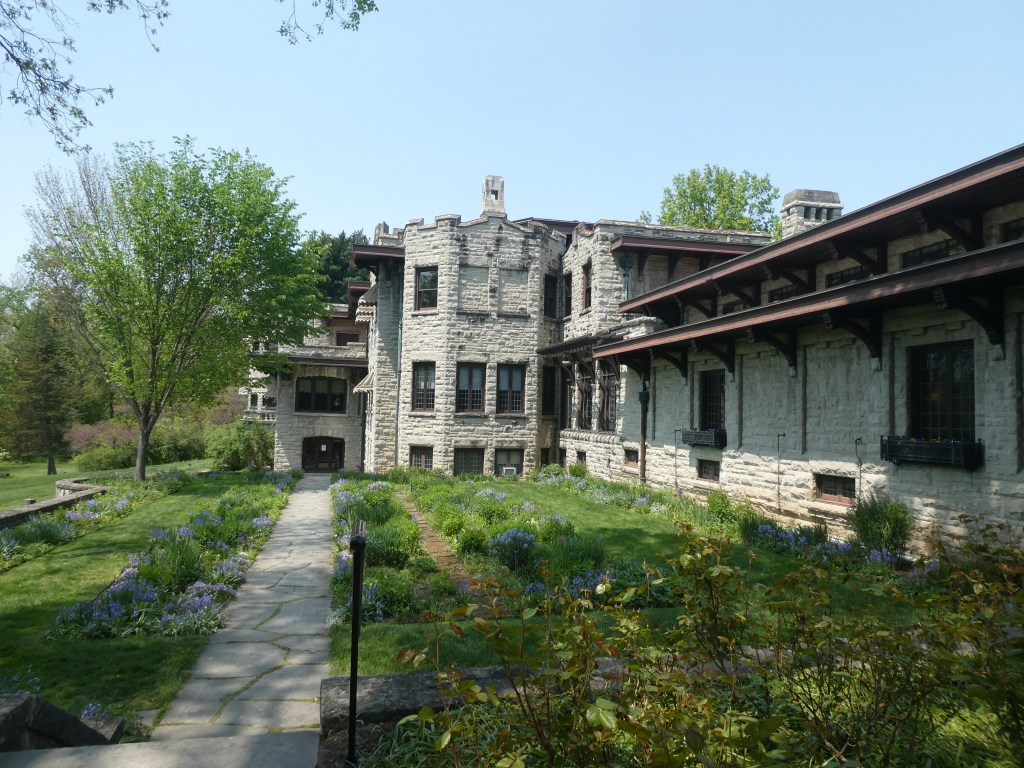
By the late 1920’s, the 56 room mansion, and estate totaled 1,300 acres including orchards, agricultural fields, gardens, greenhouses, servant cottages, a boathouse, a skating house, a maple sugar shack, and a pony barn.
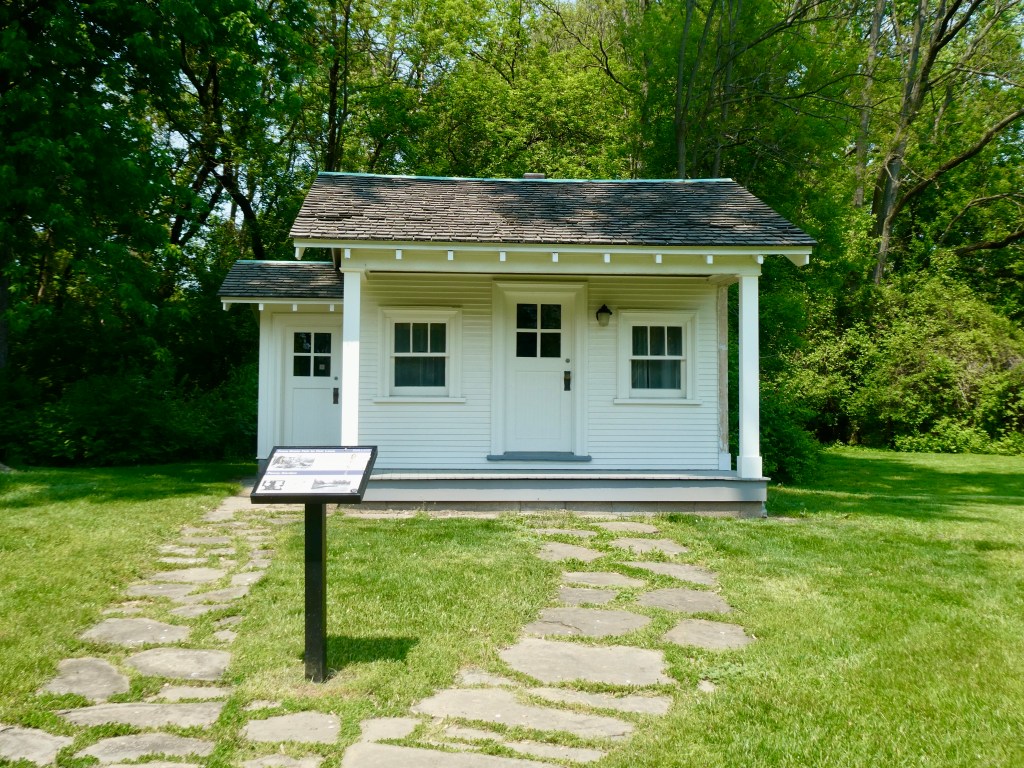
Henry Ford had a miniature farmhouse, and other farm buildings and machinery constructed for the 1924 Michigan State Fairs to educate urban children about life on a farm. After the fair, the buildings were brought to the estate for the enjoyment of the Ford grandchildren.
Fair Lane was named a National Historic Landmark in 1935.
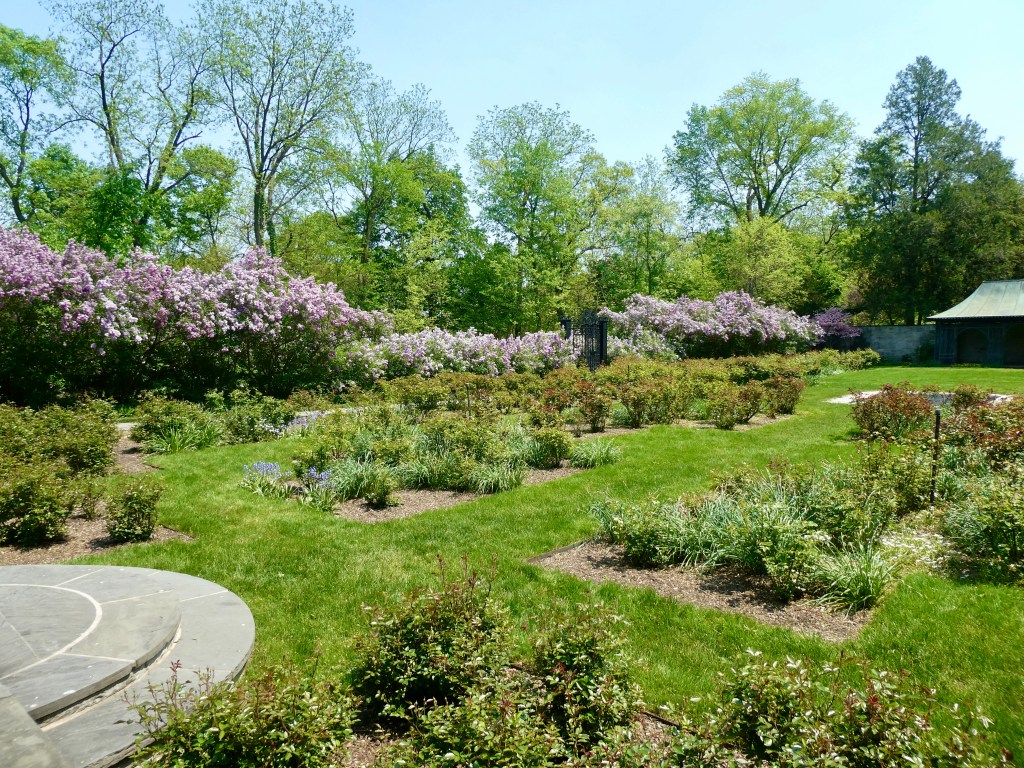
Clara Ford had extensive gardens, dominated by her favorite roses. When we were there the lilacs were in full and fragrant bloom.
Henry and Clara Bryant Ford lived at Fair Lane from 1915 until their deaths in 1947 and 1950 respectively.
In 1956, the estate was donated by Ford Motor Company to The University of Michigan for a Dearborn campus.
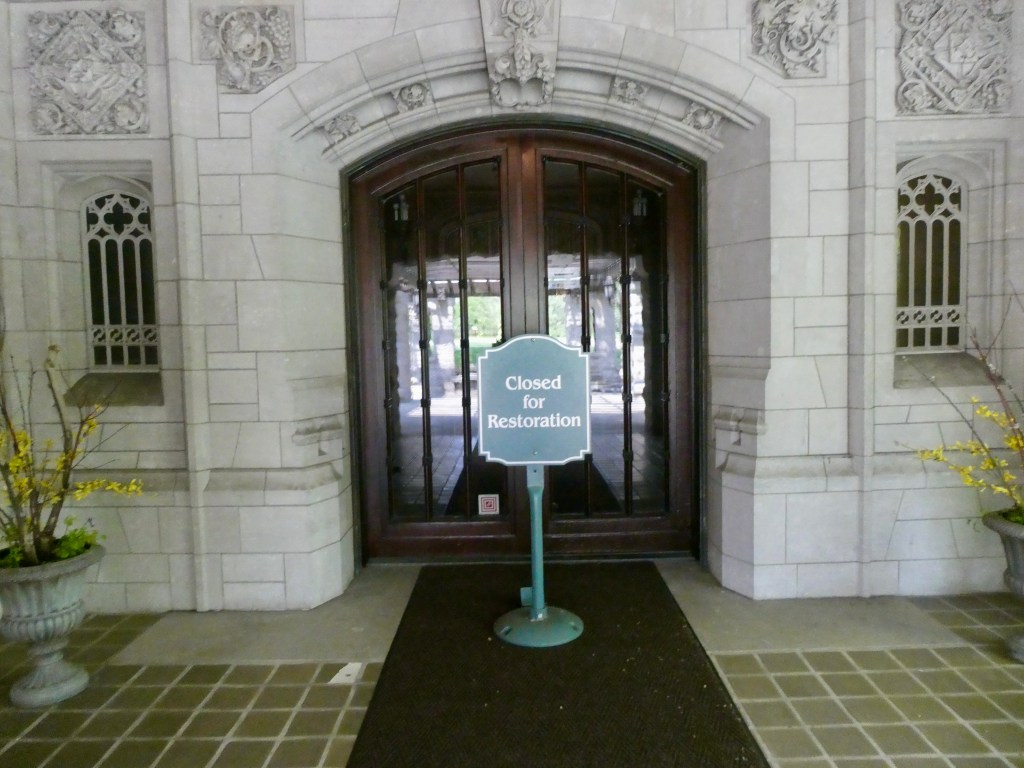
The house was undergoing renovation when we were there so we were unable to go inside. Tours are usually available.
We enjoyed our walk around the grounds…and these baby raccoons. We wondered where mama was!
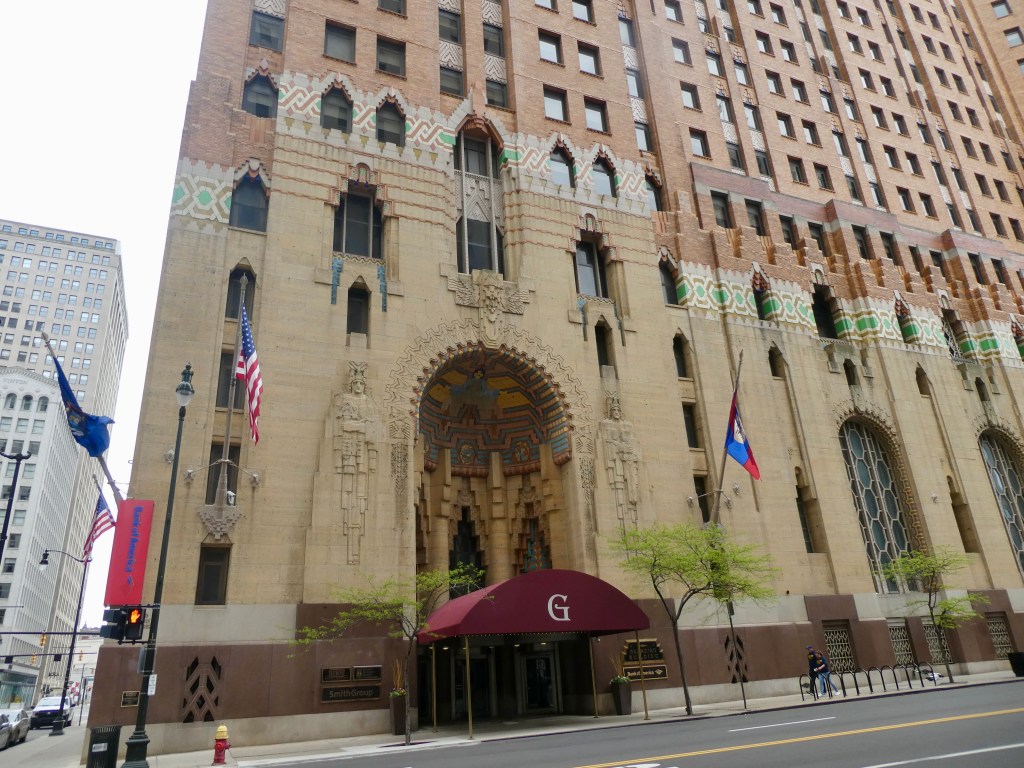
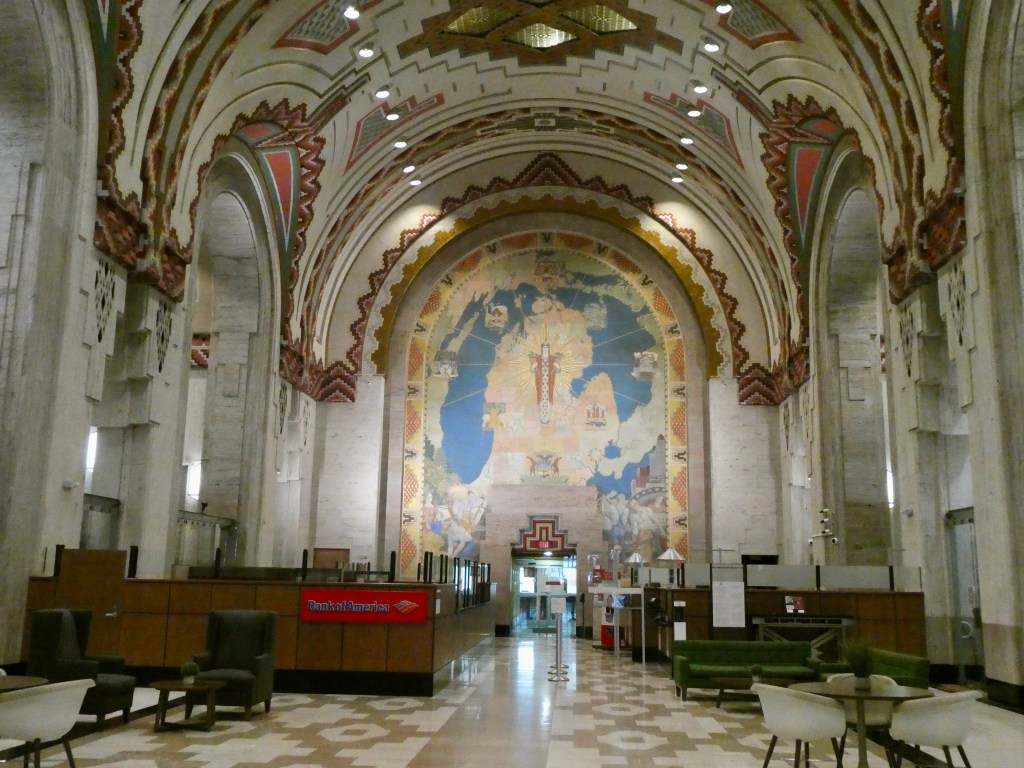
While looking for a food tour in Detroit (which didn’t exist), I found a Downtown Architecture Tour. We began our tour at the Guardian Building in downtown Detroit.
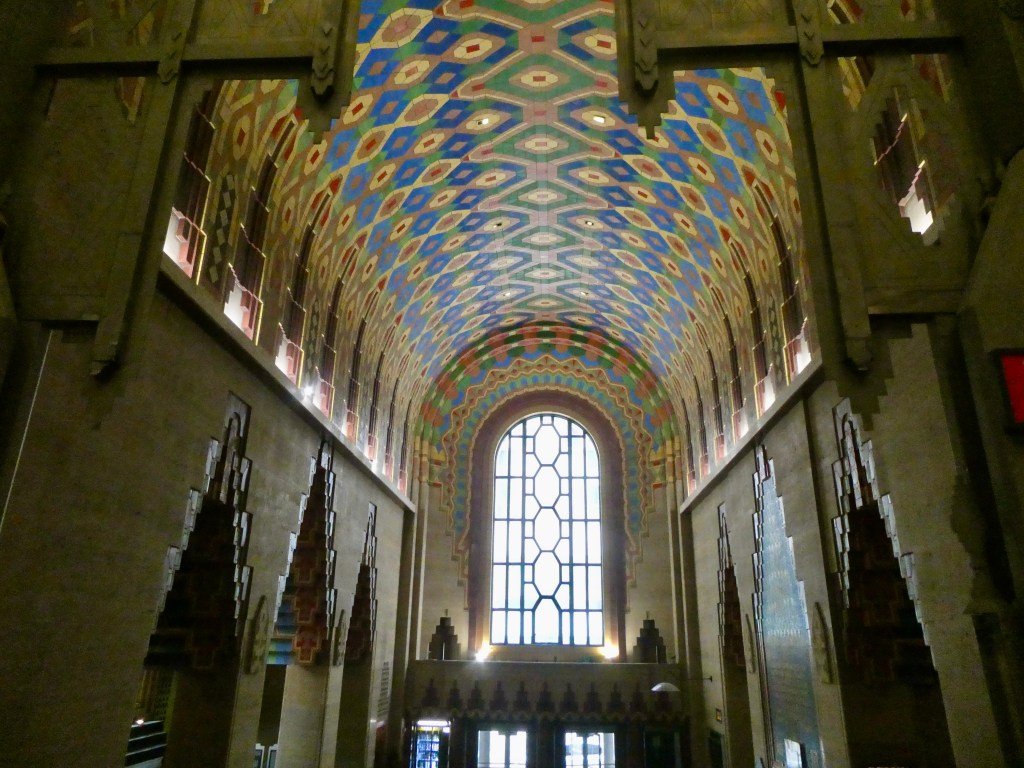
This picture is from the Guardian Building website as it is much better than the one I took!
The Guardian Building represents an era when people believed in the city of Detroit and its future.
The building was built in 1928-29 when Detroit was an international commercial and industrial hub. It took eighteen months to build and was considered the Cathedral of Finance. The former Union Trust Building was designated a National Historic Landmark.
The Guardian Building is now owned by Wayne County and serves as its headquarters. The symbolic art under the arch is in the shape of Michigan.
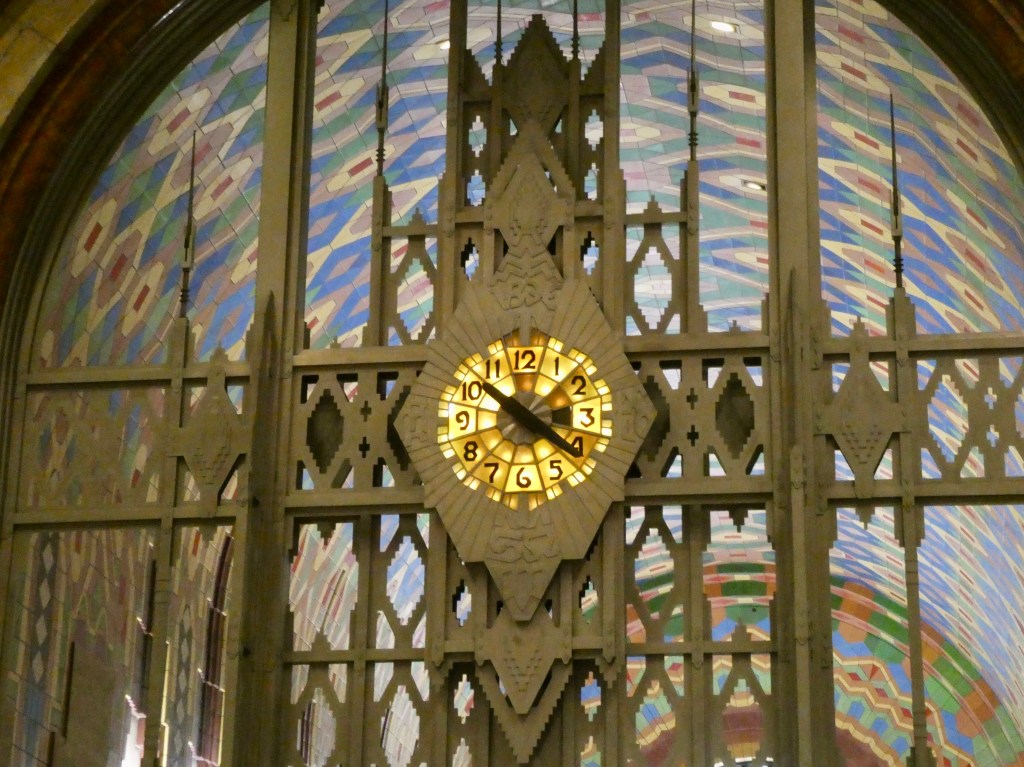
The lobby clock was made by Tiffany.
Most of downtown and much of Detroit went through severe depression. Problems were plentiful and a corrupt local government contributed. Detroit declared bankruptcy July 18,2013 and many buildings and homes were abandoned.
The People Mover was built to provide access between buildings when the streets were dirty and unsafe. As circumstances have dramatically improved, the People Mover is rarely used.
During the last decade there has been substantial investment and revitalization with private and government assistance.
Dan Gilbert, the majority stockholder of Rocket Mortgage, has made a massive investment in Detroit. He purchased and developed over 100 buildings in downtown Detroit. Gilbert and his wife joined The Giving Pledge to give half of their many billions away during their lifetime and Detroit and Detroiters have benefited.
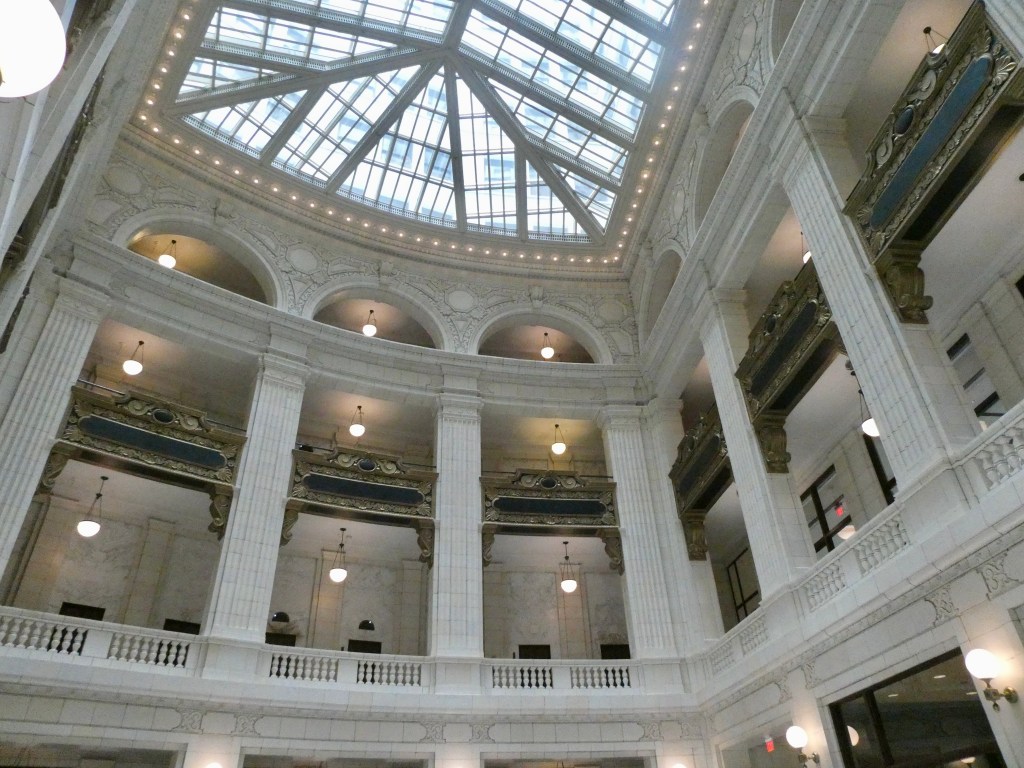
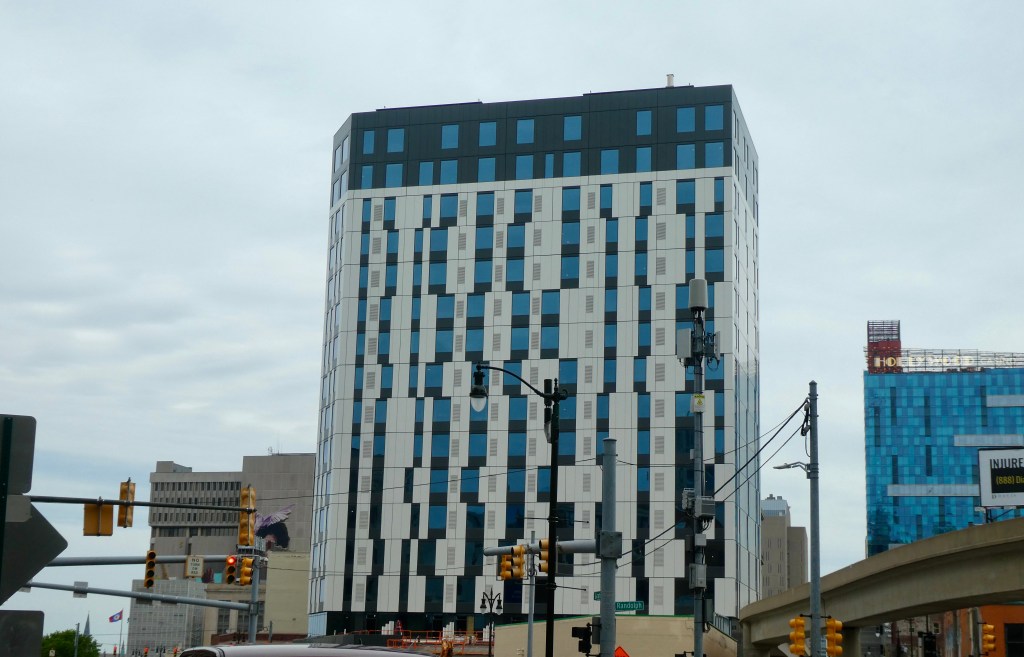
This is one of the many buildings that Gilbert has rejuvenated. He frequently tries to hold on to, or portray, the building’s history as part of the renovation.
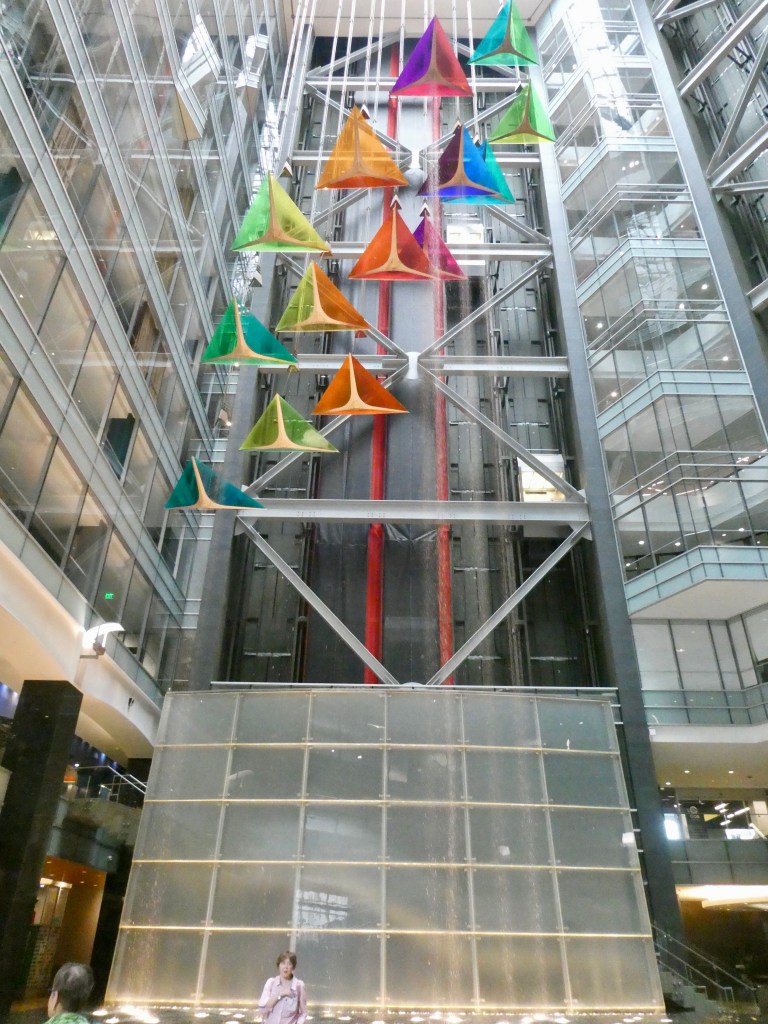
Rocket Mortgage world headquarters are at the One Campus Martius Building in Detroit. The waterfall inside the Atrium is 114ft in height and is the tallest indoor waterfall in America.
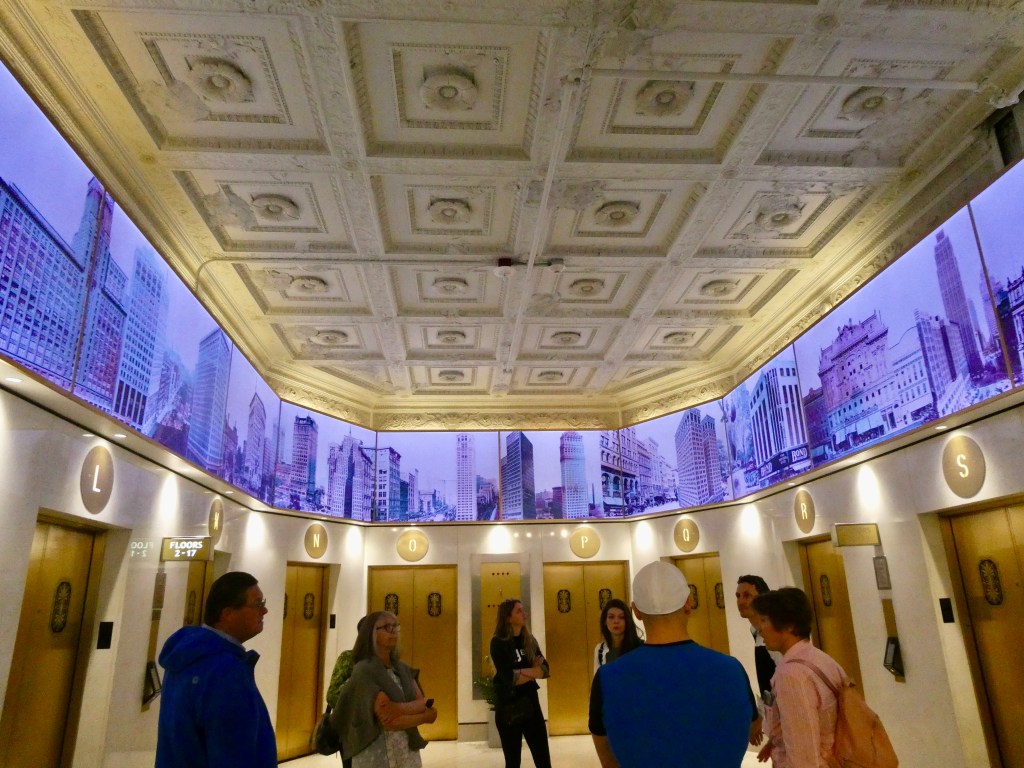
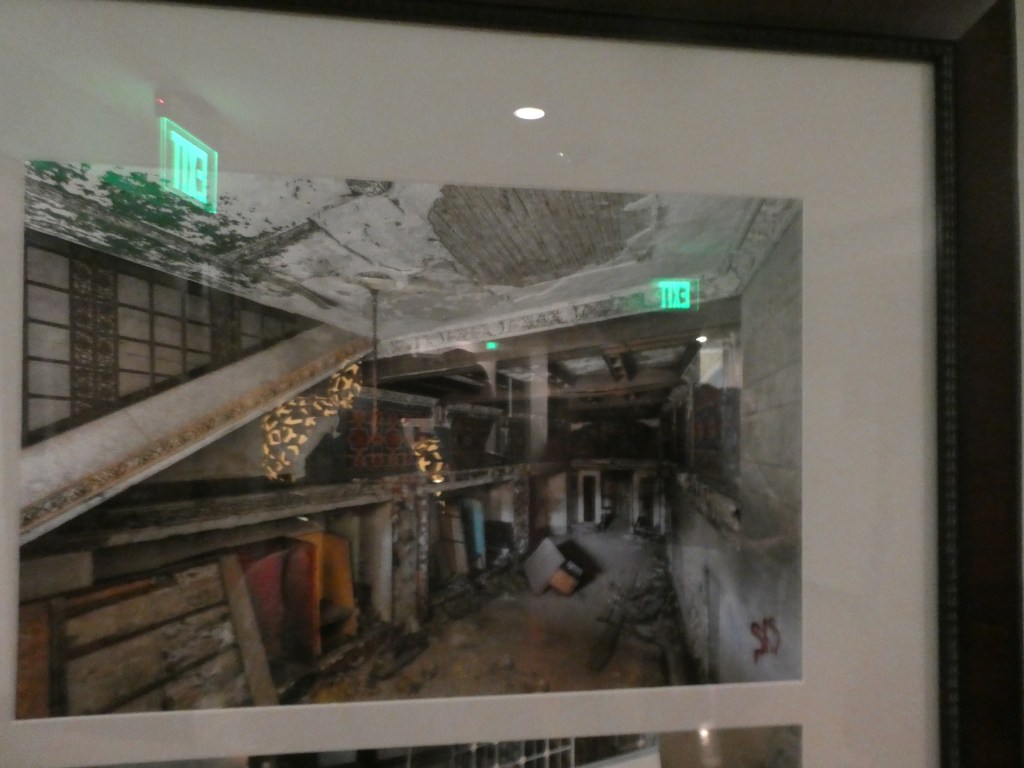
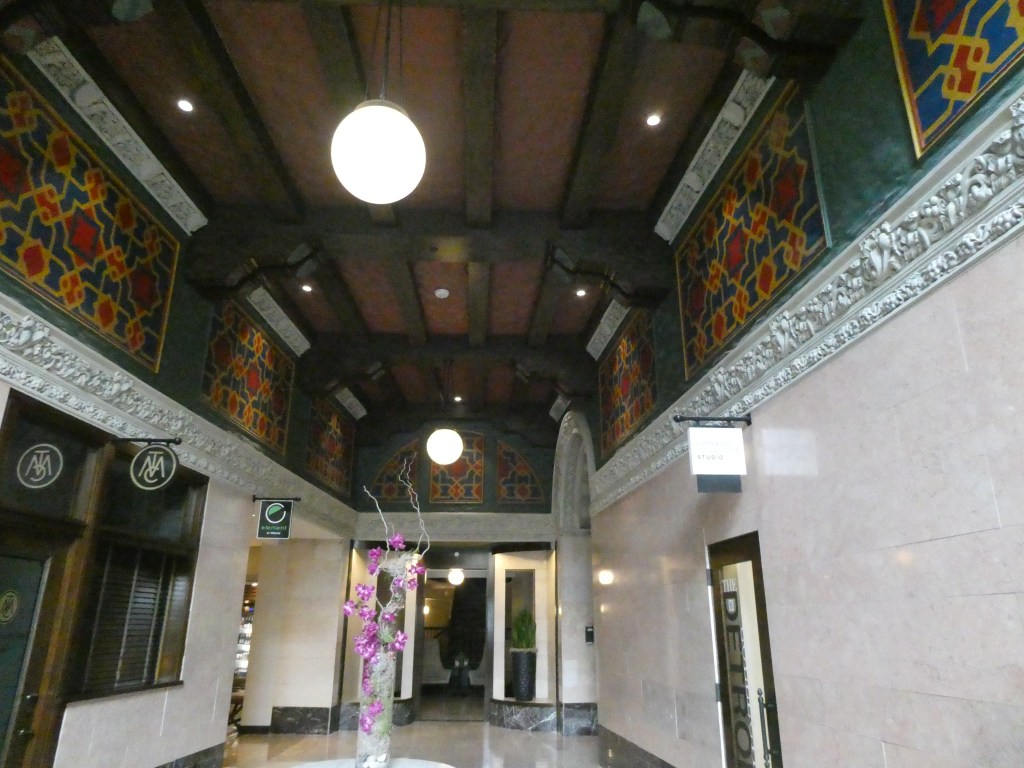
The David Whitney building is an example of the renaissance downtown Detroit has achieved in the last ten years. Built in 1915, the Whitney building was listed on the National Historic Register in 1983.
Then the bad years happened.
This is the same hallway now. Well done, Detroit!
The developers for the Apparatus Room took an old firehouse and repurposed it into a great food and bar venue.
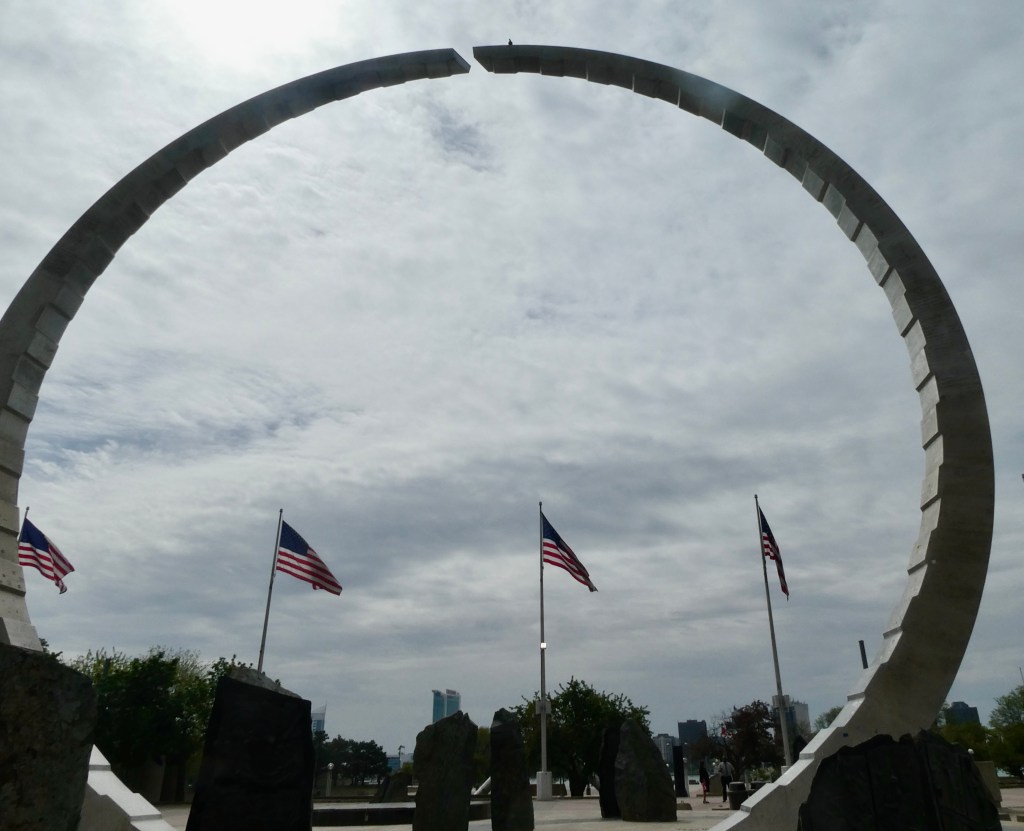
We visited Hart Plaza on the Detroit Waterfront and saw a collection of monuments.
We saw the Transcending Monument – a tribute to Labor.
After departing Montreal in 1701. Antoine de la Mothe Cadillac planted the flag of France and took possession of the territory for King Louis XIV.
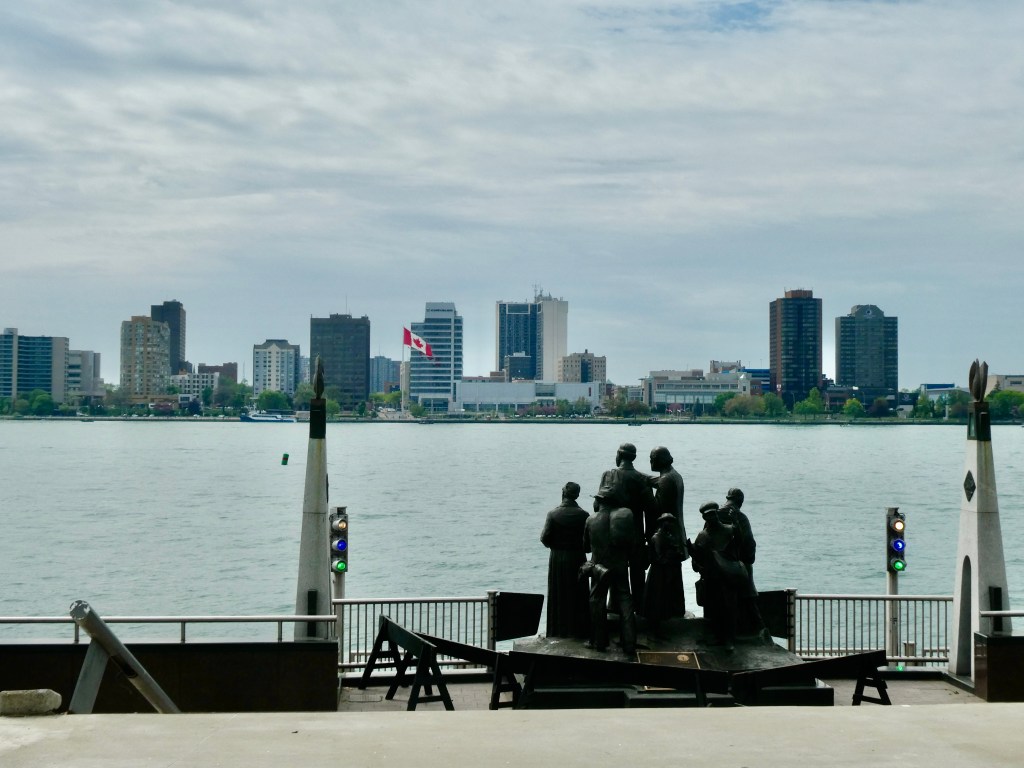
We looked across the Detroit River and saw Windsor, Ontario, Canada. It really is that close!
This 2001 sculpture is called Gateway to Freedom and commemorates the Underground Railroad.
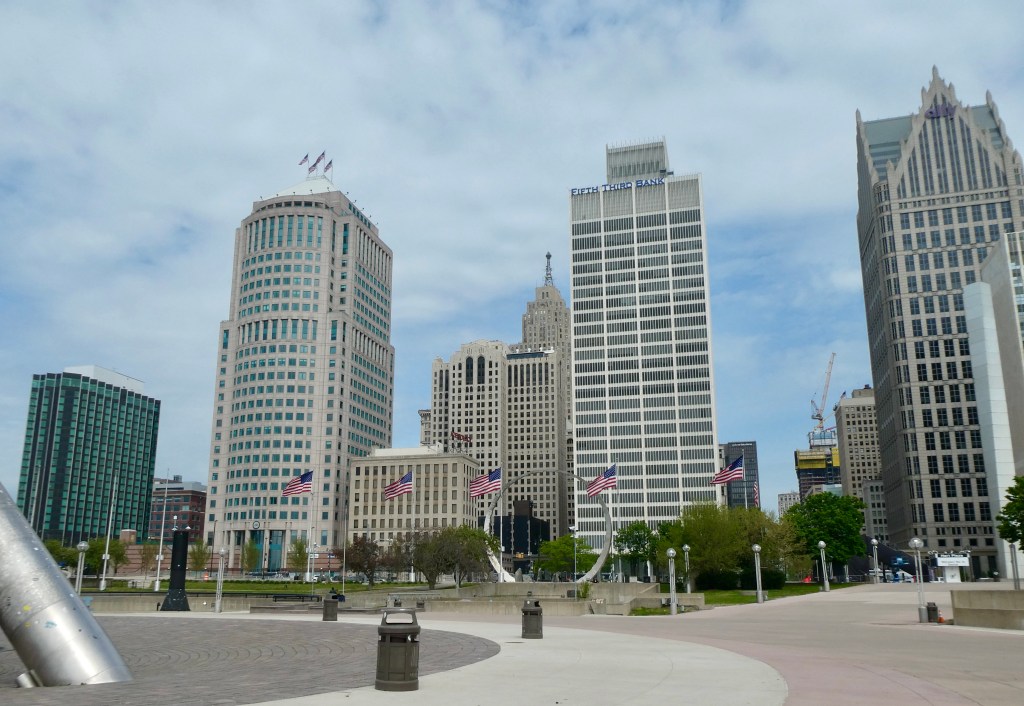
Turning around we could see the Detroit skyline.
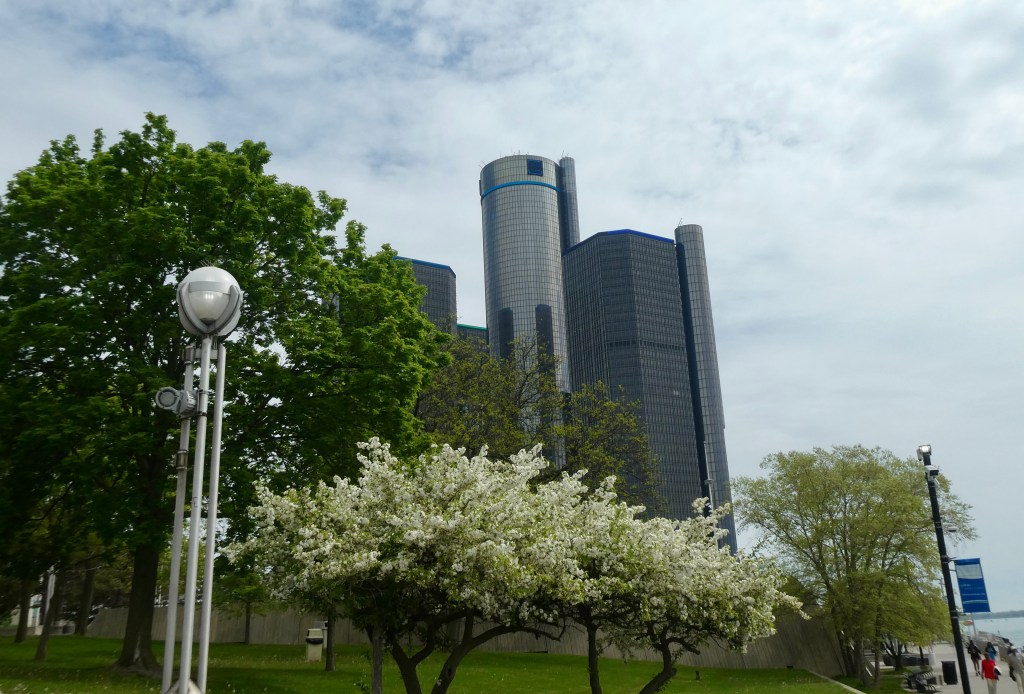
We could see the Renaissance Center – the brainchild of Henry Ford II. Consisting of several large buildings forming a city within a city, the two most notable owners are the Westin Hotel and the World Headquarters for General Motors.
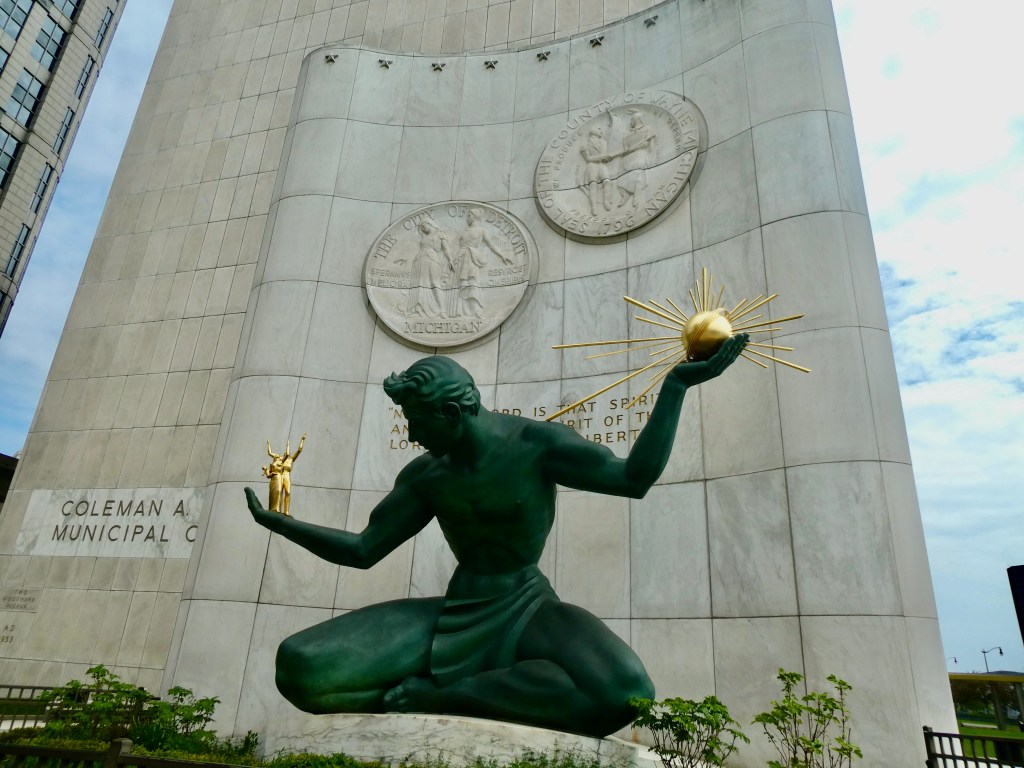
Near Hart Plaza is the Spirit of Detroit. A tradition is to wrap the statue in jerseys of Detroit sports teams when one makes the playoffs.
As we walked around hearing the stories of buildings and their refurbishment, we learned that new condo buildings must have at least 20 percent subsidized housing.
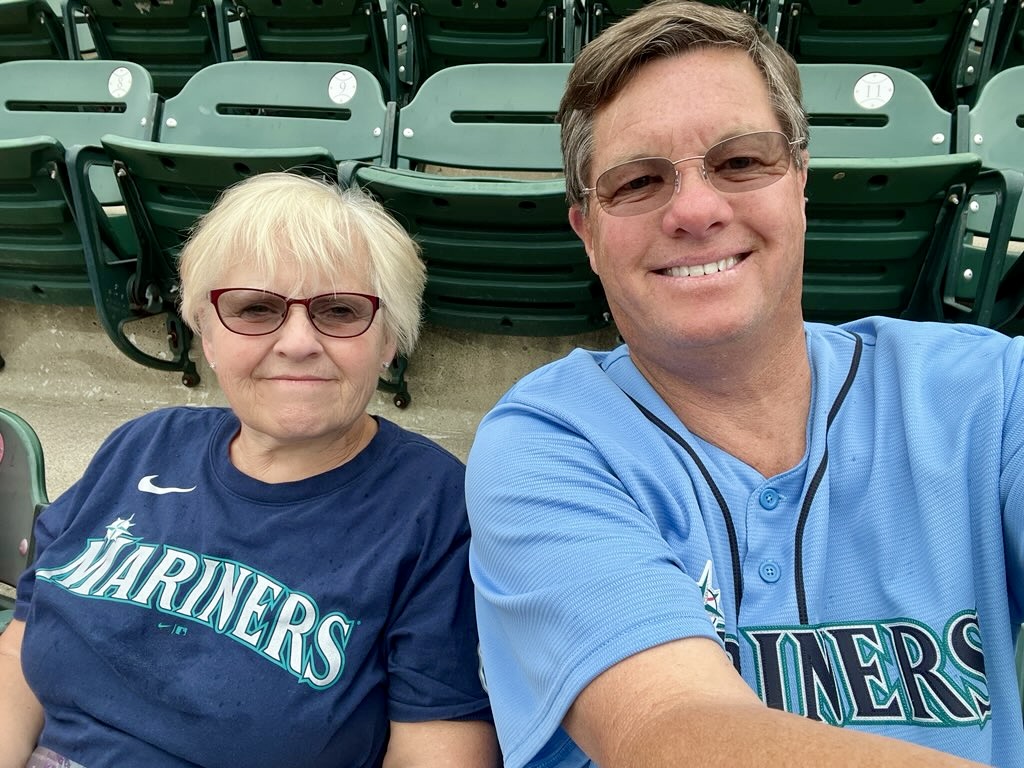
After our tour we were tired of walking and only wanted to sit. So we decided to sit at another Mariners -Tigers baseball game!
As we entered Comerica we noticed a marker indicating that the Detroit College of Law was on the site of the baseball stadium from 1935-1997. The college was the first law school in Detroit, established in 1891. It began with sixty-nine students including a woman and an African American. Graduates became circuit court judges, a supreme court justice and an ambassador.
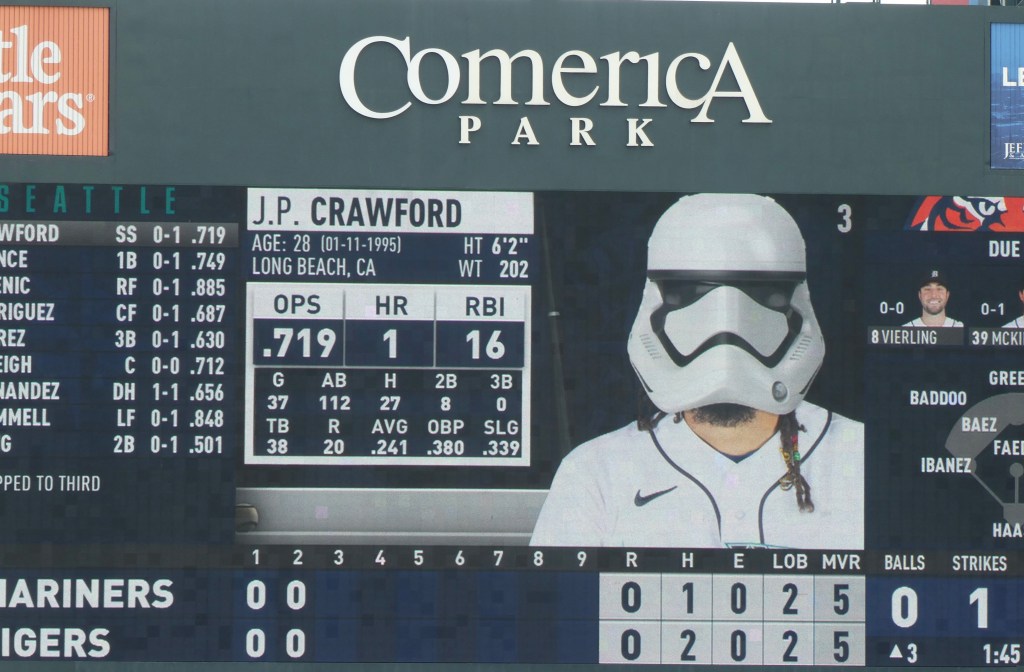
Once inside we found the theme for the day was Star Wars! There were a variety of activities but we especially enjoyed the way they made our Mariners look like Storm Troopers on the big screen!
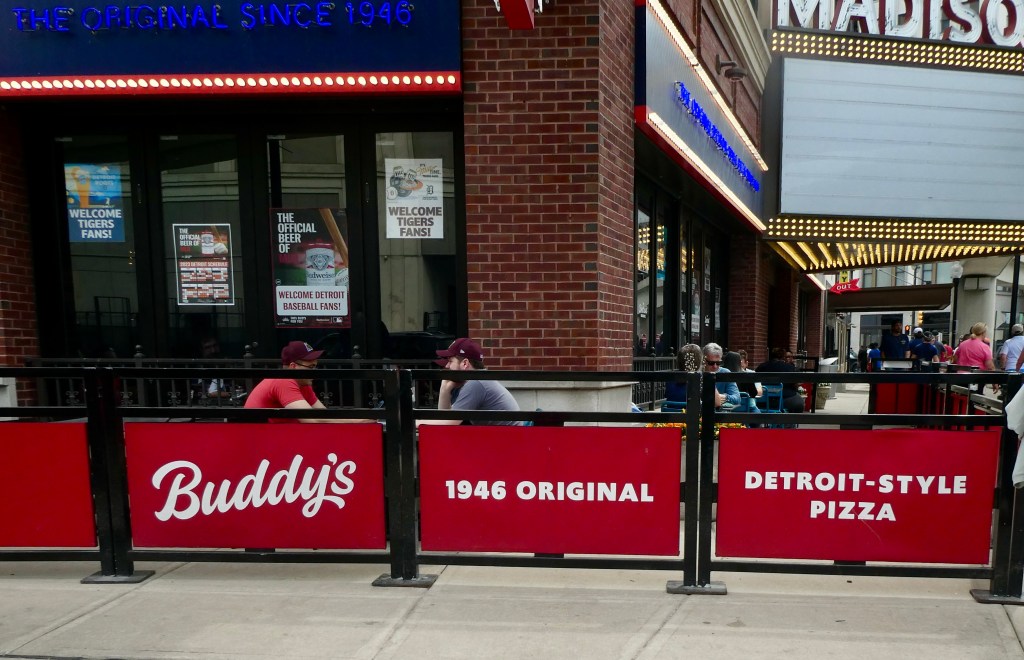
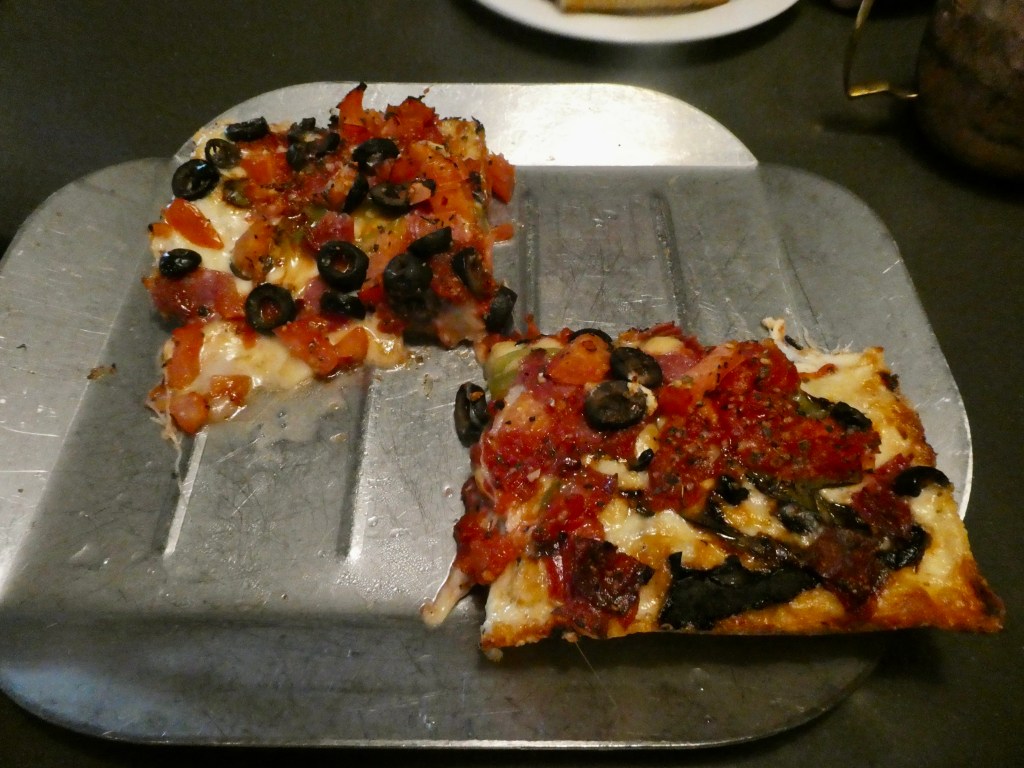
After the game we decided to try out authentic Detroit Pizza. We had been told that Buddy’s was the original maker but the downtown location was not the original location.
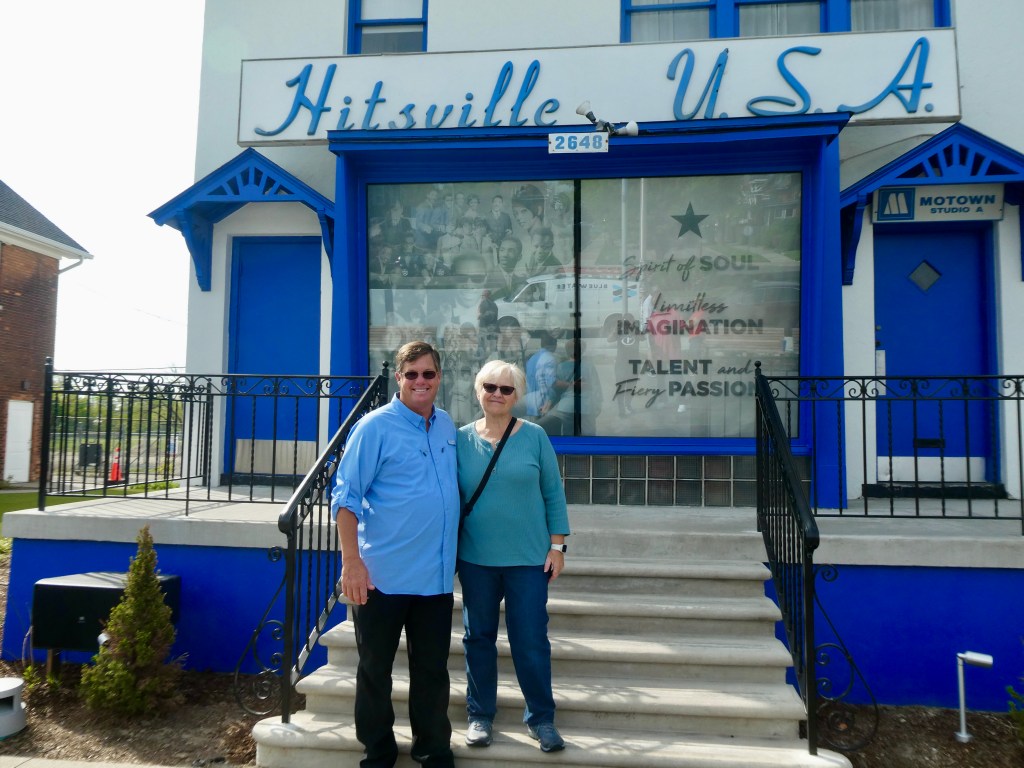
If you read our last post, you know that the Motown Museum was our first excursion in Detroit. Tickets were purchased in advance for the earliest tour on our first day.
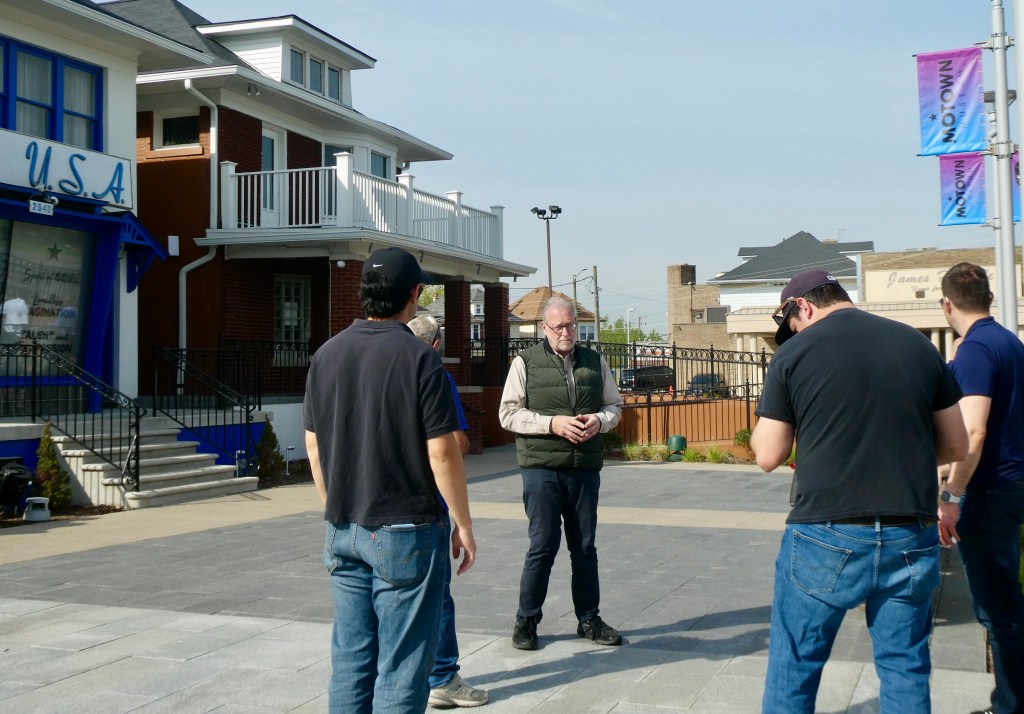
When we arrived, a bit early, there was a group of people prepping for a video shoot in front of the museum. We asked one of them what was happening and were told that Peter Greenberg, Travel Editor from CBS, was preparing a segment about things to do in Detroit. We didn’t know of him, but will watch for his segments on CBS Sunday morning.
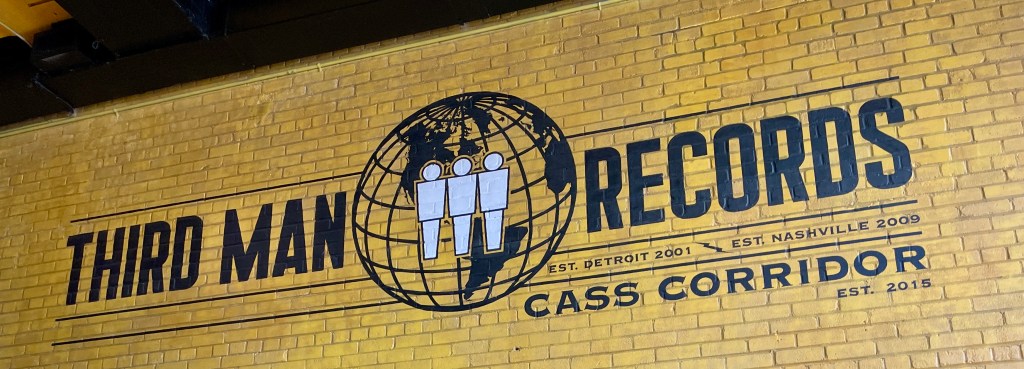
While waiting we asked the same person where else they were highlighting that we might want to go. He recommended the Third Man Records Tour that they had done the previous day.
A person from the Detroit Tourism Bureau was also there and genuinely thanked us for coming to Detroit. He approved of our general list of coming attractions and recommended that we also go to Buddy’s Pizza, home of the original Detroit Pizza.
We had places to go and an afternoon free before our first baseball game. I was able to get tickets on my phone for the Third Man Records tour and we were off.
Jack White grew up in Detroit and is a singer and songwriter who performed with his wife in their band called White Stripes. They performed together during their marriage and for a time after their divorce. Eventually he went on to a successful solo career. (If you haven’t heard of him – I hadn’t either – but I was definitely in the minority in Detroit. Randy knew of Jack White but listens to a lot more music than I do.)
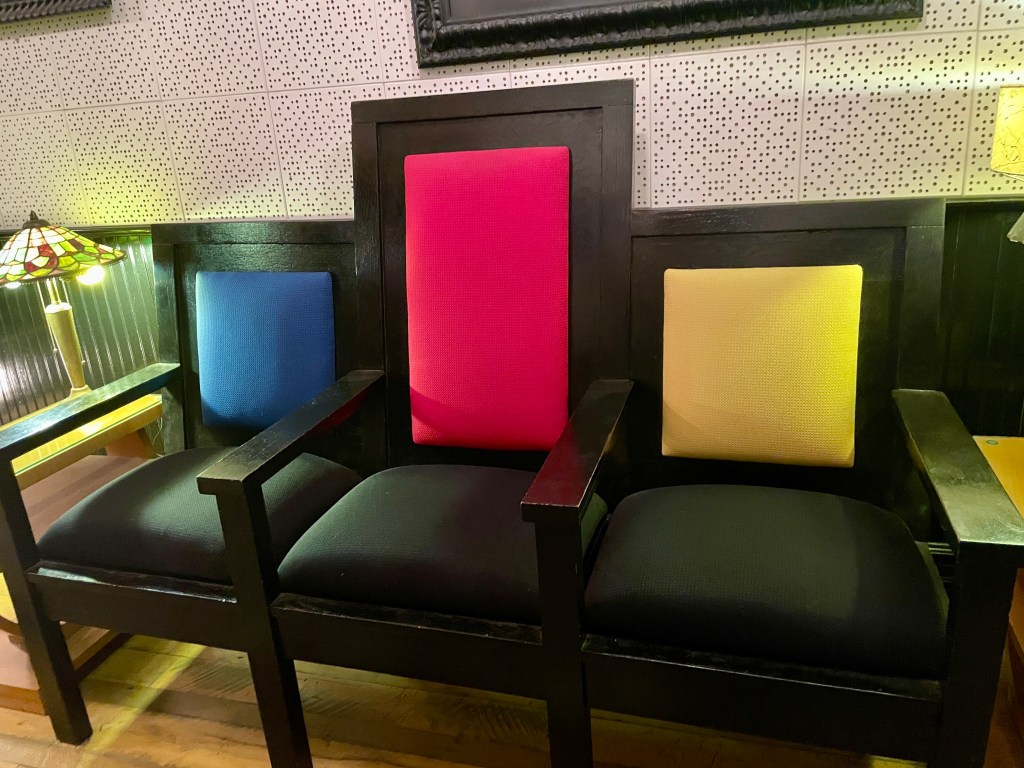
Jack White formed Third Man Records to allow him to press his own music onto vinyl. He called it Third Man because, prior to making his career music, he supported himself by doing upholstery. At that time he was the third upholsterer on the street.
He upholstered this bench for the business as a tribute to his past.
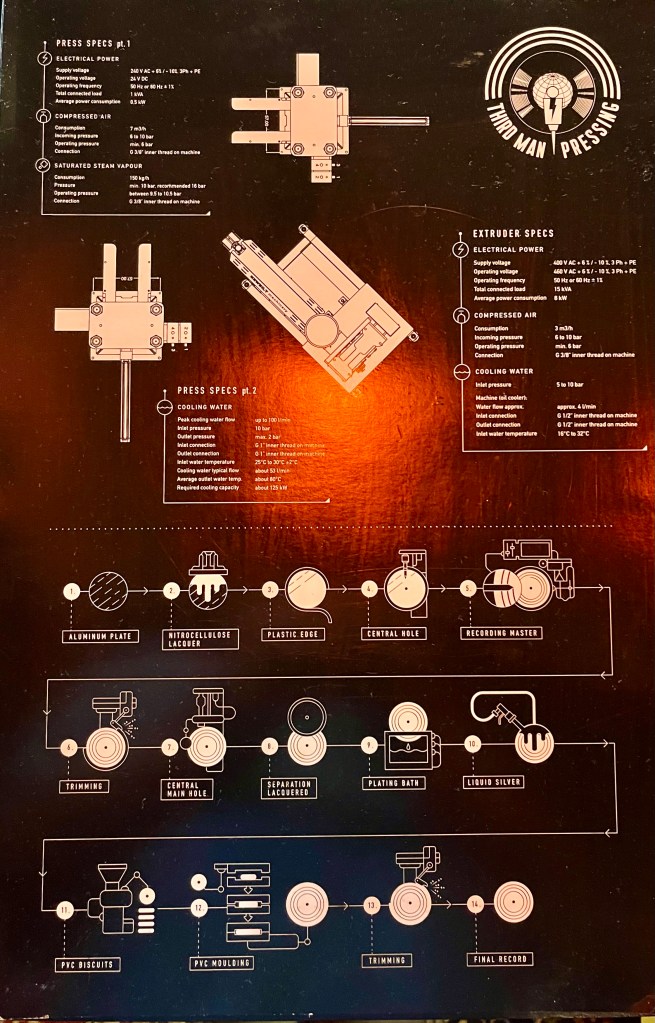
Jack White records to tape and then produces his vinyl records. Over time others asked to have Third Man Records produce their records.
Taped recordings are digitized through a special computer.
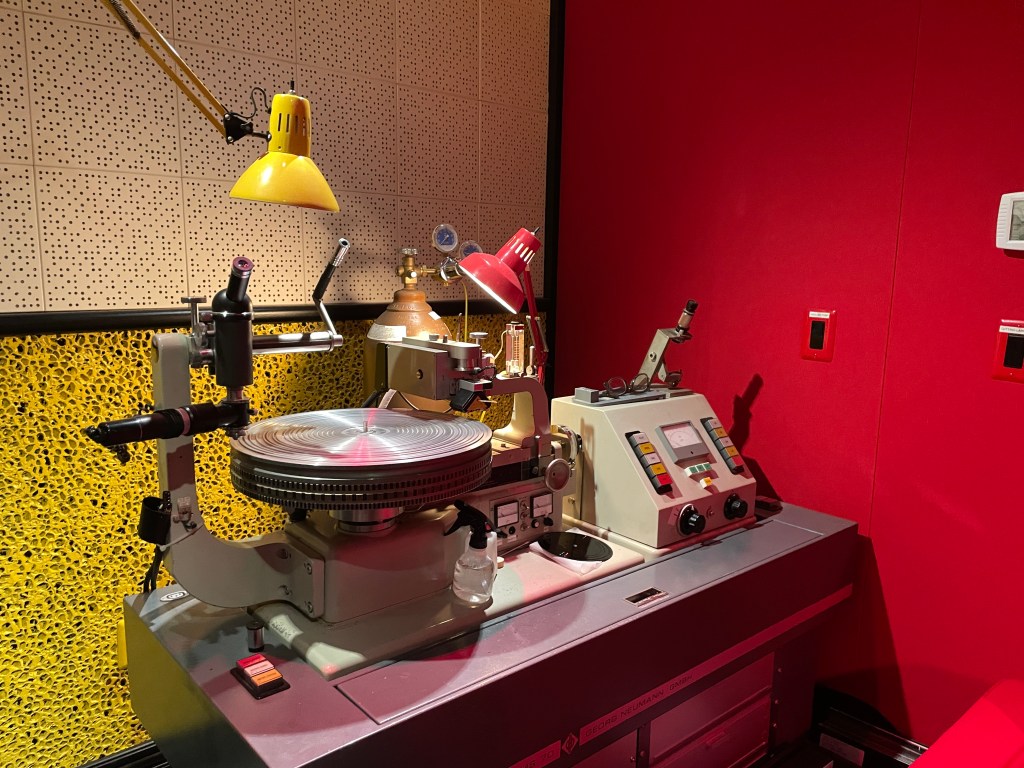
A lathe produces the master stamper. These lathes are very rare because vinyl records had their time decades ago and is only recently having a resurgence. This 1970s lathe was purchased from a German sound engineer and he and his group came to Detroit to train Third Man Records engineers on its use.
They have also been contracted to do vinyl reissues of earlier albums. The master tapes, with more advanced technology available today, allow the new listener to hear aspects of the music that previous technology did not produce.
Some musicians (including school groups) are allowed to perform live and go directly to vinyl. Those records include all the quirks that can happen in a live event.
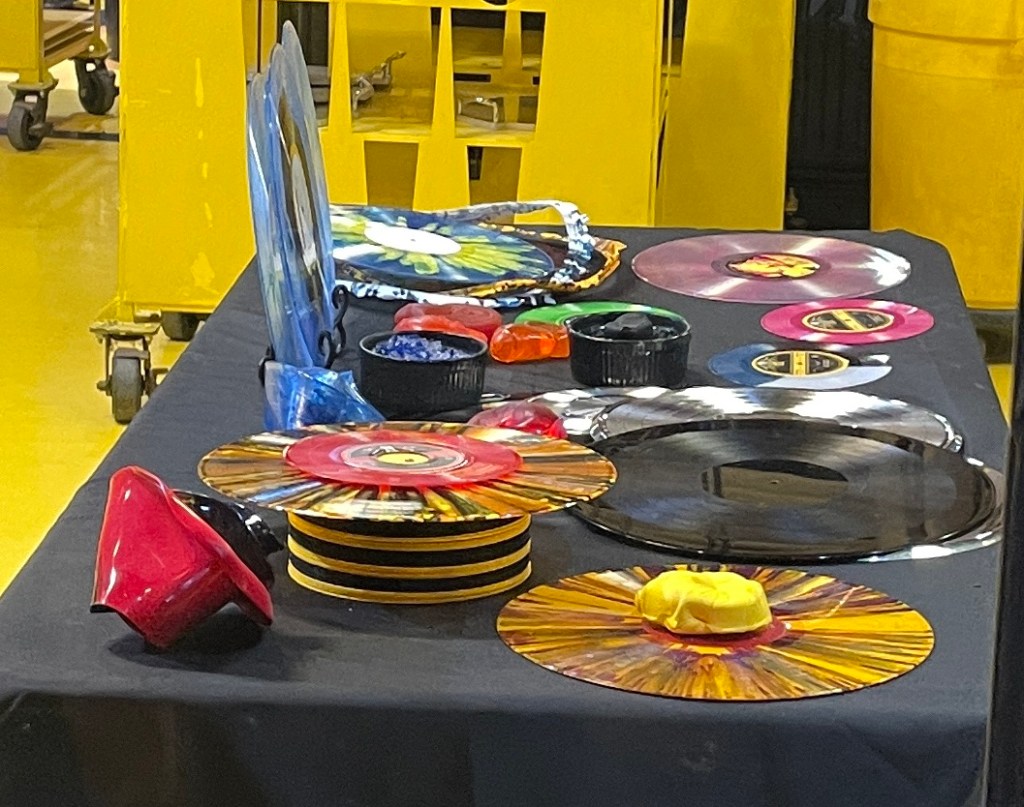
Third Man Records allow the artist to choose custom colors and designs. Price adjusted for complexity!
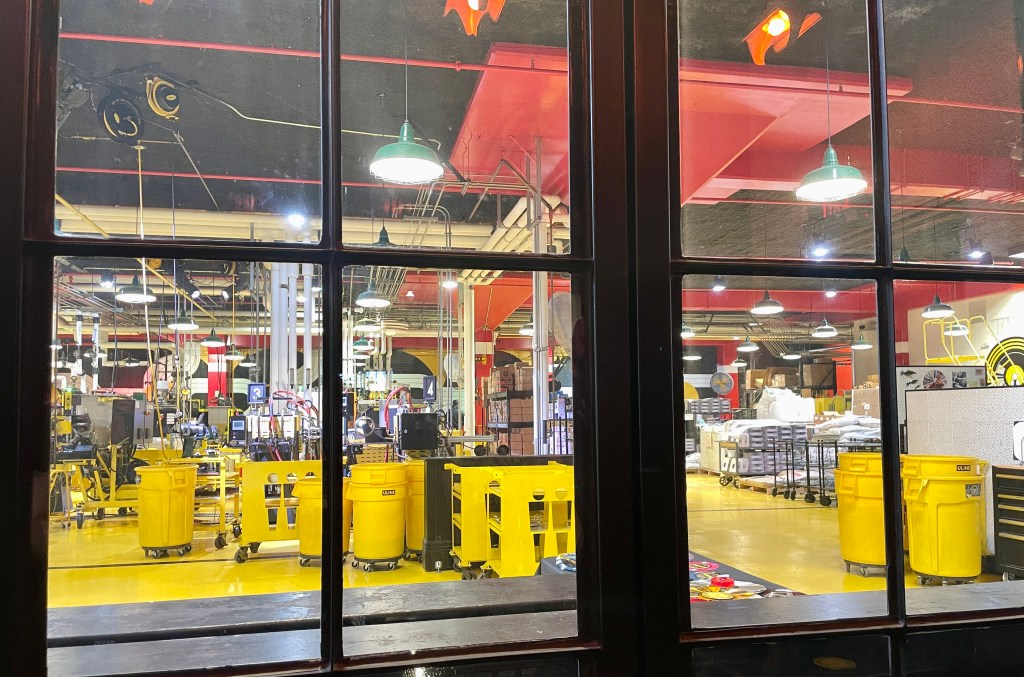
Pictures were not allowed while we were in the factory, but we stood for a while and watched two people complete their part of record production. They began with an orange colored composite chub – roughly the size of a tennis ball. A second person kneaded color pellets into the chub. It was then pressed and the musical track stamped onto the vinyl. When the record came out of the machinery it was an orange disc with a starburst of contrasting blues and purples expanding out from the center.
Eighty employees produce 10,000 records per day. Not all are as highly customized as the one we observed. We saw other options that were single color, or split colored.
We were told that black vinyl has always produced the best sound but the development of new composites has narrowed the gap in quality to be almost insignificant.
Every single record goes through audio and visual quality control and 95 percent pass. We saw individual records being put into their covers one at a time. That process is not automated.
If I’ve given you enough (or more than enough) detail – read on! If you’d like more of the science and technology behind stamping vinyl records, I found this very good 7:00 minute video filmed on the Third Man Records site. Access that video here
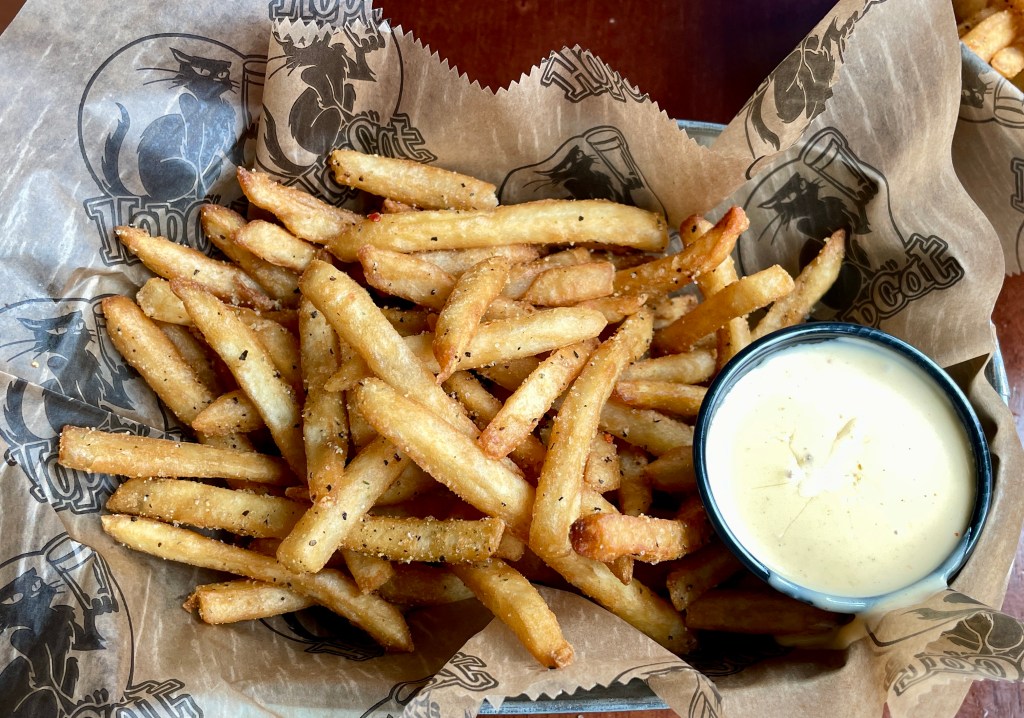
After our tour we went to a nearby restaurant called Hopcat. It had been recommended by our dinner waiter the night before.. Hopcat was ranked #21 of 591 restaurants in Detroit on Trip Advisor, so seemed worthy of a visit.
We saw on the menu that Hopcat has French Fries ranked in the Top 10 in America by the Food Network Magazine so of course we had to try them.
Yes, they were good!
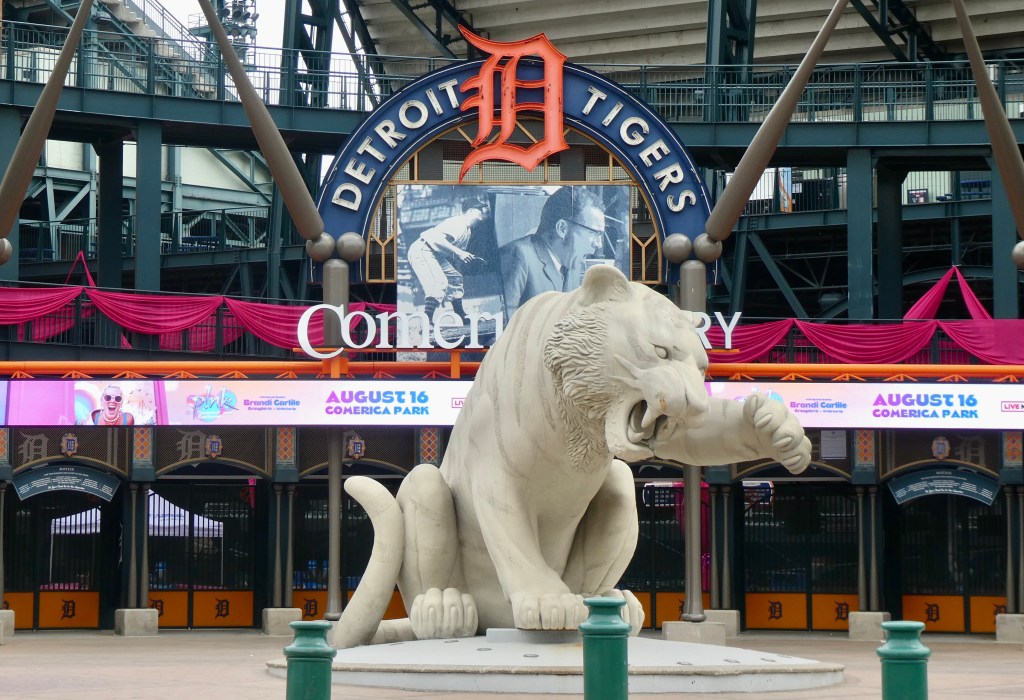
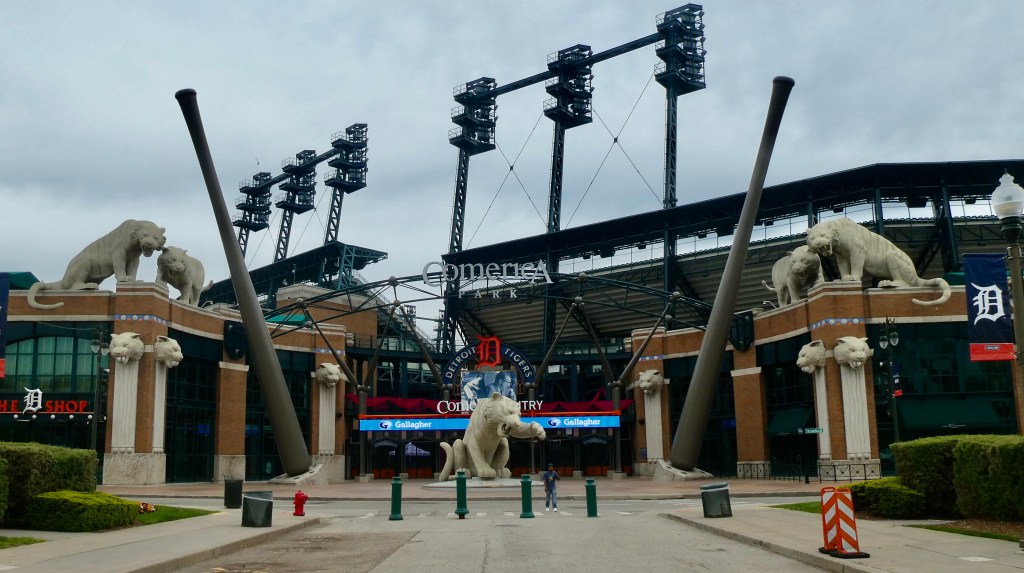
After lunch we made our way to Comerica Park to take some pictures before the game.
In a couple hours we would be there watching the Seattle Mariners play the Detroit Tigers.
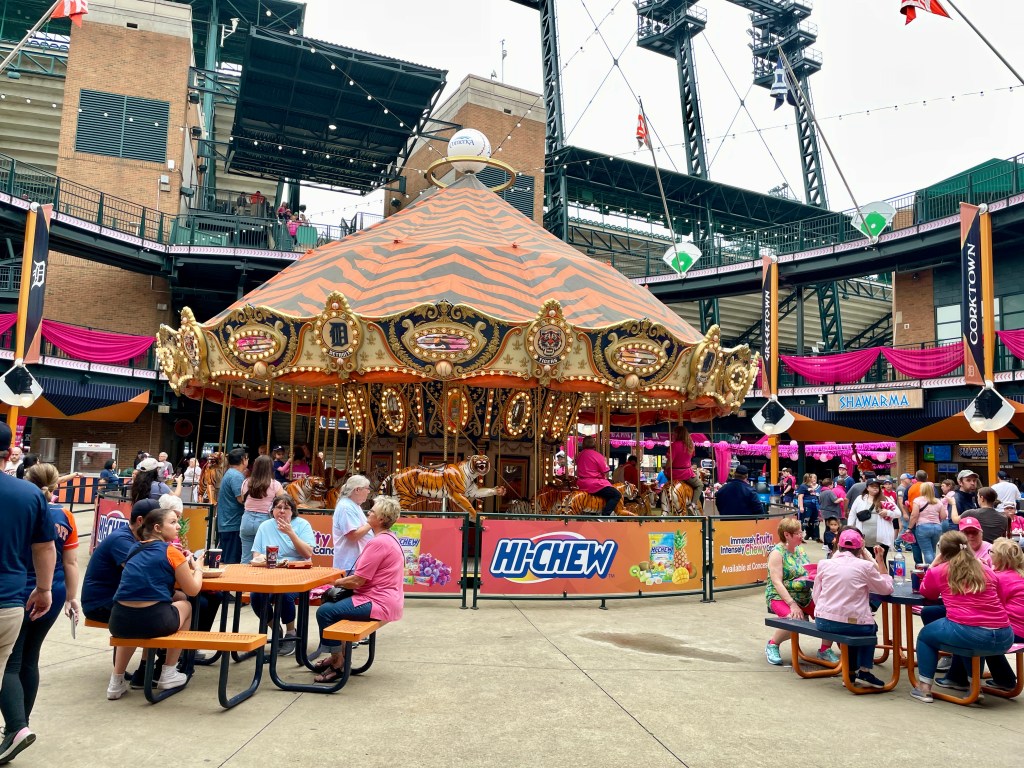
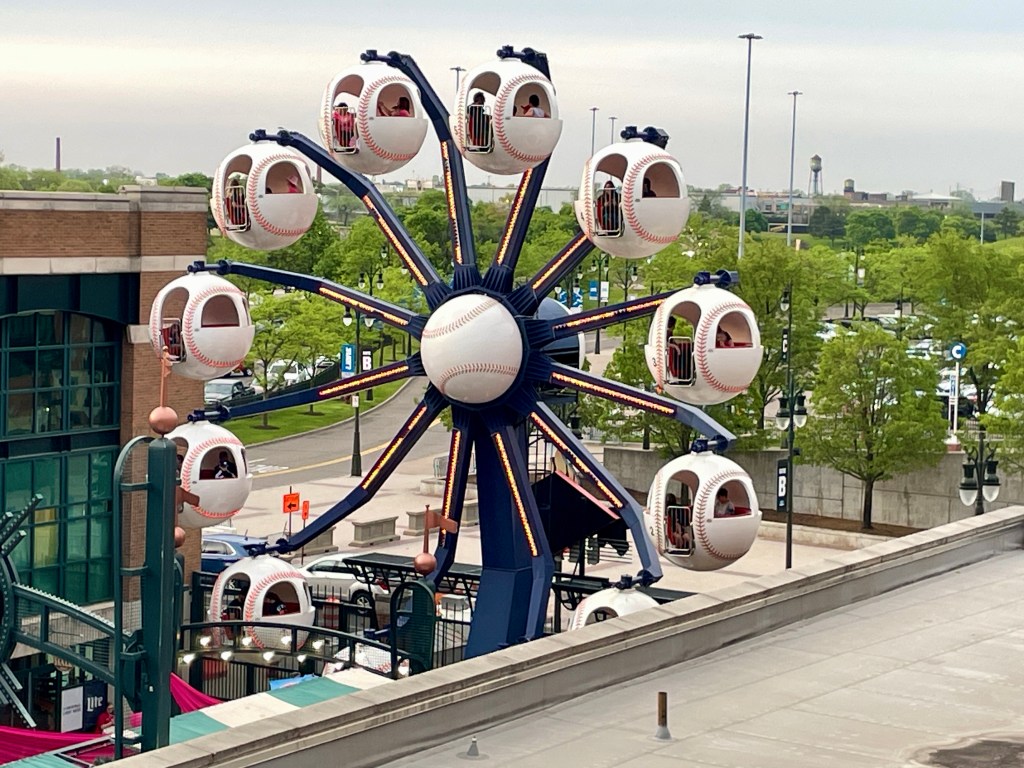
Comerica park opened April 2000 costing $300 million and includes an impressive front entrance, a carousel and ferris wheel.
There was a statue of Ernie Harwell, a major league baseball sportscast for 55 seasons. Forty two of those years were with the Detroit Tigers.
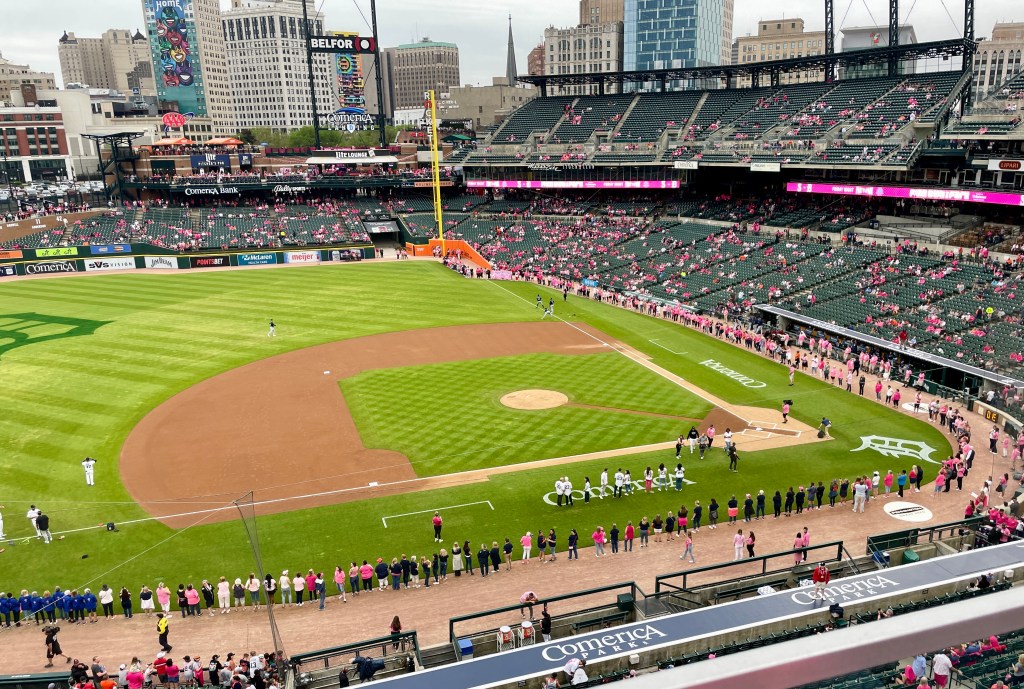
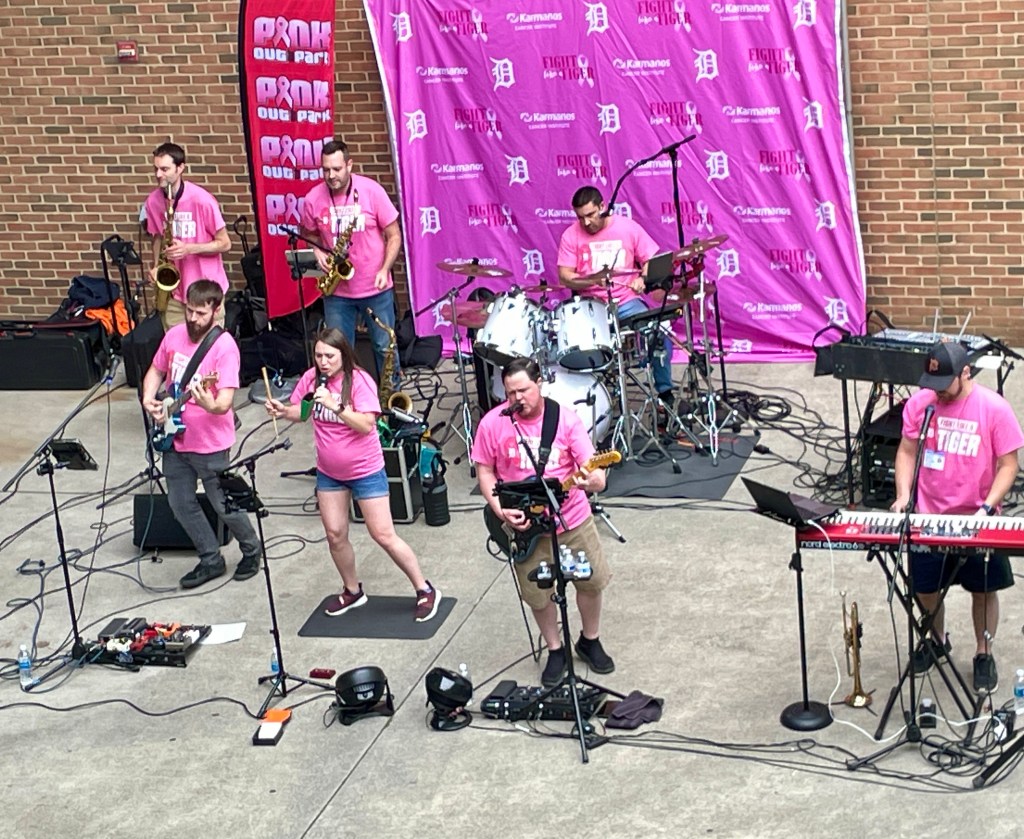
It was Pink Out the Park night highlighting the fight for a cure for breast cancer.
Before the game hundreds of women who had experienced breast cancer walked around the field. A woman seated next to us said that she may only go to one game a year but that game is always the Pink Out the Park game.
We all received a pink pullover and experienced a variety of events.
Both teams and the umpires held signs for women they knew impacted by breast cancer.
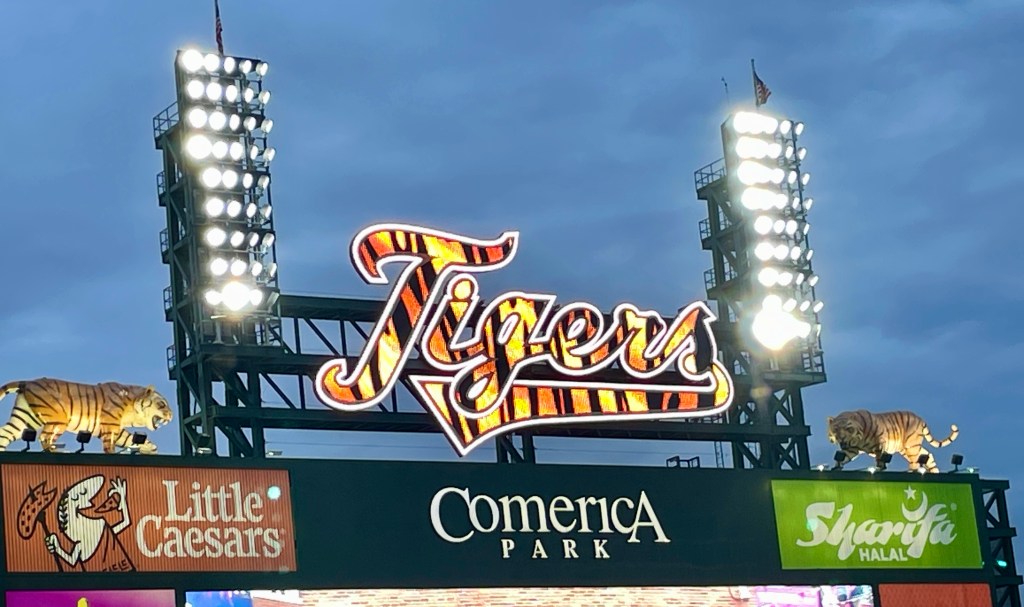
If you notice the Little Caesars advertisement on the video board – their world headquarters are in Detroit just a few hundred yards from the stadium.
One interesting deficit (in our opinion) of Comerica is that they do not post out of town scores on any of their boards. We have seen those scores in every other ballpark we have been in.
The Mariners won game one of the series.
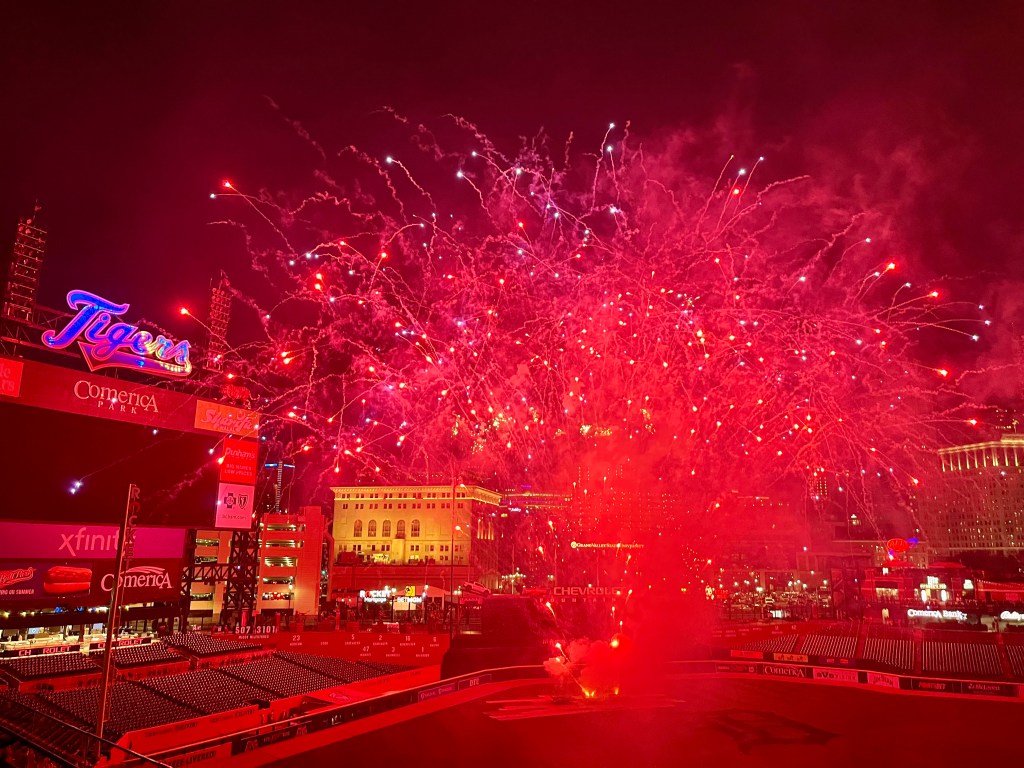
Fireworks at the stadium concluded our first day in Detroit. We had a short walk to our downtown hotel.
Next up: We go on an Architecture Tour of Downtown Detroit and have authentic Detroit Pizza at Buddy’s.