Nashville: Grand Ole Opry Times Two

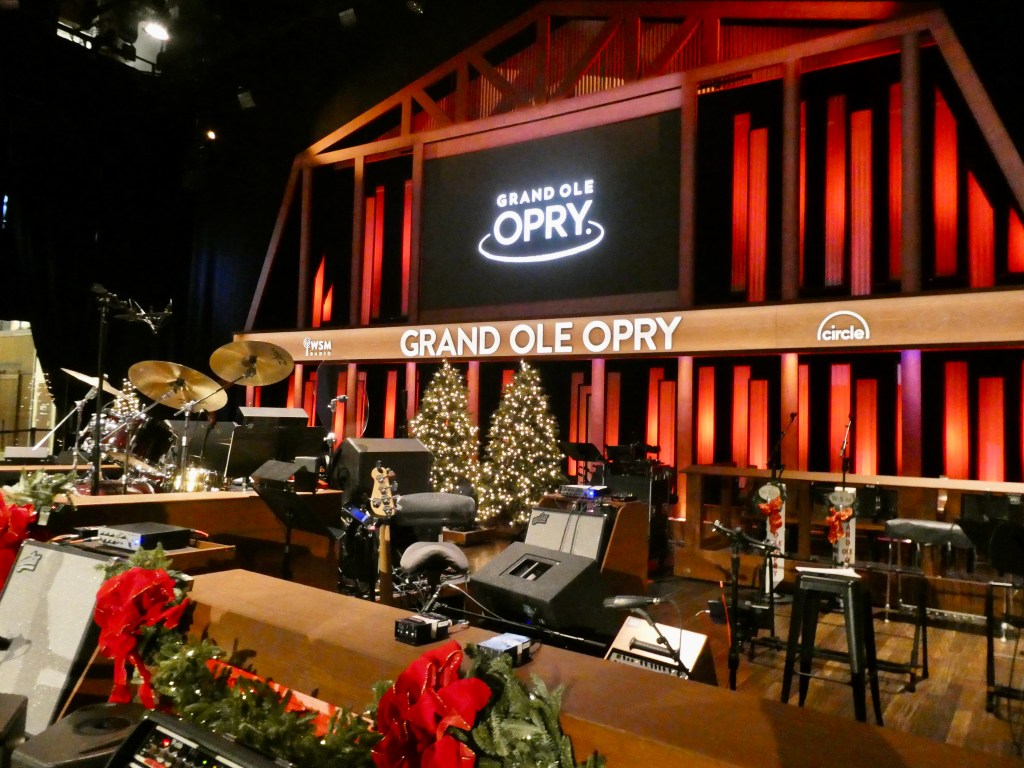
We had two Grand Ole Opry experiences: a back stage tour in the afternoon and a show in the evening. They were both great!

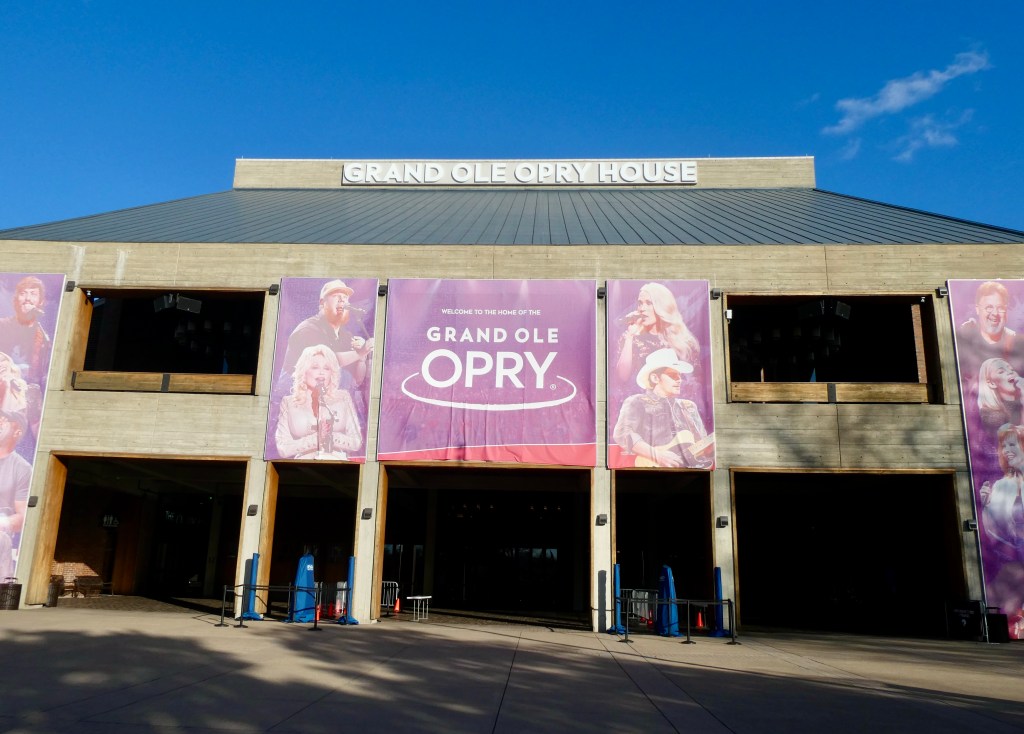
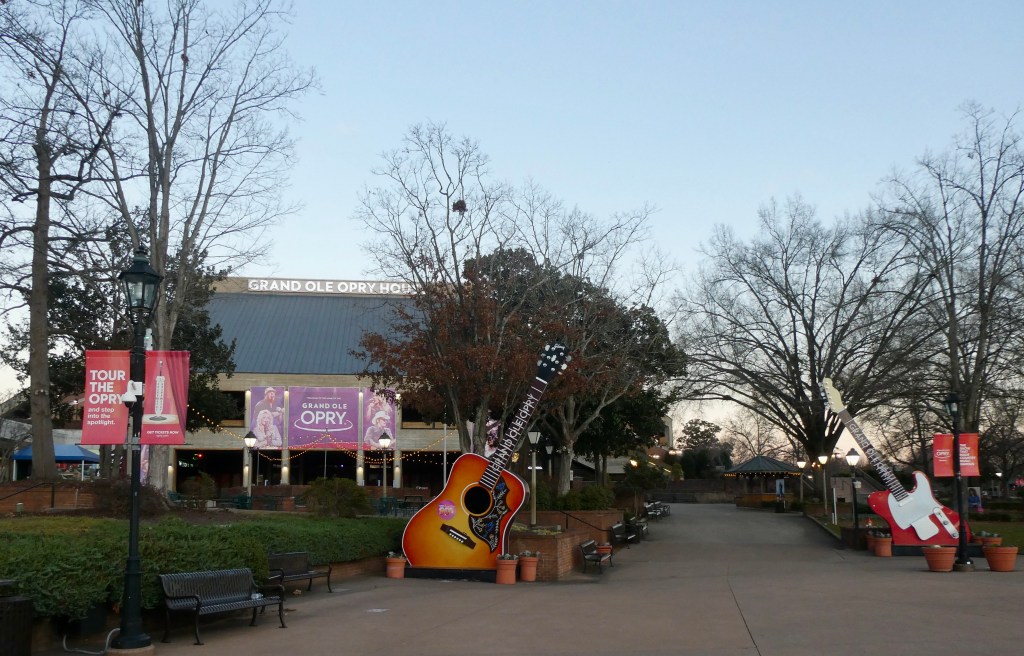
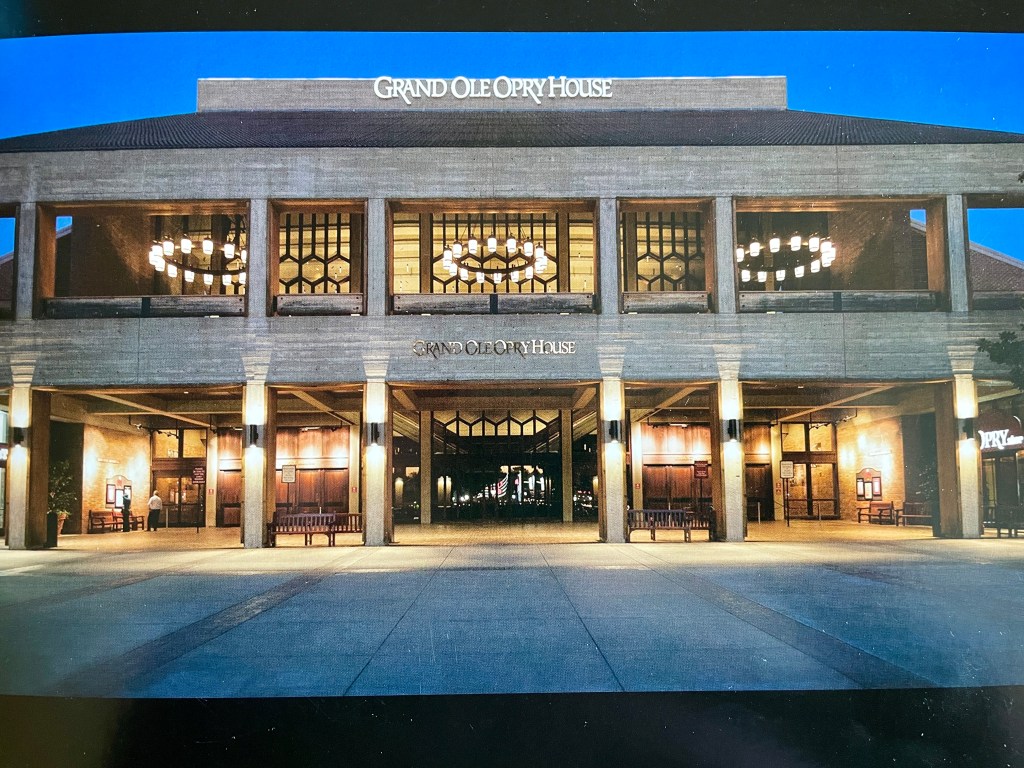
We arrived at the sixth location of the Grand Ole Opry. It has been in this location since 1974 and is likely permanent as they built and own the facility.

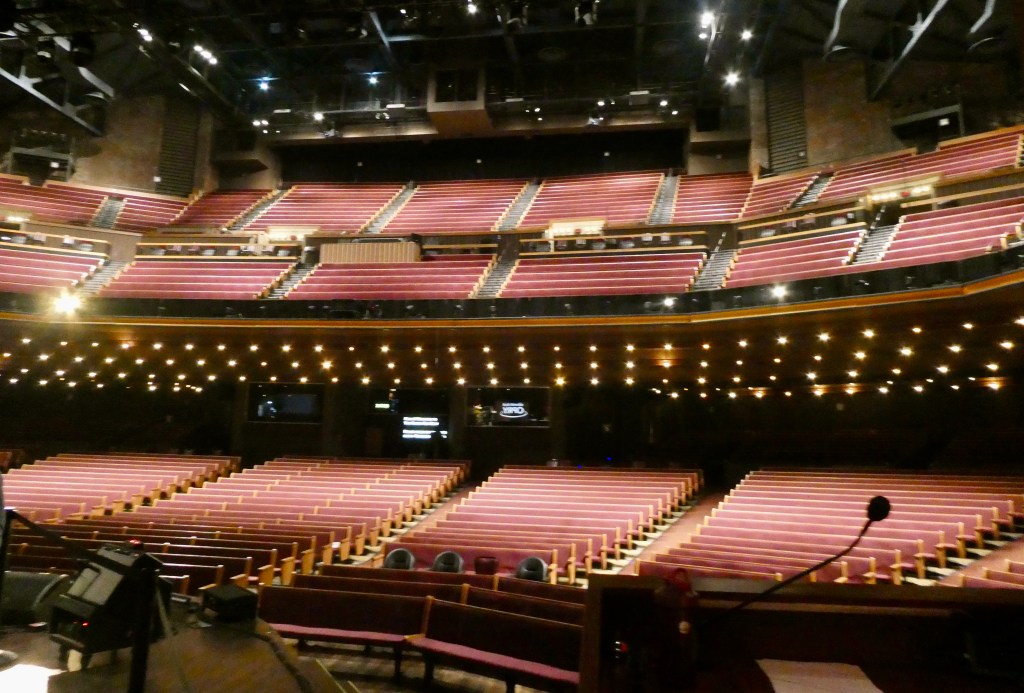
The Opry seats 4400 people, double the size of their fifth site, The Ryman Auditorium.  

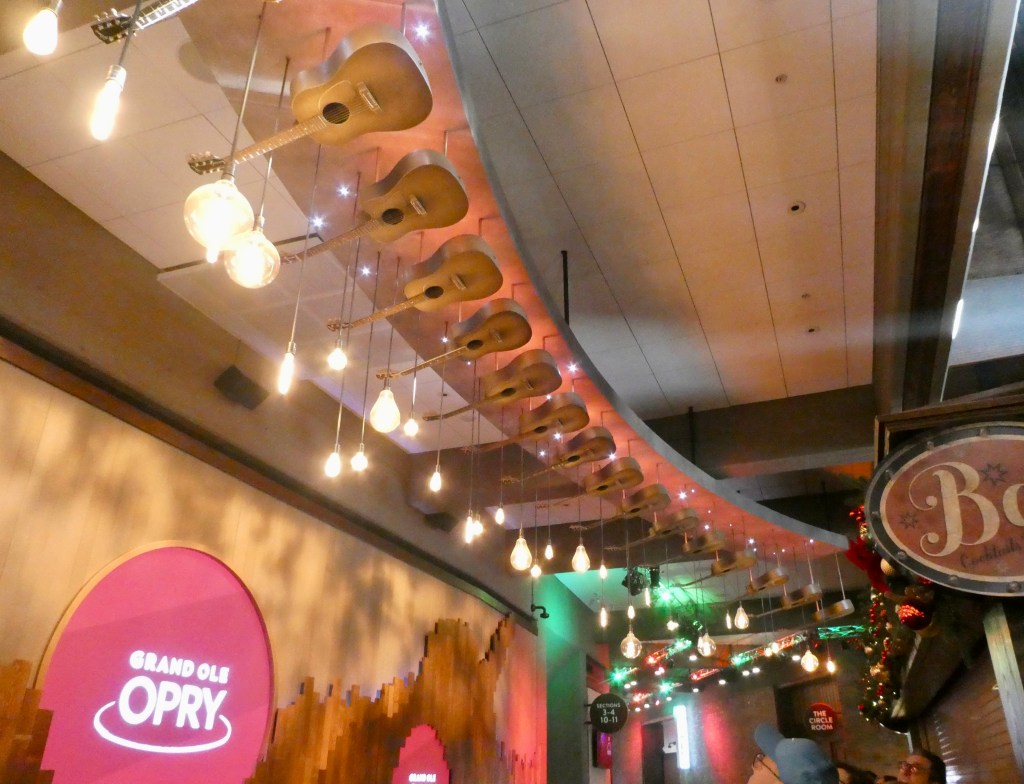
Just inside the main entrance there are $90,000 worth of Gibson guitars overhead!

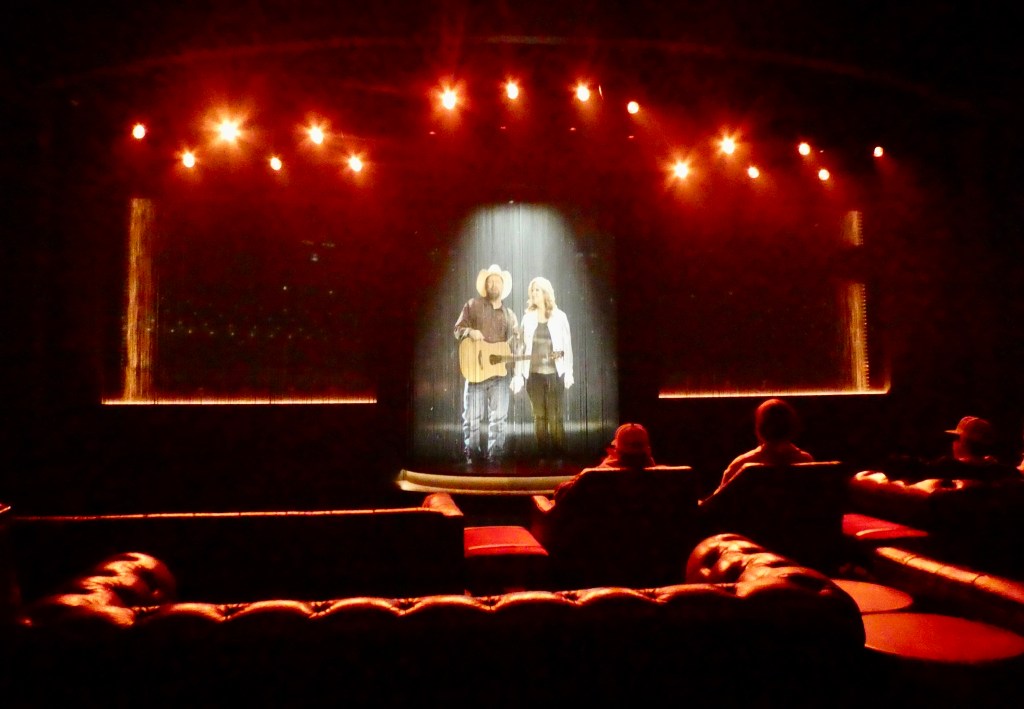
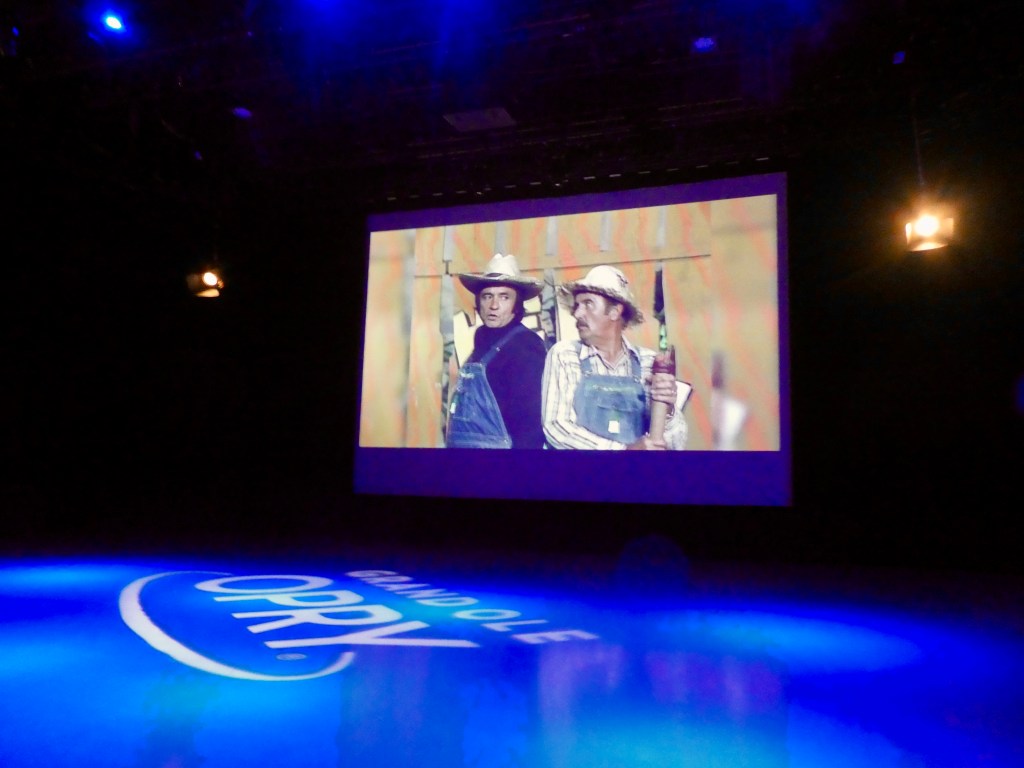
We began with a 30 minute video hosted by Garth Brooks and Trisha Yearwood holograms.  It was interesting and very well done.

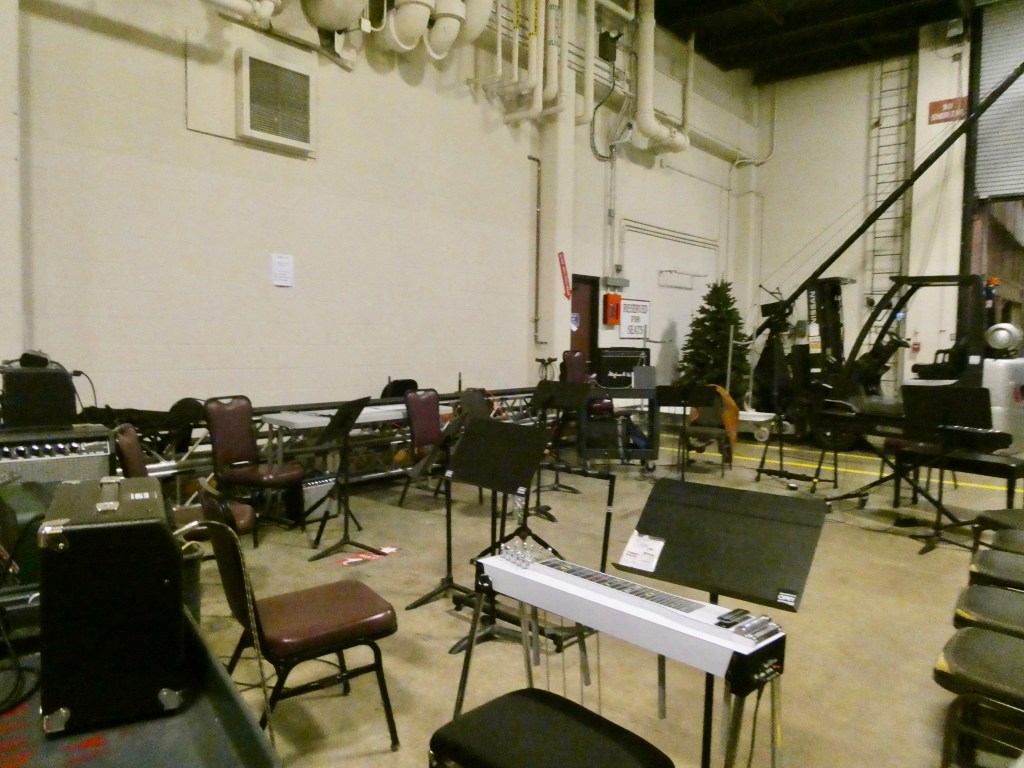
Our guide led us back stage and we saw where the house band warms up. They back up most acts.

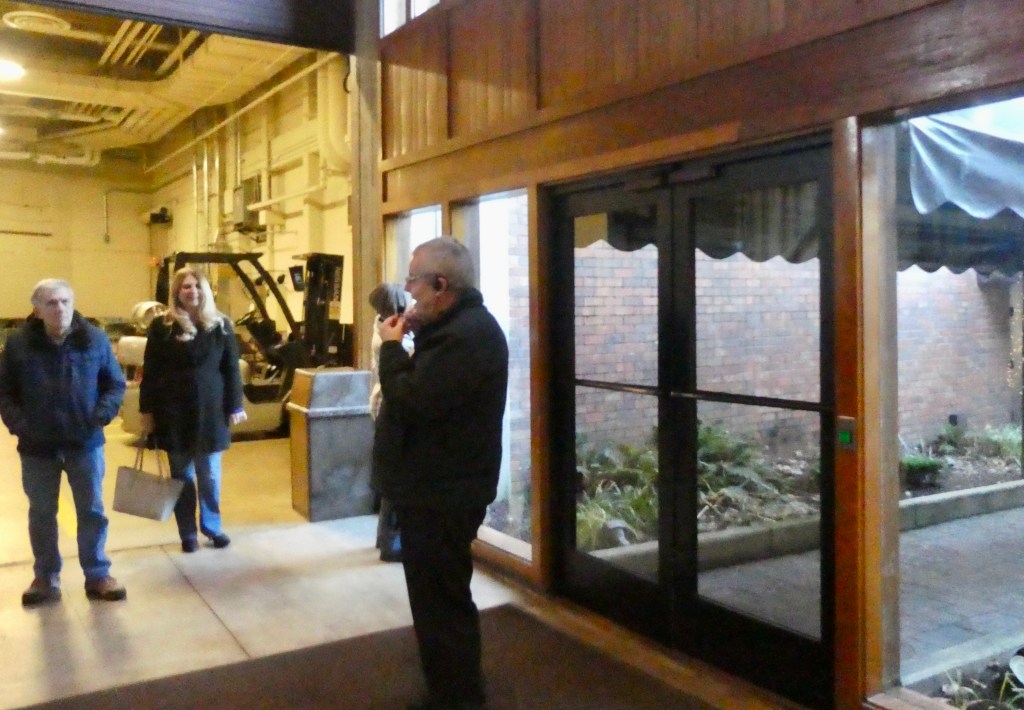
These doors are where the performers enter.  

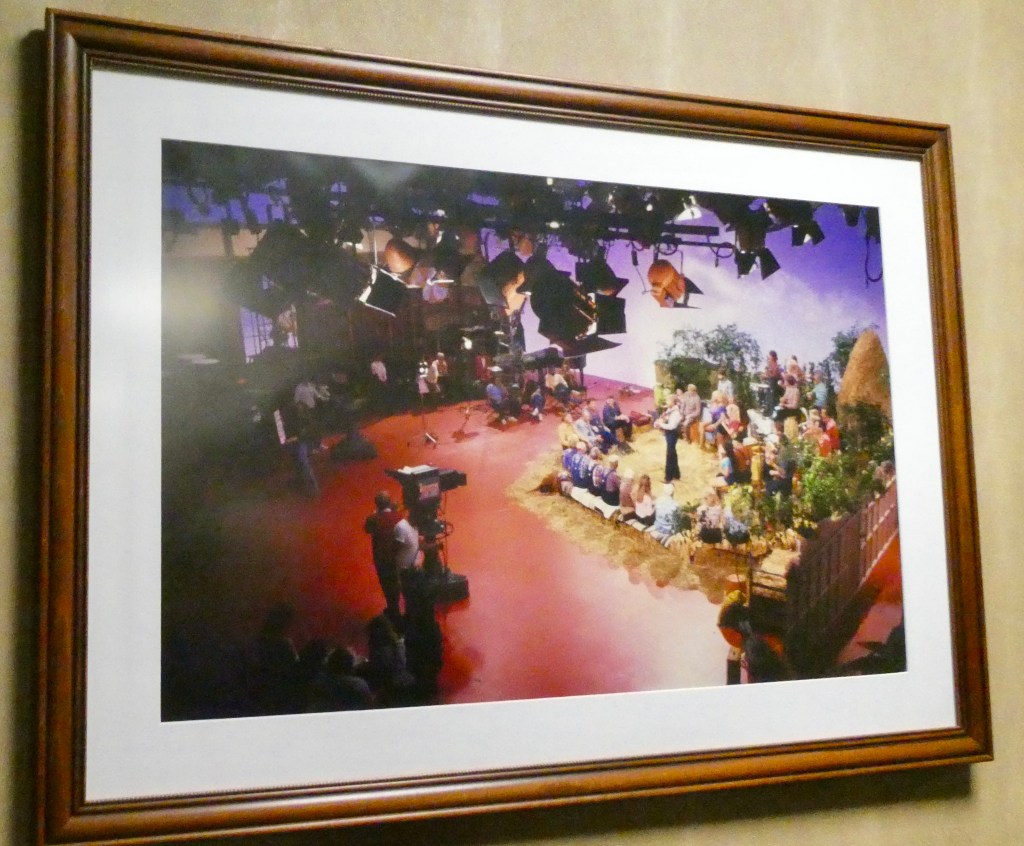
We entered Studio A where television programs like Hee-Haw were filmed.

This is a photograph of what the studio looked like set up for Hee-Haw.

Studio A is also where those invited to join the Opry have Induction Receptions.  We saw video clips of how very emotional it can be for artists to be invited to join the Opry.  The criteria seems somewhat subjective in that invitations are management decisions based on talent and commitment to the Opry.

Over the years there have been requirements for members to perform at a certain number of shows. It isn’t clear that any requirement remains but participation is expected.

The first members of the Opry were inducted in 1925. There have been 231 total members.

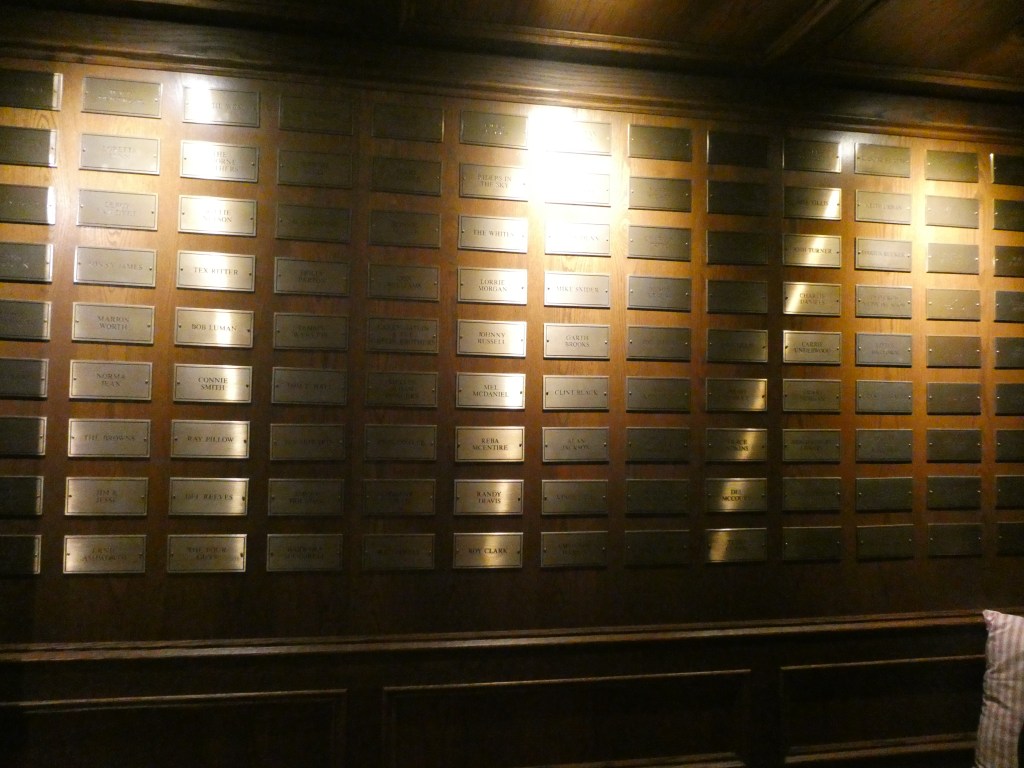
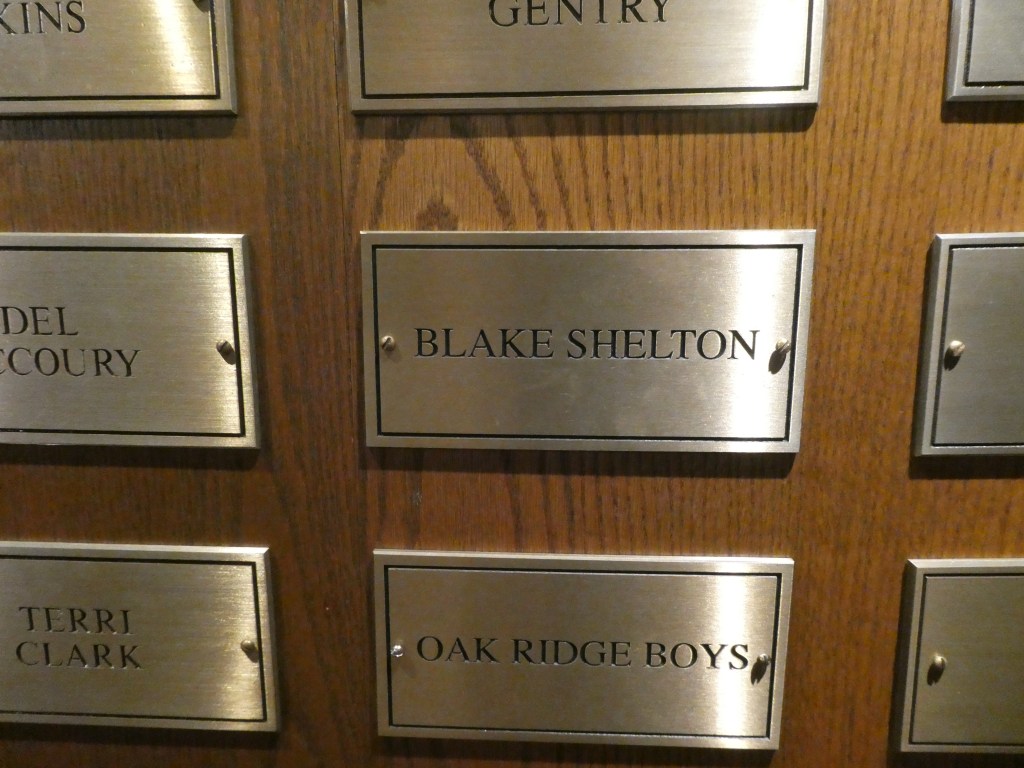
Blake Shelton was first to screw in his own name plate.  It has since become a tradition. Currently there are 71 living members of the Grand Ole Opry.   

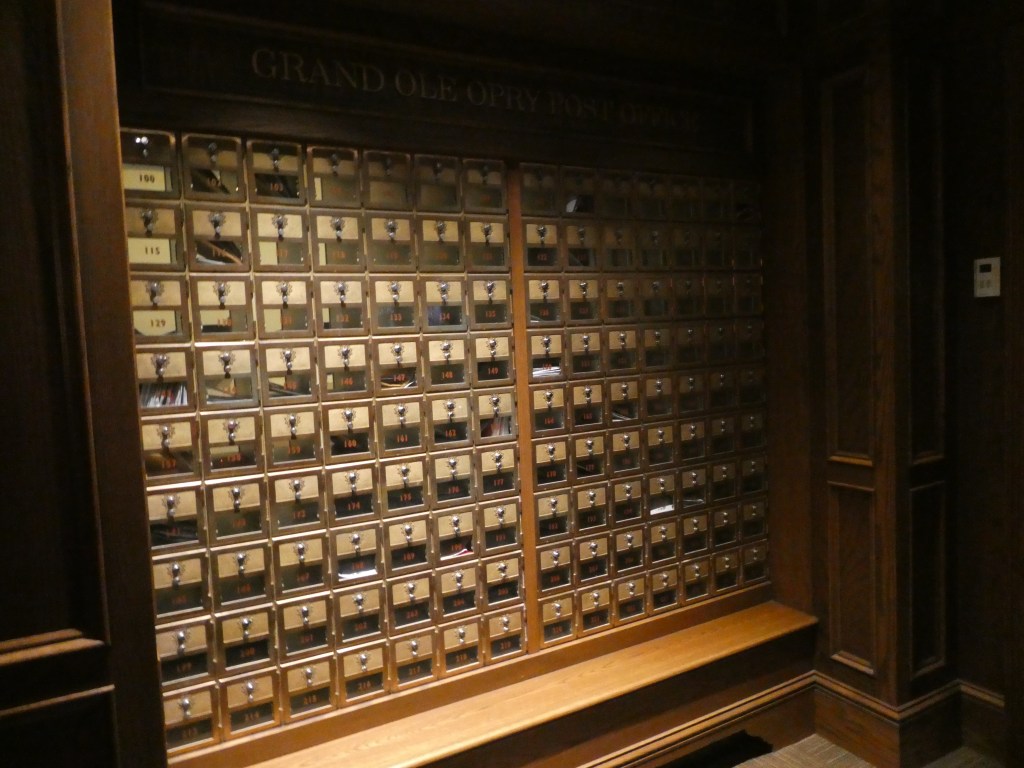
Members can receive fan mail at the Opry.

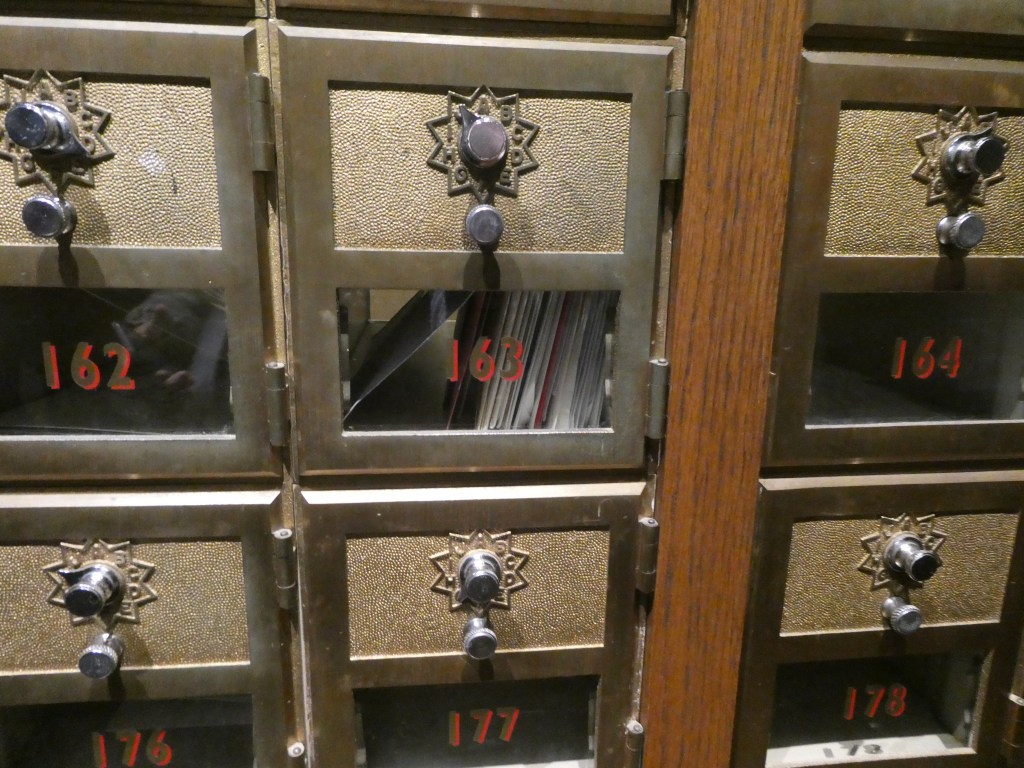
Dolly Parton’s mailbox is number 163, but it is not required to know a specific mailbox number. Write to your favorite member at the Grand Ole Opry, Nashville, Tennessee and it should get to them.

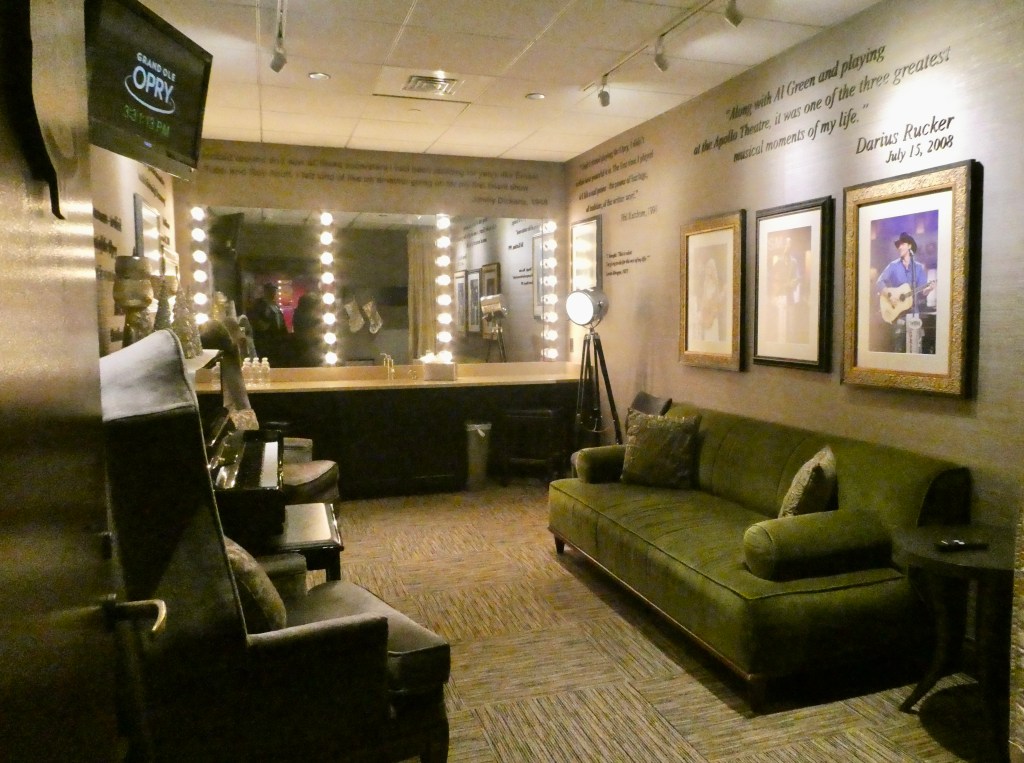
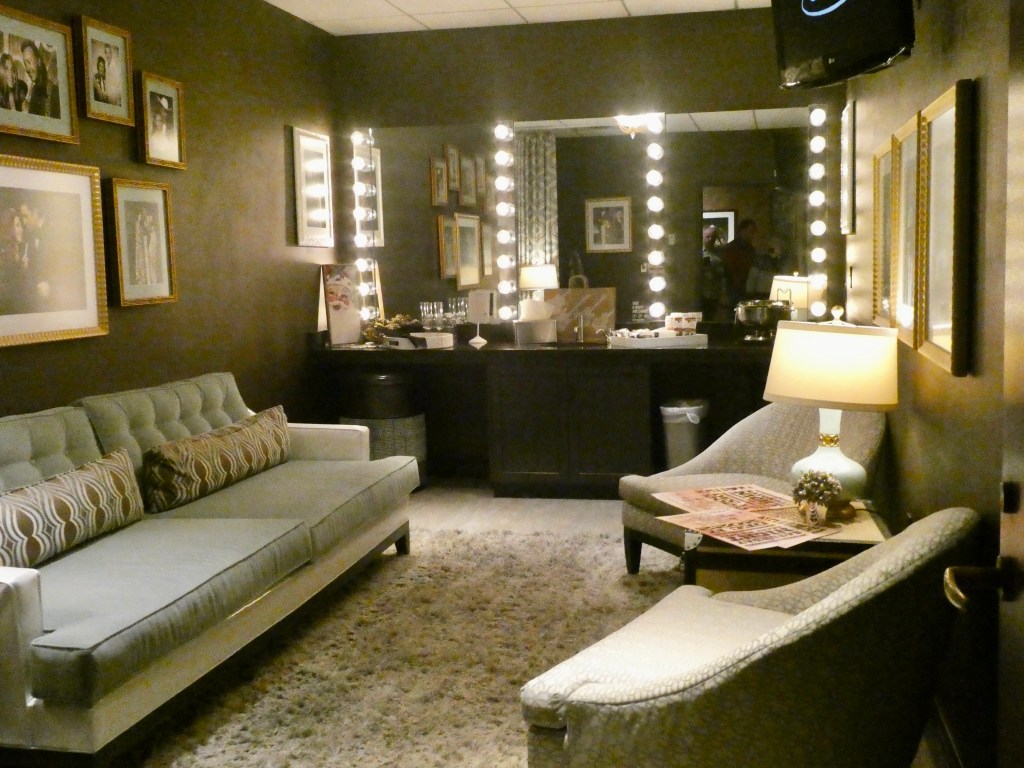
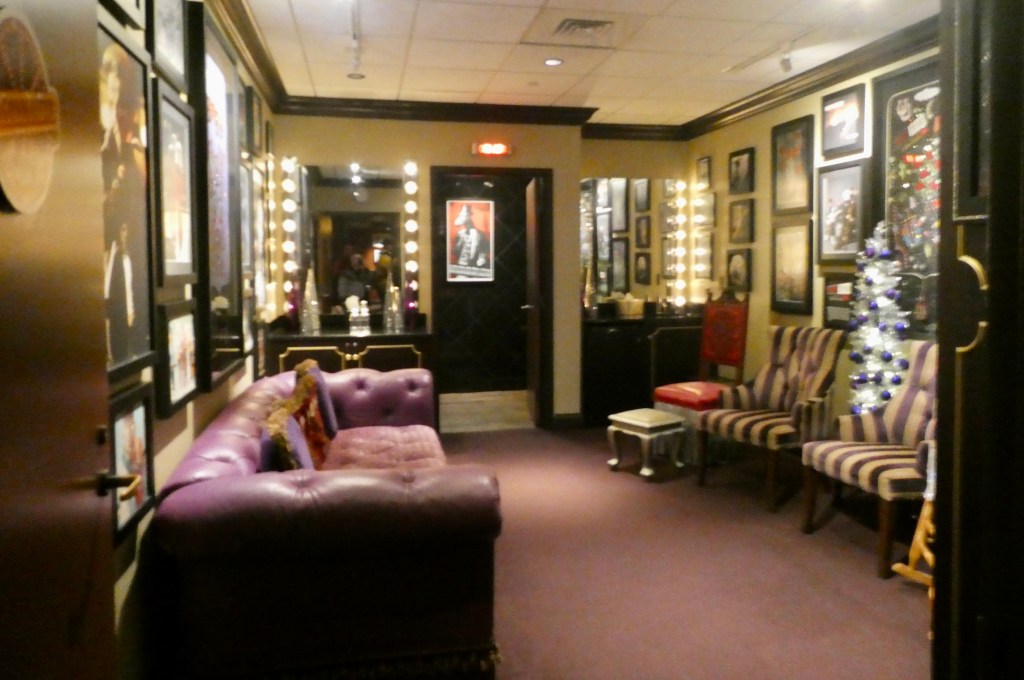
There are 18 dressing rooms.  

There is usually a theme, or dedication to a former member.

We were able to see all of them.

This is the Opry family room where artists can gather together before or after performing.The dark horizontal metal bar under the TV shows the height of the 2010 flood waters.   

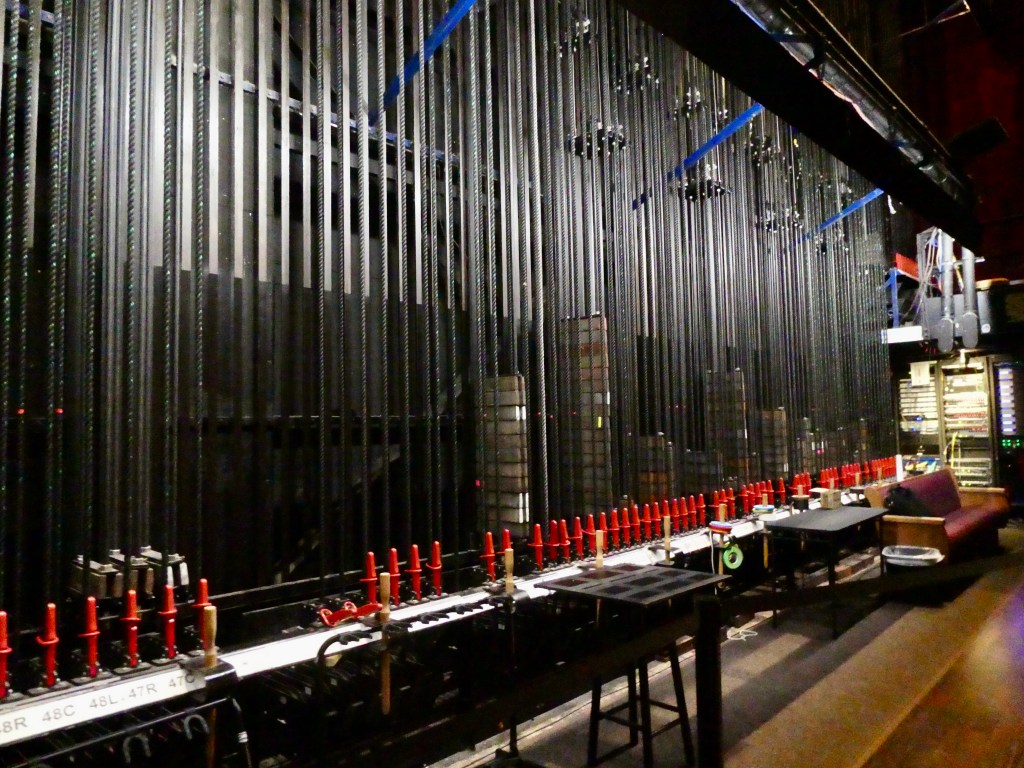
These cables looked important and impressive.  I don’t know what they do.

We were able to walk out onto the Opry stage. Approximately 6024 songs are performed during Opry shows each year.  

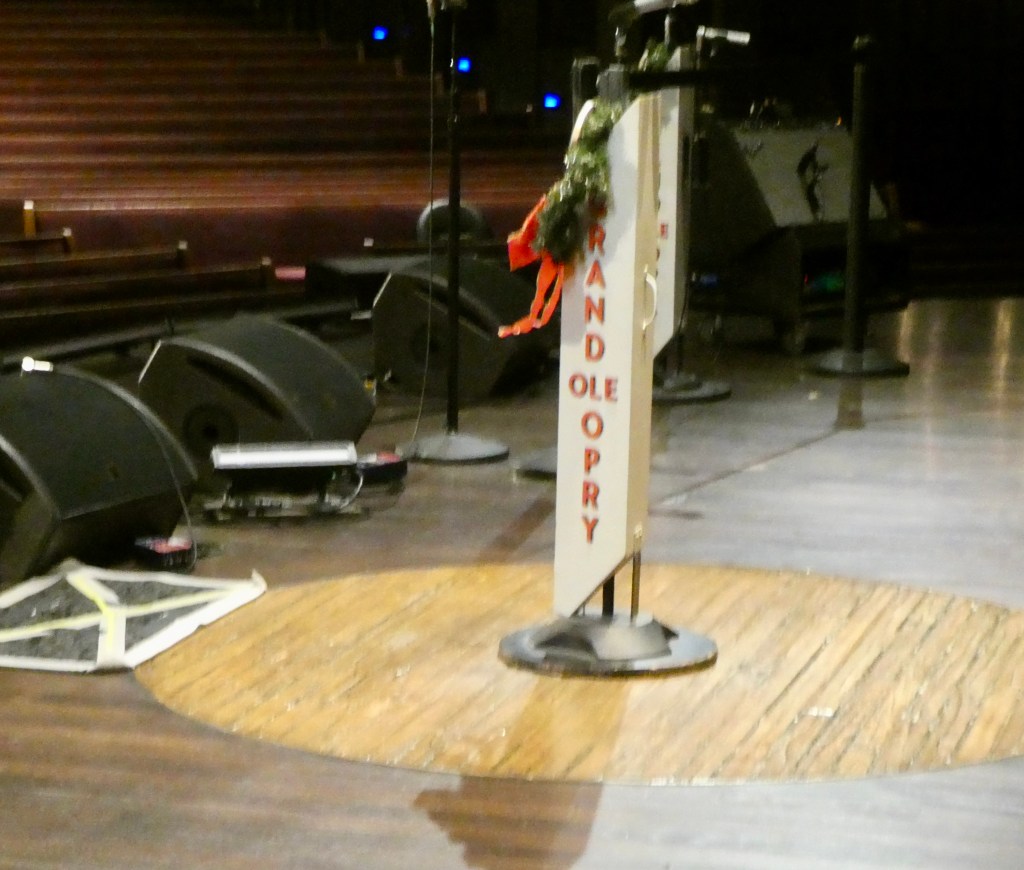
This circle was brought from the Ryman Auditorium. Stepping inside the circle and performing is an emotional rite of passage for a new artist.

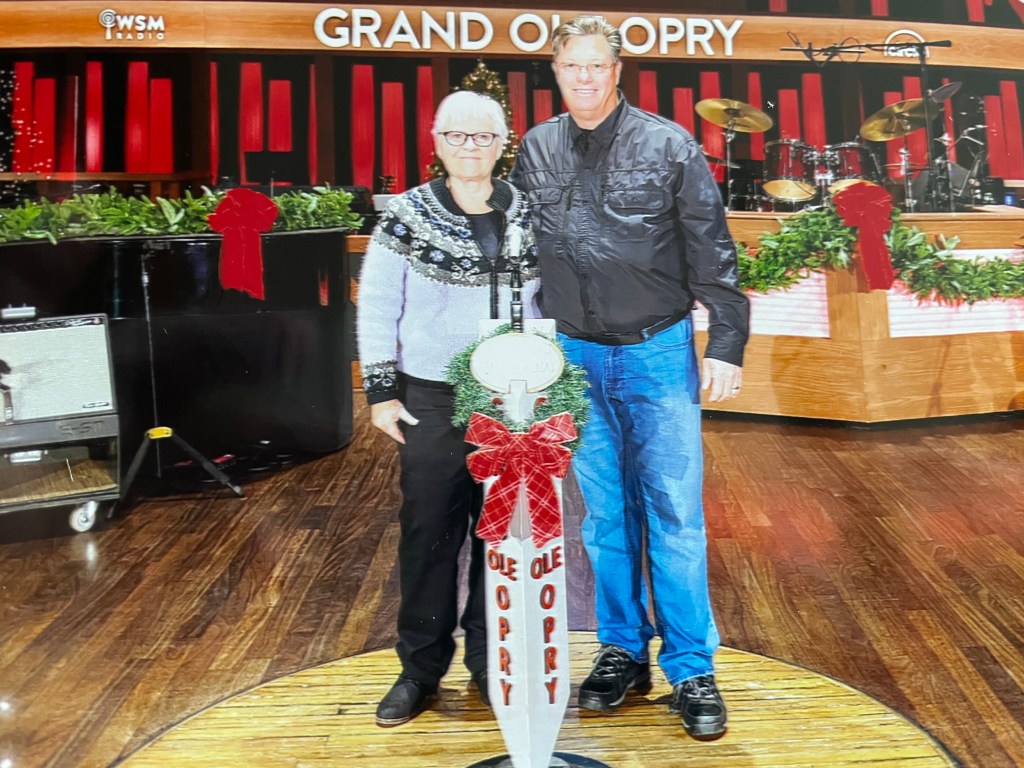
We were able to step into the circle for a photo without having to perform! We did have to buy the photo.

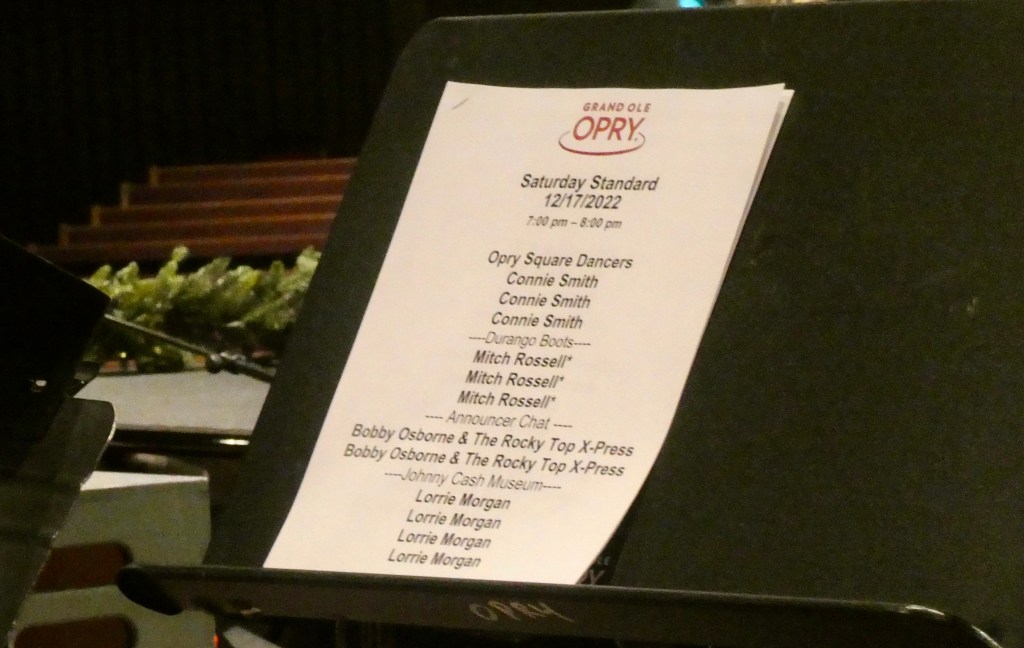
While onstage we were able to see the first page of the line-up for our evening show.

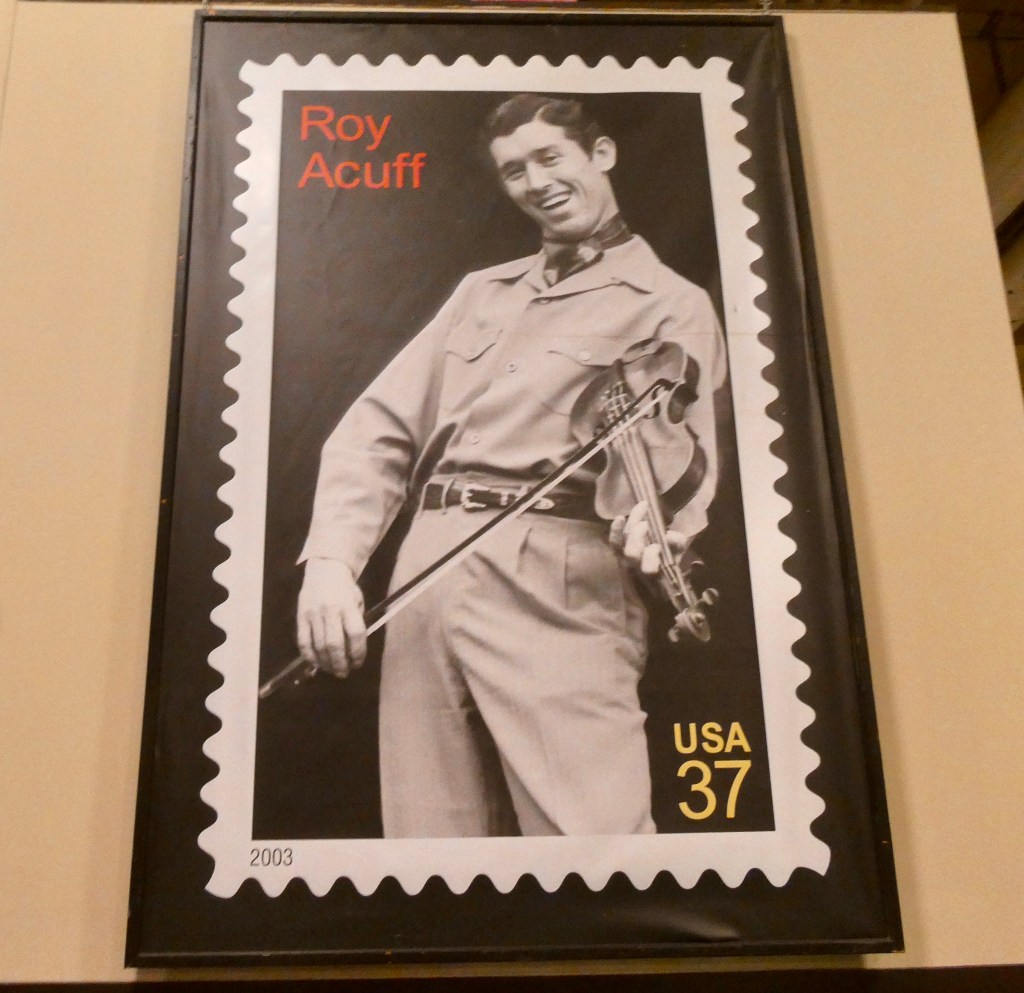
Backstage we saw this large banner for Roy Acuff (1903–1992) – known as the “King of Country Music.”  Acuff began his career in the 1930s and gained fame as a singer and fiddler.  Hank Williams once said  “For drawing power in the south, it was Roy Acuff, then God.”  He joined the Grand Ole Opry in 1938  and, over years, became an Opry elder statesman. In 1962, Roy Acuff became the first living person to be inducted into the Country Music Hall of Fame.

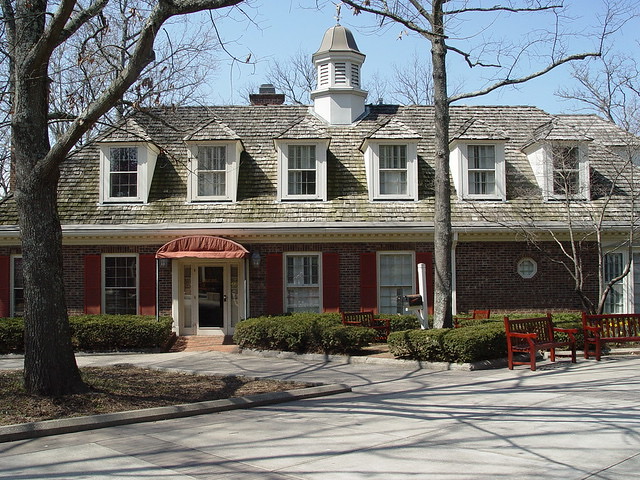
The Grand Ole Opry built a house on the grounds for Roy Acuff in 1983 after his wife died. He lived in the home for nine years and was often working on projects back stage or making impromptu performances. The Acuff House is now an Opry Museum.

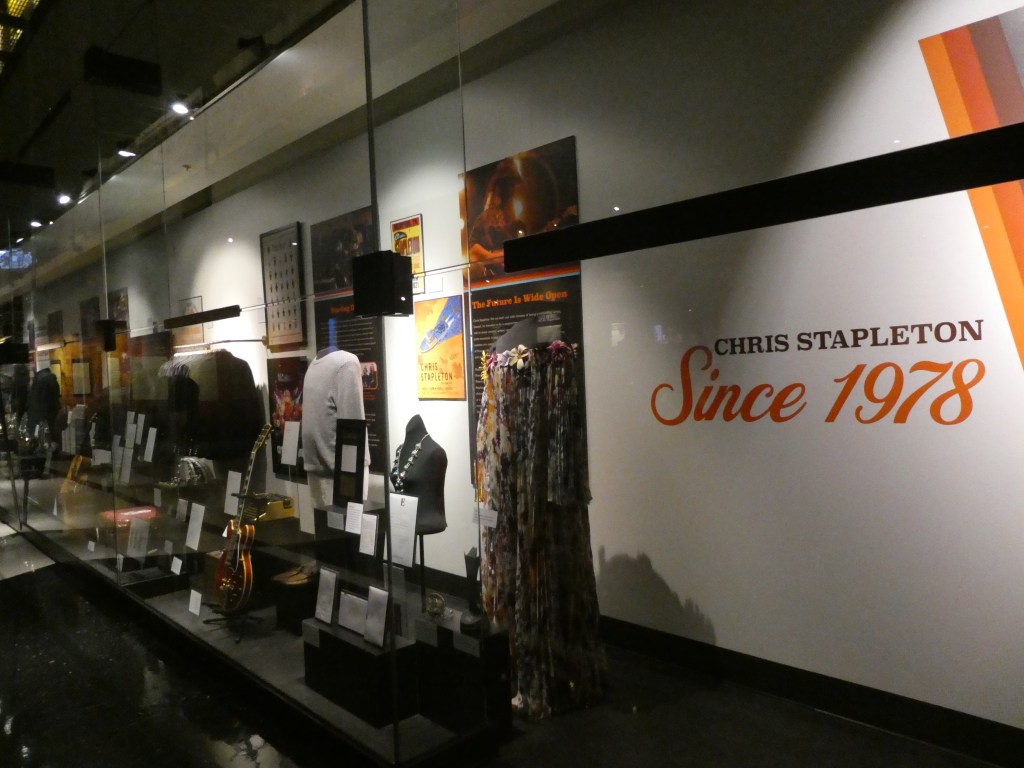
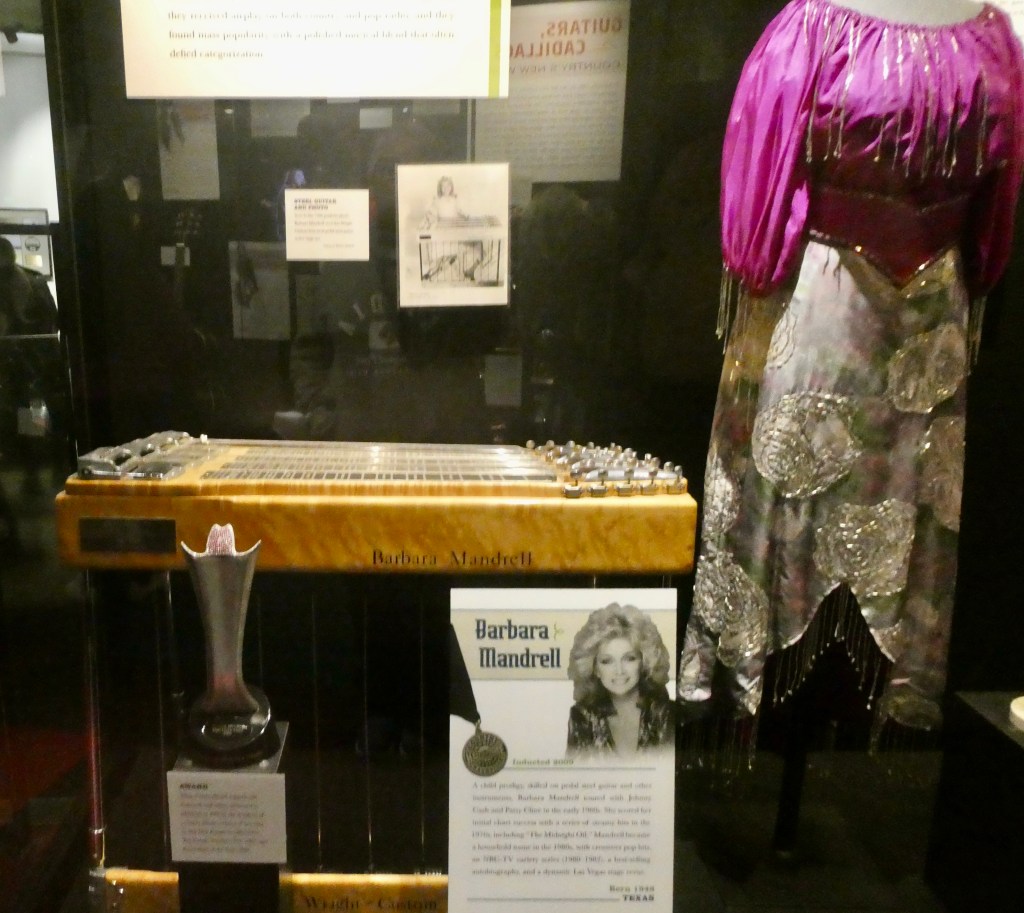
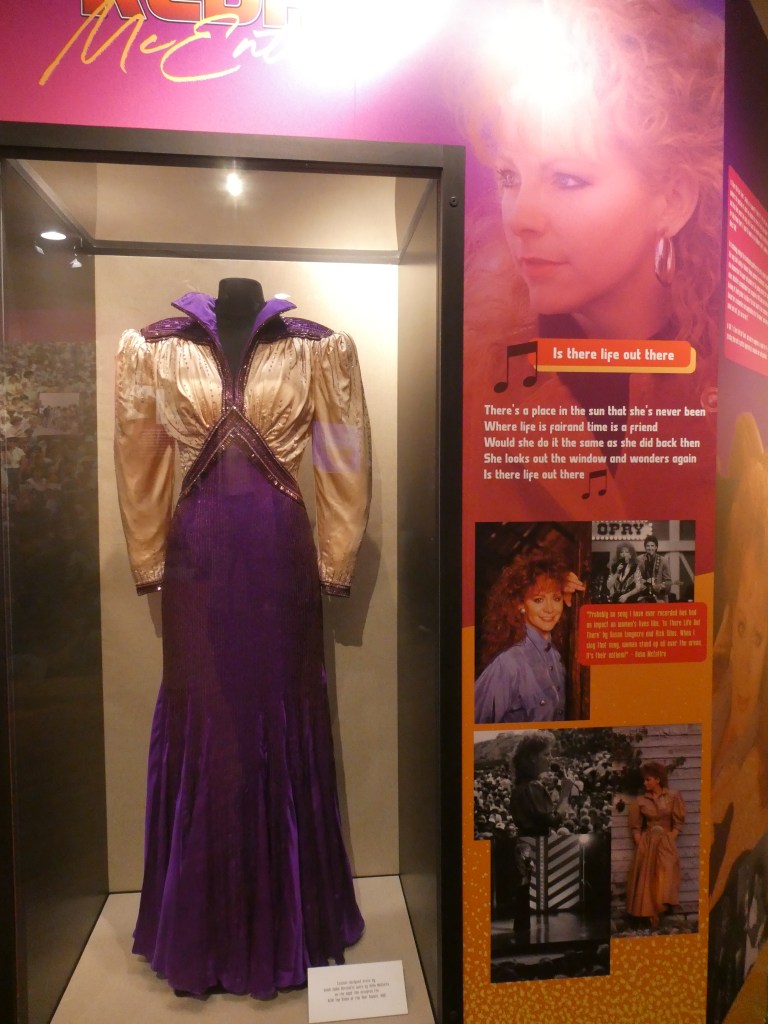
We saw a dress worn by Reba MacIntrye.

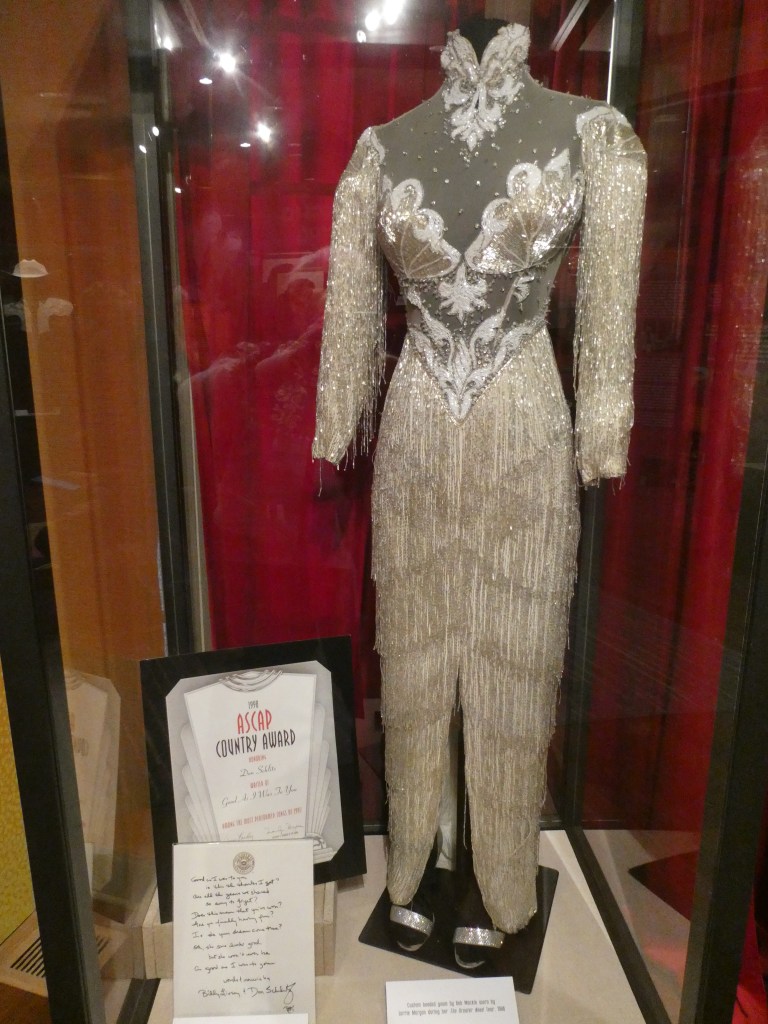
And another worn by Lorrie Morgan, designed by Bob Mackie.  There were some guy clothes too and some of them were pretty fancy!

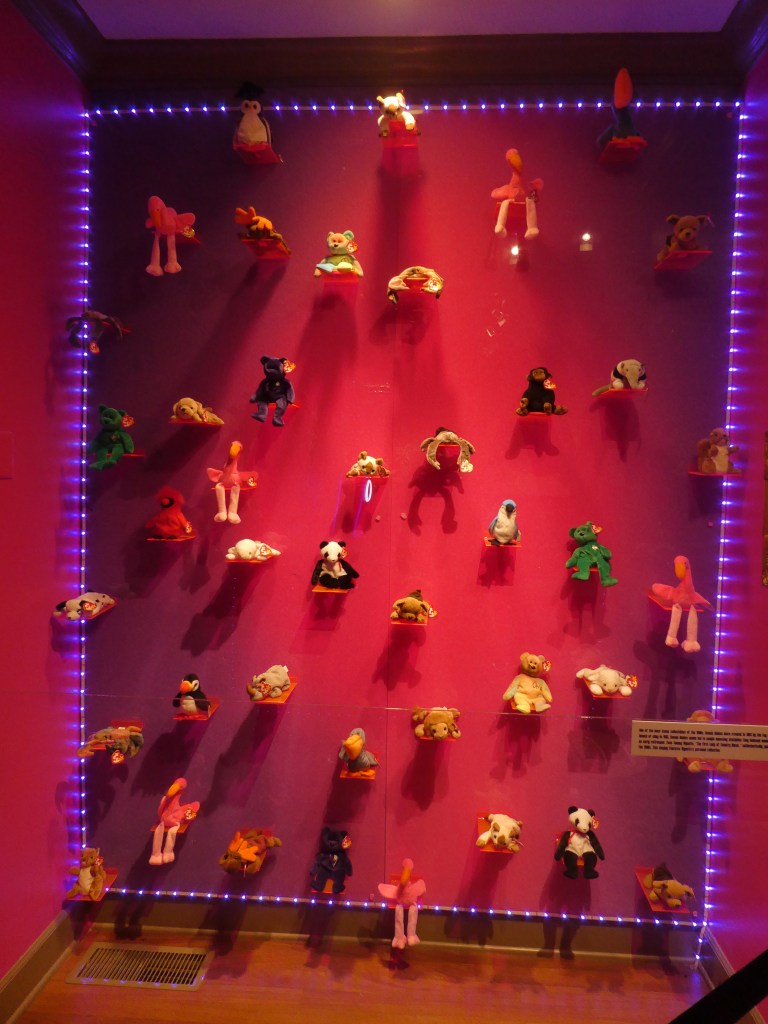
Tammy Wynette had a Beanie Baby Collection and it is on display!

The backstage tour complete, we had a few hours to wait. Our parking spot was too precious to give up since we had tickets for the 7:00 Opry.

We had planned to walk over to the Gaylord Opryland Resort. It is the largest hotel in the US that isn’t Casino based. We were told by several people that it was a “must do” especially during the holidays because of their extensive decorations. Unfortunately, they were requiring tickets to one of their events to be able to enter the resort so we were out of luck. There was an adjacent mall so we had dinner and wandered. 

We went back for the show and found our seats.  We bought good seats because this may be a one time thing. We were six or seven rows back from the stage and slightly to the left.

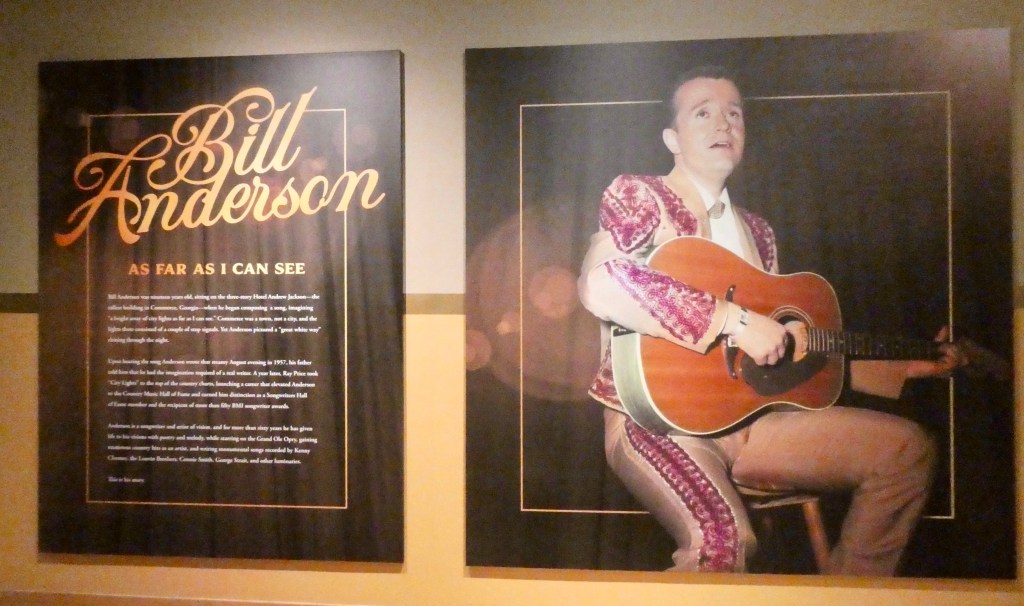
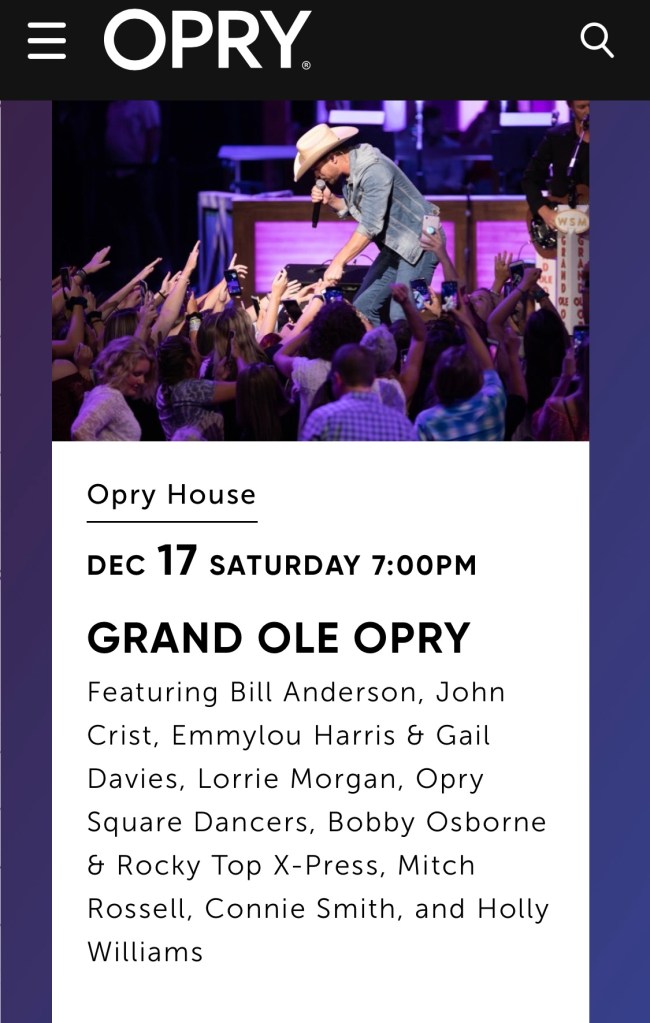
At the time I purchased the tickets, the only artist listed to perform was Bill Anderson.  Over the intervening weeks I occasionally got online to see who else was in the show.  Not being familiar with country music at all, I was very glad when Emmy Lou Harris was listed.  At least she was someone I had heard of!  Randy is much better with country music than I am. We both learned from Ken Burns’ History of Country Music series, but what we don’t know is still far greater.

The Grand Ole Opry began 97 years ago and is the world’s longest running live radio show.  It began as a platform to sell insurance by the National Life and Accident Insurance Company.  It is credited with popularizing country music through its weekly Saturday night program.  In 1932, broadcaster WSM boosted its power to 50,000 watts and was (and can still be) heard in much of the eastern and central United States.  

Shows in the Grand Ole Opry take place several nights a week but Saturday Night shows are on the radio. It was interesting to see the interaction between the live show and the radio show.  The announcer fills both roles. The sponsors of the day were Dollar General and the Johnny Cash Museum.

The format is music for 60 minutes, a fifteen minute intermission, and then another 60 minutes of music. The show moves quickly with each performer singing or playing two to four songs.

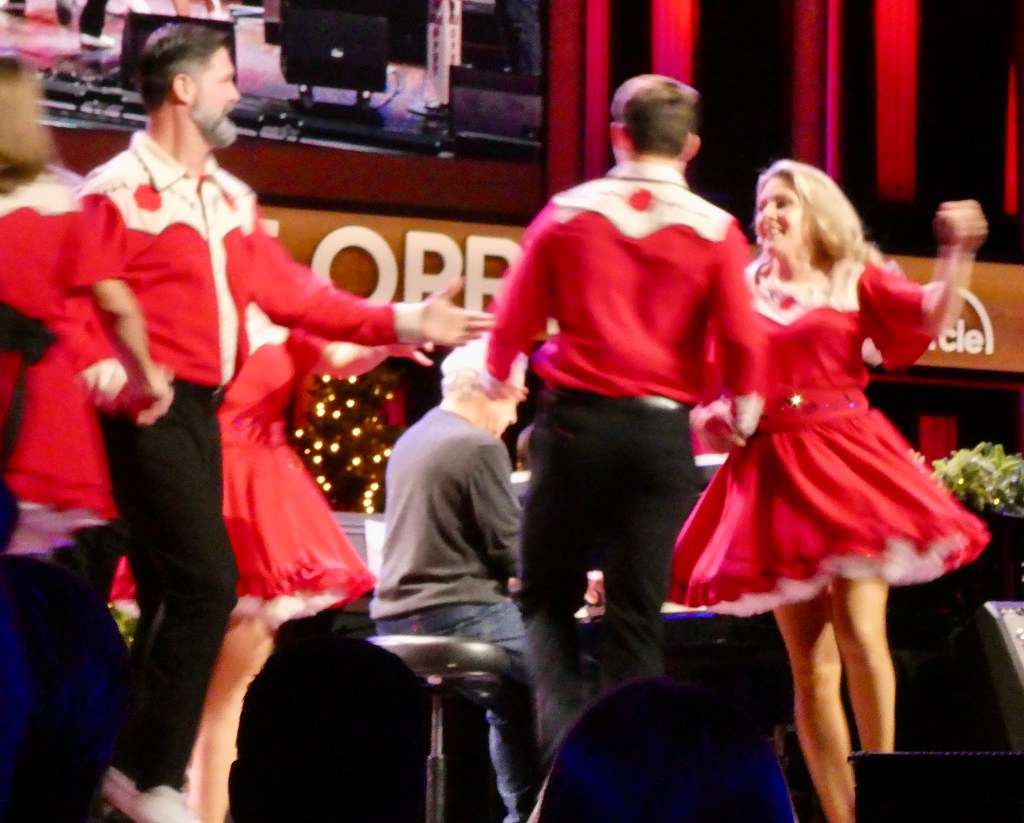
The show began with a performance by the Opry Square Dancers with music by the Grand Ole Opry house band.

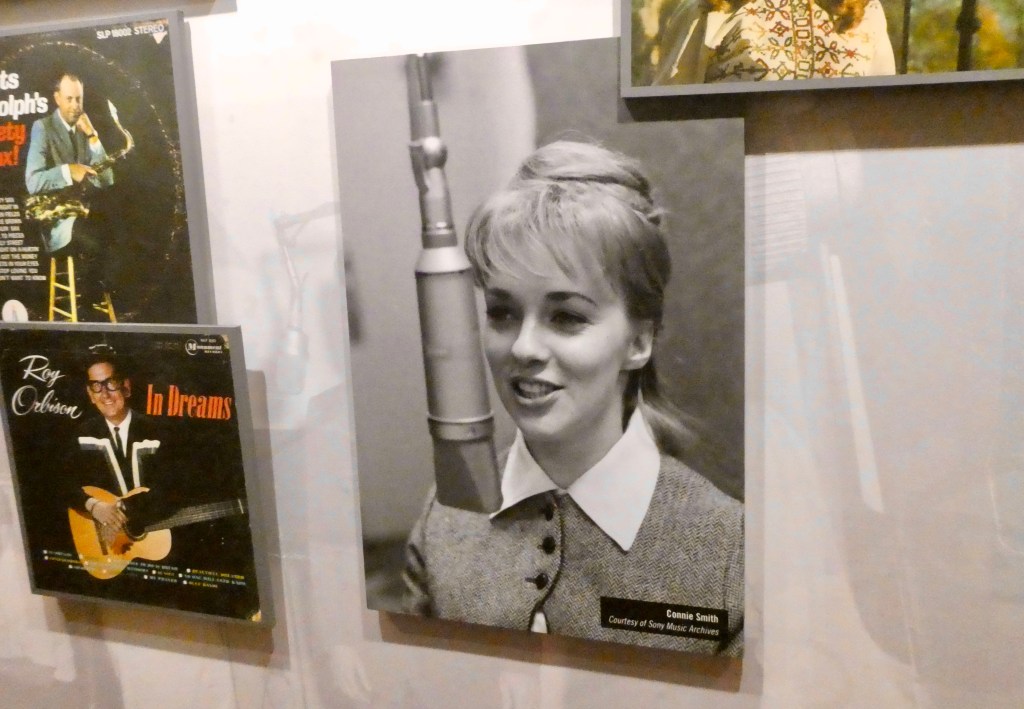
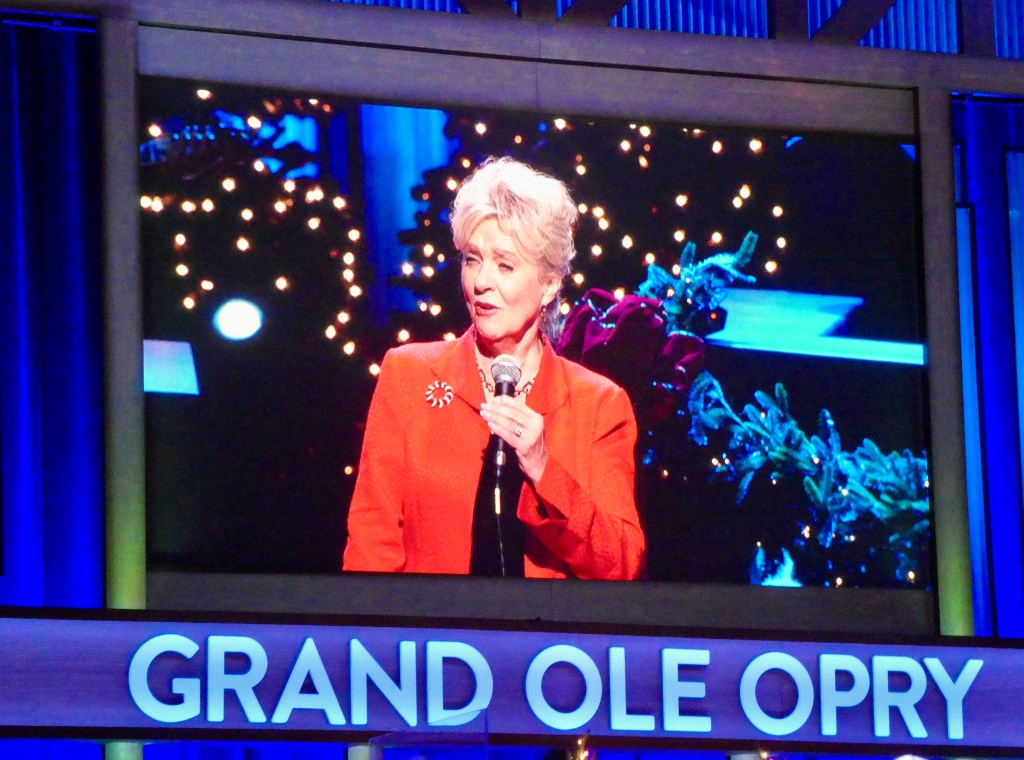
Connie Smith was the next performer.  She has been an Opry member for 50 years. We were close but it was usually easier to get a picture from the screen.

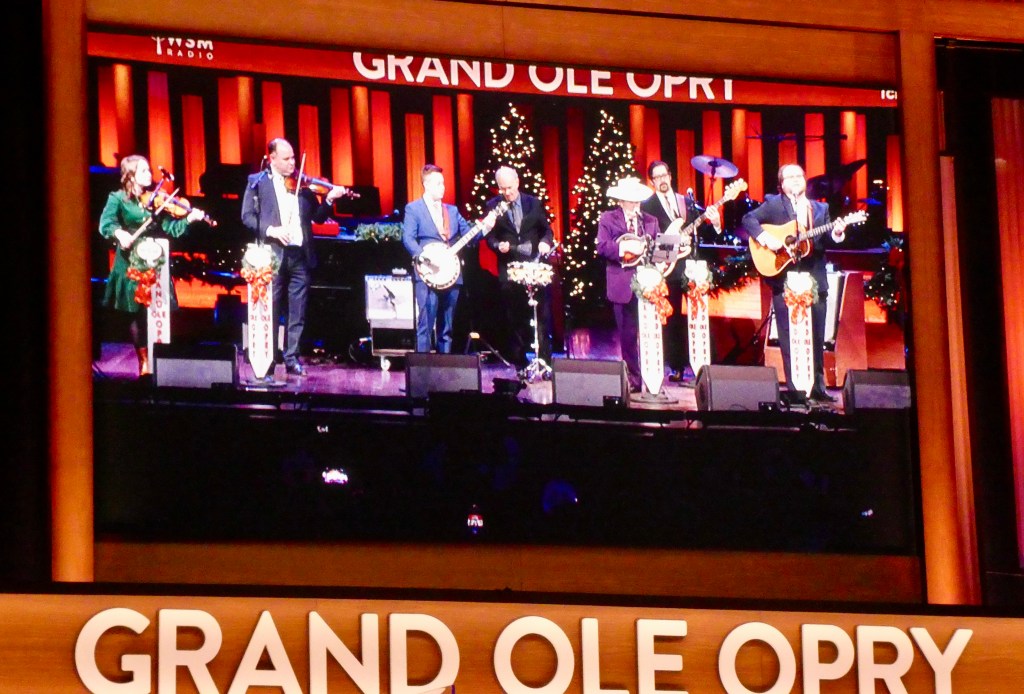
Bobby Osborne performed with his group The Rocky Top X-press.  Bobby, 86, has been an Opry member for 58 years. Appropriately, they performed their hit Rocky Top. Even I knew that song because of the University of Tennessee sports teams.

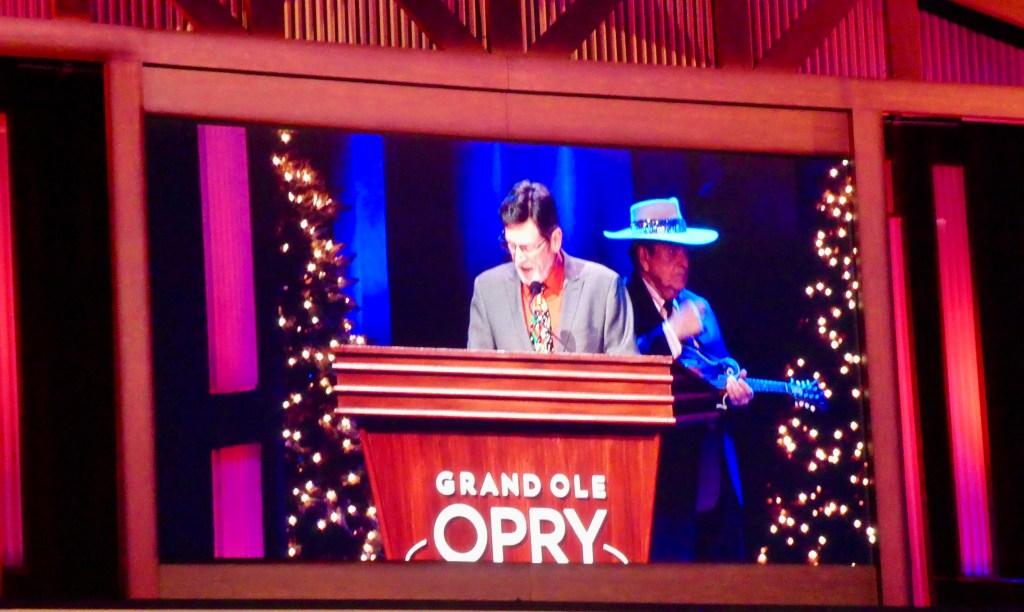
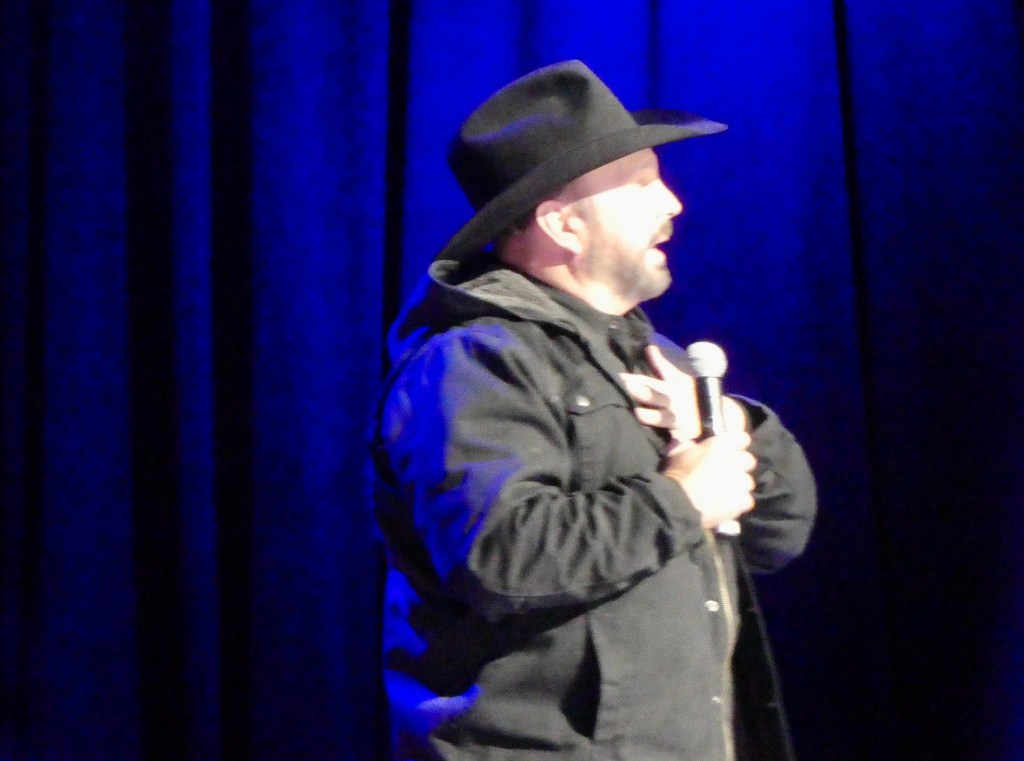
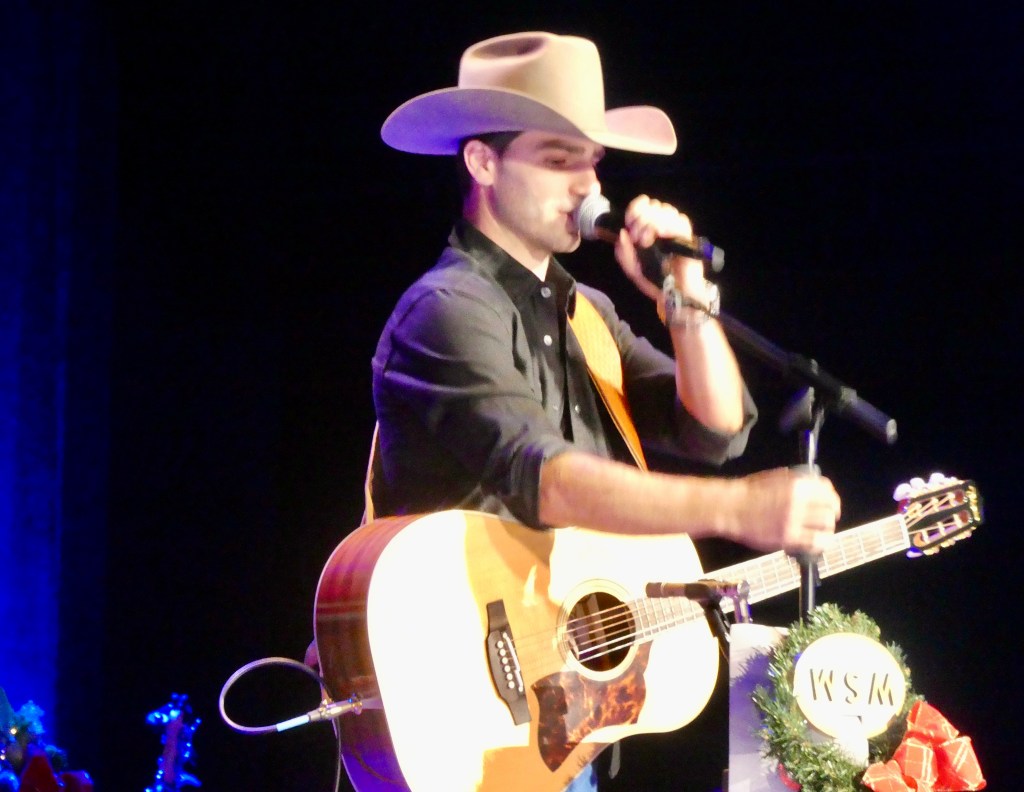
The big surprise of the night was Garth Brooks coming out to introduces his friend Mitch Rossell before his very first performance at the Grand Ole Opry. 

This was a really big deal for this performer, not only singing in “the circle” for the first time but the glowing introduction by Garth Brooks. His performance was outstanding.

Our next performance was by 38 year Opry member Lorrie Morgan. She was the one with the gorgeous dress in the museum. She had a little trouble with this dress and said she wouldn’t be wearing it again to perform.

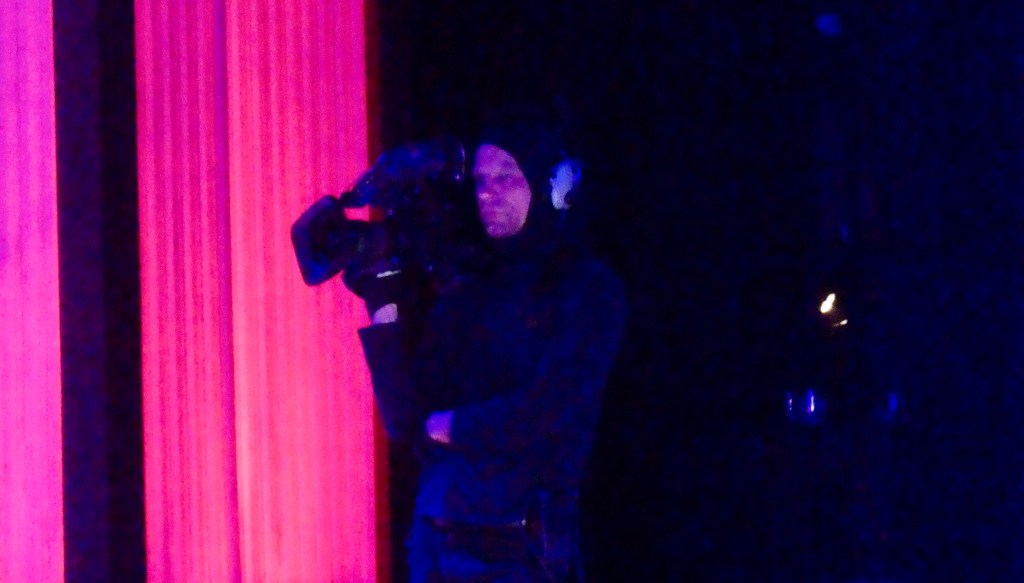
Because we were close we could kind of see these dark clothed people giving us camera views from different angles. They were amazingly unobtrusive.

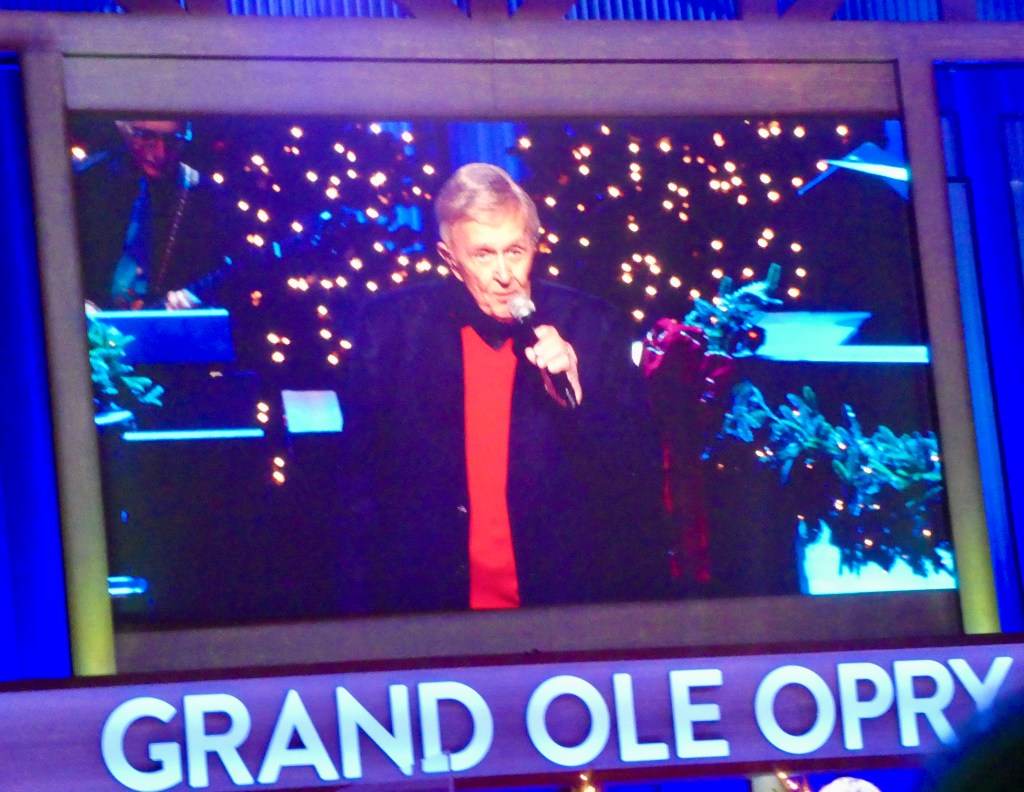
After the intermission we listened to Bill Anderson, a 62 year Opry member. He sang a bit and gave a full oration on Christmas.

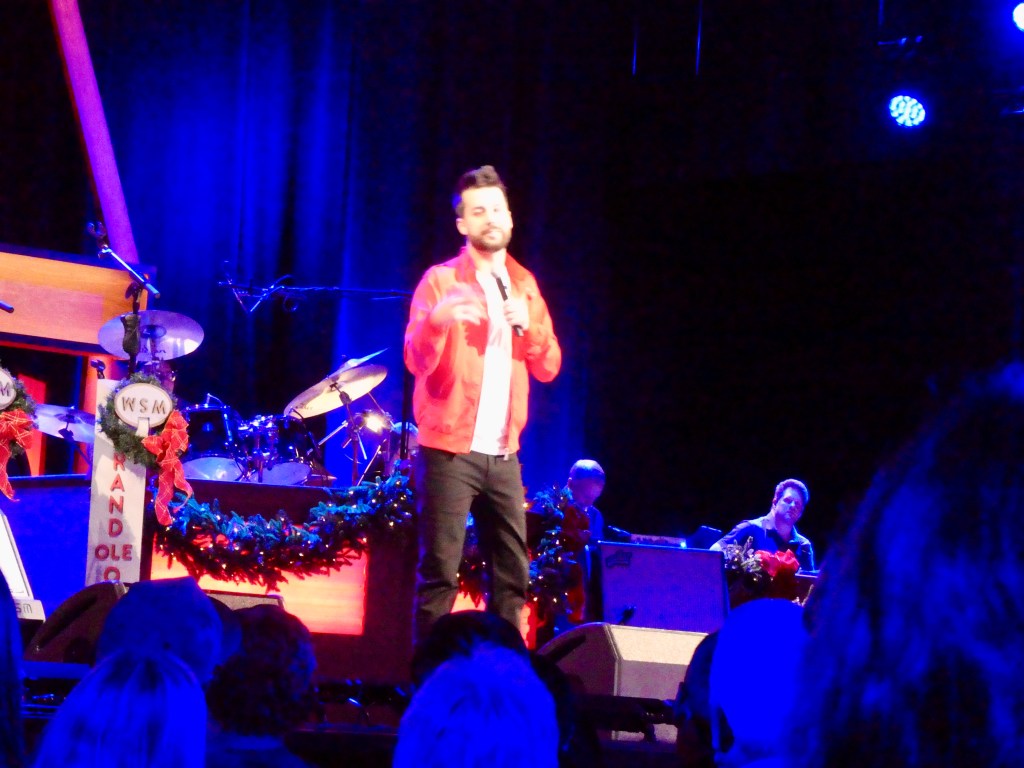
The next performance was a comedian that most people seemed to enjoy very much. We did not. Usually I am the one with a stunted sense of humor, but Randy didn’t care for him either.

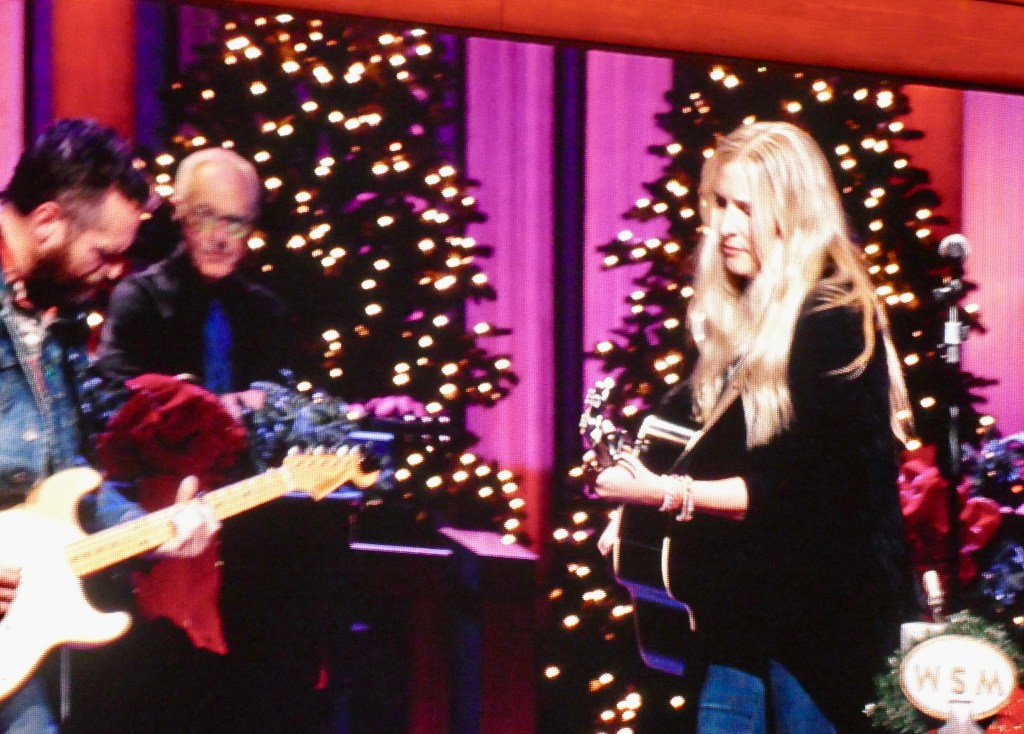
Our next performer was Holly Williams. Hank Williams senior was her grandfather and Hank Williams junior was her father. She performed with her husband.  They had a baby just ten weeks before.

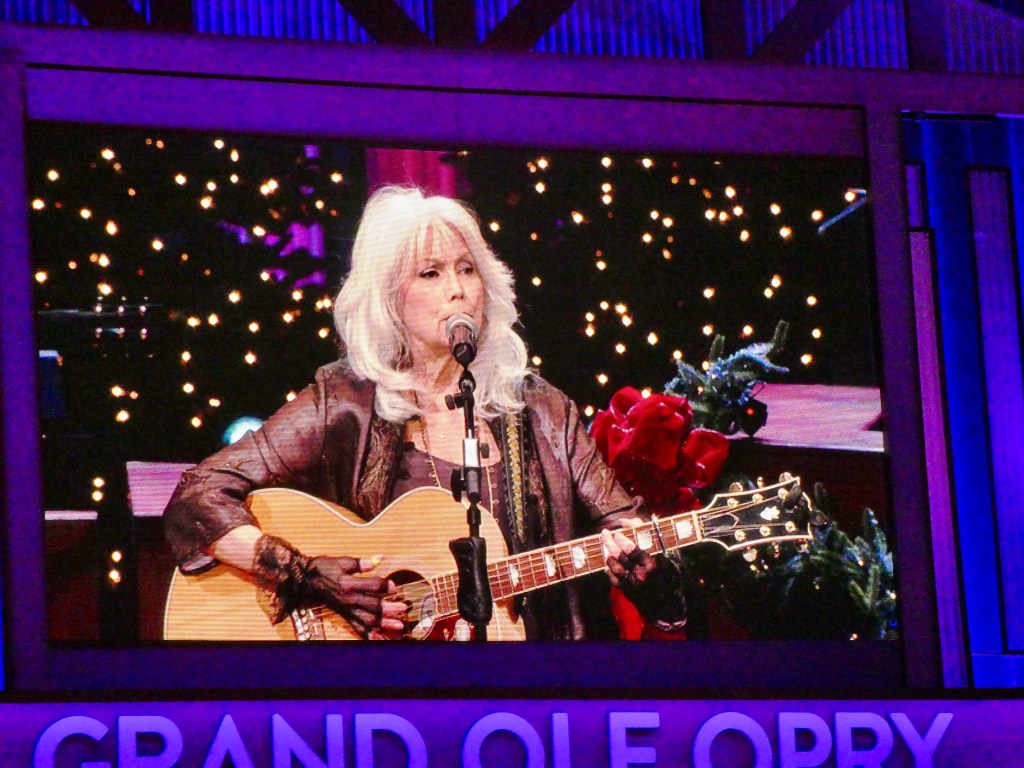
Singer-songwriter Emmy Lou Harris is a crossover performer with Pop, Rock and Country hits.  She performed a couple songs solo.

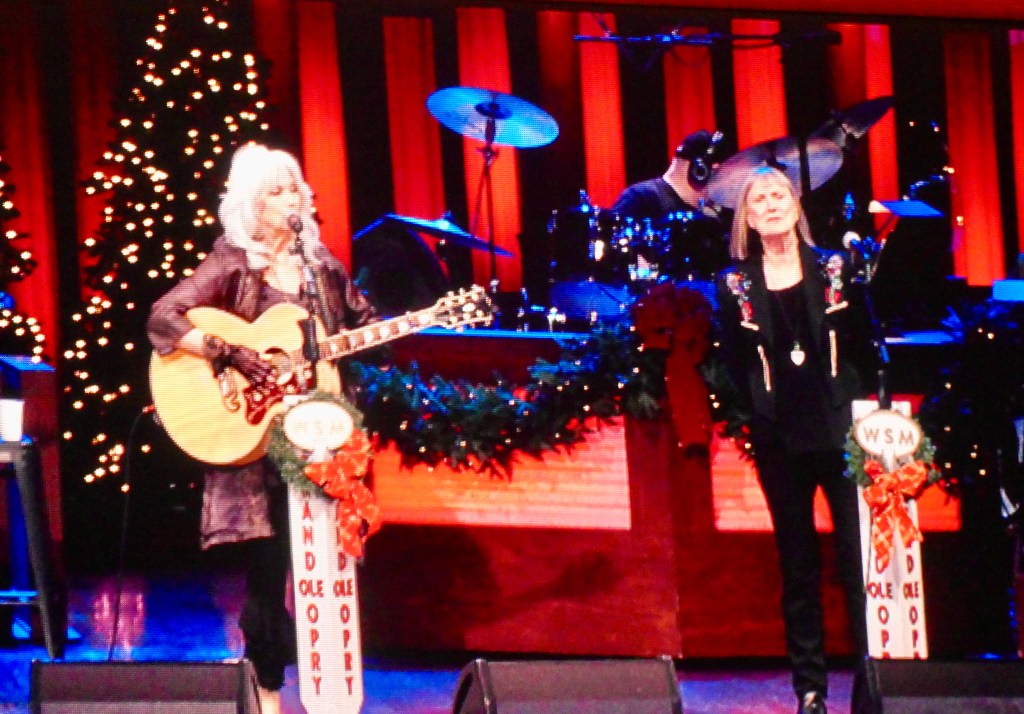
Then she was joined by Gail Davies, a singer- songwriter and the first female producer of country music. Her father, a sibling and her son were or are country music performers.

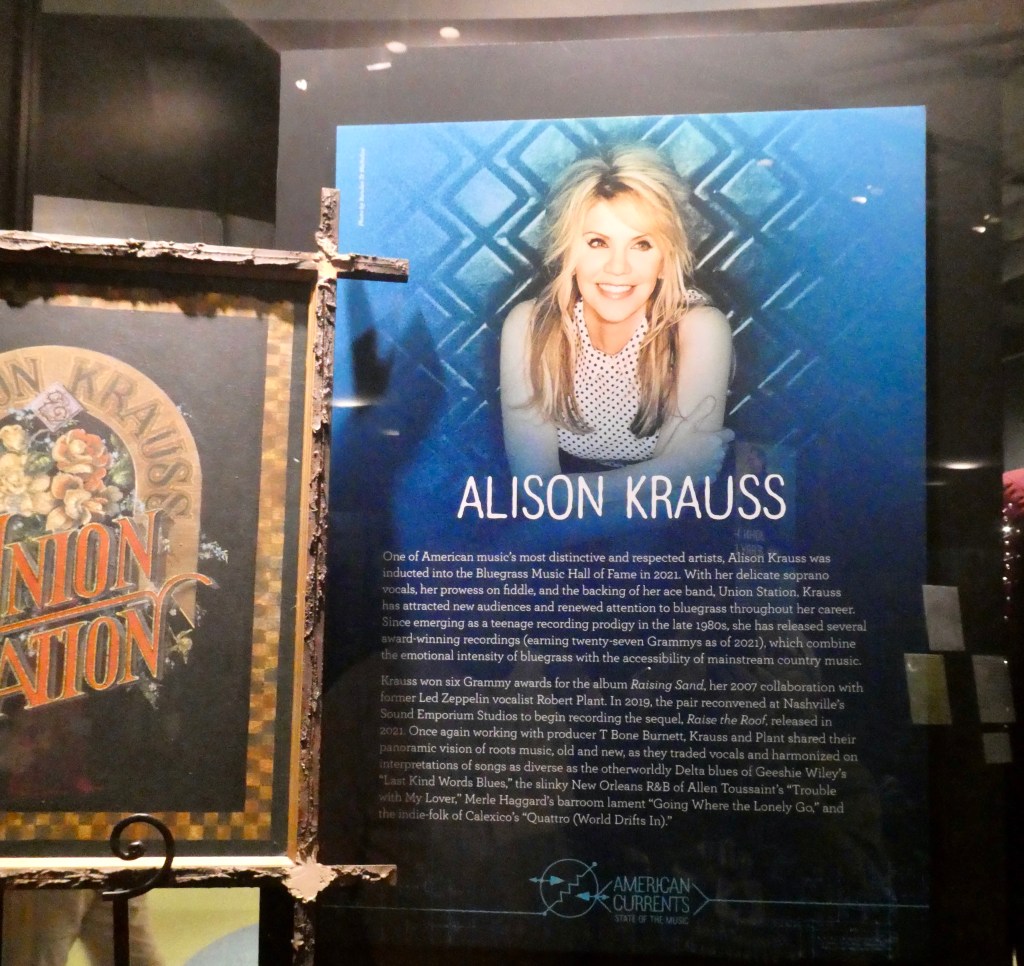
During the Harris and Davies performances I was aware of a woman coming into the row behind us led by an usher. I just happened to turn and notice her because the people who were there previously left at intermission.  I noticed the woman had no jacket with her which was odd because it was very cold outside.  She seemed to belong there. Again, I don’t know country music but it was my impression that if I did, I might know who she was. At the end of the show I turned to get a quick picture to try and figure out who she was – but she was gone. She slipped out before the show finished adding to my impression that she was a country music performer coming in to watch Emmy Lou Harris and Gail Davies perform and slipped out before being noticed. 

We went to the Country Music Hall of Fame the next day. I turned a corner – and there she was in an exhibit for Alison Krauss! At least I think so!  I think the mystery woman behind us was Alison Krauss, Country Music Hall of Fame bluegrass singer and Grand Ole Opry member since she was 21 years old.  Cool!

Posted in Uncategorized | 2 Comments

Nashville: Food Tour and Soul in Music City Trolley

We frequently try to begin our exploration of a new place with a food tour.  The guide usually provides some local history along with the tastes of the area.  Occasionally we’ll even go back to one of the places we visit. We did that this time.

Evan met us at the designated meeting point with the news that we were the only ones signed up for this mid December tour.

On our way to the first restaurant, he told us about Nashville’s rich history in Civil Rights.

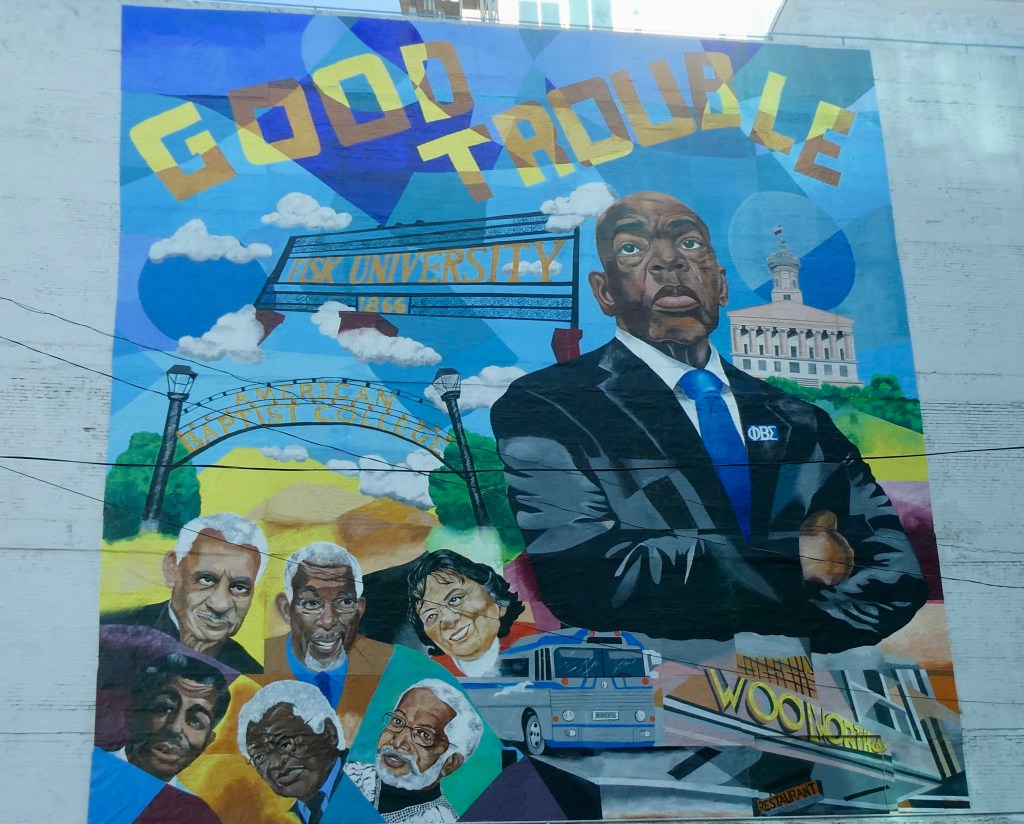
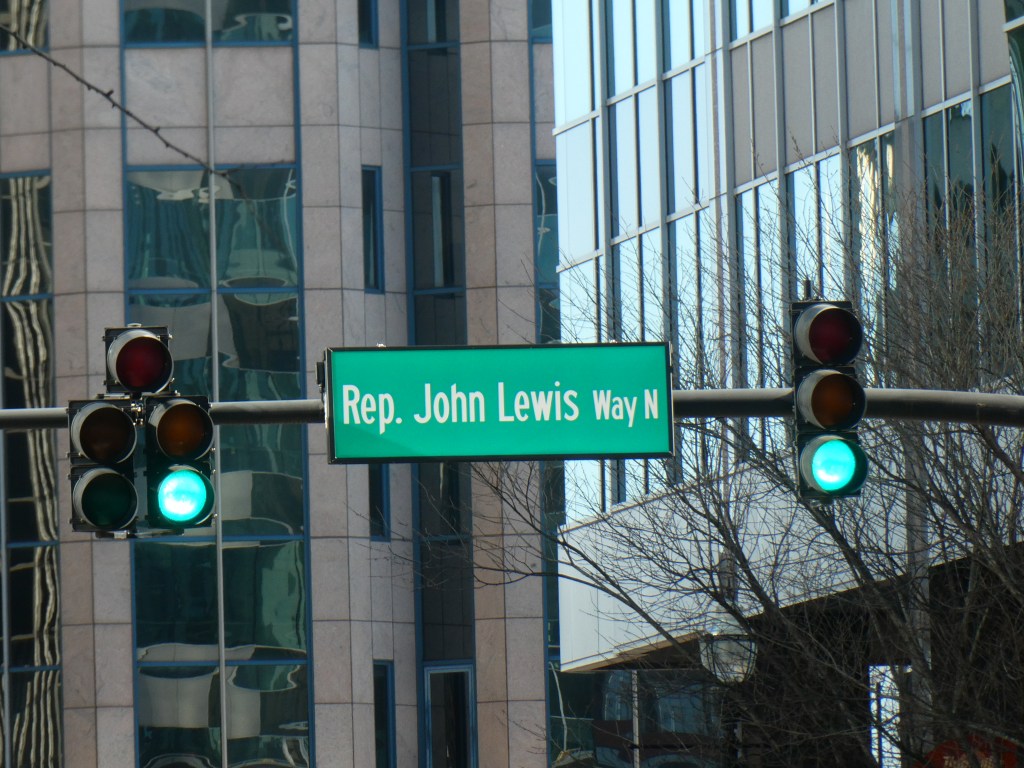
John Lewis came to Nashville as a student of American Baptist College and later Fisk University.  He, with others, made Nashville the epicenter for racial rights in America.

The first Woolworth’s Sit-in happened in Greensboro, North Carolina in 1960 but sit-ins spread across the south.  John Lewis was part of the sit-in at the Nashville Woolworth’s.  It was his first arrest for civil disobedience – after he and others were beaten for sitting at the lunch counter.  

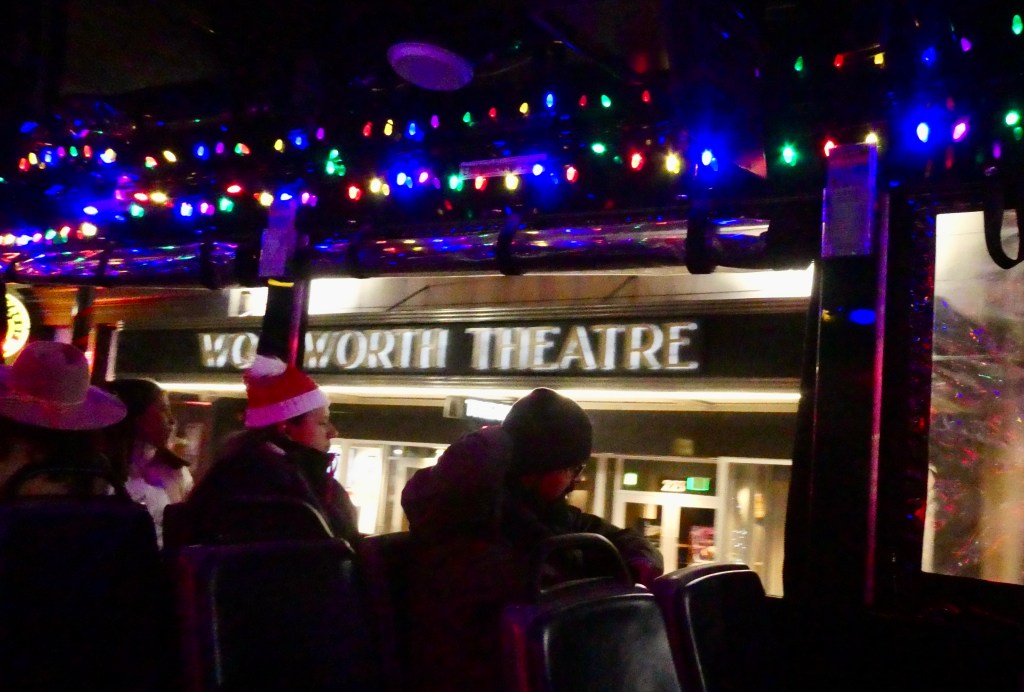
The Nashville Woolworth’s was recently re-opened as a theater. In keeping with the building’s history, their shows highlight inclusivity.

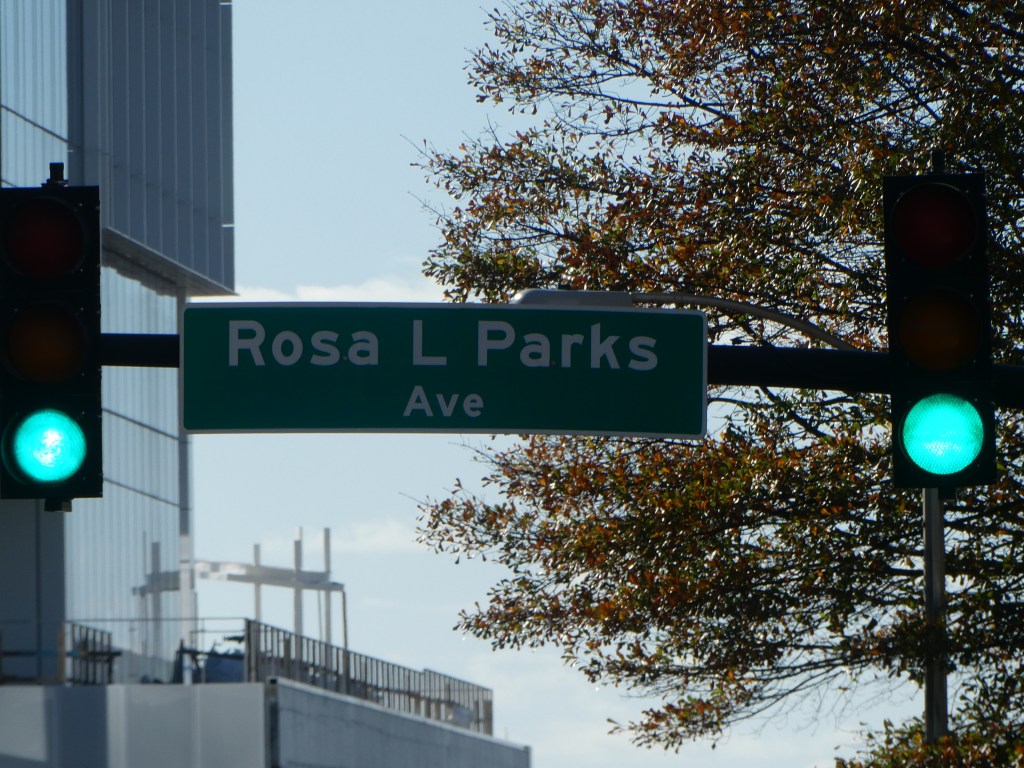
Even though Rosa Park’s refusal to give up her seat happened in Montgomery, Alabama, a street is named for her in Nashville. 

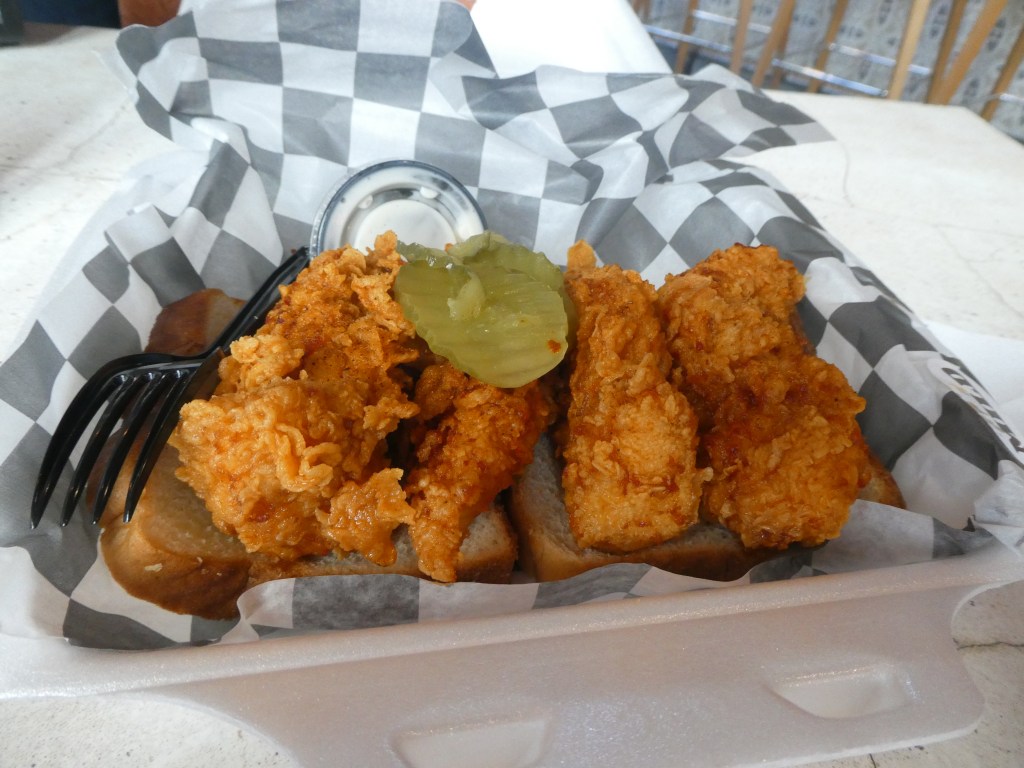
Our first taste of Nashville was Prince’s Chicken, the original rendition of Nashville’s “Hot Chicken.”  Mr. Prince was a philandering man in the 1930s.    His girlfriend tried to get some revenge by making his chicken way too hot with spice rubs and more spice in the oil.   He loved it and started selling it.  (This is the place we visited again.)

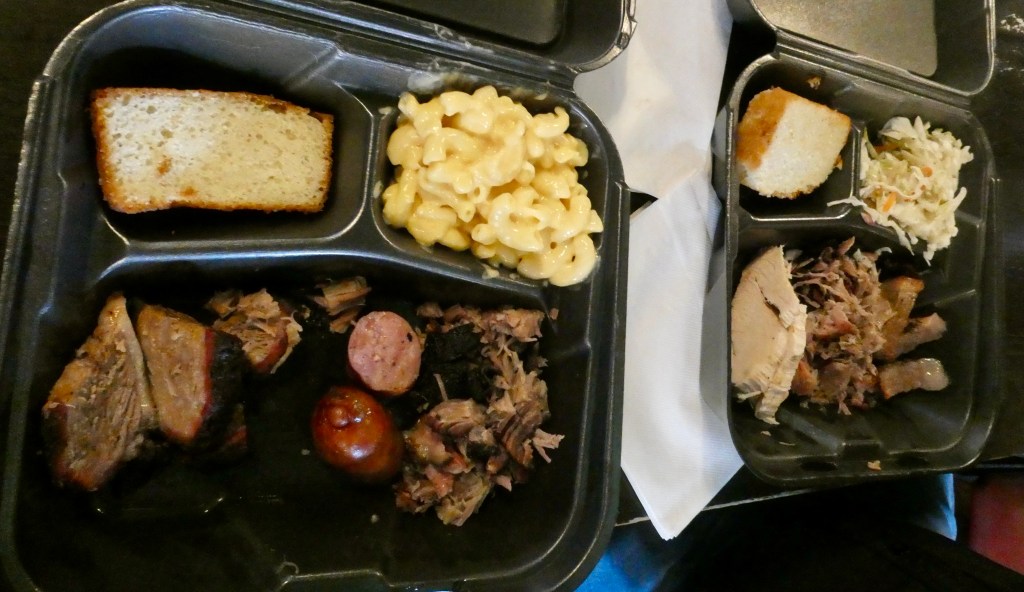
Over BBQ at Jack Cawthon’s we learned Nashville’s legal requirements for calling your establishment a Honky Tonk. You must serve cold beer, have a dance floor and have music the entire time you are open. There are 100 such establishments on Broadway in Nashville.

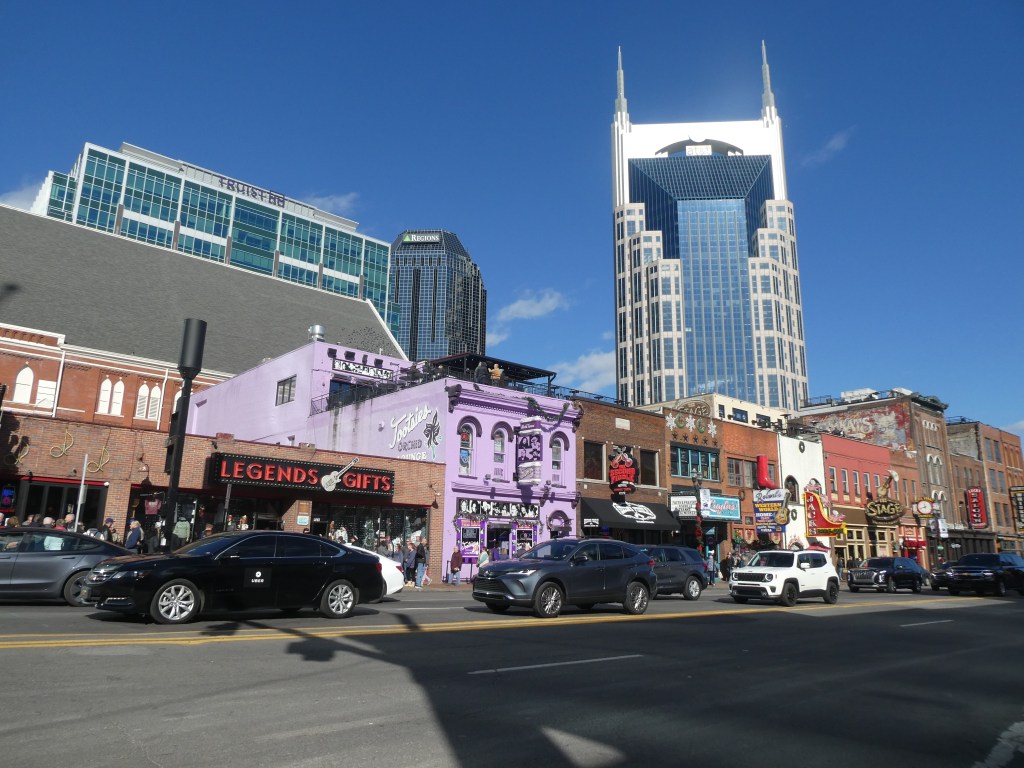
The bat man building seen behind Broadway is the AT&T building.  Its status as the tallest building in Nashville was at risk, so they added the bat ears. It maintains its tallest building status.

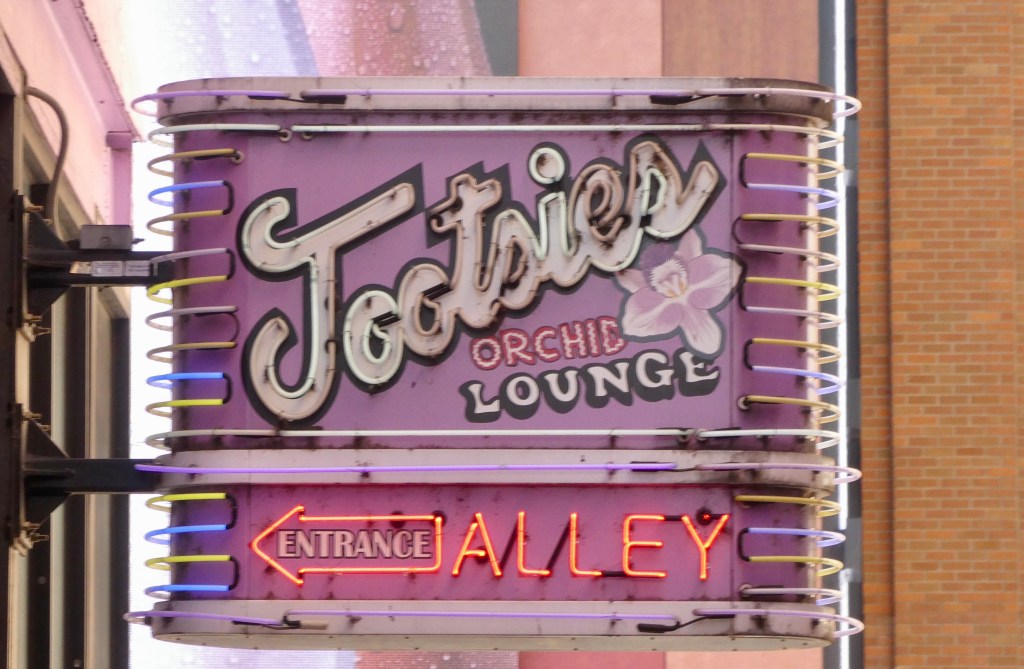
At Tootsie’s Orchid Honky Tonk, (the lavender building pictured above) a young Willie Nelson kept “drinking” his pay check.  To compensate, he set out the first tip jar.  That was very successful for him and now nearly all musicians in Nashville are paid only in tips.

The same Tootsie’s Orchid has an alley entrance near the back of the Ryman Auditorium. 

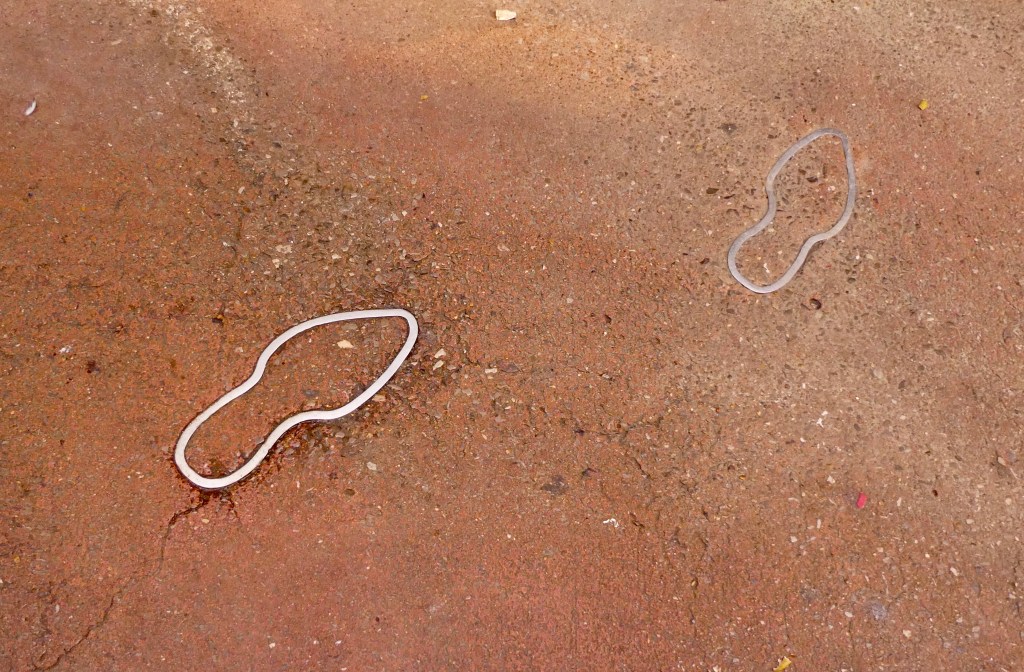
Being a church first, alcohol was not allowed at the Ryman Auditorium and these feet symbolize the quick trips across the alley for some liquid refreshment before or after performances.

We planned to go into Tootsies one afternoon for music and a meal but Randy was carrying our backpack and they do not let them in for security reasons – guns, bombs etc.  They don’t have the time to check bags so have banned them all along Broadway.

We took a peek down Printers Alley.  Nashville was once the country’s largest supplier of Bibles and religious books.

There was a devastating flood in Nashville and surrounding areas on May 1-2, 2010.   More than 13 inches of rain caused flooding from the Cumberland River and others.  The discoloration at the bottom of this building shows how deep the waters were. This building is several blocks from the river.

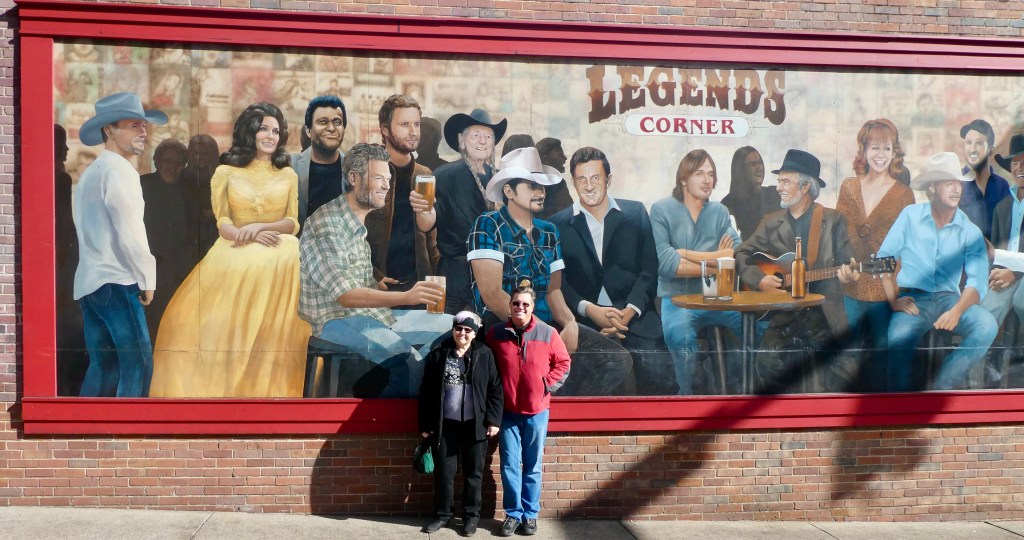
This mural depicts Music City Legends.  There is a patch of blond hair near Brad Paisley’s neck and right shoulder.  That was Taylor Swift’s hair before she was replaced by Paisley in late 2020.  That didn’t go over too well with Taylor’s fans! Our guide speculated she had gotten a little too popular.

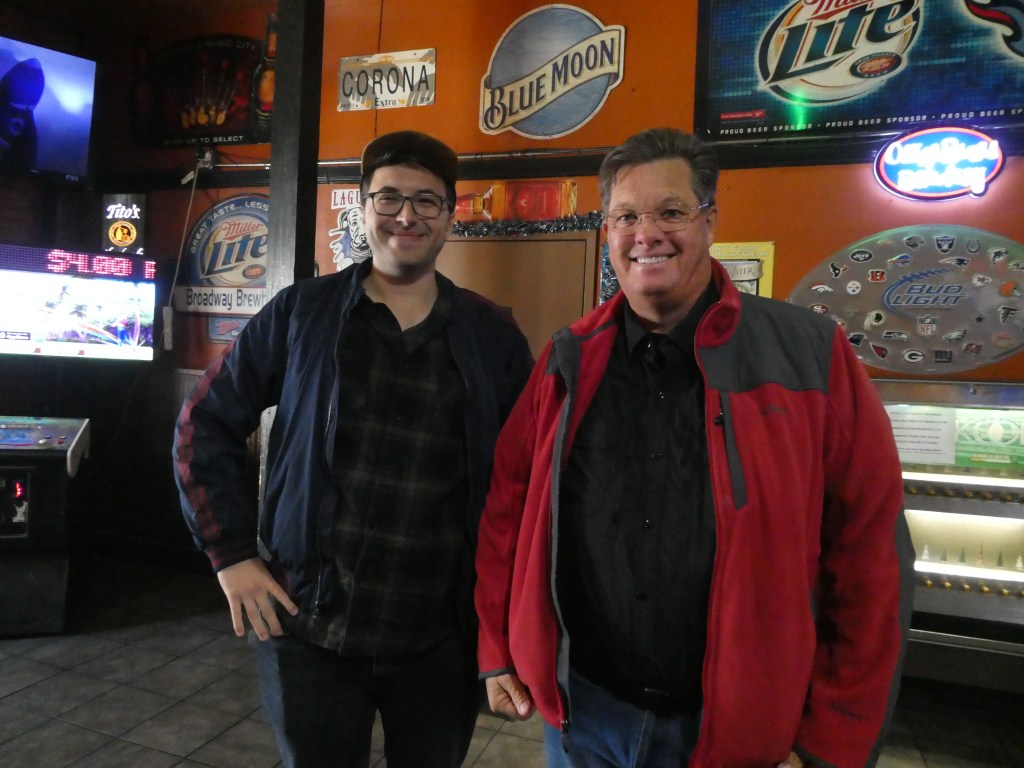
You can tell by the way we are dressed that we were cold.  We were in and out of Nashville before the December deep freeze but we live in Phoenix – we are cold weather wimps.

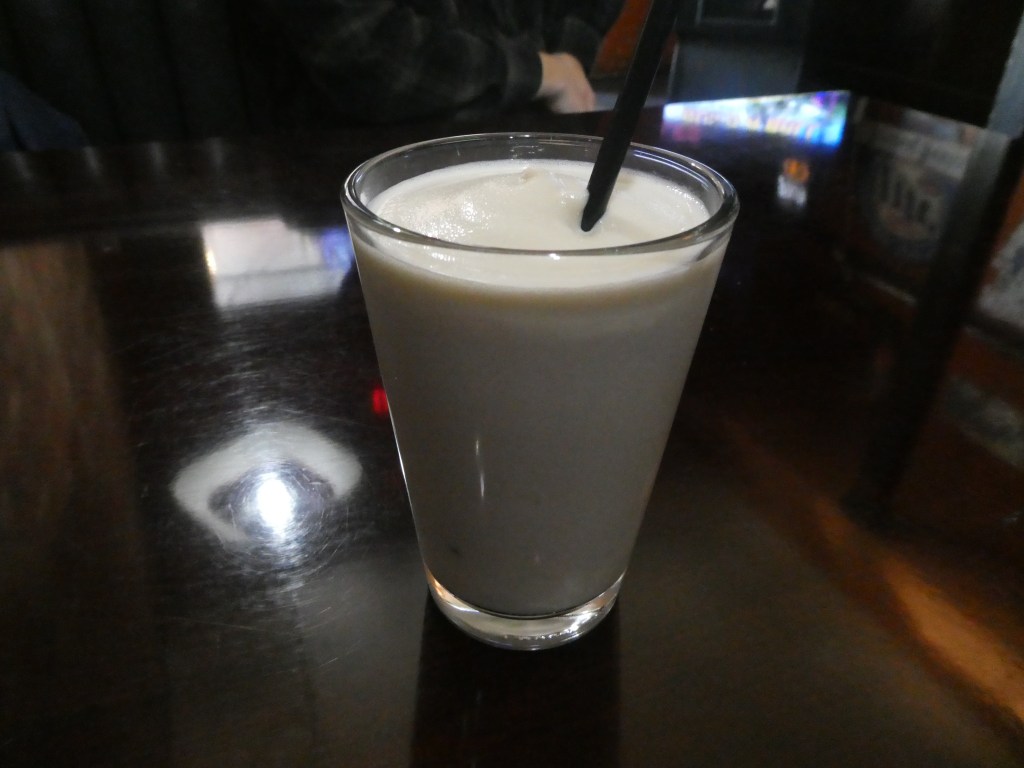
Our next tasting spot was the Broadway Brewhouse for a Bushwhacker.  This frozen drink was first served in the US Virgin Islands, and also featured in Pensacola, Florida before eventually becoming a signature drink of Nashville.  We can recommend it!

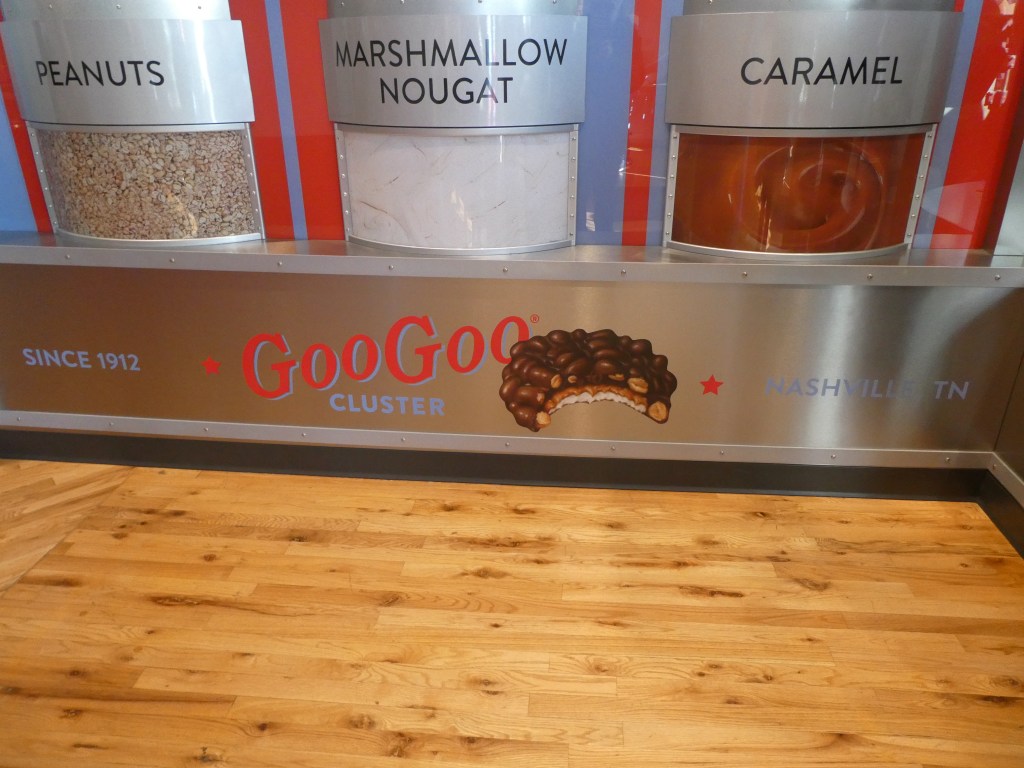
Our last food stop was for America’s first candy bar – the Goo Goo Cluster.  It qualified as such because, beginning in 1912, it was the first bar with layered ingredients.

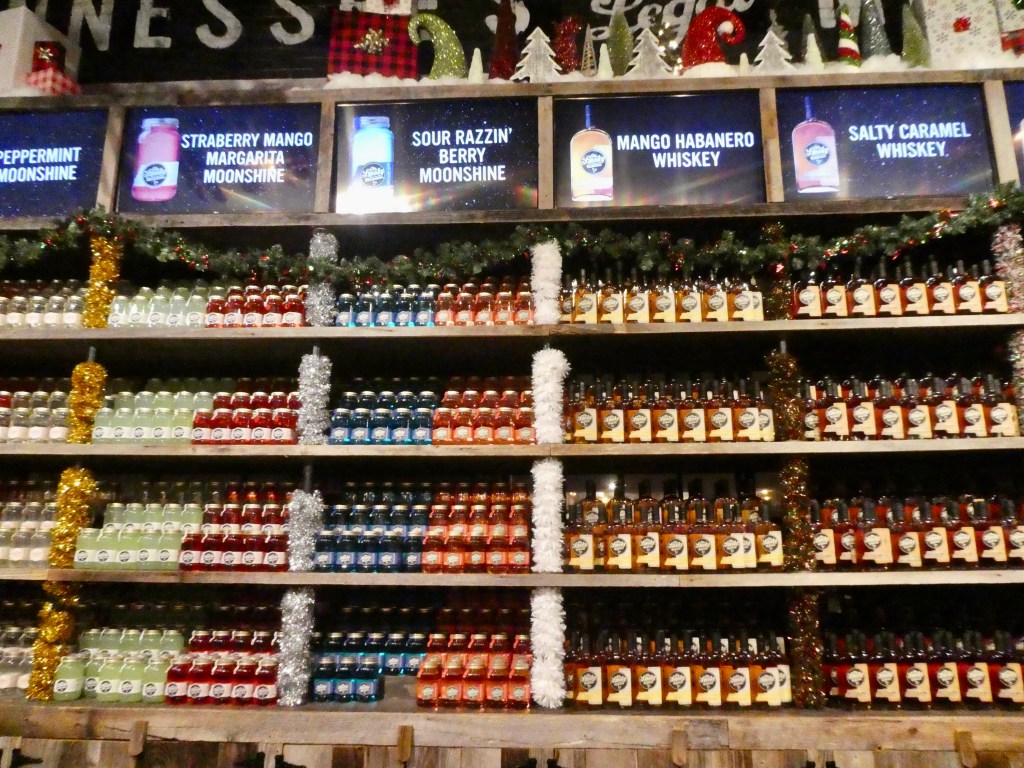
While waiting for our Soul of Music City Trolley Tour we had the opportunity to do a moonshine tasting.  Our experience with moonshine was limited and pretty awful so Randy was reluctant – but he followed me when I went forth!

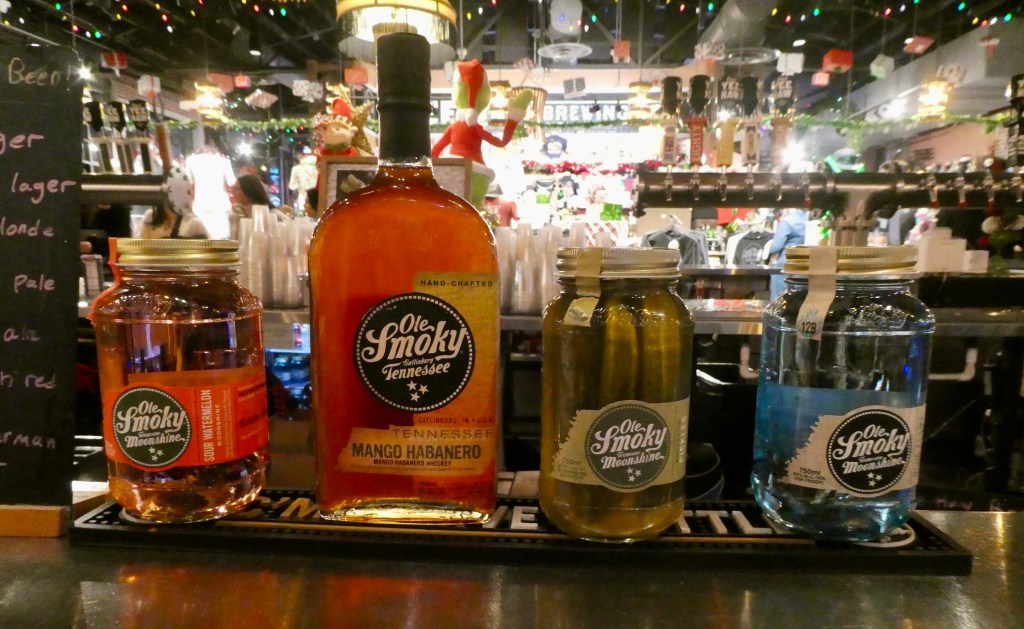
They have 35 types of moonshine at the Ole Smokey Distillery.  We were able to sample an assortment of moonshine with a beer “palate cleanser.”

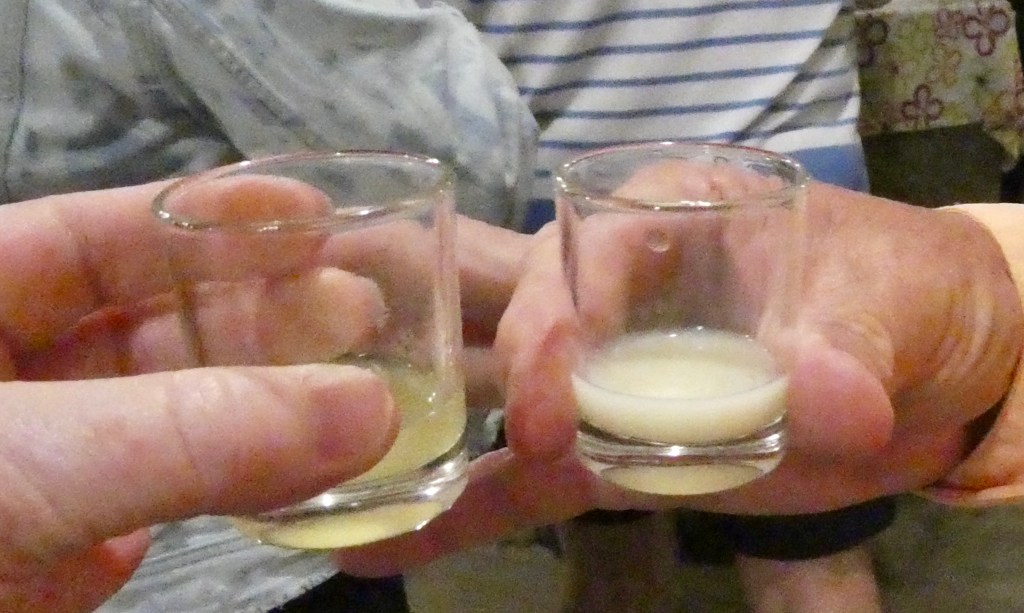
We started with Blue Flame – 128 proof.  It was like our other moonshine experiences – awful. Then we had a piece of moonshine soaked dill pickle.  It was actually pretty good.  Mango Habanero followed and then a couple others, gradually reducing the alcohol levels. Our favorite moonshine, and also the one with the least level of alcohol, was Butter Pecan at 35 percent.

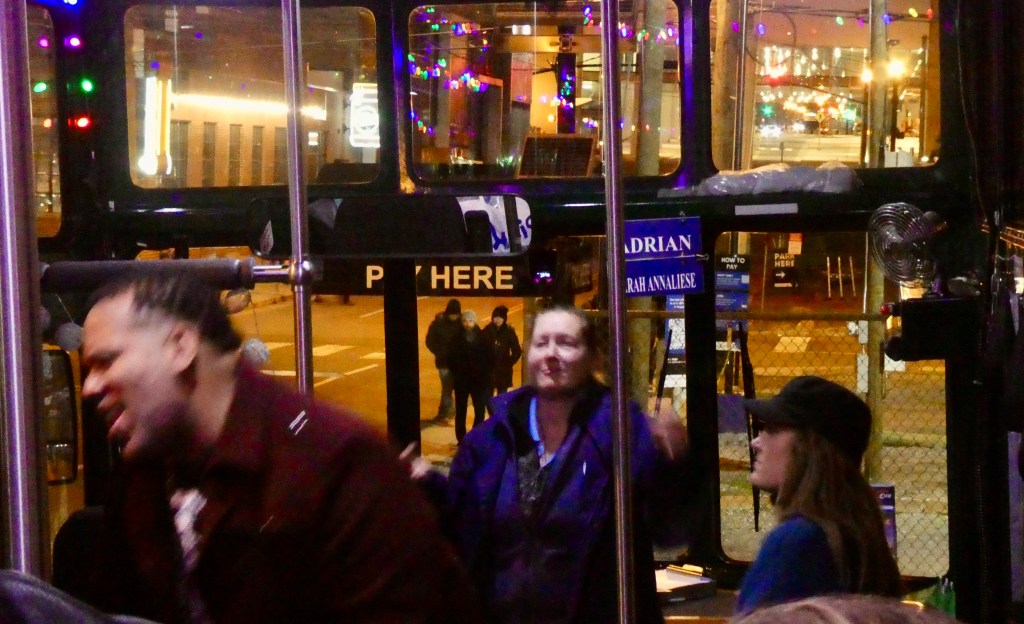
We boarded our trolley for the Soul of Music City Tour.  Our ticket taker and tour guide sang their way through instructions and the tour. Everyone sings in Nashville!  Our bus driver, the gentlemen on the left, sang very little but contributed to the fun.   We saw some areas in town that we had seen earlier and also some new places away from the downtown core.

We learned that different areas of town “featured” different styles of music – country, rock, gospel, soul and bluegrass based on where the artists lived and congregated. The highest grossing music in Nashville is gospel.

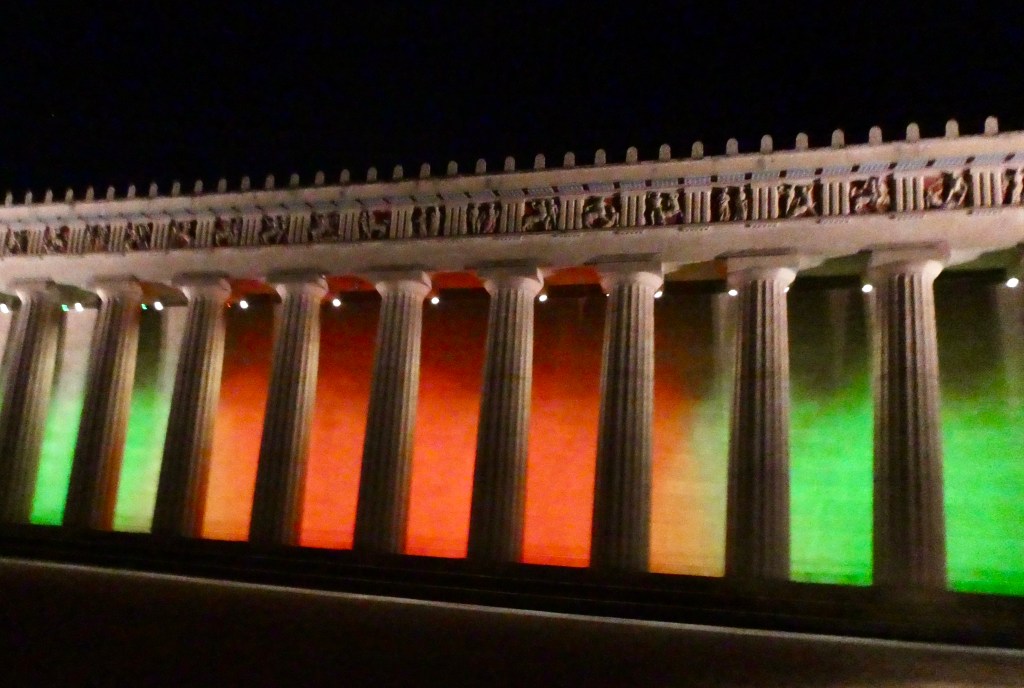
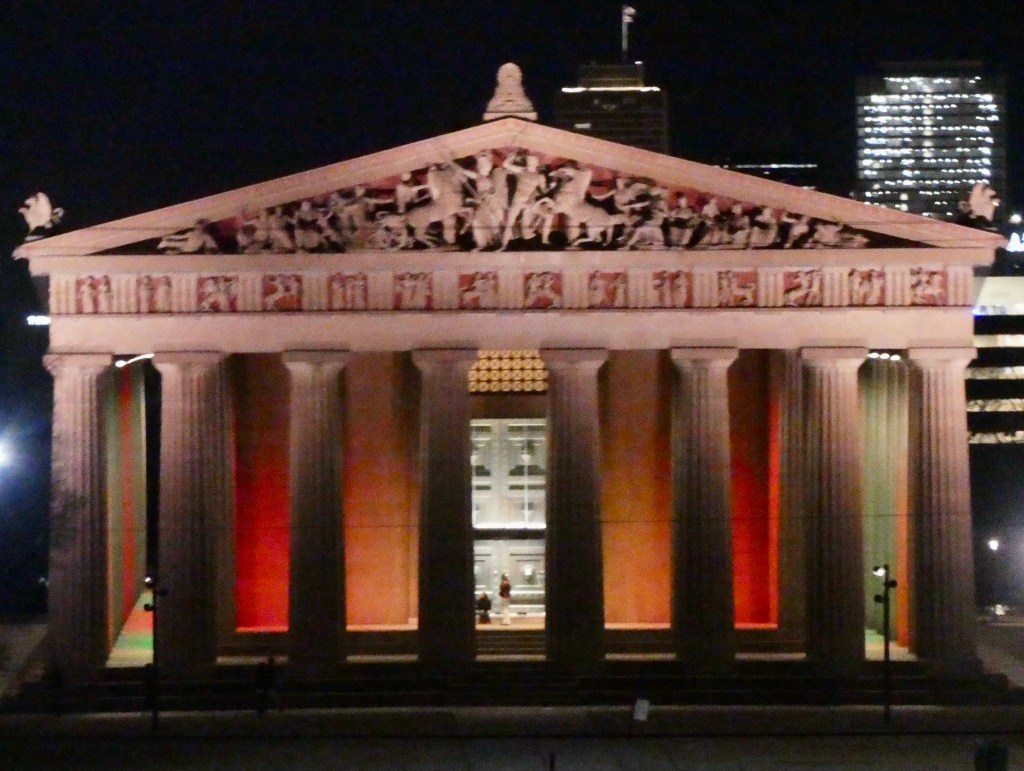
In addition to being Music City, Nashville is also called the Athens of the South.  As such they have their own Parthenon!   

It is a full-scale replica of the original in Athens. It was built in 1897 as part of the Tennessee Centennial Exposition.

We were having a fine time in Nashville so far!  The next post will be about the Grand Ole Opry!

Posted in Uncategorized | 2 Comments

Nashville: Unexpected Winter Holiday

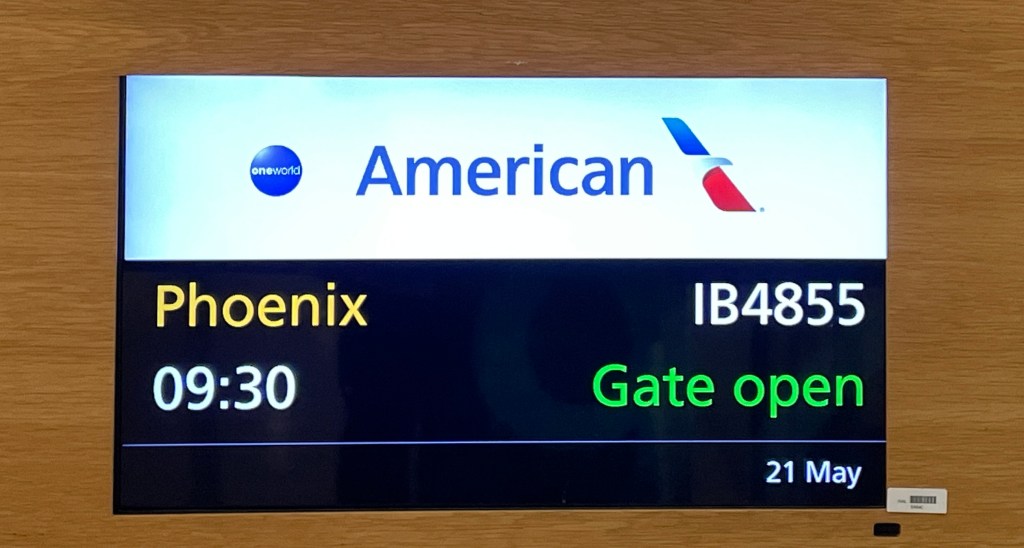
We had “use it or lose it” credit on American Airlines with very tight time constraints. We decided to go to Nashville!  You know, spend money to save money. Our afternoon direct flight was uneventful and we were in our rental car by 5:30 pm.

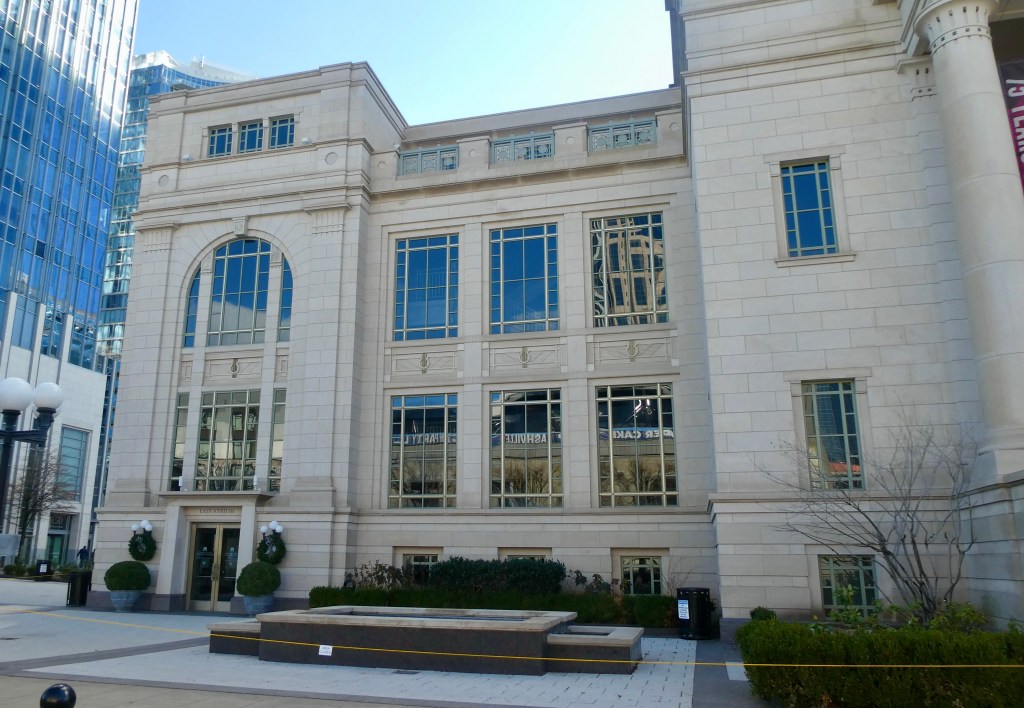
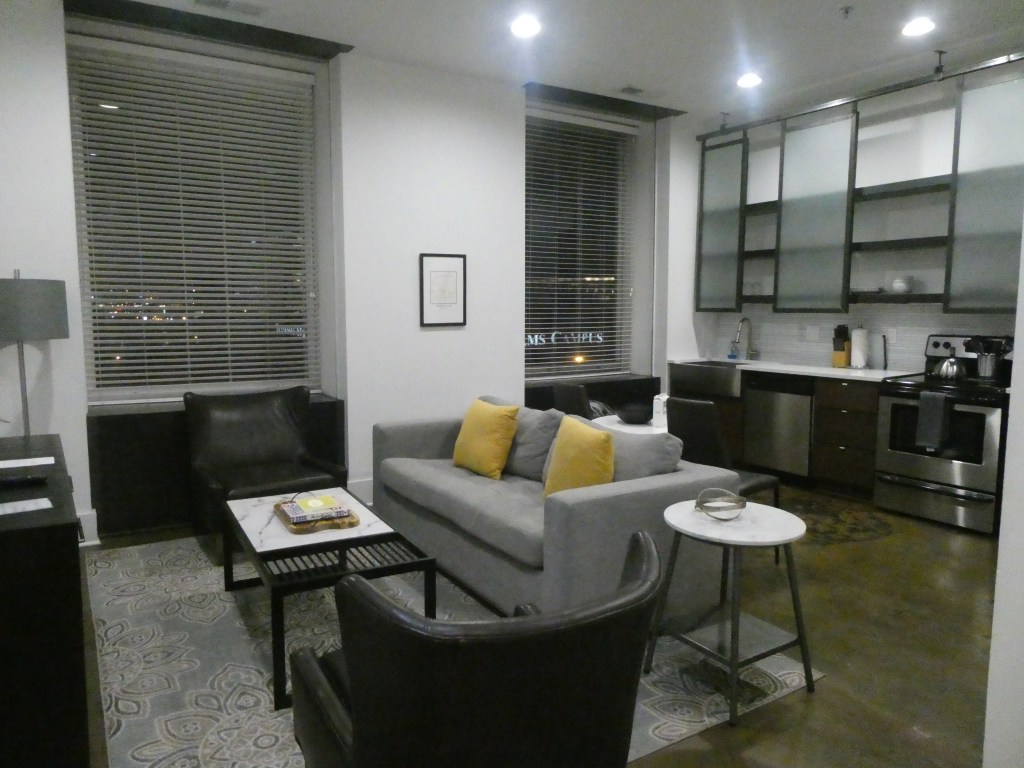
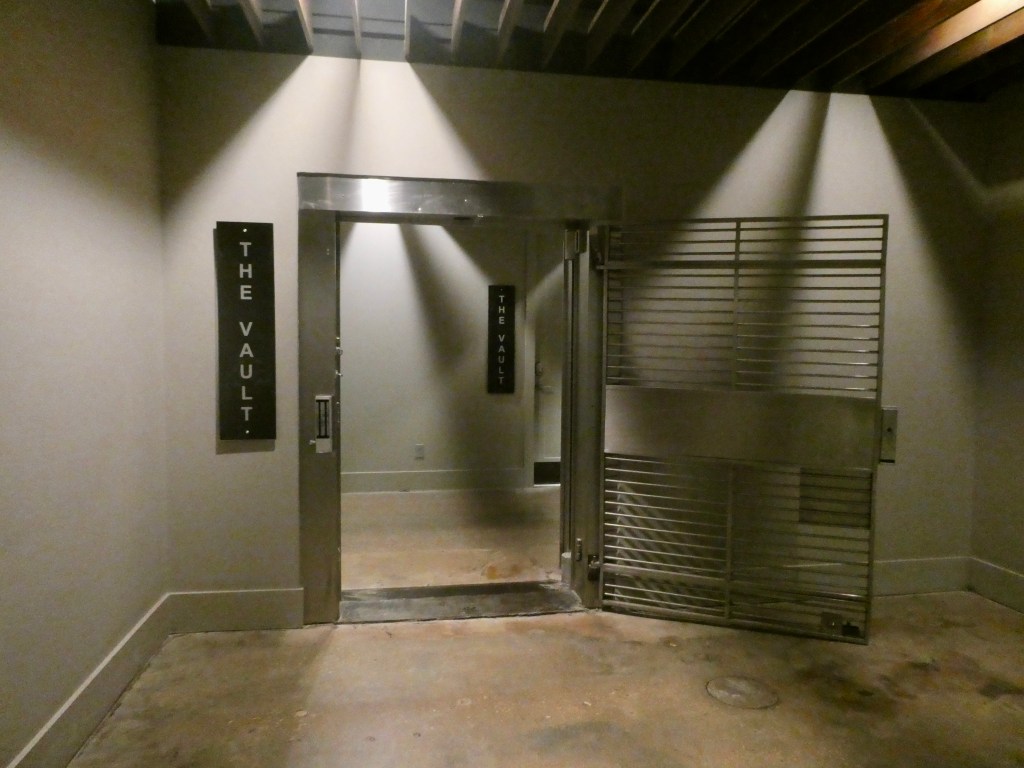
We made it to our Airbnb, the Mint House at the Reserve.  The site is a former Federal Reserve building that has been reconfigured into apartments and event space. 

There is even an old vault!

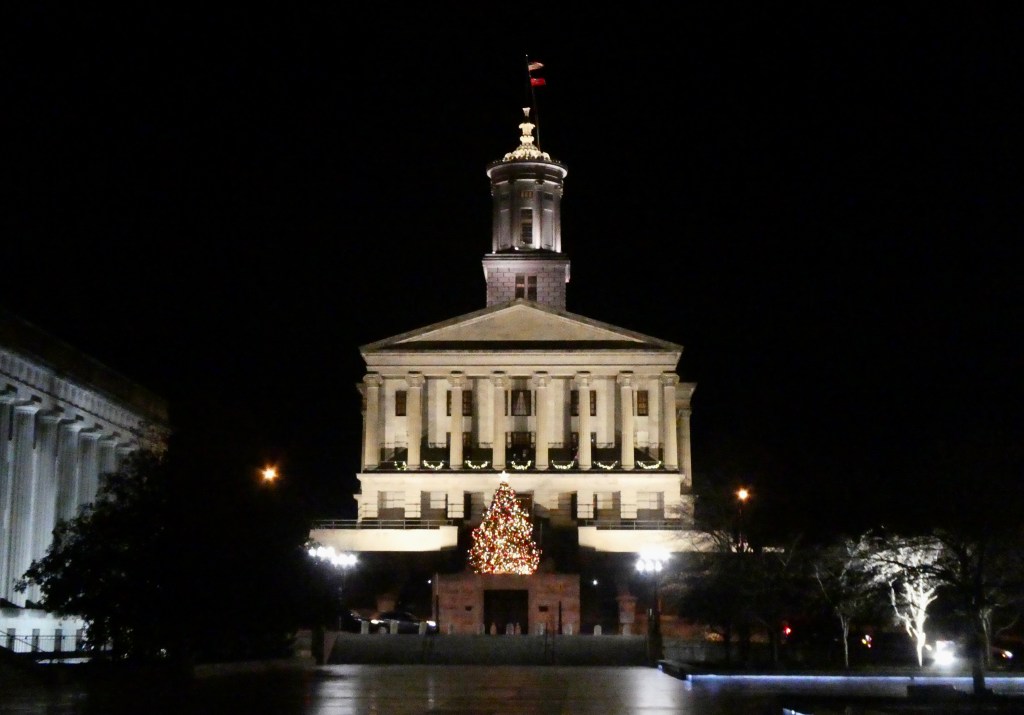
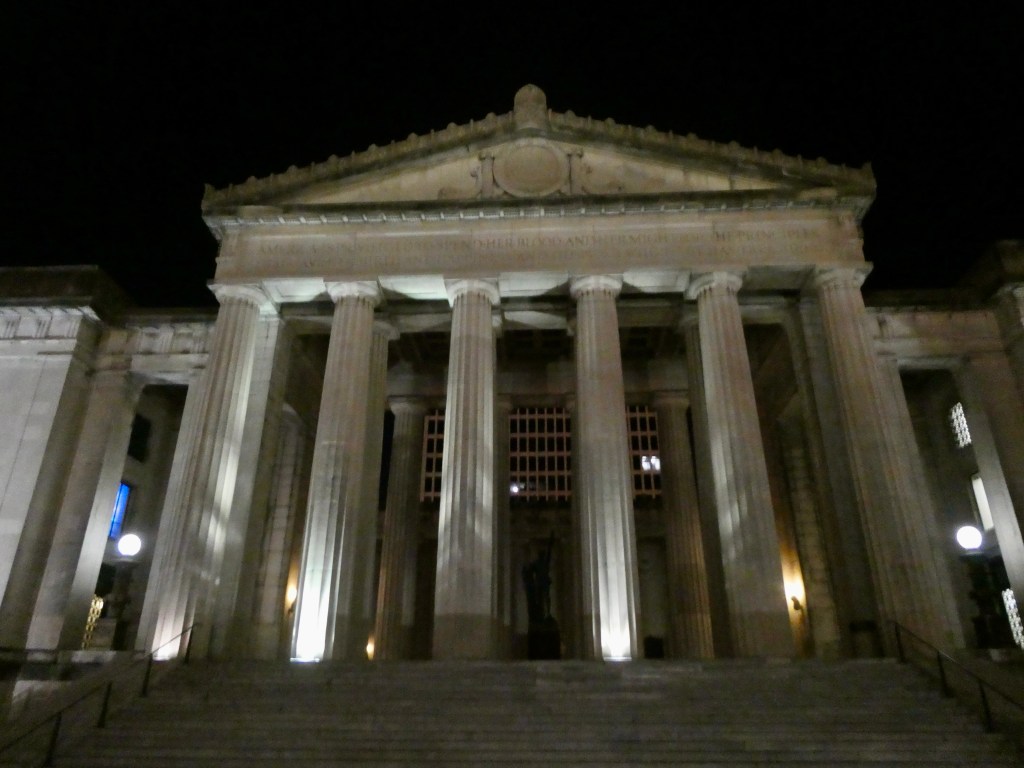
Our lodgings in downtown Nashville were near the Tennessee State Capital.  It is reportedly haunted!  The initial architect, William Strickland, and a man hired to oversee the project,  Samuel Morgan, did not get along and were often heard screaming at each other. 

In 1854, Strickland passed away and his son took over as architect.  He designed a way for his father to be buried in the northeast corner of the capital. Morgan decided he wanted to be there as well and was buried in the southeast corner when he died in 1880.  Some believe the yelling continues!

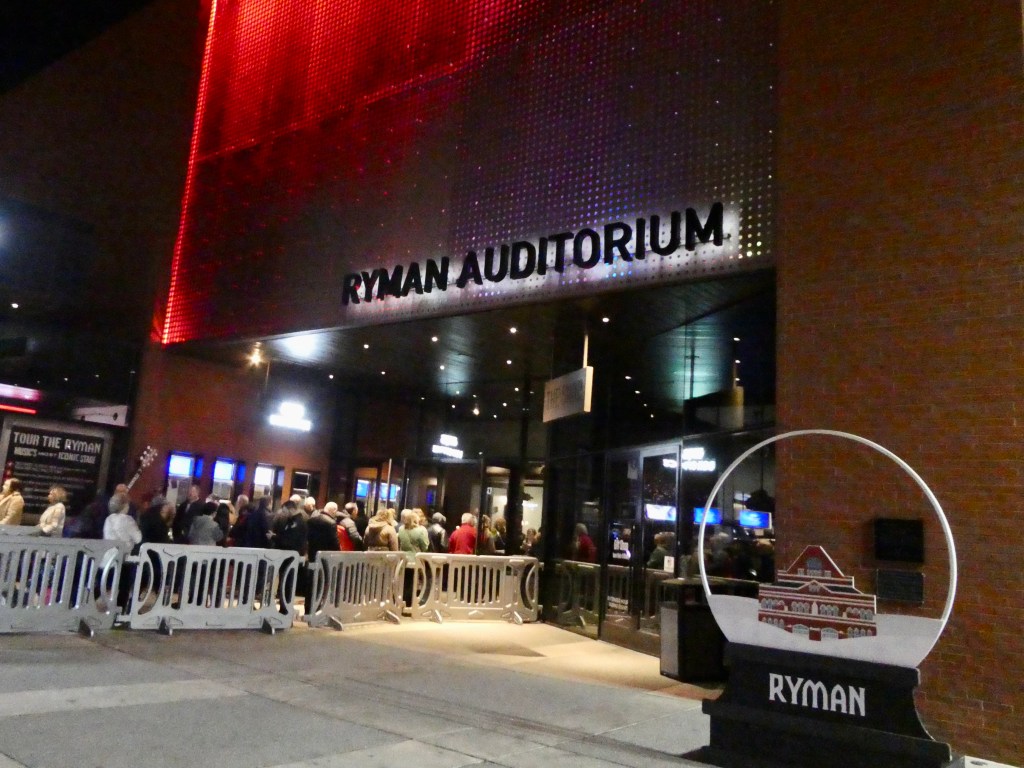
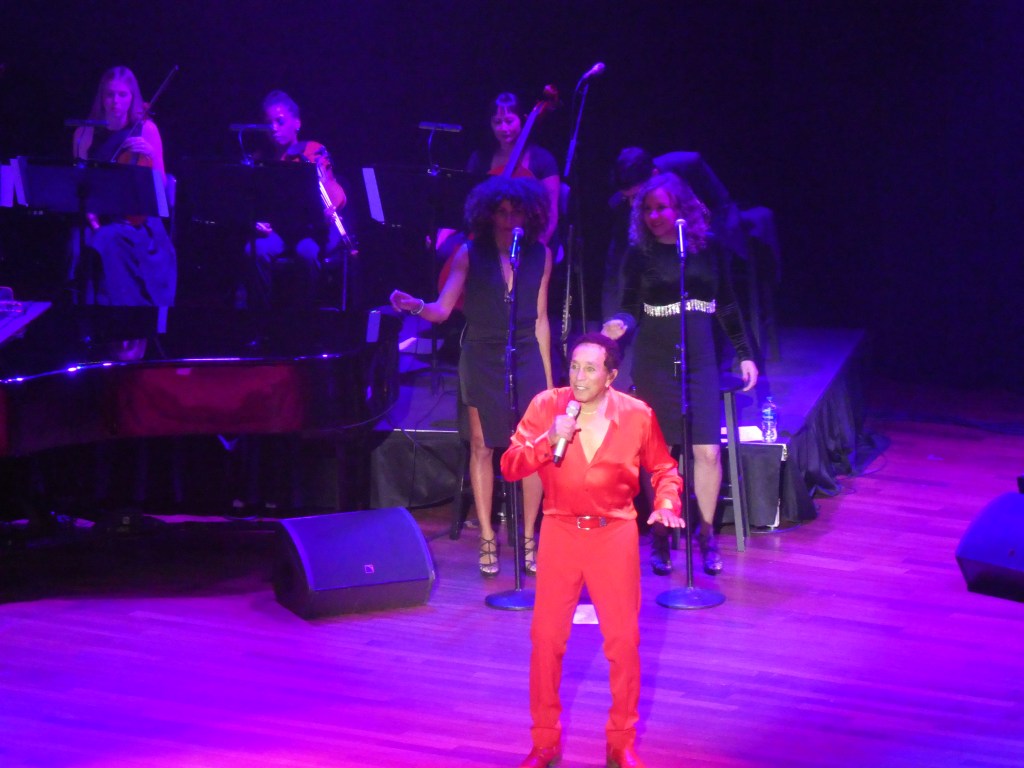
After a quick dinner we walked to the Ryman Auditorium to see Smokey Robinson in concert.  

Smokey, 82 years old, gave an outstanding show! His voice is still perfect and there were a number of standing ovations.  His stories were entertaining and almost every song was familiar.

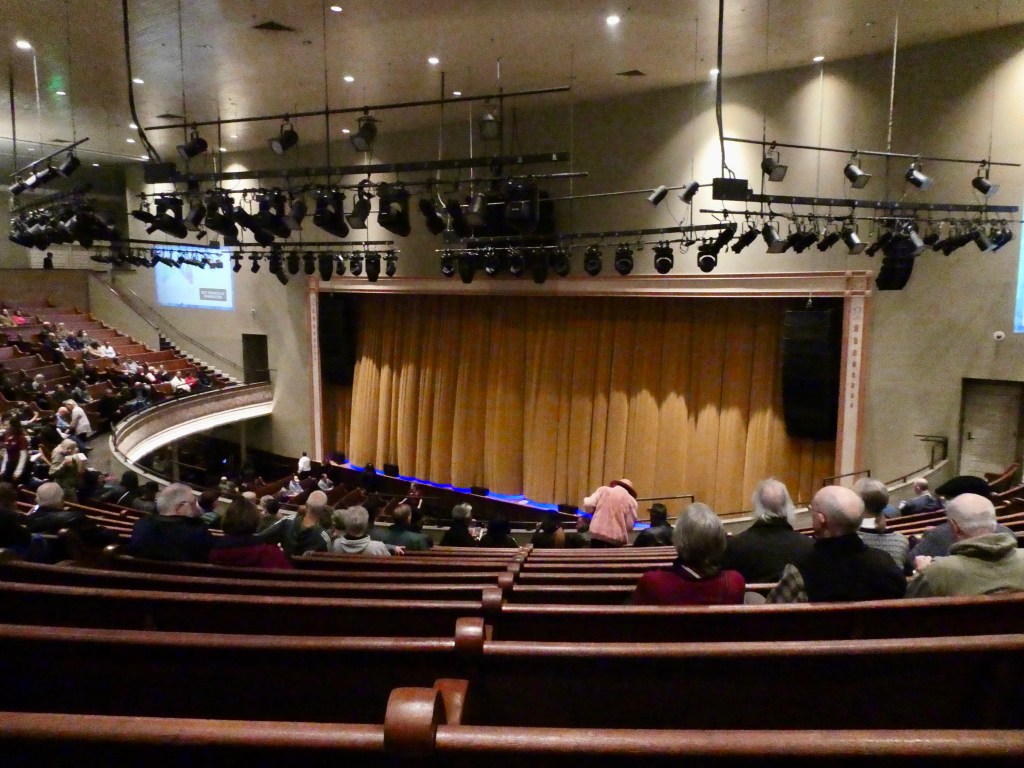
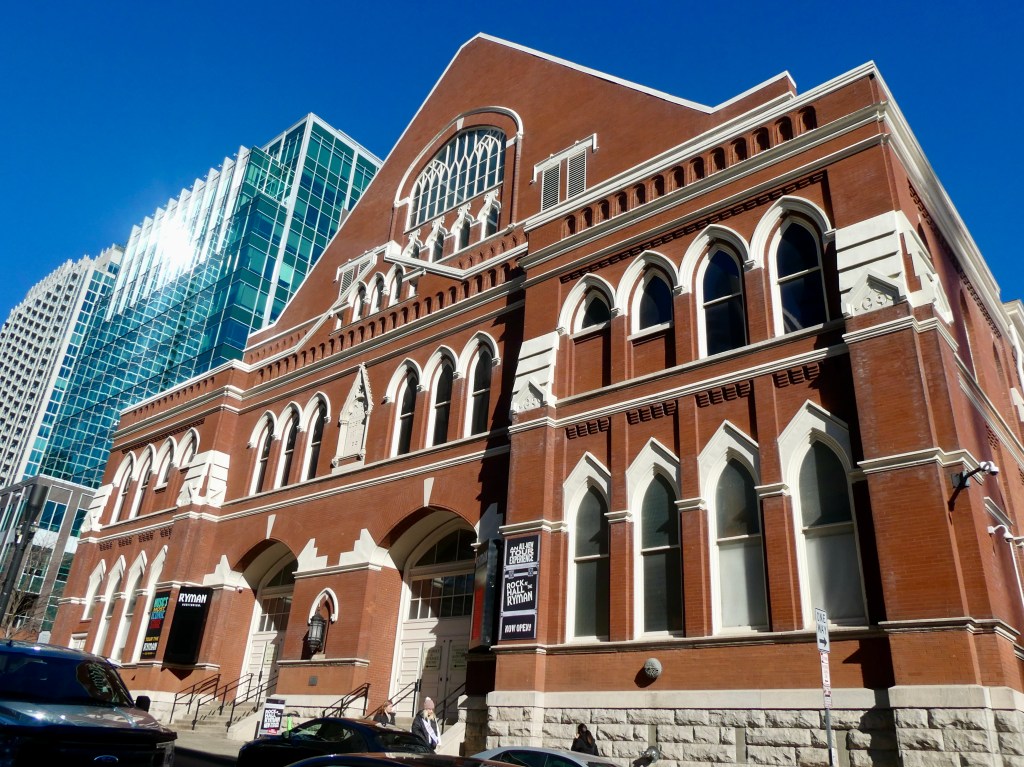
The Ryman Auditorium seats 2200 and ranks second in the world for acoustics.  Only the Mormon Tabernacle is said to be better.  

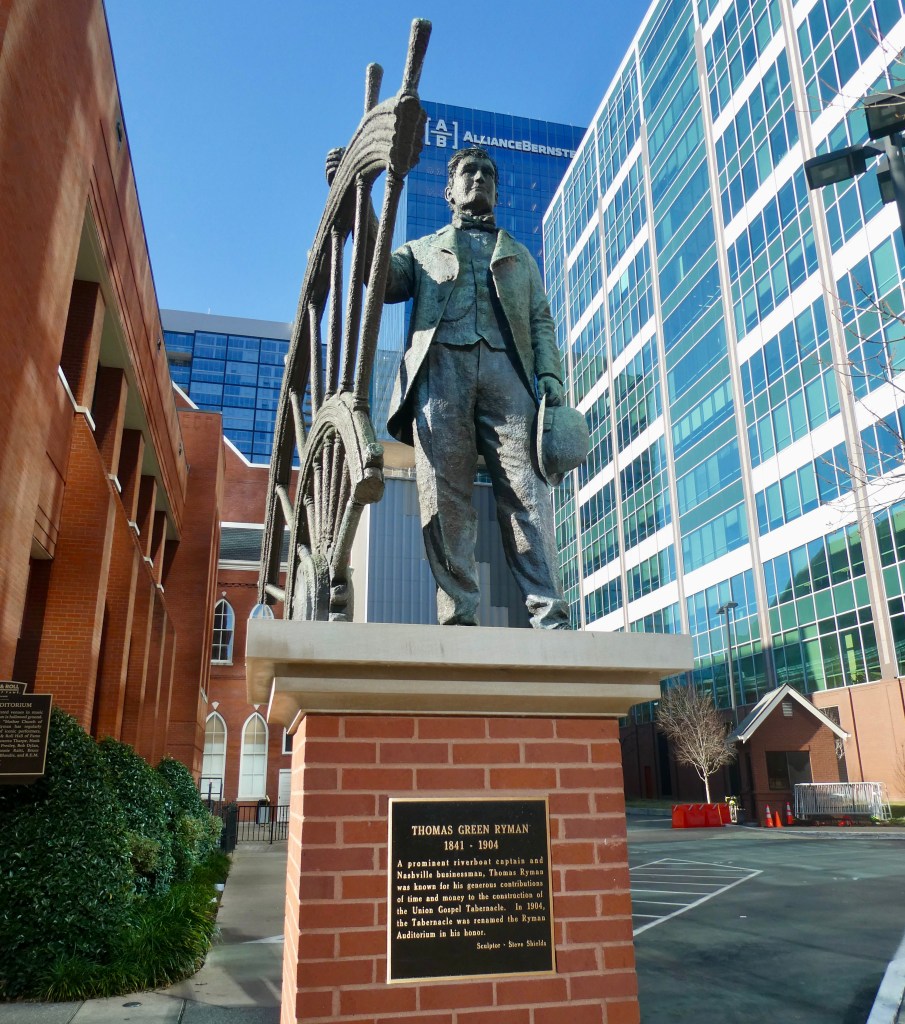
The Ryman Auditorium is named after Thomas Ryman, a steamboat captain and prominent businessman in the mid and late 1800s.

Ryman was part of the rough dock scene on the Cumberland River.   

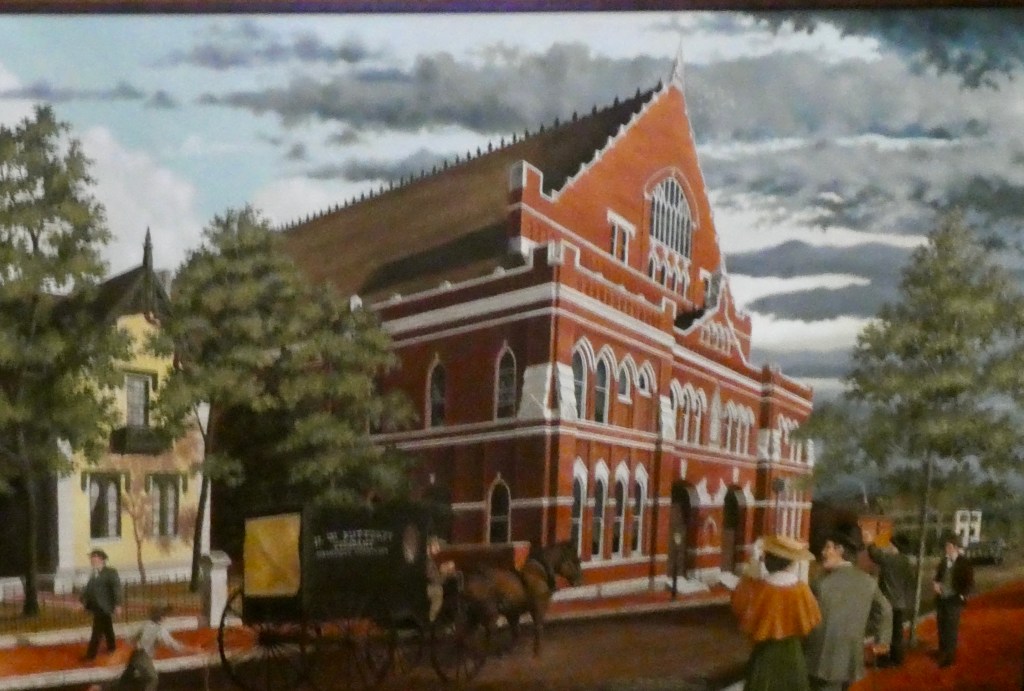
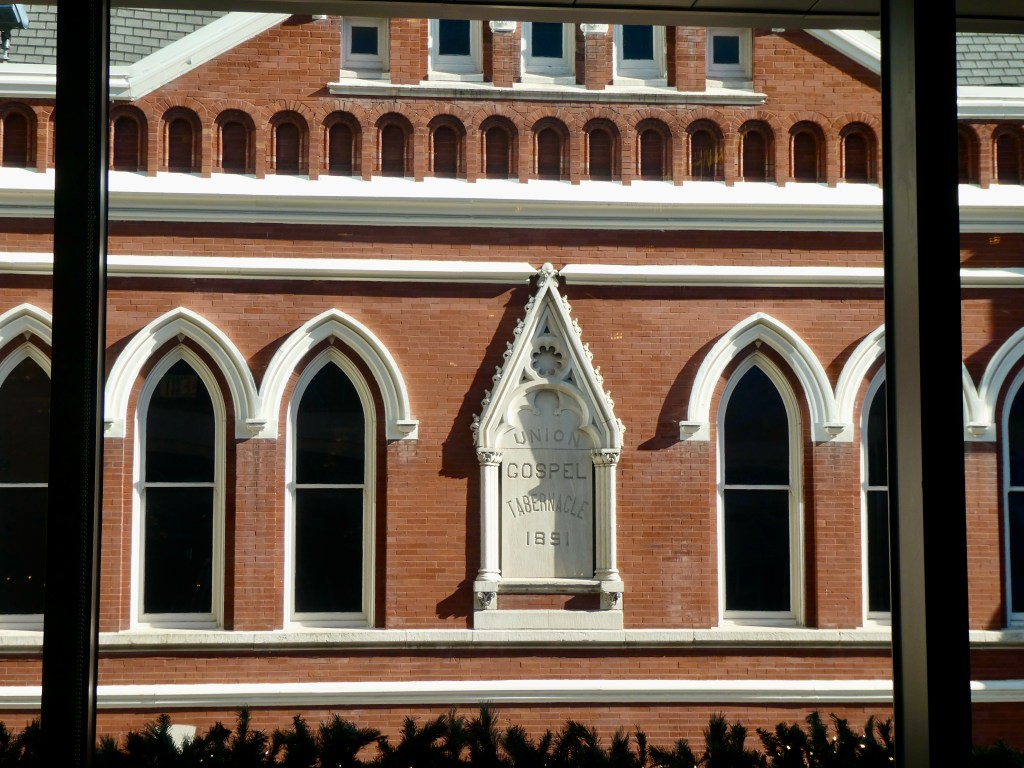
After hearing Reverend Sam Jones, a traveling revival pastor,  Thomas Ryman became a believer. He built the Union Gospel Tabernacle so Jones would have a permanent place to preach when he was in Nashville.

Over time the building also hosted musical and civic events.  

Over decades the music events became primary. The church was renamed the Ryman Auditorium after Ryman’s death in 1904.  It is often referred to as the Mother Church of Country Music.

The Ryman Auditorium was the fifth home of the Grand Ole Opry as the radio show was staged there from 1943-1974.  

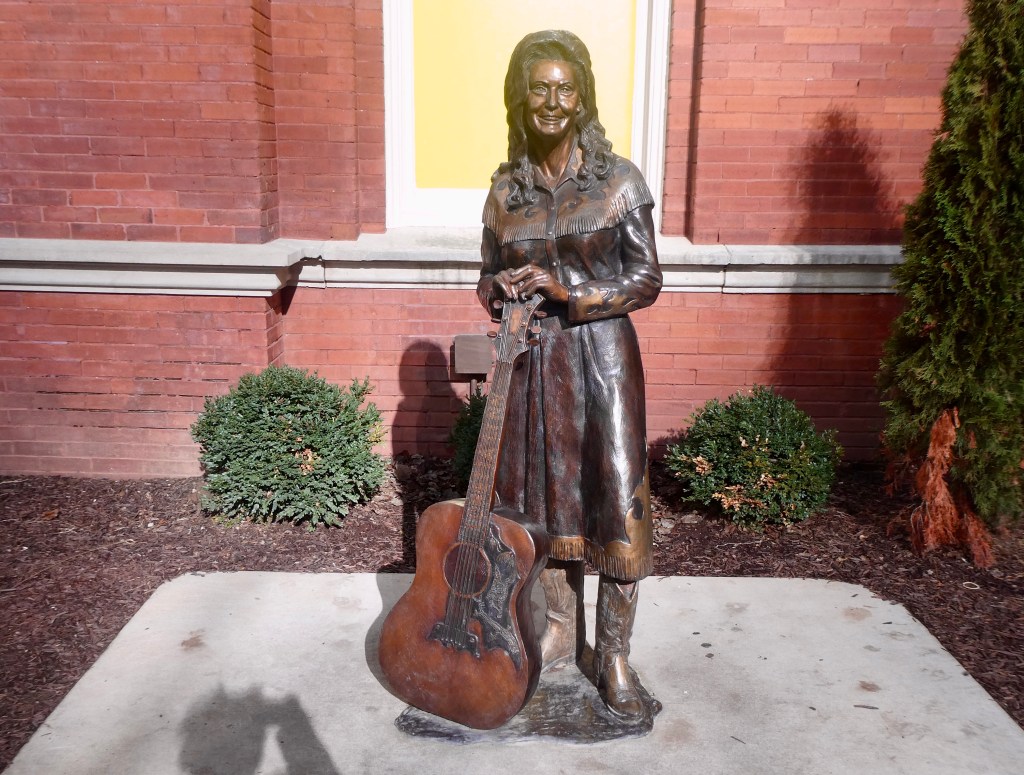
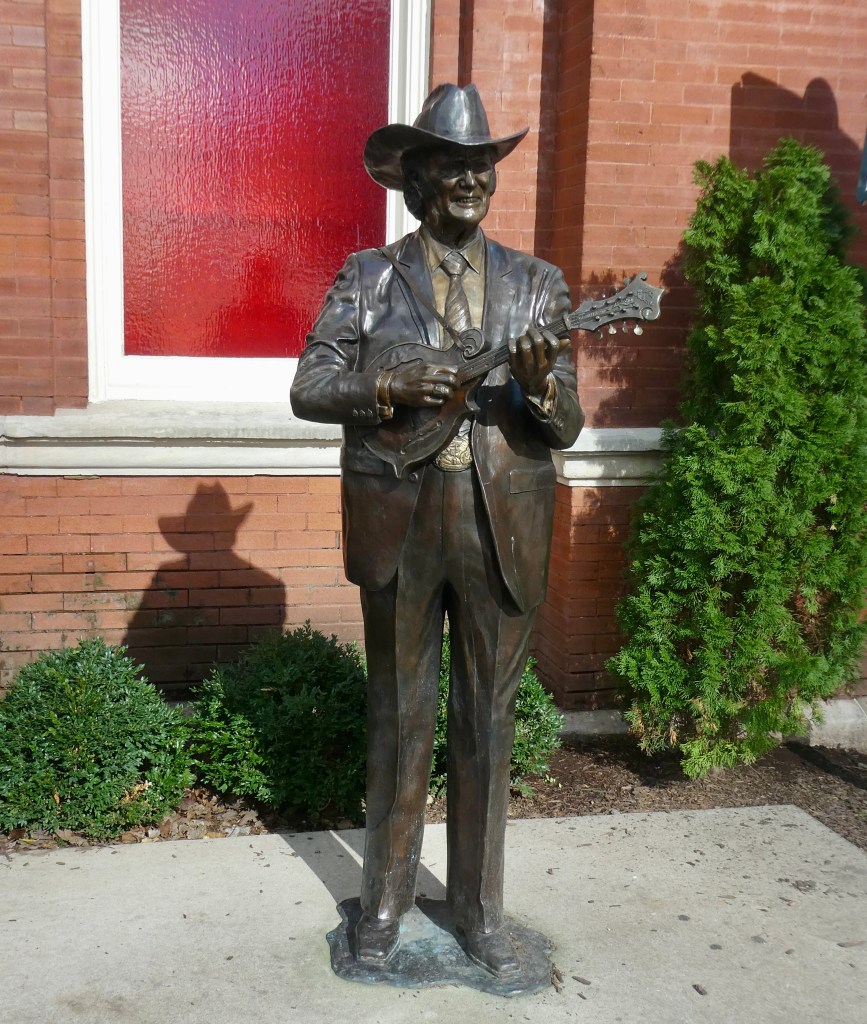
Statues outside the auditorium include Loretta Lynn and Bill Monroe.  We were told about Loretta Lynn’s controversial song in 1975, The Pill.   It was about the freedom a woman has having access to birth control pills. Her recording company originally refused to produce the song which ultimately made the song more famous than it might have otherwise been.

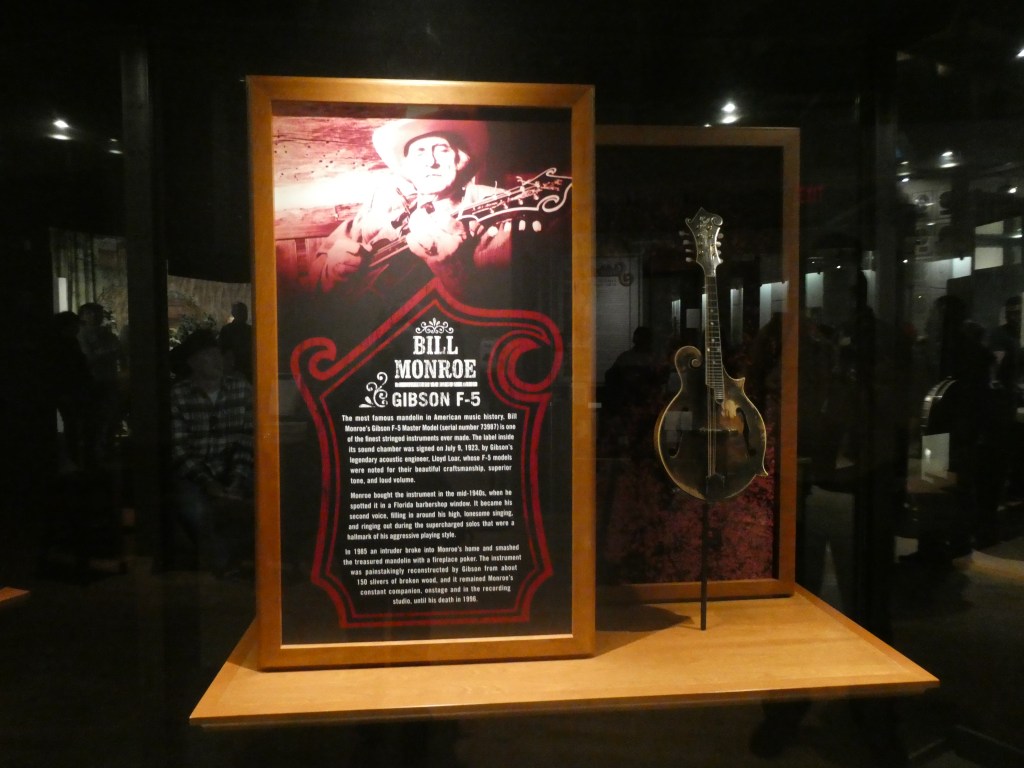
In 1945 Bill Monroe brought a music style to Nashville that was ultimately called Bluegrass.  

In 1954, nineteen year old Elvis Presley had a rough first performance at the Ryman Auditorium. He sang a rocked up version of Bill Monroe’s waltz “Blue Moon of Kentucky.”  The audience didn’t like the changes but Monroe did. Monroe incorporated some of Elvis’ changes into his own later performances of the song.  

Johnny Cash met June Carter for the first time at the Ryman.  They were both married to other people at the time.  Stories and personalities at the Ryman go on and on.  

We enjoyed the first night of our unexpected holiday in Nashville!

Posted in Uncategorized | 2 Comments

Tour of Italy: The Epilogue

We loved this trip!  We especially loved it combined with our Holland American transatlantic cruise.  It was a great five weeks in April and May 2022.

This last (yes last!) post about our trip will mention some overall impressions, some random facts that didn’t go somewhere else, and some comparisons with how we live in the US.

In general, Italians seemed to dress better and smoke more than we see in the US.  This seemed true across the southern part of Spain as well.

Italy can be very loud.  The traffic is loud and the voices are loud.  I don’t usually like anything loud but, since I didn’t understand most of it, I was usually able to tune it out.

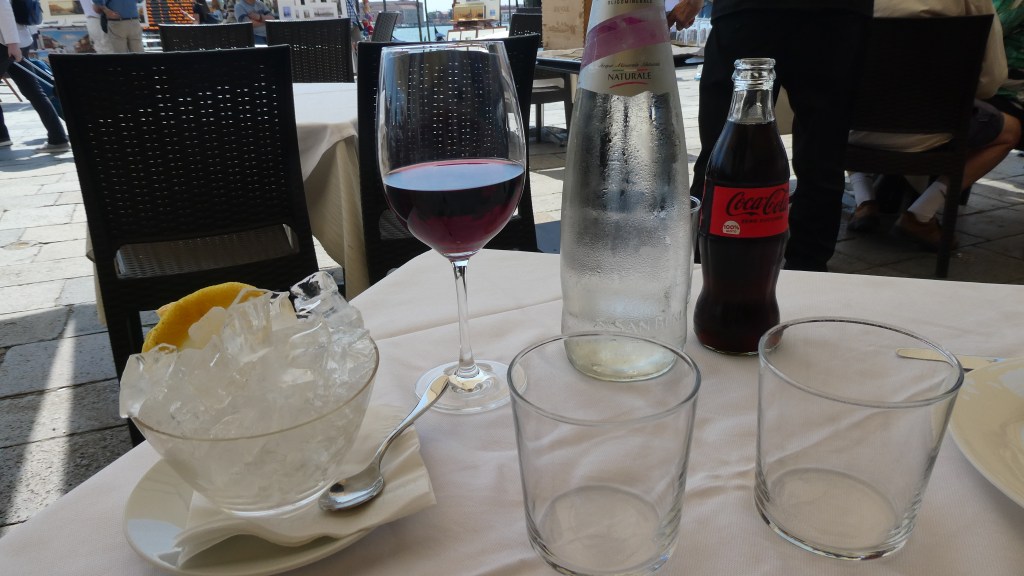
Some eating and drinking comparisons… There are three types of water available in Italy and they are in glass bottles.  There is sparkling, mineral and still water and you pay for whichever you choose in a restaurant.  After a few mishaps we definitely learned to ask for still water.  I don’t like carbonation and neither of us liked the mineral water.  It was usually easier just to drink wine!

No ice!?!? There usually is no ice in your drink unless you ask for it and then there is a small amount. Our tour guide said “Forget the ice machines, we don’t know what they are. Only in the Sheraton (an American company).”
Dinner starts late and takes forever!  That was hard for us as we prefer to eat our last meal early.  

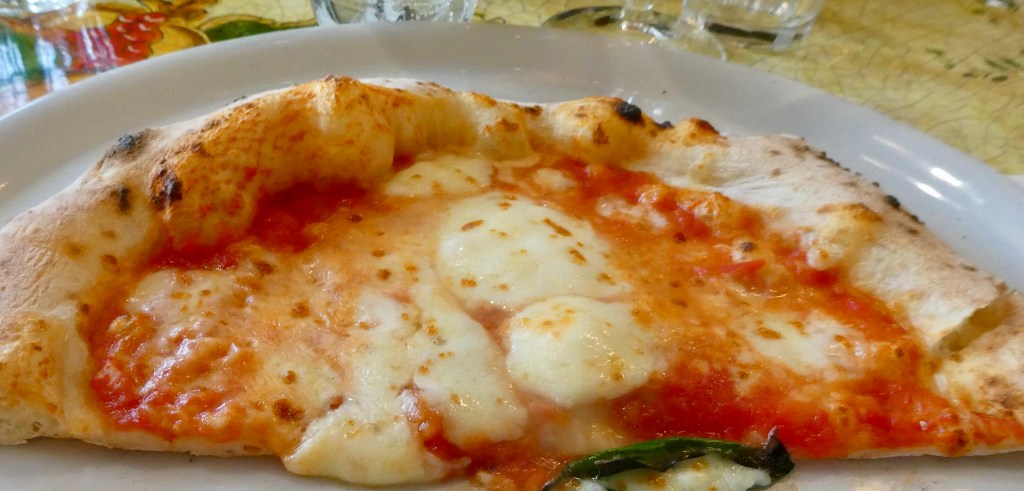
We found that food temperatures were rarely hot or cold. Everything was somewhere in the middle.  The exception was pizza coming out of a 900 degree oven!  Pizza was very hot.

Our breakfasts were interesting.  We were usually served buffet style with eight or ten types of pastries or sweet bread available.  There were eggs and breakfast meat although it seemed those were for foreigners and not typically eaten by Italians.  We were usually offered canned fruit but rarely fresh.  We were sometimes given canned peas and carrots.  Someone in our group asked about the peas and carrots and were told that they knew Americans ate them for breakfast. Who knew? No one in our group has peas and carrots for breakfast.
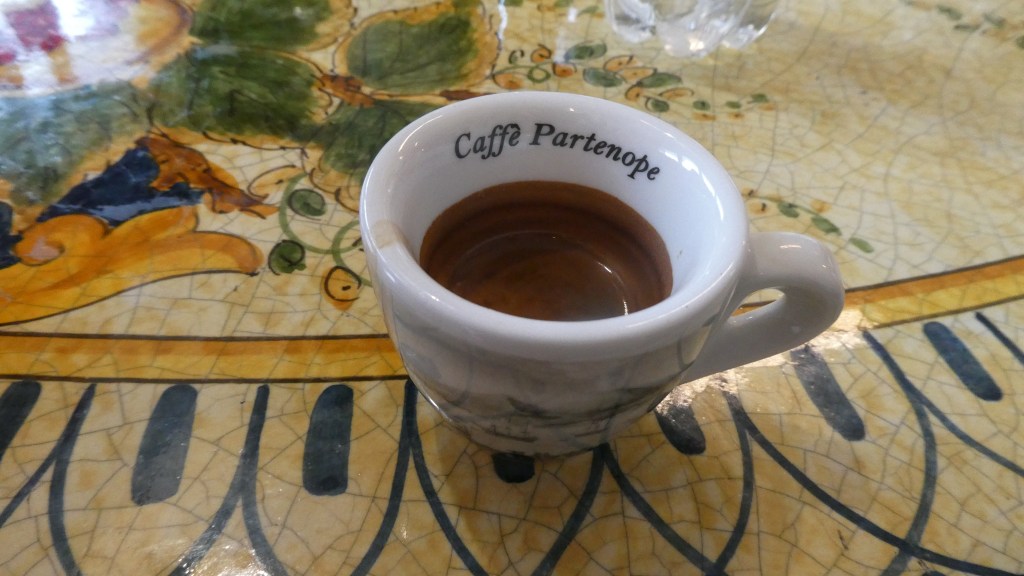
Espresso was everywhere – for all meals and in-between meals. 

Our tour guide even brought us a portable espresso on the bus one day.  

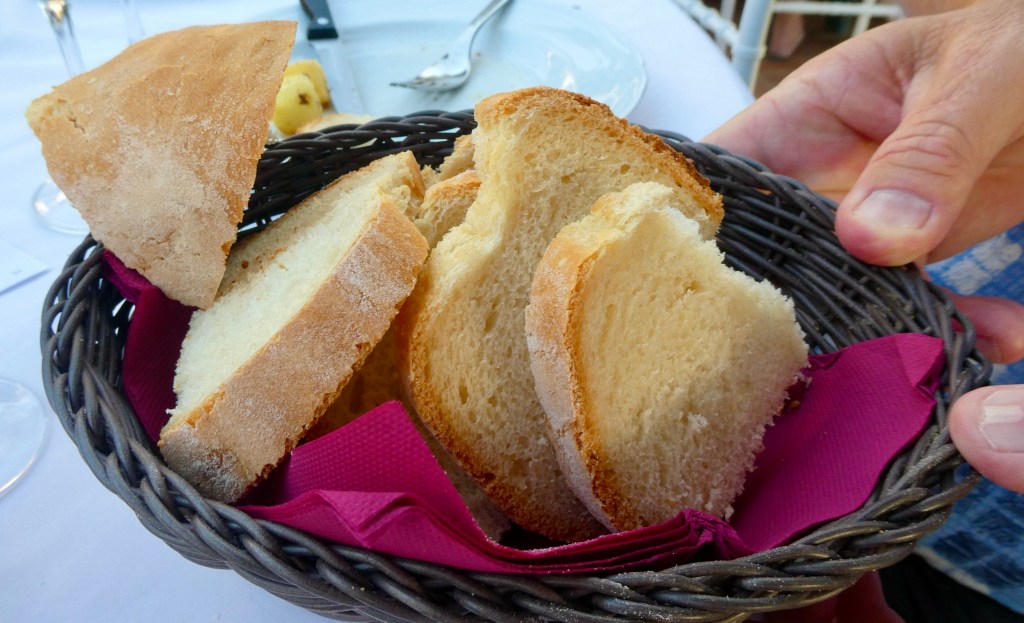
In Tuscany we were served bread made without salt. It tastes even worse than it sounds. The reasons why they make bread without salt vary from the city-state of Pisa denying Tuscans salt in the 1100s to the pope in Rome putting a high tax on salt in the 1500s. Those reasons, and others, may all be true, but the end result is that the Tuscany and Umbria regions of Italy have, over centuries, made bread without salt. We thought it was really bad and mostly passed it aside.

We saw very little salt and pepper in restaurants across Italy.  

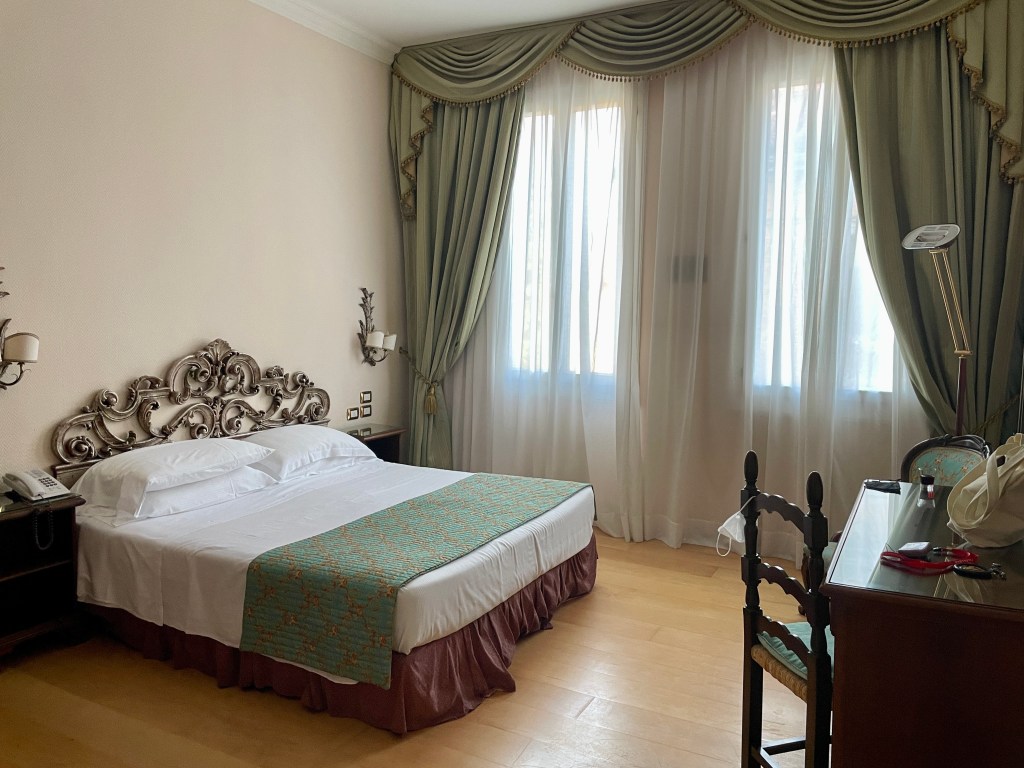
There are other things we didn’t see. In hotel rooms there are no washcloths. Travel sites online recommend you take your own washcloths if they are important to you. The hotel rooms also have no clocks.

What they do have is an endless array of faucet configurations!  I was always glad when Randy took a shower first so he could figure it out.  He probably felt the same if I went first. 

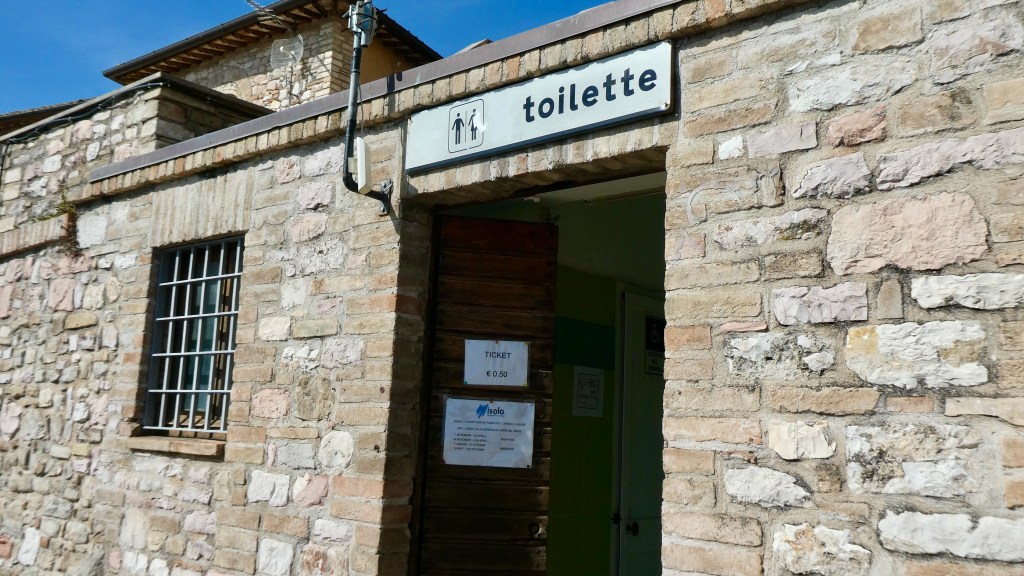
Now toilettes! Our tour guide always had comments about Americans and their “restrooms” – you don’t rest there!”   He would say  “Why do you want to see a man about a horse?  There aren’t any horses in there” or “We are going to stop for a fast pee-pee – No sitting down!” 

There are attitude differences about toilets way more than just words! There are few public toilets and you pay to use them. Usually that was 1-2 euros – approximately 1-2 dollars. Sometimes coins or bills were required and sometimes a credit card would work. They were always clean. You could buy something at a shop or restaurant and use their toilets but only if you were purchasing.

AND SOME WERE COED!  Americans can have trauma and legal battles over who goes in which restroom (oops – sorry Fabrizio) the Italians just share space. Usually there were separate sections for men and women but a shared hand washing space.  Occasionally there would actually be shared space for everything but those did not include open urinals.

One more toilet thing – there were almost no toilet seats in public restrooms.  In hotels there were some with and some without.

Thoughts on our tour itself: 

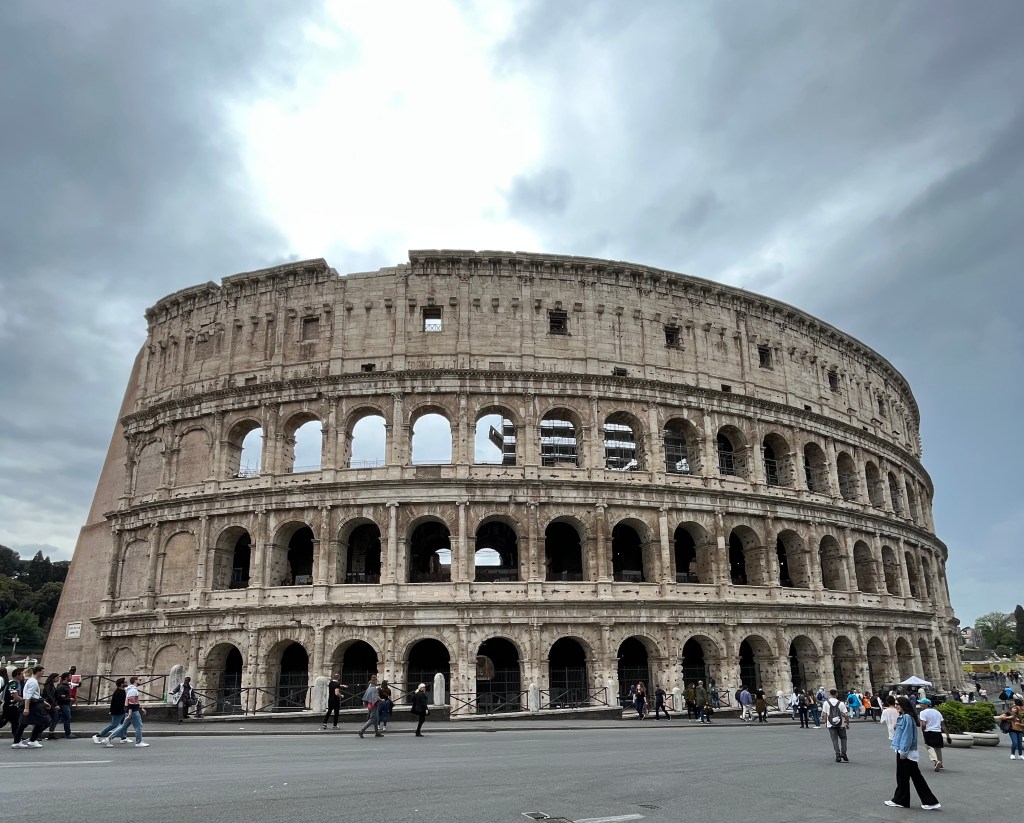
Italy has 58 UNESCO Heritage sites, more than any other country.  We visited at least ten. China is second with 56 and Germany has 51 UNESCO Heritage Sites.

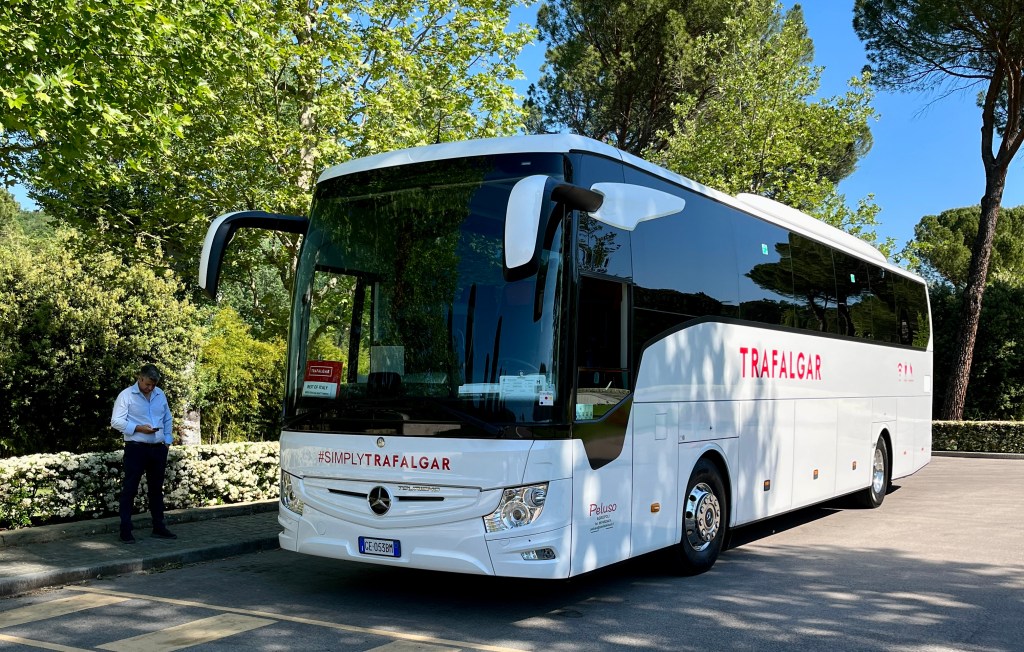
Our guided tour was with Trafalgar. 

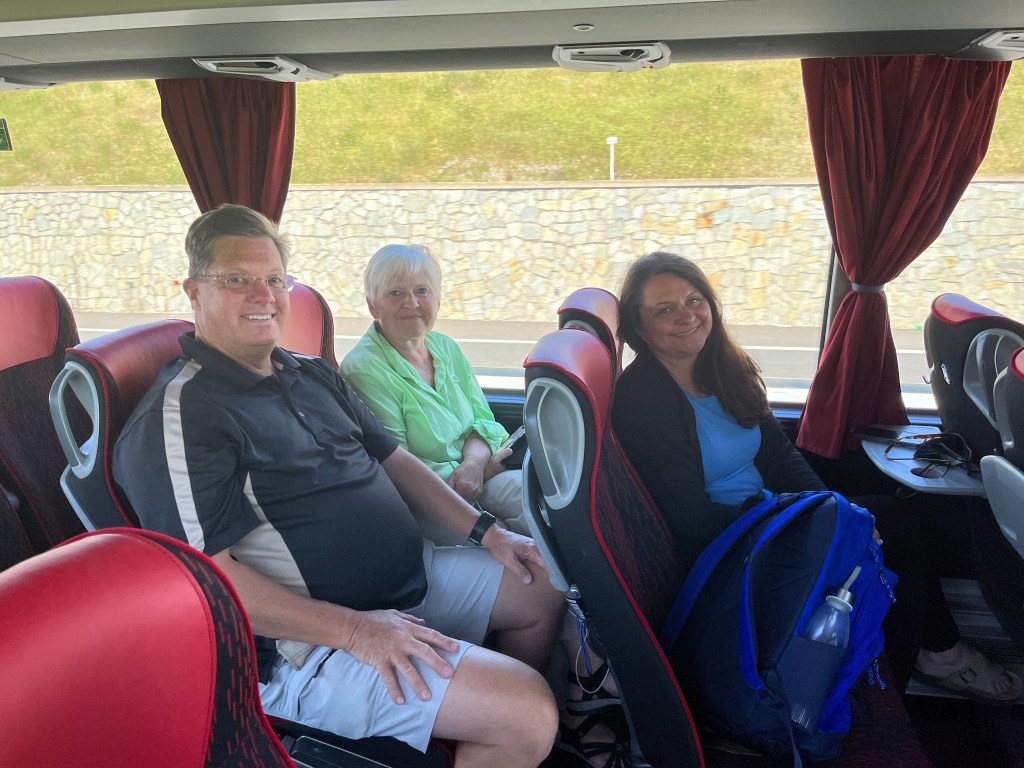
It was well done thanks to our driver Tonino (“little Toni”, on the left) and tour guide Fabrizio. 

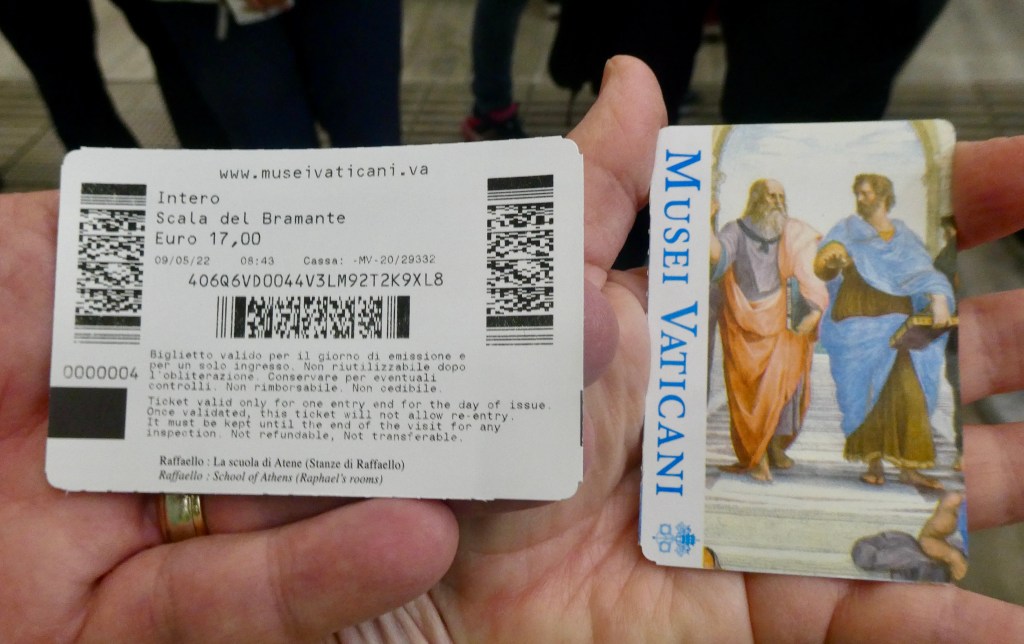
Our guided tour was advantageous getting to the front of the line, or to a different line because Fabrizio had reserved things ahead of time. We wouldn’t have seen half or a third of what we saw in the same amount of time if we’d been doing it on our own.

We had 27 people on our tour and we worked well together. However, 27 seems like the maximum number we would ever be interested in joining again. 

As Trafalgar’s typical tour has about 50 people, we had extra space on the bus to stretch out if we wanted.  As much as we would recommend Trafalgar in so many ways, we will look for smaller guided tours going forward.

We also learned that traveling in May was great. We had mild weather and things weren’t as crowded as they are in the summer.  Fabrizio said he didn’t know why people come in the summer when it is hot and crowded. We’ll prioritize the shoulder seasons going forward as much as possible.

Thanks for coming along for our grand adventure!

As Fabrizio would say “Andiamo guys”  (Let’s go, guys) – to where-ever we’re off to next!

Posted in Uncategorized | 4 Comments

Tour of Italy: Our Last Day

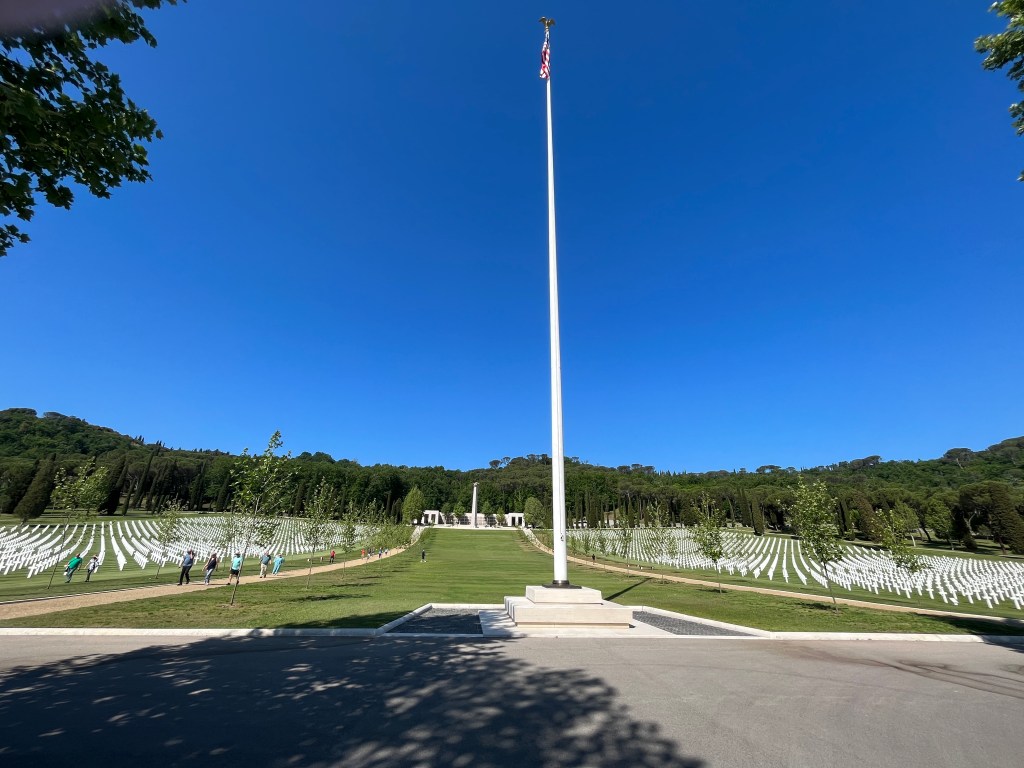
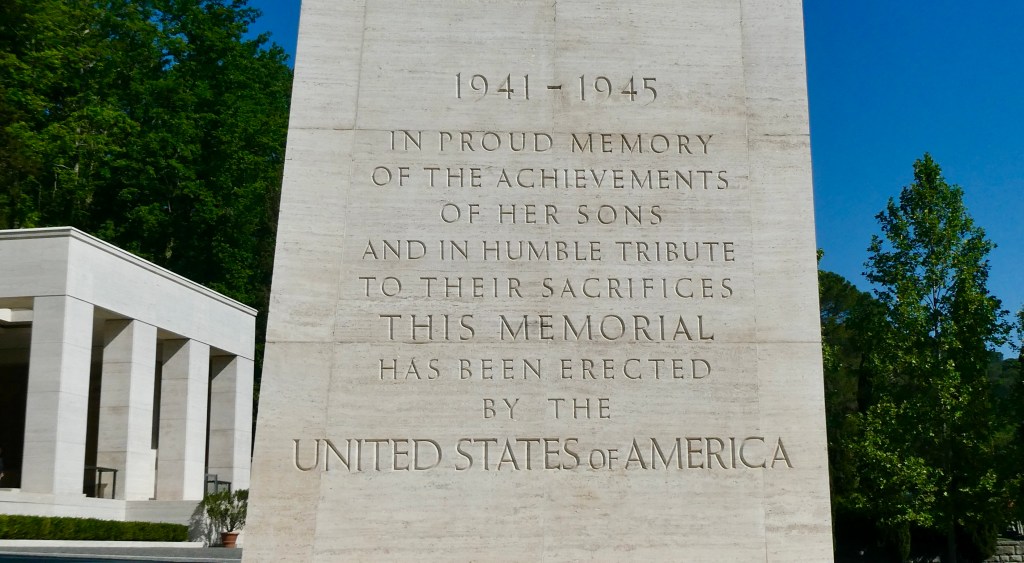
Our first stop on the last day of our Tour of Italy was at the Florence American Cemetery Memorial.  This is one of two American Cemeteries in Italy. The other is near Rome. 

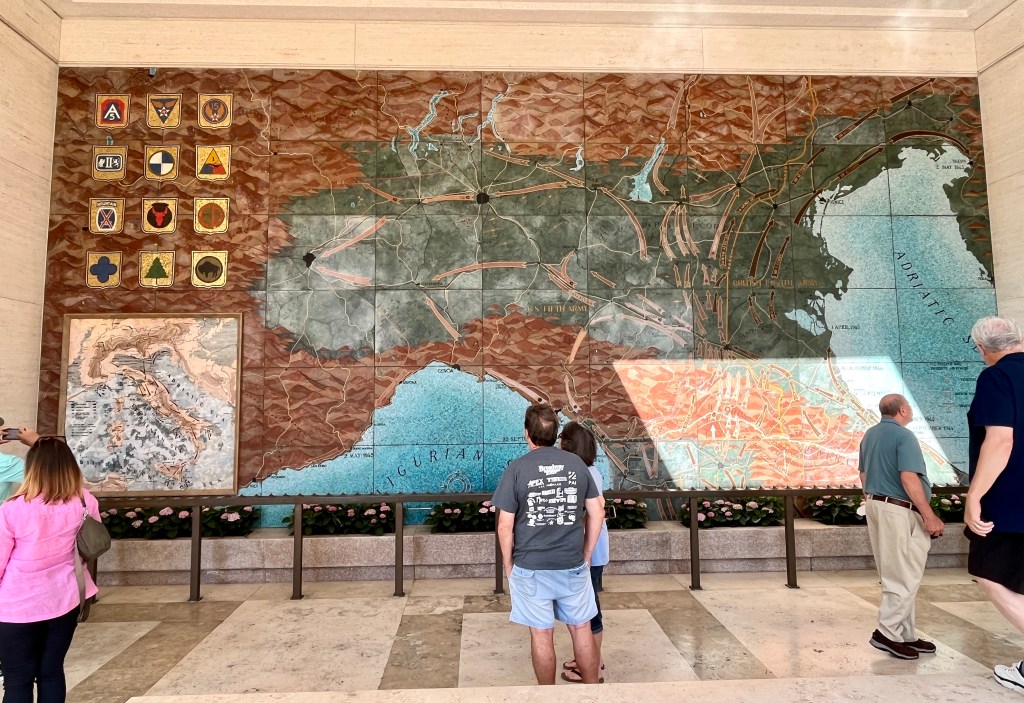
Rome was liberated on June 5, 1944.  The Allies operated throughout Italy until all remaining German forces surrendered on May 2, 1945.

Italy donated the land for this cemetery but it is maintained and operated by the United States. It has an American caretaker.

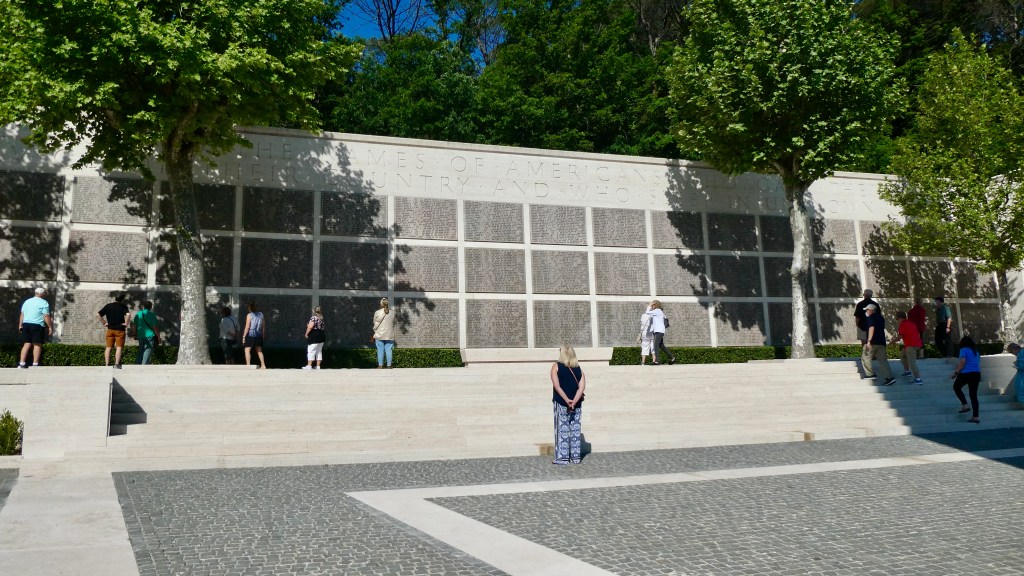
There are 4402 memorials made from exquisite marble.

The names of 1409 persons missing in action are inscribed on these tablets. 

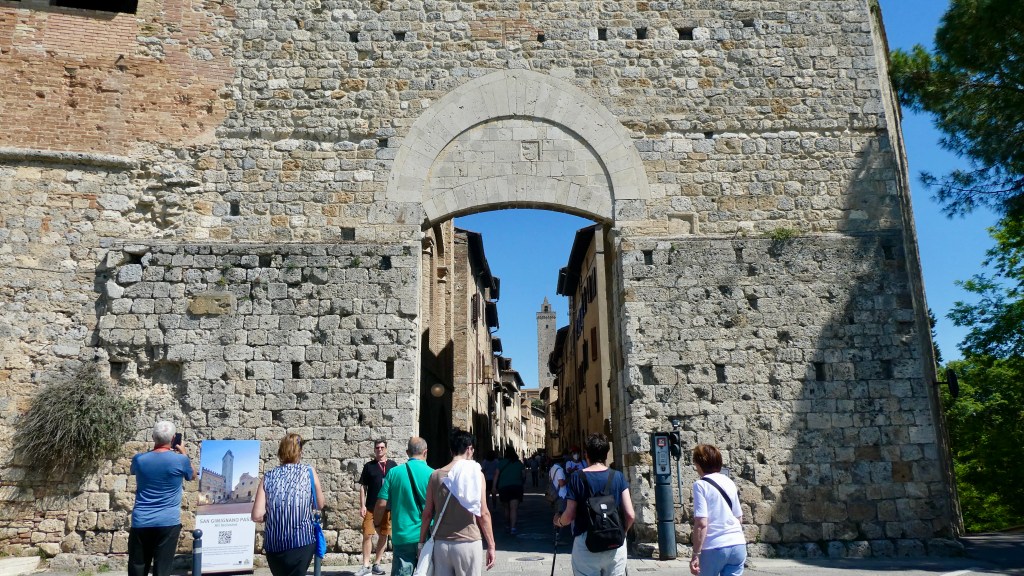
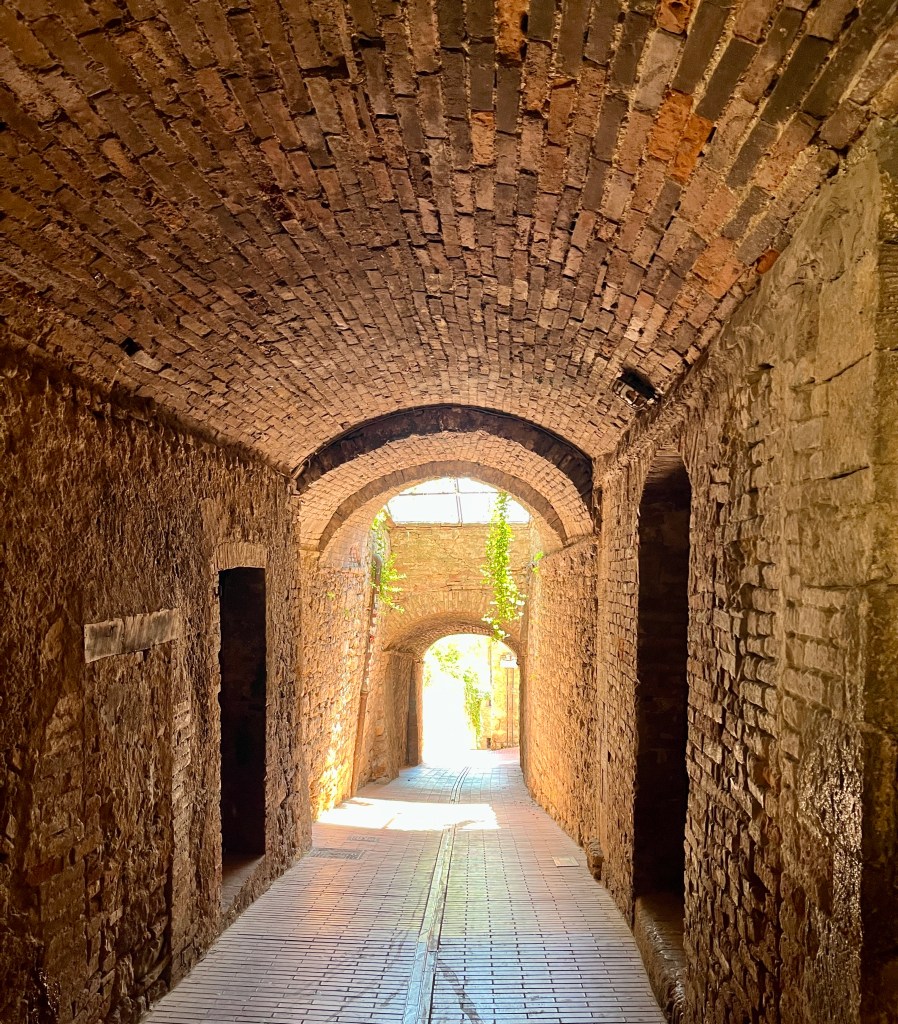
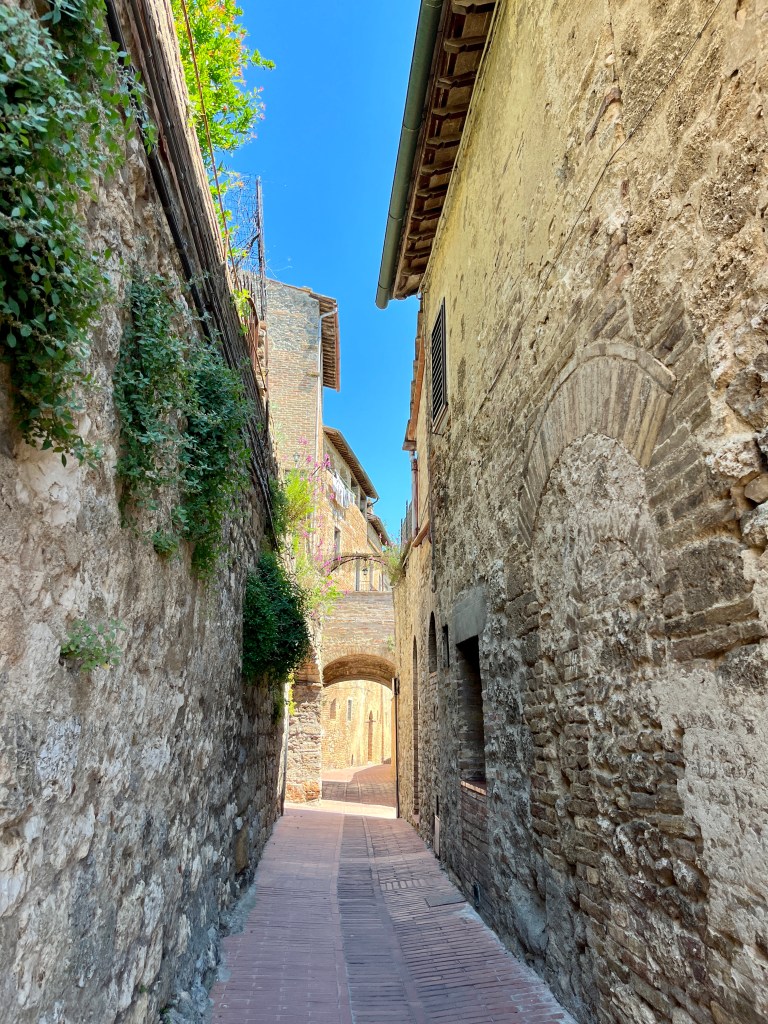
Our next stop was a treasure among the hill towns of Tuscany, San Gimignano.   High perches were important for security.

The town of San Gimignano was on the trade route in and out of Rome, to their benefit.

  When Rome fell, chaos ensued, and cities and towns around the region fortified. 

They operated as separate city states.

San Gimignano’s walls were placed in the 13th century.

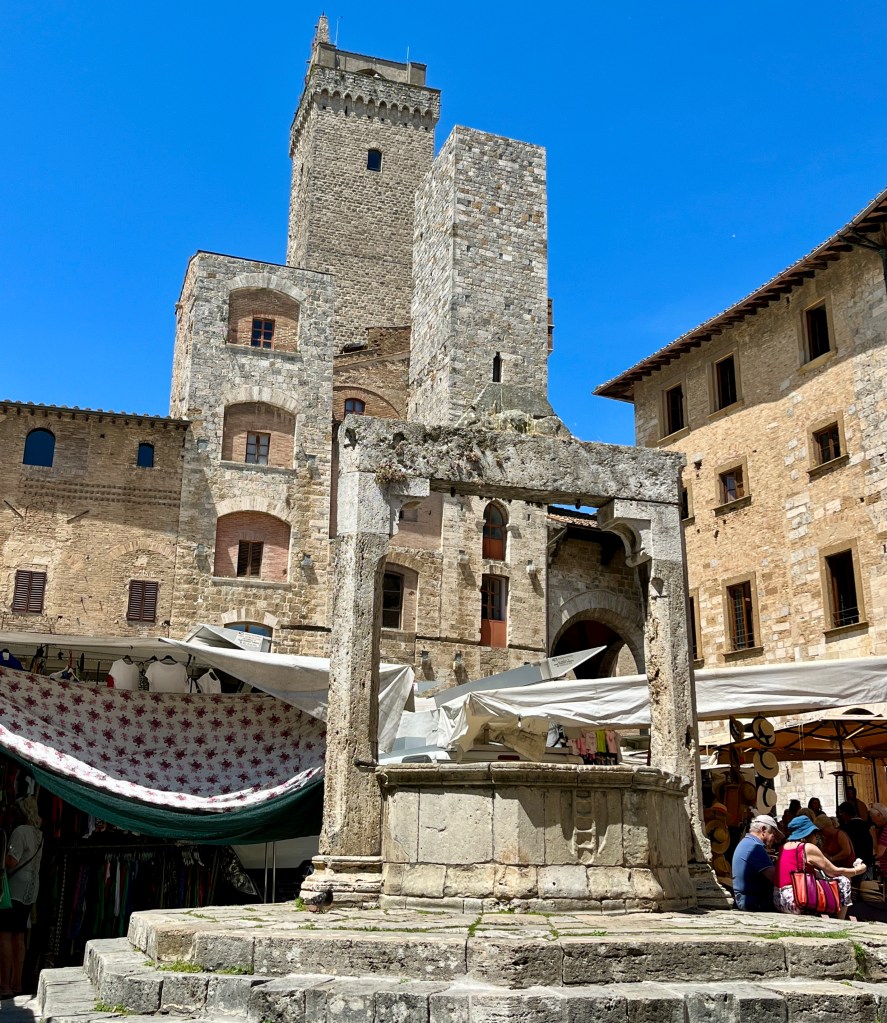
This well in the center of town operated for more than 1000 years.

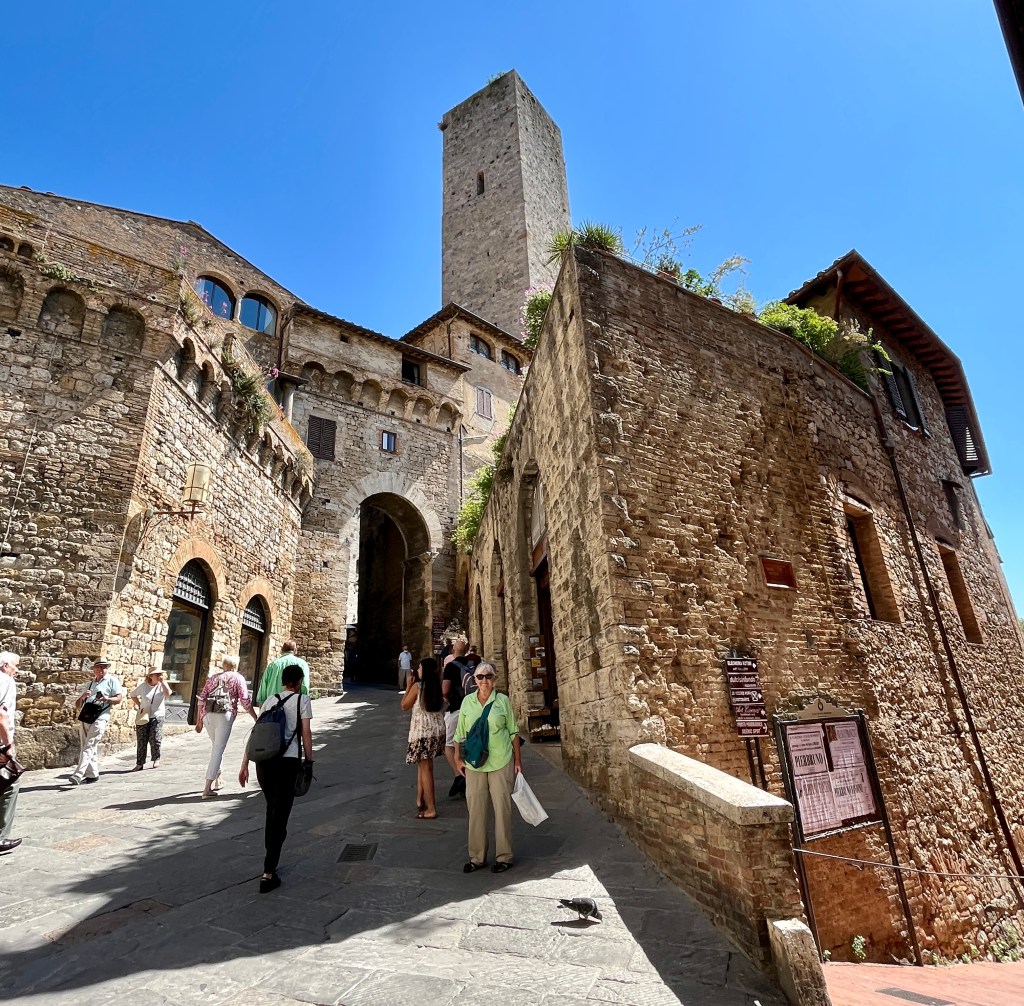
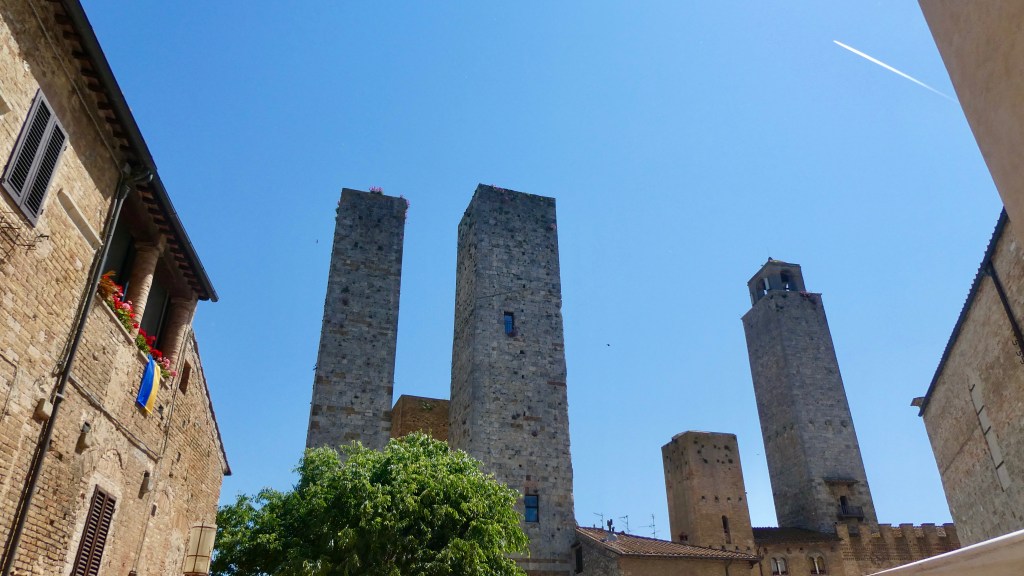
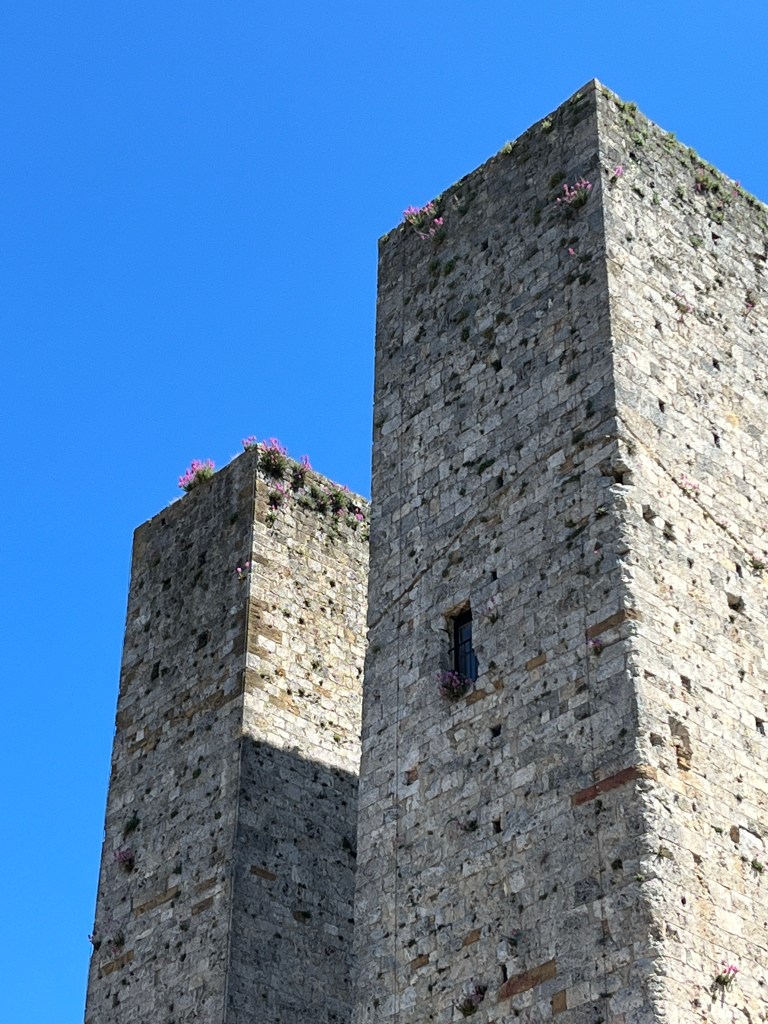
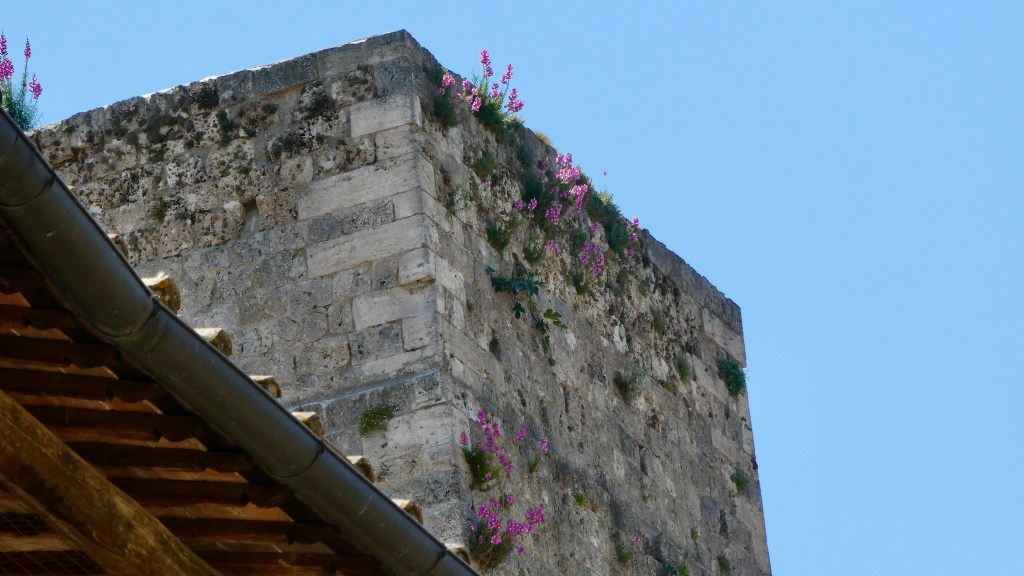
Our tour guide called San Gimignano the Manhattan of the past.  There were once 60 towers, now only eight towers remain. 

In the past people placed planks between buildings to move from one to the other.

In 1348, the plague decimated the town’s population by two-thirds. 

Florence, the regional bully,  took over and directed trade routes away from San Gimignano. 

The isolation was devastating to the economy then but has left San Gimignano less changed for tourism now. 

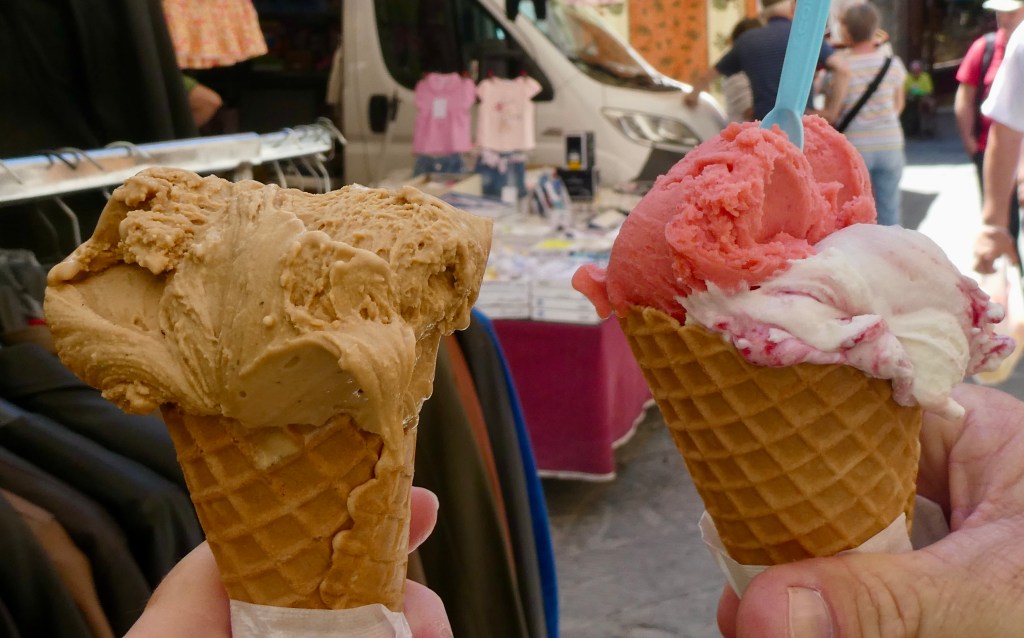
We had one last piece of “take away” Margherita Pizza and one more gelato from the best rated gelato shop in Tuscany – or maybe the world!

In the past San Gimignano had traded in leather and saffron and this shop offered a saffron flavored gelato.

We opted for our typical flavor choices instead!  

The rest of the day was spent traveling to Rome and settling into our hotel for our last night in Italy. We had flights out the next day.

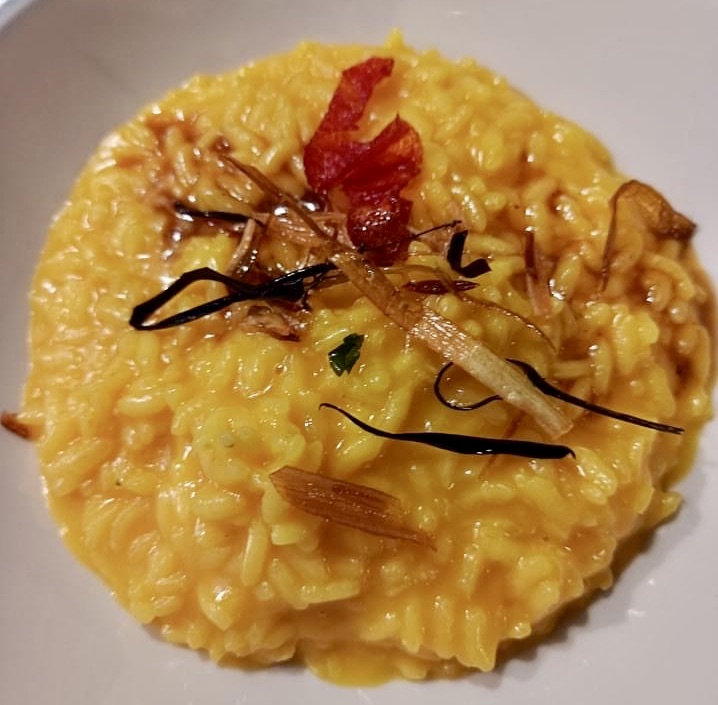
We had a farewell dinner and ate a delicious risotto – another meal I should have been ordering all along!

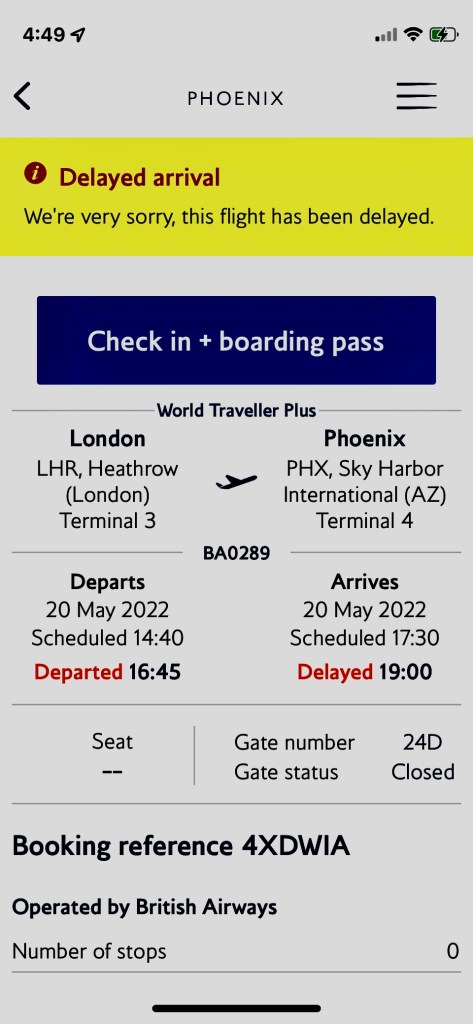
Our British Airlines flight out of Rome the next morning was delayed so we “missed” our flight out of London.   While still in the air we learned we’d been re-booked on an American Airlines flight from London to Phoenix for the next day.

After landing in London we were given vouchers for transportation, hotel, meals at the hotel etc.  We were impressed and not annoyed – things happen especially with travel in the (mostly) post COVID world.   

Our impression changed when, after getting settled in our room, our phones started notifying us to board our British Airways flight to Phoenix.  Someone or something hadn’t taken into consideration that the plane we were supposed to take leaving London was also delayed.  We could have made it easily.

But done was done.  We had opted not to retrieve our luggage in London so had almost nothing.  It was cold and drizzly and we weren’t dressed to go out for Fish and Chips at a local pub.  We’d do that differently next time! Just buy a jacket and go!

However it had happened, we had a very pleasant premium economy flight from London straight into Phoenix the next day.  

Our combined trip of the Holland America Transatlantic Cruise and the Trafalgar Tour of Italy was terrific. After being gone for five weeks, it was good to be home.

Next post: The epilogue – our summary thoughts about our trip and details that didn’t make it in anywhere else.

Posted in Uncategorized | 3 Comments

Tour of Italy: Florence – Covid Tests and David

There were two significant events on our minds as we arrived in Florence. Seeing Michelangelo’s David and taking the Covid test required for travel back into the US. In May 2022, testing positive meant quarantine in Florence. 

Our hotel room in Florence was the worst we had occupied in all of Italy.  It was very small and very gray.  It had a queen bed, TV and one chair.  Despite being new, or newly renovated, there were no electrical or USB outlets on either side of the bed.  There was one electrical outlet behind the TV and one in the bathroom.  Forget the CPAP, just having outlets to charge our phones, watch, camera and iPad was problematic. The idea of being stuck THERE for ten days was awful.

All 27 of us lined up for our Covid tests – Euros only,  exact change preferred.  Those of us with Euros helped those who had never exchanged currency.   The doctor was apparently annoyed at having to come to us because he inserted the swabs through the nasal cavity all the way to our brains.  We survived the medical assault and celebrated when we all passed!  I think our tour guide Fabrizio celebrated most because he was the one who would have had to arrange for our quarantine.

Now on to David… actually several Davids! The first David we saw was a replica at a park above Florence.  

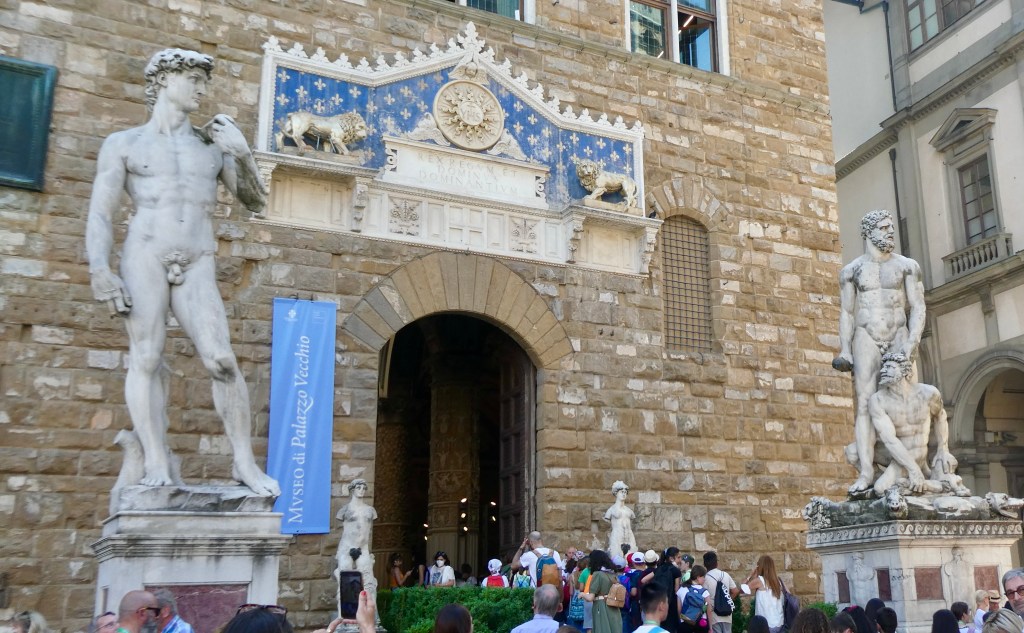
The second David was a replica placed where the original sculpture stood (outside) for 360 years.   

The statue on the right is Hercules and Cacus.  The rich and powerful Medici family that ruled Florence from the 13th through 17th centuries used Hercules as a symbol of courage and strength.  Four popes came from their line.

The Medici family used art as currency and displayed their vast collection.  They were famous for patronage – paying commissions so artists could focus solely on their art.  The Medici family had a huge impact on the Italian Renaissance.  

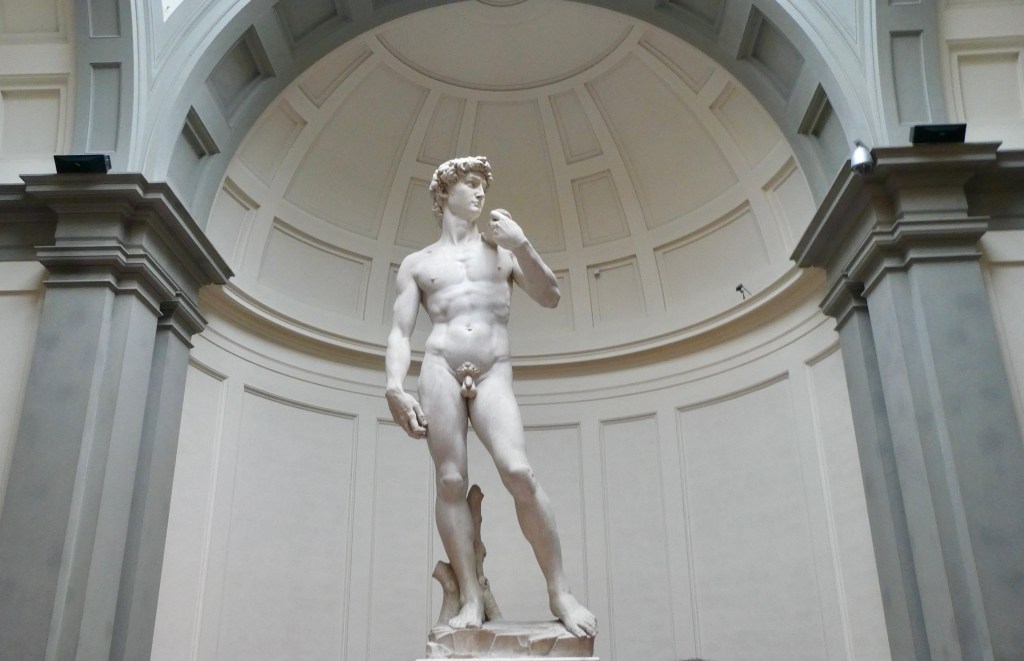
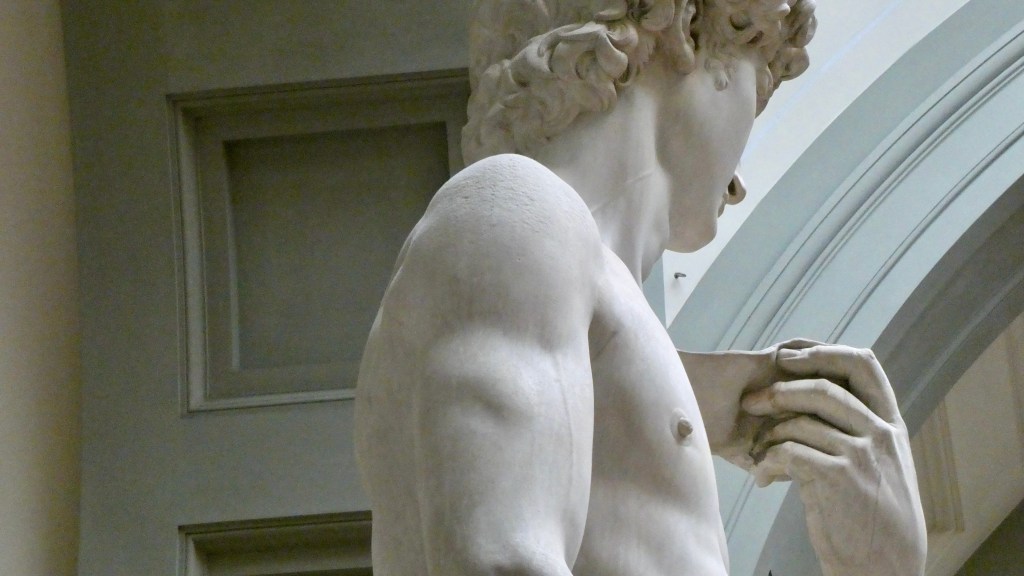
We saw the real David in the Galleria Accademia.  David was commissioned not by the Medici family but by the Opera del Duomo.  David was to be part of the sculpture collection in the Florence Cathedral.

The block of marble Michelangelo was given for David had been rejected by two other sculptors as being of poor quality. Begun in 1501, Michelangelo took three years to create David, finishing when he was 26 years old.

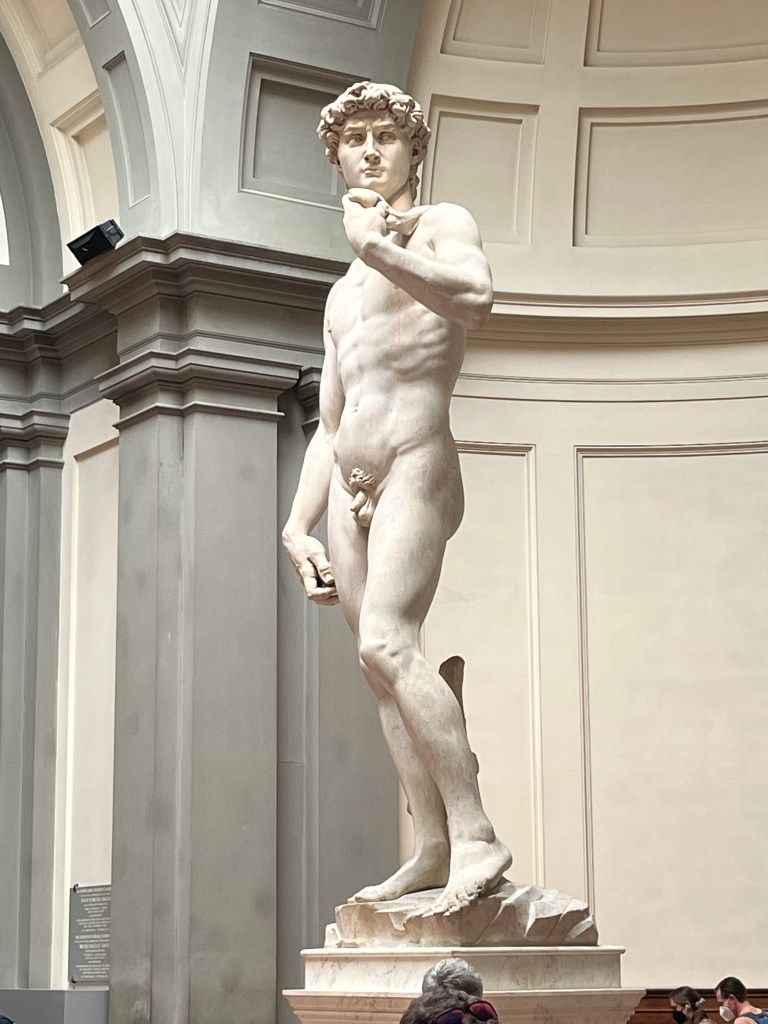
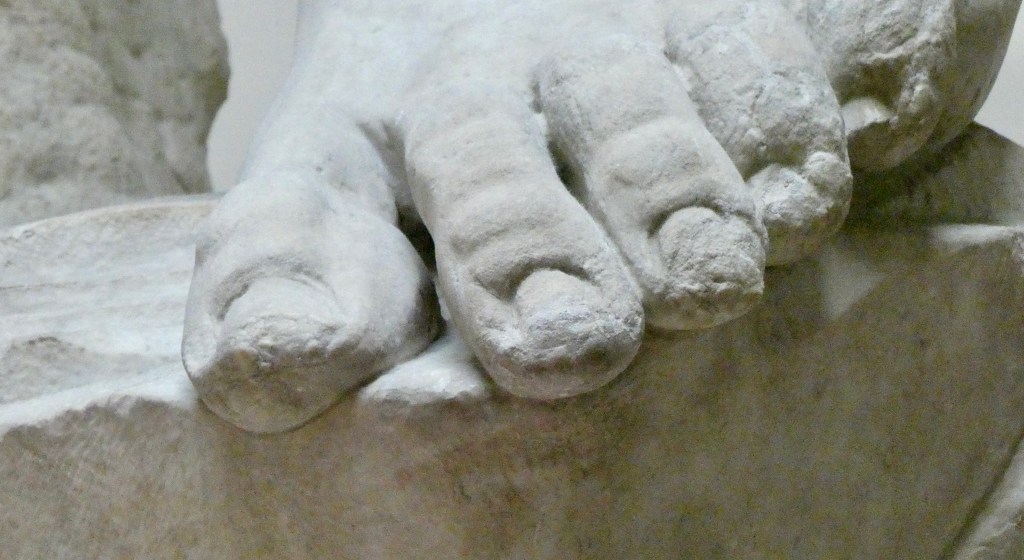
When completed David was too heavy to go in the intended place along the roofline in the cathedral. He is 17 meters tall with oversized hands and feet because people were to have viewed him from below.

David’s left arm was broken a riot while it was still outside. It was later repaired.

His right shoulder is pitted from an acid wash used to clean the statue during the 18th century.

David’s left big toe was damaged by a person with a hammer in 1991.

At age 500, David was restored in 2003.  This time restorers took 18 months to remove dirt using only distilled water.  

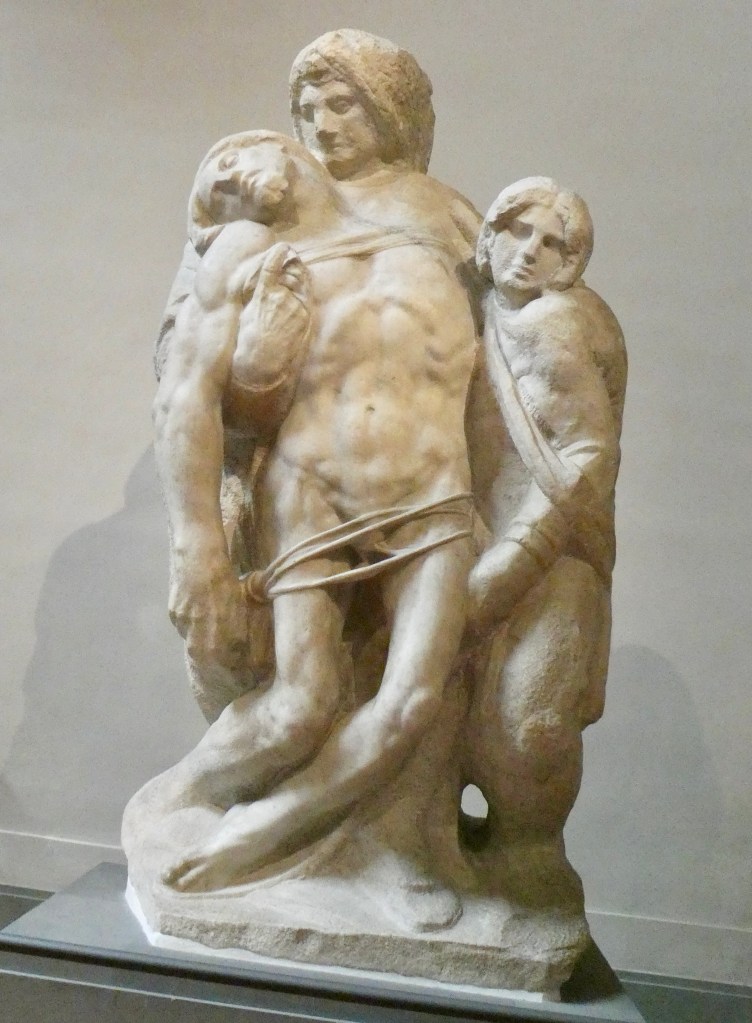
We saw another Pieta but there is not full agreement on whether this was created by Michelangelo. The Galleria claims it is so in its signage.  We were told this Pieta was found in 1940 at a small church in Italy.

We saw the famous Michelangelo Pieta in St. Peter’s Basilica in Vatican City.  A second verified Michelangelo Pieta is in another Florence location and a third is in Milan.  This would be his fourth if correctly attributed.

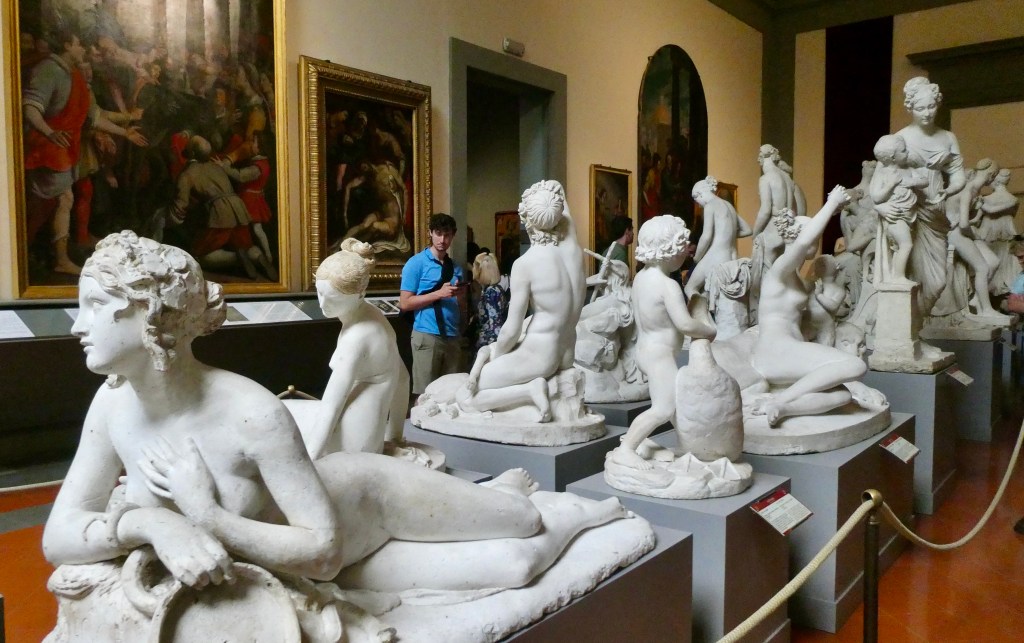
While visiting the Galleria Accademia we saw many sculptures each with a story of its own.

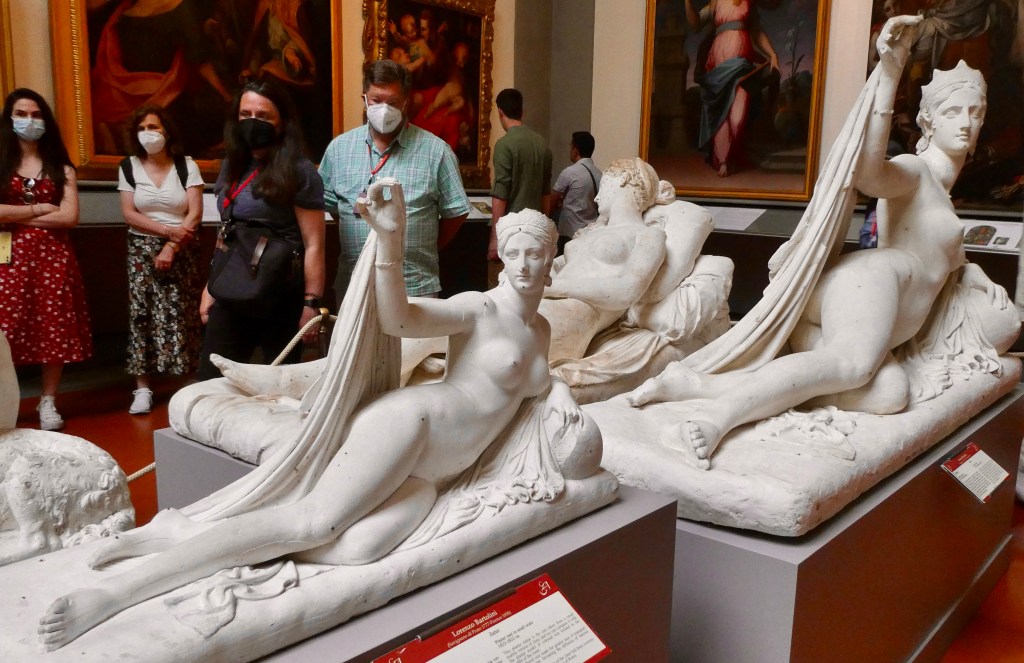
Most artists began with plaster casts such as these women.  Careful observation shows measurement marks in preparation for sculpting in marble. Michelangelo did not use casts – he went straight to the marble in creating his works.

We saw so many sculptures all over Florence – inside and outside and everywhere between.  It became a bit overwhelming!

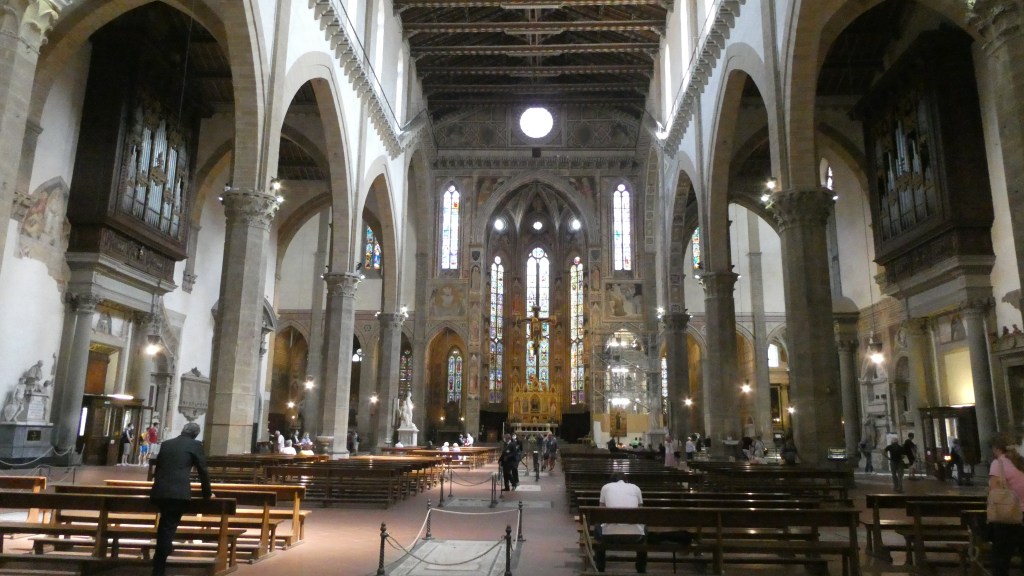
Churches on our Tour of Italy also became a bit overwhelming.  There were larger and fancier churches in Florence but we ended our day at the more modest Santa Croce Church.

Basilica de Santa Croce (Church of the Holy Cross) was begun in 1294 and consecrated in 1440.  It is the largest Franciscan church in the world.  The front facade was added later when Florence gained great importance. The architect was Jewish and included the Star of David.

This church was interesting to us, not because of interior beauty or opulence …

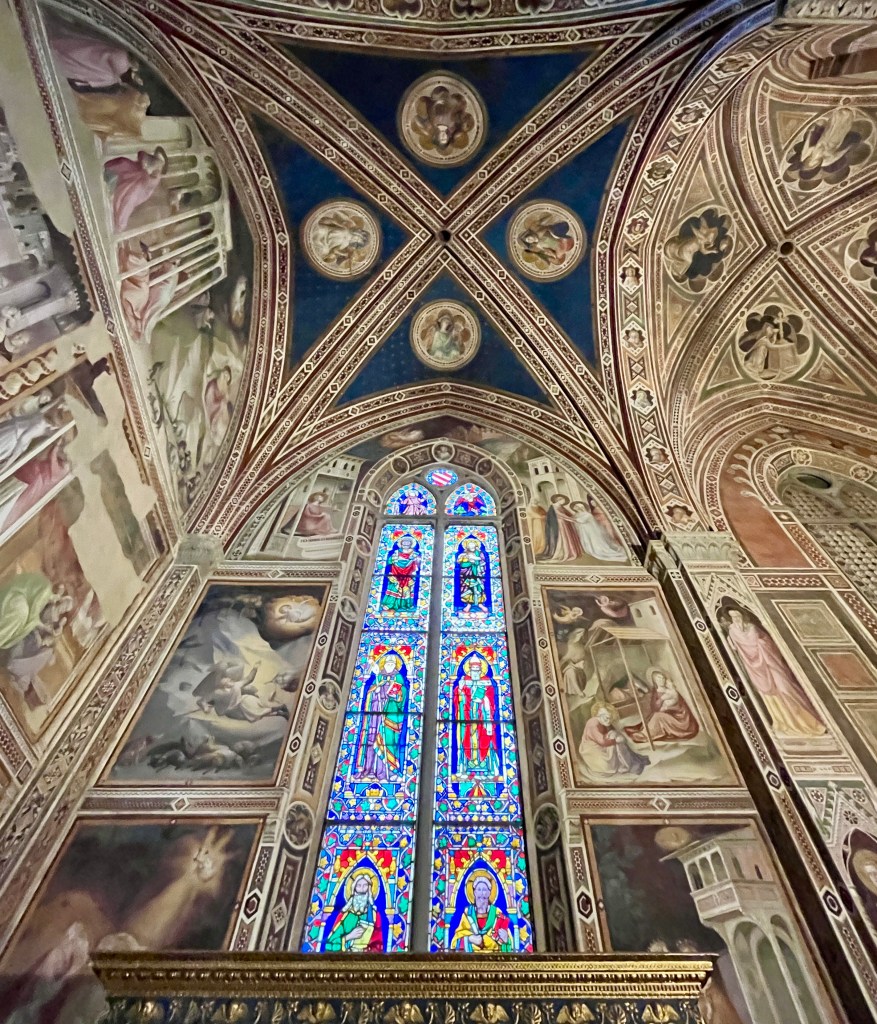
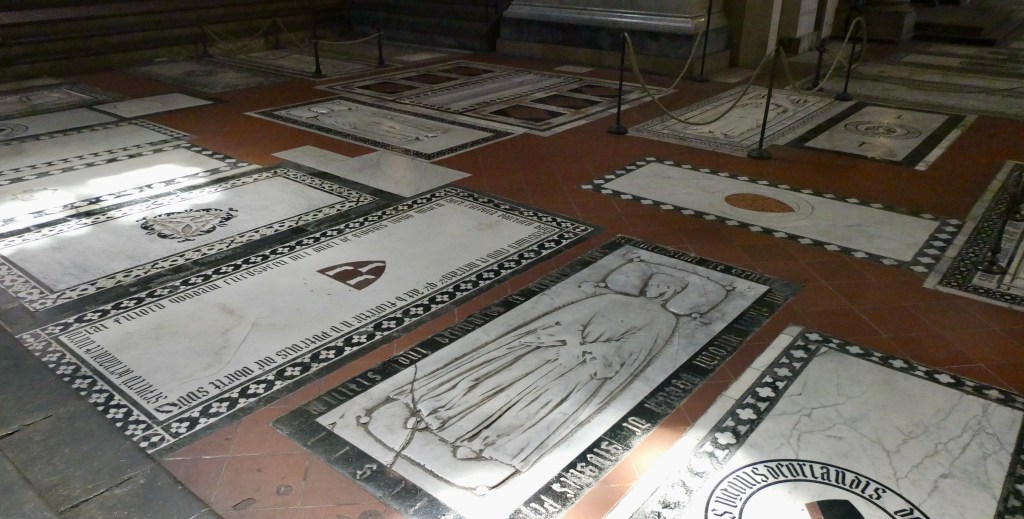
…although there was a bit of that… but because of the historical figures entombed there.

Guglielmo Marconi was an Italian inventor and electrical engineer, known for inventing the wireless telegraph system and early radio. 

Galileo Galilei was an Italian astronomer, physicist and engineer. You know – Galileo!

Nicolavs Machiavelli – writer of “The Prince” and the owner of the Tuscany villa we enjoyed the night before. 

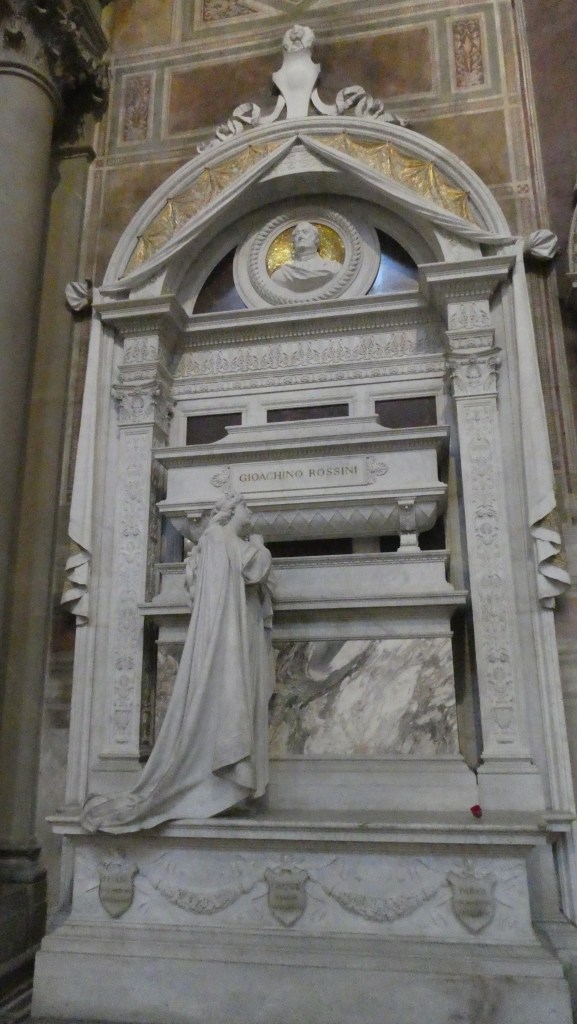
Gioachino Rossini was an Italian composer who gained fame for his 39 operas, chamber music, piano pieces, and sacred music. 

Enrico Fermi was an Italian physicist and creator of the world’s first nuclear reactor.

And of course, Michelangelo is here – but he wasn’t always.  On questionable terms with the Medici family, Michelangelo lived his last thirty years in Rome.  He died and was buried there.  The current leader of the Medici family conspired with Michelangelo’s nephew to steal Michelangelo’s body and return him to Florence. 

Santa Croce has evolved into a tomb of national glory with over 15,000 places of rest.  There were many other elaborate tombs but I have highlighted those whose names were familiar to us.

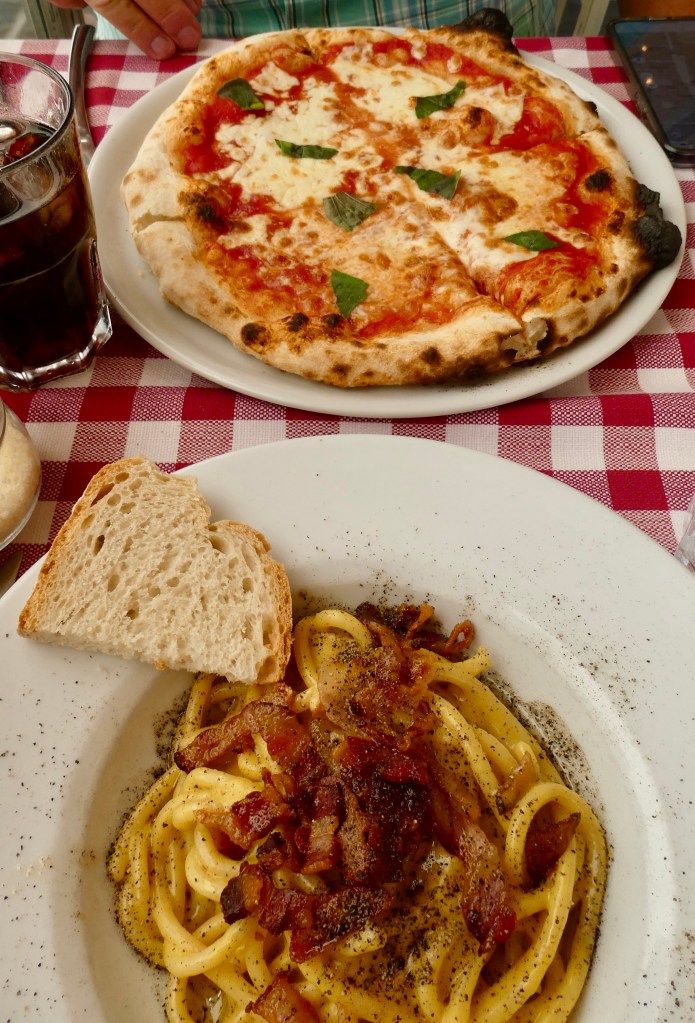
When reviewing Florence pictures (six months later) for writing this blog, I was surprised to see this meal picture but I remember it well.  We ate at a little sidewalk restaurant very near Santa Croce. Randy, as always, had pizza and I had a delicious carbonara.  I should have been ordering carbonara all along!

Next up: Our last full day in Italy!

Posted in Uncategorized | 4 Comments

Tour of Italy: Pisa and Villa Machiavelli

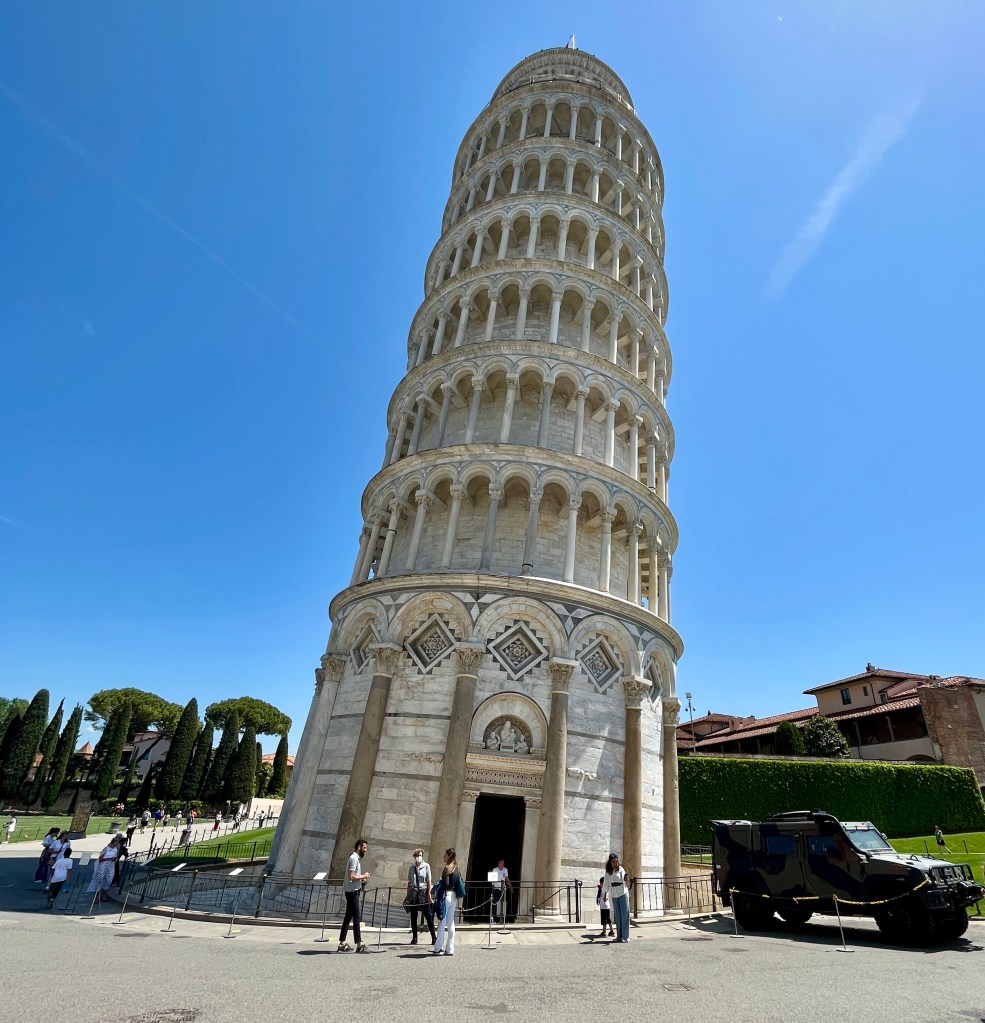
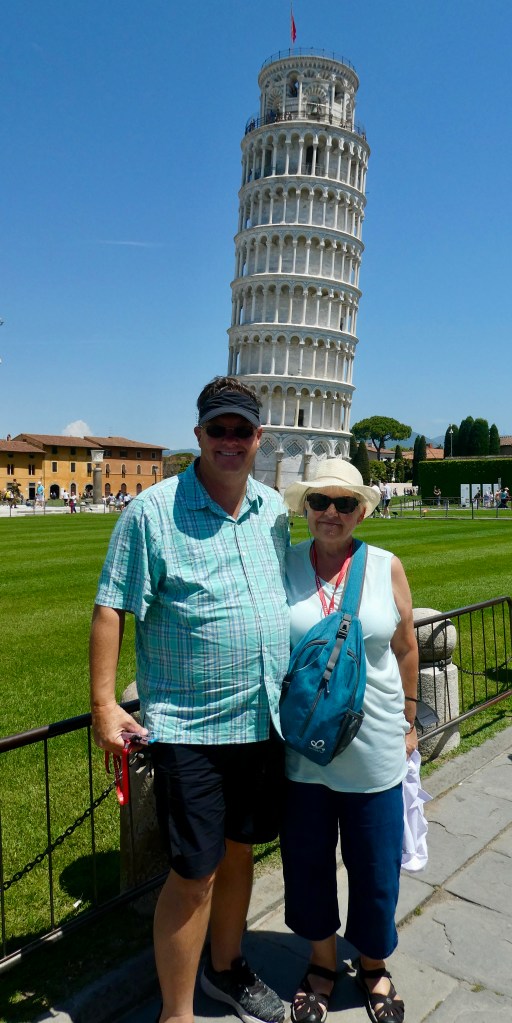
Pisa was an important port on the Mediterranean in the 12th century. Construction on a bell tower began in 1173.  

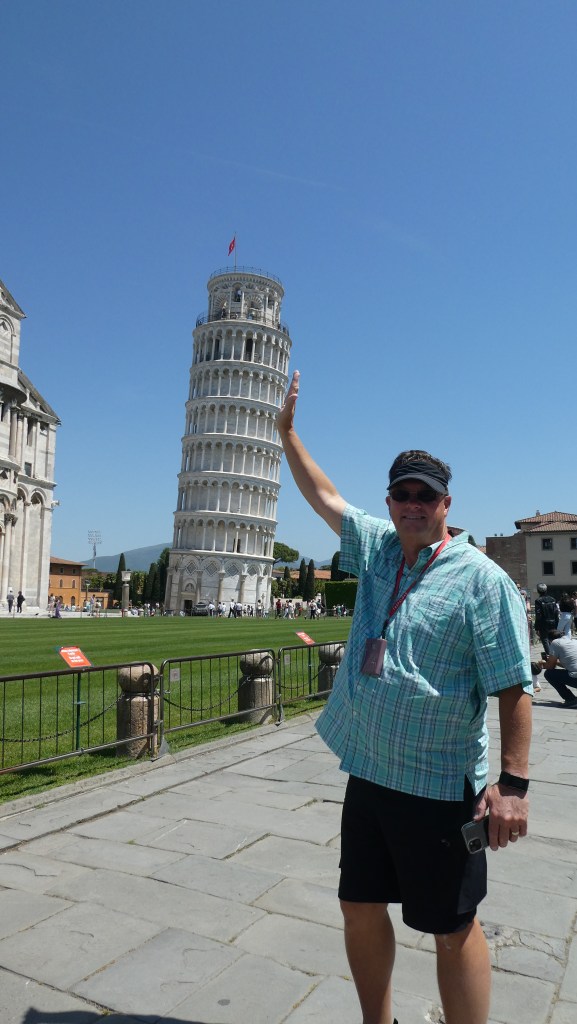
Unfortunately, the land was marshy and the tower started leaning after the third floor was added.  We were told the architect ran away.

The bell tower sat abandoned for almost 200 years until it was completed in 1372.

As it was constructed the builders tried to modify dimensions to keep the tilt from getting worse.

In1990 people around the world gathered and performed surgical fixes on the tower, improving its tilt from 5.5 degrees to less than 4.

In the year 2000, engineers tried to reinforce the Leaning Tower of Pisa with ground support. 

On the grounds are a church, the bell tower and a baptistry.  

After exploring Pisa, we were given the opportunity to have lunch on our own.  By this time I was getting tired of pizza – no matter how good it was.  (Randy never did get tired of pizza.)  

On our own, we couldn’t be shamed for trying the Italian version of McDonalds.  We saw them everywhere – all over Italy!   We thought it would be interesting to compare what they have versus what we know.  Randy had a regular Big Mac and fries.  I had an Italian burger and fries.  Both were fine but we regretted our decision even while we were eating.  When in Italy, don’t eat at McDonalds!

With our visit to Pisa complete, we continued our travel through the Tuscany region of Italy.  Tuscany is named for the Etruscans, the people group who inhabited this area before the Romans.   The Etruscans were contemporaries of the ancient Greeks. Many Etruscan tombs remain in the region. Some are decorated with frescoes allowing people to learn about their civilization. 

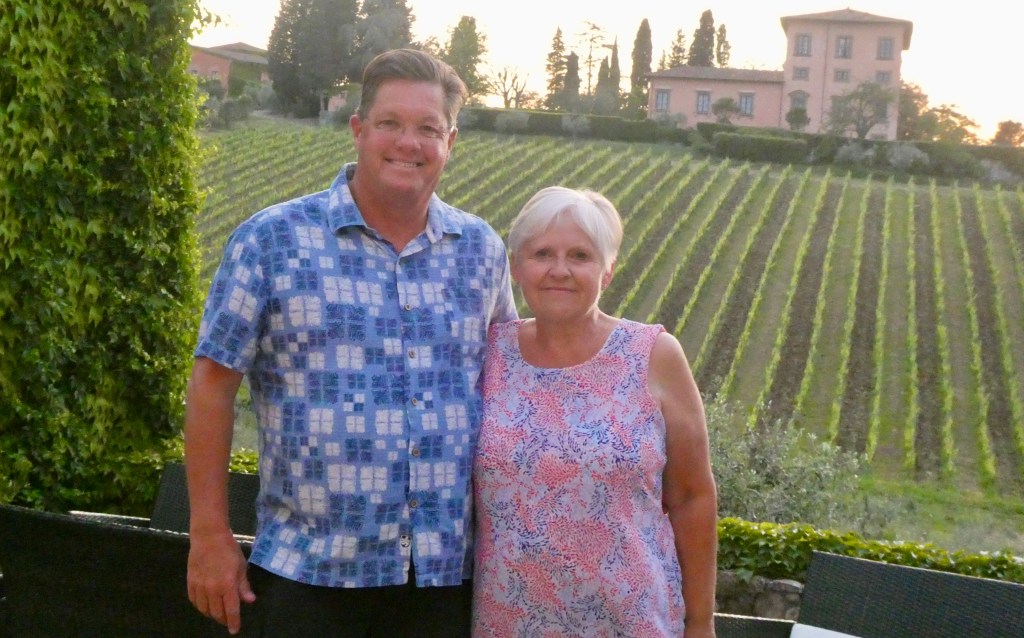
We traveled to Villa Machiavelli for a tour, wine tasting and dinner.  Our experience began with a glass of their very own Bluemond Blue Bubbly!

The Villa was the home of Italian political philosopher and writer Niccolo Machiavelli.  He served as a diplomat for the principality of Florence in the early 1500s. 

He fell out of favor with the powerful Medeici family, was abused, and eventually exiled to his Villa.   

In an attempt to regain political favor, Machiavelli wrote his most famous work, The Prince, at this desk.  The effort failed to win over the Medici family but the writing has historic longevity.

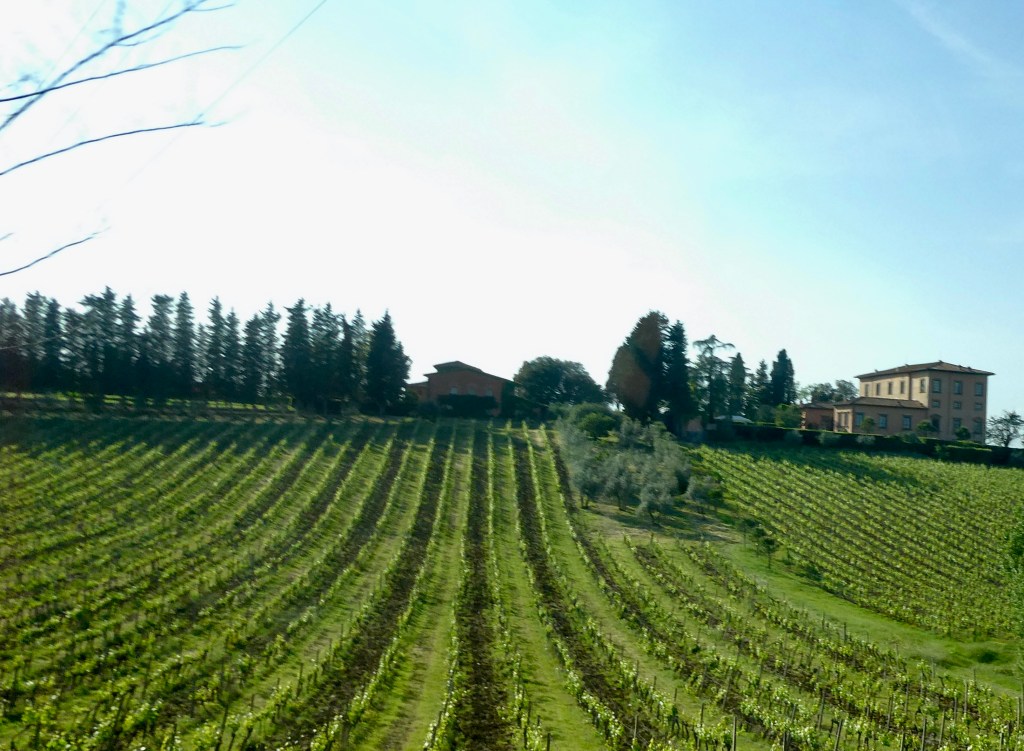
Wine has been grown on these lands for over 500 years.  One of the primary grape varieties grown in Tuscany is sangiovese.  I hadn’t been fond of red wine prior to this trip but wine from sangiovese grapes is my new favorite. 

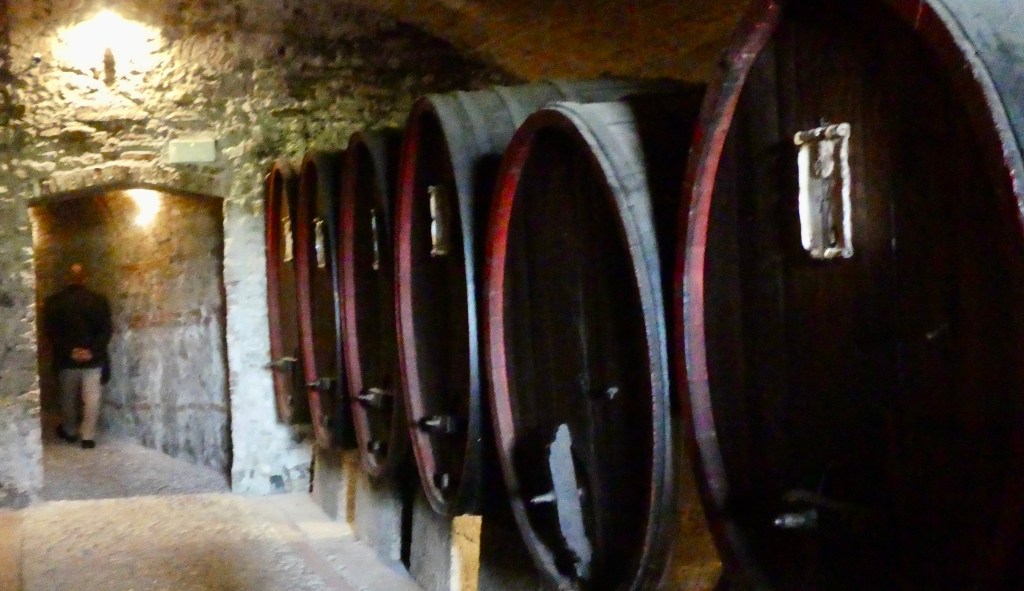
These are a few of the winery’s barrels. Wine is typically aged two to four years.

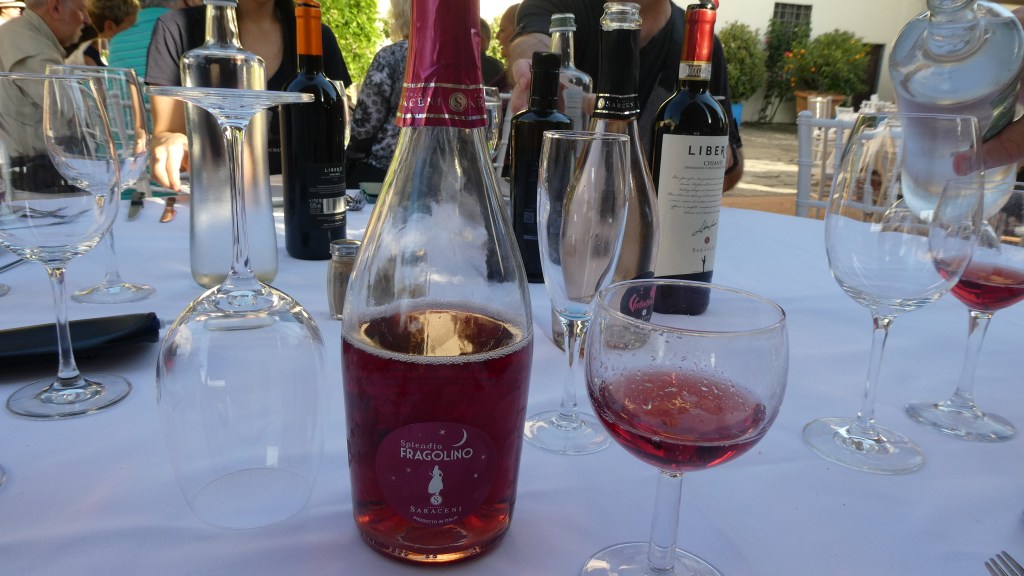
Chianti is one example of wine made in this area from sangiovese grapes.

We were able to try a variety of Villa Machiavelli wines under the Saraceni label.

Following our villa tour we had one of the most delicious dinners we had in Italy – while in one of the most scenic locations!

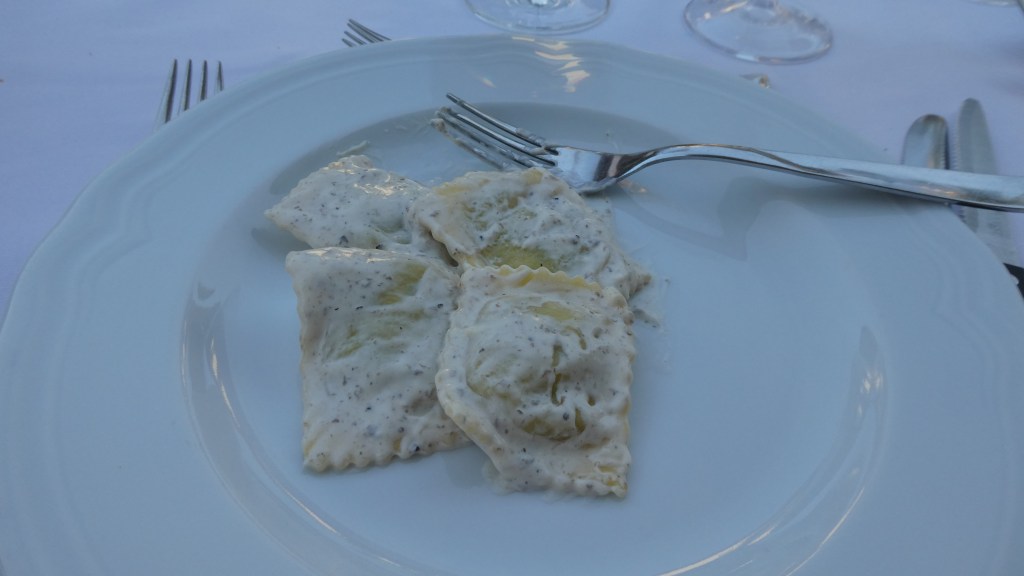
The truffle ravioli was among the best things I ate on our whole tour of Italy!  For those that might not know, truffles are mushrooms that grow underground.  Maybe the rich soil makes truffles better than mushrooms, about which I am generally ambivalent.

Although it may sound silly to those of you not on the bus with us, we had a joyous return back to our hotel and I want it written down for our memories.   Our tour guide Fabrizio started playing American songs over the bus speaker and we were all singing along – even doing arm motions with YMCA – a song I usually dislike!

Our bus driver Tonino (on the left pictured with Fabrizio) was getting into the groove turning the interior lights on and off with the music and even driving around a remote traffic circle twice for fun.  (His family owns the bus so he wasn’t putting his job at risk.)  It is a fun memory of a special night as we approached the end of our Tour of Italy.

Next up:  Florence!

Posted in Uncategorized | 5 Comments

Tour of Italy: Lake Como

Our next destination was famous Lake Como.  It is a lovely lake surrounded by elegant villas and green mountains.

We were reminded repeatedly that George Clooney and his family live on Lake Como but we did not see them.  We took a lake tour assuming we would see at least one of their three villas but we did not.  That seemed odd given the hype.

We were told that the first home Clooney purchased, Villa Oleander built in 1720, is beyond this point. He then bought the adjoining Villa Margherita and later a third villa on the lake. 

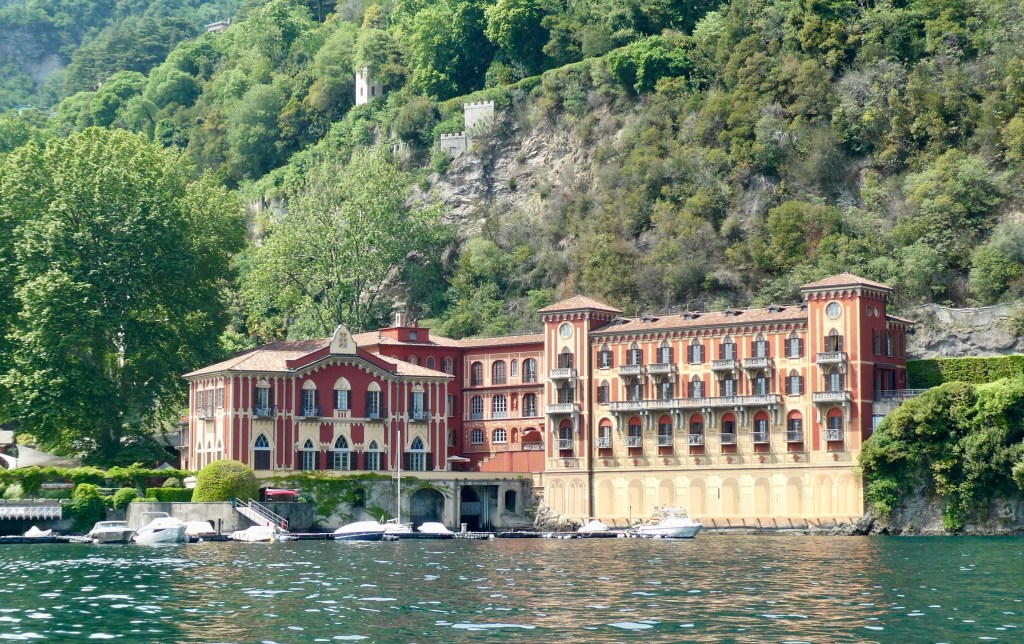
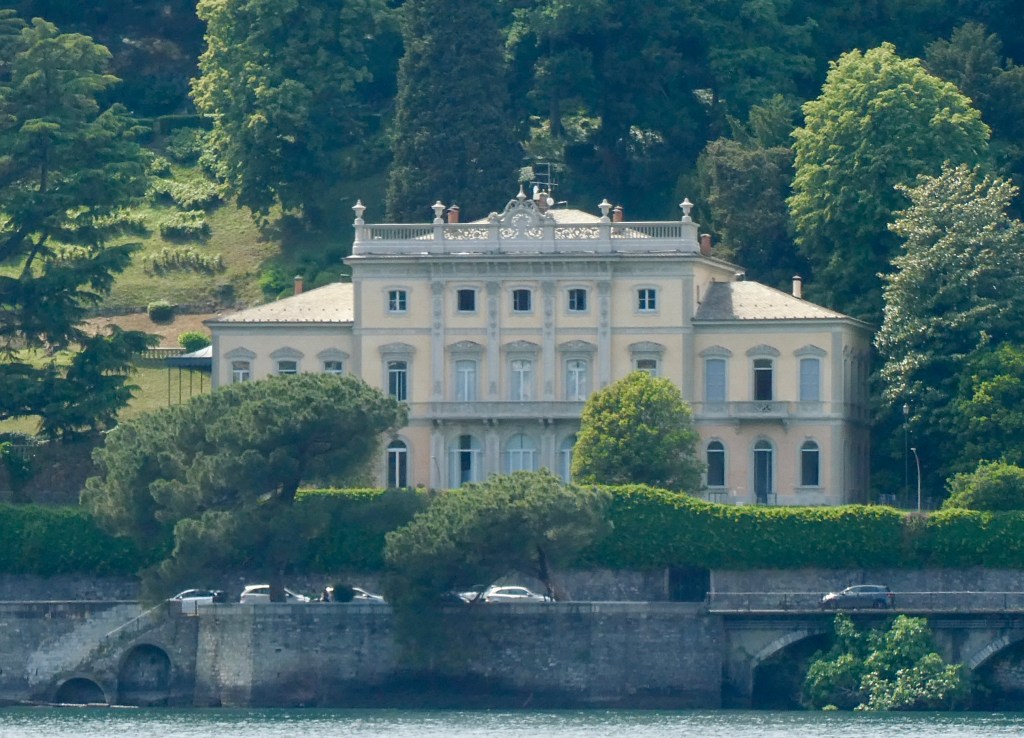
We did see many other elegant villas around the lake.  Some remain special family residences while others are now rental venues, municipal buildings or hotels.   

Each has its own history, including its origin and the variety of nobles, businessmen and celebrities that have been proprietors over the last 300-400 years.

Villa Del Grumello is one of the oldest villas on Lake Como with origins in the 15th century.  It began as a rustic two story house known as Castellazzo.  It has undergone major restorations several times over the centuries.

Villa Erba was built in the 19th century. It is now a premiere wedding and events site on Lake Como.  It was a filming location for the movie Ocean’s Twelve.

Villa Fontanelle was built in the 19th century by Lord Charles Currie.  He couldn’t find a villa to buy, so had one built.  The villa was in a state of abandonment when purchased by Gianni Versace in 1977.  He restored the home and the gardens.  Many current celebrities were regular visitors at Villa Fontanelle until it was purchased by a Russian oligarch in 2008.

There are many villas and fancy houses around the lake.  These are a mere sampling.

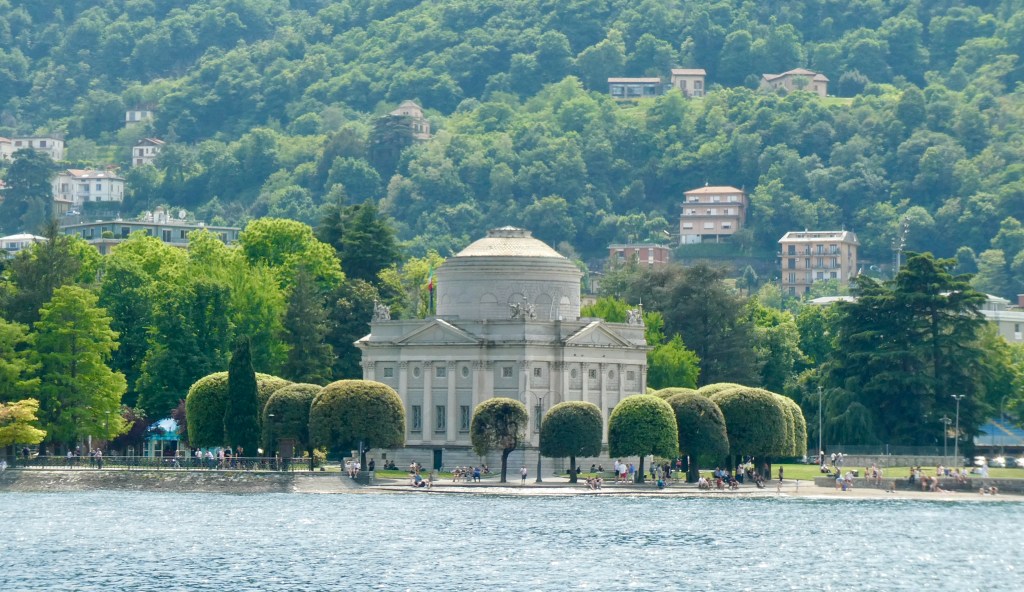
Returning to the town of Como, we could see the Tempio Voltiano.  It was built in 1927 to honor Alessandro Volta, the inventor of the electrical battery. The museum inside holds scientific instruments and that first electric battery.

There is a statue of Alessandro Volta in a piazza named in his honor in Como. Volta was born in Como in 1745 and died there in 1827. His name is also the inspiration behind the standard unit of electric potential – the volt.

Next stop on our adventure: Pisa!

Posted in Uncategorized | 1 Comment

Tour of Italy: Lake Maggiore and the Smallest Shower

Lake Maggiore is in Italy’s Lake District, ever so close to Switzerland.  At one point we were ten minutes away from the border and regretting that we hadn’t known enough to ask if a visit was possible. The tour was the Best of Italy and we weren’t thinking Switzerland.

Being close to the alps protects the Lake District from the cold north winds and allows for a very comfortable microclimate.

When we checked into our Stresa hotel on Lake Maggiore, we found an elegant, spacious room with two balconies.  

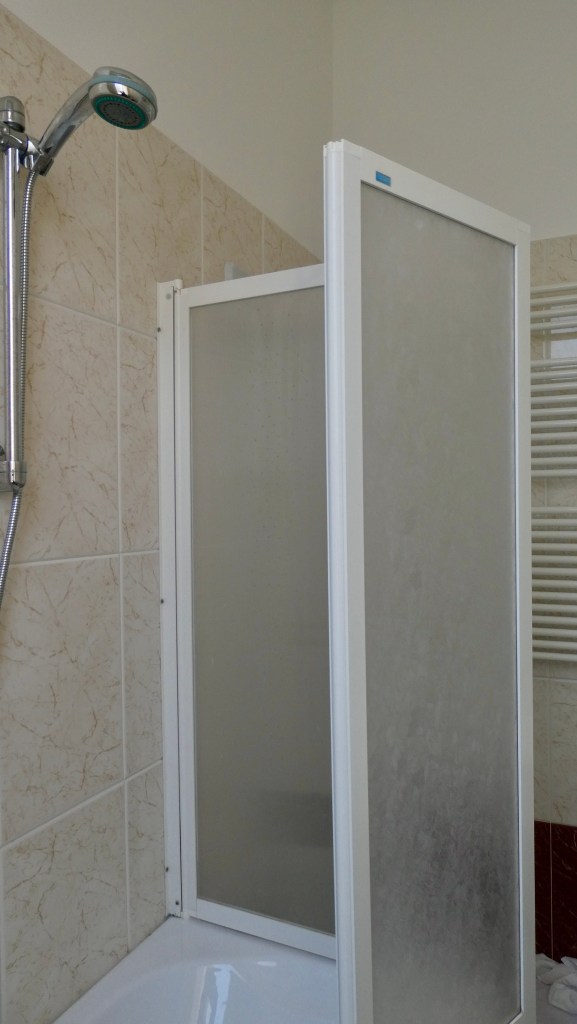
When we looked in the toilet (they don’t call them restrooms in Italy) we found a large space with a sink, toilet, bidet AND the smallest shower we’ve ever seen.   Even RV showers are larger than this one. Interesting, but we were off for a boat ride on Lake Maggiore!

Our hotel is behind us as we head for Isola Bella, the island beautiful.

Isola Bella was named after Isabella Borromeo, the wife of Vitaliano Borromeo VI. In 1632 he began transforming the island from fishing huts to a beautiful island.  Design and construction on the island continued throughout the 18th and 19th centuries.

In 1948, the northern facade and pier were built and that is where we arrived.

We walked through the palace and learned about the family, visitors and contents.  Members of the Borromeo family still live on the island in September and October each year so there were areas that were closed to the public.

The ceiling represents the family theme of humility. 

This harpsichord is from 1692.

Napoleon and Josephine arrived and slept here on their uninvited overnight visit.

This is one of the first sets of encyclopedia in the world.  It is in French.

This engraved wooden saddle is from the 15th century. It is one of twenty that remain in the world.

There were several marionette theaters to entertain guests of the past. 

Tapestry artists used animals to represent biblical stories.  Each tapestry took ten years to weave.

The grotto, on the lower level, was so unique and interesting!  We were told someone in Dubai created a replica.

There were several rooms to explore.

The walls and ceilings were made from shells and stones.

Outside the palace there are world famous baroque gardens.

The gardens are built on a series of terraces.

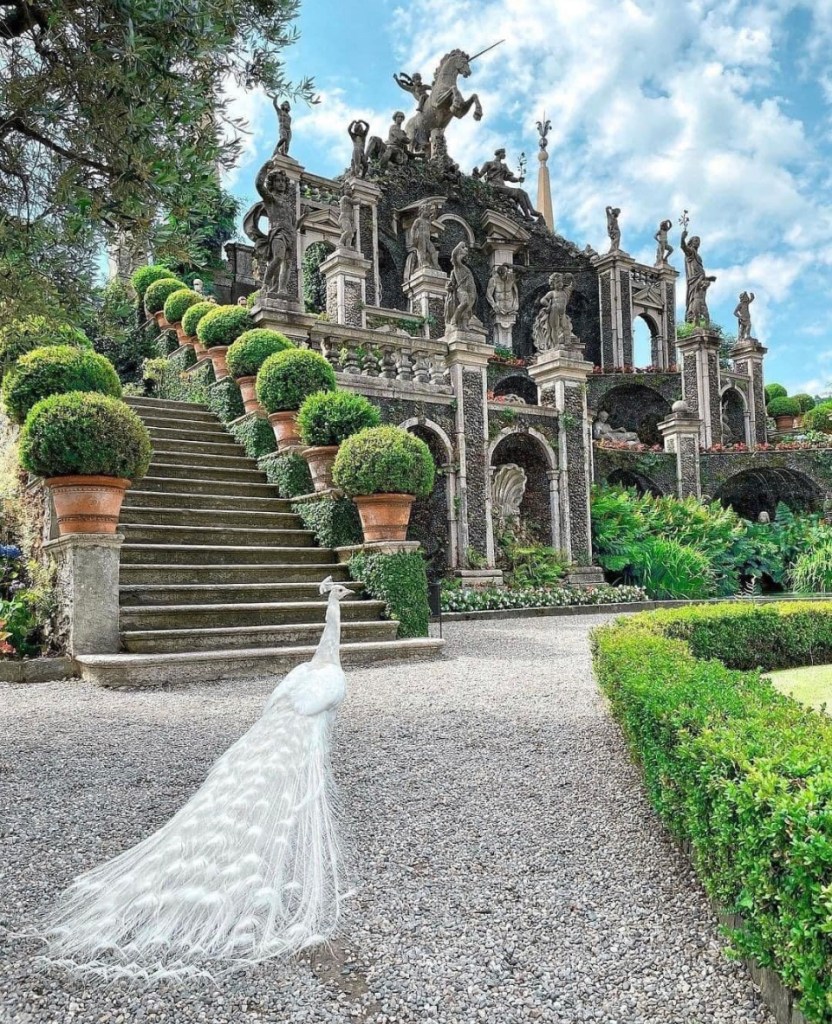
Among the many statues and fountains, the Teatro Massimo is dominant. Notice the unicorn on top – it is a family symbol.

White peacocks walk the grounds.  

Occasionally they offer the perfect picture opportunity…

Alas, this last photograph is not mine but I appreciate the unknown person who posted it for others to enjoy.

Later we gathered again for a boat ride to another nearby island.  This is our tour director Fabrizio. 

Our tour featured a couple host family dinners. The family we visited on Lake Maggiore had a small restaurant that was closed to other guests for the evening.

We had a wonderful dinner and took the opportunity to get a group picture.  We had been together about a week and felt very comfortable. It was a nice evening.

So back to that teeny shower….

When Randy was going to shower he could barely get in. He just started laughing!  I went to see what was happening and then we were both laughing! 

Obviously these photos are staged but the real thing was hilarious.  Don’t drop the soap, Randy!

Next stop: Lake Como!

Posted in Uncategorized | 5 Comments

Tour of Italy: Milano

Milano (Milan) is the second largest city in Italy and its business mecca. It is said that for every church in Rome there is a bank in Milan. The city is also an international fashion center.   

The community that became Milano began 300 years BC and, by the 4th century AD, was a primary city in the Roman Empire.  Constantine legalized Christianity in 313 while in Milano.

Construction on the Milano Duomo (cathedral) began in 1386 and was completed almost six centuries later.  

It is the fourth largest cathedral in Europe with a standing capacity of 40,000. Notice the mosaic floor. This view is looking towards the central altar from just inside the main entrance.

 It was once the home cathedral of the largest segment of eastern Christians.   

In 1565 the Milan Duomo joined with the Roman Catholic Church.  There have been ten services each Sunday ever since.

This statue on the right depicts the Apostle Bartholomew who was skinned alive for spreading Christianity in Armenia.

Built of marble in an overdone gothic style, it is believed there are more statues in this building than any other in the world. There are 3400 statues, 135 gargoyles and 700 figures.

The Milano Duomo also contains the most works of stained glass anywhere, some from the 1300s. 

Over the centuries, the glass artists used different techniques.

One hundred and forty-four stained glass windows depict scenes from the New and Old Testaments.

Despite the passage of time, and World Wars, five original works remain complete. Some windows were removed during times of war to protect them. Different sources say they were removed to the basement and/or to an island.

Light coming through the stained glass is evident on one of the 52 pillars. This view is from the main altar looking back toward the entrance.

There are side chapels and memorials along the lengths of both sides.

Cardinal Alfredo Ildefonso Schuster, served as Cardinal of the Milan Duomo and fought to save Jews and the city during World War II. At his death he was served by a young pall-bearer who became pope. Pope John Paul II beatified Cardinal Schuster in 1996.

Outside the Duomo, in the large piazza, is a statue of Victor Emmanuel II – the first king of the united Italy.  In 1850 there was a collection of colonies and small states. Those became a united country in 1870.

Built to honor the king, and to celebrate unification, the Galleria Vittorio Emanuele II is Italy’s oldest active shopping gallery. It opened in 1877 and is a major landmark in Milan. The galleria was the first building in Milan to use electricity.  (If it looks familiar, we saw something similar in Naples.)

The central area has works that represent the continents.  

Corridors branch out from the central area.

We walked through the galleria to arrive at another Milan icon – The LaScala Opera House.

MILAN, ITALY – NOVEMBER 05: A general view of Teatro Alla Scala on November 05, 2020 in Milan, Italy. (Photo by Vittorio Zunino Celotto/Getty Images)

The Teatro alla Scala is the world’s most famous opera house.  It opened in 1878 and all famous opera singers have performed there.  

The theatre has seating capacity for 2300 guests and the acoustics amplify seven times. Performances have utilized 65000 costumes!  

We were able to enter the theater boxes but employees were working on staging the lights for an upcoming performance. As a result, we had a disappointing darkened view.

Our tour guide redirected us in hopes of a better view later. She had all of us acting out Milano history. 

It was a very good time, but we never did get a better view inside.

We visited the on site LaScala Museum.  The theatre was bombed during World War II and repaired in just 30 months. 

If we are ever in Milan again, I’d love to attend a show at Teatro alla Scala.  I might not understand a word but it would be a feast for the senses.

Speaking of additional things to do on another trip to Milan….It is possible to walk on the roof of the Duomo.  That wasn’t offered on our tour but we’ll know it for next time.

We’ll also learned that Leonardo da Vinci’s painting The Last Supper is in Milan but we didn’t see it either.  Leonardo lived in Milano from 1482 to 1499, fleeing when the French invaded. This 1872 monument shows the artist with four of his disciple artists.

There are always reasons to go back!

Posted in Uncategorized | 5 Comments