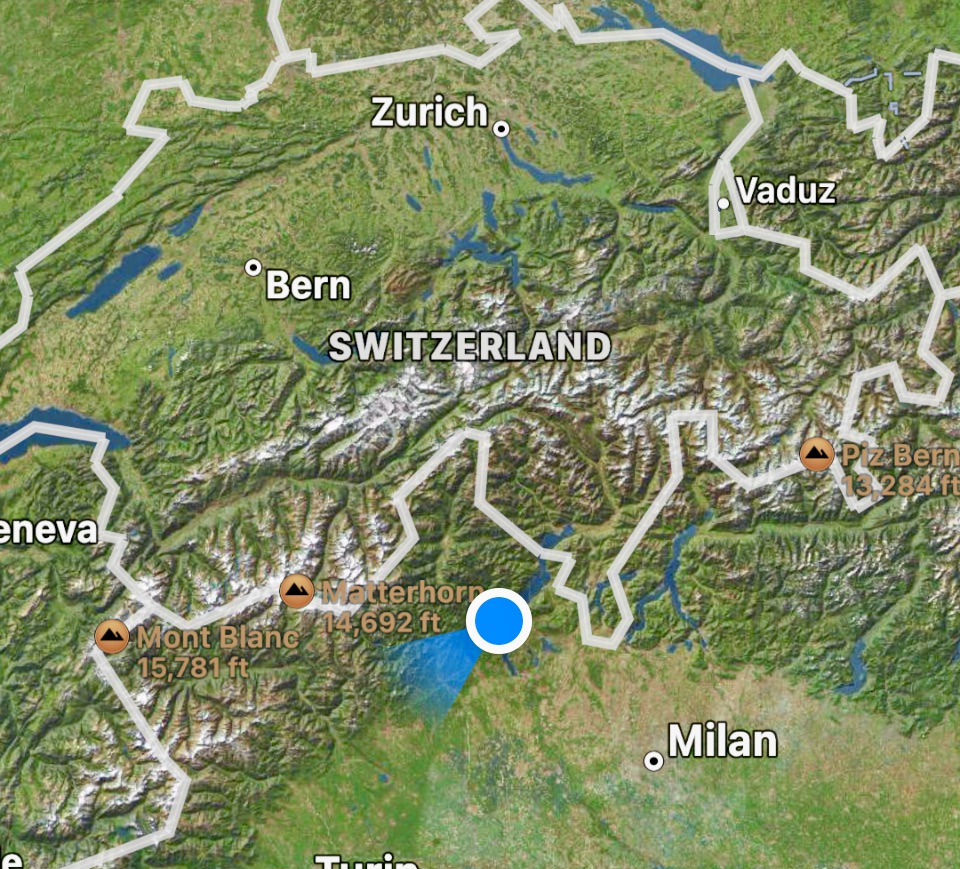
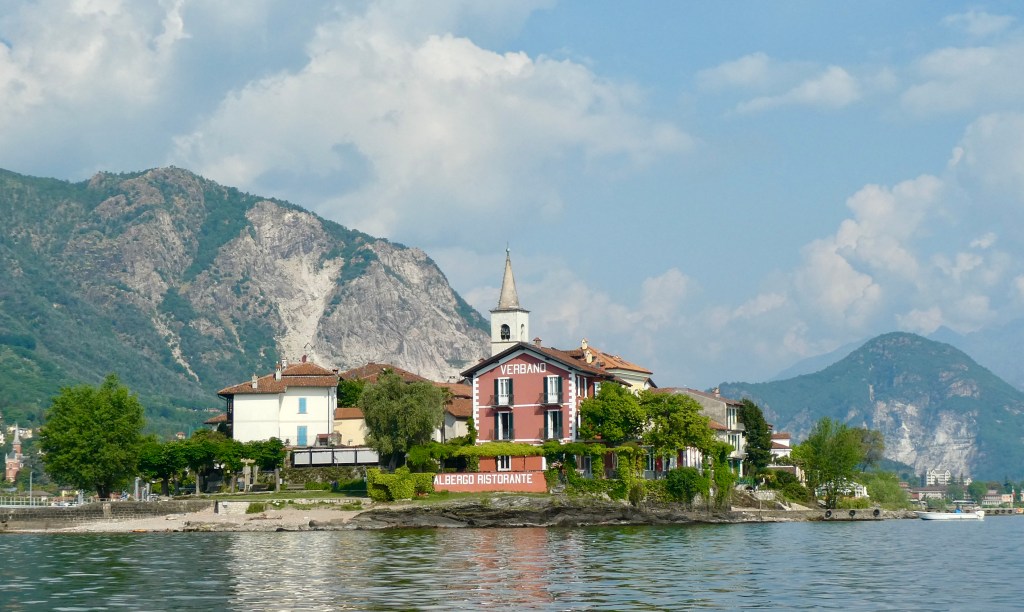
Lake Maggiore is in Italy’s Lake District, ever so close to Switzerland. At one point we were ten minutes away from the border and regretting that we hadn’t known enough to ask if a visit was possible. The tour was the Best of Italy and we weren’t thinking Switzerland.
Being close to the alps protects the Lake District from the cold north winds and allows for a very comfortable microclimate.
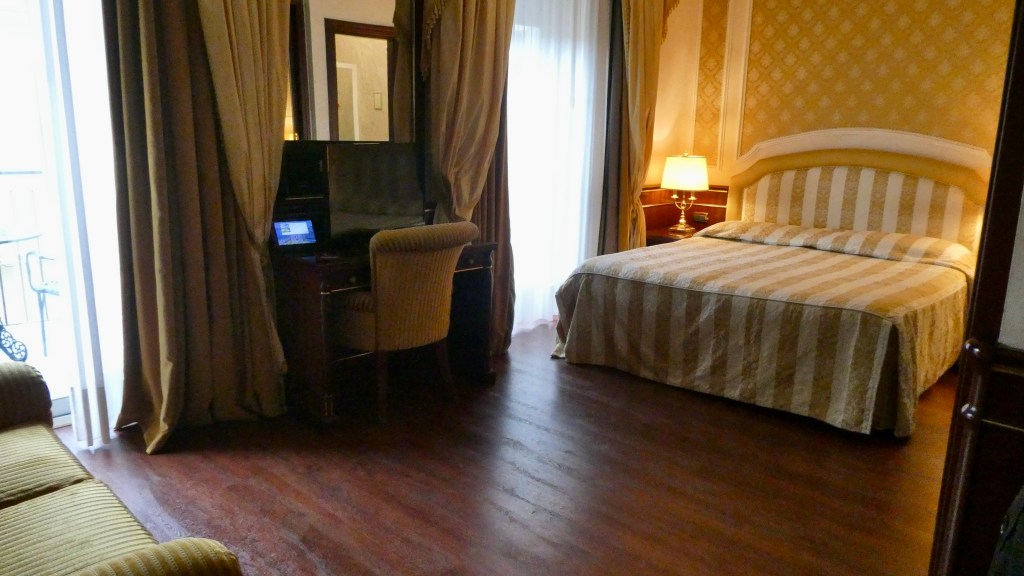
When we checked into our Stresa hotel on Lake Maggiore, we found an elegant, spacious room with two balconies.
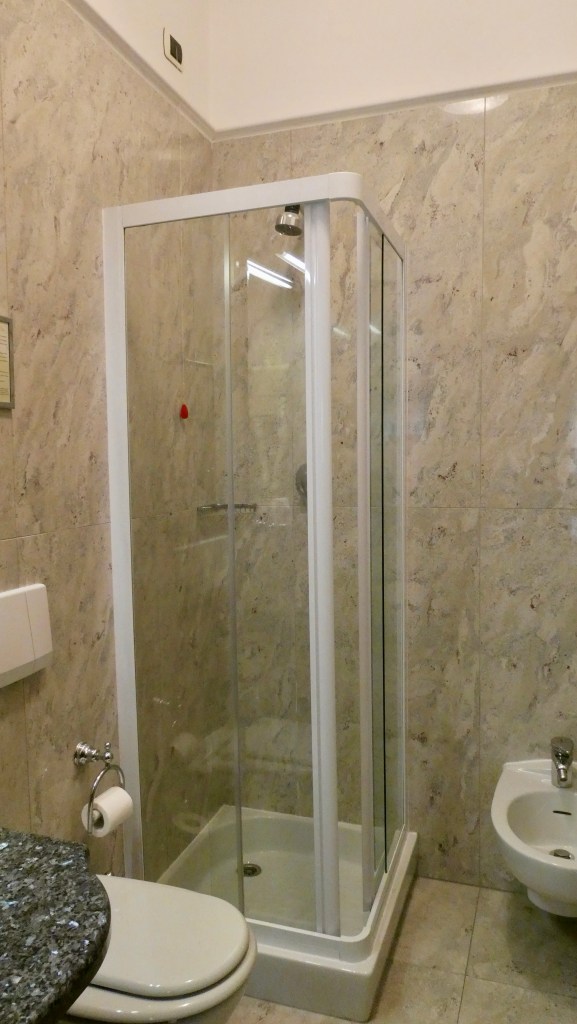
When we looked in the toilet (they don’t call them restrooms in Italy) we found a large space with a sink, toilet, bidet AND the smallest shower we’ve ever seen. Even RV showers are larger than this one. Interesting, but we were off for a boat ride on Lake Maggiore!
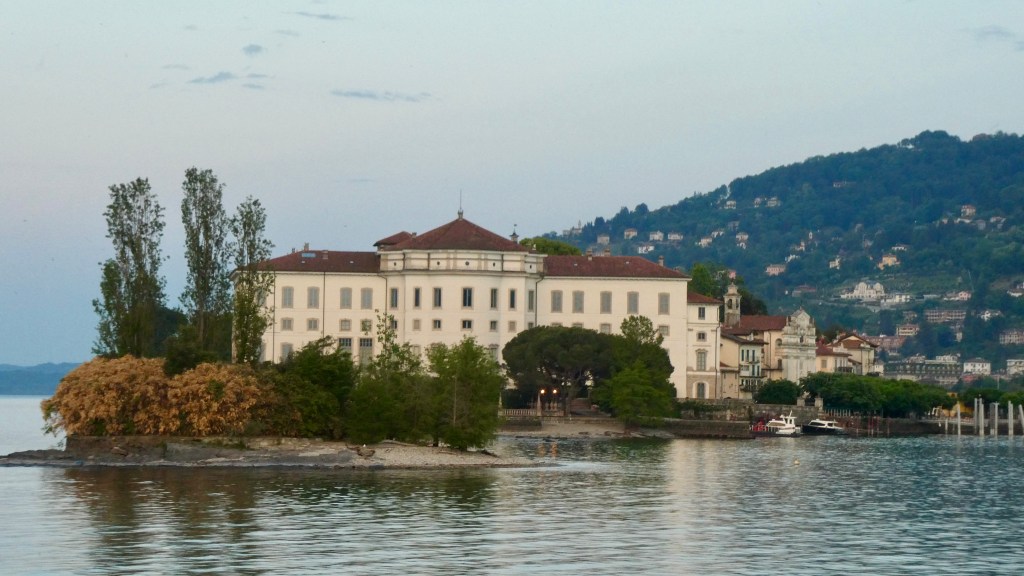
Our hotel is behind us as we head for Isola Bella, the island beautiful.
Isola Bella was named after Isabella Borromeo, the wife of Vitaliano Borromeo VI. In 1632 he began transforming the island from fishing huts to a beautiful island. Design and construction on the island continued throughout the 18th and 19th centuries.
In 1948, the northern facade and pier were built and that is where we arrived.
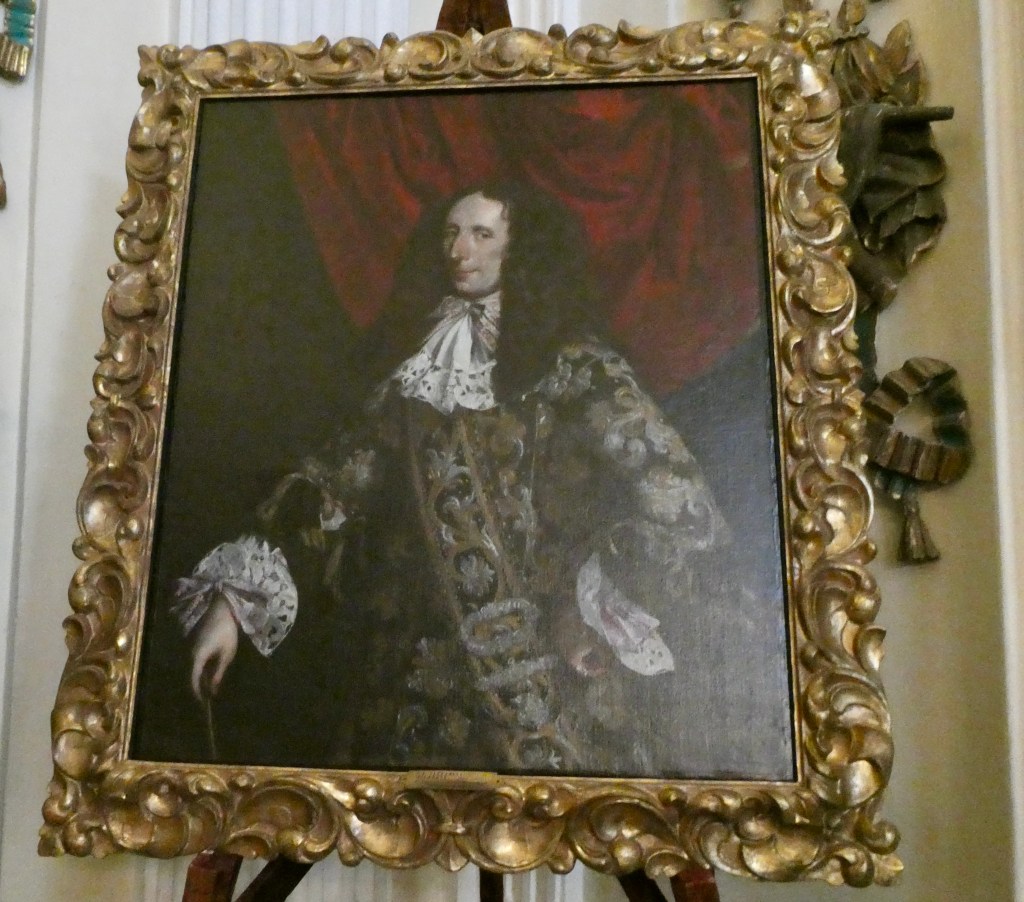
We walked through the palace and learned about the family, visitors and contents. Members of the Borromeo family still live on the island in September and October each year so there were areas that were closed to the public.
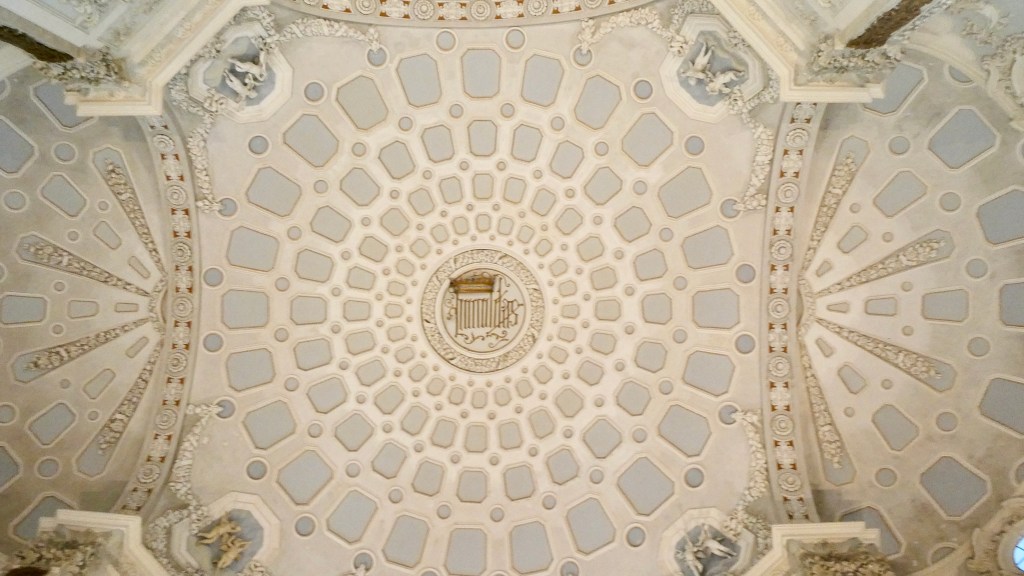
The ceiling represents the family theme of humility.
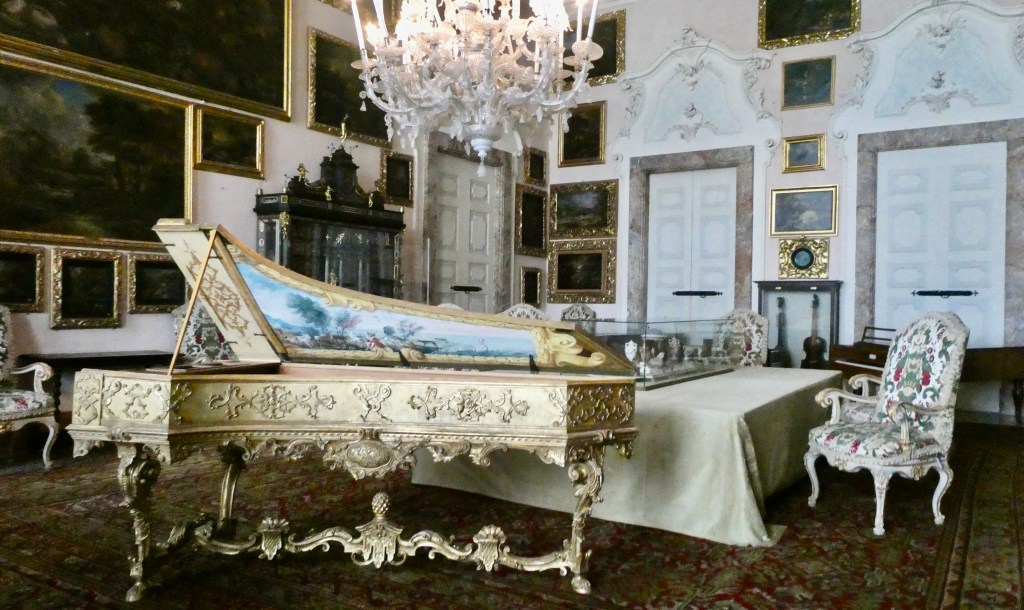
This harpsichord is from 1692.
Napoleon and Josephine arrived and slept here on their uninvited overnight visit.
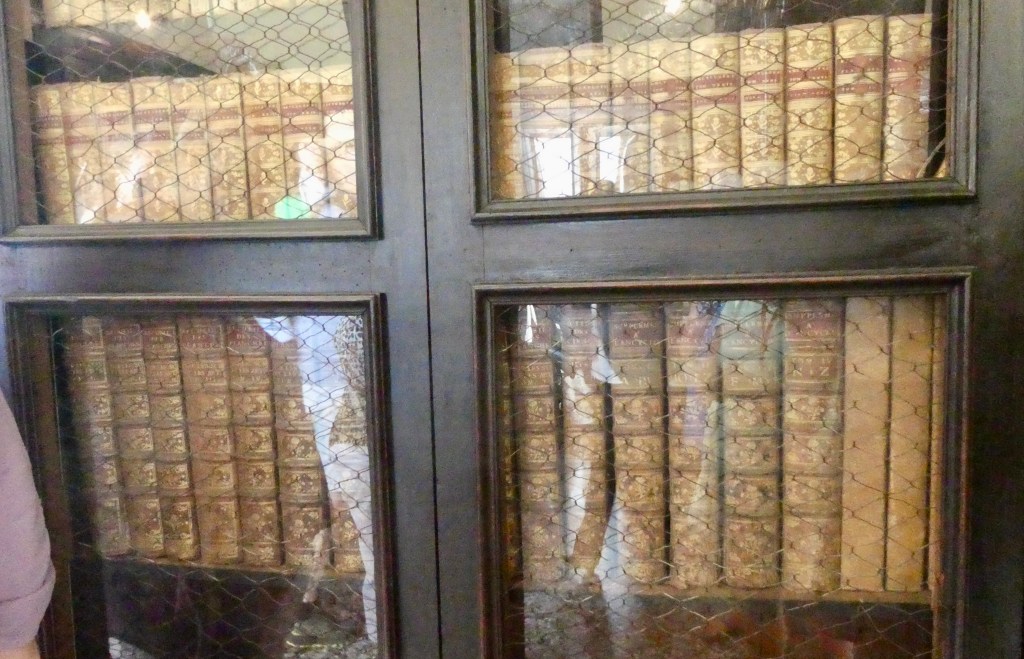
This is one of the first sets of encyclopedia in the world. It is in French.
This engraved wooden saddle is from the 15th century. It is one of twenty that remain in the world.
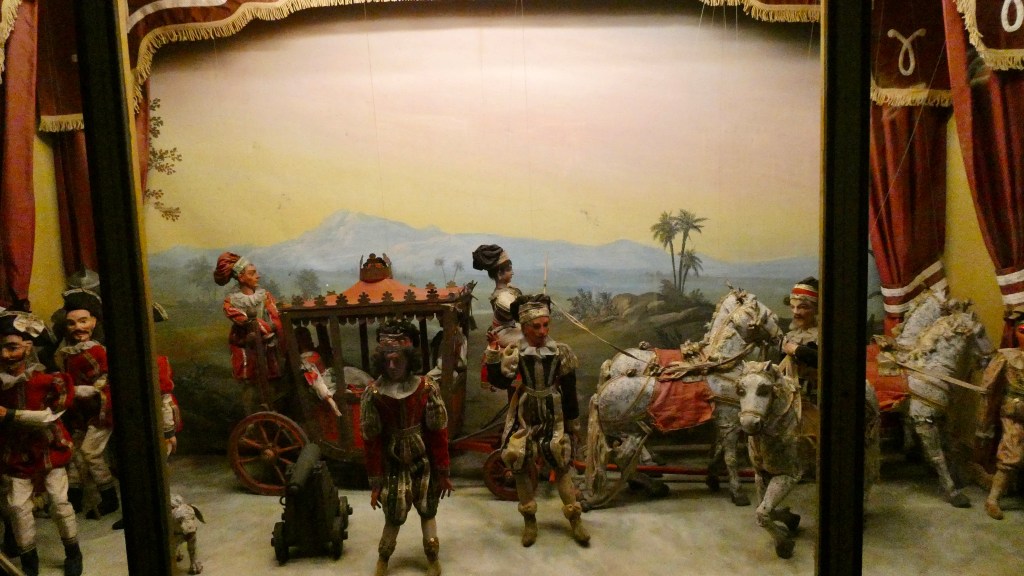
There were several marionette theaters to entertain guests of the past.
Tapestry artists used animals to represent biblical stories. Each tapestry took ten years to weave.
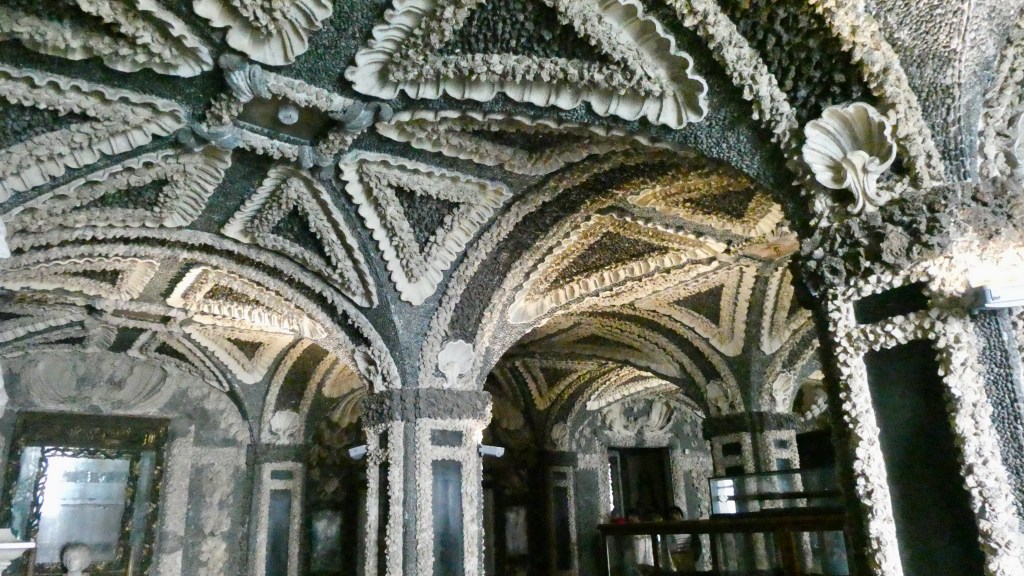
The grotto, on the lower level, was so unique and interesting! We were told someone in Dubai created a replica.
There were several rooms to explore.
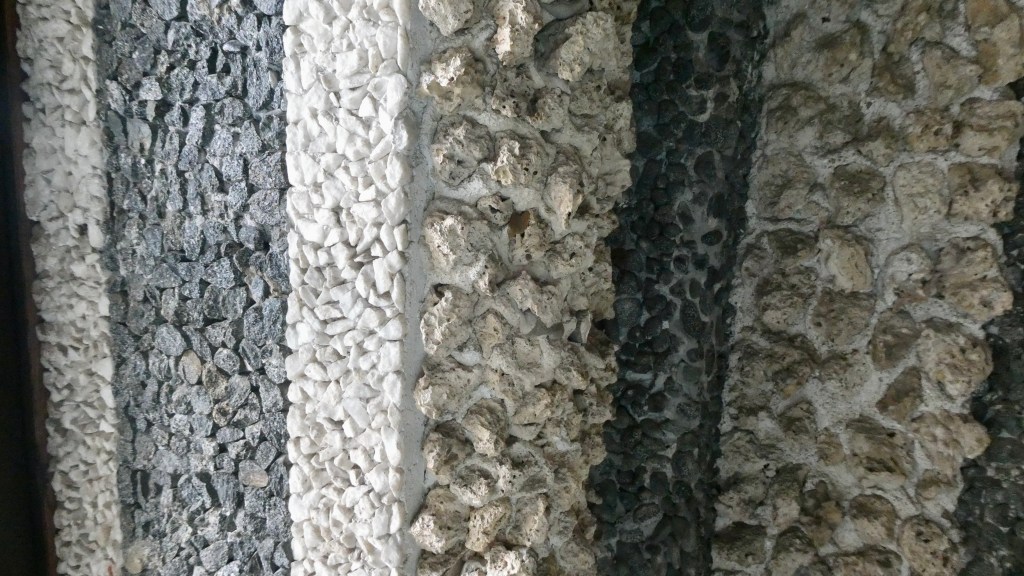
The walls and ceilings were made from shells and stones.
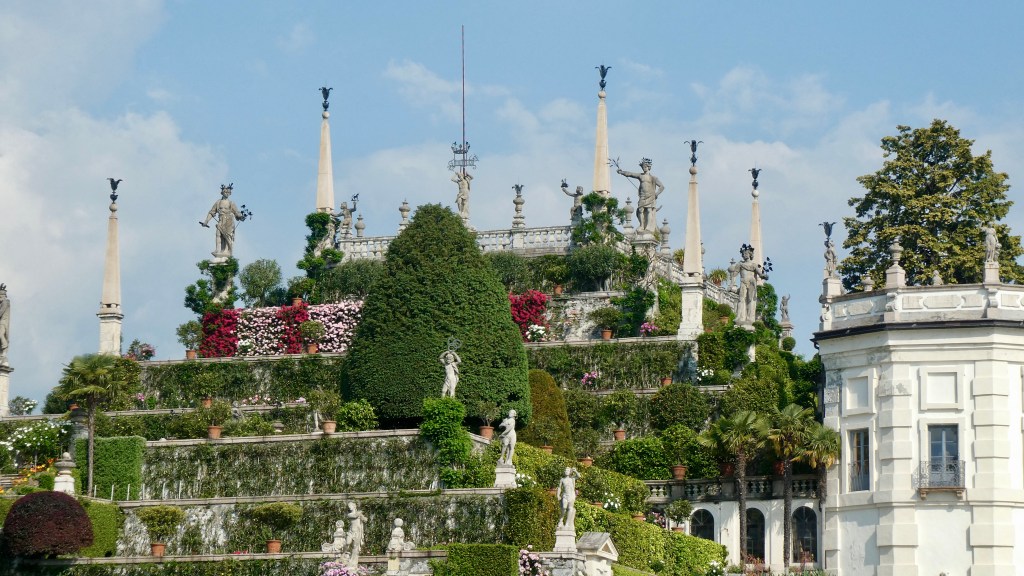
Outside the palace there are world famous baroque gardens.
The gardens are built on a series of terraces.
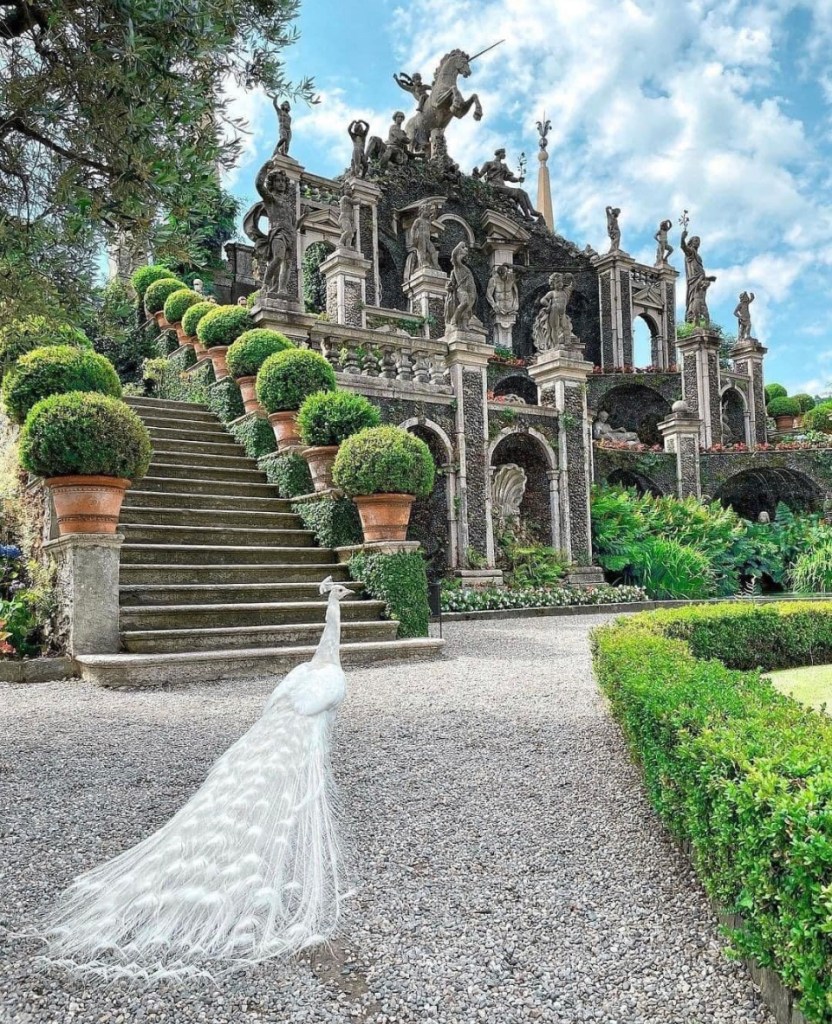
Among the many statues and fountains, the Teatro Massimo is dominant. Notice the unicorn on top – it is a family symbol.
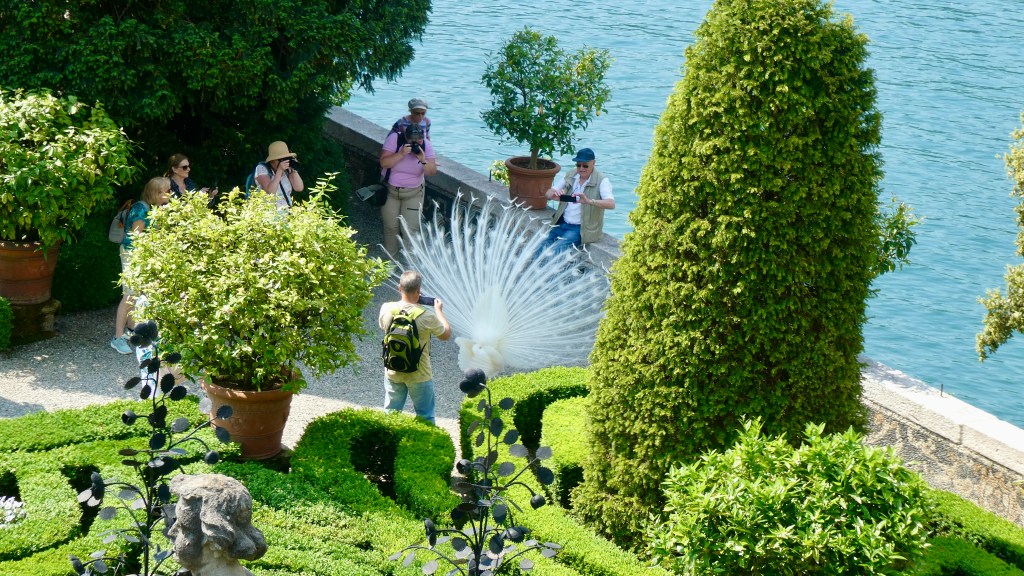
White peacocks walk the grounds.
Occasionally they offer the perfect picture opportunity…
Alas, this last photograph is not mine but I appreciate the unknown person who posted it for others to enjoy.
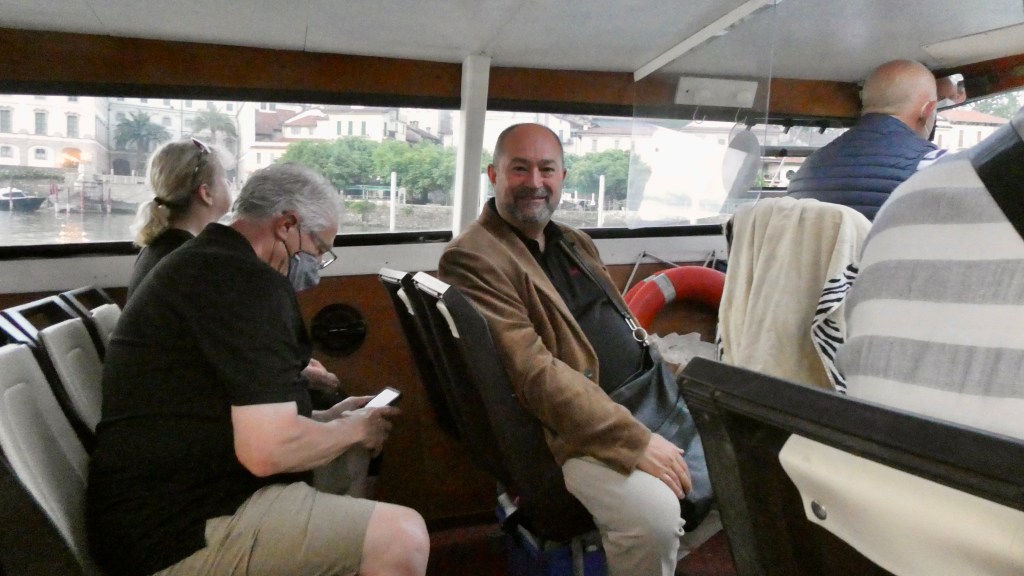
Later we gathered again for a boat ride to another nearby island. This is our tour director Fabrizio.
Our tour featured a couple host family dinners. The family we visited on Lake Maggiore had a small restaurant that was closed to other guests for the evening.
We had a wonderful dinner and took the opportunity to get a group picture. We had been together about a week and felt very comfortable. It was a nice evening.
So back to that teeny shower….
When Randy was going to shower he could barely get in. He just started laughing! I went to see what was happening and then we were both laughing!
Obviously these photos are staged but the real thing was hilarious. Don’t drop the soap, Randy!
Milano (Milan) is the second largest city in Italy and its business mecca. It is said that for every church in Rome there is a bank in Milan. The city is also an international fashion center.
The community that became Milano began 300 years BC and, by the 4th century AD, was a primary city in the Roman Empire. Constantine legalized Christianity in 313 while in Milano.
Construction on the Milano Duomo (cathedral) began in 1386 and was completed almost six centuries later.
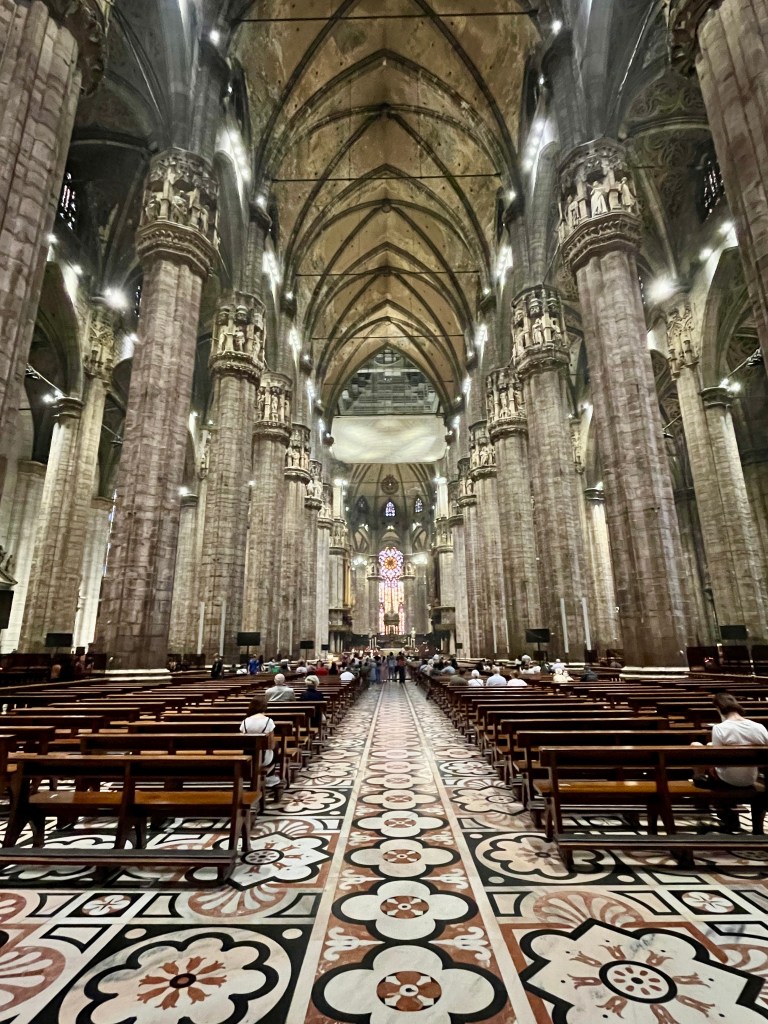
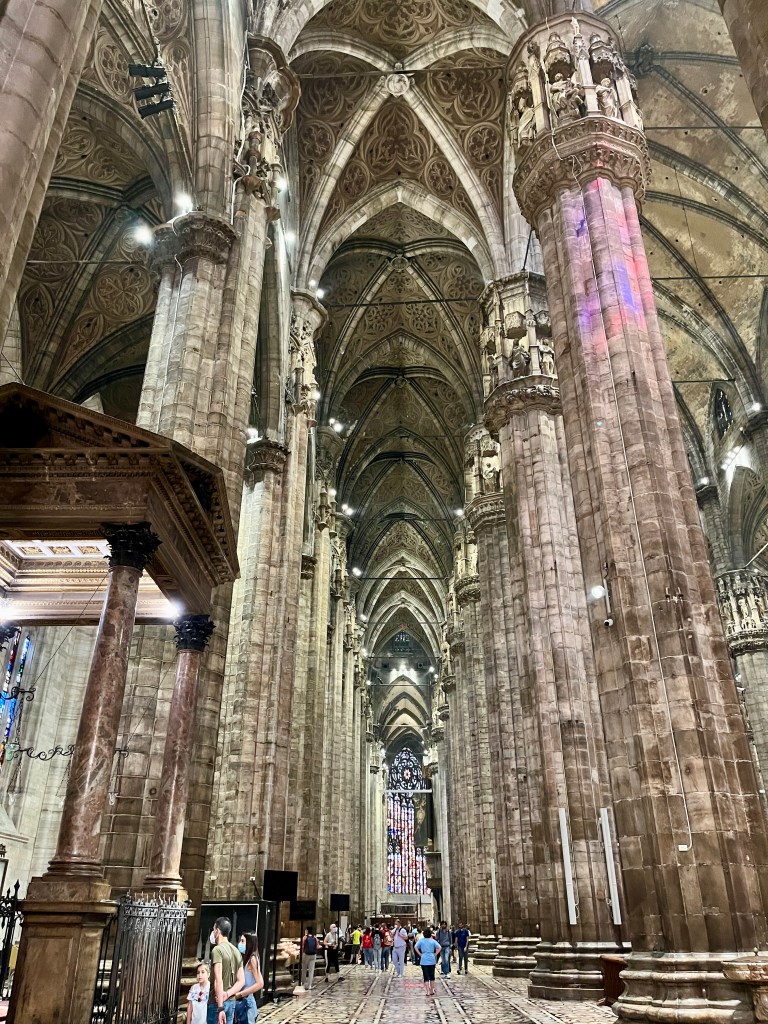
It is the fourth largest cathedral in Europe with a standing capacity of 40,000. Notice the mosaic floor. This view is looking towards the central altar from just inside the main entrance.
It was once the home cathedral of the largest segment of eastern Christians.
In 1565 the Milan Duomo joined with the Roman Catholic Church. There have been ten services each Sunday ever since.
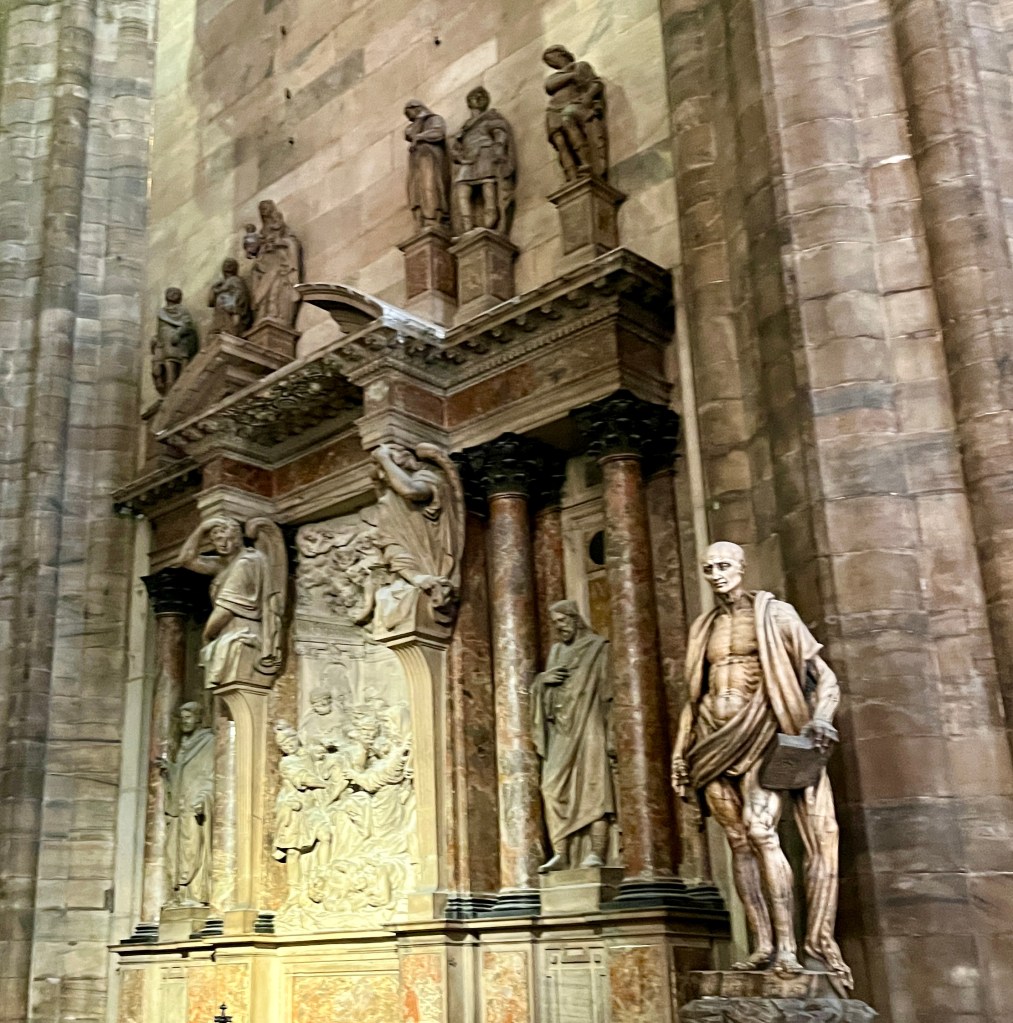
This statue on the right depicts the Apostle Bartholomew who was skinned alive for spreading Christianity in Armenia.
Built of marble in an overdone gothic style, it is believed there are more statues in this building than any other in the world. There are 3400 statues, 135 gargoyles and 700 figures.
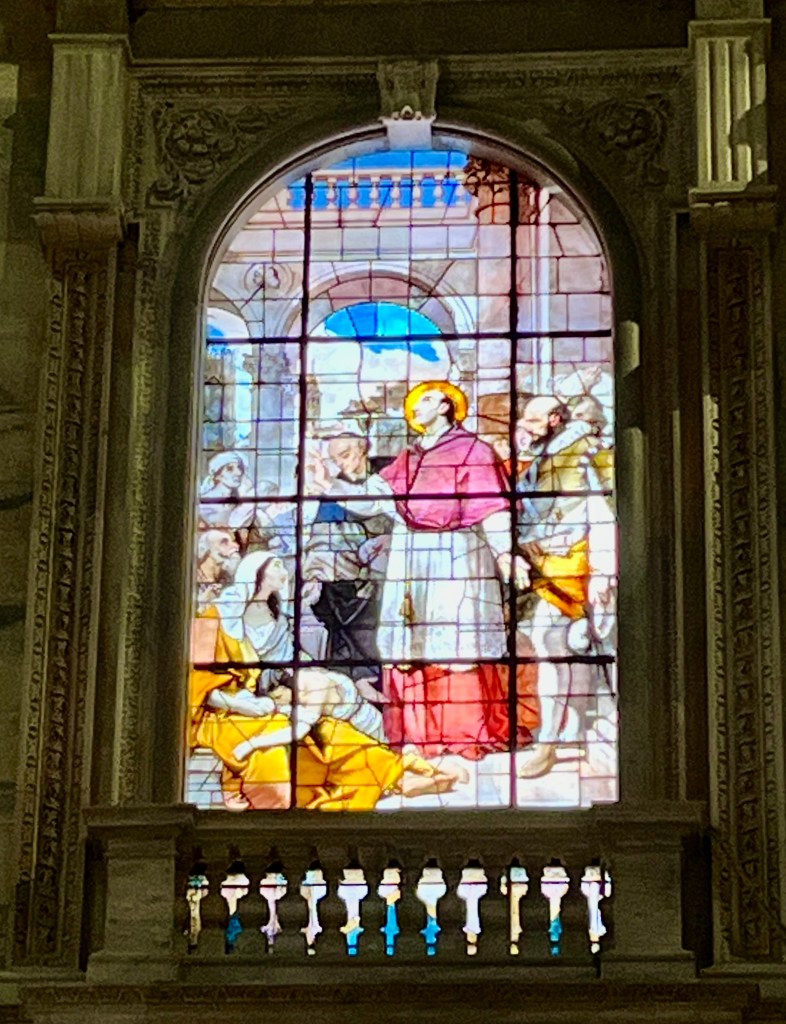
The Milano Duomo also contains the most works of stained glass anywhere, some from the 1300s.
Over the centuries, the glass artists used different techniques.
One hundred and forty-four stained glass windows depict scenes from the New and Old Testaments.
Despite the passage of time, and World Wars, five original works remain complete. Some windows were removed during times of war to protect them. Different sources say they were removed to the basement and/or to an island.
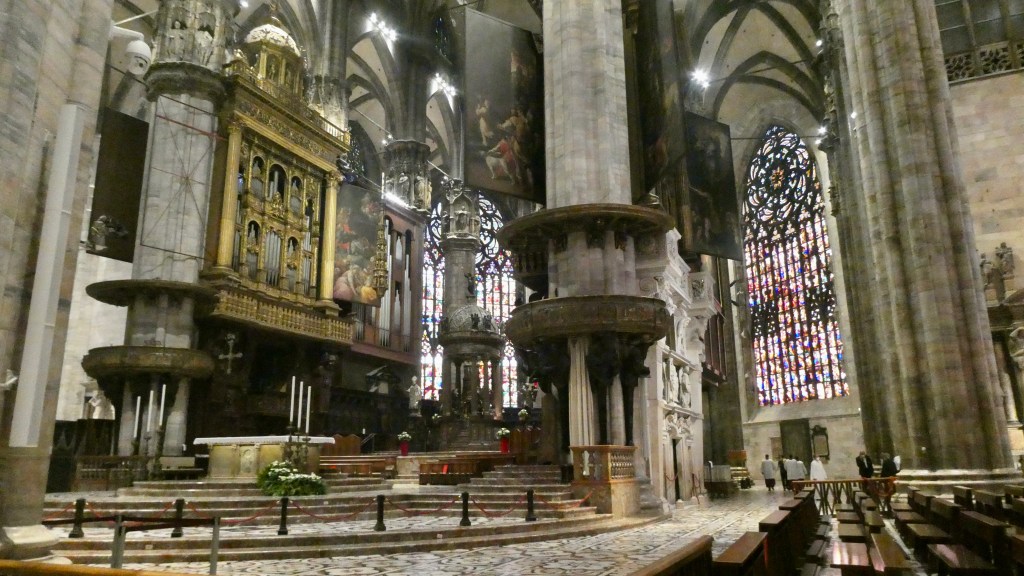
Light coming through the stained glass is evident on one of the 52 pillars. This view is from the main altar looking back toward the entrance.
There are side chapels and memorials along the lengths of both sides.
Cardinal Alfredo Ildefonso Schuster, served as Cardinal of the Milan Duomo and fought to save Jews and the city during World War II. At his death he was served by a young pall-bearer who became pope. Pope John Paul II beatified Cardinal Schuster in 1996.
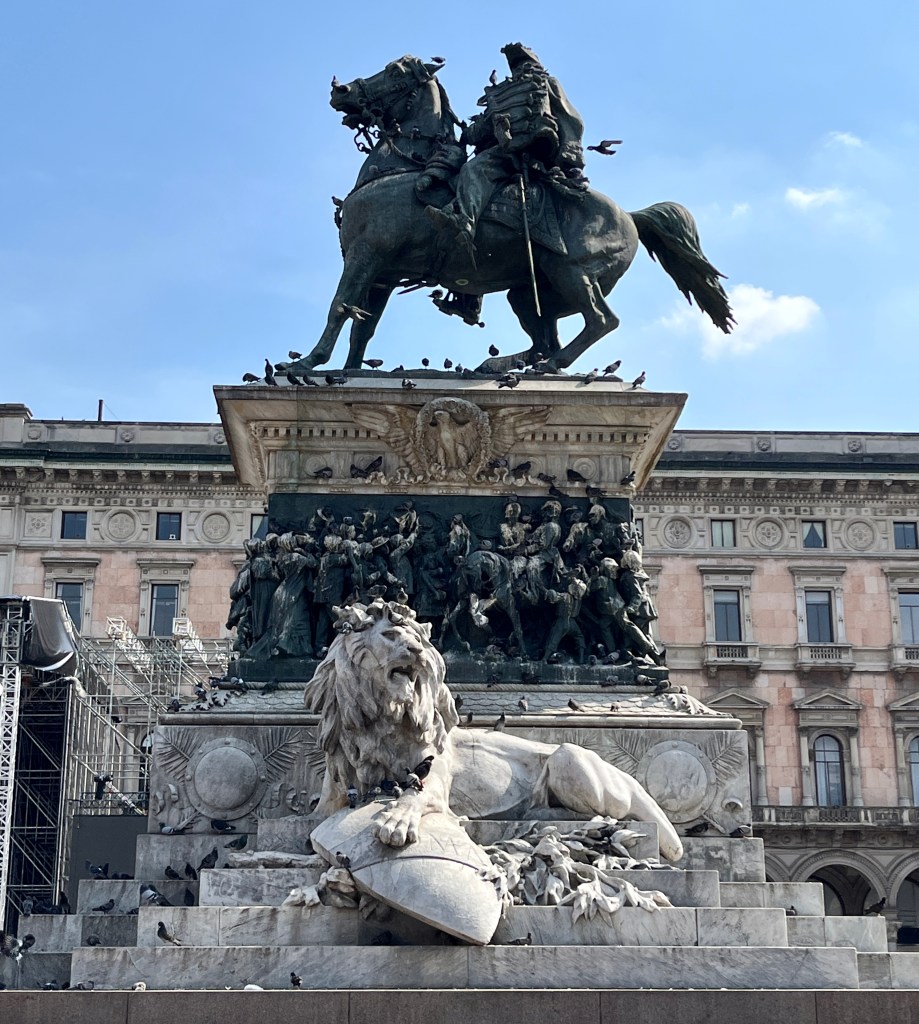
Outside the Duomo, in the large piazza, is a statue of Victor Emmanuel II – the first king of the united Italy. In 1850 there was a collection of colonies and small states. Those became a united country in 1870.
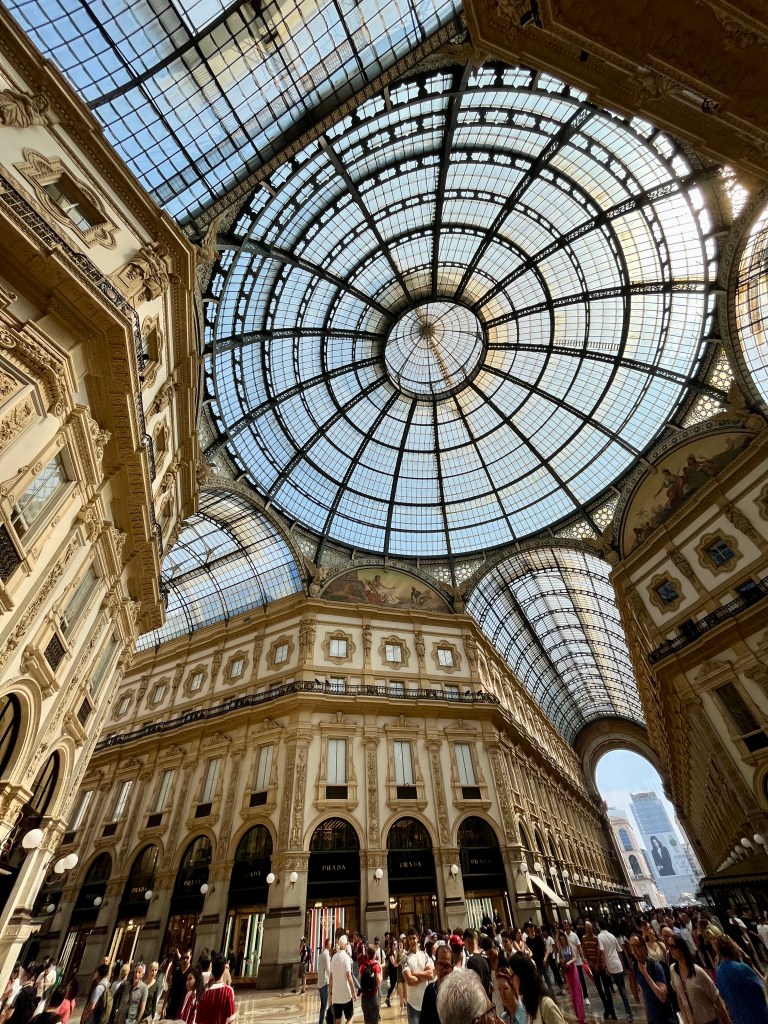
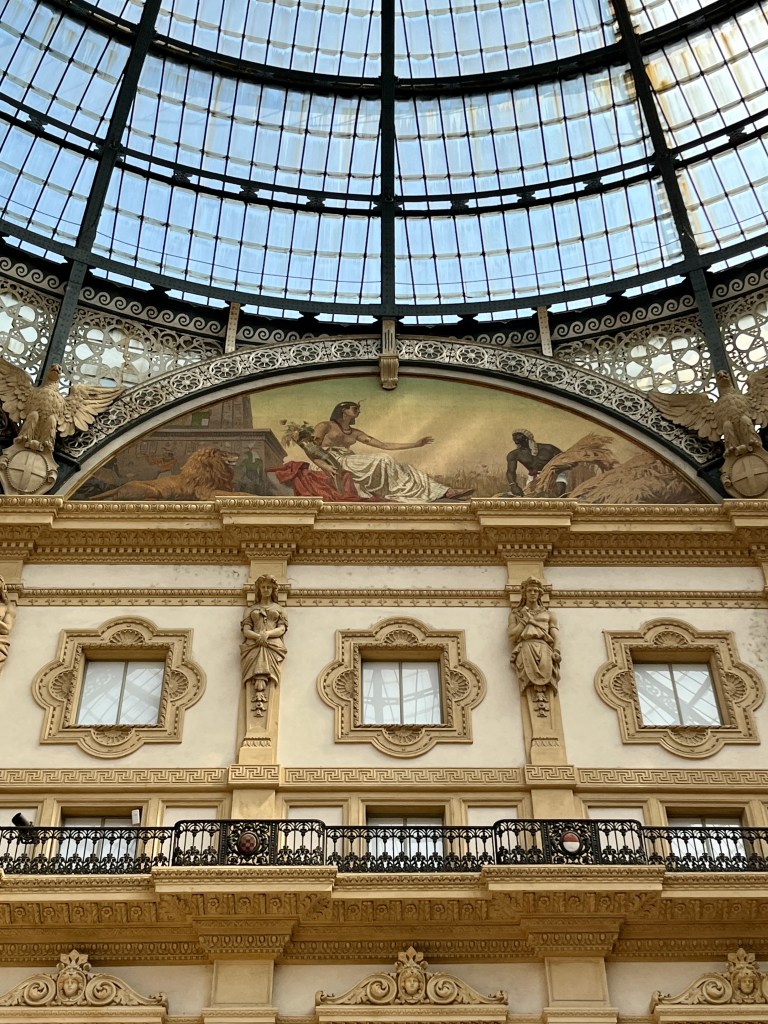
Built to honor the king, and to celebrate unification, the Galleria Vittorio Emanuele II is Italy’s oldest active shopping gallery. It opened in 1877 and is a major landmark in Milan. The galleria was the first building in Milan to use electricity. (If it looks familiar, we saw something similar in Naples.)
The central area has works that represent the continents.
Corridors branch out from the central area.
We walked through the galleria to arrive at another Milan icon – The LaScala Opera House.
MILAN, ITALY – NOVEMBER 05: A general view of Teatro Alla Scala on November 05, 2020 in Milan, Italy. (Photo by Vittorio Zunino Celotto/Getty Images)
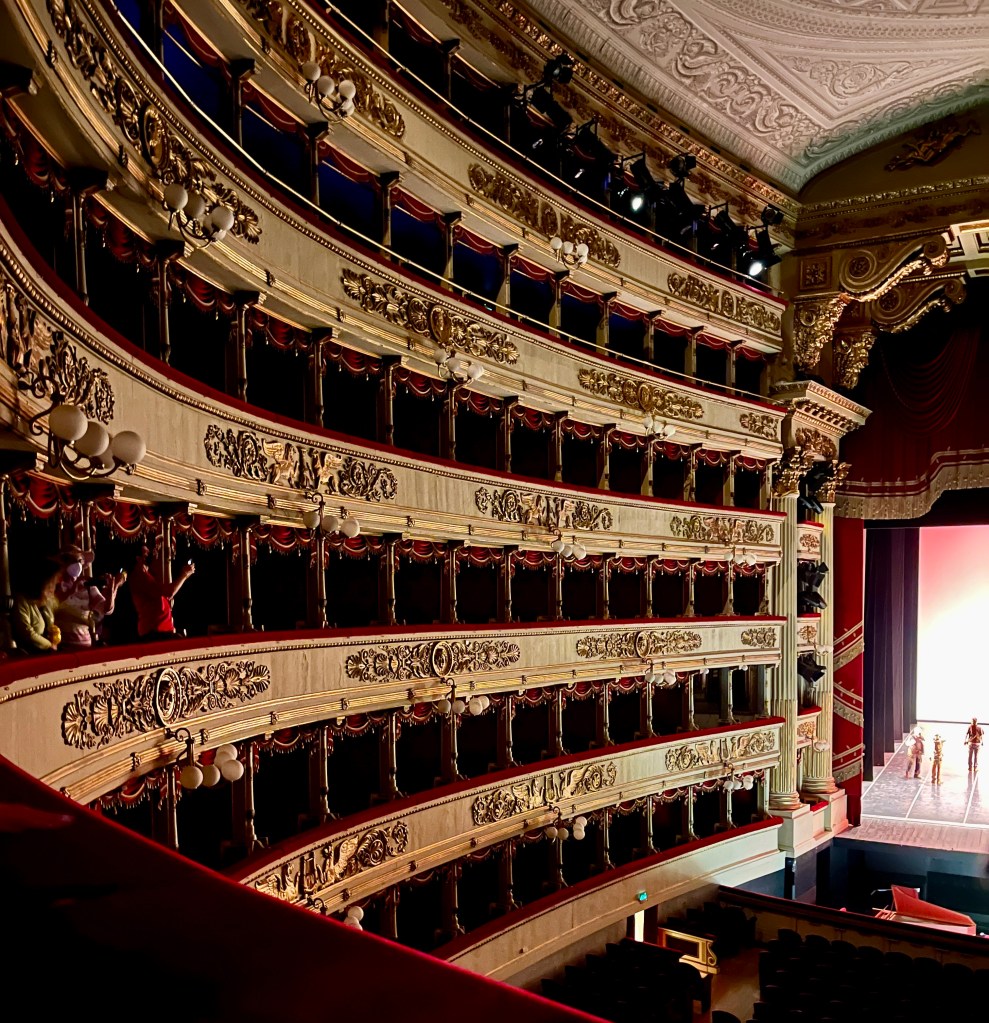
The Teatro alla Scala is the world’s most famous opera house. It opened in 1878 and all famous opera singers have performed there.
The theatre has seating capacity for 2300 guests and the acoustics amplify seven times. Performances have utilized 65000 costumes!
We were able to enter the theater boxes but employees were working on staging the lights for an upcoming performance. As a result, we had a disappointing darkened view.
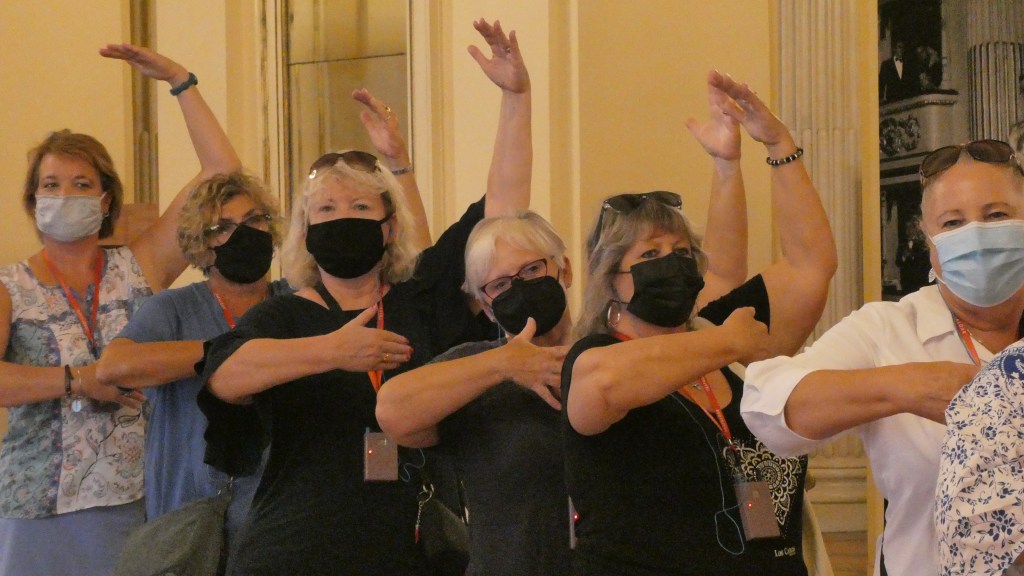
Our tour guide redirected us in hopes of a better view later. She had all of us acting out Milano history.
It was a very good time, but we never did get a better view inside.
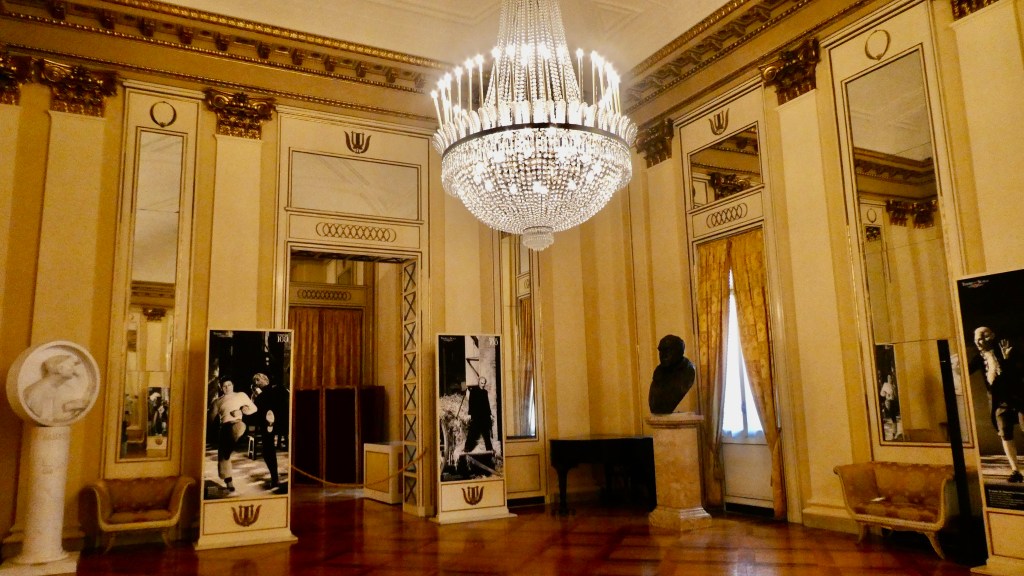
We visited the on site LaScala Museum. The theatre was bombed during World War II and repaired in just 30 months.
If we are ever in Milan again, I’d love to attend a show at Teatro alla Scala. I might not understand a word but it would be a feast for the senses.
Speaking of additional things to do on another trip to Milan….It is possible to walk on the roof of the Duomo. That wasn’t offered on our tour but we’ll know it for next time.
We’ll also learned that Leonardo da Vinci’s painting The Last Supper is in Milan but we didn’t see it either. Leonardo lived in Milano from 1482 to 1499, fleeing when the French invaded. This 1872 monument shows the artist with four of his disciple artists.
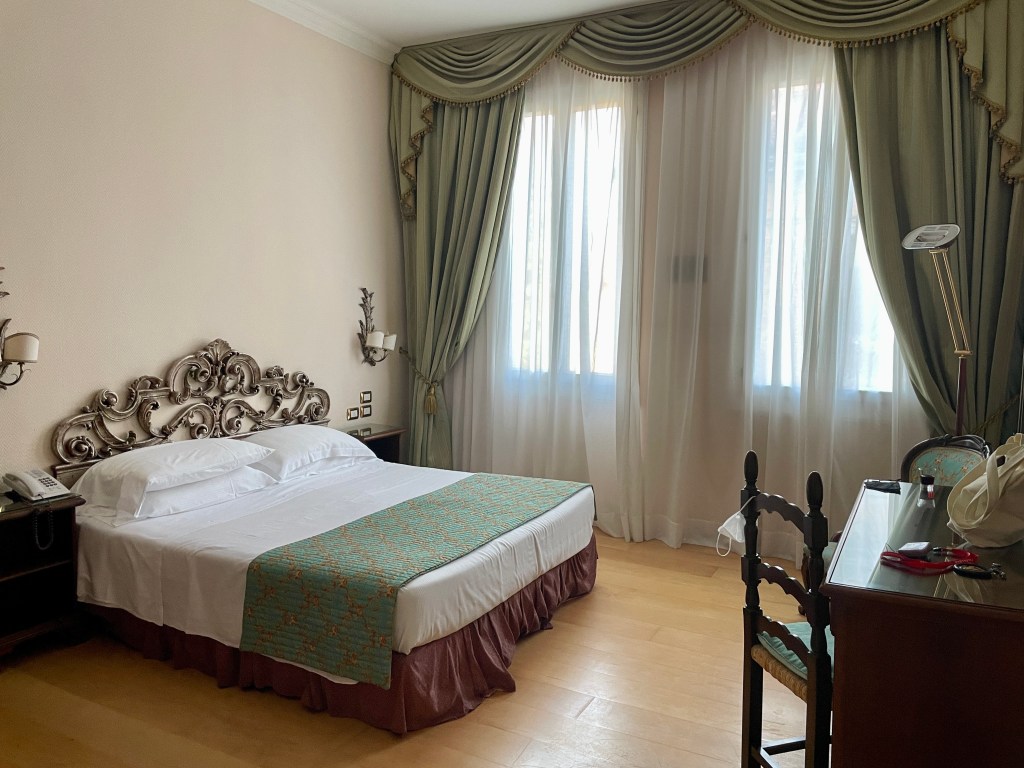
This is the hotel room we woke up in on the day we were leaving for Verona. It is fairly typical of what our rooms in older hotels looked like. They were generally good size with old style furniture. This one had power and USB outlets on just one side of the bed – which was pretty typical when they were even available. We had taken along some 10 foot USB cords and were glad we had them.
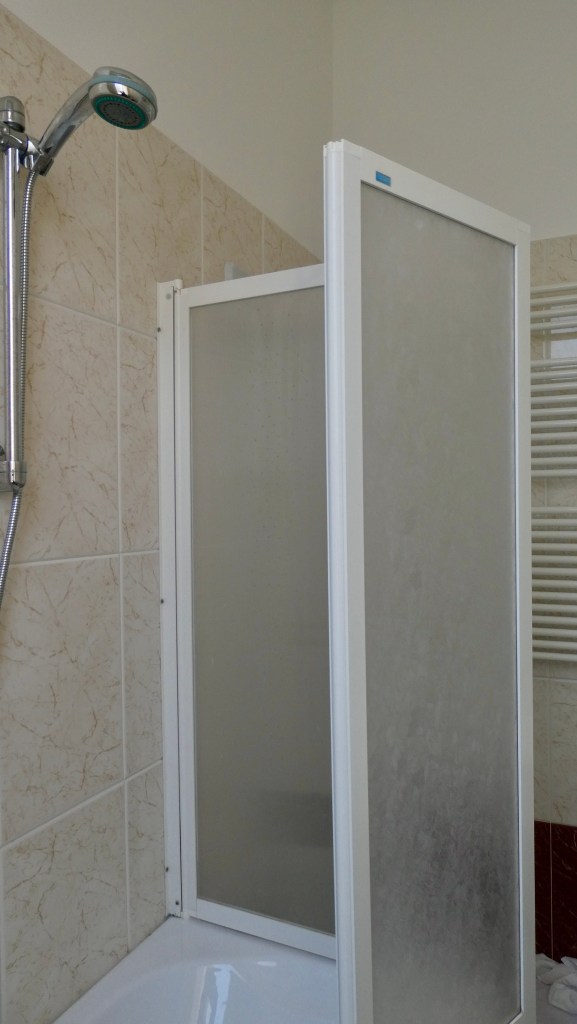
This is just one of the many, sometimes laughable, shower configurations we experienced. Obviously there was an attempt at a shower screen but the bathroom ended up soaking wet! There was a floor drain so they were prepared.
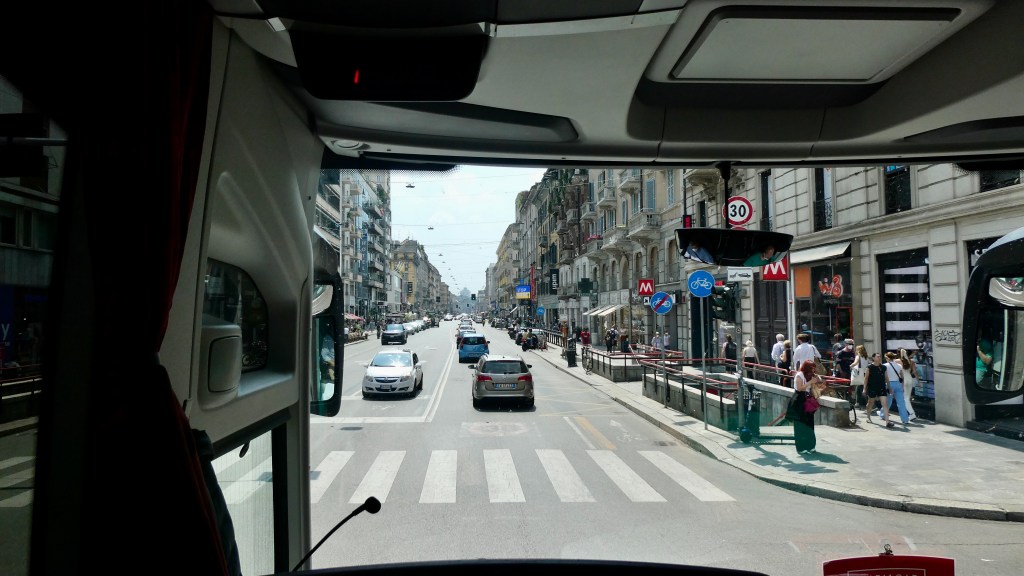
When we arrived at the bus that morning we found we had the best seats right behind the driver. The tour company had a process of assigning rotating passenger seats for fairness. We had the best seats once on our twelve day tour – this was our day! We enjoyed our ride and arrived in Verona.
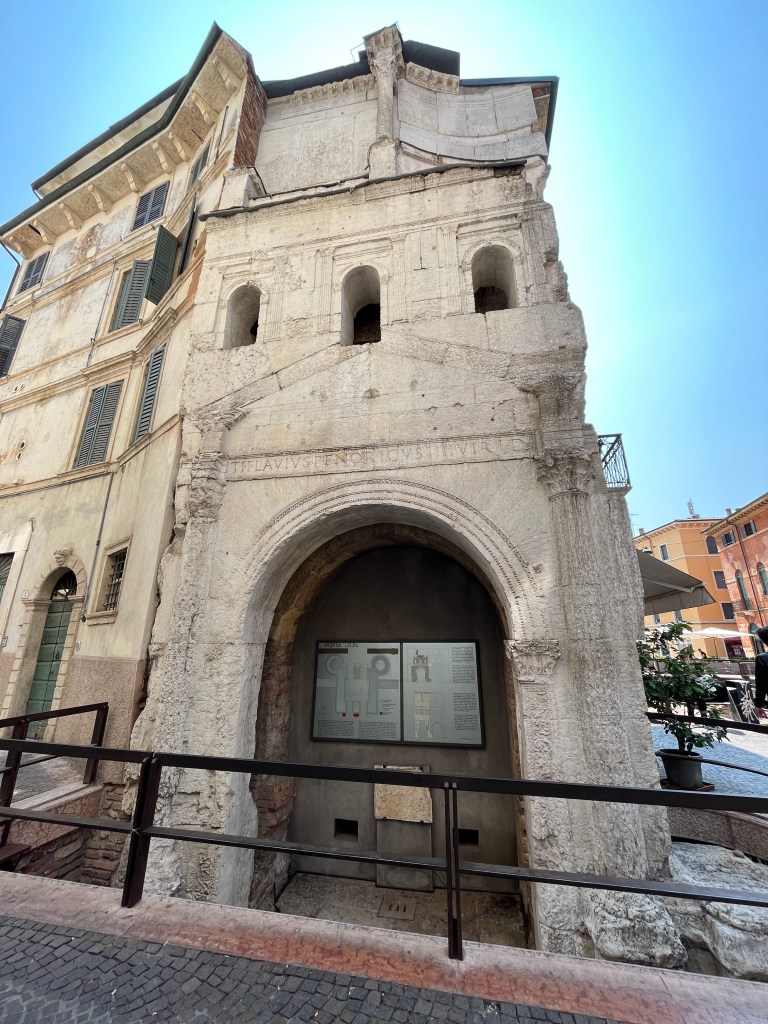
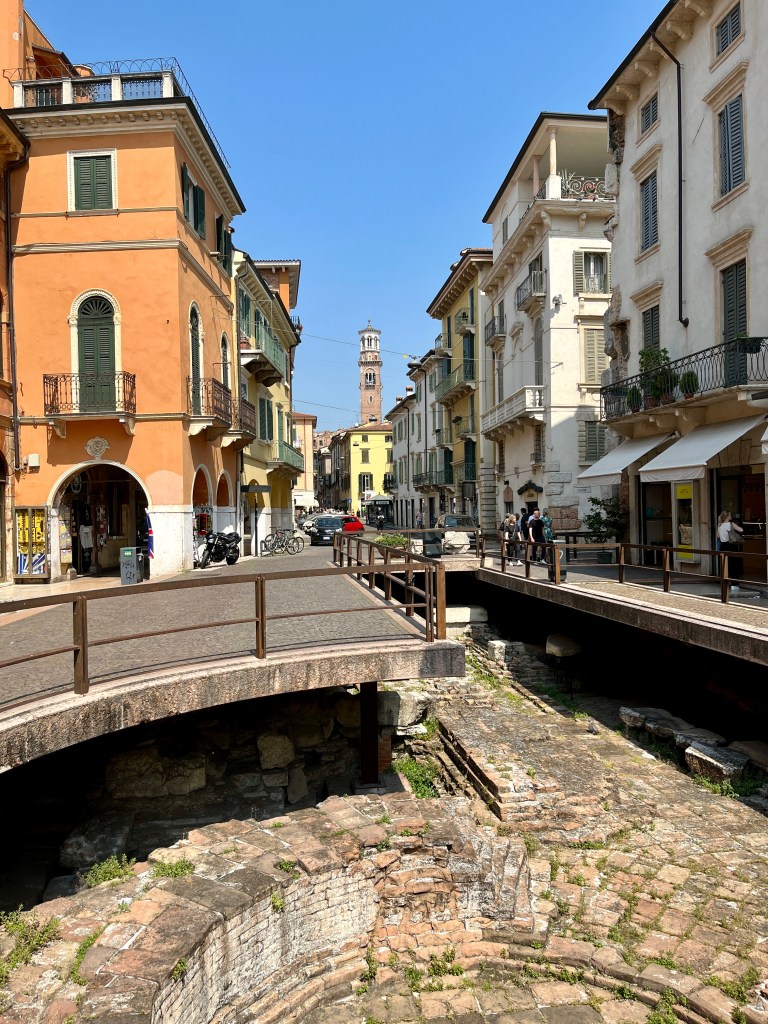
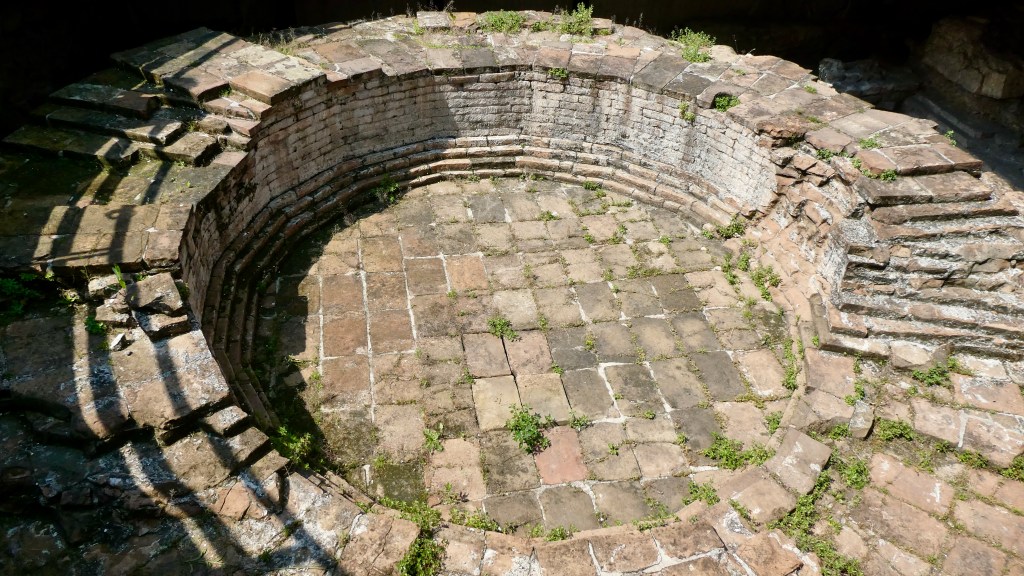
Verona was once a Roman City. The “Porta Leoni” gate was a main access route into Verona. Built in the first century BC, the gate was renovated in the first century AD. The remains of the gate had been known and were partially visible. The gate became more visible during renovations in 1958-59.
From 1974-1981 additional renovations nearby revealed part of the old city under the current road.
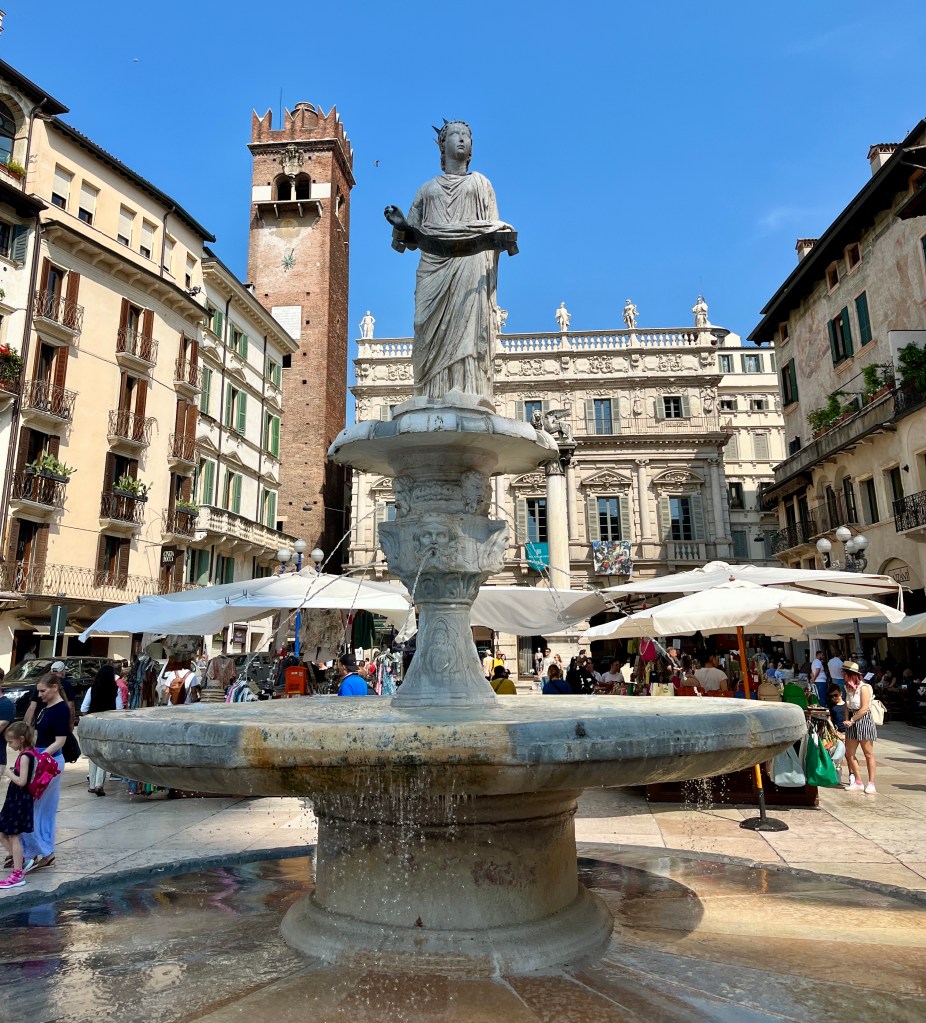
We walked down the road, and above the Roman city, to the Piazza delle Erbe. We saw the fountain and browsed the vendor tents.
We saw ravioli (tortellini?) for sale as this region of Italy is famous for filled pastas.
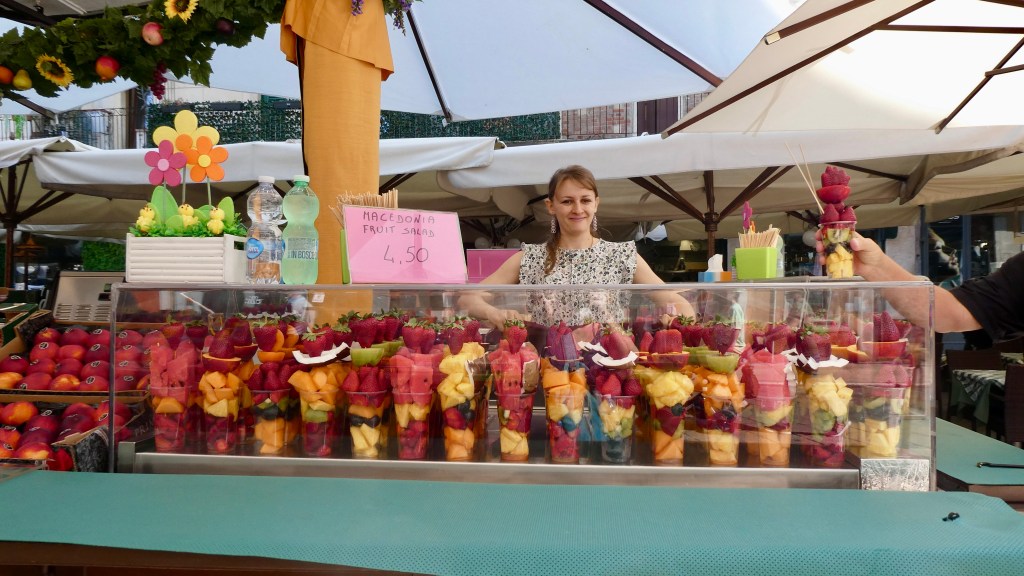
When we saw the fruit vendor we stopped and immediately bought fresh fruit cups – selecting those with our favorite fruits. We had been enjoying good food in Italy but were offered very few fresh vegetables (usually only eggplant) and almost no fresh fruit. (I know tomatoes are technically a fruit, and they were everywhere, but they are not fruit salad fruit.)
Eating our treat was more of a priority than walking to the Verona Arena or seeing another grand basilica! We were getting a bit churched out by this time.
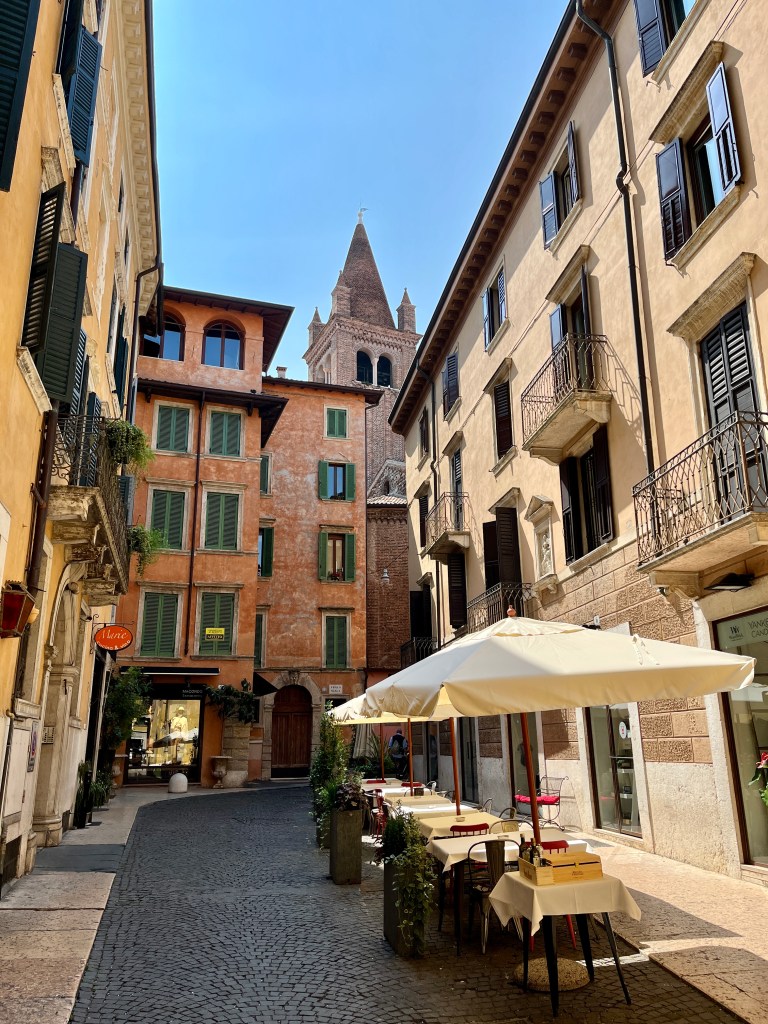
As a result we just walked around and explored the area near the piazza. This restaurant set up is very typical of what we saw in Italy. We didn’t eat here but did so at several restaurants that looked very similar.
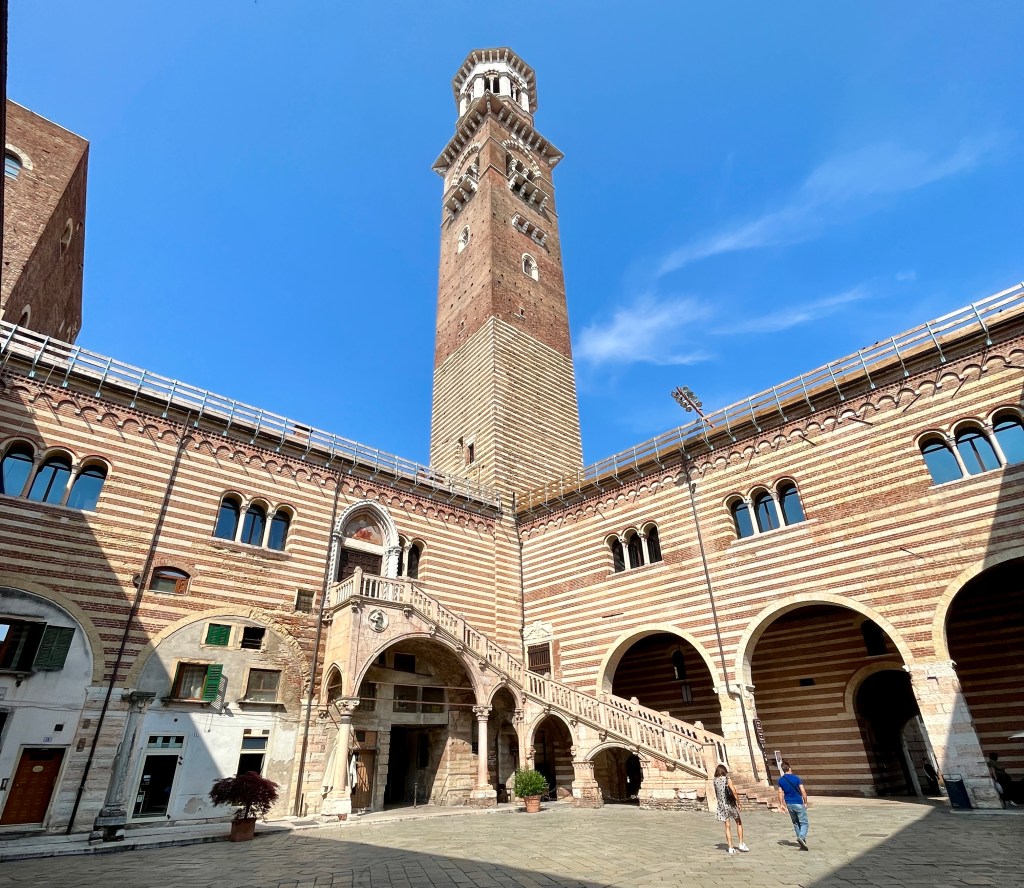
Nearby, a twelfth century castle, with a pink marble staircase, surrounds another piazza, the site of the old market.
By the 14th century, Verona was a city of art and culture. Verona’s most famous literary (fictional) inhabitants were Romeo and Juliet.
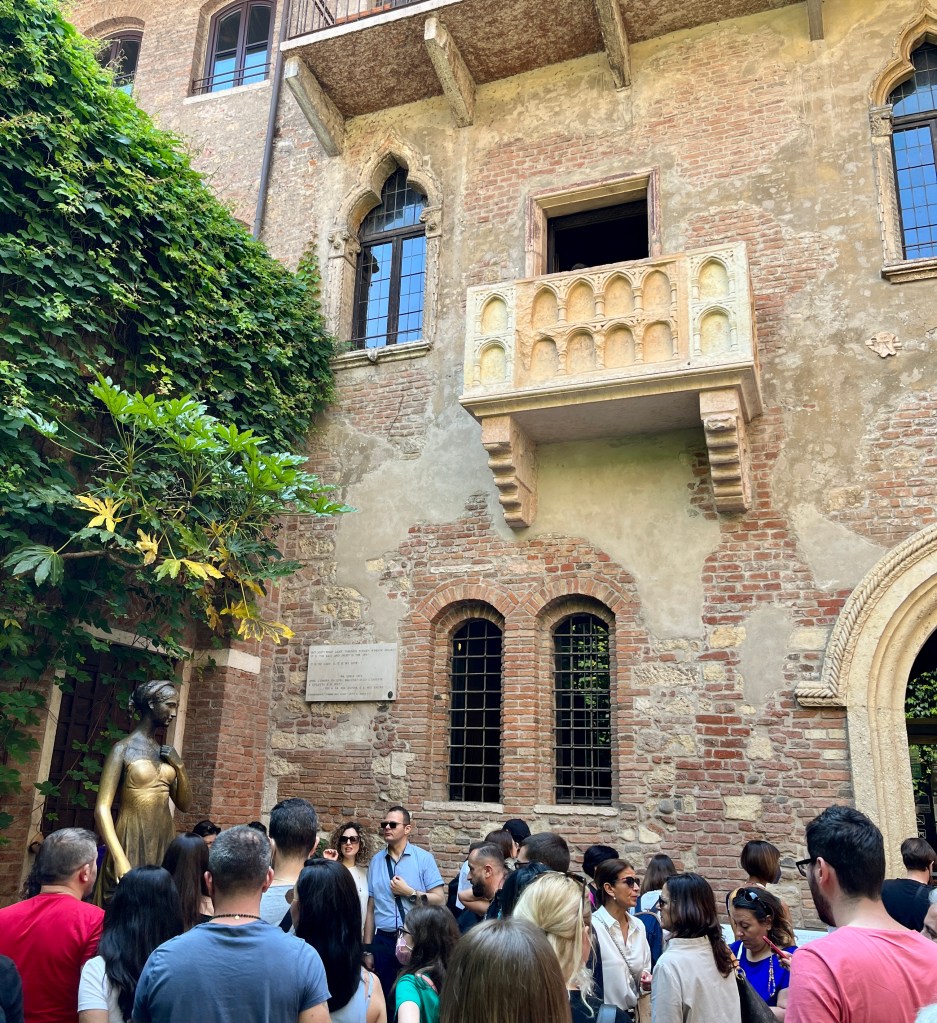
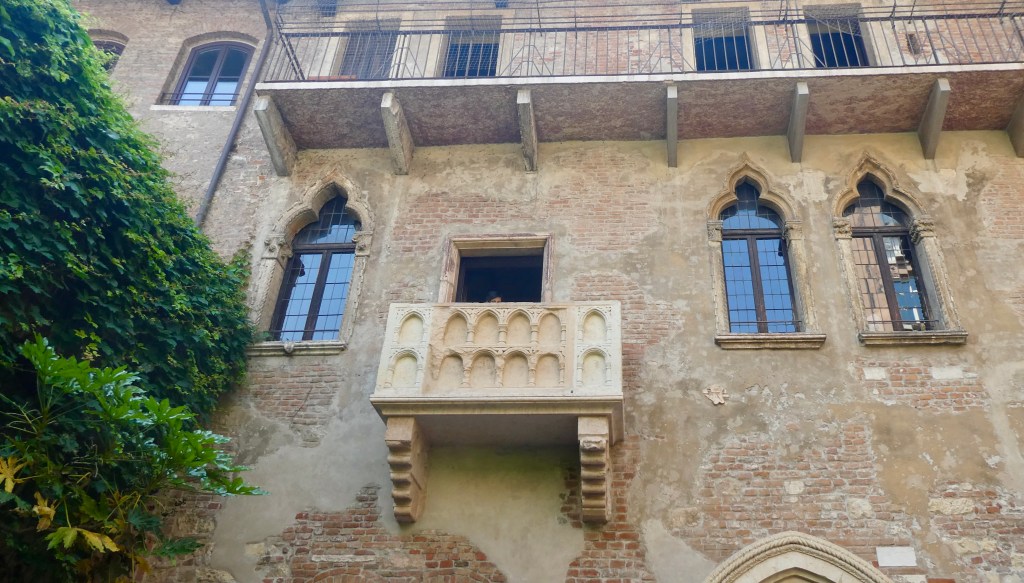
Like almost every other tourist we stopped to see Juliet’s balcony – only there isn’t really a balcony in Shakespeare’s play. Nevertheless, we saw it and were glad for it.
You can pay extra to go inside the 13th century house and stand on Juliet’s balcony but we did not.
Another thing we did not do was rub Juliet’s breast on the 1969 statue by Nereo Costantini. Doing so is thought to bring good luck.
The city capitalizes on the literary association and why would they not? Our tour guide was a bit cynical saying “Two teenagers think they are in love and people die.”
And on that cheery note – I end. Next time – Milano!
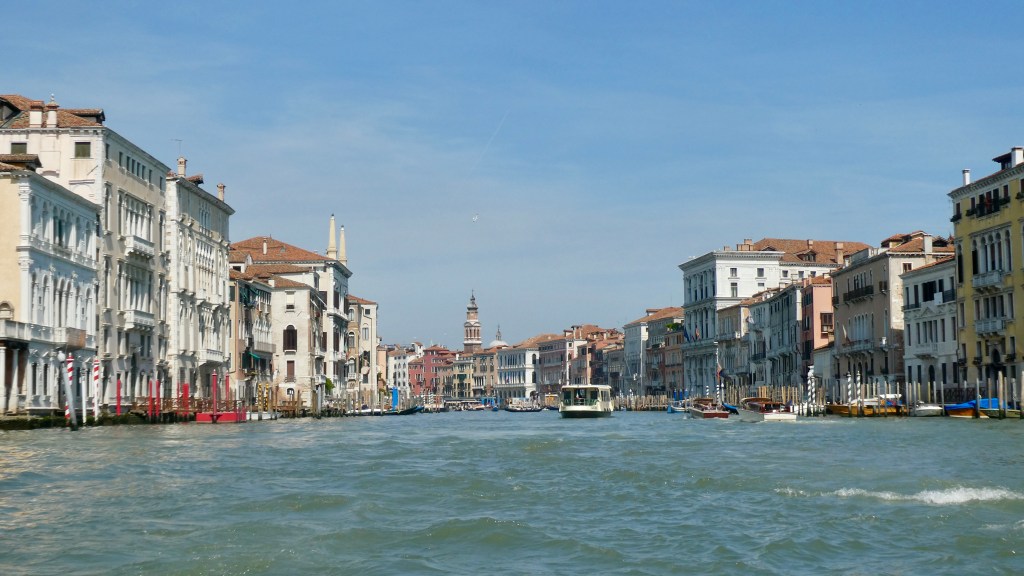
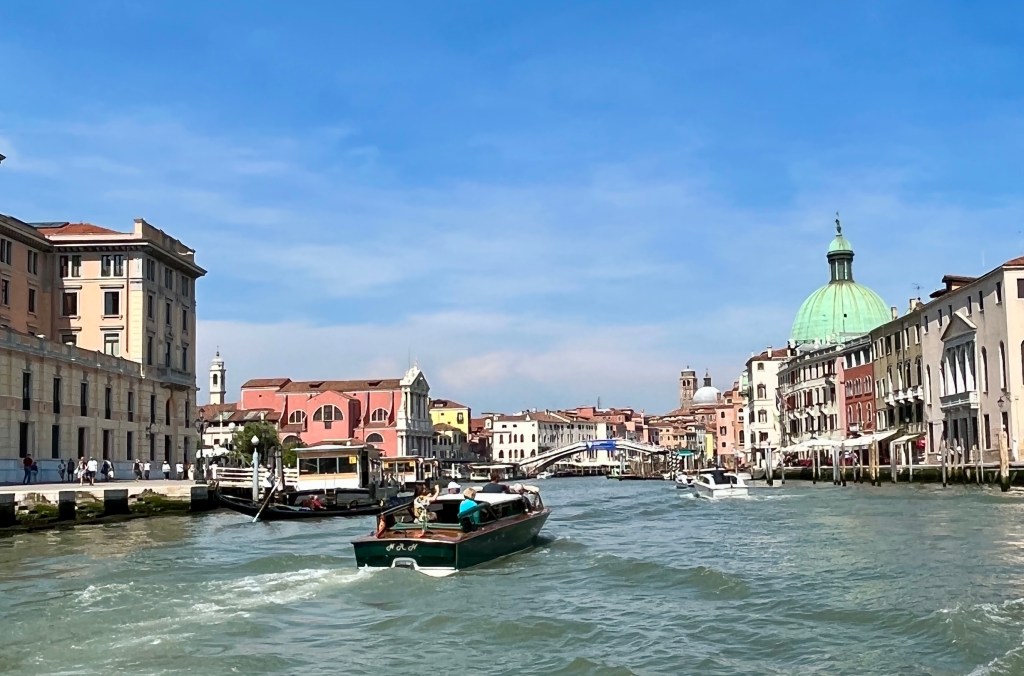
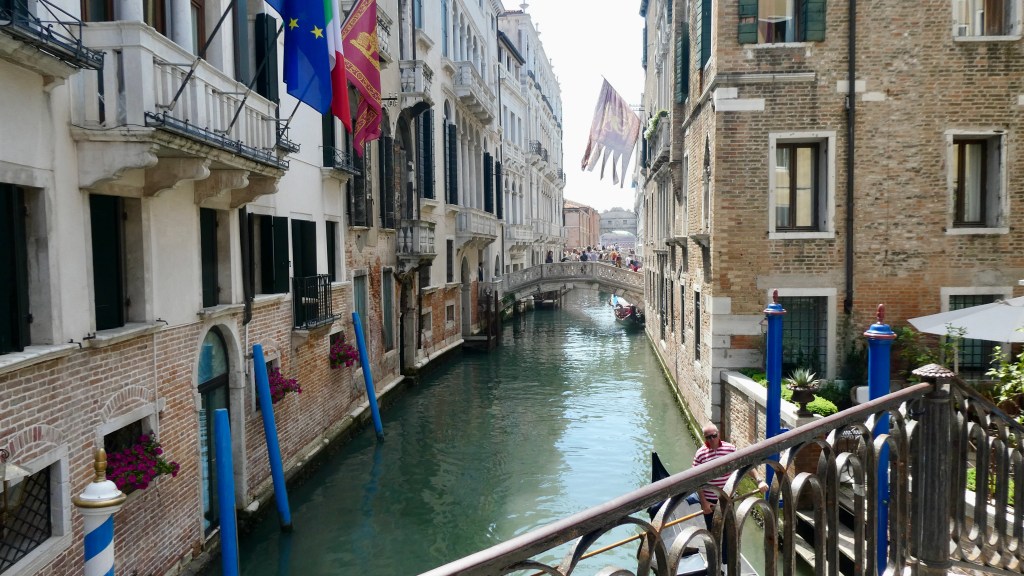
Our first views of Venice were entering the city on the Grand Canal.
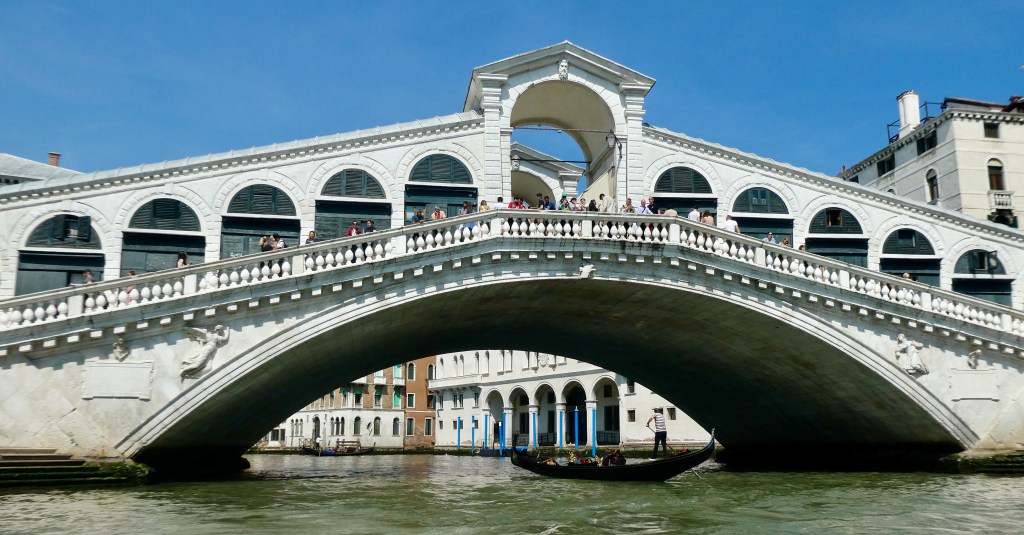
Venice is composed of 119 islands and has over 400 bridges and 150 canals.
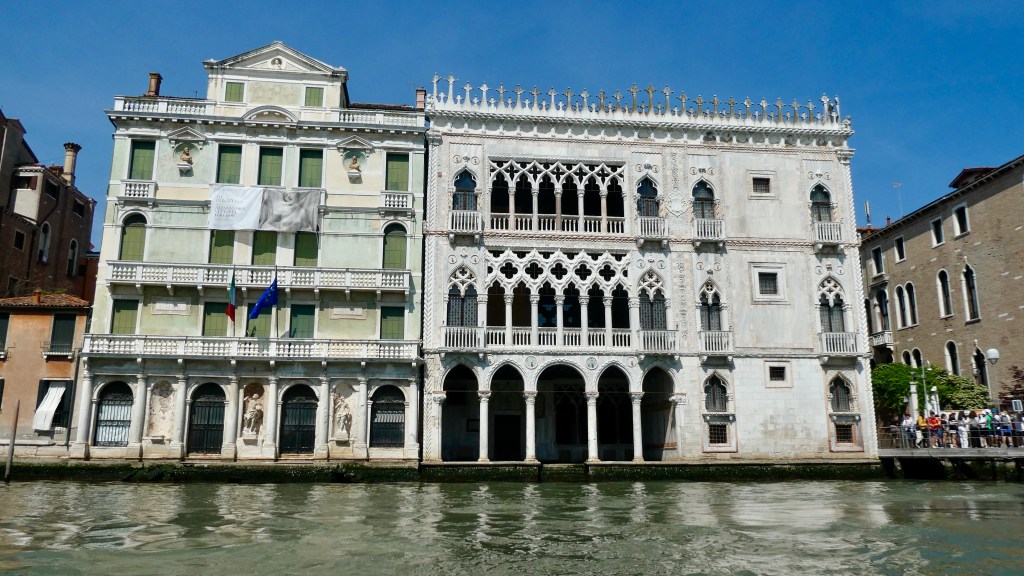
We were intrigued by the architecture in this 1600 year old city.
Venice has a wealthy history as the first inhabitants were refugee Roman citizens escaping the “barbarians” in what is now northern Italy.
Venice had many castles and homes for rich residents. The old buildings were never torn down, just refurbished for other uses. Former palaces have been subdivided, or repurposed for government offices, hospitals and schools.
The residents used millions of petrified logs placed in the marsh, then wooden pillars, bricks and stone to make their city. None of the buildings are very tall and only the facades are marble or decorative.
The rich and poor lived together and cared about each other. Government officials were elected for life but did not hold much power.
Between the years of 1789-1797 only the United States and Venice had an elected president. The tenants of the Venice government are evident in the US constitution.
Unfortunately, Napoleon conquered Venice in 1797.
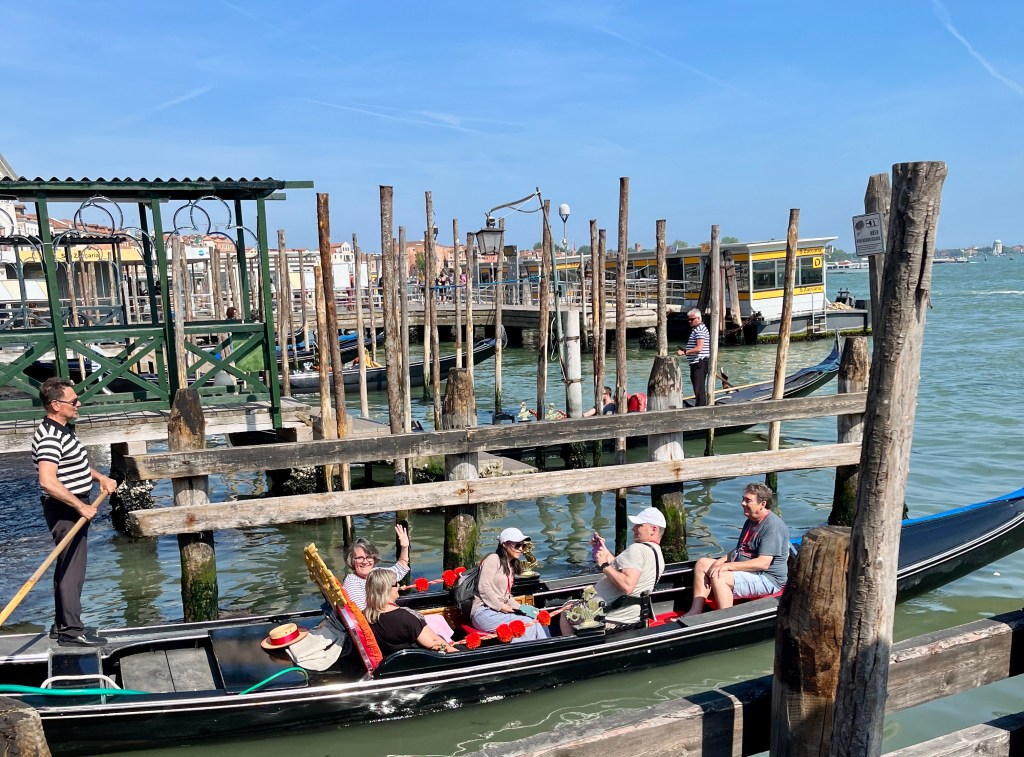
Now days, Venice has a declining population, but increasing tourists. Of course one of the iconic tourist activities is the gondola ride. This boat holds some of our tour mates.
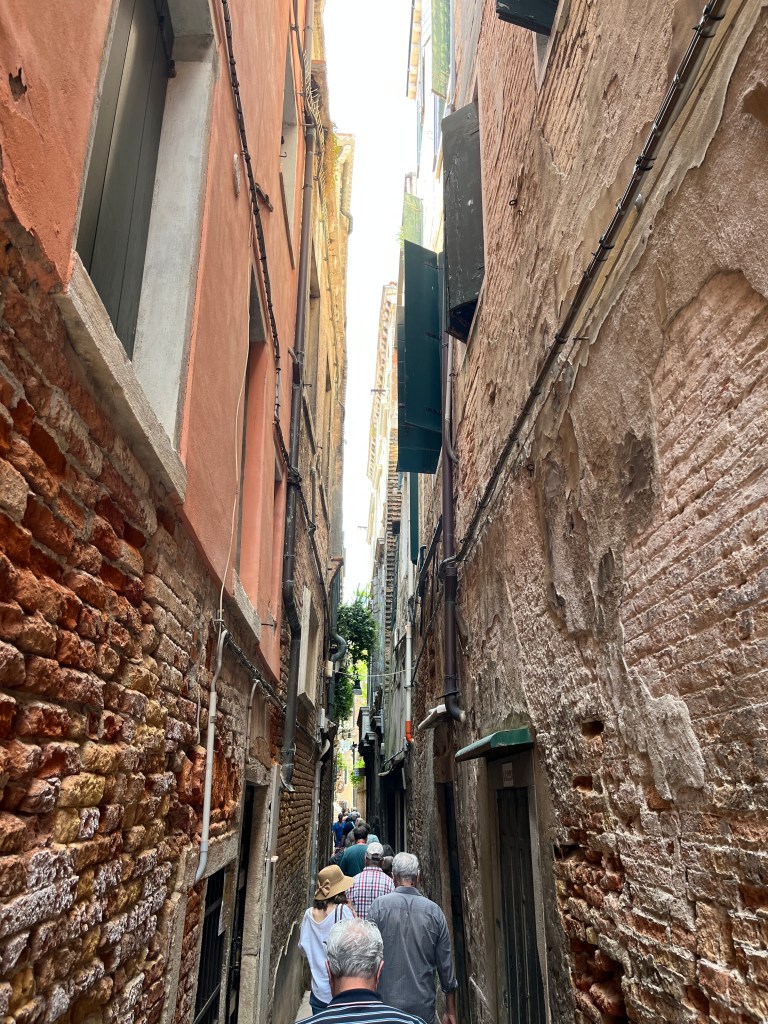
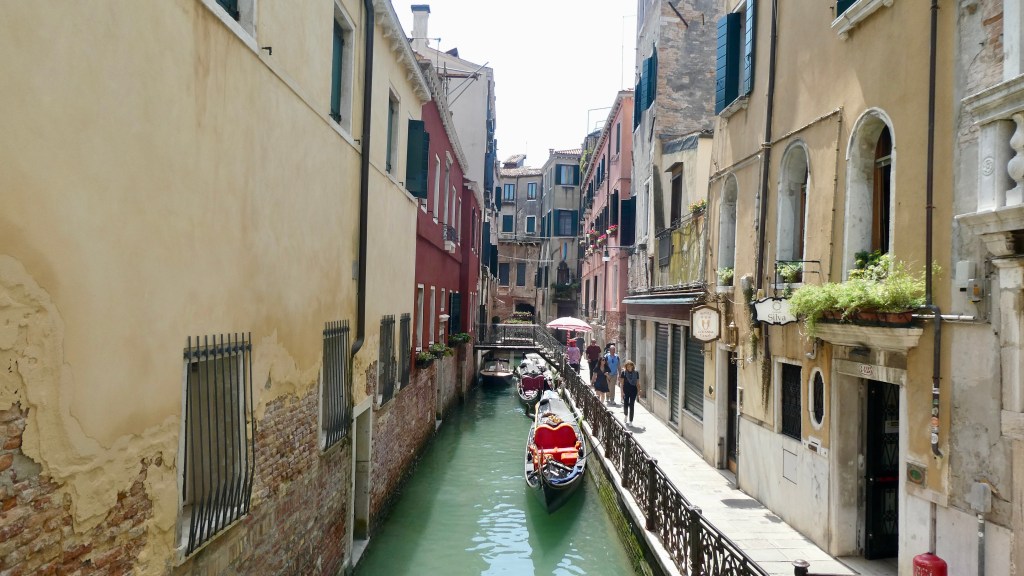
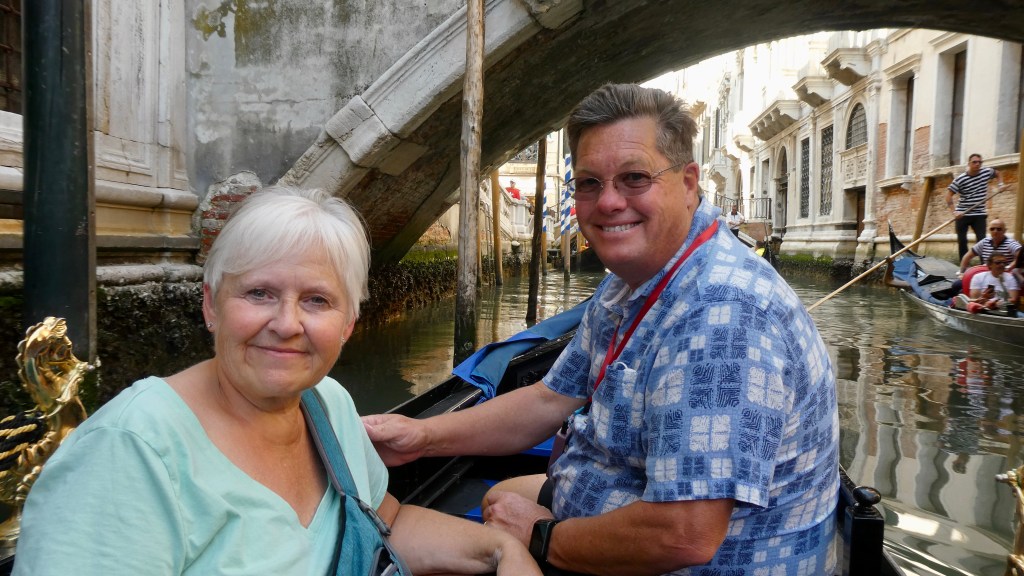
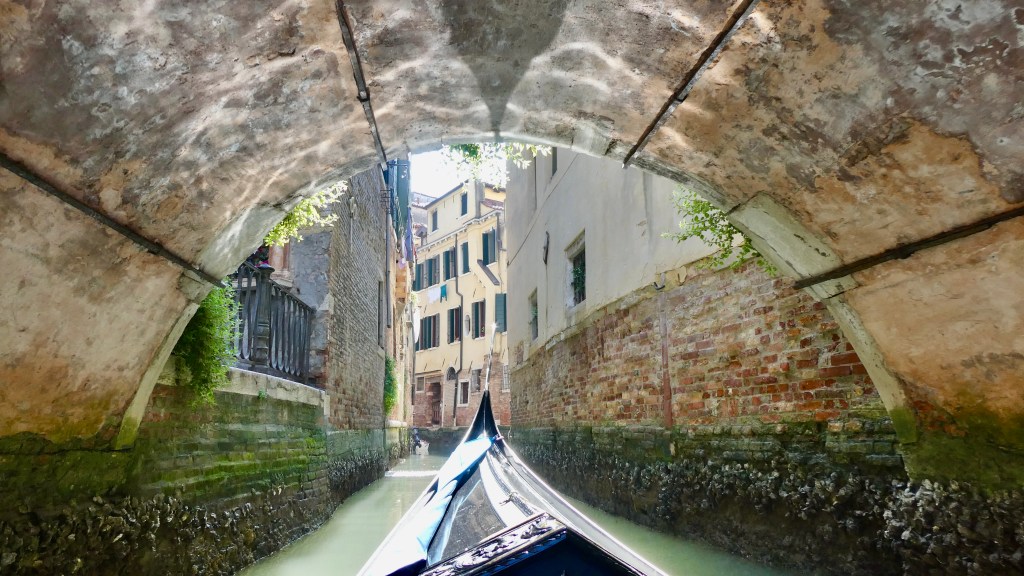
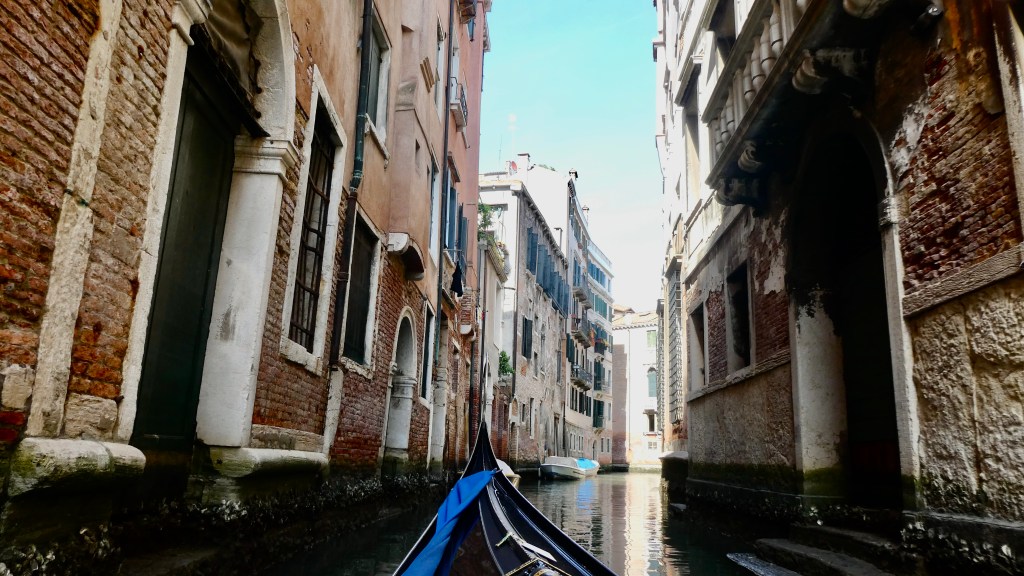
Our gondolier was Alessandro and it was very pleasant being taken through the narrow canals and told about Venice and its history.
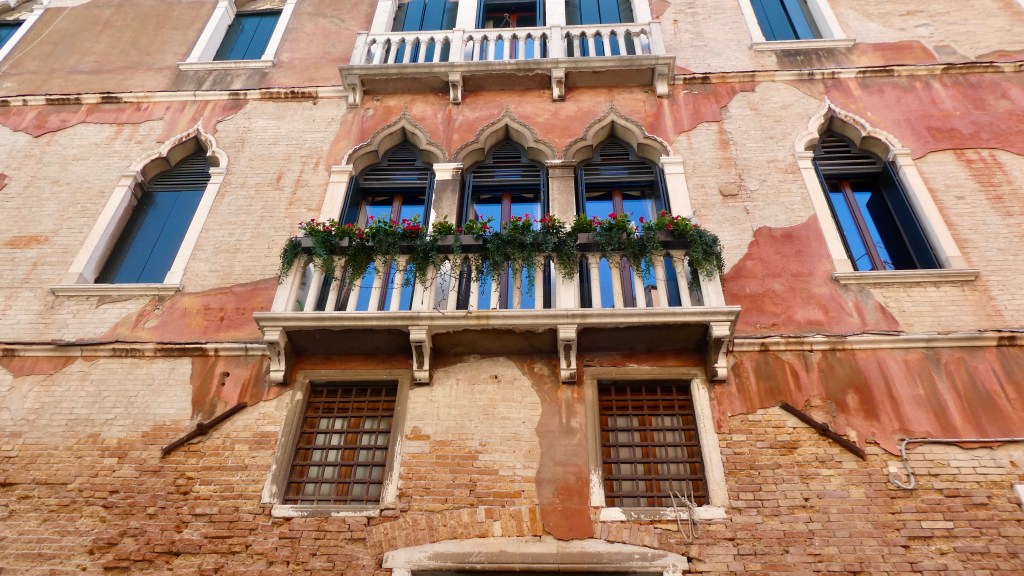
He explained about the architecture and window shapes and identified those that were Roman, Arab or Byzantine.
Alessandro told us that to be a gondolier you must be born in Venice. You must also own your own boat which can cost 15000 Euros new. (Although currently about par, a Euro has typically valued more than the US dollar.)
Canals and buildings are sometimes curved because they follow the shape of the original islands.
At one time, each original island had its own church, meaning there were 100 churches for 50,000 people
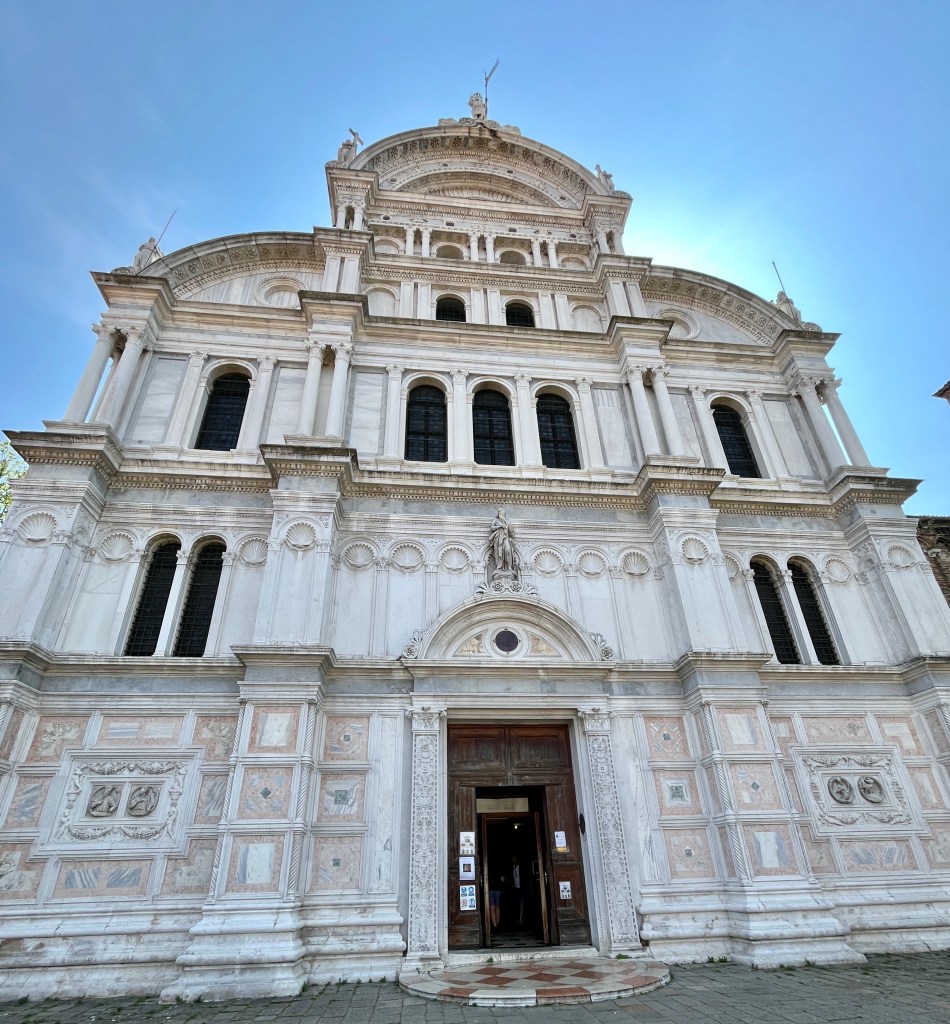
The Church of San Zaccaria holds the remains of Zachariah, the father of John the Baptist. An adjacent building was for the nuns from wealthy families. Only the oldest daughters were allowed a dowry and marriage. The others went to the convent.
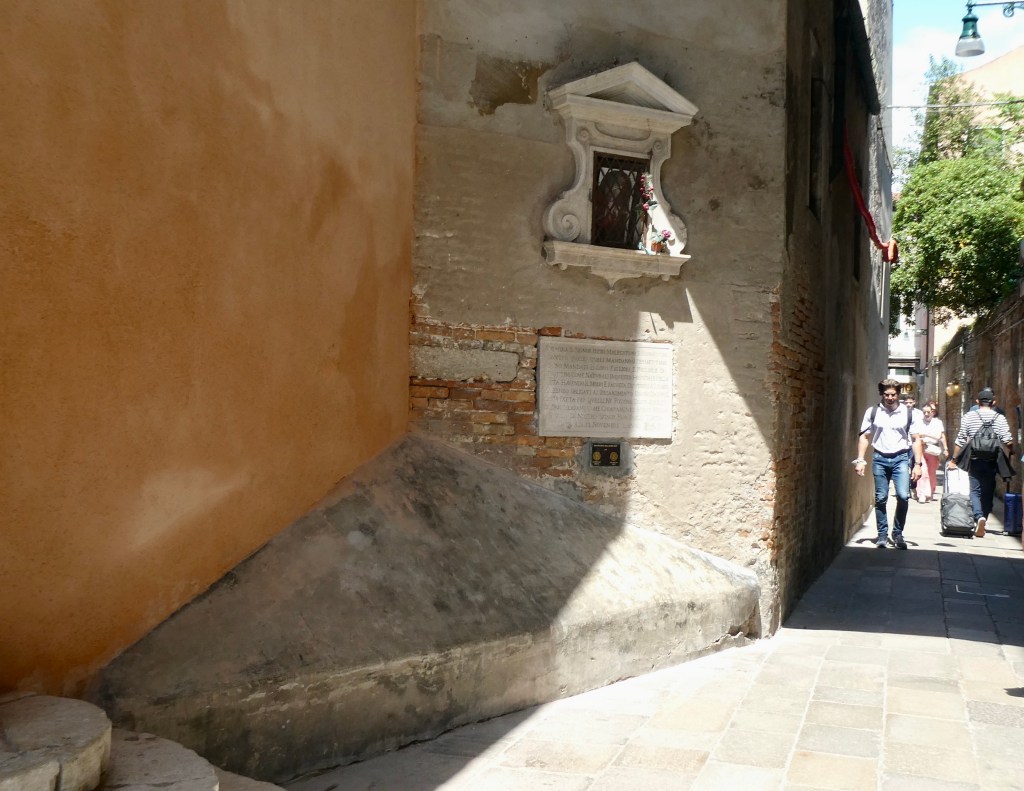
At another church we saw the “wheel of shame.” Illegitimate babies, or those a family couldn’t afford to raise, would be placed in an opening in the stone wheel which was turned to give the baby to the nuns.
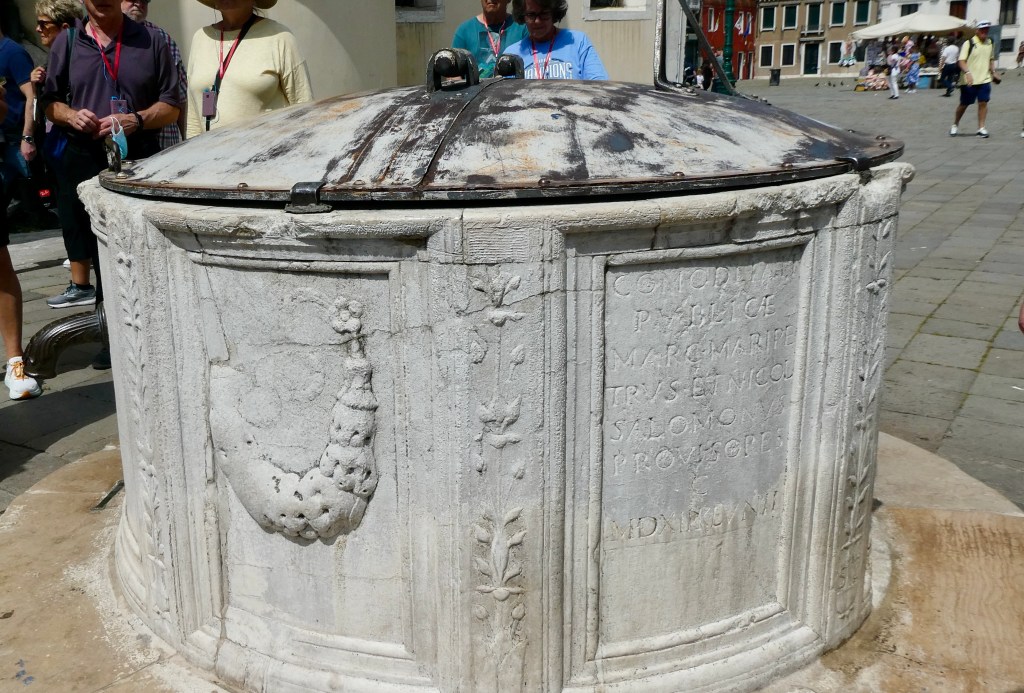
The nuns helped the city in other ways too. They collected water and provided it to the people twice a day.
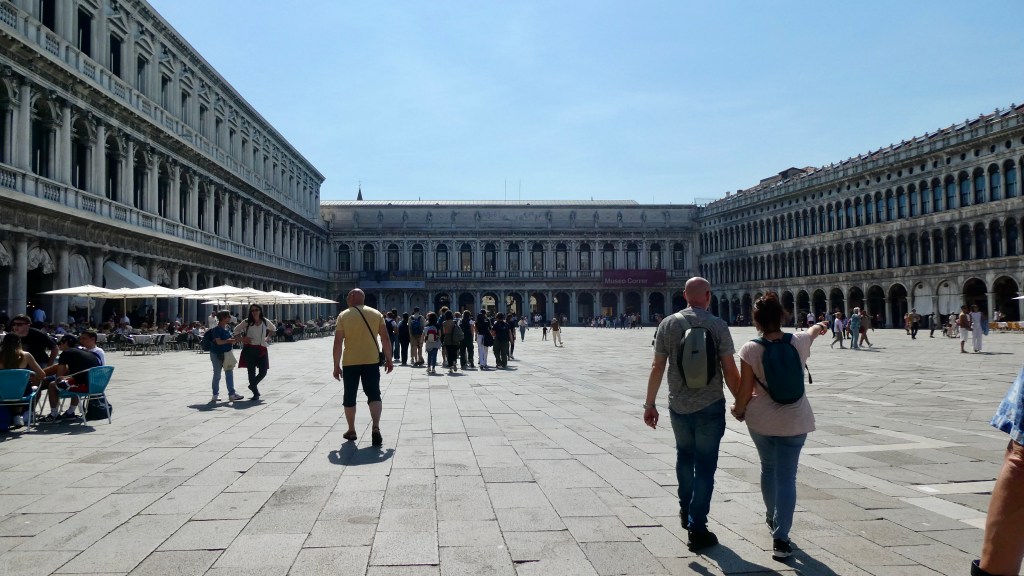
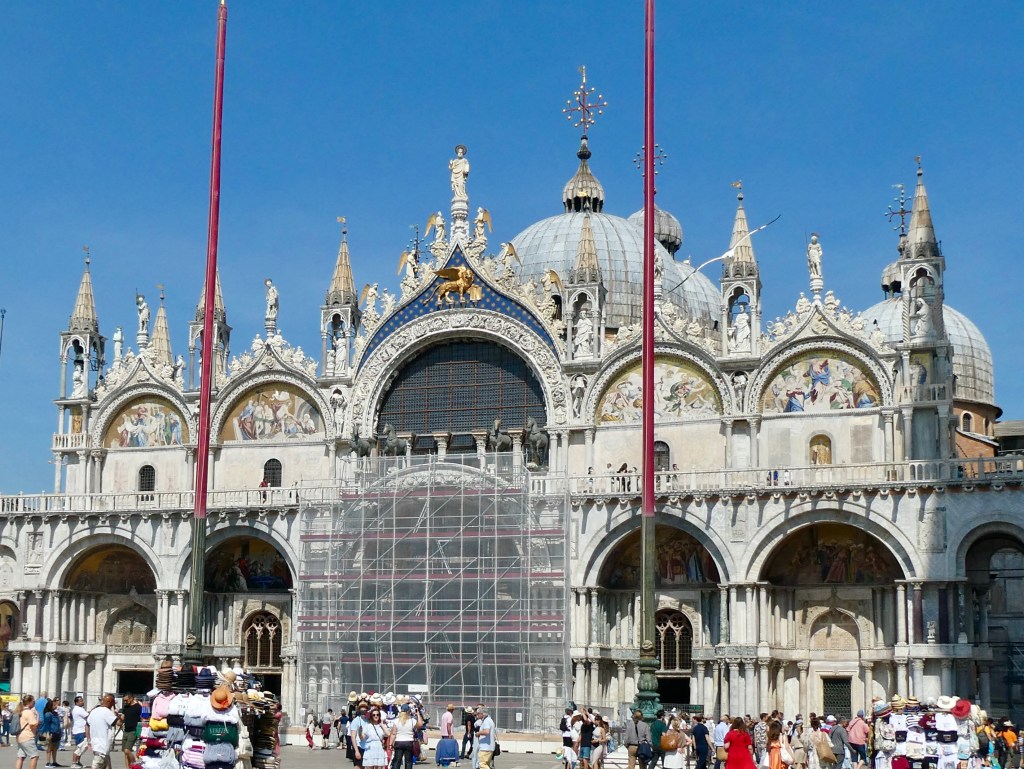
Piazza San Marco is the city’s main public square, home to the St. Mark’s Basilica, government buildings and restaurants.
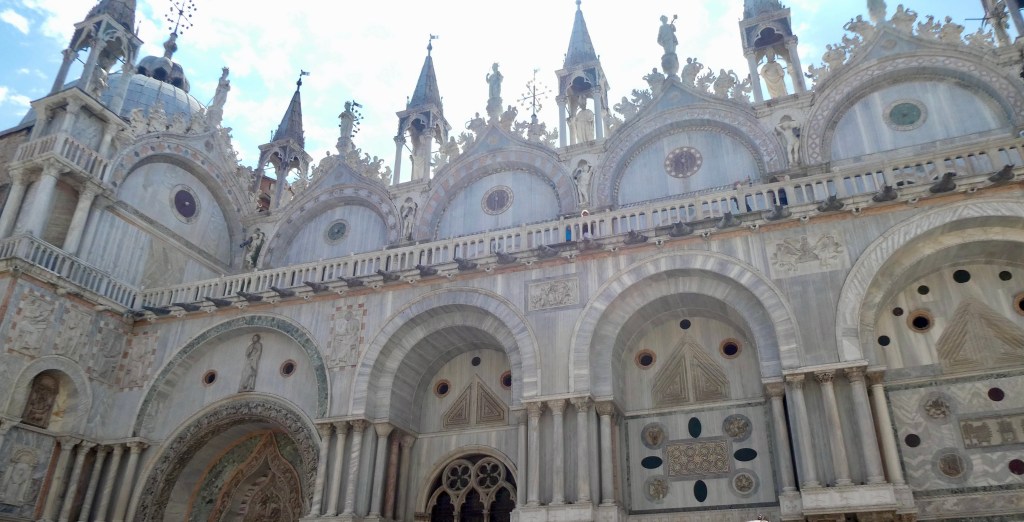
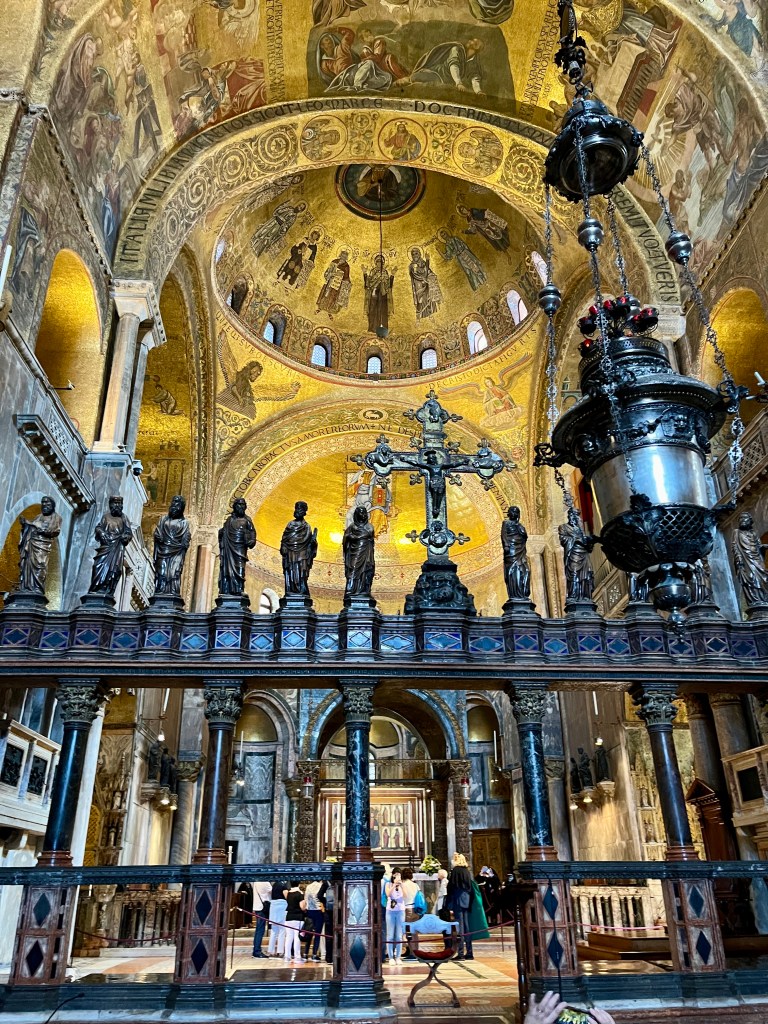
Basilica de San Marco (St. Mark’s) was named after Mark, one of the leading apostles after Jesus’ death. He wrote the gospel of Mark. It is believed that Mark once preached in the Venice lagoon area.
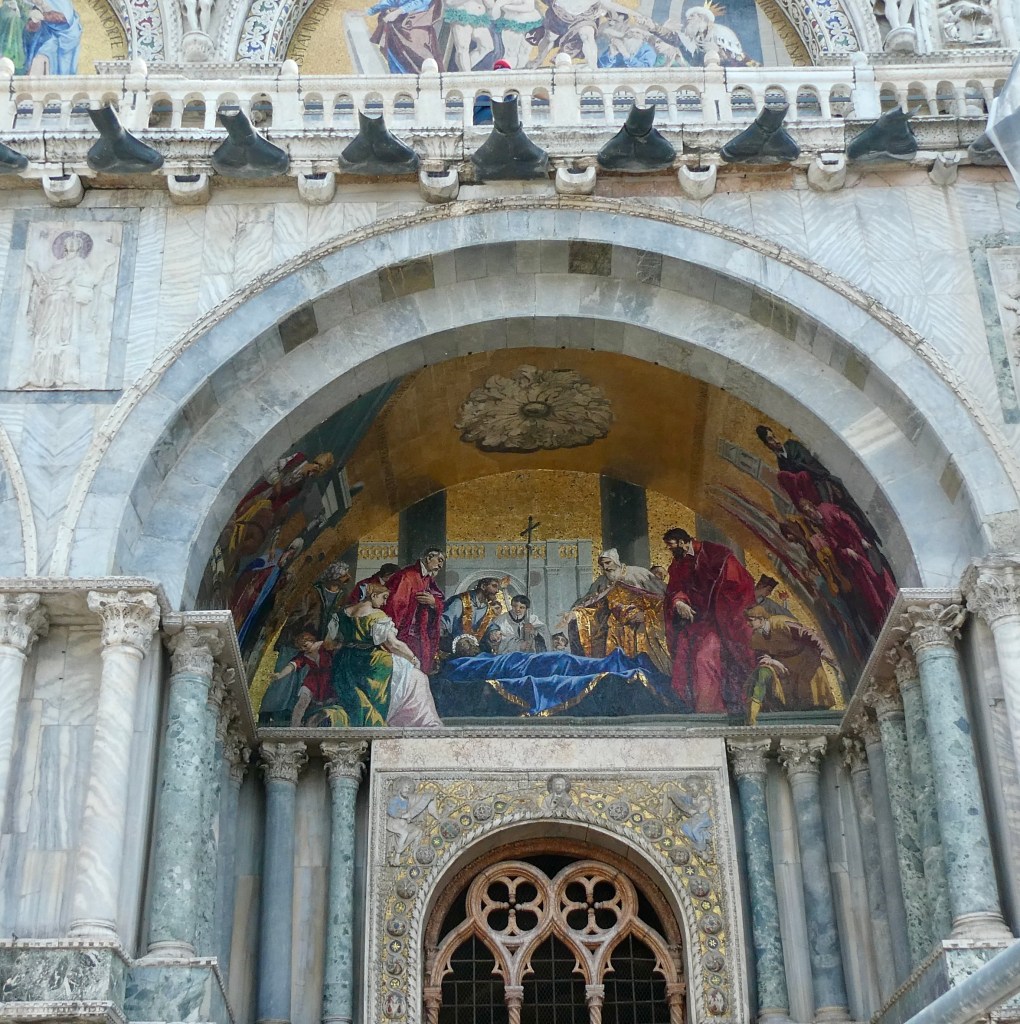
In 828, Mark’s remains were stolen from Alexandria by two Venetian merchants. They were trying to protect the remains from the Muslims as they took over Christian churches. The remains were brought to Venice and the Basilica of St. Marks was built to honor and protect them.
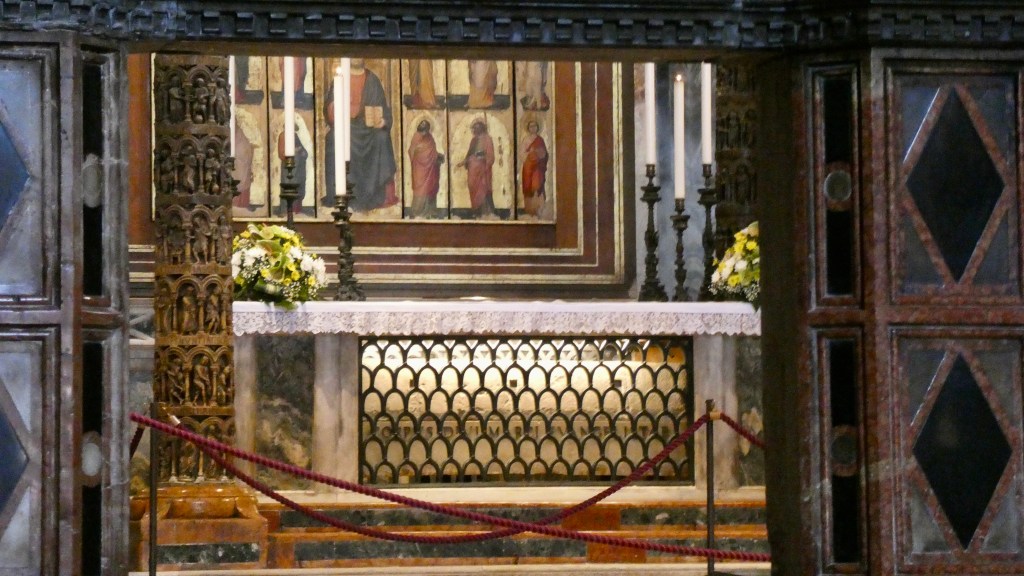
The remains were so well protected that they were lost for a time during basilica renovations. It is considered divine intervention that they were found in a pillar in the year 1094.
Possession of the remains of St. Mark had a powerful impact on the people of Venice and has benefited the area diplomatically and politically.
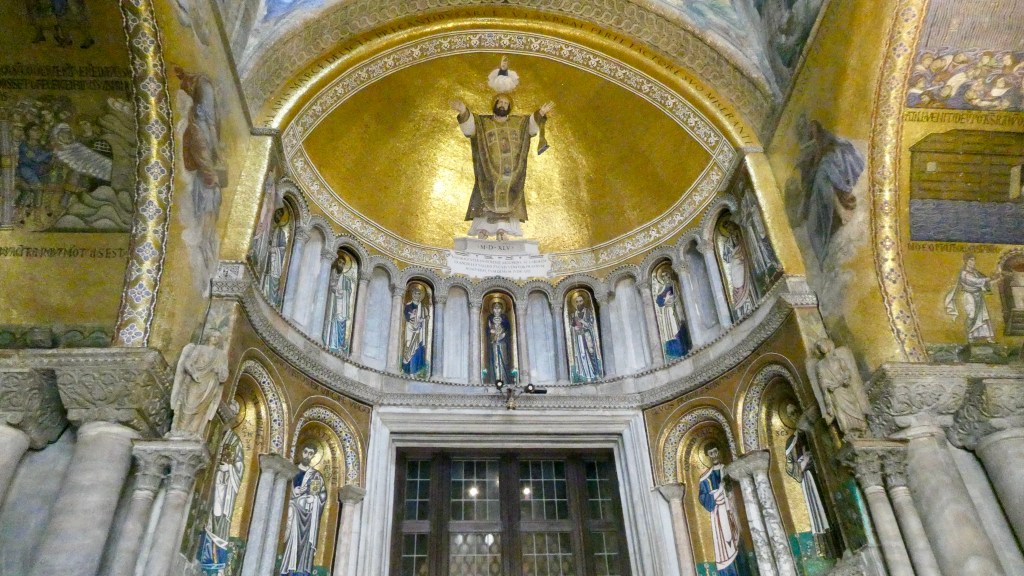
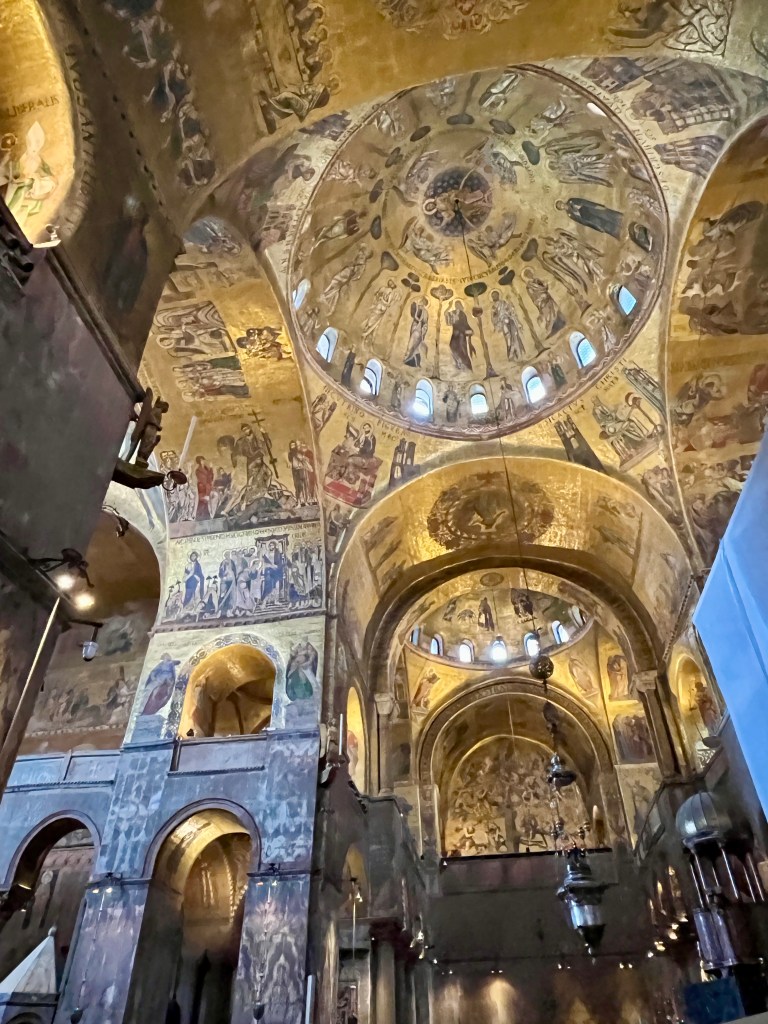
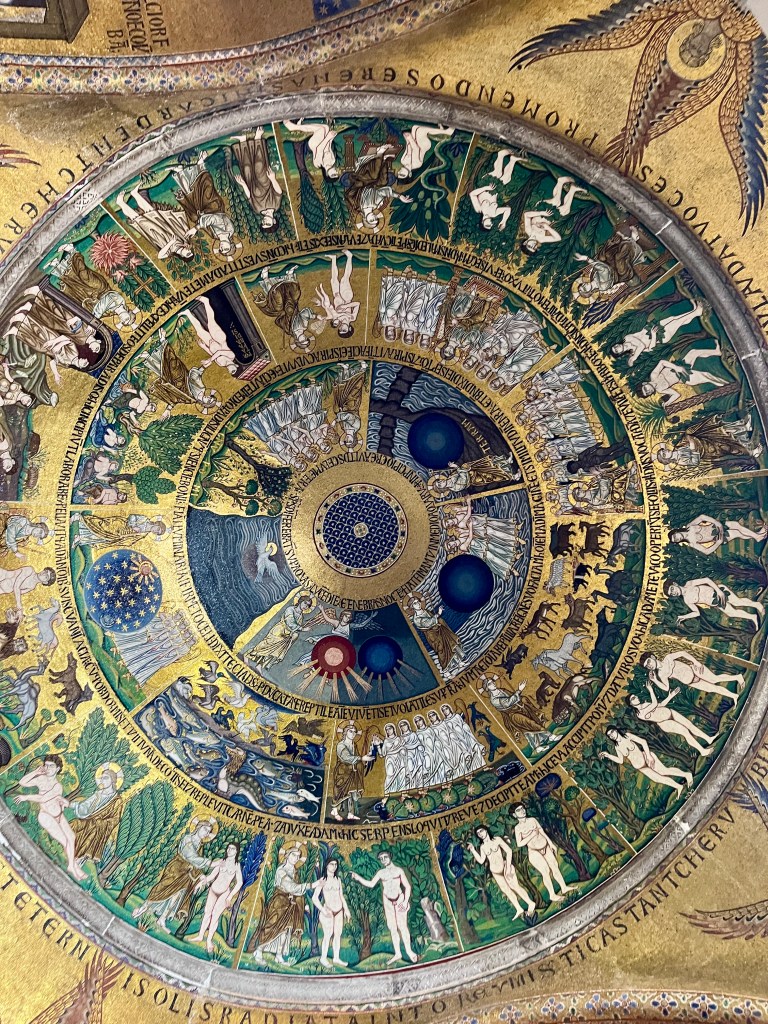
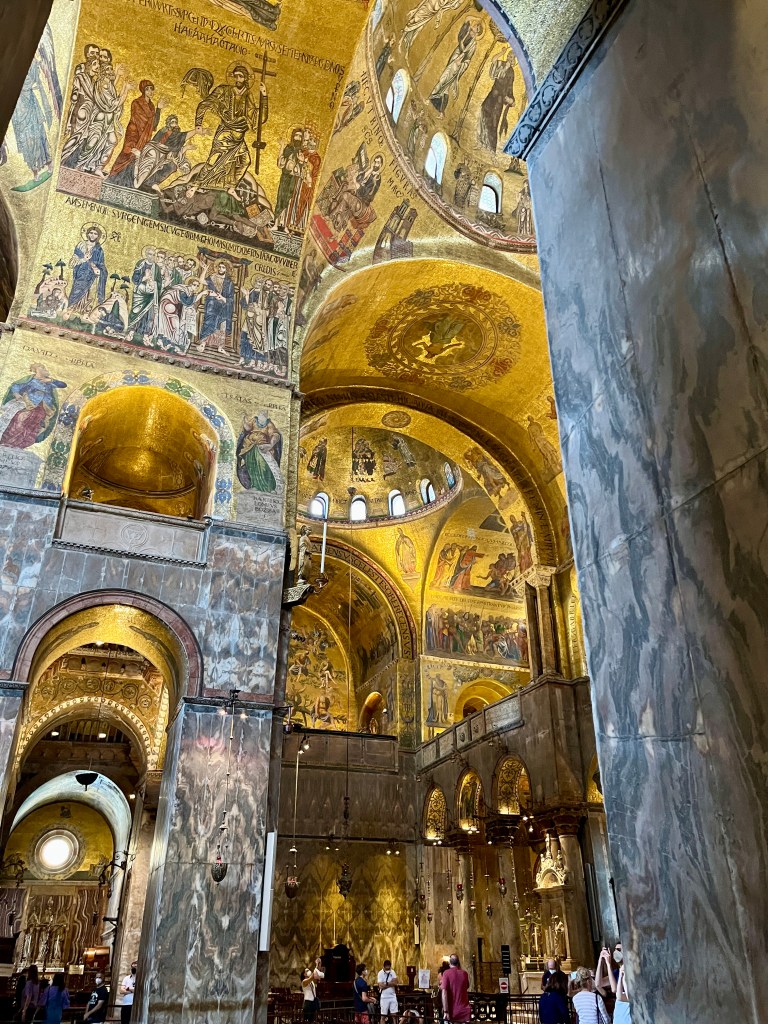
There are 8000 square meters (85,000 square feet) of mosaic art that was completed over eight centuries.
There were 22 tons of 22 and 24 carat gold used in the mosaics, some of which depict scenes from the bible.
There are reminders of the Eastern Orthodox faith, even though St. Mark’s is a Catholic church.
There are floor mosaics that are also symbolic.
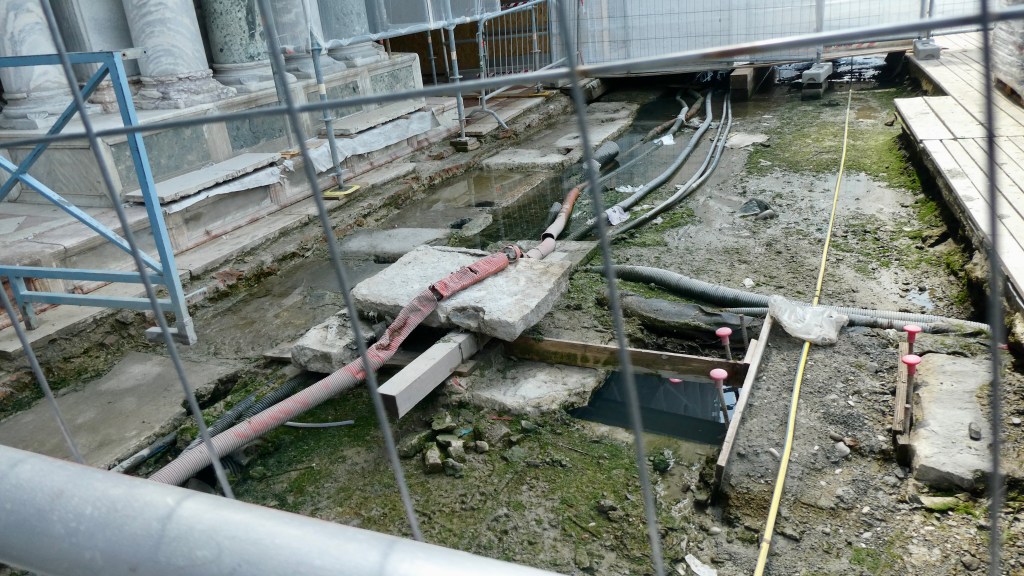
Outside of St. Mark’s is the reminder that this city is built on a series of natural and man made islands. The pumps were running to disperse water from the basilica grounds.
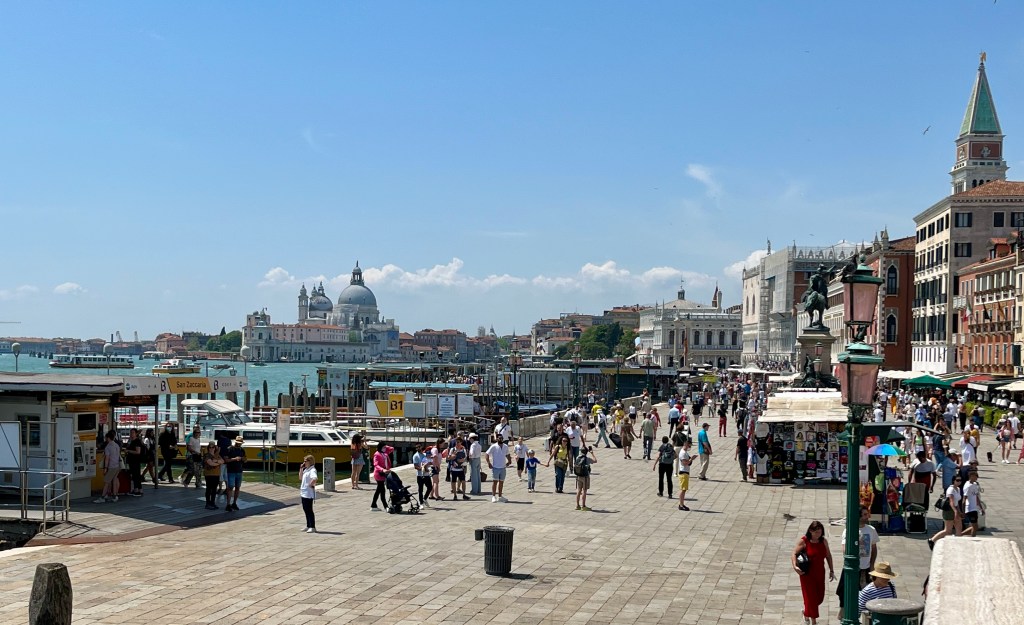
This was a center of activity for tourists. Boats came and left, gondoliers went in and out. There were shops and restaurants all around.
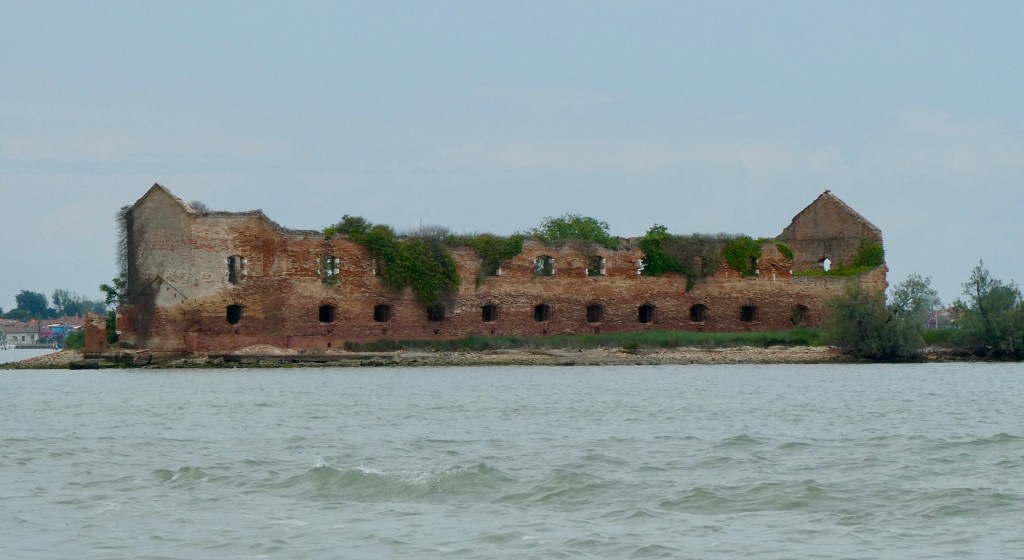
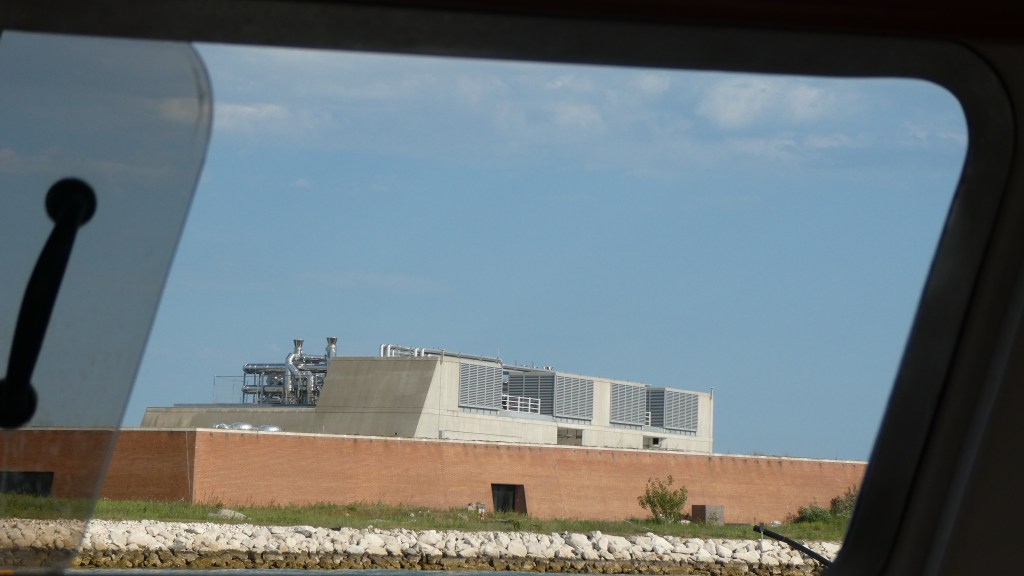
We went out into the lagoon to the islands near Venice. We went past this building placed on its own island as it once held a hospital for those with the plague. The building was bombed during WWI.
The Mose Project has been in the works for decades. It uses a series of 78 gates to protect Venice and other islands in the lagoon from excessively high Adriatic tides. Although not yet complete, it was utilized four times last year.
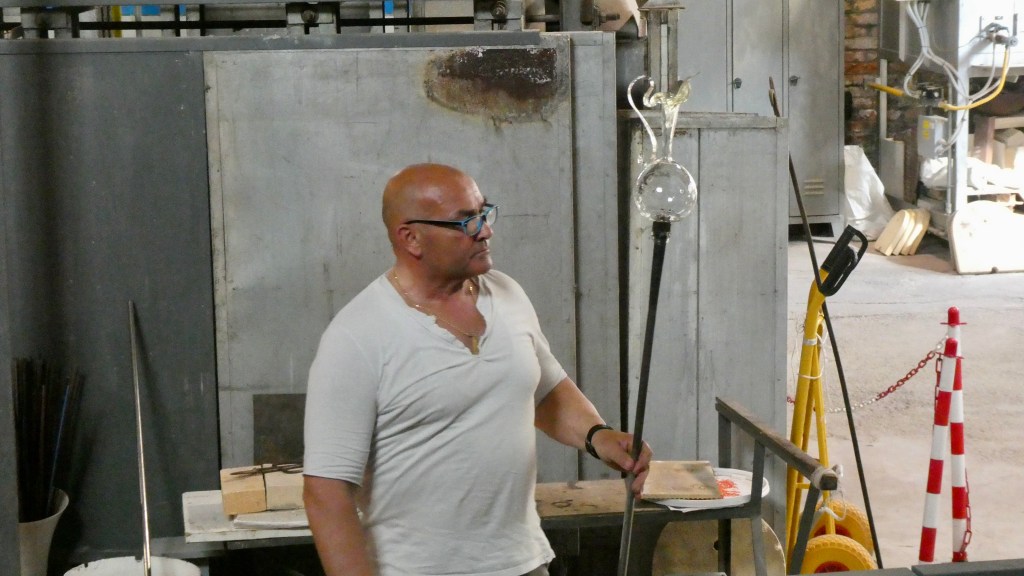
We visited the island of Murano and visited shops specializing in glassblowing and leather works. These specialties have been important to the area for centuries as descendant generations learned the craft. The continuity of the traditions are at risk as the younger generations aren’t choosing to learn and stay. Apparently, Murano Glass is a famous thing – you may know it, but we did not. They made amazing things and several people on our tour purchased items to be shipped home.
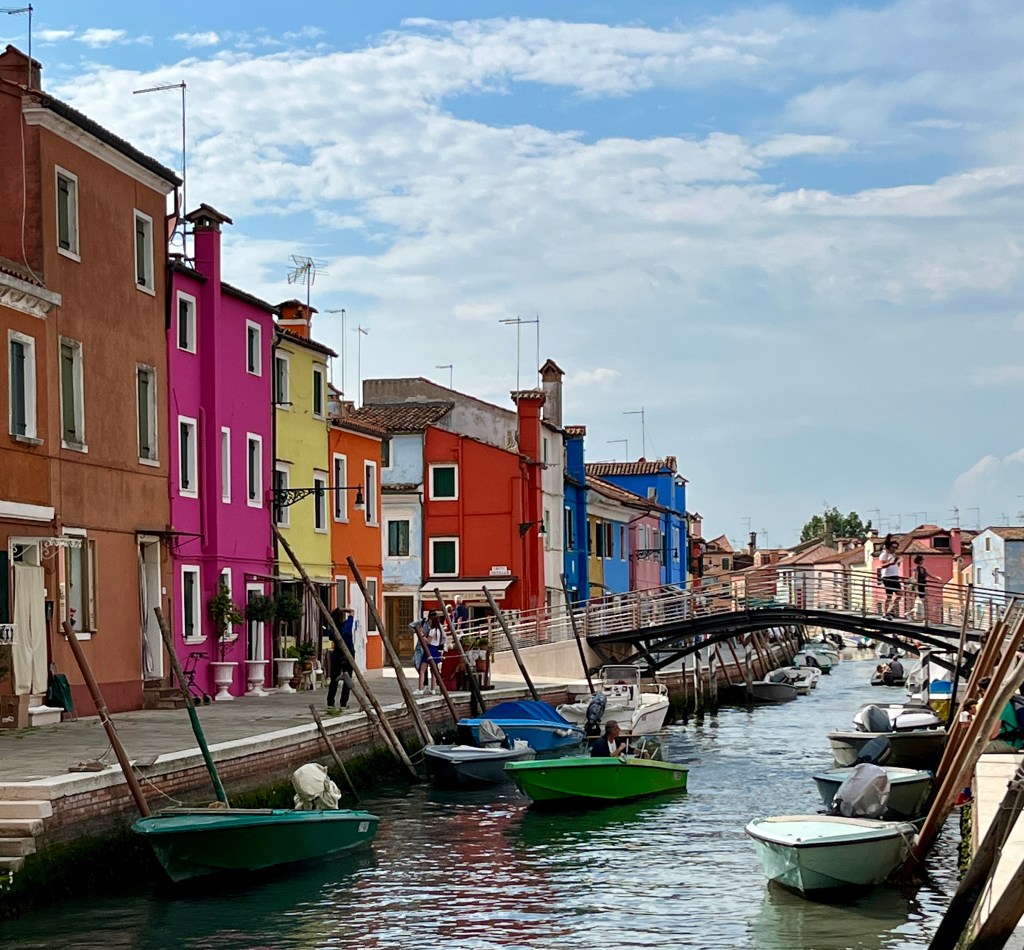
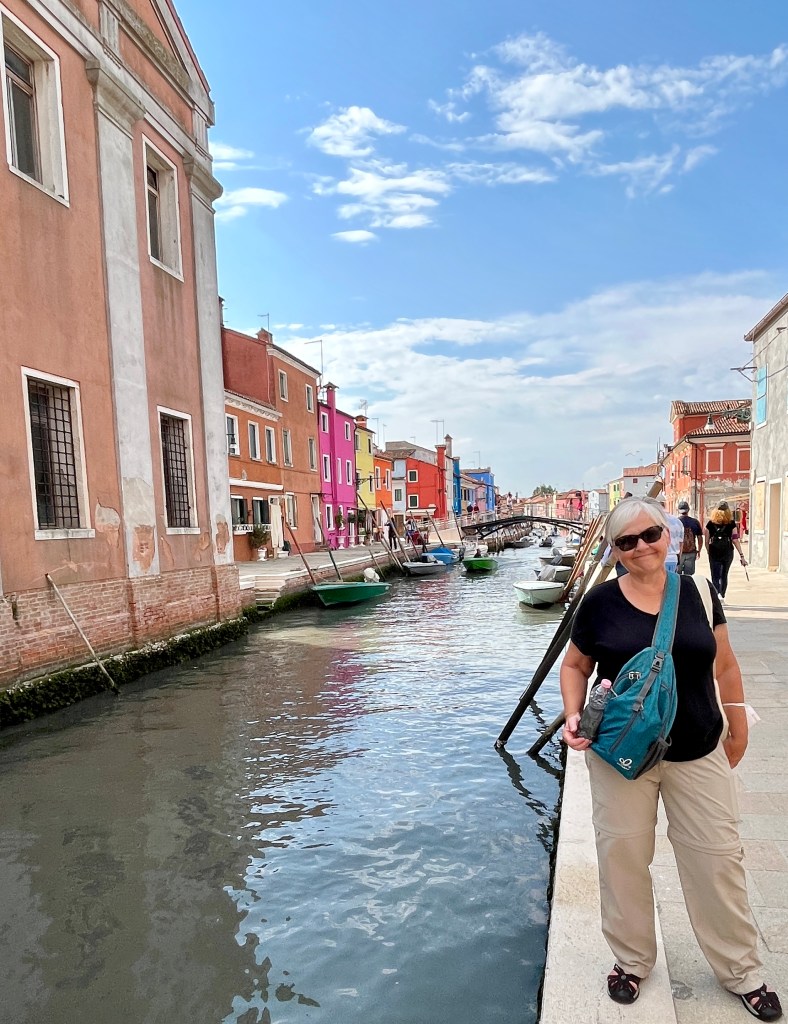
Our favorite lagoon island was the colorful Burano.
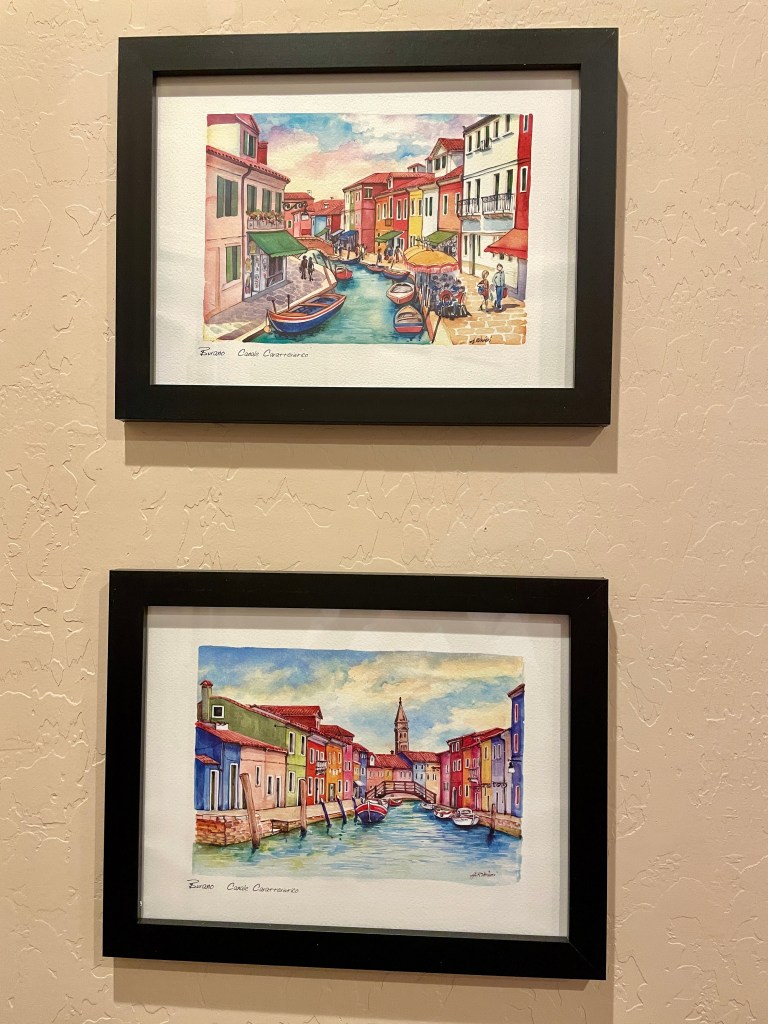
In fact, of all the places we went in Italy, the place we chose to bring home art from was Burano.
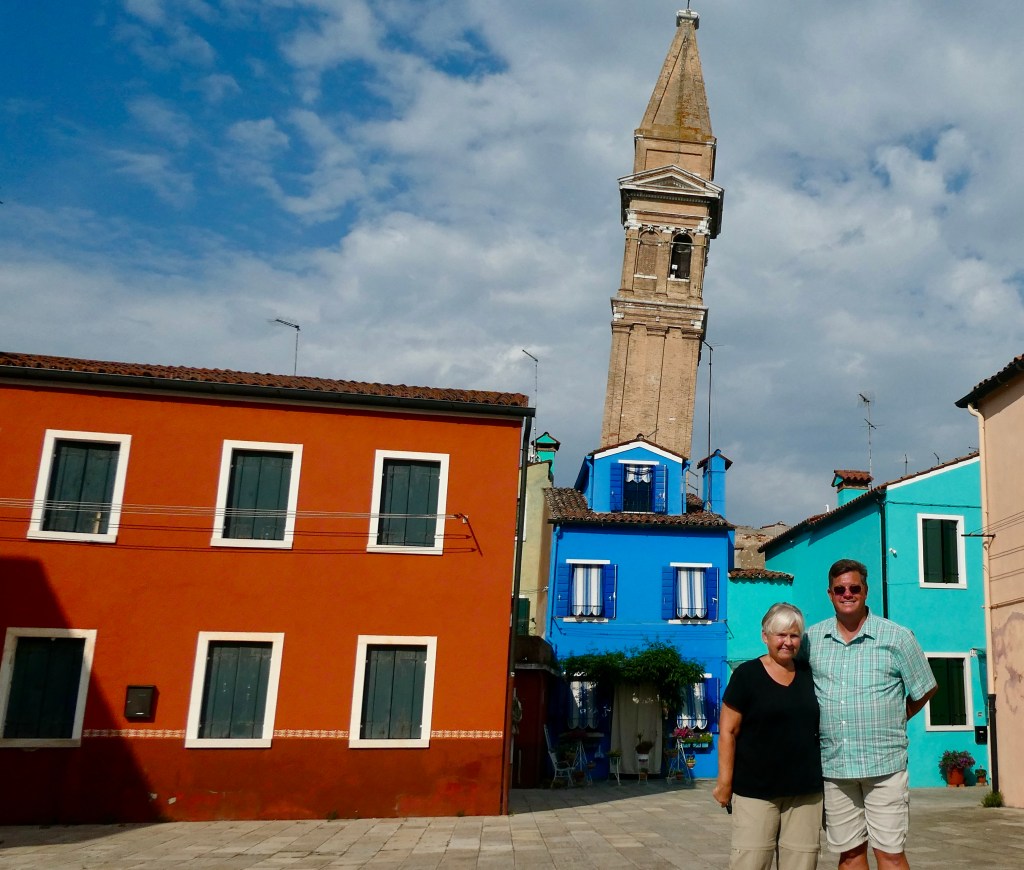
The leaning building behind us is Burano’s Bell Tower. Built in the seventeenth century, it inclines 1.83 meters due to settling land beneath it.
If only Pisa was next, but it isn’t. Next we see Verona and Juliet’s balcony.
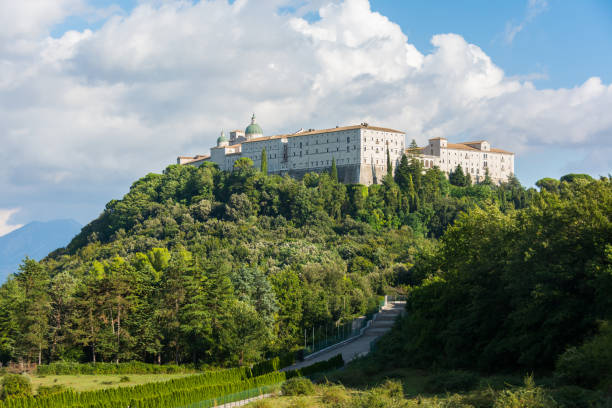
On the journey to Assisi, our tour guide pointed out the Abbey of Montecassino on a nearby hill. It was a Benedictine monastery when the Germans took it over during WW2. The US made a calculated decision to bomb the location – but the Germans were gone. Montecassino was rebuilt after the war by the United States.
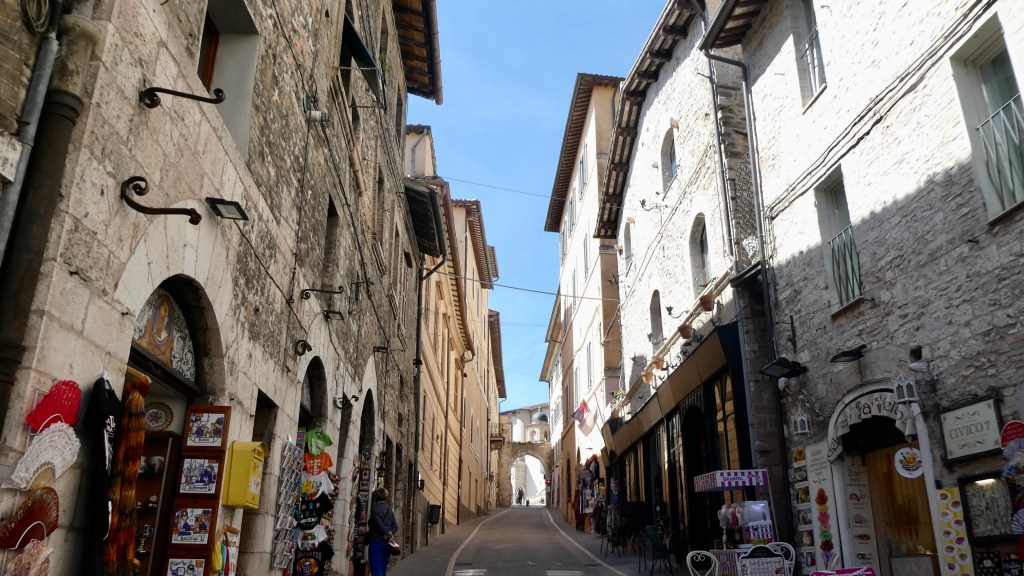
When we arrived at Assisi, we learned the city is thought to have originated around 1,000 BC. It eventually covered three square miles and had eight gates. Medieval Assisi was densely populated.
In 1182, Francis of Assisi was born to a wealthy family. Assisi went to war with Perugia in 1202 and Francis joined the military seeking glory. He was taken prisoner and jailed for a year until his father paid the ransom.
That experience helped to transform Francis’ life. Another experience was feeling compassion for and hugging a man with leprosy. Francis was further changed when he visited the crumbling chapel of San Damiano. He heard God say, “Francis go and build my church which you can see is falling down.” Francis physically repaired the chapel and later helped to rebuild people’s faith in God and the church.
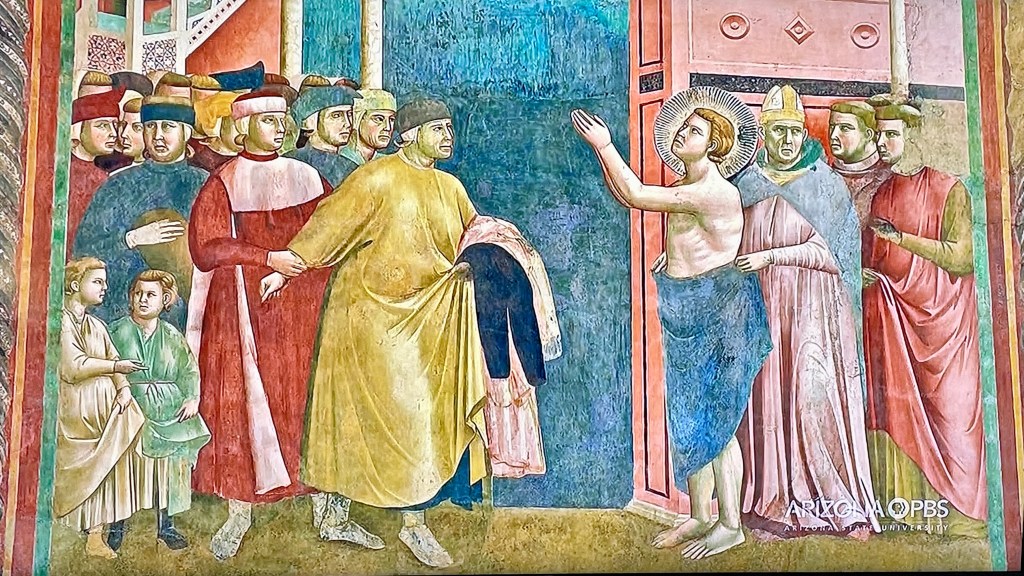
Francis denounced all his worldly possessions and lived simply. His mission was to love and help people. This fresco shows him giving his fancy clothes to his father.
Francis was never a priest. He was a simple friar who often preferred the solitude of nature. Yet, he was also a reformer, challenging the wealthy and powerful, both in the community and the church.
Frances founded three religious orders that still exist today. He created two of the most sacred Christian devotions, staging the first Christmas Nativity in 1223 and creating an interpretation of the Stations of the Cross.
After a life of piety and helping others, Francis died in 1226. The church made him a Saint just two years after his death. That was exceptionally fast. Saint Francis of Assisi is the patron saint of animals, ecology and the co-patron saint of Italy.
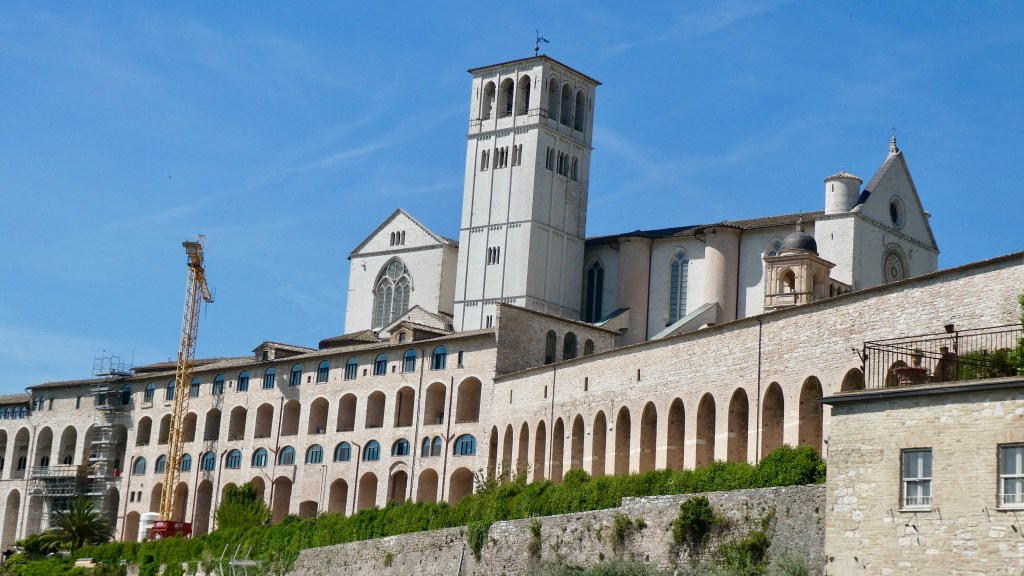
Building began on the Basilica of Saint Francis in 1228, just two years after Francis’ death. The first stone was placed by Pope Gregory IX the day after the canonization of Francis. The church sought to build a place to protect the saint’s remains.
In 1296, Giotto de Bondone was invited to paint the story of Saint Francis of Assisi in the basilica. He is considered to be the first painter in the history of Western art to show human emotions, and to place figures in realistic surroundings.
The art in the basilica is a classroom of the lives of Jesus and Saint Francis.
The basiilca is really two churches, one built on top of the other.
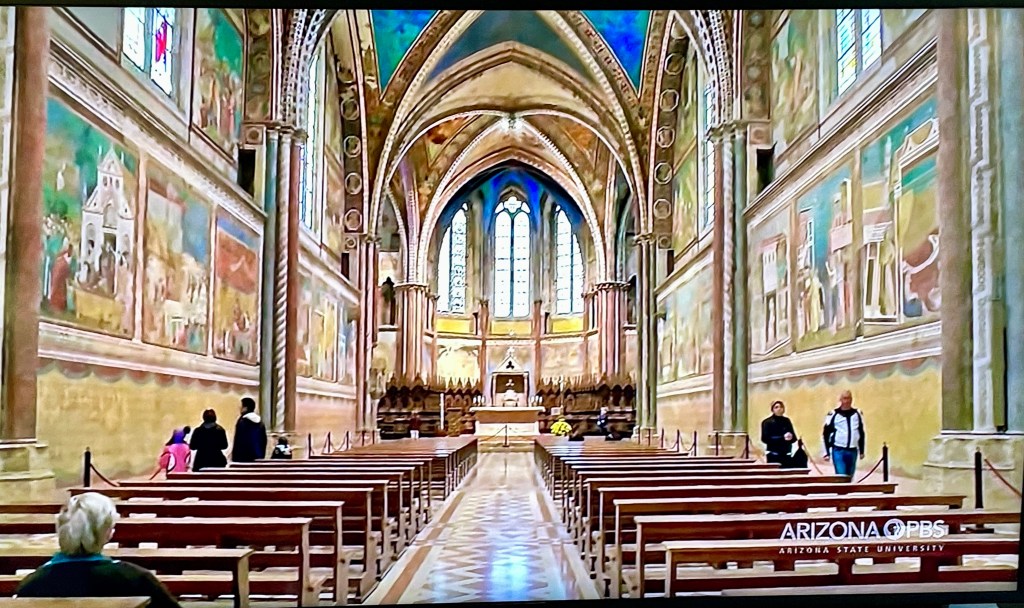
The lower church is Romanesque in style and is decorated with frescos of the life of Jesus. The colors are very vibrant having undergone cleaning.
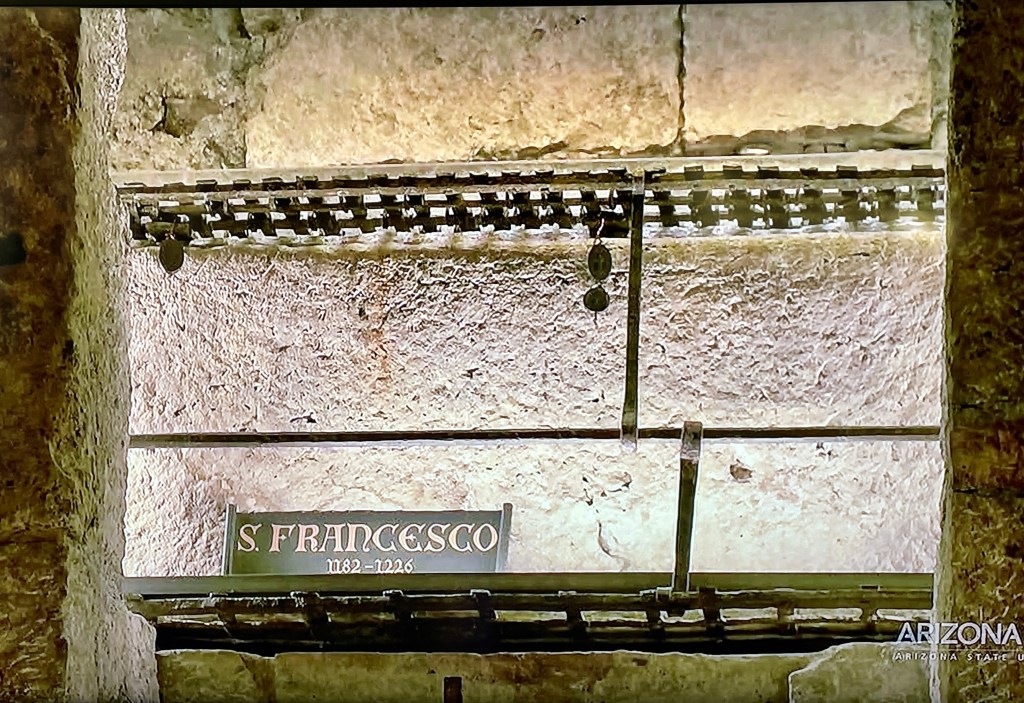
Below the lower church is a small chapel holding the remains of Saint Francis, just as the pope intended almost 1000 years ago.
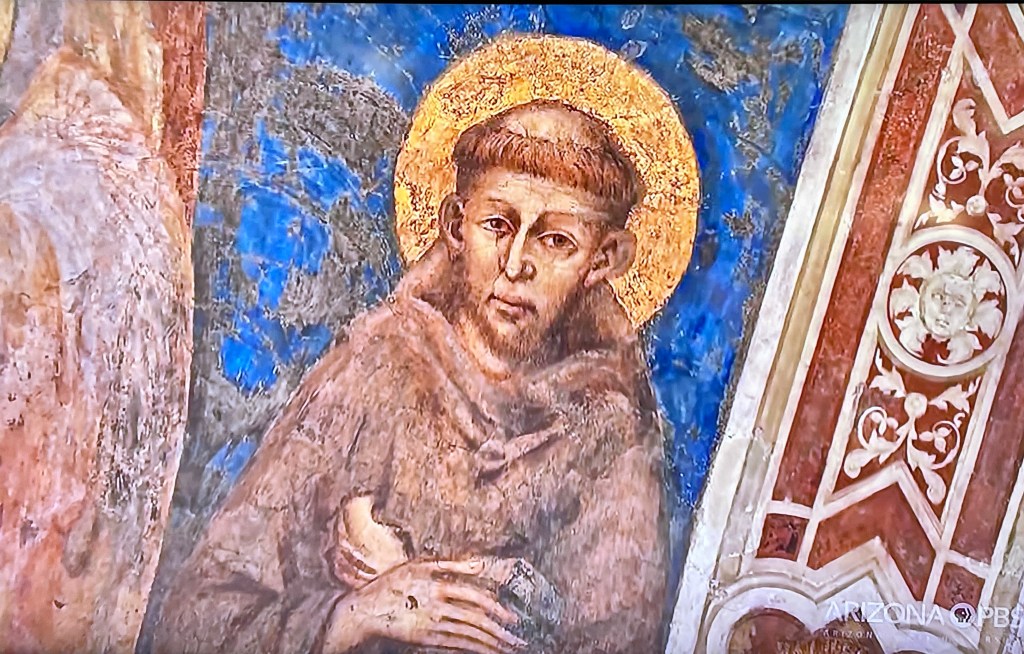
The upper basilica is 800 years old and was the first gothic style church in Italy. Giotto painted 28 scenes of the life of Francis. The photographs of Francis above are from the upper church.
Taking photographs was not allowed inside the basilica. Those shown above are photographs I took during a Rick Steve’s television program.
An earthquake damaged the basilica in 1997 and it was closed for two years while repairs were done. There were 80,000 puzzle pieces of frescos to put together. The repaired frescos are only 55 percent complete as many pieces were too small or destroyed to powder.
The Basilica of Saint Francis has been a UNESCO World Heritage Site since 2000. It is one of the most important sites on a Christian pilgrimage in Italy.
This is a view of the surrounding region. It is a lovely place.
The Peace Prayer of Saint Francis begins with:
Lord, make me an instrument of your peace: where there is hatred, let me sow love; where there is injury, pardon; where there is doubt, faith; where there is despair, hope; where there is darkness, light; where there is sadness, joy.
While the sentiments expressed could certainly be associated with Saint. Francis of Assisi, the prayer was not in his writings and didn’t appear until 1912.
The current pope symbolized his commitment to the poor in choosing the name Francis.
Our hotel in Sorrento was family owned. The mother had recently passed but her sons were keeping the hotel and restaurant business going. There were rooms facing the sea and some facing the olive groves.
We learned that olives are harvested in September and are best if they are allowed to ripen and fall naturally. Some farmers shake their trees to speed up the harvest. In Italy, only the first squeeze, called extra virgin, is considered worthy.
We visited a family farm where the goal is to grow crops to feed the animals to produce milk to make mozzarella, by hand, every single day.
We enjoyed a farm fresh dinner that included pizza made with fresh mozzarella.
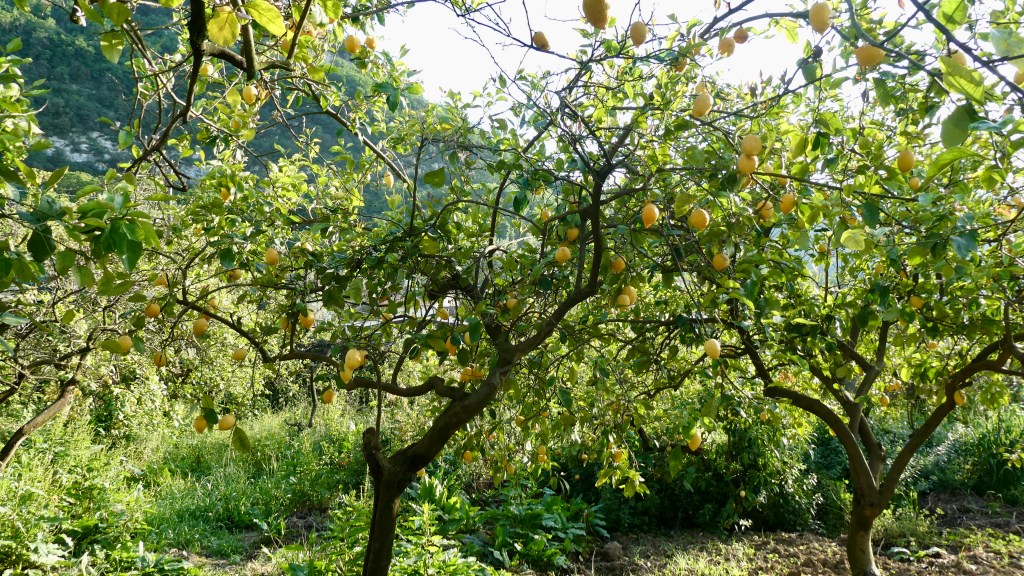
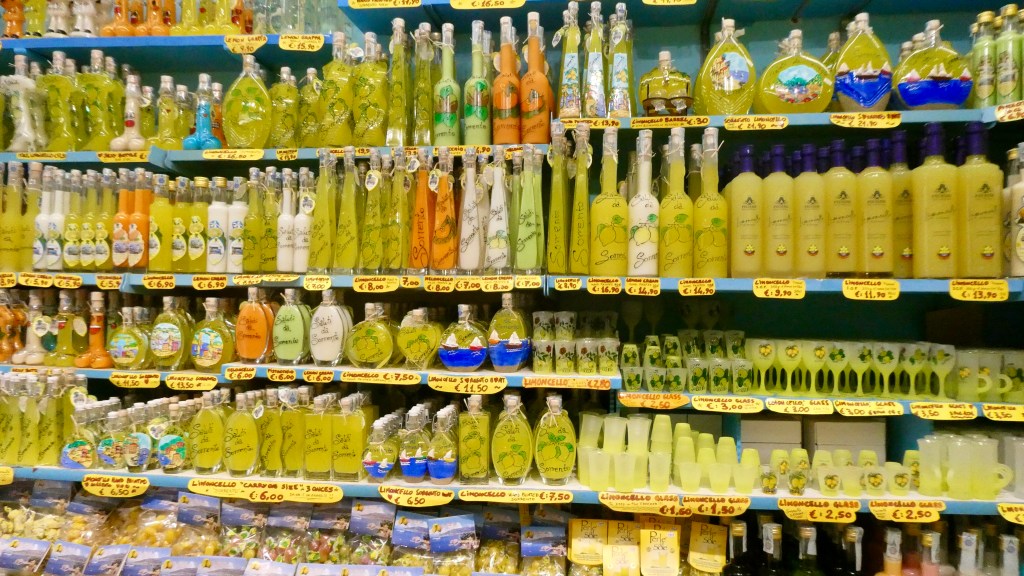
Sorrento lemons are grown to produce another product sold in abundance – limoncello.
We have enjoyed limoncello for years (and have even made our own) so we were excited to try authentic limoncello in Italy!
What we found was that authentic Italian limoncello was stronger, almost harsher, compared to what we enjoy. However, there was a limoncello cream version that we liked very much.
Sorrento’s economy is tourism based. Tourism started here in the late 1800s when the British Grand Tour became popular. Sorrento was, and is, a great location for visiting the Amalfi coast, Pompeii and the Isle of Capri.
We too visited the Isle of Capri! This statue welcomes visitors arriving by sea.
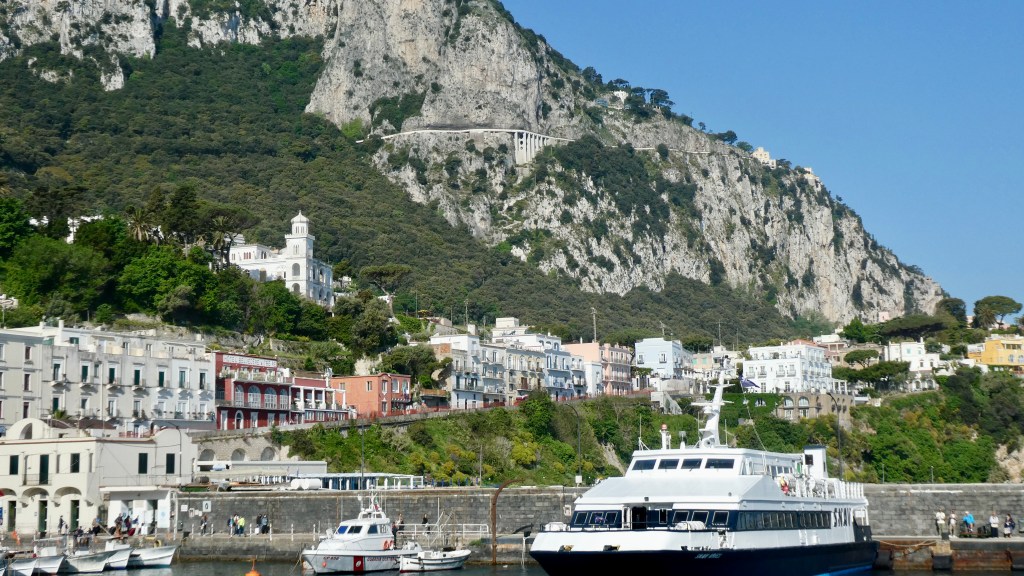
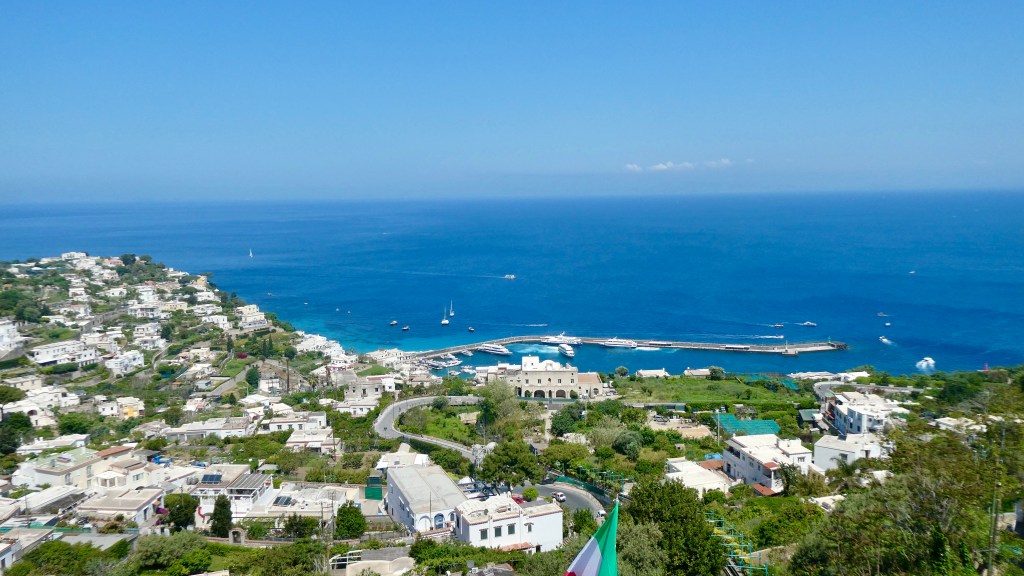
We came to Capri on a boat similar to this large one. These are port views.
Capri is six square miles, mostly mountainous. The population of 13,000 live in a small area. Capri gets water and power from the mainland using infrastructure under the sea.
We rode the funicular, built from 1904-1907, from sea level up to part of the city that overlooks the sea.
The goal is to keep the isle authentic, thus no new buildings have been erected since the 1950s. Improvements and changes can be made inside but the outside must stay the same.
The woman who owned La Parisienne clothing store invented what we know as capri pants after watching the fishermen bringing in their catch at the port. We were told that the first famous person to wear capri pants was Jacqueline Kennedy after seeing them in 1962.
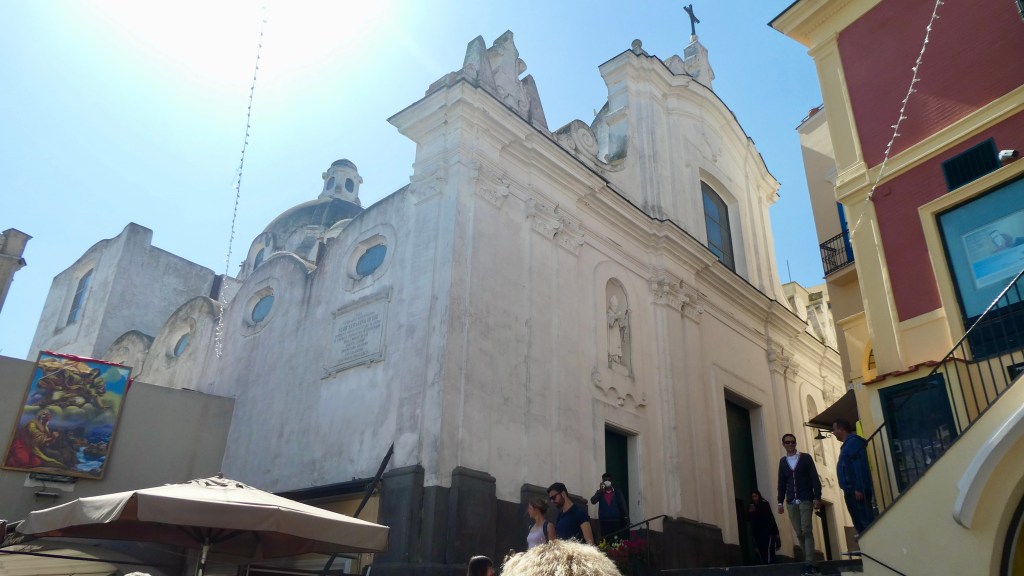
The Santo Stefano church is from the seventeenth century and is dedicated to Saint Stephen. In the Book of Acts, Stephen was one of seven deacons appointed by the apostles to care for the poor. He was the first Christian martyr.
During WWII, Eisenhower and Churchill met in a peach colored house in the distance.
Because of its location and beauty, the Roman Emperor Tiberius ruled from Capri for eleven years. He sent smoke signals to Rome from the top of the mountains. Tiberius had twelve villas on the island.
Caesar Augustus also had a villa and called Capri the “sweet place of doing nothing.” The commemorative Gardens of Augusta are named in his honor.
In the gardens we were above a former monastery, that was once used as a prison, that is now a high school.
Another building repurposed over time was a sanatarium that is now one of the main hotels on the island.
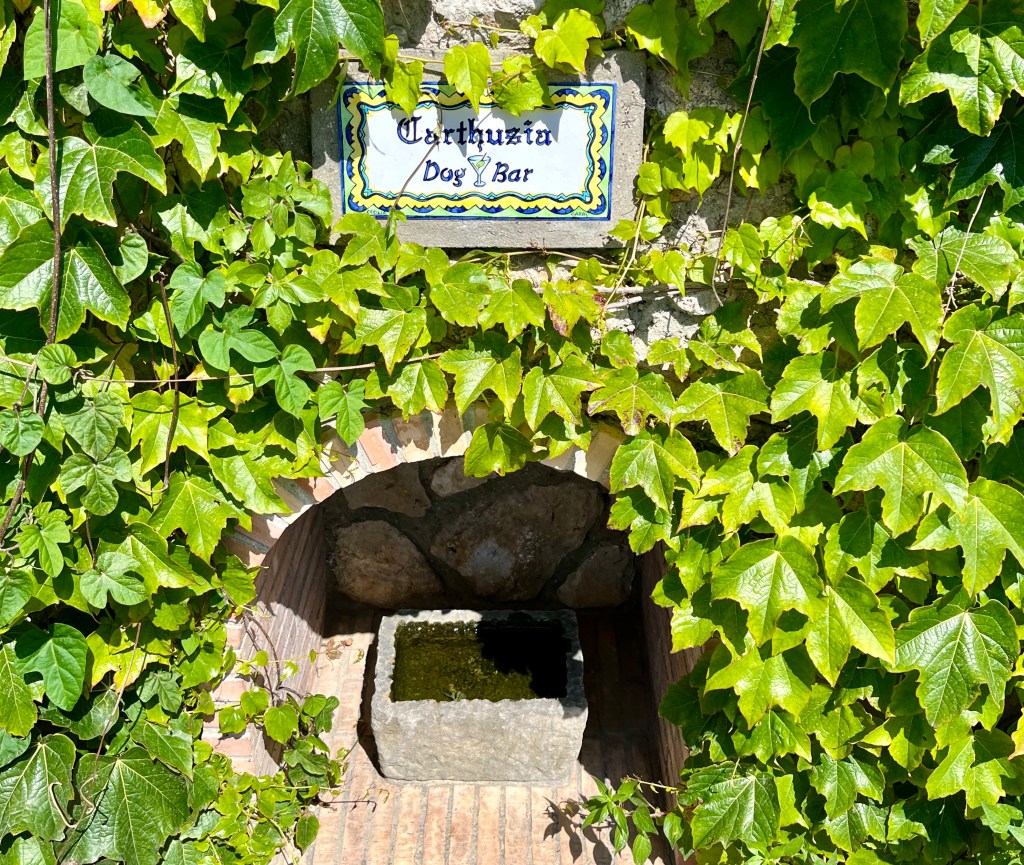
Even dogs can find a good drink on Capri!
One of the most famous things to see on Capri is the Blue Grotto, a dark cavern where the sea shines electric blue. It is so lovely that Tiberius had one of his villas built above it. Alas, we chose to see more of Capri from land and sea rather than focusing on just that one site.
After our land tour and wanderings on the island we took a boat tour around the east side.
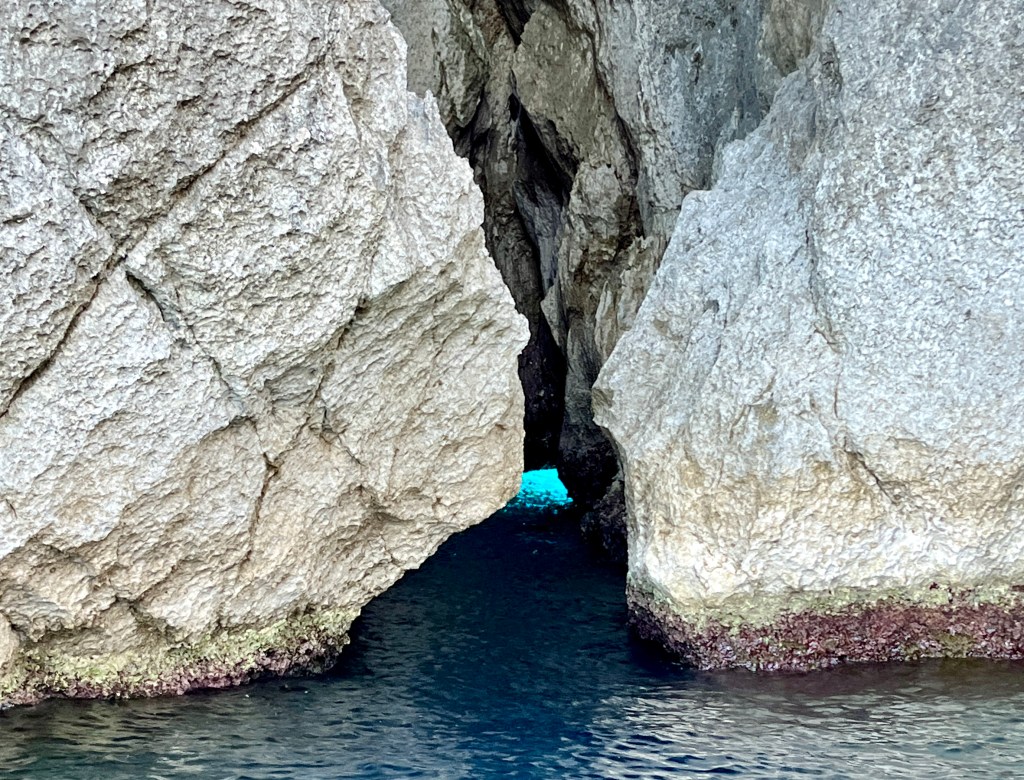
This is the Arco Natural, a natural arch of limestone.
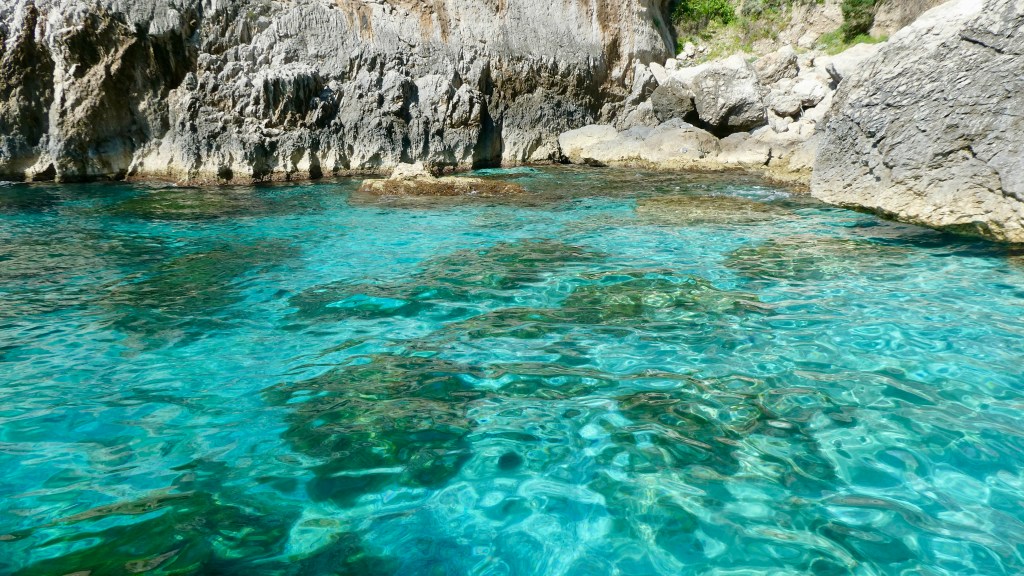
The inlet waters were very clear!
This was another boat doing our same tour.
We saw a glimpses of the little blue grotto. We’d love to return someday and see the big one!
Capri was one of Randy’s two favorite places on this trip. He agrees with Caesar Augustus that living here would be great since it is the “sweet place of doing nothing.” Sounds about right!
Pompeii, near the sea and in the shadow of Vesuvius, was a resort town for Romans 2500 years ago. There were about 20,000 full and seasonal residents. The city had a two kilometer main street and covered 66 acres.
The residents likely didn’t know Vesuvius was an active volcano because it was fully covered with vegetation and had been dormant for 700 years.
The area had experienced damaging earthquakes before but on October 22, 79 AD the quaking started in earnest. Many people with other places to go left.
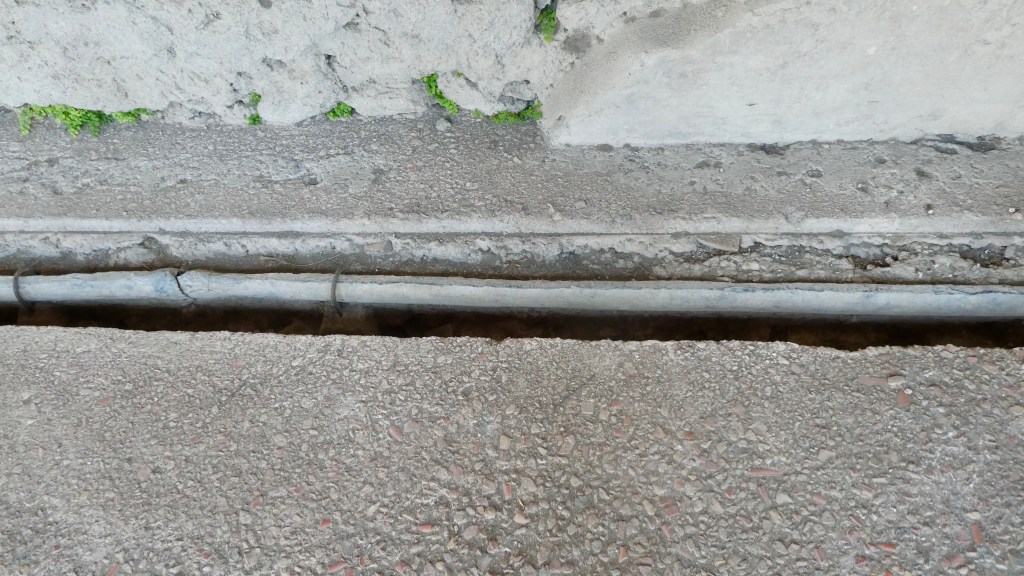
The lead pipes supplying water to the city broke disrupting water availability – another reason to leave Pompeii.
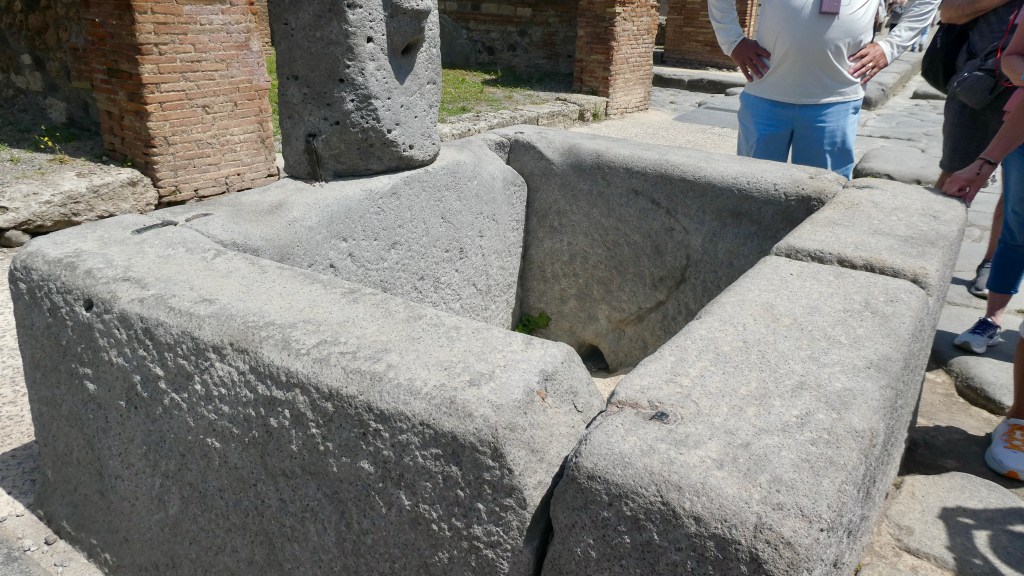
Water would have been unavailable in the street water stations.
Two days later, October 24, 79 AD, those who remained, two to three thousand of them, were trapped in Pompeii. Within 24 hours they were all killed by blasts of pumice, carbon monoxide, and extreme heat.
Over the next three days, the city of Pompeii was covered with 21 feet of ash.
Pliny the Younger, living near Naples was a witness to the eruption and wrote about it years later. Pompeii was forgotten until his letters were found in the 16th century.
Pompeii was discovered in 1748 when surveying engineers were laying water pipe in agricultural fields.
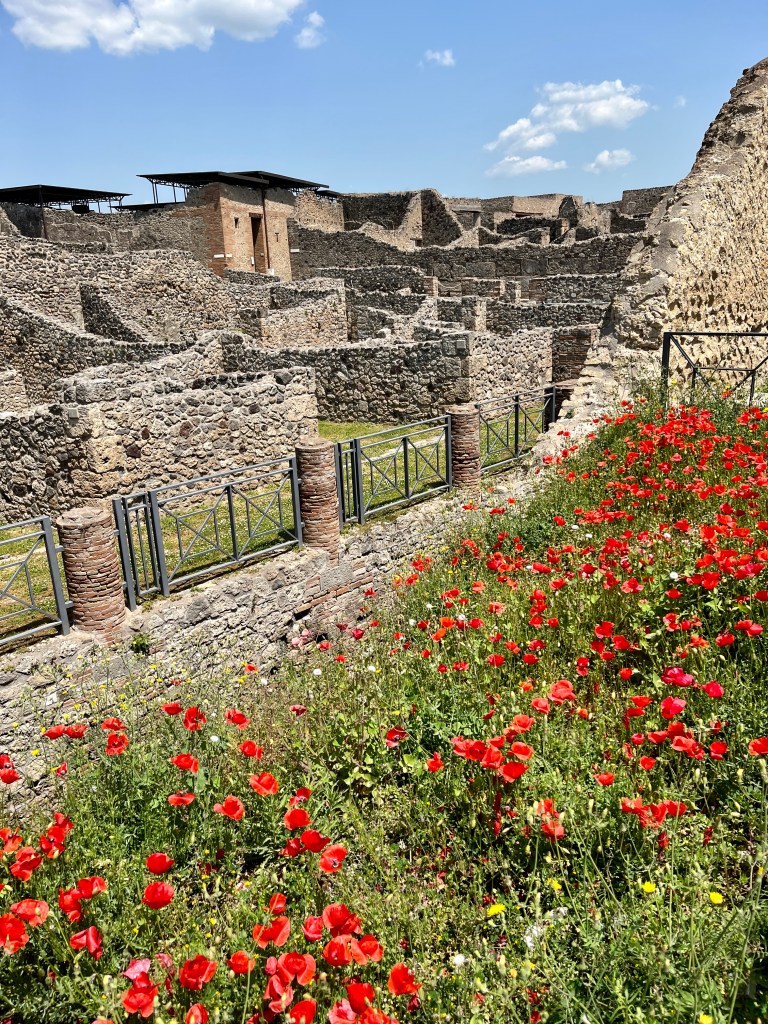
Excavation began, revealing a complete Roman town. It covered one square mile and included mansions, small homes with shops, and fast food bars.
This was a three story mansion.
Over two hundred and fifty years later, archeologists are still present. Only 65% of Pompeii has been excavated.
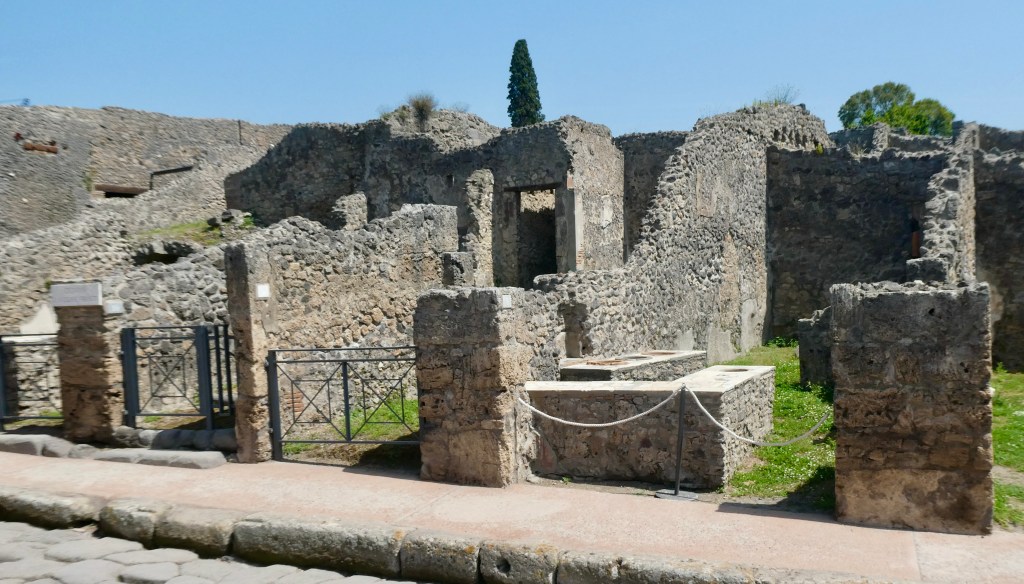
Some of what is assumed about activity in Pompeii corresponds with what is similar in nearby Napoli. The L shaped fast food stand in the picture above is still common in Napoli today.
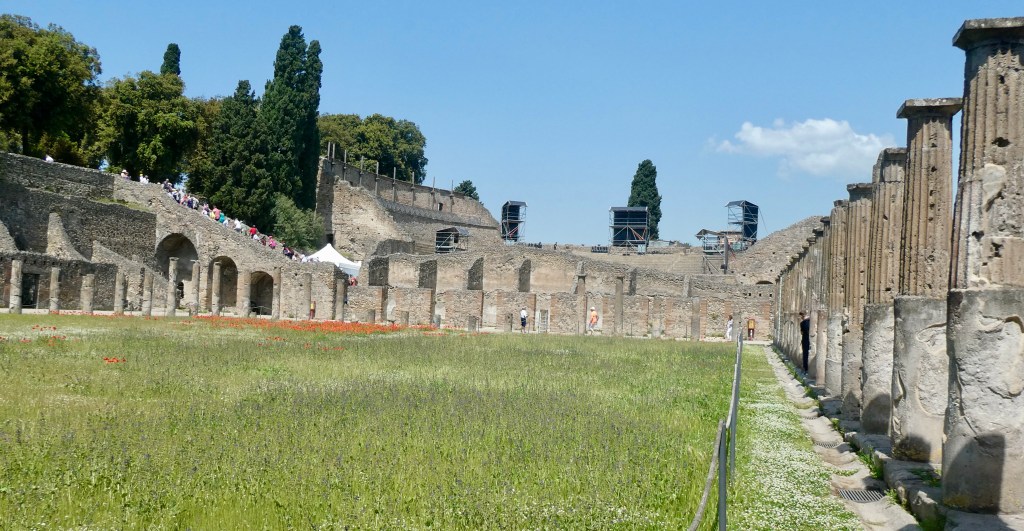
This open field would have been used in training gladiators. Like Roma, these gladiators would have been slaves trained for this purpose.
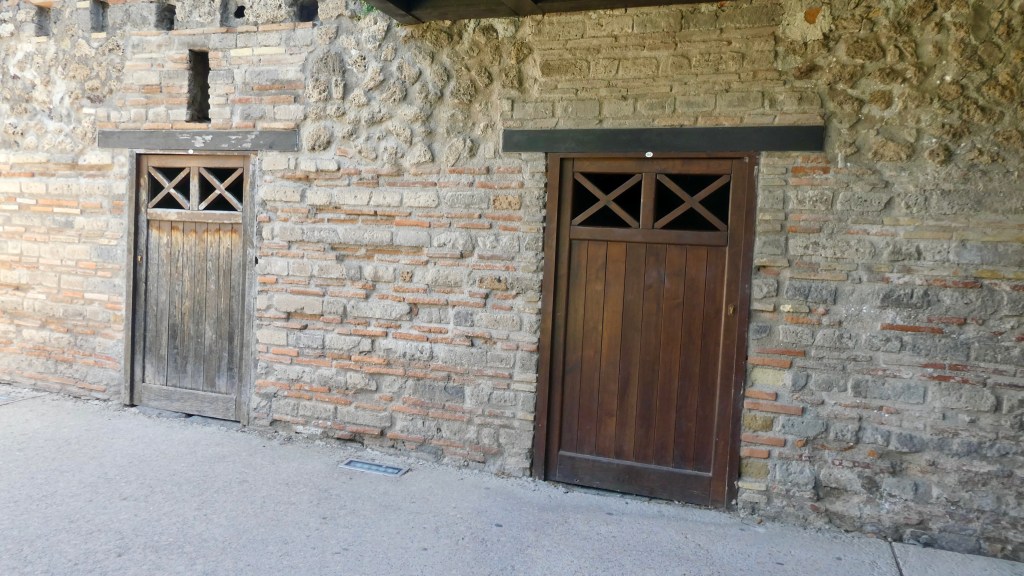
These were their quarters.
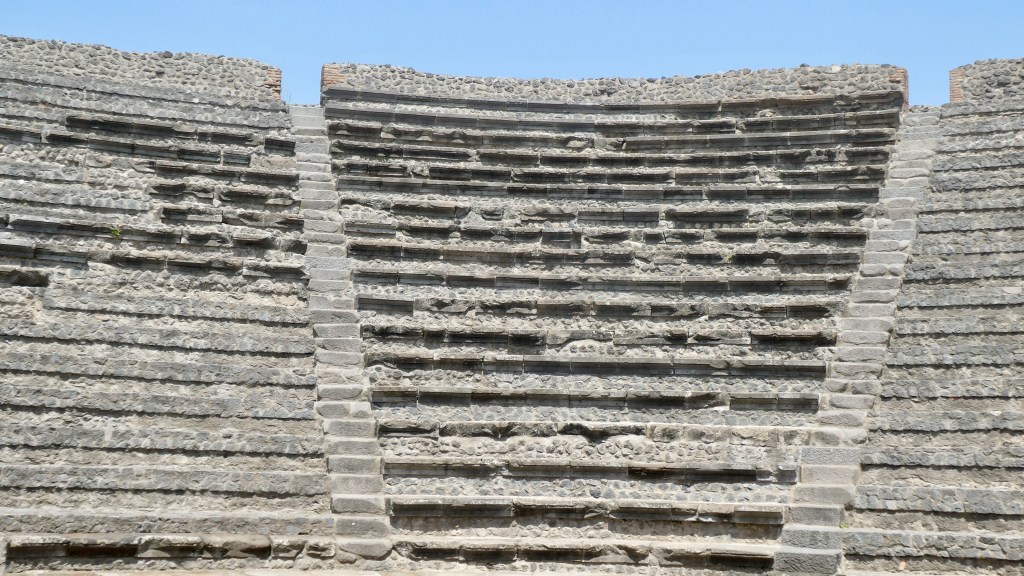
The Pompeii amphitheater seated 15,000 people. Frank Sinatra got special permission to hold a concert in this amphitheater in 1991.
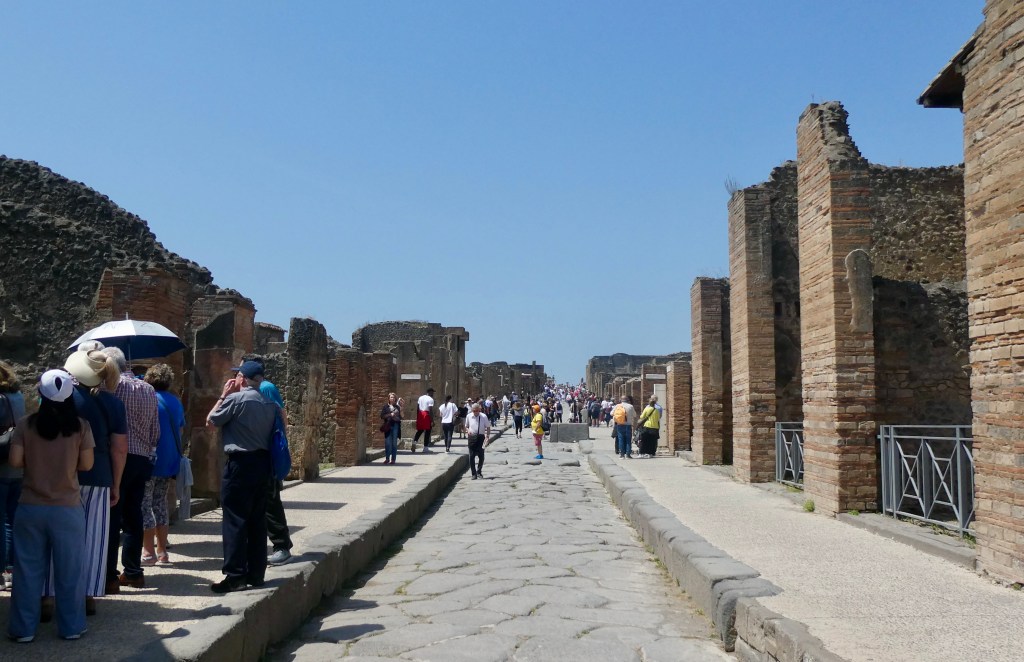
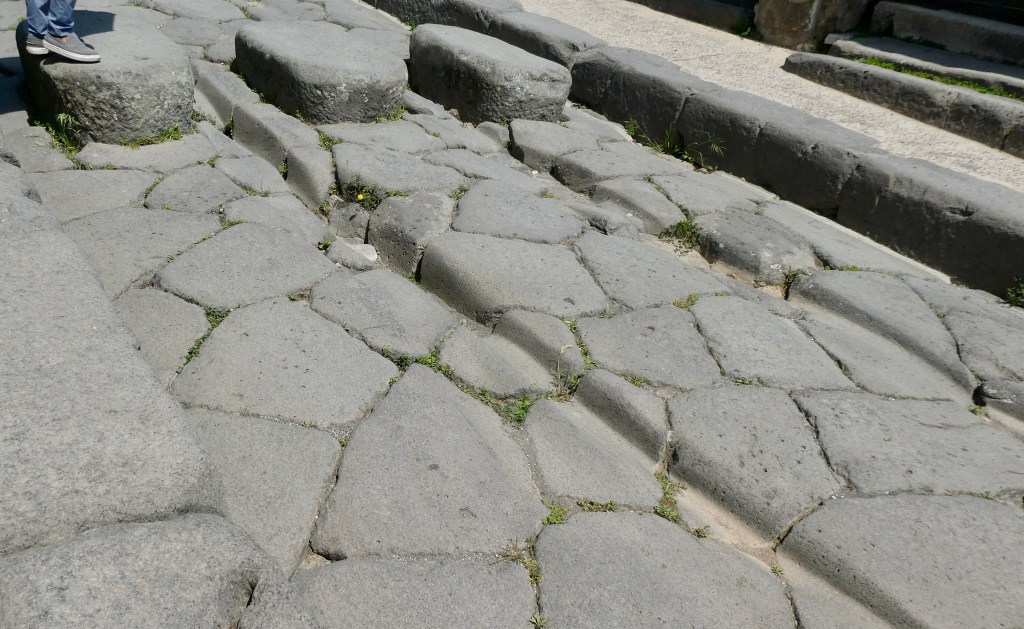
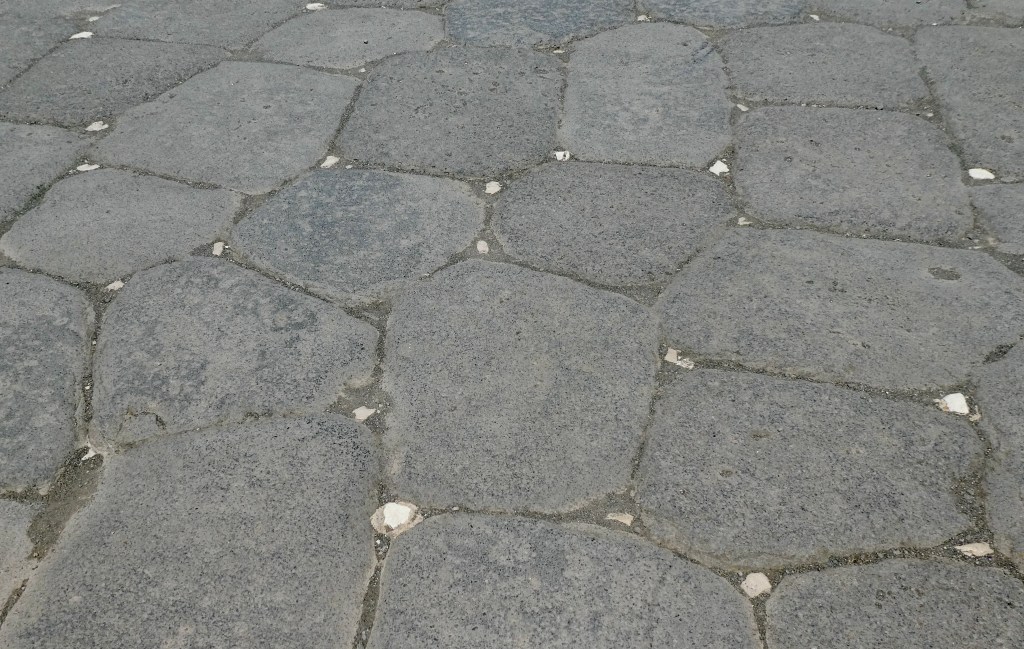
The stepping stones were to help when crossing the street during the rain. The openings are perfectly spaced for carts and chariots.
Heavy grooves are visible.
Penis blocks were placed to provide sailors directions to the sex district.
Light colored stones were nestled into the main roads to help direct people after dark. They would reflect in the moonlight.
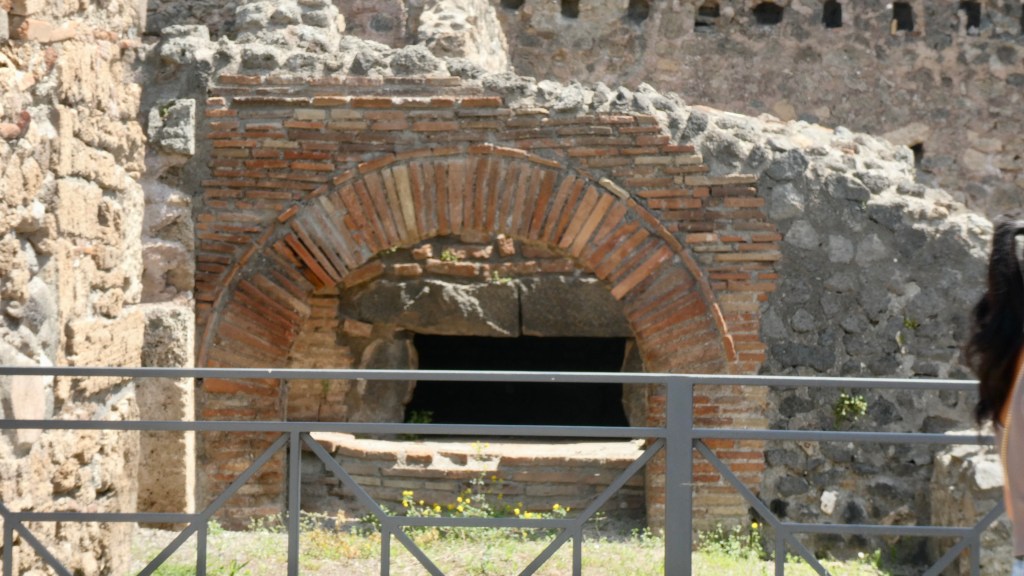
Many buildings were shops with homes in back. There was bread found in this oven when it was first excavated!
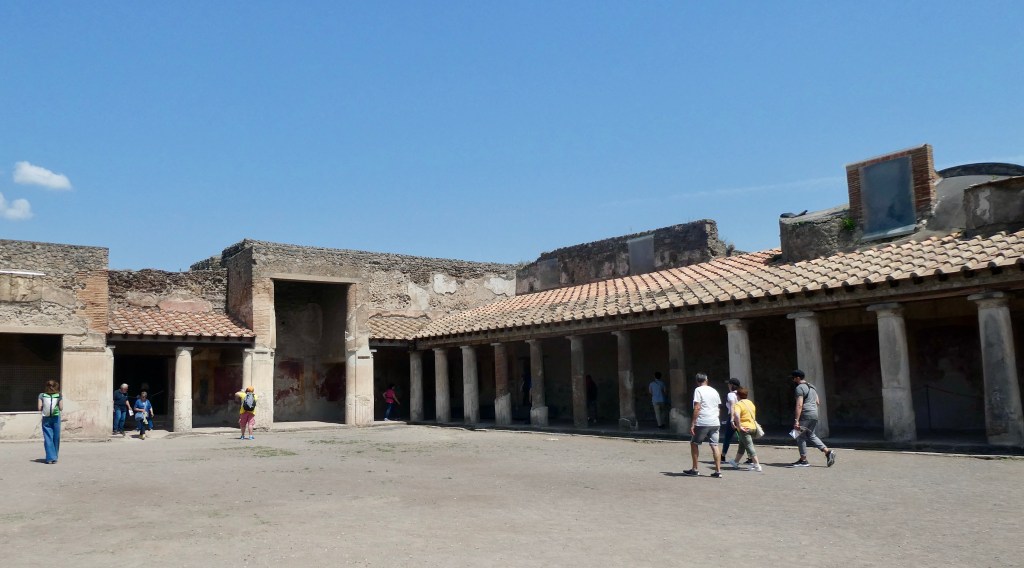
This was a spa area. Spas and baths were for everyday health, not an extravagance just for the wealthy.
Decorative carvings are still visible.
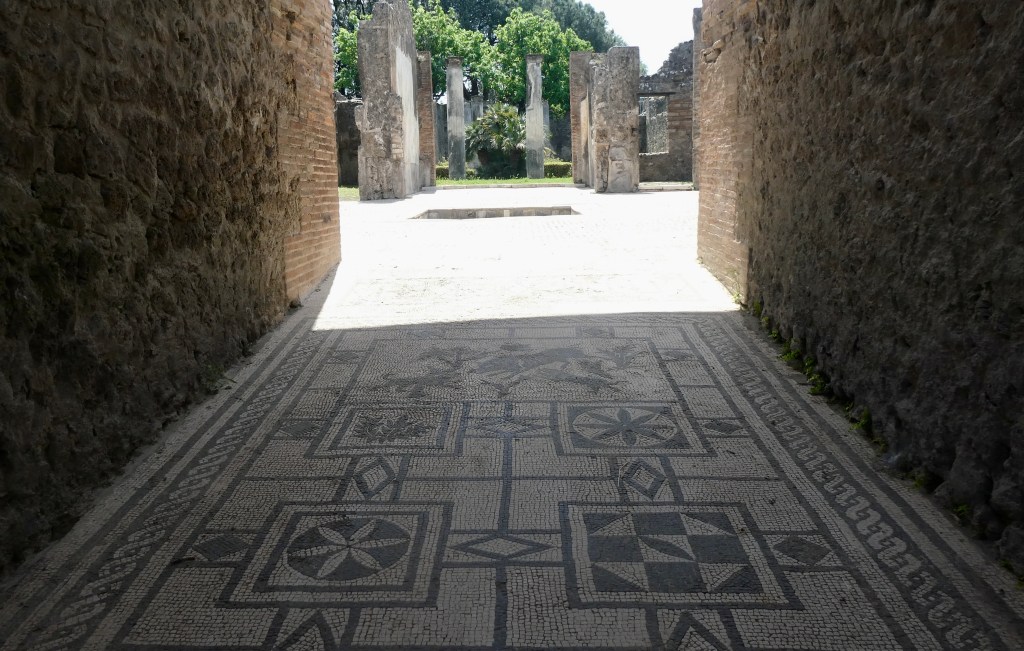
The original mosaic floor is still intact at the entrance to this house.
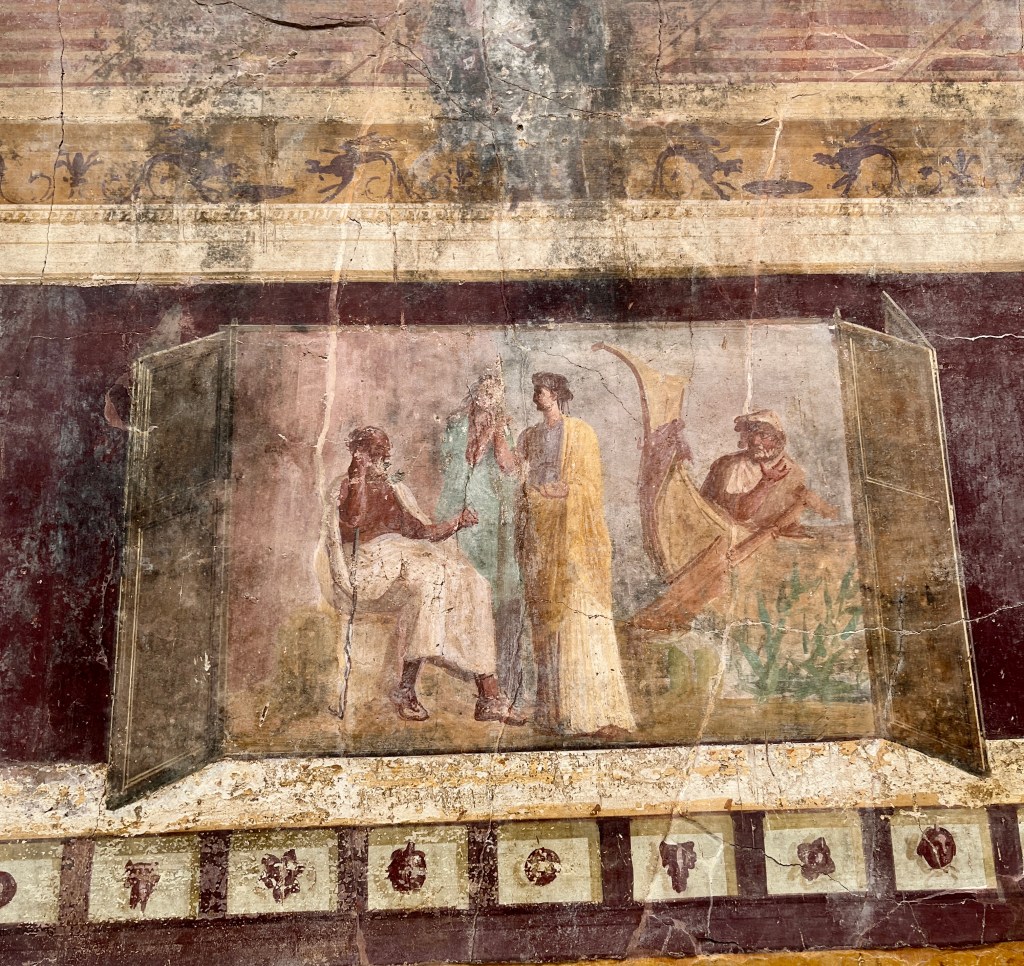
Original frescoes are still vibrant after being protected under ash for so many years.
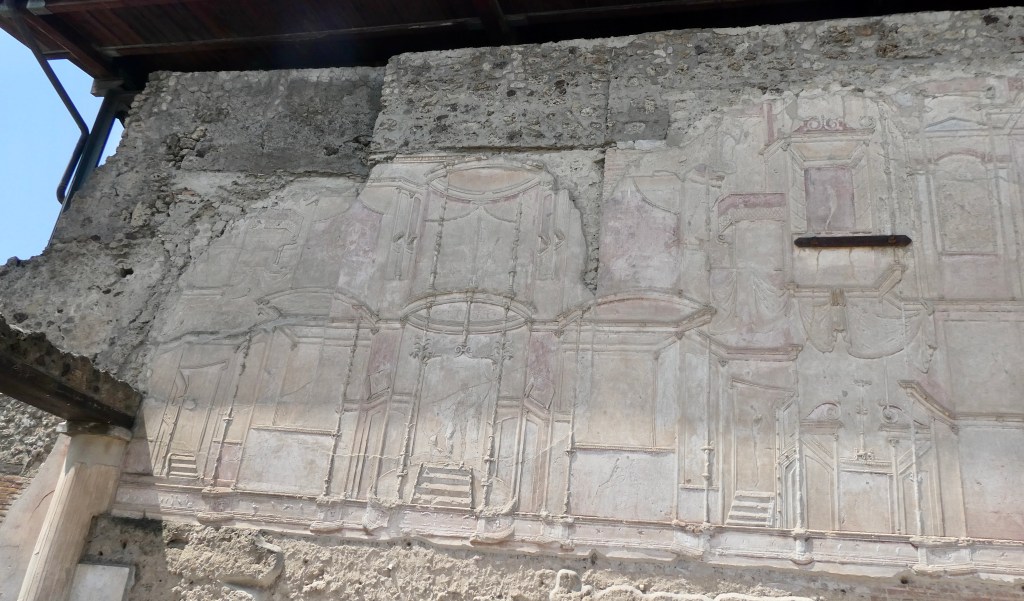
Some buildings were highly decorated.
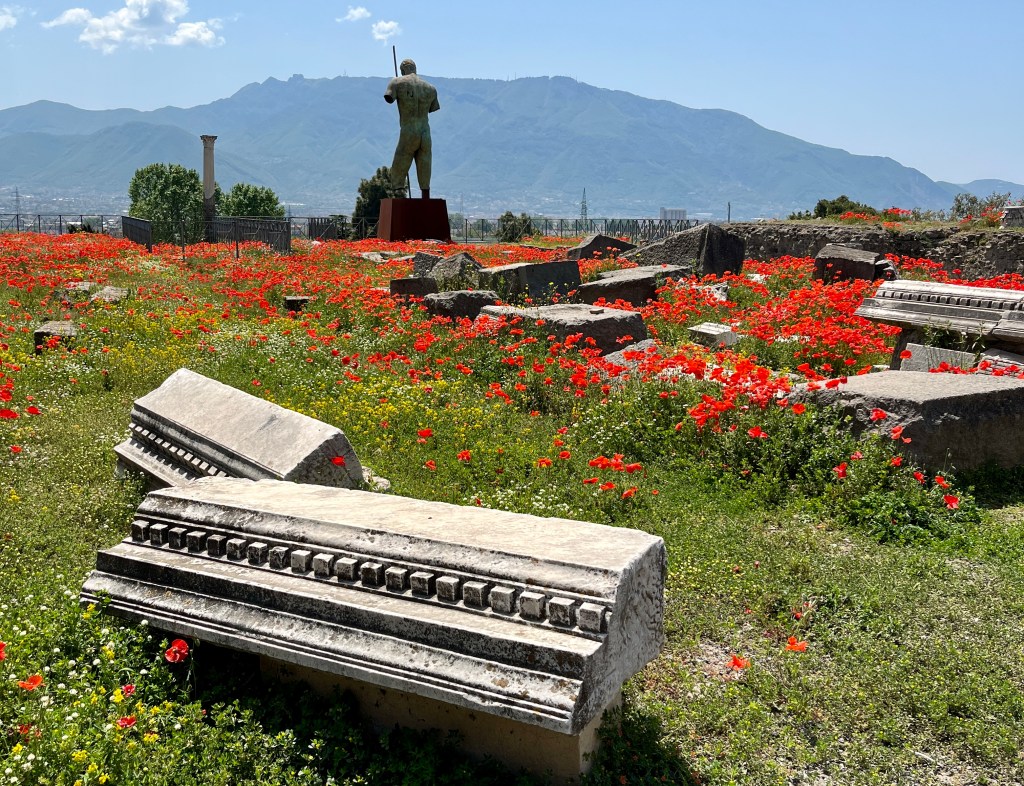
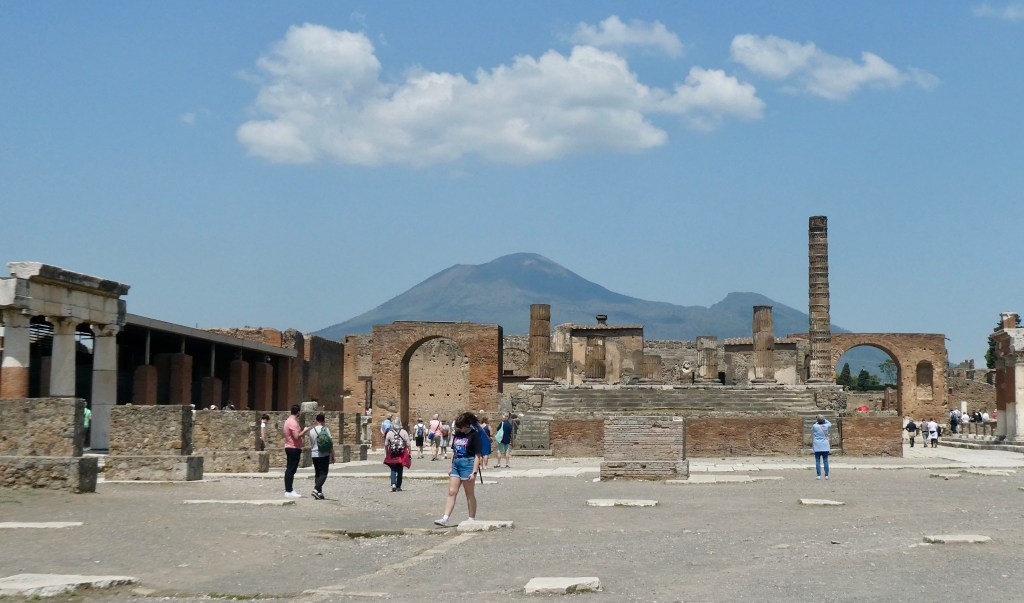
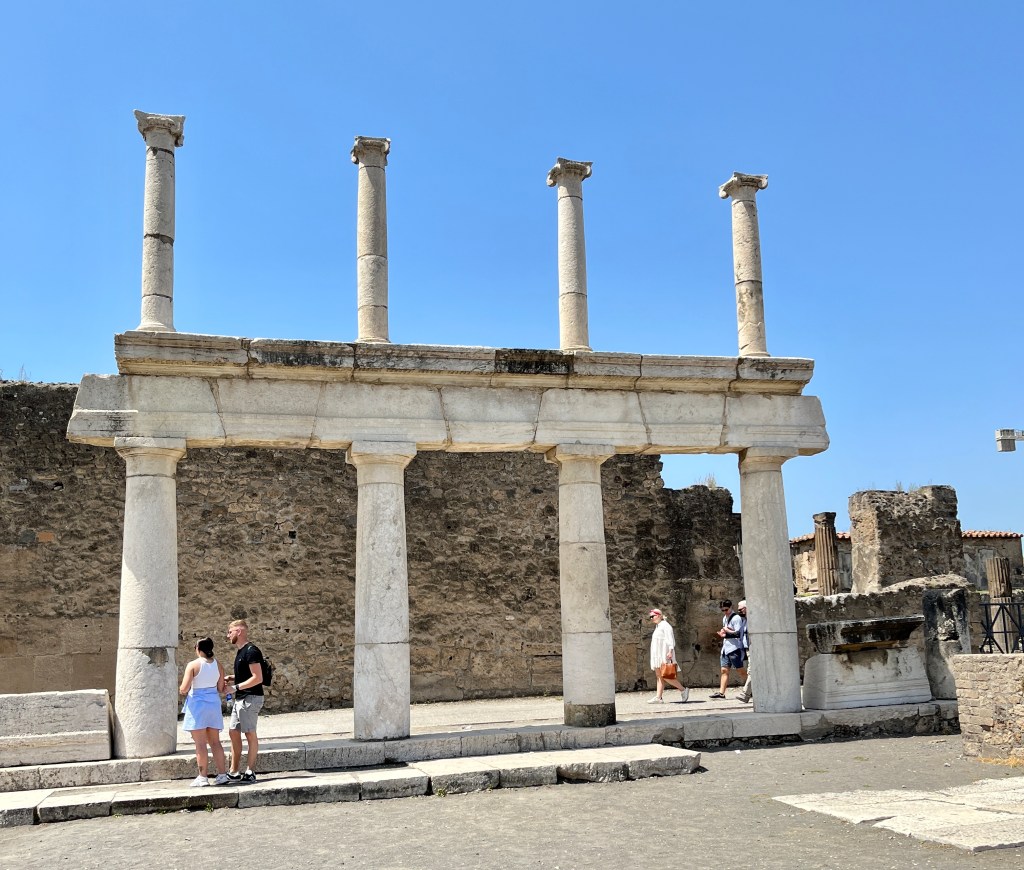
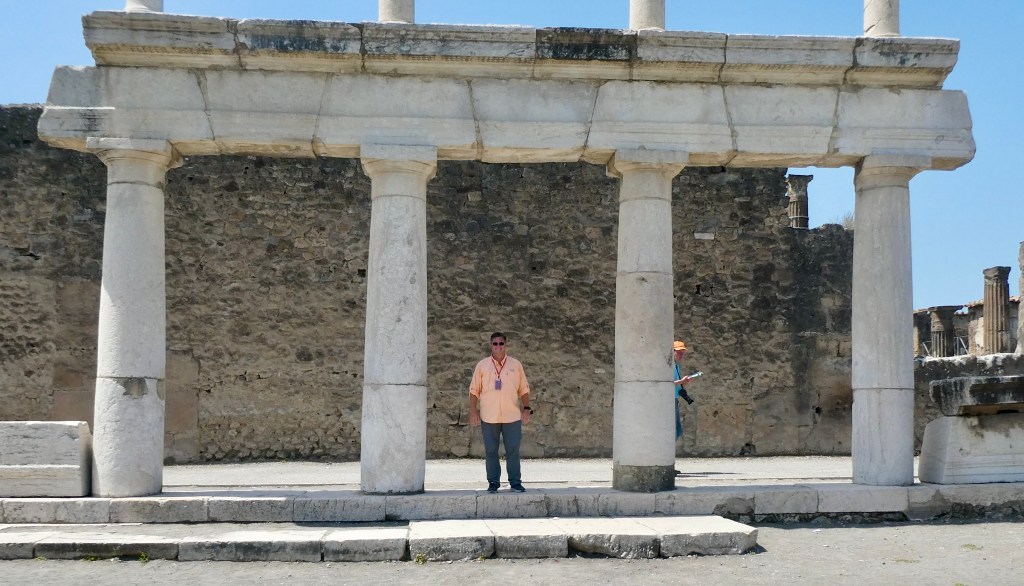
This was the forum, or main square, in the town of Pompeii. It was the first area excavated and took 25 years to complete. The Temple to Jupiter is at the end of the square with Vesuvius in the background.
The square also included a market area, a government area, and a palace for the ruler.
This was once a covered seating area on two levels.
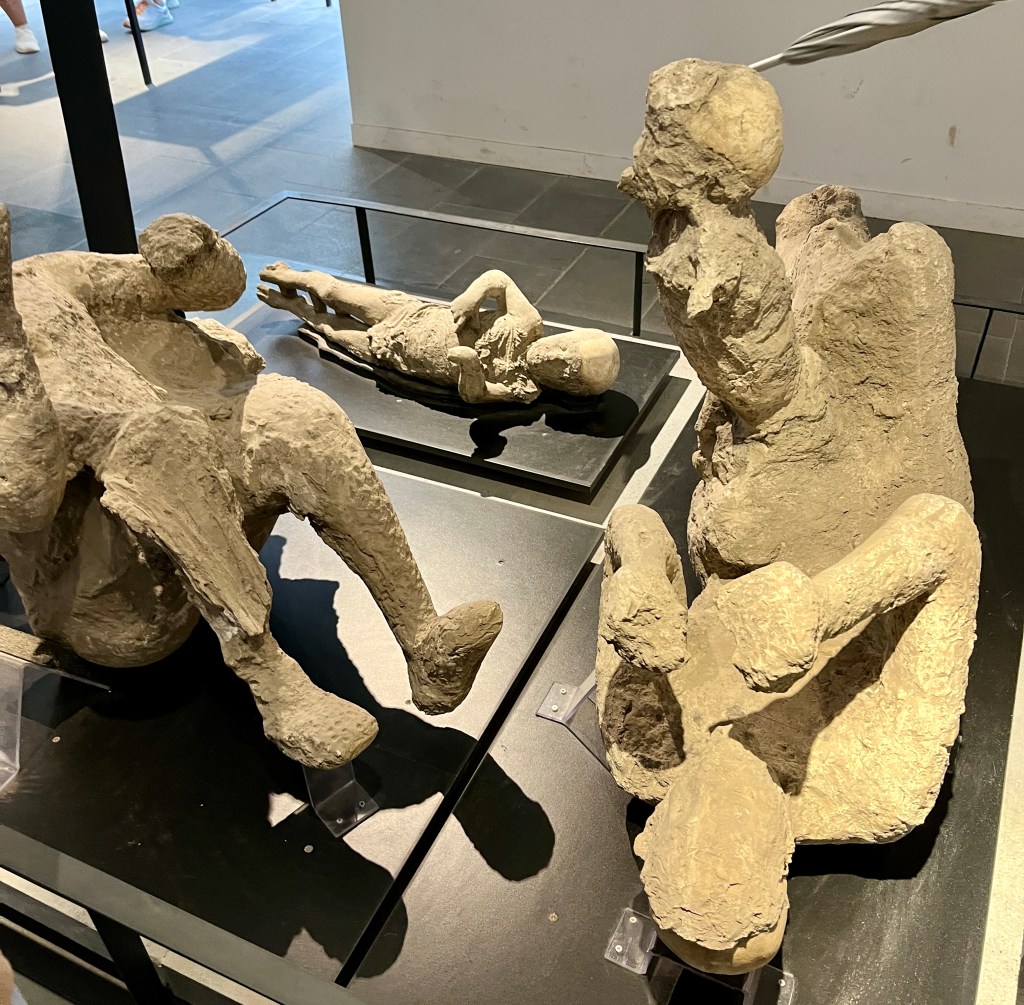
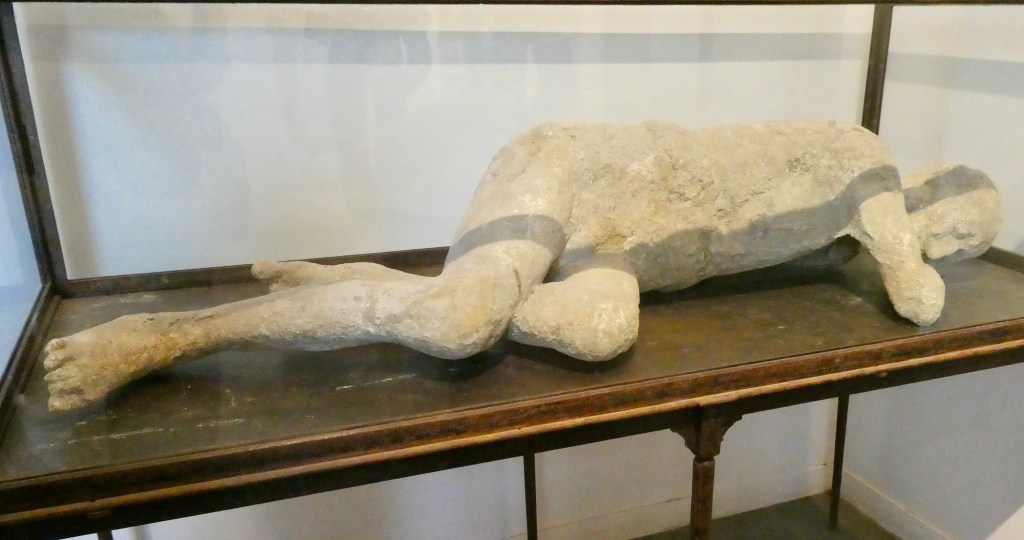
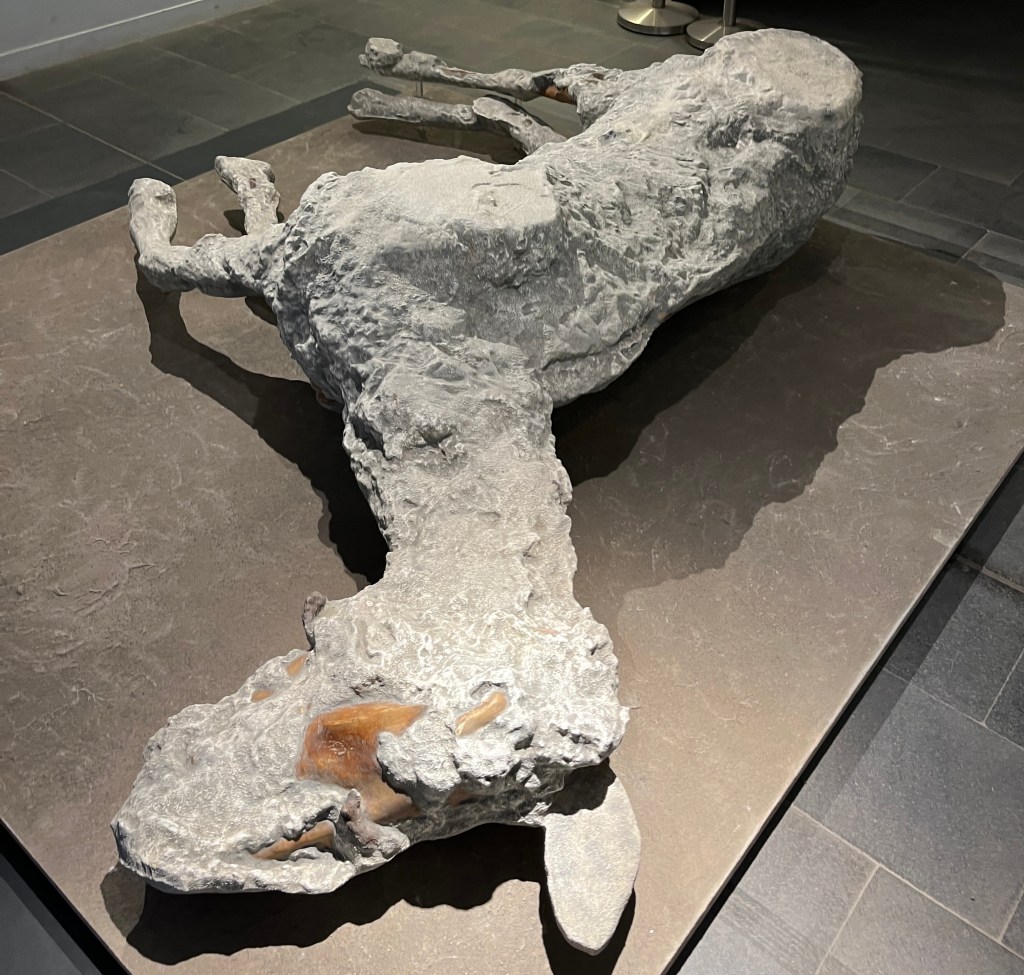
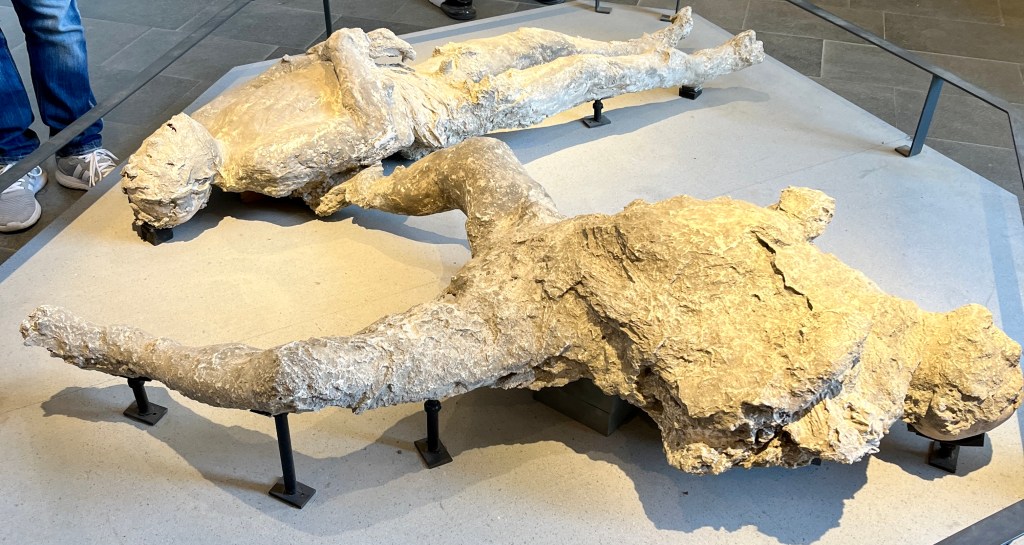
An eerie aspect to visiting Pompeii is seeing the bodies of people and animals caught in time as they died.
The bodies were encased in hardened pumice and ash for almost two thousand years. The real bodies decomposed but when scientists injected plaster into the cavity where the body had been, these delicate casts were created.
One hundred and three bodies were cast. CT Scans have been completed on some of the casts and skeletal remains have been found within the casts. The results have sometimes changed assumptions about the person’s gender and age.
So far, forensics on skeletal remains, many outside of casting, indicate that 394 people died from the initial pumice reining down from Vesuvius and from collapsing buildings. Most of the others would have died from poisonous gasses and extreme heat. Lava flow did not reach Pompeii.
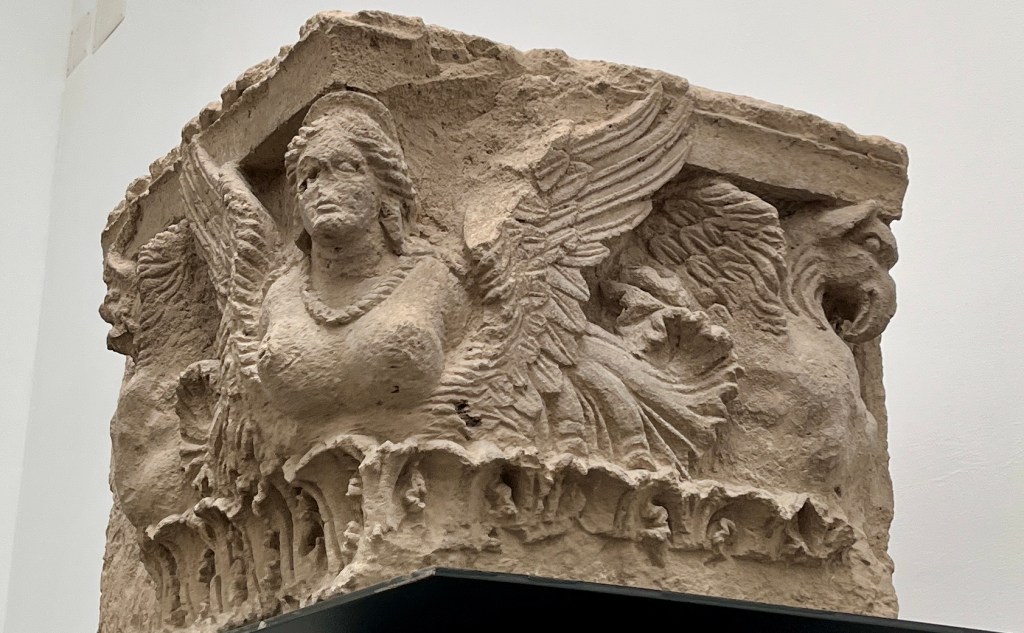
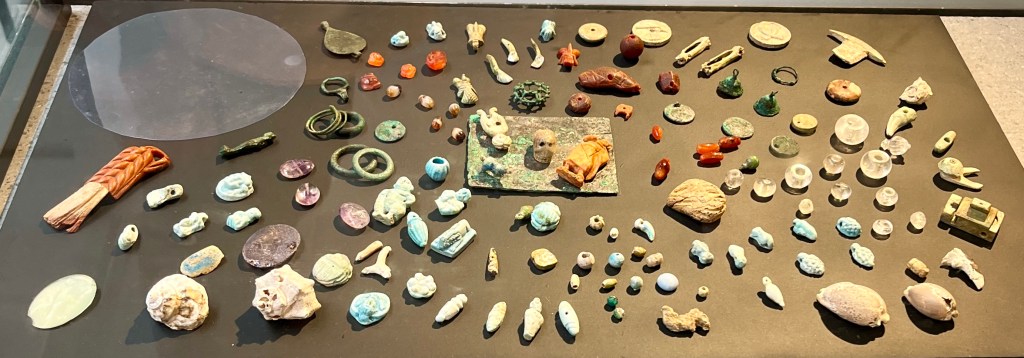
These are some artifacts uncovered in Pompeii.
Many of the casts, and the best of the artifacts, are in the Naples National Archeological Museum. Naples is in the red zone for any future eruptions by Vesuvius. It last erupted in 1944.
We learned that it is possible to go up to the Vesuvius crater and that would be interesting to do. Also interesting would be a visit to Herculaneum, a smaller town and archeological site nearby destroyed by the same eruption.
Some Italian manners advice given to us by our Pompeii local specialist: “You are allowed to push, but you need to smile.”
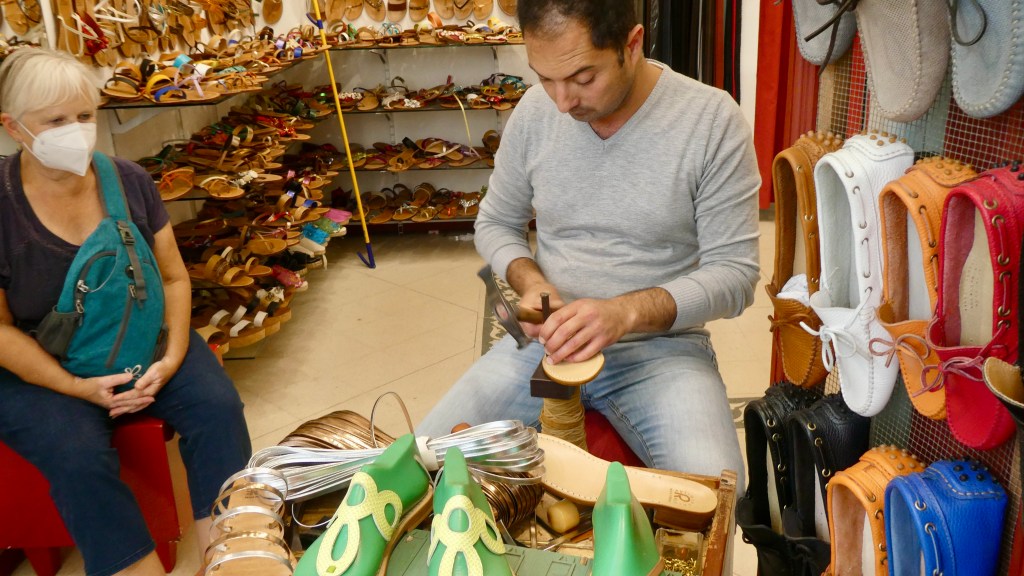
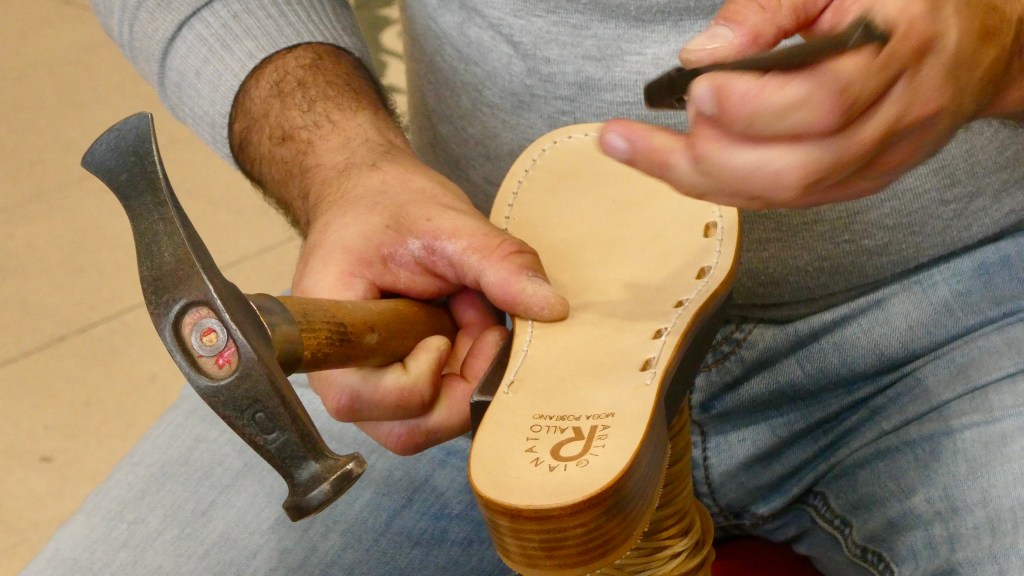
That same day we also visited the nearby sea village of Positano. It is famous for ceramics, linens and individually made sandals and shoes while you wait.
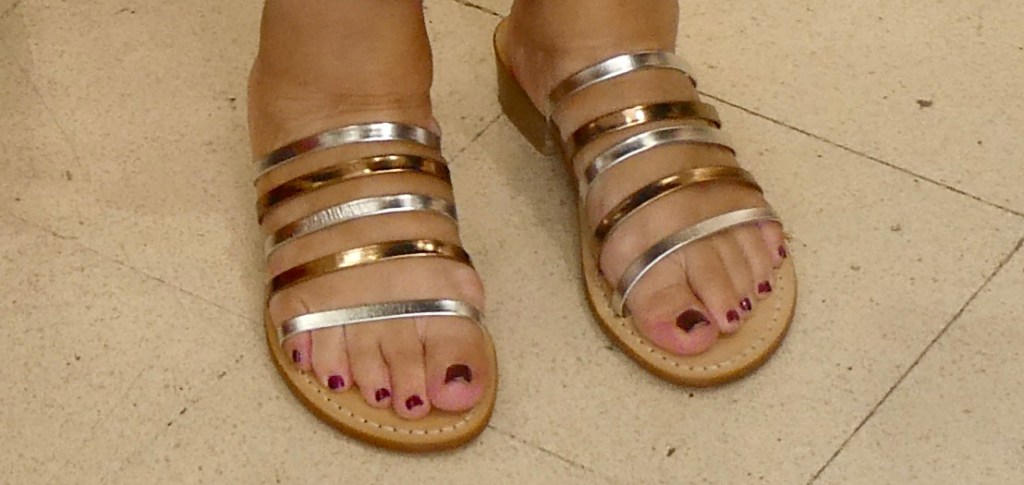
Our suitcases allowed for very few souvenirs on our five week trip – but I though a pair of flat sandals could fit.
Our day in Roma was very full! We saw so much. Here is the wrap up!
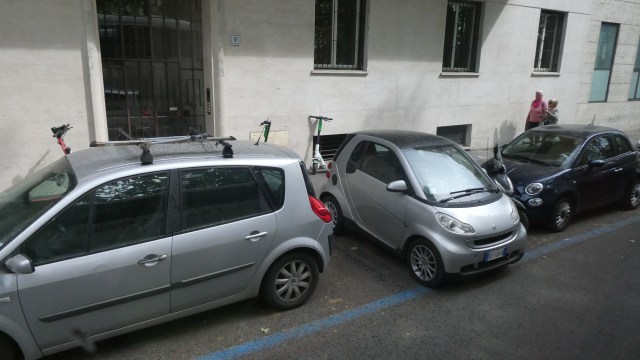
First, I just have to give you another picture of creative parking because I love it so much!
Have a look at this clock. Is there something different than you expect? We saw this iteration many times.
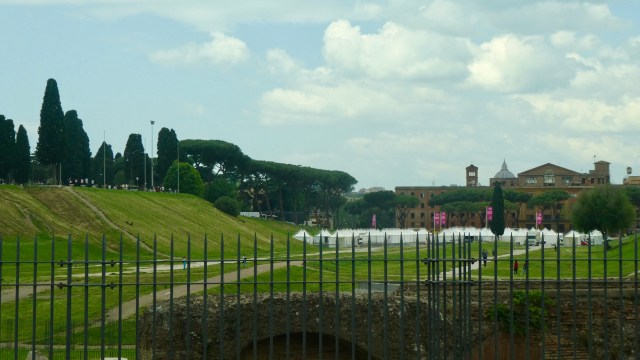
We drove by Circus Maximus where chariot races were held. Circus Maximus was also involved in a post Julius Caesar power struggle.
Brutus had been instrumental in Julius Caesar’s murder in 44 BC and tried to control the narrative that Caesar was bad so killing him was justified.
Mark Antony had been Caesar’s second in command and had a different perspective. Thus, there was a power struggle between Mark Antony and Brutus because both saw themselves as the next leader of Rome.
Caesar’s heir, teen-aged Octavian saw himself as relevant. He came back and met with Antony who didn’t take him seriously. Antony accommodated Octavian hoping that he would battle Brutus.
The battle was for public opinion. Brutus orchestrated great games held at Circus Maximus including theater, chariot races and wild beasts.
Octavian countered with his own games and had the good fortune to have a comet streak across the sky while they were in progress. Octavian used the comet as a sign that Caesar approved of him as the next leader.
Brutus tried to take over by military force and failed. So did Mark Antony who then went off with Cleopatra.
Octavian became Augustus Caesar in 43 BC and was the first emperor of ancient Rome.
These old palace ruins were where most emperors lived.
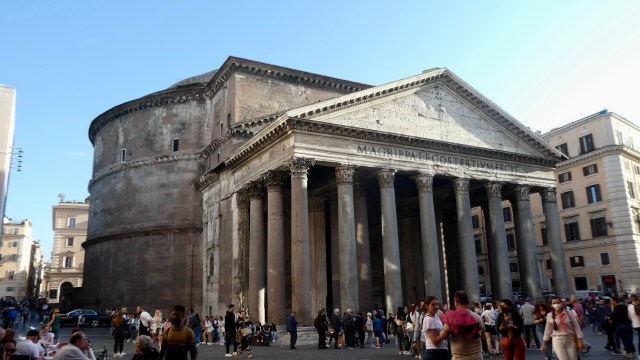
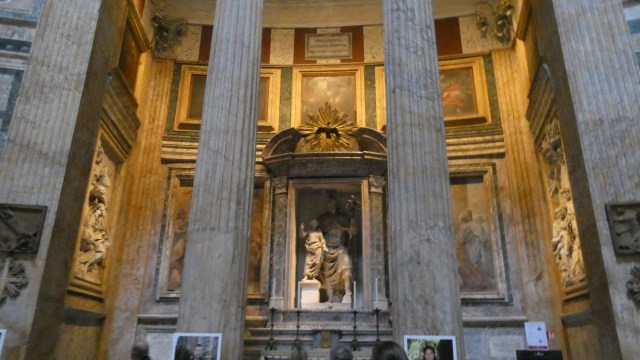
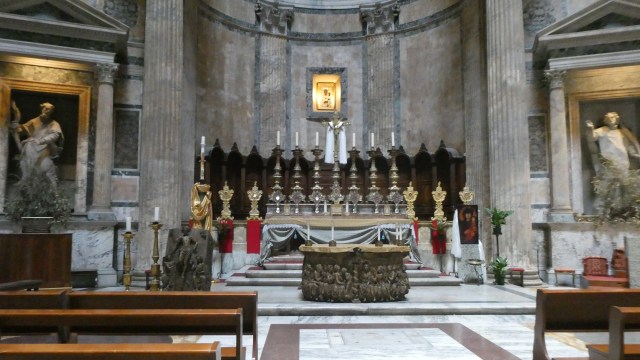
This is the Pantheon. Actually it is the third Pantheon, built on the same site as two earlier versions. The first was destroyed by fire in 80 AD and the second was struck by lightning in 110 AD and burned.
This Pantheon is the oldest building in the world that is still in use.
Built in 125 AD, it was a Roman temple. It has served as a Roman Catholic Church since the 7th century.
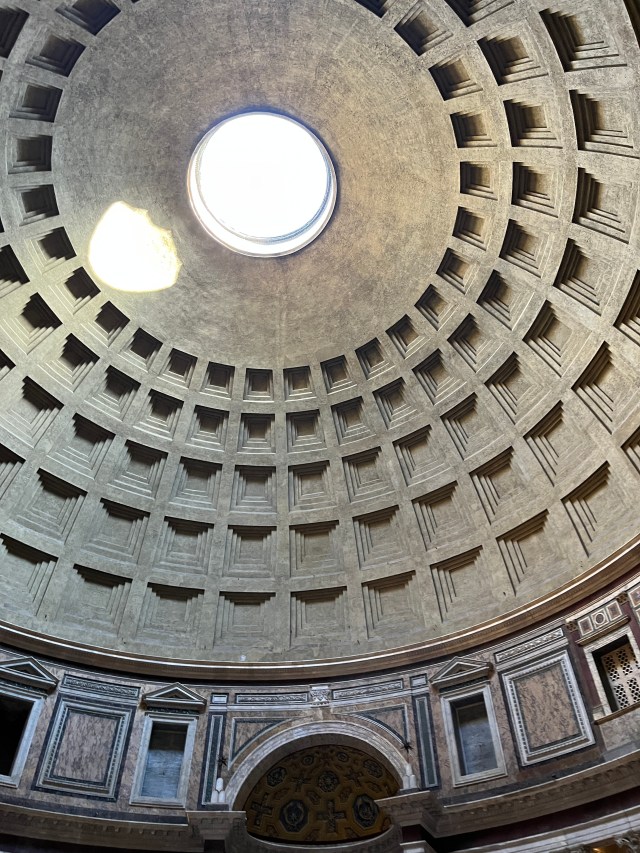
The pantheon had the world’s largest unreinforced concrete dome and no one built a larger dome for over 1000 years. Research about the history and present status of “largest domes” was a rabbit hole I entered but chose to exit quickly. I am satisfied that the dome at the pantheon was unique, for at least a significantly long time, and very impressive.
There is a nine meter wide hold in the roof by design – saving weight at a vulnerable point. It was raining the day we were there and the floor has a drainage system.
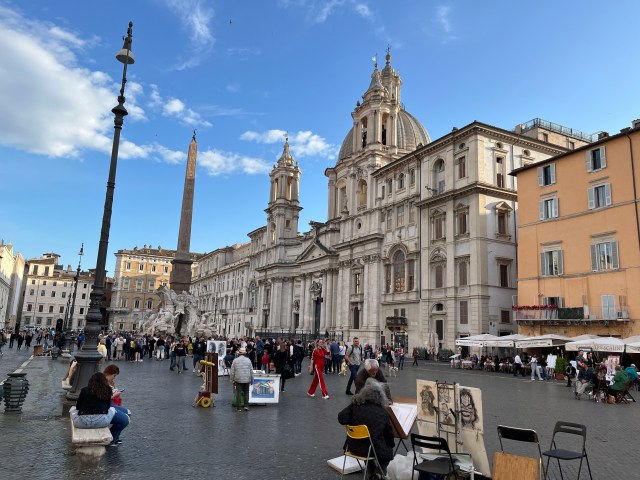
We visited the Piazza Navona and it looked similar to many piazzas we saw with great historic architecture surrounding open space with eateries on the perimeter and artisans in the middle.
The Fountain of the Four Rivers is a centerpiece topped by the obelisk of Domitian (that Domitian we learned about in the Colosseum post).
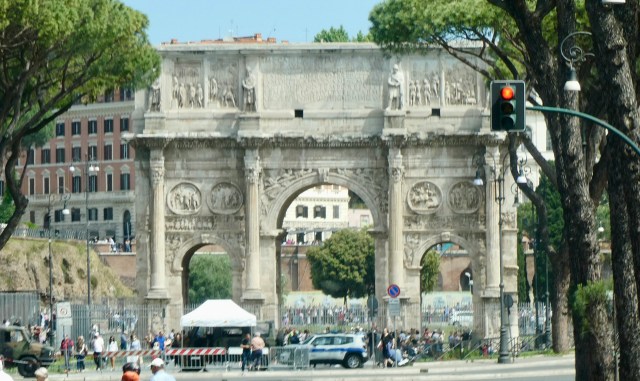
The Arch of Constantine is a triumphal arch – that being a freestanding arch generally over a road or walkway. This was was dedicated to Emperor Constantine the Great to commemorate victory over Maxentius in 312 AD.
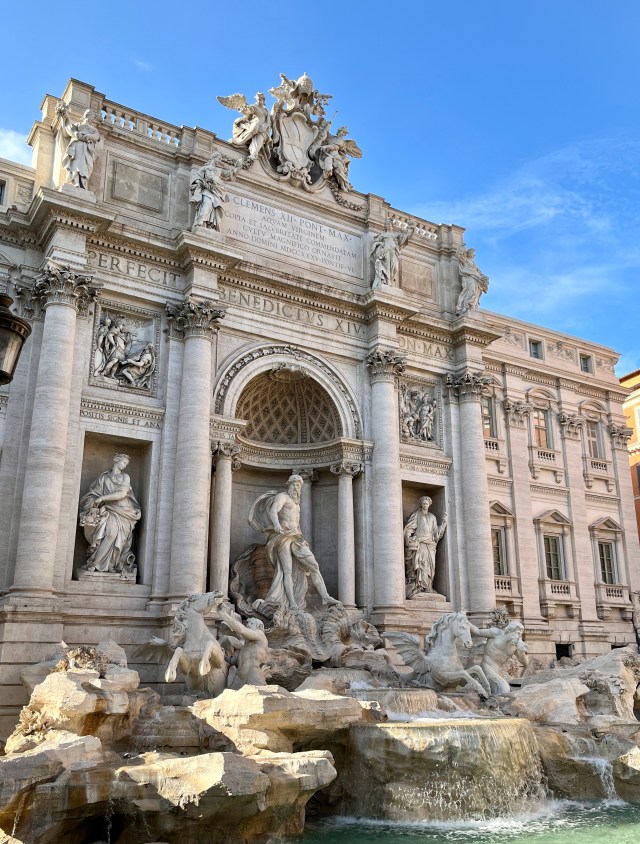
We visited the Trevi Fountain, the largest baroque fountain in Europe and one of the most famous in the world. It was built at the end point of three roads, thus the name Trevi.
The fountain uses one of oldest water sources, once used for Roman baths. In modern day, 2,848,800 gallons of water are recycled daily.
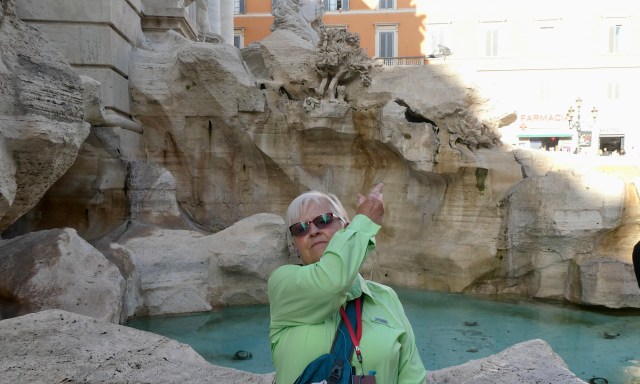
A proper Trevi coin toss is done using your right hand to throw the coin over your left shoulder. Thrown coins are collected daily used for upkeep and charity. The reason to toss a coin is that doing so will bring you back to Roma!
Although we saw most of the major sites, we did missed the Spanish Steps. We’d come again!
At the conclusion of our very long, exhausting, wonderful day in Roma, we still had our group dinner. The food was good, the entertainment was fine but it was just too much. As I wrote earlier, we went to every included and optional excursion and meal on our entire Best of Italy Tour. This is absolutely the only thing we would do differently. We were just too tired to enjoy anything.
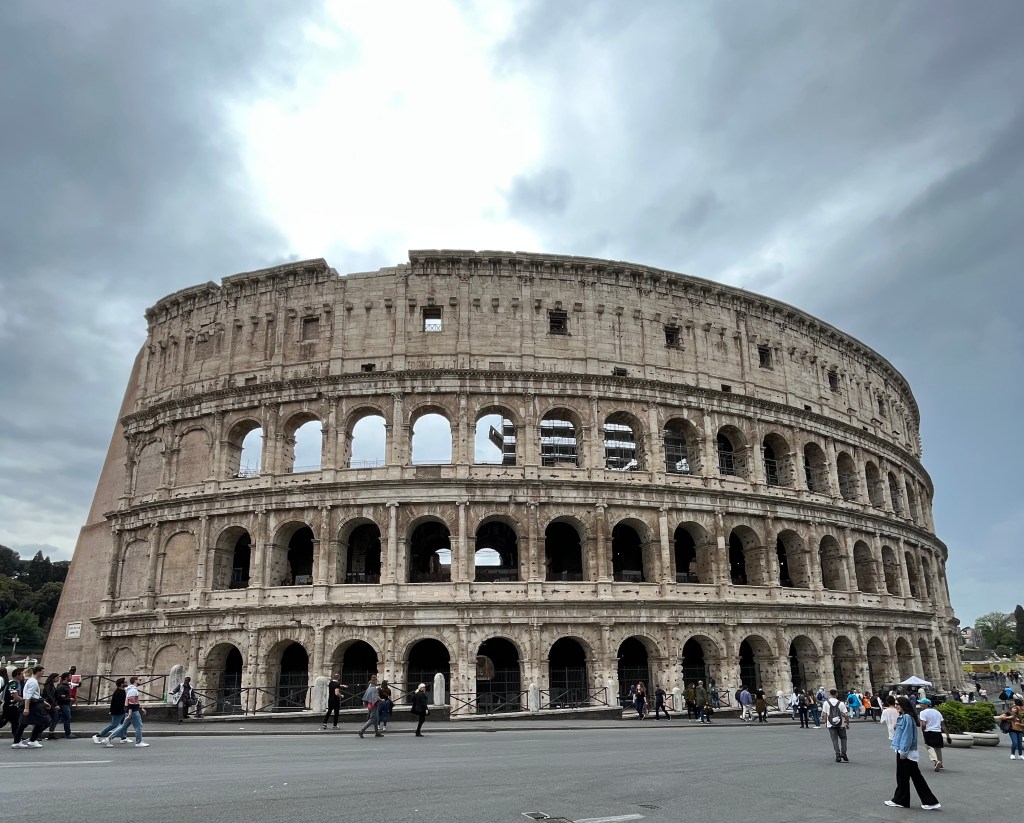
“As long as the Colosseum stands, Rome shall stand; when the Colosseum falls, Rome will fall; when Rome falls, the whole world will fall.” ― Venerable Bede (673 – 753 AD). Bede was an English monk and one of the great scholars of the Anglo-Saxon period.
Emperor Nero had taken over public lands to build his golden castle and lake. After Nero’s suicide in 68 AD, the new emperor, Vespasian, wanted to give those lands back to the people to gain their favor.
Vespasian was the first emperor of the Flavian dynasty followed by his two sons Titus and Domitian.
Master builder Haterius oversaw Vespasian’s Colosseum project which took eight years to complete. Of course, the physical work was done by slaves who made up 30 percent of Rome’s one million persons population.
The lake in front of Nero’s golden castle was filled with dirt for the Colosseum’s foundation. The primary materials used on the structure itself were Roman concrete and six ton blocks of travertine.
Haterius invented and supervised the use of treadmill cranes to raise the blocks into place. That would be like a hamster wheel – only with slaves walking the wheel.
Emperor Vespasian died one year before the Colosseum opened so his oldest son, Emperor Titus, benefited from its completion in 80 AD.
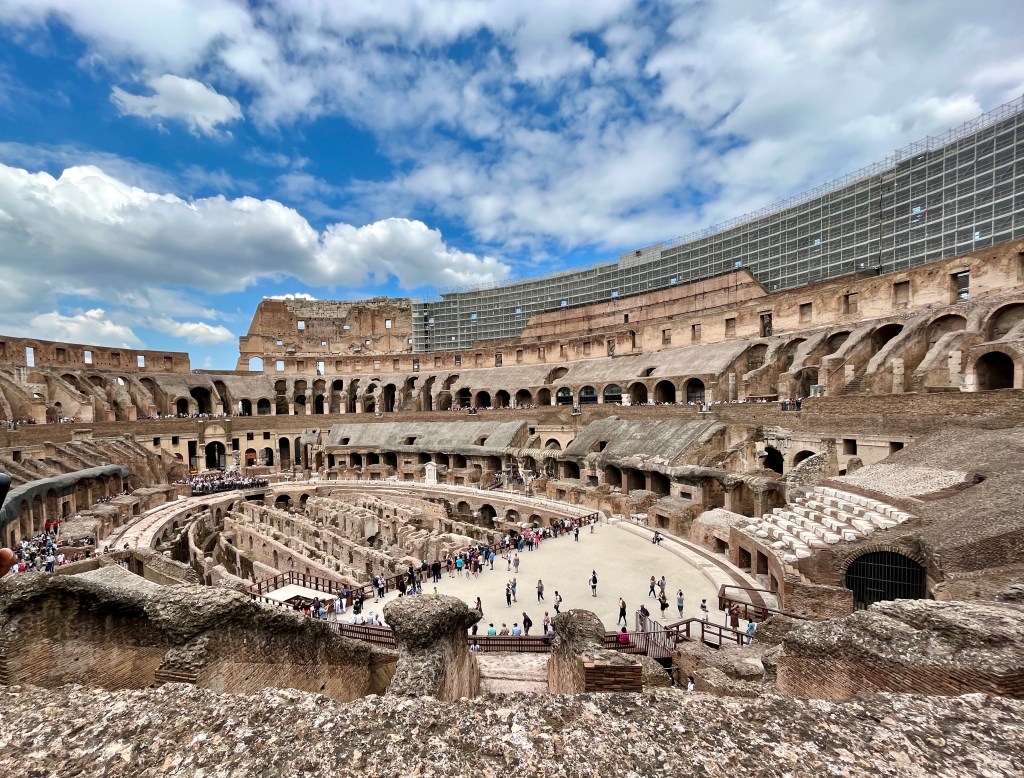
The colosseum had shade mechanisms for the comfort of the 80,000 people who attended events.The arched area in the middle on the lower level right side was for the emperor and his people. The Roman elite and sat closest to field level. Seating was available for 65,000. Women and freed slaves stood in the top levels.
There were latrine facilities for the crowds.
All could depart in 15 minutes because of the many entrances and exits.
The Colosseum was highly ornamented with marble, frescoes and statues.
A remaining marble column. The brick type walls are not original.
These are original marble covered steps.
Very few remnants of the original frescoes remain.
To gain favor, Emperor Titus opened the Colosseum with 100 days of games at the cost of $10 million dollars per day. Each day there were killings of beasts, executions and gladiator battles. (Gladiators were trained slaves who could sometimes earn their freedom.) These were cruel games for the enjoyment of the spectators.
Our local specialist made the point adamantly that Christian martyrdom did not happen in the Colosseum.
Emperor Titus died after two years, from a “fever” – perhaps poisoned by his brother. Where Titus and his father had some sense of responsibility to the people of the Roman empire, the second son, Emperor Domitian, was angry, insecure, narcissistic and cruel. (Domitian is considered one of the worst emperors ever and was assassinated after a 15 year reign.)
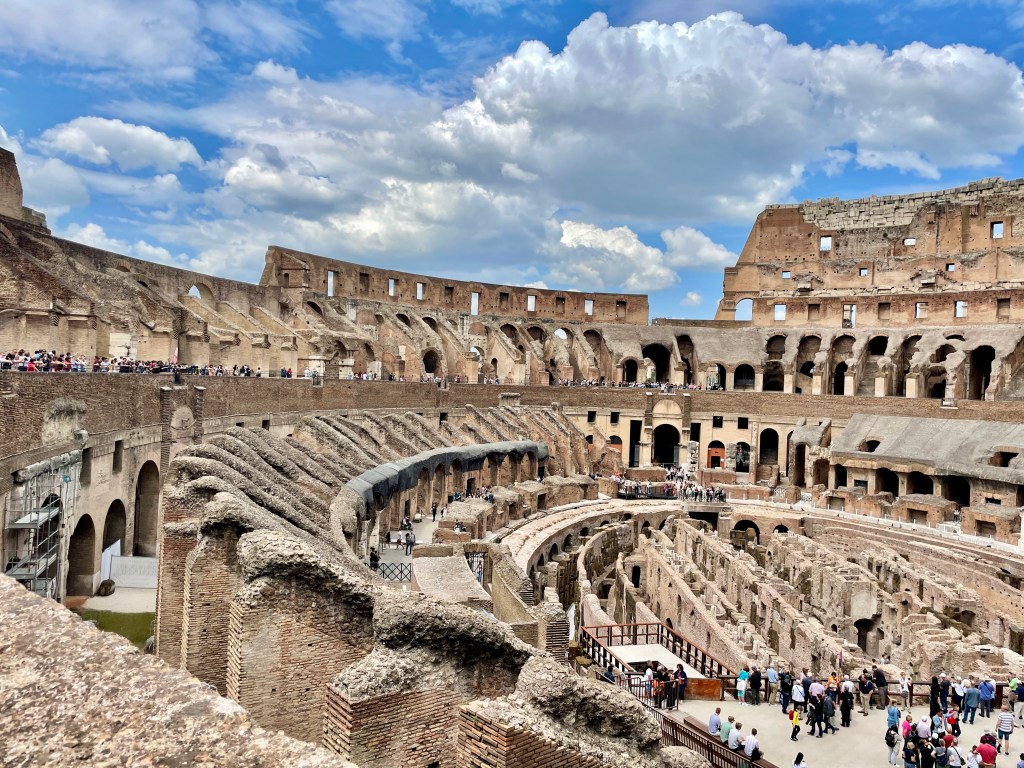
Domitian wanted to outdo his brother’s games so initiated a subterranean labyrinth with elevation systems as a means to have special effects. He wanted to make animals, people and props rise into the show games when needed. He wanted to amaze the people.
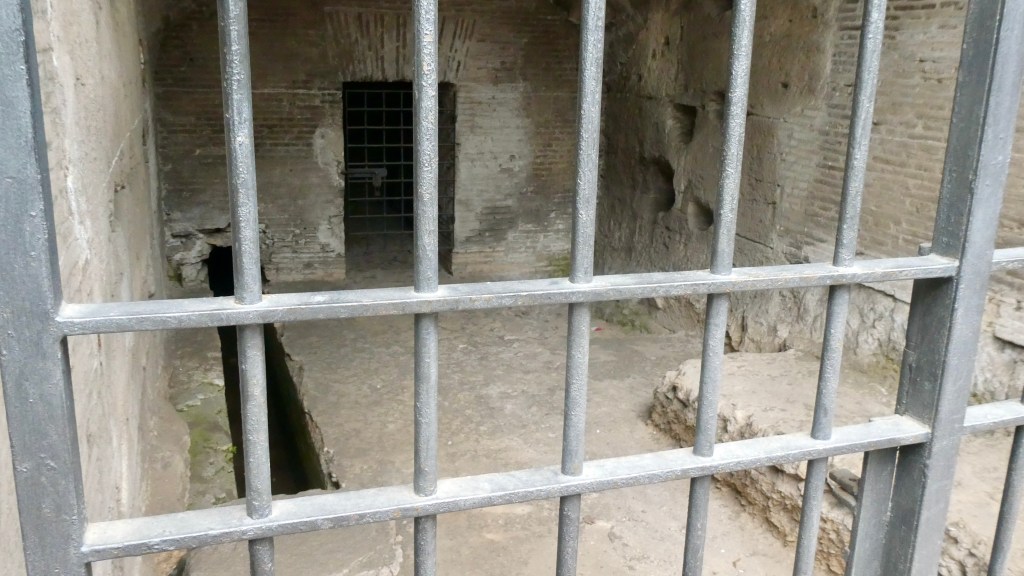
Under severe pressure, master builder Haterius supervised the building of two miles of tunnels on two levels, with cages for beasts and rooms for the gladiators. There were over 30 trap door openings in the colosseum ground to allow for special effects utilizing pulley systems operated by slaves.
Wild animals were brought in from all over their empire to do battle with “beast masters.” (Beast masters were also slaves trained for this purpose.) It is believed that approximately one million animals were killed in the colosseum. The hunt for these animals devastated species in North Africa.
With changing tastes, the games at the Colosseum were discontinued in 404 AD underEmperor Honorius. Executions, however, continued for another century.
The Colosseum went into a period of decay. Many materials were removed for other uses in the 13th and 14th centuries.
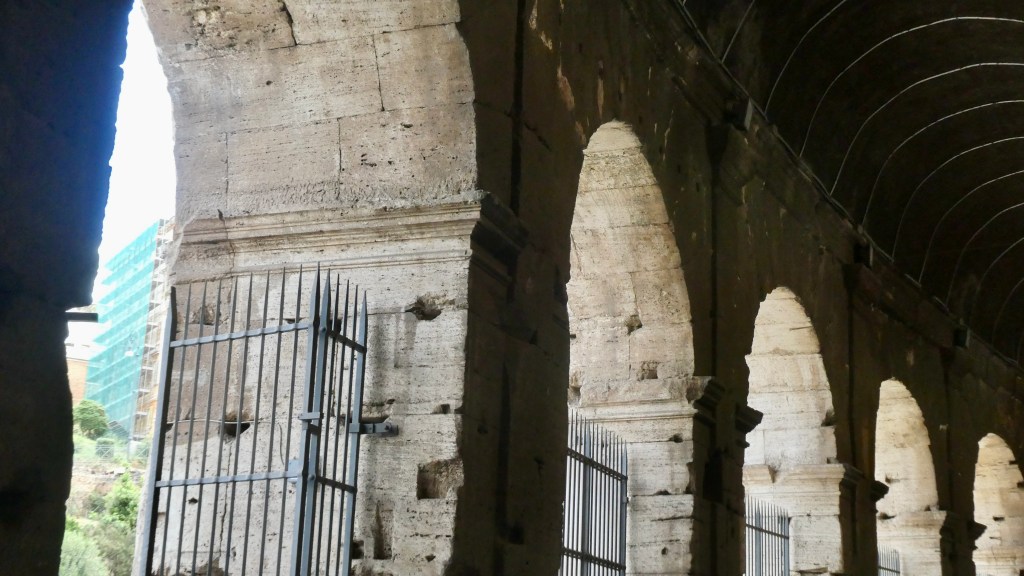
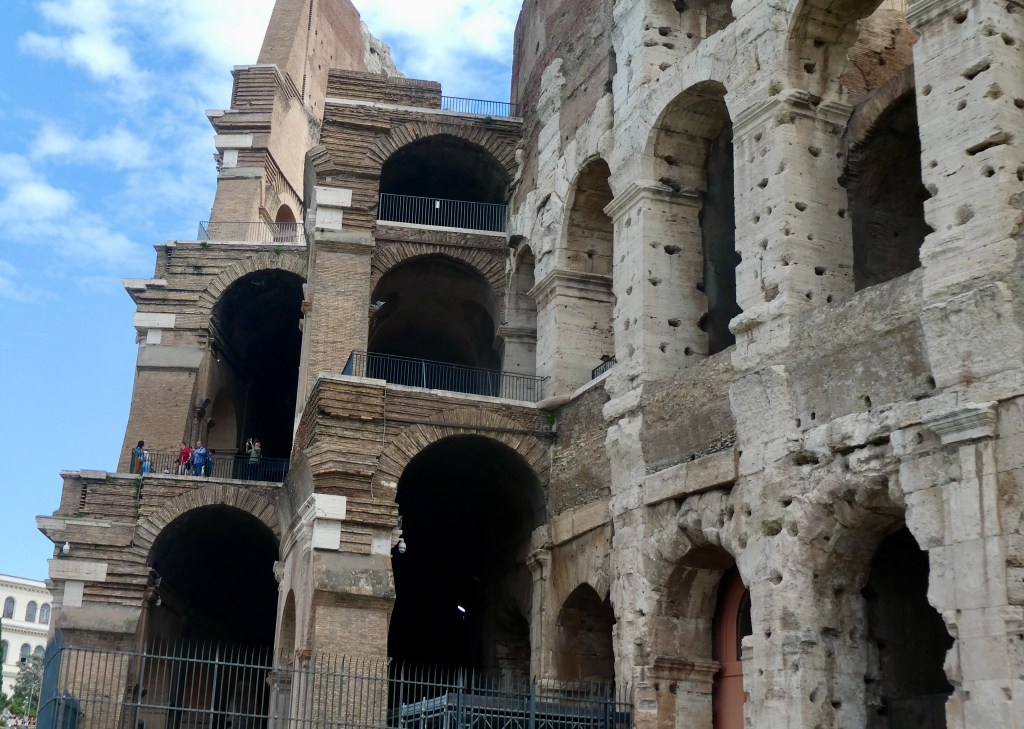
Especially desirable were the nails or clamps of iron poured into the holes between the blocks. The removal of the iron is why we see holes.
A devastating earthquake in 1349 caused the collapse of the south side leaving it much as it looks today. A likely contributing factor was the removal of the nails holding the blocks together.
Only 35 percent of what remains is original and stabilization and conservation work is evident.
In 2007, more than 100,000,000 voters worldwide chose Seven New Wonders of the World. The Colosseum was one of the seven. The others were:
Petra – In our travel queue for 2024
Chickén Itzá – We saw many years ago
Statue of Christ the Redeemer
Machu Picchu – Bucket list!
Taj Mahal – Randy has been there
I guess we have some travel ideas to pursue!
And for those of you who wondered, like I did… What were the Seven Ancient Wonders of the World?
Great Pyramid of Giza, Egypt – the only one remaining
Hanging Gardens of Babylon.
Statue of Zeus at Olympia.
Temple of Artemis at Ephesus.
Mausoleum at Halicarnassus.
Colossus of Rhodes.
Lighthouse of Alexandria.
Next up: We’ll finish our day in Rome, One day = four blog posts!
This was the day we learned the advantage of booking with a guided tour company – in our case, Trafalgar. Someone else was responsible for our transportation to the Vatican, for booking tickets with specific entry times, and knowing when we should go where. We started at the Vatican Museums, went to the Colosseum, and then back to the Vatican for St. Peter’s to make the best use of our time and avoid crowds as much as possible.
Our included tours for this day were the Vatican Museums, Sistine Chapel, St. Peter’s Basilica, and Colosseum. Our optional tours were the Pantheon and Trevi Fountain. We also had an optional group dinner. We did it all! Throughout our whole trip, we did it all!
Not only was our day in Roma very long (16,433 steps) but it would be a novel of a blog post! This post will detail only our time in Vatican City.
Vatican City is the smallest country in the world, a city-state within Rome. It is a monarchy with the pope as head. It was established in 1929 when Mussolini signed Vatican City into existence after the resolution of a dispute between Italy and the Roman Catholic Church.
Vatican City is a UNESCO World Cultural Site but is not a member of the United Nations.
This picture shows a portion of the two mile wall that surrounds the 109 acres of Vatican grounds.
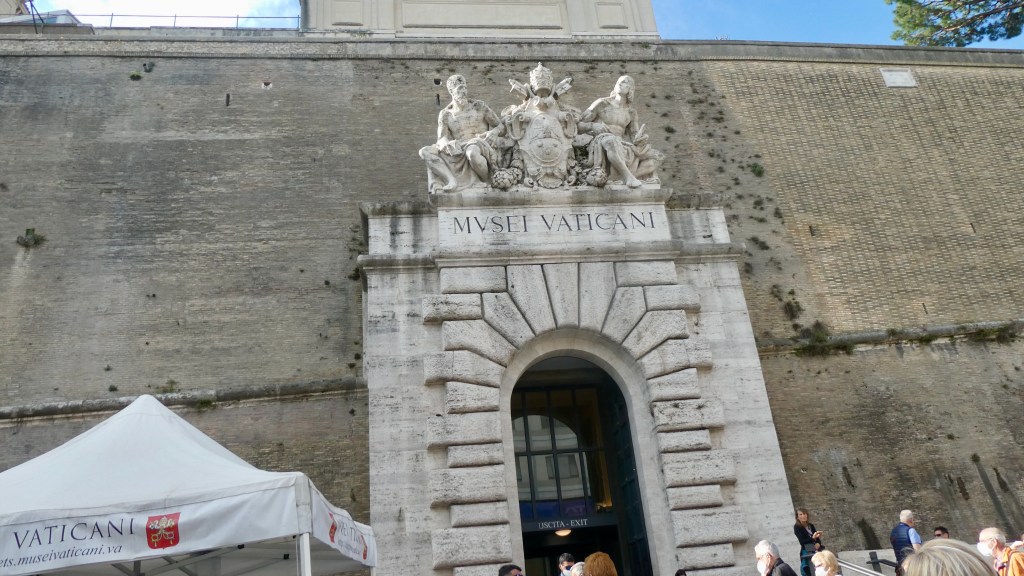
There are gates to enter Vatican property.
In the middle Ages, the Swiss Guard were hired as mercenaries and body guards for monarchy. Pope Julius II hired them in 1506 and the Swiss Guard has served at the Vatican ever since. The only unit of the Swiss Guard remaining is the one at Vatican City.
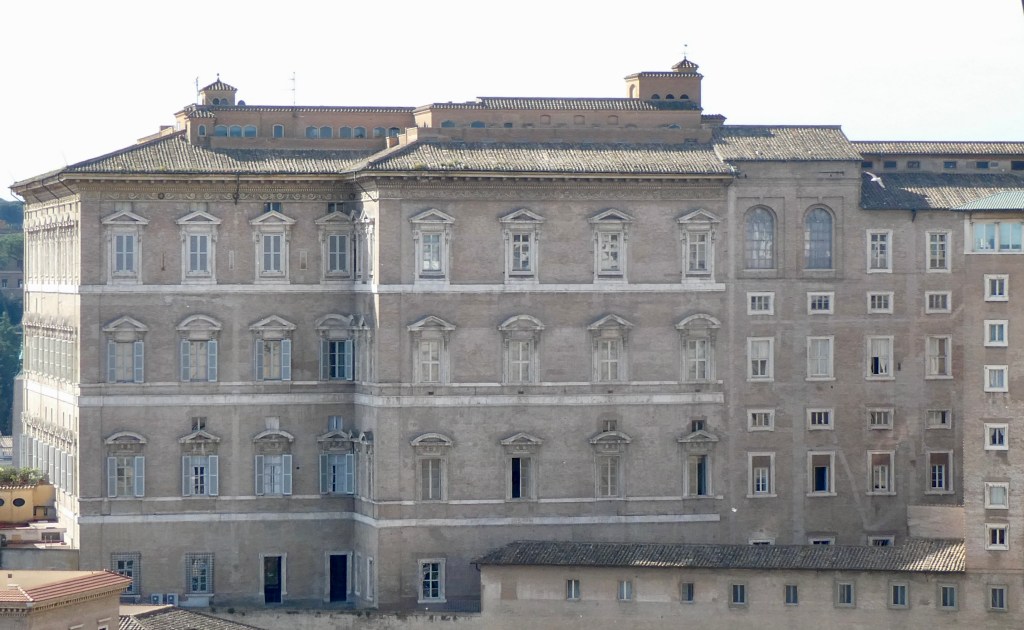
The Vatican is the headquarters of the Roman Catholic Church and is home to the pope. The top row of windows are those of the papal apartment however the current pope, Francis, chooses to live in the more humble clergy quarters.
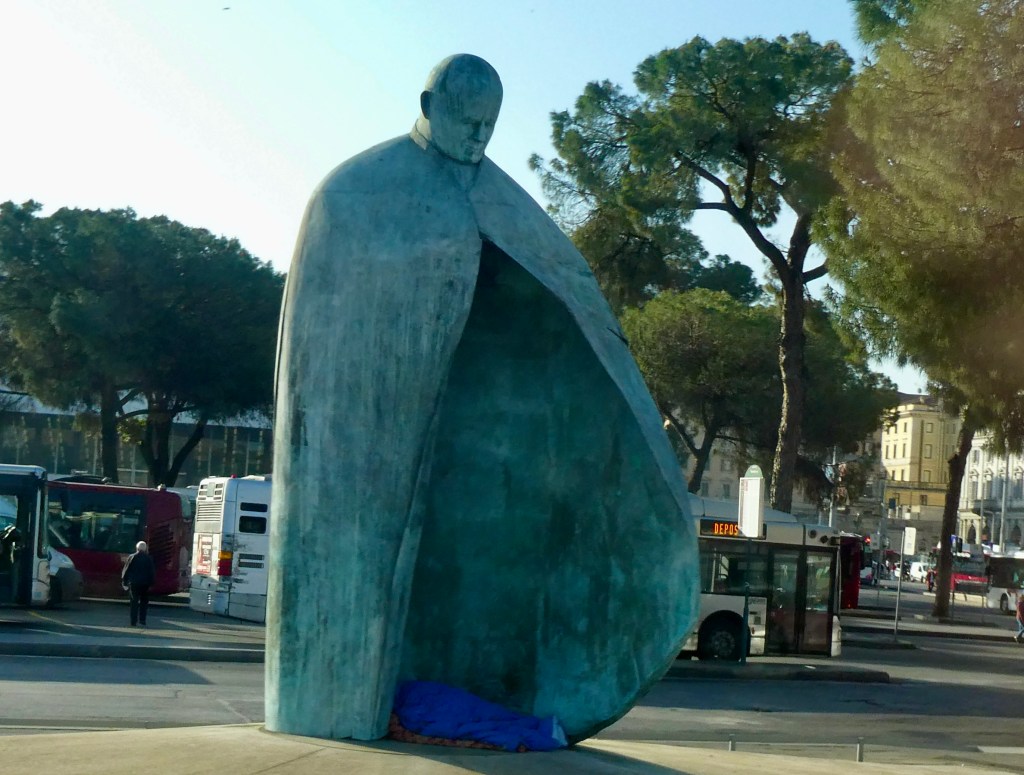
We were told that the citizens of Roma revere Pope John Paul II. This memorial to him is outside the Vatican. Pope Benedict was not favored and the opinion is still out on Pope Francis.
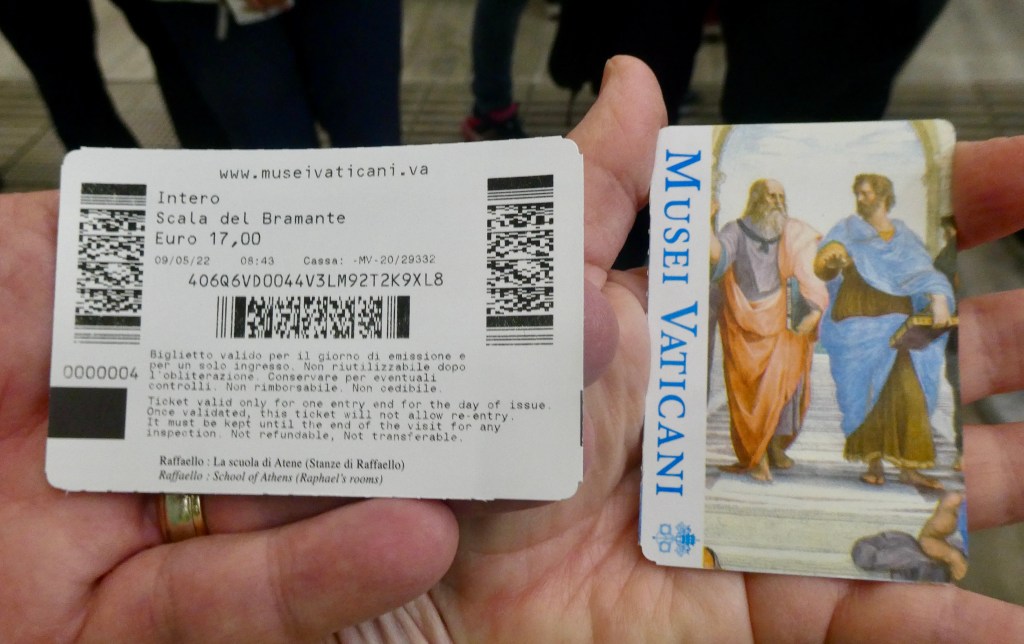
Our day started with a visit to the Vatican Museums. We had timed entry and allowance to visit areas not available to those on a public ticket.
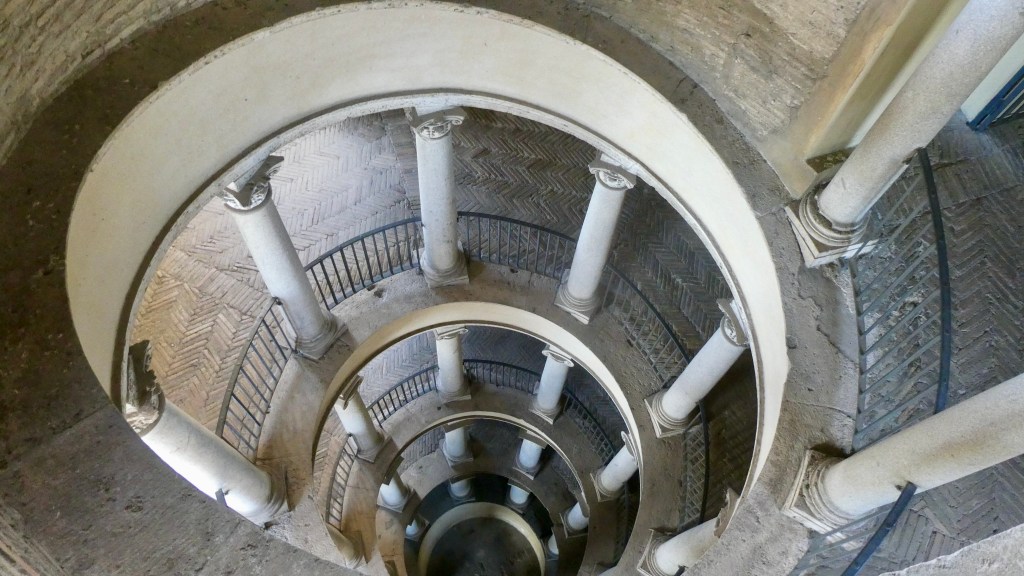
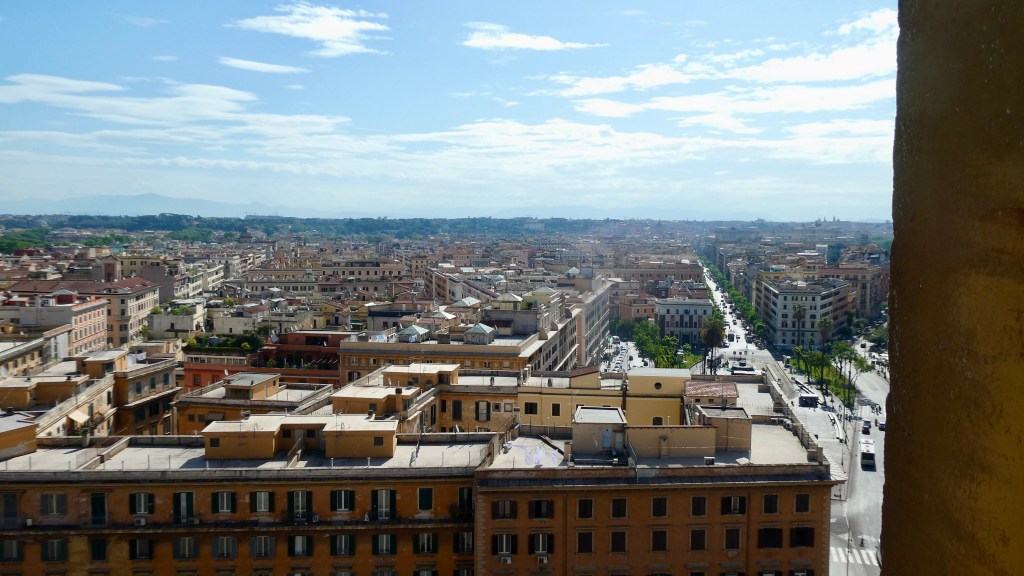
We went up the original Bramante circular staircase, built in 1505. This did not appear to be accessible to most guests. We had a nice view of Roma.
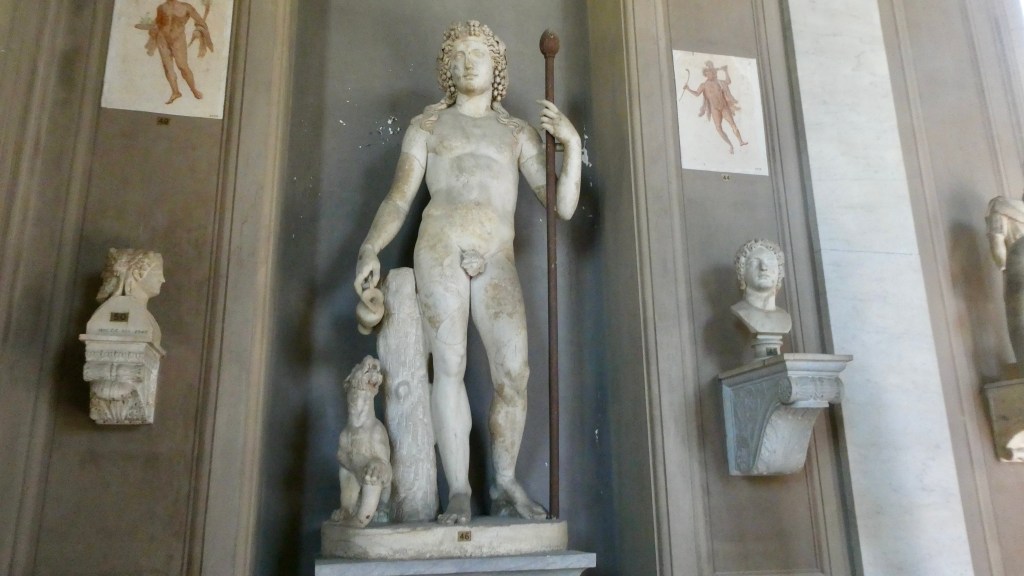
The museums house a vast amount of iconic art, artifacts, and ancient Roman sculptures.
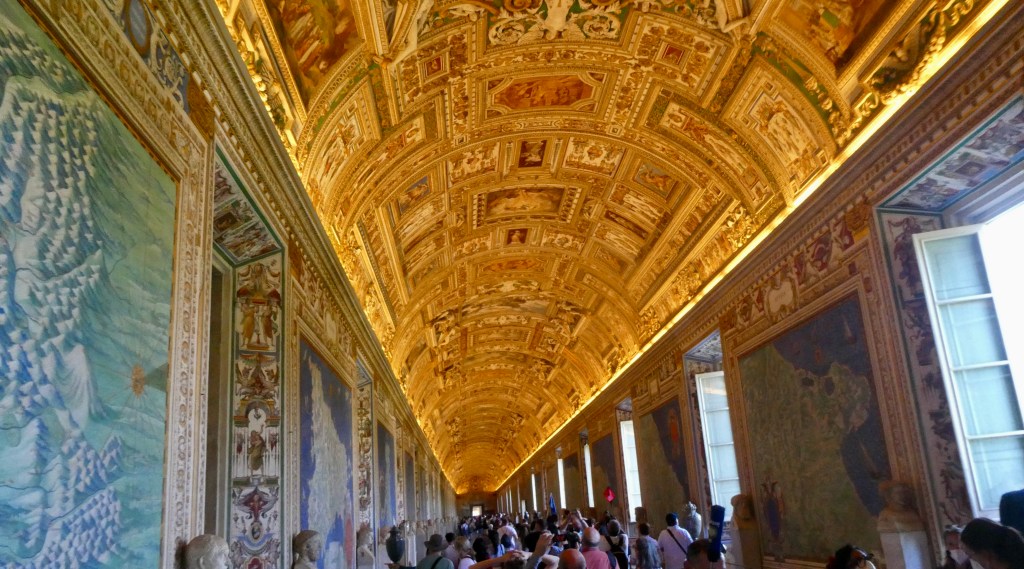
Renaissance frescoes and tapestries line the museum corridors.
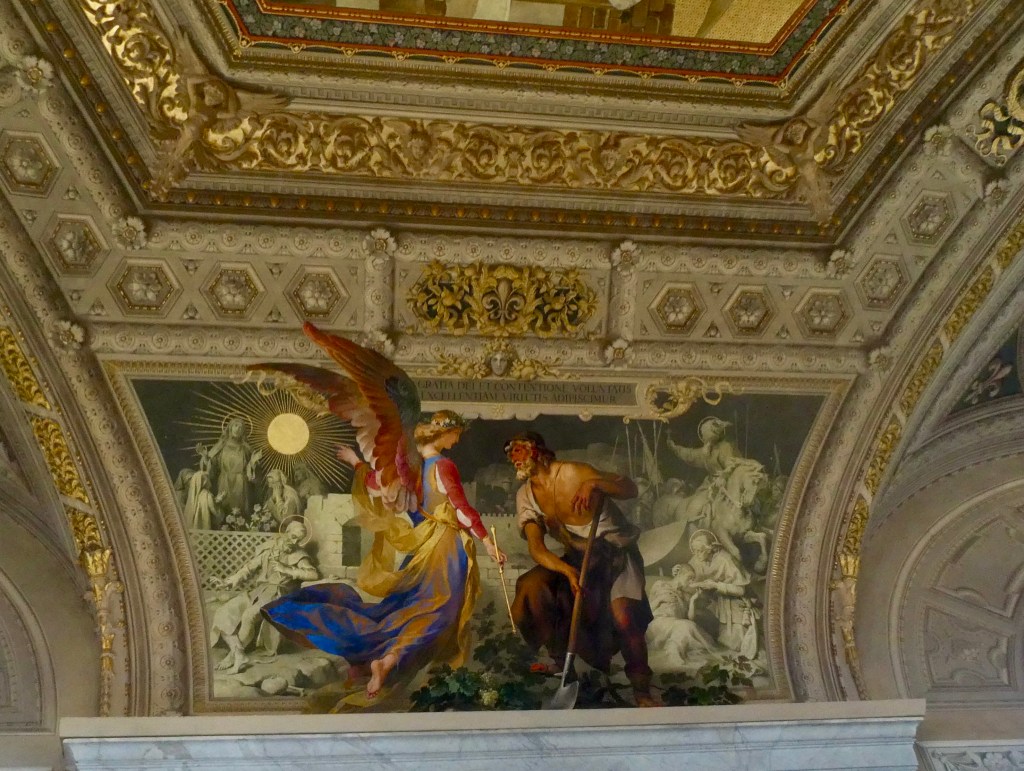
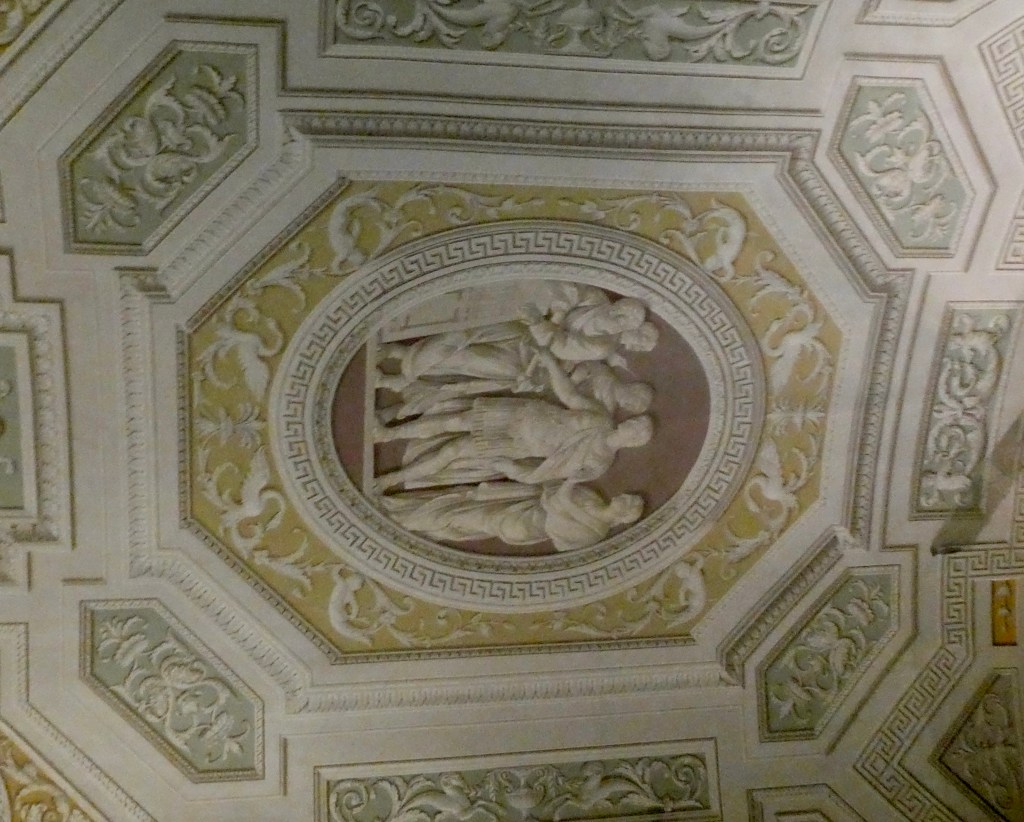
Every ceiling is decorated!
This ceiling is painted, not carved. It is flat surface! The depth the artist was able to simulate is impressive!
A gorgeous hallway in a Vatican Museum!
Papal and church ornamentation displayed.
The newer Bramante’s Staircase, built in 1932, leads you out of the Vatican Museums.
Our morning continued with a timed entry into the Sistine Chapel, famous for Michelangelo’s ceiling. This chapel is also where conclave is held for electing a new pope. Think white or black smoke.
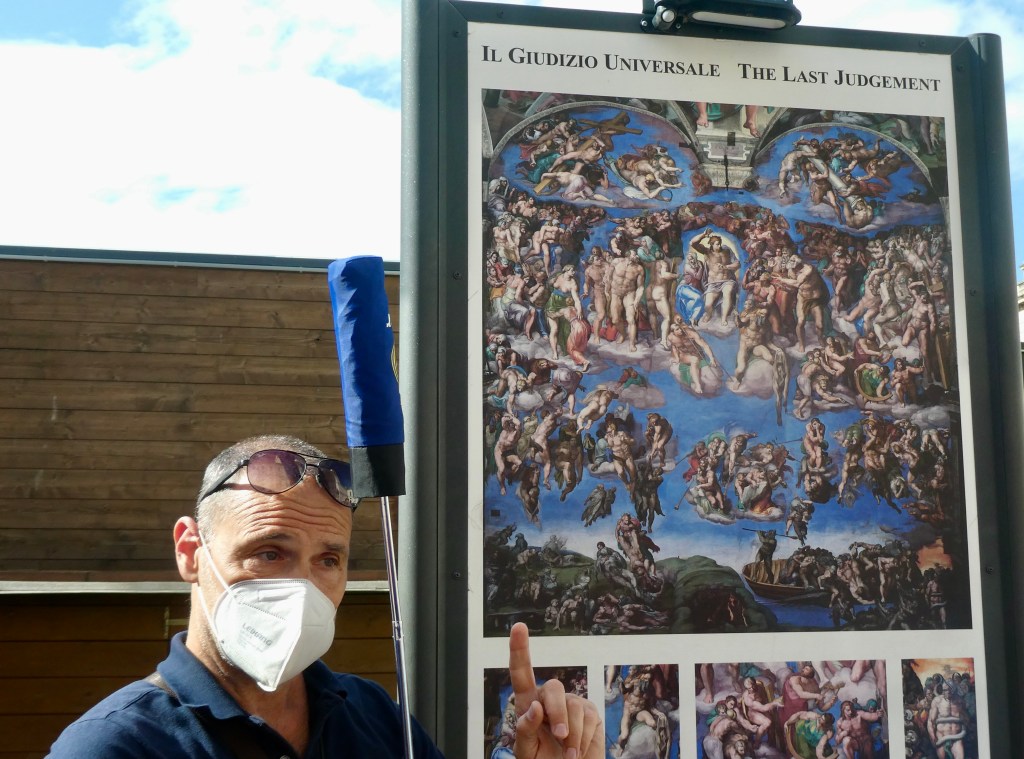
Because silence is required within the chapel, there are placards outside where guides explain what visitors will see. Our tour guide, or local specialist as Trafalgar calls them, was in the family business as both his mother and sister are also guides within the Vatican. He introduced them both as we ebbed and flowed with other groups on the grounds. Each guide has their own flag, umbrella or sign for visitors to follow.
Photography was not allowed in the Sistine Chapel and that rule was enforced vigorously. There are photos on the internet if you want to see inside. It is a small chapel, separated into two sections with limited bench seating around the perimeter. Michelangelo’s ceiling is thought to be one of the most significant works of art in the world.
Michelangelo considered himself a sculptor and did not want to paint the Sistine Chapel. Pope Julius II insisted and offered him a large sculpting commission in addition to payment for the chapel ceiling. Michelangelo spent the years between 1508 and 1512 completing the works and damaging his eye sight in the process.
The Sistine chapel frescoes were cleaned between 1980 and 1994. The restorers purposely left a dirty patch and the difference is stunning. The cleaned art work is very bright and colorful – even decades after cleaning.
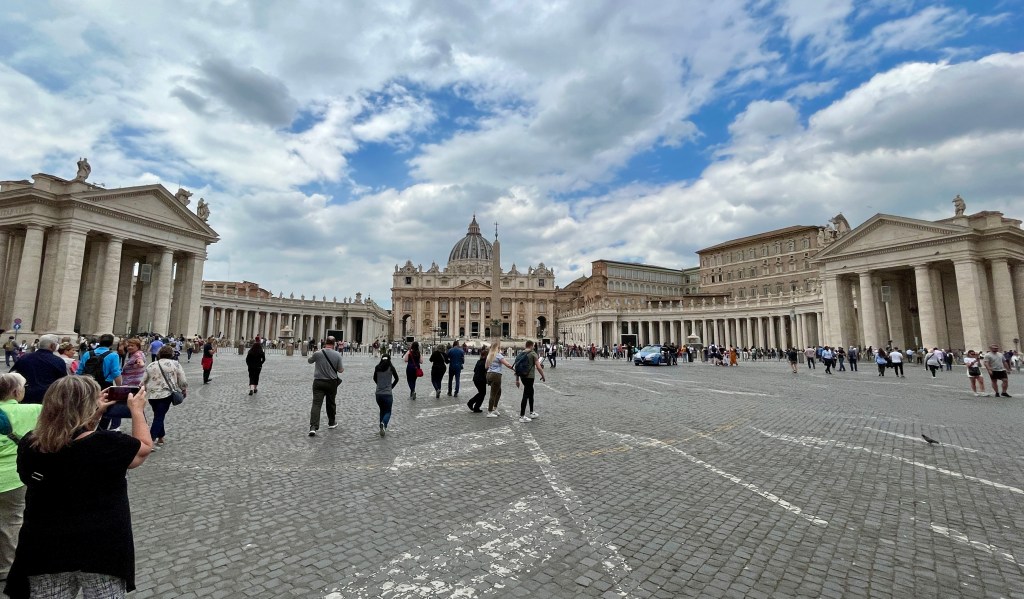
At the far end is St Peter’s Basilica, with the piazza in front bordered by palaces and gardens.
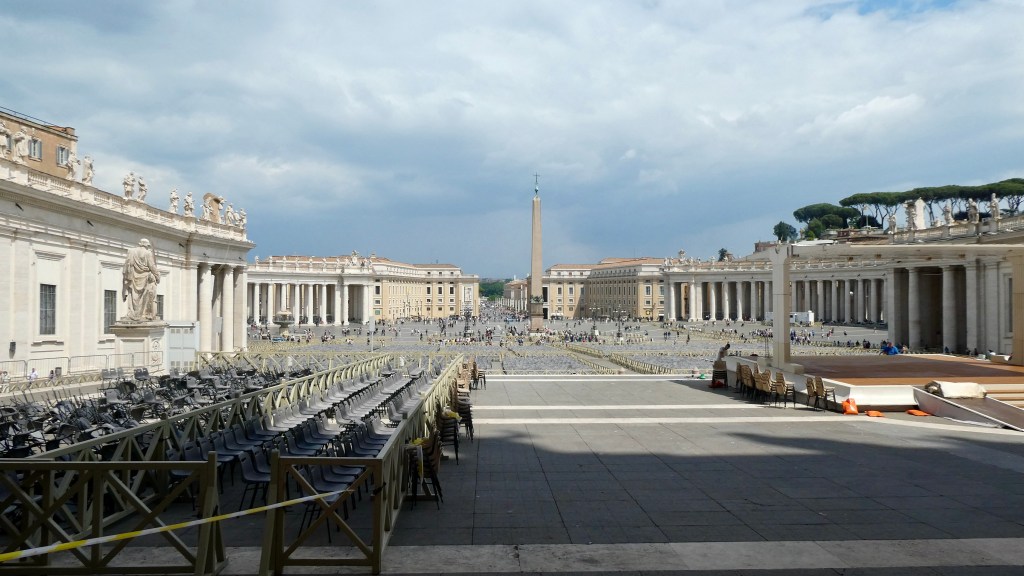
Atop the columns on two sides of the piazza are 140 statues of saints and martyrs.
This is from the basilica looking towards the other end. Notice the obelisk.
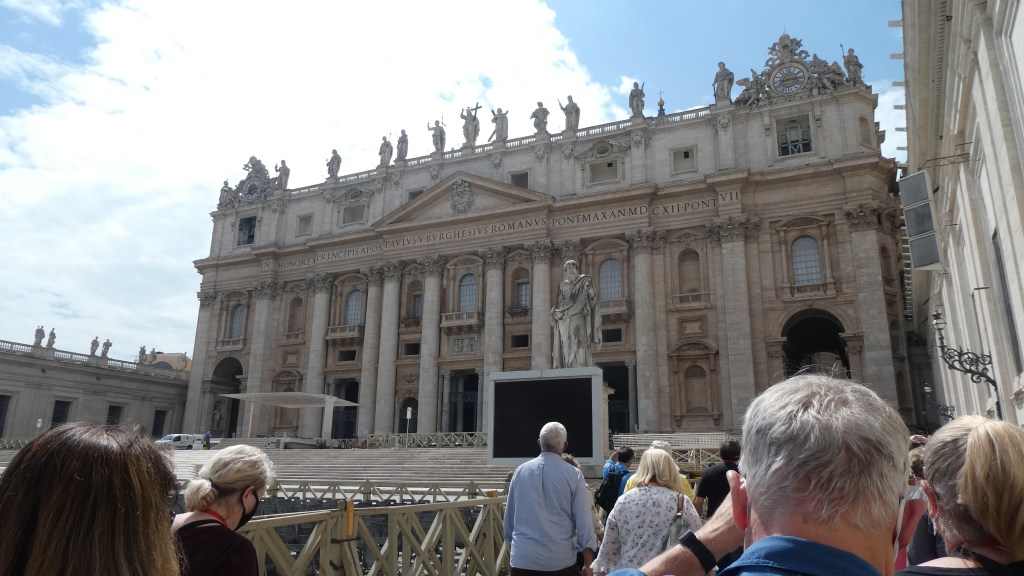
The history of St Peter’s square dates back to the great fire of Rome in 64 AD. Nero accused the Christians of starting the blaze that almost leveled Rome. In retribution he had many Christians killed, including Peter, disciple of Jesus and leader of the Apostles. Peter, first bishop of Rome, and considered to be the first pope, was buried on Vatican Hill with other early Christians.
Four centuries later, Emperor Constantine, offering official recognition to Christianity in Rome, began building a basilica atop the graveyard.
The present basilica, built in the 1500s, sits over a maze of catacombs and St. Peter’s tomb.
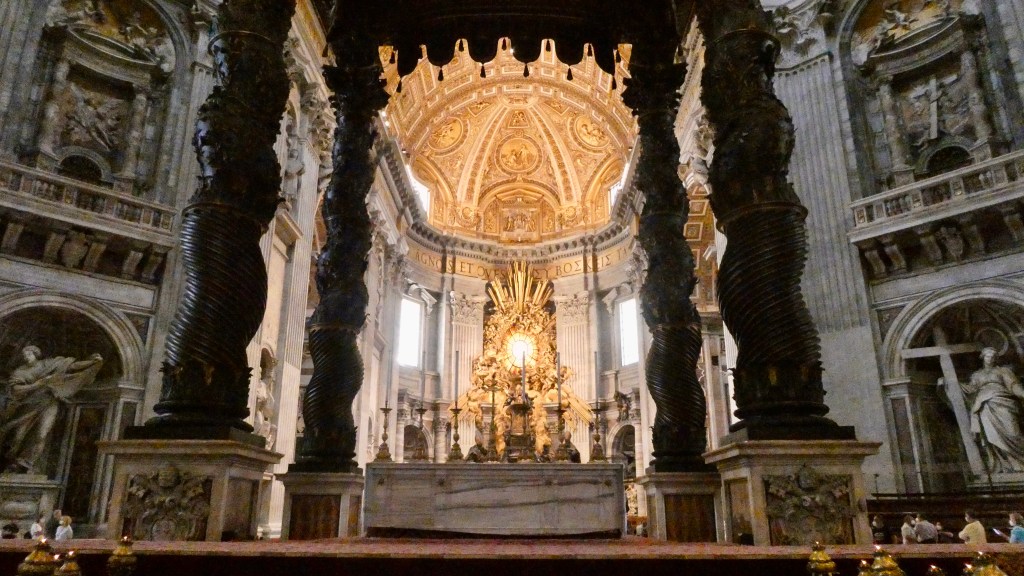
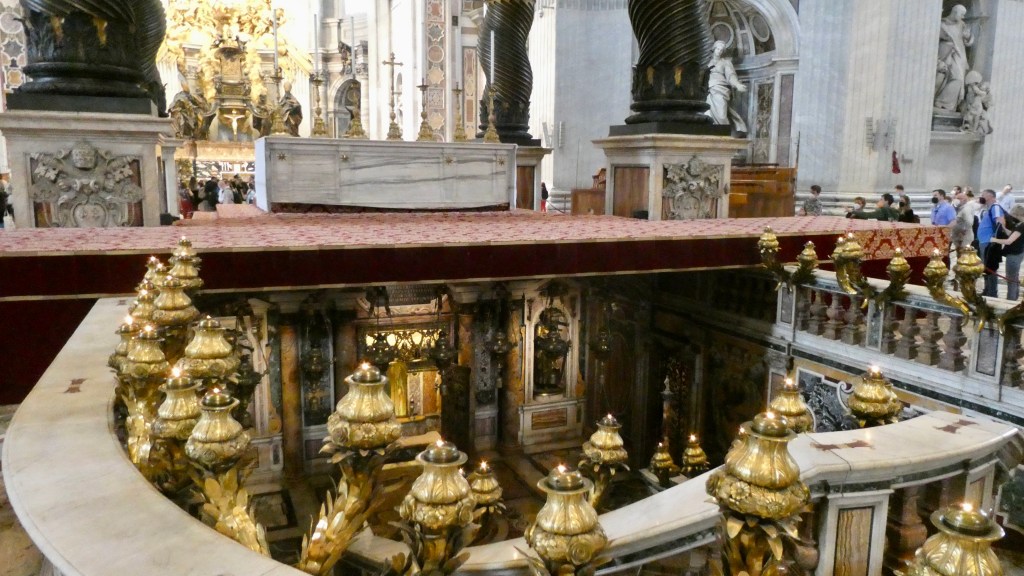
The altar sits directly above St Peter. It is possible to go below to see the tomb, as well as many others, but we did not. Darn.
This is the entrance to the grotto below. There are 90 previous popes and high ranking priests entombed at St. Peters.
The former Queen Kristina of Sweden, who died in 1689, is one of only three women buried here and is in the the tomb next to Pope John Paul II. She abdicated her crown in favor of her cousin Carl Gustav. After converting from Lutheranism to Catholicism, she spent her final years in Rome. The other two women are Countess Mathilda of Tuscany (1046-1115) and Marie Clementina Sobieski of Poland (1702-1735).
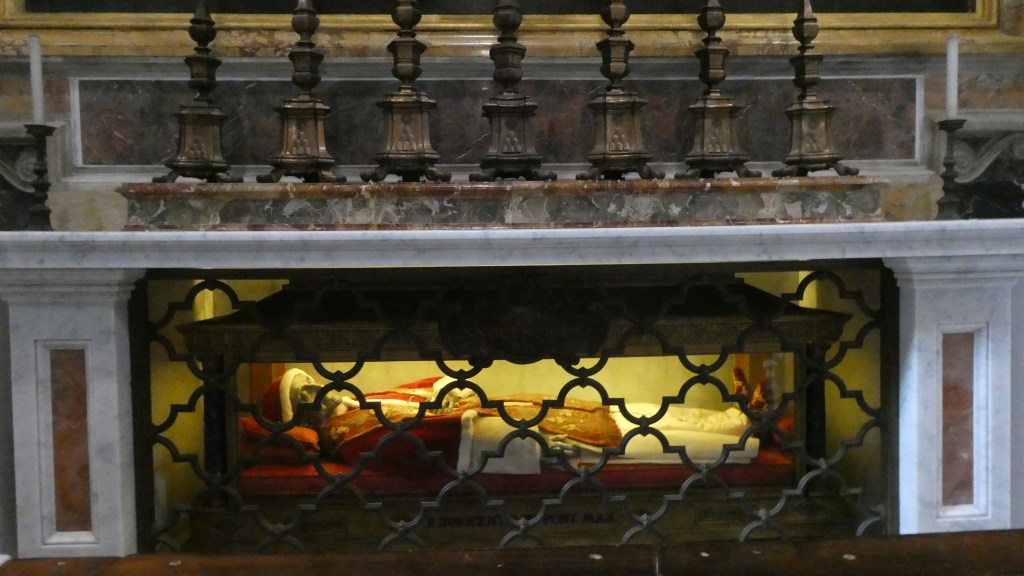
This pope or saint lies in a glass coffin upstairs in the basilica proper. My notes and research failed me for knowing who he was.
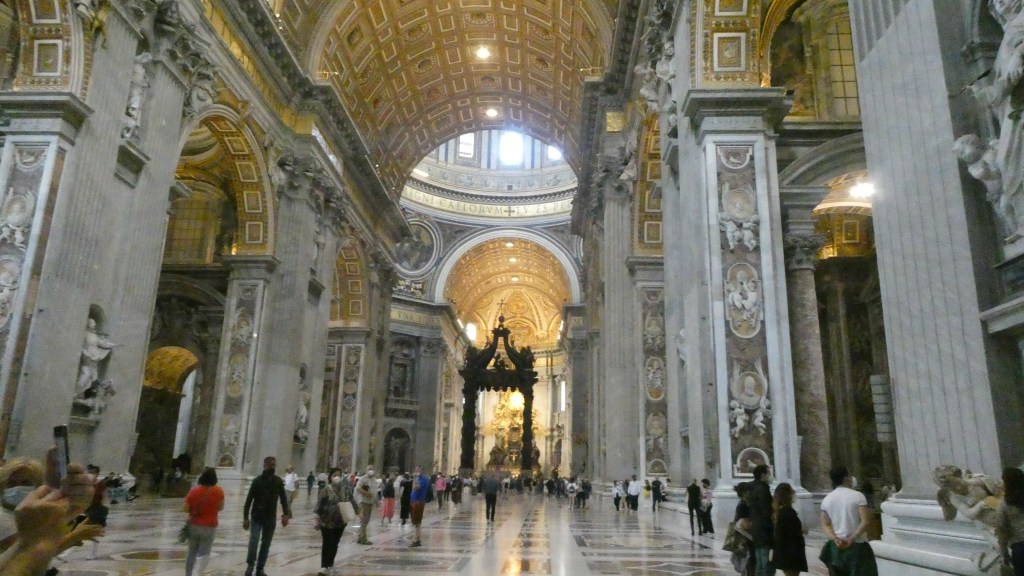
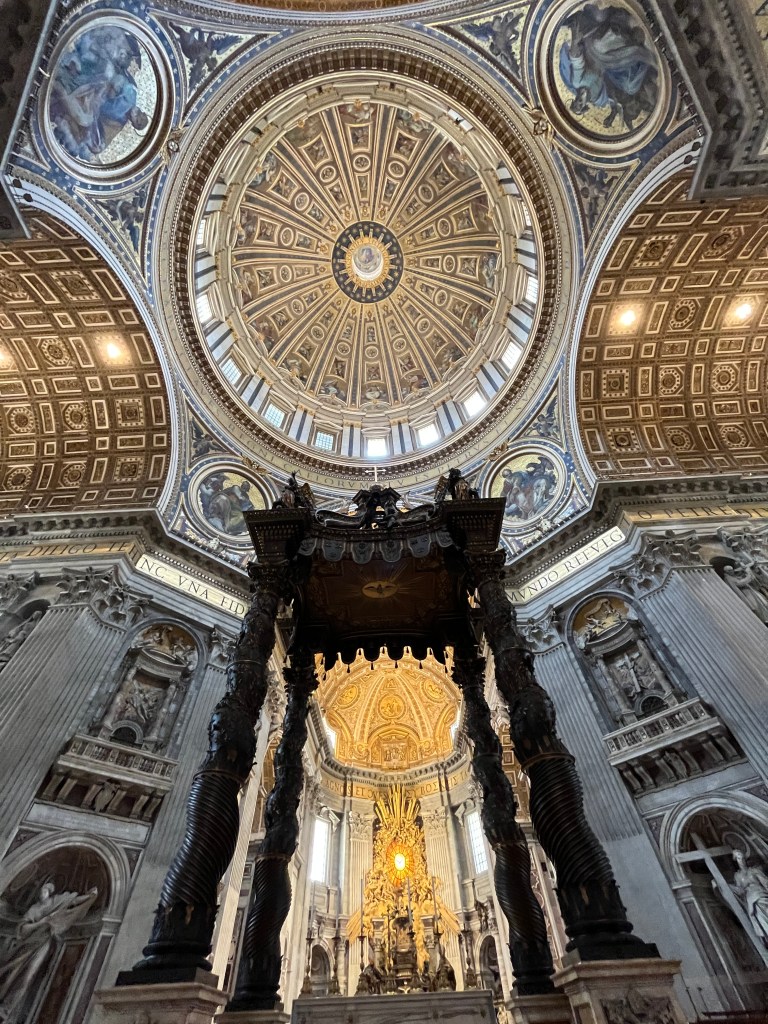
St. Peter’s Basilica is the largest religious building in the world. It was very impressive inside!
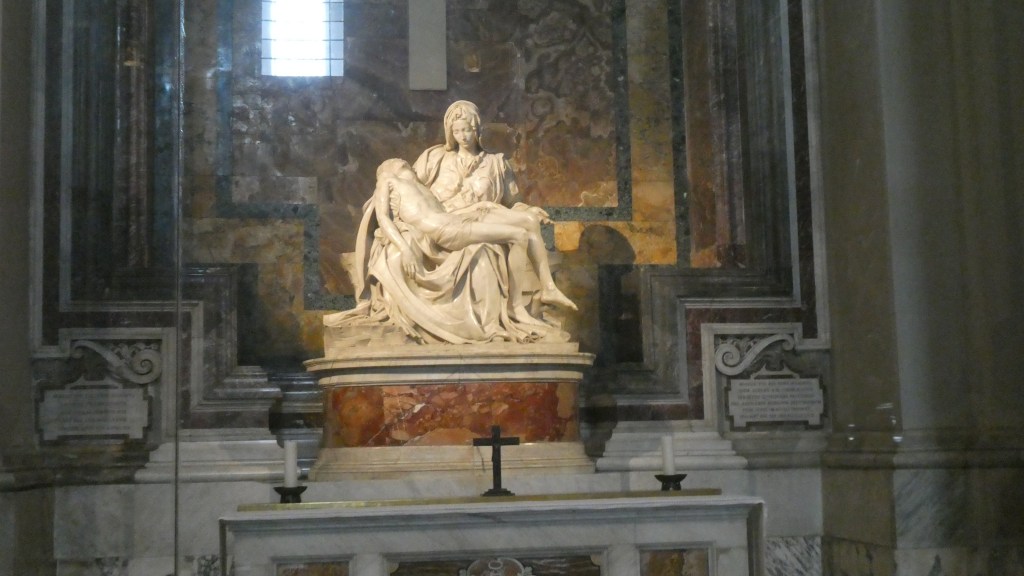
Michelangelo’s Pieta is behind a protective shield. It was vandalized in 1972. Michelangelo sculpted three Pietas. The others are in Florence and Milan.
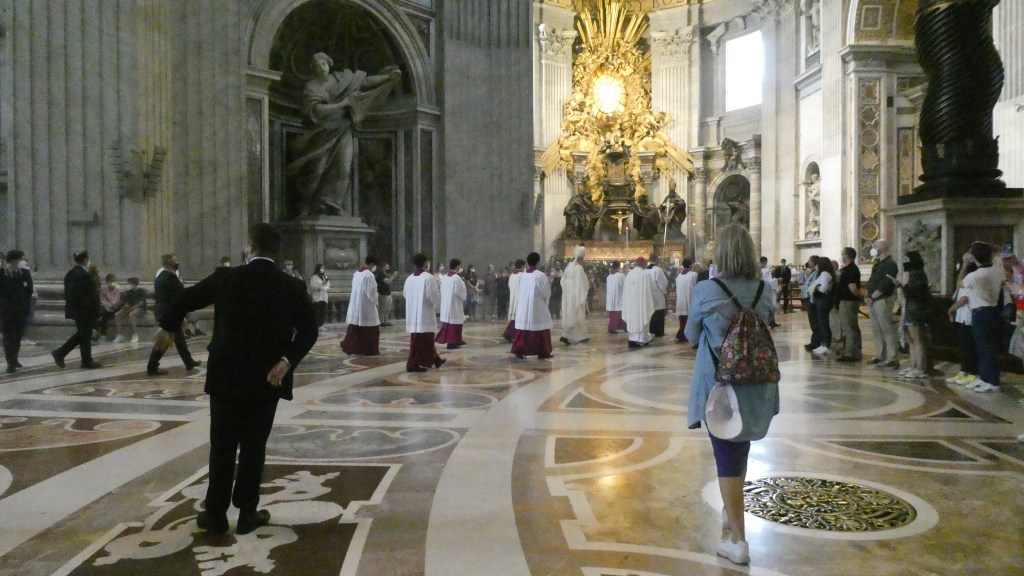
The priests came through quietly.
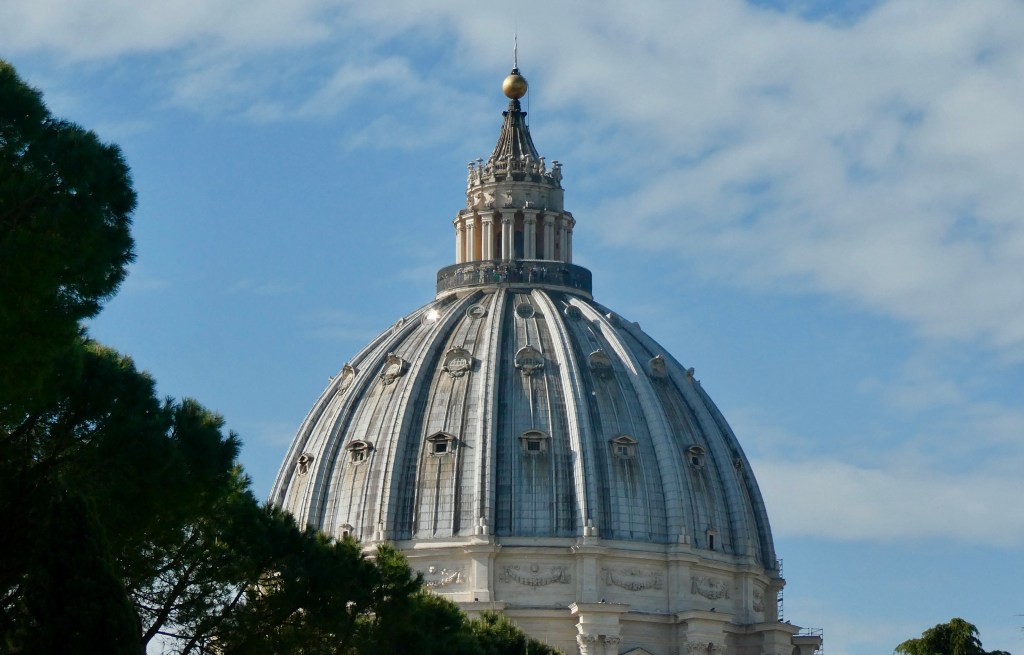
This is the dome of St. Peter’s. It is possible to go up there but we didn’t. Darn again!
The US Capitol dome is modeled after the dome at St. Peter’s.
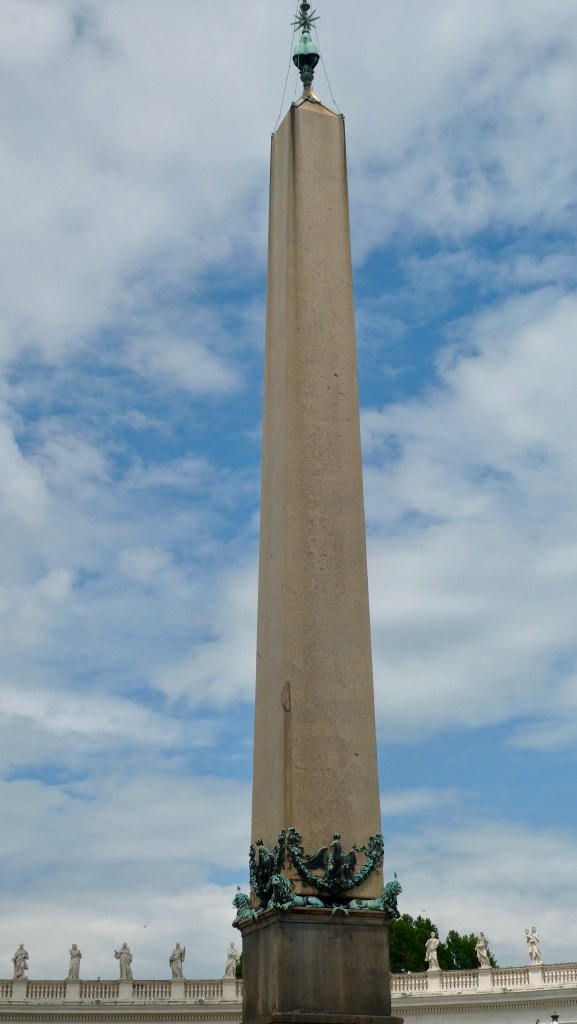
Here is a close up of the obelisk seen earlier. Built over 3000 years ago from a single piece of red granite, the obelisk was brought from Egypt after the Roman conquest. Emperor Caligula (37-41AD) set it up as a jewel in his Roman amphitheater It was moved to St. Peter’s Square in 1586 under the direction of Pope Sixtus V.
The sculpture, Angels Unawares, sits in St. Peter’s Square and was dedicated by Pope Frances in 2019 for the 105th World Day for Migrants and Refugees. The sculptor was Timothy Schmalz. It was very touching and thought provoking.
That was a lot, I know! And it was only about half of our busy day touring Roma! Next time – the Colosseum!